
#discrete-math
1 messages · Page 191 of 1
 subtle charm
I don't quite understand how a R a and a R b -> a R b is shown here. (second line) Since there isn't an arrow from a to b.

 last timber
@subtle charm still need help?
subtle charm
@last timber Yes please!
last timber
ok so yes there is no arrow from a to b
but do both arrows from a to c and c to b exist?
or a to a and a to b
last timber
yes so a R a ^ a R b is false as well as a R c ^ b R c?
subtle charm
ok I think i get it. it is true by default right?
subtle charm
yup, I got it. I kept forgetting about the vacuously true part of implication statements. Thanks for the help!
last timber
yw
 silk hull
subtle charm
silk hull
subtle charm
Can I check if x is an element of an equivalence class S, then S = [x]?
last timber
subtle charm
Can I check if x is an element of an equivalence class S, then S = [x]?
wym
subtle charm
Like if this is true?
last timber
i mean what is definition of equivalence class
subtle charm
[x]∼ ={y∈A: x∼y}.
last timber
so if S is equivalence class and x is in S then S contains elements equivalent to x
now show that if y~x then [y] = [x]
subtle charm
last timber
so if S is equivalence class and x is in S then S contains elements equivalent t...
Is this due to the same component relation?
last timber
it is due to definition
 shut jacinth
i removed vertices {c, d, h} which leaves 4 components left
and by a theorem which states that by removing k vertices s.t. the graph splits into at least k+1 components, you can prove the original graph does not contain a hamiltonian circuit
was wondering if my approach was correct here
shut jacinth
last timber
looks like this graph is semihamiltonian tho
how do u figure
last timber
like there is hamiltonian path (not cycle)
shut jacinth
oops
sorry i want to prove no hamiltonian circuit exists
i should've been more specific
last timber
shut jacinth
and by a theorem which states that by removing k vertices s.t. the graph splits ...
well i do not remember theorem
but i remember something similar to this
so looks like you are indeed on the right path
shut jacinth
sorry for the bad drawing (did it in mspaint)
but this is what G' would look like if i removed {c,d,h} right
which has 4 components
shut jacinth
true
shut jacinth
last timber
you see that graph immediately becomes hamiltonian
does this contradict what im trying to disprove then?
last timber
nah this just indicates what the problem with current graph
j is its bad vertex
but iirc there is no theorem on preserving hamiltonianness after adding removing vertices
shut jacinth
hm i see
i just dont know if this method is rigorous enough lol
i know there's 3 rules most textbooks follows to see if you can build a HC
last timber
well if this theorem is correct it is rigorous enough
shut jacinth
alright, thank you for your help
last timber
yw
shut jacinth
last timber
yw
oh also
couldn't you just say that c-d-j is a subcircuit therefore a HC cannot exist
last timber
idunno
is there such theorem?
it feels wrong
this has subcircuits but is hamiltonian

i guess it just means that you cannot do path like a->b->a if you have c also as vertex
shut jacinth
oh i see
 patent terrace
How to prove that $A(2,n)=2n+3$ for all $n \in \mathbb{N}$ (Ackermann)
 vital dewBOT
ksg
 patent terrace
Hi, I've used induction but I'm stuck on the inductive step
 glossy plover

 stray reef
have you made any progress on this so far?
glossy plover
not really. not sure how to start
is a perfect square like two same integers multiplied
where it is possible to take the square root of that product
stray reef
is a perfect square like two same integers multiplied
if you insist on phrasing it that way, yes
here's a hint: how much do adjacent perfect squares differ by?
perhaps write out the first few to get an idea.
 fresh venture
Can someone help me understand the topic Method of proof?
fresh venture
fresh venture
Can someone help me understand the topic Method of proof?
What kind of questions are related and etc.
 gritty crescent
fresh venture
Can someone help me understand the topic Method of proof?
gritty crescent
fresh venture
Can someone help me understand the topic Method of proof?
You should probably consider reading an introductory book on proofs, or discrete math. You can ask for help here on more specific problems if you're stuck somewhere.
fresh venture
I have a question
Proposition is a statement that can either be true or false right?
It can't be both at the same time
gritty crescent
Depending on your system, it likely should be
gritty crescent

 weary tiger
a ≡ −15 (mod 27) and −26 ≤ a ≤ 0.
Been stuck on this
m | (a - b )
27 | (a - (-15))
How is the answer a = -15
27 | ( -15 - (-15))
27 | 0
weary tiger
stray reef
yeah, 0 is a multiple of 27
So when you do this problem you look at the multples of the mod?
a ≡ 24 (mod 31) and −15 ≤ a ≤ 15.
weary tiger
isnt that undefined
stray reef
do not confuse the statement 27 | 0 with the expression 27/0
"27 | 0" means "27 divides 0", or "0 is divisible by 27"
weary tiger
0 / 27 = 0
im not sure how to get to a = 0
a ≡ 24 (mod 31) and −15 ≤ a ≤ 15.
how would you start a problem like this
(a - 24 ) / 31 = (needs to be an integer not a decimal )
Would guessing and checking through −15 ≤ a ≤ 15 be the wrong way to go about it
stray reef
im not sure how to get to a = 0
but who said anything about a=0...
also no you don't need to guess and check
just go down by 31 from 24
i.e. 24 - 31
weary tiger
stray reef
just go down by 31 from 24
−15 ≤ a ≤ 15 ?
it has to be between those
it's -7
-7 ≡ 24 (mod 31) and −15 ≤ a ≤ 15.
but thats just cause i guessed and checked
stray reef
i.e. 24 - 31
start with what's on the right hand side
if it's too big then subtract 31
if it's too small then add 31
weary tiger
stray reef
if it's too small then add 31
to what
stray reef
......okay evidently i failed to explain it clearly
forget i said anything and let me try again
you want to find $x$ such that $x \equiv c \pmod{m}$ and $A \leq x \leq B$
vital dewBOT
Ann
 stray reef
(we assume the range from A to B has length m so that there's exactly one solution)
ok?
c, m, A and B are known
weary tiger
ok
stray reef
start with c
if c is between A and B then you're done and that's your x
if c is not between A and B then add or subtract a multiple of m to c to put it in your range
whether you add or subtract depends on which side of the range c is on
weary tiger
a ≡ 99 (mod 41) and 100 ≤ a ≤ 140
41 * 1 = 41
41 + 41 = 82
41 | ( 82 - 99 )
41 * 2 = 82
41 + 82 = 123
41 | (123 - 99)
stray reef
you're walking in circles here
weary tiger
yes
vital dewBOT
Ann
 weary tiger
no
stray reef
you were just generating multiples of m and that's it
stray reef
41 | (140-99)
gets u 1
no
41 | (140 - 99) is true by construction
you still seem to think m|n is an operation and not a relation
weary tiger
stray reef
41 | (140 - 99) is **true** by construction
So, it means 41 is divisible by 41.
stray reef
yes
i mean
you got 140 by adding 41 to 99
so of course (41+99)-99 will be divisible by 41
 hallow blaze
is there a set for any number >= 0
 sand cipher
could someone help me with no 1

do i write it down like, if x = 1 then ..... and x = -1 then ....
if x = 2 then the result will be odd since x is even
 faint narwhal
This isn't really going to work, are you going to write out x = 3 and then x = 5 and so on for all the odd numbers?
sand cipher
faint narwhal
This isn't really going to work, are you going to write out x = 3 and then x = 5...
what if it's like if x + 1 is even there exist an integer n such that is x + 1 = 2n
faint narwhal
yeah thats towards the right idea
write out what it means for an integer to be odd or even
and then use those to show what you want
sand cipher
faint narwhal
write out what it means for an integer to be odd or even
so can i just write ( Integers that are not divisible by 2 are odd number while integers that are divisible by 2 are even numbers, therefore if x + 1 is even then there exist an integer n such that is x + 1 = 2n)
and should i provide examples too?
sand cipher
faint narwhal
but what you've written isnt sufficient at all
what should i add more?
faint narwhal
It's not clear why if you take an integer thats not divisible by 2 and add 1 then that number will be divisible by 2
Also, iff means you have to show both directions
Also, I'm pretty doubtful that this is the definition of odd thats used in your book/class
sand cipher
faint narwhal
Also, iff means you have to show both directions
yep just went to check the lecture again and it seems i need two proofs,
so 1 should be let x be an odd integer then x+1 is even
and
2. let x+1 be even then x is odd
faint narwhal
Thats right
sand cipher
faint narwhal
Thats right
ok so definition of odd integer is that if x is odd it can be expressed as x=2m + 1 for n is an integer
and we need to prove that x + 1 = 2n
Manipulate it: x+1 = 2m + 2
x+1 = 2(m+1) where m+1 = n
x+1 = 2n
since sum of 2 integer M + 1 = an integer (n)
 surreal crescent
i dont even know how to start this problem/get anything that resembles the basic rules of inference

 surreal crescent
i think i posted this in the wrong channel i just now saw the proofs and logic one haha
 lavish oar
can someone explain this to me?
 gritty crescent
@lavish oar What have you tried?
What would it mean for a subset B to contain {1,2}? What elements must B necessarily have? What additional elements, if any, can B possibly have?
last timber
@gritty crescent these questions are offensive since as mathematician i find it offensive not to get just the answer directly
fresh venture
In graph theory what are the leaves of tree?
last timber
fresh venture
In graph theory what are the leaves of tree?
nodes that have no childs
fresh venture
Are they those vertex with only 1 edge connected
last timber
e.g tree (a,b), (a,c), (c,d) -- b and d are leaves
last timber
fresh venture
Are they those vertex with only 1 edge connected
yes, but except for the root
fresh venture
last timber
e.g tree (a,b), (a,c), (c,d) -- b and d are leaves
Ok
last timber
in tree (a,b) b is leaf and a is root
fresh venture
last timber
yes, but except for the root
But that root one we can just assume any random, right?
last timber
in directed tree no
fresh venture
last timber
in tree (a,b) b is leaf and a is root
Like can't we say b is root and a is leaf
last timber
in undirected it actually does not matter much and you can choose any node to be root if needed
fresh venture
last timber
in undirected it actually does not matter much and you can choose any node to be...
How does directed one looks like?
last timber
haven't you seen directed graphs?
fresh venture
last timber
haven't you seen directed graphs?
I might have but idt it was specified

 fresh venture
stray reef
what does *what* mean?
fresh venture
stray reef
what does *what* mean?
The one in yellow box
fresh venture
stray reef
is there a word you don't understand?
The whole sentence
stray reef
so you understand every word individually, but the sentence as a whole escapes you. did i get that right?
fresh venture
How does it become eulerian path with zero or 2 vertices with odd degree
stray reef
nothing "becomes" anything.
there exists an euler path in your graph <=> there are only zero or two vertices of odd degree
 pale epoch
indeed
the idea is that you have to leave every vertex you enter (except the starting and end point)
fresh venture
Yeah
What if there is 1 vertex with odd degree and rest all are even?
I am unable to visualise
Ig it's either not possible to have only 1 vertex with odd
pale epoch
well, you will have to end somewhere
and it will have to be at a different vertex
but if that has even degree, you will have to leave it again
which you cant
fresh venture
I see
Thanks
Got it
How do we do this?

Perfect matching is when every vertex is joined with some other right?
stray reef
fresh venture
What if there is 1 vertex with odd degree and rest all are even?
this cannot happen ever
the handshake lemma makes it impossible for such a graph to ever exist
fresh venture
stray reef
this cannot happen ever
Yeah I got it
stray reef
yes a perfect matching is a matching that involves all vertices
fresh venture
So all except 2nd graph is alright?
stray reef
parts of the graphs at the bottom are cut off.
 edgy vine

What exactly is meant with the hint. Can I assume on a infinite walk that it will find v and look at every possible path without repetition? Ans what is meant by direction (one way only like in directed graph? )
 hallow blaze
is there a set for any real numbers >= 0?
gritty crescent
You can denote it with $\bR_{\geq 0}$ or whatever if you like
vital dewBOT
Manan.

 last timber
gritty crescent
Some conventions include 0 in R^+ but I generally avoid that
last timber
gritty crescent
Some conventions include 0 in R^+ but I generally avoid that
just use \overilne{R^+}
gritty crescent

 gritty crescent

 ruby cobalt
how do u give a counterexample for this
 pale epoch
not
 shadow shuttle
ruby cobalt
how do u give a counterexample for this
shadow shuttle
ruby cobalt
how do u give a counterexample for this
it's true so there is no counterexamples 😄
ruby cobalt
what about this
 pale epoch
have you tried anything?
 stray reef
it means the term at position n-1 in your sequence
nothing special
if you wish, $a_{n-1}$ is the term in the sequence right before $a_n$
vital dewBOT
Ann


 elder berry
6 = 3*2 so there is an extra 2 in the product that can be put in 2^(n-2)
vital dewBOT
peaceGiant
 weary tiger
ohh thank you
elder berry
yw
 elder berry
8 . 4^{n-1} = 8 . 4 . 4^{n-2}
After that they factored the 4^{n-2}, it's a common factor for the two numbers
 slate burrow
When we try to prove something in induction, is there a rule for how we should like prove k and k+1? Like i mean, are we suppose to derive k from k+1 or k+1 to k?
weary tiger
elder berry
After that they factored the `4^{n-2}`, it's a common factor for the two numbers
ty 🙏
 pine iris
slate burrow
When we try to prove something in induction, is there a rule for how we should l...
pine iris
slate burrow
When we try to prove something in induction, is there a rule for how we should l...
usually this is the way to go
 slate burrow
we assume p(n) is true then we prove p(n++) so we go from p(n) to p(n+1)?
Having a hard time understanding their explanation
pine iris
yes, you assume p(n) and prove p(n+1)
slate burrow
Alrighty, thank you :)
 outer hinge
I’m really confused. I have a problem that’s telling me to write the truth values for ~p —> q if the statement p —> q is false


 digital quail

 deep portal
its been a while since I took this class so i wanna make sure I remember. so statement
"if S is a square then s is a rectangle. "
negating this statement is: S is a square and s is not a rectangle
right?
 last flicker
yes
 onyx zephyr
When I get a question like this, do I make something like a diagram or write out all the 32 sets? Or is there an easier option?
"Let R be a relation on the set P([0,1,2,3,4]) so that A R B if A is a subset of B U [4]. Decide the properties of R."
Also what does B U [4] stand for in this example? I am so damn confused and stuck.
stray reef
[x] is the equivalence class of x
 calm comet
ive got no idea where to put this but i got an idea that id like to hammer out that has to do with the lucas numbers pascals triangle and f(x,y,n) = x^n + y^n
if anyone would like to discuss this new idea in mathematics voice, @ me
I'd love to iron it out with a second perspective
shadow shuttle
Do you guys know what is the best book for practicing discrete math ? , Tks
 desert edge
can somebody explain to me how A = {a,b} is not a subset of p(A)?
says in my book A is a member of the powerset A
but they both contain the set {a,b}. doesnt that qualify A to be a subset of p(A)?
faint narwhal
A is an element of p(A), not a subset like they say
a and b are not elements of p(A), so you can't say that {a,b} is a subset of p(A)

 cerulean wind
 mystic elbow
- let D represent the number of mismatched pairs of cards, R represent the number of pairs of red cards and B represent the number of pairs of black cards.
there are a total of D red cards in the D pairs of mismatched cards and D black cards in the D pairs of mismatched cards.
there are a total of 2R red cards in the collection of R red pairs and 2B black cards in the collection of B black pairs.
when you add the D red cards to the rest of the 2R red cards, you get 26. make a similar statement about the black cards.
6), a/b is either 0, positive, or negative. if it’s zero, then ur done.
if a/b > 0, then we have either a,b > 0 or a,b < 0
if a/b < 0, then either a > 0 and b < 0 or a < 0 and b > 0
 exotic fog
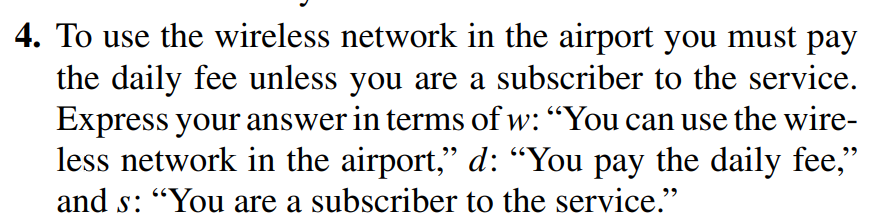
moved my question from #proofs-and-logic because it fits here more
does this translate into ¬s → w & d ?
 mystic elbow
cerulean wind
5) let D represent the number of mismatched pairs of cards, R represent the numb...
mystic elbow
cerulean wind
5) let D represent the number of mismatched pairs of cards, R represent the numb...
Thank you so much for u help but could u also elaborate q 5 I’m not quite understanding sorry
cerulean wind
mystic elbow
Thank you so much for u help but could u also elaborate q 5 I’m not quite unders...
what part r u confused on?
mystic elbow
cerulean wind
what part r u confused on?
The mismatched card part
cerulean wind
so it i have 5 pairs of mismatched cards, it looks something like this
rb
br
br
rb
rb
there are 5 reds and 5 blacks in that collection
mystic elbow
cerulean wind
so it i have 5 pairs of mismatched cards, it looks something like this
rb
br
br...
Ok
But why do u have 3 RB
cerulean wind
it was just a random collection of 5 pairs of mismatched colors
the order doesn’t matter
mystic elbow
Ohhh ok
cerulean wind
D also has to be even.
cerulean wind
u tell me (or at least any idea that you have)
cerulean wind
now what? (we’re super close)
cerulean wind
yea
mystic elbow
cerulean wind
yea
So what would the final value be

 dapper rose
No you assume that A ∩ B ⊄ ℤ
desert edge
can you help me through the steps
i am super new to proofs
but thats what i meant. sorry the terminology is not totally set
dapper rose
Assume for a contradiction that A ∩ B ⊄ ℤ
vital dewBOT
@dapper rose
 dapper rose
Oh wait
vital dewBOT
@dapper rose
 dapper rose
Okay
vital dewBOT
@dapper rose
 desert edge
wish i could tell you
dapper rose
can you see how it follows
desert edge
well yea both set a and b make up for the integer set
is that what you meant?
wait i meant they make up for the positive integers. Which means they are a proper subset
as they dont cover the negatives, right
dapper rose
yeah that's right, just they want you to use contradiction for some reason
desert edge
hm
i dont know enough properties to do anything
ive done 2 proof by contradictions so far but they werent like this
weary tiger
Consider the function f : Z × Z → Z where f(m, n) = |n|. Is this function onto?
why is it NOT onto
f(m,n) = y
m=9 n = -y
|-y|
y = y
desert edge
desert edge
I would still love some help on this if possible
 vale cairn
Suppose the intersection of A and B is not contained in Z
Then there is an element of A and B which is not an integer
Can you show that is a contradiction
weary tiger
-2 = |n|
desert edge
is he talking to you or me
weary tiger
not sure
desert edge
think its me, as mine has to do with proof by contradiction
since its a proof by contradiction, I assume that A ∩ B ⊄ ℤ
then there is an element of A and B which is not an integer hm
∃x A ∩ B ⊈ ℤ
i dont really know what im doing. can you guide me please
vale cairn
Talking to tugge
Well I assume they mean proper subset by that symvol given the hint. suppose intersection of A and B is not a proper Z. Then either A cap B is Z, or A cap B contains an element which is not an integer
desert edge
A cap B meaning?
 cloud cargo
 fallow sable
So on my practice test I have this question, and the given answer is C i just dont really understand why

it help for me to translate this into words: so what I was thinking for the original is "For all X there exists a Y that makes P(x,y) true"
But doesn't c say that "For all X there exists a Y that makes P(X,Y) untrue"?
wouldn't you just need to find one outlier Y that makes P(x,y) untrue
calm comet
i think its asking you to provide a negative of the given statement
which C certainly is
pale epoch
(c) is not the negation of $\forall x \exists y P(x, y)$ ...
vital dewBOT
Lochverstärker
 pale epoch
is there more to this question @fallow sable ?
pale epoch
why?
fallow sable
Well hold on , i guess i need to understand the original statement more. Does it mean that for all X's , there is a Y that makes P(x,y) true, so for any X that you plug in, there is a corresponding Y ?
fallow sable
So wouldn't that mean we need to find an outlier to negate that? So there exists a Y in X that makes P(x,y) false
pale epoch
a Y in X?
fallow sable
what im trying to translate into math is that there is at least one Y for the X's that negates P(x,y)
if that makes sense
pale epoch
ok so the way i would think about this is the following:
your original statement starts with "for all x ..."
so to disprove this, we would have to find a counterexample (this is what you mean by outlier)
fallow sable
yes
pale epoch
so we would have to find an x, such that P(x, y) is always wrong
so whatever y you plug in, this will always be wrong
this is (b)
does this make sense to you?
fallow sable
So B doesn't mean there exists an X for every Y? it means that there exists an X for some Y?
pale epoch
the order of quantification matters
i think of it like a game
so b) here means that i can give you a (specific) x
and no matter which y you try, you will never make P(x, y) true
i.e. for this specific x there does not exist any y that makes P(x, y) true, so this x is a counterexample to the original statement
fallow sable
okay now i see
that makes sense
it was very confusing cause C is the correct answer on the key
i guess the key is wrong
pale epoch
the key is wrong, yes
i suggest telling this to your professor
also if you want to think about this more concretely try P(x, y) as "x > y" and "y < x"
also also i get the wish to translate this into "natural language" but just mechanically negating statements is also super easy and quick
i think of it as pulling the negation symbol inside and every quantifier that it touches gets "flipped"
$\neg(\forall x \exists y P(x, y) \equiv \exists x \neg(\exists y P(x, y)) \equiv \exists x \forall y \neg P(x, y)$
vital dewBOT
Lochverstärker

 shadow grove
I have to prove this.
I tried using De Morgan's Law
Such that

(leftside):
A ^ (-A)^(-B)
Can I use some law of idempotency to turn A AND (-A) into just A?
vale cairn
wdym by 'A AND (-A)' ?
shadow grove
-A = Neg(A)
vale cairn
I don't see what negation has to do with this
shadow grove
I turned them into logic
vale cairn
the notation means to remove elements of B from A
vale cairn
er okay i see what you mean, not standard notation though
You could prove this by showing double containment and arguing that way - I'm not sure how formal you want it
But assuming by -A you mean the complement A^c of A, it should be clear that the intersection of A and A^c is empty
the set of things that are and are not in A
vale cairn
Eh there is a way to do it more directly with De Morgan's law
shadow grove
unless, once again, there is a law, such that I can turn either left side into the right side or vise versa.
vale cairn
Well there is
shadow grove
Which is?
vale cairn
Well could you show me your working thus far?
You seem to have made a slight mistake applying de morgan's law
vale cairn
ok fair enough
But yes, writing the left hand side as A cap (A cap B)^c should get you started
(cap = intersection)
vale cairn
You seem to have used that already using 'negation' right
But I also think it's very important to actually learn the set theory instead of having to port stuff over to logic
i originally thought of it in boolean algebra or equivalent too but it's helpful to do it more directly
shadow grove

I know the set theory, but I have chosen tod o it this way
and I have 2 hours 'till delivery, so I am far beyond point of no return 😄
vale cairn
What does that notation in the first line mean? as that negation seems misplaced

 vale cairn
$a \land \neg(a \land b)$ ig you mean
vital dewBOT
potato
 shadow grove
oh yeah, oops
vale cairn
well anyway, that is not how demorgan's law works like
that is equivalent to $a \land (\neg a \lor \neg b)$
vital dewBOT
potato
 vale cairn
now it's very close to what we wanted
shadow grove
oh
I see
yes omfg
Or, not where to go, but that, that is how you use De Morgan's law
I can use distributivity now, right?
And then I will (I assume) get something ala
(A\wedge\negA)?
vale cairn
yes
shadow grove
Thank you!
vale cairn
$(a \land \neg a) \lor (a \land \neg b)$
shadow grove
Saved my life 😄
vital dewBOT
potato
 vale cairn
np
shadow grove
Yes, exactly waht I meant.
But nonethless, thank yoU 🙂
shadow grove
quick question, how do I do xor in formal logic...?
@vale cairn
We haven't covered this yet, but I feel like I can effectivize some if it by using it
Nvmmm
shadow grove
Is this logically correct?
I.e If the person saying the statement is a liar, then the true statement is the negation of that said statement?

Or am I committing one of the dread fallacies? Can't quite think of which, but something feels off...
But on the other hand, analogously it feels like algebra, where I "multiply by neg" to both sides.
Please tag me, if you have an answer 🙂
<@&286206848099549185>
🙂
cerulean wind
mystic elbow
So what would the final value be
there is no “final value”. you get that
2R + D = 26 = 2B + D
so you have to have R = B. which is what we wanted to show
 rich siren
Can anyone explain what this is asking

I don't understand
For any equivalence relation R on a set T, the fact that for all x in set T, x is an element of the equivalence class of x, because R is symmetric
Is how I translate it in my head, which still makes no sense
pale epoch
which part do you not get?
do you know what an equivalence relation is? what the equivalence class of an element is?
rich siren
[x] = all elements that relate to x in a set right?
shadow grove
Could someone also help me? 🙂
pale epoch
rich siren
[x] = all elements that relate to x in a set right?
yes
so [x] is some set
and for an equivalence relation we have $ x \in [x]$
why?
rich siren
Hm. So is it saying for all equivalence relations on set T, all x in that relation will also be in the equivalence class of [x]?
pale epoch
what does "x in that relation" mean?
rich siren
x in the equivalence relations
of set T
will also be in the equivalence class of [x]
pale epoch
that makes no sense
rich siren
I agree
pale epoch
x is an element of T (which is just a set)
R is an equivalence relation
(its a subset of T x T)
[x] is a subset of T
and x is in [x] (this is true)
this questions essentially asks why its true
(and gives symmetry of the relation as a reason)
rich siren
Ah, ah, ah. Okay I get it I think
so the answer is false
but if it said reflexive, it'd be true
Yes? 🙏
pale epoch
sounds good
shadow grove
pale epoch
sounds good
Could you help me with my problem now?
pale epoch
you can just ask, someone will (probably) help you...
pale epoch
oh that
its a weird question honestly
if "anna is a liar" means lying in that what she said above, its fine
shadow grove
what..
pale epoch
I.e If the person saying the statement is a liar, then the true statement is the negation of that said statement?
this is true if you model your statements with FOL
a statement is false if, and only if, the negation is true
 sharp basin
I just have a question on how to formalize a statement. Here is the given statement "for all integers n, n2 − n + 3 is odd". Is it ok if I restate the statement as shown in the attached image or is it incorrect to say it as stated in the image? Thanks for the help.

But also if my version is incorrect how would I restate it.
 quaint seal

 dry raven

Im having trouble realizing why this is true....
x and y are the set of real numbers
 amber prism
y:=1-x
dry raven
so couldnt I make x any negative and y 0 though?
vital dewBOT
Mosh
 sharp basin
Can anybody help me with my question up top
amber prism
dry raven
so couldnt I make x any negative and y 0 though?
a y just needs to exist
so even if you pick a y that doesnt work, you can just pick a y that does work
like I demonstrated
dry raven
ohhhh that makes sense then
sharp basin
Latex is not to bad you could learn it in a day here is a good tutorial on it https://www.youtube.com/watch?v=Jp0lPj2-DQA&t=394s

► Part II with many more tips and tricks to writing math using LaTeX: https://www.youtube.com/watch?v=-HvRvBjBAvg&ab_channel=Dr.TreforBazett
►Getting started using Overleaf: http://www.overleaf.com (Free browser based editor, no installation)
►A longer intro guide from Overleaf: https://www.overleaf.com/learn/latex/Free_online_introduction_to_La...
amber prism
dry raven
ohhhh that makes sense then
in words what it says is
"For any real number x, there is a real number y such that x+y isnt negative"
weary tiger
hi
amber prism
(in fact there are infinitely many y per x but I digress)
dry raven
ya these problems somewhat confuse me because when I switch the existential and universal then it makes that false.... which makes no sense to me
amber prism
it.. shouldnt
since addition is commutative in R
$\forall y, \exists x (x+y\geq 0)$
vital dewBOT
Mosh
 dry raven

second one was aparently correct
this is why im confused haha
because whats the difference x and y are just variables and are interchangeable in this example which is why I dont understand the logic behind this
weary tiger


 river harness
I have learned new etiquette 😅
mystic elbow
cerulean wind
there is no “final value”. you get that
2R + D = 26 = 2B + D
so you have to ha...
Yes got it that you also for another question no explanation needed?
cerulean wind
mystic elbow
Yes got it that you also for another question no explanation needed?
do u mind rephrasing?
that was hard to understand
mystic elbow
There were 2 questions I sent yesterday right
So another one doesn’t needed any explanation(proving)
@cerulean wind
cerulean wind
mystic elbow
There were 2 questions I sent yesterday right
yes, 5) and 6)
mystic elbow
cerulean wind
yes, 5) and 6)
So for 6 u sent some values so that’s the answer?
That’s it nothing else to add up ya?
cerulean wind
mystic elbow
So for 6 u sent some values so that’s the answer?
yea. 2R + D = 26 = 2B + D
so you get that D is even and B = R
mystic elbow
Ok got it thank you
mystic elbow
cerulean wind
so you get that D is even and B = R
I have one question if u could help
cerulean wind
ok
 cerulean wind
its pretty late where i am. thought they would be a bit less involved. somebody else should be able to help later tho
river harness
Hi everyone, I'm trying to figure out this homework problem where it asks to show that if p and q are distinct rational numbers with p<q then there is a rational number r such that p<r<q
Any thoughts?
pale epoch
think about what you would do geometrically (on the number line)
river harness
So if i wanted to find a number between p and q i could do (q-p)/2
Or (p+q)/2 and that would give me r
Is that what you meant?
pale epoch
not quite, but that's what i mean, yes
mystic elbow
mystic elbow
Can anyone please help <@&286206848099549185>
cerulean wind
river harness
Or (p+q)/2 and that would give me r
this right here is perfect
river harness
Thank you! ☺️
 tacit pumice
Can anyone please help me on predicate logic?😩
There exist an x for all values of y such that x > y for the domain x and y in the negative
G(x, y): x > y
∃x∀yG(x, y)
But I have no idea how to do it for the domain of all real numbers.
 stray reef
"x is negative" can be written as G(0,x) by the way
$\exists x[G(0,x) \land \forall y (G(0,y) \to x=y \lor G(x,y)) ]$
vital dewBOT
Ann
 tacit pumice
That made sense, I'm 99% sure that the answer is correct. But could you pls simplify or elaborate more? I'm slow...
tacit pumice
Can I answer it this way? ∃x∀y(G(0,x) ∧ ((G(0,y)→G(x, y))) or do I have to state that x=y v G(x, y)?
stray reef
well you need to put the forall y
there exists a number x such that:
- x is negative
- for every negative number y, either y equals x or y is less than x
 orchid idol
just found out answer but i will post here again, i was so dumb all this time:
if each column and row has the sum x,
by summing all 5 columns we have total sum of 5x,
by summing all 4 rows we have total sum of 4x
and since we are summing all the squares the same way, we have 5x = 4x, meaning x = 0, which is impossible
shadow grove
I am doing an assignment on logical statements.
The logical statement in natural language is at the top, no more info is given.
I have modelled it, in the case Anne is lying and Anne is telling the truth.
Have i modelled it correct? And am I correct in assuming, that before we can say anything about their truth/liar relation, Anne must be telling the truth. Otherwise, we can say nothing?
 orchid idol
we are summing the same number
 fresh grove
A = {1, 2, 3, 4}
P(A x A) = P({(1, 1), (1, 2), (1, 3), (1, 4), (2, 1)... (4, 4)})
= {{}, {(1, 1)}, {(1, 2)}, ... {(4, 4)}, {{(1, 1)}{(1 , 2)}}, ...}
assuming each relation in P(Ax A) is equally likely to be chosen, the qn is what's the probability that a randomly chosen relation is reflective?
here, i got 4 relations to be reflective, (1, 1), (2, 2), (3, 3), (4, 4)
and the total number of relations in P(Ax A) = 2^16
but my answer isnt one of the options
 celest hazel
Hey I was kinda wondering is there any reason we can’t use the size of sets as the definition of the natural numbers?
Like you define 0 as the size of the empty set. Then you define 1 as the size of a set S such that for all x in S, x=x1 and the size of S is not 0.
And so on
vale cairn
that's remarkably similar to the construction used in ZF for example
celest hazel
Kinda? But there’s several key differences. For example in ZF 4 is an element of 5 whereas this isn’t the case in this method necessarily
vale cairn
agreed
pale epoch
what is the "size of a set" if you don't have access to natural numbers
celest hazel
The empty set is a set such that for all x, x is not an element of S
celest hazel
Well you define 0 as being it’s size
pale epoch
what does size mean
if you define 0 as something else you have to know what that something else is
celest hazel
Can’t I define it as it’s own entity?
pale epoch
no?
vale cairn
I'm also struggling to see how you'd define, say, addition with this
vale cairn
Other than just making it symbolic and saying 1 + 1 = 2 etc in which case calling it the size of the empty set seems sorta irrelevant
celest hazel
You could define addition of natural numbers by saying that if A and B share no elements, then the size of the union of A and B is equal to the size of A + the size of B
pale epoch
then you have to know what size is again ...
like, we say that a set A has cardinality n in N iff there is a bijection between A and n
cerulean wind
0 is defined as a set, as is everything in ZF. is your size a set? it doesn’t seem like it
pale epoch
this notion requires the existence of natural numbers
vale cairn
celest hazel
Hey I was kinda wondering is there any reason we can’t use the size of sets as t...
I suppose this answers your question though lol, it has clear disadvantages ig
celest hazel
I mean ZF definition of numbers is really weird tho. Like 4 is an element of 5 in ZF
But I feel like that should be wrong
vale cairn
why? it allows you to naturally define an order too for example
celest hazel
You can define order in a different way other than saying that 4 is an element of 5
cerulean wind
example?
celest hazel
I could say that |A| “comes right before” |B| iff there exists some set C such that |C|=1, A and C share no elements, and A union C is equal to B.
Where A, B, and C are all sets.
Or smth like that
pale epoch
the order with respect to cardinality of sets is defined by injections/surjections between the sets
they were talking about the natural numbers
celest hazel
Plus a really convenient thing you can do instead is say that |A| is less than or equal to |B| if there exists some C such that the union of A and C equals B.
pale epoch
which in your definition are not sets but "sizes" of sets
celest hazel
Ye my “size of sets” are not themselves sets
pale epoch
for sets its really clear, we have |A| <= |B| iff A injects into B
celest hazel
“Injects” seems a bit more complicated then you’re letting on
Injection is like this massive recursive element you need to do in this case where you need to do stuff like check the elements of your elements
Whereas just defining natural numbers in terms of sizes seems more natural to me? Plus it seems like a convenient extension of the idea of natural numbers as “counting things” where numbers wind up essentially being defined as how many elements are in a set. It’s a cardinal definition essentially
vale cairn
celest hazel
I could say that |A| “comes right before” |B| iff there exists some set C such t...
i don't see anything easier about this compared to saying there is an injection from A to B for example
celest hazel
Wait one of my definitions earlier was a bit wrong. Its actually the case that |A|<=|B| iff there exists C such that |A union C| = |B|.
vale cairn
and how are you defining equality of set sizes?
celest hazel
Well if |A|=n and |B|=n then |A|=|B|.
And I can define what that n is recursively using the way I’ve defined sizes of sets. So like I could then define 2 as being the size of any set S such that if x is an element of S, then x=x1 or x=x2 and x1=/=x2 and the size of S is not 0 or 1.
celest hazel
Ig what’s really going on is that the ZF definition of numbers is defining them as a thing, whereas my definition is kinda closer to describing numbers as a quality.
pale epoch
nothing of this works, because you can't define what the size of a set is
celest hazel
The size is essentially being defined as how many elements are in the set
pale epoch
and how do you define this in the language of sets
and more importantly, without natural numbers
you wanted to define 0 as the size of the empty set, because it has 0 elements?
that is very circular
celest hazel
You don’t need natural numbers to define how many. I can say that a set S has a size of 1 if there exists an x such that x is in S and for all y if y is in S then x=y.
celest hazel
That’s how you define 1. It’s the size of a set with the property given above
pale epoch
and what object is that
you didnt define what size means
only what it means for a set to have size 1
celest hazel
Well that’s bc we’re kinda defining numbers as a quality here not a thing in it of themselves essentially
pale epoch
that just means you arent defining numbers at all
vale cairn
I guess like, what is the real difference between this and just saying
a set S has 5 elements if you can count its elements to be 5
or smth
Like you're only sort of defining it in terms of sets
celest hazel
I mean that’s kinda what I’m saying. Numbers as qualities rather than objects.
pale epoch
whats a quality
and how do i manipulate it
but ok, the cardinality stuff works for finite sets
celest hazel
Ye and I’m just using this to define natural numbers
pale epoch
(and you can define one infinite set)
no, you dont
you only defined what it means for a set to have cardinality n
not what natural numbers are
celest hazel
I guess? Seems like defining “what they are” isn’t as useful then. Since I can just define most things using this idea of “how many”. Since for the most part, numbers are adjectives which is why you can describe so many systems with them
pale epoch
i mean i need numbers for a few things
i want to define a theory of arithmetic on them
which requires addition and multiplication
and i want induction
you can build addition and multiplication maybe, but you will always define it in terms of sets that have cardinality of a natural number
so you are again working with sets, which is essentially what the von neumann construction is
and induction will have the same issue
every time you will talk about a number n you will have to refer to some set of cardinality n
and if you like build the set of natural numbers you will have to consider all sets of finite cardinality and quotient by some equivalence relation
at which point you can just choose unique representatives of each natural number, which is exactly what the von neumann construction is
celest hazel
I mean in reality most of mathematics is adjectives without the noun. Like numbers are adjectives that can be given physical forms if you want to
pale epoch
no
when you use the word number it is very clear what you are referring to
usually some element of a skew field
celest hazel
Maybe I just need to learn more idk
 hallow horizon
celest hazel
Maybe I just need to learn more idk
hallow horizon
celest hazel
Maybe I just need to learn more idk
Same
celest hazel
It just seems that whenever we actually try to think about numbers in any way we turn them into adjectives describing something
pale epoch
i think of numbers as very concrete objects
celest hazel
And then the number is just an abstract way of describing the adjective allowing us to describe all possible things that this number could describe
pale epoch
that sounds like philosophy, not mathematics
celest hazel
I guess?
But I mean numbers are not concrete things by definition they are abstract
pale epoch
they are very concrete
celest hazel
What do you mean by concrete?
celest hazel
Okay what is 1 then? How would you describe 1 to me?
pale epoch
its an element of the natural numbers that behaves in a certain way
celest hazel
What’s a natural number?
pale epoch
an element of a set, the natural numbers
which are the intersection of all inductive sets
or we can concretely define them via the peano axioms in first order logic, model them in ZFC, ...
celest hazel
I think it’s more so that the natural numbers are better as being considered to be homomorphic to the things called natural numbers in ZF
pale epoch
what does that mean
 mild oak
help
 pale epoch
help what
stray reef
"solve this for me please i will actively refuse to put in effort to learn"
pale epoch
this seems very course specific
also don't ping helpers immediately, you are not that important (see #❓how-to-get-help)
 tawdry spindle
pale epoch
tawdry spindle
pale epoch

 velvet pine
I think it depends on what you set 3 and 5 to be
By building all the natural integers, you would start with the first iteration being 0=Card(∅)
Then 1=Card({a})
2=Card({a,b})
...
In that sense, then 3<=5
 foggy cloud
what is a finite set?
I know something like the set A = {r | r is a real number and is less than 2} is infinite but what is a finite set??
thats not like randomly defined like A = {1,2,3}
pale epoch
its a set that has either cardinality 0 or cardinality 1 or ...
alternatively they are characterized by the fact that injective maps are also surjective
maps from the set into itself
foggy cloud
Are there any examples where its not just a randomly defined set?
pale epoch
randomly defined?
foggy cloud
i just saw this and i dont know when I would ever use it

I've never seen a 'finite set' in my class yet
pale epoch
are you taking an analysis class?
foggy cloud
Its a mix between calculus and that
pale epoch
well, finite sets from the pov of analysis are very boring
since you can't really do interesting analysis on them
foggy cloud
oh ok
pale epoch
but in other fields of math, finite sets are studied a lot
velvet pine
A finite set is just a set that has finite number of elements in it
So it's a discrete set if you would prefer
Not a continuous one
foggy cloud
I know but I just haven't seen any non trivial examples lol my bad terrible wording
only time I saw it was in discrete math with some sets like A = {1,2,3,4,5,6} for some discrete math question
velvet pine
Okay so for example
pale epoch
the thing is
if you e.g. consider convergent sequences on finite sets
they are all eventually constant
if you consider finite subsets of real numbers, all the points are isolated
foggy cloud
yea you're right
velvet pine
The set {1/n | n in N*} is infinite
foggy cloud
im dumb thanks
pale epoch
so you cannot do any analysis on them
velvet pine
Since N* is infinite
velvet pine
foggy cloud
im dumb thanks
Concepts in mathematics are always hard to get from scratch
Relatable
Hey a non-trivial finite set would be something like
{x in [0,2pi] | sin(x)=1}
Is a finite set
pale epoch
foggy cloud
only time I saw it was in discrete math with some sets like A = {1,2,3,4,5,6} fo...
if you ever take an abstract algebra class, you will see a lot of more interesting finite sets (finite groups)
velvet pine
Hell yeah
foggy cloud
Oh am taking that next semester
Will it be in artin’s algebra, does it cover the topic you mentioned?
pale epoch
so yeah, a large part of that class will deal with understanding finite groups (and "almost finite" ones)
foggy cloud
(Book used in the class)
pale epoch
yes, artin talks about that
things like symmetry groups of geometric objects (cubes etc) are finite
and have interesting structure worth studying
shadow grove
Term vs variable:
A term can essentially be the specific value of the variable right?
Other than that, it can be a variable itself.
But a variable cannot have a numeric value...?
Or should it analogously be understood as:
variable is a subset of a term...?
Specifically, I am trying to understand A[t/x].
pale epoch
terms and variables are part of FOL, numerical values do not play any role here
every variable is a term
terms are inductively built from variables, constant symbols and function symbols
 celest plover
Trying to prove that m(n+k) = (mn) + (mk) holds for the natural numbers.
I know I need a base case and an inductive step.
I've done the base case:
m(n + 0) = mn = mn + 0
And I'm a little stuck on the inductive step. Pretty sure I have to show that m(n + k + 1) = (mn) + (m(k + 1)). This is what I have so far:
m(n + k + 1) = m(n + S(k)) = m(S(n + k))
pale epoch
apply the definition of multiplication?
pale epoch
you should have a recursive definition of multiplication
like m*0 = 0 and m*S(k) = m + m*k
celest plover
pale epoch
like m\*0 = 0 and m\*S(k) = m + m\*k
wait, sorry for the ping but maybe i actually dont understand

this is what im doing but it i dont think this has to do with what you said
vital dewBOT
ComicallyBad

 solemn fossil
is a|b "a divided by b" or "b divided by a"

so is the bottom line correct? this is from my professor
also may i get help on b? (variables are integers)
 meager prairie
solemn fossil
meager prairie
solemn fossil
what have you tried with b?
solemn fossil
meager prairie
what have you tried with b?
i straight up dont know where to start
amber prism
solemn fossil
also may i get help on b? (variables are integers)
were you able to do a?
solemn fossil
amber prism
were you able to do a?
yup
amber prism
apply similar logic
meager prairie
@solemn fossil use a direct proof
since you know a doesnt divide b, and a doesnt divide c, write out what that means
its nearly identical, like mosh said
well in structure, at least
amber prism
a|b iff b=an, n in Z (assuming I have it right way round)
meager prairie
ill get you started even, $a \nmid b \to b = \alpha a + \beta$, with $b \neq 0$
solemn fossil
This was my proof for a
 solemn fossil
the blue is the proof
solemn fossil
what happened to the texit bot stuff?
solemn fossil
amber prism
you have a|b <=> b=aj, now what's a does *not* divide b?
uhhhh
amber prism
dont overthink it
solemn fossil
b=/= aj?
amber prism
yes
solemn fossil
ohh
amber prism
then it's literally repeat the proof, just with !=
solemn fossil
also what the hell is this

 boreal lark
can someone help me with this?

i need to solve this using only basic proofs that have already been covered
meager prairie
solemn fossil
also what the hell is this
negation, you gotta learn that if you wanna wrangle definitions 😄
google it
or if you have a textbook
shut jacinth
meager prairie
google it
me?
exotic fog
exotic fog
https://imgur.com/PdiHyb7
does this translate into ¬s → w & d ?
anyone knows?
pale epoch
celest plover
wait, sorry for the ping but maybe i actually dont understand
continue at what you had last:
m(S(n + k)) = m + m(n+k), then apply inductive hypothesis and the result is almost what you want
 gritty crescent
@mystic elbow Wait for 15 minutes before pinging helpers, read #❓how-to-get-help . Also, what have you tried/thought so far?
mystic elbow
gritty crescent
<@750639066420215858> Wait for 15 minutes before pinging helpers, read <#4881201...
Ohh ok I’m not very sure how to do it
gritty crescent
For 7.2, try a few rational/irrational values
Same with 7.3 sorta
If I say anything more I'd virtually give away the answer
mystic elbow
Ohh ok
 fresh grove
<@&286206848099549185>
exotic fog
exotic fog
https://imgur.com/PdiHyb7
does this translate into ¬s → w & d ?
<@&286206848099549185> what does "must" mean in logic specifically in this question
 quaint star
exotic fog
https://imgur.com/PdiHyb7
does this translate into ¬s → w & d ?
quaint star
exotic fog
https://imgur.com/PdiHyb7
does this translate into ¬s → w & d ?
No
That would mean if you are not a subscriber then you have to pay the daily fee
Whereas you could just opt not to watch it
You basically have: If A is true then B must be true. So it just means the same as A implies B.
In this case I would write it as:
w -> d or s.
But if you want to start with the s you could say:
(not s) -> (not w) or d
stray reef
@weary tiger do you still need help with this
consider the game for small values of N
N=2, N=3, etc.
keep going. keep extrapolating
make a table
for each value of N specify whether you win or lose
see if you spot any patterns
that... looks wrong to me
one moment
oh nevermind
yes this is correct it looks like
wait but
3 is a winning position isn't it
you give 2 and now your opponent has 2 and he loses
and you win
pen and paper lol
the losing positions form a sequence $L_k$ that obeys the recurrence $$L_{k+1}=2L_k+1$$
vital dewBOT
Ann
 stray reef
you seem to have identified that
but the first losing position is 2 not 3
3 is a win for you
2 is a loss for you
the winning positions are all those that aren't losing positions
the losing positions are 2, 5, 11, 23, 47, ...
you do not
the opponent will give you 11 and you will lose
from 11, whatever your move is, your opponent will be able to cut it down to 5
the winning strategy is to place your opponent in the closest losing position below the current
i'm here but also kinda not here
i think you misunderstand me
you claim that if N=15, we play against each other, and i go first, then you will win.
is that the case?
yes or no
then what were you saying
ah.
okay, and what's your opening move?
the piece is 15 and it's you to move.
consider me as the opponent.
okay, so now it's 8 with me to move?
i split it into 5 and 3 and hand you the 5.
your move?
i split into 2 and 1, you get 2.
no, i get 1 and i win.
the person who receives the 1 wins.
the losing positions are 3*2^k - 1 for k = 0, 1, 2, ...
when not on a losing position, the winning move is to cut down to the biggest losing position possible.
when on a losing position you are screwed no matter what you do.
stray reef
stray reef
the losing positions form a sequence $L_k$ that obeys the recurrence $$L_{k+1}=2...
it's the solution of this recurrence with L_0 = 2
...idk honestly
stray reef
stray reef
when not on a losing position, the winning move is to cut down to the biggest lo...
here
i described the winning strat here
i have class now
this tells us how to win when we can win
the assumption is that it's us to move
celest plover
pale epoch
continue at what you had last:
m(S(n + k)) = m + m(n+k), then apply inductive hy...
k think i got it now, thanks!
stray reef
yes that was exactly my point
 tribal zenith

did i draw my hasse diagram correctly?
this is for the divisibility relation, for some reason my notes say this diagram shape is not allowed, so i added the numbers to show a counterexample
stray reef
@tribal zenith you missed 6
tribal zenith
stray reef
<@634691705873891328> you missed 6
But what if I define it to be {1, 2, 3, 4, 12}
stray reef
ah well then it looks ok
mmmm
maybe??
i'm in class rn.
so i can't fully concentrate
 toxic ermine
Hey guys, can anyone help me with a little proof with identities?