#discrete-math
1 messages · Page 173 of 1
 mint bane
 weary tiger
can two numbers smaller than a prime multiplied be multiple of it?
mint bane
weary tiger
can two numbers smaller than a prime multiplied be multiple of it?
this is like 90% of the forwards direction isnt it
weary tiger
maybe
mint bane
👀
 vital dewBOT
nitezba
 mint bane
that's forward direction i think
weary tiger
yea x=0 mod n iff x is multiple of n
mint bane
but im never using that hint it provided
and i feel like the backwards direction is a regurgitation of the forwards direction
wait backwards is much easier by contrapositive
 stray reef
that + the associative law
you want to be hyper-formal about it?
cause then youll also need the commutative law
brb in 5 min
here

8 lines of pointless bureaucratic mumbo jumbo to prove your equality with 5 applications of the associative law and 1 each of commutative and idempotent laws
& = intersection, ' = complement
weary tiger
Pretty cool problem, show: $$\sum_{k=0}^{n} k \binom{n}{k} D_{n-k} = n! = \sum_{k=0}^{n} \binom{n}{k} D_{n-k} $$ Where $D_n$ is number of derangements of a set of size $n$.
vital dewBOT
Godel

 civic horizon
You probably want your sum to index with k instead of i
weary tiger
Of course, thanks.
vital dewBOT
Godel
 civic horizon
Is this true
weary tiger
Surprisingly yes
weary tiger
That's why I found it interesting, seems false at first.
civic horizon
But the number of derangements is nonnegative
So the LHS is necessarily greater than the RHS
weary tiger
But because k can be 0, there is no first term on the LHS.
civic horizon
Hmm
civic horizon
Showing that the RHS is equal to n! seems simple
Every term on the RHS counts the number of permutations which hold k elements fixed
As k runs from 0 to n we find that it counts every permutation once
weary tiger
Hello there
I have hard time finding secure asymmetric encryption
some people recommend ECC but there are a lot lot of them
threat level is very big
and needs to safe for around 5-10y time
the encryption should be fast preferably(but not needed)
weary tiger
💀
 pallid belfry
Hello. I am doing a project on finite state machines and I need to know some back ground about it ie. what math topics do you need to know before you get into learning FSMs?
 obtuse lance
nothing really
can't hurt to know a little modular arithmetic or graph theory but definitely not a prereq
if anything it might be better if you've programmed a little, FSMs are equivalent to regex, so you can think of it as motivation for learning to understand regex
pallid belfry
@obtuse lance How about like set theory or something like that? I have seen a few videos and they talk about sets and subsets
obtuse lance
yeah I guess so, but you won't need too much probably past the basics, union and intersection etc
 fallen vigil
can someone explain this to me? it's under bernuolli trials

I can hardly wrap my head around it
stray reef
@fallen vigil are you still here and do you still need help w/ this?
 urban sluice
@stray reef I know this comes as rude, but do you mind helping me?
fallen vigil
stray reef
<@171048434529337344> are you still here and do you still need help w/ this?
Yessir, if possible
fallen vigil
my bad, it’s a local thing where I live
stray reef
do you agree that the probability of getting the sequence HHHHTTT is (2/3)^4 * (1/3)^3?
you call everyone sir where you're from? even women?
fallen vigil
yea pretty much
stray reef
the flips are independent
the probability of heads is 2/3 and that of tails is 1/3
therefore, to get heads on the first flip, heads on the second, heads on the third, heads on the fourth, tails on the fifth, tails on the sixth and tails on the seventh,
you would have
2/3 * 2/3 * 2/3 * 2/3 * 1/3 * 1/3 * 1/3
fallen vigil
hmmm should I have an intuition on this? It looks similar to counting but it doesn’t make sense to me to multiply probabilities
stray reef
okay sorry for the delay on my end
but how familiar are you with the concept of independent events? @fallen vigil
fallen vigil
if I remember the definition correctly, knowing the outcome of one event doesn't change the probability of future events
so basically the probabilities of each event have nothing to do with eachother
stray reef
so you understand it in terms of conditional probability
yeah, that's equivalent to $P(A \cap B) = P(A)P(B)$
vital dewBOT
Ann
 stray reef
as in, $P(A|B) = P(A)$ is equivalent to $P(A \cap B) = P(A)P(B)$ as long as $P(B)>0$
vital dewBOT
Ann
 fallen vigil
right, so that means (2/3)^4+(1/3)^3 is the probability of the outcome we're looking for?
stray reef
(2/3)^4 * (1/3)^3 is the probability of the specific outcome HHHHTTT
i.e. that not only do we get exactly four heads but we get them in the first four flips specifically
fallen vigil
alright that part makes a lot more sense now
so C(7,4) is the number of every outcome with 4 heads right? when we multiply it by the probability of HHHHTTT it vaguely makes sense but not quite
stray reef
yes
C(7,4) is the number of ways we could get four heads
each arrangement of heads has the same probability of (2/3)^4 * (1/3)^3 and is mutually exclusive with all the others
so to find the probability of getting one of these arrangements we add them all up
we are adding (2/3)^4 * (1/3)^3 + (2/3)^4 * (1/3)^3 + (2/3)^4 * (1/3)^3 + (2/3)^4 * (1/3)^3 + (2/3)^4 * (1/3)^3 +...
C(7,4) copies of (2/3)^4 * (1/3)^3
fallen vigil
ok so that makes a lot of sense, dumb question would that come out as less than one though?
I could just do that math on that tbh
kk it all checks out and makes sense to me now lol
@stray reef thanks for da help
stray reef
yes it would come out as less than 1
 uncut matrix
A basic counting problem, but if I were trying to design a password between 7 to 9 characters and at least one character would have to be a letter, with the remaining ones being alphanumeric, how many different combinations are there?
I'm not sure if I have it right, but I'm thinking I could represent alphanumeric letters as 10 + 26 = 36, letters as 26, and digits as 10. Then, I could let P7 = 26 * 36^6, P8 = 26 * 36^7, and P9 = 26 * 36^8 and then just sum up P7, P8 and P9. Would this be correct or not? The book seems to imply that the method is to sum up (36^7 - 26^7 + 36^8 - 26^8 + 36^9 - 26^9)
stray reef
your method places the obligatory letter as the first character in the password
 lost axle
8 plus 2???
weary tiger
lost axle
8 plus 2???
over what ring?
 surreal surge
does anyone know how to implement this function:
f(1,2,1) = 3
f(1,2,2) = 5
f(1,2,3) = 8
f(1,2,4) = 13
f(2,6,1) = 8
f(2,6,2) = 14
f(2,6,3) = 22
f(2,6,4) = 36
 pale epoch
implement?
also you just gave a finite set of values. are those all? if yes, where is the problem? if no, you need a full description of your function
weary tiger
powersets dont have co-domains. The function has one
B is probably a subset of {a,b,c}
So f takes a subset of that as input and outputs a number @spark silo
weary tiger
Do you know what injective and surjective mean?
tell me what it means to be injective
 quick folio
i mean they did thooo
but reword ur definition
also learn the formal definition
look it up
weary tiger
do you know what domain and codomain mean
a function only has 1 domain and 1 codomain
quick folio
lol
weary tiger
a function is injective if whenever f(x)=f(y) then x=y
 vale shell

Contribute on my Patreon: https://www.patreon.com/ariefanbiya
Facebook: https://www.facebook.com/Mathematical...
Blog: https://ariefanb.wordpress.com
Twitter: https://twitter.com/anbarief
Github: https://github.com/anbarief
LinkedIn: https://www.linkedin.com/in/arief-anb...
weary tiger
the simplest math proof is proving something that is an axiom
weary tiger
weary tiger
the simplest math proof is proving something that is an axiom
Uhhhhhhhh I guess one can try to prove ZFC
Not sure how far he'll get
no

weary tiger
well if you find some x, y that have same image
then its not injective
equivalently if for all x, y s.t x =/= y you have f(x) =/= f(y)
to prove injectivity
surreal surge
progress:
f(2,2,1) = 4 * 2 - 2
f(2,2,2) = 6 * 2 - 2
f(2,2,3) = 10 * 2 - 4
f(2,2,4) = 16 * 2 - (4 * 2 - 2)
f(2,2,5) = 26 * 2 - (6 * 2 - 2)
f(2,2,6) = 42 * 2 - (10 * 2 - 4)
f(2,2,7) = 68 * 2 - (16 * 2 - (4 * 2 - 2))
f(2,2,8) = 110 * 2 - (26 * 2 - (6 * 2 - 2))
f(2,2,9) = 168 * 2 - (42 * 2 - (10 * 2 - 4))
f(2,2,10) = 278 * 2 - (68 * 2 - (16 * 2 - (4 * 2 - 2)))
f(2,2,11) = 446 * 2 - (110 * 2 - (26 * 2 - (6 * 2 - 2)))
weary tiger
i suggest you learn what a function is, LiTHiuM
surreal surge
((6+10) / 2) / (10 / 2) / 10 = 6+10+16
civic horizon
please just give some context or stop spamming
stray reef
no no you don't get it, math is all about writing out long complicated equations full of numbers
(/s)
uncut matrix
stray reef
your method places the obligatory letter as the first character in the password
Thanks, I realized the problem.
But then, I'm curious ... would the answer to this problem not be summing up P7, P8, and P9 for:
P7 = 36^6 - 10^6, P8 = 36^7 - 10^7, P8 = 36^8 - 10^8?
36^6 would represent a 6 character long password represented by alphanumeric digits, while 10^6 would be a 6 character long password represented by strictly digits
by subtracting the two, I would get a 6 character long password that has at least 1 alphabetic character, correct?
36^6 - 26^6 would give me a 6 character long password that has at least one digit on the other hand
stray reef
But then, I'm curious ... would the answer to this problem not be summing up P7, P8, and P9 for:
P7 = 36^6 - 10^6, P8 = 36^7 - 10^7, P8 = 36^8 - 10^8?
it would
i think the question author miswrote either the question or their intended answer
 paper coyote
can anyone help me with first order logic?
 languid cradle
@paper coyote maybe
hey guys I just finished an exam but I kinda wanna know how i did beforehand cus im really anxious lol
Find the number of ways to arrange the six numbers 1, 2, 3, 4, 5, 6 such
that either in the arrangement, 1 is immediately followed by 2 or 3 is immediately
followed by 4 or 5 is immediately followed by 6.
so for this
I did inclusion exclusion
$3 \choose 1$ $* 5! -$ $3 \choose 2$ $4! +$ $3 \choose 3$ $ 3!$
vital dewBOT
therealjoshua
 languid cradle
does this look right?
weary tiger
languid cradle
I did inclusion exclusion
Can you explain what your sets are?
languid cradle
so Ai is for 12 together, 34 together, or 56 together
Ai intersect AJ for two of those
AI intersect AJ intersect AK for all 3
there are 3 choose 1 ways to choose Ai
etc
and then since 12 is 1 letter, we have 5 letters
12 and 34 for example, we have 4 letters (12, 34, 5, 6)
so 4!
etc
stray reef
bad latex
languid cradle
sorry lol
for some reason when I use choose it takes like everything
I guess maybe brackets would work?
vital dewBOT
Ann
 languid cradle
oh ok, thank u I appreciate it
stray reef
if you insist on \choose you can wrap it in braces
languid cradle
and I have one more question if anyone's up to it
stray reef
${n \choose k} + m$
vital dewBOT
Ann
 languid cradle
yeah no binom seems much more straight forward
I was told to find $x^7$ in $(1+x^4)^{2000} * (1+x)^{2021}$
vital dewBOT
therealjoshua
 languid cradle
so I was thinking
you could either take x exclusively from the latter
and get $\binom{2021}{7}$
vital dewBOT
therealjoshua
 languid cradle
or take $x^4$ from $(1+x^4)^{2000}$ and $x^3$ from $(1+x)^{2021}$ to get $\binom{2000}{1} * \binom{2021}{3}$
vital dewBOT
therealjoshua
 languid cradle
so the coefficient would be the summation of these two results
I could go into more detail if needed
weary tiger
did you use the binomial theorem?
languid cradle
Yep.
since $(1+x^4)^{2000}$ has the $x^4$ it produces only multiples of 4 hence a $\binom{2000}{1}$ coefficient for $x^4$
vital dewBOT
therealjoshua
 languid cradle
banking on an A from this exam cause I got B in topology
stray reef
okay
use the defn, show that for every number between 0 and 3 inclusive there exists a subset of S with that many elements
 viscid nacelle
hey, first time asking q here! how do you show this graph doesn't have a Hamiltonian cycle?

 cinder mantle
I think i should just ask here, is this true? : ∅ ≠{1,2}*∅?
weary tiger
cinder mantle
I think i should just ask here, is this true? : ∅ ≠{1,2}*∅?
is * cartesian product?
cinder mantle
im sorry what
weary tiger
What is *?
cinder mantle
oh multiply sorry
weary tiger
what multiply?
cinder mantle
{1,2} x ∅
weary tiger
notation looks like a cartesian product but you "are sorry what"
weary tiger
Can you tell me what x means?
cinder mantle
multiply
weary tiger
i asked you what it means, not its name
cinder mantle
isnt it asking if ∅ basically the same as that set times ∅?
weary tiger
Does it matter what it is asking if you don't know what set multiplication means?
cinder mantle
you are right, sorry i do not
we just started this topic in class i am really confused on it
weary tiger
if you have two sets A and B
then their cartesian product AxB is the set of all ordered pairs (a,b) where a is in A and b is in B
cinder mantle
oh ok
weary tiger
for example {0,1}x{a,b} = {(0,a), (0,b), (1,a), (1,b)}
cinder mantle
oh yeah
i remember reading that
okay gotcha
so in this case, {1,2} x∅ means: {(1,∅),(2,∅)}?
weary tiger
no
if you said {1,2}x{∅} then what you said would be true
but {1,2}x∅ does not mean that
cinder mantle
hmm
weary tiger
Remember what i said
if you have two sets A and B
then their cartesian product AxB is the set of all ordered pairs (a,b) where a is in A and b is in B
so let's see for this case
you have {1,2} x∅
cinder mantle
yeah
weary tiger
it's elements will be ordered pairs (x,y) where x in {1,2} and y in ∅
cinder mantle
yeah
cinder mantle
weary tiger
for example {0,1}x{a,b} = {(0,a), (0,b), (1,a), (1,b)}
okay but going back here, u knew ur a and b
actually wait
weary tiger
does using different variable names clear the confusion?
cinder mantle
i see where {1,2} would go in that but I dont see what would a and b mean in sense of my question
cinder mantle
weary tiger
for example {0,1}x{a,b} = {(0,a), (0,b), (1,a), (1,b)}
I just dont understand how my question applies to this
cinder mantle
{1,2} x {?,?}
weary tiger
do you know what ∅ means?
weary tiger
well, next time, before trying to answer a question you should at least find out what the things in it mean
yes it's the empty set
it's the set that has no elements
weary tiger
uh
cinder mantle
no?
weary tiger
idk what you mean by { , }
cinder mantle
{∅,∅}
weary tiger
that is not the empty set
that is a set with 1 element which is the empty set
you should definitively read some book about basic set theory
cinder mantle
today was my first time ever even seeing this at all
and now I dont know what to do cuz our stupid prof assigned hw on it due tonight
I came here to get help but ig I got nothing
weary tiger
does your course have notes, or a book to follow?
cinder mantle
we have a book, his notes are extremely useless
weary tiger
maybe the book has these stuff? or you could always try to find some other book online
cinder mantle
Its not that I dont want to learn in this class, I am trying my hardest too its just that I dont think I would have time before tonight to do all of that and figure out what these mean
weary tiger
i don't have time to tell you everything from ground up either, maybe you could ask in #book-recommendations someone could recomend something for your level
how much time do you have?
 keen girder
viscid nacelle
hey, first time asking q here! how do you show this graph doesn't have a Hamilto...
keen girder
viscid nacelle
hey, first time asking q here! how do you show this graph doesn't have a Hamilto...
I am not sure but couldn't you use Dirac's theorem here?
Someone else should probably confirm this however.
weary tiger
cinder mantle
6 hours approx
you should be able to learn the basics in that time
weary tiger
keen girder
I am not sure but couldn't you use Dirac's theorem here?
idk what dirac theorem is, but i think it follows since there is more than one vertice with odd edges?
viscid nacelle
keen girder
I am not sure but couldn't you use Dirac's theorem here?
didn't learn that yet 😅
cinder mantle
i know, im trying, can u just tell me if its true or false for just that question so I can get it over with, thats all I really need
keen girder
hmmm
So what dirac's theorem states is that for a graph with n vertices, for it to have hamilton circuit, every vertex must have degree greater-equal to n/2.
But I wasn't sure if we can apply this here.
 errant bear
are u rly trying ur hardest if ur just now reading the book 
keen girder
Hmm @viscid nacelle how did your prof or textbook describe on the process of finding hamilton cycle?
viscid nacelle
forget my prof, textbook does most of the teaching lol. we learned two methods: Suppose that we could eliminate edges from the graph, leaving just a Hamiltonian cycle (be careful not to eliminate the same edge more than once). If the remaining number of edges are less than the number of vertices, then there is no Ham cycle
2nd method kinda hard to explain but is shown pretty well in this example
 viscid nacelle
sure I'll give it another go, though the first method doesn't work if you eliminate the same edge twice by accident
viscid nacelle
my handwriting is messy so i'll just briefly type out my answer here: total 16 vertices & 27 edges so to get Ham cycle we can only remove 11 edges. c,j,m all non adjacent and have degree 5, so we can safely remove 3 edges from each one (3x3). Now look for vertices not adjacent to c,j,m. 4 such vertices b,f,p,i each degree 3 and not adjacent to each other, so we can safely remove 1 edge from each one (4x1). That means we're removing 3x3 + 4x1= 13 edges. Contradiction -> no Ham cycle
surreal surge
surreal surge
progress:
f(2,2,1) = 4 * 2 - 2
f(2,2,2) = 6 * 2 - 2
f(2,2,3) = 10 * 2 - 4
f(2,2...
can anyone derive function f?
obtuse lance
there are infinitely many possibilities
if you know it's some kind of polynomial or has certain properties that might allow you to uniquely determine it
like if I say f(0)=0 and f(1)=1 my functon could be tons of things, x, x^2, x^3, sin(pi*x/2), etc...
 unreal stump
surreal surge
can anyone derive function f?
unreal stump
surreal surge
can anyone derive function f?
By Ann's Theorem,The answer is f(x,y,z)=19 for x,y,z not in that list
stray reef

 keen ingot
Hi guys, if an identity exists for a set, then ae =ea= a right?
It has to work both ways which makes sense
I just wanna check
Sorry I should say e*a
Where * is a binary operation
 grim charm
there must be some condition about e i guess
keen ingot
But just for any generic set with rational numbers
For e to be the identity element a* e= e* a=a
 carmine ivy
keen ingot
Hi guys, if an identity exists for a set, then a*e =e*a= a right?
carmine ivy
keen ingot
Hi guys, if an identity exists for a set, then a*e =e*a= a right?
Yes , if we are saying that e is an identity of any set then it has to be both left and right identity...
viscid nacelle
f(2,2,n) = f(2,2,n-1) * 2 - f(2,2,n-3) where f(2,2,1) = 6, f(2,2,2) = 10, f(2,2,3) = 16
surreal surge
f(10,8,0) = 10, f(10,8,1) = 10+8, f(10,8,2) = 10+8+10, f(10,8,3) = 10+8+10+8
weary tiger
Am trying to do the part that says write down Var(X)

so I split it up into events A,B where A and B are the event where a specific K2,2 subgraph is there
and split this up into cases of when they share and edge,3 edges or all the edges but I'm not sure if my solution is correct
mint bane
this should be 1/i^2 right

 gritty crescent
Induction?
weary tiger
ye it should be i^2
mint bane
yeah
mint bane
i mean yeah but doin induction on it with 1/n^2 seems wack
even though it's clearly induction
weary tiger
ye ofc but its meant to be i
mint bane
civic horizon
you dont need to induct
what would u do to avoid inductioon
civic horizon
try to directly bound the LHS
weary tiger
hey
Suppose that n is an even integer such that n>8 and that n is not divisible by 4.
Use the Euclidean Algorithm to find gcd(n,5n2+8)
how exactly would you use the euc. algorithm to find this?
 late topaz
could anyone show the thought process behind this ? Spent some time on it and gave up
 late topaz
civic horizon
and what is to be done
late topaz
civic horizon
and what is to be done
yes harmonic number. Simplify in terms of H_n
 forest lodge
can someone explain how it went from the summation to that fraction after the second equal sign?

 blissful wadi
forest lodge
can someone explain how it went from the summation to that fraction after the se...
blissful wadi
forest lodge
can someone explain how it went from the summation to that fraction after the se...
looks like that -5-1=-6 was just scooched over below the 7 and the (-) was consumed by the (-5)^3. Algebra!
forest lodge
I meant how left turned to the right

 uncut matrix
I have a question regarding a certain proof
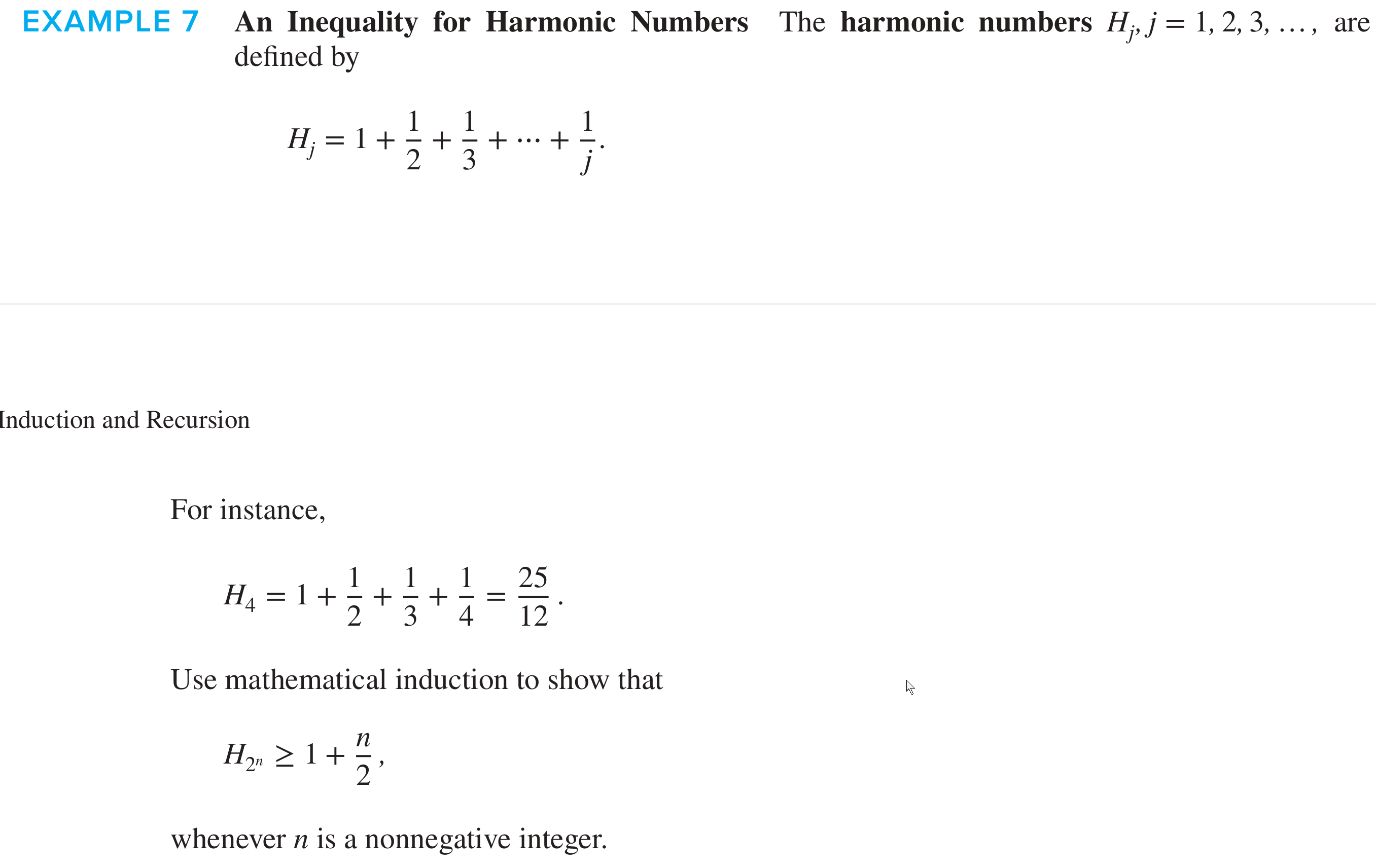
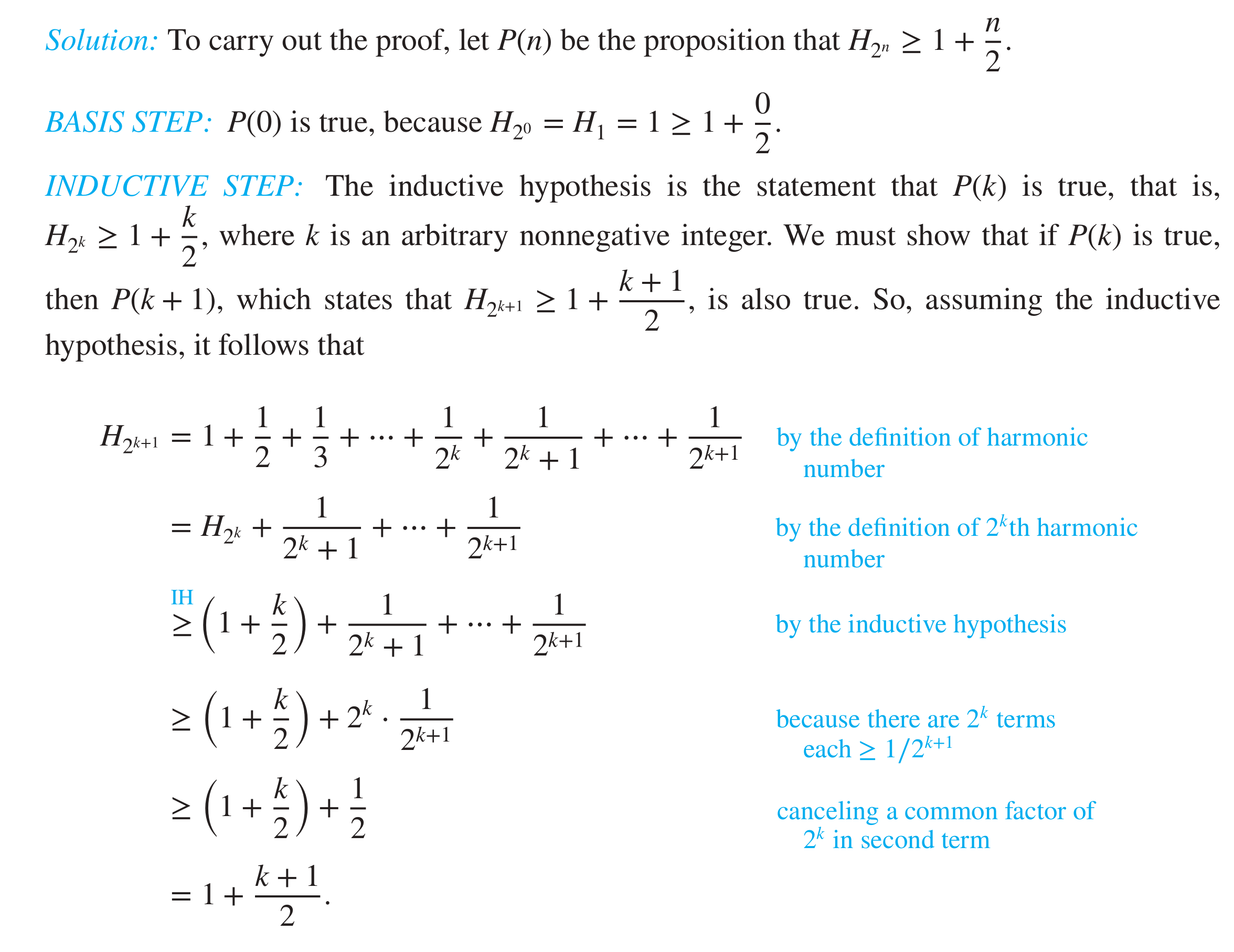
For the step where it goes from "by the inductive hypothesis" to "because there are 2^k terms each greater or equal to 1/2^(k+1)"
I don't understand how you can sub
1/(2^k + 1) + ... + 1/(2^k+1) to (2^k)(1/2^k+1)
I understand that 1/(2^k + 1) + ... + 1/(2^k+1) is comprised of 2^k terms in total
 last timber
(1/(1/2^k+1)) he does not have this term
anyway
if a+b is such that a>=c and b>=c then a+b >= c+c >= 2c
and you can extend this
uncut matrix
what I'm wondering here is how he proved 1/(2^k + 1) + ... + 1/(2^k+1) >= 1/2
I mean, it's pretty obvious it is the case when you look at it intuitively
but the way the textbook tries to prove it by using its strange substitution of values is not very comprehensible for me
last timber
 uncut matrix
yeah, that part
vital dewBOT
Commander Vimes
 uncut matrix
yes

 last timber
is it clear?
vital dewBOT
Commander Vimes
 last timber
vital dew
**Commander Vimes**
last timber
vital dew
**Commander Vimes**
and what is used here is generalization of this to an arbitrary finite number of terms in sum
vital dewBOT
Commander Vimes
 uncut matrix
so if I let a = H2^k, b = 1/(2^k + 1) + ... + 1/(2^k+1), c = (1 + k/2), and d = 1/2
a + b >= c + d
so then, a + b >= c + b
and then, c + b >= c + d?
last timber
vital dew
**Commander Vimes**
you have 2^k terms satisfying this
last timber
vital dew
**Commander Vimes**
you have this
last timber
vital dew
**Commander Vimes**
as generalization of this
connecting these all together should give result
uncut matrix
thanks for trying to help me, but it really isn't clicking
I'll just sleep on this and give it another tomorrow I guess
oh
god im so stupid
I think I sorta get it
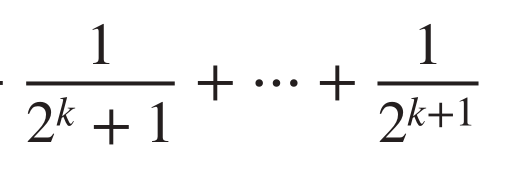
like you said, each term here is >= 1/(2^(k+1))
so this sequence of terms is simply larger than if you were to multiply 1/(2^(k+1)) by the number of terms in the sequence, 2^k
then you just simplify to 1/2 which completes the proof
last timber
yes
uncut matrix
thank you so much
im just dumb and it didn't felt intuitive to me at all
thanks for being so patient when trying to explain it
last timber
yw
civic horizon
late topaz
could anyone show the thought process behind this ? Spent some time on it and ga...
i think summation by parts will work
my calculations give me something pretty ugly but still in terms of H_n
 hybrid tendon
is there any sequence that looks something like this?
$(n + 1^{2}) + (n + 2^{2}) + (n + 2^{3}) \dots$ n is a natural number
vital dewBOT
Radical Ninja
 hybrid tendon
ohh shit wait I made a dumb mistake, its a series not sequence
let me correct it
$(n + 1^{2}), (n + 2^{2}), (n + 3^{2}) \dots$
$\ A_i = n + i^{2}$
vital dewBOT
Radical Ninja
 civic horizon
and what do you want to do with these A_i
hybrid tendon
$\sum_{i=0}^{2n} gcd(A_i, A_{i + 1})$
vital dewBOT
Radical Ninja
 civic horizon
are you sure this will have a nice closed form
because $\mathrm{gcd}(A_i, A_{i+1}) = \mathrm{gcd}(n+i^2, 2i+1)$, which doesnt look too nice
vital dewBOT
Pappa
 hybrid tendon
how did you arrive to this?
civic horizon
just use the fact that $\mathrm{gcd}(a, b) = \mathrm{gcd}(a-b, b)$
vital dewBOT
Pappa
 hybrid tendon
I don't know what you mean be nice closed form, but yes this is exactly what I wanna do
civic horizon
vital dew
**Radical Ninja**
i mean why do you expect this some to result to something nice or easy to compute
hybrid tendon
There should be an easier way to solve this because I can't solve this in O(N) complexity, should be better than that
 obtuse minnow
I'm confused. Do you want a function of n as the answer?
hybrid tendon
Yes, a function of n, is the only input
obtuse minnow
It would be so much easier if it was (n+1)^2, (n+2)^2 hehe.
hybrid tendon
sorry this is how the GCD's look

I can't find any closed form like pappa said to compute
obtuse minnow
I see you like computation, but I'd suggest starting with n = prime first. It actually pans out nicely for primes. The difference in (i+1)^2 and (i)^2 is 2i + 1. Pappa's suggestion is also seemingly helpful. He said gcd(a, b) = gcd(b - a, a). 🙂
I'm not saying I have the answer. I'm suggesting things to try that may or may not get you there. Even if it doesn't get you to where you're needing/wanting to go, you'll learn and discover things along the way.
hybrid tendon
yea, Thanks
obtuse minnow
Is this homework for your Discrete Math class?
obtuse minnow
I was wondering. It doesn't seem particularly easy. What brings you to the math temple 😛 :)?
I suggest looking at odd primes other than 5?
hybrid tendon
7?
obtuse minnow
Yeah, primes (in general not always) have simpler patterns but more exceptions happen with 2 (the only even prime).
okay give me 15 minutes to jot some things down. What is this for anyway?
hybrid tendon
Well you can't give me the answer, I only want some leads, this is question is part of competition
obtuse minnow
Er, can I ask which competition?
hybrid tendon
yea, its not a math competition btw,
https://www.codechef.com/MAY21B/problems/ISS
obtuse minnow
Ah, well there's a lot to say here. There's a super cool pattern for some of those numbers, but I don't think I should tell you much. When math people look at data, we're usually more impressed with things that are all the same or only have one exception.
I wish you good luck. Come back or DM me AFTER the competition if you want to see something I saw.
hybrid tendon
So there's a way to solve this in better way than O(N)?
obtuse minnow
I'm sorry but I'm no CS major.
keen girder
Whats the question?
hybrid tendon
Can I compute this in one step? like one formula?
obtuse minnow
I once took the O class but I have forgotten about many things there. But to answer your question, there are definnitely n such that the calculation is immediate 🙂
hybrid tendon
keen girder
Whats the question?
see the link just above
obtuse minnow
I dunno for all the numbers but for some yes 🙂
keen girder
Whats the time constraints?
obtuse minnow
I really shouldn't post more. It's a public forum.
And other competitors might see this.
hybrid tendon
keen girder
Whats the time constraints?
1.5 seconds
keen girder
You can generally guess the intended time complexity by just looking at time constraints
input size?
 obtuse minnow
Radical. You're messing up the competition for you and others. I'd ask you to stop asking 🙂
hybrid tendon
Yea, I know. That's why I clearly said I don't want the answer
I came to ask is there a name for this sequence or something like that remember?
obtuse minnow
Perhaps. I must hush now. 🙂
hybrid tendon
anyways, I should also stop btw. Thanks for the help till now
obtuse minnow
again, good luck! 🙂
 lilac breach
I need some feedback on whether I'm on the right track or not:

Here's what I got so far

But I don't seem to account for the case when the degree of a vertex > 2. As in: we discard all edges for vertices with degree > 2
weary tiger
@lilac breach you here?
lilac breach
Yeah
weary tiger
so if we look at a vertex
we want to maximise the expected number of edges adjacent to it
by linearity of expectation we know maximising it for one vertex will maximise it for the sum
Let X be the number of edges adjacent to a random vertex
E(X) = 3*p*(1-p)^2 + 2*3*p^2 *(1-p)
so you are just trying to find the p that maximises that
lilac breach
I haven't thought about looking at the individual vertices
weary tiger
it makes sense to look at individual vertices because that is what the algorithm is acting on
like its just deleting vertices when there are 3 adjacents
i realise that might be slightly wrong actually 🤔 but can use the same idea
lilac breach
I have also tried to look at it in another way. Since we are going from a 3-regular graph to a subgraph of max degree 2, then the optimal solution is a 2-regular graph. Number of edges for regular graphs can be expressed as |E|=nr/2. Our original graph has n*3/2 edges and the optimal subgraph has n*2/2=n edges. Then to generate that graph it's simply p^n*(1-p)^(n*3/2-n) = p^n*(1-p)^(n/2)
Got that definition from the Erdős–Rényi model but I don't think I'm "allowed" to use that
$p^n (1 - p)^{n/2}$
vital dewBOT
Steverman
 lilac breach
And the general formula: $P(G)=p^m(1-p)^{M-m}$, where m are all the edges we want and M are all possible edges
vital dewBOT
Steverman
 lilac breach
Huh, that's almost the binomial distribution
forest lodge
blissful wadi
Thank you! Just saw the message ✨
weary tiger
 civic horizon
Damn
Thats schurs theorem
Im pretty sure it relates to ramsey theory but im not quite sure how
weary tiger
yeh i probs shoulda said its in a graph theory Q
civic horizon
Thonk
 civic horizon
hint: ||rephrase in terms of colorings, and then draw a graph with a lot of vertices and label the vertices from 1 to VERY LARGE NUMBER. Now for two vertices a, b, the edge ab is colored according to the colour of |a-b|. ||
weary tiger

I have no idea how to approach exercise 2.8 & 2.9. I know the definition of a discrete random variable, but it can't seem to get the answer.
lilac breach
Alright, I asked my professor and he said in order to compute P[X_e]: p times the probability that at most one more edge adjacent to each endpoint of e is accepted.
What's that? p*(1-p)^{2*(|V|-2)}?
weary tiger
@civic horizon ok yeh got it thanks
civic horizon
cool
weary tiger
I think the very large number needs to be R(3,3,....,3) where there is k 3s right
civic horizon
yeah
civic horizon
cool theorem
weary tiger
ok that was kinda hard to wrap my head around
civic horizon
another cool theorem in ramsey theory is van der waerden
 valid wave
is there a way to determine the amount of faces in a planar graph?
obtuse lance
there's a well known formula due to Euler
F-E+V=2
number of faces, edges, and vertices respectively
so if you know the edges and vertices you know the faces
keep in mind this counts "outside" as a face too
if you don't want to count that for whatever reason, just subtract 1
valid wave
I tried that but im so lost

I had
|10 + k| - |30 + (5k/2)| + |F| = 2
ohh got it
induction
😄
vital dewBOT
Meliodas
 quick folio
@valid wave
valid wave
Wait huh
I’m kinda lost
Isn’t this the same as plugging in 22 as a base case for Euler’s formula
Then k + 1
I did that
Plugged in 5k/ 2 + 35 and 10 + k
To find F
Then plugged in F back into it
Then used induction for base case of 22
 unreal stump
That's same as saying a~b iff 3a-3b is divisible by 7
Which is same as saying a~b iff a-b is divisible by 7
Which is just your usual Z_7
weary tiger
where did you get 3a-3b?
unreal stump
If 7|3a+4b then 7|(3a+4b-7b)
hybrid tendon
The congruence notation confuses me $a \cong b (mod n)$ \ means $(a-b)$ divisible by $n$?
stray reef
\means 
hybrid tendon
how to break line?
stray reef
\\
vital dewBOT
Radical Ninja
 stray reef
yes, though usually you see $\equiv$ instead of $\cong$ at least in my experience
vital dewBOT
Ann
 hybrid tendon
ohh okay but how do I write $a \mod b = c$ in terms of mathematical notation?
vital dewBOT
Radical Ninja
 hybrid tendon
like $a \equiv c (\mod b)$ this?
vital dewBOT
Radical Ninja
 stray reef
$a \equiv c \pmod{b}$
vital dewBOT
Ann
 stray reef
also notice that mod as an operation and mod as a relation are somewhat different
hybrid tendon
yea, that's why I'm confused is correct if I right? \
$A \equiv (A % b) (\pmod c)$
stray reef
uh
hybrid tendon
how do I put %?
stray reef
okay so if you want a percentage symbol you need \%
hybrid tendon
thanks
weary tiger
How would you establish a 1-1 correspondence for f: Q -> Q defined by f(n) = n - 1
stray reef
weary tiger
How would you establish a 1-1 correspondence for f: Q -> Q defined by f(n) = n -...
wym
hybrid tendon
yea, that's why I'm confused is correct if I right? \
$A \equiv (A % b) \pmod{c}$
 stray reef
@hybrid tendon no need for the extra parentheses but yes you are right
hybrid tendon
sorry for editing it several times, I forgot tex
stray reef
@weary tiger yeah you can just send each point in S to its x coordinate lol
that's a bijection between S and Q
and presumably, Q is already known countable
hybrid tendon
so I can say that\
$ A - (A% b)$ is divisible by $c$?
vital dewBOT
Radical Ninja
 stray reef
by b, you mean?
wait
god ok
you had mod c all this time
the bad tex kept getting in the way
hybrid tendon
yea, sorry for that
vital dewBOT
Radical Ninja
 stray reef
mod b.
hybrid tendon

weary tiger
Ryt
hybrid tendon
$A$ divided by $c$ will give the same remainder as $A % b$ divided by $c$ \
if $A \equiv (A% B) \pmod{c}$ \
is it correct now?
vital dewBOT
Radical Ninja
 stray reef
unless you tell me what the relationship between b and c is, this is not necessarily true.
hybrid tendon
b > c
hybrid tendon
yes, I'm not stating a theorem. I want to solve this problem/equation
to find all permissible values
I want to find (c, b)
stray reef
so you want to find all triples (a,b,c) such that a is equivalent to (a%b) mod c...?
oh.
hybrid tendon
No, I already have A should only find c, b
stray reef
sounds like this will happen iff b is a multiple of c
hybrid tendon
that's not the case, that's what I'm trying to figure it out
stray reef
?? can you give a counterexample
hybrid tendon
yes pls. wait give me some time to tex
stray reef
give me a pair of positive integers (b,c) such that exactly one of the following is true:
(1) for all a in Z, a == (a%b) mod c
(2) b is a multiple of c
just a pair of positive integers nothing else
hybrid tendon
$M % a = (M % b) %a$, where $a<b$\
So I'm rewriting this as $M \equiv (M % b) \pmod{a}$\
if the above statement is correct then I can say $M - (M % b)$ is divisible by $a$
vital dewBOT
Radical Ninja
 stray reef
give me a pair of positive integers (b,c) such that exactly one of the following is true:
(1) for all a in Z, a == (a%b) mod c
(2) b is a multiple of c
hybrid tendon
yes, take a look at this
 stray reef
do you not understand what i am asking you
give me a single pair of b and c
just one
hybrid tendon
(3, 8) where both in the pair should not be greater than 15 and M=29
hybrid tendon
other way around
stray reef
so b=8, c=3
hybrid tendon
I got confused because I use a, b
hybrid tendon
not for all integers? just for a given integer a
hybrid tendon
vital dew
**Radical Ninja**
I'm very slow at texing.... that's why I asked to give me some time
 quaint star
What you are trying to do is very unclear. Do you have a specific a for which you need to find b and c? Or what is the exact problem statement.
hybrid tendon
vital dew
**Radical Ninja**
I just need to know whether what I have did in this picture is right?
If so is there any way to simplify
$M - (M% b)$ which is divisible by $a$ and provided that $a<b$
vital dewBOT
Radical Ninja
 hybrid tendon
I apologize for making it confusing because of my bad texing
hybrid tendon
stray reef
so you want to find all triples (a,b,c) such that a is equivalent to (a%b) mod c...
This is the case where I already have A with me
hybrid tendon
Ohh okay thanks, I think this is the way to calculate mod in general
unreal stump
did I skip any steps here?
 weary tiger
unreal stump
did I skip any steps here?
weary tiger
unreal stump
did I skip any steps here?
Notation is a bit sloppy no?
so if i make a graph with degree sequence 2,2,2,2,2 how do i show it can't be bipartite
In the first case you show (a,a) is in S but were you meaning to write aSa? (ie a related to itself by S)
weary tiger
weary tiger
so if i make a graph with degree sequence 2,2,2,2,2 how do i show it can't be bi...
Does it contain an odd cycle?
Or show that you can't get a proper 2-colouring
weary tiger
weary tiger
Or show that you can't get a proper 2-colouring
yeah i think i'll take this approach
stray reef
weary tiger
so if i make a graph with degree sequence 2,2,2,2,2 how do i show it can't be bi...
a graph with this degree seq is either a 5-cycle or a triangle + lone edge, is it not?
weary tiger
not sure about triangle and lone edge
weary tiger
yeah
That's even easier to prove!
5-cycle is an odd cycle so can't be bipartite
gotcha thanks!
so the only time you can't make a graph from a degree sequence is if the sum is odd?
wait no
Ah you're referring to the handshaking lemma
Sum of the degrees must be even
As it's twice the number of edges 🙂
and if there is a triangle in the graph it can't be bipartite right?
Uh yes it's a 3-cycle which is odd
It sorta forces you to use 3 colours right
gotcha
weary tiger

so if found all 6 hamiltonian cycles
but how do i prove that the list is complete?
oh maybe i have to prove this graph has exactly 6 hamiltonian cycles
wait apparently the formula is (n-1)!/2
where n is number of vertices
but that's obviously not 6
 sweet bough
can someone help me with Recusive data types and structural induction? (Sorry, I am new here, thought this will be the channel)
weary tiger

so i know this is eulerian since each vertex has even degree
but i'm having a hard time visualizing the circuit path
nvm
It's ABCDHGFEHAED right?
or ABCDHEADEFGHA
it can't be the first one since it doesn't start and end at the same vertex
stray reef
do you want just one eulerian path or to enumerate them all
weary tiger

the question is obscurely phrased
it just asks for "the" Eulerian circuit
whatever that means
But i'm pretty sure it's ABCDHEADEFGHA
stray reef
well that's an eulerian circuit but not the only one
weary tiger
weary tiger
Hm. Do you know Euler's theorem?
If a graph is connected and all of its vertices have even degree, then it has an Euler circuit
(Actually it's an iff statement but yeah)
 ashen dock
any help would be appreciated
weary tiger
why are you stuck?
gritty crescent
What can you say about the number of words in L?
ashen dock
infinitely countable
but basically sigma* - L is just 2 countably infinite sets subtracting each other
so im not sure if the compliment would be uncountable or countable
 hearty perch
could anyone explain why this is countably infinite and also how it is one-to-one
 stray reef
how it is one-to-one
how what is one-to-one?
stray reef
ashen dock
so that makes the compliment of L countably infinite correct?
late response but yes
 viscid meteor
anyone know where i can learn discrete math over the summer. looking at this math.. I am going to need time to figure it out.
weary tiger
in a book maybe?
errant bear
i learned from browsing #discrete-math 🙂
gritty crescent
MIT OCW's Mathematics for Computer Science might be worth looking into. They have recorded lectures, complete set of notes and problem sets.
 distant bobcat
Is reducibilities in relation to showing NP-completeness involve graph isomorphism? Like when proving a Hamiltonian path is NP complete using a known NP problem (i. e Hamiltonian cycle) in which we for a positive instance of X as input, it produces a positive instance of Y as output.
and for a positive instance of Y as output, it must have been given a positive instance of X as input. This sounds a lot like an equivalence relation on graphs to me.
 delicate ridge
hearty perch
could anyone explain why this is countably infinite and also how it is one-to-on...
delicate ridge
hearty perch
could anyone explain why this is countably infinite and also how it is one-to-on...
one-to-one just means injective
a set is countable if there exists an injection from it to the natural numbers
(and countably infinite if there are infinitely many elements in the set, and the set is countable)
clearly the set is infinite, since it contains the subset (2, 1), (3, 2), (4, 3), ...
you now need to come up with a mapping from S to N
weary tiger
im tryna do the last part
weary tiger
<@&286206848099549185> any ideas
 wooden acorn
I asked a graph theory/combinatorics problem in help 7
Trying to figure it out for my grandma’s favorite puzzle
Questions 7***
Also don’t forget about the dudes problem above me
 opal cedar
Is there a simple way of discerning decidability from a language description? Like some simpler rules of thumb than just reduction.
 stray reef
what's lowercase g?
you could induct on the number of connected components, and perhaps first show that a tree has exactly one less edge than the number of vertices
@woeful crag
 woeful crag
if you're implying i should use induction, we haven't done that yet:/
woeful crag
stray reef
what's lowercase g?
G*
stray reef
okay, this is possible to do without induction
but you will first need to show that a tree has |E|-1 vertices, which i'm not sure is possible at all if you do not have access to induction
woeful crag
i think we can use that, they've just told us we done need to prove it
stray reef
unless you're just given that fact for free
okay so you are given that fact for free, great
woeful crag
also what does it mean when we have multiple connected graphs?
does it imply their all detached from one another?
stray reef

here is a graph on 11 vertices with 3 connected components
i hope this illustrates the meaning of the word 'connected component'
stray reef
well this one does have a cycle so its not an example of a graph from your problem
but yes, your G is a disjoint union of k trees
maybe disjoint union is a bit too fancy as a term
woeful crag
i think i get it
stray reef
but yes your G consists of k trees
woeful crag
alright i'll see what i can do with that information
would i be using that |E|-1 rule?
stray reef
you could do that if you wanted
it may take a little bit of notational song and dance to get the proof right
and there is a clever way to avoid that, which i can share if you want
woeful crag
i mean that would be nice
stray reef
so your graph consists of k trees
pick 1 vertex on each one of those trees and mark it, so that you have k marked vertices
then weave a path through these k marked vertices - this will mean adding k-1 edges to your graph. maybe color them so that they're distinct from what was there before
say the original graph could be drawn in black and these extra edges in red
does this make sense to you
woeful crag
im following so far
stray reef
yeah so this path stitches together all the connected components of G into one
and the resulting graph is a tree
do you see why?
woeful crag
cuz theres no cycles?
stray reef
well yeah, but if i asked you to prove rigorously why there's no cycles, would you be able to do it?
woeful crag
since you have added k-1 edges probably not
or do u riggorously prove there is exactly one path between 2 vertices?
stray reef
i feel as if my yes/no question is not getting properly answered by you here
woeful crag
wouldn't i need to proove that my resulting graph is a tree?
woeful crag
ah alright
so we add k-1 edges and connect all the k trees together to get a larger tree graph
now what?
woeful crag
so u added k-1 edges, soz
stray reef
no i added k-1 edges
woeful crag
did u have n-1 edges before/
stray reef
no
you are not answering my question
now we have one big tree on n vertices
how many edges does it have
how many edges are there in a tree on n vertices?
woeful crag
so would u do (k-1)+(n-1)
woeful crag
stray reef
how many edges are there in a tree on n vertices?
n-1?
stray reef
after adding these red edges, our graph became connected, and thus a tree on n vertices.
yes
there are n-1 vertices in this new graph
there are n-1 vertices in this new graph and this count of n-1 includes the red edges we added
of which there are k-1
but we need to find the number of edges before we did any tampering with the graph
stray reef
finally
woeful crag
thank you so much sorry for my incompetence lol
 vague veldt
what is 6+7·9-56=?
stray reef
if your question can be answered by literally plugging it into a calculator or even typing it into google then it doesn't belong here.
 stray reef
show that you can't 2-color G1
also G2 can be colored with less than five colors
here's a 3-coloring of G2
 weary tiger
In a binary code of length 5, there are 5C1=5 words with 4 1's and a 0. Is this correct?
weary tiger
Thanks 💯
stray reef
oh wait
fuck im stupid lmao its edge coloring not vertex coloring
(in ref to zeldas problem)
yeah @woeful crag edge-coloring G2 still doesnt require 5 colors, you can do it in 4 like this
 woeful crag
stray reef
yeah <@350577753512476681> edge-coloring G2 still doesnt require 5 colors, you c...
woeful crag
stray reef
yeah <@350577753512476681> edge-coloring G2 still doesnt require 5 colors, you c...
ahh thank you
is there really no way to justify my answers
stray reef
well your answer for G1 is correct
a justification consists of presenting a 3-edge-coloring and showing that a 2-edge-coloring is impossible
woeful crag
other than assume it can be done with less colours and contradicting myself
right i see
stray reef
im not entirely certain whether its possible to do G2 in 3 colors
wait no of course you can't do G2 in 3 colors you have 4 edges incident to the top vertex
that means at least 4 colors are needed
vague veldt
v
vhttps://cdn.discordapp.com/attachments/496785905474994186/841280539402960906/cj
v
bro
bri
rbrob
r
rb
s
s
s
s
s
s
suck my dick @graceful condor
civic horizon
wat
stray reef
get banned speedrun any%
 proper mulch
anyone's here
i want to learn discrete maths
is CS70 a beginner course or are there any other?
pale epoch
this?
 proper mulch
pale epoch
this?
proper mulch
pale epoch
this?
yes
pale epoch
this looks like a beginner course
proper mulch
can i take it as a beginner in maths .
pale epoch
what does beginner in math mean
you have to be able to perform arithmetic
basic algebra
proper mulch
I mean like in highschool we do have math but that's like no interesting for me . So iam very much interested in CS . so want to learn maths for that
proper mulch
pale epoch
highschool math should be sufficient
iam not very much perfect in that but i can manage
pale epoch
i mean, if you struggle with this
its not because you dont know enough math already probably
proper mulch
pale epoch
i mean, if you struggle with this
do you know any other courses on discrete math
proper mulch
pale epoch
just books
what are they :?
pale epoch
what grade are you in?
proper mulch
12th
pale epoch
i like this book: https://www.math.bgu.ac.il/~lipyansk/discrete/Invitationto discrete.pdf
but i don't know if it's good for a beginner
proper mulch
seems to be pretty advance
pale epoch
(studying from a book as opposed to a lecture series is also harder)
vital dewBOT
Lochverstärker
 pale epoch
is it not explained elsewhere?
hm
do you know what an equivalence relation is?
there are multiple ways to explain this set
$(\bZ_6, +)$ is the set of integers but with addition modulo 6
vital dewBOT
Lochverstärker
 pale epoch
so you define an equivalence relation on Z but consider two integers a and b equal if their difference is divisible by 6
you can also kinda do this
think of it as the set of integers {0, 1, ..., 5}
since 6 = 0 mod 6
proper mulch
pale epoch
~~why do so many people from this server dm me recently~~
sorry . i didn't do that yet
pale epoch
oh, it wasn't meant negative
just an observation
you can dm me if you want
but don't be mad if i don't reply at all
yes, that is why the table is that way
there is a more technical way to think about that group but you probably do not need it
just the numbers 0 to n with addition modulo n
well, this group has a neutral element 0
since whatever you add 0 to, you get the same thing back
{2, 1} is not an element of that group
you can e.g. check that table and see that 3 + 3 = 0
this shows that 3 is the inverse of 3
the inverse of what
this is an equation, not an element of Z_6
the elements of Z_6 are (kind of) the numbers 0, 1, 2, ..., 5
equations dont have inverses
elements have
check the definition of inverse
you first have to find the neutral element of your group (which in this case is 0)
and then the inverse of a is an element b such that a+b=0
and since 3+3=0 the inverse of 3 is 3
the inverse of 1 is 5, etc...
yes
sometimes it be like that
weary tiger
Okay I'm missing something obvious - consider Bernoulli trial with probability of success $p$, $\Omega = {0,1}^n$, $A_k$ - event denoting exactly k successes. I need to show that for any $B \subset \Omega$, $P(B\mid A_k)$ doesn't depend on p.
vital dewBOT
Ledog
 weary tiger
I guess it would be true if B and Ak were independent, but that doesn't seem like that's the case for any B


 vital dewBOT
Ledog
 valid wave
oh
oops
so what symbol is the one i just pasted?
i read something about independent sets
oohh
independence number
sorry for noob question
thanks
 wanton seal
Solve the following congruence equation
x11 congruent 7 (mod 61)
Anyone knows how to do this?
pale epoch
what have you tried
 rich siren
How exactly do you solve this?
 lilac breach
If an edge in a graph is added independently of other edges, does this imply that the endpoints of the edge are independent? For example I would like to know something like for an edge e: Pr(degree(e_u,e_v) <= 1)
weary tiger
no it doesn't
i.e imagine a complete graph minus an edge
im not sure if im interpreting your question correctly though
lilac breach
I see.. so in the problem I mentioned a few days ago. Creating a random graph from a 3-regular graph. The question was about probability of endpoint vertices having a maximum value. Say that you want to calculate the number of edges with at most degree 1 can I just write: Pr(edge e is in graph)\*Pr(degree(e_u,e_v) <= 1)
lilac breach
In the 3-regular case, it's at most 3, giving 2^3=8 possibilities
I'm asking since my TA thinks the previous solutions were overly complicated. Here's how the algorithm goes: First, e is included temporarily in the subgraph with probability p. Then, it stays in the subgraph if, in addition, at most one of the two edges e1 and e2 incident at one point of e and at most one of the two edges e3 and e4 incident at the other endpoint of e survives.
vital dewBOT
Steverman
 lilac breach
Oh, I only have to consider 2 incident edges e1, e2, so it's 4 rows
lilac breach
so for $Pr(deg(u,v)<=1)$ is it:
$\sum_{i=0}^1 Pr(deg(u)=i) + Pr(deg(v)=i) - (Pr(deg(u)=i) \cdot Pr(deg(v)=i)) $
vital dewBOT
Steverman
 lilac breach
Oh, it's slightly wrong. I need to sum them individually
valid wave

so i have to prove a graph is symmetric, reflexive and transitive?
i thought this only applied to functions
or sets rather
 deft current
S is a set
deft current
simple, undirected graphs
deft current
so R is a relation on the set of all simple, undirected graphs
G and H in S are related i.e. (G, H) in R, if G and H are isomorphic
deft current
you're relating the graphs themselves
valid wave
but when im trying to set it up to prove reflexitivty
would I make it like
let v, u e V(G)
Then there is a path from u to v
but how would I show v, u e V(H)
sorry for noob question
deft current
I think you misunderstand the question
valid wave
how so
so would it just be like v e V
since the graphs are isomorphic?
so they are basically the same?
idk im kinda confused with setting it up
pale epoch
do you know what a graph isomorphism is?
valid wave
if thats the case would I have something like u, v e V and u~v so theres a path
and also a path the other way too
pale epoch
is that supposed to answer my question?
 coral citrus
Reflexivity:
so a graph is isomorph to itself.
Symmetrie:
You can use the inverse.
Transivity:
just jump from a graph in the middle
deft current
I think you're used to seeing relations on vertices in graphs
pale epoch
so do you know what a graph isomorphism is?
deft current
the relation isn't on vertices in a graph, it's on graphs themselves as objects
valid wave
pale epoch
so do you know what a graph isomorphism is?
no