#discrete-math
1 messages · Page 16 of 1
 obtuse lance
 spring hound
No, you can take a transitive relation and then add an element to the set that doesn't appear anywhere in the relation. That preserves transitivity while ruining reflexivity.
 analog hound
Oh, true.
 waxen vessel
I'm a high school student doing graph theory for a research project. I want to maybe study ramsey theory in depth but would that be too complex?
as in would it require too much prerequisite knowledge?
 little prism
what do you mean with indepth
waxen vessel
well I'd want to use it to prove certain results
 narrow prism
Hello, I have not been able to solve this in some days now, could anyone give me some help?

 chilly dew
I have a puzzle:
Using only $\forall, \exists, \land, \lor. \neg$, and the arithmetic operations ~$+, \times, =, >, <$, construct an expression $\varphi(n)$~ that is true if and only if $n$ is a power of three. The tricky part is you can't use exponentiation.
 vital dewBOT
mrean
 chilly dew
oh wait
all the proper factors must be divisible by three
that is a necessary and sufficient condition for powers of three
nice


 fierce quartz
Does anyone have any resources on probability in discrete mathematics
fierce quartz
I'm stuck anyone have any insight?

 reef juniper
I advise you learn ur venn diagram and set notations.
fierce quartz
reef juniper
I advise you learn ur venn diagram and set notations.
Yeah that's what I'm doing. Here's the thing amigo.... a) should be 4
 weary tiger
ah venn diagram
reef juniper
fierce quartz
Yeah that's what I'm doing. Here's the thing amigo.... a) should be 4
u r correct.
fierce quartz
reef juniper
I advise you learn ur venn diagram and set notations.
I'm not running completely blind
reef juniper
i did a probability paper
do u want some notes?
its an introductory course so it covers lotta things
 haughty garden
 snow cedar
how they get this?
snow cedar
how they get this?
split any path into three parts. We first need to find all paths from (0, 0) to (7, 6). We need to go down 6 times and right 7 times (in any order). Therefore, you can think of it as arranging 7 R's (right's) and 6 D's (down's). Then do the same from (7, 6) to (12, 9) and (12, 9) to (17, 12)
reef juniper
Let a be an element of set A,
a is a natural number therefore a is even or odd.
Case 1: a is odd, let a = 2k + 1, k is an element of Z.
a^2 = 4k^2 + 4k + 1,
Therefore a^2 % 4 = 1.
Case 2: a is even, let a = 2k,
a^2 = 4k^2
4k^ 2 % 4 != 0.
Therefore, A is the collection of odd natural numbers.
Let b be an element of set B,
b is a natural number therefore b can represented as even or odd.
Case 1: b is odd, let b = 2l + 1, l is an element of Z.
l^2 = 4l^2 + 4l + 1
l^2 = 4l * (l + 1) + 1
l^2 = 8m + 1
8m+1 % 8 = 1
Case 2: b is even, ;et b = 2l.
l^2 = 4l^2.
4l^2 != 1.
Therefore B is the collection of odd natural numbers.
Since A and B are both the collection of natural numbers. They are equal.
IS THIS ENOUGH AS A PROOF?

 stray reef
Case 2: a is even, let a = 2k,
a^2 = 4k^2
4k^ 2 % 4 != 0.
why are you saying 4k^2 % 4 ≠ 0?
also you've got some missing words towards the end
reef juniper
stray reef
why are you saying 4k^2 % 4 ≠ 0?
Oh shit I meant != 1
reef juniper
stray reef
also you've got some missing words towards the end
What am I missing?
stray reef
Case 2: b is even, let b = 2l.
l^2 = 4l^2.
this is false as written. did you mean (2l)^2 = 4l^2?
4l^2 != 1.
sure it's not equal to 1, but did you mean that its residue mod 8 is not equal to 1...?
Therefore B is the collection of odd natural numbers.
correct
Since A and B are both the collection of natural numbers. They are equal.
missing the word "odd"
 dusty juniper
is this correct? $\sim (x \in X \land y \in Y) = (x \notin X \lor y \notin Y)$
vital dewBOT
Odd_the_Wolf
 dusty juniper
oh thank you!
 robust kettle
Anyone able to chime in on this one about sets?
Suppose you have two nonempty sets, A and B, and that A ⊆ B. Let C be a set.
Must (A \ C) be a subset of (B \ C)?
 tight hound
robust kettle
Anyone able to chime in on this one about sets?
Suppose you have two nonempty s...
tight hound
robust kettle
Anyone able to chime in on this one about sets?
Suppose you have two nonempty s...
Yes.
weary tiger
Can anybody tell me what's going on here? WHy does it resolve to just one set? [-4, 4]

 brave rock
{0} is a subset of [-1, 1] is a subset of [-2, 2] etc
You might be confusing $[-4, 4]$ with ${-4, 4}$. Remember that $[a,b] = {x \in \mathbb R | a \leq x \leq b}$.
vital dewBOT
Boytjie
 weary tiger
right
 fringe siren
We are given this function
f: R->R
f(f(f(2x+3)))=x
How can we prove that f is bijection?
little prism
you can try explicitly giving the inverse
fringe siren
Hmm how?
For simple functions is obvious but I get confused when there's composition of functions
 clever river
Hi, how is it possible for a boolean function to be represented as a hypercube
Im trying to read this but going from 2d to 3d the vertex changes confuse me
 obtuse lance
fringe siren
We are given this function
f: R->R
f(f(f(2x+3)))=x
How can we prove that f is ...
obtuse lance
fringe siren
We are given this function
f: R->R
f(f(f(2x+3)))=x
How can we prove that f is ...
maybe it's easier to see if you define $g(x)=2x+3$ then you have $f \circ (f \circ f \circ g) = id$ so must be that $f^{-1} = f \circ f \circ g$.
vital dewBOT
Merosity

 sudden minnow
wow, that's cool
 granite cipher
fringe siren
We are given this function
f: R->R
f(f(f(2x+3)))=x
How can we prove that f is ...
granite cipher
fringe siren
We are given this function
f: R->R
f(f(f(2x+3)))=x
How can we prove that f is ...
I think you can just prove both injectivity and surjectivity.
Surjectivity is obvious as for any x, take f(f(2x+3)) as a input.
Then for injectivity, you assume f(x)=f(y)
Manipulating the eqn gives u f(f(f(x)))=(x-3)/2
so you have f(f(f(x)))=f(f(f(y)))=(x-3)/2=(y-3)/2 which obviously
=> x=y and you are done.
 shell loom
I need help with this problem: There exists an integer n, such that n^3-n is odd.
I think the it's false and I can show that it's always even given 2 cases, n is even and n is odd but idk if this is correct
shell loom
Okay good, thanks!
 stray root

I cannot seem to find any quantifiers/operators that make all three conditions true
I've tried OR, AND, <->, ->, (+), ~
none of them makes all three conditions true
sudden minnow
so p box q is true when both are true
false when both are false
and true when p is true and q is false
and false when p is false and q is true
so this operation only takes P into account, P box Q = value of P
a projection, if you will
stray root
yes i later realized after an hour that it's not asking me to determine the operation for the box
i got it solve though, thanks
 swift kiln
Suppose we have a graph where the vertices correspond to elements of Zp (p is a simple number). If a and b are connected by a line then and only then when ab = 1 mod p. How many edges does this graph have?
could someone help me with this?
tight hound
Other than 0, every element in ℤp has a unique multiplicative inverse (mod p). The answer should be (p-1)/2
Of course, if p is 2 then the answer is 0.
(I assume you mean prime number when you say simple number)
swift kiln
Yes, thank you
 primal turret
what is the number of combinations so order 4 digit to to 5 digit long number like the numbers 1,2,3,4 in to nomber like 11234 or 12342
you just know what you have x digit and the number length is n
and every digit need to apper
 loud oyster

Need help with this question
The blanked out part is Solve the following recurrence relations
 calm scaffold
Can someone prove or disprove that deleting edge in k-critical graph increase maximum independent set of vertices by 1 in Graph obtained by deleting this edge
vital dewBOT
_FaithAlone_
 shell loom
the problem is (b) and this is my proof so far but idk what to do next or if im doing it right
 shell loom
so b is even from the equality right?
sudden minnow
yes
sudden minnow
yes
shell loom
then should i say 3b^2=2m?
shell loom
no?
sudden minnow
yeah so?
shell loom
but b^2 isnt odd right?
sudden minnow
the entire point is to show b^2 is even
if b^2 is even, then b is even by the exact same argument you used for a
shell loom
idk, i was thinking of once again using euclid to say if 3b^2 is even then so is b^2
right since i guess 2|3b^2 -> 2|3 or 2|b^2?
idk
sudden minnow
sure... there are like 10 different ways to conclude b^2 is even under this situation
don't overthink it
shell loom
okay so "3b^2 is even, if b^2 were odd then 3b^2 can't be even so b^2 must be even"?
sudden minnow
shell loom
right since i guess 2|3b^2 -> 2|3 or 2|b^2?
yeah, but you can write this too
again, doesn't matter
shell loom
so wait did i need euclid for the first bit of my proof?
sudden minnow
don't even know what you mean by euclid's lemma
okay googled it
depends what you mean by "need"
if you can use unique factorization it doesn't really matter how you get there
but sure, if you know euclid's lemma and not much else you can keep using it, certainly works here
shell loom
well like i think being concise is better right? so i thought maybe using euclids lemma is overkill or something
sudden minnow
I'd say a lot of it depends on your audience and the level you are working at, what passes for "concise" I mean
the proof you are writing would probably be too concise for an 8th grader, and 10 sentences too long for a graduate
but in general, focus on being understandable before concise
shell loom
hmmm yeah good advice, ill try to keep that in mind
sudden minnow
as a general tip, I'd say if you've used one type of argument once you can use it in much fewer words the next time
so like
3b^2 is even, which means b^2 is even, which further means b is even by 2 applications of Euclid's lemma.
something like that would work
but I can't give you rigid advice
proof writing is in the end flexible
shell loom
yeah i was thinking about that before but it seemed weird repeating the application of euclid
true
and just to be clear, if i then have b is even, i can then say that means a and b arent coprime since 2 is there greatest common factor which contradicts that they are coprime...
sudden minnow
that is the argument, yes
sudden minnow

 cobalt canopy
Hello, I am hoping for help on the following Question:
Let x and y be two real numbers such that x + y is rational. Prove by Contrapositive that if x is irrational, then x – y is irrational.
So far I have this for my proof by am getting stuck.
We will assume that x – y is rational and prove that x also must be rational to prove by contrapositive.
If x – y is rational, that means x-y is equal to a real number that can be expressed as a fraction where the denominator does not equal zero.
Assume a and b are real numbers where b ≠ 0.
X – y = a/b b≠0
Any help on this would be appreciated (sorry, I was having a hard time deciding where this should go)
 rapid mural
they cant be real numbers
they are a specific subset of the real numbers
which one?
@cobalt canopy
when you figure out which one you will get your answer
vital dewBOT
person2709505

 quasi stirrup
Hey, just started my discrete structures class and I was wondering what prior math knowledge will I need?
 remote crane
tldr: check your syllabus
 regal gate
Why is this not a product?

this has to be wrong
you can count by hand the same problem but with less marbels, and that reasoning yields fake answers
...
this has to be a mistake lmao. In another problem of the same type he uses product
and like, you can prove it should be a product lul
annoying
 desert aurora
Hi!
I'm reading about antichains in graph theory, and also indpendent set or anticlique. Both are the set of vertices that don't have any edge in the edge set of a graph G.
So are they the same thing ?
desert aurora
Nvm, maybe they aren't. Apparently the definition is different for an antichain in a graph vs. a set ? (here https://www.youtube.com/watch?v=aHx2V3u2Cyo he defines G=({a,b,c,d},{ab,bd,dc,ac}) and claims {b,c} is an antichain as theres no direct edge)
But here in a book (for CS DSA), {3,7} is a maximum antichain (evident from the fact that 3 flows to only 4 and 7 doesn't flow to it because of the directed graph). If the video's definition was used then a maximum antichain would be {1,6,4} which is size 3.
Anywho, the maximum anticlique for G could be {1,6,4} which is != maximum antichain for G, hence anticlique != antichain.


Subject - Discrete Mathematics
Video Name - Chain and Antichain
Chapter - Poset and Lattice
Faculty - Prof. Farhan Meer
Upskill and get Placements with Ekeeda Career Tracks
Data Science - https://ekeeda.com/career-track/data-scientist
Software Development Engineer - https://ekeeda.com/career-track/software-development-engineer
Embedded and I...
little prism
I have never seen a definition for an antichain in a general graph which doesn't correspond to a poset
chains and antichains fundamentally are about stuff that's ordered
 tawdry night
Hi, I want to ask how to get 2^2k x 3 + (2^2k-1)? Why is 2^2k not multiplied into 3 to get 6^2k?
 desert aurora
little prism
I have never seen a definition for an antichain in a general graph which doesn't...
desert aurora
little prism
I have never seen a definition for an antichain in a general graph which doesn't...
Yes it might be possible that the antichain here could be a local definition of the book and not exactly the same as antichain for a poset.
But that raises the question of what do we define as an anti-chain ?
A chain is simply a set of nodes that have edge sets between them, so whats the opposite, i.e., when they dont ? Anticliques wont cover them because they are about adjacent nodes.
little prism
well for any two nodes in the antichain you can't find a directed path between them
little prism
tawdry night
Hi, I want to ask how to get 2^2k x 3 + (2^2k-1)? Why is 2^2k not multiplied int...
you only have $3\cdot 2^{2k}$, not $3^{2k}\cdot 2^{2k} = 6^{2k}$
vital dewBOT
Denascite
 desert aurora
little prism
well for any two nodes in the antichain you can't find a directed path between t...
desert aurora
little prism
well for any two nodes in the antichain you can't find a directed path between t...
Then, the video was incorrect right ?
little prism
they say "related"
instead of "edge"
if we draw a poset as a directed graph, we don't draw all possible edges
that would be way too many and make everything harder to interpret
desert aurora
Ohhh, you are right.
It's not about an edge in the poset definition, it's about the relation (which can be represented as an edge). It was simply that {b,c} didn't agree with the relation and was hence an antichain.
desert aurora
little prism
that would be way too many and make everything harder to interpret
Thanks! Got it now.
tawdry night
vital dew
**Denascite**
But why 2^2k is multiplied into 1 to get 2^2k
little prism
1*2^2k=2^2k
or what do you mean
it's just a smart way of splitting up the expression to be able to use the induction hypothesis
analog hound
rapid mural
recall elements of sets are unique
Right
I was just thinking that some authors write that eg {0,1}={0,1,0,1} instead of saying that only the former is a set
If we view sets as equivalence classes of multisets under the relation "has the same elements up to multiplicity", can the question be reframed as "should you always choose the smallest element of the class as its representative"?
 simple fulcrum
 little prism
what have you tried
 primal mountain
could i have a hint for this please

 split wren
Hi
I'm in a applied combinitorics class and I really don't understand how to think about these problems
would someone be willing to hop on voice to run through some with me?
obtuse lance
primal mountain
could i have a hint for this please
this seems like the wrong channel, maybe try #calculus personally idk what to do, but maybe writing it in terms of cosh helps, since it's an even function maybe somehow the even exponents cancels with the square roots.
primal mountain
idk calculus doesnt seem too fitting but thx 😭
obtuse lance
are you sure this even converges?
primal mountain
100%
obtuse lance
where did this come from
obtuse lance
maybe try #competition-math if that's what it is
primal mountain
i thought thats preuni though
obtuse lance
I don't know what b3 is
obtuse lance
I don't think it matters, just say that when you post it there, if no one answers, nothing lost
primal mountain
true
obtuse lance
just don't post the same question in multiple channels at the same time
primal mountain
yep yep of course
obtuse lance
👍 cool
haughty garden
primal mountain
could i have a hint for this please
It might be fruitful to find a nice expression for <n> or at least, if <n> were to equal to a number, what the range of values for n look like. You can firstly note that, if <m> = n, then <m> should lie between (n - 1/2)^2 and (n + 1/2)^2. Then do some simplification and the value of the sum should fall out
brave rock
What is the division principle?
 muted gate

are you talking about this? it's seen in Kenneth Rosen's Discrete Mathematics and its applications
right after the Sum Rule, Multiplication Rule and Subtraction Rule (counting principles)
 sturdy pilot
Hi, actually i research about coding theory and found inner product in finite fields
Does anyone know where I can read more about it?
For example in the definition inner product in finite fields, and why ?
little prism
well a lot of the stuff that works over R with orthogonality still works somewhat over finite fields. the one big exception being that a space could be its own orthogonal complement. but stuff like dimensions still work
which is really nice
sturdy pilot
Yeah for the same reason, i would like to investigate more
For now I met the product l-galois, but I don’t the formal definition in the inner product (on finite fields xd)
little prism
well its the same as over R just without the positivity stuff
little prism
for me that belongs to the positivity stuff. <x,x> >= 0 with equality iff x=0
sturdy pilot
Aah oka but what are the others conditions? Because I remember the scalar conjugate but in the concept the conjugate in finite fields is more complicated, for it i need work in extensions fields 🥲
Also in R is symetric🤔 and Hermitian product it is not
 hollow loom
 rough cradle
Hey guys, if I say "Every dog is not a reptile". Is the "not a reptile" part still P(x) or is it ~P(x)?
i.e. For all x element of D | ~P(x)
stray reef
rough cradle
Hey guys, if I say "Every dog is not a reptile". Is the "not a reptile" part sti...
is the predicate P(x) defined
or are you meant to define it yourself
rough cradle
stray reef
is the predicate P(x) defined
I'm just trying to get a hang of translating English into logic and I was actually just told in another forum "is not a reptile" can be either P(x) or ~P(x). Does that sound correct?
stray reef
again it depends on what you take as your P(x)
if you take P(x) as "x is a reptile" then "x is not a reptile" translates to ~P(x)
but if you take P(x) as "x is not a reptile" then "x is not a reptile" translates as P(x)
which one of these would be clearer to the reader is another matter of course
rough cradle
Got it. Ok so a bigger question is, I was given an example reading "Every integer has a bigger integer" formally written as:
"For all x element of D, P(x)"
But, was told that P(x) can be optionally expanded to:
"There exists a y element of D, such that y > x"
D here being the set of all integers and y being x+1
My question is, could the above expansion of P(x) be applied to say "All dogs are not reptiles"?
So as to say:
"For all x element of D, there exists a y element of R, such that y is not x"
D being the domain of dogs, R being the domain of reptiles?
In the integers example both x and y belonged to the same domain so my logic was to make the y in the pets example belong to another domain. Is this correct? I was told "no" but it wasn't explained why.
stray reef
...
rough cradle
 rapid mural
the issue here is that just because we have at least one reptile not equal to the dog
doesnt mean we cant find any reptile that is not equal to the dog
rough cradle
rapid mural
> the issue here is that just because we have at least one reptile not equal to ...
Ok I see it now.
 final swift
Hello, I just want to clarify, given the statement, $(p \land q) \lor r$, can I derive the statement $(p \lor r)$ because of the inference rule, simplification? thank you.
rapid mural
you want \land and \lor
vital dewBOT
ssrrll

 pale epoch
also you are correct
final swift
pale epoch
also you are correct
thank you
tawdry night
Hi, i want to ask for this question. It requires only two gates. Because there are three parts, there must be three AND gates. How to draw it?

 chrome fossil
tawdry night
Hi, i want to ask for this question. It requires only two gates. Because there a...
chrome fossil
tawdry night
Hi, i want to ask for this question. It requires only two gates. Because there a...
Construct a truth table
It should be similar to something you know
tawdry night
I draw a truth table already. What steps I need to do
chrome fossil
Can I see the truth table
tawdry night
 tawdry night
Isn't it just adding (~P^~Q) V (~P^Q) on the left and then adding V (P^~Q) on the right to get the answer?
This is the circuit I drew

 golden raven
how many ways could you make a set with four elements using 1, 2, 3, and 4?
repetitions of numbers obv allowed
tight hound
golden raven
repetitions of numbers obv allowed
What does it mean to repeat numbers in a set?
 olive ravine
Whats the cardinality of the set P({1, {2}), its 2 right? 2 elements, 1 and {2}
or would you say its 3, being 1, {2} and 2
brave rock
The cardinality of {1, {2}} is 2
the cardinality of P({1,{2}}) is not 2
2 is not an element of {1, {2}}.
If you are unsure of what P( ) means, it is the power set. Given a set X, the set P(X) has as its elements all subsets of X. For example, if X = {a, b} then P(X) = {{}, {a}, {b}, {a,b}}.
 heavy yarrow
I’m tasked with finding the effective conductance between the two nodes. I used a result I’ve seen before in my working out


Is my answer correct?
shell loom
So for (a) i got my x and y value but i have 0 clue what to do for (b) i dont recall going over it in lecture. I also don't know what to do for (c). I was thinking of using a theorem about how basically theres a d such that d|a and d|b as well as c|a and c|b where then c<=d. Id then use this in combination with the gcd(a, b)=ax+by but idk if thats the right approach since when i tried it there wasnt really a way to connect evrything.
 chrome fossil
tawdry night
Isn't it just adding (~P^~Q) V (~P^Q) on the left and then adding V (P^~Q) on th...
chrome fossil
tawdry night
Isn't it just adding (~P^~Q) V (~P^Q) on the left and then adding V (P^~Q) on th...
But that’s more than two logic gates
little prism
shell loom
So for (a) i got my x and y value but i have 0 clue what to do for (b) i dont re...
subtract the two equations from a) and b)
chrome fossil
m = x + (271/gcd(271, 2023))k and n = y - (2023/gcd(271, 2023))k for any integer k would be a solution.
Here’s some more info
https://www.wikihow.com/Solve-a-Linear-Diophantine-Equation
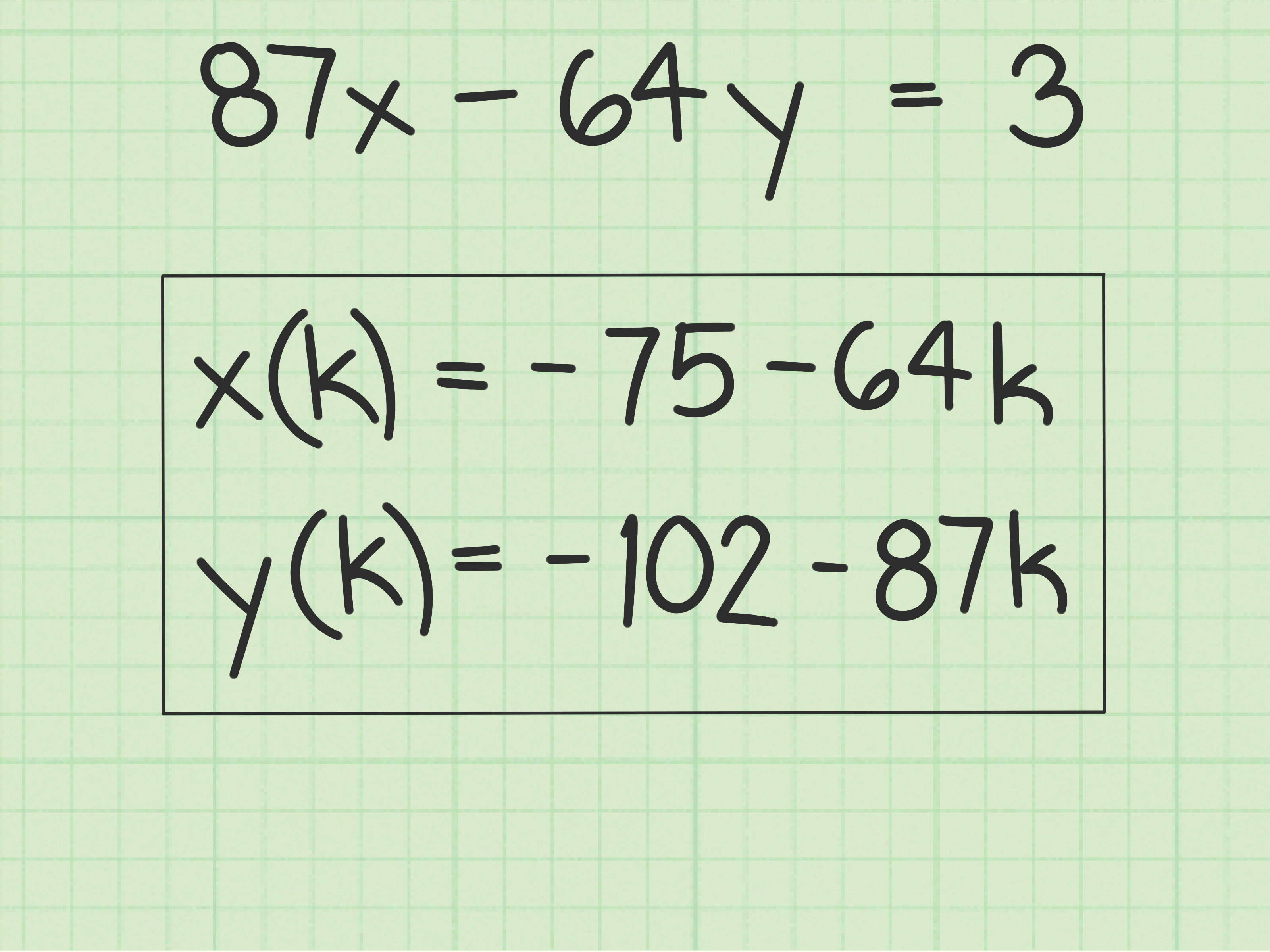
wikiHow
Solving a linear Diophantine equation means that you need to find solutions for the variables x and y that are integers only. Finding integral solutions is more difficult than a standard solution and requires an ordered pattern of steps....
chrome fossil
shell loom
So for (a) i got my x and y value but i have 0 clue what to do for (b) i dont re...
idk how to prove (c) with (a) or (b) or by using linear diophantine but
Let k = gcd(a,b) so a = km, b = kn with gcd(m,n) = 1
gcd(a^3, b^3) = gcd((km)^3, (kn)^3) = gcd((k^3)(m^3), (k^3)(n^3)) = (k^3)gcd(m^3, n^3) = k^3
Obviously gcd(a^3, b^3) = k^3 >= gcd(a, b) = k
With equality at k = 1
So statement is false when gcd(a,b) = k = 1 only
little prism
dont give out answers
shell loom
oh okay so its false lol
i never checked for the coprime case
but yeah in future just give me hints and thanks either way guys
shell loom
little prism
subtract the two equations from a) and b)
uh so when i subtract the equations I get this
vital dewBOT
geanan
 shell loom
what do i do from here?
I also see on the wiki that if you have Ax+By=C then somehow A(x+B)+B(y-A)=C which doesnt look like what i have
 sage lance
Hi folks! I am trying my hand at writing the proof for the theorem, "An Empty Set is a subset of every set." I am attempting a proof by contradiction -- this is my first attempt so I apologize if it doesn't make much sense. What I would like help with is:
- Does my proof make sense?
- How should I improve my proof?
- Where did I go wrong and how could I improve my logic?
Here is what I have tried:
### Proof by Contradiction

#### Set-Up

Let $A = \emptyset$ and $B$ be a set.

Suppose we assert the statement: $A \subset B$

#### Definitions

We will use the following [definitions](01202023041150-graphs.md) taken from [Trudeau's introductory textbook](01202023040727-introduction-graph-theory.md).

##### Set

Definition: Collection of distinct objects, none of which is the set itself.

##### Subset

Definition: A set $A$ is said to be a subset of a set $B$, if every element of $A$ is also an element of $B$.

##### Empty Set

Definition: A set containing no objects.

#### Proof

Given the definition of an [empty set](#empty-set), there are no objects within $A$.

Given $\forall a \in A$, we pose the assertion that $a \in B$.

As there are no objects in $A$, at first, the previous assertion seems false.
However, using the definition of a [set](#set), all that is required for a set to be valid is to have unique objects.
By extension, a set is allowed to be empty.
Yet, being that there are no objects in $A$, we are left to say that $a \in B$ is either true or false.

Building upon this previous statement and the definition of a [subset](#subset), we can then say that the assertion $A \subset B$ is neither true nor false.
And by the property of vacuous truth, we are left to say that an empty set is a subset of every set.
Happy to provide additional info as needed! Also, if the markdown is hard to read, attached is the rendering. Thanks! 😄

Carrying the conversation @gusty swallow , sorry about the mix-up, accidentally asked in the wrong place. But yea, I found it a bit funky as a way to get to the conclusion as I thought that was what "vacuous truth" meant in a proof by contradiction sense here. I could be completely wrong however.
 gusty swallow
not really, vacuous truth means it's true because the premise is false.
"if pigs fly then I'm superman" is vacuously true because pigs don't fly.
sage lance
Ooohhh. So should I modify the initial assertion "Suppose we assert the statement: A is not a subset of B" since A is a subset of B?
Or how should I update the premise you think?
gusty swallow
it would get to vacuous truth much quicker, imo
you have if a is in A then a is in B is vacuously true since there isn't an a in the empty set to begin with
sage lance
Bingo! That's what I was trying to convey but was a bit confused on how to say it. Let me try a small rewrite (updates in bold):
Suppose we assert the statement: **A is not a subset B**
...
Given the definition of an [empty set](#empty-set), there are no objects within $A$.

Given $\forall a \in A$, we pose the assertion that $a \in B$.

As there are no objects in $A$, at first, the previous assertion seems false.
However, using the definition of a [set](#set), all that is required for a set to be valid is to have unique objects.
By extension, a set is allowed to be empty.
**Being that there are no objects in $A$, we are left to say that $a \in B$ is vacuously true**.

**Building upon this previous statement and the definition of a [subset](#subset), we can then say that the assertion $A \subset B$ is therefore vacuously true for every set. **
Does that make more sense now?
obtuse lance
I'd focus on understanding how to prove the empty set is a subset of every set first
proving it by contradiction is just coming off as convoluted to me trying to read this here
sage lance
Oh dear, I think I am in trouble. I thought this was a proof that proved that an empty set is a subset of every set. How would you recommend approaching it differently?
obtuse lance
gusty swallow
you have if a is in A then a is in B is vacuously true since there isn't an a in...
this is the proof right here
like you said here earlier: Definition: A set $A$ is said to be a subset of a set $B$, if every element of $A$ is also an element of $B$.
vital dewBOT
Merosity
 gusty swallow
yeah.... this proof should be like 3 lines tops. You can do it by contradiction, or directly and it's very short
sage lance
Oh shoot so I wayyy over complicated it.
tawdry night
chrome fossil
But that’s more than two logic gates
i'm a bit confused😢
gusty swallow
you can fill in extra with definitions and stuff like you did, and add length. but it's a pretty succinct proof usually
obtuse lance
one thing you can do is cut out this boilerplate of laying out well known definitions before your proof. They're good to write out for yourself on paper so you can easily refer to them and help get them in your brain, but you don't have to resay them
sage lance
Ah gotcha! Let me comment back on this in about 30 minutes— I’ll try to clean what I had up to be more concise.
But thank you so much Zybikron and Merosity !
 ripe mulch
Question: https://atcoder.jp/contests/abc046/tasks/abc046_b
There are N balls placed in a row. AtCoDeer the deer is painting each of these in one of the K colors of his paint cans. For aesthetic reasons, any two adjacent balls must be painted in different colors.

Find the number of the possible ways to paint the balls.
We have N balls (> 10), for the 1st ball, I can choose K colors, for the 2nd ball can only choose K - 1, for the 3rd ball I can also only choose K - 1, and we keep going. So would the number of possible ways be K * (K - 1)^(N - 1)?

AtCoder
AtCoder is a programming contest site for anyone from beginners to experts. We hold weekly programming contests online.
 hexed shore
In how many ways can the digits 0, 1, 2, 3, 4, 5, 6, 7, 8, 9 be distributed so that no even digits are in its original position?
Anyone could give me an info 🙏
chrome fossil
ripe mulch
Question: https://atcoder.jp/contests/abc046/tasks/abc046_b
```
There are N ball...
Yes
chrome fossil
hexed shore
In how many ways can the digits 0, 1, 2, 3, 4, 5, 6, 7, 8, 9 be distributed so t...
try using inclusion-exclusion.
tawdry night
chrome fossil
But that’s more than two logic gates
Is this right? If I substitute NOR GATE
 hexed shore
chrome fossil
try using inclusion-exclusion.
hexed shore
chrome fossil
try using inclusion-exclusion.
I did
 chrome fossil
tawdry night
Is this right? If I substitute NOR GATE
chrome fossil
tawdry night
Is this right? If I substitute NOR GATE
The given expression is equivalent to not (p and q) (check the truth table)
Now put not (p and q) as a logic gate
chrome fossil
hexed shore
I did
-9 x 7!
Where did you get this
sage lance
Hey @gusty swallow and @obtuse lance , it took me a bit longer to think through this but I came up with the following proof for showing that an empty set is a subset of every set. Does the following make sense?
For any set, $B$, $\forall a \in A$, we assert that $a \in B$ is vacuously true, where $A = \emptyset$.
vital dewBOT
TheCedarPrince
 obtuse lance
gusty swallow
you have if a is in A then a is in B is vacuously true since there isn't an a in...
obtuse lance
gusty swallow
you have if a is in A then a is in B is vacuously true since there isn't an a in...
@sage lance I guess you can compare with this and try to understand if there are any substantial differences or not
hexed shore
Nvm found it
 vital dewBOT
 tawdry night
chrome fossil
The given expression is equivalent to not (p and q) (check the truth table)
Now ...
tawdry night
chrome fossil
The given expression is equivalent to not (p and q) (check the truth table)
Now ...
How to put not(p and q) as a logic gate?
sage lance
obtuse lance
<@690581641680257024> I guess you can compare with this and try to understand if...
Yea, I was flipping between what I was writing and that statement quite a bit. I did not think there were any substantial differences when compared to my statement.
obtuse lance
sage lance
Yea, I was flipping between what I was writing and that statement quite a bit. I...
yeah good, you're right
maybe one thing i'd change is refer to A=empty set first, or imo even better just don't introduce A at all and write the empty set there
rough cradle
What's the deal with the pipe | and comman , symbols when writing statements? Are they synonymous?
E.g.
 obtuse lance
sometimes people use | or : to mean "such that" in set notation, I guess comma also can be read that way too
using symbols too much is typically discouraged
sage lance
obtuse lance
maybe one thing i'd change is refer to A=empty set first, or imo even better jus...
Yea I agree. Wow, this was such a neat experience. This is my first proof that I ever sat down with, took the definitions I knew should be involved, and tried to create a proof with from scratch. I know I had problems in the directions I took initially, but starting from all the definitions and ending up with a proof that was could fit onto half a line is super magical. Thank you for being patient with me and helping me on this -- I feel like I learned something really incredible.
obtuse lance
cool, yeah math can be pretty seductive like that sometimes 
sage lance
Yea, don't want to get too off topic but I could totally see the intrigue with it. I found myself thinking, "Can I make this proof even more compact?" and realized: this is quite fun actually! I also was surprised when we finally ended up with such a compact proof -- all that content boiled down to only a few strokes. It helped click in my mind when mathematicians say something is "elegant". I am beginning to see!
obtuse lance
Yeah it's like fumbling around in the dark at first and then you find a light switch and then everything makes sense, I think that's a poor paraphrasing of how Andrew Wiles said it was like in proving Fermat's last theorem
which is pretty relatable I think
sage lance
Hey @obtuse lance , sorry for the ping (last one tonight!), but I was trying to write in my personal notes an explanation on the proof. Right now, I have this:
#### Explanation

Via the [set definition](#set), all that is required for a set to be valid is to have unique objects.
This gives rise to the definition of an [empty set](#empty-set), a set that has no objects.

The tricky bit is meeting the [definition of a subset](#subset).
**Suppose the statement $\emptyset \not\subset B$ exists as antecedent.
Next, $x$ can be established as an element of the $\emptyset$ in the statement, $\forall x \in \emptyset$.**
However, because $\emptyset$ does not have any elements, $x$ doesn't exist to satisfy the antecedent resulting in the further condition that $x \in B$ to be vacuously true.
I highlighted the confusing part to me in bold from my notes. I had this written down from our discussion but am still confused about as to where I would get this antecedent from and why not start at "An emptyset is a subset of B". Wouldn't saying this as the antecedent lead to the same resulting proof as I still cannot satisfy that antecedent?
 rough cradle
 patent gull
can i combine the 2 not q into 1 not q?
patent gull
can i combine the 2 not q into 1 not q?
Yes
patent gull
rough cradle
Yes
thanks
chrome fossil
tawdry night
How to put not(p and q) as a logic gate?
p , q --> and --> not
 unreal stump
Law of Excluded Middle?
 strange token
Can anyone help me with this? haha. I can't seem to get it right
 weary tiger
Can I just clarify that Dijkstra's Algorithm only works on digraphs? I found an A-level maths paper asking to find the shortest path, but there are no arrows on the graph
 leaden jay

Does anyone have ideas for this problem? I'm not sure what to look for in this given graphic sequence to determine if a cut edge exists...
shell loom
This is for (b) Is my proof okay? idk how else to show this

 weary tiger
it looks reasonable
shell loom
for (d) would the negation be "There exists a,b,c in Z such that gcd(a,b)=1 and c divides a+b but either gcd(a,c)=/1 or gcd(b,c)=/1."
leaden jay
^^^ Can anyone help me as soon as possible?…This assignment is due soon…
obtuse lance
leaden jay
^^^ Can anyone help me as soon as possible?…This assignment is due soon…
what's a graphic sequence
leaden jay
obtuse lance
what's a graphic sequence
That represents the degree of all of the vertices of the graph…
 last sigil
all the degrees are even
shell loom
this look okay?

 leaden jay
last sigil
all the degrees are even
leaden jay
last sigil
all the degrees are even
That’s enough of a justification?
leaden jay
Should a certain theorem be applied here?
All the degrees of this graph are not even, but it still has a cut edge (c, e)...

Wait a second...
This might be an interesting observation...
All the graphs that I have seen that has a cut edge has at least a vertex with an odd degree...🤔
 peak pewter
Can anyone help me with this
Consider the equation x^2+(y-2)^2=1 and the relation “(x, y) R (0, 2)”, where R is read as “has distance 1 of”.
For example, “(0, 3) R (0, 2)”, that is, “(0, 3) has distance 1 of (0, 2)”. This relation can also be read as “the point (x, y) is on the circle of radius 1 with center (0, 2)”. In other words: “(x, y) satisfies this equation x^2+(y-2)^2=1 , if and only if, (x, y) R (0, 2)”.
Does this equation determine a relation between x and y? Can the variable x can be seen as a function of y, like x=g(y)? Can the variable y be expressed as a function of x, like y= h(x)? If these are possible, then what will be the domains for these two functions? What are the graphs of these two functions?
Are there points of the coordinate axes that relate to (0, 2) by means of R?
brave rock
x is not a function of y.
You are right that the equation determines a relation between x and y, but this is uninteresting.
y is not a function of x either.
You should be able to prove these claims with ease.

 cedar oxide
 leaden jay
Can anyone help me from where I left off?
chrome fossil
cedar oxide
Graphing the functions should help. Invertible functions are one-to-one functions.
 small plume
can someone tell me whats ambiguous about
Joe saw David driving to school
sudden minnow
did joe see david while joe was driving to school
or did joe see david while david was driving to school
leaden jay
Any thoughts about "All the graphs that I have seen that has a cut edge has at least a vertex with an odd degree"?...
snow cedar
for string of length 3, they got 49. how?

im subtracting 4^3 from the number of bad strings
which i thought is 4^3 - 2x(3choose2)x4
 haughty garden
We use inclusion/exclusion to find the number of length 3 strings which contain 12 or 20 as substrings.
To find the number of strings which contain 12, note that the string 12 must appear in one of two places: either _ 1 2 or 1 2 _. Therefore, there are 2 places to place the 12. The remaining digit can consume one of four digits. This gives us 2 x 4 number of strings that contain 12 and we can check this quite easily: {012, 112, 212, 312, 120, 121, 122, 123}. A similar analysis shows there are also 2 x 4 number of length 3 strings which contain 20 as a substring.
But, of these cases, we would have double-counted 120 twice. So we need to remove the string 120 once. Therefore, the number of length 3 strings which contain 12 or 20 as substrings is 2 * (2 * 4) - 1.
Therefore, the number of strings is 4^3 - 2 * (2 * 4) + 1 = 49
leaden jay
leaden jay
Can anyone help me from where I left off?
Thoughts?

 weak sand
Can someone explain me why this one apparently has 60 topological orderings? from my understanding it should be 16
 haughty garden
Any topological ordering fixes the following vertices
1 _ _ 4 _ _ _ _ _ _
Now in the second and third spot, we can choose 2 or 3 - both are perfectly fine orderings. After 4, we have a few choices to make. Any topological order must place 6 after 5. Any topological order must also place 9 before 8, 10 and after 7.
If 5 comes before 7, then 6 has 5 places to go and 7 becomes fixed. 8 and 10 will then have 2 choices to go. This gives us: 2 * 5 * 2 = 20 for the case where 5 comes before 7.
If 5 comes after 7, then we fix 7 to go after 4. We can first fix 5-6 by choosing two positions and since there’s only one ordering, the number of ways of fixing 5-6 is C(5, 2) = 10. Then, the 8 and 10 can swap and everything else is fixed. Therefore, if 7 comes before 5, the number of ways is 2 * 10 * 2 = 40. This gives you 60 total topological orderings
 latent quarry
You can also solve this recursively in a dynamic-programming-esque way
i.e. there's a pretty straightforward algorithm to do this for general dags
weak sand
thank you. thank makes sense
chrome fossil
weary tiger
p -> q
q or r
So r -> p
Is this correct?
 vital jolt
Can you take the power set of an uncountable set?
And if so, is there a set with a order of magnitude larger cardinality than the power set of an uncountable set
stray reef
yes to both.
tight hound
vital jolt
Can you take the power set of an uncountable set?
Any set has a power set.
sudden minnow
<@&268886789983436800>
 grim kraken
Tyvm
 broken sonnet

I'm not sure if I am headed in the right direction with my counting question that I made
 shadow grove
In the 15 puzzle, how are the bricks initially placed?
Just randomly, or is there a pattern? Specifically, I will be doing a DFA on the easier 2x2 puzzle.
stray reef
01 02 03 04
05 06 07 08
09 10 11 12
13 14 15 ..
this is the solved state of the 15 puzzle if that's what you were asking
shadow grove
stray reef
```
01 02 03 04
05 06 07 08
09 10 11 12
13 14 15 ..
```
this is the solved state...
No, just how to initialize it?
For the 2x2 case
or actually, just the general NxN case
stray reef
wdym initialize
shadow grove
When the puzzle starts how are the letters arranged in the N x N case?
stray reef
they are scrambled, no?
unless you're talking about the popular-then-proved-impossible version
shadow grove
stray reef
they are scrambled, no?
Scrambled how? Just intuitively like a normal board game or what?
stray reef
like a rubik's cube
broken sonnet
For the RHS of a combinatorial proof, $2(n - 2) + \binom{n - 2}{2}$ can be written as:
\begin{align*}
&2(n - 2) + \binom{n - 2 - 1}{2 - 1} + \binom{n - 2 - 1}{2}\
&=2(n - 2) + \binom{n - 3}{1} + \binom{n - 3}{2}\
&=2(n - 2) + (n - 3) + \binom{n - 3}{2}\
&=(n - 2) + \binom{n - 1}{2}\
\end{align*}
vital dewBOT
phamous
 broken sonnet
Can someone explain how we were able to get rid of (n - 3) and the 2 for 2(n - 2)
 minor whale

 short merlin
Guys I need help with the fixed point method
When is the position of the structure equal to y(t) = 4?
Y(t) = 10e^t/2.Cos(2t)
Starting from x0 = 2
 unreal radish
Do all enumerable sets have less cardinality than a non-countable sets, when they are infinite? If you are assigning ID's to books, it doesnt make sense that whole numbers allow you to assign less ID's to books than if you used random numbers between 0-1
brave rock
You can prove that every uncountable set has an enumerable subset (n.b. this requires the axiom of choice.)
It makes sense to me – you just haven't gained the correct intuition yet.
Keep working with infinity and you will likely eventually agree that it makes sense.
brave rock
brave rock
You can prove that every uncountable set has an enumerable subset (n.b. this req...
This is a good exercise.
shell loom
does this look okay?
 brave rock
You have not argued why ax+by = gcd(a,b)
shell loom
do i need to say like there exists a divisor d such that etc. or how would i go about doing that?
brave rock
Give it a shot first, see what you come up with
shell loom
okay let me see
shell loom
or is maybe that i need to start with a and b have gcd(a,b)=d and then d=ax+by, 2d=2ax+2by=2(ax+by)?
gcd(a,b)=d
ax+by=d
2ax+2by=2d
gcd(2a,2b)=2gcd(a,b)
this is what i came up with
brave rock
You have reversed the same proof, but again you have not justified why 2d = gcd(2a,2b)
You are just asserting it
shell loom
okay well bezouts says there is a greatest common divisor d such that d=ax+by for some integers x and y
if i multiply both sides by 2 i get 2d=2(ax+by)=2ax+2by
brave rock
You have misunderstood Bézout
Bézout says that there are some integers x and y for which this is true
However, Bézout gives no guarantee that the x and y such that gcd(a,b) = xa + yb are the same as the x and y such that gcd(2a,2b) = x(2a) + y(2b) as you are assuming.
You must justify why this is true.
shell loom
yeah this makes sense
i guess all I'm given is that a>1 and b>1, am i to use these somehow?
brave rock
I suggest you use the defining properties of the gcd of two numbers.
If you're not sure what that is, it's in the name: it's the greatest common divisor
shell loom
the gcd of two numbers a and b is the unique integer d with d|a and d|b and if c|a and c|b then c<=d?
shell loom
yeah im asking
brave rock
That is indeed the definition of the gcd.
shell loom
okay yeah i for some reason thought bezout was like the def of gcd
this makes sense thoguh
brave rock
It can be used as a definition! The number d = gcd(a,b) is the smallest positive integer such that there exist p, q such that d = pa + qb
However, this requires a bit of work to prove. I suggest you use the definition you posted.
 meager lintel
recursive definition of growth of rabbit population when a rabbit dies
assume we start with 1 new pair and they don't they take one months to become fertile and gives birth to 3 pairs each month after becoming fertile and only lives for a total of 4 months and also they give birth to a 3 pairs in their last month.
shell loom
@brave rock I just took a bit of a break but i wanted to ask, do i use the definition of gcd to get a linear combination? or am i to reason about this without the use of a linear combination?
i tried doing without it but i couldnt figure out how i get gcd(2a,2b) from it
brave rock
I'm not going to tell you the answer to this. I will say that you should apply the definition of the gcd to try and show that 2d = gcd(2a, 2b).
shell loom
So using the definition could i say the gcd of two numbers 2a and 2b is the unique integer 2d with 2d|2a and 2d|2b and if c|2a and c|2b then c<=2d?
brave rock
I think you should try completing the proof, not asking for help on each step.
Maybe once you've tried some things, you'll either have completed the proof, or you'll have a great question to ask
 robust spear
Guys is there a channel for specifically discrete systems and signals?
weary tiger
if f(n)^f(n) = theta(n) then what could f(n) be?
i would take log of both sides and make a guess
so f(n)log(f(n) = theta(log(n))
<@&286206848099549185>
obtuse lance
you can use the lambert W function, if that's satisfying
haughty garden
weary tiger
if f(n)^f(n) = theta(n) then what could f(n) be?
i would take log of both sides ...
Be careful. The logarithmic function does not preserve big Theta. Consider f(n) = 2 and g(n) = 1. Clearly f \in Theta(g). Try applying the log to both functions
obtuse lance
oh I didn't realize this was big theta, disregard my comment
obtuse lance
seeing how they used theta seems consistent with that idea I think
weary tiger
i cant pick g(n)
g(n) = n
that's part of the question
i have to find f(n) such that f(n)^f(n) = theta(n)
weary tiger
haughty garden
Be careful. The logarithmic function does not preserve big Theta. Consider `f(n)...
it's monotonically increasing. Since's everything's positive that should preserve inequalities
a>b and log(a)>log(b) are equivalent as far as i can see
haughty garden
no, the point is that you can't simply say that a monotonic function preserves asymptoticity
this is not true in general
weary tiger
i think in this case it can help us make a guess
haughty garden
you need to be careful with what constant c you decide to choose
weary tiger
we don't have to get into mathematical proofs. The question just askes for a reasonable guess
i also don't know what lambert function is
haughty garden
well, such a function has to be bounded above by a linear function
because any function that is \Theta(n) is also O(n)
haughty garden
any constant function is too small as well since its lower bound won't be linear
any polynomial will be too big, or maybe most polynomial functions
weary tiger
my prof said it has smthing to do with logs
smallest function i could think of was the iterated log
but my prof said that's too small
haughty garden
yeah so I suspect no polynomial function is suitable as f(n)
next thought is to go to logarithmic functions
weary tiger
bruh if f(n)= n then n^n is bigger than exponentials
someone said lambert function. It looks related
it's the inverse of xe^x
<@&286206848099549185>
 gaunt nest
log is also too big I think: log(n)^log(n) = n^log(log(n)) which grows just a smidge faster than n
If you're happy to use the Lambert W then I think log(x)/W(log(x)) will work

Wolfram|Alpha brings expert-level knowledge and capabilities to the broadest possible range of people—spanning all professions and education levels.
weary tiger
bro how did you guess this
I don't want the prof to look at my solution and go this guy cheated by using wolfram
gaunt nest
Well, I noticed that the function x^x is invertible so I asked WA to invert it

 tall lodge
Anyone have advice for self studying discrete math?
I have a background in proofs and number theory
meager lintel
recursive definition of growth of rabbit population when a rabbit dies
assume we start with 1 new pair and they don't they take one months to become fertile and gives birth to 3 pairs each month after becoming fertile and only lives for a total of 4 months and also they give birth to a 3 pairs in their last month. <@&286206848099549185>
 night mantle
hiii, I wanna ask a question on set theory so this is the closest channel I found. I'm reading this solution and got confused by the line"note that this does not imply h(a)>|A| without AoC." But I thought any set of ordinal numbers are well-ordered so why do we need AoC for this??
 tight hound
night mantle
hiii, I wanna ask a question on set theory so this is the closest channel I foun...
tight hound
night mantle
hiii, I wanna ask a question on set theory so this is the closest channel I foun...
What is h(A)?
tight hound
Oh ok
vital jolt
What is the infimum of $\omega_1$?
vital dewBOT
KayJay

 coral parcel
Uh. Taken literally the answer would be "0", but I think a better answer would be: That's a strange question, can you give some more context for it?
weak sand
Given a graph G = (V,E) for which E = 2V+2.
Graph G has 8 vertices of degree 5 and the other vertices are of degree 2. How many vertices does graph G contain?
the answer is 10. but i can't figure out how to solve this? any help?
vital jolt
coral parcel
Uh. Taken literally the answer would be "0", but I think a better answer would b...
Discussion about infinities
Isn’t $\omega_1$ also the set of all real numbers? If so, how can the greatest lower bound be 0? Aren’t real numbers unbounded?
vital dewBOT
KayJay
 coral parcel
No, definitely not. It's the set of all at-most-countable ordinals.
Depending on whether the continuum hypothesis holds, this set may or may not have the same cardinality as the real numbers, but it certainly doesn't have the same elements.
vital jolt
Ok so it’s a different set?
coral parcel
Yes.
vital jolt
Ok then what is $\omega_0$?
vital dewBOT
KayJay
 vital jolt
Since I think I fundamentally misunderstand infinite ordinals
coral parcel
omega_0 is the same as omega: the set of all finite ordinals, better known as the natural numbers. :-)
vital jolt
Wait so then the infimam of omega_1 would be 1, right
Since it’s simply the ordinals extended past finite values?
haughty garden
weak sand
Given a graph G = (V,E) for which E = 2V+2.
Graph G has 8 vertices of degree 5 a...
By the handshaking lemma, the sum of the degree of vertices is 2E. Therefore, 8 * 5 + 2x = 4V + 4. This implies that 2x = 4V - 36 or x = 2V - 18. The number of vertices in G is given by V = 8 + x. You now have two equations to solve for x and V
weak sand
thank you. i did something similar. turn out i had a mistake in the algebra
coral parcel
vital jolt
Wait so then the infimam of omega_1 would be 1, right
It would be 0, since 0 is also an ordinal.
vital jolt
0 isn’t a natural number though
0 is just the cardinality of the empty set
Wait no that’s 1
coral parcel
"Natural numbers" can mean either including 0 or not, depending on who's speaking (and often also on what they're speaking about).
vital jolt
Oh okay
coral parcel
In a context where we're also talking about ordinals, "natural numbers" almost invariably start with 0.
brave rock
Also, it looks like you said that the cardinality of the empty set is 1. It's 0.
weak sand
The shortest path for 1 - 8 is apparently 3. But I cannot understand how is that possible given there is a negative cycle in 2,3, 5, 4. should that mean the shortest path and walk to 8 should also be undefined?
 stray reef
do you have the problem statement exactly was it was written...?
weak sand
What can be said about the shortest path and shortest walk from vertex 1 to vertex 8 in the following graph?
stray reef
surely a path can't take the same edge twice...?
weak sand
no
stray reef
if we're distinguishing paths from walks, then surely one of them has as part of its definition that no edge is visited twice
or do you object to this
weak sand
i do not object. path cannot have same edge twice but walk can
stray reef
then how come you said "no" to my "surely a path can't take the same edge twice...?"
anyway
a path cannot make use of the negative cycle
weak sand
i meant as "no, they cannot"
I guess my undersanding of bellman ford algorithm is not good. We use it to find shortest path right? so, when we find a negative cycle and our destination vertex is affected by the cycle how can we find the shortest path ?
we just avoid the negative cycle?
 sudden minnow
XOR, though I've never seen it used as an operation on sets before
quasi stirrup
sudden minnow
XOR, though I've never seen it used as an operation on sets before
This is a computer science class so that might be the reason
sudden minnow
I see
coral parcel
The subsets of, say, N form a ring if we consider the addition operation to be "XOR" (also known as symmetric difference) and the multiplication operation to be intersection. So "circled plus" makes some sense for the operation.
sudden minnow
oh yeah, in math we generally call it symmetric difference instead
and the symbol is a triangle
idk why I didn't connect the two
gaunt nest
I think we use that symbol in CS because for bits it's addition (hence the plus) modulo 2
That's just speculation tho
 ripe delta
Hey does anyone know if I can use an inference rule on an equation two times?
its an equation with the all quantifier and i wanted to use it for two people in my question
coral parcel
ripe delta
Hey does anyone know if I can use an inference rule on an equation two times?
Generally you can use inference rules as many or few times as you need.
 rose heath
Hey, I need help understanding this task
X = { a, b, c, d, e, f, g, h }
How many in X are equivalent relations, where "a" and "b" are together in one abstract class?
 glossy kayak
is there a non-iterative/non-recurisve way of implementing the logorithm algorithm?
weary tiger
quasi stirrup
what website is this?
snow cedar
anyone know what the significance of adding the identity matrix is?

im seeing on the internet squaring matrix tells you there is a "walk" of length 2 from i to j
and by extension a walk of length k
but im looking at the case of a simple graph O---O where the matrix would be 2x2 filled with 1's
squaring it gives [[2,2],[2,2]]
but if we raise it to 4th power, its all 4's
but i dont see 4 walks of length 4 lol
waxen vessel
how do you construct a graph such that all spanning trees share an edge?
fringe siren
What does it mean for x not belonging to (B\C)?
Is it that the x is in C and not in B?
meager lintel
not really
rapid mural
fringe siren
Is it that the x is in C and not in B?
quite the opposite rather
coral parcel
snow cedar
but im looking at the case of a simple graph O---O where the matrix would be 2x2...
That's only the right matrix if your graph also has loops at each of the vertices.
Without the loops, the matrix should be [[0,1],[1,0]] and its powers are much more restrained.
 gleaming scaffold
anyone good with recurrence relations and recursion trees?
ive got a very basic question
it seems like its basic but i just cant figure it out
brave rock
gleaming scaffold
i've got T(n) = 2T(n-2) + theta(1)
and im trying to solve it using a recursion tree
somehow im getting a linear time, which seems very wrong
my guess would be 2^n
how would you go about solving that recurrence using a recursion tree?
haughty garden
Recursion trees aren’t well suited for these types of recursions; you use them more for recursions where you have T(n) = aT(n/b) + f(n)
The idea behind a recursion tree is that it can be used to analyse the complexity of a divide and conquer algorithm
gleaming scaffold
why would a recursion tree not work? you can still have the call size to be (n-2), (n-4) etc at each level going down
my point being that it can work the same way
haughty garden
I didn’t say they wouldn’t work, just that recursion trees aren’t typically the best method to solve a recurrence of this type. A more direct way of proving that you’re right is the substitution method. You can show that this reduces down to T(n) = 2T(n - k) + Theta(1) for any k. It works fine here because you know that, at each stage of the recursion, you’re doing constant time work so the analysis via recursion trees is simple
It may be a bit harder for more exotic linear recursions or even recursions where the overall work time is non-constant
gleaming scaffold
so for that particular one would the solution be O(n) or O(2^n)
or something completely different?
haughty garden
Should be Theta(n)
Intuitively this makes sense because you can memoise each recursive call
So you only have O(n) subproblems to solve
Each of them takes Theta(1) to solve
gleaming scaffold
yeah but each call make further 2 calls, so if you have 6 calls they make a total of 2^6 calls
assuming cost of each call is constant
that cant be linear
haughty garden
It only makes 1, no? It just calls T(n - 2) which is wholly different to something like T(n - 1) + T(n - 2)
gleaming scaffold
its T(n) = 2T(n-2) + theta(1) so has to be 2
haughty garden
Okay so another way to write this is T(n - 2) + T(n - 2) + Theta(1). Though you do make 2 function calls, how many are you solving for?
haughty garden
Which two?
gleaming scaffold
one second ill send a picture
haughty garden
If you imagine it as a recursion tree, you’re only going down a single branch of the tree because, at every stage, you can just cache your result
This is also how you can reduce Fibonacci from exptime to linear time
haughty garden
haughty garden
If you imagine it as a recursion tree, you’re only going down a single branch of...
This works iff your algorithm allows caching to work
gleaming scaffold
but then why if we have [n/2] we have to consider all branches and sum all branches?
like when using master theorem
haughty garden
Because each of the subproblems solve different parts of the problem
Think of merge sort for example
You split the array into two halves but when you’re doing your recursive step, you’re solving for the lower and upper parts of the array separately
For the Fibonacci algorithm, if you know the result of f(n - 1) and f(n - 2), you can cache these results to solve f(n) in constant time
gleaming scaffold
my professor summed all the branches when considering T(n-c)

and here we have to sum all the red numbers, which is the cost for each call essentially
haughty garden
Oh so you’re not considering any memoised algorithm or at least yet
gleaming scaffold
i dont think so
haughty garden
Then yeah, the linear time analysis isn’t right
At each stage, you’re solving two subproblems of the same size
The time it takes a single subproblem is constant time
gleaming scaffold

yeah linear cant be right
but this is what i got from this working out
which is just a generalisation of the slide above
haughty garden
You should have n/2 layers
So you just need to figure out how many subproblems in each layer
gleaming scaffold
the way i calculated max depth/number of layers is that the size of each call is (n-2^i), so at the base case that needs to be equal to zero, hence n=2^i, where i is maximum depth
which gives h=log2(n)
i think the mistake i made is regarding the call size
i expressed it at n-2^i
which just isnt true
because you are subtracting 2 each time
so on the diagram it looks right down to the 3rd layer
but beyond that i assumed its n-8, n-16, rather than n-6, n-8
ill try to fix that and post an update
haughty garden
Sorry was just eating breakfast lol
gleaming scaffold
yup i made a silly mistake
haughty garden
Yeah so you should end up n/2 layers since each time you need to subtract 2
haughty garden
I believe each subproblem takes constant time to complete
gleaming scaffold
because 1,2,4 are obviously the same
yeah, each circle on the recursion graph is constant
haughty garden
So each layer takes constant time
gleaming scaffold
so you do sum from i=0 to n/2 of 2^i
which gets you to 2^n/2 completxity
which seems correct
vital dewBOT


 Requested by opengangs#7348
haughty garden
Requested by opengangs#7348
haughty garden
Yeah so that’s Theta(2^{n/2}) complexity
Actually now that I think about, memoised algorithm would have the recurrence T(n) = T(n - 2) + Theta(1) which is linear time
vital jolt
@coral parcel where can I read more about transfinite cardinals and ordinals, and other large inaccessible cardinals like mahlo cardinals?
fringe siren
If we have a relation which is transitive we have the definition:
aRb & bRc => aRc for all a, b and c
What is the definition of anti-transitive relation?
little prism
fringe siren
Didn't know that intransitive and anti-transitive are different things
How can i prove that a intransitive relation is not symmetric or not antisymmetric?
little prism
well symmetric and transitive don't imply each other so I wouldn't even count on intransitive implying anything.
maybe first find some examples and check whether they always are symmetric or antisymmetric
 vapid drift
Help
 neon raven
Agnes: "I have 5 clue sentences."
Ramon: "I have 5 clue sentences."
Set: "Ramon doesn't have 5 clue sentences."
In a game, Agnes, Ramon, and Set each gave one clue sentence to Insi. Among the three, only one person gave the correct clue sentence. If Insi can guess who gave the correct clue sentence, then Insi wins. Who gave the correct clue sentence?
is it Set since he tells you that Ramon is lying in his statement which means Agnes must be lying
fringe siren
little prism
well symmetric and transitive don't imply each other so I wouldn't even count on...
This is what i came up with

Another problem:
How can i prove this
 little prism
symmetric does not imply transitive. I don't know where you pull aRc from but it's just wrong
 night merlin
fringe siren
night merlin
fringe siren
What have you tried? There's a really simple and somewhat obvious bijection which does the trick
fringe siren
little prism
symmetric does not imply transitive. I don't know where you pull aRc from but it...
Then how we can prove it. I can't think of an example
fringe siren
night merlin
What have you tried? There's a really simple and somewhat obvious bijection whic...
First i thought to represent S as a set af a series with 0s and 1s, where 2023 will always be 1
night merlin
That's overcomplicating it
But somewhat has the right idea
Or well, you can use that idea to come up with what it should be
Probably
fringe siren
Another thing i tried
P(N)\S is subset of P(N) and to show that they have the same power
night merlin
Think of it like this
Suppose you have a set in S
Then you know that 2023 is in the set
Is there a corresponding set in P(N)\S somehow? So can you construct a set in P(N) which does NOT contain 2023 using your set in S?
Think about your original idea if that helps
fringe siren
Hmm let me think for a moment
night merlin
Sure sure, take your time
It's hard to give hints without just giving you the bijection haha
fringe siren
So in P(N)\S there is no set containing 2023.
We cannot construct a set in P(N) not containing 2023 using S
fringe siren

night merlin
So if you have a set A containing 2023, how can you take A and create a new set B which does not contain 2023?
fringe siren
B subset of A{2023}?
night merlin
A{2023}?
night merlin
Yep, any subset of A\{2023} will be in P(N)\S
night merlin
fringe siren
But then it is nit from S
A is still from S
Remember, you want to take a set in S, and turn it into set which is NOT in S
fringe siren
night merlin
A is still from S
A yes, B is not
fringe siren
night merlin
Remember, you want to take a set in S, and turn it into set which is NOT in S
We will just remove 2023
night merlin
Yep
So the mapping $\varphi:S\to\mathcal{P}(\bN)\setminus S$ given by
$$\varphi(A)=A\setminus{2023}$$
does this trick then, yea?
vital dewBOT
Lorago
 fringe siren
Hmm so A is a set of all the sets with 2023 and B is the opposite?
night merlin
No, so A is one set with 2023, but it can be any set, and you wanted to find a way to create a corresponding set which does not contain 2023
In particular, you wanted to find a bijection $\varphi:S\to\mathcal{P}(\bN)\setminus S$, which is how you prove that $\abs{S}=\abs{\mathcal{P}(\bN)\setminus S}$
Whoops
fringe siren
night merlin
No, so A is **one** set with 2023, but it can be any set, and you wanted to find...
Aaah omg i think i start to understand where you're going
vital dewBOT
Lorago
 night merlin
So the idea is to, for each set A in S, come up with a corresponding set B in P(N) \ S
fringe siren
So for arbitrary set A with 2023 we want to show that there is set B without 2023?
night merlin
We just want to find a way to do so which assigns a unique set for each choice of A
And so if we just remove 2023 from the set A, we get a unique such B, yea?
Since only one such A will give the set B = A \ {2023}
Does this make sense?
fringe siren
night merlin
And so if we just remove 2023 from the set A, we get a unique such B, yea?
Yep
night merlin
(Also if there is anything I say which you do not understand, let me know)
fringe siren
That's like surjective linear mapping in a way
night merlin
Well it's a bijective mapping
So surjective and injective
Haha
Just not linear
And that is precisely what you wanted
night merlin
Isomorphic can mean a loooot of different things haha
In the context of set theory, an isomorphism is usually just a bijective function
So then it is an isomorphism
But you could also have, say, an isomorphism in the context of linear algebra, where it is a linear bijection between vector spaces
There are a lot of terms to keep track of in math haha
fringe siren
night merlin
But you could also have, say, an isomorphism in the context of linear algebra, w...
Yeaaah that's what i was thinking of
In the context of linear algebra
night merlin
Just be aware that isomorphism can mean a few different things :)
Depending on the structure of the sets you map between
But yeah if vector space isomorphisms help you think about this, then great
fringe siren
For any AU{2023} there is a subset B \ {2023} from the set P(N)\S
night merlin
Well you don't need that union if you take A in S to begin with, but yeah exactly
So your bijective map is given by $A\mapsto A\setminus{2023}$
vital dewBOT
Lorago
 night merlin
Where $A\in S$
vital dewBOT
Lorago
 night merlin
And similarly we can then obviously invert this by taking $B\mapsto B\cup{2023}$
vital dewBOT
Lorago
 night merlin
I.e. we can go back to our A by just adding back 2023 again
So this proves that the sets have the same cardinality
Does this make sense?
fringe siren
I understand 

 fringe siren
I have one more similar problem will practice on it
night merlin
vapid drift
help please
night merlin


 night merlin
Don't expect immediate help. Not everyone active always knows the stuff you're asking about, or has the time to help (or wants to for that matter). Also please don't just randomly DM me and expect help just because I helped someone here.
vapid drift
ok can you help now
vapid drift
kk goodluck
vapid drift
vapid drift
ok can you help now
can you help now
fringe siren
What is the difference between function and partial function?
The both definitions seem the same
night merlin
Write down the definitions again
In mathematics, a partial function f from a set X to a set Y is a function from a subset S of X (possibly X itself) to Y. The subset S, that is, the domain of f viewed as a function, is called the domain of definition of f. If S equals X, that is, if f is defined on every element in X, then f is said to be total.
More technically, a partial func...
Wikipedia has some nice pictures illustrating it
night merlin
vapid drift
can you help now
Also, if no one helps you here, try the help channels
fringe siren
@night merlin what do you think about this formal proof?
Is it correct and is it exhaustive?
 night merlin
I don't see what you're really doing when you're trying to prove that $f$ is injective. To me it doesn't seem like you're really proving anything in that part. For the sujectivity part, did you mean to write $f^{-1}(B)=B\cup{2023}$?
vital dewBOT
Lorago
 fringe siren
We can't write f^-1(B) since we haven't proven yet that f is bijection in order to have an inverse?
Yeah i agree that the injection part is kinda fishy.
How we prove injection for this function then?
night merlin
Well what you can do is just prove that $g(B)=B\cup{2023}$ is the inverse of $f$. Remember that $f$ is bijective if and only if it has an inverse, and some times finding an inverse is a much easier way to prove it
vital dewBOT
Lorago
 fringe siren
Ok, the BU{2023} is the inverse but how we prove it? Feeling like we are stuck in a loop.
Find inverse to prove bijection but to prove bijection you have to find the inverse
night merlin
Just check that f(g(B))=B and g(f(A))=A and you're done
Since that's the definition of an inverse
night merlin
fringe siren
Ok, the BU{2023} is the inverse but how we prove it? Feeling like we are stuck i...
You don't have to find an inverse to prove it's bijective, but a lot of times it's much easier, such as in this case
fringe siren
Got it
night merlin
 obtuse lance
 golden otter
notice that it looks a lot like $$2^{2n-1}=\sum_{i=0}^{2n-1}\binom{2n-1}{i}$$ except it's about half of it. But hey, binomial coefficients are symmetric, so you can write out, $$2^{2n-1} = 2 \sum_{i=0}^{n-1} \binom{2n-1}{i}$$ so all you have to do is divide through by $2$ and add on the missing binomial coefficient, $$4^{n-1}+\binom{2n-1}{n}$$
vital dewBOT
Merosity
 small plume
does short circuiting work in propositional logic ?
like if I knew r was T this would just evaluate to T, right ?
 brave rock
That's not "short circuiting" — that's just the definition!
small plume
true I guess


 tawdry night
Hi, I want to ask how to do this question? This is the answer I do.But I dont know what step I need to do?


 wise nexus
 tight latch
Can you guys help me to find the inverse of 2x2 matrix?
tight latch
Can you guys help me to find the inverse of 2x2 matrix?
You made a mistake while calculating the det
rapid mural
det: 
rapid mural
tight latch
Can you guys help me to find the inverse of 2x2 matrix?
be honest: did you use chatgpt
rapid mural
vital dew
**The Great Giggleini**
because this looks like what chatgpt wrote
weary tiger
Hi! How can i sketch DAG with 1source and 4sinks?
 tepid lake
Hi, when using simplification,
where p n q is equivalent to p,
am I allowed to simplify if q is (q n r) or something like (q U r)?
so if
p n (q U r), using simplification it is logically equivalent to p?
fringe siren
what does y∈AxB mean?
is it that y∈A & y∈B?


 fringe siren
i can't think of a way to check if this is transitive relation

what should we do here?
hmm, i get that this relation is transitive
but i dont feel confident with the way i got the transitivity
brave rock
There is no general way to check if a relation is transitive. You just have to try things out and, as is often important in math, be creative.
If you want us to check a proof, then post it.
weary tiger

How the whole sequence of binary numbers is presented as element of set and what does it mean?
I do not get concept of it which is used in exercise 7,9
Can anyone grasp it?
 kind panther
idk in which channel i should ask this, but does someone know this?
 wise nexus
kind panther
idk in which channel i should ask this, but does someone know this?
wise nexus
kind panther
idk in which channel i should ask this, but does someone know this?
Well
What're you stuck on?
Which part are you confused about?
kind panther
question b
wise nexus
I was hoping you would say that haha
It's the only one whose definition i don't know lel
Gimme a second
kind panther
yeah sure
wise nexus
Oh, ok
It's the edge version of cut points
When you delete it, the number of connected components increase
For example, the edge between C and Y is a bridge
Do you see why?
Can you find the rest?
kind panther
ohh okay ty
wise nexus
 subtle plover
hi,
if i want to prove the statement:
if r and s are rational numbers, then r - s is a rational number
where do i start?
i think a proof by contrapositive is useful here, so i came up with this negation:
if r - s is not a rational number, then r and s are not rational numbers.
but i don't know where to go from there.
coral parcel
subtle plover
hi,
if i want to prove the statement:
`if r and s are rational numbers, then r...
You've learned to subtract fractions, right? Observe that when you do that and the incoming numerators and denominators are integers, you get a fraction of integers out of it.
Contrapositive would make this rather more complex. (And by the way, the contrapositive would be: if r-s is irrational then at least one of r and s is irrational).
subtle plover
That makes a lot of sense
Also yeah, i forgot about that
If i were to use that technique with a/b - c/d where a,b,c,d are integers (and thus rational) what would the method of proof be called?
coral parcel
I'd call it a proof by direct computation.
subtle plover
This is my first time writing a proof for anything so dont mind my complete ignorance
So, in formal terms, just a direct proof?
Haha i think the hardest part about this is writing is clearly. The textbook I use regularly moves from plain english to symbols, sometimes at once
And thanks btw
coral parcel
Yes, that's a direct proof.
 steady moon
Hello I am having a problem separating from statement and statement function
whats the difference?
steady moon
rapid mural
are you talking about P vs P(x)?
I have the question in #help-26
 silk inlet
Can someone explain how first question of part b works?

 steady moon
silk inlet
Can someone explain how first question of part b works?
steady moon
silk inlet
Can someone explain how first question of part b works?
this is probability or I am wrong?
weary tiger
would numbers in an inverse function be a good example of a reflexive and symmetric relation thats not transitive ?
silk inlet
steady moon
this is probability or I am wrong?
Permutations
rapid mural
weary tiger
would numbers in an inverse function be a good example of a reflexive and symm...
waht?


 grand totem
Complement; $\overline{X}={x\mid x\notin X}$
vital dewBOT
Neverbloom

 lofty spear
give an original example of a real-world device that uses a combinational circuit that relies on AND logic. Justify your answer.
 dusk sierra
steady moon
dusk sierra
steady moon
de morgans law
 crimson sentinel
right
 south marten
Saw this challenge problem in another discord, can this be turned into a coloring problem ?
 small plume

so p-> q means p iff q
can someone explain the last 2 rows
like how is p iff q true if p and q are F
south marten
south marten
Saw this challenge problem in another discord, can this be turned into a colorin...
My idea was to use burnside lemma to count the orbits but i'm not sure if it gives you the same results as the harmonic numbers (the legnth of a random n-permutation is 1/k) been trying to find an alternate solution but i'm not sure if my idea would work
coral parcel
There doesn't seem to me to be any clear coloring connection.
My argument would be that on an average day (assuming that mean that the order the n team members race in is picked as a random permutation), the probability that a record will be set by at the k'th start is the same as the probability that among the k first racers picked for that day, the best of them is randomly picked to race last -- and it ought to be fairly clear that this is 1/k.
And we can just add those probabilities together without worrying if they're independent, because we're being asked about an average, and expectations are additive even without independence.
 void crypt
what specific graphs can be decompose into Hamiltonian path and cycle? good for a undergrad thesis research paper
coral parcel
small plume
so p-> q means p iff q
No, "p -> q" and "p iff q" don't mean the same -- they have different truth tables.
However "F iff F" and "F -> F" both happen to be true.
As for why "F -> F" is true, you can find a lot of explanation attempts (including one by myself) at https://math.stackexchange.com/questions/48161/in-classical-logic-why-is-p-rightarrow-q-true-if-both-p-and-q-are-false
 magic knoll
could someone explain me stars and bars using generating functions
 can't wrap my head around wiki's explanation
south marten
coral parcel
My argument would be that on an _average_ day (assuming that mean that the order...
That makes sense 👍 when looking at the question I knew that we were dealing with a permutation but I wasn't sure how to go from there I tried using the formula for P(n;r) to get something but that didn't work.
tawdry night
Hi, anyone can solve these questions?

 snow mesa

 halcyon dock

 vague garden
I had a question about radius in trees
I understand that they are the minimum eccentricity of the graph, but it's hard to intuitively imagine what that graphs out to specifically (like for example diameter is just the maximum distance between any 2 points in the graph) and as such I don't fully understand tree centers either
 brave rock
Posting your message once is enough.
If you actually want help, you should ask a specific question instead of simply posting your homework.
 steady moon
I am pretty bad with math induction
I thought with random numbers
and if I get the same result
little prism
examples dont prove anything
steady moon
Eh I dont have any other idea that will work for me
gaunt nest
Try it for n=1,2,3,... and see if you can see a pattern
steady moon
I think its not right
 cerulean wind
steady moon
How I can prove this?
cerulean wind
steady moon
How I can prove this?
hint:
$$\frac{1}{(i+1)(i+2)}=\frac{1}{1+i}-\frac{1}{i+2}$$
vital dewBOT
c squared
 steady moon
cerulean wind
hint:
$$\frac{1}{(i+1)(i+2)}=\frac{1}{1+i}-\frac{1}{i+2}$$
steady moon
cerulean wind
hint:
$$\frac{1}{(i+1)(i+2)}=\frac{1}{1+i}-\frac{1}{i+2}$$
you sure?
cerulean wind
yes
brave rock
steady moon
you sure?
check it yourself
steady moon
when I replace i with 2, on the left side is 1/12 and on the right side is 3/4
But when I try to find a2
then its ok with n+1/n+2
cerulean wind
wot?
steady moon
vital dew
**c squared**
well when I replace i with 2 here
cerulean wind
subtraction not multiplication
also: in general, it is not a good idea to convince yourself that some equation or theorem is true by testing it out for a couple of values. there should be a clear reason/proof as to why said equation or theorem is true
its fine if you want to check your result or gain intuition, but not enough to verify if a statement is true or not
south marten
tawdry night
Hi, anyone can solve these questions?
This is just a function composition look at an example
 rapid mural
steady moon
also what does the x mean?
rapid mural
steady moon
also what does the x mean?
cartesian product
A x B = {(a,b) | a in A, b in B}
rapid mural
sorry kind of busy
 gaunt nest
General strategy with these is to "push negation inward" with De Morgan
So anywhere you see ~(...), try pushing it in and see what happens
small plume
yea so I got stuck after using demorgans lol
gaunt nest
how far did you get?
gaunt nest
What can you say about "q or not q" ?
small plume
tautology?
gaunt nest
Right, by law of the excluded middle
(or sometimes people have other names for that. But I call it LEM)
gaunt nest
Depends how formal you want to be, I guess
but (q or not q or r) is the same as (True or r) which is the same as True
and then x and True is the same as x
small plume
yea
gaunt nest
Those are the intermediate steps I would write
small plume
so am I left with p and r and not r ?