#discrete-math
1 messages · Page 11 of 1
 weary tiger
 vital dewBOT
§`

 brave rock
Of course, the set inclusion symbol is what anyone means when they say that
weary tiger
is it because i didnt say {b} is in A
brave rock
But this is nonsense, because it is even less meaningful to say that b is a subset of A.
And in general it is still not true that {b} is a subset of A.
weary tiger
because we dont know if b is in A
but since {{b}} is a subset of A
then {b} is in A
brave rock
And?
weary tiger
is this what ur trying to say
brave rock
That is indeed what I said
weary tiger
ok thanks
i'll make sure i use the {} next time
this got burried, if anyone could help, thanks in advance.
nvm solved
brave rock
Yes.
 shut bolt
would this statement entail WOP?

 tidal tulip
brave rock
Yes.
tidal tulip
brave rock
Yes.
great, thanks!
brave rock
This is the statement of the W.O.P. that I am used to.
tidal tulip
brave rock
This is the statement of the W.O.P. that I am used to.
what does W.O.P mean?
shut bolt
would u say its equivalent or entailment?
brave rock
tidal tulip
what does W.O.P mean?
I was replying to Danvs, not you
tidal tulip
ok, i thought it was to me sry
brave rock
shut bolt
would u say its equivalent or entailment?
If it is the statement itself, of course it is equivalent.
I don't know what statement of the principle you've been given.
shut bolt
but then how is it any different to this statement?
 brave rock
shut bolt
but then how is it any different to this statement?
brave rock
shut bolt
but then how is it any different to this statement?
You can come up with sets that are not N that have this property but do not have the well-ordering property. It is a good exercise to try to do so.
Hint: choose any set without the well-ordering property.
shut bolt
but doesnt it have to be sets that are N
brave rock
This will tell you why these statements are necessarily different
I don't know how to better explain that this statement and the w.o.p. are just different.
Furthermore, no – there are many ordered sets that are not N that have the well-ordering property.
brave rock
brave rock
I don't know how to better explain that this statement and the w.o.p. are just d...
A comment on this: because both statements are true in the naturals, they are of course equivalent in the naturals—true is equivalent to true! In order to show that they are logically distinct we are forced to find contrary examples, which must of course be something other than the naturals.
shut bolt
oh i see
 dry raven
part of a study guide I think I understand these concepts and got them right. Could anyone lmk if they think I should double check one of em or try to lead me in right direction?
 weary tiger
how from the first comes the second line

 elder berry
weary tiger
how from the first comes the second line
elder berry
weary tiger
how from the first comes the second line
Just a contraposition of the two statements
recall when $P \to Q ~\equiv~ \neg Q \to \neg P$
texit ded
weary tiger
 weary tiger
elder berry
Just a contraposition of the two statements
weary tiger
elder berry
Just a contraposition of the two statements
this statement is right/
ok wait I think I got it

this is the full solution btw
 stuck yoke
someone can explain what to do in q1 and q2 ?

 vale cairn
Blur 100
 chrome sand


 fickle meteor
Does anyone know any good websites with counting practice problems?
 covert bolt
Hello, I don't really understand the solution to b

In particular why the negative of both r was taken
covert bolt
And why the negative of b was also taken
Ok I think at this rate something is very wrong with the solution 💀
 worldly berry
I need help with what this means.... I don't understand how i got that combinatorial formula. Anyone who knows it, please help

 haughty garden
,rotate
vital dewBOT
 dry raven
does this seem right? its for a test study guide sop tryna get it right

 stray reef
@dry raven answer does not match mine. show your work.
dry raven
stray reef
<@303358896758849536> answer does not match mine. show your work.
Wait I actually got 136 after redoing it
stray reef
that still does not match mine and i would still like to see your work.
the number is less important than the work going into it...
dry raven
Ok one sec
The maximum is realized by the array [1, 19, 18, ..., 15, 7, 14, 13, ..., 8, 6, 5, ..., 2, 20]. First we ignore slots x1, x7, and x20, and deal with the worst case of 17 elements-- this is 17(8)=136. Next we deal with the other slots-- x1 and x20 contribute nothing while x7 contributes 5
This is kinda my thought behind it
stray reef
hold on
i don't think 7 and 16 are in place in that array
or maybe we have different definitions of what it means to be in place
but the way i read it, x7 being in place means that all elements less than x7 are to its left and all those greater than x7 are to its right
 chrome tree
NEED HELP FOR THIS:
The proportions of the other ingredients indicate that there is between 4% and 6% breadcrumbs in it, so let's assume that there is
5% breadcrumbs. It also appears from the ingredient list that there is 15% wholemeal rye flour.
There is, however, an obvious problem: At one point or another, the company must have started to
bake this bread, and naturally at one point they did not have crumb from this bread available. Let us
therefore assume that they replaced the breadcrumbs with (more) wholemeal rye flour in the first round of bread they baked.
It is easiest to calculate with shares instead of percentages, so 5% corresponds to 0.05, and 15% corresponds to 0.15.
Let rn be the total proportion of whole grain rye flour in the n'th batch of bread (this is the sum of the rye flour,
which has entered directly into the dough and the rye flour the rasp contains, which (possibly) has entered ´
the dough).
- Determine r1. Find a difference equation for rn
How do do i determine the r1 and find the difference equation?
 pearl hull
I have a question, what does this mean? That | what does it represent?

 indigo ferry
pearl hull
I have a question, what does this mean? That | what does it represent?
indigo ferry
pearl hull
I have a question, what does this mean? That | what does it represent?
13 divides 143
indigo ferry
pearl hull
But what does it mean when divides?
it means 143 is divisible by 13
not the operation division
13 | 143 is a statement, which is either true of false
pearl hull
Oh gotcha
So I always have to invert it
Why does math always overcomplicate something
indigo ferry
well it's still just saying divides
like how you would normally say it
so 13 | 143 means 13 divides 143 (without a remainder), which is a True statement
pearl hull
Ok gotcha
I am stuck with another problem, but it takes so long
Imma finish the rest and then I will show you the problem
 fiery sonnet
Hello, I need help with the following induction

Either I forgot how to do algebra to get rid of the +3, or the formula I derived from the sequence is wrong
Idk which one
indigo ferry
fiery sonnet
Hello, I need help with the following induction
Your hypothesis doesn't work for e_2
 indigo ferry
fiery sonnet
Hello, I need help with the following induction
indigo ferry
fiery sonnet
Hello, I need help with the following induction
You get e_n = 2 4^(n-1) if it's just e_n = 4 e_n-1

 mortal tide
@weary tiger The intersections of A_i
vital dewBOT
Рами
 mortal tide
Think of it like the "sigma sum" of intersection
weary tiger
thanks man
 astral fractal
For an integer n, prove that if 2^n − 1 is prime then 2^(n−1)(2^n − 1) is perfect.
Does anyone know how to approach this question?
indigo ferry
Is this $2^n-1$ and $2^{(n-1)(2^n-1)}$ ?
vital dewBOT
Franz

 indigo ferry
astral fractal
indigo ferry
astral fractal
You should be able to count up all the divisors
indigo ferry
you know what a perfect number is?
indigo ferry
astral fractal
But I need to prove it properly
do you see that it's true?
astral fractal
indigo ferry
you know what a perfect number is?
yeah and it is true..
 desert ibex
Bruh
indigo ferry
wait nvm it works
haughty garden
Hint: the divisor sum function is multiplicative, and it’s easy to see that 2^{n - 1} and 2^n - 1 are coprime
desert ibex
astral fractal
2^n - 1 is prime, let it be x. The only divisors of 2^(n-1)(2^n - 1) are of the form x^a times 2^b where a is either 0 or 1 and b is an integer between 0 and n-1.
Consider the sum of these:
(2^n - 1)(2^n - 1) + 2^n - 1
= (2^n)(2^n - 1)
= 2 times (2^{n-1})(2^n - 1)
By definition, this implies that (2^{n-1})(2^n - 1) is perfect.
desert ibex
haughty garden
Hint: the divisor sum function is multiplicative, and it’s easy to see that 2^{n...
But yeah, basically this
 verbal blade
Any idea on how to prove this?
 desert ibex
verbal blade
Any idea on how to prove this?
desert ibex
verbal blade
Any idea on how to prove this?
What does this notation mean?
You want to prove that there exist integers a, b which satisfy those properties?
verbal blade
Yes, exactly
desert ibex
Okie
Well that seems simple. You can construct A and B as follows:
For any prime factor of r that is not a prime factor of s, put the highest power of it that divides r in A
Similarly do the same for s and B
For prime factors that divide both, put it in the one which has a higher power. Break ties arbitrarily.
pearl hull
I am not understanding how to get B in this part:
 indigo ferry
pearl hull
I am not understanding how to get B in this part:
indigo ferry
pearl hull
I am not understanding how to get B in this part:
where do you get quizes like this
pearl hull
In the Rochester Institution Of technology
indigo ferry
fancy
verbal blade
desert ibex
Well that seems simple. You can construct A and B as follows:
For any prime fac...
Oh you are right, i was making it harder than it was, thank you 🙂
pearl hull
I have no freaking idea of what to do there
Where can I find actual help?
Professor might be busy
fiery sonnet
Proof by induction, am I doing this right? If so, I am stuck here. Any hints would be appreciated
 pearl hull
Found it by myself
 viral crown
fiery sonnet
Proof by induction, am I doing this right? If so, I am stuck here. Any hints wou...
viral crown
fiery sonnet
Proof by induction, am I doing this right? If so, I am stuck here. Any hints wou...
what're you proving here
fiery sonnet
4^(n+1) + 5(2n+1) is divisible by 21
viral crown
do you mean 4^(n+2)
and here are the properties of the mod function

you may find them helpful
 blazing warren
what's the maximum number of maximal chains in a size n poset
im thinking oeis 792
blazing warren
but i have no proof or any idea where to start
weary tiger
How come there's only one chain of (321) in the numerator yet both sets are cancelled out in the denominator?

 wicked bolt
it’s the 6
wicked bolt
lol np
 edgy vine

My idea was to show the upper and lower bound of |E(G)|. Using sum deg term, and assuming our graph to be at most a complete graph I get n^2/4 <= |E(G)| <= n(n-1)/2.
And now I show that when we remove one vertex, say n/2 edges at least, I show that |E(G)|>= (n-1) in both extreme cases of |E(G)|. Because only then it still is connected.
And show that |E(G)| is guranteed to be smaller than (n-2) if we remove one more time atleast n/2 - 1 edges. My idea has to be wrong somewhere..
desert ibex
edgy vine
Divide G into its maximal connected components
If G is not connected then there exist at least two connected components
Therefore there exists at least one component with <= n/2 vertices
Pick any vertex V in such a component
It can have at most n/2 - 1 edges to other vertices in that connected component. Since delta(G) > that, there must be at least one edge going to a different component. This contradicts the maximality of connected components.
blazing warren
blazing warren
what's the maximum number of maximal chains in a size n poset
help me 2 😦
 barren bear
Can anyone explain how I am supposed to look at these types of circuits? Or tell me where I can go to read about it so I can understand it? I've only seen the basic boolean gate logic style before. (The ones you see in Google Images if you search "boolean gate")
How can I tell which values need to be true or false for these more realistic looking circuits? (In this example, to make the lamp turn on.)
 indigo ferry
barren bear
Can anyone explain how I am supposed to look at these types of circuits? Or tell...
indigo ferry
barren bear
Can anyone explain how I am supposed to look at these types of circuits? Or tell...
For the Lamp to light up, the circuit needs to be complete in some way
think of it as layers
If you look at the first layer and the second layer, switches R or ( P or Q) should be on to connect those
and then you need (Not Q) or (Not P)
since all three layers need to be connected, you have [ R or ( P or Q ) ] and [ (Q') or (P') ]
barren bear
Thanks Franz. Knowing that those branches are what "OR" is supposed to look like helps a little.
So to satisfy the top side, R can be True. If not R, either P or Q can be True.
But then the middle section (Q' or P') has to be True too, so either P or Q has to be True to satisfy this section.
So... both of these can work right? Since one of them is true in these cases, we can ignore R?
P: True, Q: False
P: False, Q: True
And what if R is True?
What about this?
R: True, P: True, Q: True
I guessed this for the question but it says it's wrong. Why is it wrong?
Nevermind on the last question. I forgot about the middle section when I was thinking about it. That would make the middle section False, False. So I see why it's wrong now.
Thanks a bunch for your help! 🙂
 spring hound
Is there a more specific term for a DAG with finite nodes where the edges are labelled with unique natural numbers and directed edges can only go from lower labels to higher labels?
Or, I guess one whose adjacency graph is strictly upper triangular.
 haughty garden
I assume it's $a \equiv b \pmod n$, something of that sort?
vital dewBOT

 blazing rose
haughty garden
I assume it's $a \equiv b \pmod n$, something of that sort?
blazing rose
haughty garden
I assume it's $a \equiv b \pmod n$, something of that sort?
ohh ok
so if a equals b mod n then c to the power of a equals c to the power of b mod n right?
 little prism
that's what you have to prove or disprove, yes
blazing rose
alright thanks
 raw jetty
can someone help me prove that □P → ♢P is D-valid?
as well as prove that it is F valid?
 untold nimbus
is this a valid statement?
 indigo ferry
untold nimbus
is this a valid statement?
indigo ferry
untold nimbus
is this a valid statement?
True
The first part is saying $\forall a \in A ; \exists b \in B$ such that $a=b$
vital dewBOT
Franz
 barren bear
@indigo ferry @foggy marsh Thanks again for your help yesterday / this morning. I took my Discrete Math 1 exam a few hours ago and passed!
Now I’m working on Data Structures & Algorithms 1. But right after this I’m sure I’ll be back again asking for help because Discrete Math 2 is next! lol
 hidden locust
i dont understand the conversion why is the reminder different than whats on my calc

can anyone explain the steps please
stray reef
@hidden locust what are you putting into your calculator?
it's likely that it does not know you want quotient and remainder, and instead gives you a decimal expansion.
hidden locust
i feel like im completely wrong can u tell me the steps
@stray reef ya i have no idea how to do it
stray reef
...
stray reef
do you still want an explanation specifically for the "why is my calculator giving a different thing than written here" issue
yes or no
hidden locust
so im just dividing the number by 8
stray reef
please answer the questions i ask you!!!!
hidden locust
yes yes
stray reef
right
so you want to know why the calculator gives you something different than you expect
please show what you are entering into the calculator and getting out of it.
preferably with a picture.
 stray reef
right. that's more or less what i thought was going on, but i wanted to make sure.
the calculator does not know that you want a quotient and remainder, and instead gives you the result of division as a decimal.
stray reef
do you know how to do long division by hand
hidden locust
yes
stray reef
long division produces those
hidden locust
oh ok ok
stray reef
and in fact i was going to suggest that you do this via long division by hand
look up "division with remainder" later
stray reef
you can, but it takes some workaround.
record the integer part of the result, subtract it away, and multiply the fractional part you're left with back by 8
 pallid lintel
Guys i need help with my multiplication 😢😢
Pls dont tell my mom
Whats 7x7 Pls help
pallid lintel
Plsbhelp
pallid lintel
stray reef
the part before the decimal point
Plsss
hidden locust
oh ok like 4.5 its 4
pallid lintel
Ok
stray reef
@pallid lintel you're too young to use discord
stray reef
also your computer can answer this for you
 rugged jackal
..
pallid lintel
I dony know how Pls
stray reef
if you can use discord then your device has a calculator
rugged jackal
81
stray reef
@rugged jackal don't encourage them
rugged jackal
pallid lintel
Whats 9x9
81..
pallid lintel
Whats 6 times 1 Pls
rugged jackal
..
stray reef
@rugged jackal don't.
rugged jackal
ok
hidden locust
lmao
rugged jackal
why u got discord
pallid lintel
Because i Hadked my phon
stray reef
@pallid lintel you need to be 13 or older to use discord.
pallid lintel
My screen Time
stray reef
you cannot be here.
pallid lintel
I am 13
rugged jackal
wow ok
stray reef
no, you said earlier that you were 7.
 gritty crescent
Gottem
hidden locust
ty mod
stray reef
🫡
rugged jackal
you just grew 6 years in 1 mintue
hidden locust
ann so if its 4.453 the integer is 4?
stray reef
yes that's what i was talking about
hidden locust
oh ok ok
ohhhhh ok ok
thats easier than doing all that long division stuff
i used to do advanced math stopped doing math for 2 years nowim so bad
 still belfry
how do i prove this?

 stray reef
@azure willow how much do you know about generating functions, particularly ordinary ones
 azure willow
not too much. i can sort of see some recurrence relation being formed but i can't particularly solve it myself
stray reef
well you understand that the infinite series that gives you your ordinary generating function is $\sum_{n=1}^{\infty} \frac{1}{n} x^n$, yes?
vital dewBOT
Ann
 stray reef
if we let f(x) = this sum then you will have f'(x) = 1/(1-x)
azure willow
i do not follow
if we multiply the function out then yes it will be 1/(1-x)
but as far as the derivative i don't see it?
azure willow
this is what i mean lmao
i'm totally lost on this
i meant, if we multiply 1/x * x/(1-x) we get 1/(1-x)
stray reef
1/x * x/(1-x) is wrong and came from nowhere
stray reef
...
azure willow
😭 what dude
stray reef
let's try to start from the beginning, because clearly a communication issue happened somewhere along the way.
we want to find a closed form for the generating function $f(x) = \sum_{n=1}^{\infty} \frac{1}{n}x^n$.
vital dewBOT
Ann
 azure willow
yes
stray reef
to this end, i suggest taking the derivative of your series
you will get $f'(x) = \sum_{n=1}^{\infty} \frac{1}{n} \cdot nx^{n-1} = \sum_{n=1}^{\infty} x^{n-1}$
vital dewBOT
Ann
 vital dewBOT
Ann
 stray reef
at this point i have not yet claimed any closed form for f itself, mind you!
stray reef
yeah and now we integrate
azure willow
ok
stray reef
noting also that f(0) = 0, which will help us pin down the constant of integration
azure willow
ur fine
i think i got an answer?
i used the S-xS method
hold up lol
$f(x) = \frac{1 - \frac{x}{2}}{1-x}$
vital dewBOT
Ourple
 azure willow
i'm also seeing a 1 - 1/x but that could just be nothing
@stray reef
for 1, 2, 3, 4, it's $f(x) = \frac{1}{(1-x)^{2}}$
vital dewBOT
Ourple
 azure willow
for 1, 1, 1, 1, it's $f(x) = \frac{1}{1-x}$
vital dewBOT
Ourple
 azure willow
can i do the generating function for 1, 1, 1, over the generating function for 1, 2, 3, 4?
$f(x) = \frac {\frac{1}{1-x}}{\frac{1}{(1-x)^{2}}}$
vital dewBOT
Ourple
 azure willow
so then $\frac{(1-x)^ {2}}{1-x}$
vital dewBOT
Ourple
 azure willow
so it would just be $1-x$
vital dewBOT
Ourple
 azure willow
???????
 spring elk

can i get help with part b?
so the domain is {t1, t2, ... ,tn} and the range is {1, 8, 27, .., n^3} for g of f restricted
would the domain of g be {1, 8, 27, ..., n^3}?
?
and if so whats the range of g?
 ember obsidian
spring elk
would the domain of g be {1, 8, 27, ..., n^3}?
ember obsidian
spring elk
would the domain of g be {1, 8, 27, ..., n^3}?
@spring elk u mean g or g^-1?
indigo ferry
spring elk
for (a) do we consider a fixed n?
hmm I guess that's doesn't really matter
ember obsidian
also in general if $g:X\to Y$ is invertible then we have $g\inv:Y\to X$
vital dewBOT
RokettoJanpu
 spring elk
ember obsidian
<@679365438215553045> u mean g or g^-1?
spring elk
ember obsidian
<@679365438215553045> u mean g or g^-1?
the domain of g
we are given that for g of f the domain is {t1, t2, ..., tn} and if we use these in f then we get {1, 8, 27, n^3}
ember obsidian
so i think theres a misunderstanding of what g is
indigo ferry
okay so g is invertible on it's codomain idk if it's valid to say range
ember obsidian
indigo ferry
okay so g is invertible on it's *codomain* idk if it's valid to say range
this is false
indigo ferry
ember obsidian
this is false
why
ember obsidian
whats the codomain of g
spring elk
thats what im not sure of
ember obsidian
ok so lets review the def of restriction
indigo ferry
$$CoD_g = {k^3 | ; k \leq n, k \in \mathbb{N}_0 }$$
vital dewBOT
Franz
 spring elk
ember obsidian
ok so lets review the def of restriction
spring elk
ember obsidian
ok so lets review the def of restriction
if i restrict f on A1 then the domain of f would be the elements of A1 right?
thats restriction
ember obsidian
indigo ferry
$$CoD_g = \{k^3 | \; k \leq n, k \in \mathbb{N}_0 \}$$
false
ember obsidian
spring elk
if i restrict f on A1 then the domain of f would be the elements of A1 right?
yes
indigo ferry
ember obsidian
false
how so>
spring elk
so in this case g of f im restricting to domain t1 t2, .. tn
ember obsidian
indigo ferry
how so>
codomain isnt the same thing as range
indigo ferry
ember obsidian
codomain isnt the same thing as range
that's what I'm saying
indigo ferry
ember obsidian
codomain isnt the same thing as range
okay so what is the codomain of g then?
ember obsidian
for a function $f:X\to Y$, the restriction of $f$ to $A\sse X$ is a function $f|_A:A\to Y$ given by $f|_A(x)=f(x)$
vital dewBOT
RokettoJanpu
 ember obsidian
in this case, g is the restriction of f to {T1,..,Tn}
so the domain of g is that set. the codomain of g is Z_>=0
spring elk
still dont really get how the domain of g is the set because that set is the domain of g of f (so g(f(S))
indigo ferry
 spring elk
ohhhh
ember obsidian
g is defined as a restriction of f
indigo ferry
So f|g is just f, but with a limited domain
ember obsidian
in this case $g=f|_\brc{T_1,…,T_n}$
indigo ferry
defined on limited inputs
spring elk
oh so g is restriction of f and f is restriction of {T1, T2, ... Tn}?
vital dewBOT
RokettoJanpu
Compile Error! Click the  reaction for more information.
(You may edit your message to recompile.)

 spring elk
so when they say "g of f to {T1, T2, .. Tn} they just meant that g = the restriction of f to {t1, t2, .. tn}?
ember obsidian
the intent of the wording is “the restriction (which we’ll call g) of f to {T1,…,Tn}”
ember obsidian
ur welcome
spring elk
in this case it is one to one because since f is restricted on a set that has multiple subsets each of different cardinality, clearly they cant have the same range.
Since the cardinalities are the same can we straight up say its injective without proving its onto?
eitherway it is also onto because the cardinalities are the same and since its given that it is a function clearly everything is mapped
but if domain and range have same cardinality is it enough to just prove its one to one or onto to conclude its injective?
ember obsidian
the restriction of the codomain of a function to the range is always onto
u can check this urself if thats not clear
we’re showing that g, with its codomain restricted to its range, is invertible, so we just need to show g is injective
the only use of cardinality here should be in the injectivity argument
spring elk
ember obsidian
the restriction of the codomain of a function to the range is always onto
this makes sense
spring elk
ember obsidian
the only use of cardinality here should be in the injectivity argument
so does my argument make sense?
for injective part
we already know its a function (so all domains are mapped) and because of cardinalities we know its not mapped to the same thing
ember obsidian
spring elk
so does my argument make sense?
it mostly makes sense, just a vocab issue
i think u mean to say output, not range
range=set of outputs
 gilded knoll
Hey how are you guys doing
I need help with a discrete math problem dealing with finding a value looking at pseudo code was wondering if someone can show me how to actually do it

 glacial flame
Have you learned about summations?
If so, try thinking about how these could be written as summations (and take note of how s starts and changes)
 ionic field
Hi , can you give me a textbooks for descrete math combinatorial analysis
 snow axle
What is discrete math
 jagged hearth
This is a graph theory question, but theres no channel for it. The proof is for the theorem that: "A finite connected graph is Eulerian if and only
if all its vertex degrees are even". Consider a trail $T = v_0e_0v_1e_1....e_k$.
Assume that there are $2s$ edges incident to $v_k$. One of these edges is required to be $e_k$, Where do the other 2s - 1 go? If $v_k$ occurs as an internal vertex of $T$, that is $v_j = v_k$ for some $1 \leq j < k$, then $e_j$ and $e_{j+1}$ must both be edges to $v_k$. Thus, any internal occurence of $_k$ takes up 2 edges. This explains where $2s - 2$ of the edges of $v_k$ go, leaving one trail.
vital dewBOT
sam
 jagged hearth
This is direct copy of my lecture notes, but is this last part not a typo? Surely this would explain where 2s - 3 of the edges go?
The continuation is also: leaving one trail - and that one has to go out of v_0 to v_1 != v_k
Which I also dont uderstand
tidal tulip
@uneven violet that makes sense. thanks!
 cerulean wind
look up multisets and ordered pairs.
surjective set is not standard terminology
oh, then yes
if f is a function from X to Y (it does not matter if Y is a subset of X or not) then for each x in X, f(x) is an element of Y.
if Y is a collection of sets, then each function value f(x) will be a set. for example, f : R —> P(R) where f(x) = {x}
 pallid lynx
Hi i did'nt understand what is an 8bit two's complement is. Can someone explain it to me pls ?
ok thanks
it's just the first digit that change ?
ok i understood
And it's used when ?
ok

 sly sinew
<@&286206848099549185>
 sly sinew
indigo ferry
*pretty cool*
sly sinew
indigo ferry
*pretty cool*
yo
indigo ferry
sly sinew
yo
so what've you got so far?
sly sinew
i got t1 = 1 t2 = 2 t3 = 6
and im trying to figure out a recurrence based on these initial conditions
im noticing you can place the new number n before either n-1 or n-2
so for every permutation there's two new permutations but i think theres more places to put the new number
@indigo ferry what do you think?
indigo ferry
sly sinew
<@872430655546462228> what do you think?
where's this problem from?
sly sinew
my discrete math class
 sturdy bear
What is this? Context: group theory
 haughty garden
The degree of the field extension G / H when G is considered as a vector space over H
wicked bolt
i thought it would be the index of H in G
haughty garden
Index and degree are synonymous in the context of field extensions
haughty garden
ah my bad
yeah it's the index of a subgroup H in G (aka the number of left cosets of H in G)
tfw I've done too much field theory
vale cairn
and for what it's worth, group theory would normally belong in #groups-rings-fields
Groups needn't be discrete 
 formal palm
is an arithmetic sequence with the initial term 50 and the common difference -3.
for this question would be be 50-(-3) or just 50-3?
 lean spear
Difference between $a_1$ and $a_2$ is $-3$, meaning $a_1+(-3)=a_2$ so it's $50-3$
vital dewBOT
Lachlan
 formal palm
thanks
sly sinew

can someone point me to the right direction to solve this problem?
came up with a couple recurrences but they don't seem to work in all cases
sly sinew
<@&286206848099549185>
 red nest
sly sinew
came up with a couple recurrences but they don't seem to work in all cases
red nest
sly sinew
came up with a couple recurrences but they don't seem to work in all cases
T_(n+1) = 3T_n for all n >= 2.
red nest
Because n+1 goes in one of three places, behind n, behind n-1 or at the end
sly sinew
plus cases where you can put n at the end
but you can’t put n at the end for all permutations of T(n)
red nest
You can
sly sinew
oh will it always end in n-1 or n-2?
red nest
No
red nest
Lol we all have those moments
 chrome lily

 turbid gorge
Not sure if this is discrete math but idk where else this would fall
I have to simplify this boolean expression


 short phoenix
(Boolean Algebra) Is this simplification corect? I am not sure if x+x'y can be equal to (x+x')(x+y) using the distributive law

sorry if my handwriting is messy
 errant sapphire

 mighty ivy
I cant visualize the difference between a mealy machine and a moore machine. Can anyone help?
 copper slate
I am a bit confused with this equation { x ∈ S | P(x) }
In the book it says - x denotes "the set of all"
But isn't x only an element in set S here?
indigo ferry
copper slate
I am a bit confused with this equation { x ∈ S | P(x) }
In the book it says - x ...
The whole thing would read "the set of all x in S such that P(x)"
copper slate
indigo ferry
The whole thing would read "the set of all x in S such that P(x)"
True. But does x denote a subset here or just a single element?
indigo ferry
copper slate
True. But does x denote a subset here or just a single element?
x is an element of S, but if S is a set that contains sets then x can be a set in S
copper slate
indigo ferry
x *is* an element of S, but if S is a set that contains sets then x can be a set...
Right. I was just reading about the real number line.
And its a set of real numbers divided into 3 parts.
- Set of positive real numbers. (R+)
- Set of negative real numbers. (R-)
- 0
So i believe x can denote any one of them.
Got it.
Thanks @indigo ferry
copper slate
mighty ivy
I cant visualize the difference between a mealy machine and a moore machine. Can...
These links might be helpful.
https://www.geeksforgeeks.org/mealy-and-moore-machines-in-toc/
https://www.geeksforgeeks.org/difference-between-mealy-machine-and-moore-machine/
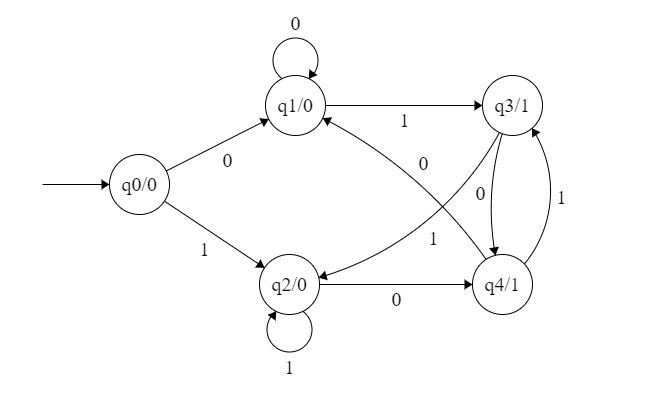
GeeksforGeeks
A Computer Science portal for geeks. It contains well written, well thought and well explained computer science and programming articles, quizzes and practice/competitive programming/company interview Questions.
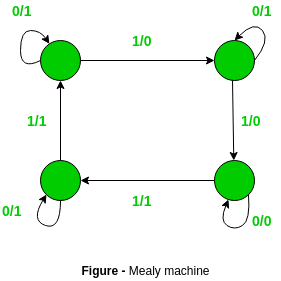
GeeksforGeeks
A Computer Science portal for geeks. It contains well written, well thought and well explained computer science and programming articles, quizzes and practice/competitive programming/company interview Questions.
formal palm
b) An RNA sequence is a sequence of letters (also called bases), each of which is one of A, C, G, or U.
How many 4-element RNA sequences do not contain the sequence CUG?
how would i do this?
gritty crescent
formal palm
how would i do this?
It's probably easier to proceed by exclusion: count the number of sequences of the type _CUG and CUG_, and then subtract it from all possible sequences of length 4.
 thorn jacinth
hey, posted this yesterday, someone suggested me to ask it here.

may i have some help ?
what i've tried :
if m = rs, then the graph should be complete. if it's not, then it has less edges, thus rs > m
but i'm pretty sure i can write that in a better way
formal palm
A committee is formed with a union. In the union there are 98 companies that participate, where each company provides 5 representatives. How many ways are there to form this committee?
Would this be 5^98 or is it 5 or is it P(98,5)?
weary tiger
If we do Kleen star, it certainly always include the original words of this language?

 grand totem
weary tiger
If we do Kleen star, it certainly always include the original words of this lang...
grand totem
weary tiger
If we do Kleen star, it certainly always include the original words of this lang...
The Kleene star of a language L is the least language that contains L as a subset, has the empty word as an element and is closed under concatenation.
So in particular, yes we have that L ⊆ L*
And you also noticed correctly that the proof makes use of the fact that we also have ε ∈ L*
Oh wait, your proof actually does contain a slight error concerning that fact. While the empty word is always part of the Kleene star of any language, you claim (in the 2nd line of the proof) that ε ∈ L₁ (and similarly for L₂). That however doesn't generally hold
weary tiger
What i tried to do is
I tried to make that w is in L1 and epsilon is in L2
Or its the other way around
Therefore
L2*L1 equals that^
grand totem
How do we know that the empty word is in L2 though?
weary tiger
But I'm not sure if that's true idk
weary tiger
grand totem
How do we know that the empty word is in L2 though?
I made two options
That it's either in L1
Or its in L2
grand totem
The empty word doesn't necessarily need to be in either one
grand totem
Your proof is almost correct, specifically it is correct to say that ε ∈ L* for any language L (by the very definition of the Kleene star)
weary tiger
Yh
grand totem
And that is really all you need
weary tiger
So wait
I just gotta add that
Epsilon is in L* for any language ..
Then the proof is correct?
@grand totem could u write it or something pls
Cuz I'm not sure of the first part too
That marked in yellow

Cuz yh its not necessarily having epsilon
grand totem
I'm not going to write the proof for you, especially because your reasoning is fine for the most part (though I suggest you write more words and less in symbols)
weary tiger
grand totem
I'm not going to write the proof for you, especially because your reasoning is f...
Ight I'll try to fix it ty

Do u think it's better now 😅
weary tiger
grand totem
Your proof is almost correct, specifically it is correct to say that ε ∈ L* for ...
The thing written on right bottom side is this basically
grand totem
A generous prof (or TA) would probably accept this since the proof is correct but without any words justifying some of the steps (specifically the ones that rely on the definition of the Kleene star) the proof looks rather empty
For example, why is w ∈ L₁*
weary tiger
It was essentially a larger equation and i proved half of it with words and got this derived out of it basically that's why i thought proving it normally would be better 😅
weary tiger
grand totem
For example, why is w ∈ L₁*
In previous steps I've explained it yh
Now i just mentioned it back without explaining it since it was previously explained in the same question
weary tiger
weary tiger
Is that more correct than the pic i posted before ?
(changed second line)
grand totem
Yea, this one is correct (as in it doesn't contain any wrong assumptions like the previous one)
weary tiger
grand totem
Yea, this one is correct (as in it doesn't contain any wrong assumptions like th...
Ight tysm mate appreciate it
grand totem
👍
indigo ferry
weary tiger
That marked in yellow
Proof:
Wel
Wel
Well
 cedar token

 weary tiger
@grand totem u awake for a quick question? 😅
grand totem
weary tiger
<@220941391054897153> u awake for a quick question? 😅
Sure but in general just ask the questions so others can help too
weary tiger
grand totem
Sure but in general just ask the questions so others can help too
All g don't worry ty i have done it 🙏
weary tiger
grand totem
Sure but in general just ask the questions so others can help too
Ight getting fucked by a new question again
I need to give an example of two infinite languages L1,L2
That upholds these conditions
L1L2=L2L1
And
L2 cap L1 = ∅
Can i do
L1= {a}*
L2={b}*?
Idk it seems correct for me but that's so simple so doubt it lol
haughty garden
Consider the languages $L_1 = {a^{2k} : k \in \mathbb N}$ and $L_2 = {a^{2k + 1} : k \in \mathbb N}$.
If $w \in L_1$, then $|w|$ is even so $w$ can't be in $L_2$. Likewise, if $w \in L_2$, then $|w|$ is odd so $w$ can't be in $L_1$. This shows that their intersection is empty.
It's easy to see that $L_1 L_2 = L_2 L_1$. Take any string $w \in L_1 L_2$. Then it is composed of $(a^{2k})(a^{2m + 1})$ for integers $k, m$. But this is exactly the same string had you grouped the first $2m + 1$ $a$'s followed by $2k$ $a$'s to give you a string in $L_2 L_1$. The reverse argument holds.
vital dewBOT
 weary tiger
haughty garden
Consider the languages $L_1 = \{a^{2k} : k \in \mathbb N\}$ and $L_2 = \{a^{2k +...
weary tiger
haughty garden
Consider the languages $L_1 = \{a^{2k} : k \in \mathbb N\}$ and $L_2 = \{a^{2k +...
Ty
weary tiger
haughty garden
Consider the languages $L_1 = \{a^{2k} : k \in \mathbb N\}$ and $L_2 = \{a^{2k +...
Wait how did u prove that L1L2=L2L1 in the second part
haughty garden
Prove both inclusions
haughty garden
Let $w \in L_1 L_2$. Then there exist integers $k, m$ such that [w = (a^{2k})(a^{2m + 1}) = \underbrace{\left(a \cdot \dots \cdot a\right)}{2k}\underbrace{\left(a \cdot \dots \cdot a\right)}{2m + 1} = \underbrace{\left(a \cdot \dots \cdot a\right)}{2m + 1}\underbrace{\left(a \cdot \dots \cdot a\right)}{2k},] which is in $L_2 L_1$
ehhh it cut off but hopefully you get the idea
the idea is that w is finite (in length), so you can regroup the a's to obtain a^{2m + 1} a^{2k}
but this is exactly an element in L_2 L_1
vital dewBOT
 haughty garden
Yeah, the reverse argument follows by just reversing the argument we made
weary tiger
Yh
 brave rock
Maybe you could try induction.
 sly widget
I am trying induction but I get stuck on the inductive step
indigo ferry
sly widget
use the binomial expansion for x + h
sly widget
Can you elaborate as to what you mean? sorry for asking too many questions
cerulean wind
assume that its true for some $n$.
$$\frac{d}{dx}(x^{n+1})=x^{n}+x\cdot \frac{d}{dx}(x^n)=\dots$$
vital dewBOT
c squared

 lusty fern
What does it mean logically for a event to be transitive?
lusty fern
stray reef
<@958223405654638602> do you still need help with this
Nvm, I think I understand it now
weary tiger
Prove or disprove
 haughty garden
Is L^2 the concatenation of L with itself?
jagged hearth

I dont understand this marked section
How can this be a cycle, you must use the edge {x,w} twice?
How else do you "starting at x, following along P until w"
I don't see why P necessarily goes along another edge than {x,w}

what am I misunderstanding
 south dock
Just a quick question. What is i in this equation?

We're doing currently doing frequency estimation using sparse fourier transform
weary tiger
south dock
Just a quick question. What is i in this equation?
$\sqrt{-1}$
vital dewBOT
rakki
 weary tiger
?
south dock
Oh yea ur right ty
weary tiger
lol yeah with all the other variables it took me a second to remember as well
south dock
Also, there's one other thing that I'm completely lost on. My prof found 49536, 669784, and (1024x1021x87) as N values and I'm unsure why. She initially had an N value of 715, fw = 100, and w = 67 with N having a factorization of 5, 11, and 13.


These were the equations she used
Any help is much appreciated ❤️
 solar flame
can anyone help with this please?

 restive surge
I know basic discrete math (like the stuff you would need to know for competition math), and it really intrigues me. I don’t really have access to any book nor money to buy books, and I learn best through practice problems. Anyone have any suggestions on i where I could learn some more advanced stuff?
 solemn zephyr
How many k-element subsets of the set {1,…n} are there in which no two consecutive numbers occur?

is this correct?
 serene plume
How do discrete math
 umbral blade
True/ false / open
If factoring is an element of p, then p does not equal np.
Kind of confused when I consider the implication rules.
I was thinking it was open because because we don’t know if p= np
But I could also see it being false
Just confused with the implication rules when one part of the proposition is open or both parts of t are open
 rancid galleon
. Let GO and S be predicates as shown below. Write using connectives ( and, or and negation and the existential and universal quantifiers), to express the following:
All the people will either go out when it is snowing or if some people do not go out when it is snowing then some people will watch a movie.
Use the following
GO(x): x goes out where x is a person
M(x): x watches a movie where x is a person
s : It is snowing.
 outer kayak
how could i go about this?
 viral crown
think about constructing bijections!
i'll give you a hint: so you know how to prove that the cardinality of N is the same as the even integers?
there's really not a big difference between even (divisible by two) and "s-even" (divisible by seven)
and much the same thing might work for the squares
and think about what T is a bit more relative to A
outer kayak
hmm
viral crown
and what do you know about the set of all primes?
outer kayak
they are in the set of all N
vale cairn
Another thing is uh well maybe a sledgehammer but every subset of N is either same cardinality as N or finite
viral crown
LOL
vale cairn
So uh
viral crown
i feel like that's too strong for this problem
vale cairn
I mean fair but it gives intuition hopefully lol / is smth you should be aware of
But yes definitely too strong for this
outer kayak
thanks guys
rancid galleon
can someone please answer my quesiont?
Let GO and S be predicates as shown below. Write using connectives ( and, or and negation and the existential and universal quantifiers), to express the following:
All the people will either go out when it is snowing or if some people do not go out when it is snowing then some people will watch a movie.
Use the following
GO(x): x goes out where x is a person
M(x): x watches a movie where x is a person
s : It is snowing.
south dock
Question. How can I determine frequencies in a signal using DFTs?
 outer mango

 crystal oyster
Problem 6: In simple terms, what is a binary predicate? Explain the difference between
the two binary predicates ∈ and ⊆ (these are symbols in the language of set theory) by
completing the following 4 parts: In each of the following four parts, find two sets A and
B such that
a) A ∈ B is true, and A ⊆ B is true
b) A ∈ B is true, and A ⊆ B is false
c) A ∈ B is false, and A ⊆ B is true
d) A ∈ B is false, and A ⊆ B is false
crystal oyster
can anyone help with those four proofs?
 urban cypress
Is there a tool that shows induction proof step by step
crystal oyster
im not sure tbh, ive been trying to find out to help out but i cant see to find one
 velvet iris
what does this notation mean?
Graph G, is there a dominating set D such that G[D] is connected?
what is G[D]
jagged hearth

Mathematics Stack Exchange
The proof in my lecture notes starts as such:
Let $T$ be a finite tree on at least $2$ vertices. Consider a path $P = xe_1x_1e_2...y$ of maximum length in $T$. This path begins with a vertex $x$, and
Need help with this
umbral blade
Proposition True or False or Open:
If factoring is an element of P, then P does not equal NP.
I went with open because of implication rules.
A proposition with Open —> open makes the proposition open?
 steady nymph
False. There exists a world where factoring is in P and P = NP
Also “P = NP => Factoring not in P” is clearly false and these are equivalent statements
wicked bolt
umbral blade
I went with open because of implication rules.
A proposition with Open —> open ...
what about
if the riemann hypothesis is true, then the riemann hypothesis is false
umbral blade
steady nymph
Also “P = NP => Factoring not in P” is clearly false and these are equivalent st...
Open —> open would be open
steady nymph
No
umbral blade
umbral blade
Open —> open would be open
That’s my question it’s clearly false but since it’s open and with implication rules then wouldn’t it be open
if we dont know if P = NP then the prop. would have to still be open would it not
false --> open is open
so why wouldnt open --> open be open
haughty garden
P = NP implies coNP = NP
So just because one side is open doesn’t mean an implication is open
It turns out both sides of this implication are open problems
But the implication we have here is true
umbral blade
haughty garden
So just because one side is open doesn’t mean an implication is open
if primality testing is in p then p = NP
T --> open
would it be true, false, or open
haughty garden
Primality testing is in P, no?
umbral blade
yes
haughty garden
It doesn’t imply that P = NP
umbral blade
we discussed this problem in class, and my teacher said although we know Primality testing isn't NP hard
the propostion is still open
because of the open being on one part
haughty garden
It suffices to show that any problem in NP-complete is in P to show that P = NP
But primality testing is not in NP-complete because it isn’t in NP-hard
So supposing that primality testing is in P does not imply that P = NP
Or at least from what I recall anyways
umbral blade
haughty garden
So supposing that primality testing is in P does not imply that P = NP
i had the same logic, we know its in p but we still don't know that P = NP so the proposition is false
but my professor said its open so I just went with their logic
haughty garden
Mmmm having a quick search, it seems as though determining whether an integer is prime is unknown whether it is in NP-complete or not
And if it is, P = NP
umbral blade
hmm so the proposition just hasn't been directly proven false?
haughty garden
We just don’t know whether primality testing is NP-complete
It’s certainly in NP but we don’t know if it’s NP-hard
If it’s not in NP-hard, then it’s not in NP-complete and so having primality testing in P doesn’t really tell us a lot regarding P = NP
 whole field
What does np mean
haughty garden
A problem X is in NP if X can be solved in non-deterministic polynomial time
Another way to think about this is that any solution can be verified in polynomial time
whole field
Wdym by non-deterministic
whole field
haughty garden
Another way to think about this is that any solution can be verified in polynomi...
I see
crystal oyster
Could anyone tell me what’s wrong with this proof?

 runic junco
H has no relation to anything, there is no reason it should be in F

 gray sun
Not looking for an answer, but what would be the best approach to this open ended problem?
 lusty fern
is there a trick to counting subgraphs of a graph?
 naive gust
However, I am stuck on the second part and I still can not find the answer after several trials.
please help
 night stream
would this graph have 13 vertices and 36 total degrees?
 stray reef
"36 total degrees" is a little odd as far as wording goes, but yes, the total degree of this graph is 36.
 molten fjord
can someone help explain to me why this is true
 haughty garden
try proving big-oh and big-omega relations
molten fjord
Im trying to figure out c_1 and c_2 for this but I cant figure it out
I've been staring at it for a while
haughty garden
You can sorta guess c_1 and c_2 by working backwards
this would be suitable for the upper bound
 desert ibex
lusty fern
is there a trick to counting subgraphs of a graph?
desert ibex
lusty fern
is there a trick to counting subgraphs of a graph?
Have a problem in mind?
 light sail
 midnight mural
guys
Prove that the Goldbach conjecture that every even integer greater than 2 is the sum of two primes is equivalent to the statement that every integer greater than 5 is the sum of three primes.
what is the right way to think about this questions
question*
i mean how can i solve it
blazing rose
how do i understand this?

like is this the operation on 2 pairs of rational numbers?
and then what does the operation say
 balmy dune
this question got me and im not sure if i solved it right. is (Q or R or P) is the right answer?
 indigo ferry
 tidal bronze
shouldn't this be 3 C 1 . 2 ^ 2
tidal bronze
indigo ferry
shouldn't this be 3 C 1 . 2 ^ 2
Thats what I was thinking too, i think this solution I have is wrong
indigo ferry
We'd need 1's on both sides, and this has no overlap with cases 1 or 2
 somber heath
<@&268886789983436800>
 proper meadow
I have a little packing problem where I want to find an optimal layout for maximizing the number of nodes in a 3D grid where the rule is that nodes should be within a taxicab distance of at least 5 of each other. Any idea how to go about it? And do you expect that for this distance it's intractable?
Ideally, the solution would be some X * Y * Z-sized pattern that can be tiled.
I'm not sure if this is the right channel, should maybe ask elsewhere.
Point me in the right direction, if that's the case. 🙂
 thorn lake
Im confused

to find the union shouldnt I just add the caridnalities and then subtract the sum of that to the intersect?
thats what i did here
(126+58)-25
 pale epoch
i think you missed the apostrophe on H
thorn lake
what does that mean?
 hollow dagger
in a dag, if for any path from ui to uj, i add an edge from ui to uj, how can i show tht the graph i obtained is still a dag
stray reef
well presumably you want to show that the addition of all these edges never gave you a cycle
hollow dagger
stray reef
well presumably you want to show that the addition of all these edges never gave...
wym by addition (sry not good w the english terminology)
i thought to assume through contradiction that the obtained dag (G') is cyclic, which would lead to G being cyclic (which is false), however i got stuck at expressing the supposed cycle
hollow dagger
stray reef
> i add an edge from ui to uj
oh sry i rly thought of like a sum xdd
gray sun
Can i calculate the equation of a normal curve from a graph such as the following:
 outer kayak
is this a sufficient proof ?
 viral crown
uhhh if 'within 1 unit distance' is inclusive of 1 and you can't place a point along the lines of the outside triangle then yes
also technically the interior points don't have to be in the triangles so maybe you could write an allowance for that?
outer kayak
i see ok ty
 viral turret
Anyone know what’s wrong here?
 viral crown
you're doing induction wrong
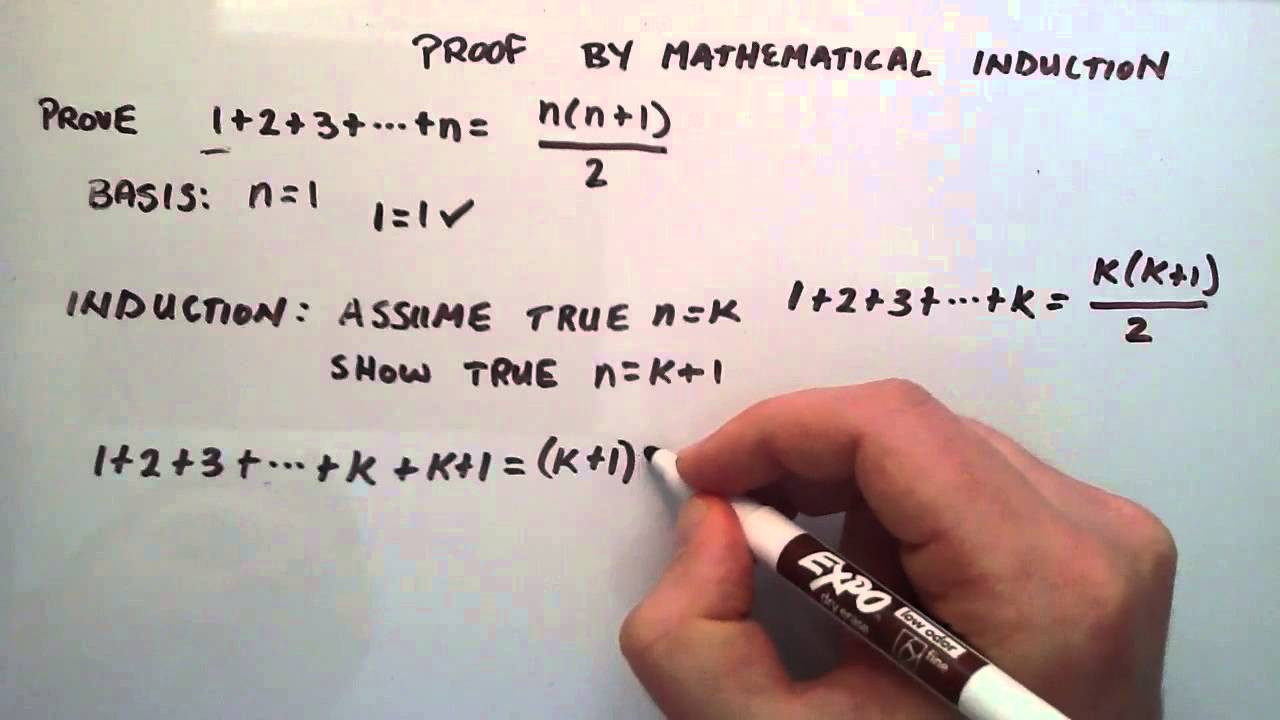
In this tutorial I show how to do a proof by mathematical induction.
Join this channel to get access to perks:
https://www.youtube.com/channel/UCn2SbZWi4yTkmPUj5wnbfoA/join
:)
this is the video that made it click for me
viral turret
Wrong induction?
desert ibex
jagged hearth
https://math.stackexchange.com/questions/4577257/proof-that-every-finite-tree-wi...
Simple counting argument solves this. The total sum of degrees in a tree is 2n - 2. If n-1 vertices have degree >= 2 and 1 vertex has degree 1 then that results in the total degree being >= 2n - 1. Therefore at least two vertices must have degree 1.
desert ibex
hollow dagger
in a dag, if for any path from ui to uj, i add an edge from ui to uj, how can i ...
Show that the topological sort is invariant
desert ibex
midnight mural
i mean how can i solve it
Start by assuming one of them and prove the other. Then go the other way.
 celest drum
Hello hope you well. I have a question on number on number theory if any can help. Is there a different (more efficient method) of finding a multiplicative inverse of lets say 7 (mod 26) other than multiplying 7 by 1,2,3......15 checking if each will give 1 (mod 26)?
 uneven violet
celest drum
Hello hope you well. I have a question on number on number theory if any can hel...
uneven violet
celest drum
Hello hope you well. I have a question on number on number theory if any can hel...
Hey, you can use the extended Euclidean algorithm for finding inverses. Here's a site that describes how it works: http://www-math.ucdenver.edu/~wcherowi/courses/m5410/exeucalg.html And otherwise, there's a ton of youtube videos on it as well.
celest drum
uneven violet
Hey, you can use the extended Euclidean algorithm for finding inverses. Here's a...
Thank you I will go over it
hollow dagger
desert ibex
Show that the topological sort is invariant
thats the route i went on, thx u!
desert ibex
hollow dagger
thats the route i went on, thx u!
No problem!
 shadow grove
Is there any obvious simplification to this that I am missing? Like some inductive proof-function I can't seem to find? I can find one for the version without the floor, but for the floor I cannot...

Without the floor, I have found:
Let k = 11/5, then
pop(n) = k^(n-1) - (k^0 * pop(n-2) + k^1 * pop(n - 3) + ...+ k^(n-3) * 1)
 vital flume
how to find all solutions of a+b+c <= 6 and a,b <= 2 and c <= 4
vital flume
how can i prove this with induction?
 desert ibex
Do the base case.
then we have
(-1)^m C(n, m) + (-1)^{m-1}C(n-1, m-1)
= (-1)^{m} ( C(n, m) - C(n-1, m-1))
= (-1)^{m} C(n-1, m) [since C(a, b-1) + C(a, b) = C(a+1, b)]
weary tiger

Okay so im trying to make sense out of what this question is asking, mainly in terms of what theyre saying $B^{A}{}$ is. From like thinking about it if figured they're talking the set looking something like $$
B^{A} = {F_{0,0},F_{0,1},F_{1,0}\dots F_{i,j}}
$$
Where $F_{k,0}{}$ maps the Kth Element of A to 0, and $F_{k}{1}$ maps the Kth element of A to 1.
My issue is weather this interpretation of $B^{A}{}$ is correct, if so why though? For any element in A isnt there an infinite amount of functions that map it to 1? So I think somewhere in my understanding its flawed of how $B^{A}{}$ is constructed, if i could figure what it looks like i think I would be able to solve the problem from there
vital dewBOT
rakki
 weary tiger
wait unless $F_{i,j}$ isnt a particular function, but make it the infinite set of functions where the property holds?
vital dewBOT
rakki
 weary tiger
also lemme know if this is the wrong channel lol. not sure if itd fit better in #proofs-and-logic more or smth
 sudden minnow
weary tiger
Okay so im trying to make sense out of what this question is asking, mainly in t...
sudden minnow
weary tiger
Okay so im trying to make sense out of what this question is asking, mainly in t...
no, that's not what an arbitrary element of B^A looks like
each function is defined on all of A
weary tiger
hm
alright let me try to remake it
alright so this isnt rly a rigerous way ive made it here, but like i wanna know if this is the step in the right direction

so like for each element in A i gave it a number between 0 and n, where like n is the nth element of A,
then say like the set of functions, like here function 1, would be like the set that maps element 1 to 1, F2 maps it to like a particular combination of 0s and 1s and then i kinda realized it was kinda like binary
uh just trying to think about the right way to word this to ask if on the right track, brb
weary tiger
written out more nicely this is what im thinking of so far
vital dewBOT
rakki
 weary tiger
$0 < i < |A| , i \in \mathbb{Z}$
vital dewBOT
rakki
 weary tiger
would this be a sufficient mapping of the functions in B^A ?
sudden minnow
... you are supposed to show B^A has |P(A)| many elements, while your set clearly has |A| many
so, not close
weary tiger
omg thats a good point
sudden minnow
all your functions map only one element to 1, that should give an idea how many functions you haven't listed
weary tiger
yeah yeah
im starting to see it
can i just say let F go from 0 to (2^|A|)-1 ? so then that way my binary representation hits all possible combinations
sudden minnow
I mean... you haven't really defined how this binary representation is defined, so you are just pushing the work one step further back
weary tiger
rip
sudden minnow
just think of a small set say {a,b,c}, write out every possible function from A to B, then write out every subset of A
think of a meaningful bijection
really this question is very easy if you just think of simple examples, instantly going way abstract is just going to make it harder to see the idea
weary tiger
yeah i bet
desert ibex
The idea is that the pull back of 1 (or equivalently 0) of a function in B^A is a subset of A, and each subset of A uniquely defines a function in which the pull back of 1 is that subset
@weary tiger
weary tiger
yee i think i got it
desert ibex
Awesome
sudden minnow
and fun fact, this is how cardinal arithmetic is defined
,, \kappa^\lambda := |B^A|
vital dewBOT
lems
 sudden minnow
where $|B| = \kappa$ and $|A| = \lambda$
vital dewBOT
lems

 steady moon
glacial flame
steady moon
glacial flame
$x \rightarrow y$
vital dewBOT
JJCUBER
 glacial flame
Also known as x implies y
 unique karma
would this statement be true?

 rapid mural
What is P(n) here?
unique karma
quantified predicate
unique karma
this is the whole question, consider the following predicates P(n): , explain why the quantified predicate is true
rapid mural
is n really in Z?
Because if you are inducting it's over N
(I mean I suppose you can induct over Z+ too but they're isomorphic)
unique karma
wait i figured it out nevermind lol
 limpid fossil
how can i do D?

 proud needle
Hello everyone. I have a graph theory research mentorship thing next summer, and I was wondering what the prerequisites to Graph Theory is. I am taking Pre-Calculus right now. I am reading the dover book about graph theory right now. Should I read up on some discrete math and study proof-writing?
outer kayak
Im a bit stuck on the surjective part.. am i on the right track ?

 heavy ridge
Hi can someone explain the subset relation to me i dont rly get it
 frigid canopy
outer kayak
Im a bit stuck on the surjective part.. am i on the right track ?
frigid canopy
outer kayak
Im a bit stuck on the surjective part.. am i on the right track ?
The formatting is all ducked up, doesn’t make sense to me either
desert ibex
outer kayak
Im a bit stuck on the surjective part.. am i on the right track ?
Well a very easy thing to do is just take the natural function from A to N which is obviously an injection, and then apply the Schroeder Bernstein theorem
 violet kayak
That's kinda overkill though, just noting that each y=f(n) is divisble by 3 (by construction of f) is enough for the surjective part
midnight mural
Show that an infinite countable product of the set X = {0, 1} with itself is uncountable.
how can we start solving this question
 fluid torrent
midnight mural
Show that an infinite countable product of the set X = {0, 1} with itself is unc...
fluid torrent
midnight mural
Show that an infinite countable product of the set X = {0, 1} with itself is unc...
hint: ||binary representation of real numbers||
vale cairn
fluid torrent
hint: ||binary representation of real numbers||
I would more say it's kinda the other way round aha
 unreal stump
LHS is number of ways of picking n boxes from k+r boxes. Now RHS is also the same thing in a different way(Try to see why)
weary tiger
I don't understand haha, that's the point of the question lol
 eternal thicket
How to get a recursive formula for the number of splitting 2*n elements into n pairs? I empirically realized that it would be a_{n+1} = a_n + n + 1, (although I still doubt the reliability), but I don’t understand how to get it combinatorially (through reasoning)
weary tiger
unreal stump
You want an explanation?
How about a hint hahah
unreal stump
Well if I give the hint,the question is done
unreal stump
||Think of RHS as pick i boxes from k boxes and the REMAINING boxes from r boxes||
||Clearly i can take the values 0,1,2...n since n<=k and n<=r||
||So you combine all the possibilities to get the total number of ways of picking n boxes from k+r boxes||
vale cairn
these combinatorial things are adorable
 scarlet orchid
hi
i have a homework question that’s about graph theory and i just don’t
know how to prove it

i understand when this can be true, but don’t know how to make a proof that applies to all like scenarios ig
spring hound
scarlet orchid
What does ⊥ mean there?
vital flume
is there more than one way to show that in a group of 20 people, there exists 2 people who have the same amount of friends
my reasoning was that for [1,n-1] you give each person [1,n-1] friends like 1 has 1 friend, 2 has 2 friends, and 3 has 3 friends...
19 has 19 friends(friends with everyone)
20 cannot have 20 friends because you cannot be friends with yourself
so 20 must have [1,n-1] friends
But here is book reasoning
Each person can have 0 to 19 friends. But if someone has 0 friends, then
no one can have 19 friends and similarly you cannot have 19 friends and no friends.
So, there are only 19 options for the number of friends and 20 people, so we can use
pigeonhole.
They prove it by contradiction, I think their proof is stronger than mine
I also arrive at a contradiction but its flawed in the sense that I don't consider 0 friends as an option
scarlet orchid
spring hound
What does ⊥ mean there?
i ended up figuring out the question, but thanks! also, it means adjacent to
haughty garden
If someone knows 0 people, then by symmetry, there can’t be anyone who knows n - 1 people
We assume that “knowing” is symmetric -> if A knows B, then B knows A
vital flume
yea
have u seen any pigeonhole problems that require similar reasoning or can u generate one
i want to be able to solve any challenging pigeonhole problems on my quiz tmrw and that one was a challenge problem from my textbook
haughty garden
Consider 5 points inside a square of side length 2. Prove that there’s a pair of points whose distance is at most sqrt(2) units apart
vital flume
You can put 4 points in squares of 1 cm width within the larger square
If you add a 5th point it will be within sqrt(2) of those 4 points
I think thats the reasoning but I dont feel confident in it
haughty garden
Yep the idea is to divide the square into four smaller squares of length 1
The distance of the diagonal is sqrt(2) by Pythagoras, so any two points inside a unit square has to be at most sqrt(2) units apart
PHP problems are all very similar, you just have to determine what the pigeons and the pigeonholes are
vital flume
im doing a lot of them in my textbook but i dont get the reasoning of this onehttps://media.discordapp.net/attachments/903481105888452609/1043995670165594183/image.png

here is question
An inventory consists of a list of 115 items, each marked “available” or “unavailable.” There are 60 available items. Show that there are at least two available items in the list ex- actly four items apart.
there's like 4-5 of this style in my textbook that confuse me but all the other problems i have an idea of how to attempt
 next canopy
vital flume
have u seen any pigeonhole problems that require similar reasoning or can u gene...
next canopy
vital flume
have u seen any pigeonhole problems that require similar reasoning or can u gene...
I'm glad someone had an actual example. My mind instantly went to "you have 21 people now..."
 rustic harness
Hi there! I have a question about graph theory:
It's about a problem that I guess is an application of the chinese postman problem, but in a weighted undirected graph. Doing some research I found an algorithm for finding Eulerian cycles in a graph and it probably solves my problem, it's the Fleury Algorithm. But my question is:
In the case of the graph I mentioned, I'll probably have to turn it into an Eulerian Graph, adding or removing edges to make all nodes even, am I right? But should I consider the weights in that equation? I mean, I guess I can just ignore the weights since I think they just add the idea of cost to travel across an edge. Is that way of thinking correct?
I can attach a draw I made to better visualise my problem
haughty garden
I imagine they want you to appeal to Fermat’s little theorem since your modulus is prime, which makes it not too bad to actually list out your inverses
desert ibex
rustic harness
Hi there! I have a question about graph theory:
It's about a problem that I gue...
Isn't there a theorem here?
The solution for chinese postman theorem is just the sum of weights of all edges + the minimum weight matching between vertices with odd degree in the reachability graph
rustic harness
desert ibex
The solution for chinese postman theorem is just the sum of weights of all edges...
hmm, thanks! I guess I got it, googled it and found a detailed explanation
thanks a lot
weary tiger
Is it just x^1 = 1 mod 17, x^2 = 2 mod 17, x^3 = 3 mod 17?
haughty garden
Since you know that $1 \leq x \leq 16$, $\gcd(x, 17) = 1$. Therefore, Fermat's little theorem tells you that [ x^{16} \equiv 1 \pmod{17}.] More generally, for prime $p$ and $a$ coprime to $p$, we have that [a^{p - 1} \equiv 1 \pmod p.]
vital dewBOT
 haughty garden
Therefore, for $k \in {1, 2, \dots, 16}$, you can write [x^{16} = x^k \cdot x^{16 - k}]
vital dewBOT
 weary tiger
When simplifying congruences it it legal to take sqrts? Say=> x^2 =~ 36 mod 397 .... so x ~= 6 mod 397 ?
unreal stump
Wdym by =~36
unreal stump
weary tiger
When simplifying congruences it it legal to take sqrts? Say=> x^2 =~ 36 mod 397...
Only if the base is prime
sudden minnow
even then no because x can also be congruent to -6, as what would happen when dealing with square roots in general
weary tiger
rip ok
sudden minnow
can consider very simple examples
1 and p-1 when squared are always congruent to 1 mod p
weary tiger
$x^2 * 20^{396} \pmod{397}\equiv 4800 \pmod{397}$
unreal stump
Well yea you need the positive and negative roots
vital dewBOT
OA
 weary tiger
Not sure how to simplify this further then 😦
 peak vine
since i dont have access to the combinatorics channel, is anyone here familiar with automatons and the nerode-relation?
unreal stump
Use ||Fermat's little theorem||
weary tiger
It'll be $x^2 \equiv 4800$ yeah
vital dewBOT
OA
 unreal stump
Yes
unreal stump
Since 397 is prime yes
weary tiger
awesome so it works then. Thanks
sudden minnow
x^2 congruent to 36 means x^2 - 36 congruent to 0
by difference of squares, (x-6)(x+6) is congruent to 0
primality of 397 is important here, since this is what guarantees it has no zero divisors
say, if this was mod 6
2*3 is congruent to 0
but for prime you cant multiply two nonzero integers and get something congruent to 0
so, x has to be congruent to 6 or -6 for this relation to hold

 vital flume
 stiff fossil
hey can anyone help me with these questions
stiff fossil
hey can anyone help me with these questions
im also taking discrete so ill try to help
stiff fossil
vital flume
im also taking discrete so ill try to help
thankyou i appreciate it
haughty garden
It might help to reduce both sides modulo 22
weary tiger
Oh interesting, so I get 2s = 2t mod 22 then... assuming I did it correctly @haughty garden
unreal stump
weary tiger
Oh interesting, so I get 2s = 2t mod 22 then... assuming I did it correctly <@39...
So you get 22 | 2 (s-t) which means 2(s-t)=22k
Which means (s-t)=11k or s=t mod 11
 oak yacht
Can you prove that in a 7x3 board filled with black and white tokens, there will be at least a rectangle whose vertices have the same color?
With the dirichlet principle
weary tiger
 dire stag
Any good ways to prepare for discrete math?
dire stag
Any good ways to prepare for discrete math?
I can suggest the book: An Invitation to Discrete Mathematics by Matousek and Nesetril. It's written in a friendly way and assumes as little as possible.
weary tiger
oak yacht
With the dirichlet principle
Assuming you mean Dirichlet's "drawer" principle, also known as the pigeonhole principle, I invite you to consider nx2 boards and the same question. Clearly you can fill a 2x2 board avoiding monochromatic rectangles, can you do 3x2? 4x2? etc.?
weary tiger
So I have $a_n = 3(a_{n-1}) - a_{n-2}$ as a recurrence relation that I want to express in the closed form
vital dewBOT
OA
 weary tiger
I can't use the Linear Homogemous Recurrence relation as I get $r^2 - 3r + 1$ which has an unidentified root
Could anybody tell me why this basis step isn't valid? I thought they did this exact same thing in theorem 5.2.3 in the book.
 vital dewBOT
OA
 weary tiger
I don't see the difference here:
 unreal stump
weary tiger
I can't use the Linear Homogemous Recurrence relation as I get $r^2 - 3r + 1$ w...
unreal stump
weary tiger
I can't use the Linear Homogemous Recurrence relation as I get $r^2 - 3r + 1$ w...
What's an unidentified root
You get 2 real roots
weary tiger
Never mind I solved it, using quadratic equation lol
unreal stump
weary tiger
I don't see the difference here:
Well you can't just assume the identity for base case
weary tiger
unreal stump
Well you can't just assume the identity for base case
How do you mean?
unreal stump
I mean this is an annoyingly small distinction here
You are supposed to take LHS of P(0) and RHS of P(0) and evaluate them separately and finally conclude they are equal
weary tiger
right
unreal stump
In the first case they assumed the identity holds automatically for case 0
And just plugged 0 in the equation
weary tiger
unreal stump
In the first case they assumed the identity holds automatically for case 0
I don't get what you mean. They plug 0 into the actual theorem itself aswell for the basis step?
Do you mean that they don't also do the inductive step?
unreal stump
Ok, actually I have no idea
weary tiger
And prove it for K+1 aswell?
unreal stump
Both are equivalent
weary tiger
unreal stump
What's an unidentified root
yo. having troubles proving my relation. \
{1, 5, 19, 65, 211, 454} ... \
Recurrence Relation: $a_0 = 1, a_n = 2*a_{n-1} + 3^n$ \
My closed form solution is $a_n = 3(n-1)+2^{n-1}$ \
Base Case: n = 1, 1=1 Checks Out. \
Inductive Step (n+1): \
$a_{n+1} = 2a_n + 3^{n+1}$ \
$a_{n+1} = 2(3(n-1)+2^{(n-1)})+3^{(n+1)}$
vital dewBOT
OA
 weary tiger
Not sure how to continue from here
unreal stump
Your solution is not correct
Like the guess itself is not correct
3^n=3^{n+1}-2 * 3^n
Think how this can be used to reduce to the problem to the form of b_n = 2 b_{n-1} doing some substitution b_n = f(a_n)
||a_n = 3^{n+1} + 2^n (a_0 -3)|| should be the closed form
weary tiger
What's the (a_0-3) mean?
Ahh damn, my solution was initially 3(n) + 2^n if a_0 = 1, but I am not sure you can have a base case in a closed form....
unreal stump
weary tiger
What's the (a_0-3) mean?
Well 1-3=-2
That expression just reduces to a_n =3^{n+1}-2^{n+1}
weary tiger
anyone here
weary tiger
unreal stump
That expression just reduces to a_n =3^{n+1}-2^{n+1}
Wow, you're great at this. Thanks so much, I genuinely appreciate it

/cdn0.vox-cdn.com/uploads/chorus_asset/file/8846551/Screen_Shot_2017_07_13_at_1.09.20_PM.png)
 south snow
Which part
weary tiger
weary tiger
such that ?
That’s what it means?
(a,b) such that a=b
yes
What is such that?
(a,b) where the following property holds
(a,b) where a =b or a=-b
Ah I thought such that meant something like multiplication or dividing thingy now it makes a bit sense to me
So the r1 r2 r3 are rules right? Like condition where if this set is that than it’s r3
Am I correct? @weary tiger is that what it is supposed to mean
yes i think you got it?
its more like R1..R3 represent sets
so like R1 = { (1,1) , ( 2,2) , (3,-3) , (-4,4)...}
and if it meets that rule defined after the | then the ordered pair is in the set
Oh makes sense man thanks for the help when I looked at it looked complicated and weird looking because of weird signs I never seen why is math looks hard but is easy
relatable, i just learned this like on saturday so im in the same boat
Oh neat
Is there websites that make math be fun and easy to learn?
weary tiger
weary tiger
Guys what does this mean?
Also is the division sign in r4 and r5?