#point-set-topology
1 messages · Page 289 of 1
 gaunt linden
I'll admit I can't guess what more it is you want either.
 gritty widget
You can't iterate disconnected -> disjoint union topology infinitely
 high hill
can you not? 🤔
gritty widget
high hill
can you not? 🤔
You can't
gaunt linden
You can go all the way to sets of the form { x \in X | x is topologically indistinguishable from a } for every a.
gritty widget
And then it's obvious
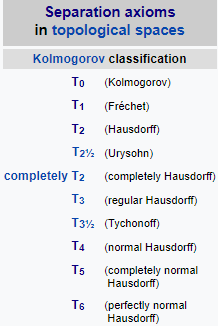
So in short, spaces of which Kolmogorov quotient is a discrete space
T_0
high hill
hmmmmmm I still do not get the infinite vs finite
$\bigsqcup_{i\in I} A_i$ where $A_i$ are all indiscrete spaces
gaunt linden
I get the impression that you're just trying to get Shuri to say what he has already said, but with particular magic words?
 gentle ospreyBOT
 high hill
Does this not work for some cardinalities of I? Or are there some spaces I've missed
gaunt linden
A topology with a basis that is a partition of X?
high hill
ah ok
Well I can certainly see all the spaces I've listed are sigma algebras
as for the converse... that doesn't sound so easy
gaunt linden
With which topology?
gritty widget
You can't just iterate taking {1/n} here to take disjoint union
gritty widget
gaunt linden
With which topology?
Euclidean
gaunt linden
The discrete topology is certainly a sigma-algebra.
With the Euclidean topology it's not a sigma-algebra. {0} is a closed set, but is not open. So not closed under complement.
gritty widget
My point is you can't just take finite amount of clopens, then more etc
And get a disjoint union
gaunt linden
Sorry, it's not clear to me what it is you're even arguing for.
Can you make a more self-contained statement of your thesis?
high hill
Well as for the proof --- all I can really say is that if we cannot write it as a union of indiscretes, we can still write it as a union of connected spaces, at least one of which isn't indiscrete. But a connected space cannot be a sigma algebra (we must have a non-trivial/proper open set whose complement isn't open)
(the open set in the connected space whose complement is not open can be found back in the union)
gritty widget
high hill
Well as for the proof --- all I can really say is that if we cannot write it as ...
I agree
gaunt linden
You can identify your indiscrete summands exactly as the equivalence classes of the "topologically indistinguishable" relation.
high hill
I shall have to look up that term 👀
gaunt linden
indistinguishable?
high hill
yes (I uh... haven't really taken topology properly properly yet)
gaunt linden
Two points are topologically indistinguishable iff they are in exactly the same open sets.
high hill
Ah I should know this, but probably forgot
gritty widget
Nah
I cant think of one right now
but ill let you know later today if I can find one
high hill
gentle osprey
no no - we got this as the answer
what was missing was my argument was finite ig
high hill
What I wrote as my argument about 'splitting' up disconnected spaces

The answer is indeed this
gritty widget
Oh I thought you said it could be an arbitrary disjoint union
I tried scrolling up but cant find easily.
high hill
By arbritrary disjoint union I was emphasizing a disjoint union of any cardinality
gritty widget
Yeah.
gaunt linden
So the topologies that are also sigma-algebras are exactly those that can be produced by picking an arbitrary equivalence relation and declare its equivalence classes to be the basis for a topology.
 gritty widget
@high hill no
But if you assume T_3 and countable basis, then you do
This is called Urysohn metrization theorem
gritty widget
gritty widget
This is called Urysohn metrization theorem
This isnt obvious
and ive seen the proof
Just embedd X in Hilbert cube and dab away
 cursive vigil
Just started topology
What treatises do you human beings recommend? I just started using topology without tears
 marsh forge
Hatchers notes
 rancid umbra
munkres
cursive vigil
rancid umbra
munkres
I tried that but idk i dont feel like im ready for that yet
cursive vigil
The set theory
marsh forge
Skip set theory tbh
gritty widget
Ah yes. The Cantor way
And then you imagine the set of all sets and your head explodes
There's couple important identities in topology imo
$f(A\cap f^{-1}(B)) = f(A)\cap B$ is one of them
gentle ospreyBOT
Blitz
 gritty widget
 uncut surge
Isn't f(f^{-1}(B)) = B only true for uuuuh surjective f
uncut surge
Isn't f(f^{-1}(B)) = B only true for uuuuh surjective f
This holds for all B iff f is surjective
My formula holds for all f
marsh forge
I have very few such formulas memorized
gritty widget
There's not a lot of them
Another one is $f\left(\bigcup_i U_i\right) = \bigcup_i f(U_i)$
gentle ospreyBOT
Blitz
 gritty widget
Also useful
gritty widget
Hmm... sure, I have it memorized by heart though
marsh forge
?
uncut surge
well it's nice to remember that maps of any kind interact well with intersections and unions
the proofs are obvious after like a minute of inspection but it's nice to not to have to put that minute of work in
marsh forge
They don’t interact well with intersections
uncut surge
uh oh
gritty widget
Yeah, only an inclusion
marsh forge
It’s not even a proof in the union case tho lol
uncut surge
life is harder than i hoped
marsh forge
You’re applying f to the same elements either way
gritty widget
That's why there are ways to circumvent intersections, such as finite fibers
Then in some special cases you can still extract something like that
uncut surge
mathematics is horrible
gritty widget
gritty widget
That's why there are ways to circumvent intersections, such as finite fibers
I'm thinking of some compactness thing
Too specific probably

gritty widget
Are there a non-trivial continuum C such that there is a point x in C which makes C\{x} totally disconnected?
gritty widget

MathOverflow
What the title said. In a slightly more leisurely fashion:-
Let $X$ be a compact, connected subset of $\mathbb{R}^2$ with more than one point, and let $x\in X$. Can $X\smallsetminus{x}$ be t...
Nope
 sleek thicket
Set theory is trivial because you can just pick a particular model and check what happens in it
 patent gorge
ayoooooooooo

 viral yoke
Let X be a topological space, let A be compact in X, and let U be open in X. Prove/disprove A\U is compact.
The specific problem I have here is that X is a metric space but a topological space should be sufficient
rancid umbra
i don’t think this property always holds in a general setting. it holds if your space is hausdorff tho
i’d like to see a ce if anybody has one. can’t think of one immediately
rancid umbra
viral yoke
Let X be a topological space, let A be compact in X, and let U be open in X. Pro...
anyway, do you need help proving this in the case of a metric space?
gritty widget
rancid umbra
i don’t think this property always holds in a general setting. it holds if your ...
Closed subspace of a compact space is always compact
rancid umbra
dang. compact subspaces of hausdorff spaces are closed. that’s what i was thinking
my bad
sleek thicket
no blitz is right
gritty widget
Nothing
sleek thicket
A\U is the intersection of X\U and A, so it's closed in the subspace top.
gritty widget
Proof still holds
rancid umbra
let C be an open cover of A\U. then C union {U} is an open cover of A. it admits a finite subcover {C1,…,Cn} which covers A, hence covers A\U
i was just being lazy ig and didn’t want to use open covers.
no need for any fancy theorems
i’m such a noob
gritty widget
rancid umbra
no need for any fancy theorems
No need for reproving fancy theorems either
viral yoke
gritty widget
No need for reproving fancy theorems either
Being a metric space is nothing special either
viral yoke
rancid umbra
let C be an open cover of A\U. then C union {U} is an open cover of A. it admits...
I forgot A\U is in A
That was the line I needed
Thank you
 kind depot
hey yall i was trying to find all the two and three degree covers of RP2 v S1. for 2 sheeted i found two covers and for 3 sheeted i could not find any. i dont think any exist of degree 3 but am not sure how to prove it. any ideas?
My two sheeted covers
 kind depot
?
 hasty pasture
I have a space that is k circles all attached at opposite ends, so think of it as a figure 8 but with k circles instead of 2. Is this the same as the Wedge product of k copies of S^1?
the wedge product usually identifies all spaces at a single point, but in this case we have a long chain of them
is it possible to create a homeomorphism between these spaces?
sleek thicket
It's homotopy equivalent but they're not homeomorphic
hasty pasture
ok, but then they would have the same fundamental group?
sleek thicket
Yep
hasty pasture
ok cool
sleek thicket
I'm about to explain why they're not homeomorphic, sorry
The wedge sum has a point p such that X \ p has 8 connected components
Right?
hasty pasture
yeah
kind depot
any answers to covering spaces of RP2 v S1 btw? i cant find any of degree 3
sleek thicket
But this isn't true for the other
hasty pasture
im trying to visualize why, is it because its all path connected?
sleek thicket
No
You can only get two components at most
There's two types of points. Points where adjacent points meet and points where they don't
The first type of points will disconnect the figure eight into two components
Right?
hasty pasture
ok
sleek thicket
If you remove the point connecting the ith and (i+1)th circles, you'll get the component {jth circle where j <= i} and {jth circle where j > i}
And the second type of points will still be path connected if you remove them
So this shows they're not homeomorphic
hasty pasture
ooh i think i get it, so if you remove it in the "flower-like" configuration, you get separate components (petals), but if you remove one point in the straight line configuration it only divides it into two
is that it?
hasty pasture
ok gotcha
what kinda homotopy should i use btw? like would i just stretch the connection points on each circle to eachother inductively?
hasty pasture
sounds like it, might just handwave and hope its okay 😬
sleek thicket
One way to think of it is as contracting the interval between the two endpoints to 0
(inductively)
hasty pasture
ah yes that makes sense
sleek thicket
That might be okay to write down
hasty pasture
cause the arcs are contractible, on their own
so it should be ok
thanks for the help!
sleek thicket
Np!
kind depot
for classifying covering spaces can any of yall expalin how they are equal up to conjuugacy? im a little confused on that point
hasty pasture
do you mean with regards to the galois correspondence for subgroups of $\pi_1$ and covering spaces?
gentle ospreyBOT
llspacebarll
 kind depot
ye
im trying to prove there are no covers of degreee 3
and its to do with order of a subgorup of gthe freegorup
 empty grove
There are 3 sheeted covers
empty grove
Take the 3 sheeted cover of S^1
empty grove
And at each of the 3 evenly spaced points put a copy of RP2
empty grove
kind depot
duh idk why that didnt occur to me
What did you have in mind 
kind depot
and i can build any n sheeted covering using that
empty grove
Yes
kind depot
well i couldnt figure anything out but i was looking at covers of S1 v S1 for inspiration
like the inscirbed triangle in a circle
empty grove
Ah
kind depot
are there any else tho? like i guess this makes sense as the subgroup (ab)^n of Z cross Z/2
empty grove
I think you might be able to say that the restriction of the cover of the wedge to either of the 2 spaces that are being wedged should be a covering map on its own?
empty grove
So you have S^1 sitting inside this wedge
Suppose you have a covering map p to this wedge
kind depot
mmm
empty grove
Then p: p^-1(S^1) → S^1, the restriction of the covering map, is this guaranteed to be a covering map?
kind depot
uhh on the wedge $$S^1 \mathbb{R}P^2$$? Uhhh i think so
gentle ospreyBOT
Optimism
 empty grove
If it is, then we know what it must be because S^1 has exactly 1 3 sheeted cover, and then we just need to look at how RP2 is attached
kind depot
ohhh
ok
so in terms of subgorups
the circles + projective concatenations is like (ab)^n whereas this is id x b or a x id right?
empty grove
Hmm yeah I think so
kind depot
actually i dont think sp
does it not have ot be up to conjugacy
cause i was trying this but like the parity forces an even number of both
unless u have an explicite image in mind
empty grove
Yeah I'm not sure lol
kind depot
ye alg top makes my brain hurt
lol reading hatcher is like a nightmare
wait can u draw out ur cover
lol i dont see how that works
it still requires even parity of cricles
which becomes degree 4
nvm
i just got it
gritty widget
kind depot
lol reading hatcher is like a nightmare
people usually don't like Hatcher, but some consider it a good first exposition
rancid umbra
what’s the knock on hatcher?
rancid umbra
why don’t people usually like hatcher?
gritty widget
because his proofs is geometry and intuition
rancid umbra
oh. so he just leaves it to the reader to fill in the blanks?
gritty widget
and no normal human being is going to fill in that much details, or so I heard
kind depot
100% agree
the books is like impossible to read i basically learn from online lectures tbh
gritty widget
rancid umbra
oh. so he just leaves it to the reader to fill in the blanks?
yeah, but he leaves too much for the reader and intuition and it feels wrong
kind depot
the issue is that by leaving out most details he goes really fast so its been an issue considering my prof thinks thats a good pace
what are homotopy classes of spaces btw? we literally never talked abt them and i cant really find it in hatcher prior to homology
gritty widget
I think there is not much you can do unless it's something more specific
kind depot
mm ok im specifically looking at [RP2, S1] which i think is H1 (RP2) x Z =~ Z/2 x Z but not sure how to show its the same as homology classes
 jolly garden

Animation showing the homotopy equivalence between a solid torus with k points removed and a wedge sum of a circle and k 2-spheres. During the process we obtain a chain of spheres (S²) in a loop (pearl necklace / necklace with k beads). The chain is homotopic to a wedge sum of k spheres and a circle, and using van Kampen's theorem one may show t...
Yeah, what can you say about it? Does anyone know? (It's in the video I just posted)

 golden gust
one homotopy class?
 hot night
What is a fiber bundle intuitively?
empty grove
It is a topological space E along with a continuous map E → B, such that the inverse image of each point of B looks like a fixed space F
The point is that if we understand B and F then we can use that to understand E
gritty widget
intuitively a fiber bundle looks like a product
you have some base space
and at each point you have a fibre attached
R^2 is a an R1 bundle over R1
a cyclinder set is a line bundle over a circle
it can also be viewed as a circle bundle over a line
a torus is a circle bundle over a circle
these examples so far are all “trivial” fiber bundles
because they really are globally product
a non trivial example is a möbius band
if you imagine a möbius band
if you looked at a small portion of it
it looks like a cyclinder
but globally
there is a twist
golden gust
so a mobius band is a line bundle over a circle, but not a circle bundle over a line?
gritty widget
yes a möbius band is a line bundle over a circle
but it is not a circle bundle over a line
so you can see that fiber bundles are like a twisted product
but the twisting only happens in the fibres
gritty widget
gritty widget
but it is not a circle bundle over a line
oh sorry
i think i might be wrong
i am wrong
i get confused with this example because
empty grove
I can't see a continuous projection onto a line though 
gritty widget
as a circle bundle over the interval
it’s not a *vector * bundle
i think it’s
picture the möbius band as rectangle before glueing
the fibre over the point x on the interval
is the line from x to 1-x
empty grove
gritty widget
is the line from x to 1-x
Aren't these intersecting
gritty widget
i think? this is okay
empty grove
But fibres can't intersect right
Because then the intersection is mapping to 2 different points
cursive vigil
Is a möbius tetrahedron a tetrahedron that has its cohomology unaffected by its cofibers and kernels?
gaunt linden
Google just seems to find this concept, which is projective geometry rather than topology: https://mathworld.wolfram.com/MoebiusTetrahedra.html
gritty widget
this is true for vector bundles
but it’s it true for fiber bundles

In mathematics, an I-bundle is a fiber bundle whose fiber is an interval and whose base is a manifold. Any kind of interval, open, closed, semi-open, semi-closed, open-bounded, compact, even rays, can be the fiber. An I-bundle is said to be twisted if it is not trivial.
Two simple examples of I-bundles are the annulus and the Möbius band, the o...
i thought the möbius band was not a circle bundle over the interval
but this seems to suggest otherwise
oh shit
never mind
gritty widget
gritty widget
but it is not a circle bundle over a line
damn you Moldi
you shook my confidence
cursive vigil
gaunt linden
Google just seems to find this concept, which is projective geometry rather than...
I literally made up that sentence on the spot I never knew that a möbius tetrahedron actually existed lol
 fading vale

 modest nexus
Hi! I'm kinda new in alg top, and I have the following problem: if X and Y are connected CW complexes, then homotopy type of X wedge Y does not depend on the point where we're gluing the spaces. Can someone give me a hint?
 glossy pine
cursive vigil
I literally made up that sentence on the spot I never knew that a möbius tetrahe...
glossy pine
cursive vigil
I literally made up that sentence on the spot I never knew that a möbius tetrahe...
lmao legend
cursive vigil
Lol
 lunar yoke
modest nexus
Hi! I'm kinda new in alg top, and I have the following problem: if X and Y are c...
lunar yoke
modest nexus
Hi! I'm kinda new in alg top, and I have the following problem: if X and Y are c...
Note that you can view a path as a homotopy
modest nexus
do you mean I can take a homotopy of paths?
lunar yoke
no i mean a path itself is a homotopy
lunar yoke
yes
so if it starts at x you can see it as a homotopy {x} x I -> X
with homotopy starting at inclusion map
and ending at map x -> endpoint of path
modest nexus
hmm, I guess I got it, but correct me if I'm wrong: so I handle my gamma: I -> X path as H : {x0} x I -> X homotopy, where x0 is the starting point gamma(0), H_0 (x) = x0, H_1(x) = endpoint = gamma(1)
cursive vigil
lol
lunar yoke
modest nexus
hmm, I guess I got it, but correct me if I'm wrong: so I handle my gamma: I -> X...
yes, you just define H(x,t) = gamma(t)
but im kind of sceptical now if you have the tools to solve this question
maybe there is some easier proof idk
but do you know about homotopy extension
modest nexus
yes
modest nexus
thanks 😄
empty grove
gritty widget
you shook my confidence
Wait so was it or was it not?
hasty pasture
Hey, im trying to apply the seifert van kampen theorem to a space constructed from chains of of circles all connected to a larger circle in the centre. I decomposed it into the individual "arms" of the space where the interesection is just the circle in the centre. My question is, is the kernel generated by the inclusion mappings trivial?
the inclusion of a map on the inner circle to any of the arms seems to just give a path in the circle like usual regardless of which arm it is included into, so i am thinking that any of these generators will always give you the constant loop.
i can share a picture if needed
Wait, I just realized my decomposition is probably wrong since the sets are not open
fading vale
@hasty pasture If you send a picture I can try to help
Also if you're working with circles and by each "arm" you mean the union of these circles or whatever you can generally thicken them a little bit to make them open and then deformation retract onto the arms so that you can still describe it in terms of pi_1(S^1)
The same thing you do to compute pi_1(S^1 wedge S^1)
hasty pasture

This is the space for k=3
the arms are at the k-th roots of unity
and there are k copies of S^1 in each arm
as well as k arms
so my thought was to decompose the space as each arm union the circle in the middle, now im thinking about how to get that open
and furthermore is the kernel trivial?
@fading vale
fading vale
Oh i see
Okay yes your idea is correct, what you can do is basically "thicken" the center circle and the arms a bit
hasty pasture
ok, and then use a deformation retract like you said?
fading vale
Its exactly how you compute pi_1 of the wedge like i said before
Yes
And then the inclusion will be trivial for the same reason that the inclusion of each copy of S^1 into the wedge is too
hasty pasture
ok, and i assume thats because this space is very similar to a wedge product?
it almost seems like it should be homotopic to one
since we can contract each arc to a point
fading vale
hasty pasture
ok, and i assume thats because this space is very similar to a wedge product?
Pretty much yes, if I write the arms as like A1, A2, A3, and the center circle as B
then the existence of nbhds around A1 and B in A1 wedge B for example that deformation retract imply that pi_1 of their wedge sum is their free product
This is a general fact for spaces X and Y with this kind of retraction property
hasty pasture
ok
fading vale
So technically speaking what you do is apply this three times with A1 wedge (A2 wedge (A3 wedge B)))
And turn all the wedges into free products
hasty pasture
ah makes sense yeah
hasty pasture
ok, so it ends up being something like $ZZ...Z$ $k^2+1$ times?
gentle ospreyBOT
llspacebarll
 fading vale
Is it k circles on each arm?
hasty pasture
yeah
hasty pasture
cool, thanks so much
i feel like i could just make an argument with the descending wedges instead of all this deformation retract stuff
fading vale
Also I think you're right that its homotopy equivalent to the standard wedge of k^2 + 1
But showing that formally would be much more annoying
Lol
hasty pasture
indeed
marsh forge
fading vale
Also I think you're right that its homotopy equivalent to the standard wedge of ...
You can think of this space as a graph and find a maximal spanning tree for it, then contract the tree to get this equivalence
@hasty pasture
hasty pasture
oh i think i remember something like that in hatcher
right after van kampen in fact
lunar yoke
yes its used to show that the fundamental group of a connected graph is always free
fading vale
model categories 
fading vale
cursive vigil
I literally made up that sentence on the spot I never knew that a möbius tetrahe...
also dont do this
Wasting peoples time trying to explain things to you
kind depot
cna yall esxplain how this implies that this is isomorphic to Finfty. Im trying to show $$[F_2, F_2] \approx F_\infty$$
 gentle ospreyBOT
Optimism
 cursive vigil
fading vale
Wasting peoples time trying to explain things to you
cursive vigil
fading vale
Wasting peoples time trying to explain things to you
Well I learned something from it, so was it really a waste
fading vale
Its at minimum dishonest
cursive vigil
Dishonest if I said I knew what it was
 surreal ocean
I just learned the definition of the support of a function. At first i thought it was a fancy term for the points which get mapped to a non-zero value but then i noticed the support is the closure of all points mapped to nonzero values. If Im not mistaken doesnt this allow for the possibility of there being a point in the support of a function which gets mapped to zero? If so, what idea are we trying to capture by defining the support of a function in this way?
 flint cove
that's just a technicality, and the one justification I know is that you need to go to the closure anyway if you want to talk about compact support
flint cove
surreal ocean
I just learned the definition of the support of a function. At first i thought i...
but you are correct in your analysis, eg a bump function ℝ→ℝ with supp = [-1, 1] is actually zero in -1 and 1
although I do wish there was a name for just f⁻¹((0, ∞))
 cobalt sonnet
I guess it is useful that the complement of the support is open
So that, for example, $\text{supp}(f') \subset \text{supp}(f)$.
gentle ospreyBOT
IlIIllIIIlllIIIIllll
 cobalt sonnet
Also it allows extension of the definition of support to tempered distributions as the complement of the largest open set on which the distribution vanishes
surreal ocean
flint cove
that's just a technicality, and the one justification I know is that you need to...
ah i see that makes sense thanks
jolly garden
What's the idea behind long exact sequences? I suppose you somehow encode information in it, splitting the computation into easier pieces. I just encountered them when learning about relative homotopy groups. Given my interpretation is correct, how do they encode information?
gritty widget
You might also want to ask in #groups-rings-fields
jolly garden
gritty widget
You might also want to ask in <#496784958430380033>
Thank you for the advice. Fortunately, I've already come to terms with it.
gritty widget
empty grove
Wait so was it or was it not?
the möbius band is not a circle bundle over the interval
sleek thicket
gritty widget
the möbius band is not a circle bundle over the interval
related: any bundle over the interval is actually just a product space
it's not too hard to prove
Wait, you may need more structure I'm not thinking of
Like the transition maps should be given by the action by a topological group or something
marsh forge
jolly garden
What's the idea behind long exact sequences? I suppose you somehow encode inform...
The idea is generally to break up the computation into an LES where you understand or already know a bunch of the groups in the sequence, as well as hopefully some of the maps
This allows you to better leverage computations you already know to do new ones
gritty widget
sleek thicket
related: any bundle over the interval is actually just a product space
nice to see you pfp is still going
sleek thicket
I still cherish it <3
 tawny juniper
This isn't so much of a desire for help as it is sheer curiosity.
I have just been introduced the fact that for n-dimensional euclidean space where n ≥ 5, there are only 3 regular convex polytopes.
WTF is going on that makes this true?
What's the culprit?
I should preface by saying that I am just a lowly analyst, so don't go too hard on me. xD
 cedar pebble
tawny juniper
WTF is going on that makes this true?
cedar pebble
tawny juniper
WTF is going on that makes this true?
one way to view this is in terms of finite Coxeter groups, and then the classification follows from the classification of these groups

such groups are classified by their Coxeter diagrams, and the point is that there are a few exceptional diagrams (H_3, H_4, and F_4) that give you the exceptional examples in dimensions 3 and 4
(from Vogan's slides: https://math.mit.edu/~dav/regpolyHO.pdf)
tawny juniper
Skimming, it reminds me of the argument about possible tessellations of R^2.
cedar pebble
"most of linear algebra" and "rest of linear algebra"


based
yeah exactly
the classification of regular polyhedra in R^3 is just like
tawny juniper
So, the issue is that there are too many possible symmetries in higher dimensions.
cedar pebble
you try all the regular faces you can have and you get everything
yeah
the reason why Coxeter groups are a good way to look at this is like
if you have some regular polyhedron in R^n, it has to be awfully symmetric
tawny juniper
This has to do with root systems and all that jazz.
cedar pebble
and not just by any group action, by like rotations and reflections across hyperplanes
yeah
tawny juniper
What happens if you remove the convexity requirement?
cedar pebble
then the stuff with Coxeter groups lets you classify these kinds of reflection groups in Euclidean space in a nice combinatorial way
oh hmmm
definitely becomes harder
I feel like I've seen the classification of non-convex regular polyhedra (or some other weakening of the definition) in R^3 and it's a huge mess
certainly you lose being able to attack the problem really cleanly with Coxeter groups's there's a lot of other junk you have to deal with
tawny juniper
Would this subject area be "geometry"?
(like, without any modifying adjectives xD)
I've always felt that pure geometric questions like these are really, really beautiful. I love it when (initially) unexpected phenomena like these emerge from simple objects.
cedar pebble
yeah this is combinatorial geometry
 bronze lake
I feel like I'm losing my mind. Anyone familiar with knot theory, someone told me:
According to Fox's Quick trip through knot theory, one correct presentation for the 2-twist spun trefoil is <x,y | x*y*y*x^-1*y^-1, y*y*x*y^-1*x^-1 >
But I've spent like a half hour scrolling through Fox's 'A Quick Trip through Knot Theory', and I can't for the life of me find that presentation
and the only other presentation I've found in another source is different
 sonic hill
What space do you get when you attach the boundary of D^2 to S^1 by a triple covering map?
sonic hill
Damn, so it's not something interesting?
marsh forge
i.e. the cofiber of the map $S^1\xrightarrow{3} S^1$
gentle ospreyBOT
ShamFan1999
 marsh forge
I mean
this space is interesting
but this requires some explanation
it plays a "height 0" role of chromatic homotopy theory at the prime 3
marsh forge
less interesting, i guess
sonic hill
Aw
marsh forge
This is effectively just like analogous to asking what the outcome of taking Z and killing 3Z is
it's Z/3Z. You can think that is intrinsically interesting or not, depending
sonic hill
Z/3Z is a basic fundamental object, so is Z/4Z
but is the cofiber of n-fold coverings useful?
marsh forge
I'm not sure what useful would mean, really
sonic hill
Maybe like, used in some important construction, an important example of something, an important counterexample of something, etc
marsh forge
it's a very elementary example of killing a generator in homotopy, but its only really used in constructions when you kill a prime.
sonic hill
I see

 rancid umbra
@mint sage lim f(x) --> f(a) as x --> a^+ means that for each e > 0 there exists a d > 0 such that if 0 <= x - a < d, then |f(x) - f(a)| < e
 mint sage
But how to prove
rancid umbra
let U be an open subset of R. you want to show that V = f^{-1}[U] is open.
if V is empty, then we are done. otherwise, let a in V. then f(a) is in U. U is open, so there is an e > 0 such that
(f(a) - e, f(a) + e) is a subset of U
rancid umbra
rancid umbra
<@!937296452026241034> lim f(x) --> f(a) as x --> a^+ means that for each e > 0...
apply this definition now and see if you can conclude that V is open
 cursive flume
does there exist any principal S^n,n even bundle?
 sinful seal
Let $X$ be a topological space and $f, g: X \to X$. Do $f\circ g$ and $g\circ f$ being homotopic to the identity map implies $f$ homotopic to $g$?
gentle ospreyBOT
Tₑ𝘖(n)
 marsh forge
no
consider S^1->S^1 given by the +1 and -1 map
In particular if [X,X] has a nontrivial group structure then you can always just take any map and its inverse
sinful seal
But in this case the composition of these maps wouldn't be -1 that isn't homotopic to id?
marsh forge
sinful seal
But in this case the composition of these maps wouldn't be -1 that isn't homotop...
we are talking about the additive group not the multiplicative structure
Oh wait I am the one being dumb here.
Yes okay use nobody's example. My bad.
 gilded crane
say i have topolgical spaces (X,tau) , (Y,pi), with A being a subset of X and B being a subset of Y. the interior of A and B, int(A) and int(B) are both open in X and Y respectively, but why is int(A) x int(B) open in X x Y (with product topology)? i dont fully understand the product topology definition, i feel
 plain raven
Maybe you should post the definition of the product topology
from the source you're working with
 marsh forge
gilded crane
say i have topolgical spaces (X,tau) , (Y,pi), with A being a subset of X and B ...
marsh forge
gilded crane
say i have topolgical spaces (X,tau) , (Y,pi), with A being a subset of X and B ...
Hint: try writing these interiors as unions of base sets and then apply the above stuff
rancid umbra
saw somebody state this on stack exchange without proof or source of proof. is this true or false:
if X is a compact metric space and f is a continuous map on X, then there is a set A such that f(A) = A
empty grove
Should be true by starting with A_0 = X, A_{i+1} = f(A_i), and A = intersection of A_i's
rancid umbra
empty grove
Should be true by starting with A_0 = X, A\_{i+1} = f(A_i), and A = intersection...
i see. didn’t think of this. thanks
gritty widget
From compactness, if X is non-empty then so is A
 coarse night
I like leaf's answer better
 wise walrus
I'm doing intro algebraic topology. What does it mean to "provide an explicit homotopy"? I presume it's wanting me to give a function on the unit square to the top. space defining a continuous interpolation between two (presumably homotopic) loops?
am i right with that?
plain raven
Yes.
plain raven
gilded crane
Did you solve this? It follows like, immediately from the definition, you just have to understand what the definition says
Take A to be {0,1}, with X_0 = (X,tau), X_1 = (Y,pi)
so the basis for the topology on X x Y is given by all U x V where U is open in X and V is open in Y
taking U = int A, V = int B gives the result
 quartz edge
I'm looking at may's explanation of the fundamental groupoid and skeletons of categories, etc
he defines a groupoid to be a category in which every morphism is an isomorphism
he then says a group can be thought of as a groupoid with only one object
this doesn't make sense to me. i don't really see what only having automorphisms is useful for here
because the homset on a group to itself is the endomorphism set
not aut(G)
in what sense exactly is a group a groupoid with one object?
plain raven
He's saying that you think of the elements of the group as being automorphisms of some fixed abstract object
plain raven
quartz edge
not aut(G)
right, so here's your miscommunication. he's not saying that given a group G we consider the full subcategory of Grp consisting of the object G, which would just be the endomorphisms of G. What he's saying is to any group G we can associate a category C where Obj(C) = { * }, a one-object set, and Hom(*,*) = G, with composition given in the obvious way
conversely for any one-object groupoid, Hom(*,*) is a group under composition
gilded crane
plain raven
taking U = int A, V = int B gives the result
Yep, this is what I got to in the end, it was just a case of me not understanding the definition at all
quartz edge
plain raven
He's saying that you think of the elements of the group as being automorphisms o...
huh. ok, like group actions on it
this actually makes sense considering a group action of G on A is induced by a map G -> Aut(A)
plain raven
Yeah, right. And like, pretend that this is more specifically an isomorphism
quartz edge
ye
wait, do we need to?
the elements of Aut(A) seem to be a superset of the elements of the homset for the groupoid
if i'm thinking about this right
may not be, just woke up
plain raven
Ok. Let C be a category and c an object in C.
Do you have a concept of an "automorphism" of c in this setting?
quartz edge
ahhhh right. we are dealing with abstract objects
not sets
oh
i see what you mean
quartz edge
plain raven
Do you have a concept of an "automorphism" of c in this setting?
there's the identity morphism
but that's all that's guaranteed to be there
plain raven
Would you let me call an "automorphism" any isomorphism from c to c?
does that sound reasonable to you?
quartz edge
yeah
plain raven
Like an automorphism of a vector space V is just an isomorphism V \cong V.
quartz edge
indeed
plain raven
So.. the automorphisms of c just consist of all isomorphisms c \cong c.
You can prove that this is closed under composition and each one has an inverse.
And the identity morphism id_c is definitely part of this family.
quartz edge
your explanation Hom(*, *) = G seems quite good. we don't consider the endomorphisms on G here in the groupoid do we?
plain raven
So we have a group of automorphisms of c.
quartz edge
like homomorphisms between G and some other group H ought to be encoded as functors?
in the groupoids corresponding
plain raven
Yes, from this perspective, if a one-object groupoid is a group, then a group homomorphism is a functor between categories.
plain raven
One cool puzzle.
Ok. So we've agreed that if C is a one-object groupoid, then we can define G = Hom(*,*).
Then group homomorphisms G -> G correspond to functors from C -> C.
gritty widget
Why is there a talk on category theory here. How's this relevant to topology
plain raven
Let phi, psi : G -> G be regarded as endofunctors on a one-object category. Under what circumstances are these two functors naturally isomorphic? (In group-theoretic language)
Which homomorphisms G -> G, regarded as functors C -> C, are naturally isomorphic to the identity?
gritty widget
There doesn't even seem to be any topology motivation behind your question @quartz edge
quartz edge
ah yeah sorry. i was super tired last night and the question came from an algtop text
gritty widget
Oh, okay.
 peak crystal
How to show that unit circle in $\mathbb{R}^2$ is not homeomorphic to [0, 1)?
gentle ospreyBOT
Giyu
 peak crystal
Yes if i remove any point from $S^{\perp}$ then it is connect but in interval if i remove only o then it is connected
gentle ospreyBOT
Giyu

 dim meadow
Yes
peak crystal
So by this how do i claim that it is not homeomorphic
dim meadow
So suppose there was a homeomorphism
Remove a non 0 point from the interval and remove the image of that point from the circle
The restriction of the homeomorphism is still a homeomorphism
But being connected is a homeomorphism invariant
peak crystal
Alright got it i try from circle to interval then i remove point from circle and take image of that removing point is zero so it is not working i need to do in reverse
peak crystal
Yes got it, thank you.
 unreal stratus
Another way is that e.g. the sequence 1/2,2/3,3/4,... has no convergent subsequence in [0,1) but its image in S^1 under any map will have one, in particular if it's a homeo we can pass to that subsequence and go back to [0,1) to get a convergent subsequence of the original sequence
Basically using (sequential) compactness
peak crystal
But i didn’t read compactness till now so
unreal stratus
Fair enough
peak crystal
How to show that any space is seperable or not i.e. they have countable dense set
dim meadow
So you want to make a countable set with which you can approximate any other sequence with bounded absolute value sum
Usually for this you use rational approximations for reals
And you use finite sequences as an approximation of infinite sequences
Stuff like that
peak crystal
This is boring haha
unreal stratus
it can be kinda cute constructing such an approximation sometimes though imo
like it tests understanding too a bit
peak crystal
For construction of approximations i need measure?
dim meadow
You need to look at the metric
unreal stratus
this has nothing to do with measure rly (unless you meant L^1)
I knew somebody would say smth like that kek
peak crystal
Okay then i need read this deeply
unreal stratus
Just to clarify, you do mean the set of absolutely convergent sequences right
peak crystal
unreal stratus
this has nothing to do with measure rly (unless you meant L^1)
No there is space of sequence small ell
unreal stratus
ok sure
peak crystal
unreal stratus
Just to clarify, you *do* mean the set of absolutely convergent sequences right
Yes
Another question: is there any Cauchy sequence which is not convergent anywhere, i mean $(a_n) \in X$ but not convergent in X so is it necessary that $a_n$ convergent in some other space?
gentle ospreyBOT
Giyu
 dim meadow
This is the definition of the completion of a metric space
peak crystal
a_n is Cauchy
dim meadow
Essentially
peak crystal
Here X is not complete
dim meadow
The completion of X is the smallest space which contains X in which all of the Cauchy sequences in X are convergent in the completion
peak crystal
Oh got it any space X have completion right so any Cauchy sequence converges in some other space
dim meadow
Yeah
peak crystal
Thanks
dim meadow
You can even make any individual Cauchy sequence converge by throwing in the point it should converge to
dim meadow
So if you have a particular Cauchy sequence you want to converge you can add a point to your space and extend your metric to that point
peak crystal
Yes
How to relate sequentially closed set and closed set
I mean S is sequentially closed set then for any x in S there is sequence which converge to x but i think it is also true for closed set?
dim meadow
Yes so there is an implication in one direction (closed implies sequentially closed)
peak crystal
So in general other one is not true right how to distinguish them
dim meadow
And in a lot of nice spaces we have the converse
In topology and related fields of mathematics, a sequential space is a topological space whose topology can be completely characterized by its convergent/divergent sequences. They can be thought of as spaces that satisfy a very weak axiom of countability.
All first-countable spaces, which includes metric spaces, are sequential spaces.
In any t...
peak crystal
dim meadow
Yes so there is an implication in one direction (closed implies sequentially clo...
If X is metrizable and S is subset of X then is it iff?
dim meadow
dim meadow
https://en.m.wikipedia.org/wiki/Sequential_space
Okay that article is probably not that helpful actually
dim meadow
peak crystal
If X is metrizable and S is subset of X then is it iff?
Yes
Here's a nice class of spaces with that property
In topology, a branch of mathematics, a first-countable space is a topological space satisfying the "first axiom of countability". Specifically, a space
    X


{\displaystyle X}
is said to be first-countable if each point has a countable neighbourhood basis (local base). That is, for each point
...
In mathematics, the Kuratowski embedding allows one to view any metric space as a subset of some Banach space. It is named after Kazimierz Kuratowski.
The statement obviously holds for the empty space.
If (X,d) is a metric space, x0 is a point in X, and Cb(X) denotes the Banach space of all bounded continuous real-valued functions on X with the...
To obtain completion of X
dim meadow
Yes first countable is much weaker
peak crystal
weaker mean more restrictions right
gritty widget
No, less
peak crystal
So second countable imply first countable?
dim meadow
Yes
dim meadow
Lower limit topology on what space?
 peak crystal
Yes i proved this one and $\mathbb{R}_l$ lower limit topology is first countable by setting $\left [x, x+1/n \right)$ so this one is first countable isn’t?
gritty widget
[x, x+1/n)
gentle ospreyBOT
Giyu
 peak crystal
Ohh sorry I’m little bit confused there is space which is not second countable but it is first countable,
gritty widget
Those are common even among metric spaces
Any metric space is first countable, but there is a lot of metric spaces which are not separable
peak crystal
$\ell_3$ is first countable but not separable
gentle ospreyBOT
Giyu
 gritty widget
Usually the space of continuous bounded functions over a non-compact metric space is not separable iirc
l^infty is not separable
peak crystal
So if we imposed one more restrictions that totally bounded imply separable
gritty widget
gritty widget
Usually the space of continuous bounded functions over a non-compact metric spac...
Well, such space would contain a copy of l^infty I think
peak crystal
gritty widget
l^infty is not separable
Oh yes sorry
gritty widget
Totally bounded implies separable, yes
peak crystal
So then we can claim that l^infty is not totally bounded
gritty widget
Yes
peak crystal
How to prove that l^infty is not separable
We need to find a point and then claim that there is no sequence which convergence to that point
gritty widget
Some kind of diagonal argument probably
peak crystal
Okay thank you.
gritty widget
There is uncountably many pairwise disjoint open sets in l^infty @peak crystal
Consider x in {0, 1}^infty and B(x, 1/2)
peak crystal
Not understand
gritty widget
Any sequence of zeros and ones and a ball in l^infty centered at it and with radius 1/2
peak crystal
I mean I’m not getting your point, by this what we conclude?
gritty widget
If l^infty were separable then there would be dense countable set
So any non-empty open set has element of this set
If we find uncountable family of pairwise disjoint open sets, then we need to have uncountably many points in our dense set
peak crystal
Ohh got it then its not remain countable
bronze lake
Any knot theorists here familiar with 2-knots? Different sources are giving me different presentations for the two-twist spun trefoil, and idk which is right
 cursive vigil
Rate my pun from -i to ij
marsh forge
bronze lake
Have you confirmed these groups are actually different
 arctic relic
Stupid question incoming
bronze lake
marsh forge
Have you confirmed these groups are actually different
To the best of my ability, yeah. I'm not the best with working with group presentations though
marsh forge
Hm, not sure then.
arctic relic
It’s obvious that H_n(empty set) = 0 for singular homology for all n but i was asked to verify this. So I defined the chain complex in the usual way but the map phi: n simplex to empty set doesn’t appear to exist.
marsh forge
You should be able to compute this yourself
Or if you draw it for me I could figure it out
I don’t know what this knot is tho
plain raven
arctic relic
It’s obvious that H_n(empty set) = 0 for singular homology for all n but i was a...
yeah so the chain complex is the free abelian group on the empty set in dim geq 1
arctic relic
So I don’t define the chain complex starting from n
plain raven
arctic relic
So I don’t define the chain complex starting from n
what?
arctic relic
There are no n simplixes that fit into empty set right?
plain raven
Yeah. the set of singular n simplices in the empty space is the empty set
and the free abelian group on the empty set is zero
bronze lake
marsh forge
I don’t know what this knot is tho
It's a 2-knot embedded in 4-dimensional space, so it's not nearly as easy to just find the relations as with a traditional knot
marsh forge
ah
arctic relic
In order to show that H_0(X) is isomorphic to augmented H_0(X) + Integers, Hatcher claims that epsilon composed with boundary map induces a map from H_0(X) to Integers st kernel of this map is augmented H_0(X). Does this follow from functoriality? I already proved this using a dimension argument but I would like to know Hatcher’s way.
Since epsilon vanishes on Im(boundary map)
Never mind
 upper basalt
Is S={1,x,x^2,x^3.......} is compact in C[a,b]? any hint how can i prove this?
 wintry heart
what does the notation pi_1(X) mean for a topological space X? i thought fundamental groups need a base point
 shut moat
upper basalt
Is S={1,x,x^2,x^3.......} is compact in C[a,b]? any hint how can i prove this?
shut moat
upper basalt
Is S={1,x,x^2,x^3.......} is compact in C[a,b]? any hint how can i prove this?
are you familiar with stone weierstrass?
shut moat
wintry heart
what does the notation pi_1(X) mean for a topological space X? i thought fundame...
pi_1(X, x_0) only depends on the path component of the base point (up to isomorphism)
so when you restrict yourself to path connected spaces you can drop the basepoint
wintry heart
shut moat
pi_1(X, x_0) only depends on the path component of the base point (up to isomorp...
pi_1(X, x_0) only depends on the path component of the base point (up to isomorphism)
sorry but i don't understand this at all
upper basalt
shut moat
are you familiar with stone weierstrass?
Yea,but can i use thay here?
shut moat
wintry heart
> pi_1(X, x_0) only depends on the path component of the base point (up to isomo...
if you can connect two base points by a continuous path, the fundamental groups at the two basepoints are the same. If the path between $x_0 $and $x_1$ is $\alpha$, then if $[a]\in \pi_1(X, x_0)$, $[\alpha] \ast [a] \ast [\alpha^{-1}]\in \pi_1(X, x_1)$
gentle ospreyBOT
Buncho Spheres
 shut moat
you can show that this is a group isomorphism
shut moat
upper basalt
Yea,but can i use thay here?
if you're not allowed to make use of that, you can still use it to get some intuition for what you need to do
wintry heart
gentle osprey
**Buncho Spheres**
oh okay thanks
shut moat
namely that {1, x, ...} is not closed in C[a,b]
gritty widget
upper basalt
Is S={1,x,x^2,x^3.......} is compact in C[a,b]? any hint how can i prove this?
It's not compact in general, you can take a = b = 1 though
upper basalt
gritty widget
It's not compact in general, you can take a = b = 1 though
That will be an intervel then
gritty widget
shut moat
namely that {1, x, ...} is not closed in C[a,b]
How does Stone-Weierstrass work here?
 hollow harbor
ummm
upper basalt
shut moat
namely that {1, x, ...} is not closed in C[a,b]
Are you using closed + bounded = compectness?
gritty widget
Yes, it's just a sequence
shut moat
jfc lmao for some reason i interpreted that as span{1, x, x^2,...} 
gritty widget
hollow harbor
maybe it is if -1 < a < b < 1
It's not compact then because 0 is not in this set
upper basalt
shut moat
jfc lmao for some reason i interpreted that as span{1, x, x^2,...} <:opencry:586...
Then i will be , because it will generate set of all polynomials
hollow harbor
ah yeah
great point
whereas if b >= 1 or a <= -1, you get failure of equicontinuity
shut moat
hollow harbor
or precompact 😵💫 idk if that's closed
nah it's not closed or precompact, that's what i was trying to say with the stone weierstrass thing
upper basalt
hollow harbor
whereas if b >= 1 or a <= -1, you get failure of equicontinuity
Why we focusing on equicontinity?
shut moat
it's dense in C[a,b]
gritty widget
shut moat
it's dense in C[a,b]
It's not
hollow harbor
upper basalt
Why we focusing on equicontinity?
arzela ascoli says that for subsets of C[a, b], precompactness (compactness of the closure) is equivalent to pointwise boundedness and equicontinuity
upper basalt
gritty widget
It's not compact then because 0 is not in this set
How? Can you please elaborate ?
shut moat
gritty widget
It's not
(i'm talking about the span in response to ryc, not the correct interpretation as a sequence)
upper basalt
hollow harbor
arzela ascoli says that for subsets of C[a, b], precompactness (compactness of t...
Ohhh i forgot Arzela Ascoli
hollow harbor
if -1 < a < b < 1, then x^n converges to 0 uniformly
yeah try to work this out using AA
gritty widget
I mean, you can check this by hand
If |a|>1 or |b|>1 then it can't even converge pointwise
So we are left with -1 <= a < b <= 1
And here you have that it converges to something that's 0 on an interval if anything
So no polynomial of the form x^n
(Then it would be 0 polynomial, which is not in the set)
So only a = b = +-1 work
upper basalt
hollow harbor
yeah try to work this out using AA
Can you please tell how can we show this is not equicontinious?
hollow harbor
the best way to see this is at x = 1
at x = 1, the derivative of x^n is n
this lets you say that, for epsilon = 1/2, if you give me any delta, we have |x^n - 1| > 1/2 for large enough n even when |x - 1| < delta. in particular, pick x = 1 - delta/2 and pick n big enough so that (1 - delta/2)^n < 1/10 (this surely will happen, since (1 - delta/2)^n converges to 0 as n goes to infinity)
i didn't really use the fact that the derivative is n
but you can also use that and the mean value theorem somehow
gritty widget
I feel like using equicontinuity is overcomplicating this
We have a sequence, and it's enough to show there is a subsequence with no convergent subsequences
hollow harbor
Sure, that's another way to do it. And you can do it for, say, [-1, 1] by saying that you do have pointwise convergence, so subsequences cant converge uniformly (or they would be forced to the pointwise, discontinuous limit)
(i dont know if equicontinuity is complicating it necessarily though - when I think about compactness of sets of functions in uniform norm, I start thinking about derivatives growing before I start thinking about literal sequential compactness. But that's just a perspective thing).
 midnight echo
is a net just a map that takes one directed set to another?
and a subnet another map that takes a directed set to the directed set of the net?
gritty widget
midnight echo
is a net just a map that takes one directed set to another?
A net is a map on directed set into our space
And subnets are analogues of subsequences, but they are slightly different
midnight echo
so is a net a way to order the space?
gritty widget
No, it's just a more general sequence
midnight echo
oh right ok
gritty widget
For example, partial sums of a Riemann integral are a type of net
I think this example is illustrative
Nets are one of two main ways of generalizing convergence, the other being filters
Both are pretty good
midnight echo
yes I can somewhat understand that a net is a less restricted definition of sequences, just having a hard time visualising what's going on
gritty widget
Directed sets, as name suggests, impose some sense of direction, without it being a well-order
Do you understand the Riemann integral example?
midnight echo
so an element can have two or more predecessors?
x_1,x_2 =< x_3
gritty widget
Yeah
midnight echo
gritty widget
Do you understand the Riemann integral example?
not really
gritty widget
Well you have one partial sum, and a second one
Now you can say the first one is < than the second one if you're using all the points from first one, and then some
And for any two partial sums there is their common refinement
Now if the integral exists, the partial sums will converge to it
Precisely in the sense of convergence of nets
midnight echo
ahhh ok, yeah so basically the sums get finer and finer until you have the exact value of the integral
midnight echo
cool jazz, thank you so much
arctic relic
Does the n+1 skeleton of a CW complex completely determine the nth homotopy group in an extension of the manner that the 2 skeleton completely determines the fundamental group?
lunar yoke
arctic relic
Does the n+1 skeleton of a CW complex completely determine the nth homotopy grou...
I think so. By cellular approximation, every map from S^n already lands in the n-skeleton and a homotopy starting in S^n x I lands in the n+1 skeleton
fading vale
arctic relic
Does the n+1 skeleton of a CW complex completely determine the nth homotopy grou...
No it needs to be n-1 connected
e.g you need pi_i(X) = 0 for i < n
Oh wait i am illiterate, n+1 skeleton yes, n and n+1 cells no
arctic relic
lunar yoke
I think so. By cellular approximation, every map from S^n already lands in the n...
Would the homotopy have to be defined from S^n x I^n for the nth homotopy group?
lunar yoke
no
homotopies are always of the form X x I -> Y
sometimes you have some extra conditions that some things are preserved
but still the domain is of that form
you can think of the interval as a time parameter
gritty widget
There is a concept of $K$-homotopy for compact space $K$, which is a function $H:X\times K\to Y$
gentle ospreyBOT
Blitz
 gritty widget
I'm not saying what chernberries said is right of course
marsh forge
is there a point to this? i've never seen it
Does K come equipped with like some structure
i.e. the inclusions of 0,1 into I
gritty widget
well, the only application I know of, is this simple theorem
gentle ospreyBOT
Blitz
 gritty widget
I read it from a book and not sure if there are other applications, seems like a definition which is too basic
it exists in literature though 
 winged badger
Is there an open set in R^n which is connected but not path connected? Just out of curiousity
gritty widget
winged badger
Is there an open set in R^n which is connected but not path connected? Just out ...
No
This is because of local path-connectedness
If U is open connected, its path-components are open and path-connected
Since U is connected, there is just one path-component
Is the proof
Interesting that Poincare duality is your favourite theorem, but you ask such basic questions 
People learn every day ig
fading vale
They are mostly active in #algebraic-geometry so I imagine they learned it out of an AG book
winged badger
I read Hatcher before getting into AG :)
fading vale
That would also explain it 
unreal stratus
Quick q - the cone of S^n is homeo to D^n+1 just because of essentially spherical coordinates right?
gritty widget
Yes
unreal stratus
Like if we embed it both R^n+1 we have the map S^(n) x [0,1] -> D^(n+1) just sending (x,λ) to λx and then ye that identifies all the points with λ = 0
compact hausdorff etc so it's a homeo
gritty widget
Yes
unreal stratus
Nice cheers
gritty widget
Np
gritty widget
unreal stratus
compact hausdorff etc so it's a homeo
More precisely, there's no argument with compactness, just quotient maps
unreal stratus
I just used that to show its inverse is continuous
But yeah the inverse can also just be explicitly written down anyway
unreal stratus
Like continuous bijection from compact to hausdorff is a homeo i mean yeah
gritty widget
Here's where it's used
unreal stratus
Yup
gritty widget

Mathematics Stack Exchange
Is the following theorem true? It seems straightforward but I haven't seen it published anywhere, not even as a corollary, so I'm concerned I've missed something. Discussions that introduce quotient
I don't want to prove it, so here's a reference
marsh forge
unreal stratus
Quick q - the cone of S^n is homeo to D^n+1 just because of essentially spherica...
In case you haven't noticed this visual: We can think of S^n x I as a copy of S^n, based at its rightmost point, living at each coordinate of [0,1]. In fact, we might as well consider them to be shrinking as we do so. Visually, this "fills in" the outermost unit sphere and looks exactly like the unit ball. The problem is that in the limit our shrinking wants a sphere of radius 0---but because we are coning, the last sphere gets to be squished to a point
unreal stratus
gritty widget
I don't want to prove it, so here's a reference
Oh i mean i've done this before lol dw
I was more just checking I had the right idea for a map/intuition
unreal stratus
marsh forge
In case you haven't noticed this visual: We can think of S^n x I as a copy of S^...
Oh nice, that's a slightly different way of visualising to what I had, thanks
And yeah the interpretation of it being a 'cone' is seen more visually when we modify the map to, say S^1 x [0,1] -> R^3, (x,t) -> (tx,t) right? since then the image is literally just a standard cone and so CS^1 homeo to the cone
marsh forge
oh sure yeah
I mean the visual should always be like
you take X, stretch it to a "cylinder" of Xs, and then squish the final copy of X

i sent this like 5 times before my internet connected properly and discord decided to send them all lol
marsh forge
gritty widget
Interesting that Poincare duality is your favourite theorem, but you ask such ba...
also i meant to say something but this attitude has no place here, please refrain from saying dumb things like this. it's toxic and pointless.
gritty widget
I feel attacked here
cedar pebble
nobody is attacking you, just saying you don't have to act like that
no hard feelings just saying
arctic relic
“Induced homomorphism” just follows from functoriality of function right
It keeps popping up and I just assumed that was the definition
Can you give an example of the composition?
My understanding, for instance, is that the functor from based spaces that takes based spaces to groups and morphisms to morphisms st f(x0) = y0 is induced by the cont function from a based space to a based space
So like what you said w/ pi_1
What are you composing? The continuous function with the function that sends basepoint to base point?
lunar yoke
arctic relic
What are you composing? The continuous function with the function that sends bas...
Given an element in pi_1(X,x) you can pick a representative a : (S^1,1) -> (X,x). If you now have a map f : (X,x) -> (Y,y) you can consider the composition f o a : (S^1,1) -> (Y,y), giving you a loop in Y. Taking homotopy classes then gives you an element in [f o a] in pi_1(Y,y).
so the induced morphism pi_1(f) : pi_1(X,x) -> pi_1(Y,y) just takes [a] to [f o a]
arctic relic
It’s weird to think that the composition is inducing functoriality vs the actual function
lunar yoke
drawing pictures helps
this is pretty common in algebraic topology though, you'll see similar things everywhere
arctic relic
Unfortunately I’m already knee deep in my algebraic topology course so I guess I need to revisit my intuition about induced things
marsh forge
arctic relic
It’s weird to think that the composition is inducing functoriality vs the actual...
Well, the composition includes the original function
We are just explaining how to get from a map X->Y to a function sending maps S^1->X to maps S^1->Y
which then gives us the algebraic map we need after taking homotopy classes
But really the original function X->Y is doing the heavy lifting here
gritty widget
Whatever, no use in arguing and I don't need to be here
marsh forge
lol what
you said something rude
and got called out
you aren't a victim here lmfao
gritty widget
This was already resolved btw (with me, max and Porphyrion in #discussion ) so if anything you are coming in for the drama, and I advise you to stop.
 rugged rock
Is [0,1] homeomorphic to [0,1)? I don't think so as $\mathbb{R} - [0,1] = (-\infty,0) \cup (1, \infty)$ which is open in $\mathbb{R}$ under the standard topology while $\mathbb{R} - [0,1) = (-\infty,0) \cup [1, \infty)$ is not.
gentle ospreyBOT
Évariste Galois
 rugged rock
Although i am not sure if that is even an indication
rugged rock
Is the way I showed it good?
gritty widget
A space can have homeomorphic sets which aren't both open/closed
rugged rock
I see
gritty widget
So your argument doesn't work
gritty widget
Np
 upper stag
Any recommendations for introduction to TQFT? I have basic knowledge in algebra, algebraic topology, and category theory. When I look up the materials, I am always deterred by advanced topics like higher category theory
 jade stirrup
rugged rock
Is [0,1] homeomorphic to [0,1)? I don't think so as $\mathbb{R} - [0,1] = (-\inf...
jade stirrup
rugged rock
Is [0,1] homeomorphic to [0,1)? I don't think so as $\mathbb{R} - [0,1] = (-\inf...
[0,1) isnt compact
jade stirrup
rugged rock
OK, so as you said ill show it using compactness or connectedness
there isnt anything to show
a compact space cant be homeomorphic to a noncompact one
marsh forge
upper stag
Any recommendations for introduction to TQFT? I have basic knowledge in algebra...
The paper I always recommend starting with is the 2cob and frobenius algebras paper
upper stag
marsh forge
The paper I always recommend starting with is the 2cob and frobenius algebras pa...
Thanks for your recommendation. Who is/are the authors?
upper stag
marsh forge
That’s a good expository on the result
Thanks. I will take a look
gritty widget
jade stirrup
there isnt anything to show
There is to show that they are not homeomorphic
I know it might sound obvious to you, but it might not be to someone who is starting with topology
 topaz plover
I'm not sure if this goes here or in #real-complex-analysis, but I'm trying to figure out what the open balls of the uniform topology on $\mathbb{R}^{J}$ look like. In Munkres, the uniform metric is given as $\overline{\rho}(x,y)=\sup{\overline{d}(x_{\alpha},y_{\alpha})|\alpha\in J}$. My first guess is that the open ball $B_{\overline{\rho}}((0,0),1)$ would be $\prod_{\alpha\in J}(-1,1)$, but that doesn't feel right: If we let $\mathbf{a}=(\frac{1}{2},\frac{2}{3},\dots,\frac{n}{n+1})\in\mathbb{R}^{\omega}$, then $\overline{\rho}(\mathbf{a},\mathbf{0})=\sup{\overline{d}(\frac{n}{n+1},0)|n\in\mathbb{Z}^{+}}=1$ so $\mathbf{a}\notin B_{\overline{\rho}}((0,0),1)$, but $\mathbf{a}\in\prod_{\mathbb{Z}^{+}}(-1,1)$.
gentle ospreyBOT
Esix, Fractal Bloom
Compile Error! Click the  reaction for more information.
(You may edit your message to recompile.)
 gritty widget
This is definitely topology
topaz plover
Yeah, it's just that it's specifically a question about a metric, and I've also done metric space stuff in real analysis
gritty widget
I'd go here for metric and metrizable spaces myself, and reserve #real-complex-analysis for integral stuff and so on
topaz plover
Fair enough
gritty widget
So you have $\sup |x_\alpha |<1$, right? Like you noticed, we need the sequence bounded uniformly by some $M<1$
gentle ospreyBOT
Blitz
 gritty widget
So it should be $\bigcup_{0<M<1}\prod_{\alpha\in J} [-M, M]$
gentle ospreyBOT
Blitz
 topaz plover
That looks believable. I want to make sure $(\frac{1}{2},\dots,\frac{n}{n+1},\dots)$ isn't in there, but I think that shouldn't be too difficult.
gentle ospreyBOT
Esix, Fractal Bloom
 topaz plover
Yeah, you just pick $n>M$ for any given $M$
gentle ospreyBOT
Esix, Fractal Bloom
 gritty widget
You can also write it as $\bigcup_{0<M<1}[-M, M]^J$ or $\bigcup_{0<M<1}(-M, M)^J$
gentle ospreyBOT
Blitz
 topaz plover
Yeah, I was about to ask, actually, about open vs closed intervals
But because it's an infinite union I'm not sure how much it strictly matters
Infinite union of closed intervals can be open, etc.
gritty widget
It doesn't matter because M is from (0, 1), this is what makes the set open
gritty widget
Np
surreal ocean
munkres theorem 17.11 states that every simply ordered set in the order topology is Hausdorff. However consider the set {a,b} with the order relation defined by a < b. This satisfies comparability non-reflectivity and transitivity. If i’m not mistaken the order topology on this set would be { {empty}, {a,b} }. Clearly this is not Hausdorff. What am i missing?
rancid umbra
the order topology is generated by the open intervals and open rays here, so sets of the form
{x : a < x}
{x : x < b}
{x : a < x < b}
for all a,b in your set.
this says that the open sets are
{}, {b}, {a}, and {a}U{b} = {a,b}
surreal ocean
aahhh thanks
 pulsar lagoon

Could someone help me get an intuition as to why these spaces are called "hedgehogs"?
hollow harbor
They're spiky
 plain panther
sorry to ask such a basic question but:

I'm a bit confused by this because from my understanding [0, 1] is a compact set
actually hmm, i think I might've figured it out
my problem with it was for example if the open sets got smaller and smaller somewhere. but it clearly neats to have an open set containing the limit point, which if it got smaller and smaller would necessarily contain an infinite number of those sets, and reduce it to a finite number.
at least I think this is correct
hollow harbor
plain panther
my problem with it was for example if the open sets got smaller and smaller some...
exactly!
trying to prove that the set {1/n : n in N} union {0} is compact will give you an idea of why this works.
plain panther
lol literally the example it gives later on
hollow harbor
for open intervals it's a tiny bit more involved to show it rigorously but your idea is 100% correct.
now maybe this makes it clearer why things like (0, 1) are not compact
plain panther
yea it does. thanks! :)
idk why but there's so many definitions in topology that have always confused me on if it's actually sound or not.
hollow harbor
(and in general, why compact sets should be closed - but you have to be careful, this can fail in non-hausdorff spaces)
hollow harbor
plain panther
yea it does. thanks! :)
idk why but there's so many definitions in topology tha...
a lot of them are very confusing at first and only become more intuitive the more arguments you do with them and the more equivalent ways of stating them you see.
plain panther
any reccomendations on a text? the text from above is just Calculus on Manifolds, so def not actual toplogy, but I'd like to kinda like to read along and I don't think I have any texts for it yet
hollow harbor
The classic text people like to use is Munkres's topology book.
plain panther
thanks so much! :)
 river gull
Does the topology $\tau$ as defined in this statement have a general name? It sounds interesting and probably merits a name because if $\tau_1$ and $\tau_2$ are induced by metrics, $\tau$ is induced by the metric given by the maximum of the two metrics.
 gentle ospreyBOT
Mistral

 shadow charm
https://math.stackexchange.com/questions/1999946/hatcher-question-1-2-10-show-that-the-loop-gamma-is-nullhomotopic in the answe to this they say that keeping track where gamma goes gives gamma = ab but when i try to visualize this i keep getting gamma = aba^-1b^-1: any nice way to visualize to figure out why im wrong ?
Mathematics Stack Exchange
See page 53 of Hatcher's Algebraic topology for reference to image. Consider two arcs $\alpha$ and $\beta$ embedded in $D^2 \times I$ as shown in the figure. The loop $\gamma$ is obviously nullhomo...
 coral pawn
Question about this definition: is ii) really what is stated here? I ask this because most of the time when we define a delta complex structure on a space, ii) isn't exactly satisfied. However, a relaxed version of ii) where we ignore the ordering of simplexes is satisfied

Here's an example

This is the Klein Bottle
L restricted to the bottom edge of the triangle gives us the map -b instead of b
Where by -b, I mean the map which takes an element t of [0,1] to b(1-t)
Strictly speaking, this map is not one of the maps from Δ^1 to K
the only two maps from Δ^1 to K that we have in our structure are a and b
Can someone verify this?
marsh forge
Restriction of L to b is the exact same continuous map
er
let me think harder
yeah wait why do you think its -b?
@coral pawn
coral pawn
Well let's say we order L by [x_0, x_1, x_2] where x_0 is the bottom-left vertex, x_1 the top-right, and x_2 the bottom-right. Then restricting to the lower edge (which is [x_2, x_0]) gives us the map -b right?
@marsh forge
I guess if you orient L the other way, the restriction to the bottom edge would be b
However, then the restriction to the right edge would be -a
high hill
My (Masters) course in Algebraic Topology more or less consisted of basic Point Set Topology and Chapter 1 of Hatcher
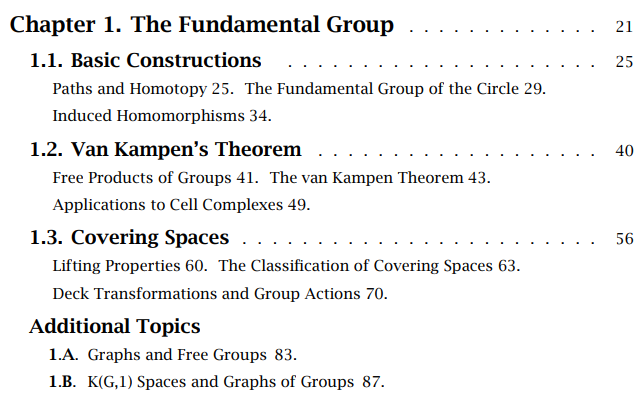


Is this typical content for a course, or is this quite short? (this thought has been bugging me for a while  )
)
shadow charm
Dont know anything about a masters degree but it does seem very short
From what I can tell a masters alg top course at least goes through homology
high hill
sigh guess I just have to readup on extra stuff
shadow charm
If I’ve got an identification space can I always say that it’s homotopy equivalent to connecting the identified points to an intermediary contractible space?
lunar yoke
My 1st sem masters course in algebraic topology had ch 1-3 and basic htpy group stuff as prerequisites. We started with hurewicz
shadow charm
shadow charm
If I’ve got an identification space can I always say that it’s homotopy equivale...
Sounds like something you might be able to say about CW complexes
lunar yoke
lunar yoke
My 1st sem masters course in algebraic topology had ch 1-3 and basic htpy group ...
There were 2 bachelor courses preceding this though, covering mostly chapter 1-3
shadow charm
From what I can tell our courses cover higher homotopy groups and cohomology in masters and do point set, fundamental group and Homology in second and third undergrad year
shadow charm
https://www.math.umb.edu/~oleg/hw_2_solutions.pdf i don’t quite get in 1.2.11 why they attach two 2-cells by the given maps instead of a single 2-cell by the map abcf(a^-1)f(b^-1)c^-1
marsh forge
coral pawn
Well let's say we order L by [x_0, x_1, x_2] where x_0 is the bottom-left vertex...
I think the issue here is that the orientation is like a formal algebraic choice rather than something actually describing the order of the map but maybe that also doesn't work
I havent thought about this in a bit and it is indeed confusing at times
Like the identifications of the edges via the directional arrows and the map representing b in the chain complex need not coincide i think
so as a map [0,1] the "direction" of b might not agree with the identification pattern
Like we could reverse the orientation, get a different shape, but keep the delta complex structure the same, I think
Hm. But then maybe you are messing up the boundary maps or something
viral yoke
Let $\mathcal{C}, \mathcal{D}$ be two chain complexes and let $f: \mathcal{C} \to \mathcal{D}$ be an arbitrary chain map. Show $f: \mathcal{C} \to \mathcal{D}$ induces a sequence of group homomorphisms $f_* = {((f_q)*) , | , q \in \mathbb{Z}}$, where $(f_q): H_q(\mathcal{C}) \to H_q(\mathcal{D})$ with $[\sigma] \mapsto [f_q(\sigma)]$ for each $q \in \mathbb{Z}$. (We write $f_: H(\mathcal{C}) \to H(\mathcal{D})$.)
gentle ospreyBOT
eM
 viral yoke
Am I showing the map $(f_q)*$ is well-defined and is a group homomorphism for each $q \in \mathbb{Z}$?
gentle ospreyBOT
eM
 viral yoke
Yeah the well-defined part doesn't seem as straightforward as I thought 🤔
So I let $[\sigma], [\tau]$ be in $H_q(\mathcal{C})$ such that $[\sigma] = [\tau]$, and therefore $\sigma = \tau + \theta$ for some $\theta in \mathrm{Img} , \partial_{q+1} = B_{q+1}(\mathcal{C}) \subseteq C_q$. Recalling $f_q: C_q \to D_q$ is a group homomorphism, from our map as defined previously, the induced map gives $(f_q)_*([\sigma]) = [f_q(\sigma)] = [f_q(\tau + \theta)] = [f_q(\tau) + f_q(\theta)] = [f_q(\tau)] + [f_q(\theta)]$.
I'm figuring out how to "delete" $[f_q(\theta)]$, which can be done so by showing $f_q(theta) \in B_q(\mathcal{D}) = \mathrm{Img} , \partial_{q+1}$, where the term $\partial_{q+1}: D_q \to D_{q+1}$. I think commutative of $f_q$ might come into the picture but I'm trying to see how to put this together.
gentle ospreyBOT
eM
 cedar pebble
viral yoke
So I let $[\sigma], [\tau]$ be in $H_q(\mathcal{C})$ such that $[\sigma] = [\tau...
cedar pebble
viral yoke
So I let $[\sigma], [\tau]$ be in $H_q(\mathcal{C})$ such that $[\sigma] = [\tau...
the map you should get sends a chain a+im∂ of degree n in C to f(a)+im∂ of degree n in D. It's well-defined since if you take a+im∂=b+im∂ then (a-b) is in im∂, but since f takes boundaries to boundaries we get f(a-b) in im∂, so f(a)+im∂=f(b)+im∂
so f takes kernels to kernels and images to images, so you get an induced map from kernel mod image to kernel mod image
(I'm being sloppy with omitting indexing/lower star)
viral yoke
cedar pebble
the map you should get sends a chain a+im∂ of degree n in C to f(a)+im∂ of degre...
I literally just saw where theta was living lol how did I miss that
cedar pebble
all good! 🙂
viral yoke
cedar pebble
(I'm being sloppy with omitting indexing/lower star)
I understand
Also, how did you get that partial character to show up?
viral yoke
Oof
cedar pebble
I know there are some fancy math keyboards but 
 ivory dragon
viral yoke
I have windows
ivory dragon
viral yoke
I have windows
consider trying wincompose
arctic relic
If A is contained X, is the fundamental group of A contained in the fundamental group of X? I found a counterexample but I’m not too sure
coarse night
if you have already found a ce, why are you still unsure?