#point-set-topology
1 messages · Page 251 of 1
 pearl holly
yeah okay to here t = 0
pearl holly
yes
 marsh forge
So can we build f:XuCA->X?
pearl holly
yeeee
marsh forge
Okay now final question before you go to bed
is X->XuCA->X a retract?
(remember the first map is just the inclusion)
pearl holly
ye it is by construction
marsh forge
amazing
now think deeply about this construction
and reversing it
is basically the exact same concept
For after you get it, Exercise: ||Prove that a map f:X-> Y is nullhomotopic if and only if there is a map g: CX->Y such that the composite X->CX->Y is equal to f (where the map X-CX is the inclusion at time 0)||
pearl holly
yeah okay I will try that one out tomorrow. Thank you so much for the help! Tbh I was kind of lost at the very start but then I started to get the idea, thank you!
marsh forge
I think that a big problem in topology is finding maps with certain properties and the solution is almost always to like, partially define the map in some easy way and bootstrap up to make the full map you need
And this gets more complicated the more topology you study
So my advice is whenever you feel totally stuck try to write down what you can guess and what the problem is giving you and see if together that can get you to where you need to be
 fickle marsh
Is (1,1) a valid basis of the standard Topology and is it the empty set or {1}
 ivory dragon
the standard topology on what? ℝ? if so, certainly not
fickle marsh
Yeah on R
ivory dragon
also i'd interpret that as the empty set but like
i wouldnt use that notation in general
{} or {1} are both more clear for whatever you want
fickle marsh
Basically I'm trying to determine if there are finite elements
And that's the only thing I could think that would be finite
ivory dragon
there are no finite open sets in ℝ except the empty set
(under the standard topology)
there are various ways to prove this
one way: prove that singletons are closed, and that closed sets in ℝ are not open unless they are {} or ℝ itself
[that second statement is equivalent to ℝ being connected, but you probably havent learned that yet]
fickle marsh
Nope
ivory dragon
a more direct way: let U in ℝ be a nonempty open set, so it has an element u. Then there is an interval (u - r, u + r) that is a subset of U for r > 0, since such sets collectively form a basis of the standard topology. but that would imply U has infinitely many elements.
intervals of the form (u, u) are not part of the standard basis for the standard topology
only (u - r, u + r) for some r > 0
as i said above, thats how id interpret it
but i would never use this notation in practice
i suppose if you interpret it like that, the empty set could be a part of the basis of the topology (though it need not be)
but in any case, its... well.. empty
so it doesnt contain u
hence doesnt present a problem to my above argument
i dont see what youre adding.
marsh forge
Tru
fickle marsh
Well I've seen problems with calling the closed set infinite or finite
Most my professors leave it as ambiguous
 plain raven
apparently there are some physicists whose convention is that the word "finite" is not used to describe 0
fickle marsh
Sorry I meant empty set@ivory dragon
ex. my analysis professor considered N to be {1, ....} and thus there was no natural number that represented the carnality of the empty set => empty set it not finite
and in terms of if it was then infinite he said that there were a lot of complexities and issues with assigning finite or infinite to the empty set
he ended up saying that (1,1) wasn't valid
plain raven
it's fine to disqualify that notation, it's confusing
but you could also just define (a, b) : { x | a < x & x < b }
and then (1,1) would denote the empty set
marsh forge
I guess when you asked if there were finite open sets I assumed you meant non empty
I think it is reasonable to call the empty set finite
 gusty flame
Does anyone know where I could find a proof for this claim?
 plain raven
gusty flame
Does anyone know where I could find a proof for this claim?
plain raven
gusty flame
Does anyone know where I could find a proof for this claim?
i think this is a theorem of topological dimension theory
maybe try Nagata's Modern Dimension Theory
or Connections, Curvature and Cohomology by Greub, Halperin and Vanstone
not a very useful reference, sorry, these are big books
 tough imp
plain raven
maybe try Nagata's Modern Dimension Theory
tough imp
plain raven
maybe try Nagata's Modern Dimension Theory
Nagata wrote a book on topological stuff?
 tight agate
tough imp
Nagata wrote a book on topological stuff?
tight agate
tough imp
Nagata wrote a book on topological stuff?
yeah it's called counterexamples in topology
tough imp
-_-
 eternal nimbus
"closed sets of R by the usual topology are NOT the segments [a,b]" WAIT WHAT
ivory dragon
intervals [a, b] are in fact closed sets
but there are more closed sets than that
for example, (-infty, a] U [b, infty)
eternal nimbus
Yup yup, or simply the union of two segments that don't overlap right?
yeah yeah, i interpret it as [a,b] are not closed and i was like "whuuuut"
ivory dragon
eternal nimbus
Yup yup, or simply the union of two segments that don't overlap right?
well its fine if they overlap, itll just give you a single segment
but yeah
eternal nimbus
(yeah was thinking a closed thing that is not segment)
ivory dragon
finite unions of closed sets are closed
in general
but yeah i understand what youre saying
you just read it backwards
 raw sedge
is every closed set of a Hausdorff space the preimage of 0 under some continuous map into R?
 true robin
raw sedge
is every closed set of a Hausdorff space the preimage of 0 under some continuous...
true robin
raw sedge
is every closed set of a Hausdorff space the preimage of 0 under some continuous...
This property implies the space is regular, so no
 empty grove
No, R_K is a hausdorff space in which K is closed but is not the preimage of 0 under any map
raw sedge
Do you have a sufficient condition?
okay, so it's equivalent to saying the space is perfectly normal?
Is there anything particularly special about R here? What other spaces could we replace it with?
true robin
R appears in the def of perfectly normal, I assume that is what makes it special in this case
 gentle ospreyBOT
Nobody
 plain raven
tough imp
Nagata wrote a book on topological stuff?
plain raven
tough imp
Nagata wrote a book on topological stuff?
i think it's a diferent nagata. the commutative algebra guy is Masayoshi Nagata, the author of this book is Jun-Iti Nagata
 fair idol
In a general topological space how would one show that a set is open?
gentle ospreyBOT
Nobody
 marsh forge
(This strategy works particularly well when you know a basis for the topology)
tough imp
plain raven
i think it's a diferent nagata. the commutative algebra guy is Masayoshi Nagata,...
This makes a lot more sense
 hollow harbor
tough imp
This makes a lot more sense
hollow harbor
tough imp
This makes a lot more sense
Good morning!
 pulsar lynx
Trying to understand the comb space as an example of a connected but not path connected space

Does A ⊂ B ⊂ C where A,C are connected imply B is connected? I don’t understand this chain of logic
Intuitively I understand it like “any open ball around (0,1) has to contain another point in D, so separating into two open sets is impossible”
 unreal stratus
pulsar lynx
Does A ⊂ B ⊂ C where A,C are connected imply B is connected? I don’t understand ...
unreal stratus
pulsar lynx
Does A ⊂ B ⊂ C where A,C are connected imply B is connected? I don’t understand ...
Not in general, no
pulsar lynx
unreal stratus
Not in general, no
Ok
ivory dragon
[1, 2] subset [1, 2] U [3, 4] subset R
ivory dragon
because its specifically the closure of E
what would it mean if D could be disconnected?
(if you want a formal proof of this fact, https://proofwiki.org/wiki/Set_between_Connected_Set_and_Closure_is_Connected)
ivory dragon
the formal proof is a bit finnickier than you might expect
but the fact should be intuitive enough
(unfortunately thats a theme for a lot of point-set topology...)
(thankfully because this is a "familiar" topology you dont need the proof of the statement in full generality)
ivory dragon
well proofwiki has a habit of constructing weird maps without explaining what its doing
lmao
if you unpack what that map is actually trying to communicate, it should match your visualization
unreal stratus
(Sometimes proofwiki seems to write in more detail than most humans reasonably would imo too or is that just me?)
ivory dragon
alternatively you could just remark that its obvious since you know how ℝ² works
whatever you prefer ¯_(ツ)_/¯
unreal stratus
Proofs almost always seem much longer and often more tedious than textbooks I mean
ivory dragon
unreal stratus
(Sometimes proofwiki seems to write in more detail than most humans reasonably w...
absolutely yeah
it likes to cite hella prereqs too
its a... weird organization
were i to make a collection of proofs, i would not structure it like proofwiki
but eh, can still be handy
unreal stratus
Ye I agree
ivory dragon
the nice part is that proofwiki's proofs are completely unambiguous
you very rarely have to fill in details
its just... you might have to hop back 3 steps of hyperlinks to figure out how they proved some random fact theyre citing that any reasonable human would bypass with an "obviously..."
or perhaps a "because ___"
actually thats another style thing with proofwiki: they rarely say "because _ is _" or whatever
its always
"By definition of bleurgh:
and therefore:
and so from [proposition]:"
which makes it look (and read) a lot more intimidating than it ought to be lmao
unreal stratus
yeahh
 crimson path
Let (X,tau) be a topological space.
I want to show from first principles that a subset A is in tau (namely, open)
iff each point x in A is inside a open set U contained in A.
I have managed to show this, but I had to go via A = Int(A) iff A is open.
Can one circumvent this sidestep and directly link the iff-statement I want to show?
Notice I am not referring to any basis or such, rather working directly from and only with
the definition of a topological space.
@gritty widget yes I feel so too but it's not clicking for me. The converse direction
is straightforward I feel, since the topology is closed under arbitrary unions.
But the other direction. Let A be open, that is, in tau. Now let x be in A.
"open" now just means "a member of tau". I don't see how to proceed from
here to exhibit a set O in tau that x lies in, and also such that O is a subset of A.
I am probably missing something here but I can't spot it
Oh lord I am dumb, thank you
 lean marten
Hey looking for some help on a problem from "Topology and Groupoids"
I'm most of the way there but having some trouble constructing a pushout in the form:
[\begin{tikzcd}
{\pi (X,(B_1\cup B_2))} & {\pi(X,B_1)} \
{\pi(X,B_2)} & {\pi(X,B_1\cap B_2)}
\arrow["{s_1}", from=1-1, to=1-2]
\arrow["{s_2}"', from=1-1, to=2-1]
\arrow[from=2-1, to=2-2]
\arrow[from=1-2, to=2-2]
\end{tikzcd}]
gentle ospreyBOT
Oatman
 lean marten
Where $s_1$ and $s_2$ are retractions given by 6.7.4
gentle ospreyBOT
Oatman
 lean marten
Actually they're deformation retractions
tough imp
ivory dragon
which makes it look (and read) a lot more intimidating than it ought to be lmao
I won’t lie, Bourbaki is honestly like this lol. When I have a specific result I need a proof of Bourbaki has consistently been the easiest proof to read as long as you can find it lol
This is in contrast to Stacks Project where it still has this reference web but all the proofs still require a ton of filling in 
ivory dragon
well you see
you dont read stacks projects for the proofs
you read it so you have something to cite and can sidestep the proof
tough imp
I do 
ivory dragon
if there is an error in the stacks project's proof network, no one will notice for 7 decades
and then itll suddenly break 5000 papers
tough imp
Maybe you but
I instead spend 193949293 hours
Poring over some dumb detail
And there’s still 1 proof I gave up on after like actually 2 days
Torsors am I right
 coral pawn
Can someone please help me answer this question from my homework?

How would one answer this?
What exactly is it even asking?
Polar coordinates don't really work if we include 0, so I'm guessing it wants us to consider R^+ x (-\pi,\pi)
But then the inverse map of the chart would require us to use atan2 function
And I don't think that's a commonly used function
Also, does this chart give the same smooth structure as the cartesian coordinates?
My hws due tonight and this is the only problem I need to do
Ping me if you have any ideas
 trail tiger
It's asking if chart transition function is smooth between the canonical polar and Cartesian charts.
That's what it means for a chart to be smooth.
 wet flame
Quick topology question bc I have done it in a while lol
Just about topology of R^n
So for a subset E of R^n, if E is compact and E consists of only isolated points, then I am trying to prove E must be finite. So since E is compact, it is closed and bounded. I think I can approach this by contradiction. So assuming E is infinite, so it has infinitely many isolated points, clearly no open cover will have a finite sub cover
But like
How do I formalize that
 rancid umbra
@wet flame if E consists of infinitely many isolated points, then for each x in E, there is an open neighborhood U_x of x so that U_x cap E is {x}. the collection of all such U_x's gives you an open cover of E with no finite sub-cover
rancid umbra
E is your set
 reef shore
cap means intersection
rancid umbra
i made a slight typo, U_x cap E is U_x intersected with E. And since x is an isolated point, it should mean that U_x intersect E is just the singleton set {x}
rancid umbra
i dont think you need contradiction either, but it works
just take the same open cover of U_x's from above
it has a finite sub-cover by compactness
each U_x contains only one point from E (namely x)
E is finite
wet flame
Ohhhh
wet flame
rancid umbra
each U_x contains only one point from E (namely x)
This is beautiful omg
The simplest things amaze me
rancid umbra
which trick
plain raven
it can be hard to figure out a good open cover for a problem sometimes, it seems so silly to take an open neighborhood around every single point (isn't that way more than you need?) and then apply compactness
so you might miss it at first
rancid umbra
yea good trick
plain raven
this is only tangentially related but like
if X is a space
then for any open cover of X
we can associate to it the Cech cochain complex of the cover, with coefficients in some Abelian group.
and there's a category of open covers and refinement maps
now, this category is not filtered, so colimits are poorly behaved.
you wouldn't want to take the colimit of all cech cochain complexes over all open covers here
because the answer would be nonsense
but if you pass to cohomology first, then the colimit kind of becomes filtered
this is a terrible explanation and probably doesn't make sense
but
where i'm going with this is
if instead of considering all open covers of X
you consider just those open covers of X indexed by the points of the space
with x\in U_x for each x
then you do get a filtered poset
and you can take colimits at the level of cochain complexes and get a reasonable answer
which is nice
this trick blew my mind when i first saw it lol
rancid umbra
diligentClerk about to send me down a rabbit hole of wikipedeia articles at three in the morning with all this vocab
plain raven
i'm sorry haha
rancid umbra
lmao its cool. wish i could appreciate it, i just have no idea what most of those terms mean
plain raven
suffice it to say that there's a common form of argument where you are dealing with open covers in a space, and it's always ok to replace the open cover you're working with with a refinement, so you'll say something like "we need property P to hold for the cover, and U doesn't necessarily have that property, but that's fine, we can replace it by a sufficiently fine refinement V such that P holds"
often this is phrased in a way where it's understood that U, V are arbitrary covers, but it turns out that a lot of these arguments still work when you let U, V be open covers indexed by the points of the space with x in U_x for each x in X, and they're much better behaved in some technical ways (although perhaps not as computationally friendly because then the cover is necessarily infinite if X has infinitely many points)
rancid umbra
i see. i didnt realize that covers came up that much later on. only places ive really seen them be used is for compactness and total boundedness and some uniform continuity
plain raven
yeah I think i first started to understand the importance of covers when i saw this picture
give me a sec
idk it was a blog post on shape theory
but like
take a circle or something
and cover it by like, short segments of arc
say, connected open sets
and cover it in an efficient "minimal" way so that no point lies in more than two open sets
now you can associate to this open cover a combinatorial data structure
this is going to be a simplicial complex
it has one vertex for every set in the cover
and it has one edge between i and j iff U_i \cap U_j is nonempty
if you draw a picture of this simplicial complex you get exactly like, a regular n-gon, where n is the number of open sets in the cover to start with
so from this nice cover of the space you can extract a simplicial complex homeomorphic to the original space
and you can imagine doing this with a sphere or something as well
rancid umbra
whomst in the fvck was big brained enough
plain raven
or just like, an arbitrary nice topological space
idk. cech? maybe mardesik?
say like
a torus or another compact manifold
you should often be able to, from a nice enough open cover, extract a simplicial complex which is a triangulation of that space, or at least homotopy equivalent or something
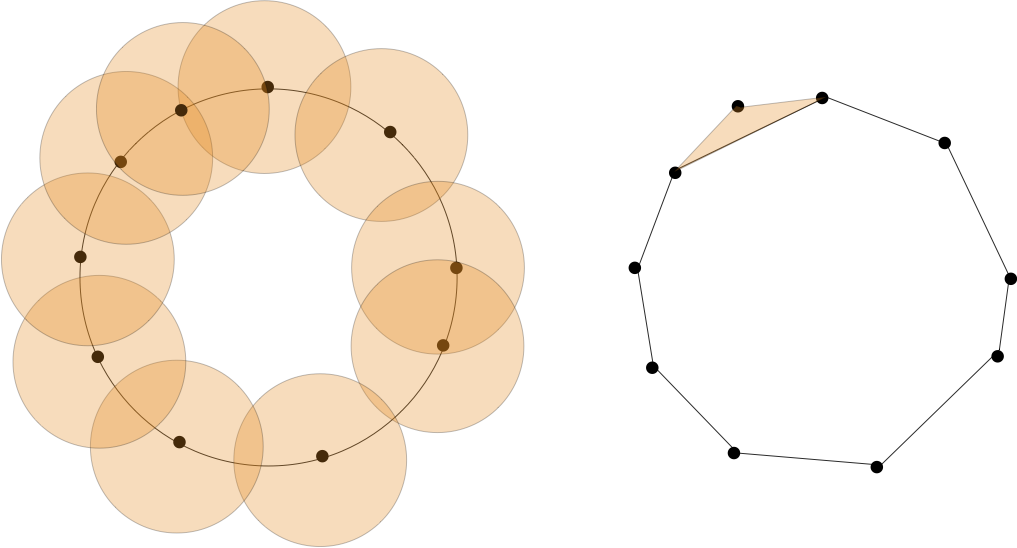
oh that's interesting
so in this example the cover is somewhat "bad"
and there's an example of a point with a triple intersection
but you can see that the new thing is still homotopy equivalent to a circle
just not homeomorphic
the triple intersection means you add a 2-simplex connecting the points i,j,k
does that make any sense lol
rancid umbra
yes the picture and extracting the simplex made sense
same with the example of the triple intersection, at least intuitively. two lines kind of got identified as one
plain raven
shape theory apparently was like, an independent branch of topology that kind of existed independently of algebraic topology for a while. it was combinatorial but not algebraic if that makes sense
in retrospect that distinction doesn't seem well founded because you can associate interesting algebraic invariants to the cech complex
but
at the time they were considered two different branches of topology
and like, two different proofs of the same theorem by two different methods (shape theoretic vs algebraic) would be published in separate journals

Wild Topology
aha this was the bllog post
The Whitehead theorem in homotopy theory basically says that to fully understand the homotopy type of a CW-complex one only needs to know about the homotopy groups (really, the weak homotopy type).…
rancid umbra
wait i feel like im failing to see something important here. so, different open covers might give you different simplexes, right?
wait, but big picture right, so if you take nice enough open covers, you get back something thats possibly easier to work with and still preserves some of the important properties of the original space, right
reef shore
In a compact, totally disconnected, separable metric space with cardinality less than that of the continuum, given an uncountable closed set, can it always be partitioned into 2 uncountable closed sets?
Context is these Stone spaces, and proving what I said will be enough. Any other suggestions would be welcome

I think whatever I said is all we know about the space S_n(T) topologically, but if it helps it is the space of complete types of over a theory T over a countable language (I don't think that would matter though, looking at the language used here. I have seen a proof of this before which doesn't use metrisability but uses the elements of S_n(T) itself, and I want to see how to get a proof from metrisability)
plain raven
rancid umbra
wait i feel like im failing to see something important here. so, different open ...
yeah this is right, different open covers means different simplicial complexes, taking refinements of the open covers gives a more detailed, more accurate representation of the original space, like increasing the number of triangles in a rendering.
rancid umbra
cool thnx
 shy moss
Hi
Let X a space. How to prove that if every map f:S^1->X extends to a map f':D^2->X then the fundamental group of X is 0?
Using functoriality of fundamental group i found that $\pi_1(f)=\pi_1(f')=0$
gentle ospreyBOT
Or x1

 gritty widget
shy moss
Let X a space. How to prove that if every map f:S^1->X extends to a map f':D^2-...
gritty widget
shy moss
Let X a space. How to prove that if every map f:S^1->X extends to a map f':D^2-...
there is a very nice picture you can draw for this
i think this might help you, to show that the fundamental group is trivial its enough to show that any map is homotopic to a point
D^2 is contractible
can you put together
crimson path
Hello.
I have made an attempt to exhibit a topological space (X,tau) with a
subset A such that lp(A) = {all limit points of A} is not closed.
Is it correct?
Take X = {a,b,c} and tau = {null, X, {a}}
Consider the subset A = {b}.
c is the only point in X such that each neighbourhood of c
intersects A. Hence lp(A) = {c}.
But the complement of {c} is {a,b}. And this is not in the topology, that is,
it is not open. So lp(A) = {c} is not closed.
I have a slight suspicion it is spurious, since I can't readily
spot an error. Does anyone see any?
reef shore
Yeah seems legit as long as your definition of limit points doesn't make all points of A limit points of A
crimson path
@reef shore The definition I used is that p is a limit point of A iff
if U is an open set containing p then U \ {p} must intersect A non-trivially.
"all points of A limit points of A", hmm well here A = {b}
and I verified b cannot be a limit point of A. This is because
X is the only open set containing b. And X \ {b} = {a,c} intersects
A trivially, so b is not a limit point.
Where could it go wrong, do you mean?
reef shore
Yeah so sometimes limit points are defined with just U instead of U \ {p}, which would make this counterexample not work
Here it is fine, I was just making sure
crimson path
Oh ok interesting, I am working with the "punctured" definition, that is, we remove the limit point when checking intersection.
@reef shore big thanks for the help!
pearl holly
Wait, does $X \times S^n$ always retract to $X \times {x_0}$?
gentle ospreyBOT
Tokidoki ✓
 pearl holly
ye it does, never mind
 pearl holly
sorrt space
reef shore
isn't that when the first oog homology is 0
pearl holly
wtf is oog homology? 
marsh forge
empty set isnt a space because real spaces have basepoints
reef shore
Then I shall define a pointed empty set 
shy moss
what is the difference between deformation retract and strong deformation retract?
marsh forge
like 3 hatcher exercises
reef shore
The homotopy to identity in a strong deformation retract must fix the subspace being retracted onto throughout the homotopy
marsh forge
i actually do not know any important results that depend on the distinction
reef shore
I only googled this because someone asked me a related question when I was TAing their topology course 
marsh forge
yeah i mean
there are literally a handful of hatcher exercises where it matters
but idk if it comes up at all after
since like
strong deformation retract is kind of a weird notion for a homotopy theorist to care about
maybe its nice to know when homotopies are homotopies of pairs
that could come in handy
but i think CW replacement makes this unnecessary for practical purposes
id have to think a little more
shy moss
marsh forge
i actually do not know any important results that depend on the distinction
in spaces of homomorfism
shy moss
i see it in a talk
marsh forge
ah no, you can't make it fix A by replacement
orx1 i really have no idea what you mean by "spaces of homomorphism"
shy moss
for example Hom(Z^n,G) with G a topological group
 quasi forum
So I'm having a bit of a hard time being able to concisely describe these topologies. I am ending up with a notational mess and it's making it harder for me to understand them.

Can someone help me boil this down a bit.
marsh forge
shy moss
for example Hom(Z^n,G) with G a topological group
Okay but how is this related?
marsh forge
quasi forum
Can someone help me boil this down a bit.
Can you start by giving me a basis for each
pearl holly
I'm sorry to disturb here but Max, I have to pick a subject to write about. I want to write about algtop but I don't know what I want to write about in that field. Any suggestions on cool stuff that I can write about?
marsh forge
Hm what have you learned that you like most
quasi forum
Sure. The first basis is open boxes and boxes with one of the boundaries included.
marsh forge
There are a bunch of things I could suggest depending on how much time you have and what you like
quasi forum
So something like Ax[0,b) or (a,1]xB for open intervals A and B, and real numbers a and b
gritty widget
pearl holly
I'm sorry to disturb here but Max, I have to pick a subject to write about. I wa...
do max's research topic
pearl holly
tbh I kind of want to explore something new in AT that I haven't learned yet and write about that. Like cohomology and the rings sound really cool but I don't know if I will be able to write a project on that topic lmao
marsh forge
I would be happy to help you learn about stable homotopy theory
pearl holly
tterra I'm too noob wtf
quasi forum
Should I wait?
reef shore
Thread perms when
pearl holly
yeah I will take a note of that. I will go now lmao, sorry for the disruption
marsh forge
I’m waiting for all three dackid but the first looks good
Except you of course also have just AxB
quasi forum
Okay cool. Wanted to make sure we were okay
shy moss
marsh forge
Okay but how is this related?
let me search the paper
quasi forum
marsh forge
Except you of course also have just AxB
Yea, that was the first part (open boxes)
quasi forum
Okay, the dictionary order is tough to explain, but I'll try. but if you have two points (a,b) and (c,d) with $a<c$, then $a_b<c_d$. And ((a,b),(c,d)) is an open set.
gentle ospreyBOT
dackid
 quasi forum
In contrast to the product topology, we have open intervals of the form [(0,0),(c,d)) and ((a,b),(1,1)].
If the notation is confusing, there is ordered pairs, like (0,0) and the outside paranthesis refers to the interval
quasi forum
gentle osprey
**dackid**
There is also the situation in which a=c, so we need to check if b<d. If so a_b<c_d
quasi forum
gentle osprey
**dackid**
Finally, the last one is defined as this on the reals intersected with the set [0,1]
Okay, I think I'm done
 solar shore
Is it true that in a Hausdorff space X, for A⊆X and x∈X a limit point of A, there is an infinite sequence of points of A \ {x} converging to x?
@gritty widget In your example, x is not a limit point of A because the neighbourhood {x} of x doesn't intersect A \ {x}.
marsh forge
quasi forum
Okay, I think I'm done
Sorry was watching a YouTube video
empty grove
You can take X = omega_1 + 1, A = omega_1 ⊂ X, x = omega_1
marsh forge
quasi forum
Finally, the last one is defined as this on the reals intersected with the set [...
This is not quite accurate you’re doing everything squared
My advice is to first look at the first and third examples and write down the basis sets explicitly
solar shore
@empty grove My definition of a limit point: x is a limit point of A iff every neighbourhood of x intersects A \ {x}
marsh forge
Hint: || they are the same ||
empty grove
Ye, then my example works
Assuming you're familiar with ordinals
I'm putting order topology on X
marsh forge
I think hausdorff second countable is the assumption you want
quasi forum
marsh forge
My advice is to first look at the first and third examples and write down the ba...
I'm not sure what you mean
solar shore
I am familiar enough with ordinals. Give me a minute, I'll try to understand your counterexample.
quasi forum
About first and third examples
marsh forge
You did not work very hard on the third examples basis
You can write down a basis for all of R^2 and use this to write down a basis for I^2
marsh forge
solar shore
I am familiar enough with ordinals. Give me a minute, I'll try to understand you...
The intuition is that if you space has too many open sets you might need more than a countable amount of points to properly converge
solar shore
@marsh forge @empty grove what if I allow not only infinite sequences, but transfinite sequences?
marsh forge
You get to the theory of nets very quickly in which case I think stuff works out how you want
But I don’t think about spaces that aren’t second countable often
quasi forum
gentle osprey
**dackid**
Yea, it's pretty much open intervals intersected with I.
something like ((0,-1),(0,2)) is an open interval, and that intersected with I would be [0,1]x{0}
quasi forum
Yea I know
marsh forge
[0,1]x0 is not open
quasi forum
marsh forge
[0,1]x0 is not open
That is the intersection of the open interval I mentioned on I^2
marsh forge
Oh I completely misread
I’m very sorry
I assumed they meant the usual subspace top
quasi forum
Oh no. It wants dictionary order
solar shore
@empty grove Indeed that works, thanks. So I guess in topology sequences are not good objects for defining stuff. Idk if transfinite sequences are though.
empty grove
They're not, I remember a counterexample but I can't remember its name
solar shore
So naturally I wonder if I can redefine a limit point in terms of transfinite sequences and their limits 🙂
empty grove
Looking it up lol
marsh forge
Wait maybe in weak* stuff this doesn’t suffice
empty grove
Ah Aren's space. I think it works, will have to check
quasi forum
quasi forum
Oh no. It wants dictionary order
So now back to the OG question. Is there a better way to express these?
My explanation for dictionary order was not great and I'd really like to know how to improve it
marsh forge
No your explanation of the dictionary order was fine. My guess would be that the second and third spaces are homeo and have the same basis
Maybe try to prove that and see if something goes wrong
quasi forum
Actually, the page right before this gives an example in the subspace that is not in the I^2 dictionary topology
The set was {1/2}x(1/2,1]
This is because the only time we will have a half closed interval is when we include the least and largest elements. In this case (0,0) and (1,1) respectively.
So that is not included in the dictionary topology for IxI
marsh forge
Oh then that is a pretty good answer I think for those two
I don’t think this problem is very good
It’s worth thinking about a little
quasi forum
Eh, compare in these classes tends to refer to try and see if there is some sort of inclusion
marsh forge
Were you given it as an assignment
quasi forum
We know those two are different, but is one finer than the other? Or are they completely separate topologies?
quasi forum
marsh forge
Were you given it as an assignment
Yessir. Last question for it
marsh forge
bad instructor
Okay
I think one of those two should be finer
The only reasonable inclusion is the identity
Maybe you could scale everything
And get an inclusion
But again this question is too open ended
quasi forum
Well, with the tools we have now, compare only really means is it coarser or finer. We don't have many tools in our kit right now
marsh forge
Yeah then one of the latter two is probably finer, whichever one you just showed can’t be coarser
And then the first should be incomparable to the others
quasi forum
Actually pretty sure Product top equal to relative top
marsh forge
Oh maybe
Sorry I’m not thinking very hard about this but it also feels like you know what you are doing
No
empty grove
@solar shore ok I'm pretty sure the Aren's space works. The reason is that (infty, infty) doesn't have a nested neighborhood basis (I hope) and that should suffice. For a net of a certain order type to converge to a point, the net of open neighborhoods of that point should have a cofinal subset with the same order type and that is a neighborhood basis of that order type. So to converge to a point, a net must mimic the order type of some neighborhood basis of that point, and to say that transfinite sequences (or even totally ordered nets) suffice would be to say that all spaces have nested neighborhood bases. I'm actually not sure about a couple details here, but this is what my intuition says. Of course that doesn't go very far in point set topology
marsh forge
There is an open set between (x,y) and (x,y’) where y’<y and everything is inside the interior
This is not open in the product topology
@quasi forum
Although you should be correct that these two are not incomparable
empty grove
hmm what I said about some subset of neighbourhood basis having the same order type as the net is not true, the converse is
quasi forum
Ah true, because {x} is not an open set
But in contrast, that set is indeed in the dictionary topology on RxR
Okay, so I believe the inclusion is I^2 dictionary topology is included in product and relative top and product is included in relative top
empty grove
I didn't follow the discussion so far but that doesn't sound right. The I² dictionary top should contain open sets which are not there in the product topology
In particular the open vertical lines
solar shore
@quasi forum you might be interested to know that there exists a solution book for Munkres' first few chapters
@empty grove Do you mean this https://en.wikipedia.org/wiki/Arens–Fort_space space? And is your (infty, infty) the same as (0, 0) in the wikipedia article?
solar shore
@empty grove
I think I have figured it out.
- Suppose we are given an infinite sequence s of points that converges to this special point (∞, ∞).
- Then s has a point in an infinite number of columns, for otherwise there would be a neighbourhood of (∞, ∞) not intersecting the columns s is contained in, and no tail of s would lie in that neighbourhood.
- Let t be an infinite subsequence of s such that t has no more than one point in each column.
- Clearly, "all points except those in t" is a neighbourhood of (∞, ∞). There is no tail of t that lies entirely in this neighbourhood. Therefore, there is no tail of s that lies entirely in this neighbourhood either. Hence, s doesn't converge to (∞, ∞).
quasi forum
marsh forge
Although you should be correct that these two are not incomparable
Got my answer. Prod top and dict top are subsets of the relative topology inherited by the dictionary top on R^2, but they are NOT subsets of each other in any way
quasi forum
solar shore
<@!178716199989936128> you might be interested to know that there exists a solut...
I do not. I'd rather figure it out on my own, even if that means losing a couple points on my homework.
 frigid patrol
Why is it true that Symm^g(C) surjects onto Jac(C)?


 empty grove
solar shore
<@!427909312099385346> Do you mean this https://en.wikipedia.org/wiki/Arens%E2%8...
empty grove
solar shore
<@!427909312099385346> Do you mean this https://en.wikipedia.org/wiki/Arens%E2%8...
Ah yeah the one I had seen before in some blog post was slightly different but captures the idea yeah (there it was a counterexample to "sequential closure is sequentially closed" but needs slight modification for that)
empty grove
solar shore
<@!427909312099385346>
I think I have figured it out.
1. Suppose we are given ...
Only detail that is missed I think is that you need t to be a cofinal subsequence. Infinite subsequence need not be cofinal of your sequences are transfinite
tough imp
frigid patrol
Why is it true that Symm^g(C) surjects onto Jac(C)?
Wtf is Symm^g
gritty widget
Can any one help me with this, I have two modules A and B I want to know that A and B have the same free parts
A and B are cohomology groups, the map between then is the map induced by the inclusion of B into A
I know that the support of the kernel and cokernel of this map is contained in some set K
gritty widget
Moreover I know that the kernel and cokernel of the map are torsion
Is this enough
fair idol
Does anybody have some tips on how to demonstrate two different sets of topological bases generate the same hotel sigma algebra? For instance the closed sets and the open rays
I'm just wondering on general tips
tight agate
@gritty widget what ring are the modules over
you said free part, so I assume they're over a PID?
or dedekind
gritty widget
Modules over C[x1,..,xn] , Specifically A and B are equivariant cohomology groups
And the map between A and B is the map induced by an inclusion
tight agate
so youre saying you have some map B ---> A such that the kernel and coker are C[x1,..,xn]-torsion?
gritty widget
Yes
tight agate
just tensor with the fraction field?
gritty widget
Sorry this is very rude of me I have to run off and help a friend
I’ll reply later
tight agate
localization is exact, yes
but you dont really need that
tensoring still gives you a complex
ker --> B ---> A --> coker
tensor that with the fraction field and ker and coker become 0
it still doesnt make sense to talk about a "free part" without more information
gritty widget
But is the tensor if B with the fraction field not just exactly the free part of B
tight agate
free part doesnt make sense unless it's a direct summand of B
tensoring with the fraction field kills torsion
but this doesnt imply that it is free
in your particular case if you somehow know that B/B_{tors} is projective, then it works
but projective implies free for modules over C[x_1, ..., x_n] is a very deep theorem
it's called the Quillen-Suslin theorem
 gritty widget
From the line before having support in that union implies that the module is torison
Is the rank not just the number of generators of the free part?
Ooh no
tight agate
what do you mean by free part
gritty widget
It’s the number of free generators
gritty widget
tight agate
what do you mean by free part
Okay I think this is where I was going wrong
I thought we could decompose our module into a free part and a torsion part
tight agate
yeah that doesnt work in general
you always have an s.e.s 0 --> B_{tors} --> B ---> B/B_{tors} --->0
but it doesnt always split
gritty widget
And that the free part was just generated by the free generators and the torsion part was generated by the torsion
But yeah I see now that you can have some mixing
Thanks very much
That cleared up a lot
tight agate

gritty widget
And just to double check if we have something like
C[x,y,z,w]/(y^2,z,w)
y, z and w all have torsion
x is the only free generator
So the rank of this thing should be 1?
tight agate
rank over what
gritty widget
Okay I need to go read the definition of rank
tight agate
the definition of rank is simple
if R is a domain
and M is an R-module
then the rank of M is the dimension of M (x) F over F
where F is the fraction field of R
gritty widget
So then above since A and B are isomorphic after tensoring with F they must have same rank
Thank you very much king
tight agate
gritty widget
So then above since A and B are isomorphic after tensoring with F they must have...
yup
gritty widget
Excellent
frigid patrol
tough imp
Wtf is Symm^g
C^g modded out my action of Symmetric group on coordimates
gritty widget
What does it mean to say that a map is fibering?
empty grove
Do you mean fibration 
 meager python
Stupid question, does anyone have an example of an etale morphism with infinite fibres?
tight agate
meager python
Stupid question, does anyone have an example of an etale morphism with infinite ...
take an infinite disjoint union of spec(k) and map to spec(k)
meager python
I thought of that but couldnt see why it is etale, and I still can’t
I see that it’s relative dimension zero so that checks at least
meager python
My guess is that etale morphisms must have finite fibres but dunno how to see that
 winged badger
meager python
I thought of that but couldnt see why it is etale, and I still can’t
winged badger
meager python
I thought of that but couldnt see why it is etale, and I still can’t
Yes, it is etale, at least according to Vakil's first defenition.
The map Spec(k)->Spec(k) is etale, and that's enough because being etale is a local condition on both the source and the target
meager python
I’m a bit confused, is the original map quasi finite?
Or how is k -> \prod k defined
 plucky verge
<@&286206848099549185>
if B is the basis for a topology
is B in T ?
does this even make sense as a question ?
meager python
@winged badger I don’t think this example works
plucky verge
@gritty widget thanks
meager python
How do you define Spec(\prod k) -> Spec k?
winged badger
meager python
How do you define Spec(\prod k) -> Spec k?
No, it's not Spec(\prod k)-> Spec(k). Let X=union of countably many Spec(k). It's not equal to Spec(\prod k). The map is from X to Spec(k)
It's not true that the disjoint union of Spec(A_i) is Spec(\prod A_i) when the union is infinite. Only for finite unions is this guaranteed to hold
pearl holly
Okay so Hatcher writes this: "Another sort of process we have encountered is the transformation of one functor into another, for example: Boundary maps H_n(X, A) -> H_n-1(A) in singular homology, or indeed in any homology theory". I don't really understand this. How is this a transformation of one functor into another?
 novel acorn
pearl holly
Okay so Hatcher writes this: "Another sort of process we have encountered is the...
novel acorn
pearl holly
Okay so Hatcher writes this: "Another sort of process we have encountered is the...
I assume it's in the vain of the n-th homology group and the n-1th are different functors because one looks at C_n and the other one at C_n-1
empty grove
Transformation of the functor (X,A) → H_n(X,A) into the functor (X,A) → H_n-1(A)
He should define what he means by this precisely later
pearl holly
yeah okay I see
meager python
@winged badger you're right this works, I was being confused by some formulations of etale morphism requiring quasi finite but missed the local part of quasi finite
empty grove
empty grove
Transformation of the functor (X,A) → H_n(X,A) into the functor (X,A) → H_n-1(A)
Of course I've only told you how the functor acts on the objects here, but it should be easy to see how to turn this into a functor by defining a map on the morphisms
The functors are from Top-2 to Ab, Ab being the category of abelian groups and Top-2 being the category of space-subspace pairs with maps of pairs as morphisms
pearl holly
ah yeah okay I see
Hatcher also defines a functor and then says "strictly speaking, what we have just defined is a covariant functor". So wtf is the difference between a functor and a covariant functor?
empty grove
A functor can also mean contravariant functor, but usually you'd say if that is the case
Contravariant functors are arrow reversing and covariant are the ones he defined. If you just see "functor" written anywhere, it means they are talking about contravariant functors
pearl holly
yeah okay, got it! Thank you so much! 
solar shore
empty grove
Only detail that is missed I think is that you need t to be a cofinal subsequenc...
I am not sure what cofinal means. But maybe the observation that we only have countably many points in the space will give you what you think I missed?
empty grove
Here cofinal = unbounded
Yeah it might, I'll have to think
Don't see it directly at least
marsh forge
Virgin covariant functor Chad contravariant functor chadder presheaf chaddest copresheaf
solar shore
Well, since we have countably many points, if a transfinite sequence converges to some point, then there's a (the usual kind, countably infinite) subsequence of it converging to that point
empty grove
:catThink:
empty grove
solar shore
Well, since we have countably many points, if a transfinite sequence converges t...
How would you argue for this
Like it might be immediate lol I'm probably just missing something
marsh forge
You should be able to use transfinite induction
To construct such a subsequence
I think
Actually not even
You can do it more simply
Oh no nevermind my idea requires a second countable assumption
I think you can still do it transfinite my
Transfinitely*
solar shore
actually now I am thinking about this and i'm unsure so let me think
empty grove
I feel like ordinals with cofinality ≠ omega might mess things up in some way but not sure
marsh forge
So I mean
You only need continuum many points to pick one for each possible open set
Then I think you can refine that
Set theory isn’t my strong suit I might be messing something up
empty grove
Hmm so you're saying take the original sequence and you can assume that it is at most continuum size?
marsh forge
Yes I believe so
Actually
Eh
You probably need some directed system of neighborhoods
To make this choice
Which is i think what nets are
Yeah actually how do you even phrase the notion of convergence without a net converging to you point for a transfinite sequence
You can define limit points
But a directed limit point seems harder
solar shore
For every point x of the space except for maybe the limit of our transfinite sequence, there exists an ordinal α s.t. x doesn't occur in our transfinite sequence after α (because the space is Hausdorff and hence t1 and hence everything-except-x is an open set).
Now what do I do next ...
empty grove
So if you have cofinality = omega, you can take a cofinal (usual) subsequence and that also converges to the point. Now if cofinality > omega, then you can do the following: suppose no point in the space occurs cofinally in s. Then since you have countably many points, the union of the indices corresponding to each point is a countable union of non cofinal subsets and because cofinality is uncountable this can't be the size of domain of s, which is a contradiction. Hence there's a point which appears cofinally in s, so you can just take t to be the constant sequence at this point and this should converge to the same point
Cofinality < omega case is trivial
empty grove
marsh forge
Yeah actually how do you even phrase the notion of convergence without a net con...
You can still say that for every neighborhood there is some index N such that for every n > N...
solar shore
Yeah actually how do you even phrase the notion of convergence without a net converging to you point for a transfinite sequence
I have no idea what a net is. So...
We say a point L is a limit of a transfinite sequence of points s iff for every neighbourhood of L, there exists an ordinal α s.t. all points of s after α lie in that neighbourhood.
empty grove
Which is the same definition as in the case of nets actually
I used cofinality above, it just means " size of smallest cofinal subset"
Cofinality < omega implies cofinality = 1, ie the ordinal is a successor ordinal so any notion of convergence is trivial
Or cofinality = 0 I guess
Which means ordinal is 0 
There might be a less set theory brained way of doing this  but I can't think of anything else
solar shore
solar shore
For every point x of the space except for maybe the limit of our transfinite seq...
Continuing, how about this?
So, from our transfinite subsequence, take the last occurence of each point and throw away everything else. Done, we've got either a finite or a countably infinite convergent subsequence.
empty grove
throw away everything else
By everything else do you mean everything upto this last occurrence of x?
Ah I see
Only keep the last occurrences
solar shore
We take our transfinite sequence. Throw away all its elements except those that are the last occurences of their respective points.
empty grove
Right that makes sense
plain raven
is there really such a thing as "set-theory brain" beyond the set-theory brain that we all have because this is the dominant working language for mathematics
 novel acorn
👉 👈 I need a bit of help with this one

Tbh I'm not sure how to even show what is created when I identify the edges
novel acorn
So if I mold it I imagine I'll get a 2-simplex with 3 edges connecting to a point in it's interior
Two triangles with an edge connecting the diagonal?
Oh yep I forgot about the second one
I feel like I'll get this

Oh wait no
I'm stupid
wrong one
Gimme a sec I'll draw it

Now I just have to somehow turn this into the sheet for the Klein bottle
Maybe I could cut it along the diagonal
Oh yeah I seee it
You have the [v1,v2] and you cut along that
Hm I thought of something like
rotating it by 60° but they I'll have to identify [v0,v1] with [v1,v2] instead of [v1,v3]
Hmmmmmmmmm
AAA I keep getting a torus 
Cut along the [v1,v2] edge and then invert the lower segment so that the edges of the same color are parallel
Like "flip it" would be a better term although that doesn't seem allowed
Oh yeah I see where I fucked up
I basically managed to replace v1 and v3 when I did that
OK OK
OOp
I had to
do another thing
sorry
So this is where I got to

Now
if I were to flip the lower part about the red axis
I'd just get the torus
However if I put it back together that way the vertices get bungled around
so there's probably some other way to rotate this that I can't see cuz it's 12AM
OK so
Flip in the way I'm thinking i.e. the same as rotating 180° around an edge or some other kind of flip
OK yeah
it was easy
I was just being stupid
OK now sleep and then I'll start computing the homology groups of this thing tomorrow
thanks a lot btw
 obtuse meteor
@sleek thicket snake snake snake
obtuse meteor
we also proved that extraordinary homologies play well with suspensions on our homework from today
 sleek thicket
Nice!
obtuse meteor
Ellenberg-Steenrod OP
obtuse meteor
yeah it's like a second course
sleek thicket
nice
obtuse meteor
there's 3 courses on Algtop in the department
592 (qual course), 695 (Algtop 1), 696 (Algtop 2)
I took 592 last semester and am taking 695 now
sleek thicket
Pog
obtuse meteor
the lecturer's notes are awful
sleek thicket
I'm thinking I might review complex analysis today
I want to take complex geometry in winter
sleek thicket
But I took one quarter of complex analysis like 2 years ago
sleek thicket
obtuse meteor
http://www.math.lsa.umich.edu/~ikriz/2021695/20216950908.pdf
Oh dear
Well it looks pretty
 sleek thicket
Lmfao
obtuse meteor
please
obtuse meteor
I didn't go to class today bc my allergies are acting up so I got a covid test just in case
it's in the context of a wedge sum
obtuse meteor
 sleek thicket
I recognize cohomology
obtuse meteor
bouged???
sleek thicket
Lmfao
I am trying "what was the bus drivers name" Twitter rn: https://twitter.com/grassmannian/status/1435739700623396865?s=19

Let k be a field and R a countable product of copies of k. What's the global dimension of k?
 Twitter
·
Twitter
·
the global dim of R = 2 iff CH holds but the global dim of k is just 0
obtuse meteor
lel
gritty widget


have you tried abandoning a physical form?
that way, it cannot physically hurt.
idk try harder
gritty widget
thanks
shy moss
marsh forge
Okay but how is this related?
if G is a reductive algebraic group and K a maximal compact subgroup of G, then Hom(Z^n,K) is a strong deformation retract of Hom(Z^n,G)
marsh forge
Oh okay I was looking for theorems that use this in the hypothesis
That is a cool result tho
shy moss
there are also more results that relate strong deformation and spaces of homomorfism
 shy moss
what are lagrange manifolds?
gritty widget
lagrangian submanifolds?
 native raptor
hey so if i'm trying to show that certain projective spaces don't admit fields of tangent 2-planes, i can do that by showing that their total steifel-whitney classes don't factor into a degree 2 polynomial and a degree n-2 polynomial in the Z_2 cohomology ring right?
coral pawn
Can someone help me with this?
 winged badger
coral pawn
Can someone help me with this?
winged badger
coral pawn
Can someone help me with this?
Probably more suited for #advanced-analysis ?
gritty widget
one word: chain rule
ivory dragon
hint: read the problem
shy moss
why there isn´t a homotopy between f and id which is stationary in both boundary circles?
 reef shore
can you visualise what f is doing?
shy moss
yes
reef shore
could you describe it in words?
ok actually idk if that will be productive
look at the subset {1} x I
shy moss
f is something like twist the points which aren in the boundary circles
reef shore
think of what its image looks like under f, and under id, and why they couldn't be homotopic intuitively
shy moss
i found a homotopy between f and id
reef shore
shy moss
f is something like twist the points which aren in the boundary circles
right yeah
I twists the cylinder
reef shore
shy moss
i found a homotopy between f and id
Yeah they are homotopic
Just that the homotopy cannot fix the boundary circles throughout
shy moss
reef shore
look at the subset {1} x I
this is a line right?
reef shore
yes
 reef shore
yep perfect
so now if you have a homotopy of f with id which fixes both boundary circles, you could restrict it to this line x [0,1] to get a homotopy between f restricted to this line and id restricted to this line (which would fix the end points)
are you able to visualize this?
like visualize it like some continuous deformation
So if you can prove that such a restricted homotopy cannot exist, then you are done
shy moss
reef shore
like visualize it like some continuous deformation
continuos deformation from the twisted line to the line?
reef shore
Yeah
shy moss
the image of f_0 should be twisted line and f_1 a line
reef shore
Yep
But it should fix the end points because the whole homotopy fixes the boundary circles, and the end points lie on the boundary circles
Do you see this? And also that it is impossible?
shy moss
i dont see why is imposible
reef shore
one of the lines is twisted around the cylinder
and the homotopy wouldn't be able to undo this twist
To prove this formally you can use fundamental groups
shy moss
ooh i see, is because the f_0 is a line twisted
shy moss
reef shore
To prove this formally you can use fundamental groups
like brouwer fixed point theorem of D^2?
reef shore
I don't see how you could use that
marsh forge
Probably means a similar contradiction
shy moss
yes, i mean, the proof of brouwer fixed point theorem is by a contrdiction and using functoriality of fundamental group. I think this proof is similar to prove that there is no homotopy f_t between f and id which fixes boundary circles
ivory dragon
how is ℝ's topology defined for you?
hollow harbor
i would pick a point in (0, infinity)
and then i would find a ball around that point which is contained in (0, infinity)
so if i have x in (0, infinity), then if i pick say r = x/2, we have the interval (x - r, x + r), and this is (x/2, 3x/2). since x/2 > 0 and 3x/2 < infinity, this interval is a subset of (0, infinity).
i could have picked other r's too
(and r can depend on x as you can see)
marsh forge
There are a few equivalent ways to define the topology on the real numbers
depending on what your definition is
the proof will look different
marsh forge
Well, if you don't know how to define the topology on R then it will be impossible to prove a set is open
just like as a matter of the question making sense
It's sort of like me asking you if apples are foobars without telling you what a foobar is
pearl holly
gib me foobar
marsh forge
or gib me deth
 wheat gulch
does a clifford torus have a pair of antipodes where the villarceau circles meet?

is that the correct terminology?
 little hemlock
Ye so that’s what it means for a set to be open in a metric space (such as the real numbers w/ the usual Euclidean distance )
So for this question, it suffices to show that given an arbitrary point x in (0, infty), you can find an open ball centered at x contained in (0,infty)
quasi forum
So I'm having a hard time with this one. Neither A^CxB or AxB^C are open, so I am not entirely sure if this is achieving anything

 bitter yoke
Remember that the open sets in the product aren't only products of open sets
The product of open sets just gives you a basis for the topology
quasi forum
Yea, open sets are unions of open boxes in the product topology.
Yeah, sadly it does not
hollow harbor
this is what i was just about to say
gentle ospreyBOT
slimvesus
 quasi forum
Le slimsavage
Thanks, I was thinking of that earlier, but I second guessed myself since I was struggling to justify it.
This gets the job done easily, so I appreciate the help.
Ya know, for a grad class, some of these questions are super free.

Half of it. The second half is algebraic
ivory dragon
My grad algebra class had a problem of showing an action A to an ordering of S_|A| could be lifted to another ordering of S_|A|
You might realize that this is not only trivial
It's like
Super trivial
...I was trying to think of a stronger word than "trivial" but failed
quasi forum
quasi forum
Ya know, for a grad class, some of these questions are super free.
So jumping back into this: when might this not be equal in an order topology?
Firstly, not interested in the sass.
2nd) this inclusion seems super trivial to me and I feel like it should always be an equality.
However, this does not appear to be true and I would like to mold my intuition into the correct one.
But yes, the first part is very simple
rancid umbra
think about when X is discrete, like X = Z
quasi forum
Ohhhh! So for instance, (1,2) is just the empty set, so the closure is also the empty set.
More generally, if (a,b) is open, then [a+1,b-1] is the closure
I think what you're getting at is that a and b have to be limit points of the set in order for the equality to hold.
rancid umbra
no, in Z, every set is open and closed... its just that cl(a,b) = (a,b) != [a,b]
like, cl(1,2) is empty, but [1,2] = {1,2}
marsh forge
So the issue is clearly the end points right
So your question is “when are the endpoints not limit points”
Er I guess any point can be a problem
Mainly the issue is that R is not a good example to keep in mind
Because it’s so connected
But Z is a better example as above
quasi forum
quasi forum
I think what you're getting at is that a and b have to be limit points of the se...
So yeah, I am pretty sure this claim holds, since 1 and 2 are not limit points of (1,2) (the empty set).
marsh forge
That is necessary but not sufficient
For example, 2 is not a limit point of [1,3] in Z
(1,3)*
quasi forum
Why?
marsh forge
Let me explain better when I get home
rancid umbra
i wanna say equality holds if and only if X contains a dense proper subset
if not that, then something like that.
assuming cl(a,b) = [a,b] for all a,b in X, then for any two points a,b in X, a and b will be limit points of (a,b)
it seems like you need some global property of X to hold
marsh forge
@quasi forum exercise: every one element subset of Z is open in order topology
quasi forum
(a-1,a+1) is open in the order topology
(a-1,a+1)={a}
If there is a smallest element, let's say a, then [a,b) is open for any b. So [a,a+1)={a} is open
Largest element has a similar approach
The above is using the fact that these are basis sets of the order topology
 quasi forum
rancid umbra
if not that, then something like that.
assuming cl(a,b) = [a,b] for all a,b in ...
quasi forum
rancid umbra
if not that, then something like that.
assuming cl(a,b) = [a,b] for all a,b in ...
Oh geez...this is super obvious! Cl(A)=AUL, where L is the limit points of A
rancid umbra
yea
you can characterize closed sets by limit points too. A is closed if and only if (something about its limit points)
quasi forum
marsh forge
Okay so now convince yourself 2 is not a limit point of (1,3)
I can't, cl((1,3))={2}
marsh forge
I agree that is the closure
quasi forum
And the closure is all the elements of A and it's limit points.
quasi forum
I guess what you're trying to get at is because {2} is a Singleton, there is no neighborhood U/{2} that meets {2}
And so yeah, that means {2} is not a limit point of itself
rancid umbra
@quasi forum
for cl(a,b) to be equal to [a,b] for all a,b in X, you need that for every x,y in X, if x < y, then there is a z in X such that x < z < y
these are necessary and sufficient conditions
frigid patrol
Can someone explain how divisors correspond to line bundles?
 cedar pebble
a divisor D corresponds to a line bundle O(D)
conversely a line bundle L corresponds to a divisor D(L) of zeros minus poles
tough imp

gritty widget
Is the classifying space of products the product of classifying spaces?
B(G\times H)=BG\times BH
 empty grove
You can write every element of S_1 as a union of elements of S_2 and vice versa
Thus T_1 contains S_2 and T_2 contains S_1 and therefore T_1 and T_2 contain each other
 surreal rain
How you write elements of S_1 as union of elements of S_2
gritty widget
countable union
empty grove
Well you can write elements of S_3 as union of elements of S_2, and elements of S_1 are special cases of elements of S_3
Do you see how to do it for S_3?
You might have seen this as "S_2 forms a countable basis for the standard topology on R"
surreal rain
Ok
shy moss
what is equivariant homology?
 sharp frost
Hi how can I find the vertex of the following paraboloid?
 hollow harbor
#multivariable-calculus #geometry-and-trigonometry this channel is for higher geometry (upper undergrad / grad level)
sharp frost
hollow harbor
<#496784996510466057> <#326138757474680852> this channel is for higher geometry ...
if you answer in another channel I'll move there but until then I don't believe you when you say it's easy
this is for a diff geom class
reef shore
ryc if you are so good why are there unsolved problems in math????
sharp frost
owned
reef shore
isnt vertex where derivative is 0
hollow harbor
what do you mean
 pseudo crane
Then you’re dumb. This is easy stuff
sharp frost
no that's the centre
hollow harbor
it's implicit in z
sharp frost
but paraboloids dont have centres
reef shore
oh epic
hollow harbor
my strategy here would be to do changes of variables to get rid of the xz and yz terms
and then to complete squares
actually you can just complete squares from the start with the xz and yz terms to see what the change of variables should be
reef shore
maybe linear change of basis so that the axis is parallel to one of the axes
sharp frost
the strategy that I have managed to catch onto is
- determine asymptotic directions of quadric surface
- the vertex is where the gradient vector is equal to the asymptotic direction vector
reef shore
and then partial derivative of 3rd coordinate wrt other 2 = 0
sharp frost
but idek how to find the asymptotic directions
sharp frost
reef shore
maybe linear change of basis so that the axis is parallel to one of the axes
yeah the aim of the question is actually to find canonical orthogonal coordinates such that the equation reduces to the form $\frac{x^2}{a^2}+\frac{y^2}{b^2}=cz$
gentle ospreyBOT
 sharp frost
but to do that I think I first need to know the position of the vertex so I can translate the axes accordingly
reef shore
maybe you can figure out direction of axis without exact line?
sharp frost
I know that the asymptotic direction can be found by ignoring the lower-order terms so you can reduce it to finding a nonzero vector $v=(x,y,z)$ such that $$4x^2+2y^2+3z^2+4xz-4yz=0$$
gentle ospreyBOT
 sharp frost
but a method for actually finding such a vector escapes me
 flint cove
Can „f: X→Y is a quotient map“ be checked locally? i.e. if we have an open cover Uᵢ of Y, and we can show that every f⁻¹(Uᵢ) → Uᵢ is a quotient map, does that suffice?
reef shore
sharp frost
I know that the asymptotic direction can be found by ignoring the lower-order te...
are you allowed to use wolfram
sharp frost
haha I have been using it for some factoring
unreal stratus
Not sure what I'm overlooking, but can we just not complete the square to get it into a quadratic form and then diagonalise?
Meh no, completing the square would leave mess still, ouchies

reef shore
flint cove
Can „f: X→Y is a quotient map“ be checked locally? i.e. if we have an open cover...
I think so, because some set V is open iff V cap U_i is open for all i, so it suffices to check f(S) cap U_i is open whenever S is a saturated open set, and that works
reef shore
yeah
flint cove
context: I was looking for a short argument that a locally trivial fiber bundle π: E→X always is a quotient map. Surjectivity is clear because Eₓ ≅ F for every fiber, and now we can see that π clearly is a quotient map when restricted to E_U whenever U is an open set over which our bundle is trivial
and since these E_U are saturated open we get that π as a whole is a quotient map
reef shore
Neat
flint cove
Not so neat: I have like a week left to finish my B-thesis and I'm still digging in the basics lmao
reef shore
all the best
flint cove
thanks, should be just the right amount of pressure to not fuck around with perfectionism
sharp frost
in case anyone is interested in the solution to the question I asked earlier: here is an answer I got in another discord

 sharp frost
gentle osprey
sharp frost
gentle osprey
and one of the columns of P turned out to be the solution to this equation
shy moss
i´m trying to understand why loops in X x {y_0} and {x_0}x Y conmutes

the isomorfism between $\pi_1(X \times Y),(x_0,y_0)$ and $\pi_1(X,x_0) \times \pi_1(Y,y_0)$ is defined by $\varphi([f])=([p_1f],[p_2f])$ with $p_1,p_2$ canonical proyections right?
gentle ospreyBOT
Or x1
 reef shore
yes
shy moss
so if i have paths $f:I \rightarrow X \times\lbrace y_0 \rbrace$, $g:I \rightarrow \lbrace x_0\rbrace \times Y$ then $\varphi([fg])=\varphi([f])\varphi([g])=([p_1f],[p_2f])([p_1g],[p_2g])=([f],[e])([e],[g])=([f],[g])$ right?
shy moss
reef shore
except there should be square brackets in the later expressions too
ooo right
reef shore
shy moss
the isomorfism between $\pi_1(X \times Y),(x_0,y_0)$ and $\pi_1(X,x_0) \times \p...
here too, the right side should have square brackets
gentle ospreyBOT
Or x1
 shy moss
but if $[f]$ and $[g]$ conmutes then $\varphi([fg])=\varphi([gf])$, $([f]),[g])=([g],[f])$ and this implies $[f]=[g]$, is this right?


 reef shore
Because the projection onto the first coordinate is still f
and similarly for the second coordinate
shy moss
now i see why loops in X x {y_0} and {x_0}x Y conmutes
pearl holly
yo I'm reading the first page of "The Idea of Cohomology" and I'm already lost lmao. Hatcher writes "let X be a 1-dimensional \Delta complex. For a fixed abelian group, the set of all functions from vertices of X to G also forms an abelian group...". How does that form a group tho? With what operation? If it's just composition then you can't just compose X->G with X->G so what is going on here?
tough imp
You just add them component wise
Think about maps to R first (the Reals)
If you want to add f,g: X -> R
Just use the rule that f + g is the function sending x to f(x) + g(x)
The identity is the constant 0-map
And the inverse to f(x) is given by g(x) = -f(x)
marsh forge
Chm alg top arc
pearl holly
oh lmao so it's just "normal" addition?
tough imp
Yee
pearl holly
oh okay yee then I see it lmao
tough imp
You can do this to turn the set of functions to any sort of algebraic structure with that sort of algebraic structure
(Okay I’m not sure any, but it works for like groups, rings, modules, etc)
pearl holly
yee okay I see. Thank you so much!
tough imp

 wise sigil
Hey! a soft question: I'm self studying AT from tom dieck. Is understanding all the "side constructions" necessary to becoming fluent in AT? For example, the build up towards homotopic map => same induced map on homology groups. Also, I've just spent about one and a half weeks on covering spaces. I'm worried avoiding too many constructions will trip me up later but I'm getting a little impatient too
reef shore
Reading tom Dieck as a first intro to AT 
I guess it should be fine to skip examples and come back later if you feel the need, or decide for each topic based on how well you think you understood it
wise sigil
reef shore
Reading tom Dieck as a first intro to AT <:monkaS:585602880434864138>
Hatcher was a bit too informal, but yeah i think ive made a mistake
wise sigil
reef shore
I guess it should be fine to skip examples and come back later if you feel the n...
How do uni AT courses usually go? straight to thm or no?
reef shore
Yeah Hatcher skips some important details and I feel that it is inefficient if you already know cat thy. I am planning to read from JP May because it was recommended to me by the people here. I was trying dieck earlier, went very poorly
reef shore
wise sigil
How do uni AT courses usually go? straight to thm or no?
Usually profs tend to give examples, some give them after theorems and some before
but books would give more examples than you would get in lectures
Not enough time in lectures
So should be safe to skip some annoying ones
wise sigil
Thanks thats reassuring
marsh forge
So
AT courses in general
normally dont focus
on nitty gritty proofs
every class ive ever had skipped the proof of singular = simplicial = cw, for example
A lot of intro AT is building the tools you will need for real AT
Understanding certain constructions is important
and other less so
one of the hard parts of self-learning AT is knowing which is which
and most books don't do a great job of distinguishing
wise sigil
marsh forge
one of the hard parts of self-learning AT is knowing which is which
yeah thats exactly my problem
wise sigil
what would you recommend?
marsh forge
I like Hatcher more than most, but I also would say a lot of people seem to like Rotman
I would disagree with your comment that hatcher is not rigorous
and in general say that omitting certain verifiable details and being unrigorous are very different concepts
wise sigil
Mmm alright ill have another look at them
reef shore
Yeah true, it's rigorous except maybe in ch0 which is a quick review of prereqs
marsh forge
I would say that peter's book is not great for learning AT without like
reef shore
but it leaves a lot up to you to check I feel
marsh forge
a heavily involved mentor
the biggest issue is the lack of exercises
but also just the writing is like, very concise, shockinglky
Peter's book also is really really written for aspiring algebraic topologists
like homotopy theorist style topologists
and not great if you are interested in e.g. knot theory
wise sigil
But will going through dieck after familiarizing myself with AT be fruitful?
reef shore
I should mention that I am doing a quick pass of Hatcher with someone else rn anyway I read the first 3 chapters in May so far and I plan to read the rest later so it will be my second pass
marsh forge
yeah no tom Dieck is like
a massive reference text
i dont think i would suggest reading this unless you are trying to read some specific part of it
also why the fuck does it introduce spectra before homology
reef shore
I remember That was where I started learning AT
marsh forge
but then not use the stable perspective for homology
I would think there is little to be gained in trying to read tom Dieck as a book
reef shore
I quit and moved to Hatcher when he defined the universal cover of a space to be a space such that the associated coverings functor becomes an equivalence or something
😵💫
marsh forge
My like, suggested course would probably be