#point-set-topology
1 messages · Page 247 of 1
 pearl holly
 reef shore
Ye
pearl holly
okay and where is the S defined?
pearl holly
Hmm the S's at the top are also maps from C_n(X) to C_n(X)
reef shore
Maybe in part 1?
pearl holly
hmm I don't see any S's in part one 
what is this lmao????
No wait it might be from part 2
I guess that it just means that I "execute" the barycentric subdivision of Delta^n?
 hazy nexus
 pearl holly
I guess that it just means that I "execute" the barycentric subdivision of Delta...
pearl holly
pearl holly
I guess that it just means that I "execute" the barycentric subdivision of Delta...
yeah okay so Hatcher does mean this I assume
 swift fjord
ok i'm pretty stuck
So I wanna prove that $H_n(X,A) \oplus H_n(A) \cong H_n(X)$ in the case that $A$ is a deformation retract of $X$. So I've proven that the sequence
$$0 \rightarrow H_n(A) \stackrel{i_}{\rightarrow}H_n(X)\stackrel{p_}{\rightarrow}H_n(X,A)\rightarrow 0$$
Is exact, where $i_$ is induced by the inclusion, and $p_$ is induced by the projection $p:S_(X)\rightarrow S_(X,A)$
 gentle ospreyBOT
ShiN
 swift fjord
I also know that $\sfrac{H_n(X)}{iH_n(A)}\cong H_n(X,A)$, but i'm not sure how to continue from here
gentle ospreyBOT
ShiN
 swift fjord
I feel like I wanna show that $H_n(X,A)$ is isomorphic to some subgroup of $H_n(X)$ in this case but I can't see how to show that
gentle ospreyBOT
ShiN

 tight agate
@swift fjord The composition $A \rightarrow X \rightarrow A$ is the identity
gentle ospreyBOT
Empty2's Math Forum
 swift fjord
yea
gentle ospreyBOT
Empty2's Math Forum
 tight agate
what does this tell you about the map $H_(A) \rightarrow H_(X)$
gentle ospreyBOT
Empty2's Math Forum
 swift fjord
I know that $i_*$ is injective if that's what you mean, i've already shown that when I showed the sequence is exact
gentle ospreyBOT
ShiN
 tight agate
im not talking about the injectivity
An s.e.s of modules $0 \rightarrow M \rightarrow N \rightarrow P \rightarrow 0$ splits if the map $M \rightarrow N$ has a section
gentle ospreyBOT
Empty2's Math Forum
 swift fjord
I don't know what that means
tight agate
i.e. if there is a map $N \rightarrow M$ such that the composition $M \rightarrow N \rightarrow M$ is the identity
gentle ospreyBOT
Empty2's Math Forum
 swift fjord
Yea but that's what I want to prove lol
tight agate
try proving it if you dont know it
reef shore
The thing you were asking about earlier shin, if N = M + P
tight agate
swift fjord
Yea but that's what I want to prove lol
what are you trying to prove
the splitting lemma or the fact that the map youre interested in has a section
swift fjord
That the exact sequence I posted splits
tight agate
right so prove the splitting lemma and then prove that the splitting lemma applies
tight agate
ig I already wrote down the proof of why the splitting lemma applies
in general idempotent maps (like the retraction) and idempotent elements are the main ways to detect splitting
swift fjord
K I think I got it
 pearl holly
lmao you have super powers if that's the case. I read 2.16 late as well and I had so many brainfarts
 novel acorn
Well that's cuz my inner clock is shifted to going to sleep at 6AM rn
 eternal nimbus
So, just to double check, all the time we talk about projective line, plane, and all that, is through isomorphism from the projective space which is made of 1 dimensional subspaces.....right?
Like, the projective space of R^2 is the set of all lines that pass through the origin, it's not a line at all, but it is isomorphic to R U subspace generated by (0,1), which would be the "point at infinity"
 abstract pagoda
For exercise 3 chapter 1.2 in Hatcher can you make a large open ball around each point in those finite set if points such that all of them intersect
and larger such that the intersection of all of them is non empty
 gritty widget
can you post the exercise
abstract pagoda
and then apply van kampen

like make open balls around the removed set of points such that they all contain a basepoint
and that space should be path connected
the space that is the intersection of all the open balls
 coral pivot
(this is true even if you remove a countable amount of point, ill add)
abstract pagoda
i can see how it makes sense
but instead of open balls i think hyperplanes with chunkinesss is the way to go
coral pivot
the countable case proof is much harder though. let me check your work for the finite case
coral pivot
i see
abstract pagoda
what if for m=3 for each point p=x,y,z we take a cube being Cp={q in R^3 | q in [-infinity,infinity] X [y-a,y+a] X [-infinity, infinity]} where a is a large enough number such that the intersection if all Cp can be written as a infinitely extended cube
I can draw if needed
coral pivot
yeah i know what you mean, partition the points into intersecting infinite cubes
novel acorn
Tbh this screams induction to me but I dunno I skipped that one
Or actually not
Since its trivial to show that for n=1,2 it isn't trivial
coral pivot
yeah induction is how i'd do it
abstract pagoda
infinite cubes might generalize easier if i construct them correctly
idk probs not
coral pivot
abstract pagoda
infinite cubes might generalize easier if i construct them correctly
what do you mean by this
abstract pagoda
showing that the intersection of all cubes the cubes is path connected and showing simply connected by applying vankampen
coral pivot
thats the idea.
abstract pagoda
im thinking i can show it without any induction
im uncomfortable with induction when it isnt purely numerical
idk why
abstract pagoda
i have 20 more days on this server so i have time if i use it everyday
and after tomorrow im off work
until school
so ill have double the time
coral pivot
but your idea is absolutely correct
like first rearrange the points to be colinear (you can do this bc these spaces are the same), and then use the box idea
then use van kampen on the box of the last one, and the rest
abstract pagoda
coral pivot
like first rearrange the points to be colinear (you can do this bc these spaces ...
how specifically. i would need to give a homeomorphism from any R^n-{a1,…,an} to a similar set but all missing points colinear. The way im thinking of it in R^3 visually is by picking one vector and looking at its span, then shearing R^3 such that each vector lies on the span of the picked point. But idk how to write this formally
coral pivot
i mean R^n minus n points are all homeomorphic
im thinking visually but im sure you could write something explicitly down
(altho this isnt really a good use of time imo)
abstract pagoda
i only want to know because i feel like doing things like showing all details is important
coral pivot
I'd say its not very important to write down explicit maps for this stuff
but yeah if you wanna do it for comfort thats fine ig
 lean marten
If you prove it for the case n=3 you’re basically done right?
Because you can move all your points into the copy of R3 sitting in whatever higher dimensional space
Wait no the copy of Rn-1
Then just take upper and lower halfplanes and van kampen
 flint cove
Does anybody have an explicit example of a bundle E over Xx[0,1] with X not paracompact such that E|{Xx{0}} and E|{Xx{1}} are non-isomorphic?
I mean I get how we need ParaHaus to get our partition of unity to get a sequence of „increasing deformations“ of the embeddings X\to X\times [0,1], but technically any such sequence that differs only on a strip U_\alpha \times [0,1] where E is trivial would suffice
I mean there's two directions to go in, either we make stuff non-Hausdorff or non-paracompact, I guess the latter direction would be more interesting to me
novel acorn
lean marten
Then just take upper and lower halfplanes and van kampen
Oooooooo yes yes
That's a actually a based idea
Upper and lower half planes of Rn and then their intersection is Rn-1
And then apply Van Kampen
 cloud plank
hi


in the 3rd line
xn-hn leaves a remainder of 0, sure
but why will only an element divide it?
because i thought its writing it out as a sum
of elements in G
flint cove
cloud plank
Doesn't this rathher fit in #groups-rings-fields ?
 empty grove
Probably because algebraic geometry 
flint cove
ah, I see. don't mean to gatekeep, just trying to see that the question gets the appropriate audience.
empty grove
ye it will probably get quicker answers in absalg
 upper basalt
how can i show set of all unitary matrices in $M_{2}(\mathbb{C})$ is compact , any hint (i know for reals closed and bounded set is compact but here for matrices case )
gentle ospreyBOT
TheStudent
 upper basalt
so i just have to prove thst ,it is closed and bounded?
 plain raven
sure
pearl holly
how do I show that H_n(X, X) is trivial (relative homology)? I know that I have an exact sequence
$[\begin{tikzcd}
\cdots & {H_n(X)} & {H_n(X)} & {H_n(X, X)} & {H_{n-1}(X)} & {H_{n-1}(X)} & \cdots
\arrow["{j_}", from=1-3, to=1-4]
\arrow["\partial", from=1-4, to=1-5]
\arrow["{i_}", from=1-5, to=1-6]
\arrow["{i_*}", from=1-2, to=1-3]
\arrow[from=1-6, to=1-7]
\arrow[from=1-1, to=1-2]
\end{tikzcd}]
$
but now what?
gentle ospreyBOT
Tokidoki ✓
Compile Error! Click the  reaction for more information.
(You may edit your message to recompile.)
 pearl holly
[\begin{tikzcd}
\cdots & {H_n(X)} & {H_n(X)} & {Hn(X, X)} & {H{n-1}(X)} & {H{n-1}(X)} & \cdots
\arrow["{j}", from=1-3, to=1-4]
\arrow["\partial", from=1-4, to=1-5]
\arrow["{i_}", from=1-5, to=1-6]
\arrow["{i_*}", from=1-2, to=1-3]
\arrow[from=1-6, to=1-7]
\arrow[from=1-1, to=1-2]
\end{tikzcd}]
gentle ospreyBOT
Tokidoki ✓
Compile Error! Click the reaction for more information.
(You may edit your message to recompile.)
 pearl holly
fuck you texit
gentle ospreyBOT
Associated Graded of MaxJ

 marsh forge
you dont need to
pearl holly
oh okay
marsh forge
wait what is the second diagram supposed to show maybe you do
(just draw it in quiver)
 marsh forge
okay yes this is the correct diagram
pearl holly
So I know that i is an iso and that ker(j) = im(i) = Hn(X) and that ker(i) = im(boundary) = 0 so Hn(X, X) = ker(boundary). But now what?
pearl holly
because $\ker(i_) = 0$ because $i_$ is an iso and so $im(\partial) = 0$ but $im(\partial) = \partial(H_n(X, X)) = 0$
gentle ospreyBOT
Tokidoki ✓
 pearl holly
yeah sorry I had a typo
marsh forge
Okay so to recap what you know
ker(\partial)=0
and
im(\partial)=0
This is enough to conclude that H_n(X,X)=0
do you see why?
pearl holly
but wait how is ker(\partial) = 0?
marsh forge
wait sorry sorry
pearl holly
but yeah I see that
marsh forge
typo
pearl holly
oh
marsh forge
sorry i always have to be extra careful to write down this stuff carefully let me take a second so i dont mess you up
Ah okay yes
You know that the ker(j)=H_nX
You know enough to compute im(j) in two ways
that is enough to conclude
(lmk if you want another hint but taking some time with these is a really good exercise)
actually
before i give you another hint I want you to make the following table
write down each map
i
j
\partial
and have two columns
for ker and im
swift fjord
Wait can't you just conclude that the homology is trivial becuase the chain complex $S_*(X,X)$ is the 0 complex?
marsh forge
and then write down everything you know
gentle ospreyBOT
ShiN
 swift fjord
Am I missing smth?
marsh forge
(you can also do that but thats not as fun)
swift fjord
lmao
marsh forge
Maybe a benefit of doing it this way is that it works for generalized homology theories without chain complexes
swift fjord
you can use a general fact about abelian groups to end up with an SES of the homologies of degree n also. Maybe that would make it easier to see
since i_* is injective
marsh forge
(there are many ways to do this but I think toki should do it the way i suggested at least once)
swift fjord
alright
marsh forge
Because this is a simpler example of LES computations that can get much trickier
But yeah theres a lot of ways to do these types of computations normally
and your way is the way i did it first
|| in fact because you know \partial has trivial image and j_* has full kernel you can reduce to an SES of the form 0->0->H_nX,X->0->0 || @swift fjord
swift fjord
||yea true and then you're done||
marsh forge
|| of course the logical way to conclude from there is that Ext(0,0)=0 /s ||
swift fjord
lmao
marsh forge
have u written down my little table
marsh forge
Okay, and you got that from?
pearl holly
that the kernel of the bounddary is H_n(X, X)
marsh forge
Good okay
Now do you know another way to compute the image of a homomorphism
oh wait
you already said it lol
pearl holly
yeah the first iso rigth?
marsh forge
pearl holly
wait can't I just use the first iso theorem?
use this to compute im j
What's the domain of j
pearl holly
the domain is H_n(X)
marsh forge
whats the kernel
pearl holly
the same right?
pearl holly
yeah okay I see lmao, I was too focused looking at the "diagram" lmao. Thank you so much!
pearl holly
gentle osprey
**ShiN**
hmm what does this mean? Like what is S_*(X, X)?
marsh forge
Singular chains
So like
H_n(X,A) is the homology of the complex C_n(X,A) where C_n(X,A)=C_n(X)/C_n(A) which is trivial if A=X
pearl holly
yoooo lmaoooo
I literally wrote that down
but then I thought that C_n(X)/C_n(X) = C_n(X) 
yeah I think I need a break. But thank you both so much!
marsh forge
no worries lol
these computations get much easier with practice
when i first did this stuff
i would like
make big dumb tables of all the stuff i knew
and slowly put th pieces together
and like, it feels like you should be able to do it quickly once you see the solution
but sometimes u just gotta make a big dumb table
pearl holly
yeah I will make those now lmao, it's a lot easier to see stuff and use the information that way. Thanks for the tip!
pearl holly
Shin are you posting something here? 
never mind I will just post in math general instead
swift fjord
@pearl holly I was then I stopped and it said I kept typing


 ivory dragon
are you just dumping your entire pset on us
or have you tried something and gotten stuck?
 sinful charm
sorry
forgot to explain
in the (i) part I could proove that >=0
but I got stuck in the other two conditions
if i can proove the first part I can do the rest on my own
my bad
reef shore
You have to show that if X≠Y then D(X,Y) > 0
Use the formula given for D
You can prove that all the quantities in the formula are positive
sinful charm
that part I got right
I just couldn't proove the second one and the triangle inequality
 small phoenix
X-Y = Y-X. This takes care of (ii). I think there are two important observations for the triangle inequality. First is that q(X,Y) \leq s. The second is that if X and Y disagree for the first time in row p, then Z has to disagree with either X or Y in row p, though it could happen in an earlier row as well. The earlier the disagreement, the larger the distance. I hope this makes sense.
pearl holly
Okay I'm tired but I need this to be checked. I know that if $f: X \to Y$ is a homeo then this induces an iso $H_n(X) \cong H_n(Y)$. But it is also true that $f$ induces an iso $H_n(X, A) \cong H_n(Y, B)$ for any subspaces $A$ and $B$ if $f(A) = B$ right? So first $f$ induces a homo $C_n(X) \to C_n(Y)$ and this in turn induces a homo $C_n(X)/C_n(A) \to C_n(Y)/C_n(B)$ and this bad boy will induce the desired iso between $H_n(X, A) \cong H_n(Y, B)$ right?
gentle ospreyBOT
Tokidoki ✓
 pearl holly
it should be "f induces a homo C_n(X) -> C_n(Y)" but texit doesn't want to update now
small phoenix
sure. and you can relax homeomorphism to homotopy equivalence.
plain raven
yep
small phoenix
of the pair (X,A) and (Y,B)
pearl holly
yeah I guess f induces a homo C_n(X)/C_n(A) --> C_n(Y)/C_n(B) directly right? I don't need the intermediate step
plain raven
yeah, i think so.
small phoenix
yeah. any continuous map will give rise to a chain map.
pearl holly
(by intermediate step I mean that I don't need the fact that C_n(X) -> C_n(Y) is induced by f)
yeah okay great! Thank you both so much!

swift fjord
Toki idk if hatcher showed this but you can also think of $H_n(X,A)$ as a quotient $\sfrac{Z_n(X,A)}{B_n(X,A)}$ where
$$Z_n(X,A)={\gamma \in S_n(X): \partial \gamma \in S_{n-1}(A)}$$
And
$$B_n(X,A)=B_n(X)+S_n(A)={\gamma \in S_n(X): \exists \gamma' \in S_n(A), \gamma - \gamma' \in B_n(X)}$$
Sometimes it can be easier to think of relative homology like this even tho it's exactly the same
gentle ospreyBOT
ShiN
 reef shore
He mentions this yeah
pearl holly
Oh yeah now I remember, like the relative cycles modded out by relative blabksbl. Thank you so much!
Completely forgot about it
reef shore
yeah, the blabksbl
 hollow harbor


 shy moss
shy moss
shy moss
here the fiber $p^{-1}(b)$ is just the vector space R when $b\neq 0=1$ right?, and what is the vector space structure on $p^{-1}(b)$ when $b=0=1$?
gentle ospreyBOT
Or x1
 hollow harbor
It's still R
I mean
You're taking two copies of R
One is (0, t)
The other is (1, -t)
You're gluing them together
So you can just think of it as (0, t) with the usual structure
Or as (1, -t) where you never change the 1 when you add or multiply by scalars, just the -t part
They're both R and the gluing respects the vector space structure
(like both are the same vector space along the gluing)
shy moss
thanks
swift fjord
Ok so i'm trying to prove this result and i'm a bit lost. This is like partially LA partially convex geometry.
So preliminary definitions: (Everything is in $\mathbb R^n$)
A polyhedron is the intersection of finitely many half-spaces.
A polytope is the convex hull of finitely many points, a polytope is a polyhedron, but the converse is not generally true since polyhedra may not be compact.
A generalised polyhedron is a convex set such that its intersection with every compact polyhedron is a polyhedron.
Given a lattice $\Lambda$, its Klein polyhedron in the positive orthant is $K(\Lambda)=Conv(\Lambda \cap C-{0})$ Where $C = {v \in \mathbb R^n: v \geq 0}$ is the positive orthant.
The sail of the lattice is then defined as
$$S(\Lambda)=\partial K(\Lambda)$$
Finally we say that the lattice is irrational or in general position if its intersection with the hyperplanes $H_i={x \in \mathbb R^n: x_i=0}$ is trivial.
So I want to show that the sail of some lattice in general position is a countable union of polytopes, each attained from an intersection of the corresponding klein polyhedron with a supporting hyperplane.
I've thought of showing that maybe the klein polyhedron is a countable union of polytopes, or a finite intersection of half-spaces, and then showing that the supporting hyperplanes corresponding to those half spaces must contain only a finite number of points of the lattice, but i'm not sure how to show this. Papers on the subject seems to take this for granted, so I fear this might be the result of some more general theorem in convex geometry about generalised polyhedra?
gentle ospreyBOT
ShiN
 swift fjord
Here are my thoughts so far: Using the fact that the klein polyhedron is a generalised polyhedron, we can show that it is in fact a (not necessarily countable) union of polytopes. For each such polytope, we may be able to show that a face of its either sits completely on the boundary of K, or completely in the interior, so that the sail is contained in the union of some of the faces of the polytopes making up K.
For the inverse inclusion, we could take a point on the boundary, assume BWOC its in the interior and reach some contradiction through the convexity of the polytope and definition of the boundary
now the questions are, if my thoughts are even correct, and if so, i've shown that the sail is a union of polytopes, but now I need to use the fact that K is the convex hull of a lattice to show that somehow this union is countable.
The last part is where I may need to show that each polytope making up the sail sits completely on the supporting hyperplane of some lattice point on the sail
Can anyone help guide me from here?
I think I went wrong somewhere cuz in this outline I don't use the fact that the lattice is in general position everywhere. Supposedly this fact should be used to show that each such polytope is bounded
In 2d it's easy to see that each face of the sail has no recession directions, so maybe if I can show that it's a polyhedron, then I can use the fact that the lattice is in GP to show that were there a direction, it must eventually intersect one of the hyperplanes Hi nontrivially, therefore it must have no directions and therefore it's compact (That is, a polytope)
Ofc the sail would only intersect the hyperplane iff the lattice eventually intersects it as the boundary of a convex hull
I also know that I can find lattice points (and in particular points on the sail) that get arbitrarily close to each hyperplane Hi
pearl holly
Is this glorified topology??
swift fjord
This has like a bit of topology but i'd say it's more geometry and LA
Is the convex hull of countably many points a polyhedron? A generalised polyhedron?
What about countably many points lying in some hyperplane?
Cuz if so I might have a strategy
swift fjord
swift fjord
In 2d it's easy to see that each face of the sail has no recession directions, s...
I think this isn't necessarily true. I'm having trouble visualising this in above 2 dimensions where the examples are very plain and simple, but I think even in 3 dimensions I can't always prove that it must eventually meet one of the HPlanes Hi
pearl holly
No. You mentioned lattices so this is glorified topology.
(I’m really sorry but I’m too noob to answer this so I’m just making jokes)
swift fjord
Lmao it's all.good
I'm a noob at this too
But these are lattices in R^n not in the context of Posets
 tough imp
pearl holly
No. You mentioned lattices so this is glorified topology.
tough imp
pearl holly
No. You mentioned lattices so this is glorified topology.
Actually it’s unglorified topology
Topology is glorified semi-lattice theory
 obtuse meteor
king
 tawdry widget
gentle osprey
**ShiN**
tawdry widget
gentle osprey
**ShiN**
Can you recommend a book about those contents?
swift fjord
If I knew one I would lol
plain raven
where does this dumb joke about semilattices come from
 swift fjord
I just lost half of my brain cells
coral pivot
wdym i gained so much knowledge from the semilattices.
reef shore
Losing half of negative amount means gaining John 
gentle ospreyBOT
Hausdorff
 coral pivot
Just look at the image of an open interval.
gentle ospreyBOT
Hausdorff

 vast estuary
Essentially I want to find an open subset of R^2 which when intersected with S^1 gives the image of (a,b) under p
vast estuary
hmmm okay how about this
gentle ospreyBOT
Hausdorff
 vast estuary
This seems to work but doesn't look rigorous right
vast estuary
cool, thanks!
swift fjord
Still need help btw :(
 pastel linden
so i am quite new to alg top and i am struggling a bit with hatcher problem 1.1.3, a path connected space X has abelian fundamental group iff the change of basepoint map only depends on endpoints
Ive been trying to prove the right implication by contraposition and i know that the basepoint map depends only on the homotopy class of the basepoint path
So essentially, assume pi(X) is nontrivial and that f and g are two non homotopic paths with shared endpoints. Then fg^-1 is not a nullhomotopic loop
I was thinking showing that pi(X) cannot be generated by just fg^-1, and then showing other loops do not commute but im not really sure if this is the right approach
pearl holly
Okay I'm not yet qualified to answer questions here but I remember this exercise. It's a "tricky manipulation" exercise. "The change of basepoint map only depends on endpoints" means that if $h_1$ and $h_2$ are two paths with the same endpoint, then $\beta_{h_1}[f] = \beta_{h_0}[f]$. I started with this, stared at it and played around with it until I got that the group is abelian. I'm not sure how I'm supposed to give hints here since, like I said, this is more of a manipulation thing.
gentle ospreyBOT
Tokidoki ✓
 pastel linden
so it's a far less complicated exercise than I the way I tried to do warranted 😩
thank you for the hint 😎
pearl holly
I think that you can do both implications in a single line with a few "clever manipulation" ideas
novel acorn
pearl holly
I think that you can do both implications in a single line with a few "clever ma...
I never solved that one tbh
I analyzed so much but it never clicked
I got that like if the map depends on the homotopy class, but the dependance on endpoints means that all the homotopy classes are the same i.e. The space is simply connected but that isn't true because S1 isn't simply connected but it's group is abelian
So I kinda moved on after that
There's a fault I'm my logic somewhere in there but I dunno
I should actually revisit it
The fault is probably the assumption that each homotopy class gives a unique beta which doesn't have to be or something
pastel linden
isn't beta an isomorphism
that would have to be true actually
Oh wait I see what you mean
novel acorn
pastel linden
isn't beta an isomorphism
No
Beta depends on the homotopy class of h
That's what I was referring to
pearl holly
wait
pastel linden
yeah I misunderstood
novel acorn
Actually I'll revisit it when I'm back home since I have to do covering space exercises anyways lmao
Haven't done too many of those
pearl holly
yeah lmao
pastel linden
I am in a mathematical rut and this is the answer
pearl holly
there's so many people learning it now
pastel linden
I need more cohomology in my life 
novel acorn
pastel linden
I am in a mathematical rut and this is the answer
I got told that I don't know physics and now I'm coping
pastel linden
alg top is math for people who cope in general 😎
pearl holly
there's like 6 people reading Hatcher in this server that I know of
gritty widget
y'all should make a cozy little reading club
novel acorn
gritty widget
y'all should make a cozy little reading club
Actually based idea
pearl holly
novel acorn
Although high school is starting back up in September
So I dunno how far we'd come
tight agate
@pastel linden which direction are you trying to prove
coral pivot
AT meme moment
novel acorn
tight agate
<@!150816219606417409> which direction are you trying to prove
Endpoints - > abelian
I think
At least from his messages
tight agate
okay, how would you check if a group is abelian
 plain raven
hint
tight agate
you need to show that xyx^{-1}y^{-1} is trivial
what does xyx^{-1} look like
in terms of basepoint change maps
tight agate
dont spoil it for bacono
tight agate
pastel linden
alg top is math for people who cope in general 😎
this is true
pastel linden
Holy fuck
oh snap
oh fucking shit
Loops are also paths 

so is this correct? taking the basepoint map over a loop
novel acorn
pastel linden
so is this correct? taking the basepoint map over a loop
Yes
Although this is only the proof when h is a loop
WAIT
Yeah only for loops
Cuz $\fund{X}$ only contains info on loops
gentle ospreyBOT
Irony Incarnate
 pastel linden
I am choosing one particular basepoint homomorphism to show that the loops commute
novel acorn
Ah OK yeah I'm stoopid
pastel linden
all basepoint homomorphisms of X only depend on the endpoints of h, so all homomorphisms over loops are the same
novel acorn
Going to sleep at 7AM and waking up at 12PM makes your brain go wonky
OK and now the other way around somehow
pastel linden
the other way is super easy
you want to show beta_h[f] * beta_k[f]^-1 is nullhomotopic
plug in the formulas and then apply the commutative property
novel acorn
But (if my brain hasn't gone wonky again) h and k aren't in the fundamental group so they don't have to commute
Or I'm missing something
I really need sleep
pastel linden
h and k dont need to commute, but the images of the basepoint maps they induce on loops do
since beta is an isomorphism between abelian groups
Since X is path connected
swift fjord
I have some vector space $V$ and I want to endow it with a TVS topology by taking some linear isomorphism $f:\mathbb R^n\rightarrow V$ and taking the final topology on $V$. I am then to show that the topology is independent on the choice of isomorphism. It's easy to show that any two such topologies on $V$ are homeomorphic, but do they want me to show that they are actually the same topology? (And not just up to renaming things)?
gentle ospreyBOT
ShiN
 swift fjord
Actually I think I can show they're actually the same but i'm not 100% sure in my proof
I think this should do it

 onyx crow
I want to know if the things listed are actually "rare to find elsewhere". Or can I find some of them in Hatcher or May?
 marsh forge
They are scattered through thatcher may et al
Maybe they mean elsewhere as other courses?
hollow harbor
thatcher
these are all very standard topics besides maybe homology of lens spaces
even that i've seen elsewhere
marsh forge
I think that’s in hatcher as an appendix?
 versed geode
I believe there is a section for homology of lens spaces in hatcher (iirc somewhere in ch 2)
hollow harbor
tight agate
oh no the cop guy is back
 unreal stratus
fairly basic q i guess, but is my reasoning for this correct?
Let f be continuous in the ε-δ sense.
It suffices to show that the preimage of any open interval I = (a,b) is open
Let I be a given open interval. If f^-1(I) is empty, then it is open trivially; if there exists some x in f^-1(I), so f(x) in I, then we can find ε > 0 such that (f(x)-ε, f(x)+ε) is in I, since I is open. But then there exists δ > 0 s.t. (x-δ,x+δ) is in f^-1(I). By taking a union over all such (x-δ,x+δ), we see f^-1(I) is the union of open intervals and hence open

 rancid umbra
yea that works
taking the union at the end works but u don’t have to. reason being is you have shown that for any point in f^{-1}{x}, there is an open neighborhood of x contained in f^{-1}{x}, so f^{-1}{x} is open by definition.
unreal stratus
ye sure, thanks
 fading vale
poggies bacono having an AT arc
hollow harbor
poggie woggie
unreal stratus
poggie woggie woo waa
swift fjord
owo


 drifting sundial
is this proof that the topologist's sine curve $T$ is not locally connected valid?
Let $T_0$ and $T_+$ be the vertical and non-vertical parts, and let $x \in T_0$. I show that the set of all connected neighbourhoods of $x$ do not form a neighbourhood basis. If $U$ is a connected neighbourhood, then $U \cap T_+$ is nonempty and connected. The projection $\pi$ of $T_+$ to the $x$-axis is continuous, so the image $\pi(U)$ is also connected and is in fact some interval $(0,c)$ where $c>0$. For all $y \in [-1,1]$, there is some $x \in (0,c)$ such that $(x,y) \in T_+$. That is, $U$ takes on all $y$ values from $-1$ to $1$.
However, consider the neighbourhood $V = (\mathbb{R} \times (x-0.1,x+0.1)) \cap T$, which is essentially a thin open strip centered at $x$. Since $V$ does not take on all $y$ values in $[-1,1]$, no connected neighbourhood is contained in $V$.
gentle ospreyBOT
wy
 drifting sundial
the part that bothers me is showing $U \cap T_+$ is connected. it seems so obvious but idk how to make it rigorous
gentle ospreyBOT
wy
 rancid umbra
@drifting sundial what if U = T_0? i’m pretty sure that breaks it.
swift fjord
rancid umbra
<@275628620725092354> what if U = T_0? i’m pretty sure that breaks it.
aren't T_0 and T_+ disjoint?
I mean it just ends up being empty
but what if U cap T_+ is nonempty?
I'm trying to prove that given a closed subgroup $L \leq \mathbb R^n$, that the connected component $S_L$ of $0$ in $L$ is a subspace. Clearly it is a closed connected topological group w.r.t addition, but i'm not sure how to show that scalar multiplication is closed. Ofc my first thought is using the fact that $\mathbb R^n$ is a TVS and that the scalar multiplication map is continuous and using the fact that the image of some connected set is connected, but the problem is that I don't know anything about $L$ w.r.t closure under scalar multiplication
gentle ospreyBOT
ShiN
 swift fjord
like, I can show that $\alpha S_L$ is connected and contains the identity for every $\alpha \in \mathbb R$, so clearly $\alpha S_L \cap L \subseteq S_L$, but this doesn't really help me...
gentle ospreyBOT
ShiN
 rancid umbra
gentle osprey
**wy**
rancid umbra
gentle osprey
**wy**
it’s not true that U intersect T+ should be connected for any open, connected neighborhood of some point x_0 in T_0.
for a small enough open ball centered at (0,y), y in [-1,1], then the intersection of that ball with T+ will be basically be a collection of disjoint line segments, which can’t be connected
pastel linden

Does this look correct for the identification of two points on the edge of the disk?
Its sort of homeomorphic to half a torus????
obtuse meteor
Half of a pinched torus it looks like to me
Why did you not stop after the pinched strip?
pastel linden
wdym
if it was a full pinched torus then I could just take the product of Z_2*Z_2 x Z and be done with things but I am unsure what to do with half of one
is it just S^1 v S^1 x I with fundamental group Z_2 * Z_2?

part e of this problem is what I am attempting
obtuse meteor
Oh I’m saying I don’t understand how you got from the pinched strip to the half of pinched torus
I think there is an easy proof using that it’s the pinched strip
||hint: the pinched strip has a deformation retract to something you know||
lean marten
@swift fjord My approach to verifying the topologists sine curve is not locally connected would be to consider open subsets of $\mathbb{R}\times (\frac{1}{2},0)$, then note that this intersected with the topologists sine curve will give you connected components arbitrarily close to the vertical section using a sequence argument.
gentle ospreyBOT
Oatman
 obtuse meteor
pastel linden
I overthink these a lot lol
obtuse meteor
pastel linden
I overthink these a lot lol
Your drawings are pretty though :)
These problems take time to get an intuition for
The key is to exploit the fact that retractions induce surjections of fundamental group
pearl holly
Hatcher but inverted colors 
 bright acorn
Let $\textbf{Gr}{k,n}$ be the (k,n)-th Grassmanian.
\
\
Given $W \in \textbf{Gr}{n,k}$ we define $U_{W} = { W' \in \textbf{Gr}{n,k} , \vert \m W' \cap W^{\perp} = 0 }$.
\
\
I want to construct, $\forall W \in \textbf{Gr}{n,k}$, a bijection $\psi_{W} : \text{Hom}(W,W^{\perp}) \rightarrow U_{W}$.
I have tried some constructions, but nothing yet.
gentle ospreyBOT
MisterSystem
Compile Error! Click the reaction for more information.
(You may edit your message to recompile.)
 obtuse meteor
@pastel linden do you have a solution for that problem btw? And understand why it’s not a pinched torus?
bright acorn
bright acorn
Let $\textbf{Gr}_{k,n}$ be the (k,n)-th Grassmanian.
\\
\\
Given $W \in \textbf{...
This is basically just trying to define a smooth structure on $\textbf{Gr}{k,n}$ such that $\psi^{-1}{W}$ are my charts.
gentle ospreyBOT
MisterSystem
 pastel linden
obtuse meteor
<@150816219606417409> do you have a solution for that problem btw? And understan...
pastel linden
obtuse meteor
<@150816219606417409> do you have a solution for that problem btw? And understan...
I can see why the pinched torus and space in question are not homeomorphic by construction, and your hint has put me on the right track seemingly
I need some time to think it over more
pastel linden
so the deformation retraction onto the circle induces an isomorphism of fundamental groups
then if such a retraction onto S1 v S1 exists, we have an injection from Z2 * Z2 into Z
Then its just a matter of showing no such injection exists by working with a nice presentation for the free group
Sorry free product
addition mod 2
I think i am misnaming my groups
Yes
pearl holly
well you can make one loop around one of the circles and another loop around the second circle. You can also combine those, i.e make one loop around one circle followed by another loop around the second circle. So the fund group of S¹ v S¹ is the direct sum of Z to Z
oh sorry
pastel linden
I meant to say free product of Z with Z
pearl holly
oh lmao sorry then
hollow harbor

 hollow harbor
pastel linden
time to throw in the towel and go back to measure theory
hollow harbor

pearl holly

hollow harbor
Ryc was not thinking
Wait
No
No!!!
Ryc was thinking
This makes no sense
Surely finite strings from a countable alphabet are countable!
Yes
The union of strings of length n
pearl holly
oh ffrick
hollow harbor
You almost tricked me into rescinding my sully you swine.
obtuse meteor
hollow harbor
You almost tricked me into rescinding my sully you swine.
Lel
The easiest way for me to think of this is like
Abelianize
Then rank as Z-modules
swift fjord
lean marten
<@!102705166754549760> My approach to verifying the topologists sine curve is no...
It's @drifting sundial that asked that but thanks haha
swift fjord
swift fjord
I'm trying to prove that given a closed subgroup $L \leq \mathbb R^n$, that the ...
Also bump
lean marten
Oh lol
You might be able to do something with dimension?
By which I mean the minimum dimension of a vecotr subspace containing the connected component
Then show that you can generate a dense set in the minimal subspace from elements of the subgroup
You will also need the fact that connected sets in $\mathbb{R}^n$ are either uncountable or a singleton
gentle ospreyBOT
Oatman
 lean marten
That should give you the scalar multiplication
lean marten
In a similar sense to how $[0,1]$ generates $\mathbb{R}$ by only addition.
gentle ospreyBOT
Oatman
 abstract pagoda
hatcher talks about attaching 2 cells via maps s1 to X
can i visualize this as finding deformations of the circle in X and then filling the spaced described within X
he doesnt really explain what he means when he says attach a 2 cell via maps
marsh forge
He means take the disjoint union of a cell with a space X
And identify a point x on the boundary of the cell with the point f(x) in the space X
@abstract pagoda
abstract pagoda
oh ok

er
kike
like*
attach 2 cell to that or something
ok bad drawing lol
it doesnt need to be mapped to boundary of X
abstract pagoda
ok ok
so

he pretty much saying if you have a path connected space X
and you attach 2 cells to it
and you take N to be the normal group generated by nullhomotopic loops by making a path that connects and goes around the boundary of each attached 2 cell
then pi1(X) mod N = the space with the attached 2 cells
marsh forge
Yes the idea is that attaching that cell kills the original loop
because now you can contract that loop over that cell
but it shouldn't do much else
marsh forge
?
abstract pagoda
it says if Y is obtained by attaching n-cells for n>2 then inclusion induces isomorphism
so does this mean attaching 3,4,5...-cells doesnt change the fundemental group?
marsh forge
yes
abstract pagoda
its how i visualize it
marsh forge
It sounds wrong
abstract pagoda
the n-cells deformation retract to their attached point
marsh forge
like
abstract pagoda
then how can i visualize it
marsh forge
take S^1 and wedge it with a copy of S^3 which is a 3-cell. This won't affect the fundamental group but certainly the attached S^3 is not just a point or anything
Like now the space has a nontrivial pi_3
(H_3 if you prefer)
how can you visualize what?
abstract pagoda
marsh forge
take S^1 and wedge it with a copy of S^3 which is a 3-cell. This won't affect th...
oh ok ty
so i got a visualization
marsh forge
Can you picture nontrivial >2 cells at all?
abstract pagoda
i can think of it as basepoint homotopy
marsh forge
i can't
marsh forge
This isn't like a
abstract pagoda
and some of it is on the sphere
marsh forge
super "visual" result outside of like
abstract pagoda
you can reduce the loop on the sphere to the point attached point
marsh forge
abstract pagoda
you can reduce the loop on the sphere to the point attached point
this is basically why the result is true yes
marsh forge
If you want to maybe convince yourself more, read about the cellular approximation theorem
abstract pagoda
like showing homotopies
ok sounds great
ill hit it tomorrow
i lied
whats a cellular map?
oh
a cellular map is one that takes the n-skeleton of one cw complex to the n-skeleton of the other
continuously
for each skeleton
looking for animations
yeah
i think thats the new meme
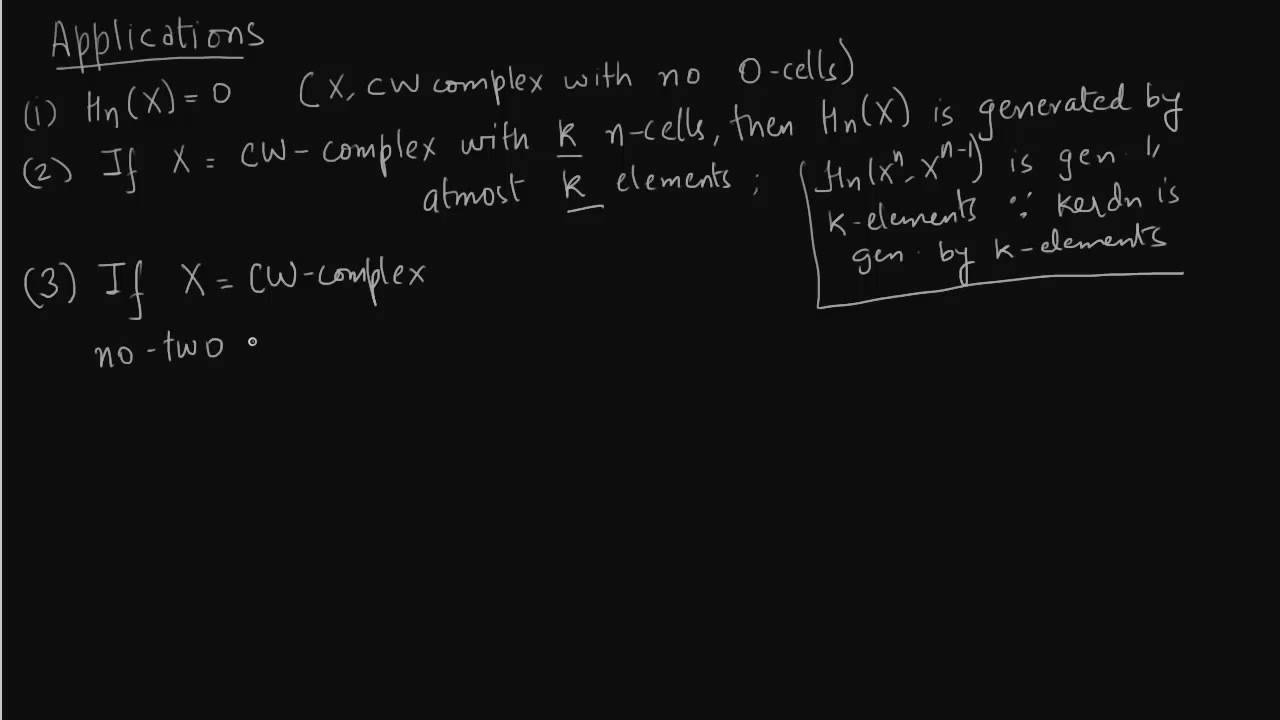
Application to calculation of homology of Complex projective space
been watching his videos
and he says it like youd imagine
marsh forge
En-cell
Is how most would pronounce it
I’m telling the other person
I know u were memeing
abstract pagoda
goofy
fading vale
this sounds like the set up to a "what if we kissed..." meme
drifting sundial
rancid umbra
<@275628620725092354> what if U = T_0? i’m pretty sure that breaks it.
I don't think U would be open then? since T inherits the euclidean topology
rancid umbra
it’s not, that’s my mistake
drifting sundial
rancid umbra
it’s not true that U intersect T+ should be connected for any open, connected ne...
also I don't really see how this contradicts my argument tho, cos the ball isn't connected in the first place
ball intersected with T+*
rancid umbra
but u say that U intersect T+ is connected
drifting sundial
I'm already taking U to be a subset of T
so by intersecting with T+ I'm just removing the portion of U in T0
actually I think that step's probably unnecessary, I can directly do the projection of T onto the x-axis and conclude pi(U) has the form [0,c)
drifting sundial
lean marten
<@!102705166754549760> My approach to verifying the topologists sine curve is no...
@lean marten could you elaborate on this? like what are the connected components in this case
 abstract pagoda
👀
lean marten
The idea is then to show that you can make the green rectangle really tiny and only lose finitely many of the components, so you have a basis of not connected neighbourhoods or something
Whoops should have bounded the rectangle
Oh and we only care about the interior
Ok the picture isn’t great lemme try again

I can give more detail but at that point I’m doing all the work for you lol
Another way you might do it is embed into the sirepenski carpet but that requires a bit of continua theory
drifting sundial
lean marten
The idea is then to show that you can make the green rectangle really tiny and o...
hmm is this sufficient to conclude not locally connected?
lean marten
Yeah actually I'm not sure now
hmmmm
lemme go check what the condition is for locally connected
drifting sundial
locally connected means there exists a nbhd basis of open connected subsets
lean marten
you'd think I'd be better at this given my dissertation next year is in continua theory
fuck
ok
so
we need at least one point without a nbd basis of connected open subsets
So if we take the point $x=(0,0)$ and some open ball $B_{\delta}(x)$ with $\delta<1$ then $B_{\delta}(x)\cap T$ should be disconnected.
gentle ospreyBOT
Oatman
 lean marten
WLOG we can assume that our basis of nbds $B$ has $\forall A\in B$, $A\subset B_{\delta}(x)$
gentle ospreyBOT
Oatman
 empty grove
You are checking if the topologist's sine curve is locally path connected or just locally connected?
lean marten
If it was locally path connected, then it would be path connected as it is connected
lean marten
This is harder than I remember
drifting sundial
you have to show that a connected subset is too big to fit inside the ball right?
lean marten
Yeah...
empty grove
If you take a neighborhood of (0,0) which doesn't extend to 1 or -1 in the y direction
lean marten
Yeah that's the one
empty grove
Then each increasing and decreasing part of the curve will be a component
lean marten
Ok yeah that's why my proof didn't work lol
was proving that you could get a basis of disconnected neighborhoods like an idiot lmao
drifting sundial
I initially thought it was freaky that it's connected but not locally connected
but now it kinda makes sense
locally connected is a pretty strong condition
lean marten
Yeah so if the nbd is connected it must contain the peaks, but then I can just get rid of them and the proof is done
Yeah theres a lot of cool continua like that
 drifting sundial
hmm ok
lean marten
The other way to define is a compact connected metric space
Theyre really cool
Like the one I posted above is part of the iterative construction of the buckethandle continuum
Which is indecomposable
So it can't be written as a union of a pair of closed strict subsets
Theyre important for dynamics I believe
because the long term behaviour of a discrete dynamical system will tend to converge to a continuum
It always will for a compact domain
They might also come up as the fibres of maps but I haven't worked with that case
Sorry for the dump lol continua are really cool
drifting sundial
lean marten
Like the one I posted above is part of the iterative construction of the bucketh...
this kinda reminds me of 1-manifolds except you allow for all these weird behaviours to happen
lean marten
Yeah they have none of the local properties of a manifold in general
One way to think about continua theory is as the study of spaces which are well behaved globally, but absolutely nightmarish locally
drifting sundial
cool, thanks for the intro haha
cloud plank
do algebraic sets need to contain all the roots?
for example if i hadd the set $\newline {(a,a^2,a^3 )| f(x,y,z) = xy - z, f(a) = 0)}$
gentle ospreyBOT
pewdssssssss
 cloud plank
if i took say .. 5 elements from this set
would i have an algebraic set
 cold vine
What are the best books to learn CW complexes, (I know some Singular hmlgy)
I have Spanier and Dold, is there anything newer thats good?
tawdry widget
cold vine
I have Spanier and Dold, is there anything newer thats good?
I don’t know, but I am reading Allen Hatcher and Rotman. Rotman’s GTM 119 is especially helpful to me anyway
tawdry widget
cloud plank
for example if i hadd the set $\newline \{(a,a^2,a^3 )| f(x,y,z) = xy - z, f(a) ...
This is an algebraic set, it is the locus of zeros of {xy-z,x^2-y}
cold vine
tawdry widget
I don’t know, but I am reading Allen Hatcher and Rotman. Rotman’s GTM 119 is esp...
Yeah thanks! I have Hatcher as well although it's a bit gazy on the details but a nice supplement. Ill check rotman out on the subject
tawdry widget
Yeah rotman seems to contain much more details
cold vine
Does it have CW complexes I think Ive used it a bit on singular homology?
tawdry widget
cold vine
Does it have CW complexes I think Ive used it a bit on singular homology?
It has in chapter 8
cold vine
Ok thanks!
swift fjord
If H is some subpsace of dim k of R^n, i'd expect R^n/H with the quotient topology to be isomorphic (as a TVS) to R^(n-k). This is true right?
I don't have much experience with quotient spaces
rancid umbra
dim V/H = dim V - dim H for any subspace H of V in the finitely generated setting, so yes R^n-k would be isomorphic as a vector space to R^n/H. not sure if this helps at all, in the case of TVS isomorphism
swift fjord
lean marten
That should give you the scalar multiplication
I think I got it, i'll write my solution here in a sec, but i'm not sure where I used the fact that the group is closed, but I think every connected subgroup of R^n must be closed
I'd expect the quotient topology to act nice with TVS
But i'll try writing it out explicitly
rancid umbra
rancid umbra
dim V/H = dim V - dim H for any subspace H of V in the finitely generated settin...
if a TVS isomorphism is just a bijective linear transformation, then this works
swift fjord
It needs to preserve the topological structure aswell
Also the quotient needs to have a TVS topology
rancid umbra
*homeomorphism
swift fjord
And i'm not sure if a linear transformation is continuous in any TVS
rancid umbra
it should work in the case of R^n
swift fjord
Yea R^n is nice enough, I just wanna verify for myself that it works
tawdry widget
swift fjord
If H is some subpsace of dim k of R^n, i'd expect R^n/H with the quotient topolo...
I think that’s truth. First WLOG we can assume that H is generated by e_1,...,e_k (after a proper rotation) let π:R^n—>R^n/H. next notice that the topology of R^n/H has a base {π(Β((x_1,...,x_n),r): (x_1,...,x_n) belongs to R^n, r>0} where Β((x_1,...,x_n),r)={(y_1,...,y_n):max{|y_i-x_i: 1<=i <=n}<r} and finally π(Β((x_1,...,x_n),r)= Β((x_(k+1),...,x_n),r) in R^(n-k)
swift fjord
yea I think I just managed to prove it, tho a bit more roundabout
tbh yea you can use the universal property of the quotient map to produce an iso'
pretty much what you did
Ok so assuming that's true, here's my solution to a bit of a generalisation of my previous question. I assert that every closed and connected additive subgroup of $\mathbb R^n$ is a linear subspace.
One implication is obvious as subspaces are closed and connected.
We prove the converse by induction. The case for $n=1$ is obvious from the properties of connected subsets in $\mathbb R$.
$\\$
Induction step: suppose that $L$ is a closed, connected subspace of $\mathbb R^n$. Let $H$ be the largest linear subspace contained in $L$ (This is well defined since we can take $H$ to be the sum of all subspaces contained in $L$, and this is still contained in $L$ from closure under addition). Let $k = \text{dim} H$. WLOG $k<n$ otherwise the result is trivial.
$\\$
Consider the quotient $\sfrac{\mathbb R^n}{H}$. Then as we've said we have that there is a TVS isomorphism $\rho:\sfrac{\mathbb R^n}{H}\cong \mathbb R^{n-k}$. Note that $\sfrac{L}{H}$ is a closed, connected subgroup of $\sfrac{\mathbb R^n}{H}$, therefore $K:=\rho(\sfrac{L}{H})$ is closed and connected (Homeomorphisms preserve closure, and continuous functions preserve connectedness), therefore by IH $K$ is a subspace, but as $\rho$ is linear, this implies $\sfrac{L}{H}$ is a subpspace. If $\sfrac{L}{H}=H$, then $L=H$ and so we are done.
$\\$
Otherwise, suppose BWOC that $\sfrac{L}{H}\neq H$, then there is some vector $v \in L-H$ such that $\text{span}(v+H)\leq \sfrac{L}{H}\Rightarrow \text{span}(v)\subseteq L$, but then $H + \text{span}(v)$ is a strictly greater subspace than $H$ contained in $L$, in contradiction to the assumed maximality, therefore $\sfrac{L}{H}$ must have been trivial and so we indeed have that $L=H$ is a subspace as required.
gentle ospreyBOT
ShiN
 swift fjord
Does this seem good?
It feels off since I don't see where we use the fact that the subgroup is closed...
oh L is a subgroup btw not a subspace ofc
otherwise there's nothing to prove
I think maybe the fact that the subgroup is closed is implicitly used somewhere in the induction?
rancid umbra
is it not used to get that L/H and K are closed?
swift fjord
yes but what would change if I omitted that requirement in the induction hypothesis
obvs something would break
but what
IG, K couldn't be a subspace if it wasn't closed, but it being a subspace would imply it being closed
I'm trying to think if there's some way to have a non-closed connected subgroup in R^n but I don't even think there is
gritty widget
Hello everyone! I found this exercise on limit point by The Math Sorcerer on the Youtube.
There is a set X={a,b,c,d,e,f} and a topology T on it, T={ {}, X, {a}, {a,b}, {a,b,d}, {a,b,c,d} }. We want to find all the limit points of A={a,b}.
(1) So he proceeds by checking whether for each point of A, each open set containing that points
contains other points as well.
If yes then the given point is a limit point. Otherwise not.
He checks that (1) also for all other point of X. And that is where I get confused. Then what difference does the choice of A make? Why do we call them limit points of A?
This is a screenshot of the end of the video


Please Subscribe here, thank you!!! https://goo.gl/JQ8Nys
Finding Limit Points and the Derived Set in a Topological Space
And this is the link to the video if you want to check.
swift fjord
For each point of X, he wants to check if for every open set containing it, there is a point (other than itself) in A in it
intuitively, you can think of this as the limit points of A being as close to A as the topology will allow (This analogy is not 100% because you can have elements of the set itself that are not limit points tho). Maybe more accurately the set of limit points is the set of points that can be 'approximated' by elements of A as well as the topology will allow
if you change A, then you'd need to check if those open sets contain points from some other set
so the limit points will change
for example, if you took A={d}, then for a,b there are open sets containing them that do not contain an element from A (that is, d). For c, there is only one open set containing it, and it contains d, therefore c is a limit point.
d is not a limit point of A since every open set that contains d cannot contain any other points from A (as there aren't any)
In general the set of limit points of a singleton will be disjoint from itself (That is, a singleton set never has its element as a limit point)
So we get A'={c}
do you see how the choice of A changes the process?
gritty widget
So, I was wrong to think that we were checking the points of A at the beginning. We were just checking the points of X.
For each point of X:
If it is not in A, we check whether it is contained in open sets that do not contain points of A. If this is the case, then it is not a limit point.
If it is in A, we check whether it is contained in open sets that do not contain points of A other than itself. If this is the case, then it is not a limit point.
Is this correct?
swift fjord
yes, though you can say that more succinctly with the definition of a limit point
everything you said is correct
tawdry widget
The set of limit points of A is the closure of A minus A right? Clearly the closure of A is X here
swift fjord
not necessarily
there can be elements of A which are limit points
consider an open interval in R
tawdry widget
swift fjord
consider an open interval in R
?
swift fjord
its set of limit points is the same as its closure
and contains itself
you can see this from the sequential definition
tawdry widget
oh I see
swift fjord
or even more simply the example of A as {a,b} in the example above
A' has b
generally, we say that a point $x \in X$ is a limit point of a set $A$ if for every open set $U$ that contains $x$, we have:
$$U \cap (A\backslash{x})\neq \varnothing$$
gentle ospreyBOT
ShiN
 swift fjord
Which is exactly what you said but it covers both cases
gritty widget
swift fjord
yes, though you can say that more succinctly with the definition of a limit poin...
OK 🙂 Then I see how the choice of A changes the process. Thank you!
swift fjord
you're very welcome!
tawdry widget
Oh my bad so x is a limit point of A iff x is from the closure of (A-{x})
So {b c d e f}?
swift fjord
are there sufficient conditions under which a totally disconnected (metric) space is discrete?
or even stronger, a totally disconnected real topological subgroup of R^n
it seems all the answers I find use lie theory
Maybe I can do this using induction again
🤔
Ah wait that won't work cuz the identity component would be trivial
I think in this context I could maybe prove it has to he countable
Unless has a counterexample of a totally disconnected, uncountable closed subgroup in R^n
Subgroup is important otherwise you have say the cantor set
 raw sedge
I know a potentially relevant theorem, but not its proof: Any countable metric space with no isolated points is homeomorphic to Q.
swift fjord
Alright at least I have that then
No, I want to prove that a totally disconnected closed subgroup is discrete
empty grove
raw sedge
I know a potentially relevant theorem, but not its proof: Any countable metric s...
You're probably missing some hypotheses?
Because [0,1] intersected with Q seems like it wouldn't be, or is it still homeomorphic?
No more compactness argument
I don't see how that would go. The only thing I can think of is constructing larger and larger partial homeomorphism inductively but the union of a chain of homeomorphisms won't be a homeomorphism
Ahh like with the radii?
I see why metric part was important then
Neat
$53 for a paper
reef shore
ty
Ah was it because of institution login? Or did you use doi elsewhere? 
I don't even see a sidebar 
On mobile and desktop sites
All I see is a yellow get access button which redirects me to login with institution or pay 53 or 105 🔫
gritty widget
Me too, I’m asked to pay
Although 53 for a 3 page paper seems obscene
I see the pdf button after logging in with my institution

reef shore
My institution ID is not accepted by anyone  like not even Indian websites 🔫
raw sedge
that's what she said
swift fjord
Of the norm? I don't see how this helps exactly
Oh
Yea that's why I didn't understand what you meant
Ok i'll try working with that
swift fjord
sorry i'm not exactly sure how that helps me
raw sedge
swift fjord
No, I want to prove that a totally disconnected closed subgroup is discrete
I have an idea for a direction of how to approach this. I'll try to articulate the idea by the proof I got for n = 1. Maybe tomorrow I'll try to generalize it.
Suppose A is a closed subgroup of R, and x is a point of A which isn't isolated.
There are then elements of A arbitrarily close to x, and thus - since A is a subgroup and considering their differences from x - we conclude that x contains elements that are arbitrarily small (in absolute value).
Then, since the subgroup generated by epsilon in R is a distance of less than epsilon from any real number, a subgroup containing arbitrarily small real numbers is dense in R.
Finally, since A is closed, this implies A = R so A is not totally disconnected.
for other values of n maybe we need an adjustment of the reasoning about what happens around a limit point, or maybe we need some kind of projection into R.
swift fjord
I don't know how well this would generalise, especially considering that the case of subgroups of R is very limited
raw sedge
I suspect any closed subgroup that contains a limit point will contain a 1d vector subspace
for reasons that are in some sense analogous to the argument for n = 1
I might be wrong though
swift fjord
your approach does require a norm tho
which makes it less general
actually i'm not sure if this would be good for me since while I am working in a space TVS isomorphic to R^n, I don't have a norm on it necessarily
as it's a quotient space
so I might need a stronger result
Going back to algtop for a bit for a sanity check: If a space $X$ has 5 connected components, and $CX$ is the cone over $X$, then I have
$$H_1(CX,X)\cong \mathbb Z^4$$
Right?.
And
$$H_1(S^1,S^0)\cong \mathbb Z^2$$
?
gentle ospreyBOT
ShiN
 swift fjord
The first one as we have the exact sequence
$$\tilde{H_1}(CX) \rightarrow H_1(CX,X) \rightarrow \tilde{H_0}(X)\rightarrow \tilde{H_0}(CX)$$
Then $\tilde{H_0}(CX)=\tilde{H_1}(CX)=0$, the first one since it's path connected, the second since it's contractible, and $\tilde{H_0}(X)\cong \mathbb Z^4$, therefore we have the exact sequence
$$0\rightarrow H_1(CX,X)\rightarrow \mathbb Z^4 \rightarrow 0$$
So this is an isomorphism.
$\\$
For the second one, we similarly have the sequence
$$\tilde{H_1}(S^0) \rightarrow \tilde{H_1}(S^1) \rightarrow H_1(S^1,S^0) \rightarrow \tilde{H_0}(S^0)\rightarrow \tilde{H_0}(S^1)$$
Then $\tilde{H_1}(S^0)=0$ from the dimension axiom as its two path components are singletons, from Hurewicz theorem we have $\tilde{H_1}(S^1)\cong \mathbb Z$, and we also have that $\tilde{H_0}(S^0)\cong \mathbb Z, \tilde{H_0}(S^1)=0$, then our sequence becomes
$$0 \rightarrow \mathbb Z \hookrightarrow H_1(S^1,S^0) \rightarrow \mathbb Z\rightarrow 0$$
Then there's a theorem that says that in this case (Since the 3rd group is free abelian) $H_1(S^1,S^0)\cong \mathbb Z \oplus \mathbb Z$
gentle ospreyBOT
ShiN
 swift fjord
The only thing that irks me is that the theorem I mentioned in the end is only proven much later in the book, so I wonder if there was an easier way to deduce this from the sequence
swift fjord
swift fjord
sorry i'm not exactly sure how that helps me
I'm bumping this up too so hopefully I can still get help
pearl holly
looks good to me but don't trust me
but maybe you meant Z⁵ since you said that it has 5 path components
swift fjord
ty
marsh forge
yes all looks good
I think that your final question can be answered by basically emulating the proof of that later lemma
i.e. find a splitting
this is easy to do
unless the splitting lemma is also off limits
swift fjord
I mean we didn't do the splitting lemma either but I proved it for one of the exercises
we proved a weaker version
but he probably meant to emulate the proof of the weaker version
marsh forge
I think you can probably prove the splitting lemma (or the version you'd need here) yourself
marsh forge
yeah then ur good
swift fjord
any chance you can help me with my other question? I want to prove that any closed, totally disconnected subgroup of R^n is discrete. Ultra said to use homogeneity but I don't see how that helps here
marsh forge
too point set for me but if I have extra time ill think about it
otherwise just ping ultra again
he's very nice
pearl holly
wait what is the splitting lemma?
swift fjord
marsh forge
otherwise just ping ultra again
Can't tell if you're being sarcastic or not tbh
marsh forge
im not
swift fjord
I thought he hated being pinged
marsh forge
ultra hates being pinged by annoying people trying to get his attention
I don't think he minds it in this instance
swift fjord
fair enough
marsh forge
Most people who dislike pings really dislike fake or dumb pings that distract from interesting pings
swift fjord
pearl holly
wait what is the splitting lemma?
If you have an SES of abelian groups 0->F->G->K->0 then there is a left split (ie a map i:K->G such that i o (F->G) is the identity on F, iff there's a right split (Same thing but for G->K and the identity on K) iff G \cong F\oplus K
the isomorphism has some naturality condition too I think
pearl holly
ah okay I see. Hatcher hasn't talked about this I think
swift fjord
rotman hasn't either, he's saving it for a bit later
pearl holly
oh lmao
swift fjord
But I needed it for an exercise so I proved it
So I don't see exactly how this helps me, if you could elaborate a bit more
wait so are you saying that I can have a nondiscrete totally disconnected subgroup?
closed subgroup
I'm not assuming subspace, just that it's closed under addition
ah ok
I'm still not sure how this helps me. So if it has an accumulation point then it's uncountable, but then I need to show it doesn't have any accumulation
yea that's what I wanna prove tho
I wanna prove that a totally disconnected, closed subgroup of R^n must be discrete
by what you said above?
alright, i'll give it a try
thanks!
I think I have an outline tho
tell me if this makes sense
wait nvm
i'm being circular
I think it's enough to show that there's one isolated point
I keep trying to find where the fact that this is a group would come in, cuz without that requirement there are closed, perfect totally disconnected sets
yup
Just gonna show that there is one...
so is the hint you gave no good?
Oof
Rip
It's all good
Tell me if anything comes up
I'll keep thinking about it
Yea
Yup
Mhm
Wait in R what about Q? It's both countable and dense
I mean that doesn't really matter since i'm assuming a closed subgroup but still
Yea...
Alright
It's all good
Thanks for.the help anyways
alright
and yea I think that works
thanks!
lmao
waitwaitwait
Why is the image of the subgroup necessarily closed? The projections onto the axes are essentially taking the quotient R^n/R^{n-1} (Or something isomorphic to it), then clearly the image of G would be closed if it contained R^{n-1}, but otherwise we have that the inverse image of the image of G would be G + R^{n-1} (for example), and i'm not sure this has to be closed.
lean marten
Isn’t the projection closed?
swift fjord
i'm pretty sure it's not necessarily closed
it's always open
I found a counterexample on MSE
lean marten
Wtf that’s so annoying lol
swift fjord
lmao yea
take $\mathbb R^2$, and project the set ${(x,y):xy=1}$ onto one of the axes
lean marten
Ah right
gentle ospreyBOT
ShiN
 lean marten
Actually you might only need to project a compact subspecies of the subgroup
swift fjord
If I could prove that the projection of G onto the axes is necessarily closed then i'd be done. It has to be true anyways I think
swift fjord
I'm not sure if that would work
I'm going to sleep now
Eh it was almost there tho!!
I'm sure we can make it work
but tomorrow
 obsidian socket
Hi, I was reading this post here https://www.quora.com/In-Algebraic-Geometry-why-are-there-exactly-27-straight-lines-on-a-smooth-cubic-surface . And was wondering if someone could help explain something. They say that if $H^2=3$ on a cubic surface $S$, where $H$ is the class of a hyperplane on $P^3$, then $S$ is smooth. I'm not sure why this is the case, would be very thankful for any help!
I've previously written a bit about the smooth cubic surface in my answer Why does "algebraic geometry" have geometry in its name? That would be a good first place to look for motivation if you don't know any algebraic geometry. Here I'll go in...
gentle ospreyBOT
LewisKSM

 livid drift
book reccos on vector bundles
raw sedge
swift fjord
actually i'm not sure if this would be good for me since while I am working in a...
I don't see how it's a problem. Even if our proof uses the norm on R^n, the statement it proves about R^n is purely in terms of its topological group structure, and therefore should apply to your object too, even if your object doesn't come naturally equipped with a norm
think of it like this: pick a TVS isomorphism phi from your object to R^n, then this gives you a norm on your object by d(x,y) = d(phi(x), phi(y))
In mathematics, particularly in universal algebra and category theory, transport of structure refers to the process whereby a mathematical object acquires a new structure and its canonical definitions, as a result of being isomorphic to (or otherwise identified with) another object with a pre-existing structure. Definitions by transport of struc...
Another problem is that the subgroup isn't necessarily isomorphic to the direct sum of the projections. i.e. consider {(x,x) | x in Z} in R^2
gritty widget
livid drift
book reccos on vector bundles
@livid drift If you haven't seen it yet, "Differential Geometry"- Tu seems to have a pretty good amount of introductory coverage on the topic; compared to standard diff geo introduction books. However, I have yet to get to those sections myself, so take that with a grain of salt. I've been slacking off in reading it for DT. If you already have a good amount of knowledge on the subject, it may be too pequeno. If you know very little, for some direction: "K-Theory" is a field which has a lot to do with vector bundles. So, looking for books covering K-Theory may be a start.
livid drift
gritty widget
<@!696075714902097942> If you haven't seen it yet, "Differential Geometry"- Tu s...
loring & Tu?
gritty widget
Loring W. Tu*
raw sedge
but I do feel like something in the spirit of that would be useful, projecting it into smaller spaces somehow
livid drift
ok thanks
gritty widget

Differential Geometry: Connections, Curvature, and Characteristic Classes (Graduate Texts in Mathematics, 275)
^link to the
embedded
I have a question myself.
How does one show $((x^i){*}){*, p}$ = 0? For a coordinate $x^i: M \to \mathbb{R}$
gentle ospreyBOT
TempMathAcc
 gritty widget
What I'm trying to do, basically is prove d(dx)(X_p) = 0
Though the exterior derivative, which I assume helps make this work^, is defined to have the property that D(D) = 0. The "differential", or pushfoward isn't; afaik. Yet the pushfoward of a smooth f:M->R is equal to df(x_p)(X_p)d/dt
<@&286206848099549185>
tawdry widget
Locally d(1dx_i)=Σ (∂/∂xj)(1) dx_j Λ dx_i =0
gritty widget
yes, but
the wedge product is defined that way, and so is the exterior derivative; but the original definition for pushfowards doesnt have that. The only reason the above works, seems to be by definition, right?
srry for sounding rude, if I did before
but, like Im saying: how does one prove the "double differential" of a chart is 0, forgetting the wedge product etc..
and using the definition: (x)_*(Xp)(f) = X_p(f(x))
for a tangent vector in T_pM
tawdry widget
We use different symbols. What I know is that X_p is a linear map from M(p) to R satisfying several axioms, where M(p) is the set of continuous maps from a neighborhood of p to R then take quotient over the equivalence relation f~g if f and g are equal restricted on an open neighborhood of p. The equivalence class represented by f is called the germ of f (at p) The linear space containing all X_p s is denoted T_p M. The dual space is denoted T_p *M any f from a neighborhood of p to R we can define df: X_p —> X_p(germ of f) to be an element of T_p * M
And my version of $(F_{})$ is that given a continuous map F from a neighborhood of P in M to a neighborhood of q in N , F(p)=q, $(F_{})$ is a linear map from T_q *N to T_p *M mapping dg to d(g•F)
gentle ospreyBOT
Cogwheels of the mind
Compile Error! Click the reaction for more information.
(You may edit your message to recompile.)
 gritty widget
nah, as I skim
let me send you the wiki for the defintiion

In differential geometry, pushforward is a linear approximation of smooth maps on tangent spaces. Suppose that φ : M → N is a smooth map between smooth manifolds; then the differential of φ,
    d
    φ


{\displaystyle d\varphi }
, at a point x is, in some sense, the best linear approximation of φ near x....
see the "The differential of a smooth map" section
I send it here, so we dont get confused and fumble due to semantics
Im saying to prove that, lets rephrase
tawdry widget
Yeah I can understand that. dF(X_p) (g) = X_p(g•F) by definition
gritty widget
yes, ok
tawdry widget
So we agree on symbol $((x^i){*})$ . What does $((x^i){})_{, p}$ mean
gentle ospreyBOT
Cogwheels of the mind
 tawdry widget
Never mind I’d better read the book you mentioned
gritty widget
I should rephrase
I was about to do that
let's simply do this:
$\frac{\partial}{\partial x^i}(x^i)_{*}(p)$
gentle ospreyBOT
TempMathAcc
 gritty widget
that was actually the original problem, but I decided to be autistic and do the double differential thing
so, I ask: how do I prove that to be 0?
if you have the notion of the exterior derivative dx, you would problably say it is equal to dx^dx
then say thats 0
but forget the wedge product
throw it out the window
tawdry widget
$\frac{\partial}{\partial x^j}(x^i)=δ_{i,j}$
gentle ospreyBOT
Cogwheels of the mind
 tawdry widget
We are really using different symbols. To me $\frac{\partial}{\partial x^j}$ is an element of T_p M $x^i$ is a germ of a map at point P
gentle ospreyBOT
Cogwheels of the mind
Compile Error! Click the reaction for more information.
(You may edit your message to recompile.)
 gritty widget
im saying take the derivation of the pushforward of x, not the derivation of simply x- like you displayed
I agree with your germ definition and tangent vector
tawdry widget
I can’t get it. $\frac{\partial}{\partial x^i}$ is an element of T_p M, $(x^i){*}$ is a linear map from T_q *R to T_p *M , p is a point from M. I can’t even understand your formula $\frac{\partial}{\partial x^i}(x^i){*}(p)$