#point-set-topology
1 messages · Page 239 of 1
 pastel thistle
the question is if such function could or could not exist.
I think not, but Im having trouble proving it
 haughty wave
Can't you use urysohn's lemma?
haughty wave
If you haven't learned it, then you can define a function like this

Oh wait, it should be flipped
haughty wave
But you can multiply that function (let's call it f) with (1, 1/2, 1/3, ...) and define g(x, y, z) = f(z) * (1, 1/2, 1/3, ...)


 shy moss
thanks, i get it
 flint sinew
I think I have some trouble trying to understand what standard topology means
 fading vale
flint sinew
I think I have some trouble trying to understand what standard topology means
fading vale
flint sinew
I think I have some trouble trying to understand what standard topology means
The standard topology on R^n?
flint sinew
I guess
not entirely sure, because the concept of std. topology is in itself conceptually foreign
fading vale
"standard topology" isnt a concept
It doesn't mean anything without the context of whatever set you're working on
flint sinew
I see
fading vale
if i have an arbitrary set X there is no "standard topology" on X in all cases
flint sinew
if that set is - say - all positive integers?
fading vale
"the standard topology on N" doesnt mean anything no
at least not anything formal
I guess it could mean subspace topology for subsets of R^n
which in this case yeah would be discrete
flint sinew
okay, let's ask it this way - if std. topology requires "context", what context is that exactly? are there any clear examples of a set and a context which establish whether something is or isn't a standard topology?
fading vale
"Standard topology" is a term used to refer to the usual metric topology on R^n and the subspace topology on subsets of R^n
In an arbitrary topological space it means nothing
flint sinew
R^n refers to space of n-tuples of real numbers?
flint sinew
is open ball the same as soft ball?
fading vale
the open ball of radius r about a point x is the set B_x = {y | d(x, y) < r}
in dimension 1 this is an open interval
flint sinew
also I think I'll need to go even further to the fundamental vocabulary - what is a "metric topology" and what does the elaboration of "the usual metric topology on R^n" mean?
fading vale
If you are missing this much terminology you probably should just crack open a textbook
flint sinew
fair enough
 lyric quartz
I'm trying to understand this proof from Weibel but to no avail. The part that I'm stuck at right now is that the intersection of D(A), the degenerate simplicial complex, and N(A), the nomralized simplicail complex, is trivial. I try to follow the proof but I don't see why ith face of y is x_i. Could anyone help? Thanks!

 plain raven
I have gone through this proof not too long ago, let me see if I can recall
btw do you have a copy of Weibel's Errata on hand? It's substantial
you can find it on his website
Indeed consulting the errata it does seem that there is an error in the proof
the correct line should be
"If $y\in N_n(A)$ and $i$ is the smallest integer such that $\sigma_i(x_i)\neq 0$, then $y = \sigma_i\partial_iy = \sum_{j>y}\sigma_j(x'_j).$ By induction, then, $y=0$, and so $D_n\cap N_n=0$.
 gentle ospreyBOT
diligentClerk

 obsidian socket
 lyric quartz
plain raven
"If $y\in N_n(A)$ and $i$ is the smallest integer such that $\sigma_i(x_i)\neq 0...
lyric quartz
plain raven
"If $y\in N_n(A)$ and $i$ is the smallest integer such that $\sigma_i(x_i)\neq 0...
so I'm not getting this line either. Isn't y - \sigma_i \partial_i y = 0 right away because \sigma_i \partial_i = id?
 plain raven
actually i don't think $\sigma_i \partial_i =id$ in general
gentle ospreyBOT
diligentClerk
 plain raven
i don't think that's one of the simplicial identities
$\sigma_i\partial_i = \partial_i\sigma_{i+1}$
gentle ospreyBOT
diligentClerk

 tepid snow
Hello! I am interested in understanding this paper on topology: https://arxiv.org/pdf/1912.11324.pdf Will an introductory topology book be sufficient? I already have familiarity with space groups, point groups, and Laue groups. What do I need to know to understand the terminology and develop a visceral intuition of the named spaces and groups. A group theory textbook as well?
lyric quartz
plain raven
i don't think that's one of the simplicial identities
okay so I'm fine with everything except the induction. What's the induction on and how is it working?
plain raven
ok yeah let me take a look at this
Ok. Let $y$ be an element in $D_n(A)$. Now, assume that $y\in N_n(A)$, so $\partial_iy=0$.
gentle ospreyBOT
diligentClerk
 plain raven
so $s_i\partial_iy=0$.
gentle ospreyBOT
diligentClerk
 plain raven
(Recall that $i$ is the index of one of the degeneracies, so it's strictly less than $n+1$)
gentle ospreyBOT
diligentClerk
 plain raven
So $y = y -s_i\partial_i y$.
gentle ospreyBOT
diligentClerk
 plain raven
Since $s_i\partial_is_ix_i = s_i$ (because $\partial_is_i=id$), the $s_ix_i$ term disappears when we rewrite it this way
gentle ospreyBOT
diligentClerk
 plain raven
and when $j>i$, we have that $sI_i\partial_is_jx_j=s_is_{j-1}d_ix_j = s_j s_i\partial_ix_j$
gentle ospreyBOT
diligentClerk
 plain raven
Tehrefore, $y - s_i\partial_iy$ can be expressed as a sum of terms $\sum_{j>i}s_jx_j'$ for some new list of $x_j'$.
gentle ospreyBOT
diligentClerk
 plain raven
We can view this as the induction step in an induction on $i$. We are proving, for each $i$, that $y$ can be expressed as the sum of degeneracies of the form $s_j(x_j)$ for $j>i$.
gentle ospreyBOT
diligentClerk
 plain raven
But if this is true for all $i$, then in the end we can write it as a sum over no $j$, i.e., as an empty sum, and the sum must be zero.
gentle ospreyBOT
diligentClerk
 plain raven
Each step in the induction kills off the lowest-index term in the sum and replaces it by higher-index terms. If you do this repeatedly you see that you can eventually eliminate all of the terms.
lyric quartz
oh okay, first given i, basically we move up indexing until you reach 0.
plain raven
yeah that's why he assumes that $i$ is the least index for which the term is nonzero
gentle ospreyBOT
diligentClerk

 flint cove
Does anybody know the condition we need for a convergence to arise from a topology?
a centered convergence such that lim ℱ = \bigcap_{𝒰 ultrafilter containing ℱ} lim 𝒰 seems to be callled “pseudotopology”
Context: Sec2.3 in https://projecteuclid.org/download/pdf_1/euclid.rae/1403894903
lmao I actually wrote that down and found it again
As is tradition with nlab, the referenced page „relational β-modules” sounds way too scary for the problem at hand
Ah thank god, the relevant stuff appears to live in one section: https://ncatlab.org/nlab/show/relational+beta-module#bridge_to_a_concrete_description
Oh, the key difference from a pseudotop seems to be that we have a relation between ultrafilters
 verbal wraith
but why?
plain raven
In 1970, Michael Barr gave an abstract definition of topological space based on a notion of convergence of ultrafilters (building on work by Ernest Manes on compact Hausdorff spaces). Succinctly, Barr defined topological spaces as ‘relational β\beta-modules’. It was subsequently realized that this was a special case of the notion of generalized multicategory. Here we unpack this definition and examine its properties.
michael barr is my god
but i don't know about this stuff, I mostly understand the relationship in the case of compact hausdorff spaces, it seems like barr is interested in trying to generalize this
For a CH space, every ultrafilter on the powerset converges to a unique point. conversely, you can characterize the CH spaces in terms of ultrafilter convergence as the category of CH spaces and continuous maps can be characterized as the category of algebras of the ultrafilter monad on Sets.
If i remember correctly, a space needs to be Hausdorff in order to ensure that the point of convergence of a filter is unique
and compactness guarantees that if the filter is maximal, there is at least one point of convergence
flint cove
verbal wraith
but why?
Because people introduce test functions and say „define sequences of test functions to be convergent if uniform convergence in every derivative and support is well-behaved“ and they never tell you why you are allowed to use topological concepts or e.g. why something other than the indiscrete topology should satisfy these conditions
That has bugged me for five years
or I'm just dumb and there's actually a way to characterize test functions in a polynormed way
flint cove
flint cove
Because people introduce test functions and say „define sequences of test functi...
(samplesize N=2)
verbal wraith
Filters in general are convoluted ways to express simple things but I'm not sure that pseudo-topologies also express simple things. Maybe they're just convoluted?
flint cove
Nets are not better
and once you leave the realm of first countability you have to choose one of these generalizations
verbal wraith
I prefer semi-lattices to filters to nets
flint cove
You mean the Kuratowski axioms?
I'm not quite sure how one can describe a topology with abstract semilattices
Also, today I learned that locally convex TVSes are always induced by seminorms
And that finally explains why we care about local convexity, and now I'm kinda happy.
flint cove
I'm confusde, don't use the word semilattice in that paragraph
Furthermore, if we have a topology on X, what would Y be? just {0,1}?
Or would we have a classification in X×𝒯?
verbal wraith
The semi-lattice is the Y
it's just a poset with an intersection operation
the closed sets are the semi-lattice
flint cove
That wouldn't give you semilattices in general, but more specificallly meet-compllete semilattices
verbal wraith
I mean, I don't use that terminology.
flint cove
My inner Birkhoff is not strong enough for being really comfortable with this stuff tho
To be fair, you're the one using the word semilattices frequently just for bragging rights
You should be the one comfortable with the terminology lmao
verbal wraith
Well the problem is that its unwieldy.
flint cove
I'm gonna head off tho, it's >4am over here. gn
 verbal wraith
I'm sort of getting distracted by foundations as I'm writing this because membership in a collection looks like a classification.
 woven juniper
is it appropriate to ask about accessing papers in certain journals I dont have access to here?
it is in an alg/geo top journal
 gritty widget
have you checked sci-h*b
 nimble jolt

 honest terrace
took me some time to realize the cat isn't actually walking on two feets 
 hollow harbor
gritty widget
have you checked sci-h*b
hollow harbor
gritty widget
have you checked sci-h*b
Finally, let me also say categorically that I myself never actually use SciHub, because it is illegal. I also specifically encourage my graduate students not to use it. In fact, just in case they might accidentally use it, I make a point to explain to them in detail all the steps that would be required in order for them to access articles via SciHub. I explain that it would be legally wrong for them ever to use that method to gain access to published articles for free, even though the authors of the articles (who are the true moral owners of the works) would want them to do so. I believe it is incumbent upon us all to instruct the future generation of researchers correctly in this matter.
plain raven
Finally, let me also say categorically that I myself never actually use SciHub, because it is illegal. I also specifically encourage my graduate students not to use it. In fact, just in case they might accidentally use it, I make a point to explain to them in detail all the steps that would be required in order for them to access articles via SciHub. I explain that it would be legally wrong for them ever to use that method to gain access to published articles for free, even though the authors of the articles (who are the true moral owners of the works) would want them to do so. I believe it is incumbent upon us all to instruct the future generation of researchers correctly in this matter.
 trail tiger
Math narcs
 sweet wing
Finally, let me also say categorically that I myself never actually use SciHub, because it is illegal. I also specifically encourage my graduate students not to use it. In fact, just in case they might accidentally use it, I make a point to explain to them in detail all the steps that would be required in order for them to access articles via SciHub. I explain that it would be legally wrong for them ever to use that method to gain access to published articles for free, even though the authors of the articles (who are the true moral owners of the works) would want them to do so. I believe it is incumbent upon us all to instruct the future generation of researchers correctly in this matter.
honest terrace
Finally, let me also say categorically that I myself never actually use SciHub, because it is illegal. I also specifically encourage my graduate students not to use it. In fact, just in case they might accidentally use it, I make a point to explain to them in detail all the steps that would be required in order for them to access articles via SciHub. I explain that it would be legally wrong for them ever to use that method to gain access to published articles for free, even though the authors of the articles (who are the true moral owners of the works) would want them to do so. I believe it is incumbent upon us all to instruct the future generation of researchers correctly in this matter.
 reef shore
copylogy and pastametry 😋
 sleek thicket
Finally, let me also say categorically that I myself never actually use SciHub, because it is illegal. I also specifically encourage my graduate students not to use it. In fact, just in case they might accidentally use it, I make a point to explain to them in detail all the steps that would be required in order for them to access articles via SciHub. I explain that it would be legally wrong for them ever to use that method to gain access to published articles for free, even though the authors of the articles (who are the true moral owners of the works) would want them to do so. I believe it is incumbent upon us all to instruct the future generation of researchers correctly in this matter.
 hallow swan
ryc literally has all the good copypastas
plain raven
this one is originally due to set theorist Joel David Hamkins, I think, I saw it on twitter earlier
 gritty widget

 uncut surge
absolute king
gritty widget
Hi
I don't even know anything about topology but this isn't for me, it's for a friend
Do you know any topology books that are good for studying topology for the first time?
I'd really appreciate if you knew any book that is good for an introduction to topology
reef shore
Topology by Munkres
gritty widget
munkres good
Okay
there's also lee's introduction to topological manifolds, which (as the title suggests) focuses on a particularly nice class of topological spaces, but still serves as an introduction to the subject
munkres is the standard though
I'll send them both
Thanks @empty grove and @gritty widget

reef shore


 hazy nexus
Finally, let me also say categorically that I myself never actually use SciHub, because it is illegal. I also specifically encourage my graduate students not to use it. In fact, just in case they might accidentally use it, I make a point to explain to them in detail all the steps that would be required in order for them to access articles via SciHub. I explain that it would be legally wrong for them ever to use that method to gain access to published articles for free, even though the authors of the articles (who are the true moral owners of the works) would want them to do so. I believe it is incumbent upon us all to instruct the future generation of researchers correctly in this matter.
 dim meadow
I confess that I might be inclined to make fisticuffs with any individual person who claimed to my face that it was they rather than me who owned the articles that I have slaved over so carefully, polishing and editing and reediting to ensure that every word and symbol expressed exactly my intended meaning. It is entirely mine. How could someone else own this, just because of some established procedural publishing bureacracy? But alas, the fight will never come, because it is not a person but a corporate entity that is claiming to own to the work. I expect that many of us feel this way.
 bronze lake
my summer research that's on knot theory somehow got to talking about the mayer-vietoris sequence
send help
plain raven
huh. that doesn't sound so surprising to me actually, I would have expected knot theory to use lots of algebraic invariants from algebraic topology
hollow harbor
bronze lake
my summer research that's on knot theory somehow got to talking about the mayer-...
Lol we were just talking about this in the context of derived functors the other day
The answer I got to "how do I understand mayer vietoris on any level beyond just knowing how to compute it" was "just know how to compute it"

hollow harbor
Thank you, that's nice
Yes, the diagram chase was only mildly useful to me when I learned it (and I completely forget how that goes)
flint cove
Is there a similar exposition that talks about manifolds or cw cohomology instead? That sounds pretty interesting, but I don't have the homotopy background to understand the paper yet.
bronze lake
flint cove
Is there a similar exposition that talks about manifolds or cw cohomology instea...
Loring Tu's "An Introduction to Manifolds" has a section on De Rham Cohomology and introduces the mayer-vietoris sequence in that context
hollow harbor
Thats essentially the context were I saw it
And I guess it didn't give me the right intuition lol
From Lee, not Tu
flint cove
bronze lake
Loring Tu's "An Introduction to Manifolds" has a section on De Rham Cohomology a...
Hm, skimming over it, it just says „By the zig-zag lemma, […] gives rise to a long exact sequencein cohomology“, so it leaves out precisely the interesting part for me
or am I overlooking something
Oh, the discussion of how to obtain the connecting homomorphism goes into more detail directly afterwards
thanks
I wouldn't say I have lots of discomfort with meyer-vietoris, but I still find it a bit mystic how cohomology of the intersection should somehow affect cohomology in higher degree
At the moment I'm just thinking about it in terms of chain complexes and reasonably happy with that, but still.
 woeful oasis
Think of M-V as "How to put together two spaces and obtain the data of all of the corresponding dimensions of substructures". Connecting one dimension to the other is where you start looking at chains.
 marsh forge
i think the split torus example is a nice one because it shows how the data of how two cynders intersect “creates” a generator in H2 @flint cove
basically the intersections are kinda like gluing instructions
and thats why they can affect how the higher dim stuff works
flint cove
Oh, that makes sense. Should even apply to the gluing of two open intervals to create S1, where a 1-cell appears
thinkking out loud And here the fact that stuff is glued together is witnessed by the nontriviality of H⁰(U cap V), i.e. the fact that there's actually stuff there in the intersection, and in fact enough so to cause higher-dim nontrivialities
I guess a good slogan that I will take away from this is that „gluing n-dim things things at a n-dim intersection together can introduce n+1-dim nontrivialities“
marsh forge
flint cove
*thinkking out loud* And here the fact that stuff is glued together is witnessed...
i would go further to say that it isn't just the nontriviality that matters but also the data given by the (co)homology maps induced by the inclusions
Like how it includes is clearly important
which is why those maps are involved as well
flint cove
Yeah, that makes sense
plain raven
i think the best way to understand mayer vietoris is in terms of mentally playing with the short exact sequence of complexes of differential forms. Take a space you understand like R^2 minus the origin, or S^2, give a cover of it by two opens, pick differential forms in an explicit coordinate system and just "play" - read the proof that the short exact sequence of complexes gives rise to the long exact sequence and spend some time thinking about the geometric content of each step (first few pages of Bott-Tu)
take differential forms and just move them left to right and up and down in the short exact sequence of complexes. I don't know if this makes sense lol
in the singular homology case I imagine a sphere S^2 covered by two open hemispheres U and V, and I have two simplices in the shape of closed hemispheres whose boundary is the equator in U\cap V that cover the sphere, the sum of the two simplices forming a generator for H_2(S^2).
think about how such a chain fits into H_2(U)\oplus H_2(V) -> H_2(U \cup V) -> H_1(U\cap V)
another way of thinking about this is that like, the most geometric understanding I have of singular homology is as being applied to integration problems for differential forms. and one of the cool things about simplices is you can subdivide them repeatedly into smaller and smaller triangles, so that given any chain in a manifold you can subdivide it until all your simplices live in a coordinate chart, and this makes analysis easier. you need some theorems that describe the relationship between a restricted homology that only deals with these small simplices subordinate to the open cover {U_i} by coordinate charts, and the full homology theory that deals with arbitrary simplices. what kind of information do you lose?
the answer is, nothing (up to homology) which is a beautiful result
the Mayer Vietoris is an immediate consequence of this when we take the case of an open cover with two elements
compare this to homotopy theory, where there's no such notion of subdivision of a map S^n -> X into a bunch of tiny little maps subordinate to an open cover
One last thing - the Mayer-Vietoris sequence for singular homology is equivalent to the excision property, which might be, if not easier to understand, at least give a different perspective. If you have nested subspaces A \subset U \subset X, and you're interested in the relative homology of X except that you mod out by all chains in U, then you're essentially trying to think about the homology of X where everything in U is just forgotten and quotiented out. It makes sense intuitively that if you just delete a subset A of U, then the relative homology of (X\A) modded out by chains in (U\A) should be exactly the same as the relative homology of X mod U, because the deletion happened in the area you were trying to suppress/forget. this result is true whenever A is closed and U is open
hmmm ok. neat. I have not heard of this technique
 bright acorn
https://youtu.be/LelwRFs1hx0 Could someone tell me further upon what he is referring to at 59:30 ?
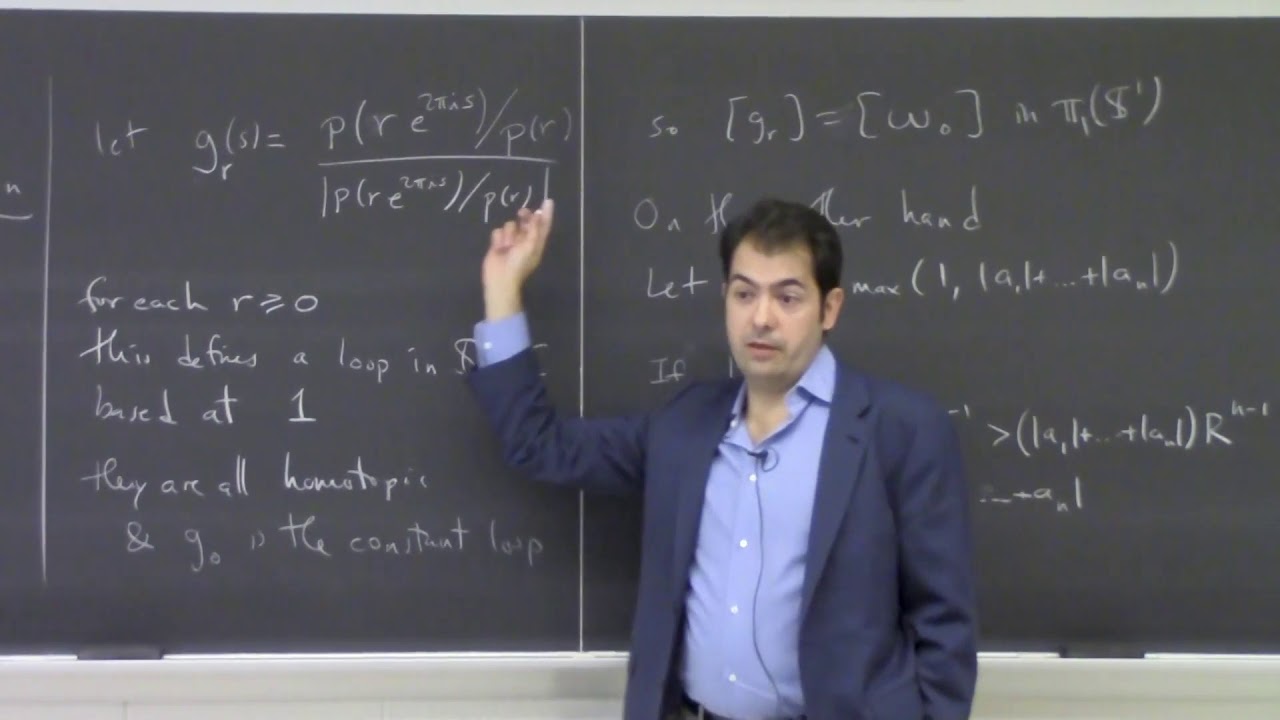
Lecture 4 of Algebraic Topology course by Pierre Albin.
It seems interesting
Be he doesn't talk much about it besides some intuition
Thanks
I will give it a look
Yeah
Prolly a lot of category theory stuff that I don't know about lmao
It's pretty new stuff too
Seems to have been introduced around the early 2000's
Are there books on the subject or is it still just confined within articles? Maybe a book that covers more on homotopy theory, spectral sequences and such touches a little bit upon the subject.
Prolly with a little bit more of background on homotopy theory and spectral sequences I could give it a look.
But I am still reading on Hatcher's first book on AT
So I think it will take a while lmao
Anyways, I have asked this here before, but what books do you recommend on homotopy theory and spectral sequences?
plain raven
Spectral sequences are so great. This isn't a homotopy theory book but the book on algebraic topology and sheaf theory by godement covers sheaf cohomology and uses spectral sequences to prove lots of interesting results.
I don't know if there's an english translation 😦
bright acorn
What's the original language it's written on?
Ooh, too many people recommended me May's book :)
plain raven
It also is a good introduction to simplicial methods in homological algebra, although it doesn't introduce terminology of homotopy theory such as Kan complexes or homotopy groups
It's in french, Topologie Algebrique et Theorie des Faisceaux by roger godement. it's just mathematical french tho so it's not as bad, the grammar is very simple
bright acorn
So it must be really good.
bright acorn
plain raven
It also is a good introduction to simplicial methods in homological algebra, alt...
I am currently trying to learn French lmao
So maybe this will be a way to get a little bit more used to "mathematical french".
I see
Hope the exercises are interesting then, if there are any.
plain raven
Yeah you can probably hack your way through it. I honestly love this book. I love the fact that it starts out with a focus on simplicial methods, I think it's a great introduction to spectral sequences in minimal levels of generality. But he doesn't include any exercises and it's not really that example driven, at least in the sense of explicit computations for a concrete choice of space
bright acorn
plain raven
Yeah you can probably hack your way through it. I honestly love this book. I lov...
I still try to google it.
Prolly won't be able to find a physical point sadly.
That's really good
Thanks for the recommendations
 supple locust
I have tried to write down detailed solution for this problem. Can someone take a look and tell me if it looks okay?

$X-V $ is closed so compact. For x, each $y\in X-V$, $U_y$ as in the problem cover $X-V$. So $U_{y_1},\dots, U_{y_n}$ cover $X-V$. Corresponding we have $U_{x_1},\dots ,U_{x_n}$. Each $U_{x_i}$ is open and closed so $\cap i U{x_i}$ is open and closed. As $U_{x_i}\cap U_{y_i}=\emptyset$, $\cap i U{x_i} \cap \cup i U{y_i}= \emptyset $ thus $x\in\cap i U{x_i}\subset V$.
gentle ospreyBOT
bert
 sleek thicket
makes sense to me
 unborn lotus
i don't understand why in (b) he says every neighborhood

so if i have a set E
and i choose say like a really big radius r
what if i find a q that's not in E?
i must be misunderstanding something
 frosty sundial
you need to find one point in E
frosty sundial
also in this definition
unborn lotus
yeah i should have just reread
frosty sundial
you want to think of this as being really small neighborhoods
frosty sundial
it's more like
no matter how small we choose r
we can always find some point
which is both in E and within r of p
unborn lotus
oh
right i can see this for R^n
but i don't know much about how R is constructed that gives it this ability other than stuff like [0,1] or the real number line has uncountably infinite elements
idk what got it there
reef shore
What ability are you talking about? This is just a definition
frosty sundial
what do you mean?
unborn lotus
aghhh
this is horribly confusing for me to phrase
but
you're saying this is a definition?
hmm
frosty sundial
yeah
reef shore
It seems to be phrased as a definition in the image you sent 
frosty sundial
this is defining "limit point"
after it defines "neighborhood"
also btw thsi isn't a standard definition of neighborhood but it will be equivalent for all the things you care about
(most people would just call it an "open ball")
frosty sundial
what do you mean?
this is the definition of a limit point
the point 0 is a limit point of the interval (0,1)
because for any r > 0, the open ball around 0 with radius r
reef shore
Are you thinking about how this lines up with your intuitive idea of a limit point?
unborn lotus
hmm i suppose i can say every time if i wanted to find a point inside that open ball
just pick a point say
half of the radius away
or a third
frosty sundial
the point has to be in E as well
p = -1 is not a limit point of E = (0,1)
because if you take r = 1/2
unborn lotus
right that too
unborn lotus
reef shore
Are you thinking about how this lines up with your intuitive idea of a limit poi...
when i saw the definition first i thought it was just referring to any point on the interior of a set
frosty sundial
you should think of p as not being a point of E
frosty sundial
yes
unborn lotus
only some of those p have the property i want
frosty sundial
that's right
if your space is R and E = (0,1)
then p = 0 is a limit point of E
but p = -1 is not
unborn lotus
right
unborn lotus
and this is where "every" comes in
reef shore
Another phrasing of the definition in English: A point is a limit point of E iff you can find points of E arbitrarily close to that point
unborn lotus
every open ball around p has to have at least one point that is in E for p to be a limit point
ok
and usually we fail if we pick points "outside"
since we can take a small enough radius to find that all of the points in this small ball are not in E
frosty sundial
that's right
example: E = Q = rational numbers
what are all the limit points of E?
(in the space R)
frosty sundial
(yeah, we'll return to that in a second)
unborn lotus
maybe it's easier if i find points which fail
but
hmm
there are ... a lot of rational numbers
uhh
frosty sundial
that's right
unborn lotus
how am i supposed to find a ball which doesnt have one
hallow swan
between every two rationals there is an irrational
frosty sundial
that's a good question 
frosty sundial
hallow swan
between every two rationals there is an irrational
that's not really relevant here... also please let metal think this through.
frosty sundial
no problem, as long as you're not spoiling it haha
unborn lotus
when i pick p as a rational number it seems fine, since if i pick a radius r i can just floor the radius and halve it
or
frosty sundial
floor?
unborn lotus
maybe im too attached to decimals when thinking of reals
frosty sundial
decimals aren't a bad way to go
unborn lotus
like im thinking of what happens in various cases
how to pick points inside the ball which are rational
when i pick p to be irrational i have to come up with a different solution
frosty sundial
let's try some specific cases
hallow swan
don’t look at this melia but would ||there is a rational between {rational, irrational} x {rational, irrational}|| be sufficient
frosty sundial
p = pi = 3.14159...
and r = 1/100
can you find a rational number within 1/100 of pi?
frosty sundial
hallow swan
don’t look at this melia but would ||there is a rational between {rational, irra...
yeah, though maybe it would be nice to justify that fact
unborn lotus
so my bounds are going to be around (3.131... , 3.151...)
or just a ball around in general ig
not just in the interval
frosty sundial
open balls in this case are intervals centered at pi
so now you have an interval. can you find a rational number in it?
(maybe you can write it down as a decimal)
unborn lotus
sure i can probably truncate something i wrote above or add half of a number and truncate
lets see 3.14 or similar
lots of answers
frosty sundial
great
3.14 is within 0.01 of 3.14159...
becuase their difference 0.00159... is less than 0.01
unborn lotus
right
unborn lotus
3.141
frosty sundial
great
frosty sundial
let's try to do infinitely many r at once
unborn lotus
1/10^n
unborn lotus
:3
frosty sundial
so we can do it for 1/10^n for any n
now what about any r?
for example
r = 1/20
unborn lotus
yeah that seems harder, cus to explicitly find one by hand my strategy is to express that radius as a decimal
and play the same game as above
frosty sundial
I claim that we have already done all the work we need to
unborn lotus
o
frosty sundial
I claim that we have already found a q which works
unborn lotus
oh
in expressing the radius as a decimal
we can use the previous result
i think
or at least in part
wait already...
🤔
lets see
and you mean already meaning like
we just
its like minimal effort
no fancy decimals stuff?
frosty sundial
that's right
unborn lotus
o
frosty sundial
you already figured out how to "win" if I pick r = 1/10^n
for example if I gave you r = 1/10000
and my claim now is that you dont have to do any more work
unborn lotus
i'd just truncate the expansion at the 5th or so decimal place
but
how do i know where to pick the place to truncate given r
is what i guess i need to find out
frosty sundial
great -- can you write that out as a complete sentence/thought?
unborn lotus
if you give me an r, i just need to work with a smaller r which may be more convenient to me
frosty sundial
yes!
unborn lotus
so in this sense no matter what r you give me
for any point
i can win
i can choose n large enough in 1/10^n
hallow swan
frosty sundial
yeah, though maybe it would be nice to justify that fact
ok so ||i just convinced myself this was true without making a proper construction. i just figured you could perturb by the appropriate power of 10 in any case||
not the most precise
unborn lotus
even if r is irrational since i can just truncate r in any way which makes it smaller
frosty sundial
that's right
(also yes 123four that is fine. in some sense metal is making that more precise right now)
the way I might phrase it is "for every r > 0 there is some n such that 1/10^n < r"
unborn lotus
so all points in R are limit points
frosty sundial
that's right
frosty sundial
so the set of limit points of Q is all of R
unborn lotus
is this still true if you said irrationals instead of rationals for E
frosty sundial
yes, it's still true
unborn lotus
i feel like it is but it seems a little weirder
since the decimals thing is not the way i think about irrational numbers
frosty sundial
for any rational number p, and any positive real number r, there is some irrational number in (p-r, p+r)
unborn lotus
oh
frosty sundial
which is the open ball centered at p of radius r
unborn lotus
er how do we know this
frosty sundial
good question
unborn lotus
might be a weird question
unborn lotus

alright lets exclude the case when p is chosen to be irrational
that case is easy
unborn lotus
okay i suppose firstly
i need to know how to tell if numbers are irrational or not
what i was thinking initially for that case was to just halve r and add it to p
but
what
if
r is 2pi
p is -pi
that wont work
for halving
frosty sundial
what condition on r would make it so that you definitely still get an irrational?
so, p = some irrational
when can you guarantee that p + r/2 is still irrational?
unborn lotus
when r is rational i feel very certain
its just weird if i add two irrational numbers together
ig
unborn lotus
right
frosty sundial
for example, if r = 1/10^n we would be set
but what if r isn't? what would we say in that case?
unborn lotus
how do i know if when i add two irrationals together the sum is not rational
that seems like a difficult problem
unborn lotus
but i guess maybe we can circumvent it
try a different construction
involving both numbers
unborn lotus
yes
unborn lotus
is this like before where i can just truncate the irrational radius into a rational radius which is smaller
and then i am done
frosty sundial
you tell me
unborn lotus
well.. it is!
i can find some way to express said irrational to a suitable number of decimal places and i can stop at any point
if i stop anywhere in the expansion i will have a rational number less than the irrational number
and then choose n large enough for r = 1/10^n to make this r smaller than the truncation i formed
frosty sundial
great
sleek thicket
pog!
frosty sundial
let's summarize this as "for any irrational number r, there is some n for which 1/10^n is smaller than r"
how does this compare to our last argument?
(when we were looking at limit poitns of Q)
unborn lotus
it is very similar
the idea seems to be the same except in dealing with r irrational in this case since addition of two irrational numbers is wonky
frosty sundial
can you maybe try to abstract a little bit and phrase it in a way which encompasses both this argument and the last one?
unborn lotus
okay
frosty sundial
(yes I know we havent yet dealt with the case where E = irrationals and p = rational, we'll get to that)
unborn lotus
ok wait
so in the previous argument for limit points p of Q in R we were saying that for any r given to me i can: find a smaller r in the form 1/10^n and then take the point p and truncate it at the n-th place when p is irrational or add on this smaller radius to p when p is rational to find a rational number in the ball
then
for this one to find an irrational number in (p-r,p+r) i was considering cases
and this case we just did is when r is irrational and p is irrational
since if p irrational, r rational we are done
frosty sundial
yeah
so more what i'm interested in is our strategy for handling both cases
in each argument we had a situation like "for some values of r we are happy... how do we deal with other values of r?"
unborn lotus
when we want rational numbers we tried to make rational + rational
when we want irrational numbers we tried to make irrational + rational
in some way or another
in this most recent one we find it easier to mess with r being irrational since it's easier to make a smaller r which is rational
and so when p is irrational we can then go into the irrational+ rational case by finding the smaller r via our r = 1/10^n, suitable n strategy
usually seem to be happy with rational r
but then what happens when we want to find an irrational in (p-r,p+r) and p is rational and r is rational
now i am not happy
agh
it's very easy to turn irrationals into rationals
er
not turn but
to find smaller numbers
frosty sundial
so everything you're saying is right
unborn lotus
which are rational
frosty sundial
it's not about rational or irrational
it's that you can always make r smaller if you want to
or the converse of that is
if some particular value of r works
then all larger values of r will automatically work
so as long as you can find a q for sufficiently small r, you're golden
unborn lotus
ah i see
frosty sundial
you don't have to do it for every r, as long as you can do it for small enough r
in some cases, it's convenient to do r = 1/10^n
unborn lotus
yes this q would work for all r greater than the one we computed with our game
frosty sundial
if you want to do some decimal stuff
that's right!
that is the connection between the two cases we've done so far
unborn lotus
ah okay
frosty sundial
that idea
hallow swan
fuck now I want to read this convo
frosty sundial
dirty hands
hallow swan
filthy hands
unborn lotus
yes
but now im trying to figure out how to find an irrational between two rationals
cus before it was easier to deal with two irrationals and to make one smaller AND rational
but uh
frosty sundial
yeah so this part is kind of a different argument
unborn lotus
how do i make a rational number smaller and irrational
yeah i assume this is some weird construction
er
if there is a construction
at all
frosty sundial
just so you can move on i'll kind of give you the idea, also like, this idea isn't really useful later
unborn lotus
doing this has made me realize how little i know about irrational numbers
frosty sundial
as opposed to the "you can always make r smaller at no cost to you"
which is an important idea
unborn lotus
right
frosty sundial
basically you can do something like
hallow swan
add k*pi to the smaller one?
hallow swan
the /10^n is just for intuition right ?
frosty sundial
another thing you can do is something like, consider sqrt(2) in the interval (0,2)
then scale by r
(assuming r is rational here)
then add p
unborn lotus
right
hallow swan
like we can just say there exists s.t. p + k*pi
unborn lotus
right the 10 is not too important
just
whatever makes it smaller and we're not dividing by an irrational
frosty sundial
yeah, it's just a convenient way to get a really small irratioal number
frosty sundial
next example
unborn lotus
ok
frosty sundial
what are the limit points of Z
the set of integers
(and: why is this question maybe a little subtle)
unborn lotus
well if i pick p to be a non integer, what if my radius is pretty small and i don't have any integers enclosed
then that won't work
frosty sundial
that's right
hallow swan
Z isn’t dense is the main problem?
unborn lotus
but then if i choose an integer.. same issue right? i make my radius smaller than 1/2 and i get problems
frosty sundial
density isn't relevant here
hallow swan
oh
frosty sundial
saying "E is dense" just menas that the set of limit points of E is R
(the term you want to refer to Z is that it is nowhere dense)
hallow swan
ok I thought it meant something else
unborn lotus
if my radius is smaller than 1/2 when i choose p to be integer, there are no integers in the ball
so that's not good either
unborn lotus
no integers other than 1?
frosty sundial
yes both of you are right
unborn lotus
i thought u can't pick p as q
frosty sundial
your'e right, you can't
that's what's slightly subtle -- it seems like a really random part of the definition
but this is exactly why
in order to be a limit point, you need other points in E to be close to p
unborn lotus
hmm yeah it is kind of weird that we have to choose other points
frosty sundial
so I will say that this is a matter of convention
some authors allow any point of E to be a limit point
but not adding the q \neq p condition
the one you see here is the more common one though
unborn lotus
ah
frosty sundial
i mean, we did futz around with decimal expansions a little bit
but i wouldn't really call that NT haha
unborn lotus
i thought that was just part of the shrinking r argument
doesn't really have to be 10
frosty sundial
yeah
unborn lotus
10 is nice cus we work in decimals and im used to truncating decimal expansions
frosty sundial
I will say that the shrinking r argument is actually pretty useful
for example, there are uncountably many r, but this shows that you can replace that with just a countable sequence of r's
like 1/10^n
and that can be useful in some cases
unborn lotus
ah
frosty sundial
sometimes you might use 1/2^n instead
unborn lotus
right
frosty sundial
or other things
unborn lotus
cool cool
unborn lotus
yeah this was really good
sleek thicket
🐐
unborn lotus
🐐
unborn lotus
:3
i should ask more questions in here
i remember in spring when i was learning beginning algebra shamrock helped me a lot
frosty sundial
i feel like i'm more likely to help people who i already know
who i think will actually appreciate it and take it seriously
frosty sundial
lucky you I suppose ;P
thanks for not being an asshole about it
some people take that as an opportunity to like
show off how much they know
unborn lotus
yeah a lot of people like to snipe the problem
frosty sundial
and it's like... this convo isn't about you... please leave
unborn lotus
which is annoying indeed
frosty sundial
but you were nice :)
unborn lotus
yes
hallow swan
cool 😎
unborn lotus
is there a reason they're called "limit points"
part of me feels like it has to do with being able to get arbitrarily close to said points
like limits
unborn lotus
i don't think so
hallow swan
epsilon delta stuff
unborn lotus
i've seen the epsilon delta definition before but i think we never got into it too deeply
frosty sundial
you can phrase it in terms of open neighborhoods as well
in any case, I'll tell you the lemma without telling you the definition
and let you try to fill it in if you'd like
a point p is a limit point of E if and only if there is a sequence of points in E whose limit is p
 bleak helm
frosty sundial
a point p is a limit point of E if and only if there is a sequence of points in ...
bleak helm
frosty sundial
a point p is a limit point of E if and only if there is a sequence of points in ...
Note the sequence of points should consist of points other than p if you use the definition you guys seemed to be using above
 empty grove
That'd etale
 fathom cave
🐐
 golden gust
unborn lotus
hmm yeah it is kind of weird that we have to choose *other* points
golden gust
unborn lotus
hmm yeah it is kind of weird that we have to choose *other* points
by the way, if you drop this condition then you have the definition of an adherent point
so the set of limit points of Z is empty, but the set of adherent points of Z is Z
 forest rover
@marsh forge do you have notes from your talk?
unborn lotus
golden gust
by the way, if you drop this condition then you have the definition of an *adher...
got it, ty 😌
gritty widget
yw
 viral atlas
Sideurk moment
 quartz loom
I have a quick question, relatively non-formal, but I couldn't think of a better channel than this one to ask it in
gritty widget

quartz loom
This question comes from the first unit of exercises from M. A. Armstrong's "Basic Topology". It reads "Imagine all the spaces shown in Fig. 1.23 to be made of rubber. For each pair of Spaces X, Y, convince yourself that X can be continuously deformed into Y. There are three examples: 1.) X= cylinder with a puncture, and Y= Disc with two punctures, which makes sense. 2.) X= punctured torus and Y= Two cylinders glued together over a square patch, which took a bit but I see now, but the third I still struggle with

I found this

And I can somewhat convince myself that this is true, through a little push, but I have no idea how one would see this process, finding this process intuitively
bright acorn
Ok so, I have heard before that there were some similarities between Galois Theory and the theory of Covering Space and the Fundamental Group.
I mean, I can see why some results can be sort of seem as similar. For instance, the isomorphism between the group of deck transformations of the universal cover of a suitable topological space, or the fact that if you have a path connected topological space there's a correspondence between the subgroups of its fundamental group and its covering spaces (Which can be seem as a sort of analogous to the Galois Correspondence in some way)
Even though, these similarities are sort of just vague intuition, but how could you make such a thing more formal?
It seems a really interesting topic
 coral pivot
oh yeah this is cool. I dont know the full formalization but yesterday we were doing the inverse galois problem for C(t) and it came up. it was p cool
basically if you have a covering map to riemann surface X, you can make this a holomorphic map and give a complex structure to the covering space, and similarly if you have a holo function from Y to X where Y is compact then you can remove a few points and make this a covering map
this map now induces a homomorphism from M(X) to M(Y) where Y is the covering space and M(X) is the field of meromorphic functions on X
so you can now think of M(Y) as a field extension of M(X)
bright acorn
Oh, I see it.
Too bad that I couldn't really find anything that goes on this topic a little bit further
But yeah, I intend to take a class on Riemann Surfaces next semester and I am doing a little bit of revision on my AT.
coral pivot
This turns out to be really nice, you can now say acontravariant functor from the compact riemann surfaces with maps into X to the field extensions of X is sending Y -> M(Y)
bright acorn
This seems to come up a lot
coral pivot
and turns out the categories are anti-equivalent under this
yeah riemann surfaces and AT are cool!
 coral pivot
yeah I am pretty weak at this stuff myself, but honestly this type of relations show up in so many places that im motivated to learn riemann surfaces a lot
bright acorn
You do Number Theory iirc, right?
coral pivot
ye
bright acorn
It seems that the last grading on this class
Is going to be about
Giving a talk
On a certain subject of your choice
Are there some interesting algebraic number theory problems where Riemann Surfaces come up?
I was thinking that maybe giving a little introduction to the Weil Conjectures and the proof of some of them would be a nice talk.
But really hard to do
coral pivot
one of the easy ones is this
bright acorn
So I was thinking about something simpler
coral pivot
eliptical curves are riemann surfaces that are isomorphic to some complex structure on the torus
(solutions in C to elliptical curves that is)
and you also inherit the group structure from a group structure on the torus
bright acorn
Oh, I have heard of this classification theorem before. Just didn't go any further.
I think Arithmetic of Elliptic Curves goes over this.
Might be a good topic to talk about for sure
coral pivot
mhm, you can look into the wierstrass p function which gives you this isomorphism, the way you figure this out is very cool
bright acorn
Thanks for the suggestions :)
gritty widget
👀
gritty widget
coral pivot
mhm, you can look into the wierstrass p function which gives you this isomorphis...
this is so cool
coral pivot
yep 
coral pivot
oh nice, i heard it mentioned in silvermans book and then researched this with a few ppl to figure it out
bright acorn
"Galois Theories"
That's intimidating
Found also this article that goes over a bit of the motivation of the book
It also mentions function spaces on Riemann Surfaces too
plain raven
That book also treats monadic descent, which is nice
i think i had a general question about Grothendieck fibrations at some point and someone pointed me to this book
and i was like, ooh very cool
I haven't read much of it because I don't know very much ordinary Galois theory
 unreal bay
p adic numbers are homeomorphic to Cantor sets minus a point. But Cantor set is a compact hausdorff space. Then why is p adic numbers not a compact Hausdorff space?
i see it is because subspace of compact may not be compact?
right
we need closed
marsh forge
honestly
this still is kinda wack to me
i have a terrible mental image of the cantor set though lmao
unreal bay
subspace of compact is compact if and only if subspace is closed?
 tight agate
👍
unreal bay
But how we loose just a point from Cantor set when finding its homeomorphic
it is unclear
How Q_p homeomorphic to Cantor minus a point
I am studying this topic , thats why asked all this
verbal wraith
quartz loom
This question comes from the first unit of exercises from M. A. Armstrong's "Bas...

This seems unintuitive because you can also interpret these pictures as 2D linked shapes and those are not equivalent.
bright acorn
marsh forge
i have a terrible mental image of the cantor set though lmao
Cantor set is weird
One of the most weird striking facts for me is that any compact metric space is a continuous image of the Cantor Set.
sweet wing
oh wha
gritty widget
cursed
bright acorn
This seems weird because for me compact metric spaces are somehow really well behaved topological spaces, while the Cantor set is weird and strange.
But just shows how messed up continuous functions can be
gritty widget
the cantor set is the continuous image of the cantor set
empty grove
It makes sense if you think of it as Cantor set being the largest cardinality compact metric space (you can prove this separately) and from it being totally disconnected, meaning most functions from it will be continuous
"most" used very loosely
That thing that you can prove separately is a really nice exercise btw, there like 5 different proofs (one of them from ryc if I recall correctly )
gritty widget
oh yeah this one time some dude tried to describe the cantor set using category theory language in my analysis class and the prof told him to go on MSE
bright acorn
gritty widget
oh yeah this one time some dude tried to describe the cantor set using category ...
Lmao
 pearl holly
I think that Munkres had an exercise about this but I skipped it lmao. Let me check
bright acorn
I mean, you could somehow thing of the Cantor set as being the initial object in the category of compact metric spaces because of this??? Like, very loosely because there's not necessarily only one continuous function from the Cantor set to a compact metric space such that this general compact metric space is going to be the continuous image of.
How tf did he try to describe the Cantor set using category theory tho?
empty grove
Initial also has a uniqueness requirement
gritty widget
bright acorn
How tf did he try to describe the Cantor set using category theory tho?
like that, mistersystem.
gritty widget
he was just asking if his interpretation was correct
prof told him "this isn't the place" despite it being a reasonable question
funny, but also kind of annoying if you're the student
empty grove
UGCTs are so oppressed 😔
bright acorn
Analysis professors must hate category theory
Is that correct?
I mean
I would understand tho
Jk
pearl holly
pearl holly
I think that Munkres had an exercise about this but I skipped it lmao. Let me ch...
yeah, the exercise is about proving that it is totally disconnected, compact blabla bla and then to conclude that it is uncountable
gritty widget
Do you like Algebraic Geometry?

Me too
Bruh
I’ll enter in IMPA’s website for take some pdf’s of geometry and abstract algebra
@gritty widget Would you like to receive some pdf’s about them?
Alright
sleek thicket
Cantor set...
plain raven
here's something fun
personally I usually think of the Cantor set by means of the theorem that every point in it can be expressed in a unique infinite binary expansion 0.0101011011000... , with this correspondence it's not hard to see that the Cantor set is homeomorphic to 2^\omega with the discrete topology on {0,1}
anyway these sets of the form 2^A are interesting because, if X is a T_0 space, and T is the set of open subsets of X, then X embeds into 2^|T| by the function which sends each x to the set { U | x\in U}
actually this inclusion has a continuous retraction as well
furthermore, sets of the form 2^A (in particular, the Cantor set) are injective objects in the category of T0 spaces
so this shows that every T0 space embeds into an injective space
 swift fjord
I think using ternary expansion might be easier to see by virtue of the construction of the cantor set.
Easier to see the function
Axtually nvm
We did it like that in my class but we showed that its cardinality Is the same as all numbers without 1 in their ternary expansion
So it ends but being the same
Maybe a bit easier to understand that construction tho
 lean marten
The correspondence between binary sequences and decimal expansions is given by a map which sends a binary sequence to the number with that ternary expansion but 2s instead of 1s
Because we want to remove all middle thirds which correspond to a 1 at some point in the ternary expansion
If ternary is the right word lol
supple locust
I wrote solution to this problem. Can someone take a look and tell me if its okay. Also ig there must be better way to do it.

(a) $f(x_1,x_2)=(\min (x_1,x_2),|x_2-x_1|,1-\max (x_1,x_2))$. So as min and max and abs value functions are continuous f is continuous. \
(b) Observe that $f(x,y)=f(y,x)$. Let $X={ (x,y) \in [0,1] \times [0,1] \ | \ y \leq x }$ and $Y= { (x,y) \in [0,1] \times [0,1] \ | \ x \leq y }$. Observe that $f$ is injective on $X$ and $X $ is compact. Thus as continuous function from compact space to hausdorff space is homeomorphism, $X$ is homeomorphic to its image under f. Define $C=A\times B \cap X \cup A\times B \cap {(y,x) \ | \ (x,y) \in A\times B \cap Y }$. C is closed. $C \subset X$. Then $f(A\times B)=f(C)$ is closed.
gentle ospreyBOT
bert
 swift fjord
Generally if a space is not T1 then normal doesn't imply regular right? You need T1 to ensure singletons are closed
supple locust
here is another problem whose solution I have written.

(a) Suppose B (WLOG) is not connected. Let $A=U\cup V$ where $U$ and $V$ clopen in A. and $U\cap V=\emptyset$. As U and V are closed in closed set A they are closed in the topological space X. $A\cap B= (U\cap B) \cup (V\cap B)$. Note that $U\cap B$ and $V\cap B$ are closed ssubsets of $A\cap B$ so $A \cap B $ is not connected - a contradiction. \
(b) Consider $A=(-1,0)\cup (0,1/2)$ and $B=[0,1]$.
gentle ospreyBOT
bert
 supple locust
gentle osprey
**bert**
supple locust
gentle osprey
**bert**
I should add that if $V\cap B=\emptyset $ then $A\cup B$ is not connected.
gentle ospreyBOT
bert
 supple locust
gentle osprey
**bert**
supple locust
gentle osprey
**bert**
actually part b just follows by continuous image of compact is compact
pearl holly
Hmm I am kind of confused. I am re-reading Hatcher from the very beginning because I just read small portions of it before when I wanted to do exercises with veryhappyperson and now when I look at it in detail, I don't get this part: If a space X deformation retracts onto a subspace A via $f_t: X \rightarrow X$, then if $r:X \rightarrow A$ denotes the resulting retraction and $i: A \rightarrow X$ the inclusion, we have $ri = 1$ and $ir \cong 1$, the latter homotopy being given by $f_t$. I understand that $ri = 1$, but how is $ir \cong 1$? Isn't $r \cong 1$ by the homotopy given by $f_t$?
gentle ospreyBOT
Tokidoki ✓
 pearl holly
Is this true: if a \cong b, then is fa \cong fb?
That is true, right?
You can just compose the family of functions that induce that homotopy to get fa \cong fb, right? Or am I missing something?
 true robin
Well the homotopy f is actually from the identity to ir, reason being that at any time t f_t is a function from X to X. It is just that ir is “pretty much the same” as r
pearl holly
Hmm well this is what I am thinking now: the induced retraction is f_1 since f_1(X) = A and the restriction to A is the identity function. We also know that f_0 is the identity. So therefore, r and the identity are homotopic. Is this wrong?
pearl holly
pearl holly
Hmm well this is what I am thinking now: the induced retraction is f_1 since f_1...
and all these fancy facts that I am stating come from the definition of a deformation retraction just to be clear
true robin
The reason why r and Id can’t be homotopic are purely formal, they are maps between different spaces. It only makes sense to ask wether ir and Id are homotopic, and indeed they are, it is given by f
pearl holly
but r: X -> X and so does Id? I don't really understand
true robin
r:X->A here
pearl holly
oh yeah lmao sorry
true robin
Np
pearl holly
But how would you prove that ir and Id are homotopic? I don't see how f induces that homotopy
Because f_1 is not ir, right?
true robin
It is
So it is pretty standard to use r and ir interchangeably (for obvious reasons) so hatcher may have said f1=r but formally it is ir
pearl holly
But the induced retraction is literally f_1, isn't it?
true robin
Well r is not f1, r is f1 once you have “reduced the codomain” of f1 to be A. In other words f1:X->X, but r:X->A takes the same values as f1 on all inputs. so we see f1=ir
pearl holly
ooohhhh okay now I see lmao
Hatcher uses r: X -> X and r:X -> A at the same time lmao
Anyway, thank you so much! I was confused about this but now you cleared it all up! 
true robin
Np
gritty widget
homo toe pee
bronze lake
I went to a seminar where they pronounced ha-MAH-tuh-pee
I hated it
they also said "beta" like "bee-tuh"
and "corollary" like co-RHO-luh-ry, second syllable like the greek letter
hollow harbor
i had a russian prof who used these pronunciations
plain raven
it's also common in Australia
 rare tree
 pearl holly
Imaging that being all of topology
gritty widget
i would hate topology more than i already do
 rancid umbra
lol why do u hate topology
gritty widget
general loathe of mathematics
rancid umbra
bruh💀
bronze lake
I'm the same way, I hated geometry in elementary/middle school but here I am now
triangles can frick off
bronze lake
yeah but at least I can pretend that they're balls instead
sweet wing
bronze lake
triangles can frick off
simplices moment
 tidal cedar
all is triangle
 sharp frost
I might be having a brain fart but what do they mean by "unit map" in this definition?
 gritty widget
ohmygod can't they just say bilinear map
sharp frost
lol
empty grove
Those are just the names for those maps, when you are talking about monoids in a monoidal category. The intuition is that it seems to be acting like the identity wrt that multiplication
sharp frost
oh ok so I shouldn't necessarily recognise the unit map like I recognise mu (as multiplication of the algebra)
its a new thing
frosty sundial
mu is the multiplication map and eta is the unit map
gritty widget
"a k-algebra is precisely a monoid in the monoidal category (Vect_k, \otimes, k)"
agony
love it
empty grove
meme math
plain raven
sharp frost
I might be having a brain fart but what do they mean by "unit map" in this defin...
A is a ring, and eta is an embedding of the field k into A such that the 1 of k coincides with the 1 of A. in this sense eta tells you what the unit of A is, as you can extract it as eta(1)
monoidal category theory is pretty interesting tbh. I put off learning it for a long time as it seemed dry and contentless but imo there are a lot of interesting results
sharp frost
plain raven
A is a ring, and eta is an embedding of the field k into A such that the 1 of k ...
Ohhh thank you
 hoary drift
why set of points of continuity for am G-delta set?
I have the answer but can anyone provide me intuition please. Please tag me when responding
pearl holly
I’m reading the proof that the group operation in the fundamental group is associative and I’m confused. How do I know that the f(gh) is a reparamentrization of (fg)h? What does the graph on the right represent?

I guess that it changes the "amount of time" it takes to traverse along those paths or something?
marsh forge
the idea is that (fg)h does f at 4x speed and g at 4x speed and then h at 2x speed
and then f(gh) does f at 2x speed and g at 4x speed and h at 4x speed
and up to homotopy this is just a reparamerization
@pearl holly
pearl holly
yeah okay that makes sense I guess. But how do I know that it is a reparametrization? Why does composing with a map change the amount of "time" it takes to traverse along those paths?
marsh forge
thats the definition of path composition
you always reparameterize so everything is a function from [0,1] instead of like [0,2]
Every loop takes 1 second so doing two loops should take 2 seconds
You speed it up so it takes 1
pearl holly
Hatcher defines a reparametrization of a path to be a composition f \phi where \phi: I -> I is any continuous function such that \phi(0) = \phi(1) = 1. Here, it's normal composition and not path composition. I don't see how this changes the "time"
pearl holly
okay let me re-read
I don't even think that I understand reparametrization lmao
What does it do to the path?
marsh forge
Think a function out of the interval as happening over time
Then a reparameterization is just the same function done faster / slower / whatever
pearl holly
yeah okay I get that, but how can I see that from the formal definition?
pearl holly
yeah okay lmao, I will think about it harder. Thank you so much!
marsh forge
Honestly like
I mean it when I say ignore the formal defn
If doesn’t matter if you understand what I said
And eventually you’ll look at this
And it will make complete sense
pearl holly
No okay lmao I get it now
I'm just tired
You're changing the time according to the graph
smh
gritty widget
marsh forge
pearl holly
No okay lmao I get it now
Its worth thinking about associTivity in the version of pi1 I taught u
pearl holly
Oh yeah that works too! Thanks! (Sorry for not responding lmao, I took a nap)
pearl holly
We are both in Europe so it's 20:29 for us now
(It was a bad idea taking a nap now, I know)
pearl holly
pearl holly
I’m reading the proof that the group operation in the fundamental group is assoc...
This is what happens when you are doing math while being tired
"constantly be doing mathematics" for me is like "constantly being dumb" if I'm tired
 abstract pagoda
Source of the proof is from Allen Hatcher Algebraic Topology
I understood most of the proof until the implication that

$$h(s+\frac{1}{2})=-h(s)\implies \tilde{h}(s+\frac{1}{2}) = \tilde{h}(s) + \frac{q}{2}$$
gentle ospreyBOT
celina baeza
 abstract pagoda
Why is this true?
abstract pagoda
Having an exact definition of the lift would help me understand easier, but is it that
h-tilde(s)+q/2 gets mapped by p to p(h-tilde(s)+q/2)=exp(2ipih-tilde(s)+ipiq) and the ipiq part corresponds to -h(s)
Thank you very much
abstract pagoda
Oh ok I see exactly why the implication holds after doing scrap work. A work in progress for me is being able to know what “h represents q times a generator of pi1(S1)” means.
One thing I wish I knew more about are the purpose of lifts in these proofs. I am thinking that their main use is to tell us something about the homotopy class of whatever is being lifted.
gritty widget
that's a great book. you might wish to supplement it with e.g.
"advanced calculus" by folland (he does all of the topology spivak does but in a much more "modern' and friendly way)
"analysis on manifolds" by munkres (expands on a lot of things spivak does)
hubbard and hubbard's book (don't know much here)
spivak's approach to topology is a little strange and i think folland does a better job there
gritty widget
make sure to do all of the exercises, including the incorrect ones
yeah the book has a few typos
luckily they're all well documented
just the two you found
plus various MSE threads
there's no one list, sadly
i can tell you off the top of my head that the stuff that's not in the problems that's bugged is:
-statement, proof of the rank theorem in R^n (last theorem in differentiation chapter)
-proof of "integrable iff null set of continuities"
-statement of partition of unity theorem
-proof of sard's theorem
those are the big ones
oh also the proof at the start of chapter 5 of the equivalence of various definitions of manifolds
id also consider the topology section to be bugged just because he uses open rectangles instead of balls
this is a book i have read too much of
there's actually no loss of generality in doing this
any hausdorff, second-countable "abstract smooth manifold" can be embedded into euclidean space of some dimension by whitney's embedding theorem
no spivak is a good book
as long as you keep the errata open 
that's a joke
it's a great book
many good problems
gritty widget
not a bad idea
but the book is already terse enough
exercise 2: rewrite the book with no errors
empty grove
Must have been a spelling error 
 frigid river
If I want to show that the fundamental group is a (covariant) functor (between Top_* and Grp) using the axioms in Riehl, how would I do that?
For any composable pair f,g in Top_, Fg \cdot Ff = F(g \cdot f).
I suppose f and g are morphisms, hence continuous functions in Top_. Then I'd have:
\pi_1(g) \cdot \pi_1(f) = \pi_1(g \cdot f)
What's that even supposed to mean  and what's the fundamental group of a function? Also, what does it mean to \cdot 2 groups?
(I'm very sorry for the formatting)
gentle ospreyBOT
TTerra
 gritty widget
that's what the "fundamental group of a function" is (this wording is misleading, since you're not assigning to each morphism a group)
remember that a functor has to take object to object and morphism to morphism
so there are two things going on here
one's the fundamental group you know and love (object to object) and one's the thing i just defined (morphism to morphism)
the \cdot here probably just means composition of functions
max is not online so i must make do
frigid river
thanks 
gritty widget
