#point-set-topology
1 messages · Page 227 of 1
 obtuse meteor
 empty grove
We do, because we need finite non empty sets to not be open
obtuse meteor
Follows from these being a basis I think no? Bc these are all infinite sets
empty grove
Yep
obtuse meteor
Yeah
empty grove
obtuse meteor
Follows from these being a basis I think no? Bc these are all infinite sets
The way it's written suggests that any topology containing them would work
 honest terrace
I mean I don't think the author was trying to give details of how the proof goes
well yeah, which are the two things that a "technical" in the proof

 pseudo crane

obtuse meteor

 marble socket
honest terrace
also it's not necessary to prove this, is it ?
viewing it as a subbasis should suffice, no ? 🤔
like just take the coarsest topology that contains all the S(a, b) as open sets
but that makes proving the fact that no open set is finite a bit longer, ig ?

empty grove
You'd want to prove then that finite intersections of those sets can't be finite
And that's pretty much proving that they form a basis
honest terrace
yeah right, good point
 thin jewel
What's an easy way to compute a (Zarisky) orbit closure of some group acting on a matrix?

 thin jewel
I'm trying to figure out a way to do it in Macaulay2
I only need the ideal I should say
 quasi forum
My study group and I were trying to do this problem (section: connected spaces), but we were completely stumped. Does anyone have any pointers so we can figure this out?

My thought is to focus on the function |f(x)-x|. And I've already shown such a function is continuous. Since [a, b] is connected, so is the range, and so the range must be an interval.
However, the issue I am having is that I am not sure how to show 0 is in the interval 🤔
Hmmm. I see where you're trying to go here. I'm just not sure how to sure there are positive and negative values of f(x)-x
Son of a bitch
Since a is the endpoint, f(a) must either be equal to or bigger than a
The opposite holds for b
Thanks for the help mate!
 gritty widget
ty ultra
 sick smelt
quasi forum
My study group and I were trying to do this problem (section: connected spaces),...
quasi forum
sick smelt
quasi forum
My study group and I were trying to do this problem (section: connected spaces),...
quasi forum
Yea I know. Tbh, I am not so sure why I struggled with that one: I have done this kinda problem before.
But it's okay. I got it now
sick smelt

 neat mango
okay how do these guys work

like is it just you imagining it as an infinitely stretchy square
and then rotating stuff so that it matches
But ive been having trouble imagining RP^2
and when i googled it ppl were cutting them and stuff so idk
how can that be justified 
pseudo crane
wdym "cutting"
it doesn't actually intersect itself as far as I'm aware
oh cutting as in physically constructing
 tawdry valve
idk if it really helps at all, but you could also pull the corner in a lil bit to make it a disk, and then the gluing is just identifying antipodal points
neat mango
hmm
tawdry valve
maybe it's more helpful to just look at the disk before gluing, and then view the quotient as having portals?
 neat mango
lmao
neat mango
shoo
neat mango
okay so im thinking about this stuff and boy
this self intersection shit
is kinda cringe
like ngl
Doesn't this mean that wrt the fundemental polygons
we are gluing more than one thing together
like more things than we want to glue
so what's the deal with this
or am i missing sth and this is not a problem
bcs with this same idea i can come up with a bunch of different representations of "the" torus that are not homeomorphic, starting with the defining fundemental polygon
neat mango
yeah that immersion shit
So my main question is how do these fundemental polygons even define
pseudo crane
so I believe it is a similar situation as one that you might have heard with a Klein bottle
neat mango
these topological spaces
pseudo crane
the self intersections where we don't want them aren't actually self intersections
they just appear that way because you've put it in R^3
neat mango
hmm
So the space formed from the fundemental polygon is simply the object in the smallest? dimension such that we have no self intersections?
pseudo crane
uh
im not sure about smallest
but the point is that we are doing nothing to the square besides identifying the edges in a particular arrangment/orientation
self-intersection not at these points is explicitly not allowed
idk if that answers ur question
neat mango
well yea
i mean these were given w/o context in the book
so im trying to clue out the defn
gritty widget
a fundamental polygon defines a cw-complex structure
pseudo crane
this helps show the explicit quotientiation, at least
 neat mango
gritty widget
a fundamental polygon defines a cw-complex structure
neat mango
gritty widget
a fundamental polygon defines a cw-complex structure
i cee i cee
i still don't intuitively get what a CW complex is
gritty widget
lol
pseudo crane
google
 flint cove
neat mango
i still don't intuitively get what a CW complex is <:hmmCat:831508801646755850>
flint cove
neat mango
i still don't intuitively get what a CW complex is <:hmmCat:831508801646755850>
My go-to mental picture is that of a 1-skeleton (i.e., a graph) where all of a sudden a wild 2-disk appears and gets welded to said skeleton on its boundary
Another mental animation I have is taking a circle as your 1-skeleton, and then imagining the 2-disk slightly different: You make an incision , take the midpoint in your hands and place it above the circle, and then wrap it around a circle to form something like an ice-cream cone. Ofc the incision has to align perfectly once you're done wrapping (so we actually get a continuous map
And then I imagine the same ice cream cone procedure just „wrapped around twice“, i.e. every point on the circle meets two layers of 2-disk-waffle and the incision still ligns up perfectly, and I have my example of an attachment with „double boundary“ (i.e. ∂(that 2-cell) = 2*(Σall the 1-cells))
not sure if that helps you in any way tho.
empty grove
donut
honest terrace
🍎
 gentle ospreyBOT
squirtlespoof

 cedar pebble
I figured out the trivialization thing it's really cute
Here's a fun illustration of this
Suppose you have a unipotent vector bundle with flat connection (E,\nabla) on an elliptic curve X=C/(Z+\tau Z) where the monodromy representation π_1(X,0)->GL_2(C) sends \alpha (the straight path from 0 to 1) to the unipotent matrix (1,a;0,1) and sends \beta (the straight path from 0 to \tau) to the unipotent matrix (1,b;0,1).
Show that (E,\nabla) is holomorphically trivial precisely if a\tau-b=0
 pearl holly
So this might be an odd question but I've just read the definition of a topology and I am already confused. I've heard that topology studies "rubbery geometry", so how can the definition of a topological space have any connection to the "rubbery geometry"?
Oh okay. So, in simple terms, what does topology study then?
So what are homotopies?
 ivory dragon
pearl holly
Oh okay. So, in simple terms, what does topology study then?
ivory dragon
pearl holly
Oh okay. So, in simple terms, what does topology study then?
particular pseudoalgebras of sets
a more serious answer is that it studies "qualitative" properties of maps and spaces
 cloud owl
pearl holly
So what are homotopies?
cloud owl
pearl holly
So what are homotopies?
well just look at the latin root of the word, homo-topy; same-place. homotopies are just places in topologies that are all the same as each other. yep.
ivory dragon
if that sounds really vague
and like it could apply to like
half of math
then yeah
topology is very broad
the most invoked topological property is that of continuity
which youre probably familiar with from analysis.
the topological definition of continuity, however, is divorced from fiddly epsilon delta constructions and whatnot
"a function such that preimages of open sets are open"
pearl holly
So like the classical example of a mug "transforming" into a donut is a homotopy?
ivory dragon
thats a homeomorphism.
pearl holly
oh
ivory dragon
homotopy talks about functions
homeomorphisms about spaces
you can view a homeomorphism as a special case of a homotopy for that reason
pearl holly
Man, it really feels like I am getting into topology without even knowing what it is... I hope this will be fun
Well I am trying to self study it without even knowing the reason behind my choice
cloud owl
many of the more abstract fields in maths are just like. in order to work out what you can do with it you have to understand it
topology is very useful tho
 summer jolt
Hey, I'm trying to understand the solution to this question about finding lines on a cubic surface.
The question given is the following

I don't understand the last line in the picture above
Why must every line intersect the line $L_1$?
gentle ospreyBOT
snypehype
 summer jolt
You mean something like $\mathbb{P}^1 \rightarrow \mathbb{P}^3 : [u:v] \mapsto [0:0:au+bv:cu+dv:eu+fv]$?
I don't see how that helps
gentle ospreyBOT
snypehype
 summer jolt
I meant $\mathbb{P}^1 \rightarrow \mathbb{P}^3 : [u:v] \mapsto [0:0:au+bv:cu+dv:eu+fv]$
gentle ospreyBOT
snypehype
 neat mango
Question why isn't every CW complex contractable
say i have this guy

I can contract the disk guy into a point
hmm

it's paint
oh word?
i guess that's why
Yeah you're right
I need to get used to spheres being the boundaries
and stuff
why so
I thought that
you could contract the disk down to a point
then you'd have S^1
And i guess i erroneously thought that was contractible too
hrm
but regardless when we contract the disk to a point doesn't that bring the edges of the lines closer together? Like necessarily?
yeah
Like the peanut looking thing is supposed to be a disk
up to bad drawing
it's supposed to be D^3 glued to D^1 at two points
hrm
one sec lemme look back at notes
oh word
yeah that's right
sorry just learning about this stuff
so sorta new
Yeah these look much less general than what i thought they were
so for instance like
I mean in the sense of
simple things
I thought these would just be a generalization of strings and balls etc just attached
And they don't generalize that entirely
could you elaborate on this
yesterday i was having trouble visualizing RP^n too
Ah i see
*RP^2
Hrm
what about that boy's surface thingy
pseudo crane
immersion not embedding
 tight agate
you can imagine RP^2 as a circle bundle on the circle
or wait can you
no you cant
sorry
neat mango
I've heard the name, what are they?
yeah
Hmm
So it's just a generalization then
So G(n+1,1) is RP^n
i see i see
G(2,0) would be normal plane?
err no
pseudo crane
what are 0-dim subspaces
gritty widget
grASSmannian
thin jewel
Grassmainians have a nice embedding in the form of the Plucker embedding too
In the alternating product
They essentially live as points on a quadratic in higher dimensional spaces
thin jewel
The coordinate free version is hard but I think it's not too bad just to think of the Plucker coordinates as maximal minors of some Matrix
gentle ospreyBOT
bdobba
 thin jewel
Wow typing latex on mobile sucks
 sharp yoke

Im trying to apply Lee theorem 6.35 to the function $F: X$x$R^n \rightarrow R^n$ given by $F(x,v)=x+v$
gentle ospreyBOT
『Urahairywizard』
 sharp yoke
Im having trouble showing this function is transverse to Y
 tough imp
Do we know the automorphism group of affine space? This is equivalent to knowing what Aut(k[x1,...,xn]) is, and I think this might be the Jacobian conjecture lol
 snow shadow
Could someone help me with the following problem:
gentle ospreyBOT
bim

 sweet wing
snow shadow
Could someone help me with the following problem:
sweet wing
snow shadow
Could someone help me with the following problem:
this should be in #groups-rings-fields but try to construct the valuation directly (hint consider Z_p)
snow shadow
I took a guess since this is a problem from a course in algebraic geometry
thin jewel
Just talk about Spec(R) then you're good ;)
pearl holly
So a subbasis S for a topology X is a collection of subsets of X whose union equals X. So a subbasis is a set that contains sets and those sets contain sets?
pearl holly
pearl holly
So a subbasis S for a topology X is a collection of subsets of X whose union equ...
So what does the union refer to? Is it that the union of S should be X?
Or is it that the union of sets in S should be X?
empty grove
pearl holly
Or is it that the union of sets in S should be X?
This
Like collection of all open intervals in R for example
Or for a topological space, the topology itself is a subbasis for itself
pearl holly
So the union refers to ALL the elements of S? Or just some arbitrary sets of S?
empty grove
Yeah
pearl holly
Okay thank you! One more thing, if B is the collection of all finite intersections of elements of S then given x in X it belongs to an element S. But how do you know that x is in some element of B?
empty grove
Finite intersections includes the intersections of just 1 set
Which is doing nothing, you just get that set itself
pearl holly
Okay so every element in S is also in B?
empty grove
Yep
pearl holly
But what does it even mean to take the intersection of just 1 set?
empty grove
You can view it as intersecting that set with itself if you want
But another way to view it is just $\bigcap_{i=1}^1 X_i$
gentle ospreyBOT
Moldilocks
 pearl holly
Oh okay I get it. So if A is in S then A intersect A should be in B, right?
empty grove
Yep
pearl holly
Okay well now I get it! Thank you so much! This is just so confusing. It will be fun they said... But they all lied
empty grove
Lol np
It becomes fun when you get to actual theorems instead of just set theoretic definitions
pearl holly
Yeah I hope so. I just have a hard time grasping and remember the definitions and without a teacher guiding me it's becoming harder and harder
 verbal wraith
"In topology, a subbase (or subbasis) for a topological space X with topology T is a subcollection B of T that generates T, in the sense that T is the smallest topology containing B. "
empty grove
Yeah it will be a bit abstract initially, but you'll see examples and it will become clearer
verbal wraith
what's the problem with this definition provided by wikipedia
empty grove
I don't see any
verbal wraith
Maybe you're having trouble with how some operations on a set can generate a larger set which is closed under those operations?
pearl holly
verbal wraith
"In topology, a subbase (or subbasis) for a topological space X with topology T ...
Well this definition is a lot easier to understand, but how can this definition be equivalent to the one I presented?
Well I guess that this is somehow connected to prime fields? In the different definitions
verbal wraith
"Sometimes, a slightly different definition of subbase is given which requires that the subbase ℬ cover X.[1] In this case, X is the union of all sets contained in ℬ. This means that there can be no confusion regarding the use of nullary intersections in the definition.
However, this definition is not always equivalent to the two definitions above. "
also from wikipedia
empty grove
Yep this
verbal wraith
looks like your prof is using a non-standard definition
empty grove
Not really non standard both are pretty standard
pearl holly
Unfortunately, I have no professor. I am still in high school reading Munkres
empty grove
The difference is that if you allow nullary intersections, you get X automatically, as not intersecting any sets just gives you the whole space
verbal wraith
oh true, actually, you're right
empty grove
So in that case, any collection of subsets forms a subbasis as finite intersections would always give you a basis
verbal wraith
who even thinks about not allowing nullary intersections
In general finite intersection and union operations are a hack
If you notice in topology nothing ever depends on the finite operation
empty grove
Apart from this difference, it's essentially the same. The B you described earlier is clearly the smallest basis for a topology that contains a given subbasis S, and let's say that B generates a topology T by unions. Then T is the smallest topology containing B and hence also the smallest containing S.
verbal wraith
It's just there cause we want finite intersections and no other reason
empty grove
The difference being that you're defining a subbasis before the existence of a topology, then using the subbasis to generate the topology
While in the other case you'd be given a topology and checking whether a subcollection is a subbasis
pearl holly
Ohh okay I think that I get it!
verbal wraith
and also if you're just learning topology I would add that the definitions won't make any conceptual sense from the POV of open sets
open sets have some nice properties related to this: https://en.wikipedia.org/wiki/Invariance_of_domain
Invariance of domain is a theorem in topology about homeomorphic subsets of Euclidean space
        R


        n


{\displaystyle \mathbb {R} ^{n}}
.
It states:
If U is an open subset of
        R
  ...
But closed sets are the ones that actually make sense
pearl holly
Okay but are there any other way of thinking about open sets instead of some fancy math definition?
verbal wraith
they are the complements of closed sets
empty grove
I just like to think in terms of metric spaces
That's what motivates topology in the first place
verbal wraith
with a topology the main idea is that you have some closed sets and an intersection operation
and then you also have a vestigial finite union operation
empty grove
There are many equivalent ways of looking at a topology (you can also look at kuratowski's definition in which a topology is just a unary operator on P(X)) but what you find best will depend on your background
gritty widget
I think it's just something you get used to lol. I remember being confused for quite some time before it started being to make sense.
empty grove
Almost all books use open sets
verbal wraith
I mean that's a terrible reason
empty grove
Because most students are comfortable with working with those in metric spaces, and you don't have to think of any algebraic closure operators etc
pearl holly
So in a metric space, what would an open set represent?
empty grove
verbal wraith
I mean that's a terrible reason
The way you described topology is way too abstract given the apparent background here
empty grove
To think in terms of operators abstractly like that
verbal wraith
empty grove
The way you described topology is way too abstract given the apparent background...
No it's just the direct explanation for why you would consider a topology
empty grove
pearl holly
So in a metric space, what would an open set represent?
I would really suggest you see metric spaces before topology
pearl holly
Yeah I have looked at it a bit before but I don't know how much I actually need
empty grove
Or at least see a bit of theory with them, because topological spaces generalize things like continuity for when you don't have a distance function but only a notion of relative closeness
Like continuity is defined using the distance by using epsilons and deltas
gritty widget
empty grove
I would really suggest you see metric spaces before topology
I don't know, I think both approaches have their pros and cons. By learning metric stuff first you kinda get used to having a metric and don't really get the 'general' case (at least thats how I felt)
verbal wraith
empty grove
Or at least see a bit of theory with them, because topological spaces generalize...
This is historical precedent but it's largely unhelpful for getting the big picture
empty grove
But you don't actually need exact distances, intuitively you can say that things that are very close stay very close
Without metric spaces I cannot see how you would motivate something like continuity
The topological definition of continuity seems very weird compared to the one in metric spaces, but it's easy to prove that they are equivalent for metric spaces
verbal wraith
It's because pointset topology is poorly understood
gritty widget
Maybe you're right, although I think Munkres explained point set pretty well. (response to Moldilocks)
verbal wraith
the definition in pointset topology is convoluted
there's another definition of continuity in general topology which is intuitive
pearl holly
Okay so I have two book that I borrowed. One is Munkres which is the one I am reading now. The second one is "Introduction to topology" by Theodore W. Gamelin which starts out with metric spaces instead of topology directly. With one would "better" to start with for an "intuitive"/better understanding?
gritty widget
Honestly, try both and see what you like more (just read first chapter or sth).
empty grove
I feel metric spaces provide the visualisation, without which it might seem like just a bunch of formal notions
verbal wraith
In pointset topology you have two semi-lattices. P(X) and T
A morphism of topologies is therefore two maps
one on X and one on T
so a continuous function is a function on X that induces a function on T which has some property
which is why that definition is hard to understand
for any function f on X the function that you get on T is cl o image_f
if that makes sense
empty grove
No idea
pearl holly
Sorry but I honestly don't understand anything
empty grove
Are you mapping the lattice T_X to the lattice T_Y or what
verbal wraith
yeah
empty grove
And is T_X the collection of closed sets
verbal wraith
yeah
gritty widget
@pearl holly Ignore them lmao.
pearl holly
Well I am going to read a bit of both. Thank you all so much!
empty grove
But closed sets may not go to closed sets
verbal wraith
that's why u use the closure
verbal wraith
But the real property of continuity is that the induced map f_T is a left adjoint
empty grove
Bruh
verbal wraith
which may sound complicated
empty grove
You wanna do cat thy before metric spaces
verbal wraith
but actually means that you have a first isomorphism theorem type result
you don't need to do any category theory for this
empty grove
So you just specialise to the specific case?
honest terrace
still not sure if Nikita is trolling or not
verbal wraith
uhhuh
So the first isomorphism theorem
it states that the image map and the pre-image map are left and right adjoints
of P(X) and P(Y)
empty grove
Are you trying to see how far you can go before I realise you're trolling or are you actually saying this legit
verbal wraith
but basically this result only requires the fact that P(X) and P(Y) are semi-lattices
lool
I should just type it up so that people have a good resource for it
empty grove
Yeah because as it is I do not see how this could help when seeing topology for the first time when people already find it too abstract with the usual definition
verbal wraith
I mean how is the first isomorphism theorem not intuitive
 nimble pebble
i havent worked my way thru a full semester of point set topo yet and i think its because i just dont understand cat theory yet
empty grove
Idk bruh I find the epsilon delta thing way more concrete and from there it's very easy to see equivalence to topological continuity
verbal wraith
A morphism should always be a thing such that the first isomorphism theorem holds
honest terrace
I wouldn't say it's easy but atleast it's not abstract nonsense moldilocks
empty grove
I've never seen a first isomorphism kinda thing for continuous functions so idk
Wait are you talking about quotient topologies
Or is this a first isomorphism theorem on lattices
nimble pebble
i always found myself feeling numb when looking at topo continuity bc it doesnt feel real
verbal wraith
yeah so a quotient of T_X is isomorphic to a subobject of T_Y
that's what I mean here
empty grove
I see
Yeah well I don't immediately see the link so will probably have to think about it
empty grove
verbal wraith
looks like your prof is using a non-standard definition
But I like how you said this
verbal wraith
XD
honest terrace

pearl holly
For 1, does'nt A=U?
 nimble pebble
A could just be any neighbourhood contained in U
honest terrace
such that x € (x-epsilon_x, x-epsilon_x) C (0,1)
 bleak helm
honest terrace
for example take ]0, 1[
bleak helm
honest terrace
for example take ]0, 1[
Be gone frenchman!
honest terrace
so it'd be open
gritty widget
honest terrace
for example take ]0, 1[
honest terrace
I changed my notation
nimble pebble
epic embed fail
gritty widget
How to embed
honest terrace
anyway did you understand @pearl holly ?
wait
Ok I'm dumb
I understood your question wrong
gritty widget
🤔
honest terrace
gritty widget

honest terrace
so a better answer:
take (0, 1)
again
and you have 1/2 \in (1/3, 2/3) C (0, 1)
but (0,1) != (1/3, 2/3)
pearl holly
Yeah now I understand. I read the question wrong lmao
honest terrace
so I'm not the only one who can't read 
pearl holly
So I want to show that if ${\tau_{\alpha}}$ is a family of topologies on X then $\cap \tau_{\alpha}$ is a topology on X. So let $A_i \in \cap \tau_{\alpha}$ and let $x_i \in \cap_{i = 1}^n A_i$. This means that $x_i$ is in every single of of the $A_i$'s. Since $A_i$ per definition is in $\cap \tau_{\alpha}$ I have shown that $\cap \tau_{\alpha}$ is closed under finite intersections, right?
gentle ospreyBOT
older sister
 pearl holly
And the same method can be used for finite unions and we also know that X and the empty set is in the set so it is a topology. Is this right?
 verbal wraith
pearl holly
And the same method can be used for finite unions and we also know that X and th...
verbal wraith
pearl holly
And the same method can be used for finite unions and we also know that X and th...
Maybe you mean the intersection of A_i is in each tau_alpha and thus in the intersection of the tau_alphas?
pearl holly
Well I don't really know what I meant, but is my solution correct?
Because I have shown that each element of the intersections of A_i is indeed in a set of the topology, right?
 viral atlas
You don't really need to consider elements, you just have to check that finite intersections of A_i's are in intersection of tau_alpha
Same for arbitrary unions
pearl holly
Yeah but don't I need the elements for that?
Oh wait. The intersection of every A_i (where A_i is in the intersection of every tau) is in the intersection of every tau since every A_i must be in each tau and tau is per definition closed under intersections?
verbal wraith
sounds right
pearl holly
Okay great! Thank you! But just out of curiosity, is my earlier solution correct?
verbal wraith
no
pearl holly
Why not? I really feels like I have shown that every element in the intersection of A_i is in some set of the topology, which means that the intersection is in the topology, no?
verbal wraith
Oh actually, I think I see what you're saying
well yeah it's right, too. I guess its just a very simple problem that you should try to highlight key things in a proof
so you just didnt state the conclusion of the part of your argument that uses x_i's
pearl holly
Yeah that's true. I will keep this in mind. Thank you!
 tardy meadow
sanity check - I consider cts maps f:\cup A_i -> {0,1} and use induction to conclude that f(A_i) must be equal to the same singular point for each i. So f(\cup A_i) is equal to that singular point so f is constant so \cup A_i is connected. Is that all correct?

had something in the back of my mind saying that didn't work for some reason
 frosty sundial
seems good to me
 strong heron
Can a non-orientable surface be a cover for an orientable surface?
Specifically, I have to find 3-fold connected covers of X= torus-{disk}. I used the property of Euler characteristic to conclude that the Euler characteristic of a cover of X must be -3.
But I'm not sure how to rule out all the options that I'm getting based on this information alone.
 light plinth
hello guys, im going to try to give a good explanation of my question !
I have a theory on a possible solution to my master thesis that is about genetic algorithms (no need to understand what that is to understand my question, but geometry and topology is one of the main advanced components that are deeply rooted into this topic)...
in order to achieve and test my hypothesis I need to be able to, in any n-dimensional sphere, calculate the cartesian coordinates of each point in the line that unites the center of that sphere with its boundary with a certain angle... my objective is create a spherical scan (assuming im not doing only this line im exemplifying but all possible lines in the 360 degrees possible) that possesses every point in that line
think of it like you're finding all the points that are inside that red line... if I want to check all the space that is in that line I need to get all of the points of that line (assume r = 100, I have to get the cartesian coordinates of every unit "1,2,3...till 100" --> assuming the smaller distance is one unit)
then I will change the angle (assume the smaller unit is 1degree) and if I do that for all the 45 lines i will get each and every point on that quadrant cartesian coordinates)
 light plinth
😦
verbal wraith
light plinth
hello guys, im going to try to give a good explanation of my question !
I have a...
Not sure what you're asking man....
light plinth
basically im asking how can I get cartesian coordinates of a point in 32d for example
n-d
verbal wraith
Are you trying to get points on a sphere that are spread out approximately at a uniform distance from one another?
verbal wraith
why don't you just generate some random points and delete ones that are too close to each other until you get what you want
light plinth
hmm not sure i can do that in my problem
by close enought
enough, i mean in the same direction
like a straight line but in nd
cartesian coordinates of a 2d line within a nd space
gritty widget
I think you should also draw the situation in 3d
light plinth
this is probably a tensor problem not sure
frosty sundial
it sounds like youre just trying to generate points uniformly on the sphere
you can just generate points uniformly in the cube [-1,1]^n and then scale them to be on the sphere
verbal wraith
If you just want a great circle in n-d space that's not too hard. you just pick two perpendicular directions and then it's the same as the 2D case.
light plinth
yeah, but that would be only in the direction of each axis... for example if I have something 5D and i make 3 points lets say [1, 0,0,0,0] ,[2, 0,0,0,0],[3, 0,0,0,0] this would be in the same direction
but if I only scale 1 of the dimensions I would be only searching in each axis direction
and we know there are more... ofc
frosty sundial
what do you mean?
I'm saying to generate points randomly in [-1,1]^n
all coordinates are between -1 and 1
and then scale them so they lie on the sphere
light plinth
i want to search a space, point by point, in a single direction (a straight 2d line through the space), then if i dont find anything, ill look on another direction that is like changing an angle in a 2d circle radius (radius being an example of a straigh line through a 2d space)
frosty sundial
pick two vectors on that circle, call them u and v
then cos(theta)*u + sin(theta)*v will parametrize the circle
 chrome dew
light plinth
i want to search a space, point by point, in a single direction (a straight 2d l...
chrome dew
light plinth
i want to search a space, point by point, in a single direction (a straight 2d l...
are you wanting to know how to go through spherical coordinates in higher dimensions or something? can you articulate what is preventing you from doing what you want to accomplish
frosty sundial
multiply by r and you get lines
light plinth
chrome dew
are you wanting to know how to go through spherical coordinates in higher dimens...
this yeah
like it would be easy to show you context
im sure this isnt a hard problem
frosty sundial

In mathematics, an n-sphere is a topological space that is homeomorphic to a standard n-sphere, which is the set of points in (n + 1)-dimensional Euclidean space that are situated at a constant distance r from a fixed point, called the center. It is the generalization of an ordinary sphere in the ordinary three-dimensional space. The "radius" of...
light plinth
ok that might help!
because I'm basically wanting to do that in order to analyse points (data points) through a landscape
but not in a random way
they literally have to be on the same line since the center till the border of that n-d sphere
and then, if i cant find anything within a certain threshold (a rule) I must change that line to one that is point towards a close to the previous space
chrome dew
sounds like he wants to systematically go through the angular components, and for each angle, go from 0 to R along the radial component
light plinth
chrome dew
sounds like he wants to systematically go through the angular components, and fo...
yeah, what you're saying is really making sense to me
chrome dew
and do this for discrete points in a certain order
light plinth
but I cant imagine how i do that in a 32D for example
chrome dew
so you need a way to detect what the next point is
as you rotate through an angle, what's the next point
or set of points
well, I suppose you could just convert from rectangular to spherical coordinates
then sort by the angles in the way you want to move through the list
for instance in 3D your points will be like (r, theta, phi) you could sort them like:
(.2, 0, 0)
(.42, 0,0)
(1, pi/3, pi/7)
(.3, pi/5, pi/2)
...
so that you are looking at going through theta first, then phi, but for those fixed angles the same you go from smaller r to larger r
once you've converted to spherical coordinates in n-d then it's just about sorting a list how you like to go through the angles
good luck
light plinth
ok, that last sentence was one of my problems and I can see how u are solving it but how should I change the angles, but if we have like a 15d space, we will have how many angles?
im obligated to keep them as rectangular (cartesian) coordinates...
14?
so I would have (r, theta, phi, x,y,z,p,j...., 14th angle) right?
and I would need to maintain the choice of angles throughout the dynamic R
that makes sense for me
but is there a way in which i can do that but for rectangular coordinates?
chrome dew
use the wikipedia link from earlier
it shows how to convert from rectangular to spherical
if you want to sort by spherical coordinates, I would just convert it
maybe there's some trick to doing it in rectangular coordinates that sorts it as if it's spherical coordinates directly but idk
light plinth
yeah, I was hoping that trick would be maybe tensor related?
chrome dew
nah no tensors
light plinth
something like a matrix operation of those starting coordinates that would simulate what we are trying
(a direction through space)
chrome dew
all I'm describing is a change of coordinates
and then sorting the coordinates
there's no magic tensor stuff happening
chrome dew
you're not the first person in the world to want to do something like this I'm sure
light plinth
once im able to do that in my code, i will be able to test it
chrome dew
try googling for something like 'sorting points with rectangular coordinates by their angles' or something
thin jewel
How much diffgeo do I need to make it though a module on Lie algebras
I’m thinking of either that or a module on reflection groups (my advisor has mentioned that either one of these two things would help for a potential project)
I feel like the Lie Algebras course is more general but it’s going to end up way more work
strong heron
strong heron
Can a non-orientable surface be a cover for an orientable surface?
Specifically,...
Anyone?
verbal wraith
strong heron
Anyone?
No because the orientation on the orientable surface would induce an orientation on the surface covering it.
strong heron
verbal wraith
No because the orientation on the orientable surface would induce an orientation...
Can you elaborate just a little bit more?
verbal wraith
Just take any loop on the cover surface, it's image is a loop on the orientable surface.
you can assign an orientation to every loop on the cover surface based on the orientation of its image.
 dusk heron
Is it correct to define a principal bundle as a map $\pi:P\to X$ together with a fiber-preserving and free right $G$-action on $P$ which acts transitively on each fiber? More precisely, does this automatically imply that $\pi$ is a quotient map, so that $X$ is homeomorphic to the quotient space $P/G$?
gentle ospreyBOT
gustavn64

 strong wren
I have a strange topological challenge of sorts. I think I need help with it.

Let me know if you're interested and I'd be happy to discuss my problem. I'll reply in a bit, bout to drive.
gentle ospreyBOT
slimvesus
 empty grove
I can see the independence from A_0, because if a loop goes around the origin some zeta times in R2, then an orientation preserving invertible linear map is just like distorting the axes slightly. A proper way to see it will be as a composition of 3 maps. If e1 and e2 are standard basis of R2, one would be sending e2 somewhere in the upper half plane, another is rotation by some angle and another is rescaling, and all 3 preserve zeta.
I'm also confused by the zeta + 2deg alpha thing. Visually it seems to me that there should be an eta instead of a 2.
Ohhh
I was just thinking of RP1 as S1 itself because they're homeomorphic lol but I guess the homeomorphism has degree 2
Still don't see why there's no factor of eta in that term tho
So do you see why a loop in RP1 won't change degree by application of A_0
Think of R2
Rotation won't change the number of times a loop goes around the origin
The whole loop just gets rotated
Loops in RP1 starting at [1] are just paths in R2 minus 0 that start at 1 and end at ±1
Well if alpha is the identity map, the longitudinal loop on the torus gets one meridional twist it seems
I'm thinking of first coordinate as longitude
Oh wait no that actually agrees with the example
Take the constant loop
It's image is the constant loop regardless of deg alpha
So 2 deg alpha seems wrong
Because it corresponds to (0,0) in the fundamental group
Should be 2 eta deg alpha I think but I only have visualisation not a proof yet
Yeah so what I'm thinking is that F twists each meridian in the torus by alpha(x), so if alpha has deg 1, the loop going around the torus once along the longitude will get 1 meridional twist
And if you go around the longitude n times, you end up with n meridional twists
That's why I say 2 eta deg alpha
n meridional twists = actually 2n because RP1
Because a meridional twist is unaffected
Like if x is fixed
Yeah I'm being very reliant on my visualisation lol
Assume for now that A_0 is identity. So if you have the loop (1, e^2ti pi), thinking of S1 x S1 for convenience, then F maps this to (f(1), e^(2ti pi + alpha (1)))
Since alpha(1) is a constant, you're just rotating this loop, that doesn't change its degree
Ah right
t in [0,1]
Yeah so I think I can actually prove it formally now
Just give me some time
empty grove
rotation by 2pi alpha(x) you mean?
gentle ospreyBOT
slimvesus
 empty grove
I didnt get it
Let $a(t) = (1,[e^{i\pi t}])$ and $b(t) = (t, [1])$ be loops $[0,1]\to S^1\times \mathbb{RP}^1$ based at $(1,[1])$ ($t$ is a loop in $S^1 = \mathbb R/\mathbb Z$, not putting []). Then their equivalence classes generate $\pi_1(S^1\times\mathbb{RP}^1,(1,[1]))$, so it is enough to see the effect of $F^*$ on these.\\
$(F\circ a)(t) = (f(1), [A_0 e^{i\pi t + 2\pi\alpha(1)}])$. $A_0$ doesn't affect the equivalence class because it doesn't affect the equivalence class of the standard generator of $\pi_1(\mathbb{RP}^1,[1])$, which is $[e^{i\pi t}]$, because this loop remains monotonous (because of orientation preservation) and only visits $[1]$ at its end points. So $(F\circ a)(t) \sim (f(1), [e^{i\pi t + \alpha(1)}])$, which corresponds to $(0,1)\in \mathbb Z\oplus \mathbb Z$.\\
$(F\circ b)(t)\= (f(t), [A_0e^{2\pi\alpha(t)}])$\$\sim (f(t),[A_0e^{2\pi\alpha(0)}]) \cdot (f(1), [A_0 e^{2\pi\alpha(t)}]) $\$\sim a'^{\deg f} \cdot b'^{2\deg\alpha(t)}$\
where $a'$ and $b'$ are $a$ and $b$ but rotated/translated so that the basepoint becomes $F(1,[1])$.
gentle ospreyBOT
Moldilocks
 empty grove
good thing I didnt type this in discord directly 
Decompose any loop as a product of a and b
And apply F*, you'll get the result
You will get 2 eta deg alpha
Np nice problem
pearl holly
So let's say that X is a metric space with a subset Y. Then x_1 is not adherent to Y (because the space is too small to contain a ball that reaches Y) but x_2 is. Have I understood the concept correctly?

 rugged swan
To be sure, is the canonical line bundle on the projective space P_k^n the same as O(1) ?
empty grove
pearl holly
So let's say that X is a metric space with a subset Y. Then x_1 is not adherent ...
Nope. A point x is not called adherent to Y if there is some open set of x intersecting Y, but if every open set containing x intersects Y. Another way to think about it is that if I give you a positive real number r, you can find a point in Y which is within r of x (so that any open ball around x of radius r contains at least one point of r, which is exactly the earlier definition)
pearl holly
Ohhh okay. So x_1 is adherent to Y because I don't need to draw a circle but instead some curved path consisting of circles?
empty grove
No, as you've drawn it, neither is adherent to Y
Because for both, you can find an open set not intersection Y
pearl holly
Oh okay, I got it
empty grove
Whether it has to be a circle or a general open set turns out to not matter
marble socket
another way to think about adherent point is distance of x from the set Y\{x} should be 0
empty grove
Because if every ball around x intersects Y, then every open set around x (which must contain a ball around x) also intersects Y
pearl holly
So the closure of Y is literally Y with it's boundary?
empty grove
Yep
marble socket
(it also contains its interior...)
empty grove
Not only, it could also contain the stuff in the interior
empty grove
@marble socket where's the eevee emoji wtf
marble socket
(lol i didn't help at all)
(i use the emoji to say "thanks for thanking me", "the current problem is over" and "look eevee is so cute")
summer jolt
Hey, I'm trying to understand the solution to this question here (part b)

First of all what is w' ? Is just a loop or is the composition of two loops?
The solution is the following
I don't quite how they worked out part b

 stray bane
I asked my question in the question channel earlier, but it was probably the wrong place to go. I am studying the topology book off munkres, and i am trying to find an example of two sets X and Y, aswell as a subset $Z\subseteq X\times Y$ such that the projections of Z onto X and Y are both open, but Z itself is closed wrt. the product topology. I really can't wrap my head around how this could be possible, could anyone give me hints to work out an example?
gentle ospreyBOT
Frozaken
 stray bane
Sorry this is correct, it should say "not open" and not closed
I am fairly sure an open disc minus a smaller open disc would satisfy this right? that is my best guess atleast
However i find it really really hard to prove that this is correct
it would not be open since it has a boundary towards the interior, however this is intuition that comes from analysis, and i am not sure how i would ever show this in the context of the product topology
pseudo crane
would Z=X×Y not work?
sort of trivially
and closed
oh did they say not open
mb didn't see
stray bane
The projections would be open since they are just the projections of the larger open disc onto both subsets i think
both sets*
X and Y
Perhaps this example is simpler?
Let $X$ and $Y$ both be $\mathbb{R}$. and let $Z$ be the union of the x and y axis. $\pi_X(Z)=\pi_Y(Z)=\mathbb{R}$, thus both are open.
gentle ospreyBOT
Frozaken
 stray bane
however the union of both axes is clearly not open
I really struggle to argue this from the product topology though, i guess i have been working with the analysis way of looking at openness for too long
I guess i first use that it is written as a union of two axes(we can because it is a topology) and the use that either axis cannot be written as a union of cartesian products of two open sets (since the singleton {0}) is not open in the standard topology on R
empty grove
stray bane
I guess i first use that it is written as a union of two axes(we can because it ...
that is an incorrect proof, openness of the union of a bunch of sets does not imply openness of each set in the bunch
empty grove
stray bane
I really struggle to argue this from the product topology though, i guess i have...
Take any point in the union, eg 0, and show that theres no neighbourhood of this in the union of the 2 axes. If there were, then some point of the form (x,x) would be there for a non zero x
pseudo crane
empty grove
that is an incorrect proof, openness of the union of a bunch of sets does not im...
they're proving closure
er
pseudo crane
dammit I thought it was "closed and not open"
empty grove
yeah they changed it later
 empty grove
summer jolt
First of all what is w' ? Is just a loop or is the composition of two loops?
empty grove
summer jolt
First of all what is w' ? Is just a loop or is the composition of two loops?
Those 2 are the same thing, a composition of loops is also a loop
For b part, instead of RP^n, think of S^n. Conveniently enough, w' lifts to a loop in S^n, based at 1 (do you see this?). On S^n, for n>1, you might know that all loops are contractible, so you can extend the map to a map from the disk to S^n. Take the composition of this map with the quotient map to get the desired map from D^2. What that solution is doing is just writing down the extension to D^2 unnecessarily explicitly
summer jolt
w' lifts to a loop in S^n
what do you mean by lift?
On S^n, for n>1, you might know that all loops are contractible, so you can extend the map to a map from the disk to S^n.
I'm aware that all loop are contractible but why does this imply that we can do such extension?
empty grove
summer jolt
> On S^n, for n>1, you might know that all loops are contractible, so you can ex...
are you familiar with quotients?
one way to think about it in this specific case is to say that the loop is an equatorial loop in S^n and so you can map the disk to one of the hemispheres, but this isnt the most obvious for n>2
summer jolt
empty grove
are you familiar with quotients?
I always struggled with them, it took me a week to understand the universal property of the quotient😂
empty grove
oof
Well a homotopy between the loop and the constant loop is a map from the cylinder S^1 x [0,1] to S^n such that S^1 x {0} is the given loop and S^1 x [0,1] is the constant loop. You can then quotient by the equivalence relation that identifies all points of S^1 x {1} to a single point (making the cylinder into a cone) and by the universal property, the homotopy factors through the cone so you get a map from the cone to S^n which maps the base of the cone to the given map, so this is the extension of the loop to the cone. But the cone is homeomorphic to the disk with homeomorphisms that dont affect the circle, so you get an extension to the disk
this can be done without quotients, lmk if you cant visualise the quotient
summer jolt
Ah yes I see so the cone is homeomorphic to the disk! I forgot about that.
stray bane
empty grove
that is an incorrect proof, openness of the union of a bunch of sets does not im...
Huh interesting, how about this case though where i know from the get go that my set is the union of two sets, if i show that none of them are open then Z cant be open though? Or am i misunderstanding
stray bane
Wow okay i did not think of this. Im not sure i can just look at the neighbourhood, as this is mostly the analysis way of showing it i believe, but i should rather use the basis of the product topology
empty grove
You can view it as a product topology proof too. Any neighbourhood of 0 will contain a basis element (a,b) x (c,d)
then if r = min{-a,b,-c,d}, then (r/2, r/2) is there in that basic open set
ultimately any proof would rely on the metric of R, because thats how the topology on R is defined
well not necessarily, you could view it as an order topology and the above as a proof based only on the order and archimedean property of R rather than on the metric of R, if you want to look at it as less analytic
stray bane
Alright thanks, i only recently started looking into topology, so this is very helpful, thanks
obtuse meteor
empty grove
think of indiscrete topology on 2 elements
A more analysis example. Union (-1, 0] and [0, 1)
stray bane
empty grove
You can view it as a product topology proof too. Any neighbourhood of 0 will con...
Could i not just use that for $U$ to be open in $X\times Y$ we must have for each $x\in U$ a basis element $B$ such that $x\in B$ and $B\subseteq U$, however from the definition of the order topology, on $X\times Y$, all of the basis elements are on the form $A\times B$ where $A$ and $B$ are open wrt the standard topology on $\mathbb{R}$, we can now simply pick an arbitrary $x$ in our set consisting of the union of two axes, and show that it is in fact imossible to find a basis element where it also holds that $B\subseteq U$, since all of the basis elements are "too thick"
gentle ospreyBOT
Frozaken
 empty grove
yep thats essentially what ive done, just a bit more explicitly
stray bane
I guess just using your intuition of picking out a single point and showing that its neighbourhood is contained is very useful, ill work the details out myself i think 👍
 bright acorn
How can I prove that the ring of germs of holomorphic functions $\mathcal{O}_{X}$ on $x$ defined on an open subset $X \subset \mathbb{C}^{n}$ and $x \in X$ is a local ring?
gentle ospreyBOT
MisterSystem

 stone cipher
,tex Is it true that the connected components of an open set $U\subset \mathbb{R}^n$ are open sets of $\mathbb{R}^n$, thus path-connected?
gentle ospreyBOT
RaD0N
 gentle ospreyBOT
MisterSystem
 empty grove
bright acorn
How can I prove that the ring of germs of holomorphic functions $\mathcal{O}_{X}...
empty grove
bright acorn
How can I prove that the ring of germs of holomorphic functions $\mathcal{O}_{X}...
In a local ring, the maximal ideal is exactly the set of non units. Can you characterize units?
bright acorn
empty grove
In a local ring, the maximal ideal is exactly the set of non units. Can you char...
Oh yeah
The units of $\mathcal{O}_{X}$ in this case are germs of holomorphic functions of the form $\frac{1}{f}$ where $f : X \subset \mathbb{C}^{n} \rightarrow \mathbb{C}$ is holomorphic and non zero at $x$.
gentle ospreyBOT
MisterSystem
 empty grove
yeah, and whenever a germ is non zero at x, it will be a unit
bright acorn
But how do I prove this maximal ideal is indeed unique?
empty grove
If the set of non units is an ideal, then any proper ideal (which cannot contain units) must be a subset of the ideal of non units
stone cipher
bright acorn
This is true since $\mathbb{R}^{n}$ is locally connected
Thx
stone cipher
bright acorn
This is true since $\mathbb{R}^{n}$ is locally connected
,tex I thought that it is true because $\mathbb{R}^n$ is locally path-connected. It is sufficient to be locally connected?
gentle ospreyBOT
RaD0N
 bright acorn
You only need the fact that $\mathbb{R}^{n}$ is locally connected to prove that given any open subset $U \subset \mathbb{R}^{n}$ and a connected component $G$ of $U$, then $G$ is open.
gentle ospreyBOT
MisterSystem
 bright acorn
But in order to prove that, indeed this component $G$ is also path connected, then indeed you need to use the fact that $\mathbb{R}^{n}$ is locally path-connected, because in a locally path-connected space open and connected implies path connected.
Get it?
gentle ospreyBOT
MisterSystem
 bright acorn
You only need the fact that $\mathbb{R}^{n}$ is locally connected to prove that ...
bright acorn
bright acorn
You only need the fact that $\mathbb{R}^{n}$ is locally connected to prove that ...
Proving this is also not that hard btw
stone cipher
Got it. Thanks!
empty grove
How are A and B mobius bands when m=n=2? Seems to me that A and B are bands with 2 edges, just that one of the edges is twisted twice over and overlapped with itself (or being turned into RP^1) I dont see the klein bottle thing either. I tried thinking in terms of CW decompositions but they seemed very different
 cedar pebble
hint: for m=n=2 you're getting this folding
 empty grove
I dont see it, isnt the top blue edge going to paste onto itself rather than onto the bottom blue edge?
because points with second coordinate 0 are being identified with points with second coordinate 0 and same with 1
cedar pebble
no
you're gluing the red edges together and the blue edges together
this gives you a Klein bottle
empty grove
I meant in the given description
empty grove
cedar pebble
hint: for m=n=2 you're getting this folding
I dont see how that matches this picture
cedar pebble
gluing the red edges gives you the S^1 part of this
gluing the blue edges gives you this remaining quotient
empty grove
This is what I am getting from the description of the equivalence relation

ignore the blue arrowhead on the red arrow
cedar pebble
right
what you have drawn is like
two copies of this fundamental polygon glued together

so as to obtain the fundamental polygon of a torus
 empty grove
cedar pebble
so as to obtain the fundamental polygon of a torus
empty grove
cedar pebble
so as to obtain the fundamental polygon of a torus
wait im not drawing this
the top edge and bottom edge are different colours
blue and green
cedar pebble
hmm
cedar pebble
wait this has got to be a typo then
empty grove
so it should change the second coordinate in both cases?
cedar pebble
you see how you get the picture I'm posting if you identify (x,1) with (-x,0) and (x,0) with (-x,1)?
empty grove
yeah
cedar pebble
yea okay
cedar pebble
hah okay I see why this was confusing now 
I've literally done this with a paper where I didn't realize the author made a typo and confused myself for like 2 weeks straight
empty grove
RIP 
empty grove
What are N and n? 
empty grove
No idea what the principal normal is 
 uncut surge
Sooo it's well known that if $G$ is a Lie group with Lie algebra $\mathfrak{g}$, then the exponential $\exp : \mathfrak{g} \to G$ is a diffeomorphism onto its image if restricted to a small enough neighbourhood $U \subset \mathfrak{g}$ around the identity $0 \in \mathfrak{g}$. Can one choose this neighbourhood to be Ad-invariant, so $\text{Ad}_g U = U$ for all $g \in G$?
gentle ospreyBOT
Lartomato
 uncut surge
Intuitively this feels like a very stronk requirement and if it holds, probably only in some really special cases like compact or semisimple groups, but idk
 sleek thicket
hmm
So I want to think about the case of a compact group
Because in that case, you can choose a bi invariant metric and turn this into a RG thing
And RG has a good description of like, the amount of stuff you need to get an injective/surjective exponential
I also wonder whether like exp(U) is conjugation invariant
Like I think C_g(exp(X)) = exp(Ad_g(X)) in exp(U) if X in U
uncut surge
Ye that should be right if you think about matrix lie groups
sleek thicket
Yup
The exponent map is natural
okay so that's something
If V = exp(U) then V is conjugation invariant
The subgroup generated by V will be normal
well that's not super interesting, it's going to be the connected component of the identity I think?
uncut surge
Oh that sounds like a good point though
sleek thicket
Yeah, I feel like V being conjugation invariant is key
Since we're basically assuming the infinitesimal version of that
uncut surge
If the subgroup is normal and your Lie group is, say simple and connected, then the subgroup has to be the whole group, and then you're basically demanding that your exponential map is a global diffeomorphism between the Lie algebra and G
which I guess can't be
sleek thicket
No but at some point I took the subgroup generated by something
The exponential won't be surjective
uncut surge
Hmmm, ah yeah, i guess exp(U) isn't automatically a group
Awright, but this is still a good perspective, I'll think about that for a bit
sleek thicket
Yeah, it will rarely be such
Sure, but unfortunately exp(U) generating the connected component of the identity is just always true
The subgroup generated by an open subset is open and open subgroups are actually clopen
uncut surge
Haha true
sleek thicket
Oh I guess I'm assuming U is connected
Which is probably bad
Since your assumption is about U
But still
It's going to be a union of components maybe
Instead of a single component
Anyways yeah my first instinct is to look at the compact case by trying to fit into the RG framework
Choose a bi invariant metric and look at the injectivity radius
uncut surge
Yup, alright, will do! Thanks
pearl holly
[1, 2) is not in the K-topology on R because [1, 2) can't be written as an open interval, right?
Isn't the proof that the K-topology and the lower limit topology (both on R) are not comparable kind of "trivial", at least not too difficult?
marble socket
pearl holly
[1, 2) is not in the K-topology on R because [1, 2) can't be written as an open ...
well kind of...
marble socket
pearl holly
Isn't the proof that the K-topology and the lower limit topology (both on R) are...
yea its pretty simple... you just need to find a set which is open in one and not in other and vice versa.
pearl holly
But do I need to prove that [1, 2) is not in the K-topology or is it "trivial"?
marble socket
just prove it with definitions?
(its trivial in the sense that proof isn't hard at all... but you still need to give a proof)
pearl holly
Oh okay, let me think about it
Well [1, 2) can't be written as (a, b) U ((a, b) - K)
marble socket
well i can just say (1, 2) u (2, 3) u (3, 4) can't be written as those... does that mean its not open?
(also (a, b) u (a, b) \ K = (a, b))
pearl holly
So I want to show that [1, 2) intersect something in the K-topology can't be in the K-topology?
marble socket
just show [1,2) is not in K-topology?
you just made the question one step longer?
if you can show that for every something, then you can show it for something = (-5, 5)
pearl holly
Yeah sorry I got carried away. But there's no interval in the K-topology that is equal to [1, 2) so what is there to prove?
marble socket
well like i said there is no interval in K-topology that is (1,2)u(2,3)... then why is the second thing still open?
pearl holly
Well that is a union of open intervals that also is the empty set. But the K topology can't contain half open intervals, right? It only contains open intervals, right?
marble socket
that's not the empty set
pearl holly
oh sorry, I thought that it was intersections
marble socket
well you need to prove that... the definition of topology is by a basis. so it tells you a few open sets... it doesn't tell you what are not open sets
we want to show [1,2) isn't open
and you can intuitively see that the problem is at that "closed-ness" at 1
how do you define a set to be open given the basis?
pearl holly
Okay so each basis element is of the form (a, b) U (a', b') - K. Then the open sets are unions of these. But the unions of these can't be half opened sets, right?
pearl holly
marble socket
how do you define a set to be open given the basis?
The union of some basis elements, right?
marble socket
pearl holly
Okay so each basis element is of the form (a, b) U (a', b') - K. Then the open s...
i can see why but not completely happy. since you didn't really explicitly use anything about K. if K = [0, 1) then this statement is false... (0,2) \ K = [1, 2)
pearl holly
marble socket
so if [1, 2) was open then you can find a basis element containing 1!
But what does this give me?
marble socket
how do the basis elements that contain 1 look like?
pearl holly
Like this:  ?
?
marble socket
lol what
pearl holly
lmao sorry but I have no idea
pearl holly
yeah so (a, b) must contain 1
marble socket
but then it also contains stuff less than 1!!!
marble socket
marble socket
so if [1, 2) was open then you can find a basis element containing 1!
if this was true, then we would find a basis element contained in [1, 2) which also contains 1
do you see the problem?
pearl holly
no
oh okay I see now
So for example if one basis element contained 1 then the basis element should look something like (-1, 2) U (a, b) \ K.
marble socket
(okay maybe we've read different texts... my book defined the basis as {(a,b) | a < b} u {(a, b)\K | a<b})
that's a minor problem though...
pearl holly
my book does it as well
marble socket
pearl holly
Okay so each basis element is of the form (a, b) U (a', b') - K. Then the open s...
(you kept saying this... so i kinda got confused)
this is not a basis element... its union of 2 basis elements.
(a, b) U (a', b') - K
I'll summarise the argument:
[a, b) is not open because if it was then there would be a basic open set L containing a and contained in [a, b). But then L = (c, d) or L = (c, d)\K. in either case, one can find an element x in L smaller than a. But this contradicts that L was contained in [a, b)
pearl holly
"L containing a and contained in [a, b)" how do you know this?
marble socket
we defined open-ness as union of basis elements
if [a, b) = union of {L_alpha | alpha in some indexing set} where each L_alpha is a basis element
pearl holly
Yeah I think that I know why L must contain a, but how do you know that L must be contained in [a, b)?
marble socket
now a must be in some L_alpha on right right
well union of those L_alpha is all of [a, b)
how can they not be a subset of [a, b)
pearl holly
ohhhhhhhhhhhhhhh
marble socket
you probably saw this type of open-ness definition while doing metric spaces
a set is open if each of its point is contained in a small enough open ball which is entirely in the set
pearl holly
Yeah I read that somewhere before
marble socket
here the open balls serves as a basis
pearl holly
Okay okay I get it now..... I really feel like a moron lmao. Thank you for helping me, seriously!
marble socket
it's Daijobou 
 gentle ospreyBOT
Moth In Shambles

 fading vale
is this somehow equivalent?
or i guess maybe its like
a(i_0(X)) = j(id(X)) so in the first your shooting the first X into X x {0} and identifying that with the top of the cylinder
and a(i_1(X)) = J(f(X)) so you identify the second X with f(X) in Y
yea i think that makes sense
gamer moment part 2: they mean qj = id and qJ = f right??

because J sends f(X) in X + Y into Z(f) while j sends X into Z(f)
empty grove
fading vale
is this somehow equivalent?
Yes
empty grove
fading vale
gamer moment part 2: they mean qj = id and qJ = f right??
No, it seems correct. j embeds X into the cylinder by x \mapsto (x,0), which then maps to f(x) under q, and J is y \mapsto y on which q acts as identity
fading vale
yeah i got confused because it typoes as f decomposing into q and J instead of q and j
but other than that it makes sense
sweet wing
gentle osprey
**Moth In Shambles**
yea it's equiv you'll see this diagram in ch5 on cofibrations xd
pearl holly
Is it true that the upper limit topology (has all (a, b] as basis) is not comparable with the K-topology on R?
I have used this lemma but I am not sure if I got anything wrong
 empty grove
Yes they aren't comparable
pearl holly
Okay thank you!
pearl holly
Oh
pearl holly
Yeah I proved that with some help of det
empty grove
empty grove
Upper limit should be finer
0 will be the only potentially problematic point
See if you can write basic nbhds of 0 as unions of basis elements of the K topology
There are only 2 kinds of basic nbhds of 0
flint cove
pearl holly
Is it true that the upper limit topology (has all (a, b] as basis) is not compar...
what is the K-Topology?
pearl holly
I did it like this using the lemma. Let x be a real number. All bases in the K-topology that contain x are in the form (a, b) where a<x<b or (a, b)-K. But then there doesn't exist a basis B in the upper limit topology such that x is in B and B is a subet of (a, b) or B is a subset of (a, b) -K
empty grove
And K topology has the basis {(a,b)} u {(a,b) \ K}
flint cove
ah, thanks
pearl holly
pearl holly
I did it like this using the lemma. Let x be a real number. All bases in the K-t...
This would work if (a, b) - K would "dissapear"
empty grove
There is a B in both cases 
In the (a,b) case, (a, (b-x)/2] works
Or rather even (a,x] lol
flint cove
So closed sets in the K-Top are the usual closed sets as well as K (and intersections ofc). Interesting. 🤔
pearl holly
empty grove
Or rather even (a,x] lol
yeah I thought about that, but what about the (a, b) -K part?
empty grove
flint cove
So closed sets in the K-Top are the usual closed sets as well as K (and intersec...
Yep, it's just introducing a new closed set essentially
empty grove
pearl holly
yeah I thought about that, but what about the (a, b) -K part?
If x is less than or equal to 0, same thing works. If x is greater than 0, it will either lie between two 1/n's or be greater than 1 so you can probably see how you can handle that
pearl holly
Oh yeah, I could somehow just chose a small enough interval that does contain x but not the 1/n parts
empty grove
Yep
pearl holly
Okay thank you so much! I will try to formalise this in some way
summer jolt
Hey, I'm trying to understand rel {0,1} homotopies and came across this:
Given paths $\alpha, \beta :I \rightarrow G$ and $e$ the constant closed path given by $e: I \rightarrow G; t \mapsto 1$, construct the rel {0,1} homotopy
$$m(\alpha) : \alpha \bullet e \simeq \alpha : [0,1] \rightarrow G$$
where $\bullet$ denotes the concatenation path.
Now, the answer turns out to be:
$$m(\alpha)(s,t) =
\begin{cases}
\alpha(\frac{2s}{1+t},t)&\text{if}, 0\leq s \leq \frac{1+t}{2}, 0\leq t\leq1\
1&\text{if}, \frac{1+t}{2}\leq s \leq 1, 0\leq t\leq1\
\end{cases}$$
There is a few points about this construction that are confusing to me:
- How was this constructed?
- $\alpha(t)$ seems two require two inputs rather than one, which I don't get because the domain of $\alpha(t)$ is the unit interval so it should only require one input variable.
gentle ospreyBOT
snypehype
 summer jolt
This is my guess on how alpha was constructed

but I still don't get why it needs two inputs
gentle ospreyBOT
Moldilocks
 empty grove
Or at least that's the one that you've drawn
And bounds might need to be changed if they're going for something else entirely
But there shouldn't be 2 inputs definitely
Actually bounds stay the same
empty grove
gentle osprey
**Moldilocks**
You just put this expression and you get exactly what you've drawn
summer jolt
but shouldn't $m(s,t) = \alpha(t)$ for s =1 at all times?
gentle ospreyBOT
snypehype
 empty grove
For s = 1 it should be constant e
For t = 1 it should be alpha(s)
So we're just working with exchanged coordinates
empty grove
empty grove
For t = 1 it should be alpha(s)
But I think this is the convention, the second coordinate t is thought of as the time coordinate, when you think of the homotopy as a deformation over time
summer jolt
Ok so $m(1,t) = \alpha(1) = e$ right?
gentle ospreyBOT
snypehype
 empty grove
Yeah
summer jolt
and we have $m(0,t) = \alpha(0) = e$
gentle ospreyBOT
snypehype
 empty grove
Yes
Wait alpha(0) is not given to be e
Alpha could start at any point we just know it ends at identity
 gentle ospreyBOT
snypehype
 empty grove
summer jolt
This is my guess on how alpha was constructed
empty grove
summer jolt
This is my guess on how alpha was constructed
That is just saying in this diagram, the whole left edge and the right edge are constant
But they could be different constants
alpha • e and alpha both have the same starting point, but it doesn't have to be the identity
summer jolt
Ok but with your formula $\alpha((2-t)s$ we get $m(1,t) = \alpha(2-t)$ right?
gentle ospreyBOT
snypehype
 empty grove
Only when t is 1
empty grove
gentle osprey
**snypehype**
See the bounds
Because 2-t is greater than 1 whenever t is less than 1, so it won't be in domain alpha for t less than 1
gentle ospreyBOT
Moldilocks
 summer jolt
ok so what is $m(1,t)$? It's not clear to me that it is a constant
gentle ospreyBOT
snypehype
 empty grove
If t<1, then it fall into case 2, so m(1,t) = 1
If t = 1 then m(1,1) = alpha((2-1)1) = alpha(1) = 1
summer jolt
Ah I see
strong heron
Is this channel free now?
empty grove
You can post
strong heron
I have to calculate connected 3-fold covering spaces of RP^2 \vee RP^2 up to covering space isomorphism.
I did the analysis with the action of the fundamental group on {1,2,3} and I got one diagram
But I'm kinda confused with the "covering space iso" part
strong heron
Hmm, no. Identifying antipodal points on the 2-sphere. It's fundamental group is Z/2Z.
empty grove
Ah right
fading vale
just making sure im not confused: this is what the homotopy pushout looks like right

you have f: A -> B, g: A -> C, and then glue the bottom of A x I along f(A) and the top along g(A)
fading vale
u know honestly i think im just gonna accept the church of blackboxing ugly homotopies
 maiden oracle
why is it so hard to find a topological space that fulfills T3 and T4 but not T2 
cedar pebble
@fading vale yes, while the usual pushout is a gluing construction, the homotopy pushout is a gluing up to homotopy; see example 2.2 in Dugger's primer:
 honest terrace
check pibase @maiden oracle
maiden oracle
pibase ?
fading vale
cedar pebble
<@!358385343629885440> yes, while the usual pushout is a gluing construction, th...
yea i saw this i think
like we define it this way because you can have A htpic to A', B to B', C to C' but the pushout of A->B, A->C might not be homotopic to the pushout of A'->B', A'->C'
so the homotopy pushout fixes that basically
cedar pebble
yes exactly
maiden oracle
no
honest terrace
 maiden oracle
only if T1
honest terrace
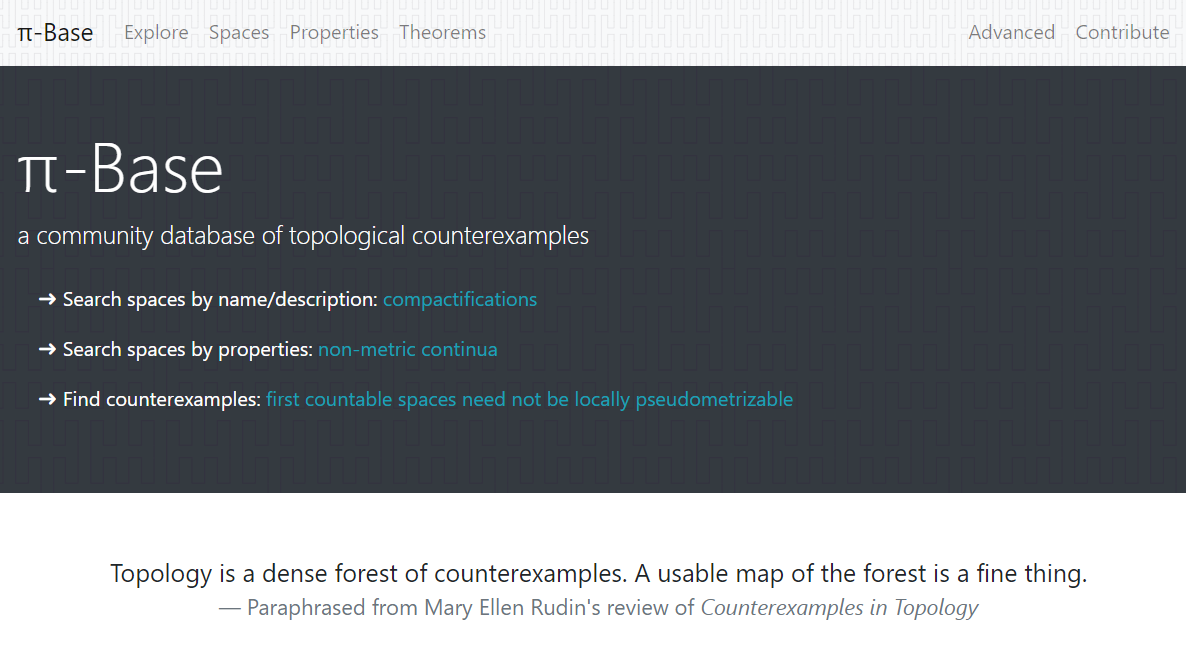
π-Base
A community database of topological theorems and spaces, with powerful search and automated proof deduction.
pi base disagrees here
fading vale
does literally anyone care about T3 but not hausdorff
cedar pebble
it depends on how you define it
pretty much any reasonable source defines T_3 as T_1 + other conditions
fading vale
having Tn not imply Tm for m < n is stupid
honest terrace
maiden oracle
well i in the lecture notes i have T3 is defined as "for every point x and every closed set with x not in A there are disjoint open subsets that contain A and x respectively
and it is explicitly stated that T4 => T3 => T2 when T1 is fulfilled or equivalently if singleton sets are closed
maiden oracle
honest terrace
check pibase <@!323112533600894977>
that's a pretty cool resource tho, thanks for sharing
honest terrace

maiden oracle
bruh, im a little salty for not coming up with the first one but hey i think i tried long enough

i tried a lot longer already before i wrote into this discord
gritty widget
sometimes it's the super trivial examples that we all miss
general topology bad
find a T_475749959 space that isn't T_4040000010010
maiden oracle
i think this is finally the assignment where i include the famous quote from poincare
xd
 gritty widget
maiden oracle
gritty widget
maiden oracle
.pin
 lucid geyserBOT
maiden oracle
gritty widget
lucid geyserBOT
maiden oracle
gritty widget
is it just me or are the other pins gone
empty grove
Ye I only see this
maiden oracle
i dont think so, the last pin i see before that was from may 1st
or well not i dont think so but not for me
gritty widget

maiden oracle


 shut moat
@sleek thicket WELCOME BACK 
sleek thicket
👋