#point-set-topology
1 messages · Page 213 of 1
 gritty widget
it's interesting because i actually have a clue what a momentum map does now
 shut moat
nice
gritty widget
thinking of a symplectic manifold as a ""phase space"" and a symplectic group action
momentum maps find quantities conserved by the action
 quasi forum
I saw no disagreement, so I consider that an "you got it." 😁
gritty widget
the term momentum map comes from the example of SO(3) acting on R^3 x R^3 (coordinates position, momentum)
the conserved quantity being angular momentum apparently
shut moat
oh nice you care about it for the same reasons then
gritty widget
and the momentum map comes out to be precisely that
(after making a million identifications)
another example being that of $S^1$ on $\bC$ by rotation. the momentum map comes out to be $\mu(z) = \pm |z|^2 + \mathrm{const.},$ which is definitely something that's preserved under the action
 gentle ospreyBOT
(T*Terra, dqⁱ ∧ dpᵢ)
 gritty widget
(plus-minus because the sign varies in the literature)
shut moat
why C instead of R^2?
gritty widget
writing things in complex coordinates is convenient
shut moat
fair
gritty widget
that example directly generalizes to the torus (S^1)^n acting on C^n
and that's interesting because then with the right choice of constant (any one works here), the zero level set of the momentum map is just the sphere
oh it might have to be |z|^2 / 2
gritty widget
gritty widget
and that's interesting because then with the right choice of constant (any one w...
and then if you quotient out by the symmetries of the group action ("symplectic reduction") you get complex projective space 
shut moat
spooky
gritty widget
gritty widget
and then if you quotient out by the symmetries of the group action ("symplectic ...
this is probably incorrectly worded so take it with a grain of salt
ah symplectic reduction is when you quotient out the zero level set by the restricted action 
and that's about all i have to say
shut moat
ty :o
shut moat
I've been googling the physical interpretations of this stuff and now my brain is melting out my ears
gritty widget
mathematically it's all somewhat straightforward
but physically? 
something something symmetries and particles idk im not a physicist 
shut moat
idk I saw a bunch of word spam like jacobi fields and homological
gritty widget
jacobi fields 
shut moat
will understand in a few years I hope lmao
gritty widget
jacobi fields are a riemannian geometry thing
i wonder how they intersect into symplectic 
gritty widget
shut moat
I've been googling the physical interpretations of this stuff and now my brain i...
arnold's classical mechanics book has a chapter on symplectic geometry that might have a good explanation or two
shut moat
oh oops jacobi and fields showed up in two disjoint places idk why i fused them
shut moat
gritty widget
arnold's classical mechanics book has a chapter on symplectic geometry that migh...
yeah I've been meaning to give it a read, it seems rly good
gritty widget
the book by mcduff and salamon might also have some stuff
it's more on the mathematical side of things but it has a section or two devoted to building up to symplectic geometry from only classical mechanics
i havent actually taken a careful look at arnold's book but i really hope it mixes in physical explanations with mathematical ones
i wanna know what's actually happening not just how to move symbols around 
shut moat
I haven't read much of it but I think it's not as rigorous as it could be at times
but ig it's a semi physics book so that's ok
gritty widget
rigor is for the weak
shut moat
like I was reading out of goldstein (a classmech book) and the derivation of euler lagrange felt fucked
gritty widget
just differentiate under the integral 
shut moat
so I went and looked at arnold because it was supposedly a math book but it didn't spell out the analysis in detail
v sad
shut moat
gritty widget
just differentiate under the integral <:sully:651816820122189834>
yeah that's how it ends up working out but I wanted to understand what it actually was
and it ended up being a frechet derivative or something I think?
gritty widget
i took an optimization class that did this
i actually don't remember
i differentiated under the integral a lot in that course
shut moat
based
gritty widget
so it probably comes up 
the joy when i learned in riemannian geometry that geodesics are just solutions to a variational problem
geodesic equations are just euler lagrange equations for the energy functional
i wonder if the jacobi equation J'' + R(J, c')c' = 0 can be interpreted as the euler lagrange equation(s) to something
anyways im just vomiting words at this point
shut moat
nice talking to ya, i should probably go back to preparing for the pile of midterms I have this week
shut moat
ty, I'll need it 
 bitter kestrel
Hey sorry to like butt in but i just sort of had this thought that differential k-forms are like the dual vectors of singular k-chains. Does this actually work? Perhaps with the assumption that everything is nice and smooth? Could we then define the exterior derivative as like the dual operator of the boundary operator? Are there any nice applications of this, like direct arguments for Stoke's theorem or Poincaré duality or anything like that? I'd love to read some articles on this perspective if any exist, and also sorry if this is trivial or something its not really my main area of research 😅
gritty widget
check out chapters 17 and 18 of lee's intro to smooth manifolds
gritty widget
I want to show that two divisors are linearly equivalent. So I have to show that their difference is a principal divisor.
so I need to construct a meromorphic function with given roots and a given poles
I'm really not how to do this. If we were on C this would be easy, but on an a Riemann surface we won't have global coordinates

Here is the full question from Mirandas Algebraic Curves
 wanton marsh
where does it say "riemann surface" in the question ?
gritty widget
good point
 obtuse meteor
presumably you can do things like you would for manifolds
and define the meromorphic functions locally
and check it agrees on the chart
gritty widget
okay i think this might work
3p0 is is the intersectin divisor with z=0
the other one is the intersectin divisor for y=0
and two intersection divisors are linearly equivalent
 proud pewter
Hello, i hope i don't intrerupt anyone. I come in a moment of despair because i know nothing about geometry, and i promised i would help a friend of mine with some collage-grade geometry. She is supposed to solve two exercises, one of them being trough carthesian and afinoid repers
i have some indications, hoping that would help
but atm i don't have any drafts of my friend's work so far.
 ivory dragon
could you be a bit more specific?
im not sure what you mean by "carthesian and afinoid repers"
proud pewter
hmm
i don't either, hope i am not that problematic, but i am parallel and equidistant with mathematics. I just want to help xD i study modern applied languages so. Let me try to find a way to explain
i have some guides but i will try to translate them myself from romanian
proud pewter
ivory dragon
im not sure what you mean by "carthesian and afinoid repers"
Cartesian landmark and affinoid landmark i think this is the correct form
oh oops
Translation: Show that the ratio of points A B C and D is -1. (Circle of Apollonius)

i am willing to help you with whatever i am able to in order to make it easier for you, i am not looking for someone to solve these exercises, i am looking more to explain what my friend has to do in order to solve and understand them
ivory dragon
apologies, i'm unfamiliar with techniques of euclidean geometry; maybe someone else will be able to help
proud pewter
oh, it's alright
thanks for letting me know
hope tese notes can help for whoever stumbles upon this request


 shut moat
what do you know about complete subspaces of R^2?
gritty widget
A good hint is to recall the definition of complete
and also consider (-1,1) as a subset of R and check if that is complete
or check that is is incomplete if you want a better hint
gritty widget
Does anyone have an idea for this?
I have a curve C and a line L in CP^2. Take a point p not on the line, we can define the projection of CP^2-p to the line which sends a point q, to the intersection of L and PQ (where PQ is the line joining p and q)
this map is holomorphic, and restricts to a holomorphic map C-p to L
how can we extend this map to be holomorphic on C ?
 sinful pecan
is the answer just the intersection of L with the tangent line of C at p?
quasi forum
 sand void
anyone got any ideas on how to approach the problem?
sand void
anyone got any ideas on how to approach the problem?
Is the subset D closed?
That may be the best hint I can give ya without just giving away the answer.
gritty widget
sinful pecan
is the answer just the intersection of L with the tangent line of C at p?
maybe but I don't see this? im not even sure how to properly extend the function?
ooh
this is just the only clever line to pick
sinful pecan
i just thought about q approaching p on C, which has the projection approaching the tangent line's intersection with L
gritty widget
okay well that helps alot
now i just need to check that this is infact holomorphic
quasi forum
The fact you two have the same profile picture makes tracking this conversation super confusing
sinful pecan
compact mode gang
gritty widget
what is nitro?
i saw someone offering to buy someone else nitro on a different server
sinful pecan
i think it lets you use emotes from particular servers anywhere. imagine paying for discord tho haha
gritty widget
imagine not using the default little green dude
 flint cove
Is cech cohomology $\v{H}(X;A)$ a functor?
i.e., is there a well-defined pullback?
gentle ospreyBOT
lux
Compile Error! Click the  reaction for more information.
(You may edit your message to recompile.)
 flint cove
I'm having a hard time coming up with something natural, since covers can only be pulled back, hence functions from (thing derived from cover) to A can only be pushed forward
Wiki casually states that Cech is “naturally isomorphic” to De Rham (CW homotopy type), but does not in any place discuss how that is a functor.
gritty widget
likely a very small brain answer
but i would guess yes
if its naturally isomrphic to singular homology or deRham
a natural isomorphism is a map between functors
so I
i'm not sure how you could define a natural transformation without having functors
soz if this wasn't helpful
 tough imp
Homology forms a functor
In particular, they’re delta functors, so I think they’re isomorphic as delta functors is what it means
tough imp
flint cove
Is cech cohomology $\v{H}(X;A)$ a functor?
i.e., is there a well-defined pullbac...
Pretty sure the functor is covariant
You form Čech cohomology by making a complex and taking cohomology right?
If you had a sheaf map F -> G you can just apply this on each of the things in the complex (taking massive products)
And then this gives you a map on cohomology
flint cove
tough imp
You form Čech cohomology by making a complex and taking cohomology right?
On a fixed cover UU, yes, then direct limit
tough imp
Are you defining Čech cohomology as the direct limit?
Even if you are, you can do it on each cover element and form a map between direct systems
Then you get a map on the direct limits
flint cove
Yes.
The context of what I know is purely topological and does not use the word „sheaf“. Although I know the basics of that
flint cove
on a space X, we're taking the sheaf of continuous functions Γ(-,G)
so a sheaf map would be what in that case?
(let G=ℤ as an example)
let's fix f: X→Y first
flint cove
Just be aware that my advisor already told me „you don't wanna do this“
tough imp
Yeah idk
flint cove
I just didn't want to shut you down 😄
tough imp
Sorry, I only know how to do Čech cohomology on sheaves
In this case it’s more like
You fix a soace X
And imagine you vary what functions you’re looking at
flint cove
And consider different sheaves over X, right?
flint cove
I see, that makes sense
tough imp
What you’re trying to do sounds like something scarier
It reminds me of the Leray Spectral Sequence type stuff
This relates Sheaf cohomology on a topological space with its pushforward
flint cove
fun fact
what I'm trying to prove eventually is injectivity of the pullback P(E)→X for a bundle E→X
multiple authors just refer to the Leray SS (or the Serre SS)
tough imp
Lol
flint cove
I'm currently seeing whether there are simpler arguments
tough imp
Well, I guess I’m on the right track
In my experience thinfs which are best done with a Spectral Sequence tend to be best done with Spectral Sequences
flint cove
Just out of curiosity, what is your intuitive image of the Leray SS that made your conceptual pattern matching trigger here?
tough imp
Which is a tautology, but really I think that when they’re used
it’s for a reason
Basically the leray spectral sequence relates cohomology of a sheaf on X with its push forward.
So like let’s use the continuous function one
flint cove
pushforward along what
tough imp
So if you had topological spaces X and Y
and a map f:X -> Y
You could define a sheaf on Y by saying that f_*F(U) = F^-1(U)
So like
In the continuous functions on X case
What you do is map to U, the continuous functions from f^-1(U) -> G
From what I saw you were doing earlier
Then you can look at cohomology of this (which is related to the Čech cohomology)
flint cove
This is that „sections functor is not exact, take derived functors“-stuff, isn't it?
tough imp
Right
So you end up getting a spectral sequence relating H^i(X,F) and H^j(Y,f_*F)
If you’ve seen the Grothendieck spectral sequence
You can construct it this way
You’re looking at the f_* and Gamma(X,-) functors (I guess really what you’re doing is observing that Gamma(Y,-)•f_* = Gamma(X,-) by construction)
Oh lol
I’m looking at the Wikipedia and the classical construction was for Čech stuff
flint cove
(btw, my long-term goal is to understand the core statement in the special case of the projective bundle. I def want to understand how SS work and what the intuition behind some of them is, but I will refrain from using that as far as possible to remain accessible to someone knowing only basic cohomology)
flint cove
well then you know geometry 
 drowsy trout
Hey, could someone give me a few pointers about algebraic group $PGL_2$?
I'm working with Milne's etale cohomology.
Following Milne, we let $PGL_n$ be the representable functor s.t $PGL_n(S) = Aut(M_n(\mathcal{O}_S))$ where we consider automorphisms of $\mathcal{O}_S$-algebra.
Now, in the case where $S$ is the spectrum of a local ring $R$, Skolem-Noether theorem works and tells us that $PGL_n(S) = GL_n(R)/R^*$.
On general scheme, this only works locally, and so we only get an exact sequence:
$$1 \rightarrow \mathbb{G}_m \rightarrow GL_n \rightarrow PGL_n \rightarrow 1$$
According to Milne, this sequence is exact as a sequence of sheaves for the Zariski, Etale and Flat topology.
gentle ospreyBOT
Montessiel
 drowsy trout
But I'm interested in a very specific case: I want to understand PGL_2 (and its cohomology) on quadratic orders.
So I'm trying to figure out what's happening there.
If I look at the long exact sequence, I get:
$GL_2(R) \rightarrow PGL_2(R) \rightarrow H^1(R,\mathbb{G}_m)$
with the last group (it's a group since the multiplicative group is abelian) being the Picard group
gentle ospreyBOT
Montessiel
 drowsy trout
If I'm not mistaken, for quadratic orders (or at least for those that are integrally closed), this H1 is non other that the ideal class group, which may very well be non trivial
So $PGL_2(R)$ will not simply be a quotient $GL_2(R)/R^*$.
gentle ospreyBOT
Montessiel
 drowsy trout
But is is Zariski-locally, so it shouldn't be that bad. Is there a way to describe the elements of $PGL_2(R)$ ?
The obstruction to surjectivity is a finite group so I'm also hoping that is might make my life easier, but so far I failed to find information on this in the litterature
gentle ospreyBOT
Montessiel

 split needle
hey, what is the relative interior of a set and why do we need this? This comes up during convex analysis
split needle
alright I found a nice answer if anyone else is curious: https://math.stackexchange.com/a/2774285/243316

Mathematics Stack Exchange
As defined in Convex Optimization written by Stephen Boyd & Lieven Vandenberghe, both interior and relative interior seems to describe a same thing: a set that peels away its boundary points. So,
 tight agate
flint cove
fun fact
what I'm trying to prove eventually is injectivity of the pullback P(E)...
tight agate
flint cove
fun fact
what I'm trying to prove eventually is injectivity of the pullback P(E)...
Hatcher might have what you're looking for
section 4D does a version of the leray-hirsch theorem
and if you're doing this to obtain the splitting principle, then I think you can obtain a weaker result (than the usual splitting principle) by meming around with lambda rings
flint cove
tight agate
Hatcher might have what you're looking for
Riight, Thanks for the reminder. I also found something else where I feel the injectivity is proven directly for compact spaces by induction over cover size.
I need to take some time and work through all variants here, haven't managed to do that yet.
Btw, does someone have a quick example of a space you see „in the wild“ that is not homotopy equivalent to something compact?
tight agate
just compact?
flint cove
Yes, all my mental examples detract to, say, a circle or a point or something like that
 sleek thicket
My instincts say maybe the long line?
flint cove
I really need to expand my landscape of examples there :>
tight agate
flint cove
Yes, all my mental examples detract to, say, a circle or a point or something li...
you can very easily get weirder examples than this
like the p-adics
but that's still compact
flint cove
sleek thicket
My instincts say maybe the long line?
Was that R^2 with the lexicographic order topology?
sleek thicket
No, it's a weird construction involving the first uncountable ordinal
Basically you glue uncountably many intervals to eachother along their ends
flint cove
Let me look it up quickly. I should know this.
sleek thicket
I think the reason I'm thinking of it is that the homotopy groups all vanish but it's not homotopy equivalent to a CW complex
tight agate
oh wait does Q work?
sleek thicket
It's sort of too long for things about it to be detected by homotopy
oof
Oh maybe that's not so bad
Homotopies are constant
right? (edit: no, wrong)
tight agate
also just an infinite disjoint union of points should work
sleek thicket
Oh lol that is much simpler
flint cove
sleek thicket
It's sort of too long for things about it to be detected by homotopy
||that's what she said|| sorry, needed to get that out of my system
flint cove
tight agate
also just an infinite disjoint union of points should work
Hmm, but there the connected components are compact, so all cohomology results for compact spaces should easily be transferable, right?
sleek thicket
tight agate
Z_p is compact, but does not have the homotopy type of a CW-complex
Good for her
tight agate
flint cove
Hmm, but there the connected components are compact, so all cohomology results f...
sure ig
flint cove
tight agate
Z_p is compact, but does not have the homotopy type of a CW-complex
Uh that sounds good
tight agate
Z_p is horrible as a top space
sleek thicket
You're horrible as a top space
flint cove
I'm trying to get a feel for when it can go wrong to show something for compact spaces, mumble something about „paracompactness“ and „similar argument“ and just continue, lol
sleek thicket
Probably depends on the argument ¯\_(ツ)_/¯
Although reducing from compact to paracompact seems weird to me
flint cove
Seems to me like many arguments for bundles work like this (although I probably forgot Hausdorffness)
sleek thicket
in my head the arguments for bundles don't really go through compactness, it's more about using paracompactness to reduce to the situation where you're working on a trivial bundle
Like usually (from my perspective) you don't even change/go local on the base, just the bundle
flint cove
Hm, I should retract that statement I guess.
But I feel like for some things, it's easier to convince me that / how an argument works by looking at compact spaces first, since often that case needs less technical fiddling
sleek thicket
Yeah, definitely
flint cove
Homotopy invariance of the pullback was one example
quasi forum
Why would a smaller collection be coarser than a larger one? I feel like it'd be the opposite 🤔
 quasi forum
So T_1 contains less open sets than T_2
shut moat
munkres had a nice analogy with pebbles or something
the open sets are the pebbles
if you crush the pebbles you create a finer topology
quasi forum
That analogy makes sense to me
 chrome dew
yeah, crush up the open sets of T_1 to make smaller ones
quasi forum
So at it's most basic, we can compare the discrete and indiscrete topologies on X.
So since the indiscrete topology is just X and the empty set, we can 'crush' X to become every open set, which forms the discrete topology.
Wait, I think I went the opposite direction
There we go.
Is that line of thinking valid?
chrome dew
ok quick quiz, what's the finest and coarest topology you can put on a set?
quasi forum
The ones I just mentioned.
The coarsest would be indiscrete ${\emptyset,X}$, and the finest would be discrete: all open subsets of X.
chrome dew
sorry I just went to get something to drink and didn't read what you wrote at all lmao
funny coincidence
gentle ospreyBOT
dackid
 quasi forum
Well, I think that means I was right :p
chrome dew
yep
quasi forum
So the way I am interpreting it is kind of like a microscope. At the end of the day, we are looking in the same space, but the greater the magnification, the more detail we get out of it, and so the finer the topology.
 viral atlas
Yes!
quasi forum
Sweet. Tbh, going from metric spaces to topological spaces was not nearly as big a jump as I thought.
So far, this is pretty understandable
Thank you for the help. I'm definitely going to pick at this more tomorrow.
For instance, a question in my book wants me to show the intersection of the topologies T_1 and T_2 are also a topology, but the union may not be.
That second part is messing with my head. But, the more I think about it, the more I have an idea as to why. I think I just need sleep.
viral atlas
I think ||the union of open sets from T_1 and T_2 can possibly not be contained in either of them.||
quasi forum
I agree. I think the thing that would really break it is that the intersections of some of the open sets may not be in T_1 and T_2 anymore
viral atlas
No, I think all finite intersections would be contained, but unions of open sets would break down
Hmmm, or possibly yes
Maybe working with an explicit example would help here
gritty widget

quasi forum
For instance. If $T_1={\emptyset, \mathbb{R}, (3,5)}$, and $T_2={\emptyset,\mathbb{R}, (4,8)}$, so then by taking the intersection of (3,5) and (4,8), we get (4,5), which is not in $T_1\cup T_2$
gentle ospreyBOT
dackid
 quasi forum
Precisely! :D
And then the intersection part of the problem should be clear as all the empty sets satisfy the 3 axioms for both T_1 and T_2.
quasi forum
Absolutely!
viral atlas
This argument seems to be in the same spirit as proving intersection of vector subspaces or subgroups is again a vector subspace or subgroup
quasi forum
Part of the question also asks if it is true for an arbitrary intersecrion of topologies, and I think with this reasoning, the answer should be yes.
viral atlas
Both topologies at least agree on the set itself(X) and the empty set
quasi forum
Yes, that is definitely key. That'd be a problem if it didn't :p
viral atlas
quasi forum
Part of the question also asks if it is true for an arbitrary intersecrion of to...
Hmmmmmm, arbitrary intersections are beyond my understanding haha
quasi forum
I was gonna go to bed, but.... topology 😆
quasi forum
Is that a book?
viral atlas
Yes haha
quasi forum
Wilson A. Sutherland
shut moat
viral atlas
Hmmmmmm, arbitrary intersections are beyond my understanding haha
they're just like finite intersections- $\bigcap_{\alpha \in A} X_{\alpha}$ is the set of points $\qty{x|\forall {\alpha \in A}; x\in X{\alpha}}$
gentle ospreyBOT
~S^1
 gritty widget
use lee itm
viral atlas
It doesn't have point-set
quasi forum
shut moat
they're just like finite intersections- $\bigcap_{\alpha \in A} X_{\alpha}$ is ...
In that case, it is definitely true!
viral atlas
shut moat
they're just like finite intersections- $\bigcap_{\alpha \in A} X_{\alpha}$ is ...
Yeah, but it gets a bit weird with nested interval and things like that in R, right?
gritty widget
lee has all the point set anyone who isn't an analyst cares about
gritty widget
viral atlas
Anyway I'll look into ITM after I'm done with Pugh
Maybe I need some more mathematical maturity to parse the things he says
Like at the very beginning he talks about dimension of spheres and balls
And that didn't really get through me
sleek thicket
gritty widget
lee has all the point set anyone who isn't an analyst cares about <:opencry:5860...
viral atlas
viral atlas
No, I think all finite intersections would be contained, but unions of open sets...
This probably illustrates that if we pick a topology, and a possibly finer topology, then chances are that intersection of open sets in the two topologies would not be an open set in either.
quasi forum
Would this be a reasonable way to go about this argument?
 viral atlas
Uhhh
You should probably show how it agrees with the axioms haha
Like, write it out in a bit more detail
gritty widget
wat
quasi forum
But if $U\in T_1$ and $U\in T_2$, the fact it follows the axioms should be automatic
gentle ospreyBOT
dackid
 gritty widget
you need to show that T_1 cap T_2 is a topology
viral atlas
 Automatic how
gritty widget
what does that entail?
checking that
- it contains the empty set, and the whole of X
- it is closed under unions
- it is closed under finite intersections
T_1 cap T_2 is a collection of subsets of X, equal to those subsets of X which are in both T_1 and T_2
quasi forum
Yea, I agree with that
gritty widget
quasi forum
Would this be a reasonable way to go about this argument?
so "the topological space axioms" don't apply to this particular set U you've chosen from T_1 cap T_2
gritty widget
gritty widget
checking that
1. it contains the empty set, and the whole of X
2. it is closed u...
you need to prove these three things about T_1 cap T_2
quasi forum
But that U is in T_1 and T_2 🤔
gritty widget
but how does this show any of 1 to 3?
quasi forum
Better?
 tough imp
Yeet
For verifying a topology is closed under finite intersections it suffices to look at just pairwise intersections btw
This might be helpful if you want to prove a particular thing is a topology
This follows by induction and associativity of the intersection
quasi forum
So by just looking at two sets instead?
quasi forum
Oh okay. Does Yeet mean it looks good?
tough imp
Yeah
quasi forum
Sweet!
viral atlas
Isn't "yeet" some slang for throwing something away?
 tough imp

quasi forum
viral atlas
Isn't "yeet" some slang for throwing something away?
That's why I was confused 😆
viral atlas
viral atlas
I figured that XD
quasi forum
Thanks for calling out my shit now, don't want to make that mistake later 😆
I definitely see where I went wrong. It's just taking me a minute to start thinking about collections of open sets instead of the sets themselves.
viral atlas

 fading vale
uhh ok so consider like


 fading vale
what i need to do is show that this is a homeomorphism but im not really even sure where to begin tbh
like even injectivity and surjectivity idk how to do
actually wait
injectivity isnt hard
ok yea injectivity and surjectivity are fine
idk how to do continuity/openness
compact open topology hard

 feral copper
Hi ! I don't understand Saveliev's proof of this statement... (from his book, "Lectures on the topology of 3-manifolds")... It seems to me that he is glossing over a lot of details, as can be seen from Hatcher's notes on 3-manifolds : https://pi.math.cornell.edu/~hatcher/3M/3M.pdf. What am I getting wrong ?

(also he is working in Top, and Hatcher in Diff, which may make things a lot different, but idk, Saveliev's proof is still a bit shady to me)
 cold vine
I haven't used LES for a while; how do I form a LES from which I can split a sequence 0 -> H(X V Y) -> H(X xY) -> H(X smash Y) -> 0
assuming that X V Y is a strong deformation retract of it's nbd
quasi forum
Okay, so this was my first stab at a real topology problem. Do you think I handled it okay? If not, where did I go wrong?
 shut moat
I think you might've flipped it? You want to show that it's closed under arbitrary unions, but finite intersections
oh wait nvm misread ignore me lmao
quasi forum
I took care of both possibilities for the union 😁
 marsh forge
feral copper
Hi ! I don't understand Saveliev's proof of this statement... (from his book, "L...
marsh forge
feral copper
Hi ! I don't understand Saveliev's proof of this statement... (from his book, "L...
what part do you dislike
feral copper
Hi ! Starting from "there exists a homeomorphism carrying D1 to the upper hemisphere"
I mean, what is the homeo defined on ? What is the codomain ? And why does it exist ?
obtuse meteor
god these algtop problems are spicy
hmm
D1 not D2?
oh D_1 not D^1
I can read
feral copper
This is more like geometric topology actually, which I like a lot less than AT ! But yeah, it's spicy 🙂
obtuse meteor
I was talking about my midterm this week and the review actually :P
feral copper
Oh I'm sorry ! :x
gritty widget
based
 sleek thicket
the converse of practice problem 1. is true for finite covering maps, which is neat
shut moat
cool diagrams tho
 obtuse meteor
I mean Sham part of that is the content of 2!
sleek thicket
oh lmfao
nice
i did not read further than 1
because my friend was texting me
4(b) literally always catches me off guard lol
and there's a simple proof too!
just doesn't stick in my brain
 gritty widget
it's just the symplectic reduction of the standard torus action on C^n
gritty widget
Ah, I knew @obtuse meteor has babababa in profile status, is this about composing loops and homotopy stuff?
 sleek thicket
yeah i would reccomend thinking about the CP^n thing
if only because you will facepalm
obtuse meteor
hmm
think I got it?
CP^0 and S^1
S^1 can't cover a point
big brain proof is
Z is not a subgroup of 0
🧠
sleek thicket
🧠
obtuse meteor
small brain proof is any open nbhd in S^1 contains lots of points
Not sure if the prof wants me to think in general
but
sleek thicket
what about other n though
obtuse meteor
yes
sleek thicket
oh fair
sleek thicket
i will spoil it because i was to and it's a meme
obtuse meteor
okie
sleek thicket
go to evenly covered open sets
then
some open subset of CP^n is homeomrophic to some open subset of S^(2n+1)
obtuse meteor
sure
sleek thicket
CP^n is 2n-dimensional and S^(2n+1) is (2n+1)-dimensional
obtuse meteor
ah indeed
sleek thicket
so invariance of dimension for manifolds says this is impossible
(to justify invariance of dimension if yall haven't done that, take charts and look at the homology of the space minus a point)
obtuse meteor
psh
formality
this is algtop
we don't do formality in this class
me: <draws a cover>
me: hmmm, looks regular to me
me: <draws another cover>
me: not regular. Bingo!
related fun problem
22 is nice
and I solved it :o
obtuse meteor
mhm
sleek thicket
ah, so equivalently
is there a normal subgroup N in Z * Z and a normal subgroup K in N with K not normal in Z * Z
obtuse meteor
yeah but doing it
with that
is cringe
do it with geometry
fucking algebra nerds
sleek thicket
this happens in D8
which has a presentaiton with two generators
so you can pull back
obtuse meteor
I hate you
obtuse meteor
ok make a cover like this
two vertices
a transposition
for one of the loops
and identity loops for the other one
now make a cover
sleek thicket
I don't understand what you mean by a transposition for one the loops
obtuse meteor
ummm
sleek thicket
so we have two vertices
sleek thicket
lol
obtuse meteor
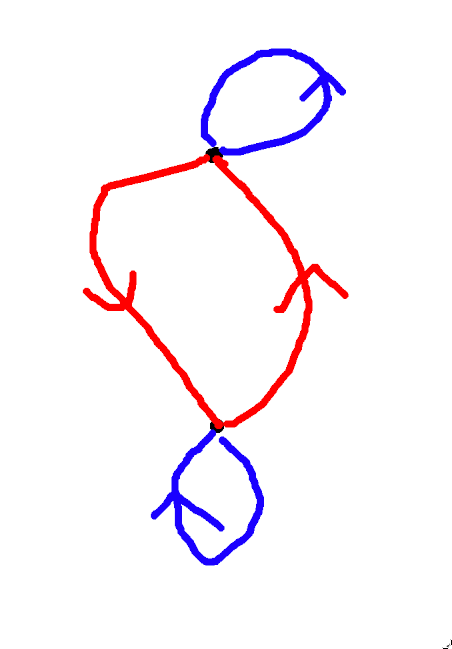
this is clearly regular
bc just like
rotate

and it's regularly covered by this guy
via flipping horizontally
but that guy doesn't regularly cover the wedge of two circles
because you have a loop on the left and right vertices but not on the center vertices
so there's no graph automorphism taking them there
sleek thicket
I think that makes sense (to me, I'm not doubting that your construction works)
sleek thicket
you have a right to your opinion
the whole point of math is to turn things into algebra so you can do algebra on them
obtuse meteor
no
sleek thicket
obtuse meteor
false
sleek thicket
look it's not called topological topology
if you were supposed to do topology
it wouldn't be called algebraic topology
now would it
:^)
anyways these problems are cool
and absolutely not helpful for me for studying for my analysis final, which is what I should be doing
obtuse meteor
ascending algebraic topology
sleek thicket
honestly it's fucked up that the universal covering space is only uniqueish
and similarly the algebraic closure
automorphisms should be illegal imo
(im looking at 12b)
obtuse meteor
lol
tight agate
sleek thicket
automorphisms should be illegal imo
this would kill a lot of bundle theory tho
sleek thicket
sacrifices must be made
it's time for a new name anyway
ah, algebraic topology 😌

faye is not allowed to criticize my proof now
tight agate
catwiggle
obtuse meteor
sleek thicket
ah, algebraic topology 😌
I really don't wanna do this problem lol
sleek thicket
rip
sleek thicket
by the contrapositive
i am not faye's homie 
lmao i thought this looked similar to something i put on my algebra problem sets
http://untyped.me/problem_sets/winter3.pdf practice problem 1
and
sleek thicket
practice problem 2 is the example of non-transitivity of regularity of a cover
that I gave
wait wtf is problem 20
this seems incorrect
ah no
im being dumb
this makes sense
sleek thicket
lol
it fizzled this year bc pandemic
i didn't want to push them
(or commit to organizing stuff for them really)
gritty widget
sleek thicket
sleek thicket
i think you can do it purely group theoretically
obtuse meteor
I guess one part is easy
gritty widget
obtuse meteor
sham you're my homie
Sham, you know what this means, it is time for you to leave #groups-rings-fields
sleek thicket
shock
obtuse meteor
20b is false
sleek thicket
gritty widget
Sham, you know what this means, it is time for you to leave <#496784958430380033...
someone said A&M earlier and I didn't recognize the book title lol
 obtuse meteor
yeah
sleek thicket
not that it's ill posed
obtuse meteor
ye
sleek thicket
yee 20(b) is false by easy group theory
sleek thicket
20(a) is false by hard group theory (I think)
obtuse meteor
:o
obtuse meteor
thonk
sleek thicket
thonk
ah wait I think my proof is wrong, rip
:c
this is hard
oh wait no
my original proof works i was just being silly lol
i went local on S^1 v S^1 for no particular reason
just because I felt like it
okay, do you want to hear my Correct, Actually proof for 20(a)?
(proof that there is no such cover)
obtuse meteor
I want to think
sleek thicket
👍
obtuse meteor
so like
problem should be the center point
intuitively what I believe is that like
a neighborhood of the torus if you take a point out is still path-connected or has some # of path components or something
but if you take the center point you get 4 components
wondering
if something similar happenns
for homotopy equivalents for torus
sleek thicket
that's pretty much my proof, yeah
look local away from singularity => 2-manifold homeomorphic to 1 manifold => problems because of removing a point after going local
sleek thicket
yup
obtuse meteor
can be weird
sleek thicket
can be fucked up
sleek thicket
Oh wait this is immediate from Nielsen schrier
You even said something like that above lol
Z×Z is abelian, so if it were a free group it would be free on one generator, which it just isn't
sleek thicket
sorry :(
obtuse meteor
it ok :P
it happens
I didn't realize at all
more mad at myself for not realizing this
sleek thicket
obtuse meteor
maybe you can exploit Schreier index
I didn't realize you had a proof when you said this
and yeah i don't think there will be a nice topology answer
probably
hmm or perhaps...
sleek thicket
lmao that definition of X is a meme
obtuse meteor
and I definitely don't want to compute its conjugacy classes
should it be a clear space
 sleek thicket
im not talking about the quotient
but the one point compactification of R^3 is a space you know
obtuse meteor
S^3?
sleek thicket
yup!
sleek thicket
yes
obtuse meteor
it's like
sleek thicket
very bad
sleek thicket
but fucked up
obtuse meteor
do that
sleek thicket
lmao
obtuse meteor
 sleek thicket
actually im not sure it is like RP^3 that much
on the complement
because we're taking the antipode in R^3 and not in S^3 <= R^4
obtuse meteor
oh yeah lol
oof
hmm
maybe there's a way to give a nice CW complex structure on it
I guess I'll find out at office hours

sleek thicket
are they at 4:30?
sleek thicket
gotcha
obtuse meteor
but I'm in class rn
sleek thicket
good luck!
obtuse meteor
and then they're for 2 hours
so
fun
exam tomorrow
very scared
me when someone hands me an orbit space:
 sleek thicket
my analysis class's exam ends at 6:30pm pacific
obtuse meteor
do analysis!!!
sleek thicket
but i got permission to take it with another student tomorrow at 9am
sleek thicket
bc of my talk
yeah haha it started at 2:30
if i were going to do it today i would be mega fucked
srtarting 2 hours late
obtuse meteor
oop
 honest narwhal
Ooh we doing problems now
obtuse meteor
yes and ???
sleek thicket
still thonking on that
obtuse meteor
oh
sleek thicket
i think maybe if you take X \ 0 and X \ infty
obtuse meteor
I already realized that but have no idea if it helps
honest narwhal
What's the problem exactly?
sleek thicket
they should be R^3/weird action
cold vine
I'm trying to show that (X smash Y) smash Z is isomorphic to X smash Y smash Z when X,Y,Z are locally compact hausdorff. I can't figure out the mapping, any help?
honest narwhal
Oh this looks like RP^3 but it's not lol
sleek thicket
yeah haha
so it's like
take R^3 and mod out by x ~ -x
glue two of those together
along x |-> 1/x
so it's RP^3 but(!) first you identify positive and negative numbers
which is very weird
err
wait
not 1/x
that doesn't make sense
was thinking 1 dimension lower....
sleek thicket
see ya!
cold vine
sleek thicket
is that second space X smash (Y smash Z)?
That's the one I'm trying to ultimately show but through this definition https://puu.sh/Hq6vc/2718a25796.png
 sleek thicket
ahh gotcha
i regret to inform you that this looks very annoying and I do not want to think about it, sorry pahus
honest narwhal
Somehow it feels like the problem is basically a matter of, if a loop goes around 0 or infinity something funny is afoot
cold vine
Haha xD my feelings exatly, no probs dude
sleek thicket
honest narwhal
Somehow it feels like the problem is basically a matter of, if a loop goes aroun...
so my thinking is
this space is covered by two copies of R^3/~
where we glue positives to negatives
and the intersection is (R^3\{0})/~, which is homeomorphic to RP^2 which has fundamental group Z/2Z since it's the quotient of the manifold R^3\{0} by a very nice (free etc) group action of Z/2Z which is R x RP^2
so you can seifert van kampen maybe
what's the space R^3/~ though? I'm not sure
wanton marsh
R x projective plane perhaps
wanton marsh
for (R^3 \ {0} ) / ~
wanton marsh
yes
sleek thicket
upstairs you can homotope the identity to the origin by H(x,t) = tx
and this descends
t(-x) = -tx
so yeah
it should be a simply connected space
by svkt
@obtuse meteor focus on your office hours/don't reply but I think the answer to 21 is that Y is simply connected, so there's exactly one iso class of connected covers
this seems like a bad question

like it's a trick question, right?
marsh forge
the screenshotted statement (a) is false but I wouldn't call it a trick?
a simply connected space is it's own universal cover and there can't be any intermediate ones
marsh forge
i would not say its a very interesting question
or that anyone would get it wrong for an interesting reason
gritty widget
I'm trying to understand this https://math.stackexchange.com/questions/251646/splitting-of-the-tangent-bundle-of-a-vector-bundle/2276379
Mathematics Stack Exchange
Let $\pi:E\to M$ be a rank $k$ vector bundle over the (compact) manifold $M$ and let $i:M\hookrightarrow E$ denote the zero section. I'm interested in a splitting of $i^*(TE)$, the restriction of the
but it seems that its much easier to actually explicitly define such a map
but now because what ive done is easier i assume its wrong
*i assume what i have done is wrong
sleek thicket
@obtuse meteor how was oh?
obtuse meteor
good!
sleek thicket
Nice!
gritty widget
do any symplectic kings or queens know how to see that the canonical form on the cotangent bundle agrees with the canonical from from the spillting of the tanget space of the cotangent bundle
 marsh forge
hahahah
sleek thicket
Good luck!
obtuse meteor
cursed times

so one could approach this problem with algebra

but I think
it's better to do it by like
just drawing covers
and being like "these are the only regular ones by (handwave)"
marsh forge
idk of a way to make that rigorous off the top of my head
idk it feels like if u r intentionally avoiding the algebra in AT ur missing the point to me hahaha
sleek thicket
Oh I thought about that one
I couldn't do it with algebra
I think I showed there are 4 covers
obtuse meteor
marsh forge
idk of a way to make that rigorous off the top of my head
exploit the fact that like it's given by graph automorphisms
and those have symmetry requirements
sleek thicket
But it seems like the prof wants explicit covers
marsh forge
well if you know how many there are
its not that hard to like draw them all given sufficient time
i guess
obtuse meteor
I mean I know they're given by subgroups of rank 4
but it's just like
how do I compute the normal subgroups of F_2 of rank 4
I don't know algebra
sleek thicket
Wdym rank 4?
obtuse meteor
I have it in my notes
sleek thicket
I computed it by saying F -> F/K is a surjective group homomorphism onto a group of order 3 with kernel K
yeah?
But F/K ≈ Z/3Z
Since there's only one group of order 3
obtuse meteor
ah
sleek thicket
So it suffices to determine the possible kernels of a surjection F -> Z/3Z
sleek thicket
You've been practicing for a while!



 sleek thicket
When one does math for a long time one's brain turns into cornflakes that have been soaking in milk for 3 hours
yeah it's annoying
Like
I love these questions as long as they're not graded lol
obtuse meteor
yeah but I took an hour thirty minute break sham lol
sleek thicket
Fair
gritty widget
can we consider S^0 a symplectic manifold?
sleek thicket
huh, weird
I guess so yeah
Take the unique 2 form on it
It's nondegenerate because everything is degenerate lol
obtuse meteor
Jenny told me
"PLEASE COMPUTE"
https://estrogen.fun/i/238z.png

 gritty widget
i relaise this was stupid
do you by chance now how to see that the canonical form on the cotangent bundle
is the same as the canonical form on T_pM \times T_pM^*
oh $\phi^\omega=\phi^ d\lambda=\lambda(d\phi)
 little hemlock
so, im trying to compute the de rham cohomology of the circle. We have $\Omega^0(S^1) \xrightarrow d \Omega^1(S^1) \xrightarrow d 0$ so i pretty much just need to compute the image of $d: \Omega^0 \to \Omega^1$.
gentle ospreyBOT
kxrider
 little hemlock
I believe this map is supposed to be surjective, but I'm not really sure how to prove it.
sleek thicket
If this map were surjective the 1th de rham cohomology would be zero
right kxrider?
(ty for the backup tterra 💪)
little hemlock
i suppose. is that bad?
sleek thicket
Well sort of
The point of homology and cohomology is to detect n dimensional holes
(I'm simplifying, but this was the origin historically and is still a good motivation)
The circle has a 1 dimensional hole in it
so we should expect H^1(S^1) to be nontrivial
Anyways, it's not true that d is surjective
I can tell you the dimension of H^1(S^ 1) if you end up wanting to check your answer
sleek thicket
Idk why I'm having this conversation with a homophobe
also here's another perspective: you may not have seen this yet, but de rham cohomology is homotopy invariant, so we have an iso H^1(R^2 \ {0}) ≈ H^1(S^1). Then if H^1(S^1) = 0 we would have H^1(R^2 \ {0}) = 0. This says that closed iff exact for vector fields in the plane. Does that last claim sound right to you @little hemlock ?
little hemlock
This says that closed iff exact for vector fields in the plane.
even though you've removed the origin?
sleek thicket
Yeah, I'm saying that this is a reason the cohomology group shouldn't vanish
Because it would imply this statement about vector fields on the punctured plane (the statement "closed iff exact")
gritty widget
are there any other ways we can prove/see \pi_k(S^n)=0 for k<n other then freudenthal
@ max
little hemlock
ah, i see what you mean. my intuition isn't exactly great. Not sure if its obvious that closed iff exact is false for vector fields on the punctured plane
sleek thicket
gritty widget
are there any other ways we can prove/see \pi_k(S^n)=0 for k<n other then freude...
Whitney approximation+sard's theorem
gritty widget
interesting
sleek thicket
I mean I can prove it rn
gritty widget
please that would be really cool
sleek thicket
Any map is homotopic to a smooth map and the basepoints will line up and all
yeah?
gritty widget
mhm
sleek thicket
So it suffices to show smooth maps S^k -> S^n are homotopic to the constant map
sard's theorem implies that the image of such a smooth map is measure zero in S^n
Sard's theorem implies this about any smooth map from a lower dimensional manifold to a higher dimensional one
yeah?
gritty widget
ok yes
sleek thicket
And then it's easy
Just remove a point outside the image and you factor the map through a contractible space
sleek thicket
Yeah, it's neat!
Here's another similar proof
In algebraic topology, in the cellular approximation theorem, a map between CW-complexes can always be taken to be of a specific type. Concretely, if X and Y are CW-complexes, and f : X → Y is a continuous map, then f is said to be cellular, if f takes the n-skeleton of X to the n-skeleton of Y for all n, i.e. if
    f
  ...
that is neat
sleek thicket
You have cw structures on sphere where there's a single 0 cell and a single n cell
a cellular map S^k -> S^n will be constant
Any map is homotopic to a cellular map
Similar vibe as the smooth argument
sleek thicket
little hemlock
ah, i see what you mean. my intuition isn't exactly great. Not sure if its obvio...
Sorry, I don't think it's obvious
But it's something that I think most people see in a vector calculus class
Sorry for assuming
Basically you can make issues happen by having stuff blow up at the origin
1/z on the complex plane minus the origin
Is closed but not exact
By which I mean, if you let f(x, y) = 1/(x+iy) = p(x, y) + i q(x, y) then the differential form p(x, y) dx + q(x, y) dy is closed but not exact
Closedness is pretty much the cauchy riemann equations, if you've seen any complex analysis
But it's not exact since the line integral around the unit circle is nonzero
tight agate
gritty widget
are there any other ways we can prove/see \pi_k(S^n)=0 for k<n other then freude...
Hurewicz thm
gritty widget
i like the sard way that is pretty cool
sleek thicket
Yeah!!!
Smooth = good
Max was very down on this argument when I said it to him lmao
little hemlock
ah yea, i think i remember. There are path independent vector fields on a non-simply connected domain which are not conservative, or something like that.
gritty widget
category of smooth manifolds is amazing wtf you talking about 

sleek thicket
gritty widget
category of smooth manifolds is amazing wtf you talking about <:angeryboppe:5580...
I would not go this far
The category is kind of ass lol
But the objects are very good
sleek thicket
little hemlock
ah yea, i think i remember. There are path independent vector fields on a non-si...
Hmm, not exactly. Iirc that's the definition of conservative (but I may be wrong)
gritty widget
yes i know joking but damn that proof is just so satisfying
little hemlock
g is conservative if there is f such that df = g, i.e. g is exact, right?
sleek thicket
Ah I saw it defined by being path independent. They're equivalent on any smooth manifold
(even with boundary!)
But you may have df = 0 and f not path independent
On a non simply connected domain
Like the circle
Which says exactly thst H^1(S^1) = 0!
sleek thicket
gritty widget
yes i know joking but damn that proof is just so satisfying
Sard's theorem is so good haha
It's like
"Oh no, how do I know this works??"
"well if you choose a random option it'll fail with probability 0"
shut moat
$\frac{xdy - ydx}{(x^2+y^2)}$ is closed but not exact on the punctured plane
sleek thicket
"so there's gotta be some way to make it work"
gentle ospreyBOT
~S^1
 sleek thicket
yes, this is the 1/z form I defined above
shut moat
oop I missed that
sleek thicket
Err, it's not quite actually
There's like a multiplication by -1
But that doesn't really change anything, same idea
gritty widget
society if 1/z dz integrated to 0 on a loop around the origin
sleek thicket
shut moat
oop I missed that
Np haha. I can only remember the explicit generator of H^1(S^1) if I think of it as 1/z
The formula is too awkward
shut moat
It's easier to remember it as the flux form of the vector field $\frac{\vec{\bm{x}}}{|\bm{x}|^n}$
gentle ospreyBOT
~S^1
 shut moat
imo
shut moat
what was that funny interior thing you showed me a while back?
sleek thicket
ah okay this isn't actually bad, that's just 1/(z conjugate)
shut moat
stick it into volume form
sleek thicket
Hmm, not sure what you mean
shut moat
like let $\mathbf{F}$ be a vector field on $\mathbb{R}^{n}$. Its flux form is the $n-1$ form given by $\Phi_{\mathbf{F}}(\mathbf{v}1, \dots, \mathbf{v}{n-1}) = \det[\mathbf{F}, \mathbf{v}1, \dots,\mathbf{v}{n-1}]$
gentle ospreyBOT
~S^1
 shut moat
so in coordinates the variants of the closed but not exact form would be $$\frac{1}{(x_1^2 + \dots + x_n^2)^{\frac{n}{2}}}\sum_{i=1}^n (-1)^{i-1}x_i dx_{1}\wedge\dots \wedge \hat{dx_i}\wedge \dots \wedge dx_n$$
gentle ospreyBOT
~S^1
 sleek thicket
Yup
shut moat
that hat is 2 smol