#point-set-topology
1 messages · Page 200 of 1
 dim meadow
dim meadow
dim meadow
@marsh forge is the definition that you need a computable dense set with a computable metric defined on it? I guess you want the metric to take values in computable reals on inputs from your dense set
That would be my initial guess for a definition
 alpine rain
They found the paper describing that one could exhaustively search for candidate in cantor space
dim meadow
Oh cantor space is something else
Computability theorists care about cantor space a lot
alpine rain
Then they thought it is topologically generalizable
dim meadow
And it's pretty well studied
Idk if what they are saying is anything useful, searching is a pretty basic thing in computability
What sort of thing are they searching for?
Also what paper are you referring to?
alpine rain
It is not a paper just website tbh
dim meadow
What website?
 tidal cedar
Wait they were saying exhaustive search
Of a compact space
Regardless of cardinality

dim meadow
You can only care about cardinalites up to the continuum
If you want a countable dense subset
tidal cedar
Unless you have additional info, you can't exhaustively search even a countably infinite search in finite time, right?!
alpine rain
Ye flona exactly.. it's meh
tidal cedar
Like you need additional info of SOMETHING
You can't just give any compact space and expect to search through all the elements
dim meadow
Yeah
You need to know what the finite subcover is
Which is not something that's computable
alpine rain
Indeed
tidal cedar
I can see like, orders, gradients, etc. allowing it maybe, but the general thing is impossible
Yeah
Is there a Turing degree which can?
dim meadow
Well idk if Turing degrees even can talk about this stuff
tidal cedar
Ahh
dim meadow
Because this stuff is big
tidal cedar
I was wondering if like computing a cover or something is halting, then adding an oracle for that allows for exhaustive search, IDK though
alpine rain
I get facepalm when cs ppl (or ofc any ppl) go like this, thinking of generalizing v specific thing
dim meadow
Idk actually, I feel like we are talking very vaguely now and I would need to sit down and make things solid before I would be able to say anything
tidal cedar
I'm really intuition-reliant with topology and even I basically think of uncountable spaces as my go-to example
Like uncountable as in underlying set, roughly "continuous" in the real sense IG
dim meadow
Okay here's me trying to make things solid
Open sets in cantor space correspond to sets of finite strings.
An open cover is going to correspond to a collection of sets of finite strings
alpine rain
Oh, that clarified things up
dim meadow
Let's say we are even only considering the computable open covers, that is we have a collection of indices of ce sets W_e which are sets of finite strings (I think this is a pretty good notion to consider)
tidal cedar
This is because cantor space in general is homeomorphic to a countably infinite product of some n-point discrete space, correct?
dim meadow
Well the basis elements are just the infinite strings that start with a given finite string
alpine rain
Start vs. Finitely many somewhere I guess
Product space just require finitely many iirc
dim meadow
Okay so now the problem is that you are asked, given a computable subset of the naturals that describes an open cover as I outlined above, to output a finite subset of that set which is a subcover
 marsh forge
dim meadow
<@158305429615673345> is the definition that you need a computable dense set wit...
marsh forge
dim meadow
<@158305429615673345> is the definition that you need a computable dense set wit...
yeah something like this although I think "computable dense set" is kind of a misnomer
dim meadow
Now that I have described this I can actually talk about Turing degrees
marsh forge
bc most of the time you sort of assert that some subset is the computable dense set
or you base it on something that makes sense already
alpine rain
Woah talking abt Turing degrees
dim meadow
I'd imagine you can just have the naturals as your base if you want
That's what we do in computable structure theory lol
Okay so now an interesting question is "how hard is it to compute a finite subcover, given the setup I outlined above"
Another interesting question is "which indices describe open covers of cantor space"
 chrome dew
interesting, sounds a lot like how I think about the 2-adic integers
dim meadow
Yeah they are topologically the same I think
alpine rain
Btw the cs person who thought this exhaustive search property would be generalizable on topological apaxw claimed that they are math major. Hmmm.
dim meadow
I feel like I'm having 2 discussions at once and maybe the streams are getting crossed
chrome dew
like what are you doing, like I want to steal the derivative and use it now to do some kind of gradient descent on what you're talking about
dim meadow
Haha
Yeah it turns out doing useful stuff is hard and they should try carrying it out instead of talking about it cascadar
Even describing what you want to do is hard tbh
alpine rain
Exactly
chrome dew
yeah, like seems as though you could just solve chess this way, this is not really realistic stuff here
dim meadow
I'm actually pretty interested in the Turing degrees of the stuff I described now, probably they are pretty terrible
I doubt they are even arithmetical
alpine rain
They also seem to think classical proof could easily be converted to constructive proof. Idk if this is true
dim meadow
Lol
tidal cedar
That is a GRAVE sin
dim meadow
Sounds like they've solved math
alpine rain
Lmao
marsh forge
dim meadow
We can all go home now
tidal cedar
Only heathens who assume LEM believe that
dim meadow
It's over
tidal cedar
The based and Coqpilled non-constructivists know that constructive proofs are not that easy
alpine rain
Idk, it looks silly when they worked out exhaustive search on naturals
And then think they could go further easily
Do mathematicians care about constructivism proofs?
marsh forge
constructive proofs are always nice
they normally allow for further exploration more easily
alpine rain
I see
Hm I should have said
Is there some mathematicians who do not care about constructive proofs?
marsh forge
it depends what you mean
i think very few mathematicians would not prefer a constructive proof given the option
as there is no downside
but lots of mathematicians don't try to make all their proofs constructive
in fact most don't
marsh forge
there are also theorems that aren't true constructively
like theorems that aren't true if you remove LEM
dim meadow
Like LEM
marsh forge
i start every proof by contradiction
even if i find an explicit example
or a general construction
tidal cedar
burning hot take: LEM is intrinsically true, you not only have to not assume LEM but add ~LEM
I am entirely joking Ultra
alpine rain
Wait anticonstructivist existed
alpine rain
Oh
tidal cedar
Mathematics should be pure and unsullied of construction
alpine rain
Lmao
tidal cedar
These mathematical objects are not reachable by the mortal means of construction / description, only by the divine probing of some limited facets of their properties
I should make an anticonstructivist manifesto on my site or something
alpine rain
Great meme
 tough imp
Y’all are silly af
Just use the axioms whenever u feel like it who even cares all this is fake bruh
Except AG I saw a scheme b4
 gentle ospreyBOT
(T*(Terra), -dτ)
 gritty widget

 sweet wing
computationally nonstructive proofs are a pain
like sure there exists some object
but not being able to make it exist in code is


 tight agate
@gritty widget you might find this interesting: https://arxiv.org/abs/1906.08618
arXiv.org
I outline the history and the original proof of the Arnold conjecture on
fixed points of Hamiltonian maps for the special case of the torus, leading to
a sketch of the proof for general symplectic...
 sleek thicket
@tight agate you end up getting the torus, not the klein bottle
I'm a little fried so I don't want to write out all the details rn
But basically the intuition is that we're acting on S^1 by a rotation
If you acted by complex conjugation you'd get a klein bottle
but rotations don't like...flip badly enough lol
 chilly rune
Anyone know/ have an example of an explicit formula for a cellular approximation map to the diagonal map for some nice saces say RP^n T^n for small n say 2,3. Id like to understand how to get an explicit formuka for higher dimensional cases but am having trouble with the low dim ones. I'm currently interested in the cup product in an SO(n) chain complex, so inderstanding these diaginal maps is key. Would appreciate any comments/ideas
tight agate
@sleek thicket that makes perfect sense lmao, all the morphisms in your structure group were orientation preserving
sleek thicket
Yeah exactly
tight agate
For some reason it felt like -1 had negative determinant 
sleek thicket
the next problem is about finding a bundle with total space the klein bottle
So I was very careful and did mayer vietoris
And realized that at one point you get x - y since conjugation is degree -1
But for the torus you'd get x+y since negation is degree 1
And that's what I'd screwed up before
tight agate
noice
your class sounds dope
they should have a class that does just bundles and characteristic classes over here
gritty widget
is the reason ad is notated ad with lowercase letters because it's like an infinitesimal version of Ad 
 wanton marsh
yes
 sleek thicket
you know why it's called the adjoint representation right?
If you're sufficiently galaxy brained you can frame it as a 2-adjunction of monoidal categories
||this is false I just want to make tterra afraid||
tight agate
sleek thicket
We're doing fibration LES tomorrow pog

once you do the fibration LES you can build up to the classical ASS very quickly
and stuff about killing homotopy groups
say you have an n-connected space X
Then Hurewicz lets you compute the n+1 homotopy group from cohomology
if pi_n+1(X) = G
then you can find a map X \rightarrow K(G,n+1)
such that it induces an iso on pi_{n+1}
and then take the homotopy fiber, F of that map
all the homotopy groups up to degree n+1 of F are 0
and all the higher homotopy groups of F are iso to the higher homotopy groups of X
as F is (n+1) connected, you can compute pi_{n+2} using Hurewicz
and repeat
lemme try drawing the diagram
[\begin{tikzcd}
{...} & {X_2} & {X_1} & {X_0} \
& {K_2} & {K_1} & {K_0}
\arrow[from=1-2, to=1-3]
\arrow[from=1-3, to=1-4]
\arrow[from=1-4, to=2-4]
\arrow[from=1-3, to=2-3]
\arrow[from=1-2, to=2-2]
\arrow[from=1-1, to=1-2]
\end{tikzcd}]
gentle ospreyBOT
Brofibration
tight agate
X_1 = F
the K_i are wedges of shifts of eilenberg maclane spectra
keep doing this
and apply pi_{*}
and you get
[\begin{tikzcd}
{...} & {\pi_*X_2} & {\pi_*X_1} & {\pi_*X_0} \
& {\pi_*K_2} & {\pi_K_1} & {\pi_{}K_0}
\arrow[from=1-2, to=1-3]
\arrow[from=1-3, to=1-4]
\arrow[from=1-4, to=2-4]
\arrow[from=1-3, to=2-3]
\arrow[from=1-2, to=2-2]
\arrow[from=1-1, to=1-2]
\arrow[dashed, from=2-4, to=1-3]
\arrow[dashed, from=2-3, to=1-2]
\end{tikzcd}]
gentle ospreyBOT
Brofibration
tight agate
and pi_*K_l is easy to compute
so you have a spectral sequence converging to the associated graded of pi_*(X)
and you get a description of the E2 page by applying cohomology to the first diagram
which is still hard to compute
 violet sonnet
Hey i noticed some neat tikz pics here and there's not channel for latex help so i hope you dont mind i ask here :)
\begin{tikzpicture}
\newcommand \ra {0.9317451479533244};
\newcommand \rb {0.5190351276169526};
\newcommand \rc {0.9924344287178753};
\coordinate (A) at (0, 0);
\coordinate (B) at (0.448315760255185, -1.3797740347935905);
\coordinate (C) at (1.7949222969810386, -0.6933404582734711);
\draw (A) circle (\ra);
\draw (B) circle (\rb);
\draw (C) circle (\rc);
\draw (A) -- (B) -- (C) -- cycle;
\end{tikzpicture}
gentle ospreyBOT
jn3008
violet sonnet
im trying to label this diagram, should be simple
i want to draw a line from the midpoint of one of the circles to its boundary, I can calculate the coordinates by hand but i want to be able to generate this quickly for any coordiantes and radii i provide
something like the blue lines
violet sonnet
i figured it out, but does anyone know how to get the node text on the other side of the line?
sweet wing
violet sonnet
i figured it out, but does anyone know how to get the node text on the other sid...
the latex server (dm the bot like ~help or smt) is a better place to ask
idk what code you used to make the text but jus google "node text in opposite direction" or something
violet sonnet
thanks
but sometimes i can't find what im looking for on google
ill look for the latex server 👍
alpine rain
Is classical like LEM extra structure over constructivist math? E.g. when talking about topology? Got that response while arguing with this person who says that one can say compact when referring to computationally compact, and that is no extra structure
(I think) the person I'm arguing with is mentioning that being computationally compact lifts to being compact, so that's not much a point in differentiation
 rugged swan
is there an example of a surjective morphism of sheaves f : F -> G which isn't surjective on sections ?
tough imp
Tons
Here’s a good example
Consider F and G on C where G(U) is the set of non-zero analytic functions on U and F(U) is the set of analytic functions on U
You have a map F -> G which on an open U sends a function f to e^f
This is not surjective on sections as not every analytic function has a logarithm, consider something like just the function f(z) = z on the unit disk
However locally every analytic function has a logarithm, you can construct it using a line integral i think?
gritty widget
Hello 🙂
I need help with algebraic topology it as applied to the blue brain project, a neuroscience study on the brain's (neocortex sample) capacity to form mathematical objects in up to 11 dimensions via neuronal connections.
https://interestingengineering.com/the-human-brain-is-capable-of-building-structures-with-up-to-11-dimensions
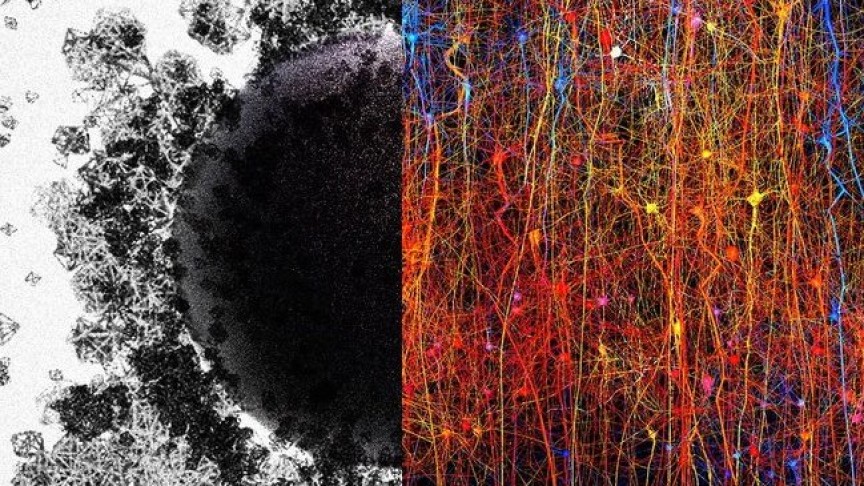
A study conducted by a Swiss research initiative shows the human brain’s structures operate in up to 11 dimensions.
More specifically my friend is in need of understanding it within the boundaries of this project
chrome dew
I remember seeing some kind of e textbook of algebraic topology for neuroscientists a year or two ago but
maybe I hallucinated it
yeah first I heard of it was I was at an algebraic topology conference and was talking to a guy doing some kind of neuroscience stuff with the development of the brain
maybe 5+ years ago I forget when this was now
gritty widget
they turned mathematics into commutative algebra, and now they have the audacity to turn neuroscience into commutative algebra!?
😡
chrome dew
neurons are objects and axons are morphisms 😳
rugged swan
tough imp
However locally every analytic function has a logarithm, you can construct it us...
yeah thanks good example !
 elder yew
gritty widget
they turned mathematics into commutative algebra, and now they have the audacity...
elder yew
gritty widget
they turned mathematics into commutative algebra, and now they have the audacity...
They haven't taken analysis yet
tight agate
moonbears that's kinda sorta what comm alg does
it replaced calculus
and analysis = calculus
sleek thicket
brofib attempting to give all the geometers in chat a rage induced heart attack
(algebraic geometers are algebraists so they're not included in what I said)
 tidal forge
is the center of mass of a piecewise linear surface the weighted average of the centers of those pieces?
chrome dew
yes
 shut moat
is there a nice explicit proof that the Mobius strip is not orientable?
Hubbard just said "lmao look at it"
I found these GATech notes online
it was also basically "lmao look at it"
sleek thicket
What's your definition of orientable again?
shut moat
an orientation is a continuous map from B(M) --> {-1,1} who's restriction to each tangent space is an orientation of the tangent space
the almost-frame-bundle thing
although Hubbard also introduced a list of ways to get orientations
with nonvanishing k-forms or normal vectors
also could it be done without charts? The remainder of the online stuff uses that, although I'm not super comfortable with it since Hubbard sticks to embedded manifolds and parametrizations (which are strictly global)
and hey terra lol
gritty widget
hello approximately circle
sleek thicket
Is your mobius strip compact or infinitely extended?
shut moat
compact I think
sleek thicket
how is it defined?
sleek thicket
My thinking is basically if you have an orientation then at each point you know which of the two boundary components is in the positive direction
sleek thicket
oof
shut moat
lol right?
sleek thicket
Alright so here's my high level argument
Choose an orientation
Let r : M -> S^1 be the retraction onto the center
shut moat
retraction meaning just projecting onto S^1?
sleek thicket
well there's this circle in the center right?
shut moat
yeah
sleek thicket
So we're sending a point of M to the point on that circle on the same line
it's a projection onto the circle
shut moat
gotcha
sleek thicket
for any point p in M, there's two boundary points of r^-1(r(p))
The orientation should actually allow us to choose a continuous function b : M -> 👌M such that r(b(p)) = r(p) and
sleek thicket
so basically like, at each point you have a positive direction
shut moat
[wait nvm]
sleek thicket
Oops sorry I forgot about this
The idea is basically you can continuously measure the "distance" of a point in r^-1(p) from one of the boundary points and get a value in [0,1]
and then this gives a global homeomorphism M -> S^1 × I where the center of the mobius band maps to (z, 1/2)
and then you observe that you can cut out the center of a mobius bundle and get a cylinder, whereas if you cut out the center of a cylinder you get two connected components
Sorry I don't really know a good definition of the mobius band in R^3, here's how I usually think of it
sleek thicket
topology 
i am thinking
let $Y = (I \times \R) \amalg (I \times \R)$ with inclusions $j_1,j_2 : I \times \R \to Y$
gentle ospreyBOT
Shamrock -> E -> B
sleek thicket
I want a quotient map $r : Y \to \mathbb{T}^2$ with the following fibers
gentle ospreyBOT
Shamrock -> E -> B
sleek thicket
\begin{align*} r^{-1}(r(j_1(t,s))) &= {j_1(t,s+n) : n \in \Z} \quad \text{if } t\in {0,1} \ r^{-1}(r(j_2(t,s))) &= {j_2(t,s+n) : n \in \Z} \quad \text{if } t\in {0,1} \ r^{-1}(r(j_1(0, s))) &= {j_1(0, s + n) : n \in \Z} \cup {j_2(1, s + n) : n \in \Z} \ r^{-1}(r(j_1(1, s))) &= {j_1(1, s + n) : n \in \Z} \cup {j_2(0, s + n + 0.5) : n \in \Z} \end{align*}
gentle ospreyBOT
Shamrock -> E -> B
sleek thicket
I thought I saw how to do it by shearing
but I no longer see it
@gritty widget change your status from homogeneous to homogenius
gritty widget
no
sleek thicket
oh okay
gritty widget
not until i fully understand this proof in my symp geo class
only then can i do that 
sleek thicket
okay anyways enough about simp geo or whatever
someone help me toruspill this problem
also to be clear, "having these fibers" is just a compact way to say "makes these identifications"
sleek thicket
hmm I think I have an idea
I can first glue I x R and I x R along (1, s) ~ (0, s + 0.5)
and reduce to looking at a quotient of [0,2] x R
hmm except this just moves other stuff over........
sleek thicket
What surface does < a, b, e | aeba¯¹e¯¹b¯¹ > present?
Feel like it should be the torus
I mean it's the torus unless I fucked up lol
 hazy stratus
Oh the torus came up in like our last two problem sets
hazy stratus
sleek thicket
What surface does < a, b, e | aeba¯¹e¯¹b¯¹ > present?
What kind of notation is that? I haven't seen it before
It looks like a generated group
sleek thicket
It's supposed to haha. It's called a "polygonal presentation of a surface", and if there's only one relation then the fundamental group of the surface has that presentation
sleek thicket
These are the presentations
<a, b|abb^-1a^-1>
<a, b|aba^-1b^-1>
<a, b|abab>
<a, b|abab^-1>
Presenting the sphere, torus, projective plane, and Klein bottle
sleek thicket
hazy stratus
It's a representation using symmetries?
Not really. It's telling you how to glue the shape together
So you'd glue together two edges labeled "a"
And you might swap them or not depending on whether it's a or a^-1
hazy stratus
Like say, which points on two opposite lines of a square are glued together?
Looks kind of like origami instructions
sleek thicket
Yeah, that's exactly it!
It's not quite folding, more gluing
but the idea is you could literally take some paper and put it together
(maybe not for all of them, some surfaces can't be embedded in 3d space...)
hazy stratus
That's pretty cool 😄
 tall flame
idk if this fits here but i ask
I have different weights for a neural network which attempts to return the mask of an object on a picture
the thing is, if it does pretty well on certain images, it takes background from others
I will keep training the nn, no worries. But
Can i somehow get the perfect mask combining the output of different models?
Like the intersection or something?
sleek thicket
i do not think this fits this channel. I mean I don't really care if you post it here but you'll probably get more help asking somewhere else
tall flame
where?
sleek thicket
Maybe on a cs/programming server? It's not really a math question
 frigid patrol
Math babble babaabbbaab
sleek thicket
robble robble
tall flame
frigid patrol
Math babble babaabbbaab
my ... idk how to say, last project for my degree
was a python script to identify any manifold
:)

this xD
frigid patrol
I think you meant genus
frigid patrol
But that's cool
 gritty widget
gender 0
tall flame
better now? :)
gritty widget
that is pretty neat, though
chrome dew
gritty widget
gender 1, 2, 3, etc. <:hmm:752276642088353792>
implying there are countably many genders
bigot!!
gritty widget

sleek thicket
sleek thicket
\begin{align*} r^{-1}(r(j_1(t,s))) &= \{j_1(t,s+n) : n \in \Z\} \quad \text{if }...
I'm thinking about this as a polygonal presentation
If I restrict to 0 <= s <= 1 on both copies
I get this
Does that seem right?
s is the horizontal coordinate in these pictures, I guess
and t is upside down...
But besides that
marsh forge
what space is this
sleek thicket
Certain quotient of (I × R) disjoint union (I × R)
It's supposed to be the torus
I'm not seeing it
 obtuse meteor

 red garden
question number 8
 astral cedar
I am pretty sure that the first one is homeomorphic to the real line with 0 removed
Yeah, the projection on the x axis is a homeomorphism with R\{0}
The second one is connected, but it takes a bit of work
You can look up the topologist’s sine
 little hemlock
Think: the closure of any connected space is connected
Showing it’s not path connected does take some work tho
sleek thicket
This is a reason to prefer connectedness to path connectedness
it's how I justify the definition to people who are learning (even though I think path connectedness is more intuitive)
 fading vale
i am so confused
wtf is p_0 here
a map from I -> S^1?
that makes this into a path?
ok nvm i found it its the exponential function from I -> S^1
sleek thicket
sleek thicket
let $Y = (I \times \R) \amalg (I \times \R)$ with inclusions $j_1,j_2 : I \times...
This
I think I can have a proof via polygonal presentation stuff but I can't get the details right, and also I would like an explicit map
fading vale
oh jeez
sleek thicket
It should just be like
Write down some fucky exponential map lol
Here's an equivalent thing
That might be easier, idk if I missed something
fading vale
maybe im dumb but arent the first and third/fourth lines contradictory here since the first should imply that r^-1(r(j_1(0, s))) = {j_1(0, s + n) : n in Z}
fading vale
ok that makes more sense lol
sleek thicket
Let U, V be the circle minus (distinct) points. Let C1, C2 be the components of the intersection of U and V. Let π : T^2 -> S^1 be the projection onto the first component. Find homomorphisms φ : π^-1(U) -> U × S^1 and ψ : π^-1(V) -> V × S^1 over our base such that φ(x, z) = ψ(x, z) if x in C1 and φ(x, z) = ψ(x, -z) if x in C2
here's the original problem I want to solve
fading vale

sleek thicket
It's tricky
Don't you want to bundlepill yourself
This is for your own good
("this" being you doing my homework for me)
 fading vale
yea its kinda hhhhhhh
fading vale
meanwhile i am doing cool based homotopy
sleek thicket
Mayer vietoris + classification of surfaces
but I need compatibility with the projection
fading vale
what class is this for?
sleek thicket
also I'm also doing homotopy theory in this class rn. I saw a proof that π3(S^2) is infinite cyclic generated by the hopf fibration!!!!
This is for bundles
This is like the first time I've ever worked with higher homotopy groups
And we like, proved the LES from a fibration
It was awesome
I was supposed to read that in the book and understand the proof today and then I didn't lol
fading vale
oh i think im doing stuff like that soon
or in the next few chapters
ch3 is covering theory, ch4 elementary htpy theory, ch 5 is entirely about fibrations and cofibrations
sleek thicket
Niiice
Yeah so like
The book doesn't even define fibration I think
Iirc Lee said the name in class
But it proves fiber bundles are fibration and then deduces the les from that
sleek thicket
lol
look I had to do this whole email exchange
arguing that I should be in the class
two years ago
fading vale
based
sleek thicket
He sent a very long list of requirements
and I was like

Except I had to say I never learned metric spaces. Didn't end up seeing them in a class until a 1 day review at the start of grad analysis
The same quarter I was taking a course on riemannian manifolds
 remote locust
Hello
I read chapters 2, 3 of munkres and started reading chapter 4
Would that be enough to start exploring algebraic topology?
gritty widget
munkres has a little intro to algebraic topology that you could try reading
part 2 of his topology book
iirc it doesn't depend on anything from chapters 5-8
remote locust
Thanks
 limpid leaf
Morning TTerra


 limpid leaf
knew I'd find you here
gritty widget
of course
gritty widget
S^1 x S^1 with fundamental group Z x Z
 cedar pebble
or you can just see it "intuitively" by actually doing the computation 
I mean I guess the intuitive reason for this is that SU(2) is the universal cover of SO(3); SU(2) is homeomorphic to S^3, while SO(3) is homeomorphic to RP^3 (which has the same fundamental group as that of RP^2)
shut moat
sleek thicket
Oops sorry I forgot about this
np ty again sham!
sleek thicket
I think it's just kind of awkward to talk about the mobius band as a subset of R^3
gritty widget
need this as a lemma to something else
maybe need connectedness on G? i saw the theorem somewhere else with a connectedness assumption, but here we're not making it
i'm not entirely sure it will even be smooth, since for any t there could be another b(t) taking m to gamma(t) (kind of like a "jump" in the curve in G?). then a(t) and b(t) would differ by an element in the stabilizer of m. maybe that's important?
unfortunately airing out my thoughts here has not given me any new ideas, so any insight or help is appreciated
ah i think i got it
gentle ospreyBOT
(T*(Terra), -dτ)
gritty widget
😌
tight agate
petthecat
sleek thicket
simpler version of the thing I was asking yesterday
what's a quotient map $r : [-1,1] \times \R \to \mathbb{T}^2$ such that $r^{-1}(r(t, s)) = {(t,s+n) : n \in \Z}$ if $-1 < t < 1$ and $r^{-1}(r(1,s)) = {(1, s+n) : n \in \Z} \cup {(-1, s+n+0.5) : n \in \Z}$
gentle ospreyBOT
Shamrock -> E -> B
sleek thicket
you can mod out the second coordinate and start looking for a map $\tilde{r} : [-1,1] \times \mathbb{S}^1 \to \mathbb{T}^2$ such that $\tilde{r}^{-1}(\tilde{r}(t, z)) = {(t,z)}$ if $t \in (-1,1)$ and $\tilde{r}^{-1}(\tilde{r}(1,z)) = {(1,z), (0, -z)}$
so it's like folding up a cylinder to a torus
but we twist the bottom by a half rotation
I guess
hmm so like
continuously rotate the second coordinate
as you go down
gentle ospreyBOT
Shamrock -> E -> B
sleek thicket
oh lol this is a homotopy
between f(z) = z and f(z) = -z
I think
hmm kind of
$\tilde{r}(t, z) = (e^{(t+1)\pi i}, e^{i (\pi (t+1)/2)} z)$
gentle ospreyBOT
Shamrock -> E -> B
sleek thicket
this seems plausible?
yeah I think this is right pogchamp
or actually $\tilde{r}(t, z) = (e^{(\pi/2 + (t+1)\pi)i}, e^{i (\pi (t+1)/2)} z)$ but still
gentle ospreyBOT
Shamrock -> E -> B
gentle ospreyBOT
Shamrock -> E -> B
 tepid depot
counter example: f(x,y) = x?
am i missing something here?
if it's properly a polynomial in both variables I should have a cute proof of this
tight agate
C is the Y-axis
tepid depot
$\omega \cup \omega$
gentle ospreyBOT
doubledual
tepid depot
i guess the cup product cup symbol is different
marsh forge
$\smile$
gentle ospreyBOT
doja max
gritty widget
$[\omega]\smile[\eta]$
gentle ospreyBOT
(T*(Terra), -dτ)
sweet wing

tough imp
what the fuck is happening in this proof?
Granted I'm tired as shit, but they never took an arbitrary neighborhood of p as far I could tell and I have no idea why they look at V_0\cap D
gritty widget
tough imp
I mean i got that part
rugged swan
If F is a sheaf of rings over Y, phi : X -> Y and x in X, do the local rings phi^-1(F)_x and F_phi(x) are isomorphic ?
tough imp
I mean as far as I can tell like... what it wants to literally say is p is just on the fucking boundary of H
but I don't see what the hell he's doing in the proof
tough imp
rugged swan
If F is a sheaf of rings over Y, phi : X -> Y and x in X, do the local rings phi...
I think so. Write it out in terms of colimits and both should be the colimit of thigns F(U) for U a nbd of phi(x), you might have to do some "colimits commute" thing but I think once you commute them one of them just kind of does nothing
gritty widget
tough imp
Granted I'm tired as shit, but they never took an arbitrary neighborhood of p as...
an arbitrary neighbourhood of p will always contain a boundary chart by taking intersections ("shrinking")
rugged swan
yeah for me it is true
so I don't understand what it means to be a "local homomorphism"
tough imp
Local homomorphism is a property of map of local rings
if you have a map phi:(R,m) -> (S,n) where m,n are the maximal ideals
rugged swan
it preserves the maximal ideals ?
tough imp
Then phi(m) < n
rugged swan
yeah ok
tough imp
or equivalently phi^-1(n) = m
tough imp
gritty widget
an arbitrary neighbourhood of p will always contain a boundary chart by taking i...
but at the end you're still essentially using that p looks like something (x^1,...,x^n-1,0) and that nbds of that in M (aka R^n) all have poitns with x^n < 0
right?
Like this proof seems stupid overly complicated idk why he does any of this but it might be me being no-sleep mode and literally just like "bruh once you go local this is literally just in R^n"
gritty widget
sounds right
lee likes to be technical with these kinds of arguments
i agree with you lol it basically is just "go local, R^n, qed"
just draw a picture
tough imp
This is AG brain
Also you say be technical
but he's still implicitly associating it with R^n by taking coordinates like that lol
gritty widget
maybe technical wasn't the right word
marsh forge
we should have a separate channel for arguments involving coordinates
gritty widget
lee likes to spell things out
gritty widget
analysis class is starting, suffering time 
sweet wing
 spring relic
So I just want to make sure I'm understanding this definition right
So in this definition we're sayiing U is a subset of X and T_f = {m in P(U) s.t. X - U is either finite or is X}
Just want to be sure I'm getting this right
spring relic
k, also when we say let T be a collection of some set X does that mean T has subsets of X?
cuz now that I'm read the definition again I'm interpreting the definition differently
I think Ima move to the questions section for this
marsh forge
huh
it says "Let T be the collection of subsets of X such that..."
its clear that every element of T is a subset of X
marsh forge
"subsets U of X" is perfectly clear
and very common writing-style
Let Y be the collection of all elements/covers/supersets/etc y of X with property....
"all subsets U where U subset X" is very painful to read lol
spring relic
idk, I kinda like it. The previous phrase makes it sound like T_f is the collection of all possible subsets you can make from X
marsh forge
I dont know if I am just used to it because this way of writing is incredibly common
but I completely disagree lol
"subsets U of X such that..." makes it completely clear you're taking a subset of P(X) with some property
marsh forge
marsh forge
"all subsets U where U subset X" is very painful to read lol
like just objectively this is bad writing style
its okay to find another way to write it
but that is clunky and bad
i guess my point is that i dont see an argument for any real ambiguity and this kind of phrasing is super common so you should get used to it haha
spring relic
k will do. I just wanted to make sure I'm getting the definition down correctly in my head. thx btw
 pure sigil
So I'm familiar with the concept of weak/weak* convergence. One of my profs today was talking about weak and weak* topologies. I was wondering if anyone had a good explanation for it?
Ok so it's the topology that defines the notion of convergence in that sense? (I'm sorry I'm applied math and not super familiar with topology as a whole)
Oh ok that does make much more sense!
Thank you so much - I really appreciate it!!
little hemlock
Here, G is a finite group.
Does anyone have a hint possibly? I've been stuck trying to prove X/G is Hausdorff for an eternity 
oh yea, and the action is continuous: i.e each of the maps T_g : X to X which send x to g.x are continuous
gritty widget
(ignore what i just deleted, misread!)
tight agate
prove that every point x has a neighborhood U such that G.x \cap U = x
little hemlock
The only potentially helpful thing I've found is that sets of the form $\bigcup_{g \in G} T_g(U)$ are open in $X/G$ when $U$ is open in $X$
gentle ospreyBOT
kxrider
tight agate
essentially show that the quotient map is open
gritty widget
welcome to the piss role channel bro
tight agate
tight agate
essentially show that the quotient map is open
once you have this, there's an obvious way to define charts on X/G
tight agate
gritty widget
welcome to the piss role channel bro <a:petTheCat:771287728305471528>
you see, I don't get the whole piss color joke
perhaps I'm too hydrated to understand
gritty widget
what, are you using light mode?
tfw you can't even read honorable names on lightmode
tight agate
if your pee isnt clear, then death is near
little hemlock
i have $$\pi^{-1}(\pi(U)) = \pi^{-1}{G.x : x \in U} = \bigcup_{g \in G} T_g(U)$$
when $U$ is open in $X$ and $\pi$ is the quotient map $X \to X/G$ which proves that $\pi$ is open, but haven't been able to see why there exists a nbhd $U$ of $x$ such that $G.x \cap U = {x}$.
gentle ospreyBOT
kxrider
sleek thicket
can you do it for a single element of G?
@little hemlock
like in my head, we want to use finiteness of G to keep cutting down some neighborhood
removing one element from the intersection at a time
does that make sense?
little hemlock
yea, hmm. Let $U$ be a neighborhood of $x$. You can remove $G.x \setminus {x}$ from $U$ since $G.x \setminus {x}$ is closed (a finite union of closed singletons).
gentle ospreyBOT
kxrider
sleek thicket
hmm I think this might actually be the wrong condition
little hemlock
i was about to say, im not really sure how this helps tho
sleek thicket
yeah so you want a nbhd such that $gU \cap U = \varnothing$ for $g \neq e$
gentle ospreyBOT
Shamrock -> E -> B
sleek thicket
the image of a connected such U under the quotient map should be evenly covered
how does that sound
little hemlock
hmm, so hausdorffness is supposed to come out of this somehow?
sleek thicket
oh lol I was misremembering the statement you were trying to prove
I think this should imply Hausdorffness
but what I was saying would be for showing X -> X/G is a covering map
(I think I see how Hausdorffness pops out of this though)
little hemlock
i desperately want to remove the set ${s \in U : G.s \cap V \neq \varnothing }$ from $U$, but there's no way its finite.
gentle ospreyBOT
kxrider
little hemlock
taking U and V to be disjoint open sets in X containing elements x and y respectively
 small phoenix
for Hausdorffness: open sets in X/G correspond under \pi to G-invariant open sets in X. I think given x and y in X, and disjoint open sets U_x and U_y, if you push U_y by G, you get only finitely many intersections with U_x. you can trim both U_x and the orbit of U_y (exploiting Hausdorffness of X and finiteness of G) to make neighborhood of V_x which is disjoint from the orbit of V_y.
 meager python
Anyone’s still taking Jarod Alpers class here?
sleek thicket
@tough imp is
tough imp
Yee
 broken robin
Hi guys, I have problems to show the claim, can someone give me a hint to proves that N is open in W_k? 😔😔😔😔
 zealous glen
Is the kernel of a homeomorphism, the pre-image of the identity?
Getting a little confused with tangent spaces of regular level sets
gritty widget
is the kernel of a homeomorphism the preimage of the identity
the word you're looking for is homomorphism
tangent spaces of regular level sets
if your level set is given by a function F, then the tangent space to the level set at x is given by ker (dF_x), where dF_x is the differential of F at x
there isn't much more to it
zealous glen
ah right I think i understand. So for our level set... our push forward defines some tangent space basis (from one manifold to another), and then we can use the kernel to find the tangent space at some point in our original manifold ?
gritty widget
the level set needs to be given by the preimage of a "regular value" to be a manifold, which is to say the differential of the defining function is surjective at every point of the level set
zealous glen
right that makes sense. So with that being said we can define our ker(dF_x) = TpM?
M being our original manifold
and p being in that manifold
such that F(p) = c and c is our regular value
 shadow charm
Could someone give me an example of a sequence of non compact sets where this fails?
shadow charm
hmm right that's empty since they're open
marsh forge
(0,1/n] also works
shadow charm
what about an example with closed non compact sets?
marsh forge
i would just google that one
marsh forge
oh nice duh
i was like
must be closed but not bounded
no useful examples of that
(its early be nice)
marsh forge
not super new
tepid depot
yeah i bribed the mods with my proof the riemann hypothesis
shadow charm

 summer jolt
Can someone explain what is meant by "extendible" sections on a vector bundle?
gritty widget
presumably it means something like: if $E \to M$ is a vector bundle over $M$, $S \subset M$ is a submanifold, and $s$ is a section of $E$ defined on $S$, then you can extend $s$ to a section of $E$ defined on all of $M$, or maybe on an open subset of $S$ in $M$
gentle ospreyBOT
(T*(Terra), -dτ)
gritty widget
the most familiar example being when s is a vector field (i.e. E = TM)
i can't imagine it meaning much else lol
summer jolt
Here is the relevant section from my notes, but I'm struggling to interpret what it means
gritty widget
ah, sections along curves
so you can have a section of E defined along gamma, right?
and you want to ask whether any given section along gamma is actually the restriction of a section defined in a neighbourhood of gamma
this isn't always possible!
it's possible if gamma is an embedding iirc
it might help if you interpret this in terms of vector fields, for some visual intuition
To make the definition precise: let $\sigma$ be a section of $E$ defined along $\gamma$, i.e. a map $\sigma\colon [0,1] \to E$ such that $\pi\circ\sigma=\gamma$. We say $\sigma$ is extendible if there exists an $s \in \Gamma(E)$ such that on $[0, 1]$, $\sigma = s \circ \gamma$.
gentle ospreyBOT
(T*(Terra), -dτ)
gritty widget
i just reworded what the pic said
yeah the phrasing in the pic is kinda odd imo
lee defines this for tensor bundles like this
screenshots of lee = proof by authority
summer jolt
Ok just to clarify: a section $s$ along $\gamma$ is ${p \in \gamma(t) | s(p)}$ right?
gentle ospreyBOT
snypehype46
summer jolt
Yeah sorry I mean the the image of the section is as above right?
gritty widget
well swap the left and the right in your set lol
but yeah, kind of
eh
nah, you should be precise
a section along a curve gamma always has the same domain of definition of gamma, so you should be writing s(t)
the "along a curve" part is very important
To make the distinction clearer: a section of $E$ along $\gamma$ is a map $\sigma\colon[0,1]\to E$ such that $\pi(\sigma(t))=\gamma(t)$ for each $t \in [0,1]$. It's basically a curve in $E$ defined "along" $\gamma$. Without the descriptor "along $\gamma$," a section of $E$ is a map $s\colon M \to E$ with $\pi(s(p)) = p$ for all $p \in M$.
gentle ospreyBOT
(T*(Terra), -dτ)
summer jolt
gentle osprey
**(T\*(Terra), -dτ)**
I see this makes sense
gritty widget
also this
summer jolt
So for the extendible part we are just saying that curve in the yellow and green paths is the same then the section is extendible right?
Ah ok yeah, that is what I meant the picture was just to give me an intuition. Ok I think I get the definition, but I'm still confused about why "extendible"?
summer jolt
Thanks that makes much more sense than my lecture notes
summer jolt
Yeah I also get the definition of my notes now.
zealous glen
Hey can anyone help me figure out the intuition behind local flows on manifolds?
is it do with mapping an integral curve or have I misinterpreted the text 😄
gritty widget
intuition behind local flows
package all of the information about a vector field and its integral curves into one function
basically
solving an ODE
the theorem about the existence of flows is in fact a direct analogue of a theorem from ODEs you might be familiar with
let me see if i can find it
eeeeeeeeeeeeeehhhhhhhhhhhhhhhhhhhhhhhhhhhhhhhhhhhhhhhhhhhhhhhhhhhhhhhhhhhh
zealous glen
OOOOO
so essentially we are mapping our integral curve which has some interval into our vector field
and calculating its velocity etc
since its velocity vector is in the tangent space of our manifold
Ty sir
when we talk about vector fields being over a manifold are we basically saying embedded onto the manifold?
or is this just another way to define a tangent bundle 
gritty widget
zealous glen
so essentially we are mapping our integral curve which has some interval into ou...
no clue what "mapping into our vector field" means. a flow is a function $F(p, t)$ associated to a vector field $X$ on a manifold $M$ such that for each $p \in M$, the curve $t \mapsto F(p, t)$ is the integral curve of $X_p$ (and it also satisfies the property $F(F_s(p),t)=F(p,s+t)$)
gentle ospreyBOT
(T*(Terra), -dτ)
gritty widget
and F(p, 0) = p, for all p
zealous glen
by mapping i mean taking every point and redefining onto our vector field
gritty widget
i still don't know what that means
you should check out chapter 9 of lee's smooth manifolds book
zealous glen
doesn't the integral curve map some interval J to the manifold M?
gritty widget
he explains very precisely what flows are, and proves their existence and uniqueness theorem with painful detail
yes
zealous glen
at different intervals t
I'm trying to think what they look like in terms of a picture, but haven't got a clue
is there a picture of it in the book?
gritty widget
probably
gritty widget
maybe to be a bit more precise, if $X$ is a vector field on a manifold $M$, then for each $p \in M$ we get an integral curve $\gamma_p$, defined on an interval $(a_p,b_p)$ around $0$ (note that the interval may depend on $p$), so that $\gamma_p(0) = 0$ and $\gamma_p'(0)=X_p$. a local flow is then a function $F$, such that $F(p,t) = \gamma_p(t)$ whenever it makes sense. (making sense of it is the annoying part of getting local flows from vector fields)
gentle ospreyBOT
(T*(Terra), -dτ)
gritty widget
so if you fix p, then F(p, t) is as a function of t the integral curve of X through p
zealous glen
zealous glen
when we talk about vector fields being over a manifold are we basically saying e...
is this correct?
gritty widget
still not sure what that means
zealous glen
gritty widget
maybe to be a bit more precise, if $X$ is a vector field on a manifold $M$, then...
this makes a lot of sense now
zealous glen
gritty widget
still not sure what that means
ok can you tell me what we mean by over a manifold?
gritty widget
zealous glen
this makes a lot of sense now
i might have left out a condition or two this is very technical and annoying
yeah shamrock i knew you were gonna blast me with some edge case #3495873459384
this is why i rec lee
sleek thicket
lol
I was gonna say flows are very visual
If you have a vector field eg
you can put a point down somewhere
And follow the arrows
zealous glen
o
sleek thicket
Like, if you think of those arrows as being something like the current in a body of water
idk I don't do physics
But you're literally just being pulled along
By the arrows and the direction they point
sleek thicket
go with the flow dude
gritty widget
lee's flow chapter is good until you get the existence and uniqueness proof
then you taste blood
zealous glen
mhm okay thank you guys
gritty widget
i had the proof on an assignment once
gritty widget
perfect reason to blackbox it
gritty widget
@sleek thicket https://www.math.toronto.edu/laithy/367/367-ps4.pdf
go to the last page
this instructor was a little sadistic with his assignments
shut moat
this sounds like integral curves but for manifolds
shut moat
pog
gritty widget
i asked him why he didn't just say "riemannian metric" and he said "i didn't want people to look it up"
sleek thicket
this sucks lol
gritty widget
yeah that course was genuinely painful
although it was the summer so the ridiculous homework was actually manageable since lower course load
 cloud owl
sleek thicket
Everything else
cloud owl
sleek thicket
Everything else
what a mood
shut moat
so, a while back, hubbard made an interesting comment about the volumes of complex manifolds:
the comment is the bottom paragraph but I left in the rest for context
so I recently got to the actual exercise explaining the reason this happens:
Now, I managed to prove this
and the magic trick had to do with $a + bi \sim \begin{pmatrix}a & -b \ b & a\end{pmatrix}$, $\det z = |z|^2$
gentle ospreyBOT
~S^1
shut moat
and it became clear that $\det{D\gamma ^T D\gamma}$ is always a perfect square with the same reasoning
gentle ospreyBOT
~S^1
shut moat
but despite all this, I still don't have a geometric feel for why having a natural orientation means the volume of the complex manifold is always this natural to compute
like, I get why it works symbolically, but is there more to it?
little hemlock
what condition of the implicit function theorem requires that df/dy != 0?
the way it was explained in class, the jacobian of f should have maximal rank, but it doesn't specify that particular components should be nonzero
--yet, its necessary in order to conclude the last part with u'(x).
shut moat
The implicit function theorem guarantees some implicit function when the jacobian has maximal rank, but you need the extra condition to guarantee that y here can be chosen as the implicit function
it should be clear why this is the case if you look at the result
this'll shit its pants if the denominator is zero
little hemlock
take the statement in spivak for example. Its a little different than the "maximal rank" formulation i learned. But what part of it is different so that g(x) gets to automatically be differentiable?
err, i guess he checks that a certain submatrix of the jacobian is nonsingular instead. And in my case, that submatrix would just be df/dy?
shut moat
yeah exactly
the generalization of the fraction above is like -[D implicit variables]^{-1}[D active variables]
where the [D ] is ofc the jacobian
this comes from a similar chain rule argument
shut moat
don't the U_1OK and U_2OK also have to be connected in order for this to work
 shrewd moth
@gritty widget can you help me with a proof
shrewd moth
im not understanding it but is there another way to restate it
tight agate
Namington is helping you in the other channel
shrewd moth
can you help on proofs and logic please
shrewd moth
okie
tight agate
in the algebra channel
shrewd moth
i cant find the channel
shrewd moth
ty
little hemlock
The quotient map $\pi : \bR^{n+1} \to \bR \mathbb P^n$ sends an open set $U$ to the set of lines through the origin which intersect $U$ somewhere. How would you show that $\pi$ is an open map?
gentle ospreyBOT
kxrider
tight agate
I think you were working on something similar earlier?
anyway, in general if you have a topological group G acting on M
let pi: M ---> M/G be the quotient map
little hemlock
well instead of trying to prove that X/G is a manifold, im taking a break to prove that projective space is a manifold.
little hemlock
G.U
little hemlock
yup. So G.U is open and pi(U) is open.
little hemlock
so i need a topological group acting on R^n+1 whose orbit set is RP^n
tight agate
minus the origin
little hemlock
nice, thanks
tight agate
another construction is the quotient of S^n by a Z/2 action
cedar pebble
same construction :^)
tight agate
(it is sort of the same construction but whatever)
little hemlock
in what sense is that the same?
little hemlock
oh you just mean both quotients are the projective space?
tight agate
no, I mean it's the "same construction" in some sense
by restricting spaces
like a line in R^n+1 will intersect the unit sphere at 2 points
and the antipodal action identifies those
perform the quotient on R^n+1 and identify the entire line to a point
or work on S^n and identify those two points to a point
little hemlock
right, i see
tight agate
and even though it is the same definition, it has its merits
it lets you see the cell structure on RP^n immediately
also, it was useful while computing the de rham cohomology of RP^n
 viral atlas
Is a spherical surface 2-dimensional because a point on a its surface can be specified by two parameters(angles with two of the 3 axes), while in a solid sphere, you can also vary the distance from the origin?
tight agate
yes
viral atlas

tight agate
marsh forge
is it true that a point on a 2-manifold can always be specified by two data points wrt the origin?
otherwise i think its wrong to say this is “why” a sphere is 2dim
viral atlas
Why is it 2-dimensional, then? I'm still kinda unconvinced about my reasoning tbh.
tight agate
you can do it, "locally"
marsh forge
It is two dimensional because if you take a point and zoom in on it
it locally looks like R^2
viral atlas
Oh
viral atlas
What is different about a solid sphere? When you zoom into a point on/in it, does it look like R^3?
viral atlas
Oh
marsh forge
okay small techbicality
theres a notion of manifold and “manifold with boundary”
so a solid sphere has a boundary that is 2dim if you remove the interior
but the interior is 3dim
viral atlas
Owww
So the interior of such a shape has a +1 dimension relative to the dimension of its boundary?(Interior points of circles seem to be like R^2 on zooming in, and for spheres you get R^3)
marsh forge
the boundary is always dim-1
viral atlas
That's what I meant, sorry for the weird phrasing haha.
viral atlas
marsh forge
the boundary is always dim-1
Is this true every time, or does this fail under certain conditions?
I can't think of anything which violates this idea
Just wondering if there are some pathologies
marsh forge
its true by definition but this follows from a rigorous definition of manifold with boundary
viral atlas
I see.
marsh forge
namely the interior has to be locally R^n
and small neighborhoods of the boundary points have to look like R^n cut in half
viral atlas

marsh forge
its easiest to see with a circle
filled in circle
disk
so inside the disk
it looks like R^2
but on the border
viral atlas
It looks like a line, so R^1
viral atlas
marsh forge
if i take a neighborhood of the arrow point
im also gonna capture some of the inside
viral atlas
Yes
 sinful pecan
note the closed disk
marsh forge
so if you "unbend" the neighborhood of a border point
it looks like this
i can draw it if you want
marsh forge
art is not my forte
also pretend i colored in the whole disk on the left
does this help
im cutting out the blue neighborhood
and unbending it
it looks like a 2-ball cut in half (a 2-ball happens to be a disk)
viral atlas
marsh forge
and unbending it
Owwwww, so you have to unbend the neighbourhood every time?
Unbending a neighbourhood on the sphere's surface would... 
Oh yeah
That gives a hemisphere!
But how do you talk about "unbending" more formally?
viral atlas
Oh, okay. So you kinda map the points under some transformation preserving some properties?
viral atlas
(Please bear with my bare knowledge, I don't know what continuous maps and inverses are)
 vocal wharf
continuity ensure that "close things stay close"
viral atlas
vocal wharf
you map the thing you cut out to the half circle thing
How? Physically, this feels like bonking the cut out portion, but I can't make sense of how to do that formally.
viral atlas
vocal wharf
continuity ensure that "close things stay close"
Oh, that makes sense.
tepid depot
@viral atlas between this question and what you asked in the analysis channel, I think learning some point set topology at this point would be very helpful.
these notes are really good: https://pi.math.cornell.edu/~hatcher/Top/TopNotes.pdf
idk if you're in a class and dont have time for this or anything
but if you do have time I highly recommend it
viral atlas
I started with Lee's ITM, I've been told it teaches point-set top with a manifolds tilt.
Oh, these are Hatcher's notes! XD
I'll take a look, I like his way of presenting things. Thanks!
tepid depot
just looking briefly at the lee table of contents, chapters 2-4 are the same content
but lee is taking a lot longer to get through it
so the difficulty density is probably lower, but idk if that's a super great thing in this case. I feel like hatcher's notes are actually really good and not that difficult
viral atlas
They look good! The idea explained above has already been explained by an example right in the beginning. :p
tepid depot
if you're interested in the content in the later chapters of lee, I think you could jump straight to chapter 5 after reading hatcher's notes
viral atlas
Great, thankyou so much.
To claim that a non-empty finite set(say, A) in R is not open, is it sufficient to say that no open interval could be a subset of A(for every such open interval is either empty, or has infinitely many elements), and hence none of the points in A is contained in an open interval which is also a subset of A?
viral atlas
What is a basis element? 😅
marsh forge
oh
it captures the idea of a “basic open set”
on R the collection of all open intervals forma a basis
and all open sets are unions of intervals
viral atlas
Owwww, I see.
What are some other examples of basis elements(in probably a different setting)?
marsh forge
in any metric space the sets
B(x,delta):={y | d(x,y)<delta}
forms a basis
where x,delta are allowed to vary over the whole space and all of R+ respectively
viral atlas
Okay, so this is a generalisation of the open interval idea to all metric spaces.
marsh forge
but it works for all topological spaces
viral atlas
marsh forge
but if youre only familiar w metric stuff
viral atlas
I'm actually not familiar with any other topological spaces
marsh forge
this is the easiest way to think about it
viral atlas
Bar metric ones
frigid patrol
anybody know what equivariant morse theory is about?
tight agate
probably morse theory + group action
Atiyah and Bott wrote a pretty big paper on it I believe
frigid patrol
do you know what moment map means in this context?
tight agate
you should probably ask tterra
shadow charm
im just reposting a q i asked in a question channel since it fits better here: I just need someone to confirm that my proof is good enough and that it isnt lacking rigor cause i feel like it kinda does
where at then end it should read $G_0 \cup {H_n}$
gentle ospreyBOT
Little Narwhal
shadow charm
oh and also i wrote G1 in a few places and meant G0 oops
vocal wharf
your finite subcover is (technically) {G_0} \cup {H_n} right?
shadow charm
it exactly is yes