#point-set-topology
1 messages · Page 105 of 1
 heady skiff
in terms of kuratowski's closure operation

like bruh what is the problem even saying
We show that any open set of Prime($\mathbb{Z}$) can be expressed as an arbitrary union of elements of Prime($\mathbb{Z}$). Let $O$ be open, so that $O = \text{Prime}(\mathbb{Z}) - C$ for some closed set $C$. We claim that $O = \bigcup_{p \in \mathcal{P} - \mathcal{C}} \hspace{.05cm} p\mathbb{Z}$ where $\mathcal{P}$ denotes the set of all primes and $\mathcal{C}$ denotes the set of all primes in $C$. Indeed, if $K \in O$, then [\bigcap_{I \in C} \hspace{.05cm} I \not\subset K] so $I \not\subset K$ for all $I \in C$ (otherwise, for some $J \subseteq K$ we would have $\bigcap_{I \in C} \hspace{.05cm} I \subseteq J \subseteq K$).
 gentle ospreyBOT
okeyokay
 heady skiff
to make sure I got things right, this is saying that the final topology is the intersection of all collections which contain subsets of Y such that f_alpha is continuous for each subset right

there's gotta be some better way to write this right
nvm
 rancid umbra
heady skiff
to make sure I got things right, this is saying that the final topology is the i...
rancid umbra
heady skiff
to make sure I got things right, this is saying that the final topology is the i...
more succinctly, its the smallest topology making all of the functions f_a continuous
 tiny obsidian
heady skiff
to make sure I got things right, this is saying that the final topology is the i...
tiny obsidian
heady skiff
to make sure I got things right, this is saying that the final topology is the i...
It's the collection of subsets whose preimage under any f_a is open, which is equivalent to intersecting each collection of subsets for a fixed f_a
(which as already said is the coarsest topology where each f_a is continuous)
heady skiff
got it thanks
how is $\varphi_{b - a, a}$ a restriction of $\varphi_{a, b}$? for instance they don't agree on 1
 gentle ospreyBOT
okeyokay
 tiny obsidian
heady skiff
how is $\varphi_{b - a, a}$ a restriction of $\varphi_{a, b}$? for instance they...
tiny obsidian
heady skiff
how is $\varphi_{b - a, a}$ a restriction of $\varphi_{a, b}$? for instance they...
you're right that is isn't a restriction
I have no idea what they meant here
 sonic crane
heady skiff
how is $\varphi_{b - a, a}$ a restriction of $\varphi_{a, b}$? for instance they...
sonic crane
heady skiff
how is $\varphi_{b - a, a}$ a restriction of $\varphi_{a, b}$? for instance they...
Wtf textbook is this
It looks like if topology was taught by a highschool textbook
 junior granite
Not sure if this is the right channel, but below is the start of a proof I am writing: \ \
Let $P$ and $Q$ be posets with partial orders $\leq_{P}$ and $\leq_{Q}$, respectively, such that every subset of $P$ has a least upper bound in $\leq_{P}$ and every subset of $Q$ has a least upper bound in $\leq_{Q}$. Let $\leq_{prod}$ be the product order on $P \times Q$.
Let $S \subseteq P \times Q$ such that the elements of $S$ are ordered pairs $(p,q)$ where $p \in P$ and $q \in Q$. By hypothesis, $P$ has a least upper bound and $Q$ has a least upper bound. \ \
How do I show that $P \times Q$ has a least upper bound? It feels so obvious and yet not obvious.
gentle ospreyBOT
Vic
 junior granite
This is for topology course I just don't know if this is the right category to ask this question.
rancid umbra
junior granite
This is for topology course I just don't know if this is the right category to a...
P has a least upper bound p* w/r/t <_P, Q has a least upper bound *q w/r/t <_Q. what can you say about (p*,q*) in P x Q?
junior granite
Can I conclude that it's an (maybe not the least) upper bound in P×Q? Or am I jumping the gun?
rancid umbra
junior granite
Can I conclude that it's an (maybe not the least) upper bound in P×Q? Or am I ju...
why do you have any reservations?
the product order is compared component-wise
junior granite
rancid umbra
the product order is compared component-wise
Because I wasn't sure of this. I was second guessing myself.
junior granite
junior granite
Can I conclude that it's an (maybe not the least) upper bound in P×Q? Or am I ju...
So if that is what I can conclude, how can I explain that any subset of P×Q has a least upper bound? Do I just say "by hypothesis, any subset of P and Q has a least upper bound, so P×Q has a least upper bound, therefore any of its subsets must have a least upper bound."
gentle ospreyBOT
Vic
 junior granite
I have a new question:
"Let $X$ be a set and view the power set $\mathcal{P}(X)$ as a poset via the partial order $\subseteq$. Prove that every subset $\mathcal{A} \text{ of } \mathcal{P}(X)$ has a greatest lower bound." \
My proof so far:
Let $X$ be a set with the power set $\mathcal{P}(X)$ as a poset via the partial order $\subseteq$. We want to show that every (non-empty) subset $\mathcal{A}$ of $\mathcal{P}(X)$ has a greatest lower bound. Let $B \subseteq \mathcal{P}(X)$ be the greatest lower bound of $X$. Now we need to show that this lower bound is a subset of $\mathcal{A}$. Well, let $A$ be the set of lower bounds in $\mathcal{A}$ such that $B \subseteq A$. Then, $\bigcap_{A \in \mathcal{A}}=B$. \
Am I going about this correctly?
rewritten because i made a mistake
gentle ospreyBOT
Vic

 uncut tartan
junior granite
I have a new question:
"Let $X$ be a set and view the power set $\mathcal{P}(X)...
uncut tartan
junior granite
I have a new question:
"Let $X$ be a set and view the power set $\mathcal{P}(X)...
think you forgot to add the A at the end of the intersectoin but i believe so. Since if $B\subseteq A$ for all $A\in \mathcal{A}$. Now to make sure that its the glb is probably the only thing thats not in this proof
gentle ospreyBOT
!Pymamba™
 uncut tartan
which shouldnt be too hard i think if any subset $C\subseteq A$ for all $A\in \mathcal{A}$ then by definition it all $x\in C$ are also in $A$ for all $A\in \mathcal{A}$ which by definition of the intersection means $x\in B$ so $C\subseteq B$
gentle ospreyBOT
!Pymamba™
 uncut tartan
you can probably say that in a more concise and less akward way
 tribal palm
so i'm looking over some of my notes from last year, and i'm skeptical of my past self's "proof" of the closure under intersections here
 uncut tartan
but the point is that you can do a standard subset proof to show C is a subset of B
tribal palm
in particular how can i justify going from |script A| < infty to |script E| < infty ?
tribal palm
tribal palm
so i'm looking over some of my notes from last year, and i'm skeptical of my pas...
oops and that plain E should of course be a script E
junior granite
uncut tartan
think you forgot to add the A at the end of the intersectoin but i believe so. S...
I wound up rewriting it because I was told my assumption that $B \subseteq \mathcal{P}(X)$ is the greatest lower bound of $X$ is not a valid assumption to make.
gentle ospreyBOT
Vic
 uncut tartan
junior granite
I wound up rewriting it because I was told my assumption that $B \subseteq \math...
uncut tartan
junior granite
I wound up rewriting it because I was told my assumption that $B \subseteq \math...
i mean yeah you shouldnt assume it. but you can prove. like mentioned above
junior granite
I wrote this:
Let $X$ be a set with the power set $\mathcal{P}(X)$ as a poset via the partial order $\subseteq$. We want to show that every (non-empty) subset $\mathcal{A}$ of $\mathcal{P}(X)$ has a greatest lower bound. Well, let $\bigcap_{A \in \mathcal{A}}=B$ for subsets $A \subseteq \mathcal{A}$. By definition, $B \subseteq \mathcal{A}$, meaning that $B$ is a lower bound of $\mathcal{A}$. Suppose we have a $B'$ such that $B' \subseteq \mathcal{A}$ is another lower bound. Then $B' \in B$, making $B$ the greatest lower bound. Thus any subset of the power set has a greatest lower bound in the poset defined above.
gentle ospreyBOT
Vic
 uncut tartan
junior granite
I wrote this:
Let $X$ be a set with the power set $\mathcal{P}(X)$ as a poset ...
uncut tartan
junior granite
I wrote this:
Let $X$ be a set with the power set $\mathcal{P}(X)$ as a poset ...
$B \subseteq \mathcal{A}$?
shouldnt it be B is a subset of A, for all A in \mathcal{A}
uncut tartan
the starting is correct here but it goes wrong when you say B'\in B
 junior granite
wait no?
junior granite
junior granite
wait no?
wait you're right i misread my own work lol
uncut tartan
i figured lol its alr
junior granite
uncut tartan
the starting is correct here but it goes wrong when you say B'\in B
I meant to say B' \subseteq B. would that fix the issue?
uncut tartan
well you need to show that
but it is correct
that is p much the only error besides the typos
like the intersection not saying \bigcap_{A \in \mathcal{A}} A=B and instead saying \bigcap_{A \in \mathcal{A}}=B
i think thats the only mistake i didnt mention before hand
junior granite
pain i'm so groggy this morning how did i miss that lol
wait so is B' a lower bound because it lies in the intersection? and B is the greatest lower bound because it contains B'?
no wait
gahhh
How would I go about showing that B' \subseteq B?
uncut tartan
junior granite
wait so is B' a lower bound because it lies in the intersection? and B is the gr...
what is the definition of a lower bound
for this set
for this poset*
junior granite
a set that is a lower bound for every set in \mathcal{A}?
feels cyclical but that's what i got
uncut tartan
junior granite
a set that is a lower bound for every set in \mathcal{A}?
which means what?
junior granite
it bounds the set from below...?
all other sets in \mathcal{A} are greater than or equal to that set
rather the glb is contained in all those sets
 plush folio
tribal palm
in particular how can i justify going from |script A| < infty to |script E| < i...
plush folio
tribal palm
in particular how can i justify going from |script A| < infty to |script E| < i...
If $\mathcal{A}$ is finite then $\bigcap \mathcal{A} = \bigcap_{i = 1}^n A \cap U_i = A \cap \bigcap_{i=1}^n U_i$ where $U_i \in \mathcal{T}$ unless I'm mistaken. Sets of sets is pretty confusing, so I think it's easier to explicitly write out the contents of $\mathcal{A}$
gentle ospreyBOT
sheddow
 uncut tartan
junior granite
all other sets in \mathcal{A} are greater than or equal to that set
uncut tartan
junior granite
all other sets in \mathcal{A} are greater than or equal to that set
what?
uncut tartan
junior granite
it bounds the set from below...?
what is the definition of that
junior granite
i'm not sure i know how to explain that. i guess that is where my studying shall begin this evening. thank you for the help!
uncut tartan
junior granite
i'm not sure i know how to explain that. i guess that is where my studying shall...
the definition of a lower bound of a set is an element that is less than or equal to every element of the set. in this case B' should be a subset of all sets A in \mathcal{A} since thats how we defined this poset.
so by definition if x \in B then for all A in \mathcal{A}, x is in A
junior granite
i misused set instead of element.
sigh i tricked myself into thinking i didn't know what a lower bound was.
i had to turn in the assignment but i will use this for corrections/exam prep. thank you again.
 robust drum
if f: X -> Y is continuous, X is locally compact, and Y is Hausdorff, is f a closed map?
this is definitely false right
like [0, 1) is locally compact isn't it
ok yes this is obviously false every point has a small enough open interval around it so its closure is compact so [0, 1) is locally compact
and then you can get continuous injections from it to the circle
uncut tartan
is there a name for metrics on rings or fields that satisfy:
- d(x,y)=d(x+a,y+a)
- d(a * x, a * y)=|a|* d(x,y)
- d(x * a,y * a)=d(x,y) * |a| (if the ring isnt commutative)
i know norms as far as i can tell satisfy this
but are there others
im guessing compete fields or rings might have metrics similar to the l^p metrics
rancid umbra
uncut tartan
is there a name for metrics on rings or fields that satisfy:
1. d(x,y)=d(x+a,y+a...
are you sure you don’t mean d(ax,ay) = |a| d(x,y)
otherwise the distance could be negative
uncut tartan
uh yeah thats probably a good thing to change it into
i dont really have a concrete idea of what these spaces are like
im just comparing them to what the standard metric does on R or R^2
rancid umbra
the second (and third) condition(s) turns it into a normed vector space in the case that it’s a field
robust drum
Yeah then you just recover that this is some scalar times the metric induced from the norm bc d(x, 0) = ||x||d(1, 0)
Wait
I’m being dumb
Lol
rancid umbra
it happens lol
rancid umbra
robust drum
I’m being dumb
li think we were both being dumb
u need translation invariance to turn it into a norm
rancid umbra
uncut tartan
is there a name for metrics on rings or fields that satisfy:
1. d(x,y)=d(x+a,y+a...
i think in the case of a field, the metric d would induce a norm if and only if it is translation invariant and homogenous of degree 1
well
absolutely homogenous ig
rancid umbra
uncut tartan
is there a name for metrics on rings or fields that satisfy:
1. d(x,y)=d(x+a,y+a...
also, look up normed ring. having a normed ring means that you can reasonably and meaningfully study normed modules
so you can weaken the statement to:
the metric induces a norm on a commutative R-Module if and only if it is translation invariant and absolutely homogenous of degree 1
 low flame
whats this zarski topology?

BTW i understand your hint now 😛
@alpine nest whats with the reaction?
 alpine nest
That's my default reaction to the mention of non-Hausdorff topologies
low flame
ah its non hausdorff, so no disjoint unions
alpine nest
I know they're necessary to some people, and I do not envy those people.
low flame
i dont even know what it is, im trying to google now
im using viro, so its just problems haha
alpine nest
I don't either, TBH, I just see the name mentioned often, usually as the example of a non-Hausdorff topology that is genuinely useful.
alpine nest
Apparently the Zariski topology on R is just the cofinite topology
So it's not very complicated
I.e. a set is open in the Zariski topology if and only if its complement is finite.
low flame
ah okay
alpine nest
alpine nest
I.e. a set is open in the Zariski topology if and only if its complement is fini...
Well, in addition the empty set is open, of course
low flame
wouldnt this just be empty then in the interior?
alpine nest
Yep, since any nonempty subset of (0,1) has infinite complement
low flame
haha yes, i thought so 😛
low flame
alpine nest
Yep, since any nonempty subset of (0,1) has infinite complement
thank you brother
 prime elbow
Intersection of two open dense set is open dense set.
Since the intersection of two open sets is open and let U and V are given open dense set.
And U intersection V is non-empty.
Take any open set S≠\nonempty, then S intersect U is non-empty set and they V intersection U intersection V is non-empty so U intersection V is dense set.
Is it correct?
To show d:X×X -> R is continuous we can use product metric on X×X then take any sequence (x_n,y_n) convergent to (x,y) then x_n convergent to x and y_n convergent to y.
So d(x_n,y_n) ≤ d(x_n,x) + d(x,y) + d(y_n,y) so we get | d(x_n,y_n) -d(x,y) | < e.
Is it correct?
rancid umbra
prime elbow
Intersection of two open dense set is open dense set.
Since the intersection of...
you should def make this as clear as you can.
but it looks like the idea is there
U,V open --> U cap V open
U,V dense --> for any open S, S cap U and S cap V is non-empty, so S cap U cap V is non-empty
rancid umbra
prime elbow
To show d:X×X -> R is continuous we can use product metric on X×X then take any ...
you need the reverse triangle inequality as well to bound d(xn,yn) below
so that
d(xn,yn) >= d(xn, x) - d(x,y^n) (reverse triangle)
>= d(xn,x) - (d(x,y) + d(y,y^n)) (triangle)
= d(xn,x) - d(x,y) - d(y,y^n)
prime elbow
rancid umbra
you should def make this as clear as you can.
but it looks like the idea is ther...
Yes
prime elbow
rancid umbra
you need the reverse triangle inequality as well to bound d(xn,yn) below
so tha...
Or we can interchange d(x_n,y_n) with d(x,y)
prime elbow
rancid umbra
you should def make this as clear as you can.
but it looks like the idea is ther...
But S cap U and S cap V is non-empty not necessarily S cap U cap V is non-empty, we need U cap V be open, but yes there is
If metrics are equivalent then they give same open sets, right? But Converse is not true.
Let X = R then take the usual metric on R and another one is d_1(x,y) = | x-y| (1 + |x-y| ).
One is bounded another one is not so they are not equivalent but they give the same open sets.
Correct?
rancid umbra
prime elbow
If metrics are equivalent then they give same open sets, right? But Converse is ...
no. these metrics are equivalent. you should prove it
if they give the same open sets, then they are equivalent. that’s exactly the condition you want for metrics to be equivalent: that they generate the same topology on your space
prime elbow
rancid umbra
no. these metrics are equivalent. you should prove it
But they define two metric space are equivalent when there exists M>0 such that 1/M d_1(x,y) ≤ d(x,y) ≤ Md_1(x,y)
rancid umbra
yes. you can show that there is such an M
prime elbow
But one is bounded another one is not bounded so d_1 is not equivalent to d
rancid umbra
prime elbow
But one is bounded another one is not bounded so d_1 is not equivalent to d
oh shoot yes, ur right,
these are not strongly equivalent
heady skiff
for c), could i show that any open ball of any radius in the topology detrmined by this metric is not an open subset of Prime(Z) udner the jacobson topology?

we haven't gotten to it in class yet but something tells me Urshoyn's metrization theorem sounds applicable
tiny obsidian
urysohn's wouldn't be really helpful I think since it only gives sufficient conditions to come from a metric, not necessary ones
I would instead think of what topological properties all metric spaces have, and see if the jacobson topology satisfies them
robust drum
tiny obsidian
urysohn's wouldn't be really helpful I think since it only gives sufficient cond...
I think there is a theorem which gives an iff
I’m not sure it’s urysohn
tiny obsidian
bing nagata smirnov
robust drum
But it does exist
Yeah that’s it
That’s probably overkill for this problem tho lol
tiny obsidian
yeah
especially since to show it doesn't apply you still show a certain topological property isn't satisfied
heady skiff
yeah i was able to figure it out
does normal space imply hausdorff?
since for any point we can just take singleton set
alpine nest
heady skiff
does normal space imply hausdorff?
Normal and T1 implies Hausdorff (because T1 gives you closedness of singletons)
Unless your definition of normal space includes being T1, which I think is sometimes done; then it does indeed imply Hausdorff
heady skiff
i see thanks
do we require that V =/= V' in this definition? for example, could we consider the emtpy set and the empty set

also isn't example 3.6 wrong, X and the empty set are disjoint closed sets
also am i missing something or is there a reason they included the converse in a remark

does that mean Urysohn's is an iff?
alpine nest
heady skiff
do we require that V =/= V' in this definition? for example, could we consider t...
Then the empty set and the empty set wil be a pair of disjoint open sets containing them
heady skiff
alpine nest
Then the empty set and the empty set wil be a pair of disjoint open sets contain...
ye
alpine nest
heady skiff
also isn't example 3.6 wrong, X and the empty set are disjoint closed sets
And X and the empty set are a pair of disjoint open sets containing them
heady skiff
alpine nest
And X and the empty set are a pair of disjoint open sets containing them
oh so they just didn't mention that case
i got confused for sm reason then i guess
alpine nest
heady skiff
does that mean Urysohn's is an iff?
 heady skiff
got it got it
tiny obsidian
heady skiff
oh so they just didn't mention that case
they did, they have or when saying V1 or V2 are empty
I did have to reread it twice to catch that though
sonic crane
Any tips on showing that hawaiian earring is closed in R^2?
tiny obsidian
I would personally show it's an intersection of closed sets
sonic crane
Ok i will try to think about how to do that
tiny obsidian
Actually showing the complement is a union of open sets (the ||moon shaped areas between the circles||) might be even easier
sonic crane
Ok true thanks i think i can see how to do that. I will go work on it
 opaque zodiac
honestly, I think it might be slightly easier to just show it's closed under convergent sequences
a convergent sequence either ends up hanging out in some circle or it's limiting to the one special point
sonic crane
Cantor set has empty interior 😢
Man how do i even think about the cantor set?
How do you guys think about cantor set?
tiny obsidian
with immense difficulty, intuitively as just the construction after only a few steps
that's kind of the point though, that it has weird behaviour
another useful characterisation is as the set of numbers in [0,1] that have a base 3 expansion without the digit 1
note I do mean a base 3 expansion, e.g. 1/3 is 0.1 in base 3 but also 0.022222... and hence in the set
sonic crane
Is showing cantor set have no interior we can just use that decimal argument
Any epsilon radius around some point in cantor set would have some decimal that has a digit 1 in it
tiny obsidian
you'd need to prove that characterisation if you don't already have it
an alternative is to show that the cantor set has 'length' 0 and thus can't contain an open interval (which is necessarily of positive length)
 bronze wadi
Im not sure why we can assume the last line

I thought about taking the intersections from k=n to inf but you could have Bn’s be the empty set every other set
Oh wait
Right this isn’t an ordered tuple
Sets already filter out and then it’s fine at some point
I mean requiring the Bn to contain x is not necessary right
They would just not be useful
Yeah I got that
This seems wrong no? Maybe the inclusions are supposed to be the other way
In the context of a metric space you’d need the distance to go to 0
And that does not have a minimum
Oh wait no I just like
Thought about it the wrong way by myself oops
Ok yeah just take the intersection up to n right
That’s why u wanted me to assume the sets contained p
Otherwise that doesn’t make sense
Alright thx
low flame

let A be a subset of a topological space X. if I let F_i = X - A_i, can I just go \cap_i F_i is the smallest closed set containing all of A. i mean is that how you would prove this
i can use demorgans here right?
(union_i A_i)^c = intersection_i (A_i)^c = intersection_i F_i
tiny obsidian
low flame
let A be a subset of a topological space X. if I let F_i = X - A_i, can I just g...
what are the A_i?
also how was closure defined
low flame
closure is defined as the smallest closed set that contains A
i was just thinking of Ai as the indivual open sets in A
tiny obsidian
the intersection of the X - A_i doesn't contain A though
the problem directly tells you what the intersection you want is
It is the intersection of all closed sets containing A
low flame
i thought closed sets were the compliments of open ones im sorry
so my idea was to take all of these closed sets that are compliment of A
and then shrink it down, but yeah i see your point
tiny obsidian
low flame
i thought closed sets were the compliments of open ones im sorry
they are, you're just taking the wrong open sets if you want to write this as an intersection of complements of open sets (which you don't need to do)
low flame
alright, well i dont wanna get bogged down on one question, how should i approach this then?
tiny obsidian
let F_i indexed by i in I be all the closed sets containing A, and take their intersection
show that this always exists (i.e. at least one such F_i exists) and is equal to the closure
low flame
alright ill get on it, i appreciate it
Can i say C is the intersection of all these closed sets
and then lets call A* the closure of A
obviously A* subset C
and since C is a closed set containing A then it obviously contains A*
thus C = A*
tiny obsidian
low flame
Can i say C is the intersection of all these closed sets
and then lets call A* ...
you've said $A^*\subseteq C$ twice, not both inclusions
gentle ospreyBOT
Edward II
 low flame
okay C subset A*
i mean A* is the closure of the set, therefore its the smallest closed set containing A. C cannot be smaller than A*
Every set in the intersection must contain A*, IE it cannot exclude any points of the closure of A.
Then doesnt that mean that C is a subset of the closure of A?
tiny obsidian
I would be concluding A* subset C from what you've just said, not the other way around
'C is not smaller than A*' means C is not a proper subset of A*, but that doesn't tell you that C is a subset. It does tell you that if C were a subset of A*, we must have equality
'Every set in the intersection must contain A*' implies that the intersection contains A*, i.e. A* subseteq C
low flame
yeah i understand, i just dont see how to get the reverse
tiny obsidian
An intersection is a subset of each set you intersected, so C is a subset of each F_i
That is, C is a subset of every closed set containing A
A* is such a set
low flame
ah wow okay
low flame
tiny obsidian
A* is such a set
thank you
heady skiff
i don't really understand, why do we have to check this forms a topology if we already know that the induced topology is a topology?

i.e. the set of all preimages of open subsets is a subbase so there's nothing to check right, we know it generates a topology
oh are they saying that the topology generated by this subbase actually just looks like the subbase elements
 civic verge
heady skiff
i don't really understand, why do we have to check this forms a topology if we a...
civic verge
heady skiff
i don't really understand, why do we have to check this forms a topology if we a...
Are these your notes?
heady skiff
civic verge
Are these your notes?
i wish lol
but no, somebody took these notes in the class that i'm taking before me
tiny obsidian
heady skiff
i.e. the set of all preimages of open subsets is a subbase so there's nothing to...
It's saying that we have a sub-base S, and not that it generates a topology (though ofc it does) but rather that it is one already
tiny obsidian
heady skiff
oh are they saying that the topology generated by this subbase actually just loo...
so yes
 uncut fulcrum
If supposed to show that if $X,Y$ are sets that $f:X_{fc} \to Y_{fc}$ is continuous if and only if it is finite to one or continuous.
I am a bit confused as to why this is true however. If $X$ is infinite and $Y$ is finite, the $Y$ gets the discrete topology and $X$ does not. In particular, $f^{-1}(U) \subset \mathcal{T}_X$ for all $U$ in $2^Y.$ That means, if $U={y}$, then $X\smallsetminus f^{-1}({y})$ is finite, so that $f^{-1}({y})$ must be infinite. What am I not getting?
gentle ospreyBOT
Zander

 gritty widget
uncut fulcrum
If supposed to show that if $X,Y$ are sets that $f:X_{fc} \to Y_{fc}$ is continu...
gritty widget
uncut fulcrum
If supposed to show that if $X,Y$ are sets that $f:X_{fc} \to Y_{fc}$ is continu...
What is X_{f_c}?
uncut fulcrum
Finite complement topology
gritty widget
uncut fulcrum
Finite complement topology
Is the "or continuous" part a typo?
uncut fulcrum
gritty widget
Is the "or continuous" part a typo?
yes. or constant i meant oops
 gritty widget
 thorny agate
how does the "in particular" follow?
thorny agate
how does the "in particular" follow?
For each x not in K, choose such an U_x. Take the union of all the U_x's
gritty widget
I wonder if it can be proved without axiom of choice though
It can
Just consider all the collection of all such possible U's
I wonder if there's some natural condition on topological spaces such that it + KC implies Hausdorff
thorny agate
KC?
gritty widget
A topological space is called a KC space if every compact subset is closed
thorny agate
Ok not sure how to do (2)

I've done this exercise so pick your favorite definition of LCH:
 tiny obsidian
thorny agate
Ok not sure how to do (2)
tiny obsidian
thorny agate
Ok not sure how to do (2)
For every x in U = X\K, use condition (4) and pass to a basic subset of V
I think
heady skiff
why does this fail/what hypothesis is violated in the tietz extension theorem?

is it that X is not normal?
tiny obsidian
Are you asking what fails in 3.27? It's the codomain
heady skiff
oh yeah oops
sonic crane
For a countably infinite product of lets say R, given box topology , is the boundary of some subset equal to the product of boundary of each factor subset?
alpine nest
sonic crane
For a countably infinite product of lets say R, given box topology , is the boun...
That's not the case even for a finite product, consider [0,1] x [0,1] (as a subset of R x R)
The boundary of the product is the perimeter of the square, and the product of the boundaries is just the 4 corners.
sonic crane
sonic crane
For a countably infinite product of lets say R, given box topology , is the boun...
Ya this just definitely wouldnt make sense lolol
sonic crane
I also realized complement of a product is not product of complements
So basically. When there are products pls think carefully
But i am able to solve the question i had now
On homework
sonic crane
Hello, i am missing some detail.
If you have two different metrics on the same space, i know they may or may not generate the same topology. However, i am confused because given an epsilon ball from one metric, couldnt you just stuff a ball with the other metric using a radius that is supremum of distances in the other ball?
Basically i am like couldnt this make us able to always stuff balls in each other
Lol
“Stuff balls in each other”
 opaque scroll
sonic crane
If you have two different metrics on the same space, i know they may or may not ...
opaque scroll
sonic crane
If you have two different metrics on the same space, i know they may or may not ...
Maybe consider an example like the discrete metric versus the standard metric on R.
In the discrete metric {0} is an open ball.
How are you suggesting to stuff a ball in that one?
sonic crane
opaque scroll
Maybe consider an example like the discrete metric versus the standard metric on...
yea i see that cant be done, what is the underlying reason here?
sup of distances there is 0?
opaque scroll
sonic crane
sup of distances there is 0?
Yeah, pretty much
tiny obsidian
there's loads of other counterexamples e.g. there are different metrics you can endow R^N (real sequences) with that lead to different topologies
opaque scroll
Well calling it an edge case is perhaps a bit strong. That is pretty much the typical case
sonic crane
Btw, the question i am trying to solve rn is that metric space with d and d' generate same topology when d' is d/1+d
so i was trying to fit epsilon balls
opaque scroll
Like either a set contains an open ball or it doesn't. If it does then you're good, if it doesn't then the largest open ball it contains has radius 0
sonic crane
i feel like this question isnt that hard but now im just a bit confused i think
opaque scroll
Do you know what in particular is confusing you?
sonic crane
Not yet
opaque scroll
What do you have so far?
sonic crane
Oh ok wait i think whats happening is that im starting with trying to fit 1 ball inside the other, but then when i try i end up thinking its wrong because that choice doesnt make the other ball fit the other way, but i dont have to worry about this right now because im only considering one case at a time
tiny obsidian
what do you mean by "that choice doesnt make the other ball fit the other way"
sonic crane
OK so starting with a d' ball, a d ball fits inside using same radius that you started with from the d' ball
that is true right?
tiny obsidian
yes
 granite slate
if X is a topological space and $X \times X$ a product space, can one regard $x \mapsto (x, 0) \text{ and } x \mapsto (0, x)$ to be two "different" inclusion maps $\iota: X \rightarrow X \times X$ ?
gentle ospreyBOT
dompa
 sonic crane
tiny obsidian
what do you mean by "that choice doesnt make the other ball fit the other way"
sonic crane
tiny obsidian
what do you mean by "that choice doesnt make the other ball fit the other way"
i mean that from what i said about d ball fits in d' ball, its not true that also d' ball fits in d ball
like containment is only one way
tiny obsidian
ah
sonic crane
but i was thinking i was doing something wrong because in my head i wanted both to fit inside each other
tiny obsidian
correct
tiny obsidian
granite slate
if X is a topological space and $X \times X$ a product space, can one regard $x ...
I don't quite understand your question, because these aren't the same map and so yes are different? and yes both are inclusions
(slight note: you didn't say what '0' is though from context it's obvious it's an arbitrary fixed element of X )
prime elbow
If X is an infinite subset of metric space which has no limit point then X is discrete space?
tiny obsidian
I think so
sonic crane
Starting with a d-ball, how can I fit a d' ball inside? All im thinking of is take radius for d' to be sup of d distances
opaque scroll
prime elbow
If X is an infinite subset of metric space which has no limit point then X is di...
Any topological space without limit points should be discrete
sonic crane
sonic crane
Starting with a d-ball, how can I fit a d' ball inside? All im thinking of is ta...
wait this doesnt even work at all ?
opaque scroll
sonic crane
Starting with a d-ball, how can I fit a d' ball inside? All im thinking of is ta...
Well the d' ball of a given radius is contained in the d-ball of the same radius right, so that direction is the easy one
sonic crane
I thought i already did that case
starting with d' ball, a d ball fits in with same radius
now im starting with d ball and want d' ball to fit
opaque scroll
maybe I swapped which one was d and which was d'
opaque scroll
Okay, right. So then d = d'/(1-d')
So all you have to show is that by restricting d' to sufficiently small you can make d small as well
sonic crane
Ok right because I am trying to basically control the size of d by controlling d' now
control the size of d' by controlling d is immediate because d' is always less than d anyway
I am probably taking longer on this question due to my inexperience in analysis tbh
sonic crane
ok so you have a d-ball centered at x with radius e. If you take e' = e/(1+e) then anything in the ball d' < e' will make d < e so its in d ball
 granite copper
As per https://en.wikipedia.org/wiki/Cantor_space#Examples,
if V={0,1}, we can map the (here binary) sequence x in V^N to the real
2·\sum_{k=0}^\infty a_k / 3^{k+1},
and this gives a homeomorphism onto the Cantor set.
If now V is a larger finite set, is there a similar sum, mapping to another Cantor-like subset of the reals?
Maybe bumping the denominator to something large enough beyond |V| does the trick and I take whatever the range of this thing is. But strangely I don't manage to google this seemingly natural generalization.
alpine nest
granite copper
As per <https://en.wikipedia.org/wiki/Cantor_space#Examples>,
if `V={0,1}`, we c...
You're on the right track; note specifically what the mapping you've given does to sequences starting with 0 and 1 respectively: it maps them into two disjoint intervals which are the first step of the construction of the Cantor set. Therefore if V consists of n elements, you'll want to do something similar except with the Cantor set constructed using n intervals at every stage
Try to first do this with V = {0,1,2} specifically
Comedy option, all Cantor spaces are homeomorphic so you can always map V^N to the standard Cantor set, but the mapping will be less nice
 tender halo
granite copper
As per <https://en.wikipedia.org/wiki/Cantor_space#Examples>,
if `V={0,1}`, we c...
tender halo
granite copper
As per <https://en.wikipedia.org/wiki/Cantor_space#Examples>,
if `V={0,1}`, we c...
you are just choosing a specific topological base of the cantor space
it doesn't strike me as particularly interesting, to me cantor space is the unique stone space of a countable atomless boolean algebra, from that point of view it is most natural to use base 2 approach
tender halo
(because Cantor space is a free object in the category of boolean algebras, the coproduct of countable amount of 2s)
what is category of boolean algebas called anyway
thorny agate
Struggling to prove (2) => (1). Not sure how to prove basically any part of the definition of a filter or ultrafilter

(ignore deleted messages) I've only shown that the empty set cannot be in U
tender halo
obviously X is in U and empty set is not
thorny agate
yea
but say A, B in U. How do I show A \cap B in U?
or if A in U how do I show that A^c is not in U
seems basic but I have 0 ideas
tender halo
thorny agate
or if A in U how do I show that A^c is not in U
take the partition A, A^c
thorny agate
ahhh then by uniqueness can't have A^c is in U
wow
I was trying to partition into 3 nonempty sets >_>
oh wait ok then I see how to do intersection
plush folio
R under the metric d(x, y) = |arctan(x) - arctan(y)| is not complete
tender halo
i think a metrizable space is complete under every metric iff its finite
junior granite
hi folks, i am looking to prove that something is a topology but i'm not sure how to go about that in this instance.
 tender halo
whats the problem?
junior granite
Is there no image attached to the message?
I thought I sent the question, my bad.
alpine nest
tender halo
it doesn't strike me as particularly interesting, to me cantor space is the uniq...
Sure, for a category theorist it's probably completely unimportant, but on the other hand, in something like symbolic dynamics you're often interested in the specific basis/metric associated to your alphabet.
The fact that all Cantor spaces are homeomorphic to each other is certainly useful, but it can also be convenient to work with some specific version rather than another.
junior granite
tender halo
what i mean is what are you having difficulty with
Oh oh what's MY problem lol I am just confused how to show that T is closed under arbitrary unions and closed under intersections of finite open sets.
tender halo
well uhh my reaction would be saying "obvious", not sure you should write that in your assignment
plush folio
hint: T is a topology when X = {a, b}, but not if X = {a, b, c}
I assume they mean Ø and X are in T, but they're not necessarily the only sets in T
junior granite
right
junior granite
junior granite
Oh oh what's MY problem lol I am just confused how to show that *T* is closed un...
i'm just not sure how to show the other two properties of a topology. is it true that if X={a,b} then it is closed under arbitrary unions? because idk X is an arbitrary union or something
plush folio
X only contains 2 elements. You can just list all possibilities for T and check it's a topology in each case
 granite crane
@prime elbow hi.
Are you still using Carothers? If i spell correctly
sonic crane
how can i show closed disk is closed
i wanna use it in my homework but im like uhh can i just say its closed
x^2 + y^2 <= 1
just that closed is complement of open set lol
its early in the class
 unreal stratus
Well then consider the complement {(x,y) | x^2 + y^2 > 1} and use a similar method to showing open disks are open
It is hopefully clear from a picture heh
sonic crane
i just think open disks are open because they are the basis for the topology anyway
do i really need to pick a point in the complement and stuff a ball in there
like do i really need to get down and dirty with the coordinates and shit
unreal stratus
Depends what you are doing lol, maybe you would have to on your first homework
But it is also yeah obvious from a picture
sonic crane
lol yeah
sonic crane
i literally emailed prof if i have to show that lmao
To be fair he actually said if ur not sure if u have to show something ask him
lol
 fierce lily
only one question here, why finitely many values of n instead of infinite?
 sonic crane
For R^N and subset A, what do the open sets of R^N\A look like ??? (R^N has box topology)
sonic crane
fierce lily
only one question here, why finitely many values of n instead of infinite?
U is a neighbourhood of x and xn converges to x, so necessarily at a certain point in the sequence, ALL xn's lie in U. So, there are only finitely many that arent in U
tiny obsidian
sonic crane
For R^N and subset A, what do the open sets of R^N\A look like ??? (R^N has box ...
open sets of R^N (box) with A cut out if needed, or you can pass to basic subsets being boxes with A cut away
arguably the box topology is the more intuitive generalisation of the topology on a finite product in terms of which sets are taken to be basic open, so the open sets will look similar to what e.g. the open sets of R^2\A look like for A subset R^2: the open subsets of R^2 and cut away A, corresponding basic subsets are rectangles with A cut away
(box is not the nice generalisation in that a lot of the properties of the product aren't actually preserved so really you lose a lot of the intuition other than this)
prime elbow
granite crane
<@1170248145314271322> hi.
Are you still using Carothers? If i spell correctly
Yes
fierce lily
sonic crane
U is a neighbourhood of x and xn converges to x, so necessarily at a certain poi...
I know all xn's lie in U, but I don't know why it should be finite instead of infinite? convergence implies at n>=N, xn converges to x, N is infinitely large here
sonic crane
fierce lily
I know all xn's lie in U, but I don't know why it should be finite instead of in...
No, all xn’s do not lie in U
robust drum
sonic crane
To be fair he actually said if ur not sure if u have to show something ask him
I mean point set topology at the start (actually in general) is a lot of these annoying verifications
You should probably actually check it
robust drum
Especially if you’ve never done it before
It’s just using triangle inequality in a clever way basically
(To show the complement is open that is)
sonic crane
fierce lily
I know all xn's lie in U, but I don't know why it should be finite instead of in...
The blurb was saying xn is not in U for finitely many
robust drum
I think |x| - 1 should work for the size of the ball you want
Around some x in the complement
sonic crane
Yeah to be fair i didnt actually give it a shot
sonic crane
robust drum
I think |x| - 1 should work for the size of the ball you want
Oh yeah i guess so lol
fierce lily
sonic crane
The blurb was saying xn is not in U for finitely many
you mean xn is not in U until n>N?
fierce lily
for this part, why Ux subset f^-1(V) implies f^-1(v) can be written as union of open Ux? My understanding is: for each V contaning x, we have Ux subset of f^-1(V), so it means every f^-1(V) has a open Ux containing x, hence it satisfies that f^-1(V) is open. is that correct?

 sonic crane
fierce lily
for this part, why Ux subset f^-1(V) implies f^-1(v) can be written as union of ...
sonic crane
fierce lily
for this part, why Ux subset f^-1(V) implies f^-1(v) can be written as union of ...
What part are u looking at?
4?
Oh nvm sorry
sonic crane
fierce lily
for this part, why Ux subset f^-1(V) implies f^-1(v) can be written as union of ...
The way you are writing this is unclear
f^-1(V) is open because it can be written as a union of open sets
It can be written as a union of open sets by using property (4). x in f^-1(V) means f(x) is in V (so V is a neighbourhood of f(x)) so by property (4) this means that there is an open set Ux containing x so that f(Ux) is in V, so Ux is in f^-1(V)
fierce lily
sonic crane
It can be written as a union of open sets by using property (4). x in f^-1(V) me...
ok, then why Ux in f^-1(V) implies that f^-1(V) can be written as union of Ux?
granite crane
i hope so it makes sense
 prime elbow
granite crane
i hope so it makes sense
prime elbow
granite crane
i hope so it makes sense
Converse is correct I am not sure about the first one. Is it true that if U is open in (X,d) then there is an open ball such that U \subset B(x,r)
granite crane
prime elbow
Converse is correct I am not sure about the first one. Is it true that if U is o...
are you talking about forward direction?
prime elbow
Yes
granite crane
B_r^d (x) is open for M with respect to d (since every open ball is open in corresponding metric space)
prime elbow
Yes
granite crane
But the hypothesis is that every open set of (M,d) is also open for (M,d')
prime elbow
Yes
granite crane
so B_r^d (x) is open for (M,d') as well and so we can find an open ball with center x contained in B_r ^d (x).
prime elbow
Are you sure?
granite crane
yes? isn't it the definition of open set? (in metric space)
prime elbow
Yes😭
granite crane
LOL
granite crane
How exactly the topology look like? $\mathcal{T}_Y={A\cap Y: A\in \mathcal{T}_X}$
 gentle ospreyBOT
Afzal

 quick delta
gentle osprey
**Afzal**
quick delta
gentle osprey
**Afzal**
Yes

 sharp panther
What bounded subset of R^2 can't be divided into 6 equal parts with 3 straight lines such that the lines intersect at some point?
It is a challenge problem in my topology homework set. It may seem irrelevant to the channel. I have shown that a bounded subset of R^2 can be divided into 2 equal parts using intermediate value theorem. You can even divide it into 4 equal parts with two perpendicular cuts; however, it shouldn't be true in general that you can divide a bounded open subset of R^2 into 6 equal parts with 3 cuts.
 red yoke
sharp panther
It is a challenge problem in my topology homework set. It may seem irrelevant to...
red yoke
sharp panther
It is a challenge problem in my topology homework set. It may seem irrelevant to...
You mean what bounded measurable subset of R^2 can't be divided into parts of equal measure with 3 concurrent lines?
sharp panther
exactly
sharp panther
Also, let us assume that the bounded open set is connected. Otherwise, the problem doesn't make much sense
red yoke
Let's assume that we have a continuous family of lines parametrized by slope θ that cut the shape into equal areas
Taking polar duality this is a loop on RP² - origin parametrized by polar coords in R/π (allowing radius in R+∞-0)
This loop should be a generator of fundamental group of RP² (?)
sharp panther
oh, I haven't really studied algebraic topology. But looks like a great idea to tackle the problem
Thank you
red yoke
I'm just writing out thoughts to help me visualize the problem
red yoke
red yoke
I bet 7 unit disks placed along a large circle works
I think this can be fixed
Place 7 unit disks along a sufficiently large regular heptagon
And add a sufficiently small disk sufficiently near the clockwise side of each unit disk
And if you want this to be connected you just add an arbitrarily thin circular wire
Any line cutting the shape in half must pass through two unit disks or a unit disk and a small disk
3 lines each passing through 2 unit disks cannot be concurrent
2 lines each passing through only 1 unit disk cannot bound 1/6 the total area
So there is 1 line passing through only 1 unit disk and 2 lines passing through 2 unit disks
And this forces only one possible configuration (up to rotation) which is not concurrent
sharp panther
red yoke
And if you want this to be connected you just add an arbitrarily thin circular w...
why do we do this?
red yoke
Idk you said we assume the set be connected
sharp panther
So I take a heptagon and place 7 unit disks on the edges and to make them connected i add arbitrarily small wires right?
red yoke
And 7 very small disks
sharp panther
to make them connected but with area of epsilon for arbitrarily small epsilon
red yoke
Yea
sharp panther
red yoke
3 lines each passing through 2 unit disks cannot be concurrent
I don't see how its true
red yoke
3 diagonals of a heptagon are not concurrent
red yoke
Oops yea I'm assuming all lines cut area in half
sharp panther
It's actually called cake cutting problem
sonic crane
fierce lily
ok, then why Ux in f^-1(V) implies that f^-1(V) can be written as union of Ux?
Because we were able to take any element in f^-1(V) and create an open set around it
Since u can do this for any element in f^-1(V), then from that we can write the set as a union of all the open sets we picked
@unreal stratus My prof said thats a basic fact and I dont have to prove it hahahaha
the closed disk being closed
unreal stratus
Yeah lol i was also thinking like this is smth usually done in an analysis course
heady skiff
does anybody know what $B_0$ and $B_1$ are here? I'm assuming something like $B_0 = \tilde{g}^{-1}({-1})$ and $B_1 = \tilde{g}^{-1}({1})$
 gentle ospreyBOT
okeyokay
 tiny obsidian
heady skiff
does anybody know what $B_0$ and $B_1$ are here? I'm assuming something like $B_...
tiny obsidian
heady skiff
does anybody know what $B_0$ and $B_1$ are here? I'm assuming something like $B_...
I think so, though it doesn't really matter for the rest of the proof since you can just replace that union with B
(my guess is it, like [0,1] above, is from an earlier version of the proof and wasn't corrected upon revision)
heady skiff
i see, thanks
heady skiff
heady skiff
does anybody know what $B_0$ and $B_1$ are here? I'm assuming something like $B_...
also how does $|\tilde{g}(x)| = 1$ force $|\tilde{g_0}(x)| = 1$
gentle ospreyBOT
okeyokay
 heady skiff
oh are we just considering the values on A
tiny obsidian
heady skiff
oh are we just considering the values on A
well both delta and g0 tilde have norm at most 1, so both factors of g tilde need to have norm 1 if g tilde has norm 1
fierce lily
Does it mean the map Z can commute with projective map pi X: XY->X and PI Y: XY->Y?

I mean if someone can explain what does unique map Z commutes with projections mean here?
tiny obsidian
It means that doing the unique map then the projection pX (for example) is the same as just doing the map Z to X directly
I'm not sure "commutes with" is the usual terminology for this, although saying that "the diagram commutes" is perfectly standard
By 'not sure' I mean I've never seen it, although I haven't really been exposed to the field much
fierce lily
tiny obsidian
It means that doing the unique map then the projection pX (for example) is the s...
so it means Z->X is equivalent to X*Y->X?
tiny obsidian
Z to X x Y and then X x Y to X
if you start with an element in Z, no matter what sequence of arrows you take in the diagram, if they end in the same place you will have applied the same function
or in general any start point, though this diagram only has Z as one where that means anything
plush folio
fierce lily
Does it mean the map Z can commute with projective map pi X: XY->X and PI Y: XY-...
Where is this from? Kinda weirdly written, can you say "one experiences mathematical statements via diagrams" in english?
fierce lily
plush folio
Where is this from? Kinda weirdly written, can you say "one experiences mathemat...
it is from my lecturer's notes, I read his notes and always feel not easy to understand compared to jame's munkres textbook
civic verge
heady skiff
i wish lol
Oooh, you could give it to me too :3 if you don't have a problem.
plush folio
fierce lily
it is from my lecturer's notes, I read his notes and always feel not easy to und...
I don't think Munkres even defines the universal property of the product, so in that sense the notes are better than nothing. But they're a bit sloppily written it seems. You could supplement the notes with Topology: A Categorical Approach though
Main Page for Topology: A Categorical Approach
 heady skiff
civic verge
Oooh, you could give it to me too :3 if you don't have a problem.<:wut:126916740...
heady skiff
civic verge
Oooh, you could give it to me too :3 if you don't have a problem.<:wut:126916740...
sure thing: https://dfoiler.github.io/notes/202A/notes.pdf
why do we care about the open intervals contained within [0, 1]? If we give [0, 1] the subspace topology (which I'm assuming we are) then don't we only care about the first intervals they talked about
 fierce lily
can someone explain what is the sup norm and euclidean norm refer to and why it induces the same topology in fininte dimensional vector space?
 tiny obsidian
heady skiff
why do we care about the open intervals contained within [0, 1]? If we give [0, ...
tiny obsidian
heady skiff
why do we care about the open intervals contained within [0, 1]? If we give [0, ...
the section you sent is convincing you that sets of the form [0,a) and (a,1] do actually form a subbase, by explicitly showing we can intersect to get the usual basis (which is those + strictly contained open intervals)
opaque zodiac
Suppose $X$ is a CGWH space. Fix a subset $A \subseteq X$ and a point $b$ such that $b \in \mathrm{cl}(A)$. Is it always true that there's a compact Hausdorff subspace $Y \subseteq \mathrm{cl}(A)$ such that $b \in \mathrm{cl}(A \cap Y)$?
I'm assuming the answer is no, but in the context of sequential spaces the answer is yes, so it's a little hard to try to reason out a counterexample.
gentle ospreyBOT
Exomnium
 opaque zodiac
(CGWH of course means compactly generated weakly Hausdorff space)
 limpid fern
plush folio
Where is this from? Kinda weirdly written, can you say "one experiences mathemat...
limpid fern
plush folio
Where is this from? Kinda weirdly written, can you say "one experiences mathemat...
they probably meant "expresses"
lee ITM has the universal property of product too for what it's worth
prime elbow
In topological space X, if A is subset of X and sequence of x_n in A converges to x then x in cl(A), because if we take any open set containing x it has an element x_n, A has non-empty intersection with every open set containing x
Correct?
prime elbow
If I want an example such that x in cl(A) but there is no sequence in A which converges to x.
Any hint?
Yes we don't need metric space
opaque zodiac
Examples of this are a little subtle when you are first learning topology
Do you just want to know an example or do you want to try to figure one out yourself?
prime elbow
opaque zodiac
Do you just want to know an example or do you want to try to figure one out your...
I am trying
Is it a natural example or need to learn more about topology?
opaque zodiac
There are what I would consider to be fairly natural examples but they're can be pretty hard to come up with on your own
prime elbow
opaque zodiac
There are what I would consider to be fairly natural examples but they're can be...
I saw some examples on MSE but it is not natural
opaque scroll
prime elbow
Is it a natural example or need to learn more about topology?
It's fairly natural, but the space needs to be not first countable. I.e. the point in question cannot have a countable neighborhood basis.
So it would need to involve some complicated uncountable things
tender halo
easiest example i can think of is omega_1 + 1
fierce lily
One quick question: if there is a map q from X to X/~. Can I argue that there is an open set U in X/~ implies q^-1(U) must be open in X directly? or need any justification( I only can argue that q must be a surjective map)?
 novel acorn
fierce lily
One quick question: if there is a map q from X to X/~. Can I argue that there is...
novel acorn
fierce lily
One quick question: if there is a map q from X to X/~. Can I argue that there is...
What is the problem saying exactly?
I'm a bit confused by what you wanna prove
Do you wanna prove there exists a single open U for which q^-1(U) is open or do you wanna prove that q is continuous?
fierce lily
novel acorn
What is the problem saying exactly?
I'm a bit confused by what you wanna prove
D...
I want to know: 1. if it is natural to just argue that a map from X to its equivalence class is surjective. 2. why U susbet of equivalence class can imply q^-1(U) is open here?
 novel acorn
fierce lily
I want to know: 1. if it is natural to just argue that a map from X to its equiv...
novel acorn
fierce lily
I want to know: 1. if it is natural to just argue that a map from X to its equiv...
The openness of U and its inverse image depend on the topology given to X/~
And in the proof they don't claim this
They define it
As in they just say we give X/~ the topology such that U is open if and only if q^-1(U) is open
fierce lily
novel acorn
The openness of U and its inverse image depend on the topology given to X/~
And ...
so we don't need to prove why U open in equivalence class imply q inverse is open in X?
I mean: is it unnecessary to prove this?
novel acorn
We don't because this is the definition of U being open
It's an axiom of the construction
fierce lily
novel acorn
We don't because this is the definition of U being open
just because this is equivalence class( construction on its own), and define U open, so inverse naturally open right?
fierce lily
novel acorn
It's an _axiom_ of the construction
do you think the part(2) of the diagram give us the condition that f:X -> equivalence X is a bijective map?
novel acorn
fierce lily
just because this is equivalence class( construction on its own), and define U o...
I mean it's natural to define it this way
novel acorn
fierce lily
do you think the part(2) of the diagram give us the condition that f:X -> equiva...
It doesn't
It just says that X/~ is unique up to isomorphism
fierce lily
novel acorn
It doesn't
It just says that X/~ is unique up to isomorphism
won't isomorphism -> bijective map? or what does [x] unique up to isomorphism mean here?
fierce lily
novel acorn
It doesn't
It just says that X/~ is unique up to isomorphism
I am also confused about why f:X->Z is same as f|q^-1(x) here, because I don't see that q:X->[x] cont->q^-1(x)=X here?
 tiny obsidian
fierce lily
I am also confused about why f:X->Z is same as f|q^-1(x) here, because I don't s...
tiny obsidian
fierce lily
I am also confused about why f:X->Z is same as f|q^-1(x) here, because I don't s...
It's not saying the maps are the same, it's saying the condition in (2) "whenever x~x' then f(x) = f(x')" is equivalent to "f|q^-1(x) is constant for any x in X"
the condition says that whenever x ~ x' in X, i.e. whenever x and x' lie in the same equivalence class, that f(x) = f(x'), i.e. that f is constant on this equivalence class
equivalence classes are by definition precisely the preimages of single elements in X/~ under q
prime elbow
opaque scroll
It's fairly natural, but the space needs to be not first countable. I.e. the poi...
Any hint to show that in the first countable topology space if x in cl(A) then there is a sequence in A which converges to x?
Yes I know we need to use nested local basis but how I don't know
rancid umbra
prime elbow
Any hint to show that in the first countable topology space if x in cl(A) then t...
limit point + nested local basis
tender halo
prime elbow
Any hint to show that in the first countable topology space if x in cl(A) then t...
there is only one thing to do
just do it
fierce lily
tiny obsidian
equivalence classes are by definition precisely the preimages of single elements...
first of all, preimage of elements in X/~ should be in X, do you mean elements in X is equivalence class(because I think elements in X/~ is equivalence class? ( I think i may be wrong here?)
fierce lily
tiny obsidian
the condition says that whenever x ~ x' in X, i.e. whenever x and x' lie in the ...
second, why f|q^-1(x) is constant? I mean why it relates to constant here
tiny obsidian
An equivalence class is the same as a set q^{-1}(y) (which I call the preimage of y) for some y in X/~, directly from definition of q and X/~
I'm swapping to y for notation reasons
Now the condition is saying that if x~x', i.e. if both x and x' lie in some equivalence class y which is the same as both being in q^-1(y), then f(x)=f(x')
i.e. no matter what element of q^-1(y) you send through f you get the same result
which is precisely what it means for f to be constant on q^-1(y)
tiny obsidian
tiny obsidian
An equivalence class is the same as a set q^{-1}(y) (which I call the preimage o...
this isn't really saying much though it is a little confusing: if x~x' they are in the same equivalence class y = {x, x', ...}, where y is itself a single point in X/~, and q^-1(y) = y as a set, though now we're treating it as a subset of X
I am slightly abusing notation, technically I should be saying q^-1({y}) but I suspect few people bother
fierce lily
tiny obsidian
which is precisely what it means for f to be constant on q^-1(y)
so the constant here mean numbers like 1,2,1.2 etc or just saying sending some elements to the same result is treated as constant ?
tiny obsidian
we say a function is constant if it takes only one value
because it doesn't change as you move around the domain
fierce lily
tiny obsidian
we say a function is constant if it takes only one value
One more question: is it correct to say that f:X->Z is the same as map f:X/~->Z?
tiny obsidian
technically no
A lot of people I personally could abuse notation and use f to mean both maps
But they have different domains
And are absolutely not the same
tiny obsidian
tiny obsidian
~~A lot of people~~ I personally could abuse notation and use f to mean both map...
the map f:X/~ to Z you refer to is precisely the f tilde the proof is showing is continuous btw
so it is very useful to distinguish them sometimes, as in this proof
fierce lily
tiny obsidian
the map f:X/~ to Z you refer to is precisely the f tilde the proof is showing is...
for this f tilde, I am confused why its inverse image is f^-1(U) here. The reason I doubt is because I wonder if we have x ~ x', and x' might not really be in X but is in inverse image of U under f tilde.
tiny obsidian
what do you mean by "x' might not really be in X"? of course x' is in X since that's the domain of f
fierce lily
tiny obsidian
what do you mean by "x' might not really be in X"? of course x' is in X since th...
if we have q:X->X/~, we might get y={x.x'}, so do you mean x and x' must definitely be in X in this case?
tiny obsidian
x and x' are in X by definition, since ~ is an equivalence relation on X
fierce lily
tiny obsidian
x and x' are in X by definition, since ~ is an equivalence relation on X
in this case, X and X/~ both contain the same elements here, and the only difference is that when y={x, x'}, X and X/~ is not the same domain right?
tiny obsidian
X and X/~ do not contain the same elements; the elements of X/~ are subsets of X.
I don't what you mean by "when y={x,x'}, X and X/~ is not the same domain" since y has nothing to do with X and X/~
fierce lily
tiny obsidian
X and X/~ do not contain the same elements; the elements of X/~ are subsets of X...
I mean can you list some examples to illustrate that X/~ has different elements from X?
I want to see how X/~ is proper subset of X
tiny obsidian
it's not a subset
For example let X be the interval [0,1]
and take ~ to be the equivalence relation where 0 ~ 1
(and also each x~x for reflexivity)
then X/~ has as an element the set {0,1}, and also {x} (which is not the same as x) for each x in (0,1)
to illustrate what I was saying earlier, in this case q^-1({0,1}) = {0,1} which is a subset (and not a point) of X
the condition on f requires that since 0~1 we have f(0) = f(1), which is precisely what it means for f restricted to {0,1} = q^-1({0,1}) to be constant
fierce lily
for part(3) proving homeomorphism part: is universal properties apply to all unique continuous map such that phi cont and phi inverse is cont at the same time?

And also, how to show that phi is bijective here?
rancid umbra
fierce lily
for part(3) proving homeomorphism part: is universal properties apply to all uni...
q’ is such that for any f : X —> Z is continuous and agrees on the fibers of q’, then there is a unique continuous function bar(f) :Y —> Z such that bar(f) o q’ = f
heady skiff
could we adjust this for arbitrary closed intervals [a, b] just by translating everything in the proof?
 unreal stratus
Of course
Can just compose with homeomorphisms between [0,1] and [a,b] to generalise it
heady skiff
how would you do that, assuming the proposition is true
unreal stratus
Well given a function A -> [a,b] you compose to get a map A -> [0,1], extend that to X -> [0,1] and then compose with inverse to get X -> [a,b]
and clearly the last map extends the first map
||Well, technically there is a special case where a = b but that case is obvious||
heady skiff
tiny obsidian
well both delta and g0 tilde have norm at most 1, so both factors of g tilde nee...
how do we know that delta has norm at most one
tiny obsidian
because it takes values 0 and 1
heady skiff
unreal stratus
Well given a function A -> [a,b] you compose to get a map A -> [0,1], extend tha...
oh yeah I forgot inverses exist lol
thanks
heady skiff
tiny obsidian
because it takes values 0 and 1
oh is X = A u B?
tiny obsidian
is 3.8 not the existence of a function to [0,1] with certain properties?
I thought it would be Urysohn's lemma judging by its use
heady skiff
tiny obsidian
is 3.8 not the existence of a function to [0,1] with certain properties?
yeah that's what 3.8 is
tiny obsidian
well in that case since delta is coming from there then the norm of delta(x) is also between 0 and 1
fierce lily
rancid umbra
q’ is such that for any f : X —> Z is continuous and agrees on the fibers of q’,...
I think I know this part, but I need to prove phi homeomorphism, so I need to know inverse of phi is cont and why phi is bijective
fierce lily
rancid umbra
q’ is such that for any f : X —> Z is continuous and agrees on the fibers of q’,...
Here is what it explains, so I ask if universal properties applies to all unique cont function( or even cont is adequate)

Can someone explain why ex 4.0.4 the resulting space is homeomorphic to S^1? and how it defines the equivalence class in the next part?

 prime kindle
is there a topology study group? id like to get started on munkres soon and it would be nice to do it with other motivated peeps
fierce lily
prime kindle
is there a topology study group? id like to get started on munkres soon and it w...
it is a forum to discuss relevant topics about topology
prime kindle
fierce lily
it is a forum to discuss relevant topics about topology
ya im aware, but i recall (on an old account, some time ago) that we had study groups where people would meet every now and then to discuss their progress on a book/topic
 fringe thorn
fierce lily
Can someone explain why ex 4.0.4 the resulting space is homeomorphic to S^1? and...
fringe thorn
fierce lily
Can someone explain why ex 4.0.4 the resulting space is homeomorphic to S^1? and...
perhaps this picture is convincing

also, the quotient space defined in the next part is not related to the one you asked about
fierce lily
fringe thorn
also, the quotient space defined in the next part is not related to the one you ...
yes, i mean how it wants to define?
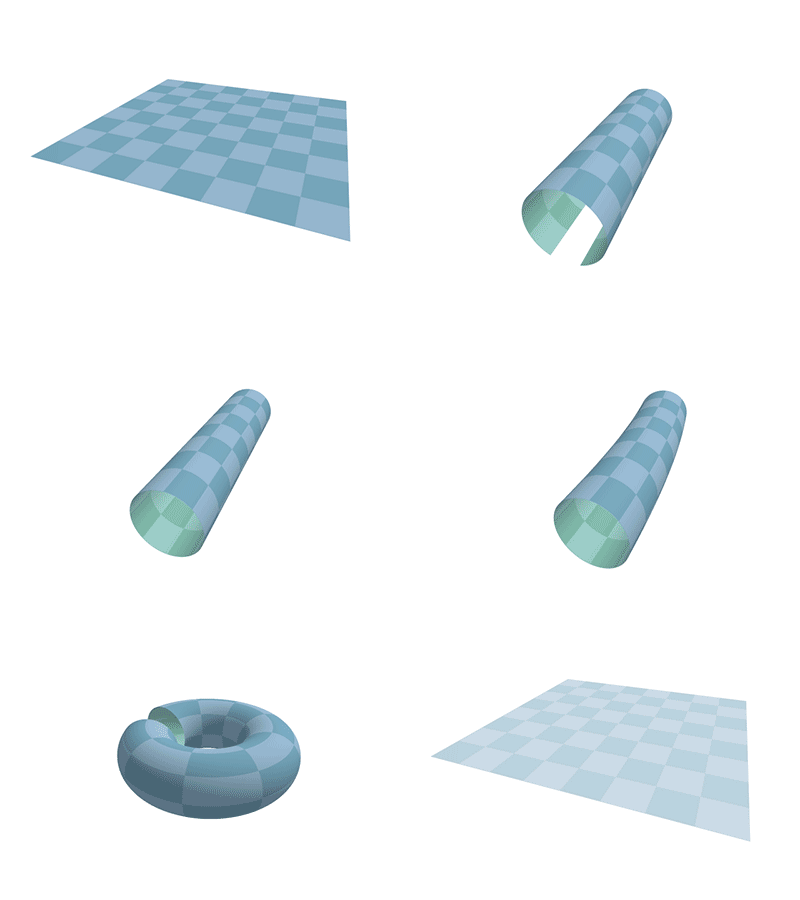 fringe thorn
fierce lily
yes, i mean how it wants to define?
fringe thorn
fierce lily
yes, i mean how it wants to define?
I don't understand the question 
fierce lily
fringe thorn
here's a GIF for the quotient space homeo to the 2-torus
seems like a plane that can be homeomorphic to 2 torus right?
fierce lily
fringe thorn
I don't understand the question <:kongouderp:483988392099446794>
probably you can just explain what does the equivalence class discussed next to 2 torus is talking about.
fringe thorn
fierce lily
probably you can just explain what does the equivalence class discussed next to ...
the equivalence relation is saying to take the left boundary of I and identify it with the right boundary of I, and then take the bottom boundary of I and identify it with the top boundary of I
fringe thorn
fringe thorn
https://upload.wikimedia.org/wikipedia/commons/6/60/Torus_from_rectangle.gif
as done in this GIF
the left and the right boundaries become the same thing under the identification, as do the top and the bottom
fierce lily
fringe thorn
the left and the right boundaries become the same thing under the identification...
may I ask what does identification mean?
just shaping like the same circle?
I mean when left and right boundary stick together, it shapes a circle, and same stuff happens to top and bottom boundary
fierce lily
fringe thorn
the left and the right boundaries become the same thing under the identification...
so it should be a typo here, we should have (a,b) related to (a', b') when (a,b)=(a', b') right?
for all other points
fringe thorn
fierce lily
may I ask what does identification mean?
informally, to identify two points in I means to treat them as the same point
the idea behind a quotient space X / ~ is to take a space X, identify a bunch of points together (we do this formally with equivalence classes), and then glue the points in each equivalence class together into one point (this is formally done by sending every element x in X to its equivalence class)
fringe thorn
fierce lily
so it should be a typo here, we should have (a,b) related to (a', b') when (a,b)...
yes, I believe so
fringe thorn
fringe thorn
the idea behind a quotient space X / ~ is to take a space X, identify a bunch of...
so in our example, we have X = [0, 1] x [0, 1], and we identify each (x, 0) with (x, 1) (i.e. every left boundary point to its opposite right boundary point), each (0, y) to (1, y) (i.e. every bottom boundary point to its opposite top boundary point), and every other point to itself. this splits up X into a set of equivalence classes, where every point on the boundary of the square is "the same" as its opposite point (meaning, they belong to the same equivalence class). now we just map every x to its equivalence class [x] to get our quotient space, and this "glues together" all the points in any particular equivalence class
prime elbow
tender halo
there is only one thing to do
okay
fierce lily
for part 3 about homeomorphism part: it writes universal property furnish mutually inverse functions which are both cont. But I am confused about if that universal property applies to all unique continous map? I know this phi is unique continuous here, but want to know how phi inverse is cont.


And also: why this phi is bijective?
prime elbow
for a prime p, S_p = {n in N | n is a multiple of p }
now take S = { S_p | p is a prime } union {{1}}, then S is a subbasis of N.
yes because union S = N.
but they ask for open sets, i know that open set looks like a set of all multiple of n, where n in N. i know there are more open sets so how can i write ?
prime elbow
i am wrong here
finite intersection of subbasis elements is set of multiple of squarefree integer
granite crane
prime elbow
for a prime p, S_p = {n in N | n is a multiple of p }
now take S = { S_p | p is ...
Wait wao is it from Carothers, interesting it contains interesting problem
limpid fern
fierce lily
for part 3 about homeomorphism part: it writes universal property furnish mutual...
let us suppose that Y is another space satisfying the universal property
we have a map q' from X to Y, so by universal property of X/~ q' factors uniquely through X/~ as q' = tilde q' circ q
now swap their positions
then q factors uniquely through Y as q = tilde q circ q'
tilde q' is a map from X/~ to Y and tilde q is a map from Y to X/~
what happens if you compose them? you get a map from X/~ to X/~
now if you apply the property of X/~ to itself you see that the identity also factors as
id = id circ q
so it follows that the composition is the identity
this argument can be rephrased slightly to prove that any construction given by a universal property is unique up to isomorphism (eg with the product topology)
also I recognize those lecture notes but I will not mention who wrote them here to avoid doxxing
prime elbow
granite crane
Wait wao is it from Carothers, interesting it contains interesting problem
no, but it helps you to prove that the set of primes number in Z is infinite
granite crane
I see.
prime elbow
i dont see why countable intersection of open dense set is non-empty, then dense ?
of R
usual topology
 vocal wharf
if you want to prove this yourself, my hint is ||you will have to use the fact that R is a complete metric space||
if you want to look it up, this is called ||the baire category theorem||
granite crane
prime elbow
i dont see why countable intersection of open dense set is non-empty, then dense...
Isn't it Baries category Theorem
prime elbow
granite crane
Isn't it Baries category Theorem
yes
prime elbow
vocal wharf
if you want to prove this yourself, my hint is ||you will have to use the fact t...
okay
to show that if X is metric space and it is separable then X is second countable.
let D be countable dense set, then say D as { d_1,d_2,....,d_n,....}
so we take the set { B(d_n,1/m) | n,m in N }, then it is a countable basis it will work right?
granite crane
prime elbow
yes
I proved it some time ago but still now sure that was correct lol
rancid umbra
prime elbow
to show that if X is metric space and it is separable then X is second countable...
yes, that should work
heady skiff
is the order topology a generalization of the standard topology on R
unreal stratus
In one way sure
The topology on R can be viewed as coming from an order or from a metric and if you generalise the first definition then yes
heady skiff
got acool thx
fierce lily
limpid fern
id = id circ q
for id circ q, it seems to map from X to X/~ to X/~, why this equality is true?
fierce lily
limpid fern
this argument can be rephrased slightly to prove that any construction given by ...
and which kind of construction must satisfy universal property? Like given cont map from X->Y, can I say all maps like X->X/~ or map from X/~->Y all satisfies that universal property?
limpid fern
limpid fern
id = id circ q
my bad this should be q = id circ q
limpid fern
fierce lily
and which kind of construction must satisfy universal property? Like given cont ...
the universal property essentially says that maps from X into Z correspond bijectively with maps from X/~ into Z
fierce lily
limpid fern
this argument can be rephrased slightly to prove that any construction given by ...
so you mean since X->Y is construction given by universal property, so unique up to isomorphism implies its bijective and also automatically satisfies its inverse cont right?
and also, I am still confused why the argument can prove that any construction given by a universal property is unique up to isomorphism ?
probably one more question that i need to ask: why universal properties furnish mutually inverse functions which are both continuous?
 languid patrol
fierce lily
probably one more question that i need to ask: why universal properties furnish ...
languid patrol
fierce lily
probably one more question that i need to ask: why universal properties furnish ...
Because of uniqueness
the universal property means that for any Z satisfying P there is a unique f: Z \to X_P satisfying some property
usually the identity from X_P \to X_P is one such map since X_P satisfies P, which means it's the only such map
limpid fern
fierce lily
and also, I am still confused why the argument can prove that any construction g...
Suppose X is a thing and Y is another thing with a map p: X to Y such that for any other thing Z and map f: X to Z, there is a unique map tilde f: Y to Z such that f = tilde f circ p.
now suppose Y' and p' are a thing and a map that also satisfy the above property
put Z to be Y' and put f to be p'.
do it analogously
heady skiff
how does one come up with a homeomorphism from (a, b) to R? I understand intuitively that we have to have some limiting behavior in the denominator, something like (b - x) in order to reach very large values, however the other parts i'm confused about/need a hint on
languid patrol
heady skiff
how does one come up with a homeomorphism from (a, b) to R? I understand intuiti...
can you get one from (a, b) \to (a, \infty)
because then you can do it step by step.
prime elbow
tender halo
there is only one thing to do
let x in cl(A), then for every open set of x A has non-empty intersection with it.
now there is a nested local basis at x, so B_1 \superset B_2 ..... so A has non-empty intersection with B_i, take x_n in A and B_n.
and for any open set U containing x, there is a B_m such that B_m \subset U and because they are nested so pick m, for all n>m x_n in U.
correct?
tender halo
yea
prime elbow
now i want to show that if X is first countable space then it has local nested basis at x
fierce lily
languid patrol
Because of uniqueness
so because we can know that phi is a (unique) continuous map, and it is a construction satisfying universal property, then we can say its inverse is continuous as well?
languid patrol
fierce lily
so because we can know that phi is a (unique) continuous map, and it is a constr...
the point is that let's say that X satisfies some universal property P in the category of topological spaces (morphisms are continuous maps)
then for any space Z satisfying P, there exists a unique continuous map f: Z \to X
languid patrol
then suppose X' is also universal for P, then there exists a unique continuous map g: X \to X' because X satisfies P, and a unique continuous f: X' \to X because X' satisfies P
but then f \circ g: X \to X is the unique continuous map X \to X induced by the fact that X satisfies P
and this should be the identity of X
so then f \circ g is the identity
but X, X' are totally symmetrical so by the same argument g \circ f is the identity on X'
so there is a unique isomorphism X \cong X' determined by the universal property
here is an example:
If A, B are two topological spaces, then there exists a unique space A \times B which satisfies the property that there exists continuous maps \pi_X: A \times B \to X for X = A or X = B and for every Z, a map f: Z \to A \times B is determined uniquely by specifying the maps \pi_X \circ f for X = A or B.
To make the universal property more formal: the set of maps {f: Z \to A \times B} is in bijection with the set of maps {f_1: Z \to A, f_2: Z \to B}
for any Z a topological space
the universal property shows that there is a unique map f: A \times B \to A \times B such that \pi_A \circ f = Id_A, \pi_B \circ f = Id_B, thus this map f has to be the identity map on the product.
now the argument above shows that the product of two spaces is unique up to unique isomorphism
languid patrol
languid patrol
the point is that let's say that X satisfies some universal property P in the ca...
technically this is a bad way to explain it, because usually P is not a property of the space, but instead an extra structure. But I don't know if belaboring that technical detail will be useful for you.
 quartz horizon
i do also like the yoneda perspective on this with representability
sometimes it’s a little nicer than the initial/final perspective, imo
fierce lily
languid patrol
so there is a unique isomorphism X \cong X' determined by the universal property
for this part, because f circ g identity map on X, g circ f is identity map on X' so it is unique isomorphism right?
languid patrol
fierce lily
for this part, because f circ g identity map on X, g circ f is identity map on X...
f and g are unique because of the universal property, they are isomorphisms because we verified that they are each others' left and right inverses
 cedar totem
what is an isomorphism and a diffeomorphism? what is the difference?
fierce lily
languid patrol
f and g are unique because of the universal property, they are isomorphisms beca...
so it means f and g are isomorphisms or isomorphism between X and X'?
fierce lily
cedar totem
what is an isomorphism and a diffeomorphism? what is the difference?
they are all bijection, but diffeomorphism will require the map and its inverse are smooth
languid patrol
fierce lily
so it means f and g are isomorphisms or isomorphism between X and X'?
g: X \to X', f: X' \to X so it seems to me that your two statements are the same, unless you wanted to ask something else.
fierce lily
languid patrol
now the argument above shows that the product of two spaces is unique up to uniq...
I am actually confused about what does product of two space is unique up to unique isomorphism mean?
languid patrol
fierce lily
I am actually confused about what does product of two space is unique up to uniq...
it means that if Z is any space with morphisms f_1: Z \to A, f_2: Z \to B such that for any space S the map of sets {g: S \to Z} \to {g_1: S \to A, g_2: S \to B} is a bijection (natural in S) then there is a unique isomorphism t: Z \to A \times B
such that \pi_A \circ t = f_1, \pi_B \circ t = f_2
fierce lily
limpid fern
Suppose X is a thing and Y is another thing with a map p: X to Y such that for a...
so in order to unique isomorphism, for any Z satisfying universal property and Y->Z, we can find two maps f1: X->Z, f2:Y->X such that f=f2 circ f1, it will show that map f is unique isomorphism?
quartz horizon
fierce lily
so in order to unique isomorphism, for any Z satisfying universal property and Y...
It’s difficult to parse what you’re saying here
fierce lily
quartz horizon
It’s difficult to parse what you’re saying here
I mean, probably you can explain what is unique isomorphism in category thm( or if universal property can automatically let unique isomorphism hold)
fierce lily
quartz horizon
It’s difficult to parse what you’re saying here
because I think I don't really know what is unique up to isomorphism
quartz horizon
fierce lily
I mean, probably you can explain what is unique isomorphism in category thm( or ...
It’s a little difficult to do this in generality
At least the way I would do it is introducing naturality
Hmmm actually
quartz horizon
fierce lily
I mean, probably you can explain what is unique isomorphism in category thm( or ...
Ok I can try to do this for products of sets first, if that’s ok?
Given two sets A and B, you can form the Cartesian product A x B. What it “is” is the collection of ordered pairs (a, b) for a in A, b in B.
But you can also ask what it “does”, how it relates to other sets, and what you can use it for. In particular, you can notice the following.
If you have a function f : Z -> A x B, it has to take the form f(z) = (g(z), h(z)) for some functions g : Z -> A and h : Z -> B. In other words, you can “unpackage” a single function f : Z -> A x B into a pair of functions g : Z -> A and h : Z -> B
Conversely, given two functions g : Z -> A and h : Z -> B, you can “package” them together into a single f : Z -> A x B, by defining f(z) = (g(z), h(z)).
This is what the Cartesian product “does”, and is called its universal property, since it tells you how it relates to every other set in the “universe”. What it does is let you package and unpackage pairs of functions!
You can notice that there are other sets which also let you package and unpackage pairs of functions - B x A “does” the same thing as A x B. Category theory then guarantees there’s a unique isomorphism between A x B and B x A which “plays nicely” with packaging/unpackaging in a manner you can make precise. This isomorphism just swaps the elements in the ordered pair
I gotta get to sleep now but I hope that’s somewhat useful
 novel plank

How would you solve exercise 2.5.2?
I don't see any straightforward way of proving this just using the definitions of induced topology
 heady skiff
my book states "every normal Hausdorff space is regular" without proof, but I'm struggling to see why - I know the intuition is that if we have a closed subset A of X and a point outside of A, then we can find disjoint open sets containing each, but who's to say that the singleton is closed?
or ig I haven't used the hausdorff condition anywhere
but still having trouble seeing
unreal stratus
heady skiff
why are the U_y an open cover for A?
There seem to be multiple typos
Lol
unreal stratus
Like they say U_x and U_y
Should be U_y and V_y in some order
Honestly I would just look up another proof to avoid confusion lol
heady skiff
okay
heady skiff
heady skiff
my book states "every normal Hausdorff space is regular" without proof, but I'm ...
lso why is this the case
are we assuming that singletons are closed
isn't that a separation axiom or whatever it's called
unreal stratus
heady skiff
are we assuming that singletons are closed
Which is implied by Hausdorff
unreal stratus
heady skiff
isn't that a separation axiom or whatever it's called
So is being Hausdorff yeah
"Singletons are closed" is T1 which is implied by Hausdorff aka T2
plush folio
novel plank
It should be a straightforward application of the induced topology, but a small difficulty is that you need the formula $f(V \cap f^{-1}(Z)) = f(V) \cap Z$. In general images don't preserve intersections, but for this we have equality. See if you can prove it
gentle ospreyBOT
sheddow

 scenic ridge
so the solution that I read of SO_3 being homeomorphic to V(3, 2) sort of confuses me
it says that an element of SO_3 can be described as a pair of orthagonal vectors each of length 1 as the third column is the cross of the first 2
V(3, 2) is obviously also a pair of orthagonal vectors of length 1
and thus they are homeomorphic (this is the part i dont get)
prime elbow
I want to characterize the continuous function from R with co-countable topology to R with usual topology.
since the closed set maps to the closed set, so for x in R, the preimage set of x must be countable.
Any hint?
prime elbow
To prove lower limit topology on R is not metrizable.
We know that if X is metrizable and it is separable then it is second countable.
But the lower limit topology on R is not second countable and it is separable so lower limit topology cannot be metrizable.
prime elbow
let A be infinite subset of A such that Z\A is also infinite. Define a Hausdroff topology on Z such that A is open and singleton set are not open.
any hint?
red yoke
prime elbow
let A be infinite subset of A such that Z\A is also infinite. Define a Hausdrof...
Do you know of a countably infinite Hausdorff topological space with no isolated points (open singletons)
 raw stag
red yoke
Do you know of a countably infinite Hausdorff topological space with no isolated...
raw stag
red yoke
Do you know of a countably infinite Hausdorff topological space with no isolated...
Q?
Under the induced topology from R?
red yoke
raw stag
Q?
You can take disjoint copies of this to get A and Z\A
raw stag
Yeah so cofinite topology or sth?
red yoke
Nah that's not hausdorff
raw stag
Sorry I meant coproduct topology
I always mess up the names
Apparently Z has a topology that is homeomorphic Q with this topology
It's the Furstenberg topology i think
prime elbow
red yoke
You can take disjoint copies of this to get A and Z\A
how? disjoint copies?
red yoke
prime elbow
how? disjoint copies?
Product of Q with some discrete space
Note that for any infinite cardinal κ, we have κ·|Q| = κ
heady skiff
does anybody know if this argument is wrong, since Y doesn't necessarily contain 0?

 languid patrol
heady skiff
does anybody know if this argument is wrong, since Y doesn't necessarily contain...
languid patrol
heady skiff
does anybody know if this argument is wrong, since Y doesn't necessarily contain...
what are X and Y
can they be any ordered set?
alpine nest
Subtraction also won't necessarily make sense in Y
bronze wadi
I get why f induces the bijection between open sets but can we go the other way?

I wanted to map x to a point contained in the intersection of the image of open sets containing x in X but I have no guarantee it will not be empty
heady skiff
heady skiff
does anybody know if this argument is wrong, since Y doesn't necessarily contain...
here could we maybe fix a in Y and consider the intersection of the preimages of (a, oo) under f and (-oo, a) under g?
well i guess this wouldn't work since if f(x) > g(x) then we don't necessarily have f(x) > a and a > g(x)...
hm
 dire dove
bronze wadi
I wanted to map x to a point contained in the intersection of the image of open ...
dire dove
bronze wadi
I wanted to map x to a point contained in the intersection of the image of open ...
X is open
Actually yes i see what you mean
Any surjective function from X to Y both with the indiscrete topology induces a bijection of open sets
I guess it should be "equivalently, f is a bijection and ... "
prime elbow
raw stag
It's the Furstenberg topology i think
Not necessarily, I think
raw stag
wdym
unreal stratus
bronze wadi
I get why f induces the bijection between open sets but can we go the other way?
As in, from a bijection on opens to a bijection on points?
Unfortunately not in general, but under some conditions, yes
raw stag
i was just saying that Z is homeo to Q with the frustenberg topology
prime elbow
raw stag
i was just saying that Z is homeo to Q with the frustenberg topology
When Q is subspace topology with respect to usual topology on R?
raw stag
obv
raw stag
i was not talking about your condition
prime elbow
Okay
But now I am thinking about how to prove that Furstenberg topology is homeomorphic to Q
prime elbow
What?🥲
raw stag
you know what metrizable is right?
prime elbow
A topology such that there exists a metric function on it such that it metrics topology same as given topology
raw stag
yeah
prime elbow
So how does it help me to prove that ?
prime elbow
Yes
raw stag
claim that any countable metric space without isolated points is homeo to Q
prime elbow
red yoke
Product of Q with some discrete space
Q×N, work?
prime elbow
raw stag
claim that any countable metric space without isolated points is homeo to Q
No idea
How bijection and continuous plays here ? Like i know there is a bijection function between that countable set to Q but do I show that the function is continuous or any different function is continuous?
raw stag
well the metric space thing is needed is what i would like to say
raw stag
prime elbow
How bijection and continuous plays here ? Like i know there is a bijection funct...
heres a reference
prime elbow
raw stag
heres a reference
Thank you ❤️
heady skiff
yo can someone let me know if they've ever heard of this pick up line before
are you the discrete topology? because man you are fine...
if X is a compact topological space, is X/~ also compact since it's the surjective image of X
sonic crane
heady skiff
are you the discrete topology? because man you are fine...
Nice
 rancid mantle
Hi! I'm having issues understanding pullbacks in topology. The ones that have the fiber product and the commutative square. I don't get why would they be useful nor what do they even mean. Also I'm still getting used to categories, universal properties and that sort of stuff, so please don't have that as a given with me.
The sort of things that I have to prove are like "prove homeomorphisms are stable under base change" or "composition of proper functions is proper".
 gentle crypt
rancid mantle
Hi! I'm having issues understanding pullbacks in topology. The ones that have th...
gentle crypt
rancid mantle
Hi! I'm having issues understanding pullbacks in topology. The ones that have th...
They help you glue spaces together, yeah?
rancid mantle
Isn't that the pushout?
I have a little less of an issue with that because gluing things together does feel intuitive
It would be nice to have something more useful than raw intuition though, but my main question is about pullbacks
 paper wedge
@rancid mantle
i wish i could help but i only know the regular pullbacks of functions under forms
ig in a way they are the same thing
rancid mantle
paper wedge
<#908108569688301649>
Are you sure? This deals a lot with category stuff. No differentials, no difeomorphism and no geometry.
paper wedge
then yeah ig this is way out of my level, i thought fiber bundles in geometry context.
ig maybe #advanced-algebra or #category-theory
rancid mantle
I found some stuff on internet about pullbacks in more general contexts but I really didn't understand a thing.
paper wedge
all what i can say is the pullback of a section is like a section on the pull back bundle
such that it is like a natural transformation in a way
rancid mantle
What is a bundle
paper wedge
ie the square diagram
paper wedge
rancid mantle
What is a bundle
do u know about smooth manifolds
rancid mantle
No
paper wedge
ig i won't be able to help you much as this is only the context i have ever seen this in
rancid mantle
This is my first topology course
red yoke
Pullbacks of topological spaces are just "product parametrized over a space"
quartz horizon
rancid mantle
Hi! I'm having issues understanding pullbacks in topology. The ones that have th...
Did you manage to understand pullbacks
prime elbow
Can someone tell me why we are always intersected in separate the points in topology?
tender halo
prime elbow
Can someone tell me why we are always intersected in separate the points in topo...
what?
i dont understand the question
prime elbow
tender halo
what?
They define regular topological space as the space, for any x in X and closed C such that x not in C then there exists disjoint open sets such that x in U and C contained in V.
So they say that we separate the points
prime elbow
Why are we interested in separation?
heady skiff
isn't this just bc the restriction of F to X x {y_0} is still continuous and similarly for k?
 tiny obsidian
Essentially
 keen seal
raw stag
claim that any countable metric space without isolated points is homeo to Q
keen seal
raw stag
claim that any countable metric space without isolated points is homeo to Q
this seems wrong
damn
guess I'm wrong
tender halo
prime elbow
Why are we interested in separation?
well thats kinda what we expect good spaces to look like
we want things to be "far away" from each other
prime elbow
thank you
tender halo
its a measure of how "fine" a space is
prime elbow
i am not sure but i want to show that if X is uncountable with co-finite topology then X cannot be second countable.
fix x in X. then intersection of all open sets containing x is {x}.
but how can i say that there exists countable basis B_i such that intersection B_i is {x}
if i assumed X is second countable
and yes {x}\subset \bigcap B_i
B_i contains {x]
rancid mantle
quartz horizon
Did you manage to understand pullbacks
Nope
rancid mantle
red yoke
Pullbacks of topological spaces are just "product parametrized over a space"
That seems better but I still don't understand why would that be true or where does that idea come from. Where's that parameterization?
quartz horizon
rancid mantle
Nope
Ooh ok I can try to explain if you like?
rancid mantle
Yeah sure
quartz horizon
So have you met the universal property of product, for starters?
rancid mantle
Yes. I can't formulate it right now but I got to use some universal properties successfully
Ah it's the one about the projections right?
quartz horizon
The way I like to think of it is in terms of “packaging” and “unpackaging”
For sets, if you have a function $f : Z \to A \times B$, it must take the form $f(z) = (g(z), h(z))$ for some $g : Z \to A$ and $h : Z \to B$
gentle ospreyBOT
Pseudonium
 quartz horizon
And conversely, if you have $g : Z \to A, h : Z \to B$, you can “package” them together into a single function $f : Z \to A \times B$ defined by $f(z) = (g(z), h(z))$
gentle ospreyBOT
Pseudonium
 rancid mantle
And if you are in some category other than set then you have the type of morphism from the category right?
quartz horizon
So this is what the product “does” - it lets you package and unpackage functions (or, in general, morphisms) with a common domain
quartz horizon
rancid mantle
And if you are in some category other than set then you have the type of morphis...
Yep
So the product of topological spaces lets you package and unpackage continuous functions
rancid mantle
And that is a consequence of the definition of product topology, right?


 quartz horizon
rancid mantle
And that is a consequence of the definition of product topology, right?
quartz horizon
rancid mantle
And that is a consequence of the definition of product topology, right?
Yep yep
So you have two perspectives here
What the product topology “is”, in terms of the specific construction and topology
And what the product topology “does”, in terms of letting you package and unpackage continuous functions
A big part of categorical thinking is being comfortable with interconverting between these two
What’s perhaps surprising is that knowing what something “does” determines what it “is” up to unique isomorphism (assuming that something satisfying the property actually exists)
All fine so far?
rancid mantle
Yes
quartz horizon
Now, what happens if you “unpackage” the identity A x B -> A x B?
rancid mantle
You get the projections
quartz horizon
Exactly! That’s essentially (half of) applying the yoneda lemma
rancid mantle
Or inclusions, I don't know which direction are unpacking
quartz horizon
Following where the identity goes usually leads you to useful places
rancid mantle
Oh wait the inclusions don't make sense
quartz horizon
quartz horizon
https://media.discordapp.net/attachments/834837272707727372/1263928509978640454/...
Its this diagram for unpackaging
We’ve just set C = A x B, and f to be the identity
rancid mantle
Yes
quartz horizon
For pullbacks, the other universal property you want to know is what I like to call “the universal property of subset”
Or subspace in this case
rancid mantle
quartz horizon
Following where the identity goes usually leads you to useful places
I'm not understanding this
What do you mean by the identity going somewhere
quartz horizon
rancid mantle
I'm not understanding this
We followed where the identity function went under “unpackaging”
And this got us the projections
rancid mantle
Right
quartz horizon
That’s all I really mean
We have some kind of way to transform morphisms into pairs of morphisms
And it’s useful to see how this transformation acts on the identity morphism
It often gives you a “natural” or “special” result
rancid mantle
quartz horizon
Following where the identity goes usually leads you to useful places
Just so I can keep this chip in my head until it shows up again (I suspect it will, from the way you phrased this), are there any other processes to apply to identity that I can follow to see what happens?
quartz horizon
rancid mantle
Just so I can keep this chip in my head until it shows up again (I suspect it wi...
Oh yeah lots and lots and lots
This is half of the yoneda lemma
Just following where the identity goes is a surprisingly useful trick
rancid mantle
I'm not familiar with that but I'll just keep it somewhere 😅
quartz horizon
Well you’re about to meet another example of it
quartz horizon
quartz horizon
For pullbacks, the other universal property you want to know is what I like to c...
With this
So say S is a subset of X
Then functions Z -> S naturally correspond to functions Z -> X whose image is contained in S
You can interconvert between the two
Does that make sense?
rancid mantle
Yes
quartz horizon
What’s useful is that this also holds for continuous functions
If S is a subspace of X (with the subspace topology)
Then continuous functions Z -> S naturally correspond to continuous functions Z -> X whose image is contained in S
You can check this using the definition of the subspace topology
rancid mantle
Yes
quartz horizon
This is what the subspace topology “does”, how it relates to other spaces
It lets you shrink the codomain of a continuous function
To a subspace containing the image
Now, what happens when you follow the identity S -> S?
rancid mantle
Wait I want to try to work it out
What I want to do is to take the identity on S and expand the codomain to X
So I get the inclusion
quartz horizon
Yep!
quartz horizon
rancid mantle
Just so I can keep this chip in my head until it shows up again (I suspect it wi...
So here’s your second example, haha
In this case, following where the identity goes gets you the inclusion map
You might also notice that in both cases, following where the identity goes describes one direction of the interconversion
“Unpackaging” for the product is just composing with the projections
And “expanding the codomain” for the subspace is just composing with the inclusion map
rancid mantle
Okay
quartz horizon
Ok so now for pullbacks
You wanna understand what a pullback “is”
But I think it’s useful to try and see what it “does” too
It’s similar to the product in that it “packages” things
Specifically, if you have A -> C and B -> C, then what the pullback P “does” is the following
Morphisms Z -> P naturally correspond to pairs of morphisms Z -> A, Z -> B which compose to the same morphism Z -> C
So it “packages” together the whole diagram A -> C, B -> C into a single object, P, such that morphisms into P naturally correspond to “morphisms into the diagram”
quartz horizon
quartz horizon
Morphisms Z -> P naturally correspond to pairs of morphisms Z -> A, Z -> B which...
It might be instructive to follow where the identity P -> P goes here
rancid mantle
Oh
quartz horizon
You can also construct the pullback as a product followed by a subset
Pairs of morphisms Z -> A, Z -> B correspond to a single morphism Z -> A x B
But you don’t want to consider all morphisms Z -> A x B. Only the subset of those which end up with equal composites to C after unpackaging
So the pullback will be a subset/space of A x B
quartz horizon
quartz horizon
You can also construct the pullback as a product followed by a subset
But this isn’t the only way to do it - often in special cases, there’s a nice description of what “morphisms Z -> A, Z -> B with equal composites to C” mean
rancid mantle
quartz horizon
Morphisms Z -> P naturally correspond to pairs of morphisms Z -> A, Z -> B which...
This is by definition? I mean, this is what you are defining the pullbacks to do right now, right?
quartz horizon
Yes
quartz horizon
quartz horizon
But this isn’t the _only_ way to do it - often in special cases, there’s a nice ...
E.g. preimages can be described by pullbacks
rancid mantle
quartz horizon
So it “packages” together the whole diagram A -> C, B -> C into a single object,...
Like you have the "whole" object in P and how it relates to A and B and you can then do whatever you want because you have the whole information encoded there?
And you also ask the information in P to not conflict when you go to C through A or B
quartz horizon
rancid mantle
Like you have the "whole" object in P and how it relates to A and B and you can ...
Yeah
rancid mantle
quartz horizon
So it “packages” together the whole diagram A -> C, B -> C into a single object,...
And why is this useful? This is something my course did not succeed in yet. We just proved properties about these things and used it to get a very strange definition of compact spaces, but it wasn't really useful up to now.
quartz horizon
quartz horizon
So it “packages” together the whole diagram A -> C, B -> C into a single object,...
It’s what I said here
quartz horizon
rancid mantle
And why is this useful? This is something my course did not succeed in yet. We j...
In the same way that a product is useful by “packaging” two spaces into one, a pullback is useful by “packaging” the data of 3 spaces and how they relate into a single space
They also come up in preimage and pullback bundles
rancid mantle
quartz horizon
It might be instructive to follow where the identity P -> P goes here
It will give morphisms P->A and P->B that don't conflict when composed with the other ones, but now I don't know what those morphisms look like. They are not projections or inclusions (I mean they will but I don't want to give answers that are not deduced by what is being said here)
rancid mantle
quartz horizon
But you don’t want to consider all morphisms Z -> A x B. Only the subset of thos...
Okay I think something clicked here