#point-set-topology
1 messages · Page 51 of 1
 grim knot
 tough hamlet
the discrete topology has every subset open
grim knot
yes sure, thank it makes sense
tough hamlet
np
grim knot
if two sets are homeomorphic does it mean that they share the same topology(?)
 ebon galleon
Fora homeomorphism f:X-->Y, if you identify elements of X with their image in Y, then yes
Strictly speaking though, they are likely different sets
So the topologies are probably not equal
grim knot
Okay, because for the exercises above, we are looking at continuous bijection between the above spaces
ebon galleon
Continuous bijections are not homeomorphisms in general
grim knot
what does fail here?
ebon galleon
A homeomorphism is a bijection f:X-->Y such that f and f^{-1} are continuous
Unlike with algebraic structures, where f being a bijective homomorphism implies (in many cases at least) f^{-1} being a homomorphism
You can have bijections where only one (or of course neither) direction is continuous
 grim knot
for example, we have a continuous bijection from $(\mathbb{R}, \mathfrak{O}_ {\text{disk}}) \rightarrow& (\mathbb{R}, \mathfrak{O}_ {eukl})$
(can somebody tell me how to do a subscript without getting a curl?)
ebon galleon
could do _{\text{disk}}
I think
Yes, this is an example of one such bijection
You have one too many $
grim knot
anyway, to the above message, if we have a continuous bijection in the other direction we would have a contradiction since one space is compact(right) and the other is hausdorff
ebon galleon
Before the second (\mathbb
 gentle ospreyBOT
damn_guuurl
Compile Error! Click the  reaction for more information.
(You may edit your message to recompile.)
 ebon galleon
grim knot
anyway, to the above message, if we have a continuous bijection in the other dir...
ebon galleon
grim knot
anyway, to the above message, if we have a continuous bijection in the other dir...
Not quite, spaces can be both compact and hausdorff
(think of [0,1]: it's hausdorff, and it's compact as a closed and bounded subset of R)
Any finite discrete space also works
grim knot
yes but in this case since$ (\mathbb{R}, \mathfrak{O} {eukl})$ is Hausdorff, and $(\mathbb{R}, \mathfrak{O} {disk})$ is not, there should be a contradiction(?)
gentle ospreyBOT
damn_guuurl
 grim knot
I took the wrong space....................
gonna write it in the old way
so, we have a continuous bijective function from R,O_eukl to R, O_cofin
which could be the identity
ebon galleon
Yes
grim knot
now if we had one in the other direction, we would have an isomorphism, which can not exist, since one space is Hausdorff and the other is compact
ebon galleon
(in fact, and map is continuous, so any bijection works for this)
grim knot
R, O cofin is not Hausdorff, is it right?
ebon galleon
grim knot
now if we had one in the other direction, we would have an isomorphism, which ca...
don't combine the two. You could either say that it cannot exist since cofin is compact and eukl is not (R is not bounded with standard topology), or you could say cofin is not hausdorff by eukl is hausdorff
ebon galleon
grim knot
R, O cofin is not Hausdorff, is it right?
correct
grim knot
Now I have it, thank you
 cursive tendon
Let $S \subset \mathbb{R}$, $L(S)$ be the limit points of $S$. Let $p \in L(S) \setminus S$, is it true that there always exists a neighborhood $N$ of $p$ such that $N \cap (L(S) \setminus S) = {x}$?
I see this is not correct in $\mathbb{R}^2$

 cursive tendon
oh, not really true. I think S = (0, 1) \ {1/n} and p = 0 will work as a counterexample
 dire moon
Hello ! For a simplicial set $S$ let $|S|$ be its realization. I think I saw a claim that $\pi_0(|S|)$ is in bijection with $S_0$ modulo the relation generated by
$x_0 \sim y_0$ iff there exists $x_1 \in S_1$ such that face maps map $x_1$ to $x_0$ and $y_0$ respectively.
I'm not sure I understand that claim. If points $x_0$ and $y_0$ in $S_0$ are path connected in the realization, can one show they belong to the same class for this relation ?
gentle ospreyBOT
plougue

 thorny agate
I don't get how $U$ is such that $\overline{U} \subseteq V$
 gentle ospreyBOT
Spamakin🎷
 ebon galleon
What do you mean? Think about open sets in R. For example, $\overline{(0,1)} \subseteq (-1,2)$
gentle ospreyBOT
Wizard King Ryx
 ebon galleon
Open sets can contain closed sets. In fact, for locally compact hausdorff spaces, we may always find a pair of such neighborhood around any point
thorny agate
that's not my question
my question is how is the U constructed in the proof such that it's closure is contained in V
ofc I know open sets can be contained in closed sets. Also local compactness has nothing to do with this
thorny agate
thorny agate
I don't get how $U$ is such that $\overline{U} \subseteq V$
I am referring to this image I sent here
ebon galleon
thorny agate
ofc I know open sets can be contained in closed sets. Also local compactness has...
Yes I know, I was just stating. My bad for misunderstanding which part you were looking at
Since g is 0 on U, then since g is continuous, $g(\overline{U}) \subseteq \overline{g(U)} = {0}$ is disjoint from ${1}$. If $\overline{U}$ was not a subset of $V$, it's image would have to intersect ${1}$
gentle ospreyBOT
Wizard King Ryx

 eager herald
so to use van kampen on $S^1 \vee S^1$, we choose to break up the set into two pieces: $S^1$ with a small arc in the other circle (that can deformation retract to a point) and likewise for the other part. Clearly van kampen says that since their intersection is path connected (and we only have 2 sets so the triple intersection thing is automatic) and since the intersection is simply connected, we get that $\pi_1(S^1 \vee S^1) = \mathbb{Z} \ast \mathbb{Z}$. my question is what goes wrong if we just make the two parts one circle and the other?
gentle ospreyBOT
sean
 eager herald
their intersection (the singleton on the basepoint) is path connected and obviously have trivial fudamental grp
ebon galleon
The two sets need to be open. If you just take each of the circles S^1 separately, they are not open in S^1 \vee S^1
eager herald
ohh that makes sense
 umbral panther
In practice you can thicken up closed regions to open regions in reasonable spaces, so it applies to closed covers. But if you glue two copies of the Hawaiian earrings at the basepoint, it doesn’t apply
grim knot
I know that this is in german, but I think it should be still understandable

Can somebody tell me what it means to glue these two spaces through the given function phi?
Does somebody also have easier examples?
 trim chasm
can't both be true?

 hidden crag
grim knot
Can somebody tell me what it means to glue these two spaces through the given fu...
hidden crag
grim knot
Can somebody tell me what it means to glue these two spaces through the given fu...
We’ve talked about that before, were you able to work it out back then?
grim knot
hidden crag
We’ve talked about that before, were you able to work it out back then?
I have too many things in my head, and I do not understand it anymore
I just do not see in my head what this looks like
is the idea that you glue A and f(A) together?
hidden crag
Yes
Now think about what z^15 does and work through the definitions
Take your time
grim knot
I forgot complex analysis
does it mean that if $z = re^{i{\theta}}$, that then we would have a more streched out number? $z = r^{15}e^{i15{\theta}}$
gentle ospreyBOT
damn_guuurl
 hidden crag
And what does that mean
grim knot
I mean it looks like we identify the whole C to f(C) besides from the disk $D^{2} = {z| |z|<1}$
gentle ospreyBOT
damn_guuurl
 hidden crag
Yeah X is just that subset
You identify x in X with f(x) after taking the disjoint union
Now think about what this will result in
grim knot
If I do not see it wrong, these spaces are glued for |z|>1, which means that we identify them in that case
but we have like a ball for |z|<1
or wait a sec
I'm gonna make a drawing
It's hard to draw, but i think I see it now

 feral copper
Heyo! So I have two submanifolds X and Y of some ambiant manifold, and I assume that Z=X∩Y is also a submanifold. Moreover, for all point p∈Z, I have that codim(TpX∩TpY)=dim(Z). I have been told that this type of intersection is called 'neat' (the case dim(Z)=0 is a transverse intersection). Is that standard terminology?
umbral panther
feral copper
Heyo! So I have two submanifolds X and Y of some ambiant manifold, and I assume ...
You mean dim = dim, not codim = dim, right?
Neat is kind of standard, but rarely useful. Transverse is very standard, but this definition is wrong. You can have high dimensional transverse intersection. The definition of transverse is that the two tangent spaces together span the ambient tangent space. Sometimes people say that the sum is the whole tangent space. Equivalently the codim of the intersection is the sum of the codim of the two manifolds
feral copper
Yes my bad, dim=dim!
Yes you're right I could have transverse circles in a manifold with bigger dimension than 2 🙂
In my case, I have neat intersections everywhere, and it's not obvious how to perturb things to become transverse... (neat intersections of surfaces along curves in a 4-manifold)
Thank you! 
umbral panther
I think neat should be locally equivalent to transverse in a submanifold
feral copper
Wdym?
As long as the sum of dimensions is less than that of the ambiant space, I can always perturb to be transverse
But if I have, say, two spheres meeting neatly along a circle, that doesn't tell me anything regarding the transverse intersections of the perturbation, right?
(again, I'm only thinking of knotted surfaces, not anything other-dimensional 🙂 )
umbral panther
If X and Y intersect neatly in M and M embeds in N, then X and Y intersect neatly in N. This is supposed to be obvious. If X and Y are transverse in M they are no longer transverse in N because there’s more room to wiggle
I’m suggesting the converse, that if a curve and a surface intersect neatly in points in a 4 manifold N that near one of the points of intersection the curve and surface should be contained in a 3 manifold M in which they are transverse
feral copper
'room to wiggle' idk, I'd say that an empty intersection is transverse 
Aaaah I see, okay! Yeah that makes sense, although I wouldn't trust it to be so easy 🙂
There are always bizarre 'jokes' in topology, and I've learnt not to be decisive about anything and try to find counter-examples to everything!
Anyways, thanks a lot for your output 🙂 I couldn't find anything anywhere talking about 'neat intersections'
umbral panther
It’s not something people prove theorems about. You just observe that a particular example is neat. Whereas transversality is useful because it creates neat intersections. If you have a neat intersection it’s because you already understand your example pretty well
 fallow ginkgo
Dumb question but
How do I "quickly" check that certain maps that come from homotopy are infact continous.
Eg : $h,h' : X \to Y$ and $k,k' : Y \to Z$ be pairs of homotopic maps. Then $k \circ h$ and $k' \circ h$ are homotopic.
Proof : Let $H,K$ be the homotopies. Then consider the homotopy $F:[0,1] × X \to Z$ defined by $F_t = K_t \circ H_t$.
gentle ospreyBOT
Noob666
 fallow ginkgo
I feel I'm missing something very simple
2nd question, how do I put this situation into a "functoriality" statement. Like composition of maps is corresponding to something about homotopies that "looks like composition".
 unreal stratus
Tbh I would usually do it just by not thinking of homotopies in that way lol
Well like just gluing maps of the form A x I -> B directly
fallow ginkgo
what way would you recommend?
unreal stratus
Here you can just give a nice formula for the homotopy and it is easily seen to be contjnuous
Well like you want a map X x I -> Z
ebon galleon
Well F is a composite of continuous maps, so F is continuous. If you check when t=0 and t=1, it should give you kh and k'h'
But what potato is suggesting might be clearer
unreal stratus
You can just do like (x,t) -> K(H(x,t),t)
unreal stratus
ebon galleon
Well F is a composite of continuous maps, so F is continuous. If you check when ...
That's not enough
Well
F isn't a complosition as given
So you should just write that out imo lol
fallow ginkgo
unreal stratus
You can just do like (x,t) -> K(H(x,t),t)
Ohhh yes that makes sense
ebon galleon
That's what I had in mind
fallow ginkgo
Also, I keep seeing people mention "the space of all paths on X". Any source where I can read about this perspective?
unreal stratus
There are a few things that can mean, but likely the loop space is meant
ebon galleon
fallow ginkgo
2nd question, how do I put this situation into a "functoriality" statement. Like...
This statement should essentially be that composition of homotopy classes of maps is well-defined.
We can take a category hTop, whose objects are spaces, and morphisms are homotopy classes of maps. This gives us our composition rule (since we know that the assignment [f] \circ [g] := [f \circ g] is well-defined)
This in itself is not so much about functoriality afaik
unreal stratus
This is showing the obvious functor Top -> hTop is actually a functor ig
ebon galleon
ig, but that's obvious provided hTop is a category lol
 formal tide
rereading munkres I just noticed this definition does not work for a one element set :p

is there a nicer way to define the order topology that works? other than adding a 4th clause
 languid patrol
@formal tide I mean you’re only including one extra space… I don’t see a natural way to extend it
thorny agate
how do you have an order on a 1 element set?
formal tide
languid patrol
<@126481328135864320> I mean you’re only including one extra space… I don’t see ...
hmmmm I think there should be some universal property but I'm not finding it
formal tide
thorny agate
how do you have an order on a 1 element set?
a <= a; that's it.
 gaunt laurel
Hi, would I need to know field theory or galois theory for chapters 1 to 3 in Hatcher?
 novel acorn
gaunt laurel
Hi, would I need to know field theory or galois theory for chapters 1 to 3 in Ha...
novel acorn
gaunt laurel
Hi, would I need to know field theory or galois theory for chapters 1 to 3 in Ha...
not really
gaunt laurel
Ok, thank you
unreal stratus
No
formal tide
formal tide
hmmmm I think there *should* be some universal property but I'm not finding it
It seems that "the coarsest topology having all closed intervals as closed sets" works but that's still not a universal property
nvm doesn't work for non bounded tosets
 nocturne matrix
I'm not sure this is the right channel for this question, but here it goes
Is it true that with the statement "a set $S$ has $\infty^n$ elements" we mean that there exists a bijection $\phi:S \to \mathbb{R}^n$?
gentle ospreyBOT
Plagionotus
 tough hamlet
no
feral copper
Does that even mean something? Also, is that #point-set-topology?
tough hamlet
also wrong channel
feral copper
It depends, did you read this sentence in a book/lecture note? Because if not, it's general math discussion or a general question
If you did, what course/level? Also, if you did, that's a bad teacher 
Maybe that's linear algebra, and this is a clumsy way to say your space has dimension n?
nocturne matrix
well I was taking Geometry 2 so we did some affine, euclidean and projective geometry. The notation was used to quantify how many planes are in a sheaf of planes and the teacher said it can be roughly interpreted as "the set is in bijection with R^n" but it was just some qualitative reasoning and she said we would give a proper meaning to it in topology. I know the notation is sometimes used to say a vector space has dimension n but I have never actually used it in that context
feral copper
The set is in bijection with R^n
You agreed yourself that n is irrelevant here, so most likely the teacher meant something more than a mere 1:1 correspondance. I have honestly never seen this notation, and I'd say it's a terrible notation just because I cannot imagine any reasonable meaning behind it. Not that I'm knowledgeable or anything, just that it should be a bit obvious what it should mean
nocturne matrix
We said that a fan of planes has $\infty^1$ planes while the set of all planes passing through a given point in space (idk the english name) has $\infty^2$ planes.
gentle ospreyBOT
Plagionotus
 feral copper
Oh a pencil of planes? But I've never seen this \infty^n notation before
Maybe try #algebraic-geometry? But don't tell them I sent you
nocturne matrix
pencin, sheaf and fan of planes should all be the set of planes containing the same given line
idk the name of the other
languid patrol
@formal tide you could just add the condition that X \in \tau, as long as the whole space is in there you’re fine.
formal tide
languid patrol
<@126481328135864320> you could just add the condition that X \in \tau, as long ...
yup, I ended doing that for my notes, ty
 balmy field
Does anyone know a crazy, accessible fact (intro topology and good complex analysis) about the Riemann sphere? I’ve seen the conformal mappings. Wondering if there was anything crazy though
 tawdry widget
Hi, I need help with the definition of regular neighborhood, and a question about linking number.
F is an orientable, compact, connected genus g surface with n boundary components, with 2g+n-1 generators of its first homology group as shown in the first picture:

My question is about the second picture. What is the definition of the regular neighborhood V of F in this case?
I am not sure I got it correctly, which leads to another question, why is the linking number lk(e_i, f_i)=1? Since I thought e_i, f_i are parallel, why 1 not 0?

 broken nacelle
gaunt laurel
Hi, would I need to know field theory or galois theory for chapters 1 to 3 in Ha...
broken nacelle
gaunt laurel
Hi, would I need to know field theory or galois theory for chapters 1 to 3 in Ha...
you need only some ring theory for cohomology
 abstract saffron
tawdry widget
abstract saffron
tawdry widget
lol, another knot theorist fellow 😄
tawdry widget
I don’t study knot theory I am just interested in it…. It’s gtm 175…
Should be contained in basic algebraic topology so I asked here…
abstract saffron
I like this book, but tbh, it has the least transparent proof of this prop
I read it a couple times, never cracked it either 😄
tawdry widget
You know other references? Of this proposition?
abstract saffron
man, it's been some time since I studied knot theory, not sure if I remember anymore
tawdry widget
I see
I will probably figure out what V is, I am still in need with explanation why lk(e_i, f_i)=1 though
abstract saffron
for minor-related things, try a short intro to alexander polynomials by massuyeau
https://massuyea.perso.math.cnrs.fr/notes/Alex.pdf
which is a dirty version of Intro to Combinatorial Torsions by Turaev
Lickorish is very good, but when it comes to Alexander polynomials, I really recommend going through other books and combining multiple sources. Lickorish didn't do it justice.
tawdry widget
Thank you I will check it out. It seems like it’s more general, Alexander polynomial for CW complexes. I didn’t know that, thank you so much.
abstract saffron
Another one with good intro to Alexander polynomials is Knot Theory & Its Applications by Murasugi.
Albeit you kinda need to know Seifert surfaces first, but if you do, the link to Alexander polynomials is transparent with this book
abstract saffron
tawdry widget
Thank you I will check it out. It seems like it’s more general, Alexander polyno...
yes, Alexander polynomials is the characteristic polynomial of Khovanov homology, iirc
tawdry widget
You know textbook about it?
abstract saffron
abstract saffron
yes, Alexander polynomials is the characteristic polynomial of Khovanov homology...
Or Floer homology. Never remember which one is Alexander's and which one is Jones'
tawdry widget
Jones polynomial has generalization too?
abstract saffron
tawdry widget
You know textbook about it?
Turaev is de facto the bible of advanced knot theory.
It introduced a lot of advanced tool. But you really need to be good at Alg Topo for this one
abstract saffron
tawdry widget
Jones polynomial has generalization too?
Oh yes
Wait till you see you can combine both homologies to get what's called HOMFLY homology
the characteristic polynomial is like, the combined of both Jones and Alexander
tawdry widget
I see
tawdry widget
abstract saffron
Turaev is de facto the bible of advanced knot theory.
What book are you referring to?
abstract saffron
abstract saffron
which is a dirty version of Intro to Combinatorial Torsions by Turaev
this one
it's lecture note from a course in Knot Theory at ETH back in 1990s
tawdry widget
I see, thank you very much.
tawdry widget
abstract saffron
Albeit you kinda need to know Seifert surfaces first, but if you do, the link to...
I know the definition of Seifert surface. I don’t know why the standard way of constructing one for a given knot gives you the Seifert surface with minimal genus though.
abstract saffron
... because it doesn't?
the construction of seifert surface depends on the knot diagram. Different diagrams give different surfaces, with different genuses.
It's only for some certain classes of knot, that it's proven that certain types of diagrams give rise to surfaces with minimal genus.
tawdry widget
What certain types?
abstract saffron
iirc, alternating knots are one of the classes
In general, computing minimal genus is NP-complete. That should show how hard it is.
abstract saffron
abstract saffron
iirc, alternating knots are one of the classes
yes, I was correct. Proven by Crowell. See page 60 of Lickorish.
tawdry widget
I see. Thank you.
Do all of those we discussed, have generalization in more general case? Like higher dimensional? K (homeomorphic to S^n) in S^(n+2), and this higher knot K has a Seifert surface F of dimension n+1 whose boundary is K. Something like that? And Alexander matrix, Alexander module, Alexander ideal, linking number used to calculate Alexander matrix… these kind of things?
abstract saffron
So Alexander polynomial is the Euler characteristic polynomial of Knot Floer homology.
We study the homology groups from here, and less the polynomial. Euler characteristic is just one tool, and not the most powerful too. We have a far bigger arsenal at disposal from Homology Theory.
recently, there has been a paper about constructing Seifert surfaces from differential geometry's point of view, so we can expect an even bigger arsenal from Analysis.
One example about higher dimensional is perhaps slice knots, which are the boundary of D^3 (in comparison with trivial knot, which is the boundary of D^2).
tawdry widget
Yeah. The thing is I saw some articles talking about those things in the case of dimensions 2, just like dimension 1, I thought maybe they are some general thing for any dimension.

Like this one, Alexander modules for dimension 2, those things, linking numbers , just look similar to the dimension 1 case. Also some articles talking about coloring, reidmeister moves, of knotted surface. It really makes one think they are general things…
abstract saffron
knot theory is a deep, deep rabbit hole 😄
tawdry widget
I see.
If I could know that there is no such generalization yet, it would also be a relief .
abstract saffron
tawdry widget
Like this one, Alexander modules for dimension 2, those things, linking numbers ...
I mean, we do know how to build these things for knots, it's almost straightforward to do the same for other things. Reidemeister moves -> colourability -> Alexander matrices and polynomials -> homology -> ??? -> profit
I expect there are generalisations, but again, knot theory is very young. We only have the most powerful tools, e.g. Khovanov-Rozansky triple-graded rings and Rasmussen's s-invariant, for almost 20 years.
Rasmussen is still alive, for example
tawdry widget
I see. I need to search harder. Speaking of coloring, coloring of a classical knot involves a quandle. (mappings from arcs of the knot diagram to a quandle). There are higher knots, but are there things like quandle , for higher dimensional cases?
abstract saffron
I didn't even know there was a thing called a quandle 😄
Strange, I never saw it mentioned anywhere
I guess there are, otherwise it'd be difficult to define more advanced tools. But again, I'm not well-versed in higher dimensional generalisations like this one
tawdry widget
I see. Last thing, do you know reference of proving any knot is either torus, satellite or hyperbolic?
abstract saffron
Oh man, lol. That fact is really, really deep
tawdry widget
I see. Never mind then. I am only interested in algebraic things for now… if it involves lots of analysis I will pass…
abstract saffron
the original proof of that is by Thurston
William P. Thurston. Three-dimensional manifolds, Kleinian groups and hyperbolic geometry.
Bull. Amer. Math. Soc. (N.S.), 6(3):357–381, 1982.
this was a huge breakthrough in knot theory back in 1980s
tawdry widget
Yes yes, they all say it’s proven by this mathematician Thurston. I just wasn’t able to find his article. Thanks a lot
abstract saffron
man, he basically won his Fields Medal for this 😄 so good luck
tawdry widget
🥲
No wonder they say “ Thurston famously proved that…”
I will save it for a day in the future far from now…. But thank you.
abstract saffron
Just to show its power, in 2020, they used this fact to classify all prime knots up to 19 crossings
That's also how I learned about the fact, and who proved it
tawdry widget
My god…
abstract saffron
I told you Knot theory is very young 😄
tawdry widget
I see. I am just interested in it, only looking for the most general results, that fit all dimensions for now. I am not ready to read any advanced result about specific things like “classification of knotted sphere up to 6 crossing”
abstract saffron
ehh, nothing is gonna fit for all dimensions
There's a reason we have knot theory, as opposed to higher dimensional topology
tawdry widget
I thought you said Alexander this Alexander that… those are general…
abstract saffron
low dimensional stuff is just weird
abstract saffron
tawdry widget
I thought you said Alexander this Alexander that… those are general…
to dimension 4, maybe. But I don't think there are those things for higher dim. We have a lot more tools when it comes to higher dims.
tawdry widget
I see. When you say dimension 4, do you mean 2-dimensional K in S^4? Or do you mean 4-dimensional K in S^6?
abstract saffron
very good question 😄 I'm not well-versed in this, I only know classical knot theory
gotta let someone else answer this
tawdry widget
No you have already told me many things I have never heard of. I have a lot of searching to do after this.
Thank you again, especially for those references. Before this conversation I only know Lickorish 😂
abstract saffron
A good resource to accompany Lickorish is a series of lectures on knot theory on YouTube. The most famous one, really
tawdry widget
With 10 episodes right
abstract saffron
"Math at Andrews", yes
tawdry widget
I don’t like him though, he rarely gave any proof…
abstract saffron
it's very informal, but also gives lots of insights and where to go, where to search
I only understand knot theory with intuition built from that series. Ain't no way I could grind through abstract gibberish by Turaev
another one is the series of lectures on knot theory from Princeton's summer school, given by Rasmussen himself. Also a lot of insights and intuition, but you kinda need to be somewhat well-versed in Alg Topo and Ring theory.
Finally, there are some lectures on hyperbolic knots too, mostly famous after Lisa Piccirillo proved that Conway knot is not smoothly slice.
Now these ones require some intuition and well-versed with geometry
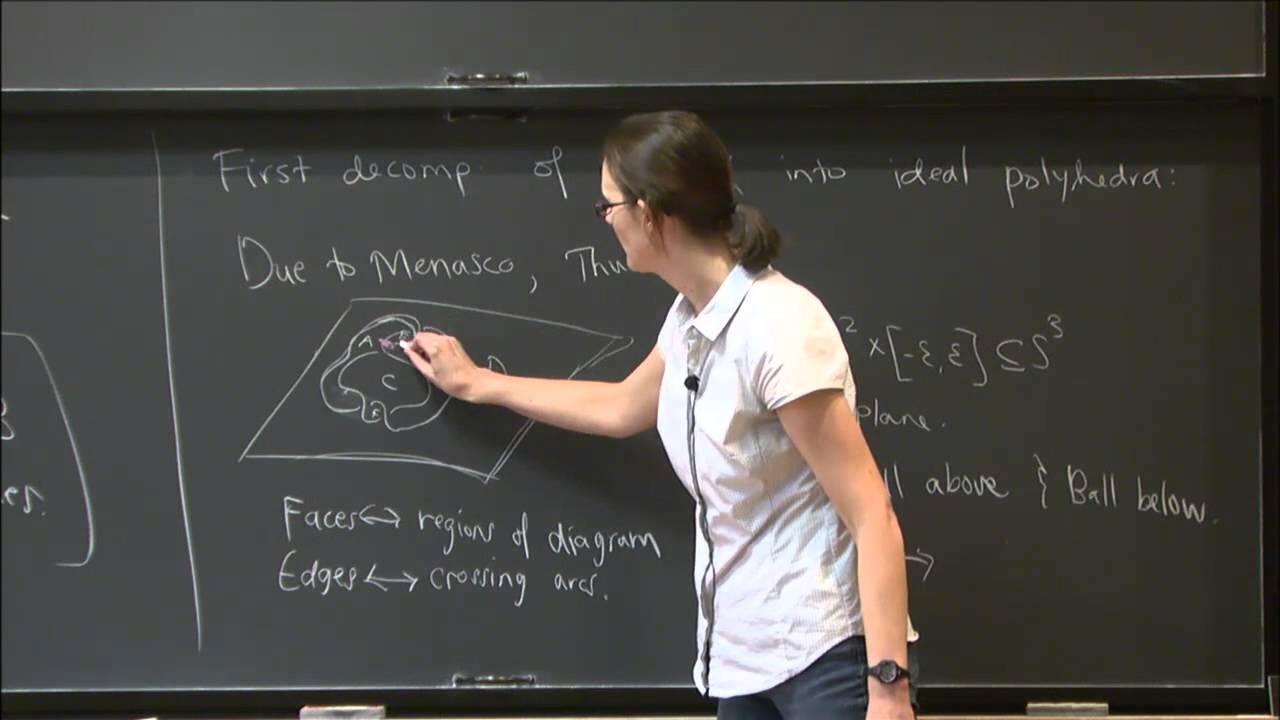
Jessica S. Purcell
Brigham Young University; von Neumann Fellow, School of Mathematics
October 20, 2015
https://www.math.ias.edu/seminars/abstract?event=83224
We will discuss methods of decomposing knot and link complements into polyhedra. Using hyperbolic geometry, angled structures, and normal surface theory, we analyze geometric and topolo...
 tawdry widget
Thank you so much. The preliminary knowledge you mentioned.
Algebra: I have finished most of basic algebra by Jacobson. I probably have the algebra background needed.
Algebraic topology: I read gtm 119 rotman. But I feel lost when people talk about duality. Alexander duality, Poincaré (? Idk) duality… all those dualities…
Geometry: I don’t know what kind of geometry I should read. Like I have no idea about “surgery”, in idk, differential topology?
abstract saffron
Idk what should be required in Geometry. I studied Differential Geometry and am familiar with surgery, and it comes up from time to time, but only as an intuition and not really involved in proofs.
I guess if you have strong intuition with 3- and 4-dimensional objects, then that should be enough. For example, you should know how to build Seifert surfaces from knot diagrams with surgery.
For Algo topo, duality is not really that fancy 😄 I'd recommend Nakahara for intro (but I guess you passed that point already) and Munkreas. Although almost everyone in this channel would recommend Hatcher.
Idk how much algebra there is in Jacobson tho.
tawdry widget
I probably wouldn’t worry about algebra, or homological algebra. I guess I need to learn more about topology.
abstract saffron
also shout out for spelling Poincaré in French
tawdry widget
Idk, it was just auto spelling of the keyboard.
abstract saffron
abstract saffron
I guess if you have strong intuition with 3- and 4-dimensional objects, then tha...
another good test is to visualise geometrically and to draw out what's going on in Chapter 2 of Lickorish
in particular Theorem 2.10. That one took me good a good hour, def putting intution to the test.
tawdry widget
I see. I will definitely continue with Lickorish. I am attracted by the way he introduces Alexander polynomials, in a IDK, geometric way…
That X^infty thing
abstract saffron
abstract saffron
Another one with good intro to Alexander polynomials is Knot Theory & Its Applic...
do couple it with this book
tawdry widget
Yeah, already downloaded it
abstract saffron
There are at least 4 ways to define Alexander polynomials
If you can't find at least 3 ways, then you haven't understood it yet.
tawdry widget
How many have you told me.
tawdry widget
Only one… which I am still reading…
abstract saffron
so, in that intro series to knot theory on YouTube by Andrews, he defined Alexander polynomials as a generalisation of k-colourability.
tawdry widget
Yeah some matrix with elements like -1, 1-t things
abstract saffron
iirc, a knot is k-colourable if and only if k divides Alexander polynomial, evaluate at 1
that's the first way
abstract saffron
abstract saffron
Another one with good intro to Alexander polynomials is Knot Theory & Its Applic...
this one defines Alexander polynomials from Seifer surfaces, as the det of that matrix of linking numbers with some minus of transpose to make it invariant
that's the second way
I'll let you find one more by yourself
abstract saffron
abstract saffron
this one defines Alexander polynomials from Seifer surfaces, as the det of that ...
i.e det of Seifert matrix
I see Lickorish defines the same, although somehow I found it less transparent
abstract saffron
abstract saffron
https://www.youtube.com/playlist?list=PLldN_DpkXL3ZuSpCA7e2yNqn8lZ4YsJsc
the fourth way I know is in this series, although I didn't understand a single thing
there. minute 17, first lecture
 tawdry widget
I see. That’s awesome. It definitely helps to know equivalent ways to define it.
abstract saffron
proving that they are equivalent is worth a Master thesis 😄
knot theory is a very deep rabbit hole
tawdry widget
God… then I only hope in the future I will be able to understand the equivalence between two of those four…
Thank you so much , will keep reading. Big help today.
abstract saffron
U r welcome
Glad that my studies of knot theory helped. No one in this server except me studied knot theory anyway.
😭
tawdry widget
😂 I hope they discuss more about it, since I don’t view it as some very specific topic… it sounds like a general, main, broad subject to me
 scenic trellis
does anyone have recommendations for textbook (or lecture notes or talks) on cerf theory
scenic trellis
scenic trellis
does anyone have recommendations for textbook (or lecture notes or talks) on cer...

Mathematics Stack Exchange
Are there any good references for Cerf theory, written in English? The main references I see are usually Cerf's own papers in French. In particular, I am looking for a source developing the fundame...
 tiny ridge
scenic trellis
does anyone have recommendations for textbook (or lecture notes or talks) on cer...
tiny ridge
scenic trellis
does anyone have recommendations for textbook (or lecture notes or talks) on cer...
What do you want to know
If you want to learn the pseudoisotopy theorem I would recommend Sanders Kupers' book "Diffeomorphism Groups" available online
scenic trellis

scenic trellis
tiny ridge
What do you want to know
I want to the case if I have a family of functions between two morse functions on manifold M that is parameterized by smoothly moving a point on another manifold N
mmm i think it is basically same as cerf's one-parameter family case (right?)
 nimble portal
A punctured closed ball in R^2 is open right?
ebon galleon
Like a closed unit ball (norm <=1, let's say), but a point is removed? No
 steel glen
nimble portal
A punctured closed ball in R^2 is open right?
steel glen
nimble portal
A punctured closed ball in R^2 is open right?
does it still contain some boundary points?
ebon galleon
Right
nimble portal
It’s punctured
ie centerpiint removed
It’s not closed because it doesn’t contain all of its bd (as the point we puncture at becomes a bd pt, but it won’t contain that)
And it’s not open because not every point has an open ball around it contained entirely in the set (take the points where x^2 + y^2 = 4, for example)
ebon galleon
Right
nimble portal
Any point on this set necessarily has elements outside of the set for all epsilon > 0
ugh
This is funny
This is a pretty good example
Really natural construction to show how sets can be neither open nor closed (and I’m sure there’s a good example for clopen too)
steel glen
in general, if you contain some, but not all, your boundary points, you are neither open nor closed
clearly the set isn't open, and the complement will also not be open for similar reasons
ebon galleon
empty set be clopen 
 queen prism
easiest example of a not-closed-nor-open set would be [0, 1) in R
nimble portal
Yeah
steel glen
is svk van kampen?
 novel ember
yes
nimble portal
ebon galleon
empty set be clopen <:sotrue:826971355542192148>
And the entire space in the discrete topology :p
steel glen
i think we know they meant every subset
nimble portal
Topology contains the entire space
So it’s definitionally open
Its complement is then the empty set which is also open
Hence it’s closed as well
Yes?
ebon galleon
Right
 hoary breach
you're welcome
 coarse mist
I have to show that the collection
B = { (a, b) | a < b, a and b rational}
is a basis that generates the standard topology on R
But isnt the topology generated by this basis courser than the basis used to generate the standard topology?
Because the standard topology includes basis items like (-sqrt2, sqrt2), and this one doesnt
 gritty widget
"topology generated by B" is not just B
ebon galleon
They produce the same topology still, even though one basis is a subset of the other
gritty widget
it includes a little more than that
coarse mist
Even if they generate the same topology, isnt there still some open sets in the standard topology that arent in the mentioned topology?
gritty widget
"even if they generate the same topology, aren't they different?"
ebon galleon
coarse mist
Even if they generate the same topology, isnt there still some open sets in the ...
No. The statement that they generate the same topology means that the topologies generated have exactly the same sets
coarse mist
Right, but how does the first collection of bases “attain” sets that have irrationals as their endpoints
if what im asking doesnt make sense feel free to just tell me and ill move on and come back to it
somethings j not clicking so it’ll probably help anyways
ebon galleon
So the proper way to show that would be to show that, for bases B and B', for any $x \in U \in B$, there is a $U' \in B'$ with $x in U' \subseteq U$, and vice versa (iirc at least). (Or show that each basis element of one is open in the others topology)
In this case, you can think about it as approximating the intervals with irrational endpoints, with ones that have rational and points. For instance, for the interval (0, sqrt(2)) we can find a monotonically increasing sequence ${x_n}$ of rationals that converges to sqrt(2). Then the union $\bigcup_{n=1}^\infty (0, x_n)$ shows that (0, sqrt(2)) is open with respect to the basis with rational endpoints
gentle ospreyBOT
Ultrawizard King Ryx
 ebon galleon
Sorry for any typos, typed on phone :/
queen prism
your basis doesn’t include intervals with irrational endpoints but they can still be contained in the resulting topology
so in some sense including intervals with irrational endpoints is redundant
 vast stump
Hii pls fill this form out it doesn't take much time its a survey pls its for english class

 limber wren
coarse mist
Because the standard topology includes basis items like (-sqrt2, sqrt2), and thi...
limber wren
coarse mist
Because the standard topology includes basis items like (-sqrt2, sqrt2), and thi...
every interval (a,b) is the countable union of of intervals with rational endpoints, so in terms of the topology the two bases generate, rational/irrational endpoints won't make a difference.
feral copper
vast stump
Hii pls fill this form out it doesn't take much time its a survey pls its for en...
@unborn lotus might wanna remove this spam. Also, Happy Birthday
feral copper
Where can I read more about this Euler class that is an obstruction to extend sections?
https://mathoverflow.net/a/175846/137265
languid patrol
@feral copper there is a good general discussion of obstruction theory in characteristic classes by Milnor
It has this fact and much more
feral copper
Oh
Oh yes, §12 xD I guess I missed this chap when I studied it back then... Thanks!
Wow they even do the Gysin sequence, amazing! Thanks 😄
coarse mist
limber wren
every interval (a,b) is the countable union of of intervals with rational endpoi...
My assumption is that each basis element is itself an open set, is that wrong?
gritty widget
not every open set is a basis element
but every basis element is an open set
the open sets in the topology generated by a basis are the unions of the basis elements
(-π, π) isn't an element of the basis consisting of open intervals with rational endpoints, because it doesn't have rational endpoints, but it is still in the topology generated by it because you can write it as a union of intervals with rational endpoints
it's the union of (-3, 3), (-3.1, 3.1), (-3.14, 3.14), (-3.141, 3.141), ...
coarse mist
Ohh I see
Thats super helpful
Thank you
dont know how I didnt see that
thanks to everyone who helped
 next crystal
Another way to view it is that every point in (-pi,pi) has a basis element containing that point and contained in (-pi,pi)
limber wren
coarse mist
My assumption is that each basis element is itself an open set, is that wrong?
Yeah, that's part of the definition of a topology being generated by a basis, the open sets in the generated topology can be written as unions of basic sets, so in particular each basic set is also open in the generated topology.
alternatively, the topology generated by a collection of sets B is the smallest topology containing each element of B
 cerulean oriole
Why (if it's even true) is the commutator [a,b] = aba^{-1}b^{-1} continuous in each of a and b separately in a semitopological group (group where inversion is continuous and multiplication is continuous in each variable separately)?
 lime sable
cerulean oriole
Why (if it's even true) is the commutator [a,b] = aba^{-1}b^{-1} continuous in e...
lime sable
cerulean oriole
Why (if it's even true) is the commutator [a,b] = aba^{-1}b^{-1} continuous in e...
if you fix a, then as a function of b it's just a composition of continuous functions, right?
oh wait i see the issue
cerulean oriole
lime sable
oh wait i see the issue
Yeah, b “appears twice in the expression” so that doesn't immediately work.
lime sable
does the inner automorphism group get a topology or nah
 coarse night
lime sable
does the inner automorphism group get a topology or nah
coarse night
lime sable
does the inner automorphism group get a topology or nah
you can give it the compact open topology
I haven't read the context tho
grim knot
guys, I'm trying to find the foundamental group of the torus with seifert van kampen, and in the solution they say that $\partial (Q)$ is a strong deformation retract of $Q = [-1, 1]^2$, please tell me this is wrong
gentle ospreyBOT
damn_guuurl
 ebon galleon
\partial [-1,1]^2, as in a square without interioir? Yeah that's wrong lol
grim knot
I have it in german, but I think you see the symbols

I'm not misinterpreting right? I mean if we take away our point p then it's true for sure
tough hamlet
that's probably what they meant yeah
grim knot
okay thank you, it really confused my intuition on deforetracts for a minute
thanks guys
tough hamlet
np
 tepid hazel
@steel glen Because it states that tau is the collection of all subsets of X so X must be within tau because X is a proper subset of itself
steel glen
no
where did you get that from
i have to go. feel free to post the full question or just ask back in #math-discussion
sorry about that
tepid hazel
You're good thank you!
ebon galleon
Okay, so now we need to check the union requirement. So if ${U_i}{i \in I}$ is a collection of subsets that satisfy this half-open interval requirement, then for $U = \bigcup{i\in I} U_i$, and any $x \in U$, we can find a half-open inerval such that $x \in [a,b) \subseteq U$.
gentle ospreyBOT
Ultrawizard King Ryx
 ebon galleon
@tepid hazel
What does it mean for x \in U? If we know that an element is contained in a union of sets, what can we say?
tepid hazel
ebon galleon
What does it mean for x \in U? If we know that an element is contained in a unio...
That it's an element of at least one of the sets?
ebon galleon
Right! And we know that then we can find a half open interval with x \in [a,b) \subseteq U_i, where U_i is one of the sets containing x
How does this then get us a half-open interval contained in U?
tepid hazel
ebon galleon
How does this then get us a half-open interval contained in U?
That's the part I'm not sure about
Because it's the union of all U_i?
ebon galleon
RIght
And since [a,b) \subseteq U_i
We also know then [a,b) \subseteq U
All good so far?
ebon galleon
Aight
limber wren
coarse night
you can give it the compact open topology
I've only seen anything like this in the context of c*-algebras/non-commutative geometry, and it was a subgroup of automorphisms that "was analogous to inner automorphisms", but outside of that I've never encountered it
ebon galleon
So the last thing to check then is that, if ${U_i}{i=1}^N$ is a finite collection of subsets for which this property holds, then it also holds for $U = \bigcap{i=1}^N U_i$. So if $x \in U$, then we need to find a half-open interval $x \in [a,b) \subseteq U$. To start off with, since $x \in U_i$ for each $i$, we can find open intervals $[a_i, b_i)$ with $x \in [a_i, b_i) \subseteq U_i$.
gentle ospreyBOT
Ultrawizard King Ryx
 ebon galleon
Where do you think we can go next?
tepid hazel
ebon galleon
Where do you think we can go next?
Im guessing that since U_i exist within U there is a [a_i, b_i) that exist within U as well?
ebon galleon
Well we don't know that there is a U_i with U_i \subseteq E (in fact, this happens iff U_i = U since intersections)
There mayb be bits of each [a_i, b_i) that essentially "stick out" of U. How can we fix that? (by considering something smaller than each of the half-open intervals, of course. What's a natural guess for the set contained in all of hte intervals [a_i, b_i)?)
tepid hazel
ebon galleon
There mayb be bits of each [a_i, b_i) that essentially "stick out" of U. How can...
R?
ebon galleon
R is larger than (contains) all of the U_i 's. Think in terms of operations on sets (i.e. unions, intersections, complements..)
tepid hazel
ebon galleon
R is larger than (contains) all of the U_i 's. Think in terms of operations on s...
Yeah I'm pretty lost with this one
ebon galleon
If you intersect each of the $[a_i, b_i)$ 's, then you'll get a set $S$ that's contained in each half-open interval. And in particular then, it's contained in each $U_i$, hence in $U$. By construction then, $x \in S \subseteq U$. The only detail to check is that $S$ is a half-open interval $[a,b)$
gentle ospreyBOT
Ultrawizard King Ryx
 ebon galleon
Take $a = max_{i \leq N} (a_i)$ and $b = min_{i \leq N} (b_i)$. Check that $[a,b)$ is equal to the intersection $S$
gentle ospreyBOT
Ultrawizard King Ryx
 tepid hazel
ebon galleon
If you intersect each of the $[a_i, b_i)$ 's, then you'll get a set $S$ that's *...
tepid hazel
ebon galleon
If you intersect each of the $[a_i, b_i)$ 's, then you'll get a set $S$ that's *...
This was my original thought but I discarded it because isn't that just U_i exactly?
OH! wait I think I got it
ebon galleon
Nope. Essentially what we're using here is that if $A_i \subseteq B_i$ for each $i \in I$, then
$$
\bigcup_{i \in I} A_i \subseteq \bigcup_{i \in I} B_i \qquad\text{and}\qquad \bigcap_{i\in I} A_i \subseteq \bigcap_{i \in I} B_i
$$
gentle ospreyBOT
Ultrawizard King Ryx
 tepid hazel
So you're intersecting every value x such that a <= x < b as opposed to intersecting every interval itself
ebon galleon
No, we are intersecting the intervals themselves. Explicitly, this is the set of everything that's in each of the intervals
tepid hazel
ebon galleon
No, we are intersecting the intervals themselves. Explicitly, this is the set of...
Okay what do you mean "in" each of the intervals
I think thats whats tripping me up here
umbral panther
lime sable
does the inner automorphism group get a topology or nah
The inner automorphism group is the quotient by the center. Surely the center is closed? Are you talking about topological groups or was this part of the conversation about semi topological groups?
ebon galleon
$$ \bigcap_{i=1}^N [a_i,b_i) = {x \in \mathbb{R} \mid x \in [a_i,b_i) \forall i}$$
gentle ospreyBOT
Ultrawizard King Ryx
 tepid hazel
gentle osprey
**Ultrawizard King Ryx**
tepid hazel
gentle osprey
**Ultrawizard King Ryx**
Okay so it's each x within the interval
ebon galleon
each of them, but yeah
tepid hazel
ebon galleon
each of them, but yeah
OH OKAY
Cool
I got it
Is that it?
I feel like theres a part at the end
ebon galleon
No that's it
tepid hazel
ebon galleon
No that's it
Oh okay so are there any examples of things that arent Topologies?
ebon galleon
uhh i mean generally it's more interesting when things do form a topology. An easy example however is if you just ignore one of the axioms (i.e., a collection that does not include the empty set, or the entire space, or is not closed under intersections)
tepid hazel
ebon galleon
uhh i mean generally it's more interesting when things *do* form a topology. An ...
Oh yeah I suppose so lol
Thank you for the help!!
 misty parrot
Tricky but cute question from MO: https://mathoverflow.net/questions/452140/does-there-exist-a-continuous-open-map-from-the-closed-annulus-to-the-closed-dis

MathOverflow
(Originally from MSE, but crossposted here upon suggestion from the comments)
In this MSE post, user Moishe Kohan provides an example of a non-continuous open and closed ("clopen") functi...
grim knot
Ihave a question again to this exam question. Is it wrong if I define $A = (\mathbb{R}^2 \times {0}) \setminus (1,1,0)$ and $B= ({0} \times \mathbb{R}^2 ) \setminus (0,1,1)$
 gentle ospreyBOT
damn_guuurl
 grim knot
I though that both sets are open and path connected and A n B is the y axis right?, which is also path connected
steel glen
yeah it looks fine. did they say that was wrong?
grim knot
They have another solution, I think my sets are not open
steel glen
hm yeah they aren’t open near the y axis
or on the y axis
so maybe you can just do your A union {0} x R x (-1,1)
and a similar idea for your B
grim knot
There is a problem because they are not open in the subspace topology?
steel glen
yeah any open ball around (0,0,0) for example
in your subspace, it would have to intersect both the xy plane and the yz plane
do you see why
grim knot
If I understand it correctly A and B have to be open in Y right? So we need a set s.t A= U n Y
steel glen
what's Y
steel glen
this is what an open ball translates to in X

you can see if you center any open ball around the y axis, it will have part of it on the yz plane and part of it on the xy plane
grim knot
A is open in X if there exists U in R3 s.t. A = U n X
steel glen
yes that's the definition of the subspace topology
grim knot
steel glen
yes that's the definition of the subspace topology
I could not see it because I continuosly thought that X was the whole space
jeez
not R3
grim knot
yeah exactly, but I was completely ignornig R3
and the meaning of A open in X with the subspace topology
and was justing thinking that having a plane without a point is an open set
so I get this now, but do you know how I could get an isomorphism from pi_1(X, x0) to G?
steel glen
what is G
steel glen
are you able to show that A and B are both deformation retracts of S^1?
grim knot
I mean, both are homotopic to {0} x B_eps(1,1) (without){p}
steel glen
not sure what you mean
steel glen
so if r is the deformation retract, are you aware that r_* is an isomorphism of fundamental groups?
grim knot
yes I agree
Oh okay, wait I didn't do it formally, but the best way is to explicitely find a deformation retract?
and then get the induced isomorphism?
grim knot
steel glen
did you compute pi_1(X,x_0)?
yes is Z * Z
grim knot
 steel glen
so they are both equal
steel glen
grim knot
yes is Z * Z
when you say pi_1(X,x_0) is Z*Z, you mean it is isomorphic to it right?
grim knot
steel glen
when you say pi_1(X,x_0) is Z*Z, you mean it is isomorphic to it right?
Yes, it's not equal sorry
and they want the isomorphism
steel glen
then yeah you can construct an explicit isomorphism by finding an isomorphism
pi_1(X,x_0) -> pi_1(S^1 v S^1)
grim knot
sorry, I din't want to confuse you
steel glen
no problem
though i am still a little confused as to what kind of answer they are looking for
grim knot
I can translate it:
b) find the isomorphic type of $\pi_1 (X, x_0)$ which means, find an algebraically defined group G, which is isomorphic to $\pi_1 (X, x_0)$
gentle ospreyBOT
damn_guuurl
 steel glen
and c asks for an explicit one?
grim knot
steel glen
and c asks for an explicit one?
yes
steel glen
ok. i think if you can say pi_1(S^1 v S^1) = <a,b>, then you can use the induced homomorphisms from the deformation retracts to get an explicit isomorphism
im saying to use deformation retracts so you can argue that there's 2 generators
grim knot
okay so I have to find the deformationretract
steel glen
shouldn't be too bad. what were your final A and B
grim knot
steel glen
shouldn't be too bad. what were your final A and B
homotopic to? S1
both
I see that S1 v S1 is a deforetract of X though
steel glen
yeah
writing an explicit deformation retract maybe is not as easy as i thought haha
but i can't see any other way to approach the problem

 echo berry
im a bit stuck on showing that the map $g\colon X \to G$ is a homeomorphism given that we have topological spaces X and Y, $X \times Y$ given the product topology, and the subspace $G = {(x,y) \in X\times Y : y = f(x)}$ of $X \times Y$ where $f \colon X \to Y$ is continuous.
gentle ospreyBOT
Eso
 echo berry
ive just defined g to send x to (x,f(x)) , but im confused how the open sets in G look
tough hamlet
do you know why g is continuous
tough hamlet
G just has the subspace topology
so continuity as a map into G is the same as continuity as a map into the product
echo berry
sorry what do you mean
tough hamlet
the product being X×Y here
tough hamlet
yes
tough hamlet
np
grim knot
Why is it not possible to flatten S2 to D2?
tough hamlet
flatten as in what
grim knot
to take the sphere in R3 and make it to the disk D2 in R2
grim knot
yeah might be an homeomorphism or an homotopy
I don't know how to explain it, but also continuosly moving it to D2
tough hamlet
because the disc is contractible
and the sphere is not
the sphere has nontrivial second homology
grim knot
oh, I'm not that far yet in topology
tough hamlet
actually you know about fundamental groups right?
grim knot
yes exactly
tough hamlet
you can do it with those now I think about it
if you remove the middle point from the disc
you obtain something homotopy equivalent to the circle
grim knot
yes makes sense
grim knot
then you are contractible
tough hamlet
yeah
grim knot
so does it have to do with that?
tough hamlet
this is one way to show it
you can remove a point on a disk and obtain something with fundamental group Z
but removing any point from the sphere you get something with a trivial fundamental group
so they aren't homeomorphic
grim knot
okay that makes sense
tough hamlet
(with homology you can do better and show they aren't homotopy equivalent)
grim knot
can you tell me how it works, I'm really curious now
or maybe if you know a webpage with that
tough hamlet
what homology?
grim knot
how to show it with homolgy
tough hamlet
well H_2(D^2)=0 because it's contractible
and you can compute H_2(S^2)=Z
and homology much like the fundamental group is homotopy invariant
grim knot
Oh well this is really nice
the problem with fundamentalgroups is that it is the same for both right
grim knot
this is really beautiful, thank you for explaining it
tough hamlet
np 
grim knot
tough hamlet
they're both simply connected
yeah, this is why I had a struggle for a sec
unreal stratus
Here's a funny proof that they can't be homeomorphic: every map D^2 -> D^2 has a fixed point (standard fact), whilst the antipodal map is a map S^2 -> S^2 without fixed points
The nice thing about this is that it only requires knowledge that π1(S^1) is non-trivial
grim knot
oh with brower's thm, this is nice!
nimble portal
What are interesting examples of manifolds in other areas of math? Algebraic varieties with manifold structure are the only example I know lol
There’s Lie groups
Any structures or spaces which arise in analysis that are naturally manifolds?
tough hamlet
uh
nimble portal
Plas get out of here stop spoiling yourself nerd
nimble portal
FOURIER SERIES?
Torus is like
not what I’m looking for
that sounds so dickish lmao sorry
tough hamlet
$(S^1)^n$
gentle ospreyBOT
Daybroken🥭
 tough hamlet
uh what else ig there's
nimble portal
I mean like it’s just very universal space
Whereas
Varieties and Fourier series
Those are much more unique and interesting examples
How are Fourier series manifolds?
tough hamlet
a 1-periodic smooth function on R is just a smooth function on the circle
nimble portal

tough hamlet
similarly a Z^n invariant smooth function on R^n is just a smooth function on the torus
can replace smooth with a lot of adjectives
nimble portal
So 1-periodic functions on R^n are smooth functions on T^n?
tough hamlet
1-periodic is a bit weird in R^n
nimble portal
yeah wait what does that even mean
tough hamlet
but yeah invariant under Z^n translation
tough hamlet
there are examples in PDE as well
like characteristic/noncharacteristic hypersurfaces of an equation
 oblique heath
Banach Manifolds
Any infinite dimensional manifold is not inherently geometric in the regular way
 rain ether
Fréchet manifolds
tough hamlet
yeah banach/frechet if you allow that
in particular invertible elements of a banach algebra are a banach lie-group
oblique heath
Some ppt I had saved a while back on infinite dim manifolds
rain ether
nice, michor
tough hamlet
tough hamlet
in particular invertible elements of a banach algebra are a banach lie-group
I had a project that involved solving a PDE by looking at the derivative of Banach-Lie group action
so yeah nonlinear functional analysis in general but again idk if you'd count it
steel glen
is there an ambient isotopy that takes T^2 to itself, but that swaps the generators for its fundamental group?
coarse night
depends on where you embed. In S³ there is, thik why
tiny ridge
There is no such ambient isotopy of the standard torus in R^3 but if you puncture the torus then suddenly there is
steel glen
does this amount to turning the torus inside out
tiny ridge
It does.
steel glen
im trying to justify to myself why the extra point in S^3 lets us do this
tiny ridge
Think very hard about the boundary of D^2 x D^2
coarse night
if you know Hopf fibration, that might help
steel glen
i dont know hopf fibration haha
this just came into my head because a lecture i was watching mentioned torus knots T_{p,q}, and i was wondering if this was the same as T_{q,p}
tiny ridge
Yup, good question
steel glen
oh wow
i think i can kind of visualize it
sheesh ok yeah that kind of makes sense lol
thank you both
tiny ridge
steel glen
tiny ridge
i just noticed the similiarity of reversing T^2 - pt and what i thought up in S^3
this makes a lot of sense now
tiny ridge
It's the same thing. Send a point on the torus to infinity
coarse night
ye but the reversing is no longer "one to one" feels like
tiny ridge
You can think of it as tugging at a ring

The ring runs along the central circle of the handle
If you pull it it becomes this

The ring is metallic, and it's stuck to a elastic material which just sort of pops to the other side of you pull hard enough
Imagine if there were door handles like this
tugs at the door handle, ends up everting the door
coarse night
you get inside the room by turning it inside out
tiny ridge
It's more like getting inside the room by redefining the inside as outside and vice versa
In general the following question is interesting. Let S be a surface (not closed, otherwise it's boring) in R^3. Which self-diffeos of S are realised by an ambient isotopy?
There are knotted annuli in R^3 whose boundary components cannot be swapped by an ambient diffeomorphism
coarse night
tiny ridge
There is no such ambient isotopy of the standard torus in R^3 but if you punctur...
how do you see there isn't any?
tiny ridge
I didn't flesh out the details but suppose F is a diffeomorphism of R^3 which does this. F preserves the standard torus T \sub R^3, restrict dF to TR^3|_T.
Mod out by the tangent bundle, dF passes to a fiber preserving diffeomorphism dF : T^2 x I -> T^2 x I of the normal bundle
Restricted to T^2 x {0} it reverses orientation because x, y goes to y, x. This forces the I factor to reverse
Aka F sends inside of the torus to the outside. This is impossible because the exterior and the interior are not diffeomorphic
You can probably now ask me why S^1 x S^1 -> S^1 x S^1, (x, y) -> (-y, x) isn't realised. That preserves orientation so the above argument doesn't seem to apply.
Ok, I mean if a diffeo F : R^3 -> R^3 extends a diffeo of T^2 then F must preserve say the interior. This means F restricts to a diffeo of S^1 x D^2. All such diffeos are isotopic to S^1 x D^2 -> S^1 x D^2, (t, z) -> (t, e^{i k t} z), k integer
None of them have the desired effect.
That is to say, on the boundary it is just a Dehn twist about a meridian. The swap map is not isotopic to a Dehn twist about a meridian
Induce different maps in homology
Even easier, a diffeo of S^1 x D^2 cannot restrict to a swap map on the boundary because the meridian is nullhomotopic in the solid torus whereas it is not so after the swap when it becomes the longitude.
But the above argument actually says there's no nontrivial diffeo of a closed orientable embedded surface in R^3 realised by an ambient diffeomorphism.
 urban zinc
anyone know if the # of topologies on a set of size n is known?
either up to homeomorphism or not
gritty widget
wikipedia says there are 8977053873043 distinct topologies on a set with 10 points
unreal stratus
Seems only upper/lower bounds are known given the references I've found
and some congruences lol
 obtuse meteor
unreal stratus
and some congruences lol
obtuse meteor
unreal stratus
and some congruences lol
Congruences???
That feels weird af
New generating function just dropped
 river granite
tiny ridge
I don't think good formulas are understood
river granite
tiny ridge
I don't think good formulas are understood
yes it's an open problem even for not-so-large n
grim knot
guys, if we already did covers and all that stuff in topology, what is it left for us to do in algebraic topology? I'm scared ngl
I also wanted to ask, what do you think are the most important spaces of which I should now how to calculate the fundamental group?
I thought about: S1, Sn, Torus, Möbiusstrip, Klein Bottle, RPn space
hidden crag
grim knot
guys, if we already did covers and all that stuff in topology, what is it left f...
As in what else there is in the subject algebraic topology?
hidden crag
A lot
Sehr sehr viel even
Coverings and pi_1 scratch the surface
If you’re interested in further topics you could pick up a textbook on it
grim knot
hidden crag
Coverings and pi_1 scratch the surface
oh okay, this scares me now haha
grim knot
hidden crag
If you’re interested in further topics you could pick up a textbook on it
https://link.springer.com/book/10.1007/978-1-4757-6848-0
I think this is the book qe are gonna use

SpringerLink
hidden crag
Oh are you taking a second course in it?
grim knot
what I asked until now was the mandatory course topology.
I may not be the smartest, but I loved the topics, so I took algebraic topology, which takes place next semester.
(I still don't understand coverings, and my exam takes place on Wednesday and I can't really study them, cause I have probability and statistics tomorrow
hidden crag
AT is very cool, right choice
Good luck with your exams!
I have a numerical analysis exam tomorrow
grim knot
hidden crag
I have a numerical analysis exam tomorrow
oh that's cool, I also have one about it next monday on how to solve ODE's with num ana
hidden crag
grim knot
oh that's cool, I also have one about it next monday on how to solve ODE's with ...
I kinda disagree with the „cool“ part

grim knot
HAHAHHAHAHAHAHA yeah well, numeric is not my thing either, but can be appreciated anyway
tawdry widget
Gtm 175 lickorish

Second paragraph, what does “algebraic sum of the transverse intersection points” mean? I’ve never seen such expression….
umbral panther
tawdry widget
Second paragraph, what does “algebraic sum of the transverse intersection points...
A more standard phrase is “algebraic count of intersections,” but it’s not a count, because some intersections are positive and some are negative. It’s the sum of these numbers, all of which are +1 or -1 (without transversality they could be more general)
tawdry widget
umbral panther
A more standard phrase is “algebraic count of intersections,” but it’s not a cou...
Oh, is it like counting how many time f pass through F? With one direction of F chosen since F is orientable, f is also oriented, +1 if f pass through F by this direction, -1 if it’s the opposite direction?
umbral panther
Yes
tawdry widget
Thank you very much, got it☺️
 sullen nimbus
This is from Lang algebra from the monoids section i have taken an introductory course in topology but i couldn't quite understand it. I would appreciate any help or explanation
 novel acorn
sullen nimbus
This is from Lang algebra from the monoids section i have taken an introductory ...
novel acorn
sullen nimbus
This is from Lang algebra from the monoids section i have taken an introductory ...
what exactly is confusing you (tho this is more algebraic topology oriented as this is somewhat related to the classification of closed surfaces)
sullen nimbus
novel acorn
what exactly is confusing you (tho this is more algebraic topology oriented as t...
The glue part
glue S-D_o to S-D'_o by identifying C with C'
And what does it mean by sth to be independent of homeomorphisms
ebon galleon
As it, it's well defined on the homeomorphism classes. Since it's an operation that, a priori, depends on which object in the homeomorphism class we choose
 gaunt linden
It says independent up to homeomorphism, not "of".
ebon galleon
And they're saying that it doesn't actually matter what the choice it
 rapid lagoon
Hi, a simple question born out of curiosity: how does topos theory generalize the fundemental group?
I heard someone snark that the fundemental group in point-set topology is merely part of the real clique, and that topos theory does it "better"
thorny agate
I feel like I'm being dumb with this question
If $G$ is a topological group with identity $e$, $U$ any neighborhood of $e$, and $n$ any positive integer, then there exists a symmetric neighborhood $V$ of $e$ such that $V^{n} \subseteq U$.
gentle ospreyBOT
Spamakin🎷
 thorny agate
if n is even then I have an answer. Basically use a map setting (g, h) -> gh^-1
get a preimage of U, call it V1 x V2. Let V = V_1 cap V_2
tough hamlet
np
 wispy berry
A global cross section \sigma: G/H \to G of the projection map \pi:G \to G/H is always G-equivariant? By definition?
tough hamlet
no
broken nacelle
how accurate is this? lol
 wispy berry
tough hamlet
no
wispy berry
tough hamlet
no
is there a specific category of groups for which this holds?
tough hamlet
ok after some thought
any G-equivariant map (from a nonempty set) into G is obviously surjective
so this happens if and only if H is trivial
i.e. there are no interesting examples
unreal stratus
broken nacelle
how accurate is this? lol
i mean it's a nice textbook
not rly much point using much category theory at an earlier level imo right until it becomes more complicated
broken nacelle
unreal stratus
not rly much point using much category theory at an earlier level imo right unti...
oh I wasn't looking for that
I was just wandering if it could give math textbook recommendations
thorny agate
what does "continuous relations" mean here
 tough hamlet
both sides are continuous
thorny agate
A A^t is continuous? what does that even mean?
tough hamlet
yeah it's a continuous function
tough hamlet
yes
tough hamlet
yes
thorny agate
ty ty
tough hamlet
np
balmy field
Need some help with conformal mappings. Want to say circle/orientation preserving implies holomorpic, but can’t find an easy proof online
ebon galleon
The statement at the end "since $U_i \cap V_i = \emptyset$" is false
gentle ospreyBOT
Ultrawizard King Ryx
 ebon galleon
This does not hold in general
I would suggest proving this statement in two steps:
First, prove that for a closed subset F, and a point x not in F, you can find open neighborhoods that separate them
Second, use this fact to prove that you can separate two closed subsets with neighborhoods, as in the question
ebon galleon
In the second paragraph, you want $V_x = \bigcup_{i=1}^n V_{y_i}$, so that it covers it (this union is still disjoint from $U'_x$ though! And intersecting the $U_x$ 's was right).
Other than that, looks good!
gentle ospreyBOT
Ultrawizard King Ryx
 ebon galleon
For compactness proofs along this vein, you'll often want to union one of the neighborhoods, and intersect the other
Also, it can be helpful to think of compactness, not as something within F, but within X. What I mean by this is that you don't really need to worry about writing $F \subseteq \bigcup F \cap U_y$. Rather, just consider $F \subseteq U_y$. The reason this works is because for every subset $V$ of $F$ that's open in $F$, there is always an open set $U$ in $X$ that $V = F \cap U$
gentle ospreyBOT
Ultrawizard King Ryx
 ebon galleon
Sorry, that should be the union of U_y's, not just a single U_y lol
steel glen
i was given the following information in a lecture im watching
k is a knot, X = X(k) the knot exterior, G = pi_1(k)
since H_1(X) = Z, there is a surjective map phi : G -> Z such that ker(phi) = [G,G]
[G,G] is a normal subgroup of G, so the covering space \tilde X corresponding to [G,G] is a normal covering space
the lecturer then mentions that the deck transformation group is Z
how do we know the deck transformation group is Z?
languid patrol
steel glen
i was given the following information in a lecture im watching
> k is a knot, X ...
Because G/[G, G] = Z by the existence of phi
steel glen
so if a normal covering space corresponds to a normal subgroup H of G, the transformation group is G/H?
languid patrol
steel glen
so if a normal covering space corresponds to a normal subgroup H of G, the trans...
Yep, that’s part of covering space theory
steel glen
alright thank you!
languid patrol
steel glen
alright thank you!
In general if H isn’t normal the deck transformations are the normalizer of H modulo H
abstract saffron
steel glen
i was given the following information in a lecture im watching
> k is a knot, X ...
yay, another knot theorist 😄
 red yoke

Why are the two isomorphisms isomorphisms? If I'm interpreting this correctly, the first isomorphism restricts to H^n(∪X) ≈ ∏H^n(X) on the factors, but the H^n(∪X)'s generate H*(∪X) while the ∏H^n(X)'s do not generate ∏H*(X). The same question for the second isomorphism.
Say, an element φ0×φ1×… ∈ ∏H*(X) where 0 ≠ φi ∈ H_i(Xi).
languid patrol
red yoke
Why are the two isomorphisms isomorphisms? If I'm interpreting this correctly, t...
They are obviously isomorphisms of groups right? So the only thing to check is that the intersections of cycles from different spaces in the wedge sum is trivial in reduced homology and that there are no nontrivial intersections in the disjoint Union
red yoke
I don't see how it is even surjective
languid patrol
Which map?
red yoke
The one on the first line
languid patrol
Are you satisfied if the index set is finite?
languid patrol
Meaning Homology vs cohomology or?
red yoke
Meaning H^n(∪X) ≈ ∏H^n(X)
languid patrol
That is a very confusing statement
Do you mean H^n on both sides or H_n on both sides?
languid patrol
Yes okay then I’m very confused. You understand why this is true in each degree but not why it is a ring homomorphism yes?
red yoke
I understand it for Hn but not for H*
languid patrol
H^* is just the direct sum of all the H^n as a group
red yoke
red yoke
Say, an element φ0×φ1×… ∈ ∏H*(X) where 0 ≠ φi ∈ H_i(Xi).
Like why is this in the image
red yoke
I mean in the image of the isomorphism in the first line
Say a wedge sum of n-spheres for n ranging over N, and an element whose n-th coordinate is a generator of H^n(n-sphere).
languid patrol
red yoke
Say a wedge sum of n-spheres for n ranging over N, and an element whose n-th coo...
I guess this just depends on how Hatcher defines H^* when the cohomology of the space is infinite
I.e exists in infinitely many degrees
red yoke
How is it usually defined?
languid patrol
red yoke
How is it usually defined?
I don’t remember any particular convention.
red yoke
red yoke
Why are the two isomorphisms isomorphisms? If I'm interpreting this correctly, t...
But does this make sense
languid patrol
red yoke
But does this make sense
Yes if H^* is the direct sum of the H^n then this isomorphism cannot possibly hold for the reason you mentioned
red yoke
Then replacing ∏H* with the direct sum of ∏Hn should fix the problem ig?
languid patrol
red yoke
Then replacing ∏H* with the direct sum of ∏Hn should fix the problem ig?
Yes that seems to be the right solution
All a bit ugly though.
It all looks a bit nicer on the level of homology but then you don’t have this remark about the ring structure
grim knot
Can somebody tell me how to find coverings and covering spaces? Cause I get it, but no idea on how you come up with them. Do you just dream about them?
novel acorn
grim knot
Can somebody tell me how to find coverings and covering spaces? Cause I get it, ...
there are two ways
There's the algebraic way and then there's the topological way
grim knot
Could you state both?
novel acorn
now idk if you've learned this but covering spaces correspond to subgroups of the fundamental group
So you could generate covering spaces if you know their fundamental group
grim knot
How would it be done then?
novel acorn
grim knot
Could you state both?
so let's say you have a CW complex
Now the topological way to go about it is to notice that an n-sheeted covering space has n times all the k-dim parts of a CW complex
So you can draw like all the 0-cells of the covering space and connect them in a way such that they locally look like the original space
grim knot
Like if I have S1, does it mean that all possible covering spaces are of order nZ?
novel acorn
grim knot
Like if I have S1, does it mean that all possible covering spaces are of order n...
Here's the exact theorem
 grim knot
so do I understand it correctly, that $p_*(\pi_1(\tilde{X}, \tilde{x}_0))$ is always a subgroup of $\pi_1(X,x_0)$
gentle ospreyBOT
damn_guuurl
 feral copper
Yes, this p_* gives the 1:1 correspondance
Because an equivalence of coverings descends to a conjugacy of the associated subgroups
grim knot
does it also mean that for any subgroup we can find a covering?
feral copper
Yes
And if it has finite index, then the index is the number of sheets
Fun exercise: try to draw all coverings of the torus corresponding to all possible index two subgroups
(step0: how many 2-fold coverings are there, using this correspondance?)
Also, there is an important word in the theorem: path-connected coverings
grim knot
feral copper
(step0: how many 2-fold coverings are there, using this correspondance?)
isn't just one up to groupisomorphism?
feral copper
It's conjugacy classes of subgroups, not mere isomorphisms
Recall that here the whole group is abelian 😉
This exercise is good to practise this theorem!
grim knot
feral copper
This exercise is good to practise this theorem!
Why are these exercises so hard
feral copper
Do you want me to explain it a little? 🙂
grim knot
It's just that I don't get it really fast, I don't see it as fast as I should
Like can we cover The torus with S1x S1?
feral copper
I'll ask a simpler question first. Do you know a double cover of the circle S(1)?
grim knot
I'd say S1->S1 t-> t^2
feral copper
Yes!
Now, if X->W is a p-sheeted covering, and Z->Y is a q-sheeted covering, can you construct a covering of WxY in an obvious way? What is the number of sheets?
grim knot
It should be the cross product of both or not(?)
feral copper
Yes it is. If I let f:X->W and g:Z->Y denote the two coverings, then you may define h:XxZ->WxY by h(a,b)=(f(a),g(b)).
I'll let you check the details that it gives a covering space.
gentle ospreyBOT
Matplotlib
 feral copper
(I'll let you try to fill the details in.)
Now, back to the link with the 'classification theorem'. How many connected coverings are there of the torus? I claim there are 3. Because there are exactly three subgroups of index 2 of Z², and they are not conjugate (because Z² is abelian).
Check that these two coverings are corresponding to the subgroups Zx{0} and {0}xZ (I may have swapped the order, you do the computations!).
There is a remaining subgroup: {(x,y)∈Z² | x+y≡0 (mod 2)}. This one is a bit more tricky to draw.
To find it, use the 'square with opposite sides identified' representation of the torus. Here is a hint:

Try to represent all three coverings by this 'square' method; you should have two units of area on the left, and one on the right.
unreal stratus
Given a (not-necessarily-smooth) manifold M, what is the orientation line bundle on M?
I've seen a construction for smooth manifolds in e.g. Bott-Tu but it's defined completely in smooth terms
(Or perhaps the source I'm reading isn't actually working in the topological category., though that seems implied ..)
umbral panther
It’s probably better to talk about the orientation double cover, rather than the orientation line. But line bundles are the same as double covers
If you can define the degree of a local homeomorphism between connected open subsets if R^n, you can define the orientation double cover. If you have a bunch of charts for your manifold, ie, embedding if R^n into it, you can build a new manifold with similar charts, but only identify them if the transition function between the charts is orientation preserving (with respect to the orientation on R^n)
unreal stratus
Okay I know about the orientation double cover - how does that relate to the line bundle?
In this case it's cause I'm reading a paper where they talk about just taking the orientation line on a manifold and doing stff with that
But perhaps I can also (for concreteness) assume they are talking about smooth manifolds, since the main applications are towards them lol
umbral panther
Double covers are principal bundles with structure group Z/2. Line bundles are equivalent to principal bundles with structure group GL_1(R), which is homotopy equivalent to Z/2. Choose a metric to get a bundle with structure group O(1), which is Z/2
unreal stratus
Oh sure, thanks
 frozen pebble
hello
is anyone free to help me with some problems in general topology?
prove that a normal space X can be functionally separated.
problems like this
 bitter smelt


 outer harness
I’m a bit confused about the definition of a boundary. Munkres defines it as $\partial A = \overline{A} \cap \overline{X\setminus A}$. But doesn’t this mean the circle $S^1 \subseteq \mathbb{R}^2$ has a boundary? I thought it didn’t.
red yoke
The circle is its own boundary
At least for the topological boundary ∂A = cl(A) \ Int(A)
outer harness
When does something have no boundary then?
Oh wait yeah I put the definition wrong
gentle ospreyBOT
LeftCosetOfANormalSubgroup
 outer harness
I see. Why does it say on here https://www.quantamagazine.org/how-mathematicians-use-homology-to-make-sense-of-topology-20210511/ for example though that the triangle has no boundary

Quanta Magazine
Originally devised as a rigorous means of counting holes, homology provides a scaffolding for mathematical ideas, allowing for a new way to analyze the shapes within data.
red yoke
That's another definition of boundary
outer harness
Huh. What’s that definition?
red yoke
First you define the boundary of an n-simplex to be a (alternating) sum of its "faces"
Eg the boundary of a triangle is a sum of its edges
outer harness
wdym by sum
coarse night
formal sum
red yoke
Then you define the boundary of a map from an n-simplex to a space X to be the sum of the maps from its faces to X
red yoke
coarse night
formal sum
I.e. it's just symbolic
I.e. Free Abelian group with basis being the simplices
coarse night
you can make it precise by looking at free ab group generated by the simplices
outer harness
alr that’s too advanced I hope I’ll get there soon
why are there multiple definitions of boundary tho lol
red yoke
The same reason we have multiple definitions of closed
red yoke
Which can mean a subspace being topologically closed, or a curve having its starting point being the same as its endpoint, or a manifold having no boundary
It's just cuz we have too few words
coarse night
nothing adv or fancy, think of simplices as paper cuts then the su becomes some stack of papers,
outer harness
red yoke
Which can mean a subspace being topologically closed, or a curve having its star...
ok so how would one distinguish in words between these two definitions of boundary
One is the boundary of a subset of a topological space and the other is ?
red yoke
It's usually clear from context
The other is the boundary of a (singular) simplex
Or a homomorphism
outer harness
I see. thanks!
grim knot
gentle osprey
**Matplotlib**
In this case I'd say again that it is a 2-sheeted cover, I might be wrong though
grim knot
feral copper
Try to represent all three coverings by this 'square' method; you should have tw...
this is really a nice exercises, thank you so much for going into the details
I think it is really hard to somehow identify these covering maps at the first glance
grim knot
are finite set closed with respect to the euclidean topology? I'd say yrs, but I'm not sure
feral copper
My pleasure! It's an exercise I haven't seen anywhere, and yet it's an important one
Try doing the same with 3-fold covers now!
Or do 2-sheeted covers of the 3-torus T³
languid patrol
grim knot
In this case I'd say again that it is a 2-sheeted cover, I might be wrong though
I think it might be easier to visualize covers of graphs
like to classify all degree <= 5 covers of the figure 8 is a nice exercise and kind of shows you the gist of how you might come up with a covering space
feral copper
Ah correct, I have completely forgotten that not everything is a manifold 😛 #based
languid patrol
Just looking at a shape and finding it's covers will be impossible in practice if you have a big CW complex
But for graphs it's easy and it will give you the intuition for what the geometry of covering spaces looks like
Another source of covers is certain bundles over manifolds M
but that's another story
feral copper
I'm going to make a talk to survey Topology (in a broad sense) next Fall, mostly to PDE and Probability students. I'm looking for 'puzzles' and 'tricks' that have a topological interpretation behind; does anybody think of anything?
An example I have in mind is the following puzzle (see image attached). It was shown impossible to solved; the idea is that the rope is a non-trivial loop in the fundamental group of the complement of the metal thingy.

This puzzle is fun because it helps me introduce the concept of a fundamental group, and I'm going to talk about 'counting holes' and all that jazz
languid patrol
feral copper
I'm going to make a talk to survey Topology (in a broad sense) next Fall, mostly...
Picture hanging puzzles?
feral copper
languid patrol
Picture hanging puzzles?
Ah yes that can do indeed!
languid patrol
I.e. how to hang a picture on a wall so that removing one nail drops the picture
hidden crag
Yeah we talked about the generalization as well right
feral copper
We discussed the k choose n nails version a while ago 😛
hidden crag
Iirc
languid patrol
That too! But it might be a lot for a little talk
feral copper
Yes that's a good idea (I'd stick the 1 in 2 version)
languid patrol
2 in 3 was also nice iirc
feral copper
I'd have liked something that involves tricolorability of links too; like showing something is not the unlink by counting the number of tri-colorings
(Because I'd like to talk about knots a tiny bit)
Anyway, I think that puzzle and hanging pictures is going to be enough if I want to introduce the objects! Thanks, I didn't think of it
languid patrol
feral copper
I'm going to make a talk to survey Topology (in a broad sense) next Fall, mostly...
Another good one is 3 utilities problem on paper vs on torus
abstract saffron
feral copper
I'd have liked something that involves tricolorability of links too; like showin...
trefoil is the classical example I think
feral copper
languid patrol
Another good one is 3 utilities problem on paper vs on torus
Yeah I thought about graph genus, but besides saying 'hey you can draw it on a torus' it doesn't tell much about Topology as a whole 🙂
abstract saffron
maybe the pearl division problem?
languid patrol
feral copper
Yeah I thought about graph genus, but besides saying 'hey you can draw it on a t...
I think the proof using the euler characteristic of the triangulation of the plane by the graph is pretty thematic in topology
abstract saffron
that one is a cool application of Borsuk-Ulam theorem
but anyone watching 3b1b would know that one already
feral copper
languid patrol
I think the proof using the euler characteristic of the triangulation of the pla...
Yes I like this
abstract saffron
Another one coming to mind is the game Hex. It turns out that its determinacy is equivalent to Brouwer fixed-point theorem
feral copper
But I'm based, the \chi is my favourite invariant 
Thanks for your insight folks, I think I have more than enough now actually! 😄
abstract saffron
Ohhhh, how about the rent division problem?
feral copper
What's this one?
abstract saffron
Rental harmony is a kind of a fair division problem in which indivisible items and a fixed monetary cost have to be divided simultaneously. The housemates problem and room-assignment-rent-division are alternative names to the same problem.: 305–328 In the typical setting, there are
    n


{\displaystyle n}
p...
it's solved with Sperner's lemma, which is also equivalent to Brouwer fixed-point theorem
I guess it's topology-ish in a discrete sense
feral copper
Funny how so many things are using fixed-point theorems!
(which makes perfect sense)
grim knot
correct me if I'm wrong, is it enough for A to be a deformation retract, s.t. the above function is an isomorphism?

(induced function on the fundamentalgroup)
feral copper
If X is homotopy equivalent to A, then this map is an isomorphism. A deformation retraction is a special kind of homotopy equivalence
unreal stratus
feral copper
If X is homotopy equivalent to A, then this map is an isomorphism. A deformation...
Well more specifically if rho is a (pointed) homotopy equivalence
grim knot
thank you guys!!
 haughty yew
what are the prerequisites to read hatcher’s algebraic topology?
unreal stratus
Patience
 rough cedar
I think I'm going insane
{ 0 } is clopen in Z_p?
I know that it's closed
I'm not sure about open
ebon galleon
Is its complement closed?
Equivalently, is there a sequence of nonzero elements that converge to zero?
novel acorn
lol the profinite topology is always fucked
rough cedar
do spheres of radius 0 exist
novel acorn
rough cedar
I'm not sure about open
if it's open then Z_p is discrete
ebon galleon
Open sphere of radius 0 is empty, closed sphere of radius 0 is single point (in a metric space)
novel acorn
ebon galleon
Open sphere of radius 0 is empty, closed sphere of radius 0 is single point (in ...
they're both a single point?
ebon galleon
No
ebon galleon
Nothing has distance < 0 🙃
Unless you are working with some degenerate version of metric spaces
novel acorn
yeah I was thinking you were talking abt S^-1 and B^0
ebon galleon
novel acorn
yeah I was thinking you were talking abt S^-1 and B^0
S^{-1} is empty
novel acorn
fuck okay today is not my day it seems