#point-set-topology
1 messages · Page 50 of 1
 steel glen
 tidal lynx
Oh yeah also to my original problem, I just realized my solution produces a construction for such a convergent sequence
Though I’m pretty sure the proof of B-W does a construction anyway
 cursive tendon
Let $S$ be a set, $x\in S$, when can we say that there exists an open set $U \subset S$, $U \ni x$? A sufficient condition seems to be $x \in int S$
 gentle ospreyBOT
Mattuwu

 ebon galleon
Necessary as well, by definition
tidal lynx
This is called U being a neighborhood of x. If x has no neighborhoods inside S then x certainly is not in the interior of S.
ebon galleon
cursive tendon
Let $S$ be a set, $x\in S$, when can we say that there exists an open set $U \su...
x \in int S iff there is an open set U with x \in U \subseteq S. Or, this is also given by the fact that int S is the largest open set contained in S
cursive tendon
thanks
 runic sun
This is not quite right, an increasing sequence might not exist. However an increasing or a decreasing has to. Then the argument works.
tidal lynx
@cursive tendon If you change to U \subsetneq S, then the statement only fails when S carries the indiscrete topology. Because the statement is then saying that “x has a neighborhood that isn’t the entire space”, and for any non-indiscrete topology this holds (otherwise the union of every open set that isn’t S would not be S)
ebon galleon
tidal lynx
<@336361466376617986> If you change to U \subsetneq S, then the statement only f...
Also fails when taking discrete topology and S={x}
Or at least, is empty
runic sun
The discrete and indiscrete topologies on a singleton are the same.
ebon galleon
Of course
tidal lynx
I was still processing where I messed up until you said that entropy lmao
runic sun
tidal lynx
<@336361466376617986> If you change to U \subsetneq S, then the statement only f...
This isn’t true, such spaces will suffice however for example in the Sierpiński space one point is in the interior of the whole underlying set but has no neighborhoods besides the whole set,
tidal lynx
tidal lynx
<@336361466376617986> If you change to U \subsetneq S, then the statement only f...
I have no idea why I thought that all topologies should satisfy the union property I mentioned, wtf
If x is not an isolated point of S, then the statement holds.
I think this is right finally
Wait wait
runic sun
No, I don’t see how being isolated plays a role here. The Sierpiński example gives a counterexample to this too.
ebon galleon
You want essentially the opposite of isolated point
tidal lynx
What do we call points x that have no neighborhoods that aren’t the entire space
ebon galleon
Isolate means {x} open, here you want the only open set containing x to be the entire space
tidal lynx
I tried to intuit that the right word was isolated, but that’s wrong yea
ebon galleon
tidal lynx
What do we call points x that have no neighborhoods that aren’t the entire space
Bad
Worthless points
ebon galleon
Yeah idk what they're called lol
runic sun
I‘ve never heard of a term for them either.
tidal lynx
I’m calling them NPCs
ebon galleon
Topological indistinguishable, in some sense I guess
tidal lynx
Oh right, two points that satisfy the property are topologically indistinguishable
cursive tendon
Let S be an open set, is it true that \forall x \in S, \exists open U \subsetneq S, x \in U?
ebon galleon
Right, so this is essentially a "global" kind of indistinguishability
ebon galleon
cursive tendon
Let S be an open set, is it true that \forall x \in S, \exists open U \subsetneq...
Take U = S
cursive tendon
subsetneq though
ebon galleon
Ah, my b
ebon galleon
Certainly for R^n
ebon galleon
Not quite
cursive tendon
NPCs 
ebon galleon
Or when you consider subspace topology, yes
S has to be a minimal neighborhood of x for no such U to exist
tidal lynx
Oh I assumed S was the entire space
ebon galleon
In particular, this should happen iff $\bigcap_{U \in \mathcal{N}(x)} U \in \mathcal{N}(U)$
gentle ospreyBOT
Ryxiann
 cursive tendon
like this topology of 3 points
 ebon galleon
I.e. the intersection of all neighborhoods is a neighborhoods, and S is that neighborhood
tidal lynx
gentle osprey
**Ryxiann**
Wait what’s the notation N(U) supposed to mean
Don’t you just want = S instead of \in N(U), like you wrote in words in your last message
tidal lynx
Huh I’m lost
ebon galleon
x can only have a minimal neighborhood if that intersection is itself a neighborhood
tidal lynx
gentle osprey
**Ryxiann**
so was this a typo for \in N(x) then?
because I don’t see why the converse to your iff holds then; the minimal neighborhood could just be inside S
I think you want = S for there to be an iff
ebon galleon
It should = S if you want to interpret it in the context of the original problem.
What I meant to write was that x has a minimal neighborhood iff that intersection is a neighborhood
tidal lynx
Oh, I should’ve just read your messages in order
Why do we rarely talk about convergence in a topology?
What I mean is like, the generalization of continuity from the reals to topologies is super important, but I don’t really see that much attention given to the generalization for convergent sequences
ebon galleon
Sequences are not enough for general topological spaces
Spaces which we can characterize properties by sequences (at least, some properties like continuity, limit points, closures...) Are called first countable (see the current convo in #discussion lmao)
Any metric space (and in particular, R) is first countable, so that works
tidal lynx
Oh so is talking about convergence of filters pretty popular then
ebon galleon
But one can take convergence of other structures to be fundamental, and things work then. You can use either nets or filters for this
ebon galleon
For some purposes yeah
Convergence spaces (which are a generalization of topological spaces) take convergence of filters to be fundamental, so some people do choose to characterize things lately on these terms
convergence spaces also suck tho
 viral atlas
runic sun
This is not quite right, an increasing sequence might not exist. However an incr...
viral atlas
runic sun
This is not quite right, an increasing sequence might not exist. However an incr...
Oh true, my bad
tidal lynx
viral atlas
Oh true, my bad
Wait, why did we ever need your sequence to be increasing or decreasing? Doesn’t B-W still apply?
Like, Ryxiann’s solution is literally that: pick a (possibly not monotonic) sequence and apply B-W.
viral atlas
True, I just had some line of thought in my mind that led me to consider monotonic sequences
It's not necessary
tidal lynx
When trying to prove that every infinite subset of a metric space has a monotonic sequence as a subset, I learned that every sequence has a monotone subsequence, which is much stronger!
cursive tendon
is it true that for a set $S$, $\operatorname{iso} S^c \subset \partial S$?
gentle ospreyBOT
Mattuwu
 cursive tendon
seems true in Euclidean spaces, but can anyone give a counterexample in general?
steel glen
what's iso S
cursive tendon
steel glen
what's iso S
the isolated points of the complement of S
steel glen
i think it's true
you should be able to show every nbhd of x in isoS^c intersects S and S^c
hm ok i take it back
i have to think about it a little more
ok i think there's a lower limit topology counterexample
let me write it up and see if it works
hm it didn't
ok i think you can just take the discrete topology on any space with more than 1 element
like in R:
S = {x}, then every point of S^c is isolated, but the boundary of S is empty
ebon galleon
cursive tendon
is it true that for a set $S$, $\operatorname{iso} S^c \subset \partial S$?
Let X={0,1} be discrete space on two points, S={0}. Iso S^c={0} since every point in discrete space is isolated, but bd S =Ø
ebon galleon
cursive tendon
is it true that for a set $S$, $\operatorname{iso} S^c \subset \partial S$?
You should check out Counterexamples in Topology. Not sure how much they have on operations like these, but it should give you an idea of how one might prove/disprove stuff like this
 trail charm
whats a “cross section?” i havent been able to find anything nor in this book unless i missed it

 gritty widget
just a section of p
i.e. a map B -> X sending every b in B to an element of the fiber of p at b. in other words a right-inverse of p
continuous has the usual meaning
gritty widget
the exercise says that trivializing a principal bundle is the same thing as continuously choosing an element of every fiber over B: once you've done so, you can get to any element of X by just group-acting on the chosen element in the same fiber of p
every fiber is the structure group, but maybe without a distinguished base element (the jargon here is "torsor"). picking a continuous section picks such elements
trail charm

 nimble marsh
Could someone explain this? "Every loop $\gamma:\mathbb{S}^1 \to \mathbb{S}^1$ is homotopic to precisely one $c_n:\mathbb{S}^1 \to \mathbb{S}^1,c_n(z) = z^n, n \in \mathbb{Z}.$"
gentle ospreyBOT
Scerball

 brittle rapids
in other words, the z ↦ z^n form representatives for each homotopy class
intuitively you're counting how many times the loop loops around the circle
gritty widget
it is nice to have that a map into a product is continuous iff each component is and this is one thing that fails with the box topology
you just have too many open sets
that products of compact spaces are compact is also nice to have
true in the product topology (the tychonoff theorem) and false in the box topology (product of countably many discrete {0, 1}s will do)
the way i see it is that the box topology just has way too many open sets for the properties we desire to hold, while the product topology has just the right amount
ebon galleon
The product topology is a type of topology called an "initial" topology: it's the coarsest topology for which a collection of maps is continuous (the projection maps, as you said). It might be easiest to first look at when we have one map, $f \from X \to (Y,\sigma)$. There is a unique topology on $X$ that is the coarsest making $f$ continuous, say $f^{-1}\sigma$. When we want to take the initial topology with a collection of maps ${\pi_a \from \prod_k X_k \to (X_a,\tau_a)}$ then, what we can do it take the topology generated by each $\pi_k$ independently, this will give us a collection of topologies ${ \pi^{-1}\tau_a}$, where $\pi^{-1} \tau_a = { U_a \times \prod_{k \neq a} X_k}$ (i think?), and then take the topology generate by their union. Explicitly, what this means is that we "close" the union $\tau' = \bigcup_k \pi^{-1}\tau_k$ under finite intersections (since this is all we need to form a topology: closing under infinite intersections gives too many open sets). For finite products, then, this is okay, the box and product topology agree. But for infinite products, this is why the product topology has only finitely many that are not the entire space $X_k$
gritty widget
maybe thinking about it the other way around will do: the coarsest topology making all of the projections continuous is a natural thing to ask for, and this is the same thing as the definition involving "all but finitely many U_n are X_n"
gentle ospreyBOT
Ryxiann
Compile Error! Click the  reaction for more information.
(You may edit your message to recompile.)
 gritty widget
you have a bunch of projection functions coming out of the product (at this stage, merely a set). you want them to be continuous, so you need to topologize the product. you don't want to be wasteful - what's the most efficient way to do this?
ebon galleon
also, this topology ends op having the nice property that maps into the product space are exactly the maps that are continuous into each coordinate
gritty widget
you want the projections p_n to be continuous, so you want p_n^{-1}(U_n) to be open whenever U_n is open in X_n. now you want to take the topology generated by these guys, since that's the smallest topology containing all of these p_n^{-1}(U_n)
maybe noting that p_n^{-1}(U_n) is precisely X_1 x X_2 x ... x X_{n-1} x U_n x X_{n+1} x ... will clear some things up regarding the product notation
ebon galleon
yeah i didn't feel like typing that out with the product, sorry 😅
But yeah, each individual pi^{-1}tau_k has only one component that's not the entire space. So when you take finite intersections, of course only finitely many are not the entire space
 urban zinc
why is this lie algebra called gl? doesn't it include non-invertible matrices?

 dry jolt
It's the Lie algebra for the Lie group GL(n, R). Usually the Lie algebra of the Lie group G is denoted by g (in fraktur)
 obtuse meteor
Another thing i think about is it’s just computationally the thing that makes sense. Generally you can only check “finitely many things at once” in some way. And that’s what the product topology is telling you to do
 heady skiff
is anybody here working through/or has worked through armstrong's basic topology
 silver umbra
is it true that if X is path-connected, then H_0(X; G) = 0 for any abelian group G
gritty widget
urban zinc
why is this lie algebra called gl? doesn't it include non-invertible matrices?
it contains every n by n matrix you can think of :3
any such matrix A, invertible or not, induces a path t -> exp(tA) through the identity in the general linear group, and the tangent vector of this curve at 0 is just A
exp here is just the normal matrix exponential you probably know from ODEs
 novel acorn
silver umbra
is it true that if X is path-connected, then H_0(X; G) = 0 for any abelian group...
novel acorn
silver umbra
is it true that if X is path-connected, then H_0(X; G) = 0 for any abelian group...
No
H_0(X;Z) = Z when X is path connected
novel acorn
silver umbra
i mean H_0(X; G) = G
I do believe so
 tawdry widget
Where can I find proof of that any knot is torus or satellite or hyperbolic? Does someone have a reference?
urban zinc
gritty widget
any such matrix A, invertible or not, induces a path t -> exp(tA) through the id...
this makes sense!
 unreal stratus
silver umbra
i mean H_0(X; G) = G
unreal stratus
silver umbra
i mean H_0(X; G) = G
Yes so like
Let C be the singular chain complex of X, note C_0 can be identified with free G-module on points of X and C_1 similarly with module on paths in X.
in the image of the differential d:C_1 -> C_0 you get all the terms of the form x - y, since this is the boundary of the path from x to y
indeed d(C_1) is just generated by those terms
which means we just get C_0/d(C_1) since we are taking free G-module on the points and then identifying all the points with one another
nimble marsh
Could someone help me find a proof of the hairy ball theorem following this structure:
Consider $\mathbb{S}^2,$ is there a tangential vector field that is nowhere zero?
On $\mathbb{S}^1:$ Yes.
On $\mathbb{S}^2:$ No. If one could, one could write down a function $\mathbb{S}^1 \to \mathbb{S}^1$ that is both homotopic to $c_0$ and $c_2.$ Contradiction! (Where $c_n:\mathbb{S}^1 \to \mathbb{S}^1,c_n(z) = z^n, n \in \mathbb{Z}.$)
gentle ospreyBOT
Scerball
 unreal stratus
is this a homework problem or smth lol seems oddly specific
nimble marsh
My lecturer was too lazy to give a full proof of the hairy ball theorem lol
I've graduated now and I'm looking back through my notes
We had just finished working on the fundamental group of the circle IIRC
gritty widget
i know a proof using homology
urban zinc
Yeah if you know the homology of the sphere and the fact that homotopic maps act the same way on the homology then this isn't too hard, not sure what your lecturer wants though
 coarse night
If there is a nowhere zero vector field, Euler characteristic must be 0, which is not in case of S²
A bit different argument
(in fact it's an iff. closed manifold have nz vector field iff ec is 0)
(keywords: Poincare Hopf index formula, Euler class, obstruction)
nimble marsh
gritty widget
i know a proof using homology
Could you share?
gritty widget
nimble marsh
Could you share?
proof in dm
 umbral panther
Analytic Proofs of the "Hairy Ball Theorem" and the Brouwer Fixed Point Theorem
John Milnor 1978
https://www.jstor.org/stable/2320860
 hushed lichen
I have a really basic question
In set notation, for a set S, what is meant by S^(-1)?
gritty widget
context?
if all you know about S is that it is a set, then i'm not sure what S^{-1} could mean
hushed lichen
Looking at the topological definition of continuity. For every open set S, S^(-1) is open
gritty widget
it's (bad) notation for the pre-image of S under some map
hushed lichen
That's the entirety of the definition as it was given in class. I can go back to the book if that isn't sufficient to clear things up. We've seen that notation mean several things depending on context.
Haha thank you!
gritty widget
f^{-1}(S) is much clearer (f being your continuous map)
a function between topological spaces is continuous if the pre-image of every open set under it is again open
 high hill
Let f, g : S -> S. S^-1? 
hushed lichen
Thank you very much for the clarification! 🙂
high hill
maybe S^-f is tolerable but smh
im sure theres a set theory reason why that looks stupid 
 languid patrol
@hushed lichen people often write that in the context of topological groups where it makes more sense
hushed lichen
languid patrol
<@84453466616913920> people often write that in the context of topological group...
"that" meaning the S^{-1} notation? Or the f^{-1}(S) notation?
languid patrol
S^-1 in that context means {s^-1 for all s in S}
ebon galleon
f^{-1} is standard for inverse image of sets, which is what is meant for general topology (no groups)
 eager herald
i'm confused on how these polygons for the torus, proj plane, and klein bottle induce a delta-structure


ok so if i focus on the torus for the moment, what will the 6 maps $\sigma_\alpha$ be?
gentle ospreyBOT
sean
 eager herald
is it the $\sigma_\alpha: \Delta^0 \to X$ which sends the $0$-simplex to the point
gentle ospreyBOT
sean
 eager herald
and 3 other maps $\Delta^1 \to X$ which send the line to the edges
gentle ospreyBOT
sean
 eager herald
and two final maps $\Delta^2 \to X$ which send the triangle with vertices $(0,0),(0,1),(1,0)$ to the two triangles with edges $a,b,c$
gentle ospreyBOT
sean

 tawdry valve
yup
eager herald
i kinda dont see how the real projective plane has two points
i havent worked w the projective spaces much so
the bottom left v is identified with the top right v
when b is identified
and similarly for w
we have a mobius band so far
i dont see how to identify a
my brain can't think four dimensionally right now
tawdry valve
I'm not sure if it's helpful but I can give some pictures how I picture RP2. I don't usually try to picture gluing edges successively, like how we usually picture the torus or klein bottle
maybe some people are better at that
eager herald
tawdry valve
I'm not sure if it's helpful but I can give some pictures how I picture RP2. I d...
sure
tawdry valve

these are some of the ways I'll think about it
rounding out the corners of the square, you get the second picture where it's identifying opposite points on the boundary of the disc
eager herald
ah yeah ive seen this construction but this makes it clear
thanks for the great diagrams
tawdry valve
yeah for sure
eager herald
you're a talented drawer
tawdry valve
thank you
eager herald
just to make sure, RP^2 has two individual points (vertices)
because each two antipodal points are identified?
 broken nacelle
eager herald
i'm confused on how these polygons for the torus, proj plane, and klein bottle i...
broken nacelle
eager herald
i'm confused on how these polygons for the torus, proj plane, and klein bottle i...
you could've asked in the reading group 😭
or at least pinged me 
coarse night
hands?
broken nacelle
coarse night
hands?
was "hands" the only tool he used?

did he magic the shit into his screen?
coarse night
certainly couldn't have drawn it with their legs
high hill
broken nacelle
was "hands" the only tool he used?
watch out for these hands right here
broken nacelle
high hill
watch out for these hands right here

broken nacelle
coarse night
certainly couldn't have drawn it with their legs
abelist 
broken nacelle
high hill
why dont u ask how i make my beautiful diagrams huh
uhhhhh
uhhhhhhhhhhhhh
 winged dagger
What does it mean for boundaries to be singly connected? Reading this in the context of classification. In the book it says that a certain way of defining boundaries is convex and singly connected. The convexity is clear to me but I have no idea what singly connected means amd neither have any Google searches aided in this understanding
ebon galleon
singly or simply
high hill
well im going to guess connected by a single point
high hill
high hill
well im going to guess connected by a single point
oh wait we re talking one boundary 
umbral panther
Sometimes people use “multiply connected” to mean not simply connected (this makes more sense in graph theory than topology). If you tried to invert this, you might end up with singly connected
 winged dagger
umbral panther
Sometimes people use “multiply connected” to mean not simply connected (this mak...
winged dagger
umbral panther
Sometimes people use “multiply connected” to mean not simply connected (this mak...
Like I'm not familiar with the study of topology, is it possible to explain what singly connected means in simple terms?
novel acorn

Stack Overflow
please - help - what does mean singly-connected set? this is set without holes and which has one bounded contour? the sample http://doc.cgal.org/latest/Straight_skeleton_2/index.html#
umbral panther
winged dagger
Like I'm not familiar with the study of topology, is it possible to explain what...
I’ve never heard the phrase. I assume it’s an error and should be simply connected
winged dagger
novel acorn
https://stackoverflow.com/questions/25140075/definition-of-singly-connected-set
...
@novel acorn I checked that as well but I can't understand the answer
Like all of it
Why is it talking about connecting points in curves and polygons
languid patrol
winged dagger
Like I'm not familiar with the study of topology, is it possible to explain what...
It is an older term for simply connected. It just means that there is, up to homotopy, only one path between two points. Just like simply connected
winged dagger
winged dagger
@languid patrol but aren't there multiple path between two points here?
What is meant by path?
BRB 5 mins, will check answer later
ebon galleon
A path from $x$ to $y$ in a space $X$ is a continuous function $p \colon [0,1] \to X$ such that $p(0)=x$ and $p(1)=y$. You can think of it like being able to draw a line from point $x$ to point $y$, without ever lifting your pen.
To say that a space $X$ is simply connected means, in some sense, that if I give you a path $p$ and a path $q$ from $x$ to $y$, you can continuously deform $p$ into $q$, without ever breaking the line.
gentle ospreyBOT
honorable chmonkey fan
 tawdry valve
broken nacelle
what did you use to draw that?
tawdry valve
broken nacelle
what did you use to draw that?
I had gotten a wacom graphics tablet to try and get into digital art a while ago, but it turned out to be super useful when everything went online for the pandemic lol. Software-wise, rn I'm using Lorien (https://github.com/mbrlabs/Lorien) since it's infinite canvas/vector graphics. It's nice for doing math with a friend online---I'll get in a call, share my screen, and transcribe. Ideally there would be a "multiplayer" infinite canvas vector graphics software, but I've yet to find a good one. Microsoft whiteboard promises to do this, but in the past it's been janky and doesn't run on Linux
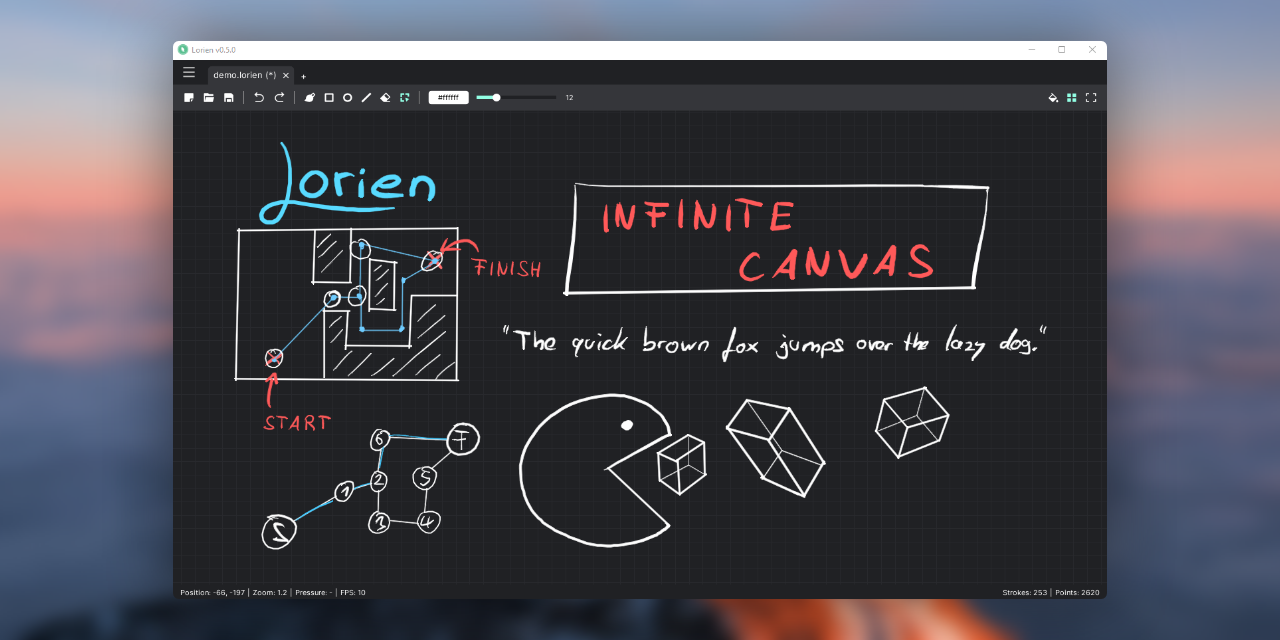
GitHub
Infinite canvas drawing/whiteboarding app for Windows, Linux and macOS. Made with Godot. - GitHub - mbrlabs/Lorien: Infinite canvas drawing/whiteboarding app for Windows, Linux and macOS. Made with...
and yes i used my hands too lol
 tiny ridge
looks super useful
i used to use xournal++ before i got an ipad
but of course thats primarily for math and not digital art
broken nacelle
tawdry valve
I had gotten a wacom graphics tablet to try and get into digital art a while ago...
this whole sentence is basedness supreme
open source??
linux???
please do tell if you find the multiplayer canvas btw
I need that too
I only see the online whiteboards
the wacom tablets are affordable af too

nimble marsh
Do spheres of n dimensions have k < n dimension great sphere's on their surfaces?
For example, the 2-sphere has a great 1-sphere (an equator)
Maybe the great spheres are of dimensions n-1?
nimble marsh
well, I didn't know where to ask it. I started thinking about this after looking at some borsak-ulam related stuff
nimble marsh
 tough hamlet
how are you defining great sphere
tough hamlet
how are you defining great sphere
Some sort of generalisation of this: https://en.wikipedia.org/wiki/Great_circle

In mathematics, a great circle or orthodrome is the circular intersection of a sphere and a plane passing through the sphere's center point.Any arc of a great circle is a geodesic of the sphere, so that great circles in spherical geometry are the natural analog of straight lines in Euclidean space. For any pair of distinct non-antipodal points o...
ebon galleon
You can probably make sense of it, but it would need a precise definition
nimble marsh
tough hamlet
also this isn't really topology
I am thinking about applying borsak ulam. I know on a 2-sphere I have infinitely many great circles and hence infinitely many 1-parameter points that are the same. I wonder if this sort of thing generalises
tough hamlet

the obvious thing is just to have a greak k-sphere be the intersection with a (k+1)-dimensional subspace
nimble marsh
yeah, that makes sense
tough hamlet
the case k=n-1 being the most important
 feral copper
tough hamlet
the case k=n-1 being the most important
feral copper
tough hamlet
the case k=n-1 being the most important
The case k=1 is as important too (at least from a geometric point of vue), because geodesics
In any case, 'great k-spheres' happen to be totally geodesic 🙂
 gaunt linden
Don't discount k=0 either: The set of great 0-spheres is exactly projective (n-1)-space.
feral copper
What are great spheres of tropospheres? 
broken nacelle
so I'm finally learning about singular homology
and I'm wandering how I should interpret the coefficients in a formal sum of singular n-simplices
feral copper
Wdym by 'interpret'?
broken nacelle
like, is there any geometric meaning to the coefficients?
feral copper
Taking 2*something is taking the union of two distinct copies, taking -something is reversing orientation
Idk if that helps
(I always think of a homology class to be represented by a submanifold)
(although that is not always the case)
But that's for Z-coefficients of course
I never thought of any meaningful way to see what would be homology with, say, Z[t,t^-1]-coefficients
broken nacelle
feral copper
Taking 2*something is taking the union of two distinct copies, taking -something...
does that really workout tho? like, taking a simple example of mapping 1-simplex to, say, \bR^2
hence the singular 1-simplex is really just a path in \bR^2
and then you reverse the map in the obvious way
does that amount to slapping a negative sign before the singular 1-simplex?
if so, why
or why not
feral copper
Think of it on a torus rather, where there is homology
But yeah, taking - a curve is that curve with reversed orientation
feral copper
broken nacelle
does that amount to slapping a negative sign before the singular 1-simplex?
I mean, they will be homologous
broken nacelle
but why is that the case?
broken nacelle
feral copper
I mean, they will be *homologous*

feral copper

This is bounded by the cylinder in the middle
Because orientations agree
This is not a boundary
 feral copper
Sure, that's the point in learning 🙂
Maybe this drawing helps regarding orientations? Idk
 broken nacelle
I'm trying to understand how the cilinder is an n-chain
feral copper
Here it is a 2-chain
It maps the square to the cylinder by gluing two opposide sides together
Like the first step of folding the torus from the square, if you've seen this picture
broken nacelle
feral copper
It maps the square to the cylinder by gluing two opposide sides together
but the square isn't a 2 simplex, no?
feral copper
Yeah well, okay, 2-chains are maps from the triangle to the space, but it's roughly the same
Another drawing (coming)
 feral copper
That describes a continuous map, doesn't it?
You don't ask for embeddings
How would you see that this '8'-shaped thingy is a 1-simplex otherwise?

You'd have to glue things in the same way
broken nacelle
feral copper
That describes a continuous map, doesn't it?
yea but the boundaries don't cancel out
leaving only the two paths you drew
that's what I'm trying to achieve
feral copper
I don't follow! 
broken nacelle
ok so for them to be a boundary they must be in the image of \del, right?
languid patrol
broken nacelle
does that amount to slapping a negative sign before the singular 1-simplex?
The two are obviously not the same formal sum of simplices, but they are homologous
feral copper
It must be del of something
feral copper
languid patrol
The two are obviously not the same formal sum of simplices, but they are homolog...
Yes that was my claim!
broken nacelle
feral copper
It must be del of something
so like, if you take the del of a a single singular simplex
the result is gonna be a formal sum of 3 1-simplices
2 of which has to be our boundary circles
feral copper
Here's a weird 2-simplex whose boundary is 4 thingies:
 feral copper
Have a nice lunch!
eager herald
darq what part of chap 2 r u on
is it hard to read
should i read van kampen first or homology
feral copper
Damn, did they unlink the Hopf link? Am I missing something?
 broken nacelle
eager herald
darq what part of chap 2 r u on
broken nacelle
eager herald
darq what part of chap 2 r u on
singular homology
broken nacelle
eager herald
is it hard to read
it has been chill so far
I'm still having trouble understanding singular homology tho so that might be when it gets real
broken nacelle
eager herald
should i read van kampen first or homology
it doesn't really matter
as I said, one isn't a prereq for the other
broken nacelle
broken nacelle
I'm still having trouble understanding singular homology tho so that might be wh...
tbh the actual theorems and definitions aren't super complicated
but making sense of them geometrically is getting me
I've heard that's a common theme over homology
feral copper
Personnally I had started with \pi_1 and SVK before homology, because at least you can make drawings of genuine loops
But that's indeed up to preference
eager herald
broken nacelle
but making sense of them geometrically is getting me
ah i see
fuck i have 0 geometric intuition tho
kinda screwed
bruh i have trouble visualizing like gluing together a mobius strip
ok maybe not to that extent but still
feral copper
eager herald
bruh i have trouble visualizing like gluing together a mobius strip
That'll come with practice 🙂
broken nacelle
you might like homology better then!
like, algebraic topologists are very good at abstracting away geometric structure
intro, well, algebraic structure
in my case, I like the geometric part too much to ignore it tho lol
feral copper
broken nacelle
like, algebraic topologists are very good at abstracting away geometric structur...
I wouldn't be so definitive about it, you do need geometric intuition to derive the right algebraic computations
Like if I give you the presentation of a fundamental group, you can do algebra, sure, but you still want to see which generator corresponds to which loop
eager herald
idk what'll murder me first the homological algebra with like the big ass diagrams or the geometry
 trim chasm
feral copper
Damn, did they unlink the Hopf link? Am I missing something?
trim chasm
feral copper
Damn, did they unlink the Hopf link? Am I missing something?
it literally just tells you to undo it in the second most obvious way? (i.e. through the wrist loops rather than untie the wrist loops)
feral copper
trim chasm
it literally just tells you to undo it in the second most obvious way? (i.e. thr...
Idk, isn't it unlinking this?
 trim chasm
but the instructions basically say cheat knot theory
feral copper
Ah okay it's cheating by going under the knot between the rope and the wrist?
Ah yes, I dislike that 
Thanks!
broken nacelle
eager herald
idk what'll murder me first the homological algebra with like the big ass diagra...
tbh I'm worried less about those then the geometry lmfao
I dunno, they look like you'd get used to them quickly
 queen prism
geometry scary
feral copper
Eeew geometry > diagrams
trim chasm
I find the geometric proofs of section 1 tedious, especially Van Kampen
feral copper
Keep in mind geometry =/= fat ass analysis
trim chasm
I much prefer Grothendieck's proof using covering theory
eager herald
feral copper
Keep in mind geometry =/= fat ass analysis
honestly i wouldnt mind analysis if u meant that
broken nacelle
feral copper
Keep in mind geometry =/= fat ass analysis
what's wrong with analysis?

eager herald
broken nacelle
I dunno, they look like you'd get used to them quickly
true
i want to learn mayer-vietoris
sequences
feral copper
broken nacelle
what's wrong with analysis?
Well, usually it ends up with PDE shenanigans and I don't like those
eager herald
idk i read they were like van kampen but better for homology
broken nacelle
feral copper
Well, usually it ends up with PDE shenanigans and I don't like those <:KEK:58624...
valid
tiny ridge
feral copper
Damn, did they unlink the Hopf link? Am I missing something?
I have a slightly less stupid version
eager herald
also they sound cool
feral copper
Ibsen-sempai, sup? Surprise me! 😄
eager herald
one step closer to spectral sequences
broken nacelle
actually I might get into PDEs coz of geometry
I couldn't care less about physics
but geometry sounds ocol
feral copper
eager herald
one step closer to spectral sequences
As long as it converges on E_2 I can buy that
tiny ridge
Say you and your friends left and right hands are L, L' and R, R' and they're standing in front of each other. Consider a rope joining L and L' and R and R' and the ropes braid twice around each other ie it represents sigma^2 in B_2
Then you can do shenanigans to make it sigma^0
Ie trivial braid
Think Dirac belt trick
feral copper
Isn't that a different problem? (still related tho, and I can believe that this one has a non-cheaty solution)
tiny ridge
Yeah not the same problem
feral copper
tiny ridge
Think Dirac belt trick
Ah yeah this
tiny ridge
Both the people should be tied to a chair for a nontrivial solution
Else the other person can do a sommersault
feral copper
tiny ridge
Both the people should be tied to a chair for a nontrivial solution
(Call social services)
You mean otherwise one can go through the other's rope entirely?
tiny ridge
Well I meant say your friend does a handstand and stands back up again
Sideways
That does the trick
 bleak anvil
How to prevent yourself from killing?
trim chasm
feral copper
Eeew geometry > diagrams
but but Van Kampen essentially states that especially nice pushouts diagrams in {*}/Top are preserved by the pi_1 functor
ebon galleon
Van Kampen 
feral copper
Yeah it's true, but it requires a shit-ton of previous knowledge to make sense of something so visual geometrically
tiny ridge
What is */Top
feral copper
Pointed top spaces
tiny ridge
Weird notation
feral copper
But like a slanted thingy version
languid patrol
tiny ridge
Weird notation
undercategory of a point
feral copper
I remember seeing this slant thingy in May's cat theory
ebon galleon
I mean it's a slice category so it works
tiny ridge
Slice is over
ebon galleon
Also Top_*
tiny ridge
Not under
tiny ridge
ebon galleon
Also Top_*
This is what I use
ebon galleon
i can never remember which is slice and which is coslice
ebon galleon
I guess lol, I just forget
languid patrol
It's like something a programmer would come up with
tiny ridge
Category theorists are like slightly better than silicon valley codebros
languid patrol
Except then Cat/x wouldn't include Id: x \to x and x/Cat would for no explicable reason
tiny ridge
Only slightly
trim chasm
feral copper
Yeah it's true, but it requires a shit-ton of previous knowledge to make sense o...
only basic category theory, and then the proof of the theorem assumes knowledge of covering spaces
tiny ridge
Consider three homomorphisms F_3 -> F_2 given by forgetting one of the standard generators. What is the intersection of their kernels?
feral copper
But the other folks were struggling with singular homology, I don't think it's necessary to add that vocabulary x') also you don't need covering spaces for a geometrical proof
Just cover opens with disks
And the Lebesgue lemma
unreal stratus
tiny ridge
Weird notation
Smh good notation
tiny ridge
In other words how many ways can you hang a portrait on the wall with three pins such that if you remove one it falls down
unreal stratus
Jk the right notation for pointed spaces is Top
feral copper
tiny ridge
Consider three homomorphisms F_3 -> F_2 given by forgetting one of the standard ...
Do you know the solution and ask that as a puzzle?
languid patrol
yes it's a famous puzzle
tiny ridge
I don't know this time
languid patrol
oh i guess not
feral copper
Well, just products of commutators, isn't it?
feral copper
Ah
 hidden crag
Ooh this is a cool puzzle
unreal stratus
Lie algebras
tiny ridge
tiny ridge
There's [a, [b, c]]
This doesn't work
Forget b you get [a, c]
[[a, [b, c]], [a, c]] works except c. Correct for that by another commutator?
Dunno
No clue
Seems like there should be an exceptional word which is not a product of commutators
languid patrol
Are you looking for minimal generators?
Or just any set of elements which generate?
feral copper
tiny ridge
This doesn't work
It does work tho? Forget b, you get [a,1]
feral copper
I think for n pins you iterate commutators
tiny ridge
languid patrol
Are you looking for minimal generators?
Both will be nice
feral copper
[a,[b,[...]]
hidden crag
Why is that bleaksully
tiny ridge
What's the answer for F_m -> F_n?
hidden crag
It’s an interesting problem
languid patrol
yes it's a very common problem, no there isn't a particularly nice geometric solution that I'm aware of.
feral copper
tiny ridge
What's the answer for F_m -> F_n?
You mean remove k pins among the n to have it fall down?
tiny ridge
Yeah
ebon galleon
hidden crag
Why is that bleaksully
I don't like working with free groups
ebon galleon
But it's probably not terrible when you just do it lmao
tiny ridge
Free groups is hard
Ok what's the solution
If there is not an obviously geometric one I might as well know the sol
languid patrol
I only know the solution for the n-1 out of n or 1 out of n versions. The k out of n version seems like a nightmare.
trim chasm
feral copper
And the Lebesgue lemma
that's too analytic for me
feral copper
languid patrol
I only know the solution for the n-1 out of n or 1 out of n versions. The k out ...
I think we can try 2 choose n by hand maybe? But I agree I don't wanna dive into this
tiny ridge
Seems like a good undergrad project
feral copper
(n-1) choose n is 'dual' to 1 choose n in some sense, right? It has to!
languid patrol
tiny ridge
Seems like a good undergrad project
I think it's been done to death as an undergrad or highschool mathcamp project
feral copper
Yeah but even for the 1C2 version, how do you come up with all possible solutions? You'd need algebra to describe the intersection of kernels, otherwise you could miss on some (possibly)
Let alone the kCn
Like, fiding one should be doable, okay
languid patrol
feral copper
(n-1) choose n is 'dual' to 1 choose n in some sense, right? It has to!
It's actually nontrivial to show that you can find one with a reasonable algorithm
oop I replied to the wrong comment
feral copper
😛
tiny ridge
Kernel of some map F_3 -> F_2 x F_2 x F_2... Who knows what this means in terms of covering space theory
Mapping wedge of three circles into product of three figure eights
feral copper
tiny ridge
Kernel of some map F_3 -> F_2 x F_2 x F_2... Who knows what this means in terms ...
This should correspond to a covering space at least 
languid patrol
For 1C2 you can show that it's just the derived subgroup, so depending on what you want that's the answer.
tiny ridge
Yeah one has to pin down what the cover is from the geometry of this map
feral copper
I can't think of a reasonable way to find the quotient even (for the 'number of sheets' of the covering)
tiny ridge
Oh this seems infinite index to me
Any normal subgroup of a free group is
This is a kernel, so
feral copper
tiny ridge
Oh this seems infinite index to me
Yeah I'd have said this too
But still, I found that understanding the quotient helps in understanding the action by deck transformations
Wait
I don't know, whatever x')
tiny ridge
Here's a separate puzzle I thought about some time ago and didn't get far
languid patrol
hmm okay
I guess maybe it's interesting to consider the corresponding rank 6 local system on S^1 wedge itself 3 times
At least that local system uniquely determines this cover
tiny ridge
How so? The number of sheets is infinite
I'm a little confused
Ah ok, you're going to use some standard rep of F_2 in GL_2(C)?
languid patrol
Yeah there is the well-known standard rep a, b \to (1 2 | 0 1), (1 0 | 2 1)
languid patrol
exakt
tiny ridge
Nice idea
languid patrol
Not sure it's terribly useful though.
tiny ridge
You know what one should classify all group homomorphisms F_n -> F_m, and then pi_1(Sigma_n) -> pi_1(Sigma_m)
That's fine I only care about good ideas
I live in the idea-space
F_n -> F_m is dumb, just choose n more or less random words
What about surface groups
Seems nontrivial
There is this theorem of Edmonds which says all maps between surfaces is a branched cover followed by collapsing some handles to points
Homotopic to one
trim chasm
tiny ridge
You know what one should classify all group homomorphisms F_n -> F_m, and then p...
even F_n -> F_n is hard
tiny ridge
Maybe you have a point
I'm just worried it's either dumb or unclassifiable depending on what one means
trim chasm
is outer space not big enough already?
(I haven't looked at any recent literature tbh)
I'm hopeful taking a module lectured by Karen Vogtmann next year
tiny ridge
Out(F_n) is cool
 broken nacelle
@eager herald
If someone "hands you" two topological spaces, you basically have a useless pile of garbage.

eager herald
broken nacelle
<@459276938234822669>
> If someone "hands you" two topological spaces, you basi...
LMFAO where is this from
broken nacelle

Mathematics Stack Exchange
I am studying homology groups and I am looking to try and develop, if possible, a little more intuition about what they actually mean. I've only been studying homology for a short while, so if poss...
I haven't read the post completely yet
I'm watching anime 
eager herald
i see
im kinda struggling with delta complexes rn

so we have this
right
when it says the n simplices e^n_\alpha, is it referring to this fact?


im struggling to see the quotient construction here
so im thinking of $X$, a $\Delta$-complex, as a CW-complex rn
gentle ospreyBOT
sean
 eager herald
well kinda but not really
so we have a bunch of $\Delta^n_\alpha$s, which are just $n$-simplices which are characterized into $X$ by corresponding maps $\sigma_\alpha:\Delta^n \to X$.
gentle ospreyBOT
sean
 eager herald
now this is great and all, but of course we need to glue everything together
hence, we quotient each face of $\Delta^n_\alpha$, which are obtained by deleting a point from the $n$-simplex, with a corresponding $\Delta^{n-1}_\beta$, and identify them together to "glue" them tgt
gentle ospreyBOT
sean
 eager herald
and this $\beta$ is one for the map $\sigma_\beta:\Delta^{n-1} \to X$ which is the appropriate restriction of $\sigma_\alpha$
gentle ospreyBOT
sean
 tiny ridge
 fading vale
Out(F_2 hat)
fading vale
Out(F_2 hat)
Is that the one which contains Gal(Qbar)
fading vale
Yes
tiny ridge
Ah yeah because CP^1 \ {0, 1, infty} has etale fundamental group F_2hat
tiny ridge
Cool
fading vale
I think taking an elliptic curve with some prescribed j function gets you injectivity of the representation
fading vale
I don't remember the details bc it's been like well over a year since I thought about this
tiny ridge
Sullivan has this tome article from 1970 where develops completion of spaces
fading vale
But it's along those lines
trim chasm
tiny ridge
Is that the one which contains Gal(Qbar)
that's a weird way to write G_Q
tiny ridge
And the homology of these completions of manifolds are acted upon by Gal(Qbar)
gritty widget
sullivan 
tiny ridge
trim chasm
that's a weird way to write G_Q
Isn't that a fashion magazine
languid patrol
tiny ridge
Isn't that a fashion magazine
No it's a men's lifestyle magazine
tiny ridge
Terrible
trim chasm
okay I'll accept Gal(Q)
tiny ridge
Aktchuyally Q is the one which is redundant because every number field automorphism fixes Q pointwise
I know you want to pretend real bad that Gal(F) is like pi_1 Spec F
trim chasm
aktahxkly Qbar is determined from Q so.... and the choice of separable closure is a basepoint
tiny ridge
Imagine saying the universal cover is my basepoint
languid patrol
Gal(\bar{Q}) is bad notation objectively
languid patrol
In this case the natural object that it would refer to is the trivial group
Anyways this conversation should really be had in #advanced-algebra , or maybe #advanced-advanced-algebra if there was such a thing
tiny ridge
I don't subscribe to co-conventions made up by the utterly deranged
I think this should go in #1100503863586455632
ebon galleon
 broken nacelle
feral copper
Here's a weird 2-simplex whose boundary is 4 thingies:
broken nacelle
feral copper
Here's a weird 2-simplex whose boundary is 4 thingies:
ok, so back to this
now I gotta ask wtf is a simplex?
how is that a triangle?
that can't be homeo a triangle 
tiny ridge
It is an image of a simplex is probably what they meant
By some random continuous map
trim chasm
these are singular simplices
tiny ridge
In the context of singular homology a "singular simplex" is a possibly horrendous continuous map from a geometric simplex to your space
I would argue it is important to keep track of the parametrizing space and not just the image but this is overly pedantic
broken nacelle
but how could that be a continuous map?
the restriction to the boundaries can't be continuous, right?
coz it's taking a connected space (the 1-simplex) to a disconnected space (2 circles or smth)
broken nacelle
well, in that case it's not a singular simplex
broken nacelle
trim chasm
a singular chain
yea, exactly
tiny ridge
There are lots of surjective maps from a disk to that surface
The preimage of the boundary of the surface need not be the boundary of the disk
Identify disk with a 2-simplex
For instance give the surface a cell decomposition
There's one with a unique 2 dimensional cell
Consider the characteristic map of this 2 cell
trim chasm
tiny ridge
There are lots of surjective maps from a disk to that surface
oh yea 🤦♀️
broken nacelle
I'm confuddled 
broken nacelle
tiny ridge
There's one with a unique 2 dimensional cell
what do you mean by this?
and the characteristic map is just $\chi_{D^2}$?
gentle ospreyBOT
chmonkeynumber1enemy
 broken nacelle
tiny ridge
Do you know what a CW complex is
 tiny ridge
Give that surface a CW decomposition
broken nacelle
sure, you can use the fundamental polygon of the 3-torus
and then not glue some of the edges
tiny ridge
Yup
Now let the map from the closure of the polygon be your map
Identify polygon with simplex
broken nacelle
I see hmm
ok but the del of that isn't just the circles @feral copper
thankyu ibsen btw 
languid patrol
broken nacelle
ok but the del of that isn't *just* the circles <@237320168198504448>
the other parts of the boundary cancel out because d^{op} ~ -d
where d^{op} is the one-simplex traversed in the opposite direction
tiny ridge
Because of this ^^^
feral copper
Yeah, sorry for the confusion, I identify the formal sums of continuous maps \Delta^n\to X to the union of their images
broken nacelle
lol
feral copper
Chmochain
tiny ridge
Cochains I call functions
languid patrol
cochains I call them cococochains
feral copper
feral copper
Yeah, sorry for the confusion, I identify the formal sums of continuous maps \De...
Actually, @broken nacelle, this is a pretty common thing in topology, so whenever you get confused, keep this rule in mind: we like to identify stuff and call them the same way and write them with the same letters
tiny ridge
Yes we like equality
We don't draw fifty million commutative diagrams of isomorphisms
A equal to A equal to A
broken nacelle
feral copper
Yeah, sorry for the confusion, I identify the formal sums of continuous maps \De...
I'm sorry I'm not sure if I was confused about that
or how I was confused by that
tiny ridge
Welcome to topology
It is an essential part of mathematics to be confused about what you're confused by
Category theorists have been setting notions on stone to deny this fundamental theological nature of being
broken nacelle
feral copper
Here's a weird 2-simplex whose boundary is 4 thingies:
are you saying what you meant by "here's a weird 2-simplex" is "here's a the image of a weird n-simplex"?
tiny ridge
I call them heretics
broken nacelle
broken nacelle
are you saying what you meant by "here's a weird 2-simplex" is "here's a the ima...
yea, ok, I think this is what you meant
broken nacelle
languid patrol
the other parts of the boundary cancel out because d^{op} ~ -d
now onto why this is true lmfao
they're in the image of del ig?
tiny ridge
Wrong perspective, it may or may not be true. Infact it can be simultaneously both
broken nacelle
oh yea
tiny ridge
Embrace dialectics
Here's the point. Take the 1-chain c which traverses the [0, 1] starting at 0 ending at 1.
Let c' be c with orientation reversed
What is c + c'?
Not zero. But shouldn't it be?
What a conundrum
tiny ridge
What does homotopy of chain mean
broken nacelle
no clue
tiny ridge
Exactly
broken nacelle
feral copper
Again, my way to visualize simplices is: a k-simplex k-chain is a k-submanifold which you allow to bend over, intersect itself. Basically: an immersion of a k-manifold. Then the boundary of the simplex is the image of the boundary of the k-manifold.
If you allow yourself to think of everything in these terms, you see that formal sum is just union of such thingies (or connected sums even), and taking opposites is reversing orientation of the thingy.
In some cases, this goes beyond a simple frame of thought. For instance, in 4-manifolds, any homology class in H_2 can be represented by an embedded closed connected surface. In the simply-connected case, each class can be represented by an immersed sphere with transverse double points only.
tiny ridge
I think it is too much to conflate k-cycle with k-simplex thouhh
Which is what you seem to be doing above
k-cycle is a k dim submanifold, k-chain is a k dim submanifold with boundary
feral copper
Sorry, I meant to say k-chain, not k-simplex!
trim chasm
I don't think you can call it a connected sum?

 solemn oar
It does not imply that, but you can choose subsets to produce the discrete topology.
Nvm, indeed it's strange.
gaunt linden
No, something looks fishy to me too. For example, cover R by the subsets {a} for each a in R, each with the trivial topology. That seems to satisfy the assumption in the claim: The subspace topology on {a}cap{b} is indeed the same no matter whether we look at it as a subspace of {a} or of {b}, and {a}cap{b} is closed in each of {a} and {b}.
But there are many different topologies on R that induce the trivial topology on each singleton.
gaunt linden
Then it will be kind of hard to make Xi cap Xj closed in Xi and Xj, though.
tough hamlet
86 the closedness
gaunt linden
(Conversely, wanting each Xi to be closed wouldn't even exclude my example).
tough hamlet
tough hamlet
86 the closedness
yeah replacing closed with open at least works
gaunt linden
I think the claim could also be repaired by requiring each Xi to be close in X, and assuming the index set J is finite.
ebon galleon
Perhaps it's supposed to something like "for every i, there's a j such that X_i \cap X_j intersect"... Not sure that would fix it but I agree it's not right as is
But that doesn't seem quite right either now that I think about it
 opaque scroll
You could just let the Xi's be the set of all pairs of points in R, and again same problem
ebon galleon
just write out colimit properly in terms of diagrams and this is not an issue
opaque scroll
I guess you can say that there is a finest such topology
Though, not sure what then would be the point of the intersections being closed
opaque scroll
 red yoke
Is there something missing here?
red yoke
Is there something missing here?
What is the context here, like what is this an "example of"?
ebon galleon
You can't even say there's a unique topology for which these sets X_i are closed in X and it induces the topology on them, tropo's example would work for any T_1 space lol
ebon galleon
opaque scroll
I guess you can say that there is a finest such topology
Actually, this makes sense, since that is the definition of colimit topology
opaque scroll
ebon galleon
Actually, this makes sense, since that is the definition of colimit topology
Indeed, but is this example suppose to illustrate what the colimit topology is? (If so it's doing a terrible job) or is it trying to say something else and there is just a small mistake somewhere
ebon galleon
I am not quite sure, it is written quite poorly/unclear lmao
high hill

$$X = {1, 2, 3}$$
$$T = {{1, 2}, {2, 3}, {2}, \varnothing, X}$$
$$B = {{1, 2}, {2, 3}}$$
$2 \in {1, 2}, {2, 3}$ but ${2} \not\in B$
gentle ospreyBOT
 high hill
What am I missing with regards to point 2
ebon galleon
B is not a basis
opaque scroll
The usual definition of basis is that every open can be written as a union of basis sets
ebon galleon
Because {2} \notin B, like you said
opaque scroll
This thing about finite intersection is not the standard definition
high hill
The screenshot gives 2 definitions
B is a basis by the first, but not the second, is that right?
languid patrol
no the screenshot gives two equivalent definitions
ebon galleon
They both generate the same topology, yes
opaque scroll
I think it's just a mistake maybe
high hill
languid patrol
no the screenshot gives two equivalent definitions
See my example though?
languid patrol
high hill
See my example though?
ah yes they are not equivalent I see, one is finer than the other
but the only difference is being closed under finite interesections
high hill
What's the intuition behind point 2 of the 2nd defn anyways - that was what I was hunting for
ebon galleon
If you close B under finite intersections (i.e. add {2}), these are equivalent
languid patrol
I think these terms like basis and subbasis are not very important
opaque scroll
languid patrol
but the only difference is being closed under finite interesections
It's not necessarily closed under finite intersections
ebon galleon
The second definition requires it to be
high hill
high hill
What's the intuition behind point 2 of the 2nd defn anyways - that was what I wa...
like why require it.
opaque scroll
ebon galleon
The second definition requires it to be
No, only that the intersection is the union of basis sets
languid patrol
ebon galleon
The second definition requires it to be
I guess technically not since it's not closed under unions
opaque scroll
Not that the intersection is a basis set
queen prism
high hill
What's the intuition behind point 2 of the 2nd defn anyways - that was what I wa...
say you have a point p in the intersection of two balls, B1 and B2
you’d like to say that there is another ball B in that intersection containing p
languid patrol
high hill
like why require it.
because you want it to be fine enough that the resulting topology is closed under finite intersections
i.e. is a topology
the actual important object associated to a basis or subbasis or whatever is the set of arbitrary unions of finite intersections of its elements
ebon galleon
opaque scroll
No, only that the intersection is the union of basis sets
oh right, i guess it's not quite closure under intersections, my bad
high hill
mmm ok ill have another look now that confusion was cleared up
high hill
opaque scroll
The usual definition of basis is that every open can be written as a union of ba...
so ill take this
 grim knot
guys, if X is T2 and Y is not, why does there not exist a homeomorphism?
I thought that a continuous function has no influence on hausdorff property
 paper wedge
you thought wrong
or is it you think wrong?
haha
suppose f:X-->Y is continuous , X is hausdorff and Y isnt
the preimages of your choice of non-hausdorfness of Y will contradict hausdorfness of X
do u see it
and
if u do the proof you will see
that you do not even need "full" homemorphism
u just need closed and bijective
grim knot
paper wedge
or is it you think wrong?
it's just that in my notes, I found that "generally T2 is not preserved under continuous functions"
paper wedge
grim knot
guys, if X is T2 and Y is not, why does there not exist a homeomorphism?
what is the difference between a homeommorphism and a continuous function?
grim knot
bijectivity(?)
grim knot
okay, I see it
paper wedge
so if ur problem is asking for a homeomorphism
then yes they do preserve
otherwise ( as you sholud try in the proof its just straight-forward ) u will find that u need bijectivity anyways
 paper wedge
no need gl
hidden crag
Exercise: suppose Y is hausdorff and f:X->Y is a continuous and injective map, is X hausdorff?
opaque scroll
grim knot
it's just that in my notes, I found that "generally T2 is not preserved under co...
The key feature of homeomorphism is that they preserves all topological properties. The same is not true for just arbitrary continuous functions
hidden crag
hidden crag
Exercise: suppose Y is hausdorff and f:X->Y is a continuous and injective map, i...
@grim knot
Potato
Shh
Don’t spoil it
unreal stratus
I was just responding to an idea
hidden crag
Let her cook
grim knot
hidden crag
Don’t spoil it
I'd say yes hahaha
grim knot
hidden crag
Let her cook
HAHAHAHAH
hidden crag
Lass sie kochen
hidden crag
grim knot
I'd say yes hahaha
That is true, why?
grim knot
because we have disjoint open set V1 and V2 in Y for y1!=y2, so, the preimage is also disjoint, and since y1!=y2, so is the preimage of the intersection empty and f^1(V1), f^1(V2) is what we were looking for
it's just a sketch
grim knot
Thank you for the crown
grim knot
hidden crag
Let her cook
I hope the dish was good
grim knot
Timo I have a question in German, do you have 5 secs?
grim knot
I understand the whole exercise here, just don't see why such a x0 has to exist

 grim knot
hidden crag
Was ist R,O
grim knot
hidden crag
Was ist R,O
I sent you O in the second picture actually
hidden crag
Also was ist da die Topologie
My bad
Das x_0 ist beliebig
Du nimmst irgendeins, bildest das ab und guckst was passiert
hidden crag
Y_0 ist einfach der Wert auf den das x_0 abbildet was man random wählt
grim knot
hidden crag
I was asked this question in my topology oral exam
I have a written one next week on wednesday
grim knot
hidden crag
Y_0 ist einfach der Wert auf den das x_0 abbildet was man random wählt
ja voll macht sinn jetzt, ich hab es eben umgekehrt angeschaut, und da f nicht surjektiv ist, muss y0 nicht unbedingt ein Urbild haben
hidden crag
paper wedge
du bist weisetmaster
hidden crag
grim knot
have a good pump<:catKing:812386361297862747>
Thanks
grim knot
is it true that finite topological spaces are compact(?)
it depends on the topology we have right?
I think it should not depend
high hill
surely all open covers will have a finite open subcover
your topology is finite
all covers are finite
grim knot
I'm still confused on how the frick to use Seifert van Kampen
I understand the whole computation, besides from how do you calculate N
hidden crag
An isomorphism will have trivial kernel
grim knot
hidden crag
An isomorphism will have trivial kernel
yeah dumb me
 grim knot
this is the exercise I'm doing
 hidden crag
grim knot
I literally am doing an exercise right N
hidden crag
grim knot
I literally am doing an exercise right N
Read examples if you struggle to do it yourself for now
grim knot
The problem is that I do not see where they get N from
 lime sable
high hill
like why require it.
lime sable
high hill
like why require it.
i think in a lot of natural cases you have a basis instead of just a subbasis, and in these cases you want to write open sets as unions of basic opens, rather than worry about finite intersections or whatever
high hill
makes sense
lime sable
by "natural cases" i mean metric topology and zariski topology because that's all i can think about right now
high hill
meanwhile in measure u have un, unu, nunun, etc 
hidden crag
@grim knot why did you delete the solution
grim knot
hidden crag
<@470359543008722946> why did you delete the solution
I understood a part of it
like the first part, I can send it again
but still don't see how they come up with the kernel again
hidden crag
No harm in resending it if there’s something you don’t understand
I’ll try to have a look later (busy dying to numerics rn) or someone else might
grim knot
this is the solution, and they don't even calculate it

Like I don't know how to come up with it
I understand that $\pi_1(A) * \p1_(B)= \mathbb{Z}*\mathbb{Z} $
hidden crag
The amalgamation is trivial
grim knot
but why is N trivial?
grim knot
wait a sec
what is the conenction between the fundamental group of the intersection and N
(asking to make it clear in my head)
hidden crag
Look at the theorem again
It’s in the definition of amalgamation

This is an isomorphism
And if pi_1(U1 cap U2) is trivial
The amalgamation doesn’t change anything
grim knot
does it come from the fact that c is only the neutral element and thus k^N does only contain the element?
 hidden crag
You basically take modulo 0
grim knot
hidden crag
oh okay I see it, this is another definition(equivalent)


 hidden crag
Ye
My handwriting is worse
But yeah the smallest normal subgroup containing that set is just the trivial group
So you take modulo 0
And get the result
grim knot
hidden crag
So you take modulo 0
yeah I know that (spammed y'all enough last semester with algebra)
grim knot
hidden crag
Or should I say normal divisor
If you want to show your german side
then go on
grim knot
hidden crag
But yeah the smallest normal subgroup containing that set is just the trivial gr...
my problem is mostly gettin the right subgroup
hidden crag
Yeah that can be tricky
There’s no way to reliably always do it
Except making smart choices for the spaces that cover your bigger spacer
hidden crag
grim knot
yeah I know that (spammed y'all enough last semester with algebra)
I think I only remember the funktheo questions
grim knot
hidden crag
I think I only remember the funktheo questions
well I'm happy for that, cause I spammed much more for algebra haha
it's gonna come again cause I have an algebra 2 exam
another question about topology, does somebody have an idea on when to use coverings and when to use SVK to compute the fundamentalgroup?
hidden crag
grim knot
another question about topology, does somebody have an idea on when to use cover...
Im not sure if there’s an answer to this
grim knot
hidden crag
Master or bachelor
bachelor
grim knot
hidden crag
Lots of algebra for a german student
swiss actually
hidden crag
grim knot
swiss actually
Makes sense then
grim knot
hidden crag
Makes sense then
it pisses me off somehow, cause we have too many rushed subjects
I love what I study, but we do not really have time to digest the subjects and to fully understand them
I asked before, because I read this

and no idea where to begin with 💔
hidden crag
you could start by deforming this into a known space
languid patrol
grim knot
I asked before, because I read this
have you ever seen a space before where you remove the origin from R^n and quotient out by x ~ -x?
grim knot
languid patrol
have you ever seen a space before where you remove the origin from R^n and quoti...
yes, I also know which fundamental groups both spaces have
grim knot
languid patrol
have you ever seen a space before where you remove the origin from R^n and quoti...
I thought about real projective spaces, I might be wrnog though
languid patrol
grim knot
I thought about real projective spaces, I might be wrnog though
So $\mathbb{R}^n - {0} \cong \mathbb{R}_{> 0} \times S^{n-1}$
gentle ospreyBOT
Topos_Theory_E-Girl
 languid patrol
how does your equivalence relation work in this coordinate system?
languid patrol
grim knot
we have the right quarter rght?
I don't understand what this means
If (x, y) are coordinates, where $x$ is a positive real and $y$ is a point on the sphere, then $-(x, y) = (x, -y)$
gentle ospreyBOT
Topos_Theory_E-Girl
 grim knot
gentle osprey
**Topos\_Theory\_E\-Girl**
grim knot
gentle osprey
**Topos\_Theory\_E\-Girl**
you just mirror your sphere
this is why I meant, for example in R2, we have the quarter of a circle(?)
trim chasm
(x,y) is not the same as (x,y)
I think you're getting a quarter of a circle from treating topos's (x,y) as a point in the plane in some way
trim chasm
grim knot
omg this is ugly
for n=2 you should imagine concentric circles centred at the origin
broken nacelle
am I supposed to know why K_\xi is a manifold here except at the (n-3) skeleton?

or is hatcher just stating it without a proof to demonstrate a geometric way of characterizing homology classes?
cursive tendon
Is it true that the limit points of a set $S$ is equal to $\operatorname{int} S \cup \partial S$?
gentle ospreyBOT
Mattuwu
 broken nacelle
yes
cursive tendon
hmmm,, I saw a counterexample...
cursive tendon
broken nacelle
yes
 broken nacelle
oh huh
interesting
sorry about that
wait, how're boundary points defined again?
cursive tendon
boundary points of a set S are the points whose every neibouhood contains some points both from in S and outside of S.
cursive tendon
For any set $S \subset \mathbb{R}$, is it true that $\operatorname{iso} S^c \subset L(S)$? Can somebody prove or give conterexamples?
gentle ospreyBOT
Mattuwu
 cursive tendon
where $L(S)$ are the limit points of S
gentle ospreyBOT
Mattuwu
 cursive tendon
and iso S^c is the isolated points of the complement of S
cursive tendon
thanks! seems like a good exercise
cursive tendon
also, I know for a fact that in R^n, iso S^c \subset \partial S
how does L(S) compare to \partial S?
can we have something nice like: iso S^c \subset L(S) \subset \partial S ?
ebon galleon
How is \partial S defined
cursive tendon
the boundary points of S
ebon galleon
Which are
cursive tendon
uhhh... I don't know there are several definition of boundary points in R^n..?
cursive tendon
points whose open balls around it has non-empty intersection with both S and S^c
ebon galleon
No this is not true as written
cursive tendon
ebon galleon
No this is not true as written
hmm?
ebon galleon
Interior points (in particular, non-isolated interior points) can be limit points
Which are clearly not in the boundary
cursive tendon
oHH right!
OK... new question should be..
is L(S) \ int S a subset of \partial S?
ebon galleon
I want to say yes at least for Rn but I'm not sure off the top of my head if this one generalizes
You should try this one as an exercise too
grim knot
shouldn't these inclusions be reversed?
 tough hamlet
no
grim knot
how does this work?
I don't see it
like the discrete topology has only the empty set and X it self
the other topologies are bigger, or not(?)
tough hamlet
grim knot
like the discrete topology has only the empty set and X it self
no that's the trivial topology
or the indiscrete topology
grim knot
OH