#point-set-topology
1 messages · Page 45 of 1
 empty grove
Pick any of the 3 faces of the 2-cell. The natural map from that to S^2 is not the same as the natural map from one of the 1-cells to S^2 (because there are no 1-cells anyway)
 silver umbra
i see, that totally makes sense
 coarse night
non injective inclusion 
empty grove

 tiny ridge
What is homotopy limit of quasicategories
Just for the pullback diagram X -> Z <- Y say
Where can I find an explicit description
Do I do a Kan fibrant replacement on Z <- Y and then take the actual pullback of SSets? That sounds wrong
Am I working in the wrong model structure? Do I need to know what the Joyal model structure is?
empty grove
tiny ridge
Am I working in the wrong model structure? Do I need to know what the Joyal mode...
Probably. Joyal is the right model structure for quasicats
The weak equivalences are categorical equivalences of ssets (a generalization of equivalence of quasicats), the generating acyclic cofibrations are the inner horn inclusions, and the cofibrations are the monomorphisms, so the fibrant objects are exactly the quasicats.
tiny ridge
Ah good that makes sense
 broken nacelle

 gentle ospreyBOT
darqube
 broken nacelle
is this proof of the above proposition correct?
ping me if you need me to elaborate 
oh forgot to mention N subset U
broken nacelle
coarse night
isn't that by definition of LCH space
every point got a compact neighborhoud
and it's hausdorff obviously lel
coarse night
oh, thaat one
there are a lot of definitions of LC, which turn out to be equivalent for H spaces
broken nacelle
do you think my proof is correct tho?
I haven't done much math in a while so I'm looking for a sanity check
coarse night
broken nacelle
do you think my proof is correct tho?
yes
I just really wanted to use Hopkins
broken nacelle
what's hopkins 
broken nacelle
thankyu lol
coarse night
lol
 unreal stratus
If $X,Y$ are $G$-spaces, is $X \times_G Y$ just $X \times Y$ equipped with the diagonal action or do we quotient out by anything?
gentle ospreyBOT
potato

 marsh forge
ive always disliked this notation
unreal stratus
Oh okay sure lol
empty grove
Matches the M ⊗_R N for modules
unreal stratus
empty grove
Matches the M ⊗_R N for modules
Oh this is funny cause I was thinking for a while about smth and this analogy happened to come in handy
Well it was like, $X^i \times Y^j$ is equipped with an obvious $\Sigma_i \times \Sigma_j$-action and they construct $(X^i \times Y^j) \times_{\Sigma_i \times \Sigma_j} \Sigma_k$
gentle ospreyBOT
potato
 unreal stratus
which must be directly analogous to extension of scalars, like promoting it to a sigma_k-space in the obvious way
 gritty widget
gentle osprey
**potato**
gritty widget
gentle osprey
**potato**
einstein summation
empty grove
Oh are you looking at symmetric spectra?
unreal stratus
gritty widget
einstein summation
lol
Nah this is actually just some configuration spaces stuff
So like lots of sigma_k-equivariant maps lol
In particular, this is a lemma which formalises like
empty grove
unreal stratus
which must be directly analogous to extension of scalars, like promoting it to a...
Yep
Has the same universal property
unreal stratus
A choice of k points in X disjoint union Y is equivalent to a choice of i points in X and j in Y where i + j = k lol and this is how we're keeping track of the Σ_k-actions
Thanks Moldi
Is there anywhere good to look for equivariant stuff lol probably like May's stuff for homotopy theoretic tings
empty grove
Maybe May's equivariant homotopy and cohomology theory lol
Idk what you mean by homotopy theoretic rings though
Like ring spectra?
marsh forge
one interseting thing is that model categories are still the bread and butter of most equivariant work
so the OG references are all still good
(i assume you mean homotopy theoretic things)
empty grove
They exchanged the normal and super reaction buttons and now my muscle memory is to always super react 
marsh forge
lol
unreal stratus
empty grove
Idk what you mean by homotopy theoretic rings though
I said tings lol
Yeah things
unreal stratus
marsh forge
so the OG references are all still good
Nice
tiny ridge
I have no understanding of Bredon equivariant cohomology
Feels like unnatural futzing around just to make the apparatus equivariant homotopy sensitive
marsh forge
I actually kind of agree, I've never really understand the "genuine" equivariant category
someone once told me a compelling justification for wanting to invert representation spheres but i forget
 cosmic socket
Are compact objects in Top or CW, compact spaces?
 umbral panther
Direct limits are fine in Top. Categorically compact objects are the compact spaces. Maybe CW complexes don’t have direct limits
marsh forge
Are you sure https://mathoverflow.net/questions/288648/what-are-compact-objects-in-the-category-of-topological-spaces

MathOverflow
Let $\mathscr C$ be a locally small category that has filtered colimits. Then an object $X$ in $\mathscr C$ is compact if $\operatorname{Hom}(X,-)$ commutes with filtered colimits.
On the other ha...
tiny ridge
Direct limits are not at all fine in Top. Nothing recognisable represents colim Hom(X, Y_i). This is why I had to work with quasitopological spaces for my research lol (which is a slightly civilized subcategory of Presh(Top))
tiny ridge
Presheaves of sets on Top such that gluing holds for open covers and finite closed covers
Notion is originally by Spanier Whitehead
umbral panther
marsh forge
Are you sure https://mathoverflow.net/questions/288648/what-are-compact-objects-...
Oh
tiny ridge
You may enjoy this post https://mathoverflow.net/questions/124616/why-are-quasitopological-spaces-needed-in-sheaf-theoretic-approaches-to-the-h-pr
MathOverflow
Recently I have been learning more about the h-principle and in particular the methods of "continuous sheaves". In many treatments of this I see people using "quasi-topological spaces" and I am try...
@bw. It is very easy to come up with examples of direct limits of perfectly reasonable spaces which are indiscrete for instance
Say, S¹ -> S¹ doubling map
marsh forge
tiny ridge
Presheaves of sets on Top such that gluing holds for open covers and finite clos...
so slightly stronger than asking for a sheaf?
tiny ridge
Right
marsh forge
interesting
umbral panther
marsh forge
someone once told me a compelling justification for wanting to invert representa...
The first reason for genuine G spectra is that they come up. The obvious definition of K- theory in terms of equivariant bundles satisfies Bott periodicity for complex representation spheres
The second is Poincaré duality. Better, Atiyah duality. You want a Thom isomorphism for the tangent bundle for a manifold with isotropy. The fibers of this bundle are representations, so it’s like saying you want representation spheres to be invertible like ordinary spheres
marsh forge
Ah yeah the equivariant thom isomorphism was the one I had in mind
 plain raven
tiny ridge
Notion is originally by Spanier Whitehead
plain raven
tiny ridge
Notion is originally by Spanier Whitehead
let's fuckin gooo
i just really like spanier's book on alg top so i'm compulsively responding to this
 novel acorn
tiny ridge
everyone used that in the olden times
novel acorn
tiny ridge
everyone used that in the olden times
Ibsen do you just know all of topology history
tiny ridge
That sounds like a backhanded insult
 coral pivot
You do topology, that is a backhanded insult you did to yourself 🙂
tiny ridge
Truly the times are telling when a noncommutative geometer says your field is a self inflicted insult
 dire moon
sorry to interrupt with a potentially dumb question but are there cases where the topological pushout of 2 closed subsets of a space by their intersection is not their union ?
unreal stratus
marsh forge
Are you sure https://mathoverflow.net/questions/288648/what-are-compact-objects-...
This is interesting cause iirc someone claimed this was true in a talk I went to lol
unreal stratus
dire moon
sorry to interrupt with a potentially dumb question but are there cases where th...
No, like say X is union of A and B, then the map A disjoint union B -> X is a closed map (as A, B are closed) and is surjective and identifies exactly those points in the intersection
So it induces the desired homeo
dire moon
Ah of course ! thanks
unreal stratus
np
 empty grove
umbral panther
Direct limits are fine in Top. Categorically compact objects are the compact sp...
empty grove
umbral panther
Direct limits are fine in Top. Categorically compact objects are the compact sp...
Compact spaces are compact only relative to closed T_1 inclusions 
empty grove
Ye a closed T_1 inclusion
marsh forge
oh missed a word yeah
okay before i send this let it be known that i have a migraine and you need to be nice to me
is there a relationship between having the homotopy type of a finite CW complex and having the homotopy type of a compact space
im so sure theres like a super obvious counter example
empty grove
Homotopy type of a finite CW complex should imply homotopy type of compact space since finite CW complexes are compact 
marsh forge
right
what about the other way
im mostly curious about whether compact spaces are compact in the infinity category of spaces
empty grove
marsh forge
what about the other way
The Hawaiian earring works since its fundamental group is uncountable
marsh forge
i honestly don't know which of those two the hawaiin earring is
not a finite cw i imagine
empty grove
Ye
empty grove

coarse night

 quick bough
how do i construct such a path homotopy?
quick bough
quick bough
how do i construct such a path homotopy?
can anybody help?
 abstract saffron
marsh forge
Top just sucks then
abstract saffron
marsh forge
Top just sucks then
First time? 
empty grove
quick bough
how do i construct such a path homotopy?
Take the straight line homotopy between the 2 paths on the square itself, and then horizontally compose with H tilde
umbral panther
marsh forge
im mostly curious about whether compact spaces are compact in the infinity categ...
A simpler counter example is the one point compactification of the integers, {1/n} cup {0}
marsh forge
abstract saffron
First time? <:KEK:586240877358350341>
Not even close lol
quick bough
is there a counterexample for a space that is not hausdorff, but every compact set is closed?
gritty widget
god i hate topology
marsh forge
Lol
Any finite set should do. Every subset is closed and every subset is compact.
Oh but that’s hausdorff
god i hate topology
gritty widget
lol
tiny ridge
What about the line with two origins
quick bough
elaborate
tiny ridge
Do you know the line with two origins
quick bough
no hahha
tiny ridge
R x {0, 1} modulo equivalence rel (x, 0) ~ (x, 1) iff x nonzero
umbral panther
In the line with two origins, the origin is compact but not closed
tiny ridge
Why not
umbral panther
Oops
I meant a compact neighborhood of the origin. [-1,1]x0
gritty widget
lol i said this example earlier but deleted it
quick bough
hmm
tiny ridge
Try R discrete topology with two origins
Same construction above but replace R by R_d
umbral panther
That’s discrete
quick bough
^
gritty widget
https://topology.pi-base.org/ just maybe...
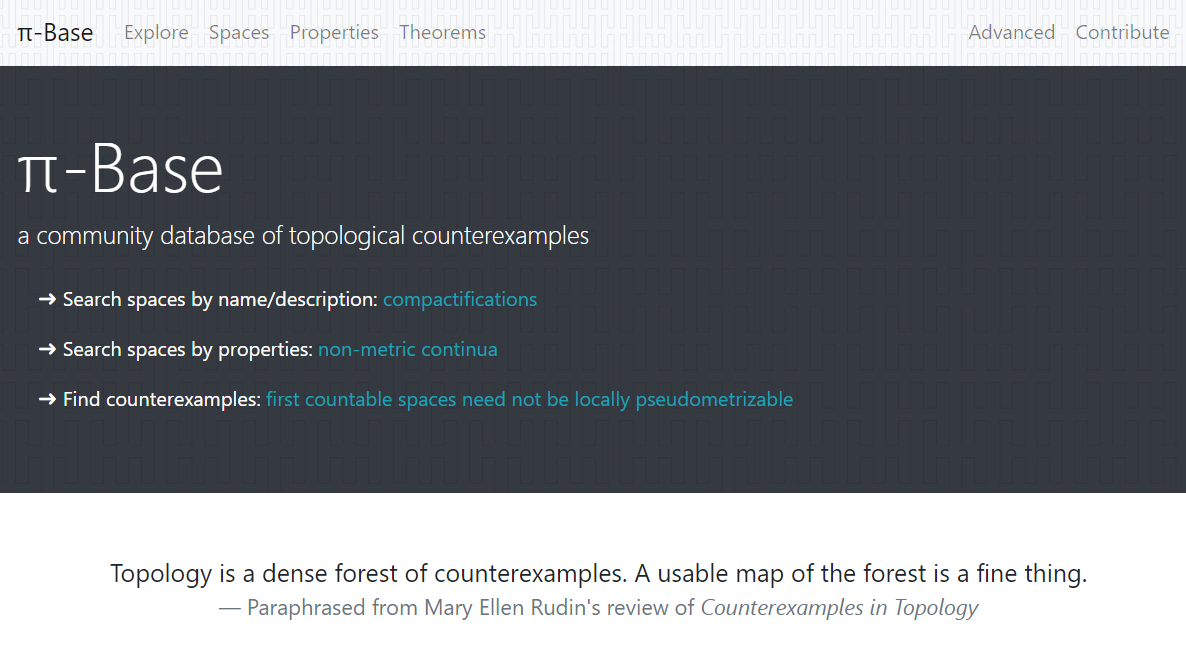
π-Base
A community database of topological theorems and spaces, with powerful search and automated proof deduction.
umbral panther
Probably implies Hausdorff. You’d have to check the details carefully, but if x and y are not separated by opens, a net that converges to x probably converges to y. The image of that net plus x is probably compact but doesn’t contain y
umbral panther
tiny ridge
Q with two origins
{1/n} cup {0}
 thorny agate
Can we do this with finite sets?
quick bough
like compact => closed implies hausdorff
tiny ridge
bw says it is
quick bough
thorny agate
Can we do this with finite sets?
no
has to contain the cofinite topology
thorny agate
Fuck
tiny ridge
What about the cocountable topology on R
umbral panther
umbral panther
Probably implies Hausdorff. You’d have to check the details carefully, but if x ...
This is a terrible argument. The net could just be constant. I guess you could solve that by taking a net indexed by open sets containing x and require each point to be in that open but not equal to x
More importantly, why is the image of a net compact? Is this really true?
unreal stratus
helo
unreal stratus
quick bough
is there a counterexample for a space that is not hausdorff, but every compact s...
hm
tiny ridge
Spam enough example ideas until it's false or until you're dead
empty grove
If you find a counterexample you can alter the statement a little to make it not a counterexample
(like put a not in it)
quick bough
i mean such a space is at least T_1
tiny ridge
Nash equilibrium point set topology exercise
quick bough
i think
quick bough
umbral panther
Probably implies Hausdorff. You’d have to check the details carefully, but if x ...
wouldn’t that already apply that it’s not hausdorff if there’s a net that converges to x and y
since in a hausdorff space limits of nets are unique
umbral panther
I’m trying to prove the contrapositive
I’m assuming it’s Hausdorff and trying to find a compact that is not closed
unreal stratus
that's not the contrapositive right
umbral panther
No
In my first sentence I stated one thing. In the rest, I tried to prove the contrapositive of that thing. But I didn’t state that thing very clearly to show that it was equivalent to what was asked
unreal stratus
I'm confused what you're trying to prove
We're trying to prove that not Hausdorff doesn't imply not (compact => closed)
unreal stratus
umbral panther
~~I’m trying to prove the contrapositive
I’m assuming it’s Hausdorff and trying...
I don't see how this relates to it
Indeed in a Hausdorff space every compact subset is closed
umbral panther
I left out the word not
I’m assuming not Hausdorff and finding a compact not closed
unreal stratus
Ah
Makes sense so you're actually proving that the statement given was true nice
hm
tiny ridge
Take an infinite set X in R with cocountable topology. Consider a countable infinite subset Y, and consider an open cover consisting of R \ Y, and open neighborhoods of each point of Y
tiny ridge
Oh cool
unreal stratus
Well not quite actually but uh
Okay nvm sure yes
I thought you meant X was the space for some reason lol but yes
tiny ridge
Lewis talked about cofinite topology above which made sense to me
tiny ridge
But cofinite fails for stupid reasons
unreal stratus
The compact subsets are precisely the finite ones
and hence all closed
Kinda interesting hm
Seems co-X big for a space of cardinality > X is interesting
Idk how often these spaces are used for things besides counterexamples though
tiny ridge
Almost never
unreal stratus
Idk what like analytic / point set topologists do lol
tiny ridge
Bing's work from the 50s is important
He did awful point set topology
Of horrifying spaces
He tried to disprove the Poincare conjecture by point set topology
But instead the machine was used to prove topological Poincare conjecture in 4D later
umbral panther
tiny ridge
Take an infinite set X in R with cocountable topology. Consider a countable infi...
What is this an example of?
thorny agate
Dusseldorf?
umbral panther
Oh, Y is a subset of X, reaching a contradiction, showing that X is finite
tiny ridge
Yes
 sonic zinc
Hello everyone,
Is it is possible to use homotopy theory to study if a geometric object (like vector field, differetial form, or Poission bracket) is well-define globally on manifold?
sonic zinc
tiny ridge
Dunno what is your exact situation though
Okay so I am dealing with something simialr to a poission bracket
it is called getzler-soloviev bracket which is define on supermanifold and my supervisor told to study if this bracket can globazlied.
I tried the navie approch which is to check if it is ivariant under local coordinate change, but it is not
So my supervisor told look for homotopy methods to see if bracket is globalazable
sonic zinc
tiny ridge
Ie you write it in coordinates
yes
$((f,g))=\sum_{k,\ell=0}^{\infty}\left(\partial^{\ell}\left(\partial_{k,\phi}f\right)\partial^{k}\left(\partial_{\ell,\phi^{\ddagger}}g\right)+(-1)^{\mathrm{p}(f)}\partial^{\ell}\left(\partial_{k,\phi^{\ddagger}}f\right)\partial^{k}\left(\partial_{\ell,\phi}g\right)\right)$
gentle ospreyBOT
beep boop
 sonic zinc
where
$\partial_{k,\Phi_{i}}=\frac{\partial}{\partial\left(\partial^{k}\Phi_{i}\right)}$
and
$\partial^{\ell}=\frac{\partial^{\ell}}{\partial t^{^{\ell}}}$
gentle ospreyBOT
beep boop
 sonic zinc
\phi are the smooth section of vector bundle
sonic zinc
tiny ridge
The keyword is "obstruction theory"
So I should learn about obstruction theory?
tiny ridge
This looks like if it isn't coordinate independent it should be a section of a different, naturally defined bundle
Ie the way it changes under coordinate transforms should be set as the new transition functions
In which this would be a section of
Idk how you'd apply homotopy methods to this problem beyond, like, vector bundle theory
One should determine what the natural vector bundle here is
sonic zinc
tiny ridge
This looks like if it isn't coordinate independent it should be a section of a d...
Yes, with like navie clacluation
like I took simplest case where I have one variable t
and two variable on the supermanifld \phi and \phi^dagger
but it is not invariant
even at the simplest term I got something like this
$\frac{\partial}{\partial\tau}\left(\frac{\partial f}{\partial(\frac{\partial\phi}{\partial\tau})}\right)\frac{\partial}{\partial\tau}\left(\frac{\partial g}{\partial(\frac{\partial\phi^{\ddagger}}{\partial\tau})}\right) =\frac{\partial}{\partial t}\left(\frac{\partial f}{\partial(\frac{\partial\phi}{\partial t})}\right)\frac{\partial}{\partial t}\left(\frac{\partial g}{\partial(\frac{\partial\phi^{\ddagger}}{\partial t})}\right)+\left(\frac{\partial t}{\partial\tau}\frac{\partial^{2}\tau}{\partial t^{2}}\right)^{2}\frac{\partial f}{\partial(\frac{\partial\phi}{\partial t})}\frac{\partial g}{\partial(\frac{\partial\phi^{\ddagger}}{\partial t})}
+\frac{\partial t}{\partial\tau}\frac{\partial^{2}\tau}{\partial t^{2}}\frac{\partial}{\partial t}\left(\frac{\partial f}{\partial(\frac{\partial\phi}{\partial t})}\frac{\partial g}{\partial(\frac{\partial\phi^{\ddagger}}{\partial t})}\right).$
gentle ospreyBOT
beep boop
Compile Error! Click the  reaction for more information.
(You may edit your message to recompile.)
 tiny ridge
I don't know if I can help you with the actual calculation
Differential geometry isn't my strongest suit, especially when it comes to coordinate computations
 tepid sparrow
I'm currently studying Max Karoubi's book "Introduction to K-Theory" and I'm feeling a bit lost with the formalism he uses to define K-theory groups and why he gives a very general construction on banach categories. I'm struggling to understand why he chooses this approach and what advantages it offers compared to other books like Allen Hatcher's vector bundle and k theory or the chapters on k theory in the book "fibre bundle" by husemoller ?
umbral panther
Maybe there’s a point, but if you don’t know what it is, go with Hatcher
If you want to study K theory of operator algebras, you’ll need functional analysis, but you’ll know you need it
sonic zinc
tiny ridge
Differential geometry isn't my strongest suit, especially when it comes to coord...
Thank you
I just wanted to know if homotopy methods can be used to study this type of problem (while waiting for the co-author of my supervisor to provide me with some refernces)
I think u gave me a decent idea
 grizzled ibex
unreal stratus
Idk what like analytic / point set topologists do lol
grizzled ibex
unreal stratus
Idk what like analytic / point set topologists do lol
forcing, topological games etc...
 tidal lynx
they need to find a hobby fr
 civic verge
Guys I am proving that X=int(X) I did the part (=>) , I wanted to read opinions or my writing is wrong.
it should be noted that I'm translating the text

I did something simple
silver umbra
so part (a) i have now, but part (b) i rly have no idea how to do


Mathematics Stack Exchange
This exercise $2.1.10$ in page $131$ of Hatcher's book Algebraic topology.
(a) Show the quotient space of a finite collection of disjoint $2$-simplices obtained by identifying pairs of edges is al...
here's a relevant stack post
empty grove
Not sure if this works, but here is my attempt. We know what the vertices, edges and faces in this Delta complex structure are supposed to be, and we only need to orient the edges and faces. In particular, we know what the 1-skeleton is. Viewing the 1-skeleton as an (as of now) undirected graph, we wish to direct all its edges such that the faces can be glued on along the triangles in this graph correctly. I think a sufficient condition for this is for the graph to be directed acyclic, meaning that there shouldn't be a directed path from a vertex to itself. This is sufficient because if you pick any triangle in this graph, it must then be directed as the ordered set {0,1,2}, and then there is an obvious way to orient and glue any 2 simplices on this triangle to it. So the problem reduces to, can we always turn an undirected graph into a directed acyclic one? My guess is that this is not possible in general but here we will have some extra conditions on the graph that make it possible.
empty grove
silver umbra
so part (a) i have now, but part (b) i rly have no idea how to do
Btw for the purposes of alg top, as far as I know, Delta complexes aren't that useful (I have never had to use them). Instead we have theory that works almost equally well for CW complexes and simplicial sets, so it's not like restricting to the special case of a Delta complex makes things that much nicer.
So I'm not sure how much return you're going to get from putting this much time into Delta complexes
Hmm maybe they are useful in low dim topology or for combinatorial problems, I wouldn't know about that
silver umbra
Mathematics Stack Exchange
Prove that every undirected graph has some orientation that is a Directed Acyclic Graph.
I understand that in graph theory, an acyclic orientation of an undirected graph is an assignment of a dire...
according to this stack post every undirected graph has an orientation that makes it a directed acyclic one
i also see how that conclusion would work to make it a delta complex
but like
empty grove
Oh convenient
silver umbra
we havent used an extra conditions on the structure imposed by
having to identify pairs of faces
between simplices
(and this condition is what guarantees that we get a closed surface)
empty grove
True
Maybe Hatcher had a different proof in mind? Or maybe this graph argument is simpler for the kind of graphs we get using this condition?
silver umbra
ok im pretty sure this proof doesnt work
i think its assuming that you dont have edges going from a vertex to itself straight up
but in this construction, ur definitely going to have that

if im not wrong, we we consider a delta complex structure on the torus like this
the below is what the graph actually looks like?
but the argument that every graph has an acyclic orientation
is just to give an arbitrary ordering on each of the vertices
and for each edge, orient it so that it goes from the smaller vertex in this ordering to the bigger one
silver umbra
rly not sure what the strategy would be then... i mean i definitely think its going to be a combinatorial argument but
i dont really have a sense of what the 1-skeleton treated as a graph with distinct vertices
should always look like given the imposed conditions
empty grove
Yeah I am not sure either
silver umbra
maybe it produces some kind of condition for the degree of each vertex?
(the undirected degree)
empty grove
Nothing straightforward at least since arbitrarily many 2-simplices could share a vertex
Has to be at least 2 I guess
But can be any number >=2
empty grove
Might not be the right direction to begin with
Or maybe we can define directed 3-acyclic as a directed graph which has no directed cycles of length 3 (but length 1 and 2 are ok) and prove that any finite undirected graph can be given this structure
Not sure how this would go lol
Actually I think you will get a condition on the loops allowed on each vertex
No wait
Can't you orient loops arbitrarily after you have oriented all the other edges according to some order on the vertices
The only sus triangles will be the ones for which all 3 edges are loops on the same vertex
But then if a 2-simplex is being attached to such a triangle, can we say that the attaching map on one of the faces can be flipped without changing the topological space
Yes we can, the attaching map remains continuous and if we attach the 2-simplices one by one, we can see that this change in the attaching map gives us something homeomorphic
Does that make any sense
silver umbra
im kind of getting it
but is the graph ur considering the one with distinct vertices
or nondistinct ones
empty grove
What do you mean by distinct vertices?
Like all 3 vertices of each 2-simplex are distinct?
silver umbra
like, in what i drew above
u have two different graphs
one where the vertices in ur graph actually are distinct points in ur topological space
the other where like
they're not
well tehy are but like
as a graph structure
they're not
empty grove
But we only have 1 topological space
I am not picking a cover where they are distinct if that is what you are asking
empty grove
Are you comfortable with pushouts?
empty grove
silver umbra
what do you mean by a loop then
A single edge whose endpoints coincide
silver umbra
oaky
empty grove
silver umbra
i havent heard of them
It's a kind of gluing of spaces, which is what we are doing here. I bring it up because I think I have an argument using those
Let me try and draw a diagram for this
silver umbra
ok
gentle ospreyBOT
Moldilocks1337 ✓
 silver umbra
ok
empty grove
In this case, we are given a space X constructed as
gentle ospreyBOT
Moldilocks1337 ✓
 empty grove
Where X_1 is the 1-skeleton, and we are taking the disjoint union of X_1 and a bunch of copies of Delta^2 and gluing them along attaching maps from each boundary to X_1
This is what is called a pushout square
Now a standard categorical fact is that if you are attaching a bunch of disjoint copies, you can attach them one at a time, like in the following sequence
gentle ospreyBOT
Moldilocks1337 ✓
 silver umbra
sure, this makes sense
empty grove
Ok nice
So now we have oriented each edge of X_1 as follows:
Pick an ordering on the vertices. Every edge with distinct end points is directed from the smaller to the larger vertex. An edge with the same end points is directed arbitrarily.
silver umbra
sure
empty grove
Now suppose we have a 2-simplex being attached at some stage
It's attaching map, from its boundary to X_k for some k, actually factors through X_1 because it is supposed to be attached to the 1-skel
Look at what edges its being attached to
If there are no loops among those edges, then we can of course orient this simplex appropriately
Because then it is being attached to an acyclic triangle
silver umbra
right
empty grove
Otherwise, it has either 1 or 3 loops
Because if it has one loop from vertex x to x, and another edge is from x to y for some y, the last edge is also x to y
The case of 1 loop is also good, because the non-loop edges are both directed the same way - either towards the vertex with the loop or away from it, and in either case they form an acyclic triangle with this loop
Is this ok?
silver umbra
makes sense, the other vertex is gonna be bigger or smaller
empty grove
Ye
silver umbra
so yeah, both of them r gonna go toward it or away
empty grove
The case of 3 loops is more complicated because we will now have to tweak the pushout
I should have mentioned earlier, we are going by induction on the number of 2-simplices
empty grove
gentle osprey
**Moldilocks1337 ✓**
So suppose in this diagram that up to X_4 we have tweaked whatever necessary so that X_4 is a Delta complex structure without disturbing the directions of the edges
And we want to show the same for X_5
And we have tackled the cases of 0 or 1 loops
And now want to tackle it for 3 loops
So suppose that the attaching map in this case is attaching along a cyclic triangle
silver umbra
ok
empty grove
I claim that we can replace this attaching map with another attaching map without changing X_5 up to homeomorphism
The change in the attaching map is: you pick one of the three edges and traverse it in the opposite direction
Should I define this more formally or is this description understandable?
empty grove
This doesn't break continuity because the end points of the edge are the same
Yep, but I am not changing the directed graph
Only the attaching map
silver umbra
thats a little hard to grasp
isnt the attaching map determined by the orientation of the edges in the 1-skeleton
empty grove
Oh no, I am assuming that we have this above diagram but it is not quite a Delta complex structure, the only obstruction being the possibly wrong orientations of the attaching maps
And we know we have this not-quite-a-Delta-complex structure on the given space because it is obtained by identifying pairs of edges
silver umbra
ok
empty grove
So the attaching map is determined by 3 maps from [0,1] to the 1-skeleton whose endpoints match in the appropriate way to make a triangle
And I am reversing one of these 3 maps, which doesn't break continuity because its end points are the same
silver umbra
are we sure it doesnt break some other rule of delta complexes tohugh
empty grove
Ye that can be checked. I don't like thinking about Hatcher's definition of Delta complexes because it gives a lot more to think about, but if you phrase it in terms of attaching maps as I did the other day, this is fine.
Idk how convincing that is lmao
But it's another argument with pushouts and their categorical properties: You have a collection of 2-simplices all glued along a bunch of edge inclusions (this forms something like a generalized pushout diagram) and you can then decompose it into a sequence of pushouts of this kind
I doubt Hatcher intended for it to be this complicated
silver umbra
i mean i honestly have no idea
there are some problems in hatcher that are just insane
gentle ospreyBOT
Moldilocks1337 ✓
 empty grove
This is the pushout you will take when you want to glue 2 2-simplices along one edge
silver umbra
sure
empty grove
But if you have 3 2-simplices, you would have something like this
gentle ospreyBOT
Moldilocks1337 ✓
 empty grove
Here the "pushout" is defined as taking a disjoint union of all 3 simplices, and then you glue them along the 2 maps. So in this case, simplex 1 is being glued to simplex 2 along an edge and simplex 2 to simplex 3 along possibly another edge depending on what the maps from I are
But each simplex has 3 edges and for example another edge of simplex 1 could be glued to another edge of simplex 2 or 3 and so one
empty grove
gentle osprey
**Moldilocks1337 ✓**
But the point is that we can decompose this as first gluing all the copies of I to each other to form a 1-skeleton, and then glue the 2-simplices to this 1-skeleton as in this diagram
I have made too much of a mess to stop now 
silver umbra
im getting a little lost
empty grove
Ok then I should stop
silver umbra
also like
the fact that the graph is a triangulation of a closed surface
we still havent used
empty grove
I don't think that will matter
silver umbra
hmm
yeah i mean im definitely not seeing why it would
but also like this is insane lol
empty grove
Ye fair
 shadow charm
silver umbra
rly not sure what the strategy would be then... i mean i definitely think its go...
shadow charm
silver umbra
rly not sure what the strategy would be then... i mean i definitely think its go...
I wonder if maybe a dual strategy is easier to work with?
Like assign to each triangle the number 1 if it is cyclically oriented and 0 otherwise: this corresponds to a labeling of the dual graph on your surface
And now you want to get all labels down to 0 by flipping bits on adjacent edges successively
marsh forge
honestly this problem is extra fucked bc i have never been convinced that delta complex structures are actually well defined
like every time ive tried to sit down and algorithmically explain how to label the verticies
shadow charm
Based
marsh forge
ive run into so many issues
it always works in practice but ive never actually figured out how to explain it lmfao
shadow charm
I know exactly what you mean
marsh forge
esp the orientation stuff
like there always seems to be a choice of labeling that works out but people have asked me how to do it in general and i always get tripped up
 fading vale
its not just me!!
marsh forge
i would honestly challenge anyone to try to write a concrete expository on delta complexes without contradicting themselves lmfao
(and not just bc i think it wont work i would genuinely be happy to understand it if it does make sense)
new uchicago reu project
fading vale
No thank u
 quiet thorn
i remember trying looking for an reu paper on this and couldn't find one 
marsh forge
thats because its impossible
unreal stratus
Lol
empty grove
I think of them as semisimplicial sets so it's not too bad
They are equivalent
Semisimplicial sets being the presheaves on the semisimplex category, which is the category of finite totally ordered sets but only with injective order preserving maps
And to give a space a Delta complex structure is the same as giving it the structure of the geometric realisation of a semisimplicial set, so you can come up with the semisimplicial set that you expect to get and then check that the realization does give you what you want
Though I am not sure why they are useful at all. Is it just to define simplicial homology? But then cellular homology is better in every way that I can think of, so why?
marsh forge
delta structures are maybe slightly easier for beginners
but yeah clearly CW is the obvious choice for most people in practice
empty grove
marsh forge
delta structures are maybe slightly easier for beginners
Is that really it? I have seen way more confusion with them than with CW complexes lol
Because of all the orientation stuff
I was guessing that they'd be useful in some low dim topology or combinatorial topology or topological combinatorics
marsh forge
I think the boundary map for CW complexes confusees some people? idrk
empty grove
I can believe that, but it just seems like a weird reason to define a whole in between thing and do a bunch of more confusing stuff with it, especially since CW complexes are in Hatcher ch0 and assumed for the rest of the book anyway
quick bough
does the forgetful functor from the category of pointed spaces to Top preserve all colimits?
marsh forge
i think no?
This would suggest that the forgetful functor has a right adjoint
and I don't think theres any way to make that work
quick bough
yeah, i’m trying to prove that it doesn’t have a right adjoint
but i was trying to use that it doesn’t preserve all colimits
but it kinda seems to me it does
actually, does the converse hold: if a functor preserves all colimits, then it has a right adjoint?
marsh forge
if the categories satify the hypothesis of the adjoint functor theorem
quick bough
is this the case here?
marsh forge
honestly Top is so awful i always for get what is true 1-categorically
at a guess yes
quick bough
hmm
how does one show that it doesnt have a right adjoint then
can’t think of a counterexample for a colimit
marsh forge
you might be able to show it can't work with hom sets directly...
but that seems hard
quick bough
oh wow, that seems tedious
marsh forge
oh i see it actually
there is a (very simple) colimit that doesn't get preserved
actually a bunch haha
what types of colimits can you think of?
quick bough
is the wedge sum a colimit here
marsh forge
yes
quick bough
okay, yeah
marsh forge
wedge sum is the coproduct of based spaces
quick bough
that was my first thought
marsh forge
the simplest example is the initial object
quick bough
but it gets preserved or am i just not thinking right haha
marsh forge
initial objects are colimits of empty diagrams
marsh forge
quick bough
but it gets preserved or am i just not thinking right haha
whats the coproduct in spaces
quick bough
disjoint union
marsh forge
so if i apply forget to a wedge do i get the disjoint union of the two spaces?
marsh forge
I think you are confused on what it means to preserve a colimit
it doesn't mean you get the same space
quick bough
yeah, i know that
marsh forge
it means the functor sends coproducts to coproducts
marsh forge
oh thats the misunderstanding
preserves colimits means preserves like
the shape of the colimit
so it can't just send a coproduct to a pushout
it has to send a coproduct to a coproduct
marsh forge
np
plain raven
quick bough
does the forgetful functor from the category of pointed spaces to Top preserve a...
it does not preserve binary coproducts.
ok nvm this seems to have been resolved.
my bad
plain raven
empty grove
Though I am not sure why they are useful at all. Is it just to define simplicial...
People should learn simplicial homology. simplicial complexes are important
both in homotopy theory and outside of homotopy theory
many combinatorial models for spaces can be thought of as simplicial complexes
For example, Kan complexes/infinity groupoids
many interesting properties of homology can be thought of as arising from purely combinatorial properties of simplicial complexes and not necessarily from anything to do with spaces per se.
Singular homology is a special kind of simplicial homology; it is the simplicial homology of the simplicial set of singular simplces of a space.
CW homology is useful for thinking about CW complexes. Simplicial homology is helpful in thinking about basically every area of math which has intercourse with algebraic topology.
The category of semisimplicial sets is of fundamental categorical interest. It is the free cocomplete monoidal category with a distinguished pointed object 1 -> M
 golden jackal
 empty grove
plain raven
For example, Kan complexes/infinity groupoids
empty grove
plain raven
For example, Kan complexes/infinity groupoids
Could you explain how to think of them like that?
empty grove
plain raven
Singular homology is a special kind of simplicial homology; it is the simplicial...
Homology for a simplicial set and homology for a simplicial complex seem like completely different things to me. I can't see how learning about the latter helps with the former at all
empty grove
plain raven
The category of semisimplicial sets is of fundamental categorical interest. It i...
So far I haven't been convinced that this property of the (semi)simplex category has anything to do with how they act like spaces. It feels to me more like a coincidence with minimal use than some extremely useful way to view topology
 sick elbow
Is there some Chinese in this group,i want help
With a math video that is in Mandarin possibly
It's the only video on that topic that i can find.....
https://youtu.be/AP8Wvn9X6v8
This is the video
The time duration where i need clarification is from 15:00,from 25:45 and from 27:20...
Here he discusses
1)Some Rhombus sort of structure,i want to know with what arguments did he arrive at that conclusion
2)He talks about Cauchy Crofton Formula,what context is he talking about it.....(like why is using that there),i have rough idea of what Crofton Formula is...
3)third in 27:20 one,He talks about evaluating integral(it comes up in his slides) integral(1/(1+x^3)) how does it come up there
Help with these,even if you can just translate and type what he said,i would be very thankful
I am posting here because this seems three of the most relevant channels for this topic
 thorny agate

Sort of confused by identification maps as well as the relations
What exactly is the relations ~ being described in each case?
and then "the identifications" makes no sense
doesn't identification depend on the definition of f and g?

this is part of my confusion
"the quotient topology" doesn't make sense to me
since it depends on the relation right?
novel acorn
thorny agate
What exactly is the relations ~ being described in each case?
for D^2 the relation is that any two antipodal points on the boundary are identified
while for S^2 it's that antipodal points are identified
thorny agate
ELI-dumb the difference?
novel acorn
thorny agate
ELI-dumb the difference?
The boundary of D^2 is S^1
so in one you identify the antipodal points of a circle
and in the other you identify the antipodal points of a sphere
thorny agate
oh I can't read
I thought they were both circles
Ok ok that clarifies my first question
still confused on the whole "the" situation
coarse night
where are you confused?
thorny agate
I guess I'll start with the definition of identification map
how can we say Y has "the" quotient topology
what is the relation?
is it somehow induced by the map?
thorny agate
I meant in the general definition
thorny agate
thorny agate
here
coarse night
oh yeah
it's not 'the' quotient topology but the quotient topology inducecd by the identification map 'f'
coarse night
cool
thorny agate
thorny agate
ok this is just a dumb question
how do you regard a unit disk as the upper hemisphere
thorny agate
yea so the upper hemisphere is a half sphere, not a disk
do they just mean take that plane where we made the cut and call that D^2?
marsh forge
the disk is the half sphere
thorny agate
what
 mint rose
sick elbow
Is there some Chinese in this group,i want help
With a math video that is in Ma...
mint rose
sick elbow
Is there some Chinese in this group,i want help
With a math video that is in Ma...
I think that's thai actually
sick elbow
mint rose
I think that's thai actually
ok ok i didn't know
 gentle ospreyBOT
spamakin
 marsh forge
by consutrction right?
thorny agate
wdym by construction
marsh forge
g sends an element to its equivalence class
taking preimage is taking all elements of equivalence class
Like do you agree that g^{-1}(U) for any U is saturated?
thorny agate
I don't see that immediately
thorny agate
yea use commutativity and the assumption
I don't see where we use the non-trivial intersection though
marsh forge
Well intuitively if A is missing an equivalence class then there will be some point in X/~ not in the image of A/~ -> X/~
thorny agate
ah
marsh forge
Oh yeah thats where it is
in the very last sentence
"clearly ... onto"
is where you're using this assumption
thorny agate
marsh forge
Like do you agree that g^{-1}(U) for any U is saturated?
just so I'm understanding
here U doesn't have to be open or anything right?
 bitter smelt
civic verge
Is a subset of X, I have to prove that X =int(X)
bitter smelt
civic verge
Is a subset of X, I have to prove that X =int(X)
idk what you were doing but here's how it goes:
Assume X is an open subset of R. You want to show X = int(X).
By definition, int(X) \subset X. So you must show X \subset int(X). That is, that all points in X are interior points.
At this point we need to know how you define open set. If it is a set for which all points are interior points, there is nothing to show. If you are just using the standard basis of R by open intervals, you proceed as follows (much like what you did).
Suppose WLOG X = (a,b). Let x \in (a,b). Then a < x < b, so that there exists \epsilon > 0 such that |x - a| > \epsilon, |x-b| > \epsilon. Then x \in (x-\epsilon, x+\epsilon) \subset (a,b). Thus x is an interior point. Since x was a generic point in X, all points in X are interior points, so X \subset int(X).
And that's pretty much it. Hope this helps. I would have walked you through it more, but I couldn't really follow your work and I could tell the language barrier would be an issue.
I think that's the direction you were attempting to prove. Lmk if you actually wanted X = int(X) implies X open
 uncut fulcrum
Does anyone have a reference about how to come up with the 4 fibrations of spheres?
 golden gust
given a subspace $i : A \into X$, what's the terminology for a map $r : X \to A$ such that $r \circ i$ is only homotopic to $id_A$ ?
gentle ospreyBOT
(m+p)akka
 marsh forge
homotopy retract
thorny agate
Is there a "isomorphism theorem" type thing for quotient spaces
Bredon started throwing around the term "factors through" without formally defining it
And it feels familiar to how people talk about factoring through quotients in algebra
But a formal definition would be neat
marsh forge
he's hinting at the universal property of the quotient space
marsh forge
essentially the idea is that if I have a continuos function X->Y and an equivalent relation ~ on X such that f respects ~
then the function should factor through X/~
i.e. there is a map X/~ -> Y making the triangle commute
 trail charm
plain raven
empty grove
Could you explain how to think of them like that?
trail charm
plain raven
empty grove
Could you explain how to think of them like that?
At first approximation I mean this in the most direct and very superficial sense, like almost all combinatorial models for spaces are basically just different ways of defining simplicial complex, some of which have technical advantages.
However I can try and give you theorems which justify my POV.
I'll try to put this in formal terms just so we can get some interesting mathematics.
An abstract simplicial complex is a set V of vertices together with a set K of finite subsets of V called simplices. K is closed downward. (K, V) represents a space, a simplicial complex, where if sigma \subset V is a simplex with n+1 points then in the realization we have the n-simplex which is formed by the convex hull of those elements. A morphism (K, V) -> (K', V') is a function V -> V' sending simplices into simplices.
On the other hand consider the category of symmetric simplicial sets, i.e., presheaves on the category of finite cardinals and not-necessarily order preserving maps. There is a nerve-realization adjunction between symmetric simplicial sets and abstract simplicial complexes given by sending an ASC (K,V) to the SSS of all maps from the standard n-simplex (P([n],[n]) to (K, V).
Theorem: The right adjoint is fully faithful and exhibits A.S.C.'s as a reflective subcategory of S.S.S.'s.
Proof: Hopefully a straightforward exercise of showing that the composition of left and right adjoint is the identity on A. S. C.'s.
We could do a similar theorem for simplicial sets maybe but it is uglier and a little less natural. There is a nerve realization adjunction between SSets and ASC's as before but you wouldn't get the original ASC back. If you want to fix this, consider the category whose objects are A.S.C.'s where V is partially ordered and the restriction of the ordering to any simplex in K is a total linear order; the morphisms are order preserving maps. Then this embeds as a fully faithful subcategory of SSets.
For semisimplicial sets, same as simplicial sets but maps have to be injective on simplices.
My main point here is the obvious one, that if you look at what the geometric realization of a simplicial set is doing, it's building a simplicial complex where the formal simplices in X_n serve as labels for copies of the n-simplex. Thus, simplicial sets are combinatorial schemas for simplicial complexes.
If you want a deeper claim, observe that a simplicial complex is, by definition, built by gluing simplices together. The word "gluing" reflects that colimits are involved somehow. A simplex here can be understood as gotten by repeatedly taking the join of the singleton space with itself, 1 * 1 *1 * 1 = \Delta^3. Thus simplicial complexes are freely generated by starting with the singleton space and taking the closure under monoidal products (joins) and colimits (gluing along permissible maps). The free cocomplete monoidal category generated a distinguished object together with certain special maps between objects precisely formalizes this intuition: in the case of semi-simplicial sets you are allowed to glue along face inclusions, for simplicial sets you can glue along faces and degeneracies, for symmetric simplicial sets add permutations.
In this way I argue that simplicial sets categorically capture what simplicial complexes are: the smallest class of spaces containing the singleton and closed under joins and colimits along certain permissible classes of gluing maps.
plain raven
empty grove
Homology for a simplicial set and homology for a simplicial complex seem like co...
If you have a simplicial complex, and you want to compute its simplicial homology, its associated chain complex is gotten exactly by taking the associated simplicial set (or semi-simplicial set or symmetric simplicial set depending on your choice of convention), taking free Abelian groups and looking at the Moore normalization, which is the the unique cocontinuous monoidal functor from simplicial Abelian groups to chain complexes sending the singleton space to the chain complex 0->Z ->Z->0. This is in my view the most elegant way to motivate the definition of the chain complex of a simplicial complex; it is not at all an ad hoc construction, it is completely naturally categorically.
I completely disagree with your perspective here that they are completely different things, they are actually almost exactly the same thing, not just in a derived category sense or some shit but up to isomorphism of chain complexes, but you have to understand how simplicial complexes and simplicial sets are the same thing before you can understand how their associated chain complexes are the same.
empty grove
Haven't read it yet, but aren't simplicial complexes different from Delta complexes
empty grove
"Same" feels like too strong a word for what you're describing, I only see how it's a generalisation
empty grove
plain raven
If you want a deeper claim, observe that a simplicial complex is, by definition,...
Ok I see how that monoidal cat universal property is not entirely unrelated
I've seen ASCs being used in combinatorics and such but I still don't see how the perspective you've given is one people should study for homotopy theory. For one thing it seems more of hand wavy intuition in places, and in other places seems like saying not much more than that simplicial sets are what you get when you generalize in a certain way.
empty grove
plain raven
If you have a simplicial complex, and you want to compute its simplicial homolog...
Sure, but in that sense singular homology of a space is also "the same" as the homology of a simplicial set. Why bother defining simplicial complexes or "the nerve of a simplicial complex" or whatever it is called in that case? The same link holds for general top spaces
By "they seem unrelated" what I meant was that they seem just as related as singular homology and homology of a simplicial set
empty grove
empty grove
Haven't read it yet, but aren't simplicial complexes different from Delta comple...
And coming back to this, a simplex in a simplicial complex is uniquely determined by its vertices while this isn't the case in a Delta complex
 median sand
is the following correct: if S\subset R is not discrete, then there is a sequence x_n\in S with all elements distinct and x_n-> a\in S.
Since S is not discrete, there is an a\in S such that every r-ball contains an element of S distinct from it. Using this, construct a sequence of distinct elements converging to a: for n=1, take the element x_1\in S that's in the 1-ball around a, then inductively take r=min(|x_1-a|,...,|x_n-a|,1/n) and pick x_n+1\in S from the r-ball around a (this ensures that x_n+1 is distinct from all the previous elements).
 stable kite
I've been wondering if the following is true:
Let p : Y to X be a local homeo and U a domain in Y such that p limited to U is injective. Then already p limited to U is a homeomorphism.
umbral panther
Yes, an injective local homeomorphism is a homeomorphism onto its image
 limpid fern
was about to say it has to be bijective lol but you sniped me
tiny ridge
If you have a map f : A -> B and restrict to a subset A' of A, we call that restriction. What about f : A -> B' where B' is a smaller subset of B containing f(A)? Should you call that corestriction?
limpid fern
try proving it @stable kite
tiny ridge
I have wondered this sometime.
limpid fern
is there no actual term for that
umbral panther
tiny ridge
If you have a map f : A -> B and restrict to a subset A' of A, we call that rest...
Corestriction is for B -> C
You can restrict or corestrict anything
For C -> B or A -> C it’s a property of f that it extends
tiny ridge
I agree with this
umbral panther
I think that substantive difference should explain the grammatical difference
tiny ridge
There are very few scenarios I can remember where treating a map f : A -> B as f : A -> C where C is a proper subset of B properly containing f(A) has been actually useful for me
Exactly once I think
Conjecture: most of the time "mapping onto image" is enough
stable kite
limpid fern
try proving it <@356883067303886858>
Oh, I guess for each point in U find a nbhd in U with p restricted to that nbhd a homeo -> gives us an open cover of both domain and image space, we get a family of homeos in the other direction that are all compatible and thus define a cont. map from the image to the domain?
limpid fern
The one I had in my head is a little simpler
stable kite
I do have the visual intuition that this only works for connected domain
stable kite
limpid fern
The one I had in my head is a little simpler
Which one did you have in your head? :)
limpid fern
the restriction of p to U is injective so p: U-> p(U) is bijective
just gotta check that p is open and continuous
stable kite
Ohh openness makes huge sense yeah
limpid fern
p is obviously continuous
openness follows quite quickly too
this is just using the definition of homeomorphism
stable kite
Yeah it does, thank you kindly!
tidal lynx
is the order topology on a totally ordered set (X, <) just the topology generated by sets of the form {x | x < y} and {x | x > y} for each y in X ?
I ask this because Wikipedia says this

if X has a greatest element p then the topology generated by the second definition contains no neighborhoods of p
which confuses me
for example the extended reals are certainly not generated by just sets of the form (a, b)
the the infinities would be lonely (no neighborhoods for them to live in)
tidal lynx
Ok so for every a, b in [0, 1] we take the set (a, b) to be a part of our subbase
even when b = 1 intervals of the form (a, 1) don’t contain 1
umbral panther
The subbasis is sets of the form (a,oo) and (oo,b). The basis is finite intersections of sub basic sets and includes (a,b). But, as Wikipedia says, it also has to include the infinite intervals, for exactly the reason you say, in case there is a maximal or minimal element
tidal lynx
oh yeah I didn’t read after (not included in my screenshot)
this was all one big whoopsie
unreal stratus
As someone dipping their feet into spectra beyond the Spanier Whitehead category for the first time - how much should I worry about the different models for categories of spectra when learning? Many places seem to focus on sequential spectra and I imagine knowing about them should be enough until I bump into smth that specifically requires some other model?
Ofc the stable infinity categories are equivalent so for that stuff it shouldn't matter lol
marsh forge
unreal stratus
As someone dipping their feet into spectra beyond the Spanier Whitehead category...
I think you really don't need to worry much about this at all
you should learn the sequential model
and you should accept the existence of the smash product

 white oxide
Writing the v-hats or w-hats would be a bit awkward without splitting the sum
white oxide
Oh that
You have to interpret j bigger than t as ordered pairs
You could re-express that as two separate sums, sure
silver umbra
ahh okay that makes sense
white oxide
It helps being lazy with sum notation and free-styling it for recognizing this sorta stuff
unreal stratus
marsh forge
and you should accept the existence of the smash product
Lol sure thanks
marsh forge
once you learn the infty formalism youll be able to prove it exists easier anyway
unreal stratus
Yeah I'm reading more HTT over next couple months
unreal stratus
marsh forge
once you learn the infty formalism youll be able to prove it exists easier anywa...
Didn't know this was the case actually, nice
Cheers
marsh forge
yeah its the universal product (w properties) such that the infinite suspension functor is symmetric monoidal
everything else is determined
unreal stratus
Sure nice
marsh forge
but yeah the two facts that matter
are that inf sus is symm monoidal
and that the tensor product preserves homotopy colimits in each variable
i.e. for fixed X the functor $-\otimes X$ preserves colimits
gentle ospreyBOT
themaxj
 marsh forge
(this is also true of other tensor products)
unreal stratus
Sure nice
 feral copper
Hey! Given a complex line bundle $L\to X^4$ and a surface $\Sigma\subset X$, the fact that $c_1(L)[\Sigma]=\frac{i}{2\pi}\int_\Sigma F_A$ for some connection $A$ is Chern--Weil theory, right?
gentle ospreyBOT
matplotlib
 feral copper
What happens if $\Sigma$ is non-orientable? Can I relate $\Sigma\cdot\Sigma$ to the integral of the curvature in some way?
gentle ospreyBOT
matplotlib
 umbral panther
If it’s non orientable, then the intersection number is only defined mod 2, so you can’t relate it to a real number like the curvature
feral copper
I take $\Sigma\cdot\Sigma$ to be the Euler class of the normal bundle, this is an integral lift of the mod-2 intersection number
gentle ospreyBOT
matplotlib
 feral copper
(and in fact, for oriented surfaces, it is equal to the value of the intersection form on the surface)
coarse night
Can anyone explain how to interpret the lemma as being “concentrated on the diagonal”
 feral copper
Somebody's working on the Wu formula it seems 😄
coarse night
Soon enough
feral copper
coarse night
Can anyone explain how to interpret the lemma as being “concentrated on the diag...
That's because the value of u'' cupped with (a,1) is the same as (1,a)
(P.S.: for a LaTeX-friendly version of Milnor--Stasheff: https://aareyanmanzoor.github.io/assets/books/characteristic-classes.pdf)
coarse night
Still lost 
feral copper
It doesn't tell you the distribution around the diagonal, it could well be an inverted Gaussian, but you know that if you take some value over (a,1), you take the same at (1,a)
There's symmetry around the diagonal
coarse night
I kind of get that, so it’s “symmetric along diagonal” thing
umbral panther
feral copper
I take $\Sigma\cdot\Sigma$ to be the Euler class of the normal bundle, this is a...
Yes, there is a Chern-Weil version of the Euler class. It is the Pfaffian of the curvature. Presumably this ends up somewhere weird if the bundle is not oriented, but I’ve never studied it. In this case, for a 2d bundle, the curvature is just a skew 2x2 matrix, so the Pfaffian is just an entry, and you can concentrate on the orientation issues
feral copper
Do you have some reference in mind dealing with this stuff? 🙂
Well nvm, I found this: https://math.stackexchange.com/a/2768279/259363
Mathematics Stack Exchange
I am a physicist so I am sorry if my question is not rigorous enough.
We use the concept of a topological invariant named Chern number, and it is an integer. I have seen people relating it to the
I think I can try to work things out from there!
Except I'm doing Seiberg--Witten theory and I'll have more struggle XD
umbral panther
Here are two books I love for other reasons:
Bott & Tu
Chern, Complex manifolds without potential
The second covers Chern-Weil. The first covers Euler classes. I don’t know if either combines them
feral copper
So In my case, the Euler class of $\Sigma$ is $e(\Sigma)=\frac{-1}{2\pi}\mathrm{Pf}(F_A)$ for $F_A$ the curvature of a connection on the normal bundle $\nu\Sigma$?
gentle ospreyBOT
matplotlib
 umbral panther
I guess
shadow charm
i imagine this is a difficult to answer question, but a relatively common one: what's the geometric interpretation of Poincare duality?
I can see pretty clearly what happens for the correspondence between H^0 and H_n but that's not particularly interesting, and I'm struggling to understand what's going on in other dimensions
feral copper
You have a nice geometric interpretation/consequence in a 4-manifold, by looking at the intersection form. This also works for curves on a surface, although it gives a skew-symmetric pairing
You also have b_k=b_{n-k} for all k
Fun fact: take my favourite field, Z/2, then you don't even need orientability, it always holds (as long as you're closed)
umbral panther
shadow charm
i imagine this is a difficult to answer question, but a relatively common one: w...
If homology is geometric, so is PD
Assume oriented manifold
1 Field coefficients: for every cycle not homologous to zero, there exists a cycle of complementary codim which is transverse and has intersection number 1
2 Z coefficients not torsion: you figure it out
3 torsion: for every torsion cycle there is a cycle of one less than complementary dimension disjoint with linking number 1?
shadow charm
Do you think you could elaborate a bit on the intersection interpretation for field coefficients
umbral panther
The result is surprising, but is the statement not clear? Do you want to know about transversality? How this is connected to other statements of PD?
shadow charm
im not sure what you mean by "is transverse": transverse with what?
and what PD has to do with intersections in the first place 🤔
umbral panther
We start with one cycle. There exists another cycle transverse to it with intersection number 1
shadow charm
intersection number in this case meaning what?
just intersects it in a single point (nvm this wouldnt make much sense)?
umbral panther
You can achieve that. I’m not sure how much harder that is. I mean the signed count of all intersections. A cycle is made up of simplicies. By general position, all the cycles are in the interior of the full dimensional simplicies. So it’s like an intersection of vector spaces and there are orientation issues
shadow charm
right okay
they intersect in finitely many points and you sum +- 1 depending on orientation
yeah that is pretty surprising
umbral panther
I guess there are three versions of PD over fields: cohomology, homology, and both. One is that the cup product on cohomology is a perfect pairing into the top dimension, which is F (if connected, closed, oriented). For homology, we use the geometric intersection pairing. Since homology and cohomology are dual, we can compare cup and intersection and they are the same. The third version is the cap product gives an iso from cohomology to homology. This works integrally
shadow charm
so that's what people mean when they say cup is poincare dual to intersection (struggling to actually see this though)
wdym by perfect pairing?
umbral panther
V tensor W —> F is called a pairing
It induces a map V -> Hom(W,F). If this is an iso, the pairing is perfect. (Assume finite dim, then this is symmetric in V, W. If infinite, be careful about perfection)
shadow charm
umbral panther
V tensor W —> F is called a pairing
It induces a map V -> Hom(W,F). If this is a...
right okay
so basically generalised non degeneracy
 craggy pendant
Oi
shadow charm
okay kind of off topic but you can build the cohomology ring using the cup product. With all this duality business cant you do the same on homology but with the intersection? I guess you'd get a coalgebra or smth though
umbral panther
The homology of any space is a coalgebra. But why would you study that when you can dualize? Coalgebras were first invented to study the (co)homology of Lie groups, so you can’t avoid it by duality
unreal stratus
Oh didn't realise coalgs came up first then
 naive hare
is there some way to generalize semidirect product from group theory to homotopy theory
φ : A→(B≅B)
A ⋉φ B
feral copper
Idk, I usually think of vector bundles as semi-direct products, because of the exact sequence 1⟶F⟶E⟶B⟶1 with the canonical zero-section B⟶E
Or the converse actually: I try to think of semi-direct products as bundles
Not sure that helps though x')
naive hare
also wat i wrote isnt right, as A is a space with paths(groupo elements) and B=B is a path space
feral copper
Actually, I think some semi-direct products of Lie groups are genuine bundles 
naive hare
Aut(x):=sum_{a}|a=x|
φ : A→(Aut(B))
A ⋉φ B
this would be more acurate
strange seeing groups and automorphism groups in this way tho
groups as spaces where group operations are paths
umbral panther
naive hare
is there some way to generalize semidirect product from group theory to homotopy...
Yes.
If G acts on X by sufficiently coherent equivalences, then you can form an X bundle over BG. Call the total space E. You get a fiber bundle X->E->BG, which you can think of as an extension of groups loop X -> loop E -> G. If the action of G on X preserved the base point, then there is a section BG -> E corresponding to a splitting of the group extension
Loop E = loop X semi G
(Loop = Omega = based loops)
naive hare
i dont understand
umbral panther
The homotopy category of based, connected spaces is equivalent to the homotopy category of topological groups. The inverse functors are Omega, based loops, and B, the classifying space.
Once you know that, you can import any concept from group theory into homotopy theory
marsh forge
Do you have a reference for this claim?
its true that (infinity categorically) grouplike E_1 spaces are equivalent to connected spaces
but I don't know if this implies what you've said
In particular I assume you need to impose homotopy categories on both sides, at the very least?
 marsh forge
it follows from the universal property but also its not hard to show there is only one map making that diagram commute
thorny agate
wait how else would you show it?
marsh forge
by hand
thorny agate
wouldn't any other way just be making the universal property just explicit?
marsh forge
yeah, but you don't need to know its universal
marsh forge
like, as sets there is only one map making it commute
and you can show this is continuous
Actually wait
thorny agate
it's just k([x]) = [i(x)] right?
marsh forge
Sorry, I am a bit out of it today. I don't think this follows from the universal property because its not a priori obvious the two equivalence relations are compatible
thorny agate
wait what
thorny agate
yea
marsh forge
I was thinking the wrong map
thorny agate
nah you're fine lol
marsh forge
its the universal property applies to g\circ i
thorny agate
ye
marsh forge
yes
thorny agate
universal properties are always the best part of learning any part of math
oh that same proof says that S^2 / ~ is "easily seen to be Hausdorff"
on an actual sphere, that makes sense
but with the relation described how do I actually show this?
marsh forge
I think theres a common trick
where you show that like
the action identifies neighborhoods
so like
thorny agate
action?
marsh forge
oh sorry identification
So like, I have two classes in S^2/~ i want to show are separated by open sets
and I do this by picking lifts
and picking compatible open neighborhoods in S^2
and then projecting back down
and arguing they are still disjoint
thorny agate
ah makes sense
marsh forge
I think the fact that S^2 is a metric space makes this particularly nice
marsh forge
yeah all i mean to say is like
thorny agate
R^3?
marsh forge
and the distance between the two points
thorny agate
yea the distance part was throwing me off cause I didn't realize it was a metric
so I was trying to figure something out
marsh forge
I think you don't actually need to invoke it
umbral panther
marsh forge
its true that (infinity categorically) grouplike E_1 spaces are equivalent to co...
So use that statement instead. Morally, grouplike monoids are groups and you could substitute them for any application, such as semi direct products
It should be fairly easy to prove that the inclusion of topological groups into group like monoids is fully faithful, leaving the question of what is the image. But it includes K(pi,n), so it has everything
Or you could construct a version of loops valued in groups. That’s the Kan loop group
marsh forge
Well, a grouplike E_1 space isn't a topological space
its a homotopy type with structure
So there's not an "inclusion" of topological groups
Basically I don't know how to make any statement of this kind at the level of topological spaces, only up to coherent homotopy
umbral panther
A group isn’t a property, either
marsh forge
huh?
My point is just that I think you lose all "up to homeomorphism" type data
I only know the statement at the level of infinity categories (or model categories)
I'm mostly asking bc I am curious if there is a strictification of this result its not something ive seen
umbral panther
E1 is a structure. A monoid is also a structure, in fact an E1 structure, so there is an inclusion of monoids in E1 spaces
Are you aware of strictifying E1 spaces to associative monoids? You just need an associative structure on Omega, namely the Moore loops
marsh forge
Yeah, you can take Moore loops, but I don't think this gives the equivalence of categories you wanted?
I was a bit confused about the claim, honestly.
marsh forge
umbral panther
E1 is a structure. A monoid is also a structure, in fact an E1 structure, so the...
This isn't my objection it was about whether you are dealing with topological spaces or not
Like, one one side I am suppose to have the homotopy category of topological groups and on the other side I am supposed to have 1-connective topological spaces?
(also E_1 spaces are not the same thing as loop spaces)
umbral panther
The homotopy category of pointed connected spaces
marsh forge
Okay, so the claim is that $\Omega: \mathrm{hTop}_{\geq 1}\to \mathrm{hTopGrp}$ is an equivalence?
gentle ospreyBOT
themaxj
 marsh forge
I guess its not even clear to me that functor lands in hTopGrp at all
umbral panther
There are two steps. I separated them. One step is strict associativity. The other is inverses. That step is the Kan loop group. But you complained about the other step as well, and about ten other things, none of which I could tell what it was
bitter smelt

marsh forge
Sorry I am still just trying to understand the claim, and along the way you've said some stuff I couldn't quite parse
But maybe this isn't worth spelling out if you're not wanting to clarify
I was just curious bc your original claim seemed much stronger than the result I knew
umbral panther
You know that there’s a map in the other direction, B. You know enough to prove that it’s an equivalence without even using the Kan model
marsh forge
My issue is understanding what categories we are meant to land in because this is kind of technical
So I start with a topological group BG and I can assign to it a connected space BG, I guess we are saying the model for B isn't all that important
I can also go backwards by taking loops
But I am not sure these two functors are inverse without at least being more careful about the domains and codomains
Like I don't think that B is essentially surjective onto connected spaces?
I'm also not sure what model for loops takes a connected space to a strict topological group
this latter point might just be ignorance
umbral panther
First show that it is fully faithful. Then show that it hits K(pi,n). Use some closure property to show essentially surjective
marsh forge
Do you have a reference? I am saying I don't see how this works.
umbral panther
marsh forge
I'm also not sure what model for loops takes a connected space to a strict topol...
I’ve told you the name of the model more than once
No, I don’t believe in references
marsh forge
lmfao what
umbral panther
I believe in exercises
marsh forge
thats unhinged
anyway, you've said both kan loops and moore loops, I am not sure what Kan loops are. Is that the correct thing to google?
I'm not even saying you're wrong I just am trying to figure out the claim you've made lol
the only references I can find to kan loops are about simplicial sets?
umbral panther
Then prove that simplicial groups are homotopy equivalent to topological groups
marsh forge
Wait, so we aren't actually landing in topological groups?
You could've mentioned lmfao
umbral panther
Sure we are
marsh forge
Can you explain your functor from connected topological spaces to topological groups then?
marsh forge
umbral panther
Then prove that simplicial groups are homotopy equivalent to topological groups
I am actually not sure if this is true either
 quiet mirage
hey there, anyone free ? i have a question
thorny agate
Just ask your question
quiet mirage
Is there a general way to represent knots on double torus? We know it for knots on toruses of genus 1. similarly is it possible for double torus knots?
feral copper
Wdym? Embeddings of circles on a genus two surface? Or maybe the genus 2 handlebody?
novel acorn
quiet mirage
Is there a general way to represent knots on double torus? We know it for knots ...
Yes!
it's called the wirtinger presentation
Tho it's more general than what you mention
quiet mirage
novel acorn
it's called the wirtinger presentation
Tho it's more general than what you menti...
yeah its for the fundamental group right?
novel acorn
quiet mirage
yeah its for the fundamental group right?
yes it's related to that
quiet mirage
I'm aware of it for knots on genus 1 torus. What is it for knots on double torus or in general genus-n body?
like i just need a direction to think, so that I can find an answer. any help appreciated
novel acorn
Maybe look at how many times knots cross around each of the four circles in T^2#T^2?
So it would be parametrized by like 4 integers
quiet mirage
hmm, I'll try that. thanks for the idea
 acoustic dome
Hello I need some help 😭
Why is this funny formula called cocycle? More specifically, what is the "chain complex" associated with this formula, thus living up to its name of cohomology group.
 umbral panther
Appendix C should answer the specific question
acoustic dome
Unfortunately Appendix C only provides routine and unenlightening def of cohomology for both group and lie group, and no mentioning of what's Ad* doing right here at all 🥲
umbral panther
That’s just the name of the representation
Ad means the representation of G on g. Ad* means the representation of G on g*
It is also the name of the action of G on G by conjugation. There is only one action of G on g, but in some descriptions of g it looks like conjugation. If you think of g as left invariant vector fields, it doesn’t look like conjugation, but if you think of it as the tangent space at the identity, the easiest way to see an action is conjugation
uncut fulcrum
What are the maps associated to each of the hopf fibrations? How does one prove that R^n is a division algebra over R --> S^n-1 is an H-space?
unreal stratus
Don't you need a normed division algebra?
But then you can just restrict the thing to S^(n-1)
I'm not sure if you can prove that implication directly
uncut fulcrum
yea normed. does there exist a nice reference to read about the proof?
marsh forge
Proof of which statement exactly?
 opaque scroll
uncut fulcrum
What are the maps associated to each of the hopf fibrations? How does one prove ...
opaque scroll
uncut fulcrum
What are the maps associated to each of the hopf fibrations? How does one prove ...
The hopf fibration S^2n+1 -> CP^n just associates S^2n+1 with the unit sphere in C^n+1, then applies the standard projection.
uncut fulcrum
marsh forge
Proof of which statement exactly?
R^n is a normed division algebra over R --> S^n-1 is an H-space
marsh forge
Ah I think this is actually slick let me see
I think you just use the assumptions to note that restricting the product to the unit sphere gives the desired structure
 obtuse meteor
opaque scroll
The hopf fibration S^2n+1 -> CP^n just associates S^2n+1 with the unit sphere in...
obtuse meteor
opaque scroll
The hopf fibration S^2n+1 -> CP^n just associates S^2n+1 with the unit sphere in...
To further answer @uncut fulcrum’s q: to get say the map S^7 -> S^4 with fiber S^3, you can see it as
S^(4n+3) -> HP^n where HP is quaternionic projective space. n = 1 gives the desired map
Similarly for octonians
(These four maps for R,C,H, O with n = 1 are generally what I see people referring to as the Hopf fibrations)
uncut fulcrum
Oh yes this helps a lot, thank you so much!
Im not the most familiar with topology so this actually really helped me get an algebraic view
When I was looking at the S^3 -> S^2 situation i viewed as like 1 -> Stab_G X -> G -> G \cdot X -> 1, and was mostly looking to see if all of these things are like that
Like through orbits and such
I'm actually still getting a bit stuck: I've computed that S^0, S^1, S^3 are the only spheres that are Lie groups (is this right?), so i dunno what to do with S^7
obtuse meteor
S^7 is a Lie group sooo
uncut fulcrum
wait wut. what'd i do wrong. I got that H^1(S^7, R), H^3(S^7, R) are both zero.
hmm ig then it works
umbral panther
S7 is not a group. The octonians are not associative, so they don’t form a group. Writing down the Hopf map and OP2 is tricky
uncut fulcrum
Does there exist a way for me to view it more algebraicly?
Or should I just use the regular way of projection maps
obtuse meteor
umbral panther
S7 is not a group. The octonians are not associative, so they don’t form a group...
Oop this was my fault!
The fact that non-associative spaces exist…
Cursed
Interesting fact about spheres in this same vein: spheres are the only H-cogroups which are also manifolds
(Can be weakened co-H space actually)
 hazy lotus
can I show that f:[0,2pi)->S^1 defined by f(x) = (cos(x), sin(x)) is continuous just from the categorical properties of the product topology and subspace topology?
Since cos(x) and sin(x) are both continuous from [0,2pi)->R, we get that h=(cos(x), sin(x)) is continuous from [0,2pi)->R^2. Additionally, the inclusion map from the subspace S^1 to R^2 is continuous.
I feel like f being continuous should follow immediately from h being continuous to the product topology and the range of h being contained in S^1
umbral panther
Yes
It’s not enough to know that the map from S1 to R2 is continuous. That would be true even if you have S1 the discrete topology. What you need to use is that the topology on S1 is the subspace topology
hazy lotus
it being the subspace topology is equivalent to the inclusion map being continuous
I know that if f:A->B is continuous and f(A) \subseteq C and i:C->B is continuous, then h:A->C defined as h(a)=f(a) is continuous by the topological argument that h^{-1}(U_c) = f^{-1}(U_b \cap C) = f^{-1}(U_b), but I want to be able to phrase this in a more general categorical language
i.e. just proving universal properties about f, i, h using topology and letting the rest follow categorically
I'm not really experienced with category theory so I'm not sure how it would look
hazy lotus
also if g is f^{-1], how would I show that g^{-1}([0,pi)) is not open. We can compute g^{-1}([0,pi)) = f([0,pi)) = {(cos(x),sin(x)): x \in [0,pi)} and we would try to show (1,0) is not an interior point. Except it gets a bit messy when considering open balls and having to actually choose a point in the open ball and outside of the arc. I would like to try to avoid this problem.
 tawdry widget
I know that knot theory is about embedding S^n into S^(n+2). Are there results about other situations? Like are there results about classification of g-torus Σ_g embedded into S^4? studying how torus are knotted. Also are there classification of 1-knots S^1 on g-torus Σ_g?
umbral panther
Yes, there’s a great theorem about embedding of CPn in CPn+1
tawdry widget
umbral panther
Yes, there’s a great theorem about embedding of CPn in CPn+1
What is the theorem called and what about situations I mentioned? I mean g-torus in S^4, and S^1 in g-torus?
umbral panther
Knot theory usually means codimension 2
Codimension 1 is a lot easier. S1 in a surface is indecomposable elements of the fundamental group
umbral panther
I don’t know a name for the theorem, but it is that there is only one embedding of CPn in CPn+1 with the standard map on homology. In particular, if you take a knotted S2n in S2n+2 and take connected sum with CPn it unknots. It cancels anything
tawdry widget
umbral panther
I don’t know a name for the theorem, but it is that there is only one embedding ...
Sounds very interesting, thank you, do you know some reference about those you said?
umbral panther
I think it’s an h-cobordism exercise
tawdry widget
umbral panther
I think it’s an h-cobordism exercise
Thank you, I will check it out
tawdry widget
umbral panther
Knot theory usually means codimension 2
Codimension 1 is a lot easier. S1 in a s...
What about torus in S^4 though… it’s of codimension 2. I just searched for some knot theory book, they discuss S^2 only. Any result about how torus is knotted in S^4? I mean there certainly exists knotted torus in S^4, I just wonder if there is some kind of classification of them.


 novel acorn
idk what the other images have to do with anything lol
but take two groups G and H
and a map phi: G -> Aut(H)
naive hare
Here I'm using spaces as groups where paths are group operations.
 bright acorn
What do you mean by "using spaces as groups"?
novel acorn
naive hare
Here I'm using spaces as groups where paths are group operations.
I don't think that's well defined if you don't take the homotopy classes of the paths
naive hare
More like using a space as a model for a group via paths
novel acorn
(Here I assume you're talking about the fundamental groupoid of spaces)
bright acorn
novel acorn
I don't think that's well defined if you don't take the homotopy classes of the ...
Yeah, just considering the loop space over a pointed topological space doesn't give you a group.
unreal stratus
Infinity groupoid
bright acorn
because if you take a loop c : S^1 -> X
concatenating with its inverse loop doesn't give you the constant function at the basepoint
something similar happens with associativity
concatenation is only associative up to homotopy
unreal stratus
H-group rather than group ig lol
unreal stratus
Having stuff work on the nose would be too boring
naive hare
Honotopy groups are a neat generalization of groups
unreal stratus
They are examples of groups not a generalisation tho
novel acorn
naive hare
Here I'm using spaces as groups where paths are group operations.
OK continuing on
Take groups G and H and a homomorphism H -> Aut(G)
Then the semidirect product of G and H via phi is the group whose underlying set if G x H and whose group operation is (g,h)(g',h') = (g phi(h)(g'), hh')
bright acorn
naive hare
Honotopy groups are a neat generalization of groups
they are not really a generalization of a group
unreal stratus
I mean ig all groups are homotopy groups lol
bright acorn
but a particular case
novel acorn
naive hare
Honotopy groups are a neat generalization of groups
homotopy groups aren't a generalization of groups?
they are groups
bright acorn
unreal stratus
I mean ig all groups are homotopy groups lol
yeah, since every group G is the fundamental group of the eilenberg maclane space K(G,1)
unreal stratus
For G commutative if n > 1 ofc
bright acorn
ah yeah
naive hare
Well spaces are generalizations I mean
unreal stratus
In what way do you mean
naive hare
Paths within the space form a group, but it's generalized by having non identical identities between these group operations.
More structure
bright acorn
naive hare
Paths within the space form a group, but it's generalized by having non identica...
novel acorn
naive hare
Paths within the space form a group, but it's generalized by having non identica...
homotopy classes of paths form a group*
it's called the fundamental groupoid of a space