#groups-rings-fields
406252 messages · Page 530 of 407
 next obsidian
So I dislike AM in general I like Matsumura more
But one thing to be said is both present it as just
This is algebra
 golden pasture
D_n -> D_{kn}
next obsidian
And I used to hate on Eisenbud
Because it’s so big
But Eisenbud has like
Really good geometric intuition in it
And explanations of what this algebra really says
So if you’re someone who’s motivated by that maybe check that out
golden pasture
:o cool
golden pasture
i burnt all my time on am lol
next obsidian
Rip Ari
I mean AM is good to get a workable knowledge quickly
But it’s painful
If you have time I think learning it a different way is better
golden pasture
next obsidian
But it’s painful
never mattered to me
next obsidian
Or at least more enjoyable for me
next obsidian
golden pasture
never mattered to me<:opencry:586078614865444865>
Dan
NP
He also outlines a “first course”
In the start
But it’s more than enough
To get started with AG
Yes
So my view on commutative algebra and AG
Okay so you CAN look things up as you go along
And you’ll be forced to just prove commutative algebra results as you go along
The thing is for me, when I started it’s really hard to know what to do and like I felt really out of olce like umm
I knew 0 CA
So I didn’t really have any intuition for what SHOULD be true
So I think you should have a basic understanding going in
But from then on knowing more is VERY HELPFUL
Like I can only speak for schemes but
Before I would see a problem and go aaaaaa
Then struggle and finally reduce it to some CA thing and go “is this fucking true???”
But now thag I know more I see an AG thing and go “wait I think this is just secretly ___ CA result”
And knowing what I want to reduce the problem to
Helps me know how to do that reduction
I think you can do both probably
Hartshorne will like
Cite results
And like you know localization
So that’s a good start but
At least in Hartshorne
He won’t make everything explicit and you’ll get lost so
I think having a basic knowledge up till like basic dimension theory
I think knowing properties of finite type k algebras is important
And without that knowledge things can be tough
But the rest I think you can just do as you feel is best for you
For me I’ve found this is a slightly more CA-forward style
I find the algebra easy to learn purely as algebra since I like it
Then this informs the geomwtry
But others might be backwards
Yeah then I think maybe once you learn a bit (this actually might be where AM is good)
Or just try Eisenbud
But once you have the BASICS
For you I think switching off of AM if you did use it is 100% the right way
And switch to Eisenbud or check out Reid’s undergraduate commutative algebra
That might even be the best place to start, I’ve heard that it’s geometric
Reid’s book, that is, and it should cover the basics so that you won’t get owned just starting out
And then as you need just fill in with Eisenbud might be good
NP, lmk if you have more questions. I like talking about this stuff since I didn’t really know any of it going in so
I feel like I should pay it forward haha
 chilly ocean
This paper defines Ulm sequences and characters for Abelian p-groups (it’s open access): https://www.sciencedirect.com/science/article/pii/S0168007208001863
Now suppose that you have proven that two Abelian p-groups G and H have the same character. Then my question is, what else do you need to prove on top of that to show that they are isomorphic? Does the fact that they have the same character narrow down how different their Ulm sequences can be?
 sturdy marsh
I've seen the infinite dihedral group defined as a semidirect product of Z and Z/2
which fits into Dn being the nonabelian semidiect product of Z/n and Z/2
 languid meteor
Hey all, I thought that I could only get r + I = I if r = 0. So surely the only element of the ring that would work is the zero element. How am I assuming that I intersection J only contains {0}? or am I totally misunderstanding this
I and J are coprime ideals here
sturdy marsh
r + I = I for all r in I
 maiden ocean
^
languid meteor
ah of course, thats what im missing. Thank you!
sturdy marsh
how are they defined?
 uncut girder
Inverse limit of Z/(6^nZ)
sturdy marsh
hmm, inverse limits are limits
and products are limits
and limits commute with limits
uncut girder

sturdy marsh
so im pretty sure that thing is iso to the product of 2-adics and 3-adics
which obviously has zero divisors
(1,0) (0,1) = 0
uncut girder
Interesting
sturdy marsh
yeah that should do it
lmao
never thought of n-adic where n isnt prime
anyway, doing everything using properties of limits seems to be the way to do a lot of these adic problems
there was a problem on proving that a p-adic number with the first term nonzero is a unit
which is horrible to do using the series definition
 hot lake
Z/(10^n Z) is also the product of 2-adics and the 5-adics, which means you can find two "infinite decimal numbers to the left" x and y such that x * y = 0 but they are not 0
corresponding to (0,1) and (1,0)
and such that x + y = 1
 smoky cypress
What is p^2-adic then?
hot lake
um what
the limit of the Z/((p²)^n)Z is just the same as the limit of the Z/p^nZ, so the p-adics
smoky cypress
oh....ok
uncut girder
Yes this is because p^2 -adic valuation and p-adic valuation generate the same topology on Z
So the completion, which is a topological operation, remains the same
sturdy marsh
The inverse limit will work out to be the same over any cofinal subset
sturdy marsh
Do you know what is the order of an element in a product of groups?
in terms of the orders of the components
Consider (g,h) in G x H
can you express the order of (g,h) in terms of the orders of g and h
is k1 the order of g?
okay
so now if you have (a,b,c,d) in the group you mentioned above, what would the orders of a, b, c and d need to be so that that order of (a,b,c,d) is 60
what is the lcm of 2,2,3,5
well there are no order 4 elts in C2
right, so 1,4,3,5 or 2,4,3,5 would work
and those are the only ones that work as 9 or 25 do not divide 60
and you need a 4
well the lcm of the orders are all that we care about
and we do have an order 1 element in C2
we havent started counting yet
we're trying to figure out which ones do we want to count
uhh, let's say we want to count order 4 elements in C2 x C4
what do the orders of 'a' in C2 and 'b' in C4 need to be so that the order of (a,b) is 4
what is the order of (0,1)?
yup in C2xC4
the order is a single number
what is the order of the element (0,1)?
we have (0,1) + (0,1) + (0,1) + (0,1) = (0,0)
and it doesnt work for any smaller number
yeah so the order is 4
but the order of 0 is 1
in C2
so what orders do we need to count in C2 and C4 to get order 4 elements in C2xC4
well, yes
but what do the orders of g and h need to be
we just saw that if ord(g) = a, and ord(h) = b, then ord((g,h)) = lcm(a,b)
bingo
the combinations of orders that work are 1 ,4
and 2 ,4
1,4,3,5 is also a combination that works
languid meteor
is it obvious that Z/4Z X Z/3Z would be isomorphic to Z_4 X Z_3?
like we know that Z/4Z is isomorphic to Z_4 and Z/3Z is iso to Z_3
languid meteor
the integers mod 4
languid meteor
the quotient of the integers by 4Z = {4n | n is an integer}
next obsidian
those are the same thing...
 oblique river
👀
languid meteor
oh they're actually equal not just isomorphic
next obsidian
Equals is a nebulous thing
which does not matter
They're isomorphic so you can just exchange them at will
languid meteor
and the cartesian product doesnt affect any of that?
next obsidian
It's a purely algebraic construction, it doesn't depend on the specific actualization
if you're not convinced then construct an isomorphism G x H to G' x H'
when G is iso to G' and H iso to H'
if you're categorically minded x is a product
and products of isomorphic objects are isomorphic
Actually
ignore what I said this is highly not useful
I doubt that would elucidate anything
chilly ocean
What is the precise meaning that isomorphic objects are "the same"? I have wondered about understanding the precise meaning of this, I guess it has something to do with logic
oblique river
I mean they're not literally "the same" unless, well, they are literally the asme
next obsidian
It's not a precise statement really
 thorn delta
there is a bijective mapping of generators satisfying the same relations?
oblique river
there are various levels of sameness
next obsidian
It just means that for properties which are "algebraic"
in the sense that it's stated purely in terms of the like... algebraic structure
chilly ocean
But I could probably say something like all propositions which are true of one object are true of an isomorphic object
next obsidian
that they operate the same
No
The statement has to be isomorphically invariant
aka like "algebraic" in nature
oblique river
usually it's always okay to identify two isomorphic objects as the same in practice, but you can only really do that once
next obsidian
Like say you have two isomorphic things
which are subsets of the same thing
(you can even find this for subgroups)
Like lok at Z/2Z x Z/2Z
you have {(0,0), (1,0)} and {(0,0), (0,1)}
They're isomorphic but we can't say they are the same subset of Z/2Z x Z/2Z
chilly ocean
Sure
next obsidian
since that's about objects like in their conrete realization
that's not an algebraic statement, and it gets nebulous
chilly ocean
But this is just restricting to some set of "acceptable" propositions
next obsidian
since in S_4 you have 4 copies of I think Z/4Z
and 3 are not normal
and 1 is
Or no 4 copies of klein 4
 lament barn
chilly ocean
What is the precise meaning that isomorphic objects are "the same"? I have wonde...
lament barn
chilly ocean
What is the precise meaning that isomorphic objects are "the same"? I have wonde...
This is just rephrasing the definition of isomorphism, but basically you can "relabel" the elements of one group in a different labeling convention in which the algebraic operations are compatible.
Like in an infintie cyclic group, it doesn't matter if you call the generator 1 and signify the group operation by + (like integers) or if you call the generator x and signify group operation by taking powers.
chilly ocean
Eg I'm thinking something like a proposition like "there exists x such that P(x)" is true among isomorphic objects where P consists of symbols in the language of <whatever kind of object you are studying>, or whatever the correct terminology for this is
I am certainly familiar with what kind of things you can do with isomorphic objects, but I am more curious about the formalization of the idea
 latent anvil
mathbath, I think there is like a model theoretic way to state this. If you have some theory then an isomorphism between two models is an invertible map which commutes with the interpretation of the functional/relational symbols. Two isomorphic models should then be elementarily equivalent (satisfy the same set of first order formulas)
But elementary equivalence of models is extremely weak, iirc C and Q-bar are elementary equivalent
We usually care about a lot more than first order statements
You could also interpret yoneda as a statement like this. An isomorphism X ≈ Y is the same as a natural system of bijections between the sets of maps Hom(X, Z), Hom(Y, Z) for each object Z
oh and we define isomorphisms of algebraic structures to be invertible maps preserving the operations, so this agrees with the model theory definition
 north widget
What is the best way to think of the orbits of a set X under the group action, conjugation?
I don't know how to visualize this.
golden pasture
like the conjugation action of a group on itself?
golden pasture
ahh
north widget
conjugation action of group on itself.
golden pasture
idk if theres like a visual way to see it but it kinda is like has the "2 elements are the same under a base change" idea (like in perspective of matrices)
north widget
What would the individual orbits be? Sets that contain permutations which if conjugated enough times give the original permutation?
Wasn't clear, but an example.
One orbit would be Orb((1 2)) = {1,(1 2),(1 3), (2 3)}?
Because the orbits would have to be orbits of elements of S3
golden pasture
rmb h(g(x))=(gh)(x) so you only need to check conjugation with all other elements and not repeated conjugations
north widget
rmb?
golden pasture
north widget
One orbit would be Orb((1 2)) = {1,(1 2),(1 3), (2 3)}?
but yea
rmb=remember
theres a super simple condition to determine if 2 elements in symmetric groups are conjugated
north widget
What do you mean determine if they are conjugated?
Isn't my job to conjugate them and write the orbit set?
golden pasture
north widget
Isn't my job to conjugate them and write the orbit set?
also yes but generally this is super tedious
north widget
yeah
My guess is that Orb((1 2)) = Orb((1 3)) = Orb((2 3)) = {1,(1 2),(1 3),(2 3)}
So I would only need to write {1,(1 2),(1 3),(2 3)} for one orbit
and the other would be the other 3 elements of S3
golden pasture
If $\alpha$ is any permutation, then
$$\alpha\left(i_1,i_2,\dots,i_n\right)\alpha^{-1}=\left(\alpha\left(i_1\right),\alpha\left(i_2\right),\dots,\alpha\left(i_n\right)\right)$$
golden pasture
north widget
My guess is that Orb((1 2)) = Orb((1 3)) = Orb((2 3)) = {1,(1 2),(1 3),(2 3)}
so why do you think 1 is in the orbit?
 cloud walrusBOT
ariana:
golden pasture
but this doesnt mean 1 is in the orbit
golden pasture
yup
north widget
ok i had a feeling
so 1 has its own orbit
the trivial orbit?
it always does I think
nvm its obvious now
golden pasture
cloud walrus
**ariana**:
if you ever need to compute orbits of elements in symmetric group try using this
super useful
north widget
aren't there other examples of orbits with 1 element besides the trivial group?
golden pasture
in symmetric groups nope
north widget
ok
but in like
d4
rotating twice
is an example
or wait let me think about it a little more because I guess it depends on the set it is acting on
So d4 acting on itself
under conjugation
rotating twice is an orbit with 1 element
or it would have 2 nvm
north widget
golden pasture
if you ever need to compute orbits of elements in symmetric group try using this
what do the i_n represent?
other permutations?
north widget
wat
north widget
ok
you say for any permutation a(i_1,...,i_n)a^-1 = (a(i_1),...,a(i_n))
are the i's permutations?
or just a list of elements
golden pasture
list of elements
north widget
ok i shouldve gotten that from context
 stone fulcrum
@north widget
Consider any abelian group. What does conjugation do to it?
north widget
leave it at the start
so
x+g-x = g
for every element x
are you gonna give me leading questions to understand something better? @stone fulcrum
stone fulcrum
Actually I think I misread, I'm sorry. You're primarily interested in the permutation groups, which never have "trivial orbits"
Note that any abelian group only has "trivial orbits", or any element in the center of a group
north widget
The question I am trying to answer if to find all the orbits of X under conjugation where X is a G-Set under conjugation and X=G=S3
stone fulcrum
Has trivial orbit ⇔ in center
north widget
oh
stone fulcrum
Oh haha yeah okay so the permutation groups have a really neat orbit rule
north widget
from computation I got an answer
stone fulcrum
If you try a few it might become apparent
north widget
actually nvm
im doubting my answer
i was gonna say the orbits were:
{( 1 2), (1 3), (2 3)} , {(1 2 3), ( 1 3 2)},{1}
stone fulcrum
Nailed it
north widget
but
im doubting my understanding
The reason for this is because when finding the orbits for the first set I just went by purely computation and found that with (1 2), conjugating twice with (1 3) and (2 3) gave me identity.
For the second set I found the orbit of ( 1 2 3) and noticed that it looked similar to (1 3 2) in that it had same order
stone fulcrum
It shouldn't have. Check your calculations
north widget
I did (1 3)(1 2)(1 3) = (2 3)
doing it twice gives identity
(2 3)(1 2)(2 3)
gives not a transposition
so i did something wrong there
wait
nvm
(2 3)(1 2)(2 3)= (1 3)
and (1 2)(1 2)(1 2) = (1 2)
and i noticed if I did their conjugation twice I would get identity
golden pasture
cloud walrus
**ariana**:
as always super helpful exercise to do😛 makes your computations exponentially fastwe
north widget
yea
I applied that to my second example
showing the orbits of (1 2 3) and (1 3 2)
and I noticed that since they are pretty much left and right shift, doing them 3 times puts you back at start
golden pasture
yea
north widget
and that 2 right shifts = a left shift
and vice versa
then I wrote down their orbits
and i noticed they looked similar but inverted
so I just assumed they would be in the same orbit
What is throwing me off about this question is the way the question was asked. Find all the orbits of X using conjugation.
orbits of X was defined to me as an equivalence class in the book im using.
 tacit saffron
i am confusion, i gots a proof "prove that the ideal <x^2 + 1> is prime, but not maximal in Z[x]"
ik Z[x] isn't a field and x^2+1 is irreducible in Z[x]
uhhh for <x^2 + 1> to be prime, Z[x]/<x^2 + 1> has to be an integral domain and <x^2 + 1> to be maximal, Z[x]/<x^2 + 1> has to be a field, so I have to prove Z[x]/<x^2 + 1> is an integral domain? so its a ring, and i just need to show it contains unity and has no zero divisors? i be confusionnn
north widget
golden pasture
basically like
Sorry I never heard the term, "finding two elements conjugate to eachother" my book didn't define it well and I found it while looking things up
thats why I was confused
golden pasture
ic
golden pasture
tacit saffron
i am confusion, i gots a proof "prove that the ideal <x^2 + 1> is prime, but not...
Yup just show that it is a integral domain
hint: ||assume it isnt, it implies x^2+1 isnt irreducible||
north widget
tacit saffron
ok so if it isn't an integral domain, then the ring has zero divisors, so instead of ab=0 giving a=0 or b=0, i have ab=0 gives a=0 and b=0??
stone fulcrum
Ring has zero divisors means that
There exists an a, b ≠ 0 such that ab = 0
tacit saffron
ahhhhh proof by contradiction confuse me is there another way to do this
 sharp sonnet
golden pasture
sharp sonnet
golden pasture
also proof by contradiction is kinda super commonly used
so uh
may want to get familiar with it
tacit saffron
concept of contradiction don't confuse me i just have very weak understanding of these definitions
maiden ocean
hurb
what is "write down explicitly" supposed to mean here if not finding generators
am i supposed to just literally list all the elements
golden pasture
m8 those are tiny tiny groups

 latent anvil
lol

 urban acorn
if you list the elements you really wrote down the set explicitly, something like a cayley table is more akin to explicitly writing down the groups lmao
maiden ocean
im not doing that
golden pasture
cayley is cursed
urban acorn
acceptable
golden pasture
ive never drawn a cayley table in my life
urban acorn
cayley graphs are pretty and nice
maiden ocean
im not starting now
thorn delta
haven't drawn one since the 1st grade
maiden ocean
15 year old me was so gullible theyd just do exercises. even the shit ones
urban acorn
haven't drawn one since age 4
urban acorn
maiden ocean
15 year old me was so gullible theyd just do exercises. even the shit ones
someone: I did all the exercises in the book!
Moth: points out to 17 exercises that are completely pointless repetitions of the same boring thing with different numbers, some of them have more than one digit
golden pasture
maiden ocean
15 year old me was so gullible theyd just do exercises. even the shit ones
rip
the only cayley graph i drew
was in latex
and i wrote code to generate it
just to stress test tikz
tikz broke when i fed S6 into it
urban acorn
cayley graphs (not tables!) are genuinely cool
i don't mean drawing them as an exercise or smth
golden pasture
i havent rlly seen the appeal
urban acorn
i mean just the graphs
urban acorn
they intuitively capture something about the structure
 maiden ocean
why is ari a hyperbolic shitposter now
urban acorn
particularly in small finite groups
golden pasture
maiden ocean
why is ari a hyperbolic shitposter now
unironically geometric topology in 3D is cool
2D is trivial
4D is pain
maiden ocean
hurb
golden pasture
3D is a good mix of difficulty and doabilitt
latent anvil
maiden ocean
hello shamrock
Hi moth
maiden ocean
high dim seems neat
latent anvil
Cayley graphs come up in GGT I think
golden pasture
ggt?
latent anvil
Geometric group theory
golden pasture
ah
i only saw cayley graphs when trying to construct the boundary of a hyperbolic 3-manifold
the problem is groups are generally infinite
maiden ocean
hatcher has so few exercises in the cohomology chapter
it goes from like 30+ per section to around 15
golden pasture
imagine trying to construct infinite cayley graphs
thorn delta
have you seen the cayley graph for the free group on two generators?
latent anvil
Oh lol that's the only one I really did exercises from
maiden ocean
o-oh
latent anvil
Well like
I already knew the non homology stuff
And I had 2 weeks to get through the homology section
maiden ocean
it seems really neat
i finished the exposition on 3.1 im doing the problems tmrw
i think i can be done by ch 3 pretty soon tbh
like middle of december
latent anvil
I was gonna say you should do the de rham version and look at the proof of de rham's theorem in Lee, because it's similar
 vestal snow
Let F' be an algebraic field extension of F, P a place of F, and P' a place of F' lying over P. If F has characteristic 0, is it true that the ramification of P' over P equals 1?
latent anvil
tfw no diff top
maiden ocean
sad
latent anvil
maiden ocean
i think i can be done by ch 3 pretty soon tbh
You will surpass me soon
urban acorn
Ahh, so beautiful.
latent anvil
Wrt AT
maiden ocean
spooky
urban acorn
You can see the structure in the graph.
golden pasture
i dont see any structure
urban acorn
I don't like how they chose right multiplication instead of left multiplication, but still.
maiden ocean
im getting 2 for xmas/end of year stuffs
maiden ocean
woke
golden pasture
s&s also p ok actly
maiden ocean
the DC comics universe wikia fandom webpage is also telling me to get intro to smooth manifolds you must have great taste sham
golden pasture
s&s or rudin🤔
maiden ocean
i literally get GTM ads all the time now
latent anvil
@golden pasture I didn't know they did a diff top book
maiden ocean
its rly meme
latent anvil
or wait you mean vs Rudin lol
golden pasture
latent anvil
<@223340518619217920> I didn't know they did a diff top book
:o did they?
golden pasture
latent anvil
or wait you mean vs Rudin lol
yea this
maiden ocean
someone post graduate texts in homophobia
maiden ocean
i love that edit so much shamrock
golden pasture
lolwtf
urban acorn
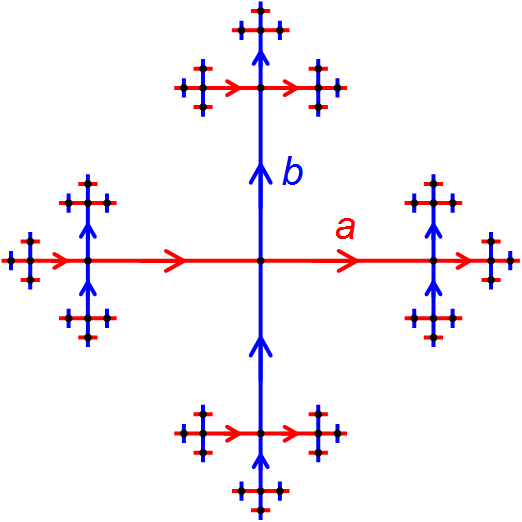
@golden pasture think of it like this: the red paths show the structure of <r> (here <a>), the way the graph is extended by making two of them and connecting them with blue shows how we take a semidirect product by $Z_2$, and the manner in which they go in the opposite direction to each other shows how it's the nontrivial semidirect product (instead of the one which is also a direct product)
cloud walrusBOT
Intel:
maiden ocean
you can probably make it look a little nicer
latent anvil
Yeah but why would I
maiden ocean
by copying the hex code of the color
urban acorn
on the different sides of the reflection, the rotations are opposite - that corresponds to the reversal of the arrows between the cycles
golden pasture
hm that’s interesting ig
latent anvil
I made this on my phone
maiden ocean
so the yellow around the homophobia doesnt look weird
latent anvil
Yeah but it's funnier like this
urban acorn
i look at that graph and immediately see $D_4$
golden pasture
feels too specific and like iffy still tho
cloud walrusBOT
Intel:
maiden ocean
mayhaps
golden pasture
i intuit groups by group action
golden pasture
xd
latent anvil
Oh lol I never did that
urban acorn
I intuit groups by how group elements "do things", but without specifying what they do things to
urban acorn
so i guess that's sort of like group actions
and it includes it
but also, it's somehow built to work with the action of G on itself by left multiplication
because
ab is a applied to b
maiden ocean
just intuit groups by K(G, 1)
urban acorn
OMG THIS IS SO COOL
(incomplete) cayley graph of free group on two elements
it's (going to be) A FRACTAL!!!
up = multiplication by a, down = multiplication by a^-1, right = multiplication by b, left = multiplication by b^-1
this picture doesn't specify inverses and only accounts for words with up to 4 terms
this fractal nature generalizes to more dimensions, it seems, but I can only imagine it in 3 dimensions
 glossy yoke
if you blur your vision, it kinda looks like the hyperbolic plane (it's quasiisometric to H^2 in fact). It's not a coincidence that the thrice punctured sphere is both hyperbolic and has fundamental group F_2.
you can get lots of pretty cayley graphs this way.
golden pasture
re hyperbolic these free groups appear as schottky groups which have pretty cool stuff related to it
 sour plume
i've recently seen a talk about these graphs, and the fun things you can do when topologizing them, like considering its gromov boundary https://en.wikipedia.org/wiki/Gromov_boundary
In mathematics, the Gromov boundary of a δ-hyperbolic space (especially a hyperbolic group) is an abstract concept generalizing the boundary sphere of hyperbolic space. Conceptually, the Gromov boundary is the set of all points at infinity. For instance, the Gromov boundary of the real line is two points, corresponding to positive and negative i...
i have no reason to care about this but it is a really pretty idea to think about the boundary of this graph as equivalence classes of rays starting from zero
urban acorn
i have no reason to care about this but it is a really pretty idea
said every mathematician ever
or no mathematician ever, or only pure mathematicians, depends on how you think about it
sour plume
i only have reason to care about things about which i can write papers
but because humans are cursed, sometimes i care about things against my own financial interest
golden pasture
the reason why i care about things is to care about other things
urban acorn
anyway i have no idea what the hyperbolic plane is, what H is, what F_2 is, what schottky groups are, and how one would topologize these graphs, i have so much math to learn
golden pasture
and to care about other things eventually leads to how to solve number theory
urban acorn
i mean, I'm guessing the hyperbolic plane is a topological space, i don't know topology 😦
golden pasture
ye it's like differential topology ish
urban acorn
are any of the things I mentioned that I don't know relatively simple without prerequisites in topology or any field like (insert adjective) topology/geometry?
golden pasture
topology is kinda like
a prerequisite for math
like sure in theory you could study some of it without topology but learning topology and algebra opens up a lot
point set isnt too hard to learn, jus read like first 3-4 chapters of munkres
 south temple
is it correct to say that a field is an extension of itself?
because a field contains itself
latent anvil
yup
urban acorn
@golden pasture yeah, i sure will learn topology
which parts of algebra would you say are most important in algebraic topology?
golden pasture
i dont recall really needing like algebra algebra
as long as you know definitions
urban acorn
I see.
chilly ocean
An Abelian p-group is divisible if every element is divisible by p. An Abelian p-group is reduced if it has no nontrivial divisible subgroups. But how is it even possible for an Abelian p-group to be reduced? If G is a reduced Abelian p-group and g is an element of G, then isn’t <pg> a nontrivial divisible subgroup of G?
 wind steeple
wdym by p-group ?
chilly ocean
wind steeple
wdym by p-group ?
A group where the order of every element is a power of a fixed prime p.
wind steeple
then it cannot be divisible, since if you take a non trivial x, you can find an y st py = x, and by iterating this you have a non trivial z st p^kz = x. But if your group is of order p^k, we would have x = 0 which is impossible
chilly ocean
Yeah, I see my mistake now, I incorrectly assumed that if every element of a subgroup is divisible by p in the larger group then the subgroup is divisible. But it’s actually about divisibility by p in the subgroup.
chilly ocean
New question: Let $G$ be an Abelian $p$-group, let $g$ be an element of $G$ such that $g\notin pG$, and let $x\in \langle g\rangle\cap pG$. Then is $x\in p\langle g\rangle$?
cloud walrusBOT
lugita15:
sturdy marsh
The condition is saying that x = ng = py
and you want to show that p divides n
write n = mp + r for some r less than p
then you have rg = p(y - mg)
so rg is in pG, for some r less than p
chilly ocean
@sturdy marsh OK thanks, I figured it out.
uncut girder
Prufer p group is the direct limit of Z/p^nZ while p adic integers are the inverse limit of Z/p^nZ
Cool
chilly ocean
If a countable Abelian p-group G is written as a direct sum of at most countably many finite cyclic groups and at most countably many Prüfer p-groups, then does that mean that the number of Prufer p-groups present in that decomposition is equal to the number of subgroups of G which are isomorphic to the Prufer p-group? https://en.wikipedia.org/wiki/Prüfer_group
 wind steeple
the picture is really cursed
maiden ocean
okay im doing a hom alg thing
basically i need to show that regarding Z2 as a Z4 module, Ext^i(Z2, Z2) is always non-zero
that is i need to construct a free resolution of Z2 as a Z4 module and show that after dualizing ker f_i/Im f_i-1 is never 0
the free resolution I constructed was
maiden ocean
the map induced by multiplying by 2 is going to be the zero map bc composing either 0 or the quotient w/ it is pretty clearly gonna just get u 0
The problem is finding the map induced by the quotient
maiden ocean
so clearly i fucked up
but idk where
wait am i an idiot
arent i supposed to remove the first Z/2Z term
lmao
sturdy marsh
yup
 sturdy marsh
so what you get should be identity, and then all 0
maiden ocean
yeah
sturdy marsh
lmao one of the exercises in hartshorne asks you to prove the riemann hypothesis for curves
surprisingly, it isnt bad at all
golden pasture
for elliptic curves?
golden pasture
ohh
maiden ocean
over finite fields?
sturdy marsh
yup
golden pasture
me not enuf machinery yet
 sturdy marsh
the solution doesnt need too much machinery
golden pasture
oo
sturdy marsh
you just need the intersection pairing on surfaces
maiden ocean
brofibration you're at UCLA right?
golden pasture
sturdy marsh
and uuuuh, the hodge index theorem
yea im missing this stuff rn
sturdy marsh
3
maiden ocean
mhm
but gen eds dont seem that bad if theyre specific and interesting
instead of
ap lang
sturdy marsh
some of them are interesting
but not interesting enough to motivate me to study and write stuff on them
maiden ocean
¯_(ツ)_/¯
 maiden ocean
its insanely expensive out of state
sturdy marsh
uuuuh wait lemme pull up the french name to be super pretentious
maiden ocean
fondements de la geometrie algebrique
sturdy marsh
Fondements de la Géometrie Algébrique
maiden ocean
but probably with an aigu on the first e in geometrie and algebrique
yeah
FGA SGA EGA
how many other variations are there on this
sturdy marsh
those are the only ones I know
but anyway, the book im reading is 'fga explained'
not fga
sturdy marsh
there's like 6 authors
maiden ocean
woke
 vital quail
broke: FGA
woke: FGO
sturdy marsh
fantechi, goettsche, illusie, kleiman, nitsure, vistoli
maiden ocean
stop
vital quail
is that kleiman from altman & kleiman
sturdy marsh
what's fgo
maiden ocean
a shitty mobile game
vital quail
(a term in commutative algebra)
sturdy marsh
yup
chilly ocean
Suppose that $G$ is a countable Abelian $p$-group which equals a direct sum of at most countably many finite cyclic groups and at most countably many Prüfer p-groups, where there exists a k such that there are no cyclic groups in the decomposition of order greater than $p^k$. And let $N$ be the number of Prufer p-groups in the direct sum decomposition, where $N$ can be zero, finite, or infinite. Then what is the number of elements of $G$ of order $p^{k+1}$, as a function of $N$? Does it matter what the specific orders of the finite cyclic groups are?
cloud walrusBOT
lugita15:
next obsidian
What da fuq...
vital quail
this must be what mochizuki is working on now
chilly ocean
Lol
sturdy marsh
the finite cyclic groups have no elements of order p^k+1
every element of the direct sum ignoring the prufer part has order at most p^k
so they probably dont matter
maybe
idk
that shit looks scary
chilly ocean
@sturdy marsh Yeah, the Prufer part is key. Now there are $p^{k+1}-p^k$ elements of order $p^{k+1}$ in the Prufer p-group. But the thing is that $G$ has uncountably many subgroups that are isomorphic to the Prufer p-group, but most of them overlap.
cloud walrusBOT
lugita15:
chilly ocean
@sturdy marsh I’m guessing that there are only finitely many elements of order $p^{k+1}$, I’m just not sure how to go about finding that number.
cloud walrusBOT
lugita15:
sturdy marsh
Let's ignore the finite cyclic group part for now, assume G is a direct sum of some number of prufer p groups
chilly ocean
Sure
chilly ocean
@sturdy marsh What do you mean by orders over the components?
sturdy marsh
if $x = (a_i)i$ is an element of G, then I think $\text{ord}(x) = \sup{i}\text{ord}(a_i)$
cloud walrusBOT
Brofibration:
sturdy marsh
definitely if it's a finite direct sum lol
yeah it should be
only finitely many can be nonzero
oh wait wtf
say x is an element of order p in the prufer group
then (x,0,0,0..) has order p
and (0,x,000)
and (0,0,x,000)
if the direct sum is infinite, cant you have infinitely many?
elements of order p
chilly ocean
@sturdy marsh Oh yeah, I think you’re right. But what about the case when the direct sum is finite?
sturdy marsh
okay, let's assume we have N summands
an element $x = (a_i)_i$ has order p^k iff $\sup{i}\text{ord}(a_i) = p^k$
cloud walrusBOT
Brofibration:
Compile Error! Click the  reaction for details. (You may edit your message)
sturdy marsh
there are p^k elements of order at most p^k
in the prufer group
and p^k - p^(k-1) elements of order p^k
So we just need to count the number of ways we can form an element such that at least one of the components has order p^k
chilly ocean
@sturdy marsh Is it really enough for just one of the components to have order p^k? Don’t the other components need to be 0?
sturdy marsh
nope
let's say it is a product of 2 of them
(a,b), a has order p^k, b has order p^l for some l<k
then (a,b)^(p^k) = (a^(p^k), b^(p^k) ) = (1, (b^(p^(l))^(k-l)) = (1,1)
chilly ocean
Oh right
sturdy marsh
that was a stupid thing to write, ord(a,b) = lcm(ord(a), ord(b)) = lcm(p^k, p^l) = p^k
as p^l divides p^k
anyway, so there are (p^k-1)^N ways to pick an element such that all components have order lower than p^k
So the number of elements of order p^k is (p^k)^N - (p^(k-1))^N
brb
chilly ocean
@sturdy marsh Don’t we care about all components having order less than or equal to p^k, not just less than? In your (a,b) example a had order p^k.
sturdy marsh
yeah less than or equal to
at least one of them needs to have order p^k
the others can have order less than or equal to
that was just an example to demonstrate that the other components do not need to be 0
chilly ocean
@sturdy marsh So how did you get (p^k)^N - (p^(k-1))^N?
sturdy marsh
just count
you want to count the number of ways at least one happens
to do that count the number of ways all of them have order less than what's required
and subtract
chilly ocean
@sturdy marsh OK now I see
sturdy marsh
now if you multiply that number by the order of the direct sum of all the finite cyclic groups involved, then you get what you wanted
oh, and replace k+1 in the problem statement with k
i switched notation
chilly ocean
@sturdy marsh Wait, what about if there are infinitely many summands in the finite cyclic group part of the direct sum, even if each finite cyclic group in the direct sum has size bounded by $p^k$? Then are there infinitely many elements of order $p^{k+1}$?
cloud walrusBOT
lugita15:
chilly ocean
@sturdy marsh Actually mathematical logic.
chilly ocean
@sturdy marsh This came up in the course of trying to solve some research problem in logic.
Haha
sturdy marsh
no
maiden ocean
yessssss
sturdy marsh
there are quite a few people interested in logic for some reason lol
maiden ocean
¯_(ツ)_/¯
chilly ocean
@sturdy marsh By the way, even if there are infinitely elements of order $p^{k+1}$, they’re not all linearly independent, right? Are there finitely many linearly independent elements?
cloud walrusBOT
lugita15:
maiden ocean
oh also since C_i(X) is free abelian over Z, Hom(C_i(X), Z) = C_i(X) right
and thus the cohomology is only dependent on the dualization of the boundary maps
chilly ocean
Model theory is a branch of logic, this problem actually came up in the context of model theory.
maiden ocean
model theory sounds dope
chilly ocean
Computable model theory to be precise.
sturdy marsh
maiden ocean
oh also since C_i(X) is free abelian over Z, Hom(C_i(X), Z) = C_i(X) right
yes
maiden ocean
yea ok
chilly ocean
maiden ocean
model theory sounds dope
I’m more of a proof theory man myself. Proof theory is more connected to the very foundations of mathematics.
maiden ocean
makes sense
i dont know anything about logic tbh
something to fix
but i have lots of other things to do >_>
sturdy marsh
maiden ocean
something to fix
dont fix it if it aint broke
chilly ocean
maiden ocean
i dont know anything about logic tbh
Then read Godel, Escher, Bach. I read it in 8th grade, it’s what got me interested.
chilly ocean
chilly ocean
<@351398829238648832> By the way, even if there are infinitely elements of order...
@sturdy marsh Did you see my question here?
sturdy marsh
linearly independent over what?
Fp?
every element is torsion so the only independent set over Z is the empty set
chilly ocean
@sturdy marsh I think linearly independent over $\mathbb{Z}_{p^{k+1}}$ is the relevant notion?
cloud walrusBOT
lugita15:
sturdy marsh
nah I don't think it's true
let x be an order whatever element from the prufer part
(x) \oplus (1,0,0,...), (x) \oplus (0,1,0,0...), etc. are all independent
sturdy marsh
yes
maiden ocean
yea makes sense
and then universal coeff thm gives us isomorphisms w/ the nth homology group
chilly ocean
@sturdy marsh OK yeah, you’re right, there are infinitely many independent elements.
@sturdy marsh By the way, earlier I had posted this question on MathOverflow. I just got an answer, and the formula at the end they give seems slightly different from yours:
sturdy marsh
they seem to be using your notation
i was doing it for elts of order p^k
not p^k+1
chilly ocean
@sturdy marsh I'm not talking about that, I'm talking about the fact that they seem to be raising p to the k^2 power.
They're doing m^k, and m = p^k(p-1).
I think they're wrong.
sturdy marsh
theyre assuming the number of prufer factors is k
set N = k in my solution and you get the same thing
I assumed there were N copies of the prufer group
chilly ocean
Oh, that's a weird assumption to make.
chilly ocean
That is the whole answer.
But here: https://mathoverflow.net/questions/377554/how-many-elements-of-each-order-are-there-in-this-p-group

MathOverflow
Let $G$ be a countable Abelian $p$-group which equals a direct sum of at most countably many finite cyclic groups and at most countably many copies of the Prufer $p$-group, where these finite cyclic
sturdy marsh
alright
maiden ocean
fair warning this doxes you i think?
sturdy marsh
yeah they assumed k(or k+1 depending on notation) = N
chilly ocean
@maiden ocean I dox myself every day of the week and twice on Sundays.
maiden ocean
sad!
sturdy marsh
rip
well, the weirdest thing we know about you is that you do logic so you're probably okay lmao
sturdy marsh
there seems to be quite a lot of them
sturdy marsh
that's a decent number
vital quail
 i know like 02139402934 234213421 3algebraists
vital quail
they're probably overrepresented online too
sturdy marsh
yeah for some reason everyone on mathoverflow does AG
sturdy marsh
there's a few unis with a lot of logicians
I've heard berkeley has quite a few
UCLA has over 20
I think
graduate students
 sturdy marsh
there's a lot of them too
vital quail
wonder why
sturdy marsh
do you?
vital quail
i guess it's just because for whatever reasons there were initially some good analysts there
and then it just builds on that
those people attract analyst grad students
etc etc
sturdy marsh
there are a few really good analysts even right now lol
vital quail
who are the big analysts these days 🤔 im not really familiar lol
sturdy marsh
terry tao
vital quail
besides tao
sturdy marsh
I do not know many analysts
uncut girder
Tao
thorn delta
james maynard if you count ANT
maiden ocean
cant believe no one mentioned gomez
thorn delta

chilly ocean
yeah, i'm not sure what people mean when they say there are more algebraists
vital quail
online
online there's definitely a greater number of algebraists
more visible at any rate
next obsidian
There would be more analysts if analysis was better
chilly ocean
but where is "online"?
next obsidian
vital quail
the internet
maiden ocean
hello chmonkey
chilly ocean
so, the number of algebraits that use the internet is more than the number of analysts that use the internet?
vital quail
wait this isn't #chill
yes
analysts are boomers
they don't use the internet
at least that's my hypothesis
i really don't know why there aren't more analysts online but there does seem to be a gap
uncut girder
Yeah most algebraists are weebs
north widget
Is that true? @uncut girder
(g)Let X be a G-set and let H < G. Then X can be regarded in a natural way as an H-set.
(h)With reference to (g), the orbits in X under H are the same as the orbits in X under G.
False for h since H may have less "action"/"permutation power" than G. An example of this is to take G as D4 and H as {e,r^2} where r^2 is rotation twice. Then take X as a G-Set containing the vertices, edges,diagonals,middle lines, and center.
Then H would have two orbits for the vertices while G only has 1.
I would like clarification on "action"/"permutation power"
don't know of another way to phrase it. I want to say that elements of H moves elements of X to less places compared to what elements of G do.
 leaden finch
can someone check my work
golden pasture
north widget
Is that true? <@!126935813022810112>
(g)Let X be a G-set and let H < G. Then X ...
yup h is false
how about g?
(just write down the action)
north widget
I wrote g is true
thought of it intuitively
I don't know definition of H-Set but I just assumed it is another type of G-Set
the only properties needed to be satisfied for something to be a G-Set is that
1.ex=x
2.(g_1g_2)x=g_1(g_2x)
if thats true for G, its also true for H
since h has identity and g_1,g_2 can be elements of H
@golden pasture Two questions, What is your name since I don't have correct locale downloaded so I can't see your name.
Is it true that every G-Set is isomorphic to a disjoint union of left coset G-Sets?
My answer is that since a G-Set is just another set, it is saying:
Is a set A ismomorphic to a disjoint union of its left cosets?
which is true since a disjoint union of cosets of a set A equals A
golden pasture
north widget
<@!223340518619217920> Two questions, What is your name since I don't have corre...
"a cute cat" literally
sounds about right
 dim escarp
Hello how do I show that there is an irreducible polynomial of degree p with exactly 2 complex roots?
dim escarp
For context, I'm trying to prove that there is always a field extension with galois group Sp
My professor provided a proof of "degree p irreducible function with single pair of complex root over Q has galois group of Sp"
I guess I have to use that
I'm wondering about how.
<@&286206848099549185>
=/
chilly ocean
maybe there is some easy way to construct polynomials with many number of real* roots, then eisenstein criterion?
not sure
i was thinking maybe descarte rule of signs, but i guess that gives an upper bound on the number of real roots, not a lower bound
dim escarp
Yep.. lower bound is more helpful in this case
I wonder if it is possible to recursively construct functions with n-2 real roots for degree n
Perhaps slightly modifying a function with n-2 roots in Q? hmm.
chilly ocean
maybe something to do with the fact that if a polynomial has n-2 roots then its derivative must have n-3 roots? (ie it must be very wiggly)
 nova plank
dim escarp
nova plank
dim escarp
Success!
chilly ocean
If $G$ is an Abelian group and $A$ and $B$ are subgroups of $G$ which are both direct summands of $G$, then under what circumstances is $A\oplus B$ a direct summand of $G$? Does it suffice that $A\cap B = 0$, or is more required?
cloud walrusBOT
lugita15:
 solemn rain
the orders match
like the order of |A||B| is |G|
and also (|A|,|B|) = 1
and they are normal
for an abelian group
of order xy for some x and y coprime
you can always find two such subgroups
@chilly ocean
chilly ocean
@solemn rain To be clear, I'm interested in the case when $G$ is infinite. And also I'm not asking for $G$ to equal $A\oplus B$, I just want $A\oplus B$ to be a direct summand of $G$.
cloud walrusBOT
lugita15:
solemn rain
oh sorry
 sterile garden
I'm working through some of Rotman's group theory text. I'm given that G = <a> is cyclic of order rs, with gcd(r,s) = 1. I need to show there are unique b,c in G with b of order r, c of order s, and a = bc.
I know there exist integers x,y such that xr + ys = gcd(r,s) = 1.
So my sort of idea is to let b = a^ys, c = a^xr. This makes their product a.
But if I set b and c like that, are their orders as required?
I'm just unsure about the properties of x,y
sterile garden
I get stuck trying to get their product to be a when I do that
Taking their product gives me a^(r + s)
I sort of got stuck trying to get r + s = 1
 carmine fossil
Why are you taking a product
sterile garden
It says we need a = bc
carmine fossil
mb
sterile garden
if I set b = a^s, c = a^r, how does a = bc?
next obsidian
since s and r are coprime
any element of order r is of the form a^ks and any element of order s is of the form a^jr
This isn't even using coprime actually
You can show just show this from the order of a being rs
now we want ks + jr = 1 mod rs
by coprimeness we can find such k,j so that ks + jr = 1
sterile garden
Yeah this was sort of my idea I mentioned above
next obsidian
and basically if we enforce k,j to be positive, but within [1,r] and [j,s] we get uniqueness
this is because a^{ks} = a^{(k+k'r}s}
basically since a^{rs} = 1 we can change k by a multiple of r and do nothing
and can change s by a multiple of r and do nothing
so we can WLOG k,j to be in the ranges I specified since it changes nothing
Then it's just showing that there's only one pair (k,j) in [1,r] x [1,s] for which the equation ks + jr = 1 mod rs holds
sterile garden
In your range above, should that second range be [1,s]?
next obsidian
yeah i jus corrected it haha
Does that reduction make sense?
It's a bit hard maybe to see that this actually does it but
I think it's easier to assume that we had non-unique elements
sterile garden
It doesn't make sense immediately, but I think I can get it
next obsidian
then we get like k,k' so that say b = a^{ks} and b' = a^{k's}
(this is saying b isn't unique)
sterile garden
yeah
next obsidian
from here we can shift k and k' to be inside of [1,s]
yeah?
but once we do that, k can't be equal to k'
else b = b'
so this gives us more than one solution to
ks + jr = 1 mod rs
where (k,j) is in [1,r] x [1,s]
So really we're arguing by the contrapositive
sterile garden
How do I know I can find k, j in that range?
next obsidian
this is by bezout's lemma
we can always find SOME k,j so that ks + jr = 1
since s,r are coprime
sterile garden
RIght I get that
next obsidian
from here just take that k and add multiples of r
sterile garden
OH!
next obsidian
and take j and add multiples of s
sterile garden
I see
sterile garden
Okay, this is clear now
next obsidian
NP
carmine fossil
There's also a nice counting argument
next obsidian
👍
carmine fossil
number of elements of order a is phi(n/a)
sterile garden
Yeah, and this bit of the exercises is about euler phi
carmine fossil
Note that any element of form bc(|b|=r,|c|=s) generates <a>
And there are phi(r)phi(s) elements of that form
There are phi(rs=n) generators of G
sterile garden
And the second part of this question is showing phi(rs) = phi(r)phi(s)
carmine fossil
Implying any generator of G is of that form(since gcd (r,s)=1)
nvm, That's your answer
sterile garden
Appreciate the help in here. I'll let it sit for the day and try to reproduce it this evening or something
next obsidian
but a^ks isn't always order r
I think the idea works pretty much in this same fashion
sterile garden
Yeah this was what I was wondering
next obsidian
but certainly any element of order s MUST be of the form a^ks
sterile garden
Yeah
next obsidian
Which is probably enough I think
sterile garden
And I can still force it to be within that range
next obsidian
Right
So I think it does go through unhindered
probably
so we need k to be coprime to r
next obsidian
This still sounds true IMO
sterile garden
But if we choose k in [1,r) it should be fine right?
next obsidian
I think so
oh yeah
nice
or hmm
I think this is gonna require more weird coprime stuff
I think we don't strictly need [1,r) either
we just need some like
[ir + 1, i(r + 1))
since I think we should still only have one solution
in someting of the form [ir + 1,i(r + 1)) x [ks + 1, k(s + 1))
and then by being able to have a bit more freedom we can always take it to be coprime or something
tbh I don't know off the top of my head but coprimeness sounds like it probably means this stuff is true lol
oh wait
THIS IS EASY
take
ks + jr = 1 mod rs
Or wait
oops
Well, maybe this still works
k isn't coprime to r so we have an a with ak' = k and ar' = r
then
ak's + ajr' = 1 mod rs
factor out the a so we get
a(k's + jr') = 1 mod rs
and uh...
hmm I want to conclude that this is bad somehow