#groups-rings-fields
1 messages · Page 221 of 1
 delicate orchid
have you done $\frac{1}{x_1+...+x_n} = \frac{1}{x_1}+...+\frac{1}{x_n}$ on the 2nd equality?
 cloud walrusBOT
Wew Lads Tbh
 delicate orchid
third*
FUCKING MOVE THE | UNDER THE FRAC RAAAAAAAAAGHHHHHHHHH
:thecosmoshumswithatunemostsweet:
 south patrol
so equality holds iff Z(G) has index 4
ig
which holds for non-abelian order 8
makes sense
well
delicate orchid
I'm not seeing the third equality am I skill issu- yeah ok
south patrol
non-abelian order p^3
delicate orchid
south patrol
non-abelian order p^3
[neuron activation]
cloud walrusBOT
Süßkartoffel
 south patrol
- Z(G) index 2
- every conjugacy class size 1 or 2
which means p^3 doesn't work necessarily unless p = 2
 silver kettle
hate algebra
south patrol
it's cause i left in an extra = by accident
silver kettle
hate finite group theory
south patrol
i'm bounding |g^G| >=2 for non-central elements
silver kettle
SIMPLE AS!
delicate orchid
there are many other channels on this server for you to enjoy then, buster
south patrol
Fair enuff
delicate orchid
character theory has no uses other than the odd order theorem
delicate orchid
ur using the 5/8th theorem in ur diss? :letroll:
south patrol
lol unfortunately not
but did remind me about characters
tbf what i am doing rn is kinda chracter theoretic i guess
delicate orchid
oh lord here we go
south patrol
lol
delicate orchid
considering u said the word "etale" earlier I'm scared
oml Q_{2^n} has such a nice subgroup lattice

 summer path
It's not symmetric :c
delicate orchid
the trivial group ruins everyone's life once more

 dusk whale
I could use a hint on how to get started for this problem

The hint says use induction but im a little lost setting up a base case
 vivid tiger
When a grid's misaligned with another behind it's a moiré!
vivid tiger
dusk whale
I could use a hint on how to get started for this problem
Well, Z/pZ is normal in Z/nZ with p dividing n.
Well actually you probably want that Z/(n/p)Z is normal in Z/nZ with factor group Z/pZ.
Then huzzah
dusk whale
vivid tiger
Well, Z/pZ is normal in Z/nZ with p dividing n.
How do we know this
vivid tiger
Normality? That's easy.
It's abelian.
The part you actually need to show is that Z/nZ / Z/mZ with m|n is in fact Z/(n/m)Z.
This is just due to uniqueness of cyclic groups of specified orders.
dusk whale
So Z/pZ is normal in Z/ nZ iff p divides n where p is a prime and thats something we know a priori?
vivid tiger
You can rederive it.
It's immediate from the definitions of normality.
ghg^{-1} is what?
in an abelian group, you'll always get h
dusk whale
I see
dusk whale
vivid tiger
The part you actually need to show is that Z/nZ / Z/mZ with m|n is in fact Z/(n/...
how come the m | n part is necessary?
vivid tiger
dusk whale
how come the m | n part is necessary?
otherwise it's not a subgroup.
at the very least you have lagrange's theorem
yeah, I think that's true.
oh, obviously.
it's still just that generated by the generator
m * index = n
i retain my math license.
why do I feel like sometimes wrong
 crystal vale
For 3, characteristic polynomial is det(tI -A ) =0 which are satisfied by A.
det( tI - A) = t^n so A^n =0, right ?
 dire siren
crystal vale
For 3, characteristic polynomial is det(tI -A ) =0 which are satisfied by A.
de...
dire siren
crystal vale
For 3, characteristic polynomial is det(tI -A ) =0 which are satisfied by A.
de...
that's correct
but the polynomial is det(tI-A), not "det(tI-A)=0"
crystal vale
dire siren
that's correct
but the polynomial is det(tI-A), not "det(tI-A)=0"
I am not sure about characteristic polynomial, thank you
 white wraith
I was reading a survey and there's 35.3% of people that think rings need to be commutative, is there some convention in another country that I don't know about??
 south patrol
I imagine there is some ambiguity here - often people work in contexts where every ring is commutative
So it is an assumption rather than actually having commutative part of the definition
This survey was weird though lol I guess because it is largely undergrads
 dull marsh
Oh lmao I thought the question was asking about the number of commutative rings and noncommutative rings
Only 35.3% of rings are commutative fr
 dull ginkgo
commutative algebra mfers when they need to write out 2 extra words

 rocky cloak
crystal vale
But I don't know how to show this set is uncountable
rocky cloak
crystal vale
But I don't know how to show this set is uncountable
This is correct.
To see that it's uncountable just notice that for any b in [-1, 1] there are c and d such that b^2 + c^2 + d^2 = 1.
crystal vale
If R is a Boolean ring without unity , can it be commutative, I think yes
crystal vale
rocky cloak
This is correct.
To see that it's uncountable just notice that for any b in [-1...
Okay, thank you
dire siren
crystal vale
If R is a Boolean ring without unity , can it be commutative, I think yes
it's always commutative
crystal vale
dire siren
it's always commutative
So unity not necessary
dire siren
yes, not necessary
white wraith
crystal vale
So unity not necessary
I don't think so, you can show it with the idempotent property
white wraith
Characteristic 2
dire siren
(x+x)^2=x+x
white wraith
-ba = ba
white wraith
south patrol
uwu
Ending all my proofs with this from now on
white wraith
south patrol
I like "so we win", like on the Stacks project
\renewcommand\qedsymbol{$so we win$}
south patrol
lol
white wraith
I'm testing that when I get home
crystal vale
white wraith
Characteristic 2
So it also follows characteristic 2 without unity, right?
white wraith
crystal vale
So it also follows characteristic 2 without unity, right?
Yeah
white wraith
south patrol
This survey was weird though lol I guess because it is largely undergrads
Or in particular, people answering questions about things they don't know about
Like I didn't answer any applied questions because I haven't done it since I did intro to applied in my first year of uni 😆
dire siren
white wraith
Or in particular, people answering questions about things they don't know about
they completely messed up question 72
crystal vale
If R is a commutative ring with 1. Then is it true that if f(x) is an element of R[[X]] and all coefficients of f(x) are nilpotent in R. Then f(x) is nilpotent in R[[X]].
dull ginkgo
I think that’s for R[X]
Though my de facto proof for that is just proving the nilradical is additively closed, then just showing that if all the coefficients are nilpotent, then any polynomial is nilpotent because it absorbs multiplication
crystal vale
dull ginkgo
I think that’s for R[X]
Yes, but I want to check on R[[X]]
dull ginkgo
Hmm
crystal vale
In the ring, the existence of the right unity implies the existence of left unity ?
dire siren
for R[x] there is a nice proof using the characterization of units:
f is nilpotent in R[x] => 1+f is a unit in R[x] => the free coefficient is a unit and the other ones are nilpotent
crystal vale
dire siren
for R[x] there is a nice proof using the characterization of units:
f is nilpote...
It can be true if we can replace 1 by any other unit element, right?
dire siren
yes
crystal vale
dire siren
for R[x] there is a nice proof using the characterization of units:
f is nilpote...
How can I prove that if all coefficients are nilpotent then f is nilpotent
dull ginkgo
The best way to show it imo is the nilradical is an ideal
crystal vale
dull ginkgo
The best way to show it imo is the nilradical is an ideal
Okay, thank you
crystal vale
crystal vale
In the ring, the existence of the right unity implies the existence of left unit...
This one ?
dull ginkgo
For the case of R[[X]]
dull ginkgo
crystal vale
In the ring, the existence of the right unity implies the existence of left unit...
This is a group theory exercise afaik
Or moreso module
I haven’t done much at all with R[[X]]
Though from what I’ve tried it’s like R[X] but “in reverse”
rocky cloak
crystal vale
If R is a commutative ring with 1. Then is it true that if f(x) is an element of...
Not necessarily no.
Like take
R = k[x1, x2, x3, ...] /(xixj, xi^i : i not equal to j)
Then
x1X + x2X^2 + x3X^3 + ...
is not nilpotent
dire siren
crystal vale
How can I prove that if all coefficients are nilpotent then f is nilpotent
actually no need of induction
say the coefficients have nilpotence indexes k_1, k_2, k_3, ..., k_n
and raise f to the power k_1+k_2+k_3+...k_n... you'll get 0
(this is for R[x])
dull ginkgo
Is there a nice universal property for R[[X]]?
rocky cloak
dull ginkgo
Is there a nice universal property for R[[X]]?
It's the adic completion of R[X]. So I guess continuous maps of R-algebras are freely determined by maping X to a continuously nilpotent element.
crystal vale
dull ginkgo
This is a group theory exercise afaik
Hint
dull ginkgo
crystal vale
Hint
Give me a moment, I’d have to find it
Correction, I am wrong
Misread the problem
rocky cloak
crystal vale
In the ring, the existence of the right unity implies the existence of left unit...
I don't think it's true, but don't have an example at hand
crystal vale
Let R be a non-zero ring such that the equation ax=b has a solution in R for all a,b belongs to R and a≠0. How can I show that R has unity?
crystal vale
rocky cloak
I don't think it's true, but don't have an example at hand
Okay
dull ginkgo
crystal vale
Let R be a non-zero ring such that the equation ax=b has a solution in R for all...
This can be proven for semigroups
dire siren
it was asked recently
dire siren
I found it, but apparently this has one extra condition: #groups-rings-fields message
dull ginkgo
I think it needs right unity
crystal vale
dire siren
I found it, but apparently this has one extra condition: https://discord.com/cha...
If it is commutative then it is true
 chilly ocean
crystal vale
In the ring, the existence of the right unity implies the existence of left unit...
chilly ocean
crystal vale
In the ring, the existence of the right unity implies the existence of left unit...
In what ring? Any?
dull ginkgo

 crystal vale
chilly ocean
In what ring? Any?
crystal vale
chilly ocean
In what ring? Any?
Yes
chilly ocean
crystal vale
Yes
2x2 matrices with zero lower entries
rocky cloak
dull ginkgo
<:uponthewitnessing:1204923968096706581>
This seems like an overconvoluted way of saying that it
nr = 0, then nrs = nsr = 0 as well
chilly ocean
[1 0; 0 0] is a left identity but not an identity
dull ginkgo
rocky cloak
This seems like an overconvoluted way of saying that it
nr = 0, then nrs = nsr =...
lol it was mainly me just thinking it was neat
crystal vale
chilly ocean
2x2 matrices with zero lower entries
Okay, thank you
crystal vale
dull ginkgo
I think it needs right unity
How can I prove that?
dull ginkgo
idk off the top of my head tbh
crystal vale
And if it is true then I can show that if R has no zero divisors and it is finite, then it is a division ring, right?
dire siren
crystal vale
And if it is true then I can show that if R has no zero divisors and it is finit...
that's always true
I mean the second part
crystal vale
dire siren
that's always true
Yeah but then I need unity
dire siren
yes
crystal vale
Centre of division ring is a field, because it is subring of division ring containing 1 and also it is commutative, right ?
rocky cloak
crystal vale
Centre of division ring is a field, because it is subring of division ring conta...
It's true that it's a field. But a commutative subring of a division ring doesn't have to be a field
rocky cloak
crystal vale
Yeah but then I need unity
You don't need unity, in the sense that it follows that the ring has unity without you having to assume it.
crystal vale
rocky cloak
It's true that it's a field. But a commutative subring of a division ring doesn'...
And according to your subring definition 1 has to be in it or not?
rocky cloak
crystal vale
And according to your subring definition 1 has to be in it or not?
Not really relevant
crystal vale
rocky cloak
You don't need unity, in the sense that it follows that the ring has unity witho...
Yes
crystal vale
rocky cloak
Not really relevant
Then?
crystal vale
rocky cloak
It's true that it's a field. But a commutative subring of a division ring doesn'...
It is not necessary that they have inverse closure, right?
rocky cloak
crystal vale
Then?
Personally, I use the definition that subrings have the same 1, but the statement is true regardless
Z is a subring of Q for example
crystal vale
Means centre has closed under inverse right?
crystal vale
rocky cloak
Which is how you would show it's a field
Yes
So if the subring of the division ring is closed under inverses and commutative then it is field , right?
rocky cloak
Yes, a commutative ring where every nonzero element has an inverse is by definition a field
rocky cloak
crystal vale
Is Z_2 × Z_2 Boolean ring?
Maybe try writing out the definition and seeing if it holds
crystal vale
rocky cloak
Maybe try writing out the definition and seeing if it holds
Yes it is hold
rocky cloak
Then there's your answer
crystal vale
So the Boolean ring does not need to be integral domain
rocky cloak
They very rarely are
crystal vale
Yes got it
rocky cloak
There's Z/2, and maybe the trivial ring depending on your definition of integral domain
crystal vale
How it depends on integral domain definition, trivial ring means ab=0 for all a and b ?
rocky cloak
Trivial ring, means the ring with one element
Many people have 0 =/= 1 as part of the definition of integral domain
crystal vale
rocky cloak
Many people have 0 =/= 1 as part of the definition of integral domain
Okay, thank you
chilly ocean
rocky cloak
Many people have 0 =/= 1 as part of the definition of integral domain
Alternatively, define an integral domain as: if a product is 0 then one of the terms in the product is 0. Then the empty product on trivial ring is 0 despite none of the terms being 0 so it isnt a integral domain
crystal vale
Empty product?
rocky cloak
That's an interesting aproach
Seems to be leaning more towards obfuscation than elegance, but still
dull marsh
crystal vale
Empty product?
The empty product is usually defined to be the multiplicative identity
rocky cloak
It makes it so that the product over a disjoint union is the product of the products over each set
Which is nice
crystal vale
dull marsh
The empty product is usually defined to be the multiplicative identity
Okay
chilly ocean
This makes me wonder
Let R be a ring (unital or not idc, preferably commutative)
Can there be a subset of that ring that is closed for ternary products, but isn't a subring?
crystal vale
chilly ocean
Can there be a subset of that ring that is closed for ternary products, but isn...
ternary products ?
rocky cloak
chilly ocean
Can there be a subset of that ring that is closed for ternary products, but isn...
I guess take some element x where x^3 is 0, but x^2 is not. Then consider {0, x}
chilly ocean
rocky cloak
I guess take some element x where x^3 is 0, but x^2 is not. Then consider {0, x}
nice move
crystal vale
In the ring of all real valued continuous function on [0,1] , the nilpotent element only 0 ?
chilly ocean
crystal vale
In the ring of all real valued continuous function on [0,1] , the nilpotent elem...
What have you tried?
 hidden wind
help i'm stumbling over something really elementary 😭
chilly ocean
bet
south patrol
All maths is elementary
crystal vale
chilly ocean
What have you tried?
Let f be a nilpotent element then f^n(x) =0 for all x and for some positive integer n.
But it shows that f(x) =0 for all x, right?
rocky cloak
hidden wind
help i'm stumbling over something really elementary 😭
My dear Watson
hidden wind
hidden wind
help i'm stumbling over something really elementary 😭
namely, if S is a finite semigroup, in which the two laws of cancellation holds (i.e. if ab = ac then b = c, and similarily with a on the right), then S is a group
rocky cloak
On a finite set injective = surjective = bijective
hidden wind
i'm not sure how to go from this "ab = ac implies b = c", to "a has a multiplicative inverse"
hidden wind
rocky cloak
On a finite set injective = surjective = bijective
whaaaaat
rocky cloak
Are you one of the lucky 10 000 today?
hidden wind
what do you mean
chilly ocean
hidden wind
what do you mean
if you have a function f: X->X and X is finite, then injective is equivalent to surjective
rocky cloak
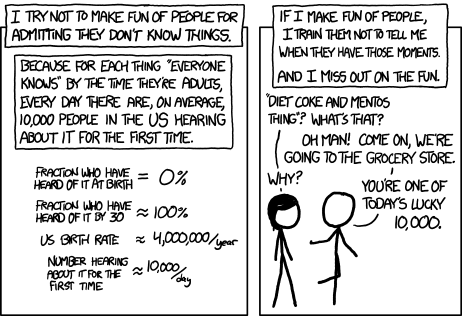
Saying 'what kind of an idiot doesn't know about the Yellowstone supervolcano' is so much more boring than telling someone about the Yellowstone supervolcano for the first time.
hidden wind
ohh
crystal vale
crystal vale
Let f be a nilpotent element then f^n(x) =0 for all x and for some positive inte...
Is it correct?
crystal vale
chilly ocean
you have that f^n(x)=0
From there we have f(x) =0 , right?
chilly ocean
crystal vale
From there we have f(x) =0 , right?
why?
crystal vale
Because f(x) is the real number
chilly ocean
yeah
crystal vale
chilly ocean
yeah
It follows that for all x, f(x)= 0, right?
 rain grove
We can look at the set of square matrices over Complex numbers M_n(C) and over quaternions M_m(H) as vector spaces over Real numbers... is there a pair of natural numbers n,m so that these vector spaces are isomorphic?
chilly ocean
rain grove
We can look at the set of square matrices over Complex numbers M_n(C) and over q...
Do you know of any condition that is equivalent to two vector spaces being isomorphic?
rain grove
My answer is no, as M_m(H) ≅ R^(4 * m^2) and M_n(C) ≅ R^(2 * n^2)
but then that means n = sqrt(2) * m
is this ok?
rain grove
chilly ocean
Do you know of any condition that is equivalent to two vector spaces being isomo...
yeah, they are the same dimension
chilly ocean
rain grove
My answer is no, as M_m(H) ≅ R^(4 * m^2) and M_n(C) ≅ R^(2 * n^2)
but then that...
sounds gud to me
crystal vale
Let R be a ring and Z be the centre of R, then M_n(Z) is never the centre of M_n(R) if n>=2.
So let's first for n>=3.
If I take A be strictly upper triangular matrices in M_n(Z) and B be the strictly upper triangular matrices in M_n(R). If AB= C and BA= D then C[1,3] = A[1,2] × B[2,3] and D[1,3]= B[1,2] × A[2,3] so if there are at least two elements, then I have distinct B[1,2]≠B[2,3] , right? But what if A[1,2] × B[2,3]= B[1,2] × A[2,3] ?
dire siren
crystal vale
Let R be a ring and Z be the centre of R, then M_n(Z) is never the centre of M_n...
I would suggest choosing matrices with only 0 and 1s, but very few 1s
for example: ||A = the matrix with 1 in the top right corner and 0 everywhere else|| and ||B = the matrix with 1 in the bottom right corner and 0 everywhere else||
crystal vale
dire siren
I would suggest choosing matrices with only 0 and 1s, but very few 1s
But it is not given that R has unity
dire siren
@crystal vale I'm fixed on rings with unity; you can replace the unity with any element in Z
crystal vale
dire siren
<@1170248145314271322> I'm fixed on rings with unity; you can replace the unity ...
Yeah got it, thank you
dire siren
we should assume of course that R is not commutative (otherwise the problem is false)
crystal vale
But if Z={0} then maybe it is true
crystal vale
Then M_n(Z) ={0}
dire siren
@crystal vale So if Z={0}, then for any element x we can find y such that xy =/= yx
so let's take a non-zero matrix A in M_n(R)
say the element on row i, column j is non-zero... we can denote it by a
now take an element b different from 0 and a
and consider the matrix
B = b on row j, column i and zero everywhere
I just hope I didn't mess up the multiplication, but I think AB is not equal to BA
yeah, the multiplication is messed up... have to search for another matrix B
crystal vale
dire siren
and consider the matrix
B = b on row j, column i and zero everywhere
But if Z={0} then M_n(Z) = {0} ?
dire siren
I know, but I have a feeling that fails to be true
@crystal vale I might be wrong, but my intuition comes from matrices with real entries... in this case the center consists of scalar multiples of the identity
so if we move to a general ring which might not have identity... my intuition tells me that it could happen for the center to only contain the zero matrix
crystal vale
dire siren
<@1170248145314271322> I might be wrong, but my intuition comes from matrices wi...
Okay, thank you ❤️
dire siren
that's not a proof yet
crystal vale
Yeah I know, assume Z(R) ≠ {0}
rocky cloak
If ab = 0 for all a and b in R, then the same is true for Mn(R), so Mn(R) is commutative
I think things get pretty crazy in general if R isn't unital.
dire siren
oh, but R is commutative in that case
rocky cloak
But I guess maybe you could get away with a condition like, there is an element x in Z(R) and an element y such that xy is nonzero
Alternatively don't consider Mn(R), when R isn't unital 😛 . Like I can't really imagine a situation where that ring would come up
dire siren
we proved the case Z(R) ≠ {0}, but we are stuck with the case Z(R)={0}
I can only get that a matrix in Z(M_n(R)) would have 0 on the main diagonal
rocky cloak
If R is commutative then Z(R) = R, hence nonzero
dire siren
we assum R to be non-commutative
crystal vale
dire siren
we proved the case Z(R) ≠ {0}, but we are stuck with the case Z(R)={0}
But in case Z(R) ≠ 0 , I get ab=0 what if a is zero divisor , how can I prove that there is another b such that ab≠0
dire siren
what I want to prove specifically is
if Z(R)={0}, then Z(M_n(R))={O}
rocky cloak
non-commutative typically means "not necessarily commutative", but if you insist on it being strictly noncommutative you could just append two variables that don't commute with each other
dire siren
sorry, I meant to say "not commutative" and I didn't realize
yeah, the thing is that I solved Notknow's problem under the assumption Z(R)=/=0 and I doubt it is true in the case Z(R)=0
rocky cloak
But I don't believe you solved it
dire siren
yes, you are right
crystal vale
Lie ring has no multiplicative identity element because it is anti- commutative, right?
rocky cloak
Corectomundo
delicate orchid
1x =-x1
dull ginkgo
char 2 motherfuckers be like
crystal vale
rocky cloak
Corectomundo
?
rocky cloak
Just trying out new ways to say yur
dire siren
@crystal vale So regarding the previous problem, you should ignore my approach for the first part because it is wrong. Sorry about that.
But on the other hand, the problem turns out to be false, as jagr2808 provided a counterexample above.
Did you find that problem in a book or did you come up with it?
 stark helm
if f(x)=x^4-6x+1 and want to justify f(x) is irreducible over Q[x], is it correct to solve roots x= +- sqrt(3+2 sqrt(2)) or +- sqrt(3-2sqrt(2)) and write it into linear factor? then arguing that linear factor of four roots can not be combined into f=h*g in any ways when h, g in Q[x]?
 long obsidian
Say f:A->B and a is an ideal in A. Is the extension $a^e=\cap_{I\supset f(A)} I$ I can't remember if this is the same as the ideal generated by the image
cloud walrusBOT
HausdorffT1

 celest furnace
stark helm
if f(x)=x^4-6x+1 and want to justify f(x) is irreducible over Q[x], is it correc...
celest furnace
stark helm
if f(x)=x^4-6x+1 and want to justify f(x) is irreducible over Q[x], is it correc...
Yes that works
You can let alpha be one particular root and say (x-alpha)(x-beta) doesn’t have coefficients in Q for all the other roots beta
 chilly radish
dire siren
yeah, the thing is that I solved Notknow's problem under the assumption Z(R)=/=0...
chilly radish
dire siren
yeah, the thing is that I solved Notknow's problem under the assumption Z(R)=/=0...
||For any ring, one has
Z(M_n(R))=Z(R)I_n
So indeed in Z(R)=0 then Z(M_n(R))=M_n(Z)=0.
In the case Z(R)\neq 0 amd n>=2 one has, M_n(Z)\neq Z I_n since M_n(Z) has non scalar matrices||
 vivid birch
is this the correct channel to discuss semigroup theory?
dire siren
@chilly radish I think that's true only for rings with unity
chilly radish
dire siren
<@102705166754549760> I think that's true only for rings with unity
I think one could probably extend it further but yea I did assume unity
I think most reasonable textbooks do tho
dire siren
yeah, initially I also thought that the ring has unity, but the guy who asked told me it's not necessarily unital
chilly radish
Oh my bad
That's silly
I guess in that case one can just take a nonscalar matrix and show it doesn't commute with another matrix
I think you need to think of the case where Z(R) has only 2 elements tho
I think taking diag(a,0,..) for a in the center will work, you just have to choose a correct matrix (and disregard trivial edge cases)
chilly radish
chilly radish
I think taking diag(a,0,..) for a in the center will work, you just have to choo...
Sorry not diag(a,0...) But rather something like
(0 a)
(0 0)
And the rest is zeroes
rain grove
h: G -> G' homomorphism of groups, let a be an element of a finite order of G. Show that the order of h(a) divides the order of a. Show that if h is injective then the orders are the same
what i did: a^n = 1
then: h(1) = h(a^n) = h(a)^n
multiply both sides with h(a): h(a) = h(a)^n
multiply both sides with h(a)^(-1) : 1 = h(a)^n
im stuck here
dire siren
@chilly radish it just works by adapting the standard proof that the center of M_n(K) consists of scalar matrices of the identity (K - field)
In that proof one takes the matrices E_ij, whose elements in row i, column j is 1, and the rest of the elements are 0
For our problem we should take the same matrices with some arbitrary element b instead of 1.
So what happens is that if A is in Z(M_n(R)), then E_ijA=AE_ij so we get ba_ji=a_jib, for any b, so a_ji is in Z(R), so it must be 0; hence A=0.
dire siren
chilly radish
I think one could probably extend it further but yea I did assume unity
On the other hand, due to the randomness of the ring, I'm not sure to what extent such an extension is possible
for example, jagr2808 mentioned above the ring in which ab=0 for any a,b. For this ring the center of M_n(R) is M_n(R) itself
chilly radish
This works in the case of the center being 0
But I don't think this will work for nonzero center
south patrol
Non-unital rings...
chilly radish
dire siren
On the other hand, due to the randomness of the ring, I'm not sure to what exten...
Oh huh I missed that
south patrol
did notknow ask it
chilly radish
Yea ok then it's not true in general
dire siren
yes, the proof I wrote is for the implication "Z(R)=0 => Z(M_n(R))=0"
chilly radish
Ye
dire siren
I actually mentioned it, but I deleted it by mistake; sorry
south patrol
Only person to use non-unital rings
chilly radish
No worries
I feel like the author sdid not intend for thos to be a question of nonunital rings
But idk
dire siren
crystal vale
But it is not given that R has unity
I don't like rings without unity, but this was the request
south patrol
waiting for the scheduled debate on unital rings
tbf i do think using nonunital rings in an intro textbook is probably a pedagogical mistake lol
causes extra headaches
chilly radish
dire siren
I don't like rings without unity, but this was the request
I mean, it's pretty much never given that a ring is without unity. Usually you'd specify in the beginning that all rings have unity and only say something when they don't
It's either that or the author was thinking of unital rings when writing the exercise
rocky cloak
How to tell if you're doing algebra or analysis:
Look at your rings
Do they have unit?
Yes -> you're doing algebra
No -> you're doing analysis
What rings? -> your title as mathematician is hereby revoked
rocky cloak
Rings that often come up in analysis are compactly supported functions on Hausdorff spaces
(which don't have unit)
((unless your space is compact))
long obsidian
Hey if I have the injection Z->Z[i] apparently if I take the ideal 2Z and extend it through this homomorphism $(2Z)^e={(1+I)^2}$ why is this the case
cloud walrusBOT
HausdorffT1

 wooden rain
I know proofs 1 and 3 from this thread: https://math.stackexchange.com/a/331027/1058445, but I wonder if you could prove that algebraic numbers form an additive group only using linear algebra without resorting to multlinear mappings and the tensor product

Mathematics Stack Exchange
The proof I'm familiar with that the algebraic numbers $\mathbb A$ form a field uses the fact that the resultant of two polynomials $p,q\in\mathbb Q[x]$ satisfies the following properties:
It is $...
vivid tiger
wooden rain
I know proofs 1 and 3 from this thread: https://math.stackexchange.com/a/331027/...
well, i mean, it's not that bad. the tensor product here can just be thought of as the kronecker product, and the facts about the eigenvalues shown
that is, take the companion matrix (matrix whose char poly is p)
rocky cloak
long obsidian
Hey if I have the injection Z->Z[i] apparently if I take the ideal 2Z and extend...
(1 + i)^2 = 2i = 2 * i
Since i is a unit, (2) = (2i)
vivid tiger
wooden rain
I know proofs 1 and 3 from this thread: https://math.stackexchange.com/a/331027/...
So, the point is that we need to show that the algebraic closure of Q indeed only has elements algebraic over Q?
Isn't that immediate?
Every element in the algebraic closure, by definition, is algebraic over Q.
By definition, every algebraic element is in the algebraic closure.
Admittedly, this needs the apparatus to prove the existence of an algebraic algebraically closed extension.
Which is definitely more complicated than the tensor product.
wooden rain
The goal is to prove the set forms an additive group. It might, potentially, happen that the sum of two algebraic numbers is not algebraic
vivid tiger
wooden rain
The goal is to prove the set forms an additive group. It might, potentially, hap...
but we have the algebraic algebraically closed extension. algebraic extensions are such that every element is algebraic.
since elements algebraic over Q are in the algebraic closure, the sum of two algebraic elements must be algebraic.
this should work over any field.
rocky cloak
wooden rain
I know proofs 1 and 3 from this thread: https://math.stackexchange.com/a/331027/...
The answer that imho is very simple is the second answer here.
If a and b are algebraic, then F(a)/F is finite, and F(b, a)/F(a) is finite, thus F(a, b) is finite.
Thus a+b, a-b, ab, and a/b are all algebraic
vivid tiger
Oh, that's much better.
rocky cloak
The only two things you're using here is that F(a) = F[x]/(p(x)) where p is the minimal polynomial of a, and that you don't have infinitely many linearly independent elements in a finite dimensional vector space.
Both of which are pretty basic facts
This is less powerful though . Like it doesn't price that the algebraic integers form a ring, which the other argument does.
wooden rain
What does F(a) denote? Based on your message, it would be some subspace of polynomials of degree lesser than the degree of the minimal polynomial, but I've seen the notation F(x) to denote the field of fractions. How about F(a, b)?
vivid tiger
rocky cloak
This is less powerful though . Like it doesn't price that the algebraic integers...
by other argument, you mean the companion matrix argument?
vivid tiger
wooden rain
What does F(a) denote? Based on your message, it would be some subspace of polyn...
F(a) = field generated by F and a = F[a] = space of polynomials in a
(for a algebraic)
this is because e.g. 1/sqrt(2) = poly in \sqrt(2)
rocky cloak
wooden rain
What does F(a) denote? Based on your message, it would be some subspace of polyn...
F(a) is the smallest field containing F and a.
vivid tiger
(it's \sqrt(2)/2)
the only reason F(a) would be with polynomials lesser than the degree of the minimial polynomial would be because you can reduce higher degree things
rocky cloak
vivid tiger
by other argument, you mean the companion matrix argument?
Yeah, I didn't read any further down
vivid tiger
e.g. reduct \sqrt(2)^2 to 2
vivid tiger
rocky cloak
Yeah, I didn't read any further down
i didn't even click on the link
wooden rain
vivid tiger
the only reason F(a) would be with polynomials lesser than the degree of the min...
Yep, that's clear and very elegant. I like it
vivid tiger
stuff like this is why i'm liking algebra nowadays
the basic field theory and galois theory stuff is currently some of my favorite stuff
rocky cloak
"all proofs in algebra are trivial once you understand the definitions"
(if only it wasn't for those pesky definitions ey)
vivid tiger
false, that's DG and AT
part of why i like algebra is that some of these proofs still seem neat after understanding them!
wooden rain
I'm not sure I understand why $F(a) / F$ is finite to be honest. Couldn't we construct infinitely many elements of the form $\alpha_1 a + \alpha_2 a^2 + \ldots + \alpha_{d - 1} a^{d - 1}$ where $d$ is the degree of the minimal polynomial?
vivid tiger
like the proof in lang attributed to artin of the existence of an algebraically closed field extension
cloud walrusBOT
Thingoln
 vivid tiger
wooden rain
I'm not sure I understand why $F(a) / F$ is finite to be honest. Couldn't we con...
vivid tiger
wooden rain
I'm not sure I understand why $F(a) / F$ is finite to be honest. Couldn't we con...
"finite" means "finite dimensional vector space"
it indeed is infinite as a set
it's just "a finite field extension"
rocky cloak
vivid tiger
like the proof in lang attributed to artin of the existence of an algebraically ...
If the proof
Zorns lemma, qed.
?
rocky cloak
Like you want to prove that the algebraic closure is it's own algebraic closure?
vivid tiger
the hard part is getting a field extension in which all polynomials of the previous field split. from there you can do zorn's lemma
at least, i think that was the hard part
rocky cloak
I think you mean the other way around
vivid tiger
the proof looked at the polynomials over the letters X_f where f is a polynomial in k[x]
rocky cloak
Getting a field where all polynomials split is just Zorns
wooden rain
Okay, I think I got it. F is a one-dimensional vector space over itself. If F(a) / F is finite, then F(a) is also finite because $\dim (F(a) / F) = \dim F(a) - \dim F$. We apply the same reasoning to $F(a, b) / F(a)$ and that yields that $F(a, b)$ must also be finite
south patrol
vivid tiger
false, that's DG and AT
Huh lol
This is the opposite of what is the case imo
vivid tiger
and then, showed that the ideal generated by f(X_f) is not maximal
because if it was a finite linear combination of them would be 1
but since each one has a root, by plugging in separately you get 0+0+0...+0=0=1
so then you can take the quotient by this ideal and get a field
south patrol
Like dg doesn't have as much abstract nonsense immediately
cloud walrusBOT
Thingoln
 rocky cloak
vivid tiger
but since each one has a root, by plugging in separately you get 0+0+0...+0=0=1
rocky cloak
vivid tiger
but since each one has a root, by plugging in separately you get 0+0+0...+0=0=1
That's a funky as proof
south patrol
Yeah
vivid tiger
rocky cloak
That's a funky as proof
it's wonderful!
vivid tiger
south patrol
Like dg doesn't have as much abstract nonsense immediately
okay but immediately you get trivial proofs and hard definitions
e.g. generalized stokes
south patrol
Sure
vivid tiger
and the rest is abstract nonsense
south patrol
Lol kinda disagree w that but sure yes initial DG courses just seem a bunch of definitions
But then a first course in rings or smth will probably usually be similar
AT has stuff like excision which is not like that
vivid tiger
ehhh, i was perhaps wrong about AT
i feel that, say, PID=>UFD or structure of finitely generated abelian groups or galois theory is much more nontrivial than initial DG
maybe in a couple years I'll be like "obviously it's trivial consequences of the definitions, just like DG"
wooden rain
rocky cloak
The answer that imho is very simple is the second answer here.
If a and b are a...
Can I have one more question to this? Why does the finiteness of F(a, b) imply a + b is algebraic? Is it because we could choose a finite number of non-zero elements of that vector space whose sum would be equal to the zero vector? In the case of F(a), I imagine we could start interpreting elements of this space as polynomials of the variable a and taking a linear combination that would equal zero would produce a polynomial of coefficients from F whose root would be a
vivid tiger
Well, if we have a finite extension E of K
take any element a of E.
Look at 1,a,a^2, a^3, ...
wooden rain
For what it's worth, we haven't covered the proof of the existence of an algebraic closure of an arbitrary field yet. But I know Zorn's lemma (if that's important for understanding this)
vivid tiger
they can't all be linearly independent.
Se ,eventually we have some relation like c0 * 1 + c1 a + c2 a^2 + ... cn a^n = 0
rocky cloak
wooden rain
Can I have one more question to this? Why does the finiteness of F(a, b) imply a...
So take an element x in F(a, b) (for example x = a+b)).
Then 1, x, x^2, x^3, ... must be linearly dependent, since it's infinite.
Hence there are coefficients f0, f1, ... such that
f0*1 + f1x + f2x^2 + ... fnx^n = 0
vivid tiger
And, well, what is that if not a polynomial with coefficients in K and variable being a?
rocky cloak
So x is the root of a polynomial
wooden rain
Oh, that makes sense
vivid tiger
The intuition: algebraic relationships are just polynomials.
so, if you have linear dependence, you have some algebraic equation.
wooden rain
vivid tiger
The intuition: algebraic relationships are just polynomials.
Algebra really turns into the study of polynomials lol We're studying the properties of endomorphisms at uni now and they're ubiquitous, but it seems it never changes
vivid tiger
this realization is what made me realize why we care so much about polynomials and why we should expect them to be interesting.
wooden rain
rocky cloak
So x is the root of a polynomial
That makes a lot of sense. The proof assumes that an algebraic extension of a field always exists, right? Like although previously we looked at F(a), F(b) and F(a, b) as vector spaces over F, here we assume that F(a, b) is a field
vivid tiger
"endomorphism" reads to me as "morphism to itself", which is much more general (e.g. an endomorphism in Top is a continuous map to itself)
vivid tiger
wooden rain
That makes a lot of sense. The proof assumes that an algebraic extension of a fi...
No, you are proving that every element is algebraic.
So, we know F(a) is algebraic since a is algebraic. It's finite as it's generated by an algebraic element.
Same for F(b).
Now, F(a,b) = (F(a))(b)
So, we still have finiteness.
Now, we can conclude F(a,b) is in fact algebraic (meaning that every element is algebraic)
Likewise this works for extensions that are finitely generated by algebraic elements.
rocky cloak
wooden rain
That makes a lot of sense. The proof assumes that an algebraic extension of a fi...
Well by assumption a and b (and F) all live inside some field. Then F(a, b) is just defined to be the smallest field containing them.
But you could also directly construct F(a, b) using their minimal polynomials
wooden rain
I got it. 🎉 Thank you both for the help, I really appreciate it
Out of those proofs, I personally find the tensor one the most intuitive. It makes it really easy to see why a + b and ab would be algebraic
long obsidian
rocky cloak
(1 + i)^2 = 2i = 2 \* i
Since i is a unit, (2) = (2i)
Ooh okay thank you
long obsidian
If A is a ring such that x^n=x for some n for all x in A then any prime ideal is a maximal ideal.
Does this follow since the quotient kinda "inherits" the relation and so for nonzero y in A/p we have y^n=y and then y^{n-1} =1 by cancellation of A/p. Then it follows that y^{n-2} is the multiplicative inverse of y?
south patrol
long obsidian
If A is a ring such that x^n=x for some n for all x in A then any prime ideal i...
Yes, great
Of course we should assume "for some n >= 2" but yes
this is always a nice kinda "ansatz"; to show any prime ideal is maximal given some assumption A, it often suffices to show that every domain satisfying A is a field
crystal vale
dire siren
<@1170248145314271322> So regarding the previous problem, you should ignore my a...
What counterexamples, Z={0} , this one?
crystal vale
dire siren
Did you find that problem in a book or did you come up with it?
From internet
crystal vale
dire siren
On the other hand, due to the randomness of the ring, I'm not sure to what exten...
This one?
long obsidian
If A is a Boolean algebra apparently any finitely generated ideal is principal. So for instance say <x,y> is an ideal of A. Then consider z=x+y+xy and then it follows xz=x(x+y(x+1))=x and similarly yz=y. And so <x,y>=z
Say by induction any ideal <x1,...,xk> is principal then say <y1,...yk+1>=<y1,...,yk>+<yk+1> and then by applying the inductive hypothesis <y1,...,yk+1>=<f>+<yk+1>=<e> where I guess you have to apply the inductive hypothesis twice.
Is there a non inductive proof of this? I hate inductive proofs. I saw something on line about Boolean algebras and the proof maybe being more clear from that perspective
dull ginkgo
what
 crystal vale
dull ginkgo
The best way to show it imo is the nilradical is an ideal
crystal vale
dull ginkgo
The best way to show it imo is the nilradical is an ideal
Because we can write f(x) as the sum of nilpotent elements therefore f(x) is nilpotent in R[X], right?
dull ginkgo
crystal vale
Because we can write f(x) as the sum of nilpotent elements therefore f(x) is nil...
Nilradical is an ideal in any commutative ring
crystal vale
dull ginkgo
Nilradical is an ideal in any commutative ring
In the commutative ring, right?
dull ginkgo
Yes
crystal vale
If R is a finite commutative ring, then if f(x) has all nilpotent coefficient then f(x) is nilpotent in R[[X]], is it true for R[[X]] ?
crystal vale
There is a question in which it takes R=Z_n and says that f(x) can be written as a sum of finitely many suitable nilpotent elements in Z_n[X], by collecting terms with the same coefficient.
crystal vale
Is it true that in M_n(Z_m), every element is a zero divisor or a unit, for all positive integers m and n.
I think it follows from that if a finite ring has 1 then if x is not a zero divisor then x is a unit.
 vagrant zinc
Guys a quick question!
(Z_4,+)={0,1,2,3} and (Z_4^x,x)={1,3}
is this correct?
vagrant zinc
I was able to solve the doubt, it is the multiplicative group, it is that god so many different notations that have these books.
crystal vale
vagrant zinc
I was able to solve the doubt, it is the multiplicative group, it is that god so...
Means groups of units of Z_n, right?
vivid tiger
Yep
Note the following neat theorem: any finite subgroup of the group of units of a field is cyclic.
Proof uhh lemme try and remember/rederive this
call it A
Look at the p-torsion A(p)
ah
since it's finite take the max order p^r
Point is that all the elements must be a root of the polynomial X^{p^r}-1
but there's only at most p^r of them
so since the element of max order generated a group of order p^r
we know that that must be all of them in A(p)
now since A = direct product of A(p)'s (since it's abelian), we are done since p^r is coprime to q^s and we can apply Chinese remainder theorem.
stark helm
How will you prove this question? I know we have formula to know three roots of p(x), but the hint let me to graph it? Is it really a proof if we just draw the graph of p(x)??

 prime sundial
that hint makes me think they want you to use calculus, otherwise im not sure what they're getting at
vivid tiger
stark helm
How will you prove this question? I know we have formula to know three roots of ...
Well, think about what graphing it tells you.
That is, it's negative below some number, positive above some number, and if you look at the derivative you'll hopefully no problem there. thus there's exactly one root.
specifically: it's negative at x=0, positive at x=1, and the derivative is
3x^2+3
which is always positive
so there is exactly one root between 0 and 1.
(in R!)
dire siren
crystal vale
This one?
yes
rocky cloak
long obsidian
If A is a Boolean algebra apparently any finitely generated ideal is principal. ...
Personally I think the inductive proof is very clear, since it gives a completely explicit construction of how to find the generator of a finitely generated ideal.
But I suppose you could unravel it into a single formula. I.e. for an ideal (x1, x2, ..., xn) define z to be the sum of all monomials
x1 + x2 + ... xn + x1x2 + x1x3 +... + x1xn + x2x3 + ... + x1x2x3 + ...
Then xiz = xi, so the ideal is equal to (z).
rocky cloak
rocky cloak
Personally I think the inductive proof is very clear, since it gives a completel...
Or I guess a slightly easier way to describe this would be
z = 1 - prod_i (1 - xi)
crystal vale
crystal vale
If R is a finite commutative ring, then if f(x) has all nilpotent coefficient th...
This one?
dusk whale
I have a quick question
In dummit and foote it says G/K can be thought of as the set of fibers of a homomorphism from G to some group H. If every normal group N is the kernel of some homomorphism G to G/N, is it still useful to think of this codomain G/N as the set of fibres of a different homomorphism?
delicate orchid
well not every map is the canonical surjection G -> G/N
but the fibres would be the same anyway so I guess you might as well just think about them as fibres of the canonical map
dusk whale
whats a canonical map mean
delicate orchid
very vague and odd question I must admit
like yea, there's probably been some point in human history where thinking about the fibres of whatever map you have is more useful and immediate
like maybe if you're lifting representations in a topological way by using vector bundles over the classifying spaces of G and G/N? only example that comes to mind
 barren sierra
dusk whale
whats a canonical map mean
barren sierra
dusk whale
whats a canonical map mean
If I ask you for a map G -> G/N what's the map that comes to mind?
dusk whale
g -> gN
barren sierra
That's the canonical map in this case
 mighty kiln
Canonical means the "obvious" one
dusk whale
oh ok
dusk whale
delicate orchid
very vague and odd question I must admit
i guess i was confused like if we define a map G -> G/N, and G/N is the set of fibres of some homomorphism between groups, which we haven't defined yet a priori?
I should provide context that I saw this in a proof that any normal subgroup N is a kernel to a homomorphism
dull ginkgo
delicate orchid
like yea, there's probably been some point in human history where thinking about...
I mean that's also the "statement" of the first iso theorem for sets. The equivalence relation is x ~ y <=> f(x) = f(y)
dusk whale

Of course G/N is the set of fibres of the homomorphism pi, but we didn't know that apriori, so how is G/N "well defined" at the beginning?
if we think of it as set of fibres of a hom.
 ashen heron
N is a normal subgroup
barren sierra
Have you not seen that G/N is a group iff N is normal in G?
If so, it's not a hard proof, worth proving it yourself
dusk whale
barren sierra
Have you not seen that G/N is a group iff N is normal in G?
I have but is the definition that N is normal implying G/N is a group the same as G/N being the set of fibres of a homomorphism?
ashen heron
are you saying N is a normal subgroup so it is kernel of homomorphism phi: G to G/N. then, if we quotient G by this kernel N then G/N is the fibers of elements in G/N itself? as in elements in G/N are of the form phi^-1(x) for x in G/N?
H = G/N here and your K is N
dull ginkgo
Is this a proof of the existence of an element of order divisible by p if G is a finite abelian group, and prime p | |G|
Assume the converse, thus p does not divide |(x)| for any x in G*, thus p | |G/(x)|. The same converse applies to G/(x), so repeating this implies there are infinitely many factors of |G| that arent divisible by p, a contradiction
south patrol
Yes that works. You can also just say that like
crystal vale
How? If Converse is false then how does it imply the original statement is true?
south patrol
this is a fine use of converse tbf lol
It's converse in the usual english sense
Anyway
crystal vale
dull ginkgo
Is this a proof of the existence of an element of order divisible by p if G is a...
G* ?
south patrol
You can use that like
dull ginkgo
G\{e}
south patrol
G/(x) has an element of order divisible by p by induction
and then you can lift that to G
dull ginkgo
strong or standard induction?
south patrol
who cares
Uh i guess strong
idk I wouldn't worry about the type of induction beyond high school exams lol
dull ginkgo
i suppose
south patrol
But yeah
dull ginkgo
I am trying to understand Jacobson's proof of sylow 1 which is different from what I've seen before
south patrol
Oh interesting
How does he do it
The nicest proof I've seen is the non-inductive proof
dull ginkgo
He proves Cauchy's theorem
dull ginkgo
south patrol
The nicest proof I've seen is the non-inductive proof
group action one?
south patrol
Ye
dull ginkgo
I think he leaves that one as an exercise actually
south patrol
Well almost all use group actions
but there's a nice one w/o induction which is particularly cute
on wikipedia lol
dull ginkgo
He uses Cauchy's theorem to show there's an element of order p in all abelian groups who's orders are divisible by p
south patrol
Sure
dull ginkgo
then uses two cases, where p divides the center, or not
south patrol
There's also a nice other proof of Cauchy for abelian groups which is popular in like elementary number theory courses lol
delicate orchid
south patrol
idk I wouldn't worry about the type of induction beyond high school exams lol
we were supposed to case even in high school exams?
dull ginkgo
if p doesn't divide the center then by the conjugacy class eq then it cannot divide some conjugacy class order
delicate orchid
anyway just throw the structure theorem at it :letroll:
south patrol
delicate orchid
we were supposed to case even in high school exams?
Tbf no but people here seem to care sometimes lol
delicate orchid
so strange, unless there's some logic reason why they're different. Which there probably is
delicate orchid
dull ginkgo
Is this a proof of the existence of an element of order divisible by p if G is a...
proof that if G is a p-group, then G has an element of order p. This is true for p-groups of order p, hence assume it is true for all p-groups of order less than G - then we can lift an element of order p from G/Z(G) as Z(G) \neq 1
problem, lagrangeheads?
south patrol
Gotem
delicate orchid
don't ask how I know Z(G) is non trivial please please please please please please
dull ginkgo
delicate orchid
don't ask how I know Z(G) is non trivial please please please please please plea...
conjugacy class eq
delicate orchid
dull ginkgo
~~conjugacy class eq~~
it's circular irregardless
delicate orchid
I don't want to think about this anymore. It was a quip
stop talking lalalalalalalalal I can't hear you
although it is funny that this implies the result for uhh all groups
cauchy's that's it
dull ginkgo
hur dur $|G| = |Z(G)| + \sum{[G : C_G(x_n)]}$ but $|Z(G)| = 1$ so |G| is coprime to $\sum{[G : C_G(x_n)]}$ but the summands all divide $|G|$
cloud walrusBOT
Mizalign #1 simp
 dull ginkgo

There's two actions on the set of p-subsets of G
conjugation, or left/right multiplication
I wonder if either can be used to prove sylow I
delicate orchid
I don't buy left/right multiplication being an action
but I don't know what a "p-subset" is
dull ginkgo
delicate orchid
I don't buy left/right multiplication being an action
subsets of G of size p
so the group action maps a subset S to it's image by left/right multiplication by an element
delicate orchid
then there's nothing special about p being a prime
dull ginkgo
it's for sylow you dingus
delicate orchid
ok?
dull ginkgo
of course it has a generalization to any pos number
delicate orchid
no it doesn't?
unless your group is solvable
society if I didn't have to think about solvablity
south patrol
gotem
 cobalt heath
p-subsets, not p-subgroups?
dull ginkgo
y e s
south patrol
this is painful given that p-subgroup means order a power of p lol
delicate orchid
south patrol
this is painful given that p-subgroup means order a power of p lol
we're ignoring this
dull ginkgo
wew I was just defining the group action to use it
cobalt heath
Err
delicate orchid
delicate orchid
the proof of sylow 1 relies on p being a prime
counter example is the fact that there is not an order 30 subgroup of A_5
cobalt heath
Well, I guess left-multiplication is bijective, at least that's kind of true I guess
dull ginkgo
We can define a group action of $G$ on $\mathcal{P}(G)$, and it stabilizes the partition of $\mathcal{P}(G)$ into subsets of the same cardinality
cloud walrusBOT
Mizalign #1 simp
 dull ginkgo
so you just consider it on sets of size $p$ for p dividing |G|
cloud walrusBOT
Mizalign #1 simp
 delicate orchid
ok
dull ginkgo
i'm literally going off the standard proof of sylow
cobalt heath
This does not seem to have relations with sylow imo
cobalt heath
Other than, well.. using group actions
delicate orchid
anyway yes, keep going
dull ginkgo
I am looking at my textbook right now 
delicate orchid
you are awful at expositing information (and I am awful at reading it)
dull ginkgo
true chat
delicate orchid
anyway chat
I see where you're going with this now
although I don't think you want size p
p^n would be better I think
cause then index of the size is coprime with |G|
dull ginkgo
ah yeah
stark helm
vivid tiger
specifically: it's negative at x=0, positive at x=1, and the derivative is
3x^2+...
If I use geogebra and it gives me a graph of increasing function, then we get ngtaitve when x<=0, positvie when x>=1, and derivative is always positive between 0 and 1, so there is exactly one root, is that true?
south patrol
delicate orchid
counter example is the fact that there is not an order 30 subgroup of A_5
Source chat
delicate orchid
south patrol
Source chat
A_5 is simple, chat
dull ginkgo
delicate orchid
A_5 is simple, chat
no it's complicated :troll:
 uneven bobcat
delicate orchid
A_5 is simple, chat
uneven bobcat
delicate orchid
A_5 is simple, chat
Being simple only means there's no normal subgroups. You can still have plenty of non-normal subgroups.
Although, you're correct in this case that there's no subgroups of order 30, because such a subgroup would be index 2 and all index 2 subgroups are normal. This extra step is important to mention though.
south patrol
Wew is aware dw
stark helm
Consider the polynomial p(x) = x3 + 3x − 1 ∈ Q[x] and let E be the splitting field of p(x) over Q, If I want to find the size of Galois group Gal(E/Q), My arguement here: argue that because p(x) is seperable because it is in a field of char=0, and we have a real root and two complex roots of p(x) in E. Hence, |Gal(E/Q)|=[E:Q(alpha)][Q(alpha):Q], alpha is real root of p(x). Sicne we have three distinct roots of p(x), then |Gal(E/Q)|<=3!=6, but [E:Q(alpha)][Q(alpha):Q]>=3 because [Q(alpha):Q]=3 but Q(alpha) does not contain complex roots? Is it a true argument?
so |Gal(E/Q)|=6 at last
rocky cloak
stark helm
Consider the polynomial p(x) = x3 + 3x − 1 ∈ Q[x] and let E be the splitting fie...
Yes that works. Assuming you know the polynomial is irreducible anyway
delicate orchid
uneven bobcat
Being simple only means there's no *normal* subgroups. You can still have plent...
almost like that's exactly what I said
and is the exact reason the subgroup of order 30 counter example came to my mind
anyway
uneven bobcat
delicate orchid
almost like that's *exactly* what I said
Exactly isn't quite accurate.
uneven bobcat
delicate orchid
counter example is the fact that there is not an order 30 subgroup of A_5
See here for the "exact" wording of your claim
uneven bobcat
delicate orchid
A_5 is simple, chat
and the "exact" wording of your explanation
delicate orchid
three (you)s :thecosmoshumswithatunemostsweet:
I now know how women feel when they're being "mansplained" to
uneven bobcat
delicate orchid
I now know how women feel when they're being "mansplained" to
glad I could be of service
stark helm
rocky cloak
Yes that works. Assuming you know the polynomial is irreducible anyway
then if I want to find phi in Gal(E/Q). suppose three roots of p(x) is alpha( real roots), alpha1, alpha2(two complex roots). Then phi(a)=a if a is in Q. and phi(alpha)=alpha, phi(alpha)=alpha1, phi(alpha)=alpha2. phi(alpha)=alphaalpha1, phi(alpha)=alphaalpha2, I should miss one here, do you think this forms that I get is correct?
rocky cloak
stark helm
then if I want to find phi in Gal(E/Q). suppose three roots of p(x) is alpha( re...
The automorphisms are given by permuting the 3 roots.
alpha alpha1 is not a root, so you can't map alpha to that
stark helm
rocky cloak
The automorphisms are given by permuting the 3 roots.
alpha alpha1 is not a roo...
so basically alpha from alpha, alpha from alpha 1 and alpha from alpha 2 is correct right?
And what will other three automorphisms look like?
rocky cloak
stark helm
so basically alpha from alpha, alpha from alpha 1 and alpha from alpha 2 is corr...
So you have, the identity. You have the automorphisms that fix one of the roots and swaps the other two. Then you have the cycles alpha -> alpha1 -> alpha2 and alpha -> alpha2 -> alpha1
rocky cloak
stark helm
so basically alpha from alpha, alpha from alpha 1 and alpha from alpha 2 is corr...
Just saying "alpha from alpha 1" doesn't really determine an automorphism, since it doesn't say what happens with the other roots
stark helm
rocky cloak
Just saying "alpha from alpha 1" doesn't really determine an automorphism, since...
OK, then we have identity, alpha->alpha1->alpha2, alpha->alpha2->alpha1, but we have six automorphisms here, and it seems only three of them are listed?
it seems to me like S3?
rocky cloak
rocky cloak
So you have, the identity. You have the automorphisms that fix one of the roots ...
I listed 6 right here
stark helm
rocky cloak
I listed 6 right here
six? how to count them?
rocky cloak
1 identity.
3 automorphisms that swaps two roots
2 cycles that cycle all 3
1 + 3 + 2 = 6
stark helm
rocky cloak
1 identity.
3 automorphisms that swaps two roots
2 cycles that cycle all 3
1 + ...
does three automorphism that swaps 2 roots refer to like alpha1->alpha2->alpha1?
alpha -> alpha1 -> alpha2, this one seems to me that cycle all 3 roots
rocky cloak
stark helm
does three automorphism that swaps 2 roots refer to like alpha1->alpha2->alpha1?
No, it refers to the ones that swap two of the roots
For example complex conjugation is one
rocky cloak
stark helm
does three automorphism that swaps 2 roots refer to like alpha1->alpha2->alpha1?
Yeah, so what you wrote there
Alpha1 goes to alpha2, alpha2 goes to alpha1 and alpha is just mapped to itself
stark helm
rocky cloak
No, it refers to the ones that swap two of the roots
For example complex conjug...
I think the stuff that I confused is how to express these three automorphisms. since we fix one roots, it seems to me that there is a cycle in S3 like ( alpha, alpha1), (alpha, alpha2), and (alpha1, alpha2). and how can we describe all three roots by using map?
stark helm
rocky cloak
Just saying "alpha from alpha 1" doesn't really determine an automorphism, since...
I mean how to say what happen to alpha 2 here using this map, in order to emphasize alpha 2 is fixed here?
dull ginkgo
I read over the sylow shit in jacobson and I don't know how to do even the first exercise
nice!
 terse crystal
Bourbaki gave the best (constructive) proof for sylow. The proof in Jacobson is merely an induction one for existence.
As for where to find that proof given by bourbaki. Idk, it’s translated in many languages, the one I read is from a textbook in my language. So sadly I don’t know which books in English have that proof. Lang I guess? I haven’t checked.
 hollow mica

I’m the proof, if we differentiate a constant polynomial (that is nonzero)
it has constant term zero
so “if some coefficient of our polynomial f is not zero, then the constant term of a suitable derivative will be nonzero too” seems wrong
rocky cloak
stark helm
I mean how to say what happen to alpha 2 here using this map, in order to emphas...
The way to say it is just to say "phi(alpha2) = alpha2" or "alpha2 is fixed" or "alpha2 maps to itself".
You don't need any hocus pocus, just say what you mean.
delicate orchid
hollow mica
so “if some coefficient of our polynomial f is not zero, then the constant term ...
yeah, you do have a point. But it's kind of easy to see that non-zero constants won't be in the kernel
rocky cloak
hollow mica
so “if some coefficient of our polynomial f is not zero, then the constant term ...
A function is it's own 0th derivative
hollow mica
If we allow 0th derivatives then the claim seems empty
delicate orchid
maybe the authors should write down what they actually mean by "a suitable derivative"
why don't people just write shit down
it baffles me
rocky cloak
hollow mica
If we allow 0th derivatives then the claim seems empty
Why?
delicate orchid
the claim seems empty for non-zero constant functions because it's REALLY obvious they don't get mapped to zero 
rocky cloak
Just because something's obvious doesn't mean it's not true
 hollow tartan
terse crystal
Bourbaki gave the best (constructive) proof for sylow. The proof in Jacobson is ...
hollow tartan
terse crystal
Bourbaki gave the best (constructive) proof for sylow. The proof in Jacobson is ...
Is this it? https://download.tuxfamily.org/openmathdep/algebra_abstract/Algebra-Bourbaki.pdf Pg 103 on the pdf
rocky cloak
Like if a function is 0, then all it's derivatives (including the 0th derivative) vanishes at the origin.
That's what they're using, and that's the thing that's true.
terse crystal
hollow tartan
Is this it? https://download.tuxfamily.org/openmathdep/algebra_abstract/Algebra-...
Page 78 I think
hollow tartan
terse crystal
Page 78 I think
Yes, I said 103 because it's easier to find
terse crystal
I see
hollow mica
How’s this for a proof: suppose f is a nonzero polynomial that gets mapped to zero and is of degree n. there are more than n zeros. that’s a problem.
celest furnace
Yeah that’s what I was thinking
And this proof generalizes for any infinite field (and you can get rid of the continuous hypothesis)
But this is more algebraic and the proof u showed is more analytic which can be a cool observation
ashen heron
so you went back from ice spice to ultimate chad
celest furnace
ashen heron
so you went back from ice spice to ultimate chad
Yeah I had to give my discord to someone IRL and I got embarrassed being the ultimate chad 💀
terse crystal
hollow tartan
Yes, I said 103 because it's easier to find
The symbols look too old. The version I read is like this:
|G|=(p^r)n, we don’t require that p doesn’t divide n btw. N is the number of subgroups of order p^r of G. Let X be the set of subsets of G having p^r elements. And we define an action of G on X: g•M =Mg^-1. Then X is union of orbits Tj. Each orbit Tj we choose an element Mj of it. Aj={g: Mj g^-1=Mj}, the fix subgroup of Mj. From Mj=MjAj we know Mj is union of some cosets , say nj many gAj. (nj=|Mj|/|Aj| we know |Aj| is a factor of p^r) nj>1 iff |Aj|=p^rj for some rj<r, iff |Tj|=[G:Aj]=0 mod pn. On the other hand, nj=1 iff |Aj|=p^r, iff |Tj|=n, iff Mj=gAj, in this case the orbit Tj contains a subgroup Mj g^-1=gAj g^-1. And each orbit contains at most one subgroup of order p^r. So one orbit Tj contains a subgroup iff |Aj|=p^r, iff |Tj|=n.
Finally C(np^r,p^r)=|X|=Σ|Tj|=Σ{|Tj|: Tj contains a subgroup}=nΣ{1: Tj contains a subgroup}=nN mod pn. This is true for any group of order (p^r)n, particularly, for cyclic group of order (p^r)n, so C(np^r,p^r)=n mod pn. Together we have nN=n mod pn, which is equivalent to N=1 mod p
hollow tartan
terse crystal
The symbols look too old. The version I read is like this:
|G|=(p^r)n, we don’t ...
I'm sorry but what is Aj? is it the orbit of each Mj?
terse crystal
hollow tartan
I'm sorry but what is Aj? is it the orbit of each Mj?
Fix(Mj)
G acts on X, x from X, Fix(x)={g: g•x=x}
 hollow mica
wdym
 void cosmos
it is saying that without this proposition it would be hard to see that the integer determined (gcd?) has this form
hollow mica
How does it follow that the gcd has this form though
2.6 is just one direction
it says the gcd satisfies these properties
void cosmos
im studying something rn so i can't help you with the details im sorry
void cosmos
hollow mica
How does it follow that the gcd has this form though
probably the proof should show youw how
hollow mica
ok nw
void cosmos
b) c) are literally the definition of the gcd ig
hollow mica
OHH I see
only one integer can satisfy (b) and (c), since if d1 and d2 did then d1 | d2 and d2 | d1 so d1 = d2
and then our construction with the least prime power thing satisfies (b) and (c)
so it has to be the gcd
and so it satisfies (a) too
Nice
stark helm
I see that the order of this galois group is 4 by writing f(x)=x^2-sqrt(2) over Q(sqrt(2)) and x^2+sqrt(2) over Q(2^(1/4)). I feel very confused about what does say what each of its elements is doing to generator mean here?

 rustic crown
stark helm
I see that the order of this galois group is 4 by writing f(x)=x^2-sqrt(2) over ...
rustic crown
stark helm
I see that the order of this galois group is 4 by writing f(x)=x^2-sqrt(2) over ...
galois group is the group of automorphisms, so it acts on the generators 2^1/4 and i. tell them what is sigma(2^1/4) and sigma(i) for each sigma in the galois group
stark helm
rustic crown
galois group is the group of automorphisms, so it acts on the generators 2^1/4 a...
do you think the order is 4 here?
stark helm
rustic crown
galois group is the group of automorphisms, so it acts on the generators 2^1/4 a...
and do you mean we need a map that considers 2^1/4, sqrt(2) and i? like the map from i to 2^(1/4) to sqrt(2)? since for this one i am not sure if it want me to find the elements of this galois group?
rustic crown
stark helm
do you think the order is 4 here?
yee, size of the galois group is same as degree of the extension
rustic crown
stark helm
and do you mean we need a map that considers 2^1/4, sqrt(2) and i? like the map ...
nu
an element of the galois group is a field map φ : Q(2^1/4, i) --> Q(2^1/4, i) such that φ fixes Q(sqrt2)
stark helm
rustic crown
nu
an element of the galois group is a field map φ : Q(2^1/4, i) --> Q(2^1/4, i)...
so we have the automorphism: sigma1: identity, sigma2: 2^(1/4)-> 2^(1/4) i sigma3: 2^1/4->-2^1/4 *i, sigma4: 2^1/4->i, do you think this is complete or any mistakes?
rustic crown
to specify an automorphism, you need to tell the image of both the generators, not just one
and don't forget the slogan "roots go to roots"
so in sigma4 you can't map 2^1/4 to i, as the image must also satisfy x^4 = 2
and in sigma2 you need to make sure that this automorphism is actually fixing the base field = Q(sqrt2). sigma2(sqrt2) = sigma2((2^1/4)^2) = (2^1/4 i)^2 = -sqrt2
so out of the ones you're written, only sigma1 is in the Galois group.
sigma2,3 would be in Gal group of Q(2^1/4, i) over Q once you also specify where i maps to
stark helm
rustic crown
and in sigma2 you need to make sure that this automorphism is actually fixing th...
I ignored this fact. So then sigma2: 2^1/4->-2^1/4. fix 2^1/4i sigma3: 2^1/4i->-2^1/4*i fix 2^1/4, sigma4: the combination of sigma2 and sigma3?
And one more question: does finding all automorphims answers this question( the diagram I post?)
stark helm
rustic crown
galois group is the group of automorphisms, so it acts on the generators 2^1/4 a...
I think if I just tell them sigma(2^1/4)=-2^1/4 and sigma(i)=-i, then we have already answered it, does it what you mean?
rustic crown
yep
since sigma needs to fix Q(sqrt2), it must send 2^1/4 to another root of x^2 - sqrt2. Similarly, it must send i to another root of x^2+1
so there are at most 4 possibilities for such a sigma
and since we know there has to be exactly 4 automorphisms, it must be these ones
so yea sigma(2^1/4) = ± 2^1/4 and sigma(i) = ± i
stark helm
does A refer to all A in M_n*n? I am considering if I just let A=I, then let a0=-1, a1=1, and done. but is it true that all A can be linearly dependent in this polynomial?

 fleet citrus
stark helm
does A refer to all A in M_n*n? I am considering if I just let A=I, then let a0=...
fleet citrus
stark helm
does A refer to all A in M_n*n? I am considering if I just let A=I, then let a0=...
yes
vivid tiger
...Cayley Hamilton, QED?
delicate orchid
I feel like if they had cayley hamilton they wouldn't have been asked this exercise lol
vivid tiger
stark helm
does A refer to all A in M_n*n? I am considering if I just let A=I, then let a0=...
Well, look, you need to show that F[A] is algebraic, so you can show it's a finite dimensional extension. You can do this by showing that the powers are not all linearly independent.
Look at the Jordan decomposition, maybe? The problem is that just looking at powers still won't make the nilpotent part go away
oh wait
F[A] = F[D+N] ⊆ F[D,N] = F[D][N]
N is algebraic over F because N^n = 0 so you get the polynomial x^n.
D is algebraic because each element along the diagonal is
wait no
okay, why is a diagonal matrix algebraic?
delicate orchid
well if each element is algebraic can you just product their minimal polynomials together then shove the matrix through that?
vivid tiger
I also thought that but now I'm unsure.
[2,0]
[0,1]
product would be (x-2)(x-1)
Oh
Duh
delicate orchid
which is the characteristic polynomial lol
vivid tiger
Yeah, each indices gets zeroed by each part, but then the product is 0 because dude, they're diagonal matrices.
That was neat. Note that it generalizes to showing that for any finite dimensional matrix A over E with E an algebraic extension of k, then A is algebraic over k.
(that is, matrices over algebraic extensions of a base field are algebraic over the base field)
delicate orchid
also the first time I've ever seen the diagonalisable + nilpotent decomposition in the wild
vivid tiger
delicate orchid
also the first time I've ever seen the diagonalisable + nilpotent decomposition ...
oh come on
i see it only more
and yet i still can't for the life of me remember how to compute the jordan decomposition after 5 minutes of relearning it
dire siren
the point of the hint is that M_n(F) is a finite dimensional F-vector space
so we can find some linearly dependent matrices in that sequence, and this gives a polynomial
chilly radish
delicate orchid
also the first time I've ever seen the diagonalisable + nilpotent decomposition ...
Jordan and chavelley crying rn
vivid tiger
dire siren
so we can find some linearly dependent matrices in that sequence, and this gives...
i thought of this but then somehow stopped thinking of it for some reason.
My thought was "algebraic => finite => algebraic, AHHH CIRCULAR" and "M_n isn't a field!" and dropped it instead of going "...it's still a fin dim vector space"
stark helm
vivid tiger
F[A] = F[D+N] ⊆ F[D,N] = F[D][N]
D and N? probably because I don't know about jacobian composition?
stark helm
vivid tiger
N is algebraic over F because N^n = 0 so you get the polynomial x^n.
And also, why we know N^n=0? I am doubting if I miss too much knowledge here
delicate orchid
vivid tiger
the point is that D is diagonal and N eventually dies a lonely death
D is diagonalisable
vivid tiger
yes yes just diagonalize it
stark helm
vivid tiger
nilpotent
I mean why it is nilpotent here?
vivid tiger
stark helm
I mean why it is nilpotent here?
Jordan decomposition splits in diagonalizable and nilpotent
delicate orchid
it's Jordan-Chevalley decomposition, it's a standard linear algebra thing
stark helm
vivid tiger
Jordan decomposition splits in diagonalizable and nilpotent
so if there is any n*n matrix A, then we all can splits A in a diagonalizable form? So all this kind of A is nilpotent?
delicate orchid
then you can write A as the sum of something nilpotent added to something diagonalisable
or "N" and "D" as Xela called them
stark helm
delicate orchid
or "N" and "D" as Xela called them
ok, so any matrix A can be the sum of nilpotent and diagonalizable?
delicate orchid
yes
vivid tiger
it's just like the spectral theorem
except now you account for
0 1
0 0
in general you can turn it into Jordan blocks, each with lambda on the diagonal and ones right above the.
representing the sum of a nilpotent part and a diagonalizable part
@delicate orchid wait so how do we get the polynomial that has D as a root when D is only merely diagonalizable?
i thought this would be obvious and it probably is but i'm not seeing it.
delicate orchid
vivid tiger
<@233993116418441216> wait so how do we get the polynomial that has D as a root ...
f(XYX^-1) = Xf(Y)X^-1 for any two matrices X and Y
and polynomial f
delicate orchid
exactly
stark helm
vivid tiger
That was neat. Note that it generalizes to showing that for any finite dimension...
OK, so when we get every Ai can be written as Ni+Di, but how will it be related to linearly dependent matrices and do we first need to show tht F is finite vector space?
or we need finite->algebraic-> linearly dependent?
vivid tiger
everything's finite dimensional, you are given that
otherwise you should call the functional analysis emergency hotline
stark helm
vivid tiger
everything's finite dimensional, you are given that
OK, then F[A] can be argued as an finite extension of F right? so A is algebraic over F. but I don't see how A=N+D works here?
vivid tiger
so there are two proofs here
the easy one is realizing the matrices are a finite dim vector space
so of course the powers aren't linearly independent
the other way is to look at the powers of N+UDU^{-1}
since F[UDU^{-1} + N] \subseteq F[UDU^{-1}][N]
you can then just prove the latter is algebraic
so, note that F[UDU^{-1}] is fine as we can do the product of the minimal poly's of each element in the diagonal.
(that stuff)[N] is fine because N satisfies an obvious polynomial, it's nilpotent
stark helm
vivid tiger
so of course the powers aren't linearly independent
so because matrices are finite dim vector space, then if we have a large enough degree of p(x)>dim(Mn*n), then powers of vectors are linear dependent
stark helm
vivid tiger
the easy one is realizing the matrices are a finite dim vector space
by the way, is it true to say that dim(Mnn)=nn?
vivid tiger
also known as n^2
delicate orchid
well find n^2 K-linearly independent matrices
stark helm
delicate orchid
well find n^2 K-linearly independent matrices
I may just find n^2 basis by writting a_ij in each entries.
celest furnace
Yes.👍
stark helm
vivid tiger
you can then just prove the latter is algebraic
in this part, how will u show this one is algebriac instead of saying this field is finite extension?
vivid tiger
vivid tiger
so, note that F[UDU^{-1}] is fine as we can do the product of the minimal poly's...
j did bere
let's take an example
2 0
0 1
let's do (D-2I)(D-1I)
now we get
0 0
0 -1
times
1 0
0 0
which equals the 0 matrix.
 reef trench
Suppose a comm. ring R.
If I, J are distinct ideals, ie there exist elements i in I, j in J, s.t. i is not in J, and j is not in I, then does that imply that R/I and R/J cannot be isomorphic?
This seems like a natural conclusion to me, but at the same time, it also seems open to counter examples
vivid tiger
the point being that it looks the same
reef trench
That's an interesting example
vivid tiger
like, do you see how i came up with that? perhaps the only difference between the parts is that there are 2 of them.
reef trench
bcs the isomorphism is swapping x's w y's lol
vivid tiger
yes, indeed
reef trench
Interesting
 next obsidian

reef trench
vivid tiger
yes, indeed
I suppose this only holds in PIDs, then?
vivid tiger
what does?
reef trench
reef trench
If I, J are distinct ideals, ie there exist elements i in I, j in J, s.t. i is n...
.
Oh shit
Maybe not
vivid tiger
...probably not?
 vivid tiger
not sure. poly ring over field in many vars may not be PID
reef trench
Mhm, i hear ya
next obsidian
You can factor y^2 - x^2 and can’t factor y^2 - x
chilly radish
vivid tiger
not sure. poly ring over field in many vars may not be PID
They never are
vivid tiger
Ah, okay, that's what I thought.
reef trench
next obsidian
You can factor y^2 - x^2 and can’t factor y^2 - x
Yes but what exactly does that tell us?
next obsidian
🗿
vivid tiger
irreds
chilly radish
But I don't think your statement is true even in a PID
vivid tiger
prime ideals
chilly radish
chilly radish
But I don't think your statement is true even in a PID
Just take any 2 maximal ideals in C[x]
Both quotients will give you C
reef trench
vivid tiger
irreds
Yeah, this is a thought I had, but maybe I am not fully understanding reducibility
reef trench
chilly radish
Just take any 2 maximal ideals in C[x]
OMG
That example was literally 1 question ago
how could I forget
chilly radish
Lol
vivid tiger
chilly radish
Both quotients will give you C
So...
C[x]/m must be a field. How do we know it'll be C?
chilly radish
vivid tiger
So...
C[x]/m must be a field. How do we know it'll be C?
It's an algebraic extension of C
C is alg closed
So it has to be C
next obsidian
chilly radish
It's an algebraic extension of C
-1: you did not show that C[x] has more than a single distinct maximal ideal
chilly radish
next obsidian
-1: you did not show that C[x] has more than a single distinct maximal ideal
I don't go to uoft
reef trench
next obsidian
You can factor y^2 - x^2 and can’t factor y^2 - x
Could you please elaborate
chilly radish
I don't have to show that
vivid tiger
Well, PID, so m is gen by a single element, so we have the minimal poly whose root this is an extension by.
next obsidian
reef trench
Could you please elaborate
No because you should figure it out
For your own remotest
chilly radish
But for posterity, maximal ideals are irreducible polynomials
next obsidian
Enrichment
chilly radish
Exercise: find 2 distinct monic irreducible polynomials in C[x]
vivid tiger
don't need monic
chilly radish
vivid tiger
Well, PID, so m is gen by a single element, so we have the minimal poly whose ro...
Yea, so it's a finite extension of C so it must be C
chilly radish
vivid tiger
don't need monic
Otherwise you need to specify nonassociate
reef trench
next obsidian
No because you should figure it out
my god, it was that easy
chilly radish
Irreducibles are not defined uniquely unless you fix their leading coefficient
vivid tiger
chilly radish
Irreducibles are not defined uniquely unless you fix their leading coefficient
Oh, right, I forgot what monic meant.
vivid tiger
I confused monic with degree 1.
vivid tiger
reef trench
One is prime, the other is not
one ideal is. now make a statement about the quotients.
cobalt heath
reef trench
One is prime, the other is not
Wdym prime
chilly radish
vivid tiger
I confused monic with degree 1.
That's another way of using algebraic closeness to argue that
vivid tiger
cobalt heath
Wdym prime
prime ideal
reef trench
vivid tiger
one ideal is. now make a statement about the quotients.
One is ID, the other is not
cobalt heath
Ah, thought we were talking about monic polynomials
vivid tiger
chilly radish
That's another way of using algebraic closeness to argue that
yes, yes, that's why I said "you don't need monic"
vivid tiger
reef trench
One is ID, the other is not
not yes necessarily
reef trench
What?
reef trench
I think prime implies quotient is ID
vivid tiger
yup reproved that while trying to prove it false, dw, thanks.
cobalt heath
Algebra is confusing
reef trench
cobalt heath
Algebra is confusing
fr
I actlly prefer analysis
ts lowkey like taxonomy
cobalt heath
vivid tiger
yup reproved that while trying to prove it false, dw, thanks.
Woah you are fast
reef trench
no offense
vivid tiger
cobalt heath
Woah you are fast
i was typing "well, imagine if there was xy=0 but xy not in the ideal" and then was like "oh"
cobalt heath
I cannot verify a property like this so fast
crystal vale
I am not sure about the cycle decomposition of S_n , what does that mean ?
Disjoint cycles ?
celest furnace
crystal vale
I am not sure about the cycle decomposition of S_n , what does that mean ?
Most likely writing any permutation as a product of disjoint cycles
crystal vale
celest furnace
Most likely writing any permutation as a product of disjoint cycles
Okay
dusk whale
Just had a quick question on this

Im confused how the last part shows a contradiction if | H | = 6
 untold garnet
The last part shows that H contains at least eight different elements, so |H| can’t be equal to 6?
dusk whale
Oh
dusk whale
untold garnet
The last part shows that H contains at least eight different elements, so |H| ca...
how do we know there are 8 elements of order 3?
untold garnet
You have two rotations of order 3 per vertex of a tetrahedron.
crystal vale
In Z_3 × Z_3, {( 0,0), (1,2), (2,1) } is a subgroup but not subring, right?
 toxic zephyr
dumb question: so continuous functions on R form a ring right? and if f/g is not continuous (for f,g continuous), then can we infer that this happens if and only if g is zero somewhere?
and if so, would that imply that the strictly nonnegative and nonpositive functions make up the units of the ring?
toxic zephyr
crystal vale
In Z_3 × Z_3, {( 0,0), (1,2), (2,1) } is a subgroup but not subring, right?
under addition yeah it's a subgroup. you basically have {0,x,-x} where 2x=-x. so that's closed under addition and inverses.
but the product x^2 is not in the set so it's not a subring
crystal vale
toxic zephyr
under addition yeah it's a subgroup. you basically have {0,x,-x} where 2x=-x. so...
Yes
crystal vale
toxic zephyr
dumb question: so continuous functions on R form a ring right? and if f/g is not...
And what's your operation?
toxic zephyr
regular addition and multiplication
celest furnace
toxic zephyr
dumb question: so continuous functions on R form a ring right? and if f/g is not...
How do you treat removable singularities? Like would (x+1)^2/(x+1) be considered continuous?
If not then yeah I think ur unit argument is correct
prime sundial
celest furnace
How do you treat removable singularities? Like would (x+1)^2/(x+1) be considered...
well this just wouldn't be included in the ring since the domain is different right
celest furnace
So what’s in the ring? How can you talk about quotients?
Feels like you have to assume the functions are never 0 to make this work
prime sundial
toxic zephyr
dumb question: so continuous functions on R form a ring right? and if f/g is not...
the units are also not the nonnegative/nonpositive, they must be strictly positive or negative
0 is exactly what you want to exclude
prime sundial
celest furnace
So the claim is f is invertible iff f is strictly positive or negative?
yes
for continuous that is
and so we are on the same page, by invertible we mean has a multiplicative inverse
cloud walrusBOT
normalAtmosphericPa=101,325

 tacit hemlock
for cyclic C_n, Dihedral D_n
since all homomorphisms are determined by where the generators are sent, I can consider all possible values for f(1) right?
since 1 is a generator of Z_n
but 1 is not necessarily the only generator of Z_n !!!
crystal vale
C_n is Z_n ?
tacit hemlock
crystal vale
C_n is Z_n ?
isomorphic
so I can consider it instead right
all finite cyclics are isomorphic
crystal vale
Yes
tacit hemlock
ok
so 1 is a generator
additively
but so is any k such that gcd(k,n)=1 b/c by bezout's identity, we can construct 1
so suppose we have $b$ possible values for $f(1)$
cloud walrusBOT
normalAtmosphericPa=101,325
 tacit hemlock
doesn't that mean the number of homomorphisms is $\varphi(n)\cdot b$ instead of $b$?
cloud walrusBOT
normalAtmosphericPa=101,325
 tacit hemlock
where $\varphi(n)$ is euler's totient function, so the number of terms coprime to $n$
cloud walrusBOT
normalAtmosphericPa=101,325
 rocky cloak
tacit hemlock
how many homomorphisms are there from $C_n\to D_n$?
rocky cloak
tacit hemlock
how many homomorphisms are there from $C_n\to D_n$?
It depends whether n is odd or even
tacit hemlock
rocky cloak
It depends whether n is odd or even
why does it matter
rocky cloak
Because if n is even, then you can map the generator of Cn to elements of order 2 in Dn (which there are many of)
tacit hemlock
rocky cloak
Because if n is even, then you can map the generator of Cn to elements of order ...
but c_n doesn't necessarily have a unique generator right
so do we have to consider where all the generators are sent?
rocky cloak
That doesn't matter. You just pick a generator then proceed
tacit hemlock
rocky cloak
That doesn't matter. You just pick a generator then proceed
huh?
the image of ecah generator determines a homomorphism right
so if I map 1 --> b possible choices of images in D_n
that is b homomorphisms?
rocky cloak
Alright, so let's say g generates Cn. Then a homomorphism f:Cn -> Dn is uniquely determined by where g is mapped
tacit hemlock
rocky cloak
Alright, so let's say g generates Cn. Then a homomorphism f:Cn -> Dn is uniquely...
but what if t also generates Cn
rocky cloak
That doesn't affect it
tacit hemlock
rocky cloak
That doesn't affect it
oh, because any other generator can be simply rewritten in terms of that generator
i.e. t = g^k for some k
rocky cloak
Yeah, that's right