#groups-rings-fields
1 messages · Page 214 of 1
 delicate orchid
 long oracle
Quite possible that the word was translated from some other language
 rocky cloak
Transitivus means to move across. The group action moves one element to another
delicate orchid
ah it comes direct from latin. Nice
long oracle
Yeah not that this has anything to do with actual math, just a curiosity
 viscid pewter
'transit' means 'a movement' generally in english
long oracle
I think I should look when was this term introduced. Weyl introduced group actions, didn't he?
delicate orchid
I'm not sure you'll get a better explanation than jagr's
long oracle
rocky cloak
Transitivus means to move across. The group action moves one element to another
Any free action would do that, wouldn't it?
Except the identity
Perhaps I'm splitting hairs here....
delicate orchid
long oracle
Any free action would do that, wouldn't it?
no, a free action can definitely have more than one orbit (take <(12)(34)> acting on {1,2,3,4})
rocky cloak
long oracle
Any free action would do that, wouldn't it?
A free action doesn't necessarily move across the whole set.
That's the special thing about transitive actions, it moves across the entire set.
long oracle
rocky cloak
A free action doesn't necessarily move across the whole set.
That's the special...
Ah now I get it
Thanks both of you
 stark helm
then suppose that alpha is a root in Zp(t), so t=(q(t)/r(t))^p=alpha^p, and take the derivative on both sides such that r(t)=0
stark helm
are there any ideas about how to show alpha can not be element in Zp(t) by writing (x-alpha)^p=x^p-t?
rocky cloak
stark helm
are there any ideas about how to show alpha can not be element in Zp(t) by writi...
Well if
t = (q/r)^p, that means
t r^p = q^p
Left side has degree
pdeg(r) + 1 and right hand side has degree pdeg(q). So they can't be equal.
stark helm
rocky cloak
Well if
t = (q/r)^p, that means
t r^p = q^p
Left side has degree
pdeg(r) + 1 an...
one question: so you mean left side has degree p+1, right hand side has degree p? but why t has degree 1?(since t can not be anything)? and t is not similar to r, so why we can just add degree 1?
rocky cloak
stark helm
one question: so you mean left side has degree p+1, right hand side has degree p...
When you multiply two polynomials you add their degrees, so the degree of
t * r(t)^p is 1 + the degree of r times p.
stark helm
rocky cloak
When you multiply two polynomials you add their degrees, so the degree of
t \* r...
so here t is a polynomial with degree one? and also must degree(r)=degree(q), since we only know that alpha should be of the form alpha=q/r where q and r are polynomials?
rocky cloak
stark helm
so here t is a polynomial with degree one? and also must degree(r)=degree(q), si...
We don't a priori know anything about the degree of r and q, but no matter what they are the degree of q^p is divisible by p, while the degree of t r^p is not
stark helm
rocky cloak
We don't a priori know anything about the degree of r and q, but no matter what ...
since t=(q/r)^p, it seems that if difference of deg(q) and deg(r) is divisible by p, then t must have deg(t)=0 mod p.
 celest furnace
stark helm
so here t is a polynomial with degree one? and also must degree(r)=degree(q), si...
celest furnace
stark helm
so here t is a polynomial with degree one? and also must degree(r)=degree(q), si...
You’re really trying to show that you don’t have equality in the polynomial ring F_p[t]
So remember what you know about polynomials and apply that here—F_p(t) is just Frac(F_p[t])
stark helm
rocky cloak
We don't a priori know anything about the degree of r and q, but no matter what ...
probably i need explanation about why deg(t)=1?
rocky cloak
That's kinda just the definition of degree.
Like the degree of a polynomial is the largest n such that t^n apears
So 1 has degree 0, t has degree 1, t^2 has degree 2 and so on
stark helm
rocky cloak
So 1 has degree 0, t has degree 1, t^2 has degree 2 and so on
but it seems that t=(q/r)^p, so won't the degree of t related to the difference of deg(q) and deg(r)? Also what will t be, since you said t can not be anything before
stark helm
celest furnace
So remember what you know about polynomials and apply that here—F_p(t) is just F...
I think you want to express that F_p(t) contain elements of rational functions?
celest furnace
If I could offer some words of advice—q and r are polynomials in t (q = q(t) and r = r(t)) so what jagr has done is write r^p(t) t = q^p(t) and deduce a contradiction from there by arguing about degrees in the polynomial ring F_p[t]
rocky cloak
stark helm
but it seems that t=(q/r)^p, so won't the degree of t related to the difference ...
I think you need to take a few steps back here.
A polynomial is just a formal sum a0 + a1t + a2t^2 + ...
The t is just a formal symbol, it's not anything specific.
When we have a ring R, then we can define a ring of polynomials R[t]. And we can define the degree of a polynomial, and it behaves well.
You seem to want to make t into something, but it is just a formal symbol. and by itself it is a degree 1 polynomial.
stark helm
rocky cloak
I think you need to take a few steps back here.
A polynomial is just a formal s...
oK, I got it, really appreciate your response
 alpine plank
has anybody actually used the 2nd isomorphism theorem in a problem lol? halfway through my algebra course and I don't remeber using it once
 low wyvern
I just opened a thread to ask a rings question (also for future questions) would someone mind taking a look https://discord.com/channels/268882317391429632/1210670975054512188
celest furnace
alpine plank
has anybody actually used the 2nd isomorphism theorem in a problem lol? halfway ...
Used it a bunch in Galois theory but not much for just groups in my first course except for one time
 south patrol
it kinda comes up a lot in general ig
but uh i haven't seen it explicitly referred to much
i for one never remember which is 2nd and which is 3rd
rocky cloak
south patrol
i for one never remember which is 2nd and which is 3rd
Different authors use different numberings, so that's understandable
 lethal dune
very common in comm algebra, ex localisation and stuff
celest furnace
south patrol
i for one never remember which is 2nd and which is 3rd
I believe hes referring to the $GH/H \cong G / G \cap H$
 cloud walrusBOT
rbmuk
 south patrol
Yes that's what it means to me too
stark helm
Can someone explain what does sigma|X mean?
 rocky cloak
stark helm
Can someone explain what does sigma|X mean?
rocky cloak
stark helm
Can someone explain what does sigma|X mean?
Sigma restricted to X
stark helm
Then what will be elements of Sx? (ie. all elements from X?)
stark helm
rocky cloak
Sigma restricted to X
it seems somewhat confused that automorphisms sigma can be mapped to elements from symmetric group
rocky cloak
stark helm
it seems somewhat confused that automorphisms sigma can be mapped to elements fr...
Why do you say that?
Sigma permutes elements of X, hence gives you an element of SX
stark helm
rocky cloak
Why do you say that?
Sigma permutes elements of X, hence gives you an element of...
does permute mean something like sigma(a)=b?but all sigma fixes elements from X and sigma(X).
 coral spindle
a function sigma : X -> X 'permutes' X if it is a bijection.
That's all that means
stark helm
rocky cloak
Why do you say that?
Sigma permutes elements of X, hence gives you an element of...
all sigma from Gal(E/F) seems to fix all elements from X.(ie. sigma(alpha1)=alpha1 and so on) so it seems to me that it all maps to identity?
coral spindle
Sigma does not fix all elements of E, it only fixes elements of F.
rocky cloak
stark helm
all sigma from Gal(E/F) seems to fix all elements from X.(ie. sigma(alpha1)=alph...
Why do you think that?
stark helm
coral spindle
Sigma does not fix all elements of E, it only fixes elements of F.
so we will have a map to elements of Sx now, since elements from X will not be fixed
 vocal fern
can someone give me some pointers for parts b and c?

 formal ermine
vocal fern
can someone give me some pointers for parts b and c?
formal ermine
vocal fern
can someone give me some pointers for parts b and c?
idk just go through the definition for b
stark helm
rocky cloak
Why do you think that?
so we will have sigma(alpha_i)=alpha_j as automorphisms from E to E?
These. will be form of elements in Gal(E/F)?
formal ermine
for c u have two antihomorphisms, one of them being self invertible
and the composition of two antihomomorphisms is a homomorphism
rocky cloak
stark helm
so we will have sigma(alpha_i)=alpha_j as automorphisms from E to E?
Sigma maps elements of X to other elements of X yes
stark helm
rocky cloak
Sigma maps elements of X to other elements of X yes
is there any argument in order to argue that sigma->sigma|X is an homomorphism?
 tender wharf
vocal fern
can someone give me some pointers for parts b and c?
tender wharf
vocal fern
can someone give me some pointers for parts b and c?
not totally related but interesting fact for b: if you take psi to be the trivial homomorphism the equalizer would be the kernel of phi
I almost thought it was category theory for a second
tender wharf
i'm not doing category theory tho
tender wharf
oh wait I am taking it as a course.
rocky cloak
stark helm
is there any argument in order to argue that sigma->sigma|X is an homomorphism?
Not much. It's just that composition is still composition when you restrict a function.
stark helm
rocky cloak
Not much. It's just that composition is still composition when you restrict a fu...
I think it is hard to imagine an arugment here, it seems like intuition
rocky cloak
stark helm
I think it is hard to imagine an arugment here, it seems like intuition
I mean you can easily turn that into a formal argument.
(st)|X(x) = (st)(x) = s(t(x)) = s|X(t|X(x)) = (s|X t|X)(x)
Hence (st)|X = s|X t|X
stark helm
rocky cloak
I mean you can easily turn that into a formal argument.
(st)|X(x) = (st)(x) = s...
OK, so since we have a injective homomorphism, we finally conclude that Gal(E/F) is isomorphic to the subgroup of Sx?
rocky cloak
Yes
 solemn kettle
some pointers for 2 and 4??
 rocky cloak
solemn kettle
some pointers for 2 and 4??
rocky cloak
solemn kettle
some pointers for 2 and 4??
For 2, A/M is a field extension of K. So if A is finitely generated and K is algebraically closed, what can you conclude?
For 4, you could use Artin-Wedderburn. Or just assume it has d+1 maximal ideals and use CRT to get a contradiction.
stark helm
does two automorphism refer to map from a+bi-> a-bi and a-bi to a+bi respectively? And also can we modify it into map from z to z instead of z to conjugate(z)?
 rocky cloak
For 2, A/M is a field extension of K. So if A is finitely generated and K is alg...
rocky cloak
rocky cloak
For 2, A/M is a field extension of K. So if A is finitely generated and K is alg...
You don't need K to be algebraically closed either, just that A/M is a finite extension.
coral spindle
stark helm
does two automorphism refer to map from a+bi-> a-bi and a-bi to a+bi respectivel...
Both of the maps you've written are equal
The identity map, sending a+bi to a+bi, is the map z |-> z that you describe
 chilly radish
And the map sending a+bi to a-bi and that sending a-bi to a+bi is also the same map
stark helm
coral spindle
Both of the maps you've written are equal
so the two maps are referring to z->z and z-> conjugate(z) right?
 astral fractal
I've been working on this problem for a lil while now and am stuck https://gyazo.com/29db92a701bc682b8c9ec22990b49799
 astral fractal
im a bit stuck on how to proceed
So far I showed if X is the set of diagonals of the cube, and s_4 is the group action acting on X, then the stabilizer of some diagonal i corresponds to S_3
tender wharf
okay now you need to find some kind of homomorphism
astral fractal
between S_4 to S_3 right
astral fractal
im not sure how it'll help me in constructing a homomorphism
which is where im stuck
i guess it'll show by orbit stabilizer theorem that S4/H has same cardinality as S_3 which may help me later on
tender wharf
intuitively H is the rotations of some face right
astral fractal
yes
I said it corresponds to 1 Type 1 rotation and 2 Type 3 rotations of a cube
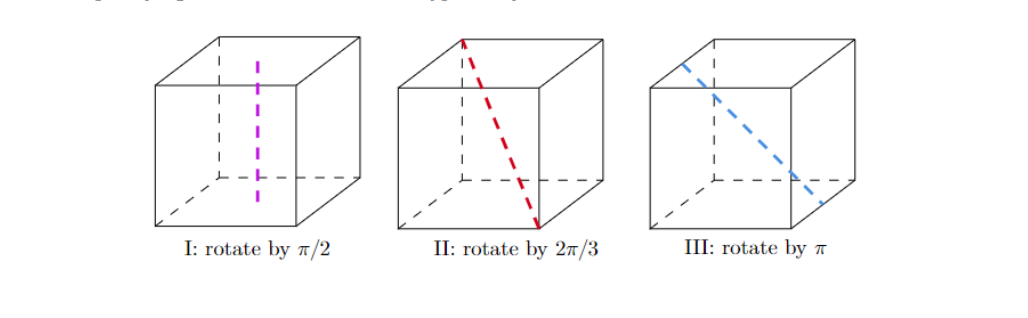
if you label the diagonals 1,2,3,4
tender wharf
fix a diagonal and rotate it
what do you get
(visualize this as the cube staying fixed, but the diagonal rotates)
astral fractal
hmm
tender wharf
so for example the middle cube in your image
that red line
rotate the red line by 90 degrees
astral fractal
hmm not really
tender wharf
okay so you observe that to change the stabilizer from one diagonal to another we're simply rotating
astral fractal
change the stabilizer as in..
tender wharf
so what would a good surjection be
astral fractal
i'll think about it its not totally clear to me yet
tender wharf
just say one intuitively for now
think about the fact that S_4 is the disjoint union of left cosets of stab (i) for a fixed diagonal i yes
tender wharf
yeah
astral fractal
lets see
tender wharf
so a surjection could perhaps be "throwing out" the rotation information
astral fractal
wdym by throwing out the rotation information
tender wharf
an element of S_4 is in one of these left cosets yes?
astral fractal
yes
oh
Does this have something to do with that S_3 permutations can be represented in S_4?
is that what you meant by throwing out rotation information
tender wharf
basically the intuition is that we can get rid of the information about which diagonal we are taking the stabilizer of
astral fractal
let me reread some of the past messages and see
tender wharf
i kind of have to go rn
astral fractal
all good
i think what you've given me is good help but ill have to think about it
thanks for the help
 spare isle
Is the Z/4Z notation equally valid for the reals, i.e. R/4R? (My textbook extends what they call Z_4 to R_4, but my professor prefers the Z/4Z notation [since it conflicts with cyclic groups I think].)
 chilly ocean
what's 4ℝ equal to
 cobalt heath
Yeah you gotta need to look into how the extension works
spare isle
chilly ocean
what's 4ℝ equal to
That's a good point
Would there be some equivalent notation other than R_4, or is it just completely nonstandard in the first place?
 prisma ibex
spare isle
Would there be some equivalent notation other than R_4, or is it just completely...
prisma ibex
spare isle
Would there be some equivalent notation other than R_4, or is it just completely...
yeah another standard notation is "0" lmao
spare isle
I presume that's a joke?
prisma ibex
no?
spare isle
So 0 means R_4...
prisma ibex
R/4R is the trivial group
spare isle
I'm referring to R_4, not R/4R
R/4R was my attempt at using some other notation for R_4
prisma ibex
what is R_4 lmao
spare isle
spare isle
Is the Z/4Z notation equally valid for the reals, i.e. R/4R? (My textbook exten...
^
prisma ibex
can you actually define it
spare isle
set of [0,4) where when (for a,b in said set) a +_4 b > 4, a +_4 b = a + b - 4
prisma ibex
oh do you mean R/4Z
spare isle
well the issue is they also do 2pi
although I guess 2piZ is valid, just doesn't yield a set of integers?
prisma ibex
I mean sure you can talk about R/rZ for any r in R
spare isle
I see, thanks
prisma ibex
this is a standard way to write the circle group
 lime warren
is there a particular reason why this channel isn't just called abstract algebra?
chilly ocean
it used to be called that and then some people decided having homological algebra and people just starting out with group theory in their first proof based math course was a bad idea
south patrol
Abstract algebra is a funny term to me
chilly ocean
you'd have questions on Tor and Ext and whatever followed up by people having trouble proving things are subgroups
south patrol
The abstract is pointless other than to say it isn't high school right lol
lime warren
yeah that's fair enough lmao
cobalt heath
May I have struggles in figuring out if specific Tor is a subgroup of another group
spare isle
south patrol
Abstract algebra is a funny term to me
I guess you can say that the terrm is abstract 😏
spare isle
south patrol
The abstract is pointless other than to say it isn't high school right lol
Half the people I know think that it's just a normal algebra class
 peak root
One thing is that this channel is named more specifically, unlike advanced algebra or algebraic geometry, as a result, every now and then someone will post some high school geometry or algebra questions.
There have been discussions on changing algebraic geometry channel names to more specific terms, like schemes-varieties-stacks or something.
 languid trellis
This happens rarely and people get crucified for doing it so it's a non issue really
 solemn garden
languid trellis
This happens rarely and people get crucified for doing it so it's a non issue re...
solemn garden
languid trellis
This happens rarely and people get crucified for doing it so it's a non issue re...
when did that happen?
prisma ibex
All the time lmao
 glad osprey
I'm trying to come up with a proof that R/4Z is isomorphic to the [0, 4) group defined above (lets call it S). Can we define a homomorphism phi: R -> S, phi(x) = x mod 4, then notice that ker(phi) = 4Z, then use the first isomorphism theorem to conclude that R/4Z ~= S?
 void cosmos
is R the real numbers?
not sure your map would make sense
if R was to be the real numbers
glad osprey
Yeah, R is the real numbers. I think mod can be defined for reals: x mod n is the (unique) r s.t. x = n * q + r where q in N and |r| < n
rocky cloak
glad osprey
I'm trying to come up with a proof that R/4Z is isomorphic to the [0, 4) group d...
That's usually the way to prove that something is isomorphic to a quotient yes. And indeed it works
glad osprey
So you rarely think about the cosets directly, you just find an appropriate homomorphism and use the isomorphism theorem?
rocky cloak
If the quotient group is isomorphic to one you're already familiar with, then yeah sure
rocky cloak
But in this case you're just considering cosets, like the definition of the group operation in a quotient group is just that you pick two representatives and add them together. Which is exactly how you defined addition in S
So you are just working directly with the cosets
glad osprey
I see, thanks! Final question: is R/pZ isomorphic to R/qZ for any positive integers p and q? So there is in a way only one circle group?
void cosmos
yeah
glad osprey
Thanks 🙏
 dull ginkgo
If you want a challenge try to describe the isomorphism for real numbers a and b
not really a challenge
multiplication by a fixed real number is a group automorphism of R
rocky cloak
Level 2 challenge, prove that any continuous homomorphism R -> R is multiplication by a real number.
glad osprey
I think just phi: R/aZ -> R/bZ, phi(x) = (b/a)*x is an isomorphism
 warm wyvern
how do I calculate <a,b>/N where N is the normal group generated by abab^-1?
and thereafter its abelianization?
oh nvm
its ablianization is rather simple
just ZxZ/<(2,2)>
which is ZxZ_2, I think
warm wyvern
warm wyvern
how do I calculate <a,b>/N where N is the normal group generated by abab^-1?
maybe it's just $\bZ\star \bZ_2$
cloud walrusBOT
DarQ!
 rocky cloak
warm wyvern
how do I calculate <a,b>/N where N is the normal group generated by abab^-1?
rocky cloak
warm wyvern
how do I calculate <a,b>/N where N is the normal group generated by abab^-1?
One way to calculate it is to notice that this is exactly the defining relation of a semidirect product
warm wyvern
I don't know what semi-direct products are 
delicate orchid
rocky cloak
One way to calculate it is to notice that this is exactly the defining relation ...
<a,b| abab^-1 = 1>
It’s like Z ltimes Z upon
 warm wyvern
I should do some algebra sometime, it's kinda funny how little algebra i know at this point 
ehhhh, it can wait a semester I bet
 fading field
rocky cloak
One way to calculate it is to notice that this is exactly the defining relation ...
fading field
rocky cloak
One way to calculate it is to notice that this is exactly the defining relation ...
i don’t understand why this is related to semidirect products actually
rocky cloak
warm wyvern
I don't know what semi-direct products are <:kekw:752021756650455061>
Hmm, so what kind of answer are you looking for when you say "calculate it"
warm wyvern
thank jagr tho!
fading field
fading field
i don’t understand why this is related to semidirect products actually
i have seen like the construction of one via group actions, but is there a way to make some connection to this presentation?
warm wyvern
I'll look into them
rocky cloak
fading field
i don’t understand why this is related to semidirect products actually
bab^-1 = a^-1
Means you have a semidirect product of Z with Z of the action a |-> a^-1
fading field
rocky cloak
bab^-1 = a^-1
Means you have a semidirect product of Z with Z of the action a |...
oh omg
ty
warm wyvern
rocky cloak
Hmm, so what kind of answer are you looking for when you say "calculate it"
I dunno, like, to some extent I think just giving the presentation of the group is enough of a calculation, right?
ig I wanted something more concrete, like Z\str Z_2 or smth
that doesn't really work tho, does it 
rocky cloak
warm wyvern
ig I wanted something more concrete, like Z\str Z_2 or smth
Well $\mathbb Z \ltimes \mathbb Z$ is pretty concrete, if you know that it means. Otherwise I guess you would just need to describe the elements and how they multiply.
cloud walrusBOT
jagr2808
 warm wyvern
rocky cloak
Well $\mathbb Z \ltimes \mathbb Z$ is pretty concrete, if you know that it means...
warm wyvern
rocky cloak
Well $\mathbb Z \ltimes \mathbb Z$ is pretty concrete, if you know that it means...
that makes sense
fading field
warm wyvern
that makes sense
if you’re trying to describe the elements use the fact that abab^-1 is a commutation relation, so every element has a form a^ib^j, then for describing multiplication you only need to say how elements of this form multiply
(you get that ba=a^-1 b, so just at every point where you have an a to the right of a b, use this relation)
cobalt heath
This is not isomorphic to Z * Z_2 right
rocky cloak
cobalt heath
This is not isomorphic to Z * Z_2 right
It doesn't have any elements of order 2
cobalt heath
Guessed it, but I cannot think of why right off my head.
stark helm
w means e^(2pi*i/3). And I want to know if the two automorphism I find is correct here
 dull ginkgo
salamander lemma
 summer path
Have fun diagram chasing
I remember having that as a homeowork problem and just being like I don't think I need these 10 points
stark helm
if there is a function f(x)=x^3-1 in Q[x], since f(x) is separable and f(x)=(x-1)*(x^2+x+1) , we know that E=Q(w). and [Q(w):Q]=|Gal(E/Q)|=2, so we have two automorphism from E to E. So what are the two automorphism: z->conjugate(z) and z->z?
dull ginkgo
summer path
Have fun diagram chasing
I liked proving how diagram chasing works, I don’t like doing it :)
summer path
What is there to prove about how diagram chasing works, you just have a commutative diagram and just going around chasing elements
rocky cloak
dull ginkgo
salamander lemma
There needs to be more diagram lemmas with fun names.
Like this one https://www.researchgate.net/publication/341029857_The_Anaconda_lemma
dull ginkgo
rocky cloak
There needs to be more diagram lemmas with fun names.
Like this one https://www...
It’s fun to consider how there’s like an underlying homological lattice
rocky cloak
How do you mean?
warm wyvern
summer path
I remember having that as a homeowork problem and just being like I don't think ...
 warm urchin
warm wyvern
warm urchin
warm wyvern
good thing you already seen it 
languid trellis
I'm struggling with an exercise in Jacobson: Show that for n \geq 3, the centre of S_n is of order 1.
The centre is a subgroup, so that implies that the only element in the centre is the identity map.
My approach so far has been, take a and b to be maps in S_n. As they are not the identity, each permutes at least two elements of [n]. Say a permutes at least j and k, and b permutes at least k and m. Then a(b(k)) = a(m), whereas b(a(k)) = b(j), which may not be equal. I'm unsure about my idea of "permutes at least 2 elements", and "may not be equal", (this idea breaks for S_2 because there are only two elements to permute, thus our construction breaks).could anyone advise if (1) this approach works, (2) is there a nicer way to go about things, and (3) a hint if so. 🙂
pls ping btw
rocky cloak
languid trellis
My approach so far has been, take a and b to be maps in S_n. As they are not the...
If a is not the identity, then there is some i, j different such that a(i) = j. From there I would split into to cases either a(j) = i or a(j) is different from i.
In both cases try to construct a simple permutation that doesn't commute with a.
viscid pewter
you can always write a permutation (a b c ... z) as (1 a)(1 b)(1 c)...(1 z)
or the reverse depending on how it works specifically i forget
anyway that might help
or not
languid trellis
rocky cloak
If a is not the identity, then there is some i, j different such that a(i) = j. ...
Case 1: a(j) = i. Define b(i) = 1, b(j) = i. Then ab(i) = a(1) \neq i (by bijectivity of a) whereas ba(i) =i.
Case 2: a(j) \neq i. Define b(j) = i, b(i) = j. Then ab(i) \neq i, whereas ba(i) = i
And this only works when n \geq 3 because then I have to make a third choice in Case 1.
thanks jagr
rocky cloak
languid trellis
And this only works when n \geq 3 because then I have to make a third choice in ...
Yeah, so you sort of implicitly assumed neither i or j was equal to 1. So in general you would just have to replace 1 with something different from i and j
viscid pewter
or you can say that the center is normal but there are only very few normal subgroups of S_n
lol
languid trellis
rocky cloak
Yeah, so you sort of implicitly assumed neither i or j was equal to 1. So in gen...
Make sense.
languid trellis
viscid pewter
or you can say that the center is normal but there are only very few normal subg...
this feels very like presupposing my conclusion
actually
viscid pewter
it does a bit but i think it's fine
languid trellis
feels sus tho lol
viscid pewter
i thought about it for 5 secs and concluded it was fine and that's just the most reliable thing in existence
languid trellis
lol
warm wyvern
warm urchin
good thing you already seen it <:smugsmug:812884290282848266>
Like a year ago!
 winged void
I have question regarding modulo
i do not really understand

what is the bar suppose to mean
can somebody help with that
 rose prism
mod n
winged void
well then what is the diffrence between a bar and not a bar
because they both mean mod n
winged void
can you give an example
rose prism
no
look at the screenshot you sent
they are defining k-bar as k mod n
idk how to give an example of this
there are examples already in the screenshot
3-bar = 1002-bar
etc.
but the integers 3 and 1002 are in fact not equal
winged void
becasue 3/3 = remainder(0) and 1002/3 = remainder 0
i see that but i mean
we write as well 11 = 8 mod 3
is that not the same
rose prism
youre asking whether “11=8” is the same phrase as “11 = 8 mod 3”?
winged void
im aksing if its the same as bar yes
rose prism
what
winged void
if its the same as saying 11 bar = 8 bar
winged void
sure then i get it eventhough i do not like the notation because it reminds me of conjugate of a complex number
rose prism
you can alternatively view the elements of Z/nZ as sets of integers with the same remainder when divided by n
but i suspect that isnt a particularly helpful perspective at this stage
winged void
i see
 vivid tiger
winged void
can somebody help with that
vivid tiger
winged void
can somebody help with that
The bar is the equivalence class
formal ermine
winged void
what is the bar suppose to mean
you will see this more than once: in general $\bar x$ for some $x \in R$ usually means the image of $x$ under $R \to R/I$ for some ideal $I$ of $R$
cloud walrusBOT
 formal ermine
or the image under some other map, but usually under a quotient
vivid tiger
The 2bar mod n is the set of all integers that equal 2 mod n.
(I prefer the notation [x] for this)
winged void
vivid tiger
The 2bar mod n is the set of all integers that equal 2 mod n.
what do you mean with second bar
vivid tiger
What
vivid tiger
[2] = {2,2+n,2+2n,2+3n,...}
e.g. if n=2, [2]=[0]=evens
formal ermine
winged void
what do you mean with second bar
$\bar 2$
cloud walrusBOT
 winged void
mod n
vivid tiger
Mod 2, [0] ≠ [1].
winged void
\bar 2 = [0] and [1]
vivid tiger
Mod n≥2, [0] ≠ [1]
vivid tiger
winged void
\bar 2 = [0] and [1]
Why is [0] equal to [1]?
winged void
no equal to each other
winged void
but i mean that when i say 2\bar this mean actuall 2 mod n and this equal to the equivalen class [0] and [1] together
vivid tiger
[1] ≠[0] because they are different sets.
winged void
not equal to each other
formal ermine
winged void
but i mean that when i say 2\bar this mean actuall 2 mod n and this equal to the...
huh what
vivid tiger
ℤ/2ℤ = {[0], [1]}
If you use \bar{2} to mean ℤ/2ℤ, everyone will come after you with pitchforks.
vivid tiger
Z/2 is bad. Me no like.
formal ermine
im a Z/2Z guy but if i have to write quick i do Z/2
vivid tiger
Z/2 would make me think "??? is this the coset 1/2 Z in something like Q?"
Z_2 is quick!
formal ermine
vivid tiger
Z_2 is quick!
i think of 2 adics then
winged void
that is what i want to say
vivid tiger
formal ermine
i think of 2 adics then
fair
formal ermine
vivid tiger
Z/2 would make me think "??? is this the coset 1/2 Z in something like Q?"
Eh
vivid tiger
I've literally never used the p-adics.
formal ermine
vivid tiger
I've literally never used the p-adics.
analyst spotted
vivid tiger
I've been doing more algebra recently.
formal ermine
Good.
vivid tiger
By that I mean learning algebra that I really should've known, like the isomorphism theorems beyond the first.
vivid tiger
Learning what a modular lattice is helped me finally understand the lattice isomorphism theorem
formal ermine
the stuff ive been learning the past year doesnt need any group theory beyond like simple groups
and silly me can only remember so much
vivid tiger
imo Sylow's theorem should be replaced in introductory algebra classes with something else
formal ermine
my alg 1 course did too much
formal ermine
south patrol
p-adics are analysis
unfortunately...
chilly ocean
formal ermine
unfortunately...
why unfortunately?
chilly ocean
south patrol
Jk
And why jk? i think its fair to call p-adics analysis since they have a complete metric
spare isle
Would it be right to say that all groups with prime order have only one distinct form? (i.e. group table)
chilly ocean
spare isle
Would it be right to say that all groups with prime order have only one distinct...
Yes, this is called isomorphism type. There is an unique group of order p up to isomorphism
coral spindle
Indeed, the only groups of prime order are cyclic.
chilly ocean
Fun fact: the first product of two primes such that the only group of that order is cyclic is 15. And the first product of three primes is 255
(and the pattern stops there)
 sly crescent
What is the next one?
chilly ocean
i forgot, i just remember its not of the form 2^n-1
spare isle
darn, I was hoping to find it in oeis
spare isle
thanks!
chilly ocean
you're welcome
spare isle
Also I just realized that the pattern for number of groups for a given order is the first entry to oeis
viscid pewter
god bless
they have their priorities straight
hmm
is there a list of oeis sequences with just brief descriptions anywhere
or a next button i can click
spare isle
wdym by next
chilly ocean
you can just edit the link
viscid pewter
do i really have to edit the url every time
spare isle
if you are searching, you can scroll through the matches. If you just want to look at a random ones, you can modify the number in the url.
chilly ocean
viscid pewter
do i really have to edit the url every time
you can make a script to automate it
 young hinge
(5)
spare isle
viscid pewter
that's like six whole key presses
just type in a random sequence and scroll through them on a single page then
viscid pewter
ctrl-l (2)
backspace (3)
number (4)
enter (5)
spare isle
viscid pewter
ctrl-l (2)
backspace (3)
number (4)
enter (5)
actually you need to click ctrl-l then right then backspace 😉
chilly ocean
install qutebrowser and make a macro to automatically increment the url with a key press, its pretty easy
young hinge
yea they said 6 keys
spare isle
it's 7
viscid pewter
why would i need to click
young hinge
I consider ctrl + L one key since its done with both hands at the same time
viscid pewter
it's literally two keys, this is not up for debate
viscid pewter
why would i need to click??
viscid pewter
what is 'hit'
young hinge
it
viscid pewter
what am i clicking on
spare isle
yeah and highlights (in 95% of browsers)
young hinge
lol
spare isle
I'm an advid ctrl-l haver, I know my stuff 😉
viscid pewter
i literally did not realise, clicking right arrow is literally unconscious
spare isle
fr
young hinge
young hinge
I consider ctrl + L one key since its done with both hands at the same time
told you
viscid pewter
anyway 7 is definitely too many
young hinge
5 + 2
spare isle
just create a user script, easy
viscid pewter
but that would be like
young hinge
thats a whole lot of overhead
spare isle
but think about all the seconds those minutes of work would save!
I'm starting to see where all my time goes
anyway, groups am I right?
chilly ocean
with qutebrowser you can make little macros for little stuff like this in like 10 keypresses
qutebrowser sucks tho
but so does every other browser
which is unfortunate
chilly ocean
spare isle
yeah and I'm locked in due to my over-dependence on some plugins
life is unfair
well qutebrowser uses vim-like keybindings
spare isle
yeah but I just recall it not being that good back when I checked it out many years ago
chilly ocean
yeah
spare isle
and vimium c has a ton of functionality
chilly ocean
how come it doesnt have macros
spare isle
good question
 hidden wind
chilly ocean
with qutebrowser you can make little macros for little stuff like this in like 1...
hidden wind
chilly ocean
with qutebrowser you can make little macros for little stuff like this in like 1...
it do be cute though, i use it sometimes when i need to do some simple web stuffs
chilly ocean
me too besti
winged void
is this a good proof
let $n$ be a positive integer
\newline
\textbf{(a) }If (a) and (b) are integers congruent modulo (n), so (a \equiv b \pmod{n}), shows that (\text{ggd}(a, n) = \text{ggd}(b, n)). Thus, (\text{ggd}(a, n)), for (a \in \mathbb{Z}/n\mathbb{Z}), is well defined.
\begin{proof}
$ggd(a,n) = ggd(b,n)$
\newline
we know that $a \equiv b \mod n$ that they have the same remainder or in other words the following holds:
\begin{align*}
n | a &- b \
a - b &= qn \
a &= b + qn\
b &= a +- qn
\end{align*}
we know that the $ggd(a,n)| a$ and $n$ and furthermore we know that a equals $a = b + qn$ so this means that the $ggd(a,n) | b + qn$ this subsequently means that $ggd(a,n) | b$ and that $ggd(a,n) | qn$. we also know that $ggd(b,n) | b$ and $ggd(b,n)| n$. this actually means that $ggd(b,n) | a+(-qn)$ or $ggd(b,n) | a $ and $ggd(b,n) | -qn$ and therefore $ggd(b,n) | qn$ this also means that:
\begin{equation*}
ggd(a,n) = ggd(b,n)
\end{equation*}
\end{proof}
ggd or gcd are the same its the highest common divisor
spare isle
Just curious, what does ggd stand for?
winged void
its in dutch
spare isle
ah
winged void
spare isle
ah
if you can help me with that (:
spare isle
I'll let someone else look at it in addition, but so far I notice that you don't define q and you use b x qn at some point instead of b + qn?
cloud walrusBOT
Mootje
 spare isle
I'm not sure that gcd(a,n)|b+qn => gcd(a,n)|b, gcd(a,n)|qn generally?
although I guess you are utilizing that a === b and qn has divisor of n
still not convinced it holds like that though
winged void
you are right actually
 prime sundial
can every derived series be written as the homology for some chain complex? as in H_n(C) = G^n. if there is such a construction, can anyone point me in the right direction
prisma ibex
prime sundial
can every derived series be written as the homology for some chain complex? as i...
yeah take the chain complex where all the differentials are 0 lmfao
prisma ibex
prime sundial
okok nontrivial
replace this with a quasi-isomorphic chain complex
idk this is silly
you have to ask a more refined question if you want a good answer
cobalt heath
prisma ibex
yeah take the chain complex where all the differentials are 0 lmfao
This works?
Wow
prime sundial
prisma ibex
replace this with a quasi-isomorphic chain complex
isn't this what i am asking though? to find a quasi isomorphic chain complex to the trivial one
but yeah i'll try to refine the question and come back
prisma ibex
yes but you have so much freedom to do this replacement that you can't expect an interesting answer without asking something more specific
prime sundial
makes sense
prime sundial
prisma ibex
yes but you have so much freedom to do this replacement that you can't expect an...
maybe the point here is that derived series are not interesting as a homology then?
or well, i guess you could say that about any homology then 
i'll try and make sense of what i want to ask
vivid tiger
prime sundial
maybe the point here is that derived series are not interesting as a homology th...
nGroupoid's answer had nothing to do with the derived series.
Give me any sequence, I can find a chain complex with that as the homology.
prime sundial
vivid tiger
nGroupoid's answer had nothing to do with the derived series.
that was the point of my second answer
well not answer
but my second message
this stemmed from trying to give an example of homology to someone who had seen derived series before, and to say that they had seen a specific example of a broader concept
vivid tiger
So, quasi isomorphism just means a morphism that induced iso on homology, right?
prime sundial
i believe so
vivid tiger
prime sundial
this stemmed from trying to give an example of homology to someone who had seen ...
Are the derived series a homology group of something interesting?
lol that's your question
But hey, now I get it 🙂
prime sundial
well i kind of just assume they are interesting
it is more about, how can we express the derived series using homology in a meaningful way, but that is too broad a question because of what ngroupoid said
vivid tiger
Here's a paper that I don't understand. Sorry if it's useless.

arXiv.org
In 1964, John Stallings established an important relationship between the low-dimensional homology of a group and its lower central series. We establish a similar relationship between the low-dimensional homology of a group and its derived series. We also define a torsion-free-solvable completion of a group that is analogous to the Malcev comple...
prime sundial
i think it is also out of my depth but looks like it touches on what i was asking
thank you for the link!
cobalt heath
Ahhh
Right, you can take homology of the group
And do fun stuffs, I guess
It's quite interesting how you can consider a group as a discrete group, and work on it topologically.
winged void
can somone helo with the folloowin
\textbf{(a) }If (a) and (b) are integers congruent modulo (n), so (a \equiv b \pmod{n}), shows that (\text{ggd}(a, n) = \text{ggd}(b, n)). Thus, (\text{ggd}(a, n)), for (a \in \mathbb{Z}/n\mathbb{Z}), is well defined.
\begin{proof}
(a \equiv b \pmod{n}), so this implies that $n | a - b$ or this is also equal to:
\begin{equation*}
a - b = qn
\end{equation*}
so this means that:
\begin{equation*}
a = qn + b
\end{equation*}
we then want to prove that
\begin{equation*}
gg(a,n) = gcd(qn+b,n) = gcd(b,n)
\end{equation*}
suppose that $ggd(b,n) = d$ this implies that $d| b$ and $d|n$ this also implies that $d| qn$ so this means that $d | qn + b$ this means that d is the common factor of $qn+b$ and also of $n$ but we now want to show that $d$ is the gr
cloud walrusBOT
Mootje
Compile Error! Click the  reaction for more information.
(You may edit your message to recompile.)

Mootje
 winged void
let $n$ be a positive integer
\newline
\textbf{(a) }If (a) and (b) are integers congruent modulo (n), so (a \equiv b \pmod{n}), shows that (\text {ggd}(a, n) = \text{ggd}(b, n)). Thus, (\text{ggd}(a, n)), for (a \in \mathbb{Z}/n\mathbb{Z}), is well defined.
\begin{proof}
(a \equiv b \pmod{n}), so this implies that $n | a - b$ or this is also equal to:
\begin{equation*}
a - b = qn
\end{equation*}
so this means that:
\begin{equation*}
a = qn + b
\end{equation*}
we then want to prove that
\begin{equation*}
gg(a,n) = gcd(qn+b,n) = gcd(b,n)
\end{equation*}
suppose that $ggd(b,n) = d$ this implies that $d| b$ and $d|n$ this also implies that $d| qn$ so this means that $d | qn + b$ this means that d is the common factor of $qn+b$ and also of $n$ but we now want to show that $d$ is the gr
\newline
\end{proof}
cloud walrusBOT
Mootje
Compile Error! Click the reaction for more information.
(You may edit your message to recompile.)
 winged void
im not really sure how to continue
 waxen hedge
winged void
im not really sure how to continue
waxen hedge
winged void
im not really sure how to continue
Look at #❓how-to-get-help
delicate orchid
waxen hedge
Look at <#488120190538743810>
Asking for help here is fine that’s the entire point of these channels
 vernal flume
winged void
im not really sure how to continue
vernal flume
winged void
im not really sure how to continue
Now that you've shown that d is a common factor of both a and n, you need to show that d is the greatest common divisor by introducing a number "c" such that it's a common factor of a and n, then show c<=d after some manipulations. Ping me to elaborate or you can try doing it yourself.
winged void
i see
winged void
vernal flume
Now that you've shown that d is a common factor of both a and n, you need to sho...
i proved in another way
but not really sure if its correct
this is what i did

@vernal flume im not really sure if this is correct
chilly ocean
i am facing difficulties with part i

i tried looking at the contrapositive
also as cosets are disjoint besides the first term in the union the rest of a_2H_2 to others must equal the union of rest of cosets of H_1
I don't understand pls elaborate
How does being the largest H_i work
If we don't know any of them are finite yet
delicate orchid
The problem is you could have [G:H_i] = \infty with each H_i also infinite if their argument is what I think it is
Hiding the evidence
Anyway this is a very strange question and it’s making my head hurt
chilly ocean
Same
delicate orchid
I think it’s because it’s a finite union of these cosets, that has to be where it would break
delicate orchid
delicate orchid
The problem is you could have [G:H_i] = \infty with each H_i also infinite if th...
But again, this
Its clear that at least one of the H_i must infinite or the union would be finite. If there are an infinite number of cosets for all of the H_i then since it’s a finite union of other cosets can we conclude via a disjoint argument that only a finite number of cosets of each H_i are contained in this union, giving a contradiction?
delicate orchid
chilly ocean
also as cosets are disjoint besides the first term in the union the rest of a_2H...
Using this idea
delicate orchid
Gee wilikers…
chilly ocean
First of all if that then we have a finite union on one side and infinite one on the other
 dire siren
I don't think it is true that at least one H_i is infinite
Part (ii) seems to contradict this
delicate orchid
dire siren
I don't think it is true that at least one H_i is infinite
Part (ii) seems to co...
Then we would have a finite union of finite sets, contradicting the fact that G is infinite
Once again I reiterate that an infinite subgroup can still have infinite index
Z as a subgroup of R
Or S^1 as a subgroup of C^\times if you want two of the same cardinality
dire siren
I see, but part (ii) explicitly asks to show that G is the union of the cosets of finite index
chilly ocean
It doesn't imply that each H_i is finite?
delicate orchid
dire siren
I see, but part (ii) explicitly asks to show that G is the union of the cosets o...
Yeah we agree there
dire siren
chilly ocean
It doesn't imply that each H_i is finite?
no, but if you drop the infinite ones, you are left with a counterexample
chilly ocean
Index being infinite dosent guarentee uhh
chilly ocean
south patrol
I think I have a proof
Tell
delicate orchid
south patrol
I think I have a proof
I’m on da edge of my seat
chilly ocean
chilly ocean
i am facing difficulties with part i
I'll leave the source here incase it helps
: Problems in Abstract Algebra by A R Wadsworth
From groups ch
dull ginkgo
I’m trying to intuitively understand this problem
delicate orchid
It’s saying we can write g = a_ih_i for all g in G and finitely many a_i on an intuitive level I guess
dull ginkgo
Assume the indicies are ALL infinite. With the index and a specified coset we can find an partition of G for each a_i H_i with that coset in it. I’m wondering if we can hijack the infinite partitions that each contain one of the finite union’s sets
choice jumpscare
chilly ocean
Uhh probably not a very important observation but if something say b is in a_2H_2 then it can be written as bH_2
We can keep getting new letters if we assume every index is infinite
So starting from a_1 we get there is some H_i with an infinite number of representatives of H_1 in it
Then that H_i can be written as those things multiplied with it
Again it's assumed of infinite index
vernal flume
winged void
this is what i did
If a|b and b|a then a=+b or a=-b not a=b
But yeah in this case since gcd is always a positive integer, a=+b
winged void
Sure I will write both prove because I really love it
chilly ocean
chilly ocean
i am facing difficulties with part i
Ok this has been resolved
Thank you everyone

Mathematics Stack Exchange
Some time ago, I was told the following theorem, attributed to Neumann (I have no idea which one):
If $G$ is an abelian group, and $G$ is the finite union $\bigcup_{i\in I} g_iH_i$ of cosets of
The author is apparently very mean
delicate orchid
Let’s have a peep
Inclusion exclusion crossed my mind I must admit but I didn’t see how it would be useful
Cheeky little poset
south patrol
delicate orchid
I’m on da edge of my seat
Okay I am unsure it worked lol
dull ginkgo
So it’s a finite union, but over sets which are each a part of infinite partitions of the first set
I’m wondering if you can inductively prove it by somehow combining cosets of two subgroups
delicate orchid
If we’re to go with the inclusion exclusion nonsense then |a1H1 U … U anHn| = |H1| + … + |Hn| - mobius function junk
delicate orchid
chilly ocean
https://math.stackexchange.com/questions/2616574/neumann-theorem-about-finite-un...
I’m still not seeing how this would show something to do with the index
Strange
dull ginkgo
Are you guys still stuck on (i) lol
delicate orchid
I want to see if I can come up with the argument used without just Googling it but I may need to relent
dull ginkgo
Assume G, infinite, is the finite Union of cosets with infinite order. Firstly each of these subgroups are proper otherwise the index would be 1
dull ginkgo
I have an idea
The intersection of two of the cosets is either empty or is a coset itself in the intersection of the two subgroups
However the index of this subgroup doesn’t necessarily need to be infinite
low wyvern
Quick question; does the theorem from group theory that says that Znm is isomorphic to Zn X Zm if gcd(n,m) = 1 hold if we replace the groups with rings?
 vale locust
languid trellis
vale locust
languid trellis
I can't figure out this proof at all. I don't understand how we justify f_i > e_i for some i. Can someone help?

o(g) = |<g>| and exp G = the smallest positive integer e s.t. x^e = 1 for all x in G.
dull ginkgo
low wyvern
Quick question; does the theorem from group theory that says that Znm is isomorp...
Chinese remainder theorem?
In general if two two-sided ideals $X$ and $Y$ of ring $R$ satisfy $X + Y = R$ then $\frac{R}{X \cap Y} \cong \frac{R}{X} \times \frac{R}{Y}$
delicate orchid
languid trellis
I can't figure out this proof at all. I don't understand how we justify f_i > e_...
If h^og isn’t 1 it has to have a bigger order?
cloud walrusBOT
Dyfunction Executive
 delicate orchid
Hence one of the exponents in the prime factorisation has to be bigger
languid trellis
delicate orchid
If h^og isn’t 1 it has to have a bigger order?
I thought this, but im not convinced the order has to be bigger
low wyvern
dull ginkgo
In general if two two-sided ideals $X$ and $Y$ of ring $R$ satisfy $X + Y = R$ t...
ok thanks
delicate orchid
Yeah ok fair enough
You can argue this by splitting h into p-parts for each prime but ill keep it basic. If h^o(g) isn’t 1 then clearly o(h) cannot divide o(g), so one of the prime exponents must be higher
If o(h) did divide o(g) then h^(o(g)) = h^(ko(h)) = 1^k = 1
dull ginkgo
low wyvern
ok thanks
It holds for Z/nZ and Z/mZ because Bezout’s lemma implies there exists a and b such that an + bm = 1, so it generates all of Z. Therefore the ideals <n> and <m> are comaximal, and their intersection is <mn> by divisibility. Thus Z/mnZ is iso to Z/mZ x Z/nZ
languid trellis
delicate orchid
You can argue this by splitting h into p-parts for each prime but ill keep it ba...
ahhhhhhh
dull ginkgo
The proof of sylow’s theorems are so fucking simple I’m surprised I didn’t figure it out
delicate orchid
dull ginkgo
The proof of sylow’s theorems are so fucking simple I’m surprised I didn’t figur...
They’re easy once you know them
languid trellis
i swear to god working with divisibility is the hardest thing known to man
the rest of the argument is nice tho
rocky cloak
chilly ocean
i am facing difficulties with part i
I think I have an inductive argument on the number of distinct subgroups that apear:
||If there's just one subgroup that appears, then G is the finite union of cosets means it has finite index||
||If G is such a union with n distinct subgroups, let Hn be one of those groups. If Hn has finite index we're done. If Hn has infinite index, then not every coset apears, hence the is a coset of Hn contained in the union of the other groups. By left multiplication this means any coset of Hn can be written as a finite union of cosets of the other groups. In particular the cosets that apear in the decomposition can be. Thus G is the finite union of cosets of the other n-1 groups. So by induction one of those has finite index.||
dull ginkgo
delicate orchid
They’re easy once you know them
Group action on groups of prime power order
HOW THE FUCK DID I NOT THINK OF THAT
languid trellis
dull ginkgo
>Group action on groups of prime power order
>HOW THE FUCK DID I NOT THINK OF TH...
um spoilers sweaty
dull ginkgo
languid trellis
um spoilers sweaty
Why spoilers if it’s literally nothing to do with the ongoing convo 
languid trellis
dull ginkgo
Why spoilers if it’s literally nothing to do with the ongoing convo <:meowdy:121...
spoilers for me in about 3 weeks time
u just spoiled that captain america dies
good job
dull ginkgo
languid trellis
spoilers for me in about 3 weeks time
Don’t worry, now it’s trivial
wait no I didn’t get to it yet in Jacobson lmao, I just started last night and finished the exercises in Chapter 0 lmao
languid trellis
are you just doing the exercises?
dull ginkgo
No,
I’m reading it and doing the exercises when I get to them
Well, I alternate between doing the even and odd exercises
languid trellis
gotcha
dull ginkgo
I read over all the problems, but if I don’t immediately know how to do a problem I do it
languid trellis
I need to review my lin alg but I really cba taking notes so I think I'll implement ur strat
until i get to stuff I'm looking at for the first time
dull ginkgo
I know a lot of the content in Jacobson already but it’s worded much nicer than D&F
languid trellis
i plan on using D&F as an exercise book
dull ginkgo
Exercises are much harder though. But because it’s not for a class I used abbreviations for my understanding
Overly formalizing it takes way too long often times if I understand the solution on my own
delicate orchid
the important thing is that you're able to come up with the ideas
dull ginkgo
That’s what I focus on
dull ginkgo
If a problem uses repetitive wording I use ditto marks lmao
languid trellis
thats why i specified
low wyvern
delicate orchid
the important thing is that you're able to come up with the ideas
how do u get good at this lol>
languid trellis
low wyvern
how do u get good at this lol>
- dont do physics
low wyvern
Like once I start a proof I am generally ok, but I can not always start
dull ginkgo
The problem is trying to keep at the level that the textbook is at because I know more than the textbook has provided thus far
This one took a bit for me to process Lmao
 languid trellis
dull ginkgo
This one took a bit for me to process Lmao
languid trellis
dull ginkgo
This one took a bit for me to process Lmao
i skipped this one
dull ginkgo
But I use abbreviations or English sometimes like for that one
dull ginkgo
dull ginkgo
This one took a bit for me to process Lmao
Though once I slowed down and actually read it, it’s fuckin awesome that you can “generate” a equivalence relation
I really liked that exercise
I am excited to get to the Galoisy stuff
But my goal is to try to take an alternate approach to the fundamental theorem of Galois theory
delicate orchid
dull ginkgo
This one took a bit for me to process Lmao
I read these as double cosets for like 15 seconds
yeah this is cool
dull ginkgo
I want to prove Artin’s Lemma by proving F is an **algebraicly finitely generated extension ** of F^G
For G Finite subgroup of Aut(G)
delicate orchid
reminds me of generating a simplical complex from a bunch of 1-simplices
dull ginkgo
and then invoke Neother normalization
To make it algebraicly generated as a module
Which the dimension being |G| comes from that
I have an idea
Let F be a field, G a finite subgroup of Aut(G) of order N, and F^G the fixed point subring.
Because G is Finite, F over F^G is an integral extension and thus algebraic. Any intermediate ring must be a field.
Fix some x not in F^G, and consider the valuation map from F^G[X_1…X_N] that sends the indeterminates to the orbit of x under G, necessarily of cardinality N.
I want to prove that the map must be epimorphic
I can assume there’s an intermediate field K that is the image, I wonder if I can prove that it can’t happen
chilly ocean
Are the modules $Hom(M\wedge M,N)$ and $Alt(M\times M,N)$ isomorphic? Where can I find a reference for this statement?
cloud walrusBOT
username0000
 delicate orchid
this should just be the universal property of the alternating product
which is in turn a combination of the universal props of the tensor product and quotient
dull ginkgo
WAIT A MOMENT
delicate orchid
waiting
dull ginkgo
dull ginkgo
I have an idea
The monoid-algebra F^G[G]
Which is a commutative ring
I don’t really know if it’s a field
FINITELY GENERATED MODULE WAIT A
dull ginkgo
Wait a second, I think F^G[G] is isomorphic to F
rocky cloak
dull ginkgo
Wait a second, I think F^G[G] is isomorphic to F
As F^G[G]-modules, yes. But as rings no. Since F^G[G] has zerodivisors
dull ginkgo
rocky cloak
As F^G[G]-modules, yes. But as rings no. Since F^G[G] has zerodivisors
Oh good point, what is a zero divisor you can think of?
rocky cloak
1 - g for example
rocky cloak
1e - 1g yeah
dull ginkgo
Got ya
Trying to see what I can do with that ring
It’s not hard to show it’s a quotient ring of R[X_1…X_|G|] via either universal property or a similar construction to the tensor product
chilly ocean
putting a backslash \ before your _ and * will prevent discord from turning them into italics and stuff
dull ginkgo
I am too lazy to do it on mobile except for when I want to escape asterisks for jokes
dull ginkgo
rocky cloak
As F^G[G]-modules, yes. But as rings no. Since F^G[G] has zerodivisors
Do you think I can prove Artin’s lemma possibly by using this ring
rocky cloak
dull ginkgo
Do you think I can prove Artin’s lemma possibly by using this ring
Idk, seems it would be easier to just use the usual linear algebra way
dull ginkgo
The usual linear algebra way seems like magic
I had a brain wave
Chinese remainder theorem
 tardy hedge
what is combinatorial commutative algebra?
 raw badge
What even are fields
 drifting plover
Is there software that computes the square root of an element in a multivariate polynomial ring modulo a certain ideal?
E.g. I believe that -2x^6 - 40x^3 + 16 is a square in Z[x, y] modulo (3x^4 + 12x, -x^3 + y^2 - 1), but I don't know how to compute the square root
tender wharf
raw badge
What even are fields
this question feels more suitable for #math-discussion tbh
otherwise look in your abstract algebra textbook for the definition
 indigo ridge
im having a little trouble understanding the proof of this theorem, if im not mistaken an ideal must be a subring of a ring, so what this correspondence is doing is using the fact I think that F_q is isomorphic to F_p[x]/f where q = p^n and f is an irreducible poly thats just my guess and im pretty sure im wrong

obviously the whole in my logic is that F_q is isomorphic to F_p[x]/f not F_q[x]/f
where q = p^n
cobalt heath
indigo ridge
im having a little trouble understanding the proof of this theorem, if im not mi...
I think this argument is not using what is q
That is, e.g. I do not see the mention of p, and that q = p^n.
indigo ridge
yeah but i believe my professor is skipping steps
cobalt heath
Why though?
indigo ridge
because his notes are full of him skipping steps lol
cobalt heath
Ah
I don't think it is using "F_q is isomorphic to F_p[x] / f".
Rather, it is defining a new ring. And an ideal on the ring
indigo ridge
the new ring being all the polynomials of the form c_0+c_1x + ... + c_(n-1)x^n-1?
cobalt heath
Yep!
Basically you can identify that with F_q[x] / (x^n - 1)
By like, regarding "x^n = 1"
indigo ridge
so if we regard x^n = 1 then it follows that this new ring is a subring
or subfield
cobalt heath
It's just a new ring
Not really a subring of F_q[x], because multiplication is different
Like, on F_q[x] there is no zero divisor, but F_q[x] / (x^n - 1) has an obvious zero divisor of (x-1).
indigo ridge
I meant a subring of F_q[x]/(x^n-1)
cobalt heath
Ah, do you mean C?
indigo ridge
well our new C the ones with the polynomial types
cobalt heath
Yeah C is an ideal to make/identify (whether C is a ring or not.. is debatable)
indigo ridge
indigo ridge
so if we regard x^n = 1 then it follows that this new ring is a subring
so for the most part.... yes?
cobalt heath
Yeah except that C does not have identity ( 1 )
indigo ridge
so how does it follow though that part is not exactly clear to me
indigo ridge
indigo ridge
so if we regard x^n = 1 then it follows that this new ring is a subring
.
cobalt heath
It is showing that C can be considered an ideal, not a subring.
Do you recall what is an ideal?
indigo ridge
yeah
cobalt heath
The line "Since a(x)c(x) = .." is showing that C is an ideal of the "polynomial" ring F_q[x] / (x^n - 1).
indigo ridge
yeah I got that part but what Im interested in is for C to be an ideal, if im not mistaken it must be a subgroup of the quotient group F_q[x]/x^n-1 first
this is also one of the conditions for C to be an ideal
or is that wrong?
cobalt heath
Yeah, it should be.
Indeed, there is an abuse of notation happening here, by identifying C as a subset of F_q[x] / (x^n - 1).
Which is basically the correspondence given above
indigo ridge
cobalt heath
Indeed, there is an abuse of notation happening here, by identifying C as a subs...
is it an isomorphism?
cobalt heath
Isomorphism as an additive abelian group, yeah.
I admit this kind of identifiation may look like "skipping steps", but this is quite common approach in algebra (and other math).
indigo ridge
I see, so from my understanding he is showing there is an isomorphism to this specific subset of F_q[x]/x^n-1, is that correct?
or saying rather
cobalt heath
The isomorphism is immediate
You can also notice that.. "(c_0, .., c_{n-1})" is not given an algebraic definition, so you can simply regard it as a polynomial.
indigo ridge
Ok so it's obvious but this is what he was saying essentially right?
then my second question would be, do we regard x^n = 1 because 1 is a root of x^n-1 or something its not really clear to me why this is the case tbh
cobalt heath
F_q[x] / (x^n - 1) happens to work out well in this case.
indigo ridge
?
cobalt heath
Since you want the ring to have dimension n over F_q, you want F_q[x]/(f) where deg(f) = n.
cobalt heath
With the setting f = x^n - 1, multiplication by x basically gives "cycling" the code.
indigo ridge
yeah
cobalt heath
For instance, with F_q[x]/(x^3 - 1),
x (2x^2 + 3x + 1) = 2 + 3x^2 + x = 3x^2 + x + 2
(2, 3, 1) -> (3, 1, 2)
indigo ridge
mhm, yeah it gives this effect because x^n = 1, how does x^n = 1 be though?
cobalt heath
Wdym "how does x^n = 1 be"?
indigo ridge
how is it that x^n = 1
cobalt heath
Ah, the ring F_q[x] / (x^n - 1) is basically like
Polynomials, but x^n - 1 = 0. So x^n = 1.
If you recall modular arithmetics, you might understand this better
indigo ridge
oh right
yeah ok I see lmao
because we are modding by x^n -1
thanks @cobalt heath
cobalt heath
indigo ridge
thanks <@1118370143471415410>
No problem!
 tribal niche
if you give me an abelian group G, can you always find a ring R such that G (with the inherited product) is an ideal in R?
(i assume rings are commutative and have an identity)
i've found an example of an abelian group which can't be made into a ring, but i'm not sure if you can ever not make it into an ideal
viscid pewter
seems hard
not sure how to approach this in a general sense
you could probably do it for finite abelian groups, hah
 rotund aurora
tribal niche
i've found an example of an abelian group which can't be made into a ring, but i...
rotund aurora
tribal niche
i've found an example of an abelian group which can't be made into a ring, but i...
shouldn't that example work?
mmh if I understand you want G to be embedded in the ring where the operation on G is multiplication on the ring, right?
in that case G has an identity element, so the ideal would also be a ring
but maybe you meant G should be embedded with respect to addition in the ring
rocky cloak
tribal niche
i've found an example of an abelian group which can't be made into a ring, but i...
You mean that the addition in the ring is the operation of G? If so you can make this into an ideal.
Consider the ring ZxG with pointwise addition, and multiplication (m, g)(n, h) = (mn, ng + mh). Then G is an ideal.
chilly ocean
Let $h: \mathbb{C}^{\times} \rightarrow \mathbb{C}^{\times}$ be defined by $h(z) = z^{4}$. Prove that $h$ is a homomorphism of multiplicative groups and find the kernel of $h$.
cloud walrusBOT
gian
 rocky cloak
chilly ocean
But is ker(h) = {i} ?
rocky cloak
chilly ocean
But is ker(h) = {i} ?
The kernel are those elements that map to the identity, so for which z do we have
z^4 = 1?
rocky cloak
(so the kernel should have 4 elements)
 jagged widget
Let $G$ be a finitely generated group . Then show that for fixed positive integer $k$ there are only finite number of normal subgroup of $G$ of index $k$. How to do this can someone can give a hint ?
cloud walrusBOT
spectrum

 vocal patrol
how do i prove for 0 < x < y and 0 < u < v, xu < yv for x,y,u,v being real numbers
it seems rather trivial but I cannot figure out what axioms to use
 mighty kiln
xu < xv < yv
tribal niche
jagged widget
Let $G$ be a finitely generated group . Then show that for fixed positive inte...
relate subgroups to homomorphisms to S_n
tribal niche
rocky cloak
You mean that the addition in the ring is the operation of G? If so you can make...
thanks, that's clever
 long obsidian
I don't know where else I would ask this question. This might belong in linear algebra. I guess this is a question about modules
What is the basis of the complex numbers C as a complex vector space?
I think as a real vector space the basis is 1,i
But as a complex vector space it is (1,i)? I don't get that. Is that saying if I pick an a+ib I can always find an c+id so that (c+id)(1+i)=a+ib?
rocky cloak
long obsidian
I don't know where else I would ask this question. This might belong in linear a...
The complex numbers is a 1 dimensional complex vector space. So any nonzero complex number will give you a basis. For example {1} is a basis, but also {i} would be a basis or {1-i} or whatever.
Not sure where you're getting (1, i) from...
delicate orchid
it should hopefully be clear that C is a 1 dimensional vector space over itself by that exact reasoning you just gave
long obsidian
rocky cloak
The complex numbers is a 1 dimensional complex vector space. So any nonzero comp...
Oh sorry for the confusion that was from some specific thing I was reading.
I guess if I have a z in C it's a basis cause if I have another w in C then (w/z)z=w. Yeah so anything works thanks
delicate orchid
(1,i) generates C as well it's just a wonky copy of C 
viscid pewter
rocky cloak
You mean that the addition in the ring is the operation of G? If so you can make...
wait, what is ng in this context?
oh, is it just addition n times?
cloud walrusBOT
HausdorffT1

 old hollow
Can anyone give an overview of the proof for why (Z/pZ)* is cyclic?
 clear fiber
The quotient ring R[x]/(x^2 + 1) defines the complex numbers.
The quotient ring R[x]/(x^2) defines the dual numbers
The quotient ring R[x]/(x^2 - 1) defines the split-complex numbers
This is blowing my mind. That’s so amazing to me that there is this single method to produce all these weird and exotic algebraic systems. Abstract algebra is an absurdly powerful tool!!
There’s literally infinite possibilities of quotient rings to just try out and see what they’re like
 fast sentinel
Hey, I need help doing a proof if anyone is not busy.
The proof is Let $\sigma$ be a cycle. Prove that if $\sigma$ is even, then $\sigma^{-1}$ is even as well.
cloud walrusBOT
Reactorge
 fast sentinel
I started by saying that since $\sigma$ is even, it can be written as a composition of an even number of transpositions. I'm unsure of where to go from there
cloud walrusBOT
Reactorge

 ivory trail
fast sentinel
I started by saying that since $\sigma$ is even, it can be written as a composit...
ivory trail
fast sentinel
I started by saying that since $\sigma$ is even, it can be written as a composit...
what's the inverse of a bunch of transpositions
fast sentinel
ivory trail
what's the inverse of a bunch of transpositions
the same transpositions right?
ivory trail
fast sentinel
the same transpositions right?
well what happens to the order
vivid tiger
fast sentinel
I started by saying that since $\sigma$ is even, it can be written as a composit...
sgn: S_n -> Z/2Z is a group homomorphism.
looking at cycle or transposition decompositions will work just as well
vivid tiger
fast sentinel
so like (1 2) (2 1)
((12))^{-1} = (21) = (12)
((12) (23))^{-1} = (32) (21)
err
((1 2 5) (4 3) )^{-1} = ??
notice how the lengths and number of groupings are the same
but you can also try the abstract approach: sgn is a group homomorphism, and then you can figure it out
fast sentinel
I was eventually able to figure it out! The proof I did was
Let $\sigma$ be a cycle, and let $\sigma$ be even. This means $\sigma$ can be written as a composition of an even number of transpositions. Let $\sigma = (a_1 a_2 a_3 \dots a_{2n+1})$, where n is a positive integer. If we take the inverse of this, it becomes $\sigma^{-1} = (a_{2n+1} \dots a_3 a_2 a_1)$. Sincee they have the same elements and the same length, $\sigma^{-1}$ must be even as well.
cloud walrusBOT
Reactorge
 vivid tiger
This works
Well, I skimmed it,
actually I didn't look at it
maybe it doesn't work
vivid tiger
fast sentinel
I was eventually able to figure it out! The proof I did was
Let $\sigma$ be a c...
anyways I was gesturing towards the easiest way:
sgn(σ^{-1})=sgn(σ)^{-1}=1^{-1}=1 so even
(here, Z/2Z thought of as ({-1,1},×))
that is, it's a group homomorphism, so sign of inverse is inverse of sign is inverse of +1 is +1.
likewise the product of an even and an odd is odd
fast sentinel
vivid tiger
anyways I was gesturing towards the easiest way:
sgn(σ^{-1})=sgn(σ)^{-1}=1^{-1}...
We haven't done the sgn stuff so I have no clue what that means 😭
fast sentinel
vivid tiger
maybe it doesn't work
Why doesn't it?
chilly ocean
clear fiber
The quotient ring R[x]/(x^2 + 1) defines the complex numbers.
The quotient ring ...
I wonder if this is related to the classification of quadratic forms over R
 narrow wagon
is ${\frac{1}{2}k : k \in \mathbb{Z} }$ the smallest subgroup of $\mathbb{Q}$ containg 1/2?
cloud walrusBOT
Dubs
 coral spindle
Yes
narrow wagon
what about the smallest subring?
coral spindle
What do you think?
narrow wagon
let me try
coral spindle
Indeed it is not a ring.
narrow wagon
(1/2)^{k} l?
coral spindle
Prove it
First show it's a ring, then argue why it's the smallest.
If you can't prove any part of it, try disproving that part.
 narrow wagon
I picked a,b in S and assume k1<k2 to factor (1/2) outside
coral spindle
I assumed you had
narrow wagon
I proved S is an abelian subgroup of +
a+(-b) in S whenever a,b in S
finally it’s closed under multiplication

 pliant forge
narrow wagon
I picked a,b in S and assume k1<k2 to factor (1/2) outside
pliant forge
narrow wagon
I picked a,b in S and assume k1<k2 to factor (1/2) outside
wolg* k1<k2
narrow wagon
yeah
since Q is a ring, i assume associativity and distributivity is gifted for it’s elements
@coral spindle
is that correct?
coral spindle
Hint: assume you have a subring containing 1/2 and construct some elements in it
narrow wagon
that’s how i started with
i generalised it to this above
I’m wondering something similar to this, to prove 4Z is contained in 2Z, i can say any element in 4Z is a= 2(2l), is some multiple of 2.
coral spindle
Yes, what's the confusion
narrow wagon
i mean can i argue something like that
coral spindle
You just did
coral spindle
Just try the proof
narrow wagon
sure
 viral tiger

No idea where to start
The hint is suggesting that i show that the group $H = \mathbb{Z}^_{p^m} \times \mathbb{Z}^_{q^n}$ has two or more elements of order 2 to contradict the fact that H is cyclic
cloud walrusBOT
Noah Song
 viral tiger
But I'm lost on how to show that
rocky cloak
viral tiger
But I'm lost on how to show that
Do you know any element of order 2 in (Z/p^n)^*? Or what about in (Z/3)^* or (Z/5)^*?
viral tiger
rocky cloak
Do you know any element of order 2 in (Z/p^n)^\*? Or what about in (Z/3)^\* or (...
(2, 1) has order two in (Z/3)^* or (Z/5)^*
rocky cloak
Yeah, so 2 is an element of order 2 in (Z/3)^*
Do you also know an element of order 2 in (Z/5)^*? What about (Z/p)^* or (Z/p^n)^*?
viral tiger
4 has order to in Z/5 * , this leads me to guess that elements of order two in (Z/p)^* are p-1, but im not sure why that is. For (Z/p^n)^*, I dont any intuition for, except a random guess would be p^n-1
I'm going to think about why elements of order two in (Z/p)^* are p-1
rocky cloak
viral tiger
4 has order to in Z/5 * , this leads me to guess that elements of order two in (...
Well, try to verify your guess. What happens if you square it mod p^n
cloud walrusBOT
Noah Song
 viral tiger
So the element p-1 done twice is 1 mod p
but for (Z/p^n)^* , p^(2n-2) mod p^n is p^2 * p^-2 mod p^n, which is just 1 mod p^n
Nice
So for $H = \mathbb{Z}^_{p^m} \times \mathbb{Z}^_{q^n}$, we can choose two elements of order two:
(a, b) where $a = p^{m-1} , b = 1$
(c, d) where $c = 1, d = q^{n-1}$
cloud walrusBOT
Noah Song
 viral tiger
Therefore, the group is not cyclic.
Thank you so much !!
How difficult is this problem? I don't know if I'm meant to go into math or not. Is needing help on something like this a bad sign
rocky cloak
viral tiger
How difficult is this problem? I don't know if I'm meant to go into math or not....
I wouldn't classify it as a particularly hard problem, but I wouldn't say needing help is a bad sign.
How to tackle problems is a skill you build up, and can take time. Everyone struggles in the beginning.
coral spindle
Its difficult is based on how comfortable you are with groups. If you are very experienced, it's simple. If not, it is difficult precisely because it requires identifying several relevant facts.
rocky cloak
Also I didn't help very much, so that shouldn't take away from what you accomplished.
rocky cloak
viral tiger
but for (Z/p^n)^* , p^(2n-2) mod p^n is p^2 * p^-2 mod p^n, which is just 1 mod ...
Seems this is not quite right yet.
p^(2n-2) = p^(n-2)p^n, so is 0 mod p^n. You seem to have reduced the exponent modulo n, or something to that extent.
long obsidian
Hey I'm trying to show $\mathbb{Z}/ n \mathbb{Z}\otimes \mathbb{Z}/ m \mathbb{Z}\cong \mathbb{Z}/gcd(m,n)\mathbb{Z}$. I know there is a bilinear map $f:\mathbb{Z}/ n \mathbb{Z}\times \mathbb{Z}/ m \mathbb{Z}\to \mathbb{Z}/gcd(m,n)\mathbb{Z}$ defined by $f([x]_n,[y]m)=[xy]{gcd(m,n)}$. So by the tensor product universal property there is some $f':\mathbb{Z}/ n \mathbb{Z}\otimes \mathbb{Z}/ m \mathbb{Z}\to \mathbb{Z}/gcd(m,n)\mathbb{Z}$ such that $f'\circ \pi=f$. It's not clear to me why this map is injective. For instance I can consider $6([3]_4\otimes [1]_2)+5([2]_4\otimes [1]_2)\in \mathbb{Z}/4\mathbb{Z}\otimes \mathbb{Z}/2 \mathbb{Z}$ but $f'(6([3]_4\otimes [1]_2)+5([2]_4\otimes [1]_2))=6([1]_2)+5[0]_2=[6]_2=[0]_2$. Is this not the right tensor product?
cloud walrusBOT
HausdorffT1
 delicate orchid
6(3 \otimes 1) = (3 \otimes 6) = 3 \otimes 0 = 0 \otimes 0
5(2 \otimes 1) = 10 \otimes 1 = 0 \otimes 1 = 0 \otimes 0
of course 0 will map to 0
my hint for this is bezout's lemma
long obsidian
delicate orchid
my hint for this is bezout's lemma
Ahh okay thank you!
coral spindle
[That's so wild](#advanced-algebra message)
Are you and TStepped in the same class or sth
delicate orchid
coral spindle
[That's so wild](https://discord.com/channels/268882317391429632/113664117971956...
ip logger MODS
coral spindle
🔪 I NEED THE IPs
delicate orchid
oh you recommended bezout's as well lol
coral spindle
Extremely similar question, exactly the same hint
viral tiger
rocky cloak
Seems this is not quite right yet.
p^(2n-2) = p^(n-2)p^n, so is 0 mod p^n. You...
Haha yeah it should be p^n - 1 instead?
Thanks again
long obsidian
delicate orchid
6(3 \otimes 1) = (3 \otimes 6) = 3 \otimes 0 = 0 \otimes 0
5(2 \otimes 1) = 10 \...
Wait what about $[1]_{12}\times [4]_8 \in \mathbb{Z}/12\mathbb{Z}\otimes \mathbb{Z}/8\mathbb{Z}$ is this actually zero 0?
Cause from that map $f'( [1]_{12}\times [4]_8)=[4\cdot 1]_4$ is this just another cause where it's actually zero
cloud walrusBOT
HausdorffT1
 delicate orchid
smokes crack and dies
at this point I'd just start working with things that look like a (x) b it makes my head hurt less
dire siren
I think 1 (x) 4 = 1 (x) 3*3^(-1)*4 = 12 (x) 3^(-1) = 0
anyway, 3^(-1) is just 3 in Z/8Z, but I wanted to emphasize that it doesn't have to be calculated
rocky cloak
Guess it's worth noting that this aproach uses that 3 (=12/gcd(8, 12)) is relatively prime to 8, thus wouldn't work if you wanted to show something like
1 (x) 6 being 0 in Z/12 (x) Z/18
long obsidian
coral spindle
BEZOUT!!!!!!!!!!!!!!!!!!!!!!!!
I'm not really sure how to apply bezout. If I have something in the kernel $f'([a]_n\otimes [a']_m + [b]_n \otimes [b']m)=[a\cdot a'+b\cdot b']{gcd(n,m)}$ then all that tells me is that $a\cdot a'+b\cdot b'=k\cdot gcd(n,m)$. I don't see how bezout tells me anything or even how to apply it. Is it something like $l\cdot gcd(a,b)=k \gcd(n,m)$ then you have the division of integers $gcd(n,m)|gcd(a,b)$ then this is enough to say that the original $([a]_n\otimes [a']_m)+([b]_n\otimes [b']_m)$ is trivial since a and b being divisible by gcd(n,m) means each term cancels out? I genuinely don't know basic arithmetic or even gcds
cloud walrusBOT
HausdorffT1
 coral spindle
What is the statement of Bézout's lemma?
This is not a trick question. I am asking you to recall the statement.
long obsidian
coral spindle
What is the statement of Bézout's lemma?
That if you have n,m integers there exists other integers r,s so that rn+sm=k gcd(n,m). Does this even hold for linear combinations with more terms i.e. kgcd(n,m,p)=rn+sm+tp
coral spindle
Yes it does apply to more terms, but this is irrelevant.
This is not the correct statement.
k has been added here for no reason
long obsidian
Woops
coral spindle
The statement is that for all n,m there exist r, s such that rn+sm= gcd(n,m). That's it.
Now I will tell you how to apply it: substitute rn + sm everywhere.
See what that gets you.
cloud walrusBOT
jayz
 indigo ridge
then is $a$ an m-tuple with elements in F_2?
cloud walrusBOT
jayz
Compile Error! Click the reaction for more information.
(You may edit your message to recompile.)
 indigo ridge
what do you mean?
coral spindle
It's not helpful to think of them as m-tuples
This is like
A good example is the construction of the integers. Technically integers are equivalence classes of pairs of naturals. Is that a helpful view? No.
indigo ridge
this is why though they ought to be m-tuples since the matrix here is 2m x 2^m -1
 indigo ridge
coral spindle
A good example is the construction of the integers. Technically integers are equ...
indigo ridge
coral spindle
A good example is the construction of the integers. Technically integers are equ...
fair enough
coral spindle
OK yeah sure I see why you'd say this.
F_{2^m} is, in particular, an F_2 vector space
So choose a basis for it. Tadah, you have an m-tuple of elements of F_2 describing some element of F_{2^m}
This is what's happening implicitly, I reckon.
indigo ridge
OK I see makes sense
 crystal vale
If I have a non-empty set X and G is a group then the set {f | f:X->G } is a group, right?
 barren sierra
crystal vale
If I have a non-empty set X and G is a group then the set {f | f:X->G } is a gro...
barren sierra
crystal vale
If I have a non-empty set X and G is a group then the set {f | f:X->G } is a gro...
what is your operation on this set?
if you claim it's a group, give me an operation
and show the group axioms are satisfied
 reef trench
What is the significance of learning about PIDs, IDs, UFDs and EDs?
I can accept why we need to learn about groups, rings and fields, as they come up quite a bit in mathematics
but those domains? I am not sure. The only ones I can really come up with are either Z, or Z[X], or a subring Z(D) of a field extension Q(D)
crystal vale
barren sierra
what is your operation on this set?
f•g(x)= f(x)°g(x) where ° is a group operation of G.
Then if I want all x belong to X,
f•g(x)=f(x) then take g(x) be an identity element of G.( g maps every element of X to identity element of G).
Hence g is the identity element of the new Group.
Similarly, associativity comes from °, and inverse also.
For closure since ° is closure so new set will be closure under •.
Is it right?
barren sierra
looks fine to me yea
viscid pewter
can you explain in more detail how you get an inverse
crystal vale
reef trench
What is the significance of learning about PIDs, IDs, UFDs and EDs?
I don't know a lot, but you can learn from that how factorisation works, how the irreducible element and prime element are related to each other, how you can write an element of ring in terms of irreducible elements.
viscid pewter
i don't think g(x) mapping everything to the identity of G is an identity element
actually no it is nvm
crystal vale
barren sierra
explain how to get an inverse
Since here my identity element is g which map every element to the identity element of X.
So let x belong to X for f(x) I take g(x) which is inverse of f(x) in group G so for all x belong to X I take inverse g(x) is inverse of f(x) in G. Hence, f•g is identity element of new group.
barren sierra
ok yea looks fine to me