#groups-rings-fields
1 messages · Page 205 of 1
 slim kayak
 final dragon
oh yea
 chilly radish
I think they mean modular arithmetic
 delicate orchid
barely
final dragon
our professor always says when we do rings we have a ring containing elements of blue giraffes bro thinks he funny
 fossil hound
final dragon
our professor always says when we do rings we have a ring containing elements of...
fossil hound
final dragon
our professor always says when we do rings we have a ring containing elements of...

slim kayak
chilly radish
I think they mean modular arithmetic
I have a certain feeling they arent spending much time on modular arithmetic
final dragon
slim kayak
I have a certain feeling they arent spending much time on modular arithmetic
yea
we just skipped through that and got to rings
chilly radish
It's a weird pedagogical decision but I don't think vector spaces are per se easier than rings to introduce
Both are easy to motivate
 formal ermine
 chilly ocean
<@391270706186420224> maybe ur teacher can help here
chilly ocean
<@391270706186420224> maybe ur teacher can help here
real
slim kayak
Yeah idk this might be a professor taking a very liberal approach that vaguely fits into the criteria of the course
slim kayak
chilly radish
It's a weird pedagogical decision but I don't think vector spaces are per se eas...
but non-commutative and non-unital rings?
final dragon
slim kayak
but non-commutative and non-unital rings?
yea so
chilly radish
Commutativity is a prison of our own creation
final dragon
you guys what does it mean when there is a ring R and there is something like this R/I
chilly ocean
anything non-commutative and without one ie like putting pineapple on pizza
you can do it but you're crazy
 south patrol
final dragon
you guys what does it mean when there is a ring R and there is something like th...
south patrol
final dragon
you guys what does it mean when there is a ring R and there is something like th...
Quotient rings (quotients by ideals)
If you forget the multiplication everywhere then it is just the normal quotient group
Then you put a multipliction on it in the only way that makes sense
chilly radish
chilly ocean
anything non-commutative and without one ie like putting pineapple on pizza
Non commutativity is everywhere in nature
chilly ocean
chilly radish
Non commutativity is everywhere in nature
pineapple as well
final dragon
yo can sombody help me with this problem i dont even know what im supposed to do here
delicate orchid
chilly radish
Non commutativity is everywhere in nature
non-unital on the other hand.....
final dragon
I and J are ideal comutative ring R and f:R->R/I x R/J deffined as f(r)=(r+I,r+J),r from R proov that f is homomorfism of a ring wich its core is I intersection J
formal ermine
homomorfism
slim kayak
chase the diagram definitions
slim kayak
the translation is kernel
slim kayak
das me
final dragon
we say it kernel here also but i think english its core
slim kayak
Bild(f) is worse than Im(f) imo
south patrol
no it's kernel in English
slim kayak
Although only slightly, but aesthetically ker(f)>>>kern(f)
final dragon
oh
slim kayak
die image, natürlich
final dragon
is ker where all elements are paste into 0
south patrol
well i found this here
 slim kayak
who decides this
formal ermine
south patrol
das Image, right
yes this is correct
south patrol
formal ermine
slim kayak
who decides this
r u a native german
south patrol
I just went off vibes for das tbf
it would be die if it weren't pronounced french ig lmao
lol imagine if it were like
der Image, den Imagen
formal ermine
so in german the rule is gender(english word) = gender(translation into german) in 99.9% of the cases
slim kayak
i dont want to imagen that
formal ermine
portemonnaie is a german word if u ask me
south patrol
i assumed it's an older french one
south patrol
ah sure
formal ermine
schlechtes image
south patrol
thank
slim kayak
btw do you also find most german versions of math terms being way less cool than the english version
formal ermine
No
south patrol
personally i find the german names cooler lol
final dragon
yo did you guys start with groups or rings
formal ermine
groooops
slim kayak
garben, halme and keime make me think I am about to buy 40 eggs and a sheep
south patrol
Hauptidealsatz, Hauptvermutung, Nullstellensatz, usw.
formal ermine
thats too real
south patrol
Like nice snappy names
formal ermine
Aaron Pfister Hauptsatz
south patrol
Lol
formal ermine
say that twenty times in a row while doing a handstand
south patrol
Die, die die, die die deutsche Wörter präferieren, hassen, sind kringelig
sag das 20mal
formal ermine
south patrol
Die, die die, die die deutsche Wörter präferieren, hassen, sind kringelig
took me a solid 30 seconds to understand the dies
slim kayak
i am allowed to count with my fingers
formal ermine
zehn zahme ziegen ziehen zehn zentner zucker um zehn nach zehn am zehnten zehnten
south patrol
this has made me now wonder the difference between bevorzugen and vorziehen
cause we were taught bevorzugen but i'd instinctively say vorziehen more commonly lol
formal ermine
bevorzugen = to give someone an advantage
vorziehen = to put someone before someone else (e.g. in a queue)
formal ermine
slim kayak
ich bevorzuge X vs ich würde X vorziehen
yes thats the same
but jemanden
south patrol
i mean in the sense of preferring something
formal ermine
bevorzugen vs jemanden vorziehen is different
south patrol
but sure yes makes sense
i wasn't actually aware of that 2nd meaning of vorziehen
though it is very literal i guess lmao
slim kayak
yeah
slim kayak
i cant remember having heard vorziehen used in this literal sense in forever
south patrol
lol
slim kayak
slim kayak
ich bevorzuge X vs ich würde X vorziehen
if you mean this use case, then they have the same content, altho slightly different connotations
the former expresses a general preference, whereas the latter id interpret as a weaker preference or a preference that emerges from a provided choice
maybe we are algechillng a bit too hard hm...
formal ermine
slim kayak
i cant remember having heard vorziehen used in this literal sense in forever
wir mussten den patienten vorziehen da sein zustand sich stark verschlechtert hat
formal ermine
south patrol
by "give someone an advantage" what do you mean
i can only think of discriminatory examples for this rn lol
der schüler wurde aufgrund seiner herkunft bevorzugt
=> er hat bessere noten bekommen
 glossy crag
slim kayak
garben, halme and keime make me think I am about to buy 40 eggs and a sheep
glossy crag
slim kayak
garben, halme and keime make me think I am about to buy 40 eggs and a sheep
That's just because you haven't "lived" with the equivalent English terms, I'm sure Americans/Brits feel the same way about sheaves and stalks.
slim kayak
yeah probably
formal ermine
prägarben 💀 💀 💀
south patrol
formal ermine
der schüler wurde aufgrund seiner herkunft bevorzugt
ah okay so like advantages as a result sure
slim kayak
prä goes kinda hard dont lie
formal ermine
prä ist ein schlechter präfix
south patrol
glossy crag
That's just because you haven't "lived" with the equivalent English terms, I'm s...
I think sheaves and stalks are used/mentioned so infrequently in everyday life (at least for me) that they sound cool to me lol
(as a Brit)
formal ermine
south patrol
(as a Brit)
my condolences
south patrol
Maybe farmers think about it differently lol
slim kayak
glossy crag
That's just because you haven't "lived" with the equivalent English terms, I'm s...
at least sheaves are sometimes used in other concept, like a sheaf of papers or clothes lol
south patrol
Uh I have never heard anyone talk about sheaves of papers or clothes
Lol
Literally only example is a sheaf of wheat to my mind
glossy crag
IDK, can't speak much for the English terms, but in Russian they sound just as agricultural.
slim kayak
maybe i was thinking of a heap
glossy crag
south patrol
Uh I have never heard anyone talk about sheaves of papers or clothes
Dunno about clothes, but "sheaf of papers" is a perfectly mundane expression I think.
slim kayak
the founders of AG were too hard into cottagecore aesthetics it seems
glossy crag
slim kayak
the founders of AG were too hard into cottagecore aesthetics it seems
Mwah, the French~~
chilly ocean
germans must feel scammed
grothendieck being a native german but saying fuck you after ww2 and just using french
chilly ocean
that would be much easier than french
agreed
did you know you can actually visit his house in Berlin 🤣
delicate orchid
did you know you can visit my house too
chilly ocean
like not go in but there is like a sign and all
chilly ocean
delicate orchid
did you know you can visit my house too
do you have pizza
delicate orchid
I live right next door to a pizza place
formal ermine
ive never been to berlin
chilly ocean
well your house is superior to grothendieck
chilly ocean
formal ermine
ive never been to berlin
its not worth the visit dw
i only went there for the plot
and it was disappointing
idk what i even expected
slim kayak
the plot?
chilly ocean
barely
formal ermine
chilly ocean
that would be much easier than french
Yeah my french is terrible
https://www.instagram.com/reel/C035SogIbVT/?igsh=MTl6enlmaGR1cjBsMw== this is my level of french


 wooden ember
just to be sure im not being stupid, if I have a quotient of G by a compact subgroup H, then the preimage of any compact subset of G/H is compact right?
just cause itll look like KH which is a product of compact sets and thus compact?
 rustic crown
wooden ember
just cause itll look like KH which is a product of compact sets and thus compact...
rustic crown
wooden ember
just cause itll look like KH which is a product of compact sets and thus compact...
why would it look like KH?
for locally compact hausdorff spaces, a map f : X --> Y is proper iff f is closed and each fiber is compact iff inverse image of each compact is compact.
 keen loom
wooden ember
just to be sure im not being stupid, if I have a quotient of G by a compact sub...
keen loom
wooden ember
just to be sure im not being stupid, if I have a quotient of G by a compact sub...
Is your G compact?
wooden ember
rustic crown
why would it look like KH?
Right I see my mistake
wooden ember
rustic crown
for locally compact hausdorff spaces, a map f : X --> Y is proper iff f is close...
Okay I can still work with this I didn’t know that criterion
wooden ember
rustic crown
for locally compact hausdorff spaces, a map f : X --> Y is proper iff f is close...
What’s wrong with this argument though? Take an open cover of p^-1(K), quotient it via p which is an open map to get an open cover of K, extract a finite cover and take preimages for a finite cover of p^-1(K)
It’s naive and must be wrong im just not seeing it
Nvm I see
Stupid argument
The point is I wanted to show PSL_2R -> PSL_2R/PSO_2R is proper and thought I could get away without really using too much about those specific groups
But I guess I’ve got to work for closedness of the map
keen loom
wooden ember
Okay I can still work with this I didn’t know that criterion

MathOverflow
Let $M$ and $N$ be two differential manifolds and there is a surjective submersion $f$ from $M$ to $N$ such that $f^{-1}(p)$ is compact and connected for any $p$ on $N$. Can we conclude that $f$ is
And your fibers should look like the compact subgroup so should be compact
wooden ember
Oh yeah it is a submersion
Fair enough then closedness is trivial
Perf thanks a bunch
 stark helm
Can someone provide me with some ideas or hints for this one?

 dull marsh
Well, do you think the statement is true or false?
(Either way, try plugging in some small values of n and see what happens)
 carmine mantle
yeh!
do some small computations and determine some pattern, that will give u a intuition. That's the best idea for any elementary number theory problems, but may not always work in advanced number theory (like algebraic or analytic).
and they try to prove that the pattern holds everyone, which shouldn't be that bad
that is only if you are sure that it is true
 severe linden
Is it correct that this is the case iff a) 0 < k < n and b) k > 0?
 rustic crown
wooden ember
Fair enough then closedness is trivial
rustic crown
wooden ember
Fair enough then closedness is trivial
you could also use tube lemma to get closedness, if K is compact and X is closed in G, then need to show G \ KX is open, pick g in G \ KX and notice K^-1g ∩ X is empty. So under the map G x G --> G given by (a, b) --> a^-1b, K x {g} maps inside X^c. so by tube lemma we can find U containing g such that K x U also maps inside X^c, i.e. K^-1U ∩ X is empty, so U is in G \ KX and contains g.
keen loom
severe linden
Is it correct that this is the case iff a) 0 < k < n and b) k > 0?
We would need to know what the action is from the "previous 2 exercises"
delicate orchid
I imagine it would just be permuting the subsets in the obvious way
severe linden
delicate orchid
I imagine it would just be permuting the subsets in the obvious way
Exactly, it's just the trivial action
delicate orchid
Well no it’s not the trivial action unless n = k lol
severe linden
σ * {a_1, ..., a_k} = {σ(a_1), ..., σ(a_k)} and same for tuples
severe linden
delicate orchid
Well no it’s not the trivial action unless n = k lol
Oh yeah sorry I meant "the action obvious from the context", my bad
delicate orchid
No worries I was being nitpicky
severe linden
delicate orchid
Well no it’s not the trivial action unless n = k lol
I guess that establishes that at least it's not faithful when k = n ;)
For a)
delicate orchid
I think both your answers are correct though
severe linden
My reasoning was that for a), if 0 < k < n you can always write some {i} as the finite intersection of k-element subsets, so if σ(A) = τ(A) for all k-element subsets A then σ(i) = τ(i) for all i, and in b) well you can just look at the first index so the permutations have to be the same
final dragon
guys can sombody help me with this proove that there exists an non abelian group G s.t. 2 consecutive natural numbers i,i+1 holds that for every element a,b from G , (a*b)^i=a^i * b^i, (ab)^(i+1) = a^(i+1) * b^(i+1)
slim kayak
What's your go to example for a nonabelian group
slim kayak
Yeah those work if I understood the question correctly
final dragon
but listen you can do this by hand go trhoug all the groups maybe to the 10 like power idk what to call it
and i did it like that by hand
but i want algebraic
slim kayak
When is (ab)^n=a^n b^n true, generally?
final dragon
10 cyclic
final dragon
what
south patrol
This doesn't hold for the free group on the generators for example
final dragon
yea its no problem to go through group of permuations and finde example
but can this be done like algebraic
south patrol
Yes
slim kayak
Maybe you should consider reading a bit of a proof book on the side, you seem a bit rusty
final dragon
slim kayak
Maybe you should consider reading a bit of a proof book on the side, you seem a ...
who me
slim kayak
Yeah
south patrol
No me
south patrol
Tbf I probs suck at trig now lol
slim kayak
Whenever some acquaintance asks me to help with proof stuff I am happy to help
Unless it's geometry class
final dragon
so is there a way without going trough and checking manually
south patrol
Yes
final dragon
so how
south patrol
Not sure what hint to give hm
slim kayak
This has an easy and stupid solution, but I think it's better if you try to find a more interesting example
south patrol
I suggest you consider any theorems in group theory u know
As there is one that makes this 1 line
I assume Kerr has the exact same idea
slim kayak
So like, start playing around. Again, what is a condition that gurantees (ab)^n=a^n b^n generally?
stark helm
dull marsh
Well, do you think the statement is true or false?
i actually think it might not be true since I have tried it, like n=4, n=6, but at least I can not factorize it into reducible over Z pattern?
slim kayak
south patrol
I assume Kerr has the exact same idea
The finite group nuke argument
dull marsh
stark helm
i actually think it might not be true since I have tried it, like n=4, n=6, but ...
n = 4 is a counterexample, yeah
Not sure what you meant by the end though
stark helm
dull marsh
Not sure what you meant by the end though
I mean can you factorize this polynomial, I fail
stark helm
dull marsh
Not sure what you meant by the end though
fail to factorize it into product of Z[x]
slim kayak
But I dont like your solution potato tbh
dull marsh
stark helm
fail to factorize it into product of Z[x]
x^3 + x^2 + x + 1 = x^2(x + 1) + (x + 1) = (x^2 + 1)(x + 1) 
slim kayak
its very olympiad-y, one trick that you either see or dont
final dragon
wait you guys did it
slim kayak
final dragon
wait you guys did it
There are several ways to do it, altho more important is that you find something that gives you practice with problem solving here
ok enough yappin sry
slim kayak
final dragon
wait you guys did it
what have you tried so far
final dragon
south patrol
I suggest you consider any theorems in group theory u know
we only did lagranges theorem
south patrol
Bingo
final dragon
what does that have to do with this doe
slim kayak
well, when is (ab)^n = a^n b^n no matter what? Which one n value
slim kayak
and for finite group there are more n's
 copper nacelle
hi
copper nacelle
slim kayak
well, when is (ab)^n = a^n b^n no matter what? Which one n value
kerr
slim kayak
me
final dragon
slim kayak
and for finite group there are more n's
why does that hold
slim kayak
remember the argument you used yesterday?
final dragon
yea
slim kayak
or a slightly different hint, what are the "simplest" (sub)groups?
final dragon
how do you mean simplest
slim kayak
the way you'd use it
 cloud walrusBOT
Spamakin🎷

 narrow wagon
When solving a system of linear equations we can eliminate the variables by adding or subtracting
is it something that’s is only possible if the algebraic structure is a field
formal ermine
narrow wagon
is it something that’s is only possible if the algebraic structure is a field
why should it
narrow wagon
This is my guess
say 2x+ 3y=10
-2x + 7 y=3
eliminating a variable is same as adding the same thing both sides
2x -2x +3y+7y= 13
3y+7y=13
formal ermine
the only issue arises when you wanna divide
narrow wagon
formal ermine
the only issue arises when you wanna divide
It should be atleast an integral domain?
formal ermine
narrow wagon
It should be atleast an integral domain?
every non zero element is invertible => ur working in a field
narrow wagon
yes
this must be the case for me to have a solution for linear system of equation right?
formal ermine
not necessarily
stark helm
I am wondering why we can not have unique remainders in Eulicidean domain, since I don't see any real difference between this one and a field with division algorithm?
 celest furnace
stark helm
I am wondering why we can not have unique remainders in Eulicidean domain, since...
celest furnace
stark helm
I am wondering why we can not have unique remainders in Eulicidean domain, since...
There’s no “canonical” choice
If you think of Z as a Euclidean domain then negative numbers can also be valid remainders
If you restrict to only positive then it’s unique
final dragon
how can i proove that a factor ring is isomorfic to another ring
 rocky cloak
final dragon
if I and J are ideals of a ring is I U J still ideal of R
rocky cloak
final dragon
if I and J are ideals of a ring is I U J still ideal of R
Only if one of them contains the other
final dragon
why is that
 coral spindle
I think you should try proving it, it's a simple enough exercise and you will gain some intuition.
final dragon
final dragon
final dragon
if I and J are ideals of a ring is I U J still ideal of R
ty guys i wouldve just said this holds but it doesnt
celest furnace
final dragon
if I and J are ideals of a ring is I U J still ideal of R
This is also false at a higher level of generality—for subgroups N,H of G N cup H is a subgroup iff one contains the other
So you can just apply this to these ideals since they r abelian groups under addition
final dragon
but we do rings before groups
 prime quail
I am looking for a calculator.
Input is 2 permutations.
Output is number of elements in the group generated by the input.
example
input 1=(1,2)
input 2=(2,3)
output=6
 prisma ibex
prime quail
I am looking for a calculator.
Input is 2 permutations.
Output is number of elem...
prisma ibex
prime quail
I am looking for a calculator.
Input is 2 permutations.
Output is number of elem...
use sage
 cobalt heath
Mathematica would also work well (& easier to use) if you have the money.
 barren sierra
sage 🤩
 summer path
Sage fun 
 deft pecan
baby question about group generators: I'm trying to prove that the closed interval A := [-2, -1] generates R^*, i.e. the real multiplicative group. Intuitively I can see that A isn't closed under multiplication, and given some x in R\{0} we can factorize it in terms of some elements from A -- but I'm not entirely sure how to show this, or if this is what I need to show here. Also: I'm guessing there's nothing "special" about this particular closed interval, and that any closed interval in R\{0} would do?
The definition of generator I'm working with is that, given a group G and a subgroup X, Gen(X) is the smallest subgroup of G that contains X, i.e. it's the subgroup K such that X is a subset of K, and if Y is any subgroup containing X then K is a subset of Y. The only other fact I've shown already is that Gen(X) = Gen(X^{-1}) where X^{-1} is the set of inverses of elements of X
 crystal forge
so the goal would be to show that for any x in R^*, as you said, there’s a “factorisation” in terms of elements in [-1, -2] - perhaps try some concrete examples with x and then working from there? (say, 2, 3, 4)
formal ermine
cobalt heath
Mathematica would also work well (& easier to use) if you have the money.
if you have a raspberry pi you can get it for free i believe
celest furnace
deft pecan
baby question about group generators: I'm trying to prove that the closed interv...
You can show that you can get all of [1, 2] then all of [1/2, 1] then all of [1/4, 1/2] and so on until you get all of (0, 1]
Then think about how x -> 1/x works and see if you can get everything in R_>0
celest furnace
Also you are likely right about any interval using the same tricks—dividing by the upper limit first then continuing and getting all of (0,1]
 rapid junco
For a communitave Ring R that is non unital if we introduce a multiplicative identity 1. Then define 1 + 1 = 0 and define a + 1 just to be a new element does this give rise to a new ring?
In the homework I was doing apparently the trick was to look at Z x R but are these similar?
rocky cloak
rapid junco
For a communitave Ring R that is non unital if we introduce a multiplicative ide...
Remember that multiplication should distribute over addition.
So think about what (1+1)*a would equal in this case
delicate orchid
unit quaternions, I think you mean
unitary groups are implied to be matrix groups over the complex numbers, usually
rocky cloak
I guess unitary matrices over quaternions aren't much studied, so they don't get their own special notation.
delicate orchid
well I mean we can look at them from either perspective
well yes that's what an isomorphism is? I'm confused now
the group of unit quaternions is denoted H^1, which is isomorphic to SU(2)
as sets they're different
I'd write it as C^1 but S^1 is more common (cause they're a circleeee)
sorry let me correct myself lol
rocky cloak
Guess there's two different definitions of unit floating around here
delicate orchid
yeah I realise that now which is probably my source of confusion
yeah, just extend the domain of the isomorphism to GL(2, C) or GL(1, C) by composing with the inclusions SO(2) -> GL(2, C), U(1) -> GL(1, C) if you want to make it explicit
 uneven bobcat
Careful, the word "representation" has a formal meaning in group theory, usually meaning a vector space with a group action.
uneven bobcat
In that case, I don't see how it could be true. Like I said, SO(2) isn't a vector space.
They're isomorphic as Lie groups though.
So, you can get representations of one from representations of the other.
Definition: Let G be a group. A representation of G is a pair (V, p) where V is a vector space over some field k, and p: G --> GL(V) is a group homomorphism where GL(V) is the group of invertible k-linear transformations of V.
So, yes, part of the definition involves a homomorphism from you group, into the group of linear transformations on a vector space.
If the above definition is too abstract, you here's the following simplification which is a special case of the above, and the case one usually studies first:
Let G be a group. A finite-dimensional complex representation of G is a homomorphism G --> GL_n(C) where GL_n(C) is the group of n-by-n invertible complex matrices.
rocky cloak
R^2 (with the usual action) and R with trivial action would be two (real) representations
The isomorphism SO(2) = U(1) also gives a 1D complex representation.
Which is really just the same as the R^2 one in disguise
 daring burrow
Can you suggest me lecture on yt about splitting field
uneven bobcat
rocky cloak
The isomorphism SO(2) = U(1) also gives a 1D complex representation.
Given that this conversation spawned from them being confused about this isomorphism is and the definition of a representation, you should parse what you're saying for them.
rocky cloak
uneven bobcat
Given that this conversation spawned from them being confused about this isomorp...
They didn't seem confused to me
uneven bobcat
daring burrow
Can you suggest me lecture on yt about splitting field
Check out Matt Salamone's channel.
rocky cloak
Seems they understood it pretty well
Trivial meaning acting by doing nothing (every element acts like the identity)
The usual is how 2x2 matrices usually act on 2d vectors, matrix vector multiplication
uneven bobcat
So to conform with the definition I gave you above, for the usual action let V = R^2 realized as column vectors. Then, I define the homomorphsim
p: SO(2) --> GL(V) by sending the matrix X in SO(2) to the linear transformation
v --> Xv for all v in V = R^2.
For the trivial representation, let V = R. and define p: SO(2) --> GL(V) to be the map sending everything to the identity in GL(V).
stark helm
if there is an ideal (d), and a is in (d), can I say (a) is the subset of (d). I am considering in this way: we can have a=dp where all p is in ring R, for all t from R, we have at=(dp)*t, therefore all elements from (a) is in (d)?
south patrol
Yes
Also like (a) is the smallest ideal containing a
So since (d) contains a it contains (a)
 old vapor
stark helm
if there is an ideal (d), and a is in (d), can I say (a) is the subset of (d). I...
old vapor
stark helm
if there is an ideal (d), and a is in (d), can I say (a) is the subset of (d). I...
can you provide your thoughts on combintronics..i have doubts if i understood it correctly
or what would be the appropriate channel to discuss about it
can you provide your time for discussion about this #groups-rings-fields message
barren sierra
 cloud walrusBOT
Spamakin🎷
 barren sierra
so those computations seem to imply the claim in the last sentence of the question here ^ is wrong
so I must be misinterpreting the question but I'm not sure
rapid junco
rocky cloak
Remember that multiplication should distribute over addition.
So think about wh...
Ah so a + a should be zero, but then nessexwriky means we could be introducing new in verses.
keen loom
old vapor
can you provide your thoughts on combintronics..i have doubts if i understood it...
There is a different combinatorics channel https://discord.com/channels/268882317391429632/576511723574525962
final dragon
what is the factor ring R/I where I is the ideal of R and R is the set of matrices (a b 0 c) where a,b,c are real numbers , and I is matricies (0 b 0 0) , b is from real numbers
how do cosets look
keen loom
final dragon
what is the factor ring R/I where I is the ideal of R and R is the set of matric...
It's often the case that the first isomorphism theorem helps. If you can think of a surjective homomorphism to another ring that has your ideal as the kernel, then the factor ring is isomorphic to the codomain.
To think about what the codomain could be, you can get some intuition by thinking of all the things in the ideal as "collapsed" to zero, as if you've imposed a set of relations on your ring.
uneven bobcat
Short answer: yes.
Long answer: Technically you need to first define what you mean by "unitary matrix over the quaternions". Recall that over C, unitary matrices are defined to be those that satisfy XX^ = I, where the ^ means conjugate-transpose. Of course in the quaternions we have a notion of conjugation, but I highlight this because for matrix groups over other fields (or division algebras, meaning they have multiplicative inverses but need not be commutative, like the quaternions) we might not have such a notion.
However, if your field F has a quadratic extension, there is a way to make sense of U(n, F). So yes, U(1, H) is isomorphic to the group of unit quaternions H^* which is isomorphic to SU(2, C).
stark helm
I am wondering why we can have R[x]/(x) is isomorphic to the integral domain R?
 coral spindle
Like most times we show that a factor ring is isomorphic to something, we use the first isomorphism theorem. Try it
south patrol
Also like think about what elements of R[x]/x look like
stark helm
coral spindle
Like most times we show that a factor ring is isomorphic to something, we use th...
can we just say that (x) is the kernel when we construct a ring homomorphism between R[x] and R?
stark helm
coral spindle
Like most times we show that a factor ring is isomorphic to something, we use th...
since it seems that R[x]/x is of the form r(constant coefficient), when all r is in R?
stark helm
south patrol
Also like think about what elements of R[x]/x look like
it should be of the form r(constant coefficient) when r is in R, and is it convincing to say that (x) is kernel when we construct ring homomorphism between R[x] and R?
slim kayak
Well, what is the kernel of the R[x]->R sending x to zero?
stark helm
slim kayak
Well, what is the kernel of the R[x]->R sending x to zero?
only pick 0 from R[x]? or picking a constant coefficient a so that a is in R(since R can only contain elements of the form a?)
coral spindle
stark helm
can we just say that (x) is the kernel when we construct a ring homomorphism bet...
You can certainly say it, but it's up to you to construct such a homomorphism and prove it has kernel (x).
stark helm
coral spindle
You can certainly say it, but it's up to you to construct such a homomorphism an...
Maybe I need to ask a similar question, if there is a mapping from Z[x] to Z, then how will you state that (x) is the kernel of this ring homomorphism?
 round hull
it's best illustrated in two steps. -1 via multiplication represents getting the additive inverse, and taking additive inverses twice corresponds to doing nothing
the latter part is really a statement about abelian groups
hence (-1)(-1) = -(-1) = 1
coral spindle
stark helm
Maybe I need to ask a similar question, if there is a mapping from Z[x] to Z, th...
I think you should try discover the answer to this yourself. Write down a few mappings from Z[x] to Z, and see if the kernel is (x). A good way to begin to check if the kernel is (x) is to see if the kernel even contains x.
round hull
account deleted
slim kayak
another victim to discord message wormholes
keen loom
what does that even mean..."makes sense outside of university math"...like, applicable to the real world?
slim kayak
People who have had no experience with math at an university level
Clearly an impossible task. How could anyone understand even + odd = odd without years of study?
slim kayak
those are nice ones
chilly ocean
Things like bezouts theorem can be understoof pretty easily
Even tho they require a lot of machinery to prove
celest furnace
slim kayak
Clearly an impossible task. How could anyone understand even + odd = odd without...
2+1 = 3 which is odd, 4+3 = 7 which is odd… yep we’re good, it’s true
keen loom
celest furnace
2+1 = 3 which is odd, 4+3 = 7 which is odd… yep we’re good, it’s true
I cannot tell you how many papers I grade look like this
celest furnace
Division algorithm too
 keen loom
intro to discrete math, we have compsci students take it
celest furnace
Lmaoooo
2 of my friends r CS students and they TA the intro to proofs class for CS and they say the same lol
keen loom
it's so bad...it's one of the few times when I'm just like "it is what it is"
when it comes to teaching
celest furnace
My friend showed me one combinatorics example that would be good to keep in mind
The pattern of something was like powers of 2 up to like n = 4 then the next one is just 31 outta nowhere
Something related to diagonals of an n gon
cobalt heath
2 + 1 is odd.
2 + 3 is odd.
3 + 1 is odd.
The rest of the proof is left to the reader as an exercise.

keen loom
 keen loom
celest furnace
https://oeis.org/search?q=1%2C2%2C4%2C8%2C16%2C31&language=english&go=Search
keen loom
celest furnace
https://oeis.org/search?q=1%2C2%2C4%2C8%2C16%2C31&language=english&go=Search
Hahah that's nice
celest furnace
Yep when in doubt look it up lol
 golden turtle
celest furnace
Yep when in doubt look it up lol
golden turtle
celest furnace
Yep when in doubt look it up lol
spotted
celest furnace
golden turtle
spotted
!status
 flat treeBOT
golden turtle
spotted
flat treeBOT
golden turtle
spotted
What step are you on?
1. I don't know where to begin.
2. I have begun but got stuck midway.
3. I got an answer but I was told that it's wrong.
4. I got an answer and would like my work checked.
5. I have a question about someone else's work/solution.
6. I have completed the problem and don't need help anymore. Thank you.
7. None of the above
7
if you want a challenging problem from a non-mickey mouse 335 tho I can show u one from basedrian
celest furnace
golden turtle
if you want a challenging problem from a non-mickey mouse 335 tho I can show u o...
This is more appropraite for #multivariable-calculus
slim kayak
cobalt heath
2 + 1 is odd.
2 + 3 is odd.
3 + 1 is odd.
The rest of the proof is left to the r...
Hm, maybe it only works for small numbers?
golden turtle
celest furnace
This is more appropraite for <#496784996510466057>
you wouldn't know about that
slim kayak
1001+2=1003
1005+8=1013
Hm..
golden turtle
slim kayak
1001+2=1003
1005+8=1013
Hm..
maybe it only works for numbers involving a 1 or a 3?
cobalt heath
I mean, it illustrates how to show it
You can get all the combinations by adding 2 on each entry
slim kayak
golden turtle
maybe it only works for numbers involving a 1 or a 3?
Good point
 ivory trail
celest furnace
The pattern of something was like powers of 2 up to like n = 4 then the next one...
ivory trail
celest furnace
The pattern of something was like powers of 2 up to like n = 4 then the next one...
maximum number of parts you can divide a disk into with n chords
even a 3b1b video on it https://www.youtube.com/watch?v=YtkIWDE36qU
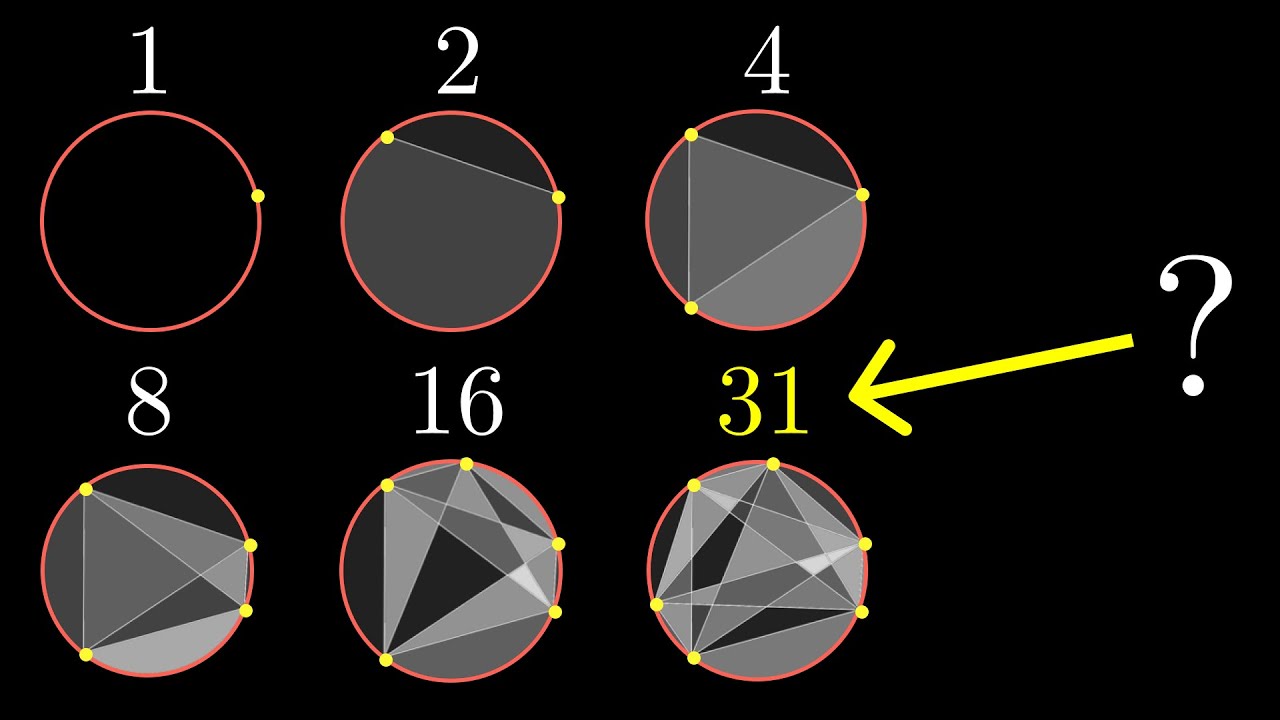
An apparent pattern that breaks, and the reason behind it.
Summer of math exposition: https://3blue1brown.substack.com/p/some3-begins
Learn more at https://some.3b1b.co/
Help fund future projects: https://www.patreon.com/3blue1brown
An equally valuable form of support is to simply share the videos.
For the long-time viewers among you, if this s...
celest furnace
Awesome
cloud walrusBOT
Riku

 boreal inlet
If I do not assume this map is a ring homomorphism, can I even continue to extend this map to the whole ring?
I am asking this because we have been asked to prove this as an isomorphism (automorphism, to be precise.)
K is a field here.
keen loom
boreal inlet
If I do not assume this map is a ring homomorphism, can I even continue to exten...
What makes you say it's not necessarily a homomorphism?
boreal inlet
Considering it to be a set map, we have no useful relations to define the map for other polynomials at all
keen loom
Sure you do: x is a generator for the whole thing. You only need to know it for x.
boreal inlet
That is true
keen loom
Polynomial rings always work that way: choose where to send x, and it can be extended to the whole ring
boreal inlet
Ok so, x is a generator, so x^n can be determined. How exactly we do it?
x^2 maps to the square of the image of x right?
and after we determine each x^n in the format, we can scale it using any scalar from the field, and also we can add the images.
All of these are properties of homomorphisms
My question is, if we do not start with these assumptions, how can we arrive that this is naturally true for this map?
keen loom
This is a good question
boreal inlet
Exactly.
keen loom
Polynomials are the "free" rings. They have the special property that if you send their generating set somewhere (anywhere at all, it can be an arbitrary set map), you can uniquely extend that map to a ring homomorphism.
boreal inlet
Wait, actually?
keen loom
This is like in linear algebra: if you choose to send your basis elements somewhere, then you can automatically extend that to a linear map
You just construct the map according to the rules of homomorphism
boreal inlet
keen loom
You just *construct* the map according to the rules of homomorphism
This answers my question.
boreal inlet
I have to show {(ax + b)^n | n \in {1, ..... N} } is linearly independent in K[x] over K.
a and b are fixed elements of K, a not zero.
I thought of doing induction, but now I am stuck at the inductive step
Showed the case for n = 1 and 2
If K was R I'd use the continuity of polynomials but we don't know that for any arbitrary field
Never mind, I did
boreal inlet
cloud walrus
**Riku**
Okay so, I used the linear indepedence to show this map is injective.
Now I have to show this is surjective
This seems to be difficult though.
Because the map x |-> (x - b)/a doesn't seem to work as an inverse
This gives back x when applied to ax + b
But fails for (ax + b)^2
(ax + b)^2 = ax^2 + 2abx + b^2, and now if you put (x - b)/a in place of x, it doesn't give back x^2
Oh my god.
Ignore me
I saw the mistake
Also, now I realize this map itself is the inverse and it would have been much easier.
celest furnace
U can do it more directly too
If they were linearly dependent a finite sum of them would be 0 with not all coefficients 0
Let a_m be the coefficient of the highest power of (ax+b)^n. But how can you kill the x^n when everything else has smaller power?
boreal inlet
That's the exact inductive argument I applied
Assuming upto m -1 is L.I, then showing the coefficient for x^m has to be also zero, is sufficient
celest furnace
Ah yep that works
Was wondering if you could use that f(x) = ax+b is affine so an isomorphism somehow
Like is the image of the basis elements under an isomorphism still a basis probably I think this is what u we’re getting at
boreal inlet
celest furnace
Was wondering if you could use that f(x) = ax+b is affine so an isomorphism some...
Yes, if I was able to use it I'd Just write this
celest furnace
Or rather the linear transformation fixing K and sending x to ax+b
Ahhh so u found an inverse it all makes sense now sorry
boreal inlet
celest furnace
Ahhh so u found an inverse it all makes sense now sorry
Nah it's okay, this is also a viable idea
Okay just confirming, if I have a group homomorphism f : G -> K and I have found a set mapping g : K -> G such that
f • g = Id(G) and g • f = Id(K). Notice the fact that g is a set mapping.
Is this sufficient to say f is an group isomorphism?
celest furnace
Yes. Why?
boreal inlet
Or do I have to prove g is also a group homomorphism
celest furnace
No its true in general that if f: G -> H is a group homomorphism and bijective then f^{-1} is also a group homomorphism
I recommend you prove this fact if you dont believe it
celest furnace
Ah yeah something like that is assumed
boreal inlet
This reduces my workload just a bit
 regal star
Could someone tell me to follow the book "a first course in representation theory" by Fulton Harris, what are the prerequisites required?
I have gone through course in group theory although a basic one and courses in real analysis and linear algebra by axler
 dim widget
regal star
Could someone tell me to follow the book "a first course in representation theor...
dim widget
regal star
Could someone tell me to follow the book "a first course in representation theor...
probably the only requirements are a first course in group theory and a good understanding of linear algebra
the book is pretty self contained
regal star
Is multilinear algebra required?
summer path
There's an appendix section on multilinear algebra in F&H, I believe
You'll probably want to be familiar with it one way or another
formal ermine
whats multilinear algebra
 lavish sigil
If we have a real vector space with inner product, $(V,g)$, and if we let $(V_\mathbb{C},g_\mathbb{C})$ be its complexification, where the inner product has been extended by complex bilinearity (i.e.\ \textbf{not} to a Hermitian inner product), then the Clifford algebra $\mathrm{Cl}(V_\mathbb{C},g_\mathbb{C})$ is canonically isomorphic to the complexification $\mathrm{Cl}(V,g)\otimes_\mathbb{R}\mathbb{C}$. The complex conjugation on the latter thus induces a complex antilinear map $c:\mathrm{Cl}(V_\mathbb{C},g_\mathbb{C})\to\mathrm{Cl}(V_\mathbb{C},g_\mathbb{C})$ such that $c^2=\mathrm{id}$. If we assume that $w_1,\dots,w_k\in V_\mathbb{C}$, so that the product $w_1\cdots w_k$ is an element of $\mathrm{Cl}(V_\mathbb{C},g_\mathbb{C})$, is then $c(w_1\cdots w_k)=\overline{w_1}\cdots\overline{w_k}$, where the conjugation on the right is the standard conjugation on the complexification of a real vector space?
cloud walrusBOT
gustavn64
 dim widget
multilinear algebra is part of linear algebra
who learns about linear algebra without bilinear forms and determinants?
I guess maybe from Axler
rapid junco
in a general ring, can there be an element a such that a^2 = -1?
dull marsh
Well, the ring of complex numbers is such an example
south patrol
take any ring R and consider R[x]/(x^2 +1)
you can force it to be the case
There's also the funn case of the trivial ring
rapid junco
what am i missing then to show this:

i have deduced that N(x) \in {+- 1} if x is a unit
a^2 + b^2 = 1, where a and b are in Z
without using order
dull marsh
Pretty sure that N can't be negative
rapid junco
Yeah but how do you show this without using the order on Z?
Or is this literally the way.
dull marsh
Yeah
 long obsidian
Can someone help me think about direct limits of groups?
For instance if I consider a group A with the identity map on itself can we form a direct limit? A->A->A->A...?
I feel like this should be A where we just use the identity to get the commutative diagram and in fact A->A->A with the identity maps will commute with A->A with an identity map
Is this correct?
rocky cloak
long obsidian
Can someone help me think about direct limits of groups?
For instance if I con...
Yes
long obsidian
rocky cloak
Yes
Do you always use this universal property? I saw something that made me think it was more natural to think of these as sequences (a potential example being the p adics).
 mighty kiln
A filtered colimit of sets / groups / modules etc can be explicitly described by taking the union and quotienting by the relation "a ∼ b iff a is eventually equal to b"
rocky cloak
Sometimes it's easier to work with the universal property, sometimes it's easier to work with an explicit construction.
mighty kiln
Where "eventually equal" means they get mapped into the same element in some group
long obsidian
mighty kiln
Where "eventually equal" means they get mapped into the same element in some gro...
Ohh okay I didn't know about the eventually language that is helpful. I also forgot it was an equivalence relation to the union thank you.
formal ermine
dim widget
who learns about linear algebra without bilinear forms and determinants?
that's mutlilinear algebra? i thought its just linear algebra lol
slim kayak
mighty kiln
A filtered colimit of sets / groups / modules etc can be explicitly described by...
You usually can do it with any colimit, the filtering condition just means the quotient is significantly easier. Also, being able to consider cofinal families makes them much more friendly objects
mighty kiln
slim kayak
You usually can do it with any colimit, the filtering condition just means the q...
I think in general you take coproduct instead of union?
slim kayak
I thought that was what you meant with union?
slim kayak
Setwise that's what they are
I am not sure why you would want to pass to the union description instead of working with the coproduct itself?
It's usually the nicer object
slim kayak
Yeah?
mighty kiln
You can do much arguments by taking representatives
Cuz is quotient of disjoint union
slim kayak
I never had a situation where there being a disjoint union helped with the stalk arguments
You mean that you can take sections of some neighbourhood in the pre-image of a germ?
Or wait, do you mean that you can talk about germs in general?
Due to the coproduct/coequalizer construction?
mighty kiln
Well like whenever you take a local section as a representative
You're using the fact that the elements of the stalk are represented by local sections
slim kayak
Yeah I get what you mean now
I suppose it clearer if you go the setwise colimit -> equip it with extra structure route for stuff like rings/modules/abelian groups that any germ always corresponds to some local section so you can pass over to them, like when making - say - the argument that being integral passes over to staks and vice versa
 tough raven
slim kayak
I am not sure why you would want to pass to the union description instead of wor...
tough raven
slim kayak
I am not sure why you would want to pass to the union description instead of wor...
That fact should be true in any “reasonable” “algebraic” category and is helpful for explicit computations when coproducts are not so simple (e.g. in the category of groups or rings).
Like, words are fine, but union is better.
I think.
dim widget
slim kayak
Setwise that's what they are
for groups it is not the disjoint union
Products and limits in algebraic categories are the same as those in set, but coproducts and colimits are usually unrelated
slim kayak
Yeah I was thinking abelian groups
dim widget
even in abelian groups the coproduct is not the same as disjoint union
It’s the same as the product in set in some nice cases but that is basically an accident
slim kayak
Hm... so the constructiong does require the filtered assumption somewhere in order to construct the colimit step by step as first a disjoint union with an equivalence relation and then equipping it with the right structure?
south patrol
In which content
slim kayak
I am refering to exercise 1.4E (page 43/44) in this here
https://math.stanford.edu/~vakil/216blog/FOAGjul3123public.pdf
slim kayak
does "here" extend further than modules and maybe rings?
south patrol
Apparently it should be for most like equational algebraic things but not sure
slim kayak
non-abelian group feels like they would be too cursed for this
dim widget
south patrol
Apparently it should be for most like equational algebraic things but not sure
The “forgetful functor” of any monadic adjunction preserves all sifted colimits
dim widget
and sifted colimits are basically all filtered colimits and mutually split coequalizers, and the colimits they generate
dim widget
slim kayak
non-abelian group feels like they would be too cursed for this
non abelian groups would also work
basically any algebraic structure built out of a set which admits a “free” functor would work
 viral mountain
Consider a permutation $\sigma \in S_n$ written in disjoint cycle notation as $(1, 3, 6)(2, 4)$
If we consider $\tau = (1, 3, 6)$ and $\phi = (2, 4)$ as two separate permutations, is it a coincidence that $$\sigma = \tau \phi$$ or is there a reason for this?
cloud walrusBOT
BlazingSaber
 barren sierra
cloud walrus
**BlazingSaber**
barren sierra
cloud walrus
**BlazingSaber**
0 coincidence
That's the definition of the operation of S_n, which is composition
Remember these are just bijections [n] ↔ [n]
And what you've written there is how that operation is reflected when you express these as cycles
viral mountain
Having a tough time wrapping my head around this, maybe because the book I'm following taught me how to write in disjoint cycle notation given the two-row notation, as an algorithmic procedure
I understand that the definition for how these cycles are written is motivated by function composition, but trying to see how/why exactly
Okay, the fact that these cycles are "disjoint" helps make it a lot clearer
Given that $\tau$ and $\phi$ are disjoint, they share no common elements and so you can first apply the action of $\phi$ and then $\tau$, which can essentially be done as a single permutation $\phi$
cloud walrusBOT
BlazingSaber

 cloud solar
Let I be an open interval in R and (I,•) commutative group with the property that for every a,b in I with a<b and for every x in I we have x•a<x•b. a) Show that e is between b and b^-1 for every b in I-{e}. b) If H≠{e} is a subgroup of (I,•) with the property that for every sequence (x_n)n>=1 with numbers from H and for every b in I with b>e, the set {x_n | n>=1 } intersected with (b^-1,b) is a set with no elements or a set which has a maximum, show H is cyclic.
a) is trivial
b) is interesting
cloud solar
if I look at e<h with h in H-{e} we get e<h<h^2<...<h^n
and take the sequence x_n ={h,h^2,...,h^n}
and take b>h^n. If b^-1<h^n we get S=(b^-1,b) intersected with {x_n} has elements so S has a maximum but thats false because of the open interval. So b^-1 > h^n. But h^n>...>h>e. And because b^-1<e<b we get something false
Can someone explain where is the problem
viral mountain
Is this result incorrectly stated? Did they mean $ab^{-1} \in H$ instead $G$?
I tried proving the theorem with the current hypothesis without any luck, so I'm wondering if they meant H instead
 barren sierra
yes should be in H
cloud walrusBOT
BlazingSaber
 barren sierra
also "for all a, b in G"
should be "for all a, b in H"
we don't care about elements outside of H
boreal inlet
I have a field K, where K(t) = Frac(K[t]). Let u \in K(t)\K, such that u = f(t)/g(t) for non zero f, g \in K[t] and gcd(f,g) = 1.
Gcd is defined as K[t] is an Euclidean domain
I have to prove that h(x) = f(x) - ug(x) is irreducible in K(u)[x], and t \in K(t) is a root of h(x).
The latter part is very obvious
But how do I show irreducibility
celest furnace
Is K(u)/(u) iso to K? Maybe Eisenstein?
slim kayak
Are you familiar with localizations? Maybe how they commute with quotients?
Ofc if K didn't contain u in the first place.
The straightforward path is checking the map sending u to 0 and making sure the image is exactly K
south patrol
celest furnace
Is K(u)/(u) iso to K? Maybe Eisenstein?
I mean, u is a unit
celest furnace
Ah shit ur right
south patrol
if it's K[u]/(u) then agreed
 lime junco

im just confused by this definition
what is F? (wasnt mentioned before)
for context, E is a field extension of k
boreal inlet
slim kayak
Ofc if K didn't contain u in the first place.
The straightforward path is check...
u can't be in K by the question. u is taken from K(t) - K.
boreal inlet
lime junco
what is F? (wasnt mentioned before)
F is a subfield of E, containing the field k and the elements in S. If you gather all such F and take an intersection, you get k(S), which is the smallest of all such fields
lime junco
ohhhhh
boreal inlet
This notion is very common
lime junco
its all F such that F contains k and S, i see
lime junco
boreal inlet
This notion is very common
ill keep that in mind lol
boreal inlet
slim kayak
Are you familiar with localizations? Maybe how they commute with quotients?
Sadly I'm not. I was thinking of reading about what localizations are in my spare time but we formally haven't had any course on Commutative Algebra yet.
 alpine island
lime junco
alpine island
lime junco
yeah that first bit is kinda weirdly phrased
lime junco
follow up question
lets say I have it set up as k subset E where k is my field and E is my extension
is k(S) as denoted above
equal to all linear combinations of elementsof S with coefficients in k?
analogous to a vector span
boreal inlet
It doesn't have to be I think
lime junco
oh, unfortunate
boreal inlet
I'm new to field theory as well and up until now this is how we define it
I think for particular fields and particular subsets you can calculate that to isomorphism
lime junco
ah fair enough
I suppose then theres probably no real general case
but in "nice" fields one can compute it
 crystal turtle
lime junco
is k(S) as denoted above
crystal turtle
lime junco
is k(S) as denoted above
In general, you'll need to consider linear combinations divided by nonzero linear combinations to also have inverses
Finite extensions (deg(E) < ∞) you have a basis however, so you can always write things in terms of that
(or uhh deg(k(S)) < ∞ here)
boreal inlet
crystal turtle
Finite extensions (deg(E) < ∞) you have a basis however, so you can always write...
Oh right, yes, my bad
This you can do
boreal inlet
boreal inlet
I have to prove that h(x) = f(x) - ug(x) is irreducible in K(u)[x], and t \in K(...
. Btw, may someone help me here? I have been stuck for hours 😭
This is the original text if anyone needs

t is a root that is very easy to see, you just plug t in there
But that kind of also means t isn't in K(u), because otherwise h(x) won't be irreducible
I'm also confused on how different f(x) and f(t) is. At start it is also an indeterminate variable
cloud walrusBOT
Riku
 boreal inlet
But that kind of also means t isn't in K(u), because otherwise h(x) won't be irr...
boreal inlet
boreal inlet
But that kind of also means t isn't in K(u), because otherwise h(x) won't be irr...
Does that also say we are welcome to try contradiction, that is, assume beta is a root of h(x) in K(u). This extension (K(u) over K) is finite and has the degree as the degree of some minimal polynomial having u as root (for the time being I don't know what it is).
From there can we reach somewhere
Oh wait this assumption is also only true if u is algebraic over K
 marsh quarry
we can show without much work that matrix multiplication is associative. but if we instead show that matrix multiplication is the same as composition of their corresponding linear maps, then does associativity come for free since function composition is associative?
if so, can we generally show some operation is associative by treating its inputs like functions and the operation as composition?
alpine island
marsh quarry
if so, can we generally show some operation is associative by treating its input...
Yeah you can do that, but finding a set of functions to work with is usually harder than just proving associativity directly
boreal inlet
marsh quarry
we can show without much work that matrix multiplication is associative. but if ...
This is true because of the obvious isomorphism between the groups of matrices over a field K under multiplication and group of linear maps over a field K under composition
But yeah in general the corresponding functions would be hard to find unless it's something like this
marsh quarry
do we know any other examples of proving associativity by treating objects like functions
alpine island
Sometimes the definition of your object just happens to be closely tied to functions
and it's easy to do this
marsh quarry
ya ok that makes sense
alpine island
boreal inlet
. Btw, may someone help me here? I have been stuck for hours 😭
Unfortunately no, I cannot
boreal inlet
boreal inlet
Does that also say we are welcome to try contradiction, that is, assume beta is ...
From here, if I assume beta is a root of h(x) that is in K(u), I can write u = f(beta)/g(beta), provided both f(beta) and g(beta) is non zero
And we already know u to be f(t)/g(t) with gcd 1 between f and g
Both f(x) and g(x) are in K(u)[x] so evaluated at beta f(beta) and g(beta) both should be in K(u)
boreal inlet
From here I am unable to proceed anywhere
boreal inlet
Ok anyways this doesn't work for degree more than 3 so this shouldn't work in general
I think the problem boils down to the fact that f(x)g(t) - f(t)g(x) is irreducible in K[t, x]
Which would be true iff the same polynomial is irreducible in K(t)[x] and coefficients have to have gcd 1, Gauss's Lemma
boreal inlet
boreal inlet
I think the problem boils down to the fact that f(x)g(t) - f(t)g(x) is irreducib...
Now how to show this 😭
boreal inlet

Mathematics Stack Exchange
I was originally trying to show this isomorphism:
$$PGL(2, K) \cong GL(2, K)/Scal(2, K), \text{ where } K \text{ is a field, and } Scal(2,K) \text{ is the group of scalar 2x2 matrices over } K.$$
I...
I have given up and raised a stackexchange post.
cloud solar
Let I be an open interval in R and (I,•) commutative group with the property that for every a,b in I with a<b and for every x in I we have x•a<x•b. a) Show that e is between b and b^-1 for every b in I-{e}. b) If H≠{e} is a subgroup of (I,•) with the property that for every sequence (x_n)n>=1 with numbers from H and for every b in I with b>e, the set {x_n | n>=1 } intersected with (b^-1,b) is a set with no elements or a set which has a maximum, show H is cyclic.
if I look at e<h with h in H-{e} we get e<h<h^2<...<h^n
Can someone help me
boreal inlet
I'm actually not sure what is the operation supposed to do.
It certainly doesn't seem a subgroup of R
Or is it the multiplication
If it is, the open interval cannot contain zero
mighty kiln
cloud solar
Let I be an open interval in R and (I,•) commutative group with the property tha...
This group is isomorphic to (R, +)
cloud solar
mighty kiln
This group is isomorphic to (R, +)
Ok I understand
So the problem is wrong?
mighty kiln
?
cloud solar
@boreal inlet said H doesnt look like a subgroup of R
mighty kiln
(I, ·) is not a subgroup of (R, +) with the standard inclusion I ⊂ R
But (I, ·) is isomorphic to (R, +)
mighty kiln
Well any subgroup of (R, +) s.t. all bounded sequences have maximum is cyclic
Or perhaps (?) the same argument for proving this can work directly on I
mighty kiln
mighty kiln
This group is isomorphic to (R, +)
The easiest way to prove this is probably: Find all the integers, find all the rationals, find all the reals
mighty kiln
mighty kiln
Or perhaps (?) the same argument for proving this can work directly on I
Tho I think this works actually
cloud solar
mighty kiln
Well any subgroup of (R, +) s.t. all bounded sequences have maximum is cyclic
Where can I find the proof of this
mighty kiln
cloud solar
Where can I find the proof of this
Consider the infimum of elements in H larger than the identity
viral mountain
I'm trying to prove that the subgroup $H = {a^n : n \in \mathbb{Z}}$ of a group $G$, for some $a \in G$ is the smallest such subgroup containing $a$
Is this a valid argument by contradiction to show the same?
cloud walrusBOT
BlazingSaber

 boreal inlet
mighty kiln
(I, ·) is not a subgroup of (R, +) with the standard inclusion I ⊂ R
boreal inlet
mighty kiln
(I, ·) is not a subgroup of (R, +) with the standard inclusion I ⊂ R
Wait, so the dot is multiplication?
boreal inlet
(\psi: (I, \cdot) \to (\mathbb{R}, +)) s.t.
[
\psi(a \cdot b) = \psi(a) + \psi(b)
] is an isomorphism?
cloud walrusBOT
Riku
 slim kayak
Not enough information
rocky cloak
cloud solar
Let I be an open interval in R and (I,•) commutative group with the property tha...
For the first part, compare e and b, then multiply by b^-1.
For the second, call an element positive if it's bigger than e. Then you want to show that H has a minimal element and is generated by its minimal element.
Assume H doesn't have a minimal positive element, then let xn be a decreasing sequence, such that any positive element is eventually larger than xn (we know such exist because every well ordered subset of R is countable). Then consider b(xn)^-1 in (b^-1, b)
cloud solar
rocky cloak
For the first part, compare e and b, then multiply by b^-1.
For the second, cal...
The sequence xn has all the terms positive?
rocky cloak
cloud solar
The sequence xn has all the terms positive?
Yeah, xn positive
cloud solar
rocky cloak
Yeah, xn positive
Can you explain more the part with the existence of the sequence and how this proves H is cyclic please?
viral mountain
In the proof of this theorem, it isn't clear how they arrived at the highlighted conclusion.
Is it because in any nontrivial subgroup of G, we must have an inverse for every element, so for every positive power of a, we must also have a negative power of a, and vice versa?

So we can be sure that there exists a power of a that's present in H if its nontrivial
rocky cloak
cloud solar
Can you explain more the part with the existence of the sequence and how this pr...
What it's proving is that H has a minimal positive element. After that you should try to prove that H is generated by this element.
Remember your hypothesis says that b(xn)^-1 has a maximal element inside (b^-1, b), how can you use this to get a contradiction
rocky cloak
viral mountain
In the proof of this theorem, it isn't clear how they arrived at the highlighted...
That's right, if a^n is in H then also a^-n will be there
cloud solar
If A finite ring isomorphic with A1×A2×...×Ak and the number of nilpotent elements of A is 2^k then the number of nilpotents of Ai is 2?
cloud solar
If each Ai has 2 idempotents
And A has 2^k idempotents
If some ring Ai has only one nilpotent then there must be a ring Aj which has 2^r nilpotents with r>=2
slim kayak
The image of each projection is nilpotent (why?), go from there
cloud solar
slim kayak
The image of each projection is nilpotent (why?), go from there
Ik that but then?
cloud solar
slim kayak
An element is nilpotent if all it's components are
Yeah this is a property
I used this to show A has 2^k elements because each Ai has 2 idempotents
cloud solar
So if some A_i has only one nilpotent then there must be some A_j which has more than 2 nilpotents (2^p where p>=2 because the product it must be a power of 2)
In that ring A_i because it is finite there is some n s.t. a^=a^(2n) for a in A_i so a_i idempotent so every element must be invertible or nilpotent
And because A_i has only one nilpotent that means A_i is a field with only 2 idempotents
cloud solar
It is commutative
A_i can be iso to Z/2Z for example
So can we have an A_i that has only one nilpotent?
@slim kayak so each A_i must have only 2 nilpotents or not?
slim kayak
Fields have no zero divisors, so the only nilpotent is 0
cloud solar
slim kayak
Fields have no zero divisors, so the only nilpotent is 0
Yes. A_i has only one nilpotent
This is what we supposed
Oh we cant have
That
In the problem we also have that A has 2^k invertible elements
Or can we have such an A_i? We will get that A_i must be iso to Z/2Z
viral mountain
How do we justify that the only subgroups of $\mathbb{Z}$ under addition are $n \mathbb{Z}$ $\forall n \in \mathbb{Z}$?
cloud walrusBOT
BlazingSaber
 slim kayak
You can find a smallest element in it
viral mountain
My guess is that we know that the subgroups of any cyclic group are also cyclic
Since $n \mathbb{Z}$ are the only cyclic subgroups of $\mathbb{Z}$ under addition, they're also the only subgroups
cloud walrusBOT
BlazingSaber
 slim kayak
And given any larger element, this smallest thing must divide it.
viral mountain
slim kayak
You can find a smallest element in it
Smallest element in which set?
slim kayak
Subgroup ofc
viral mountain
which subgroup tho, I mentioned all the subgroups nZ of Z
slim kayak
Any
cloud solar
@slim kayak I am trying to figure out if there is such an A_i with only one nilpotent. If it is true, then there must be A_j with 2^p nilpotents with p>=2 (so at least 4 nilpotents). Because A has 2^k invertible elements we know that A_j has 2^q invertible elements with q>=0. We also know A_j has only 2 idempotents (0 and 1) and the fact that A_j is finite and commutative.
Another thing I see is that we cant have q=0 because of the function from the nilpotents to the invertible elements f(x)=x-1 (picking a and b distinct both nilpotents)
So A_j has at least 2 invertible elements
Another thing: because A_j has only 2 idempotents it means that every element in A_j is nilpotent/invertible
viral mountain
I understand this proof, but I don't understand where the corollary below comes from
We'd seen in a previous section that the subgroups $n \mathbb{Z}$ of $\mathbb{Z}$ are cyclic. But how does that imply that all the subgroups of $\mathbb{Z}$ are of the form $n \mathbb{Z}$? What if hypothetically we're not considering subgroups of $\mathbb{Z}$ which are not of the form $n \mathbb{Z}$ but are still cyclic (as Theorem 6.6 shows)?
 cloud walrusBOT
BlazingSaber
 viral mountain
I understood, never mind
Every cyclic subgroup of Z can be expressed as nZ
And since every subgroup of Z is a cyclic subgroup, it follows that every subgroup of Z can be expressed as nZ
cloud solar
cloud solar
Another thing: because A_j has only 2 idempotents it means that every element in...
Another thing: A_j has 2^q invertible elements and q>=p>=2 because the function f(x)=x-1 is injective
So this means that there must be A_t ring s.t. A_t has only one invertible element
cloud solar
cloud solar
So this means that there must be A_t ring s.t. A_t has only one invertible eleme...
This means that char(A_k)=2 because -1=1
So that means A_k has 2^m elements. But A_k also has 2 idempotent elements so every element is nilpotent/invertible. But A_k must have 2^s nilpotent elements with s>=0. so 2^s+1=2^m and this is only possible if s=0 so A_k has only one nilpotent, only one invertible element and exactly 2 idempotents so A_k is isomorphic with Z/2Z
slim kayak
cloud solar
Another thing: because A_j has only 2 idempotents it means that every element in...
Can you show that a ring that isn't the product of more rings can only have 2 or odd numbers of nilpotents?
cloud solar
slim kayak
Can you show that a ring that isn't the product of more rings can only have 2 or...
Commutative ring?
slim kayak
If that's what you can assume here, sure
cloud solar
And how this helps me with my problem
Oh I see it
We will apply this for every ring A_i right?
slim kayak
The idea is that the number of nilpotents in A is just the product of all elements you can choose
cloud solar
Yes I know that
slim kayak
So if we can limit the prime factors of the nilpotents of any ring which can't be expressed as a non-trivial product of rings, then it follows
cloud solar
What do you mean
How do we know all the A_i's cant be iso to some non trivial product of rings
cloud solar
I know but I want to keep the property that all the A_i's have exaclty 2 idempotents
Oh
The property remains
slim kayak
Right, so split up the A_i's further into something that has nilpotents and something that doesn't, then move those without them to the side
cloud solar
Because 2 prime
slim kayak
Or whatever. If each A_i has r_i nilpotents, then the number of nilpotents of A are 2^k=r_1...r_k
So clearly each A_i has some power of 2 many nilpotents. Maybe you can show that the only possible values are 1 and 2
cloud solar
But if we șplit some A_i into B1× B2 the number of idempotents of B1 × the number idempotents of B2=2 but every ring with unity has at least 2 idempotents so we cant split A_i into a non trivial product of rings
So that means all the original A_i's cant be split
slim kayak
slim kayak
Or whatever. If each A_i has r_i nilpotents, then the number of nilpotents of A ...
yeah, go this route
no splitting there
cloud solar
slim kayak
So clearly each A_i has some power of 2 many nilpotents. Maybe you can show that...
If these are the only possible values, if we have some A_i with only 1 nilpotent then there must be A_j with at least 4 nilpotents and that is false. So the only possible value would be 2
cloud solar
So if all A_i's have more than 4 nilpotent elements the product will be striclty bigger than the number of nilpotents in A
cloud solar
slim kayak
so show why 4,8, ... cant occur
To show why we cant have some A_i that has more than 4 nilpotents or all A_i's?
slim kayak
We we cant have any A_i with more than 2 nilpotents while still being a power of 2
cloud solar
slim kayak
We we cant have any A_i with more than 2 nilpotents while still being a power of...
How
viral mountain
I don't understand. How can we "choose" a generator to be positive?
Isn't what it means to be a group to be cyclic that it must contain an element whose powers represent every element in the set, but we need not know anything of the nature of the generator until we actually find what it must be?
 slim kayak
You can if your group is ordered
If a is a generator, so is a^-1 or -a (depending on notation)
viral mountain
In other words, I know that a group $G$ is cyclic if there exists $a \in G$ s.t. $G = {a^n : n \in \mathbb{Z}}$
But we're only claiming that $a$ exists, we don't know the nature of $a$ until we find it, correct?
cloud walrusBOT
BlazingSaber
 viral mountain
slim kayak
If a is a generator, so is a^-1 or -a (depending on notation)
viral mountain
slim kayak
If a is a generator, so is a^-1 or -a (depending on notation)
hmm, I see
Wish the book would've mentioned this
slim kayak
Not to be rude, but I think thats reasonable to expect to figure it out
Like (a^-1)^-1=a
viral mountain
Not sure if it's supposed to be obvious, but I don't know anything about ordering
slim kayak
Ah, yeah the ordering is inherited from Z itself
Without it you cant really talk about "positive" elements
viral mountain
No, I meant literally I don't know what ordering means
 thin bough
I don't understand the closure axiom for a group.
Let the symbol * be a binary operation on a set G. A binary operation means the calculation that combines two elements to produce another element. For example, addition 1 + 2 = 3 is a binary operation because it combines two elements, 1 and 2, to produce another element, 3. And the symbol * can be any binary operations including subtraction(−), multiplication(×), etc.
what does the symbol * mean ?
keen loom
viral mountain
No, I meant literally I don't know what ordering means
Sure ya do, it's the thing the inequality symbol gives you
slim kayak
Yeah, thats as good as it gets without going into theory
viral mountain
Yeah I have a vague idea from analysis, but besdies the < symbol I literally don't know how to define an ordering
slim kayak
you have some method by which you can use < satisfying all the properties you know and love
keen loom
A total order is really the exact thing you already know
slim kayak
Usually you just go "a < b iff a and b fulfill P" where P is some property
viral mountain
a relation basically
slim kayak
and then you can check that it mets the axioms of what an ordering is (it acts like the < sign from the real numbers)
Its a relation fulfilling some rules, yeah.
cloud solar
slim kayak
We we cant have any A_i with more than 2 nilpotents while still being a power of...
How can I prove this? Can you explain please? I just dont understand.
slim kayak
cloud solar
How can I prove this? Can you explain please? I just dont understand.
Idk, I was suggesting some different thing you could try to approach
cloud solar
We can have one A_i with 1 nilpotent and other A_j with 4 nilpotents and the rest of them with only 2 nilpotents for example and the product of the numbers of nilpotents would be exactly 2^k.
I proved that if there is some A_i with only 1 nilpotent, then there is an A_t iso with Z/2Z
slim kayak
wait how
cloud solar
Above
cloud solar
cloud solar
So that means A_k has 2^m elements. But A_k also has 2 idempotent elements so ev...
.
slim kayak
thin bough
I don't understand the closure axiom for a group.
```
Let the symbol * be a bi...
its a function f(a,b) with the property that f(f(a,b),c) = f(a,f(b,c))
you can forget the second half since it just says * is associative.
cloud solar
So the question is all A_i's must have exactly 2 nilpotents or there is a chance that some A_i can have only 1 nilpotent?
slim kayak
do you have a picture of the exericse?
cloud solar
It is not an official problem. It is just some problem I was thinking about. If A is a finite commutative ring with # idempotents = # nilpotents = # invertible elements, who is A?
And the idea with the product of A_i's is from @rustic crown . I think he said each A_i has 2 nilpotents, 2 invertible elements and 2 idempotents, but how? Cant we have one A_i iso to Z/2Z. This is what I understood. Correct me if I am wrong.
slim kayak
Commutative rings with unity?
cloud solar
Yes
slim kayak
so the idempotents are fixed to be 0 and 1. The invertibles must include 1, so we have some self-inverse a. And now we also have a single nilpotent element b
besides 0
cloud solar
From where did you get that has 2 idempotents, 2 nilpotents and 2 invertible elements
slim kayak
just looking around
rocky cloak
Didn't you already ask this @cloud solar
cloud solar
Yeah but cant we have one A_i iso to Z/2Z, where A iso A_1×A_2×..×A_k ?
cloud solar
So now the problem is not only about finding the finite commutative rings with 2 nilpotents, 2 idempotents and 2 invertible elements. If there is some A_i iso to F2 then there must be A_j in that product where A_j has at least 4 nilpotent elements
So idk if we can classify this type of rings
rocky cloak
Yeah, so what you do is choose A_i to be local rings with residue field F2. That will give you rings with the same number of nilpotents as units. But typically not that many idempotents, then you just tack on a few more F2 until you have enough idempotents
If you want to describe all local rings with residue F2, that will be a lot.
Things like F2[x, y]/(x, y)^2 and also Z/4Z, but also things like Z/4Z[2x] and a bunch of crazy stuff
 barren sierra
the group operation
so when you define a group, it's a set + this operation satisfying certain conditions
so if G is the integers, then that dot could represent addition of two integers
or if G is a vector space, that dot could represent addition of two vectors
or if G the set of invertible 2 x 2 real matrices, that dot could represent multiplication of two matrices
etc etc
those are all examples of groups
thin bough
I see
Could you define your own operation ?
or does it only have to be addition and multiplication
barren sierra
well you'd have to show your operation satisfies the other conditions
but yes, in theory it could be anything
I just gave examples you are hopefully familiar with
thin bough
i see okay thanks
coral spindle
Note that this should be clear from the definition of a group!
You should take this opportunity to reread the definition.
barren sierra
(I think this is the definition lol)
coral spindle
There should be a line saying something like "a group is a set G with an operation . such that ..."
thin bough
 barren sierra
like I'd bet right above that screenshot is a sentence along the lines "A group is a set G with an operation * satisfying the following axioms"
lol
coral spindle
ew no
coral spindle
thin bough
Anyway, notice how the paragraph above your screenshot also answered your question.

celest furnace
coral spindle
ew no
So based
thin bough
I am trying to prove that the set of integers modulo 13 form a group with respect to addition
is there any association between prime numbers and it forming a group with respect to addition ?
 barren sierra
Looks good to me
thin bough
thank you
cloud solar

G is an abelian group
How to prove that for every n>=1 there is an unique subgroup H with n elements?
I was thinking using the fact that a matrix A is in subgroup of order n if A^n=I2
formal ermine
what is R
cloud solar
And then using the binomial expression
cloud solar
formal ermine
what is R
The set of real numbers
viral mountain
If $G$ is a cyclic subgroup, does it make sense to define the order for every one of its elements, or only for the element $a \in G$ s.t. $a$ is a generator of $G$?
cloud walrusBOT
BlazingSaber
 celest furnace
viral mountain
If $G$ is a cyclic subgroup, does it make sense to define the order for every on...
celest furnace
viral mountain
If $G$ is a cyclic subgroup, does it make sense to define the order for every on...
Each one
You define the order of an element a in an arbitrary group G as |<a>|
For example the order of 5 in Z/15 is |<5>| = |{0,5,10}| = 3
viral mountain
Right yeah fair
I forgot that <a> exists for every element of a group
I thought only those elements which generate the entire group have <a> defined for them
cloud solar
cloud solar
I was thinking using the fact that a matrix A is in subgroup of order n if A^n=I...
If H1, H2 two distinct subgroups of order n, because G abelian H1,H2 are normal so H1H2 subgroup of G and ord(H1H2)>n (idk if this helps)
 rotund aurora
 glossy crag
@rotund aurora I see you're back to being a croq.
south patrol
thin bough
A1 is also redundant lol
 tiny jolt
bump
long obsidian
Hey I'm confused about the terminology of normal rings versus integrally closed rings. Are they exactly the same thing?
slim kayak
Depends on who defines it, normal rings on stacks are the same thing as integrally closed rings
What wikipedia defines as normal rings is that the localizations at all prime ideals (not just (0), if R is a domain) are integrally closed rings
cobalt heath
I know I am out of nowhere but; Thanks Kerr, now I do not have to look up wikipedia/hartshorne to learn what normal rings are
 formal fractal
Let G,H be solvable groups. Show G x H is solvable
Can i do this constructively
<@&286206848099549185>
barren sierra
Do you know that G is solvable if and only if for all normal subgroups K, K and G / K are both solvable?
if not, that would be worth proving and using that
maybe there's a more direct way but idk
 static mauve
I have the book "A First Course In Abstract Algebra" by Fraleigh. Im wondering what sections/chapters of this book might be found in your average introductory undergrad course. Im essentially looking for a knowledge base that goes deep enough to advance my studying in Topology and Diff Geo.
Here is a breakdown for the high chapters
-Groups and Subgroups
-Permutations, Cosets, and Direct Products
-Homomorphisms and Factor Groups
-Rings and Fields
-Ideals and Factor Rings
-Extension Fields
-Advanced Group Theory (maybe this ch name is a bit too vague)
-Groups in Topology
-Factorization
-Automorphisms and Galois Theory
 scarlet estuary
undergrad courses tend to be paced fairly differently from school to school
i'd consider fraleigh to be roughly the contents of a two-semester introduction to abstract algebra
some schools might do it in one semester but that'd be fast paced
barren sierra
that'd be a fast one sem IMO
static mauve
I see. So maybe like the first half is roughly the "bare basics"?
scarlet estuary
kinda? but like
barren sierra
although I'm curious what makes factorization come so late
scarlet estuary
i'd expect many schools to instead group the chapters by subject
barren sierra
and what is "advanced group theory" lol
scarlet estuary
i.e. there might be a group theory course that does the first 3 chapters and then the last 4, save galois theory
and then a ring/field theory course that does the rest
static mauve
I can send some pics to get into specifcs 😄
barren sierra
If my first abstract algebra course was just group theory
I would not have done a second
cobalt heath
barren sierra
and what is "advanced group theory" lol
Idk, maybe group homology stuffs?
barren sierra
no way homology is appearing that early
scarlet estuary
anyway
static mauve
 scarlet estuary
as for what you need for topology
you mostly just need the group stuff
to get started
ring/field theory are relevant later but initially you just need comfort working with groups
static mauve


@scarlet estuary cool! well that is definitely helpful!
I didnt want to spend TOO much time going off on a tangent with this book, but maybe starting with just groups to start is a good idea 🙂
scarlet estuary
yeah so like for context my undergrad did 1-3 and 7 in a dedicated group theory course
4-6 and 9-10 in a dedicated ring/field theory course
and then 8 in introductory algebraic topology
(actually i think at the end of general topology, but same diff)
cobalt heath
barren sierra
no way homology is appearing that early
Idk, an algtop prof said that homology is the easiest thing possible in math
static mauve
I did plan on going through Lees Topological Manifolds book... so maybe that should cover chapter 8 of Raleigh 🤷
scarlet estuary
for general topology you dont really need anything besides basic familiarity with the properties of common fields (namely ℝ)
for algebraic topology, you need group stuff to start and further topics in algebra are gradually introduced as you develop the machinery to study them
static mauve
I have some familiarity with basic Topolgy via Apostols Real Analysis book
scarlet estuary
for differential geometry, you only need algebra insofar as you need comfort with vector spaces
so a bit of field theory is helpful but not super necessary
static mauve
Yeah, im going through an intro diff geo book (not Lees) and I havent really needed any algebra
Well thanks for the input! I do appreciate it 
 sinful kite
static mauve
I have the book "A First Course In Abstract Algebra" by Fraleigh. Im wondering w...
sinful kite
static mauve
I have the book "A First Course In Abstract Algebra" by Fraleigh. Im wondering w...
Fraleigh mentions in the preface how he covers the material across two courses and what he includes/excludes. And, there should be a chart of topics as well there.
Actually he tallks about only one intro course. In the 8th edition, Neal Brand talks about the two course split. If it helps you I can post the snippet here...
static mauve
Sure, that would be awesome! 😄
sinful kite
This is Neal Brand's take btw.. for Fraleigh's you can look at your edition's preface

oh wait the section numbers are going to be all different 😐
static mauve
Ah right. No worries, let me look a bit harder at the preface. I didnt initially see a breakdown for what Fraleigh thought was a good breakdown per semester
sinful kite
ok so the instructor's preface and the ToC are available on amazon.com as samples.
formal fractal
formal fractal
Let G,H be solvable groups. Show G x H is solvable
Can anyone else help
rocky cloak
formal fractal
Can anyone else help
Did you consider what spamakin said?
If N is a normal subgroup of G and both N and G/N are solvable, then so is G. This should actually be immediate from the definition, so try carefully writing down what the definition of solvable entails.
coral spindle
I think Q is an odd choice to name a group, I thought for a moment you were talking about the rationals!
coral spindle
Why not G? :)
I'm thinking about the question still, I do think you should be able to conclude it is Abelian but I would like to double-check
I believe the dicyclic group of order 12 is a counterexample to this claim.
 meager fractal
Z/6Z x Z/6Z?
coral spindle
No.
A presentation for the dicyclic group of order $2n$ is given by $\langle a, x \ |\ a^{2n} = e,\ x^2 = a^n,\ xa = a^{-1}x\rangle$.
cloud walrusBOT
Boytjie
 coral spindle
The subgroup $\set{e, x^2} = \set{e, a^n}$ is the centre, according to GroupProps.
cloud walrusBOT
Boytjie
 coral spindle
Then evidently the quotient is cyclic of order 6, and the dicyclic group is not Abelian.
meager fractal
hmm
coral spindle
cloud walrus
**Boytjie**
Typo! This should be of order 4n not 2n.