#groups-rings-fields
1 messages · Page 142 of 1
 unkempt stream
If a minimal poly’s leading coefficient is a unit, then you can just divide by it’s inverse to have an integral extension
which is always the case for a field
but yeah, this
i wonder if the evaluation map that sends X_n to \sigma_n(x) for some chosen x can be manipulated somehow
because applying an automorphism in G to that after you evalute it is the same as permuting the indeterminates
i have no idea
i know the proof of artin’s lemma is amongst those same lines
 white oxide
why are we allowed to pull out the $r$? I thought by definition f was a R-module homomorphism from $L \to \text{Hom}\mathbb{Z}(R, J)$ and hence isn't in $\text{Hom}\mathbb{Z}(R, J)$


 cloud walrusBOT
okeyokay

 wraith cargo
Say I have M = IM+N for fg R-modules M and N, and I is an ideal that is contained in the jacobson radical of R, does Nakayama's lemma then tell us that M=N?
 topaz solar
white oxide
why are we allowed to pull out the $r$? I thought by definition f was a R-module...
topaz solar
white oxide
why are we allowed to pull out the $r$? I thought by definition f was a R-module...
What
 glossy crag
wraith cargo
Say I have M = IM+N for fg R-modules M and N, and I is an ideal that is containe...
glossy crag
wraith cargo
Say I have M = IM+N for fg R-modules M and N, and I is an ideal that is containe...
I think so

 topaz solar
It’s an R module hom, so you can pull out scalars
wraith cargo
glossy crag
I think so
thanks!
I looked elsewhere and found out that I was thinking of it wrong but now it makes sense
white oxide
topaz solar
It’s an R module hom, so you can pull out scalars
oh yeah duh right thanks
 little root
is there a trick for computing the 105th cyclotomic polynomial by hand, or is this problem not meant to be done manually?
 wraith cargo
little root
is there a trick for computing the 105th cyclotomic polynomial by hand, or is th...
wraith cargo
little root
is there a trick for computing the 105th cyclotomic polynomial by hand, or is th...
$x^n-1 = \prod_{d|n}\Phi_d$
oops lol
that ain't true
 formal ermine
isn't 105 like the first without abs <= 1 coeff
formal ermine
wraith cargo
$x^n-1 = \prod_{d|n}\Phi_d$
make the lhs x^n - 1
or + 1?
probably + 1
wraith cargo
formal ermine
make the lhs x^n - 1
yea
x^n-1
I think if you put n=105 you could calculate it
cloud walrusBOT
Irony Incarnate
 wraith cargo
wtf 105 has a super nice factorization
formal ermine
,w 105
cloud walrusBOT


 Requested by projective
formal ermine
Requested by projective
formal ermine
bruh
wraith cargo
formal ermine
,w 105
3*5*7
so the only divisors are 3,5,7,15,21,35 and 105
OH
YOU CAN USE
THE MOBIUS INVERSION FORMULA!!!
wraith cargo
little root
is there a trick for computing the 105th cyclotomic polynomial by hand, or is th...
you can calculate it as $\Phi_n = \prod_{d|n}(x^d-1)^{\mu(n/d)}$
cloud walrusBOT
Irony Incarnate
 little root
yeah but you would need a computer to actually compute that right
 chilly ocean
formal ermine
now just gotta do loooooong division
chilly ocean
formal ermine
now just gotta do loooooong division
bruh
little root
like theres not some trick that gives you the explicit answer easily?
im just confused since its an exercise in aluffi
formal ermine
chilly ocean
bruh
what
wraith cargo
little root
yeah but you would need a computer to actually compute that right
this a product with 7 terms so it's not that awful
wraith cargo
little root
like theres not some trick that gives you the explicit answer easily?
not really
little root
cloud walrus
**Irony Incarnate**
wait what's the \mu here?
wraith cargo
little root
wait what's the \mu here?
the mobius function
little root
oh interesting
little root
cloud walrus
**Irony Incarnate**
wouldnt this formula have multiple factors of x - 1 though
wraith cargo
little root
wouldnt this formula have multiple factors of x - 1 though
no?
little root
like x - 1 divides each (x^d - 1)^{\mu(n / d)}
wraith cargo
ahh
okay yes but I mean it'll be hidden in the computation
little root
wait wdym
wraith cargo
sry am very tired
I meant as in yes there are factors of x-1 but you can just multiply out the (x^d-1)
 void cosmos
guys is 3 trivial
 wraith cargo
void cosmos
guys is 3 trivial
wraith cargo
void cosmos
guys is 3 trivial
no
void cosmos
wait how
wraith cargo
the a_i could generate some ideal that's only contained in M
wraith cargo
void cosmos
tbh
say the a_i generate some module M'
then when you map M' to R/M^2 it has the same image as M
wraith cargo
R -> R/M^2
void cosmos
yea
the equivalence classes of the ai generate M/M^2
is that what ur saying?
just going mod M^2 or what
sorry ur just being weirdly minimalistic in ur explanation like
haha
wraith cargo
void cosmos
sorry ur just being weirdly minimalistic in ur explanation like
I'm was trying to come up with an example lol
but the problem is saying like
say you have generators of M/M^2 right
You have to show they generated M as well
Now this really isn't immediate since hypothetical what's stopping the a_i's from generating some subideal of M called let's say M' that just has the same image under the map R -> R/M^2 as M does?
I'm trying to come up with some tangible example but idk what rings are non noetherian and local lol
void cosmos
ig it would be
contained in M anyways
this subideal
that is
and i have to show that this + generating M/M^2 is enough
are*
void cosmos
isnt any ideal contained in a maximal ideal anywaays?
wraith cargo
yea
void cosmos
and M is our only maximal ideal right
wraith cargo
proper ideal
ah sure yeah in this case that's true 
I got used to proving these kinds of results in group theory where it needn't be local at all
void cosmos
okay so now i have to show that M is a subset of this ideal generated by (a1,a2,...)
ugh idk hbow
how*
like
i dont know how to go from M/M^2 to R lmfao
maybe i can use nakayamas lemma or something idk
wraith cargo
void cosmos
maybe i can use nakayamas lemma or something idk
that is really not a bad idea
void cosmos
idea*?
wraith cargo
yeah lol
wraith cargo
Here's how I'd do it
void cosmos
the assumptoin that this ideal generated by a1a2
is not M
would just make me blow it up and make it = 0
wraith cargo
take M' to be the idal generated by the a_i
void cosmos
if i can show that MI = I
wraith cargo
and since it's local clearly M' subset M
void cosmos
yea
wraith cargo
now you need to show that M' = M
And the Way I'd do this is to take the quotient M/M' and use nakayama to show it has to be 0
You also very likely have to use the notherian condition too
void cosmos
probalby use like
third iso theorem to divide by M^2 up and down
and then i think any representative would be just a sum of the form ab where a is in M' and b is in M/M^2
lmao its far from trivial ig
and ofc
i cant find the solution
in any solution manual
little root
isn't this just nakayama's lemma?
or like specifically this corollary of nakayama's lemma

but this doesn't require R to be noetherian local so maybe im missing something
void cosmos
thats what i had in mind
when i thought it was trivial
but yea
thats enough
i think it being local noetherian is just for the nakayamas lemma hypothesis
 coral steeple
Hi there, I'm looking for a group which has at least one subgroup of infinite index and at least two of finite index
formal ermine
Z x Z/2 x Z/2
coral steeple
My book hasn't gotten to product groups yet so I don't know how that works though
(Nor quotient groups)
 agile burrow
Z itself should work, if you're familiar with computing the index of subgroups of Z
coral steeple
I tried the additive group of integers, and the multiplication groups of R and C
 delicate bloom
multiplicative group of C should work
coral steeple
Wait but don't all subgroups of Z have finite index
delicate bloom
all of C itself is infinite, then {1,-1} and then {1,i,-1,-i}
agile burrow
There's exactly one subgroup of infinite index
 crystal turtle
Or in other words, there's exactly one subgroup of finite order
coral steeple
Ah yes it's just 0 right
delicate bloom
oh I misread
coral steeple
@agile burrow
agile burrow
Yeah, that's right
coral steeple
Ok thanks!
agile burrow
Happy to help

 wispy urchin
resist the low hanging fruit challenge (impossible)
delicate bloom
think they call that a feynman diagram
 hidden haven
It is commutative though  no harm in calling it that
 ivory trail
all DAG diagrams forests are actually commutative, true
hidden haven
No,
• → •
↓ ↓
• → •
is DAG but need not commute
 vague granite
Does one need the axiom of choice to find $Y\subset X$ such that $X=\sqcup_{y\in Y}\mathrm{Orbit}(y)$ for a general group action?
 solar vessel
yeah prolly
cloud walrusBOT
Philka
 vague granite
I suspect so to since you essentially need a representative for each orbit
If you have a.o.c. then you let $f:{\mathrm{Orbit}(x):x\in X}\rightarrow X$ be a choice function and you get $X=\sqcup_{y\in \mathrm{Im}f}\mathrm{Orbit}(y)$.
cloud walrusBOT
Philka

 rocky cloak
vague granite
Does one need the axiom of choice to find $Y\subset X$ such that $X=\sqcup_{y\in...
rocky cloak
vague granite
Does one need the axiom of choice to find $Y\subset X$ such that $X=\sqcup_{y\in...
Let A_i be an indexed family of nonempty sets, let X be their disjoint union and let G be the product of symmetric groups S(A_i), acting on X in the obvious way. Then picking such a Y is exactly picking a choice function
topaz solar
If you can bound things in size (or maybe some structure?) you can get away with a weaker choice principle, but you’d have to have choice even if not a full power
 coral spindle
vague granite
I suspect so to since you essentially need a representative for each orbit
coral spindle
vague granite
I suspect so to since you essentially need a representative for each orbit
My guess would be yes although I can't think of an immediate proof here. My reasoning is that under choice, given any partition of a set you could find a group action on that set whose orbits form that partition. This is obviously not sufficient to show equivalence, though.
chilly ocean
Hey I don't know how to prove the following :
On a G chart simple of order 2n,in which the degree of each edge is even,there is for each vertex another vertex connected to an even number of edges in common.
Thanks for help
coral spindle
This is not an abstract algebra question. Please move to #discrete-math for elementary graph theory questions.
chilly ocean
Ok ty
topaz solar
coral spindle
My guess would be yes although I can't think of an immediate proof here. My reas...
try doing it on partitoning UX by (disjoint) x in X?
or uh, UX u X kinda thing
coral spindle
I'm writing up my approach rn actually give me a mo!
@vague granite OK I got it – I think the following is a proof that the existence of representatives of a group action is equivalent to AoC. To prove it, I simply show that we may choose representatives of any partition assuming the group-theoretic version, since the latter is a convenient form of AoC.
Consider some partition of a set. For each part P of the partition, consider the group Sym(P) of bijections on P. Since we may construct a bijection that swaps any two elements of P, the action of Sym(P) on P is transitive. Now consider the group G defined to be the product of Sym(P) over all these parts P. We may explicitly construct elements of G that show that the orbits under the obvious action are the same as the parition, so we're done.
Obviously some details need checking but I'm confident
Stunningly simple tbh lol
Just had to choose the right groups
vague granite
coral spindle
<@346002897017896961> OK I got it – I think the following is a proof that the ex...
I think jagr said something similar
coral spindle
Oh lmao that's what I get for not reading
 solar vessel
no
coral spindle
They are critically different
 solemn dew
oh
coral spindle
A (unital) subring is almost never an ideal, and an ideal is almost never a unital subring.
coral spindle
No
A unital subring is a subring, specifically that contains 1
Since we do sometimes care about subrings of a ring that don't contain 1, we need to make a distinction
An ideal is always a non-unital subring, but even non-unital subrings are only rarely ideals
coral spindle
Yes
solemn dew
then the ideal can contain 1
coral spindle
None that I know
We don't tend to care very much about subrings
We care a lot more about ideals
solemn dew
alright thanks brother
 teal vessel
so I'm having to prove that for some subgroup H of the additive group of rationals, the property that for all nonzero x, (x ∈ H) ⇒(1/x ∈ H) must mean that H is either {0} or H=Q. I know there are easier ways to do this, but (ignoring the H={0} case because it is incredibly easy to show) I showed the following:
assume 1 is a member of H, this directly implies all integers must be in H by closure.
this further implies that all unit fractions are in H by the given property
By closure, all multiples of unit fractions must be in H, i.e. all fractions, therefore, if 1 is in H, then H=Q
Further, assume some nonzero element x is in H, this implies that 1/x is in H as given
by closure, x/x must be in H (all multiples of 1/x must be in H, but this is the vital one), which is equal to 1, therefore if any nonzero x is in H, the above assumption starting at 1 applies.
thus, if there exists a nonzero x in H, then H must contain all rational numbers, and is therefore equal to Q.
(if there's only 0, then it's a trivial group where 0 is the identity, and it is exempt from the extra condition given because that's a universal, not existential quantifier).
there are easier more efficient ways to determine this, by starting from any arbitrary nonzero element instead of from 1, but I like this thought process.
rocky cloak
teal vessel
so I'm having to prove that for some subgroup H of the additive group of rationa...
How are you concluding that x/x must be in H?
teal vessel
repeated addition of the unit fraction 1/x
rocky cloak
but x is rational?
teal vessel
fair. to be strictly rigorous, I suppose the proper statement is that it ends up being some integer by flipping the fraction and getting a multiple of the denominator, which then implies that a unit fraction in integer components exists, hence the rest follows.
rocky cloak
Right, yeah that works
 night onyx
yeah it still works, just take p/q \in H, so that q * (p/q) = p \in H, so 1/p \in H, so p * (1/p) = 1 \in H, you can still get there
the proof does look good though, I agree
teal vessel
I think it's often better to show the process of breaking down the proof into easier parts, i.e. first show that 1 works, then any integer, then non-integers. The final proof given in texts is often quite dense and removes such lemmas
crystal turtle
yeah this is fine, not sure if there's a nice way to do it more efficiently
teal vessel
mostly just re-ordering for presentation.
night onyx
I wonder if you can prove that H has to be an ideal of Q, and Q being a field means H = 0 or Q (lol I don't know if it's true just a thought)
teal vessel
I would not know. I may return to that question when I learn of ideals.
isn't this literally just the notion that the union of two groups in a subgroup relationship is equal to the larger group, and therefore the union from 1 to n across chained subgroups H_i is just H_n, and in cases where an infinite chain exists, the "limit" of that unioning just converges onto G? No clue what the rigorous version of this will look like, but as a sketch that seems fairly obvious.

(also with the fact that any group is a subgroup of itself)
 ebon heron

YouTube
rocky cloak
teal vessel
isn't this literally just the notion that the union of two groups in a subgroup ...
The limit doesn't need to converge to G, but you're right that the limit is the only thing you need to prove something about
It's also not very complicated
Just checking the definition of subgroup
teal vessel
rocky cloak
The limit doesn't need to converge to G, but you're right that the limit is the ...
oh, it could arbitrarily stop at any such subgroup and just be "unioning with itself" over and over right? damn axiom of choice.
rocky cloak
teal vessel
oh, it could arbitrarily stop at any such subgroup and just be "unioning with it...
I'm not sure what you're saying, and the axiom of choice doesn't play a role. Consider for example
(1/2) < (1/4) < (1/8) < ... Q
teal vessel
if I didn't do all my work on a whiteboard and actually kept notes this would be much easier with a previous result from this section
teal vessel
rocky cloak
I'm not sure what you're saying, and the axiom of choice doesn't play a role. Co...
I'm not sure what those groups are representing
(1/2) doesn't look like a group to me, it looks like a number
teal vessel
ah, ty
so this ends up going to the group generated by all negative powers of 2, got it
OH given any subgroups H and K, H U K is a subgroup iff one is a subset of the other, and that's already established in the chain structure
crystal turtle
But that only could extend with induction to finite unions
Not infinite chains like this
night onyx
teal vessel
isn't this literally just the notion that the union of two groups in a subgroup ...
You can prove this is a subgroup pretty directly: obviously 1 is in each H_i so it's in the union, if x is in the union it's in some H_i, so it's inverse is also, so its inverse is in the union, and if you have x in H_i and y in H_j with i < j then because it's a chain of inclusions, both x and y are in H_j, so their product is. No fancy stuff required!
teal vessel
crystal turtle
But that only could extend with induction to finite unions
evidently I need to relearn induction conditions.
crystal turtle
I mean the general rule of thumb with something like unions or intersections is that, once you've proved it for the binary case, you can usually extend (at least under some circumstances) to any arbitrary finite case
But with (regular, not transfinite) induction, you won't every get the infinite case
teal vessel
my last exposure was entirely transfinite induction, I'm out of practice lol. that's what I get for doing studies in pure set theory before this 😅
crystal turtle
lmao
but yeah this specific case should just be an easy evercise in subgroup definition
teal vessel
yeah
 rocky cloak
solemn dew
any hints guys?
rocky cloak
solemn dew
any hints guys?
If x is contained in an ideal then so is ix - xi
 south patrol
Interesting problem btw
rocky cloak
Wedderburns theorem coming up maybe?
Not that the problem is really leading to it, just kinda hinting a bit
unkempt stream
wedderburn’s theorem is neat
so is the fact that if for each x in a ring there is an n such that x^n - x is central, then the whole damn ring is commutative
doesn’t even need a multiplicative unit afaik
unkempt stream
solemn dew
any hints guys?
quick question
by ideals is it referring to sided ideals or two sided ideals
solemn dew
two sided ideals

they call it left-ideal or right-ideal if it is not a two sided ideal
but i would argue that they should call it ideal-right and left-ideal
💀
 open sluice
that doesn't sound ideal to me
unkempt stream
In my own stuff i usually call a two sided ideal a strong ideal
Otherwise left or right
Or a normal ideal
Given how it related to a normal subgroup almost
rH = Hr for normal subgroup H
rI = Ir (= I) for two sided ideals
unkempt stream
solemn dew
By the definition, 1 can be proven by showing that this ringc, call it Q_p, is a finitely generated module (with an associative algebra) over Z/pZ of degree 4
therefore it is module isomorphic to (Z/pZ)^4 which has cardinality p^4?
idk
WAIT
 delicate orchid
it's p^4 because it's a dim 4 vector space over F_p
unkempt stream
Same proof different words given Z/pZ is a field
unkempt stream
delicate orchid
it's p^4 because it's a dim 4 vector space over F_p
Btw isn’t that the module algebra F_q[Q_8/Z(Q_8)]
or smth
idk
delicate orchid
are you asking if this doodad is iso to that?
 coral shale
solemn dew
but i would argue that they should call it ideal-right and left-ideal
coral shale
solemn dew
but i would argue that they should call it ideal-right and left-ideal
we dont do politics here
unkempt stream
solemn dew
any hints guys?
trying to think of a non-unit
delicate orchid
unkempt stream
Btw isn’t that the module algebra F_q[Q_8/Z(Q_8)]
thankfully we're taking p odd here so this ring is actually nice (semisimple)
unkempt stream
assume x = a + bi + cj + dk is a unit
delicate orchid
stop pinging the dude mizalign
unkempt stream
i thought i had the reply pings off
srry
i had it off i must’ve turned in on again by accident
delicate orchid
Q_8/Z(Q_8) \cong C_2 x C_2, the group algebra F_q[C_2 x C_2] is commutative so no they're not iso
ok cool
unkempt stream
I’ll be back with a solution hopefully
i’m somewhat lazy so
x = a + bi + cj + dk
Then
x^-1 = (a - bi - cj - dk)/(a^2 + b^2 + c^2 + d^2) in F_q
so a^2 + b^2 + c^2 + d^2 ≠ 0 in F_p should be necessary and sufficient to prove an element unital
unkempt stream
thing is, idfk what examples to choose
I know for certain each element in a prime field is the sum of two squares
unkempt stream
unkempt stream
I know for certain each element in a prime field is the sum of two squares
so just chose any x, get x = a^2 + b^2
and -x = c^2 + d^2
So a + bi + bj + dk has F_p norm 0
So it’s a zero divisor
delicate orchid
seems like you knew exactly what examples to choose
in fact, you chose all of them at once
unkempt stream
Lol
delicate orchid
also I quite like that this shows that every prime can be written as the sum of 4 squares
unkempt stream
WAIT WHAT
delicate orchid
a very funny proof for that result
unkempt stream
delicate orchid
in fact, you chose all of them at once
dude someone gave me that sum of two squares as a challenge problem like 2 days ago, that’s the only reason why I thought of it
unkempt stream
delicate orchid
also I quite like that this shows that every prime can be written as the sum of ...
the only other proof I’ve seen of that was with quadratic forms in Serre’s Course in Arithmetic
i have it printed out on my bedstand lol
delicate orchid
unkempt stream
I know for certain each element in a prime field is the sum of two squares
how would you show this without quadratic forms?
glossy crag
solemn dew
For the ideal bit you could argue like this: you know this is a 4-dimensional algebra (can be proved using the i,j,k relations) and any image of this algebra would again be an algebra satisfying the same assumptions (generated by F_p and i,j satisfying i^2=j^2=-1 and ij=-ji), so 4-dimensional => all its images are isomorphic to it => it has no ideals.
unkempt stream
delicate orchid
how would you show this without quadratic forms?
consider the endomorphism f(x) = x^2
solemn dew
i just used @rocky cloak 's method and showed that 1 is in the ideal
unkempt stream
If f(x) = f(y), then x^2 - y^2 = (x+y)(x-y) = 0
solemn dew
but thanks for the advice
unkempt stream
unkempt stream
If f(x) = f(y), then x^2 - y^2 = (x+y)(x-y) = 0
follow from there
solemn dew
don't know what a algebra is yet though
unkempt stream
unkempt stream
follow from there
hint: no element is nilpotent of degree 2, sorry
glossy crag
solemn dew
don't know what a algebra is yet though
Stuff akin to M_n(K) (a ring that is simultaneously a vector space so that ring multiplication and scalar multiplication commute). Prototypical examples include M_n(K), K[x] and the celebrated quaternions.
unkempt stream
WOrds mixed UP
delicate orchid
unkempt stream
consider the endomorphism f(x) = x^2
:uponthewitnessing: I cannot consider :tearsofthenile: a construction most mysterious :jubulantboltsofheaven:
solemn dew
glossy crag
Stuff akin to M_n(K) (a ring that is simultaneously a vector space so that ring ...
i'll look into this as soon as i get to the vector space chapter
thanks 😄
Stuff akin to M n K a ring that is
unkempt stream
this is a great example of non-division simple rings
glossy crag
solemn dew
i'll look into this as soon as i get to the vector space chapter
My bad, I spoke out of turn (didn't know you were just starting out).
unkempt stream
e.g having no nontrivial bi-ideals does not imply all elements are units
delicate orchid
doing rings before vector spaces is cracked
glossy crag
unkempt stream
this is a great example of non-division simple rings
M_n(D) is better imo
It's very easy to see that there's plenty of non-invertible elements
unkempt stream
glossy crag
M_n(D) is better imo
shut up about your endomorphism crap
delicate orchid
I could find an ideal in M_n(D)
glossy crag
unkempt stream
shut up about your endomorphism crap
What would be a witty comeback to this
Your mother?
unkempt stream
heteromorphism mapping you to my mother
rocky cloak
glossy crag
M_n(D) is better imo
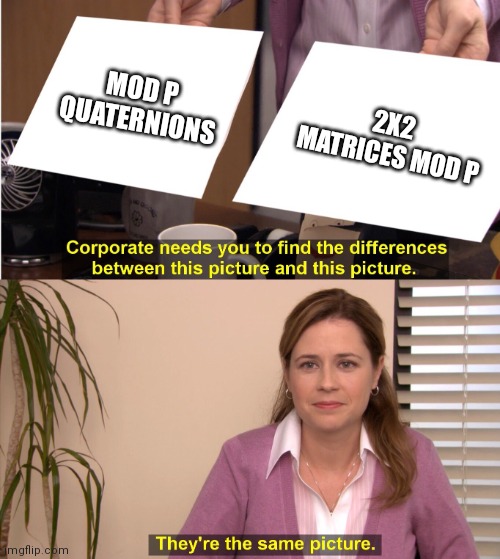 glossy crag
rocky cloak
https://imgflip.com/i/7ubmzv
glossy crag
rocky cloak
https://imgflip.com/i/7ubmzv
AKA Br(F_p)=1
Since I have you here @rocky cloak, mind if I run something by you?
rocky cloak
glossy crag
Since I have you here <@581774454091415553>, mind if I run something by you?
Shoot
glossy crag
rocky cloak
Shoot
I was trying to show an algebraic extension of a quasi-algebraically-closed field is QAC (QAC=homogenous polynomial polynomial of degree d in n variables with n>d has a non-trivial root). Clearly this reduces to the case of a finite extension, however I haven't made any headway there.
rocky cloak
Sounds like some algebraic geometry magic maybe
glossy crag
If f=\sum_j a_jx^j is in L[x], then write out the a_j wrt a K-basis b_i and get a b_i-linear combination of homogenous K-polynomials. However I don't know what to do afterwards lol.
glossy crag
unkempt stream
heteromorphism mapping you to my mother
Your mother's fundamental group will be Z*Z once I'm done with her.
unkempt stream
glossy crag
Your mother's fundamental group will be Z*Z once I'm done with her.
lol
glossy crag
rocky cloak
Sounds like some algebraic geometry magic maybe
I'll try there I guess.
rocky cloak
glossy crag
I'll try there I guess.
Yeah, I have no idea, but I'll give it a think
glossy crag
rocky cloak
Yeah, I have no idea, but I'll give it a think
No need to strain yourself, I'll take it next door.
unkempt stream
ocean man, are you knowledgeable in galois theory
glossy crag
unkempt stream
ocean man, are you knowledgeable in galois theory
Depends on your definition of knowledgeable. Why?
unkempt stream
kinda wondering if you know if there is a way to generalize Artin’s Lemma
glossy crag
unkempt stream
kinda wondering if you know if there is a way to generalize Artin’s Lemma
What exactly do you mean by Artin's lemma?
unkempt stream
if G is a finite subgroup of Aut(F)
and F^G is the fixed point subfield of F under G
then [F : F^G] = |G|
glossy crag
unkempt stream
then [F : F^G] = |G|
Also F/F^G is Galois with group G
I don't know anything about generalisations of this, I just know it as an auxiliary result in Galois theory used to prove the Galois correspondence in the finite case.
unkempt stream
glossy crag
I don't know anything about generalisations of this, I just know it as an auxili...
yeah
glossy crag
But, maybe a potential avenue could be some kind of invariant-theoretic/group-action thing?
unkempt stream
i am wondering if there is some way to generalize galois theory to a larger class of rings via algebraic extensions (not just purely module extensions in the field case)
which finitely algebraicly generated <=> finitely module generated in the field case
glossy crag
Sorry, my man, I'm just a lowly undergrad far removed from such lofty ideas
rocky cloak
glossy crag
No need to strain yourself, I'll take it next door.
found a proof here https://www.jstor.org/stable/1969785
unkempt stream
glossy crag
Sorry, my man, I'm just a lowly undergrad far removed from such lofty ideas
i am not even an undergrad yet lol, just going off of D&F
glossy crag
unkempt stream
i am wondering if there is some way to generalize galois theory to a larger clas...
That said I recall there was a chapter in Jacobson about Galois theory in the non-separable case or something like that. Not exactly what you're looking for, but it's something.
- someone more knowledgeable than me could tell you about Galois descent, afaik that's soooort of related (invariant stuff)
 rocky cloak
unkempt stream
i am wondering if there is some way to generalize galois theory to a larger clas...
rocky cloak
unkempt stream
i am wondering if there is some way to generalize galois theory to a larger clas...
Group actions on rings and the resulting extensions R^G -> R is something people study at least. Dont know if thats what your going for
guess it would fall under geometric invariant theroy
delicate orchid
or rep theory, lol
rocky cloak
There is also some generalization of the galois correspondence where you replace groups with hopf algebras
though I dont remember exactly how that works
from Hopf Algebras and Galois Theory - Chase--Sweedler
 south patrol
If A is an R-coalgebra with unit (aka coaugmentation) A -> R, is there a name for the cokernel of the unit?
I just see it called JA but I wondered if e.g. "coaugmentation ideal" was common parlance lol
delicate orchid
coaugmentation is a funny name so I would use it
unkempt stream
glossy crag
ee major who does math as a hobby
Going into freshman year
never heard of a hopf algebra
south patrol
delicate orchid
coaugmentation is a funny name so I would use it
Thabks
delicate orchid
call it diminution for the music theory ref
south patrol
Oh that's funny I happened to ask a question motivated by Hopf algebras just under someone mentioning hopf algebras
Don't see them too often in this channel
rocky cloak
south patrol
If A is an R-coalgebra with unit (aka coaugmentation) A -> R, is there a name fo...
Is it supposed to be a section of the counit?
south patrol
the unit is yes
glossy crag
unkempt stream
ee major who does math as a hobby
EE is pretty based, but math's baseder. Welcome to the light.
unkempt stream
glossy crag
EE is pretty based, but math's baseder. Welcome to the light.
fourier transforms go brrr
glossy crag
So the Brauer group of K describes finite-dimensional central division K-algebras. Do we have anything analogous for infinite-dimensional algebras?
 chilly radish
what would even be the inverse in that case?
 dim bane
delicate orchid
call it diminution for the music theory ref
dim bane
delicate orchid
call it diminution for the music theory ref
please no, i was a music major and i already have suffered at musical isomorphisms
 pallid matrix
(ii) states that $G_\mu$ is not compact. How does the fact that the kernel is a closed, normal subgroup of $G_\mu$ plus the fact that the quotient group is finite imply that $H$ is infinite? Also, how might I justify that the quotient group is finite?
 cloud walrusBOT
mdc
 pallid matrix
I'm thinking the non-compactness is only used to extract the fact that G_\mu is not finite. But not sure this is correct
topaz solar
Well G mu is hard to be finite if it’s not compact
Any open cover would be finite there I think lol
crystal turtle
Could one have that G_mu is infinite, G_mu/H is finite, and H is finite?
topaz solar
pallid matrix
(ii) states that $G_\mu$ is not compact. How does the fact that the kernel is a ...
If you want to justify why G_mu/H is finite too, it looks like a subgroup of permutation on r elements?
What text is this btw @pallid matrix
pallid matrix
topaz solar
What text is this btw <@804602896141647882>
" Products of Random Matrices with Applications to Schrödinger Operators" by Philippe Bougerol, Jean Lacroix
pallid matrix
topaz solar
If you want to justify why G_mu/H is finite too, it looks like a subgroup of per...
Yes, that makes sense thanks
topaz solar
Interesting
pallid matrix
My algebra is extremely rusty so I'm having trouble parsing this
topaz solar
Yeah I mean it’s a little awkward looking to me with the typewriter setup lmao
And idk the action(s) etc
But if it’s not compact and finite, that’s an issue since P(G mu) is kinda finite
topaz solar
Right, and that’s the conclusion you draw from (ii)
If you’re reading what (ii) is correctly and all
I don’t feel like digging up and reading the whole text 
pallid matrix
Yes, but how do I conclude that the H (the kernel) is infinite as well?
topaz solar
So, if H is finite, and G is infinite
How do you get G/H finite
Elements of G/H are equivalence classes right?
pallid matrix
yes
topaz solar
Union of them is G
And G is infinite, but you have finitely many classes
How big is each class?
Of course they’re all ||the size of H||, because of how they’re defined
This make sense?
topaz solar
pallid matrix
" Products of Random Matrices with Applications to Schrödinger Operators" by Ph...
This seems like an interesting topic, why dig up this clearly old paper?
crystal turtle
only from 1985, looks much older than that by the typewriting lmao
pallid matrix
topaz solar
This make sense?
Yes, I need to fill in some details however but I think I can continue by myself from here
pallid matrix
topaz solar
This seems like an interesting topic, why dig up this clearly old paper?
I am trying to understand Furstenberg's theorem on products of random matrices
topaz solar
Ah I see
topaz solar
crystal turtle
only from 1985, looks much older than that by the typewriting lmao
 I hate typewriter typesetting in math
topaz solar
pallid matrix
Yes, I need to fill in some details however but I think I can continue by myself...
Any particular holes I can help with?
pallid matrix
This is an alternative resource but it does not contain this proof https://www.mat.uc.cl/~jairo.bochi/docs/fur_revised.pdf
topaz solar
I see, and readable 
Ok this is kinda interesting but above my pay grade on the measure shenanigans
pallid matrix
topaz solar
Any particular holes I can help with?
To argue that G/H is finite, I can use (a corollary of) the "First isomorphism theorem", which states that the G/H is isomorphic to the image of the homomorphism, which in this case is a subset of the set of all permutations of a finite set. No?
The corollary I'm referring to is this
 pallid matrix
Thank you
topaz solar
You can indeed
I do not believe it is strictly necessary but ye
G = U(G/H) unioning the equiv classes, and each equiv class has cardinality |H|
And they’re disjoint
crystal turtle
This is for G/H to be finite
topaz solar
Ah right
Oop
I misread as G finite nvm me
Ye that’s exactly what I was suggesting earlier don’t mind my illiteracy
pallid matrix
Thanks to both of you
rocky cloak
crystal turtle
Could one have that G_mu is infinite, G_mu/H is finite, *and* H is finite?
One variant of Lagrange's theorem says that
|H| * |G/H| = |G|
Works for any cardinality, also infinite
delicate orchid
what
coral spindle
what
coral shale
well G/H is a set 

coral shale
ur not.
coral spindle
You don't know me
delicate orchid
would you rather jagr state "the size of a complete left transversal of H in G" rather than "|G/H|"
coral spindle
G/H is a G-set. It's very standard to write it as G/H
coral shale
idk what a G-set is
delicate orchid
basis of the burnside ring mmmmm yummyyy
coral spindle
coral shale
idk what a G-set is
Set with a G-action on it
U know group actions I'm sure
coral shale
probably
coral spindle
D:
delicate orchid
you don't get to have an opinion on notation then
coral spindle
As a side-note, I once mispronounced 'set' as 'sex' in a class while asking a question. It was the most embarassing thing in my life, I think.
delicate orchid
I would have continued pronouncing it as "sex"
coral spindle
Chad
coral shale
but what was the question
delicate orchid
"how is babey made"
coral spindle
Something like "can you explain the intuition behind these sets"
coral shale
so when one element and another element love each other very much...
open sluice
they create a product
 delicate orchid
ermm... what the deuce??
coral shale
suppose it isnt true. prove directly it is true. #. sotrue
delicate orchid
well it's obviously true if it's a division ring so assume that it isn't
now if ab \neq 0 for some a,b in R then (a) is a strictly larger ideal than (0) - could still be the whole got darn thang tho
but it's only the whole ring if there is NO non-zero b such that ab = 0 very curious
solemn dew
R=U says that 1 must be in U. So you know there must be a inverse element for say, b. But let us assume that ab = 0, then abb^-1=(ab)b^-1=0 = a(bb^-1)=a, hence contradiction, so it must be a division ring
delicate orchid
yeah zero-divisors cannot be units
solemn dew
How can it be a division ring or a ring with prime numbers if ab=0 is leads to a contradiction
delicate orchid
wait are your rings unital
must be since you're using inverses
solemn dew
i have not heard of a unital ring so far 😅
delicate orchid
cause if they are then a = 1a = 0 for all a in R lol
solemn dew
unital ring is a ring R s.t. R = {0}?
delicate orchid
no
delicate orchid
it's a ring with a 1
although we saw yesterday that the quaternions mod p are a non-divison ring with no non-trivial ideals
so they're somehow in the latter category?
solemn dew
idk haha
delicate orchid
I just don't believe this result
coral spindle
solemn dew
unital ring is a ring R s.t. R = {0}?
I believe I mentioned this yesterday, but a unital ring is a ring that has a 1
We occasionally want to think about rings which do not contain unity (i.e., 1) but nowadays people are fond of calling them rngs or rungs.
delicate orchid
rungs
 coral spindle
that's how they say rng anyway
solemn dew
hahah
delicate orchid
rite
delicate orchid
coral spindle
I believe I mentioned this yesterday, but a unital ring is a ring that has a 1
have you get any thoughts on an actual proof of this mofo though
coral spindle
facts and also true
delicate orchid
I can believe it though, as I said before:
coral spindle
So ok it has to have a prime number of elements bc we'd have nontrivial additive subgroups
why the multiplication though hmmm
delicate orchid
if ab \neq 0 for some b in R then (a) is a strictly larger ideal than (0) - I'm not sure how you determine when the ideal is the whole ring as units don't exist? Left/right-cancellability I guess
coral spindle
OK let's think about that
delicate orchid
coral spindle
So ok it has to have a prime number of elements bc we'd have nontrivial additive...
good spot
coral spindle
Actually, maybe there's a definition of 'division rung' that we're unaware of
where every nonzero element divides every other
delicate orchid
it quite clearly says "division ring" boss
coral spindle
Even so maybe we can argue why there's an identity, but I kinda doubt it
In the first place the zero ring kinda fits this
delicate orchid
also the mod p quaternions are a ring that do not satisfy the latter property lol - they're order p^4
coral spindle
uh-oh spaghetti-ohs
coral spindle
Then there is either context not seen here or this is just wrong
great counterexample with the matrices btw
Or is that just two-sided ideals
I can't remember how the ideal structure works out
delicate orchid
yeah it's just two sided whoops
delicate orchid
the one sided ones are in a weird bijection with column spaces or something I can't remember
 elder wave
coral spindle
elder wave
coral spindle
:(
delicate orchid
delicate orchid
if ab \neq 0 for some b in R then (a) is a strictly larger ideal than (0) - I'm ...
I'm convinced it's because of this though, like this is what they're getting at
delicate orchid
elder wave
simmer down in the back, numerics boy
elder wave
Fuck offfff
coral spindle
delicate orchid
>is a ring with a prime number of elements
yeah but I'm wondering if we should try and argue that a unit exists through finiteness or sth
I don't see how we can assume that there isn't a unit and conclude finiteness, that seems weird
delicate orchid
oh wait we're being stupid
coral spindle
I know
delicate orchid
if (a) is a strictly larger ideal than (0) it is a proper subgroup of the additive group
but there aren't any
coral spindle
Yeah?
delicate orchid
so it's the whole ring
coral spindle
Well yeah but how's that help
We can't guarantee we have a unit from that, can we?
delicate orchid
I did do the implication backwards so there could be a more mysterious thingymajig lurking in da void
delicate orchid
coral spindle
but we need to show it's a division ring otherwise, right?
yeah ok, so this is the part I no longer believe
there's just too many questions - does it mean two sided ideals only?
coral spindle
OK. If the ring has a unit then it's clear to see that it's a division ring from right simplicity – this is standard unital ring theory junk. If it doesn't, then let's say that for some a in R we have that the right ideal aR is nonempty, so it contains a. So there is some b in R such that ab = a. Does that get us somewhere?
Obviously it looks a lot like a unit.
 smoky ivy
is x^6-2 irreducible over F7
elder wave
Try
coral spindle
Hint: every nonzero element of F7 is a member of a group of order 6
smoky ivy
and then?
coral spindle
As for non-linear factors... you're fucked
smoky ivy
wait, so it is irreducible?
coral spindle
Dunno man I just gave you a way to approach it
 summer path
You only have like 6 things you can do here...
smoky ivy
those are?
 prime sundial
elder wave
Try
prime sundial
elder wave
Try
good advice
prime sundial
smoky ivy
hm, idrk what to do with that hint tbh
what is x^n for x in a group of order n
delicate orchid
x = 1 is a counter example to that claim
smoky ivy
oh
delicate orchid
what we're trying to envoke is fermat's little theorem but that's alright
coral spindle
You're mixing up the additive group and multiplicative group
delicate orchid
again, that just takes care of the linear factors which is the easy part
what's that result again? Hensel's lifting lemma or something?
won't help us as we can't get all the way to Z
annoying
smoky ivy
hm, i’m confused
 summer path
Wow you just spoiled the fun
delicate orchid
smoky ivy
hm, i’m confused
so we got that 3^2 = 2 right
so x^6-2 = (x^3+3)(x^3-3) lol
summer path
Well it's easier to see if we just did a -7
smoky ivy
oh wow hahah
crystal turtle
rocky cloak
One variant of Lagrange's theorem says that
|H| * |G/H| = |G|
Works for any ca...
Makes sense since each coset has the same cardinality, wasn't sure if that generalized to infinite groups
unkempt stream
coral spindle
As a side-note, I once mispronounced 'set' as 'sex' in a class while asking a qu...
Axiomatic sex theory
unkempt stream
solemn dew
OH NO NOT AGAIN
teal vessel
unkempt stream
Axiomatic sex theory
the axiom of depravity
crystal turtle
unkempt stream
Axiomatic sex theory
Axiom of rizz
unkempt stream
i would work off of the existence of an element NOT in any ideal YET is not a unit
 ember field
Guys is hom(z/4,q/z) under addition, isomorphic to z/4
rocky cloak
solemn dew
Here's a solution:
I assume R is meant to be a rng
||So if ab = 0 for every a and b, then an ideal is just a subgroup. And the only groups without proper nontrivial subgroups are those of prime order.
Now assume there are some elements where the product is nonzero. Consider an arbitrary b, if ab = 0, then (a)b = 0, so if a is nonzero (a)=R, so Rb = 0. But then (b) = Zb and so the product of any two elements is 0, contradiction.
So for a and b nonzero ab is never 0, thus we have cancellation. Now consider the product of 3 nonzero elements abc. Since this is nonzero we have (abc) = R. In particular there exists r in R and n in Z such that (r+n)abc = c = (ra+na)bc.
Define 1 = (ra + na)b.
Note d1c = dc implies d*1 = d.
Assume 1*d does not equal d. Then 1*d - d is nonzero, so a(1*d - d) = (a*1 - a)d is nonzero. Cancelling d we get a*1 - a, which is 0, contradiction. So 1*d = d, and 1 is unity.
From there, using cancellation and 1 it's not hard to show that R is a division ring.||
rocky cloak
rocky cloak
Here's a solution:
I assume R is meant to be a rng
||So if ab = 0 for every a ...
I swapped right ideal for left ideal. So I guess just reverse all multiplications
 static yew
What is the use of cayleys theorem?
It didn't make sense to me at all until I realized that it said "a group of one-to-one" which just means that a group exists, so there are at least as many one-to-one functions as there are group elements, which seems kind of obvious
formal ermine
it's used in the construction of a galois extension for an arbitrary group
static yew
Wait what
Not a field, not even a ring, but a group?
Could you please direct me to an example?
delicate orchid
formal ermine
it's used in the construction of a galois extension for an arbitrary group
you can also get funny permutation representations!!!
static yew
Yeah the book is talking about permutations now
The things its saying don't make sense to me, which suggests that I misunderstood something
delicate orchid
it basically means you can think of any group as just permutations
static yew
Q(x) is all of the expressions of the form a/b where a,b in Q[x], b!=0, gcd(a,b)=1 right?
delicate orchid
don't see why you need the gcd bit
oh right you're implicitly dividing them
yeah ok
coral spindle
rocky cloak
Here's a solution:
I assume R is meant to be a rng
||So if ab = 0 for every a ...
Deeply cursed, gg for working this out
cloud walrusBOT
Dealersgrip
 delicate orchid
holy smokes
static yew
Wait what's a plain old morphism
delicate orchid
cloud walrus
**Dealersgrip**
the f(H) is correct at least
delicate orchid
static yew
Wait what's a plain old morphism
for your purposes, a homomorphism
 winter thunder
delicate orchid
the f(H) is correct at least
winter thunder
delicate orchid
the f(H) is correct at least
ok nice, that's at least 1/2
static yew
Imma troll some people by inventing the heteromorphism
winter thunder
Define it
delicate orchid
static yew
Imma troll some people by inventing the heteromorphism
coral spindle
classic 
coral spindle
Interesting, it's the funny adjunctions
delicate orchid
seems to be adjunction but for special snowflakes
static yew
Damn. I thought I was onto something
delicate orchid
no it doesn't just write out Hom(F(a), b) rather than Het(a, b)
coral spindle
As in the name makes sense
delicate orchid
I guess
coral spindle
I don't especially think it's terribly helpful but we
winter thunder
Is my proof for K correct?
static yew
"are you heteromorphic or himomorphic"
"Biomorphic, actually. 3.14159 on the Kinsey-Galois scale"
Are we saying that A<B means A is a strict subgroup of B?
Like subset but keeps operator and closure property?
winter thunder
yeah
delicate orchid
winter thunder
Is my proof for K correct?
yeah it's right
winter thunder
perfect thanks a lot
unkempt stream
formal ermine
it's used in the construction of a galois extension for an arbitrary group
???
Oh
Gal(F(X1…X_N)/F) is iso to S_N
static yew
Yeah its talking about that
night onyx
winter thunder
Is my proof for K correct?
You shouldn't write x = f^{-1}(x') or y = f^{-1}(y'), rather f(x) = x' and f(y) = y'. Seems like a nitpick but writing x = f^{-1}(x') implies f has an inverse f^{-1}. In general f^{-1}(x') = {x | f(x) = x'} so writing x = f^{-1}(x') doesn't quite make sense. Other than that your argument is fine, if f(x) = x' and f(y) = y' then f(xy) = f(x)f(y) \in K, so xy \in f^{-1}(K)
winter thunder
yes thank you very much, it's still an important detail
unkempt stream
static yew
Yeah its talking about that
Galois theory eludes me
static yew
Wait what are elementary symmetric functions
night onyx
In mathematics, specifically in commutative algebra, the elementary symmetric polynomials are one type of basic building block for symmetric polynomials, in the sense that any symmetric polynomial can be expressed as a polynomial in elementary symmetric polynomials. That is, any symmetric polynomial P is given by an expression involving only ad...
unkempt stream
static yew
Wait what are elementary symmetric functions
the polynomials invariant under permutation of their roots
*vars
static yew
Q(x,y,z) is basically all the polynomial fraction type deals where top and bottom are of the form a + bx + cy + dz
night onyx
elementary ones are specific ones which generate all symmetric polynomials
static yew
unkempt stream
the polynomials invariant under permutation of their roots
Wouldn't that be the constants then? Not sure I follow
No wait
These are transcendental
So it's all polynomials of all exponents and coefficients
This is a biiiig field
formal ermine
static yew
Wouldn't that be the constants then? Not sure I follow
x + y
xy
x + y + z
xy + xz + yz
night onyx
xy isn't, xy + yx is though
formal ermine
night onyx
xy isn't, xy + yx is though
f(y, x) = yx = xy = f(x, y)
static yew
When you say invariant
What does that mean exactly? That the counts of each exponent are the same?
E.g.
axy^2z^3
ax^3y^2z
ax^2y^3z
I don't have a good picture of this in my head
formal ermine
static yew
When you say _invariant_
What does that mean exactly? That the counts of each e...
for all $\sigma \in S_n$ we have $f(x_1, \ldots, x_n) = f(x_{\sigma(1)}, \ldots, x_{\sigma(n)})$
cloud walrusBOT
 formal ermine
however when we say elementary symmetric we mean a specific kind of symmetric polynomials
crystal turtle
static yew
When you say _invariant_
What does that mean exactly? That the counts of each e...
or in words, if you swap the variables (i.e. taking f(y,x) instead of f(x,y)), the output is the same
static yew
Which means both indeterminates must have the same exponent in each of the components of the expression
formal ermine
and in fact those elementary symmetric polynomials generate every symmetric polynomial. in other words: if $e_1, \ldots, e_n$ are the elementary symmetric polynomials then $$\bC[x_1, \ldots, x_n]^{S_n} = \bC[e_1, \ldots, e_n]$$
cloud walrusBOT
 crystal turtle
static yew
Which means both indeterminates must have the same exponent in each of the compo...
crystal turtle
static yew
Which means both indeterminates must have the same exponent in each of the compo...
not necessarily in each component, since xy^2 + yx^2 is symmetric
formal ermine
symmetric polynomials are used in doing discriminant/resultant stuff and also algebraic geometry iirc
static yew
This book seems to be focusing on something related to geometry
A cyclic group is any one that has a generator, right?
static yew
Is the additive group of a ring always cyclic? Trying to think of a way where the multiplicative identity
Wait
2x2 matrices are a ring, right? Even if the matrix elements are of a finite field, you cant generate the group from the 2x2 identity matrix
coral spindle
No
static yew
No to which
coral spindle
As in, your example is right
The additive group of a ring is almost never cyclic
In fact the only such rings are (gasp) Z/nZ
where n is possibly 0
static yew
I'm used to dealing with stuff isomorphic to Z/nZ
static yew
coral spindle
In fact the only such rings are (gasp) Z/nZ
To be fair, there are a a lot of those. Aleph-null of them, even.
coral spindle
Yeah but there are a lot more rings that ain't
And I can't even put a size to that
bc it's so much bigger, I reckon
not that I have a proof
static yew
coral spindle
And I can't even put a size to that
Aleph-one
static yew
Aleph-three
south patrol
Hm can you never put a different multiplication on Z/nZ
I've never thought about it lol
Oh yeah sure it is determined by 1.1 = 1 lol
fair
static yew
south patrol
Hm can you never put a different multiplication on Z/nZ
Do you mean a different multiplicative identity?
static yew
Oh a different mapping of a×b ?
coral spindle
south patrol
Oh yeah sure it is determined by 1.1 = 1 lol
It's not immediate that 1 is the unit, but you can think about the characteristic of R whose additive group is Z/nZ. It's clear that char R = n, so it must contain a copy of Z/nZ as a ring
So even if we choose a different unit, it doesn't matter
I explained that sloppily but I hope it makes sense
static yew
I think I got it
Even if you permuted 0..n-1
If the resulting set is still a ring, then that ring is isomorphic to z/nZ
static yew
Wait what about phi(x)=-x
coral spindle
what about it
static yew
coral spindle
And to be clear, you can absolutely permute it
I'd like to see them stop me
Negation doesn't preserve multiplicative identity
Is "minus Z" still a ring?
coral spindle
I don't know what that means
If you mean that we can permute it in that way and still have an isomorphic ring, yes
static yew
Replace each element x in Z with -x
static yew
But it's not anautomorphism
Cuz -(xy) != (-x)(-y)
static yew
Not all transforms that produce isomorphisms are automorphisms
coral spindle
I don't know what that means
That's not an isomorphism
Automorphisms are, by definition, isomorphisms
static yew
Which one preserves f(a)f(b) = f(ab) then
static yew
But f(15) = -15
f(3)f(5) = (-3)(-5) = 15
coral spindle
Again, so what
I'll use your idea, maybe this is the way you're trying to express it
We define a new ring
We'll call it R,
its underlying additive group will be Z.
static yew
Okay
coral spindle
We will define the multiplication a * b = phi(a)b
Let's double-check this forms a ring
It's pretty clear that -1 is going to be the multiplicative identity. You can see the multiplication is going to be distributive since (a+b)*c = phi(a+b)c = phi(a)c + phi(b)c
ah just realised I used the same symbol. I'll fix that
Hopefully you can see how the rest will work
This ring, R, is isomorphic to Z.
static yew
I thought at least one morphism had to have phi(ab) = phi(a)phi(b)
Maybe homomorphisms?
coral spindle
Yeah, phi : Z → R is now an isomorphism of rings
coral spindle
static yew
Maybe homomorphisms?
You're getting confused. Homomorphisms, isomorphisms, automorphisms of rings all have this property
But again, phi : Z → Z is not a ring homomorphism.
static yew
But it's not a transform on Z
It's a new ring with the same set and different operators
coral spindle
It is a function on Z.
Oh you're not talking about 'it' being phi
Yes, this is a new ring
This is the whole point I've been making
static yew
A function on Z
The book I'm reading mostly focuses on transforms that map one group/ring/field to another
coral spindle
So you're not using the word transform in the way I thought you were aaaaaaa
Please use the usual terminology such as 'function'
static yew
Sorry this book called them transformations
coral spindle
OK
static yew
Or "mappings"
coral spindle
coral spindle
So even if we choose a different unit, it doesn't matter
Anyway this was the point
static yew
Would "mapping" work?
coral spindle
mapping is standard.
phi is not a ring automorphism Z → Z
but it is a group automorphism Z → Z
And using that automorphism, we produced a new ring structure on Z
static yew
For the additive group
coral spindle
When people refer to the group Z, they mean the additive group without fail.
static yew
Ahhh ok, thanks.
coral spindle
Just clarification on the terminology:
A homomorphism is a structure-preserving function.
An isomorphism is a homomorphism with an inverse homomorphism.
An automorphism is an isomorphism from something to itself.
static yew
Right, like "mod n" is a homomorphism on Z, right?
coral spindle
You can think of the map n |-> n + mZ as being 'mod m'
but I don't like this!
This is misleading!
But indeed, that is a homomorphism Z → Z/mZ
fixed typo
static yew
The mapping phi(x) -> the r from x = qn+r (euclidean thingy) is a homomorphism
coral spindle
Sure
Remember when we talked about choosing representatives?
You've composed the map x |-> x + nZ with the map that chooses representatives there.
static yew
Yeah. That r is my representative
coral spindle
It's way more natural and easy to think of mod as a relationship between integers rather than a function that chooses remainders
static yew
Oh I see what you mean
coral spindle
it makes things so much easier
Like
It is very easy to show that if a = b (mod n) and c = d (mod n) then ac = bd (mod n) using the idea of the relationship
proving that in terms of the remainder function is a pain
static yew
In software, the operator that computes that 'r' is called the modulus operator
coral spindle
I know
It is truly awful. That terminology is poor
So many undergrads think that's what modular arithmetic is...
static yew
Just wait till you see that it gives different answers for negative inputs
coral spindle
It's disgustingly bad
It's funny because I've seen languages use quot_rem for the function that produces the quotient and remainder
and that's great terminology, 10/10
static yew
Okay I gotta run
Thx for the knowledge
night onyx
south patrol
Hm can you never put a different multiplication on Z/nZ
In theory if f : R -> X is a bijection (just of sets), R a ring and X just a set, you can put a ring structure on X by defining xy = f(f^{-1}(x) * f^{-1}(y)) and x + y = f(f^{-1}(x) + f^{-1}(y)), and in this case f is a ring isomorphism. Lol it's not super exciting but yeah you can put plenty of different ring structures on the same set
south patrol
I mean of course but I mean in such a way that Z/nZ is the additive group
night onyx
ahhh like same additive group, different multiplication
coral spindle
you can obviously do it in the same way: define the multiplication as a*b = -ab for a single example
Now this doesn't work for n=2, but that's for a good reason :)
south patrol
Ye lol
Classifying finite rings is weird
Well just never thought about it or seen any applications
coral spindle
kinda sick tho
delicate orchid
Z/nZ^op
solemn dew
rocky cloak
I swapped right ideal for left ideal. So I guess just reverse all multiplication...
Ur clever! Nice proof
thx!
 topaz solar
there are for some elements
consider -1 in Z
but not all are, because 2 has no inverse in Z
solemn dew
alright so unit elements are these elements as you described
yes i understand
very cool thnks
so a unit in Z can be -1
coral shale
solemn dew
does this mean that there are inverses in a commutative ring now??
The set *cough* of units is denoted R^x. What is this for Z
 solemn dew
right but this is a contradiction to that definition then
coral shale
That doesn't break the definition you've been given.
topaz solar
gcd in a euclidean ring shuri
coral shale
No.
coral shale
topaz solar
gcd in a euclidean ring shuri
uhhh i forgot that shit
coral shale
coral shale
gcd function is defined to output non-negative numbers
gcd function in Z at least
topaz solar
solemn dew
right but this is a contradiction to that definition then
relatively prime <-> gcd is a unit
not every unit will show up
not necessarily anyway
coral shale
well its best if you consider examples and non-examples for given defns
solemn dew
alright
solemn dew
product of units are also units right?
coral shale
prove it.
topaz solar
solemn dew
product of units are also units right?
Consider the obvious choice of inverse Holmes
solemn dew
hint?
coral shale
In fact, prove $R^\times$, the set of units form a particular structure, have a guess
cloud walrusBOT
 coral shale
solemn dew
hint?
coral shale
solemn dew
hint?
nah. not til uve had a good go. falls out from the defn of unit
delicate orchid
solemn dew
hint?
the obvious one
 coral shale
casually written but ite.
delicate orchid
(ab)(b^-1a^-1) = 1
delicate orchid
you asked if the product of two units was a unit...
solemn dew
oh so a unit has a inverse then?
coral shale
$r\in R$ is a unit iff $(\exists s\in R)(rs = sr = 1)$
night onyx
solemn dew
product of units are also units right?
if a and b are units you know ax = by = 1 for some x,y. To prove (ab)z = 1 for some z, you should use commutativity, along with x and y
cloud walrusBOT
 delicate orchid
solemn dew
oh so a unit has a inverse then?
delicate orchid
solemn dew
oh so a unit has a inverse then?
no offense but what the fuck did you think a unit was
solemn dew
a is a unit if ab = 1 for some b
coral shale
what is an (multiplicative) inverse then...
solemn dew
hah...
delicate orchid
ok so now it should be obvious that the set of all units is a group
wraith cargo
I kinda feel like u guys are being sorta mean to jonathan rn
coral shale
spoilers !
delicate orchid
grumpy even
coral shale
delicate orchid
ok so now it should be obvious that the set of all units is a group
hum. it usually has even order if finite right.
must usually be Z_2 x ??? ...
coral shale
my intuition on rings is so weak even tho its supposed to be more 'familiar' than groups...
delicate orchid
This. So much this.
night onyx
solemn dew
You should prove a few things about units along the way:
- Prove inverses are unique (this justifies writing a^{-1} for the inverse)
- Prove (ab)^{-1} = b^{-1}a^{-1}
- Prove 1^{-1} = 1
- Conclude that the set of units is a group
delicate orchid
Probably because the only intuitive examples for rings include 3 fields, Z, the basic finite fields, and then disgusting non-integral domains and not really much in between
Ok maybe k[x] and Z[x]
wraith cargo
coral shale
my intuition on rings is so weak even tho its supposed to be more 'familiar' tha...
Idk to me rings were easies to grasp than groups because groups use awful combinatoric arguments that I could never fucking come up with
coral shale
gyuh.
I think cayley makes groups so much easier to understand
This classifies all of them.
wraith cargo
coral shale
I think cayley makes groups so much easier to understand
I hate permutations with my life so you are WRONG
coral shale

wraith cargo
doing stuff in S_n is actually the most unfun thing ever for me
I hate it so much lol
wraith cargo
coral shale
im guessing u hate group actions...
no
delicate orchid
Combinatorial group theory is THE fun
coral shale
i cant even.
wraith cargo
I hate S_n
coral shale
but permutations are lit actions
delicate orchid
wraith cargo
I hate S_n
What do you think a group action is
coral shale
sully
wraith cargo
ala my life is better because of it
delicate orchid
sully
wraith cargo
our algebra class had like 4 fucking classes where we talked abt nothing but S_n it was hell
it was like
coral shale
is this trauma...
delicate orchid
S_n… le bad!!
The regular rep:
wraith cargo
"In the C part of the class we'll use these results to prove that the quintinc in unsolvable with radicals"
delicate orchid
Nilpotency is easy
coral shale
i really barely give a sht about that ngl
wraith cargo
Upper/Lower central series are dreadful
coral shale
slept in the last part of galois class
delicate orchid
delicate orchid
Nilpotency is easy
Is it a direct product of its sylow subgroups y/n
So easy
topaz solar
delicate orchid
Probably because the only intuitive examples for rings include 3 fields, Z, the ...
There’s also function rings by extension of those understandable ones
wraith cargo
delicate orchid
Is it a direct product of its sylow subgroups y/n
idf care that class destroyed group theory for me
delicate orchid
Awwww poor baby
wraith cargo
I wanted Sylow to choke
delicate orchid
I nearly failed first year group theory
wraith cargo
delicate orchid
I nearly failed first year group theory
does wew need cuddles to feel better 🥺
coral shale
i didnt gaf about sylow...
summer path
i hate sylow proofs
coral shale
i dont feel like i missed anything
wraith cargo
nah sylow is actually cool I was fucking with you lmao
get fucked
OK I wasn't but it would be funny if I was wouldn't it
delicate orchid
wraith cargo
does wew need cuddles to feel better 🥺
Not from YOU… if you could put me in contact with your mother however…
Sylow is not cool until you extend the theorems to general fusion systems
wraith cargo
delicate orchid
Not from YOU… if you could put me in contact with your mother however…
what if I inform you I am someones mother?
coral shale
wraith cargo
get fucked
OK I wasn't but it would be funny if I was wouldn't it
u werent having any of us on
wraith cargo
coral shale
u werent having any of us on
the anime pfp doesn't understand high brow humor (ala seinfeld)
wraith cargo
that's okay
topaz solar
Hater of automorphisms
unkempt stream
muncher of ice
 molten viper
So, if a ring has a unique maximal ideal, m, can I say that x \notin m implies x is a unit? It seems so, because every non unit is contained in a maximal ideal, in this case, m.
 dim widget
Yes
molten viper
I'm sure I will use this fact to great affect 
dim widget
perhaps also to great effect!
delicate orchid
don't be absurd.........
summer path
wow tteg is back 
unkempt stream
dim widget
perhaps also to great effect!
localization of prime go brrr
white oxide
yo how important are hom and duality in the study of tensor products
my school's aboutta start and i'm tryna study the more important stuff
delicate orchid
they're pretty handy imo
rocky cloak
The fact that $Hom(X\otimes Y, Z) = Hom(X, Hom(Y, Z))$ comes up a lot
cloud walrusBOT
jagr2808
 white oxide
are they like necessary to study tensor products or can i just skip that section
oh well i guess hungerford gave a dependence chart
rocky cloak
Depends what you're doing with tensor products I suppose
white oxide
``On the other hand, it is also convenient to think of $A \otimes_R B$ as a sort of dual notion to $\text{Hom}_R(A, B)$."
rocky cloak
,tex ``quote''
cloud walrusBOT
jagr2808
 south patrol
white oxide
yo how important are hom and duality in the study of tensor products
south patrol
white oxide
yo how important are hom and duality in the study of tensor products
They are basically the definition
So yes
cloud walrusBOT
okeyokay
 white oxide
south patrol
They are basically the definition
white oxide
south patrol
They are basically the definition
oh ok i'll check out that section then
this shit so abstract, truly an #groups-rings-fields moment 😭
south patrol
So I mean
Basically the intuition for tensor products is that there's a natural notion of multilinear maps out of a product
Like multilinear A x B -> C
rocky cloak
I guess the question is, why are you so eager to learn about tensor products, but not about the hom functor?
The hom functor is the cool one
south patrol
And it'd be nice if we could just view those as maps out of another module
white oxide
idk i always hear things about tensor products and i want to learn what i hear about the most often
south patrol
A (x) B is then the one doing that
white oxide
i have no clue what a multilinear map is
molten viper
what exactly is the hom functor 👀
white oxide
white oxide
idk i always hear things about tensor products and i want to learn what i hear a...
plus i have like two more weeks until school starts and then i have to concentrate on my other classes
topaz solar
molten viper
what exactly is the hom functor 👀
Hom(A, B)
As in, space of maps A->B lol
delicate orchid
ermmm actually it's Hom(A, -) sweaty
wraith cargo
It's a bifunctor bucko
 it’s a bifunctor
delicate orchid
it’s a bifunctor
delicate orchid
contravariant functors are not functors
molten viper
yeah Idk what this means