#groups-rings-fields
1 messages · Page 136 of 1
 delicate orchid
 white oxide
omg i got wew's approval
delicate orchid
except, I don't think that's exact
white oxide
oh
delicate orchid
trying to think
A{i+1} -> A{i+2} -> 0 exact implies that f_{i+1} is surjective, which would mean that f_{i+2} has to be the zero map
but there's no reason f_{i+2} has to be the zero map

 white oxide
for the second part of the proof, they're implicitly referencing the canonical epimorphism from R to R/M right
 delicate orchid
yes, that's a homomorphic image of R into a field
"into"? not sure what word to use there
white oxide
why not onto lol
delicate orchid
sure, that works
 solemn dew
how to find a homomorphism from dihedral group = {e, x, y, ...}, where x^2 = e, y^{n-1} = e, xy=y^-1x to W = {-1,1}?
how should one think in this context ?
 chilly ocean
just any homomorphism?
solemn dew
i'm supposed to show that G/N ~= W, where N = <y>
delicate orchid
y^(n-1) = e
odd
solemn dew
i guess any homomorphism
delicate orchid
you'll want a surjective one to use first iso
delicate orchid
 formal ermine
f(x) = 0
formal ermine
f(x) = 0
otherwise you'll get people who think they're funny
but honestly? it's easier just to construct the two cosets in this case
delicate orchid
yeah that's immediate from it being index 2
delicate orchid
so you know that G/N is a group, and that the size of G/N is 2
there's only one group of order 2
solemn dew
 delicate orchid
I'm not going to read this and just assume it's correct
solemn dew
sure
delicate orchid
delicate orchid
there's only one group of order 2
so any groups of order 2 have to be isomorphic
solemn dew
how did you draw the conclusion that the size is 2?
delicate orchid
D_n is of order 2n and <y> is clearly order n
do you not have the order of D_n yet?
solemn dew
haven't come that far in the book yet
delicate orchid
ok, that's fine
map y to 1 and x to -1
that should be a group homomorphism, as it's basically just the map G -> G/N but relabelled
but again, just writing down the cosets is easier here imo
solemn dew
 delicate orchid
what about things that are in neither of those subgroups, like xy
solemn dew
im listening to the expert so i wont argue
solemn dew
true, this one does not hold that argument
delicate orchid
delicate orchid
but again, just writing down the cosets is easier here imo
N = {1, y, y^2, ..., y^(n-1)}
xN = {x, xy, xy^2, .., xy^(n-1)}
is it clear that these are all of the elements of D_n?
solemn dew
yes sir
delicate orchid
formal ermine
calling wew an expert
sorry where's your first class masters degree?
 rocky cloak
Replace g in <x> with "otherwise"
solemn dew
sorry i have to sleep now
i'll try to dream about this
and maybe it will solve itself in my dreams
hahah
goodnight ppl
 elder wave
delicate orchid
sorry where's your first class masters degree?
elder wave
delicate orchid
sorry where's your first class masters degree?
where is his high school degree
delicate orchid
elder wave
where is his high school degree
lol
 stuck fiber
Okay so this prop is kicking my ass, I'm seeing why everything works now except why the last element in G's tower is X

 night onyx
stuck fiber
Okay so this prop is kicking my ass, I'm seeing why everything works now except ...
night onyx
stuck fiber
Okay so this prop is kicking my ass, I'm seeing why everything works now except ...
Probably cause the preimage of the identity in G/X under the canonical projection G -> G/X is X
stuck fiber
See I thought that but I didn't see why G' must end in {e}
 charred crescent
is it just a coincidence that, for the natural projection pi : G -> G/K, ker(pi) = K and for the map, phi : G/H -> G/K, ker(phi) = K/H ?
i was able to prove ker(phi) = K/H, but I am lacking intuition as to why this is true or how/if "modding" by H has this apparent congruency
is it as simple as ker(pi) is a subset of G, thus G/H results in ker/H ?
charred crescent
yes, i noticed this in proving the 3rd iso
i was able to prove it but again i lack intuition
charred crescent
K/H
 topaz solar
Oops im dumb
night onyx
charred crescent
is it just a coincidence that, for the natural projection pi : G -> G/K, ker(pi)...
I guess the intuition (very unrigorous lol) is that (G/H)/Ker(phi) is isomorphic to G/K via the first isomorphism theorem, and you can do a sort of "cancellation" by writing G/K = (G/H) / (K/H), which is the kernel of phi as you said
charred crescent
"cancellation" like fractions
topaz solar
I mean yeah I think of it like that too pretty much
Maybe a lil sillier structurally tho
night onyx
lol yeah of course
charred crescent
see but it sure looks like cancellation of fractions but they're groups so idk i guess i was wondering about the deeper level stuff "under the hood" if you will
topaz solar
topaz solar
Consider (G/K)/(H/K)
Swapped the two oop, but (G/H)/(K/H) ~ G/K which is kinda exactly your desired map?
topaz solar
charred crescent
see but it sure *looks* like cancellation of fractions but they're groups so idk...
Well, you proved it so presumably you saw under the hood 
charred crescent
yeah, to be able to use the 1st iso, i constructed a map phi : G/H -> G/K and showed the ker(phi) = K/H
charred crescent
topaz solar
Well, you proved it so presumably you saw under the hood <:opencry:5860786148654...
well once i knew the trick from the second isomorphism theorem it was pretty obvious that the crucial step was to show K/H was the kernel of phi
to then use 1st iso of course
does my question even make sense? i think i need a sanity check
topaz solar
Well it’s certainly iso to the image since haha G/ker
So if it’s surjective then that’s a whole iso 
night onyx
charred crescent
does my question even make sense? i think i need a sanity check
Try thinking of it in terms of dividing G up into pieces (which are cosets, or elements of G/K). If H \subgroup K, and you divide G into n copies of K, and then divide K into m copies of H, the result is the same as dividing G into mn copies of H. In terms of cosets you can say |G/H| = |G/K| * |K/H|, or rearranging you get |G/K| = |G/H| / |K/H|.
 coral shale
i remember trying to prove the 3rd iso from 1st principles 100% algebraically. Fucking god.
night onyx
so there's an obvious analogue between cancellation of fractions, and cancellation when chopping G into copies of K and then K into copies of H, but it's super handwavy
but I think it's the correct intuition to keep in the back of your head so it's not just manipulating symbols lol
night onyx
Another analogous idea is looking at the connection between the unique factorization of numbers into powers of primes, and the unique factorization of finite abelian groups into subgroups of prime powers. There are a lot of relationships between properties of numbers and properties of groups like that
 livid grove

Does anyone know how to prove this actually using D&F's hint?
I know how to show it from the fact that G acts transitively on the set S={O_1,..,O_r} so |S|=|G:stab(O_1)| and stab(O_1)=HG_a
Since gO_1=O_1 iff there exists h s.t ga=ha iff there exists h s.t h^{-1}g\in G_a i.e iff g\in HG_a
 wraith cargo
Did you show the first equality?
livid grove
Yes, O_1 is the orbit of a in H and so |O_1|=|H:H_a|. We have that H_a=H\cap G_a as H\subseteq G.
wraith cargo
Oh lol okay
They wanted you to write |O_1|=|HG_a:G_a| by the second iso theorem
Then r = |A|/|O_1|
But |A|=|G:G_a| by orbit stabilizer
So r = |G:G_a|/|HG_a:G_a| = |G:HG_a|
@livid grove
stuck fiber
stuck fiber
Okay so this prop is kicking my ass, I'm seeing why everything works now except ...
So why does the cyclic tower in G' have to end in {e} here?
night onyx
stuck fiber
So why does the cyclic tower in G' have to end in {e} here?
induction on the size of the group, G' has a smaller cardinality than G because X isn't trivial
stuck fiber
I'm not really seeing how that implies G' ends in {e} though
topaz solar
Well, you decrease in size strictly
What else could it end in
It’s not going on forever since finite thing decreasing
night onyx
The proof is just skipping a few steps, but it's proving the result by induction on |G|. If |G| = 1 then the result is trivial, and then to prove the result for G when |G| > 1, they reduce to G/X which has a smaller size than G. So by induction there's a tower ending in {e} in G/X, then if you look at the premiages of those subgroups you get a tower in G ending in X (because the preimage of {e} in G/X under the projection G -> G/X is X), and then then you just add {e} onto the end of that tower
stuck fiber
So it's just some tower of G/X that ends in {e}? Because from the definition I have a tower is just a sequence of subgroups so I wasn't seeing why it couldn't end in the subgroup before {e}
night onyx
This is from Lang right? I think it's actually missing that "it suffices to prove that if G is finite and abelian there is a cyclic tower ending in {e}", otherwise the proof doesn't really work
I could be wrong lol, but I'm pretty sure that should be part of it
stuck fiber
Yeah this is Lang I don't think he mentioned that
I'll double check when I get home it might be like a little line somewhere that I've missed
night onyx
cause the tower in G' needs to end in {e}, otherwise the preimage of the tower under the canonical projection G -> G/X doesn't necessarily end in X
lol this is definitely a lang proof, very terse!
stuck fiber
Yeah I had worked out most of it I actually like that aspect of the book a lot because I'm usually not a very active reader
 void cosmos
yo
i literally just realised
that the first iso theorem is just universal property of quoitients
lol
topaz solar
Makes sense, considering they’re quotients
 lyric furnace
wait until you realize abaout the other 3
 untold turret
if we consider nonzero unital rings and require ring homomorphisms to map to multiplicative identity, all kernels of homomorphisms are strict (i.e. proper) ideals, right?
topaz solar
Well, multiplicative identity isn’t in the kernel
So proper subset
Can you show it an ideal?
untold turret
yeah that part isn't a problem, i'm just trying to rule out the kernel being the entire ring
 small bramble
aight stupid question time: if I is an ideal in F[x1,..., xn], why is tI an ideal in F[t, x1,..., xn]? My first instinct to show p(t, x1,..., xn)tq(x1,...,xn) is in tI by combining p and q but we only know I is an ideal of F[x1,..., xn] so that won't work. I don't have any other idea rip
Oh
Bruh
It's an error in the book
Just checked errata of dummy and feetpics and they removed the entire part claiming that it was an ideal as a fix
topaz solar
I will assume this isn't commutative?
small bramble
No F is actually a field
rocky cloak
It's clearly not closed under multiplication by t
 pea brain moment for me
small bramble
pea brain moment for me
small bramble
 book even had the gall to say "Clearly" to make me question my existence
 rotund aurora
so (12) and (12...n) generate S_n
(ab) and (12...n) generate S_n if and only if gcd(b-a,n)=1 (see kconrad "generating sets")
so in general, the subgroup generated by (ab) and (12...n) will be a proper subgroup
what is it's size?

rotund aurora
rotund aurora
(ab) and (12...n) generate S_n if and only if gcd(b-a,n)=1 (see kconrad "generat...
looking at the proof of this, it's probably all permutations that respect the structure modulo d=gcd(b-a, b), since it is "trivial" (tho I didn't see it immediately) that the permutations you get will respect the structure modulo d (by this I mean that i=j mod d implies sigma(i)=sigma(j) mod d)
ok to count this is actually interesting
 delicate bloom
I might have it
since we have (12...n) that cycles around, we can imagine a regular polygon with points on it and imagine that this rotates (ab) anywhere we want around the edges, which exchanges markers located at distance b-a around it
so we have d=gcd(b-a,b) partitioning them into d separate disjoint sets, each now looks like S_{n/d}
so it's a direct product of d copies of S_{n/d}, so it should have size (n/d)!^d
I think we can go through the orbit stabilizer theorem by thinking of these d disoint sets as the orbits and these S_{n//d} as the stabilizing group. Maybe it even helps to think of these as like drawing stars in your regular polygon
oh I think I might have swapped n/d with d above
like n=6 with (1,3) you have d=2, so you can imagine drawing two triangles where each one now looks like S_3
hopefully that's clear, by using (123456) we can "rotate" (13) anywhere we want around the hexagon to make (24), (35), (46), (15) and now we have the disoint triangles we could color red and blue which are fixed by {(13),(35),(15)} and {(24),(46),(26)} respectively
|S_3 x S_3| = 3!^2 = 36
as a special case of
|S_{n/d} x ... x S_{n/d}| = (n/d)!^d
as a sanity check is n!/(n/d)!^d an integer? I think that's a multinomial coefficient so it is
I suppose visualizing them this way also gives us more to count about them, we have phi(n)/2 subgroups of this form
or somethin like that lol w/e
well number of divisors, I'm thinking inside out here, well some stuff to say on both sides of that I guess


 lusty marlin
solemn dew
lusty marlin
solemn dew
If G is a group and the quotient group G/Z(G) is cyclic, then G is abelian.
 prime sundial
do you have lagrange's theorem?
solemn dew
yes
prime sundial
what are the possible orders for the subgroups
solemn dew
9,3,1
prime sundial
so what are the possible orders for the elements
if one of your elements has order 9 you're done, so just consider the case where you have only elements of order 3
prime sundial
so let's suppose you have an element of order 9
what does that mean in this case
you have a group of order 9, and an element of order 9. how can you describe that element
solemn dew
don't know 😅
prime sundial
it's a generator, your group would be cyclic
rotund aurora
delicate bloom
like n=6 with (1,3) you have d=2, so you can imagine drawing two triangles where...
yes, but can't you premute the triangles too?
sorry for late response (very noisy out of my home so I had to stop doing math 😤 (actually angry lol))
prime sundial
prime sundial
it's a generator, your group would be cyclic
are cyclic groups abelian? @solemn dew
solemn dew
i think so
prime sundial
they are. you should convince yourself of that, it's fairly straightforward
so then if we have an element of order 9, our group is abelian
so the only other case is for elements solely of order 3 (and 1 for the identity)
delicate bloom
rotund aurora
yes, but can't you premute the triangles too?
they're independent of each other, you're not really permuting them as part of the group
solemn dew
but my subgroup that is generated is order 3, so how does this have anything to do with a group of order 9 is abelian
in my head you only showed that the subgroup of a cyclic group must be abelian
prime sundial
i think you're mixing up the concepts a little bit
prime sundial
so let's backtrack for one sec
the subgroups of a group of order 9 can be of:
order 1
order 3
order 9
if we have a subgroup of order 9
those are also the possible orders for the elements
do you agree
solemn dew
yes i agree
prime sundial
then let's knock out one of the cases. suppose we have an element g of order 9
like we said above, this element must generate G
solemn dew
yes
prime sundial
so G is cyclic -> abelian
so if we have an element of order 9
G is abelian
so that case is done
now we need to check what happens when we only have elements of order 3 (and the identity of order 1)
do you understand the argument so far
solemn dew
is it that if you have elements of order 3 in our group G, we need to find a argument that they are also abelian?
prime sundial
the argument now is that if all nonidentity elements are of order 3, then the group is abelian
yes
solemn dew
alright i got you so far then
prime sundial
ok
so let's do this in full generality
let's take two arbitrary elements in G
g,h
now our goal is to show gh = hg
rotund aurora
@delicate bloom btw d=gcd(b-a, n) I made a mistake while writing xD, you wrote the same. Im sure you know it should be that anyway
solemn dew
alright
so now the only possibility for G is G = {e, g, h, g^2, h^2, gh, gh^2, g^2h, g^2h^2} since ord(G) = 9
and g^3 = h^3 = e
delicate bloom
rotund aurora
<@622029249053982720> btw d=gcd(b-a, n) I made a mistake while writing xD, you w...
yeah haha
rotund aurora
mmh
pretty sure you are missing a d!
well not pretty sure
but sage agrees with me

so
if we look at permutations sigma with the property that i=j mod d then sigma(i)=sigma(j) mod d, then the number of this permutatinos is d!·((n/d)!)^d
rocky cloak
Order would be d * ((n/d)!)^d right?
rotund aurora
and I think this is just generated by (1,d+1) and (1,2,3,..., n), which is what we want
rocky cloak
Or why d! ?
rotund aurora
sec
rocky cloak
I would think it's the semidirect product of C_d and (S_n/d)^d
rotund aurora
C_d?
as cyclic?
dude I dont find my calculator lmao
so
take d=4
and n=8
sage yields
 rocky cloak
(1, 4) is a difference of 3
rotund aurora
ah yeah mb
yeah this didnt make sense
I should of taken 1, 5
64
so yeah it seems you are right
rocky cloak
I guess it's not quite a semidirect product, but (S_n/d)^d is a normal subgroup with quotient C_d
rotund aurora
so I think the point is, you can obtain the transposition (1,d+1) with d dividing n. Then, if we let X_1,...,X_d be defined by X_k={t in [n] : t=k mod d}, then the n-cycle (1,2,...,n) cyclically permutes the X_1,....,X_d, and each X_k is stabilized (as a set) under (1,d+1) (so that's the C_d of jagr2808). Then, inside each X_k, we can permute the elements arbitrarily. For this, you want to show that you can obtain the transposition (1,1+dk) for every k.
To show this last step, look at the set {1+dk} where k=0,..,n/d-1. Then composing the n-cyclie d times, takes 1+dk to 1+d(k+1), and (1,d+1) takes 1+d*0 to 1+d
but this situation is the same as (1,2), (1,2,..., r) where r=n/d (look at the ks)
which we know is the whole S_r
delicate bloom
ah yeah I missed a d good catch
rotund aurora
yeah my X_k's are your triangles
delicate bloom
cause the rotation itself, I left it out cause I was so focused on fixing that to focus on the internal stuff
cool
basically these pentagram type shapes made out of sticks, where you can rotate the entire picture or flip the sticks that make up the edges of the stars
something you could draw out and ask a kid to play with I guess
 vague granite
Let M/K be a field extension, is it the case that End_K(M)=Aut_K(M)?
 vague granite
yes
 uneven jackal
not M as a K vector space
formal ermine
vague granite
Let M/K be a field extension, is it the case that End_K(M)=Aut_K(M)?
Yes
in general injective endomorphisms of artinian modules are surjective
vague granite
artinian module?
uneven jackal
wouldn't C((x)) -> C((x)) mapping x to x² be a counter example ?
formal ermine
formal ermine
in general injective endomorphisms of artinian modules are surjective
your vector space needs to be finite dimensional for this to apply
uneven jackal
in the infinite dimensional case
vague granite
uneven jackal
wouldn't C((x)) -> C((x)) mapping x to x² be a counter example ?
no, because it doesn't preserve R
formal ermine
vague granite
artinian module?
dcc
uneven jackal
vague granite
no, because it doesn't preserve R
what ?
it does preserve C
C((x))/C
vague granite
uneven jackal
what ?
It's not an R-endomorphism
uneven jackal
?
formal ermine
vague granite
It's not an R-endomorphism
pearl is taking the base field to be C
uneven jackal
I think you're misunderstanding my mapping
vague granite
oh right
uneven jackal
it maps the variable x to x², but it sends a constant to itself
formal ermine
but yeah in the fin dim case it's (trivially) true
vague granite
So
the lectures are wrong
Do people study endomorphisms of field extensions?
As an extension of solely studying automorphisms
formal ermine
ig it could be easier to view them as tensors but I have no idea lmao
rocky cloak
vague granite
the lectures are wrong
The "hint" also says "use rank nullity", which is a theorem about finite dimensional spaces. So it seems they assumed it to be finite dimensional at some point, but then maybe rewrote the notes...
 south patrol
vague granite
So do you reckon this is a mistake?
south patrol
vague granite
So do you reckon this is a mistake?
Is this Damien Rössler by any chance
But actually this is true for algebraic M/K
Just for different reasons
rocky cloak
vague granite
Do people study endomorphisms of field extensions?
I guess people are most concerned with algebraic extensions, in which case every endomorphism is an automorphism.
south patrol
But yeah I'm p sure I read these same notes and thought the same thing when I read it lol
These notes are a bit rough iirc and not really the best to learn from lol especially since the course has changed since
formal ermine
south patrol
But actually this is true for algebraic M/K
ong wait I mixed up finite dimensional and finitely generated lmaoo
I hate these conditions
a module over an artinian ring is artinian iff it's finitely generated
south patrol
Well depends what you mean by finitely generated lol
formal ermine
I think that's the correct one
delicate orchid
generates finitely nothing personell kidd
formal ermine
french
south patrol
maybe I am missing context lol
formal ermine
south patrol
formal ermine
in general injective endomorphisms of artinian modules are surjective
oh is this true nice
Well it must be just dual in some sense to surjective endo of a noetherian module being injective
Nice
Oh yeah sure
south patrol
Sure yeah I guess it's like
if φ is ur endo then you consider either the ascending chain (ker φ^i) or the descending (im φ^i)
delicate orchid
it's to do with the kernel of successive applications of the map isn't it
south patrol
and conclude those are zero in the Noetherian resp. Artinian case
delicate orchid
delicate orchid
it's to do with the kernel of successive applications of the map isn't it
I am very glad I came up with this on the spot
south patrol
This came up in my exam lol
Though surjective endo of a Noetherian module has an easier proof, since it's true in the f.g. case I'm p sure
delicate orchid
well that makes sense, noetherian is artinian but for babies
south patrol
lol isn't it the other way round
delicate orchid
I have artinian as the stronger one in my head even though they don't imply each other at all (for modules)
untold turret
for any ring homomorphism f:A -> B, do we have if f(a) = 0, a is not a unit?
delicate orchid
take B to be the trivial ring and f to be the zero map
formal ermine
untold turret
for any ring homomorphism f:A -> B, do we have if f(a) = 0, a is not a unit?
no
delicate orchid
then consider A a field
formal ermine
delicate orchid
take B to be the trivial ring and f to be the zero map
fucking beat my wife to it
vague granite
south patrol
Is this Damien Rössler by any chance
It is
south patrol
nice
untold turret
hm.. add the following condition: unital rings, unity preserving homomorphism
delicate orchid
formal ermine
fucking beat my wife to it
you need to stop
formal ermine
YOU need to STOP
vague granite
south patrol
nice
Oxon?
delicate orchid
untold turret
hm.. add the following condition: unital rings, unity preserving homomorphism
my example still works lol
south patrol
delicate orchid
I have artinian as the stronger one in my head even though they don't imply each...
oh lol i mean considering for rings artinian => noetherian
oh stronger
sure nvm
delicate orchid
south patrol
oh lol i mean considering for rings artinian => noetherian
yus, that'll be why
south patrol
vague granite
Oxon?
Yes
vague granite
Sure?
wraith cargo
delicate orchid
I have artinian as the stronger one in my head even though they don't imply each...
They do???
Artinian implies noetherian
delicate orchid
there are artinian modules that are not noetherian
wraith cargo
I think it works for modules of finite length or something right
untold turret
ring homomorphisms redux electric boogaloo 2: unity preserving ring homomorphism f:A->B, B nonzero. f(a) = 0 implies 'a' nonunit?
delicate orchid
wraith cargo
I think it works for modules of finite length or something right
I buy it
south patrol
lol
wraith cargo
I know Eisenbud has this sort of equivalence
delicate orchid
untold turret
ring homomorphisms redux electric boogaloo 2: unity preserving ring homomorphism...
a \in ker(f) which is an ideal of A, so if f is not the zero map ker(f) cannot contain any units otherwise it would be all of A
think this works?
assuming f is surjective
because why wouldn't it be
untold turret
that's what i'm thinking, but f need not be surjective
elder wave
wraith cargo
I think it works for modules of finite length or something right
module has finite length iff it is noetherian and artinian innit
delicate orchid
corestrict to img(f) then do the same thing
untold turret
i am blind to any words starting with co
elder wave
so the module already is both
wraith cargo
elder wave
module has finite length iff it is noetherian and artinian innit
Ye
I was thinking of rings lol
delicate orchid
delicate orchid
corestrict to img(f) then do the same thing
basically all this means is that, yes your statement is correct unless f is the zero map @untold turret
untold turret
delicate orchid
basically all this means is that, yes your statement is correct unless f is the ...
thanks!
for an arbitrary nonzero ring, there's always a nontrivial homomorphism to an algebraically closed field. any other class of ring hom. codomains have this property?
untold turret
yes, and commutative
delicate orchid
ok, this could be true for non-unital too but
formal ermine
take embedding into fraction field
delicate orchid
by zorns every ring R has a maximal ideal M, so R/M is a field
hence there is a map into there
delicate orchid
formal ermine
take embedding into fraction field
this is good alsobeit
untold turret
hm right, R/M field is the fact we use to embed into algebraically closed field
ty for answers
untold turret
formal ermine
take embedding into fraction field
could this depend on being integral domain?
delicate orchid
even for non-integral domains you can just consider localising like (R-{0})^-1R
delicate orchid
quipcel
untold turret
hm i see, and then we also get embedding into algebraic closure from this. ty!
south patrol
delicate orchid
even for non-integral domains you can just consider localising like (R-{0})^-1R
i mean R - 0 isn't multiplicatively closed if R has zero divisors
so i'm not sure what you mean
delicate orchid
south patrol
i mean R - 0 isn't multiplicatively closed if R has zero divisors
you know what I mean, search within yourself
you will find the truth
south patrol
well i don't
 mortal mortar
south patrol
well i don't
mortal mortar
south patrol
well i don't

Mathematics Stack Exchange
From what I understand, the localization of a ring $R$ with a multiplicative set $S$ is a construction of a bigger ring $R^*$ such that $R$ is a subring in this bigger ring and every element in $S$...
south patrol
I'm not really sure what posting this answers
delicate orchid
yeah me too lol
south patrol
Oh okay sure
delicate orchid
just take the field of fractions you stinkers
south patrol
Of a non-integral domain?
delicate orchid
yeppers
delicate orchid
yes, you can ?
south patrol
How are you defining it
delicate orchid
you have to mod out by an extra relator where instead of just like x/y ~ a/b iff xb-ya = 0 you have to multiply it by a unit I believe
I'll check my notes
south patrol
That's the normal definition of localisation wrt a multiplicatively closed subset, sure
(a,b) ~ (c,d) iff there's s in S such that s(ad - bc) = 0
mortal mortar
yes
south patrol
But then what subset are you taking as your S
Cause you will end up producing the zero ring according to what you're doing (if you're doing what I think you're doing)
formal ermine
south patrol
Cause you will end up producing the zero ring according to what you're doing (if...
why?
I give you a (a, b)
how do you show that's ~ (0, 0)
south patrol
Well what is your S
formal ermine
oh wait
south patrol
The idea hasn't been given
delicate orchid
no potato is right, if you just do it a priori you get 0
formal ermine
I see
south patrol
If you try to localise a zero divisor you wind up with 0
mortal mortar
Mathematics Stack Exchange
All rings are assumed to be commutative with unity. Usually denoted $R$
Intro: I understand that there are two definitions of localization (or possibly more, but these two are somewhat canonical fo...
delicate orchid
I can't find the actual construction I was thinking of so I'll take the L on this one
south patrol
because like 1 = (a/a)(b/b) = (ab)/ab = 0/ab = 0
if ab = 0 for a,b which are inverted
delicate orchid
yur
mortal mortar
as you say, it can not be made for non-multiplicatevly closed but one can extend to the smallest multiplicatve closure of the set
delicate orchid
so Illuminator's embedding is bad but mine is good :iwon:
formal ermine
who is Illuminator
untold turret
do we have: two rings map to the same algebraically closed field if one of them is a subring of the other?
rocky cloak
untold turret
do we have: two rings map to the same algebraically closed field if one of them ...
Yes, if f:R -> K is a map from a ring to a field and S is a subring of S, then you can simply restrict f to S.
The converse is not true though: both Z/2 and Z/4 map to F2bar, but neither are subrings of each other.
untold turret
i see, thank you!
formal ermine
rocky cloak
Yes, if f:R -> K is a map from a ring to a field and S is a subring of S, then y...
S is a subring of S
impossible
rocky cloak
formal ermine
> S is a subring of S
impossible
*improper
 pure mulch
ok so this is my question
 delicate orchid
yus
pure mulch
what would firstly the commutator subgroup be like, i have a hard time imaginging a group generated by multiple things
delicate orchid
well lets start by picturing a group that's generated by multiple things then
The group of symmetries of a triangle, S_3, is generated by two elements
rotating by 2pi/3 radians, and a reflection (or (123), (12) if you want to think of them as permutations)
pure mulch

delicate orchid
lets call that rotation r and that reflection s
so all elements in S_3 look like some "word" with "letters" r and s (and r^-1, s^-1 if you want to be technical)
like rrssrr or rsrsrr, or r^-1s^-1sr
pure mulch
so a group generated like this just has all combinations of all the elements r and s and their inverses?
delicate orchid
obviously, you can simplify most of these words down
delicate orchid
pure mulch
so a group generated like this just has all combinations of all the elements r a...
yes
pure mulch
delicate orchid
it's like a basis but not linearly independant (because linear doesn't really make sense here)
delicate orchid
ok so now we take our "r" and "s" to be things that look like xyx^-1y^-1
so we consider the group of "words" that look like (x_1y_1x_1^-1y_1^-1)^2(x_2y_2x_2^-1y_2^-1)^-1 or whatever
pure mulch
my first thought was that that would turn the comm subgroup into the trivial group
delicate orchid
it is trivial you're correct
pure mulch
Oh
delicate orchid
but why
white oxide
i get the part about f(x) dividing g(x), but how do we know that g(x) has all zeros of multiplicity one? because K is a finite extension of E, but that doesn't mean that E has to be a finite extension of F right (which would imply that K doesn't have to be finite). because to use the perfectness of F we're assuming that K is a finite extension
or maybe it's obvious or i'm trippin idk
pure mulch
becuase since each element is of the form xyx^-1y^-1, and all combinations of each of these
then since G is abelian, xyx^-1y^-1=xx^-1yy^-1
=1_G
delicate orchid
yup
pure mulch
so all elements would be of the form the identity iterated multiple times
delicate orchid
and <1_G> is the trivial group
delicate orchid
np np
 hidden haven
white oxide
i get the part about f(x) dividing g(x), but how do we know that g(x) has all ze...
hidden haven
white oxide
i get the part about f(x) dividing g(x), but how do we know that g(x) has all ze...
You can reduce to the case where E is a finite extension of F
Standard trick: you look at one element of K at a time to prove that that element is separable. You then consider the extension generated by this element over F(all coefficients of the minimal polynomial of this element) instead of E, essentially throwing away the irrelevant parts of E.
pure mulch
delicate orchid
np np
another question, does the commutator group always happen to be a subgroup of the original group G?
delicate orchid
pure mulch
another question, does the commutator group always happen to be a subgroup of th...
yes, it's always a subgroup
hidden haven
Actually can you send your definition of perfect @white oxide?
white oxide
hidden haven
You can reduce to the case where E is a finite extension of F
wait why can we do this? algebraic doesn't imply finite right
delicate orchid
delicate orchid
yes, it's always a subgroup
G is closed under multiplication, and all of the elements in [G,G] are products of stuff in G, so it must be contained in G
white oxide
hidden haven
Actually can you send your definition of perfect <@418474799208071180>?
every finite extension is a separable extension
hidden haven
ok I see
white oxide
yea that prolly changes things
pure mulch
delicate orchid
G is closed under multiplication, and all of the elements in [G,G] are products ...

hidden haven
white oxide
wait why can we do this? algebraic doesn't imply finite right
No, the stuff I said under that lol. You can instead look at only one element of K and whatever elements of E are needed to make this element algebraic.
white oxide
oh so i could just consider E($\alpha$) is what ur saying
hidden haven
I am assuming a lemma: An extension E/F is separable iff every element of E is separable over F
white oxide
yea
 cloud walrusBOT
okeyokay
 hidden haven
Yes but you will still have the issue that E/F may not be finite
white oxide
ah right
weird proposal: i could consider irr(alpha, E) and then the coefficients of irr(alpha, E), and try to deduce something from the fact that they're algebraic over F
hidden haven
Yep exactly
white oxide
oh wait wtf
hidden haven
You replace E by the subfield generated by the coefficients of that polynomial
That is a finite extension of F so it allows you to use the perfectness of F
And the minimal polynomial of alpha over this subfield is the same as the minimal polynomial over E, so alpha is separable over one if and only if it is separable over the other
white oxide
okay i won't read the last part u just sent only as a last resort lol (to try to solve it with minimal hints)
but thanks! will try
hidden haven

white oxide
help i need showing that if K is a possibly infinite separable extension of E and if E is a possibly infinite separable extension of F then K is a separable extension of F
i let alpha in K and considered E(a) which is a separable extension of E, my idea was that if i could show that E(a) is a separable extension of F then F(a) would be separable over F by definition
this was how fraleigh defined a separable extension in the broader case

ok i split it up into cases; if E is a finite separable extension of F then it's pretty easy, now i'm assuming it's an infinite extension of F
oh wait nvm i got it
untold turret
given a nonzero unital commutative ring A with two nontrivial homomorphisms f,g to nonzero commutative unital rings B,C, is it possible to have f(a) = 0 and g(a) \neq 0?
formal ermine
non unital rings aren't real, they can't hurt you
formal ermine
mfw non injective morphisms exist
topaz solar
Then yeah you’ll usually have that
 next obsidian
You have your example
untold turret
Z -> Z/(2) Z -> Z/(3), take f(2), g(2)
next obsidian
Take Z/4Z and multiply by 2
topaz solar
Mfw Z x Z
next obsidian
Oh wow you’re even letting the codomain vary
Then you can do this for any nonunital a
Consider A -> A id
And then A -> A/(a)
The projection
next obsidian
I don’t know why you’d expect this to be true to be honest 😭
This is wayyyyy too strong
topaz solar
“Yeah bro there’s only one function”
untold turret
its too powerful
next obsidian
Too much power for one man
formal ermine
next obsidian
I don’t know why you’d expect this to be true to be honest 😭
if this thing is true then erh is true ong
I showed this implication
 ivory trail
next obsidian
This is wayyyyy too strong
ivory trail
next obsidian
This is wayyyyy too strong
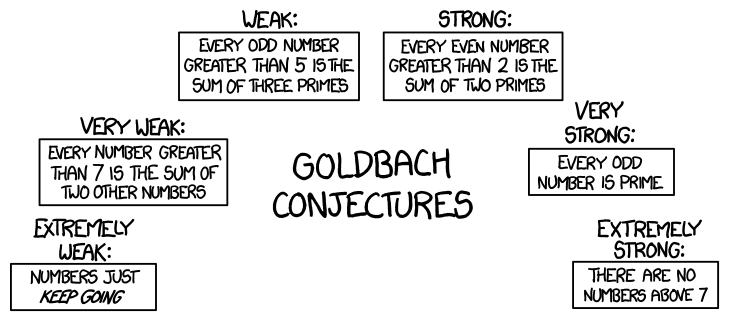
The weak twin primes conjecture states that there are infinitely many pairs of primes. The strong twin primes conjecture states that every prime p has a twin prime (p+2), although (p+2) may not look prime at first. The tautological prime conjecture states that the tautological prime conjecture is true.
untold turret
i'm trying to explore the extent to which f(a) = 0 implies a nonunit
formal ermine
what 💀
ivory trail
if f is a map of unital rings, then it preserves units
next obsidian
untold turret
i'm trying to explore the extent to which f(a) = 0 implies a nonunit
It implies nonunit always, unless the codomain is 0
untold turret
ivory trail
if f is a map of unital rings, then it preserves units
important, ty
next obsidian
A unit is sent to a unit
ivory trail
untold turret
important, ty
it's a short calculation: 1 = f(1) = f(a a^-1) = f(a) f(a^-1)
hidden haven
untold turret
its too powerful
Based
 south patrol
Assuming consistency of ZFC
hidden haven
You can prove it with Falso
ivory trail
i can also prove falso with it
hidden haven

Second order ZFC 
Tbf it is the number to memorize not the number itself 🤓
Actually I'm not sure if even second order ZFC would be finitely axiomatized
Probably not what relations could you even add to the language
 median pawn
alright basic question about presentations
hidden haven
Haha that's funny because presentations involve bases
median pawn
want to show <S|R> with S = {x} and R = {x^n} is isomorphic to Z/nZ using the universal property of generators and relations. I define f: S to Z/nZ by f(x) = 1, so that f(x^n) = 1 + ... + 1 (n times) = 0. by the universal property, there is a unique map g from <S|R> to Z/nZ such that g composed with the canonical map (S to <S|R>) is f.
to show the isomorphism, i should define h from Z/nZ to <S|R> (= F(S) quotiented by the normal subgroup generated by R in F(S)) also. h(1) = x is the obvious choice
delicate orchid
swubsituwion twest
median pawn
h(1) = x really means the equivalence class of x in the quotient
everything seems right so far? just g o h = id and h o g = id should do it
delicate orchid
is it part of the question that you have to use the universal property
median pawn
delicate orchid
is it part of the question that you have to use the universal property
yes
delicate orchid
cvringe!!!!!!!
median pawn
that's the whole point lol
delicate orchid
that map should work though
hidden haven
How do you solve a problem without using universal properties when the terms in the problem are defined using universal properties
median pawn
hidden haven
How do you solve a problem without using universal properties when the terms in ...

just trying out the first approach lol
delicate orchid
or via the explicit construction
ahhhhh there's the based...
median pawn
oops didn't mean to reply
hidden haven
delicate orchid
>or via the explicit construction
ahhhhh there's the based...
Why are you
delicate orchid
hidden haven
Why are you
so cool? dunno bro
hidden haven
untold turret
K field, R some subring, t not in R, R[t] has t in a maximal ideal M. why is there a valuation ring V with maximal ideal M' that contains R[t] and has M \subset M'
formal ermine
did you not use K???
white oxide
can i get a hint for b pls

i suck at image subset problems lol
i'm trying to use the fact that it's a direct sum but struggling f
Okay; say $b \in f(B)$ so that $b = f(x + y)$ for $x \in B, y \in C$ since $A = B \oplus C$
cloud walrusBOT
okeyokay
 white oxide
Then $b = f(x) + f(y)$
cloud walrusBOT
okeyokay
 rocky cloak
untold turret
K field, R some subring, t not in R, R[t] has t in a maximal ideal M. why is the...
rocky cloak
untold turret
K field, R some subring, t not in R, R[t] has t in a maximal ideal M. why is the...
I don't think this is true. Let K be k(x, y) and let R be k[y + 1/x, 1/y + 1/x, x], then I'm fairly certain x is not a unit in R. But if you adjoin either y or 1/y it makes x a unit.
median pawn
median pawn
everything seems right so far? just g o h = id and h o g = id should do it
ofc it worked but imo not the best way to show isomorphisms between a presentation and a given group? because F(S) may not always be "simple" and dealing with cosets can be painful
this particular example was just too easy
rocky cloak
white oxide
can i get a hint for b pls
Guess a hint is, what happens if you multiply A by 1
median pawn
median pawn
ofc it worked but imo not the best way to show isomorphisms between a presentati...
also uniqueness of g didn't play a role
white oxide
rocky cloak
Guess a hint is, what happens if you multiply A by 1
oh oops right you get 0
thanks
at least i think that's right
nvm
that was C
i'm trippin
white oxide
well it just becomes a = b right
ohh
well i know that all elements of C are mapped to 0
does it have to do with the fact that f(b + c) = f(b) + f(c) and since that's in A1 = B1 \oplus C1 we can conclude that f(b) is in B1?
rocky cloak
So imagine f(b) = b' + c'
And remember that f is a homomorphism
What you want to show is that c' is 0.
white oxide
ye i know that multipliying by 1 in C makes c go to zero but i'm not sure what properties C1 has
rocky cloak
C1 has that same property by assumption right
white oxide
i thought it didn't
because then it wouldn't be so bad
oh wait
i guess rc1 = 0
oops
and 1R obviously in R
ah there we go
got it thanks!!
rocky cloak
Guess this exercise shows that studying nonunital modules over unital rings is just the same as unital modules except you just keep an extra abelian group around.
white oxide
rocky cloak
Guess this exercise shows that studying nonunital modules over unital rings is j...
oh yea that makes sense now
untold turret
rocky cloak
I don't think this is true. Let K be k(x, y) and let R be k[y + 1/x, 1/y + 1/x, ...
cool counterexample! thank you
charred crescent
can we say, for a group G, and N < A < G, with N normal in G, that (A/N)(A'/N) = (AA')/N
rocky cloak
untold turret
cool counterexample! thank you
Did you read somewhere that this should be true, or did you come up with it yourself?
untold turret
rocky cloak
Did you read somewhere that this should be true, or did you come up with it your...
I'm trying to distinguish the key components of the proof that the intersection of the valuation rings containing a ring A is the integral closure of A, and I'm testing out to what extent we can extend valuation rings containing A
rocky cloak
charred crescent
can we say, for a group G, and N < A < G, with N normal in G, that (A/N)(A'/N) =...
Maybe you're able to write that what the elements are for each, and see if they match?
charred crescent
well the thing is, i have an idea for what an element of (A/N)(A'/N) looks like but im not sure
i think it should look like aNa'N for some a,a' in A, which is (aa')N iff N is normal and N < A
if that's the case, then im inclined to say that the equality does hold
but if im misunderstanding the definition of (A/N)(A'/N), then im not so sure @rocky cloak
rocky cloak
charred crescent
but if im misunderstanding the definition of (A/N)(A'/N), then im not so sure <@...
No I think you got it.
white oxide
how does this exercise show that f(P) is a subset of B1? i can't think of any direct sum that we can include P in to align with the statements of (b) in exercise 17

oops wait
referencing this

idk could we just form $P \oplus A$?
cloud walrusBOT
okeyokay
 white oxide
in exercise 17, i'm letting g: A --> B be the given module homomorphism in (b). but all exercise 17 says is that f(A1) \subset B1 and f(A2) \subset B2, i don't understand at all where P comes in
does it have to do with the factorization?
 cloud walrusBOT
kevinyang2.71
 rocky cloak
 warm ember
where i assumed Hg=g'H for g \neq g'
warm ember
where i assumed Hg=g'H for g \neq g'
What is an element you can be sure to find in Hg?
untold turret
rocky cloak
I don't think this is true. Let K be k(x, y) and let R be k[y + 1/x, 1/y + 1/x, ...
btw how did you construct this example? just finished verifying it and it wasn't obvious heheh
rocky cloak
untold turret
btw how did you construct this example? just finished verifying it and it wasn't...
I just came up with it in the spot. But I'm having some doubts, as it seems to contradict Atiya Macdonald
Or maybe I'm misunderstanding something
Or maybe x actually is a unit
white oxide
 untold turret
rocky cloak
I just came up with it in the spot. But I'm having some doubts, as it seems to c...
untold turret
rocky cloak
I just came up with it in the spot. But I'm having some doubts, as it seems to c...
it does have that adjoining either y or y^{-1} makes x a unit
will keep working with your example to see what exactly makes it work
untold turret
rocky cloak
I just came up with it in the spot. But I'm having some doubts, as it seems to c...
the theorem in Atiyah-Macdonald requires that whatever t we adjoin to R to make R[t] must be the inverse of a nonintegral element
so i don't think it contradicts it
second part of corollary 5.22
oh btw if you're reading 5.22 be sure to check the errata, forgot to say
white oxide
white oxide
how does this exercise show that f(P) is a subset of B1? i can't think of any di...
anyone?
rocky cloak
white oxide
how does this exercise show that f(P) is a subset of B1? i can't think of any di...
P = P + 0
white oxide
rocky cloak
P = P + 0
ah right oops thanks
charred crescent
rocky cloak
No I think you got it.
thanks 🙂
untold turret
hmmm but i'm actually not seeing the part integral dependence plays in 5.22
yeah, in fact, it seems 5.22 only uses the fact that t is in a maximal ideal of R[t]. @rocky cloak i'm trying to figure out if x is a unit in your example
rocky cloak
untold turret
yeah, in fact, it seems 5.22 only uses the fact that t is in a maximal ideal of ...
It seems
(y + 1/x) + (1/y + 1/x) + x - x (y + 1/x)(1/y + 1/x) = 1/x
So x is a unit and all is right with the world
untold turret
oof, close call. almost discovered inconsistency of ZFC
rocky cloak
I will go to bed now
untold turret
cheers, thanks for the help
i wonder if there's some sort of commutative algebra software we could use for this
formal ermine
idk what exactly you're trying to do right now but this looks like the software whose name I forgot could do this
sage
that was the name
south patrol
Sadge
formal ermine
south patrol
Sadge

warm ember

can help pls
so my progress is there is a primitive root gZ(G)
and let k=|G/Z(G)|
so g^k h=hg^k for all h in G
but idk how to use the primitive root
btw Z(G) is the set of elements commutative with every element in G
wraith cargo
warm ember
and let k=|G/Z(G)|
Why does the quotient with the center have to be finite?
chilly ocean
G = (G/Z(G))Z(G) and each is abelian so G is abelian qed
warm ember
o
warm ember
chilly ocean
G = (G/Z(G))Z(G) and each is abelian so G is abelian qed
what
what is that
multiplication
chilly ocean
it's bullshit
warm ember
what
 empty rose
chilly ocean
G = (G/Z(G))Z(G) and each is abelian so G is abelian qed
empty rose
chilly ocean
G = (G/Z(G))Z(G) and each is abelian so G is abelian qed
wouldn't this imply that all finitely generated groups are abelian
warm ember
i dont understand
chilly ocean
this got out of hand
warm ember
(G/Z(G)) x Z(G)?
wraith cargo
It's called a "joke"
empty rose
chilly ocean
G = (G/Z(G))Z(G) and each is abelian so G is abelian qed
this was intended as a joke
warm ember
o
chilly ocean
i'll put the /s next time
formal ermine
warm ember
can help pls
do you intuitively understand why it's true?
warm ember
how to do
warm ember
formal ermine
do you intuitively understand why it's true?
uh
quotient groups arent intuitive
unlike rings
delicate orchid
formal ermine
do you intuitively understand why it's true?
Tbh, I don’t understand it intuitively either
Anyway, so you have a generator for G/Z(G), which you’ve named gZ(G)
 frigid lark
warm ember
frigid lark
warm ember
so let G/Z(G) = <xZ(g)>, then any element in G, g, can be written as g = x^ih for some h in Z(g)
delicate orchid
The cosets of Z(G) partition G, so we can write any element of G as x^i*h as parrot says
delicate orchid
(And what terra was joking about by writing G = (G/Z(G))Z(G))
frigid lark
well {x^i} is the set of enough? coset representatives of G/Z(G)
delicate orchid
warm ember
why x^ih
Any coset of Z(G) in G is of the form x^iZ(G) by our assumption that the quotient group is cyclic
formal ermine
delicate orchid
Tbh, I don’t understand it intuitively either
this might be really wrong but I like to think of it as like, if we look at the non commuting elements they're all x^n so they intrinsically commute with each other again, and so we get abelianess
warm ember
delicate orchid
Any coset of Z(G) in G is of the form x^iZ(G) by our assumption that the quotien...
ye
delicate orchid
These cosets partition G, so every element is in one of these x^iZ(G)
delicate orchid
Which is equivalent to saying it’s equal to x^i*h for some h in Z(G)
delicate orchid
So now use this form to show G must be abelian
delicate orchid
formal ermine
this might be really wrong but I like to think of it as like, if we look at the ...
Right yeah, the “non-central” components commute
Reminds me of uhh p-parts and p’-parts of elements in a weird way
formal ermine
wait when is G/Z(G) not just empty when G is abelian lol
formal ermine
same thing
delicate orchid
Almost like Z(G) cyclic => G = Z(G) implies G is cyclic or something
formal ermine
I need sleep
frigid lark
is it 2 am again?
frigid lark
you're on discord
formal ermine
are you b'i'*sh? 🤢
delicate orchid
formal ermine
are you b'i'*sh? 🤢
Ur GMT+1 don’t drag me into this
frigid lark
formal ermine
are you b'i'*sh? 🤢
no, a former colony
formal ermine
it's been like what, 7-8 months?
frigid lark
frigid lark
no, a former colony
That isn't known for being nice or shooting schools
formal ermine
I just stepped on the fucking head of my fan
frigid lark
Or being big
delicate orchid
Ah… the glorious nation of Fiji…
formal ermine
it's almost as bad as stepping on a lego
frigid lark
fuck
formal ermine
south africa?
frigid lark
England had too many colonies
formal ermine
I'll be in the us starting friday
frigid lark
frigid lark
Or being big
populationwise, not landmass wise
formal ermine
australia?
frigid lark
ye
formal ermine
oi m8 bloody cunt
delicate orchid
The glorious territory of Tokelau
frigid lark
can we not wake up more people in the middle of the night?
formal ermine
it's 10 am for you
delicate orchid
Southern Hemisphere… so cringe
frigid lark
and lemme guess, they responded
formal ermine
I had my oral exam today
I forgot the MOST EASY THINGS
and couldn't think at all
I wanted to say that the coordinate ring describes Mor(X, C)
but just couldn't think
frigid lark
formal ermine
I had my oral exam today
today?!
formal ermine
I was too nervous
frigid lark
at 1am?
formal ermine
formal ermine
I wanted to say that the coordinate ring describes Mor(X, C)
so I emailed him this as a fwi
formal ermine
frigid lark
at 1am?
16 hours ago
frigid lark
idk, in Australia, we call that yesterday
formal ermine
today is when I haven't gone to bed yet
delicate orchid
And you also say December is in summer so excuse me if I ignore you
formal ermine
yesterday is what was before I gone to bed
formal ermine
delicate orchid
And you also say December is in summer so excuse me if I ignore you
SO TRUE
guys do I flip a coin whether I go to sleep
delicate orchid
Go to sleep
frigid lark
formal ermine
today is when I haven't gone to bed yet
so what happens when you pull an allnighter
formal ermine
it's one big day
delicate orchid
Skips a day
frigid lark
formal ermine
guys do I flip a coin whether I go to sleep
yeah, heads sleep, tails sleep
frigid lark
frigid lark
yeah, heads sleep, tails sleep
that thing that happened in ngnl, also sleep
 glossy grotto
Suppose you have a group isomorphism between two groups, are isomorphisms basically permutations on the generators of these groups?
 lethal dune
There’s no canonical generator, not even cardinality is unique for a generating set so no in general
Quick example: Z with generating sets {1} and {2,3}
glossy grotto
I see, does this mean that even isomorphisms do not map generators to generators on presentations?
topaz solar
Well, if S generates A, then f(S) is gonna generate B
delicate orchid
The problem is the presentation of a group is not unique
topaz solar
But that’s about it
topaz solar
lethal dune
Quick example: Z with generating sets {1} and {2,3}
Using this can get you two different presentations for Z
My favorite presentation is the unholy one where we use <G> = G 
topaz solar
Certainly not minimal in any sense, that’s for sure
glossy grotto
delicate orchid
The problem is the presentation of a group is not unique
Ah there's that.
topaz solar
But it’s probably natural in a categorical sense
hidden haven
Maximal nondegenerate that's pretty special
topaz solar
It’s degenerate in another sense though 
 topaz solar
glossy grotto
Ah there's that.
topaz solar
glossy grotto
Ah there's that.
But, of course, generating sets -> generating sets
And isomorphisms in particular have inverses
So you get that at least
glossy grotto
We have this same problem of non uniqueness of the generating sets for different algebraic structures no? In particular for algebras, we should be able to show that any algebra is some quotient (encapsulating relations) of the free algebra on some generators. The problem is that these generator-relations is not unique, as you have said.
median pawn
What's this notation? What's the square bracket doing on the right?

The relations seem to be a bit weirdly written
topaz solar
glossy grotto
We have this same problem of non uniqueness of the generating sets for different...
after all, feely adjoin an extra generator and quash it to 0
delicate orchid
median pawn
What's this notation? What's the square bracket doing on the right?
the commutator
and yeah the double | is weird
I'd write this as $\langle s, t | [t^nst^{-n}, t^mst^{-m}] \text{ for all } n, m \in \bZ \rangle$
cloud walrusBOT
wew ladz
 median pawn
delicate orchid
the commutator
median pawn
delicate orchid
the commutator
ohhh okay! alright
apparently this group is interesting because it has no finite presentation
delicate orchid
I believe it
 teal vessel
⟨s,t | ∀m,n ∈ ℤ ([tⁿst⁻ⁿ,tᵐst⁻ᵐ])⟩
Just to prove I can with this keyboard
untold turret
if V is a valuation ring of field K and t is in K but not in V, is V[t] = K?
formal ermine
chmonkey is indeed correct, the answer is either yes or no
 wraith cargo
solemn dew
Is the normal subgroup the image?
wraith cargo
solemn dew
Is the normal subgroup the image?
Inner automorphisms
solemn dew
A(G) is just S_{n] then?
chilly ocean
solemn dew
Or what is that symbol+++
it's a \mathscr{I} i think
wraith cargo
solemn dew
A(G) is just S_{n] then?
A(G) is the group of automorphisms of the group G
untold turret
next obsidian
Wait maybe?
t is not integral over V since V is integrally closed
we do know valuation rings are maximal wrt. extensions of homomorphisms mapping to algebraically closed fields
next obsidian
No this can’t be true
Yeah this is not true
It’s true if V is a DVR
But look at eg
Thm 10.1 of Matsumura

So this doesn’t quite exactly have the statement written down immediately
But there’s a bijection between primes of a valuation ring and valuation superrings
You can look at this in terms of convex subgroups of the value group too, this is all written down in Bourbaki
But the point is, you can have valuation rings which are not maximal subrings of K
So in that case, just pick an element t living in a larger subring of R of K, and look at V[t]
You have V < V[t] <= R < K
In fact you can even use this exercise to see that most valuation rings are not maximal

10.5
untold turret
is the fact that a homomorphism f:A->B from a ring A to an algebraically closed field B can be extended to a ring f:C->B a strong statement about the structures of A,C?
solemn dew
does anyone know what this lemma is called? I don't understand it

don't know what " i(H)! " means
 coral spindle
Maybe index of H, factorial?
coral spindle
Really weird notation overall.
solemn dew
🤷♂️
coral spindle
I don't know if this has a name.
solemn dew
lemma 2.9.1 in topics in algebra
rocky cloak
untold turret
is the fact that a homomorphism f:A->B from a ring A to an algebraically closed ...
So a homomorphism from A to a field is basically the same as a prime ideal in A, by looking at the kernel.
So this extending to C would mean to find a prime in C lying over the prime in A. In other words we need the extension A -> C to satisfy the "lying over property".
It's a theorem that any integral extension satisfies the lying over property (the going up theorem).
untold turret
rocky cloak
So a homomorphism from A to a field is basically the same as a prime ideal in A,...
oooooooooh! that makes a LOT of sense!
I was missing the explicit connection between homomorphisms and prime ideals
so extensions of homomorphism have a very intimate relationship to the structure of prime ideals lying over each other
I guess we're interested in homomorphisms to specifically algebraically closed fields because these are so easy to find?
there's also my question that you've already answered before: if a ring A contains a ring B, we can easily find an algebraically closed field to which both map to
rocky cloak
untold turret
I guess we're interested in homomorphisms to specifically algebraically closed f...
I think it's more a nice "maximal" situation to be in.
Like if p is a prime in A and q in C lies over it, then the fraction field of C/q is a field extension of the faction field of A/p. And if A -> C is integral then the extension is algebraic. So if A/p already sits inside something algebraically closed you never need to switch up your codomain.
untold turret
rocky cloak
I think it's more a nice "maximal" situation to be in.
Like if p is a prime in ...
that makes sense, thanks a lot!
solemn dew
i've shown that the subgroup must be cyclic

how to continue from here?
how will every element in this group commute?
delicate orchid
you're right in that G has to be abelian
do you know about the fact that if the quotient G/Z(G) is cyclic then G is abelian?
because I think the easiest route here is to just show that G has to be abelian and then conclude the result
rocky cloak
This is probably intended to be a step in proving that every group of order p^2 is abelian.
delicate orchid
very odd proof of that fact then
solemn dew
So if G/Z(G) is cyclic => G is abelian?
Does this work the other way around too? G is abelian => G/Z(G) is cyclic
delicate orchid
if you consider the trivial group cyclic then yes
delicate orchid
ok but you still need to show that G/Z(G) is cyclic
solemn dew
yes i'll try to do that
solemn dew

i don't understand what i am doing at this point
lol
any hints on how to show G/Z(G) is cyclic?
ahh sorry didn't copy everything
solemn dew
 delicate orchid
||let H < G be a normal subgroup of order p, then consider C_H(G) - you claim to have shown that H must be cyclic, which is true, so we know that H <= C_G(H) so C_G(H) cannot be trivial. If C_G(H) is a proper subgroup of G then take N_G(H)/C_G(H) which is isomorphic to G/C_G(H) because H is normal in G. This quotient must be cyclic of order p as 1 < C_G(H) < G <=> C_G(H) \cong C_p. By the N/C theorem G/C_G(H) is isomorphic to a subgroup of Aut(H), which is a contradiction, as the automorphism group of C_p (and therefore the automorphism group of H) is C_{p-1}, which is smaller than G/C_G(H) so cannot possibly contain it, so C_G(H) must equal G, and so H <= Z(G)||
this proof is a uhh mess but I didn't want to think too much
solemn dew
i appreciate it
 karmic moat
u’re very welcome :)
solemn dew
i am not at this level yet so i will have to try something else
 summer path
Did you just use C for both centralizer and cyclic group
delicate orchid
yeah and I'll do it again
summer path

 celest cairn
Is there a polynomial who’s splitting field is non-Galois? If so, would this imply the polynomial does not have a Galois group associated with its roots?
delicate orchid
solemn dew
i am not at this level yet so i will have to try something else
do you know about the orbit stabilser theorem/group actions?
solemn dew
i think i do
f be a homomorphism, so f(x) = x is the stabilizer
group action is just a action in the group?
what i've done so far:
 delicate orchid
ok so you don't know about group actions
summer path
The proof of orbit stabilizer is really trivial for how useful the theorem actually is
delicate orchid
indeed it is
 formal ermine

untold turret
that font has set my computer on fire and i had to throw coffee over it, rip these are my last seconds on the internet
solemn dew
isn't an orbit all the permutations of a group action?
for a element a in G, suppose o(a) = 3, then the orbit would be {e, a, a^2}?
delicate orchid
kind of, but you still haven't convinced me you know what a group action is
solemn dew
i don't blame u
celest cairn
Are all splitting fields Galois over Q or are there polynomials without Galois groups?
 barren sierra
solemn dew
barren sierra
solemn dew
I can tell from the way these fonts look that it's already going to be a hard text
south patrol
celest cairn
Are all splitting fields Galois over Q or are there polynomials without Galois g...
I assume you mean a splitting field of a polynomial f(x) in Q[x}?
In which case yes, in fact for finite extensions K/F, K/F is Galois iff it is the splitting field of a separable polynomial
And every polynomial over a field of characteristic zero - in particular over Q - is separable
 untold turret
next obsidian
No this can’t be true
untold turret
next obsidian
No this can’t be true
correct statement, I think: either V[t] = K, or t is not in the maximal ideal of V[t]
next obsidian
What do you mean “the” maximal ideal
untold turret
If V[t] is not K, then it is a valuation ring too (let me think through why)
next obsidian
t will be a unit in V[t] yes, because t^-1 is in V
Also you’re right
I was being dumb lol
It’s because of the condition that you’re a valuation ring iff either x or x^-1 is in V for any x in K
They can both be in V
Not an exclusive or
next obsidian
That’s not how or is used in math
untold turret
i always consider them exclusive because they're special tho
formal ermine
next obsidian
That’s not how or is used in math
yeah I realized too
warm ember
whats Inn(G)
delicate orchid
the inner automorphisms of G
 delicate orchid
basically, all automorphisms of G that look like conjugating by some fixed element
warm ember
o
solemn dew
@delicate orchid what about doing two subgroups of G, in which "a" is in one of the subgroups and "b" is in the other. We know the first subgroup is generated by (a), and due to subgroups being normal in G, the other group that has that contains "b" has to be normal too. Thus a,b must be in Z(G), and so o(Z(g)) > p since the first subgroup has order p? then due to Lagranges theorem o(Z(G)) = p^2 thus Z(G) = G?
Does this work?
 delicate orchid
how do we know that all of the subgroups must be normal
delicate orchid
and there are normal subgroups which are not central, so the following implication doesn't hold either
although, hmm
if we know the centre is non-trivial that implication holds
but the centre being non-trivial is equivalent to G being abelian in this case, so kinda missing the forest for the trees
formal ermine
solemn dew
abstract algebra is so hard
I find analysis to be harder