#groups-rings-fields
1 messages · Page 80 of 1
 solar glacier
 rotund aurora
based
 rapid junco
Cayley Hamilton
solar glacier
I “started” at 18 but didn’t take it serious till I was 27
 tawny cloak
I'm thinking to try doing all the exercises from a textbook (or certain parts of it) and then say I did it
 fleet pelican
I went to one of the top universities in the world for math.
rotund aurora
rapid junco
Cayley Hamilton
that's what people was talking about, so thought it was a fun exercise
solar glacier
fleet pelican
I went to one of the top universities in the world for math.
Where’d you go if u don’t mind my asking
fleet pelican
haha dm
 formal ermine
I started taking/learning math seriously a couple of months ago
rapid junco
formal ermine
I started taking/learning math seriously a couple of months ago
Are you in University? Or your own free time
formal ermine
I'm still in high school
rapid junco
Nice, what have you studied so far?
formal ermine
some complex analysis, some analytic number theory, group theory, some commutative algebra, field theory, galois theory, linear algebra, intro to real analysis, numerical analysis, point set topo, a bit of alg top, a bit of rep theory, currently doing alg geo
rotund aurora
When you go to uni classes, do you skip hs classes? Just curious about the education system in other countries
formal ermine
yeah but it's like
I can only take one class per semester at uni
and then I have to ask the teacher of the class I would miss
rapid junco
So what are you taking right now
rotund aurora
Do you go to regular math classes at hs?
formal ermine
yeah here in germany you don't get to pick what classes you take
everyone has to take math
each and every year
formal ermine
rapid junco
So what are you taking right now
rn it's semester break but next sem I'm taking the geometry of newton okounkov bodies
rotund aurora
Are they interesting to you? (The normal math classes at hs)
rotund aurora
Or like you would preffer not to go
formal ermine
attendance is mandatory
rotund aurora
formal ermine
rn it's semester break but next sem I'm taking the geometry of newton okounkov b...
Why wouldnt you take like general basic algebraic geometry course xD
The wikipedia page of that is like 8 lines
formal ermine
my uni doesn't offer an ag course next sem
rotund aurora
Ah k makes sense
formal ermine


these are all courses for next sem
the only other interesting thing would've been diff top
or maybe lie groups
fleet pelican
If you're early in your studies, it might be best to try and get some more general/intro topics.
formal ermine
like?
rotund aurora
fleet pelican
If you're early in your studies, it might be best to try and get some more gener...
I dont exactly agree. I think Illum is fine doing this kinda things
fleet pelican
Well, definitely focus on what you enjoy most. But if you have two courses you're considering, I'd more heavily weight the more general one the earlier in your career, and the more specialized the later in your career.
formal ermine
it's whatever
I still have like 3 years till I graduate high school
so plenty of time to do a wide variety of things
rotund aurora
formal ermine
arent the kurven courses like algebraic curves or something
formal ermine
rotund aurora
arent the kurven courses like algebraic curves or something
it means curves and surfaces but it's diff geo
rotund aurora
you could do
Im doing algebraic curves things, and there is a lot of differential geometry and complex analysis going on
formal ermine
idk the semester starts in a week and I already picked that one course lol
rotund aurora
i dont really know diff geo nor complex analysis tho, but Im trying to keep up with the definitions and basic results
the course you are doing is fine yeah
formal ermine
I definitely wanna do analysis in the future too though
not just algebra
probability theory also looks interesting, but it needs measure theory
 thorn delta
okay, i don't quite have a full answer. i found something wrong with the idea i had last night, but here's some ideas:
if phi : Q(sqrt(d1)) -> Q(sqrt(d2)) is the field isomorphism, then phi must fix Q, and therefore phi sends roots of a polynomial f to roots of f. In particular, phi(sqrt(d1)) is a root of x^2 - d1, and therefore phi(sqrt(d1)) = \pm sqrt(d1). Write phi(sqrt(d1)) = a1 + a2sqrt(d2) for some a1, a2 in Q. Then we can write sqrt(d1) = a1 + a2 sqrt(d2).
Now from here, I'm not exactly sure what to do. During a failed attempt, i noticed that if sqrt(d1 d2) is an integer and d1, d2 are square-free, then d1 = d2 (think about why). I feel like this might be the "trick" that you are supposed to see at some point.
For example (x - sqrt(d1))(x - sqrt(d2)) = x^2 - (sqrt(d1) +sqrt(d2))x + sqrt(d1 d2). So for this polynomial to be the irreducible polynomial of some element of an extension F/Q, then we essentially need sqrt(d1 d2) to be an integer. However, the best we can say at the moment is something like (x - sqrt(d1))(x - phi(sqrt(d1)) = (x - sqrt(d1))(x - a1 - a2sqrt(d2)) is in Q[x], and I'm not sure if this is strong enough to imply sqrt(d1 d2) must be an integer without imposing a1 = 0 maybe.
someone better at field theory surely knows how this works tho
 livid willow
Hi, I had a test yesterday on Algebra and there was a question which I was not quite sure of the answer. They asked for Dim (C : R) [Field of complex numbers over the field of real numbers]. I was not entirely sure of the answer but since C can be written as a + bi where a,b belongs to R, the basis is (1,i), so I wrote the dimension as 2. Would the answer be correct with my reasoning?
fleet pelican
That is correct.
If we want to be a tiny bit more careful, we can write the basis as <1+0i, 0+ 1i>.
livid willow
Ah okay, thank you 
 vagrant zinc
Can anyone tell me the order of study of abstract algebra?
 delicate bloom
I'd open up the table of contents of an undergrad algebra book like artin or something and look at that
fleet pelican
Artin is a great source. He has a bit of everything.
vagrant zinc
I am handling Thomas W. Judson's abstract algebra book and I have seen books that handle different order.
I have been reviewing and studying in this order so far.
Groups
subgroups
Cyclic groups and subgroups
Permutation groups
Lateral classes and Lagrange's theorem
and I don't know what comes next, I guess isomorphism.
thorn delta
aluffi's order in his new book if u want to be based
fleet pelican
vagrant zinc
I am handling Thomas W. Judson's abstract algebra book and I have seen books tha...
That seems a pretty natural progression. I would hope you at least manage to get a good look at group orbit-stabilizer stuff. Later on comes things like rings, those are a almost a whole new subject.
vagrant zinc
fleet pelican
That seems a pretty natural progression. I would hope you at least manage to get...
Group action?
fleet pelican
vagrant zinc
I am handling Thomas W. Judson's abstract algebra book and I have seen books tha...
The isomorphism theorems should teach you about normal subgroups and quotient groups. It seems like the book is hitting all the major topics.
fleet pelican
vagrant zinc
Group action?
A group action is probably going to show up in a different chapter. It's a bit more fancy, you'll get there. It really helps you calculate a lot of group properties fairly quickly.
vagrant zinc
In these days I will be asking about permutation groups and side classes, I hope I don't bother asking so much, I don't know much either but I have studied, and I feel good to face the exercises.
fleet pelican
I think this is the right channel for that. I think if you put in the effort people would be happy to supply hints as you work through problems.
vagrant zinc
fleet pelican
That seems a pretty natural progression. I would hope you at least manage to get...
group orbit stabilizers, in which topic do you see that?
fleet pelican
Group actions.
 solar shore
heyo, i was wonderin if my proofs for this entire theorem was correct; there are 6 parts and i was wondering if i could get some other eyes to check if they are indeed correct for them. (dont mind 2 and 3, we had proven them in class from our instructor; it was left up to us to do 1, 4, 5, and 6)

 kind temple
in part 1 (a) g_1 = g_2 implies that bar(g_1) = bar(g_2) because phi is injective. If you show that phi^{-1} is a homomorphism first, then there is an alternative proof for injectivity by showing that its kernel is trivial.
in part 1 (b), to show surjectivity of phi^{-1}, start with an element g in G and produce an element x in bar(G) such that phi^{-1}(x) = g.
when you write, "for some phi(a) in phi(Z(G))" it is confusing, since it is meant to be fixed throughout that section of the proof. try writing, "let phi(a) in phi(Z(G)) be given" or, "fix phi(a) in phi(Z(G))" instead.
the same goes for when you "fix" an x in bar(G) and write x = phi(z).
otherwise the proofs are fine
@solar shore
solar shore
okay thank you so much!
i appreciate the feedback a ton
these are supposed to be notes that im going to look back on so i want them as clean as possible
tysm <3
 sonic coral
solar shore
sonic coral
solar shore
could you post theorem 6.1 for me please?
solar shore
the proofs for the specific parts?
or the entirety of theorem 6.1


heres what i wrote
 tender wharf
these look fine
 quartz quiver
what does it mean here by $G_{i+1} / G_{i+1} \cap (G_i N)$ is an image of $G_{i+1}/G_i$? i assume image of some homomorphism, but which homomorphism?

 cloud walrusBOT
Darylgolden
 quartz quiver
what does it mean here by $G_{i+1} / G_{i+1} \cap (G_i N)$ is an image of $G_{i+...
quartz quiver
quartz quiver
what does it mean here by $G_{i+1} / G_{i+1} \cap (G_i N)$ is an image of $G_{i+...
<@&286206848099549185>
 untold cloud
Hi, guys, given a group G, how to show that Inn(G) char Aut(G)?
 coral shale
Invoke the defns?
huh. 2, 4 are natural, gcd(2, 4) isnt 1.
At this stage you should try figuring these out yourself before asking for hints.
Also.
yes it is...
I see you asking a lot and I get the impression that isnt happening
ic
In any case, it is hard for anyone to assist with a wall of text like this. Its hardly readable
Use @cloud walrus
And try not to ask for full blown proof verification here

Just my opinion
On getting yourself help better. In the end its only a waste of your own time if no one ends up helping
 coral shale

In any case - have some confidence in what you write
only ask the specific parts you are unsure about
rather than a review on the entire thing
thats the job of a marker
and yes, once youre done , you can compare to other proofs
 elder wave
formal ermine
elder wave
formal ermine
wonder where you got that one from
 grand cliff
Hi, I just learned about Cayley graphs.
I'm curious if there's a name for some sort of "generalized" cayley graph for infinitely generated groups.
Take for instance (R, +) which can be generated by the interval [-1, 1].
We could then define a cayley "graph" G with vertex set R in the same way we do in the finite case.
Obviously the resulting object is not a graph, since there's an uncountably infinite number of edges and vertices, but I'm not sure exactly what to call it.
Some sort of topological object
coral shale
do graphs have to be restricted by cardinality...
surely theres a generalized defn that is not
 wooden ember
I think the only restriction is that graphs be locally finite?
coral shale
this fails
wooden ember
Yeah for this example it doesn’t work
I mean nothing stops you from defining such a structure
coral shale
is it a cw complex? idk
wooden ember
Does seems like a very odd construct though
To me it feels like for this structure to make sense you just end up getting R lol
Under the right identifications
But okay technically speaking nothing is stopping you from making a disgusting CW complex with 0-skeleton given by R and 1-cells attached between any two points that represent points a distance <=2 away from each other. Topologically speaking though I don’t see how you will recover any information about R
Exercise: compute the fundamental group 🤮
 green walrus
wooden ember
Exercise: compute the fundamental group 🤮
green walrus
wooden ember
Exercise: compute the fundamental group 🤮
exercise left to the author
cloud walrusBOT
LeftySam

 molten viper
Checking my intuition: with a local ring, it has a unique maximal ideal. This would be the set of all non-units in the ring yes?
I'm at a very basic level but I'm seeing a lot of correspondences between local rings and modules, so I'm gonna say it's homomorphic to an R-module
in some way
the ideal itself?
so (R,m), m is an ideal and a module
cloud walrusBOT
LeftySam
 elder wave
? what they said is correct
oh it's a troll apparently
Galstaff what you said is true, it follows directly from the fact that every non unit in a ring is contained in a maximal ideal
molten viper
I see
Over time I'm trying to build up foundation for understanding some papers I've been recommended, so I'm trying to find holes in my knowledge as I start learning beyond my ug level
formal ermine
elder wave
oh it's a troll apparently
pending g+
 fleet pelican
Local rings are a pretty central topic. Seems like you're going in the right direction.
elder wave
Local rings are very cool
what local properties there are, what additional assumptions you need for other properties to be local etc
all plays nicely together
fleet pelican
I was taught to think of it as a way to "zoom in" on a prime
elder wave
elder wave
what local properties there are, what additional assumptions you need for other ...
i'm mainly referring to flatness, injectivity and projectivity here
molten viper
I'm working on some stuff with modules for my ug thesis, so I'm starting with the basics of different properties of rings and basics of modules rn
which essentially means "hey here's this graduate course textbook, read it and have fun!"
I'm loving it
fleet pelican
I found Atiyah Macdonald to be a great treatment of modules.
elder wave
what are you reading
molten viper
AM is one of the ones I've been recommended lol
I've got a few texts my director is having me look through (or will have me look at)
AM,
fleet pelican
It really complemented my learning style. I find it a bit Rudin-esque in style.
molten viper
"Commutative Algebra with a View Toward Algebraic Geometry" is another from the springer graduate text series
She's also gonna have me look into a graph theory text
It's very exciting, I think I've finally gotten over some of the imposter syndrome
<@&268886789983436800>
thanks
anywyas
I'll come back when the troll gets remoived
ah excellent, thanks mods
There's something to be said for the 3rd or 4th year undergrad realization that you really know nothing
actually delving into something slightly more specialized has kind of helped me get over the sort of "imposter syndrome"
Alrighty well, I'll get back to it, I have under 11 hours to send a thesis proposal to the college
 unique topaz
Yo im stuck if y=0 then whats the root of y=3x(squared)-11x-4
 rustic crown
#prealg-and-algebra maybe?
 celest furnace
molten viper
There's something to be said for the 3rd or 4th year undergrad realization that ...
celest furnace
molten viper
There's something to be said for the 3rd or 4th year undergrad realization that ...
moment
 molten viper
Maybe!
molten viper
I think there's a typo in part v) here, I figure professor means u \nin Q

 chilly ocean
Yes, otherwise Q(u)=Q
wooden ember
gonna soon give a talk about fourier transforms on finite groups but there's a piece of intuition im missing that im sure exists and id love to convey. I can see formulaically why the fourier transform changes convolutions to products, but why does it do so intuitively (it's a very convenient property to get the isomorphism C[G] = sum End(V_i) but I'm struggling to find an intuitive explanation for it)
delicate bloom
the way I see all convolutions is basically as just a shortcut trick, like my intuition comes from multiplying polynomials -> convolution gives you a way to get the coefficients directly. I dunno if that's the sort of intuition you want or that's still considered formulaic
but there are probably other, better intuitions than that for it
wooden ember
In the context of the talk convolutions are mainly used to compute the probability distribution of an iterated process and ideally I’d like to somehow link the property of the Fourier transform to that
But good point for polynomials
It’s a bit weird though cause I went from functions on a group to C[G] where we see that convolutions become products, and now I go from C[G] to sum EndV_i where I want a different interpretation for how a convolution is turned to a product
Your interpretation seems better for for the first case
delicate bloom
lmk if you find something I'd be curious to know. when counting solutions for varieties over finite fields I've used them, and they sorta ended up being like gauss sums, but I never really got any good intuition about that either
wooden ember
Will do
rotund aurora
delicate bloom
the way I see all convolutions is basically as just a shortcut trick, like my in...
I agree with this

 glossy crag
From Morandi's Field Theory. He uses up almost an entire page just to show that g(x) is in F[x] (and I don't feel like bothering with those details), isn't it enough that min(a) factorises as \prod (x-\sigma_k(a)) in Fbar[x] (where \sigma_k are embeddings with distinct images of a)? This means that g and min(a) have exactly the same roots in Fbar (just with different multiplicities), then scaling things appropriately we see that g=min(a)^{n/m}=char(a) in Fbar[x], which by Viete implies the formulas for norm and trace. Is this not sufficient?

OK, nvm, I think some of the details are not adding up, so it's probably necessary to show g\in F[x].
molten viper
So, how would I go about proving the first part of ii? My first guess is writing it as some a + bu + cu^2 + ... + fu^5

but that seems like a mess of algebra
which feels wrong for a homework problem
Actually, I guess the fact it has degree 2 is telling
rustic crown
what's 1/z?
molten viper
z^6
rustic crown
in terms of cosines and sines
elder wave
molten viper
but that seems like a mess of algebra
literally all of field theory
elder wave

 next obsidian
use the complex exponential
rustic crown
hewwo 

rustic crown
molten viper
12pi/7
and that's -2pi/7 (modulo 2pi)
molten viper
yerp
rustic crown
so what's z+1/z 
molten viper
so the previous problem has me look at... exactly that lol
Update: much simpler than the previous problem lol
Thnaks for the help
chilly ocean
How should one think about the difference between a solvable vs nilpotent Lie algebra? Like what’s the intuition for the difference of the derived series vs the lower central series
Ik that’s sort of a vague question, hopefully makes sense though
fleet pelican
Well. You can think of a nilpotent lie algebra as a wing which decays as you move along it. A solvable one is like a body with a wing attached. The body is the good bit which saves the wing from decaying. That’s my mental image anyhow.
I mean. In particular. Think of raising a solvable Lie algebra to a power. Like look at how solvable doesn’t imply nilpotent. There’s a certain lack of decay
fleet pelican
I guess to clarify a bit. I mean the difference between The function acting on the whole space. So like a solvable but not nilpotent will have [L_0, L_1] doesn't go to 0 but [L_1, L_1] does, where L_1=[L_0, L_0] Somehow the L_0 prevents you from losing dimensions
chilly ocean
I see, so some of the elements in L_0 that are not in L_1 give you non zero elements when bracketing
But when restricting to L_1 you can’t find any nonzero elements and thus it is zero
Or for instance n, n-1 instead of 1,0
Okay so the subalgebra kills itself but the whole space preserves some of the sub space
I’m seeing
fleet pelican
In particular, it is worth knowing that if L is solvable. [L,L] is nilpotent
chilly ocean
I will try to prove that..
 feral agate
For (b), I don't really understand how I can show that alpha +2 is a primitive element, i.e. that (alpha +2) is of order 48, without calculating all 48 powers of it.

Probably I have to use the calculations made with all the ks given, I could see for instance why k = 24 is useful, because it must give -1.
But for the other ks I don't really know how to use them
This is what I have so far:\\
\begin{align*}
(\alpha+2)^2 &= \alpha^2 + 4\alpha + 4 \mod (x^2+1) &\equiv 4\alpha+3\
(\alpha+2)^4 &= 2\alpha^2 + 3\alpha + 2 \mod (x^2+1) &\equiv 3\alpha\
(\alpha+2)^8 &= 2\alpha^2 \mod (x^2+1) &\equiv 5\
(\alpha+2)^3 &= 4\alpha^2 + 4\alpha + 6 \mod (x^2+1) &\equiv 4\alpha+2\
(\alpha+2)^6 &= 2\alpha^2 + 2\alpha + 4 \mod (x^2+1) &\equiv 2\alpha + 2\
(\alpha+2)^{12} &= 4\alpha^2 + \alpha + 4 \mod (x^2+1) &\equiv \alpha\
(\alpha+2)^{24} &= \alpha^2 \mod (x^2+1) &\equiv 6\
\end{align*}
Note that the calculations above assumes $mod 7$ in the coefficients.
To prove that $\alpha + 2$ generates $F^*$, we need to show that $(\alpha+2)$ is of order 48 as $\alpha + 2 \neq 0 + (x^2+1)$. Begin by observing that $$(\alpha+2)^{\frac{48}{2}} = (\alpha+2)^{24} = 6 \equiv -1 mod 7.$$
cloud walrusBOT
FrankF
 fleet pelican
You also know that if some lower power equals 1, that power must divide 48, these are all the factors of 48, so you're done
feral agate
I see very smart
feral agate
For 10(b), how are there zeros for y^2+1? We need to have that y^2 = x^2+x+1 for it to be a zero in the quotient ring, but the determinant of x^2+x+1 is negative so it does not have roots in the reals and it thus cannot be factored.

Am I missing somethign here?
next obsidian
feral agate
For 10(b), how are there zeros for y^2+1? We need to have that y^2 = x^2+x+1 for...
3 = 0
You aren’t over the reals
feral agate
oops
feral agate
I am a bit confused about what I need to do, because in the end I want to find a $y \in Z \backslash 3Z$ such that $0 \equiv y^2 + 1 \mod y^2+y+2$. Thus I am not allowed to say that we need to find y such that $y^2+y+1 = 0$ right? So how else can I simplify the problem?
cloud walrusBOT
FrankF
 next obsidian
No
You want a polynomial f(x) in Z/3Z[x] such that plugging it into y^2 + 1 = 0, but you get to use the relation x^2 + x + 2 = 0
Let me illustrate an example with a different polynomial
So you can see the idea of what’s going on
Give me a moment
So I can cook up a polynomial
Okay, take y^2 - y + 2
Plug in (x+1)
You get
x^2 + 2x + 1 - x - 1 + 2
= x^2 + x + 2
= 0
feral agate
Ah I see so y needs to be in Z/3Z[x]
next obsidian
Right, but here actually
I didn’t even use that 3 = 0
But if instead of +2 I did say, -1
I would have ended up with -3
Which is actually 0
feral agate
Yeah
feral agate
Yess thanks!
next obsidian

 coral steeple
Quick terminology question: If every group that satisfies xyz property is isomorphic to some other group (say (Z,+)), then can we say that "the group that satisfies xyz property is unique up to isomorphism"?
next obsidian
That makes sense. Maybe say “groups satisfying xyz property are unique up to isomorphism”
coral steeple
Ah yes that does sound better, thanks!
feral agate
Is it always the case that the kernel of a ring homomorphism is a principal ideal?
next obsidian
feral agate
Is it always the case that the kernel of a ring homomorphism is a principal idea...
Every ideal is a kernel
Of the quotient to R/I
feral agate
next obsidian
Every ideal is a kernel
yeah, but I mean whether it can be generated by one element
next obsidian
If it were true then every ideal is principal
 barren sierra
is there a good notion of a ring generated by a set?
I want a ring generated by (1, x) or something lol
next obsidian
Holy hell this isn’t hard lmfao
Just take (x,y) in k[x,y]
Or any ring that isn’t a PID
barren sierra
yea
next obsidian
barren sierra
is there a good notion of a ring generated by a set?
And yes, you consider the elements of the set as formal variables and take Z[S]
barren sierra
ah right
feral agate
feral agate
For 10(b), how are there zeros for y^2+1? We need to have that y^2 = x^2+x+1 for...
For (b), I have shown that there exists an isomorphism between K and L. However, the exercise asks for a explicit one? So I interpret it that the definition of the mapping should also be found. Is there a general approach to finding an explicit isomorphism from the first isomorphism theorem? This is what I have so far:\\
\newcommand{\Z}{\ensuremath{\mathbb{Z}} }
Begin by noting that we need to find a $y \in (\Z \backslash 3\Z)[x]$ such that $0 \equiv y^2 + 1 \mod x^2+x+2$. In other words, it holds that $y^2$ is a multiple of $x^2+x+1$. Note that for $x = 1$ it holds that $x^2+x+1 = 0$ and for $x=0,1$ it holds that $x^2+x+1 \neq 0$. To verify, we see that $$(x-1)^2 = x^2+x+1.$$ Hence, we have found the root at $y = x-1$. Do note that this $1$ is a representative of the class $1 + 3\Z$, so all elements in that class is a root for $x^2+x+1$.\\
Consider the ring homomorphism $f: (\Z \backslash 3\Z)[x] \rightarrow L$ mentioned in the exercise. We know that by the first isomorphism theorem, there exists a map $\psi: (\Z \backslash 3\Z)[x]\backslash ker(f) \rightarrow im(f)$ that is an isomorphism. So we need to show that $ker(f) = (x^2 + 1)$ and $im(f) = L$. For polynomial $p(x)$, the map $f$ is defined by $f(p(x)) = p(x-1) \mod x^2+x+1$. We observe that for $p(x) = x^2+1$, it holds that $p(x-1) \mod x^2+x+1 = 0$. Since, in the first part of the exercise we have proven that $x = 0, 2$ are not roots for $x^2+x+1$, we have that the kernel is a principal ideal, hence $ker(f) = (x^2 + 1)$. Furthermore, let $ax + b + (x^2+x+1) \in L$ where $a,b\in \Z \backslash 3\Z$. Consider the representative $ax + b$. We know it is always possible to pick $p(x)$ such that the coefficient of $x$ in $f(p(x))$ is $a$. To get the constant in $f(p(x))$ to be equal to $b$, we just need to tweak the constant in $p(x)$. Therefore, $im(f) = L$.
cloud walrusBOT
FrankF
 barren sierra
For the connecting morphism from the snake lemma
suppose we're in the category of R modules
cloud walrusBOT
Spamakin🎷
 barren sierra
(delta is the connecting morphism)
EDIT: nvm got it it's just an annoying chase
 prime sundial
is there any straightforward way to find a generator of the multiplicative group of F[x]/(p(x)), p irreducible? if it helps, F = Z/2Z
my p is cubic and i really don’t want to show the order of my proposed generator is greater than 13
would the field necessarily be isomorphic to Z/26Z? can i just find an isomorphism and let the generator be w/e maps to 1?
i have the result that x is of order > 5, so maybe i can just go up to 13 without much issue
ok that was it
an easier question, if E = F[x]/(p(x)), then the roots of p(x) in E are all of F right?
or am i oversimplifying
sorry i meant all of E
next obsidian
prime sundial
would the field necessarily be isomorphic to Z/26Z? can i just find an isomorphi...
It’s F_8 no?
If you’re over F_2 and quotient by a cubic
You’re degree 3 so order 8
next obsidian
You typoed >_<
prime sundial
yeah my bad
next obsidian
Anyway, all I’m gonna say is 🫥
Sorry bruh this seems cursed
Luckily I think like uhh
prime sundial
nah it wasn’t that bad actually
next obsidian
,w phi(26)
cloud walrusBOT


 Requested by Chmonkey#9767
next obsidian
Requested by Chmonkey#9767
next obsidian
Almost half of them generate so
prime sundial
ord(x) > 5 and the last couple parts had to do with the representative of x^5 in E
next obsidian
Maybe just pick a random one and say you should get 12/26% credit because you’re that likely to be right
Ah
prime sundial
so it simplified quite a bit
well
it was the representatives of some powers of x^2 + 2
but they worked out to be the same
so you’re really just doing (x^2 + 2)^2 = x^10, which was also a precious part
and then you just show multiplication by (x^2 + 2)^3 is not one
prime sundial
prime sundial
an easier question, if E = F[x]/(p(x)), then the roots of p(x) in E are all of F...
this is more theoretical though and i feel like i over simplified
p(x) in E is = 0, so p(alpha) for any alpha in E must be 0 as well right? thus any element of E is a root
prime sundial
i’m given that R is an integral domain, F a sub ring that is also a field, and we define the VS over F with R as elements and scalar multiplication to be left multiplication by elements of F. i need to show if dim_F R is finite, then R is a field
i assume i want to pick a basis and abuse it but i need a hint
maybe i put the multiplicative identity in the basis and name drop graham schmidt?
maybe i don’t need or can’t even use graham schmidt
cloud walrusBOT
LeftySam
 coral shale
unravel defn, looks like geometric progression on factors maybe
cloud walrusBOT
LeftySam
 coral shale
unravel defn, looks like geometric progression on factors maybe
coral shale
coral shale
unravel defn, looks like geometric progression on factors maybe
.
idk
u can also try converting the RHS into that
looks easier
cloud walrusBOT
LeftySam
 coral shale
cloud walrus
**LeftySam**
coral shale
cloud walrus
**LeftySam**
huh. expand it using this definition?
coral shale
cloud walrus
**LeftySam**
rhs of this
cloud walrusBOT
LeftySam
 coral shale
very confused.
\phi_{dn}(t)
expand this...
and see if it gets u anywhere
sry if it doesnt
cloud walrusBOT
LeftySam
 coral shale
thats what i thought
coral shale
cloud walrus
**LeftySam**
then try turn it into this
try for simple m n
maybe theres a trick
idk whats good...
nvm 2 and 3?
???
what
try for small m and n
and see if theres a rearrangement trick
i mean small when i say simple
for example 2 and 3
...
 hot lake
doesn't he just show that they have the same roots ?
hot lake
well he isn't detailing his reasoning much tbh
yes they are monic polynomials with no repeated roots
yes because then they are both the product of the (x- ri) over the same set of roots {r1,r2,...}
yeah or over the field algebraic numbers
uh
that if P is a polynomial over a field F and r is a root of P then P is divisible by (x-r) ?
yeah by induction and using that r is a root of P <=> P is divisible by (x-r)
more generally, K[x] is a unique factorisation domain (even if K isn't algebraically closed)
I'm not completely sure how you would define multiplicity without knowing that K[x] has unique factorisation
yeah because 1 * 1 = 1
the product of monic polynomials is monic
cloud walrusBOT
LeftySam
 hot lake
no
they are the primitive nth roots of unity
the polynomial whose roots are the nth roots of unity is x^n-1
cloud walrusBOT
LeftySam
 hot lake
if t^m is an nth root of unity then t^mn = 1
cloud walrusBOT
LeftySam
 hot lake
yeah so among the mn-th roots of unity, you have to find out among the possible orders they can have, which ones are a root of the LHS
and yes you do that with chinese remainder theorem
that is, which ones have an mth power that are primitive nth root of unity
because the group of mnth roots of unity with multiplication is isomorphic to (Z/mnZ,+)
and you can translate questions about order of particular roots into order of some element in (Z/mnZ,+)
cloud walrusBOT
LeftySam

 somber sleet
What is the difference between inner and outer semiproduct?
rustic crown
inner is when you have a big group and you wanna decompose it as a semidirect product of smaller subgroups
fleet pelican
Whether they are subgroups of group you're constructing.
rustic crown
outer is when you have two weird groups, and you put them together in weird way to get a big group
fleet pelican
They basically work the same, it's more about how you arrive at the construction. Inner is a decomposition and outer is a construction.
often ppl will just call it a semidirect product, and not bother specifying
somber sleet
Ohh okay, thx guys
 shell brook
I have the following set up $G, H \supset F$ are all fields. What does it mean to say that $G$ and $H$ are algebraically disjoint as fields over $F$?
cloud walrusBOT
jesse
 fleet pelican
it means that the polynomials which generate the extensions have gcd 1
shell brook
fleet pelican
it means that the polynomials which generate the extensions have gcd 1
Oh okay
this is nice
thanks
shell brook
not my notation sry
formal ermine
H is even worse
 formal ermine
bro those aren't fields you're doing sheaf theory
elder wave
only cowards delete messages jesse
shell brook
i cant be mean in the public chats
coral shale

formal ermine
what did he say
 south patrol
mathscr
elder wave
formal ermine
what did he say
some crazy stuff
jesse you can't be doing illum like that
formal ermine
I don't quite understand why sigma(K) is a strict subset of K

 prisma ibex
I mean strictly speaking this isn't true
formal ermine
but then how does this work
rotund aurora
I think you just have equality?
cuz the sigmas that act on L fixing Q also act on K fixing Q, but K is Galois
formal ermine
this is perhaps a stupid question but what does K/Q being galois change
rotund aurora
nothing can escape from K
cuz if a in K, all the galois conjugates of a are in K (galois conjugates of a = roots of the minimal polynomial of a)
and sigma sends galois conjugates to galois conjugates
formal ermine
what is a galois conjugate
rotund aurora
formal ermine
what is a galois conjugate
(galois conjugates of a = roots of the minimal polynomial of a)
south patrol
ye
south patrol
anyway yeah you should get equality just cause like
south patrol
σ is an injective Q-linear map
formal ermine
yeah
south patrol
Actually tbf easier to just think in terms of roots lol
no vector space theory involved
formal ermine
doesn't the inverse limit consist of sequences/tuples/whatever you want to call it?
 fleet pelican
Usually a limit is the unique object satisfying a property. It'll be initial or final in some construction.
formal ermine
wikipedia says this
 fleet pelican
that is correct
 agile burrow
Yeah, by specifying a map Gal(L/K) -> Gal(M/K) for each M, you get a unique map from Gal(L/K) to the limit. Presumably the isomorphism is induced by the unique map to the limit
fleet pelican
note that A is an object which satisfies a universal property i.e. is initial or final in the relevant construction
formal ermine
agile burrow
Yeah, by specifying a map Gal(L/K) -> Gal(M/K) for each M, you get a unique map ...
ahh
so it's like
agile burrow
If you want to think of it through the explicit construction of the limit, you're just sending an automorphism of L/K to the sequence of automorphisms where you restrict to M for each M/K
formal ermine
we send it to subset Gal(A/K) x Gal(B/K) x Gal(C/K) by sigma -> (sigma|A, sigma|B, sigma|C) ?
yeah ok
thanks
not exactly the cartesian product, a subset of it or whatever
but yeah I get what you mean
oke thanks
agile burrow
Are you doing infinite Galois theory
agile burrow
Fun
formal ermine
yee
fleet pelican
oh word i know sam
agile burrow
Word
fleet pelican
he's a great guy, one of the best lecturers ive known
i think hes about finishing up his phd now
formal ermine
fleet pelican
haha dm
now we know 👀
 void cosmos
formal ermine
doesn't the inverse limit consist of sequences/tuples/whatever you want to call ...
void cosmos
formal ermine
doesn't the inverse limit consist of sequences/tuples/whatever you want to call ...
yo if u dont mind asking what text is this
formal ermine
formal ermine
https://people.math.harvard.edu/~smarks/mod-forms-tutorial/mf-notes/galois-reps....
.
lol
formal ermine
no worries
formal ermine
void cosmos
is this for a number theory class?
no idea
just reading it for the funnies
found it while searching for something else
void cosmos
formal ermine
just reading it for the funnies
oh okay
formal ermine
and it seemed interesting
 hollow dune
Does anyone know a trick to find the inverse of a 3x3 fast?
or at least to find the matrix of minors fast since thats what takes the most time when finding the inverse.
Thanks!
formal ermine
hollow dune
Does anyone know a trick to find the inverse of a 3x3 fast?
or at least to find...
hollow dune
oh mb
 gleaming quarry
This probably won't fit here, but seems outside the scope of Early University
What is the difference between gradient matrices and gradient strength maps?
next obsidian
This has nothing to do with abstract algebra
formal ermine
what even is a gradient strength map
next obsidian
If anything this sounds like more of an analysis thing
gleaming quarry
formal ermine
what even is a gradient strength map
good question, I don't know
196 Google results for it
celest furnace
gleaming quarry
196 Google results for it
so few?
gleaming quarry
got it from
where Hh and Hv are the horizontal h and vertical v gradient matrices, respectively. Gh
and Gv respectively represent the horizontal and vertical gradient strength maps.
-Blind Additive Gaussian White Noise Level Estimation from a Single Image by Employing Chi-Square Distribution
 cloud walrusBOT
blanket
 fleet pelican
the size of G is the sum of the sizes of the aH
and the size of aH is the same as the size of H
fleet pelican
so that the size of G is the size of H time the number of cosets
no doubt
lagrange is one of my favorite theorems
i once presented it during a speed class, where the goal was to prove a theorem within two minutes
solar shore
oh damn thats kinda cool
 pastel cliff
is there any intuition for minimal and characteristic polynomials? do they only exist for JCF and RCF or is there something more intuitive for them existing on their own
next obsidian

Eigenvalues
Square matrix also is an endomorphism
So it tells you that any endomorphism satisfies a relation
You can eg prove Nakayama’s lemma using this
pastel cliff
next obsidian
Eigenvalues
this is with regards to characteristic polynomial right
pastel cliff
ok my definitions are as follow
the minimal polynomial of T \in End(V) (where V is a k-vector space) id the monic polynomial of minimal degree such that f(V) = 0
the characteristic polynomial of T is c_T(t) = det(t*id - T)
south patrol
Sure
pastel cliff
how is it apparent they have the same roots then?
fleet pelican
the matrix itself is a root of both
fleet pelican
not for showing that minimal is factor of char
south patrol
pastel cliff
how is it apparent they have the same roots then?
I'll write it up lol
south patrol
fleet pelican
not for showing that minimal is factor of char
That isn't what we're doing tho right
Anyway so
Suppose $m_{T}(\lambda)=0$ for some $\lambda \in k$. Then $x-\lambda \mid m_T(x)$, so we can write $m_T(x) = (x-\lambda)p(x)$ for some $p(x) \in k[x]$. $p(T) \ne 0$ (think why) so there's $v$ with $w:= p(T)v \ne 0$. But $0 = m_T(T)v = (T-\lambda) p(T)v = (T-\lambda I) w$, so $w$ is an eigenvector and $\chi_T(\lambda) = 0$
cloud walrusBOT
potato
 south patrol
The converse is easier
if $\chi_T(\lambda)=0$ and $v$ a corresponding eigenvector, then $p(\lambda)v = p(T)v$ for any polynomial $p \in k[x]$. In particular, $0 = m_T(T)v = m_T(\lambda)v$.
cloud walrusBOT
potato
 south patrol
:)
pastel cliff
cloud walrus
**potato**
with regards to think why, if it was then this wouldnt be a linear transformation right
im lacking the words but it would have a row of 0's
next obsidian
No
pastel cliff
oh well i guess by defn m_T already has to be of minimal degree
next obsidian
Yes
pastel cliff
ok i get what potato said before
and this connects to companion matrices since the characteristic polynomial of those guys is a thing
ohhhh okay okay
so using structure theorem we can break a k[t] module into the direct sum of a bunch of things modded by ideals
each of those k[t]/(a(t)) has a matrix with a(t) as its characteristic polynomial
(not sure exactly what that companion matrix represents for a given k[t]/(a(t)) in the decomposition though) - (is it to do with the basis of the component of the decomposition?)
but then using the companion matrix for each module in the decomposition, and putting those all in a block diagonal way in a bigger matrix we get the RCF of the k[t] module V_T (where V is a k vector space)
and this is useful becauseeeeeee
ok im stuck at that because
something something encodes information
south patrol
Hm im unsure exactly what ur asking
Like
Imo the way to view RCF and its proof is that
-instead of just looking at decomposing V as a k-vector space, we incorporate T into the structure and get a k[t]-module as you describe
-By RCF, the k[t]-module V is isomorphic to a direct sum of modules k[t]/(a(t))
-Thjnking of k[t]/(a) as just a vector space, we see that a basis is given by 1,t ,... ,t^(n-1) with n = deg a, and that "multiplication by t" has a very nice form. In fact 1 is a cyclic vector.
-This corresponds to a T-stable subspace of V with a basis given by v, Tv ... T^(n-1) v with the same nice matrix
-So overall we have a decomp into cyclic T-stable subspaces, and cyclic spaces r super easy to study
 charred crescent
can someone help me understand the following factor group?:
G is a group and N, H are both normal in G, with N subset of H.
Group in question: (G/N) / (H/N)
fleet pelican
H/N is a subgroup of G/N
can you verify that it is normal in G/N?
if it is, then you can mod by it..
Is that isomorphic to G/H?
charred crescent
fleet pelican
Is that isomorphic to G/H?
well we do want to show that it is isomorphic to G/H, but i don't understand the set (G/N) / (H/N)
fleet pelican
do you understand G/N?
do you understand H/N?
can you verify that H/N is a subgroup of G/N?
fleet pelican
can you verify that H/N is normal in G/N?
fleet pelican
charred crescent
and the third one is a "possibly"
ok, so go through the requirements of subgroup
closed, inverses, identity
cloud walrusBOT
LeftySam
 fleet pelican
isn't that #elementary-number-theory ?
cloud walrusBOT
LeftySam
 fleet pelican
maybe #advanced-number-theory
because it's about field extension solutions to polynomials
also, when you ask teh question, it helps to explain the terms you're using, it isn't obvious what the notation refers to.
no. i dont know things.
galios theory is number theory though
if by ring you mean feild
and if by field you mean Q
then sure
charred crescent
fleet pelican
ok, so go through the requirements of subgroup
okay i verified H/N is a normal subgroup of G/N
fleet pelican
amazing
charred crescent
🥲
fleet pelican
then you can mod out by the normal subgroup
charred crescent
i guess my confusion arrises when i try to think about what is means to mod out by an already modded group if that makes sense
fleet pelican
well rthe good thing is....
it's just G/H
so if you can just verify that, you never nee dto thing about it again
charred crescent
now are they exactly equal or just equal up to isomorphism
if the latter is the case then im having trouble defining what an element from (G/N) / (H/N) looks like
well in both cases actually😔
fleet pelican
charred crescent
now are they exactly equal or just equal up to isomorphism
there's a difference?
fleet pelican
charred crescent
well in both cases actually😔
starty with an element of G/H then
fleet pelican
charred crescent
well by exactly equal i mean set equality
ok, but we have group equivalence, which is enough in group theory
do yoiu know what the element looks like
charred crescent
maybe im being dumb or am just not seeing something obvious, but i am under the impression that i need to define a mapping between elements, but the problem is i don't know the form of the elements of (G/N) / (H/N)
fleet pelican
it can be tricky
an element of (G/N)/(H/N) looks like the coset gHN
which you may be able to verify is equal to the coset gH
charred crescent
fleet pelican
an element of (G/N)/(H/N) looks like the coset gHN
but how do you know just by looking at it
fleet pelican
charred crescent
but how do you know just by looking at it
you kind of use the definition tbh
charred crescent
cuz G/N = {gN | g in G} and H/N = {hN | h in H}, but when i think about (G/N)/(H/N), i think {ghN | g in G, h in H}, but that isn't quite right
fleet pelican
more like g{hN}N
which, you'll notice, is the same as gH
i think we should be precise and explcit
charred crescent
okay i think it makes more sense, im going to try to think through it some more
thank you for your help!
fleet pelican
so... it's "really" (G/N)/(H/N)={(gN){hN|h in H}| hN in H/N, g in G}
BUT, recall gN={gn|n in N}
I think you can work it out from tehre
 fleet pelican
whats LT
cloud walrusBOT
LeftySam
 chilly ocean
fleet pelican
whats LT
chilly ocean
fleet pelican
whats LT
Leading term
cloud walrusBOT
LeftySam
 fleet pelican
chilly ocean
Leading term
fleet pelican
chilly ocean
Leading term
I think this usually comes down to choice of definition tbh
cloud walrusBOT
LeftySam

LeftySam
Compile Error! Click the  reaction for more information.
(You may edit your message to recompile.)

LeftySam
Compile Error! Click the reaction for more information.
(You may edit your message to recompile.)

LeftySam

LeftySam
 coral shale
no. do not ping users
tender wharf
no one is under obligation to help you
solar shore
how does one generate subgroups of $S_n$?
cloud walrusBOT
blanket
 solar shore
im trying to look for examples to practice calculating orbits and stabilizers, and there's only one given example subgroup of $S_8$ in my textbook
cloud walrusBOT
blanket

 solar shore
tender wharf
that's gonna be fun <:KEK:586240877358350341>
solar shore
tender wharf
that's gonna be fun <:KEK:586240877358350341>
it sorta is
but im trying to generate the ones generated by a set S
i dont think they're subgroups
correct me if im wrong, but consider $S_5$ and the subgroup $\langle (123), (12)(345) \rangle$
cloud walrusBOT
blanket
 solar shore
or
so..
@tender wharf
ive done it this way so far
i have 18 cycles

do i have to do the calculations with the ones where the powers of (12)(345) go first?
 lusty marlin
solar shore
lusty marlin
solar shore
What are you trying to gain by undertaking these huge computational exercises? If you want to understand stuff better, then I suggest you look at a standard book and try out examples.
tender wharf
well, would you want to be randomly pinged for help?
pinging people directly for help suggests you think they are your personal helpers
people here who help you are volunteers. if you are struggling you might want to go to office hours with your professor
rustic crown
okie whut about this... there's definitely a rule saying not to ping helpers... definitely not for for latex help.
tender wharf
also helper pings are more for the help-n channels rather than this lol
rip abstract algebra it has turned into chill again
rustic crown
the hint here is that, if (m, n) = 1, then any divisor of mn can be split into a divisor of m and one of n. namely given d | mn, take d1 = gcd(d, m) and d2 = gcd(d, n). then d = d1 * d2
this is some elementary-number theory... like how you prove that the divisor counting function is multiplicative
coral shale
I don't see how my advice yesterday on attempting the proof for m=3 n=2 was unhelpful
Far more helpful than spoonfeeding yourself the answer from SE before having completed the question in my view.
 tribal moss
The server rules indeed don't explicitly say not to ping people out of the blue. That ought to be common politeness and is not something that is specific to this server. No wonder people are dismissive towards you if you treat them like that.
As moderator I will hereby explicitly tell you not to ping people who you have no reason to ping.
coral shale
Also I didn't help you specifically because I was pinged but more like it wasn't happening regardless being the first thing I see in the morning in my notifs.
untold cloud
Hi, guys, suppose F_q is a field of order q, where q is a prime power, then why if q is odd, 1 is not equal to -1?
coral shale
the only case when 1 = -1 is when ur in char 2?
coral shale
your order has to be a prime power or infinite right?
untold cloud
Then char F is p
untold cloud
coral shale
your order has to be a prime power or infinite right?
Prime power
fleet pelican
solar shore
That’s going to be a subgroup of S_5. Which is reasonable to work with. As opposed to S_8, which you shouldn’t work with explicitly at all. It’s just too damn big at like 40,000 elements.
Note that the order of a subgroup of S_5 will divide 120
coral shale
Then ask and I can clarify
I can't remember, but you were proving something for arbitrary m and n. I was suggesting you proved the statement for m = 3, n = 2
If looking up the solution on SE isnt spoonfeeding idk what is
fleet pelican
solar shore
do i have to do the calculations with the ones where the powers of (12)(345) go ...
As others have said. It’ll be better to think of this more abstractly. I’d suggest first trying exercises in S_4. With only 24 elements is much more reasonable.
coral shale
coral shale
I can't remember, but you were proving something for arbitrary m and n. I was su...
Because I thought the polynomials would turn into cubics and quadratics which are easier to work with. Using this perhaps u could see a general method
cloud walrusBOT
LeftySam
 formal ermine
untold cloud
So if F has odd order, it cannot have char 2?
formal ermine
untold cloud
So if F has odd order, it cannot have char 2?
if F has char 2 then it is a Z/2Z vector space thus resulting in an order of 2^n for some n > 0
(assuming F is finite)
fleet pelican
odd order means finite
formal ermine
some people here like to nitpick
fleet pelican
ew
rustic crown
yea it follows immediately from FTA
yea something like that
or you can prove it by using stuff like bezout
cause writing out prime factorization is a tiny bit messy... can be made simpler by introducing things like multisets but still not that clean to write
if d1 = gcd(d, m) and d2 = gcd(d, n) then you can see (d1, d2) = 1 but since d1 and d2 both divide d, we get d1d2 divides d.
conversely we know d divides mn, so d/d1d2 divides (m/d1)(n/d2). now since d1, d2 were gcds, (d/d1, m/d1) = (d/d2, n/d2) = 1 which means d/d1d2 divides 1 so d = d1d2
oh so this fact a|bc and(a, b) = 1 then a|c
d/d1d2 divides that stuff, but both are coprime to it
rustic crown
rustic crown
oh so this fact a|bc and(a, b) = 1 then a|c
proof of this is simple bezout ax+by = 1 means a(cx) + (bc)y = c
and clearly a divides the left side now
d = gcd(a, b) means gcd(a/d, b/d) = 1 else you'll get a bigger common divisor than d
okie mb, we were proving d = d1 * d2... so i was trying to show both sides divide each other.... first i prove d1d2 divides d... and "conversely" d divides d1d2
now that i think about it, "conversely" wasn't the best word :p
yee
yee
(d/d1d2) divides (m/d1) * (n/d2)
and (d/d1d2) is coprime to (m/d1), which gives you (d/d1d2) divides (n/d2) * 1, applying it again it tells you (d/d1d2) divides 1
coral shale
You are currently taking group theory? Did you take number theory or no
Are you writing all these arguments down on paper and trying them out
(these are all number theory arguments, really)
fleet pelican
fleet pelican
isn't that <#418981682117345288> ?
Yeah. I told him to take it to that channel...
coral shale
Well yeah, it's worth brushing up on number theory if u want to get to the bottom of these kinds of arguments
Some of these Q's you're asking are facts from there you generally learn fairly early on
rustic crown
yee
ig you can phrase the argument differently
d | mn implies d/d1 divides (m/d1) * n
so d/d1 divides n
which gives d | d1 *n
then doing it again, d/d2 divides (n/d2) * d1
so d/d2 divides d1
so d | d1d2
a | bc and gcd(a, b) = 1 implying a | c
this statement is equiv to FTA
idk what it's called
i just call that FTA as well
if you think about it, this is purely a statement about the multiplicative structure of N or Z
but to prove it, you need the additive structure
namely bezout
you can only do it within like 5 minutes of posting the message
 tough raven
Let Γ(n) be the set of 2×2 integer matrices with determinant 1 and congruent to the identity matrix modulo n, i.e. the kernel of the “reduction modulo n” homomorphism from SL_2(Z) to SL_2(Z/nZ).
Is it true that the composite of the subgroups Γ(m) and Γ(n) is Γ(gcd(m,n)) for all positive integers m, n?
rustic crown
yea that's true
coral shale
with regards to the roots of unity and cyclotomic polynomials, are you taught them as visualisations in terms of the unit circle?
tough raven
rustic crown
yea that's true
Also hoping for a proof 👉 👈
rustic crown
hehe cute
i don't have the proof at the top of my head, but i can give you leads
so you have to prove some weird facts
the weirdest was this reduction map is actually surjective
tough raven
That I know (as in, have seen the proof of)
rustic crown
once you have that, with some work you can calculate the index Gamma(n)
looks similar to the formula for phi(n)
tough raven
Wait the proof is by subgroup indexes?
rustic crown
after that first show intersection of Gamma(m) and Gamma(n) would be Gamma(lcm(m,n))
rustic crown
tough raven
Wait the proof is by subgroup indexes?
yea you show one inclusion and show they have equal indices
at least that's how i remember doing it
tough raven
That seems anticlimactic somehow
Why didn't I try that
rustic crown
hehe :p
 rustic crown
tough raven
That I know (as in, have seen the proof of)
rustic crown
tough raven
That I know (as in, have seen the proof of)
do you know the same proof i know?
i thought there would be a cute proof
but i could only come up with some weird argument
coral shale
coral shale
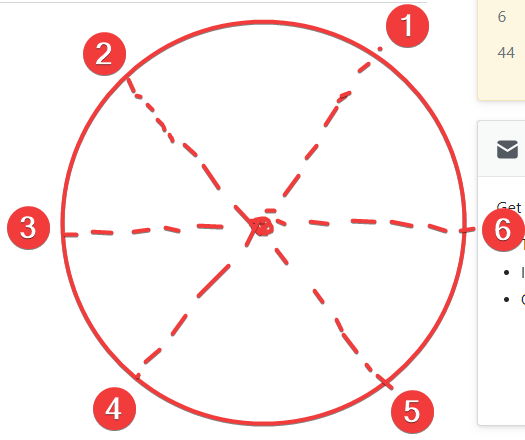
https://i.imgur.com/a6vtSQy.png
So one thing to visualize about cyclotomics are that the 1, 2, 3, 6 cyclotomic roots are some partition of these 6 roots
rustic crown
manually tweaking some 2x2 matrix which had det 1 mod n
tough raven
rustic crown
yea you show one inclusion and show they have equal indices
Yep, the index as a function of m is multiplicative so index_{gcd} index_{lcm} = index_m index_n
coral shale
If you look at the definition of the nth cyclotomic polynomial, hopefully that makes sense?
rustic crown
tough raven
rustic crown
manually tweaking some 2x2 matrix which had det 1 mod n
That seems natural enough to me
Although yes, not cute
rustic crown
oh like i meant, the way i did it wouldn't easily generalize to higher dimensions
so kinda weird
idek if the reduction thingy is surjective for > 2
coral shale
coral shale
If you look at the definition of the nth cyclotomic polynomial, hopefully that m...
I like to think of the process of 'adding more roots' so x^6 -> x^12 for example and consider what happens.
You get 6 more roots, and these correspond to the new factors, so 4th and 12th cyclotomics
I mean - it's not necessarily helpful to the original question, but a useful visualisation to understand what's going on at times
coral shale
coral shale
https://i.imgur.com/a6vtSQy.png
When I suggested 'try m = 2, n = 3' as a hint I was considering this diagram
As I said before though, that might be a dead end, but it was something to try
Algebraically at least, you can verify the equality for that example and maybe gain something from it
The hint given in the SE answer relates to that diagram.
pastel cliff
south patrol
Imo the way to view RCF and its proof is that
-instead of just looking at decom...
what did you mean by T-stable
fleet pelican
that means the subspace contasins its T image
cloud walrusBOT
memeke
 fleet pelican
It is likely in fact that T(W)=W, i.e. it need not be a proper subset
south patrol
Ye and T-stable subspace of V is equivalently a k[t]-submodule of V with the standard thing
fleet pelican
i love linalg, it's so elegant
 south patrol
What anime is that
rustic crown
K-On!
rustic crown
me is rewatching
south patrol
I have dvds for most of them lol
rustic crown
so cool
 rustic crown
i wanna be that cool
oh
but then i'll need a dvd drive to watch the actual animu

first dvd drive, then ethernet port, then headphone jack...... i don't like where this is going
.<
coral shale
#groups-rings-fields-anime
rustic crown


 rustic crown
cwunchy woww twake mew hwome >.<
 lethal dune
what does that even mean
formal ermine
crunchy role take me home
 kind jacinth
why is the second one yes?

is it because it can be contained in either L1 or L4?
and all words are in L1?
rustic crown
pretty much by definition union of regular languages is regular
rustic crown
yea
only L3 isn't regular
answer to first happens to be Y because it only contains like the empty word
rustic crown
kind jacinth
why is L4 regular?
you could explicitly write a regex, (a+b)^3((a+b)^6)*
since number of letters is 3 mod 6
formal ermine
regex uwu
formal ermine
does $\hat{\bZ} = \prod_p \bZ_p$ have a specific name?
cloud walrusBOT
 rustic crown
profinite integers, completion of Z, etc
formal ermine
ah ic
rustic crown
it's also iso to End_{Ab}(Q/Z)
 primal tusk
There is one groups of order 6 in |Zmod2 x Zmod12| due to the fundamental theorem of cyclic groups right
south patrol
what are the bars for
primal tusk
order
south patrol
But like
primal tusk
wait i typed that wrong lmao
south patrol
Oh lol
primal tusk
Zmod2 x Zmod12
south patrol
There is more than one subgroup of order 6
primal tusk
wait but the order is 24 and 6 divides 24 so shouldnt there only be 1?
south patrol
Well Z/2Z x Z/12Z isn't a cyclic group
south patrol
Np
hm tryna determine when $\mathbb Q\Big(\sqrt{\sqrt{5} + a} \Big)/ \mathbb Q$ is normal for $a \in \mathbb Q$. Are there any more general techniques one can apply or is this just a bit of a pain?
cloud walrusBOT
potato
 south patrol
Hm okay so I think i've shown that this is always a degree 4 extension and then I guess it suffices to see whether that splits
which corresponds to when a - sqrt(5) is a square, or (in turn) when a^2 - 5 is a square
I imagine that is kinda the end of the line for what one can do in general though
rustic crown
you can classify such a if you're asking that
we want to classify rational points on the hyperbola x^2-y^2 = 5. since you know (3, 2) is a rational point, any other rational point is then an intersection of a rational line through (3, 2) and the hyperbola
if you call the slope of this line t, then doing some calculations shows that the other intersection point is x = 3 + 2(2t-3)/(t^2+1)
only point we probably could have missed is when the line is vertical, but that point also has x = 3.
void cosmos
rustic crown
we want to classify rational points on the hyperbola x^2-y^2 = 5. since you know...
yo this trick always work right
like starting from one solution and noticing the others are the intersection of tangents or something
rustic crown
yea rationals points are far easier to understand than integer points :p
south patrol
Pain
Yeah I can't tell with Galois/field theory stuffs like
whether something will be a painful calculation or have a neat trick
void cosmos
math shoould have a new patch
where problems involve like certain tags
wether this should be easy or hard
fleet pelican
void cosmos
math shoould have a new patch
I'm a big advocate of math 2.0 hashtag-release-the-upgrade
solar shore
fleet pelican
That’s going to be a subgroup of S_5. Which is reasonable to work with. As oppos...
im fine with doin it abstractly but i was trying to see if i could calculate what elements were in the subgroup at all
i think im doing something wrong though because every calculation ive done ends up like
not being correct if that makes sense
fleet pelican
it does
that's been my experience in the past
its tough to do, easy to make mistakes
solar shore
but maybe ill go down one and try s_4
i think s_5 just has too many to keep track of
fleet pelican
deffo recoomend
solar shore
for me personally
fleet pelican
yeah, same
solar shore
and the s_8 one was just given so i didnt have to do anything 
fleet pelican
i usually prefer more bstract treatments, it helps manage the difficulty setting
fleet pelican
id say, i usually think of these groups in terms of their conjugacy classs now
solar shore
also i was using it as a practice for a test soon where we're calculating permutations by hand :p
fleet pelican
it feels much more natural
solar shore
i c i c
fleet pelican
solar shore
i wanted to get my hands dirty w some calculations though
that is a wonderful instinct
solar shore
also for the specific example i said before, i think i figured out where i was going wrong
for the cyclic subgroup $\langle (123), (12)(345) \rangle$, is $(12)(345)(123)(12)(345)$ in there?
fleet pelican
it looks lke you were only multiplying the base elemnts
cloud walrusBOT
blanket
 solar shore
like is bab in there as well?
fleet pelican
exactly!!
solar shore
oh..
thats why it was terrible to multiply out
ok i see what i've been forgetting then LOL
fleet pelican
in a subgroup, you can also multiply as much as youd like
solar shore
right okay
fleet pelican
gl!
solar shore
thats why i was like, wait why am i not having random elements pop up when i tried ot randomly pick the ones id already calculated
forgot abt the closure of it all
anyways, thank you! appreciate it @fleet pelican

kind jacinth
rustic crown
only L3 isn't regular
For L3 can i not have regex ((ab)^2)^*?
rustic crown
oh . means concatenation
and + is union
so (a+b)^2 means words with letters a, b of length 2
what you wrote means words which are made of abab repeated some number of times
kind jacinth
rustic crown
what you wrote means words which are made of abab repeated some number of times
Ah but id want sth lik aa bb abab which cant be written in regex
Right?
kind jacinth
Woops
Is there a way i can figure out if its regular or not?
Ive hesrd of pumping lemma
rustic crown
yea
kind jacinth
Applied it for L3 but i cant think of how id apply it for L4
rustic crown
another equiv definition is stuff you get from a DFA/NFA
rustic crown
kind jacinth
I see it as a set thats closed
closed under unions, concatenation and star?
kind jacinth
rustic crown
closed under unions, concatenation and star?
Yes
rustic crown
okie, so i think just show that the set of lengths of words in regular language is a finite union of arithmetic progressions
or even better
the set of lengths, if infinite will contain an arithmetic progression
which i think is pretty much obvious from definition
if the set is infinite, then you used * in the regex
so then it contains some arithmetic progression
and clearly set of squares doesn't contain any
ig i pretty much gave a weaker version of pumping lemma lol
kind jacinth
This makes sense for disproving L3. But for L4 how did u instsntly know its regular?
rustic crown
weird question >.<
the language looked "nice" enough to be regular would be the answer :p
more precisely i could imagine an automaton producing that language
because you only need finite memory to store the residue mod 2, 3
but giving a regex is equally easy
intersection of regular languages is also regular, but that may not be obvious from the definition you're using
kind jacinth
rustic crown
you could explicitly write a regex, (a+b)^3((a+b)^6)*
But this onr doesnt include bbb which could work right?
 digital raptor
Is there a name for a module who's ring is countable?
digital raptor
Yeah okay, thanks
rustic crown
countable rings.... haven't heard that much 
kind jacinth
rustic crown
yea sorry i don't know the standard notation
So then bbb is in there. Then using this i can take S=bbb where y=b x=b and z=b then xy^2z gives bbbb but this isnt in the set so it shouldnt be regular based on this definition right?
 rustic crown
ig because algebra is more sensitive with finite/infinite than with countable/uncountable
rustic crown
kind jacinth
So then bbb is in there. Then using this i can take S=bbb where y=b x=b and z=b ...
it only says there exists some pumping length... so what you just showed is pumping length is more than 3 :p
in our case, P = 9 works
do you know this statement? F/k algebraic with F = k(a1, ..., an) is separable if and only if each a_i/k is sep?
oh i had separable degree stuff in mind >.<
south patrol
One nice way is that L/K is separable iff each embedding of K into its algebraic closure can be extended to L in [L:K] ways iirc
rustic crown
yea given an extension F/k you define [F:k]_s as the number of such embeddings
south patrol
I think you can just replace the alg closure w like a galois closure
next obsidian
rustic crown
yea given an extension F/k you define [F:k]_s as the number of such embeddings
No you define it as the degree of the separable closure of k inside of F >_<
rustic crown
.<
south patrol
OwO
Yeah we had a cursed way to show that towers of separable extensions r separable
Hm
next obsidian
south patrol
Yeah we had a cursed way to show that towers of separable extensions r separable
This is kinda just a cursed fact to show
rustic crown
why tho >.<
rustic crown
rustic crown
yea given an extension F/k you define [F:k]_s as the number of such embeddings
if you define sep-deg like this, then it's quite uwu
show this is multiplicative
then a finite extension F/k is sep iff [F:k] = [F:k]_s
and this gives an easy proof of both tower thingy and f.g. with sep generators is sep
south patrol
next obsidian
This is kinda just a cursed fact to show
Fair
rustic crown
embeddings into alg-closure of k
south patrol
Oh the way I gave is the nice one joe
rustic crown
whut is the cursed one 🙈
south patrol
We gave one that does it in the galois case and then deduces from that
But I didn't understand the wording of the problem sheet question we had to do it for and got it wrong apparently (but marked correctly), weird
Lol
So idk full details
rustic crown
yea you probably can do that... but separable degree is such a useful tool when dealing with separability that it's just better to define alg closure before that lol
next obsidian
rustic crown
then a finite extension F/k is sep iff [F:k] = [F:k]_s
But you have to show that this agrees with actually being separable
_<
rustic crown
yee >.<
south patrol
Pain.
rustic crown
lol potato's pain arc
south patrol
Well im just doing some galois problems and they seem to require more tricks
 warm shoal
what would the invertible elements of a direct product of rings look like>
warm shoal
what do u mean?
next obsidian
Joe 1 have you ever met Joe 2
warm shoal
I reckon the identity element is (1, 1)
next obsidian
warm shoal
what do u mean?
Pairs where both sides are invertible
So the units is the product of the units of R and S
south patrol
If L/K/F a tower and M an alg closure and you can extend F -> M to a map K -> M in [K:F] ways, then extend each of those in [L:K] ways to L, you've got [L:K [K:F] = [L:F] extensions of F -> M to L
next obsidian

south patrol
Because Joe Mama
Ye
But composition of normal extensions ain't normal
And I do not know any particularly nice examples lol
south patrol
Well that's what I was thinking lol but ye
What is a nice example of a non normal degree 4
rustic crown
Q(2^1/4)/Q
next obsidian
Yah dumbdumb
south patrol
The example I know from a question I did earlier is like Q(sqrt( sqrt(5) + 2))
south patrol
rustic crown
Q(2^1/4)/Q
Oh okay fair lol
next obsidian
next obsidian
south patrol
Hm why is a real thing enuff
next obsidian
Well you also need an imaginary root
south patrol
Yeah