#groups-rings-fields
1 messages · Page 3 of 1
 pastel cliff
 robust pollen
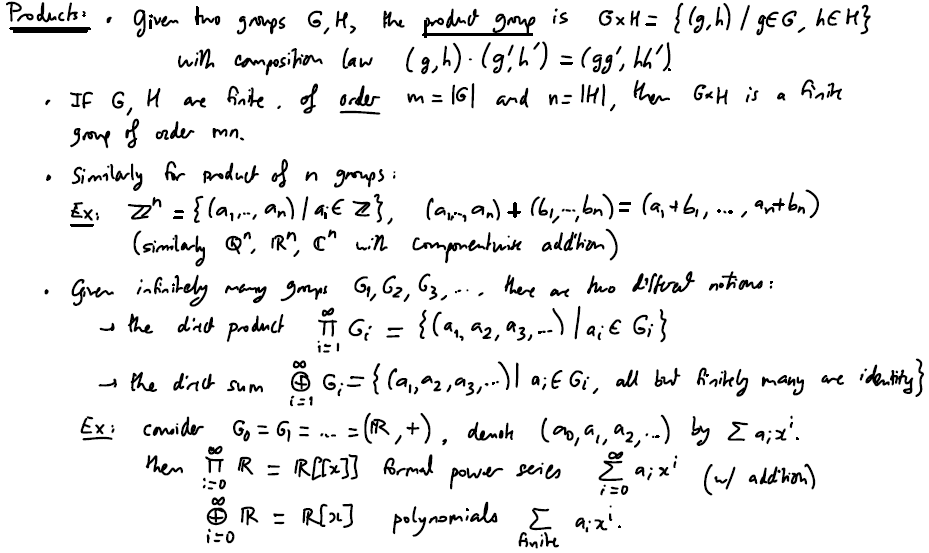
Let $R, S$ be rings, $M$, $N$ a left and a right $R$ module, $X$, $Y$ a left and a right $S$ module.
We can build the product ring $R \times S$. Then we get for example that $M \times X$ is a left $R \times S$-module by componentwise action, right?
So, let's now consider the abelian group $(M \times X) \otimes_{R \times S} (N \times Y)$. My question is whether this is isomorphic to $(M \otimes_R N) \times (X \otimes_S Y)$?
 cloud walrusBOT
expectTheUnexpected
 pastel cliff
is this good enough? feels kinda handwavey but idk what else to write

 eager willow
robust pollen
Let $R, S$ be rings, $M$, $N$ a left and a right $R$ module, $X$, $Y$ a left and...
eager willow
robust pollen
Let $R, S$ be rings, $M$, $N$ a left and a right $R$ module, $X$, $Y$ a left and...
That's true, and in fact this is a R×S module isomorphism
robust pollen
eager willow
That's true, and in fact this is a R×S module isomorphism
How so? The tensor product is just an abelian group. (My rings are not assumed commutative)
eager willow
Oops it's not an isomorphism of abelian groups nevermind
Thought about it more. It respect the scalar multiplication structure but not additive
there's an obvious map defined on simple tensors
$(m , x)\otimes (n, y) \mapsto (m \
$(m , x)\otimes (n, y) \mapsto (m \otimes n, x \otimes y)$
cloud walrusBOT
datorangeguy
 eager willow
but this is not a homomorphism of abelian groups
oh nm it is hahaha I keep flipping
so yeah that's your isomorphism
well... shoot that's not injective is it...
no it is! if both entries on the right are 0 then one of m is 0 and one of y is 0. By tensor relations this means it is 0. And it's surjective. So that's an isomorphism as it's a homomorphism of modules
eager willow
robust pollen
How so? The tensor product is just an abelian group. (My rings are not assumed c...
tensor product of modules is between a right module and a left module, so that an R module structure is defined no matter if R is commutative. Without specifying if modules are given left or right action, there are multiple nonequivalent definitions of the tensor product as a group so it's assumed that M(x)N means M is a right module and N is a left module, with relations ar(x)b = a(x)rb but not ra(x)b = a(x)rb.
oh wait that's not right either ah
robust pollen
eager willow
tensor product of modules is between a right module and a left module, so that a...
Your first sentence is incorrect. If M is right R, N is left R, then how do you define an R-module structure on (M ot N)?
eager willow
I'm just dumb ignore me. but those groups were isomorphic definitely
robust pollen
So basically this was your map in the one direction

 hallow kiln
pastel cliff
is this good enough? feels kinda handwavey but idk what else to write
hallow kiln
pastel cliff
is this good enough? feels kinda handwavey but idk what else to write
<= direction is wrong as you did not explain why |G| cannot have more than one prime factor.
robust pollen
robust pollen
So basically this was your map in the one direction
Oh wait, that's the problem you had before @eager willow . The map I use to define f_1 is not additive. Is it?
eager willow
no it's bilinear like it needs to be. Add things in either the first two or the second two entries to check, not all 4 entries.
robust pollen
oh haha  big dumb
eager willow
yeah that's what I went through on paper and got confused about
robust pollen
very thank
 chilly ocean
I'm pretty sure that's because the "theory" in "wheel theory" doesn't even exist.
 coral spindle
Wheels only exist so people on the internet can say "akshually you can divide by zero  "
"
 rotund aurora
imagine that for every object there were a "theory" of that object, xD
eager willow
robust pollen
very thank
just fyi there's a characterization that occured to me to make me guess it was true that I've thought more on and does work. If you can accept that tensor product over a fixed ring is an additive functor, then your situation is just a special case where the RxS action on A and C is just via R (S torsion), and similarly B and D, and you're looking at $$(A\oplus B)\otimes(C \oplus D).$$ Then if you distribute all the terms and cancel the tensor products that are torsion, you get
$$(A\otimes C)\oplus(B\otimes D)$$
cloud walrusBOT
datorangeguy
 robust pollen
eager willow
just fyi there's a characterization that occured to me to make me guess it was t...
robust pollen
eager willow
just fyi there's a characterization that occured to me to make me guess it was t...
I see, that is a lot easier and without whacky computations involving a million universal properties. Now I need only argue the simple fact that A \otimes_{R \times S} C \cong A \otimes_R C 👍
 sly storm
You can consider the smallest subfield containing the set.
Hello. If $A$ is a finite subset of $\mathbb{C}$ and $r, s \in \mathbb{C}$ are algebraically independent over $A$, then is there an automorphism of $\sigma$ of $\mathbb{C}$ such that $\sigma |_A$ is the identity and $\sigma (r) = s$?
cloud walrusBOT
MathPhysics

 karmic jacinth
Probably
 tender wharf
cloud walrus
**MathPhysics**
tender wharf
cloud walrus
**MathPhysics**
Honestly maybe if you showed some work
sly storm
I have no idea.
tender wharf
MathStackExchange?
 next obsidian
The answer is yes
tender wharf
I'd like to prove that $|G|$ is prime. $G$ is a group with more than 1 element and G has no proper nontrivial subgroups. I have already proved that $G$ is finite. Will this argument work to show that $|G|$ is prime?
Let $|G| = p$. Suppose WPOC that $p$ is not prime. Then, $p = nm$. $1 < n, m < p$ Let $a \in G$ be arbitrary such that $a^n = e$. So $<a>$ is a proper subgroup of G which is a contradiction.
cloud walrusBOT
DerpZ

 agile burrow
The issue with your proof is that there doesn't necessarily exist an element of order n
next obsidian
Why does such an a exist
next obsidian
This is the right train of thought
tender wharf
The contradiction is fine right?
next obsidian
But as Walter said this isn’t possible, take like Z_2^4, every element has order 2
But 16 = 4•4
You have to work a bit harder
tender wharf
Yup I'll go think about it more, thanks!
sly storm
next obsidian
The answer is yes
Why?
pastel cliff
is this reasoning correct
 agile burrow
that sounds fine
pastel cliff
i was starting an argument for each p=2,3,5 but then this occurred to me and it feels to simple ( ) to be true
tender wharf
Does this idea work: Pick some a in G and form <a>. <a> is a subgroup of G for sure. So |<a>| <= |G| if <a> = G then proper subgroups can be found which is a contradiction. If |<a>| < |G| but again that's a contradiction because <a> is now again a proper subgroup of |G|.
agile burrow
why does <a> = G imply proper subgroups can be found?
pastel cliff
im guilty of this too but usually when you have an idea, you can see for yourself if it works with like 5 minutes of work
tender wharf
we assumed |G| is not prime for contradiction
tender wharf
Wouldn't there be a proper subgroup of order |G|/k where k is a divisor of |G|
agile burrow
Yeah, that sounds better
You should try to elaborate on that step, can you be more explicit about how to construct the proper subgroup?
tender wharf
The subgroup is constructed by <a ^ n/k> where k is a positive divisor of |G| = n
Using the fundamental theorem of cyclic groups
Thank you very much for your help
 south patrol
oh lol i was gonna say just cauchy it
but I suppose you want to avoid that / haven't been taught that
tender wharf
Yeah I wanted to avoid that since it's from a later chapter
I'm self learning so I definitely haven't been taught it
pastel cliff
can i get a hint for finishing this? mathoverflow soln uses group actions but im wondering if there's a direct argument i can use here, and if what i have so far is good
 coral spindle
The typical way to do this is to show it has nontrivial center, then show that if G/Z(G) is cyclic then G is Abelian.
Neither of these are super hard, but the first part is harder than the second.
pastel cliff
yeah that's what i found online but id already started like this and i got stuck on the last bit
though idk if a group where every element has order p must be abelian
coral spindle
Well I think you should prove that first
 pastel cliff
i thought it would follow pretty easily from the fact that x is not in the cycle generated by y and also has order p
coral spindle
I don't think so
I want more justification
and if you can't justify it, then you shouldn't use that
There are groups, for example, where x and y are of order p, but <x,y> is infinite
coral spindle
That still doesn't help me see why <x,y> has order p^2
pastel cliff
informally, can i say that since x is not in the cycle generated by y, it must generate its own cycle. by assumption they both have order p, so both cycles must be of order p
coral spindle
Yes that's totally normal
but that doesn't tell me why <x, y> has order p^2
at best it tells me that |<x, y>| >= 2p-1
Also this is a more fundamental error
but G = <x,y> does not mean that G is cyclic
and in fact, you conclude in every case that G is cyclic, and this is just wrong.
pastel cliff
coral spindle
but G = <x,y> does not mean that G is cyclic
dihedral group should counter example this right
coral spindle
Well yes, but I should just say that that's not the definition!
pastel cliff
nah i see why this is wrong anyways
i'll do it the Z(G) way
t minus 20 hours until my midterm 
chilly ocean
Hey. I'm tired and v sleep-deprived.
Can I get a sanity check?
Let either one or both of G and H be NON-cyclic groups.
Then the direct product of G x H is necessarily also NON-cyclic.
In other words, if G is a NON-cyclic group.
Let H be any group.
Then G x H is necessarily NON-cyclic.
This is true, right?
chilly ocean
chilly ocean
Hey. I'm tired and v sleep-deprived.
Can I get a sanity check?
Let either one o...
Yes because any subgroup of a cyclic group is cyclic, and G can be identified with a subgroup of G x H
you could sanity check it after getting a good 8 hours you know
chilly ocean
chilly ocean
Yes because any subgroup of a cyclic group is cyclic, and G can be identified wi...
Thank you! X__X
chilly ocean
chilly ocean
you could sanity check it after getting a good 8 hours you know
Wow, why didn't I think of that?
south patrol
Or I guess you can use the projection G x H -> G to see that any generator of G x H would give you a generator of G, but that amounts to the same thing more or less
 white nymph
is there a nice way to simplify $\prod_{i=0}^{n-1} (q^n-q^i)$ ? im looking to compare that quantity with $q^{n^2}$. i didn't really know where to put this so i put it here since it comes from a problem where im figuring out the probability a random nxn mtx over a finite field (with $q$ elts) is invertible.
cloud walrusBOT
EricW

 delicate bloom
compare in what way? since $q^n-q^i<q^n$ you can get the inequality that the product is less than $q^{n^2}$ if that's what you're after
cloud walrusBOT
Merosity

 glossy crag
white nymph
is there a nice way to simplify $\prod_{i=0}^{n-1} (q^n-q^i)$ ? im looking to c...
glossy crag
white nymph
is there a nice way to simplify $\prod_{i=0}^{n-1} (q^n-q^i)$ ? im looking to c...
You can write it as $q^{\frac{n(n-1)}{2}}\prod_{j=1}^{n}(q^j-1)$, so it's better comparable with $q^{n^2}$, but I don't see any other simplifications.
cloud walrusBOT
Ocean Man
 white nymph
i was looking to divide that product by q^(n^2)
delicate bloom
you could write it as a product of q^n with the same indices, then reindex to k=1 to n of (1-1/q^k)
glossy crag
white nymph
i was looking to divide that product by q^(n^2)
You can divide the expression I wrote by it and get q^(-n/2)m, where m is P_j(q^j-1). If q happens to be prime, m will not be divisible by q.
Does this automatically prove that every symmetric polynomial is a polynomial in the s_k? Every such polynomial is an element of L^{S_n}, so there must be a rational function in the s_k equal to it. Does it also follow that there must also be a polynomial in the s_k equal to it?


 shell brook
 peak hornet
The zero morphism, no?
chilly ocean

shell brook
I guess in Grp that is a homomorphism A -> B that sends everything to 1_B
chilly ocean
this shouldn't be an "i guess"
shell brook
I mean I'm right
peak hornet
so my idea for this question
is just $\phi(h) = e_g$, the identity element in the group $G$
cloud walrusBOT
failingphysics
 peak hornet
i don't want to know the solution if this is wrong
but if it is wrong can someone help me understand why it's not the right one?
I know it's well defined because if h_1 = h_2 then $\varphi(h_1) = \varphi(h_2) = e_G$
cloud walrusBOT
failingphysics
I know it's well defined because if h_1 = h_2 then $\varphi(h_1) = \varphi(h_2) = e_G$
```Compilation error:```! Missing $ inserted.
<inserted text>
$
l.57 I know it's well defined because if h_
1 = h_2 then $\varphi(h_1) = \var...
I've inserted a begin-math/end-math symbol since I think
you left one out. Proceed, with fingers crossed.
LaTeX Font Info: Calculating math sizes for size <14> on input line 57.
LaTeX Font Info: Trying to load font information for U+msa on input line 57.``` peak hornet
so it is a function
and furthermore it is a group morphism because $\varphi(h_1h_2) = e_G$ and $\varphi(h_1) \cdot \varphi(h_2) = e_G \cdot e_G = e_G$
cloud walrusBOT
failingphysics

 tribal moss
peak hornet
is just $\phi(h) = e_g$, the identity element in the group $G$
tribal moss
peak hornet
is just $\phi(h) = e_g$, the identity element in the group $G$
That won't work -- it's a homomorphism all right, but it doesn't make the diagram commute.
peak hornet
why not? we have $\alpha(h) = e_G$ and $i \circ \varphi(h) = i(e_G) = e_G$
cloud walrusBOT
failingphysics
 shell brook
(Check the LHS triangle, that's what you're interested in making commute)
tribal moss
You don't necessarily have alpha(h) = e_G, only f(alpha(h)) = e_G'.
peak hornet
ahhhhhh
yes i misread the question
ok let me go back and try to figure it out then
thanks
tribal moss
(The diagram is missing a null map from H to G', really).
cloud walrusBOT
failingphysics
 shell brook
Yes
tribal moss
peak hornet
null map?
"trivially constant" map or whatever your exercise called it
shell brook
Tropo is saying that f \circ \alpha being constant trivial is the same as saying that there is a constant trivial map H -> G' and the diagram commutes
pastel cliff
is there a proper non-abelian subgroup of S_n which acts transitively on {1, ... , n}
assuming n \geq 4
actually
ive asked this before but i'll reask
what does it mean for the "natural action" of a subgroup of S_n on {1, ... , n} to be transitive
im assuming that the natural action simply refers to the permutation described by each element of S_n
so that being transitive means that there is only one orbit of this action
tribal moss
A_n ought to qualify.
tribal moss
pastel cliff
im assuming that the natural action simply refers to the permutation described b...
Yes.
 tribal moss
Or D_2n.
pastel cliff
can i get a small nudge pls - mechanically, it seems like showing that forall x,y \in {1, ... ,n}, there exists a g \in A_n s.t. g(x) = y would be easier than showing that it has only one orbit but idk how to start that
i know that those two things are basically the same, i moreso mean the actual method of the proof
tribal moss
It's a "just do it" thing. After you set g(x)=y, fill in the rest of the values of g randomly to get a bijection. If that ends up producing an odd permutation, swap g(a) and g(b) for some a and b that are both different from x.
pastel cliff
im not sure i follow, wdym fill in the rest of the values randomly
tribal moss
Any which way you like.
Or if you want to be more concrete than that, pick a z distinct from both x and y and consider the 3-cycle (x y z).
pastel cliff
i understood it but may have over simplified?

mildly related but how often to short exact sequences come up
im studying for an exam and my understanding of semi direct products is pretty lacking atm, but group extensions are directly (ha) related to that right?
tribal moss
pastel cliff
(x y) is not in A_n.
 pastel cliff
tribal moss
Or if you want to be more concrete than that, pick a z distinct from both x and ...
pastel cliff
tribal moss
Or if you want to be more concrete than that, pick a z distinct from both x and ...
that's why you said this lol
tribal moss
pastel cliff
mildly related but how often to short exact sequences come up
Pretty much all the time, inasmuch as "short exact sequence" is the category-theoretic ways to talk about quotient objects, and quotients are everywhere.
pastel cliff
another quickie but does this look sound?

my main concern is the handwavey argument that that is in fact the klein 4 group in A_4
tribal moss
No, that sounds convincing.
pastel cliff
what is the motivation for considering semi direct products
that's probably an incredibly broad question so if there's something more refined that i should be asking about that would also be useful and col
next obsidian
Within group theory they help@you classify groups
They also are exactly the split exact sequences
And show up in places groups show up in nature, like in NT
chilly ocean
pastel cliff
what is the motivation for considering semi direct products
I only saw them ever used as "yeah that group is just a semidirect product of these two groups"
Which honestly doesn't tell you that much
pastel cliff
the way im understanding it is that it’s moreso a property of a group
chilly ocean
It's more like a construction
We can just think about it internally
For other structures we do similiar things, like direct sum of vector spaces, or subdirect product of rings
I'm actually not sure if internal subdirect product is a thing

pastel cliff
this smells important?
 chilly ocean
It's like Chmonkey already said. You describe groups using semidirect products, it's just kinda an useful way
Like for exemple the dihedral groups, you havy x, y as generators and you can write yx = x^a y^b
pastel cliff
semi direct product of C_2 and C_n right 
pastel cliff
im reviewing my prof's lecture notes from a week where i was terribly sick, we apparently spent three whole lectures on semidirect products lol
chilly ocean
Dihedral group is what I think about for semidirect products
Oh. Maybe they have more applicatioms than I thought. Spending 3 whole lectures on them 
pastel cliff
something something finitely generated abelian groups
i would post the notes but i dont wanna doxx myself lol
pastel cliff
yeah that's like the ultimate thing it proves
chilly ocean
Oh
pastel cliff
 chilly ocean
I guess you could state it as
Any finitely generated abelian group is isomorphic to a product of quotients of Z
pastel cliff
yeah i see that
there's no way i learn all this tonight lmao, t minus 9 hours until exam
chilly ocean
It seems a little bit more like something that has potential generalizations
Then
Any finitely generated R-module is isomorphic to a product of quotients of R perhaps?
I think that's a theorem?
pastel cliff
idk what a module is
chilly ocean
A vector space but over ring
pastel cliff
the only ring i fuck w is elden ring
 lethal dune
chilly ocean
Any finitely generated R-module is isomorphic to a product of quotients of R per...
lethal dune
chilly ocean
Any finitely generated R-module is isomorphic to a product of quotients of R per...
over PID yes
ftofgmopid
chilly ocean
lethal dune
over PID yes
Is there a homological proof?
pastel cliff
this should just be an application of orbit stabilizer right
 lethal dune
do you need orbit stab for this?
pastel cliff
the equality looks very similar to |G| / |Stab(g)| = |Orb(g)|
chilly ocean
lethal dune
proves I've seen uses SNF
SNF?
lethal dune
smith normal form
chilly ocean
Ah. It's a known acronym to me
 chilly ocean
Yes
chilly ocean
chilly ocean
Ah. It's a known acronym to me
It's not a known acronym by me*
robust pollen
pastel cliff
what is the motivation for considering semi direct products
In hindsight, a motivation could be: linearizing the concept of "semidirect product of groups" leads to "smash product of Hopf algebras", and these have some very nice categorical interpretations.
If I have a ring R, an element x in R, what does the ideal R x R look like? Is it elements of the form rxs with r, s in R, or is it elements of the form r_1 x s_1 + r_2 x s_2 + ... + r_n x s_n ?
chilly ocean
The latter
robust pollen
Ya I'm dumb... otherwise it wouldn't even be a subgroup of the abelian group lmao
chilly ocean
Because it contains rxs and you make it an ideal so throw all additions too
And then it satisfies the definition so we're done
If R were just a semigroup then it would be the former though
robust pollen
I was a bit confused by, for example, how Rx looks like.
chilly ocean
Yeah, it's confusing
But even more confusing is remembering which of Rx, xR is left and which one is right ideal
Commutative rings ftw
robust pollen
chilly ocean
But even more confusing is remembering which of Rx, xR is left and which one is ...
hm, I don't think so. Rx captures multiplication on the left, so it's a left ideal
robust pollen
chilly ocean
Commutative rings ftw
Nah 😄 tbh I've been doing abstract stuff so much that I don't even want to consider the category of vector spaces anymore, I
I'd rather consider the category of bimodules over a field. But that really is confusing.
chilly ocean
Lol
If that's something you like
I think it's okay to consider left/right ideals as long as you stick to one. Probably better to remember too if you do that
coral spindle
Have you seen that irreps of Abelian groups over an ACF are dim 1?
This is that + Mashke
You just consider it on the subgroup <g>.
This will have been discussed earlier in these notes so I suggest you go back and check
<g> is Abelian.
coral spindle
coral spindle
You just consider it on the subgroup <g>.
Like I said here…
sly storm
Hello. If $A$ is a finite subset of $\mathbb{C}$ and $r, s \in \mathbb{C}$ are algebraically independent over $A$, then is there an automorphism of $\sigma$ of $\mathbb{C}$ such that $\sigma |_A$ is the identity and $\sigma (r) = s$?
cloud walrusBOT
MathPhysics

 trail stump
so I guess an orbit of a permutation of a set A can only have one element?
 hidden haven
sly storm
Hello. If $A$ is a finite subset of $\mathbb{C}$ and $r, s \in \mathbb{C}$ are a...
hidden haven
sly storm
Hello. If $A$ is a finite subset of $\mathbb{C}$ and $r, s \in \mathbb{C}$ are a...
Yes. Let k denote the algebraic closure of ℚ(A) inside ℂ, which doesn't contain r or s. Then you want an extension of the identity automorphism of k to a map with r ↦ s. Extend both r and s to transcendence bases B and C of ℂ over k, and B and C must have the same cardinality. Take a bijection between the 2 that maps r to s. Extend this to a map of the purely transcendental part of the extension, then extend to a map of the algebraic closures (which is ℂ in both cases)
Commuting operators have the same eigenvalues
In the sense that any eigenvalue of one is an eigenvalue of the other
 sharp dirge
how to show 3 is irreducible in $Z[\sqrt{-5}]$
cloud walrusBOT
pewdssssssss
 sharp dirge
just straight from defintion ?
chilly ocean
N(x+sqrt(-5)y) = x^2+5y^2, then N(3) = 9
But there is no a with N(a) = 3
coral spindle
We consider the representation restricted to <g>. It is diagoalisable by the theorems I mentioned (i.e. it has a basis of eigenvectors, which are just 1d reps) so we are done
sharp dirge
chilly ocean
N(x+sqrt(-5)y) = x^2+5y^2, then N(3) = 9
But there is no a with N(a) = 3
wym
chilly ocean
N(u) = 1 iff u is a unit, so the only way that 3 could be reducible if 3 = ab where N(a) = N(b) = 3
because N is multiplicative
sharp dirge
why cant N(a) = 9
sharp dirge
ye so 3 is irreducible
so you are saying that N(a) or N(b) has to be 9
@chilly ocean
chilly ocean
Rather, I'm saying N(a) or N(b) has to be 1
so one of them is a unit
I'm not an algebraic number theorist in disguise
sharp dirge
chilly ocean
Rather, I'm saying N(a) or N(b) has to be 1
kk in turn one of them has to be a 9
and norm = pm 1 iff unit
chilly ocean
sharp dirge
kk in turn one of them has to be a 9
But I don't care if they are 9
sharp dirge
yea but it implies that the other hast o be 1
whats a good way to show that (3) is not prime in Z[\sqrt{-5}] ?
lethal dune
look at (1+sqrt(-5))*(1-sqrt(-5))
sharp dirge
thnx
cloud walrusBOT
koaaa

 weak flower
Also I wonder if $V^* \otimes_{kG} W$ is the vector space of the module morphisms. It is naturally a quotient of $V^* \otimes_k W$, which reminds me of some projection formula. However the projection formula requires the finiteness of $G$ but this construction only of $V,W$, so I guess I’m missing something here.
cloud walrusBOT
koaaa
 weak flower
Wait no, it’s some sort of biggest quotient of Hom on which G acts trivially… I don’t know how to describe that.
pastel cliff
how is the normalizer condition weaker?
 sly storm
hidden haven
Yes. Let k denote the algebraic closure of ℚ(A) inside ℂ, which doesn't contain ...
sly storm
hidden haven
Yes. Let k denote the algebraic closure of ℚ(A) inside ℂ, which doesn't contain ...
Thank you.
 patent ocean
If shown that it is well defined. Do I need to use sequences to show that 1/f is continuous on this open ball
 chilly ocean
algebra?
chilly ocean
patent ocean
If shown that it is well defined. Do I need to use sequences to show that 1/f is...
like TTerra is trying to say, it's not algebra, but this just follows from continuity of 1/x
lethal dune
talgebra
chilly ocean
chilly ocean
like TTerra is trying to say, it's not algebra, but this just follows from conti...
"trying to say"?

patent ocean
chilly ocean
like TTerra is trying to say, it's not algebra, but this just follows from conti...
So do I assume the distance fund used in the reals is the modulus
Oh my bad which channel is metric spaces
 lapis trail
How do I solve this?
 chilly ocean
lapis trail
How do I solve this?
chilly ocean
lapis trail
How do I solve this?
assuming if f:Z/2Z to S_5, by conjugate of f by g in S_5 you mean x -> gf(x)g^-1, note that f(1) must be trivial or 2-cycle
also, g(i, j)g^-1 = (g(i), g(j))
lapis trail
Oh, I think I see what I did wrong
chilly ocean
I don't like how they say "the number" though
seems like they want number of conjugacy classes for a non-trivial homomorphism
 chilly radish
chilly ocean
assuming if f:Z/2Z to S_5, by conjugate of f by g in S_5 you mean x -> gf(x)g^-1...
chilly radish
chilly ocean
assuming if f:Z/2Z to S_5, by conjugate of f by g in S_5 you mean x -> gf(x)g^-1...
It can also be a product of 2 disjoint transpositions
chilly ocean
Oh right.
chilly radish
chilly ocean
seems like they want number of conjugacy classes for a non-trivial homomorphism
Seems to me they want the number of conjugacy classes of Hom(Z/2,S_5), that is "the number"
chilly ocean
Ah. I was thinking of amount of elements in each conjugacy class. Makes sense
chilly radish
chilly radish
Seems to me they want the number of conjugacy classes of Hom(Z/2,S_5), that is "...
This isn't a group I don't think, but I don't think that should matter either way
lapis trail
The next question is the amount in each
pastel cliff
pastel cliff
<#578008840193310740>
just finished my midterm, if i knew like 3 more facts about semi direct products i would've done sm better 
sharp dirge
I want to show $(2, 1 + \sqrt{-5}) \neq (a + b\sqrt{-5})$ in $\mathbb{Z}[\sqrt{-5}]$. i.e not a principle ideal in the quadrratic ring. Suppose that $(2, 1 + \sqrt{-5}) = (a + b\sqrt{-5})$. Then $2 = \alpha (a + b\sqrt{-5}), Applying norm. 4 = N(\alpha)(a^2 + 5b^2)$ . Which implies that $a^2 + 5b^2 = 1,2,4$. It cant be 2 cuz no solutions. If $a^2 + 5b^2 = 4$, Then $a = \pm 2$ which implies $1 + \sqrt{-5} = \pm 2c \pm 2d\sqrt{-5}$ which cant happen. So if $a^2 + 5b^2 = 1$ then $a = \pm 1$. Which implies that $2x + (1 + \sqrt{-5})y = 1 $. after multiply by $1 - \sqrt{-5}$ it implies that 2 divides $1 - \sqrt{-5}$ which cant happen. so $(2, 1 + \sqrt{-5})$ is not principle
cloud walrusBOT
pewdssssssss
 sharp dirge
anyone can say if this looks ok?
lethal dune
sharp dirge
anyone can say if this looks ok?
what did you do in the last part? 2x+(...) shows 2 divides 1-sqrt(-5)
sharp dirge
if a = plus minus 1
then (2, 1 + \sqrt{-5}) = (1)
so 2x + (1 + \sqrt{-5})y = 1
x,y in Z[\sqrt{-5}]
then multiply by 1 - \sqrt{-5}
for contradiction
does that work?
lethal dune
you are getting 2x{1,-1}+6y = 2{1,-1} => 2(x-1){1, -1} = -6y => (x-1){1, -1} = -3y
what after that? {1, -1} = 1-sqrt(-5)
sharp dirge
so $2x + (1 + \sqrt{-5})y = 1$ then $2x(1 - \sqrt{-5}) + (1 - \sqrt{-5})(1 +\sqrt{-5})y = 1 - \sqrt{-5}$
cloud walrusBOT
pewdssssssss
 sharp dirge
then $2x(1 - \sqrt{-5}) + 6y = 1- \sqrt{-5}$
cloud walrusBOT
pewdssssssss
 sharp dirge
then $2 (x(1-\sqrt{-5}) + 3y) = 1 - \sqrt{-5}$
cloud walrusBOT
pewdssssssss
 sharp dirge
awesome 
lapis trail
Is using a shit ton of symbols the norm in writing for abstract algebra, and I just need to get gud; or is it poor, unclear writing? I borrowed a book and I have to keep searching to know what their notation means.
It might be easier to understand if I completed the book cover to cover but I don't have time for that
lethal dune
you have time to complain
lapis trail
I take that as a yes?
lethal dune
take that as 'idk'
coral spindle
Without an example of what you're referring to it's hard to tell.
lapis trail
"Group Theory" by W.R. Scott is the book if anyone knows it
coral spindle
You're right, we should only talk about things that we already know about. No new things.
pastel cliff
i only know that i know nothing
chilly ocean
coral spindle
You're right, we should only talk about things that we already know about. No ne...
what about the new things that we already know about
coral spindle
Define what you mean by—WAIT NO
 formal ermine
why is $(ab)\inv = b\inv a\inv$
cloud walrusBOT
illuminator3 (#eric4honorable)
 coral spindle
Remember that the inverse is unique?
coral spindle
Well notice that $(b^{-1}a^{-1})(ab) = b^{-1}(a^{-1}a)b = e$
cloud walrusBOT
Boytjie
 formal ermine
yeah
coral spindle
Well you noticed it before I could finish
chilly ocean
formal ermine
what does "structure preserving" mean?
it's informal speech
if your structure has addition for example, we preserve addition
if it has order, we preserve the order
if it has multiplication, it preserves multiplication
formal ermine
what does 'preserve' mean here?
chilly ocean
commute with operations/if relation holds then it holds under the map as well
it depends on if we are talking about preserving a particular n-ary operation or an n-ary relation
moreover we can talk about preserving something else
so it's more complicated than that
formal ermine
chilly ocean
it depends on if we are talking about preserving a particular n-ary operation or...
no idea what that means. for context, my prof said "a homomorphism is a structure preserving map" so I was wondering what it means in that context
chilly ocean
it means that it commutes with operations
so what the definition of homomorphism says
formal ermine
chilly ocean
it means that it commutes with operations
what does to commute mean here
formal ermine
chilly ocean
but for maps
wdym?
formal ermine
chilly ocean
did you read the definition of homomorphism
yes
I'm just having a hard time right now because my lecture is in german and all of the terms are different in english
chilly ocean
symbols are the same
just stare at the definition of homomorphism and you'll see it
formal ermine
I still don't understand what "it commutes with operations" means
chilly ocean
formal ermine
I still don't understand what "it commutes with operations" means
the order in which you apply the map and the group operation doesn't matter. you can do them in either order and get the same result. they commute
formal ermine
chilly ocean
the order in which you apply the map and the group operation doesn't matter. you...
but that's the definition of a homomorphism, no?
chilly ocean
yes, and?
chilly ocean
Can Fraleigh be a enough prerequisite for Eisenbud?
coral spindle
I would say so, yes
chilly ocean
But I've read fraleigh and then read eisenbud but couldn't understand...
Is it cause of that I didn't read chapters with a asterisk? ..
coral spindle
So you're saying you only read parts of fraleigh? I think that explains it.
 soft skiff
coral spindle
soft skiff
coral spindle
Don't spam requests for your help channel in unrelated channels.
 sage spruce
I guess in C*-algebras
 zenith quiver
if H is a subset of G, it's automatically associative right?
sage spruce
zenith quiver
if H is a subset of G, it's automatically associative right?
Yes
But the product does not necessarily remain in H
So it's not an internal law anymore
 upper pivot
 ruby sundial
Is there an algebraic way to talk about integration?
ruby sundial
Is there an algebraic way to talk about integration?
Yeah I mean integrals are basically just linear operators on e.g. compactly supported functions on X
Riesz representation is maybe what you are looking for
If you look into some of Pedersons work, he hates measure theory and wants to replace it with a more linear algebraic formulation
Maybe you will find some of this useful
(His book analysis now has a chapter that does measure theory 101 in this framework)
zenith quiver
how do we get the identity in C(a) {gag^-1=a} I'm assuming we can set a as g to get g(gg^-1)=g, can we say the identity is in C(a) because of this?
zenith quiver
zenith quiver
how do we get the identity in C(a) {gag^-1=a} I'm assuming we can set a as g to ...
or wait if g and g^-1 exists in C(a) can't i just say gg^-1=e thus e is in C(a)?
 drowsy summit
I'm taking my first formal abstract algebra course (mostly group theory stuff), and something that has confused me consistently is why, if the definition of "operation" suggests that we may only call a rule an operation if it maps an ordered pair in a set to one element of the set. However, in computer science and philosophy, we often refer to unary operators and ternary operators. If something like logical not isn't an operation, what is it?
sage spruce
drowsy summit
I'm taking my first formal abstract algebra course (mostly group theory stuff), ...
It's not an operation it's an internal law
Which is bery specific
You can define all kinds of operations in fact
drowsy summit
Interesting okay. I'll look internal law up
Thank you
I imagine then that it's just lazy language to call something like logical not an operator?
sage spruce
zenith quiver
how do we get the identity in C(a) {gag^-1=a} I'm assuming we can set a as g to ...
Just gag^-1=agg^-1=a in C(a)
sage spruce
drowsy summit
I imagine then that it's just lazy language to call something like logical not a...
It's a boolean operator defined on specific sets
zenith quiver
sage spruce
Just gag^-1=agg^-1=a in C(a)
we didnt assume its abelian
drowsy summit
So I can refer to n-ary rules with arbitrary n as operations?
zenith quiver
im too early to know what commutant is
sage spruce
zenith quiver
im too early to know what commutant is
C(a) is defined as the commutant of a isn't it? (Like the set of elements that commute with a)
drowsy summit
Thank you that clears up a lot actually
My professor was faily adamant about operations needing to be binary, which seemed off
zenith quiver
sage spruce
C(a) is defined as the commutant of a isn't it? (Like the set of elements that c...
to me they just defined it as C(a)={gag^-1=a} and asked to prove its a subgroup of G when a is in G
sage spruce
Which means that ga=ag
zenith quiver
sage spruce
Which means that ga=ag
how
sage spruce
Multiply by g on the right
tender wharf

from gallian
It's the same thing as that definition yeah although this one is a bit clearer imo
chilly ocean
upper pivot
If you look into some of Pedersons work, he hates measure theory and wants to re...
based
zenith quiver
SL2(R) is a group under addition right?
 hollow mica
I'm trying to see why every abelian group admits a unique Z-module structure
I know how to find the module: just define scalar multiplication as n * g := (g + g + ... + g) where there are n g's
I'm not sure how to prove that this module is unique
rotund aurora
I think its just because 1*v should be v, and Z is generated by addition from 1
hollow mica
ohh
that makes sense

this is an alternative proof that I'm trying to understand
it's the same for the most part except it uses the "endomorphism ring of a group"
I'm not sure what they mean by "By applying this to End(G)...", could anyone explain?
zenith quiver
can anyone find the wiki for this? im dying to get information on it i know its all the 2x2 matrices with det not equal to 0 but i cant find visual confirmation of it anywhere
 hollow mica
usually M_n(F) means all n by n matrices with entries in a field F
sometimes M_{x, y}(F) means all the x by y matrices with entries in a field F
maybe here it is the latter and they forgot the comma
if you don't want matrices with det equal to 0 you usually notate this as GL(R, n), the "general linear group"
zenith quiver
so in this case, theyre talking about GL(2,R)
 hollow mica
no where do they say the det has to equal 0
hollow mica
hollow mica
sometimes M_{x, y}(F) means all the x by y matrices with entries in a field F
so this
hollow mica
hollow mica
no where do they say the det has to equal 0
like H very clearly has elements with det equal to 0
zenith quiver
hollow mica
like H very clearly has elements with det equal to 0
if H very clearly has elements with det equal to 0 then how is it a subgroup since it's inverse would be 1/det
hollow mica
the group operation in M_{2, 2}(R) is addition
that's why it also has people with det equal to 0
whereas GL(R, n) doesn't (group operation is multiplication)
zenith quiver
hollow mica
the group operation in M_{2, 2}(R) is addition
so is the identity for this group 0? or (0,0,0,0)
hollow mica
the identity is the 0 matrix, the matrix with entries all equal to 0, but it is very common to denote the identity in groups with an additive structure as just the number 0
hollow mica

I'm confused
isn't R the set of two variables polynomials in x and y
so like some sum a_{i,j} x^i y^j
and then the ideal generated by x, y is I = {ax + by | a, b \in k}
for a module to be free over R, it can't be isomorphic to any power of R (definition)
why is I not isomorphic to any power of R?
agile burrow
hollow mica
I'm not sure what they mean by "By applying this to End(G)...", could anyone exp...
do you understand why a Z-module structure on G is the same as a ring homomorphism Z -> End(G)?
hollow mica
yes, it's like currying
pastel cliff
walter that graduate+ role looks mighty fine on you
hollow mica
z -> (g -> g) is equivalent to (z, g) -> g
agile burrow
Do you understand why there's a unique ring homomorphism Z -> End(G)?
pastel cliff
could i possibly bother you about some grad-related questions? i have an important decision to make soon and ive been told talking to other students is a good idea
agile burrow
pastel cliff
could i possibly bother you about some grad-related questions? i have an importa...
i'm not a grad student lol
 wicked zephyr
hollow mica
and then the ideal generated by x, y is I = {ax + by | a, b \in k}
wicked zephyr
hollow mica
and then the ideal generated by x, y is I = {ax + by | a, b \in k}
is a module over itself, so that ideal is {ax+by with a,b in k[x,y]}
hollow mica
agile burrow
Do you understand why there's a unique ring homomorphism Z -> End(G)?
oh ah I see it now
hollow mica
wicked zephyr
is a module over itself, so that ideal is {ax+by with a,b in k[x,y]}
oh yeah
that
pastel cliff
nvm lmao
i also realize im doing the literal "hey can i ask u dis help me pls urgent" but talking to literally anyone would be helpful, dont kill me mods
hollow mica
wicked zephyr
is a module over itself, so that ideal is {ax+by with a,b in k[x,y]}
but isn't that just k[x, y] without elements with constant term = 0
agile burrow
if (x, y) were free, what do you think the rank would be?
wicked zephyr
hollow mica
but isn't that just k[x, y] without elements with constant term = 0
in deed
hollow mica
(x, y) is the submodule generated by x, y? (the same one as above)
wicked zephyr
yeah
hollow mica
i would think the rank is 2
in fact i don't know why it isn't
isn't it by definition generated by a two element set
wicked zephyr
it is not difficult to prove that in general, a free ideal over domains are generated by just one element
hollow mica
agile burrow
The issue is that x and y don't form a basis for a free module
well
I have two definitions of free module rn
wicked zephyr
so, if a,b are distinct elements, then a(b)+b(-a) is linear depende, and therefore these cannot form a basis.
But then it reduces the problem to prove that (x,y) is not a principal ideal in k[x,y]
hollow mica
"isomorphic (as modules) to some power of the ring it is over"
and
"has some finite basis"
is {x, y} not a basis for the submodule we just generated by definition?
wicked zephyr
which you can do using coprimality of the variables I think
wicked zephyr
You have to be careful, we are considering as a module over k[x,y]
hollow mica
ok let me write up a proof
wicked zephyr
Did you get the idea?
hollow mica
I think
zenith quiver
this is honestly a bit confusing, a lot of variables and I'm not sure what i should work with
 hollow mica
consider the module k[x, y], and the submodule {a*x + b*y | a, b \in k[x, y]}.
wait shit
we only showed {a, b} isn't a basis
we didn't show there exists no basis
agile burrow
Potitov06 explained why if I is an ideal which is a free module, then I must be principal
hollow mica
ah ok I see
another side question
R is clearly free over R for any ring R
by the definition "must be isomorphic to some power of the base ring"
but how do I see this from the definition "has a finite basis"
what's the basis of the R-module R
agile burrow
{1}
hollow mica
oh true
lapis trail
Is there a way to construct a homomorphism based on what properties must be conserved?
delicate bloom
maybe?
lapis trail
How about an homomorphism from a space onto itself?
delicate bloom
whos gonna stop me if i do?
 delicate bloom

zenith quiver
if i have an element lets say A with order n, and an element B with order m can AB be infinite?
agile burrow
Yes. Consider the group G with presentation <A, B | A^n = B^m = e>
Alternatively, you could probably construct some examples with small matrices
zenith quiver
agile burrow
Yes. Consider the group G with presentation <A, B | A^n = B^m = e>
yeah ive got a matrices problem where the order of A is 4 and order of B is 3 but it feels like it doesnt make sense because when i take AB then find the order it turns to be infinite but shouldnt AB just be 12? 4*3?
agile burrow
No, you can't expect that to be true in general when your elements don't commute
zenith quiver
so A^12B^12 =/= (AB)^12?
agile burrow
Right
zenith quiver
if my elements dont commute?
agile burrow
Exactly
And you can see this very explicitly by just writing out what (AB)^12 is; it's just (AB)(AB)...(AB) 12 times
You can't necessarily rearrange this to be A^12 B^12 when A and B don't commute
 agile burrow
What are the properties a subset of G needs to satisfy to be a subgroup?
zenith quiver
non empty, has the identity, a,b belongs to the subset then ab^-1 must belong there too
zenith quiver
agile burrow
What are the properties a subset of G needs to satisfy to be a subgroup?
but here, do i prove its a subgroup of H or G, since if its a subgroup of H then its a subgroup of G but here they're talking about x in G and h in G
agile burrow
You prove it's a subgroup of G. In fact, K is not necessarily a subgroup of H. As it's defined, K is the set of elements x in G such that x = aha^-1 for some h in H. However, there's no reason aha^-1 should be in H if a is not in H.
zenith quiver
if we take the inverse of x=aha^-1 it'll be a^-1h^-1a right?
how is this possible?
 agile burrow
The inverse they compute is correct. Try multiplying it out to see why and note that inverses in a group are unique
zenith quiver
wdym multiplying it out?
agile burrow
Just multiply x and x^-1 to see that the inverse they computed is actually correct
zenith quiver
agile burrow
Just multiply x and x^-1 to see that the inverse they computed is actually corre...


sound good? @agile burrow
 scarlet estuary
please use LaTeX
chilly ocean
Using desmos to write math is the funniest thing I ever seen
If you want something external then you can write in markdown or on a whiteboard... or a piece of paper
In #resources there's a cheat sheet about how you can type in LaTeX, here directly using a bot
lethal dune
omg

 woeful sage
${\bZ}_{1009}$ means a ring of integers with addition mod 1009 right?
cloud walrusBOT
Neamesis
 tribal moss
Yes, sometimes.
It may also mean the 1009-adic integers, which is a quite different beast.
woeful sage
so i saw a problem "find the multiplicative inverse of [17] in ${\bZ}_{1009}$"
cloud walrusBOT
Neamesis
 south patrol
Lol
tribal moss
Definitely integers mod 1009 then.
woeful sage
so how would multiplication work in that? also mod 1009?
trail stump
i thought it really depends on the context
tribal moss
Yes.
woeful sage
okay thanks
woeful sage
chilly radish
If you have to ask it's probably that
hey u became mod
chilly radish
Indeed
tribal moss
If there's a "[17]" in the context, then p-adics looks unlikely.
woeful sage
what do the brackets signify?
chilly radish
Residue class
tribal moss
The congruence class of 17, i.e. the set {..., -992, 17, 1026, 2035, ...} of numbers congruent to 17 modulo 1009.
trail stump
tribal moss
The congruence class of 17, i.e. the set {..., -992, 17, 1026, 2035, ...} of num...
that seems right
woeful sage
hm i see
chilly ocean
And I'll say equivalence class of 17 just to be different
south patrol
And I'd just abuse notation and say 17
tribal moss
Yeah, the brackets are only really used in introductory texts that need to emphasize how things work formally.
chilly ocean
If alpha is the real sixth root of 2 and zeta = exp(i * pi/3) is the primitive 6th root of unity, then I know that Q(alpha, zeta) is the splitting field of the polynomial x^6 - 2. We can define the automorphism sigma : alpha -> alpha * zeta; using this, how can I show that the fixed field Q(alpha, zeta)^{<sigma^2>} = Q(sqrt(2), zeta)?
The generator <sigma^2> gives the set of automorphisms: {id, sigma^2, sigma^4} I think
chilly ocean
no, take everything to e
i get the feeling you meant to write more than "homomorphism"
what is the "category theory definition"?
formal ermine
f : G -> G is an endomorphism though
chilly ocean
to be distinguished from "automorphism"
formal ermine
yes
homomorphism: G -> H
endomorphism: G -> G
automorphism: G -> G, bijective
isomorphism: G -> H, bijective
monomorphism, G -> H, injective
chilly ocean
i feel like you're not really addressing the point illuminator
 lament dawn
Nobody likes ur boy epimorphism 😔
Oops I thought this was discussion myb
chilly ocean
the morphisms in this definition are not going to be the morphisms of the corresponding group, but the elements of the corresponding group instead
... something like that
so you might say that the morphisms of the corresponding group are "morphisms of the morphisms of the groupoid" or something
there's probably some category theory jargon for this but i don't care
there's a reason people typically learn about groups before they do categories
i didn't say you haven't
formal ermine
$n\bZ + k = { nz + k | z \in \bZ }$?
cloud walrusBOT
illuminator3 (#eric4honorable)
 coral spindle
Yes
 coral spindle
Disjoint union
formal ermine
what's that
coral spindle
A union of disjoint sets
formal ermine
what's a disjoint set
coral spindle
Two sets are disjoint if they have no common elements
formal ermine
ah
formal ermine
why do we include H itself in G/H where H is a subgroup of G
coral spindle
I don't know what you mean by that. H is annihilated under the natural map G -> G/H
Oh are you saying why we consider H as a coset of H?
Because H = e.H 🤓
and in fact for any h in H, H = h.H
It is natural and turns out to be important as a coset.
chilly ocean
I mean, there's no particular reason for that
formal ermine
coral spindle
It is natural and turns out to be important as a coset.
ah
chilly ocean
We just use congruence classes as elements of G/H, but we could use something else
like representatives of such classes
formal ermine
it just feels weird cuz left coset is linksnebenklassen in german which translates as like left classes besides
if $|G/H| = 1$ then $G = H$?
cloud walrusBOT
illuminator3 (#eric4honorable)
 chilly ocean
I mean it's beneficial to represent them as whole congruence classes since then it's clear how can we act with G on elements of G/H
coral spindle
cloud walrus
**illuminator3 (#eric4honorable)**
Yes
formal ermine
ahhhhhh wait I think I finally understand what G/H is
G/H are H and the different disjoint sets needed to represent G?
coral spindle
I don't like that interpretation particularly
G/H consists of equivalence classes of G. These classes are elements of G that differ by something in H.
formal ermine
equivalence classes?
coral spindle
Equivalence classes.
chilly ocean
it's because you're quotient by a normal subgroup, you really are quotienting by a relation generated by it
coral spindle
Slow down there, we haven't seen normal quotients yet
This is just an arbitrary subgroup H
chilly ocean
oh wait. My bad lol
still though, what you really are doing is quotiening by a relation, which says that x ~ y iff xH = yH
formal ermine
coral spindle
Equivalence classes.
what's an equivalence class
coral spindle
A set of things that we consider "the same" up to some definition of what we mean as "the same"
You likely know about equivalence relations
an equivalence class is just a set of all things which are equivalent to each other under an equivalence relation
coral spindle
These classes are elements of G that differ by something in H.
Also see Blitz' messages
chilly ocean
Because this relation is on G. By itself it doesn't mean anything
maybe they should teach group actions before introducing quotients
formal ermine
coral spindle
> These classes are elements of G that differ by something in H.
I don't understand that sentence
like uh
how can a class be an element of a set
isn't a class a set itself
or am I misunderstanding what a class is
chilly ocean
because then I could just say that G/H for some group H is what you obtain when you want to act with G on some quotient of G by an equivalence relation
which kind of justifies the need to quotient by stuff
chilly ocean
formal ermine
isn't a class a set itself
everything is built from sets
formal ermine
chilly ocean
everything is built from sets
but how can a class be an element of a set that e.g. only contains numbers
chilly ocean
numbers are sets
chilly ocean
It means that elements of G/H consist of subsets A of G such that any two elements of A differ by something in H
formal ermine
but then the subsets aren't disjoint anymore if they only differ in one element?
wait
chilly ocean
you misunderstood me. I'm not sure what you understood, but it's not what I'm saying
formal ermine
yeah
so for any two elements a_1 in A_1, and a_2 in A_2, a_1 = h \circ a_2 for some element h in H?
chilly ocean
no, a_1 in A and a_2 in A, a_1 = a_2 h for some element h in H
coral spindle
formal ermine
so for any two elements a_1 in A_1, and a_2 in A_2, a_1 = h \circ a_2 for some e...
That is quite the opposite of the definition
if A_1 and A_2 are distinct classes, there should not exist an h for which that works
chilly ocean
Yeah. I'd give you something non-commutative but I'm not sure of a good early example, but do try this on G = Z and H = 2Z
formal ermine
chilly ocean
Yeah. I'd give you something non-commutative but I'm not sure of a good early ex...
that's the example they also used in the lecture
 formal ermine
I'm sorry but I have no idea what you guys are saying :c
I still don't know what "equivalence classes of G" means
chilly ocean
chilly ocean
Because this relation is on G. By itself it doesn't mean anything
.
it means we are thinking of some equivalence relation, and under this equivalence relation, they are equivalence classes of G
formal ermine
what's 'they' here?
chilly ocean
elements of G/H
coral spindle
Illuminator, do you know what an equivalence relation is?
formal ermine
uh I don't think I know exactly what it means
coral spindle
So the answer is no
formal ermine
yeah
coral spindle
You are likely to have seen it before if you are doing a math degree, but iirc you're not are you
chilly ocean

coral spindle
This is an OK introduction. https://byjus.com/maths/equivalence-relation/

BYJUS
An equivalence relation is a relation if the relation R is reflexive, symmetric and transitive for a set. Click here to get the equivalence relation proofs and solved examples.
chilly ocean
you should probably go and read some set theory introduction
coral spindle
Woah even better: http://www-math.ucdenver.edu/~wcherowi/courses/m3000/lecture9.pdf
formal ermine
 formal ermine
coral spindle
Woah even better: http://www-math.ucdenver.edu/~wcherowi/courses/m3000/lecture9....
formal ermine
coral spindle
Woah even better: http://www-math.ucdenver.edu/~wcherowi/courses/m3000/lecture9....
this one works
coral spindle
OK then just use the PDF I linked :)
formal ermine
lemme read it
coral spindle
If you have questions about equivalence relations and classes, ask them in #discrete-math as here is not the right place.
formal ermine
alr
formal ermine
coral spindle
G/H consists of equivalence classes of G. These classes are elements of G that d...
equivalence classes in(?) what equivalence relation?
coral spindle
chilly ocean
still though, what you really are doing is quotiening by a relation, which says ...
.
formal ermine
mhm alright
thanks
another question
what's this operator here

the disjoint union with the dot on top
chilly ocean
formal ermine
what's this operator here
people, usually in probability, denote this to mean the sets are disjoint
it's just a normal union
formal ermine
and what about this one
 formal ermine
and what about this one
formal ermine
formal ermine
and what about this one
so this one is disjoint union
formal ermine
formal ermine
what's this operator here
and this one is regular union?
chilly ocean
both are regular union
formal ermine
formal ermine
and what about this one
wait I think this one is regular union
formal ermine
formal ermine
what's this operator here
and this one is disjoint
 chilly ocean
both are regular unions
the dot is only an additional information than those sets are disjoint
same with square unions
formal ermine
chilly ocean
the dot is only an additional information than those sets are disjoint
than or that?
chilly ocean
that
formal ermine
ahhhhh
yeah
that's what I meant
probably used the wrong terminology
alright
thanks
what's $\bZ_k$? like how is it defined in set builder notation
cloud walrusBOT
illuminator3 (#eric4honorable)

 celest cairn
Do you mean like $\bZ_n$?
$\bZ_n$ = /{0,1,…,n-1}
chilly ocean
celest cairn
Idk how to have the brackets.
chilly ocean
backslash them
celest cairn
oh thx lol
chilly ocean
addition is modulo n
 chilly ocean
go to #latex-testing
celest cairn
Ok anyways what’s the picture above?
next obsidian
That’s just Q(-1) lol
celest cairn
ok how about like
Q(zeta 5 + (zeta 7)^2)?
chilly ocean
If I have G a group and x->x^3 a surjective morphism. Is G abelian ?
 eternal schooner
what does this notation mean? K is a field

 lavish gull
i think <x1,x2> is the ideal generated by x1 and x2
eternal schooner
we denote ideals with ( )
here they re defining a quotient K<x_1,x_2>/ (x_1x_2-c)
 gloomy night
Might just be the field of rational expressions in x_1 and x_2 over K, but I usually see that as K(x_1,x_2).
Or might even the polynomial ring K[x_1, x_2].
coral spindle
Typically K<a,b> is the ring of non-commuting polynomials
so it's one in which ab is not ba
gloomy night
So K<a,b>/(ab - ba) = K[a,b] (isomorphic)
coral spindle
Yeah, if indeed this is the notation intended. It is a bit hard to tell without more context though
south patrol
free associative (not necessarily commutative) K-algebra on {x1,x2} ig
celest cairn
What is this and how would I find the minimal polynomial?
 gloomy night
Two very different questions in one. Are these squiggly symbols roots of unity or smth?
celest cairn
Roots of unity
chilly ocean
chilly ocean
If I have G a group and x->x^3 a surjective morphism. Is G abelian ?
Can someone please help me with this question
lavish gull
algebraic numbers, i would think
chilly ocean
chilly ocean
If I have G a group and x->x^3 a surjective morphism. Is G abelian ?
I'm not sure but note that it implies that ab and ba are conjugates. Maybe that's important
lavish gull
not clear what the subscript is to me though
delicate bloom
looks like zeta with subscript, this notation is commonly used to denote roots of unity of order equal to the subscript
chilly ocean
chilly ocean
I'm not sure but note that it implies that ab and ba are conjugates. Maybe that'...
How ?
chilly ocean
chilly ocean
How ?
ab = x^3 y^3 = y^-1 (yx)^3 y = x (yx)^3 x^-1 = y^-1 ba y = x ba x^-1
lethal dune
chilly ocean
If I have G a group and x->x^3 a surjective morphism. Is G abelian ?
look at GL_n(ℂ) maybe
or some subgroup
GL(n, ℂ) works as every matrix here have a cuberoot, so x ↦x³ is surjective
 thorn delta
i don't think x^3y^3 = (xy)^3 is true in GL(n, C) though
thorn delta
morphism of groups surely
lethal dune
forget it then
delicate bloom
well can't hurt to look for a counter example maybe to prove it wrong I guess lol
chilly ocean
I think the result is right
celest cairn
celest cairn
What is this and how would I find the minimal polynomial?
Anyone know
I know it’s zeta and the roots of unity, I just don’t know how to find the minimal polynomial of Zeta.
delicate bloom
one way to try to do it might be take $\alpha-\zeta_5$ and plug it into the cyclotomic polynomial $\Phi_7(\alpha-\zeta_5)=0$ and then try to work further on playing with the $\zeta_5$ terms to simplify more until it's just $\alpha$ in terms of rational coefficients, then you can gauge to the degree of $\bQ(\zeta_5,\zeta_7)$ to see how good you are to try to see if you can simplify it some
cloud walrusBOT
Merosity
 delicate bloom
maybe there's a better way, but this is something to get started
celest cairn
Thanks! 🙂
 willow mason
Suppose it was principal and use the fact that x and y are irreducible
 ember field
if i have 1->A->G->H->1 a group extension and A abelian, why is the action h*a=h'ah'^(-1) an action on A by H with h' s.t. pi(h')=h ?
i am trying to check the identity requirement but im not sure why e*a = e'ae'^(-1)= a ?
hollow mica
Let P be the submodule generated by x, y in k[x, y] (as a module over itself)
how do I show that P is not generated by a single element
in fact it isn't free, and I was able to show the rank can't be greater than 1, but I am stuck now
in other words, I want to show P is not a principle ideal
hollow mica
wicked zephyr
which you can do using coprimality of the variables I think
basically trying to understand this @wicked zephyr
Over the past 24 hours I learned what ideals and principle ideals were
wicked zephyr
As soon as you prove that it cannot be generated by a single element, it is non-free
suppose (x,y)=(f)
hollow mica
I was trying to show f + 1 isn't in (x, y)
wicked zephyr
then $x\in (f)$ and $y\in (f)$
cloud walrusBOT
Potitov06
 hollow mica
wait actually that isn't true (my comment)
wicked zephyr
so $f\mid x$ and $f\mid y$
cloud walrusBOT
Potitov06
 wicked zephyr
so...
hollow mica
wait
x = af
y = bf
x + y = (a + b)f
what's the problem
oh but
we have
bx = ay
so a = b = 0
yay!
@wicked zephyr
thanks
wicked zephyr
hmm
that is not the point
$f$ is common divisor of $x$ and $y$... What are those?
cloud walrusBOT
Potitov06
 hollow mica
x and y are multiples of f
that's why I wrote
x = af
y = bf
and then from this you get bx = ay (for some nonzero a, b) because we're in a commutative ring
and then that's clearly impossible
right?
hollow mica
oh shit
wicked zephyr
so, certainly xy=yx
but that is not the point
f divides x and f divides y
and the only common divisors are constants
sorry, units
so then (f)=(x,y)=k[x,y], which is not ture
hollow mica
wicked zephyr
sorry, units
the only common divisors between x and y are units?
hollow mica
i've never talked about divisors of elements in a general ring
but intuitively it's 1 and x
wicked zephyr
yeah, or 1/2 and 2x
hollow mica
ky and k for all nonzero k
hollow mica
wicked zephyr
inverse of k
wdym
 gritty skiff
im a little confused with this problem

the given solution is (x-1)^2(x-2) but i dont see how that could be possible given that 2 isnt a zero of this polynomial
hollow mica
wicked zephyr
$f$ is common divisor of $x$ and $y$... What are those?
the units of k[x, y]
cloud walrusBOT
Potitov06
 cloud walrusBOT
Potitov06
 cloud walrusBOT
Potitov06
 wicked zephyr
contradiction
wicked zephyr
an ideal is closed by multiplication
Let $I$ be an ideal that contains a unit $u$. If $a$ is any element of $R$, then $a=u\cdot (u^{-1}a)\in I$, so every element is in the ideal.
cloud walrusBOT
Potitov06
 hollow mica
oh hmm
i think i understand
wait i'm going to try to give an overview of the proof from the beginning
can you see if my ideas are right
question: prove that (x, y) = {fx + gy | f, g \in k[x, y]} is not a free submodule of k[x, y] (as a module over itself)
proof:
assume (x, y) is free
if it has rank > 1, then we can easily produce (b)a + (-a)b = 0 for some a, b in a basis
if (x, y) is generated by a single element, then that element divides both x and y
but the only common divisors of x and y are units
but a unit clearly generates the entire ring, done
hollow mica
hollow mica
but the only common divisors of x and y are units
this is the only shaky part for me
i'm trying to rigorously classify all divisors of x and y and am struggling
well actually since deg(fg) = deg(f) + deg(g), I know the divisors must be of the form ax + by + c, for some a, b, c \in k
but if fg = x, and f = ax + by + c, by the same degree thing above, b = 0
so the divisors of x are of the form ax + c
if fg = x, and f = ax + c, then g = d for some nonzero d \in k
but fg = (ad)x + (cd) = x, so we must have either a = 0 and c \neq 0, or a \neq 0 and c = 0
this gives what I had earlier
I was also going to ask why why the units in k[x, y] are only the constants, but that again is true because of the degree thing
nice
wicked zephyr
it is simpler, if fg=x then f or g is a constant (ny taking degrees). suppose f is the one of degree 1 and write f=ax+by+c, and g=d. Then x=adx+bdy+cd, so b=c=0 and ad=1, so a is a unit
thus if f divides x, then f is a unit or a unit times x
hollow mica
got it
hollow mica
Can someone explain to me the connection between the transpose of a linear map and the transpose of the matrix corresponding to the linear map (wrt some basis) if any
reminder: the transpose of a linear map A from vector space V to vector space W is the natural map from W* to V* that takes an element f in W* to f ○ A
chilly ocean
@hollow mica the transpose of the matrix representation of a map is the matrix representation of the transpose in the dual bases
in symbols: if $T\colon V \to W$ is a map and $\beta,\gamma$ are bases of $V, W$ with dual bases $\beta^,\gamma^$, then $$\left([T]\beta^\gamma\right)^T = [T^*]{\gamma^}^{\beta^},$$ where $T^*\colon f \mapsto f \circ T$ is the transpose
cloud walrusBOT
TTerra

 old hollow
If H, K are subgroups of G with H intersect K = {1}, then is the product map p: H x K --> G, (h,k)-->hk bijective?
lethal dune
Bijective to G? No you need further assumptions
old hollow
well the book proves it's injective
lethal dune
it's injective yes
lethal dune
Don't you need normality for this also?
old hollow
there are some elements of g which can't be written as a product of h and k
for injective no
lethal dune
ig you don't NVM

 analog pumice
If k is an algebraically closed field such that char(k) != 2, then x^2 - 1 has two distinct roots, right?
 latent anvil
yes
latent anvil
Sure, do you want me to check it?
analog pumice
sure!
if $\alpha^2=1$, then $\alpha\neq0$, and $-\alpha$ is another root of $x^2-1$. Suppose for contradiction that $\alpha=-\alpha$, then $\alpha+\alpha=2\alpha=0$, and $\alpha\neq0$, $k$ is a domain, so necessarily this would imply $2=0$, which is not true if $\mathrm{char}(k)\neq2$
cloud walrusBOT
cucaracha
 latent anvil
Yep!
analog pumice
thx
latent anvil
This works for x^2 - r for any nonzero r, yeah?
But actually in the specific case of x^2 - 1 we can be more direct
the roots are always 1 and -1
analog pumice
I think so, yea
coral spindle
You can also use the old derivative trick
latent anvil
yeah, also that
analog pumice
In general, what conditions do I need to put on an algebraically closed field k so that k has n distinct n-th roots of unity?
Does it suffice to take char(k) > 2?
latent anvil
no
coral spindle
that char(k) does not divide n
analog pumice
I didn't think so
coral spindle
Like for example
analog pumice
coral spindle
that char(k) does not divide n
this makes sense
coral spindle
field of char p
latent anvil
Do you know what a separable polynomial is?
analog pumice
yea
coral spindle
x^p - 1 = (x - 1)^p due to freshman's dream, right
analog pumice
yes
latent anvil
Do you know how to check if a polynomial is separable via the derivative?
analog pumice
I vaguely remember learning about that
sorry, it's been a while since I took algebra
latent anvil
Sure, so p(x) is separable iff p is coprime to p'(x)
analog pumice
oh right!
latent anvil
this is because of the product rule
analog pumice
yes I remember that now
latent anvil
If p has a double factor x-a, so p(x) = (x-a)^2 q(x), then p'(x) = 2(x-a) q(x) + (x-a)^2 q(x). So p'(a) = 0
If you's seen complex analysis, this is like the order of a zero thing
Okay so
This tell us a field has distinct nth roots of unity iff x^n - 1 is coprime to n x^(n-1)
Yeah?
when is that possible?
analog pumice
right, when char(k) does not divide n
latent anvil
Yep
analog pumice
thanks! that was enlightening
latent anvil
We know the irreducible divisors of x^(n-1)
 dreamy fiber
Does anyone have an example of a function between ABELIAN groups $f: G \to H$ such that $f$ sends identity to identity, for any $g \in G$, $f(g^{-1}) = f(g)^{-1}$, but $f$ is not a group homomorphism?
cloud walrusBOT
ScarletScorch
 dreamy fiber
I don't think these conditions are sufficient to guarantee f is a group homomorphism
so i couldn't quite come up an example yet
hollow mica
Let G = Z_5, and define f:G -> G by f(0) = 0, f(1) = 2, f(2) = 1, f(3) = 4, f(4) = 3. Then f(2 + 4) = f(1) = 2 and f(2) + f(4) = 1 + 3 = 4.
chilly ocean
You could put f(n) = n for integers not -1, 1 and switch 1, -1 around. In Z
 neat valley
f : Z --> Z sends x to sign(x) * x^2
neat valley
neat valley
f : Z --> Z sends x to sign(x) * x^2
or even easier take x --> x^3 from Z --> Z