#help-0
1 messages · Page 859 of 1
 still estuary
 alpine sable
Now substitute A, B, and C into here
which will replace the fraction in this integral
still estuary
 still estuary
I dint understand this part
 steep mortar
if (x+iy)^((1)/(3)) =a+ib then what is (x/a) + (y/b)

 alpine sable
oh hold on
still estuary
Nvm I can't do both I'm stupid
Or I can take log |1-x|/-1
On right
So I should vg t
-1/3× -log |1-x|
Which is
1/3log |1-x|
 nova bluff
Hi everyone, I am creating a wallpaper for my pc but I have encountered the following problem:
My pc has a screen with an aspect ratio of 16: 9 and I want to insert the album covers without having to cut them, so with the same dimensions as height and length
what is the minimum number of covers I can put vertically and horizontally to fill the screen?

 still estuary
alpine sable
and this is only for the left term
still estuary
alpine sable
and this is only for the left term
Ok thx alot
alpine sable
still estuary
So I should vg t
-1/3× -log |1-x|
Which is
1/3log |1-x|
yes this is right but don't forget the + C
 dull onyx
um
alpine sable
i guess at the end once you're done
dull onyx
how do i get the derivative of a function i dont know😭
still estuary
alpine sable
yes this is right but don't forget the + C
Yea
still estuary
dull onyx
how do i get the derivative of a function i dont know😭
Which function?
 heady tusk
 alpine sable
dull onyx
i need to find the derivative of g(x) = f(x^2+1)
alpine sable
dull onyx
i need to find the derivative of g(x) = f(x^2+1)
do you need to plug things in or nah
what is riemann sum?
heady tusk
can this also be written as x=-2 ; x=8
alpine sable
like i know what the definition is
but how is it different from simply finding the integral?
and when is it used in place of simple integration?
alpine sable
dull onyx
i need to find the derivative of g(x) = f(x^2+1)
just use this
 alpine sable
but how is it different from simply finding the integral?
alpine sable
alpine sable
but how is it different from simply finding the integral?
riemann sums are an approximation of an integral when your step size is small
with a step size approaching infinity, it is an integral
why dont we take the last point
when calculating the riemann sum?
depends on which riemann sum you want to use

yeah i am talking about LRAM
why do we leave the last one out?
dull onyx
alpine sable
do you need to plug things in or nah
no
alpine sable
just because its an approximation starting from the left
i mean
excluding the right most point is like purposefully making it inaccurate
because you're leaving a section out from the area under the graph (between the end points)
basically, different graphs work best with different approximations, which is why 5 different types of approximations exist
this is mostly because the left Riemann sum amounts to an overestimation if f is decreasing on this interval, and an underestimation if it is increasing
LRAM (and RRAM) also provide a practical way to calculate the integral
this is also useful in multivariable calculus when proving integrals in 3D
i still don't understand how it is valid to leave one of the sections out
its just so there are multiple ways to approximate an integral
 sick lance
Hi yall, I was solving a logarithm question and I got something like this (actually a equals to log 2 and all of theese in a big square root, but I only need to remember how to solve theese type of exponential numbers)
 dull onyx
alpine sable
just use this
dull onyx
alpine sable
just use this
im so lost
 sick lance
heady tusk
sick lance
heady tusk
Didn't you asked the same thing on #help-1 ?
heady tusk
sick lance
Didn't you asked the same thing on <#269573202018041856> ?
the person wasn't sure of their answer?
so do you know?
sick lance
heady tusk
the person wasn't sure of their answer?
If theese parentheses are same with [ ], the answer is -2 ≤ x ≤ 8.
But if it is ( ), it is -2 < x < 8
I've never seen such a parenthes like this, maybe because of I'm not american idk.
if it is { }, the answer is x=-2,** x=8**
 paper egret
sick lance
Hi yall, I was solving a logarithm question and I got something like this (actua...
paper egret
sick lance
Hi yall, I was solving a logarithm question and I got something like this (actua...
First of all, a is greater than 0
Because of a^(-2) = 1/a², so you may let t = a² (t >0), then a² + a^(-2) = t + 1/t
Assuming that t + 1/t = k (k > 0)
⟹ (t² + 1)/t = k
⟹ t² - kt + 1 = 0
Then you just solve this quadratic equation (remember to eliminate negative roots of the equation)
*Sorry if I made mistakes
sick lance
paper egret
First of all, a is greater than 0
Because of a^(-2) = 1/a², so you may let t = a...
I can solve rest of the question now, thanks!
heady tusk
sick lance
If theese parentheses are same with [ ], the answer is **-2 ≤ x ≤ 8**.
But if i...

so this is incorrect?

is this correct?
please ping me
 jade birch
Not quite
You are saying that, given a product AB, then AB is less than 0 if A<0 and B<0
But if A and B are negative, then their product is positive
For AB<0 you get two cases:
Case 1: A<0 and B>0 or
Case 2: A>0 and B<0
@heady tusk
heady tusk
jade birch
For AB<0 you get two cases:
Case 1: A<0 and B>0 or
Case 2: A>0 and B<0
so there is 4 answers?
heady tusk
ok
jade birch
However there are 2 cases, each giving you one interval, and the union of those 2 intervals is the answer
You don't usually solve quadratic inequalities this way
jade birch
You graph the parabola with the x-intercepts and see where it is above and below 0, those intervals are the answers
,w graph (x-8)(x+2)=0
 ocean sealBOT


 Requested by .itsjustnai#9187
jade birch
Requested by .itsjustnai#9187
jade birch
From this graph, can you see for which interval of x, the quadratic is less than 0?
jade birch
Np
jade birch
Yes
heady tusk
,w graph (2x+1)(x-3)(x-3)
ocean sealBOT

 Requested by superpro#8907
jade birch
Requested by superpro#8907
jade birch
You might also see it written as $x \in (-2, 8)$
ocean sealBOT
.itsjustnai
 heady tusk
k thanks
jade birch
$(2x+1)(x-3)(x-3)=(2x+1)(x-3)^2$
ocean sealBOT
.itsjustnai
 jade birch
(x-3)^2 is positive for any x
heady tusk
oh yes
jade birch
So you want to find for which x is (2x+1) also positive
heady tusk
so it's x=3
jade birch
x=3 is the x-intercept
heady tusk
yes
jade birch
You want (2x+1)(x-3)^2>0?
heady tusk
and - 1/2
heady tusk
jade birch
You want (2x+1)(x-3)^2>0?
yup
jade birch
Right
heady tusk
wait lemme try
jade birch
Alright
 feral zodiac
If AB || DC
so DF || DE?
 jade birch
@feral zodiac this channel is occupied, move to a free one
feral zodiac
jade birch
<@473074540583321612> this channel is occupied, move to a free one
Okay, do you help me in #help-4 ?
jade birch
A is positive for x>-1/3, B is positive for every x except 3
heady tusk
what is A and B?
jade birch
A: (2x+1)
B: (x-3)^2
heady tusk
jade birch
A is positive for x>-1/3, B is positive for every x except 3
-1/2 you mean?
heady tusk
so its
jade birch
We dont check when both of them are negative because (x-3)^2 cant ever be negative
heady tusk
 ocean sealBOT
 Requested by .itsjustnai#9187
heady tusk
Requested by .itsjustnai#9187
heady tusk
,w graph (-x^2-1)(x-1)
ocean sealBOT
 Requested by superpro#8907
heady tusk
Requested by superpro#8907
heady tusk
@jade birch (-x^2-1) will always be negative right?
jade birch
Yes
ocean sealBOT
 Requested by superpro#8907
heady tusk
Requested by superpro#8907
heady tusk
can't x be anything?
because it will always be multiplied with a negative
making it lower than zero?
@jade birch
jade birch
No
heady tusk
because the other bracket has to eb a negative
so
positive I meant
it has to be a postive
because + x -
= -
so x always has to be higher than 1
@jade birch
am I correct
jade birch
The left is always negative
jade birch
To get a positive result, the right term has to also be negative
To get a negative result, the right term has to be positive
heady tusk
so I'm correct
nice

so like
my notes only give a method where there is 2 terms on the right
for ex
8 + 2i
but now there's only 5?
@jade birch
jade birch
So you have a complex number on the left with Re(a-2b) and Im(2a+b)
But you also have a complex number on the right with Re(5) and Im(0)
heady tusk
 jade birch
Two complex numbers are equal if their real and imaginary parts are equal
So you want a-2b=5 and 2a+b=0
heady tusk
I think I did that right?
jade birch
Looks correct to me
jade birch
Yep
 lapis valley
how to plot this in gnuplot?

 quaint trout
Yes i^2 = -1
heady tusk
(2-i)^2
jade birch
Because it treats i as a variable, not as the imaginary unit, I guess
heady tusk
is 3-4i?
jade birch
Yes
heady tusk
how do I make a calculation with this bot
jade birch
,w (2-i)^2
ocean sealBOT
 Requested by .itsjustnai#9187
jade birch
Requested by .itsjustnai#9187
jade birch
You send a query to wolfram
heady tusk
,w (3-4i)(2-3i)
jade birch
heady tusk
<@197677205382365184> are you studying math at uni?
Why did you ask me this?
jade birch
Nah, just high school maths


 heady tusk
I want the normal form

 hard garden
Why 3^x<=-5 has No Solution?
jade birch
a^x, if a is positive is always positive, therefore 3^x cant ever be negative
It is an exponential equation
hard garden
Ahh yes. Thanks
hard garden
jade birch
a^x, if a is positive is always positive, therefore 3^x cant ever be negative
What about if a is negative?
jade birch
Well, for starters that is not an exponential function
And also it jumps into the complex numbers, if you had (-2)^(1/2), that would be isqrt(2)
 heady tusk
i have to calculate the quadratic eqaution
if one of the roots is x=3+7i
@quaint trout does it still look correct
quaint trout
You are just expanding (x-(3-7i))(x-3-(3+7i))
So, (x-(3-7i))(x-3-(3+7i)) = ... = x^2 - 6x + 58
You are simplifying an expression, there is no equation
heady tusk
OK thansk
@quaint trout

I hav e5o write this in poalr form
but do I use - 1?
or 1
quaint trout
Do you mind if I ask where you are from?
heady tusk
when calculating tan
heady tusk
quaint trout
Do you mind if I ask where you are from?
South Africa
quaint trout
Cool
 heady tusk
alright
quaint trout
But use radians 
heady tusk
quaint trout
But use radians <:blob_cry2:759652053248376833>
we're not doing that yet
heady tusk
we will later
 brazen plank
It is known that the covariance of the variable X with Y is −143.8, with G 4 and with K 487.8. In addition, it is known that the standard deviation of X is 4.4. What is the covariance of X with a variable D defined by the formula D = 143K + 2.8G + 2X? Does anyone know what I should do with this task? 😄

 primal ether
on the 3rd line move the 1 to the other side to form a quadratic in terms of cosx
quaint trout
^
If you have trouble seeing it, let y = cos(x) then you have 1 = 2y^2 + y.
So solve for y
primal ether
but then remember to convert the y back to cosx once you find the solutions
hard garden
Thanks
 molten elk
Why can't this be evaluated using the power rule for integration and then dividing by the derivative of the function under the square root?

 dry lava
molten elk
Why can't this be evaluated using the power rule for integration and then dividi...
dry lava
molten elk
Why can't this be evaluated using the power rule for integration and then dividi...
Because the 6-x^2 is not a linear function
That rule only works if the inner function is linear
 glass lichen
molten elk
Why can't this be evaluated using the power rule for integration and then dividi...
glass lichen
molten elk
Why can't this be evaluated using the power rule for integration and then dividi...
You'd need a trig sub, however it's easier to just draw the graph then interpret as signed area

 sinful anvil
oh
damn
ok ty
and can anyone help me with the last 2 questions

i dont know what im supposed to do whatsoever
 polar barn
what is 196883+1
glass lichen
polar barn
what is 196883+1
do it yourself
polar barn
glass lichen
do it yourself
ok
 fading salmon
sinful anvil
fading salmon
sinful anvil
second:
if you take the inner isoceles triangle you have one angle (56°) and one side 18cm, half it for 28°, 9cm and right angle -> rest you can work out
third:
bisector means it's half
so 30° and 28cm, find half the opposing side
 crystal narwhal
wth am i doing wrong here? I had to find the perimeter. I divided the quadrilateral into 2 triangles one scalene and one right angled. I used the cosine rule on the scalene triangle to find the hypotenuse of the right angled triangle which I called B. I used Pythagoras to find the value of g by doing B^2 – 5^2 which gave me 304.39... which I added to 14,5,9 to get the perimeter. the real anwser is 45.4 btw to 1 decimal place


 dusky palm
idk
alpine sable
what does the sentence "the ratio of fossils to artifacts is 2:9" means to you?
dusky palm
I think it means for every 9 artifacts, there are two fossils?
dusky palm
how'd you get to a?
glass lichen
sinful anvil
im sure
dont give answers
alpine sable
then, what if there were 90 artifacts, how many fossiles ?
 upbeat gorge
dusky palm
I think it means for every 9 artifacts, there are two fossils?
upbeat gorge
dusky palm
I think it means for every 9 artifacts, there are two fossils?
so yes this is correct
dusky palm
20 fossils
sinful anvil
so i divided 279 by 31
upbeat gorge
The idea is, find how many groups of 9 artifacts are in the 279
dusky palm
ah alright
alpine sable
sinful anvil
so i divided 279 by 31
the point is to help understand, just to give the answers
glass lichen
you're still giving the answer
glass lichen
no
sinful anvil
im trying to explain
glass lichen
if you're not going to help, dont type
upbeat gorge
You wait buddy
dusky palm
so when I divided 279/9 its equal to 31 so in the original ratio it would be fossils to 31 artifacts
and now I just need to find the amount of fossils
upbeat gorge
Well no, the ratio is still 2:9
The 31 is like the number of “groups of 2 artifacts and 9 fossils you have”
alpine sable
dusky palm
so when I divided 279/9 its equal to 31 so in the original ratio it would be fos...
the way got 20 earlier with what i asked is because you naturally got that 90 is 10 times 9, so you calculated 10 times 2 and you found the number of fossiles
 granite coral
how would you find the zeros algebraically?
 glass lichen
granite coral
how would you find the zeros algebraically?
glass lichen
granite coral
how would you find the zeros algebraically?
in use, and dont ping helpers instantly
alpine sable
now, you know that 279 is 31 times 9, so what calculation would you have to make to find the number of fossiles?
granite coral
oh sorry
dusky palm
so you multiplied 9 times 31 groups to get 279 total artifacts
so I would need to multiply 2 * 31
to get 62
i get it now thanks
upbeat gorge
well done
alpine sable
granite coral
how would you find the zeros algebraically?
you can already factorize by x, then set X=x² and see what it becomes 😉
 severe marlin
Anyone know surds? A bit advanced

completed every question apart from the last 2
alpine sable
what's the question there? simplifying the fractions ?
upbeat gorge
Have you heard of rationalizing denominators?
severe marlin
upbeat gorge
Have you heard of rationalizing denominators?
Of course that’s the method.
upbeat gorge
do you remember how to?
upbeat gorge
What methods are you thinking of
severe marlin
multiply by the denominator with a different sign
upbeat gorge
alright you’re on the right track
upbeat gorge
If you’re getting lightheaded solving math, try taking a break for a while and coming back to it later refreshed
severe marlin
I have and I’m back now
upbeat gorge
ah
 north needle
severe marlin
north needle
severe marlin
You need both of them?
severe marlin
just stuck in the last 2 yeah
north needle
For the fist one keep the bottom as one function
So you would just need to times by:
(root 2 / 2 ) - 1
severe marlin
on the top or on the bottom?
like let’s say to begin
I have to multiple by the denominator right
different sign this case subtraction
How should the top and bottom be
How should the numerator and denominator arrive
 north needle
So just expand it
glass lichen
more efficient way $=\frac{\sqrt{2}}{1+\sqrt{2}}$ then rationalize
ocean sealBOT
Mosh
 severe marlin
Alright gimme a sec
 grave solar
 north needle
grave solar
north needle
grave solar
Being used sorry
grave solar
What?
north needle
Need to move to different channel since this one is in use
severe marlin
I think I got it
What did your answer arrive to @north needle
Show me your expanding working
I need to compare and contract
grave solar
How can i delete this message
north needle
Gis a sec
north needle
 severe marlin
YES MY GUY
top class
There we go
My working agreed with yours and I just checked the answer
perfect
 crude hazel
how do I find the work done by gravity to a satellite in orbit
alpine sable
can u solve these
 severe marlin
@alpine sable
Simple
I’m also in the same topic
for a) do this
5 is already done so what is 5 the root of?
25
25x3 = 75
- = square root of 75
Do you get it?
let’s go to no. 2
severe marlin
No worries always get back on track
alpine sable
ty

 autumn dock
hard garden
autumn dock
hard garden
Hi, Mr/Ms.MilkyWare
My proposal for you is to draw triangle first
Did you ?
 gentle ocean
is this channel taken?


I don’t get how question ii is worked out here
Cause I did not solve it like this so I’m abit confused
 small bear
gentle ocean
Cause I did not solve it like this so I’m abit confused
small bear
gentle ocean
Cause I did not solve it like this so I’m abit confused
What's confusing you?
small bear
You don't have to take the derivative, and even if you did, did you get that the function is minimum at the same point?
gentle ocean
small bear
You don't have to take the derivative, and even if you did, did you get that the...
yes i got same answer
small bear
The amplitude here doesn't matter. We need to find when h is lowest.
We know that -1 <= sin(theta) <= 1 right?
Since we want to minimize the function, we put (-1) in place, as the smallest value
that, multiplied with 0.7 which is the amplitude, gives the minima
gentle ocean
ohhh
so is it cause amplitude wont change the points of the maximum and minimum
originally i thought you have to take first derivative and equate to 0 to find maxmum and minimum
 digital needle
can anyone help me solve this pls
 small bear
The length of the amplitude doesn't change where the minima and maxima are
gentle ocean
small bear
The length of the amplitude doesn't change `where` the minima and maxima are
I seee
thanks for the clarity
small bear
gentle ocean
originally i thought you have to take first derivative and equate to 0 to find m...
Usually yes, you do. However the sine function is periodic and its properties are very simple. Therefore we can just plug in -1 for it
small bear
No problem ||also it isn't a shortcut, we know when sine is minimized by the inequality above, therefore the minima has to be reached somewhere||
digital needle
peacgiant can u help me
 sturdy walrus
where is the question from? @digital needle
digital needle
sturdy walrus
where is the question from? <@!813213654257500180>
a test my instructor gave me
a practice one
 charred flint
The total perimeter before gluing is 19*3
What sides should you glue to remove the least amount of perimeter?
Haha definitely felt like a mathcounts question
digital needle
charred flint
The total perimeter before gluing is 19*3
u mean gluing right?
charred flint
Right
digital needle
hmm
digital needle
charred flint
The total perimeter before gluing is 19*3
okay i understand this
digital needle
charred flint
What sides should you glue to remove the least amount of perimeter?
i dont this
charred flint
If I glue two sides together, those 2 sides stop being perimeter
charred flint
Yea
charred flint
So with 2 triangles you can choose either the 5 or the 7
Which is best to go for the greatest perimeter?
digital needle
7?
charred flint
Nah, because that would subtract 7*2 from the perimeter
charred flint
Now, what can you glue with those 2 triangles and an extra one?
Might have to draw it
digital needle
for the the two triangles when glued together do they make a rhombus shape?
charred flint
I think so, not sure on what sides are parallel
digital needle
the base
digital needle
charred flint
Now, what can you glue with those 2 triangles and an extra one?
is it what or where?
charred flint
Like what length sides cane be glued now
digital needle
well, if the shape is a rhombus we can glue the side with a 7
to any of the existing sides with a length of 7
glass lichen
 thick kernel
I need help with my math homework
thick kernel
I need help with my math homework

 surreal sinew
why is it true that $n!=\int_0^\infty e^{-t} t^n dt$
sturdy walrus
@digital needle is the answer 33?
digital needle
sturdy walrus
<@!813213654257500180> is the answer 33?
thats what i got
ocean sealBOT
TheToadSage
 glass lichen
repeated IBP
or differentiating under the integral sign, which a professor from Oxford has done a video on the exact problem
surreal sinew
i dont get how to do it by IBP
glass lichen
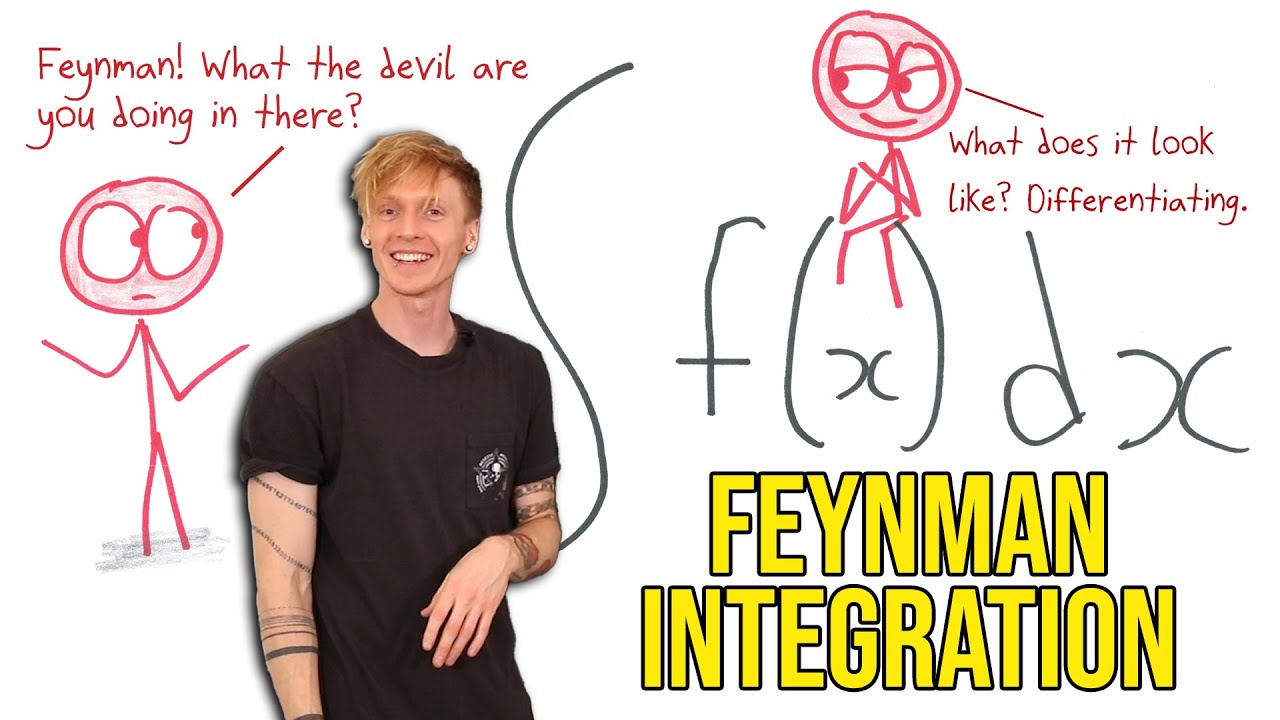
Richard Feynman famously used differentiation under the integral sign to solve many difficult problems, including one during his time at Los Alamos Laboratory during World War II that had stumped researchers for 3 months.
Learn how Feynman's Integral Technique works from Oxford Mathematician Dr Tom Crawford with the help of Ben Orlin from Math ...
you just do IBP n times
 lapis sluice
$\left | \left (\frac{n+1}{n} \right ) ^n - e \right | < \epsilon$
ocean sealBOT
Danajax
 glass lichen
No
lapis sluice
why not?
glass lichen
the stuff inside the abs value isnt necessarily positive
lapis sluice
so how should i proceed on that inequality then?
lapis sluice
ocean seal
**Danajax**
yes,
 ionic knoll
One dumb question, x-2 is the same as 2-x?
lapis sluice
no
lapis sluice
ionic knoll
One dumb question, x-2 is the same as 2-x?
proove it yourself $x-2 \not = 2-x$
ocean sealBOT
Danajax
 ionic knoll
lapis sluice
no
ionic knoll
lapis sluice
no
bc I thought that -x is the same as -1*x, so I could take the -1 and multiply it by the 2
lmao
lapis sluice
ionic knoll
bc I thought that -x is the same as -1*x, so I could take the -1 and multiply it...
think that x is a variable
any number
so easy number 100
test with 100

 crisp grove
take x=2
ionic knoll
oh I see
lapis sluice
crisp grove
take x=2<:KEK:586240877358350341>
xDDDD
alpine sable
that was fast
crisp grove
lol it wasn't for you
lapis sluice
nopr
lapis sluice
crisp grove
take x=2<:KEK:586240877358350341>
hax
 late parcel
 sick lance
Can someone explain me how did this happened?

 dull storm
hi guys
how is this possible

i keep getting different results and he got 0.947241
i have no idea how though
h=4.8 btw
so tg(4.8*1.804219591) is supposed to equal 0.947241
or should 4.8*1.804219591 i tried to times 180/pi but still no result
any idea about this? 😦
same goes for here

how in living hell does he calculate that tg and cos is beyond me
R=5,h=4,8 though
though it is: cosh1.804219591
oh my god...
it's cosh (x) function
and tanh (x) function
i can't believe this 😄
 still sundial

does anyone know how im supposed to find this base
am i supposed to end up with a quadratic formula?
 minor solar
I know this is a stupid simple questions, but i wanted to double check. If i had .003% of people out of 15,510 people. That would be 46 people? Because it would be 15510 * .003% = 46 people
 sharp sable
minor solar
I know this is a stupid simple questions, but i wanted to double check. If i had...
sharp sable
minor solar
I know this is a stupid simple questions, but i wanted to double check. If i had...
yes
minor solar
sharp sable
yes
thank you!
 dull storm
@minor solarwait
alpine sable
dull storm
<@!188841432486772737>wait
Can u help
dull storm
was that % actually 0.3%?
sharp sable
 dull storm
if u want 1%, then that is 1/100 = 0.01
if u have 0.003% then that is 0.003/100
so 15510*(0.003/100)
=0.4653
minor solar
dull storm
=0.4653
so its .46 people?
dull storm
(illogical since it can't be half a human?)
 dull storm
maybe they have converted original 0.3% into 0.003 already ready for u to calculate i don't know
minor solar
so that statstic would make it half a human>
dull storm
you need to ask
minor solar
dull storm
you need to ask
im calculating dick size lmao. trying to figure out how many people have 9 inches and above
so that means .46 people will have dicks biggetr than 9 inches
sharp sable
that's rare
dull storm
significant research i must say...
minor solar
wow, so even less than 46 people
dull storm
no u're not
well it is rare
because it's irrelevant to have bigger than average
more than that it is just weight in life
nothing more
and if u think ladies are impressed with such a thing, no they are not
only the sluts
and you want to avoid them really, because they are not a keeper ey?
xD
 tidal lion
help me

 grizzled path
wise words
dull storm
you can calculate this in wolfram alppha man @tidal lion
 dull storm
-0.25
dull storm
7x+5y=331
4x+9y=398
sharp sable
i got 7X+5Y=331 and 4X+ 9Y=398
tidal lion
sharp sable
dull storm
7x+5y=331
4x+9y=398
yeah i did that
but how to answer that
is it by elimination
 dull storm
7x+5y=331 / 5
 buoyant kayak
both are the same
sharp sable
oh
dull storm
also u can use system of linear equations
sharp sable
just divide both sides that convenient
dull storm
@sharp sablein that second equation u have 4x+9y=398
so u will now have when u transfer that y u got in first equation
sharp sable
yeah
dull storm
4x+9(331/5-1.4x)=398
sharp sable
yes
dull storm
u get X and then u put that value X in first equation 😄 and u get Y
u can use matrices as well
dull storm
no probs mate
 silver dew
alpine sable
sharp sable
silver dew
alpine sable
sharp sable
how i solved this was:
I found a factor for the large buses (5 and 9)(i should have done 45, the least common factor), 90.
Then I wrote
(7s+5l=331)*-18
I got 18 from 90 divided by 5.
(4s + 9l=398)*10
I got 10 from 90 divided by 10.
Then I multiplied them and got
-126s + 90l = 5958
-40s + 90l = 3980
I subtracted them and got
-86s + 0 = 1978
Divided 1978 by 86 and I got how many people the small buses can carry.
Then to get how many people the large buses can carry,
I did 331 - 7s divided by 5.
There's another way to do it if you want.
sharp sable
alpine sable
how i solved this was:
I found a factor for the large buses (5 and 9)(i should h...
damm
that's pretty good too
thanks
 desert fable
uh is this occupied
 dawn heart
hi
sharp sable
no
desert fable
ah good
alpine sable
desert fable
uh is this occupied
i don't think so
desert fable
for this question lol its easy once u can come up w the graph but i cant
hi
is there a way to solve this using calculus idk
;-;
desert fable
uh
dawn heart
bro im so lost
 cerulean grotto
to see if someone knows how to help me ?
dawn heart
which level math u guys doing
 tight locust
SURE
 cerulean grotto
dawn heart
which level math u guys doing
cerulean grotto
dawn heart
which level math u guys doing
bro
my question must be a easy leve one
late parcel
It definitely has 3 POI
Oh wait does it have 4 POI
<@&286206848099549185> I have this graphing question
So on this graph on the very left would you consider the stretch at -5 a POI
sharp sable
late parcel
It definitely has 3 POI
can i use the channel
alpine sable
I’m trying to understand what it means for a functor to be full. If f wasn’t mapped to F(f), that would mean that not all morphisms of the domain or mapped to the morphisms of the codomain, therefore the functor is still a functor but no longer full right? Sorry if this question sounds stupid but I’m still new to functors.
 dawn heart
wait
do tehy help for algebra
here
9th grade math
i in 7th grade and doing 9th grade
math
 twilit dune
Can you please show your work?
huh?!
what is your first step?
is this a given?
As I understand, shouldn't it be $(a^{2}+2abi-b^{2})^{2}$?

 twilit dune
oh, i see
 ember sluice
is asin(x)+bsin(x) equal to (a+b)sin(x)?
 civic jungle
alpine sable
I’m trying to understand what it means for a functor to be full. If f wasn’t map...
civic jungle
alpine sable
I’m trying to understand what it means for a functor to be full. If f wasn’t map...
f has to be mapped to something in order for F to be a functor, so not mapping f to anything is not an option
Since there's only one arrow in D between F(X) and F(Y), there's really no choice in the matter except to map f to that arrow
 velvet osprey
Guys the spectrum of A is the set of proper values right ?
alpine sable
ember sluice
is asin(x)+bsin(x) equal to (a+b)sin(x)?
Yes
ember sluice
alpine sable
Yes
I sorted it out using desmos but thanks for confirmation
 glass lichen
yes
 simple dragon
oh ok thanks
 odd obsidian
to get 1-cos^2x they used the Pythagorean identity
sin^2 (x) + cos^2 (x) = 1
sin^2 (x) = 1 - cos^2 (x)
yep! in fact, many of the identities are found through this main identity
for instance:

is derived from that identity, and you can see that by dividing all three components by cos^2 (x)
or

which is derived the same way, but by dividing all three components by sin^2 (x)
alpine sable
hi need help
odd obsidian
no worries!
alpine sable

question: Find the smallest value of N, for which S∞ − SN < 0.5
not sure where i went wrong tbh but the answer seems so wrong
odd obsidian
what's the sequence
anyway your second step doesn't seem to make any sense... how did you divide 160 by 0.5?
you should have subtracted it just guessing based on your operations here
alpine sable
lol idk what i did
whats wrong with me
i dont know what to do
i know i need to use logs thats it
What should I do

 mild plover
If (x+yi) = re^theta(i)
Does -(x+yi) = -re^theta(i) for
alpine sable
yes
omg i know where i went wrong
thanks anyways
i should have used the equasion
20/1-7/6 = 160
so i can cancel them out
 final tartan
 alpine sable
just draw a seperate diagram for A and B then for B and C then C AND C AND D if ur confused
but its the same concept i dont get you
 normal carbon
HCF OF 450 AND 180 AND HOW DID U GET 90? HELP
 shut scaffold
u not gonna sleep huh
 quartz osprey
how do i solve for 0 on this

i swaer im dumb or something
iset = to 0
can i u multiply the demonimator/
?
i jsut do lnx=1?
isnt ln 0=1
ln 0 = 1-1 = 0
the answer isnt e either
kinda dont know what to do from here
 mystic kindle
What seems to be the problem?
quartz osprey
i have no clue how to dolve for -
0
my algebra is kinda weak dont know how to get started
i mean i can umltiply entire thing by e right ?
mystic kindle
You mean when x = 0?
quartz osprey
solve g'(x)=0
mystic kindle
Oh ok
quartz osprey
when that equation = 0
mystic kindle
Gotcha
shut scaffold
its quotient rule
shut scaffold
(vu'-uv')/v^2
shut scaffold
shut scaffold
(vu'-uv')/v^2
^
quartz osprey
to solve for when it = 0?
shut scaffold
yeah
quartz osprey
what
shut scaffold
get the derivative and set it = 0
quartz osprey
ok let me say again
im trying to sovle for when the derivitvve = 0
and i kidna dont know how

here is the q
shut scaffold
instead of just e like u type
quartz osprey
__--
shut scaffold
d
quartz osprey
well here how do you even get that from the derivitve
cuz what i did is multiply the bottom
mystic kindle
I think e isn't an acceptable input in whatever site this is
quartz osprey
to both sides
shut scaffold
quartz osprey
cuz what i did is multiply the bottom
that's right
quartz osprey
2nd place
glass lichen
$e\approx 2.72$
mystic kindle
2 decimal places
quartz osprey
tens hunddrehs
ocean sealBOT
Mosh
 mystic kindle
Lol wait until you join engineering school
 shadow reef
Quick question would inc be (-oo, -2] [2,7]
Dec(-1, 2]
 quartz osprey
shadow reef
Quick question would inc be (-oo, -2] [2,7]
Dec(-1, 2]
quartz osprey
shadow reef
Quick question would inc be (-oo, -2] [2,7]
Dec(-1, 2]
iirc if its closed point then its included
yea looks right to me
alpine sable
im doing implicit differentiation. is the derivative of 2y = 2 or = 2y(dy/dx)?
 vague coral
it's 2(dy/dx)
 carmine cobalt
Hi can anyone help me with this problem pls

 glass lichen
you have k aces b/w them
 somber moat
that means that the max is 2 aces per hand
glass lichen
4 aces in 1 hand and 0 in the other is 4 aces b/w them
somber moat
oooh okay
tbh i dont even know how to approach this
halp
theres like 6X10^12 or something like that different combinations for hands you can get but I cant figure out how to get all the ones w/ aces
you have a 2/26 chance of getting 4 aces out of the deck
3/52 chance of getting 3 aces
1/26 chance of 2
 ebon steeple
A AND G and J can some one please do them as an example
 ebon steeple
@somber moat can u pls help
somber moat
ebon steeple
<@394587021579911178> can u pls help
these are pretty common squares, the first on is 8. remember that sqrt(ab)=sqrt(a)*sqrt(b) to break them down into easier square roots
 somber moat
so for (g) 441=49*9
and for (j) 900=9*100
^them there factors can be easily broke down
somber moat
glass lichen
you have k aces b/w them
would you be able to help me pls?
glass lichen
how big are bridge hands?
glass lichen
so you need P(k aces in 26 cards)
glass lichen
Pretty sure permutations is better here
somber moat
P(a)=mod(a)/mod(capital omega)
somber moat
glass lichen
Pretty sure permutations is better here
how so?
 craggy elbow
how was the range found out here?

 keen mulch
Sub x = 1 into equation
craggy elbow
but why specifically 1?
keen mulch
Because that’s the lowest value x can be
Otherwise you’ll get a negative square root
So to get lowest value of y
craggy elbow
ok 👌 thx
 jade birch
Orient yourself around point C, it is the only one that doesn't move. Also notice that C is on the y-axis. Points A and B lie on the same horizontal line (they have the same y coordinate) and the distance between A and B to the y-axis is the same.
If you can't imagine the triangles formbed by f), give some values to coordinates a and b and see what you get
 vast ore
so just find values for a and b and put it into a distance formuila?
how would we do this with the formula
jade birch
Ohh right
And you're finding the distance of all 3 sides and then the type of triangle?
vast ore
yes
jade birch
Lemme try writing it out
vast ore
ty
jade birch
Ok so you get that AC=BC
jade birch
Just plug the coordinates in the formula
vast ore
yes
jade birch
You don't get anything nice
vast ore
and what do u get?
jade birch
except for AB

 vast ore
how do u know there equal??
jade birch
Well because they have the same equation?
jade birch
Send a picture if you want
jade birch
np
vast ore
@jade birch would it be isoceles then?
small bear
The triangle will always be isosceles, yes. That is because AC = BC.
As a bonus, you might want to try and figure out, which condition should we have for a and b so that the triangle is equilateral.
 small bear
Yes, that is precisely what we get for the equilateral case
vast ore
how would we figure it out'
small bear
So what we know for certain is that AC = BC, that is true always (by using the distance formula)
Now we try and see when does AC = AB
Can you calculate the distances and write the equation?
small bear
Hmm, some terms are missing, and the square root is missing
Did you mean 2a = sqrt(a^2 + b^2 - 4b + 4)?
small bear
Alright, we can square this equality, what do we get?
Try to simplify as much as possible
vast ore
4a^2=a^2+b^2-4b+4?
small bear
Yes, I'll move all a terms to the left
We will be left with 3a^2 = b^2 -4b +4
This is also 3a^2 = (b-2)^2
Alright, let's take the square root of both sides
vast ore
small bear
We will be left with `3a^2 = b^2 -4b +4`
did u minhus a from both sides here?
small bear
(this is also where we introduce the plus minus sign, since we need to do that when square rooting)
small bear
vast ore
did u minhus a from both sides here?
I did yes
vast ore
ok so wat does that sign mean?
small bear
When we square root something, for example sqrt(x^2) isn't just x. I won't get into the whole thing but in equations you can also write plus minus x
It comes from the absolute value, but we needn't talk about that
small bear
small bear
This is also `3a^2 = (b-2)^2`
So taking the square root of this equation yields +- sqrt(3) a = b-2
small bear
Why would we need to square root -4?
vast ore
as in taht
small bear
We don't take the square root of individual terms, we take the sqrt of the whole expression
So we took the square root of b^2 -4b +4
which is the same as the sqrt of (b-2)^2
Are we good so far?
vast ore
kind of
small bear
Ask me anything that bothers you
vast ore
OH
wait
i get it
b^2-4b+4 is in the format of that thing where u square a term
so we ignore the middle term?
 small bear
these two things are the same
small bear
Np
 dire jetty
Hello I've got a question regarding a normal distribution example with μ = 35 and δ = 2
and have to find out the ? from the statement below:
P(X <= ?) = 0.2
The answer for the example is given to me but I have no clue what formula I have to use to reach the result.
Result for ? = 33.316
 ashen anchor
 rustic delta
what is your understanding of domain?
rustic delta
The domain of a function is the set of its possible inputs