#help-0
1 messages · Page 578 of 1

 livid jolt
 keen python
- check if the {(1, 0, 0), (2, 1, 0), (0, 0, 3)} make a basis for R3 or not
- write down a linear combination of them
- compute T(x, y, z) on the linear combination
 dawn wraith
<@&286206848099549185> could you please answer me? I really need this
 small stag
All of them I believe

 hardy pewter
 candid torrent

 hard thorn
no its 0.5
 night geyser
just move on
hard thorn
what’s the solutions of sin(x)=-1/2 if x is in [0;2pi]
 muted raft
keen python
smth like
(x,y,z) -> (x +2, y+z)
muted raft
keen python
smth like
(x,y,z) -> (x +2, y+z)
@keen python
You can simply get your standard matrix by $\begin{pmatrix} 1 & 3 & 3 \ 0 & 2 & -3 \end{pmatrix} \begin{pmatrix} 1 & 2 & 0 \ 0 & 1 & 0 \ 0 & 0 & 3 \end{pmatrix}^{-1}$
 ocean sealBOT
zslya
 dawn wraith
small stag
All of them I believe
dawn wraith
small stag
All of them I believe
God bless you mate, much appreciated.
small stag
No problem
dawn wraith
Does the same go for a quadrilateral that’s inscribed in a circle with the perpendicular medians?
keen python
@muted raft I'm not sure what you are doing
is there another way

Order my "Ultimate Formula Sheet" https://amzn.to/2ZDeifD
Hire me for private lessons https://wyzant.com/tutors/jjthetutor
Read "The 7 Habits of Successful STEM Majors" https://amzn.to/2FFJlR2
in this video he said that
A is equal to [ T(e_1), ...., T(e_n) ]
muted raft
Well, you can always express the standard basis in terms of $\begin{pmatrix} 1 \ 0 \ 0 \end{pmatrix}, \begin{pmatrix} 2 \ 1 \ 0 \end{pmatrix}, \begin{pmatrix} 0 \ 0 \ 3 \end{pmatrix}$ and then just compute $T\qty(\begin{pmatrix} 1 \ 0 \ 0 \end{pmatrix}), T\qty(\begin{pmatrix} 0 \ 1 \ 0 \end{pmatrix}), T\qty(\begin{pmatrix} 0 \ 0 \ 1 \end{pmatrix})$
ocean sealBOT
zslya
 keen python
but how do I compute it if I dont have T yet
muted raft
@keen python Ok, lets make it simple and do it the easy way
We will apply the definition of linearity to find the standard matrx.
Do you recall what that means?
 muted raft
Shouldn't linearity be the first thing to learn in linear algebra 
muted raft
Standard matrix is just columns that are images of the standard basis. So just T(1, 0, 0) T(0, 1, 0) T(0, 0, 1)
So we want to find this standard matrix. We already know from our given that T(1, 0, 0) = (1, 0)
So our first column would be (1, 0)
Now, our second vector from standard basis we need is (0, 1, 0)
We need to write (0, 1, 0) as a linear combination of vectors from your basis.
which was why another person had asked you to check if they form basis in R^3 or not.
So we need to observe that $\begin{pmatrix} 0 \ 1 \ 0 \end{pmatrix} = \begin{pmatrix} 2 \ 1 \ 0 \end{pmatrix} - 2 \cdot \begin{pmatrix} 1 \ 0 \ 0 \end{pmatrix}$
ocean sealBOT
zslya
 keen python
so before you do anything check if we form a basis ?
muted raft
ok Can you continue from here then?
keen python
 keen python
you want to transorm it to canon basis
muted raft
Since we already know that they form basis, that means every vector can be written as linear combination from those vectors.
keen python
and the results form the standard matrix
keen python
I see why it works but somehow I dont understand why
muted raft
What part do you not understand?
keen python
do you maybe know any good tutorials
@muted raft like why do we have to do this whole stuff ?
to express the mappings ins canon basis

cant we just say that standard matrix is (1,0), (3,2), (3,-3)
muted raft
No.
Your basis is B = {(1, 0, 0), (2, 1, 0), (0, 0, 3)}. The matrix you wrote is the matrix associated with basis B.
You want to change it to standard matrix which is associated with the basis S= {(1, 0, 0), (0, 1, 0), (0, 0, 1)}
 muted raft
$\begin{pmatrix} 1 \ 0 \ 0 \end{pmatrix} = \frac{1}{2} \begin{pmatrix} 1 \ 1 \ 0 \end{pmatrix} - \frac{1}{2} \begin{pmatrix} 0 \ 1 \ 1 \end{pmatrix} + \frac{1}{2} \begin{pmatrix} 1 \ 0 \ 1 \end{pmatrix}$
ocean sealBOT
zslya
 muted raft
Do you know how I got this solution?
keen python
not really
muted raft
$\begin{bmatrix} A | \begin{pmatrix} 1 \ 0 \ 0 \end{pmatrix} \end{bmatrix} = \begin{bmatrix} 1 & 0 & 1 & 1 \ 1 & 1 & 0 & 0 \ 0 & 1 & 1 & 0 \end{bmatrix}$
ocean sealBOT
zslya
 muted raft
Write it as an augmented matrix then solve it by converting it into reduced-row echelon form.
aka apply gauss jordan elimination.
What was the latex notation for augmented matrix again?
muted raft
We are basically just solving system of linear equations.
 vale wigeon
for this problem you can add all three of your things
to get T(2,2,2) = (1,1)+(2,0)+(1,-3)
keen python
Ahhhh
keen python
Just was confused by the name
So we are looking for a linear combination to get that vector
vale wigeon
we are looking for the values of T on (1,0,0), (0,1,0) and (0,0,1)
keen python
Ye now I understand what she did
vale wigeon
this may take multiple steps
muted raft
Ann, do you happen to know latex notation for augmented matrix?
I don't recall if it exists at all.
vale wigeon
there is a way to write those but it's hacky
you basically have to use an array environment enclosed in a \left and \right
muted raft
ahhh i see

 noble sinew
muted raft
ahhh i see
noble sinew
muted raft
ahhh i see
Write this before \begin{document}:
\makeatletter
\renewcommand*\env@matrix[1][*\c@MaxMatrixCols c]{%
\hskip -\arraycolsep
\let@ifnextchar\new@ifnextchar
\array{#1}}
\makeatother
Then you can make an augmented matrix by doing \begin{pmatrix} [ccc|c] ... \end{pmatrix} for example (This gives first 3 columns then a straight line down and then the last column)
So for example the following command will give you:
$$\begin{pmatrix}[ccc|c] 1 & 0 & 0 & 1 \\ 0 & 1 & 0 & 2 \\ 0 & 0 & 1 & 3\end{pmatrix}$$

 pale river
Quick question: does x between 2 and 3 mean 2 < x < 3
or the same thing, with less than or equal to
 shell widget
2 < x < 3 is correct, include equal sign if it says inclusive
 opaque galleon
I need to calculate an angle between two 3D vectors in which the x,y,z of each vector will mostly, but not always be different than each other. How can I achieve this? (usecase: working on a game where the red dot with the yellow arrow is the gun, while the red dot at the top of the triangle is the target. I need the gun to aim towards this top red dot, which I believe involves finding the angle between these two vectors (or dots).

 nocturne mirage
Hi everyone.. could anyone answer me why linear algebra is useful in group theory?
 alpine sable
anyone free?
i got an assignment that i want help solving it, it's a 10 question assignment.
and eh idk what i got but im paying in uc nitro codes lol so yea dm me
alpine sable
it isn't money doe
● Do not cheat on tests or exams. Do not be academically dishonest. Do not offer money for doing homework assignments, and vice versa.
it isn't money .-.
Post assignment
I dont know what uc nitro codes are
well they are unchecked nitro codes lol
I dont know what nitro is, just post assignment
k
btw they are 10 questions and 120 mins, when timer ends i fail
Donate it to charity or something
Is it a test?
nop
its an assignment
teachers give us shitty assignments every day
Whats the topic?
doesn't say in title

but here they are
alpine sable
alpine sable
doesn't say in title
- 2
4
2 - 4
(choosing btw)
well i can donate like $30 to charity only cause im pretty broke

btw that's a solving with steps kind of potato
question

same thing

choosing:
1
2
4
- 4

steps

choosing:
{ 3 , - 4 }
{ 3 , - 1 , 1 }
{ 3 , 1 , - 4 }
{ 3 , - 1 }

choosing:
3
2
0
1

steps

steps

steps
btw (im asking this here because i didn't come in last 2 days cause of some fam probs and the teacher doesn't respond to any of my messages)
and assignments go to smth called assessments that help in my exam, like if i get 20 from 100 and i did the homework good, i will get like 50-60 grades
some good/bad system
bad cause its literally timed
@alpine sable is that still allowed or no
cause tbh idk shit and my professor doesn't answer to any of my messages and i only have like 1 hour left on it
Is what allowed
like is asking for that allowed
if i don't know anything? and i have 1 hour left
I mean, it's a test. People wont give you answers here
no
it isn't
1 se
sec
It's timed homework for which you want answers in an hour

@alpine sable it isn't a test
lol
its assignments but for online classes
we take classes on an app that our school bought sub in
it's zoom but better lol
every assignment is like that
@alpine sable will u please help me?
 pale terrace
 alpine sable
.-.
No clue what S.S. means.
Two numbers, x and y
Three times first plus twice second is 13
pale terrace
Hi I'm having trouble getting started with this question and I would appreciate if someone taught me how to think about them ^^^
alpine sable
Write that down
alpine sable
alpine sable
No clue what S.S. means.
Two numbers, x and y
Three times first plus twice secon...
what question is that
alpine sable
alpine sable
^?
9

this?
Yeah
ight 1 sec
Two numbers, give them names. a and b or x and y
alpine sable
alpine sable
No clue what S.S. means.
Two numbers, x and y
Three times first plus twice secon...
lol i don't understand
can u tell me the steps
I wont give you the solution, I can guide yoi
You*
.-.
how will i know the solution in 1 hour
Two numbers call them x and y
if i didn't even join session
ok
Three times first plus two times second gives you 13
what's first and second
x y?
x and y, we dont know them
Yes
ight ok
So whats the equation when you write it down? In terms of x and y
im trying but my brain isn't functioning
i just woke up few mins ago
ok so now
3 x X + 2 x Y
= 13
Yes
Thats step 1
lol this is gonna take so long
Step 2: first added to three times second is 16
and i'll not submit the assignment in time
Then fail
why .-.
ok how about this
can you solve the stuff now, and after the assignment can you stay abit or when you're free and dm me and try to explain until my shitty professor answers?
cause tbh i need all the assignments i can get cause i got some other fam stuff i need to focus on
assessments*
1 sec lemmy show u what they are

these are assessments
alpine sable
alpine sable
Then fail
please?
Focus on family stuff then. I wont give you answers sorry
ok
ok can u give me a way i can solve the choosing questions
like not answers
Could have finished 1 question by now
Find help elsewhere
alpine sable
alpine sable
Find help elsewhere
why are you acting like that
and 1 question in 1 hour .-.
You want solutions, not help. Find someone to solve it for you then. Giving out answers is against the rules
Sorr,
Sorry
well i will sit and understand the questions after i solve it
Ping helpers, maybe someone will. I doubt it though
<@&286206848099549185>
well i think its a gonner anyways
rip
Guess randomly. Or google it
if it took 1 hour to do 1 question it would take longer to make them all

randomly how

i will write the answers
and take pic with my phone and answer it

 sage path
@alpine sable Standing on the top of the sunset cliff in OB, Jack spotted a ship. If the cliff was 20 meters above sea level and the angle of depression of the ship from Jacks's eye was 10 degrees, how far is the ship from the shore <@&286206848099549185>
🙏 PLEASE BRO
alpine sable
ill try
sage path
Kk
 alpine sable
yeah yeah
sage path
so the answer is 20/x>
 kindred helm
so your answer is 20/cos(10)
kindred helm
it is not?
sage path
?
sage path
😰 pls i only got 1:24 min left
kindred helm
that wouldnt make any sense delta
alpine sable
why wouldnt it
kindred helm
for the ship to be the base?
alpine sable
the shore starts from the bottom
kindred helm
how far is ship from the shore. if jack spots the ship from the cliff
alpine sable
yeah assuming the cliff is straight
its tangent that u use
to solve for the base of the triangle
kindred helm
im not a native speaker but i got a strong feeling im right here. could be wrong though lol
alpine sable
me neither and same
kindred helm
yeah the shore starts from the bottom
sage path
ty guys!
alpine sable
😄
kindred helm
but how far away is it from the shore
sage path
i got no idea
sage path
30 seconds left
alpine sable
thats the hypothenuse
alpine sable
not the distance to the shore
 sage path
alpine sable
Focus on family stuff then. I wont give you answers sorry
sage path
alpine sable
Focus on family stuff then. I wont give you answers sorry
😐 damn it's just math bro
kindred helm
hmm
alpine sable
it's just school bro
kindred helm
delta u in uni?
sage path
alpine sable
please?
lol don't beg em, suddenly they start to feel like they better than you and act all holy. just ask someone else
alpine sable
$\int_{ }^{ }\frac{x}{x+3}dx=\int_{ }^{ }x\left(x+3\right)^{-1}$
ocean sealBOT
Delta
 alpine sable
do x+3-3 and split into two fractions
but have no idea how to go past this
bruh forgot the dx there
muted raft
Couldn't you just u sub this?
 manic quail
muted raft
Couldn't you just u sub this?
manic quail
muted raft
Couldn't you just u sub this?
Yes.
kindred helm
how does the sub thing work?
manic quail
let u=x+3
manic quail
Have you never done substitution?
alpine sable
we havent had those yet
im just bored and learnin ahead of time
i did quite a lot of those yesterday but cant say i got them to the heart
manic quail

Using u-substitution to find the anti-derivative of a function. Seeing that u-substitution is the inverse of the chain rule. Created by Sal Khan.
Watch the next lesson: https://www.khanacademy.org/math/ap-calculus-ab/ab-antiderivatives-ftc/ab-u-substitution/v/u-substitution-example-3?utm_source=YT&utm_medium=Desc&utm_campaign=APCalculusAB
Mis...
alpine sable
that integral at the start looks like pure suffering
 dawn robin
$\int{ }^{ }\frac{x}{x+3}dx=\int{ }^{ }x\frac{x+3-3}{x+3}$
ocean sealBOT
HyperBolt
 alpine sable
that's what i suggested, then split the fractions
dawn robin
Sorry im new here
alpine sable
the x shouldn't be there, typo
alpine sable
yeah thought so
dawn robin
$\int{ }^{ }\frac{x}{x+3}dx=\int{ }^{ }\frac{x+3-3}{x+3}$
ocean sealBOT
HyperBolt
 alpine sable
add dx at the end and it's perfect
dawn robin
Then you just can split x+3 and -3
alpine sable
ahh
hard on a phone 😄
atleast on a phone u can use the technique of pen and paper
and picture
not if you're on a bus
dawn robin
$\int{ }^{ }\frac{x}{x+3}dx=\int{ }^{ }\frac{x+3-3}{x+3}dx=\int{ }^{ }\frac{x+3}{x+3}-\frac{3}{x+3}dx$
ocean sealBOT
HyperBolt
 alpine sable
not keeping a notebook on u at all times to do some quick maths
the first part simplifies to 1 right
dawn robin
Clear from here @alpine sable ?
dawn robin
alpine sable
the first part simplifies to 1 right
yep
kindred helm
show how its done after uve done it
alpine sable
done these with a number on top
kindred helm
is it x - 1/3 * ln(x+3) + C
dawn robin
kindred helm
is it x - 1/3 * ln(x+3) + C
just make the 1/3 to just 3
Then you got the exact solution
kindred helm
i dont know what u mean
kindred helm
true abs value
dawn robin
no abs value
kindred helm
u meant 1/3 instead of 1-3?
alpine sable
i meant 1-3
kindred helm
true no abs value x is x > -3
alpine sable
forgot about that part, it was stated yeah
dawn robin
x - 3 * ln (x+3) + C
kindred helm
ahhhhhh im stupid i forgot
dawn robin
no abs cause x>-3
kindred helm
obv you can take the constant out
alpine sable
$\int_{ }^{ }\frac{x}{x+3}dx=\int_{ }^{ }\frac{x+3}{x+3}-\frac{3}{x+3}=\int_{ }^{ }1-\frac{1}{3}\cdot\frac{1}{x+3}=x-\frac{1}{3}\ln\left(x+3\right)+c$
ocean sealBOT
Delta

 twin raft
that symbol gives me the scary
alpine sable
forgot the dxs
dawn robin
It is 3 not 1/3 @alpine sable
kindred helm
yeah it is 3
dawn robin
3 ln
alpine sable
dude cmon how the hell did i miss that
dawn robin
I think it is a little attention error
alpine sable
$\int_{ }^{ }\frac{x}{x+3}dx=\int_{ }^{ }\frac{x+3}{x+3}-\frac{3}{x+3}dx=\int_{ }^{ }1-3\cdot\frac{1}{x+3}dx=x-3\ln\left(x+3\right)+c$
ocean sealBOT
Delta
 alpine sable
now it should be correct
twin raft
can i get some help laters
dawn robin
Happens to even the great mathematicans
alpine sable
twin raft
can i get some help laters
ask we are done with my problem
twin raft
i dont get it i keep getting wrong answer
finite difference
200x / ((x^2) + 1)
f'(4)
i get f(4.01) being smaller than f(3.99)
so it gives me negative number
h=0.001
so
doing it the f(4.01)-f(3.99)/2h
sec ill screenshot

 fluid valley
hello everyone !
how can i generate this sequence ?
1, 2, 2, 3, 4, 4, 5, 6, 6, 7, 8, 8,…
alpine sable
odd numbers once, evens twice?
twin raft

muted raft
floor(2n/3)
dawn robin
twin raft
i dont get it i keep getting wrong answer
finite difference
200x / ((x^2) + 1)
f...
The function is decreasing on the posive real line
So every difference should be negative
fluid valley
alpine sable
odd numbers once, evens twice?
thats a great hint thanks !
alpine sable
ty
 gusty pawn
 elfin hamlet
 surreal lantern
Could someone help me out? I did this word problem but I don’t think I did it correctly.
 alpine sable
@surreal lantern, I just joined this server, but trig questions are up my ally. I’ll answer this, just give me a few minutes.
surreal lantern
Thanks so much!
alpine sable
Btw, bearing is the clock rotation from north
surreal lantern
Yup this is how my teacher described it.
 alpine sable
When sixty consecutive odd integers are added together, their sum is 4800. Determine the largest of the sixty integers.
 daring chasm
obligatory question if this is a test or not
alpine sable
I would start by doing that an odd number is 2n+1, the next consecutive odd is 2n+3, and maybe try work out the sum from there? I’m not sure how you’d do it without noting all 60 numbers tho 😂😂
I did that
And got this

I know I went wrong some where
But I do not understand where
I’d try approach it with a series, calculate sum of 60 numbers with progression: 1,3,5,7,9 etc. Then take that away from 4800 and you’d be left with 120n=4800-sum of integers, find value for n and then use arithmetic sequence formula to find 60th number and substitute if you have to
Thats what I did
The sum of the integers is 900
I’ll give it a try, two mins :))
kk
I got 139 as the final answer, I’m unsure if it’s right but I did it via the method I suggested,
Hmmm
I got 133
I used the arithmetic series and arithmetic sequences to work it out, are you aware of those formula?
Yes
What did you get as the value of n
I got n as 10
I got n as 7.5
Would you like me to send my working?
Yes
Please

I got the sum of the odd integers as 900
I’m not sure where you got that from
2+4+6+8+10 = 30 and 12+14+16+18+20= 80, therefore I said that they increase my a common difference of 50. So, 30+80+130+180+230+280. Adding them all up I got: 930
That’s even numbers?
I know, allow me to further explain my thinking
The sum of the sixty of the consecutive integers would then be: 1830. Using the formula: n(n+1)/2
1830-930= 900
There are 5 integers that make up 30 and 80 respectively i only count 30 total integers in your calculation to 930. You’d need to keep adding 6 more :))
 alpine sable
If you add the remaining 6 digits you get 3660 which is a total of 60 integers
For even numbers*
Ohhhh
I see
Try it now, hopefully it’ll work out 😁
@tight basin I’m stuck on this too funnily enough, what I think you could do is differentiate first which removes b as it’s an integer, then substitute x=1/6 which means gradient function is 0 (I think), then rearrange for a. Then you may be able to work out b? I’m not too sure how just yet
@surreal lantern, I feel like such an idiot, i certainly did something wrong
Lemme show you what I did


It’s been a few months since I’ve done this, and this is old for me
 tight basin
alpine sable
<@650736719083077633> I’m stuck on this too funnily enough, what I think you cou...
tight basin
alpine sable
<@650736719083077633> I’m stuck on this too funnily enough, what I think you cou...
yeah mate i got a = -13 but ms says a = -2
just doesnt say how it got -2 so kinda annoying
alpine sable
Sorry if I wasn’t much help
@tight basin same here I got -13, not sure how she got -2
Here is a similar question from one of my online classes
 tight basin
stupid
alpine sable
I think your teacher is wrong 😬, subbing a=-2 in the differential doesn’t equal 0
What negative two?
Yeah apparently
Wdym?
His teacher got a =-2 but we both got it as -13
I think we are doing different questions
 alpine sable
I’m really confused how they got that result tf
I mean I get how to obtain the second derivative but and all that but it seems strange that you have to use the second derivative
A point of inflection is just where the gradient is 0 so surely the first derivative would work too
tight basin
alpine sable
A point of inflection is just where the gradient is 0 so surely the first deriva...
i figured
first deriative is for stationary point
they got a+4b= 10 by multiplying everything by four after u sub in g(-1/2)
alpine sable
I have literally no idea where they got a+4b=10 either because I can only make it as a+b=10
Unless I’m missing something
tight basin
ye just a shitty question
alpine sable
Yup
They got the answer wrong though for sure because second derivative is only used to determine the nature of the stationary point right?
Though saying that a point of inflection still has a second derivative of 0
daring chasm
alpine sable
I got 139 as the final answer, I’m unsure if it’s right but I did it via the met...
i'd say try something with noticing that if you start with 1, then plus 3, then plus 5, each interim sum would be a square number
so starting from 1, it'd be n^2, where n is the number of terms
now ofc you don't want to start from 1, and you can subtract the point where you want to start out
in this case 60 earlier, since you want to add up 60 numbers
so you'd end up with n^2-(n-60)^2 - then you could factor it out by the difference of the squares as 60(2n-60)
and n is the nth odd number starting at 1
alpine sable
I got the answer, it was the guy I was helping out who needed help. 139 was indeed the answer 😊
daring chasm
yeah then solve 60(2n-60)=4800, resulting in 70
that's the 70th odd number, with the 1st being 1, so you multiply by 2, subtract 1, yep 139
 steel scaffold
Any idea on how to even start solving this? https://i.imgur.com/qghbiv7.png
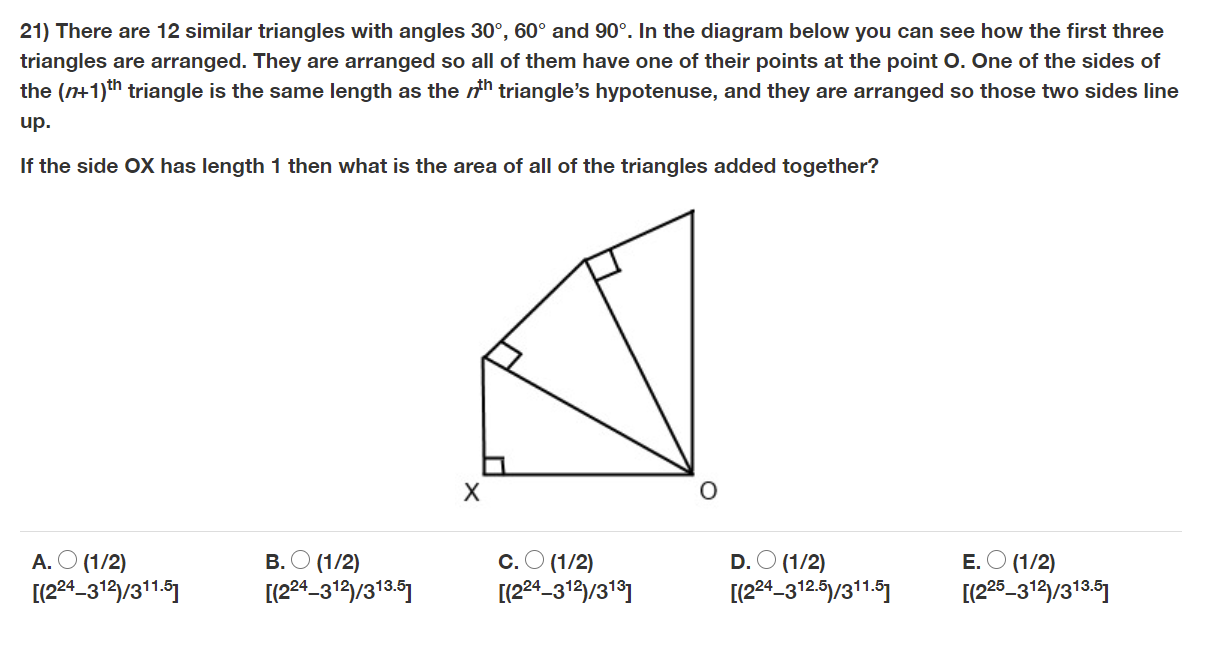
i dont even understand the question
 oak chasm
@steel scaffold What's the height of the bottom triangle if the base is 1?
steel scaffold
oak chasm
<@!743474009039175733> What's the height of the bottom triangle if the base is 1...
1/sqrt(3)?
oak chasm
Right, so you can get the area of the bottom triangle from base and height.
Now, what's the base of the second triangle? It's the hypotenuse of the bottom triangle. What's that length?
steel scaffold
sqrt(4/3)?
steel scaffold
sqrt(4)/3
oak chasm
Yep, which can be simplified a bit.
So, you have the base and height of the second triangle, so you can find its area.
What's the base of the top triangle, which is also the hypotenuse of the second triangle?
steel scaffold
0.7698003589
ocean sealBOT
Chai T. Rex
 oak chasm
The base of the middle triangle was sqrt(4/3), which is 2/sqrt(3). That's the adjacent side, which is the numerator on cosine. The hypotenuse is the denominator of cosine.
So, $x = \frac{2}{\sqrt{3} \cos(30^{\circ})}$
ocean sealBOT
Chai T. Rex
 steel scaffold
hmm ok i see
oak chasm
So, $x = \frac{2 \times 2}{\sqrt{3} \times \sqrt{3}} = \frac{4}{3}$
ocean sealBOT
Chai T. Rex
 oak chasm
Now we know the base of the top triangle, what's its height side?
steel scaffold
4/3 tan30
oak chasm
Yep, and what's $\tan(30^{\circ})$?
ocean sealBOT
Chai T. Rex
 steel scaffold
1/sqrt3
oak chasm
OK, so you have the base and height of the top triangle.
Find the area of all three triangles, add it together.
steel scaffold
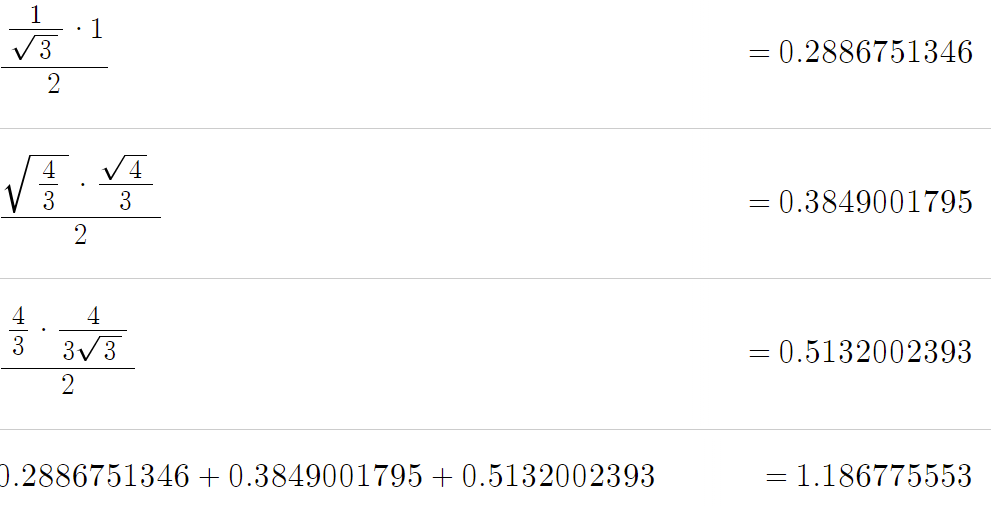
1.186775553
oak chasm
No, it's 2.37 something, but what's the exact answer?
steel scaffold
https://i.imgur.com/aUe7sOj.png where did i go wrong?
 oak chasm
Oh, I see. I think I made a mistake. One moment.
Yes, you were right.
,w (1 1/sqrt(3) + 2/sqrt(3) 2/3 + 4/3 4/(3 sqrt(3)))/2


 oak chasm
So it has $\sqrt{3}$ in the exact answer.
ocean sealBOT
Chai T. Rex
 oak chasm
So, it'll be one of the answers with .5 in the power of three.
steel scaffold
wdym
ocean sealBOT
Chai T. Rex
 steel scaffold
yea
ocean sealBOT
Chai T. Rex
 steel scaffold
yea
steel scaffold
there are 12 triangles not 3
steel scaffold
and there are different angles for some
not all have 30 degrees
i assume 4 4 4
wait no
oak chasm
It says they're similar triangles, which means the angles are the same in all of them.
steel scaffold
oh yea
oak chasm
But basically, let's make it easier for ourselves.
The area of the bottom triangle is $\frac{1}{2 \sqrt{3}}$.


 oak chasm
So, the total area is $\frac{1}{\sqrt{3}} \sum\limits_{i = 0}^{11} \left(\frac{4}{3}\right)^i$
ocean sealBOT
Chai T. Rex
 steel scaffold
ocean seal
**Chai T. Rex**
steel scaffold
ocean seal
**Chai T. Rex**
in that case shouldnt the second triangle have a base of 2sqrt(3) rather than sqrt(4/3)?
oak chasm
Let me recheck.
oak chasm
Sorry, computer crash.
@steel scaffold Yeah, good catch.
So, the area is $\left(\frac{2}{\sqrt{3}}\right)^2 = \frac{4}{3}$ times as much.
ocean sealBOT
Chai T. Rex
 oak chasm
So, it comes out to the same thing, but I made a typo.
No, wait, another typo.
So, the total area is $\frac{1}{2 \sqrt{3}} \sum\limits_{i = 0}^{11} \left(\frac{4}{3}\right)^i$

 oak chasm
@steel scaffold I think that's correct.
steel scaffold
yea i think
oak chasm
,w 1/(2 Sqrt[3]) Sum[(4/3)^i, {i, 0, 11}]
ocean sealBOT


 Requested by Chai T. Rex#7323
oak chasm
Requested by Chai T. Rex#7323
oak chasm
So, that should be the total area of all 12.
steel scaffold
hmm i see
is there another way that I could calculate the area of all 12 without having to use sigma?
oak chasm
Well, you could do sigma by hand.
,w 1/(2 Sqrt[3]) (1 + 4/3 + (4/3)^2 + (4/3)^3 + (4/3)^4 + (4/3)^5 + (4/3)^6 + (4/3)^7 + (4/3)^8 + (4/3)^9 + (4/3)^10 + (4/3)^11)
ocean sealBOT
 Requested by Chai T. Rex#7323
oak chasm
Requested by Chai T. Rex#7323
oak chasm
The trick to save a lot of work is to notice that the sides of each successive triangle are 2/sqrt(3) times as large, so the area must be 4/3 as large as the previous.
So, you have the first area plus 4/3 of the first area plus 4/3 times 4/3 = 4/3 squared of the first area, etc.
This allows you to find the area of just the first triangle and multiply it by that.
oak chasm
You're welcome.
 unreal herald
am having math problem on scaling image from all sides and keeping the corner position

this piece of code work only before rotation

preview
 snow tundra
Determine the excise tax to be paid on a house that sells for $268,210 if the buyer makes a $25,000 down payment and the seller takes back a second mortgage for $50,000?
[7:56 PM]
A)$536 .42 B)$537 C)$533 D)$538
[7:57 PM]
so the answer is B but can anyone explain how you get the answer please?
amp12128 — Today at 8:34 PM
$268,500/500 = $537
this is all it says soo idk where they got 500 from
 twilit sierra
my exam got cancelled
night geyser
👍
 sly mantle
👢
night geyser
(deleted message with mod ping to remove venmo info)
 manic glade
C⊆A, f:A->B
need to prove that C⊆f^-1(f(C))
so i suppose my task here is to show that for every x in c that x is also in f^-1(f(C))
and im having trouble formulating that into something more explicit than a vague gesture at the page and saying "well of course it is, look at it"
any tips?
verbally i can say that its true because that set contains all elements in A that "point" to the elements in B and that that set contains C
might as well mention the other part while im at it, need to also prove that if f is bijective then c=f^-1(f(C))
sly mantle
it's no more than using definitions of image set & preimage
manic glade
just feels like that falls short of the task to "prove" it
sly mantle
i meant most of the proof involves using those definitions
manic glade
for every x∊C f(x)∊f(C) ⇒ x∊f^-1(f(C)) ⇒ C⊆f^-1(f(C)) does this look right?
sly mantle
yes
 pale cargo
Hi

what should i do first
this is out of context, but after I have a complex number in polar form, it's equal to z
 winged plank
What is the question?
pale cargo
 pale cargo
then
i know those lol
im asking if i should find z first then multiply, THEN take the conjucate
or
find the conjucte then multiply
winged plank
Well if you have it in a+bi form I would just multiply them together and then take the conjugate
you've already done the heavy lifting
pale cargo
are both ways correct?
winged plank
I don't really know
I don't think so
but I may be wrong try it out
The question is (a-bi)^2 = Conj((a+bi)^2)
winged plank
Yeah you can convert from a+bi to polar form
pale cargo
k
winged plank
the radius is just the magnitude of a+bi and the angle is just arctan(b/a) I believe
pale cargo
pale cargo
since the line is on top of all
i think maybe do z*z first
then take their conjucate
winged plank
That's what I would do 😎
 small stag
Multiply first because it asks for the conjugate of the product
,w conj(z) * conj(z) = conj(z*z)
ocean sealBOT

 Requested by AyeWaddup#5214
small stag
Requested by AyeWaddup#5214
small stag
Oh nvm then
winged plank
Oh hey that other way does work
pale cargo
so both...
winged plank
man I forget how conjugates work some times damn
small stag
Indeed it does sorry not too well versed with complex
pale cargo
lol
winged plank
Tell me what you get
small stag
What is z*
pale cargo
r is zero
winged plank
right?
pale cargo
1
small stag
pale cargo
i got "i"
What is this the solution of?
pale cargo
i simplified the big fraction
small stag
Nvm continue
winged plank
Okay cool so the magnitude is 1
So our polar form looks like this e^ix right?
but recall that e^ix=cos(x)+i*sin(x)
What value of x does cos(x)+i*sin(x) = -1?
ocean sealBOT
Chai T. Rex
 winged plank
Yeah exactly and cos(x)=-1 when x= pi so that means (z * z)^*=e^(i * pi)
@small stag
 wicked frost
Every value of (2n+1)$pie
winged plank
Well that's only if you're a math major
wicked frost
Well range is not defined so we have to assume (-infi,+infi)
winged plank
Around these parts we only care about first order terms and finite solution sets
vale wigeon
consider: in how many numbers does the digit 1 appear in the hundreds place?
repeat for the other digits and the tens and units places.
come to a conclusion about how one might calculate the sum.
 vale wigeon
well you made it so that the x only appears on the left
why not add or subtract something else to both sides to get rid of that +10
 elfin matrix

Its asking for solution set
And all the answers on the multiple choice are not decimals and i keep on getting decimals and i check it online and it says decimals too
elfin matrix
Im sorry i guess i took it the wrong way
I tried adding 4x instead and then 10 and then 5 to try out different ones like you said

I just ended up putting this cause it made the most sense with what i got
vale wigeon
 what the fuck?
none of these are correct.
the correct answer is x <= 5/9
,w -4x + 10 >= 5x + 5
ocean sealBOT

 elfin matrix
Thats exactly what ive been getting
And i even started doing it different ways to get different answers to just get one from the choices
But i couldnt find any so i just put the one with 5 cause 5/9
vale wigeon
well the thing is
all the answer options are wrong
so the correct course of action is to talk to your teacher and hope they don't double down
alpine sable
is 2log|x-2| = log(x-2)² ?
vale wigeon
2 log|x-2| = log( (x-2)^2 ) yes
 serene hearth
Can someone guide me as to how I can solve a simple question like this on matlab?

syms y(x)
ode = diff(y,x) == -0.0004332 .* y;
cond = y(1) == 0.005;
ySol(x) = dsolve(ode,cond);
disp (ySol(-0.002));```This is my code so far, however it doesn't work as intended, the value it returns looks too random.
alpine sable
can this be simplified any further
 serene hearth
Can someone guide me as to how I can solve a simple question like this on matlab...
serene hearth
serene hearth
Can someone guide me as to how I can solve a simple question like this on matlab...
<@&286206848099549185>
 woeful pulsar
please don't crosspost
woeful pulsar
alpine sable
can this be simplified any further
yes log(x/y)=log(x)-log(y)
 inner zinc
I m new here
sly mantle
@inner zinc please familiarize yourself with the rules in #❓how-to-get-help; in particular don't multipost
inner zinc
Ok
 elfin wasp
any help on this physics question

 raw badge
Physics server, link for which you'll find in #old-network, is more suited for this
elfin wasp
alright, I thought this was more maths based question with mechanics
kindred helm
is it asking for mu? i dont understand the question because of my bad english
alpine sable
If x=1/6 at the point of inflection on f(x)=4x^3 +ax^2, how do you work out a? If you take the first derivative you get f’(x) 12x^2 +2ax=0, the second derivative f’’(x)=24x +2a. Sub in the x=1/6 and for f’(x) you get a=-1, sub in x=1/3 for f’’(x) and you get a=-2. That shouldn’t happen right? What have I missed?
 versed osprey
why is minus sqaure root of 7 an irrational number
 gray isle
@alpine sable you're not using your x=1/6 properly
 lyric lynx
versed osprey
why is minus sqaure root of 7 an irrational number
lyric lynx
versed osprey
why is minus sqaure root of 7 an irrational number
Because √7 is an irrational number. Any non-perfect square under a radical will be irrational.
gray isle
when consider inflection, you're only really interested in the second deriviative
versed osprey
lyric lynx
Because √7 is an irrational number. Any non-perfect square under a radical will ...
thanks
gray isle
i.e. solve f''(1/6) = 0
lyric lynx
Actually, it would be better to say the square root of any prime number is irrational, and 7 is prime.
versed osprey
lyric lynx
Actually, it would be better to say the square root of any prime number is irrat...
oh smort, thx
lyric lynx
I'm pretty sure the former statement is still correct though.
versed osprey
lyric lynx
Because √7 is an irrational number. Any non-perfect square under a radical will ...
oh and one more thing, the quotient of a irrational number divided by a rational one, is a rational number right?
lyric lynx
Not necessarily. In fact, I can't think of a single case where that is true.
versed osprey
lyric lynx
Not necessarily. In fact, I can't think of a single case where that is true.
oh ok
 jagged imp
versed osprey
oh and one more thing, the quotient of a irrational number divided by a rational...
jagged imp
versed osprey
oh and one more thing, the quotient of a irrational number divided by a rational...
in fact this is never true
 sullen juniper
not sure where to begin doing this, idek what the question means lol
 raw badge
 livid path
Would u guys and girls help
livid path
Would u guys and girls help
Sure 
gray isle
it's asking you to find the size of angle C
sullen juniper
thank you
gray isle
note that the given 103° is for angle A and is rounded.
you could apply the sine rule (which may be what they want)
since you are given all 3 sides, you can instead apply the cosine rule to get a more accurate result
sullen juniper
thanks
 opaque cape
why is there only one possible value of x and how, i feel like im missing smthn i didnt realize
 lyric lynx
context?
jagged imp
show the whole question, there's probably something earlier in the question that doesnt permit negative numbers or smthn
lyric lynx
jagged imp
show the whole question, there's probably something earlier in the question that...
this
jagged imp
in isolation, whats written is fine
 opaque cape
oh why not
lyric lynx
convention
also because in the context of this question, a negative length makes no sense.
serene hearth
serene hearth
Can someone guide me as to how I can solve a simple question like this on matlab...
halp ;-;

It returns a value like this
which imo looks too absurd? xD
lyric lynx
Gotta love computers
The equation solution will be an exponential, so that seems correct...
But you're going to want to simplify it to a decimal
$\frac{1}{200}e^{0.004315}$
ocean sealBOT
John_Cavanaugh
 lyric lynx
Check my work
 acoustic crater
A number is selected at random from the set {1,2,3,4,...,20}. Find the probability of the following events

1. drawing an odd number
2. drawing an event number
3. drawing a prime number
4. drawing a composite number
5. drawing a number divisible by 3 or 5
6. drawing a number divisible by 4 or a factor of 20
7. drawing an odd number or a factor of 18
8. drawing an even number or a factor of 11
i need to finish my homework because my mom is gonna kill me again, so I need help in someone.
lyric lynx
serene hearth
Can someone guide me as to how I can solve a simple question like this on matlab...
not sure about matlab, but the correct answer is 0.00500217
 nimble wyvern
@acoustic crater what you need help with? which number
 faint trench
need a bit of help with finding the domain over which a function has an inverse, but not sure if im doing it right. The function is f(x) = (x^2)/(x^2 - 9), and i need to find the domain where it has an inverse. any help is appreciated, thanks.

 vague coral
well (2sqrt(3))^(1/3) = (3sqrt(x))^(1/6)
(2sqrt(3))² = 3sqrt(x)
12 = 3sqrt(x)
sqrt(x) = 4
x = 16
If I'm not wrong
 leaden hill
u sure?
vague coral
you can verify
vague coral
I mean you plug 16 in the equation and see if it's correct '-'

 glass lichen
 copper silo
what do you know about the diagonals of kites?
copper silo
nothing
copper silo
could you just tell me how to do it?
copper silo
yeah so i gotta find the perpindicular gradient how do i do that?
glass lichen
use the definition of perpendicular slope
copper silo
which is?
glass lichen
look at your notes or google yourself. I'm not gonna spoonfeed all the things you can easily google
copper silo
why not?
glass lichen
Cause you should be able to type on google. .
copper silo
i prefer human interaction
 coral pagoda
I think the problem moshill is currently dealing with is that you are not showing much attempt on trying to solve the problem on your own.
They gave you guidance, but note they will not just give the answer to you. That's not how it works here.
 chrome steppe
becuase kites are (hopefully) perpendicular, i think it should be the reciprocal of AC's equation + or - an offset
chrome steppe
copper silo
there's not enough evidence if the angles arent 90 degrees
ocean sealBOT
bow wow
 chrome steppe
i put it on a graphing calculator and it worked
copper silo
so how i do it?
chrome steppe
(x=\frac{1}{3}y-\frac{2}{3}) is the reciprocal to AC's equation
ocean sealBOT
bow wow
 copper silo
you gotta find the perpendicular gradient first
chrome steppe
if you swap x and y back it will rotate 90 degrees
and then (i think) you square the 2 in 2/3
i'll check
no
the offset is different
copper silo
welp the answers tell me to find the perpendicualr gradient
chrome steppe
google that
ocean sealBOT
Omri

 half pasture
Sorry I meant $C_2[a,\infty)$
ocean sealBOT
Omri
 half pasture
No, this is calculus
chrome steppe
oh
half pasture
the hint is "integration by parts"
glass lichen
right
half pasture
but how?
glass lichen
so pick one of the f'(x) to be u and the other to be dv
half pasture
I tried that.... I didn't get anywhere
You get $f(x)f'(x)-\int_a^\infty f''(x)f(x)dx$
ocean sealBOT
Omri
 glass lichen
right yeah
half pasture
but both terms might not converge
chrome steppe
copper silo
if you remove the offset from the other eq i sent, then y=2 will have x=-6, so the offset must be -(-((6-2))/3, so 4/3
glass lichen
well you know for the integral to converge $\lim_{x\to\infty}f''(x)=\lim_{x\to\infty}f(x)=0$
ocean sealBOT
moshill1
 half pasture
Thats simpy false
simply
There are positive functions that don't have a limit at infinity, but their integral converges
 vagrant rover
Is this question solvable? I don't necessarily want an answer, I just want to know if the question is written wrong. I have been having a problem with questions not having a correct answer.
 chrome steppe
if you do an expaned version of the quadratic formula, (so ax^3 + bx^2 +cx + d)
you can make any wave like that
glass lichen
that's not a wave
that's a cubic
so there's no such thing as expanded version of the quadratic formula
vagrant rover
Are yo uguys talking to me?
glass lichen
I was talking to bow
but you know the roots so you can write the factored form of the cubic.
then use the y-int to find the a value
vagrant rover
Thanks
half pasture
ocean seal
**Omri**
does anybody know?
 candid sluice
 subtle mantle
ocean seal
**Omri**
subtle mantle
ocean seal
**Omri**
What if you integrate by parts again to get something $-\int_{a}^{\infty} (f’(x))^2 dx$
ocean sealBOT
Wew Lads Tbh
 half pasture
You just get 0=0...
subtle mantle
I think it would be $f(x)f’(x)- f’’(x)f’(x)+\int (f’(x))^2 dx$
nimble wyvern
@half pasture where you get 0=0?
ocean sealBOT
Wew Lads Tbh
Compile Error! Click the  reaction for more information.
(You may edit your message to recompile.)
 half pasture
ocean seal
**Wew Lads Tbh**
Compile Error! Click the <:errors:504266556054962196> reaction ...
half pasture
ocean seal
**Wew Lads Tbh**
Compile Error! Click the <:errors:504266556054962196> reaction ...
That is mistaken, the second term is $f'(x)f(x)$
ocean sealBOT
Omri
 half pasture
And you just get a trivial identity
subtle mantle
Only other thing I can think of is maybe try integration by parts on $\int (f’’(x))^2 dx$ but I’ll need to actually write it all out to see if it leads anywhere
ocean sealBOT
Wew Lads Tbh
Compile Error! Click the reaction for more information.
(You may edit your message to recompile.)
 half pasture
How? $f$ is not three times differentiable
ocean sealBOT
Omri
 subtle mantle
Yeah that’s the problem
 gritty pine
do i need geometry to learn trigonometry? sorry for the stupid question
gray isle
yes
gritty pine
gray isle
yes
ok thank you
 hollow cypress
what's the construct called if equivalences between a and b are themselves all equivalent?


 vale wigeon
product rule in reverse
 analog locust
umm.... not really
can you explain it to me please?
or is there some sort of step-by-step explanation for it?
vale wigeon
look up "calculus product rule derivation" if you want a proof
analog locust
im just plunging into ODE without knowing this stuff and it felt a bit hard 😦
analog locust
yes, im planning to speed-through it 🙂
vale wigeon
ew no
analog locust
any advice where I can learn calculus?
analog locust
I don't have the luxury... my exam is in 3 months 😦
vale wigeon
bruh
i mean like ok just to put this into perspective
this is like if you tried to start solving quadratic equations while barely knowing how to multiply.
analog locust
is there like a table of content/recommended book or something similar to have an overview of what I need to know to do ODE?
analog locust
@vale wigeon do I need to do Calculus 1-3 before ODE?
vale wigeon
1 and 2 definitely, 3 maybe
analog locust
and what happens if the independent variable was also a part of the derrivative?

I noticed that t was there too
y*
the dependent variable*
ok... im a bit confused
vale wigeon
of course youre confused
this is like trying to explain a particular instance of factorization to someone who struggles with multiplying numbers ;p
like
no really, i could try and state the product rule time and time again
it would be no use because it will not stick
analog locust
I just skimmed it
vale wigeon
like ok for reference here is the rule itself: $$\dv{x} [f(x) g(x)] = f(x) g'(x) + f'(x) g(x)$$
ocean sealBOT
Ann
 analog locust
its like taking a derivative of 4+t^2 times y, right?
vale wigeon
yes thats exactly what is on the right-hand side
analog locust
lets say 4+y^2 is f(x) and y is g(x)
vale wigeon
(4+t^2)y, differentiated
4+t^2 itself differentiates to 2t
y differentiates to dy/dt, almost tautologically
analog locust
I just need to do f'(x)(g(x) + f(x)g'(x)?
vale wigeon
"need to do" is one way of putting it ¯_(ツ)_/¯
analog locust
I can't do that since I am not enrolled in calculus 😦
analog locust
vale wigeon
y differentiates to dy/dt, almost tautologically
okay, im a bit confused at this part
how does it differentiates to dy/dt?
vale wigeon
what do you think dy/dt even is
subtle mantle
the derivative of y is dy/dt by definition
vale wigeon
if not the derivative of y