#help-0
1 messages · Page 544 of 1
 gray isle
gray isle
gray isle
no
 cinder sundial
ohh im so smart
but 2x√3x√5 got me confused
x is multiply sign btw
in my understandin, 2x√3 the answer will be 3?
 vale wigeon
you should know that $\sqrt{a} \cdot \sqrt{b} = \sqrt{ab}$
 ocean sealBOT
uu∀
 vale wigeon
if you're going to use the square root symbol, then use parentheses too
√3*5 is ambiguous. it could mean sqrt(3*5) or sqrt(3)*5
vale wigeon
does it correct → is it correct
cinder sundial
thank you
vale wigeon
,calc 2 * sqrt(3)
ocean sealBOT
Result:
3.4641016151378
$2\sqrt{3}$ cannot be simplified, you should just leave it as-is
ocean sealBOT
uu∀
 vale wigeon
you can turn $2 \cdot \sqrt{3} \cdot \sqrt{5}$ into $2 \sqrt{15}$, but that's it.
ocean sealBOT
uu∀
 cinder sundial
then √5^2, the value is 5 right
vale wigeon
sqrt(5)^2 = 5, yes
cinder sundial
ohhh im so smart
 random token

cinder sundial
how do i know if a question can be converted to an different form like this
vale wigeon
converted*
cinder sundial
thank you
vale wigeon
to a* different form
cinder sundial
thank you
vale wigeon
anyway... there's no universal rule for that
cinder sundial
like (a+b)^2 = a^2+2ab=b^2
i noticed he converted a super hard question to this
and find the answer easily
 sly mantle
**+**b^2
vale wigeon
^ you made a typo there
well (a+b)^2 = a^2 + 2ab + b^2 is an identity that you should know
as you get more experience, you get better at noticing when it and other identities like it can be applied
cinder sundial

it seems like i can use the method
for this one to find the answer
it said x and y is rational numbers, and i have to find x^2+y^2=
vale wigeon
$x + y \sqrt{16 + \sqrt{252}} = x \sqrt{8-\sqrt{28}} + 5$
cinder sundial
what it means
vale wigeon
i'm trying to summon the bot
cinder sundial
ohh
vale wigeon
but it's not working for some reason
ocean sealBOT
uu∀
 cinder sundial
x and y is rational
it seems like i can use the [method(a+b)^2] to find the answer,but im not sure about the process
vale wigeon
it'll take some trickery, i'm sure of it
cinder sundial
what should i do in the first step
my understandin, i gotta get rid of those sqrt
vale wigeon
there is no step-by-step procedure for this kind of questions, sorry
cinder sundial
ohhh
vale wigeon
however, something that i came up with is to factorize the 252 and 28
 white obsidian
there is... you have to isolate the sqrt
cinder sundial
i have to square it in order to get rid of the sqrt inside of sqrt
white obsidian
for step-by-step of course
vale wigeon
and it turns out you can write $\sqrt{252} = \sqrt{4 \cdot 9 \cdot 7} = 2 \cdot 3 \cdot \sqrt{7}$
ocean sealBOT
uu∀
 vale wigeon
and you can also write $\sqrt{28} = \sqrt{4 \cdot 7} = 2 \cdot \sqrt{7}$
ocean sealBOT
uu∀
 vale wigeon
so from here:
$\sqrt{16 + \sqrt{252}} = \sqrt{16 + 2 \cdot 3 \cdot \sqrt{7}} \ = \sqrt{9 + 2 \cdot 3 \cdot \sqrt{7} + 7} = \sqrt{(3 + \sqrt{7})^2} = 3 + \sqrt{7}$
ocean sealBOT
uu∀
 ocean sealBOT
uu∀
 cinder sundial
yes 4x9x7 is 252
vale wigeon
just to be clear, this is NOT the result of a strict, step-by-step procedure. this relies on being able to notice a lot of things. such as knowing to split 16 into 9+7 so that what's under the big root looks like a^2 + 2ab + b^2
it looks like the roots have been set up specifically to be simplifiable like this
white obsidian
y you're right, i somehow read a x within the sqrt. pardon.
vale wigeon
anyway
$\sqrt{8 - \sqrt{28}} = \sqrt{8 - 2 \sqrt{7}} = \sqrt{7 - 2\sqrt{7} + 1} = \sqrt{(\sqrt{7} - 1)^2} = \sqrt{7} - 1$
this follows a similar logic to the above
ocean sealBOT
uu∀
 vale wigeon
3^3 isn't 9, it's 27. you meant 3^2 is 9.
vale wigeon
2 is the root of 4.
cinder sundial
thats what i means
vale wigeon
3 is the root of 9.
you can't do anything about 7.
(and what you really mean here is that 7 isn't a perfect square)
cinder sundial
thats why sqrt 4 and 9 and 7 became 2x3x sqrt7
i noticed you rearranged those numbers
if i were you, i wont be able to rearrange those like you did, how you do that
cinder sundial
is there sth you can look at to rearaange
2ab is 2 * 3 * sqrt(7) right
then turn the 16 to those a^2 b^2
cinder sundial
wait, a and b cant be different?
can a and b be the same number
i know the leftover number 16 gotta to be a^2 + b^2
and 2^3 + 2^3 will be perfect
ohhhh i noticed im wrong
vale wigeon
2^3 isn't a square, it's a cube
cinder sundial
yes
im so dumb
what number should i use instead?
4^2
can a and b both be 4^2
not
then its will be 32
i cant find an number that multiply itself will get 16
vale wigeon
i can't find a number that, when multiplied by itself, will give 16
cinder sundial
ohh i made a little mistake here, 16 have to be the combination of a^2 and b^2
am i right
16 is the leftover
vale wigeon
we aren't anywhere close to solving the entire problem yet
but if you wish... then yes
sqrt(9) is just 3 though
cinder sundial
ohhhh
i think were close to the answer
we just have to put them in place
like get them into the 2ab stuff
vale wigeon
once we get through this thing with the radicals, we go back to the original equation, which will look like this:
$$x + y(3+\sqrt{7}) = x(\sqrt{7} - 1) + 5$$
ocean sealBOT
uu∀
 cinder sundial
but we find the x and y is 7 and 9?
vale wigeon
no??
we never even talked about x and y until now.
all i did was mess with the big roots to make them look less heavy.
it was all just preparation
vale wigeon
that's irrelevant.
i want to make sure that you understand this:
\begin{itemize}
\item $\sqrt{16 + \sqrt{252}} = 3 + \sqrt{7}$
\item $\sqrt{8 - \sqrt{28}} = \sqrt{7} - 1$
\end{itemize}
cinder sundial
no i cant, it beyond my understanding
ocean sealBOT
uu∀
 vale wigeon
mmm
cinder sundial
do you simplify them
vale wigeon
yes! that's what i've been doing all along!
vale wigeon
that's the second root. the second root is sqrt(7) - 1.
cinder sundial
the top and bottom are same thing right,same question but you simplied
vale wigeon
they're not the same thing, they're different roots
the simplification follows (almost) the same logic though.
vale wigeon
sqrt**(8- sqrt28)**
ok, let me repeat myself
$\sqrt{8 - \sqrt{28}} = \sqrt{8 - 2 \sqrt{7}} = \sqrt{7 - 2\sqrt{7} + 1} = \sqrt{(\sqrt{7} - 1)^2} = \sqrt{7} - 1$
ocean sealBOT
uu∀
 vale wigeon
this is how
cinder sundial
i got stuck in first part to the second, why 28 became 2 sqrt 7
vale wigeon
$\sqrt{28} = \sqrt{4 \cdot 7} = 2 \cdot \sqrt{7}$
 ionic jewel
have you seen problems like that before or did you just find it? i never would have thought about splitting the 8 @ ann
ocean sealBOT
uu∀
 vale wigeon
i have done problems like that before yeah @ionic jewel i guess i just picked up some intuition
cinder sundial
why 2 * sqrt 7 is 28
vale wigeon
ocean seal
**uu∀**
look here.
cinder sundial
sqrt 7 is 14?
 alpine sable
ocean seal
**uu∀**
alpine sable
ocean seal
**uu∀**
This is correct
cinder sundial
i know everythin she said is correct, but in my understandin i cant multiply sqrt 7 by 2
ohhhhh
i can but 2 * 7 is 14
or you simply them so 28 became 14
ionic jewel
$\sqrt{28} = \sqrt{4 \cdot 7} = 2 \cdot \sqrt{7}$
ocean sealBOT
ʎuunq
 ionic jewel
consider reading the middle step of Ann's work here
it shows how you get the 2 sqrt 7
vale wigeon
sqrt 7 is 14?
no, where did i say sqrt(7) = 14???
 crisp night
ionic jewel
$\sqrt{28} = \sqrt{4 \cdot 7} = 2 \cdot \sqrt{7}$
crisp night
ionic jewel
$\sqrt{28} = \sqrt{4 \cdot 7} = 2 \cdot \sqrt{7}$
Suggestion- when you write like that in steps i suggest going down a line every time you do a step, ex:
$\sqrt{28} =\ \sqrt{4 \cdot 7} =\ 2 \cdot \sqrt{7}$
ocean sealBOT
ƃuǝɹo_ʎuᴉɐɥS
 ionic jewel
a) it's not mine
b) i think that looks worse
crisp night
Btw how can i not include tye text in the latex?
vale wigeon
tye?
ocean sealBOT
ƃuǝɹo_ʎuᴉɐɥS
 crisp night
This is what i meant
ionic jewel
okay i definitively would put the equals at the beginning of the line if j was doing that but i prefer 1 line
for something this simple
if it was more complex i can see splitting it
 latent thistle


can someone help me out with the parametrisation of this?
the curve from one is the first linked pic
vale wigeon
you start at (0,1), then follow the black semicircle, then the blue line, then the purple arc, then the red line
latent thistle
vale wigeon
you start at (0,1), then follow the black semicircle, then the blue line, then t...
i got that i just dunno how to word it
like the anto clockwise thing
wait ill show what i have
i have all the parametrisations i think
$(sin(\frac{\pi \times t}{2})), cos(\frac{\pi \times t}{2}))
\break
-1\le t\le 0$
ocean sealBOT
74ʞ∀_oɯlƎ
 latent thistle
$t, - (\frac{1}{\sqrt{3}+1 }) \cdot(t+1)
\break
-1\le t\le \sqrt{3}$
ocean sealBOT
74ʞ∀_oɯlƎ
 latent thistle
im sorry im learning
vale wigeon
it's s o w i d e
can you write it out on paper
i think i can alreay see something wrong
your parameterizations don't have unit speed
latent thistle
 vale wigeon
yeah, only one of these is unit speed
latent thistle
which one is that?
latent thistle
vale wigeon
and also they're kinda... not connected to each other
yea they are all over the place
i just dunno how to make it clockwise

thats the graph it prodcues
vale wigeon
ok so...
that purple arc
is it an arc of a circle of radius 2 centered at the origin
vale wigeon
hhhhhhh
please
read my question
this does not at all answer my question
if you continue like this i will have to stop helping you
latent thistle
vale wigeon
is it an arc of a circle of radius 2 centered at the origin
yes
latent thistle
vale wigeon
if you continue like this i will have to stop helping you
oh sorry about that, im thankful for your help
 tiny carbon
Hmm... How can I know the average speed without its net displacement?
vale wigeon
@tiny carbon channel busy please move
tiny carbon
Oh ok
vale wigeon
@latent thistle since your parameterizations have to be unit speed, it means that the time taken to move along a curve is equal to the length of the curve
the black arc has length pi/2
the blue line has length sqrt(5+2sqrt(3))
the purple arc has length 2pi/3
the green line has length sqrt(3)
these are named in the order that they'll be traversed
do you understand what i've said so far Y/N
vale wigeon
okay
great
so
i'll make the following abbreviations so as not to have to write out pi's and roots and whatnot a thousand times:
$t_1 := \frac{\pi}{2}, \ t_2 = \frac{\pi}{2} + \sqrt{5+2\sqrt{3}}, \ t_3 = \frac{\pi}{2} + \sqrt{5+2\sqrt{3}} + \frac{2\pi}{3}, \ t_4 = \frac{\pi}{2} + \sqrt{5+2\sqrt{3}} + \frac{2\pi}{3} + \sqrt{3}.$
the idea is that the particle arrives at the four "breaking points" in your curve at times t1, t2, t3 and t4 respectively.
do you understand this? Y/N
ocean sealBOT
uu∀
 latent thistle
Y
vale wigeon
okay
great
now
for the circular arc
we will want the parameterization (-sin(t), cos(t)) for 0 ≤ t ≤ t_1
do you understand this
latent thistle
yes
vale wigeon
okay
for the line
i'll write the parameterization in terms of $t-t_1$, since this is how much time the particle spends moving along the line (not just $t$, mind you)
ocean sealBOT
uu∀

 fossil oriole
One people is ok for help me
vale wigeon
@fossil oriole this channel is occupied, please move.
fossil oriole
Ok
vale wigeon
$\paren{-1 + \frac{\sqrt{3}+1}{t_2 - t_1} (t - t_1), -\frac{1}{t_2 - t_1}(t - t_1)}, \quad t_1 \leq t \leq t_2$
ocean sealBOT
uu∀
 vale wigeon
@latent thistle this is the parameterization for the blue line. do you understand this? y/n
latent thistle
y
vale wigeon
great
now for the purple arc
we could use (2cos(t), 2sin(t)) or some variant thereof, but this would have speed 2 rather than 1, and we don't want that.
so we will need to divide the argument by 2.
and get the parameterization $$\paren{2\cos\paren{-\frac\pi6 + \frac{t - t_2}{2}}, 2\sin\paren{-\frac\pi6 + \frac{t-t_2}{2}}}, \quad t_2 \leq t \leq t_3$$
ocean sealBOT
uu∀
 vale wigeon
do you understand this? y/n
latent thistle
y
vale wigeon
great
and now all we have left is the green line, which is very easy
$(\sqrt{3} - (t-t_3), 1), \quad t_3 \leq t \leq t_4$
ocean sealBOT
uu∀
 vale wigeon
since we are going to the left along it
latent thistle
ah yep
vale wigeon
$(x,y) = \begin{cases} (-\sin(t), \cos(t) & 0 \leq t \leq t_1 \ \paren{-1 + \frac{\sqrt{3}+1}{t_2 - t_1} (t - t_1), -\frac{1}{t_2 - t_1}(t - t_1)} & t_1 \leq t \leq t_2 \ \paren{2\cos\paren{-\frac\pi6 + \frac{t - t_2}{2}}, 2\sin\paren{-\frac\pi6 + \frac{t-t_2}{2}}} & t_2 \leq t \leq t_3 \ (\sqrt{3} - (t-t_3), 1) & t_3 \leq t \leq t_4 \end{cases} $
ocean sealBOT
uu∀
 vale wigeon
putting it all together
latent thistle
omg thankyou so much
 tiny field
Decide K so that the parabola has its highest point in x=-2 f(x)=kx^3+6x^2
Could someone give me some tips for that one
vale wigeon
f(x) = kx^3 + 6x^2 is not a parabola
tiny field
It said so in the problem
But you are probably right, if we leave out the parabola thing, how do i proceed?
The answer is also supposed to be 2
 jagged imp
unfortunately that never has a highest point for any value of k. are you sure the question is correct?
its not kx^2+6x or something?
tiny field

This is the question
Roughly translated it says: Decide K so that the parabola f(x) has its top in the point x=-2
jagged imp
oh its looking for a k where the graph has a local maximum at x=-2
tiny field
yea
jagged imp
weird wording to call it the top or whatever but who cares
so, do you know derivatives?
tiny field
Yup the course is derivates so I know im supposed to do something with derivates
jagged imp
yeah, so at a local maximum(what the question wants), the derivative is always 0. note that the derivative being 0 doesn't necessarily imply a local maximum however. Since you want a local maximum at x=-2, you should set f'(-2)=0 and find what value of k satisfies that
(and in some cases you will have to check if this is a local maximum or something else, but the wording of this question kinda guarantees its a local maximum in this case)
tiny field

I get the wron answer so there got to be something wrong in there, do you see it?
wrong*
 tiny field
yup there it was, i added them togheter insted of multiplying, thanks
jagged imp
nwnw
tiny field
jagged imp
nwnw
Do you have time to kickstart me with another one to?
jagged imp
perhaps
tiny field
Decide the equation for a tangent to the curve
 jagged imp
at a certain point?
jagged imp
does that mean gradient/slope?
i understand that might be hard to answer cuz language barrier but is direction coefficient the m in y=mx+b in other words?
jagged imp
sure, so the slope of a tangent to f(x) at a point x=k is f'(k)
so we can find out what point its tangent to the curve at by setting f'(k)=4 and solving for k
jagged imp
yeah the first one just with a different variable name
there was no real reason why i chose to use k there over x
jagged imp
yeah
tiny field
then i get 2
jagged imp
so after you do that, you have a point on a line and the line's slope?
are you aware of point-slope form?
jagged imp
it looks something like $y-y_1=m(x-x_1)$
ocean sealBOT
ʎʞɐǝuS
 tiny field
Is that how I should think
jagged imp
oh you can do it from y=mx+b if you aren't familiar with what i just posted
are you familiar with what i posted?
tiny field
Yea I will use the one you posted that is the one we are using in the course
Thanks for the help I understand what im supposed to do now
jagged imp
awesome
alpine sable
Find tan (A) when a = 8 and b = 4.
alpine sable
nope
 fading zephyr
how do a and b relate to A?

 normal cloud
lol the one on the top left is different to the rest
alpine sable
yep
normal cloud
it’s impossible to say the answer without knowing which side is which
fading zephyr
indeed
alpine sable
Yh lmao what is this question even
normal cloud
if there really is no context you should probably ask your teacher
 alpine sable
fading zephyr
show the whole page where the question is
alpine sable
fading zephyr
show the whole page where the question is
Ok I'll do that

hosliggende katete = adjacent
fading zephyr
the whole page, you still cut out some stuff at the bottom
 fading zephyr
i'm pretty sure questions 2 and 3 use the triangle in that second pic
question 1 uses the 4 triangles at the top
alpine sable
Probs
fading zephyr
that's still kind of a guess, though. this assignment wasn't designed very carefully
alpine sable
indeed
fading zephyr
you should ask your teacher to confirm, as the other person suggested
fading zephyr
the notation this thing is using is that side a is opposite to angle A
and similarly for the other letters
so put the info they give you about the sides on that triangle, and then use the SOH CAH TOA
 fading zephyr
careful there
alpine sable
v = tan^-1(0,5)
fading zephyr
what's v
alpine sable
the angle
fading zephyr
which of the 3
alpine sable
A
fading zephyr
you got it backwards there
with respect to angle A, the opposite side is a = 8
the adjacent is b= 4
alpine sable
huh
alpine sable
how's it like then
fading zephyr
as i just said
the opposite is a, the adjacent is b
adjacent means it is right beside
alpine sable
 fading zephyr
no, this is wrong
fading zephyr
the drawing was already correct
 fading zephyr
 alpine sable
yes?
fading zephyr
i have indicated there the hypotenuse, the adjacent side, and the opposite side with respect to A
tangent A = opposite/adjacent
alpine sable
8/4
fading zephyr
there you go
alpine sable
what now
alpine sable
i thought they meant i had to calculate something

 fading zephyr
those are 2 different things
alpine sable
so the answer is basically 8/4= 2
alpine sable
Find sin (A) when a = 8 and c = 10.
fading zephyr
follow the same procedure
put the sides on the triangle, then SOH -> sin A = opposite/hypotenuse
alpine sable
 fading zephyr
nope
alpine sable

well
i do like
a is the smallest, b is the second smallest and c is the largest side
i've got to eat, brb
fading zephyr
i would say to just ignore the shape of a triangle, that's just a visual aid... that is making it worse here
 drifting thorn
A cubic function is in the form y = kx^3 + c. Find it's equation if it passes through: (1,-4) and (-2,33).
 subtle jetty
the coordinates are in the form (x,y)
so you can substitute their values in the equation
and you'll be left with a linear system
 elfin wasp
Anyone help with this?

 woven whale
the distribution for the next 7 christmas holidays would be X~B(7,0.65)
since you're investigating whether the rate has fallen you would do something liek this

you add up the bars from 0 to 2 and see if it exceeds 5%=0.05
my calculator shows that it adds up to 0.0556 which is greater than 0.05
therefore you can reject the hypothesis at the 5% level
 trail isle
Hmm while doing a question i messed around and found this to be true for all numbers i pressed into the calculator. Is this thing i have here true or false

Where y-x > 0, a>0, a is not equal to 1
woven whale
well a^log_a(x) = x so yeah
trail isle
Ooo interesting
trail isle
trail isle
Ooo interesting
Can you explain why this works to me a bit more? I find this to be quite interesting
woven whale
alright so log is a bit of an interesting function
log_a(x) would be equivalent to asking "what is the value of c if a^c = x?"
for example log_2(8) would be equivalent to "what is c if 2^c = 8"
it would be 3 in this case
trail isle
woven whale
well a^log_a(x) = x so yeah
Oh wait i get this now
woven whale
and if you take 2^3 you get 8 back
it's really cool
exponentials and logarithms are inverse functions and they're pretty fun to mess around with
trail isle
Yeah its really interesting!
 spring harbor
For how many three-digit integers is the middle digit the average of the other two digits?
woven whale
you set up a summation with the middle digit i guess
or just count; it's just 3 digits
spring harbor
I've tried to count and got to 13
But I am not sure how to continue
The answer is not even close to 13
spring harbor
111
woven whale
then you could have a common difference of 0
yeah there's one
and then for -2-
you could have a common difference of 0 or 1
woven whale
that would get you 123 222 or 321
well yeah those always work
my strategy would be to find the maximum "common difference" between the digits and then count
spring harbor
hmmm
woven whale
for example if you have 3 as the middle digit you could have a maximum common difference of 3 (630) but not the other way round(036)
spring harbor
840 420 210
woven whale
yep those
if you need to set up a summation then separate into two parts, one excluding numbers with 0 and one just for those
spring harbor
But I guess there is no real way to immediately calculate it, because I am bound to miss one or two by doing it thiss way
 tired creek
you could note that the sum of the first and last digit has to be even, so they both have to be either even or odd, then count the cases
trail isle
trail isle
Yeah its really interesting!
Lol im still feeling so amazed, its so cool, never had math do this to me so much
 fathom vortex
How do I show where <v,w> is the dot product of vectors v and w, if <Av,Aw> = <v,w> and A is invertible, the equation is also true for the inverse matrix of A?
 torpid wing
yo guys
 earnest panther
Trevor, I believe that the idea is to use the Z-score given the probabilities of the two benchmarks.
To find it out (or, at least, to get a good estimate), you can look up the probability of an entry to be within 0 and z standard deviations from the mean under normal distribution. Once you find the appropriate z score for the given probability, you can say that the given benchmark is µ + [z score]·σ, where µ is the mean and σ is the standard deviation.
You can use the chart at the bottom of this page:
https://www.calculator.net/z-score-calculator.html
As an example, given the first piece of data that the probability of running more than 36 miles is 58%.
This means that this benchmark is slightly smaller than the mean. We will attempt to find its Z-score.
You need to find some Z-score such that the probability of being between the mean and the Z-score is 58% - 50% = 8%.
Using the chart, you can see that this is a Z-score of about 0.02, which means the given 36 mile benchmark is about µ - 0.02σ. (the subtraction is because the Z-score is negative, as the benchmark is lower than the mean)
You can perform a similar operation on the other piece of data. Notice that since there's a probability of 7% of being smaller, it translates to 93% of being larger, and so you can perform a similar operation.
Then, you have two equations with two unknowns, allowing you to figure out the mean and the standard deviation.
Awynn, are you told that this is true for any two vectors v and w? If so, consider the following:
Given two vectors v and w, what vectors can you choose to apply the <Av, Aw> = <v, w> equality on in order to achieve the desired equality <A^(-1) v, A^(-1) w> = <v, w>?
Calculator to find out the standard score, also known as the z-score, of a normal distribution, convert between z-score and probability, and find the probability between 2 z-scores. Also explore many more calculators covering probability, statistics and other topics.
 crisp pollen
@earnest panther Got u. Thank you sm
fathom vortex
earnest panther
Trevor, I believe that the idea is to use the Z-score given the probabilities of...
Yes, the equation is true for all v,w in R^n.
So I was thinking we have the identity matrix I where we trivially have that Iv = v and Iw = w. So <v,w> = <Iv, Iw>. We could make a substitution <A(A^-1)v, A(A^-1)w>, which by our assumption regarding A preserving the dot product is equal to <(A^-1)v, (A^-1)w>. Does that seem right?
earnest panther
I believe you're correct. Indeed, if the equality applies to all vectors, then in particular, for each $v$ and $w$, you can apply the inequality on $A^{-1} v$ and $A^{-1} w$ and receive: $\$
$<v, w> = <A (A^{-1} v), A (A^{-1} w)> =_{\text{known}} <A^{-1} v, A^{-1} w>$.
ocean sealBOT
uoɯpɐʞᴉoɹ
 fathom vortex
Alright, cool. Thanks!
 somber spoke
how do u get the values of tan sin and cos from -360 < theta < 360
i remember there being a way where u drew the graph and solved it by symmetry
do u know that method?
i cant quite remember how to do it
ok ty
 coral pilot
Explain pls

 fresh wigeon
for my last problem on my hw, this is right? or is it the second option

<@&286206848099549185>
should i just assume its the third one
its been like 10 min
earnest panther
You are correct.
Indeed, if you approach x = 2 from the left, then the limit you get is according to x² - 5, which will give you 2² - 5 = 4 - 5 = -1.
However, if you approach x = 2 from the right, then the limit you get is according to 2x - 3, which will give you 2·2 - 3 = 4 - 3 = 1.
Since the two one-sided limits differ, then the limit at x = 2 does not exist.
As to the other answers:
- This is incorrect, as we have demonstrated that not only does the limit not equal the value at the point, but the limit doesn't even exist, since the two one-sided limits are different.
- This is incorrect. The value
x = 2is defined under the function, since thex² - 5description applies to values ofxin the domainx ≤ 2, whichx = 2is included in.
fresh wigeon
thank you so much, you are good at explaining things
 sturdy grail

so in partial integration You would have fg-integration(f()'g)
but they have integrated f meaning x to x^2/2 why?
earnest panther
From what I understand, one of the functions in the product in the original integral must be chosen as $u$ and one of them as $v'$. In this case, $x$ was chosen as $v'$ and $\ln (x)$ was chosen as $u$. In this case, we get: $\$
$v' = x \Rightarrow \int v' ; dx = \int x ; dx = \frac{x^2}{2}$
ocean sealBOT
uoɯpɐʞᴉoɹ
 earnest panther
In retrospect, in case I misunderstood the question and you meant to ask why pick $x$ as $v'$ and not $\ln (x)$: This is because picking $\ln (x)$ as $v'$ would require integrating it, which is more complicated than integrating a polynomial function. Moreover, if you pick $\ln (x)$ as $u$, then inside the integral of $\int u v' ; dx$, you get to differentiate it, turning it into a power of $x$, which makes integrating it a matter of using the power of $x$ formula, which is relatively easy compared to having $\ln (x)$ in there.
ocean sealBOT
uoɯpɐʞᴉoɹ
 sturdy grail
but
v prime is derivate
so if we gonna derivate x we will get 1
not
x^2/2
oh man
they juust switched it
yeah
man
im stupid
sorry
btw why would you switch ?
earnest panther
By 'switching', do you mean making the: $\$
$\int\limits_{a}^{b} u v' ; dx = [uv]|{a}^{b} - \int\limits{a}^{b} u' v ; dx$ $\$
transition to begin with, choosing another function as $u$?
ocean sealBOT
uoɯpɐʞᴉoɹ
 sturdy grail
yes
like how do you know which one to choose
I forgot that part
I know it has to do with in the integral in that it will cncel out if you chose one over another
earnest panther
Typically, you will choose $u$ as the function that you want to differentiate in order to make integration easier. For example, in the integral $\int x \cdot e^x ; dx$, you'd like to "differentiate away" the $x$, which you can do by choosing it as the $u$ and the other function, $v'$, as $e^x$, and get: $\$
$\int x \cdot e^x ; dx = x \cdot e^x - \int 1 \cdot e^x ; dx$ $\$
In this case, we wanted to "differentiate away" the $\ln (x)$, so we chose it as $u$ and the other function as $v'$.
ocean sealBOT
uoɯpɐʞᴉoɹ

 tulip sedge
sturdy grail
like how do you know which one to choose
tulip sedge
sturdy grail
like how do you know which one to choose
theres this rule called ilate . search it up on google itll help
 clever pulsar
if you know a*b and b*c, can you find a b and c?
earnest panther
Unfortunately, you can't. Since you have only 2 equations, this is insufficient to find 3 variables.
clever pulsar
earnest panther
Unfortunately, you can't. Since you have only 2 equations, this is insufficient ...
damn... would this be a good server to ask about least squares method for system identification? or should i ask in a control server?
sturdy grail
so you choose the part that is easier to differentiate
sturdy grail
ocean seal
**uoɯpɐʞᴉoɹ**
but why didn't they do that with x?
we could have removed it, how is lnx better suit for it?
earnest panther
would this be a good server to ask about least squares method for system identification? or should i ask in a control server?
I am only familiar with the least squares method as a way to find the line that best represents pieces of data. In which case, I believe this would go under #calculus or #linear-algebra.
so you choose the part that is easier to differentiate
I meant differentiating the function that you want to "differentiate away" such that your second integral would be easier. In this specific case, integrating x · ln (x) is difficult, but integrating 0.5x² · (1/x) is relatively easy. We "differentiated away" the ln (x) so that we could get an easier-to-integrate expression inside the integral.
If you chose x as function to "differentiate away", then you would have to integrate ln (x), which is relatively complicated compared to integrating powers of x.
sturdy grail
integrate ln x is 1/x
 eager orbit
-n=40, i dont understand how to get the answer?
earnest panther
integrate ln x is 1/x
Not quite. 1 / x is the derivative of ln (x), not its integral. The integral of ln (x) would be x ln (x) - x.
-n=40, i dont understand how to get the answer?
In case I understood your question correctly, you can get n by multiplying both sides of the equation by -1, which gives:
(-n) · (-1) = 40 · (-1)
n = -40
Can someone help me please
 sturdy grail
earnest panther
`integrate ln x is 1/x`
Not quite. `1 / x` is the derivative of `ln (x)`, not it...
sturdy grail
earnest panther
`integrate ln x is 1/x`
Not quite. `1 / x` is the derivative of `ln (x)`, not it...
yeah integrate of lnx is integrate(lnx *1)
through the rule of ilate
we get
lnxx-integral(1/xx) = lnx*x-x
ilate rule is the best
@tulip sedge thanks
where in ilate does cos and sin belong to?

 gray gorge
Try u = x² - x + 2 instead
 clever condor
Uhh, okay so now what,
du = 2x - 1 dx
gray gorge
Can you write 4x - 2 in terms of 2x - 1?
clever condor
ya, 2du
clever condor
Uhh, 2u?
I'm not sure I understand your question, math in english is hard haha
gray gorge
Uhh what's your native language
clever condor
danish
I hardly remember all the math terms in danish, let alone in english
But if I were to say 2du, wouldn't I have to multiply the rest with 2 as well?
gray gorge
No

 edgy cape
when you do integration by substitution how do you know what function to chose from to let u = . for example: ∫[1-sin(x)]*cosx_ dx_ , is there a quick way for me to know which to make u = instead of using trial and error
alpine sable
Know derivatives very well so you know what to expect
edgy cape
ok ty
alpine sable
$1-\sin{x} = u\$
$-\cos{x} dx = du\$
So you get $- \int u du$
ocean sealBOT
ɯƎ
 alpine sable
It also sort of becomes obvious once you solve a lot of them
 thorn storm
wouldnt it be u*sec(x)?
alpine sable
We dont want to have an x if we substitute
cosxdx is in the original integral, and when we find the derivative of our u sub we get that -cosxdx is du
So cosxdx is -du
crisp pollen
anyone know how to do this?

 manic quail
Do you have any idea on how to approach this problem, @alpine sable ?
At first you have to calculate the function at x=3 and x=8
then you just calculate the difference between those in percent.
why +8?
+13
so y(3)=22 and y(8)=37, right?
then 22 + how many percent is 37?
and solve for x
ahm no
that would be equal to 35.98, not 37
it is close though
,w 22 plus how many percent is 37?
forget the equation I wrote I fucked up xD
$22 + x \cdot \frac{22}{100} = 37$, this should be correct now
ocean sealBOT
uosɹǝdʎddɐɥʎɹǝʌ
 manic quail
around 69, it is not exact
If you solve that equation, you get x=68.182
,w solve 22+ x*22/100 = 37


 alpine sable
Can we not multi post
 stuck gate
i know since it stretches directly we need to use y=kx but i am confused with the variables given in the problem

rn i have d=40/3*5
sly mantle
@zinc tundra you've multiposted right after being asked to not do that. knock it off, also don't spam questions
fading zephyr
you should use the given info to find the spring constant first
you know that F = kx, yes?
they have given you the distance x, and you can find the force exerted by the mass of 3kg assuming this is happening on earth
 opal sentinel
Hey guys, so Im solving this ODE. And I have a complementary solution of y_h = e^4x+e^x
The particular integral I got is y_p = -e^2x/3 +(e^4x)*x
So when I was gonna on check my answer on symbolab they omit the -e^2x/3 of the particular integral

there is a screenshot
Would really appreciate your help on this 🙂
 spare fern
What's the ODE
opal sentinel
ordinary differential equation
spare fern
I know what ODE stands for
opal sentinel
Oh Im so sorry
spare fern
I'm asking what's the given ODE
 sly mantle
how'd you get y_p
opal sentinel

I use this expression
W is the wronskian and y1 and y2 the complementary solutions
h(x) would be 3e^4x
sly mantle
can you show work in using this formula
 sly mantle
 opal sentinel
im such an idiot
cant belive I didnt pick up on that
Thanks man
owe you a big one
sly mantle
no prob 
alpine sable
just for fun how do i create a equation that's like:
everytime it hits a new number on the x axys on this 2d graph its y axis limit goes up by 1(while the x axis limit is infinite)
but also so the line travels at a 25 degree angle.
 pearl epoch

 rocky kernel
 pearl epoch
<@&286206848099549185>
 jade wadi
pearl epoch
jade wadi
pearl epoch
in 3:4 ratio
70 degrees
28 units
32 units
stuck gate
i can solve this by using the quadratic formula right?

 agile compass
quadratic formula can solve any quadratic equation
stuck gate
@jade wadi can you walk me through this one? i have some of the steps down
jade wadi
stuck gate
<@!827299116790448168> can you walk me through this one? i have some of the step...
sure
jade wadi
stuck gate
i can solve this by using the quadratic formula right?
well, you can also factorize this one
jade wadi
stuck gate
i accidently posted my work in <#269573202018041856> <@!827299116790448168>
you are doing it right as in the last step, it would be 16+-4/6
stuck gate
According to my calculator I should be getting 10/3 and 2 @jade wadi
jade wadi
yes is the answer you are getting not matching??
16+4/6=10/3
and
16-4/6=2
see they are the same answers @stuck gate
jade wadi
okay np
jade wadi
stuck gate
I understand now
factorizing such equations would be easier
stuck gate
@jade wadi like for this one. When I check my work I see that it should be -11 and 7 but I have the revered

It’s always the last steps that mess me up 😭
jade wadi
stuck gate
<@827299116790448168> like for this one. When I check my work I see that it shou...
huh, your way is different let me send my way

sorry for the best image quality
alpine sable
First person is right cause he's doing complete the square method
U did the other method forgot what it's called
jade wadi
alpine sable
First person is right cause he's doing complete the square method
i don't use that method lol
jade wadi
alpine sable
U did the other method forgot what it's called
idk i have practiced this only
jade wadi
i see
i don't know how to do the completing the square method efficiently as i have not practiced it, but the way I did, i am good at that
jade wadi
stuck gate
<@827299116790448168> like for this one. When I check my work I see that it shou...
in the last step you messed up, just do -9-2 and do +9-2 to get the answers
 agile pelican
Any math gods care to explain how to solve this complex equation?
 manic quail
$210 \cdot 291 \cdot 10^6$
ocean sealBOT
uosɹǝdʎddɐɥʎɹǝʌ
 manic quail
,w 210 \cdot 291 \cdot 10^6
ocean sealBOT


 Requested by veryhappyperson#1152
manic quail
Requested by veryhappyperson#1152
manic quail
Must I elaborate or is this enough, @agile pelican ?
agile pelican
Sorry I was afk @manic quail
alpine sable
how do i solve 2^x / 2^9 = 2^2x
manic quail
Do you have any idea how to approach this, @alpine sable ?
manic quail
but that doesn't work yet
alpine sable
this question is a lot easier if i write it on paper
well first thing u do is solve the exponents
cause the base is same
so u ignore it
2^2x means 2 to the power of 2x
not 2 and then x btw
manic quail
wait, let me write that real quick
manic quail
$\frac{2^x}{2^9}=2^{2x}$
ocean sealBOT
uosɹǝdʎddɐɥʎɹǝʌ
 manic quail
that's one correct way: $2^{x-9}=2^{2x}$
ocean sealBOT
uosɹǝdʎddɐɥʎɹǝʌ
 manic quail
and then remove the 2, also correct
alpine sable
yup
manic quail
If you know how to do it anyway, why did you ask? xD
alpine sable
uh
cause i have to solve it
i had one problem
ill take a picture so its easier to explain

idk what to do after
this
manic quail
$2x-x=x-x-9$
ocean sealBOT
uosɹǝdʎddɐɥʎɹǝʌ
 alpine sable
so its
manic quail
$x=-9$
ocean sealBOT
uosɹǝdʎddɐɥʎɹǝʌ
 manic quail
no, -9 is not 2
manic quail
you do minus x on both sides, then you get: $2x -1x =1x -1x -9$
ocean sealBOT
uosɹǝdʎddɐɥʎɹǝʌ
 manic quail
xD
manic quail
No problem.
 patent burrow
i'm a little stuck here because my answers aren't showing up as correct

so far i've done
sin(pi/4 - x) = -sqrt3/2
manic quail
,w solve sin(pi/4 -x) + sqrt3 = 0
ocean sealBOT
 Requested by veryhappyperson#1152
alpine sable
Requested by veryhappyperson#1152
alpine sable
@manic quail in exponential equations, what happens if both bases arent the same and u cant divide them by each other
so like one is 3 and another is 10
what happens there

how
manic quail
you use logarithms, @alpine sable
show me the question, maybe something else can be done
manic quail
just show me the question -.- maybe in another channel
alpine sable
ok
learn logs rn
ez
well ill make one up ig
EZZZZZZ
<@&286206848099549185>

how
2^x / 3^9 = 2^2x
the one i just asked u to help me with lel
just with a different base
manic quail
you use logarithms here, the inverse function of exponentials
alpine sable
ok so what does that mean
manic quail
there is no way around them, I think you will learn them soon
manic quail
like $\sqrt{x}$ is the inverse function of $x^2$
alpine sable
ohhhh
ocean sealBOT
uosɹǝdʎddɐɥʎɹǝʌ
 alpine sable
wait thats not too bad
so i just
wait
whats the inverse function of x^3?
cubed...
manic quail
@alpine sable just use Pythagorean Theorem
 glass lichen
manic quail
like $\sqrt{x}$ is the inverse function of $x^2$
glass lichen
manic quail
like $\sqrt{x}$ is the inverse function of $x^2$
x^2 with restricted domain*
manic quail
pfffffffffff
alpine sable
ok
alpine sable
manic quail
<@456226577798135808> just use Pythagorean Theorem
its not a right triangle tho
glass lichen
x^2 doesnt have an inverse function if you dont restrict the domain, since x^2 isn't injective
alpine sable
crazy how changing one thing in the equation makes it completely different
manic quail
pffff, bijective, injective, same thing
glass lichen
they arent
alpine sable
@manic quail imma see if khan academy has a video on it
alpine sable
alpine sable
2^x / 3^9 = 2^2x
you can solve this without logs and without square root
if u didnt learn logs in class then u need to do it the way they want u to
u set t = 2^x
and then u have a quadratic equation (3^9)*t^2 - t = 0
glass lichen
yes it's a quad. in disguise, however unless you get t=obvious power of 2, you do need logs
glass lichen
$ax^2+bx+ c$ is a quadratic in x
ocean sealBOT
1llᴉɥsoɯ
 alpine sable
ok wait
patent burrow
manic quail
,w solve sin(pi/4 -x) + sqrt3 = 0
i think you missed the 2
alpine sable
let me show u the equation i want to solve
u can solve those by factoring, quadratic equation, completing the square, grouping, etc
let me take a pic of it
manic quail
@alpine sable do you see what I mean? You can make two right triangles out of that one and then use pythagoras
 ocean sealBOT

 alpine sable
i have never seen symbols like that in my life
alpine sable
manic quail
<@456226577798135808> do you see what I mean? You can make two right triangles o...
but then i only have 2 sides so idk how to do
that big ass Z lol
glass lichen
No clue why you felt the need to post the answer @alpine sable
manic quail
You only need two sides for pythagoras
glass lichen
alpine sable
whats the problem with posting the naswer
bad practice when helping
if you want to help, actually help
$\frac{2^x}{3^9}=(2^x)^2 \implies \frac{t}{3^9}=t^2, t=2^x$
ocean sealBOT
1llᴉɥsoɯ
 alpine sable
wait is log just the amount of times ur multiplying the base to get the desired number
is that basically it
thats not so bad lol
alpine sable
manic quail
You only need two sides for pythagoras
actually i still dont know what to do because i have 2 variables
glass lichen
$log_a{b}=c \iff a^c=b$
ocean sealBOT
1llᴉɥsoɯ
 alpine sable
glass lichen
$\frac{2^x}{3^9}=(2^x)^2 \implies \frac{t}{3^9}=t^2, t=2^x$
alpine sable
glass lichen
$\frac{2^x}{3^9}=(2^x)^2 \implies \frac{t}{3^9}=t^2, t=2^x$
what does t mean
glass lichen
I defined t. . .
manic quail
$h = \sqrt{(3x+7)^2 - (\frac{x-4}{2})^2}$, @alpine sable
glass lichen
$t^2-\frac{t}{3^9}=0\to t\left(t-3^{-9}\right)=0$

 alpine sable
how do I solve for x
manic quail
I might miss something, but I don't think you can. Don't you have any other information?
alpine sable
it was (2^x)/(3^9)=2^(2x)
right
if it was u can solve for x
how do we know when to
use logs
in a question
manic quail
no, the triangle, mr monkey
alpine sable
oh
maybe i can set up system of equations for 2 variable
with sohcahtoa
nvm idk which side would be adjacent to the 90 degree
manic quail
If you think about it, you only know "the proportions". There could be multiple triangles like this, just bigger or smaller, I think.
alpine sable
yea i am probably missing info, its a random screenshot i found
 sonic halo
In Dirac brakets, can I do : -|f> = |-f> ? If yes, what property can I call this?
 alpine sable
Answer pls
 manic quail
pythagoras
alpine sable
If S is a subspace of all polynomials that have degree at most 3 , and it is 2 dimensional and satisfies p(1)=p(2)=0, for those polynomials p(x). What would be the basis of S?
Would the set {[1 0], [2 3]} span S?
Those are column vectors
 solar cradle
@alpine sable So you'll want "vectors" that give all possible polynomials of degree $$\le 3$$. These won't be vectors in the conventional way you're probably think about. Consider $$e_{1} = 1, e_{2} = at, e_{3} = bt^{2}, e_{4} = d t^{3}$$ and find the value of the coefficients that would span this space
ocean sealBOT
snɹoʇuᴉlƆ ʎllᴉB
 solar cradle
Sort of, you're given $$p(1)=p(2)=0$$, and we're interested only in polynomials of degree less than or equal to 3. This tells us that all polynomials satisfying these two properties will be of the form $$p(t) = (t-1)(t-2)(at-b)$$. Expanding this polynomial out we'll find $$p(t) = bt^{3} - at^{2} + 3at - 3a$$. We want basis vectors that are linearly independent. Note the vectors $$e{1} = 1, e{2} = at, e{3} = bt^{2}, e{4} = d t^{3}$$ can span this whole space. That is $$p(t) = \alpha e_{1} + \beta e_{2} + \gamma e_{3} + \delta e_{4}$$. Now just find the coefficients $$a, b, d$$ and you'll have your basis. Hope this helps!
ocean sealBOT
snɹoʇuᴉlƆ ʎllᴉB
 solar cradle
@alpine sable
Oops, I made an error in the second expression of p(t), just expand out the first polynomial and you'll find the correct expressions. Then just apply the rest of the strategy.
alpine sable
Gotcha thanks
 wet gorge
I'm trying to show that
$\int_0^\pi \frac{Rie^{i\theta}}{R^2e^{2i\theta}+a^2} d\theta = 0$
in the limit of $r \to \infty$, however I am using this to try to find an upper bound of 0 for the integral, and the arc is actually over a length of $R\pi$, so I really get
$R\pi \int_0^\pi \frac{Rie^{i\theta}}{R^2e^{2i\theta}+a^2} d\theta = 0$
ocean sealBOT
sǝlƃuɐp
 wet gorge
This integral has to be 0 for the answer to be right, but I can't seem to see how R^2/R^2 + a^2 = 0, or can i take that limit before multiplying the other R in?
That feels like cheating
a is real also
solar cradle
@wet gorge, are you certain that your set up is correct? Evaluating the last integral I get 2 \pi
wet gorge

Heres my idea, i have to evaluate that 1/x^2 +a^2 term using contour integration
So I set it up liket his, and it's also of course just a trig integral, so I plugged that in to check, and I get that the answer should be pi/a
But pi/a is simply the residue, so I am assuming that the \theta integral should be 0
cause that first dx integral is def = pi/a, and that's def the residue according to wolfram after checking
It is possible that I am messing up the theta integral though (or its setup in the first place).. I tried finding a way to use Jordan's lemma but couldn't
solar cradle
I see now, you don't need to multiply by R \pi in the original message. The integral that you have already describes the behavior over that piece of the contour. And that integral does tend to zero.
@wet gorge
wet gorge
Hmmm how come? I was trying to show that it goes to zero by taking
integral < max(integrand)*arc length
Is there a diff way to do that?
solar cradle
Your strategy doesn't seem to work here. It definitely sound and correct but will only work if max(integrand)*arc length goes to zero which it does not in this case. Any easier way to see that the integral goes to zero in this case is to majorize in the following way; $$ \vline \frac{Rie^{i \theta}}{R^{2}e^{2i \theta} + a^{2}} \vline \le \frac{R}{R^{2} + a^{2}}$$ Taking the limit as $$R \rightarrow \infty$$ then shows that the integral tends to 0.
wet gorge
Ohhhhh
ocean sealBOT
snɹoʇuᴉlƆ ʎllᴉB
 wet gorge
Soo the whole <max * arclength is really better for when the integrand doesnt already go to 0 itself
because it's more or less unecessary if the integrand itself already does?
solar cradle
Yes and no, if the max * arclength does tend to zero then the integral will go to zero. It's just that if you evaluate it and max * arclength = b, that result doesn't give you any information other than integral < b. Even in this case, you find that it is a valid statement, it just doesn't show that the integral tends to zero.
wet gorge
Right right that makes sense
awesome well thank you very much for your time, i appreciate it
ocean sealBOT
˙ʎɹɹɐq

 indigo slate
<@&286206848099549185>
alpine sable
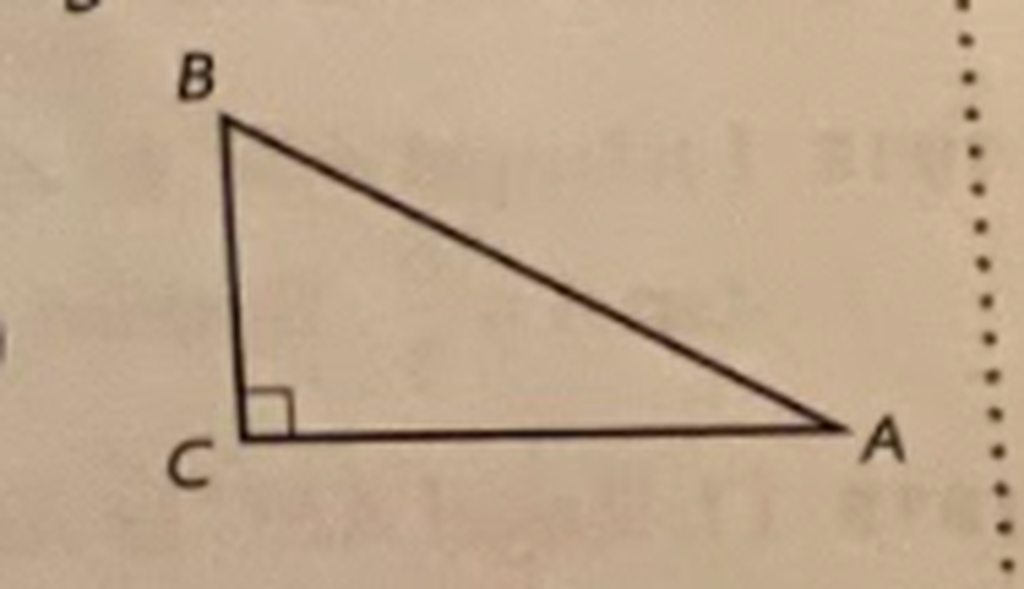
For a right-angled triangle, ABC, https://imgur.com/a/vt1N7Z8 cos A = 4⁄5
Determine
a) cos B
b) sin (90°-B)
c) tan A
 untold warren

 wheat rivet
why is the answer to this negative
 cinder sundial
i need an handsome person to solve me out the hot question i posted in #help-3
that person must be super handsome, so that hes able to solve the hot question
 wind hare
What do you have against the aesthetically challenged?
cinder sundial
wdym, everyone is handsome and pretty, but the one that can solve the question i have posted in #help-3 gotta be the most handsome person in the world (today
 coral pagoda
cinder sundial
wdym, everyone is handsome and pretty, but the one that can solve the question i...
coral pagoda
cinder sundial
wdym, everyone is handsome and pretty, but the one that can solve the question i...
You've been around for a while. Don't do this. :(
cinder sundial
what you means @coral pagoda
coral pagoda
I think you know very well what I mean. Don't ask people to help from other channels, especially back to back.
cinder sundial
no, i thought you were talkin bout the joke i made, and im sorry
i thought i could do that like ask ppl check diffrent channel,
i wont do that again, sorry
coral pagoda
You're bribing unrelated compliments if ya get help. That also is a bit debatable
 unkempt viper