#help-0
1 messages · Page 259 of 1
 craggy spire
 steep pendant
craggy spire
And to build a line poing slope form i just plug the points into the formula?
steep pendant
craggy spire
And to build a line poing slope form i just plug the points into the formula?
so long as you plug in the point at the bisection of AK and a slope that's the negative reciprocal of the slope of AK
 lone heartBOT
@craggy spire Has your question been resolved?
lone heartBOT
Channel closed
Closed due to timeout
Use .reopen if this was a mistake.
lone heartBOT
 Available help channel!
Send your question here to claim the channel.
Remember:
• Ask your math question in a clear, concise manner.
• Show your work, and if possible, explain where you are stuck.
• After 15 minutes, feel free to ping <@&286206848099549185>.
• Type the command .close to free the channel when you're done.
• Be polite and have a nice day!
Read #❓how-to-get-help for further information on how to ask a good question, and about conduct in the question channels.
 dawn quail
 lone heartBOT
dawn quail
lone heartBOT
dawn quail
 dawn quail
Why am I allowed to do this?
dawn quail
dawn quail
Why am I allowed to do this?
Divide by 2x like this
 placid zinc
u = x² + 5
du = 2x dx
Or dx = du/2x
dawn quail
Why is du = 2x dx?
placid zinc
They have one too many 2x in the denominator. Maybe a typo
Oh you've never seen u-sub before
Give a quick check to u-substitution
dawn quail
Oh it’s from the derivative of u
placid zinc
It's an integral method, the reverse of the chain rule
dawn quail
Nothing to do with 4x
lone heartBOT
@dawn quail Has your question been resolved?
lone heartBOT
Channel closed
Closed due to timeout
Use .reopen if this was a mistake.
Available help channel!
Send your question here to claim the channel.
Remember:
• Ask your math question in a clear, concise manner.
• Show your work, and if possible, explain where you are stuck.
• After 15 minutes, feel free to ping <@&286206848099549185>.
• Type the command .close to free the channel when you're done.
• Be polite and have a nice day!
Read #❓how-to-get-help for further information on how to ask a good question, and about conduct in the question channels.
 cunning vine
Could someone look over my gorilla problem and part 1 of the car problem (when it's asking for approximation, is it better to use a concrete number of subintervals instead an arbitrary number n even I don't take the limit as n approaches infinity) which gives the exact area?
lone heartBOT
cunning vine
Could someone look over my gorilla problem and part 1 of the car problem (when i...
@cunning vine Has your question been resolved?
lone heartBOT
Channel closed
Closed due to timeout
Use .reopen if this was a mistake.
Available help channel!
Send your question here to claim the channel.
Remember:
• Ask your math question in a clear, concise manner.
• Show your work, and if possible, explain where you are stuck.
• After 15 minutes, feel free to ping <@&286206848099549185>.
• Type the command .close to free the channel when you're done.
• Be polite and have a nice day!
Read #❓how-to-get-help for further information on how to ask a good question, and about conduct in the question channels.
 hot bluff
prove divergence or convergence by comparison. would this be good enough of an answer in calc 2?
 lone heartBOT
hot bluff
prove divergence or convergence by comparison. would this be good enough of an a...
lone heartBOT
hot bluff
prove divergence or convergence by comparison. would this be good enough of an a...
 rigid prawn
looks pretty good...if you have learnt series you can also think of the integral as a sum of small areas and since every small area of x/x^3+1 will be smaller than each small area of 1/x^2 it has to converge (this isnt rigorous)
 kindred lodge
You should state why 1/x^2 is convergent
hot bluff
haven't gotten to series yet
power series, 1/x^p, p <= 1 is divergent, p > 1 is convergent
hot bluff
alright the next one though is way harder and idk where to start the comparison

undefined both at 1 and 0
how would i split this
0 dont matter, but 1 does
would it be split like (1, 2] and [2, inf)?
and beyond that, would power series comparison work here?

?
rigid prawn
i m not familiar with these kinds of justification for convergence but since at 1 the value is infinity, and the integral is positive everywhere it has to diverge
lone heartBOT
@hot bluff Has your question been resolved?

 placid zinc
√[x⁴ - x] < √x⁴ = x²
So
1/√[x⁴ - x] > 1/x²
hot bluff
okay so the comparison of 1/x^2 works
how did you realize 1/x^2 was the comparison needed?
not quite clear from what you posted
also, does the numerator not matter in this instance?
placid zinc
Numerator matters, but that just means
∫ x+1 / √[x⁴ - x] dx > ∫ x+1 / x² dx
The right is divergent, so I was done
Honestly, I saw it because omitting a term is an easy way to obtain an inequality
Just remove the -x from under the √, bingo you have an inequality, does it work? A lot of questions flow this way
hot bluff
yeah it worked. i moved onto the next one and im wondering if this works?

dont mind the product-sum identity i messed that up, but 1 > sin^2 x, does that seem right? because sin^2 x can = 1
hot bluff
sin^2 pi/2 = 1 though which violates the inequality
placid zinc
I mean ≥ yeah
hot bluff
you're right it could be >=
 gusty hollow
(-20x^3u^6-16x^6u^6+25x^5u^6) ÷ (-4x^4u^5) simplify your answer as much as possible.
Any help on this problem would be awesome
hot bluff
 placid zinc
hot bluff
placid zinc
hot bluff
wait if we are proving divergence. shouldn't the equality be reversed?
since we are trying to prove the integrand grows faster than the known divergent function x^(-1/2)?
placid zinc
That one converges! So they both do.
hot bluff
omggg whaaat, but i thought 1/x^p diverges for p <= 1
hot bluff
damn this is confusing me now. since the comparison theorem is for integrals with an infinite bound?
ohhh its for discontinuous bounds. so 0 in this case is the discontinuity, right?
placid zinc
0 is an asymptote
The infinity bound rule is great, I don't have a similar one for finite bounds. I just did the integral in my head real quick
Luckily ∫ 1/√x dx isn't too bad
hot bluff
yeah i see it here, im just trying to conceptualize how we are comparing this. its obvious from the graph but im trying to make sense of it through the comparison theorem

its still hurting my brain though because this is actually convergent, although 1/sqrtx is supposed to be divergent?
placid zinc
∫ 1/√x dx, between 0 and π, is convergent. It's 2√π
hot bluff
so working out the integral of the comparison function is helping me understand

since now i've found it converges, i can then use the inequality i was using before
to prove this function also converges
right?
placid zinc
ye
hot bluff
cool. thank you so much.
placid zinc
Another way to see it, do a u-sub:
u = 1/x
Turns into a limit to infinity of ∫ u^(-3/2) du
 lone heartBOT
Channel closed
Closed by @hot bluff
Use .reopen if this was a mistake.
Available help channel!
Send your question here to claim the channel.
Remember:
• Ask your math question in a clear, concise manner.
• Show your work, and if possible, explain where you are stuck.
• After 15 minutes, feel free to ping <@&286206848099549185>.
• Type the command .close to free the channel when you're done.
• Be polite and have a nice day!
Read #❓how-to-get-help for further information on how to ask a good question, and about conduct in the question channels.
 alpine sable
Find dy/dx if y=e^(2x).
lone heartBOT
alpine sable
Find dy/dx if y=e^(2x).
 green hazel
derivative of e^ x is e ^x
 last ether
(Chain rule is gonna be your best friend)
green hazel
use chain ruel
hot bluff
you can use log diff too, but its simple enough where you can chain rule.
green hazel
means something entirely different
hot bluff
try log differentiation, it might help you.
green hazel
both can be solved using chain rule
hot bluff
ln y = 2x -> y'/y = 2 -> y' = 2y -> y' = ???
placid zinc
To do the chain rule you
- Differentiate the outer function
- Put the inner function back in, unchanged
- Multiply that by the derivative of the inner function
Note the unchanged part
The 2x goes back in
alpine sable
green hazel
means something entirely different
I know that it’s a different expression. But e^(2x)= (e^x)^2 = 2 * (e^x)
Why can’t I do that?
green hazel
u taking the derivative?
that's wrong
d/dx (e^u) = e^u * u'
use this formula gang
placid zinc
Okay, in that case, the outer function is x², the inner is e^x.
You have to multiply by the derivative of e^x to finish it off
hot bluff
you're substituting without replacing what you substituted. replace e^x with u and see what we mean
placid zinc
(e^x)² differentiates to:
2(e^x)(e^x)
placid zinc
Take a second to identify the outer function and inner function, if you haven't yet
Of (e^x)²
alpine sable
Inner is e^x. The outer is squaring?
hot bluff
good, apply chain rule.
placid zinc
Namely, outer is x²
Apply by the formula, or by #help-0 message my explanation above
lone heartBOT
@alpine sable Has your question been resolved?
alpine sable
placid zinc
Namely, outer is x²
I don’t understand. I’m sorry for the late reply. I had to go
Why x^2
Actually I need to go
Thank you for the help tho
I’ll use chain rule to solve it
Thank you guys
.close
lone heartBOT
Channel closed
Closed by @vivid walrus
Use .reopen if this was a mistake.
Available help channel!
Send your question here to claim the channel.
Remember:
• Ask your math question in a clear, concise manner.
• Show your work, and if possible, explain where you are stuck.
• After 15 minutes, feel free to ping <@&286206848099549185>.
• Type the command .close to free the channel when you're done.
• Be polite and have a nice day!
Read #❓how-to-get-help for further information on how to ask a good question, and about conduct in the question channels.
lone heartBOT
rigid prawn
what is the objective? simplify?
 naive valley
what's the goal?
 lone heartBOT
Channel closed
Closed by @zenith mulch
Use .reopen if this was a mistake.
Available help channel!
Send your question here to claim the channel.
Remember:
• Ask your math question in a clear, concise manner.
• Show your work, and if possible, explain where you are stuck.
• After 15 minutes, feel free to ping <@&286206848099549185>.
• Type the command .close to free the channel when you're done.
• Be polite and have a nice day!
Read #❓how-to-get-help for further information on how to ask a good question, and about conduct in the question channels.
 ashen shore
No clue on how to solve for the shaded region or the angle, what should I start with?
 lone heartBOT
ashen shore
No clue on how to solve for the shaded region or the angle, what should I start ...
alpine sable
lone heartBOT
ashen shore
No clue on how to solve for the shaded region or the angle, what should I start ...
alpine sable
Help
 echo socket
ashen shore
No clue on how to solve for the shaded region or the angle, what should I start ...
echo socket
ashen shore
No clue on how to solve for the shaded region or the angle, what should I start ...
You can calculate the areas of the sector and the triangle, right?
ashen shore
echo socket
You can calculate the areas of the sector and the triangle, right?
Only the triangle
echo socket
You haven't been shown how to evaluate some sector's area?
ashen shore
If I have the sector I can find the segment
echo socket
ashen shore
No clue on how to solve for the shaded region or the angle, what should I start ...
Notice that the sector can be divided into the triangle and the shaded area
So sector's area = triangle's area + shaded area
 turbid swan
isnt it ((angle/360)*circumference - (area of triangle))
sectors area is angle/360 * circumference i think
echo socket
Basically, we want to calculate the difference between areas of the sector and the triangle
echo socket
turbid swan
sectors area is angle/360 * circumference i think
That's arclength
turbid swan
oh u right
echo socket
Area of a sector is theta/360 * pir^2
turbid swan
ohhh *area of circle instead of circumference
echo socket
Yup
So, we need to figure out the angle theta
For that you can draw a line from O perpendicular to BC and notice that sin(theta/2) = 5/9
Which is the same as $\sqrt{\frac{1 - \cos\theta}2} = \frac59$
 ocean sealBOT
alonelybean
 echo socket
So, just calculate theta, use theta to calculate sector's area and then subtract triangle's area from what you get
turbid swan
triangle area
.5(10)(height)
height = √(9^2 - 5^2)
ashen shore
echo socket
Notice that the sector can be divided into the triangle and the shaded area
How do I find the sector using only the triangle's lengths?
echo socket
ashen shore
How do I find the sector using only the triangle's lengths?
First you calculate the value of theta, because it's needed for the sector's area to be known
echo socket
echo socket
So, we need to figure out the angle theta
Just read what I said from here
ashen shore
.close
lone heartBOT
Channel closed
Closed by @ashen shore
Use .reopen if this was a mistake.
ashen shore
thanks
lone heartBOT
Available help channel!
Send your question here to claim the channel.
Remember:
• Ask your math question in a clear, concise manner.
• Show your work, and if possible, explain where you are stuck.
• After 15 minutes, feel free to ping <@&286206848099549185>.
• Type the command .close to free the channel when you're done.
• Be polite and have a nice day!
Read #❓how-to-get-help for further information on how to ask a good question, and about conduct in the question channels.
 crimson zodiac
 crimson zodiac
help
spmeone
pls
i gotta do this fast
someon pls ik the correct answer is one of the last 2
lone heartBOT
@crimson zodiac Has your question been resolved?
 crimson carbon
is '1' the centre of the circle?
like an angle at the centre of the circle
A central angle (most likely since the q assumes that anyway)
there are a couple different ways to get arc measure DF
if 1 is a central angle then it must have the same angular measure as the arc
lone heartBOT
Channel closed
Closed due to timeout
Use .reopen if this was a mistake.
Available help channel!
Send your question here to claim the channel.
Remember:
• Ask your math question in a clear, concise manner.
• Show your work, and if possible, explain where you are stuck.
• After 15 minutes, feel free to ping <@&286206848099549185>.
• Type the command .close to free the channel when you're done.
• Be polite and have a nice day!
Read #❓how-to-get-help for further information on how to ask a good question, and about conduct in the question channels.
alpine sable
How do I find the sum?
 lone heartBOT
alpine sable
How do I find the sum?
lone heartBOT
alpine sable
How do I find the sum?
 upbeat hornet
alpine sable
How do I find the sum?
upbeat hornet
alpine sable
How do I find the sum?
You can take 9 out
And then use the fact that this is a geometric series
 young finch
^
alpine sable
so 9(pi)^-n?
young finch
you know the formula for infinite geometric series right
 modern sedge
This one?
 modern sedge
This one?
modern sedge
modern sedge
This one?
Do you know this formula or anything similar?
alpine sable
yea
modern sedge
alpine sable
How do I find the sum?
So this is just a geometric series. 9*(1/pi)^1 + 9*(1/pi)^2 + 9*(1/pi)^3 ...
so you can apply the formula
ocean sealBOT
methisalwaysright
 modern sedge
what's the first term and common ratio here?
alpine sable
9 and 1/pi
modern sedge
Almost, note that here we start from n=1. So the first term is actually 9*(1/pi). Easiest way to find it is writing out first few terms of the series as I did above and looking at the first term
 wild trail
why not just take 9 common out and solve it easily?
young finch
upbeat hornet
You can take 9 out
like first guy said^
alpine sable
wild trail
why not just take 9 common out and solve it easily?
9(1/pi)^n?
wild trail
@alpine sable
wild trail
mb, shouldn't have deleted the source
$\sum_{n=1}^{\infty} \frac{9}{\pi^n} = 9 \left( \sum_{n=1}^{\infty} \frac{1}{\pi^n} \right)$
ocean sealBOT
numbily
 modern sedge
If it makes it easier for you to find the sum, you can do what they said
alpine sable
modern sedge
This one?
what about this

 alpine sable
oh ok, got it thanks
 vapid shuttle
alpine sable
oh ok, got it thanks
vapid shuttle
alpine sable
oh ok, got it thanks
are you done with this channel then and ready to close?
alpine sable
.close
lone heartBOT
Channel closed
Closed by @pale thorn
Use .reopen if this was a mistake.
Available help channel!
Send your question here to claim the channel.
Remember:
• Ask your math question in a clear, concise manner.
• Show your work, and if possible, explain where you are stuck.
• After 15 minutes, feel free to ping <@&286206848099549185>.
• Type the command .close to free the channel when you're done.
• Be polite and have a nice day!
Read #❓how-to-get-help for further information on how to ask a good question, and about conduct in the question channels.
 warped topaz
 lone heartBOT
warped topaz
https://i.imgur.com/hBxAOfv.png
warped topaz
lone heartBOT
warped topaz
https://i.imgur.com/hBxAOfv.png
warped topaz
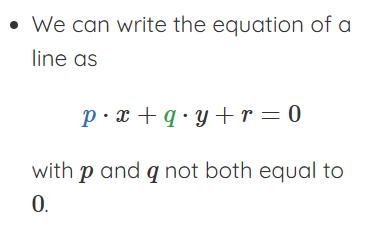
What is the benifit of writing a line like this
 surreal meadow
it’s subjective
warped topaz
Like y=mx+c gives the slope and y intercept
warped topaz
Is there anything I can read instantly from it or something
 tardy stag
looks pretty 
vapid shuttle
There is a clear benefit to point slope, or slope intercept, but not to this
this just sets the right hand side equal to 0
so, that is really the only benefit
warped topaz
Does the r mean anything
surreal meadow
warped topaz
Does the r mean anything
distance from the origin, in a way
modern sedge
One benefit I can think of is ability to express lines such as x=4
vapid shuttle
x=4 isn't of this form provided though
modern sedge
nvm
tardy stag
vapid shuttle
x=4 isn't of this form provided though
yeah it is, p and q can't both be 0
but one of them can
surreal meadow
odie the answer here, and whenever you see forms, is that they are useful to display certain information, or they will become useful later in math
tardy stag
but i've always seen this as px + qy = r
vapid shuttle
I think we can summarize it as the benefit of this form of line equation is that we have all the variables on one side, and the other side is 0, and that kinda looks neat. Does that explanation suffice @warped topaz ?
warped topaz
surreal meadow
odie the answer here, and whenever you see forms, is that they are useful to dis...
Which info does it display?
or they will become useful later in math
Ah ok
Maybe im not there yet haha
just starting geometry
warped topaz
vapid shuttle
I think we can summarize it as the benefit of this form of line equation is that...
Ye haha
vapid shuttle
this kind of form comes up a bit in differential equations, but those are nonlinear
surreal meadow
this one isn’t particularly useful yet
vapid shuttle
so not really
surreal meadow
when you get to vectors it’ll become reasonable
but till then just memorize it as another form
there’s not any more to it than that
vapid shuttle
there's nothing really even to memorize
so long as you know how to add and subtract this is always 1 operation away from slope intercept form
warped topaz
ye haha its easy enough
Anyway thats all I wanted to ask
Thank you everyone!
❤️
.close
lone heartBOT
Channel closed
Closed by @warped topaz
Use .reopen if this was a mistake.
warped topaz
.reopen
lone heartBOT
✅
warped topaz
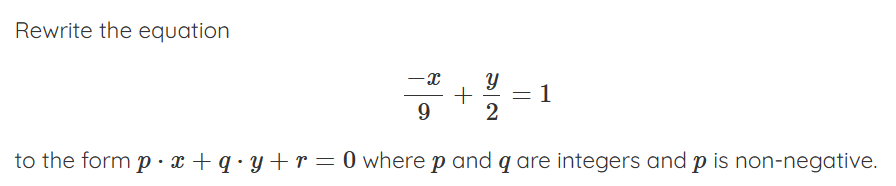
So in this form the coefficient of x HAS to be a positive integer, right?
y doesnt matter right?
vapid shuttle
nope
warped topaz
o
tardy stag
i would find it weird for it to be negative but it's allowed
vapid shuttle
p and q can be any real numbers
 surreal meadow
for uniqueness
warped topaz
I just assumed it had to be
surreal meadow
otherwise there’d be multiple answers
tardy stag
the fact that it tells you specifically to do it for those questions means that it's not a general rule 
warped topaz
But is it the standard form?
vapid shuttle
this isn't a standard form for anything
it is just yet another way to rearrange an equation
equation being the key word, any way you spin it, any form you put it, it just describes an equivalence between at most two variables, in a linear relationship.
$$y=x+5$$ is an equation between two variables. y is always equal to x+5. $$0=x-y+5$$ is an equation between the same two variables, describing the same relation. this time, it says it differently. x-y is equal to -5, since x-y plus 5 is 0.
ocean sealBOT
austinu
 warped topaz
Ya true haha
surreal meadow
it’s all the same things reworded is the point
the most standard form you’ll encounter is y=mx+b
be comfortable with that and moving that around. the rest should follow
lone heartBOT
Channel closed
Closed by @warped topaz
Use .reopen if this was a mistake.
warped topaz
.reopen
lone heartBOT
✅
warped topaz
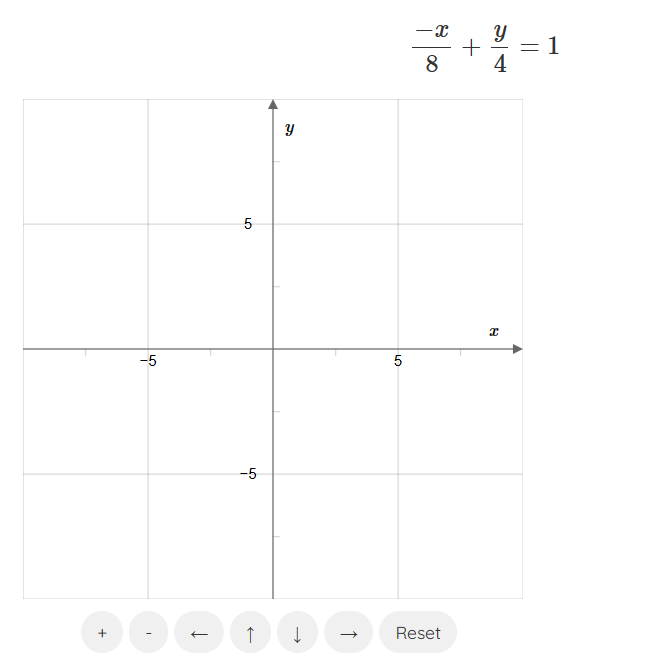
Like is there any way I can quickly draw this
Or do I have to change it back to y=mx+c
surreal meadow
plug points in for x
like values
and find the corresponding y value
that’s all there is to it
vapid shuttle
Hey Odie, can I help you with this in DMs instead?
lone heartBOT
Channel closed
Closed by @warped topaz
Use .reopen if this was a mistake.
Available help channel!
Send your question here to claim the channel.
Remember:
• Ask your math question in a clear, concise manner.
• Show your work, and if possible, explain where you are stuck.
• After 15 minutes, feel free to ping <@&286206848099549185>.
• Type the command .close to free the channel when you're done.
• Be polite and have a nice day!
Read #❓how-to-get-help for further information on how to ask a good question, and about conduct in the question channels.
 dusty iris
i dont get the answer as if you had n=5 and k=3, you would still get 10 partitions


 lone heartBOT
dusty iris
i dont get the answer as if you had n=5 and k=3, you would still get 10 partitio...
dusty iris
lone heartBOT
dusty iris
i dont get the answer as if you had n=5 and k=3, you would still get 10 partitio...
dusty iris
answer
 vapid shuttle
what are the marks for?
surreal meadow
into k subsets of equal size
surreal meadow
i misunderstood hold on
you need at least 2 elements per subset
and k is the number of subsets
dusty iris
yeah
surreal meadow
f(5,3) is the number of ways to partition 5 elements into 3 subsets
each with at least two elements
lone heartBOT
Channel closed
Closed by @dusty iris
Use .reopen if this was a mistake.
Available help channel!
Send your question here to claim the channel.
Remember:
• Ask your math question in a clear, concise manner.
• Show your work, and if possible, explain where you are stuck.
• After 15 minutes, feel free to ping <@&286206848099549185>.
• Type the command .close to free the channel when you're done.
• Be polite and have a nice day!
Read #❓how-to-get-help for further information on how to ask a good question, and about conduct in the question channels.
 worldly pagoda
how do I factor by grouping for mx - my - nx + ny
 raven haven
!status
lone heartBOT
What step are you on?
1. I don't know where to begin
2. I have begun but got stuck midway
3. I got an answer but I'm told it's wrong
4. I got an answer and would like my work checked
5. I have a question about someone else's worked solution
6. None of the above
group together the items with similar terms
worldly pagoda
2
vapid shuttle
so, you have four variables here
m, n, x, and y
but at most your pieces here only have 2 things
so you can't factor the same thing out of all of them
instead, you could group them together
maybe grouping x's and grouping y's
so rearranging the equation into
mx-nx +ny-my
and then factoring those two groups individually
see how the first group shares x's?
and the second group shares y's?
so you can factor those from the groups
worldly pagoda
I have and I ended up with x(m-n) + y(n-m)
raven haven
(n-m) = (-1)(m-n)
worldly pagoda
aren't the terms inside both brackets meant to be the same?
raven haven
does this help?
vapid shuttle
worldly pagoda
aren't the terms inside both brackets meant to be the same?
you can make them the same thing using DerpZ's hint 😜
worldly pagoda
so -x(m-n)?
vapid shuttle
do you mean -y(m-n)
worldly pagoda
can we not apply it to the first group?
oh wait no mb
I understand it now
thank you
worldly pagoda
.close
lone heartBOT
Channel closed
Closed by @worldly pagoda
Use .reopen if this was a mistake.
Available help channel!
Send your question here to claim the channel.
Remember:
• Ask your math question in a clear, concise manner.
• Show your work, and if possible, explain where you are stuck.
• After 15 minutes, feel free to ping <@&286206848099549185>.
• Type the command .close to free the channel when you're done.
• Be polite and have a nice day!
Read #❓how-to-get-help for further information on how to ask a good question, and about conduct in the question channels.
 strange fractal
HI
lone heartBOT
strange fractal
HI

 carmine reef
They plugged in the point to the equation
raven haven
substitution
 gray isle
solve for a after subbing
raven haven
nice
strange fractal
thnx
raven haven
any other questions?
vapid shuttle
may we close the channel now?
raven haven
if not remember to close it
strange fractal
ok thnx
wait am i allowed to leave open if i have another question im very bad at parabolas
theres like 5 people
strange fractal
thats sooooo drag
raven haven
^
lone heartBOT
Channel closed
Closed by @strange fractal
Use .reopen if this was a mistake.
strange fractal
.reopen
lone heartBOT
✅
strange fractal
how do i find a point here
 raven haven
the "height" you speak of is the y intercept
strange fractal
oh
strange fractal
strange fractal
how do i find a point here
pls help
raven haven
what point are you trying to find
strange fractal
so is y=a(x−h)2+k same as y = ax^2 + k
strange fractal
raven haven
what point are you trying to find
idk any point
so i can sub it in
omg wait..
i can just use this one
y=a(x−h)2+k
its easier
OMGGGGGGGGGGGGGGGGGGGGGGG
 bleak hemlock
strange fractal
pls help
bleak hemlock
strange fractal
pls help
Whcih Point
raven haven
unless h=0
 lone heartBOT
Channel closed
Closed by @strange fractal
Use .reopen if this was a mistake.
lone heartBOT
Available help channel!
Send your question here to claim the channel.
Remember:
• Ask your math question in a clear, concise manner.
• Show your work, and if possible, explain where you are stuck.
• After 15 minutes, feel free to ping <@&286206848099549185>.
• Type the command .close to free the channel when you're done.
• Be polite and have a nice day!
Read #❓how-to-get-help for further information on how to ask a good question, and about conduct in the question channels.
 zenith leaf
How do I find m<EF?
 lone heartBOT
zenith leaf
How do I find m<EF?
zenith leaf
lone heartBOT
zenith leaf
How do I find m<EF?
zenith leaf
I am having trouble rewriting the formula
zenith leaf
vapid shuttle
do you know that formula?
Arc = x/360 times pi(r^2)
vapid shuttle
where x is what?
zenith leaf
x is angle measure degree
zenith leaf
I got 32.03
vapid shuttle
great
zenith leaf
Thanks but thats right correct?
vapid shuttle
you can verify that on your own I'm sure
zenith leaf
it looks like its right
surreal meadow
do you have any other questions
zenith leaf
no
surreal meadow
you can close the channel with .close
vapid shuttle
.close
lone heartBOT
Channel closed
Closed by @vapid shuttle
Use .reopen if this was a mistake.
raven haven
it got coosed
lone heartBOT
Available help channel!
Send your question here to claim the channel.
Remember:
• Ask your math question in a clear, concise manner.
• Show your work, and if possible, explain where you are stuck.
• After 15 minutes, feel free to ping <@&286206848099549185>.
• Type the command .close to free the channel when you're done.
• Be polite and have a nice day!
Read #❓how-to-get-help for further information on how to ask a good question, and about conduct in the question channels.
 thick lynx
For the matrix $A = \begin{pmatrix} 2 \ 3 \ 1 \ 3 \ 4 \ 1 \ 5 \ 2 \ 1 \end{pmatrix}$, we have the eigenvalues $\lambda_1 \approx 7.2, \lambda_2 \approx -0.85$ and $\lambda_3 \approx 0.65$. \ Then the corresponding eigenspaces would be \begin{align*} E(\lambda_1) &= {x \in V \ | \ x \neq 0, A(x) = 7.2x} \cup {0} \
E(\lambda_2) &= {x \in V \ | \ x \neq 0, A(x) = -0.85x} \cup {0} \
E(\lambda_2) &= {x \in V \ | \ x \neq 0, A(x) = 0.65x} \cup {0}, \end{align*} right?
lone heartBOT
thick lynx
For the matrix $A = \begin{pmatrix} 2 \ 3 \ 1 \\ 3 \ 4 \ 1 \\ 5 \ 2 \ 1 \end{pma...
thick lynx

 lament forge
...is there a reason you're explicitly excluding the zero vector and then adding it back?
also the eigenspace should presumably be using the exact value of the eigenvalue instead of an approximation
but other than that yeah that looks correct i think
thick lynx
lament forge
...is there a reason you're explicitly excluding the zero vector and then adding...
I was just about to ask that, for some reason, Wikipedia first arrives at not excluding the zero vector and then proceeds to do so (https://de.m.wikipedia.org/wiki/Eigenraum). Is there a reason for that?
It's the German version, but it's right under "Definition"
lament forge
i guess it might be because ${x\in V | x \neq 0, A(x) = \lambda x}$ is the set of eigenvectors?
ocean sealBOT
bee [it/its]
 lament forge
since 0 isn't an eigenvector even though A(0) = lambda*0
so the eigenspace is indeed "all the eigenvectors and the zero vector"
thick lynx
lament forge
so the eigenspace is indeed "all the eigenvectors and the zero vector"
You would just write \begin{align*} E(\lambda_1) &= {x \in V \ | \ A(x) = 7.2x} \end{align*} though, right?
 lament forge
yeah that's equivalent and simpler
i don't really know why you'd want to write it as "the set of nonzero vectors such that A(x) = lambda*x and also zero"
thick lynx
lament forge
i don't really know why you'd want to write it as "the set of nonzero vectors su...
Thanks. And if the initial matrix was called A, you would also call your function A(x), right?
lament forge
yes
thick lynx
Alright
V is a vector space in this case, does it have anything to do with our matrix A?
lament forge
well A should be a linear map from the space to itself (or an "endomorphism", which is apparently basically the same word in german as it is in english, unless "ein Endomorphismus" means something else)
so if V is n-dimensional then A is an nxn matrix
 left wharf
which means if A is a matrix, the elements of A depend on the underlying vector space (although in most cases it's R^n or C^n)
lament forge
lament forge
well A should be a linear map from the space to itself (or an "endomorphism", wh...
(if it wasn't then either A(x) wouldn't make sense because A doesn't take a vector from V as input, or A(x) = 7.2x wouldn't make sense because A(x) is a vector in some other vector space and can't be compared with x)
lone heartBOT
Channel closed
Closed by @thick lynx
Use .reopen if this was a mistake.
Available help channel!
Send your question here to claim the channel.
Remember:
• Ask your math question in a clear, concise manner.
• Show your work, and if possible, explain where you are stuck.
• After 15 minutes, feel free to ping <@&286206848099549185>.
• Type the command .close to free the channel when you're done.
• Be polite and have a nice day!
Read #❓how-to-get-help for further information on how to ask a good question, and about conduct in the question channels.
thick lynx
When we want to determine the rank of a matrix, why do we want to get it to a row echelon form?
lone heartBOT
thick lynx
When we want to determine the rank of a matrix, why do we want to get it to a ro...
alpine sable
it makes it much easier to determine the rank (look at the pivots)
thick lynx
alpine sable
it makes it much easier to determine the rank (look at the pivots)
What is it that we want to look at when determining the rank? The rank of a matrix is the rank of a column and the rank of a row
But how do we determine the rank of a row?
 mortal trellis
it doesnt make sense to talk about the rank of a row
not really
the row-rank is the maximal number of linearly independent rows. this you can read off from the number of pivots
thick lynx
mortal trellis
it doesnt make sense to talk about the rank of a row
What do you mean with it doesn't make sense to talk of the row-rank?
mortal trellis
row-rank does not mean "rank of a row"
thick lynx
thick lynx
What is it that we want to look at when determining the rank? The rank of a matr...
It should be "The rank of a matrix is the row-rank and the column-rank"
mortal trellis
yes because those are equal
thick lynx
How do we determine these? Given a matrix $A = \begin{pmatrix} 1 & 2 & 3 \ 4 & 5 & 6 \ 7 & 8 & 9\end{pmatrix}$, how would we determine the row-rank, for example?
mortal trellis
thick lynx
When we want to determine the rank of a matrix, why do we want to get it to a ro...
row echelon form
thick lynx
 thick lynx
mortal trellis
row echelon form
thick lynx
mortal trellis
row echelon form
Oh, you are allowed to do certain operations and want to end up with the row echelon form
mortal trellis
yes. elementary row operations dont change the rank
thick lynx
mortal trellis
yes. elementary row operations dont change the rank
Wouldn't the column-rank be the rank of for example \begin{pmatrix} 1 \ 4 \ 7\end{pmatrix}
 mortal trellis
no
column rank doesnt mean "rank of a column" either
column rank means maximal number of linearly independent columns
thick lynx
oh
thick lynx
mortal trellis
column rank means maximal number of linearly independent columns
Couldn't you see that without doing any elementary row operations?
It might take longer, of course
thick lynx
oh, alright
mortal trellis
the point of row reduction is not "this is the only way to do it"
its "this is a general way that always works and most of the time will be the best way"
this holds for most algorithms you learn
thick lynx
mortal trellis
its "this is a general way that always works and most of the time will be the be...
So given a nicer matrix from my book [A = \begin{pmatrix} 1 & 2 & -1 & 0 \ 2 & 6 & -3 & -3 \ 3 & 10 & -5 & -6\end{pmatrix}], we are allowed to change the rows, multiply them with $a \in \mathbb R, a \neq 0$ and add a multiple of some other row to any row

How would you proceed?
Change the first and last row, right?
mortal trellis
subtract some multiple of the first row from the second and third so that the first column is (1,0,0)
thick lynx
to get the 0 down
thick lynx
mortal trellis
subtract some multiple of the first row from the second and third so that the fi...
Oh, then we can subtract -2 times the second column from the third and then entire third column will be 0, 0, 0, 0.
We will get $\begin{pmatrix} 1 & 2 & - 1 & 0 \ 0 & 2 & -1 & -3 \ 0 & 0 & 0 & 0\end{pmatrix}$. This is the row echelon form

So the rang is 2, right?
the last column isn't independant from any of the others
mortal trellis
2 pivots, so yes rank is 2
thick lynx
What do you mean with pivots?
mortal trellis
the first nonzero elements in the rows
thick lynx
Oh
mortal trellis
that's also called pivot in german
thick lynx
mortal trellis
i.e. exactly what we did
Yep, in this case, everything went very nicely, I guess there are cases where we would need a lot more operations, then
mortal trellis
well if the matrix is big, sure
lone heartBOT
Channel closed
Closed by @thick lynx
Use .reopen if this was a mistake.
lone heartBOT
Available help channel!
Send your question here to claim the channel.
Remember:
• Ask your math question in a clear, concise manner.
• Show your work, and if possible, explain where you are stuck.
• After 15 minutes, feel free to ping <@&286206848099549185>.
• Type the command .close to free the channel when you're done.
• Be polite and have a nice day!
Read #❓how-to-get-help for further information on how to ask a good question, and about conduct in the question channels.
 reef flame
Is this correct
 lone heartBOT
reef flame
Is this correct
lone heartBOT
reef flame
Is this correct
 tawny crown
Not quite. You can not write 3(2)^(n-1) as 6^(n-1)
There's only one 3
$(23)^n ≠ 3(2)^n$
ocean sealBOT
radiation1
 tawny crown
Instead you can divide by 3 on both sides
alpine sable
ocean seal
**radiation1**
this equation is incorrect or am i wrong
reef flame
tawny crown
Not quite. You can not write 3(2)^(n-1) as 6^(n-1)
Yeah
tawny crown
alpine sable
this equation is incorrect or am i wrong
It's an inequation
Not an equation
reef flame
I don't think you divide by 3 on both sides tho I think you just leave it like that
alpine sable
tawny crown
It's an inequation
oh lol i didn't see the line
upbeat hornet
reef flame
Is this correct
the sequences are short enough that you could list them out to check them with a calculator
lone heartBOT
Channel closed
Closed by @reef flame
Use .reopen if this was a mistake.
reef flame
.reopen
lone heartBOT
✅
upbeat hornet
reef flame
I had another question why would I divide by 3
Where did you divide by 3?
tawny crown
You can divide by 6 by taking one 2 out of the bracket but it would be a hassle
tawny crown
reef flame
I had another question why would I divide by 3
Because its simple?
reef flame
So do I do 768/3 and 3/3
tawny crown
Yes
reef flame
Oh ok thanks
tawny crown
Giving you 256=2^(n-1)
lone heartBOT
Channel closed
Closed by @reef flame
Use .reopen if this was a mistake.
Available help channel!
Send your question here to claim the channel.
Remember:
• Ask your math question in a clear, concise manner.
• Show your work, and if possible, explain where you are stuck.
• After 15 minutes, feel free to ping <@&286206848099549185>.
• Type the command .close to free the channel when you're done.
• Be polite and have a nice day!
Read #❓how-to-get-help for further information on how to ask a good question, and about conduct in the question channels.
 tiny path
 tiny path
So umm
Linear equations
Yea
I need to do the 7 8 9 and 10
Anyone who can help me?
I need to get this done by tmr
lone heartBOT
What step are you on?
1. I don't know where to begin
2. I have begun but got stuck midway
3. I got an answer but I'm told it's wrong
4. I got an answer and would like my work checked
5. I have a question about someone else's worked solution
6. None of the above
Ok
tiny path
2 digit numbers?
 mystic mulch
hmm
any number can be represented as a sum of its digits and the corresponding multiple of 10
for 2 digit numbers
say we had a 2 digit number ab
then the number is actually 10 * a + b
yes?
tiny path
Yea
mystic mulch
alright
now
continue
The digit at the tens place is four times the digit at the units place.
What does this mean, algebraically?
tiny path
Ooooh
9 is a tens and 3 is a ones
Place
Idk
If that's right
Online education really fcked me up
tiny path
Ic
mystic mulch
The digit at the tens place is four times the digit at the units place.
Can you express this algebraically, using the a and b I've given you?
ocean sealBOT
eriktheepik
 mystic mulch
We said our 2 digit number consisted of 10's place digit $a$ and one's place digit $b$
ocean sealBOT
eriktheepik
 mystic mulch
So that number is $10a + b$ right?
ocean sealBOT
eriktheepik
 mystic mulch
What's the digit in the tens place here
And how do you make
The digit at the tens place is four times the digit at the units place.
true?
tiny path
Yea
Wait give me a min
To understand it
Ok yea
I can't understand it
Trying my best
mystic mulch
What's the tens place digit
mystic mulch
ocean seal
**eriktheepik**
^
ocean sealBOT
eriktheepik
 mystic mulch
what's the tens place digit and ones place digit
mystic mulch
No
tiny path
To find their digits
tiny path
Ok
mystic mulch
a is the tens place digit yes
mystic mulch
Yeah
tiny path
Bro
My mom telling me to go to shop
I will br back I'm 5 mins
Back
@mystic mulch
mystic mulch
Alright
Yeah so
Now
The tens place digit is 4 times the one places digit
Write that down algebraically
tiny path
Just by
Lil bit of help
By my friend
Or teacher
Not friend
The teacher wrote it
Nd them the period ended
<@&286206848099549185>
Anyone?
lone heartBOT
@tiny path Has your question been resolved?
lone heartBOT
Channel closed
Closed by @tiny path
Use .reopen if this was a mistake.
Available help channel!
Send your question here to claim the channel.
Remember:
• Ask your math question in a clear, concise manner.
• Show your work, and if possible, explain where you are stuck.
• After 15 minutes, feel free to ping <@&286206848099549185>.
• Type the command .close to free the channel when you're done.
• Be polite and have a nice day!
Read #❓how-to-get-help for further information on how to ask a good question, and about conduct in the question channels.
 pure wyvern
i want to learn trignometery
lone heartBOT
pure wyvern
i want to learn trignometery
pure wyvern
i want to learn addition
modern sedge
pure wyvern
i want to learn addition
sin(a+b) and cos(a+b) expansions?
 limpid spade
i want to learn subtraction
lone heartBOT
Channel closed
Closed by @modern sedge
Use .reopen if this was a mistake.
 outer lark
.cloes
 wind cloak
.toes
 daring totem
Patrick bateman guy
lone heartBOT
Available help channel!
Send your question here to claim the channel.
Remember:
• Ask your math question in a clear, concise manner.
• Show your work, and if possible, explain where you are stuck.
• After 15 minutes, feel free to ping <@&286206848099549185>.
• Type the command .close to free the channel when you're done.
• Be polite and have a nice day!
Read #❓how-to-get-help for further information on how to ask a good question, and about conduct in the question channels.
 karmic grove

 lone heartBOT
karmic grove
karmic grove
lone heartBOT
karmic grove
karmic grove
I'm unable to find a counter example to the last bit
 marsh rapids
Do you have any intuition about why it wouldn't hold
karmic grove
not really honestly
tardy stag
this doesn't show anything useful, you need to find an r in R such that (f+g)(x + r) = (f+g)(x) for all x
 marsh rapids
How would you prove it over Z ? over Q ? Does it still hold over R ? Why does it break ?
karmic grove
marsh rapids
How would you prove it over Z ? over Q ? Does it still hold over R ? Why does it...
ig the first two conditions hold over Z , Q & R , though not sure about U being closed under vector additon in any of three cases
marsh rapids
marsh rapids
How would you prove it over Z ? over Q ? Does it still hold over R ? Why does it...
It holds for functions over Q. Why ? Why doesn't it over R ? Hence, find a proof
That should help you get some intuition
Doing it over Z and Q isn't a bad exercise anyways
karmic grove
tardy stag
this doesn't show anything useful, you need to find an r in R such that (f+g)(x ...
Yeah, f+g(x) = f(x+p) + g(x+q) = f+g(x+c) is what I need to show for some c in R , I didn't write f+g(x+c) bit because I was confused if it's true for all f,g (from R to R) it's not a complete proof I'm stuck there
marsh rapids
The question is
Is there a c such that (f+g)(x) = f(x+c) + g(x+c) ?
karmic grove
marsh rapids
Doing it over Z and Q isn't a bad exercise anyways
hmm I'll do that
karmic grove
marsh rapids
The question is
Is there a c such that (f+g)(x) = f(x+c) + g(x+c) ?
yeah
or if we can find a counter example to that
for some f,g with period p and q , f+g isn't periodic
lone heartBOT
@karmic grove Has your question been resolved?
karmic grove
It's coming down to only this question '' Is f+g periodic given f and g are periodic '' when I try to prove it over Z , Q and R or even C actually (in fact condition 1 i.e 0(x) = 0 belongs to U is true over any arbitrary field) also is U closed under scalar multiplication (over any arbitrary field) ?
karmic grove
marsh rapids
Doing it over Z and Q isn't a bad exercise anyways
wait Z is a ring ? how do we do it over Z (given that a V.S is defined over a field)
hmm do we need multiplicative inverse of non-zero scalars to exist in this case
marsh rapids
I just meant it as functions over Z rather than functions over R
We only care about stability by sum anyways
We saw the rest is trivial
Also the set of all functions from Z to R is still a v.s.
marsh rapids
karmic grove
wait Z is a ring ? how do we do it over Z (given that a V.S is defined over a fi...
Exercise: prove that, for any set S and vector space E, the set of all functions from S to E is a vector space (over the same field as E)
In this case for periodicity we only need that the input space be an additive group
karmic grove
hmm
marsh rapids
Arguably even an additive monoid
karmic grove
marsh rapids
Also the set of all functions from Z to R is still a v.s.
over R ?
marsh rapids
Yes
marsh rapids
marsh rapids
Exercise: prove that, for any set S and vector space E, the set of all functions...
Eliminated the ambiguity in the generalized version
marsh rapids
karmic grove
ig the first two conditions hold over Z , Q & R , though not sure about U being ...
Do you see why it holds over Z and Q ?
karmic grove
marsh rapids
Arguably even an additive monoid
hmm here the group operation is addition of functions , so we don't need the additive inverse of these functions to exist ?
karmic grove
ohh okay
karmic grove
marsh rapids
Do you see why it holds over Z and Q ?
still not sure if closed under vector addition holds over Z , Q
karmic grove
hmm okay
marsh rapids
Then Q is just about adapting the proof a bit
karmic grove
alright
marsh rapids
Then you should understand why it doesn't work for R and guess a counter-example. Then you still need to actually prove it, which is imo much more difficult
karmic grove
hmm okay
just to be clear when say over Z we mean the set of all periodic functions from Z to R is a subspace of R^R over Z , right ?
marsh rapids
Still an R - v.s.
Addition of functions is no different
(a f + b g)(x) = a f(x) + b g(x)
karmic grove
ahh okay over R
marsh rapids
marsh rapids
(a f + b g)(x) = a f(x) + b g(x)
Notice the input space doesn't matter
karmic grove
yeah
marsh rapids
marsh rapids
Exercise: prove that, for any set S and vector space E, the set of all functions...
It's what allows for this exercise to exist
karmic grove
marsh rapids
Notice the input space doesn't matter
yeah it just needs to be a additive monoid as you pointed out earlier
karmic grove
yes that makes sense
marsh rapids
karmic grove
still not sure if closed under vector addition holds over Z , Q
No intuition still ?
Then how about sin(2x) + sin(3x).
Is that periodic ?
karmic grove
yeah
marsh rapids
Why
karmic grove
becuase the period is 0
karmic grove
2npi
karmic grove
2pi
karmic grove
2pi
marsh rapids
prove it
you can't just give me the same answer and except me to stand there and approve
karmic grove
sin(ax) is periodic for all a in R with the smallest period 2pi ?
 karmic grove
it's the circumference of unit circle ?
 wary stirrup
Hi everyone! i'm new here. In this(https://www.youtube.com/watch?v=Kqf0uO0oV6s&list=PLB7540DEDD482705B&index=15) lecture the professor was doing a proof by strong induction. The proof starts at 42:00. But around 45:25 it said that the sum of ceiling[(n+1)/2] + floor[(n+1)/2 is equal to n + 1. can someone please help me understand this?

Lecture 14: Divide and Conquer Recurrences
Instructor: Tom Leighton
View the complete course: http://ocw.mit.edu/6-042JF10
License: Creative Commons BY-NC-SA
More information at http://ocw.mit.edu/terms
More courses at http://ocw.mit.edu
karmic grove
so all values wrap around it
marsh rapids
wary stirrup
Hi everyone! i'm new here. In this(https://www.youtube.com/watch?v=Kqf0uO0oV6s&l...
marsh rapids
karmic grove
so all values wrap around it
prove it then, since you're so confident
karmic grove
hmm the a is frequency of movement of the radian (x) , +2pi means finishing a cycle once
no matter what the frequency of movement of radians (x) is
marsh rapids
I expected a computation
"the frequency of the movement of the radian" doesn't mean anything
marsh rapids
do it I dare you
karmic grove
marsh rapids
do it I dare you
okay so sin(ax+2π) = sin(ax) for all a in R is what we need to prove
sin(ax+2π) = sin(ax)cos(2π) + cos(ax)sin(2π) = sin(ax)
marsh rapids
look at the definition of period again
marsh rapids
karmic grove
okay so sin(ax+2π) = sin(ax) for all a in R is what we need to prove
sin(ax+2π) ...
do you still not see anything wrong with what you wrote ?
karmic grove
It looks right ig , sin(ax) is the function and c (period) is 2pi
marsh rapids
x -> sin(ax) is the function
sin(ax) is an expression
so f(x+T) = sin(a(x+T)) = sin(ax + aT)
karmic grove
Ohh yeah sorry
marsh rapids
making a computational mistake every now and then is fine
marsh rapids
karmic grove
2pi
when it comes out like that, not so much
that was over 30 minutes ago
so 2pi is not (at least a priori) the smallest period
What is ?
karmic grove
Just a sec
I'm trying the new computation now (f(x+T))
Yeah so 2pi/a
is the smallest
2npi/a in general
karmic grove
Yeah so sin(2.1x) has the smallest period 2pi/2.1 and sin(3x) has a period 2pi/3,
marsh rapids
so what would a period of their sum be ?
karmic grove
Is it not periodic ?
marsh rapids
it is
marsh rapids
karmic grove
2npi/a in general
you want to find T such that T is both of the form 2npi / 2.1 and 2mpi / 3
karmic grove
hmm makes sense
marsh rapids
the point of using Z was to try and make 2pi/2.1 and 2pi/3 a bit more "integer like"
karmic grove
Ahh let wolfram do the calculations it will take a lot of time by hand ig
,w period of sin(2.1x)+sin(3x)
hmm it doesn't work in help channels
marsh rapids
marsh rapids
you want to find T such that T is both of the form 2npi / 2.1 and 2mpi / 3
that's saying T/2pi is of the form n/2.1 and m/3
So you want a sort of lcm(1/2.1, 1/3)
karmic grove
marsh rapids
the point of using Z was to try and make 2pi/2.1 and 2pi/3 a bit more "integer l...
hmm
So in case of Q, 2npi/a and 2mpi/a will be rational
And in case of reals it can be irrational
when a is irrational
So sin(√2x) has a period 2π/√2
marsh rapids
marsh rapids
that's saying T/2pi is of the form n/2.1 and m/3
So you want a sort of lcm(1/2.1...
letting a = 2.1, b = 3
l = lcm(1/a, 1/b) is such that l / 1/a and l / 1/b are integers
1/2.1 = 10/21, so you'd want 21 l / 10 to be an integer, and 3l to be an integer
That requires l to be a multiple of 10. We can take l = 10
then l = 21 * 1/2.1 and l = 30 * 1/3
Hence we'd get T/2pi = 10
So T = 20 pi
so basically the lcm over Q always exists
marsh rapids
karmic grove
So sin(√2x) has a period 2π/√2
then find two numbers for which you'd expect their sum to not be periodic
karmic grove
A rational and a irrational number ?
karmic grove
lcm(1/√2,1/4)
marsh rapids
does not exist
the problem is that its nonexistence doesn't prove it's not periodic
let's take the example of sin(x) + sin(pi x), for simplicity
karmic grove
lcm(1,1/π) doesn't exist I suppose
So we can't find real T such that T/2pi = 2npi/pi = 2mpi
marsh rapids
marsh rapids
the problem is that its nonexistence doesn't prove it's not periodic
the problem is, if the two functions share the same period then it makes their sum periodic
but they don't have to
at least not a priori
they could just happen to magically cancel each other out very well and manage to be periodic for a random and very particular period
of course they don't
but you need to prove that
karmic grove

marsh rapids
so suppose there's a period T
then for all x you have
sin(x) + sin(pi x) = sin(x+T) + sin(pi x + pi T)
karmic grove
yeah
marsh rapids
However, I don't know of an intuitive proof for this, so I'll just say
Differentiate twice and you get
sin(x) + pi² sin(pi x) = sin(x+T) + pi² sin(pi x + pi T) (why ?)
Now f(0) = f(T) yields sin(T) + sin(pi T) = 0
f''(0) = f''(T) yields sin(T) + pi² sin(pi T) = 0
Arrive at a contradiction
karmic grove
here f(x) = sin(x) + sin(pi x) ?
marsh rapids
yes
karmic grove
yeah got a contradiction
2 = -1-pi^2
ohh wait we can't cancel sin(T) since sin(T) can be equal to 0 for T = 2npi
karmic grove
hmm so that means T ≠ 2npi
marsh rapids
karmic grove
ohh wait we can't cancel sin(T) since sin(T) can be equal to 0 for T = 2npi
you yourself said it didn't have to be
prove it can't be a 2npi
I'll be back in 30 minutes. Hopefully you'll have figured it out by then
lone heartBOT
@karmic grove Has your question been resolved?
karmic grove
Ahh okay f(0) = f(T) = f(-T) = sin(0) + sin(pi 0) = 0 = 2sin(T) = -sin(T) - sin(pi T) => T = 2npi and pi T = 2m pi => T / 2pi = n = m pi for some m and n , lcm (pi,1) doesn't exist
marsh rapids
something like that
marsh rapids
marsh rapids
However, I don't know of an intuitive proof for this, so I'll just say
Differen...
subtracting gives (1-pi²) sin(pi T) = 0 so T = 2n
Then that gives sin(T) = 0 but that's impossible because T is a positive integer and sin(n) != 0 for integer n, because no integer is a multiple of pi (since pi is irrational)
karmic grove
okay
marsh rapids
karmic grove
where did you get that question from ?
karmic grove
yeah that makes
karmic grove
marsh rapids
where did you get that question from ?
LADR chapter 1 que 9 (section C)
karmic grove
hmm the previous questions were way easier tbh
marsh rapids
honestly, the sin(x) + sin(pi x) is nice but it may not be the simplest
karmic grove
hmm
marsh rapids
https://math.stackexchange.com/questions/1079/sum-of-two-periodic-functions
But it's all kinds of obscure stuff

Mathematics Stack Exchange
Let $f$ and $g$ be two periodic functions over $\Bbb{R}$ with the following property: If $T$ is a period of $f$, and $S$ is a period of $g$, then $T/S$ is irrational.
Conjecture: $f+g$ is not per...
marsh rapids
marsh rapids
honestly, the sin(x) + sin(pi x) is nice but it may not be the simplest
this one has the advantage of coming to mind immediately and not being that hard to prove
lone heartBOT
Channel closed
Closed due to timeout
Use .reopen if this was a mistake.
karmic grove
marsh rapids
this one has the advantage of coming to mind immediately and not being that hard...
yeah thanks a lot btw :-)
lone heartBOT
Available help channel!
Send your question here to claim the channel.
Remember:
• Ask your math question in a clear, concise manner.
• Show your work, and if possible, explain where you are stuck.
• After 15 minutes, feel free to ping <@&286206848099549185>.
• Type the command .close to free the channel when you're done.
• Be polite and have a nice day!
Read #❓how-to-get-help for further information on how to ask a good question, and about conduct in the question channels.
 strong summit
 lone heartBOT
strong summit
strong summit
lone heartBOT
strong summit
strong summit
Can someone helping me with what’s the idea behind this cause am really lost
 regal arrow
use change of base formulas
karmic grove
strong summit
Can someone helping me with what’s the idea behind this cause am really lost
do you know the change of base theorem/formula ?
 karmic grove
yes
strong summit
Ok how can I use it here
karmic grove
now can you see how you change one of the log term into another
strong summit
Not really sorry
karmic grove
log₅x = logₘx / logₘ5 choose m such that it turns into the other ie logₓ5
or you can turn logₓ5 into log₅x
strong summit
karmic grove
log₅x = logₘx / logₘ5 choose m such that it turns into the other ie logₓ5
Wouldn’t it be reverse ? Logm5 up top?
strong summit
karmic grove
or you can turn logₓ5 into log₅x
How tho
karmic grove
using change of base formula
karmic grove
strong summit
Wouldn’t it be reverse ? Logm5 up top?
no see the formula and compare
strong summit
Ohhhh ur changing the first 1
karmic grove
yeah either works
there's no restriction on using it (as long the expression is defined)
strong summit
karmic grove
using change of base formula
The one I sent?
karmic grove
strong summit
The one I sent?
yes, that is change of base formula
strong summit
Ok what now?
strong summit
Am lost sorry


 karmic grove
yes multiply both sides by log₅x now
one will get cancelled
you will get a quadratic in log₅x
solve for log₅x
strong summit
Omg 😭😭
I got it thank u so much
But idk how am gonna recognize this type of question
karmic grove
just practice and try to get the equation in term of one or less variables
less variables => easy to solve
strong summit
karmic grove
just practice and try to get the equation in term of one or less variables
Wdym?
karmic grove
here essentianly you have reduced the variables in the equation
like originally it was log₅x + 6logₓ5 = 5
here there are two unknowns namely log₅x and logₓ5
and then we reduced it to a equation in one variable by turning one of the unknowns into another (using change of base theorem)
strong summit
Ohhh so try to minimize unknowns
karmic grove
yes
strong summit
I gotch u thank you so much
lone heartBOT
@strong summit Has your question been resolved?
lone heartBOT
Channel closed
Closed due to timeout
Use .reopen if this was a mistake.
lone heartBOT
Available help channel!
Send your question here to claim the channel.
Remember:
• Ask your math question in a clear, concise manner.
• Show your work, and if possible, explain where you are stuck.
• After 15 minutes, feel free to ping <@&286206848099549185>.
• Type the command .close to free the channel when you're done.
• Be polite and have a nice day!
Read #❓how-to-get-help for further information on how to ask a good question, and about conduct in the question channels.
karmic grove


 lone heartBOT
karmic grove
karmic grove
lone heartBOT
karmic grove
karmic grove
- Is this correct ?
- This cayley diagram looks pretty messy. How do I make it look something like this (obv it's cayley diagram of a different group)

If there's no restriction on asking I have a doubt in the very next question as well 😶
It's about cayley diagram of a infinite group
Well it's whether we can draw cayley diagram of a infinite group (of actions) (with one generator)
So all the other actions of the group are sequences of the generator set
Here


Aren't the groups (of actions) described in 1.13 and 1.14(a) same ?
Except maybe that the latter has a group generator {2} or {-2} and former has {1} or {-1} as smallest set of group generator
The number of actions (sequence of actions) is still infinite in both cases
So ig locally there cayley diagrams look similar (or even exact same maybe)
placid zinc
Just put less detail into your diagram. You don't need to actually write down where the pictures are
The group structure ignores details like that
I'm not sure what your question about the infinite group is
You can't draw the entire diagram, obviously. But you can imply it. It follows a nice easy pattern
I wouldn't think in terms of each action. There's exactly one generator, so you can reach every action using it.
karmic grove
Okay thanks I'll try to do that.
karmic grove
placid zinc
I'm not sure what your question about the infinite group is
hmm I might have worded it incorrectly
.close
lone heartBOT
Channel closed
Closed by @karmic grove
Use .reopen if this was a mistake.
Available help channel!
Send your question here to claim the channel.
Remember:
• Ask your math question in a clear, concise manner.
• Show your work, and if possible, explain where you are stuck.
• After 15 minutes, feel free to ping <@&286206848099549185>.
• Type the command .close to free the channel when you're done.
• Be polite and have a nice day!
Read #❓how-to-get-help for further information on how to ask a good question, and about conduct in the question channels.
reef flame
 lone heartBOT
reef flame
reef flame
lone heartBOT
reef flame
reef flame
Is this correct
First prize in a lottery is $500000. Each succeeding winning number pays 60% as much as the winning number before it. How much is paid out in prizes if 7 numbers are drawn?
To find out how much is paid out in prizes if 7 numbers are drawn in the described lottery, we can use a geometric sequence to calculate the payout for each winning number.
The first number drawn pays the full amount, which is $500,000. Each succeeding winning number pays 60% as much as the previous winning number.
We can set up a geometric sequence where the first term (a) is $500,000, and the common ratio (r) is 0.6. The payout for each number can be calculated using the formula:
Payout = a * r^(n-1)
where n is the position of the winning number in the sequence.
Let's calculate the payout for each of the 7 numbers:
Payout for the first number (n=1):
Payout = $500,000 * 0.6^(1-1) = $500,000 * 0.6^0 = $500,000 * 1 = $500,000
Payout for the second number (n=2):
Payout = $500,000 * 0.6^(2-1) = $500,000 * 0.6^1 = $500,000 * 0.6 = $300,000
Payout for the third number (n=3):
Payout = $500,000 * 0.6^(3-1) = $500,000 * 0.6^2 = $500,000 * 0.36 = $180,000
Payout for the fourth number (n=4):
Payout = $500,000 * 0.6^(4-1) = $500,000 * 0.6^3 = $500,000 * 0.216 = $108,000
Payout for the fifth number (n=5):
Payout = $500,000 * 0.6^(5-1) = $500,000 * 0.6^4 = $500,000 * 0.1296 = $64,800
Payout for the sixth number (n=6):
Payout = $500,000 * 0.6^(6-1) = $500,000 * 0.6^5 = $500,000 * 0.07776 = $38,880
Payout for the seventh number (n=7):
Payout = $500,000 * 0.6^(7-1) = $500,000 * 0.6^6 = $500,000 * 0.046656 = $23,328
To calculate the total payout, we add up the payouts for all 7 numbers:
Total Payout = $500,000 + $300,000 + $180,000 + $108,000 + $64,800 + $38,880 + $23,328 = $1,215,008
Therefore, the total payout in prizes for 7 numbers drawn in this lottery is $1,215,008.
 worn fox
Did you write this?