
#help-0
1 messages · Page 111 of 1
 ocean sealBOT


 carmine reef
,w sin(5pi/2)
ocean sealBOT

 Requested by monikanicity#0205
carmine reef
Requested by monikanicity#0205
carmine reef
,w sin(9pi/2)
 vale fjord
yep that makes sense cuz of the unit circle
ocean sealBOT
 Requested by monikanicity#0205
vale fjord
Requested by monikanicity#0205
vale fjord
So if I simplify to get x, my calculator shows x = 46.944
carmine reef
Are you in degree mode?
vale fjord
yep
carmine reef
yeah the equation you found is for radians
vale fjord
OHHHH
carmine reef
you assumed at the start sin(x) has a period of 2π, this is only true for radians
vale fjord
damn it, ur right
alright so I changed it to radians and got 0.819 which I know is a solution because of desmos
vale fjord
carmine reef
you assumed at the start sin(x) has a period of 2π, this is only true for radian...
how do I find the second x intercept with the first x intercept?
carmine reef
ye
vale fjord
this means that the other x intercept would be 3.181
carmine reef
ye
carmine reef
The sine curve is very symnetric
Somewhere in your book is probably the identity sin(x) = sin(π-x)
vale fjord
yep i know that idenity
vale fjord
interesting, thank you for the explanation
vale fjord
assuming what u said, this could work anywhere on a sine graph sine right?
carmine reef
the transformed sine curve will have the same kinds of symmetries as the origt
yeah
 lone heartBOT
Channel closed
Closed by @vale fjord
Use .reopen if this was a mistake.
carmine reef
you're welcome!
lone heartBOT
 Available help channel!
Send your question here to claim the channel.
Remember:
• Ask your math question in a clear, concise manner.
• Show your work, and if possible, explain where you are stuck.
• After 15 minutes, feel free to ping <@&286206848099549185>.
• Type the command .close to free the channel when you're done.
• Be polite and have a nice day!
Read #❓how-to-get-help for further information on how to ask a good question, and about conduct in the question channels.
 orchid parrot
 lone heartBOT
orchid parrot
orchid parrot
lone heartBOT
orchid parrot
orchid parrot
i justr cant find the way to solve this
do i have to calculate for cookies then peanut better then
substract

and in this math i tried to first get the length of 1 euro
then get the number of euros for 10cm
ultimately my result appears in fraction which isnt in the options
 molten pivot
one question at a time
orchid parrot
ok the first question
 remote heron
orchid parrot
remote heron
orchid parrot
you need to normalize
so like
find the calories from fat per calorie
for each food
this will allow you to compare them in the way the problem wants
for example: the calories from fat per calorie of the peanut butter is 160/200 = 4/5
every calorie gives you 4/5 calories from fat
orchid parrot
so i have to calculate for both food food per calorie
remote heron
yes
remote heron
then they want you to work with a 50-cal sample of each food
remote heron
orchid parrot
after getting 2 equations
you have calories from fat per calorie
so if you multiply both of these by 50 calories
here
for the peanut butter:
$\frac{4 \text{ calories from fat}}{5 \text{ calories} } \cdot 50 \text{ calories} = 40 \text{ calories from fat}$
ocean sealBOT
jan Niku
 remote heron
just for the like
dimensional component of it, if it helps it make sense
calories cancel, leaving just calories from fat
make sense?
remote heron
youll need to do an identical process for the cookies
remote heron
its a similar process
they give you cm per 20 coins
so whats cm per coin?
thats enough to answer the problem
remote heron
sure
orchid parrot
then i applied howmany coins
for 10cm
it is in fraction
the answers are in ineteger
remote heron
it says closest

you can probably guess which 2 its gonna be between, right
given that 20 coins is just under 5cm
you just have to check which 2 of those answers is closer
lone heartBOT
Channel closed
Closed by @orchid parrot
Use .reopen if this was a mistake.
remote heron
lone heartBOT
Available help channel!
Send your question here to claim the channel.
Remember:
• Ask your math question in a clear, concise manner.
• Show your work, and if possible, explain where you are stuck.
• After 15 minutes, feel free to ping <@&286206848099549185>.
• Type the command .close to free the channel when you're done.
• Be polite and have a nice day!
Read #❓how-to-get-help for further information on how to ask a good question, and about conduct in the question channels.
vale fjord
Does this look correct?
 lone heartBOT
vale fjord
Does this look correct?
vale fjord
lone heartBOT
vale fjord
Does this look correct?
vale fjord
 last ether
Is this homework
last ether
Is this homework
not necessarily cuz i am on winter break
this is more so practice
last ether
Sketch the function using multiplicity of factors
Well what's the order of the function (leading term's power)
vale fjord
last ether
Well what's the order of the function (leading term's power)
3
the leading term power is 3
lone heartBOT
@vale fjord Has your question been resolved?
lone heartBOT
Channel closed
Closed due to timeout
Use .reopen if this was a mistake.
Available help channel!
Send your question here to claim the channel.
Remember:
• Ask your math question in a clear, concise manner.
• Show your work, and if possible, explain where you are stuck.
• After 15 minutes, feel free to ping <@&286206848099549185>.
• Type the command .close to free the channel when you're done.
• Be polite and have a nice day!
Read #❓how-to-get-help for further information on how to ask a good question, and about conduct in the question channels.
 barren portal
Is it possible to get some intuition on volume of the cone is 1/3 of the volume of cylinder
 lone heartBOT
barren portal
Is it possible to get some intuition on volume of the cone is 1/3 of the volume ...
barren portal
lone heartBOT
barren portal
Is it possible to get some intuition on volume of the cone is 1/3 of the volume ...
barren portal
as in, can I fit visualize fitting three cones into this picture
i'm aware about practically verifying by seeing that it takes 3 full cones to fill a cylinder with same diameter
 raven haven
lone heartBOT
raven haven
lone heartBOT
@barren portal Has your question been resolved?
lone heartBOT
Channel closed
Closed due to timeout
Use .reopen if this was a mistake.
Available help channel!
Send your question here to claim the channel.
Remember:
• Ask your math question in a clear, concise manner.
• Show your work, and if possible, explain where you are stuck.
• After 15 minutes, feel free to ping <@&286206848099549185>.
• Type the command .close to free the channel when you're done.
• Be polite and have a nice day!
Read #❓how-to-get-help for further information on how to ask a good question, and about conduct in the question channels.
 rose musk
hello
lone heartBOT
rose musk
hello

 hallow heath
rose musk
uhh i was here first
hallow heath
rose musk
uhh i was here first
nah i started typing beore you but ok
ill just go in another help channel
rose musk
sorry
 vague mirage
Your question is ?
$5x+4(\frac{5x-2}{-4})$
ocean sealBOT
Arnab Pal
 vague mirage
$5x+4(\frac{5x-7}{-4})$
ocean sealBOT
Arnab Pal
 rose musk
yes correct
vague mirage
rose musk
sorry if i wrote in unclear
That's why I asked that first
Ok you could just cancel -4 and 4 first
$\frac{4}{-4}$
ocean sealBOT
Arnab Pal
 vague mirage
What will you get?
rose musk
5x + 5x - 7
 hard patio
do you undrstand now ariff?
lone heartBOT
@rose musk Has your question been resolved?
lone heartBOT
@rose musk Has your question been resolved?
 humble heron
@rocky grove @alpine sable thank you will check out your explanations later I need to prepare for a test right now 
lone heartBOT
Channel closed
Closed due to timeout
Use .reopen if this was a mistake.
lone heartBOT
Available help channel!
Send your question here to claim the channel.
Remember:
• Ask your math question in a clear, concise manner.
• Show your work, and if possible, explain where you are stuck.
• After 15 minutes, feel free to ping <@&286206848099549185>.
• Type the command .close to free the channel when you're done.
• Be polite and have a nice day!
Read #❓how-to-get-help for further information on how to ask a good question, and about conduct in the question channels.
 median bridge

 lone heartBOT
median bridge
median bridge
lone heartBOT
median bridge
median bridge
Have I solved this problem correctly?
lone heartBOT
@median bridge Has your question been resolved?
lone heartBOT
Channel closed
Closed due to timeout
Use .reopen if this was a mistake.
Available help channel!
Send your question here to claim the channel.
Remember:
• Ask your math question in a clear, concise manner.
• Show your work, and if possible, explain where you are stuck.
• After 15 minutes, feel free to ping <@&286206848099549185>.
• Type the command .close to free the channel when you're done.
• Be polite and have a nice day!
Read #❓how-to-get-help for further information on how to ask a good question, and about conduct in the question channels.
 jovial mica
In an isosceles right angled triangle 📐 (pqr), PR is 10cm long (is the hypotenuse). Find the length of the two equal sides.
Thanks for your help in advance
lone heartBOT
jovial mica
In an isosceles right angled triangle 📐 (pqr), PR is 10cm long (is the hypotenu...
 alpine sable
jovial mica
In an isosceles right angled triangle 📐 (pqr), PR is 10cm long (is the hypotenu...
alpine sable
jovial mica
In an isosceles right angled triangle 📐 (pqr), PR is 10cm long (is the hypotenu...
Trigonometry
,w sin(45°)
ocean sealBOT

 Requested by Vanilla's Social#1555
jovial mica
Requested by Vanilla's Social#1555
jovial mica
?
alpine sable
In an isosceles right angled triangle, the angles of isosceles sides are equal, since all angles add upto 180 one of them is 90 and other two are equal, the basis angles for isosceles sides are 45°
Using the trigonometric ratio of sin(45°) u can figure out its value on triangle with radius 1
jovial mica
I'm asking for the length though
alpine sable
jovial mica
I'm asking for the length though
U can, multiply sin(45°) × 10 for one side and since it is isosceles, one side is equal to another side
jovial mica
So what would be the answer, so I make sure it's correct
alpine sable
jovial mica
So what would be the answer, so I make sure it's correct
10/√2
lone heartBOT
Channel closed
Closed by @jovial mica
Use .reopen if this was a mistake.
Available help channel!
Send your question here to claim the channel.
Remember:
• Ask your math question in a clear, concise manner.
• Show your work, and if possible, explain where you are stuck.
• After 15 minutes, feel free to ping <@&286206848099549185>.
• Type the command .close to free the channel when you're done.
• Be polite and have a nice day!
Read #❓how-to-get-help for further information on how to ask a good question, and about conduct in the question channels.
 wind hornet
Can anyone help me with this

 lone heartBOT
wind hornet
Can anyone help me with this
lone heartBOT
wind hornet
Can anyone help me with this
 vale wigeon
@wind hornet have you done problems like this before?
wind hornet
Yeah
vale wigeon
so you know about things like the number line?
wind hornet
Yup
vale wigeon
and how to draw your A, B and C on it
wind hornet
I think so
vale wigeon
yes, A cap B = [pi, 7/2].
lone heartBOT
Channel closed
Closed by @wind hornet
Use .reopen if this was a mistake.
Available help channel!
Send your question here to claim the channel.
Remember:
• Ask your math question in a clear, concise manner.
• Show your work, and if possible, explain where you are stuck.
• After 15 minutes, feel free to ping <@&286206848099549185>.
• Type the command .close to free the channel when you're done.
• Be polite and have a nice day!
Read #❓how-to-get-help for further information on how to ask a good question, and about conduct in the question channels.
 grave bough
If the areas of two triangles are equal in orthogonal Cartesian coordinates, will the areas still be equal in non-orthogonal Cartesian coordinates?
lone heartBOT
grave bough
If the areas of two triangles are equal in orthogonal Cartesian coordinates, wil...
grave bough
What will the expression for area be?
Could we define area in non-orthogonal Cartesian coordinates as
A = 1/2 [|x1(y2-y3)+x2(y3-y1)+x3(y1-y2)|] and then just use transformation (x = u + vcosa ; y = vsina) in order to obtain the area in orthogonal coordinates?
 vague coral
grave bough
If the areas of two triangles are equal in orthogonal Cartesian coordinates, wil...
vague coral
grave bough
If the areas of two triangles are equal in orthogonal Cartesian coordinates, wil...
its just a change of bases, nothing will change
grave bough
What is the factor for the area change?
vague coral
I said nothing will change 
Its still the same triangle
except, express in an other basis
grave bough
Hm
vague coral
maybe the shape will appear different if you apply a rotation or smthing else but its still the same triangle
vague coral
grave bough
what may I use?
the new coordinate
grave bough
grave bough
Could we define area in non-orthogonal Cartesian coordinates as
A = 1/2 [|x1(y2-...
So, I could apply this result with no change?
vague coral
and thinking about what I said earlier, the area of the original triangle may change, I gave a second thought
But im not sure, I dont have an example in my mind rn
grave bough
Ok, but two triangle area equality is invariant, right?
vague coral
depends of the transformation
lone heartBOT
@grave bough Has your question been resolved?
grave bough
So, what is the expression for triangle area in such coordinate system, where y axis was rotated about the origin for some angle alpha?
vague coral
I mean, you find the new coordinate of the triangle in the new base, and thats it
you use those new coordinate to find the area or perimeter, idk
grave bough
And what about invariance in this transformation?
vague coral
you'll see about it when you will find the new expression in the new base
lone heartBOT
@grave bough Has your question been resolved?
lone heartBOT
Channel closed
Closed by @grave bough
Use .reopen if this was a mistake.
grave bough
thx
lone heartBOT
Available help channel!
Send your question here to claim the channel.
Remember:
• Ask your math question in a clear, concise manner.
• Show your work, and if possible, explain where you are stuck.
• After 15 minutes, feel free to ping <@&286206848099549185>.
• Type the command .close to free the channel when you're done.
• Be polite and have a nice day!
Read #❓how-to-get-help for further information on how to ask a good question, and about conduct in the question channels.
humble heron
Our teacher doesn't understand english
 rocky grove
humble heron
Our teacher doesn't understand english <:holothink:595992719633940482>
rocky grove
humble heron
Our teacher doesn't understand english <:holothink:595992719633940482>
Oh hmm
I meant like
You have points that are on the borders exactly
Like 2.6 and 4.4
They're on the border of your intervals
humble heron
Can we start from the begging please
rocky grove
Sure


 rocky grove
Did the teacher tell you a specific way or can you use a way on your own to make intervals?
Like what I learned is that I take the biggest data point
4.4
And minus that from the smallest data point
humble heron
rocky grove
Did the teacher tell you a specific way or can you use a way on your own to make...
Our teacher didn't tell us anything, It was online class and teacher doesn't understand english
Sooo you can imagine
 humble heron
rocky grove
Okay I'll tell you my way then
humble heron
rocky grove
Okay I'll tell you my way then

humble heron
Ok Ok
rocky grove
Minus smallest data point
humble heron
I seee
rocky grove
We look at how far the data points are from each other
humble heron
How?
rocky grove
Like you see if the have a difference of 0.1 or 0.2 or whatever they have in difference
humble heron
There is .1
rocky grove
Yep
humble heron
and .2 differences i guess
rocky grove
So from that we can say that 0.3 fits as an interval range
You can make it 0.4 if you want as well
rocky grove
Yep
Preferably your interval range should be a divisor of your total range
Like 1.8 divided by 0.3 gives you a whole number
6
humble heron
rocky grove
Preferably your interval range should be a divisor of your total range
Ohhh
Okay
I'm gonna write down everything you say
rocky grove
If you got a fraction, you round it up
rocky grove
If you got 4.2 intervals, then you take 5
humble heron
It would be 6.333334
rocky grove
Yep you round it to 7
humble heron
So we would up and make it 7?
rocky grove
Yep
rocky grove
Now if you got a whole number, like in our case, 6, you add one to keep your points within the intervals
And avoid making them on your borders
But if you had a fraction and already rounded up, you don't need to add one
So to reiterate
humble heron
rocky grove
Now if you got a whole number, like in our case, 6, you add one to keep your poi...
Okok
humble heron
So 7 intervals
rocky grove
Yep
rocky grove
That's why I was asking if your teacher has a specific way to do it
If you took exactly 6 intervals, your points will be on the borders
Like 2.6 will be on the border of the first interval
humble heron
If you have time, after we solve this example question together
Can so solve an actual question together
rocky grove
Sure
humble heron


rocky grove
Hopefully I explain well haha
rocky grove
Happy about that
Now we got the intervals
I'll explain what to do in the case we use 6 intervals exactly
And what to do when you use 7
Let's start with 6
Your least data point is 2.6 right?
humble heron
diviser is spelt how?
rocky grove
Divisor
humble heron
Oky
humble heron
rocky grove
Your least data point is 2.6 right?
Yep
rocky grove
Okay so
2.6 is gonna be our starting point
For the first interval, we will add an interval length to 2.6
And our interval length is 0.3
So
2.6 + 0.3 = 2.9
Our first interval goes from 2.6 to 2.9
Second interval picks up from the one before it
humble heron
okok
rocky grove
Can you find the second interval?
humble heron
2.9 to 3.2
humble heron
3.2 to 3.5
3.5 to 3.8
3.8 to 4.1
4.1 to 4.4
humble heron
Yes
rocky grove
Let's find the mean of each interval
rocky grove
humble heron
Should I make table first?
Yep
humble heron
Shouldn't mean of each interval be sum of all the values that go in that interval/total number of values in interval
rocky grove
Nope
The mean of each interval is the mean of the interval length
Which is what makes this method really good
Simplifies your calculations
So we take for example the first interval
2.6~2.9
We add them both and divide them by 2
2.6 + 2.9 = 5.5
Then we divide it by 2 we get 2.75
That is the mean of the first interval
humble heron
rocky grove
The mean of each interval is the mean of the interval length
okay
rocky grove
Can you get the mean of the rest of the intervals?
lone heartBOT
@humble heron Has your question been resolved?
rocky grove

Okay so
Now we find the frequency of each interval
And this is the hard part
If we do it correctly, we should be good
humble heron
okok
rocky grove
Before finding the frequency for each interval though, we first should assign the limits of each interval
Which seems weird
We already did that
humble heron
It sounds weird
rocky grove
But we didn't say if the points that lie on the limits should be included in either interval
Like let's say we had 2.9
Where should it go?
Between 2.6~2.9 or between 2.9~3.2?
rocky grove
Here is where we have this rule
humble heron
😮
rocky grove
We start assigning our limits from the last interval
Our last interval was 4.1 ~ 4.4
Right?
rocky grove
Oo what confused you?
rocky grove
Oo okay
So we have our last interval
Which was 4.1 ~ 4.4
This interval will have everything that equals 4.1 and 4.4
So if there was a point with 4.1, it will go there
Between 4.1 to 4.4
Because it is the last interval
humble heron
ohhh true
it would have been different if we had 1 more interval which we didn't add
rocky grove
Yep
Exactly why I told you about it
It will follow the same rule though
If a point happens to be in the border exactly
The rule needs some notation
Last interval will be like this
ocean sealBOT
VulcanOne
 rocky grove
Includes both borders
The interval before it should not include the upper border
So it will be like this
ocean sealBOT
VulcanOne

 humble heron
ocean seal
**VulcanOne**
humble heron
ocean seal
**VulcanOne**
shouldn't it be 4.1 < x <= 4.4
rocky grove
Hmm
rocky grove
Think of it like layers
First layer is the first interval
Then you lay the second layer on top of the first layer
So it takes the limit of the first interval with it
And you keep doing that till the last interval
And the last interval is the last layer
So it has the limits of both its own and the interval before it
Does this make sense?
humble heron
okyy
rocky grove
Do you know how to get the frequency?
rocky grove
Ooo haha
rocky grove
Haha I'm super honored
humble heron
Thats why I wanna use your wordings
I keep second guessing my wordings when it comes to maths
rocky grove
Aww hopefully you'll master the concepts in no time
Okay so for the frequencies
Any point in your data that lies in your interval goes into it
And for this you're going to need to organize your data from least to greatest to make your job easier
rocky grove
lone heartBOT
@humble heron Has your question been resolved?
lone heartBOT
Channel closed
Closed due to timeout
Use .reopen if this was a mistake.
Available help channel!
Send your question here to claim the channel.
Remember:
• Ask your math question in a clear, concise manner.
• Show your work, and if possible, explain where you are stuck.
• After 15 minutes, feel free to ping <@&286206848099549185>.
• Type the command .close to free the channel when you're done.
• Be polite and have a nice day!
Read #❓how-to-get-help for further information on how to ask a good question, and about conduct in the question channels.
 somber spoke
 lone heartBOT
somber spoke
https://cdn.discordapp.com/attachments/909417980532756581/1057055162360922193/im...
somber spoke
lone heartBOT
somber spoke
https://cdn.discordapp.com/attachments/909417980532756581/1057055162360922193/im...
somber spoke
slightly confused on how they went from line 3 to 4
and also should it not be a bisector?
 raven rover
somber spoke
slightly confused on how they went from line 3 to 4
raven rover
somber spoke
slightly confused on how they went from line 3 to 4
My guess is squaring and collecting terms
lone heartBOT
@somber spoke Has your question been resolved?
lone heartBOT
Channel closed
Closed due to timeout
Use .reopen if this was a mistake.
Available help channel!
Send your question here to claim the channel.
Remember:
• Ask your math question in a clear, concise manner.
• Show your work, and if possible, explain where you are stuck.
• After 15 minutes, feel free to ping <@&286206848099549185>.
• Type the command .close to free the channel when you're done.
• Be polite and have a nice day!
Read #❓how-to-get-help for further information on how to ask a good question, and about conduct in the question channels.
 steady basin
could someone tell me where these n's in the denominator have come from plz
lone heartBOT
steady basin
could someone tell me where these n's in the denominator have come from plz
steady basin
 vale wigeon
they divided both sides by n in the very last step
steady basin
vale wigeon
they divided both sides by n in the very last step
oh i didnt see the n on the LHS
thx
.close
lone heartBOT
Channel closed
Closed by @steady basin
Use .reopen if this was a mistake.
Available help channel!
Send your question here to claim the channel.
Remember:
• Ask your math question in a clear, concise manner.
• Show your work, and if possible, explain where you are stuck.
• After 15 minutes, feel free to ping <@&286206848099549185>.
• Type the command .close to free the channel when you're done.
• Be polite and have a nice day!
Read #❓how-to-get-help for further information on how to ask a good question, and about conduct in the question channels.
 lone heartBOT
 steel olive
meaning of this?
steel olive
meaning of this?
 pliant cedar

thats what it looks like to me lol
it means intersction of Q with the interval [1/2, 1]
steel olive
so Q is all the values between 1 and 1/2 excluding them both?
pliant cedar
no [1/2, 1] is the set of all values between 1/2 and 1, including both 1/2 and 1
idk what Q is
is Q supposed to be the set of rational numbers?
steel olive
real numbers
pliant cedar
if Q is the set of real numbers then Q intersection [1/2, 1] = [1/2, 1]
pliant cedar
do u know about intersection of sets
pliant cedar
yeah
steel olive
is intersection
pliant cedar
so Q is a circle
and [1/2, 1] is a different circle
$Q\cap\left[\frac{1}{2},1\right]$
ocean sealBOT
SilverSoldier
 pliant cedar
is the common part of those two circles
pliant cedar
pliant cedar
and [1/2, 1] is a different circle
this circle contains 1/2 and 1 both
steel olive
Ohhhhhhhhhh, so the value of q lies between 1 and 1/2 including them
not all values
but some values
right?
pliant cedar
what do u mean value of q
ocean sealBOT
Mehdi_Moulati
$\Q?$
 pliant cedar
ocean seal
**Mehdi\_Moulati**
```latex
$\Q?$
```
pliant cedar
ocean seal
**Mehdi\_Moulati**
```latex
$\Q?$
```
rational numbers?
lone heartBOT
Channel closed
Closed by @steel olive
Use .reopen if this was a mistake.
Available help channel!
Send your question here to claim the channel.
Remember:
• Ask your math question in a clear, concise manner.
• Show your work, and if possible, explain where you are stuck.
• After 15 minutes, feel free to ping <@&286206848099549185>.
• Type the command .close to free the channel when you're done.
• Be polite and have a nice day!
Read #❓how-to-get-help for further information on how to ask a good question, and about conduct in the question channels.
 wanton roost
help me
lone heartBOT
wanton roost
help me
wanton roost
anyone here ?
 long axle
Nope
 woven plaza
Yes
long axle

 trail ginkgo
Don’t ask to ask, just ask
 wanton nova
 limpid spade
lone heartBOT
limpid spade
lone heartBOT
@wanton roost Has your question been resolved?
last ether
LOL
lone heartBOT
Channel closed
Closed due to timeout
Use .reopen if this was a mistake.
lone heartBOT
Available help channel!
Send your question here to claim the channel.
Remember:
• Ask your math question in a clear, concise manner.
• Show your work, and if possible, explain where you are stuck.
• After 15 minutes, feel free to ping <@&286206848099549185>.
• Type the command .close to free the channel when you're done.
• Be polite and have a nice day!
Read #❓how-to-get-help for further information on how to ask a good question, and about conduct in the question channels.
 wind cloak
$\frac{1}{\ln 2}\int_1^2 \ln (t^3 + 1) + \frac{3t^3}{t^3 + 1}dt$
ocean sealBOT
NEONPerseus
 alpine sable
Looking just at the second term, try integration by parts with t and 3t^2/(t^3+1)
wind cloak
Hmm alright
alpine sable
But don’t go plugging in limits yet
wind cloak
alright
lol when I integrate by parts it cancels out the first part
Thanks a lot
it's solved :P
$2\log_2 9 - 1$
ocean sealBOT
NEONPerseus
 lone heartBOT
Channel closed
Closed by @wind cloak
Use .reopen if this was a mistake.
Available help channel!
Send your question here to claim the channel.
Remember:
• Ask your math question in a clear, concise manner.
• Show your work, and if possible, explain where you are stuck.
• After 15 minutes, feel free to ping <@&286206848099549185>.
• Type the command .close to free the channel when you're done.
• Be polite and have a nice day!
Read #❓how-to-get-help for further information on how to ask a good question, and about conduct in the question channels.
 formal nebula
 lone heartBOT
formal nebula
lone heartBOT
formal nebula
 echo socket
If any of the a1, a2 and a3 are divisible by 3, then it's clearly true, so consider the cases when some of them are congruent to 1 mod 3 and others - to 2 mod 3
Can't think of a simpler way yet
lone heartBOT
@formal nebula Has your question been resolved?
Channel closed
Closed by @formal nebula
Use .reopen if this was a mistake.
Available help channel!
Send your question here to claim the channel.
Remember:
• Ask your math question in a clear, concise manner.
• Show your work, and if possible, explain where you are stuck.
• After 15 minutes, feel free to ping <@&286206848099549185>.
• Type the command .close to free the channel when you're done.
• Be polite and have a nice day!
Read #❓how-to-get-help for further information on how to ask a good question, and about conduct in the question channels.
 gusty coral
 lone heartBOT
gusty coral
gusty coral
lone heartBOT
gusty coral
gusty coral
so i did smth totally wrong nd m not sure what it is
 tacit arch
gusty coral
so i did smth totally wrong nd m not sure what it is
tacit arch
gusty coral
so i did smth totally wrong nd m not sure what it is
What makes you say that
 tacit arch
If you differentiate your answer do you get the integrand?
There's an equivalent way to express arccosh in terms of logs
So they could be the same answer
 gusty coral
itried but if i express it that way its not the same :c
tacit arch
tacit arch
If you differentiate your answer do you get the integrand?
Do this then
gusty coral
turns out no
 tribal oxide
gusty coral
turns out no
tribal oxide
gusty coral
turns out no
Are you differentiating by hand?
gusty coral
no
ocean sealBOT

 Requested by Mehdi_Moulati#1210
gusty coral
gusty coral
Requested by Mehdi_Moulati#1210
gusty coral
gusty coral
i understand how he did it, but im not sure why mine doesnt turn out correctly
lone heartBOT
@gusty coral Has your question been resolved?
lone heartBOT
@gusty coral Has your question been resolved?
gusty coral
<@&286206848099549185> D: sorry
tacit arch
gusty coral
i understand how he did it, but im not sure why mine doesnt turn out correctly
Differentiate your answer then?
Find out where the derivative doesn't match up
gusty coral
i tried but havent been able to spot it
lone heartBOT
@gusty coral Has your question been resolved?
gusty coral
.close
lone heartBOT
Channel closed
Closed by @gusty coral
Use .reopen if this was a mistake.
Available help channel!
Send your question here to claim the channel.
Remember:
• Ask your math question in a clear, concise manner.
• Show your work, and if possible, explain where you are stuck.
• After 15 minutes, feel free to ping <@&286206848099549185>.
• Type the command .close to free the channel when you're done.
• Be polite and have a nice day!
Read #❓how-to-get-help for further information on how to ask a good question, and about conduct in the question channels.
 nocturne iris
hi
lone heartBOT
nocturne iris
hi
 alpine sable
what rank does the matrix need to have?
nocturne iris
alpine sable
what rank does the matrix need to have?
well since it goes from a 3 dimensional vector space, i would say not bigger than 3?
Wait, is this right: f: R^3 ---> R^n
?
alpine sable
it goes from? what dimensions do the vectors need to have you multiply with?
like if you want to multiply M*v, what kind of vector does v need to be?
nocturne iris
alpine sable
like if you want to multiply M*v, what kind of vector does v need to be?
something like (x, y, z) ?
no wait
it has 4 columns
so it would actually be (x, y, z, t)?
@alpine sable
alpine sable
yes so it goes from R^4
nocturne iris
oh yes
alpine sable
and into what space does it map to?
nocturne iris
to something 3 dimentional because 3 lines
alpine sable
yes, so what rank does M need to have?
nocturne iris
it must be 3 or less than 3
alpine sable
well if it had rank 2, the image would have dimension 2
but you want the image to have full 3 dimensions
nocturne iris
yes and surjective means that image dim less or equal to the antecedant
no?
unless i misunderstood something
nocturne iris
alpine sable
but you want the image to have full 3 dimensions
uhm
alpine sable
surjective means the map hits all vectors in the output space
nocturne iris
alpine sable
surjective means the map hits all vectors in the output space
ah yess actually
ok so it must be equal to 3
alpine sable
so now just apply some algorithm for determining the rank and set alpha and beta accordingly
 lone heartBOT
Channel closed
Closed by @nocturne iris
Use .reopen if this was a mistake.
lone heartBOT
Available help channel!
Send your question here to claim the channel.
Remember:
• Ask your math question in a clear, concise manner.
• Show your work, and if possible, explain where you are stuck.
• After 15 minutes, feel free to ping <@&286206848099549185>.
• Type the command .close to free the channel when you're done.
• Be polite and have a nice day!
Read #❓how-to-get-help for further information on how to ask a good question, and about conduct in the question channels.
 hushed imp
this isnt really a math question, but more of a physics question can anyone help me
lone heartBOT
hushed imp
this isnt really a math question, but more of a physics question can anyone help...
hushed imp

 wary stream
A hint, is law of conservation of energy
hushed imp
the only part im confused about is the last part.
i know its not possible to create work without expensing energy
but since no energy is being used how would I explain what happens to the energy
wary stream
The law of conservation of energy states that energy can neither be created nor destroyed - only converted from one form of energy to another
That end part is important
hushed imp
ohh would it be like I transfer energy indirectly
like i heat up the ground and the air temp increases slightly
hushed imp
kk thx
lone heartBOT
@hushed imp Has your question been resolved?
Channel closed
Closed by @hushed imp
Use .reopen if this was a mistake.
Available help channel!
Send your question here to claim the channel.
Remember:
• Ask your math question in a clear, concise manner.
• Show your work, and if possible, explain where you are stuck.
• After 15 minutes, feel free to ping <@&286206848099549185>.
• Type the command .close to free the channel when you're done.
• Be polite and have a nice day!
Read #❓how-to-get-help for further information on how to ask a good question, and about conduct in the question channels.
alpine sable
Hello, I'm not very expert in maths, I wanted to know if it is possible to have the list of all the numbers Ranging from 1,111,111,111 to 2,222,222,222 Containing only digits 1 and 2
if it is possible to send it to me in file or PDF mode I will be very happy.
Or if there is a mobile app that allows you to do this kind of calculation, I am all yes. Leave me the name of the applications in private Thanks very much ..
lone heartBOT
alpine sable
Hello, I'm not very expert in maths, I wanted to know if it is possible to have ...
@alpine sable Has your question been resolved?
lone heartBOT
Channel closed
Closed due to timeout
Use .reopen if this was a mistake.
Available help channel!
Send your question here to claim the channel.
Remember:
• Ask your math question in a clear, concise manner.
• Show your work, and if possible, explain where you are stuck.
• After 15 minutes, feel free to ping <@&286206848099549185>.
• Type the command .close to free the channel when you're done.
• Be polite and have a nice day!
Read #❓how-to-get-help for further information on how to ask a good question, and about conduct in the question channels.
 vast apex
can someone prove that, i want a million dollars
 lone heartBOT
vast apex
can someone prove that, i want a million dollars
lone heartBOT
lone heartBOT
vast apex
can someone prove that, i want a million dollars
lone heartBOT
Channel closed
Closed by @tacit arch
Use .reopen if this was a mistake.
Available help channel!
Send your question here to claim the channel.
Remember:
• Ask your math question in a clear, concise manner.
• Show your work, and if possible, explain where you are stuck.
• After 15 minutes, feel free to ping <@&286206848099549185>.
• Type the command .close to free the channel when you're done.
• Be polite and have a nice day!
Read #❓how-to-get-help for further information on how to ask a good question, and about conduct in the question channels.
vale fjord
 lone heartBOT
vale fjord
vale fjord
lone heartBOT
vale fjord
vale fjord
Can anyone explain to me how I am wrong?
tacit arch
the limit at -1 exists
vale fjord
tacit arch
the limit at -1 exists
that is what I selected
i selected that limit at -1 is 3
vale fjord
tacit arch
the limit at -5 also exists
how can a limit at -5 exist if there are two points for -5?
one at -5 and one at -7
tacit arch
use the definition of limit
f(-5) has nothing to do with the limit of f(x) as x goes to -5
vale fjord
tacit arch
f(-5) has nothing to do with the limit of f(x) as x goes to -5
by doing so that means that the limit of 3 also has an answer?
 pseudo ice
vale fjord
by doing so that means that the limit of 3 also has an answer?
pseudo ice
vale fjord
by doing so that means that the limit of 3 also has an answer?
No - go from the left and from the right, you don't get closer towards the same value
vale fjord
pseudo ice
No - go from the left and from the right, you don't get closer towards the same ...
yea but that is the same thing for -5
pseudo ice
Whereas when you get closer to -5, the function output gets closer to -5
vale fjord
 alpine sable
the limit from the left and the limit from the right are equal
its just f(-5) != lim
pseudo ice
Note that you don't need continuity for a limit to exist
vale fjord
pseudo ice
Note that you don't need continuity for a limit to exist
ok so why wouldnt 3 have a limit?
is it not the same situation as -5
in which there are two points for 3 and -5
 pseudo ice
vale fjord
ok so why wouldnt 3 have a limit?
pseudo ice
vale fjord
ok so why wouldnt 3 have a limit?
Approach from the left, you get closer to 5.something, whereas approach from the right, you get closer to 7 - those aren't the same
pseudo ice
Whereas with -5, approach from the left, you get closer to -5, approach from the right, you get closer to -5
pseudo ice
vale fjord
does the (-5, -7) not affect the limit?
Not quite - what's the definition of a limit that you have? Are you familiar with the epsilon-delta definition?
vale fjord
pseudo ice
Not quite - what's the definition of a limit that you have? Are you familiar wit...
i have not heard of an epsilon-delta limit haha?
pseudo ice
vale fjord
i have not heard of an epsilon-delta limit haha?
Ah, fair enough, then don't worry too much about it (I'll state it anyway)
At least one of them which I'm familiar with states that $\lim_{x\to a} f(x) = L$ if for any $\varepsilon >0$, you can find a $\delta_{\varepsilon} > 0$ such that whenever $0 < |x - a| < \delta_{\varepsilon}$, you have $|f(x) - L| < \varepsilon$
ocean sealBOT
chartbit
 pseudo ice
You can worry about it later I guess, but basically you aren't concerned about what the value of the function at that point (say -5) actually is, but what the value gets closer to
So it doesn't really matter that $f(-5) = -7$ and isn't the same as the limit $\lim_{x\to -5}f(x) = -5$
ocean sealBOT
chartbit
 pseudo ice
Now, for continuity, you would want them to be the same
vale fjord
so long as x is the same number in both directions, the limit is true, regardless of if there are also different numbers?
pseudo ice
(Short version is that continuity is saying that you have the limit at the point existing and being the same as the function value)
pseudo ice
vale fjord
so long as x is the same number in both directions, the limit is true, regardles...
Basically yea - it doesn't matter if the function doesn't take that limit value, just that as you go from the left and the right, you go towards the same thing
lone heartBOT
Channel closed
Closed by @vale fjord
Use .reopen if this was a mistake.
Available help channel!
Send your question here to claim the channel.
Remember:
• Ask your math question in a clear, concise manner.
• Show your work, and if possible, explain where you are stuck.
• After 15 minutes, feel free to ping <@&286206848099549185>.
• Type the command .close to free the channel when you're done.
• Be polite and have a nice day!
Read #❓how-to-get-help for further information on how to ask a good question, and about conduct in the question channels.
 swift ice
Let $X$ and $Y$ be random variables with finite mean. Show that $\int_{-\infty}^\infty [P(X<x\leq Y)-P(Y<x\leq X)]dx = \mathbb{E}[Y]-\mathbb{E}[X]$
lone heartBOT
swift ice
Let $X$ and $Y$ be random variables with finite mean. Show that $\int_{-\infty}^...
ocean sealBOT
Quaerendo_Invenietis
 swift ice
My first instinct is to break this into two integrals, but the subsantive part is reinterpreting the probabilities.
Recall that $\mathbb{E}[X] = \int_{-\infty}^\infty x P(X=x)dx$
ocean sealBOT
Quaerendo_Invenietis
 swift ice
Maybe there's a way to change the bounds of integration.
But then again we seem to like those bounds.
lone heartBOT
@swift ice Has your question been resolved?
 sleek tundra
swift ice
Let $X$ and $Y$ be random variables with finite mean. Show that $\int_{-\infty}^...
sleek tundra
swift ice
Let $X$ and $Y$ be random variables with finite mean. Show that $\int_{-\infty}^...
Is this measure theoretic probability?
swift ice
I'm not sure if measure theory is necessary for this problem, though it is possible.
sleek tundra
If you’re familiar with measure theoretic techniques you can probably write P(X < x <= Y) as an integral, then use fubini
(I personally have never learned non measure theoretic probability so I probably can’t help on that front, but hopefully this gives you something to work with)
swift ice
Hm. I guess I could convert the probability into the expectation (i.e., integral) of an indicator random variable. But I'm not sure where that leads.
swift ice
.close
lone heartBOT
Channel closed
Closed by @swift ice
Use .reopen if this was a mistake.
Available help channel!
Send your question here to claim the channel.
Remember:
• Ask your math question in a clear, concise manner.
• Show your work, and if possible, explain where you are stuck.
• After 15 minutes, feel free to ping <@&286206848099549185>.
• Type the command .close to free the channel when you're done.
• Be polite and have a nice day!
Read #❓how-to-get-help for further information on how to ask a good question, and about conduct in the question channels.
 warped topaz
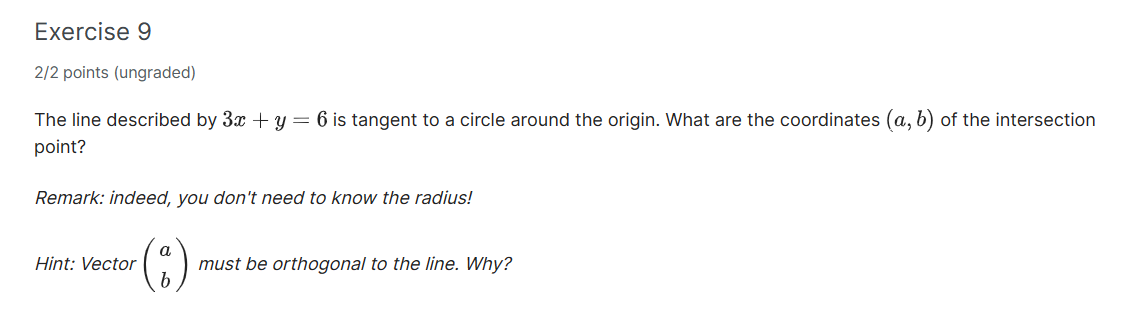 warped topaz
Someone showed me how to do this yesterday, I already forgot 🫠
wary stream
Someone on this server?
warped topaz
yep
wary stream
You realize that discord as message history, right?
lone heartBOT
Channel closed
Closed by @warped topaz
Use .reopen if this was a mistake.
Available help channel!
Send your question here to claim the channel.
Remember:
• Ask your math question in a clear, concise manner.
• Show your work, and if possible, explain where you are stuck.
• After 15 minutes, feel free to ping <@&286206848099549185>.
• Type the command .close to free the channel when you're done.
• Be polite and have a nice day!
Read #❓how-to-get-help for further information on how to ask a good question, and about conduct in the question channels.
alpine sable
show that the set V= r^2 for an abelian group with that vectoraddition
so i guess we have to show that it fulfills all 4 conditions of an abelian group.
if we add neutral element (0, 0, 0, ..R^n) it stays the same.
if we add inverse element it builds 0 with x
if we add a 3 rd group and put braces the end result is the same
if we change vector x1 and x2's position the endresult is still the same
 lone heartBOT
alpine sable
show that the set V= r^2 for an abelian group with that vectoraddition
so i gue...
alpine sable
lone heartBOT
alpine sable
show that the set V= r^2 for an abelian group with that vectoraddition
so i gue...
alpine sable
did i solve this correctly
also can you show me how to solve this the formal way?
like it doesn't need to be super formal, just the correct way how you would write it down
that it's mathematically correct
 gentle jackal
a more appropriate channel may be #groups-rings-fields since this is a more advanced topic. if you don't get an answer here for a while then consider asking there instead
alpine sable
hmm k but usually people here can help me, it's just 1st semester uni math
lone heartBOT
@alpine sable Has your question been resolved?
lone heartBOT
Channel closed
Closed due to timeout
Use .reopen if this was a mistake.
Available help channel!
Send your question here to claim the channel.
Remember:
• Ask your math question in a clear, concise manner.
• Show your work, and if possible, explain where you are stuck.
• After 15 minutes, feel free to ping <@&286206848099549185>.
• Type the command .close to free the channel when you're done.
• Be polite and have a nice day!
Read #❓how-to-get-help for further information on how to ask a good question, and about conduct in the question channels.
 elfin relic
how do i solve this?
 lone heartBOT
elfin relic
how do i solve this?
tacit arch
lone heartBOT
elfin relic
how do i solve this?
tacit arch
u substitution
elfin relic
can you help me with the substitution? its a little confusing to me
molten pivot
think about it logically
is there any relation between the functions 1/x and log(x)?
first of all we must clarify what exactly is meant by 'log'
elfin relic
molten pivot
first of all we must clarify what exactly is meant by 'log'
i think its natural logarithm
molten pivot
alright then this becomes simple. very good
is there any relation between the functions 1/x and log(x)?
elfin relic
yes
 molten pivot
yep
molten pivot
no
elfin relic
and that will cancel out the 2 in the denominator
molten pivot
yes
 molten pivot
elfin relic
so this is wrong then
molten pivot
elfin relic
so this is wrong then
yeah that's definitely wrong haha
 green folio
elfin relic
green folio
elfin relic
damn thats what had me confused
so my ans is correct! thank goodness
thanks a lot for your help :))
.close
lone heartBOT
Channel closed
Closed by @elfin relic
Use .reopen if this was a mistake.
molten pivot
think about it logically
elfin relic
molten pivot
think about it logically
yeah, that seems to be the trick haha
molten pivot
if the integral of logx/x is log(x), that implies that logx/x = 1/x
elfin relic
ive just started integration so its a little confusing at times still
molten pivot
lol!
lone heartBOT
Available help channel!
Send your question here to claim the channel.
Remember:
• Ask your math question in a clear, concise manner.
• Show your work, and if possible, explain where you are stuck.
• After 15 minutes, feel free to ping <@&286206848099549185>.
• Type the command .close to free the channel when you're done.
• Be polite and have a nice day!
Read #❓how-to-get-help for further information on how to ask a good question, and about conduct in the question channels.
 dim trout
How do i evaluate this where R is the region in the first quadrant bounded by y=1+x^2 and y=8-x^2
 lone heartBOT
dim trout
How do i evaluate this where R is the region in the first quadrant bounded by y=...
lone heartBOT
dim trout
How do i evaluate this where R is the region in the first quadrant bounded by y=...
 ornate condor
dim trout
How do i evaluate this where R is the region in the first quadrant bounded by y=...
ornate condor
dim trout
How do i evaluate this where R is the region in the first quadrant bounded by y=...
then y will b between these 2
ornate condor
ornate condor
probably find where 1+x^2 and 8-x^2 intersect
while x will be between the positive val here and 0
then u do ur normal integration thingy
molten pivot
what x values are permissible?
ornate condor
dim trout
How do i evaluate this where R is the region in the first quadrant bounded by y=...
hm c if these 2 go below y=0 ig
else split integration a bit
molten pivot
lol
dim trout
Its like this but idk how to write the bounds for double integral
 molten pivot
we have to solve for the point of intersection
molten pivot
dy dx you mean
molten pivot
because we have scalar bounds for x and function bounds for y
dim trout
Can you type the bounds for me I'm confused
ornate condor
dim trout
Should be root of 7/2
for d its from 0 to that intersection pt u found
molten pivot
1+x²<y<8-x²
0<x<sqrt(7/2)
dim trout
Bottom one is for outer integral right?@molten pivot
molten pivot
Yeah
dim trout
And it's dydx
molten pivot
Yea
lone heartBOT
@dim trout Has your question been resolved?
lone heartBOT
Channel closed
Closed due to timeout
Use .reopen if this was a mistake.
Available help channel!
Send your question here to claim the channel.
Remember:
• Ask your math question in a clear, concise manner.
• Show your work, and if possible, explain where you are stuck.
• After 15 minutes, feel free to ping <@&286206848099549185>.
• Type the command .close to free the channel when you're done.
• Be polite and have a nice day!
Read #❓how-to-get-help for further information on how to ask a good question, and about conduct in the question channels.
 formal dust
You roll fair, 6-sided dice all at the same time. a is the number of dice you roll in this initial set of rolls. Call this initial set of rolls “phase 1”.
An individual roll is called a “success” if it falls within the range {6, .., 6-b}. So if b=2, then the range of success for any roll is {6, 5, 4}. It follows that the probability of success of any individual roll is (b+1)/6.
But whether or not you got any successes in the initial set of rolls, you must re-roll any die which falls in the range {6, …, 7-c} if c>0, but if c=0 then you cannot re-roll that die. It follows that the probability you get to re-roll any individual die is c/6.
The next set of rolls, the re-rolls (if there are any), is called “phase 2”. And so on.
In terms of a, b, and c, what is the probability of getting any successes at all?
Here’s my work so far:
Probability of there being no successes in a phase, given that there are n dice in that phase:
[1 - ((b+1)/6)]^nSince whether there will be a success in a phase is independent, then letting n2, n3, n4… mean the number of dice in phase 2, phase 3, phase 4, and so on, the probability that there will be no successes at all is just multiplying the previous probability infinitely:
[1 - ((b+1)/6)]^a * [1 - ((b+1)/6)]^n2 * [1 - ((b+1)/6)]^n3 * …
And then
1 - [1 - ((b+1)/6)]^a * [1 - ((b+1)/6)]^n2 * [1 - ((b+1)/6)]^n3 * …
gives the probability of getting any successes
The problem is that n2, n3, n4 are not determinable in terms of a,b,c. I know that the expected value of n2 is going to be a*c/6, but does that really help?
lone heartBOT
formal dust
You roll fair, 6-sided dice all at the same time. a is the number of dice you ro...
carmine reef
How many phases are there?
formal dust
Potentially infinite
Or we can just treat it as infinite, with there being a probability 1 that there will eventually be phases with no rolls in them
carmine reef
And you want to know the probability of getting any success by a given phase?
formal dust
The probability of getting any success at all, in terms of a,b,c
At least one success in any phase
formal dust
Not necessarily
carmine reef
for the problem to be interesting it has to be possible to lock down a failed roll
right
otherwise success is eventually guaranteed
so the probability is 1
formal dust
Well suppose a is 1
in phase 1 you start off with one roll
and lets say b is 2
so success means falling within {6, 5, 4}
let's say that your roll is a 2
carmine reef
what's c?
formal dust
c determines the range of values for which you get to reroll
carmine reef
yes but in this hypothetical what is it
formal dust
like concretely?
carmine reef
ye
formal dust
xD it's a modifier in a game
carmine reef
hmm I see
problem was slightly different then I was first thinking
but wait why don't we have a c value
formal dust
wym
carmine reef
to solve the problem we need to know what c is right
why did you choose values for a and b but not c
formal dust
ohhhh
formal dust
carmine reef
what's c?
i misapprehended here lol
carmine reef
ah
formal dust
and let's say that c is 1
carmine reef
so only 6s are rerolled
carmine reef
so there's a 1/2 chance here
If you get a 4,5,6 you succeed
if you get a 1,2,3 you fail
formal dust
Yeah
carmine reef
so whatever the chance of one dice failing is
let's say p
The chance of a dice failing will be p^a
since each one is independent
formal dust
yes
carmine reef
so if c≤b+1 then only successful dice are rerolled
which has no outcome on the final result, so the chance is the same as the chance of no successes given a dice
formal dust
right
carmine reef
your choice of 6-b vs 7-c makes it a little weird
formal dust
yea i agree. i'm doing it from my friend's game rules. i wonder if there is a way if I can make it nicer without affecting the substance of the problem
carmine reef
6-b and 6-c I would assumr
but anyways the remaining part here
it's a kind of problem where
formal dust
the issue is he wants modifier C being 0 to mean that you can't re-roll
carmine reef
The chance of a failure is A
The chance of success is B
The chance of rerolling is C
A+B+C = 1
formal dust
carmine reef
A+B+C = 1
how do you know that?
carmine reef
Because you have to either fail, reroll, or succeed
the probabilities have to add up to 100%
formal dust
but both failing and succeeding are consistent with rerolling
carmine reef
I mean in one roll
formal dust
yea
carmine reef
For one given roll
And the goal is to calculate the probability of eventual success
formal dust
A + B = 1 for an individual roll
carmine reef
no reroll chance?
formal dust
there is a re-roll chance but adding it would bring you over 1
carmine reef
i just mean like
A chance that the roll causes you to instantly fail
B chance that it causes you to instantly succeed
C chance that it's a reroll
formal dust
ah, I see
carmine reef
They're the 3 possibilities of a roll
formal dust
I thought you meant failure as in not-a-success
carmine reef
ah
formal dust
it's a dead end, so to speak
carmine reef
yeah here instant failure means not success and getting the dice locked
formal dust
gotcha
carmine reef
So the goal is to calculate the chance of eventual success
formal dust
oh wait so it does seem easier to calculate the chance of eventual success given an individual roll and then just multiply(?) that by a
carmine reef
take that to the power of a
yeah the multiple rolls part is an element that can be completely removed from the problem and just done at the end like that
formal dust
why wouldn't it be multiplication tho
carmine reef
Independent events
formal dust
but we're looking for the probability of the union, rather than the intersection, no?
if A,B are independent, 𝑃(𝐴∪𝐵)=𝑃(𝐴)+𝑃(𝐵)−𝑃(𝐴)⋅𝑃(𝐵)
carmine reef
P(A or B) = 1 - P((not A) and (not B))
When it comes to independent events it's a lot easier to work with ands than ors
so instead of asking about A or B or C being a success
I look at when A and B and C are failures
You already did this step right in your work so far
With ^n
formal dust
ah so, P(success) = 1 - P(failure)^a
carmine reef
yeah
here success being any success
And failure meaning failure of some specific dice
formal dust
@carmine reef
so i've worked out these fundamental probabilities:
probability that an individual roll is a success is (b+1)/6
the probability that an individual roll gets re-rolled is c/6
carmine reef
ye so you need a solution to the general win/lose/reroll problem
then you probably should be able to do the rest
Let S = success, F = failure, W = win, L = lose, R = reroll
S and F are global outcomes, W,L,R are on one roll
P(F) = P(L)*P(F|L) + P(R)*P(F|R) + P(W)*P(F|W)
You can arrive at that formula by making a tree diagram
Yeah, sure we can say first roll
formal dust
carmine reef
You can arrive at that formula by making a tree diagram
ok, I'll attempt this and be back in 5 mins
carmine reef
gl


 carmine reef
i split it up into W R and L at first
formal dust
should I do that? it seems unintuitive to me, because neither W or L are inconsistent with R, but they are inconsistent with each other
formal dust
just realized that W guarantees S
carmine reef
non-success rolls that still allow rerolls are R
non-success rolls that don't allow rerolls are L
formal dust
wouldn't that just be global failure i.e. F?
formal dust
cause we're only thinking about one die
ok lemme redo
@carmine reef my tree is infinite
carmine reef
also ignore my formula at this point
but keep the tree thing
right so
its infinite
but its self referential
formal dust
carmine reef
S and F are global outcomes, W,L,R are on one roll
is this right: L entails F, F entails some eventual "L" though not necessarily on the original roll?
carmine reef
yes
formal dust
carmine reef
yes
ok, would this equation be right:
P(F) = P(L) * P(RL) * P(RRL) * P(RRRL) * ...
wait no
thatd be a small number
carmine reef
infinitely small in fact
formal dust
and RL and RRL are not independent
formal dust
carmine reef
remember you're looking at union here
how does this help?
formal dust
so P(L) + P(RL) + P(RRL) + P(RRRL) + ...?
formal dust
do these first two terms look right 1 - (b+1)/6 + (1 - (c/6))(1 - (b+1)/6)(b+1)/6)
for P(RL) i multiplied (1- (b+1/6))(c/6), the probability I calculated for R, with 1 - (b+1)/6, the probability of any L
i'm taking P(RL) to mean P(R and then L)
carmine reef
doing it that way is going to be very messy
i'd recommend just finding the sum in terms of P(L) and P(R)
but no i dont think P(R) is necessarily (1-(c/6))
that would be P(W or R)
formal dust
P(F) = P(L) + P(R)P(L) + P(R)P(R)P(L) + ...
P(F) = sum k=0 to inf of P(L)P(R)^k?
formal dust
nope lol
carmine reef
do u know geometric series formula?
carmine reef
P(K)?