#elementary-number-theory
1 messages · Page 89 of 1
 torn escarp
 idle steeple
torn escarp
sounds similar to the post correspondence problem, I'm gonna guess it's undecida...
idle steeple
torn escarp
sounds similar to the post correspondence problem, I'm gonna guess it's undecida...
What does this mean?
For what it's worth I wrote a program that I think gives the answer in python, it seems to work
def isproduct(number, list_of_factors):
    for n in list_of_factors:
        for m in list_of_factors:
            a = max(n, m)
            b = min(n, m)
            if a % b == 0 and a != b:
                current_factor = a // b
                if current_factor not in list_of_factors:
                    list_of_factors.append(current_factor)
    for factor in list_of_factors:
        while number % factor == 0:
            number = number // factor
    return number == 1
Assumes that 1 isn't in the list of factors
torn escarp
idle steeple
For what it's worth I wrote a program that I think gives the answer in python, i...
your function doesn't seem to work, isproduct(4, [6,10,15]) returns false but 4 = 6*10/15 is true
torn escarp
idle steeple
What does this mean?
you can think of the post correspondence problem as being a kind of simple problem with given a set of dominos with letters on them, and trying to match them up to make the same word on top and bottom
the observation I'm saying is it's sorta similar except it's prime numbers in numerator and denominator and the letters commute, and we're not exactly making the words match exactly, we're trying to match the given number
so it might not be undecidable but I wouldn't be surprised if it turned out to be equivalent or something cause it's sorta similar and deceptively simple sounding
idk it was just a quick guess after looking at it for 3 seconds so don't look into it too much lol
idle steeple
thanks for the rundown
 leaden swan
torn escarp
sounds similar to the post correspondence problem, I'm gonna guess it's undecida...
leaden swan
torn escarp
sounds similar to the post correspondence problem, I'm gonna guess it's undecida...
I was thinking you could reduce this to a Z-module membership problem
Enumerate all the different prime factors in N. Let the count of all the distinct prime numbers be k. Consider \mathbb{N} ^k
Reduce a number to $N^k$ as
${p_1}^{q_1} {p_2}^{q_2}...{p_k}^{q_k} \mapsto ({q_1},{q_2}...{q_k})$
 sterile pumiceBOT
JohnDS
 leaden swan
Similarly reduce your X to this form. If you can't reduce it,it means you can't obtain it trivially
Otherwise ,Check if X is in the span of those generators(all the numbers in N)
That can be done with Smith Normal form because this corresponds to finding a solution to a system of linear equations over Z
I have no idea how you will do this part computationally but that's how you do it mathematically
leaden swan
leaden swan
Reduce a number to $N^k$ as
${p_1}^{q_1} {p_2}^{q_2}...{p_k}^{q_k} \mapsto ({q...
Sorry this N should be $\mathbb{N}$
sterile pumiceBOT
JohnDS
 leaden swan
I think this could have been PCP but a finite set of \mathbb{N} being reducible to \mathbb{N}^k prevented that
leaden swan
leaden swan
Enumerate all the different prime factors in N. Let the count of all the distinc...
@sacred junco you saw this right?

 stiff timber
 sacred junco
it would be better if you show what you already know, so that we know where to start with
 elfin condor
lol I think this problem solves itself, just plug some jawns in and see where the algebra takes you
 wicked patio
I need to prove that there exists a prime number between n^2 and (n+1)^2 for all positive n. I have already bruteforced the theorem, and it appears to be correct.
Can i get a hint? (Thank you)
 formal minnow
wow lol
 wanton torrent
anyone acquainted with vigenere cipher?
 stiff rivet
wanton torrent
stiff rivet
wanton torrent
I don't understand how he built the system of Betas


This is the exercise, I don't understand how to do (b)

Note that the length of the key is 4

 frigid path

 inner anchor
you can interpret the second condition using eulers criterion and then use quadratic reciprocity to find to which residue classes 2p+1 must belong mod 5
i think after that its just brute force
 silver berry
what is the contradiction here? (the proposition was about how g is a primitive root mod p iff for all q s.t. q is a prime factor of p-1, g^ (p-1/q) is not congruent to 1 mod p)
 sacred junco
can someone explain how passing the lucas test proves n is prime

idk any group theory
but i get that a is the order of n-1 for every a
how does that prove n is prime though
also why use n-1/q instead of q. Since n-1/q is just the complementary divisor
stiff rivet
(Z/nZ)^* consists of all elements in {1, ..., n-1} coprime to n
so if the order of that group is n-1, then n must be prime
you can use q
sacred junco
so the conditions holding true implies phi(n)=n-1 and that implies n is prime
sacred junco
stiff rivet
you can use q
im still wondering why they used n-1/q
is it to highlight q divides n-1
stiff rivet
sacred junco
so the conditions holding true implies phi(n)=n-1 and that implies n is prime
yes
no idea, it doesnt matter
you just have to test the divisors of n-1
leaden swan
A question about that notation,what does [z]_{\phi_p(z)} mean? I know Z_q[x] but this is new to me
You know
$\sum_{i=0}^{p} x^i = \frac{\left(1-x^{p+1}\right)}{1-x}$?
sterile pumiceBOT
Drake
 leaden swan
If you differentiate this you get \sum_{i} i x^{i-1}
So it feels like the expected solution is to find a closed form for the sum and then manipulate that somehow to show it's a unit
Or maybe you can use this to demonstrate x will be nonzero
sterile pumiceBOT
Scip
 leaden swan
This is called the discrete logarithm problem
There are different techniques to solve discrete logarithm (like baby step,Pollard rho). You can look those up
 exotic valve
Thanks! Wanted to update my example to replace GF(169) with GF(23) where 2 generates a subgroup of order 11 fwiw
leaden swan
You can't exactly solve the discrete log problem efficiently in the general case
Like there are cryptosystems built around that
 calm pelican
You could say 2^n = 169x + 8
 abstract quail
Hi guys
Could someone send me this demo or where I could look at it please.
"how many positive integers have an odd number of positive factors".

leaden swan
Infinite
A positive integer has a odd number of factors iff it's a square
Check out the relation between prime factorization and no of factors
After that it becomes really obvious to see that
@abstract quail
https://www.programming9.com/tutorials/competitive-programming/364-check-if-a-number-has-even-or-odd-number-of-factors
If you really want a website

Check if a number has even or odd number of factors
 wheat tinsel
Given any natural number n there exists a polynomial P such that P(x) is prime for all natural numbers 0<x<n.
Is there something known about this?
Seems true to me
 wild lotus
Is it required that P has integer coefficients?
wild lotus
Well you could just take P(x) = (x-1)(x-2)...(x-n) + 2 right
Maybe try distinct primes?
wheat tinsel
Uhm yeah true
inner anchor
you can just do lagrange interpolation
wild lotus
Yeah but then the polynomial won't necessarily have integer coefficients
wheat tinsel
wild lotus
Maybe try distinct primes?
Or maybe require it to have as lowest degree as posible
wild lotus
Yeah
wheat tinsel
I wonder if degree 1 suffices (obviously degree 0 is trivial). It would be something like 2ax+b, where a and b would need to be carefully chosen. I have no idea to be honest
b being odd of course
 modest kestrel
here i would need to find an element of order 9 in F_37, so they use a primitive root 2 and raise it to the power 37-1 and divide by 9, but why is that?
 sacred junco
they just constructed an element such that its order is 9
when you raise it to 9th power you get that it is 1
modest kestrel
sacred junco
when you raise it to 9th power you get that it is 1
ah yes got it thank you
leaden swan
Well if it were m^2 you first need to find a solution using that mod m solution
If m is prime this is easy, otherwise that would be a lot of work
Yea
Well The exact statement is Z_m*n is isomorphic to Z_m X Z_n if m and n are primr
Well anyway you can explicitly construct a bijection (CRT doesn't help you with this,it just tells you this bijection exists)
Let a be inverse of n in mod m and b be inverse of m in mod n,that is
$an=1 \mod m \
bm=1 \mod n$
sterile pumiceBOT
Drake
 leaden swan
Then Consider
$p=(xan+ybm) \mod mn\$
Then p satisfies
$\p=x \mod m \
p= y \mod n\$
sterile pumiceBOT
Drake
 leaden swan
Because write
P=(mn) q + r where r is the remainder when (xan+ybm) is divided by mn.
This implies
p mod m=r mod m = xan mod m =x mod m
Similarly for mod n
Well TL;DR you can explicitly find a c such that x=c mod pq is equivalent to x=a mod p and x=b mod q
Chinese remainder in the general case is not very powerful compared to over Z

If you are interested,you can do these exercises on CRT
 leaden swan
No? p=5 and x=3 mod 5 satisfy that
 fluid coyote
I need help finding all integer solutions to the equation $51x=4\quad \text{mod}, 110$ as well as find those integers $x$ which also solves the equations: $x=7\quad\text{mod}, 13$ and $6x=5\quad\text{mod}, 7$. I know its not supposed to be that difficult but for some reason I'm still having trouble with it. Can anyone help me with this?
sterile pumiceBOT
Ursus1234
 leaden swan
so you want to solve
$\51x = 4 \mod 110 \
x = 7 \mod 13 \
6x = 5 \mod 7$?
sterile pumiceBOT
Drake
 leaden swan
which is
$\x= 54 \mod 110\
x = 7 \mod 13\
x = 2 \mod 7$
sterile pumiceBOT
Drake
 leaden swan
@fluid coyote ?
fluid coyote
leaden swan
which is
$\\x= 54 \mod 110\\
x = 7 \mod 13\\
x = 2 \mod 7$
holy moly, it's been so long since I've worked with this modulus, I've totally forgotten everything.
why is $51x=4$ the same as $x=54$ mod 110?
sterile pumiceBOT
Ursus1234
 leaden swan
multiply with inverse of 51
fluid coyote
leaden swan
multiply with inverse of 51
how do I know what that is?
fluid coyote
leaden swan
I mean is this hw
not homework, just preparation for exercises
leaden swan
Algorithmically it's extended euclidean
fluid coyote
Im just so frustrated that I couldnt understand so I would get just a little bit better understanding before class exercises
fluid coyote
leaden swan
Algorithmically it's extended euclidean
yea, and I've tried to follow an example from the lecture notes, but somehow Im still lost...
fluid coyote
leaden swan
This is unironically super good
thanks Ill check it out, maybe I just need another explanation
wanton torrent
Take n any positive integer
is there any function that gives us all pairs (x,y) such that gcd(x,y,n) = 1
with x,y in Z_n
leaden swan
Isn't that easy,Let A be the set of numbers coprime to n in Z_n
Then your set is (Z_n x A) U (A x Z_n)
wanton torrent
Is there any already known function that gives us the number of elements?
in that set
like phi(n) is the coprime with n
wanton torrent
nooo, there would be double counting
wanton torrent
and for a big n ? o:
leaden swan
This is not quite correct
gcd(x,n) can be >1 and gcd(y,n) can be >1 but gcd(x,y,n) can be 1
 atomic dagger
Need some one to help me on math on friday will pay 25$ for 32 questions dm plz for Friday
wanton torrent
leaden swan
gcd(x,n) can be >1 and gcd(y,n) can be >1 but gcd(x,y,n) can be 1
like what
wanton torrent
yep
fluid coyote
leaden swan
<@416896656429023236> ?
I know finally understand. I also made some mistakes in my calculations and that didn't really help either.
fluid coyote
sterile pumice
**Drake**
so now that I'm here, how can I find the integer solutions for all 3?
leaden swan
That seems like a weird conclusion.
If p=7 , 2 satisfies x^2+3=0 mod 7 and x^3=1 mod 7
You can't say anything more if you don't know anything about p
@sacred junco
Maybe you assumed like p is of form 4k+1 or something in class?

Well This should be a correct proof for that
Yea,The if is fine ig
Actually this feels weird compared to just applying Lagrange
With group theory lang ,The if statement is just order of element divides order of group
If x^2+1=0 mod p then x^4=1 mod p ,i.e., ord(x)=4
So 4 divides p-1( order of (Z/pZ)^x) and you are done
So you are telling me you are doing this before lagrange?
No
x^2+1=0 mod p worked nicely because x^4=1 mod p
sterile pumiceBOT
Drake
 leaden swan
-2 is invertible in mod p so this gives you a y such that
y^3=1 mod p
@sacred junco
Your y is $- \frac{x+1}{2}$
sterile pumiceBOT
Drake
 leaden swan
np

 sterile pumiceBOT
Kraft Macaroni

 fervent crest
Hmm I remember for square roots the continued fraction is periodic so at least you can calculate the continued fraction in finitely many steps
 wooden glen
Which procedure (or train of thought) are you following that gives you those sixes?
A simple procedure that often suffices is to use a calculator: compute sqrt(22), then alternately subtract the integer part and take the reciprocal. Note down the integer parts you subtract, and continue until you spot a repeating pattern.
Then write down the continued fraction with that pattern, derive the equation for its fixed point. Simplifying it always gives a quadratic equation which ought to have sqrt(22) as its root.
abstract quail
What do you guys think of the demo?
 wooden glen
If x+y=0 then 0=0. I believe that.
(Of course 0=0 tends to be true even on days where x+y is not 0, so perhaps we haven't learned much. But complaining about that would just be ungrateful).
wheat tinsel
Would it make sense or would it be interesting to ask for (non-trivial) integer solutions to equations like x^pi+y^pi=z^pi ?
wooden glen
It makes sense to ask, but (a) it would surprise me if there are any, (b) even if there is a solution, verifying that a claimed solution works looks like it would be very hard.
sacred junco
there is no way there are any solutions
 fervent grove
 low yacht
instead I have 6s all over the place
low yacht
instead I have 6s all over the place
sorry I'm a few days late
there is a very efficient algorithm to compute the continued fractions of quadratic irrationals; see S5.1 of https://www.math.canterbury.ac.nz/~j.booher/expos/continued_fractions.pdf
fervent grove
wooden glen
A simple procedure that often suffices is to use a calculator: compute sqrt(22),...
also, as an aside: for numbers larger than 22 (which do come "in practice") it does not suffice to use a calculator and take floors of things because calculators use floating point arithmetic, and often the rounding done will make later terms of the continued fraction come out incorrectly (!)
one of the amazing things about the super magic box algorithm (from S5.1 above) is that (after a little practice) it can actually be done by hand at comparable speed or faster than someone with a calculator using the "reciprocal and floor" technique
 crisp escarp
wheat tinsel
Would it make sense or would it be interesting to ask for (non-trivial) integer ...
crisp escarp
wheat tinsel
Would it make sense or would it be interesting to ask for (non-trivial) integer ...
I wrote a simple CUDA solver in python for this. It doesn't look like there are any integers even close to it, but so far I've only checked the first 10000 or so
sterile pumiceBOT
Anton.

 west glade
can you use stuff like fermat/euler?
or do you actually need to calculate 3^341 mod 341 by hand
wheat tinsel
341=31*11. Try working mod 31 or mod 11 and use FlT. Numbers get smaller.
 still fox
showing 3^20 ≠ 1 mod 341 is enough
because the order of 3 mod 341 divides phi(341) = 10*30 = 300, but GCD(300, 340) = 20
of course you have to check that 3^d is not 1 mod 341 for all divisors of 20
so you can take the path: 3^1 -> 3^2 -> 3^4 -> 3^5 -> 3^10 -> 3^20 by squaring and multiplying by 3
i think that's as fast as you can get if you have to do it by hand
 north orbit
Find all integers k between 1 and 500 such that 2^k + 1 is divisible by 101
given that 2 is a primitive root of 101
So I started with 2^k = 100 (mod101)
k ind(2) = ind(100) (mod100)
k = ind(100) (mod100)
How would I find the index of 100 base 2 by hand?
west glade
if 2^x=100=-1 mod 101, then 2^(2x)=1 mod 101. but you know that 2 is a primitive root, so can you use that?
calculating the index is pretty hard in general. there are some algorithms like baby step giant step but nothing easy
 burnt stirrup
stiff rivet
burnt stirrup
stiff rivet
you look at the prime ideals in that ring, any of those, say P, will lie over a prime ideal of Z; that is P \cap Z is again prime in Z and therefore generated by a prime number
now the behavior of P depends on how the ring extension looks like: you have Z[sqrt(a)] = Z[x]/(x^2 - a) and by the correspondence theorem, the prime ideals in Z[sqrt(a)] correspond to prime ideals in Z[x] containing x^2 - a
it follows that the prime ideals in Z[sqrt(a)] must contain x^2 - a and a rational prime p, thus contain the ideal (x^2 - a, p)
if now a is a quadratic residue mod p, say b^2 = a mod p, then (x-b, p) and (x+b, p) both contain (x^2 - a, p) (they are in fact maximal)
then we say that the prime p splits
the case you asked about corresponds to a not being a quadratic residue mod p: in this case x^2 - a is irreducible and the ideal (x^2 - a, p) turns out to be prime
there is also the case that p divides a and in this case the ideal (x^2 - a, p) = (x^2, p) is contained in (x, p)
anyways, the short answer is you can tell by looking at the jacobi symbol
this phenomenon is called "splitting of prime ideals" (the first case is called a split prime, the second an inert prime and the third ramified) @sacred junco
fluid coyote
Im having trouble with following exercise: Let $p>3$ be a prime and $a$ a primitive root mod $p$. Show that $-a$ is a primitive root iff $p=1$ mod 4
sterile pumiceBOT
Ursus1234
 fluid coyote
<@&286206848099549185>
I thought since $a$ is a primitiv root mod p that for a generator $g, a=g^u$ where $u$ and $p-1$ are coprime and then assume the same for -a and use that
sterile pumiceBOT
Ursus1234
 fluid coyote
but not sure if that is correct or how else I should go about it
idle steeple
This is a very interesting question which spawns a lot of interesting mathematics. It sounds like you want to read into some algebraic number theory. It would take too long to develop the maths to explain everything but p in Z is not prime in Z[i] iff X^2+1 is reducible mod p iff X^2+1 = (X+a)(X-a) for some a mod p iff a^2=-1 is soluble mod p iff p = 1 mod 4, so p factorises iff p = 1 mod 4, and p remains prime iff p = 3 mod 4(you already knew this).
fluid coyote
idle steeple
This is a very interesting question which spawns a lot of interesting mathematic...
haha, I thought you were gonna respond to my question. I was waiting in anticipation 😅
idle steeple
This reasoning works for rings of the form Z[sqrt(d)] where d != 1 mod 4, so you can study X^2-2 and X^2-7 to answer your other examples. You can't answer your question for Z[sqrt(5)] in this way. This is because Z[sqrt(5)] does not have unique factorisation of prime ideals, what you want to study is actually Z[(1+sqrt(5))/2] which are the "integers of Q(sqrt(5))" in some sense that can be made precise
Ramification of rational primes (aka finding out whether primes in Z remain primes in more general integer rings) in general is covered by Kummer-Dedekind theorem in chapter 9 of these notes, but this is aimed at third year undergraduates with some algebra under their belt so it might be a bit heavy. You asked an interesting (but difficult to answer) question and I highly recommend reading into this topic, it's one of my favourite courses in undergrad maths
idle steeple
fluid coyote
haha, I thought you were gonna respond to my question. I was waiting in anticipa...
Ahh sorry about that, I just happen to be revising this topic hence why I posted a lengthy reply
inner anchor
If a is a primitive root, use the multiplicativity of the legendre symbol to conclude that you must have p = 1 mod4
fluid coyote
inner anchor
If a is a primitive root, use the multiplicativity of the legendre symbol to con...
Im not sure I quite know how to use the legendre symbol
inner anchor
Do you know eulers criterion for quadratic residues
fluid coyote
its not in my lecture notes
inner anchor
Have you been given any properties of quadratic residues
Or do you just know the defn
fluid coyote
oh I missed it. I found eulers criterion
fluid coyote
yea, Ill try. This is the first exercise using that, so maybe I will be back with some more questions...
inner anchor
Sure
 keen urchin
fluid coyote
Im having trouble with following exercise: Let $p>3$ be a prime and $a$ a primit...
keen urchin
fluid coyote
Im having trouble with following exercise: Let $p>3$ be a prime and $a$ a primit...
It can be proved using quadratic reciprocity law
 haughty ivy
i don't see how the problem has to do with quadratic residues
wooden glen
fluid coyote
Im having trouble with following exercise: Let $p>3$ be a prime and $a$ a primit...
Since a is a primitive root, a^((p-1)/2) == -1 (because it is a root of x²-1 that is not 1, and Z/p is a field). So the question is whether -a == a^((p+1)/2) is a primitive root, which it is iff (p+1)/2 is coprime to p-1 ...
(Not sure why the exercise assumes p>3 -- the argument I've started here seems to work perfectly well for p=3 too).
 native monolith
anyone know what the rules are for arctan of rational and irrational numbers ? or if they exist?
wooden glen
This is more #geometry-and-trigonometry. However: the only rational numbers whose arctangents in degrees are rational are -1, 0, and 1.
The arctangent in radians of a nonzero rational is always irrational, and even transcendental according to the Lindemann-Weierstrass theorem.
native monolith
alright ty
Is there anything about irrationality when inputted into arctan? @wooden glen
wooden glen
Not really. The arctangent of an irrational number may be either rational or irrational.
native monolith
Because computing a certain function and proving it's differentiable you can show there exists a $c\in (0,1)$ such that the $\sum_{k=0}^{\infty}\frac{(-1)^k \cdot c^{2k}}{2k+1} = G$ where G is the Catalans constant. But this is just $\frac{arctan(c)}{c}$ and if I could show for each case c rational and c irrational that this produces an irrational number then it would prove G is irrational which I don't think has been done yet
sterile pumiceBOT
Max..
 native monolith
wooden glen
Not really. The arctangent of an irrational number may be either rational or irr...
native monolith
wooden glen
Not really. The arctangent of an irrational number may be either rational or irr...
thought so
but if for c irrational (which c is more likely to be) it's unknown what arctan(c) will be looks like it's a dead end rip
torn escarp
native monolith
Because computing a certain function and proving it's differentiable you can sho...
problem with this approach is this has nothing to do with Catalan's constant
what's stopping you from picking any number on the RHS?
native monolith
Yeah I was thinking that as soon as you said the original thing
shame but oh well might be another route rather than this cheap routing using a similar technique to lambert
Pretty pointless statement
Someone solved a long standing problem using elliptic curves... pi has been proved irrational using integrals and a simply constructed function
Just because the problem and the technique have been around a long time doesn't mean the solution to the problem isn't using that technique
torn escarp
your way of proof could be generalized to show why it is broken in a more severe way
because you don't even know if c is rational or not
for instance f(x)=x would satisfy the same requirements as a special case
obviously there's a c such that f(c)=G
and f maps rationals to rationals and irrationals to irrationals
native monolith
The thing is I wasn't looking at general c I was looking at whether if I knew c was rational or irrational would it make proving G irrational simpler, don't think I explained this well.
torn escarp
this doesn't prove that G is irrational it just puts us in a position of having some other c which we then need to determine is rational or irrational
native monolith
Yes I know that now, that's why I asked if it would help
Because potentially proving the irrationality of c couldve been a more doable activity
Not saying it was lol
I mean pi^2 is proven irrational and it has a similar definition
(To the original definition of G)
You can also define catalans constant in multiple ways using power series, endpoints of functions and integrals
Lots of stuff to be played around with... thanks for your information on arctan @torn escarp 👍
 torn escarp
native monolith
Lots of stuff to be played around with... thanks for your information on arctan ...
torn escarp
native monolith
Lots of stuff to be played around with... thanks for your information on arctan ...
you're welcome 😎
native monolith
native monolith
You can also define catalans constant in multiple ways using power series, endpo...
Also probably differential equations and infinite fractions but I haven't looked at these yet in this context so can't say yet
torn escarp
expand it out and equate the coefficients on both sides
west glade
well in particular it would have a root. just show that it doesn't
torn escarp
you can do brute force check that way or use quadratic reciprocity
west glade
probably easier to calculate 4 squares than use quadratic reciprocity
torn escarp
definitely
west glade
2 if you are not counting 0^2 and 1^2
wanton torrent
I must show 645 is pseudoprime for base 2

 wanton torrent
I tried dividing 646 by 336 but it isn't an integer
 rancid aurora
@wanton torrent u mustve done the prime factorization wrong
when using euler fermat theorem
rancid aurora
this is the best definition for what your proof is supposed to be

when using fermat theorem in this case, you are saying that 645 and 2 are relatively prime (1 is the only common factor) and it can shown using the theorem as a direct proof
in this case the prime number is 2, your base and the other integer is 645, your exponet


then you should get


leaving you with

where x = 2
proving that 645 is a pseudoprime of 2
@wanton torrent
rancid aurora
your gonna have to figure out how to show that 2^154 is congruent to 1 mod 645
sterile pumiceBOT
CuriousTalon
 leaden swan
Well in this case yea,All the linear polynomials are distinct.
Because
For (a,b) != (c,d) ,
ax+b=cx+d => there exists (e,f)!= (0,0)
such that ex+f = k(x^2+3),which is not true since gcd(1,5)=1(1 here is coefficient of x^2)
@sacred junco
fervent crest
Pi divides (2p_1…p_r) because it’s literally in the product, then if P_i divides two numbers then it also divides their sum
leaden swan
leaden swan
Well in this case yea,All the linear polynomials are distinct.
Because
For (a,...
To understand this,try finding the number of elements in
$Z_6[x]_{2x^2+1}$
@sacred junco
sterile pumiceBOT
Drake
 leaden swan
The answer is ||There are only 9 elements||
wooden glen
Huh? Does that subscript notation not mean (Z/<6>)[x]/<2x²+1>?
If it does, then I'd expect there to be infinitely many elements in the quotient, since all x^n would be distinct.
Whoops no, I see.
3(2x^2+1)=3 so it all collapses to mod 3.
sterile pumiceBOT
mns
 leaden swan
Yes
wanton torrent
Thanks
 pale fjord
Prove that there exists infinitely many positive integer $n$, satisfies: there exists a positive integer $k$, such that $n<10^k$ and $10^{k}|2^{n}-n $.
sterile pumiceBOT
erictheeonicpizhao
 wooden glen
Looking at it modulo 2^k gives 2^k | n. In particular 2^k <= n < 10^k, so it suffices to show that there are infinitely many (n,k) pairs. That means we could also attack it from the "infinitey many k" end.
Beyond that I'm getting nothing, though.
wooden glen
The only pairs of (n,k) with k<=5 that satisfy even just 5^k | 2^n-n are: (3 + 20m, 1) and (297 + 2500m, 4) for any m>1 -- but none of these can also satisfy 2^k | 2^n-n.
Wait, that doesn't make sense.
Those are solutions allright, but not the only ones.
(3,1) and (297,4) are the only ones with n < 4·5^(k-1) and k <= 5, but the reasoning that led me to think that bound for n was relevant is rubbish.
I've found these base solutions for 5^k | 2^n-n with k<=4:```
(16,1) (36,2) (236,3) (1236,4)
(17,1) (97,2) (297,3) ( 297,4)
(14,1) (34,2) (434,3) (1434,4)
( 3,1) (83,2) (283,3) (2283,4)
And for each (n,k) we also add any multiple of 4·5^k to n to get more solutions. That ought to be exhaustive. supple palm
do any of those also satisfy 2^k | 2^n - n or is there still nothing on that front
wooden glen
Still checking -- I thought I had a CRT argument for that, but it turned out to be bogus.
supple palm
this seems like a very interesting problem but i am rather stuck.
i am not entirely convinced that there are infinitely many solutions in the first place.
wooden glen
I've yet to convince myself there's even one.
supple palm
hah, yeah
wooden glen
Oh, wait: (36,2) is a solution.
supple palm
it does, but it is not at all clear to me how to get from one to the next
wooden glen
(48736,5)
wooden glen
At each step we have (n,k) such that n is a multiple of 2^k (which easily implies 2^k | 2^n-n) and 5^k | 2^n-n.
Suppose we try (n,k+1). That most like won't work, but we can fix it up in two steps:
Let n' = n+j·4·5^k for some j. Then 2^n == 2^n' (mod 5^(k+1)) due to Euler's theorem. So by choosing j appropriately between 0 and 4 we can make 2^n'-n' == 0 (mod 4^(k+1))
supple palm
likewise with with 736 you get 8
wooden glen
Hmm, that sounds like it may be more promising that the hodgepodge I've thought up, but let me continue the explanation for completeness.
supple palm

wooden glen
Also 2^n-n mod 5^(k+1) is periodic in n with period 4·5^(k+1), that being the least common multiple of the totient and the modulus. So if we can add some multiple of 4·5^(k+1) to n, we won't lose the match mod 5^(k+1), but can get n to be a multiple fo 2^(k+1).
This is always possible since n' was already a multiple of 4, and 5^(k+1) is invertible modulo 2^(k-1).
So how much do we need to add in total to the n of (n,k) to get one that works with k+1?
At most 4·4·5^k to fix up modulo 5^(k+1), and then less than (2^(k-1)-1)·4·5^(k+1) for fix up modulo 2^(k+1).
The sum of these, divided by 10^k is bounded by 2^(4-k) + 10*(1-2^-(k-1)).
Hmmm, I had hoped that would always be < 9·10^k, but these estimates are not precise enough for that.
At least it looks like heuristically the new n ought to be less than 10^(k+1) most of the times.
Especially since we can start with the intermediate n that worked mod 5^k in the previous step, and that grows asymptotically strictly slower than 10^k.
wooden glen
supple palm
if you reduce (2^36 - 36)/100 mod 10, you get 7
If we can figure out why this seems to work, it will probably be a much nicer argument.
supple palm
i think it would be, but i think you have to do some modular arithmetic magic with 2^((2^n - n)/10^k) and im not sure how
(fwiw this also works to get 48736 and the next term, 948736)
so im reasonably confident that im on the right lines
wooden glen
Yeah.
Let's see. When k is large enough, 2^n-n mod 10^k is periodic in n with period 10^k -- namely, this period holds both modulo 2^k and modulo 5^k since phi(2^k) and phi(5^k) both happen to be divisors of 10^k.
So adding a multiple of 10^k to n cannot change the lower k digits which we already know are zeroes.
wooden glen
Your observation suggests we should try to prove $$2^{n+10^k} - (n+10^k) \equiv (2^n - n) - 10^k \pmod{10^{k+1}}.$$ First, several terms cancel to leave $$2^{n+10^k} \equiv 2^n \pmod{10^{k+1}}.$$ This is obviously true modulo $2^{k+1}$ since $n\gg k$, so we just need to check $$2^n 2^{10^k} \equiv 2^n \pmod{5^{k+1}}.$$ But this is true, since it happens in the \emph{multiplicative} group modulo $5^{k+1}$ whose order is $\varphi(5^{k+1}) = 4\cdot 5^k$ and $10^k$ is a multiple of that as soon as $k\ge 2$.
sterile pumiceBOT
Troposphere
 wooden glen
Ah, much nicer!
supple palm
this is perhaps my tiredness showing, but where does the first line come from?
in my working i was trying to show that
$$ 2^{n+a} \equiv n + a \mod{10^{k+1}}$$
where
$$ a \equiv 2^n - n \mod{10^{k+1}}$$
sterile pumiceBOT
twiceshy
 supple palm
given that
$$ 2^n \equiv n \mod{10^k}$$ of course
sterile pumiceBOT
twiceshy
 wooden glen
The first line essentially says "to decrease the last digits of 2^n-n by 100..00, just add 100..00 to n".
supple palm
i am perhaps being very silly in my tiredness aha
supple palm
wooden glen
The first line essentially says "to decrease the last digits of 2^n-n by 100..0...
right, i follow that
wooden glen
We could also write $$2^{n+10^k j} - (n+10^k j) \equiv (2^n - n) - 10^k j \pmod{10^{k+1}}$$ (and then my argument above, mutatis mutandis) to do the correction in one go, where $j$ is the remainder from your observation -- that is, the above equation together with $$ 2^n - n \equiv 10^k j \pmod{10^{k+1}}$$ gives us $$2^{n+10^k j} - (n+10^k j) \equiv 0 \pmod{10^{k+1}}.$$
sterile pumiceBOT
Troposphere
 supple palm
ah! there we go.
well, thank you for your hard work here.
i think it's time for me to hit the hay.
 frozen patio
so i was thinking about the statement "every natural number is written as a unique product of a square and a squarefree number"
is it equivalent to the fundamental theorem of arithmetic?
frozen patio
i think it is
stiff rivet
both of those statements are just true so im not sure what you mean by equivalent
wooden glen
It's easy to prove that from the fundamental theorem of arithmetic, but it's not clear how you would go the other way without essentially proving the fundamental theorem from scratch anyway,
frozen patio
well, you can write any product of prime powers as a unique square/ squarefree pair of terms . so two different such products would have different square and or squarefree parts leading to a contradiction
wooden glen
Is that suposed to be an argument for the fundamental theorem?
How does it establish, for example, that a square-free number cannot be written as a product of (distinct) primes in two different ways?
frozen patio
hmm
so this number would have two factorizations like n = p1 x p2 x pi = p1' x p2' x ... pj'
then we could square it and have
n^2 = p1 x .... pi x p1' x ... pj' . if there are factors unique to each factorization (say p3, p3' and p5'), their product would be a squarefree number. so n^2 = a^2 * (p3,p3',p5'), violating the assumption.
wooden glen
Hmm, perhaps you can get through that way.
frozen patio
it does sort of feel like begging the question
frozen patio
and we could argue that a product of distinct primes is squarefree based on euclid lemma
here's another way to present the argument:
assumption: every number is written as unique product of a squarefree number and a square.
let x be the smallest number with 2 different factorizations: p1^a1 x p2^a2 ... = p1'^a1' x p2'^a2' ....
now write each a using division by 2 and euclid algorithm: p1 ^(2y1 + r1) * p2 (2y2 + r2) * ....
separate the quotients and the remainders to get square and squarefree parts.
p1^2y1 x p2^2y2 .... x p1^r1 x ...
so you get. square1 x squarefree1 = square2 x squarefree2. since these are unique it must be that either square1=square2 has two different factorizations, or squarefree1=squarefree2 does. either way we get a smaller number than x which is a contradiction
wooden glen
Unless the square or the squarefree is 1.
wooden glen
Dunno. Whether flaws are fatal or not is a squishy question when we know the conclusion is true anyway,
frozen patio
alright. hear me out.
if the squarefree is 1: take the square root of both sides to get the contradiction.
if the square is 1: from euclid lemma we can argue that it again leads to contradiction
frigid path
Is there any handout kinda thing for mod $p^k$ where p is a prime.
sterile pumiceBOT
dEePaNu1729
 frigid path
sterile pumice
**dEePaNu1729**
frigid path
sterile pumice
**dEePaNu1729**
especially mentioning the properties of this modulo
<@&268886789983436800> cud u plz change my name to this ದೀಪನು
sorry to ping u guys
 elder bobcat
sure
frigid path
thank you bro
fluid coyote
Let $p$ be a prime and assume that $p=1$ (mod 5). How do I show that $(\mathbb{Z}/p\mathbb{Z})^*$ has an element of order 5. I thought any primitive root mod $p$ would have order $\varphi(p)=p-1$ and you couldnt have a higher order mod $p$...
sterile pumiceBOT
Ursus1234
 fluid coyote
if $p=1$ (mod 5) and $c$ is an element of $(\mathbb{Z}/p\mathbb{Z})^*$ with order 5, how can I show that $p, |, (c^{-2}+c^{-1}+1+c+c^2)$?
sterile pumiceBOT
Ursus1234
 inner anchor
use the formula for a geometric sum
fluid coyote
inner anchor
use the formula for a geometric sum
do you mean something along the lines of $c^{-2}+c^{-1}+1+c+c^2=c^{-2}(1+c+c^2+c^3+c^4)=c^{-2}\cdot \sum_{k=0}^4 c^k=c^{-2}\Big(\frac{1-c^5}{1-c}\Big)$?
sterile pumiceBOT
Ursus1234
 fluid coyote
ehh I'm, not quite sure. It confuses me that its mod $p$ when $p$ it self is 1 (mod 5)...
sterile pumiceBOT
Ursus1234
 sterile pumiceBOT
Ursus1234
 inner anchor
yes
fluid coyote
well ok then. thank you
inner anchor
np
 jolly frigate
Given that 17x+3y is divisible by 61, prove that 8x+5y is divisible by 61
1 million dollar question 
west glade
17x+3y=0 mod 61. multiply both sides by 18. then x=7y mod 61. finally 8x+5y=56y+5y=61y=0 mod 61
18 here because it is the multiplicative inverse of 17 mod 61
jolly frigate
Tnx
jolly frigate
@west glade and where did you get x=7y?
west glade
from simplifying after multiplying by 18
x+54y = 0 mod 61
x = -54 y mod 61
x = 7y mod 61
jolly frigate
yy i get it tnx
 leaden swan
Well do by induction
We know 3^{2^1} = 1 mod 4
That's your base caze
Now
$3^{2^n} = 1 \mod 4
\implies
3^{2^{n+1}}=({3^{2^n}})^2\mod 4=1^2 \mod 4 = 1 \mod 4$
sterile pumiceBOT
Drake
 sacred junco
How to have that?
leaden swan
Just add 1 and you get that expression will always be 2 mod 4
 south sedge
guys can you tell me what a –= b –= c mod(m) mean ?
leaden swan
$a \equiv b \equiv c \mod m$
sterile pumiceBOT
Drake
 south sedge
yea what does it mean
south sedge
can we tell it as (a-b) , (b-c) and (a-c) ?
 sacred junco
<@&286206848099549185>
 gentle gate
sacred junco
gentle gate
sacred junco
What is the symbol with the three dots?
sacred junco
divisible
gentle gate
sacred junco
divisible
that's not the symbol..
|
this is the symbol
it's above the enter key
and below backspace
Anywahs
gentle gate
I know the meaning, don't worry
sacred junco
gentle gate
|
That symbol use in different case
sacred junco
sacred junco
like 8 can be devide to 4
like 4 | 8
sacred junco
I came across this notation $[a]_n$. Does this mean a mod n or something else?
sterile pumiceBOT
Pencil

 karmic notch
How long of a post is too long of a post here? Asking for a me. lol
Essentially I have an idea that occurred to me when I was reading a book and was wondering if this was the right place to post that idea/questions/observations
But when I wrote out everything I wanted to a text editor, it ended up being a bit long winded... I'm wondering if I should post this somewhere else, if I should segment the messages into smaller chunks, or just post the entirety of it all at once...
The post in question is about number theory, so, I figured I'd ask here
This would be the first time I try to post one of my ideas for evaluation by other math peeps, so I'm a bit nervous I think.
stiff rivet
you can post it but longer post will probably lead to less people reading it
might be worth considering to post on math stackexchange instead
karmic notch
Gotcha, I'll do that then, I can then post the link here once it's available. Thanks for the suggestion @stiff rivet
karmic notch
"Should 0 be considered a perfect number?": https://math.stackexchange.com/questions/4462895/should-0-be-considered-a-perfect-number

Mathematics Stack Exchange
I know the current definitions of perfect number don't support this, but, I feel with some slight modifications, that it could make sense and could help simplify some situations.
Essentially, when
I'm interested in hearing people's thoughts on this.
sacred junco
I agree with JMoravitz; letting 0 be a perfect number or not does not change any results, so it is not significant enough to really get people to care.
leaden swan
Actually nvm it doesn't work that eay
torn escarp
I was thinking more in terms of the 2-adics and pretend $\lim_{p \to \infty} 2^{p-1}(2^p-1) = 0*(-1)$ and then going to the formula $\lim_{p \to \infty} \sigma(2^p) = 1+2+2^2+\cdots = \frac{1}{1-2} = -1$ with $\lim_{p \to \infty} \sigma(2^p-1) = \sigma(-1) = 1+(-1) = 0$ (because it's prime duh... lmao)
sterile pumiceBOT
Merosity
 torn escarp
therefore $\sigma(0) = \sigma(0*(-1))=-10=20$ lmfao
sterile pumiceBOT
Merosity
 torn escarp
I once read in a book that conway argued -1 should be prime, so obviously this is just that totally legitimate thing yes
sacred junco
Like why would -1 being prime help though
torn escarp
it wouldn't, this is a giant shitpost pretending to argue -1 is a mersenne prime lol
sacred junco
Stoopid
karmic notch
torn escarp
sure let's say 0 is, then -1 is the corresponding mersenne prime
I never actually made that claim, instead I asked to relax the restriction that the power we use be a prime to show that it would still fit the overall form of the even perfect numbers.
I never mentioned the mersenne primes in the entirety of that post, the only time I mentioned primes at all was to outline the above relaxing of restriction.
karmic notch
torn escarp
I was thinking more in terms of the 2-adics and pretend $\lim_{p \to \infty} 2^{...
Never made this claim either...
karmic notch
torn escarp
therefore $\sigma(0) = \sigma(0*(-1))=-1*0=2*0$ lmfao
Never made this claim either...
torn escarp
it's true, I made all the claims lol
karmic notch
Yeah, I only realized a short while ago that the shitpost you were referring to in one of your later posts was your series of posts, and not necessarily mine... I'm new to the community, so I hadn't expected someone to go to great mathematical lengths for the purposes of a joke, lol
abstract quail
guys, help with this exercise please
If ∅ is considered as a relation of A in A, is it reflexive? is it symmetric?
is it antisymmetric?
is it transitive?
I know it is reflexive because emptiness is related to itself, emptiness.
symmetrical it cannot be because it cannot be related to any other element besides itself.
leaden swan
Is A an empty set?
abstract quail
leaden swan
Is A an empty set?
we will call A as an empty set
(?)
so it says (spanis), sry
 leaden swan
The definitions are $\$
1)Reflexive:\ $(\forall a) a \in A \implies aRa\$
2)Symmetric:\ $ (\forall a,b)aRb \implies bRa\$
3)Antisymmetric:$\ (\forall a,b)aRb \land bRa \implies a=b\$
4)Transitive: $\(\forall a,b,c) aRb \land bRc \implies aRc$
sterile pumiceBOT
Drake
 leaden swan
So The null relation is vacuously symmetric, Antisymmetric and transitive
Reflexive if A is null set
abstract quail
leaden swan
Reflexive if A is null set
ye
abstract quail
leaden swan
So The null relation is vacuously symmetric, Antisymmetric and transitive
I understand a little of the definitions
but I don't understand your abstract thinking
about it
abstract quail
 fluid coyote
Im having a difficult time understanding this example
how do they establish the 3rd equality?
 inner anchor
quadratic reciprocity probably
fluid coyote
yea, I think I found out why since $541=83\cdot 6+43$
sterile pumiceBOT
Ursus1234
 fluid coyote
inner anchor
quadratic reciprocity probably
fluid coyote
inner anchor
quadratic reciprocity probably
can I maybe ask you another question about this quadratic reciprocity?
if $p$ is a prime and $p=1$ (mod 5) why is it that from quadratic reciprocity that $\bigg(\frac{5}{p}\bigg)=1$?
sterile pumiceBOT
Ursus1234
 fluid coyote
I get $\bigg(\frac{5}{p}\bigg)=(-1)^{(5-1)(p-1)/4}\cdot\bigg(\frac{p}{5}\bigg)=1\cdot\bigg(\frac{p}{5}\bigg)$
sterile pumiceBOT
Ursus1234
 fluid coyote
how is that 1?
fluid coyote
no how can it be that if p is a prime
inner anchor
what is the definition of a quadratic residue
fluid coyote
an integer a is quadratic residue mod p if there exists y such y^2=a (mod p)
a can not be 0
inner anchor
why do you care for the primeness of the number
inner anchor
you are
look at your definition again
lets put in our numbers into it
an integer p is a quadratic residue mod 5 if there exists y such that y^2 = p mod 5
so the only thing that matters is what p is mod 5
fluid coyote
fluid coyote
I was thinking that 9^2=81=1 mod 5
so would this be a reason why p is quadratic residue?
inner anchor
yes
fluid coyote
inner anchor
yes
but why does it then say in the problem that p is a prime
when does that come into play?
inner anchor
in using quadratic reciprocity
also the legendre symbol is only defined for prime moduli
fluid coyote
inner anchor
also the legendre symbol is only defined for prime moduli
hmm yea okay
so this is till true $\bigg(\frac{5}{p}\bigg)=(-1)^{(5-1)(p-1)/4}\cdot\bigg(\frac{p}{5}\bigg)=1\cdot\bigg(\frac{p}{5}\bigg)$
sterile pumiceBOT
Ursus1234
 fluid coyote
and then since $\bigg(\frac{p}{5}\bigg)$ is quadratic residue so is $\bigg(\frac{5}{p}\bigg)$?
sterile pumiceBOT
Ursus1234
 inner anchor
yes
fluid coyote
thank you
inner anchor
np
abstract quail
$\text{Show that is a relation R defined on A}\
\text{(a) It is symmetric in A if and only if }R=R^{-1}\
\text{(b) It is antisymmetric if and only if } R\cap R^{-1}\subseteq \bigtriangleup_{A}$
sterile pumiceBOT
Aylou-210
 abstract quail
Hi guys, could someone help me with this exercise?
$\text{We know that R is symmetric in }A \left( \left(\forall x \right) ,y\in A \right)\left( xRy \longrightarrow yRx \right)\
\text{Then we have to }R=R^{-1}$
sterile pumiceBOT
Aylou-210

 opal linden
Is there a generalization for sum of the individual digits of the product of any number and 9 is 9 for any number besides 9?
torn escarp
do you mean how when you have a number written in base 10, it's divisible by 9 when its sum of digits is divisible by 9?
this type of trick will work for numbers written in base b and looking at its sum of digits to test for divisibilty by b-1
opal linden
torn escarp
do you mean how when you have a number written in base 10, it's divisible by 9 w...
Yhea
opal linden
torn escarp
this type of trick will work for numbers written in base b and looking at its su...
Is there a theorem or something for this?
Are there any other modular behaviors besides just b - 1?
torn escarp
basically the proof is just writing out the number in base b and reducing mod b-1
$$\sum_{k=0}^n d_kb^k \equiv \sum_{k=0}^n d_k \pmod{b-1}$$ since $b=1 \mod b-1$
sterile pumiceBOT
Merosity

 jaunty cape
Can you simplify the calculation of the modular inverse of a modular inverse of a modular inverse .. and so on?
So basically a simplified way to calculate n = n^-1 % p multiple times in a row
leaden swan
Why would you do that multiple times in a row
Extended Euclidean is good enough if you want speed
@jaunty cape
jaunty cape
I've been given a task to simplify this
I figured out that x ** k % y = x ** k + 1 % y - 1 , but not sure how that helps me
fervent crest
jaunty cape
Can you simplify the calculation of the modular inverse of a modular inverse of ...
The inverse of the inverse is the original number...
jaunty cape
oh... i just noticed, thanks
 silver oak
sorry
silver oak
i know, just getting agitated
 somber lagoon
I see
silver oak
@somber lagoon i don't understand
like, how do you know it has 8 elements, that's circular
if it has 8, then yeah, you map remainders to actual numbers
oh you said injective, so you still can
no, that's not what injective means
this "set of equivalence classes" has 2^n elements or less, and we're trying to prove it has 2^n, am i wrong?
somber lagoon
No
I constructed a map from
Z/(2^N)Z to ({number of length N in 10-adic made up with 0,1}+Z)/(2^N)Z
Mapping the equivalence class of Σa_k 2^k to equivalence class of Σa_k 10^k
Where a_j are all 0 or 1
This is well defined and injective
And clearly is surjective
somber lagoon
silver oak
this "set of equivalence classes" has 2^n elements or less, and we're trying to ...
We know Z/mZ has m elements, we are not proving it we know it already
silver oak
ok, it's not something easy but obfuscated, got it
 robust dirge
Hi, I posted something in the math help channels, which got no replies in four hours; the thread has long been closed since. The question seems related to Diophantine approximations. Am I allowed to post it here?
stiff rivet
yes
robust dirge
Denote $\text{frac}(x)$ where $x \in \mathbb{R}^+$ to output the fractional part of $x$; in other words, $\text{frac}(x) = x - \lfloor x \rfloor$. Prove that $\inf{n \in \mathbb{N}^+ : \sqrt{3}n,\text{frac}\left(\sqrt{3}n\right)} = 1$
sterile pumiceBOT
_gmz
 formal minnow
does anyone have any advice for proving things relating to lcm and gcd? i really suck at it and i want to be able to handle all the abstract algebra stuff that depends on lcm and gcd
torn escarp
I guess the main things to know and understand are the euclidean algorithm, extended euclidean algorithm, and gcd(a,b)lcm(a,b)=ab at least for starters
maybe if you have some examples of problems in particular you could show, that might help give an idea what you mean better
 main ermine
could someone help me understand 2. ?

i don’t really understand what the equivalence classes in Z/nZ are
could someone help me understand i know that the equivalence classes of $a \in \mathbb{Z}$with respect to congruence modulo n is the element $\bar{a} \in \mathbb{Z}/n \mathbb{Z}$
sterile pumiceBOT
sean
 main ermine
but then the equivalence classes of Z/nZ
i don’t even know what equivalence relation it’s talking about on Z/nZ
leaden swan
The equivalence relation is
$\aRb \iff a \equiv b \mod n$
sterile pumiceBOT
Drake
 leaden swan
@main ermine
leaden swan
Well Z/nZ actually means the set of equivalence classes of Z under that equivalence
Each element in Z/nZ is an equivalence class
main ermine
yeah i figured it out
one more question, how is this division in modular arithmetic defined?

could someone lead me to a proof of it or smth?
i'm not really sure where that comes from
 gaunt geyser
 leaden swan
formal minnow
main ermine
one more question, how is this division in modular arithmetic defined?
leaden swan
formal minnow
main ermine
one more question, how is this division in modular arithmetic defined?
it’s not here
e divides a and b, therefore a/e and b/e are integers
gcd(n,e) divides n by definition, so n/gcd(n,e) is an integer
 full crescent
how do those implications arise?
 torn escarp
chinese remainder theorem
torn escarp
yup yw 😎
full crescent
wait im still confuesd
sry
like for the 4th implication
how would i go about finding the inverse?
nvm
 scarlet geode
all my homies hate fermat
 patent escarp
well I guess ill take another crack at asking a problem here. I want to find all nontrivial integers x, y, and z (not x=y, 2x=y, or an integer multiple of an existing solution) such that $\sqrt{\left(2xy\left(x-y\right)\right)^{2}+\left(z^{2}\left(2x-y\right)\right)^{2}}$ is an integer. This is not an easy problem in the slightest as nothing I do to it has made it budge. I do have a life of a lot of solutions (found through brute force) so I know they exist, I just don't know the fastest way to find them.
sterile pumiceBOT
Chixen
 patent escarp
forgot to also add that trivial includes x, y, or z being zero. Positive integers only too.
a few examples include (1,4,3), (1,3,4), (1,7,4), (1,15,7), and for a big one: (99,77,36)
(18,25,35) is the best solution I've found so far because for what I'm using it for it's the only one that has fully worked.
patent escarp
Still wanting help with this
patent escarp
This problem is equivalent to finding rational points on the 3d quartic curve $\left(2xy\left(x-y\right)\right)^{2}+\left(z^{2}\left(2x-y\right)\right)^{2}-1=0$
sterile pumiceBOT
Chixen

 haughty coral
I think I may have found a similar but better approximation for gauss’s prime counting function
Gauss’s approximation is
$\frac{x}{\log(x)}$
sterile pumiceBOT
Adeline
 haughty coral
Mine is $\frac{\frac{x}{\log(x)}}{1.95}$
sterile pumiceBOT
Adeline
 haughty coral
I haven’t proven anything all I know is it might be a better approximation
I’ve tested up to 300 and it looks promising
inner anchor
Its worse
It might be alright for small x but it will be worse for sufficiently large x
fervent grove
amusingly, if I remember correctly x/(-1+log x) has a better error term than x/log x
patent escarp
I would still like some help with my stuff
Well if you scale every variable in the expression by $a$ you get $a^{3}\sqrt{\left(2xy\left(x-y\right)\right)^{2}+\left(x^{2}\left(2x-y\right)\right)^{2}}$
sterile pumiceBOT
Chixen
 patent escarp
so not every integer solution scales nicely to a rational solution on a 3d curve
or in other words not every integer evaluation to the expression has a rational (x,y,z) (assuming there isn't one for every evaluation already)
but every rational solution on the 3d quartic curve $\left(2xy\left(x-y\right)\right)^{2}+\left(z^{2}\left(2x-y\right)\right)^{2}=1$ does map nicely to an integer solution to $\sqrt{\left(2xy\left(x-y\right)\right)^{2}+\left(x^{2}\left(2x-y\right)\right)^{2}}$.
sterile pumiceBOT
Chixen
 patent escarp
I guess I could then solve for z and try to find rational sultions to that
Right?
Given that $\left(x,y,z\right)$ is a rational solution to $\left(2xy\left(x-y\right)\right)^{2}+\left(z^{2}\left(2x-y\right)\right)^{2}=1$ and $a$ is a common denominator of x, y, and z, $\sqrt{\left(2\left(ax\right)\left(ay\right)\left(\left(ax\right)-\left(ay\right)\right)\right)^{2}+\left(\left(az\right)^{2}\left(2\left(ax\right)-\left(ay\right)\right)\right)^{2}}$ will be an integer.

 patent escarp
I gotta test this out
I guess it could help find counterexamples but wouldn't help in proving the conjecture if it is true.
Now the problem is just rational solutions to $\sqrt[4]{\frac{1-\left(2xy\left(x-y\right)\right)^{2}}{\left(2x-y\right)^{2}}}$
sterile pumiceBOT
Chixen
 patent escarp
I'm getting somewhere
 pine cave
so my abstract algebra textbook had a very interesting problem (it's relevant to cyclic groups), that at a glance looked very difficult until i thought about it for a minute and realized how trivially easy it was: "compute the last digit of 1238237^18238456".
so inspired by this i went about doing some fucking around with general examples of this problem, and i discovered some interesting theorems, and i have a relevant interesting conjecture i don't yet know how to prove or disprove, though i am sure i'll learn how eventually
the conjecture is "consider higher order iterations of exponentiation x^[z]y (e.g. tetration x^[2]y, pentation x^[3]y) in bases p. the possible rightmost (i.e. smallest) digit of the full expansions of x^[z]y for any natural x z and natural y > 1 exhausts all available digits in base p if and only if p is prime."
i don't really have any motive for sharing this other than i thought it was a fun thing to think about and thought other people might think so too
 desert sonnet
pine cave
so my abstract algebra textbook had a very interesting problem (it's relevant to...
desert sonnet
pine cave
so my abstract algebra textbook had a very interesting problem (it's relevant to...
can u elaborate on wut u mean by "consider higher order iterations of exponetiantion"
cuz even with the examples i still don't really get wut u are saying
 hollow slate
Woke up today thinking about this problem:
Take any integer, i.e 57

now half it, taking the integer part if odd and repeat until reaching 1.

This clearly takes roughly log_2(n) steps, but will be slightly faster because of odd numbers - this will more strongly affect at small numbers because -1/2 is more significant to its binary logarithm.

This would mean that the offset averaged over all n should converge as the effect diminishes (probably exponentially too?)

The question: what is the value and form of this offset?
something like log_2(n) - k?
idk if it fits in number theory per se, but i dont really know where else it'd go :3
leaden swan
Wdym roughly it's always $\floor{\log_2{n}}$
sterile pumiceBOT
Drake
 leaden swan
@hollow slate
So you want something like
$\lim_{n->\infty} \frac{\log_2{n}-\floor{\log_2{n}}}{n}?$
sterile pumiceBOT
Drake
 torn escarp
hollow slate
Woke up today thinking about this problem:
```
Take any integer, i.e 57
now hal...
torn escarp
hollow slate
Woke up today thinking about this problem:
```
Take any integer, i.e 57
now hal...
I don't think I understand the algorithm, are you doing floor(x/2) at every step of the way? I guess I don't get what you mean by offset or what would be faster
hollow slate
torn escarp
I don't think I understand the algorithm, are you doing floor(x/2) at every step...
tbh this is what happens when I'm not properly awake yet lol. Yeah I'm doing the floor each step. I guess what I was attempting to get at was that the powers of 2 all take log_2(n) steps exactly but the rest need the floor - so what would be needed to create a smooth function? (one that passes through the middle of the steps rather than grazing the steps as with log_2(n))
hollow slate
leaden swan
Wdym roughly it's always $\floor{\log_2{n}}$
you're absolutely right, but what would it be without the floor?
wooden glen
What are you trying to achieve here?
$\log_2(n)-\frac12$ will approximate your function with the smallest \emph{absolute} error, but I'm not sure that is what you're going for ...
sterile pumiceBOT
Troposphere
 torn escarp
I am kind of interpretting it as asking how many times you'll have to floor when dividing by 2 on average
hollow slate
wooden glen
$\log_2(n)-\frac12$ will approximate your function with the smallest \emph{absol...
yeah this is what I'm looking for
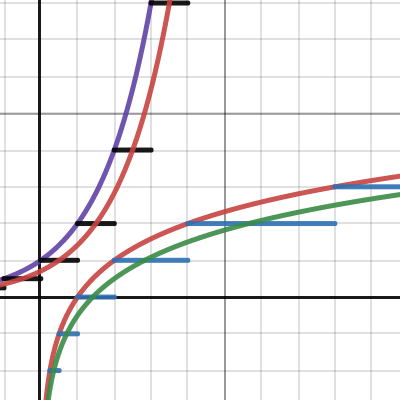
Desmos
 wheat prairie
Can someome point me to a proof of the following fact: If $n\vert l$ such that $n<l$ and $\varphi(n)=\varphi(l)$, then $n$ is odd and $l=2n$, where $\varphi$ is the euler function
sterile pumiceBOT
ShiN
 fervent crest
I think you can prove it by writing down a prime factorization of n and l
Yeah so write $l=np_1^{r_1}\cdots p_k^{r_k}q_1^{i_1}\cdots q_j^{i_j}$, where $p_i,q_i$ are primes and $p_i$ are in the prime factorization of $n$ and $q_i$'s are not. Then \begin{align*}
\varphi(l)&=\varphi(np_1^{r_1}\cdots p_k^{r_k})\varphi(q_1^{i_1}\cdots q_j^{i_j})\
&=np_1^{r_1}\cdots p_k^{r_k}\prod_{p|n}\br{1-\frac1p}q_1^{i_1}\cdots q_j^{i_j}\br{1-\frac1{q_1}}\cdots\br{1-\frac1{q_j}}\
&=\varphi(n)p_1^{r_1}\cdots p_k^{r_k}q_1^{i_1}\cdots q_j^{i_j}\br{1-\frac1{q_1}}\cdots\br{1-\frac1{q_j}}
\end{align*}
So by canceling $\varphi(n),\varphi(l)$ on both sides we get $1=p_1^{r_1}\cdots p_k^{r_k}q_1^{i_1}\cdots q_j^{i_j}\br{1-\frac1{q_1}}\cdots\br{1-\frac1{q_j}}$ or $q_1\cdots q_j=p_1^{r_1}\cdots p_k^{r_k}q_1^{i_1}\cdots q_j^{i_j}\br{q_1-1}\cdots\br{q_j-1}$ and so $p_i$'s don't exist and $q_i$ must be 2 and $j=1$ and $i_1=1$ so $l=2n$ where $2$ doesn't appear in the prime factorization of $n$
sterile pumiceBOT
Whoever
 fervent crest
@wheat prairie
torn escarp
I like whoever's proof cause it's clear what's happening but wanted to try to see for fun if I could prove it without writing out all the prime factors here's what I came up with
sterile pumiceBOT
Merosity

 rough field
@sudden spoke the unicity you asked about a2ⁿ and so on is easily provable with induction. If you want help, ask in a help channel and ping me
 tender cedar
I wrote a proof but I'm not sure if it's correct.
Goal: prove that ideal $I \subset a\mathbb{Z}$, where $a$ is the smallest positive integer in $I$.
Take any $b \in I$. Since $I$ is closed under integer multiplication we know that $ba \in I$.
We also know that $gcd(b,a) = gcd(ba,a) = a$. So $b=an$ for some $n \in \mathbb{Z} \implies b \in a\mathbb{Z}$
sterile pumiceBOT
sam
 tender cedar
I suppose it's that last step, gcd(b,a) = gcd(ba, a) that im not sure is correct
seems really iffy
west glade
It's wrong. 1=gcd(3,2) but gcd(6,2)=2
You'll have to use division with remainder for your proof
tender cedar
oh yeah I mixed up two propositions
wheat tinsel

Does "the sum of the positive integers not exceeding n" mean 1+...+(n-1) or 1+...+n ?
I suppose its the first one but I have no idea how to do it
leaden swan
Latter
If n+1 is prime , the product will not have a factor of (n+1) and hence is not divisible by the sum which does have a factor of (n+1)
If n+1 is composite ,well you can just factorise and match with those terms in the product
Ergo n(n+1) divides the product implies n(n+1)/2 divides the product
wheat tinsel
Is there a non tedious way to prove that n^2-81n+1681 is prime for all n=0,...,80 ?
simply using elementary tools
west glade
well you can write it as t^2+t+41 to t=n-41. then you have to show that t^2+t+41 is prime for t=-40,...,39 of which you can find some proofs online. whether you count them as elementary, dunno
wheat tinsel
Oh thats nice
Well the most elementary thing is to see whats the maximum value, say n, and then we only have to worry about primes less than sqrt n
But thats tedous
tender cedar
Can someone give me a light hint for the following proof: Show that every integer on the form 4n+3 has a prime factor of the same form.
 strange grail
tender cedar
Can someone give me a light hint for the following proof: Show that every intege...
strange grail
tender cedar
Can someone give me a light hint for the following proof: Show that every intege...
Suppose all of the prime factor of that number is 4k+1 form so ...
tender cedar
This is using the fact that all primes are either 4k+1 or 4k+3 then yeah?
strange grail
Yes
 grave carbon
How would I find an integer, where $13^n + n^{13}$ is a prime number?
sterile pumiceBOT
beeswax
 grave carbon
I saw this on Twitter, and I thought it would be fun to recall some number theory stuff from a year ago
robust dirge
grave carbon
How would I find an integer, where $13^n + n^{13}$ is a prime number?
I believe there are none
grave carbon
robust dirge
I believe there are none
Why is that?
I was thinking it is unlikely, but idk why
grave carbon
Wait, why does 13>2 imply n is even?
robust dirge
Next, consider mod (n + 1): let n = 2k (since it's even), and so 13^(2k) + (-1)^13 (mod n + 1) ≡ (13^k + 1)(13^k - 1) (mod n + 1)
Hold on I thought I had a solution that didn't require Fermat's little theorem
robust dirge
grave carbon
Wait, why does 13>2 imply n is even?
13^n + n^{13} > 2, so in order for it to be prime it must be odd
grave carbon
robust dirge
13^n + n^{13} > 2, so in order for it to be prime it must be odd
And for that to be odd, n needs to be even?
robust dirge
if n + 1 is prime we're done, by FLiT
inner anchor
If n+1 is prime then your idea works yeah
inner anchor
If it isnt prime then you should just be able to look at some prime factor of n+1
grave carbon
inner anchor
If it isnt prime then you should just be able to look at some prime factor of n+...
Are we still trying to prove that there exists no such integer n?
wooden glen
Wait, just because the number factors modulo n+1 doesn't mean it's actually composite. Am I missing some implication of this?
 misty nova
PLEASE, READ THE ENTIRE QUESTION. I've asked this on the help channels and no one was able to help me
I'm writing a short paper where I analytically prove a few theorems of elementary arithmetic about the divisibility relation n | m \↔️ ∃p(m = np), prior to introducing division with remainder and/or its related algorithms, as a proof of concept for a friend. right now I'm trying to prove a lemma of Euclid's lemma, to in turn prove the uniqueness part of the fundamental theorem of arithmetic
the lemma is that, given nonzero integers m,n,p,q where p,q are coprime and mq = np (i.e. m/n = p/q), there is an integer k such that m = pk and n = qk* (i.e. m,n are multiples of p,q by the same integer). I know that, if q | n, then the theorem follows (because then n = qk for some k, in which case mq = pkq, and so m = pk and p | m, and conversely), so in turn I just have to prove that q | n (or p | m), but I don't know where do I even begin
so far I've proven that divisibility is a pre-order over the nonzero integers having 1 as a minimal element over the positive integers, that every composite number is a product of primes (though not the uniqueness of this product, of course), and that the integers resulting from the division of m,n by their gcd are coprime (i.e. that if m,n are nonzero, and if m = gcd(m, n)p and n = gcd(m, n)q, then gcd(p, q) = 1)
 runic token
m = pk and n = qp
?
runic token
i think you are overthinking this
we have $\frac{m}{n} = \frac{p}{q}, m,n > p,q$. it then naturally follows that we have an integer k due to this: $\frac{m}{n} = \frac{p}{q} \cdot \frac{k}{k}$.
sterile pumiceBOT
valley
 runic token
or, well, i am 99% sure that works
misty nova
runic token
or, well, i am 99% sure that works
as I've said in the statement of the question above, I'm trying to prove this and other theorems prior to introducing division, from the definition of the divisibility relation alone
this is trivial if you consider fraction multiplication, but I'm not considering fractions in the first place
runic token
omg i forgot fractional multiplication was division
fuck me
lmfao
could you use that because q is a factor of np, and p and q are coprime, q must be a factor of n
i think this works from what you have and doesn't require division
misty nova
runic token
could you use that because q is a factor of np, and p and q are coprime, q must ...
that's Euclid's lemma
again, as I've already said in the question above, I'm trying to prove this theorem as a lemma to Euclid's lemma
I'm sorry for pointing that out so harshly, but about 5 people across 2 different servers and 2 different social media platforms have "answered" me in the exact same way, appealing to Euclid's lemma in some way or another
and I've made sure to point out I've already ruled out this proof in the statement of my question, every single time
misty nova
not without the division with remainder algorithm
runic token
hmmmmm
misty nova
I've already stated above what I have proved so far as well
- divisibility is a pre-order over nonzero integers having 1 as a minimal element over the positive integers
- every composite number has a least non-trivial factor which is prime, as well as a (possibly not unique) prime factorisation
- given nonzero integers m,n having d as a gcd, if there are p,q such that m = pd and n = qd, then p,q are coprime
runic token
i thought i had a funny induction proof but i still need division to finish it
damn
and every other one i can think of is circular
oh wait
i think i have one
misty nova
👀
runic token
okay so i didn't wanna give you another wrong proof so i went over it again and it uses something i think you don't have :/ damnnn i rly thought i had something here
i might just look this up this is painful
misty nova
runic token
okay so i didn't wanna give you *another* wrong proof so i went over it again an...
it's fine as long as it doesn't appeal to the division with remainder algorithm or anything that presupposes it, or to a theorem I'm already trying to prove (i.e. Euclid's lemma or the uniqueness of prime factorisation)
 misty nova
yeah, that won't work
runic token
i went looking on the internet and i found a really fucking nice proof
and i think it works for you
uhhh do you want it? or would you prefer hints to figuring it out
misty nova
I also searched for a proof of this theorem or anything similar to it, and I found nothing
so I'd like to see the proof you found, if it isn't one I've seen already
runic token
Call a triple (p,a,b) of positive integers "bad" if p is prime and p∣ab, but p∤a and p∤b.
Suppose that a bad triple exists. Among all bad triples, consider those in which p is minimal. Among all such triples, choose one in which a is minimal.
Note that a<p, since otherwise (p,a−p,b) would also be bad, violating the minimality of a. Also, a>1, since otherwise p would divide ab=b.
Let q be the smallest divisor of a such that q>1. (Notice that a is such a divisor, so q exists.) Clearly q is prime, since otherwise it would have a divisor r with 1<r<q and then r would be a smaller divisor of a.
Let a=qt. Since p∣ab, pc=ab=qtb for some positive integer c.
We now consider two cases:
- If q∣c, so c=sq for some positive integer s, then ps=tb.
Since t∣a, p∤t; so (p,t,b) is bad, violating the minimality of a.
- If q∤c, then (q,p,c) is bad, violating the minimality of p.
In either case, we have a contradiction. Hence there are no bad triples.
i think this one works
not 100% sure
runic token
misty nova
this works!
originally due to someone called "dean thompson" :)
misty nova
if m,n,p,q are as in the statement of the lemma, then p | m is equivalent to q | n (for p | m means m = pk, and since mq = np, then np = qpk, so n = qk, and thus q | n) and p | m implies the theorem, so assume that p,q are the least integers as in the lemma such that ¬(p | m). first, p | mq since mq = np. second, q < p since otherwise p,q - p would be the least such integers. and third, either q | n, in which case p | m, contradicting ¬(p | m), or ¬(q | n), in which case q,p would be least such integers, contradicting q < p. thus no such p,q exist
there's no need to invoke q's least non-trivial factor
that's kinda brilliant
thank you very much @runic token
runic token
you're welcome!
sorry for all the false proofs and mishaps
and yeah this proof is absolutely beautiful
grave carbon
An interesting problem I saw online: are there finitely many primes p, such that there exists an n where the following is prime:
n^p + p^n
runic token
i bet this is either open and on the level of goldbach's or incredibly easy and simple
 sturdy violet
Well, its almost like Goldbach, adding 2 non-primes to get a prime
 sturdy violet
Ok so I might not finish this or at least answer later, but z could have something to do with -2 or 2
Because if ya expand the sum of those fractions you can work this out

So if z = ±2, we get 0 = z²(2y + 3x)
So 2y + 3x = 0, or 2y = -3x. Can't happen within the integers
 gentle summit
can someone help with this? I am having a hard time to prove (1) and (2)

 smoky finch
sturdy violet
smoky finch
sturdy violet
I got sort of the same
z > 2 or z<-2
So far I know that z²>=9, x²>=4, y²>=4
smoky finch
If I could determine an upper bound I could exhaustively check all the answers
 buoyant mason
smoky finch
If I could determine an upper bound I could exhaustively check all the answers
buoyant mason
smoky finch
If I could determine an upper bound I could exhaustively check all the answers
this will not be the most helpful answer ever but here is a really lazy upper bound on $x$ that still takes some work lol. I'm gonna consider $x,y, z$ to be positive integers since that doesn't really change the problem at all, other than the final answer. Let $x > 100$. Now we'll show there are no solutions for any $y\geq 2$.
\begin{enumerate}
\item Let $y=2$. Since $0<\frac{2}{x^2}<\frac{1}{5000}$, we can show that $\frac{3}{4}+\frac{4}{z^2}\geq 1$ or $\frac{3}{4}+\frac{4}{z^2}\leq \frac{4999}{5000}$ for all $z$. It's simple algebra to verify that $\frac{3}{4}+\frac{4}{z^2}\geq 1$ when $z=3$ or $z=4$, and that $\frac{3}{4}+\frac{4}{z^2}<\frac{4999}{5000}$ when $z=5$ and hence when $z\geq 5$ (by monotonicity stuff if ya know what I mean)
\item Let $y=3$. With $z=3$, $\frac{3}{9}+\frac{4}{9}<\frac{4999}{5000}$, and a similar inequality holds for any $z > 3$
\item If $y>3$, then the same inequality as above holds for any $z\geq 3$, which is good news
\end{enumerate}
100 is a really bad bound but you can pick something smaller and it should work
I was lazy and wanted to be sure it would work
you should be able to bound y and z in a similar way with cases
sterile pumiceBOT
Spring
 buoyant mason
I thiiiink that's typo free now, but let me know if anything looks off
smoky finch
I think I get it
wanton torrent
Hey guys
there's a theorem that goes as follows: 2 is a quadratic residue for all primes of the form 8k - 1
so, for k = 6, it follows that x^2 = 2 mod 47 has two solutions
How can I find them?
(clearly 7*7 = 49 = 2 mod 47) but I wonder if there's another way without knowing this
thanks
buoyant mason
wanton torrent
How can I find them?
I think you can find them easily if you know a primitive root of the prime
oh uh actually I misread that as 8k + 1
wanton torrent
it also works for 8k + 1
2 is a quadratic residue for primes of the form 8k + 1 and 8k - 1 and is not a residue for 8k +3 and 8k + 5
buoyant mason
hm ok I'm not sure about the 8k - 1 case
wanton torrent
hum so how would you find x in x^2 = 2 mod 49
wooden glen
Even if you know a primitive root, you'd have to find a discrete logarithm of 2, which is a challenge of its own.
wooden glen
If g is a primitive root and you know that 2 == g^n, then n will be even and g^(n/2) is one of the square roots. But finding n can in itself be hard.
wanton torrent
hum interesting
buoyant mason
actually it's not hard when $p$ is of form $8k+1$. If $r$ is a primitive root of $p$, then the two solutions to $x^ 2\equiv 2\pmod{p}$ are $x=\pm (r^{7(p-1)/8}+r^{(p-1)/8})\text{ mod } p$
sacred junco
apparently there's an (fast?) algorithm for square roots modulo a prime https://en.wikipedia.org/wiki/Cipolla's_algorithm
sterile pumiceBOT
Spring
 wooden glen
buoyant mason
actually it's not hard when $p$ is of form $8k+1$. If $r$ is a primitive root of...
wooden glen
buoyant mason
actually it's not hard when $p$ is of form $8k+1$. If $r$ is a primitive root of...
Ah, because g^((p-1)/2) = -1 and the a² and b² parts of the square cancel out. Nice.
 fathom pumice
wanton torrent
there's a theorem that goes as follows: 2 is a quadratic residue for all primes ...
fathom pumice
wanton torrent
there's a theorem that goes as follows: 2 is a quadratic residue for all primes ...
Gauss's lemma application

For all primes of the form 8k-1, n is even
To prove it, it's just brute force algebra
fervent grove
wanton torrent
How can I find them?
your prime is 3 (mod 4), so you can just use 2^((p+1)/4)
this is efficient to compute by modular exponentiation by repeated squarings
for 1 (mod 4) primes, I think taking modular square roots is a little harder
I am under the impression that "in practice" one uses an algorithm like https://en.wikipedia.org/wiki/Tonelli–Shanks_algorithm
 sacred portal
What exactly does this mean? Here we should perhaps mention yet another fact which is initially somewhat surprising.
Namely, in the prime numbers sequence $p1, p2,\ldots $, gaps between prime numbers can have an
individually determined length n. It is undeniable that under the n succession of natural numbers
$(n + 1)! + 2, \ldots ,(n + 1)! + (n + 1)$,
none of them is a prime number since in order, the numbers $2, 3, \ldots ,(n + 1)$ are comprised
respectively as real divisors. (n! means the product of the first n natural numbers therefore
$n! = n ∗ (n − 1) ∗ \ldots ∗ 2 ∗ 1)$.
sterile pumiceBOT
SXK
 buoyant mason
sacred portal
What exactly does this mean? Here we should perhaps mention yet another fact whi...
buoyant mason
sacred portal
What exactly does this mean? Here we should perhaps mention yet another fact whi...
maybe an example would help. Something it says is (letting n = 5) that 6! +2, 6! + 3, 6! + 4, 6! + 5, and 6! + 6 are all composite
because 2 divides 6! + 2, 3 divides 6! + 3, etc
sacred portal
Okay I get it now, thanks
wanton torrent
fervent grove
for 1 (mod 4) primes, I think taking modular square roots is a little harder
I a...
Yeah that’s on the next chapter
Thank you all!
 mossy sun
wanton torrent
hum so how would you find x in x^2 = 2 mod 49
mossy sun
wanton torrent
hum so how would you find x in x^2 = 2 mod 49
yeah tonelli shanks mod prime and then hensel lifting and crt for other integers
so invoke tonelli shanks to find the set of all residues mod 7 which have x^2 = 2
then mod 7^2, any answer y will be of the form 7k+x for a residue x from before and an integer k. this is easily solvable
if you had more prime factors you need to use chinese remainder theorem on the answers to get candidates
fervent grove
mossy sun
then mod 7^2, any answer y will be of the form 7k+x for a residue x from before ...
(in practice, there are more efficient ways to do this Hensel lifting; if interested, search the keywords "Newton's method" and "Hensel lifting" together)
patent escarp
I have an interesting problem that if solved could seriously help on an unsolved problem in number theory. The problem is simply finding integer solutions to $\left(2xy\left(x-y\right)\right)^{2}+\left(z^{2}\left(2x-y\right)\right)^{2}=n^{2}$. I know that solutions exist and it's likely that there are infinitely many solutions as I've written a program to brute force some. Any methods I could apply to this? I've tried the obvious stuff and it doesn't work.
runic token
$\sqrt{\left(2xy\left(x-y\right)\right)^{2}+\left(z^{2}\left(2x-y\right)\right)^{2}}=n^{2}$
texit down?
patent escarp
i guess
sterile pumiceBOT
valley
 patent escarp
whoops
mistyped
not that
I'll copy and fix
I have an interesting problem that if solved could seriously help on an unsolved problem in number theory. The problem is simply finding integer solutions to $\left(2xy\left(x-y\right)\right)^{2}+\left(z^{2}\left(2x-y\right)\right)^{2}=n^{2}$. I know that solutions exist and it's likely that there are infinitely many solutions as I've written a program to brute force some. Any methods I could apply to this? I've tried the obvious stuff and it doesn't work.
sterile pumiceBOT
Chixen
 patent escarp
$\left(2xy\left(x-y\right)\right)^{2}+\left(z^{2}\left(2x-y\right)\right)^{2}=n^{2}$
sterile pumiceBOT
Chixen
 patent escarp
I mean even some way to speed up computation time would help
runic token
if there are solutions then there are infinitely many of them
patent escarp
I know
runic token
since this is essentially a pythagorean triplet
patent escarp
yeah I know
runic token
what solutions do you have so far?
patent escarp
A lot
I look up to 100 for each one
This is just for gcf(x,y,z)=1 and the triplets are the (x,y,z) pairs.
also I removed any x=y, 2x=y, x=0, y=0, or z=0.
I didn't show the n values as they're trivial to find once you have (x,y,z)
runic token
you can multiply x and z by two to get a new solution i think
patent escarp
I know
torn escarp
what's the goal, proving there are infinitely many or just computing them or what
patent escarp
you can multiply the three values by and constant $a$ and $n$ by $a^{3}$ to get new solutions
sterile pumiceBOT
Chixen
 patent escarp
torn escarp
what's the goal, proving there are infinitely many or just computing them or wha...
patent escarp
torn escarp
what's the goal, proving there are infinitely many or just computing them or wha...
computing them
runic token
you can compute a thousand solutions in a few seconds
if you have just one base solution
patent escarp
yes but I know if (x,y,z) doesn't work for what im using it for I'll know (ax,ay,az) also won't work
torn escarp
i don't get it, what's the point of computing them faster
patent escarp
to find more
torn escarp
why do you want more
runic token
what are you using it for
patent escarp
I found a way to transform solutions to this equation to near-miss magic square of squares.
magic squares where 6/9 values are perfect squaers
runic token
which unsolved problem are you trying to solve
patent escarp
The magic square of squares problem
at least for 7/9.
So far only one solution to this equation I've found works for 7/9 but the rest give 6/9
torn escarp
so by computing more of these, the more likely you are to find an example, makes sense
torn escarp
I'd try to write your formula in terms of pythagorean triples if I were you
patent escarp
I tried that already and I couldn't get anywhere
torn escarp
then work out what conditions that places
yeah I guess that's why you're coming here, I'll try later and see if I can find something maybe
runic token
have you tried factoring it into a complex form and seeing what that does?
adding i always helps, probably
patent escarp
How do you do that?
runic token
$a^2 + b^2 = (a+bi)(a-bi)$
sterile pumiceBOT
valley
 patent escarp
huh ill try that

 patent escarp
yeah I dont know where to go from here
given any rational solution you can easily get an integer solution. maybe I try something with that
I mean I already did but maybe you can try
ok an idea to get it to rationals
divide all variables by z
well I've simplified it
Given any rational solution $\left(x,y,n\right)$ to $\left(2xy\left(x-y\right)\right)^{2}+\left(2x-y\right)^{2}=n^{2}$, $\left(za,zy,z^{3}n\right)$ is an integer solution to the original curve. (where z is a common denominator of $\left(x,y,n\right)$)
sterile pumiceBOT
Chixen
 runic token
have you considered graphing the original curve in 3d btw