#elementary-number-theory
1 messages · Page 8 of 1
 limber charm
 lilac elk
was collatz conjecture solved?
why is this channel named like that?
wait. I got it
april's fools
what was the original name of this channel? number theory I think
 lean gust
lilac elk
what was the original name of this channel? number theory I think
lean gust
lilac elk
what was the original name of this channel? number theory I think
Ya, and no collatz not solved 
 kindred basin
lilac elk
kindred basin
lilac elk
Some claim to have solved but internet is too short to write the proof here 😅
 teal zealot
 verbal cedar
anyone know if there's a formula for the sqrt of -1 mod p=8k+5?
 leaden swan
Find a generator of (Z/p)^{\cross}
If this is g, g^{{p-1}/4} should be what you want
Apparently x= ((p-1)/2)! works
verbal cedar
leaden swan
If this is g, g^{{p-1}/4} should be what you want
interesting. i had (p-1)/4=2k+1 but i hadn't seen a relationship between which elements got mapped to 1 or -1. makes sense that if it equals 1 then it can't be a generator.
leaden swan
leaden swan
Apparently x= ((p-1)/2)! works
This works because you can square and rewrite terms so that this becomes (p-1)!
And that is -1 by Wilson
Take p=5 for example, x would be 1*2
x^2 would be 1*2*1*2
=1*2*4*3 mod 5
= 4! mod 5
verbal cedar
leaden swan
And that is -1 by Wilson
awesome tysm! 🙂
 sterile pumiceBOT
LeftySam

 sleek spire
commutativity and associativity are obvious
for closure you just have to check that all properties of a dirichlet character still hold
do you know what commutativity and associativity mean
yeah
and the complex numbers are a field
so they are commutative and associative
sterile pumiceBOT
LeftySam
 sleek spire
,, (\chi \circ \chi') \circ \chi'' = \chi \circ (\chi' \circ \chi'')

 sterile pumiceBOT
LeftySam
 sleek spire
yes
sterile pumiceBOT
LeftySam

 runic gull
hey I have an interesting exercice: Let $a$ and $b$ be two strictly positive natural number such that $a^n-1|b^n-1$ for all $n$ in the set of strictly positive natural integers; show that there exists $k$ a strictly positive integer such that $b=a^k$
sterile pumiceBOT
weeb_destroyer

 rugged moth
,texsp Let $b=a^kpm$ where $p(\neq 1)$ is prime. Then $a^n-1 | b^n -1 , \forall n$ means $a^n-1$ and $b^n$ are relatively prime for all $n$. But taking $n=\varphi(n)=p-1$ we see that $p | a^n-1$ and clearly $p|b^n$ contradicting assumption.
sterile pumiceBOT

 frank vine
rugged moth
,texsp Let $b=a^kpm$ where $p(\neq 1)$ is prime. Then $a^n-1 | b^n -1 \, \forall...
frank vine
rugged moth
,texsp Let $b=a^kpm$ where $p(\neq 1)$ is prime. Then $a^n-1 | b^n -1 \, \forall...
No the reasoning is false
rugged moth
where am I mistaken
frank vine
rugged moth
,texsp Let $b=a^kpm$ where $p(\neq 1)$ is prime. Then $a^n-1 | b^n -1 \, \forall...
There are two cases p|a and p|a^(p-1)-1
rugged moth
p doesn't divide a by assumption
frank vine
There are two cases in fermats theorem
frank vine
rugged moth
p doesn't divide a by assumption
So the assumption is false this is what we can deduce
rugged moth

frank vine
We deduce that whatever prime may be such that p|b you have ultimately p|a
rugged moth
don't see where your are getting at
ok the solution is incomplete, it just says there's no prime diving b but not divining a, doesn't say it's aⁿ
frank vine
frank vine
We deduce that whatever prime may be such that p|b you have ultimately p|a
Listen this is the only thing you can deduce because we deduce that b cannot be written as a^k.pm with p not dividing a so p must be dividing a
@rugged moth this is the only result that the contradiction leads to
Well I think the exercice seems to be challenging I think its from “polythechnic and ENS” entrance oral exams, the best schools in france known for their selectiveness, one simple substitution wouldn’t solve the problem
 unkempt void
sterile pumice
**weeb\_destroyer**
unkempt void
sterile pumice
**weeb\_destroyer**
Inch resting
 pale raven
runic gull
hey I have an interesting exercice: Let $a$ and $b$ be two strictly positive na...
pale raven
runic gull
hey I have an interesting exercice: Let $a$ and $b$ be two strictly positive na...
Ok I'm probably doing this all wrong because I've had no formal number theory training but I'm thinking difference of squares. If b = a^k, then a^n - 1 | a^kn - 1. If k is a power of 2, you can factor a^kn - 1 using difference of squares, a^kn - 1 = (a^(k/2)n - 1) * (a^(k/2)n + 1) and repeat until one of the terms is (a^n - 1), which satisfies divisibility.
frank vine
unkempt void
Oh wow that is an interesting problem
Yeah probably
unkempt void
not sure how you would do that in an oral exam lol
but ye it's on stack exchange lol noice
okay well you nerd sniped me for a while :)
frank vine
pale raven
Ok I'm probably doing this all wrong because I've had no formal number theory tr...
You only proved that b=a^k satisfies the condition but not that this is he only one that canbe satisfying it
pale raven
frank vine
You only proved that b=a^k satisfies the condition but not that this is he only ...
so I need to show that b must be a^k?
frank vine
pale raven
so I need to show that b must be a^k?
Yeah
 brazen night
Does the following make sense:
Given exponents $e_1,e_2$ and the congruence $a=_nb^{e_1}$ where $n$ and $b$ are coprime and that $gcd(e_1,\phi(n))=gcd(e_2,\phi(n))=1$, we can know that $gcd(a,n)=1$, so $a^{-1}$ exists in $Z_n$. Then in $Z_n$:
$$1=aa^{-1}=a^{-1}b^{e_1}=a^-{e_1x+e_2y}b^{e_1}=b^{-e_1(e_1x+e_2y)+e_1}=b^{e_1(-e_1x+e_2y+1)=b^{e_12e_2y}$$
Then
$$1^{e_2^{-1}=1=b^{2e_1y}=a^{2y};\text{mod n}$$
So we can say that $2y=k\phi(n)$ for some $k\in\mathbb{Z}$?
sterile pumiceBOT
Orthonormal
Compile Error! Click the  reaction for more information.
(You may edit your message to recompile.)

 pearl vault
hi
i desperately need some help
i have a supervision in 15 minutes and i cant solve one of the questions from my problem sheet
can one of you please help me out?

 normal heart
brazen night
Does the following make sense:
Given exponents $e_1,e_2$ and the congruence $a=_...
normal heart
brazen night
Does the following make sense:
Given exponents $e_1,e_2$ and the congruence $a=_...
Fix your latex first?


 wanton lance
I've found out that m=2 but from here, I'm not sure what else I am supposed to be doing

 torn escarp
seems to me that's all they want you to do, and show your work
probably they wanna see you say something about how you simplified it using the chinese remainder theorem, euler's theorem or fermat's little theorem, that kind of thing
 sacred junco
A store sells a chair at a lower price than usual, which is $99 . If an amount of $8137 of these chairs is sold, and the discount on the price is an integer, how many chairs were sold?
How can this problem be solved using the division algorithm theorem and operations defined only in Z?
 fossil fog
Are there any mathematical systems (which are used and not just made up as an example) where distributivity is a one-way thing?
I feel like it would be possible, since having something factored out of a group of values could represent something that decays partially in information when distributed out, leading to a lack of symmetry.
Almost like subset behavior but with information/descriptions
fossil fog
Okay what I’m saying is imagine $a$ as a descriptor where when factored out means a category like tree, but when distributed means something more specific like apple tree (i can’t think of a less stupid example), so $a(x + y)$ has more information than $ax + ay$.
sterile pumiceBOT
JJCUBER
 fossil fog
I’m forcing the example of such an environment where this would be the case, but I feel like there would be some real numerical systems that involve a quirk like this.
fossil fog
fossil fog
Okay what I’m saying is imagine $a$ as a descriptor where when factored out mean...
Wait I think I swapped it; the factored out item would likely be more descriptive, since I’m saying that distributing leads to decay of information.
Though I guess distribution could also be one way in the opposite direction
 unkempt smelt
Hi, I'm stuck on this question
Let m be an integer, let X_m = {p = n^2 + m^2 | n is a natural number} be the set of primes of the form n^2 + m^2. Prove that the Dirichlet density of X_m is 0 for each fixed m.
I know that usually due to Fermat we have that p = x^2 + y^2 iff p = 1 (mod 4), but that seems different to here
 dawn epoch
Can somebody help me with this basic question? Is it always true that if i have a rational number p=m/n where both m and n are even, then p can be further simplified to a fraction where the numerator and denominator are not both even?
Or the idea of talking about rational numbers is that they already have to be simplified?
torn escarp
dawn epoch
Can somebody help me with this basic question? Is it always true that if i have ...
yeah you can always simplify a rational number p=m/n so that m and n have no prime factors in common (2 in particular to your question)
it'll still be the same rational number, so for instance 10/6 and 5/3 are the same, it's just 10/6 is not the simplest representation of it
hopefully that answers your second question, but to be clear, it doesn't have to be simplified completely before you call it the rational number
torn escarp
fossil fog
Are there any mathematical systems (which are used and not just made up as an ex...
I think the biggest issue is the fact that the = sign is symmetrical, so a(b+c)=ab+ac is really read exactly the same as ab+ac=a(b+c) and so distributing and factoring are two sides of the same coin
however it's very possible to have number systems where x+y could be factored two or more ways, x+y=w(b+c)=z(b+c) so even though b+c part is the same, w is not equal to z
not sure if that aligns with what you're interested in or not
 livid birch
i know that sigma(n), the function that is the sum of all positive divisors of n, is multiplicative
i have to show that $\sigma(p^a)$ is odd if and only if $a$ is even.
sterile pumiceBOT
not sebbb not stμ₂dying
 livid birch
for the forward direction, can we say sigma(p^a) = sigma(p)^a as a result of multiplicativity
leaden swan
That sounds very wrong
\sigma(5)=6 while \sigma(5^2)=31
livid birch
oop
leaden swan
multiplicativity splits like that only for relatively prime numbers
leaden swan
You will probably just do induction
Well not induction,just counting mod 2 should work
fossil fog
torn escarp
I think the biggest issue is the fact that the = sign is symmetrical, so a(b+c)=...
I guess imagine that it’s an environment where => is typically used (loss/generalization of information is often necessary in this system to get anything meaningful maybe?).
fossil fog
torn escarp
not sure if that aligns with what you're interested in or not
It seems like it does somewhat fall into the category I was interested in; would you be able to give some examples of this phenomenon by chance? One off the top of my head is the concept of eigenvalues, though I doubt that’s what you were referring to.
torn escarp
leaden swan
You will probably just do induction
I suppose you could do induction, but we could just look explicitly at the sum and reduce mod 2, sigma(p^a) is a sum of a+1 odd numbers after all.
leaden swan
leaden swan
Well not induction,just counting mod 2 should work
.
Yea that would be (a+1) mod 2
torn escarp
gotcha, missed that
torn escarp
fossil fog
It seems like it does somewhat fall into the category I was interested in; would...
sure, any ring with zero divisors, cause if you write b+c=d then you have wd=zd and so (w-z)d=0 and neither w-z or d are 0.
so that could be a ring of matrices, although this is more like #groups-rings-fields or something, not really number theory stuff
at least for this second part, the first part of having an asymmerical equals sign or whatever will probably not be very well received there, but that's my guess lol
 proven temple
I don't know if this is the right place to post this question, but in my thermodynamics and statistical mechanics class we had a geometric series in a proof which reminded me of the beautiful proof of the sum of a geometric series G where you take G-rG and cancel out all the terms in the middle. For infinite geometric series I could use the finite geometric series formula and say r^infinity=0 for r<1 but i could also do G-rG again. G=A+Ar+Ar^2+Ar^3+... and rG=Ar+Ar^2+Ar^3+... and so G-rG=A and rearranging we get G=A/(1-r). However, this proof seems to be valid even for r>1, although it falls apart for r=1. This would seem to imply that divergent series would equal some finite number which doesnt make sense. For instance if A=1 and r=2 i get G=1/(1-2) or G=-1 which seems to imply 1+2+4+8+16+...=-1???? If I write out the sums and subtract them like in the proof for the formula i get G=1+2+4+8+16+... and 2G=2+4+8+16+... and so G-2G=1 and G=-1 which to me almost looks convincing but it doesn't make sense for a divergent series to equal some finite number. I haven't redefined what equals means so it isnt like some semantic thing either so its straight up saying a divergent series equals some finite number which doesnt make sense. What mistake have I made for this to happen?
normal heart
You cant in general switch the order of summation in a series that's not absolutely convergent
proven temple
what does order of summation mean here?
normal heart
Means when you subtract the two series you switched the order of the sum to cancel out the summands
proven temple
to be clear do you mean to evaluate G-Gr for series that are not absolutely convergent i must evaluate it as (A-Ar)+(Ar-Ar^2)+(Ar^2-Ar^3)+...=A(1-r)(1+r+r^2+r^3+...) which actually diverges and not as (A-0)+(Ar^2-Ar^2)+(Ar^3-Ar^3)+... ? Also if it doesn't take too long, how do you prove that changing order of summation for series that are not absolutely convergent is not legit? Also does this mean that if I have a sum of a series that is not absolutely convergent and switch the order of the summation of some or all of the terms, the sum of that series is no longer the same thing as the sum of the original series? Would adding zeroes in the geometric series totally change what the sum means? Would the sum of the geometric series G=0+1+2+4+8+16+... be totally different from the sum of the geometric series G=1+2+4+8+16+... ? If i swap two terms would that totally change the sum of the geometric series aswell? Is it legitimate to say that (1+2+4+8+16+...)-(0+2+4+8+16+...)=1 which means one divergent geometric series minus another different divergent geometric series equals 1?
torn escarp
proven temple
I don't know if this is the right place to post this question, but in my thermod...
there's more than one way to handle this, there's the idea of analytic continuation, but since you asked it in number theory, the way to do it is to instead think of it as modulo powers of some power.
so specifically if you look at 1+2+4+... mod 2^n we can see that all the infinitely many higher powers are 0 mod 2^n, and what you're left with is:
$$1+2+2^2+...+2^{n-1} = \frac{2^n-1}{2-1} = 2^n-1 = -1 \mod 2^n$$
sterile pumiceBOT
Merosity
 torn escarp
so this sorta infinite series is actually valid in these kinds of scenarios, and just releasing the restriction of forcing yourself to look at a finite approximation gets you the 2-adic numbers in this case
whereas mod 2^n arithmetic is a ring, the 2-adics is a field, a kind of alternate reality that contains the rational numbers but is distinct from the real numbers
proven temple
is it reasonable to argue that mod infinity arithmatic is the same as the rational number line? if so what stops you from making an argument that as n approaches infinity you get this sum equaling minus one, with the sum existing in the rational number line at n=infinity and not some finite ring, so it looks like a divergent series equals -1?
unkempt void
Wdym by mod infinity arithmetic lol
livid birch
what's the point of something like the mobius function
i know that's vague, but how useful is its multiplicativity
(im assuming that's why it's useful but idk how that extends to anything beyond being a good example)
 jade isle
hey guys
any number theory formulas that can count for numbered lists
The perfect squares from $1$ through $2500,$ inclusive, are printed in a sequence of digits $1491625...2500.$ How many digits are in the sequence?
sterile pumiceBOT
darkwarriormentality
 sleek spire
I'm not sure if this is what you meant by counting, but 3 perfect squares have 1 digit, 6 have 2 digits, 22 have 3 digits, and the rest have 4 digits
3 + 6 * 2 + 22 * 2 + (50 - 3 - 6 - 22) * 4 = 135
jade isle
How did u derive that
jade isle
See counting is a pain
jade isle
@sleek spire what bout n digits
verbal cedar
question is
"find (5/17) using
a) Euler's criterion
c) a primitive root (part a will be helpful)"
so 5^8=-1 mod 17. thus the order of 5 does not divide 8, but the order divides 16 by Euler's/Fermat's theorem. so must the order of 5 be 16 making it a primitive root? is that right?
wouldn't that imply that any quadratic non residue is a primitive root? i feel like I'm seriously missing something obvious
or making a dumb mistake. probably that
 wooden glen
Is "(5/17)" meant to be a Legendre symbol?
wooden glen
verbal cedar
question is
"find (5/17) using
a) Euler's criterion
c) a primitive root (part a ...
That sounds right. The multiplicative group modulo 17 is cyclic of order 16 = 2^4, so it contains only generators (i.e. primitive roots) and double-somethings (i.e. quadratic residues).
leaden swan
What if you have 2^k =1 for some k < (p-1)/2
wooden glen
Then 2 is not a generator, and must therefore be a quadratic residue.
leaden swan
There are (p-1)/2 quadratic non residues, but you only have phi(p-1) generators(Because (Z/pZ)^{\cross} is cyclic)
So there are definitely some quadratic non residues that are not generators
wooden glen
No. (17-1)/2 = 8 and phi(17-1) = 8, and there are 8+8 = 16 nonzero residues.
wooden glen
It works here because 17 is a Fermat prime.
leaden swan
Ok agreed
leaden swan
verbal cedar
question is
"find (5/17) using
a) Euler's criterion
c) a primitive root (part a ...
Well this works iff (p-1)/2=phi(p-1).(quadratic non residue =>generator). So only for fermat primes
verbal cedar
leaden swan
Well this works iff (p-1)/2=phi(p-1).(quadratic non residue =>generator). So onl...
so where would my logic break down for a non Fermat prime?
wooden glen
When p-1 is not a power of 2, its totient will be less than half of p-1.
(And you don't get more quadratic residues to compensate for that).
verbal cedar
so if a^k≠1 mod p that doesn't necessarily imply that the order of a mod p does not divide k?
i should probably think about this after i get out of class lol
leaden swan
That is true yes
wooden glen
The general setting (for an odd prime 2k+1) is that you know the multiplicative group is cyclic of order 2k -- that is, it is isomorphic to Z/2kZ. You don't know exactly how that isomoprhism works, but you can find out whether an element maps to an odd or even number, by raising to the kth power. That produces something that maps to either 0 (if your original element was even) or k (if it was odd), and you know that the element of the multiplicative group that maps to 0 is 1.
verbal cedar
leaden swan
That is true yes
true that the implication is false, or the implication is true?
order of a mod p divides k implies a^k=1 mod p
so that would be the contrapositive?
leaden swan
Order of a will always divide such k
verbal cedar
oh i think i'm starting to see now. (8/19)=-1, and the order of 8 must divide 18, so it can be {2,3,6,9,18} (it is actually 6). by eulers criterion 8^9=-1 mod 19, so the order can't divide 9. that only rules out 3 and 9. so the order can still be 2 or 6, and not be a primitive root (which it isn't).
meanwhile, (5/17)=-1, and the possible orders of 5 divide 16 means {2,4,8,16}. but 5^8=-1 mod 17 so the order can't divide 8, which rules out everything except 16. and the key reason it works here is because all the divisors of p-1 (besides p-1 itself) also divide (p-1)/2. that being because p-1=2^4.
sorry i know thinking about it in terms of abstract algebra is probably better, but i wanted to see it from a number theory perspective lol
leaden swan
Yeah that works
But that just tells you there is a possibility that quadratic non residue need not be a generator for non fermat prime case
It doesn't show that there WILL be quadratic non residue non generators
verbal cedar
yeah exactly
sacred junco
If c = 3n + 1 or c = 3n - 1 for any n in Z, then it is not possible to write c as a linear combination of 45 and 1251
How can I prove this proposition? Can I say that because the hypothesis applies for any n in Z, I can use n = 0 and notice that 1 or -1 cannot be written as a linear combination of 45 and 1251? (im only working with integers)
 loud moon
sacred junco
If c = 3n + 1 or c = 3n - 1 for any n in Z, then it is not possible to write c ...
loud moon
sacred junco
If c = 3n + 1 or c = 3n - 1 for any n in Z, then it is not possible to write c ...
what property does a linear combination of 45 and 1251 have?
livid birch
a little bit silly but im stuck here atm
 leaden swan
Didn't you like ask this before
leaden swan
torn escarp
I suppose you could do induction, but we could just look explicitly at the sum a...
.
That sum should be (a+1) mod 2
Which is 1 iff a is 0 mod 2
livid birch
i got it ty 
verbal cedar
livid birch
a little bit silly but im stuck here atm
take mod 2 of both sides
 charred mountain
Please check out my new free open source software for complex analysis of infinite products and infinite series, Ive been working on these proofs for the past 3.5 years and have developed this fractal software for my paper on the Riemann hypothesis and Special Infinite products. Please let me know if you are able to apply my work to anything useful. I believe this mathematics will change the world. You can read my paper by downloading it from the repository, it is the pdf file called Divisor_waves_and_their_relationship_to_the_riemann_hypothesis.pdf
https://github.com/Leoleojames1/Special-Functions
The final conjecture of the paper proposes new equations for quantum mechanics which may show new results for wave functions

GitHub
A Class for plotting complex functions. This tool provides the plotting functions for 2D and 3D graphics for infinite series such as the Riemann zeta function, the infinite product of the product r...
I will say there are components of the paper such the the identity between the Euler mascheroni and pi which are incorrect however I am currently trying to resolve that. I would suggest reading the section about the function b(z) and realize that the further you go into the paper the more recent and complex the proofs become so there is more room for error.
livid birch
related to what i asked before but

im a little stuck at the end there
im assuming i need to show that \alpha is 1 right?
 charred mountain
😛
leaden swan
livid birch
im assuming i need to show that \alpha is 1 right?
It doesn't matter what \alpha is
\sigma(2^\alpha) will always be odd
The question is really about "show v_p(n) should be even except for p=2 and v_2(n) can be anything"
v_p(n) is greatest power of p dividing n
 livid birch
nvm im p sur eit's right
livid birch

Mathematics Stack Exchange
Let $f: \mathbb{Q} \cap [0,1] \to K$ and set $F(n) = \sum_{k = 1}^n f(\frac k n)$, $F^(n) = \sum_{k = 1, (k,n) = 1}^n f(\frac k n)$.
Show that $F^ = \mu * F$ where $*$ is the Dirichlet product.
...
im having trouble understanding the answer here
how do we get that second equality?

also i doubt it but is this #advanced-number-theory
leaden swan
$\sum_{d | k} \mu(d)$ will be 0 if $k > 1$
sterile pumiceBOT
DraK
 leaden swan
Well if k=$\prod {p_i}^{\alpha_i}$ , then
$\sum_{d | k} \mu(d) =\prod ( \sum_{j=0}^{\alpha_{i}} (\mu(p_i^j))$
sterile pumiceBOT
DraK
 leaden swan
Think of the sum of divisors formula
This should work out the same way because multiplicativity
livid birch
you mean sigma(n)?
leaden swan
Yes
livid birch
livid birch
how do we get that second equality?
i was gonna say that since we're taking k,n to be coprime mu will only count certain things but that's incoherent lol
leaden swan
Which book do you get these problems from
livid birch
prof gave it to us
he takes some problems out of apostol but idk if this one is in there
oh ig this one is from there my b
wooden glen
Please don't use this server to post announcements of you own work. The channels are intended for discussion and would become unusable for that purpose if everyone who makes something post several long ads for it. There are better dissemination channels for actual new work than Discord servers.
charred mountain
got any suggestions for better places to post? ive been looking
the only other place that really gets a lot of attention is reddit
wooden glen
No, but that doesn't change the fact that they are out of place here.
charred mountain
i understood that the first time bro
you told me to post elsewhere i asked where
livid birch
is this enough 
 normal heart
it follows immediately from what
livid birch
i have that as a thm in our textbook
normal heart
well then ok
livid birch
hold up
normal heart
cuz usually in an elementary proof like this you should quote what you're deducing from

 normal heart
yeah, then it's ok
livid birch
is this right?
 unkempt void
Slight typo in the second maths bit but otherwise seems fine ye
Only thing is r and s can both be 1

 leaden swan
Induction on m
 leaden swan
This feels like it has something to do with symmetric polynomial identities
livid birch
livid birch
how do we get that second equality?
this is from yesterday but im still not quite sure i follow
i see why the sum of mu(d) for k > 1 is 0
so are we just adding on 0's? in the third equality?
leaden swan
Apparently to get to this form

Basically manipulate symbols till you get to the dirichlet form
 regal cloud
can someone give me some examples of non-Diophantine sets over the natural numbers?
unkempt void
 past light
Hey, do anyone of you guys know a intuitive proof of the Bezout's Theorem? I'm kind of struggling understanding one proof.
verbal cedar
past light
Hey, do anyone of you guys know a intuitive proof of the Bezout's Theorem? I'm k...
that an integer linear combination that gives 1 means they're coprime? it'd be helpful if you could explain where you're having trouble understanding
 subtle garnet
Hey I was wondering if someone could point me in the correct direction here. Atatched below is a question I am trying to solve. I have already started the problem but, I'm currently stuck
I observed that every Primitive Pythagorean Triple (a,b,c) could be expressed as:
a = st
b = (s^2 - t^2)/2
c = (s^2 + t^2)/2

Where s > t, both are positive integers and gcd(s,t) = 1
The question asked about ordinary Pythagorean Triples so I changed it:
z = gcd(a,b,c)

a = z(st)
b = z((s^2 - t^2)/2)
c = z((s^2 + t^2)/2)
I then immediately observed that if k = a = z(st), there can only be finitely many ways to factor k into valid combinations of z,s and t, therefore there can only be finite Pythagorean triples in this case. However, I'm still stuck on the case where k = b or k = c. If someone could give me some hints or even better point me towards some helpful resources, that would be helpful 😊
 torn escarp
I think you can prove the case for c by thinking of the geometry of the situation
subtle garnet
torn escarp
I think you can prove the case for c by thinking of the geometry of the situatio...
That makes sense, since with a fixed hypotenuse (c), the triangle's legs (a and b) must be shorter than the hypotenuse. Therefore, when a and b are integers, that must mean there can only be a finite number for the two, since they have an upper bound
Thank you very much!
Now for b. I think I can simply state that the same argument for a also holds for b, as it is just another leg of the triangle. Is that true? Or would I still need to prove something else for b?
livid birch
$$\text{ord}_n(b^i) = \frac{d}{\text{gcd}(i,d)}.$$
sterile pumiceBOT
not sebbb not stμ₂dying
 livid birch
can i get a nudge on proving this pls
d = ord_n(b)
i is just any integer
im probably forgetting some fact about d*i / (i,d)
normal heart
$\text{ord}_n(b^i) \mid \frac{d}{(i,d)}$: Consider $id=\text{lcm} \times \gcd$.
sterile pumiceBOT
cflau_
 normal heart
$d \mid (i,d) \text{ord}_n(b^i)$: Consider Bezout
sterile pumiceBOT
cflau_
 livid birch
remind me what you mean by bezout?
normal heart
there exist a,b integers such that ax+by=gcd(x,y)
normal heart
well yeah, that proves order of b^i divides d/(i,d) right, or did I get you wrong
normal heart
normal heart
lcm/i
cuz d/(i,d)=lcm/i, and the question says order of b^i=d/(i,d)=lcm/i, there's probably a miscommunication between us or something haha
livid birch
normal heart
well yeah, that proves order of b^i divides d/(i,d) right, or did I get you wron...
ohhhh yeah my b
 unique cypress
Hey may anybody work me through this step? It is concluded from a lemma, which I don't quite understand. Thank you in advance.


I don't quite know if this is appropriate for #advanced-number-theory or #elementary-number-theory ...
normal heart
It's just changing the order of summation, then note the inner sum (after changing the order of summation) is over the set S (fix n).
[I think both adv and elementary are appropriate]
unique cypress
normal heart
It's just changing the order of summation, then note the inner sum (after changi...
Sorry I don't quite get it. I find myself struggling with manipulating the sums. I have no problems with the sums being infinite but manipulating finite sums with gcd is just...
normal heart
What do you get after switching the order of summation?
unique cypress
normal heart
What do you get after switching the order of summation?
(After switching) Inner sum is the divisors (d|n) of the function f((kn/d/)n)? If you are hinting for the lemma then I don't get the relationship really
normal heart
Another way to think about it is the combined sum is over all d such that (d|n) and (d, k) =1, and 1 <=k<=n, and this is exactly the condition in the definition of the set S
 mossy rampart
Let $n,k\in\mathbb{Z}$ with $k\geq 2$. If $(n-1)|(n+1)^k$, then does $\(n-1)|(n+1)$? If no, then give a counterexample
sterile pumiceBOT
Évariste

 hearty osprey
Is it possible to prove the small fermat theorem using addition?
Ljke n^p=n...*n p times
Which is n, n^p-1 times added together
Idk.. i feel like it should be somehow obvious using addition and simplifying modulo p to get n
Ig thats the recurrence proof with the binomial theorem, but idk i feel like it was a hack
I tried the case n=2, p=3....nothing seems obvious
unique cypress
normal heart
Another way to think about it is the combined sum is over all d such that (d|n) ...
I see thank you for clarifying it. Indeed, if you start reading the sums from left to right it matches the lemma. But I have a slight doubt. You see when the lemma says kn/d|d? Which part of the equation shows that kn/d divides d? I see the similarities in the inner values of f(x) namely kn/d. Does kn/d implies that it is divides d?
Other than that thank you again 😄
normal heart
That | doesnt mean divide, it means "such that"
The same as the symbol : when we define sets
sleek spire
mossy rampart
Let $n,k\in\mathbb{Z}$ with $k\geq 2$. If $(n-1)|(n+1)^k$, then does $\\(n-1)|(n...
is there even a number n such that n - 1 divides n + 1 that is not 1, 2, or 3
sterile pumiceBOT
Merosity
 sleek spire
yeah lmao just what I thought
unique cypress
same
My book just assumes that the reader knows such not obvious results like this

Why is that true?
torn escarp
how many times are you multiplying n by itself?
unique cypress
I used this fact to prove this claim
 unique cypress
torn escarp
how many times are you multiplying n by itself?
unique cypress
torn escarp
how many times are you multiplying n by itself?
n^n ?
torn escarp
more simply do you know why $$d(n)=\sum_{t|n}1$$
sterile pumiceBOT
Merosity
 torn escarp
unique cypress
n^n ?
torn escarp
unique cypress
n^n ?
nope, that would be different than t|n since that means you look at a term for each divisor t of n
unique cypress
sterile pumice
**Merosity**
Yes it follows from the definition of divisors functions when alpha = 0
$$\sigma_{\alpha}(n)=\sum_{d|n}d^{\alpha}$$
sterile pumiceBOT
DespairΔBullet
 normal heart
That would be overkill, the formula for d(n) above is by definition
unique cypress
It is an overkill
normal heart
unique cypress
My book just assumes that the reader knows such not obvious results like this
Anyway, if you know that formula, you could deduce this
unique cypress
normal heart
Anyway, if you know that formula, you could deduce this
What formula?
unique cypress
Another way to think about it is this
$$\sigma_{\alpha}(p^s)=1+p^{\alpha}+...+p^{s \alpha}=\frac{p^{\alpha(s+1)}-1}{p^a-1}$$
sterile pumiceBOT
DespairΔBullet
 unique cypress
normal heart
the one above
unique cypress
normal heart
the one above
Take logs?
unique cypress
I'm confused now
normal heart
$$n^{d(n)}=n^{\sum_{t \mid n} 1}=\prod_{t \mid n} n.$$
sterile pumiceBOT
cflau_
 unique cypress
Yep got it thanks
I just need to play around with divisor function I guess
There is also this proof that is bugging me
 unique cypress
normal heart
and also which step is troubling you?
unique cypress
normal heart
and also which step is troubling you?
The upper bound of the inner sum in the first line
What I was thinking is to convert the floor function into the sum of mobius function where d|n
normal heart
it's just the fact that $$A=\sum_{k=1}^A 1$$ for $A$ a positive integer, if that is what you're asking
sterile pumiceBOT
cflau_
 unique cypress
Oh so A is the floor function here
What about the second step? I can tell there is a switch of summation
normal heart
yes, it's just switching the order of summation
unique cypress
normal heart
yes, it's just switching the order of summation
Yeah but how the bounds changed?
The entire process looks like magic to me
normal heart
it takes some time to understand, try writing out the sum with small numbers x and n and it should be clear how they switched the order
Also, note $d \mid (n,k) \iff d \mid n$ and $d \mid k$.
sterile pumiceBOT
cflau_
 unique cypress
Yeah
unique cypress
sterile pumice
**cflau\_**
So you're implying that $$\sum_{d|n, d|k }$$
sterile pumiceBOT
DespairΔBullet
 unique cypress
I do remember seeing some sums getting split into two after doing this
normal heart
it just takes some thought gymnastics to establish the olrder of summation interchanges in that way, try expanding the sums with small parameters n and x
unique cypress
$$\sum_{d|n}(. )\sum_{d|k }(.)$$
sterile pumiceBOT
DespairΔBullet
 unique cypress
Ok I'll take the time to work through some numbers to get the intuition behind it I guess
 craggy cradle
sterile pumice
**DespairΔBullet**
craggy cradle
sterile pumice
**DespairΔBullet**
this implies that any linear combination of n and k with integers divides d such that the number with which you multiply n and k should be integers
 feral roost
\text{ Idk if this is number theory but can anyone solve $\sum_{x=1}^{\infty} (2x^2)(p(1-p)^{x-1})$? Have been going on circles for an hour now for it}
sterile pumiceBOT
Lukee

 harsh solstice
<@&268886789983436800>
sacred junco
does anyone know how to tackle this question? specifically part a?
 sleek spire
sacred junco
does anyone know how to tackle this question? specifically part a?
sleek spire
sacred junco
does anyone know how to tackle this question? specifically part a?
well it can't be 0 or 1
sacred junco
sleek spire
well it can't be 0 or 1
so do i just use any prime number greater than or equal to 2 that i can think of? and show the prime factorisation of it?
unkempt void
a) doesnt need any prime factorisation stuff
sacred junco
unkempt void
a) doesnt need any prime factorisation stuff
right, okay thanks
torn escarp
feral roost
\text{ Idk if this is number theory but can anyone solve $\sum_{x=1}^{\infty} (2...
no it's not number theory, try calculus or in a question channel #❓how-to-get-help
unique cypress
Why this is true?
$$\prod_{d|n}\frac{1}{d^{\varphi(d)}}\prod_{\substack{k=1\ (k,d)=1}}^{d}k=\prod_{d|n}\prod_{\substack{k=1\ (k,d)=1}}^{d}\frac{k}{d}$$
sterile pumiceBOT
DespairΔBullet
 leaden swan
There are \phi(d) terms in inner \Pi
unique cypress
leaden swan
There are \phi(d) terms in inner \Pi
Sorry I don't quite get it
phi(d) is 1 only if d = 1 or 2
Is the inner product implying this in some way that I still did not notice?
leaden swan
How many positive integers below d are coprime to d?
unique cypress
That's just phi(d)
leaden swan
Well then how many terms will be there in the inner product?
unique cypress

leaden swan
So you just give one d to each term in product
unique cypress
$$\prod_{d|n}\prod_{\substack{k=1\ (k,d)=1}}^{d}\frac{k}{d^{\varphi(d)}}$$
Would that still be correct?
leaden swan
No?
sterile pumiceBOT
DespairΔBullet
 unique cypress
hmm
unique cypress
leaden swan
Well then how many terms will be there in the inner product?
What's the answer for this one?
leaden swan
\phi(d)
unique cypress
leaden swan
\phi(d)
When doing this are you moving the 1/d^phi(d) function inside the product ?
leaden swan
You can't just move a term inside like that
unique cypress
leaden swan
You can't just move a term inside like that
I thought you can as long the product is not infinite
@leaden swan Oh I got what you mean now. So the inner product is multiplying d phi(d) times so it is already taking care of the exponent that is outside the inner product
Thanks btw
leaden swan
Yes
sacred junco
Does anyone have a good method for solving linear diophantine equations with an arbitrary number of variables?
I'm able to find a few online but they all look pretty involved compared to the level of difficulty this class usually has
sacred junco
normal heart
Whats the usual difficulty of your course?
As far as raw calculations go the hardest thing I've had to do so far has been some divisibility exercises. One example I can find is show 2^70 + 3^70 is divisible by 13
As for harder things conceptually we had to prove fermat's little theorem using induction as homework
These usually take one or two pages to do for me but the methods I'm finding for solving linear diophantine equations are taking me easily over 4 pages the moment there are 3 variables involved
Maybe I'm just missing something but it seems way over what I'm usually expected to do
normal heart
What is an example of a lineat diophantine example ur asked to solve?
And what is your solution that you think is too long?
sacred junco
normal heart
What is an example of a lineat diophantine example ur asked to solve?
I'm on the bus now but the one was doing at the time was 39x+42y+28z=5
I was using a method that was in a compendium I found but it's a bit long to explain in detail while I'm typing on my phone on the bus x.x
It involved a lot of variable substitutions that led to simplifying the equation down to something obvious and then working your way back to the original variables
What makes it so long is just how many variable substitutions there are
Like for the equation I just posted following the algorithm took me 5 subs deep for each variable
normal heart
For each y, can you solve 39x+28z=5-42y in terms of y?
sacred junco
Not with the methods I currently have
I can solve that explicitly but not in terms of y
Like if I started with y=1, 2, 3 etc I would do just fine I think
But in terms of y I'd have to do something different from what I've been doing so far
leaden swan
normal heart
For each y, can you solve 39x+28z=5-42y in terms of y?
Is this about finding a,b such that 39a+28b=1
And then consider x=(5-42y)a and z=(5-42y)b?
That will get you a particular solution
Now you can find all solutions in terms of y
sacred junco
I haven't come across this before, I'll give it a closer look when I get home, ty
leaden swan
leaden swan
Is this about finding a,b such that 39a+28b=1
Do you know how to do this?
sacred junco
Although I don't really see how that would generalize to more variables
leaden swan
Well induction probably
sacred junco
leaden swan
Do you know how to do this?
Oh yeah no problem
leaden swan
Well actually it works in the exact same way ig
sacred junco
It's going from the 3 variable equation to what you wrote that I haven't seen before
 wide hollow
Any1 know what quadrant theta would be in if tan theta is > 0 and csc theta is < 0?
normal heart
leaden swan
Is this about finding a,b such that 39a+28b=1
Yeah
leaden swan
So if you have $\sum_{i=1}^{n} a_i x_i = c$ this becomes $a_1 x_1 + a_2 x_2 = c-\sum_{i=3}^{n} a_i x_i$
sterile pumiceBOT
DraK
 normal heart
sacred junco
Like if I started with y=1, 2, 3 etc I would do just fine I think
normal heart
sacred junco
Like if I started with y=1, 2, 3 etc I would do just fine I think
Then you can do general y
Same method except u have the variablr y instead
leaden swan
Well if you cannot find a pair of coprime integers , this becomes annoying
sacred junco
The method I currently use involves converting the equation to a linear congruence equation
And I have no idea how to solve one of those for arbitrary y
Maybe I can and I just don't know it but it def feels a bit odd
I'll give it a closer look when I get home
Thanks for the help anyways
normal heart
You should know the general way of solving linear diophantine equations in two variables?
craggy cradle
sacred junco
does anyone know how to tackle this question? specifically part a?
how can n be equal to 2?
1 is not prime
loud moon
it doesn’t have to be equal to 2, just needs to be at least 2. it’s unnecessary to consider N = 2 of course but it’s probably written that way to tie that back to “any integer >= 2 has a unique prime factorization” in some lecture notes somewhere
but yeah it’s a bit strange and overkill to invoke a notion of “prime factorization” to show infinitude of primes. basic divisibility arguments are enough. but it’s in the question so
 misty nova
I'm trying to prove a stronger version of the well-ordering principle for integers: that, for any non-empty set A of integers, every non-empty subset of A has a least element if so does A. my proof depends on a lemma I'm stuck on:
sterile pumiceBOT
katia
 misty nova
this sounds like a fairly obvious theorem, but I'm not managing to prove it
so far I've tried proving it by contradiction:
sterile pumiceBOT
katia
 misty nova
where should I go from here?
 normal heart
misty nova
where should I go from here?
normal heart
misty nova
where should I go from here?
consider x-a0, and compare it to n, noting that a_n>a_{n-1}>...>a0
 loud maple
 kind marten
could i get some help for this question?
kind marten
could i get some help for this question?
If n is composite then n=a×b for some positive integers a and b such that a,b>1
And a ≤ n-1
loud moon
the last part would be proving that if n is prime then the factorial actually equals 1 mod n (rather than just nonzero), which is not too difficult to see with the right insight
 dusty dragon
(3 - 1)! = 2 (mod 3)
I assume they mean -1 (mod n) which is precisely Wilson’s theorem
loud maple
dusty dragon
I assume they mean -1 (mod n) which is precisely Wilson’s theorem
It doesn't matter, the given statement is equivalent to the statement "if n is composite, then (n-1)! is not congruent to 1 mod n"
But what you're saying is, in all probability, the intended statement of the problem.
dusty dragon
loud moon
the last part would be proving that if n is prime then the factorial actually eq...
I was more referring to this^
loud maple
dusty dragon
I was more referring to this^
Ah my bad, apologies.
loud moon
yeah it should be -1 of course
kind marten
yeah i was looking up factorials with mod n and everywhere said -1
so i was like
maybe its just an error
misty nova
normal heart
consider x-a0, and compare it to n, noting that a\_n>a\_{n-1}>...>a0
I don't follow. what do you mean "compare it to n"?
normal heart
Suppose x>a_n for all n. Note a_n-a_0>=n for all n, so what lower bound can we get for x-a_0? And how is this a contradiction if n sufficiently large?
misty nova
normal heart
Suppose x>a_n for all n. Note a\_n-a\_0>=n for all n, so what lower bound can we...
ok, I see it now. thank you very much
mossy rampart
If $a,b\in\mathbb{Z}^{+}$ have exactly 120 common positive divisors, then find how many positive common divisors the numbers: \begin{center}$A=4a+5b$ and $B=3a+4b$ have.\end{center}
sterile pumiceBOT
Évariste

 silent charm
Hey all I'm trying to prove the following -
$gcd(ca,cb) = c*gcd(a,b)$ in two different methods, using the Fundamental theorem of arithmetic and without it. I'm not 100% what I am required to show here and how to do so.
sterile pumiceBOT
meitar5674
 verbal cedar
silent charm
Hey all I'm trying to prove the following -
$gcd(ca,cb) = c*gcd(a,b)$ in two di...
verbal cedar
silent charm
Hey all I'm trying to prove the following -
$gcd(ca,cb) = c*gcd(a,b)$ in two di...
so if you have some work written down on paper or digitally you can send a picture, or you can just describe what you've done/tried so far
like if you were able to do it with FToA, and now you're stuck doing it without it for example
silent charm
verbal cedar
so if you have some work written down on paper or digitally you can send a pictu...
So honestly I'm not 100% sure what am I suppose to prove and I believe this is mostly my issue.
like I could denote d as the gcd of a,b therefore I know both a and b are divisible by d. multiplying by c I get that cd is divisible by the gcd of (ac,ab). Is that even a valid start?
Maybe I'm just afraid doing mistakes cuz its the beginning but honestly feeling kinda lost with it
verbal cedar
silent charm
So honestly I'm not 100% sure what am I suppose to prove and I believe this is m...
sure. writing d=gcd(a,b) is really convenient. we know d divides a and b. but that actually implies cd divides ca and cb.
the thing you want to aim for in these kind of proofs is showing that x divides y and y divides x. because then that implies x=y
so you want to prove cd divides gcd(ca,cb) and gcd(ca,cb) divides cd
silent charm
verbal cedar
sure. writing d=gcd(a,b) is really convenient. we know d divides a and b. but th...
Ok let me think about it and see if I can solve it now, I'll tag if success / failure
 ruby tendon
 sleek spire
ruby tendon
sleek spire
ruby tendon
17.9 m^2
ruby tendon
sleek spire
17.9 m^2
how did u get that?
sleek spire
thinking hard
 high island
3x7.5+10x7.5/2
silent charm
verbal cedar
so you want to prove cd divides gcd(ca,cb) and gcd(ca,cb) divides cd
So for one direction -
cd divides both ca and cb hence by definition cd | gcd(ac,bc)
for the other direction -
im not sure but I know that d' is the gcd of ac,bc therefore lets assume d' > dc so theres no equality.
d' = c*k for some k > d (since we divide both sides by c) which is a contradiction to the minimality of d? is this correct?
verbal cedar
silent charm
So for one direction -
cd divides both ca and cb hence by definition cd | gcd(ac...
wdym by the minimality of d?
silent charm
i meant maximality sorry, since its already the gcd, and we get that there is a bigger common diviser
silent charm
verbal cedar
wdym by the minimality of d?
forgot to tag sorry
verbal cedar
silent charm
i meant maximality sorry, since its already the gcd, and we get that there is a ...
i think that works. personally, i used Bezout for the other direction.
silent charm
verbal cedar
i think that works. personally, i used Bezout for the other direction.
how?
verbal cedar
silent charm
how?
if mx+ny=D, then gcd(m,n) divides D
we know there exist integers x,y such that ax+by=d.
that's the start
misty nova
misty nova
I'm trying to prove a stronger version of the well-ordering principle for intege...
the finished proof, btw:
sterile pumiceBOT
katia
 misty nova
now a soft question: has anyone seen this theorem in the literature before?
it came to me but I've personally never seen it before
and I feel like my proof, though original (or at least independently conceived), is a bit longer than necessary
unkempt void
Hm I think here it is just easier to note that a subset of Z has a least element if and only if it bounded below
This theorem doesn't generalise to other orders, since for example [0,1] has least element 0 but (0,1) is a subset with no least element
misty nova
unkempt void
Hm I think here it is just easier to note that a subset of Z has a least element...
hmm, true
misty nova
ig it doesn't work when the order is dense, since you can always find a smaller element even in an interval (or more generally a set) bounded below
but if it's discrete, as with the integers, then it works
 lunar moat
Can we always find a real number $s > 0$ such that:
$$
\Sigma_{i=1}^Nr_i^s = 1
$$
where $r_i \in (0,1)$
sterile pumiceBOT
chedug
 normal heart
$N=1$ and $r_1=1/2$?
sterile pumiceBOT
cflau_
 lunar moat
Hm?
normal heart
I mean this disproves your claim right
lunar moat
I mean does this number $s$ always exist for any $N$ and for any $r_i \in (0,1)$
sterile pumiceBOT
chedug
 lunar moat
normal heart
I mean this disproves your claim right
lunar moat
normal heart
I mean this disproves your claim right
Hm, you're right
And N = 2, r1=r2=1/2 also disproves it..
normal heart
s=1 works
lunar moat
But s can't be 0 or 1. It's a contraction factor, but I didn't mention in for the sake of the channel
normal heart
Oh, yeah then no s works
lunar moat
normal heart
I mean this disproves your claim right
Thank you
 cloud patrol
Hello, I need help solving this.

i tried with the methods shown to us in school but the -13 is messing everything up
 wooden glen
cloud patrol
Hello, I need help solving this.
wooden glen
cloud patrol
Hello, I need help solving this.
I'd write y=9^n to get 3y² + 10y - 13 == 0 (mod 64). Then multiply through by 43 (namely the inverse of 3 modulo 64). Now completing the square yields something very nice ...
(Or even better, multiply through by 3 instead, and complete the square in the form (3y+A)^2 for the appropriate A.)
cloud patrol
im sorry, english is not my main language, by multiply through you mean multiply the entire equation, correct?
wooden glen
Yes.
cloud patrol
alright, much appreciated
cloud patrol
wooden glen
(Or even better, multiply through by 3 instead, and complete the square in the f...
i got y1 to be -13/3 and y2 to be 1
wooden glen
There shouldn't be any thirds.
What does your equation look like after completing the square?
cloud patrol
so just to know we are on the same page, i got 9y^2+30y-39 then I used the formula (-b +- sqrt(b^2-4ac)) / 2a and got those answers for y. is that what Im supposed to do?
wooden glen
My suggestion was to complete the square, not to plug into the quadratic formula (which doesn't work well in non-fields).
If (3y+A)² gives 9y²+30y+(some constant) then what must A be?
cloud patrol
A=5?
wooden glen
Right. Then find the right constant such that (3y+5)² + ??? = 9y²+30y-39.
cloud patrol
alright so the ??? needs to be -74
wooden glen
Check your arithmetic again.
wooden glen
So your equation is now (3y+5)² - 64 == 0 (mod 64), which is the same as ...?
cloud patrol
(3y + 5)² == 64 (mod 64)
wooden glen
It can become simpler yet.
cloud patrol
(3y + 5)² == 0 (mod 64) ?
wooden glen
Yes. Very nice -- the constant term has disappeared!
Now, which numbers have squares that are multiples of 64?
wooden glen
Uh, 2^2 is 4, which is not a multiple of 64.
Remember that we know that 3y+5 must be a number whose square is a multiple of 64.
cloud patrol
oh so y can only be 1 ?
wooden glen
y==1 (mod 64) is a solution, but not the only one.
(We're on the right path, but you skipped a few steps and details, and I'm not sure you got to the right point).
cloud patrol
i think im missing the point lol, im supposed to find all the solutions, right? i just dont know how i would go about that
wooden glen
We're doing that!
But you seems to have skipped ahead from my question: Which numbers have squares that are multiples of 64?
cloud patrol
1,4 and 8?
-8, -4, -1, 1, 4, 8?
what exactly does multiples mean, i dont think we are thinking of the same thing

8,16,24,32 etc. are numbers that have squares that are mutiples of 64
i think we are on the same page now 😭
wooden glen
Right. The numbers whose squares are multiples of 64 are exactly the multiples of 8.
This means that (3y+5)² == 0 (mod 64) if and only if 3y+5 == 0 (mod 8).
cloud patrol
omg i see now
cloud patrol
3y == -5 (mod 8)
finding the inverse of this is possible because 3 and -5 are prime in pairs (idk if thats how its said in english)
3 * a == 1 (mod 8)
a = 3
so the inverse is 3.
3y = -5 (mod 8) / * 3
9y = -15 (mod 8)
now because 9 is 1(mod 8) :
y = -15 (mod 8)
so y = - 15 + 8 * l ???
i think y = -15 + 8 * l is the answer
wooden glen
Well, recall that -15 == 1 (mod 8), so we can say that a little bit simpler: 3y² + 10y - 13 == 0 (mod 64) <===> y == 1 (mod 8).
Now remember that the variable we were looking for was not y but n, where i had defined y to be 9^n ...
In fact we could plug in y=9^n as soon as we get to 3y+5 == 0 (mod 8), namely getting 3·9^n + 5 == 0 (mod 8).
And, as you've remarked, 9 is the same as 1 when we're working mod 8.
cloud patrol
ohhh so that means 8 == 0 (mod 8) ?
wooden glen
Yes.
cloud patrol
i guess that proves it
youve been of tremendous help, thank you so much for your precious time
i really appreciate it
wooden glen
yw
lilac elk
does anyone know if this site is legit?
it claims that there is a prize of 120 millions yen to whoever solve the Collatz conjecture it.
https://mathprize.net/posts/collatz-conjecture/
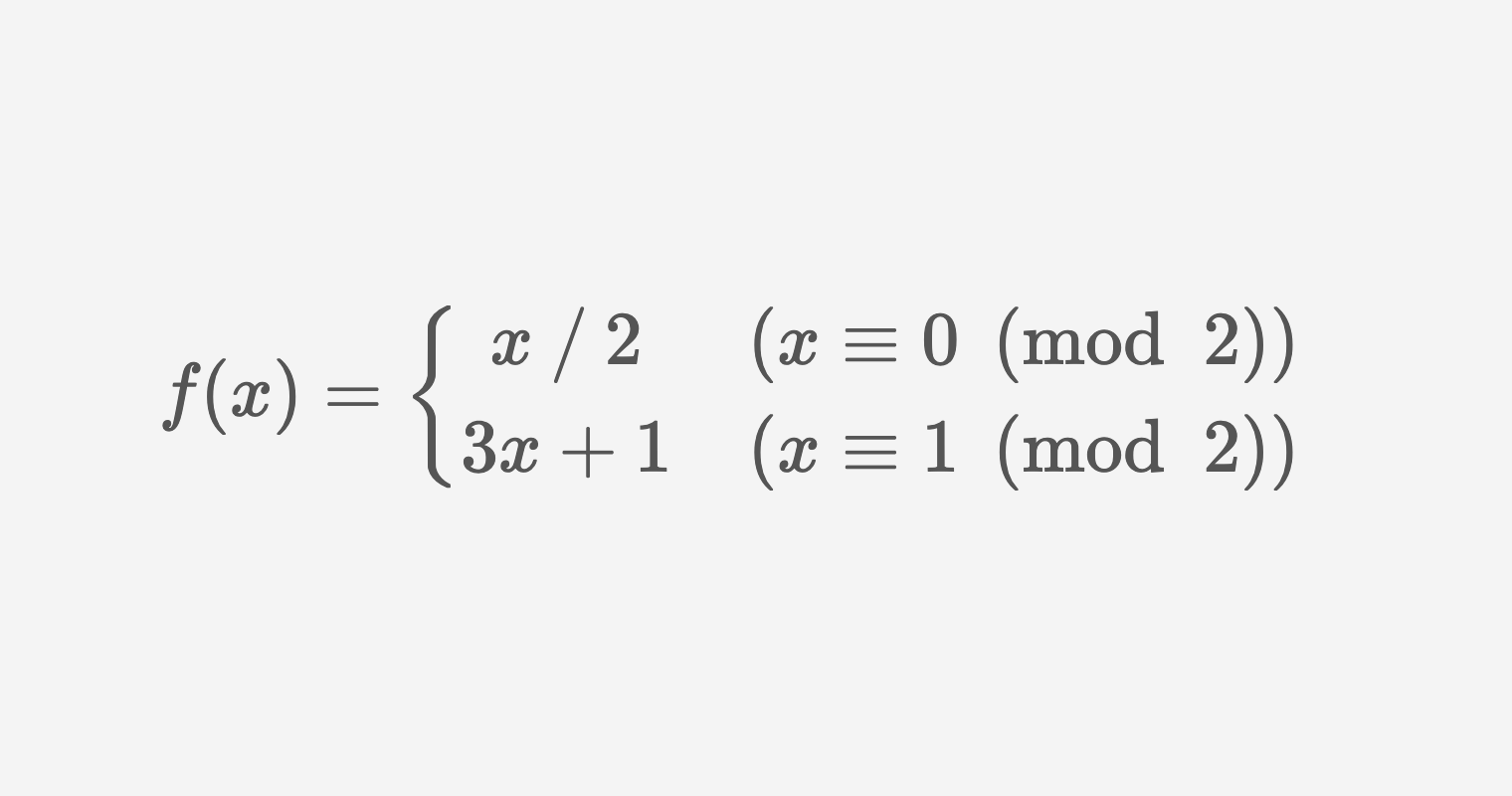
A prize of 120 million JPY will be paid to those who have revealed the truth of the Collatz conjecture. The conjecture is also known as the (3x + 1) problem or the (3n + 1) problem.
120 million JPY in USD
Collatz conjecture Repeatedly applying the function (f(x)) defined below to any positive integers will eventually result in (1).
[ f...
 still flare
It doesn't seem legit, but it simply does not matter: you're not going to be affected
verbal cedar
so there's the theorem that if g is as PR mod p then either g or g+p is a PR mod p^2. for example, 2 is a PR mod 5, so either 2 or 7 is a PR mod 25. but technically 2=7 mod 5. so does that mean that 7 or 12 could be a PR mod 25? and since 7 is definitely not a PR (7^4=1 mod 25), then 12 must be a PR?
torn escarp
verbal cedar
so there's the theorem that if g is as PR mod p then either g or g+p is a PR mod...
I think you can show it by supposing you have $x^{p-1}=1\mod p$ then you can expand $$(x+pn)^{p-1}=x^{p-1}+(p-1)pnx^{p-2} \mod p^2$$ notice all the higher terms are killed. This gives you "n" to play with
sterile pumiceBOT
Merosity
 torn escarp
then we can reason a bit further from here, but I'll let you work on that for a bit I guess
I'm sort of side-stepping your question by going directly to what the relation is between x vs x+np as being generators
since it's maybe not obvious the next step I'd take is subtract off 1 from the two terms to p-1 powers, then everything is divisible by p and we can simplify it down to write it like this:
$$\frac{(x+pn)^{p-1}-1}{p}=\frac{x^{p-1}-1}{p}-nx^{-1} \mod p$$
sterile pumiceBOT
Merosity
 torn escarp
those fermat quotients can only be 0 mod p if they come from a generator mod p^2
mossy rampart
We colour the positive Integer numbers from 2 to 1024 with k colours, such that any number has not been coloured by the same colour that any of his multiples have. find the minimum value of k.
leaden swan
I guess 11 should work?
 exotic bone
leaden swan
I guess 11 should work?
exotic bone
leaden swan
I guess 11 should work?
You can do it with 10 (color a number based on its number of prime factors, counting multiplicities, so all primes are color 1, any product of 2 primes is color 2, etc... Obviously if n|m then n has fewer prime factors than m, so they get different colors). In general the answer is just the ceiling of log_2(n) for 2...n.
leaden swan
mb 10 works
leaden swan
exotic bone
You can do it with 10 (color a number based on its number of prime factors, coun...
I don't think it's necessarily ceil. Consider n=5. You can color 1,3,4,5 color 1. 2 color 2
exotic bone
Yes and it's provably optimal because all the powers of 2 have to be different colors.
exotic bone
leaden swan
I don't think it's necessarily ceil. Consider n=5. You can color 1,3,4,5 color 1...
That's true actually, this strategy is only optimal when n is a power of 2.
Or sorry only gives ceil(log_2(n))
It's clearly always optimal.
leaden swan
I think it should be floor(log_2(n))
Because you clearly need at least that much because the greatest power of 2 in [1,n]
exotic bone
Ah that's right.
And Floor(log_2(n)) always has the largest number of prime factors.
Anyway hope this helped.
mossy rampart
thanks guys, to be honest, I still do not understand the solution, I even read it from the textbook solution's page and still don't get it...
 errant ridge
mossy rampart
thanks guys, to be honest, I still do not understand the solution, I even read i...
errant ridge
mossy rampart
thanks guys, to be honest, I still do not understand the solution, I even read i...
Love the référence in your nickname
mossy rampart
thanks!
leaden swan
mossy rampart
thanks guys, to be honest, I still do not understand the solution, I even read i...
Ok so define a chain as a sequence p_1,p_2...p_n such that p_i is divisible by p_{i+1}
Length of longest chain will be the required color count
 analog portal
There isn't a quick way to do this right?

I have a method that has success with probability > 1-2^-r after r attempts that involves some maths
sleek spire
maybe I'm having a brainfart here, but is there any nice form of $\frac1v \cdot \operatorname{lcm}(q, v^2)$
sterile pumiceBOT
 loud moon
analog portal
I have a method that has success with probability > 1-2^-r after r attempts that...
loud moon
analog portal
I have a method that has success with probability > 1-2^-r after r attempts that...
what’s your method? you can do this deterministically and in time polynomial in log(N), i.e. “fast”, though depending on how e_j and d_j are defined it can range from trivial to somewhat annoying
 fierce shale
analog portal
I have a method that has success with probability > 1-2^-r after r attempts that...
fierce shale
analog portal
I have a method that has success with probability > 1-2^-r after r attempts that...
even with 100-digit prime numbers used to make N?
exotic bone
sleek spire
maybe I'm having a brainfart here, but is there any nice form of $\frac1v \cdot ...
I guess there is an alternative form? But it's not much simpler.. lcm(a, b) = ab/gcd(a, b) so this is qv/gcd(q, v^2) depends on what you want to do with this.
torn escarp
lcm(q/v, v) I think also works I guess, idk if that's much nicer or not
 vapid sable
hi guys, i am i right in my workings here? the solution given did it much more simply but for my understanding could you see if this is correct?

 dusty dragon
Your proof for l being an integer seems fine but you can jump straight from g | m to m = k_1 * g where k_1 is an integer (same for n). Your proof for m | l seems a bit difficult to follow. I’m not entirely sure what your argument here is since it seems like you assumed that m | l and tried to derive some expression
vapid sable
oh i see how ive done the proof of m|l incorrectly let me try again later
i shouldnt have started with that oops
 fervent crest
 vapid sable
dusty dragon
Your proof for l being an integer seems fine but you can jump straight from `g |...
vapid sable
dusty dragon
Your proof for l being an integer seems fine but you can jump straight from `g |...
thats better right?
 dusty dragon
vapid sable
thats better right?
dusty dragon
vapid sable
thats better right?
Yes, that looks much better!
vapid sable
:)
 main stump
how to prove the hint?
 main stump
I dont understand...
 lean coral
main stump
I dont understand...
lean coral
main stump
I dont understand...
don't know if you still need help, but i believe you are meant to use fermat's little theorem here
and then evolve from there
sacred junco
Which factorisation of 840 gives us the largest sum?
(Cant use 1 , must be in at least 2 pieces )
With proof
Anyone
 west glade
consider the function f(x)=x+840/x where x can only be in a relevant interval and then find maximums. that gives you the upper bound for using 2 factors. then with induction you can bound the sum of factors by their product plus some term depending on the number of factors you use
 white lion
Why is it that when I make 13x congruent 6 mod 23 I get a difference answer than if I were to solve x for 13x congruent -17 mod 23? Surely X should satisfy both so I should have the same answer right?
 dusty dragon
You should get the same answer, you may have just made a mistake somewhere in your working
,w 13x = 6 mod 23
sterile pumiceBOT


 Requested by opengangs#7348
dusty dragon
Requested by opengangs#7348
dusty dragon
,w 13x = -17 mod 23
sterile pumiceBOT
 Requested by opengangs#7348
white lion
Requested by opengangs#7348
white lion
Yeah got it thx @dusty dragon
 languid granite
also exists for the unit vector
 analog raptor
 still flare
N can be any number at all 👍
leaden swan
Mod 7 should do the trick
If z>=6 , RHS mod 7 is 5
LHS can be either 1,2 or 0 mod 7
So z < 6
Now like just brute force
@analog raptor
Or you bound z further to get z<=3
 onyx granite
Is there a way to find number of prime numbers up to a natural number n?
leaden swan
Well if you want a deterministic way, there is sieve of Eratosthenes
Pretty sure there are a thousand probabilistic/bounding techniques for this
 leaden swan
Sieve is easy to program tho
normal heart
onyx granite
Is there a way to find number of prime numbers up to a natural number n?
Literally what number theorists have been trying to do for centuries
 stiff rivet

there are also better sieves
the sieve of Atkin is a modern version
if you just want a reasonable guess, this is answered by the prime number theorem
n/log(n) is a pretty good guess, you can be a bit better but not much
@onyx granite
 errant otter
Oh? You can?
onyx granite
,calc 100/log(100)
sterile pumiceBOT
Result:
21.714724095163
,calc (25-21.714724095163)/(21.714724095163)
sterile pumiceBOT
Result:
0.151292546497
 loud maple
onyx granite
Approx 15% error
loud maple
onyx granite
Approx 15% error
The prime-counting function tends to n/ln(n) as n tends to infinity
For smaller values there may be large percentage errors
 misty anchor
Hi! Could someone give me a hand with this?

I’ve tried number 13 but got (n^2)/n-1
Instead of n^2
 gaunt sedge
how do I prove the homomorphism part of this? (context, this is just before stating the power series trick; it says recall but i dont recall us doing this so im asking here)
for exp, i want to show exp(a+b) = exp(a)*exp(b)
i worked with the power series expansion, but the double summation on the right hand side is hard to simplify
 stiff rivet
gaunt sedge
how do I prove the homomorphism part of this? (context, this is just before stat...
stiff rivet
gaunt sedge
how do I prove the homomorphism part of this? (context, this is just before stat...
can you share what you have? on the left hand side you use the binomial theorem and if you know what the binomial coefficient looks like you should be already done
i.e. there is no reason to get rid of the double summation if you work from both ends
 tough crown

 weak rapids
I'm assuming the question does not want me to use Fermat's Little Theorem. I'm unsure how to proceed, could I get a hint?
 loud moon
weak rapids
I'm assuming the question does not want me to use Fermat's Little Theorem. I'm u...
loud moon
weak rapids
I'm assuming the question does not want me to use Fermat's Little Theorem. I'm u...
consider the order of a mod each of the three prime factors of n, and think about what that means for the order of a modulo n itself
wooden glen
Yeah, it seems fair game to use FLiT for each of the given prime factors and then combine them using CRT.
weak rapids
Thanks guys I used these ideas and I think I've got answer
I used that a^(18t) = 1 mod(p) for all the primes p. Then showed that a^(18t) = 1 mod(n) using CRT and the claim follows since 18t divides n-1.
does this seem right?
wooden glen
Hmm. If t=1 we have the primes 7, 13, 19. Then 2^18 == 12 (mod 13), rather than 1.
loud moon
yes, 18t doesn't quite work, but you are on the right track
 unkempt charm
How can I write $4 - \sqrt{15} \in \mathbb{Q}(\sqrt{15})$ as a sum of squares????
sterile pumiceBOT
arab arnold
 sacred junco
Hey there! I have this very simple prime number theory but nobody to discuss it with. I was hoping this community could tear it apart for me. It's not pleasant practising math without anyone to share with. It's very short and straight forward. https://www.reddit.com/r/numbertheory/comments/1348h6y/theory_to_discuss_a_lower_bound_on_the_symmetry/?utm_source=share&utm_medium=web2x&context=3
torn escarp
sacred junco
Hey there! I have this very simple prime number theory but nobody to discuss it ...
post it on math stackexchange maybe they'll be more willing to tear it apart for you
sacred junco
Thanks @torn escarp I was directed here from reddit but that might be the better choice.
verbal cedar
say we're looking at the finite field Zp/<x^2-bx-c> (obviously assuming the quadratic is irreducible)
and r is a quadratic nonresidue mod p. when will r be a quadratic residue mod x^2-bx-c, and how can we find its "square root"?
it seems to be true a lot of the time.
west glade
well if its not a square mod p, then x^2-r is irreducible and Zp[x]/<x^2-r> gives the same field
which now has the square root
not sure about finding it tho. that would essentially give a field isomorphism between those fields which afaik is a hard thing to find
torn escarp
verbal cedar
say we're looking at the finite field Zp/<x^2-bx-c> (obviously assuming the quad...
r/discriminant is a QR, so that's basically your answer
I'm on mobile I'll elaborate more later if that doesn't make sense
verbal cedar
west glade
not sure about finding it tho. that would essentially give a field isomorphism b...
yeah that's actually where i got the problem. finding a field isomorphism between two quotient fields of Zp by irreducible quadratics
phi: Zp/<x^2-b'x-c'>->Zp/<x^2-bx-c>,
i got that if phi(x)=f(x) in Zp/<x^2-bx-c>, then f would have to satisfy
f(x)^2-b'f(x)-c'=0
but f can't be a constant or else the polynomial is reducible, so we need a square root of r=b'^2+4c' which can't be. a QR mod p, so it must be a QR mod x^2-bx-c
verbal cedar
torn escarp
r/discriminant is a QR, so that's basically your answer
yeah after i sent the message i got that. since r and (discriminant)^-1 are QNRs, then their product must be a QR.
but I'm still curious if there's a way to find a square root. any ideas?
verbal cedar
verbal cedar
yeah that's actually where i got the problem. finding a field isomorphism betwee...
since $\phi(x)^2=f(x)^2=\phi(x^2=b'x+c')=b'\phi(x)+c'=b'f(x)+c'$
sterile pumiceBOT
nilpotent nix
 verbal cedar
leading to
$(2f(x)-b')^2\equiv b'^2+4c'\bmod{x^2-bx-c}$
sterile pumiceBOT
nilpotent nix
 verbal cedar
or wait i actually got that if $g(x)=m_0+m_1x$, where $g(x)^2\equiv r\bmod{x^2-bx-c}$ then
$$m_0\equiv bm_12^{-1}\bmod{x^2-bx-c}$$
$$m_1^2\equiv 4r(b^2+4c)^{-1}\bmod{x^2-bx-c}$$
so i do just need a square root of r/discriminant
sterile pumiceBOT
nilpotent nix
 torn escarp
verbal cedar
yeah after i sent the message i got that. since r and (discriminant)^-1 are QNRs...
torn escarp
verbal cedar
yeah after i sent the message i got that. since r and (discriminant)^-1 are QNRs...
Well I just turned the problem into finding the sqrt of a QR
I'm other words, the problems are equivalent so if you can do one easily, you can do the other easily
Maybe that's what you just figured out, I didn't read heh 
at my computer now, to be explict what my solution is, since we know r/disc is a QR, $\frac{r}{disc}=x^2$ and so $r=x\sqrt{disc}$, which you can rewrite in terms of the root if you wanted
sterile pumiceBOT
Merosity
 torn escarp
to be even more explicit say $u$ is one of the roots of $x^2+bx+c$, write it as $u=\frac{-b+\sqrt{disc}}{2}$ so $\sqrt{disc} = 2u+b$ and your solution is $\sqrt{r}=x(2u+b)$
sterile pumiceBOT
Merosity
 torn escarp
(I left out sqrt in the previous latex, not gonna edit it and put it out of order now)
verbal cedar
torn escarp
at my computer now, to be explict what my solution is, since we know r/disc is a...
but it seems you still need to compute the square root of r/disc and disc in the first place.
though I'm not sure how you compute sqrt(disc) since disc can't be a QR without the poly being reducible
verbal cedar
sterile pumice
**nilpotent nix**
i think these should be mod p actually
but yeah it seems that basically i just need a square root of r/disc mod p and then i have it.
so, are there any tricks for square roots of a product of two nonquadratic residues? i guess that's my only hope lol
torn escarp
torn escarp
Well I just turned the problem into finding the sqrt of a QR
nah @verbal cedar what I'm saying is this already shows the problem amounts to finding the square root of a QR
if you solve one you necessarily are solving the other problem
verbal cedar
okay yeah makes sense
verbal cedar
verbal cedar
but yeah it seems that basically i just need a square root of r/disc mod p and t...
actually we covered something in class that sorta works: cipolla's algorithm. let $a=\frac{r}{disc}$, which is a qr. then choose any $t$ such that $t^2-a$ is a qnr. then
$$\sqrt{a}=\paren{t+\sqrt{t^2-a}}^{\frac{p+1}{2}}$$
it's written in terms of the power of an element in $\mbb{F}_p(\sqrt{t^2-a})$ but the power is in $\mbb{F}_p$.
sterile pumiceBOT
nilpotent nix
 weak rapids
I want to find primes p such that (x+y)^13 = x^13 + y^13 mod p. A necessary condition is that 2^13 = 2 mod p -> 2^12 = 1 mod p(except 2). I'm unsure of how to proceed further and would appreciate any hints.
also not sure if the condition is sufficient to guarantee the homomorphism
torn escarp
I'd probably look at the binomial theorem
on the plus side, your argument has effectively ruled out all primes larger than 4096, so only a few more to brute force if you wanted... 😛
<@&268886789983436800>
weak rapids
torn escarp
on the plus side, your argument has effectively ruled out all primes larger than...
why all primes larger than 4096 ?
oh ig you know powers of 2
torn escarp
yeah
weak rapids
not really because 2 works
weak rapids
yeah not sure how to find the order of 2 for different primes p though unless i'm just doing trial and error
like 2^3 = 8 = 1mod 7
torn escarp
fix y and think of f(x)=(x+y)^13 - x^13 - y^13 as a 12th degree polynomial - since mod p is a field it means for p>13 it has at most 12 roots, but it must have p roots, which is impossible
more explicitly for that f, f(x)=0 mod p for all x in {0,..., p-1} which means it must be a multiple of x^p-x
leaden swan
Is (Z/pZ) algebraically closed?
leaden swan
So how do you know it will have p roots
torn escarp
it's supposedly an identity - that's why it's 0
leaden swan
Ah mb
torn escarp
f(x)=0 means (x+y)^13 - x^13 - y^13 = 0 yup
so assuming this I derived a contradiction yeah, I could have said that clearer my bad
weak rapids
wdym by it must have p roots
leaden swan
torn escarp
more explicitly for that f, f(x)=0 mod p for all x in {0,..., p-1} which means i...
.
weak rapids
ah yes
sacred junco
this whole question confuses me but i was wondering if anyone knows how to tackle part a please?


 cunning plinth
sacred junco
this whole question confuses me but i was wondering if anyone knows how to tackl...
cunning plinth
sacred junco
this whole question confuses me but i was wondering if anyone knows how to tackl...
try starting with some specific examples for integers a and x. that should help with the understanding w/ how to approach part (a) 
sacred junco
cunning plinth
try starting with some specific examples for integers a and x. that should help ...
sure i’ll try that thanks
sacred junco
cunning plinth
try starting with some specific examples for integers a and x. that should help ...
this is the best i could do but it’s not right i’m sure of it
 cunning plinth
sacred junco
this is the best i could do but it’s not right i’m sure of it
cunning plinth
sacred junco
this is the best i could do but it’s not right i’m sure of it
try prime factoring x as well. what do you see as a result when comparing to what the problem is asking? try also x = 6 and x = 2. what observations can you make then?
sacred junco
cunning plinth
try prime factoring x as well. what do you see as a result when comparing to wha...
oh right yeah i forgot to prime factorise x instead of a
ok this is what i’ve changed it to
 cunning plinth
sacred junco
oh right yeah i forgot to prime factorise x instead of a
cunning plinth
sacred junco
oh right yeah i forgot to prime factorise x instead of a
you want to see the prime factorization of both -- the problem is asking you to establish a relationship between the prime factorization of a and the prime factorization of x
sacred junco
cunning plinth
you want to see the prime factorization of both -- the problem is asking you to ...
okay i’ve prime factorised 60 and 12 and the difference is that 60 has one more prime number than 12. i’m not sure how to express it tho
cunning plinth
sacred junco
okay i’ve prime factorised 60 and 12 and the difference is that 60 has one more ...
right! so how is that related to a = qx?
sacred junco
cunning plinth
right! so how is that related to a = qx? <:Pom:790325902986444851>
right okay i sort of see the connection

i’ve added the last bit but i think it should be changed slightly
verbal cedar
so if l divides p-1, then there exists an element of order l mod p. and, i seem to have proved that there are phi(l) such elements. for example, mod 31, there are phi(6)=2 elements of order 6. 3 is a primitive root, so we can write all the elements as
3^(5k)
and so is the idea for it to be a solution, we need k to be coprime to 6=30/5 for it to actually have order 6? or if someone can articulate some intuition more clearly, please let me know.
 tender cedar
I have an excercise to solve the congruence $4x^{20}+50x+43 \equiv 0 \mod 23$ (without trying bruteforce)
sterile pumiceBOT
sam
 tender cedar
But just out of curiosity I tried to bruteforce it with python (and wolframalpha), and there dont seem to be any solutions?
Is there a mistake in the excercise?
def polynomial(x):
    return 4*x**20 + 50*x + 43

for i in range(23):
    if polynomial(i) % 23 == 0:
print(i)```This is my code, and it prints nothing
Must be a mistake in the exercise no?
Or do you first have to reduce it or something?
west glade
well why should there be a solution? not every polynomial has a solution
 river rapids
@tender cedar have you tried to use newton's method or something to find x instead?
oh didn't see "mod 23"
leaden swan
tender cedar
I have an excercise to solve the congruence $4x^{20}+50x+43 \equiv 0 \mod 23$ (w...
You can rewrite that as
50 x^3+43 x^2 + 4=0
4x^3+20x^2+4=0
x^3+5x^2+1=0
I guess you can use cardano to find solutions to this
Or well show no real solution exists
tender cedar
leaden swan
You can rewrite that as
50 x^3+43 x^2 + 4=0
=
4x^3+20x^2+4=0
x^3+5x^2+1=0
I g...
How did you arrive at the first line?
 sinful shale
Is anyone here familiar with Diophantine sets?
weak rapids
torn escarp
fix y and think of f(x)=(x+y)^13 - x^13 - y^13 as a 12th degree polynomial - sin...
sorry back to this explanation, wouldn't p=13 not work too since we must have 13 roots for mod 13
leaden swan
Yea
torn escarp
leaden swan
Yea
wot
leaden swan
torn escarp
fix y and think of f(x)=(x+y)^13 - x^13 - y^13 as a 12th degree polynomial - sin...
Well f is explicitly defined to be a 12th degree polynomial in x(fixing y) here
I mean it is a formal polynomial that ends up being the 0 function(because of identity imposed)
Like how f(x)=x(x-1) is same as f(x)=0 in Z/2
torn escarp
leaden swan
Well f is explicitly defined to be a 12th degree polynomial in x(fixing y) here
It's not formally 12th degree
This isn't like how x^p-x evaluates to 0, this literally is 0 here
leaden swan
torn escarp
fix y and think of f(x)=(x+y)^13 - x^13 - y^13 as a 12th degree polynomial - sin...
So is this wrong? Because by this argument for mod 13 you have 13 roots
Or am I misunderstanding the argument
torn escarp
leaden swan
Or am I misunderstanding the argument
sort of, it might be clearer if you compute what the coefficient is of the x^12 term
that way you see the distinction between when the coefficient is 0 or not
torn escarp
torn escarp
I'd probably look at the binomial theorem
here's my hint from earlier
torn escarp
yeah it's a bit tricky
I guess the nice thing to know in general is:
$$(x+y)^p - x^p-y^p = \sum_{n=1}^{p-1} \binom{p}{n}x^ny^{p-n} = \sum_{n=1}^{p-1} \frac{p}{n}\binom{p-1}{n-1}x^ny^{p-n} = 0$$
since $p \nmid n$, all those terms are divisible by $p$.
sterile pumiceBOT
Merosity
 torn escarp
proving that identity of the binomial coefficients shouldn't be too hard if you expand it out as a factorial
sacred junco
tender cedar
Is there a mistake in the excercise?
You are 100% in my class and I pointed out to the teacher yesterday that this was probably a typo
She amended the problem to 4x^2 etc
torn escarp
ah nice
my soln:
||substitute y=2x
y^2+25y+43=0
y^2+2y-3=0
(y+3)(y-1)=0
now y=-3, y=1
so x=-3/2, x=1/2
use euclidean algo to find 2^-1 mod 23 I guess||
sacred junco
I'm not getting that but I'm on the bus rn so can't show my work
I think going from the factored version to writing down solutions is not allowed or something
The process we learned involves some form of completing the square
Ah wait
Lines 2 to 3 doesn't work
y^2+25y-3 = 0 mod 23 doesn't imply y^2+2y-3
Afaik
sacred junco
Yes but the y^2 messes with it
You can check on Wolfram that the answer is different
Also shouldn't the sub be giving you 2y^2
Not just y^2?
Ah nvm I forgor how subs work
tender cedar
sacred junco
You are 100% in my class and I pointed out to the teacher yesterday that this wa...
Yeh I saw this yesterday
sacred junco
👍
unkempt smelt
How do I prove the following: $0 < b_m < 1,$ $m \geq 1$ and $\sum_{m=1}^{\infty} b_m$ converges implies $\prod_{m=1}^{\infty} (1 - b_m)$ converges to a nonzero number
sterile pumiceBOT
LeftySam
 unkempt smelt
I get that if you let $S_M = \sum_{m=1}^{\infty} b_m$ and $P_M = \prod_{m=1}^{\infty} (1 - b_m)$ that $P_M \leq e^{-S_M}$
sterile pumiceBOT
LeftySam
 unkempt smelt
Does the result follow from this?
west glade
yes
unkempt smelt
west glade
yes
So since S_M converges, say to a limit S, then e^-S_M converges to e^S and thus P_M is bounded and thus it converges?
west glade
well you also need monotonicity
unkempt smelt
west glade
well you also need monotonicity
wdym
west glade
wait you want to show that it converges to something nonzero
so no, this is not enough
unkempt smelt
So how do I do it?
west glade
and an upper bound doesnt actually matter. its clearly smaller than 1
west glade
for example try finding a lower bound
that is nonzero
also I assume you messed up notation and S_M and P_M are not supposed to be the whole infinite series/product and instead just partial?
unkempt smelt
Yeah, I did
unkempt smelt
west glade
for example try finding a lower bound
I have no idea
unkempt smelt
west glade
for example try finding a lower bound
I think a lower bound of P_M is 1 - S_M but I'm struggling to prove this by induction
leaden swan
Yea
It should be the number of iterations, I think
Additive Persistence
Well that's usually the right thing,no?
99999999 should take more iterations to reach a fixed point than 9
What are you proposing
Well ig it's not strictly true
But it's like a heuristic
Elaborate
leaden swan
Ok, ngl
I don't know wtf cares about additive persistence
Because like none of the integrity stuff I am familiar with uses this
And additive persistence sounds like a very weak thing to use for integrity
For checksum and such, the algorithms you use are way more complicated
Because those algorithms need special properties and hence end up being complicated
Like small change in input should have a significant change in output,etc
So like they aren't meant to be computed by hand by humans
errant otter
stop spamming your question everywhere, especially in these channels ._.
 green hill
How can I prove that the cycle 1,3,9,7,1,3,9,7... doesn't break for 3^n mod(10)?
wooden glen
Each number is 3 times the previous, modulo 10.
Since you can compute the next term without knowing how you got where you are or exactly what your n is, there's no way the sequence can't repeat, once you've reached a residue you have seen before.
green hill
Cheers!
 opal swift
If 2 is a primitive root modulo p where p is a prime what is the order of 8 mod p? I think we are looking for the smallest n such that 2^3n = 1 mod p, but I don't know how to use the condition on primitive roots here
wooden glen
You'll need to work in the multiplicative group, which (as you should know) is cyclic of order p-1 when p is a prime. You're told that 2 is a generator of the group.
opal swift
Yeah 2 generates Z_p in this case
wooden glen
The multiplicative group is cyclic of order p-1, not of order p.
opal swift
By Z_p I mean the group 0, ... p-1 with multiplication mod p
wooden glen
So there is an isomorphism between nonzero elements of Z/p under multiplication to all elements of Z/(p-1) under addition, and in particular you can choose an isomorphism that maps 2 in Z/p to 1 in Z/(p-1).
wooden glen
opal swift
By Z\_p I mean the group 0, ... p-1 with multiplication mod p
That is not even a group -- 0 doesn't have an inverse.
opal swift
ah yes sorry from 1, ... p-1. i think it's denoted actually Z_p^*
wooden glen
Yes, and I'm telling you it's easier to think about the isomorphic representation of that group as addition modulo p-1.
torn escarp
I'm thinking if 3 divides p-1 then you're closer and need a smaller n, otherwise you just need p-1. In other words, ||n=(p-1)/GCD(3,p-1)||
verbal cedar
opal swift
If 2 is a primitive root modulo p where p is a prime what is the order of 8 mod ...
$\ord(2^i)=\frac{\ord(2)}{\gcd(\ord(2),i)}$
sterile pumiceBOT
nilpotent nix (nix)
 verbal cedar
the order formula
 loud moon
 wheat tinsel
I'd probably start by noting that (8x^2 - 6x + 8) is positive for sufficiently large x, and then note that as x grows, there eventually can't be that many perfect cubes between x^3 and x^3 + 8x^2 - 6x + 8, which should be enough to enumerate all possible solutions fairly quickly
wheat tinsel
ye
it seems thats the standard thing to do
you can bound that polynomial in x by (x+1)^3<P(x)<(x+3)^3 for x>=0
loud moon
yeah I can't think of any simpler way
fossil fog
When it comes to hyperoperators, would it be correct to say that $\forall n \in \mathbb{N}, 2[n]2 = 4$ ($H_n(2, 2) = 4$)?\
If I'm not misunderstanding anything,\
$2+2 = 2\cdot 2 = 2^2 = 2↑↑2 = 2↑↑↑2 = ... = 4$\
(pentation, hexation, and so on of 2,2 are all 4, right?)
sterile pumiceBOT
JJCUBER
 loud maple
 harsh loom
Do I need any prerequisites of math to learn this?
harsh loom
Do I need any prerequisites of math to learn this?
Learn what?
harsh loom
loud maple
Learn what?
Number theory?
sacred junco
You don't strictly need anything in particular but you'll probably have a hard time if you don't at least have high school algebra down
loud maple
harsh loom
Number theory?
There aren't really any prerequisites for starting with 'elementary' number theory.
sacred junco
Also basic proof writing is prob recommended
loud maple
sacred junco
You don't strictly need anything in particular but you'll probably have a hard t...
Right, what I said was assuming that they are decently comfortable with high school mathematics.
sacred junco
Yeah it says he's an undergrad makes sense
harsh loom
I see thanks guys!
opal swift
Is reduced residue system mod n just the same as Z_n^*?
verbal cedar
anyone know what this is supposed to say? it seems like there are some typos and im not sure what it should say to make sense

 fervent grove
Here is one interpretation: Suppose $n$ is a natural number such that $\varphi(n)\mid(n-1)$, where $\varphi$ denotes the Euler phi function. Prove that $n$ is not divisible by $p^k$, for any prime $p$ and natural number $k\ge2$. (Hint: by contradiction, assume that $n$ is divisible by some such $p^k$ and use the multiplicative property of $\varphi$.)
sterile pumiceBOT
dfoiler
 verbal cedar
fervent grove
Here is one interpretation: Suppose $n$ is a natural number such that $\varphi(n...
verbal cedar
fervent grove
Here is one interpretation: Suppose $n$ is a natural number such that $\varphi(n...
is that true? also, i'm not sure what "multiplicative property of phi" means when we're just doing phi(p^k) for a single prime p. should we instead suppose for contradiction that p^k divides n for k>=2?
this is my attempt, i'm not sure if it makes sense really.

i wonder if assuming n**=**p^k is actually justified by the multiplicative property of phi. because then the principle should supposedly extend to if n is a product of multiple terms of the form p^k. but i feel like you'd still have to do some justifications that q-1 doesn't make things alright for some other prime q, and this approach to the proof might be more straightforward.
verbal cedar
verbal cedar
this is my attempt, i'm not sure if it makes sense really.
i probably have to do a bit more explaining to conclude the proof but i just wanna make sure this approach actually works
actually i think this does sorta make sense. i think the point is that n will actually have to be just n=p for p some prime.

if p is prime then phi(p) definitely divides p-1, so this exercise appears to have us prove the converse
leaden swan
Why does phi(n) | n-1 and p^k | n imply phi(n) | p^k-1?
verbal cedar
leaden swan
Why does phi(n) | n-1 and p^k | n imply phi(n) | p^k-1?
shit you're right. p^k-1 is still from assuming n=p^k ughhh
leaden swan
Do you want the solution?
Hint: ||if p^2|n, Think about prime divisors of gcd(phi(n),n)||
||And think what that implies about gcd(n,n-1) (Using fact phi(n) divides n-1)||
verbal cedar
leaden swan
Hint: ||if p^2|n, Think about prime divisors of gcd(phi(n),n)||
p would have to divide the gcd of phi(n) and n.
and then since p divides phi(n) which divides n-1, then p divides n-1.
so n and n-1 are divisible by p. but then p divides n-(n-1)=1, so p divides 1. contradiction.
is that what you had in mind?
this being the full proof
\begin{proof}
Suppose that $\phi(n)\mid n-1$ and $p^k\mid n$ for $k\geq2$.
Then $p\mid n$, and
[
\phi(n)=p^{k-1}(p-1)\mid \phi(n)\implies p\mid \phi(n)\mid n-1\implies p\mid n-1
]
But then $p\mid n$ and $p\mid n-1$, so
[
p\mid n-(n-1)=1
]
Contradiction. Hence, $p^k$ cannot divide $n$ for $k\geq2$.
\end{proof}
sterile pumiceBOT
nilpotent nix (nix)
 leaden swan
verbal cedar
p would have to divide the gcd of phi(n) and n.
and then since p divides phi(n) ...
leaden swan
verbal cedar
p would have to divide the gcd of phi(n) and n.
and then since p divides phi(n) ...
Yeah
verbal cedar
leaden swan
Yeah
great thank you so much!
livid birch
shouldnt this be an iff statement
 livid birch
if 2 is a primitive root mod p, how can i use quadratic reciprocity to prove that p \cong 3 or 5 mod 8
west glade
livid birch
shouldnt this be an iff statement
the other direction is not true. note that a^((p-1)/2) can only be +-1 cause squaring it gives 1 and for each a coprime to p it is one of them. because mod p gives a field, the polynomials x^((p-1)/2) +-1 have at most (p-1)/2 roots each and because in total they have p-1 roots, they each have (p-1)/2. and now finally notice that there arent (p-1)/2 primitive elements, so there will be elements with a^((p-1)/2=-1 and that arent primitive
livid birch
gotcha
livid birch
livid birch
if 2 is a primitive root mod p, how can i use quadratic reciprocity to prove tha...
any chance you have a hint on this oone
normal heart
if 2 is a primitive root mod p then its a quadratic nonresidue
so you use the property that tells you when 2 is/isnt a quadratic nonresidue
livid birch
omfg
i forget basic things
ofc that makes sense, being a primitive root means that it literally cannot be a square mod p
thus forcing it to have legendre = -1
and 2 only has legendre symbol -1 mod p if p = 3 or 5 mod 8
it seems so obvious
normal heart
haha, sometimes when you're doing too much advanced stuff you tend to forget some basic properties
It's normal
livid birch
how can i use extended euclidean algo to find integers a,b such that 8 = 12a + 40b
this is asking for what integers is gcd(12a, 40b) = 8
 charred jasper
how do I solve these? I used hensel's lemma on the first to show thst x had to be one of {3,4,13,14,22,23} but I'm sure there's a better way to conclude than checking each. And I just have no clue for the latter
 charred jasper
livid birch
this is asking for what integers is gcd(12a, 40b) = 8
charred jasper
livid birch
this is asking for what integers is gcd(12a, 40b) = 8
Oh and if I'm understanding you correctly this is a=2p where p is coprime to 40 and b=q where q is coprime to 12 and p, right?
charred jasper
you want integers such that gcd(12a,40b)=8,yes?
gcd(12a,40b)=4k no matter what integers a, b you choose, so you just need to add an extra common factor of 2 without adding any other factors in common
livid birch
oh i see lmao
charred jasper
@manic mortar help.
 manic mortar
Wha
charred jasper
charred jasper
how do I solve these? I used hensel's lemma on the first to show thst x had to b...
this, im extremely lost
I rembered you were in here
manic mortar
i reckon on the first one you might as well just check all 6, its much better than 27
and come on you can do some of them in your head easy as pie
In fact
charred jasper
Ok so it's obviously not 4 or 5,but 13,14,22,23 are hard to see
Oh but it can only have two roots, and they have to be symmetric don't they
manic mortar
so it has to be
manic mortar
ngl idek what you did for the first one to get ur set
so idk how you can do for thr other one either
charred jasper
Hensel's lemma is a trick that lets you lift from lower prime powers to higher