#elementary-number-theory
1 messages · Page 4 of 1
 wanton viper
 torn escarp
the reason the coefficients pop out is due to the p-adic absolute value's competitivity
the edges not necessarily
it might help to show me a concrete example you're looking at and confused with
wanton viper
its with puiseux-series, but it should the same idea, the roots of P(y) have the valuation of 1 or -1/3 and i dont understand how exactly these values show up as the edges
 torn escarp
I can show you how to derive the slope if that's what you want to see too
yeah sure
it has 3 roots of valuation -1/3 and one root of valuation 1
I don't know what you mean about "edges" exactly
wanton viper
i got the hang of how to use the polygon, i want to understand it better
torn escarp
like where the slope changes or the slopes themselves
maybe I should just walk through how I derive the newton polygon, maybe that helps?
wanton viper
sure
torn escarp
I take a polynomial and imagine I'm in the algebraic closure so I have all the roots
so I have say, the root x, with f(x)=0 and I see that 0 = |f(x)| = |a_nx^n + ... +a_0|
|.| is your ultrametric absolute value here
|x| = e^{- ord(x)} to be clear
so the ultrametric absolute value has a specific property that if $|c_1+c_2+\cdots+c_n|=0$ then it must be that there's an $i \ne j$ that makes $|c_i|=|c_j|$, so we can prove that real quick
 sterile pumiceBOT
Merosity
 torn escarp
assume not, then pick the maximum $|c_i|>|c_j|$ for all $j \ne i$, then $$0=|c_1+c_2+\cdots+c_n|=|c_i| \ne 0$$
sterile pumiceBOT
Merosity
 torn escarp
because the strongest win properties of the ultrametric absolute value forces for |x|>|y| that |x+y|=|x|
that gave us a contradiction, so that means some |c_i|=|c_j|, we can then just use that with the terms of the polynomial
$$|a_ix^i| = |a_jx^j|$$
sterile pumiceBOT
Merosity
 torn escarp
rearranging this gives you the slope formula, maybe writing it in terms of the order would help
or maybe this doesn't feel deep enough to see it pop out of the algebra after this point, and that's just unsatisfying to you
I've said a lot of stuff so probably I lost you at some point too, so feel free to ask
wanton viper
i got this for once, i have the slope formula. maybe im just stupid and dont see it. im going to experiment a little more on paper, but you gave me a couple of ideas
thx :D
torn escarp
yeah, good luck, feel free to ping me if you have more questions
wanton viper
alright
torn escarp
there's more to say, you could look at Alain M. Robert's A Course in p-adic Analysis chapter 6 section 1.6 for some more info
wanton viper
im still a little lost.
where is the context between the slope (e.g. -3, for i=0 and j=1) and the geometric shape.
I draw the polygon as the lower half of the convex hull of the points (i, v(a_i)).
the values for i and j only work if they are "on" a line of the polygon

mainly its this part here, why must (i, v(a_i)) and (j, v(a_j)) belong to an edge of the newton polygon

@torn escarp
torn escarp
sterile pumice
**Merosity**
@wanton viper that was part of this argument here, which led to two terms being equal, you can think of the "smaller terms" are the ones that get thrown up above the newton polygon, and aren't part of the convex hull
another book to look at would be Gouvea's p-adic numbers book he goes in depth too, but
to see that the valuation lies on the newton polygon, that's all here to do with the ultrametric absolute value's properties, I think it's probably the main thing that's confusing, the fact that |a|>|b| implies |a+b|=|a| when you might suspect the weaker statements |x+y|<=|x|+|y| or |x+y|<=max(|x|,|y|), we actually get equality
wanton viper
i think i start to understand it now. any slope between point a and b would give me a result that equals $i \cdot v(y_0) + v(a_i) = j \cdot v(y_0) + v(a_j)$ but for the requirement that $i \cdot v(y_0) + a(a_i)$ is also the minimum for all i, the slope has to be on the edge of the polygon, where it is the steepest it could get
sterile pumiceBOT
[Hyp] Deutschland
 wanton viper
@torn escarp
 native monolith
surely the hint should contain mod 7 not mod 6??

then you get $10^4\equiv 1 \mod{7}$ and $10^100=10^{98}\times 2^2 \times 5^2$ so the power is a multiple of 4 so the answer is thursday
sterile pumiceBOT
Max..
 native monolith
but i dont get why they used mod 6 in the hint
7 days means we need 7 least residues, mod 6 has only 6 least residues
 crimson forum
hi i have a question how would one write x^2+y^2+x=c where c<0 as the sum of squares??
torn escarp
crimson forum
hi i have a question how would one write x^2+y^2+x=c where c<0 as the sum of sq...
complete the square of x^2+x like the last problem
crimson forum
(x+1/2)^2+y^2-1/4=c but then the problem would be we move 1/4 to the other side and wed get (x+1/2)+y^2=c+1/4
my q is "observe that the polynomial can be represented as a sum of squares of polynomials. Conclude that the equation has no real solutions and therefore no integer solutions." so if i have -1/4 when completing the square i cant conclude that x+1/2)^2+y^2-1/4 is >0 if that makes sense
because of the -1/4
but i have no idea on any other way of making it sum of sqs?
torn escarp
well c+1/4 is a sum of squares so it must be >=0
so c+1/4 >=0 makes -1/4 <= c < 0, about as good as you can do
crimson forum
hmm but then im not sure i fully understand becuase arent we tryna make contradiction that c>=0 but we are told c<0 ==> no int sols
torn escarp
crimson forum
hmm but then im not sure i fully understand becuase arent we tryna make contrad...
if c>=-1/4 it has real solutions, no amount of factoring can change that
crimson forum
so it a trick q?
torn escarp
well, is there any more information
if c is an integer that would be enough to solve it this way, but for all I know it's a rational number
since the interval [-1/4,0) contains no integers
actually I don't think that's enough, I'm distracted but
maybe there's a typo or some information you left out on accident maybe? I'm in a call right now sorry
crimson forum
hmm lemme show u the problem

theres no notes for this but then im thinking itd just make the 4th one also wrong
crimson forum
torn escarp
maybe there's a typo or some information you left out on accident maybe? I'm in ...
alright no worries if u in call
but yh thats the thing theres no proper notes at all on this eithr which is annoying
crimson forum
ok i think im just overthinking this a lot
im just gnna go with c being an integer and gna use what u sed about completing square then (x+1/2)^2+y^2>=1/4 so (x+1/2)^2+y^2-1/4 must also be >=0 if we rearrange as that works n makes sense
Thanks so much for the help and time too @torn escarp 🙂
torn escarp
yeah you're welcome, glad to hear you sorted it out
 minor nexus
Given that n=p_1*...p_t, t is even.
Could someone help me with this? Seems that the answer is 0, but I can't strictly prove it. Tried saying that sqrt n > p_1...p_t. If I prove, that there is no dividers of n between sqrt n and p_1...*p_t, then the answer is easy to get, but Its not true
 torn escarp
minor nexus
Given that n=p_1*...*p_t, t is even.
Could someone help me with this? Seems that...
torn escarp
minor nexus
Given that n=p_1*...*p_t, t is even.
Could someone help me with this? Seems that...
do the primes need to be distinct in n? for instance, n=4=2*2 gives you mu(1)=1
minor nexus
torn escarp
do the primes need to be distinct in n? for instance, n=4=2*2 gives you mu(1)=1
Yeah, sorry for the late answer. p_i != p_j, i != j
minor nexus
Okey, I solved it
 dusty dragon
Note that aa’ = 1 (mod p), so 1 = (1/p) = (aa’/p) = (a/p)(a’/p)
Multiply both sides by (a’/p) and use the fact that (a’^2/p) = 1 to get the result
 runic token
wait what does it mean with the parentheses
dusty dragon
It's the Legendre symbol
[ \left(\frac{a}{p}\right) = \begin{cases}0 & \text{if } p \mid a, \ 1 & \text{if } a \text{ is a non-zero quadratic residue mod }p, \ -1 & \text{if } a \text{ is a non-zero quadratic non-residue mod }p.\end{cases}]
sterile pumiceBOT

 vernal void
dusty dragon
Note that aa’ = 1 (mod p), so 1 = (1/p) = (aa’/p) = (a/p)(a’/p)
vernal void
dusty dragon
Note that aa’ = 1 (mod p), so 1 = (1/p) = (aa’/p) = (a/p)(a’/p)
cvisnt this enough?
oh wait
dusty dragon
Indeed
Once you're there, you're effectively done
[ 1 = \left(\frac{a}{p}\right)\left(\frac{a'}{p}\right) \implies \left(\frac{a'}{p}\right) = \left(\frac{a}{p}\right)\left(\frac{a'^2}{p}\right) = \left(\frac{a}{p}\right)]
sterile pumiceBOT
 runic token
oh, neat
torn escarp
what kind of stuff have you been learning about in class, trying to not use crazy ideas to solve this if I can help it
vernal void
torn escarp
what kind of stuff have you been learning about in class, trying to not use craz...
basically like up to this stuff
we're on pythagorean triples rn!
torn escarp
maybe try translating f(x-b/(2a))
idk, I think there's some easy trick to do this problem, I'm a bit busy right now and tomorrow but maybe I'll find time to think about it if no one else pops in
vernal void
@dusty dragon any idea ❤️
 fluid steppe
that doesnt sound like number theory
torn escarp
try #math-discussion I guess, but what you're saying sounds wrong
fluid steppe
 ivory fable
well where can i find theory
ivory fable
well where can i find theory
maths is theory
 fierce knoll
ivory fable
Yo guys
fierce knoll
ivory fable
Yo guys
no you don't even neet time on your axis's, for example y = 2x where x is apples and y is money, there isn't any time in this equasion
 verbal cedar
say b and d are integers, b>0, and d is fixed such that 0≤d≤10. if b divides both d and 10-d, then what can I say about b?
dusty dragon
If b divides d and 10 - d, then b divides 10. To see this, note that 10 - d = bk for some integer k. So 10 = d + bk = bm + bk for some integer m. In other words, 10 = b(m + k) => b | 10
Since b > 0, this means that b \in {1, 2, 5, 10}
@verbal cedar in case you still needed it
verbal cedar
dusty dragon
If b divides d and 10 - d, then b divides 10. To see this, note that 10 - d = bk...
ah ofc. that's so obvious now that i see it lol
dusty dragon
it happens lol
I sometimes forget that gcd(a, b) = d implies that d | a and d | b

verbal cedar
is there a way to know which numbers will have a square root in a modular ring? say for Z/nZ. are there tricks that work for certain kinds of n? such as if n is prime?
dusty dragon
I guess another way to phrase your question is to determine which numbers are quadratic residues? If x \equiv y^2 (mod n), then x has a square root y in Z_n?
 dark flax
what grade is this for?
 north pagoda
dark flax
what grade is this for?
north pagoda
dark flax
what grade is this for?
as suggested by this being in the "early university" section, the main target audience of this section is university-level elementary number theory questions
but if youre a high school student and have a number theoretic question, you can ask it here
(if it doesn't fit, we'll redirect you)
torn escarp
verbal cedar
is there a way to know which numbers will have a square root in a modular ring? ...
factor n into powers of primes mod p^k, then you can reduce to the prime mod p and solve there, then hensel lift back up to p^k, then combine with the chinese remainder theorem.
if you're just checking if it has a square root, you just need to reduce to the prime and show that it satisfies the condition of hensel's lemma (which is a sufficient, but not necessary, there's a bit more general version of hensel's lemma that you can use)
 onyx rock
 gray sequoia
How should I study number theory for olympiad, if I can't solve most of the problems?
I'm reading modern olympiad number theory, but the book is getting harder and harder, almost can't keep up with the pace
 sacred junco
What does this notation mean?
 dusty dragon
It doesn't look like standard notation; card(...) is sometimes used to signify the cardinality of a set, but more context is probably needed to make out what the rest means
north pagoda
i would wager its meant to be the cardinality of the set of functions ℚ → ℝ?
usually thatd be denoted ℝ^ℚ, not ^ℚ ℝ
but same gist
 flint schooner
help i need to solve and reduce A, B and C

 onyx granite
Is the sieve of eratosthenes still relevant?
north pagoda
flint schooner
help i need to solve and reduce A, B and C
this is not number theory, try #prealg-and-algebra or a help channel
north pagoda
onyx granite
Is the sieve of eratosthenes still relevant?
define "relevant"
onyx granite
We can use programming tools to find if a number is prime or not.
north pagoda
the sieve of eratosthenes is definitely not the fastest way to determine primality - its very bad at that
it also isnt a particularly fast way to determine the nth prime (the reason it exists), but it isnt that bad either
its merits are being simple and intuitive
onyx granite
I meant to ask if we still use it in today's world of mathematics
north pagoda
it is used as an example
it is not used, like, algorithmically
besides maybe in teaching intro programming students how to use loops
north pagoda
that said, sieves ARE used in proofs
the most famous example here is probably euler's proof of the riemann zeta primes identity
you wont find too many opportunities to prove things using the sieve of eratosthenes specifically
but sieving in general is a powerful technique in number theory
the modern "optimized" version of the sieve of eratosthenes is https://en.wikipedia.org/wiki/Sieve_of_Atkin
onyx granite
That gives a lot of insights, very helpful, ty!
north pagoda
i say "optimized" but this is only asymptotically
for non-astronomical inputs the sieve of eratosthenes is faster
onyx granite
What are some nice applications of number theory other than cryptography?
Is it more inclined to being 'pure mathematics'?
north pagoda
it's very pure, yes.
indeed, prior to the invention of cryptography, it was seen by many mathematicians as the "purest" field
turns out that cryptography is actually very useful
and a lot of developments in number theory have inspired developments in other stuff that turn out to be useful
(one can draw a direct lineage from early analytic number theory to most of modern mathematical physics, for example)
(because it inspired a lot of the development of complex analysis and differential geometry)
but number theory itself isn't all that applicable.
onyx granite

 inner anchor
also in terms of theoretical interest, the sieve of eratosthenes-legendre, which is just a formalized version used to simply count the number of primes instead of determining primality, is a good starting point into more powerful sieve methods
 shy cedar
Guys any book recommendation to start number theory my own?
Qualifications: almost a highschool passout
sacred junco
shy cedar
Guys any book recommendation to start number theory my own?
did you check #books-old
 stiff rivet
shy cedar
Guys any book recommendation to start number theory my own?
stiff rivet
shy cedar
Guys any book recommendation to start number theory my own?
i like silverman's friendly introduction to number theory
shy cedar
sacred junco
did you check <#556194300912861205>
Oh I didn't, will
shy cedar
stiff rivet
i like silverman's friendly introduction to number theory
Thanks will check it out for sure
 shut scaffold
If I am to perform a calculation with "3-digit chopping", 22/7 becomes 3.14 or 3.142? I think it's 3.14, but I'm sanity checking myself. 🙂
 brisk skiff
shut scaffold
If I am to perform a calculation with "3-digit chopping", 22/7 becomes 3.14 or 3...
brisk skiff
shut scaffold
If I am to perform a calculation with "3-digit chopping", 22/7 becomes 3.14 or 3...
wdym by 3 digit chopping
shut scaffold
It's out of my Numerical Analysis book. Truncation vs rounding.
brisk skiff
oh ok nvm
 uneven granite
How do this
 west sun
Does this set notation describe all positive even numbers? If not, how is it wrong?

 lilac elk
west sun
Does this set notation describe all positive even numbers? If not, how is it wro...
lilac elk
west sun
Does this set notation describe all positive even numbers? If not, how is it wro...
in order for x/2 to belong to N. x/2 must be an integer, let's say k
x/2=k, then x=2k. which is an even number as long as k is an N number
 weary patio
Hi there, I have a question, but I'm not sure it fits in here directly (since I'm not professionally trained), please redirect me if it isn't appropriate (trying to avoid posting in adv)! My question concerns the argument for claiming that "there aren't enough names for the reals, since countable infinite text (names) with a finite alphabet can't be mapped onto the reals (via diagonal argument)." While I see that much ink has been spilled about that already, I would like to ask for help pointing me in the right direction to answer this question. In many discussion the argument quickly changes to definability or computability. Where can I look up how to properly answer this question (possibly that giving names necessarily leads to definability) and the connection between these topics (name, model & proof theory, definability). Thanks in advance!
torn escarp
weary patio
Hi there, I have a question, but I'm not sure it fits in here directly (since I'...
I think this is more a #proofs-and-logic type of thing, you might get better reception there, or they might forward you somewhere better.
weary patio
@torn escarp thanks a lot!
 untold moat
i have to prove that this will never give me a prime number , n is Natural number

how do i do it ?
 buoyant mason
untold moat
i have to prove that this will never give me a prime number , n is Natural numbe...
buoyant mason
untold moat
i have to prove that this will never give me a prime number , n is Natural numbe...
try simplifying it and factoring it
buoyant mason
how could you factor it?
buoyant mason
you are overthinking it if you cannot figure it out
untold moat
i know it look simpel but like i have no ideas come to my head if how i should do it
buoyant mason
what are the factors of 55?
untold moat
5*11
buoyant mason
yep
 ruby cloak
someone help
untold moat
what should i do after that hhhhhhhhhhhhhhhhhhhhhh
ruby cloak
my hw
ruby cloak
 buoyant mason
11 times something greater than 1 is not prime
buoyant mason
yep ^-^
 karmic notch
stiff rivet
i like silverman's friendly introduction to number theory
karmic notch
stiff rivet
i like silverman's friendly introduction to number theory
I also like this book, and A Book of Abstract Algebra because of the short chapters that introduce one idea at a time and exercises related to those ideas that were introduced. I'm wondering if there are other books like these two that I could learn from, but for other topics like combinatorics and such.
torn escarp
the question seems incomplete, you refer to 'x' but never use i
 full thicket
nvm i have solved it
 dark zealot
if a man has to work 5 days in 31 days, without working 2 consecutive days, how many arrangements are possible for his days of work?
dusty dragon
it might be easier to find the number of arrangements where the man has to work 2 consecutive days
dark zealot
dusty dragon
it might be easier to find the number of arrangements where the man has to work ...
i tried
too difficult
dusty dragon
Think of it similar to how you would solve the problem where two people have to sit next to each other
(i.e. start by fixing the 2 consecutive days and then figure out how many arrangements you have to fit the remaining 3 days)
 wind glacier
How can we find all positive integer solutions of the equation $2(x^3-x)=y^3-y$
sterile pumiceBOT
Amorous aka Lucifer
 sacred junco
is analysis number theory?
 midnight forge
sacred junco
is analysis number theory?
midnight forge
sacred junco
is analysis number theory?
No
midnight forge
wind glacier
How can we find all positive integer solutions of the equation $2(x^3-x)=y^3-y$
Try factoring both expressions and reducing modulo 6?
Idk if it’ll work but just an idea
wind glacier
Im not able to do ,much even after this
 serene socket
It's an elliptic curve as verified by Sage
runic token
wind glacier
How can we find all positive integer solutions of the equation $2(x^3-x)=y^3-y$
maybe do $2x(x^2-1)=y(y^2-1)$ and then break these up into smaller factors and use coprimality to set different factors equal to each other to get solutions?
sterile pumiceBOT
valley
 runic token
not sure if it'll work, js a thought
 next abyss
i have a set with two elements {a,b} and im looking for a set thats something like a hybrid between the powerset and all possible permutations of a set. id like to theoretically have all arrangements (permutations) of elements, such that:
{
  {a}, {b}, all "1-element-permutations"
  {a,a}, {a,b}, {b,a}, {b,b}, all 2-element-permutations
  {a,a,a}, {a,a,b}, {a,b,a}, {a,b,b}, {b, a, a}, ...,  "3 element permutations"
  {a,a,a,a}, {a,a,a,b}, ....,  "4 element permutations"
  ... up to k-element permutations
}
whats the mathematical operation im looking for here?
or structure?
buoyant mason
next abyss
i have a set with two elements {a,b} and im looking for a set thats something li...
maybe something about permutations of multisets?
next abyss
buoyant mason
maybe something about permutations of multisets?
thanks, i didnt find out but figured out how to implement it in python!
buoyant mason
ah great ^-^
 coarse carbon
Idk if its correct in english but when they ask u to define a function explicitly what do they mean?
I have this problem

And they ask u to define f^-1 explicitly
And this is the solution and i didnt get why the teacher use a b c and why is he using the congruence system

Do we need like the direct image of the x’s for it to be defined explicitly is that what we should do?
 harsh solstice
coarse carbon
Do we need like the direct image of the x’s for it to be defined explicitly is t...
harsh solstice
coarse carbon
Do we need like the direct image of the x’s for it to be defined explicitly is t...
Define a function explicitly means to write down the output you get explicitly , in this case we know that there is a isomorphism f^- , we just didnt write it down explicitly as opposed to f which is clearly defined as f(x+165Z)=(x+3Z,x+5Z,x+11Z) <-- (we have an explicit formula for the output in terms of x)
notice f^- is from (Z3* ,Z5* , Z11* ) to (Z165*) meaning we take 3 elements from each set (in this case we call them a+3Z ,b+5Z and c+11Z)
and send them to (x+165Z)
or more concretely f^-(a+3Z,b+5Z,c+11Z)= x+165Z , now we insert f on both sides and we get f(f^-(a+3Z,b+5Z,c+11Z))=f(x+165Z)
since f is bijective we get (a+3Z,b+5Z,c+11Z)=f(x+165Z) =(x+3Z,x+5Z,x+11Z)
notice that a+3Z=x+3Z implies a and x are in the same congruency class modulu 3 , and thats where we get x cong a (mod3)
coarse carbon
Aw man
Thanks
That was a really good explanation
Btw i saw u like measure theory i have a class and im struggling in it can i ask u later if im stuck on something? Were just having basic stuff on it
harsh solstice
coarse carbon
Btw i saw u like measure theory i have a class and im struggling in it can i ask...
ye of course i can try to help if i can ,altho i have started learning it not so long go lol ,currently working on outer measures and caratheodory's criterion proof
 drifting imp
Have I done this right?

i put triple no for injective,surjective and bijective since the relation R is not a function ?
actually mbe it is functional
and surjective?
harsh solstice
coarse carbon
So can I dm u when I need something with it?
i Think its a better idea to post in #advanced-analysis , there is plenty people here more competent than me in measure theory  , but i usually do lurk on the analysis channels so ile notice if you post something that i can help with.
coarse carbon
Alright thank you 💕
 marble tusk
sterile pumiceBOT
marble tusk
sterile pumiceBOT
yoohoo
 inner anchor
by the division algorithm, we have $n \pmod{d} = n - d \left\lfloor \frac{n}{d}\right\rfloor$
sterile pumiceBOT
Pappa

 dense scroll
Does anyone have a hint?
 dusty dragon
If d | (3 * 10^499), then d | (3 * 2^499 * 5^499). You can now independently choose the number of 2's, 3's, and 5's to appear in your factorisation
dense scroll
Thanks!
dense scroll
Does anyone have a hint for doing this induction? I can't figure it out
 dusty dragon
Note that $a_{n + 1} = 2^{2^{n + 1}} - 1 = (2^{2^n})^2 - 1$. This is just a difference of two squares, one of its factors being exactly $a_n$.
sterile pumiceBOT

 ashen gull
This may be a stupid question, but do the relative prime numbers of a number n generate the prime numbers as n tends to infinity?
next abyss
buoyant mason
maybe something about permutations of multisets?
for reference, it was the "kleene star" i was looking for:
In mathematical logic and computer science, the Kleene star (or Kleene operator or Kleene closure) is a unary operation, either on sets of strings or on sets of symbols or characters. In mathematics,
it is more commonly known as the free monoid construction. The application of the Kleene star to a set
    V


{\...
 unkempt void
ashen gull
This may be a stupid question, but do the relative prime numbers of a number n g...
unkempt void
ashen gull
This may be a stupid question, but do the relative prime numbers of a number n g...
Not really sure you mean by "generate the prime numbers"
You'll always omit all multiples of n for any n
And whenever you get an even number then only odd numbers can be coprime to it and so on
buoyant mason
next abyss
for reference, it was the "kleene star" i was looking for:
ohh cool 🙂
wind glacier
Given that $\phi=\frac{1+\sqrt{5}}{2}$. Let $$n=\frac{1}{1}+\frac{1}{1+\phi}+\frac{1}{1+\phi+\phi^2}+\frac{1}{1+\phi+\phi^2+\phi^3}+\dots$$
The value of $\lfloor2n\rfloor+\lceil2n\rceil$ is $\dots$
sterile pumiceBOT
Amorous aka Lucifer
 wind glacier
sterile pumice
**Amorous aka Lucifer**
wind glacier
sterile pumice
**Amorous aka Lucifer**
Please anyone help
 willow steppe
guys i am in 7th grade and i dont understand any of this help pwease
 stoic bear
Think about bounding it somehow
 still flare
Welcome
 fiery zenith

Hint 🙏, I've seen the answer before but forgot
iirc the general topic was determinants
if we set $f(x) = lhs - rhs$, we get $f(x) = (x-1)^2(x^4+2x^3+4x^2+2x+1)$
sterile pumiceBOT


 fervent grove
fiery zenith
if we set $f(x) = lhs - rhs$, we get $f(x) = (x-1)^2(x^4+2x^3+4x^2+2x+1)$
fervent grove
fiery zenith
if we set $f(x) = lhs - rhs$, we get $f(x) = (x-1)^2(x^4+2x^3+4x^2+2x+1)$
for the record, this could actually work
note that we must have x>0 for a solution
but then if x =/= 1, we see that (x-1)^2>0 and (x^4+2x^3+4x^2+2x+1) > 0, so f(x) > 0
so the only solution is x=1
fiery zenith
fervent grove
but then if x =/= 1, we see that `(x-1)^2>0` and `(x^4+2x^3+4x^2+2x+1) > 0`, so ...
How do you get the 2nd inequality with the quartic
fervent grove
x > 0 and all the terms have positive coefficients
fiery zenith
🤔
fervent grove
did I misread something
fiery zenith
im thinking
right x > 0 is necessary (missed that earlier). nice one
(and yh, Q shouldve stated x in R)
 fair skiff
fiery zenith
if we set $f(x) = lhs - rhs$, we get $f(x) = (x-1)^2(x^4+2x^3+4x^2+2x+1)$
fair skiff
fiery zenith
if we set $f(x) = lhs - rhs$, we get $f(x) = (x-1)^2(x^4+2x^3+4x^2+2x+1)$
so x>=0 obv has no solutions (except x=1), to show the same with x<0:
x^4+2x^3+4x^2+2x+1=(x+1)^4-2(x^3+x^2+x)=(x+1)^4-2x(x^2+x+1)
x^2+x+1>0 for Vx, but when x<0, -2x(x^2+x+1)>0, and we’re done
oh wait x>0 is necessary
Lol
 crisp finch
fair skiff
oh wait x>0 is necessary
crisp finch
fair skiff
oh wait x>0 is necessary
Its necessary becsuse in the original equation the LHS is strictly positive.
fair skiff
crisp finch
Its necessary becsuse in the original equation the LHS is strictly positive.
yeah whoops
all that work for nothing lolz
crisp finch
Its fine
fair skiff
happens all the time 😩 sometimes i delve too deeply and miss a trivial insight
crisp finch
A nice tip before doing algebraic manipulations is trying to input 0 and 1
and then notice degrees
The degree on LHS is gigantic while RHS is half that
so if we know that they are equal at 1 then we can assume they dont intersect again after that.
the way i can justify this is sorta like this
we know the degree of LHS is 6 so we can say that the equation is approximately x^6+C=4x^3
fair skiff
it definitely simplifies the problem + provides groundwork to a potential solution
crisp finch
yeah how much time did you have for the problem?
fair skiff
i think i spent like 5 minutes on it, did it while eating breakfast
i just saw it randomly and decided to give my thoughts
but as you can see, i missed the big picture ;-;
fair skiff
crisp finch
no its no big picture thing
okay maybe big picture wasn't the right phrase - i missed a simpler approach to prove that x > 0 is necessary
fair skiff
crisp finch
can I give u an equation?
for what reason?
fair skiff
x^2y^2+x-1=3y-1?
crisp finch
yea lol
fair skiff
there are infinitely many solutions, do you want a general form or smth
crisp finch
yes
sterile pumiceBOT
EzMoneyBois
 crisp finch
yeah this is right
 tacit heart
Why is this true $$\frac{2015^{2017} + 2^{2017} - 2017}{2017}\equiv -1 + \sum_{k = 0}^{2017}(-1)^k(-2)^{k}2^{2017 - k} \pmod{2017}$$
sterile pumiceBOT
kappa
 fair skiff
sterile pumice
**kappa**
fair skiff
sterile pumice
**kappa**
consider $2015^{2017}=(2017-2)^{2017}$
sterile pumiceBOT
EzMoneyBois
 fair skiff
@tacit heart
stoic bear
I think -1 from -2017/2017 and then consider the binomial formula expansion of something related to the remaining expression
tacit heart
Hey
tacit heart
fair skiff
<@886648822606991481>
Thanks
tacit heart
fair skiff
consider $2015^{2017}=(2017-2)^{2017}$
Nvm I don’t understand, could you elaborate
fair skiff
tacit heart
Nvm I don’t understand, could you elaborate
$2015^{2017}+2^{2017}-2017
=(2017-2)^{2017}+2^{2017}-2017
=\left(\sum_{i=0}^{2017}(2017)^i\cdot(-2)^{2017-i}\cdot\binom{2017}{i}\right)+2^{2017}-2017
=\left(\sum_{i=1}^{2017}(2017)^i\cdot(-2)^{2017-i}\cdot\binom{2017}{i}\right)+(-2)^{2017}+2^{2017}-2017$
sterile pumiceBOT
EzMoneyBois
Compile Error! Click the  reaction for more information.
(You may edit your message to recompile.)
 fair skiff
can you finish from there?
 short lion
math
tacit heart
fair skiff
can you finish from there?
Yea thanks
 leaden swan
<@&268886789983436800>
 paper lion
Thanks
 lean path
what is the 100s digit of 44^44
 knotty anchor
lean path
what is the 100s digit of 44^44
knotty anchor
lean path
what is the 100s digit of 44^44
you posted in the other thread. modulo 100 and you can just use eluers totient theorem to simplify
knotty anchor
tacit heart
Why is this true $$\frac{2015^{2017} + 2^{2017} - 2017}{2017}\equiv -1 + \sum_{k...
Is this from OTIS?
tacit heart
knotty anchor
Is this from OTIS?
You were also curious about the summation so I asked. I am kn07
 opal dome
I'm uncomfortable with this justification for the set of rationals being countable because it can be shown that a bijection exists between the natural numbers and the grid of p/q for all p, q in the integers

Namely, if there's redundancy in this construction, how is there a bijection?

lol like believe they're countable ... but this argument with the redundancies has me feeling 😕
 night quail
you could say that the above shows Zx(Z/{0}) is countable, and you can construct Q to be a set of equivalence classes of Zx(Z/{0}) for the relation (n,m) ~ (p,q) <=> mq = np, and so should also be countable
well the above actually shows NxN is countable, but you could build the same argument for Zx(Z/{0}) im sure
opal dome
sorry for being slow to respond, im still relatively new to a lot of this jargon so brb as i figure out what equivalence classes are lol
night quail
it's essentially saying "get rid of all the redundancies" like 1/2 and 2/4
the idea is that Q will then be a "subset" of Zx(Z/{0}), and since we showed Zx(Z/{0}) is countable, Q must be as well
opal dome
night quail
the idea is that Q will then be a "subset" of Zx(Z/{0}), and since we showed Zx(...
ah thanks for the high level strategy
night quail
note that the construction of Q above is not actually a subset of Zx(Z/{0}), but it's... isomorphic (to a subset)?
torn escarp
opal dome
I suppose one way to think of it is, since N is in Q you have |N| <= |Q|, but this picture shows |Q| <= |N| so putting those together |N|=|Q|
buoyant mason
@flint ivy i didn't know where to put this since the channel closed but for your problem here i was thinking of completing the square twice to rewrite it as 6(4x+1)^2 - (12y+2)^2 = 2, then this is almost an equation of form 6a^2 - b^2 = 2

and if you know pell equation stuff that can be solved
but the solutions will still be pretty complicated
and only describing the ones with a = 1 mod 4 and b = 2 mod 12 i think will make it even more complicated 🥹
fervent grove
I mean (a,b) = (1,2) is a solution
the rest of the solutions for (a,b) you can find by multiplying (sqrt(6)+2) by some powers of the fundamental unit in Z[sqrt(6)] as in normal Pell equation theory; I think the fundamental solution is (a,b) = (2,5)
if you actually write out what your solutions for (a,b) are, then you're going to get some recurrences to generate your solutions. to add congruence conditions on (a,b) to solve for (x,y), one should be able to "solve these recurrences" modulo an integer because they're periodic modulo any integer, so you can just pick out the indices you want
this is probably not the most efficient way to solve this, but it'll work
 west glade
opal dome
Namely, if there's redundancy in this construction, how is there a bijection?
west glade
opal dome
Namely, if there's redundancy in this construction, how is there a bijection?
I mean you can just jump over any repeated numbers. f(1)=1/1, f(2)=2/1, f(3)=1/2, f(4)=1/3 and then f(5)=3/1. you'll obviously still hit all of them
 pine badge
Hello, I am not formally trained in math. Is there a name for generating all of the factors of a given number based on that number's prime factors?
 silver oak
well no?
there's no short equivalent for "generating all of the factors of a given number based on that number's prime factors"
pine badge
silver oak
there's no short equivalent for "generating all of the factors of a given number...
Thanks, not necessarily a shortcut, but just a name for the process.
silver oak
that's what i mean?
there's no other way to say it
well, you're looking for a powerset of a multiset, but it's barely a synonym
 languid spade
Is there a formal name for the field created by taking the remainder of an irreducible polynomial in another field? More formally, the field $\mathbb{G}=\mathbb{F}[x]/p$ where $p(x)$ is an irreducible polynomial in $\mathbb{F}[x]$.
sterile pumiceBOT
TheUnTamed
 still flare
Yes, the sometimes-used name for the specific construction where we quotient out by the ideal generated by an irreducible polynomial is called Kronecker's construction.
These days I don't think people would think of it as any more special than any other quotient of a ring. (except of course that it is a maximal ideal)
languid spade
still flare
Yes, the sometimes-used name for the specific construction where we quotient out...
Thanks!
coarse carbon

And this is my work


The result is weird
I tried to use fermat's little theorem
I factorised 5642 into something ×16
Which is 17-1
Idk if its the right way
But at the end I found that the remainder is 0

 torn escarp
coarse carbon
I factorised 5642 into something ×16
torn escarp
coarse carbon
I factorised 5642 into something ×16
there's a trick for divisibility by 4 by checking the last two digits is divisible by 4, since 5642 = 56*100 + 42 we know 100 is divisible by 4, but 42 is not divisible by 4. That means you have made some mistake here at least.
coarse carbon
I found that 5642= 352×16+10
And 1035125 is congruent 12 mod 17
So I tried to use the fermat's little theorem
But I think it doesn't work here
pine badge
silver oak
well, you're looking for a powerset of a multiset, but it's barely a synonym
What are power sets and multisets ?
 odd quest
Not sure this goes here but is anyone aware of why you couldn’t take a harmonic mean of any real numbers that aren’t zero as long as the sums dont cancel out?
runic token
my fav proof that q has the same cardinality as n uses the cailkin wilf tree (i spelled that wrong!) because it's v pretty
runic token
runic token
my fav proof that q has the same cardinality as n uses the cailkin wilf tree (i ...
oh fuck i js looked it up i was rly close to the name
torn escarp
odd quest
Not sure this goes here but is anyone aware of why you couldn’t take a harmonic ...
seems like the wrong channel, also should be no reason that wouldn't work. Might be easier to say if you describe what you're actually looking at though.
odd quest
Yea wasn’t sure if this actually had some more complex to do with it? Just looking at hippocampus volume rates over time
torn escarp
odd quest
Yea wasn’t sure if this actually had some more complex to do with it? Just looki...
well, what's the specific problem you're running into
the only reason you'd be unable to do it is if you're dividing by 0
I think usually the values are positive in order to be meaningful, so I don't think that should be an issue in practice
odd quest
Ok just wanted to see if I was going crazy every “blog”/se question was like you can’t use negative numbers and I couldn’t see a good reason for it in an interpretation level
torn escarp
odd quest
Ok just wanted to see if I was going crazy every “blog”/se question was like you...
you should have just asked this from the start
 flint ivy
buoyant mason
and if you know pell equation stuff that can be solved
flint ivy
buoyant mason
and if you know pell equation stuff that can be solved
hi uh what's pell's equation?
buoyant mason
flint ivy
hi uh what's pell's equation?
it's just a type of diophantine equation

so what i was trying to say was your equation is almost of that form
after some manipulation
and also you probably can't get around doing something like this, the solutions to your equation look like pell equation solutions
buoyant mason
yep ^-^
dense scroll
Does anyone have a hint for c? I can't find a pattern/integers for which the statement should hold
 torn escarp
odd+even is odd
 torn escarp
show that it's 0 mod 2, mod 3, and mod 7 individually, since 42=2*3*7
dense scroll
ye so I wanted to do it using CRT but we're technically not 'at' that point yet, so I want to see how to solve this without CRT
 fervent crest
This isn’t really crt
Think of it as 2, 3, 7 all divide the number, hence since these are distinct primes, x_n is a multiple of 42
If you don’t believe that try to show that if a | n and b | n where a, b are coprime then ab | n
 slate juniper
what makes a equation diophantine?
leaden swan
Restrict solutions to Z and you have a diophantine equation
slate juniper
ah okay
fervent crest
slate juniper
what makes a equation diophantine?
Thus it's diophantine if you make it diophantine 
slate juniper
huh I wonder if there's a diophantine analogue for differential equations, I guess you cant since you dont really have an analogue of Z for a frechet space 
slate juniper
leaden swan
Restrict solutions to Z and you have a diophantine equation
Wouldn't it be more accurate to call the solutions diophantine rather than the equation? because it's just any algebraic equation no?
diophantine solutions 
leaden swan
slate juniper
huh I wonder if there's a diophantine analogue for differential equations, I gue...
You mean discrete analog?
slate juniper
no like diophantine differential equations but I guess you cant really have those (or rather that doesnt really make sense)
 elder rain
Does anyone have their own set of rules when it comes to numerical notation?
 sleek spire
how do I show that ${2^n \choose j}$ for $1 \leq j \leq 2^n$ is divisible by $2$?
sterile pumiceBOT
pure for president
 fervent crest
One thing you can do is consider $(x+1)^{2^n}$ modulo 2
sterile pumiceBOT
Music major
 fervent crest
Now expand this using the fact that you’re in modulo 2, and expand it using binomial theorem
 prime sparrow
sleek spire
how do I show that ${2^n \choose j}$ for $1 \leq j \leq 2^n$ is divisible by $2$...
prime sparrow
sleek spire
how do I show that ${2^n \choose j}$ for $1 \leq j \leq 2^n$ is divisible by $2$...
Here is a combinatorial proof:
${2^{n} \choose j}$ counts the number of ways of choosing j subsets of an n element set. For each such choice there is a complementary choice of j subsets by choosing the complements of each set. This mapping shows that the number is divisible by two.
sterile pumiceBOT
chmonkeynumber1fan
 fervent crest
What if you have A B where A B are disjoint and union to the n elements, then the mapping will not give you a different collection of subsets though
fervent grove
(you can find a few proofs of a stronger statement here: https://en.wikipedia.org/wiki/Lucas's_theorem. there is also a proof by bashing everything out with computations of nu_p(n!), if I remember correctly)
(in particular, there is a combinatorial proof there)
sleek spire
sleek spire
how do I show that ${2^n \choose j}$ for $1 \leq j \leq 2^n$ is divisible by $2$...
(this should've been j < 2^n btw)
sleek spire
fervent crest
Now expand this using the fact that you’re in modulo 2, and expand it using bino...
this seems kinda ironic to me lol
cuz what I'm tryna do is show that $x^{2^n} + 1$ is irreducible in $\bZ[x]$
sterile pumiceBOT
pure for president
 sleek spire
how do I show that ${2^n \choose j}$ for $1 \leq j \leq 2^n$ is divisible by $2$...
sleek spire
sleek spire
how do I show that ${2^n \choose j}$ for $1 \leq j \leq 2^n$ is divisible by $2$...
I used eisenstein's criterion and am almost done but just have to show that this holds
sleek spire
sleek spire
and show that there's a 2 in the top number
but yeah can't I just do this lol
,, {2^n \choose j} = \frac{(2^n)!}{j!(2^n - j)!} = \frac{2^n (2^n - 1)!}{j!(2^n - j)!} = 2 \frac{2^{n - 1} (2^n - 1)!}{j!(2^n - j)!}
sterile pumiceBOT
pure for president
 fervent crest
Ok so what you do is, notice that $(x+y)^2\equiv x^2+y^2\pmod{2}$, so $(x+1)^{2^n}\equiv x^{2^n}+1\pmod{2}$. Then by binomial theorem, $(x+1)^{2^n}=\sum_{i=0}^{2^n}\binom{2^n}{i}x^i$, so $x^{2^n}+1\equiv \sum_{i=0}^{2^n}\binom{2^n}{i}x^i\pmod{2}$, by comparing coefficients you see that $\binom{2^n}{i}\equiv0\pmod{2}$ when $1\leq i\leq 2^n-1$
sterile pumiceBOT
Whoever
 sleek spire
,, {2^n \choose j} = \frac{(2^n)!}{j!(2^n - j)!} = \frac{2^n (2^n - 1)!}{j!(2^n ...
sleek spire
sleek spire
,, {2^n \choose j} = \frac{(2^n)!}{j!(2^n - j)!} = \frac{2^n (2^n - 1)!}{j!(2^n ...
is this wrong tho?
fervent grove
you should explain why the number of powers of 2 in your numerator is at least in the denominator
namely, for 2^{n-1}(2^n-1)! / (j! * (2^n-j)!)
sleek spire
fervent grove
you should explain why the number of powers of 2 in your numerator is at least i...
wut?
fervent grove
fervent grove
namely, for `2^{n-1}(2^n-1)! / (j! * (2^n-j)!)`
namely, why is this an integer
unkempt void
Nice method whoever
fervent crest
Thx potato
torn escarp
nice indeed 
torn escarp
fervent crest
Thx potato
$$(1+x)^{z+p^n} = (1+x)^z (1+x^{p^n})$$
Compare coefficients on the binomial expansion of $x^i$ for $i<p^n$
$$\binom{z+p^n}{i} = \binom{z}{i} \mod p$$
It's periodic with period $p^n$, take $z=0$ for the special case.
sterile pumiceBOT
Merosity
 fervent crest
Ohh ok
torn escarp
extra credit: show this forms a basis for p^n periodic maps
extra extra credit: prove Mahler's theorem
fervent crest
Ok buddy
fervent crest
sterile pumice
**Merosity**
Tbh this just feels like a corollary of lucas
torn escarp
Mahler series are kind of an analogy for fourier series in the p-adics
torn escarp
fervent crest
Tbh this just feels like a corollary of lucas
yeah you might be right, if I recall lucas's thm is the same except you decompose the number into base p so that all the digits come out, which is more of a hassle
like the same in terms of doing it by generating functions
 white lion

the first is asking for the sum of the divisors whilst the second one is asking for the number of divisors.
$3718 = 2^1 x 11^1 x 13^12$
thats it's canonical form
so the second equation J(3718) it is [multiplication notation] (a_i+1)
from i=1 to r
so what I got was (a_1+1)(a_2+1)(a_3+1)(a_4+1)(a_5+1)(a_6+1) = (1+1)(0+1)(0+1)(0+1)(1+1)(2+1)= (4)(3)=12
am i correcr?
white lion
$3718 = (2^1)(11^1)(13^2)$
sterile pumiceBOT
jayz
 white lion
This is its canonical form, and by the formula that tells us the number of divisors
sterile pumiceBOT
jayz
 white lion
I got 12 is my anwser correct?
 night perch

 low vapor
may i please get some help with this?
 torn escarp
low vapor
may i please get some help with this?
torn escarp
low vapor
may i please get some help with this?
Hint: the first and last number are of opposite parity
low vapor
torn escarp
Hint: the first and last number are of opposite parity
so one of those expressions has to be 2?
torn escarp
Exactly😎
 mint coral
How to find relative distance from 8

 upper gale
Hi!
(it is in French, sry), question (1), I need to prove that U with multiplication of complex numbers is a finite group (hope it is the right term)
I did something but I'm stuck to prove that U is a finite set.
z^n = 1 can be written like this: exp( 2k*i*pi /n), for all 0 <= k <= n-1
 sacred junco
do you know the fundamental theorem of algebra every polynomial of degree n with complex coefficient have exactly n roots
z^n - 1 = 0 has n solutions
$e^{\frac{2k\pi}{n}}, 0\leq k\leq n-1 $ the number of elements in that group is the number of k values ${0,1,\cdots,n-1}$
sterile pumiceBOT
Amer
 upper gale
sacred junco
do you know the fundamental theorem of algebra every polynomial of degree n with...
upper gale
sacred junco
do you know the fundamental theorem of algebra every polynomial of degree n with...
Yes, I saw it during my first year of university
So, do I need to say something like that?
| U | = n, because [insert fundamental theorem of algebra]
=> U is a finite set => (U, x) is a finite group
sacred junco
After saying it is a finite set show it is a group with multiplication
If you multiply any two elements in U it shoud stay there
And it has the identity element
upper gale
Got it!
 signal cedar
How can I see that $\sum _{n=1}^\infty\frac{\mu (n) d(n)}{n^s }=\prod _p (1- \frac{2 }{p^s})$?
sterile pumiceBOT
bert
 unkempt void
I'd not say it's Gauss lemma, more just a general algebraic thing
Not sure how much algebra you know, but the point is that the map Z -> Z/pZ gives us a map Z[x] -> (Z/pZ)[x]
(These are both ring homomorphisms - that is, they are compatible with addition and multiplication (and send 1 to 1 etc))
torn escarp
signal cedar
How can I see that $\sum _{n=1}^\infty\frac{\mu (n) d(n)}{n^s }=\prod _p (1- \fr...
I try to think backwards from any given n, what terms contribute to it from the product? In particular if n is not squarefree, then it won't appear in the sum as we expect since mu(n)=0. So now suppose that n is squarefree. You get a -2 for each prime factor, the -1 is what you normally see in the mobius function and the 2 is the same as counting that 1 and p are prime factors.
torn escarp
I feel like there's a simpler statement, like: suppose f has no root mod n, but f has a root r in Z. Since f(r)=0, then f(r)=0 mod n, contradiction.
sacred junco
mint coral
How to find relative distance from 8
Logic
unkempt void
Okay, so another way of saying this is that evaluating a polynomial and then taking it mod p is equivalent to taking it mod p and evaluating
So if f in Z[x] has a root, so does its image in (Z/pZ)[x]
torn escarp
Your phi is not well defined at x=0
unkempt void
also like saying `x' there means like
this just is the polynomial 1
that isn't a polynomial with integer coefficients
also like you are using φ as like a function Z -> Z or something there in that last line, when it maps polynomials to polynomials
Like φ has a given description (reduction mod n)
Well what you've said is a bit vague
You seem to be using φ to mean two different things
Okay sure
So okay you seem to mean like
a polynomial p where p(0) = 0 and p(a) = 1 for all non-zero a, right?
and no such polynomial p exists
Where does that come from
But yes, that cannot be a homomorphism
unkempt void
unkempt void
Okay, so another way of saying this is that evaluating a polynomial and then tak...
Okay sure so there is more detail and it's from this
I'll make it more explicit lol
Okay so we have a map $\phi: \mathbb Z \to \mathbb Z/n\mathbb Z$ which is reduction mod $n$ and this induces a map $\bar \phi: \mathbb Z[x] \to (\mathbb Z/n\mathbb Z)[x]$. Then for any $a \in \mathbb Z$ and $f \in \Z[x]$, $\bar \phi(f)(\phi(a)) = \phi(f(a))$
sterile pumiceBOT
potato
 unkempt void
okay oops i've used phi and bar interchangeably to mean reduction mod n
sterile pumiceBOT
potato
Compile Error! Click the reaction for more information.
(You may edit your message to recompile.)
 unkempt void
but it becomes a pain writing it all out like this lol
but yes tl;dr evaluation and reduction mod n "commute" in the relevant sense
torn escarp
It isn't in textbooks?
That's not quite the same thing though
That's a stronger result, since a polynomial factoring doesn't necessary mean it has a root
Like a quartic factoring into two irreducible quadratics
unkempt void
Yeah
Nobody would write it like what I said though lol
but i wasn't sure if you were confused about like making it fully explicit
 errant dragon
 thin cedar
it means anything that doesn't require graduate level understanding about there but the line is fuzzy
 upper gale
Hi, I have a question: assuming G, a group and H, a subset of G
To prove that H is a subgroup of G.
Which way "is mostly better" than other one?
-> definition of subgroup
-> Subgroup theorem (Idk how to spell this theorem but you know what I meant)
sacred junco
When it is easy to show a-b is an element of the H I will do it but sometimes it is hard to verify that so i would show using the long way
unkempt void
Tbh usually easiest to just use the definition in my experience
upper gale
okay! ty both for your review
 rustic escarp
is there a way to write the sum of the first n odd numbers in summation notation ?
rustic escarp
yea that's the general form of every odd number
but if I wanted to write it in summation notation this wouldn't mean that
sacred junco
$\sum_{k=1}^n (2k+1) = (1 + 3 + \cdots + [2n+1])$
sterile pumiceBOT
Amer

 rustic escarp
ok so I'm trying to prove that the sum of the first n odd numbers adds up to n^2
when using the sum of [2k + 1] I get (n + 1)^2
but when using [2k - 1] I get n^2
actually nvm I think I get what's wrong
I guess both are the general form of odd numbers
but one gives the odd number a[k] and the other gives the odd number a[k + 1]
sacred junco
Hey guys can someone explain how in fermats little theorem, How is a^p ≡ a (modp), simplified to a^(p-1) ≡ 1 (modp)
rustic escarp
so getting (n + 1)^2 makes sense since we have an extra odd number in the sum
sacred junco
sacred junco
Hey guys can someone explain how in fermats little theorem, How is a^p ≡ a (mod...
nvm i figured it out
 loud maple
Could someone please help me out with the following question?
Let S={x>1: lim(n->∞) frac(x^n)=0} where frac(x) is the fractional part of x. Determine the cardinality of S.
Apologies for the poor formatting.
S ⊂ ℝ, if this was not clear from the question.
 uncut pumice
loud maple
Could someone please help me out with the following question?
Let S={x>1: lim(n-...
uncut pumice
loud maple
Could someone please help me out with the following question?
Let S={x>1: lim(n-...
The cardinality is infinite since all integers greater than 1 are in it
loud maple
uncut pumice
The cardinality is infinite since all integers greater than 1 are in it
It is quite trivial to observe that S is infinite. I was asking how to determine whether it is countable or uncountable.
uncut pumice
loud maple
Could someone please help me out with the following question?
Let S={x>1: lim(n-...
Here's my proof that the only rationals in 𝑆 are the integers. Let 𝑥 > 1, 𝑥 = 𝑎 + 𝑏 where 𝑎 ∈ ℤ, 𝑏 = frac(𝑥) ∈ (0, 1). Let's assume 𝑥 ∈ 𝑆,
Given an 𝜀>0, we can find 𝑁 such that ∀ n > 𝑁, frac(xⁿ)< 𝜀.
Let 𝑚 > 𝑁, we have frac(𝑥ᵐ) < 𝜀. Let xᵐ = 𝑐 + frac(𝑥ᵐ), where 𝑐 ∈ ℤ.
frac(𝑥ᵐ⁺¹) = frac( (𝑐 + frac(𝑥ᵐ)) (𝑎 + 𝑏) ) = frac( 𝑎𝑐 + (𝑎 + 𝑏) frac(xᵐ) + 𝑐𝑏 ) = frac((𝑎 + 𝑏) frac(𝑥ᵐ) + 𝑐𝑏) = frac((𝑎 + 𝑏) frac(𝑥ᵐ) + frac(𝑐𝑏))
where the last equality comes from the observation that frac(𝛼 + 𝛽) = frac(𝛼 + frac(𝛽)).
If 𝑏 ∈ ℚ with denominator 𝑞, then frac(𝑐𝑏) ∈ {1/𝑞, 2/𝑞, 3/𝑞... 𝑞-1 / 𝑞} ,
We can make 𝜀 smaller than 1/𝑞.
We can also make 𝜀 small such that (𝑎 + 𝑏) frac(𝑥ᵐ) is smaller than 1/𝑞, such that 1/𝑞 < (𝑎 + 𝑏) frac(𝑥ᵐ) + frac(𝑐𝑏) < 1, and thus frac((𝑎 + 𝑏) frac(𝑥ᵐ) + frac(𝑐𝑏)) > 1/𝑞.
But this is contradicts the assumption that frac(𝑥ᵐ⁺¹) < 𝜀 < 1/𝑞.
I tried 
My guess is that the irrationals are also not in 𝑆, and thus 𝑆 is just the set of all positive integers.
sacred junco
uncut pumice
My guess is that the irrationals are also not in 𝑆, and thus 𝑆 is just the set...
if x is an irrational, and it was in S 🥴 nvm
lim(x^n) in Z
lim(x^{n-1})x in Z
but thats false as integer times irrational is irrational
this should work
loud maple
sacred junco
~~if x is an irrational, and it was in S
lim(x^n) in Z
lim(x^{n-1})x in Z
but th...
If x is in S, then the limit (n->∞) (x^n) does not exist
uncut pumice
sacred junco
~~if x is an irrational, and it was in S
lim(x^n) in Z
lim(x^{n-1})x in Z
but th...
are you an engineering or physics major...? /joking /sorry
loud maple
uncut pumice
Here's my proof that the only rationals in 𝑆 are the integers. Let 𝑥 > 1, 𝑥 =...
Thanks, I'll read through this.
loud maple
loud maple
If x is in S, then the limit (n->∞) (x^n) does not exist
This follows easily from the fact that x>1 ∀x ∈ S
loud maple
uncut pumice
Here's my proof that the only rationals in 𝑆 are the integers. Let 𝑥 > 1, 𝑥 =...
Where does the statement, "Given an ϵ>0, we can find N such that..." come from?
Other than that, the proof seems to be valid.
loud maple
uncut pumice
My guess is that the irrationals are also not in 𝑆, and thus 𝑆 is just the set...
However, I am not so sure about the validity of this guess, as I do remember reading in some text about the existence of a class of irrational numbers satisfying the property mentioned in the problem.
uncut pumice
loud maple
Where does the statement, "Given an ϵ>0, we can find N such that..." come from?
...
I made a typo on the first line, corrected: it's from the assumption 𝑥 ∈ 𝑆, i.e. lim frac(𝑥ⁿ) → 0.
uncut pumice
loud maple
However, I am not so sure about the validity of this guess, as I do remember rea...
did you read this?
https://math.stackexchange.com/questions/453673/fractional-part-of-rational-power-arbitrary-small
and this
https://mathworld.wolfram.com/PowerFractionalParts.html
Two interesting irrationals seem to be the golden ratio 𝜙 and the irrational 1 + √2, which have accumulation points 0 and 1 and thus are not elements of 𝑆

Mathematics Stack Exchange
I think that ${a^n}$ (where ${x}$ is $x \pmod 1$), where $a$ is fixed rational greater than 1 and $n$ is positive integer, is dense in $[0,1]$ is unsolved. However what about ${a^n}$ is arbit...
Hardy and Littlewood (1914) proved that the sequence {frac(x^n)}, where frac(x) is the fractional part, is equidistributed for almost all real numbers x>1 (i.e., the exceptional set has Lebesgue measure zero). Exceptional numbers include the positive integers, the silver ratio 1+sqrt(2) (Finch 2003), and the golden ratio phi. The plots above ill...
loud maple
uncut pumice
I made a typo on the first line, corrected: it's from the assumption 𝑥 ∈ 𝑆, i....
Oh ok, makes sense. Thanks.
loud maple
uncut pumice
did you read this?
https://math.stackexchange.com/questions/453673/fractional-p...
No, I haven't read these yet. Thanks
uncut pumice
@loud maple I just realized the stackexchange question asked exactly the same thing as what I tried to prove.
I just typeset everything in a neater way and posted my answer there, if you want for future reference
https://math.stackexchange.com/a/4596429/1129672
Mathematics Stack Exchange
I think that ${a^n}$ (where ${x}$ is $x \pmod 1$), where $a$ is fixed rational greater than 1 and $n$ is positive integer, is dense in $[0,1]$ is unsolved. However what about ${a^n}$ is arbit...
unkempt void
loud maple
Could someone please help me out with the following question?
Let S={x>1: lim(n-...
cool q
sacred junco
hellow can you help me for this please, How to show that if a prime number different from 2 and 3 then it is congruent to 1 or -1 modulo 6, thanks
uncut pumice
sacred junco
hellow can you help me for this please, How to show that if a prime number diffe...
Let 𝑝 be a prime > 3, if 𝑝 = 5 we see it's congruent to 1. So consider 𝑝 > 6, 𝑝 = 6𝑛 + 𝑘 for some 𝑛 > 1, 𝑘 ∈ {0, 1, 2, 3, 4, 5}. 𝑘 ≠ 0 because 6𝑛 + 0 = 2(3𝑛) is not a prime. 𝑘 ≠ 2 because 6𝑛 + 2 = 2(3𝑛 + 1) is not a prime. 𝑘 ≠ 3 because 6𝑛 + 3 = 3(𝑛 + 1) is not a prime. 𝑘 ≠ 4 because 6𝑛+4 = 2(3𝑛 + 2) is not a prime. Thus 𝑘 = 1 or 𝑘 = 5. Thus 𝑝 is congruent to 1 or 5. Note that 5 is congruent to -1 mod 6, so we can also say that 𝑝 is congruent to 1 or -1.
Also note the converse is not true: 25 is congruent to 1 mod 6, but 25 is not a prime.
sacred junco
thank you for your help but I have to find a form pn +K or not
uncut pumice
sacred junco
thank you for your help but I have to find a form pn +K or not
No. to say 𝑝 is congruent to 𝑘 mod 6 means 𝑝 = 6 𝑛 + 𝑘 for some 𝑛 ∈ ℤ, 𝑘 ∈ {0,1,2,3,4,5}.
4 options of 𝑘 can be readily eliminated because for example 6𝑛 + 0 always has divisor 2, which makes it unable to be prime. 6𝑛 + 2 = 2(3𝑛 +1) always has divisor 2 too. 6𝑛 + 3 = 3(2𝑛 + 1) always has divisor 3...
loud maple
uncut pumice
<@918356007820881960> I just realized the stackexchange question asked exactly t...
Nice, thanks.
loud maple
unkempt void
cool q
Yeah
 brittle hill
sterile pumiceBOT
brittle hill
sterile pumiceBOT
person2709505

 latent gate
Sorry, that should be "knowing 2003 and 10 are relatively prime"
My first thought was that this looks like Euclid's lemma, but that definitely isn't right
Or rather, the book I'm reading seems to suggest it follows without knowing that 2003 is prime
 unkempt zephyr
Test for divisibility by the factors of 10.
fervent grove
it is more generally true that given gcd(a,b) = 1, if a | kb, then a | k
this is an application of Bezout's lemma
latent gate
fervent grove
it is more generally true that given `gcd(a,b) = 1`, if `a | kb`, then `a | k`
Oh oops I didn't know that, thanks!
latent gate
unkempt zephyr
Test for divisibility by the factors of 10.
As far as I can see, this shows 10 doesn't divide 2003, which is implied by gcd(10, 2003)=1
unkempt zephyr
Oh, I think I misread the question altogether. If my response was a little off the mark or seemed non sequitur, that's why. Sorry. 
latent gate
unkempt zephyr
Oh, I think I misread the question altogether. If my response was a little off t...
Oh got it, no worries
 crystal plume
i want to double check that the following function is an isomorphism
j : Z×Z→Z×Z, j(a, b) = (−b, a)
 solemn scaffold
What will happen if Carmichael numbers were accidentally used in one or both of the $p, q$ pair that are used to form $N = pq$?
sterile pumiceBOT
rngwn
 solemn scaffold
Note: Carmichael numbers are composite numbers that passes the Fermat's test on all of its coprimes smaller than itself.
 mild siren
dark zealot
if a=bq+r , gcd (a,r)=gcd(a,b)
mild siren
dark zealot
if a=bq+r , gcd (a,r)=gcd(a,b)
This is not true. For example, a=20, b=9, then q=2 and r=2, but gcd(a,b)=1 while gcd(a,r)=2. It is true, however, that gcd(a,b) always divides r.
fervent grove
you might want gcd(a,b) = gcd(b,r), which is true
sacred junco
Hello!
I am unsure what $\mathbb{Z}_n$ means in the context of number theory.
sterile pumiceBOT
trololol !

 plucky jacinth
sacred junco
Hello!
I am unsure what $\mathbb{Z}_n$ means in the context of number theory.
plucky jacinth
sacred junco
Hello!
I am unsure what $\mathbb{Z}_n$ means in the context of number theory.
It probably means the integers modulo n
torn escarp
crystal plume
j : Z×Z→Z×Z, j(a, b) = (−b, a)
apply it again, j^2(a,b) = (-a,-b) then it's obvious if you do it 2 more times you get j^4(a,b)=(a,b) so j^3 is the inverse of j, which proves it's an isomorphism.
 tranquil shoal
sacred junco
Hello!
I am unsure what $\mathbb{Z}_n$ means in the context of number theory.
tranquil shoal
sacred junco
Hello!
I am unsure what $\mathbb{Z}_n$ means in the context of number theory.
Z/nZ
so essentially the set containing every number that has remainder 0 when you divide by n (the set [0]), the set containing every number that has remainder 1 when you divide by n (the set [1]), and so on until you reach the set containing every number that has remainder n-1 when you divide by n (the set [n-1]), all of those sets are contained with in Z_n or Z/nZ
 serene roost
anyone know how youd go about proving this?
 torn escarp
I might try writing x^p = 1 + mn
serene roost
torn escarp
I might try writing x^p = 1 + mn
so what exactly would going through with that contradict?
torn escarp
look at the gcd, it's larger than 1 and divides x and n and try to apply that to this equation x^p = 1 +mn
sacred junco
plucky jacinth
It probably means the integers modulo n
thanks
sacred junco
tranquil shoal
Z/nZ
thanks
loud maple
Does ∑(1/ϕ(n))² converge or diverge, where ϕ is the Euler totient function, and the sum is taken over all integers n≥1?
 sage fern
there are an infinite number of numbers n for which totient(n) = 1, so it trivially diverges
@loud maple
wait, no
i'm a fool
i got it the wrong way round lol
infinite number of numbers n for which totient(n) = n-1
ok
ok well we can still look at it like this
consider 2n, then this has like n numbers which are not relatively prime to it, approximately
hmmmmm
ok this is actually interesting
ok so for even numbers it's basically like sum over 1/n^2 which converges
and then for odd numbers it should be less than sum over 1/n^2 because we should expect odd numbers to have fewer factors than even numbers
so overall it should converge i think
like, odd numbers have less factors, so more numbers below them are coprime to them, so totient(n) is larger, so 1/totient(n) is smaller
loud maple
It is quite reasonable to guess that it converges, that was my guess too, but I don't know how to even start a proof of this claim.
sage fern
oh, i've got something
loud maple
loud maple
It is quite reasonable to guess that it converges, that was my guess too, but I ...
We need to demonstrate some nontrivial lower bounds for ϕ(n) in order to be able to proceed, I guess. The only lower bound I know is ϕ(n)≥(0.5×√n)
sage fern
ok so let (1/totient(n)) be p(n), and then the series is sum from n = 1 to infinity over p(n)^2
then when n = 2k, p(n) < 1/k
i think
loud maple
1/k is divergent anyway
loud maple
Being less than a divergent series doesn't help to prove anything
sage fern
so it's 1/k^2
there
or ok no i'll bake it into the p(n)
ok so
let f(n) = (1/totient(n))^2
then the series is just sum from n = 1 to infinity over f(n)
then when n = 2k, it will share a factor with at least all the even numbers below it, so totient(n) =< n
wait
sage fern
ok that's worthless
i got it flipped originally is my problem
i always get it flipped, pain
loud maple
I tried searching math stack exchange for this, couldn't find anything.
Is the convergence/divergence of this series a well-known result?
sage fern
idk
i don't know the well-known results
ok
wait
if n = 2^k, n shares a factor with at most 2^(k-1) numbers below it; the even numbers
so t(n) = 2^(k-1)
loud maple
n=2^k implies ϕ(n)=n/2
sage fern
sure
sage fern
so f(n) = 1/2^k
so summing over k, we get just 1
if we exclude n = 1
like, all the powers of 2
loud maple
What does the evaluation of this series at a proper subset of the natural numbers tell us about the entire series?
What can we conclude from this?
sage fern
so now here's my trick
let's do the same for all the primes
all the prime powers
disjoint subsets of the naturals
and i pray it will diverge
maybe? maaaybe?
loud maple
hmm
sage fern
actually maybe it could work for composite powers as well
loud maple
sage fern
all the prime powers
This converges if we sum it over all primes
sage fern
ok so for general powers, n = a^k, a a constant:
n shares a factor with at least a^(k-1) factors below it, all the multiples of a
so t(n) < a^k - a^(k-1)
so f(n) > 1/(a^k - a^(k-1))^2 = a^-2(k-1) * 1/(a-1)^2
wow this is tiny
yeah
hm
well we expect it to converge anyway
i guess?
loud maple
sage fern
ok so for general powers, n = a^k, a a constant:
n shares a factor with at leas...
What is the conclusion here?
sage fern
the conclusion is that this will not diverge
loud maple
By giving a lower bound how can one show that something doesn't diverge?
sage fern
well the sum over the lower bounds doesn't diverge, to be precise
so we can't show that the actual series will diverge
it's a bad lower bound, is what i mean
loud maple
sage fern
it's a bad lower bound, is what i mean
Right
Would this question be more appropriate for the advanced number theory channel?
sage fern
man idk what goes on in there
loud maple
I thought what I was asking was some trivial, well-known result that everyone would know except me because I'm a dum dum
sage fern
it's not the most fundamental hypothesis to consider
that said maybe it is well-known and i just also don't know it by coincidence, hell if i know
loud maple
sage fern
man idk what goes on in there
Farewell it is, then. I leave for the advanced channel, wish me luck for my journey.
 analog onyx
loud maple
I thought what I was asking was some trivial, well-known result that everyone wo...
analog onyx
loud maple
I thought what I was asking was some trivial, well-known result that everyone wo...
you aren’t alone
sage fern
luck!
analog onyx
my turn to ask a trivial well known question
loud maple
analog onyx
you aren’t alone
Any question I look at I just assume that it is high-school level, around 9th grade. Irrespective of what it is.
analog onyx
how would i go about showing 2^n is not congruent to 98 mod 100
loud maple
for what n?
sage fern
write out all of them until they start repeating 🙂
analog onyx
for all n
sage fern
yup
analog onyx
how’d you get there
sage fern
loud maple
Wait a minute, 98 mod 100 implies 2 mod 4
just take mod 4 of both
i mean it's like
98 mod 4 is 2
loud maple
For n>1, 2^n is 0 mod 4, trivial to check. Leaving the case n=1, which is 2 mod 100 and not 98 mod 100
analog onyx
surely i’d go about proving the first part of the statement with induction right
loud maple
100k+98=4(25k+16)+2
loud maple
loud maple
100k+98=4(25k+16)+2
Hence numbers of this form are not multiples of 4, which means they cannot be powers of 2 that are ≥4. And then you check that 2 is not 98 mod 100
analog onyx
okay that part makes sense
loud maple
loud maple
Any question I look at I just assume that it is high-school level, around 9th gr...
Number theory is taught thoroughly to high schoolers in the US right? I heard that it is a standard course offered in high schools over there that basically everyone deals with around grade 9 or 10.
analog onyx
LOL i’m in my senior year of college and havnt had a formal course in NT
loud maple
analog onyx
LOL i’m in my senior year of college and havnt had a formal course in NT
Are you a math major?
analog onyx
yes
sage fern
loud maple
Number theory is taught thoroughly to high schoolers in the US right? I heard th...
that sounds like a lie
loud maple
analog onyx
LOL i’m in my senior year of college and havnt had a formal course in NT
Ohk, so I'm assuming you didn't do it in high school either?
loud maple
sage fern
that sounds like a lie
My intention wasn't to lie, I'm sorry. Maybe the person who told me this was not reliable.
loud maple
analog onyx
algebra 1 and 2, geometry, precal calc and stats
Algebra 1 and 2? Is that linear algebra and abstract algebra?
analog onyx
LOL gosh no
sage fern
ok so
analog onyx
bro what did you learn in highschool
sage fern
high school is for teenagers
i think you're thinking of university
or college
i think?
loud maple
I know very well what high school and college are, lol
analog onyx
although algebra 1 does has system of equations
sage fern
honestly i'm not even american
loud maple
I just heard from someone that US students do all this in high school
sage fern
but yeah there is no abstract algebra going on in high school
loud maple
analog onyx
bro what did you learn in highschool
Nothing at all, unfortunately .
High school was just coordinate geometry (2D: conic sections and all that, 3D: basic stuff with lines and planes and stuff), basic computational (non proof-based) stuff involving vectors, matrices, determinants, then trigonometry and results involving triangles,calculus(very basic integral and differential calculus, not even convergence and multivariate stuff) and then some stuff involving permutations, combinations and probability
sage fern
yes that sounds exactly the same as what would be expected in us afaik
analog onyx
i agree
loud maple
loud maple
High school was just coordinate geometry (2D: conic sections and all that, 3D: b...
Entrance exam prep sucked the soul out of me. Couldn't even do proper math
analog onyx
i didn’t see any matrices and determinants though
but all the other stuff i saw
does this make sense
 loud maple
analog onyx
does this make sense
loud maple
analog onyx
does this make sense
Yeah, proof is valid.
sage fern
looks good
analog onyx
i feel like my proof writing is terrible but the math is right thanks to you two
maybe i should show 2^n is congruent to 0 mod for for all n > 1
even though that’s obvious
loud maple
Also write why 98 mod 100 implies 2 mod 4
analog onyx
i mean don’t you just apply mod 4 to 98
loud maple
I assume that points would be deducted for an incomplete proof right?
analog onyx
yeah absolutely
loud maple
The question itself was trivial, but we can't just write 'trivial' can we, if we want credit
analog onyx
i left it as an exercise to the grader one time but she didn’t like that
loud maple
analog onyx
i left it as an exercise to the grader one time but she didn’t like that
If only we could
analog onyx
was it not as simple as taking 98 mod 4 though
loud maple
No
analog onyx
i’m gonna be honest i didn’t know you could reduce linear congruences like that
loud maple
analog onyx
was it not as simple as taking 98 mod 4 though
Because if it was 98 mod x, where x is not a multiple of 4, then we can't proceed simply by doing this
analog onyx
but if we want to reduce 98 mod x where x is a multiple of y, we can
sage fern
it's like
loud maple
yeah
sage fern
x = 98 mod 100 only if x = 2 mod 4
idk
i can't explain this stuff simply any more lol
analog onyx
so i should say something like
since 100 is a multiple of 4, we take the congruence module 4 leaving us with 2^n ect
loud maple
Just write 100k+98 = 4(25k+16)+2
analog onyx
oh yes that’s what you did
loud maple
Which implies that 98 mod 100 implies 2 mod 4
sage fern
ok so because phi(ab) = phi(a)phi(b), we essentially get that the series is:
1 + 1/phi(2)^2 + 1/phi(3)^2 + 1/phi(2)^4 + 1/phi(2)^5 + 1/phi(2)^2 * phi(2)^3 + 1/phi(7)^2 + ...
which is like 1 + a + b + a^2 + c + ab + d + ...
loud maple
sage fern
ok so because phi(ab) = phi(a)phi(b), we essentially get that the series is:
1 ...
Only when a and b are relatively prime
loud maple
This can't be an open problem though, right? It would have been much more famous if it was, I guess.
The result is probably sitting somewhere in an analytic number theory text.
sage fern
yes
analog onyx
what function are you using as phi
loud maple
loud maple
The result is probably sitting somewhere in an analytic number theory text.
Unfortunately I haven't even started with analytic number theory.
sage fern
ok so excluding all the numbers such that the prime factorisation contains a power greater than 1:
(so excluding 4, 8, 9, 12, etc.)
the series is like 1 + 1/phi(2)^2 + 1/phi(3)^2 + 1/phi(2)^5 + 1/phi(2)^2 * phi(2)^3 + 1/phi(7)^2 + 1/phi(2)^2 * phi(2)^5 + ...
which is like 1 + a + b + c + ab + d^2 + ac +...
rearranging to 1 + ((a + ab + ac + abc + ...) + (b + bc + bd + bcd...) +
= 1 + a(1 + b + c + bc ...) + b(1 + c + d + cd + ...) +...
i think this rearrangement is legitimate because if it's convergent it's clearly absolutely convergent
we want to show it diverges though since we're missing terms
loud maple
And? What does this rearrangement give us?
loud maple
Mathematics Stack Exchange
Wolfram Alpha gives $$\sum_{n=1}^{10000} 1/\phi(n)^2\approx 3.3901989747265619591157$$ and a graph of partial sums indicates fairly clearly this converges: .
It's well-known that the sum of the inv...
The series converges
loud maple
Yup, thanks to Ramanujan.
 sleek onyx

i have literally no idea how to even start doing this
like where do formal derivatives even fit in
if you take the derivative of $m(x)^2$ and of $f(x)$ is it true that $m'(x)^2 | f(x)$?
sterile pumiceBOT
failingphysics
 sleek onyx
so here’s what I have so far
if m^2 | f then there exists an n: f = m^2n
my thought is that if I take the formal derivative of both sides
then because m is nonconstant the degree of f’ will not equal the degree of (m^2n)’
but I just did that and it doesn’t seem to hold up
<@&286206848099549185> sorry to ping but I gotta finish this hw tonight so I am a little panicked
leaden swan
If you take the derivative you get that m divides 1
@sleek onyx
torn escarp
sleek onyx
like where do formal derivatives even fit in
$f(x)$ has a multiple factor iff $f'(x)$ has the same factor, for instance $f(x)=g(x)^n h(x)$ for $n>1$ you have $$f'(x)=ng(x)^{n-1}g'(x)+g(x)^nh'(x) = g(x)^{n-1}(ng(x)^{n-2}g'(x)+h'(x))$$
sterile pumiceBOT
mOwOsity
 sleek onyx
but we can factor $m$ out of both terms of the formal derivative no?
sterile pumiceBOT
failingphysics
 sleek onyx
like if $f = m^2n$ then $f' = 2mm'n + m^2n' = m(2m'n + mn')$
sterile pumiceBOT
failingphysics
 sleek onyx
so how do we get that $m$ divides 1? or what is the contradiction here?
sterile pumiceBOT
failingphysics
 leaden swan
f'(x) is also $p^n x^{p^n-1} -1=-1$
sterile pumiceBOT
Drake
 leaden swan
Since we are in (Z/p)[x]
sleek onyx
ahh ok
but $2mm'n + m^2n' = m(2m'n + mn')$ is not constant because none of those terms is guaranteed to be a multiple of a prime number?
sterile pumiceBOT
failingphysics
 leaden swan
This is the set of all polynomials where the coefficients are from Z/p
 lethal spindle
 wintry dagger
What are partial sums of 1/n^2
torn escarp
$$\sum_{k=1}^n \frac{1}{k^2} = \frac{\pi^2}{6}-\sum_{k=n+1}^\infty \frac{1}{k^2}$$
also can do a little work with either abel summation or approximating the sum as an integral to get something in terms of big O
sterile pumiceBOT
mOwOsity
 torn escarp
lol
torn escarp
take it up with the analytic number theorists, this is the best they could come up with, I'm just the messenger
torn escarp
wintry dagger
u want to talk later tonight?
what do you want to talk about
torn escarp
wintry dagger
maybe math?
sure I'm free now
 wheat tinsel


Where

@torn escarp So I think I could prove this
I was only interested in the case p=5, but I think these exact statements also hold for p any prime and 4 replaced with p-1
Also, I mention k>=3 because when k=2 you kind of have to treat it separately (because then 5^(k-2) is simply one and k-2=0), so its kinda annoying, but it is also true for k=2 and I guess for k=1, but these are no problem
wheat tinsel
wheat tinsel
I was only interested in the case p=5, but I think these exact statements also h...
Not entirely sure, but my main interest was in the case p=5, as I said. Tho to extend it to any prime p, you would need to prove some results that generalize the fact that the numerator of 1+1/2+...+1/(p-1) is divisible by p^2 and other facts that do not seem too intimidating, tho I wont try
In particular, if it were true for any prime p, then for n>= p^3 the denominator of H_n would be divisible by p, so this would yield another proof of the infinitude of primes xD
 gilded breach
Let (n+1) is composite. Then there are natural numbers p, q such that 1 < p, q < n+1 and n+1 = pq.
Now p, q<n
Here, how can we derive p,q<n? Is it because n can't divide (n+1) so automatically none of p, q can be equal to n?
loud maple
Let p=n
Then q=1+(1/n)
Since 1+(1/n) is a natural number, n=1.
This implies than n+1=2, which is not composite.
brisk skiff
How can you quickly compute 2^103 (mod 1000) ?
 lilac lark
= (2^100 * 2^3) mod 1000
= ((2^10)^10 * 8) mod 1000
= (1024^10 * 8) mod 1000
= (24^10 * 8) mod 1000
= (3^10 * 2^10 * 2^10 * 2^10 * 8) mod 1000
= (3^10 * 1024 * 1024 * 1024 * 8) mod 1000
= (3^10 * 1024^3 * 8) mod 1000
= (3^10 * 24^3 * 8) mod 1000
= (59049 * 24^3 * 8) mod 1000
= (49 * 24^3 * 8) mod 1000
= (49 * 8^3 * 3^3 * 8) mod 1000
= (10584 * 8^3) mod 1000
= (584 * 8^3) mod 1000
= (584 * 2^9) mod 1000
= (584 * 512) mod 1000
= 299008 mod 1000 = 8
 brisk skiff
thanks
sorry i was asking for this problem
and i just realized how it did it
thx tho
lilac lark
oh k
gilded breach
loud maple
Let p=n
Then q=1+(1/n)
Since 1+(1/n) is a natural number, n=1.
This implies than...
Nice proof!
Thank you!
loud maple
welcome
 somber cobalt
hey guys gotta question for Y'all. what does the meaning of "number" refer to? does it refer to the index or the value? perhaps both?
wheat tinsel
I don't think this is appropiate for this channel, I don't think this question has a definitive answer either
This is kind of philosophy of mathematics
If you want to know more, you can read Hamkins or Shapiro maybe. These are the only texts on the philosophy of mathematics I know
torn escarp
brisk skiff
How can you quickly compute 2^103 (mod 1000) ?
Use the Chinese remainder theorem and Euler's theorem. Since phi(5^3)=100 it simplifies very nicely
brisk skiff
torn escarp
Use the Chinese remainder theorem and Euler's theorem. Since phi(5^3)=100 it sim...
yeah ik but how do you use that
Like how do you know that because 2^100 congruent to 1 mod 125 and 0 mod 8 that its congruent to 1 mod 1000
unkempt void
brisk skiff
Like how do you know that because 2^100 congruent to 1 mod 125 and 0 mod 8 that ...
That isn't how it works
Some x being 1 mod 125 and 0 mid 8 specifies it uniquely and then we know we can just solve for it e.g. write x = 125a +1 and then take it mod 8 to get 5a +1 = 0 mod 8 so a must be like 3 I guess
torn escarp
It's 8 mod 125 and 0 mod 8, so it's 8 mod 1000.
brisk skiff
alr thx 👍
 visual umbra
Hello, I need help with this
Let x, y, z ∈ Z be three integers that are solutions of Fermat's equation x³+y³=z³. Show that one of the integers x, y or z is divisible by 3.
torn escarp
I think looking mod 3 then mod 9 gives an answer, just a guess I haven't actually done that myself
Ok,||suppose none are divisible by 3, then the equation is 1+1=2 or 2+2=1 mod 3. Wlog take the first case, since second is negative of the first, then it becomes 1+1=8 mod 9, contradiction.||
visual umbra
Got it thanks
 wooden glen
I'd say #groups-rings-fields for that.
inner anchor
By linearity it suffices to find the derivatives of g(x)^n for a polynomial g(x)
Which probably follows from induction
wooden glen
There's a nice general approach here, based on the principle of permanence. It goes like this:
If we fix the degrees of f and g, and then ask whether (f' o g)·g' = (fg)', then that is an equation between polynomials, which boils down to corresponding coefficients on each side being equal. But each of those coefficients is some polynomial expression in the coefficients in f and g -- we don't need to figure out the exact expressions here, it is enough to convince oneself they are polynomials with integer coefficients.
So for each output coefficient we have some polynomial equation.
Now we know from calculus that these equations are always true when the coefficients of f and g are real numbers. In particular they are true if all the coefficients of f and g are distinct algebraically independent transcendental numbers. But (by definition of algebraic independence) the only way for that to happen is if each of the equations reduces purely as an integer polynomial to 0=0. And that reduction then has to apply no matter which ring we're planning to get numbers to plug in from.
 pale fjord
the answer's 0 but how did they get there

 brittle root
 torn escarp
chevalley warning theorem guarantees at least p solutions
(there is a multiple of p many solutions, and since we know (0,0,0) is one, there are at least p-1 more)
fervent grove
one should be able to show by hand that there is a solution to x^2 + y^2 + 1 = 0 (mod p) [by hand, i.e. with Chevalley--Warning]
namely, x^2 takes on (p+1)/2 distinct values, as does -y^2-1, so there must be some overlap
 brazen python

Hello
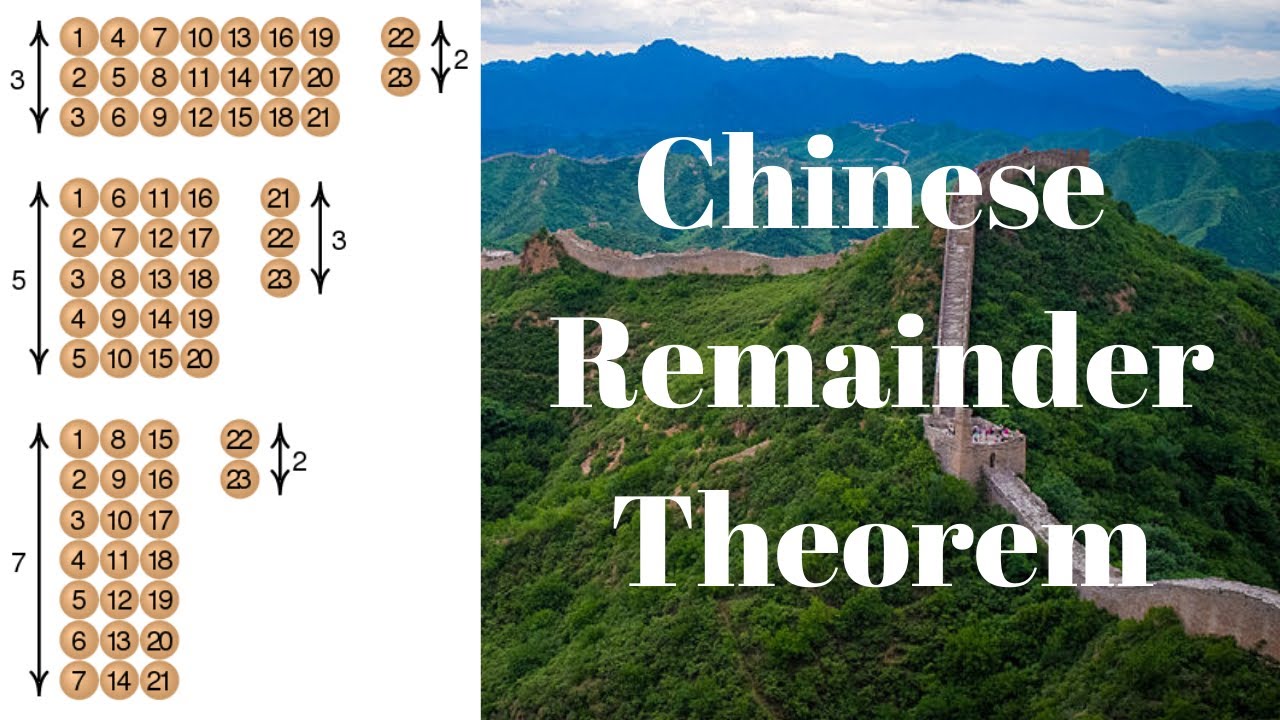
We use the construction outlined in the proof of the Chinese Remainder Theorem to solve a system of linear congruences.
brazen python
brazen python
Can someone explain the intermediate steps here?
how does he get 2x_1 = 1 (mod 3) from 20x_1 = 1 (mod 3)
i have a feeling it's something to do with the addition and multiplication properties of congruences but i don't see it
fervent grove
20 = 2 (mod 3), so 2x_1 = 1 (mod 3) is equivalent to 20x_2 = 1 (mod 3)
brazen python
but if you take 10 = 1 (mod 3) and 2x_1 = 1 (mod 3) then 20x_1 = 1 (mod 3)
im not sure i understand how they're equivalent
dusty dragon
20x_1 = 18x_1 + 2x_1 = 3(6x_1) + 2x_1 = 2x_1 (mod 3). So 20x_1 = 1 (mod 3) also implies that 2x_1 = 1 (mod 3) (and vice versa), so they are equivalent
 vast dove
For what values of n does there exists two distinct odd positive integers b such that 2n <= b < 3n?
Sorry
This is the correct question:
For what values of n does there exists two distinct odd positive integers b such that 2b <= n < 3b?
torn escarp
vast dove
This is the correct question:
For what values of n does there exists two distinc...
I guess since we just care about n, we might as well try to look at consecutive intervals to find them, since that maximizes their overlap. The intersection between [2b,3b) and the next interval [2(b+2), 3(b+2)) is 3b-2(b+2) = b-4, so in order for this to be positive we need b to be 5 or greater.
I guess next is trying to determine what integers are actually in the interval [2b+4, 3b) now for odd b >=5. I dunno if there's some great way of listing these numbers out, you can imagine them as the y values on the line y=2x+4 and up to but excluding the line y=3x. This sorta triangular segment extends out infinitely far and gets larger, seems to be the first number is n=14.

Desmos
idk, do the lines get far enough apart that eventually every n large enough appears? that would be convenient
then it'd be a matter of determining that cutoff value and working out the finitely many examples below that
vast dove
torn escarp
idk, do the lines get far enough apart that eventually every n large enough appe...
Yes
n>17 works
torn escarp
vast dove
Yes
yeah, it's not hard to show, I did it earlier but was distracted but the end result is 14, 18, 19, 20, and n>=22
21 doesn't work
vast dove
Oh 21 doesn't work
Ok next question, for a given n, how many b's can we find that satisfy the constraints: b is odd positive integer and 2b<= n < 3b?
torn escarp
interesting question, pretty fun, I think I might try to see if I can generalize this question/result while I'm thinking about it. What is this for
vast dove
I was trying to prove something else and needed this condition on b
torn escarp
vast dove
Ok next question, for a given n, how many b's can we find that satisfy the const...
I suppose we might try to repeat the process but instead of looking at the intersection of 2 consecutive intervals do k consecutive intervals, then we basically would have worked out all integers that occur at least k times
maybe a bit roundabout way of doing it, but I think finding these sets might not be too difficult that we could sorta do this
so like call the sets S_k, we determined S_2 = {14, 18, 19, 20, and n>=22} which I was able to describe as finitely many inequalities, so S_k in general is probably of the same form
$S_2={n : 4t+14 \le n \le 6t+14 \text{ for } 0\le t \le 1, \text{ and} \ n \ge 22 }$
sterile pumiceBOT
mOwOsity
 torn escarp
for any n we can always just look at what the inequalities are for each S_k, since they should be pretty systematic and only finitely many of them to ever check
vast dove
Can you give an expression in terms of n? Or a lower bound?
torn escarp
I probably could yeah, I just haven't worked it out yet
the thing is, S_k is just as easy to work out as S_2 since k consecutive intervals really only depend on the first interval overlapping with the last interval, the intermediate intervals overlap by default
it should be easy to work out the lowest number in S_k and the first number N such that n>=N will appear
torn escarp
vast dove
I was trying to prove something else and needed this condition on b
what was the other thing you were proving I'm curious what this is for
I'm about to be busy for about an hour or so, so I want to think about it while I'm busy, I might not finish grinding out the details here
vast dove
torn escarp
what was the other thing you were proving I'm curious what this is for
A certain proof by contradiction. Theres a certain 2 player game on Fibbonaci decompositions of a positive integers n that I won't define and I'm trying to prove player 1 always has a winning strategy for n large enough.
torn escarp
vast dove
Can you give an expression in terms of n? Or a lower bound?
back, ok:
All elements that can be written in between at least k different b are:
n = 12k+2, 12k+6, 12k+7, 12k+8, and n >= 12k+10
from here it shouldn't be too bad to invert this as a function of n I think, but this is pretty good already
torn escarp
vast dove
Can you give an expression in terms of n? Or a lower bound?
Ok think this is the final answer now, the [] is the Iverson bracket, it's 0 if the statement is false, 1 if true $$k = \left\lfloor \frac{n}{12}\right\rfloor -1 + \left[\left\lfloor \frac{n}{12}\right\rfloor \equiv 2, 6, 7, 8, 10, or 11 \mod 12\right]$$
sterile pumiceBOT
mOwOsity
 torn escarp
that k(n) = exact number of intervals n falls inside
vast dove
thanks mero!
torn escarp
vast dove
thanks mero!
Yeah hopefully I didn't make any mistakes haha, you're welcome