#precalculus
1 messages · Page 311 of 1
 grim zephyr
How do you derive half angle identities
Like ik I could search it up
But I might forgot so what’s the logic behind it
Like how double angle can be adding the same angle twice so u can just use angle addition
grim zephyr
<@&286206848099549185>
 grizzled sable
 tulip lily
I'm gonna start learning precalculus tommorow

 lone peak
 granite holly
Since A and B both have to lie on the curve, we know that
$0.5 = \frac{a}{b}$ and
$8 = a \times b $.
Hence b = 2a, and 2a² = 8, meaning that a = 2 and b = 4 or a = -2 and b = -4. Both are acceptable answers to this question.
 obsidian monolithBOT
OutOfNosh
 granite holly
so like y=1/2(8)^x
lone peak
The equation y=a(b)^x means that to find the y value, you raise b (which we don't yet know) to the power of x, and then multiply that by a.
So we know that if we raise b to the power of 1 (as in (1,8)), and then multiply that by a, we get 8.
And since b to the power of one is just b, that means a times b is 8.
granite holly
ohhh okay, thank you so much, i have one more question
lone peak
Shoot.
granite holly
 lone peak
It is known that the angles on the inside of a triangle add to 180°.
That symbol in the top-right means that that angle is 90°.
So 90 + 48 + β = 180.
Which is just a subtraction problem.
lone peak
I don't understand what you mean by that.
granite holly
like what should have my final answer been
lone peak
For β?
granite holly
noo, for the other question
lone peak
Oh right.
lone peak
obsidian monolith
**OutOfNosh**
So from this, there are two possible correct answers, with you being asked you give only one. You can either give ||y = 2(4)^x|| or ||y = -2(-4)^x||, both formulae contain the points given.
I have to go to bed now, so if you need help finding a and c you're either going to have to ask for someone else's help or wait 7 hours. Best of luck to you.
granite holly
its okay i got it, thanks sm!
 abstract cloak
Does anyone know a good precalculus book?
 icy cypress

 tight compass
Is there more stuff after 0.5^k? If not 0.5^k is not dependent on t so the inner sum is summing up a constant value. After that you end up with a sum of a finite geometric sequence. Try writing out the sum S = r^1 + r^2 + … + r^K and the sum rS then solve for S.
@icy cypress
icy cypress
tight compass
Is there more stuff after 0.5^k? If not 0.5^k is not dependent on t so the inner...
Nope nothing after k
 half coral
Who invented calculus?
Was he bhaskara II or Issac newton?
or German philosopher Gottfried Leibniz
?
 willow bear
would probably be best to say that calculus as we know it today is not based upon the work of one single person
 hushed sphinx
Leibinz and Newton had a public and bitter priority dispute, but a more balanced view is that calculus as we now know it is a combination of ideas developed by several people starting in the mid-late 1600s (sometimes discovered by several of them independently) and refined throughout the next 150 years or so.
willow bear
even some of archimedes' work (i think? it was someone from ancient greece) on calculating the area of a parabolic segment could be considered a form of integral calculus
 fiery quartz
wow i didn't know about bhaskara ii that's so cool
so bhaskara i invented the symbol for zero, bhaskara ii figured out the essentials of calculus
based
 indigo rain
Any help

 viscid thistle
what's log(-infi)?
 strange echo
Undefined?


 willow bear
 minor oxide
the constant term controls the distance from the parabola to the intersection of the asymptotes, to put it loosely
minor oxide
willow bear
the constant term controls the distance from the parabola to the intersection of...
how to use tho
willow bear
well you could just graph your curve's x and y intercepts idk
if you want to graph it by hand
minor oxide
willow bear
well you could just graph your curve's x and y intercepts idk
dang ok
viscid thistle
As the constant changes the curve gets closer or gets farther to the vertical and to the horizontal asymptotes. See DESMOS slider graph below to understand it better

Desmos
Hi I am new here! @viscid thistle
 flint bloom
reference angles should always be between 0 and pi correct?
willow bear
0 to pi/2
flint bloom
oh bc its the distance to the x axis
so at most it is pi/2 which would happen at pi/2 + 2pi*k
viscid thistle
the reference angle is the acute angle formed by the "terminal side and the x-axis"
this is the reason why it is between 0 and pi/2
 viscid thistle
you have ti eliminate h from the denominator
after that you replace h with 0
here is an example for you to follow https://youtu.be/Bi5Eop1fw18

This video shows an Example of Defining the Derivative.
 jovial elk
Not sure if this falls in late algebra 2 or pre calc but can some please give me the steps to this

And this one too plz

 toxic remnant
Can anyone point me to something that will help me learn how to use the trigonometric functions with pi? Or am I meant to just use a calculator, given this assignment hasn't told me I'm not allowed to? I have exams coming up soon that make me worried because I know I'm not allowed to have a calculator there, and I'm wondering if this is just the fact that I don't understand much about trig and it's something somewhat trivially worked out or if it's actually a "Well, use a calculator." problem here for this assignment.

I just understand that these functions are a huge gap in my knowledge, and when I try and find information on them I get lost in sohcahtoa which I already understand
 mystic tendon
anyone able to help me
 vapid plaza
toxic remnant
Can anyone point me to something that will help me learn how to use the trigonom...
vapid plaza
toxic remnant
Can anyone point me to something that will help me learn how to use the trigonom...
what are you having problem with
toxic remnant
Moreso I'm wondering if I'm meant to be able to work out, for example, sin(13*π) without a calculator
sorry, the value that's meant to be in both of those equations is negative pi, not positive
vapid plaza
you know that 2pi is a full circle right? so 13pi is 13 half-rotations
toxic remnant
ah... okay, I've been taught how to convert radians to degrees and back, and that should've given me the knowledge that 2pi radians=360deg... I didn't make that connection and I haven't been explicitly taught that yet. Thank you for the point in the right direction :)

 slate reef
 stark mango
call the first angle x
the second is x+10
the third is 3*x
stark mango
Anyone have trigonometry resources
stark mango
slate reef
call the first angle **x**
the second is x+10
the third is 3*x
ty i got the answer
granite holly
please help
 willow bear
have you made any progress so far?
are you familiar with things like the law of sines and the law of cosines?
 strange echo
granite holly
please help
strange echo
granite holly
please help
Between?
stark mango
Is anyone particularly good at trigonometry
 granite holly
39 degrees between them @strange echo
 lapis eagle
granite holly
39 degrees between them <@600171179084349441>
lapis eagle
granite holly
39 degrees between them <@600171179084349441>
Read what Ann said
The message below yours
 river jasper
viscid thistle
How do I go about solving this by any chance
river jasper
viscid thistle
How do I go about solving this by any chance
Hint: Plug in (x-1)/x as x
 limpid wasp
Just substitute x = 2 for f(2) and x = -1 for f(-1)
obsidian monolithBOT
Ebeere
 river jasper
Because it is a relation between the values that f takes at x and at (x-1)/x
hushed sphinx
In the sense that both of them mean "whatever it has been defined to mean in the context", yes.
 proper field
Help pls how do I determine whether p and q are positive or negative
 hushed sphinx
Is your earlier question related to that? The "px" in that image just means p multiplied by x; both letters stand for numbers.
 hushed sphinx
Okay, there p is the name of a function that could just as well have been called f.
proper field
ok
hushed sphinx
proper field
Help pls how do I determine whether p and q are positive or negative
You can see from the definition y=(px+5)²+q that the value of y must be at least q.
Since it is clear from the graph that y does depend on x, p cannot be 0 because that would make y the same for all x.
This means that there must actually be a value of x that leads to y=q, namely the one that solves px+5=0.
So q is actually the minimum value of y.
And the x-coordinate where that minimum is achieved has px+5=0.
 vivid quail
- A baseball is hit at a point 5 feet above the ground toward the left field fence. The fence is 10 feet high and 375 feet from home plate. The path of the baseball can be modeled by the parametric equation
x = t * 115cos(x),y = 5 + t * 115sin(x) - 16t^2. Will the ball go over the fence if it is hit at an angle of x = 35 degrees? (Parametric mode, degrees)
Yes or no?
If yes, how far above the fence will the ball be when it goes over?
If no, how far below the fence will the ball be when it hits the fance?
obsidian monolithBOT
dackid
 hushed sphinx
Just set r² to (x0-h)²+(y0-k)²?
 summer basalt
Help


 obsidian hinge
have you been taught l'hopitals
 lunar forum
are u asking me
obsidian hinge
yes
lunar forum
no
obsidian hinge
are you in precalc?
lunar forum
yes
lunar forum
what do u mean
lunar forum
so it doesnt exist?
lunar forum
what work would u show to prove it
lunar forum
ok
obsidian hinge

 crisp palm
you cant even use l'h
obsidian hinge
and it obviously doesn't go to the same value on 0
obsidian hinge
crisp palm
you cant even use l'h
yeah that's why i went nvm lol
crisp palm
yeah
obsidian hinge
forgot it required 0 or infinity on both sides
lunar forum
were on the last unit in my precalc class so were just learning our first part of calc
crisp palm

YouTube
The goal here is to make calculus feel like something that you yourself could have discovered.
watch this series
NOW
lunar forum
no
crisp palm
but why
lunar forum
why am i not watching it or why am i waiting until next year
crisp palm
waiting
lunar forum
cuz thats when im taking calc
obsidian hinge
fair enough honestly
 weak wharf
Does anyone know of a function with a jump discontinuity that is not piecewise-defined?
eg. not absolute value, or floor, or ceiling, etc
 opal tree
weak wharf
Does anyone know of a function with a jump discontinuity that is not piecewise-d...
opal tree
weak wharf
Does anyone know of a function with a jump discontinuity that is not piecewise-d...
sgn(x)
There's also
6mod(x)
Or any modulo function
But those are well beyond pre-Calc lol
In desmos you can try mod(x^2, x)
weak wharf
opal tree
But those are well beyond pre-Calc lol
i could have sworn I ran into some combination of exponential functions that happened to be piecewise around the y-axis, but I just couldn't remember
opal tree
weak wharf
i could have sworn I ran into some combination of exponential functions that hap...
(-1)^x?
There's this
 weak wharf
I think it looked something like this

but it's alright, maybe i dreamt it or something
 blissful stone
opal tree
There's this
blissful stone
opal tree
There's this
What are series used for?
I see them so often in high school maths
willow bear
a lot of things
for example one of many equivalent ways to define the exponential function is as its power series: $e^x = \sum_{n=0}^{\infty} \frac{x^n}{n!}$
obsidian monolithBOT
Ann
 blissful stone
So series go through the amount of equivalent ways to define functions
blissful stone
Definitely, I need to find the perfect place for the trees so they didn’t grow on rocks
 opal tree
blissful stone
What are series used for?
opal tree
blissful stone
What are series used for?
A lot of things. They can be used to find a total sum of things, represent trigonometric functions, formulas, etc
 lapis sentinel
can anyone please explain the fourth result

 odd cloud
@fallow basin existence and unique of minimum can be shown using completeness axiom, because f(x) is bounded below by 0. But finding the minimum can be tricky.
viscid thistle
weak wharf
hyperbolic functions
 smoky kelp
yes or no and why

 stable yacht
If you know the definition of a one-to-one/many-to-one function, you should be able to see this graphically.
 bitter current
 fallow basin
Can anyone solve Q2?
fallow basin
Can anyone solve Q2?
(1+m)/2
bitter current
odd cloud
<@892972577830617118> existence and unique of minimum can be shown using complet...
I doubt high school math teaches the completeness theorem lol
 frank vine
Anyone can explain why using synthetic division of polynomial with rational root theorem yields roots of polynomial and how to do this process?
frank vine
Like find possible roots by p/q theorem and then test by synthetic division
But test positive first then from whatevers left test negative of same number on it
<@&286206848099549185>

 faint scroll
viscid thistle
<@&286206848099549185>
faint scroll
viscid thistle
<@&286206848099549185>
what does bearing exactly mean?
viscid thistle
faint scroll
what does bearing exactly mean?
angle in degrees measured clockwise from north
Trig
faint scroll
viscid thistle
angle in degrees measured clockwise from north
maybe 270 degrees
viscid thistle
Less 249.5
faint scroll
viscid thistle
Less 249.5
Why would the distances coverd by the taxi will affect the angle?
The taxi has just gone south first and then west, so if we measure the angle anticlockwise from north, we get 90 degrees, therefore if we measure in clockwise direction it is 270
viscid thistle
It creates a triangle
faint scroll
viscid thistle
It creates a triangle
Oh ok
my bad
we have to find the angle of the hypotenuse of that right triangle
from north ( clockwise)
am i right now?
viscid thistle
Sure why not
faint scroll
Ah is it 210.6 degrees?
viscid thistle
Jeez with how long I'm spending I don't think I'm fit for this
faint scroll
This is same as [180 + arctan(3/8)] degrees
viscid thistle
I think tan is sin/cos
viscid thistle
Isn't it arctan(8/3)
viscid thistle
Drawing on paper is inaccurate
faint scroll
Just draw inaccuarate one
You just have to find whether it is arctan(8/3) or arctan(3/8)
faint scroll
I calculated arctan(3/8) from this site
Free Online Inverse Cosine Calculator works in degrees or radians, plus draws triangle.
viscid thistle
The answer is 200.6 degrees yeah
faint scroll
Yep
faint scroll
faint scroll
Ah is it 210.6 degrees?
here , the mistake I did was 180 + 20.6 = 210.6
haha, sometimes we do really silly mistakes
 formal forge
If you were to use the complex definitions for sin x and cos x, how would you go about proving the > part of (sin(x))^2+cos2x >= 0, I guess it could be shown geometrically but idk if that's very valid
 fickle terrace

how is the sereies r^n-1 + r^n-2 ... r + 1 a factor of (r^n -1)
and how did they get (r-1)
the proof makes sense but I don't know how you get the factor
river jasper
you dont understand why r^n-1=(r-1)(r^n-1 + r^n-2 ... r + 1)?
fickle terrace
@river jasper how do you figure that out series is a factor of r^n-1
river jasper
i think because previously you know that r^n-1=(r-1)(r^n-1 + r^n-2 ... r + 1)
fickle terrace
how can you previously know lol
river jasper
if i recall correctly it is seen in previous chapter
 kindred sluice
Why is it that when we shrink the period of a trig function say tan(x) , are the points still undefined at the ends of the period? Like if we aren’t at those end points anymore shouldn’t the graph now be defined at those new shifted points? But this is not the case the new end points of the period are still undefined.
My textbook doesn’t go into any detail about it 💀
vapid plaza
Can you provide an example
kindred sluice
vapid plaza
Can you provide an example
Sure like for example the function y=tan2(x-pi/3). The period get shrunk from pi -> pi/2. But when you go to graph it the end points are still undefined. Even though neither occur at -pi/2 and pi/2 which is tans normal period. Why is this?
vapid plaza
Well if the period of the function is shrunk then plausibly the points at which the function is undefined will shrink with it as well
For the function to be undefined you want the expression inside the tangent to be pi/2, 3pi/2 etc…
kindred sluice
vapid plaza
Well if the period of the function is shrunk then plausibly the points at which ...
Ah ok so the whole thing dynamically adjusts. For some reason I imagined more of a range like if something went out of the range or back in range it would now be defined
vapid plaza
It doesn’t lol
kindred sluice
vapid plaza
It doesn’t lol
Yea your explanation makes more sense lol
 low burrow
i just finished trig and algebra 2, do you think it is necessary for me to take pre-calc before calc?
summed up: is pre-calc really necessary?
tight compass
low burrow
i just finished trig and algebra 2, do you think it is necessary for me to take ...
not really precalc is usually trig and algebra 2, so just take calc.
viscid thistle
How do I do q63

 mild swan
viscid thistle
How do I do q63
mild swan
viscid thistle
How do I do q63
Solve the equation and look for complex solutions
viscid thistle
Quadratic formula? Isnt immediately obvious to me how to solve it
mild swan
viscid thistle
Quadratic formula? Isnt immediately obvious to me how to solve it
Why/why not quadratic formula?
Any time you have a quadratic, you can use the QF
mild swan
viscid thistle
Complete the square? Idk
Either works
viscid thistle
Hm ok
 woven token
 viscid thistle
hey guys
i'm currently studying Precalculus, is anyone interested to be "precalc buddies" to help and talk each other about the subject?
woven token
smoky kelp
I just started pre calc 3 days ago
Now I am studying calculas
smoky kelp
gamer
 candid iron
hey rly quick what does it mean by f(4,3)? does it mean the values of f(3) and f(4)?
 hushed sphinx
My first guess would be that it's a typo for f(4.3).
candid iron
ohh right, it is a translation so that makes sense
hushed sphinx
Especially if it's a translation from a language that uses a comma as the decimal separator.
blissful stone
viscid thistle
i'm currently studying Precalculus, is anyone interested to be "precalc buddies"...
I’m a math addict, I can talk about pre calculus for as long as I get more knowledge about it
viscid thistle
I don't rlly know much abt calculus but I'm rlly interested and wanna learn about it so where do I start, if it helps I've done trigo but idk if algebra 2 is still necessary since im still looking deeper into it and I don't know if there's any other areas in math that I should be good in for it
In general I just wanna know where to start with calculus
Oh shit wait do I have to be good at logarithms for calc
Forget it
hushed sphinx
You won't need logarithms to understand the basic definitions and concepts of calculus.
(To be frank, I'm not really sure what "good at logarithms" even means, but seeing some applications might easily be what you need to make it click, rather than trying to memorize random logarithm facts for no other reason than because).
 brittle talon
viscid thistle
I don't rlly know much abt calculus but I'm rlly interested and wanna learn abou...
brittle talon
viscid thistle
I don't rlly know much abt calculus but I'm rlly interested and wanna learn abou...
I've some Calculus books and they all start either with the list of subjects of what you need to know in order to start with Calc or a test of those subjects, so i would recommend getting a Calc book and working from there.
frank vine
viscid thistle
i'm currently studying Precalculus, is anyone interested to be "precalc buddies"...
Rn in geometry gonna skip Algebra 2 and go into precalc next year so yes I accept as long as I get knowledge
viscid thistle
Having some trouble understanding this situation here, where I'm not given the period. Would it be safe for me to assume that the period is 360 and k-value as 1 ?


 storm lodge
frank vine
Rn in geometry gonna skip Algebra 2 and go into precalc next year so yes I accep...
storm lodge
frank vine
Rn in geometry gonna skip Algebra 2 and go into precalc next year so yes I accep...
Algebra 2 is basically just trig
 proven marten
viscid thistle
Having some trouble understanding this situation here, where I'm not given the p...
proven marten
viscid thistle
Having some trouble understanding this situation here, where I'm not given the p...
yes
hushed sphinx
viscid thistle
Having some trouble understanding this situation here, where I'm not given the p...
You're supposed to do something like compute the circumference of the wheel, then compute how many revolutions there are in 1000 m, then use trigonometry to figure out the vertical position of the stone after the last fractional revolution.
The actual answer, however, is that it's impossible to tell. It only takes a 1 mm difference in the measurement of the wheel diameter to add up to a whole revolution fewer or more over a distance of 1 km, and the rolling deformation of a motorcycle wheel is surely in at least that vicinity.
viscid thistle
Can anyone explain wtf is precalculus is about and what theorems and stuff it contains
viscid thistle
brittle talon
I've some Calculus books and they all start either with the list of subjects of ...
Ahh alright thank you, I'll definitely look into it and get myself some books
viscid thistle
hushed sphinx
You're supposed to do something like compute the circumference of the wheel, the...
I've got this so far. The circumference is 60pi. So I assume that 1m = 60pi (whole 1 revolution) so to find how many revs are there in 1000m I'm multiplied 60pi and got 60000pi. But, I not exactly sure what you mean by the last fractional revolution
 hushed sphinx
So I assume that 1m = 60pi
What? Why? What's going on here?
viscid thistle
hushed sphinx
The _actual_ answer, however, is that it's impossible to tell. It only takes a 1...
There is an answer to this (but I didn't exactly look at it )
hushed sphinx
60pi is about 188½. How do you get that to be 1m?
viscid thistle
I needed a reference point
hushed sphinx
You can't just make up stuff.
viscid thistle
Do you think I should divide the 60pi by 1000m instead?
hushed sphinx
I suppose you mean that the circumference is pi·60 cm, which is 188.5 cm. If you pretend that is equal to 100 cm, you get nonsense. Why would it equal one meter anyway?
viscid thistle
I think that 60pi is equal to 1 Rev, since we know that the wheel will continue to rotate up & down. What would 1 Rev would equal to exactly in terms of meters is what I am trying to figure out.
hushed sphinx
1.885 meter.
viscid thistle
What!?
hushed sphinx
What do YOU get when you multipy 60 cm by pi?
viscid thistle
188.5, you multiplied divide it by 100 to get that value in terms of meters.
hushed sphinx
Do you disagree that 188.5 divided by 100 is 1.885?
viscid thistle
No, I see how you got it, since 60mpi is 188.5cm, to convert that to meters you divided by 100, 1.885m would be 1 Rev.
hushed sphinx
Good. So how many of these revolutions does it take to drive 1000 m?
viscid thistle
So, then if 1rev = 1.885m, now I can figure out how many revs there would be in 1000m by multiple 1000m, which give me 1885rev
hushed sphinx
1885 times 1.885 is 3553.225 -- that's more than three kilometers.
Lets suppose you have giant wheel with a circumference of 100 meters instead. How many revolutions would that wheel make while it rolls 1000 meters? Surely not 100,000 of them.
viscid thistle
No, I wouldn't multiply it
That would be a bit too much, if I were to graph it.
I would instead divide this, because if the wheel rolls 1000m but with a circumference of 100m, not many rotate would be made. 1000÷100 = 10.
Wait
Nvm, @hushed sphinx
Okay from the question
I need to divide 1000 by 1.885, if that what was my circumference. 1885 is too much, if I were to graph it
hushed sphinx
Yes, you need to divide.
viscid thistle
1000m = 530.5 Rev
hushed sphinx
Right.
viscid thistle
Okay now all that's left is to find the vertical position (heigh) of the stone now that I know that 1km = 530.3 Rev
hushed sphinx
But you need more digits than that, because you need to find out how high the last 0.5 revolution of the wheel leaves the stone, and "about half a revolution" will not allow you a better answer than "it's somewhere near the top of the wheel".
viscid thistle
So I need the 530.5 Rev to be more precise
I'll use 530.50397 Rev. Is the 0.5 Rev, the last fractional revolution as you mentioned before?
hushed sphinx
Yes.
(Note that 530.50398 is 100/1.885 where you have already rounded the 1.885. If you divide by a more precise representation of 0.6·pi, you get 530.51648 instead).
(On the other hand, that makes a difference of only a few millimeters in the final height).
viscid thistle
Yes, I just check that could've been done as well if 60cm became 0.6m pi and divided by 1000 to give me 530.5164
viscid thistle
hushed sphinx
(On the other hand, that makes a difference of only a few millimeters in the fin...
You mean like 530.5164 - 530.50397 =
hushed sphinx
viscid thistle
Yes, I just check that could've been done as well if 60cm became 0.6m pi and div...
Careful here! "0.6 pi divided by 1000" means something different from "1000 divided by 0.6 pi" -- the latter of these is what you did.
hushed sphinx
viscid thistle
You mean like 530.5164 - 530.50397 =
No, I went ahead and did the final trig step and compared the results with the two values.
viscid thistle
hushed sphinx
Careful here! "0.6 pi divided by 1000" means something different from "1000 divi...
Oh oh yes, that I what I mean. That that would equal to 530.516477
Trigonometry?
hushed sphinx
viscid thistle
Oh oh yes, that I what I mean. That that would equal to 530.516477
Yes.
Also yes, trigonometry, since now you need to find how high the stone is 0.516477 revolution after the last time it hit the ground.
viscid thistle
530.516477 is the revolution after it hit the ground.
hushed sphinx
But each time the wheel has completed one revolution, the stone hits the ground again.
So it's only the last .516477 we need to care about.
viscid thistle
Ooh so that why it needs to be exact
I think I should draw the circle to better visualize this
My radius is 30cm, would the angle be 0.516477?
My adjacent is 30cm
@hushed sphinx I have to go now, can we talk about this l8r?
hushed sphinx
Perhaps. Or perhaps someone else will be around.
The angle is 0.516477 of 360°, or 0.516477 of 2pi if you're working in radians.
 lean cove
I have this extra credit assignment and I need to prove that both sides are equal working on one side at a time. I've tried a lot of ways to prove it working without a calculator but I havent been able to. How would I prove this?
 lean cove
does this work as a proof

 neat zodiac
help
 viscid thistle
@hushed sphinx I got the right answer, instead of doing that trigonometry step you were using, my teacher told me to use a cosine function and have all my values in units of cm as mentioned in the question. The textbook answers was 59.8cm, but my teacher said 55.43cm was okay too.
 lunar forum
I’m stuck
 viscid thistle
lunar forum
I’m stuck
viscid thistle
lunar forum
I’m stuck
Happy to help. Do you any calculus whatsoever?
lunar forum
no just basic limits and the derivative formula
viscid thistle
So I am assuming the problem is asking you to compute the derivative of 1/(2x+1) right?
Like plug the function into the derivative formula and solve the limit?
lunar forum
yes
i think i have an idea of what to do actually
well turns out i dont have to do this problem for homework actually i just didnt check what was actually assigned
obsidian monolithBOT
Arr0w_04
 viscid thistle
or you could just use the quotient rule for derivatives and this could be done in two seconds but I digress
lunar forum
yea we have to use the derivative formula only for this
viscid thistle
Well best of luck in your course. If you have further questions feel free to ask.
lunar forum
thanks
hushed sphinx
viscid thistle
<@217922183169572864> I got the *right answer*, instead of doing that trigonome...
Um, the cosine function is trigonometry.
viscid thistle
This unit I'm learing is called trigonometric functions
My last unit was trigonometry with the sohcahtoa stuff
hushed sphinx
Huh. In my world, "trigonometry" is the thing you do with trigonometric functions, and "trigonometric functions" are what you use in trigonometry.
viscid thistle
Okay, either ways I get it. I really really appreciate you for all the help. The final test is tomorrow so wish me good luck 💖@hushed sphinx
viscid thistle
hushed sphinx
Huh. In my world, "trigonometry" is the thing you do with trigonometric function...
Mhm mhm
i didnt learn shit in trigonometry so thats good to know
 sinful dome
Can u help me

 faint prairie
viscid thistle
Can anyone explain wtf is precalculus is about and what theorems and stuff it co...
faint prairie
viscid thistle
Can anyone explain wtf is precalculus is about and what theorems and stuff it co...
it's a harder algebra 2/trig class that prepares you for calculus basically + an introduction to matrices, vectors, and limits depending on what school you're in. i heard that they do
trig identities, graphs, and equations
matrices, vectors, limits, derivatives
harder complicated algebra 2
idk what theorems
so if you did good in trig and algebra 2 you'll be fine
viscid thistle
so its basically just reciting trig?
faint prairie
yea
viscid thistle
good
I didnt learn shit about trig
I dont blame myself since none of our batch did lmfao
faint prairie
same
viscid thistle
faint prairie
same
But u learned in precal?
faint prairie
kinda glad i'm also doing precal next year
my friend did it
and i looked at his shit
faint prairie
yup did you graduate too?
viscid thistle
Yes
faint prairie
congrats
viscid thistle
mhm mhm
I do understand factorials
And the like
Sequence thing
Coz i was so interested in probabilities and statistics way before trigo
faint prairie
viscid thistle
I do understand factorials
those are useful in calcbc i think if you're in the united states
viscid thistle
Not in the us sad
faint prairie
dam then everywhere else in the world would call it second semester calculus
viscid thistle
wtf
faint prairie
factorials you aren't gonna use em for a while
faint prairie
US
faint prairie
4
viscid thistle
with college u take 8?
faint prairie
hell naw it depends what career choice you want to be
viscid thistle
Wtf
faint prairie
here go to #discussion i guess
viscid thistle
Alright come over there
 spiral locust
K
 supple owl
Precalculus
 restive berry
hello
stable yacht
That quadratic has no excluded values. It is defined for all real x-values.
I am not sure which approach you were taking, but it factors to (x-9)(x+4).
 steel fern
Can I just cancel out the x^2 ok in both then multiply
 viscid thistle
faint prairie
factorials you aren't gonna use em for a while
viscid thistle
faint prairie
factorials you aren't gonna use em for a while
Factorials are used everywhere in higher math…
 hollow cosmos
viscid thistle
Factorials are used everywhere in higher math…
hollow cosmos
viscid thistle
Factorials are used everywhere in higher math…
Only use i can see is combinatorics , binomial coefficient
viscid thistle
hollow cosmos
Only use i can see is combinatorics , binomial coefficient
There are so many more applications than what you just mentioned. They are used for (1) calculus (power series) (2) combinatorics (literally everywhere) (3) algebra (symmetric groups) (4) probability theory (poisson distributions) (5) number theory (legendre's formula, wilson's theorem) and I could go on and on
hollow cosmos
So basically 99% combinatorics 1% rest
(Not real %)
viscid thistle
hollow cosmos
So basically 99% combinatorics 1% rest
(Not real %)
What math have you done yet, out of curiosity?
hollow cosmos
Calculus , Algebra , Combinatorics , Number Theory , Geometry
And you can put lil bit of linear algebra to the list ig
viscid thistle
So AoPS/contest math basically?
hollow cosmos
Well basically competition math is all i do
And a lil calculus / analysis just because its interesting to me
viscid thistle
OK, yeah that explains things. To keep it short, there are a lot more applications to factorials besides introductory combinatorics and the math that you are used to. They come up everywhere in weird places not just in combi.
hollow cosmos
Well i mean power series and binomial coefficient are like id say biggest places where you see it right? Not including combinatorics
I mean sure there are bunch of theories that use it
obsidian monolithBOT
Arr0w_04
 hollow cosmos
Thats group theory?
viscid thistle
Yeah.
hollow cosmos
hollow cosmos
I mean sure there are bunch of theories that use it
Well i said alot of theories use it
viscid thistle
hollow cosmos
Well i said alot of theories use it
You also said 99% combinatorics 1% rest, which you now know is false.
So now ya'll know
hollow cosmos
viscid thistle
You also said 99% combinatorics 1% rest, which you now know is false.
That was not really supposed to be true but more like pointing out that combinatorics is biggest use case
But yea i get you
viscid thistle
Are you on AoPS Pluton? I'm assuming yes because you do competition math?
viscid thistle
ye
viscid thistle
Yeah they have forums on there and stuff
 shrewd prawn
hiiii
viscid thistle
Yeah, most contest people use AoPS nowadays in some form.
Like the entire US IMO team uses it, most USAMO quals use it, etc.
You should check it out. I think it'd be a good resource for you.
hollow cosmos
Their whole website looks like it just wants to sell you books and courses lol
viscid thistle
Yeah
It's a business/company that sells textbooks and courses
I'm not sure if you are from the US or not, but most of the top math students in the US (ranked via competitions) use art of problem solving.
I use it.
hollow cosmos
Ye im not from usa. But if i may ask you what do you use it for?
viscid thistle
Books, problems, they also have contest collections from every olympiad/contest in the world.
opal tree
faint prairie
factorials you aren't gonna use em for a while
That is just false
Ain't no way you just said that
tight compass
Just let Posato daydream for a bit.
faint prairie
viscid thistle
Factorials are used everywhere in higher math…
i mean i'm not doing anything with higher math so my bad
opal tree
They appear in Calc 1
faint prairie
opal tree
They appear in Calc 1
oh yeahhhh
i remember seeing that once from proving the power rule i think
opal tree
Nth derivative definition
opal tree
I mean just a general rule of thumb
They like to ask problems like "what is the 16th derivate of x^(16)"
At least, for me, that's what I ask constantly asked
faint prairie
wait so the definition
"nth derivative of x raised to the nth power is n!"
so that'll just be 16!
opal tree
Yeah
It's like getting us ready for Taylors ... even though like
That doesn't appear until late Calc 2
Series tho
opal tree
Not really
Maybe for like
Finding a term in a derivative of like (x+7)^6
Then that's just binomial theorem
 primal harbor
Hello
IF f(x)=2g(x-1)
and g(x)=m(x-1)+n(x)
does that mean that f(x)=2[m(x-1-1)+n(x-1)] ?
frank vine
primal harbor
Hello
IF f(x)=2g(x-1)
and g(x)=m(x-1)+n(x)
does that mean that f(x)=2[m(x-1-1)+...
yes
 deep plaza
can anyone help derive the function. passes through points (-3,0),(1,0),(4,0) and (-1,40)
 viscid thistle
deep plaza
can anyone help derive the function. passes through points (-3,0),(1,0),(4,0) an...
viscid thistle
deep plaza
can anyone help derive the function. passes through points (-3,0),(1,0),(4,0) an...
Well you have the x-intercepts so you can set up an equation in factored form
You also have the graph so you can get a basic image of the factors’ exponents
The graph touches at (1,0), meaning the factor will most likely be (x - 1)^2
The rest are assumed to just be their normal factors
Now you have an equation
y = a(x + 3) (x - 1)^2 (x - 4)
(Spaces for clarity)
And since you’re given a point and you have an equation (input/output), just plug in the sample point
40 = a(-1 + 3) (-1 - 1)^2 (-1 - 4)
Now just solve for a
40 = a(2)(4)(-5), thus a = -1
And your equation is complete
y = -(x + 3) (x - 1)^2 (x - 4)
viscid thistle

 burnt lodge
viscid thistle
burnt lodge
viscid thistle
Find what?
viscid thistle
Can anyone smart help me in #help-7|zen1thxyz
viscid thistle
is there a quick way to find the y or x intercept in general form?
or does it only work in standard form (c/a or c/b)
viscid thistle
nevermind, i got it


 celest nacelle
for the first question you just aply Pythagoras: |AC| = sqrt(260^2 + 195^2) km
idk rly understand what bearing is suposed to mean here (not native in english) but is it's the angle BÂC its arctan(195/260)
*if it's
 fierce violet
so divie the 2 angles
celest nacelle
is that a question?
fierce violet
so bearing is the angle in degrees measured clockwise from north.
ok waite i got it but this i left out cus i have no clue what it means
 celest nacelle
in that case arctan(195/260) should be right

for the 3th one you do besicly the same
fierce violet
thx alot man
 lofty sage
 hot reef
bro the only thing that i though is use l'hospital 4 times
hahsah
or maybe taylor series
hot reef
lofty sage
bro the only thing that i though is use l'hospital 4 times
It'd make it even more worse right
hot reef
lofty sage
or maybe taylor series
Probably might work
 celest yacht
@hot reef i gotchu bro


i think taylor series could have been applied at the beginning but this route simplifies that portion into a simpler step
proven marten
why are these the domain restrictions?
 hot reef
celest yacht
hot reef
celest yacht
Aww, thank you so much! Really means a lot homie! ❤️❤️
celest yacht
👍
proven marten
proven marten
why are these the domain restrictions?
<@&286206848099549185>
 stuck lark
proven marten
why are these the domain restrictions?
stuck lark
proven marten
why are these the domain restrictions?
theyre the x values where the equalities hold, graph each side to see
proven marten
stuck lark
theyre the x values where the equalities hold, graph each side to see
right but how would you deduce that normally
just by graphing it?
also why cant the x value take the value of lets say 2
za zombie
Christina
 gentle vale
I'm confused on how one differentiates some Tan functions
Like $y = Tan^{4}x$. It should be $4Tan^{3} Sec^{2}x$ but I don't understand why the Sec's power is 2 not 8
obsidian monolithBOT
Scott 🌙
 stuck lark
proven marten
also why cant the x value take the value of lets say 2
stuck lark
proven marten
also why cant the x value take the value of lets say 2
plug in 2 into each side, u get different values
stuck lark
proven marten
right but how would you deduce that normally
late reply but maybe i'd try drawing an appropriate right triangle
stuck lark
gentle vale
I'm confused on how one differentiates some Tan functions
Like $y = Tan^{4}x$. I...
tan'=sec^2
 stuck lark
gentle vale
Why is Tan^2 = Sec^2 then?
stuck lark
gentle vale
Why is Tan^2 = Sec^2 then?
where did u get this
stuck lark
nowhere does it say that
gentle vale
It does? The second line of the red box, they multiply by sec^2 3x which is the derivative of tan^2 3x
apparently
I'm guessing it's an error?
stuck lark
actually the derivative of tan^2 3x is 3 sec^2 3x
but thats very different from what u said, tan^2=sec^2
anyway i think u messed up using the chain rule for the first one
write $y=(\tan x)^4$ so the use of chain rule is easier to see
obsidian monolithBOT
RokabeJintaro
 stuck lark
by chain rule, $y'=4(\tan x)^3(\tan x)'$
obsidian monolithBOT
RokabeJintaro
 obsidian monolithBOT
RokabeJintaro
 gentle vale
Okay I did the chain method and yeah I got it this time
There's this other kind of quick method you use without substituting and I think I make some slip-ups with that if the function has a Tan in it
 ivory urchin

Hey guys can someone help me out with this ones, this are the answer for F
a) a = 2, b = −3;
b) a = 1/2 + 1/π, b = 1/2 − π/4;
c) a = −3/2, b = 1
I don't really know how to start F
E i think i got it, but just wanted to check if i did it right
lofty sage
ivory urchin
Hey guys can someone help me out with this ones, this are the answer for F
a) a ...
u want a little hand?
ivory urchin
lofty sage
u want a little hand?
yes pls
i know i have to do lioke this

but idk how to evaluate at X = -3
if i don't take the limits
because on the first one i will end up withj
-9 + 6a
second one will be -9a -7b
lofty sage
ivory urchin
-9 + 6a
no
ivory urchin
idk what to do after that
ivory urchin
ivory urchin
so this is wrong?
ivory urchin
lofty sage
not -3
oh right
i'm thinking as if it was limit
so i can just make X=2?
lofty sage
you can think this, to know if limit exist u can see the left and right limits, so for the left the f(x) is 3x+6a and right is 3ax-7b, now you can sub x to -3 and set -9 + 6a = -9a - 7b bc in the question f(x) must be continous
and you do the same for x = 3
but now for 3, the 3ax-7b is for the left and for the right f(x) is x-12b
ivory urchin
lofty sage
no
so this is right?
lofty sage
you'll get
15a + 7b = 9
9a + 5b = 3
now you solve this system
lofty sage
ivory urchin
so this is right?
yeah its the idea its right but with this explanation you cant get anything from limits by left and by right
and its important to see how this works
u need help on E?
ivory urchin
Just wanted to check if my conclusion was right
i just ignored the first one bc i though:
F(x) -3 <= X^2 - 3
If X =1
f(1) = 7
7 -3 = 4
1^2 - 3 = -2
4 <= -2 ( do not exist )
So it's discontinuous
is it right to think like this?
lofty sage
no
ivory urchin
rip
lofty sage
bc after this inequation the question said, x different than 1
u need to put f(x) only in the middle of this inequation, and then you have to get the limits by left and right
then you'll see they are different
limit not exists
and functions is discontinuous
u get?
@ivory urchin
ivory urchin
hmm
lofty sage
u speak portuguese?
ivory urchin
yes sir
but i get what u are saying
i just don't know why you would to that
X different than 1
But if X-> 1
it wouldn't be 1 right
lofty sage
lofty sage
but try to use x = 1 on the left
you'll get division by zero
 ivory urchin
lofty sage
you'll get division by zero
ivory urchin
lofty sage
you'll get division by zero
yeah
lofty sage
ivory urchin
by right you mean 1+
yeah
lofty sage
ivory urchin
actually this is not the function by right, bc you have to sum 3 on both sides
so you have lim x to 1+ x²
lofty sage
ivory urchin
but i have to tweak it right?
what means tweak
lofty sage
yeah
 ivory urchin
nah
wait a sec
@lofty sage
tem como a gente fazer o passo-a-passo do pensamento?
lofty sage
sim
ivory urchin
k
stuck lark
@pulsar turret help on the test itself?
 serene cradle
Imagine you draw a card from a shuffled pack of 52 playing cards. It is the Jack of spades. You set it to one side. Now imagine you draw a second card from what is left of the pack. What is the probability, expressed as the simplest possible fraction, that this new card will be the Queen of spades?
I think it is 1/51 right? Reason is that we removed 1 card from the deck and so the probability of drawing queen of spades become 1/51?
 tight creek
The following question is from pg. 17 of the student guide for Marsden and Weinstien Calculus I
I found to equation of the line to be 5x + 3y - 5 = 0 however the answer in the book has the equation as 5x + 3y +5 = 0. Have I made a mistake or is the student guide in error?
 granite holly
please help

 noble trench
granite holly
please help
noble trench
granite holly
please help
can u clarify wut a decay constant is
granite holly
inverse of lifetime
kindred sluice
Hey guys I’m trying to figure out what exactly the trigonometric addition and subtraction formulas represent. Like I know how to use them, but I don’t know what the result means. My book is mentioning the distance formula. But it doesn’t really explain it any deeper than showing how to prove cos(s+t).
So we are multiplying and adding the cosines and sines of two angles but what does that give me at the end and why is it important?
lofty sage
 midnight timber
is anyone good at logs
midnight timber
is anyone good at logs
just send the question
lofty sage
kindred sluice
Hey guys I’m trying to figure out what exactly the trigonometric addition and su...
idk if i get your ask but think in sin(75) for example, how you can calculate this? sin(45+30), now why this is important? idk, i just learn and use this to manipulate some trigonometric equations
kindred sluice
lofty sage
idk if i get your ask but think in sin(75) for example, how you can calculate th...
Lol 😂 good to know. I guess maybe that’s all it’s really good for.
lofty sage
kindred sluice
Lol 😂 good to know. I guess maybe that’s all it’s really good for.
some relations you can use to be easier to solve some integrals on calc 2, i dont know other things rn
kindred sluice
lofty sage
some relations you can use to be easier to solve some integrals on calc 2, i don...
Good to know. I am kind of relieved when I realize something I thought was going to be important turns out to not be
 lofty sage
midnight timber
are you still there
lofty sage
midnight timber
are you still there
yes
midnight timber
lofty sage
yes
can u help with that question
lofty sage
do the difference in left then you get
2log 2a = log(11a+3)
now put the 2 inside the log:
log (2a)² = log(11a+3)
now you can remove the log:
4a² = 11a + 3
4a² - 11a - 3 = 0
the answer will be the roots of this quadratic equation
lofty sage
midnight timber
if you want to check, answer is letter A
 midnight timber
lofty sage
if you want to check, answer is letter A
midnight timber
lofty sage
if you want to check, answer is letter A
wait but it cant be -1/4 tho right
steel fern
i need to convert this from interval to set builder. I am not sure why the correct answer here is [-2,0)
 celest yacht
@steel fern the intersection means that only the shared elements are included
visually:
 steel fern
celest yacht
<@373160837151719424> the intersection means that only the shared elements are i...
steel fern
celest yacht
<@373160837151719424> the intersection means that only the shared elements are i...
i figured that out. yeah
celest yacht
Ah sweet
 dreamy marsh
Helloo, I need help with maths, I have a test soon of the domain of functions and logarithmic functions so if you wanna help me I’ll be more than thankful
 stable yacht
Factoring each quadratic would help if you are looking for the domain.
 placid folio
guys i need help
what information can u obtain from the
- f(x) graph
- f'(x) graph
- f''(x) graph
opal tree
placid folio
what information can u obtain from the
- f(x) graph
- f'(x) graph
- f''(x) gra...
f(x) is the function itself (so domain and range)
f'(x) is the "slope" of f(x), (can determine where extrema exist)
f"(x) is the "slope of the slope" (tells concavity and can confirm existence of maxima and minima, and sometimes saddle points)
All of which can be used to determine the behavior of f(x)
placid folio
thx
viscid thistle
i need help on this pls
 viscid thistle
a line that is 90 degrees that crosses both line
supple owl
Oh
First
If c is perpendicular to both A and B which mean A and B never touch
And A is just B but shifted by a constant k to its new place
viscid thistle
can you explain the second part more pls
supple owl
Imagine A and B in single line
viscid thistle
yes
supple owl
They both on 1 line
But
We shifted A from b
By some number k
So it's now have a different position
But A will never to B in any point
viscid thistle
the some number k is the perpendicular?
supple owl
No....
viscid thistle
wait now i get it
supple owl
So reminds you of femilier equation ?
viscid thistle
yea i think
supple owl
Nice . Now write it Infront of you
viscid thistle
Ax + by = c ?
supple owl
The z component
BC it has I j k mean it's 3d space so it's X y w
Make A and B as a vector form
supple owl
Lemme see it
viscid thistle
(8,9)x + (0,6)y = 6
obsidian monolithBOT
MRme001
 supple owl
Like this
 fiery saffron
The right term doesn't have x^2, the left term doesn't have 5, so 5x^2 isn't a CF
I guess technically you could factor $5x^2$ out, and have $$5x^2(\frac{x+7}{5}-\frac{x+7}{x^2})$$
obsidian monolithBOT
seth.delacroix
 fiery saffron
See my note in algebra channel
Well on problem two, you already have $5x^2$ out front the parentheses already, so you can just factor that trinomial
obsidian monolithBOT
seth.delacroix
 fiery saffron
At point you have one term with three factors, so there is nothing to factor out
Factoring is just the distributive property in reverse
 deft meteor
.
fiery saffron
Problem 2 is fine
deft meteor
.
fiery saffron
Problem 1 is fine
fiery saffron
If you had 5x^2(x-2)+(x-2), you could take out x-2 to have (x-2)(5x^2+1)
deft meteor
.
fiery saffron
If you had 5x^2(x-2)+1×(x-2), you could take out x-2 to have (x-2)(5x^2+1)
Is it more obvious now?
deft meteor
.
fiery saffron
There is no need
Because that's factored form all ready
It's 5abc
Where a=x^2
b=(x-2)
c=(x-2) also
Btw you could say 5x^2(x-2)^2
Now if you had 5ab+2b
You'd factor out over that addition
To get b(5a+2)
Yes
Factoring is something you do on terms separated by addition or subtraction
Just like multiplication is an operation that distributes over addition
Factoring is the distributive property backwards
You see, if you use the distributive property on the factored form you are back where you started
No
That top you could say is 3×3×5
You can always multiply by 1 and nothing changes
Does it make more sense now how they're different?
 iron gulch
frank vine
iron gulch
frank vine
Alight can any explain what this means f(x) is the function itself (so domain and range)
f'(x) is the "slope" of f(x), (can determine where extrema exist)
f"(x) is the "slope of the slope" (tells concavity and can confirm existence of maxima and minima, and sometimes saddle points)
All of which can be used to determine the behavior of f(x)
Like what extrema concavity saddle points mean?
mild swan
yup, they are all correct
mild swan
frank vine
Like what extrema concavity saddle points mean?
These are things you can look up
But: extrema - maxes or mins
Concavity, whether the graph "faces" up or down
Saddle point: this is used in multivariable calculus
frank vine
mild swan
These are things you can look up
Hmm ok yeah I was gonna soon
frank vine
mild swan
Saddle point: this is used in multivariable calculus
And what significance do they have
mild swan
You'll figure that out if you ever take a multivar calc course
Oh
In this context, it's where concavity changes
frank vine
Oh ok I see
So if f(x) =x^2 then f’(x)=2x and f’’(x)=2 right?
I can see the slope but not the concavity
 hasty belfry
yo
i need help
The integer n for which
x→0
lim
x
n
(cosx−1)(cosx−e
x
)
is finite non zero number is
 rocky wind
hasty belfry
The integer n for which
x→0
lim
x
n
(cosx−1)(cosx−e
x
)
is finit...
rocky wind
hasty belfry
The integer n for which
x→0
lim
x
n
(cosx−1)(cosx−e
x
)
is finit...
you can use LaTeX to typeset math?
if not you can try any online WYSIWYG $\LaTeX{}$ editor, say
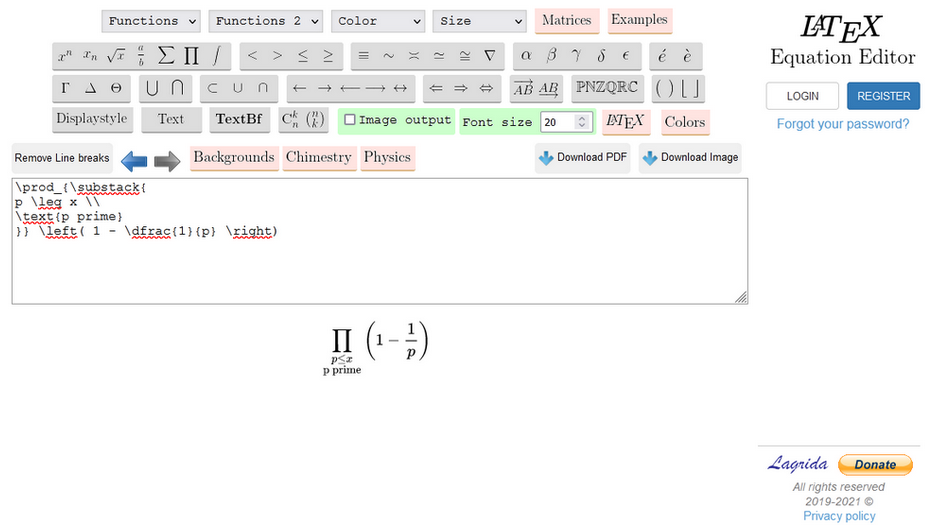
Online LaTeX equation editor, free LaTeX equation generator (png, pdf, mathML, ...), generate your complex mathematical expressions with simple clicks.
obsidian monolithBOT
vin100
 hasty belfry
rocky wind
you can use LaTeX to typeset math?
hasty belfry
rocky wind
you can use LaTeX to typeset math?
bro i cant
lim
x→0
(cosx−1)(cosx−e
x
)
/ x^n
WYSIWYG $\LaTeX{}$ lim
x→0
(cosx−1)(cosx−e
x
)
/ x^n
obsidian monolithBOT
Zyzzbrah
Compile Error! Click the  reaction for more information.
(You may edit your message to recompile.)
 rocky wind
hasty belfry
bro i cant
rocky wind
hasty belfry
bro i cant
you're on 📱 / 💻 ? there's #latex-help on #resources
hasty belfry
rocky wind
you're on 📱 / 💻 ? there's <#840667252793802752> on <#488106178094694400>
laptop
hasty belfry
obsidian monolith
**Zyzzbrah**
Compile Error! Click the <:errors:504266556054962196> reaction for ...
this is the question bro
hasty belfry
willow bear
<@939518195872694302> do you have a picture
its e^x
rocky wind
to start with you can write an equation with two commas
willow bear
do you have a picture
rocky wind
,,e^x
obsidian monolithBOT
vin100
 hasty belfry
lim x tends to 0 , (cosx-1)(cosx - e^x) upon x^n
rocky wind
willow bear
do you have a picture
that's not an answer to his problem
hasty belfry
rocky wind
to start with you can write an equation with two commas
okay
willow bear
and he is not answering my question of whether he has a picture of the problem
okay, so you have here
hasty belfry
willow bear
and he is not answering my question of whether he has a picture of the problem
no
i dont
its a question online
willow bear
screenshots are a thing...
$\lim_{x \to 0} \frac{(\cos(x) - 1)(\cos(x) - e^x)}{x^n}$
obsidian monolithBOT
Ann
 hasty belfry
willow bear
what are you asked to do with it
hasty belfry
willow bear
what are you asked to do with it
find n
willow bear
find n such that what
hasty belfry
so that the limit is finite
rocky wind
sorry that's not a #precalculus problem
hasty belfry
limit should be finite non zero
hasty belfry
rocky wind
sorry that's not a <#363224154469826562> problem
bruh its limits
willow bear
thanks for not answering my question again
hasty belfry
willow bear
thanks for not answering my question again
there is only one n
not a set
just a single value
willow bear
a set can consist of one element only
also do you have access to things such as taylor expansions?
might be of use here
hasty belfry
willow bear
also do you have access to things such as taylor expansions?
you mean the sinx series?
yeah ik
willow bear
not the taylor series of sin(x) in particular
you would want the ones for cos and exp here instead
hasty belfry
sinx = x- x^3/3! + x^5/5! ...... right?
hasty belfry
willow bear
you would want the ones for cos and exp here instead
yup
i do
how to use it tho?
willow bear
no, sin(x) is not x - x^3/3!. you cannot just clip off all but two terms of the INFINITE taylor series and claim equality stull
still*
but well ok
rocky wind
i don't think you reli need tayloy series of trigo funct
just bound them by 1
that won't change the problem
hasty belfry
rocky wind
just bound them by 1
i cant understand bro
hasty belfry
wdym bound them by 1?
willow bear
$\cos(x) - 1 = -\frac{1}{2} x^2 + O(x^4)$ and $\cos(x) - e^x = 1 - \frac{1}{2}x^2 - 1 - x + O(x^3)$
hasty belfry
like limit the values of y?
obsidian monolithBOT
Ann
 willow bear
this is what i was going for
hasty belfry
obsidian monolith
**Ann**
oh yeah
willow bear
you have that cos(x) - 1 behaves as x^2 and cos(x) - e^x behaves as x
up to multiplicative constants
all as x goes to zero obviously
hasty belfry
willow bear
you have that cos(x) - 1 behaves as x^2 and cos(x) - e^x behaves as x
fair
rocky wind
oops i misread the limit as $x \to \infty$
obsidian monolithBOT
vin100
 willow bear
yes exactly
hasty belfry
willow bear
yes exactly
we just had to use the series?
damn bro i was trying to convert it into standard limit lmao
willow bear
taylor series helped us but i would not go so far as to say it was necessary to do it this way
hasty belfry
willow bear
taylor series _helped_ us but i would not go so far as to say it was necessary t...
yeah it was prolly the shortest one thanks
willow bear
if you're a masochist you can spend like a year or two doing this with l'hôpital (or attempting to)
hasty belfry
willow bear
if you're a masochist you can spend like a year or two doing this with l'hôpital...
LMAO
I TRIED
lh rule is just too easy to NOT use
@willow bear which series do i need to memorise ?
e^x , sinx , cosx , tanx , ln(x+1) ?
hasty belfry
willow bear
you can go without tan(x)
yeah its complex but somehow ik the first 3 terms
hasty belfry
willow bear
you might also want to commit (1+x)^p to memory
whats that?
willow bear
(1+x)^p
hasty belfry
wait ill google
willow bear
a function whose taylor series i am suggesting you memorize
p is an arbitrary real number
hasty belfry
willow bear
p is an arbitrary real number
oh yeah ik that
its 1+ nx
nC2 x^2
and so on
willow bear
yes, except your n is my p
hasty belfry
its binomial right?
hasty belfry
willow bear
yes, except your n is my p
...
that sounds so wrong
but yeah
your p is my n
just these ?
and sinx cosx tanx are enough?
willow bear
wym by "that sounds so wrong"
willow bear
e^x, sin(x), cos(x), log(1+x), binomial
also 1/(1-x)
as a somewhat special case
but it's a geometric series
and good to know still
hasty belfry
what conceps would you suggest to solve questions related to relation and functions? @willow bear
like ik domain range
willow bear
too vague for me to make any meaningful suggestions
hasty belfry
but odd , even , peridocity etc
hasty belfry
willow bear
too vague for me to make any meaningful suggestions
mainly just like solving questions related to weather the function is odd/even and finding period of composite functions
hasty belfry
willow bear
also 1/(1-x)
this is ,,(1+(-x)) ^ -1
wait how tf do i use latex
,,(1+(-x)) ^-1
obsidian monolithBOT
Zyzzbrah
 willow bear
this is $(1 + (-x))^{-1}$
obsidian monolithBOT
Ann
 willow bear
and yes i did say it was a special case of binomimal
binomial*
but it is still good to know separately
hasty belfry
aight cool
hasty belfry
willow bear
but it is still good to know separately
okay thx
 pallid jewel
56

 quick temple
Hello
I am learning precalculus but I am in grade 8
Precalculus is really fun to learn actually
but it is hard
hasty belfry
\begin{array}{l}\underset{x\to 0}{\mathop{\lim }},\left[ \frac{x}{{{\tan }^{-1}}2x} \right]\end{array}
obsidian monolithBOT
Zyzzbrah
Compile Error! Click the reaction for more information.
(You may edit your message to recompile.)
 hasty belfry
nvm its 1/2
 gritty flax
quick temple
but it is hard
gritty flax
quick temple
but it is hard
 fiery saffron
@pallid jewel did you try writing cos(2x) as 1-2sin^2(x)
steel fern
What did i mess up here

 void thorn
steel fern
What did i mess up here
void thorn
steel fern
What did i mess up here
looks like you have 15+4 = 11 when you probably meant 15-4 = 11
gritty flax
steel fern
What did i mess up here
In step 4 it should be 15xy - 4xy