#precalculus
1 messages · Page 305 of 1
 vapid plaza
Well (x,0) doesn’t always lie on the circle. (r,0) does
vapid plaza
But in the special case where x = r,
(x,0) is (r,0) and therefore lies on the circle.
 lavish edge
ok but
look look
in the figure
the terminal side
as in figure
theta is given as theta say 30
alright
so how can you have theta = 0 for x in the same figure
vapid plaza
Theta is 30 in the figure, but the figure represents one only possible point on the circle.
vapid plaza
vapid plaza
Theta is 30 in the figure, but the figure represents one only possible point on ...
If we were to consider all the possible points on the circle, we would take theta as many different values, including 0.
The figure only shows what happens when theta = 30!!!
when theta = 0, we would get a different figure
lavish edge
NO i am not saying that
 full pagoda
i have not the slightest clue what you're trying to ask
vapid plaza
Bruh
lavish edge
just look at the initial side x. If you see its coordinates youll get x,0 which is the same as xcos theta and xsin theta when theta is 0 but in the figure theta is already defined and is a positive angle
vapid plaza
Yeh but in the figure (x,0) is not on the circle we were talking about anyways!!!
lavish edge
so how cn we take theta as 0 for x and theta = some positive angle for another side
if theta is already mentioned to be some value can like 30 for one question can we take theta as some other value for the SAME question?
vapid plaza
There was a question? You never mentioned there was a question.
lavish edge
look at the figure
vapid plaza
lavish edge
if theta is already mentioned to be some value can like 30 for one question can ...
Then what question are you talking abt
vapid plaza
Yeh so what?
lavish edge
whatever im talking about is from the figure
lavish edge
its not
if it does form 0 degrees with the base
does that mean theta is the theta in the figure or 0
full pagoda
theta is an arbitrary angle measurement
vapid plaza
The figure is trying to show that (x,y) lies on the circle.
So of course it would display theta as the corresponding theta for (x,y)
lavish edge
and for x,0 whats the corresponding theta
vapid plaza
0
lavish edge
so therer 2 thetas right
 hushed sphinx
If theta=0 then there isn't really any triangle, just a single line from the origin out to (1,0).
There are infinitely many possible thetas.
vapid plaza
lavish edge
so therer 2 thetas right
But only 1 case, and only 1 theta is the focus of the figure!!!
Besides, (x,0) doesn’t lie on the circle, (r,0) does
lavish edge
does that mean theta is 0
vapid plaza
Theta is not just “some value” for an entire circle
hushed sphinx
Yes, theta is whatever you give as input to the trig functions.
lavish edge
look what im trying to say is some point is given P(x,y) with some theta as the focus. If somehow theta is 30 we will get x as root 3/2 and y as 1/2 for a unit circle. Theta is defined to be 30. But if the side x lies on the circle for the SAME example, it will still have the points r,0 which is the same as rcos theta and r sin theta. Now if theta is defined as 30 degrees how come we still get r,0 which occurs when theta is 0
hushed sphinx
Theta is defined to be 30.
No it isn't.
full pagoda
you just said theta is two different angles
vapid plaza
There is no problem!!!!! If theta is 30, we get a point that lies on the circle, if theta is 0, we get another point that lies on the circle.
hushed sphinx
Just because you can choose to let theta be 30 doesn't mean theta must always be set to 30.
full pagoda
"the base"?
full pagoda
if theta is 30, you're not looking at the coordinates of the initial side
vapid plaza
Hmm Vedanth what are your hobbies? 
lavish edge
physics and maths studies
lavish edge
No
i understand everything you guys are saying
but it doesnt answer my question cause i dont know how to explain my question in text
vapid plaza
:/
lavish edge
lavish edge
look what im trying to say is some point is given P(x,y) with some theta as the ...
read this again
hushed sphinx
It still falsely claims, "theta is defined to be 30".
lavish edge
theta is defined to be 30
hushed sphinx
No it is not.
lavish edge
as per question
full pagoda
what question???
lavish edge
a sentence worded or expressed so as to elicit information.
hushed sphinx
The question you still haven't shown us?
lavish edge
theres no question
full pagoda
lavish edge
as per question
???
hushed sphinx
Please post a picture of the text that defines theta to be 30.
lavish edge
lavish edge
look what im trying to say is some point is given P(x,y) with some theta as the ...
read the damn thing.
vapid plaza
lavish edge
but it doesnt answer my question cause i dont know how to explain my question in...
“I have discovered a truly marvellous question which this text is too narrow to contain  ”
”
lavish edge
i created a scendario where theta is 30
hushed sphinx
The damn thing claims that theta is defined to be 30, which is not true, It is false. it is not the case.
It is not even an EX-fact.
lavish edge
If somehow theta is 30 we will get x as root 3/2 and y as 1/2 for a unit circle. Theta is defined to be 30.
first i said if somehow theta is 30
full pagoda
bro
lavish edge
then i claimed theta is 30
hushed sphinx
No, theta is not defined to be 30, no matter how often you repeat that false claim.
full pagoda

full pagoda
lol
hushed sphinx
You repeat your false claim again. That does not make it more true this time either.
lavish edge
its true
hushed sphinx
You lie.
lavish edge
truth is relative
hushed sphinx
It there was a definition of theta as 30, it would have been a simple matter for you to post a scan, photo, or screenshot of that definition.
lavish edge
no lemme finish
hushed sphinx
You have not provided that. I confidently conclude that you have not in fact seen such a definition in whatever it is you're quoting from.
lavish edge
did i ever say theta is defined to be 30 for every scenario
hushed sphinx
You keep saying that theta is definied to be 30 in the thing you're talking about.
lavish edge
yes
hushed sphinx
From which you have still not shown the definition you keep claiming exists.
Come on. Pics or it didn't happen.
vapid plaza
lavish edge
did i ever say theta is defined to be 30 for every scenario
You say that theta is defined to be 30 for this scenario, but then screams in terror when another point with a different theta also lies on the circle.
hushed sphinx
You keep claiming that you have a definition that says it is 30.
If it is 30, it is not 0.
vapid plaza
hushed sphinx
You keep claiming that you have a definition that says it is 30.
(This is based on the figure btw
Figure just looks like 30, doesn’t even say so)
hushed sphinx
Please show the place where it says so.
lavish edge
thanks for the great help
hushed sphinx
The figure looks like a fair bit less than 30, but never mind. The author might have intended it to be 30 when they wrote the definition that Vedanth refuses to show.
vapid plaza
Go do something else 
lavish edge
can a question have two different thetas'
These are the most important rules. For more info see info.
If you see anyone violating these, feel free to ping <@&268886789983436800>.
GUIDELINES:
● Respect topics of the channels: make sure that you are asking in the right place.
● Avoid Directly Messaging people for help without their consent. In general it is bad etiquette to DM people you do not know.
● #help channels are for homework type questions/problems. Topical channels prioritise open-ended discussion about particular topics.
● Do not spam your questions in the wrong channel or across multiple channels. Be patient and wait for someone to answer.
● When asking a question, show what you tried to solve the problem. We are not here to do your homework for you, but we are here to help you learn how to do your homework. See ❓how-to-get-help for more info on how to ask questions.
● Respect that other people might be at a different stage in their education than you, what is obvious to you might not be obvious to them.
● Be rational and exercise critical thinking. If someone makes a mistake in their reasoning, politely point it out.
SOCIAL CHANNEL GUIDELINES:
● Keep it civil in the chill channel. Treat it as a channel for friendly banter with your classmates or possibly your teacher/professor/advisor.
● If there is a debate, be polite and civil. Try to back up your arguments with objective facts, and avoid fallacies. When arguing you should seek to find out the truth, instead of trying to be right. There is nothing wrong with changing your opinion based on presented information and admitting that you were wrong.
● Try to avoid debates on heavy topics like politics and religion. These rarely result in fruitful discussion.
mniip — 06/05/2021
(Revision as of June 4, 2021)
 slender river
oops
lavish edge
<@&268886789983436800>
 stuck lark
???
lavish edge
yes
Respect that other people might be at a different stage in their education than you, what is obvious to you might not be obvious to them.
full pagoda
if you are looking at the set of coordinates that lie on the unit circle when theta = 30 degrees, you are not simultaneously looking at a different set of coordinates that relates to a different theta
lavish edge
lavish edge
Respect that other people might be at a different stage in their education than ...
this rule has been broken
full pagoda
we've told you time and time again that what you're saying makes zero sense yet you keep saying it over and over again and expecting things to change
definition of insanity
lavish edge
Be rational and exercise critical thinking. If someone makes a mistake in their reasoning, politely point it out.
can a question have two thetas
full pagoda
entirely depends on the context of the question...
 short sorrel
i dont see anyone being rude or untoward
youre asking a vague question thats hard to interpret with imprecise wording and unclear intent/clarification
people are asking you for an explanation
you are being dodgy
almost makes me think this is for a test or something
hushed sphinx
(He's moved to #geometry-and-trigonometry now, btw).
short sorrel
i was responding to the mod pings
 dapper brook
How come I’m learning trig while I’m in pre-cal
hushed sphinx
Why wouldn't you? It's pretty common to teach trigonometry before calculus.
 viscid thistle
ik this is a lot to ask but could someone plz offer a step by step by step explanation for how each step works. I’m very lost here; the only step I understand is get is when we distribute the square of the absolute value of the difference of Ba_i and Cb_i


the book I’m using rn is skimming complex numbers and assumes the reader already knows about em ;/
 low slate
Bit of a multi step problem, but i dont really understand how to find the answer and if someone can help me out it would be appreciated
 full pagoda
low slate
Bit of a multi step problem, but i dont really understand how to find the answer...
full pagoda
low slate
Bit of a multi step problem, but i dont really understand how to find the answer...
have you drawn pictures yet?
 fast monolith

I don't know what the first step is, if possible, can someone explain how to solve this?
low slate
full pagoda
have you drawn pictures yet?
i have but im confused on where the angle goes
full pagoda
low slate
i have but im confused on where the angle goes
the ladder makes an angle with itself and the ground
low slate
correct
full pagoda
so where the ladder touches the ground
low slate
and the hypotunese is 24
full pagoda
right
full pagoda
can i see the diagram you've drawn?
low slate
yea sure gimme 1 sec
full pagoda
you can set up a trig ratio with a missing variable using a right triangle, an angle, and a side
low slate
 full pagoda
looks good
so using that, you need to find both other sides
you can use two different trig functions to set up an equation for either side
full pagoda
well what ratio does sin represent?
 lofty yarrow
⠄⠄⠄⢰⣧⣼⣯⠄⣸⣠⣶⣶⣦⣾⠄⠄⠄⠄⡀⠄⢀⣿⣿⠄⠄⠄⢸⡇⠄⠄
⠄⠄⠄⣾⣿⠿⠿⠶⠿⢿⣿⣿⣿⣿⣦⣤⣄⢀⡅⢠⣾⣛⡉⠄⠄⠄⠸⢀⣿⠄
⠄⠄⢀⡋⣡⣴⣶⣶⡀⠄⠄⠙⢿⣿⣿⣿⣿⣿⣴⣿⣿⣿⢃⣤⣄⣀⣥⣿⣿⠄
⠄⠄⢸⣇⠻⣿⣿⣿⣧⣀⢀⣠⡌⢻⣿⣿⣿⣿⣿⣿⣿⣿⣿⠿⠿⠿⣿⣿⣿⠄
⠄⢀⢸⣿⣷⣤⣤⣤⣬⣙⣛⢿⣿⣿⣿⣿⣿⣿⡿⣿⣿⡍⠄⠄⢀⣤⣄⠉⠋⣰
⠄⣼⣖⣿⣿⣿⣿⣿⣿⣿⣿⣿⢿⣿⣿⣿⣿⣿⢇⣿⣿⡷⠶⠶⢿⣿⣿⠇⢀⣤
⠘⣿⣿⣿⣿⣿⣿⣿⣿⣿⣿⣿⣿⣽⣿⣿⣿⡇⣿⣿⣿⣿⣿⣿⣷⣶⣥⣴⣿⡗
⢀⠈⢿⣿⣿⣿⣿⣿⣿⣿⣿⣿⣿⣿⣿⣿⣿⣿⣿⣿⣿⣿⣿⣿⣿⣿⣿⣿⡟⠄
⢸⣿⣦⣌⣛⣻⣿⣿⣧⠙⠛⠛⡭⠅⠒⠦⠭⣭⡻⣿⣿⣿⣿⣿⣿⣿⣿⡿⠃⠄
⠘⣿⣿⣿⣿⣿⣿⣿⣿⡆⠄⠄⠄⠄⠄⠄⠄⠄⠹⠈⢋⣽⣿⣿⣿⣿⣵⣾⠃⠄
⠄⠘⣿⣿⣿⣿⣿⣿⣿⣿⠄⣴⣿⣶⣄⠄⣴⣶⠄⢀⣾⣿⣿⣿⣿⣿⣿⠃⠄⠄
⠄⠄⠈⠻⣿⣿⣿⣿⣿⣿⡄⢻⣿⣿⣿⠄⣿⣿⡀⣾⣿⣿⣿⣿⣛⠛⠁⠄⠄⠄
⠄⠄⠄⠄⠈⠛⢿⣿⣿⣿⠁⠞⢿⣿⣿⡄⢿⣿⡇⣸⣿⣿⠿⠛⠁⠄⠄⠄⠄⠄
⠄⠄⠄⠄⠄⠄⠄⠉⠻⣿⣿⣾⣦⡙⠻⣷⣾⣿⠃⠿⠋⠁⠄⠄⠄⠄⠄⢀⣠⣴
⣿⣿⣿⣶⣶⣮⣥⣒⠲⢮⣝⡿⣿⣿⡆⣿⡿⠃⠄⠄⠄⠄⠄⠄⠄⣠⣴⣿⣿⣿
niceeee


 viscid thistle
ik this is a lot to ask but could someone plz offer a step by step by step expla...
viscid thistle
viscid thistle
ik this is a lot to ask but could someone plz offer a step by step by step expla...
Here you go
Let me know if you want something explained in more detail
viscid thistle
viscid thistle
ik this is a lot to ask but could someone plz offer a step by step by step expla...
https://math.stackexchange.com/questions/446148/cauchy-schwarz-for-complex-numbers
also you can prove a stronger version of this with cauchy-schwarz

Mathematics Stack Exchange
Let $z_1, . . . , z_n$ and $w_1, . . . , w_n$ be complex numbers. Show
that $$|z_1w_1 + ··· + z_n w_n|^2 ≤ \sum ^n _{j=1} |z_j|^2 \sum ^n
_{j=1}|w_j|^2$$
I basically tried to use the proof given...
low slate
full pagoda
well what ratio does sin represent?
opposite/hypotonuse
do u have to use sin ?
like how do u know which one to use
full pagoda
depends on which sides you have relative to your angle
in your triangle, you have an angle and the hypotenuse
and you're looking for both sides, so to find the first side, you can use either sin or cos
since both utilize the hypotenuse that you know, the angle that you know, and an unknown side
so one equation, one variable
solvable
 sick steppe
🤨
viscid thistle
for calculus questions dm
 mellow tapir
hey guys my friend has this question and i don't know how to solve it either so can someone help us
 hushed sphinx
Hmm, there are five "I don't know yet"s and 96 is 3·2^5.
That indicates there's probably a progression where each successive declaration of ignorance doubles the numbers.
The guess that would fit best with that hypothesis would be ||oops, I see it's a still open contest||.
mellow tapir
nah the contest is over but that was a cool observation
 tribal lodge
Can someone help explain something
mellow tapir
yeah i can help
tribal lodge
Can you vc???
mellow tapir
nah
tribal lodge
🥲
hushed sphinx
If you state what it is you need explained, perhaps someone who knows will reply.
tribal lodge
I’m slow that’s why I need to be in a vc
 hushed sphinx
Numerically.
viscid thistle
hushed sphinx
Numerically.
can you clarify?
hushed sphinx
Basically systematic trial and error until you know a short enough interval where the function changes sign that it approximates the root well enough for your purposes.
 cerulean flower
hey guys, when theres a slant asymptote of a rational function, how do you know when and where it gets crossed by the function?
 jolly raven
i dont think functions can cross slant asymptotes but i might be wrong
if they were to be passed, it would probably be in a central part of the function bounded by vertical asymptotes where the function is not continuous all the way to both infinities
cerulean flower
i know that slant asymptotes can be crossed, and you are right
but i wanted to know how to find the exact point
of where the function crosses the slant asymp
hushed sphinx
An example of a crossing would be f(x) = x - x/(1+x²)
I don't think there's a particular procedure for that, though. Subtract the equation for the asymptote, and look for roots of the numerator of the resulting rational function, is the best general thing you can do.
cerulean flower
i know that for finding the slant asymptote, you have to divide the numerator and the denominator, and whatever remainder you get determines if and where it crosses the slant asymp
wait a second
i answered my own question
thanks for clearing some things up guys
so if anyone wants to know ig, if the remainder you get when dividing the num and denom of a rational function is a constant, then the slant asymptote doesnt get crossed. if it has a variable (ex: 2x-1), then solve for the variable (x=1/2) and plug the answer into the og rational function to get the y value of the coordinate. (not so sure ab the last part but its what i remember)

 willow bear
you can construct a piecewise-linear function that does this
willow bear

 grave tartan
willow bear
no calc and no piecewise functions...
i mean like
you COULD do it all exclusively with absolute values i guess
grave tartan
im like stumped
willow bear
at least tell me you have access to that
grave tartan
wouldn't it also be piecewise tho
willow bear
the piecewiseness would be hidden
grave tartan
no we do I just don't know how to combine like
willow bear
you said "we haven't covered piecewise functions"
grave tartan
absolute values with different vertexes
grave tartan
willow bear
you said "we haven't covered piecewise functions"
yeah
viscid thistle
willow bear
you can construct a piecewise-linear function that does this
i dont think the question is asking for a function using conditionals, more likely a polynomial
willow bear
a polynomial would require calculus to properly construct
and we are told we aren't allowed calculus
viscid thistle
willow bear
a polynomial would require calculus to properly construct
or maybe not, (1,1) (2,2) (3,3) are "good values", probably we can do something
willow bear
you'd need the polynomial to have at least degree 4
grave tartan
which means 5 unknown variables
grave tartan
viscid thistle
or maybe not, (1,1) (2,2) (3,3) are "good values", probably we can do something
and these give 3 equations if plug into f(x)=ax^4+...+e
so its not nice
unless I just give myself like (0,0) and (5, 5)
but its a cancerous system of equations
willow bear
this ban on piecewise functions is super annoying ngl
grave tartan
IKKK
i am just going to assume the worksheet was meant for after and she either assigned it too early or changed the flow of the curriculum this year
viscid thistle
grave tartan
wait, how many degrees a function with 3 relative maximums has?
grave tartan
but either way wanted piece wise
grave tartan
yeah 4
but I think I am allowed to have more
just has to have a minimum degree of 4
willow bear
 viscid thistle
willow bear
viscid thistle
willow bear
this way of solving ignores the fact that the maximums are on the line y = x
viscid thistle
willow bear
the author of the problem wouldnt give the three maximums on y =x for no reason
grave tartan
true but at this point I don't want the ingenius solution
grave tartan
willow bear
nasty nasty
willow bear
viscid thistle
this way of solving ignores the fact that the maximums are on the line y = x
just add a +b term at the end or something to shift it vertically
if necessary
 vivid void
willow bear
vivid void
willow bear
dear god
viscid thistle
vivid void
you just need a period of 1
but the function needs to go upwards
vivid void
i’m aware
viscid thistle
sine functions dont go above 1
vivid void
that’s why you give it a variable coefficient
willow bear
doing that will screw up the location of the maximum points
and pinning those down will take calculus
so that is a no go
grave tartan
tried that too
viscid thistle
something like this
 viscid thistle
something like this
viscid thistle
viscid thistle
something like this
the bad part is that this isnt a function
grave tartan
fortunately $f\left(x\right)=-2.5\left|x\right|-1.5\left|x-1\right|+3\left|x-1.5\right|-4\left|x-2\right|+5\left|x-2.5\right|-6\left|x-3\right|+10.5$ is
 obsidian monolithBOT
vrang
 grave tartan
was also thinking about it
would x^2 - x*ceil(x-1) work
do you need points on either side to be considered a max
 peak moss

Sorry to interrupt, but I'm stuck with this question. I've tried to factor the (sin2x•cos2x)² • cos 2x, but the answer that I got is too different compared to the scheme. I'm a bit stuck, and in need of help 🤲🏻
 opaque idol
sub sin^2(2x) = 1- cos^2(2x)?
then let u = 2x or something?
or u = sin 2x
idk
try it and see if it works
vivid void
precalculus
viscid thistle
wdym quantum that looks like precalc to me
antiderivatives are like algebra or somthin
vivid void
ok let me just post a nonhomogeneous ode here then
vapid plaza
vivid void
ok let me just post a nonhomogeneous ode here then
no homo 
viscid thistle
willow bear
you'd need the polynomial to have at least degree 4
the minimum degree of a polynomial that satisfies the conditions turns out to be 7
willow bear
oh yeah you're right
you need two minimum points between the maxima
so that's 5 turning points
...why degree 7 tho
viscid thistle
grave tartan
so i know this wasn't what the question was asking but you can find the minimum polynomial that satisfies this with some calc

Desmos
willow bear
it is impossible to do it with 6?

 obsidian monolithBOT

 obsidian monolithBOT
 viscid thistle
original problem seems impossible without using either piecewise functions or calculus
viscid thistle
willow bear
it is impossible to do it with 6?
ok it is possible to do it with 6, just looked back through my work and saw that i found the degree of the polynomial incorrectly at the end
everything else still checks out though
viscid thistle
obsidian monolith
minimum degree should have 6 boxed in here instead of 7
 peak creek
Hello

Why does "Out of these, only x=1 is within the interval (0,3)"?
The mean value theoreme does not apply to the limit of the interval?
willow bear
the mean value theorem asserts the existence of a point in the open interval (a,b)
 gloomy gulch
I need to create a function with all these requirements. Cannot to it. Need help please
 vivid void
it would help to write it as this
$\frac{f(5)-f(1)}{5-1} =5,\ \frac{f(10)-f(1)}{10-1} =-20 \ \frac{f(9)-f(2)}{9-2} =0,\ f’(2) = -10,\ f’(3) = 0$
obsidian monolithBOT
quantum
 vivid void
notice what the third one implies
i would assume that this is a uh
maybe third degree polynomial
not sure honestly
actually no
assume it’s in the form of ax^2+bx+c
since you would have three equations in three variables and two equations in two variables then
@gloomy gulch
this is just a system of equations in disguise
seems kinda fun honestly
gloomy gulch
@vivid void Hey. I just came sorry
gloomy gulch
Lol. I’m trying to solve this that’s why I came in quickly
vivid void
yeah considering that you have the two derivatives this shouldn’t take too long
gloomy gulch
Well, it is to me 😂
The thing is, I was able to make a function that meats the first requirement
But then, when I try to meet the second, my first requirement is lost
I’m doing trial and error
vivid void
you shouldn’t do that
vivid void
vivid void
assume it’s in the form of ax^2+bx+c
.
gloomy gulch
That actually made things easier now that I know how my function would look
gloomy gulch
obsidian monolith
**quantum**
I don’t understand what’s here
Nvm
I have two functions. One that matches the first requirement and one that matches the second. Maybe I should combine them?
vivid void
note that this guess of it being a quadratic could be wrong
if it is wrong we can try something else so it’s fine
gloomy gulch
vivid void
note that this guess of it being a quadratic could be wrong
Okay
Hmmm this is weird
vivid void
$f(5)-f(1) = 20 \ f(10)-f(1) = -180 \ f(9)-f(2) = 0 \ f’(2) = -10 \ f’(3) = 0$
obsidian monolithBOT
quantum
 gloomy gulch
Nvm nvm. Those numbers are supposed to be my numerators?
For example, the first requirement. My denominator is 4 so we need 20 in the numerator so when we divide, we get 5 which is the rate of change
Idk I’m confused
vivid void
yeah i just multiplied both sides by the denominator
gloomy gulch
Ok that helps
gloomy gulch
vivid void
assume it’s in the form of ax^2+bx+c
Well if its in the form of this, I’ve noticed that the c value doesn’t have an effect on my rate of change
Well if I spend 20 hours straight of trial and error I would be able to get it lol but that’s not the efficient way
Hopefully we don’t need to include cos, and sin in the function
vivid void
@gloomy gulch i’ll just write it out and see if my guess is wrong
gloomy gulch
vivid void
<@660548541541908499> i’ll just write it out and see if my guess is wrong
Alright
vivid void
$25a+5b+c-(a+b+c) = 20 \ 100a+10b+c-(a+b+c) = -180 \ 81a+9b+c-(4a+2b+c) = 0 \ 4a+b = -10 \ 6a+b = 0$
obsidian monolithBOT
quantum
 vivid void
$-4a-b = 10 \ 6a+b = 0$
obsidian monolithBOT
quantum
 gloomy gulch
Lol please no
vivid void
maybe even a quintic
remember that it’s really just a big system
$24a+4b = 20 \ 99a+9b = -180 \ 77a+7b = 0 \ 4a+b = -10 \ 6a+b = 0$
obsidian monolithBOT
quantum
 vivid void
this is what i get after simplifying
i actually got a = 5, b = -30 for this
but i’m pretty sure that’s wrong
yeah that’s definitely wrong
this would be a uh
hmm
quintic yeah
i am not writing all that out on latex lol
a quintic has 5 coefficients excluding the constant at the end
and notice that none of these have that constant term
gloomy gulch
Hmmmm
vivid void
i’m pretty sure this if in the form of $ax^5+bx^4+cx^3+dx^2+ex+f$
obsidian monolithBOT
quantum

 tight compass
just use a_i instead.
vivid void
are you triggered by me using e as a coefficient
i was about to say something about that lol
i don’t like it either
gloomy gulch
No no, it’s weird, but no worries
tight compass
Imagine you need to 26 + 1 degree polynomial.
vivid void
i would just not do the assignment at that point
gloomy gulch
I wish I can’t 😂
vivid void
augmented matrix time 😎
gloomy gulch
If I decide to surrender I’ll just create a function that meets one requirement. That’s what I’m capable of 😅
gloomy gulch
I hope no one falls in this type of question 😂
vivid void
do the last three equations first
well
at least the last one and the third one
since they both equal 0
so you don’t have to worry about any constants there
gloomy gulch
Yes yes
Well the question is out of 4 marks. If I manage to get at least 3 (which I think I can). There’s at least 2.5/4

 full dock
 mild root
divide all 3 vectors into component form
then
find the resultant vector's magnitude and direction by taking the sum of the y and x components
viscid thistle
gloomy gulch
I need to create a function with all these requirements. Cannot to it. Need help...
f(t)=5t
f(t)=-20t
f(t)=0
f(t)=-10t
f(t)=0
vivid void
cringe
 hushed sphinx
My first guess would be diameter.
 velvet jungle
low slate
velvet jungle
low slate
seems simple but i feel stuck
 vivid void
same honestly
wait
i assume that the information given means that 108 = 2x+2y
so just solve for y @low slate
low slate
ok ill try
 graceful fiber
y=(x^3-9x)/(x^2+2x-15) graph
i know that it looks like a slanted hyperbola but i cant figure out how to get the second asymptote
gloomy gulch
@vivid void hey, remember me from yesterday? The guy who asked for help in finding average rate of change. Well guess what? It turns out the question only asks to sketch a graph that meets those requirements and not build a function with numbers. I think that’s suppose to make it easier 😂
vivid void
yeah if it wasn’t such a big system it would be fun
gloomy gulch
Graph will still have big numbers in it
It’ll be a sinusoidal behaviour too
Just a quick question, what do you recommend should my scale go by?
Because there will be some big numbers, I don’t want to have a graph that looks gigantic @vivid void
vivid void
repost the question and i’ll help in a minute
gloomy gulch
Just a quick question, what do you recommend should my scale go by? Because there will be some big numbers like -180, I don’t want to keep extending my graph for ever
vivid void
@gloomy gulch no i meant the question you sent yesterday
 vivid void
yeah that’s a good idea
because the height will have to be at least like 90 because of the second condition
gloomy gulch
Yes
I’ve calculated and the max hight would be 200
😬
That’s a lot. My teacher would hate my graph lol
graceful fiber
y=(x^3-9x)/(x^2+2x-15) graph finding the asymptotes
 dim lodge
hey can anyone help me with precalculus
willow bear
 dim lodge
its delta math work 😭
ive been at this for like 4 hours now
but theres a penalty so if i get it wrong it makes me go back
willow bear
well if you don't show us the problem(s) then we can't help you now can we
dim lodge
alr ur making me feel like a dumbass now
lmfao
but im trynna figure out how to send pics cuz im on pc
dim lodge
 dim lodge
i know how to begin but its just i make some sort of mistake somewhere
so heres what i do
instad of cosx i just substitute x
like 4x^2 - 3 = 0
then sqrt 3 / 2
willow bear
then sqrt 3 / 2
then what?
okay first off
maybe you shouldn't use the same letter for two different things
let's call cos(x) something like t instead to avoid confusion
so you have the equation 4t^2 - 3 = 0
dim lodge
ok ok
willow bear
what did you do afterward?
dim lodge
afterwards i do cos^-1 (sqrt3/2)
willow bear
show your work in solving for t.
i have a suspicion you're making a mistake somewhere in that part, and i want to ensure it doesn't happen.
willow bear
i said show not tell
dim lodge
ohhh
willow bear
do you have it written out on paper somewhere
it needs to be written out on paper in order to diagnose potential errors
 tight compass
viscid thistle
tight compass
viscid thistle
Forgot about using the technique for finding the inverse of f, think about what f is doing to x. It scales it by 5 then added to it by 3. So what do you think the inverse should do?
viscid thistle
vivid void
do you know how to find an inverse function
figured it out sorta
viscid thistle
tight compass
Forgot about using the technique for finding the inverse of f, think about what ...
(x-3)/5
tight compass
Yep.
 tight compass
You can split it to 1 + 2/x
viscid thistle
ok
tight compass
So apply what we did above to this.
tight compass
Think about what f is doing to x. Clearly we first take x to 1/x.
viscid thistle
im going to be honest. im really confused rn lol
maybe im tired but i do not understand
tight compass
viscid thistle
im going to be honest. im really confused rn lol
We take x to 1/x then multiplies by 2 then adds 1
So x-1 then (x-1)/2 then 2/(x-1), for x in the domain of inverse f. Do you see it?
Generally to find the inverse of f change f(x) to y to make it easier, then switch the variables y and x then solve for y.
tight compass
viscid thistle
where did you get the f from originally?
What do you mean?
viscid thistle
in a message before you said f-1 first or something similar i think
you edited it though so it doesnt matter
one minute
thanks for your help so far but i think ill try tomorrow.
its currently 3 am lol and i think im too tired to understand
tight compass
viscid thistle
its currently 3 am lol and i think im too tired to understand
Go to sleep and rest on it.
Wake up, read your notes and watch videos explaining it.
viscid thistle
@tight compass a friend explained it too me and made me understand it better
it was 2/x-3
tight compass
viscid thistle
it was 2/x-3
Nope it 2/(x-1).
viscid thistle
tight compass
Nope it 2/(x-1).
oh yeah sorry mistype
figured out the other few questions after too lol
 dawn sun
Hello is there someone here who could help me please?
stuck lark

 limpid dune
Hello
 full pagoda
we can't see any of the information given
 desert badger
 full pagoda
,rotate -90
obsidian monolithBOT
 full pagoda
where'd you get 56 degrees from?
full pagoda
how exactly did you do that
i say that because it's close
i'd like to know where you went wrong
full pagoda
where'd 95 come from?
desert badger
B
desert badger
Not sure
 desert badger
c
full pagoda
what is the value of angle C
desert badger
90
full pagoda
right
and that's vertical
straight line from the ground up
so what's 3 degrees more than vertical?
desert badger
93
full pagoda
👍
desert badger
@full pagoda Ik how to plug it in
full pagoda
ok
desert badger
I can give u the number can u try it
obsidian monolithBOT


 Requested by a disappointing son#0540
full pagoda
Requested by a disappointing son#0540
full pagoda
your syntax is not the best
desert badger
Wym
full pagoda
desert badger
44/sin 58 (sin 29
this is not typed properly
desert badger
Can u help me plug that in
full pagoda
are you meaning $\frac{44}{\sin{58}}\sin{29}$
obsidian monolithBOT
a disappointing son
 desert badger
Yes
full pagoda
,w (44/sin(58 degrees))sin(29 degrees)
obsidian monolithBOT
 Requested by a disappointing son#0540
 snow ravine
ayo why is the derivative of sin = cos
 uncut mulch
you can try differentiating by first principles
hushed sphinx
How is that PREcalculus?
uncut mulch
its a fine line. difference quotients are pre-calc and then involving limits in the last steps takes it up to calc
 obsidian skiff
What’s precalculus
sick steppe
foundations for calculus
viscid thistle
any help
 willow bear
@viscid thistle do you still need help with this?
viscid thistle
willow bear
<@456226577798135808> do you still need help with this?
yes
willow bear
how familiar are you with basic trigonometry?
viscid thistle
umm not really fimilar teacher literally did one example
willow bear
so your teacher did not even explain to you the words "sine", "cosine" and "tangent", and did not teach you the SOH-CAH-TOA mnemonic to remember which is which?
viscid thistle
oh yeah he tought the sine, cos, tan but did not really touch on soh, cah and toa
willow bear
...
either you have a shitty teacher or you just didn't pay enough attention in that one particular class.
do the words "hypotenuse", "adjacent" and "opposite" sound familiar at all to you or are they completely alien
viscid thistle
i know what they are
willow bear
okay but you don't know the definitions sin(θ) = opp/hyp, cos(θ) = adj/hyp and tan(θ) = opp/adj? is that what's happening?
viscid thistle
Yes but is it the same thing for this
willow bear
what do you mean by "the same thing"
willow bear
you are expected to use one of them to find the value of x, yes.
you are also supposed to know what the value of sin(30°) is.
viscid thistle
Is it 0.5
full dock
1/2 yes
viscid thistle
So is it relative to we’re the degree is
willow bear
???
viscid thistle
nvm i got it
willow bear
what calculator?
viscid thistle
willow bear
what calculator?
casio fx-991ex
willow bear
read the manual for the casio fx-991ex
 viscid thistle
willow bear
read the manual for the casio fx-991ex
viscid thistle
willow bear
read the manual for the casio fx-991ex
in the menu/setup?
willow bear
wait, you're not asked to solve these equations using your calculator, are you?
viscid thistle
willow bear
wait, you're not asked to solve these equations using your calculator, are you?
no, i mean he said we can use our calculators so
either we solve these equations manually or by using calculator
 timber obsidian
viscid thistle
timber obsidian
viscid thistle
tan (x)/tan(x) = 1
true for all values where tan (x) != 0
timber obsidian
viscid thistle
how do i type "sin x cos x = sin 2x" in calculator
2sin(x) cos(x) = sin(2x)
timber obsidian
viscid thistle
how do i type "sin x cos x = sin 2x" in calculator
hence it’s not true for any value of x
except x = 0
or values where sin(2x) = 0
timber obsidian
viscid thistle
any help
x sin (30) = 7
x/2 = 7
x = 14
viscid thistle
timber obsidian
tan (x)/tan(x) = 1
true for all values where tan (x) != 0
what number is this
timber obsidian
viscid thistle
y = (x+2) / x
yx = x+2
x(y-1) = 2
x = 2/(y-1)
therefore inverse of f(x) = 2/(x-1)
timber obsidian
viscid thistle
what number is this
infinitely many values of tan unless given bounds / a domain
viscid thistle
timber obsidian
2sin(x) cos(x) = sin(2x)
wait, where did 2sin(x) come from?
viscid thistle
timber obsidian
infinitely many values of tan unless given bounds / a domain
i mean what number is this equation, is it for number 6?
viscid thistle
timber obsidian
y = (x+2) / x
yx = x+2
x(y-1) = 2
x = 2/(y-1)
therefore inverse of f(x) = 2/(x-...
i got it already but ty
vivid void
timber obsidian
y = (x+2) / x
yx = x+2
x(y-1) = 2
x = 2/(y-1)
therefore inverse of f(x) = 2/(x-...
why did you reply to a 3 day old message?
timber obsidian
dim lodge
let cos x = y ( for ease of typing )
4y^2 = 3
y^2 = 3/4
cos ( x) = root(3)/2
x = pi/ 6
x = 11 pi/6
timber obsidian
viscid thistle
i got it already but ty
nws matey.
timber obsidian
vivid void
why did you reply to a 3 day old message?
idk i was just looking at them now
timber obsidian
viscid thistle
what number is this
6
timber obsidian
viscid thistle
wait, where did 2sin(x) come from?
it’s an identity which you can prove by using two right angles or e^ix conversions. i’ll show you
viscid thistle
timber obsidian
6
oohh but where are cos and sin
 viscid thistle
timber obsidian
viscid thistle
timber obsidian
do i need to change the given from "sin x cos x" to "2sin x cos x?"
or is it the rule or something to make it like that?
im sorry for asking too much :( i kinda dont get it
timber obsidian
sin(x)cos(x) = (sin(2x))/2
vivid void
yes because that’s what makes them equal
timber obsidian
viscid thistle
or is it the rule or something to make it like that?
you can look at the derivations if you like
there is one using triangles and another using euler’s fomula
viscid thistle
what about the euler's formula
timber obsidian
 viscid thistle
is this the euler's formula?
viscid thistle
timber obsidian
can you explain it
 toxic cradle
any resources for pre calc?
viscid thistle
aops
tight compass
Probably khan academy, Stewart’s book
 broken pelican
correct me if im wrong but
for example, the given is 30°
if the question is "find the SMALLEST POSITIVE co-terminal angles", then the answer is 390°
if the question is "find the SMALLEST NEGATIVE co-terminal angles", then the answer is 330°
is it correct? idrk my answer on the second part
 queen ermine
the wording on the second question is annoying but I’m assuming it’s asking for the closest co-terminal to 30° and if it is you’re answer is correct.
timber obsidian
viscid thistle
can you explain it<:happy_cry_cat:636407813144576010>
it would take a while plus my ipad is not with me, just try expanding the brackets out and you’ll see it yourself. or you could simply accept the identities. you can still try expand them. do you know e^ix = cos(x) + isin(x) right? that’s how you get the first line. substitute these values in.
timber obsidian
viscid thistle
aops
agreeably one of the best resources
 shy helm
 hushed sphinx
You also want the leading coefficient to be negative, such that the parabola points downwards.
 potent raft
question about #23 on this review, do I cancel the LNs leaving me with x = (y - 4)^5 or am I meant to do something else
 hushed sphinx
Do you mean y = (x-4)^5?
potent raft
hushed sphinx
Do you mean y = (x-4)^5?
It's finding the inverse so I have to swap the x and y first
hushed sphinx
Hmm, it's strange to ask about the "given function" when the formula then doesn't define a function but just a relation between two variables ...
viscid thistle
timber obsidian
it would take a while plus my ipad is not with me, just try expanding the bracke...
aightt i'll try to learn this. thanks for helping!!
timber obsidian
sick steppe
so you want the quadratic to have no roots in R.
** y should also be always be negative,
as in the thing should be <0
 tender quarry
can anyone help me with parabolas in a call?
viscid thistle
 viscid thistle
if possible could we hop in a call so i can get a full understanding
uncut mulch
convert <LKM to radians and apply the formula for arclength
viscid thistle
uncut mulch
convert <LKM to radians and apply the formula for arclength
so 20/360= 1/18
vivid void
yes, what do you think you’d do next
viscid thistle
umm Substitute
uncut mulch
write down the formula you intend to use
viscid thistle
is there away to do it in the server
uncut mulch
take a snapshot of a formula online / draw in paint / type it out in text properly with sufficient and appropriate notation
viscid thistle
 uncut mulch
bad notation at the end
it looks like you crossed out r at the end
and your final line isn't an equation telling you exactly what r is
sure, 36/3 = 12. but so what?
viscid thistle
is the answer 12
uncut mulch
simplify your equation properly and it'll tell you
you'll either reach something that tells your
r = 12 or r = something else
viscid thistle
r=12
uncut mulch
yes
 mellow tapir
hey guys this is on my friend's homework im not really sure what would be the answer

 limpid nest
 radiant zodiac
the last 2 terms simplify to 1, by the identity
so tan3x = 1
sry, -1
3x = y
so y = 45
so, therefore x = 15
15 degrees
 compact tulip
radiant zodiac
compact tulip
radiant zodiac
do u know expression of 1+tan^2x=sec^2x
compact tulip
limpid nest
15 degrees
correct vsg
timber obsidian
mellow tapir
-1x + 6
timber obsidian
viscid thistle
 timber obsidian
mellow tapir
timber obsidian
mellow tapir
 timber obsidian
radiant zodiac
timber obsidian
radiant zodiac
sec2 = tan2 +1
and tan(x+ 2x) = (tan addition formula)
 tepid cloak
any desmos experts here knows how to shade this shape?

ill share the link https://www.desmos.com/calculator/nnsphpejqd

Desmos
 marsh cipher
@tepid cloak use inequalities
mellow tapir
timber obsidian
Ty
 fickle robin
tepid cloak
any desmos experts here knows how to shade this shape?
fickle robin
tepid cloak
any desmos experts here knows how to shade this shape?
this is the best I could get with the shading, hope it helps https://www.desmos.com/calculator/g4oo7dg1y1

Desmos
 keen eagle

Can someone explain me this question
Like I dont understand what we are suposed to do
tight compass
keen eagle
I remember you, I told you before to go to desmos and play around with different transformations of functions to understand how to solve it. Also read your notes/book on it to understand it.
hushed sphinx
There are three operations you're being asked to do in sequence. Can you do the first one?
keen eagle
tight compass
I remember you, I told you before to go to desmos and play around with different...
I did I dont understand it
keen eagle
hushed sphinx
There are three operations you're being asked to do in sequence. Can you do the ...
No
keen eagle
tight compass
I remember you, I told you before to go to desmos and play around with different...
Like I went to demos and played around with it and still dont understand it
like I did with 2^x
then 2^x + 2
tight compass
keen eagle
I did I dont understand it
keen eagle
tight compass
Read this. https://www.mathsisfun.com/sets/function-transformations.html
Thank you
 proper dome
Anyone else doing precal 1 and 2 in one semester?
tepid cloak
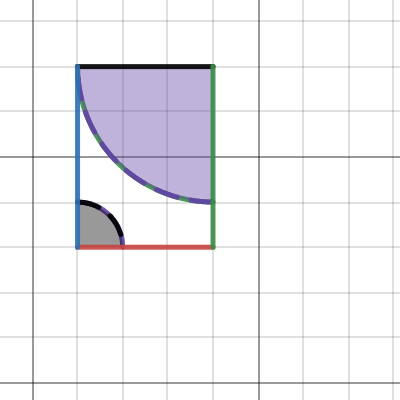
help how do I shade the unshaded area (the inside of the rectangle) in this figure?

Desmos
uncut mulch
consider first splitting the region into two parts
and isolate y for each circular arc
tepid cloak
how
willow bear
wait are you required to do it as an integral
can't you just subtract the areas of both quarter circles from that of the rectangle
@uncut mulch @tepid cloak
uncut mulch
they wanted to shade it in desmos
not calculate the area from what i interpreted
like
 willow bear
oh shade
my bad
right so this region is defined by four inequalities
$$\begin{cases} \left(x-16\right)^{2}+\left(y-8\right)^{2} \geq 1 \ \left(x-19\right)^{2}+\left(y-12\right)^{2} \geq 9 \ 16 \leq x \leq 19 \ 8 \leq y \leq 12 \end{cases}$$
obsidian monolithBOT
Ann
 willow bear
or six inequalities i guess
min( (x-16)^2 + (y-8)^2 - 1, (x-19)^2 + (y-12)^2 - 9, x-16, 19-x, y-8, 12-y) ≥ 0
@tepid cloak sorry for the double ping but
tepid cloak
willow bear
`min( (x-16)^2 + (y-8)^2 - 1, (x-19)^2 + (y-12)^2 - 9, x-16, 19-x, y-8, 12-y) ≥ ...
it showed me this

 uncut mulch
type
min( (x-16)^2 + (y-8)^2 - 1, (x-19)^2 + (y-12)^2 - 9, x-16, 19-x, y-8, 12-y) ≥ 0
tepid cloak
uncut mulch
type
`min( (x-16)^2 + (y-8)^2 - 1, (x-19)^2 + (y-12)^2 - 9, x-16, 19-x, y-8, 12-...
what if I tried to flip it

like this?

Desmos
like this
willow bear
swap out the equation of the bigger circle


 astral prism
did you distribute the negative?
 timber yarrow
I used sin(A-B)

 trim burrow
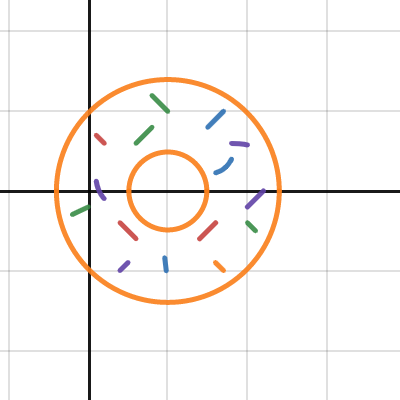
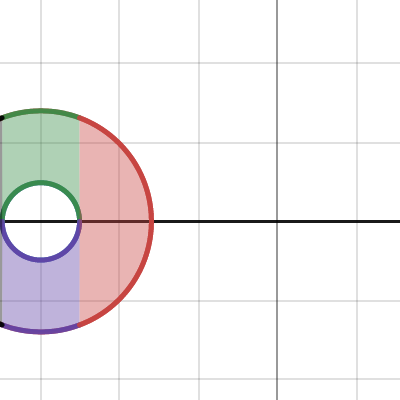
this is kinda unorthodox and long but it does the job (obv you can fix the colors)
Desmos
marsh cipher
timber yarrow
Hey guys does anyone know how to do no. 3?
Convert arctan to arcsin
 glass relic
hi, can someone help me to resolve this but using properties of natural log
If $2000 is invested at an interest rate
of 3.5% per year, compounded continuously, find the value
of the investment after the given number of years.
(a) 2 years
(b) 4 years
(c) 12 years
willow bear
@glass relic what do you mean
did you receive explicit instruction to do this "using properties of natural log" under threat of punishment?
hushed sphinx
Does "compounded continuously" mean that after one year $100 has grown to $100·e^0.035, or that we select a rate of continuous exponential growth that will make $100 reach exactly $103.50 after a year has passed?
willow bear
i would think the former
hushed sphinx
Hmm, that agrees with what Google seems to be telling me.
viscid thistle
hushed sphinx
Does "compounded continuously" mean that after one year $100 has grown to $100·e...
Are you doing grade 10 FMP?
hushed sphinx
I'm not -- just musing after reading Andrusita's question.
 teal plinth
how do you find b. I haven't done precalc in a long time
 viscid thistle
bro this is the same lesson
i’m struggling with
that’s quadratic functions right?
viscid thistle
teal plinth
yep
do you understand that lesson?
that’s like the lesson i’m struggling with and i have a test tomorrow
teal plinth
not well enough to help you
viscid thistle
teal plinth
not well enough to help you
fair enough
teal plinth

YouTube
I was that student that sat in the back of the classroom bored out of mind, frustrated & not understanding what the teacher was saying. I struggled learning math but in the pursuit to earn my degree, I learned a lot of what it takes to not only absorb the material, but be successful in class. This channel is all about sharing those experiences ...
checkout this channel. he explains stuff really well.
just type the type of problem and search if he has (mostly likely does)
thats how I get thru my math classes
teal plinth
np
 vagrant lintel
Hi, anyone can help me finding this?
 vivid void
it’s a linear function
so just find the slope
and then find what the added constant is
vagrant lintel
It's not lineal.
obsidian monolithBOT

 Requested by quantum#6320
vivid void
Requested by quantum#6320
vivid void

 rustic forge
vagrant lintel
Hi, anyone can help me finding this?
rustic forge
vagrant lintel
Hi, anyone can help me finding this?
maybe a family of circles is needed? Isn't there more context behind the question?? otherwise there's a hell lot of graphs passing through these two points out there
willow bear
the person left
 vapid stratus
 viscid thistle
 uncut mulch
supposedly there's an image that comes with the question
stuck lark
@strong ermine dont shitpost here
 strong ermine
 hollow vapor
PLUS CCCC
 lean cove
Can anyone help me really fast? I don't remember what the thing on the right of the 8 is for

also it's not a quiz for my class just got an example off khan academy
uncut mulch
to indicate which sides you're approaching from
lean cove
So - would come from the left?
uncut mulch
yes
vivid void
$x\to 8^-$ means you’re approaching 8 from values that are less than 8
obsidian monolithBOT
quantum
 vivid void
so the left
lean cove
Oh ty that makes sense
 deep pewter
 viscid thistle
<@&286206848099549185>

 heady mango
viscid thistle
<@&286206848099549185>
heady mango
viscid thistle
<@&286206848099549185>
Do you know the equation for the area of sector?
viscid thistle
heady mango
Do you know the equation for the area of sector?
to late already got it
 steel fern
I have an old calclulator that my dad used in college. A casio 7000-GA is that something i could now days ?
if not waht should i buy calculator wise for precalc
uncut mulch
pretty much any scientific calc is good enough for precalc
steel fern
uncut mulch
pretty much any scientific calc is good enough for precalc
this calc is a graphing calcualtor
uncut mulch
a graphing calc can do what a scientific calc can and more
 willow bear
this looks like desmos notation for a restriction
tepid cloak
yeah
 tight compass
 runic ravine
You can either write out the pascal triangle up to 5 and 9 to figure it out or just compute it explicitly using combination formula.
 fiery creek
runic ravine
fiery creek
runic ravine
$\frac{5!}{2!(5-2)!}$
obsidian monolithBOT
mniip's foe
 fiery creek
do you know how to do factorials?
 crystal stream

 fiery saffron
dA/dt=dA/dr•dr/dt is the correct chain rule
 hoary rose
I dont get wat I did wrong
the steps look correct yet for some reason I got the wrong answer
3h^2 - 22h + 7
3h^2 - 21h - h + 7
(3h^2 - 21h) + (-h+7)
3h(h - 7) - 1(h - 7)
(3h - 7)(h - 7)(h - 7)
I dont know what order the factored out numbers for 22h should be in
so I dont know how to factor it correctly
heady mango
you did everything right until after the last line. how would you factor this:
$3h \cdot a -1 \cdot a$
obsidian monolithBOT
Taltost

 cold kestrel
lmao
 snow axle

 hushed sphinx
Do you have a place to look up trigonometric product formulas?
(at least you presumably have Google).
 amber badger
i dont think so
this was given as a quiz on paper in class and your allowed one cheat sheet
hushed sphinx
If this kind of questions are on the quiz, the trigonometric product/addition identities should definitely be on your cheat sheet.
amber badger
ok
are they these

ohhh i get it
you just have to find which ones correspond
my bad
hushed sphinx
Yes, that's the ones.
There should be ones that take sums to products too, for the second part.
 sick steppe
what have you tried/thought/noticed?
 short pilot
i tried to find the d like others excersice
but my book do something and doesnt show a formula or something
sick steppe
Geometric Sequence/Progression is the key term
 frank acorn

 warm nebula
@frank acorn expand it using foil
tight compass
Expand it using distributive property which says a(b+c) = ab + ac.
Apply it to this (a-b)^2 or just (a+b)^2 then you have a nice quicker way to always expand expressions in that form.
 meager cairn
viscid thistle
frank acorn
meager cairn
viscid thistle
frank acorn
Expand this using (a-b)² = a² + b² - ab . There you go :-
(2x-3)²
=> (2x)²+(3)²-2×2x×3
=> 4x²+9-12x
 serene pewter
The range of this function would be [3,0) right?
 vivid void
no
vivid void
what’s the largest y value
vivid void
viscid thistle
Wth are h&k?
 hushed sphinx
Hopefully that is explained on one of the preceding pages; otherwise you're sunk.
viscid thistle
?
hushed sphinx
There's no standard concept of "parameters h and k" for a function. It must refer to something defined specifically in that book/course/module/test/whatever.
 hollow idol
I think question 2 explains what h and k are