#precalculus
1 messages · Page 287 of 1
 pliant locust
 lilac storm
log(1/4)=(t/27) x log(1/2)?
pliant locust
You forgot the $\frac{1}{27}$
 obsidian monolithBOT
rts
 lilac storm
yes and then 2 x 27 = t which is 54
pliant locust
👍
lilac storm
and i just had a question so what is the point of finding k or there is no point because the answer key shows the answer for k and then this answer that we just found?
pliant locust
I have no idea what your k in this case is
lilac storm
yeah np, i was just asking to make sure.
pliant locust
If something is halved after T years you can express it as a function in terms of time t in the following:
$$\left(\frac{1}{2}\right)^\frac{t}{T}$$
obsidian monolithBOT
rts
 pliant locust
I havent looked in physics formula sheets in a long while, this is just what i came up with myself
pretty straightforward tbh
 wide void
I know this might be really simple, but we got these two questions as an extra challenge at the end of a homework and i dont even know where to start


 ornate lintel
your profile pic is so funny
wide void
Thank you🥸
pliant locust
wide void
Use pythagorean theorem to get the length of the hypotenuse then tell me what cos(x) is (x is theta here)
wide void
Hyp would be 26 for the first one but then do i use the secant to find the cosine?
pliant locust
Recall that cosine is just adjacent divided by hypotenuse
And then just use half-angle identity to compute sin(x/2)


 stuck lark
this isn't what the mod ping is for
 hoary rune
Ok
stuck lark
and please wait 15min before pinging helpers
hoary rune
Could you help tho
stuck lark
i'm not available rn to stay and help. wait for an available helper, and it doesn't hurt to also post what you've tried to solve the problem


 short sorrel
 hoary rune
I did
Lol are you gonna help or just be one of those discord mods
<@&286206848099549185>
 sick steppe
Patience is key 
 smoky pagoda
Christ, a triple helper ping
For a question you could likely look up
As rokabe said, post your work so we can guide you through instead of giving you the answer

 winter quartz
smoky pagoda
Christ, a triple helper ping
winter quartz
smoky pagoda
Christ, a triple helper ping
Some people just aren't interested in following the rules 🤷
winter quartz
 obtuse locust
Is k -0.253
obtuse locust
Is k -0.253
Walk us through what you did
 winter quartz
Okay. Walk me through it
obtuse locust
I subbed in the variables
Then subtracted to isolate k
Use log for the exponent
Do u think k is 0.253
obtuse locust
<@&286206848099549185>
sick steppe
Based on what you have written, k isnt .253
obsidian monolithBOT
moshill1
 obtuse locust
Oh thank u
But I got the same thing for k
is the final answer 36 when the time is 110
obtuse locust
sick steppe
what?
i got the same answer
obsidian monolithBOT


 Requested by moshill1#9771
sick steppe
Requested by moshill1#9771
sick steppe
which is approx .0253
obtuse locust
when the time is 110 do you get 36
sick steppe
your question had no time
obtuse locust
what does that mean
sick steppe
also im not going to check an answer, use a calculator/wolfram to check
obtuse locust
ok
 subtle mist
Josh starts at the point $A=(0,0)$ and is heading towards the point $P=(12,3)$ and he uses 3 hours to reach this point. Tommy is located at $B=(0,9)$. One hour after Josh starts to walk towards $P$, then Tommy starts to head towards point $P$ as well. I need to find a parametrization for the path to Tommy such that he and Josh ends up at $P$ at the same time.
obsidian monolithBOT
please request a new nickname
 subtle mist
I found where Josh is after one hour, which is just $\mathbf{x}=(0,0)+t(12,3) = (0,0)+1/3(12,3) = (4,1)$
obsidian monolithBOT
please request a new nickname
 subtle mist
but I'm not sure how to go on about making sure that they end up there at the same time
 viscid thistle


 main cedar
obtuse locust
Is this right
main cedar
obtuse locust
Is this right
yeah its correct
 grand barn
idk if this belongs in pre calc but does anybody know how I can find the function of a building which has the shape of a paraboloid using the information that the maximal height is 36m , the width is 72m, the length is 140m
and that the maximal height touches the y axis
if we only had the two dimensions of height and width

this would be the shape
but I need 3 dimensions does anybody have a clue
pliant locust
Well, solid of revolution comes in mind. If you let the parabola in 2D have 140 meter in width and the height remaining 36 on y-axis a 180 degree revolution around the x-axis would give you a shape with a width of 72 meters.
A full spin will give you an ellipsoid, but i guess if you cut it in half you get a similar structure, hence a revolution of 180 degrees
pliant locust
grand barn
im missing it
True, solid of revolution would just describe the volume of it.
What exactly do you mean by a function that describes the 3d of it?
You want like a funciton that would draw the building in geogebra?


 glossy geyser
is the derivative of a functions in calculus or precalculus?
 blissful ridge
Calculus
glossy geyser
wait is it the same as increasing and decreasing functions?
but thats the general name
 echo wagon
No, different concepts but related in that the derivative can tell you whether a function is increasing or decreasing
glossy geyser
so they are both in calculus thank you, i have been looking for resources about them in precalculus and i was wondering why i didnt find anything
echo wagon
You should know what an increasing function is before precalc. Like when you learn about linear and quadratic functions.
glossy geyser
wait i am so confused so what field are increasing functions and reference functions are in?
echo wagon
Idk what a reference function is
You should learn about increasing functions almost immediately when you start learning about different functions. Idk when that happens or what that is called where you are.
glossy geyser
we follow the french system thats why im confused
reference functions are the one thats are known like quadratic and square root and stuff like that im not sure my self i was looking for resources on them
 astral apex
reference function is probably another name for what's sometimes called "parent function"
Like standard things that have horizontal and vertical translations happen to them
 mild swan
echo wagon
You should know what an increasing function is before precalc. Like when you lea...
mild swan
echo wagon
You should know what an increasing function is before precalc. Like when you lea...
^^
mild swan
astral apex
reference function is probably another name for what's sometimes called "parent ...
probably
 stark fulcrum
can someone pls help with this?
 stark fulcrum
how to make the function
 willow bear
make what function
 cunning spear
look at the requirements
stark fulcrum
yes but how can i make c'(1) equal them added together?
cunning spear
basically make any qudratic or higher degree function of ur choice
willow bear
pnksociety
you need to write down the formula for c(x) first
and then take its derivative
and then evaluate said derivative at x=1
stark fulcrum
but how do i know it equals this
 stark fulcrum
so chain rule?
willow bear
yes.
stark fulcrum
oh alright, thanks
 fossil verge
guys i’m lost
viscid thistle
could someone tell me if the professor made a mistake or I'm high
 willow bear
this looks ripped out of context
 mystic basin
im scared
 main cedar
f(x) > 0, when the y value is >0, i.e. the areas where the graph goes above the x-axis
 sinful gulch
Are there any integers whose squared difference equal 4?
I've highlighted the solutions I am struggling to find

 past meadow
the only integer solutions for a^2-b^2=4 are (a,b)=(-2,0) and (a,b)=(2,0)
you can prove this by factorising both sides
past meadow
sinful gulch
Are there any integers whose squared difference equal 4?
not sure of the physics/whatever that is but thats the answer to this lol
 round bane
Do people say cosine-i-sine instead of just cis?
past meadow
i say e^(itheta) personally
round bane
I've heard it as cis for a while but then my precalc teacher this year keeps saying cosine-i-sine lmao
past meadow
but i've only ever heard people say cis when they're pronouncing it lol
round bane
Yeah ikr!! It was getting on my nerves haha
It took him sooo long to say cis every single time bc he kept saying cosine-i-sine
 runic flower
$\lim_{x\to \infty} e^{-x}=0$
obsidian monolithBOT
canol
 runic flower
how to prove this using taylor series?
 runic flower
was just trying to proof it by definition
obsidian monolithBOT
Ann
 runic flower
well would it imply the other one then?
 steel tulip
$e^{-x} = \frac{1}{e^x}$
obsidian monolithBOT
Tiessie
 runic flower
oh yes that would work i think
and is there a way to directly prove it using taylor series of e^(-x)?
willow bear
meh
i guess not?
if you try to examine the taylor polynomials of e^-x as x goes to +∞ then youll alternately get them blowing up to +∞ or -∞
which tells you basically nothing
runic flower
right
its kind of surprising that it goes to 0 then
i mean just looking at the expansion of e^(-x)
and even more so that it goes to 0 faster than any polynomial
willow bear
i mean... the taylor series only really tells you local information normally
it just so happens that e^x is one of those really nice functions whose taylor series converges everywhere
runic flower
hmm
viscid thistle
hi guys
can anyone help me out with a couple of problems?

I can find the sum of these easily
but I dont know how to tell if their values do not exist
<@&286206848099549185>
 lilac pier
@viscid thistle For the first, you can separate the sum into sum(k^2) - 5 sum(k) + 7 sum(1)
you should know the formulas for sum(k^2), sum(k) and sum(1)
viscid thistle
in hindisght yes, i shouldve come back here and said so
I kinda had a brain fart when i asked the question
and then it resolved itself and im like
lilac pier
ok np
 neon venture
hey can I ask a precalc question here?
or is this channel being used im confused lol
 stable yacht
neon venture
hey can I ask a precalc question here?
stable yacht
neon venture
hey can I ask a precalc question here?
You can ask a question here. It’s the “questions” channels that are more for 1-on-1 help so your question doesn’t get buried if the topic channels are busy.
lilac storm


this is what i have done so far but now i'm stuck so if anyone could help me out?
i think i made a mistake that's why i am getting that t^-1+1/-1+1 which is 1/0
i don't know what to do so if anyone is there that can please help me out?
 brave snow
Well for one i don’t think splitting the fractions that way in line 2 is allowed
 cedar pawn
@lilac storm
Numerator is the derivative of denumerator
f'(x) =3t^2 {f(x)=t^3-3}
g(x)=t^2
So the only difference is the 3
So just put the 3 before the integral and u get 1/3integral of (1/t)
cedar pawn
cedar pawn
f'(x) =3t^2 {f(x)=t^3-3}
f(x) =t
The formula is integral of f'(x)/f(x) = ln|f(x)|
 edgy blaze
 lilac storm
cedar pawn
<@735330764861866016>
lilac storm
cedar pawn
<@735330764861866016>
sorry, i wasn't here, can you explain where are you getting all of this, i'm confused?
lilac storm
cedar pawn
<@735330764861866016>
are you there?
cedar pawn
From my textbook
Whenever the numerator is the derivative of the denumerator u can use that cheat
lilac storm
but it isn't because the derivative of the denominator is 3t^2 and the numerator is t^2?
lilac storm
i don't get what do you mean by put it before the integral?
obsidian monolithBOT

 Requested by Z = Z²+c#2374
cedar pawn
Requested by Z = Z²+c#2374
cedar pawn
^
lilac storm
sorry can you tell me where are we getting the 1/3 from?
lilac storm
ok
 opal kettle
ig ask question first
 harsh cipher
 opal kettle
well at least thatll help me know if i can solve it to begin w/ kek
oh no word problem xd
harsh cipher
haha
c^2 = a^2 + b^2
I think a = 80 because it tells us that the aircraft is 20km closer to station b.
opal kettle
im confused on how this navigation system works xd
harsh cipher
Radio transmitter situated in a straight line.
Center (0,0)
Center to station B is 100km
opal kettle
oh nvm understood it
so points A and B on a plane 200 units apart
find the loci of pts P=(x,y) such that PB+20=PA
which define a hyperbola
harsh cipher
hyperbola
(x-h)^2/(a^2) - (y-k)^2/(b^2) = 1
need to find value of a and b using pythagoras
opal kettle
opal kettle
find the loci of pts P=(x,y) such that PB+20=PA
^
let A = (-100,0) and B=(100,0)
and then use the distance formula
harsh cipher
Yes
We don't know the coordinates of the plane except that it's 20km closer to station B
or aircraft
opal kettle
@harsh cipher

so I just let P=(x,y) be the location of the plane
and they said PB+20=PA
so then i used the pythagorean theorem /distance formula and simplified the expression
harsh cipher
Center to the vertice is the value of a. Center to the foci (100,0) is the value of c.
opal kettle
or x^2 - y^2/(30sqrt11)^2 = 10^2 if u want it in that form
harsh cipher
I'm not sure why you used the distance formula here.
opal kettle
oh thats cz i dont have the a/b/c stuff memorized oops xd
harsh cipher
 opal kettle
harsh cipher
opal kettle
harsh cipher
oh ok
harsh cipher
In that image the question was different.
harsh cipher
It said the difference of the distance from boat to A and B as 386km
opal kettle
the center, we could choose so i chose the origin to simplify things
harsh cipher
In the question I asked, the aircraft is 20km closer to station B
opal kettle
wait where r u getting a = 80
harsh cipher
100-20?
opal kettle
why?
harsh cipher
the plane is 20km closer to station b
opal kettle
oh shoot did i mess up somewhere?
harsh cipher
or I did
opal kettle
the plane is 20 closer to station b
which means
20 = (100+a) - (100-a) => a = 10
try drawing a diagram; it might help
 rain monolith

 tough trail
answer is C
all i did was substitued numbers, the easiest numbers to use is 1 and 5 since they are inclusive.
u see where it says -2X - 2 for all of X which is equal to 1 or less, substitute 1 since the rule applies to it and then see if it correlates with the graph or not, if it does test another number such as 5 to double check. @rain monolith
 lucid verge
 past meadow
square x and rewrite one of the cos^2's in terms of sin^2 so you can use pythag identity
 rustic glacier
i need helpp

 still depot
u-substitution
Set u to t^3-3 find derivative cancel t^2 solve u terms and then substitute back in
lilac storm
so i have u=t^3-3 and du/dt=3t^2, so what next then?
obsidian monolithBOT
moshill1

 lilac storm
so du/3t^2
still depot
Yes
still depot
So u have t^2 / u as of now
Substitute dt for du/3t^2
So you have integral of t^2 / u dt
Make that now (t^2 / u) * (du/3t^2)
lucid verge
 lilac storm
still depot
So u have t^2 / u as of now
lilac storm
still depot
So u have t^2 / u as of now
are you there?
lilac storm
so i have du/3t^2=dt
still depot
Thats ur original part
lilac storm
so what do i do now?
still depot
cancel
if u have t^2/u dt and u want to get rid of dt just substitute du/3t^2 so you just have t^2/u * du/3t^2
lilac storm
sorry so i don't get where do we get this t^2/u from?
lilac storm
oh sorry my bad, being stupid
still depot
np
sick steppe
Are you able to do work by yourself @lilac storm ?
You've gotten help, why do you need the answer spoon-fed?
lilac storm
sorry about that
so i'm still confused, so i have du/3u so when will i be writing everything in integral form, right now i'm just substituting and simplifying so i just need help that is the du/3u correct so what will be my next step?
sick steppe
if everything's in terms of u (and was correctly substituted), integrate...
if you have t's and u's in the same integrand, dont integrate until it's all 1 or the other
still depot
Yah i think u should watch this video first

This calculus video tutorial provides a basic introduction into u-substitution. It explains how to integrate using u-substitution. You need to determine which part of the function to set equal to the u variable and you to find the derivative of u to get du and solve for dx. After replacing all x variables with u variables, find the antideriva...
 eternal stone
sqrt(25x) = 5(sqrt(x)) is this legal?
sick steppe
yes
eternal stone
bless
sick steppe
by exponent laws
eternal stone

the part underlined by the pen
hopefully this is all valid
(x^2 + 1)^(3/2) = sqrt((x^2 + 1)^3))
is this also valid?>
nm wolfram says it is
 jolly raven
Ye bc that's definition of fractional exponent
 lilac storm
anyone there to help?
sick steppe
a's just integrate then use the initial conditions
lilac storm
if you don't mind, can you help me a bit with the integrating for this eq?
sick steppe
u-sub
 unborn nimbus
hello does anyone know how to solve this? do i have to draw the graphs first or...
 tough trail
yea draw graphs just sketch it nothing fancy plot few points and u will get the answer straight away
 dusk oriole
Can someone help me find the sin equation of the indicated period?
 viscid thistle

 stark fulcrum
can someone please help with this?
 eternal stone
to be clear ln(1/sin(x)-1/tan(x)) is the same as ln|cscx + cotx| right?
eternal stone
stark fulcrum
can someone please help with this?
what have you tried?
viscid thistle
eternal stone
to be clear ```ln(1/sin(x)-1/tan(x))``` is the same as ```ln|cscx + cotx|``` rig...
not really.
first off, you pulled out a plus sign out of nowhere.
viscid thistle
and while one has the absolute value, and the other one does not, both aren't equal when the argument of the first is negative, ie where 1/sin(x)-1/tan(x)<0
but yeah, if you were to fix that, $\\ln(\frac{1}{\sin(x)}-\frac{1}{\tan(x)})=\ln(\csc(x)-\cot(x))$ is totally correct.
obsidian monolithBOT
Al𝟛dium
 lilac storm


so i have solved this question but the answer in the back of my textbook says S(t) = 2.3e^0.234t + 0.6, but the answer that i am getting is 2.3e^0.234t + C, so how do i get the 0.6, if anyone there that can please help me out? like how do i solve for C?
 lost bane
how do i do this
 lilac storm
anyone there to help?
unborn nimbus
does anyone know how to solve this? its going to be on my exam later but i've never learned how to do these type of questions

 faint nest
is the range of arctan (-pi/2, pi/2) or is that with brackets??
mild swan
faint nest
is the range of arctan (-pi/2, pi/2) or is that with brackets??
parentheses
mild swan
unborn nimbus
does anyone know how to solve this? its going to be on my exam later but i've ne...
If you don't know about logs, I'd look them up on mathisfun.com
or other online sources
unborn nimbus
mild swan
If you don't know about logs, I'd look them up on mathisfun.com
ill do that thank you!!
unborn nimbus
ah okay for that one i've watched a video about already
but i think thats all i know
viscid thistle
unborn nimbus
does anyone know how to solve this? its going to be on my exam later but i've ne...
Just use Photomath and you can scan the problem and it tells you the answer and also shows you the work to get the answer
I mean sure it’s cheating but it’s a good way to learn by reading the ways to get the answer given
unborn nimbus
viscid thistle
Just use Photomath and you can scan the problem and it tells you the answer and ...
hahaha okayy!! thank you sooo much
 civic sierra
@unborn nimbus if you want to I can go over a couple of those with you
unborn nimbus
civic sierra
<@!563608464363094016> if you want to I can go over a couple of those with you
i've actually used photomath, should i send you my working to make sure?
civic sierra
sure
unborn nimbus
okay should i send a pic here?
civic sierra
yeah
unborn nimbus
 unborn nimbus
okay, thank you so much!!
stark fulcrum
eternal stone
what have you tried?
oh I ended up solving it
stark fulcrum
eternal stone
what have you tried?
I think it’s wrong but it’s ok

sorry it’s all over the place I kept running out of space LOL
viscid thistle
anyone know this?
 viscid thistle
no lmao
 willow bear
great then why not read it
viscid thistle
but i cant find this
willow bear
then think about it
 blissful ridge
Ask mods, they generally handle these kind of requests
echo wagon
Pinging the mods for your own banning 
stuck lark
👢
 willow bear
direct calculation?
,w simplify (sin(a) + cos(b))(sin(a) - sin(b)) - (cos(b)+cos(a))(cos(b) - cos(a))
obsidian monolithBOT


 slender raptor
willow bear
this won't simplify, will it
slender raptor
willow bear
this won't simplify, will it
Yup, that's it
I tried various trig formulas and none of it worked
slender raptor
We can't apply properties of matrices to solve it?
I'm pretty bad with the properties so I haven't been able to figure out if it would simplify that way
Thank you btw!! @willow bear
 raven tusk
anyone able to help me with a question real quick?
lilac storm


so i have solved the question but the answer in the back of my textbook for this question is S(t) = 2.3e^0.234t + 0.6 and the answer I have is 2.3e^0.234t + C, so my question is how do i find C, if anyone there that can please help me out?
viscid thistle

 sudden bluff
help? pls

 bold lintel
You need to set the problem =0 and then solve for x
Plugging in your answer will tell you if you have one solution, 2 or none
lilac storm


so i have solved the question but the answer in the back of my textbook for this question is S(t) = 2.3e^0.234t + 0.6 and the answer i have is 2.3e^0.234t + C, so my question is how do i find C, anyone there that can please help me out?
sick steppe
lilac storm
so i have solved the question but the answer in the back of my textbook for this...
you're given a boundary condition
S(0)=2.9
lilac storm
sorry isn't S(0)=2.3 + C and if you rearrange then C=-2.3?
sick steppe
,w integrate 0.528434e^(0.234t) dt
obsidian monolithBOT
 Requested by moshill1#9771
sick steppe
lilac storm
sorry isn't S(0)=2.3 + C and if you rearrange then C=-2.3?
Requested by moshill1#9771
sick steppe
lilac storm
sorry isn't S(0)=2.3 + C and if you rearrange then C=-2.3?
not sure how you got -2.3 from 2.9-2.3
lilac storm
sorry where are you getting the 2.9 from?
sick steppe
lilac storm
sorry where are you getting the 2.9 from?
the boundary condition
S(0)=2.9
lilac storm
sick steppe
the boundary condition
sorry but if you don't mind, can you tell me what is the boundary condition?
lilac storm
no, the concept or like the definition of boundary condition, what exactly are you calculating which might help me understand how we get 2.9?
sick steppe
Im reading the question
"The expenditure on media spending on ads in 2012 stood at $2.9 billion"
lilac storm
i'm so sorry, thank you so much for helping out, i really appreciate it
so i just want to make sure so whatever so far i have written in my solution which i have also posted above, underneath i just simply write now that S(0)=2.9 so 2.9-2.3 which gives 0.6 which is the value of C, right?
sick steppe
yes
lilac storm
ok, thanks a lot once again.
 small trail
SHE NEED HELP IMMEDIATELY
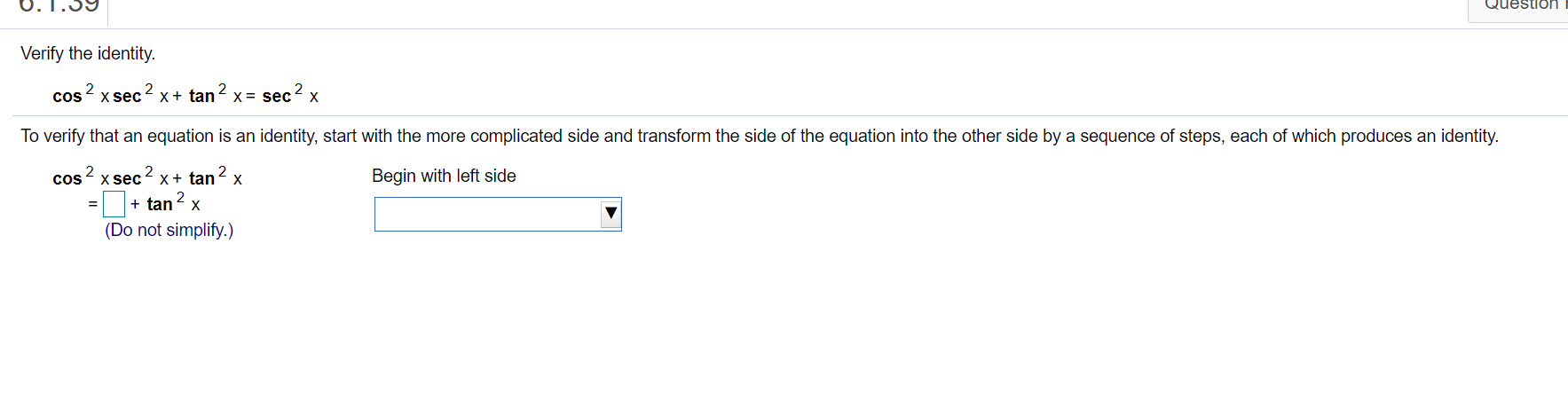 sick steppe
 hexed depot
https://prnt.sc/10v9qpp
hexed depot
https://prnt.sc/10v9qpp
what are you stuck on?
hexed depot
im confused what does it mean by the most complicated side
math is not my good subject but im trying to learn
sick steppe
well which side looks more complicated?
hexed depot
um the cos squared ect
sick steppe
something with 3 trig ratios or something with just 1?
hexed depot
left side
sick steppe
yes
so typically you want to start with the messier side of an identity and simplify it, cause we can just simplify stuff better
hexed depot
okay so im just simplifying it?
sick steppe
simplifying/molding it into the right side
hexed depot
YAS OKI
 unborn blade
How do I do question B?

6B***
i got A correct
but i keep getting 0/0 for B
but the correct answer is 4
mild swan
@unborn blade send your work
 unborn blade
i tried factoring but didnt work
wait or do you mean before i adding the -5
ok yeah that would factor
so i guess my mistake was adding -5
mild swan
unborn blade
so i guess my mistake was adding -5
nope, this is good
$3h^2 - 2h - 1 = (3h+1)(h-1)$
obsidian monolithBOT
Shen
 unborn blade
uh oh i made a typo when calculating the discriminant
i multiplied by 1 instead of -1
so i assumed it didnt factor
tyty
mild swan
👍
 ornate lintel
$$Tan(\theta)>1$$ in right triangle?
obsidian monolithBOT
lebedevhツ

 fallow slate
ornate lintel
fallow slate
ornate lintel
is this affirmation true?
mild swan
@unborn blade looks good to me
unborn blade
thank youu

 sick steppe
lilac storm
sick steppe
lilac storm
integrate, apply the boundary condition, then solve for the debt in 2012
 obsidian monolithBOT
 Requested by moshill1#9771
sick steppe
Requested by moshill1#9771
sick steppe
looks right
lilac storm
yes, that is what i got when integrating the eq
sick steppe
Ok so apply the boundary condition
lilac storm
and we know that R(0)= 10.025
obsidian monolithBOT
moshill1
 sick steppe
then S(0) = what?
lilac storm
so now do i rearrange the eq that i just found and solve for C?
sick steppe
Yep, but hopefully you'll see you dont need much re-arranging
lilac storm
yes i can factor it and so on
sick steppe
No
all the terms except C have t, and you're plugging t=0
so anything with a t disappears, leaving you with S(0)=C
lilac storm
oh, yes
sick steppe
so what's C=?
lilac storm
0?
sick steppe
No
lilac storm
C=10.025
sick steppe
S(0)=10.025
S(0)=C
C=S(0)=10.025
lilac storm
ok so i just want to make sure but the answer in the back of my textbook, the answer for this question says 16.067
sick steppe
lilac storm
ok so i just want to make sure but the answer in the back of my textbook, the an...
yeah, have you found the debt in 2012?
lilac storm
yes
lilac storm
sick steppe
yeah, have you found the debt in 2012?
are you there?
sick steppe
well if you found the debt in 2012, then you're done
lilac storm
so i don't get why my answer is so different from the one in the back of the book?
 lilac storm
so i am double checking my math now and just want to make sure that this this 2012 year value which is 4, i am subbing it into the original eq, right?
sick steppe
yes you find S(4)
 solemn flame
Please excuse the numbers around this equation. I want to learn how to solve this on Gaussian Elimination but I don’t understand it.
 willow bear
have you done Gaussian elimination before?
willow bear
.-.
mystic basin
sorry
willow bear
@solemn flame ?
solemn flame
@willow bear yes
willow bear
is that a "yes i'm here" or "yes i have done GE before"
solemn flame
Not for a long time tho
willow bear
ah
willow bear
i see you've written out the matrix for your system below
$\left[\begin{array}{ccc|c} 2 & -1 & 2 & 10 \ 1 & -2 & 1 & 8 \ 3 & -1 & 2 & 11 \end{array}\right]$
obsidian monolithBOT
Ann
 willow bear
so you know the three types of elementary row operations, right? (row addition, row swapping, row scaling)
solemn flame
Yes
willow bear
okay
solemn flame
I swapped R1 and R2
willow bear
great, that's what i was gonna suggest
$\left[\begin{array}{ccc|c} 1 & -2 & 1 & 8 \ 2 & -1 & 2 & 10 \ 3 & -1 & 2 & 11 \end{array}\right]$
obsidian monolithBOT
Ann
 solemn flame
I timed row 1 by -1
willow bear
mkay
solemn flame
Then added R2
willow bear
you... added row 2 to row 1?
solemn flame
Yes
willow bear
hm
a bit unorthodox, but legal nonetheless.
there's a shortcut here that just became apparent to me, by the way.
two shortcuts, even.
solemn flame
Really
willow bear
subtracting row 2 from row 3 (in the matrix i wrote out above) will give [1 0 0 | 1]
and subtracting 2 times row 1 from row 2 will give [0 3 0 | -6]
which gives you x=1 and y=-2 almost for free
willow bear
the part about subtracting row 2 from row 3?
willow bear
do i need to continue?
solemn flame
No I got it
willow bear
ok
solemn flame
Thank youuuu
 severe sandal

slender raptor
is f: I --> R defined as f(x)=x^3 a one-to-one function?
willow bear
what is I?
willow bear
how do we know $I \subseteq \bR$ tho
obsidian monolithBOT
Ann
 willow bear
if ${1, e^{2i\pi/3} } \subseteq I$ then $f$ won't be injective
obsidian monolithBOT
Ann

 willow bear
sometimes people ask questions about complex numbers here.
slender raptor
Ahh this topic came under precalc for me that's why I asked it here
slender raptor
 harsh smelt
no need in particular info on I tho
harsh smelt
no need in particular info on I tho
Isn't I imaginary numbers?
viscid thistle
no that's C
sick steppe
slender raptor
Isn't I imaginary numbers?
i is the imaginary unit, C is the set of complex numbers, I usually denotes a general interval
viscid thistle
if i send math problems here, could i get help ?
willow bear
yes, and in fact that's exactly what you need to do to get help here
can't help you if we don't know what to help with, if you catch my drift
 willow bear
try to think about building your word letter by letter
willow bear
there are 4 possible places for you to put the B
viscid thistle
is there some kinda formula
willow bear
no, just think about the multiplication principle
after you place the B, there are 3 slots left to fill with a letter each
the first slot can be filled by any of the 5 remaining letters
afterward, the second slot can be filled by any of the 4 letters that remain
willow bear
no
don't forget to multiply by 4 for the possible positions of the B.
and the 2 should go.
viscid thistle
so 5 times 4 times 3 times 2 times 4?
why shouldnt the two go?
nvm got the answer thanks
willow bear
the 2 should go.
willow bear
no! the 2 should go!
willow bear
at no point are you making a choice with 2 options in this problem!
 willow bear
there are point values

 uncut mulch
unmute mic? proctored?
 viscid thistle
can u pls help me out ?
willow bear
from #❓how-to-get-help
- Do not ask for help on tests. Any violation of this will lead to appropriate action being taken at mod discretion.
<@&268886789983436800>
uncut mulch
if you can alleviate out concerns that this is an assessed test
 sick steppe
obtuse locust
Do u think I picked the right answer
sick steppe
obtuse locust
Do u think I picked the right answer
Assuming convention, no
obtuse locust
The one right to it?
sick steppe
I mean you tell me
echo wagon
Is 16 a1 or a0 for you?
Normally sequences start at a1
But you could be starting at 0
obtuse locust
it doesn’t say but probably a1
obtuse locust
Oh then it’s the one next to it
 slender river
 haughty pendant
 misty imp
If theres an angle theta where csc(theta) = -35/24 and tan(theta) > 0, what are the ratios of: sin(theta) = , cot(theta) =, and cos(theta+pi) =
can someone help me out on this one
lilac storm


i just want to ask that have i done this question correctly?
and for f, so i have the area which is 17.5 found in a so do i just simply write in f that as we increase n, the area becomes more accurate and to the actual exact value as you can see from each graph respectively

and here's part b as well
anyone there to help?
lilac storm
is anyone there to help?
 fading token
looks good
lilac storm
fading token
looks good
thank you so much
obsidian monolithBOT
Ann
 willow bear
leibniz notation
 upper kelp
You don't need to go back to square one. It's just a different notation.
The $f'$ notation is the one most commonly used for single-variable functions, whereas the $\frac{d}{dx}$ notation is required in case you have functions with multiple variables.
As an example, if you had the function:
$f(x, y) = 3xy + y^2$
then, when you differentiate, you have to specify which variable you're differentiating by. For example, if you differentiate by x, you get:
$\frac{df}{dx} (x_0, y_0) = 3 y_0$
and if you differentiate by y, you get:
$\frac{df}{dy} (x_0, y_0) = 3 x_0 + 2 y_0^2$.
(The point $(x_0, y_0)$ is the point at which you measure the derivative of the function.)
If it makes more sense, as an example, in Leibniz notation, the sum rule can be written as:
If $h(x) = f(x) + g(x)$ [another way to write it would be $h = f + g$], then: $h'(x) = f'(x) + g(x)$.
In the $\frac{d}{dx}$ notation, the rule would be: $\frac{d}{dx} h(x) = \frac{d}{dx} f(x) + \frac{d}{dx} g(x)$.
obsidian monolithBOT
RoiKadmon

 vapid mica
hello, i was wondering if someone could check what i did wrong with this problem:

This free triangle calculator computes the edges, angles, area, height, perimeter, median, as well as other values of a triangle. View a scaled diagram of the resulting triangle, or explore many other math calculators, as well as hundreds of other calculators addressing finance, health, fitness, and more.
this gives me something completely different and im not sure why
any help is appreciated.
uncut mulch
there is ambiguity when applying the sine rule
where possible, apply the cosine rule instead to avoid situations like this
stable yacht
The question asks: “For which values of a and b does this function have a limit at x = 0?”

I think it’s the wording, but I don’t really know how to go about it.
Do I just set the limits approaching zero from the left and right equal to each other?
 copper vigil
set the upper and lower functions equal to 5
stable yacht
Is that because at x = 0, f(x) = 5?
 upper kite
Every question channel is being used, and no one has answered here for more than an hour now, so I'm going to go ahead and post my question here :
In the following image, the problem basically asks what's the probability of at least 2 people having the same birthday in a room of 30 people.
So what he's doing is getting the probability of no one having the same birthday, and well substracting it from 1 to get the answer we need
But I'm confused about this part, why is he using the permutation formula instead of the combination formula here ? It's not like it matters in which order the birthdays are, so I'm confused
 upper kite
<@&286206848099549185> please
 rare galleon
Can you state the difference between permutation formula and combination formula?
upper kite
From what I've learned, the permutation formula is :
nPr = n! / (n-r)!
whereas the combination formula is :
nCr = n! / ( r!(n-r)! )
winter quartz
Qualitatively: Permutations care about order, Combinations do not.
upper kite
Exactly, which is why I'm confused as to why permutation is used here
It doesn't matter in which order we're taking people's birthday here, as long as they're all different
winter quartz
So it's hard to tell based on your screenshot, but are you sure he is using the permutation formula? Perhaps the r! Got cancelled out.
upper kite
Do you want me to send you the link of the video instead ?
winter quartz
Or perhaps he is using permutation and making it a combination later for the final solution
upper kite
https://www.khanacademy.org/math/precalculus/x9e81a4f98389efdf:prob-comb/x9e81a4f98389efdf:prob-combinatorics-precalc/v/birthday-probability-problem?modal=1
That's the video if you prefer that, because it's hard to explain from screenshots
But at the end, to get the probability of no one having the same birthday, he's doing : Permutation / 365^30
winter quartz
I agree, and that is simply because that is how you mathematically express $365363\dots*335$
obsidian monolithBOT
dackid
 winter quartz
$365364363*\dots335=\frac{365\dots335334*\dots1}{334\dots*1}=\frac{(365)!}{334!}$
obsidian monolithBOT
dackid
 winter quartz
We weren't using the permutation or combination formula, we were simplifying our term here.
And it just so happens to be a permutation
Ah, they don't have the 335 in the problem.
Either way the logic is the same.
So $365*\dots*336=\frac{365!}{(365-30)!}$
obsidian monolithBOT
dackid
 upper kite
This is a weird one, I hope this isn't a common occurence.
But so far I've been able to work through every exercice using one of those two formulas. This one struck me as a combination one so that's how I interpreted it
It's still a bit fuzzy to me but I think that's just me, I'm gonna try to work through this another time and see if I get it
winter quartz
Don't focus on the formulas.
Focus on how he solved the problem. The logic is sound
sick steppe
Birthday Paradox?
winter quartz
This is the probability that out of 30 people, at least 2 people share the same birthday
upper kite
The thing is the logic he went though only works for this problem, and maybe a handful of other ones, what I'm trying to do is find a pattern to generalize one technique that works on a lot of problems (which I'm aware all problems are different, but there's always this one pattern you can figure out once you understand it correctly)
winter quartz
Combinatorics is a bit more involved than you are giving it credit for
If it was that simple, there wouldn't be college classes on the subject
 misty marten
Hi, I have a question for trigonometry I don’t understand how to start this.
 upper kite
winter quartz
If it was that simple, there wouldn't be college classes on the subject
upper kite
winter quartz
If it was that simple, there wouldn't be college classes on the subject
I guess you're right, I'm just upset I guess that unlike everything I've learned so far, there's no magic formula that can help me breathe through every exercice
winter quartz
Do we agree that $\sec(\theta)=\frac{1}{\cos(\theta)}$?
obsidian monolithBOT
dackid
 winter quartz
upper kite
I guess you're right, I'm just upset I guess that unlike everything I've learned...
winter quartz
upper kite
I guess you're right, I'm just upset I guess that unlike everything I've learned...
If it worked like that, I'd have my degree years ago 😆
misty marten
obsidian monolith
**dackid**
Yes! It’s primary reciprocal
winter quartz
Okay, so we can rearrange the question
$\sec^{2}(\theta)=2$ is the same as $\frac{1}{\cos^2(\theta)}=2$
obsidian monolithBOT
dackid
 winter quartz
But that can be reexpressed as $\frac{1}{2}=\cos^2(\theta)$
obsidian monolithBOT
dackid
 misty marten
Ahh ok.
winter quartz
And squarerooting gives us two equations
$\frac{1}{2}=\cos(\theta)$ and $-\frac{1}{2}=\cos(\theta)$
obsidian monolithBOT
dackid
 winter quartz
I think you can solve from here.
Note, there should be four solutions for your final answer
sick steppe
misty marten
Wait 4 solutions?? How please explain.
2 from the positive 1/2, 2 from the -1/2
since cos is positive in 2 quadrants, and negative in the other 2 by CAST
misty marten
sick steppe
since cos is positive in 2 quadrants, and negative in the other 2 by CAST
Ok thank you. See what you guys are talking about now.
Don’t laugh but am I getting somewhere? Lol
 sick steppe
misty marten
Don’t laugh but am I getting somewhere? Lol
sick steppe
misty marten
Don’t laugh but am I getting somewhere? Lol
double check your exact values
misty marten
Should I not do the cos inverse?
sick steppe
misty marten
Should I not do the cos inverse?
I mean you can, but it's not 30 deg
misty marten
Oops I did the wrong sign. It’s 60 degrees
Ok thank you
Now I have my final answer as 300 degrees
misty marten
winter quartz
What about the other two?
Oh for the second set I got 120 and 240 degrees
winter quartz
You betcha :)
grand barn
how many solutions can a biquadtrical equation have ? including complex solutions
willow bear
biquadratic?
do you mean specifically ax^4 + bx^2 + c = 0 or do you mean general 4th degree (quartic)
in either case, up to 4 solutions.
 fossil ravine
Why does y^2 - x^2 = 2y^2 - π
draw a circle
the left side is a difference of two squares
-y^2 - x^2 = -π
y^2 + x^2 = π
Explanation please?
echo wagon
Well, how do you know if something is a circle? Because to me, being able to write it in that form makes it a circle centered at the origin with radius sqrt(π)
fossil ravine
Ok so that's how we get 1.77 as radius
Thanks @Lunasong#7197
 uncut mulch
consider the general equation for exponential growth
and what the variables represent
lilac storm
so i don't get how do you solve for k when k is not even in the eq, like i have solved a question similar to this one before but in that one you have k with the t but over here you don't even have k so how would you solve for it?
uncut mulch
consider the general equation for exponential growth
lilac storm
are you talking about the Q(t) = 500e^0.02t?
lilac storm
oh, that is Q(t) = Qoe^-kt
uncut mulch
parentheses
lilac storm
yeah
uncut mulch
and _ for subscript
lilac storm
that's the intial value, right?
uncut mulch
and then compare that to the equation you're given
also it seems you've written decay instead of growth
$Q(t) = Q_0 e^{kt}$
obsidian monolithBOT
ℝamonov
 lilac storm
oh i think i get it, so i sub in 500e^0.02t in for Q(t) in the Q(t)=Qoe^-kt eq, right?
uncut mulch
no - in the exponent
obsidian monolithBOT
ℝamonov
 uncut mulch
Q_0 = ?
k = ?
uncut mulch
now compare the stuff in the exponent
lilac storm
do you mean kt=0.02t?
uncut mulch
yes
lilac storm
so i have k=0.02
uncut mulch
yes
lilac storm
oh, yeah sorry
uncut mulch
also you already have the equation. explicitly knowing the value of k is irrelevant
uncut mulch
yes\
lilac storm
ok, thank you so much for your help, i really appreciate it
mystic basin
theres a question on my preclalc homework
"If a graph is vertically stretched or shrunk, explain why points on the x-axis remain fixed." my answer would be like
"The y is modified because it is being stretched or shrunk, so the x remains the same" is this a valid answer?
uncut mulch
no
 primal quail
Can anyone explain this to me

Why is d/dx of lny=1/y dy/dx
I am confused about that part
Help is greatly appreciated
 onyx wharf
obsidian monolithBOT
onyx wharf
obsidian monolithBOT
rjsp


 dim rampart
for (a): $S=\frac{1}{2}*f(4) + \frac{1}{2}*f(4.5)$
obsidian monolithBOT
veryhappyperson
 lilac storm
sorry, if you could just explain to me where are you getting the 1/2?
and also the f(4.5)?
dim rampart
The interval [4,5] has the "length" of 1. I want to put to rectangles in there so I split it into 2 parts, each of them with a width of 1/2
lilac storm
i get f(4) because 4 is given but where is the 4.5 coming from?
lilac storm
oh, ok
sick steppe
$\Delta x = \frac{b-a}{n}$ for n rectangles on the interval [a,b]
obsidian monolithBOT
moshill1
 lilac storm
so for (b), would it be S=1/5 x f(4) + 1/5 x f(4.5)?
dim rampart
You would have $S= \frac{1}{5}f(4)+\frac{1}{5}f(4.2)+\frac{1}{5}f(4.4)+\frac{1}{5}f(4.6)+\frac{1}{5}f(4.8)$
obsidian monolithBOT
veryhappyperson
 lilac storm
oh
sick steppe
$\Delta x \sum_{i=0}^{n-1}f(a+i\Delta x)$
obsidian monolithBOT
moshill1

 sick steppe
lilac storm
sick steppe
lilac storm
find the inflection point, then find the slope at that point and the point itself
lilac storm
so i have y' = e^-2 - e^-2 (x)
obsidian monolithBOT
moshill1
 lilac storm
yeah so i have that but i then subbed in 2 for the x's
sick steppe
,w solve d/dx (e^(-x)-xe^(-x)) = 0
right ok
so you need the slope at x=2 and the point at x=2
lilac storm
so i have f'(x) = e^-2 - e^-2 (x)
obsidian monolithBOT
moshill1
 sick steppe
yes
lilac storm
so i have y = -1/e^2x + b, so i sub in 0 for y and 2 for x to solve for b, right?

 vast beacon
oh i was looking at it like a^4 * b^4n and thought since the powers arent the same
silly me
ty
 steep anchor
@vast beacon
        [-1 * x^4]^n =
(-x^4)^n```yup thx
steep anchor
what does this mean?
{𝑥 ∈ ℜ / 𝑥 ∉ ℜ− ∨ 𝑥 > 6}
i think it mean X has to be 0 or +, and/or greater than 6
am i right?
 stark helm
Definition of the 6 trig functions for reference
 lilac storm

so i have almost solved all of the question but i am stuck on a step so i have y-2/e^2 = -1/e^2 (x-2)
so my question is, the thing that i need help with is that how do i get from that to the y=mx+b form?
anyone there that can please help me out?
anyone there to help?
would it just be y = -1/e^2(x-2) + 2/e^2?
viscid thistle
Did they give any (x,y) values?
lilac storm
no
it says in the question at its inflection point, that is why it is a lot more tougher
dim rampart
you have to calculate the inflection point by taking the second derivative and setting it 0, have you done that?
wait
lilac storm
yes
dim rampart
why is calculus precalculus? xD
lilac storm
yes, i got x=2
dim rampart
then plug the x value of the inflection point into the first derivative then you have your slope
for y=mx + c
lilac storm
yes i got that
lilac storm
the slope is -1/e^2
viscid thistle
I got y=x
lilac storm
so i put the slope value into the original eq?
dim rampart
no, you put the x coordinate of your inflection point into f(x)
 normal night
💀
lilac storm
so i have solved to get the points which i got (2, 2/e^2)
normal night
😭
viscid thistle
No you have to find the derivatives of the given equation first
viscid thistle
Like I did it in two ways and got two different answers lol
normal night
dim rampart
just focus xD
its the teacher
lilac storm
ok, so i'll tell you from the beginning, i took the first and second derivatives, then set the second derivative equal to 0 and got x=2
viscid thistle
X+ye^2=4, that’s what I got
dim rampart
Now let me summarise: You need to find the inflection point. Then you write the coordinates of that point down. Then you calculate the slope at that point. Then you use this

Then you have the equation of the tangent line
lilac storm
then i did f(2) which gave me the y point so i have (2, 2/e^2)
oh i think i get it
or no
dim rampart
(2,0.27) is correct
now use your knowledge from like pre algebra and use the formula I sent you
lilac storm
so what i'm getting is y = -1/e^2(x-2) + 2/e^2, is this correct?
viscid thistle
Like for the derivative?
lilac storm
no, as the final answer in y=mx+b form
viscid thistle
Umm I got a different one
lilac storm
oh
viscid thistle
I got x+ye^2=4