#precalculus
1 messages · Page 283 of 1
 sick steppe
sum/difference identity is also called compound angle
so im assuming you have sin(a+b) in your notes. ..
 strange brook
yep
sick steppe
yeah.. so use it
strange brook
that doesnt explain anything
i know the formula
i just dont know how to get it to equal the right side
sick steppe
use it. . . then simplify. . .
I cant do much in the way of helping if you're not going to listen to the instructions of the question
strange brook
ok then
thank you
just one more question
how do you figure out which quadrant the triangle goes in?
sick steppe
alpha and beta are acute
sick steppe
where is 0 degrees measured?
strange brook
idk the first quadrant?
sick steppe
no, which axis is an angle of 0
strange brook
x-axis
sick steppe
pos or neg
strange brook
pos
sick steppe
what about pi/2?
strange brook
its still positive
sick steppe
which axis
strange brook
the y-axis
sick steppe
right, so what quadrant is bounded by pos x and pos y?
strange brook
the first quadrant
sick steppe
yes
strange brook
ohhhhhhh thank you so much
strange brook
Can someone answer this, I want to know if I did it right.
 uncut mulch
show your work instead
sick steppe
why cant you?
 true sage
um bc im stuck on the same one sweetheart
dont gotta be passive aggressive up in dis chat
that is not tolerated
sick steppe
I asked a simple question, no clue why you feel the need to get defensive
true sage
i was just playing lmao
sick steppe
cool
sick steppe
g4u bud
 serene heath
yes
strange brook
ok thank you
 carmine fulcrum
Help please 🙏
 pliant locust
carmine fulcrum
Help please 🙏
pliant locust
carmine fulcrum
Help please 🙏
Try multiplying the fractin with its numerators conjugate
Reduce the fraction with the numerators conjugate.* excuse my English in math.
pliant locust
carmine fulcrum
Help please 🙏
Kinda like this, now do the same limit as x approaches negative infinity
pliant locust
Same thing, just start with fraction first and then the whole thing
 steel flare
Hey
How would I go about solving this question? I’m pretty confused on where or how to start. Could anyone give me a detailed step breakdown (with numbers) for how to solve the question?
Thanks
 crisp quest
steel flare
How would I go about solving this question? I’m pretty confused on where or how ...
crisp quest
steel flare
How would I go about solving this question? I’m pretty confused on where or how ...
Do you know what (f ÷ g)(0) = -4 and (f + g)(0) = 3 mean? Try translating that first, and then you should get a system of equations that will allow you to solve for n and m.
 viscid thistle
help
for what value of x and y will this be maximum
xy=20
how to find this mathematically not trial and error
 past meadow
can you use calculus?
you
if xy=20, then y=20/x. Then you can rewrite the expression in terms of x only and maximize it using calculus
I mean I'm not just doing it for you lol.
No <3
 trim pebble
He told you how to do it - maybe try doing what he said?
trim pebble
Set y=20/x and everywhere it says y replace it with 20/x
viscid thistle
the answer aint matching
 proper pilot
it's like the fate got me in here with the #precalculus
How do you guys memorized the unit circle, i'm so confused and i'm just blindly going over youtube and searching for solutions
viscid thistle
@proper pilot i'd recommend understanding it before going with memorisation.
 ancient rampart
for me i tried understanding it in degrees first and then converting and eventually i just got familiar with the radian values
themore you work with it the easier it gets
 storm matrix
can someone join the call and help me with a few questions plz
steel flare
crisp quest
Do you know what (f ÷ g)(0) = -4 and (f + g)(0) = 3 mean? Try translating that f...
No, I don't have a good idea of the foundation at all for this unit. Missed a few classes due to supplementary university applications as well as visiting a few schools interesting in basketball recruitment.
This is the question here. I don’t know how to do it or even where to start really. I’ve heard to use (f/g)(0)=-4 and (f+g)(0)=3 to start out with, but I don’t really know what to do with it all. Basically how
trim pebble
Yeah so what does f(0) mean?
steel flare
Represents the y-intercept I believe
trim pebble
So f(0) you replace all x’s with 0’s
Then do the same for g(0)
And then you have an equations that says (f/g)(0)=-4 and another one with (f+g)(0)=3
So you will end up with 2 equations with 2 unkown variables and then you can solve it
 dark sky
not sure how to find range for this problem pls help
would it be: (-infinity, infinity) U ( -infinity, -infinity) U (infinity, 0)?
sick steppe
range is whatever y values you can equal
so 1st thing is fine the bottom the "quadratic" part of the graph (not an actual quadratic, but you get the idea)
steel flare
trim pebble
Then do the same for g(0)
So, I just replace all the x variables with the value 0? Where do i go from there? And with being said am i supposed to have f(0) = 0^2 +2m(0)+m^2?
trim pebble
yes
steel flare
So then I would get f(0)=m^2?
Sorry if the questions seem a little stupid, this unit has me lost as i've fallen behind
steel flare
g(0)=1/n
trim pebble
yep
steel flare
Okok
steel flare
m^2/1/n?
 obsidian monolithBOT
ScapeProf
trim pebble
and then also calculate (f+g)(0)
trim pebble
yep so you need both equations
then isolate either m or n and insert that in the other equation
trim pebble
what is the 2nd equation?
steel flare
(m^2 +1/n)(0)=3
trim pebble
remove the (0) now but yeah
okay so try and isolate for example n in the 2nd equation there
so n is alone on one side of the equality sign
steel flare
Okay thank you
Really appreciate the help
Pretty sure I got i
I might share it here in a bit
trim pebble
nice
trim pebble
yep
proper pilot
viscid thistle
<@341054642500927489> i'd recommend *understanding* it before going with memoris...
yeah, I think I understand the unit circle very well, let me say what I understand in a nutshell, Unit circle is just combinations of 30 60 90 and 45 45 90 right triangles, AM I RIGHT
send help
 worldly radish
supposed to find out whats wrong with this statement, i guess its the end but im not 100% on how to explain
last problem for tonight trying to go to bed early

pliant locust
proper pilot
yeah, I think I understand the unit circle very well, let me say what I understa...
This is how I remember them, if you have memorized the pythagoras theorem,sin x = opposite side/hypotenuse and cos(x)=adjacent/hyp
Then all you have to remember is an equilateral triangle which is a triangle where all angles and sides are equal to each other.
As to the unit circle I always just compare if the fraction is closer to pi or 2pi(zero).
proper pilot
pliant locust
This is how I remember them, if you have memorized the pythagoras theorem,sin x ...
thanks fam, ive been grinding youtube videos about this, your last statement, ill keep that in mind cherish it and love it, Thanks again
pliant locust
$$
\frac{-1}{-2}=\frac{-1\cdot 1}{-1 \cdot 2} = \frac{1}{2}
$$
The negative one factors in numerator and denominator cancel each other out
obsidian monolithBOT
ds.b16rts
 signal summit
viscid thistle
signal summit
viscid thistle
Hey i'm having a bit of trouble understanding this
ill try and write out my steps and if anyone can correct me id appreciate it
i squared what was inside the parentheses so i got
(1 - (sin^2(x) - 2sin(x)cos(x) + cos^2(x))/2cos(X)
i end up with (2sin(x)cos(x))/2cos(x)
I don't know where to go from there because the answer is supposed to be sin(x) but im not sure what im doing wrong
proper pilot
Where should I study precalculus?, from start to beginning, I want to master it so I can understand basic calculus calculus and etc. (idk if thats the order)
any book suggestions or others
proper pilot
pls help, what did I do wrong, is the question wrong or am I missing somthing, my tan is negative idkk
sorry for the bad hand writing
pliant locust
proper pilot
Where should I study precalculus?, from start to beginning, I want to master it ...
Know your algebra and polynomials really well, complete the square, polynomial division etc.
Understand definition of derivatives with limits
Graph polynomials and asymptoptes, integration and derivation with simple rules, no limits.
Get good at trigonometry
Get confident using e(x) and it’s inverse the natural logarithm.
Then the only thing left is understanding inverses and solving some nasty inequality equations used for epsilon-deltas and proving functions are bijective in calc1.
I might have missed something but the prerequisites for calc1 aren’t that many really.
proper pilot
pliant locust
Know your algebra and polynomials really well, complete the square, polynomial d...
yo thankssss
 storm spoke
hii
does anyone know how to do the
r = 2sin(theta)-3cos(theta)
convert to rectangular form
OH NVM I GOT IT
LOVE U MUAH
 mild swan
😐
 novel cargo
proper pilot
yo thankssss
novel cargo
proper pilot
yo thankssss
There is a book "Precalculus by Ron Larson". It's pretty good.
 tough hemlock
 velvet granite
 sweet sundial
(This is my first message every lol) solve for x: sec^2(x) - 1 + 2tan(x) = 6/tan(x) + 5 -- write a general solution -- could someone show me how they would solve this
sick steppe
sweet sundial
(This is my first message every lol) solve for x: sec^2(x) - 1 + 2tan(x) = 6/tan...
write everything in tan, then solve
 jagged sun
This place aint that active 😦
 tender galleon
Can I have some help understanding a function/domain question? I'm unsure of what I'm doing wrong when attempting to create a function that has a certain domain. The domain is: (-∞, -5) U (-5, 2] I believe that the function should be the attached image, yes?
sick steppe
,w domain of (x+5)/cbrt(x-2)
obsidian monolithBOT


 Requested by moshill1#9771
uncut mulch
Requested by moshill1#9771
uncut mulch
you should use cbrt instead of ^(1/3)
otherwise it takes the principle cube root in complex
,w domain of (x+5)/cbrt((x-2))
sick steppe
,w domain of (x+5)/cbrt(x-2)
obsidian monolithBOT

 Requested by ramonov#0921
uncut mulch
Requested by ramonov#0921
uncut mulch
firstly, why did you exclude -5?
tender galleon
This is the first problem that I've ever done that requires me to create a function from an existing domain
Honestly, I'm kind of lost as to where to go, but I thought I was right with the above answer. I'll make some revisions really quick
uncut mulch
also I misread your goal
tender galleon
That's fine. I did type a large blurb
uncut mulch
utlise square roots instead of cube roots
give it another go, and then if you're still struggling I can walk you through it
tender galleon
I have a few domains here, but I feel like I'm so close to actually having the solution, but I still feel lost? I know that I'm close though. Thank you, I really appreciate this!
uncut mulch
(-∞, -5) U (-5, 2]
so you want to exclude -5 and values greater than 2 from your domain.
to exclude -5, you'd want the denominator of your expression to be 0 when evaluated at -5.
i.e. the (x+5) should be in the denominator of your fraction
does that make sense so far.
tender galleon
Let me try something really quick
This may be the hint I need!
This is the answer! This excludes values great than 2!
uncut mulch
not quite
 scarlet saffron
Hey, I am having trouble understanding what to do for this problem. I am unsure if this is the right section, so don't mind me if I post it in the wrong section. If anyone can solve this, would you mind giving me step by step instructions? I would appreciate any help. <@&286206848099549185>
uncut mulch
that excludes values less than -2
tender galleon
WHOOPS! Sorry 2-x sorry
pliant locust
Now it makes sense 🙂
tender galleon
I think I understand a little bit better! Thank you!
For anyone that cares, the answer is the attached image. Thank you, Ramonov!
 worthy seal
uncut mulch
worthy seal
uncut mulch
no
the expression may be undefined at x=6
but when taking the limit you don't really care about that
you're considering what's happening around it, value being approached etc,
pliant locust
scarlet saffron
Hey, I am having trouble understanding what to do for this problem. I am unsure ...
It means that the function is 4x- 3 if and only if x is greater than 4 else function evaluates to value 6. in first question, x=-5 which is less than 4 meaning that the function evaluates to 6.
 umbral oar
 surreal finch
scarlet saffron
surreal finch
scarlet saffron
Can someone explain what I have to do in terms of steps in order to solve this? <@&286206848099549185>
 shadow zodiac
I'm trying to figure out the equation for a curved line and its been a minute since I've done this,
plots are (1,6), (5,8), (10,10), (15,12)
 clever pecan
f(a) = 2a/(a - 5)
f(a + h) = (a + h) plugged into each x in f(x)
when you do more in calculus you'll learn $\lim_{h\to 0}\frac{f(a + h)-f(a)}{h} = f'(a)$
obsidian monolithBOT
Modular Code
clever pecan
but the difference quotient itself is just another way to compute the slope of the secant line of function, which can approximate the derivative based on the mean value theorem
the derivative is the way to compute infinitesimally small slopes
anyways
I'm sure based on how you find f(a + h) and f(a), you can find the 3rd option @scarlet saffron
scarlet saffron
clever pecan
but the difference quotient itself is just another way to compute the slope of t...
Thank you so much.
clever pecan
np 👍
would you mind if I showed you?
how you compute the slope of a linear function with the difference quotient
 icy raft
bruh im tryna do some verify identities
real hard for some reason
like it makes sense why its true or false but I have to show work and thats whats messing with me
scarlet saffron
@clever pecan I would appreciate that.
clever pecan
so let's say you have this function:
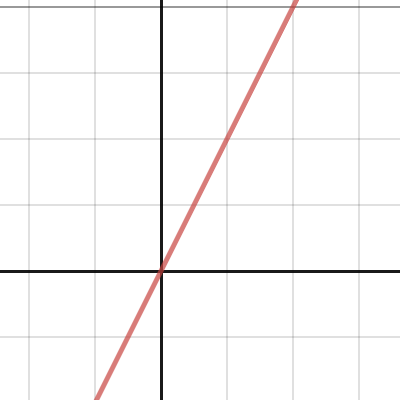
Desmos
and you're given the points (10, 20) and (5, 10)
when you use the difference quotient 20 - 10 = h
you can pick an x value from one of the given points
let's say 10
and we can plug everything into the difference formula: $\frac{f(x+h)-f(x)}{h}$
obsidian monolithBOT
Modular Code
clever pecan
so it should be: $\frac{f(10 + 10)-f(10)}{10}$
obsidian monolithBOT
Modular Code
clever pecan
which is f(20) - f(10) over 10
f(20) = 40, and f(10) = 20
40 - 20 = 20
and 20/10 = 2
so the slope is 2
you must've learned (f(b)-f(a))/(b - a)
that's way easier than this process in order to compute the slope of a function
it also works for derivatives
$\lim_{x\to a}\frac{f(x)-f(a)}{x-a} = f'(a)$
obsidian monolithBOT
Modular Code
clever pecan
I replaced b with x
it's just this is for given points
let me give you an image
scarlet saffron
Thank you for showing me. I appreciate it.
clever pecan
np
shadow zodiac
clever pecan
f(a) = 2a/(a - 5)
Was this in response to mine? How did you get to this answer?
clever pecan
@shadow zodiac I was replying to wookienipple
proper pilot
is there any excellent books that would help a mindblock like me improve at Pre Calculus?, i'm jealous that one of my school mate is getting 45/45 easily when i'm struggling so hard, I know a book wouldn't make me good ''brrrttt u r smart now'', I know it takes a lot of dedication, time and patience
is there any materials like book, youtube channel to follow to improve at Pre Calculus?
materials that can help even a mindblock like me
because my teacher is not helping me, and I'm going so down right now, I'm passing simply by having a formulae next to me, it makes me feel guilty. if something helped you improved with a book, I'd thank you forever
 steel venture
proper pilot
because my teacher is not helping me, and I'm going so down right now, I'm passi...
steel venture
proper pilot
because my teacher is not helping me, and I'm going so down right now, I'm passi...
what exactly is holding you back though?
you can always look up yt videos on topics you don't completely get
proper pilot
if I know myself very well, it's because im blindly memorizing stuffs, I really don't know what am I doing, I'm just passing like a piece of shit
steel venture
there's also khan academy, and organic chemistry tutor is a great resource on yt
proper pilot
YT videos just makes me memorize it, I really don't understand
it's like, I know what 1+1 cause I memorized it but if I get asked what is 1+2 I would get frozen
cause I don't know what to do
steel venture
well i wouldn't blame it on a mind block then, because your classmate clearly is also memorizing and doing just fine
unless you are being taught different things
proper pilot
yeah, it's not im failing, i'm just passing and writing stuffs that I don't know what the fuck im writing
steel venture
then it's probably best to ask questions, or google "why does the quadratic formula work"
proper pilot
is there any materials that will break me down these stuffs
proper pilot
steel venture
then it's probably best to ask questions, or google "why does the quadratic form...
the problem is that I really don't get a relliable answer
I do that all the time
steel venture
proper pilot
for example in getting coterminal angles, our test today is to get the coterminal angles of stuffs
but what I was taught is that there are infinitely
many
coterminal angle
so I got really confused
steel venture
yes
proper pilot
and I had to resort into googling stuffs
steel venture
why wouldn't there be infinitely many coterminal angles?
proper pilot
yeah, I know there are infinitely many, I understand that, next is like soh cah toa, I don't know how it is useful
I know how I apply stuffs
like
I know sin is opp/hyp
etc etc
but I really don't know
it's hard to explain XD
Imma study at Khanacademy again
steel venture
well i can explain to you sohcahtoa if you'd like, the issue is that you probably haven't gone far enough to truly prove it
or understand a proof of it
proper pilot
I got jealous of this guy who got 45/45 in a test, while i'm struggling af he is just swiftly doing stuffs
steel venture
well he is memorizing just like you, so the memorization doesn't seem like the issue
proper pilot
steel venture
well i can explain to you sohcahtoa if you'd like, the issue is that you probabl...
yeah, is there any materials that goes in detail, and explains what is and what does it do in simple words
my teacher is stating big words in English
and English is not my first language
steel venture
then ask what they mean, it can only help
if not they'll never know you don't understand
and just mindlessly move on
proper pilot
I do ask, but I have a feeling that i'm holding back
everything
do you have any
book suggestions
or any authors
steel venture
no
proper pilot
oh that's unfortunate then
steel venture
im sure you could find some but it would seem as if these more basic topics would have less literature written on them
do you have a textbook by any chance?
to go along with your class?
proper pilot
the funny thing is that we don't, they print out modules by Math Teachers in our country
then
my Teacher is telling us to ''don't trust this''
and the modules are incomplete, they are only there for activities
hence I want a textbook to follow on
steel venture
i don't recall much about my prealgebra textbook, i mostly remember lectures more than readings, so i can't comment much on it
but you could just find textbooks online and read reviews on them
see their contents
see if they are just formulas or explanations as well
and figure out something from there
proper pilot
yeah, my plan is to follow a textbook and a youtuber/lecturer at the same time
If I don't improve my understanding with maths then i'm switching to other course
steel venture
i honestly find that asking here is your best bet. its free and answers are relatively quick
plus you can ask follow up questions if something is confusing
but a textbook is a great solution too
proper pilot
oh yeah, I've asked questions here before and I got big help
all this time I didnt know sqrt of x^2 is just absolute value
so yeah, I wish I can improve my mathematics
I love maths
steel venture
proper pilot
all this time I didnt know sqrt of x^2 is just absolute value
what do you mean
proper pilot
I was told that sqrt of x^2 = |x|
is it true
I haven't got a chance to ask anyone
steel venture
in a sense it could be
proper pilot
but I was told its like that
proper pilot
yeah
obsidian monolithBOT
maximo
steel venture
which could be $x, -x$
proper pilot
yeah, that made a lot of sense
obsidian monolithBOT
maximo
proper pilot
I bet the guy who got 45/45 is not listening to our lecturer at all
I could be wrong
but I could also be right
it's not that I want to get 45/45 too so I can flex
I want to understand mathematics because i'm going to take a course that is going to be related on maths
so yeah
thanks for replying
steel venture
then don't bother with the score
proper pilot
if anyone can suggest a textbook, youtube channel or some website for precalculus, pls pls @ me
steel venture
you're putting too much focus on that 45, when the content seems more important
proper pilot
my mindset is that if I don't score 45 then I didnt understand it
steel venture
that's a poor mindset
if you make a silly mistake and no longer get a 45, does it mean you didn't understand the content?
proper pilot
I want to understand the contents
steel venture
and if you get a 45 by just memorizing, is it really understanding?
a score is a score, don't confuse it for intelligence
proper pilot
yeah, thats why I'm here asking, I don't want to score on something that I just memorized
I want to understand it
because if I don't I would fail in Basic Calculus
and also, I like maths so I want to understand it
steel venture
and that's great, but lose the interest in the 45. good grades are important, but they're not the determining factor between understanding and not understanding
proper pilot
thanks for the enlightenment I will keep that in mind
i'd try to re-follow Khan Academy again
pliant locust
Actually nvm, this just served to confuse you more
 somber yew
@lilac storm What have you thought so far?
 lilac storm
so i am confused, so i know that it is approaching 5 from the negative
and it =3
so that curve stops at 3 and then starts at x=2
i think it is false
if we are talking like about the function at x=2 to x=5, then it looks true
so i am confused
so how do you figure out this question?
by reading this, to me it looks like it is true but I am not a 100% sure.
are you there?
are you there?
can anyone please help me out.
 stable yacht
I’m not really sure where to go from here, or if my work up to this point is even correct.
sick steppe
stable yacht
I’m not really sure where to go from here, or if my work up to this point is eve...
only issue is the conjugate in the denominator turned into a minus instead of the plus you originally had
stable yacht
Oh, that explain a lot. I just made a random sign change for no reason. Thanks for catching that!
somber yew
Oops, sorry for leaving on a cliffhanger back then.
lilac storm
yeah, no worries.
somber yew
You see, as you get closer and closer to 5 from the left, the value of the function does remain 3 consistently. What does this tell you about the left hanf limit of f(x) at x=5?
lilac storm
that as x approaches 5 from the negative, f(x)=3
lilac storm
but when it goes down and you can see the point (2,2), there is a break so this part confuses me?
somber yew
What happens at near x=2 is not relevant for the behaviour of the function near x=5.
lilac storm
and what about the hole in between the line (2,3) and (5,3)
somber yew
Again, not relevant.
somber yew
When talking about limits, you would like to see that the points in the immediate neighbourhood are approaching a certain value.
Yes.
The basic idea is this: as you get closer to the point, the function values should get closer to the limit, if it exists.
somber yew
No worries; goodluck!
lilac storm
can anyone help me with this question.
so i know and i was able to do the first and last step for which the answers are, so the answer for the first step that i got is
and the answer for the last step i got is
can anyone please help me with step 2 and 3
anyone there that can help me.
lilac storm
is anyone there to help?
viscid thistle
Can't u just send 1 picture containing everything @lilac storm
 lilac storm
so i take the derivative of what?
lilac storm
yeah so that is just -3
lilac storm
so is it f(x) = -3(x+6)-(-3)
lilac storm
yes, i know that, what i need help in is writing step, how would you write step 2, i know that the slope is -3 as i have already mentioned above in my answer.
viscid thistle
Dunno differentialquotient was long times ago
lilac storm
sorry, what do you mean?
viscid thistle
lilac storm
That's differential quotient without the limit
lilac storm
yeah, i still don't understand what you mean.
 faint sun
can someone help out with this problem: $\sqrt[i]{1 \frac{1}{2}} \cdot i \sqrt{\frac{4}{3}}$
obsidian monolithBOT
Yolobro117
obsidian monolithBOT
maximo
steel venture
and $\ln{a\cdot b} = \ln{a} + \ln{b}$
obsidian monolithBOT
maximo
 calm frigate
Alright honestly no idea what im doing wrong with this, so A Ferris wheel is 10 meters in diameter and boarded from a platform that is 3 meters above the ground. The six o'clock position on the Ferris wheel is level with the loading platform. The wheel completes 1 full revolution in 6 minutes. How many minutes of the ride are spent higher than 12 meters above the ground?
This is a homework question and a failed attempted one so its a good example
I get that you need both T values but I subtract them from each other its a few points off from the actual answer
 bright grail
im confused on what to do beyond this point
do i log both sides? natural log?
this is what i have in mind
bright grail
yes
im p sure i did everything right
im just unsure about taking the log of both sides
viscid thistle
Then what you did is totally correct
bright grail
how about this
its asking for the domain
and im unsure if i did this one correct
i found what e^x is
but i got ln(-3) which i think is not possible
and ln(1) which is 0
meaning x = 0
so would the domain be 0, infinite
viscid thistle
yes, that's correct. Preferribly (0,+∞)
Though unsure of what you did
To find the domain of f, you can notice that the argument of the log must be >0, ie solving the inequality: argument>0, but you somehow reach that without being clear on what you are doing
pliant locust
He recognized the input as a polynomial, factorized the polynomial and solved x for polynomial =0
bright grail
i mightve not written it properly x)
viscid thistle
I know what they did. I suggested writing it explicitely.
bright grail
i did a similar question
pretty sure this is correct
it said to solve for x though
5^x = 5
x = 1
5^x = 1/2
ln both sides i think
x = ln(1/2)
viscid thistle
5^x=1/2's solution isn't correct
viscid thistle
bright grail
ln both sides i think
e isn't the base on the left hand side, so you can't just "cancel" the e's with the ln as you did with the previous one
ie saying ln(5)=1 is incorrect, which looks like it is what you showed
viscid thistle
you'd get $x\ln(5)=\ln\left(\frac12\right)$, you can just finish by dividing both sides by $\ln(5)$
obsidian monolithBOT
Al𝟛dium
viscid thistle
You can as well yeah
Alternatively, you can also log with base 5 on both sides, and use the fact that log_5(5)=1 to then get x=log_5(1/2)
bright grail
i like that
sorry for all these questions homie
i rly appreciate it 🙏
im rly stuck here
viscid thistle
Note that when you divide both sides by -5 you want already to indicate the flip of the inequality sign
Now in order to solve $\log_{\color{blue}{2}}(x)<-\frac95$, you can consider what do you do when you are solving for $x$ on an example like: $\log_3(x)=4$. Though you'll have to consider something else as we are solving an inequality.
obsidian monolithBOT
Al𝟛dium
viscid thistle
Sure
Consider: ${\color{blue}{a}}^{\log_{\color{blue}{a}}( {\color{green}{x}} )}={\color{green}{x}}$
obsidian monolithBOT
Al𝟛dium
viscid thistle
obsidian monolith
**Al𝟛dium**
excluding values where log_a(x) is undefined
viscid thistle
bright grail
so raise it by 2
correct
But you have to consider something else as we are in an inequality and not in an eqn.
viscid thistle
There's something subtle to consider
You can if you think about it.
When do we have to flip the sign of an inequality? ie in which cases do we have to?
viscid thistle
Alright. Now we can be sure to apply this, as for $a>1$, \$\log_a(x)>b\implies x>a^b$ is true. Due to the behaviour of the log/exponential graph. And as our $a$ is indeed greater than 1, we can safely do: $$\log_2(x)<-\frac95$$ $$x<2^{-\frac95}$$
obsidian monolithBOT
Al𝟛dium
viscid thistle
bright grail
but how does that differ from an equality
Because we have to take into consideration the behaviour of log/exp functions, while in an eqn you can just simply not worry about flipping the sign. And also consider later where log(x) is undefined, etc.
bright grail
makes sense
here its log4(x) < 3/2
so im guessing u cant just simply raise it here? 🤔
viscid thistle
Did you just dropped the absolute sign bars?
bright grail
yeah i was planning on doing < 1
and then > -1
because i remember that being possible
viscid thistle
Oh okay
Okay, be careful, from line 3 to 4, log(a-b)≠log(a)-log(b)
But instead, log(a/b)=log(a)-log(b)
bright grail
😓 i knew i did that wrong
i had a feeling loool
im so used to sigma notation or whatever
viscid thistle
Don't worry
Surely you can apply what you know from previous exercises at the line log_4(x²-4)<2, same way you did before
This time you just have x²-4 instead of x, which you'll take care of later
bright grail
wait so u can just raise it to the 4 here
viscid thistle
correct, and consider again what i said about the behaviour, as 4>1, you can safely apply it here
bright grail
makes sense 😄
viscid thistle
After doing so you get a simpler inequality to solve, i'm afraid i have to be afk rn, so good luck with the rest.
 fathom root
Hey for a right triangle, does the hypotenuse side stay the same for all 3 angles but the adjacent and opposite sides vary for each of the 3 angles?
 weak needle
fathom root
Hey for a right triangle, does the hypotenuse side stay the same for all 3 angle...
weak needle
fathom root
Hey for a right triangle, does the hypotenuse side stay the same for all 3 angle...
This is more suited for #geometry-and-trigonometry
viscid thistle
Need recommendation for a video to learn how to draw polar equations
 neon walrus
dark sky
steel venture
neon walrus
dark sky
steel venture
170=c + T - t
130 = T + t - c
if you add both equations up you get that 2T = 300
so the table is 150cm
viscid thistle
 round quest
how would i find the vertical asymptote for y=3cot pi x
sick steppe
3cot(pi*x) = 3/tan(pi*x)
serene heath
are you trying to isolate P_2
 atomic urchin
How would One set this up and solve this?
sick steppe
atomic urchin
How would One set this up and solve this?
write out the proportionality statement, then convert it to an equation w/ the prop. constant
lilac storm
can anyone please help me with step 2 and 3 of this question.
is anyone there to help?
uncut mulch
do the algebra
lilac storm
yes i did it but i don't know why it told me it is the wrong answer again and again
like i got the first step right
can you help me out?
so what i have for step 2 is (-3x-3h+6)-(6-3x)
are you there?
uncut mulch
simplify comepletely
lilac storm
oh i think i got my mistake, thank you for pointing out
i thunk this was the mistake which was messing up my answer
think*
so -3h is the answer for step 2 then what will be the answer for step 3?
oh is it -3h/h
uncut mulch
simplify completely
uncut mulch
how is that relevant?
uncut mulch
start with a circle centred at (0,0)
uncut mulch
identify your quadrant from the given interval
 full pagoda
 crisp citrus
what do you know about those two angles
full pagoda
you seem to be on the right track
you just need to write in the last thing, you factored a six out of six
or are you looking to completely expand it and then factor it?
 restive bone
Ya forget my pencil stuff
I need to get to 6(a-b-1)''
'' means squared
Appearently thats the answer
full pagoda
i've expanded both the answer and the problem 5 times now
i'm 90% sure the answer you're given is incorrect
restive bone
hmmmmm
its possible
thats from the answer key
its been wrong before but rarely
dont worry about it too much ill skip it
i appreciate your help tho 🙂
 strong ermine
crisp citrus
FIND VALUE OF X OR GAY
strong ermine
crisp citrus
FIND VALUE OF X OR GAY

crisp citrus
lol
 zealous cosmos
dark sky
zealous cosmos
dark sky
It's also probably fine to leave it as $$\left(\frac{1}{x-a}\right)^{2}+3$$
obsidian monolithBOT
jolimath
zealous cosmos
dark sky
I personally would try to simplify this more ... into a single fraction bar rather than 3.
dark sky
Ok kewl thx
 limpid rampart
fellas
i been stuck on this for like 20 minutes
$|x+1| -|x|+3|x-1|-2|x-2| =x+2$
obsidian monolithBOT
Someone
uncut mulch
identify the x values where the insides or your abs vals are 0
and consider what happens before, between and after those values
limpid rampart
thanks 😄
sick steppe
 faint nest
when is x/(x-16) not defined?
sick steppe
which one?
faint nest
16 i think
 sick steppe
draw it I guess?
 opal cosmos
why is (1,b) point of exponential graph only one above the horizontal asymptote (when there is no stretch or compression)?
sick steppe
opal cosmos
why is (1,b) point of exponential graph only one above the horizontal asymptote ...
your question makes no sense
since the y value isnt 1...?
opal cosmos
in exponential isnt base to power of x just equal to b so thats y value tho
sick steppe
yes, but what do you mean by "only 1 above the horizontal asymptote" when b=1 means b^x is just y=1
opal cosmos
like the point (1,b) that is transformed after applying all the transformations
sick steppe
You said no transformations
opal cosmos
my teacher told me that that point will usually be one above HA when there is no stretch/compression
sick steppe
Can you, maybe, crazy idea, post the explicit question instead of quoting
opal cosmos
if there is stretch or comp it will be more than one above HA or something but idk the reason
she gave us this graph and wanted to write what the function would b
sick steppe
yeah, so what f(x) did you get?
opal cosmos
1/5^x-1 -4 I think
i didnt get it right the first time so i had to go ask her
x-1 is the exponent of 1/5 btw and -4 was just vertical shift
my bad i meant x+1 as exponent
 hidden willow
this is on my pre calc warm up
the circular blade on a saw rotates at 4200 revolution in a minute
whats its angular speed
 reef spade
how do I find out if the function is Surjective and Injective?
pliant locust
reef spade
how do I find out if the function is Surjective and Injective?
Let a != b (not equal b)
If you find a solution to equation
f(a)=f(b) then it means the function isn’t injective and thus not bijective. When it comes to surjectivity I know only how to prove surjectivity when the codomain is the functions range. So if you know how to prove that the range of the function is R then you know.
I have two ways of proving bijection on its own range. Either prove it is strictly increasing or decreasing or just solve f(a)=f(b) (a != b).
A general approach:
Let upper function of the piecewise function be called g(x) and the lower called p(x).
You can start with showing that the upper g(x) is bijective on its own range either by proving it is strictly increasing for x>2 or showing that g(a) =/= g(b) when a > b (implies a =/= b). Then do the same for p(x). Now the last step is to show that p(x1) does never equal g(x2) in other words
f(x1) =/f(x2) where x1 =/=x2.
This is just proving that it is bijective when the codomain is its own range. The function isn’t injective btw.
You can also instead of just solving inequalities use derivatives and knowledge of polynomials but I dunno exactly what they expect of you.
 halcyon granite
would the limit as x approaches one just be 4?
sick steppe
halcyon granite
would the limit as x approaches one just be 4?
graph it and find out
halcyon granite
i did, its a horizontal line
so can a horizontal line have a limit
id say no, but calc has proven me wrong a few times already
 ornate lintel
guys whats intergration?
 lilac pier
@halcyon granite yes the limit is 4
halcyon granite
@lilac pier can you explain why its 4? i feel it should just not exist
lilac pier
limit doesn't exist when left hand limit and right hand limits aren't equal
lilac pier
g(x) is always 4 no matter what x is(except x can't be 1), so when u approach x from the left and the right
g(x) is 4
so the left hand and right hand limits are same
halcyon granite
so they dont need to be approaching 4, if they are equal to four, then that can be seen as a limit too?
lilac pier
yeah
halcyon granite
@lilac pier one last thing, for a limit to exist, the function must approach a finite value, the limits must be equal on both sides, x must approach a from both sides but what else? I have those 3 on my notes but the practice sheet i got asks for 4
lilac pier
maybe the 4th one is the requirement for continuity?
halcyon granite
doesnt continuity also require all that i just said?
lilac pier
yes but one more condition that the value of the function at a point and limits at that point must be equal
halcyon granite
but you can have a hole and there still be a limit right?
so how can continuity be mandatory for there to be a limit
lilac pier
we can have a hole and the limit can exist, but for continuity, the hole shouldnt be there
halcyon granite
ok well then that means that continuity is not necessary for there to be a limit correct?
lilac pier
Yes
halcyon granite
i need a last reason why there cant be a limit
halcyon granite
i agree
but i need something that is never true if that condition is met
like there can be no limit if the function has this
reef spade
@pliant locust thanks
halcyon granite
so why does sin(1/x) not have a limit as x approaches 0
sick steppe
$\lim_{x \to 0} \sin{x^{-1}} = \sin{\left(\lim_{x \to 0} x^{-1}\right)}$ since sine is continuous
obsidian monolithBOT
moshill1
sick steppe
which is equivalent to $\lim_{a \to \infty} \sin{a}$
obsidian monolithBOT
moshill1
halcyon granite
how does it being continuous mean it doesnt have a limit? y=x is continuous and has a limit as x approaches 0 am i wrong?
lilac pier
when did he say that
sick steppe
"since sine is continuous" was for why I could bring the limit inside the sin
halcyon granite
huh
pliant locust
reef spade
<@!778846013829152781> thanks
Just one counter example is enough to show it isn’t injective like
f(-2+p) = f(-2-p) for -4 <p<2
lilac pier
@halcyon granite What moshill is saying that because the sin function is continuous, we can say that lim x--> 0 sin(1/x) = sin[ lim x---> 0 (1/x)]
sick steppe
That, and the limit of sinx as x goes to infinity is undefined. Since as x gets bigger and bigger, sinx continues to just oscillate on [-1,1]
halcyon granite
so in a function with infinite oscillations, there is no limit?
sick steppe
yes, if the value keeps changing and doesnt approach a value, it's undefined
halcyon granite
ok thank you
uncut mulch
show work
uncut mulch
by cancelling the (1-cos(theta)) like that, you're missing soluions
uncut mulch
you're dividing both sides by something that could potentially be 0
hence losing the solutions from (1-cos(theta))=0
using a simpler case:
x = x^2
x = 0 is a trivial solution to that
but if you divided both sides by x,
→ 1 = x
that information is lost
instead you should consider factorisation
 robust nest
ahhh
so instead what identity should I begin with
you said to use factorization correct
uncut mulch
the first step was alright
just rearrange to stuff = 0
and factorise
robust nest
ok so starting from the second step of the pic I sent
subtract 1 and add cos
right?
uncut mulch
from both sides, yes
 vale eagle
nice precalc
 wanton wedge
Hi ummm I was wondering if could get some help, I’m not quite sure on how to do this
 mighty fiber
Instead of using a matrix, why not just do elimination and get rid of c then b?
are u required to use a matrix?
proper pilot
What should I always remember when dealing with sin, cos, tan graphs?
and transformation graphs
proper pilot
like, the properties and how to determine transformation of graph
like, I'm given points, and I need to determine what is the value of theta (like sec theta and other stuffs)
what should be my guide
thanks
viscid thistle
your question is worded very vaguely, and it is still not clear at all what you're asking. May i ask you to either reword it or give an example of those type of exercises?
proper pilot
I was given a point earlier, and I need to determine what are the values of the six trigo functions, i'm sorry I really don't get the topic myself
our topic is about graphing sin,cosine and tan
oh nevermind, I think I get it now, but thanks for replying
I just realized that I can just do the soh, cah, toa formulas to determine what I need to find, so yeah
the graph have formulas which I found in Brian McLogan youtube, in case anyone is wondering
have a nice day people
sick steppe
ok then..?
 hearty bronze
can someone help with this question?
sick steppe
hearty bronze
can someone help with this question?
plug in the given point and solve for a
hearty bronze
so if i use desmos
i would set a equal to the options listed
?
and if f(pi/4) = -4
what would the amplitude be
sick steppe
hearty bronze
and if f(pi/4) = -4
plug that in and isolate for a
$-4 = a \cos{\left(2(\frac{\pi}{4})-\frac{\pi}{6}\right)} + 6$
obsidian monolithBOT
moshill1
 lunar mirage
Oh sorry lol I'm just not sure if it's i (- infinity, 0) and for decreasing (0,- infinity)
I just don't know of its increasing or just decreasing
sick steppe
decreasing = tangent w/ negative slope
lunar mirage
Oh okay, does that apply with that graph?
sick steppe
lunar mirage
Oh okay, does that apply with that graph?
well is the tangent slope every positive..?
lunar mirage
No?
lunar mirage
Ooh okay I see
 pine kindle
would anyone mind helping me with some exponents rq?
 astral mantle

pine kindle
i understand for the equation you're going to have to convert the negative exponent into a fraction
do you apply the exponent outside the parentheses after that?
pine kindle
when applying the exponent outside the parentheses does it go to both the top and bottom then?
so, i'd get 12w^4/z^4?
astral mantle
yes
Its just 6w^2/z^2 * 6w^2/z^2
you just multiply across, adding the exponents
it would be 36w^4/z^4 though
astral mantle
its ok
pine kindle
alright, it looks like it makes sense now
i'll be back w more in a bit
thanks haha
if the negative exponent came first, does the same rule apply?
whereas if i had an (8m^-5 n^4)
would it end up as (n^4/8m^5)?
astral mantle
the 8 doesnt go to the denominator
it would be 8n^4/m^5
but yeah order does not matter
multiplication is commutative
 hazy furnace
https://gyazo.com/2994e805c065450c0efd509849aab721 wouldnt this be horizontal shrink by 4 but that isnt an option

horizontal compress is probably the right answer but a horizontal compress of 1/4 would actually be a stretch by 4
like the second and last answer choice are the same thing
round quest
how do i find this graphs equation
zealous cosmos
It's ... a secant ... for starters
sick steppe
why.... the dots...
 dusky thunder
zealous cosmos
It's ... a secant ... for starters
dusky thunder
zealous cosmos
It's ... a secant ... for starters
yup
zealous cosmos
sick steppe
why.... the dots...
Because they're not part of the graph. They're just guiding information.
I would say it's sec(x) + 1. Final answer.
sick steppe
I meant in your typing
 dull ginkgo
lilac pier
dull ginkgo
lilac pier
you should show the full question
zealous cosmos
sick steppe
I meant in your typing
I don't know, actually ...
I want people to hear the pauses in my voice when I physically pause to think about something.
Sometimes I use it it indicate that I'm not finished with a sentence.
And sometimes I use it to make a statement that expects a response ... even if the statement is not a question.
 unique cypress
hi
viscid thistle
roughly worded, but yeah seems like so.
i mean all i've guessed you've told me is that f(x)=cos(x), then a new function g is transformed by those characteristics you've said, so uh yeah, i would definitely specify the new function g defined as g(x)=2cos(x)+1
viscid thistle
"A rectangle has a length of 12 inches and a width of 9 inches. Squares of length 3x by 3x are cut out of each corner, and then the sides are folded up to create an open box. Express the volume of the box as a polynomial function in terms of x. "
Is this solvable?
I think my teacher may have messed up
 small tree
how to write this in radical form: -5x^3/5 y^3/5
clever pecan
$\sqrt[b]{x^a} = x^{\frac{a}{b}}$
obsidian monolithBOT
Modular Code
clever pecan
so you want to write $-5x^{\frac{3}{5}} y^{\frac{3}{5}}$ into radical form right?
obsidian monolithBOT
Modular Code
viscid thistle
Lol
viscid thistle
lol
lilac storm
so i have factored the eqs and i am getting (x+3)(x-1)/(x-2)(x+1)
so i can't cancel anything so what do i do?
can anyone help?
uncut mulch
your factorisation is incorrect
 elder charm
the numerator turns to zero when x=2, so clearly it must have (x-2) in its factorization
lilac storm
i checked multiple times but i can't see any mistake in my factorization?
uncut mulch
how are you checking?
uncut mulch
can you show your work/how you're doing it for the numerator?
lilac storm
yes of course
so for x^2-3x+2, the sum is -3 and product is 2 so the numbers are 3 and -1 so the factors are (x+3)(x-1) on the top
yeah i found my mistake, it was a really huge silly mistake that i was making, thanks a lot for your time and help.
lilac storm
so i have started off this question by multiplying the top and bottom by the conjugate which is (sqrt of x+5 + 3)
so on the top i have (x+5)-(3) but i am confused on the bottom on how to multiply it out
so in the denominator you have (x-4) multiplied by (sqrt of x+5 with a 3 added to it)
so how would you multiply that out?
so would you have like (x times sqrt of x+5) - 12
anyone there to help?
anyone there to help?
sick steppe
dont foil
sick steppe
lilac storm
so on the top i have (x+5)-(3) but i am confused on the bottom on how to multipl...
you didnt expand the difference of squares correctly
lilac storm
it doesn't work with foil.
viscid thistle
Wot
sick steppe
$(\sqrt{x+5} -3)(\sqrt{x+5}+3) \neq x+5 - 3$
obsidian monolithBOT
moshill1
viscid thistle
Oh ye ig you dont foil 

lilac storm
sorry is it (x+5) - 9
viscid thistle
Mhmm
sick steppe
yes, which simplifies to?
lilac storm
but what about the denomiantor, that is what is confusing?
sick steppe
sick steppe
yes, which simplifies to?
answer this
sick steppe
right, so you have $\frac{x-4}{(x-4)(\sqrt{x+5}+3)}$
obsidian monolithBOT
moshill1
sick steppe
yes
lilac storm
that makes much more sense
sick steppe
that's the reason you rationalize the numerator in the first place.. since the x-4 in the denom is the problem
lilac storm
right.
sick steppe
(And usually if the answer is rationalize it'll work out)
lilac storm
okay.
 crystal osprey
How are you supposed to make regression models without technology...
 full breach
Scalar product
Given there are two unknown vectors a and b where |a| = 2 and |b| = 3.
The angle between the vectors is 60°.
How can I find out if two vectors u and v are perpendicular when
u = 7a - 12b and v = a + b?
sick steppe
full breach
**Scalar product**
Given there are two unknown vectors `a` and `b` where `|a| = ...
u . v = (7a-12b).(a+b), then expand the dot product
full breach
sick steppe
u . v = (7a-12b).(a+b), then expand the dot product
And just see if the product equals to 0?
Where does the angle information come handy in all of this?
sick steppe
to find out the value of a.b
since you'll have a a.a term, a.b term, and b.b term
so you need a.b =
sick steppe
well the dot product is just a way to multiply cartesian vectors
lilac storm
is it [1,3) U (3, infinity)
sick steppe
$\vec{a} \cdot \vec{b} \in \mathbb{R}$
obsidian monolithBOT
moshill1
full breach
We're just learning about finding the dot product of a single vector, but I've yet to understand what it's used for
sick steppe
you cant find the dot of a single vector
viscid thistle
@lilac storm yes that seems fine, but next time avoid posting questions on a channel that is occupied. Read #❓how-to-get-help
lilac storm
ok, sorry and can you explain why do we not include -4 since that is also a factor?
sick steppe
full breach
We're just learning about finding the dot product of a single vector, but I've y...
I mean.. it's a way of multiplying vectors, but in physics dot product is usually associated with Work
 sleek socket
Hey I need help
pliant locust
full breach
We're just learning about finding the dot product of a single vector, but I've y...
The dot product is a function that Maps a pair of vectors to a real valued number.
A vector that is its own argument( input = (v,v) ) in the dot product function grants you the squared length of the vector .
In other words, let v be a vector:
v dot v = |v|^2 it grants you the squared length of the vector in R^n, a dot product in euclidean space grants you the length aswell.
Its use is pretty neat because with it you can find the orthogonal projections of vectors which is useful in finding orthonormal bases in at least euclidean vector spaces. You can use it to determine wether two vectors are orthogonal aswell etc etc.
viscid thistle
pliant locust
The dot product is a function that Maps a pair of vectors to a real valued numbe...
I have a question regarding that. Why didn't you include the case when if we multiply 2 different vectors we get uv^T which is also as a vector that we got though the dot product
I know that you will say it is given like that by definition but in fact, why can't we just store the xy x1y1 .... in a matrix?
pliant locust
viscid thistle
I have a question regarding that. Why didn't you include the case when if we mul...
I am not really sure what you are asking. I am still doing linear algebra. Yes, if u and v are given in orthonormal bases then the dot product can be written as the matrix mutliplication u^T*v.
I dont see why you wouldnt be able to just store it in a matrix but why? It is just a matrix with one element, it can lead to confusion since every row represents a linear combination, your coefficients are still there.
Maybe you are asking why a distinction is made between the dot product and a matrix multiplication of the form 1xn * nx1. Well one reason I can think of right now is that the dot product isn’t the matrix multiplication if the coordinates aren’t given using ON-basis. The dot product is the matrix multiplcation if and only if the basis is orthonormal.
proper pilot
Yo, How do I determine the amplitude, period, phase shift at y = cos x, maximum value, minimum value and zeroes?, in questions like involving graphing the sin, cosine and tan
viscid thistle
pliant locust
I am not really sure what you are asking. I am still doing linear algebra. Yes, ...
I see and yeah, that is what I was trying to understand and that is why I was confused, by the way. Matrix multiplication sometimes is also called a "dot product" because you get a scalar value from multiplying rows and columns. So in some way, it is a sequence of dot products. Sorry, I thought that 1xn and nx1 multiplication can be interpreted as a one iteration operation which made things confusing when I thought of the dot product that ouputs scalar
pliant locust
viscid thistle
I see and yeah, that is what I was trying to understand and that is why I was co...
The standard dot product in R^n is like that since well you are always assumed to be in ON-basis. You can also redefine the scalar product on a vector space such that it fulfills certain conditions, if it fulfills them they are then called euclidean vector spaces.
 fresh ledge
mathamatics
 potent creek
hey guys. How would I go about this? From my understanding, I need to have 2 cases for if n is initially + or -, right? The - part is easy as all terms become postive but when its instially positive idk what to do. Calculating in my head ik that if n <= 4 the 5 saves the day but how would I prove that. Thanks
pliant locust
 vague stump
pliant locust
potent creek
hey guys. How would I go about this? From my understanding, I need to have 2 cas...
vague stump
pliant locust
potent creek
hey guys. How would I go about this? From my understanding, I need to have 2 cas...
You have the right approach
Determine for what n 4n > n^2
potent creek
div both sides by n so just 4 > n?
pliant locust
Yes and now determine if n^2 -4n is less than 5 when n< 4
potent creek
ok thanks for the help. We just started learning about numerical proofs so are we allowed to like write words in order to explain? Lol if that sounds dumb
pliant locust
potent creek
ok thanks for the help. We just started learning about numerical proofs so are w...
It is ok, I am not really the guy to ask about formality of proofs
uncut mulch
completing the square would be the most efficient
pliant locust
Yup
potent creek
Ok thanks for all the help mateys
uncut mulch
are you supposed to do induction or allowed to do anything you want
potent creek
wait doesnt any int include the negative ones?
potent creek
np. As for the methodology, it doesnt really say
uncut mulch
then yeh, complete the square / vertex form
potent creek
ok so @uncut mulch if I just complete the sqaure from the start then it doesnt matter if I do a - or + test case cuz it always get squared to a + number, right?
for refrence it becomes (x-2)^2 + 1
pliant locust
Yup
potent creek
Thansk @uncut mulch and @pliant locust
 rugged wigeon
hello! i was wondering why x^2 becomes (limx)^2 and also why does 9 become lim9? What property did they use?
viscid thistle
properties of limits