#geometry-and-trigonometry
1 messages · Page 377 of 1
 fresh sky
 tawdry juniper
How about if you mirror in this way?
 fresh sky
tawdry juniper
How about if you mirror in this way?
fresh sky
tawdry juniper
How about if you mirror in this way?
I kinda mirrored it like that
but reversed
 whole minnow


 hushed arch
@grizzled current for which question?
Ill help you through radians cause degrees is kinda messy and you can always convert to degree if you so choose
- Is just asking you to take 2 3 root 5 and just substitute into basic trig formulas.
- Is just asking for the degrees. In radians that is pi/4 and 3pi/4.
- tan is converted into sin/cos and sec is just 1/cos. You can just solve from there
 grizzled current
i got all them eventually but thanks for the help @hushed arch
 spark flint
Sorry not sure how to google this question, how do I convert a normalized vector to a 360 degree rotation?
wait no that shows up on google let me try
sorry confusing stuff
oh I think I got it

 dark sparrow
if you knew all three sides in a triangle would you be able to find its angles?
 steady flame
dark sparrow
if you knew all three sides in a triangle would you be able to find its angles?
steady flame
dark sparrow
if you knew all three sides in a triangle would you be able to find its angles?
nope, tbh not sure what you mean
if using SOH CAH TOA then yes
dark sparrow
i was going to point out that the missing side in triangle ABC, i.e. BC, is equal to the radius of the sphere (5)
and then would have suggested that you use the law of cosines
 upper karma
anyone can help me? idk the answer for number 3 4 and 5
 dark sparrow
@upper karma this is not geometry. your question is better suited for #probability-statistics.
upper karma
ook ty
steady flame
dark sparrow
and then would have suggested that you use the law of cosines
but dont I need at least one angle to find it
dark sparrow
do you know what the law of cosines is
steady flame
yea, cosines rule right?
steady flame
yea I know that
dark sparrow
or the form more relevant to us right now: cos(A) = (b^2+c^2-a^2)/(2bc)
steady flame
I need at least one angle for it to use it tho
dark sparrow
no
this law relates four elements of the triangle: three sides and one angle
knowing any three of these allows you to recover the fourth
steady flame
wait my bad
dark sparrow
so long as you know which sides relative to the angle go where in the formula
dark sparrow
dark sparrow
or the form more relevant to us right now: cos(A) = (b^2+c^2-a^2)/(2bc)
namely, in the notation i used here,
a is the side opposite to angle A, while b and c are adjacent
steady flame
I got 36.9 degree
dark sparrow
you are asked to get the value in radians, and also i think you may have fucked up the calculation anyway.
steady flame
then I try to change it to radians which is by multiplying (pi/180)
dark sparrow
show how you calculated 36.9 degrees.
 dark sparrow
so where did you get 36.9 from
steady flame
fucked up somewhere, mb
dark sparrow
okay now
steady flame
then multiply by (pi/180) right?
dark sparrow
why not switch your calculator, which you no doubt used to find arccos(-7/25), into radian mode...
dark sparrow
steady flame
then multiply by (pi/180) right?
or that, sure.
steady flame
then I get 1.85 radians or 0.590pi
dark sparrow
1.85 radians there we go
steady flame
but then the answer for it is 33.82 pi
dark sparrow
the answer for what
steady flame
thats where I am confused,
dark sparrow
are you sure you are looking at the right answer key
dark sparrow
can you show me the answer key
 dark sparrow
?!
i mean like
33.82pi is an absurdly big angle
it's 16 full rotations and then some
so this is definitely the textbook's fault
 arctic galleon
How do I find the surface normal of an ellipsoid for ray tracing?
For a sphere of radius r and center c, given a point p of intersection on the sphere, the normal at the point is (p - c) / r. For an ellipsoid with center c and radii r = <a, b, c>, I have calculated the intersection point p, but I think the equation for the normal is not the same as a sphere.
Hmm, or is it?
 neat plank
could someone show me their working and how they form the general solution for when y=3 for example?. I know you use θ = nπ + (−1)nα

 robust crane
is it always true that two arcs in a 2D plane can never have more than one intersecting point (not including if they are identical and thus have infinite intersecting points)
 rich sky
robust crane
is it always true that two arcs in a 2D plane can never have more than one inter...
rich sky
robust crane
is it always true that two arcs in a 2D plane can never have more than one inter...
What are you calling an arc
rich sky
You’re saying that two circles’ perimeters can only intersect at a max of one point?
 robust crane
im trying to find the limit number of intersections i thought it was one but maybe its 2
not including identical arcs of course
rich sky
Yes, it’s always either 1,2, 0, or infinite
When you’re wondering something like that, just start drawing as distinct of examples as you can, and see if you can exhaust all possible cases by inspection
Unless it’s becoming abundantly obvious the number of cases is more than is practical to exhaust
upper karma
If y=mx+b then mx+b=y
 ripe skiff
unit circle

 frozen gate
crochet
ripe skiff
?
 silk charm
frozen gate
crochet
silk charm
frozen gate
crochet
is something the matter?
frozen gate
thing: you can exactly edit π
silk charm
frozen gate
thing: you can exactly edit π
memes go in chill, please don't interrupt here
frozen gate
geometry dash
ripe skiff
no dis is desmos
 silent badger
hey angles fall into the geometry category aswell right?
dark sparrow
yes
 grave pond
Imagine how confusing it must be to the rest of us who have no idea what you're even trying to achieve.
Perhaps if you write a few English sentences describing your problem it will be easier to help.
 visual sluice

 charred maple
height of the 2 structures plesae

 analog otter
Can someone kindly explain what the person did here to arrive at the solution? Thanks :)

 grave pond
I agree with the result, but I don't understand the method they followed either.
 molten sentinel
I'm having some issues around simplifying identities
 grave pond
analog otter
Can someone kindly explain what the person did here to arrive at the solution? T...
grave pond
analog otter
Can someone kindly explain what the person did here to arrive at the solution? T...
I figured it out: The squiggles in the numerators that look like "5" are really "s", and s stands for the area of the blue triangle plus the white one to the left of it.
analog otter
grave pond
I figured it out: The squiggles in the numerators that look like "5" are really ...
but why divide by 7 and 5? what's going on there?
grave pond
molten sentinel
I'm having some issues around simplifying identities
Hmm, perhaps all that's expected here is something like 6y³-6y²-6y+6 = 6(y-1)²(y+1) applied to y = sec(x)?
grave pond
analog otter
but why divide by 7 and 5? what's going on there?
The first two triangles (counted from the left) have the same altitude and split in proportions to their bases 3 and 4, so they must have areas 3s/7 and 4s/7 in order to total s.
Then for the middle white triangle, switch to considering the upper edges as the base: the middle white area is A, we have A:s = 4:5 so A = 4s/5.
Finally we're going back to considering the horizontal sides the bases: (red area):(non-red area) = 5:(3+4), but the total non-red area is 9s/5, so the red must be (9s/5)(5/7) = 9s/7.
molten sentinel
grave pond
Hmm, _perhaps_ all that's expected here is something like 6y³-6y²-6y+6 = 6(y-1)²...
If about this is what you mean there. I watched the video explanation for a similar problem and it gave me an odd answer which I cant seem to follow


Oh wait a sec, I typed it in wrong
What you gave me was very much correct
Thank you!
Is what you did in the vain of cubic identities?
grave pond
That is true too; whether it is more simplified than the all-sec variant is, I think, a matter of temperament and application.
 young crow
In $n$-dimensional space, given a "camera" point located at $C$, an $(n-1)$-dimensional hyperplane $H$ which does not contain $C$, and $P_1, \dots P_n$ the verticies of an $(n-1)$-simplex. Define the depth of a point as its signed distance from $C$ in the direction perpendicular to $H$. In other words, $\mathop{\text{Dist}}(P) = (P - C)\cdot H^\perp$, where $H^\perp$ is the normal to $H$ in the direction such that the depth of any point on $H$ is positive. Assuming each $\mathop{\text{Dist}}(P_i)$ is positive, let $P_i'$ be the point on $H$ to which $P_i$ is projected by $C$, i.e. the intersection of $CP_i$ with $H$. Assuming the $P_i'$ are affinely independent, let $A = \sum \alpha_i P_i'$ be an affine combination of the projected points, and let $A'$ be the intersection of $CA$ with the simplex formed by the $P_i$s. Is it necesarially true that the depth of $A'$ is the weighted harmonic mean of the depth of the original points:
$$
\mathop{\text{Dist}}(A') = \frac{1}{\sum\frac{\alpha_i}{\mathop{\text{Dist}}(P_i)}}
$$
 somber coyoteBOT
TheZachMan
 young crow
(this is a transcription of a post I just put up on mathoverflow https://math.stackexchange.com/questions/4411465/is-this-geometry-formula-true, but I figure someone here might know it)
this feels like something that probably falls out of some other much more general theorem that I don't know
 upbeat helm
This is mainly for high-school geometry, that would either go in #algebraic-geometry or #point-set-topology or #diff-geo-diff-top .
young crow
I know that, but this is neither algebraic geometry nor differential geometry?
I think
I don't know enough about either field
upbeat helm
oh dang. then maybe #linear-algebra ? at the very least its too advanced for this channel
upbeat helm
upper karma
which is not algebraic geometry. Big oof
when words do not commute 
upper karma
I would even suggest #computing-software if you guys discuss computer graphics in there
But you guys don't, so uhm... oof. Either way, that is one very heavy question
 acoustic sedge
Check out my discord, Math Messages, for free math help! 🙂
 north heart
oooh i was unaware this channel existed i had a really neat question one sec lemme type it up
Take the Euclidean plane, and randomly color every point on it either $red$ or $blue$. Is there always every regular polygon such that the vertex points are all monocolor (for every side length $L$)? This is true for the line case (not a polygon but ykwim) trivially: Construct an equilateral triangle with whatever side length you want. By the pigeonhole principle, there is at least one line of such a color. The equilateral triangle case is a bit harder (It needs a specific little construction) but still pretty easy and the square case needs Ramsey Theory(???) although I have no idea how or why. However, the square case, triangle case, and line case are always true for at least one color. Is this true for every other regular polygon? (I feel like it should at least be easily provable for hexagons (with a construction similar to the triangle case) but not exactly sure how to do it tbh)
somber coyoteBOT
valley
 north heart
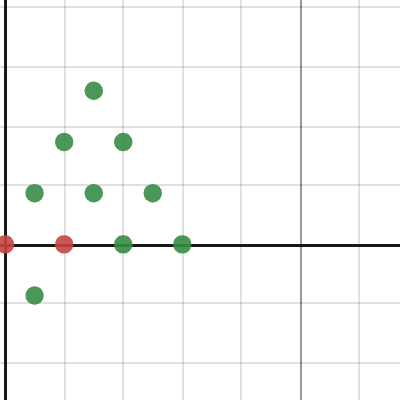
Desmos
i think that should work?
there's the triangle case
(we can assume A and B are red with no loss in generality since there will always be A and B that are red somewhere)
young crow
Is your side length fixed, or do you accept a figure of any side length
Because I can give a coloring and side length such that there are no regular 100-gons of that side length with points of all the same color
grave pond
Good point.
young crow
So that answers the most extreme version of your conjecture, at least
young crow
Well, if we're looking for adversarial colorings
The measure of the points of each color has to be nonzero within each closed ball (if it's measurable), so that's a hint at the kind of colorings to look at, I guess
grave pond
north heart
any side length
This clarification is not quite clear to me. (The semantics of "any" in natural English is confusing when we only have a sentence fragment to go by). Is it:
a) For every coloring, there exists L>0 such that there exists a regular N-gon of side length L that is monochromic. ("An example of any side length is enough").
b) For every coloring and every L>0, there exists a regular N-gon of side length L that is monochromic. ("For any side length there must be an example").
north heart
monochromic in the sense that all the vertices are the same color and a
hmmm maybe i can better write the question
grave pond
I'm not asking what "monochromic" means.
north heart
north heart
monochromic in the sense that all the vertices are the same color and a
probably should've italicized but i picked A
grave pond
Okay.
north heart
yeah that's my bad
grave pond
Now I'm confused again.
north heart
uhhh what're you confused on
grave pond
You seem to be saying A and then B a minute later. So now I still don't know which of those two interpretations you intend.
 north heart
oops lmaooooo "that's my b" means "that's my bad"
i can see how that would be confusing
grave pond
Ah, okay.
In this interpretation I can at least see the argument that there's always a regular triangle of one color...
north heart
the triangle one is actually really pretty
i think i added too many dots
you don't need k, j, h, or f
grave pond
Indeed.
C and D must be blue, so E is red. But then G must be blue too and now we can't color I.
grave pond
Unfortunately this doesn't even begin to generalize to 4-gons.
north heart
yeah, it's a bit of an issue
the only reference i could find for that case uses
uhh
ramsey theory
actually
looking closer into them
they don't exist

Mathematics Stack Exchange
Color every point in the real plane using the colors blue,yellow only. It can be shown that there exists a rectangle that has all vertices with the same color. Is it possible to show that there exi...
here's a math stackexchange post with some things
grave pond
Arguably the whole question itself qualifies as Ramsey theory ...
grave pond
Nah, it has enough of a geometric flavor that it doesn't seem wildly out of place here. But it might have fit in #combinatorial-structures too.
(Mathematics is not as neatly partitioned into fields as the practical organization of the server must, out of necessity, pretend).
north heart
nice
 rare sierra
grave pond
You seem to be saying A and then B a minute later. So now I _still_ don't know w...
rare sierra
grave pond
You seem to be saying A and then B a minute later. So now I _still_ don't know w...
light theme and compressed!!??!
young crow
So for both the square and triangle you can just pick some finite subset of the plane to look at
Is that true for any shape? Or might it be true that e.g. there must be a monochromatic regular pentagon in any coloring of the plane, but any finite subset of the plane can be colored such that there are no monochromatic regular pentagons.
north heart
young crow
So for both the square and triangle you can just pick some finite subset of the ...
i don't think you can do that for the square
young crow
The linked MSE post says you can do it with just finite subsets of the integer lattice?
north heart
hmm
i guess, then? i don't think the techniques used in the linked paper are all that similar to the triangle case but in a certain sense you aren't wrong
grave pond
I suppose tings might start to get funky with regular pentagons because they don't fit into a lattice, contrary to squares and equilateral triangles.
north heart
yeah it looks really annoying
that's why i think hexagons would be easier
i suspect that you can even make a construction for them
although it would probably be a massive pain
dark sparrow
or you could just subtract 2pi without ever having to think about degrees
 warped fjord

 cyan shell
hello
i have a question
are there any notations or methods to represent three dimensional angles?
or am I dreaming?
 wise pawn
there's a concept called solid angles
cyan shell
say if you wanted to move an object in a direction, but that object was three dimensional.
how would you show what direction it's moving in, in angles?
wise pawn
for what you describe though you'd probably want to use 2 angles
dark sparrow
you want to specifically use some sort of angular representation and not anything to do with vectors?
cyan shell
wise pawn
for what you describe though you'd probably want to use 2 angles
which is what i was thinking
xy angle and z angle?
dark sparrow
that's one way to go about it
cyan shell
because, say if you wanted to fire a projectile, and you wanted to simulate gravity on the projectile.
in programming
what I would is have an angle, and subtract/add a value onto that angle, until it nears 270 (facing down), but what if that object was in three dimensions?
wise pawn
if you're simulating physics you wouldn't have to do things that way anyways
cyan shell
My real question is, if you move a 2d dimensional object in a direction of (cos(theta), sin(theta)) you will always be moving it 1 unit away, but how do I come up with a function that will move an angle with a three dimensional angle (so to speak) and move it 1 unit away 3d dimensionally?
wise pawn
there's more than one way to do it, but basically if you just want to specify a unit vector with 2 angles you can use spherical coordinates
wise pawn
I can but I'm busy, maybe someone else can help you
cyan shell
okay. thank you for the info.
rare sierra
who sommon thy
dang it I k now this hold on
ok got it
So the radius is 10
the line segment bisecting the chord is 4
picture the radius is connected to the centre and then touching point E
Lets label the intersection of the bisector as V
So then you can set up an equation using Pythagorean theorem
a^2+b^2=c^2
4^2+b^2=10^2
16+b=100
-16 both sides
b=74
b which is EV = 74.
Since it is a perpendicular bisector then it is fact that both sides are equal meaning, EV x 2 = ES
Therefore, ES = 148
upper karma
rare sierra
So then you can set up an equation using Pythagorean theorem
a^2+b^2=c^2
4^2+b...
100 minus 16 is 84 tho
also
How is it 148?
cause
rare sierra
upper karma
100 minus 16 is 84 tho
ok my brain hurts your right
so then its 84 x 2
168
upper karma
rare sierra
ok my brain hurts your right
Could you help me with this one as well
I feel like I am overthinking it
yea i am
nvm
rare sierra
heres a sample drawing for other one

and yes
alright so that is essentially reverse
We know that AB can be split into 2 equal halves of 4
which means that
lets use c to resemble the intersection
So then you can form another right triangle here
One side is 4, and another is 11
upper karma
And then the hypotenuse is the length?
rare sierra
correct
upper karma
Alright
rare sierra
So you would use pythag again
upper karma
Thank you
rare sierra
no problem
 soft marten
how

 abstract saddle
Make a triangle diagram and input the values to the triangle
 stray spindle
im new to this how would i calculate this?
 upper karma
You should have learned about 30-60-90 triangles and their relative side lengths.
In a 30-60-90 triangle, the small side is half the length of the hypotenuse.
stray spindle
im doing online school with no zoom classes and they said i have to teach my self
upper karma
They should at least provide you with links to learning resources for each section/chapter, no?
stray spindle
nothing
upper karma
Wth
stray spindle
ik
 harsh violet
how do you find the area of the pentagon without using a formula for a pentagon?
if you have one side

5 equilaterals dont equal a pentagon because equilateral triangles have 60 degrees. A pentagon has a combined total of 360 degrees. 5 triangles, 60 degrees each = 300 degrees which dosent equal 360 degrees.
 whole granite
harsh violet
5 equilaterals dont equal a pentagon because equilateral triangles have 60 degre...
whole granite
harsh violet
5 equilaterals dont equal a pentagon because equilateral triangles have 60 degre...
man, sorry if its a dumb hint, I'm really beginner, but can't you complete the 60 missing degrees with another triangle which totalizes 6 equilaterals?
 sleek river
harsh violet
how do you find the area of the pentagon without using a formula for a pentagon?
sleek river
harsh violet
how do you find the area of the pentagon without using a formula for a pentagon?
I would start by thinking about a point that could be the center of the pentagon. It could have line segments extending to each of the angles of the pentagon that are all the same.
That would divide it into five similar, non-equilateral triangles.
If the triangles’ angles the center of the pentagon add up to 360, they should each be 360/5 degrees, right? (the five triangles are also isosceles)
That’s the first steps I would take.
harsh violet
ok and then trig would be inevitable
 harsh violet
whole granite
man, sorry if its a dumb hint, I'm really beginner, but can't you complete the 6...
harsh violet
whole granite
man, sorry if its a dumb hint, I'm really beginner, but can't you complete the 6...
hey dont worry about whether its dumb or not 😀, if we add another triangle there would be 6 sides so a hexagon but yes a hexagon has 360 degrees
 sleek river
is the a^2 outside of the radical?
stray spindle
what formula or instructions on how to solve this for angle J
 sleek river
I’m not familiar with it but I heard there are things called laws of cosines
maybe those would work?
stray spindle
ok thanks
somber coyoteBOT
valley
 north heart
where gamma is the angle opposite c
to solve for a gamma just use some algebra and manipulate the statement
north heart
north heart
for sides it's $c = \sqrt{a^2+b^2-2ab\cos(\gamma)}$
where a and b are the other sides
whole granite
harsh violet
oh, true man, I misunderstood the "pentagon"
stray spindle
im confused what they are asking can someone like dum it down
 sleek river
uhhh
basically
you have a circle, and makayla is showing Rodney how to make a square in it (the square where the vertices are tangent to the circumference of the circle)
makayla tells Rodney some stuff
the question is if she make an error, and if so, what was it?
@stray spindle
stray spindle
was their no eror?
sleek river
I am legally obligated not to give answers sorry also not sure lol
stray spindle
k
whole granite
stray spindle
so according to what im seeing i belive its a?
I found it

maybe can be helpful
whole granite
stray spindle
was their no eror?
I'm trying to solve it too, and I guess a) is not correct cause the chord already must be perpendicular. Then moving to b) this also doesn't seems to be right because this doesn't make sense: the diameter is the same for all the circle no matter the rotation, and CD must be perpendicular, so the rotations doesn't matter at all, then moving forward to c) also doesn't makes sense: if we do so, we will have something like the image instead of a square, then the last option is what we have

if you find the solution, please ping me I'm interested to know
 desert shore
i have a really simple question that im having trouble with cuz if never had to answer this before: how do you calculate the shortest distance from a point to a line
whole granite
desert shore
i have a really simple question that im having trouble with cuz if never had to ...
from a point to a line? can you illustrate it?
desert shore
i can give u a screenshot of the question
whole granite
sure, please
desert shore
 north heart
oooh ok i got you
the shortest distance between two points is a straight line, right?
whole granite
desert shore
 desert shore
Oh was i supposed to change it to standard form for this
north heart
desert shore
yea
therefore, we should try and construct a straight line between the line and the point, right?
desert shore
yes
desert shore
what i was thinking was to find the altitude line but i wont be able to find the distance from that
north heart
hmmmm
close, i think
so i have a question for you
say you had the x-axis
and the point (4, 33)
how would you find the distance between the x-axis and that point
desert shore
32
north heart
what if we wanted to use the y-axis
desert shore
4
desert shore
is that a rule
north heart
that hits the point and the line
north heart
desert shore
is that a rule
yup, since a straight line is always the shortest distance between two points
desert shore
i have an idea of what i need to do which is finding the endpoint of the altitude but idk how to go about doing that
desert shore
opposite slope\
north heart
close
desert shore
Do u mean like the whole equation
desert shore
yea i would need to get the negative reciprocal of it
north heart
yup
desert shore
so it becomes the opposite
north heart
desert shore
what would the negative reciprocal of the slope be
desert shore
1
desert shore
yes
north heart
and this line will always be perpendicular to your original line
desert shore
mhm
desert shore
sub in x and y with the given coordinates
 north heart
hmmmm
desert shore
yeah
north heart
and we subtract 7 from both sides, to get c alone, right?
desert shore
Oh wait im brain dead rn srry
north heart
so we have
y = x - 2
now we need to find the intersection point between this line and your original line
how would we do that
north heart
yw
desert shore
ur a good helper damn
north heart
aww ty i try
keep in mind that this only works for linear equations
i have no clue how to do this for quadratics which is smthn i should probably figure out
 novel hemlock
how do you find diagonal lengths in a kite given the lengths of two sides
desert shore
north heart
i have no clue how to do this for quadratics which is smthn i should probably fi...
i dont think the question would come up for that
desert shore
whole granite
I'm trying to solve it too, and I guess a) is not correct cause the chord alread...
dont want to bury this question
north heart
probably not, and i doubt i'll ever need to use the answer, but why not, right?
north heart
whole granite
if you find the solution, please ping me I'm interested to know
i'm 99% sure the answer is A because it's entirely possible to have a chord bisect something but not be perpendicular
the example you sent a photo of is of the diameter to the chord, whereas the instructions are the other way around
north heart
whole granite
I found it
this one, i mean
yeah, the more i look at it the more convinced i am i'm right
since the diameter wouldn't be bisecting a chord in that scenario
and unless it's exactly perpendicular you don't get a square
whole granite
north heart
the example you sent a photo of is of the *diameter* to the *chord*, whereas the...
if a diameter of a circle bisects a chord do you know why is it different? I mean, if a diameter bisects a chord should be perpendicular, then if a chord bisects a diameter the same rules should be applied, right?
north heart
nope
since a chord bisecting a diameter doesn't mean the chord has to be cut in half
wait i'll show a graph of what i mean
whole granite
sure thx
north heart

Desmos
you can see that the green line bisects the blue line
but it you connect the points together
then it is clearly a rectangle
actually, i was also wrong on something
the chord still has to be bisected
but the issue is that that doesn't mean it's a square
as shown here, it could also be a rectangle
it can be a square if and only if it's perpendicular, since that would force the "radii" of the square to be an even distance apart
my final answer was still correct though, so there's that
whole granite
you're right, the chord will probably create a rectangle, since the problem ensures "square" then this should be clarified on the steps
so the why of the "compass" is only to ensure to bisects the center

not to make sure the chord is perpendicular
north heart
yup
whole granite
gotcha you man, you're fire
north heart
no u
whole granite
someone knows how to find the area of the intersection the center? Any tip will be really helpful because I have no clue how to do it, I already tried to find some related concepts like Integration on Calculus but I don't know if its the right direction to study in order to solve it

this is a programming computational geometry question: https://www.beecrowd.com.br/judge/en/problems/view/1291

We are a global community of developers committed to keep evolving as students and professionals. Train algorithms and programming challenges and become the expert you always dreamed to be.
north heart
just notice that that construction is four quarter-circles
whole granite
yeah
north heart
you can use pure geometry to solve it actually i think
whole granite
north heart
just notice that that construction is four quarter-circles
another dude told me to draw the diagonal imaginary lines
north heart
just know that the intersection of the two quarter-circles and the two bottom points form an equilateral triangle
north heart
whole granite
another dude told me to draw the diagonal imaginary lines
ngl, i have no clue what that means
i think i've seen something similar to this in a mindyourdecisions video tho
whole granite
whole granite
another dude told me to draw the diagonal imaginary lines
like this
 whole granite
north heart
i think i've seen something similar to this in a mindyourdecisions video tho
whole granite
north heart
i think i've seen something similar to this in a mindyourdecisions video tho
mindyourdecisions?
whole granite
north heart
just know that the intersection of the two quarter-circles and the two bottom po...
true, I haven't noticed this equilateral triangle
north heart
whole granite
mindyourdecisions?
youtube channel
he does a lot of those weird fruit/popmath questions but sometimes he has some nice geometry puzzles
whole granite
north heart
youtube channel
https://www.youtube.com/watch?v=oS8yKLdvVYY seems great!
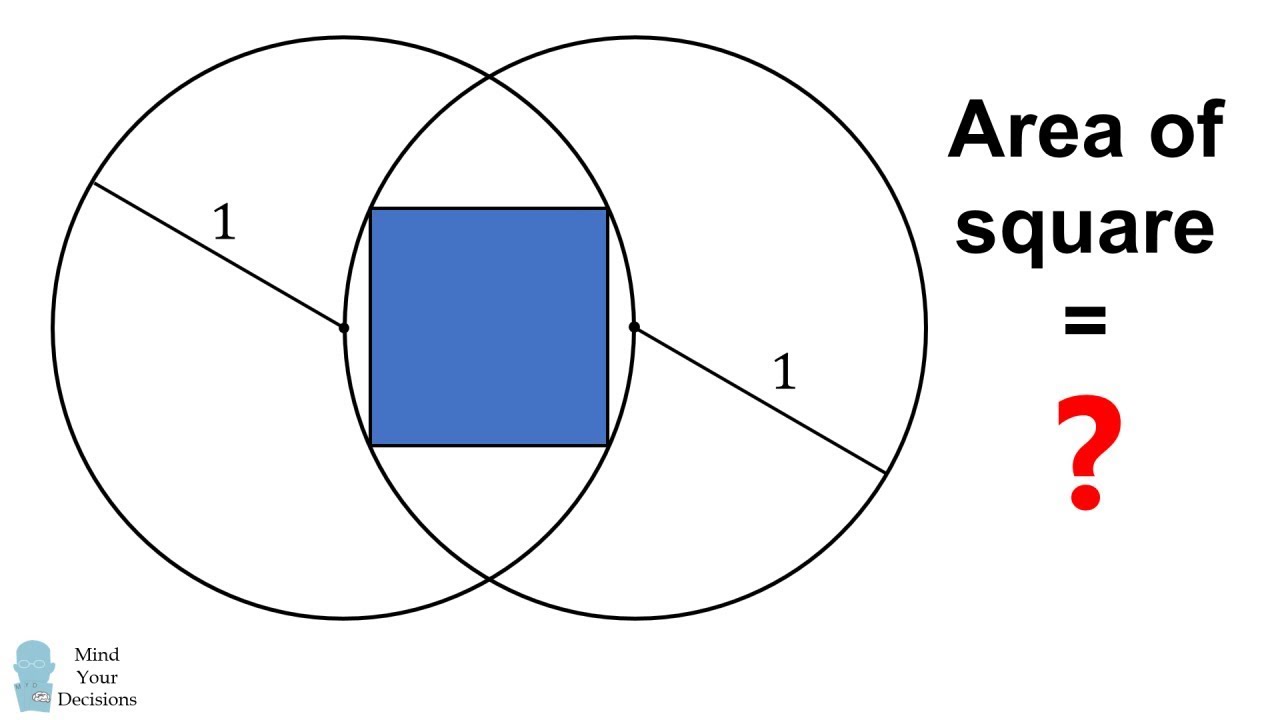
Thanks to Nibedan Mukherjee who sent me the problem and its solution all the way back in October 2018. I was also told this problem appeared in the 2019 Senior Mathematical Challenge by the UKMT.
2019 Senior Mathematical Challenge paper (see question 25)
https://www.ukmt.org.uk/sites/default/files/ukmt/senior-mathematical-challenge/SMC_2019_Pap...
north heart
yup, lots of nice geometry things
whole granite
I'll take care to learn from the videos, thks a lot for the tips and the gold content =)
whole granite
how is it possible? Is this correct? how the area of a 2d shape can be smaller than the actual size (width, height) of the shape itself?

 nocturne remnant
whole granite
how is it possible? Is this correct? how the area of a 2d shape can be smaller t...
nocturne remnant
whole granite
how is it possible? Is this correct? how the area of a 2d shape can be smaller t...
Why not?
0.25 is not “smaller” than 0.5; one is an area, one is a length, and there is no sensible way to compare them
 atomic tulip
nocturne remnant
0.25 is not “smaller” than 0.5; one is an area, one is a length, and there is no...
atomic tulip
nocturne remnant
0.25 is not “smaller” than 0.5; one is an area, one is a length, and there is no...

dark sparrow
whole granite
how is it possible? Is this correct? how the area of a 2d shape can be smaller t...
consider that putting 4 squares like this together will make a single square whose area you'll surely agree must be equal to 1
whole granite
dark sparrow
consider that putting 4 squares like this together will make a single square who...
this broke me, lmao
whole granite
nocturne remnant
0.25 is not “smaller” than 0.5; one is an area, one is a length, and there is no...
there's no sensible way to compare them. Key point
dark sparrow
comparing lengths to areas is literally comparing apples to oranges
switch up your units and the relationship between length and area considered as just numbers may well reverse
the same square can have:
sidelength 1 m and area 1 m^2 [numbers are equal]
sidelength 100 cm and area 10,000 cm^2 [number for area is greater]
sidelength 0.001 km and area 0.000001 km^2 [number for sidelength is greater]
whole granite
dark sparrow
comparing lengths to areas is literally comparing apples to oranges
I really don't know how I skipped these elementary concepts, thanks for clarify it
 wise bear
whole granite
how is it possible? Is this correct? how the area of a 2d shape can be smaller t...
wise bear
whole granite
how is it possible? Is this correct? how the area of a 2d shape can be smaller t...
when you're doing 0.5 squared, you're multiplying a half, or in other words dividing a half by two
so it makes sense
it also makes sense visually if you extend the sides to make a square with sides 1 and a total area of 1

as you can see in this square the shaded area will be only a fourth of the total
and it works in a general case because squaring small parts of the side of a square will make a shaded area who's ratio in regards to the total area is smaller than it's side's ratio to the total side of 1
 pliant sapphire
if 1+sin^2 theta = 3 sin theta cos theta prove that tan theta = 1 or 1/2
idk how to do it
can anyone explain?
north heart
ok ngl i have no clue what ur asking but i'm going to assume this:
If $1 + \sin^2(\theta) = 3\sin(\theta)\cos(\theta)$, prove that $\tan(\theta) = 1$ OR $\frac{1}{2}$
somber coyoteBOT
valley
 north heart
does that look about correct
wait it's been an hr no way ur still here
oops
sorry
wise bear
how does $1 + \sin^2(\theta) = 3\sin(\theta)\cos(\theta)$ ?
somber coyoteBOT
K-2SO
 north heart
he's asking for which values of theta they can be true
 scenic jewel
Can someone tell me how to simplify sin squared + cos squared + tan squared
Anyone ?
north heart
$\sin^2(\theta) \times \cos^2(\theta) = 1$
somber coyoteBOT
valley
 north heart
now divide everything in the above identity by $\cos^2(\theta)$
somber coyoteBOT
valley
 north heart
and tell me what you get
north heart
yep
scenic jewel
thanks for your time
north heart
technically it's $\sec^2(\theta)$
somber coyoteBOT
valley
 scenic jewel
Yes but i only learned those 3
scenic jewel
Yes
north heart
usually you're taught all six
hm
1/cos^2x is correct too so
just go with whatever you were taught
scenic jewel
Ok thanks
 gleaming nova
somber coyote
**valley**
gleaming nova
somber coyote
**valley**
bruh
gleaming nova
north heart
i forgot about \cdot lmfao don't @ me
my point was that it’s + not *
i don’t even think what you sent is ever true
,w sin^2(x)*cos^2(x) = 1
somber coyoteBOT


 Requested by quantum#6320
gleaming nova
Requested by quantum#6320
gleaming nova
cringe
north heart
OMG
STOp
IM FUCKING IDIOTIC
HOW
omg
my precalc teacher is going to murder me
...
gleaming nova
making comments about representation and group theory yet not knowing about complex inputs 
north heart
i never said anything about rep or group theory don't @ me
i was asking a questionnnnn
i forgot abt addition that's all
addition isn't that important anyways
like srsly even seen a plus sign it looks like trash
 outer lagoon
Please explain 6 trig functions graphs
wise bear
north heart
$\sin^2(\theta) \times \cos^2(\theta) = 1$
i think you meant plus unless im missing something
the pythagorean identity is $\sin^2(\theta) + \cos^2(\theta) = 1$
somber coyoteBOT
K-2SO
 wise bear
if it was times it would mean sin^2 = sec^2 which isnt true
whole granite
The constant 1 - PI / 4 is known for something?
grave pond
The fraction of a square's area that is not covered by its inscribed circle?
wise bear
or at least, one of the four corner parts
whole granite
grave pond
The fraction of a square's area that is _not_ covered by its inscribed circle?
do you mean it?
1 - PI -> Green + Red
1 - PI / 4 -> Red
If so, the division don't have priority here?
 grave pond
If the square has area 1, then the white part has area pi/4, and so the green+red part has area 1 - pi/4.
whole granite
the area of a circle is A = pi * r²
A = pi * 0.5²
A = pi * 0.25
A = pi / 4
holy, I got it, thanks troposphere and k-2SO
whole granite
double area_quartil = area_total*(1 - PI/4); // I got it
double quadriculado_quartil = area_total*(1 - sqrt(3)/4 - PI/6); // Now this one gets easier even I didn't get yet
the problem is to calculate each shaded area
 north heart
like i said
wise bear
how do we know what the arcs are
north heart
north heart
like i said
just build up a system of equations till you get somewhere
especially if you remember the triangle thing
and then notice that you can create a subsection of a circle
with the triangle
wise bear
north heart
it's four quarter circles
oh right im stupid
whole granite
north heart
with the triangle
here?

 whole granite
np
grave pond
I would suggest calculating this area, which is one-sixth of a circle minus the area of a 30-60-90 triangle.

Then you end up with three equations in three unknowns:
4·[crosshatched] + 4·[dotted] + [center] = 1
2·[crosshatched] + 3·[dotted] + [center] = pi/4
½[crosshatched] + [dotted] + ½[center] = (area from above)
young crow
quick sanity check
if a point P is in the triangle Q1Q2Q3
and you take V perpendicular to Q2Q3
then (P - Q1) dot V / (Q2 - Q1) dot V will necessarily be between 0 and 1?
grave pond
Sounds right.
 silk jacinth
are barycentric coordinates metric spaces ?
grave pond
Inasmuch as they are a coordinate system for Euclidean space, which has a standard metric, yes.
(That doesn't mean that the metric is necessarily simple to compute from barycentric coordinates).
 rich sinew
Does anyone have a link to a website that's good for memorizing trig identities?
soft marten
@upper karma

 fossil pier

 north heart
do you know FOIL?
 flat zealot
no
north heart
how in the world are you doing trig without knowing foil??

Khan Academy
Sal expresses the product (3x+2)(5x-7) as 15x²-11x-14.
here's a nice resource
check it out
flat zealot
ok
upper karma
north heart
how in the world are you doing trig without knowing foil??
I’m confused on which is the base and which is the height I feel like it’s a trick question can u help
 north heart
pinging people to answer a question is generally considered rude
upper karma
my fault
north heart
upper karma
i just joined
north heart
i'll tell ya smthn tho: it doesn't really matter which is the base or the height
north heart
ohhh that's what ur confused on
upper karma
I’m pretty sure 14 is the base I’m jus confused on whether 12 or 10 is the height because it’s horizontal
upper karma
Isn’t that the height ???
north heart
no
north heart
a parallelogram's area is just the longer side times the shorter side
so yeah
wait
.>
no it isnt
i lied
okay so what you wanna do
is orient it
such that the height
is a straight line
just imagine that in your head
now tell me the length of the line that's perpendicular to the height
north heart
no no the 12.2 line is the height
ignore everything i said earlier lmfao i was clearly having a mental breakdown
upper karma
But the only problem I have with that is if u look at the picture the triangles aren’t congruent so it’s weird to see the 10 as the base
It kinda cuts off the point
and 10 doesn’t go all the way to E
north heart
yeah i would just ignore that
notice that a parallelogram is basically a rectangle but tilted

here's a visual
it's kinda scuffed but whatever
this only works on this specific kind of parallelogram tho
so keep that in mind
upper karma
Gotchu so 12.2 times 10
Would I multiply 122 times 2 again since that’s the area of a triangle
upper karma
Gotchu I appreciate it
outer lagoon
Can someone explain why people thought transforming the 6 trig functions on a graph was a good idea
 hot cliff
 whole granite
the problem is to calculate each shaded area
whole granite
whole granite
the problem is to calculate each shaded area
the triangle was the key, nice valley
 dark sparrow
@hot cliff wdym by "correct ratio"?
north heart
^
north heart
whole granite
the triangle was the key, nice valley
nice
 hallow forum
 whole granite
how can I prove that the angles are equal, that is, x = y = z?
 whole granite
hallow forum
whole granite
hallow forum
the sizes aren't corresponding with the image, is that so?
by "don't correspond" I mean it:
 ripe skiff
It is a normal rule of every math competition and exam to have images NOT to scale
pls seriously do NOT think that any image will be to scale
I have done olympiad math for six years and I have never seen any image drawn to scale on any test paper
I have seen a 1m line shorter than a 50cm line
I have also seen a 113º angle being drawn on the diagram as an acute angle
I have even seen a straight line being drawn as a curved line
please don't assume any image, or any measurement in any image will be to scale and ratio. Trying to measure an angle with your protractor in a math exam will very likely give you a wrong result.
nocturne remnant
whole granite
how can I prove that the angles are equal, that is, `x = y = z`?
x+y=60,y+z=60,x+y+z=90
whole granite
nocturne remnant
x+y=60,y+z=60,x+y+z=90
I mean, how can we know/assume x + y = 60? we can have 30-40-20 or 20-50-20 (same for y + z)
whole granite
oh is it. thanks man
upper karma
I'm trying to understand some argument and I'm struggling to follow the steps to drawing it. I have a diagram but I want to draw it myself. How should I draw the ray PR?

! means steps I'm struggling with
It seems that N (that goes through point P) is going to touch the line as long as it's not equivalent to line M. What does it mean to be between PQ in this case? and why is there a ray emanating from P to M?
 uncut bronze
upper karma
uncut bronze
upper karma
I need help with this.. can anyone help me?
 upper karma
I'm trying to understand some argument and I'm struggling to follow the steps to...
upper karma
upper karma
I'm trying to understand some argument and I'm struggling to follow the steps to...
It probably means pick an arbitrary point R so long as it is to the bottom right of P
upper karma
upper karma
I need help with this.. can anyone help me?
You'll want to show that triangles ABE and CDE are similar first. This can be shown by noting that AB || CD
After that, note which triangles share the same height. You can slowly work your way towards the answer from there

 gusty sorrel
polar coordinates will help a lot here
uh well u know he walked 12 miles, then trig ig
upper karma
 high stump
Zhang walks 3 * 4=12 miles.
Co-ordinates:-
x=12sin(30)=12/2=6
y=12cos(30)=6*sqrt(3)
 zinc mural
How would you calculate the area between A, B and D

 sharp plume
x^2+y^2=sqrt(12)^2
solve for y
that's your function f(x)
$-\int_{0}^{2\pi}f(x)dx$
somber coyoteBOT
The Fractalogist
 whole granite
zinc mural
How would you calculate the area between A, B and D
whole granite
zinc mural
How would you calculate the area between A, B and D
do you mean the triangle ABD or the arc ABD?
north heart
if u mean the triangle you'll need to use some trig to get the sides but shouldnt be too hard
if you want the quarter circle then use some trig to get the r and just apply the area formula and divide by 4
whole granite
north heart
if you want the quarter circle then use some trig to get the r and just apply th...
even for the different radius for the X and Y axis?
whole granite
yeah Y radius = 13 and X radius = 12
north heart
wait, how would you even find that?
there's no well-defined formula for eclipse perimeter
whole granite
yeah, maybe some tricks with sin and cos to get the how much of the area is X and Y
wait, we can't use it and divide by 4?

such ellipse:
 north heart
i mean the entire premise of the question is flawed tho
since it gives arc length
and we can't have that
whole granite
do you know how this formula works valley?
 grave pond
It doesn't look like an ellipse centered on (0,0) to me.
whole granite
which one?
grave pond
zinc mural
How would you calculate the area between A, B and D
The arc in this image.
whole granite
why? the D point is definitely on (0, 0)... or not?
grave pond
Yes, but the arc looks to me like its a bit wider slightly above the x-axis.
whole granite
oh, I think it's a ellipse
grave pond
My next guess was that it's an arc of the circle centered on (0,0.5) that passes through A and C but then its length would be 38.73 rather than 39.75 (if my calculator can be trusted).
Perhaps B is (0,13) exactly and it's an arc of the circle that passed through A, B, and C.
whole granite
The total circumference is ≈ 78.57124 -> which divided by 2 got 39.28562
but yeah, its different from the 39.75 which appears on the graph
grave pond
If it's a circle with center (0, 25/26), then it can pass exactly through (-12,0) and (0,13), and the arc length is 39.7450699
whole granite
if the center is (0, 25/26) then radius Y = 13 - 25/26 -> 12.0384615385 -> which results in arc length of 37.75955, but maybe me or javascript double precision is missing something
grave pond
How do you get that arc length? Even just a semicircle of that radius has length 37.82, i.e. greater than your number.
whole granite
grave pond
How do you get that arc length? Even just a semicircle of that radius has length...
by the online calculator, google it: circumference of a ellipse
 grave pond
My proposal is that it is a circle, not an ellipse.
grave pond
Beats me.
But the numbers fit so well I think it must be the intended interpretation.
north heart
the numbers are super convincing, i'll give you that much, but i just am having trouble understanding how a problem like this is even given
whole granite
north heart
the numbers are super convincing, i'll give you that much, but i just am having ...
maybe he's just a developer trying to figure out a isolated problem to solve another one
zinc mural
whole granite
maybe he's just a developer trying to figure out a isolated problem to solve ano...
I mean the triangle with the rounded side. And its just a other way to get the answer. The real question was what is the volume of that whole thing if the depth is 13
zinc mural
Its like a airplane hangar but 2D. And I cut it to two "triangles"
harsh violet
can you calculate the size of a triangle knowing all 3 angles and 1 side length
 silent plank
yes

 rough ridge
Hi folks, does anyone know how the auto-rotate functionality works on Google maps? I am trying to do the map rotation with my data but have been unable to figure out the maths.
I posted a question on the mathematics stackexchange website but didn't get any responses so far. I will really appreciate your help. https://math.stackexchange.com/questions/4415597/how-to-rotate-coordinates-based-on-the-direction-of-motion
Mathematics Stack Exchange
Objective
I want to auto-rotate a road network based on the direction of motion of a car.
Background
I collect the live position data of a simulated car. Just like the google maps application, I wa...
 normal dew
Anyone know the answer?
 dark sparrow
some of us might, but we don't give out answers here.

 neon bridge
upper karma
help with solution; my answer: B and C
neon bridge
upper karma
help with solution; my answer: B and C
it's an isosceles triangle, so the x is equal to the other angle formed with the side of the triangle
the diagonal of the square means the angle formed in the corner is 45°
upper karma
(180-45)/2 like this?
neon bridge
:> np!
 tepid wave
anyone have geometry questions
silk jacinth
what kinds of methods would be computationally efficient in approximating the overlap between an Isosceles triangle and a circle?
tepid wave
you can probably compute it directly by solving some quadratics
silk jacinth
really?
tepid wave
yea
silk jacinth
cool!
tepid wave
what your interested in are the points at which the triangle and circle intersect
if you compute that, it's basically done
silk jacinth
now that you say it, it feels almost obvious 😄
tepid wave
an easy method is getting the intersection points between circle and triangle
then finding the corner lying in the circle, and then getting the area of the triangle inside the circle
which would be an approximation
silk jacinth
approximation is fine, this is for a simulation that doesn't require pure geometric fidelity
tepid wave

@silk jacinth basically this
u probably got it tho
(yellow part is circle segmentm but probs dont need to compute that)
silk jacinth
I think so, but I'll let you know if there any problems, thanks! 🙂
 cunning knoll
How do you guys find the measure of each angle for right, verticle, alternate, and corresponding angles??
 uneven bone
Can someone help me with this?

def lines_are_parallel(l1, l2):
    if l1[0] == l2[0]:
        return True
    else:
        return False
its python and these are the tests i gotta pass
Test.assert_equals(lines_are_parallel([1,2,3], [1,2,4]), True, "Given example 1.")
Test.assert_equals(lines_are_parallel([2,4,1], [4,2,1]), False, "Given example 2.")
Test.assert_equals(lines_are_parallel([0,1,5], [0,1,5]), True, "Given example 3.")
Test.assert_equals(lines_are_parallel([2,5,0], [20,50,10]), True)
Test.assert_equals(lines_are_parallel([2,5,0], [-200,-500,10]), True)
Test.assert_equals(lines_are_parallel([400000,1,0], [400000,2,0]), False)
Test.assert_equals(lines_are_parallel([800,20,0], [40,20,0]), False)
Test.assert_equals(lines_are_parallel([400000,1,0], [800000,2,100000]), True)
Test.assert_equals(lines_are_parallel([-5,7,100000], [5,-7,-200000]), True)
ping me if you know how to solve this
zinc mural
tepid wave
anyone have geometry questions
how do I get area of ABD
 zinc mural
Not a circle
tepid wave
just some arc?
zinc mural
its 1/4 of a ellipse
tepid wave
and whats that?
zinc mural
Height 13 and width 12
tepid wave
so what u just want the area of an ellipse?
something like? (pi * 12 * 13) / 4
@zinc mural did that work?

 hearty rain
Are lemniscates only plottable by quartic equations?
tepid wave
lol u changed the problem
zinc mural
tepid wave
lol u changed the problem
Still the same question
tepid wave
width just doubled lol
tepid wave
hearty rain
Are lemniscates only plottable by quartic equations?
kind of, but i believe you can get it through inversions
@zinc mural
i thought you wanted the quarter area of the ellipse formed by:
$\frac{x^2}{12^2} + \frac{y^2}{13^2} = 1$
somber coyoteBOT
ryаn
 zinc mural
tepid wave
<@!837589996600164359>
i thought you wanted the quarter area of the ellipse for...
zinc mural
tepid wave
<@!837589996600164359>
i thought you wanted the quarter area of the ellipse for...
Yes I wanted that so I can calculate the volume of that thing
Or area
tepid wave
the area of that ellipse is 12 * 13 * π
then you can just quarter it
then multiply by the height or whatever u want
zinc mural
Did that and the answer was still wrong
tepid wave
lol well you've constructed your problem wrong
or whatevers giving you the answer is wrong
tepid wave
hearty rain
Are lemniscates only plottable by quartic equations?
u can also plot it with sin/cos
zinc mural
Maybe
tepid wave
hearty rain
Are lemniscates only plottable by quartic equations?
,w plot r=sin(2theta(1-(sgn(theta-pi/2)-sgn(theta-pi))/2)), 0<theta<3pi/2
somber coyoteBOT

 Requested by ryаn#6410
tepid wave
Requested by ryаn#6410
tepid wave
wolfram made it ugly
but in reality, its just sin(2θ), where 0 < θ < π/2 and π < θ < 3π/2
or:
$f(x) = \begin{cases}
x & 0 < x < \frac{\pi}{2} \text{ or } \pi < x < \frac{3\pi}{2} \
0 & \text{otherwise}
\end{cases}$ and $r=sin(2f(\theta))$
somber coyoteBOT
ryаn

 crisp narwhal
Given A = (3,7),B = (−1,2) and C = (11,4), determine the numbers x and y that make the equality xA + yB = C true.
can anyone help me to solve this problem?
 whole granite
 pure void
someone pls help me
pure void
someone pls help me
what do you need
 opaque gull
whole granite
what do you need
opaque gull
whole granite
what do you need
with finding the values of x and y apparently
using the law of sines
pure void
whole granite
what do you need
i dont understand it that well
sinA/a
=
sinB/b
idk
opaque gull
do you know the law of sines?
 pure void
yeahh
so 63 is and A
71 is angle B
18 is side a
x is side b
y is side c
@opaque gull
is that right
@whole granite
 pure void
opaque gull
seems about right
pure void
opaque gull
seems about right
so now how do i solve it
whole granite
develop the equation system
opaque gull

Learn how to work with the law of sines and the law of cosines in this video math tutorial by Mario's Math Tutoring. We discuss when to use the law of sines and law of cosines as well as going through 4 unique examples. We discuss how to solve for the missing side or missing angle in a triangle.
Related Videos to Help You Succeed:
Ambiguous...
I think you sohuld watch this and be more sure about law of sines & cosines
pure void
whole granite
the another degree is 46
yeah cuz 63 + 71 + 46 = 180
pure void
opaque gull
https://www.youtube.com/watch?v=T--nPHdS1Vo
thx
pure void
kk
whole granite
sin(A) / a = sin(C) = c

# Equation for x
sin(63) / 18 = sin(71) / x

# Equation for y
sin(63) / 18 = sin(46) / y
just calculate the sin values (with a calculator, you don't need to know the exact value of sin for the angle 71, neither for 63)
and you'll end up with a regular equation
opaque gull
awesome
whole granite
also this isn't a equation system, I misunderstood before
whole granite
pure void
so you plugged in the numbers that were given and used it in the formula
yep, values are values use what you have to find what you need
pure void
whole granite
yep, values are values use what you have to find what you need
so then once you do that you basically use the calculator to solve right
whole granite
in this case yes
pure void
alr let me just copy paste in the calc
whole granite
you can also study this table if you dont yet, probably you need in this field

this is just the most common values for sin(x)
north heart
whole granite
you can also study this table if you dont yet, probably you need in this field
make sure you understand this tho
pure void
whole granite
you can also study this table if you dont yet, probably you need in this field
ohh ok thanks
north heart
purely memorizing things gets you nowhere
pure void
north heart
make sure you understand this tho
ill try my best lol im pretty bad with trig
lmao
pure void
north heart
purely memorizing things gets you nowhere
yeah if you understand it its much easier
north heart
it's okay, enough practice gets you everywhere
opaque gull
valley, may i ask you something?
whole granite
whole granite
you can also study this table if you dont yet, probably you need in this field
complement for the table to get you an idea of the origin of the values
 opaque gull
valley, may i ask you something?
opaque gull
opaque gull
valley, may i ask you something?
or even laks
whole granite
sure
opaque gull
are you american?
whole granite
nop
opaque gull
oh, what then?
 unique flower
my profile pic is a very advanced trig table if for whatever reason you need cos(36)
north heart
yup
opaque gull
whole granite
I'm from brazil
oh nice
north heart
depends on the exam
pure void
i have one last question xd
north heart
like the ACT or the SAT?
pure void
 opaque gull
I'm not American, but I assume a normal exam
like a not serious one
if you get me?
opaque gull
oh wow
north heart
i don't think so
pure void
okay so c2=a2+b2=2abcosC
opaque gull
we lucky we always get to
north heart
we're expected to either know everything or know how to derive everything
i think it helps with understanding tbh
unique flower
pure void
I would use law of sines for finding angle y but you need to find x first with law of cosines
opaque gull
north heart
i think it helps with understanding tbh
true tbh instead of just memorizing everythin
unique flower
north heart
we're expected to either know everything or know how to derive everything
does geometry teach the proof for law of cosines?
pure void
unique flower
I would use law of sines for finding angle y but you need to find x first with l...
ye lemme type it out
north heart
nah
unique flower
bruh
north heart
we never even went over loc in geo
unique flower
"derive everything"
north heart
i learned the proof in calc
north heart
yeah
unique flower
idk why bother using 2 column proofs and then not prove law of cosines
opaque gull
i love geometry
north heart
i just think everything i did before precalc was just trash
opaque gull
so much fun
unique flower
north heart
we never even went over loc in geo
my school did that
whole granite
unique flower
just pythagorean theorem with trig identities
you sentence made me think about how can we prove pythagorean theorem
pure void
C= y , c=9 , A=27 , a=5 , B = , b=x
opaque gull
whole granite
you sentence made me think about how can we prove pythagorean theorem
same
unique flower
whole granite
you sentence made me think about how can we prove pythagorean theorem
yeah theres a bunch of nice proofs that only require pictures
north heart
whole granite
you sentence made me think about how can we prove pythagorean theorem
pythagorean is actually incredibly simple and pretty
honestly
i encourage you to work it out yourself
just draw a right triangle
unique flower
pure void
C= y , c=9 , A=27 , a=5 , B = , b=x
the angle corresponds to the opposite side in law of cosines, not an adjacent side
you can also use area to prove it
north heart
north heart
just draw a right triangle
and just try and get things using trig into the right config
pure void
unique flower
the angle corresponds to the opposite side in law of cosines, not an adjacent si...
oh
north heart
unique flower
you can also use area to prove it
i've seen those, tbh never liked them as much
opaque gull
make a square with 4 right triangles? @north heart
unique flower
i mean law of sines
north heart
that one is lame
 unique flower
i was talking about law of sines
pure void
this is the question
 unique flower
you said A = 27 a = 5
north heart
law of sines =/= law of cosines
pure void
unique flower
you said A = 27 a = 5
yeah xd in law of sines thats wrong but for cosine im pretty sure its correct
unique flower
you only need to consider one angle with law of cosines, maybe find x first with a = 9, b = 5, and C = 27
then you can use law of sines to get y
pure void
oh so you can use law of sine to get y?
but it says in the question "use the law of cosines to find the values of x and y".
unique flower
after you have x