#geometry-and-trigonometry
1 messages · Page 363 of 1
 dire copper
 dark sparrow
@dire copper do you still need help with this?
dire copper
dark sparrow
<@704073651175293049> do you still need help with this?
yes:(
dark sparrow
do you know how to find the slope of a straight line from its equation?
dire copper
I guess no and that's why I couldn't:(
 silent plank
would you be able to determine the slope of something like
$$2x + y = 5$$
@dire copper
 somber coyoteBOT
ℝamonov
 dark sparrow
they DM'd me with their answer
 nova tiger
I got the equation arctan(100w)+arctan(w) = 90 degrees
From what I remember arctan(a)+ arctan(b) =arctan(a+b/(1-ab))
so what I did was to tan both sides and got a+b/(1-ab) = tan(90) which is undefined
but when I look at solutions what they did was: arctan(a)+ arctan(b) = sign(a) x 90 degrees, if ab = 1 then they set 100w^2 = 1 and solved
so my question would be, why was the first method I was using wrong? and whats the theory behind the solution? ive never heard about it
 wary veldt
Hello all.
TLDR: My question is - how do I convert a decimal (e.g. 1.414213562 is root2) to the root form?
I'm working on a pre-calc course and getting some basic trig. It's an online class with no professor. I'm inputing sin/cos/tan etc problems in my calculator and getting decimal results where the text book is providing roots.
For example, the problem is sec(pi/4)
I input 1/cos(pi/4)
answer = 1.414213562
Book answer = root2, which comes out to 1.414213562
I think I SHOULD be correct if I answer the decimal form on the quiz / tests, however I'd rather avoid having to justify it if I can give the root version of the answer.
Sorry this is so long.
My question is - how do I convert this decimal to the root form?
 old fable
Why does the radial component of the weight have a minus sign? The force is in the r hat direction so why would it have a minus sign?

 dim stirrup
old fable
Why does the radial component of the weight have a minus sign? The force is in t...
dim stirrup
old fable
Why does the radial component of the weight have a minus sign? The force is in t...
they are both in the opposite direction to r hat (i.e. towards the center of the circle)
old fable
But the radial direction is towards r hat or not?
dim stirrup
r hat is pointing away from the centre of the circle
the acceleration is towards the center of the circle
old fable
So radial acceleration is always to the Center of the circle
dim stirrup
search for centripetal force
old fable
Yes but that’s not always the radial acceleration, I heard some dude say
dim stirrup
im not sure what he means by that haha
old fable
Wait I’ll send the vid

This material was produced by Rice Online (http://online.rice.edu) for PHYS101x Introduction to Mechanics at edX (http://edX.org)
If you enroll in the full course (for free!), you will also have access to homework problems, solutions, an active discussion forum, an exam, and a certificate if you complete the course. The courses are self-paced...
dim stirrup
oh okay
old fable
Min 3:31
dim stirrup
the tangential force in your case is given by Wcos(theta)
so the weight always points down
as the mass moves around the circle
you need to split the components of that vector into radial and tangential
think about it physically
if the mass is at the bottom of the circle
the weight won't make it move
however, if the mass is at 90 degrees, it will fall down
dim stirrup
oh okay, so the difference here is how you're defining r hat in your model
it doesn't actually matter, just pick whichever direction makes your calculation convenient
whichever one you choose will only add or remove some minus signs
it's like deciding xhat points like <- instead of ->
doesnt matter
dim stirrup
no worries
old fable
I’ve been on this for like 2 hours cuz no replied in the physics server
dim stirrup
feel free to ping me with any physics questions, i have 2 masters degrees in it haha
dim stirrup
high school?
dim stirrup
show me the questions lol
dim stirrup
whatever, im bored and can give you a hand with a few
 grizzled lantern
that a radius
dim stirrup
i dont need your money
 plush cloud

 simple bear
<@&286206848099549185>
dark sparrow
@plush cloud do you still need help with this?
 nocturne remnant
E is a point on the interior of quadrilateral ABCD s.t.
[AEB][CED]=[BEC][DEA]
(where [] denotes the area of a triangle. )
Question: Is it possible that E lies on neither AC nor BD?
dark sparrow
i can say for certain that it's impossible if ABCD is a parallelogram
not sure about the general case tho
nova tiger
why is arctan(a)+ arctan(b)=sign(a) * 90 degrees if ab = 1?
nova tiger
<@&286206848099549185>
nocturne remnant
let a=tan x, b=tan y
( -90<x,y<90 by range of arctan)
tan x tan y = 1
tan x tan 90-x = 1 (identity)
So x+y=90 or -90
If x+y=90, x and y both positive, so a is positive, done
x+y=-90 just the same
nocturne remnant
dark sparrow
i can say for certain that it's impossible if ABCD is a parallelogram
I think I have an epiphany
(Refer to diagram)
The area condition reduces to
sin a sin c = sin b sin d
(Other than trivial sols with a+b=c+d=180 etc.)
Suppose a non trivial sol exists.
Then let T be a point in the region with smallest angle in (a,b,c,d) in this case c
Then reflect Ray EA over T, it should meet EC again (since this solution is not trivial) at P, then by def P’ would be back on Ray EA
(Same for Q AND Q’)
Then PQP’Q’ is parallelogram with a nontrivial sol. Which we know cannot happen.
Done 
 old fable
,w simplify (-csc x)(cot^2x) + csc^3x
somber coyoteBOT


 Requested by Thalapathy#3541
old fable
Requested by Thalapathy#3541
old fable
does this actually simplify to cscx?
looks kinda weird to me cuz the second part is way more complicated

 wanton silo
Any tips to remember trig identity
 potent dove

 upper karma
 plush bloom
https://cdn.discordapp.com/attachments/750369692157345925/883905654773932082/unk...
plush bloom
https://cdn.discordapp.com/attachments/750369692157345925/883905654773932082/unk...
(3/4, 3.5) (5.25, 10.5)
 mossy geyser
From the dimensions of the black rectangle and the green line length, I want to calculate the length of the blue line. So, I thought maybe I should determine, first, the value of the violet angle. But how can I do that? I'm confused.

 orchid quartz
$$\frac{5230 \text{cm}}{1} \cdot \frac{1 \text{m}}{100 \text{cm}} \cdot \frac{1 \text{hm}}{100 \text{m}}$$
$$\frac{5230 \text{cm}}{1} \cdot \frac{1 \text{m}}{100 \text{cm}} \cdot \frac{1 \text{hm}}{100 \text{m}}$$
somber coyoteBOT
Mr Syndicate7734

 silk venture
let a=tan x, b=tan y
( -90<x,y<90 by range of arctan)
tan x tan y = 1
tan x tan 90-x = 1 (identity)
So x+y=90 or -90
If x+y=90, x and y both positive, so a is positive, done
x+y=-90 just the fuck
 unreal ivy
oh wrong channel
 shell raven
so i have a question

if I had a circle with a radius of 1cm
and i had a piece of string 1cm and put it around the circle is a radian
wait no
that's stupid
i don't get radians
nocturne remnant
What seems to be the problem
upper karma
hey can someone just tell if this is solvable, or the info is sufficient or not

 crimson dust

 wheat osprey
@crimson dust how did you get 3?
If the question had an equilateral triangle then we could have done it by finding the angle OCF... But out here there's no symmetry... So how did you go about it?
 fallen girder
A website dedicated to the puzzling world of mathematics.
2 different ways of finding the area of the triangle allows an easy way to solve for the inscribed radius
 wicked crag
how am i supposed to solve this
"Find the value of the following, put it in its simplest form.
cos(pi/12)
wheat osprey
wicked crag
"Find the value of the following, put it in its simplest form.
cos(pi/12)
Cos(2x) = 2cos^2(x) - 1
We know cos(pi/6) = root(3)/2
 marsh bobcat
hey, can anyone help me with a trig question? i forgot trigonometry lol
wanton silo
can anoyne please help me with geometry
wanton silo
marsh bobcat
hey, can anyone help me with a trig question? i forgot trigonometry lol
sure
marsh bobcat
can i dm you?
wanton silo
k

 silk patio
What’s the question
 torn sluice
find coordinates? @silk patio
silk patio
Of?
torn sluice
idk :((
silk patio
Then go away
torn sluice
my teacher didnt explain anything :I
 novel mango
potent dove
novel mango
potent dove
hi, $\sin^2(x)=\frac{1-\cos(2x)}{2}$ youll get a telescoping sum
somber coyoteBOT
God V2
 upper karma
,
 boreal niche
can someone pleas help me with some bearings and scale drawings?
- A taxi travels 8 km south, then 3 km west.
a) Draw a sketch to illustrate this information.
b) Using a scale of 1 cm represents 1 km draw an accurate drawing to represent the above information.
c) From your accurate diagram, determine;
i. How far the taxi is from the starting point.
ii. The bearing of the taxi’s finishing point from the starting point.
 lone arch
i think this geometry since its a shape but anyways can somebody help i forgot how to solve it and the answers and explinations i getting online arent helping+ i have to find area of these

 vague bloom
Uhh
You know the formula for area of a circle?
The formula is pi x r^2
so in the first circle the radius is 12, so substitute it into the formula
it would be pi x 12^2
which is 144pi
so for the first one the answer would be 144pi km^2
and just repeat the process for the second circle
@lone arch got it?
lone arch
vague bloom
<@!802016677050056765> got it?
Tysm
 high estuary
 upper karma
correct
upper karma
Hey, currently learning analytic geometry and was wondering how can you find the rectangle points when all you know is the x and y values of only 2 points?
upper karma
upper karma
Hey, currently learning analytic geometry and was wondering how can you find the...
If only two points are given, then these are of opposite coner of rectangle. Find the difference of abscissa and ordinates of both the points and you will get both the sides, then add or subtract the sides in the given points to get other two points.
upper karma
upper karma
If only two points are given, then these are of opposite coner of rectangle. Fin...
It's a rectangle where each vector length of 2 points equals to the others. But it's not grid aligned.
upper karma
upper karma
It's a rectangle where each vector length of 2 points equals to the others. But ...
What are these two vectors? value
A (0,0), B (4,3)
@upper karma
I know the answers for the 2 possible options for both point C and D but I don't know how to get to those values nor I understand how to start solving this kind of problem.
What's that
upper karma
upper karma
I know the answers for the 2 possible options for both point C and D but I don't...
Tell me the answer, I will try.
Oh it's fine 😅
upper karma
upper karma
Tell me the answer, I will try.
One sec
(7, - 1), (3, -4) or (1,7), (-3,4)
Thanks
upper karma
upper karma
Thanks
Its a square not rectangle according to these other points. You need to find the slope of the lines perpendicular to the line joining the two given points and passing through these two points. Then add and subtract the side(distance between the two given points) in the direction of these two lines.
Thanks will try it out, and yeah I guess that's the right term for what I was trying to say ^^
 lean ferry
Can someone please explain double identities I have no idea what to do
I have the formulas but idk how to do anything
 flat tartan

 hard geyser
 literal ghost ping
 fleet marsh
im not a helper
 night crown
what's good brother
fleet marsh

upper karma
y da ping?
fleet marsh
no
hard geyser
just read the rules dude
 tacit whale
420 degrees
night crown
6
tacit whale
qed
upper karma
Lol
night crown
diagram says 6 degrees bro
upper karma
Bro. I just got ghost pinged
fleet marsh
the answer is probably 1
hard geyser
fleet marsh
hard geyser
stop pinging the roles
night crown
who tf
upper karma
STOP PINGING
fleet marsh
how are they pinging
upper karma
fleet marsh
how are they pinging
IDK
night crown
@ ADMIN
upper karma
upper karma
I got pinged
same
 stuck torrent

hard geyser
thks nami
upper karma
Oh ok
upper karma
 spark stag
user has been banned
spark stag
user has been banned
thx
hard geyser

 remote hill
2 pings nice

 gloomy trail
2x+40?
gloomy trail
I have no idea
 valid harbor
when do two angles are supplementary
gloomy trail
when they add to 180
gloomy trail
Tbh idk how the supplement thing works
valid harbor
if <DCB = x then what is <ACD
 gloomy trail
x+ACD needs to equal 180
valid harbor
then <ACD is ....
gloomy trail
IDK how to set it up to get the measure or equation for it tho
gloomy trail
180-x=acd
gloomy trail
90
valid harbor
no
gloomy trail
90-acd?
valid harbor
the complementary to x...
gloomy trail
is there a youtube video you could send me, I feel like I'm not fully grasping it
 pearl tendon
Ok this might be a weird question
How would we put this measurement into deceimal form
11 7/8 “
valid harbor
i really hope that your lack of responses is due to a lack of connection and not because of the fact that you are blatantly ignoring me
 verbal night
Math GRE question

My current work is:
Note that A, B, C sit on the same circle centered at O so OA=OB=OC. Note also that O, B, C sit on the circle centered at A so OA=AO=AB=AC. That is, the lines drawn between the centers of either of the circles to any points are all of equal length.
Then the strategy I imagine would be to construct equilateral triangles and use some kind of angle complement argument to get it
verbal night
 weary hearth
anyone tagged me?
 primal inlet
upper karma
primal inlet
upper karma
Did someone ping me?
 jolly hollow
Idk who ping me 2 times?
 surreal pike
Anyone knows how to eliminate the x in this

 gritty fractal
whos good with yr 10 maths
i need help lol
vague bloom
gritty fractal
whos good with yr 10 maths
i need help lol
ok
Post the question here.
 worn sparrow
surreal pike
Anyone knows how to eliminate the x in this
worn sparrow
surreal pike
Anyone knows how to eliminate the x in this
wtf is sen lol
gritty fractal

 lone copper
gritty fractal
lone copper
gritty fractal
What is the problem?
lone copper
gritty fractal
For question 1 find a word to describe OA and OC (remember O is the centre of the circle). For question 2 just compare the length ratio of the sides and whether it increases or decreases
 storm heath
gritty fractal
storm heath
gritty fractal
Q1) Option C because both the triangles are congruent.
storm heath
gritty fractal
Q2) Answer is +3 since dividing the sides of the bigger triangle by the smaller triangle give that.
 undone totem
worn sparrow
wtf is sen lol
undone totem
worn sparrow
wtf is sen lol
sin he misspelled
undone totem
gritty fractal
wait is this actully yr 10 maths
undone totem
 versed river
sen is how sin is written in some spanish adjacent languages lol
versed river
sen is how sin is written in some spanish adjacent languages lol
o
oops
 sleek prawn
 full dome
im a bit confused

 quick cedar
do you know what it means for two angles to be supplementary?
full dome
i solved it, nevermind
 left lake
quick cedar
do you know what it means for two angles to be supplementary?
left lake
quick cedar
do you know what it means for two angles to be supplementary?
4 hours later it means they add up to 180˚
 humble pulsar
left lake
*4 hours later* it means they add up to 180˚
humble pulsar
left lake
*4 hours later* it means they add up to 180˚
it also... wasnt a question
it was a prompt for Viper
left lake
nvm I'm dumb occasionally
thanks for clearing my confusion @humble pulsar
I didn't realise
upper karma
@surreal pike still looking for help?
upper karma
worn sparrow
wtf is sen lol
sen is sin in spanish.
storm heath
Lmao.
 potent orbit
Hey guys! I'm in a kinda odd situation
My professor gave me this question and everything that has been given to me doesn't work, even what the professor gave me doesn't work and i don't know what to do

 river vortex
potent orbit
My professor gave me this question and everything that has been given to me does...
river vortex
potent orbit
My professor gave me this question and everything that has been given to me does...
I mean it looks right. Not sure why it's counting it wrong
potent orbit
river vortex
I mean it looks right. Not sure why it's counting it wrong
this is pretty odd tbh
river vortex
Is there any kind of weird order you have to put them in
I don't see why
But worth a try
potent orbit
That's an old pic btw, I fixed (b), but c is messed up

All I have for c is AB, AC, BC
 nocturne remnant
potent orbit
That's an old pic btw, I fixed (b), but c is messed up
nocturne remnant
potent orbit
That's an old pic btw, I fixed (b), but c is messed up
I think he meant the possible segments which are not already on the diagram?
Such as BE?
potent orbit
nocturne remnant
I think he meant the possible segments which are not already on the diagram?
Oh shoot, maybe you're right
In the meantime, I gotta figure this out and I think I'm going the wrong direction
 silent plank
ABC and ACD aren't lines
silent plank
can you identify two lines that are perpendicular to each other?
potent orbit
I'll be honest, I've forgotten so much
All I remember is that it sums up to intersecting lines that result in a right angle
Like a plus sign
potent orbit
So like AB, BC or AC, CD
silent plank
yes

 potent orbit
jeeeeezzzzzz, why is this so weird
potent orbit
@silent plankHey, so I fixed it, but I'm on one last question
surreal pike
@surreal pike still looking for help?
@upper karma YES PLZ
full dome
can someone please draw thsese instructions with a straightedge and compass
Open the compass more than half the length of line
Then keep at the two ends of line and draw an arc from both sides on both above and below the line
The arcs drawn will intersect at a point above and below the line
Join the two points, this is the perpendicular bisector of the line
silent plank
@full domehave you tried doing it yourself
full dome
i dont have a compass so i cant
full dome
silent plank
use a cd
what is a cd
silent plank
compact disc lol
blu-ray disc? but way cheaper
or a decent sized round object will suffice
full dome
something like this?

 slender wasp
yes, and remember cos(x+pi) = - cos(x)
Actually finding an expression for cos(2pi/5) is a slight pain :(
slender wasp
Oh, that's easier then
I would basically just say it's 27pi/5 shifted by multiples of 2pi until its in (0, 2pi)
Oh sorry silly mistake
Ignore that please I made a mistake cri
OK so we already had that cos(27/5 pi) = cos(7pi/5) from what you said
the trick I'd use next is the symmetry of cos x
(about pi)
cos(2pi-x) = cos(x)
This is because we need to get something in [0,pi]
Limitation on cos^-1's range ye
A number x in the interval [0,pi] such that cos(x) = cos(7pi/5),yes
Ye
Well with sine it's slightly easier as the range of arcsin is [-pi/2,pi/2]
cos(x) = cos(2pi-x), sin(x) =sin(pi-x)
Ah okay
Oh I mean those are correct
But that's not what you were quoting / what we were using
Well we were using cos(2pi-x) = cos(x)
The identities there use + signs
Different thing
And sorry I can't vc
We used cos(2pi-x) = cos(x) to say cos(7pi/5) = cos(3pi/5)
Not the 2pi+x identity or anything
Although yes, you used the identity with 2pi+x earlier too to get to 7pi/5 in the first place
Yes
yeah
so here I'd use the sin(pi-x) = sin(x) identity
It's not the same thing, no, it's just another identity
Npp
a lot can be derived from just staring at the graph, like lines of symmetry
For example cos(2pi-x) = cos(x) because of symmetry about pi
but you could also find another list of identities ofc if need be
But yeah np
 lusty plover
Quick question, what are a 3d vector's version of magnitude and direction and the equations to convert them into their components?
silk patio
What would you guess
dark sparrow
@slender wasp did someone delete all their messages after talking to you or did they get b&
 thorn finch
I have maybe a little Advanced question
I have some part of a circle, which is controlled by the Korde, is there a formel, which Can determine if i have moved 1cm on the “korde” from the begining i have then moved x degrees, but if i move 1cm on the “korde” from the middle i have then move Y degrees. Y > x
 nocturne remnant
You mean, move the Korde without changing its direction? …So it gets shorter near the edge and longer near the center?
thorn finch
Yes. Start point is the left side of the “korde”. And the middle of the circle is static point, if i am walking on the “korde” and i start from the begining, if i move 1cm i have example made 1 degree, but if i am in the middle and move 1 cm from the same “korde” i have now by moving 1 cm made 5 degree change
Hope that made sense 🙂
dark sparrow
the english word for korde is chord
thorn finch
Thanks 🙂
thorn finch
I also try haha, it is a little brain twister
 thorn finch
I’ll try it out
I have a question, if You calculate the area of the obtuse triangle, what is the degrees then
nocturne remnant
?
thorn finch
I need to calculate the length of the arc, if i move 1cm on the chord i have moved example 1,5cm on the arc from the start, and also the degrees, if i move 1cm from the start i have moved 2 degrees but if i move 1cm from the middle of the chord i have moved 8 degrees
But Your illustration helped me alot
nocturne remnant
nocturne remnant
y is the angle you’re looking for
thorn finch
Is there a Way You Can show that in a formal, where i get Y and not A, and im super grateful for Your help
slender wasp
dark sparrow
<@!356844891722219520> did someone delete all their messages after talking to yo...
I'm honestly not sure, I didn't see them delete anything though
thorn finch
@nocturne remnant i solved it only thanks to you mate :)! thank you
old fable
2/L sin^2(pi nx/L) where can i find the graph of this function
if i put it in wolfram it doesnt give the graph
silent plank
what's n and L
 peak mesa
So idk how to explain this but the black body and the orange arm are connected so if the position of the black body changes, the orange changes too, and when the rotation of the orange thing changes, is around of the right side of the black body according the red circle (the rotation) but i want to achieve a state when the orange thing is all the time poiting to the green point independ the rotation (the black body can move or something), so i need to know what i can do to achieve this (i dont know what math i need to use on the rotation of the arm & position of the black body)

i tried to use sin cos for the rotation of the arm and then the black position add sin/cos but inverted but did not work as expected
peak mesa
lol i just added 180º on the arm and thats it...
upper karma
In 2nd question, slope (m) tends to infinity at point (1,2). Can't use point slope form to derive the equation of tangent... Any other way?? <@&286206848099549185>

 wanton kestrel
upper karma
In 2nd question, slope (m) tends to infinity at point (1,2). Can't use point slo...
wanton kestrel
upper karma
In 2nd question, slope (m) tends to infinity at point (1,2). Can't use point slo...
please don't simultaneously post the same question in different channels
but #help-0 is occupied atm
so you may continue that here instead
upper karma
wanton kestrel
so you may continue that here instead
it's a geometry question so it's better to ask here ig
Should I delete that from #help-0
wanton kestrel
i would say it's a calculus question, actually
upper karma
Yeah a bit of differentiation is also used
wanton kestrel
upper karma
Should I delete that from <#490557019623915520>
your choice
upper karma
upper karma
In 2nd question, slope (m) tends to infinity at point (1,2). Can't use point slo...
I figured out the solution. Nvm
 visual girder
where do i begin to solve this triangle?

 steel trout
visual girder
where do i begin to solve this triangle?
steel trout
visual girder
where do i begin to solve this triangle?
Solve the whole thing and then solve the top triangle.
Whole triangle - top triangle = bottom quadrilateral
 flat schooner
can someone plz explain what this is and how it works? |
visual girder
how do I find angles ACB and DEC
upper karma
dark sparrow
the english word for korde is chord
So korde is the actual word from where it was stolen?
dark sparrow
no, i think it was "stolen" from a greek word
surreal pike
Help i need to find the area of the colored area in the unit circle

And also say true or false and justify
 potent orbit
dis sucks, any thoughts?
 storm heath
Any way to know the reason why their graphs is such without knowing radians and stuff?
 nocturne remnant
How such?
They look normal to me
dark sparrow
yeah these do not look weird to me
but desmos does measure angles in radians by default
there is a setting to make it use degrees instead
dark sparrow
you're just starting trig right
storm heath
T understand these?
storm heath
dark sparrow
you're just starting trig right
Yup.
dark sparrow
okay then you'll learn everything in due time
radians are just a unit of angle measurement nothing more
storm heath
Damn inverse trigonometry is cool but hard.
storm heath
dark sparrow
radians are just a unit of angle measurement nothing more
I see I see.
dark sparrow
get comfortable with right triangle trig and circle trig will follow
potent orbit
I hate this math
storm heath
dark sparrow
get comfortable with right triangle trig and circle trig will follow
Oooo.
potent orbit
It's due in 30 minutes and I have an english paper due in 30 minutes too
dark sparrow
@potent orbit and you want us to do what about that, exactly?
potent orbit
My questions are slightly easier than what you're dealing with rn
storm heath
GiVe DiReCt AnSwErS.
 potent orbit
my stuff or your stuff?
storm heath
My stuff.
dark sparrow
...your part (a) looks weird to me
no clue what conclusion they expect you to draw from a=e
nocturne remnant
Then e=a?
Seems like the only reasonable thing 
potent orbit
Tried
dark sparrow
at least c and d are somewhat more transparent since the angles in question are well-positioned
storm heath
Yeah exactly.
What is angle of s's?
dark sparrow
(c) you can look at angle 3
(d) you can look at the sums of two pairs of angles
thats as much as can be said without just giving away the intended answer\
potent orbit
I'm so confused, I'll get to you if I fail the question or get it
Oh yeah, I also have this too
 storm heath
D nt yu think #❓how-to-get-help wuld be better since that place is mre fr help than discuss?
potent orbit
I got it partially corrrrect
storm heath
Ayo wtf.
 potent orbit
i was thinking of only one pair instead of actually using multiples
dark sparrow
D nt yu think ❓how-to-get-help wuld be better since that place is mre fr help than discuss?
is your O key broken?
storm heath
storm heath
Ayo wtf.
How is the 2nd one the opposite of the first?
storm heath
dark sparrow
> D nt yu think ❓how-to-get-help wuld be better since that place is mre fr help ...
Yup.
nocturne remnant
storm heath
How is the 2nd one the opposite of the first?
It kinda looks likes the line is flipped across the x=y diagonal
storm heath
I need t use this but it is tedius.
 storm heath
nocturne remnant
It kinda looks likes the line is flipped across the x=y diagonal
storm heath
nocturne remnant
It kinda looks likes the line is flipped across the x=y diagonal
Frm what angle?
nocturne remnant
The 45 degree diagonal line
nocturne remnant
Actually, for any function f, the inverse of that function should look like it’s reflection over the diagonal line
(Disregarding the domain stuff)
storm heath
This yu mean?

 verbal beacon
no ,the line y=x
storm heath
Duck I need t re-learn Algebra 1 which I started and get inverse trignmetry well.
storm heath
verbal beacon
no ,the line y=x
That is what I sent.
verbal beacon
you've sent a diagonal of a square
 storm heath
Ayo wtf.
storm heath
storm heath
Ayo wtf.
Wait so here the 2nd function has the inverse of itself in the graph?
 woven yacht
.
potent orbit
 desert pewter
i just asked a triangle question in <#486841085210132490> if anyone can help
desert pewter
i just asked a triangle question in <#486841085210132490> if anyone can help
I can try
 lone cave
,help
somber coyoteBOT
A brief description and guide on how to use me was sent to your DMs!
Please use ,list to see a list of all my commands, and ,help cmd to get detailed help on a command!
 valid harbor
@verbal night impossible
verbal night
This is how I feel every single time I like at a MGRE geometry question
 sour folio
can someone help me with transformations
spark stag

 junior veldt
Idk how to help without giving answers, but I’d suggest to think of how midpoints work? (Given can be a thing you put in reasons)
Look at 3
verbal night
valid harbor
<@!213026416759930881> impossible
Not impossible. <RPT=<QPS as P,Q,R sit on the same line as well as P,T,S do. This means that RT/PR=QS/PS. Solve for PS to get PS~10.29
 clever sluice
Can anyone teach me how to evaluate the volume of a spherical hexagon given its angles and sphere radius?
lone cave
Been struggling on this one for days now
Given: ray OP (pointing right) and ray OR (pointing right) trisect ∠NOS, m∠NOP = 3x - 4y, m∠POR = x - 6, and m∠ROS = y - 10. Find the m∠ROS by creating and solving a system of equations.
silk patio
clever sluice
Can anyone teach me how to evaluate the volume of a spherical hexagon given its ...
What’s a spherical hexagon
 molten delta
lone cave
Been struggling on this one for days now
Given: ray OP (pointing right) and ray...
molten delta
lone cave
Been struggling on this one for days now
Given: ray OP (pointing right) and ray...
Do you know how to solve system of equations?
lone cave
yes but i do not know how to set it up
lone cave
molten delta
Do you know how to solve system of equations?
because we have to create one
 ocean socket
Oum Hi
wary veldt
Hello all,
My text book has not explained how to complete these problems. I was wondering if someone would be willing to walk me through the process with problem 38

Or any of the even numbered problems really, as the answer key in the book only covers the odd numbered
Disregard - I've figured out to find the x/y intercepts
valid harbor
The slope of the line represents the tangent of the angle made by the x-axis and the lane
@wary veldt
 solid mantle
Can anyone explain how it’s rad3 from tan60?
 lone copper
Special right-angled triangles in trigonometry, there are mainly 2 to remember, for this one just draw an equilateral, draw a line from the top vertex to nicely ÷ the triangle into two smaller triangles, ratio of hypotenuse: smallest length=2:1
Now use pythagoras theorem to find the opposite length and tangent ratio is opposite/adjacent=√3/1=√3
 upper blaze
Hy guys, does anyone know any good book that has stareometry and properties of pyramids and stuff?
upper karma
Doubt

 hallow tulip
If it only gives you that information you could theoretically say that:
$\tan{\theta}=\frac{\sin{\theta}}{\cos{\theta}} then \sin{\theta}=2x(x+1) and \cos{\theta}=2x+1$
somber coyoteBOT
DR
 dark sparrow
no you couldn't say that
who says 2x(x+1) is between -1 and 1
or that 2x+1 is between -1 and 1
solid mantle
lone copper
Special right-angled triangles in trigonometry, there are mainly 2 to remember, ...
Oh! Thank you!
solid mantle
Can anyone help explain how they got that answer? Plugging it into the calculator also seems to be wrong
 upper karma
,w approx 1/(sin(25 degrees))
somber coyoteBOT

 Requested by Al3dium#4084
upper karma
solid mantle
Can anyone help explain how they got that answer? Plugging it into the calculato...
Requested by Al3dium#4084
upper karma
solid mantle
Can anyone help explain how they got that answer? Plugging it into the calculato...
can you type exactly what you are plugging into your calculator?
dark sparrow
👻

 kind rain
<@&286206848099549185>
valid harbor
kind rain
I need help with this
what did you try sir

 raw tiger
 split nexus
can anyone help me on my hw
left lake
Don't ask to ask, just ask! ( #❓how-to-get-help )
go ahead and post the question
someone can help
 nocturne tusk
for geometry, to have an opposite ray, do the points have to be on the same line?
 storm portal
If (in 2D), a ray with a starting point has an opposite ray, then I'm pretty sure they lie on the same line
The opposite ray may or may not be able to have its starting point elsewhere.
lone copper
Split the top circle into a semicircle
Then the bottom part of the top circle not overlapping with other circles=area of square with sides 1cm- area of quadrant with radius 1cm
Each side of the blue square is 1cm

So u can find area of black portion by taking 1²-area of quadrant
 lone copper
Send ur workings u r probably doing something incorrect
Yes
That is an even better diagram than mine
So it’s (2+area of one circle)cm²
It’s ok we are always careless
As long as u understand where u went wrong, ur good
Np
 smoky talon
tell me if ur good at 2 column proofs
junior veldt
smoky talon
tell me if ur good at 2 column proofs
do you mean like statemnet reason ones?
smoky talon
yeah
junior veldt
if you need helpw iththem, i might be able tohelp wtih simpler ones? i could try
junior veldt
which ones are the hard ones? i could try to help with them?
 fluid wasp
quadrant VI is the same as quadrant II? 
 dark sparrow
i think they meant quadrant IV but typo'd
 timid pier
a question specifically or a concept?
 pure void
timid pier
a question specifically or a concept?
pure void
timid pier
a question specifically or a concept?
yes
like conditional
and stuff

@timid pier pls help me understand this better
pure void
oh i forgot to add false
pure void
timid pier
aaa sorry but i have a limited understanding on geometry stuff, idk this stuff
oh ok
upper karma
I had a question

Do you know what cosec is
Yes
Do you know what cot is
Yes
Trigonometric ratios
Do you know that sin^2 t + cos^2 t = 1
Yes it's an identity
Did you try expressing cosec and cot in terms of sin and cos and using this identity to simplify your expression?
...lemme do again. It all messed up
Oh. I see
Like this?

Yes, exactly
Then should I square them
Yes
Did it
Alright.

Yeah. Now plug it in and simplify
Oo lemme try
But how
🤔🤔
First, multiply nominator and denominator by sin^2 A
Okei
Now
upper karma
upper karma
Do you know that sin^2 t + cos^2 t = 1
Use this formula
The denominator :- sin^4 A
Should I solve numerator part by quadratic equations formula?
upper karma
upper karma
The denominator :- sin^4 A
Huh
Show me your calculations
Okei

It's not this that you were supposed to multiply
I meant (q^2-1)/(q^2+1)
Plug in q^2 and multiply nominator and denominator by sin^2 A
@upper karma and how is it going?
upper karma
upper karma
<@456226577798135808> and how is it going?
Oh sorry.. 😅I slept on my table
upper karma
upper karma
I meant (q^2-1)/(q^2+1)
Oo
upper karma
upper karma
Plug in q^2 and multiply nominator and denominator by sin^2 A
I'll do it again today
 south onyx
 upper karma
south onyx
help please https://cdn.discordapp.com/attachments/887133609239142481/8893139123...
upper karma
south onyx
help please https://cdn.discordapp.com/attachments/887133609239142481/8893139123...
Okei
1st one or second
upper karma
south onyx
help please https://cdn.discordapp.com/attachments/887133609239142481/8893139123...
BTW 1st one is correct

 junior veldt
I think (this is my guess) that if both segments are the same length then the other 2 angles should be the same? So like 180-100 then take whatever you get and divide by 2?(this is a guess)
@winged torrent
 winged torrent
yyah i just forgot the property btw the answer is 40

can someone help on this
<@&286206848099549185>
junior veldt
winged torrent
Use supplementary angle theorem thing to find angle ABC, then go on from there

 raw saffron
 bitter nimbus
someone please help
bitter nimbus
someone please help
can I help?
bitter nimbus
raw saffron
can I help?
yea
raw saffron
ok
so angle B is 55 degrees due to corresponding angles
and angle A is 125 degrees
@bitter nimbus
 dark sparrow
@upper karma do you still need help with this?
dark sparrow
maybe you could have had an idea in the 5 minutes before me noticing it
in any case, what's giving you trouble here?
it appears all you'd need to do here is substitute the values of x, y and z into x^2+y^2+z^2 and simplify.
slender wasp
because it's multiple choice just consider A = 0 bad advice
nocturne remnant
upper karma
Obviously the answer is proportional to r^2
So that leaves A or B
Subbing r=1, a=b=0 gives the answer is B
dark sparrow
or you could also not engage in any of that bullshit
it is not hard to simplify r^2 sin^2(A) cos^2(B) + r^2 sin^2(A) sin^2(B) + r^2 cos^2(A) using the sin^2 + cos^2 identity twice
nocturne remnant
Or…
You can prove with actual geometry
 elder pebble


 lyric topaz
 junior veldt
 winter rover
Hey could yall help me with some geometry problems? They're pretty basic
winter rover
Hey could yall help me with some geometry problems? They're pretty basic
What do you now know how to do?
For first 8magem do you know what alt int and alt ext angles are?
winter rover
I know what they are, but I don't know how to explain them.
junior veldt
For sending image, use the supplementary angles
junior veldt
winter rover
I know what they are, but I don't know how to explain them.
The thing is asking to give a pair of alt interior and alt exterior
storm heath
Anyone here who has studied AoPs Introduction to Geometry?
 noble thunder
Introduction to Geometry?
didn't saw that before on aops
is that a pdf or a post
oh it's a book from aops...
it says for grade 7 to 10... I don't think it could be very advanced though I never read it before


 quiet blade
upper karma
quiet blade
upper karma
The solution is quite long, and it's been solved on other websites such as: https://www.toppr.com/ask/question/in-a-triangle-abcrarbrc-are-the-radii-of-the-circles-which-touch-the-incircle-and/
If you need a hint, start with the fact that the center of the incircle and (one of the*) smaller circles must lie on one of the angle bisectors
upper karma
quiet blade
If you need a hint, start with the fact that the center of the incircle and (one...
centre of $\Gamma_A$ lies on angle bisector of $\angle A$
\this applies to every of the smaller circles (with their corresponding angle) right? why only one of them?
somber coyoteBOT
OvercomplicatedHexagonAAAAAAAA
 quiet blade
yes the result generalises to the other circles as well
but only one small circle* would lie on the angle bisector of A
upper karma
yeah ok fair enough
how to do this?
https://www.youtube.com/watch?v=baD79KCWcsQ
@quiet blade btw what the hell is this lmao
i assume this is wrong?

There are 4 incircles of respective triangles given in the figure, GH||AB, IJ||BC & JK||AC , Radii of circles with centers O, M and Q are 1, 2 and 1.5 unit respectively then what is the radius of the biggest circle (in-radius of △ABC)
Your smartphone is your classroom- Download Android App - http://bit.ly/3Eapp
How Can I Ask Questions To Ami...
@upper karma could you perhaps help?
sure
ty
as $MQN$ is similar to $MPO$
\$\frac{MQ}{MP} = \frac{MN}{MO} = \frac{QN}{PO}$
somber coyoteBOT
OvercomplicatedHexagonAAAAAAAA
 upper karma
just substitute values now
ah okay ic ic, i was just confused as to what is similar to what etc
upper karma
upper karma
https://www.youtube.com/watch?v=baD79KCWcsQ
<@!206074524150530049> btw what the ...
ohshi I just realised this is in Hindi and you might not know it xD
he's saying r = r_a + r_b + r_c
upper karma
somber coyote
**OvercomplicatedHexagonAAAAAAAA**
5/8 = 3/5 = x/x+9/4
is this what I should get after substituting the values?
@upper karma ^
 somber coyoteBOT
OvercomplicatedHexagonAAAAAAAA
 upper karma
so $\frac{MN}{MO} = \frac{6}{\frac{48}{5}} = \frac{5}{8}$
somber coyoteBOT
OvercomplicatedHexagonAAAAAAAA
 upper karma
ohhhh
upper karma
upper karma
ohhhh
you deadass wrote 5/8 = 3/5 lol that gives 25 = 24
upper karma
upper karma
you deadass wrote 5/8 = 3/5 lol that gives 25 = 24

lmao
ok so im getting 5/8 = 5/8 = x/x+9/4 @upper karma
i really appreciate the help btw
nice
upper karma
upper karma
ok so im getting 5/8 = 5/8 = x/x+9/4 <@456226577798135808>
x/(x+9/4) btw brackets can change a lot of stuff
upper karma
upper karma
x/(x+9/4) btw brackets can change a lot of stuff
ic ic, yes
so from now on, what do I have to do?

 ruby seal
i need help calculating the circumfrance and the area of a circle
no questions just revison
 sweet linden
iirc,
Circumfurence = 2 * pi *r
Area = pi * (r^2)
 eternal plover
Why does the circle have to move when graphing trigonometric ratios?
nvm I think I get it now

 onyx cloud
can we assume that OZ is parallel to OB?
onyx cloud
actually i don't know if that's helpful
the immediate thing i see is that AOZ looks like a 90 degree angle
but i can't quite show it is with the information they gave you
 slate steppe
onyx cloud
the immediate thing i see is that AOZ looks like a 90 degree angle
slate steppe
onyx cloud
the immediate thing i see is that AOZ looks like a 90 degree angle
That’s what I think as well but when I try doing it it dosent work
 strange river
Um hello?
onyx cloud
hello
strange river
Do you know how to do this?
 strange river
Yes
onyx cloud
so what we did there is
A = pi*r^2
and we solved for the area
now, instead, what we want to do is solve for the radius
if the area is double what we had before, we can set A to be 2 * pi * 1.3^2
so
2 * pi * 1.3^2 = pi * r^2
can you solve for r here?
strange river
10.6 is the new area right?
onyx cloud
it's best to keep it exact
onyx cloud
onyx cloud
2 * pi * 1.3^2 = pi * r^2
as i did here. the left side is about 10.6, but it's better to keep it in this way
strange river
Ok
slate steppe

Could someone help me understand this?
I’m really bad at proofs
I need help solving it but I also want to understand how to do these on my own
storm portal
Well, we can say that CT = CA + AT
And there for CT = DO + OG
because CA = DO, and AT = OG
And because CT = DO + OG, and DO + OG = DG
then CT = DG
upper karma
i have a question - sec411º to rounded two decimal places
can anyone show me steps for this?
silent plank
do you know what sec(x) is?
upper karma
i've seen it but i dont know much
i think i heard there is a way to solve it with calculator?
silent plank
yes
but in most cases will require you to know the definition of sec
$\sec(x) = \frac{1}{\cos(x)}$
somber coyoteBOT
ℝamonov
 upper karma
oh
silent plank
which is something that could be entered in a scientific calculator
also make sure it is set to degrees since you're working with degrees
upper karma
ty so much ill try that
can i ask one more question?
secØ<0, sinØ<0 sinØ<0, tanØ>0
i have to name the quadrant where the angle lies
silent plank
don't use Ø as a variable (assuming you're using it in the place as theta)
the simple letter t is a much more appropriate substitute for theta
have you done much with the unit circle yet?
upper karma
no we just started with this chapter
silent plank
not much or literally nothing at all?
silent plank
i mean you should at least have some information since,
work with quadrant is dependent on knowledge of the relation between trig and circles
otherwise the teacher hasn't provided you with the information required to do this
upper karma
oh this isn't a assignment that's due i just wanted to look ahead what we were gonna do
silent plank
try to find an in-depth guide on the unit circle and its properties
upper karma
ok
 timber tapir
how do you know what specific values of a trig function
?
in high school covid kicked me out of school when we covered the unit circle
and idk how ppl just look at sin(pi/2) or sin(0) and know what it is
 weary drift
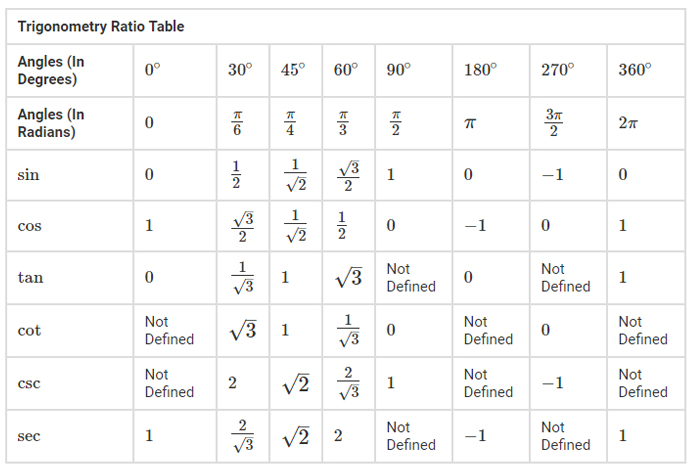
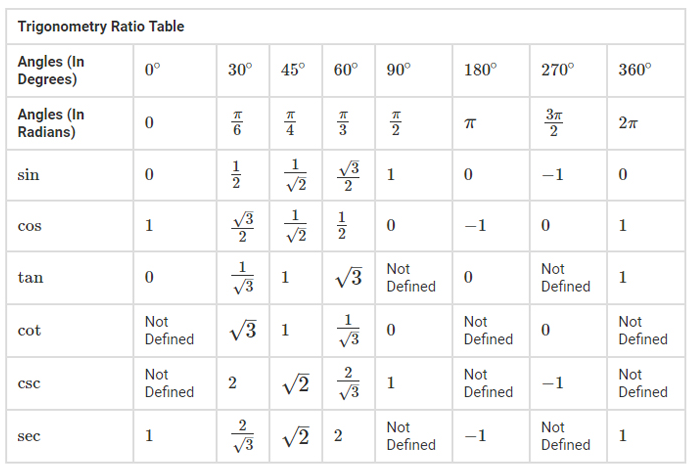
you can see how trig function values relate to certain right triangles or cram a values table (https://trigidentities.net/wp-content/uploads/2021/06/Trigonometric-Table-of-All-Angles.png)
 upper blaze
Guys there is one interesting problem I am working on 😄 If anyone has any ideas it would be apriciated. I got a bit rusty on those stuff 😄 I will post a picture too 🙂
Problem: Equilateral triangles $\triangle A_1BC, \triangle AB_1C, \triangle ABC_1$ are constructed outwards on sides of triangle $\triangle ABC$ and equilateral triangles $\triangle A_2BC, \triangle AB_2C, \triangle ABC_2$ are constructed inwards on sides of triangle $\triangle ABC$. Let $A_0,B_0,C_0$ be midpoints of $BC,AC$ and $AB$ respectivly and let $C_3$ be midpoint of $A_1B_1$. (With $A_3$, and $B_3$ you can mark midpoints of sides$ B_1C_1$ and $A_1C_1$ if needed). Also let $A_4$ and $B_4$ be midpoints of $B_2C_2$ and $A_2C_2$ respectivly (you can set $C_4$ the same way). Prove that triangles $\triangle A_4B_4C$ and $\triangle A_0B_0C_3$ have the same center.
 somber coyoteBOT
MotionMath
 upper blaze
Two things I know for sure ahha Both of those triangles are equilateral and C C_2 anc C_3 are colinear
and CC_3=C_2C_3
timber tapir
weary drift
you can see how trig function values relate to certain right triangles or cram a...
so just memorize this?
upper blaze
I think you just need to memorize just value of sin of angles 30 45 and 60
all others you can deduce from those 3
timber tapir
really? how
upper blaze
well 0 and 90 are 0 and 1 always on sine and cosine
cosx= sin(90-x) so you got cos 30 45 60 from there
upper blaze
upper blaze
well 0 and 90 are 0 and 1 always on sine and cosine
same for 270 and 360
timber tapir
wait what im lost
upper blaze
HAhaha
upper blaze
values at 0 90 180 360 are always 0 or 1 in sin and cos
timber tapir
ok
upper blaze
and you just need to understand where you look cosine values and where you look sin values to know them
so those are easy
you go that?
and 270 same
upper blaze
Hmm, when you draw unit circle, you look cosine values on x-axis and sin values on y-axis
you know that?
timber tapir
i do now
timber tapir
timber tapir
in high school covid kicked me out of school when we covered the unit circle

last half of precalc got cancelled
upper blaze
timber tapir
i do now
nice thats where you start
Now when you got like cos(90) its easy just remember cos is on x axis and you immidiatly know thats 0 😄
timber tapir
ok so i know the thing where the denom is 0 and the numerator is 1,2,3 and 3,2,1 then sqrt everything
upper blaze
hmm ok I dont get what you want to say on this xD
timber tapir
idk it's like a trick to remember something my teacher showed
upper blaze
Hmm you in high school?
timber tapir
no im in college
i passed calc last year in high school and got the college credit but i wanted to take it again in college just to make sure i have a solid foundation before hitting calc II
upper blaze
Hmm Idk maybe this works for someone but I wouldnt learn this method honestly haha
timber tapir
okay
upper blaze
but you can to this too if you see its good for you
upper blaze
DId you understand what I said about 0 90 180 270 and 360 first?
those should be easy
timber tapir
sure but i usually see the values in radians
so it would b easier to convert to that bc i more often end with like sin(pi/2)
than sin(what ever pi/2 is)
upper blaze
okay I can do that 😄
so we are done with those values
now all you need to learn
is sin(pi/6) sin(pi/4) and sin(pi/3)
timber tapir
so they're always 1 or 0, so i just need to memorize which are 1 and which are 0?
upper blaze
timber tapir
so they're always 1 or 0, so i just need to memorize which are 1 and which are 0...
you dont need to know which one is which you can deduce that from understanding unit circle 😄
upper blaze
timber tapir
wait is pi/2 the angle at (0,1)
yes
timber tapir
ok so now what
like idk where to even start to understand the unit circle
like i have a circle drawn with x and y axis in front of me
in my notes
upper blaze
Uhh seems to me like you miss theory there :/
timber tapir
huh?
upper blaze
The way I teach trigonometry is that I ask my students to understand sin and cosine functions completly
timber tapir
okay well i am willing to learn that
upper blaze
and how to connect them from right trigangle to unit circle
timber tapir
yes i just have very little understanding of the unit circle bc of aforementioned reasons
upper blaze
Well for values that you asked not much is needed actualy
timber tapir
yeah but i dont want to just learn for this test
like ideally i'd like to understand the unit circle
upper blaze
you know that it is and you know what points determines 0,pi/2,pi,3pi/2 and 2pi points right?
timber tapir
no
all i know is the info from the vid i sent
which is the angles and their coordinate values
upper blaze
good
now
When you want to find values of sin function
you always look at y-axes
for example
wait I will draw you picture
timber tapir
oh so (x,y) is cos, sin
upper blaze
yes 😄
upper blaze
okay and now
when you have sin0
you need to see what values is determined on y axis by its 2nd line
timber tapir
wait so what are the coordinates of pi/2
upper blaze
pi/2 is at x=0 y=1 so (0,1)
1st line of angle is always on positive part of x axis
Look at this picture
orange part is value of sin and pink one is cos value of angle that I draw there
timber tapir
ohh yeah duh
so do i only need to know the angles for that one quadrant?
and then i can just make x and/or y negative based on whichever quadrant im in?
upper blaze
Basicly yes
you just need to be very careful there and thats it
And you dont need to know both sin and cos
you just need one
I memorize sin in first quadrant
and rest I deduce from formulas and using this fact that you look sin on y-axis and cos on x-axis
Thats how I do at least
when you give me an angle it takes max 2s to deduce but thats becouse of practice though at begining it may take you 5-10s to calculate in your head or its even good to draw a picture for yourself
dont be afraid of doing it on the little picture on the side of your paper
its better to understand how it works than to memorize that table honestly
its more valuable for you
upper blaze
I really dont know what book is good for it though
I have never learn that from book
timber tapir
so then i find tangent with trig conversions
upper blaze
tan=sin/cos
nothing else you need honestly
those sqrt(3) stuff I have never learned in my life xD
timber tapir
like if i need tan(pi/2), i do cos(pi/2) [0]/ sin(pi/2) [1]
timber tapir
upper blaze
those sqrt(3) stuff I have never learned in my life xD
lol ok cool
well thanks i hope that works
wait
timber tapir
what's the angle at (1,0)
upper blaze
its 0
timber tapir
oh ok
upper blaze
both lines coincide
timber tapir
so the pi/2 angle is the 90 degrees angle
timber tapir
wait so when would i ever use (-1,0)
upper blaze
thats pi
timber tapir
oh so 1,0 is 0 and -1,0 is pi
upper blaze
Thats when one line of angle is positive part of x axis and 2nd on negative part
yes
upper blaze
np anytime 😄
timber tapir
im glad i finally understand the unit circle
its been haunting me in calc haha
every time i see a lim and then a trig function
 prime vigil