#geometry-and-trigonometry
1 messages · Page 348 of 1
 night vigil
 silent plank
if you were to consider HK as your base,
the altitude to that would be MJ
 upper karma
you could also use Apollonius theorem + pythag
 copper marten
its asking me for the scale factor to get from the base of the large pyramid to the base of the smaller pyramid at the top, but im not sure how to do it (??)

 trim breach
The triangles in the top pyramid and the whole pyramid are similar.
You can set up a proportion between similar parts.
copper marten
trim breach
You can set up a proportion between similar parts.
so like this?
144 = height of the whole/biggest pyramid
144-96 = 48
48/144 = 1/3
1/3 is the scale factor (?)
(dilated from the apex)
 lament nova
Can someone tell me why I'm getting these wrong?

 finite swan
 onyx marlin
 lament nova
i managed to get it done thx!
onyx marlin
would anyone pelase help me
lament nova
whats up
onyx marlin
can you please show me how to solve the one aboce
 earnest sphinx
What's a recommended software to use to do geometry? For example, for working with parametric curves?
Is MATLAB the best option?
 twin phoenix
onyx marlin
twin phoenix
onyx marlin
Try using the proprieties:
• cos(2x) = cos²(x) - sin²(x)
• sin(2x) = 2sin(x)cos(x)
And expand the right hand side using tan(x) = sin(x) / cos(x)
 somber coyoteBOT
xi64
 upper karma
@onyx marlin
there is a typo btw
(a - b)^2 = a^2 - 2ab + b^2
i mistyped + instead of -
 crimson holly
$4/3 n + 3/4 = 1/2$
somber coyoteBOT
rayy
 upper karma
what is the question ?
 frigid flower
Hello i really can't find any material on my issue because i don't know what this is called. Basically, the exercise goes like this:
AB=5cm
I need to find points (named T1,T2,T3...) that are 2cm away from AB.
Also the angle ATB must be 90°
Help please, i don't even know what method to use to get these points
trim breach
I don’t really know what you are describing. It sounds like ATB is a triangle with hypotenuse AB = 2, but I am not sure what you mean by points away from AB…
Do you have a picture?
 inland salmon
 silent plank
consider circumferences
 past geyser
@inland salmon calculate the circumferences of each circle
that is the equivalent of 1 revolution
 vestal canopy

 delicate lagoon

 finite jackal
@delicate lagoon these triangles must be similar, so just select all the ones that show the correct proportions
 waxen willow
 upper karma
HELP


 silk patio
I think it is
 left plank
There are multiple ways to inscribe octahedron inside tetrahedron right?
left plank
🙏 pls
left plank
left plank
Is octahedron here inscribed in tetrahedron??
I think it is, but I'd rather get confidence from you before approaching my teacher
trim breach
upper karma
HELP
The altitude is perpendicular to the bottom line, which is why it forms a 90-degree angle. Using supplementary angles, and the total degrees in a triangle, you can solve the left triangle. Then, you should be able to solve the rest of easily.
 ruby anvil
dont know how to do this

 storm portal
ruby anvil
dont know how to do this
storm portal
ruby anvil
dont know how to do this
125˚ can't be obtained by summing and subtracting
so
you might have to use a calculator
unless someone else knows
¯_(ツ)_/¯
ruby anvil
ok thx :)
 trim breach
 tawny cypress
B is calculated finding the hypotenuse of triangle ACG.
 shy heath
you can use pythag to find AC then use pythag to find AG
finite jackal
@upper karma angles in a triangle add to 180 degrees and the little squares in the triangles represent 90 degree angles
thats all im going to say
shy heath
tawny cypress
find AC first
7.2^2 + 9.6^2 = x^2
x^2 = 144
x=12
then same thing for AG
shy heath
tawny cypress
Now I'm confused w c
C is finding the angle of GAC
shy heath
tawny cypress
What do they mean by floor
the angle line AG makes with plane ABCD
shy heath
tawny cypress
you can use trig to solve for GAC
shy heath
np
tawny cypress
So tan 3.5/12?
shy heath
tawny cypress
So tan 3.5/12?
yeah you can do that
but
you have to use the arctan function or tan^-1
because your solving for an angle
 trim breach
 remote bronze
is this correct
remote bronze
is this correct
It should be considering the volume relation between pyramids and prisms is 1/3. I don’t think it matters that it is a right pentagonal prism, but if someone could confirm, that would be great.
 tiny snow
Let's say I am given a "box" (not drawn to scale) with the following side lengths. Would there be a way to figure out the metric given this information?

x_1 and x_2 are colinear, and so is y_1 and y_2.
 junior light
Is the box supposed to have all sides equal?
Or just opposite sides or sth like that?
tiny snow
Not necessarily, just opposite sides. In this particular case If we choose x_1 = y_1 = 0 it will collapse to a right angled triangle, with the hypotenuse corresponding to that you would get using Pythagoras. So it's very likely that the metric is the usual metric on R^2.
I would not like to employ that trick though, and I'd rather figure out how to get a metric out of that. Even if it means more conditions have to be satisfied. I'm working on a paper and I will be getting more exotic boxes than that one.
junior light
Aaah
This also might be a better fit for #point-set-topology tbh
This isn't exactly at the pre-uni level haha
tiny snow
Ah, true 🙂 I'll give it a try there, thanks.
junior light
No worries. I'll be trying it too, although I don't know of any metric besides L1, L2 and L∞ 😛
And the discrete metric obviously
@tiny snow I guess the fact that $\sqrt{x_1^2+y_1^2}=\sqrt{x_2^2+y_2^2}$ is independent of our choice of metric since these are just real numbers, right? This gives us $$(x_1-x_2)(x_1+x_2)=(y_2-y_1)(y_2+y_1)$$as a constraint. Would this only be consistent with the $l_2$ metric?
somber coyoteBOT
Manan.
 junior light
Since we want $d(y_2,y_1)=d(x_2,x_1)$
somber coyoteBOT
Manan.

 tiny snow
No, that box actually looks like this (roughly sketched)
 junior light
Aahhhhhh
So uh, you want to find a metric which ensures it retains a convex quadrilateral shape?
(given that the dimensions are as mentioned in your last diagram)
tiny snow
My goal is to figure out that given those side lengths I must be in the real plane, and not, for example a hyperbolic plane.
junior light
Hmmmmmm
Okay, so we're confined to R^2 and metrics on R^2, which ensures the above figure stays a convex quadrilateral
Let's just work with the assumption that none of the four values is 0 to avoid collapsing-into-triangle kind of degeneracy
Also, x_1 and all that don't have any relation to coordinates, right? They're just real values?
tiny snow
They're just real values.
junior light
Okay
tiny snow
I think there's some constraint missing in order to get a handle on this.
junior light
Honestly I think so too
I'd be amazed if this problem could be solved with only this much information
I'm still trying to wrap my head around the problem itself lmao
I also think the values of x_1, etc. would impact the choice of metric
tiny snow
I can choose x_1 and x_2 freely as long as they are colinear, and same for y_1 and y_2.
So, making those two sides equal in length is possible.
junior light
What would it mean for x_1 and x_2 to be collinear? They're just real values, right?
tiny snow
I mean, geometrically they're along the same straight line on the space.
junior light
 Is that a constraint on the coordinates of the box?
Any two points on the plane are collinear anyway
You can always get a line through them
tiny snow
Yes, sorry, these are on straight lines. I don't want to rule out that there could be other lines through two arbitrary points. Think great circles on a sphere for example.
junior light
Hmmmmmm
tiny snow
Maybe I should rephrase the question to how much information can you get about a space, if you can construct boxes with various side lengths at various places in the space 🙂
junior light
Sure, that might help!
I'll try thinking more about this problem, limited as my understanding of both geometry and analysis may be. 😛
tiny snow
Thanks for the help so far!
junior light
I wasn't able to add anything meaningful. Let me know if you have any updates!
 barren patio
Truth or deception?

 humble pulsar
I mean given that's not pi, deception
However the problem of squaring the circle under using a straight edge and compass is known to be impossible
tawny cypress
shy heath
arctan 3.5/12=x
ohh yeah that's what i meant tyvm again
barren patio
humble pulsar
However the problem of squaring the circle under using a straight edge and compa...
I solved that problem too.
humble pulsar
Ok.. how?
cause given you posted something with an incorrect value of pi, I doubt you did
barren patio
humble pulsar
Ok.. how?
Did you check the squaring of the circle with that value 3.1630625 on calculator?
humble pulsar
why would I use that value?
It's not pi, so using that value isnt the area of a circle w/ radius 1
barren patio
humble pulsar
It's not pi, so using that value isnt the area of a circle w/ radius 1
wait, I will send you.
humble pulsar
I asked for your proof of squaring the circle under the typical restirctions
not a radian calc
barren patio
humble pulsar
not a radian calc
I'm sending you a PDF
humble pulsar
cool, can you stop fucking pinging me
barren patio
ok, sorry
humble pulsar
You did not solve a problem from ancient Greece if you used a value of pi that isnt pi
barren patio
I'm talking to you, so it's my habit. Sorry again for that...
Why are you immediately convicting and you haven't even looked at the evidence yet?
humble pulsar
cause what you have posted is grounds enough to null your proof
humble pulsar
so yeah, 2nd line already missed the point of squaring the circle
which is that you cannot create a square using a straightedge and compass that has the same area as a circle
Squaring the circle does not say it's impossible to make a square with the same area period
barren patio
Do you have a better solution?
humble pulsar
cause that's trivially define the side length as $\sqrt{\pi}$ and pack up
somber coyoteBOT
moshill1
 humble pulsar
barren patio
Do you have a better solution?
humble pulsar
barren patio
Do you have a better solution?
No, since it's known impossible
barren patio
lol
humble pulsar
no amount of precision in your straightedge, even if it's graduated, will give you square root of pi
since sqrt(pi) is irrational, and thus always more decimals
barren patio
🙂 Ok 🙂
I don't want to argue or convince who is right. I just want to share what is reasonable and logical. He who has eyes, let him see, and he who has ears, let him hear. With love.
humble pulsar
Then share something reasonable and logical 
barren patio
I've already done that.
 humble pulsar
You did not, since the 2nd point of that article asserts that pi is rational, yet it is not proven that it's rational
whereas pi has been proven to be irrational, transcendental at that
barren patio
@torpid hearth Pi is a rational. Check countless times in countless ways.
 torpid hearth

I did make one big typo/mistake in the video: at 3:40 I claimed that f(x) is a polynomial with integer coefficients. I meant to write n!f(x) is a polynomial with integer coefficients. Commenter ffggddss also pointed out some other typos/smaller mistakes in the video which I have pinned to the top.
As it's impossible to simply edit the video on ...
barren patio
There is a lot of garbage on Wikipedia and on the Internet. The truth is barely noticeable.
torpid hearth
I can't tell if this is a troll or not
humble pulsar
It's clearly a troll
 wanton storm
Now prove it's transcendental 
somber coyoteBOT
moshill1
 torpid hearth
humble pulsar
It's clearly a troll
torpid hearth
humble pulsar
It's clearly a troll
this is so sad
who takes the time to make a fake research paper
barren patio
If I’m a troll, I’m sorry I came to this channel of my own free will. 😦 It is easiest to condemn. I was born in the country where Nikola Tesla was born. As a token of love, I will greet you.
humble pulsar
and they gone
 wintry tundra
Lol
 eager rock
need help
wintry tundra
With what specifically
eager rock
the whole thing 😭
wintry tundra
That's a lot of work
I mean I can just generally teach you how to do proportional triangles
eager rock
sure please
i keep getting decimals in my answers when im solving x
and idk if thats right
for number 2 i got 12.6 for GH and 9.6 for Kj @wintry tundra
wintry tundra
If its only tenths then probably right
As long as ur taking ratios for lengths of similar sides
Which ima guess u are
Also don't expect to get all the answers bc here we only help you get to the answers
So its mainly u that gets the answers in the end
 near imp
 upper karma
 upper karma
can someone explain this to me? my english is really bad and im not very good at word problems
 torpid hearth
upper karma
can someone explain this to me? my english is really bad and im not very good at...
torpid hearth
upper karma
can someone explain this to me? my english is really bad and im not very good at...
 upper karma
ohh i see it now, thank you!

 tired pine
It’s a square pyramid
You have the diagonal of the square from (c), and you’re solving for the side of the square
Do you know special right triangles?
actually wait you don’t even need that
do you know pythagorean theorem
 proven breach
Anyone know how to do this?
 tired pine
Do you know the double angle identity for cosine?
 tired pine
Yep
proven breach
what do i do with it
tired pine
Which one can you do with the info you have
proven breach
the second one
proven breach
plug in where
tired pine
You can use $\cos(2A)=2\cos^2(A)-1$
somber coyoteBOT
CST
 tired pine
Since you have $\cos(A)=\frac{\sqrt{3}}{6}$
somber coyoteBOT
CST
 proven breach
how i get cos^2 in my calculator
tired pine
you don’t need the calculator (cos)^2
proven breach
ok
tawny cypress
tired pine
You have the diagonal of the square from (c), and you’re solving for the side of...
Omg I'm literally not thinking damn I feel dumb but thank you I get it now
proven breach
tired pine
~~you don’t need the calculator~~ (cos)^2
what do i do
proven breach
tired pine
You have cos already
im confused
tired pine
proven breach
im confused
square the value you have, then multiply it by 2, then subtract 1
proven breach
tired pine
square the value you have, then multiply it by 2, then subtract 1
thanks, got it
 worthy lichen
oh wait nvm this isnt the help channel
 valid sinew
worthy lichen
oh wait nvm this isnt the help channel
valid sinew
worthy lichen
oh wait nvm this isnt the help channel
This is the help channel
 inland dagger
 junior light
@inland dagger What have you tried so far?
 pure bronze
@inland dagger Do you still need help with that question?
copper marten
inland dagger
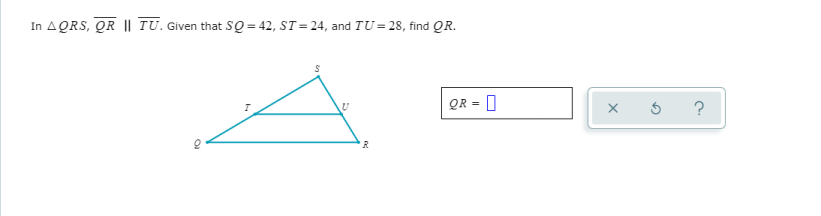
can someone help me with this? https://images-ext-2.discordapp.net/external/pSAr...
49
@inland dagger
find scale factor:
ST and SQ are corresponding, so we can divide those to find the scale factor
42/24 = 1.75
TQ is corresponding to QR and we know what TQ is which is 28
28 x 1.75 = 49
so, QR = 49
 azure basalt
Hey guys, this may sound as a stupid question, but how can sine/cos have inputs > 180 degrees. from what I now those functions are just the ratio of triangle sides. triangle interior angles add up to 180. so there is no triangle with angle > 180. what am I missing? 😢
trim breach
Those functions are based on the unit circle, but can be applied to triangles.
azure basalt
so later on I will learn the relation of sine/cos etc. in relation to the unit circle?
I am already solving unit circle problems now without a problem, It's just that I don't really grasp the full picture/relations
trim breach
Yeah. Essentially, anything greater than 2π radians (360 degrees), the angle in those trig functions yields the same value as that angle minus 360 degrees.
So you wouldn’t really have a 400 degree angle in your triangle, but you could have a 40 degree angle since it is the same value within the trig function.
 somber coyoteBOT
hiidostuff
 wintry tundra
Also lol 69 nice
proven breach
So it’s pi over 5? @wintry tundra
wintry tundra
Mhm
proven breach
Thanks
wintry tundra
Np
 humble pulsar
tan is odd, so $-\tan{x}=\tan(-x)$
somber coyoteBOT
moshill1
 proven breach
@humble pulsar so ya what’s the answer
proven breach
2 square root 5?
humble pulsar
why is it that?
humble pulsar
by doing what?
proven breach
Idek
humble pulsar
Ok then idek if it's right
proven breach
Why so mean
humble pulsar
It's not mean, trying to see if you actually solved it or blindly guessed
Besides, the final answer isnt important 99% of the time
proven breach
I guessed idk how to do it
humble pulsar
what's the relationship between cot and tan?
proven breach
I forgot
humble pulsar
Ok so look at your notes, or the trig cheatsheet that's pinned in the channel
proven breach
Not doing all that, just gonna guess
humble pulsar
Ok
humble pulsar
Yoiu have a 25% chance of being right
proven breach
humble pulsar
Yoiu have a 25% chance of being right
😑
humble pulsar
Look, if you wanted to learn how to get the answer, I was more than willing to explain the couple steps it took
humble pulsar
proven breach
U wouldn’t explain
I gave you a nudge with how to get tan(-x), then told you you need a relationship b/w tan and cot, also told you the relationship was pinned in the cheatsheet. I did help you, and did try to explain it
I am not going to spoon-feed someone answers if that is what you expect help and explanation(s) to be
proven breach
Damn u one of those smh
humble pulsar
Yes, I'm one of those people that actual helps
proven breach
@humble pulsar well thanks anyway
wintry tundra
proven breach
Damn u one of those smh
Ahh ur one of those smh, those who want the answers spoon fed to them
proven breach
no im not
azure basalt
trim breach
Yeah. Essentially, anything greater than 2π radians (360 degrees), the angle in...
Thanks bro! 😃 Appreciate the info!
 wintry tundra
Well idk why u boxed only sin(x) = A
When the equation is actually arcsin(x) = A
Where arcsin is the inverse function of sin
 onyx viper
yea that was a stupid mistake
onyx viper
not sure how to find the arccos and if it can be a real value
wintry tundra
Hmm
Well sadly the arc mistake is really the only thing I can help with
Sorry
But maybe someone else could help out
onyx viper
it is ok just not sure where even to begin tbh

 desert copper
sad
 shrewd tendon
yea
shrewd tendon
desert copper
sad
intesesting name tho
desert copper
ahhaa thanks
 desert copper
sorry i can't
desert copper
that's hard for me
shrewd tendon
yea math has never been my thing
i was the smartest in my class until 3rd grade lol
shrewd tendon
damn
desert copper
ii think my besties influence me
desert copper
hahah how old are u
desert copper
shrewd tendon
junior in hs
me too i will be 11th grade next year
shrewd tendon
desert copper
me too i will be 11th grade next year
nice
shrewd tendon
desert copper
hahah how old are u
i just turned 17 yesterday lol
desert copper

shrewd tendon
 wintry tundra
shrewd tendon
😦
wintry tundra
shrewd tendon
😦
what is it that was confusing about circles to you? i could help you with that
shrewd tendon
wintry tundra
what is it that was confusing about circles to you? i could help you with that
lol the whole thing but lukuly i passed that unit
i really appreciate the help tho brodie
wintry tundra
np
i mean i guess one thing to remember with circles tho is that most things you are trying to find in geometry with circles relate to how much of the angle is to 360
 glacial dawn
Amazing pfp hiido
wintry tundra
thank you stephen
shrewd tendon
whoa picture is amazing lol
usually i struggled with the tangents cosign and the other one
i would struggle to identify each side
wintry tundra
but if you have an angle whos joining point is on the middle of the circle, the curve at the end, like the crust of the pizza slice, it will be the radius times the angle
shrewd tendon
and how to solve
wintry tundra
tangent cosine and sine?
ahh i see
just remember that they are ratios on a triangle
like comparing sides
the reason we even bothered to have sine cosine and tangent is because you need to find weird ratios of triangles all the time
if ur in engineering or physics that is
but for my robotics team i am mainly the mathematician and i have to work with circles a lot for wheels
and holes being cut in parts of the bot
which are usually circular holes
but good luck with geometry and algebra 2 next year is what i guess u would take

 fast pulsar
Here, I have this drawing for you at least

 pseudo pumice
Stop double pinging, please.
 slow fossil
OK
torpid hearth
slow fossil
https://cdn.discordapp.com/attachments/409596215697866773/832504463368912956/unk...
Did you get this question answered?
oops
@slow fossil
alright I solved it


Imma go to sleep so i'll just post the answers
sorry it's a bit messy lmao
 gilded fjord
hi, can someone help me figure this out? i've been trying to solve it but i'm so confused

 crimson smelt
 compact jasper
if i trying to do tan (x) = sin(x) / cos(z) its cant be? The one and only case is tan(x) = sin(x)/cos(x) ? 🙂
pure bronze
compact jasper
if i trying to do tan (x) = sin(x) / cos(z) its cant be? The one and only cas...
it has to be the same angle or value
trim breach
 loud wolf
can anyone help me factorize this?
loud wolf
can anyone help me factorize this?
That doesn’t factor nicely. Can you use quadratic formula for what you are doing?
pure bronze
Well it actually does if you use a different method other than the quadratic formula
 torpid hearth
 vague helm
Need some help with this problem
vague helm
Need some help with this problem
what is the ratio of cosine? (Hint: SOH, CAH, TOA)
@vague helm
vague helm
Um I’m very new to this and don’t really now how to do it at all
torpid hearth
here are the 3 trig ratios
 vague helm
So what way would I answer the problem in?
somber coyoteBOT
keto11
 torpid hearth
a ratio is division between two numbers so...
somber coyoteBOT
keto11
 vague helm
Ok so how would I start putting the numbers in?
torpid hearth
the first thing you want to do is actually draw the triangle, it's a lot easier to see what's going on
@vague helm are you able to upload images to the discord?
torpid hearth
kk ping me when your back
 vague helm
@torpid hearth ok I’m back
 torpid hearth
okay good
now you have to identify which lengths are the hypotenuse, adjacent, and opposite
@vague helm
 torpid hearth
what's the definition of a hypotenuse?
 vague helm
Oh shit so ON
torpid hearth
which angle are we looking at?
vague helm
Wait what?
torpid hearth
We're trying to find the cosine of angle N
 vague helm
Oh ok so what will the equation look like?
torpid hearth
well you have to identify the sides...
you already have 1, the hypotenuse is NO
do you know how to identify the sides?
vague helm
So cos(90) 77/85?
torpid hearth
90 is the right angle not angle N
vague helm
So would I replace 90 with X?
torpid hearth
cos(N) = ?
vague helm
So cos(N) = 36/85?
torpid hearth
somber coyote
**keto11**
from back up here
vague helm
So I can use a calculator to answer the question so how would I put this into a calculator?
torpid hearth
stop rushing for the calculator
you already have the answer
What is the question asking you to solve for?
torpid hearth
yep
the only reason you would need a calculator was if they asked you to find the value of N
then you would have to do the inverse cosine
vague helm
Yeah and I’m gonna need that soon
I’m gonna finish this one. Then next thing that I don’t know I’ll ask I guess
torpid hearth
kk
 vague helm
 torpid hearth
We're trying to find the cosine of angle N
torpid hearth
torpid hearth
We're trying to find the cosine of angle N
now you wanna draw the angle that you're solving for just like I did here
torpid hearth
vague helm
Now what?
What's the ratio for sin of an angle?
torpid hearth
it's these ratios
 vague helm
So it’s 20/29?
vague helm
Oh so 21=20/29?
torpid hearth
what's 21?
upper karma
vague helm
It’s 21=20/29
in addition, be aware of what you are saying.. 21=20/29 is blatantly untrue, this is the same nonsense as saying 0=1.
vague helm
P=20/29
 somber coyoteBOT
keto11
 vague helm
Oh so sin(P)=20/29
torpid hearth
how do you isolate P?
vague helm
Um idk
torpid hearth
torpid hearth
then you would have to do the inverse cosine
if in the last problem to find the value of angle N, you had to take inverse cosine, then to find the value of P you need to take...?
somber coyoteBOT
keto11
 vague helm
So what will be A and what will be B?
somber coyoteBOT
keto11
 torpid hearth
vague helm
Oh so sin(P)=20/29
torpid hearth
vague helm
Oh so sin(P)=20/29
here
vague helm
Oh so the answer will be 0.69?
somber coyoteBOT
Result:
0.68965517241379
o frick me
torpid hearth
somber coyote
**keto11**
what pattern do you see here?
vague helm
For like the template of the problem?

 vague helm
Oh so cos wouldn’t have the negative?or that’s it’s not inverse?
torpid hearth
what is the inverse cosine?
vague helm
Cos-1
torpid hearth
torpid hearth
and what have I highlighted here?
vague helm
Cos-1
torpid hearth
so to cancel out cosine you use inverse cosine, then to cancel out sine you use ?
vague helm
Inverse sine?
torpid hearth
yeah
somber coyoteBOT
keto11
 vague helm
Ok ok understood
somber coyoteBOT
keto11
 vague helm
So now I have this problem because I finished the section that had the questions you helped me with

Also understood
So how would I go about answering this?
torpid hearth
Identify which sides are opposite, hypotenuse and adjacent to the angle G
vague helm
So Hypotenuse is I, Opposite is G, and Adjacent is H
torpid hearth
those are angles, sides are line segments
torpid hearth
All of these problems are basically the same, why don't you try to work it out on your own for a bit. Use the stuff that I posted above if you get stuck first
vague helm
Oh ok
torpid hearth
@vague helm did you figure it out?
vague helm
,calc 8.9 tan 48
somber coyoteBOT
The following error occured while calculating:
Error: Unexpected type of argument in function multiplyScalar (expected: number or Unit or string or boolean or BigNumber or Complex or Fraction, actual: function, index: 1)
vague helm
@torpid hearth no, no I don’t
I’ve been trying for an hour now and can’t even get past the first question
torpid hearth
wassap?

 torpid hearth
it's because you're using desmos
later on in math you'll learn about something called radians it's a unit system for degrees basically
if you want to fix it for desmos you want to do this
vague helm
So what do I do with my desmos?
 vague helm
Yeah I see it and I clicked
torpid hearth

radians should be highlited in black, click on degrees and you should get the correct answer

 somber coyoteBOT
keto11
 torpid hearth
@vague helm did you figure it out?
 warm temple


 pure bronze
which one?
 zealous forge
the last 4 pgaes
pure bronze
when you have similar triangle, you have a special unique attribute, can you guess what that is?
pure bronze
they have a relation of similarity
pure bronze
@zealous forge are you here?
zealous forge
yeah
pure bronze
all right, so when you have a pair of similar triangles, you have a ratio between them
to calculate that ratio, you divide two proportional sides from each triangle
zealous forge
ok
pure bronze
if BE = 9
AM = 3
ET = 12
then the ratio must be 1/4
since AM and ET are proportional
AM comes from the triangle RAM
ET comes from the triangle BET
and for that reason, what can be inferred?
pure bronze
what can you conclude from the ratio of 1/4
if the smaller triangle is RAM and the larger one is BET
and they have a ratio of 1/4
what can you figure out
zealous forge
BE
pure bronze
BE is already given to us, it's 9 cm
but what can you see and say about the relation between the two triangles?
one is smaller than the other
but by what?
zealous forge
is that its 1/4 smaller
pure bronze
yup
zealous forge
ok thank you
pure bronze
anything else?
zealous forge
ok can you help me with the last 4 questions please? i think i can figure out everything else
zealous forge
sorry for asking alot
pure bronze
it's fine, I'm here to help ya
pure bronze
pure bronze
13, 12, 11, 10?
?
zealous forge
i think we have to find the area
zealous forge
so what do we need
pure bronze
perhaps some trig could do the trick 🤔
pure bronze
zealous forge
are u Australian ?
nope
pure bronze
bullseye
zealous forge
Nice thats cool
pure bronze
but now
what kind of trig could we use to do this?
(hint: this is not a right triangle)
pure bronze
yeah sure
zealous forge
sorry wdym by trig
pure bronze
trigonometry
zealous forge
 ok 1 sec
zealous forge
pure bronze
have you learned the law of sines?
yeah]
pure bronze
yup
zealous forge
so its should be side a
pure bronze
wait no
zealous forge
plus side b
pure bronze
mate
zealous forge
right
zealous forge
Ok
so
the missing angles is
93
and now i can use the formula because i ahve 3 angles
zealous forge
ok
ok
thank u so much
1 sec
am gonna solve and may u tell me if i got it right
please
zealous forge
ok i got for the first side which is A its equal to 7.4
zealous forge
i used the know one to find the of the other sides
pure bronze
uhh, what?
zealous forge
i ddi this
 pure bronze
all right, now find x
zealous forge
ok i got 5.845
and a bunch of ther numbers
its not fo a though
nbm
nvm
1 sec
A=7.4
pure bronze
okay
zealous forge
B=5.8
pure bronze
weird
wintry tundra
Wait 93 degree angle?
zealous forge
yeah
wintry tundra
What shape
 wintry tundra
Oh ok
pure bronze
zealous forge
thanks for the help Hunny
np
wintry tundra
Did u solve it already?
wintry tundra
Ok
Hmm
9.7 / sin 37 = a / sin 50
Will give u one side
Then u can use law of cosines to find the last side
And there u go
Problem solved
So @zealous forge now u should be able to solve ur issue, if you know law of cosines
zealous forge
Goddamn
pure bronze
didn't I tell you to use the law of cosines? @zealous forge
wintry tundra
Do u know law of cosines?
zealous forge
wintry tundra
Do u know law of cosines?
no
zealous forge
pure bronze
didn't I tell you to use the law of cosines? <@!444251511250354177>
yeah but idk whats that
wintry tundra
$c^2 = a^2 + b^2 - 2ab\cos{(\gamma)}$
somber coyoteBOT
visual of Petter's ascendance
 pure bronze
zealous forge
yeah but idk whats that
pure bronze
zealous forge
yeah but idk whats that
I don't recall myself telling you that
zealous forge
pure bronze
I don't recall myself telling you that
telling me what
pure bronze
zealous forge
telling me what
to use the law of cosines
wintry tundra
If you use the law of sines, you can find both sides u need to find x
Gamma is the supplement to the sum of the other angles
So boom
That's what u need
zealous forge
wintry tundra
a and b are the sides know
so if i find the fist side i use that and the orgiginal lside to find X
wintry tundra
Yep
zealous forge
ok thanks
zealous forge
pure bronze
to use the law of cosines
idk what that law is thi
wintry tundra
Remember x has to be larger than 9.7
zealous forge
tho*
wintry tundra
I told u that law
wintry tundra
somber coyote
**visual of Petter's ascendance**
This is that law
The cosine is why it's called law of cosines
zealous forge
wintry tundra
Remember x has to be larger than 9.7
ok so anything larger than that i can be sure that its right
zealous forge
wintry tundra
The cosine is why it's called law of cosines
oh i didnt know that
wintry tundra
Yep
Bc think about it
If there's a large angle then it's opposite side also has to be big
Bc the angle makes a lot of space to connect
And 93 is bigger than 50
wintry tundra
Yeah
zealous forge

lets goooo
ok i need one more
so in this law

the variables are the angles not the sides right?
wintry tundra
Ok remember this
English letters are probably sides and Greek letters are probably angles
This follows the same thing
a and b are your known sides
And the weird curly thing called gamma is the angle opposite of c
c being the side ur trying to find
zealous forge
so what do i plug in for c^2,a^2 and b^2
wintry tundra
a and b are the sides you know
zealous forge
i still dont have 3 sides
wintry tundra
c is the side you don't know
Yeah ur trying to find c
The right hand side is solvable itself since a b and gamma are now defined
Doesn't matter what sides you put in for a and b
Gamma angle does tho
Has to be able opposite of c
wintry tundra
So $c^2 = 12.3^2 + 9.7^2 - 2(12.3)(9.7)\cos{(\gamma)}$
somber coyoteBOT
visual of Petter's ascendance
 wintry tundra
Is what u should have
zealous forge
ok i understand now
how do i make photos like u
when i write an equatin
equation*
zealous forge
yeah no thanks am just gonna draw it and send it here
wintry tundra
There's so many math functions and therefore so many things to do with the math thing called texit
 zealous forge
what is it?
wintry tundra
$2ab$ is not equal to $2(ab)$
somber coyoteBOT
visual of Petter's ascendance
 wintry tundra
For 2ab you only double one of the variable values
For 2(ab) you double both
Here you have 2ab so only one
 ionic talon
Would 2(ab) be 2a + 2b?
zealous forge
missing side
zealous forge
wait x in the question?
wintry tundra
Only multiply 12.3 yes
zealous forge
ok
wintry tundra
2(ab) is 2a2b
ionic talon
So no addition?
wintry tundra
No
somber coyoteBOT
visual of Petter's ascendance
 zealous forge
 wintry tundra
Gamma is 93 degrees or 93pi/180 radians whichever one u like best
Degrees is better here so use degrees
zealous forge
so what shall i do from here
wintry tundra
Multiply the end part by cos 93
zealous forge
so -24.6(9.7) cos 93
wintry tundra
Is ur calculator is radians mode?
zealous forge
nah am using google as my calulator bro
wintry tundra
Hmm
 wintry tundra
End result should be 12.5
zealous forge
ok 1 second
 wintry tundra
Your calculator is set to radians
Set it to degrees
Or change 93 to $\frac{93\pi}{180}$
somber coyoteBOT
visual of Petter's ascendance
 zealous forge
wintry tundra
Your calculator is set to radians
zealous forge
wintry tundra
Your calculator is set to radians
yeah
zealous forge
somber coyote
**visual of Petter's ascendance**
ok iwill

omg
its right
12/5
12.5
wintry tundra
Yep
zealous forge
wintry tundra
Yep
Thank you so so so much dude
zealous forge
damn ofc u gotta ruin the moment
wintry tundra
Now you have $c^2 = 12.3^2 + 9.7^2 - 12.5$
somber coyoteBOT
visual of Petter's ascendance
 zealous forge
so i just solve then what ever i get is c^2 right
zealous forge
which is x
wintry tundra
Yeah
zealous forge
right then am done
wintry tundra
Mhm
zealous forge
what now lol
 wintry tundra
Alright
So c^2 is equal to that
So what should we do to 233 to make it equal to c
wintry tundra
Wait
Is that an answer on your homework
Bc that isn't riggt
Did u solve this? $12.3^2 + 9.7^2 - 12.5$
somber coyoteBOT
visual of Petter's ascendance
 wintry tundra
Or evaluate it I should say
zealous forge
Oh
thats whyy
its all good
i hope its right this time
16.0586425329
so 16.10
uhh fianlly
thank you very mcuh Sir
wintry tundra
Yep
zealous forge
for helping me with this
wintry tundra
Np
zealous forge
Could i ever ask you for help if i need some in the future
wintry tundra
Heck yeah I help pretty often
I'd ask for helper role but I don't wanna get mentioned all the time
So dms would be fine by me
zealous forge
alr so your like an undercover helper
wintry tundra
Not really undercover
Ima be honest I haven't taken trig yet in school
I just self studied it
A while ago
And I'm not bad at it since I use it in my robotics club and engineering somewhat often
 onyx viper
are the semi circles at at right angle
upper karma
yes
onyx viper
I think then they should both intersect at the apex
onyx viper
I honestly have no idea I dont see any given angles or line measurements
upper karma
pretend the radius is 1
onyx viper
what specificaly are you trying to find
the exact cordinate of the intersection or just information about the semi circles
upper karma
the area of the part where they intersect
onyx viper
oh ok
I have no idea how to help you out with that I would post that in a questions most of them seem to be open
upper karma
thank you
onyx viper
anyone able to help solve sin^2(x/2)cos^2(x/2)=(sin^2x)/4
torpid hearth
onyx viper
anyone able to help solve sin^2(x/2)cos^2(x/2)=(sin^2x)/4
uh
double angle identity
onyx viper
thanks feel stupid now
 lofty adder
If a point is defined as being dimensionless or according to Euclid 'that which has no part', then how can it represent anything geometrically. I think this confusion is arising because we use a dot to represent a point but the dot obviously has a part to it which can be observed on zooming in. Can anyone please help me?
 gritty spindle


 dark sparrow
do you have a calculator with buttons for inverse trig functions?