#geometry-and-trigonometry
1 messages · Page 341 of 1
 acoustic notch
 supple onyx
Nice
 remote bronze
can someone help me with this
 viscid patio
Since n intersects j at one single point, n and j are not parallel
j is parallel to k
thus n is non-parallel to k
And based on the fact that : if two coplanar lines are non-parallel, they intersect
...n intersects k
 tulip ingot
wait guys I got it
the line is going downwards right
and the k is below it
so eventually the line will keep going down until it passes the line k
boom
Q.E.D.
 oak citrus

 obtuse tapir
a book
 storm portal
the internet - there are great sources on yt, and i'm sure khan academy since people continue to recommend it
 elder sphinx
How do I solve this
storm portal
you have your sides messed up - side opposite 30˚ is x, side opposite 60˚ is x√3, hypotenuse is 2x
 graceful trail
how can I solve for the period?
 pure cape
asin(b(x+c)) + d = f(x) is the function of the sine function where 2pi/|b| is the period
remote bronze
is this correct?
 silent plank
yes
 vapid stag
so trig is kinda like geometry?
 prime linden
vapid stag
so trig is kinda like geometry?
prime linden
vapid stag
so trig is kinda like geometry?
Yes, the trigonometric functions are interesting in that they are first defined not as some algebraic expression but rather as the process of measuring sides of a right triangle and determining their ratio.
vapid stag
 So I technically didn't need to learn algebra 2 to get into trig
prime linden
Well to do the excercises that test your understanding in trig you need algebra
remote bronze
i think it is D but i am not too sure
silent plank
what's your reason for adding 42 to 42?
 upper karma
Spherical and polar, how often?
remote bronze
i am suffering someone please help
upper karma
what do you need to prove ABCD parallelogram ?
remote bronze
that is what it says to do.
viscid patio
Just graph the rectangle
First
They are basically asking you to calculate the percentage of the area of the rectangle in the quadrant III
U know just graph
And u ll understand
Try to use the little squares
As a unit area
viscid patio
25 is the area right?
Now calculate the area of the rectangle that lies in quadrant III
upper karma
@viscid patio I see
so then
What do I have to do for 8
the rectangle in quadrant 3 would be t w o, that's the area, no?
because l is -1 and h is -2
viscid patio
Area of the whole square : 25
Area of the rectangle in QIII : 2
viscid patio
upper karma
25/2?
Close
upper karma
2/100 * 25?
viscid patio
Close
viscid patio
its a formila i guess
upper karma
that's 23
viscid patio
No
viscid patio
area / total area × 100
upper karma
so 8%
viscid patio
Yesss
viscid patio
You re welcoome
upper karma
@viscid patio is it possible to find the sides of a right triangle with only the 3 angles
 humble pulsar
upper karma
<@796094488225120306> is it possible to find the sides of a right triangle with ...
humble pulsar
upper karma
<@796094488225120306> is it possible to find the sides of a right triangle with ...
Yes, simultaneous equations w/ trig
vapid stag
what a troll lol
 low oak
 scarlet basin
hey can somone help me out with this?
AB = 7.2 and CD = 14.2, (7.2 + 14.4) / 2 = 10.8
So EF should be 10.8, but it says it's wrong?
<@&286206848099549185> srry idk if im allowed to tag u guys
scarlet basin
@alpine cliff i did
 alpine cliff
What does the midsegment th. State
The mid segment is the average of the two bases
Find the length of the bases
And then their average
Voila you got your length in exact form
 green osprey
mathamatics
remote bronze
is my proof correct?
 open crypt
Confused on where to start, any help? I usually dont need help but for some reason I cant plot my finger on were to start. I dont need an answer just a correct first step
open crypt
<@&286206848099549185>
 abstract prairie
https://gyazo.com/39936d613fb17a6741ddf002b5b0a52f
Find x to the nearest tenth

can i get help here
abstract prairie
not sure tbh
upper karma
Use your Trigonometric Ratios
abstract prairie
havent learned those
upper karma
$x=10\sin\left(36\right)$
Yeah your Trigonometric Ratios
you do know them
why'd you tell me you don't know them
upper karma
SOHCAHTOA?
abstract prairie
what
abstract prairie
ahh
 somber coyoteBOT
Several people are
abstract prairie
ohh
upper karma
come back
upper karma
You didn't round it
 alpine niche
Can anyone explain me from where comes that 160?
 tiny kiln
Can someone help me with geometry please
 ebon star
 azure laurel
How do I do this I'm so confused
 grizzled lantern
did mans get banned?
 unique peak
azure laurel
How do I do this I'm so confused
unique peak
azure laurel
How do I do this I'm so confused
X = 3 by mid point theorem
Then find the sides by placing the Value of x
 royal crown
royal crown
royal crown
 onyx cloud
royal crown
onyx cloud
royal crown
what's giving you trouble
royal crown
the = too part
onyx cloud
you said you know that you have to combine the fractions
so do just that
combine the fractions
royal crown
im so lost
onyx cloud
with what
royal crown
@onyx cloud
royal crown
what it simplifies too
onyx cloud
do you see the 2 like terms?
royal crown
no
onyx cloud
you just need to add the 2 cos(theta)sin(theta) together like you said
its just 2sin(theta)cos(theta)
royal crown
can you transform that for me
silent plank
where did your sin^2 and cos^2 wander off to?
onyx cloud
you had $\frac{\sin(\theta)\cos(\theta) + \cos(\theta)\sin(\theta) +\cos^2(\theta)+\sin^2(\theta)}{\cos(\theta)\sin(\theta)}$
somber coyoteBOT
maximo
royal crown
oh so keep that?
onyx cloud
which is right
royal crown
ahhh
onyx cloud
just add the 2 like terms
silent plank
there's no reason to erase them from existence
onyx cloud
$\frac{[\sin(\theta)\cos(\theta) + \cos(\theta)\sin(\theta)] +\cos^2(\theta)+\sin^2(\theta)}{\cos(\theta)\sin(\theta)}$
somber coyoteBOT
maximo
onyx cloud
now add the two terms i put in the brackets
$\frac{[\sin(\theta)\cos(\theta) + \cos(\theta)\sin(\theta)] +\cos^2(\theta)+\sin^2(\theta)}{\cos(\theta)\sin(\theta)}$
somber coyoteBOT
maximo
somber coyoteBOT
maximo
royal crown
i apologize if i am wrong
onyx cloud
add them though
don't just put the brackets
$\sin(\theta)\cos(\theta) + \cos(\theta)\sin(\theta) = ?$
somber coyoteBOT
maximo
royal crown
its already in the bracket ? or add it again?
silent plank
you're overthinking it
royal crown
sorry bro if im bothering you i just dont understand
royal crown
2xy
silent plank
a^2 + b^2 + ab + ba= ?
onyx cloud
yes
royal crown
so 2xy my numerator
onyx cloud
here
just let x = cos(theta)
and y = sin(theta)
so now we have cos(theta)sin(theta) + sin(theta)cos(theta)
what does that equal to?
if xy + yx = 2xy
royal crown
sin 20?
onyx cloud
where did you get 20 from
silent plank
you're really overthink yhis
a^2 + b^2 + ab + ba =?
you're really overthinking this
no
vapid stag
what's a good time to start physics class? After pre-cal?
pure cape
how is this relevant on a math server?
and in a channel for questions regarding exercises and problems
 unkempt glen
vapid stag
what's a good time to start physics class? After pre-cal?
unkempt glen
vapid stag
what's a good time to start physics class? After pre-cal?
yeah a lot of high school physics uses 0 calculus
past that textbooks will explicitly state velocity as the derivative of position
onyx cloud
@royal crown
from what we just did
do you see what is between the brackets?
how can you simplify it
royal crown
add together
royal crown
sin^2+cos^2
onyx cloud
go back to our dm
what answer did you give me for cos(theta)sin(theta) + cos(theta)sin(theta)?
onyx cloud
@royal crown
sin(theta) * cos(theta) + cos(theta) * sin(theta)
we found out thats equal to
2 cos(theta) sin(theta)
royal crown
ye
royal crown
bracket
onyx cloud
exactly
 lofty pendant
Is quadrilateral a geometry topic?
 wintry tundra
@lofty pendant yes quadrilaterals are geometry
lofty pendant
wintry tundra
<@!335687303555055616> yes quadrilaterals are geometry
Oh okay good im in the right channel then.
i need help on my homework
Other channels wont help me..
Does anyone know how to solve a kite
wintry tundra
solve a kite?
hmm
definition of a kite is top sides are equal bottom sides are equal right?
 crystal quail
Yall think it's possible to have a quadrilateral with exactly 3 axes of symmetry? I can find examples of 0,1,2,4. Can say with near certainty 4 is max, and now I'm wondering if axes of symmetry come in powers of 2. Thoughts? (strictly speaking in 2D)
obtuse tapir
similiar means having the same angles
 nova ivy
 glass pollen
Inscribed Angle Theorem
the measure of an inscribed angle is half the measure of its intercepted arc.
crystal quail
Kites are defined as only having 1 diagonal be an axis of symmetry right? Like a square would not be a special case of a kite?
silent plank
no
kites are defined as quadrilaterals with 2 pairs of adjacent congruent sides
squares have that property and would be a special case of a kite
crystal quail
that's strange that a square could still be considered a kite with 4 congruent sides by just saying "these 2 are congruent, and so are these other 2"
silent plank
why would it be strange?
crystal quail
when you say "2 pairs of adjacent congruent sides", in my eyes, I see that as saying the 2 pairs must be distinct from each other, but I can see how it's hard to word it better to specify the same thing
silent plank
well the pairs are distinct, but the lengths of each pair don't have to be
if a distinction was intended, it would be explicitly part of the definition
crystal quail
Also, since i have you here, still got a question bugging me from last night. Do axes of symmetry only come in powers of 2? For quadrilaterals I was trying to find all possible values for the number of axes of symmetry. I can think of quadrilaterals with 0, 1, 2, and 4, but not 3
is that just a thing that can't happen?
silent plank
yeh, doesn't seem 3 is possible
crystal quail
Can you think of any shape that has a number of axes of symmetry that's not a power of 2? off the top of my head I can't
maybe a hexagon?
silent plank
triangles
silent plank
can have 3
crystal quail
damn, there goes my nobel prize 😂
silent plank
n-gons can have n
crystal quail
wait that's cracked. Is that something you can prove with simple geometric rules (like not using algebra, vectors, or calculating math)? I'm trying to relearn math from the ground up and my geometry book doesn't use any calculations, just axioms and visual proofs
think i might have found a way for it. If all points on the n-gon are spaced out with the same angles from the center each point should have an axis of symmetry. At least for odd n, I think i can figure out even n. Thank you!
 pulsar spoke
does someone know how to solve this?
 lament cobalt
Idk,What Im doing wrong
like I did 2x+7/14=x-3/63
And it said the answer was 23/42
But when i type it in it says numerical values only

silent plank
incorrect ratios in combination with lack of parentheses
 old remnant
How do I start with this?
right now I'm using the area of pentagon equation where
m+n = 1/4(sqrt(25+10sqrt5))(2)^2
regular?
oh I assumed each side is 2 so the angles must've been the same
aah that makes sense 
 shy venture
pulsar spoke
does someone know how to solve this?
shy venture
pulsar spoke
does someone know how to solve this?
Are you familiar with the trig functions sine cosine and tangent?
47 degrees is the angle, 200ft would represent the hypotenuse, and the height of the building would represent the opposite side which you can use x to represent
shy venture
Okay
so you would plug the numbers the question gives you which would be sin(47) = x/200, then multiply 200 to both sides to get 200sin(47)=x then type 200sin(45) into a calculator
Now, since the crane is 5 feet above the ground level that the building is at, you would need to add that 5 feet to the answer you get from 200sin(47)
pulsar spoke
wait so its 151
shy venture
pulsar spoke
wait so its 151
yes
pulsar spoke
shy venture
yes
ok thanks 
shy venture
You're welcome!
pulsar spoke
this is my last problem and in all the other problems i had to use soh cah toa but in this one i dont know how to start off
 ionic bluff
wow
now listen here kid
have you ever heard of a little something called pythagoras' theorem
@pulsar spoke
silent plank
why even bother mentioning 3.87
firstly its not exact
and sqrt(15) is right there
ionic bluff
you can actually simplify sqrt(15)
15 = 3*5
so you can say it's sqrt3 * sqrt5
pretty cool?
but it's also near a perfect square
4^2 = 16
so you can also write sqrt15 as 2*sqrt(15/4)
upper karma
can someone help me with questions 4 and 6?
upper karma
upper karma
 rocky rune
Need help with the 5th one
 old onyx
rocky rune
Need help with the 5th one
old onyx
rocky rune
Need help with the 5th one
Do u know the formula for finding the surface area of a square pyramid
rocky rune
yes but a bit confused
old onyx
If u know the formula then u just have to plug in the values
obtuse tapir
You can create it on your own
 carmine sundial
Quick question, how many tangent lines can be drawn in a concentric circle? Zero, right?
 teal mason
 heavy haven
 static ridge
gonna need more information i think
static ridge
yea 12 is right since a perpendicular bisector cuts a segment into 2 congruent parts
if youre talkking about length
 foggy talon
and is AG also 12?
static ridge
no
foggy talon
oh okay thank you @static ridge
foggy talon
thank you so much @static ridge
static ridge
yea no problem
 novel ginkgo
i dont get how to solve this
if there was a way to prove triangle ABC was congruent to triange ACD then it would be ez
but other than that, idk how to solve this
can anyone help?
upper karma
@novel ginkgo
It's easy. First find AC(in terms of AB and BC- already given) which is equal to AE. So Area of ABE is AB+BC+CD+DE+AC, Simplify and get the anser.
 violet meadow
 umbral fossil
@hybrid solstice A squared + B squared = C squared
silent plank
apply angle bisector theorem
umbral fossil
@vapid stag Is that all the info it gives?
vapid stag
yessir
umbral fossil
I'm tryna remember what I learned lmao
umbral fossil
Rotation angle is sketched correctly
My teacher wanted me to do sketch PQR aswell, dunno if that wat yours wants
 high shell
Ah. Usually, the side opposite to some uppercase angle is called by the corresponding lowercase letter.
silent plank
by convention lowercase letters are used to denote the sides opposite the capital angle/vertex
high shell
So m would be the side opposite to M: KL.
green osprey
ok thanks
upper karma
umbral fossil
<@391047002269679617> A squared + B squared = C squared
You shouldn't assume it's a right angle triangle
And yes what Ramonov said
umbral fossil
vapid stag
I don't think the problem asked for that. So I assume no
Like, label it I mean.
upper karma
apply angle bisect theorem
umbral fossil
upper karma
You shouldn't assume it's a right angle triangle
K
 signal otter
Can someone please explain to me how the s value provided corresponds to that point
upper karma
11 pi over 3 is equv to 11 * 180 divided by 3
meaning a 180 degree angle
11pi/3 radians = 180 degrees
@signal otter
signal otter
Thank you very much
upper karma
why is your arrow at 300 degrees?
signal otter
Hm?
Because that value of s corresponds to 300 degrees
I just didnt understand how we got there
 blazing pond
 olive cove
Is that a test?
vapid stag
 multiple choice question huh?
i'm sure he's got it figured out by now or the time has ran out 🙂
prime linden
signal otter
Can someone please explain to me how the s value provided corresponds to that po...
11pi/3 = 5pi/3 +6pi/3 = 5pi/3 + 2pi
2pi corresponds to a full 360 turn.
 open spindle
 wind plank
I need help with midpoints, segment adition and construction, and angle bisectors
this has to do with midpoints
static ridge
Wouldn’t HJ also be .75
silent plank
drawing a diagram usually helps
 lusty slate
blazing pond
olive cove
Is that a test?
lusty slate
blazing pond
olive cove
Is that a test?
uh no
its homework
and I got 89 ft for the answer
would that be correct @olive cove @vapid stag
 pine oar

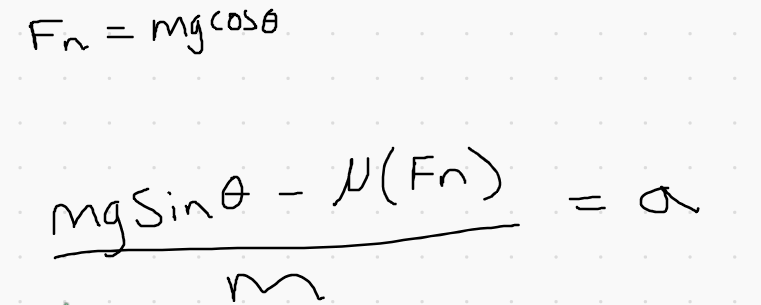
Would this be the right way to approach this problem?
I drew it out on paper, but phone is dead rn
 main lintel
@pine oar #old-network you have physics discord
 dry jay
thats the section were covering for these question but im guessing they just want 45/45/90 rule etc. aka x = 42sqrt2
yup thats what they wanted
got tunnel vision
upper karma
Can someone help me with a problem please
dry jay
@upper karma
upper karma
ok so
im trying to learn how to do this
(Solve for b) a=11m c=15m, i have to do a square + b square + c square
dry jay
oh, wasnt the question the image you uploaded asking for the distance?
upper karma
no I figured that out
dry jay
so im guessing this is a triangle with 15m being the hypotenuse
upper karma
Yup
dry jay
well we know Pythagorean theorem states that a^2 + b^2 = c^2; therefore, c = sqrt(a^2 + b^2). when youre only missing one side you can do b = sqrt(c^2 - a^2)
upper karma
ok so 11^ 2 is 121 and 15^2 is 225
I add those 2 together?
I’m confused sorry
OHHH
I subtract it
upper karma
AHH thank you!!
@dry jay wait then once I get my answer for c I square root it right
dry jay
yup
upper karma
okok 👍🏻
 prime ore
I know that the length of QA=tan, shown in point Q. But doesn't that mean that tan is equal to sin?
Bit confused
 versed river
about what exactly
prime ore
about tan
So we see that the length of QA, is equal to tan
and the fact that the point Q has the coordinates 1 and tan
But they're equal triangles
so does that mean sin and tan are the same? Since tan is the y coordinate of Q and the coordinates of P would be cos, sin?
versed river
What triangles are you saying are "equal"?
prime ore
ONP and OAQ
I'm confused about the entire section actually, im not sure if I even get the point of this section
Wait so this is how I am interpreting this section,
(1) We have a right angled triangle ONP, we extend the triangle to form a new triangle which meets at point A
thats it
then i get confsued
versed river
Well I'd start by correcting the assumption that ONP and OAQ are equal. I'm not quite sure why you think they are. The goal of this passage is just to provide a definition of the tan function, and then to show that this definition is equivalent to tan(x)=sin(x)/cos(x). I can clear up any confusion you have on what a specific part means but I'm not sure I know how to re-explain the entire thing in a different way
prime ore
well okay, we know that tan is opposite over hypotheneus, and on the unit circle that relates to sin/cos which. But I don't understand why they have to extend OP to meet the tangent from A
wait nvm 1=cos becauses thats the value/length of x
prime ore
versed river
Well I'd start by correcting the assumption that ONP and OAQ are equal. I'm not ...
But aren't they similar triangles because they have the same angles?
versed river
oh you meant they're similar
when you said they were equal?
you should say what you mean
prime ore
apologises
Now I'm just confused about the red part where its labelled tan, if they are similar triangles. How can the length of QA be tan and the length of PN be equal to sin when they are the similar triangles?
That makes absolutely no sense to me
Algebraically, it makes sense because you can show it but visually I don't get it
versed river
What makes it feel off to you? Those functions are basically defined as the lengths of those lines
prime ore
I just said, the length of PN is sin and QA is tan, if PN=AQ how can sin=tan??
 signal swallow
PN does not equal AQ
versed river
the only case where PN=AQ is when theta=0
signal swallow
prime ore
I just said, the length of PN is sin and QA is tan, if PN=AQ how can sin=tan??
?
upper karma
 hybrid solstice
 tired knoll
nvm I got it after intense staring
 tiny snow
Given that everything is as it looks, if it looks like a tangent it is a tangent, what can be said about the relationship between the two areas in gray, defined by ABFG?
You can fiddle with the setup here: https://www.geogebra.org/classic/d7z8ngfz (point B can be moved)
 dense island
 upper karma
if anyone is familiar with Apollonian conics
do his conjugate diameters have to be perpendicular to each other outside of the circle?
 onyx yew
im trying to prove (not for homework) that there are no five unique points that lie on an ellipse perpendicular to the xy axis such that each group of four points lies on a unique ellipse perpendicular to the xy axis
ive been working on it for the past few weeks and ive gotten stuck
i was thinking for one of the eliipses it can be a circle of radius 1 centered at the origin
since if one of them isnt an circle with radius 1 centered at the origin, it can be transformed to one with a linear transformation
(for context this is part of undergrad research on vc-dimension)
trying to prove that the vc dimension of ellipses perpendicular to the x,y axes is less than 5, already proven that its greater than or equal to 4
im fine if i have to get into analysis or other higher level math to do it
doesnt have to be done w/ high school level math, this just seemed the most appropriate category
 wise hornet
onyx yew
im trying to prove (not for homework) that there are no five unique points that ...
wise hornet
onyx yew
im trying to prove (not for homework) that there are no five unique points that ...
perpendicular to the xy-axis?
onyx yew
the major and minor axes of the ellipse are perpendicular each to either the x or y axes of the plane
heres an email where i typed it up better
(sadly had to use outlook equation editor tho)
humble pulsar
upper karma
How to find the distance between the points
distance formula
static ridge
upper karma
How to find the distance between the points
upper karma
static ridge
Got it. Thanks
 night basin
Given triangle ABC, the angle bisector of angle B passes through the circumcenter of triangle ABC. Prove that AB = BC.
i understand that it must be an isosceles triangle but not the exact terms?
humble pulsar
 agile kestrel
I got some double square route things
agile kestrel
I got some double square route things
which question specifically?
agile kestrel
b
upper karma
Fun
 boreal adder
how can u evaluate cos(arcsin(3x)) in radians
the teacher told us to draw a right traignle but idk how that helps
agile kestrel
humble pulsar
ok what nested radical did you get?
sorry I didn't know you responded I got √(44 + 4√10)
humble pulsar
boreal adder
how can u evaluate cos(arcsin(3x)) in radians
the teacher told us to draw a righ...
Arcsin(3x)=y means sin(y)=3x/1
 warm sphinx
Can anyone help me out today, I am struggling in College trig and need someone to explain more than 1 problem for me
🙏
I ask because im not a math major and I really need this A in the class for my GPA. I wont be using this class for my degree so I legit could use the help.
humble pulsar
warm sphinx
I ask because im not a math major and I really need this A in the class for my G...
the answer to your well worded question is 7
 neon hamlet
How would you classify this?
silent plank
in that context your options for sides would be:
scalene, isosceles, equilateral
options for angles would be
acute, right, obtuse
warm sphinx
Its a lot more than just a few topics xD so it would take time. and a lot of screenshots.
neon hamlet
Ah
humble pulsar
yeah well you still havent posted a question.. so idk how much help you're gonna get
neon hamlet
so sides would be scalene
humble pulsar
yes space
neon hamlet
but how would you find out the angles?
silent plank
compare it to pythagoras
neon hamlet
7^2 + 12^2 = 10^2 ?
silent plank
not quite like that
your shorter sides are 7 and 10
determine whether
7^2 + 10^2 or 12^2 is larger
warm sphinx
Im doing things on mymathlab and I got this question on the Unit Circle
silent plank
no, it shows actually shows the opposite
warm sphinx
Can someone explain to me what P is and a little bit about the unit circle so I can learn and work towards solving these on my own? ^-^
silent plank
P is the name of a point with the indicated coordinates
humble pulsar
P is a point on the unit circle, which is a circle centered at origin with radius 1
warm sphinx
Ok so given this how would I find this point on the unit circle?
so I can set up the problem?
Im like struggling hard lol
I just failed a test on friday on different topics. and I have another one next friday x.x
silent plank
you are literally given the coordinates of it
warm sphinx
but 🤔 where are said points?
warm sphinx
where on the unit circle can I visualize those points being at...?
upper karma
how i do this one i remember this tricks things where u point 50 to NO then something
humble pulsar
warm sphinx
where on the unit circle can I visualize those points being at...?
do you know how to plot points on a plane?
warm sphinx
like for example where is -1/2 on the unit circle
silent plank
(-1/2, sqrt(3)/2) is the point where the
x-coordinate is -1/2 and
y-coordinate is sqrt(3)/2
the unit circle is just a circle with radius 1 drawn over the xy-plane
warm sphinx
like yeah I understand that... I just dont know where sqrt(3)/2 would be on the xy plane.
humble pulsar
Ok so you need help plotting points?
silent plank
silent plank
the green dot has coordinates (1,2)
silent plank
this doesn't really have anything to do with that
warm sphinx
oh..
silent plank
from the image the point (1,2) is at that position because that's where the x-coordinate represented by the first value is 1
and the y-coordinate of the point represented by the second value is 2
warm sphinx
Oh ok
so instead I would plot 1/2 at 1/2 = x but whats really bugging me is where do I post sqrt(3)/2
like where is that on the y-axis
do I put it in the calculator, get a decimal and then just plot a guessing point?
like an approx?
silent plank
well sqrt(3)/2 is approximately 0.866
you don't need to be exact
warm sphinx
Oh ok
silent plank
just place it in the general area
warm sphinx
I see
so it would be 1/2,.866
for my plot points
its clicking.
I feel stupid but its going...
ok
silent plank
no
warm sphinx
its not clicking ok.
warm sphinx
so it would be in Quad. 4
silent plank
no
silent plank
yes
silent plank
silent plank
apply the definitions of trig functions in the unit circle to determine what's being asked
warm sphinx
so that angle = t
angle of theta
wait a minute...
does t in this sense = theta..
silent plank
t is just a variable
warm sphinx
oh ok
warm sphinx
so how would I go about finding sin, cos, tan and all that?
its ofc an obtuse.
I have the coord.
x^2+y^2=r^2 right?
and then I would get (r,0)?
and sin= b/r?
and cos = a/r
and then boom I have the Opposite, Adj, and Hyp?
and can find out the rest?
@silent plank
humble pulsar
Points (x,y) on the unit circle map to equivalent points (cos(t),sin(t))
warm sphinx
so what I said was not correct?
so would x = Opp or Adj or Hyp?
and if that is it what would y =?
and then youre looking at a^2 + b^2 = c^2
 meager carbon
does anyone want to mentor a self taught leanrer?
warm sphinx
wait r=1
neon hamlet
How would I get the longest side/shortest side here?
warm sphinx
can anyone tell me if I got that right? it will let me know if im following the right track
So far I have Opp. = Sqrt (3)/2
Adj. = (-1/2)
and Hyp = 1
but then I need to also remember is Sin is only positive in Quad 1 and 2
Tan in 1 and 3
and Cos in 1 and 4
but the problem with that idea is that I get this
and something doesnt seem right about that
or this
Sin = y/r .. Cos = x/r.. and Tan = y/x
humble pulsar
warm sphinx
or this
those are right.. just simplify them
humble pulsar
simplify them like any other stacked fraction
 hazy wyvern
Multiply the bottommost part with the topmost (while also removing the bottommost)
It would become -2 in this case
warm sphinx
o.o
hazy wyvern
Isn't that how you do stacked fractions?
hazy wyvern
Negative
hazy wyvern
Yep
warm sphinx
ok
so 3 people and 1000 questions from me later I can now solve Question 1 and 2 of my homework...
man am I in trouble..
and I also need to remember
All Students Take Calculus
Q1 = All positive
Q2 = Sin Positive
Q3 = Tan Positive
humble pulsar
yeah we know CAST rule
warm sphinx
and Q4 = Cos post
and ye
so if I keep that in mind...
only ones that will be positive with this being in Q2
is Sin
and Csc
right?
humble pulsar
yes
warm sphinx
if I do Tan I need to put a - in front of it
and if I do Sin I need to remove the -
right?
or
?
humble pulsar
You have the minus sign when it's negative
warm sphinx
now what if its Sin = - 1/2
humble pulsar
that's not a thing
humble pulsar
sin = -0.5 isnt a thing
humble pulsar
sin isnt a thing in math
warm sphinx
"forget that neg"
humble pulsar
sin(t) is
warm sphinx
ok...
well
Sin(t) = -1/2
would I just be like
no
Sin(t) actually ='s 1/2
?
humble pulsar
tbh I have no fucking idea what you're even going on about
humble pulsar
sure
warm sphinx
lets say if I have the answer Sine(t) = -1/2
right?
Just because its in Q2 do I just throw that - in front of the fraction away?
because Quad 2 rules?
humble pulsar
sin(t) = -1/2 in quad 3 or 4
warm sphinx
so yes
it will change to positive automatically in 1 or 2?
no questions asked?
😖
humble pulsar
You leave it so that the statement is true
warm sphinx
Ahh ok
humble pulsar
you dont change it to get rid of the negative sign willy-nilly
warm sphinx
I didnt think so but I had to ask..
Alright! Next Question1
a lot simpler..
would -6 be the Amp or the Period?
humble pulsar
neither, amplitude and period are positive numbers
humble pulsar
yes
warm sphinx
which one would it be?
humble pulsar
you tell me
warm sphinx
Uhhh
imma go out on a wim here and say... period?
o.o
Like I said im in a lot of trouble atm xD
humble pulsar
No, cause period is something that affects the x values
warm sphinx
wait
so
6 = Amp
and 7 = Period?
ok
O.o?
did I get that right?
Im really trying here xD
humble pulsar
warm sphinx
and 7 = Period?
No, period is $\frac{2\pi}{k}$ if $y=A\sin{[k(x-h)]}+c$
warm sphinx
o.o
somber coyoteBOT
moshill1
somber coyoteBOT
IamKingSage
warm sphinx
@humble pulsar
humble pulsar
yes
warm sphinx
then I need to simplify?
warm sphinx
if the amp is 4, the period is pi/3 and the phase shift is -1
how would I plot those points?
because I ge this weird Zig Zag on my calulator...
looks almost like a seismograph reading lol
humble pulsar
Almost like earthquakes travel as waves. . .
obtuse tapir
shit
vapid stag
is it useful to memorize prime numbers up to 1000?
 umbral snow
Ye
 remote nimbus

 placid jasper
Solving problems.
 livid moss
It's not useful if you only memorize up to 1000. You need to memorize the first 1000 primes, then the usefulness will become clear
 pastel mirage
can someone explain me on this circle, where is vercosine, covercosine, and haversine is located at, i see the text in image but dont know on which line they lie
meager carbon
I’m about to take a geometry course on YouTube so hyped I’ve taken trig logs exponents now I’m taking geo I’m Freshening up bc I quit college (wpi) after one semester due to personal issue and I have to admit I remmeber a lot and can follow it easily anyone want to join me when I begin a new text book in a few hours of proof and logic by zhang I think transitions to advance mathematics or something
silent plank
outside angles theorem (circle geo)
silent plank
Google what I mentioned above. you should get nice images.
 plain nimbus
Mkay
 latent berry
Hey guys, please solve the qotd in MODS...
 crude yarrow
help:
 silent ledge

 strong socket
i am in uni and have never heard of covercosine, vercosine and haversine wtf is that
 native snow
I’m really confused on this question and don’t know how to answer it. If someone could just point me in the right direction that would help a lot.
 humble pulsar
strong socket
i am in uni and have never heard of covercosine, vercosine and haversine wtf is ...
humble pulsar
strong socket
i am in uni and have never heard of covercosine, vercosine and haversine wtf is ...
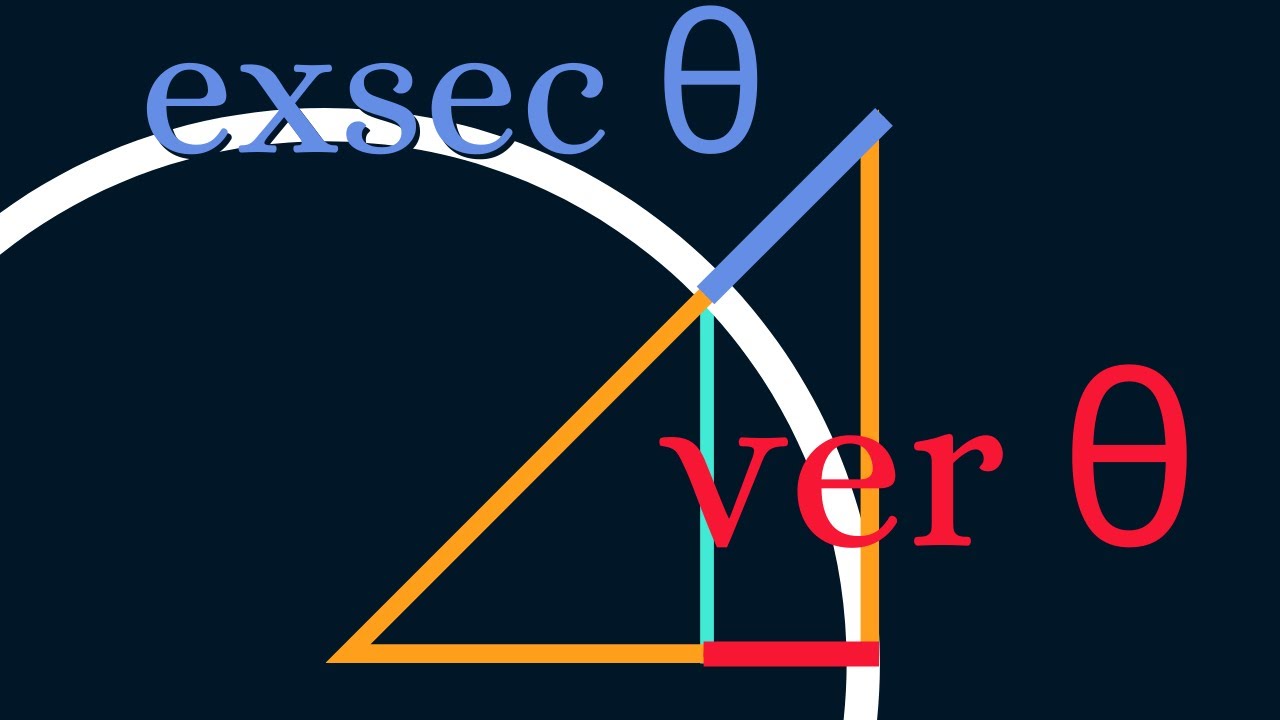
We present definitions of some historical trigonometric functions. Further investigation is made as to why they have fallen out of favor.
Please Subscribe: https://www.youtube.com/michaelpennmath?sub_confirmation=1
Personal Website: http://www.michael-penn.net
Randolph College Math: http://www.randolphcollege.edu/mathematics/
Randolph College...
There were lots of trig functions that ended up not getting used
storm portal
silent ledge
try clearing complex fractions
 thorny charm
I have a larger problem I'm working on that I can't express in a concise way but boiling it down to one part that I'm not sure how to do is a question I can ask
Say for example the interior angles of a regular pentagon are 108 degrees
Then of course because of the symmetry rotating the entire pentagon 72 degrees will cause it to line up exactly with itself
On a smaller scale given one of the angles can you calculate that? What is the relationship between the '108' and '72' degrees?
Specifically trying to figure that out for an interior angle of 98.2 degrees
Both of the lines do meet whatever condition will cause them to line up after the rotation
I'm just trying to find which point that's at ^^'
green osprey
its late and i might be stupid rn
but like can you figure out the area of a triangle just with a permitted
and if not what angles give you the largest triangle
upper karma
thorny charm
Specifically trying to figure that out for an interior angle of 98.2 degrees
Bot...
Sum of interior and exterior angle will be supplementary (i.e. 180)
 humble pulsar
abstract prairie
https://gyazo.com/ec3835a9e642f1bd088e862cc7e3fc1a
humble pulsar
abstract prairie
https://gyazo.com/ec3835a9e642f1bd088e862cc7e3fc1a
just take inverses of both sides
somber coyoteBOT
moshill1

 humble pulsar
arcsin?
 humble pulsar
do you have notes?
humble pulsar
abstract prairie
is that even a word <:dead:745877173453455360>
it's the american notation for inverse sine
humble pulsar
Cause I doubt your teacher taught you trig w/o teaching you the basics of inverse trig
abstract prairie
this is trig????
humble pulsar
sine cosine and tangent are trig ratios
humble pulsar
$\sin{A} = 0.6 \implies A = \sin^{-1}{(0.6)}$
somber coyoteBOT
moshill1
 abstract prairie
hmmm
humble pulsar
which is about 36.9 deg
abstract prairie
for a?
somber coyoteBOT
moshill1
 humble pulsar
no, cos(B) = 5/12
abstract prairie
ohh
this is still very new to me
@humble pulsar do you think you can help me with B and C? 
humble pulsar
I mean.. talk to your teacher about it tbh
 graceful spear
so when it comes to proofs and geometry is there like a list of axioms we can go off of? Interested in learning about geometry with proof stuff but just wanted a clear basis of what is defined already to work of it.
Along with this things like what defines specific shapes and their interior angles sums.
 storm heath
Why was it made 9 times instead of 3 times?
 humble pulsar
storm heath
Why was it made 9 times instead of 3 times?
humble pulsar
storm heath
Why was it made 9 times instead of 3 times?
(3r)^2
storm heath
But why>
humble pulsar
cause you tripled the radius
 white vapor
how would you find the area of a right triangle with only knowing the two legs are 1.8 and 3.2?
prime linden
Pythagoras theorem?
white vapor
how would i use it
ohh i thought the hypotenuse was the other leg
i see now thx haha
silent plank
why would you even need pythag?
A = bh/2
upper karma
command how
,\frac
\frac{1}{2}
whattt
,heh,
,\frac{2}{2},
EH
put $ around the tex.
And #bots for this.
$\swrt$
somber coyoteBOT
Skyler
Compile Error! Click the  reaction for more information.
(You may edit your message to recompile.)
 green osprey
I'm solving a triangle and all i have is the angles, its a right triangle but would i still use law of cosine?
wait
you cant do that
my bad
humble pulsar
green osprey
I'm solving a triangle and all i have is the angles, its a right triangle but wo...
You can use sine law and cosine law on any triangle
right triangles just dont need them


