#geometry-and-trigonometry
1 messages · Page 103 of 1
 dire jackal
at your level if you see any trig ratio squared try to see if using any of the square identites work
since thats the only thing you can do with them
you havent been taught double angle formulas right, like cos(2x)?
 simple vigil
no what is that
BTW my sister passed 12TH i saw her sheet of trigonometry identity i was shocked
around 20-25 or more identity
simple vigil
but most of them was of inverse trigo
dire jackal
there are a bunch of normal trigo too
simple vigil
in 10th its only 3 identity
that is making this chapter one of the hardest in boards
what about 11th and 12th


 dire jackal
at your level if you see any trig ratio squared try to see if using any of the s...
dire jackal
dire jackal
at your level if you see any trig ratio squared try to see if using any of the s...
again my point is just try those 3 identites and they should work out
simple vigil
dire jackal
these are just two pages from my formula book
looks very hard to remember
 worthy eagle
dire jackal
(im in 12th)
worthy eagle
dire jackal
(im in 12th)
||with undergraduate role|| 
worthy eagle
dire jackal
these are just two pages from my formula book
well if you are in cbse board, if a question comes to find cos60 cos45 cos75, will you use the formula from here or calculate it long way? I asked cuz many formulas aren't in book so I wonder if it will be ok to use them in exam 
dire jackal
I'm pretty sure you gotta calc it the long way if the formula doesn't exist in the syllabus
worthy eagle

 edgy phoenix
when I get sinx = 0 how do I find principle angle using unit circle?
 spiral lodge
Well, you should know that sin(0) and sin(π) are 0
Then, all the other solutions are those values with a multiple of 2π added
Therefore, sin(x) = 0 has the following solutions:
x = 0 + 2kπ V x = π + 2kπ, where k in Z
worthy eagle
edgy phoenix
when I get sinx = 0 how do I find principle angle using unit circle?
I think by principal angle, you mean the smallest angle in [0, 2π] that gives the given value of sin.
So which angles in [0,2π] give sinx=0? 0 and π. Since 0<π, principal angle is 0.
For using unit circle, sin x gives the y-coordinate of a point on circle. So you have to ask, which point on circle has y-coordinate 0? It's (1,0) and (-1,0). Which one comes first starting from (1,0) and moving counter clockwise? It's (1,0). So whatever angle (1,0) makes with +x-axis should be principal angle which is 0 rad.
 junior iris
Struggling with refraction, watched countless videos. Is this correct? I don't think it is.

 ruby latch
junior iris
Struggling with refraction, watched countless videos. Is this correct? I don't t...
ruby latch
junior iris
Struggling with refraction, watched countless videos. Is this correct? I don't t...
Those lines should be perpendicular to the side of the prism, you've drawn them very strangely
junior iris
ruby latch
Those lines should be perpendicular to the side of the prism, you've drawn them ...
The normal lines?
ruby latch
yes
junior iris
Don't they have to be 90?
ruby latch
Yes, 90 deg = perpendicular
and on your image they are clearly not perpendicular
junior iris
 junior iris
ruby latch
Yes, 90 deg = perpendicular
and on your image they are clearly not perpendicular
junior iris
ruby latch
Yes, 90 deg = perpendicular
and on your image they are clearly not perpendicular
Is this correct?
ruby latch
junior iris
Is this correct?
Yep, this is much better
Here's what I've drawn
 junior iris
ruby latch
Yep, this is much better
Here's what I've drawn
junior iris
ruby latch
Yep, this is much better
Here's what I've drawn
Thank you so much!!, exactly what I needed.
 night cape
hi, im confused, what do the trig functions yeild?
what answer do they give
is it the angle?
 maiden brook
night cape
is it the angle?
maiden brook
night cape
is it the angle?
No, a real number
spiral lodge
Rather, their input is an angle (and if this is measured in radians, it is a real number) @night cape
night cape
ohhh and what do i do with this number?
spiral lodge
Wdym?
night cape
what do i do with the number  i dont know how else to ask
spiral lodge
You do what you need to do
It's like asking: what do we do with the word "beautiful"?
Answer: you use it when it's useful/required
I really don't understand your question
 ripe bison
night cape
what do i do with the number <:sadcat:547124024585486359> i dont know how else t...
ripe bison
night cape
what do i do with the number <:sadcat:547124024585486359> i dont know how else t...
It depends so heavily on what exact trig function you're dealing with. Super contextual, which is why the others are giving you a "vague" response. Each trig function has a different geometric interpretation
As for what to do with it, that just depends on the specific question that needs it, like Alberto said
 knotty quiver
ratios
night cape
how do i use that number for a rotation of a vector
ripe bison
That, above all else, yes
knotty quiver
night cape
how do i use that number for a rotation of a vector
by using a rotation matrix?
night cape
yes
Now i know, from seeing, what the rotation matrix is
So what from what you all told me thus far
the resulting rotation from the functions are added to the starting vector to result a rotation
knotty quiver
resulting rotation from the functions?
night cape
yes
im so sorry if im not using the wright terms
i started getting into linear algerab and trig this week
spiral lodge
Have you not done trig in precalculus?
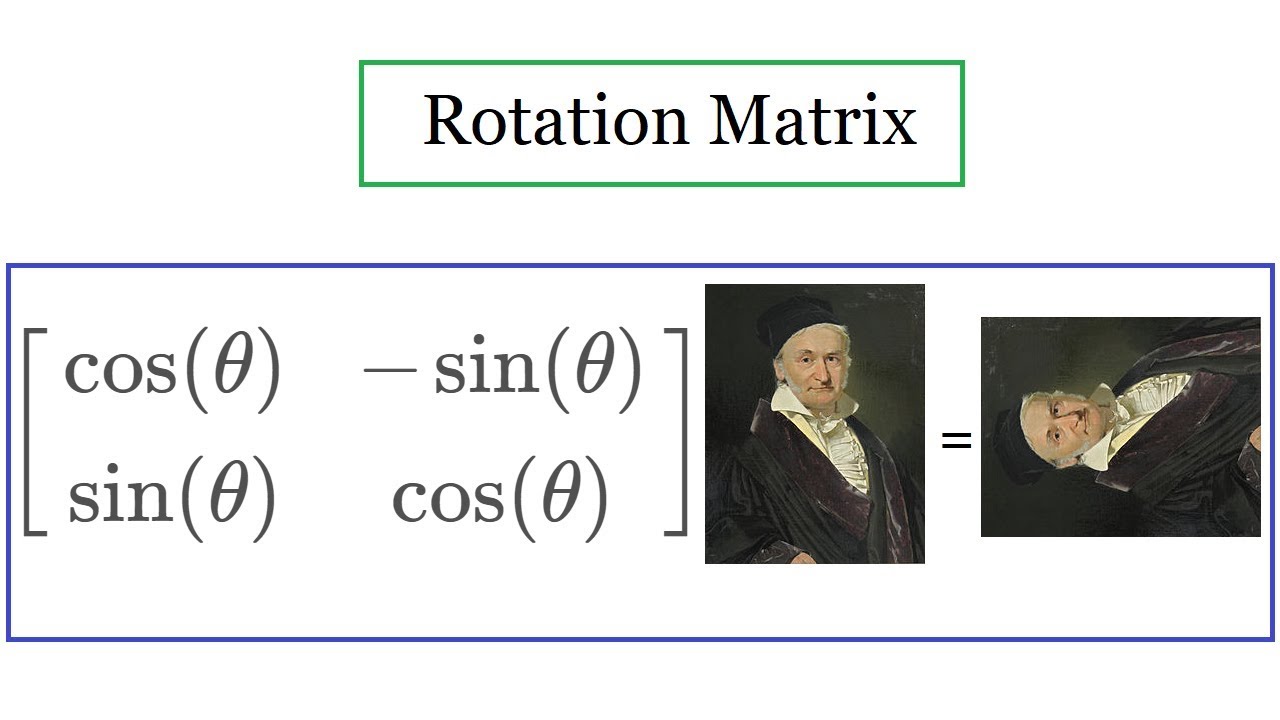
Derivation of the rotation matrix, the matrix that rotates points in the plane by theta radians counterclockwise. Example of finding the matrix of a linear transformation
Check out my Linear Equations playlist: https://www.youtube.com/playlist?list=PLJb1qAQIrmmD_u31hoZ1D335sSKMvVQ90
Subscribe to my channel: https://www.youtube.com/channel/UCoO...
spiral lodge
spiral lodge
https://youtu.be/Ta8cKqltPfU?feature=shared
By the way, are you probably referring to this?
 obsidian harness
night cape
i started getting into linear algerab and trig this week
obsidian harness
night cape
i started getting into linear algerab and trig this week
a key concept of linear algebra is the concept of basis vectors
so in the 2D plane, the standard basis vectors are $\hat{e_1} = (1, 0)$ and $\hat{e_2} = (0, 1)$
 somber coyoteBOT
south
 obsidian harness
if you multiply a vector by the rotation matrix, the columns tell you that $e_1$ goes to $(\cos \theta, \sin \theta)$ and $e_2$ goes to $(-\sin \theta, \cos \theta)$
somber coyoteBOT
south
 obsidian harness
it's an exercise to show that $-\sin \theta = \cos(\theta + \pi/2)$ and $\cos \theta = \sin(\theta + \pi/2)$
somber coyoteBOT
south
 obsidian harness
somber coyote
**south**
obsidian harness
somber coyote
**south**
and then every vector $(x, y)$ is a linear combination of $e_1, e_2$, cause $(x, y) = x \cdot (1, 0) + y \cdot (0, 1)$
somber coyoteBOT
south
 obsidian harness
so if you track where the basis vectors go after the linear transformation, you can just do x * (new basis 1) + y * (new basis 2) to find out where any vector goes
night cape
spiral lodge
https://youtu.be/Ta8cKqltPfU?feature=shared
I found that video thank you :D
night cape
spiral lodge
By the way, are you probably referring to this?
and yes i was :D
night cape
spiral lodge
Have you not done trig in precalculus?
I have never done precalculus until last week :c
 fluid night
Im teaching school maths next year, i went through a past exam paper and I swear to god I have no clue how to solve this question neatly. I came up with an answer but I think my working is using methods above this level (UK GCSE). Is there a trick to finding easy formula for the single final transformation that students would do at age 16?

like i feel ridiculous ive completed a degree in maths but i just have no clue how students at that low level are expected to get to an answer for this, like it has to be something quite simple for 3 marks but i only came up with complicated ways
fluid night
well i found one of biggest issues was at one step i got signs mixed up on x and y for rotation 
 grave pond
fluid night
Im teaching school maths next year, i went through a past exam paper and I swear...
grave pond
fluid night
Im teaching school maths next year, i went through a past exam paper and I swear...
Here's what I would do: Draw triangle B in red, and then triangle C in blue -- the right-angled "handles" connecting the apex to (1,2) help eyeball the rotation.
Now, I know that since the directiions of A and C are not the same, the transformation from one to the other is either a rotation or a reflection, but it's clearly not a reflection, since (a) I notice that both of the two transformations A-B and B-C are orientation-preserving (but that might be slightly too highbrow for the target group), (b) both triangles have the same orientation: if I stand on the right angle looking toward the hypotenuse, the short leg is to my left.
So it's a rotation. If it's not visually clear what the center of the rotation is, then: Each point in triangle A moves to its corresponding point in triangle C along some circular arc. The straight line between the original and corresponding point is a chord in the circle, and therefore the center of rotation is somewhere along the perpendicular bisector of the chord. I've drawn two sets of chord and perpendicular bisector in different green nuances, sneakily chosen to make everything of interest happen at grid intersections. The two perpendicular bisectors intersect at (-5,2) (-4,1), so that must be the rotation center.
Except I botched the initial translation. 😭 Moment, new diagram coming up.
This is better:
 fluid night
i would have to spend a while understanding why that works lol, i found the answer analytically using clockwise rotation transform equation, putting the start and end points in and doing coordinate change relative to the unknown centre of rotation, then solving for that centre of rotation using the start and end points
but i dont think thats how students would do it due to level of exam
so yours is probably the right one
[also as in, i did the analytic work after finding the first translation doing everything between A and the blue one]
grave pond
fluid night
i would have to spend a while understanding why that works lol, i found the answ...
Hmm, my description was perhaps more convoluted than it really ought to be. What's going on is really just
- the rotation center has the same distance to P as to P'
- the rotation center has the same distance to Q as to Q'
The two perpendicular bisectors are simply the loci of those two conditions.
 fluid night
Yh makes sense cause ik you need it to be same distance from all points
i am not geometry brained i found it by DEFINITELY NOT this level of learning analytical method 
 grave pond
And the best thing is there are no calculations to get signs mixed up in, just drawing on the helpfully provided graph paper.
fluid night
yh signs i got mixed up was did CCW rotation instead of CW rotation when i did working out first time lol
i really need to revise geometry stuff i was never good at remembering stuff from that
i like swimming in algebra soup
 hazy tree
 last palm
can anyone help me understand reflections on graphs?
last palm
can anyone help me understand reflections on graphs?
What are your questions?
last palm
hazy tree
What are your questions?
how do i relfect y=x
i dont have any actual questions, im just trying to grasp the understanding of itr
hazy tree
With respect to which axis?
y=x is a straight line
a diagonal
if you reflect it with respect to the vertical axis
you'd get another straight line
last palm
ohh
hazy tree
that instead of going up from left to right, goes down from left to right
last palm
what about y=-x?
hazy tree
That's the reflection of x=y, with respect to the vertical axis
last palm
not understanding
hazy tree
let me draw it
last palm
ok!

 hazy tree
if you want a reflexion of y=f(x), with respect to the vertical axis, you have to plot y=f(-x)
like this

 hazy tree
nooo
the inverse would be f^-1(y)=x
because f^-1(y)=f^-1(f(x))=x
this is the reflection of that curve with respect to the horizontal axis

y=f(x) is the original one, the reflection is y=-f(x)
with respect to the horizontal axis
hazy tree
say it
last palm
isnt the equation of the p(x) just the inveresed equation of h(x)
hazy tree
no
you just fliped the sign of the argument of the function
the inverse of a function is another concept
hazy tree
with respect tho the horizontal and vertical axis
you could also reflect with respect to an axis that's just shifted up or down
left or right
or even in a diagonal
last palm
can i have an example
hazy tree
but you always reflect with respect to a straight line
hazy tree
last palm
can i have an example
sure
last palm
hazy tree
sure
ty
 hazy tree
imagine that there's a mirror at x=-10
last palm
oki
hazy tree
look that at x=-2, f(x)=0
and that's 8 units of lenght away from the mirror
to the right
you have to have the reflection at that distance from the mirror, but to the left
got it?
last palm
yes
so whats ever done from the orange line to the right has to be done from the orange line to the left?
but in a mirrored way?
hazy tree
yes
last palm
okay!
hazy tree
at the same distance from the mirror
hazy tree
you're welcome
 lone panther
it can
 cunning lion
 cinder ledge
Can sin(x) be represented as a polynomial?
cinder ledge
Can sin(x) be represented as a polynomial?
not unless you count infinite sums of polynomials as polynomials (which they aren't really)
cunning lion
yes, and power series ("polynomials with infinite terms") can behave quite differently from polynomials
knotty quiver
,w define Taylor series
somber coyoteBOT


 cinder ledge
Oh thanks!
 chrome glacier
cinder ledge
Can sin(x) be represented as a polynomial?
chrome glacier
cinder ledge
Can sin(x) be represented as a polynomial?
sinx doesn't show the properties to call itself a polynomial though
grave pond
In particular, it has infinitely many zeros, and the only polynomial that has that is the zero polynomial (which clearly isn't the sine function).
simple vigil
should i call tan 90 infinity or not defined from exam pov
grave pond
If you’re setting the exam, strive to ask questions in a way where the difference won't matter.
(Unless your point is to enforce making the right terminology choice, but then you wouldn't be asking...)
 strange reef
Is the convex hull of two line segments in R^3 a (possibly degenerate) parallelepiped?
grave pond
In general it's an irregular tetrahedron.
Same as the convex hull of four points; the interior of the line segments don't add anything to the convex hull anyway.
strange reef
Ah, of course. Thanks
 granite umbra
is this the math2/3 chat?
maiden brook
grave pond
In particular, it has infinitely many zeros, and the only polynomial that has th...
But how would u know for example sin(x) defined on [0, 2pi] can’t be expressed as a polynomial
maiden brook
maiden brook
But how would u know for example sin(x) defined on [0, 2pi] can’t be expressed a...
oh nvm
 real socket
😮
grave pond
maiden brook
But how would u know for example sin(x) defined on [0, 2pi] can’t be expressed a...
Yeah, that requires a more intricate argument. For example that all the higher derivatives of sine exist and are nonzero, whereas if you differentiate a polynomial sufficiently many times you get an everywhere zero function.
maiden brook
grave pond
Yeah, that requires a more intricate argument. For example that all the higher d...
👍
grave pond
On the other hand, thanks to the Weierstass approximation theorem there are polynomials whose values are very close to the sine over the entire interval [0,2pi].
cinder ledge
So...?
maiden brook
grave pond
On the other hand, thanks to the _Weierstass approximation theorem_ there are p...
Would that not be an “obvious” fact? Can’t u get a polynomial to approximate very well basically any smooth function over an interval
grave pond
maiden brook
Would that not be an “obvious” fact? Can’t u get a polynomial to approximate ver...
Not equal, but approximate arbitrarily well.
"Obvious" is in the eye of the beholder. It doesn’t feel obvious to me that one can do that, even though it's true.
maiden brook
grave pond
"Obvious" is in the eye of the beholder. It doesn’t feel obvious to me that one ...
I feel like it seems easier to approximate with polynomials than with other functions eg trig ones
 stiff spoke
Anyone know héros formula
cinder ledge
Herons?
stiff spoke
cinder ledge
Herons?
Yes
somber coyoteBOT
ILoveCalculus
 somber coyoteBOT
ILoveCalculus
 cinder ledge
FINALLY
 turbid vortex
cinder ledge
Herons?
turbid vortex
cinder ledge
Herons?
Called Hero’s too :)
cinder ledge
Oh
 jagged sonnet
How did you guys become more fluent/ quick with your trig before calculus?
 shadow yacht
somber coyote
**ILoveCalculus**
shadow yacht
somber coyote
**ILoveCalculus**
how resolve?
shadow yacht
jagged sonnet
How did you guys become more fluent/ quick with your trig before calculus?
I just practiice exercises every single day, I spend lik 30 minutes to 2 hours
shadow yacht
jagged sonnet
Do you use chat gpt to generate problems?
i prefer deepseek or gemini, I use prompts to make specific difficult levels of exercise
jagged sonnet
hmm can you give me an example of a prompt you'd enter?
I'm new to using AI to study I def wanna start though
shadow yacht
but I see a guy in discussions said the gemini can be switched, so
shadow yacht
jagged sonnet
hmm can you give me an example of a prompt you'd enter?
yeah, i´ll get, one sec
"Use clear, direct language and avoid complex terminology. Aim for a Flesch reading score of 80 or higher. Use the active voice. Avoid adverbs. Avoid buzzwords and instead use plain Germany. Use jargon where relevant. Avoid being salesy or overly enthusiastic and instead express calm confidence."
I use it to german exercises, but u can make some mods to math!
 dark sparrow
!nogpt
 lime crownBOT
Please do not trust ChatGPT or similar AI tools for mathematical tasks, as they often generate output which "sounds correct" but has numerous factual or logical errors. Use of these AI tools to answer other people's help questions is strictly against server rules (see #rules).
 shadow yacht
dark sparrow
!nogpt
shadow yacht
dark sparrow
!nogpt
i dont use GPT, but I think the others AI are more good, i dont use it to generate answers too
dark sparrow
all AIs suffer from the same flaws.
shadow yacht
dark sparrow
all AIs suffer from the same flaws.
I see
sorry for something about it, I used it so many times-
 hoary totem
jagged sonnet
How did you guys become more fluent/ quick with your trig before calculus?
hoary totem
jagged sonnet
How did you guys become more fluent/ quick with your trig before calculus?
do smth that involves a lot of trig

 old swift
dark sparrow
!nogpt
old swift
dark sparrow
!nogpt
what does that even do
dark sparrow
prints the factoid you see just below my msg
old swift
dark sparrow
prints the factoid you see just below my msg
oh i thought-
gpt
chat gpt
nevermind
 warm shuttle
lime crown
Please do not trust ChatGPT or similar AI tools for mathematical tasks, as they ...
warm shuttle
lime crown
Please do not trust ChatGPT or similar AI tools for mathematical tasks, as they ...
I generally don't trust humans either
old swift
warm shuttle
I generally don't trust humans either
fair enough
granite umbra
hoary totem
more like
trigwall``` whole imp
trigonometry is just memorizing stuff for the most part
 delicate chasm
fr
delicate chasm
whole imp
trigonometry is just memorizing stuff for the most part
are u in high school?
 whole imp
delicate chasm
are u in high school?
whole imp
delicate chasm
are u in high school?
yes
whole imp
whole imp
yes
and no
I dropped out :p
You will encounter trigonometry for the rest of your life... some hate it, some love it
it's a necessary evil nonetheless
worthy eagle
 visual flume
help pls
visual flume
help pls
have you tried anything?
whole imp
I just imagined a triangle from the dot's position

 zealous pike
The small circle has radius R₁ and the bigger circle radius R₂, both tangent at point Q. Line s and r are tangent in both circles. Find the distance between P and Q

I tried taking similar triangles but failed miserably

The hypotenuse of the smaller triangle would be x + 2R₁ and that of the bigger one, x + 2R₁ + R₂
I dunno y I failed to find x
worthy eagle
PT1C1 is similar to PT2C2
T1C1/T2C2 = PC1/PC2

C1, C2 are centres, T1, T2 are points where tangents touch the circles. I think you can find x in terms of R1, R2 from here.
 marble oriole

First day on geometry
Yo this is so sick guys
Bro screw learning algebra first
zealous pike
worthy eagle
C1, C2 are centres, T1, T2 are points where tangents touch the circles. I think ...
basically, $\frac{R_{1}}{R_{2}} = \frac{x + R_{1}}{x + 2R_{1} + R_{2}}$
y
marble oriole
Cuz no
worthy eagle
yes
somber coyoteBOT
Pi, a future fluent jp speaker
 zealous pike
I tried but failed smh
somber coyoteBOT


 Requested by shubham1029
zealous pike
Requested by shubham1029
zealous pike
Yea I got that one
zealous pike
$\frac{2R_{1}R_{2}}{R_{2} - R_{1}}$
somber coyoteBOT
Pi, a future fluent jp speaker
 whole imp
visual flume
i did this
whole imp
visual flume
i did this
It is
wrong
This actually matches a common application for the quadratic formula since you are given two possible scenarios for R
just get the distance of (R_1, R_2) to (24, 27)
$\text{Using the distance formula, we get } \sqrt{(R_1 - 24) + (R_2 - 27)} = R$
Since R is just the distance of (R_1, R_2) to (24, 27), it works out well
now just rewrite that expression as a polynomial with a degree of 2
zealous pike
I have another exercise that I didn't understand at all
whole imp
whole imp
Since R is just the distance of (R_1, R_2) to (24, 27), it works out well
Something like R^2 - 102R + 1305 = 0
then apply the quadratic
zealous pike
Its translation is as follows:
Given perpendicular lines r and s that intersect each other in the plane at point (3, 3), and r intersects the x axis at (2, 0), find the area of the triangle bounded by the two lines and the x axis.
Is it possible to solve it with this information?
somber coyoteBOT
Andy
 worthy eagle
zealous pike
Is it possible to solve it with this information?
worthy eagle
zealous pike
Is it possible to solve it with this information?
yes
you need to know at which point s intersects x axis
zealous pike
how do I find it?
worthy eagle
try to find equation of line s with the given information in y=mx+c form then put y=0 and you get x=-c/m
zealous pike
but to find the slope wouldn't I need a second "x" for s? I only have one pair of points for s
worthy eagle
hints: y-y1=(y2-y1)/(x2-x1), m1 m2 = -1
worthy eagle
zealous pike
but to find the slope wouldn't I need a second "x" for s? I only have one pair o...
||you can start by finding equation of line r||
whole imp
zealous pike
but to find the slope wouldn't I need a second "x" for s? I only have one pair o...
You need a tangent slope?
warm shuttle
That is correct
zealous pike
The line perpendicular to r would be the decreasing version of r, wouldn't it?
I wonder if x is perpendicular to -x? for example
whole imp
I get it now
zealous pike
At this point I'm sure I skipped something really important on linear functions on stewart's precalculus book
warm shuttle
yep, if i remember correctly for this line representation, you flip the sign, and then find the multiplicative inverse for a
zealous pike
-x/3 + 6?
whole imp
Is s = -r?
warm shuttle
Well + c
-x/3 + c
c moves it around
You also need to satisfy (3,3) intersection
warm shuttle
Yeah
warm shuttle
Also, this is something that's bothering me personally, but i would've liked if you wrote either
y = mx + c
or
ax + by + c = 0
to represent lines
warm shuttle
zealous pike
now comes the sick part that is calculating the distances
You don't actually need to do that
Not through pythagorean formula at least
You just need to find the base and height of your triangle
zealous pike
the base and height aren't the distances between (0, 2), (3, 3) and (12, 0), (3, 3) for r and s, respectively?
whole imp
zealous pike
answer is 15
hoary totem
granite umbra
```textwall?
more like
trigwall```
its fun
lime crownBOT
No need to ask “Can I ask…?” or “Does anyone know about…?”—it’s faster for everyone if you just ask your question! See https://dontasktoask.com/
hoary totem
 gray osprey
Can anyone help with trig question
gray osprey
Can anyone help with trig question
just ask
 tribal plank
geometry dash
dire jackal
convert sin^2(A) to 1-cos^2(A) and divide both sides by sin^2(A)
 summer cradle
simple vigil
if 1+sin^2A = 3sinAcosA find cotA
summer cradle
simple vigil
if 1+sin^2A = 3sinAcosA find cotA
divide both sides by cos²(A)
to make in terms of tan(A)
dire jackal
yeah that works too
simple vigil
can someone show me in paper
simple vigil
summer cradle
divide both sides by cos²(A)
it will give sec^2A and tan ^2A
 simple vigil
ok thanks
but i have doubt how to think like this in exam
where time pressure is there
dire jackal
simple vigil
but i have doubt how to think like this in exam
well since you needed to find cotA, i looked for ways in which i could change the terms in the given equation to tan and sec^2 (since sec^2x=1+tan^2x.) you see that dividing by cos^2x gives you that
simple vigil
dire jackal
youll see what you need to do in equation with practice
i practise around 10 a day
long
dire jackal
you understood what i did to 3sinAcosA right
dire jackal
simple vigil
i practise around 10 a day
nice
simple vigil
and 20-25 mcqs
dire jackal
oki
dire jackal
dire jackal
you understood what i did to 3sinAcosA right
since you asked then deleted
simple vigil
dire jackal
since you asked then deleted
ya but i understood we divided whole eq by cosA
not only one side
dire jackal
yess
dire jackal
alr see ya
 short lynx
what does "A vertical stretch by a factor of 4" mean?

 tepid jolt
short lynx
what does "A vertical stretch by a factor of 4" mean?
tepid jolt
short lynx
what does "A vertical stretch by a factor of 4" mean?
@short lynx "A vertical stretch by a factor of 4" means that every y-value (height) on the graph of the function is multiplied by 4, making the wave four times taller compared to the original.
For example, the original sine function
𝑦
sin
(
𝑥
)
y=sin(x) oscillates between -1 and 1. After a vertical stretch by a factor of 4, the new function becomes:
𝑦
4
sin
(
𝑥
)
y=4sin(x)
Now, instead of oscillating between -1 and 1, it oscillates between -4 and 4. The peaks are four times higher, and the troughs are four times lower.
In the graph you shared, this means the blue curve's amplitude (the height from the centerline to a peak) is four times the amplitude of the black sine curve.
If you combine that with the vertical shift up by 3 units, the function becomes:
𝑦
4
sin
(
𝑥
)
+
3
y=4sin(x)+3
This means the whole graph is also shifted upward by 3 units on the y-axis, so the midline moves from
𝑦
0
y=0 to
𝑦
3
y=3.
grave pond
tepid jolt
<@1132146139177685042> "A vertical stretch by a factor of 4" means that every y-...
Do not attempt to answer questions by copy-pasting from an AI bot response.
grave pond
short lynx
what does "A vertical stretch by a factor of 4" mean?
"Vertical stretch by a factor of 4" would mean to multiply all of the y-coordinates by 4. Every vertical distance in the diagram becomes 4 times as large, whereas the horizontal distances stay the same.
In this case I think the problem author has expected the stretch to leave the x-axis in place, even though you have already moved the curve away from the x-axis. So after the stretch, the marked red and blue points on the curve end up with y=12 instead of the y=3 they had after the shifting.
grave pond
No, y=4(sin(x)+3)
short lynx
isnt that the same thing
here, y=-2?, is 3 like the vertical shift up?

oh wait the amplitude
(max-min)/2=amplitude?
simple vigil
which class Q is this?
grave pond
short lynx
isnt that the same thing
No -- for example for x=0, we have 4sin(x)+3 = 4·0 + 3 = 3 but 4(sin(x)+3) = 4·(0+3) = 4·3 = 12.
short lynx
Ohh
short lynx
simple vigil
which class Q is this?
precalc
zealous pike
Find the values of theta such that: 14sencos + 7(sen² - cos²) = 0, for theta in [0, π]
Any hints to solve this?
spiral lodge
zealous pike
Find the values of theta such that: 14sencos + 7(sen² - cos²) = 0, for theta in ...
Do you recognise the double angle formulas for sine and cosine?
Hint: 14 = 7•2
zealous pike
No
spiral lodge
At least, do you know them?
zealous pike
Oh
No but just looked uo
7×2sincos +7sin² - 7cos²
7×sin(2Θ) + 7(sin² - cos²)
7sin(2Θ) + 7(-(cos² - sin²))
sin(2Θ) - cos(2Θ) = 0
spiral lodge
Awesome
So you have sin(2θ) = cos(2θ)
Now, I would use the fact that cos(a) = sin(π/2 - a)
 ocean isle
Yo I'm a new to trigonometry highschooler, I'm tryna advanced learning ahead of others in my batch. Is there any advice you would give me for learning this subject
spiral lodge
spiral lodge
Now, I would use the fact that cos(a) = sin(π/2 - a)
So that you have:
sin(2θ) = sin(π/2 - 2θ)
Other ways could be writing the equation as R•sin(...) = 0 or dividing by cos to get tangent
knotty quiver
me, i would put the cosine to the RHS
spiral lodge
spiral lodge
Other ways could be writing the equation as R•sin(...) = 0 or dividing by cos to...
For the latter beware the fact that you can't divide by 0, so ...
spiral lodge
knotty quiver
me, i would put the cosine to the RHS
Yeah sure
zealous pike
spiral lodge
So that you have:
sin(2θ) = sin(π/2 - 2θ)
In this case wouldn't it be π - 2Θ?
spiral lodge
Nope
knotty quiver
spiral lodge
So that you have:
sin(2θ) = sin(π/2 - 2θ)
oh my, my vision is so bad i thought the = sign was -
spiral lodge
spiral lodge
Now, I would use the fact that cos(a) = sin(π/2 - a)
Because I used this with a = 2θ @zealous pike
knotty quiver
0≠1
knotty quiver
zealous pike
sin(0) = sin(π)
this is your answer?
knotty quiver
hey
knotty quiver
zealous pike
7×2sincos +7sin² - 7cos²
7×sin(2Θ) + 7(sin² - cos²)
7sin(2Θ) + 7(-(cos² - sin²...
you were here
knotty quiver
spiral lodge
Other ways could be writing the equation as R•sin(...) = 0 or dividing by cos to...
(or here)
zealous pike
spiral lodge
So that you have:
sin(2θ) = sin(π/2 - 2θ)
Is there any value that satisfies this?
spiral lodge
Sure, there are infinite values
sinA = sinB
iff
B = A + 2kπ V B = π - A + 2kπ
Then you have to choose the ones belonging to your interval
zealous pike
What's k?
knotty quiver
zealous pike
Is there any value that satisfies this?
i would simplify it first to find theta
knotty quiver
ocean isle
Yo I'm a new to trigonometry highschooler, I'm tryna advanced learning ahead of ...
practice deriving the trig identities
zealous pike
π/8 is one of the values
ocean isle
knotty quiver
practice deriving the trig identities
I'm still stuck on the law of sines after learning Pythagoras 💔

this you mean?
knotty quiver
ocean isle
yep
ngl i still don't know how the law of sine is derived
but i know for law of cosine
spiral lodge
zealous pike
What's k?
An Integer...
Haven't you been taught how to solve trig equations? 🤔
zealous pike
No, I'm self studying
knotty quiver
ocean isle
it looks a lot but it's simpler than you thought. they're just derived from one another, for most of them
,w plot 14sinxcosx+7(sin²x-cos²x) from 0 to π
somber coyoteBOT
 simple vigil
how you are guys are so good at maths
what should i do such that trigo becomes easy for me
maiden brook
knotty quiver
ngl i still don't know how the law of sine is derived
Area of a triangle in three ways
simple vigil
maiden brook
Area of a triangle in three ways
i know 2
1/2 x b x h
s = a+b+c/2
area = underroot s(s-a)(s-b)(s-c)
maiden brook
No I mean there’s a particular formula u can use in three ways that quickly gets u the law of sines
zealous pike
spiral lodge
sinA = sinB
iff
B = A + 2kπ V B = π - A + 2kπ
-2Θ + π/2 = 2Θ + 2kπ
-2Θ = -π/2 + 2Θ - 2kπ
-4Θ = -π/2 - 2kπ
Θ = (π/2 + 2kπ)/4
?
For B = π/2 - 2Θ and A = 2Θ
 upper karma
Stuck at this , anyone please help
 ocean isle
knotty quiver
it looks a lot but it's simpler than you thought. they're just derived from one ...
ocean isle
knotty quiver
it looks a lot but it's simpler than you thought. they're just derived from one ...
Oh thank you, Im just not familiar so I guess it's natural to feel alot
zealous pike
spiral lodge
An Integer...
Haven't you been taught how to solve trig equations? 🤔
thx BRO
ocean isle
what does derives even mean tbh 🥀
knotty quiver
ocean isle
what does derives even mean tbh 🥀
like to transform from one form to another
knotty quiver
ocean isle
what does derives even mean tbh 🥀
for example, you see the Pythagorean identities? any idea why they're called that?
knotty quiver
zealous pike
π/8 + 5π/8 = 6π/8 = 3π/4
does substituting 3π/4 to the equation gives 0?
warm shuttle
knotty quiver
ngl i still don't know how the law of sine is derived
Honestly the coolest proof i know is using radius of the circumcircle
See https://en.wikipedia.org/wiki/Law_of_sines section Relation to the Circumcircle, Proof
dark sparrow
gonna share this thing i made here if anyone ever wants to get a good visual for trig values
this is a recreation of my own thought process when calculating values like these
 dark sparrow
gonna share this thing i made here if anyone ever wants to get a good visual for...
dark sparrow
dark sparrow
gonna share this thing i made here if anyone ever wants to get a good visual for...
<@&268886789983436800> may i ask for this to get pinned
 weary drift
dark sparrow
gonna share this thing i made here if anyone ever wants to get a good visual for...
dark sparrow
weary drift
dark sparrow
gonna share this thing i made here if anyone ever wants to get a good visual for...
dark sparrow
yay!!!
weary drift
trig sheet 2: electrig boogaloo
whole imp
Is linear algebra overrated
whole imp
dark sparrow
gonna share this thing i made here if anyone ever wants to get a good visual for...
I just memorized a reference value: pi/4 rad = 45 deg
 vocal verge
whole imp
Is linear algebra overrated
vocal verge
whole imp
Is linear algebra overrated
No it isn't
 fresh anchor
Yo
marble oriole
Yo guys I got a question

So I started geometry yesterday right
Couldn’t understand what the book was telling me when it was trying to explain how to create a 90 degree angle
So I did it myself
And then learned that you can keep splitting angles right
Did I do good
zealous pike
The book said that an identity is an expression that'd be true for all values of x (in this case, x = theta). While reading this chapter I've come up with a thought: is this really an identity? It may indeed work for all values of theta, but if theta = pi/2, won't this be undefined? Does it "work" even if the function is undefined at some value?
 zealous pike
dark sparrow
gonna share this thing i made here if anyone ever wants to get a good visual for...
zealous pike
dark sparrow
gonna share this thing i made here if anyone ever wants to get a good visual for...
hey, awesome work
 tough lark
zealous pike
The book said that an identity is an expression that'd be true for all values of...
tough lark
zealous pike
The book said that an identity is an expression that'd be true for all values of...
the correct way of saying it may be that it works for all values of theta in the domain of the function
pi/2 is not in secant's domain, nor in the other expression's domain
so it doesnt matter
 tough lark
basically all computational or early math textbooks are very handwavy with domains of functions so your confusion makes sense
not a dumb question at all
 willow kiln
whole imp
Is linear algebra overrated
willow kiln
whole imp
Is linear algebra overrated
nope, it's used just about everywhere in "university" math and in algorithms such as those for computer graphics, machine learning, digital audio processing (FFT)
in case you wanted a serious answer lol
ocean isle
knotty quiver
for example, you see the Pythagorean identities? any idea why they're called tha...
Cause they're used in trying to find something that they all have relation to with each other?
Idk how to put into words
obsidian harness
ocean isle
Cause they're used in trying to find something that they all have relation to wi...
it's cause this literally comes from the Pythagorean theorem

okay, so for this part I'm assuming you're familiar with the definitions of csc, sec, and cot
starting from sin^2 t + cos^2 t = 1
what happens if you divide everything by cos^2 t?
dark sparrow
whole imp
I just memorized a reference value: pi/4 rad = 45 deg
that's a conversion from degrees to radians, not really directly related to what i wrote here
 zealous mountain
I have sucessfully remember the value of the angles of sin cos tan cosec sec cot, anyone have exercise for me to do?

 dim jay
simple vigil
zealous mountain
dim jay
simple vigil
zealous mountain
yes i like to do is ask your friend to ask you value at any point
for faster recalling
 noble swan
Does anyone know how to solve a not really a midpoint of a line segment?
simple vigil
means you want to prove that a line segment has 1 mid point only?
 radiant sparrow
noble swan
Does anyone know how to solve a not really a midpoint of a line segment?
radiant sparrow
noble swan
Does anyone know how to solve a not really a midpoint of a line segment?
if its not the midpoint, its just some other point along the line. use the section formula with the ratio they give u
upper karma
zealous mountain
I have sucessfully remember the value of the angles of sin cos tan cosec sec cot...
The angles are in a pattern, i only remember sinx° and tanx°, and get every else by the pattern
The pattern is for 0°,30°,45°,60° and 90
But am pre sure theres a pattern for ur table too

 orchid storm
marble oriole
And then learned that you can keep splitting angles right
orchid storm
marble oriole
And then learned that you can keep splitting angles right
the standard way of constructing a right angle is something like this
 marble oriole
orchid storm
the standard way of constructing a right angle is something like this
marble oriole
orchid storm
the standard way of constructing a right angle is something like this
Yeah I know that now
🤣🤣🤣
marble oriole
orchid storm
the standard way of constructing a right angle is something like this
Okay what about getting a 90 degree angle from any point like this
 orchid storm
yeah thats how you do it
marble oriole
Oh I see
I’m trying to get a parallel line from the line
Not trying to get 90 degrees rn actually
But don’t tell me
I’m trying to figure this out on my own
This is incredibly difficult
Nvm

don’t look parralel to me tho 🤣🤣
We out here son
Definitely not the conventional way to do it
Dude what am I
 zealous pike
marble oriole
Ah so this is how Descartes made his coordinate plane
zealous pike
marble oriole
Ah so this is how Descartes made his coordinate plane
Are u using a compass?
 queen shadow
visual flume
isnt this like the golden ratio or smt
queen shadow
visual flume
isnt this like the golden ratio or smt
No I think it'll be 2/1
marble oriole
zealous pike
Are u using a compass?
Yes
He actually did it a different way I came to find out
He started from algebra
zealous pike
I was just wondering how your circles were so perfect
marble oriole
zealous pike
I was just wondering how your circles were so perfect
Look at this thing

What a beast of a compass
zealous pike
indeed
visual flume
ok what did i do wrong here

obviously 3√5 is a valid answer but if u think about it aops wouldnt require u to solve for a radical
sooooo…
paefup0a39urp49t8gsof;dk'pfs[[[eiruhgdfjo;;;rsusiw3yapdfiojglke
老天保佑金山银山全都有
marble oriole
visual flume
ok what did i do wrong here
What is even the question
 upper echo
visual flume
ok what did i do wrong here
upper echo
visual flume
ok what did i do wrong here
2sqrt(7) is not valid, bc it is less than 6.
So, you got extra roots when squaring the first line.
LHS must be positive.
queen shadow
visual flume
ok what did i do wrong here
Well I do have a method to do it
A little different from this
I used similarity of triangle for that
queen shadow
visual flume
wait howd u get that
Well using properties of circle I proved that MN is equal to CN and NQ is half of CN
 final terrace
hy everybody
 upper echo
visual flume
help
upper echo
visual flume
help
draw trapezoid, use its midline and properties of intersecting chords

 hidden geode
 quick tangle
Guys, I'm taking Geometry for my freshman year of highschool. Any tips?
quick tangle
quick tangle
Guys, I'm taking Geometry for my freshman year of highschool. Any tips?
Ping me with any tips if you have any.
obsidian harness
quick tangle
Guys, I'm taking Geometry for my freshman year of highschool. Any tips?
- Always draw a diagram if one is not provided
- Know the formal names of geometrical objects and theorems: in maths you always need a reason for why something is true
- Understand why the non-obvious theorems are true: don't just memorise them!
- Draw an extra line or something if you can't figure out how to start with a problem
- You got this! Good luck!
dark sparrow
@quick tangle im gonna expand a bit on point (2) from south -- there's quite a lot of important vocab:
- nouns (straight line, segment, ray, angle, triangle, bisector, trapezoid, square, circle, ...)
- adjectives (parallel, isosceles, right, acute, obtuse, supplementary, interior, inscribed, ...)
- verbs (to construct, to drop [a perpendicular], to draw [a line through something], ...) -- these are smaller in number but it'll still help you a lot if you can explain what you do properly.
 spark yacht
marble oriole
spark yacht
marble oriole
Old school
 ionic zodiac
quick tangle
Guys, I'm taking Geometry for my freshman year of highschool. Any tips?
ionic zodiac
quick tangle
Guys, I'm taking Geometry for my freshman year of highschool. Any tips?
Also get a good compass if the course is heavy on construction
 obsidian harness
simple vigil
what makes a compass good BTW
obsidian harness
simple vigil
what makes a compass good BTW
all of them are equally good
as long as it doesn't break or something
simple vigil
obsidian harness
as long as it doesn't break or something
that depends on your frustration while doing maths
obsidian harness
obsidian harness
1) Always draw a diagram if one is not provided
2) Know the formal names of geom...
some main theorems (this is not an exhaustive list):
- logical reasons: given, substitution property of equality, transitive property, addition/subtraction/multiplication/division property
- triangle congruence theorems: SAS, SSS, ASA, AAS
- correspondence theorems: corresponding parts of congruent triangles are congruent (CPCTC), corresponding parts of similar triangles are proportional
- angle congruence theorems: in parallel lines, alternate angles, corresponding angles are equal, co-interior angles sum to 180 degrees; vertically opposite angles are equal
- circle theorems: angle in the centre is twice the angle at the circumference, angle between a tangent and radius is 90 degrees, angles in the same segment are equal, intersecting chord theorems...
 nocturne sigil
hi,im new,and i have a question,cuz im not like american and i just saw ur message about theorems and if u are american,in what grade do u guys learn this stuff?
obsidian harness
nocturne sigil
hi,im new,and i have a question,cuz im not like american and i just saw ur messa...
there's a big difference between American school geometry and Olympiad geometry
Americans usually learn this in 9th grade, but 8th grade is also very common for those who have the ability
obsidian harness
nocturne sigil
like the congruences and about the circle
well yes, unless they do integrated maths, they're going to be learning geometry for the entire year
which is weird by global standards
so there's also some stuff about right triangle trigonometry, Pythagoras in 3D
honours geometry might also have conic sections: the circle, ellipse, hyperbola, and parabola
obsidian harness
nocturne sigil
like the congruences and about the circle
also you probably didn't need to prove any theorems, like give proper reasons step-by-step
obsidian harness
most American students don't go to special STEM schools
there's always a choice to (they're called magnet schools)
and this is changing but maybe 10, 20 years ago, American students didn't need tutoring for 9th grade
I'm sure the average American student writes better essays not just in their native language, but in the social sciences, than students in your country
cause there's less reliance on a memorisation-based curriculum for these subjects
 cold cargo
simple vigil
cold cargo
simple vigil
I never had that, idk that thing's name in English
cold cargo
nocturne sigil
we havr very diffrent ways of teaching
Teach me
Basic
Formulas
Pls
simple vigil
cold cargo
I never had that, idk that thing's name in English
you never used a compass??
how you draw circles then?
cold cargo
simple vigil
how you draw circles then?
I dont
Teachers were and are like
"Well, then just watch"
marble oriole
cold cargo
"Well, then just watch"
you have never in ur life
actually learned what got us to our current advancement
in maf
queen shadow
cold cargo
Pls
Of what ??
quick tangle
simple vigil
that depends on your frustration while doing maths
Good point
knotty quiver
-# is #advanced-algebra technically trig
 fervent dirge
going into geometry as of tomorrow, is it necessarily harder than algebra 1?
 fast widget
fervent dirge
going into geometry as of tomorrow, is it necessarily harder than algebra 1?
fast widget
fervent dirge
going into geometry as of tomorrow, is it necessarily harder than algebra 1?
It really depends on your own personal strength honestly, but if you’re personally better at logic and visualizing shapes, geometry might be easier. It really depends on you
 pliant hawk
i was js asking, never looked at anyone of the material
 pale sentinel
knotty quiver
-# is <#1136641179719565342> technically trig
pale sentinel
knotty quiver
-# is <#1136641179719565342> technically trig
Assuming this as a /gen, not at all
It's more about algebras over a field, which are annoyingly also called... algebras
tf happened to the embed
In mathematics, an algebra over a field (often simply called an algebra) is a vector space equipped with a bilinear product. Thus, an algebra is an algebraic structure consisting of a set together with operations of multiplication and addition and scalar multiplication by elements of a field and satisfying the axioms implied by "vector space" an...
 proven zealot
Anyone have tips to get better at geo?
Im like a former geo main back in 7th grade but I’m kinda bad at it now
Like coordbash is my only saving grace lol
fast widget
I’d skim over Geometry Revisited by Harold Scott, however if you know your basics, I would look at the AoPS introduction to geometry , I think it’s personally really helpful.
proven zealot
already finished both intro to geo and the other books
proven zealot
fast widget
I’d skim over Geometry Revisited by Harold Scott, however if you know your basic...
thx for info anyway
maiden brook
fast widget
I’d skim over Geometry Revisited by Harold Scott, however if you know your basic...
coxeter is good but a bit difficult as well. i think it is beter to start with aops and then do coxeter that book goes beyond aops
proven zealot
ok yeah
nice
wait so another thing is like is it better to grind theorems or to acc just do problems?
like beyond the well known ones like stewarts potlemy, etc.
 keen plover
is this place appropriate for olympiad geometry?
 polar leaf
????
proven zealot
keen plover
is this place appropriate for olympiad geometry?
perhaps not
oops
where is the place if u dont mind me asking
keen plover
proven zealot
where is the place if u dont mind me asking
i mean this channel
maiden brook
keen plover
i mean this channel
this channel works i believe, so does competition math. if its difficult, competition math or a help channel might be better
upper karma
Sup chat
Can someone help me wit this
I got like a hindred solutions for it
(TanA/1-cotA)+(cotA/1-tanA)=1 + secA×cosecA
Kts just using the simple inedetities
But uff

dire jackal
upper karma
(TanA/1-cotA)+(cotA/1-tanA)=1 + secA×cosecA
do you have to find A or prove this?
obsidian harness
,w solve tanA/(1-cotA)+cotA/(1-tanA)=1 + secA * cosecA
obsidian harness
upper karma
(TanA/1-cotA)+(cotA/1-tanA)=1 + secA×cosecA
isn't this an identity
should be true for all A where both sides are defined
worthy eagle
did you try anything?
 worthy eagle
try converting to sin cos
upper karma
we have to simplify both sides to get a common value on both sides
upper karma

marble oriole
Watch magic
marble oriole
Let’s see if chat gpt can do it 🤣🤣
dire jackal
yoo i think i got it
wait
yess
convert everything to sin and cos on the LHS
then simplify
 worthy eagle
you can send a pic to show us where you are stuck
dire jackal
marble oriole
ig this is correct yeah
warm shuttle
I don't see any mistakes
marble oriole
dire jackal
ig this is correct yeah
GPT Olympiad strikes again
 warm shuttle
Trig identities are wild
upper karma
ffr
worthy eagle
i know this question, actually if you convert everything to sin, cos, you get
s²/c(s-c) + c²/s(c-s)
the trick is to see that (c-s)=-(s-c) so it becomes
s²/c(s-c) - c²/s(s-c)
and after this it's ez
upper karma
worthy eagle
i know this question, actually if you convert everything to sin, cos, you get
s...
its quite lenghty by that way tbh, i tried to do it, just doin cot to 1/tan etc. is simpler
obsidian harness
upper karma
its quite lenghty by that way tbh, i tried to do it, just doin cot to 1/tan etc....
if you're completely stuck it's usually a good idea to convert it in terms of s, c only however
cold cargo
simple vigil
then how draw in exam
Then they'd give me that circle making thingy
Compass? Isn't this compass 🧭
cold cargo
queen shadow
Of what ??
Of circle, square, long Square, triangle, etc. Js basics
pale sentinel
the forbidden Long Square
 haughty root
🤔🤔🤔.
 tender lark
I started trig tdy, pls dm me if ur good at the subject with any tips that will help me 
 foggy swallow
can someone help me do a sum of trigo i dont understand it
sin + cos -1 / sin + cos - 1 = sec + tan
 rain scaffold
foggy swallow
sin + cos -1 / sin + cos - 1 = sec + tan
rain scaffold
foggy swallow
sin + cos -1 / sin + cos - 1 = sec + tan
? Use latex
dark sparrow
foggy swallow
sin + cos -1 / sin + cos - 1 = sec + tan
nobody knows what you mean by this
write it on paper
foggy swallow
this
 dark sparrow
(sin(t) - cos(t) + 1)/(sin(t) + cos(t) + 1) = sec(t) + tan(t)
this is how you write it
when you write fractions in plain text, you need brackets
also just gonna fix your awful crop...

so now that this is out of the way, can you tell us what's troubling you here @foggy swallow
foggy swallow
ok the question was easy but i found my self struggling in finding out commons
tan(t) + sec(t) - (sec + tan)(sec - tan)
all are theta
making commons trouble me
pls help me Ann of maths
dark sparrow
foggy swallow
making commons trouble me
i have no idea what "making commons" is supposed to mean.
foggy swallow
T-T
dark sparrow
also i'm confused if you're finding the question easy or can't do it at all bc clearly both cannot be true at once
foggy swallow
well the process of question is easy but i found a part in it hard which isnt related to trigo
and its like taking out common terms
and then cutting stuff to get answer
dark sparrow
can you show your work maybe
foggy swallow
um actually i got over that question and i understood thanks to my friends help
but
now i have come across another question and am stuck
dark sparrow
ok sure let's see that one + tell us exactly where you're stuck
foggy swallow
(1+cotθ−cscθ)(1+tanθ+secθ)=2
now my answer came out to be 2cot (t) = 2
which seems wrong
problem is i dont have an answer key
so i dont even know if i did right or wrong
but obviously its wrong
i cant take picture of my work
as im using laptop
dark sparrow
foggy swallow
(1+cotθ−cscθ)(1+tanθ+secθ)=2
is this meant to be an identity or an equation?
dark sparrow
if it's "to prove" then it should be an identity.
dark sparrow
foggy swallow
i cant take picture of my work
no picture of work, no diagnosis.
foggy swallow
im in class 10th and i dont have such identities so idk
if u want i can send a inverted image
dark sparrow
identity == equation that's true for all values of x (or theta or whatever) where both sides make sense.
foggy swallow
which will be hard af to read
dark sparrow
inverted meaning?
foggy swallow
alr wait i have to bring my phone if u wanna take a gaignosis
dark sparrow
if "inverted" turns out to mean "rotated 180 degrees" then that isnt an issue
 dark sparrow
foggy swallow
Ann help me find what i did wrong
dark sparrow
foggy swallow
Ann help me find what i did wrong
sorry, i had some shit come up IRL.
line 4 looks sus, how did it happen?
foggy swallow
well 1 - 1 = 0 and 1 + 1 = 2
dark sparrow
no, not line 5
dark sparrow
how did you go from this to this
 dark sparrow
(cos(t)-1)/sin(t) is not cot(t)-1
dark sparrow
also these were cot-csc and tan+sec just a minute ago, and you mysteriously turned them into cot-1 and tan+1. red flag
foggy swallow
hehe
dark sparrow
foggy swallow
should i conver 1 into some cos and sin prop?
i would probably add the 1's into the fractions in each bracket
dark sparrow
tons and tons and tons of practice i guess
foggy swallow
so hard work is the only trick
so do i just multiply it after adding a sin and cos?
dark sparrow
i would not say hard work
overwork exists
abbreviating sin(t) and cos(t) to just s and c respectively, you will get:
(s+c-1)/s * (c+s+1)/c
those brackets on the numerator can be read as a difference of squares
foggy swallow
abbreviating meaning?
dark sparrow
shorten
foggy swallow
oh
dark sparrow
im on my phone and want to save time/effort while still writing the thing clearly
foggy swallow
DONEEEE
i did it
thanks alottt
sensei?teach?Ann?senpai? what should i use ?
your clearly way older than me so calling you Ann would be arrogant especially when your taking out your time to help me in maths
dark sparrow
foggy swallow
sensei?teach?Ann?senpai? what should i use ?
you can just call me by my name without any honorifics, it's fine.
i am 26.
foggy swallow
im 15 T-T
if its possible could you accept my friend request as your way of teaching was really good
most of the people just ignore and spoon feed me and i end up getting worse and worse in maths
but i want to , no i need to understand how maths work
ok i wont let the motivation in me burn up i can do 5 more trigo questions
foggy swallow
uh Ann
if your still there i have a doubt
can i cancel
(cosA + CosA.SinA)/SinA
like can i cut Sin A
and make it cos A + Cos A
wait nvm dont even asnwer that
dark sparrow
the answer would have been no
foggy swallow
T-T its ok tho i solved a question own my own
i did not take help i will take that as a small achievement and i will treat myself 1 cookie
but damn cookies are so full of calories like i treated my self 1 cookie per 3 trigo questions i ate 3 of them and will eat another now so 4 its like 450 calories
dark sparrow
foggy swallow
but damn cookies are so full of calories like i treated my self 1 cookie per 3 t...
calorie counting is the road to mental hell
foggy swallow
well then welcome to my hell
are you free? if yes im sending a question could you solve it for me pleaseee
i dont know how to do it
its totally fine to decline as you probably have alot of work yourself
ok so
the question is
if cos (t) + sin (t) = root 2 cos (t)
prove
i mean show that
cos (t) - sin (t) = root2 sin (t)
i cant do this at all
could you please send me a pic of this solved
pleaseeee
knotty quiver
if $\cos(t)+\sin(t)=\sqrt2\cos(t)$, show that $\cos(t)-\sin(t)=\sqrt2\sin(t)$.
somber coyoteBOT
glass
 knotty quiver
somber coyote
**glass**
knotty quiver
somber coyote
**glass**
@foggy swallow this?
 viral plover
how do i do this??? idek what type of math this qualifies as?? algebra?? geometry??
knotty quiver
foggy swallow
can u solve it for me
sorry, I don't understand it
dark sparrow
foggy swallow
can u solve it for me
!noans
lime crownBOT
foggy swallow
can u solve it for me
The purpose of this server is to help you learn, not to hand out answers. Do not ask someone to give you the answer directly.
knotty quiver
i actually tried solving it and, idk how are they equal
unless it assumes t to be some value
foggy swallow
dark sparrow
!noans
so the question itself is wrong?
knotty quiver
like π/4
knotty quiver
π/8
foggy swallow
lime crown
The purpose of this server is to help you learn, not to hand out answers. Do not...
ok
knotty quiver
viral plover
how do i do this??? idek what type of math this qualifies as?? algebra?? geometr...
looks like about functions
knotty quiver
what's 0
foggy swallow
zero
knotty quiver
why would it come to 0
foggy swallow
did your answer match?
did your answer match
OHHH NOO
i didnt put a value when i was solving
mb
maybe the question is correct
hehe mb
foggy swallow
dark sparrow
!noans
wow did i get reported on my first day
i hope i dont get banned
dark sparrow
lol this is not a report
foggy swallow
dark sparrow
lol this is not a report
damn i have litral truama of reports i once said i was 11yrs old for fun and someone actually reported me even tho was 14 i got banned from dc and had to do so many shinanigans to get my acc back
dark sparrow
im sorry that happened to you
knotty quiver
foggy swallow
damn i have litral truama of reports i once said i was 11yrs old for fun and som...
-# i once said I'm 10 or 11 (i forgot) as a joke and i was detained and made to join vc with a mod to prove it. i didn't talk. In the end, i was let go
foggy swallow
dark sparrow
im sorry that happened to you
I appreciate it, but it’s ancient history now.
upper karma
foggy swallow
if cos (t) + sin (t) = root 2 cos (t)
Dayum
My Book have the exact same ques
upper karma
It was a maths exampler
foggy swallow
ohh
upper karma
The diff is i was given this eq, and was told to prove that tanA+cotA=2 from that equation
upper karma
Firstly square on both sides
foggy swallow
let me try one last time
bro
i just have one problem
im stuck on
2 cossine = 2cos sq - 1
what do i do after that
ahuhauh im stuck on this question
i just dont get it
i even asked a friend for help but he seemed to have used the to prove part
but thats not how your supposed to solve it right
@upper karma
dire jackal
foggy swallow
ahuhauh im stuck on this question
i think i got it
dire jackal
somber coyote
**glass**
this is the question right
dire jackal
so what i did was i transfered the root 2 to LHS
and split so i get cos(pi/4)cost+sint(pi/4)sint=cost
foggy swallow
it would be nice if u could show work
bro pi????
why is class 10th maths so hard
foggy swallow
its ok either it feels like your way might not work for me
dire jackal
close though wait a sec
foggy swallow
as its too high of grade
could you check this photo
my teacher did this
but i dont understand the
dire jackal
ok
 knotty quiver
foggy swallow
2 cossine = 2cos sq - 1
knotty quiver
foggy swallow
2 cossine = 2cos sq - 1
$2\cos^2x-1$ is an identity
somber coyoteBOT
glass
 dark sparrow
knotty quiver
$2\cos^2x-1$ is an identity
dark sparrow
knotty quiver
$2\cos^2x-1$ is an identity
it's half of an identity
by itself it is simply an expression
knotty quiver
oh i see
dark sparrow
the identity you're looking for is cos(2x) = 2cos^2(x) - 1
foggy swallow
damn so cool
knotty quiver
yea i knew it sounded wrong to call it an identity itself
dire jackal
foggy swallow
ok so simplifying eqn 1 here we get sin2t=cos2t right
that should give us something
though it might not be in ara's 10th syllabus
knotty quiver
exercise: prove it using the identity $\cos(a+b)=\cos a\cos b-\sin a\sin b$.
dire jackal
we didnt have double angle formula in 10th
somber coyoteBOT
glass
 dark sparrow
are we still on the question "if cos(t) + sin(t) = sqrt(2) cos(t) then prove cos(t) - sin(t) = sqrt(2) sin(t)" btw?\
foggy swallow
ye...
dark sparrow
i believe there is an easier way
in both of these equations you can solve for tan(t)
with some rearrangement and [at one point] a division of both sides by cos(t)
dire jackal
i mean yeah we get tan2t=1 right
hence 2t can be pi/4
t is pi/8
but this doesnt seem to be the correct approach
foggy swallow
dark sparrow
in both of these equations you can solve for tan(t)
um but we can only use 1 equation as the other one we have to prove
dark sparrow
you can still do it to the goal equation as rough work
and then reproduce the same-ish work backwards
like "if the equation cos(t) - sin(t) = sqrt(2) sin(t) were true then what would tan(t) be"
just on your own piece of paper
foggy swallow
FINALLLYYYYYY
its donee
AND THE BEST PART
i was really going to just ask for someone to give me direct answer
but
thanks to your strict nature of not providing answer
I DID IT BY MYSELFFF
and it wasnt even tough
no need to use pie and all
i might have not used your tan (t) advice as it flew past my head
what i did was
sub cos
and got sin as
root 2 cos - cos
and i took cos as comman
so
sin = (root 2 - 1)cos
and then i just placed its value on the to prove
both side