#geometry-and-trigonometry
1 messages · Page 102 of 1
 dense escarp
I started 4 months ago because I could hardly divide and I wanted to know what people were talking about with all the X and Y and Z and symbols
 twin depot
Idk why but trig has been fun for me even when I hated geo out of all classes
dense escarp
I’ve gotten into high school geometry so far
dense escarp
twin depot
Idk why but trig has been fun for me even when I hated geo out of all classes
It’s application to the real world for me personally
You can use it in aviation to find distances and slants
twin depot
Yeah it’s interesting
dense escarp
twin depot
Geometry is kinda a bummer
Yep been struggling with it
 civic rock
twin depot
Geometry is kinda a bummer
civic rock
twin depot
Geometry is kinda a bummer
what did you say? 😡
twin depot
civic rock
what did you say? 😡
It was not bad but fucking quadrilateral messed me up😭
civic rock
what's wrong with quadrilaterals
twin depot
You had to remember stuff like how it’s a rhombus or if it’s a parallelogram
twin depot
No their fine
dense escarp
Cyclic quads?
civic rock
quadrilaterals that are inscribed inside a circle
twin depot
A quadrilateral inside of a circle iirc
dense escarp
civic rock
quadrilaterals that are inscribed inside a circle
Ah
civic rock
twin depot
You had to remember stuff like how it’s a rhombus or if it’s a parallelogram
mmmhm
I remember one time getting scolded because I didnt remember the property of intersecting circles
not the regular perpendicular bisector bullshit but it was a special theorem that was key to solving a difficult problem
dense escarp
What makes math interesting for you guys?
twin depot
dense escarp
What makes math interesting for you guys?
I basically find it like a sandbox. It’s interesting seeing how things work like I would spend an hour on desmo and calculator seeing how theorems work
dense escarp
twin depot
I basically find it like a sandbox. It’s interesting seeing how things work like...
Me too,alongside how well it can describe things in the world,and it’s applicability
It never feels like a waste of time to do mathematics
It’s also like a puzzle and it feels prestigious to do higher level stuff knowing your hard work learning the building blocks got you up to that point
 dire jackal
dense escarp
What makes math interesting for you guys?
dire jackal
dense escarp
What makes math interesting for you guys?
the puzzle solving part of it. it feel great to apply basic knowledge and concepts and mix them together to do difficult questions
dense escarp
dire jackal
the puzzle solving part of it. it feel great to apply basic knowledge and concep...
Yes,and finally nailing some problem or concept you’ve been wrestling with feels amazing,like it’s trying to call you dumb and you just proved it wrong by sheer willpower and mathematics
 clear sleet
thanks!
 agile glen
CAN ONE GIVE ME TIPS TO TAKE MY TRIGONOMETRY AND CONIC SECTION FROM BASIC TO ADVANCE
 pale sentinel
DRAW BIGGER CONES
[In seriousness though that's far too broad a question]
Assuming you're a high-school student (by this I mean not a university student), you can probably look up textbooks
dire jackal
agile glen
CAN ONE GIVE ME TIPS TO TAKE MY TRIGONOMETRY AND CONIC SECTION FROM BASIC TO ADV...
yo so you prepping for jee right
id assume you know hindi?
theres no other way other than watching lectures and doing problems
there are a lot on youtube
see which teacher you like the best and watch the lectures
and try to find questions
agile glen
dire jackal
yo so you prepping for jee right
THANKS BRO
agile glen
pale sentinel
Assuming you're a high-school student (by this I mean not a university student),...
OK BRO THANKS
pale sentinel
[Also - is your CAPS lock broken or something?]
 upper karma
I THINK SO
civic rock
pale sentinel
[Also - is your CAPS lock broken or something?]
his shift key is locked
pale sentinel
His key lock is shifted
civic rock

 visual flume
Lock's shift is keyed
anyways help for 1000000 robux
\

ok i got it nvm
wait does this mean i get 10000000 robux
 prime gyro
What am i forgetting about this?
 civic rock
for angle b you can use sum of angles in a triangle
prime gyro
buut how do i figure that out when all i have is the 90
civic rock
no look at the big triangle
 quiet herald
prime gyro
What am i forgetting about this?
quiet herald
prime gyro
What am i forgetting about this?
6 x 1.41
quiet herald
visual flume
\
6 x 1.41
quiet herald
visual flume
\
I don't know if it's correct but I think it's likely
 civic rock
your solution is def wrong
quiet herald
civic rock
your solution is def wrong
what is the answer
 summer cradle
visual flume
\
summer cradle
visual flume
\
4sqrt(6) ?
 west narwhal
visual flume
\
west narwhal
visual flume
\
Nice problem 🙂

 dark sparrow
!nosols
 lime crownBOT
As a helper, please do not give out answers that could be copied as a homework solution. Have the student work through the problem themselves and guide them along the way.
dark sparrow
for future reference...
dark sparrow
quiet herald
what is the answer
!noans
lime crownBOT
quiet herald
what is the answer
The purpose of this server is to help you learn, not to hand out answers. Do not ask someone to give you the answer directly.
 alpine cargo
idk why but ts pmo now.
 deft sail
Guys I just thought of something
Why have so many product to sum identities when you can use a few
Example cos(9x)sin(8x)
We can change cosine into sine
sin(π/2 -9x)sin(8x)
Or sin(3x)-sin(x)
We can make it positive
sin(3x)+sin(-x)
I feel like the other identities are very useless(kind of)
 upper echo
deft sail
I feel like the other identities are very useless(kind of)
upper echo
deft sail
I feel like the other identities are very useless(kind of)
Taking your argument to the extreme, I could say that all trigonometric identities are useless, as the definitions of sine and cosine alone are enough 🙂 But we don't do that, because it's much faster to use some suitable identity rather than deduce it every time it is needed. So, it is just faster and more convenient to remember as many identities as you can.
deft sail
upper echo
Taking your argument to the extreme, I could say that all trigonometric identiti...
Yeah I guess you’re right
dark sparrow
deft sail
I feel like the other identities are very useless(kind of)
it's not about anything conceptually new but about practical convenience
 karmic rover
Was doing a physics question and it says "inclined plane with inclination 1 in l." What does this mean? Does this refer to sin(x) or tan(x)?
 grave pond
Usually it would mean the slope is 1/l.
upper echo
alpine cargo
well, something went wrong 🙂 bc the chord AB is definitely supposed to be shorter than the diameter DC which is 12.
upper echo
visual flume
\
This is exactly the case when a coordinate solution is fairly short. ||If the larger circle is given by x^2+y^2=6² and r=AB/2, then the x-coordinates of the intersection points of the smaller circle with the x-axis satisfy the equation x²-x+(6²-2r²)=0 (by Pythagoras) and we know that x1=-3 and x2=4, so r^2=(6²+3*4)/2=24 and AB=2sqrt(24)=4sqrt(6).||
 brittle sluice
In convex pentagon ABCDE, AB = 1, BC = 2, CD = 3, DE = 4 and
m B mC mD = 135 . If x = AE, compute the ordered pairs of integers (p, q) such
that x^2= p+qroot2
can u help me solve it please !
btw i am new here 😊
upper echo
brittle sluice
In convex pentagon ABCDE, AB = 1, BC = 2, CD = 3, DE = 4 and
m B mC mD = 135 . ...
||Draw line BF parallel to CD. The rest is easy by Pythagoras + law of cosines ||
civic rock
brittle sluice
In convex pentagon ABCDE, AB = 1, BC = 2, CD = 3, DE = 4 and
m B mC mD = 135 . ...
||Construct a rectangle like the following. The rest is Pythagoras||
 brittle sluice
@civic rock i didn't quite get it dude
 torpid current
just a curiosity, in trig if we get confused from a question, could we make the trig functions a variable such as x or y?
nvm i dont think its a really good idea if we do that all the time
 gentle canyon
guys yk when they say in a question that circles are touching does that mean they are tangent or can they intersect
 knotty quiver
gentle canyon
guys yk when they say in a question that circles are touching does that mean the...
knotty quiver
gentle canyon
guys yk when they say in a question that circles are touching does that mean the...
my first thought would be tangent
grave pond
Generally tangent.
gentle canyon
o ty
just making sure
coz there was this question i did where there were 2 circles with the same centre but different radii and they touched another circle
grave pond
Sounds like the latter circles lies between the two concentric ones.
 rancid dragon
I need some easy to follow trigonometry books, that makes me understand concepts, and has cool and challenging problems, and also covers the high school trigonometry syllabus
 hearty wagon
hi
brittle sluice
hello
 obsidian harness
gentle canyon
coz there was this question i did where there were 2 circles with the same centr...
obsidian harness
gentle canyon
coz there was this question i did where there were 2 circles with the same centr...
yeah, 'touched' is the common English translation of 'tangent'
cause tangent is a Latin word
in Latin tangent literally means touching
||(it's the accusative of (linea) tangēns for all you linguistic nerds)||
gentle canyon
grave pond
Sounds like the latter circles lies _between_ the two concentric ones.
the question was smc 2020 i think
lemme check
yeah question 18 of SMC 2020
 lime crownBOT
What step are you on?
1. I don't know where to begin.
2. I have begun but got stuck midway.
3. I got an answer but I was told that it's wrong.
4. I got an answer and would like my work checked.
5. I have a question about someone else's work/solution.
6. I have completed the problem and don't need help anymore. Thank you.
7. None of the above
i js wanna verify, is 55º correct?
 ancient crescent
visual flume
i js wanna verify, is 55º correct?
ancient crescent
visual flume
i js wanna verify, is 55º correct?
Give me like 3 minutes and I gotcha
So @visual flume your trying to find Angle RPK correct?
So you have 2 known angles, which are KMR which is 134° and the other is QMK which is 20°
visual flume
wait what
so what i did is draw the center O
and kom is 134º
and qom is 20º
wait
i js got 56º
i never saw the mr=mk thing lmao
well based on iscoceles kmr rpk would be 56
but if i use inscribed angles
its 55
grave pond
Due to isosceles, the arc RQM is 134°, so we have angle MKR = angle MRK = 67°, right?
Bu angle sums, then angle RMK = 46°, and angle RPK is 20°/2 more than that.
What was the argument that gave you 55°?
visual flume
i used inscribed angles to get 55
but i also got 56 from iscoceles
wait have i seen u before
anyways
if you have circle center O, ROM is 2 times RKM
and draw ROM and its 20+y
its kinda confusing
and then ROK would be 206-y
so RKO would be 103-y/2
and if u add RKO to OKM u get 126-y/2
and u get the equation 252-y = y+20
y= 116
but its prob wrong
grave pond
Well, your y should be 114 because the chords MR and MK are equal, so they span equal arcs.
ancient crescent
Aren't you just trying to find the angle RPK?
grave pond
Currently I'm trying to understand how No Stop got 55° for angle RPK.
ancient crescent
Me too 💀
ancient crescent
grave pond
Currently I'm trying to understand _how_ No Stop got 55° for angle RPK.
May I dm you?
grave pond
Can't you say what you have to say here?
grave pond
visual flume
so RKO would be 103-y/2
Wait, why would angle RKO be half of angle ROK? It is RMK that is half of ROK.
ancient crescent
grave pond
Can't you say what you have to say here?
It was about the actual answer. But sure I can just say the equation.
grave pond
I agree with 56° as the actual answer.
ROK is 92° and RKO is 44°, close enough to half of 92° that the mistake might only make a small difference at the end.
 zealous trout
Hey can somone help me with mid point theorem
visual flume
grave pond
Currently I'm trying to understand _how_ No Stop got 55° for angle RPK.
me too 😭
visual flume
grave pond
Wait, why would angle RKO be half of angle ROK? It is RMK that is half of ROK.
wait
hold on
i think im tweaking
visual flume
grave pond
Wait, why would angle RKO be half of angle ROK? It is RMK that is half of ROK.
oh sorry i meant (180-260-y)/2
OH
wait thats where i got it wrong
i forgot to subtract from 180
dang i lowk sold that
yeah so basicallly i forgot to subtrac t180 and got 55
its 56 either way then
thanks for helping
visual flume
zealous trout
Hey can somone help me with mid point theorem

bro
darkest diagram ever
anyways if u look closeley u can see some lines and stuff
so in this diagram ce = eb, cd = ad
de = 1/2 ab
thus de || ab
zealous trout
Ye i appreciate the diagram but i understand the basics but got a super complex midpoint theorem question i opened ticket in help so just waiting there ig i could upload it here if you want
zealous trout
a) Calculate length of CE
 zealous trout
visual flume
ill try but fail
zealous trout
visual flume
ill try but fail
hahaha
zealous trout
ye
zealous trout
omd
visual flume
so bf is 15*2 = 30
zealous trout
my eyes have been opend
zealous trout
Tysm
zealous trout
visual flume
wait dy play doom
nah
visual flume
oh
zealous trout
currently 1am and got school tmr
visual flume
cuz thats one of the speech lines in it lmao
visual flume
zealous trout
currently 1am and got school tmr
rip
zealous trout
visual flume
cuz thats one of the speech lines in it lmao
lmao
zealous trout
visual flume
rip
yeppp
civic rock
<@&268886789983436800>
 jagged geyser
So for Self Study, Should I use one of the AOPS intro to Geometry books to learn the geometry curriculum but be well prepped for competition math?
twin depot
jagged geyser
So for Self Study, Should I use one of the AOPS intro to Geometry books to learn...
I would recommend to use the state standard curriculum textbooks first.
upper karma
zealous trout
a) Calculate length of CE
BF=2GE,CE=2BF
=>BF=2(15)=30
=> CE=2(30)=60
upper karma
I found the answer, it is so fun
upper karma
i mean, it took me more than an hour
 maiden brook
jagged geyser
So for Self Study, Should I use one of the AOPS intro to Geometry books to learn...
maiden brook
jagged geyser
So for Self Study, Should I use one of the AOPS intro to Geometry books to learn...
I think that book is very good, yes
jagged geyser
twin depot
I would recommend to use the state standard curriculum textbooks first.
So like glencoe?
jagged geyser
maiden brook
I think that book is very good, yes
Thank you for your response actually TBH It was kinda hard to determine which geometry book to get or find a pdf of and read as I wanted it to be rigourous yet still follow a curriculum so thank you so much.
twin depot
jagged geyser
So like glencoe?
If it follows your state curriculum then yeah. The only reason why I’m recommending it to follow your state curriculum as you’ll be knowing the necessity of what someone your school have already learned.
Haven’t seen AOPS book yet might look at it later
jagged geyser
twin depot
If it follows your state curriculum then yeah. The only reason why I’m recommend...
So if you want the information I can give it but essentially the AOPS textbooks are like harder versions of your typical geometry textbook and introduces more harder problems seen in competitions in math such as AMC for example. These do cover a geometry curriculum though unless you look at their TOC the website doesn't really explain the TOC that well of them.
twin depot
Ahh then yeah if you like those advance stuff then go for it. Since it’s going in depth then yeah it will likely cover everything you usually need
 grave pond
Very not to scale.
But simple enough if you start by drawing DEF and then extend EF to AC approporiately and note down the various angles that are forced by the given information.
 iron orchid
hey guys im new to trignometry and i have a question
i was calculating sin of A and uhh sin is perpendicular/hyp but i need to do sin of A so how do i know whats the perpendicular relative to angle A?
what am saying is that perpendicular for the sin of a will be the side adjacent to a or the side opposite to a
knotty quiver
iron orchid
i was calculating sin of A and uhh sin is perpendicular/hyp but i need to do sin...
what is A? angle?
iron orchid
yeah
knotty quiver
is A and a the same?
iron orchid
angle A
 cosmic rover
bru im retareted how tf u do ts
 iron orchid
knotty quiver
is A and a the same?
iron orchid
knotty quiver
is A and a the same?
yeah sorry😭
knotty quiver
iron orchid
i was calculating sin of A and uhh sin is perpendicular/hyp but i need to do sin...
the only formula for sin i know is opposite side / hypotenuse
cosmic rover
cosmic rover
bru im retareted how tf u do ts
CDE and ADE are equal
iron orchid
knotty quiver
the only formula for sin i know is opposite side / hypotenuse
ohhh tysm
knotty quiver
idt angles can be perpendicular. only lines do
when lines are perpendicular, they form a 90° angle
knotty quiver
cosmic rover
bru im retareted how tf u do ts
,, x+y=360^\circ-2(\bullet)-2(\measuredangle) \
z = 180^\circ - (\bullet) - (\measuredangle)
 somber coyoteBOT
glass
 knotty quiver
,align x+y &= 360^\circ-2(\bullet)-2(\measuredangle) \
&= 2(180^\circ-(\bullet)-(\measuredangle)) \
z &= 180^\circ-(\bullet)-(\measuredangle) \
2z &= x+y
somber coyoteBOT
glass
 knotty quiver
quadrilaterals always have a total internal angle of 360° and for triangles 180°
upper karma
cosmic rover
bru im retareted how tf u do ts
Let <BAE=a and <CDE=d
=> a+d+z=180 => 2a+2d+2z=360
=> 2a+2d+x+y=360 => 2a+2d+x+y=2a+2d+z=>
2z=x+y

 graceful crag
 potent furnace
guys check out my geometry-based mario game i made in desmos
potent furnace
guys check out my geometry-based mario game i made in desmos
Was genuinely excited 😭
 mystic umbra
never trust links 💔
cosmic rover
knotty quiver
quadrilaterals always have a total internal angle of 360° and for triangles 180°
oh thank you
cosmic rover
upper karma
Let <BAE=a and <CDE=d
=> a+d+z=180 => 2a+2d+2z=360
=> 2a+2d+x+y=360 => 2a+2d+x+y...
ty
 edgy osprey
Nah man, i suck at geometry
Am i weird that i can do trigs but can't do this kind of geometry😭
 fresh birch
 meager flax
 knotty quiver
edgy osprey
Am i weird that i can do trigs but can't do this kind of geometry😭
knotty quiver
edgy osprey
Am i weird that i can do trigs but can't do this kind of geometry😭
what geometry
it's not weird I'm kinda like that
edgy osprey
fresh birch
Like this kind of geometry
knotty quiver
maybe trig is actually is easier than geometry bc trig is limited to triangles and circles
fresh birch
knotty quiver
maybe trig is actually is easier than geometry bc trig is limited to triangles a...
Well that is applied trigonometry within geometry
knotty quiver
fresh birch
it looks easy
edgy osprey
I just need to learn angle theorems to improve my geometry i guess
edgy osprey
knotty quiver
it looks easy
For me it's hard💀
fresh birch
edgy osprey
I just need to learn angle theorems to improve my geometry i guess
It's about learning a little bit of everything. I recommend that you don't be mechanical and that whenever you see a theorem, axiom, etc. try to demonstrate all those properties. That way, you will hardly forget those theorems and you will progressively improve in geometry.
knotty quiver
for that particular problem i used facts like supplementary angles and complementary angles and a triangle always have a total internal angle of 180° and special triangles like 30°60°90° triangle
a flat line has an angle of 180°. if a line divides it, the resulting two angles will have a sum of 180° (supplementary angles)
edgy osprey
fresh birch
It's about learning a little bit of everything. I recommend that you don't be me...
Yeah, i just need to do a lot of practices, but currently i am just learning calc 2, is it wrong that i learn calculus without even mastering geometry (and i left behind linear algebra [like matrices, Eigenvalue])
knotty quiver
idt u have to really master geometry
u might feel the need to go back to some concepts ig
edgy osprey
Yeah, you are right
fresh birch
edgy osprey
Yeah, i just need to do a lot of practices, but currently i am just learning cal...
Geometry doesn't have much to do with calculus, but if you're learning Calculus 2, you should master functions, limits, series, and more advanced trigonometry.
knotty quiver
maybe geometry like conic sections
fresh birch
knotty quiver
maybe geometry like conic sections
clear geometry of space
knotty quiver
but mastery isn't mandatory
fresh birch
the calculation is applicable within that
edgy osprey
I haven't master series yet, currently i just want to integrate everything😂, like i still learning to derive the integral of arc hiperbolic functions
knotty quiver
edgy osprey
I haven't master series yet, currently i just want to integrate everything😂, li...
i haven't mastered series either
i just know taylor/maclaurin series and geometric series
but I don't fully grasp the concept of convergence/divergence
fresh birch
It is not that difficult either, summative, productive, convergence, divergence, etc.
knotty quiver
or at least I don't, calculationwise idk
edgy osprey
I don't even know what taylor series and mclaren series are
edgy osprey
Ahh, so you can convert them back and forth
somber coyoteBOT

Wolfram Alpha doesn't understand your query!
Perhaps try rephrasing your question?
Click here to refine your query online
 Requested by usrcard
edgy osprey
fresh birch
It is not that difficult either, summative, productive, convergence, divergence,...
Requested by usrcard
edgy osprey
fresh birch
It is not that difficult either, summative, productive, convergence, divergence,...
I learned a bit about the convergence and divergence tests from the OG chemistry tutor guy
knotty quiver
it shows how any function can be written as a series of polynomials
,,\sum_{k=0}^\infty\frac{(x-a)^kf^{(k)}(a)}{k!} ?
somber coyoteBOT
glass
 knotty quiver
edgy osprey
I learned a bit about the convergence and divergence tests from the OG chemistry...
knotty quiver
edgy osprey
I learned a bit about the convergence and divergence tests from the OG chemistry...
maclaurin series is taylor series where a=0 (radius?)
knotty quiver
edgy osprey
I learned a bit about the convergence and divergence tests from the OG chemistry...
that's neat
edgy osprey
Yeah i think, i'll learn those two series rn, thanks bro!
and the chemistry tutor guy already has videos about it👍
knotty quiver
idk if i wrote it right. lemme check by trying jt on sine or exp. i kinda remember their series expansions
-# it's correct
knotty quiver
edgy osprey
Yeah i think, i'll learn those two series rn, thanks bro!
i think it's fun if you try to derive it yourself
i forgot the concept behind it tho. like u start with linear approximation oh yeah
basically taylor series is a series of approximations of the function
starting with linear, then quadratic, then etc. to infinity. The more terms, the better the approximation is
maiden brook
knotty quiver
basically any function can be written in taylor series form
that’s not true
potent furnace
e
meager flax
potent furnace
e
U should've said lim x---->♾️ (1+1/x)^x
upper karma
where the hell is geometry problem
meager flax
Bro it's in persian I need time to translate it
Do u want matrix or just shapes problems?
fresh birch
meager flax
I have more and harder ones
send them so people can try them
meager flax
Hm sure
Everyone


I spent a lot of time translating this question to English so u better solve the shit out of this question
Btw 18 is a wrong option it was supposed to be 10 gpts mistake
obsidian harness
meager flax
I spent a lot of time translating this question to English so u better solve the...
triangles ABF and BEC are similar so $\frac{BF}{CE} = \frac{AB}{BE} \implies \frac{x}{\frac{2}{3} s} = \frac{s}{2x}$
somber coyoteBOT
south
 obsidian harness
hang on, but isn't the question at fault cause it implies AB = AE?
meager flax
Noo it doesn't say AB=AE
Lemme give you a hint
You must draw a segment from a point to another
fresh birch
meager flax
 obsidian harness
fresh birch
obsidian harness
fresh birch
oh that's not a right angle, my bad
fresh birch
obsidian harness
oh that's not a right angle, my bad
Sometimes the figure looks like something else, don't be fooled by the graph.
fresh birch
meager flax
I spent a lot of time translating this question to English so u better solve the...
xd
upper karma
an inscribe right triangle has area π, prove that it is 3-4-5 triangle
fresh birch
upper karma
an inscribe right triangle has area π, prove that it is 3-4-5 triangle
ehm a triangle could not have area Pi
upper karma
fresh birch
ehm a triangle could not have area Pi
i mean a circle inside triangle has area of π
fresh birch
ohhh
upper karma
So... do you have an idea?
???
DAMN, i am stuck, should i just answers it is not enough information?
fresh birch
upper karma
So... do you have an idea?
Poncelet's theorem
fresh birch
upper karma
i mean a circle inside triangle has area of π

Ok, when you tabulate a value of a and find the value of b, the relationship a+b = 5 will always be maintained; so with that you would demonstrate the triangle. What happens is that a and b can have infinite values, but their sum will always remain constant at 5.
Another way to demonstrate it would be to state the statement the other way around, that is, if we have a right triangle of 5-4-3, prove that the area of the inscribed circle is 1
That way it would be easier
 maiden brook
knotty quiver
ah yeah, probably non differentiable ones
maiden brook
knotty quiver
ah yeah, probably non differentiable ones
or non-analytic functions
knotty quiver
what is analytic function
maiden brook
I think it’s basically just a function where it’s Taylor series converges everywhere to the function
knotty quiver
i see
alright that's enough #calculus or #real-complex-analysis right there
in this world of #geometry-and-trigonometry
maiden brook
knotty quiver
i see
But the point is that not every smooth (infinitely differentiable) function necessarily converges to its Taylor series. usually they don’t bring that up
knotty quiver
yea i could see that
like 1/x?
or
maybe u could pick another radius of convergence (idk if that's the term)
maiden brook
knotty quiver
like 1/x?
No
 real scroll
hello, im just starting to learn geometry, what are some tools that i can use to learn it, other than khan academy, which is what im using now.
 spiral lodge
Geogebra and/or Desmos
 quaint chasm
this is probably very well known, but a cool property i found of 'skewed' (i.e effectively rotated) grids is that they have large gaps orthogonally and diagonally between any two points on the grid, despite there being points close by
 meager flax
fresh birch
xd
meager flax
fresh birch
xd
Ok guys I'll send the answer now
There are 2 super ways to solve this 1 long way whoch came to mind of people and 1 is a cooler and faster way
Omg
I can't take screenshot of the question cause the site policy
This is gonna take long
fresh birch
Lol
meager flax
Yo guys I just realized tex it is a girl cause it's pronounce is she/her
 analog maple
Hi, when a formula says: a sen α. It means a * sen α; or it says the sen α of a? Ty
visual flume
 upper karma
visual flume
upper karma
visual flume
quadri oabc is a kite because angle o=b=90, and C+A=180
So you can tell the length of CO=3,OA=4, and OA is radius, and the formula of the quart circ is πr²/4
visual flume
upper karma
quadri oabc is a kite because angle o=b=90, and C+A=180
So you can tell the leng...
wait for that to be a kite then oca and abc would be the same
which idk how to prove
upper karma
visual flume
wait for that to be a kite then oca and abc would be the same
You don't need to prove by length.
You just need to proof by angles
and that is enough
visual flume
i meant angles oca and abc
knotty quiver
meager flax
Yo guys I just realized tex it is a girl cause it's pronounce is she/her
-# fun fact: there used to be none
upper karma
Go back learn about the property of a kite
visual flume
bro
upper karma
Go!!!
upper karma
IT IS!!
upper karma
EXACTLY
visual flume
then ob would also be 4 because it isa also the radius of the circle
so oba is equilateral
which means ANGLE boa is 60º
visual flume
and due to the fact that coa is 90º, cob would be 30º, and ob would be perpendicular to ca, meaning oca would be 60º
so now, we have a 30 - 60 - 90 tirangle, and skince "ocba is a kite", oc would be 3
meaning the intersection point between ob and ca , may we call it d, cd would be 3/2, resulting in od being 3√3/2, and ob SHOULD be 4 if it is a kite, but we find that 2od = ob => 2(3√3/2) ≠ 4
so it is not a kite
…
upper karma
visual flume
meaning the intersection point between ob and ca , may we call it d, cd would be...
why would cd be 3/2
Why??
fresh birch
upper karma
visual flume
and due to the fact that coa is 90º, cob would be 30º, and ob would be perpendic...
i got the wrong question to say you are wrong, how it is perpendicular?
civic rock
one of the ways I see is to use Ptolemy's theorem
 civic rock
one of the ways I see is to use Ptolemy's theorem
civic rock
civic rock
one of the ways I see is to use Ptolemy's theorem
4CO + 3R = 5R
-> R = 2CO
-> R^2 + R^2/4 = 5^2
-> R = 2√5
upper karma
how can it be.... Okay, i give up, i used the wrong method.
visual flume
civic rock
4CO + 3R = 5R
-> R = 2CO
-> R^2 + R^2/4 = 5^2
-> R = 2√5
what even is ptolemey's theorem 😭
imam search
civic rock
if you don't want to use Ptolemy's, you can extend BC and OA so that they intersect at D
And D will lie on the big circle by Thale's theorem
visual flume
wait what this is what google showed
 civic rock
yep
and if you look at OCBA, you see the opposite angles add up to 180°
so it is a cyclic quad
upper karma
Hhmm... my memory messed up avain
civic rock
so Ptolemy is applicable here
 junior tiger
visual flume
wait what this is what google showed
junior tiger
visual flume
wait what this is what google showed
pretty good theorem btw
visual flume
ohhhh
civic rock
I believe it's the fastest way to solve this problem if you don't want to deal with a gazillion similar triangles and ratios
visual flume
ohhhhhh
i see
tysm!
i was trying to do it with inscribed angles all the time lol
junior tiger
also if it is a problem related to sum of opposing angles in a quadri then pitots theorem is the solution
upper karma
I see.
civic rock
anyways
wait I found an easy way without Ptolemy

CA = CE = 5
then EO * EA = EC * EB
or 2R^2 = 5(5+3)
-> R = 2√5
upper karma
civic rock
the chord theorem?
civic rock
sorta
you can see ∆EOC and ∆EBA being similar
if we don't want to bring any cyclic quad shenanigans here
upper karma
civic rock
if we don't want to bring any cyclic quad shenanigans here
Yep, i see that.
 hollow finch
chat im going into geometry next year is it easier than algebra 🙏
 round beacon
hollow finch
chat im going into geometry next year is it easier than algebra 🙏
round beacon
hollow finch
chat im going into geometry next year is it easier than algebra 🙏
Eh. For me about the same
but for others idk
hollow finch
alright
upper karma
hollow finch
chat im going into geometry next year is it easier than algebra 🙏
This is easier.
 shut pebble
"Use your straightedge and compass to construct a triangle, square, pentagon, hexagon, and heptagon. How many steps did each take?" i'm stuck
(regular)
maiden brook
shut pebble
i was stuck on heptagon
btw, if u r curious which polygons are constructabld
First a Fermat prime is a prime of the form (2^2^m) + 1, where m is a nonnegative integer
Eg m = 2 gives 17 so this is a Fermat prime
shut pebble
i know
fresh birch
XD
analog maple
Hi, is this exercise correct? I drew the triangle with the data, so idk if it's correct, the idea is to calculate c and Â. I think C is correct but idk Â. Ty!

In fact the angle is wrong, because I'm calculating the difference between CA and H, but idk how we can calculate te angle
knotty quiver
it's hard to differentiate your H and A handwriting
also why not just use c for hypotenuse since it's the variable for it instead of H
analog maple
It's better like that?
 west narwhal
Yes, I think so.
 signal karma
a^2=b^2+c^2-2bccosa
analog maple
¿250^2 = 308^2 + 396^2 -2(308*396) (cos a)? How does this gives the angle of A? It's going to give a huge number
 weary haven
Is there a special term for an angle θ that are defined such that it is defined for all real numbers θ
grave pond
What?
weary haven
I mean
in simpler terms is there a term for an angle that allows for measures greater than 360° or less than 0° (for all real numbers essentially)
unlike in elementary mathematics where angles are just defined to be not less than 0° and not greater than 360°
obsidian harness
weary haven
in simpler terms is there a term for an angle that allows for measures greater t...
it's the reverse: an angle between 0° and 360° is called a principal angle
when we say angle, we mean that the angle can be any real number
weary haven
oh
grave pond
That depends a bit on context: in elementary geometry it will usually be implicit that the angles that are being asked about are to be beteeen 0 and 360⁰ -- or even between 0 and 180⁰, ignoring direction.
obsidian harness
yeah we don't really need a specific name
it's pretty clear when a trig context will differ from a Euclidean geometry or an angle between two planes context
grave pond
It's good to be aware of these implicit differences in convention, despite the lack of generally understood terse words for stating them.
 warped sail
I am gonna loose it
 grave pond
Hint: Lots of ||central angle theorem||. All five points ||lie on the circumcircle of the square||.
warped sail
grave pond
Hint: Lots of ||central angle theorem||. All five points ||lie on the circumcirc...
Yea i am just plain stupid, so can you explain it to me ?
grave pond
Do you know the central angle theorem?
warped sail
yea but i cant see any of it here
grave pond
Suppose ABCD is already drawn, then the central angle theorem tells you where to find all the possible locations for a point E where the directions to C and D differ by 45°.
Namely, since E is to the left of CD, it must be on a circle that passes through both of C and D, and whose center sees C and D separated by 90°. And that circle can only be the circle that passes through all of A, B, C, and D.
warped sail
is that what you mean ?
 grave pond
Yes.
warped sail
oh. yea i get it now
grave pond
It doesn't look very circular, but then again the square doesn't look very square to begin with ...
grave pond
It's not any worse than the original diagram, is what I said. :-)
And now you can find angle DEA, and then you're almost done.
warped sail
the rest is easy, I just didnt see that inscribed angle
obsidian harness
warped sail
the rest is easy, I just didnt see that inscribed angle
yes, it's because angle DEC = angle DBC = 45 degrees, so the converse of the angles in the same segment theorem implies that D, E, B, C are concyclic
and you can similarly observe angle DCB + angle DAB = 180
oh yeah and there's also a unique circle through 4 points if they are cyclic, so the two circles are the same
warped sail
no need for all that, since I got angle DEA, and DAE is 90+25 I can minus all that from 180 and get angle ADE
obsidian harness
I know just re-explaining why exactly you can draw a circle through all these points
warped sail
oh, ok thanks !
grave pond
(I didn't go that way, by the way -- instead I looked for a point O on the perpendicular bisector of CD such that angle COD is 90°).
 honest pumice
Am i wrong or is this exercise is wrong? where x+2w = 500 feet of fencing and my area is x*w but since x+2w = 500 <-> w = (500-x)/2 then A = x(500-x)/2 and 0 < x <500


the author's answer assumes we also add fencing to the river side, right?
 silent plank
you are wrong
the question says that
x is the length of the side perpendicular to the river
honest pumice
ahhh, my bad
silent plank
you have the wrong location of x in your diagram
honest pumice
i assumed it was parallel, lol
thank god i'm reviewing my knowdledge of calculus before taking the real analysis course
honest pumice
i'll assume i'm doing something wrong again.
my cylinder will be composed of 2 circles and a rectangle, the two circles are 2(2*pi*(r^2)) and the rectangle is 2*pi*(r)*h so the total are of material is 100 = 2(2*pi*(r^2)) + 2*pi*(r)*h, if i solve for h i get h = (50-2*pi*r^2)/pi*r so my volume is V = (2*pi*r^2) (50-2*pi*r^2)/pi*r = 100r - 4*pi*r^3

but the result is half that, what am i doing wrong?
maybe i have to assume it's not a rectangle but a square?
silent plank
you double counted the circles
honest pumice
don't i need two circles to make a cylinder?
silent plank
yes, but you doubled it twice
area of one circle is pi * r^2
for two, it's 2 pi r^2
but you had **2 ** (2 pi r^2)
honest pumice
ahh, right, thank you, yeah, it's just that forgot the formulae for the area of a circle
i did something like

and counted two triangles instead of one
the area was 2(pi)(r^2)/2 <-> (pi)r^2 not 2(pi)r^2
thank you
 cedar mist
Is there anyone available to aid in my understanding of trig func verification?

It is part of an exam, so I undestand if it crosses moral boundaries; however, we are allowed to seek help as long as we give credit.
 short osprey
cedar mist
Is there anyone available to aid in my understanding of trig func verification?
short osprey
cedar mist
Is there anyone available to aid in my understanding of trig func verification?
write sin2x as 2sinxcosx and then write tan as sin/cos then you get 1/cos^2 = sec^2
cedar mist
Man, I just realized that I posted the wrong problem, already got the answer SEC^2(theta)
Thank you so much for helping!
short osprey
no worries
mystic umbra
8 pts is a bit much for a two to three line solution, but it could be just me
cedar mist
I dont understand how you know so much, when you have such little context.
 short lynx
how do u find the coordinates of point k
 grave pond
It asks for approximate coordinates, so you're just supposed to eyeball it using the grid lines.
short lynx
the x and y int right?
grave pond
They shouldn't be integers, if that’s what you're asking.
grave pond
I don't immediately recall a more formal English word for it than "eyeball", sorry.
The x-coordinate looks to me like it's about a third of the way from -0.8 to -1.0.
The y-coordinate looks about halfway between 0.4 and 0.6.
short lynx
Ok
cedar mist
short lynx
how do u find the coordinates of point k
Do you have your unit circle?

Cos = x
Sin = y
You can plug them into your calculator for the approximate values
(-0.866,0.5)
obsidian harness
cedar mist
(-0.866,0.5)
yes
cedar mist
Sorry, ill stop now
obsidian harness
no need to apologise btw
cedar mist
I know, I want to help but don't want to give inaccurate info, so I kept sending before I checked, lmao.
short lynx
Oh
short lynx
cedar mist
You can plug them into your calculator for the approximate values
Ahh thx
grave pond
cedar mist
You can plug them into your calculator for the approximate values
But doing that with the calculator was the next part of the exercise, so the initial question that only asks for approximations must be about just reading the coordinates off the grid by eye.
short lynx
cos = x, sin=y?
ye u find the second and third part to find the x and y coordinates
without them, i cant answer the first qs
short lynx
grave pond
But doing that with the calculator was _the next part_ of the exercise, so the i...
u cant find the points by eye, would've gotten it wrong

it would be like (-0.8,0.5)
idk why its rounded to 3 decimal places
-0.866
grave pond
You're not being asked to find the point to 3 decimal places by eye.
That's the follow-up questions where it says to use a calculator.
short lynx
To find the intersection you would make the equations of both graphs equal each other, such that sqrt(1-x^2) = tan(-pi/6)x
Which would just simplify it sqrt(1-x^2) = (-1/sqrt(3))x . Is this right way to find it asw?
grave pond
The first question is just to approximate the coordinates, and (-0.8,0.5) would be reasonably good answer to that -- although the x-coordinate is obviously a bit to the left of the -0.8 grid line, so I would say something like -0.9 or -0.85 or -0.8666.
short lynx
oh alright
grave pond
The exact coordinate is -sqrt(3)/2 = -0.8660254... so neither -0.85 nor -0.87 would be that much off for an approximation by eye.
short lynx
ohhh i get it
grave pond
The only way the entire exercise makes sense to me is that it wants you to have some experience both with reading approximate coordinates out of a random graph by eyeballing the distance from the gridlines, and with computing them to greater precision with a calculator.
Both these skills are important; they can serve as checks on each other.
 swift ibex
Can anyone help me understand how to apply trigonometry formulas while solving problems?
Anyone?
somber coyoteBOT

 worthy eagle
@swift ibex u mean these?
swift ibex
Hii sorry for replying late
swift ibex
worthy eagle
<@1316774790488522793> u mean these?
Yep
worthy eagle
You will be given an angle say 30° and a side's length say 4 cm and will be asked to calculate the length of remaining sides
Now, firstly you will need to look if the given side is opposite to the given angle or adjacent or hypotenuse
swift ibex
Okay
Actually I did some of trigonometry but as lack of practice I forgot how to solve
worthy eagle
somber coyote
suppose you find the given side is adjacent and you are asked to find the opposite side, just look for the formula that includes adjacent and opposite sides,i.e., tan and use it
you write tan 30° = opposite/4 cm
then either you remember that tan 30° is 1/√3 or we can say √3/3 and substitute for it there and get the answer or you can use calculator to find tan 30° if it's allowed
cedar mist
grave pond
But doing that with the calculator was _the next part_ of the exercise, so the i...
Approximate does not mean to read by "eye"
When you use pi, to get an answer you are only using a very small part of the actual number. I believe that's what it means by approzimate.
swift ibex
worthy eagle
then either you remember that tan 30° is 1/√3 or we can say √3/3 and substitute ...
Okay
worthy eagle
somber coyote
you will be given 2 of any three things in formulas mentioned here and you will be asked to calculate the third which i told you how to do
worthy eagle
short lynx
how do u find the coordinates of point k
aah yea tropo's right first one is supposed to be done by looking, i think goal is to verify that sin, cos give coordinates of a point on unit circle, and even better exact coordinates which we can't find by just looking
grave pond
cedar mist
Approximate does not mean to read by "eye"
When you use pi, to get an answer yo...
It's the only possible meaning that makes sense to me in this context where they ask for "approximate" coordinates as a separate question before asking for 3-decimals approximations by calculator.
swift ibex
Here is problem I got in my book
A ladder is placed at an angle of 60° with the ground in the window of our house. If the ladder is 2√3 meters long, draw a picture and calculate how high our window is from the ground.
I did use this
Perpendicular= Ab , land=Bc, hypotenuse=Ac
Sin60°=Perpendicular/hypotenuse
√3/2 = Ab/2√3
Abx2 = 2x3
Ab = 2x3/2
Ab = 3cm
@worthy eagle
cedar mist
grave pond
It's the only possible meaning that makes sense to me in this context where they...
I understand why you would see it that way.
I really think the problem is poor due to the it causing such confusion.
worthy eagle
oh u did some work let me check
worthy eagle
swift ibex
Here is problem I got in my book
A ladder is placed at an angle of 60° with the...
yes good
it's correct
worthy eagle
I don't understand why did you use Ab, Bc, Ac for perpendicular, base and hypotenuse?
is there any reason or you just picked it randomly
I mean I would normally use variables like A, B, C here or just P, B, H or something like that
grave pond
I think he meant AB, BC, AC -- he has named the corners of the right triangle A, B, and C.
worthy eagle
oh
grave pond
(Where B is the right angle, and C is where we measure the varying angle).
worthy eagle
ok
grave pond
This goes to show that the "draw a picture" is an important part of the exercise, and you need to show your drawing together with the rest of the work in order for readers to make sense of it.
(It doesn't quite sound right that the window is only 3 cm off the ground, however).
worthy eagle
oh units
worthy eagle
grave pond
This goes to show that the "draw a picture" is an important part of the exercise...
@swift ibex read this and remember units, ladder's length was in meters not cm
sry for ping(tropo), mb
swift ibex
worthy eagle
I don't understand why did you use Ab, Bc, Ac for perpendicular, base and hypote...
My teacher actually wrote them to make me understand better so I kept using them (sorry for bad handwriting)
 swift ibex
worthy eagle
<@1316774790488522793> read this and remember units, ladder's length was in mete...
swift ibex
worthy eagle
<@1316774790488522793> read this and remember units, ladder's length was in mete...
Mb
swift ibex
grave pond
I think he meant AB, BC, AC -- he has named the _corners_ of the right triangle ...
Yep
Can you help me with this ones
If xsin45° cos45° tan 60° = tan²45° - cos 60°, find the value of x
If x sin 60° cos² 30° = tan²45° sec60°/cosec60°, find the value of x.
@worthy eagle
swift ibex
Yep
worthy eagle
then just write their values there and then solve for x
it will become a linear equation of form
ax+b=0
swift ibex
worthy eagle
then just write their values there and then solve for x
Okay I'll try solving it
 hollow pawn
 grand condor
can anyone take a look of this problem, i already solved it but i'm still looking for better and simpler solution.
 worthy eagle
grand condor
can anyone take a look of this problem, i already solved it but i'm still lookin...
worthy eagle
grand condor
can anyone take a look of this problem, i already solved it but i'm still lookin...
can you show how you solved it
 grand condor
worthy eagle
can you show how you solved it
grand condor
worthy eagle
can you show how you solved it
see
upper karma
somber coyoteBOT
 worthy eagle
this was one more way to do it but both ways look equally time taking
 pale linden
if we let 5 points make a pentagon then does there always exist a triangle with corners on these 5 points, such that the triangle at least has half the pentagon area?
visual flume
help pls

im cooked
i got angle bad is 45 😭
tryna use angle chasing to solve for x (which is dp probably)
civic rock
visual flume
help pls
notice anything about ∆ABD and ∆APC?
visual flume
uhhhhhhhhhh
UHHHHHH
UHMMMMMMMMMMMMMM
ERMMMMMMMMMMMMMMMMMMMMMMM
theyre similar?
idk
im tryna use cyclic quadrilaterals to make abpc
civic rock
why are they similar then?
visual flume
thtas how i got bad is 45 😭
visual flume
civic rock
why are they similar then?
well all i know is angle bad = angle pac
dang it my pens broken
civic rock
what about angles ABD and APC?
visual flume
hold on imma try to fix my pen 😭
pale linden
yo we left angles in 2024
visual flume
ok finally fixe dmy pen
pale linden
civic rock
notice anything about ∆ABD and ∆APC?
answer my question instead gng 🥺
civic rock
dell
pale linden
it’s not what im initially trying to solve but I think that should be easier?
civic rock
pale linden
if we let 5 points make a pentagon then does there always exist a triangle with ...
no, take the regular pentagon for instance
pale linden
well I have this question where you place 5 points and the 10 triangles that u can make all have area > 2
and u gotta prove at least one has an area of 3
lime crownBOT
Please show the original problem, exactly as it was stated to you, with the entire original context. A picture or screenshot is best. If the original problem is not in English, then post it anyway! The additional context might still be helpful. Do your best to provide a translation.
pale linden
pale linden
and u gotta prove at least one has an area of 3
if u place them in a pentagonal pattern u know the pentagon will have an area 9>=A>6 cuz it can be made from 3 triangles and u don’t assume a triangle has an area that’s greater than 3 initially
if its minimal then a triangle must be at least half
if the thing holds right
so if this doesn’t hold then the problem doesn’t hold?
@civic rock
visual flume
hell no.
every time i understand it now, i have to go somewhere
like i JUST finished getting EVERY single angle and i had to go cut my hair
and i js came and got 3/5
is it ✅ 😀  or ❌ 😡 👎
fresh birch
visual flume
help pls
 fresh birch
grand condor
honestly, it's not that easy
fresh birch
grand condor
honestly, it's not that easy
The way you did the 2nd statement seems the fastest to me, using the law of sines and expressing the angles in terms of C, you could also derive the function to find its minimum
short lynx
is cos always x and sin always y?
short lynx
fresh birch
would u find qs like this on the SAT
short lynx
like would you find a similar question like that on the SAT math section?
oh wait nvm
its alr
fresh birch
:V
civic rock
fresh birch
just use ∆ABD ~ ∆APC
visual flume
yipeee
grand condor
fresh birch
The way you did the 2nd statement seems the fastest to me, using the law of sine...
i see, thx
fresh birch
civic rock
just use ∆ABD ~ ∆APC
Thx master
cedar mist
Mathster*
fresh birch
jajajaja
 tender leaf
Hey everyone, im gonna be taking geometry this year and im pretty nervous, i did well with Algebra1 and i take algebra2 after geometry, anyways i havent really done anything geometry related sense like 8th grade and im gonna be in 10th and id like to start the year off without feeling like im going into geometry blind😅 if anyone is willing to dm me and give me some pointers or a rundown of geometry and some advice id greatly appreciate it 🙂
upper karma
tender leaf
Hey everyone, im gonna be taking geometry this year and im pretty nervous, i did...
My advice is... 🤔🤔🤔
I don't know.
What??
civic rock
think of illuminati every time a triangle appears
upper karma
Well, let me give you formula of to learn smoothly:
Success=RCD/S
R is for Reading C is for Confident and D is Don't give a damn about fail.
And S is S**ess
So... the more you don't give a damn about being fail, the more you will be succeed at Something.
But still you need to read and confident (trust yourself)
Good luck buddy 🤞
grand condor
can anyone help me on the problem,pls, finding the maximum of y
 upper echo
grand condor
can anyone help me on the problem,pls, finding the maximum of y
upper echo
grand condor
can anyone help me on the problem,pls, finding the maximum of y
Rewrite it as this. ||Then use sqrt(13)<4.||
 obsidian harness
grand condor
can anyone help me on the problem,pls, finding the maximum of y
obsidian harness
grand condor
can anyone help me on the problem,pls, finding the maximum of y
here is another general method
but yes the way above is particularly neat
upper karma
grand condor
can anyone help me on the problem,pls, finding the maximum of y
derivetive?
 steep granite
can someone explain to me the sine sum and sine difference formula
i dont understand where cosine comes from
somber coyoteBOT
 steep granite
why does cosine appear
worthy eagle
steep granite
can someone explain to me the sine sum and sine difference formula
Do you want derivation?
worthy eagle
I can send you a derivation by diagram video, you will understand how cos came, wait a minute.
steep granite
so u can only understand where cosine comes from if u know derivatives?
worthy eagle
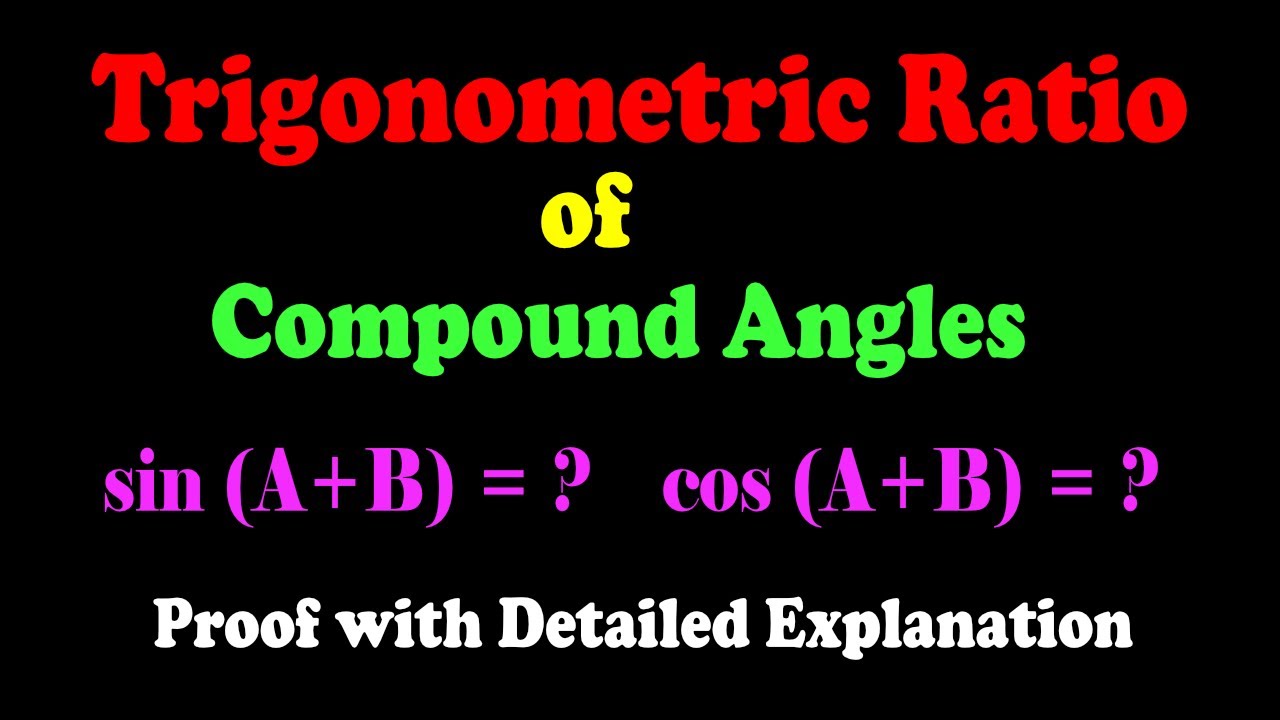 worthy eagle
steep granite
so u can only understand where cosine comes from if u know derivatives?
worthy eagle
steep granite
so u can only understand where cosine comes from if u know derivatives?
Derivation, not derivative
worthy eagle
"Derivation" of a formula refers to the process of deducing or obtaining a formula from a set of established principles, laws, or simpler equations using logic and mathematical steps.
I hope you understand now, watch the Vedio and I think it will clear your doubt
steep granite
wait I have one question
is the two definitions of deriviation
something u learn in calculas
or is the
second meaning
to the thing
the proof thing
something u learn
earlier
worthy eagle
The process of deducing something from already known facts is called derivation. This meaning is not at all related to calculas. So don't confuse yourself.
worthy eagle
 oh man, when he got confused with this. My brain also confused 'derivative' with 'derivation'
worthy eagle
steep granite
so u can only understand where cosine comes from if u know derivatives?
when he used 'derivatives'  big shame
dark sparrow
steep granite
what is derivation?
derivation is a set of steps to arrive at some identity, formula or other result
grave pond
Though, just to keep everyone on their toes, a "derivation" can also mean a linear operator satisfying f(ab) = f(a)b+af(b).
 mossy mirage
yess sure
knotty quiver
terms confusement 
fresh birch
 warped pendant
how can i do this problem?
 upper echo
warped pendant
how can i do this problem?
upper echo
warped pendant
how can i do this problem?
A triangle's area is maximal when its height is maximal, i.e. it is a right triangle and its side is a diameter..
warped pendant
okayy thanksss
zealous trout

Hey could someone help me with this. Ik im probably smooth braining it it's been a long day but I have to prove that ABCD is a parallelogram
worthy eagle
zealous trout
Hey could someone help me with this. Ik im probably smooth braining it it's been...
||you start by proving AQB congruent to CSD then prove PBC congruent to RDA||
 cinder ledge
||Try proving that PBC is congruent to RDA, then use CPCTC.||
What how to mark spoiler
worthy eagle
cinder ledge
What how to mark spoiler
use || on both ends of your text
worthy eagle
yes
cinder ledge
Ok thanks!
 orchid tendon
anyone here read or is reading the book "Basic Mathematics" by Serge Lang
zealous trout
worthy eagle
||you start by proving AQB congruent to CSD then prove PBC congruent to RDA||
Thanks so much
 cerulean hearth
Hello, how are you? . Where on the server do I ask about books on Euclidean geometry? I'm looking for it for the first time.
 left mauve
cerulean hearth
Hello, how are you? . Where on the server do I ask about books on Euclidean geom...
left mauve
cerulean hearth
Hello, how are you? . Where on the server do I ask about books on Euclidean geom...
Welcome to mathcord Stiven 
 lofty spear
@cinder ledge welcome to the mathcord c:
cinder ledge
Ty
 night cape
hii im a tad confused
if the circle is used for angles, why is the triangle important and how is it related to this idea
knotty quiver
idk but i know u can form triangles in the unit circle
 noble garden
yo guys help i cant beat this level on geometry dash
mystic umbra

lime crownBOT
 little tendon
Hey guys, can someone help me with this question, greatly appreciated
little tendon
Hey guys, can someone help me with this question, greatly appreciated
What step are you on?
1. I don't know where to begin.
2. I have begun but got stuck midway.
3. I got an answer but I was told that it's wrong.
4. I got an answer and would like my work checked.
5. I have a question about someone else's work/solution.
6. I have completed the problem and don't need help anymore. Thank you.
7. None of the above
 pearl hinge
little tendon
Hey guys, can someone help me with this question, greatly appreciated
pearl hinge
little tendon
Hey guys, can someone help me with this question, greatly appreciated
Can u draw the figure
 keen shuttle
Hey guys these two problems of my trigo homework (10th grade) are really challenging and absolutely beats me, any kind of help will be highly appreciated

 void drum
keen shuttle
Hey guys these two problems of my trigo homework (10th grade) are really challen...
void drum
keen shuttle
Hey guys these two problems of my trigo homework (10th grade) are really challen...
Hey
keen shuttle
void drum
Hey
Hello
void drum
keen shuttle
Hey guys these two problems of my trigo homework (10th grade) are really challen...
n or o?
keen shuttle
void drum
n or o?
Both actually
void drum
keen shuttle
Both actually
ok. we can use some rules with the sin: sin B - cosB = sen A while sin B + cosB = cosA
void drum
void drum
ok. we can use some rules with the sin: sin B - cosB = sen A while sin B + cosB ...
This is a proportion
So its just multiplying
keen shuttle
void drum
This is a proportion
But sinA/cosA is jus TanA
void drum
keen shuttle
But sinA/cosA is jus TanA
Yes, but that doesn't mean that sinB - cosB = sinA (i got confused)
keen shuttle
keen shuttle
Hey guys these two problems of my trigo homework (10th grade) are really challen...
What have I done?!
 keen shuttle
Hey guys these two problems of my trigo homework (10th grade) are really challen...
keen shuttle
keen shuttle
Hey guys these two problems of my trigo homework (10th grade) are really challen...
Still couldn't solve the second one :/
 spark yacht
keen shuttle
Still couldn't solve the second one :/
spark yacht
keen shuttle
Still couldn't solve the second one :/
Give me a sec
spark yacht

 haughty root
I thought tanα=tan(β-π/4), then cosα=±cos(β-π/4).
while sinα+cosβ=√2cos(β-π/4).
oh no
haughty root
haughty root
while sinα+cosβ=√2cos(β-π/4).
sinβ+cosβ=√2cos(β-π/4).
summer cradle
keen shuttle
Still couldn't solve the second one :/
k sin(a) / k cos(a) = (sin(B) - cos(B)) / (sin(B) + cos(B))
sin(B) - cos(B) = k sin(a) ...(²)
sin²(B) + cos²(B) - 2 sin(B) cos(B) = k²sin²(a)
1 - 2 sin(B) cos(B) = k²sin²(a) -> (1)
sin(B) + cos(B) = k cos(a) ...(²)
sin²(B) + cos²(B) + 2 sin(B) cos(B) = k²cos²(a)
1 + 2 sin(B) cos(B) = k²cos²(a) -> (2)
(1) + (2)
2 = k²sin²(a) + k²cos²(a)
2 = k²(sin²(a) + cos²(a))
2 = k²
k = ±sqrt(2)
sin(B) + cos(B) = ±sqrt(2) cos(a) (Proved)
keen shuttle
Thanks y'all
little tendon
pearl hinge
Can u draw the figure
idk how the polygon even is whether its a regular polygon or some other type of polygon
night cape
ohhhhhhh
night cape
knotty quiver
idk but i know u can form triangles in the unit circle
oh so they are related
knotty quiver
ya like what frances said
 river sand
guys i have two exams for both geometry semesters tomorrow whar do i do 😭
knotty quiver
learn from your mistakes
 simple vigil
how to do trigonometry easily i m in class 10
help me
i have problem with algebraic identity in trigo
silent plank
show the specific problem
many of those trig identity proofs involve the use of
conjugates and pythagorean trig identities
obsidian harness
simple vigil
i have problem with algebraic identity in trigo
!show
lime crownBOT
simple vigil
i have problem with algebraic identity in trigo
Show your work, and if possible, explain where you are stuck.
simple vigil
i want to learn how to solve a question in trigo
like how to make a path
to convert ratios
silent plank
too vague, the topic is too broad
show specific questions
spiral lodge
simple vigil
to convert ratios
What would that mean? You should realize by yourself that your questions are extremely vague...
obsidian harness
simple vigil
overall i m stuck in remembering ratio
which ratios do you need help remembering?
obsidian harness
simple vigil
cosec cot and sec
ah okay, well for cosec and sec
they start with C and S respectively
swap them around, so S and C
so then cosec = 1/Sin
sec = 1/Cos
cot = 1/tan cause both cot and tan have the letter T
hope these mnemonics help!
obsidian harness
simple vigil
then i have to think for a second
the more you practice non-calculator the easier it will become
just trust
simple vigil
thanks bro
obsidian harness
yeah all of the tangent values (and thus cotangent) don't have any 2s
for tan it's 0, 1/sqrt(3), 1, sqrt(3), infinity
so tan is increasing
simple vigil
i know this
obsidian harness
(cotangent is decreasing, the reverse order, but don't worry about that for now)
obsidian harness
yep for first quadrant ofc
simple vigil
but i have a doubt in identity sinA=sin(180-A)
obsidian harness
simple vigil
but i have a doubt in identity sinA=sin(180-A)
oh, have you learned the unit circle yet?
simple vigil
obsidian harness
oh, have you learned the unit circle yet?
not learned but know it
obsidian harness
okay, so just to recap
simple vigil
is this for only sin or all ratio
obsidian harness
cos(theta) = x-coordinate
sin(theta) = y-coordinate
obsidian harness
simple vigil
is this for only sin or all ratio
sin and cos
but all ratios come from sin and cos anyways
simple vigil
but if i put A=180 this is false
bcz cos 180=-1
but in this formula it will be cos 0 = 1
obsidian harness
simple vigil
but in this formula it will be cos 0 = 1
no! that formula does not apply to cos
the correct one for cos is cos(-x) = cos(x)
obsidian harness
simple vigil
thanks
this is the picture proof for sin(180 - x) = sin(x)
 simple vigil
i still have like 6-7 months before boards
obsidian harness
simple vigil
i still have like 6-7 months before boards
ahhhh okay
you have plenty of time don't worry
simple vigil
but there is like 15 chapter in 10th class
obsidian harness
keep making progress on maths, also your other subjects ofc
simple vigil
my maths marks are not good or else in othere subject i m in top 3 students
simple vigil
no but i really like coding AI ML DL which require a lot of maths
obsidian harness
I think there's a difference with the maths you need for coding and the maths you're learning in school
not exactly the content, but the way it's taught and how the knowledge gets applied, such that school really kills learning
simple vigil
in coding i require like PnC
obsidian harness
honestly just try to do well enough to get into those uni programs
obsidian harness
simple vigil
in coding i require like PnC
exactly and you're never, or rarely, going to put a married couple in some seats right
obsidian harness
but then there might be some coding scenario that is similar
simple vigil
you know there is an institute in india which has only one subject
MATHS
and a student got a package of 60LPA
obsidian harness
crazy
left mauve
Hello
left mauve
A bit
left mauve
Yeah well it's the top private eng college 
Getting in is not too easy
What grade are you in
left mauve
simple vigil
you can give BIT SAT
ik
left mauve
simple vigil
10th
Ah, you still have time then
simple vigil
what about you
left mauve
I'm in uni
simple vigil
i think you are in 3rd year
left mauve
No, 1st year
simple vigil
left mauve
No, 1st year
fresher
left mauve
Yes
simple vigil
which college
left mauve
left mauve
Ah, you still have time then
Why go for BITS then?
 slender flint
BITS isn't in Chennai 😭
left mauve
simple vigil
which college
Not doxxing myself, lol
left mauve
left mauve
Why go for BITS then?
BITS is always a secondary target
left mauve
simple vigil
its in GOA and PILANI (rajasthan)
And hyderabad (and dubai)
slender flint
And Dubai
simple vigil
left mauve
BITS is always a secondary target
why secondary?
left mauve
simple vigil
why secondary?
Because it doesn't offer as much ROI as a good NIT or IIT might
simple vigil
bye guys let me go i have to do worksheet and work of triangles
 jaunty quail
obsidian harness
<@1276805241286688798> can you help me out with India specific stuff bhai
jaunty quail
obsidian harness
<@1276805241286688798> can you help me out with India specific stuff bhai

 azure rivet
obsidian harness
honestly just try to do well enough to get into those uni programs
azure rivet
obsidian harness
honestly just try to do well enough to get into those uni programs
i knew you were indian
 azure rivet
obsidian harness
<@1276805241286688798> can you help me out with India specific stuff bhai
azure rivet
obsidian harness
<@1276805241286688798> can you help me out with India specific stuff bhai
whats this then
 polar otter
Hellooo
dire jackal
azure rivet
whats this then
if he was indian why would he ask someone else for help with indian stuff
also having BITS as your goal in 10th grade is stupid
should aim for iits and nits since they are better for job placements which the person cares about lol
azure rivet
your point is true tbh
simple vigil
dire jackal
should aim for iits and nits since they are better for job placements which the ...
the problem is competition
jee given by more than 12 lakhs students
meanwhile bitsat maybe 6-7 lakhs
left mauve
Uhh
Bits is a single college
Jee offers admission to multiple colleges
It evens out
dire jackal
simple vigil
the problem is competition
why are you aiming lower though
if aim for iit, you have a better chance of geting into bits
aim for bits and you would prep less
pearl hinge
little tendon
idk how the polygon even is whether its a regular polygon or some other type of ...
Yeah but if we drawn PQ and MN is such a way that QM is perpendicular on PQ.i.e. then we can find the R+S easily
I couldnt come up with anything else
Since they didnt specify how the segments would be arranged exactly, we can draw one which can actually give an answer ,i suppose
worthy eagle
pearl hinge
Yeah but if we drawn PQ and MN is such a way that QM is perpendicular on PQ.i.e....
I came up with something ↓
worthy eagle
little tendon
idk how the polygon even is whether its a regular polygon or some other type of ...
Begin by drawing a seven sided regular polygon, you only drawing a regular polygon for your reference. Just remember to show PQ parallel to NM in this diagram.
Now, extend MS and QR and let O be the point where they meet.
Extend NM and PQ and draw a perpendicular line from O to the extended NM and PQ.
Now you got 2 right triangles. Mark angle Q = 98° and M = 111° and use 'sum of all angles on a line = 180°' and 'sum of all angles in a triangle is 180°' to find your answer.
you can send a diagram so that I can tell you if you are doing it right
pearl hinge
worthy eagle
Begin by drawing a seven sided regular polygon, you only drawing a regular polyg...
That's a vey cool wayy,thanks!
Also there is already a vertice named O in the polygon,so it should be named as something else
 crimson crescent
does anyone have any good youtube videos to learn how to do statement reason cus im talking geo next year and I havent done statement reason in a while and I dont know how I should learn it so youtube would be good or any other resources
 solid radish
Hi

For the vertex form if it’s like x - 3 + 2
Would the vertex be (3, 2)
And if it was the opposite like x - +3 + 2 the vertex would be (-3, 2) right
Sorry I posted it in the wrong channel
 blazing ermine
dark sparrow
solid radish
For the vertex form if it’s like x - 3 + 2
blazing ermine
dark sparrow
solid radish
For the vertex form if it’s like x - 3 + 2
you should never drop the ()^2
otherwise you'll confuse everybody
lime crownBOT
No need to ask “Can I ask…?” or “Does anyone know about…?”—it’s faster for everyone if you just ask your question! See https://dontasktoask.com/
spark yacht
simple vigil
its in chennai
cmi?
 dire jackal
yo is that 10th ncert by any chance
dire jackal
simple vigil
especially (viii) and (iv)
in 8th, you just open the squares and you will see general properties like sin^2x+cos^2x=1 pop up
worthy eagle
You can try converting LHS to sin, cos and then multiplying and dividing LHS with the denominator of RHS so the denominator on both sides become same and solve the rest to make the numerators same.
For example in iv,
(1+secA)/secA
= (cosA+1)
= (1+cosA) (1-cosA)/(1-cosA)
= (1-cos²A)/(1-cosA)
= sin²A/(1-cosA)
worthy eagle
yes
simple vigil
what are you typing so long
dire jackal
discord is bad at showing when someone is actually typing. if i type one letter and erase it it will still show me as typing for some time
worthy eagle
worthy eagle
You can try converting LHS to sin, cos and then multiplying and dividing LHS wit...
but this multiplying and dividing thing doesn't work always, just tried on viii and it's getting very long,
dire jackal
viii is pretty simple just expand the square
worthy eagle
dire jackal
discord is bad at showing when someone is actually typing. if i type one letter ...
actually I do solving on mobile by typing, not on paper so it shows me typing for very long
dire jackal
ohh ok
dire jackal
simple vigil
i have problem in such kind of question
man these are so nostalgic
things were so much simpler in 10th
worthy eagle
dire jackal
viii is pretty simple just expand the square
yes, converting everything to sin, cos makes it unnecessarily long
dire jackal
hmm ok
simple vigil
dire jackal
things were so much simpler in 10th
it look simpler now for me as a first time VERY HARD
dire jackal
true it wasnt that easy when i first did it
just do some practice and youll start to see certian patterns
simple vigil
no like in vii part
i have a solution to divide all by sin A
both numerator and denominator
first we will take common sin from numerator and cos from denominator
then divide
dire jackal
instead of dividing take sin common from numerator and cos from denominator and keep it as tanA
dire jackal
ye
 dire jackal
ohh damn
simple vigil
i can't afford this much time on a question of 2-3 marks in boards