#geometry-and-trigonometry
1 messages · Page 14 of 1
 vapid patio
vapid patio
vapid patio
oh?
 vague mica
Yeah
vapid patio
this is killing me ☠️..
vague mica
Good
vapid patio
ok shriveled up ball sacked dick
vague mica
Cuz its about to get worse
vapid patio
vague mica
Cuz its about to get worse
nah fr?
vapid patio
what the hell
vapid patio
okay you dickheaded shaped cone pussy slurper, why don’t you go suck on some dick
vague mica
NO
you smell like an unpleasant individual who as peed their pants on multiple occasions as a teenager
vapid patio
oh hell no
vague mica
Oh hell yes
vapid patio
you snail skulled little rabbit would that a hawk pick you up, drive its beak into your brain, and upon finding it rancid set you loose to fly briefly before spattering the ocean rocks with the frothy pink shame of your ignoble blood may you choke on the queasy, convulsing nausea of your own trite, foolish beliefs 🧟♀️
 foggy parcel
@vapid patio @vague mica u two could've talked all these shits in dms
 dark sparrow
@vapid patio @vague mica do not flood this channel with mildly-obscene, interpersonal banter.
foggy parcel
these shitty talks just prove that both of u are unmatured kids fighting over each other @vapid patio @vague mica
 junior light
@vapid patio @vague mica You've been muted for a day for cluttering the topic channel with #chill -worthy content.
 royal heath
A,B and C are three sequential points on a straight line on horizontal ground. A vertical flagpole PQ is situated close by the line (but its base P is not on the line). The angles of elevation of the top of the flagpole from A, B and C are tan^-1 (1/4), tan^-1 (1/2) and tan^-1 (1/3) respectively. If AB = 90m and BC = 30m, find the height of the flagpole.
 trail birch
3d shapes are pain
 elder nimbus
hey would it be possible to get some tips on geometry?
 timber cargo
I would suggest Khan Academy or Organic Chemistry
 restive acorn
Yo guys
I’m studying for the PSAT
I do calculus for fun but I forgot a bit of geometry
I need help
What is the name of the measure from the perimeter of an n-gon to its center point?
IIRC it’s like starting with an A
 obtuse patio
restive acorn
What is the name of the measure from the perimeter of an n-gon to its center poi...
obtuse patio
restive acorn
What is the name of the measure from the perimeter of an n-gon to its center poi...

 summer mason
hi
 hasty karma
Is there some very efficient formula for triangle area with points given?
i want to use it in algorithm so idealy it should have no roots/exp/arctg
simplier to compute the better
 nocturne remnant
shoelace formula?

The shoelace formula, shoelace algorithm, or shoelace method (also known as Gauss's area formula and the surveyor's formula) is a mathematical algorithm to determine the area of a simple polygon whose vertices are described by their Cartesian coordinates in the plane. It is called the shoelace formula because of the constant cross-multiplying fo...
 upper karma
hasty karma
Is there some very efficient formula for triangle area with points given?
upper karma
hasty karma
Is there some very efficient formula for triangle area with points given?
Im figuring out the formula

 feral bobcat
Nvm.thete was a mistake in excersise xddd
obtuse patio
 terse wigeon
How to Find Trignometric Functions of - 90°
terse wigeon
How to Find Trignometric Functions of - 90°
What does that even mean
terse wigeon
obtuse patio
What does that even mean
Idk that's why I am asking you guys you know math
terse wigeon
Kind of yes
obtuse patio
I would ask your teacher to clarify
terse wigeon
obtuse patio
I would ask your teacher to clarify
Can you check dm
upper karma
We can find area of triangle directly by using coordinates of three vertices of triangle. Heron's formula can be lengthy in some situations. Therefore, we can prefer direct formula to find area of triangle using coordinates of vertices of triangle.
hasty karma
upper karma
https://mathinstructor.net/2012/08/how-to-find-area-of-triangle-given-three-vert...
oh nice
i expected it to use addition and multiplication only

upper karma
im interested in teaching myself trigonometry since my school doesnt appear to teach it at all do you guys have pointers where to start
 silent plank
khan
 young rampart
upper karma
im interested in teaching myself trigonometry since my school doesnt appear to t...
young rampart
upper karma
im interested in teaching myself trigonometry since my school doesnt appear to t...

Trigonometry is a branch of mathematics that studies relationships between side lengths and angles of #triangles. Throughout history, #trigonometry has been applied in areas such as geodesy, surveying, celestial mechanics, and navigation. Trigonometry is known for its many identities, which are equations used for rewriting #trigonometrical expre...
it covers everything u need on a high school level
hasty karma
upper karma
im interested in teaching myself trigonometry since my school doesnt appear to t...
i see this problem is quite common around the world

in what part of world you live, if not secret?
obtuse patio
hasty karma
in what part of world you live, if not secret?
why does it matter
hasty karma
obtuse patio
why does it matter
just wondering
obtuse patio
its not relevant really
 nocturne remnant
terse wigeon
nocturne remnant
terse wigeon
Use C=pi-A-B and compound angle identities to get rid of C from the equation
Then simplify
 uncut oak
Can someone tell me about it

 kind latch
does a deltoid have symmetry center?
upper karma
uncut oak
Can someone tell me about it
can you take another pictured more zoomed in? I don't know if the numbers are 15,6,8,10, It's too blurry on my side.
upper karma
uncut oak
Can someone tell me about it
The rectangles are multiplied by the length x width. The triangles are multiplied by length x width and then divide by 2.
upper karma
hasty karma
in what part of world you live, if not secret?
usa
 floral shale
upper karma
usa
floral shale
upper karma
usa
My condolences
 languid grail
uncut oak
Can someone tell me about it
languid grail
uncut oak
Can someone tell me about it
you can just add them all together
upper karma
trigonometry seems easy

just scribble on the graph and ur guaranteed to get a 100

170 pie
nice
someon plz explain the difference between sin cos tan csc sec cot
upper karma
languid grail
sin = opp/hyp
i learned how to make wine glasses using math
and cups

is this why my math teacher says trigonometry is stupid math
upper karma
upper karma
is this why my math teacher says trigonometry is stupid math
stupid?
i think he does not know what triangulate means and how it is used in operations such as spying to catch spies and do more stuff related to technology
dang
what is the qualification of ur teacher?
upper karma
he teaches algebra 1
floral shale
Whatever "algebra 1" covers varies school to school
upper karma
well
first semester we went over
inequalities
slope
systems of equations
that kinda stuff
second semester we only did quadratics
 torn gazelle
Can someone help me with this?
 timber cargo
torn gazelle
Can someone help me with this?
timber cargo
torn gazelle
Can someone help me with this?
The equation for a linear line is y=mx+b
M is your slope
And b is your y intercept
Now, you're already given the slope,m, which is -2
You just need to find what b is, and you can do that with the coordinate point that you are provided with
(3,4)
timber cargo
torn gazelle
How would I find be knowing (3,4)?
Your line is y=-2x+b
And your x,y coordinate is 3,4
Meaning that when x is 3, the y value is 4
In other words: 4=-2(3)+b
timber cargo
Yeah
torn gazelle
So getting b alone would mean we move 4
timber cargo
4=-6+b
timber cargo
Yep
timber cargo
You already have (3,4)
Choose another point
Use a straight edge to connect the two points
timber cargo
timber cargo
Choose another point
But whatever point it may be, it must hold true for the equation
Your equation is y=-2x+10
Say you chose x=-2
That would be y=-2(-2)+10, which is 14
So at x =-2, your y coordinate is 14
timber cargo
torn gazelle
Then y would be 11
What is 2 added with 10
torn gazelle
timber cargo
What is 2 added with 10
Sorry 12
@timber cargo so this is what the graph would be?
 timber cargo
torn gazelle
<@926486270807515157> so this is what the graph would be?
timber cargo
torn gazelle
<@926486270807515157> so this is what the graph would be?
Get another point
Or just align your straight edge to the points and draw a continuous line throughout the graph
timber cargo
torn gazelle
How would I do b?
Point slope equation is this

Your m is the slope
And x1 and y1 is your corresponding coordinate point
torn gazelle
So it would be 12-4=-2(-1-3)?
Also, @timber cargo
That’s my third point, is that good?
 timber cargo
Yeah, and just draw arrows at each end of the line to signify that the line is continuous
torn gazelle
Awesome!
torn gazelle
torn gazelle
So it would be 12-4=-2(-1-3)?
^is this good @timber cargo
timber cargo
torn gazelle
So it would be 12-4=-2(-1-3)?
No
Leave the y and x alone, all your substituting into is 3 and 4 into X1 and Y1
So, y-4=-2(x-3)
torn gazelle
That’s the equation in point slope form?
timber cargo
That's correct
timber cargo
Right. that's y=mx+b
timber cargo
No, you're asked to find the equation of the line
Whoch is y=-2x+10
What you did tells me that this equation above is true for that point
torn gazelle
Ok
C is y=2x+10
Then d wants the y intercept
I also changed the graph because the first one I didn’t have (3,4). Is this correct now?

@timber cargo sorry to ping you, I didn’t know if you saw
torn gazelle
timber cargo
(0,10)
Why would it be 10?
timber cargo
torn gazelle
Why would it be 10?
Recall what b is again
B is the y intercept of the graph
torn gazelle
So should I redo the graph?
timber cargo
Just label where the graph intercept the y axis (0,10)
 timber cargo
torn gazelle
<@926486270807515157> can y check and see if that’s correct?
timber cargo
torn gazelle
<@926486270807515157> can y check and see if that’s correct?
That’s correct
 static spindle
can anyone help me out
 silent plank
show work.
you probably made a small error seeing as you got everything else correct
specifically sec(A)
 pastel sand
cos(A) = b/c
b = 5 = √(25)
c² = b² + a² = 125
=> c = √(125)
cos(A) = √(25/125) = √(0.2)
maybe I misunderstood, but it seems to be correct
 past jolt

It takes a special kind of student to outsmart 2,000 years of mathematicians -- at St. Mary's Academy, they have two.
Calcea Johnson and Ne'Kiya Jackson just gave a presentation to the American Mathematical Society's Annual Southeastern Conference. They say they've proved Pythagoras' Theorem can be proven with trigonometry -- something that man...
 rugged sleet
pastel sand
maybe I misunderstood, but it seems to be correct
rugged sleet
pastel sand
maybe I misunderstood, but it seems to be correct
it is correct👍
 twin rose
 pastel sand
5 tan (A) * tan (B) = 5 * tan (A) * tan (B)?
i don't understand how 5 * tan(A) * tan(B) = 2
because tan(A) * tan(B) = 1

 twin rose
 spiral lodge
I hope this clarifies
spiral lodge
I hope this clarifies
Thanks a lot brooooo
spiral lodge
twin rose
Thanks a lot brooooo
You're welcome 😊
 dire snow
Idk how to justify them and finish the exercise

Can I tag Helper too if no one respond?
 thin locust
does
$\measuredangle CDK = \measuredangle CBA$ proof that DK is parallel to BA ?
C, D, B are colinear
 somber coyoteBOT
Affe

 junior dirge
hello anyone can send worksheets with answer in geometry solids which whats the valuess
 late monolith
guys can someone tell me about the sine and cosine rules? I need it for a test tomorrow and the teacher hasn't even discussed it in class
floral shale
late monolith
guys can someone tell me about the sine and cosine rules? I need it for a test t...
Google can tell you much faster than we can manually

 random verge
because you are calculating square of radius for sphere, you have to calculate cube of radius
@upper karma
 tepid nexus
Hi! I was wondering what areas of mathematics i would have to understand before delving into fractal geometry?
 opal bear
You finish it?
Could you tell me what you got for an answer?
I dont beleive there would be a second triangle.
And you tried those values for an answer?
Then the second triangle you need to complete.
🤨
 paper remnant
floral shale
Google can tell you much faster than we can manually
paper remnant
floral shale
Google can tell you much faster than we can manually
true
 covert belfry
 sturdy trail
anyone know how to solve this using half angle formulas?
sturdy trail
anyone know how to solve this using half angle formulas?

Did you try this formulas?
 sand charm
Hey guys, does someone how to calculate complementary angles and that kind of stuff?
Like
Parallel angles
idk how it is called
opal bear
sand charm
Hey guys, does someone how to calculate complementary angles and that kind of st...
🤨
opal bear
example bro
sand charm
I dont speak english as first language
sand charm
opal bear
example bro
lemme check

Here
Based on this
With the given angle
How would you calculate this other angle
opal bear
Which other angle?
 opal bear
That would be.
sand charm
Think that the line is perpendicular to the line the box is in
The crooked one
Not the Y axis one
How is that property called?
And how would you calculate stuff like thaat
opal bear
sand charm
And how would you calculate stuff like thaat
This is assuming all the infoirmation you have is the angle 30?
sand charm
opal bear
This is assuming all the infoirmation you have is the angle 30?
Yup
I have to find the missing angle
And everything i have is that
Only thing i know is that
opal bear
would it be 30?
sand charm
opal bear
would it be 30?
Yup
opal bear
Theta would be 30.
sand charm
But how do get to that conclusion
Thats the thing i want to learn
Because im going to need to do a lot of stuff like that
opal bear
Theta is 30 because its 60 degrees to a riht angle.
sand charm
opal bear
Theta is 30 because its 60 degrees to a riht angle.
How do you compare theta to a right angle
Like
How do you see that
I cant see it
opal bear
Idk if that would help bro.
opal bear
sand charm
I cant see it

the angle of 30 and theta are the same because you just imagine it as a triangle rotated 90 degrees to the right
sand charm
opal bear
Sorry, i kinda get it, but i cant understand
Dont you know if thats a property or something i can search on google?
opal bear
The property is that angles withing a right angle add up to 90 degrees
sand charm
opal bear
The property is that angles withing a right angle add up to 90 degrees
Well, yea
Ur right
Thanks
sand charm
opal bear
The property is that angles withing a right angle add up to 90 degrees
Ey man
Sorry for bothering
But i didnt get it at all
Im trying to do it myself
But i cant
Can you get me through your thought process?
And what things did you do and think to get that conclusion?
Alr, i think i got my own thought process
Lemme know if im right

So, if the green line is parallel to the hypotenuse
Then the red line is going to be parallel to the oposite
And we already know that that angle is 30
So
If the angles of the green bars are 90°, because they represent axis and so
Then the other angle is 60
Because thats whats left to complete the full 90°
Can someone prove me right or wrong please?
<@&286206848099549185>
sand charm
 gusty patrol
and you know it's perpendicular to the base
gusty patrol
and you know it's perpendicular to the base
Well, then im right
The thing is that i need to draw stuff like that
Making axis parallel to the surface the object im studying is resting
So ye
The red line represents the gravity
And you know, gravity is always going down
But yea, thanks bud
 languid finch

Can someone explain how my textbook got the answer 10.1?
When i plug it into my calculator I get -13.6
torn gazelle
Can someone help me with c?

 valid basin
y'all
try trigonometry by sl loney
its an amazing book
I finished the book after 5 months
and I feel fucking great
torn gazelle
torn gazelle
Can someone help me with c?
^
torn gazelle
180 degrees?
 sweet magnet
yeah
 rapid sigil
valid basin
try trigonometry by sl loney
rapid sigil
valid basin
try trigonometry by sl loney
did you already know the concepts and just used the book for practice or reference or did you use it as an introductory textbook.
 rose pike
Im a bit confused so im doing the law of sines and cosines
and my teacher gave me a problem
with no angle
but with all sides
how do I find all angles
timber cargo
What’s the problem set?
rose pike
timber cargo
What’s the problem set?
problem set?
timber cargo
rose pike
problem set?
What is the problem that you’re teacher assigned to you
rose pike
a triangle that is not a right one with 3 sides being (21.4,29.5,13.9) and asked to find the 3 angles
timber cargo
rose pike
a triangle that is not a right one with 3 sides being (21.4,29.5,13.9) and asked...
inverse trig functions
for that
to get the angle
rose pike
So i
did law of cosines
then when it got to the final step i left cos A on one side
then the rest on the right and got 25.986
using inverse trig cos
timber cargo
Construct a triangle with such side lengths and manipulate that triangle to try to get the angles
rose pike
I kind of just want someone to double check my work
valid basin
rapid sigil
did you already know the concepts and just used the book for practice or referen...
my basics were stronge, I used it to master advanced trigonometry
 fading lynx
Hi, I asked about where to find info on this topic, I'm asking here just in case it's specific of this channel #help-0 message
 lapis wind
am i trippin or how is this wrong
 obtuse patio
lapis wind
am i trippin or how is this wrong
obtuse patio
lapis wind
am i trippin or how is this wrong
maybe you need to do < > or i + j
lapis wind
obtuse patio
maybe you need to do < > or i + j
nah that wasnt it 😦
obtuse patio
looks fine to me then
 raven sable
lapis wind
am i trippin or how is this wrong
raven sable
lapis wind
am i trippin or how is this wrong
they're correct
lapis wind
huh must be a mistake with the professors answer then, had that happen b4
 upper creek
can someone tell me if x is 8.478708228 and if not a good spot to kms
 obtuse patio
upper creek
can someone tell me if x is 8.478708228 and if not a good spot to kms
obtuse patio
upper creek
can someone tell me if x is 8.478708228 and if not a good spot to kms
it is not
upper creek
obtuse patio
it is not
is it 13.57?
obtuse patio
upper creek
is it 13.57?
yes
upper creek
alright thank you
 vestal kraken
Can someone help me with the ones that are circled #?
 floral shale
vestal kraken
Can someone help me with the ones that are circled #?
floral shale
vestal kraken
Can someone help me with the ones that are circled #?
What kind of equations are they
Start with identifying what kind of equation you're given
timber cargo
They are the equations for a circle
floral shale
You need to understand components of the equation
The the center of the circle is $(h, k)$. Then the equation of a circle is:
$$(x-h)^2 + (y-k)^2 = r^2$$
somber coyoteBOT
Umbraleviathan
 floral shale
So let's look at the first equation:
x^2 + y^2 = 49
What is the radius and center?
@vestal kraken
vestal kraken
floral shale
So let's look at the first equation:
x^2 + y^2 = 49
What is the radius and c...
Doesn’t tell me
vestal kraken
49
floral shale
somber coyote
**Umbraleviathan**
r is the radius
No that's r^2
If r^2 = 49
What is r
vestal kraken
Square or square root?
vestal kraken
Do I square it or square root it
floral shale
You want to do the inverse of the ^2, so square root
This should be familiar stuff if you're dealing with circles and conics
r^2 = 49
=> r = sqrt(49)
What is sqrt(49)
vestal kraken
7
floral shale
So that's your radius
vestal kraken
I don’t understand equation symbols so correct me if I’m wrong
floral shale
What's your center
floral shale
somber coyote
**Umbraleviathan**
Refer up to here if need be
I'll give you a hint
x^2 is the same as (x-0)^2
vestal kraken
somber coyote
**Umbraleviathan**
I don’t think I have that unless I have to solve for it
vestal kraken
I have the equation down
floral shale

Khan Academy
Learn for free about math, art, computer programming, economics, physics, chemistry, biology, medicine, finance, history, and more. Khan Academy is a nonprofit with the mission of providing a free, world-class education for anyone, anywhere.
Perhaps look at the practice problems in here
They go each one step-by-step should you get stuck
obtuse patio
doesnt matter how easy they are
asking people to do your work is academic dishonesty
 bright venture
Ok then nvrmind
obtuse patio
youre tutoring and you havent done alg 1?
obtuse patio
okay so then why are you asking for someone to do some problems
obtuse patio
bright venture
And this kid needs to check his work
so youre asking someone to check the work of the person youre supposed to tutor?
obtuse patio
do you realize the stupidity of what you are saying
youre asking someone to do the tutoring for you
floral shale
Hey did I hear someone was going to pay someone to do their homework?
Is that what I call
Time to ping the moderators??
 ancient nebula
I'm making notes, are these accurate and if not what can I fix? (7th grade so we're not doing too complicated things)

Is there anything important I should include or is it good?
,rotate
somber coyoteBOT
 floral shale
Lol if your notes were any messier they might as well be painted by Basquait
floral shale
ancient nebula
I'm making notes, are these accurate and if not what can I fix? (7th grade so we...
How much of this do you actually need
Because it's pretty cluttered
ancient nebula
I kinda need all of it but I just started and added on as I remembered it
floral shale
Like the thing is it just seems like spaghetti
ancient nebula
I'm not good at writing notes
floral shale
Like do you need to write down what acute, obtuse, and right angles are
I would save space for the theorems
And shape properties
Like keep the vertical angle stuff
But ngl I would try to organize it more and focus more on theorems
And then if you really like math, try to prove the theorems by yourself
That way it'll kinda engrain itself into your mind
ancient nebula
I got this as an organize and make room kinda thing( haven't added anything else yet

,rotate
somber coyoteBOT
 floral shale
What's with the 1 = 2/3 thing
ancient nebula
I need the isosceles and scalene bc I can never remember the difference
ancient nebula
floral shale
What's with the 1 = 2/3 thing
Idk, kinda saying that s =o/h
Useless ig bc that's easy
floral shale
SOHCAHTOA kinda covers it but sure
And the areas for circles/squares/triangles
I mean you'd have to deal with more
Not sure if you need to document those compared to area of a trapezium/hexagon/pentagon
How far have you gotten in geometry
ancient nebula
I can never remember circle's for some reason but the other 2 are easy to remember
ancient nebula
floral shale
Not sure if you need to document those compared to area of a trapezium/hexagon/p...
Forgor abt tose shapes lmao my brain is peanut sized
floral shale
And then the 90°, 180°, 360°
Do you absolutely need those
Because as geometry progresses you'd need more space for the theorems
Like lemme see if I can recall the shit I had to write down for geometry
• Law of Sines
• Law of Cosines
• sin(a +/- b) identity
• cos(a +/- b) identity
• Pythagorean identity for trig
• Heron's formula
• Geometric Mean theorem
• Chord-Chord, Secant-Tangent, Secant-Secant power theorems
• Area of a trapezium
• Area of a kite
• The sum of all interior angles of an n-gon
• Circumcenter, orthocenter, and centroids
• volume of a frustum
Thats what I remember having to learn on the top of my head
Im disregarding the proof stuff
Like the thing is, the more you do the more it'll stick
For me, I never really remembered the volume of a frustum or the geometric mean theorem
But after doing a fuck ton of law of cosines and sines, i kinda got used to it and then was able to prove them to fortify my understanding
ancient nebula
Trapezoid=trapezium right?
 autumn furnace
the volume of a frustum is just the volume of the whole shape (pyramid/cone) minus the volume of the part that's cut out.
floral shale
ancient nebula
Trapezoid=trapezium right?
Yeah
floral shale
autumn furnace
the volume of a frustum is just the volume of the whole shape (pyramid/cone) min...
Yeah but there's a more direct formula
autumn furnace
right, but you could figure it out if you needed to
floral shale
$\frac{\pi h r^2}{3}$
somber coyoteBOT
Umbraleviathan
 autumn furnace
1/3 the volume of the corresponding cylinder
ancient nebula
What I got so far

I removed sohcahtoa bc I can remember that
Idk how to draw a GOOD sphere so it's ugly
Also kites I have in my head as s pq over 2
ancient nebula
floral shale
$\frac{\pi h r^2}{3}$
How-
Ydzygz
I tryna say that the radius is 2× the diameter
 smoky jetty
ancient nebula
What I got so far
smoky jetty
ancient nebula
What I got so far
i'd say do more math problems so u need not worry too much without those
 carmine cape
yo can someone please help me wit these i got 4 questions i need done and they hard for me😭


 wary pumice
I don’t understand center angles and inscribed angles. I really don’t.
For examples it says find the value of X. 74 degrees and (7x-3) that’s the thing idk how to do this and my teacher doesn’t really do a good job at explaining it
 empty sonnet
The sides and classification of a triangle are give below. The length of the longest side is the integer give. Find x:
x+2, x+3, 29; acute.
So I know that (x+2)^2 + (x+3)^2 > 29^2. The answer I get is x = 18 or -23.
However, we need to verify whether it forms a triangle. So (x+2) + (x+3) > 29.
But the answer key says "x+3 < 29, so x < 26."
The final answer becomes 18 < x < 26.
My answer was 12 < x < 18.
 undone lintel
Can someone help me please, I don't know how to do this.
ABC is a right-angle triangle inscribed within (O) (B=90). D is on the chord that doesn't have B. M is on DC chord. N is on BC chord. The intersection of DC and AM is E, the intersection of BC and AN is F, the intersection of DN and BM is K. Prove E, F, K is linear.


 trail arrow
how to find the end coordinates of vector, if we know whole and start of vector?

 sacred jetty
f)12
e)24
answer: 10*5squareroot5
answer:squareroot125
@cyan wren
answer:(𝑥−4)^2+(𝑦+5)^2=81
 pure hare
sacred jetty
4)
f)12
e)24
pure hare
sacred jetty
4)
f)12
e)24
What’s the formula for the fourth one?
sacred jetty
a)(-3,2)
b)3
c)⁅9𝜋⁆
sacred jetty
pure hare
What’s the formula for the fourth one?
trigonemetric square(x)+square(xsquareroot3)=x
squareroot(x)
sacred jetty
sinus and cosinus teorem
timber cargo
sacred jetty
4)
f)12
e)24
Don't just answer the questions for him, instead guide him to the answer
sacred jetty
ok i'm new i'm sorry
 languid hinge
Can someone help me with geomtry Question?
sacred jetty
Yes,ı can help
languid hinge
it doesnt translate right on google
timber cargo
Alright, post the question here
languid hinge
In Same language?
timber cargo
Yeah
languid hinge

 open kettle
Hi just wondering how u would work this out 2 circles 1 inside the other not touching and you have to find the limits for a letter in the radius
sacred jetty
languid hinge
please translate
smoky jetty
 cyan wren
for Q.4, refer to 30-60-90 special right triangle, where the shortest side measures x, longer side measures sqrt.3 times x, and longest side (hypotenuse, or 12 sqrt. 3 in in this case) is twice the measure of shortest side. Since, the original triangle is a right triangle, u can draw an altitude perpendicular to the hypotenuse (e), thus u can refer to right triangle theorem. Hence, you may get the values of e and f from the geometric mean formulas (which were got from the ratio of corresponding sides of the orig triangle and the smaller 2 right trigs made by the altitude drawn to hypotenuse)
for Q3, you are given an equilateral triangle, and u did the right step so far on diving the value of base into 2 equal measures. you can refer to pythagorean theorem; altitude^2 = hypotenuse^2-base^2 and then once u have the value of altitude, get the area of triangle which is half the product of base and height
or simply refer to heron's formula if u're more familiar with it
 shadow topaz
wassup
 weak vault
hey was wondering if anyone got a graphing tool for function in the complex plane?
 weak vault
i thought geogebra can’t go 3D
obtuse patio
weak vault
i thought geogebra can’t go 3D
thats like why people use it lol
weak vault
so can i graph 3d complex things with geogebra
pure hare
weak vault
i thought geogebra can’t go 3D
weak vault
ty
obtuse patio

weak vault
ok hear me out im trying to graph the function sin(x)^sin(x) without using complex numbers it looks something like this-in the section sin(x)<0 there should be a complex output because of squareroot of negativ

isnt it just x^2+x^2=(12sqrt(2))^2
then solve for x
sacred jetty
Sin(30)*x=9 x=18 ac 9squareroot3 ab=18
sacred jetty
Sin30=1/2 sin60=squareroot3/2
sacred jetty
Sin cos function

This math video tutorial provides a basic introduction into trigonometry. It covers trigonometric ratios such as sine, cosine, and tangent. It explains how to evaluate it using right triangle trigonometry and SOHCAHTOA. In addition, it explains how to solve the missing sides of triangles and how to find the missing angles using inverse trig f...
 crimson pawn
sacred jetty
Sin cos function
crimson pawn
sacred jetty
Sin cos function
and tan
sacred jetty
I can't explain it out loud. my english is not good

You can find the results by multiplying the x value with the trigonometric functions
obtuse patio
 open sun
how do i understand trig
open sun
how do i understand trig
khanacademy
 fair crag
sacred jetty
fair crag
sacred jetty
Me who just knows cos tan and sin 😟

 wise pawn
idk is there part of the screenshot missing or something
looks like a physics problem wihout the full question given
 pearl storm

 ornate lava
how would I go about learning how to do this?
 obtuse patio
ornate lava
how would I go about learning how to do this?
obtuse patio
ornate lava
how would I go about learning how to do this?
You just need to know your unit circle
That’s it
 vestal sky
ornate lava
how would I go about learning how to do this?
vestal sky
ornate lava
how would I go about learning how to do this?
(a) get sin theta alone
And then find where the value is true on the unit circle
vestal sky
ornate lava
how would I go about learning how to do this?
(b) is already alone so now you need to evaluate where cos(5x) = sqr rt/2 divided by 2 is true then divide the solutions by 5 or multiply by 1/5, whichever you prefer
 warm kettle
ornate lava
how would I go about learning how to do this?
warm kettle
ornate lava
how would I go about learning how to do this?
(a) sin(theta) = sqrt3/2
theta = pi/3 + 2pik, 2pi/3 + 2pik, k is an integer
(b) cos(u) = sqrt2/2, u=5x
u = pi/4+2pik, 7pi/4 + 2pik = 5x
x = pi/20 + 2pik/5, 7pi/20 + 2pik/5, k is an integer
 static marten
1^2 = 1, 1^3 = 1, 1 = 1, 1^2 = 1^3, log_1(1^2) = log_1(1^3), 2(log_1(1)) = 3(log_1(1)), 2(1) = 3(1), therefore 2 = 3
 ocean cobalt
ornate lava
vestal sky
And then find where the value is true on the unit circle
ocean cobalt
ornate lava
vestal sky
And then find where the value is true on the unit circle
what do you mean by unit circle, when it came to the question i don't understand what it means by find the first ''four'' solutions. I thought I would need to rearrange and just plug it into the calculator
floral shale
warm kettle
(b) cos(u) = sqrt2/2, u=5x
u = pi/4+2pik, 7pi/4 + 2pik = 5x
x = pi/20 + 2pik/5, ...
I hate to warn you but
!nosols
 lime crownBOT
As a helper, please do not give out answers that could be copied as a homework solution. Have the student work through the problem themselves and guide them along the way.
 calm chasm
Name changed here
 late pilot
 vast apex
shoutout to the right triangle
upper karma
^
 fallow sable
 chrome thistle
u can use other methods such as cosine rule and sine rule
 vivid sun
No way I love soh cah toa
 crisp burrow
 worthy holly

its just saying that if its in equilibrium there is no resultant force acting on the body. Therefore, sum of all forces in x and sum of all forces in y are 0
i assume the question is finding tension in the string?
upper karma
shoutout to the right triangle
 mental zodiac
🗣️
worthy holly
crisp burrow
brain was dying at the time, thought it said 20 degrees not 2theta xd
 split vault
does this server have a general
 grave pond
vestal sky
ornate lava
what do you mean by unit circle, when it came to the question i don't understand...
grave pond
vestal sky
ornate lava
what do you mean by unit circle, when it came to the question i don't understand...
The unit circle is the circle with a radius of 1
upper karma
LMFASO THE CHANNEL NAME THO
 lost pulsar
worthy holly
brain was dying at the time, thought it said 20 degrees not 2theta xd
lost pulsar
worthy holly
brain was dying at the time, thought it said 20 degrees not 2theta xd
lmaoo
ornate lava
vestal sky
The unit circle is the circle with a radius of 1
thx
vestal sky
ornate lava
thx
No worries

 solid axle
can someone help
 untold cloud
 fast palm
If u draw perpendiculars from the incenter to the sides,
Like here FD and DE
Join DH , you’ll get two congruent triangles
And congruent triangles have congruent sides
So if u overlap the two triangles with respect to their common side DH, you’ll find the corresponding matching segment
 forest marsh
Fuck circle theorems
 timid parcel
Best resources/notes for geometry and trigonometry? I'm taking precalc next year so anything to help review key concepts would help a lot!
rapid sigil
Why are the two answers different?


 pallid vine
rapid sigil
Why are the two answers different?
pallid vine
rapid sigil
Why are the two answers different?
You're finding two different angles within the same triangle. If they were the same, wouldn't form a valid right-angled triangle, unless it happened to be 45 degrees
fast palm
untold cloud
So if u overlap the two triangles with respect to their common side DH, you’ll f...
Ok thanks
 short echo
i made this earlier and thought i would share it because it was cool

Desmos
its just all of the base trig functions on the unit circle
i should clean it up a bit because currently there is no organization there. that or remake it entirely just to make it more clean
i will come back with a better one
any suggestions for the color for each function
 ionic bluff
Not really

 magic tangle
is there different area formulas for trapezoids depending on what kind they are?
short echo
what kind they are?
magic tangle
right, scalene, isosceles, those
short echo
i believe unless theres something im missing there should be a different formula for them
magic tangle
im pretty sure its just A = 1/2(a+b)h for all of them
short echo
where a and b are the side lengths of the parallel sides and h is the distance between them?
magic tangle
yes
 vast geyser
Yo, I'm learning Trig for the first time and have gotten to learning about unit circles. I get the concept pretty well, but it's thrown an example at me that I'm not really following.
I understand the principle, but the examples seems... Gimmicky? In all three cases the distance moved along the the arc is equivalent to some sort of reflection for P, so they don't actually have to compute any points... The section doesn't show how to really obtain the points in other normal cases. I understand how to find the distance along the arc, but not how to calculate the new point


it's possible they get into later, but it feels like a bit of a backwards way to get into it no?
 mortal nexus
What is a congruent line
short echo
two lines that have the same length are said to be congruent
mortal nexus
so what can be congruent here?
 vast geyser
Are we looking at a list of points?
short echo
i dont think i understand
vast geyser
I think I do maybe, is this a table of x/y values @mortal nexus and you're trying to find congruent line segments?
short echo
vast geyser
Yo, I'm learning Trig for the first time and have gotten to learning about unit ...
from what i understand P(t) is the point at angle t, and its just translating the angle to make either coordinate negative or positive
so if the point at angle t is equal to (x, y) the point at angle (t + pi) would be (-x, -y)
and if you were to just make the angle negative it would be the same in the negative direction so only the y value would change
if you are looking to translate a point by a specific angle, the x coordinate of the point is r cos A, and the y coordinate is r sin A, where A is angle and r is radius
vast geyser
Yeah, I'm following that much at least, what bothers me is that it doesn't really explain the process for P(t+n) when n isn't some convenient value that neatly reflects the point across an axis
vast geyser
short echo
if you are looking to translate a point by a specific angle, the x coordinate of...
ah okay, this is what I was wondering
short echo
i can make a graph really quick to demonstrate
vast geyser
I think I understand, but a graph would be cool. From what I'm following in the case of the unit circle r = 1, so the process is pretty straight forward.
P(t + 3), and we have the point P(3,4), we'd need to find theta, then take t+3 as a new angle, finding sin and cos for the x and y?
short echo
yes. you can also find the radius from the distance of the coordinate from the center

Desmos
vast geyser
thats a neat graph, thanks!
short echo
so you kind of work backwards from a point to find the angle and the radius, then you can translate it
mortal nexus
mortal nexus
so what can be congruent here?
@short echo @vast geyser
short echo
i dont exactly know what im looking for there gom. i dont see what the table means
is it a coordinate table?
mortal nexus
short echo
is it a coordinate table?
Intersection lines
I’m searching for the congruent angles
short echo
to find congruent lines you need lengths of lines.
oh wait congruent angles?
like this one?
 mortal nexus
yes
short echo
there you go, you need to find which angles are equal, and therefore congruent
mortal nexus
so 1 and 3 for example
short echo
yes, 1, 3 are also congruent to 7 and 5 since a and b are parallel as well
mortal nexus
Where can i practice math
vast geyser
Isn't this just about symmetry then? if A and B are parallel then 1,3,7,5 are congruent with each other and 8,6,2,4 are congruent
short echo
that is a hard question, i like to write my own questions, but its hard to find questions that make sense. I have learned most of my math by just looking into problems, and looking stuff up to find more problems.
its hard to get practice, asking a teacher might be the best way, there are also khan academy courses on stuff like this
khan academy is really useful
short echo
vast geyser
Isn't this just about symmetry then? if A and B are parallel then 1,3,7,5 are co...
yes,
mortal nexus
Does engineering require maths
short echo
a ton.
mortal nexus
and what does pre uni mean?
vast geyser
mortal nexus
Where can i practice math
This is as good of a place as any I suppose, I agree with oogie that writing your own questions is a good method. When you think you understand a topic, try making up a new example and working through it.
With stuff like factoring this is really good for forming a deeper understanding
short echo
pre university
factoring is so interesting.
you know how to find roots of a polynomial by factoring?
because apparently theres an equation for doing it with 2nd, 3rd, and 4th degree polynomials
vast geyser
I think so lmao, I'm currently taking pre-calc on an accelerated schedule so I'm just flying through topics trying not to lose my mind
short echo
but there cant be a 5th one
mortal nexus
short echo
pre university
Ik but is it like you’re entering uni but not yet or?
short echo
mortal nexus
Ik but is it like you’re entering uni but not yet or?
im not too sure, im still not there yet lmao
short echo
vast geyser
I think so lmao, I'm currently taking pre-calc on an accelerated schedule so I'm...
ye next year i got precalc 12 and calc 12
so it might be pretty rough
mortal nexus
precalc is the basics of calculus?
short echo
mortal nexus
Ik but is it like you’re entering uni but not yet or?
i think that its just anything beforehand
vast geyser
mortal nexus
precalc is the basics of calculus?
kinda, but mostly a review of all the subjects required for it
short echo
mortal nexus
precalc is the basics of calculus?
precalc is kind of the prerequisites to learn calculus, its the building blocks you need for calc
vast geyser
algebra, trig, ect all crammed together
short echo
because calc can require some very advanced algebra trig and so on
its also learning how to use powers way better and polynomial theory
which are insanely useful
mortal nexus
and all squares have 360 °
short echo
if you want to do calculus, double down on polynomials and trig
mortal nexus
short echo
if you want to do calculus, double down on polynomials and trig
Where do i learn polynomials and trig:/
short echo
mortal nexus
and all squares have 360 °
inner angles, the inner angles of a shape with n sides sum up to 180(n-2)
short echo
mortal nexus
Where do i learn polynomials and trig:/
what grade are you in currently?
mortal nexus
short echo
what grade are you in currently?
9
short echo
ah. you should learn them soon enough in math courses, i dont exactly know the curriculum outside of Canada
but if you want to start early, you can probably find some stuff online
vast geyser
mortal nexus
Does engineering require maths
Idk if you're just getting started learning math Gom, but the question about engineering makes me think you may be. If you're feeling discouraged, please don't be. I'm 27 and just going back to university.
My parents decided to "homeschool" me for highschool, basically just left me alone all day with an AP Algebra book to figure it out myself. On top of having unmedicated ADHD. Not a single thing stuck.
Then I started community college in 10th grade, I literally cheated to pass all my college math classes because I was lacking a foundation. Never felt right and had a lot of self-hate because of it. Last year I decided I was going to set things right and am taking optional math classes and am basically starting over
In just a few months, I've managed to wrap my head around and enjoy subjects that used to make highschool-me want to throw up
short echo
short echo
but there cant be a 5th one
heres the equation for the 4th one if you were wondering, its like the quadratic formula on crack
 short echo
vast geyser
In just a few months, I've managed to wrap my head around and enjoy subjects tha...
short echo
vast geyser
In just a few months, I've managed to wrap my head around and enjoy subjects tha...
good for you man.
i have some severe ADHD as well
im medicated but its still tough
vast geyser
Same now
short echo
and ive been pushing the hell outta myself to do well in school
im just gonna power through school and then itll all fix itself lmfao
but ive always had a strong interest in math, I had a teacher in like grade 3 that said i should help correct other students work and i just was like thats it im the math guy
problem is that next year is going to be even more hellish than this one
I'm tryna be an electrical engineer, with robotics, physics, math, and coding
so i can do stuff with robots that do useful stuff
but holy hell its been tough
vast geyser
I find ADHD makes it much harder to learn, but when I do learn things I learn them in a very deep and fundamental way.
In my experience, my working memory sucks. So I desire a intuitive understanding of the subjects I'm trying to learn. Neurotypicals can memorize a formula, then use it a few hundred times until the concept makes sense, and that's how education is structured. It teaches a working understanding, then expects you to develop a deeper one with time. But if I don't have that deeper understanding right away, the formulas and rules slip my mind, and I make mistakes
vast geyser
finding ways to quickly develop understanding before moving onto new subjects has been a really important part of learning to self-study lol
as well as finding my tolerance level for accepting things i don't totally "get" and coming back to them later
short echo
yeah, for us its very difficult to learn through tedious repetition
sometimes i jump into a project way too advanced for me, then i search up how, and see the methods and search how to do those, and just decompose it to learn more
vast geyser
yeah diving into the deep end is a good strategy if you can avoid feeling overwhelmed
short echo
yeah, i remember learning calculus specifically because my friend drew a shape. that is all
he drew 2 non simmilar triangles
and connected them to make an object
so i took 4 weeks learning calc to find the volume
vast geyser
lol thats great
vast geyser
When I was 19 or so I decided I was going to make an entire 3D rendering engine from scratch, worked on it for over a year. Was some of the most challenging math and programming I've ever done, was my first introduction to vectors, matrixes, trig in general, not to mention an absolutely massive amount of programming concepts
short echo
oh god, matrixes in coding are hell
i made a 4 dimensional matrix in a certain code, and it was
so bad to organize and scan through
vast geyser
Yeah it really neat, 3D graphics work by representing the view as a 4D projection matrix. It allows you to perform translation, rotation, and scaling in a single operation by multiplying another translation matrix against it
short echo
oh god matrix multiplication
vast geyser
so in practice, a computer renders 3D graphics by transforming the entire world AROUND your screen, your view position never moves
short echo
i have a rotation thing that i made in desmos,
short echo
vast geyser
so in practice, a computer renders 3D graphics by transforming the entire world ...
i have heard this before, despite my coding revolving around programs rather than engines
found the graph https://www.desmos.com/calculator/27ahhcuq0z
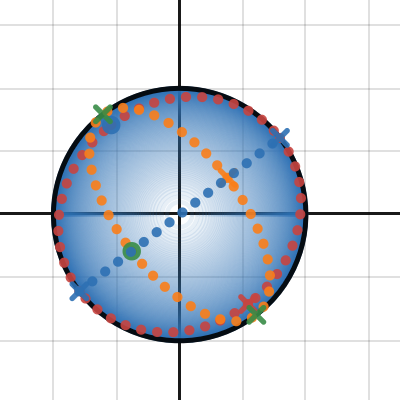
Desmos
vast geyser
tbh a huge motivator for learning math again has been shader programming lol
vast geyser
short echo
found the graph https://www.desmos.com/calculator/27ahhcuq0z
that's pretty sick
short echo
if you go to the graph its animated
vast geyser
yeah im looking, its wild
short echo
that one took me a second to make
it was one of the more difficult ones
especially since i cant think rotation in 3d
vast geyser
have you ever messed around with https://www.shadertoy.com ? seems like your kind of thing. I want to play around with it so bad, but im not quite advanced enough to make anything very fun. Some simple fractals if i follow a guide
but i feel like you're at a level where you could do some pretty neat things with it if you wanted
vast geyser
basically what you're doing with desmos but in a language called GLSL, "OpenGL shading language"
short echo
oh god i dont know that language
vast geyser
its a very low level language that lets you send instructions to the GPU and render things on the screen, at it's core all it lets you do is place a pixel on the screen and decide it's color
the rest is math
short echo
huh. thats really interesting, it would definitely be good for my coding skill as well
vast geyser
short echo
oh god my computer is dying lmao
yeah lol be careful what you open some are huge or unoptimized
short echo
that is a very broad question
vast geyser
also the front page is the programming equivalent of the front page of Instagram lmao, its quite insane what people have made
short echo
id think generally through practice
yeah theres some crazy stuff there
heres another kind of "3d" thing i made on desmos https://www.desmos.com/calculator/99cxho33rm

that one is animated as well, and you can even choose the quality of the graphics
vast geyser
open sun
how do you understand trug?
yeah that's a loaded question for sure lol, "practice" is generally the only way to understand anything, but you may be interested in more nuanced answers
like how someone specifically understands a subject
short echo
another good way to understand trig is to get on desmos and make things
vast geyser
The way you understand trig is the way you understand woodworking, programming, water skiing, or any other skill really. You break it down into it's fundamental parts, understand those, then build ontop of them
At it's core, mathematics is a language that defines relationships. You can memorize all the "words" of math, but you also need to understand what they mean. I think trig is the ultimate example of this tbh because everything ties back into something that's pretty intuitive: shapes, lines, and distances
Are you just starting trig? @open sun
vast geyser
short echo
heres another kind of "3d" thing i made on desmos https://www.desmos.com/calcula...
also yeah, you could make some sick stuff in shadertoy lol
short echo
ill try it sometime
vast geyser
best part is that the shaders can be translated to engines like Unity pretty easily
Can you believe I didn't know what a reciprocal was until last year? lol
short echo
wait how
vast geyser
Was never taught it :/
short echo
thats fair
vast geyser
seeing it described for the first time was like taking the limitless pill or something. I suddenly could see how every operation can be defined with addition, and that all of math is just layers of abstraction on top of those central principles.
like computing
short echo
yeah, learning how division and multiplication are one in the same is very important
vast geyser
yeah fr, never had it lmao. It also forced me to understand fractions a lot better, I'd never learned "proportional reasoning" but that was enlightening as well
had a lot of epiphanies that should not have been very impressive but where to me lmao
short echo
yeah, some things you realize just change everything
vast geyser
well, thanks for the explanation earlier, I should get to work
short echo
alr, cya man
open sun
vast geyser
Are you just starting trig? <@1079512135031332988>
sadly yes
vast geyser
i've just discovered that my calculator is incapable of returning exact values for trig functions
decimals only
vast geyser
Alright doing my last question for today
I think im just having a brain meltdown, but i have no clue how they want me to format this answer

like it's pretty simple but im not sure how to write it down lol, the value of X is periodic, repeats an infinite number of times
silent plank
look up general solutions trig for examples
vast geyser
thanks, ended up finding some examples
x = 6/π + 2πk is what I went with
where k is an integer
upper karma
vast geyser
x = 6/π + 2πk is what I went with
i think u mean x = pi/6 + 2pi K, k E Z
silent plank
missing a set of solutions
 heavy swan
Hey
upper karma
vast geyser
i've just discovered that my calculator is incapable of returning exact values f...
Then take the square root of the top and bottom of the fraction and you’re done

This works for common trig functions
upper karma
upper karma
Then take the square root of the top and bottom of the fraction and you’re done
So this would be radical 3 over 2
 clever jay
has anybody here done Pure 1/2 Maths? My exam for both is in about a month
Is it possible to finish Pure 2 in a month?
 hoary topaz
can someone check if i did my homework right and help me on number 8


 hoary topaz
can someone check if i did my homework right and help me on number 8
hoary topaz
hoary topaz
can someone check if i did my homework right and help me on number 8
<@&286206848099549185>
 tepid hatch
what are parallel proofs?
 near harness
Sure.
near harness
tepid hatch
what are parallel proofs?
Proofs where you have to proof that certain lines are parallel to each other
 lilac lagoon
 placid latch
vast geyser
Whats the best way to go about sketching graphs of trig functions on paper? Should I be labeling the x axis with real numbers or with π, 2π, 3π, ect?

I can't think of a way to draw a graph by hand that's meaningfully accurate
or am i over thinking this and it doesn't really matter how accurate it is lol
ah nvm, i think i get it. Textbook was doing the classic "introduce a topic and have them use it for a while before explaining an important prerequisite"
smoky jetty
vast geyser
or am i over thinking this and it doesn't really matter how accurate it is lol
maybe draw it on a graphing paper?
could ease the accuracy by a bit
 coral latch
On X axis are those in π
Y axis are real numbers
upper karma
trig graphs r good to draw with PIs rather than actual integers
upper karma
Can someone in a basic way explain how to count 72x72?
 wicked schooner
upper karma
trig graphs r good to draw with PIs rather than actual integers
wicked schooner
upper karma
trig graphs r good to draw with PIs rather than actual integers
you know about face values and place values??
 limber summit
upper karma
Can someone in a basic way explain how to count 72x72?
limber summit
upper karma
Can someone in a basic way explain how to count 72x72?
72 x 72 = (70+2)^2
so use algebra then
you can also use geometry here to prove the same algebraiclly
vast geyser
smoky jetty
maybe draw it on a graphing paper?
Yeah I use graphing paper, my main issue is labeling the graph in a way that i could plot points consistently.
Like right now I have a sinewave with amp = 2, period = 2π, and phase π/3. I'm not sure how to accurately plot it because the phase is a weird division that doesnt fit neatly into the graph
I could get the interval, which is [π/3, 7π/3] and just make those the first points on the graph? then label the additional points buy the period?
 vast geyser
 steel dust
Can someone help me with this problem?
steel dust
Can someone help me with this problem?
This is one of those questions that makes intuative sense but the excat way they want you to word the answer is a bit tricky (at least for me), I don't know excatly how to format the answer, but I can try my best to walk you through rationalizing the shape.
Because the shape is a rhombus, you know a few things by definition. The first is that that it has two sets of parallel sides. BC=AD, and AB=DC.
Because you know which lines are parallel and equal length, you can infer other things about the shape. The triangle ABC is equal to ADC for example.
As for F, because it's the intersection of AC and BD you know it's the midpoint because the previous points prove that the shape has symmetry along those axis.
From there you should be able to see how the other statements make logical sense
 wild zodiac
There is a proof, that for an n-gon inscribed in a circle of a radius r the maximum area of that n-gon is for when it is regular, but is there a some kind of law or thesis I can call for that to not reinvent the wheel?
upper karma
Can someone solve this?
 chrome thistle
soh cah toa
grave pond
Don't ping helpers with no purpose, they get enough pings already.
young rampart
Can someone help me with this? the goal is to find the angle ADC
 vast geyser
Would you guys consider this a satisfactory solution for this problem?
"Find the Period and graph the function"


I've not gotten anything graded back for this section yet but need to move onto the next assignment or ill get behind, not sure if this is the correct way to present things
vast geyser
dang, well except from the incorrect period, would you say the format is good? lol
actually im pretty sure period for tan is just π/2
young rampart
Actually you are right with the period
your x-intercepts are wrong I think

every 3π there is an x intercept
starting from π for natural numbers
plus remember to label the graph
vast geyser
actually im a bit of a fool and those numbers are actually supposed to be labeling the asymptotes lol, the only x intercept i labeled was 3π/2m but i think that one is broke for sure, supposed to be π/2 now that i look at it
I graphed the interval first then moved the asymptotes by the period, which i think is a valid way to do it
smoky jetty
vast geyser
I could get the interval, which is [π/3, 7π/3] and just make those the first po...
Not very sure, I used to draw the graph as near or accurate to the values on the axes, of course considering the amplitude and stuff. But sometimes the intervals could look large but the positions are accurate when seen from the values on the axes. In short, I'm just not too keen about it, as there's desmos, lol
ngl i have forgotten a ton about it already
upper karma
young rampart
Can someone help me with this? the goal is to find the angle ADC
I thinking that perhaps angle DAB is 45 and angle ADC is 75. Because 180-135=45 then 45+135+105=285 then 360-285=75
smoky jetty
how did u get DAB=45?
nocturne remnant
They assumed AD//BC💀💀
smoky jetty
welp thats a blunder
wild zodiac
young rampart
Can someone help me with this? the goal is to find the angle ADC
The answer is right, but this proof is incomplete, because I am unable to prove ASD is isosceles
 wild zodiac
The answer is right, but this proof is incomplete, because I am unable to prove ...
wild zodiac
wild zodiac
The answer is right, but this proof is incomplete, because I am unable to prove ...
in the first line there should be angle CBD equals CDB
young rampart
wild zodiac
The answer is right, but this proof is incomplete, because I am unable to prove ...
thank you so much!
wild zodiac
At your service
nocturne remnant
young rampart
Can someone help me with this? the goal is to find the angle ADC
The morally correct way to prove <ADC is 67.5° is to construct rhombus ABCE, find <ECD = 60° and hence AE = CE = AB = BC = CD = DE. Then E is the circumcenter of ΔACD and so <ADC = <AEC/2 = 67.5°.
 wild zodiac
what implies ED is equal to EC?
nocturne remnant
CE = CD and <ECD is 60° so CDE is equilateral triangle
wild zodiac
right, my bad
smoky jetty
nocturne remnant
CE = CD and <ECD is 60° so CDE is equilateral triangle
how'd u know that <ADE=7.5deg?
pretty cool diagram tho (looks advanced to me, hehe)
ah wait\
so <AEC+<DEC+<AED=360 right?
135+60+<AED=360
195+<AED=360
<AED=360-195 = 165
AED is an isosceles triangle, hence opposite angles of the congruent sides are congruent.
180-165=15
15/2 = 7.5 each
wild zodiac
AED triangle is isosceles, and because you know the angles AEC and CED, by angle difference you know the angles of the AED triangle
wild zodiac
smoky jetty
so <AEC+<DEC+<AED=360 right?
135+60+<AED=360
195+<AED=360
<AED=360-195 = 165
AED...
yes, combined they form the full angle
smoky jetty
yeah
wait i tihnk it was right
lmao i thought for a min that interior angles of triangles sum up to 360
wild zodiac

smoky jetty
there we go
wild zodiac
when I looked at this problem the first thing that came to my mind was to brute force it with cosine theorem
smoky jetty
pretty fun to realize
i thought firt that u have to make some alignment magic to refer to parallel line cut by transversal theorems lol
or cut the shape into smth to produce special triangles
wild zodiac
oh there was this nice problem I recall
There is given a semicircle of radius r, to which the rectangle with the biggest area was inscribed. Show the cosine of the obtuse angle between its diagonals
smoky jetty
nocturne remnant
could we prove that ED=EC=DC through trigonometry?
i could think of 60-30-90 triangles, but not sure how to explicitly apply it
wild zodiac
if it is possible, it's an overkill
smoky jetty
to prove their congruence?
wild zodiac
we know the two sides of a triangle and the angle between them already. these sides are the same length and the angle is 60 degrees. that implies this triangle is not only isosceles, but also equilateral
which automatically proves that ED = DC
smoky jetty
yeah, but when drawing the figure, how could one say immediately that ED=EC when they weren't stated in the problem
wild zodiac
It cannot be done right away. It is shown by measuring the angle and the sides that make that angle
You can improve that proof
smoky jetty
which sides are u referring to?
wild zodiac
CE and DC. You know their lengths
smoky jetty
but how would u already know CE=DC?
wild zodiac
ABCE is a rhombus
smoky jetty
like CE was just added inthe figure?
how wait right
LMAO
i see now
yeah that all made sense
i forgot that AB=EC, as a rhombuzzzz
thx btw, i could've had a bad sleep later on
wild zodiac
Then glad I cured your potential insomnia
 glass sparrow
why cosec=1+tan

 sick hemlock
glass sparrow
why cosec=1+tan
sick hemlock
glass sparrow
why cosec=1+tan
It's not?
glass sparrow
sick hemlock
It's not?
sorry i meant by
sec^2=1+tan^2
young rampart
glass sparrow
sorry i meant by
sec^2=1+tan^2

A follow up proof to accompany sin^2 + cos^2 =1. Another identity that is used quite a bit, especially in calculus involving trigonometric functions.
 somber coyoteBOT

 weak flare
When doing the side splitter, how do you find the 2 middle segments if you know all 4 integers of the outer sides?
 young violet
A right rectangular container is 10 cm wide and 24 cm long and contains water to a depth of 7cm. A stone is placed in the water and the water rises 2.7 cm. Find the volume of the stone.
help pls
 gritty turtle
young violet
2.
A right rectangular container is 10 cm wide and 24 cm long and contains wate...
gritty turtle
young violet
2.
A right rectangular container is 10 cm wide and 24 cm long and contains wate...
Volume of stone minus volume of water up to 7 cm
grave pond
The problem setter thoughtfully provided you with the initial water level, which you don't strictly need, but which makes it conceptually easier just to wing it. You can directly compute the volume of the water alone, and the volume of water+stone, then subtract.
grave pond
That looks like a "power of a point" problem. Have you learned about that?
Alternatively, the "intersecting secants theorem"?
You know three of the four lengths the theorem tells you are in proportion; you're asked about the fourth.
I don't know what you mean by "set it up" here.
The theorem gives you an equation between various lengths in the diagram. Write that equation down, and fill in the values you know already. There's then just one length you don't know left in the equation, and you can solve for that.
I'm not going to do your homework for you.
glass sparrow
young violet
2.
A right rectangular container is 10 cm wide and 24 cm long and contains wate...
10 * 24 * 2.7, thats it bcz vol^m of water displaced = vol^m of stone, archimedes principle
 grim geyser
 sacred helm
divide it into shapes and apply your formulas
 rotund arrow
Hi, How to calculate the direction of 3D vecter
dark sparrow
wdym by direction?
 outer sinew
how would u use euler's identity to derive the half angle formulas?
short echo
glass sparrow
sorry i meant by
sec^2=1+tan^2

 dry basalt

Good morning,
Can someone explain to me how we find the two results in red, please? I can't understand the development
obtuse patio
dry basalt
this is most definetely not geo/trig
 upper karma
Can anyone help with a part of question 2, the line of code for beta. I am not sure what angle it is calculating. I've done the line for alpha as shown.

 outer sinew
how would u use euler's identity to derive the half angle formulas?
outer sinew
outer sinew
how would u use euler's identity to derive the half angle formulas?
Anyone? It's certainly easy for double (and beyond) identities, but I'm unable to think of how it could be done to derive the half angle formulas
 dark sparrow
phi_1 evaluates to zero...
we can't see the whole expression for phi_1 so we can't tell you why that happens
short echo
a = -r
but why is it dividing by zero
the thing at the end of phi_1 just adds pi
wait

desmos what
dark sparrow
that's what happens when you divide by zero
 outer sinew
short echo
and the limit of 1/x where x -> 0 is infinity?
outer sinew
short echo
and the limit of 1/x where x -> 0 is infinity?
No, that limit is undefined
short echo
dang i guess i just have no idea what im doin lmao
 lost sky
 silent plank
no, its not correct