#geometry-and-trigonometry
1 messages · Page 4 of 1
 silent plank
 smoky jetty
ohh interesting, do u think the problem is doable?
silent plank
using a reasonable assumption, yes
smoky jetty
what could a reasonable assumption be?
silent plank
assume which sides are corresponding based on which sides look longer
smoky jetty
but are the two triangles' angle values supposed to be similar? I've never heard of similar pair of triangles before
silent plank
you've never heard of similar triangles before?
silent plank
all angles the same
corresponding sides in same ratio
smoky jetty
corresponding sides? only learned that in geometry a week ago, but it wasnt about triangles. googling it a bit
oh i get it
pretty much the same with parallel line cut by transversal thingy, in terms of concept
do u know how to work it out?
silent plank
yes
smoky jetty
can u show how? like the not so exact explanation of steps only
silent plank
corresponding sides in same ratio
smoky jetty
might try this tomorrow, thx
 errant pulsar
hello, this was asked by someone else but i’ve been wondering how to go about solving it.
it is given that DA is parallel to BC and EA parallel to DB and N, M midpoints of ED and DC, then show that the red area is equal to the blue area

 brittle rivet
Anyone have some ideas or tricks to memorize the unit circle? I have to be able to fill this out from a blank circle. Thanks.

 still dagger
To remember the first quarter you have three values to remember. The sine will be increasing will the cosine will be decreasing
 sly raptor
The way I remember the unit circle is that sqrt(3)/2 is larger than 1/2 and then I can always deduce that, because pi/3 has a larger y than x, it has to have (1/2, sqrt(3)/2) as its coordinates.
And just remember any pi/4 is sqrt(2)/2
Also keep in mind quadrants
brittle rivet
Yes I understand that. Where I get messed up on is how they get from say pi/6 to 5pi/6. I forget where they are counting from
sly raptor
Ah
brittle rivet
Oh wait it's a 30 degree angle so it's every 30 degrees right?
sly raptor
I like to change it to degrees and then find the quadrant, and then specify the angle for myself
So 30*5 = 150
Yep
So I know it's 30 below 180, which means lower y than x
brittle rivet
Light bulb moment 💡
sly raptor
Nice!
brittle rivet
sly raptor
So I know it's 30 below 180, which means lower y than x
Right that totally makes sense
Ty ty
I made a ton of copies and I'm trying to fill it out from blank haha
brittle rivet
I'm getting better. Thank you for the sage advice sir
smoky jetty
brittle rivet
Anyone have some ideas or tricks to memorize the unit circle? I have to be able ...
wow thats so interesting, actually, u dont necessarily need to remember everything, there are formulas to find those values
 heavy mango
I have a question: How do I solve a trigonometric function with a constant inside it? I'm referring to this. f(x)=2tan(4x-32)
If I plug in pi/4, for example, how would I solve 2tan(pi-32)?
smoky jetty
brittle rivet
Anyone have some ideas or tricks to memorize the unit circle? I have to be able ...
in the first quadrant, there are 3 angle values that are part of a special right triangle case, so the sine values of those can be found using the Pythagorean theorem. Then on the 2nd quadrant, find the sine function of angles between 0 degrees to 360 degrees. First, you'll get their reference angles (wherein in Q2, Theta _R = 180 - theta, Q3 Theta_R = theta - 180, Q4 Theta_R = 360 - theta) and from there on, you'd have special angles again, which are part of a special triangle case, thus giving u identical values ( TAKE NOTE of the negative values). Then for those sine values lying at the quadrants, you'll be finding quadrantal angles, where r = 1. Find those using the Pythagorean theorem. For the radian measurement, u can just convert degrees measure using theta*(pi/180)
so in conclusion, I'm pretty sure u can find those sine values using formulas to find reference angles (for angles between 0-360 degrees which in your case, for angles in Q2-Q4), quadrantal angles, and the Pythagorean theorem.
errant pulsar
 upper karma
^ Sherman Line (A triangle having 4 sides? nah! well, actually yes!!!)
upper karma
^ Sherman Line (A triangle having 4 sides? nah! well, actually yes!!!)
i’m sorry if i’m mistaken, but is this something related to my post? if so i wonder how, if not ignore me
 austere hearth
g(x) = 2 − 6 · cos2
(x) − 2 · cos(x) · tan(x)
someone help please
 dark sparrow
bad copypaste + no problem statement
austere hearth
sowy me dum
solve for x g(x) = 2 − 6 · cos2
(x) − 2 · cos(x) · tan(x)
and about the coypaste nothing can be done
dark sparrow
yeah it can
you can post a screenshot instead
be sure to include all instructions to go with this
austere hearth
too lazy need to do other work . forgive ?
dark sparrow
well sure but if you're too lazy to post your problem here you won't get any help for it
so if youre ok with that then ¯_(ツ)_/¯
austere hearth
booo
At which points do the functions intersect the coordinate axes?

@dark sparrow good 🙂
dark sparrow
so, do you want to get help with this problem or do you just want someone to do it for you
austere hearth
help or step by step solutions
dark sparrow
it's just that "too lazy need to do other work" makes me think you wouldn't want to cooperate on being taken through this problem...
anyway
you want to find the intersections of the (graph of) this function with the coordinate axes.
i.e. you want to find its x-intercept(s) and y-intercept.
do you understand what this means?
austere hearth
dark sparrow
i.e. you want to find its x-intercept(s) and y-intercept.
yes ik
austere hearth
x=0
dark sparrow
"I need to set x to 0, or in other words I need to evaluate g(0) to get the coordinate of the y-intercept."
ok
are you able to do this on your own?
austere hearth
dark sparrow
are you able to do this on your own?
yeah
austere hearth
dark sparrow
do you understand what you need to do to find the x-intercept?
yeah
but aint workin
dark sparrow
in what way is it not working exactly?
is it:
(a) you tried to solve the equation g(x)=0 but got stuck along the way,
(b) you solved the equation g(x)=0 but couldn't figure out how to write down the answer, or
(c) you solved the equation g(x)=0 and got an answer, but your homework system rejects it?
austere hearth
b
dark sparrow
ok, show your work so we can take a look.
austere hearth
nevermind me dum
i forget the minus

thx u though appreciate ur help sorry for waisting time

@dark sparrow
but then when i solve i only get the t=1 and t =-2/3
so pi/2 and -pi/2 plus 2kpi
but for the t=-2/3 idk
its -41,40
not matching the answer
dark sparrow
,w 3sin^2(x) - sin(x) - 2 = 0
 somber coyoteBOT


 austere hearth
somber coyote
austere hearth
somber coyote
yes but he got 5,55 for answer 1 and 3,87
and we dont have a interval so i put nr in it for k or n in this example
dark sparrow
who's "he"
austere hearth
he teacher
dark sparrow
can you show the teacher's answer
austere hearth
its only the answer without the method
dark sparrow
i think it might be some sort of radian vs degree issue
 viscid trellis
Hello
 dark sparrow
,calc sin(5.55)
somber coyoteBOT
Result:
-0.66923985727626
ok yeah your teacher just put things in radians
 zealous pivot
How is this not a contradiction? The perimeter is 700+223+400+282=1605, while XY=953 ??


I'm suspecting the circles ought to be centered at the midpoints of AD and BC, respectively. But the statement does not indicate that.
dark sparrow
these circles need to have diameters AD and BC as in those actual segments need to be their diameters
zealous pivot
yeah makes sense
zealous pivot
This is not too worrying, but is there a keyboard shorcut to start writing on the input bar of geogebra (instead of having to move the mouse and click on the input bar)? I tried searching but didn't find anything, idk if anyone knows.
 smoky beacon
What does orthogonal unit vector mean
 flat ivy
At right angles
 pliant roost
flat ivy
At right angles
pliant roost
flat ivy
At right angles
if I remember correctly, orthogonal unit vectors are the vectors that satisfy the following properties:
- They are all linearly independent
- They are perpendicular to each other in the respective planes
- They have unit length (obviously)
flat ivy
Yep
 flat plinth

 pallid quest
Does anyone have any tricks for tangent inverses? Because im struggling to recognize which points fit
zealous pivot
Let ABC be a triangle, let N lie on the side BC such that AN is twice as long as CM, where M is the midpoint of AB. We also have that the angle ANC is 45 degrees. Prove that AN is perpendicular to CM.
Couldn't solve this 😦 Help is appreciated
 vestal stag
zealous pivot
Let ABC be a triangle, let N lie on the side BC such that AN is twice as long as...
vestal stag
zealous pivot
Let ABC be a triangle, let N lie on the side BC such that AN is twice as long as...
but what is L in ALC
zealous pivot
vestal stag
but what is L in ALC
L was N, sorry I wrote it wrong (I edited the message)
 teal oriole
when it comes to trig functions, if you have like
cos beinf 6/10 do u write it as 6/10 or simplify it to 3/5?
 polar path
as 6/10 🙂
teal oriole
thank u!!
upper karma
doies anyone here use geogebra? please ping me i need help asap figuring out how to do area
upper karma
errant pulsar
i’m sorry if i’m mistaken, but is this something related to my post? if so i won...
oh, sorry for my the late response. No, actually that is not related to your post above.
It was just a fun paper I found.
zealous pivot
zealous pivot
Couldn't solve this 😦 Help is appreciated
Could eventually solve it xd
 pliant roost
 slate mauve
how do i prove this using a column proof (statement and reasoning)
slate mauve
how do i prove this using a column proof (statement and reasoning)
you just write out the sum of the angles of a triangle
w + x + a = 180° and z + y + a = 180°, then the proof easily follows
 sullen kettle
slate mauve
how do i prove this using a column proof (statement and reasoning)
sullen kettle
slate mauve
how do i prove this using a column proof (statement and reasoning)
There’s a pair of parallel lines in there, and x=z and w=y because these two pairs of angles are corresponding angles. https://en.wikipedia.org/wiki/Transversal_(geometry)#Corresponding_angles

In geometry, a transversal is a line that passes through two lines in the same plane at two distinct points. Transversals play a role in establishing whether two or more other lines in the Euclidean plane are parallel. The intersections of a transversal with two lines create various types of pairs of angles: consecutive interior angles, consecu...
sullen kettle
pliant roost
w + x + a = 180° and z + y + a = 180°, then the proof easily follows
This is also a very good argument. The two triangles share an angle, therefore the other two angle sums should be the same.
pliant roost
sullen kettle
This is also a very good argument. The two triangles share an angle, therefore t...
you weren't given that the lines actually are parellel, I mean it's only visual
sullen kettle
pliant roost
you weren't given that the lines actually are parellel, I mean it's only visual
Ah I see, then your argument is correct and mine isn’t
sullen kettle
upper karma
doies anyone here use geogebra? please ping me i need help asap figuring out how...
Provide the details

 heavy shale
 hollow gazelle
you can see the direction of opening in the graph
hollow gazelle
i dont know anything about this lesson
heavy shale
Axis of symmetry is the line which divides the parabola symmetrically
heavy shale
hollow gazelle
i dont know anything about this lesson
just use english
where is the first one opening
up or down
coordinate of vertex is the point where the graph turns
heavy shale
y-intercept is point where parabola intersects y-axis
and x-intercept is the same thing as y-intercept but for x axis
idk about domain and range
hollow gazelle
 wet sapphire
ILL HELP YOU BRO
wet sapphire
ILL HELP YOU BRO
really
it depends on this whether i take summer class or nah
lmao
hollow gazelle
uhm idk yep thats how bad i am at math
 past phoenix
hey anyone need help in finding area of triangle
 red jetty
i do not know what you mean by this lol
 heavy vigil
past phoenix
hey anyone need help in finding area of triangle
heavy vigil
past phoenix
hey anyone need help in finding area of triangle
what is the question
if its general, just use Herons formula
 copper spade
how can i prove this one?
 heavy mango
Hi, how do I solve 2tan(pi-32)? What do I do if there's a constant inside tan(x), like the number 32 in this case?
Can someone help?
 zealous furnace

 grave pond
What an utterly, totally inane problem.
It makes no sense, but the best you can do is pattern-match the wording and replace the so-defined word sequences by "p" and "q".
 simple swift
zealous furnace
simple swift
zealous furnace
I think the last one
upper karma
slate mauve
Well, they are corresponding angles I believe.

 craggy monolith
help its literally 12am and this is due literally at 3am and my brain stopped working

 proper bridge
sin(x)=8/10=4/5
upper karma
proper bridge
what was the name of this shape?
i remember faintly from years ago
that the small base
equals the big base over 2
so AB = 2CD = 6
forgot the rule of AD tho
oh a trapezoid
 tribal ore
 tribal ore
Already solved it a bit ago that isn't the right answer but thank you anyways
dark sparrow
@loud talon don't give out answers in the future
 loud talon
ok, sorry. Did not know that I shouldn't give out answers. Should I use /spoiler next time, or just don't give out at all?
dark sparrow
just don't give out at all
 ruby fulcrum
wait wrong place
upper karma
tribal ore
Well, basic example of transversal
upper karma
dark sparrow
<@946927637706719262> don't give out answers in the future
Funny to say that as the answer... was not even an answer as it was wrong.
But I understand what you are saying. And @loud talon What method did you use to obtain those answers?
 young otter

 foggy crypt
Draw a diagram.
foggy crypt
You will need to understand the definition of vertical angles.
loud talon
upper karma
But I understand what you are saying. And <@946927637706719262> What method did ...
I solved for x and y.
 terse meteor


 glacial mural
Hi is anyone available to help me with a project regarding geometry? I really need help and would mean alot ty
Please dm if you can.
grave pond
glacial mural
Hi is anyone available to help me with a project regarding geometry? I really ne...
Please read https://dontasktoask.com/
 grave pond
Do you really read that fast?
glacial mural
grave pond
Do you really read that fast?
Yes
Im doing a project to show how geometry can be applied irl and i chose architecture


What i have done so far and im not sure whether its relevant and my math is not very good 😔
grave pond
I doubt that. It makes your "sorry" sound rather insincere when it comes only a few seconds after I send you a link to a long text that explain what you're doing wrong.
glacial mural
grave pond
I doubt that. It makes your "sorry" sound rather insincere when it comes only a ...
I apologise to all as it may sound like im questioning your mathematical ability which i have no intention of. I sincerely am sorry if I have insulted anyone
I dont really socialise much so please forgive me.
glacial mural
grave pond
I doubt that. It makes your "sorry" sound rather insincere when it comes only a ...
Im new to forums and i didnt know how I should be asking 😅
grave pond
Well, it's just advice.
If you would really rather not get any help than reveal what you're planning to ask until someone commits to answering your question sight unseen, then go right ahead
glacial mural
grave pond
If you would really rather not get any help than reveal what you're planning to ...
I understand, thank you.
 olive hatch
I have an object that has the height of 30cm and a diameter of 50cm. Using this information, how can I work out what the length and width of the item is?
grave pond
Is your object a cylinder? Otherwise it is not clear exactly what "diameter" means.
olive hatch
Is this question impossible to answer if you don't know what object it is?
grave pond
Yes. We need to know that the object has a shape where the word "diameter" makes sense..
olive hatch
No worries, can I post images here?
grave pond
If we know that the object is box-shaped, we can get a little further, but still the most we get is that W² + L² = (40 cm)², which has many different solutions.
You should be able to post images, yes.
olive hatch
Alright, so the object is a chandelier, but I'm not sure how this object will help 😐
It's a LED chandelier.
 dusky palm
tan69+tan66-tan69tan66=2k, what is the value of k?
olive hatch
 dusky palm
tan69+tan66-tan69tan66=2k, what is the value of k?
dusky palm
dusky palm
tan69+tan66-tan69tan66=2k, what is the value of k?
pls help
grave pond
olive hatch
Okay, that makes it clearer what "diameter" means, but on the other hand I'm now unsure what the "length" and "width" you're asking about mean.
olive hatch
The reason why I'm asking is because I'm trying to list these chandelier onto the tiktok marketplace and it's asking me for the height, width and length of the chandelier.

I have a sheet which shows me the dimensions but the dimensions tell me the height and the diameter only.
Furthermore, it won't even let me list this item because it says The volumetric weight must be less than 15.00kg. Volumetric weight = length*width*height/8000. which I don't understand.
grave pond
I'd assume they're asking for the dimensions of a box the chandelier fits into, or possibly the box it is shipped in. In the former case the width and length would both equal the diameter -- understood as the outer diameter of the horizontal circle.
"Volumetric weight" sounds very like they're talking about the shipping box.
olive hatch
So the dimensions aren't about the product itself, just the box it's shipped in?
Because on the top left, it says "product dimensions"
 grave pond
That's what I'd expect, but that's not really a mathematical question. My immediate guess would be that the form you show does gets confused by writing "cm" in front of the numbers.
grave pond
dusky palm
tan69+tan66-tan69tan66=2k, what is the value of k?
Punch the expression on the LHS into a calculator to find 2k, then divide by 2?
 heavy vigil
 young horizon
use distance formula to find the length of the given side
it should be equal to the length of the other 2 sides
olive hatch
This object has a diameter of 16CM and a height of 12CM. My question is, what is the width and length?

In this scenario, does diameter just mean width and length?
I might have extremely confused myself
Could I just say that the length is also 16CM and the width is also 16CM? Since the diameter is 16cm?
dusky palm
grave pond
Punch the expression on the LHS into a calculator to find 2k, then divide by 2?
i cant use calculater in exam
there is restricrion in usage of calcuater
dusky palm
ok
grave pond
Ah, clever!
dusky palm
figured it out
 placid rampart
does someone
wanna
help me
fill out the work and answers
for my practice test
i dont really need help i just need yo see the work
and ill understand it
grave pond
No, we don't do that.
placid rampart
ok ig?
 young bough
Can someone explain how to get the answer without a yx axis chart
 grave pond
If the answer (or the approach leading to the answer) is not obvious, you should always draw a diagram.
 patent field
Hey
So I have a point A(4,0) and apparently it's supposed to be on y= -x+6
But that doesn't sound right 😳
grave pond
Indeed it doesn't.
 restive mulch
im sIow

 torn flare
restive mulch
im sIow
torn flare
restive mulch
im sIow
number 1, the angle would be the same as angle 4
i think its because of the corresponding angles theorem, im not sure
for the second one you would have to subtract angle 4 from 180 to get angle 5

 river compass
A line with a line intersecting it
That particular intersection's angles
Add up to 360
Meaning two angles add up to 180
So <7 & <2 add up to 180
Sorry if I explained that horribly lol
 paper blaze

 obsidian lotus
upper karma
restive mulch
im sIow
obsidian lotus
upper karma
restive mulch
im sIow
i can explain
so angle 2 is congruent to angle 4 due to them being Alternate Interior Angles.
angle 5 is 43.7. So you need to realize that angle 4 and angle 1 are vertical angles so they are congruent to each other.
in order yo find
in order to find the measure of angle 5 you need to realize that angle 1 and angle 5 are known aa Consecutive Interior Angles
and Corresponding Interior Angles always add uo to 180 degrees
so you do 180-136.3 which u will get 43.7
you need to know the following @restive mulch
-Corresponding Angles are Congruent
-Alternate Interior Angles are Congruent
-Alternate Exterior Angles are Congruent
-Consecutive Interior Angles are Supplementary
-Consecutive Exterior Angles are Supplementary
-Vertical Angles are Congruent
-Linear Pair are Supplementary (And Also Adjacent)
 smoky vector
What should I do when geo makes no sense
Like any resources
To check that can explain things
upper karma
Like High School Geo or like Geometrical Topology or Differential Geometery and etc?
 sinful belfry
I just started trigonometry, is there anything I should know that is useful?
 wise pawn
the special angles on the unit circle is a big one
sinful belfry
should I study that more often?

 agile elm
anyone down ?
 placid sandal
would the area of the fabric of space bent by a black hole count as geometry?
like is there a theoretic studies channel?
grave pond
The relevant portion of mathematics is called differential geometry. There's a #diff-geo-diff-top channel in the advanced section.
(However, "area/volume of space" in general relativity is not a particularly useful concept since it is not Lorentz invariant; instead you can measure a region of spacetime and get a value in units m³·s).
smoky jetty
smoky vector
To check that can explain things
one thing i found very useful is visualizing the problems i.e making representations
it would help u know why this and that are congruent etc
from personal experience, the theorems in parallel lines cut by transversal seemed really complicated to me at first, as I thought I'd be forced to remember the angles' relationships. But the representation of the problem significantly gave birth to the sort of logic behind them.
 cosmic smelt

i have this exercise, just look to the squeare, is an 40x40 square and pq ans sr are 8
is asking to find the area of the shadow region
i tried to take the 40 as the large of the rectangle and the 8 as the width
used area formulm of rectangle and multiply with 2 bc there are two rectangles but it didnt, idk why
 unkempt scroll
cosmic smelt
used area formulm of rectangle and multiply with 2 bc there are two rectangles b...
unkempt scroll
cosmic smelt
used area formulm of rectangle and multiply with 2 bc there are two rectangles b...
when you subtracted the area of 2 rectangles from the area of whole square, you subtracted the center square of 8x8 twice!
since these two rectangles are overlapping at one square, we have to add the area of small square once after subtraction of 2 rectangles
placid sandal
grave pond
The relevant portion of mathematics is called _differential geometry_. There's a...
does it work for white-holes?
grave pond
There's no relevant difference at this level of abstraction.
 jade heath


if we just prove the (1) inequetion didnt we prove the theorem ? why we need to do all these with l, l', l'' ?
heavy vigil
 lofty rune
y^(3)-ty=0
lofty rune
y^(3)-ty=0
what exactly is the question??
finding the value of t or y?
or do you have to differentiate or integrate
 copper sail
Help, please! : ( (Ping me if you're able to help)
 grave pond
copper sail
Help, please! : ( (Ping me if you're able to help)
grave pond
copper sail
Help, please! : ( (Ping me if you're able to help)
Much of that information seems to be red herrings. You need only "GC bisects angle BGD" and "angle CGF is (4x+3)°".
copper sail
grave pond
Much of that information seems to be red herrings. You need only "GC bisects ang...
I still don't understand, sorry 😭
Thank you for trying to help tho!
grave pond
Think about what "GC bisects angle BGD" means.
And note that angle CGF is the same as angle CGD.
 tulip temple
Hey guys
What exactly is preuniversity maths
Im from India in grade 11 so I'm not very familiar with the standards used in other countries for my academic level
Is grade 11 pre University?
 spring vault
Hi guys
Geometry is the thing that i loved but i couldn't completely learn it
So is there anything special that i have to know??
grave pond
"Geometry" is many things. (Especially, one of the things it is is a horrible parody of formal reasoning that some school systems teach for unknown reasons). You'll have to be more specific about what it is you couldn't learn but wish you had.
 oak mural
Anyone know how to do these im lost... with the first one
 unkempt scroll
oak mural
Anyone know how to do these im lost... with the first one
unkempt scroll
oak mural
Anyone know how to do these im lost... with the first one
do you know when sin function is minimum and maximum?
your main job is to make H(t) = min possible value and so think what value of t will give you that?
 cloud niche
Hello guys, I am a math teacher who is teaching Geometry this year.I am creating video lessons for my students.Is it against the rules to place the link to my channel here? I think this group might find it useful.
I will be uploading more lessons as the school year continues
silent plank
no self promoting
cloud niche
Sounds good, I wanted to know the rules before posting anything

 uncut raft
yes, but was it correct?
 sacred trench
Let me check
uncut raft
ok
sacred trench
I have to check after I answer this one I send you to help me with
or else I could get this one wrong
uncut raft
ok
 sacred trench
yeah
uncut raft
cool
sacred trench
.yeah thanks for your help
uncut raft
your welcome
 outer wave
my mistake, this is not the channel, sorry
smoky vector
Hey does anyone know what resources I could use when geo makes no sense to me
Like to explain things
For example YouTube
 lime yoke
can anyone help me with this??
 dark sparrow
@lime yoke have you made any progress so far?
dark sparrow
have you worked with angles made by 2 parallel lines and a third line intersecting them before?
lime yoke
only on thrusday
dark sparrow
the two angles marked here are in a position known as corresponding angles, and because the two parallel-looking lines are actually parallel (i.e. marked as such), the two marked angles are equal
dark sparrow
this lets you write down an equation
lime yoke
3x + 23 = 4x
dark sparrow
yes
lime yoke
ty
somber coyoteBOT
what7todo

 ocean escarp
Can anyone help me understand why $z= \pm C \sqrt{x^2 + y^2}$?
 somber coyoteBOT
what7todo
 ocean escarp
Can anyone help me understand why $z= \pm C \sqrt{x^2 + y^2}$?
ocean escarp
ocean escarp
Can anyone help me understand why $z= \pm C \sqrt{x^2 + y^2}$?
I have solved it. I was confused about the axis. The vertical one is Z.
olive hatch
https://i0.wp.com/www.ecobriteled.com/wp-content/uploads/2020/02/Screenshot-2020-02-18-at-12.33.52.png?zoom=2&resize=266%2C266 This object has a Diameter of 95mm and a Length 150mm, using this information, how can I calculate what the height is?

 low moat
I've been doing Khanacademy, and I'm currently on sine and cosine graphs with phase shift, and I have a question. How can I tell whether a graph is a cosine or sine graph?
pliant roost
low moat
I've been doing Khanacademy, and I'm currently on sine and cosine graphs with ph...
you don't
sine FUNCTION passes through (0; 0), cosine FUNCTION passes through (0; 1)
when either is shifted naming it strictly sine or cosine doesn't make much sense
low moat
pliant roost
when either is shifted naming it strictly sine or cosine doesn't make much sense
So, if it is shifted, they can be both sine and cosine?
pliant roost
low moat
So, if it is shifted, they can be both sine and cosine?
it is pointless to say sine or cosine when they are shifted, so you can say them interchangeably in this case
pliant roost
 jaunty crystal
can someone explain to me what radians are?
jaunty crystal
can someone explain to me what radians are?
radian is such an angle measure, that if you passed x radians on a unit circle you passed a distance of x on a unit circle
low moat
So, a shifted graph like this can be expressed with sin and cosine?
 pliant roost
low moat
So, a shifted graph like this can be expressed with sin and cosine?
pliant roost
low moat
So, a shifted graph like this can be expressed with sin and cosine?
technically yes
sin(x)=cos(pi/2 - x)
low moat
Ah, okay. Thanks
pliant roost
@jaunty crystal

 pliant jasper
jaunty crystal
like what is considered as 1 radian?
pliant jasper
jaunty crystal
like what is considered as 1 radian?
1 radian is about 57.3 degrees. There are exactly $2\pi$ radians in a circle.
somber coyoteBOT
FLORIDA MAN
 jaunty crystal
so just one pi radian = 180 degrees?
pliant jasper
Yep
 neon raven
could anyone try helping me with my trig hw? its on law of sin and cos
 trim breach
If you post the problem you are having trouble with, someone will be able to help.
 thick hound
 neon raven


 last trout
 dawn swallow
A little help
dawn swallow
A little help
i am not sure but if this question is of congruency then
angle a = angle e (both 90)
ac = ce (mid point)
angle dce = angle bca (vertically opposite angles )
triangle acb = triangle ecd
cd = cb (cpct)
i am not sure because of some symobls which i have yet not seen in my mathematics i am from india but hope this helps
 runic beacon
last trout
i am not sure but if this question is of congruency then
angle a = angle e (both...
runic beacon
last trout
i am not sure but if this question is of congruency then
angle a = angle e (both...
4rth line should be AC=CE
last trout
runic beacon
4rth line should be AC=CE
sry my bad and thankyou
 mint flint

 spiral bough
(b) follows from (a), and (a) can be proven by observing that an inscribed trapezoid has two equal sides (the ones that are not parallel, I don’t remember what they were called)
 worn dust
Hey, does anyone know what the theorem is for stating that
m∠BOA = m∠BOC + m∠COA?

assuming you don't know it's a bisector (although in the image it is)
 slate geode
who's here familiar with fanos geometry?

i just don't understand what the Ax 3 means
Oooooh wait
4th point not 4 point
worn dust
worn dust
Hey, does anyone know what the theorem is for stating that
m∠**BOA** = m∠**BOC**...
Just found out, it's called "Angle Addition Theorem/Postulate" for anyone interested
upper karma
whats the area of a regular pentagon?
grave pond
$\dfrac{5(\sqrt5 + 1)}{4\sqrt{10-2\sqrt5}} \approx 1.72$ times the square of the side length.
somber coyoteBOT
Troposphere

 unique egret

 neat steeple
worn dust
Hey, does anyone know what the theorem is for stating that
m∠**BOA** = m∠**BOC**...
neat steeple
worn dust
Hey, does anyone know what the theorem is for stating that
m∠**BOA** = m∠**BOC**...
lemme see I'm learning this in geometry rn i might be able to help
neat steeple
worn dust
Just found out, it's called "Angle Addition Theorem/Postulate" for anyone intere...
oh ok thanks for the info 🙂
thought it might be addition wasn't sure though

could anybody help me with this?
I have to find the reasoning/proof for each step
1.Given
I think 3 might be subtraction property
-bc on both side would get AB=CD
worn dust
neat steeple
a bit late but
- Given
- Segment Addition Postulate
- Substitution or Transitive Property (both work)
- Subtraction property of equality
smoky vector
Hey does anyone know what resources I could use when geometry makes no sense to me
Like to explain things
For example YouTube
upper karma
worn dust
Hey, does anyone know what the theorem is for stating that
m∠**BOA** = m∠**BOC**...
inscribed angle theorem?
worn dust
pretty sure it's called angle addition theorem
upper karma
 upper karma
worn dust
pretty sure it's called angle addition theorem
upper karma
worn dust
pretty sure it's called angle addition theorem
Yeah sorry i was thinking of something else. you are right
 dark sparrow
do you want help from them and them only?
if not, then can you show how you got 13?
worn dust
sacred trench
but yea @sacred trench it's asking you to square the distance between the two points provided
 novel vale
sacred trench
<@545012151081893898> you think you can help me out with this
novel vale
sacred trench
<@545012151081893898> you think you can help me out with this
it is like this by replacing the strings given points
 fair harbor
In the acute angle triangle ABC there is a height BH. It turns out that CH = AB
How many degrees is the angle BAC if ABC = 84 ?
please
i know, it is very simple, but i am struggling with this one
 nova belfry

 versed kernel
You are building a rectangular planter box. The designer gave you the following instructions:
a) The top of the box should have sides parallel to 2x+3y=6. Since it is a rectangle, you know
that the other sides should be perpendicular to the given line
b) 2 of the vertices are given as C(7,0) and E(3,7)
c) The rectangular box has a height = 3 feet.
d) Each side is made of concrete with thickness of 2 inches
e) All length measurements are in feet
f) The volume of a rectangle =lengthwidththickness
Find the perimeter of the top rectangle
Find the volume of the concrete in each side of the rectangle
If concrete costs $5.25 per 6 cubic feet, how much does the box cost?
Write an equation to represent the measure of the angle formed by
the diagonal with the longer side.
If the angle formed by the longer side and the diagonal is 52 degrees, find x
 arctic basalt
Can someone explain to me why the coordinates of point b are as they are? This is a visualization of the law of cosines
 dark sparrow
are you familiar with polar coords
or the unit circle in the trigonometric usage thereof
 cobalt chasm
sacred trench
cobalt chasm
sacred trench
d = sqrt(a) = sqrt((x2 - x1)^2 + (y2 - y1)^2)
a = d^2 = (x2-x1)^2 + (y2-y1)^2 = (11-5)^2 + (-7-2)^2 = 6^2 + 9^2 = 36 + 81 = 117.
upper karma
sacred trench
hello
upper karma
sigh <@&268886789983436800>
 sturdy kite

how would i approach solving this
so far i have this information
1 period is 4 seconds
and potentially there is a shift of +2200ml vertically
the graph also begins before inhaling so i assume it starts from the mid point of a sinusoidal fuction
 wide dragon

can someone explain the working out after sinx = 1/root2
i dont understand where the pi's come into play in row 3, 4 and 5
arctic basalt
wide dragon
can someone explain the working out after sinx = 1/root2
sinx = 1/root2 is just the same as asking the question “for what angles on the unit circle the y coordinate will be equal to 1/root2 ” in this case because sin is positive we only consider the angles above the x axis

Can someone give me a hint?

 alpine peak
 sterile bolt
Can someone tell me what I’m doing wrong? I’ve done this type of problem twice and have gotten it wrong both times. The blue box are the values I’m supposed to get but i don’t know how. Any advice?


 opaque panther
@sterile bolt You're using the right equation but you're simplifying it incorrectly
opaque panther
Didn't do anything, thanks and good luck though 😂
 sacred hamlet
From the figure, the parabola passes through points (-5,2) and (-1,2) with point A(-3,4) as its vertex. If this parabola intersects a line y=5 at points B and C, then triangle ABC. How many square units are there?
 opaque panther
@sacred hamlet Well, you need the equation of the parabola to find points B and C, so consider this:

K and H are givens (just the vertex), so if it starts at point (-3, 4) and goes to (-5,2) & (-1,2)
What that's saying is F(2) = 2, so the equation has to agree with that
 burnt wasp
completely confused on as to what I need to do to solve this question
 heavy shale
burnt wasp
completely confused on as to what I need to do to solve this question
heavy shale
burnt wasp
completely confused on as to what I need to do to solve this question
u need to find all the possible values where sin(2x)+sinx = 0
burnt wasp
heavy shale
u need to find all the possible values where sin(2x)+sinx = 0
yeah I understand that part at least, I tried graphing sin(2x)+sinx=0 on desmos and stuff and got a bunch of solutions but I'm not getting all the solutions from 0 to 2pi apparently
so im just baffled
heavy shale
burnt wasp
yeah I understand that part at least, I tried graphing sin(2x)+sinx=0 on desmos ...
u can use formula for sin(2x)
opaque panther
@burnt wasp So you can write out the sin double angle formula to get 2sin(x)cos(x)
0 = 2sin(x)cos(x) + sin(x)
Factor out the like term which is sin(x), solve the equation. You should get 2 answers this way
Then you can write the equation another way:
- sin(x) = 2sin(x)cos(x)
Divide both sides by 2sin(x), simplify, then solve for cos(x), should get 2 more answers
I can't really explain why this process works or how I know this solves all possible values of x without looking at the graph though

 cunning crest
Whats the difference between coordinate and analytic geometry?
 manic lance
 ripe narwhal
anyone? I could not understand this question
 upper karma
ripe narwhal
anyone? I could not understand this question
upper karma
ripe narwhal
anyone? I could not understand this question
Which part of it? I’m happy to talk you through it
ripe narwhal
upper karma
Which part of it? I’m happy to talk you through it
part d and e
upper karma
Have you drawn the curve yet? What does items when they say the value of the inequality must be > 0? Like, what does that look like on the graph?
 green knoll
Can anyone help with my trigonometry assignment?
heavy shale

 lyric belfry
Alr so


 lyric belfry
it’s find the measure of the missing angle, ik it’s basic geometry but I can’t think rn

My grades r about to come in
green knoll
green knoll
I'm so struggling rn and it's due on monday. Our assignment was handed yesterday Friday
heavy shale
lyric belfry
when does trigonometry get taught?
10th grade
green knoll
lyric belfry
Corresponding angle (F shape, meaning the question mark should be 67 degrees as well, I could be wrong but it should be the same)
heavy shale
lyric belfry
Ok you can use the property of parallel lines
lyric belfry
oh alright let me try
Ik correspding angles, alternate interior etc.
I just don’t understand the measuring part
green knoll
oki
heavy shale
lyric belfry
I just don’t understand the measuring part
ok so these angle are corresponding and using property of parallel lines the are equal
heavy shale
green knoll
So Part A u first need to draw a line perpendicular to a cuz thats what height is
 heavy shale
lyric belfry
14x - 6 = 120 right
heavy shale
lyric belfry
14x - 6 = 120 right
Yes
lyric belfry
Ok thanks
green knoll
heavy shale
So Part A u first need to draw a line perpendicular to a cuz thats what height i...
okay but if I have to find the height of the triangle how will that help me find it after drawing a perpindular line to a when there are no other numbers?
heavy shale
green knoll
okay but if I have to find the height of the triangle how will that help me find...
lets suppose that perpendicualar is Called AD
now what would sin theta be?
green knoll
heavy shale
now what would sin theta be?
i find that by dividing the perpindular by the hypotenuse right?
green knoll
heavy shale
yes
alright! tysm! let me do that now
heavy shale
ok
 undone moat
green knoll
Corresponding angle (F shape, meaning the question mark should be 67 degrees as ...
undone moat
green knoll
Corresponding angle (F shape, meaning the question mark should be 67 degrees as ...
Depends
In WJEC GCSE you are sometimes taught trigonomtry in Year 9
Or 9th if you are american
 heavy shale
Use Co-interior angle property
undone moat
heavy shale
Use Co-interior angle property
If corresponding angles are the same, then you just have to use the property to find the angle
Therefore
green knoll
heavy shale
yes
wait, would that mean that the perpendicular is 90 degrees divided by b cm? how would I show this in a mathematical procedure?
undone moat
green knoll
wait, would that mean that the perpendicular is 90 degrees divided by b cm? how ...
Wdym?
undone moat
Yes
undone moat
So the cointerior angles sum up to 180
green knoll
undone moat
Wdym?
to find the height from the first pic i showed, I have to divide the perpendicular by hypotenuse. but like would the perpendicular be 90 degrees?
im so confused because i have to show mathematical reasoning
undone moat
You just show why you used the specific trigonemtric function to find it
If you want to show mathematical reasoning you have to justify why you used the method and how you did it
lyric belfry
 undone moat
Pythagoras' Theorem
 dreamy spear
undone moat
Pythagoras' Theorem
dreamy spear
undone moat
Pythagoras' Theorem
i would suggest distance formula
undone moat
dreamy spear
i would suggest distance formula
I mean, if we know the the length of the other sides if the line segment is the hypotenuse, we can work it out using Pythagoras' Theorem.
You can implement it in this question
It is just asking for the length of the line segment, and so long the method used is sensible and correct there is no point arguing about how to find the length.
 cosmic fulcrum
how do I solve for the length of ac. radius is 2 and angle θ is 60◦
 upper karma
The angle <bac is 90 degree
do you know that ?
the angle on the diameter is 90 degree
thats a theorem
 opaque panther
9^2 + 7^2 = c^2
c is the line segment.. Was there any doubt?
smoky jetty
undone moat
In WJEC GCSE you are sometimes taught trigonomtry in Year 9
we were taught plane trigo at 8th grade, sucked it badly, though ig i recovered, lmao
smoky jetty
lyric belfry
First of all, what's your initial understanding of the problem? i.e how do you think it should be solved
or your idea of the theorems regarding it
 glass ivy
can anyone help me with this problem?
find the equation of the plane that passes through the point (2, 5, 1), is perpendicular to the plane 3x-y+2z=1 and parallel to the lines 4x+5y-z=7 and 2x+3y+4z=1
 undone moat
glass ivy
can anyone help me with this problem?
find the equation of the plane that passe...
undone moat
glass ivy
can anyone help me with this problem?
find the equation of the plane that passe...
Is this on a 3d plane?
glass ivy
yes
smoky jetty
from the x axis i think
cosmic fulcrum
upper karma
do you know that ?
no it doesnt say
 grave pond
,rccw
somber coyoteBOT
 grave pond
The trick for making this simple is to notice that ABO is similar to HAO where H(6,0) is the foot of the altitude from A.
So you can ask for the tangent of angle HAO instead.
grave pond
I gave a name to the point where the dashed vertical line meets the x-axis.
grave pond
It's a very useful fact about right triangles: the altitude splits a right triangle into two smaller right triangles that are each similar to the original.
 near haven
Yh got it man thx so tan abo = tan hao = .5 thx man
grave pond
No, you divided OH and AH in the wrong order.
grave pond
Yeah. Or perhaps I'm wrong. Better double-check your work in any case.
near haven
Tan = the opposite side / the adjacent side so if we are talking about hao then it would be tan a = ho/ha = 3/6 = .5 got it?
Which as u pointed out = to abo which is the question
grave pond
How is HO/HA = 3/6?
near haven
No i think i did smth wrong one sec
Ohhh i misplaced h i placed it at 0,6 not 6,0 so i calculated it 3/6 instead of 6/ab
But still how do i get ab
6/3*
I still dont get how do i connect tan abo and tan hao like how do i proof it
 whole heron

 near haven
@grave pond are u there bro?
undone moat
smoky jetty
from the x axis i think
Indeed
undone moat
whole heron
Are we solving for x in this problem?
smoky jetty
whole heron
interesting. welp, I've not encountered such parallel lines cut by a deformed transversal (pun). But I'm certain that the vertical angle theorem is applicable to that problem
whole heron
It is
smoky jetty
alright then
undone moat
smoky jetty
interesting. welp, I've not encountered such parallel lines cut by a deformed tr...
Bruh.
smoky jetty
yeah, the transversal is pretty unique for me atleast
grave pond
near haven
I still dont get how do i connect tan abo and tan hao like how do i proof it
The two angles are the same: each of them is 180° - 90° - angle AOB.
 zinc trout

 feral orbit
 half iron
Hw assignment help

 fair pendant
Don't post irrelevant videos in channels, i'm giving you a day mute
 keen leaf
whole heron
keen leaf
whole heron
is your ans is 22 for 1st ques?
cosmic fulcrum

anyone know how to solve for lenght of ac
and area of the shades region?
bc goes through the middle
silent plank
consider the theorem concerning angle subtended by the diameter (aka thales theorem)
 solid jackal
cosmic fulcrum
solid jackal
cosmic fulcrum
BC =4cm
ABC is a right angle triangle cos hypo is through diameter
sin60= AC/4
AC= 3.46
cosmic fulcrum
solid jackal
BC =4cm
ABC is a right angle triangle cos hypo is through diameter
sin60= AC/4
A...
yeah i guess its about proving that
else it would be easy
near haven
(Cos 5x/sin x) = 1 (where 5x is the measure of an acute angle) find the value of sin 2x
 cedar python
does anyone know why?


 royal osprey
cedar python
does anyone know why?
royal osprey
cedar python
does anyone know why?
Bottom one uses SSA
cedar python
royal osprey
Bottom one uses SSA
i thought it can be sas 💀
royal osprey
cedar python
i thought it can be sas 💀
The upper one is SAS, the bottom triangle is SSA
royal osprey
Ye
royal osprey
 heady plume
Im guessing bcfg?
heady plume
Im guessing bcfg?
Yes your right
cedar python
wait so its still still be congruent even if the angles r not the same @royal osprey ?
royal osprey
As long as both of them use the same congruency shortcut
 solid yacht
royal osprey
As long as both of them use the same congruency shortcut
solid yacht
royal osprey
As long as both of them use the same congruency shortcut
isnt SSA not enough to prove congruence
Like its the "ambiguous case"
royal osprey
solid yacht
isnt SSA not enough to prove congruence
Yes.. I’ll be specific. If it’s AAA or SSA, you can’t prove congruency.
 upper karma
which point is the x
solid yacht
all the points
you add 4 to the x of all of the points
that will move the whole graph to the right 4 units

 solid yacht
translation
translation is when you move a graph by x amount of units
reflection is like a mirror
its a mirrored image of the graph on the other side of a axis
upper karma
on the x axis
 little patio
cedar python
does anyone know why?
little patio
cedar python
does anyone know why?
I always remind myself that ASS is not a word that should appear on a mathematics paper therefore ASS is not a reason to prove for congruent
cedar python
little patio
I always remind myself that ASS is not a word that should appear on a mathematic...
tu
ty
opaque panther
Think about the Pythagorean theorem @real oar
Side a^2 plus side b^2 = side c^2
This is the same thing just with a unit circle, who's radius is one.
Take an angle and try it for yourself, it'll make sense. I bet that's also a good question better explained by YouTube
upper karma
whole heron
Late to the party, but draw another parallel line at the tip...
 drifting pulsar
 royal osprey
Yeah that’s why it’s wrong


 mental ridge
@sacred trench reason 2 is vertical angle
Reason 3 is transitive property of congruence
Reason 4 is converse of isosceles triangle theorem
mental ridge
 real oar
Do the identities like
"sin² + cos² = 1"
always end up as 1?
real oar
Do the identities like
"sin² + cos² = 1"
always end up as 1?
Try this site out https://www.mathsisfun.com/algebra/trigonometry.html
Trigonometric identities are just the length of two lines in a triangle inside a unit circle (A circle with a radius of 1). This works in all triangles because of fundamental theorem of similarity.
 sacred trench
@mental ridge is that for the first image I sent you or the second one ?
mental ridge
Its for the osai guy
sacred trench
@mental ridge could you just help me real quick with these though please
there the last problems in my HW
and cant seem to figure it our
out*
mental ridge
sacred trench
<@910156963181101086> could you just help me real quick with these though please
Sure let's go to vc channel mathematics

 real oar
mental ridge
Try this site out https://www.mathsisfun.com/algebra/trigonometry.html
Trigonome...
real oar
mental ridge
Try this site out https://www.mathsisfun.com/algebra/trigonometry.html
Trigonome...
Oh thank you!
 cosmic mountain

 nova pelican
they not the same corner
cosmic mountain
could you explain it.
 lavish quail
can someone explain to me how this is incorrect before i blow my brains out
 trim breach
sacred trench
trim breach
sacred trench
You can use the Isosceles Triangle Theorem and the fact there are 180 degrees in a triangle to solve for x.
trim breach
lavish quail
can someone explain to me how this is incorrect before i blow my brains out
Maybe a syntax thing? (x + 3, y + 1) maybe?
sullen kettle
lavish quail
can someone explain to me how this is incorrect before i blow my brains out
like @trim breach said, you wrote the differences in x and y but instead you need to write how the new coordinates depend on the old ones
 foggy nova
d
 sleek lava
How would i do this?

I'm completely lost and our teacher left us with just an answer key with no explanation to them
 naive cipher
Lets name the vertices a , b, c
naive cipher
sleek lava
I'm completely lost and our teacher left us with just an answer key with no expl...
Now in a right traingle hypotenuse is the biggest side
So
Ac>ab ,,ac>bc
heavy shale
name the vertices A(-1,2); B(-10,5); C(-4,k)
Now using distance formula find all the sides
In a right angled triangle, (largest side)^2 = sum of square of other 2 side
upper karma
Hi everyone! I made my first yt movie in manim. It lasts only 2 and a half minutes. Maybe you’ll enjoy if you watch it 🙂 Link: https://youtu.be/QtVImcr4g0U
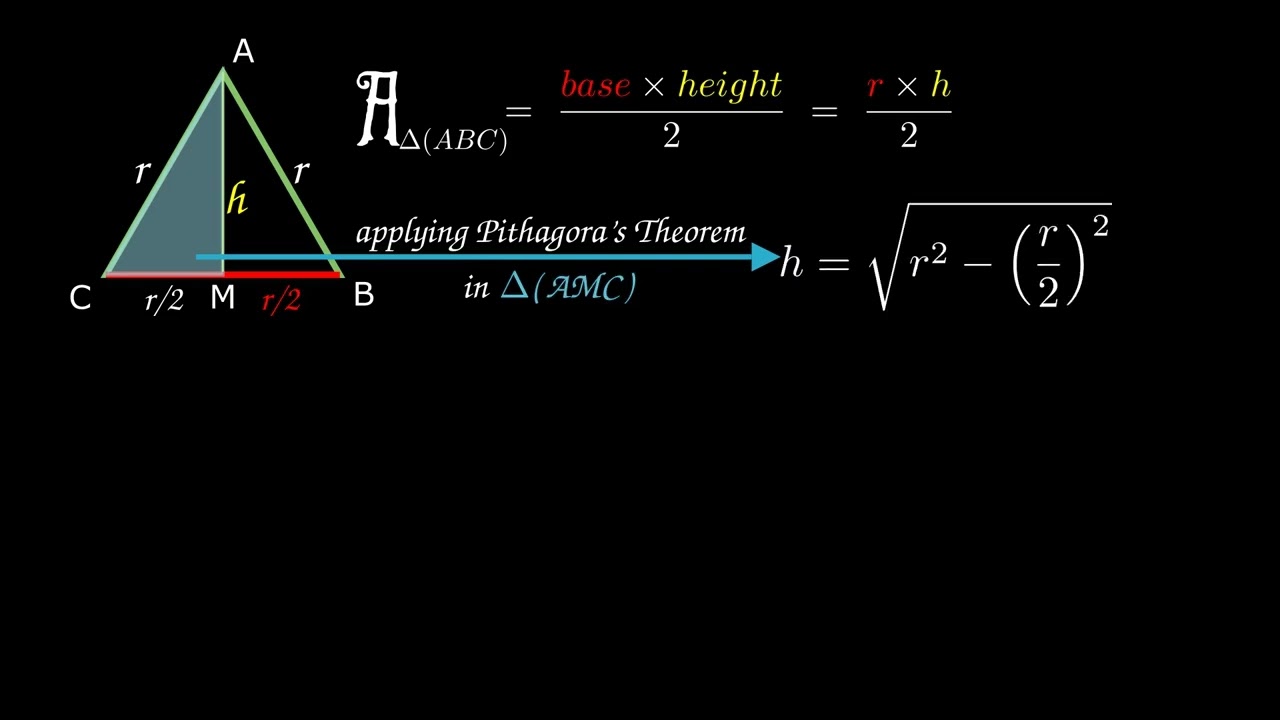
The area of a regular triangle in respect with its side length. The animated proof.
Hash Tags:
#Math #LearnMath #Triangle #TriangleArea #Area #Geometry #Euclidean #Euclid #Pithagoras #Pithagora #Manim #animate #proof #tutorial #visualeffects #visual
Recommended Channels:
Michael Penn - https://youtube.com/c/MichaelPennMath
3Blue1Brown - http...
real oar
I have a question,
Suppose a hexagon ABCDEF where all angles are equal, AD and BE intersect at O, would the triangles created (Triangle AOB and EOD) be equilateral?
Can one mathematically prove this?
Btw all sides are equal too.
real oar
real oar
Can one mathematically prove this?
Wait my dumbass lemme try it again.
real oar
This is my second attempt 🙂.
Lemme just


Now it doesn't look too overwhelming.
Btw those triangles are similar by AA test of similarity.
real oar
(Prove: AOB and EOD are equilateral)
real oar
I think it's better to consider 1/1 = AO/DO
1/1 = BO/EO than what I just did.
This can also be be done
$\frac {1}{1} = \frac {AO}{DO} = \frac {1}{1} = \frac {BO}{EO}$
and just crossmultiply.
somber coyoteBOT
OSAI(OverSentientAI)
 real oar
Y'all get the drill right?
real oar
I also had a bigger question..
Suppose in hexagon PQRSTU there's midpoint for PQ called V and a centre to the hexagon is called O will 6(VO * PQ) = A(PQRSTU)?
If a hexagon is made of 6 equilateral triangles then is
$A(PQRSTU) = 6\left( \frac {\sqrt {\frac {PO² + OQ² - 2(VP²)}{2}} \cdot PQ}{2}\right)$
correct?
somber coyoteBOT
OSAI(OverSentientAI)
 real oar
I mean, the height of the equilateral triangle is the median as well, right?
So the median will equal to
PO² + OQ² = 2(VP²) + 2(OV²)
PO² + OQ² - 2(VP²) = 2(OV²)
(PO² + OQ² - 2(VP²))/2 = OV²
√(PO² + OQ² - 2(VP²))/2 = OV
Right?
And yes I used appolonius theorem.
 fierce shadow
,w sin^4x+cos^4x=3/4
somber coyoteBOT


 Requested by Аппроксимат#6705


 lethal fable
since 1 and 2 are a linear pair they equal 180 so 180-123 and you would get 2
upper karma
basics of trigonometry help pls ?
a 1.5 m tall boy is standing at some distance form a 30 m tall building . the angle of elevation form his eyes to the top of the building increases form 30 to 60 degree as he walks towards the building . find the distance he walked towards the building ?
grave pond
Hmm, if the boy is 1.5 m tall, then his eyes are probably something like 135 cm above the ground, but there's some uncertainty there.
But other than that, you should be able to find the distance to the building at the beginning and end of the walk, and subtract.
 woven light
https://media.discordapp.net/attachments/979534947780001852/1034992390974480465/image0.jpg
https://media.discordapp.net/attachments/979534947780001852/1034992391649755147/image1.jpg


 serene monolith
grog
 signal ibex
woven light
https://media.discordapp.net/attachments/979534947780001852/1034992390974480465/...
signal ibex
woven light
https://media.discordapp.net/attachments/979534947780001852/1034992390974480465/...
just look for a fixpoint on P and try to go through every answer and ask urself what it does to P
 rotund vigil
Somebody please solve this for x and y...
 undone moat
rotund vigil
Somebody please solve this for x and y...
undone moat
rotund vigil
Somebody please solve this for x and y...
It is like a normal equation but with trigonemtric functions.
First ask yourself, on what axis sine is projected and from then on you can work out the question yourself.
I can only say this concerning the question.
The sine function is projected on the y and cosine on the x.
It is simplified to c^2=a^2+b^2
rotund vigil
undone moat
It is like a normal equation but with trigonemtric functions.
can you pls provide a solution ?
 jagged coyote
 heavy shale
jagged coyote
heavy shale
jagged coyote
U can use linear pair property to find m5
and then go from there to the closest angle(i.e. 8) and use properties of parallel lines and triangle to find the angles
jagged coyote
Ty
upper karma
Hi guys
You have a triangle defined by the 3D points P1,P2 and P3, and another separate point P4. You do not have access to the normal of the triangle. How do you determine on which side of the triangle point P4 is? (Point traversal order is from 1 to 3)
Any ideas?
trim breach
Thank you for your contribution.
 atomic nebula
can someone help me rq
grave pond
Certainly not unless you describe what it is you want help with.

 brazen gust
convert it into y=mx+b form
brazen gust
what'd u get
atomic nebula
it was like -14
atomic nebula
so this is right

 timber cargo
atomic nebula
so this is right
timber cargo
atomic nebula
so this is right
Yes, that's right.
And your x intercept would be at (3.5,0)
and your y intercept is at (0,-14)
timber cargo
atomic nebula
how would i plot that though
Okay, so, you know that one of the points that lies on the linear line is at the point (3.5,0), so using y=4x-14, pick some other x value, preferably an integer, and you'll get some y value. Graph that point and use a straight-edge to align with the point you just plotted with the x intercept of the graph and just draw a continuous line
 atomic nebula
okay
timber cargo
K, 👍
atomic nebula
timber cargo
K, 👍
thank you!!!
 twin ember
Trying to think though some stuff conceptually for trig
Would I be correct in saying this?

 nocturne remnant
Yes
twin ember
Ok cool. I'm sitting here staring at trig problems and trying to figure out how to deal with squared things and I needed to make this connection lol
undone moat
I am sorry if I am posting this in a non-relevant place, however I could not find anything related to it, soo...

I was on a website for mathematics and got this question.
I don't ask you to explain it to me.
Please do explain how this makes any sense.
 deft drum
When we draw a line, we call it 1d geometry. Now the tip of your pen and pencil would have some thickness. So if you zoom it more there will be some thickness. Is there positibility to have a line w/o thickness at all?
deft drum
undone moat
I am sorry if I am posting this in a non-relevant place, however I could not fin...
What is the upper limit?
undone moat
deft drum
What is the upper limit?
There is no upper limit, I am not asking a question.
nocturne remnant

deft drum
Oh now i got it
So prime number means a number has only two factors 1 and itself lets say 7: 1 and 7 can divide 7 with 0 remainder
If a number is divisible by any other number than that, it is called composite number
So the answer is very easy, I would like you to give answer of both of the questions
dark sparrow
undone moat
Please do explain *how* this makes any sense.
in what way does this question not make sense to you?
undone moat
How can a prime number be a prime number if it is the multiple of anything other than one and itself?
I said there is one for part a but it was apparently wrong.
undone moat
deft drum
So the answer is very easy, I would like you to give answer of both of the quest...
Go on then.
This literally breaks mathematics though.
deft drum
5 / 5 = 0 and there no integer that divides 5 therefore answer is 1
8 / 8 = 0 but there are other integers like 2 and 4 also divide 8, therefore answer is 0
Let me know if I am mistaken
undone moat
deft drum
5 / 5 = 0 and there no _integer_ that divides 5 therefore answer is 1
8 / 8 = 0...
You are correct, but the question is so badly worded.
deft drum
May be it was a trick question then
undone moat
Idk.
nocturne remnant
undone moat
This literally breaks mathematics though.
?
undone moat
nocturne remnant
?
Look.
How can a prime number remain so if it is a multiple of another number excluding one and itself?
 dark sparrow
deft drum
5 / 5 = 0 and there no _integer_ that divides 5 therefore answer is 1
8 / 8 = 0...
dark sparrow
deft drum
5 / 5 = 0 and there no _integer_ that divides 5 therefore answer is 1
8 / 8 = 0...
5/5 isn't 0...
deft drum
Yeah my bad 5%5
dark sparrow
@undone moat you do realize that the answer to "how many X are there which are Y" can be zero, yes?
deft drum
deft drum
When we draw a line, we call it 1d geometry. Now the tip of your pen and pencil ...
Can anyone help me here
dark sparrow
no, it is not possible to draw a perfectly straight line without any thickness in the real world
upper karma
whats Geometry ive never heard of this until today
oue oue ya des meufs de LYON ?
Oue
 ancient kernel
hey guys is there any good math book for geometry?
upper karma
upper karma
oue oue ya des meufs de LYON ?
what?
ancient kernel
like in the form of a pdf
 languid elm
I need help with my geometry hw bro
royal osprey
Does anyone know how I can better understand special segments and point of concurrencies
twin ember
Which one would be correct here?

X is supposed to be theta oops
Also I am trying to prove

If that helps
dark sparrow
twin ember
Which one would be correct here?
do you mean correct or do you mean helpful?
near haven
Can sm help me with this rq
 somber coyoteBOT

 mellow sparrow
Hello I require help in this problem. It's the summation that's bothering me.

 vapid pollen
near haven
Can sm help me with this rq
vapid pollen
near haven
Can sm help me with this rq
Hmm have you tried half-arc?
Bc 5X is 2X+3X. And with half-arc you could get something from X to 2X
And since it is an acute angle
Then you don't need to worry about +-
undone moat
,rccw


 near haven
vapid pollen
Hmm have you tried half-arc?
near haven
vapid pollen
Hmm have you tried half-arc?
Bro im in 10th grade but thx for helping lol
I solved it x = 15 and sin 2x = .5
 torn gazelle


 idle thistle
Yeah Idk, I'm very lost so I started looking for other ways of doing it
vapid pollen
near haven
I solved it x = 15 and sin 2x = .5
How
near haven
vapid pollen
How
Angle y (the other acute angle) = 180 - (x +90)
Angle y = (-x + 90 )
Sinx = cosy
Cosx = siny
Cosx=sin(-x+90)
Cos(5x) = sin(-5x+90)
Sin(-5x+90)/sinx=1
Sin(-5x+90)=sinx
-5x+90=x
90=6x
X=15
Sin 2x = sin (15*2) = sin 30 = 1/2 or .5
Got it?
vapid pollen
near haven
Got it?
How do go from Cosx= sin(90-x) to Cos(5x)= sin (-5x +90)
 eager bolt
idle thistle
Yeah Idk, I'm very lost so I started looking for other ways of doing it
eager bolt
idle thistle
Yeah Idk, I'm very lost so I started looking for other ways of doing it
trig is probably the easiest way]
timber cargo
idle thistle
90-48 is 42, so find Cos of 42 degrees, using that, you can then find cos of 48
If you need me to show you it mathematically, I can
Actually, I'll just do it right now, give me a minute or two to jot everything down
idle thistle
eager bolt
trig is probably the easiest way]
i tried that but im not sure
idle thistle
timber cargo
Actually, I'll just do it right now, give me a minute or two to jot everything d...
oht hanks
thanks*
idle thistle
on a piece of paper
idle thistle
now i feel guilty
timber cargo
idle thistle
oht hanks
 idle thistle
ah thanks man!
timber cargo
Yeah, no problen
idle thistle
on my first attempt I actually got 4.5 for WX I just assumed it was wrong because the 12cm ZY was shorter (and I know it's not drawn to scale but I thought it was somewhat accurate).
near haven
vapid pollen
How do go from Cosx= sin(90-x) to Cos(5x)= sin (-5x +90)
U multiply x by 5
vapid pollen
near haven
U multiply x by 5
Ye but is that legal?
near haven
vapid pollen
Ye but is that legal?
Yh its legal no one would put u in jail for it lmao jokes aside yh its legal since u multiply x by 5 on both sides so the ratio is still the same so its completely fine
Any more questions?
vapid pollen
near haven
Any more questions?
450-5x , which is 360+90-5x which is equivalent to 90-5x
Oooooh
Right
Thanks
I ended up being the one who had to be helped

near haven
Nah its alr we all help each other
vapid pollen
Yes
near haven
Anyways u got the whole thing right
near haven
Y 360 tho? This is a triangle the sum of all angles is 180
vapid pollen
near haven
Y 360 tho? This is a triangle the sum of all angles is 180
Because 360 is a full round
Trigonmetric ratios of X equal trigonometric ratios of (X+- 360°)
+- 720 +- 900 +- ...
vapid pollen
near haven
Y 360 tho? This is a triangle the sum of all angles is 180
Sin30° = sin390°
near haven
Ahh its essentially the same so its useless just keep things simple
Other than that everything is clear?
vapid pollen
Yep yep it is alright
vapid pollen
near haven
Other than that everything is clear?
Thanks
near haven
Np i got u bro
vapid pollen

upper karma
Can some explains this to me
 dark sparrow
,rccw
somber coyoteBOT

 distant crypt
yo who is good with geometry? im in eleventh grade and teacher had some trouble with a problem and was hoping to get some help