#internals-and-peps
1 messages · Page 121 of 1
 halcyon trail
 paper echo
whereas close to 100% of the code i write i never care about GC at all
halcyon trail
maybe when I get tired of finance, it would be fun to go to a FAANG and say I'm interested in doing either C++ or Rust
 verbal escarp
hehe
halcyon trail
Yeah, I mean, that's close to 100% of people
paper echo
so i have vanishing interest in learning rust, although knowing how it works has been useful since it has interesting language features (affine types, traits, etc)
 flat gazelle
Raku can IIRC also enforce function purity
halcyon trail
vanishing?
paper echo
like, approaching zero
halcyon trail
ah, ok
paper echo
abusing math jargon
paper echo
like how people say "modulo" colloquially
halcyon trail
gotcha
paper echo
this const faq is hurting my head
halcyon trail
it's pretty cool. My dream general purpose, GC language at this point, would probably be some mix of Kotlin and Rust
which const faq?
halcyon trail
oh the D one
paper echo
have you tried nim? it seems pretty nice, and it compiles and interoperates with both C and C++ so you aren't starting from scratch w/ tooling and libraries
halcyon trail
I wouldn't worry about most of that faq
verbal escarp
paper echo
so i have vanishing interest in learning rust, although knowing how it works has...
why aren't you interested in rust?
paper echo
idk why i picked up crystal instead of nim, i guess i just wanted to try ruby syntax + i wanted go-like concurrency without go
halcyon trail
I have not. Realistically, you're still starting from scratch in many respects
paper echo
that is true
paper echo
verbal escarp
why aren't you interested in rust?
i started reading through the book, wrote some toy programs, didn't want to mess w/ memory management
halcyon trail
The thingis that we have to write actual C++ for performance (I work in high frequency trading), and we need to use python for the quant stack
So both C++ and pythons are simply givens
paper echo
yeah makes sense
halcyon trail
The question is, with those fixed, does it make sense to introduce any more languages
and the answer, for me, has been "no"
paper echo
i think the early adopters will always be hobbyists and small boutique firms, writing web servers
halcyon trail
If python type annotations + mypy hadn't existed, then I think I would have started using Kotlin for all the unsexy code
paper echo
and CLI tool developers
verbal escarp
halcyon trail
If python type annotations + mypy hadn't existed, then I think I would have star...
oh, that's interesting!
halcyon trail
Yeah. I mean the benefits of static typing IMHO are pretty big.
Especially when a lot of our unsexy code is written very quickly, it does a lot of system operations so it's a bit of a pain to test properly, so we often don't
So it's fairly awful to crank out some script quickly to do some boring but important operation, like say backing up production logs across all your servers, and then get a failure deep in the code because of some trivial type issue
verbal escarp
i knew typing would be useful, but i haven't met anyone so far for whom it was the main selling point
halcyon trail
Main selling point of what?
verbal escarp
python
verbal escarp
you said "If python type annotations + mypy hadn't existed"
to me that sounds like a main selling point 😄
halcyon trail
I think you misread 🙂
The main selling point was the suitability for quant research
verbal escarp
okay
halcyon trail
It's such a big selling point that using python, was a given
verbal escarp
got it
halcyon trail
the question was just "do we also write some of this non-quant, non-perf-critical code in python, or use a third language"
types hugely decreased the value add of using a third language like Kotlin
but obviously the costs remain the same. People have a third language ot learn, third environment, harder to share code, etc.
flat gazelle
Justifying a new language is always hard. Rust brings some actually useful things you can't get elsewhere (safe parallelism, except pony, but you are really working from scratch there), which is why it is growing in popularity
paper echo
pony seems even less popular than crystal...
halcyon trail
We had a ton of python 2 code, and I made the call to just write new code in python 3 with type annotations, gradually rewrite, etc, instead of writing new code in Kotlin or something similar
paper echo
pony has some kind of capability model right?
halcyon trail
Pony is the 0 / 0 = 0 language 🙂
probably the only thing I will ever know about Pony
paper echo
the what
verbal escarp
lmao
halcyon trail
you read it
verbal escarp
paper echo
the what
exactly my thought
flat gazelle
Pony is very very tiny, but it has a company behind it which is afaik yet to be bankrupt.
Yup, reference capabilities. Honestly kinda useful for just thinking about data races
halcyon trail
flat gazelle
Pony is an excellent actor runtime on a mildly strange language
I generally end up using the unsafe or erroring division
verbal escarp
uhhh.. not sure i'm convinced :p
halcyon trail
it's pretty weird
flat gazelle
I mean, unless you need a fast actor runtime and are willing to write things from scratch for it and will never encounter memory pressure, pony is not the language for you
halcyon trail
IME almost every one of these niche languages has something that is, I'm sorry, totally insane
and only people grinding axes online will try to defend
for Nim, the language has some kind of bizarre snake case/camel case insensitivity
when I saw that, I was like... yeah....
flat gazelle
Honestly, I like that about nim
halcyon trail
I'm sorry but its nuts
flat gazelle
Makes it really easy to interop with different libraries that use different conventions
halcyon trail
It's the kind of feature that everyone who's worked on a large codebase with a large team stops and says "oof"
well, almost everyone
paper echo
flat gazelle
Makes it really easy to interop with different libraries that use different conv...
or just have a standard formatter that spits out warnings if you don't use the "the" convention? idk
flat gazelle
There aren't large ním codebases. It's a great glue language and "I wish I could write C without C" language
halcyon trail
Right
But there's also no real major selling point for it
that I can see, at least
flat gazelle
Yeah, I wouldn't use ním for much anything
halcyon trail
the only thing I will say is that there is a big of a vacuum, IMHO, for a reasonably powerful, GC, native, cross platform language
it's strange, but... there's really no language there
paper echo
is nim not that? since it compiles to C/C++
flat gazelle
I mean... Go
halcyon trail
when Go gets generics 🙂
paper echo
isn't it getting generics soon?
paper echo
also nim seems good for writing CLI tools and stuff
halcyon trail
Kotlin native looks cool and I'm rooting for it but realistically I wouldn't touch it right now for anything serious
flat gazelle
And I mean, julia will be a strong contender once aot is done
halcyon trail
but anyhow in relative terms I mean, there's still, relatively speaking, a vacuum there.
I doubt that Julia will ever become even vaguely mainstream outside quant work. Julia is also dynamically typed.
flat gazelle
But yes, Right now you have a large number of minor languages
paper echo
julia is already a contender for data science
julia for general purpose computing is like a side benefit
flat gazelle
Hell, Lisp falls there
halcyon trail
I basically just want something like a Java/C#/Kotlin/Swift/Rust, language-wise
nothing tooo too insane, but reasonable type system (generics). But cross platform, native, GC.
generics will help Go, the last thing I read about it though was what's happening with modules and that made me facepalm pretty hard, at least if the people telling me about it were accurate
flat gazelle
Yeah, go has some issues, especially with the cross platform part
verbal escarp
halcyon trail
generics will help Go, the last thing I read about it though was what's happenin...
what was that?
halcyon trail
it looks like Go's module system is planning to handle different majors of the same package as though they were entirely different packages
this has, uh, a number of ramifications, none of which seem great to me
verbal escarp
o.O what's the reasoning behind that?
halcyon trail
something about sharing the burden of upgrading between users of the library, and the library maintainers, I think?
but basically, imagine you have two dependencies, that in turn have a common dependency, which defines some type, and you are getting an instance of that type from one dependency, and passing it to the other
when one of your dependencies upgrades its major on the transitive dependency, and the other doesn't, teh module system itself will not complain. It will just say "ok, you now depend on Foov2 and Foov3"
Fetch both
and then, your code will of course not compile, because you are trying to pass Foov2.Bar where Foov3.Bar is expected
it seems pretty insane to me, that this error is happening at compile time and not at package/dependency resolution time
verbal escarp
hm.. as i mentioned, i'm working on https://github.com/amogorkon/justuse, which also allows inline auto-installation of packages, version/hash-pinned, so that scenario actually could happen there as well
but with classical pip/import, you wouldn't even have the chance to make things work with different versions of the same package without danger of conflicts
halcyon trail
yeah, pip is pretty awful for thsi stuff, though, or at least it was
you need something that properly solves the dependency satisfaction problem
there is no other way
In an ideal world, packages should separate private and public dependencies
flat gazelle
Yeah, python more or less doesn't support 2 versions of one thing in the same codebase
halcyon trail
And versions of private dependencies wouldn't need to agree
verbal escarp
halcyon trail
In an ideal world, packages should separate private and public dependencies
that's actually what i was aiming for, but never formulated it like that
halcyon trail
I don't know any language that makes this practical though
verbal escarp
i love that phrase, i'm going to steal it 🙂
verbal escarp
actually, with justuse that will be possible
you could have public dependencies maintained with pip/import
flat gazelle
node.js can have different versions of the same dep, but due to sys.modules, it is near impossible in Python
verbal escarp
and private dependencies managed via justuse
i like the notion of public/private dependencies, that's nice
halcyon trail
I'm curious to see how justuse will allow one package to use numpy 1.19 while another is using numpy 1.18
verbal escarp
numpy is a bit of a sore point, i'm afraid.. although, we're getting there, slowly
flat gazelle
If justuse completely reifies the import system, it is possible-ish, unless the module wants to grab itself from sys.modules
verbal escarp
flat gazelle
If justuse completely reifies the import system, it is possible-ish, unless the ...
exactly.
halcyon trail
what exactly does "reifies" mean in this context
I know at least 2 usages of that term and I don't see how either applies here haha
flat gazelle
Reify is essentially reimplement in this case
verbal escarp
we're managing distributions in a completely seperate way from pip
so we don't run any danger of conflicts
unless, yes, modules insert themselves into sys.modules and other shenanigans
halcyon trail
Well, the very large practical danger here is that there is zero enforcement of private vs public dependencies
flat gazelle
It is not impossible to build 2 module objects of the same module with different versions, it is impossible to have that work correctly with the current python import system
verbal escarp
flat gazelle
It is not impossible to build 2 module objects of the same module with different...
not with the classical import system, no. we've rebuilt the import system basically to make this work
flat gazelle
Yeah, wonder if it will be stable enough to see adoption
halcyon trail
if package A asks specifically for foo =1.1, and B for foo=1.2, there's nothing that actually enforces that that foo.bar doesn't show up anywhere in the public API of A, or B
verbal escarp
me too ^^
halcyon trail
and if foo.bar is in their public API, then it's really bad
maybe if you packaged a tool that helped enforce that, it would reduce my misgivings.
Out of curiosity what was the motivation for this
verbal escarp
my main motivation was the lack of module/version annotations
halcyon trail
We use conda where I work, which is explicit about only having one version of every package, and also explicit about completely solving the dependency graph correctly (or error'ing out if it's not possible)
And it's been a good experience
what do you mean by that?
verbal escarp
i ran code in jupyter never knowing which version is actually running, got me into trouble a couple of times and i realized how limited the import statement was, which could only be improved on by syntax changes
halcyon trail
well, your environment manager would tell you that right
verbal escarp
not if you try to run notebooks that are over a year old across different machines
so i started with a functional import, building on importlib, which worked surprisingly well and simple
halcyon trail
I don't follow, at the time you're running it though, you run it in a specific environment, right
Here's a question, suppose I do stuff like this:
import pandas as pd  # this just gets the default pandas, which is such and such version, requires numpy 1.20
np = your_import("numpy", "something something = 1.18")
So now I'm using pandas and numpy that are incompatible with each other, no?
halcyon trail
yeah....
verbal escarp
but theoretically, yes
halcyon trail
I just don't think tbh inside the code is to solve these kinds of issues, it's an entire world of issues
*is the place
verbal escarp
well, not like that
halcyon trail
you can't really get away from different imports interacting with each other, so I still think the only thing that makes sense in the context of python is to "solve" the dependency world, and know you have a solution that works for everyone
verbal escarp
let me get a bit into detail
halcyon trail
tbh your reasons for writing this weren't what I expected, I think the issues you described can be handled well enough with virtual environments. I expected you were going to say that you weren't able to resolve dependency graphs.
verbal escarp
halcyon trail
Here's a question, suppose I do stuff like this:
```
import pandas as pd # this...
this wouldn't work
because use("numpy", version="1.18") would just try to pull the classical install and discover that it's running the wrong version. if you use("numpy", version="1.18", auto_install=True) it would install the package in a seperate folder with no overlap with pandas
yes, you might get in trouble down the road if you mix versions, but for those cases, we've got an internal dependency graph planned to track down issues
halcyon trail
okay, the auto_install=True is what I mean
I just think it's risky to allow code to essentially do ad-hoc, local dependency management, instead of a proper dependency/environment manager
And I'm not really sure what the major benefit is
If you want to run year-old notebooks on different machines, you create an environment that you think will run it properly on one machine, test it, and if it works, just keep using that environment on all the machines
verbal escarp
well, one big main benefit is that you have your versions pinned inside your code, which is especially important for scientific and other "free floating" code that isn't managed in an environment
like publications
you could post code in a blog and have something that is definitely running anywhere
halcyon trail
You could just post the lockfile with the source code
verbal escarp
i think the risks are manageable, especially with a proper internal dependency graph that can alert the user of potential problems
if done right, it could even help with potential issues when upgrading versions
halcyon trail
The thing is that 100% of scripts that use this aren't describing their dependencies, they're pinning them, which is not great for downstream users. mature packages like numpy, etc have, in the grand scheme of things, very very few backwards incompatible changes, you have to be using code that totally ignored deprecation warnings for much longer than a year to have problems. So at the very least, even if you ran you rscript with numpy 1.18, you don't need exactly numpy 1.18, but at least 1.18
and even the "at least" part is usually very conservative
verbal escarp
i'm thinking of alerting the user of incompatible call signatures etc
halcyon trail
If I download two scripts, and one says numpy 1.18, and the other says 1.19. this whole approach creates many more problems than it solves
If the first script had a dependencies file that said >= 1.18, and the second. >= 1.19, then a dependency manager would just resolve it to 1.19, which is going to be a better outcome, 99.9999999% of the time
verbal escarp
halcyon trail
The thing is that 100% of scripts that use this aren't describing their dependen...
actually, you often want exactly version 1.18 or 1.19 not "at least"
halcyon trail
for testing, deploying, your own code, sure
for writing code that's going to be used by someone, in conjunction with other code, no
that's why for libraries, you ideally want to have both a dependencies file, and lockfile(s)
verbal escarp
i've had so many problems caused by pip upgrading some library because one thing required "at least" version X and breaking other stuff in the process
halcyon trail
well, pip doesn't properly solve environments
if you already have package X that depends on Y, and now you want to install Z which also depends on Y, you need to ensure that Z and X have compatible dependencies on Y
you need to find some version of Z, that has a dependency on Y compatible with your current version of X
either that, or, you can ask it to try to install any version of X with any version of Z, from scratch, and then it will try to find the latest X and Z that can depend on the same Y
Conda and I'm sure many others, do all this properly
verbal escarp
why not just have things their own "private" dependencies and raise the issue of requiring "public" dependencies if a diamond comes up
halcyon trail
Once the environment is resolved, your stuff only breaks if library authors have bugs (like incorrectly describing their dependencies)
what do you mean by a diamond coming up?
In this example, there's already a diamond
"my environment" depends on X and Z, X and Z depend on Y
diamond
verbal escarp
well, it's not exactly a diamond but more a rhombus
halcyon trail
"raising the issue when a diamond comes up" (or, modulo shapes that are equivalent to diamonds for our purposes) and simply having public dependencies, is exactly the same thing
verbal escarp
not really
halcyon trail
can you give an example of how it's different?
verbal escarp
well, let's say you have a program (maybe a subprocess) that requires version X of a package while a different program, in the same environment, requires version Y
halcyon trail
are you saying that there could be a "diamond" present in the environment, but not in any specific piece of software that runs in the environment?
ok, yes, that is what you are saying
verbal escarp
pip wouldn't allow that, although there is no direct conflict of those dependencies
those two programs have no overlap or exchange, although they share a common "space"
halcyon trail
Sure, so in principle, that does give you more flexibility, at the cost of adding a lot more danger
the real question is, what's your use case for this flexibility
verbal escarp
that's where i'd say they can have "private" dependencies, no problem
halcyon trail
Well, it's not really "no problem now", because now there are landmines in your environment
You're basically saying "well, if you never run X and Z in the same process, then you're fine"
But one day, someone takes th existing environment, and they write a package P, P depends on both X and Z, and now suddenly there's an issue
So, you could in principle have a tool that errors, at import time
verbal escarp
and then your code should alert you of that potential problem
halcyon trail
as soon as both X and Z get imported, boom
verbal escarp
not before
halcyon trail
Okay. So, like I said, you get more flexibility, but you also have landmines buried in your environment.
I shouldn't use that word, that's too charged.
You have more flexibility, but you have have a potential issue that you've left latent instead of dealing with immediately.
This can be a valid engineering trade-off, don't get me wrong. I just don't really see the need for that flexibility, both in my work, and also in the use cases you've described so far.
Practically speaking, 99% of the time, the dependencies just get resolved, everything just works, and it's all great.
verbal escarp
true. on the other hand, you couldn't even run those two programs in the same environment, at all
halcyon trail
Well, that's the thing, there's a certain assumption behind that statement that isn't really true
If those two programs are over-specifying their dependencies, then yes, it will be true
but, again, in 99.99999% of cases, X and Z should be fine to specify something like numpy >= 1.18
and then you will get a valid dependency up front
for both X and Z
verbal escarp
i don't think so. just think of python itself
halcyon trail
what about python itself?
verbal escarp
python versions
halcyon trail
I don't understand
lets use python itself as an example
and numpy
numpy's dependencies on pip say that it can be used with multiple versions of python
it doesn't say "numpy 1.20 depends on python 3.7"
verbal escarp
how much has been added and then deprecated over the years, you couldn't just say "python >=3.1 should work"
halcyon trail
that would be incredibly bad
that's literally exactly what numpy says 🙂
just not 3.1
 verbal escarp
numpy is a bit of a special case, i wouldn't like to get into detail there
halcyon trail
looks like 3.7, 3.8, 3.9
well, pick any python package
almost none of them will be locked to a specific python version
verbal escarp
numpy is compiled to certain platforms and i had to downgrade to make things work at some point
halcyon trail
yeah, so with conda, the C packages are also part of the environment
so that's all handled correctly and 100% reproducibly
sorry, 99.9% percent reproducibly, there's like, one package that conda doesn't handle, which is libc itself. But not normally an issue.
More like 99.9999% reproducible.
But ok, let's leave that example alone.
arrow afaik is a pure pytho package. it looks like it supports python 3.6-3.9
verbal escarp
while i am a fan of conda for its reliability, it suffers a different problem
it's basically impossible to upgrade things
verbal escarp
well, sometimes it would take hours to try to come up with feasible dependency resolution and then i'd just cancel the operation
 deft pagoda
anaconda broke my installation once, and i never used it again
i will concede that it's as likely that it was user error, but i don't like things that let me mess them up
halcyon trail
it's taken me as long as minutes, never hours
I've never used anaconda, just conda, so I'm not sure what else goes into it
I have 280 dependencies in my lockfile, for perspective
so, idk
I guess it's possible you had far more and that was part of it
verbal escarp
no idea what the problem is in my case, but in my experience, it's easier to just set up a new VM with a completely new conda installation
halcyon trail
at any rate though, taking a step back: it is 100% the standard for libraries, and generally any code that is planning to be reused, to explicitly state that they depend on "ranges" of other libraries
verbal escarp
rather than to try to upgrade an existing installation
halcyon trail
and say what those ranges are
If you just say "this code was run and tested with these exact dependencies" then you're basically shifting an insane burden downstream
because obviously, as soon as you have say, 10 dependencies, arrow says that it only supports python 3.7, pydantic says it only supports python 3.8, etc
that's just madness
verbal escarp
hm.. the system requirements are checked for each indidvidual package installation
i don't think that's a big issue, tbh
but yeah, there's one issue that has been nagging me
i'm thinking of security patches
halcyon trail
well, it applies for any kind of dependency, even if it was not a system package.
verbal escarp
i just got an idea.. let's be crazy for a moment
what if there's a mechanism for patch releases that can automatically try and install a new package release (of course with cryptographic signatures etc) but checks if all callable signatures match the current version before actually making it available to the user
and raise a warning if signatures don't match to give a heads up
then the user could be sure to get all patches, as long as the contracts are fullfilled
it would force people to put a little more thought into their APIs, but i think python has everything by now that could make this approach doable
paper echo
conda is particularly fucked up for some reason
i dont know how apt, zypper, dnm, etc all manage to be not as fucked up as conda
halcyon trail
I honestly don't know what you think is fucked up about conda
@verbal escarp i just don't really think that's much of a value add; the same type signature doesn't guarantee the same behavior, usually with small fixes the types are all identical anyway, and if the types were not identical then your static type checker would anyway catch this issue. After I update dependencies, I run my full CI, which includes obviously static type checking, if it doesn't work, I roll back. This doesn't happen very often.
so the value of doing this aprticular thing earlier is pretty low
 raven ridge
verbal escarp
and raise a warning if signatures don't match to give a heads up
raven ridge
verbal escarp
and raise a warning if signatures don't match to give a heads up
I don't think it should be controversial to say that if you're depending on a library whose author changes a callable so that what used to be a valid call ceases to be a valid call on a new minor version of that library, you should stop using that library
verbal escarp
that usually isn't an option 🙂
raven ridge
why not?
verbal escarp
because dependencies aren't called "dependencies" without a reason
raven ridge
that's a circular argument.
I must always depend on this because I currently depend on this.
verbal escarp
if you rely on a certain library and they break something after you build on them for years, it's not an option to just change it
raven ridge
sure it is - most libraries are open source, you can fork it, or you can look for an alternative and start using that instead
verbal escarp
and there's no guarantee that there is an alternative that doesn't break things just the same
raven ridge
maintaining backwards compatibility, or at least warning users loudly and documenting clearly how to make code forwards-compatible when you break it, is the bare minimum that you should be asking of the maintainers of your dependencies. If you can't depend on them to do that, you probably shouldn't be relying on them at all.
verbal escarp
not sure i get what the whole point of the argument is, tbh
paper echo
halcyon trail
I honestly don't know what you think is fucked up about conda
the dependency resolver
its incredibly slow and apparently kind of flaky
i love that it exists, i used it heavily when i was doing data science work
but its just a weird tool with a lot of weirdness about it
its gotten a lot better, was weirder 4 years ago when i first started using it
raven ridge
verbal escarp
not sure i get what the whole point of the argument is, tbh
That I believe the onus should be on library authors to preserve backwards compatibility wherever possible and clearly and loudly document breaking changes when it's not, not on users of libraries to check whether the library author failed to do this.
halcyon trail
@paper echo I mean dependency resolution is an NP hard (or complete? I always forget) problem
if your dependency solver is working really quickly and smoothly, be very suspicious
paper echo
yeah but why is it so much harder in conda than say zypper?
halcyon trail
I'm pretty sure that conda internally uses some industrial strength solver
paper echo
is conda dependency resolution harder for some reason? more kinds of dependencies?
halcyon trail
I couldn't speak to that, we'd need to do a careful apples to apple comparison, with graphs of comparable size and density
paper echo
resolving stuff like gcc versions and mkl vs openblas etc?
my impression is that its mainly slow because its written in pure python
in my quick testing, mamba is significantly faster and gives the same results
halcyon trail

Anaconda
Lately, we have been responding to issues about Conda’s speed. We’re working on it and we wanted to explain a few of the facets that we’re looking at to solve the problem. TL;DR: make it faster Are you: Using conda-forge? Use conda-metachannel to reduce conda’s problem size Using bioconda?…
according to this, conda uses pycosat
which is a python wrapper around picosat
which is, an industrial strength SAT solver
I don't know if it's the absolute state of the art but this isn't some naive pure python code here
 unkempt rock
Hey guys quick question can you set/cap/ control cpu clock speeds in python ? For windows I'm trying to make it kinda like the throttlestop app but in python. I have done research but it all just keeps saying only for linux
halcyon trail
@raven ridge agree, and similarly I think library authors need to make a tleast somt reasonable effort to say that their package supports some range of dependencies
You can't just say you depend on foo=1.21, bar=3.5.7, it's not scalable
it depends on foo >=1.1, bar >=3.5
verbal escarp
halcyon trail
You can't just say you depend on foo=1.21, bar=3.5.7, it's not scalable
actually, my idea before would solve that
halcyon trail
realistically these things aren't always perfect but, again, you need to make some kind of reasonable effort
I dont' see which of your ideas solves this
This situation is fundamentally unsolvable
paper echo
that makes sense and thanks for the link @halcyon trail
halcyon trail
np
paper echo
i never heard of metachannel before
halcyon trail
Yeah, I don't know why it's slower. I admit I haven't done much real comparison. Obviously, a few minutes for a few hundred dependencies doesn't feel super fast, but it is a hard problem
but like all benchmarking, you have to be incredibly anal
there could be some "small" detail, something that one takes into account and the other doesn't, that makes the whole computation 10x more expensive
paper echo
it's not just that it's slow, it's that installing packages after the env is created is extremely flaky and liable to break or give inconsistent results
i understand, dependency resolvers always are heuristic and have to decide where to stop
halcyon trail
I really appreciate conda because it does a lot. It doesn't just do python, it does the entire C stack, which means total reproducibility for the entire numpy stack
I dealt with those headaches before
and they are awful
paper echo
yeah its great, i used it to package fasttext long before facebook had updated binaries
i love the idea and its quite a technical achievement
also there was some weirdness with the CLI, ill-named things, unable to search for the latest version of a package, conda env create -f vs conda create -f using different file formats, etc
new releases being very slow to propagate to conda forge and default channels
not that hard to host your own private channel though, which was reallly nice
halcyon trail
Yeah at my work we use private channels for everything
Also installing packages has always been super fast for me
paper echo
but i agree, being able to distribute an entire environment with a conda env yaml file is a huge plus, without having to rely on docker which has a lot of its own issues
halcyon trail
I agree that some functionality is or was weirdly missing
I have code that creates lock files given a dependencies file
I thought that workflow was industry standard more or less
But whatever, problems solvable with 100 line python scripts aren't problems :-)
paper echo
like the conda env list file?
i remember i wrote a script to clean up the conda env yaml files so they could be distributed to other people
halcyon trail
Yeah so conda doesn't make this distinction at all so I have to myself
I have one file that is a conda env list file with loosely specified dependencies
Only direct dependencies too
Then I have multiple, fully specified, including transitive, files
I.e. the whole environment
You need to have both dependencies file and a lock file
For multiple reasons
paper echo
yes i agree strongly
halcyon trail
And the former should allow programmatic generation of the latter
But I couldn't find a way to do it
So I just created a dry run dummy conda environment with the dependencies file + variant packages lol
And dump everything from it
paper echo
thats more clever than what i did
i just used this to generate the lockfile from the user's env after it's been created https://gist.github.com/gwerbin/dab3cf5f8db07611c6e0aeec177916d8
Gist
Export a Conda environment with --from-history, but also append Pip-installed dependencies - conda_env_export.py
you parsed the dry run output?
or you actually created a temporary conda env, got its deps, then deleted it?
halcyon trail
The former
Except you don't need to really parse anything
Theres a --json option
Gives you everything in a structured json
paper echo
ooh
halcyon trail
I can share the code with you if you wan
halcyon trail
Sure np, not at desk but I will tag you when I have it
halcyon trail
@paper echo when I removed all the company specific stuff there wasn't much left lol 🙂
import json
from pathlib import Path
import subprocess
from typing import List

SOURCE_CONDA = "source /opt/devtools/conda/etc/profile.d/conda.sh"

TEST_ENV_NAME = "foobarbazqux"


def make_lock_files(deps_files: List[Path], extra_packages: List[str]) -> List[str]:

    conda_command = f"{SOURCE_CONDA} && conda create -n {TEST_ENV_NAME} --dry-run --json"
    files_string = " ".join(f"--file {f}" for f in deps_files)
    packages_string = " ".join(extra_packages)

    conda_output = subprocess.run(f"{conda_command} {files_string} {packages_string}",
                                  shell=True, check=True, capture_output=True, text=True).stdout.split("\n")[2:]

    conda_json = json.loads("\n".join(conda_output))

    return sorted(f"{d['name']}={d['version']}={d['build_string']}\n" for d in conda_json["actions"]["LINK"])
obviously you'll want to change SOURCE_CONDA to wherever your conda.sh file lives. Note that while shell=True is not ideal, it's the only "proper" way to call conda from python, afaik, because conda itself is actually a shell function
so this shell=True and source'ing dance is the way to go
the extra_packages argument is very useful for variants
not sure if there is a more formal name for that
In my actual code, I have a constant that looks like this currently:
VARIANTS = {"gcc8cxx17": ["gcc8cxx17"], "clang8cxx17": ["clang80cxx17"]}
And when I run this code, I actually iterate over the variants, and produce one lock file for each variant. the key is the variant name, the value is a list of extra packages to put in that variant.
in my code, as well, I don't actually take deps_files, I just take the overall project root, and hardcode two relative paths from teh project root that I need dependencies from. One of them is my own team's dependencies, and the other are the dependencies of the software of the rest of the company, which we build/use from source (so this is more relevant to the C++ side). I also have a couple more constants that go through the company-wide dependencies and make certain modifications, i.e. excluding certain dependencies, basically minor hacks that I've needed in order to actually get the dependencies to resolve.
paper echo
i think you only need the conda shell function if you're using conda activate fwiw
otherwise it wouldn't be able to inject any env vars into the current shell session
e.g. my script just uses whatever conda is on your path
i think there is a name for those variants but i cant remember what it is right now
thats a great idea to make different lockfiles for different toolchains
halcyon trail
yeah, different tool chains or even different versions for internal testing
I mean say a python package claims to support python 3.6-3.9
you probably want to do at least some testing with different python versions
so you have a few different lock files
obviously as you add ranges of dependencies and have more dependencies it explodes exponentially, so you can't cover everything, but you can have however many you think are appropriate to try to give some kind of coverage
your build matrix, basically
it's not just conda activate, at least, that's not my understanding, which comes from the guys at my company that specialize in this, one guy in particular who knows conda really well
it could have changed recently, but basically conda-as-shell-function is/was the only officially supported way to call any of the conda commands
at some point it was a binary and you could call it directly and it mostly worked, but support for that was deprecated
https://github.com/conda/conda/issues/7126 see for example

GitHub
From gitter starting https://gitter.im/conda/conda?at=5ac4e56dc574b1aa3e67a0d8 @natefoo: With conda being a shell function in 4.4+, what's the suggested way to use conda via scripts when an...
 upper spoke
so I have an insanely bizarre thing I'm looking into....
I am working on what I hope to be a next-gen MUD server (strange as that may sound.) one of the things that I want this thing to have is a powerful integrated scripting capability, preferably with the ability to run more-or-less untrusted code from users in order to bring life to game objects and power quests and so on. Something kinda like Bethesda's Papyrus as an example!
The problem is that I'd really, really like to write this project in Asyncio because the multi-tasking/concurrent features of asyncio are amazing and fit in well with the idea of making sure the whole simulated game world keeps ticking along while letting different sub-systems access web resources. That means using something like Lua for the scripting isn't very practical - I can sandbox it, but I don't have a great way to make it yield/await from a Python sense and then resume the Lua execution.
However, I -have- had some good luck porting MUSHcode - an awful-looking lisp-like mishmash of bad ideas that works surprisingly well - creating my own Python-based interpreter (the original MUSHcode is interpreted by C, so...). I'd -really- prefer not using MUSHcode though... I'd rather have an expressive, sane-looking language akin to Lua, Javascript, AngelScript, SOMETHING.... but I don't see any way to utilize those in a way that will interact nicely with asyncio.
This leaves me with the strange idea of creating a whole new domain specific language that is designed from the get-go to execute atop of asyncio and, thus, can be paused, canceled, etc, while running inside of an asyncio Task.
But where the -heck- would I even -start- ?
 grave jolt
@upper spoke Probably more relevant in #async-and-concurrency, but generally, if you want to run a blocking computation, you do it in a separate thread (if it's I/O-bound) or in a separate process.
https://docs.python.org/3/library/asyncio-eventloop.html#asyncio.loop.run_in_executor
upper spoke
hmm
yeah the problem with run_in_executor is that while it can net you an awaitable Future object it doesn't actually.. await said future.. there is no way to await something once you are out of async def territory
so hmmm
grave jolt
upper spoke
yeah the problem with run_in_executor is that while it can net you an awaitable ...
I don't understand what you mean
upper spoke
when I was using Scoder's Lupa to try and interrupt Lua, I had only one way of doing it - lua's debug.sethook to force a python routine to run and have it 'await' something but the way it did that left me very unsure of just what's happening because the Lua runtime was still executing synchronously for 100 instructions and then pausing at an arbitrary state of executing bytecode
grave jolt
let's move to #async-and-concurrency
 static bluff
I wanna apologize to you all for a bit of drama I was at the centre of today
I was accused to asking for help and then arguing against the advice provided. As much as I think the person who said this was being unreasonable, there is probably truth to this
So I just wanted to say that I've heard this criticism, and though I'm trying to be a gracious student of all you already, I'll try even harder in the future
I think this server is the best learning tool I'll ever find 🙂 Hoping to learn a lot from you all
 lilac storm
can someone guide me on how to get started with building web applications in python..? the only modules I know to use are tkinter and pyautogui as of now
 rough leaf
Anyone know about the collatz conjecture (in math)? I really want to try to apply it to python and see what happens.
 gleaming rover
lilac storm
can someone guide me on how to get started with building web applications in pyt...
gleaming rover
lilac storm
can someone guide me on how to get started with building web applications in pyt...
try #web-development
verbal escarp
@upper spoke you have to consider that a scripting language like python is actually what you'd want for scripting a game, so I understand the urge to write a more limited DSL, but most often it is only a matter of time until that people need that DSL to be turing-complete, so you end up with a language that theoretically has the power of python but only a fraction of its features
there might be a few ways to go about though. for instance, you could look into the interpreter thing discord runs to run those python snippets in chat
or you limit users to define certain artifacts like functions with defined names and then scan the AST before importing them
for anything weird
or you could try to sandbox those modules as subprocesses, regard them as isolated blackboxes and only care about their input/output
not sure which is the safest or most convenient for you, though
halcyon trail
The problem is that python tends to be really poor for embedding for various practical reasons
So people don't generally do it
Most games do either use lua or a custom language for internal scripting
verbal escarp
python is used in a number of AAA titles though
halcyon trail
Really, which ones
verbal escarp
The Python programming language is actively used by many people, both in industry and academia, for a wide variety of purposes.
halcyon trail
Well, ok :-)
verbal escarp
it's not all doom and gloom ^^
halcyon trail
Some these games are written in python completely which is different
And many are not AAA or are very old. And it's a fairly short list.
verbal escarp
actually, i didn't know sims 4 is using python, that's unexpected and pretty cool
halcyon trail
Yeah, sims 4 is really the most decent example
But still, it shows that python is a rare choice for this
verbal escarp
actually, there are some missing
iirc one of the modern civ was also using
not sure which one
civ 4
halcyon trail
I'm sure it's not complete but there are dozens of top tier AAA games per year, and this list has zero from the last 7 years
verbal escarp
true, that's sad
halcyon trail
The first title I picked at random, horizon zero dawn uses lua. Skyrim and Witcher both use custom languages etc.
Eh,don't think it's sad, tradeoffs and all that
verbal escarp
it's sad because in other industries python is used primarily for scripting, only gaming didn't pick it up
halcyon trail
In what other industries is python embedded usually?
verbal escarp
video/audio production pipelines are mostly in python
halcyon trail
Is it embedded though
verbal escarp
sure
flat gazelle
the issue with embedding python is that the interpreter is full of globals
halcyon trail
That doesn't sound convincing lol
flat gazelle
whereas with lua, you can just run it in 4 threads at once without the things breaking
verbal escarp
@halcyon trail no, i'm just too lazy to write a list 😄 just look at blender, CAD, inkscape..
halcyon trail
"mostly in python" sounds like it's not embedded but just in python
flat gazelle
afaik, PUBG uses python for at least parts of it's codebase
halcyon trail
Maybe with C parts inside
flat gazelle
yup, blender, CAD, inkscape do use python for plugins
but well, it is hard to justify python when lua is just overall easier to work with, and you don't really need the python stdlib for scripting in a game engine
halcyon trail
Games also tend to be a lot more resource constrained
They have to run very fast on consoles
verbal escarp
oh, you mean consoles
verbal escarp
i'd say computer games are the least resource constrained of any product
(consumer)
flat gazelle
that certainly doesn't hold for AAA games at least
halcyon trail
Don't quite follow that
 finite sparrow
verbal escarp
i'd say computer games are the least resource constrained of any product
finite sparrow
verbal escarp
i'd say computer games are the least resource constrained of any product
do you notice if blender renders a bit slower? most likely not. do you notice if your game runs as 30 instead of 60 fps? ya, at least most people do.
halcyon trail
I feel like you're trying hard to say that game devs don't use python for scripting just cause
verbal escarp
no, i think game devs don't pick up python because it's harder to write a DSL with it than with lua
halcyon trail
Whereas all the game devs I know think that python just doesn't make the best tradeoffs for being used in that way for a game
That's not the reason
Not the main reason, at any rate
finite sparrow
python is a incredibly complex language that is hard to embed into another piece of software. i would wager thats one of the main reasons its not being used much
compared to lua which is so much more simple
flat gazelle
there are cases where python is used for embedding, such as in cases where you need a more expressive language than lua
or even want to use the standard library
finite sparrow

but it has to be a case where you need what python offers, because its too hard to embed it "just because" (without proper reason)
flat gazelle
but for games, where most of the code is just if then else, lua is a fine language without having to think about the GIL, sharing state, kind of lacking performance and module caching.
halcyon trail
Fwiw I hate lua
flat gazelle
same, did not enjoy my time with it at all
halcyon trail
And I think writing your own language is nuts
finite sparrow
i dont like lua, but there are worse options. like a completely custom langauge.
halcyon trail
So I would love for python to be more suitable
finite sparrow
halcyon trail
And I think writing your own language is nuts
oh god VRchat UdonSharp flashbacks
flat gazelle
there are some merits to a custom DSL for specialised tasks, I know a company had a custom language for some financial things I am not smart enough to understand
verbal escarp
well, i think it would be a good fit exactly because python is used as a main scripting language in content production pipelines, so artists who learned python to tinker with their tools could easily get started with in-game scripting
finite sparrow
verbal escarp
well, i think it would be a good fit exactly because python is used as a main sc...
please go ahead and show me a example of python embedded into a c# project. and then look at the complexity of it.
maybe its a good fit if you dont care about the effort it is to actuall do that
but when you actually have to do it, you will care a lot about how much effort it is
verbal escarp
finite sparrow
please go ahead and show me a example of python embedded into a c# project. and ...
google is your friend
finite sparrow
...
halcyon trail
You're saying it would be a good fit because the language would be familiar to some people who aren't the main people writing the game
halcyon trail
That's not as important as making it easier to hit the performance goals of the game for the people writing it
And reducing the technical complexity
verbal escarp
you don't render your content with python, it shouldn't be performance-critical
finite sparrow
anything that needs to run once per frame, physics or render, is performance critical
unless you want to say that physics scripting should be impossible when using embedded python?
halcyon trail
The scripting language sucking up a ton of memory still affects your ability to hit performance goals
And while those parts aren't as critical they still need to be reasonable, and luajit is way faster then python
finite sparrow
oh i have an idea, why dont they embed cython? that would be fast enough (/s)
halcyon trail
Basically... Game devs have very good reasons this. Seems like unless you really understand the situation extremely well it makes sense to give experts the benefit of the doubt no?
verbal escarp
i've been involved in game development
finite sparrow
have you embedded any scripting language in a game?
finite sparrow
and what was the reasoning?
halcyon trail
There's a lot of game studios making independent decisions about what scripting language to use
verbal escarp
i only used the language, i wasn't on the coding side
halcyon trail
If almost zero AAA games have chosen python in the last 7 years there's probably reasons
verbal escarp
so i can't really tell you what the reason was they cooked up that monster
halcyon trail
Ah, in the content production pipeline?
verbal escarp
yeah
finite sparrow
wait are we arguing about scripting for game users or for the developers? i thought we were arguing scripting for endusers.
 swift imp
finite sparrow
i dont like lua, but there are worse options. like a completely custom langauge.
swift imp
finite sparrow
i dont like lua, but there are worse options. like a completely custom langauge.
bro I wish I could use python to write scripts in WoW
verbal escarp
finite sparrow
wait are we arguing about scripting for game users or for the developers? i thou...
well, i was arguing about game development
halcyon trail
Scripting internally for developers
Game developers
Game devs usually embed a higher level language for controlling high level game state/events
halcyon trail
Things like "when the character reaches this town, if this didnt happen, trigger this cutscenes"
verbal escarp
the content devs need to be able to script those events without worrying about low-level stuff
finite sparrow
i thought we were arguing about scripting for endusers because there were comparisons made to blender scripting etc.
verbal escarp
ohh
well, there is a bit of overlap because model, texture artists use those tools to create the game content
so i was saying that those people who create the content and the settings/quest/ai devs would have an easier time if they all used the same scripting language
finite sparrow
.xkcd 927
 neon troutBOT
Fortunately, the charging one has been solved now that we've all standardized on mini-USB. Or is it micro-USB? Shit.

2011/7/20 - #927, 'Standards'
verbal escarp
lol :p
yeah, kind of like that - but we all can agree that python should be that 15th language, right 😉
finite sparrow
eh
debatable
python is actually used a bunch by game developers, for example in the sims and WoT
verbal escarp
yeah, we covered that earlier
and made the sad discovery that there's only a handful of lonely exceptions in the past decade that dared to use python for internal scripting
finite sparrow
but yea all this time i thought we were talking about this sorta thing: https://en.wikipedia.org/wiki/Category:Lua_(programming_language)-scripted_video_games
or as i meantioned earlier, things like VRchats UDON which are specifically designed for anyone to be able to create content with them
paper echo
im going to jump into this conversation without context and declare that python is bad for embedded scripting specifically because its syntax prohibits succinct one-liners, and lua is unequivocally better for the same purpose, especially because a good embedded scripting environment will provide the "standard library" that lua is missing, and because you can already compile moonscript or teal or fennel to lua if you want cute syntax or types or s-expressions
however hy wouldn't be bad for scripting, and i suppose theoretically you can use coconut or hy to write embedded scripts, but then the embedded command line itself or whatever will still be a deficient experience
also pharo 9 just came out so i am going to jump ship on functional programming and upload my brain to the object oriented meta-matrix, goodbye world
 quasi hound
because its syntax prohibits succinct one-liners
really? i use these all the time
the one thing i hate is no multiline lambdas
paper echo
yeah that's a big part of it, also statements like if being not-really-inlinable
lisp/scheme is also bad in general i think because if you're typing a script directly into a little gui box or a command line you typically won't have structured editing or parentheses balancing support
halcyon trail
Why does succinct one liners matter so dramatically for embedding?
paper echo
it depends on what you're embedding in
e.g. i think python is fine in freecad, but horrible in sublime
halcyon trail
Okay I think you are talking about end-user scripting
paper echo
yeah, if your "scripting" purpose is for dev-side scripting then do whatever you want
halcyon trail
Which wasn't the kind of scripting we were talking about
paper echo
ok back to my salt cave
halcyon trail
Also, lisp bad for scripting, hello, emacs
paper echo
yes and elisp is cursed
halcyon trail
Why would you type your code into a little gui box
Yes but it's divine compared to vim script
Even compared to JS maybe ;-)
paper echo
heh vimscript is silly but it has some interesting ideas
namespaced variables, if/endif syntax
halcyon trail
elisp has dynamic scope which is certainly "interesting"
And obviously it has all the cool lisp stuff
paper echo
apparently that was an old lisp thing fwiw so i don't blame it for being really old and kind of a trailblazer
ive been casually keeping an eye on the emacs-in-common-lisp project
halcyon trail
there's so many things emacs badly needs, and being written in CL isn't one of them...
paper echo
heh
verbal escarp
"True is instance of the class named True that has methods for control structures (like ifTrue:) that work with closures" okay, pharo lost me
next up: zero code
grave jolt
verbal escarp
"True is instance of the class named True that has methods for control structure...
? context ?
oh, Pharo the language
i c
yeah, smalltalk and friends are mind-blowing
 visual shadow
programming languages are basically "i hate the code i wrote yesterday" played out on a much larger scale.
 woven robin
What problems could arise if we could import from folders that didn't have __init__.py in them? Not sure if I have the situation exactly right but you should know what I'm talking about.
unkempt rock
woven robin
What problems could arise if we could import from folders that didn't have `__in...
Folders without __init__s are still packages 
They're called "namespace packages"
I suppose this is the exhaustive list of differences https://www.python.org/dev/peps/pep-0420/#differences-between-namespace-packages-and-regular-packages

Python.org
The official home of the Python Programming Language
paper echo
in general i recommend not using namespace packages, unless you have a specific reason to use them
i kind of wish implicit namespace packages werent entirely implicit, although i know why they did it that way
static bluff
paper echo
ok back to my salt cave
Are you headed over there in the Saltmobile?
halcyon trail
@paper echo i was just thinking that, it seems a bit odd that they get picked up, completely implicitly
verbal escarp
okay, so i'm trying to figure out which artifact is suitable for the current platform/version/interpreter to install from pypi
this is the versioning issue from yesterday ** 3
numpy is compiled, so in the json pypi provides, there's a python_version given, but also a requires_python and tags to be extracted within the filename
and none is compatible with each other :p
halcyon trail
not totally sure I understand
verbal escarp
cp36-cp36m-macosx_10_9_x86_64 are the tags provided in the filename
halcyon trail
you're installing numpy or installing something that depends on numpy
verbal escarp
i'm working on justuse, which is supposed to help the user giving the proper hash for the file that should work on their system
halcyon trail
I mean you can't really solve this problem at the justuse level
you need to consider what C shared libraries are already loaded
crazy stuff
verbal escarp
the installation is solved, relinking works inline
paper echo
halcyon trail
<@!389497659087650836> i was just thinking that, it seems a bit odd that they ge...
in the dark past you had to put some kind of special path-related incantation in __init__.py, but i wish they had just used a sentinel file akin to py.typed instead of making it entirely implicit
halcyon trail
dark past meaning like python 2.1?
an empty init.py file has been enough since I've been programming python
so, prob since 2.6 or so
verbal escarp
halcyon trail
you need to consider what C shared libraries are already loaded
i can install and import a specific numpy version on linux, windows, android from within my python code
given the proper hash to the artifact for the specific platform
but finding that artifact.. sigh
halcyon trail
you can and it will probably work most of the time but the odds that you're accounting for all the things that you technicall should are low
verbal escarp
why, it's solved :p
paper echo
halcyon trail
dark past meaning like python 2.1?
no, sorry. you had to do that to make a namespace package. looks like implicit namespaces were added in 3.3. https://www.python.org/dev/peps/pep-0420/
Python.org
The official home of the Python Programming Language
it goes through all the historical solutions
halcyon trail
ah gotcha
i was confused
err how do you know it's solved, did you test it on every single combination of compilers, system package, setups, etc? 😛
verbal escarp
halcyon trail
err how do you know it's solved, did you test it on every single combination of ...
i have faith!
halcyon trail
as Asimov would say
So the universe is not quite as you thought it was. You'd better rearrange your beliefs, then. Because you certainly can't rearrange the universe.”
verbal escarp
i'll do that when the universe gives me reason to 😉
halcyon trail
Seriously though this stuff is awful. If you thought python dependency management was bad, when you start involving the C/C++ ecosystem it's much worse.
verbal escarp
my main issue however is the ad-hoc nature of versioning in python exponentiated with platform and distribution specifiers, it's a bloody mess
halcyon trail
not quite sure how python versioning is ad hoc
but yeah, the problem increases exponentially, as you say
verbal escarp
look at the list of PEPs, if that isn't ad-hoc, i don't know..
pip "solved" the issue for them by a gigantic list of "compatibility tags"
(which we boldly stole)
halcyon trail
even if you know that something is compatible with a platform
how od you know it's compatible with the specific native packages you have installed
not everything is ABI compatible forever
well, only libc is really
verbal escarp
don't make me cry
halcyon trail
Well, that's why if you want to solve this properly you need something that actually fully solves the native side of it
i.e., conda or docker
verbal escarp
well, can't have docker on my phone
and it's damn nice to be able to install a package inline on my phone!
still, need to be able to find the right distribution :<
 digital laurel
Guys
I have just stumbled upon this
keep womens nuss
What does "nuss" mean here?

PYS.com
In 1916, Keds created the original canvas sneaker - named for the silent rubber soles on our shoes (superb for sneaking up!). This lightweight canvas sneaker, named the Keds Champion, more than lived up to its name.
verbal escarp
i wonder what those shoes have to do with python.. they're not even leather
 fallen slateBOT
Off-topic channels
There are three off-topic channels:
• #ot0-psvm’s-eternal-disapproval
• #ot1-perplexing-regexing
• #ot2-never-nester’s-nightmare
Their names change randomly every 24 hours, but you can always find them under the OFF-TOPIC/GENERAL category in the channel list.
Please read our off-topic etiquette before participating in conversations.
digital laurel
Oh, crap
@grave jolt I'm sorry, I thought I was at the English server
@verbal escarp
It was supposed to be an English discussion
grave jolt
okay, no worries
 silent leaf
hi guys
i have urgent task and i need help . i have to find a an api or tool or code can let me : take the html of website but without header , menu , advertising … just the main content in python or php someone can help ?
rough leaf
Anyone know about the collatz conjecture (in math)? I really want to try to apply it to python and see what happens.
Plz respond ASAP
paper echo
@silent leaf @rough leaf neither of these questions are on topic for this channel. also i don't think either of them are posed in a way that is answerable. you should read the information in #❓|how-to-get-help
paper echo
@rough leaf if you click the text next to the channel name at the top, you can see the topic. it says:
Discussion on the use cases, implementation and future of the Python programming language including PEPs, advanced language concepts, new releases, the standard library, and the overall design of the language.
rough leaf
Ok thanks
 dapper grail
So, property decorators are a decorator factory for the property that they decorate.(right?) Allowing the dispensed decorator have the name of the attribute. Am I correct in assuming there is nothing stopping me from using a class decorator in a similar fashion but on all the attributes of that class? it looks like I would just have to define call on the iteration of the classes attributes, right? I know there isn't a good code example and I'm sorry.
been trying to get an answer for a thing for a while, and it feels like I'm doing this wrong because I cant find examples of it anywhere and I don't know why, maybe not everyone has as much ability to manipulate classes because of environment restrictions?
either that or I stumbled into doing something so stupid and dangerous that everybody else knew not to, lol
halcyon trail
you can do that, somebody posted about doing that here recently
well, maybe I don't understand exactly what it is you want to do
what exactly are the "attributes of the class"
like if you annotate the class
class Foo:
   x: int
   y: float
I am overriding the getters of all of my classes to return insantiated gui objects if the signature of the application making the request contains a renderer property
so that I can get auto controls without having to do the layout every single time, I just have to define the format on the container making the call
and if I check for not rendered first, the actual data object should only be minimally affectied in both size and processing speed
I don't know if it is a good thing or a terrible thing, but I'm making a thing that is really big so I can get some real elbow grease practice in
and this is just kinda the way I wanna pursue it
@rendered
class Person(object):
  name : str

@name.Text([control attributes put here])
def name(self):
    return self.name
if the signature of the application making the request
How exactly do you envision that part getting passed in?
You could override __getattr__ for your class
but that method is only getting passed self and the name of the attribute
dapper grail
it wont be passed in, the two layers will just be coordinating off the same object, an api that pushes data in and a gui that displays modifies and replies, it knows that it is not an api and the api knows it isnt a window
halcyon trail
I think maybe it would help to show the syntax you want, and explain what you want to happen
dapper grail
like I said, I dont know explicitly why, it just looks so clean when I do it that wayt and now it is a compulsion
I'm just finishing up the initial entry window for the application currently, but the project is intended to be open source so everyone will get it eventually
halcyon trail
err I didn't ask "why", just asking what syntax you are trying to achieve, and what you want it to do
dapper grail
I already showed you the syntax I was trying to achieve just up there on the person object
the name.Text property is a wrapper that checks the signature of where it is currently running, and if it exists in an application that makes gui requests it returns controls with the class attributes instead of just the attributes themselves
atm I am using PyuSimpleGui
PySimpleGui**
halcyon trail
What do you mean by "class attributes instead of the attributes themselves"
dapper grail
so, in a console window, if you have a person object, and you call person.name, you get the value of that attribute
halcyon trail
what do you mean by "in a console window..." lol sorry but I'm not really following a lot of your terminology
halcyon trail
you mean like "in python"
"in python, if you have a person object, person.name gives you back a string, which is the person's name" ?
dapper grail
well, yes in python, but if my api is written in python and my frontend is written in python why wouldnt I want to use the same classes between them, and why would I want to burden my API with strippiung values out of controls or even thinking about them?
halcyon trail
I'm sorry I have no idea what the whole part has to do with what I asked
you're qualifying things with "in a console window", when I don't understand how that's related
python works a certain way, whether it's running in a console window, in a gui, in a server, etc
dapper grail
do you not know what console, command prompt, a running environment is?
halcyon trail
I do...
dapper grail
yes it does
and if you have a python program that has a gui, it needs more than just its attributes to render them onto a window, it needs to know how to display them, if they are editable controls, where on the window to put them
I'm just defining containers that tell objects how they want to be displayed and object that know what kind of controls they can adapt into
so I don't understand where your disconnect with understanding is
halcyon trail
I mean you're very focused on explaining your problem entirely in terms of ideas that are very specific to GUIs, even though what you're asking about is at its core more of a fundamental question about python reflection, etc
I don't have much experience with GUIs, so it makes it hard to follow what you want
halcyon trail
I literally didn't though...
dapper grail
I misunderstood when you said here, sorry my bad
well, maybe I don't understand exactly what it is you want to do
halcyon trail
Yeah. I mean, I'm trying to understand what you want to do. I think generally you'll have a better chance to get help if you can boil your problem down so that it's free of GUI specific terminology, because then it's just a python problem, and everyone here knows python but not everyone knows GUIs
dapper grail
legitimately though, I'm just kinda scrambled atm, apologies
halcyon trail
but, then again, maybe somebody will come along with more GUI experience and understand what you want immediately, I'm not sure
class Person(object):
  name : str

class name:
    def Text(f):
        def f2(self):
            return [Text(f(self))]
        return f2

@name.Text
def name(self):
    return self.name
like I'm quite sure this is not what you want, but this just something I'm throwing out to show what I've understood so far
in this case, name.Text is a decorator that just calls the passed function, and passes the result to Text (which I guess is a class somewhere as well, so that's a bit ambiguous), and wraps in a list of size 1 (for some reason), and then returns it 🤷♂️
dapper grail
nah, I'm just trying to clean up my code by abusing the thing the property decorator does, let me try somethin real quick
class render_property_displays:
    def __init__(self, func):
        self.func = func

    def Text(self, *args, **kwargs) -> Text:


class render_class(object):
    def __init__(self, cls):
        if not cls.rendered:
            cls()
        else:
            for name in cls.__dict__:
                setattr(cls, name, render_property_displays(getattr(cls, name))
I get about this far and then cant think of how to do the dunder call for the functions to make the decorators return with the name of the function passed in
and the Text def there is just going to return the cotrols, that bit of code is irrelevant to the scenario
I think I am just a little wrapped up in the idea though and made a mistake somewhere
halcyon trail
is render_class supposed to be a metaclass? Or what exactly
dapper grail
it is a decorator factory
or its supposed to be, I'm still new to that bit
I think I mixed up init and call and made some poor assumptions on the code example
the simplest way I can describe it is I want a class decorator that builds property-like decorators for the attributes of a class which have wrappers on the get to return a contextualized display rather than a passing a flat value
and the contextualized display is irrelevant as previously discovered
I know it is bad form generally to just change the data out from under the variable like that because you can unexpectedly return incorrect data types, but I control both ends and all sides of the environment and I'll likely just make everything return as list anyways
so if I have
@decorator_factory
class Person:
  name : str=''
I want to be able to do this:
@name.wrapper(kwargs)
def name(self):
  return self.name
and then I can just define transforms to the get of the attribute based on the kwargs of the wrapper
or have various wrappers defined
I know is all boils down to callable so it should be possible, its just an iterated property decorator that I can self define. I can accomplish basically what I want by overloading property, but I dont really want to do that if I plan on releasing the end result as open source
halcyon trail
I understand the idea of a class decorator that applies another decorator to all its properties
I don't understand what's happening in the second bit of code
are you just saying that decorator gets applied to the method name ?
*a decorator
dapper grail
The property decorator itself has methods on it like .Text or .Input which will let it conditionally change its return value
I dont expect to have multiple per property
It doesnt have to have the name of the property realistically, I just think it is cool and am trying to step up my game
halcyon trail
sorry still really unclear what you want
dapper grail
Fair enough, thanks for listening
 lean scaffold
E
 terse hill
Not sure if advanced or not. But if python lists are containers of references stored in an array, do the lists still have spatial locality? If you're retrieving a slice of numbers that fits into a cache line, does python internally try to line up the data in the list so that there is SOME form of spatial locality when stored in memory?
 spark magnet
terse hill
Not sure if advanced or not. But if python lists are containers of references st...
spark magnet
terse hill
Not sure if advanced or not. But if python lists are containers of references st...
The objects referenced by the list can be anywhere in memory. There's nothing that moves them to be close to each other.
terse hill
So getting 4 numbers in a list of numbers could easily be 4 compulsory cache misses
spark magnet
terse hill
So getting 4 numbers in a list of numbers could easily be 4 compulsory cache mis...
yes
You might want to use numpy arrays instead
terse hill
Because all 4 are not potentially stored sequentially. Got it
Im guessing if im interviewing in python, an interviewer would not care about this level of detail, but good to know
Thanks @spark magnet
spark magnet
terse hill
Im guessing if im interviewing in python, an interviewer would not care about th...
I would be very surprised if this came up 🙂
 severe lichen
Actually, there MAY be cache locality.
Since first 256 ints are pre-loaded in memory, they probably SHOULD be relatively close to each other.
I do not know if additional allocations follow some pattern, or CPython tries to fit them in blocks.
spark magnet
Yes, but my point was that lists themselves do nothing to ensure locality
halcyon trail
I'm not sure how hard cpython actually works to help with locality tbh
the JVM is kind of famous for this kind of stuff
I actually just saw some pretty crazy benchmarks in Kotlin; kotlin has "sequences" which are like python iterators, i.e. lazy, and it also has the notion of "iterables" which are eager
so if you have a sequence s and an iterable like say a List, i, if you do s.map { ... }. filter { ... } it does the maping and filtering point wise
with i.map { ... }. filter { ... } it creates entire intermediate collections
the crazy thing is that the performance of these is about the same, even for very large collections
raven ridge
severe lichen
Since first 256 ints are pre-loaded in memory, they probably SHOULD be relativel...
Since first 256 ints are pre-loaded in memory, they probably SHOULD be relatively close to each other.
There is no guarantee of that whatsoever. They're each independently allocated. https://github.com/python/cpython/blob/59242431991794064824cf2ab70886367613f29e/Objects/longobject.c#L5753-L5761 Nothing guarantees that the allocator returns objects that have any spatial locality when you call it repeatedly.
fallen slateBOT
Objects/longobject.c lines 5753 to 5761
PyLongObject *v = _PyLong_New(1);
if (!v) {
    return -1;
}

Py_SET_SIZE(v, size);
v->ob_digit[0] = (digit)abs(ival);

interp->small_ints[i] = v;```need opinions, anything that i should change?
 severe lichen
TIL.
I wonder how close True and False are in memory.
Probably the same independent allocation.
raven ridge
Actually, no - they're statically allocated. https://github.com/python/cpython/blob/59242431991794064824cf2ab70886367613f29e/Objects/boolobject.c#L200-L210
fallen slateBOT
Objects/boolobject.c lines 200 to 210
/* The objects representing bool values False and True */

struct _longobject _Py_FalseStruct = {
    PyVarObject_HEAD_INIT(&PyBool_Type, 0)
    { 0 }
};

struct _longobject _Py_TrueStruct = {
    PyVarObject_HEAD_INIT(&PyBool_Type, 1)
    { 1 }
};```Interesting
raven ridge
though I suppose there's no guarantee that the linker puts those adjacent in memory.
severe lichen
I wonder how much experience with C do you need to meaningfully understand CPython code.
raven ridge
I'd say the Python code is generally written to be easily read, compared to a lot of projects of similar size.
halcyon trail
Two globals declared one after another I'm almost positive are going to end up adjacent in memory
The linker doesn't get to control that, it's not loading individual variables
 orchid portal
struct_longobject _Py_Falst
raven ridge
halcyon trail
The linker doesn't get to control that, it's not loading individual variables
Are you sure? They'll both wind up in the BSS segment, serialized in some particular order, but doesn't the linker control what order things get copied into the BSS segment in?
raven ridge
wait, not BSS - they'll be in the .data segment - but still, serialized in some order chosen by the linker.
raven ridge
in any event, regardless of whether it's the compiler or linker's responsibility, some phase of building the executable decides what order to place the globals in, and while it will probably choose to keep two globals of the same size and alignment adjacent to each other in memory, it's under no obligation to.
halcyon trail
are you talking about the static linker or the shared linker, now?
At any rate, we definitely agree that it's not under any obligation to, but I do suspect that it will be
#include <iostream>

int x = 0;
int y = 0;

int main() {
    std::cerr << &x << "\n" << &y;
}
just tried this on godbolt, it printed out
0x601178
0x60117c
so, exactly 4 bytes apart as you'd expect
raven ridge
halcyon trail
are you talking about the static linker or the shared linker, now?
The static linker. The shared linker / loader is irrelevant here; we're only talking about code within a single .so or executable
halcyon trail
if you aren't linking to static libraries, the static linker is never used 🙂
but yeah, it should not matter
 iron perch
How would I know if a variable is a reference of another variable or just a copy
raven ridge
halcyon trail
if you aren't linking to static libraries, the static linker is never used 🙂
Huh? No, the static linker is relevant because it's what linked a bunch of .o files into the .so that the dynamic loader comes along and loads.
a .so isn't just a collection of individual object files like a .a is, it's partially statically linked. References that can be resolved statically are resolved, and the remaining undefined references are left for the dynamic loader to handle.
raven ridge
iron perch
How would I know if a variable is a reference of another variable or just a copy
If a is b returns True, a and b are two references to the same object.
raven ridge
raven ridge
a `.so` isn't just a collection of individual object files like a `.a` is, it's ...
Granted if you're not using -fvisibility=hidden or -fno-semantic-interposition there may not be much that can be statically resolved when you build the shared library, but the linker is still running and figuring that out.
iron perch
raven ridge
If `a is b` returns True, `a` and `b` are two references to the same object.
What about without checking
raven ridge
are you asking me if it's possible to check if two names are references to the same object without checking if two names are references to the same object?
iron perch
I mean is there a rule or law about what happens
raven ridge
if you do a = b, then a and b are references to the same object
iron perch
But what about
iwi = self.smth
iwi.append(69)
iron perch
But why
        white_turn = self.is_white_turn
        if white_turn:
            white_turn = False
            return
        white_turn = True
It didn't changed self.is_white_turn
raven ridge
right, because you used = again
iron perch

raven ridge
after py white_turn = self.is_white_turn white_turn is a reference to the same object as self.is_white_turn
After py white_turn = False white_turn is a reference to the same object as False
the only thing that = does is make the left hand side a reference to the right hand side. After the first =, it's a reference to self.is_white_turn, whatever that might be set to. After the second =, it's a reference to either True or False - one of hundreds of references to those objects, most likely.
!e ```py
x = True
import sys
print(sys.getrefcount(x))
@raven ridge :white_check_mark: Your eval job has completed with return code 0.
56
^ there's 56 references to True in this freshly started interpreter.
try watching or reading https://nedbatchelder.com/text/names1.html - it may help you understand this better.
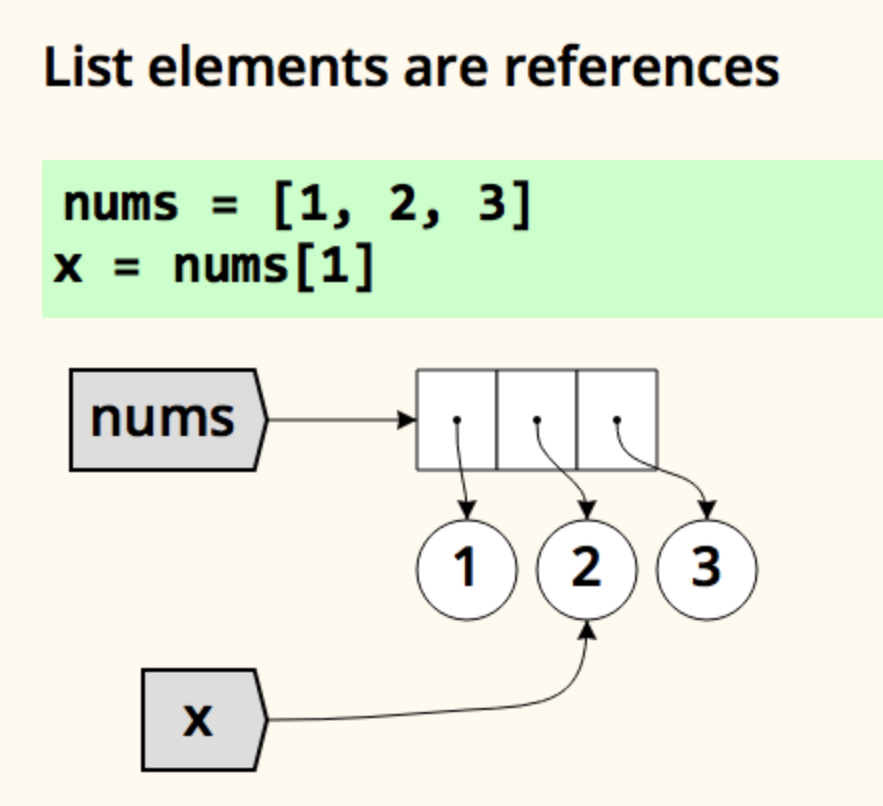
Assignment in Python might surprise you. How do names and values work? This presentation explains it all.
iron perch
Dies of confusion
raven ridge
you're expecting inconsistent behavior from =. You're expecting that the first time you use = in that function, it makes the left hand side refer to the same object as the right hand side, and the second time you use = in that function, instead of making the left hand side refer to a different object, it modifies the object that the left hand side is referring to and gives it a new value.
it doesn't work that way, = always does exactly the same thing
Seriously, watch Ned's talk on this, or read the slides. It will help you understand it much better.
 native flame
when you do white_turn = False it forgets all about self.is_white_turn, it only knows about False now
if you had the two labels self.is_white_turn and white_turn on the same box, white_turn = False moves one of those labels to another box, leaving the previous label unaffected
iron perch
Oh that makes sense
raven ridge
Let's imagine that there are no references to either True or False anywhere in the program. Assuming that in your __init__ you're doing self.white_turn = True, now self.white_turn is a reference to True, and there is 1 reference to True and 0 references to False.
Then in your function to change whose turn it is, you do: py white_turn = self.is_white_turn and now there are two references to True (white_turn and self.white_turn) and 0 references to False.
Then later in your function to change whose turn it is, you do: py if white_turn: white_turn = False and now there is one reference to True (self.white_turn) and 1 reference to False (white_turn)
Then you do py return and now there is one reference to True (self.white_turn) and 0 references to False (because white_turn is a local variable that disappears after the function ends)
iron perch
I get it now 
raven ridge
nice. But seriously, watch Ned's talk, or read the slides. You'll get it better, and it will cement the knowledge. 🙂
verbal escarp
@halcyon trail i thought about what you mentioned the other day, the notion of public and private dependencies, and i must say i really like that idea
i don't think pip/conda are in direct competition with justuse, it's more complementary
i can well imagine that people start a project using pip and classical installs, with an environment and at some point realize they might want private dependencies to be more self-contained for deployment on different platforms without resorting to docker
or that a user runs into a situation where pip/conda would just give up because dependencies couldn't be resolved without conflicts
i don't think justuse can or should try to replace environments and other traditional deployment methods, but rather complement them
the two solve different problems and i think that's good
 stuck valley
Hi. I'm a programmer interested in getting deep into the horrible internals of Python.
Does python 3.9 have an equivalent of python 2.x's __metaclass__ global variable?
verbal escarp
why do you need to get into python 2?
stuck valley
I'm not. The guide to metaclasses I'm using is a few years old.
stuck valley
I can't find one.
I'm a skilled programmer (7 years), but I've only been using python for three.
verbal escarp
there are worlds between 3.9 and 2 when it comes to internals
stuck valley
I'm aware of that. That's why I asked if 3.9 had an equivalent. Has it been removed entirely?
verbal escarp
https://stackoverflow.com/questions/56057132/why-global-variable-metaclass-not-working <- apparently

Stack Overflow
I define some func here, it will change all user defined attribtutes into upper case
def up(name, parent, attr):
user_defined_attr = ((k, v) for k, v in attr.items() if not k.startswith('_'))
...
i haven't worked with metaclasses much so far, but given that the class system was revamped, that's hardly surprising they also changed those implementation details
verbal escarp
well, what exactly are you trying to do?
https://docs.python.org/3/reference/datamodel.html#metaclasses might be helpful
native flame
what did the global __metaclass__ do in python 2?
if you just want the metaclass of some class A, type(A) should give you that
stuck valley
native flame
what did the global `__metaclass__` do in python 2?
All classes created without a metaclass attribute would be instances of it
native flame
oh
spark magnet
stuck valley
All classes created without a metaclass attribute would be instances of it
I haven't followed those changes closely, but that kind of action-at-a-distance in python 2 is the kind of thing I could see them getting rid of.
stuck valley
I hope there's a workaround.
spark magnet
stuck valley
I hope there's a workaround.
Can you say more about what you are trying to do?
stuck valley
stuck valley
Hi. I'm a programmer interested in getting deep into the horrible internals of P...
^
verbal escarp
read the source 😄
spark magnet
OK, you don't need a workaround then, because you don't have a problem. That's an old-style class feature, and old-style classes are gone.
stuck valley
Specifically, my latest project is converting this line in my .pythonrc to 3.9.
__metaclass__=lambda*_:type('',[],{})
I'm well-aware of how bytecode works.
spark magnet
stuck valley
Specifically, my latest project is converting this line in my `.pythonrc` to 3.9...
Why was that line there? What did it do for you?
stuck valley
That line breaks most classes.
verbal escarp
???
spark magnet
why do you want that?
stuck valley
It's for fun.
spark magnet
OK, then the workaround is to do a different fun thing 🙂
stuck valley
If you can't answer that, I do have another question about metaclasses. It is also a fun thing.
verbal escarp
then sorry for python3 to spoil your fun?
stuck valley
verbal escarp
then sorry for python3 to spoil your fun?
Eh, I guess it's an incentive not to use python2.
spark magnet
there are plenty of reasons to not use python2!
verbal escarp
stuck valley
If you can't answer that, I do have another question about metaclasses. It is al...
what's that?
stuck valley
class math(metaclass=lambda*q:__import__(q[0])):0
With this python 3.9 program, how can I convert it into a single call to type(), in the form
math=type(...)
?
I apologise for bad practice. This is just a learning experience.
stuck valley
Would you like some more examples of bad code? I'm happy to oblige.
By the way, I normally write clean code.
 peak spoke
You'd use your lambda thing in place of type
stuck valley
Could you elaborate?
verbal escarp
stuck valley
Would you like some more examples of bad code? I'm happy to oblige.
By the way, ...
i'd love to, and i believe you 😄
stuck valley
import sys
import marshal
import types

file=sys.argv[1]

magic=b'\x61\x0d\x0d\x0a\x00\x00\x00\x00\x00\x00\x00\x00\x00\x00\x00\x00'

f=open(file)
t=f.read()
f.close()

code=compile(t,'','exec')

new=types.CodeType(code.co_argcount,code.co_posonlyargcount,code.co_kwonlyargcount,code.co_nlocals,code.co_stacksize,code.co_flags,code.co_code,code.co_consts,code.co_names,code.co_varnames,'','',0,b'')

f=open('.'.join(file.split('.')[:-1])+'.cpython-'+str(sys.version_info.major)+str(sys.version_info.minor)+'.pyc','wb+')
f.write(magic+marshal.dumps(new))
f.close()
python compiler that produces 16% smaller files than the official compiler
#The virgin:
print('foobar')
#The chad
import sys
sys.stdout.write('foobar')
#The megachad
__import__('sys').stdout.write('foobar')
#The gigachad
__builtins__.__import__('sys').stdout.write('foobar')
#The ultrachad
getattr(__builtins__,'__import__')('sys').stdout.write('foobar')
#The überchad
getattr(globals().get([*globals()][-1]),'__import__')('sys').stdout.write('foobar')
#The exachad
getattr(globals().get([*globals()][-1]),''.join(map(lambda _:chr(0x2fdfe9cb7f0dba6fdf>>7*_&127),range(10))))('sys').stdout.write('foobar')
text=lambda depth,data,start='',end='\n\n',seed=0:(k:=__import__,sys:=k('sys'),random:=k('random'),(lambda r=random.seed(seed or None),head=[data[i-depth:i]for i in range(len(data))],output=list(start or data[:depth]): (lambda a=any(((output.append((arr:=[data[j]for j in[i for i in range(len(head))if head[i]==''.join(output)[-depth:]]],random.choice((head,arr)[len(
arr)>0]))[1]),1)[end in output]for _ in range(sys.maxsize))):''.join(output))())())[3]
when did #esoteric-python get renamed to #internals-and-peps 😛
verbal escarp
lmao
stuck valley
I'm new here. I didn't realise that channel existed.
verbal escarp
although, most of those aren't even esoteric or horrible
verbal escarp
nah, just bad
stuck valley
The first one is weak. I'm improving it right now.
peak spoke
stuck valley
Could you elaborate?
Meta(name, bases, dict) is equal to class name(metaclass=Meta): ...
stuck valley
I'm going to work on a ton of optimisations to nested codetypes.
stuck valley
peak spoke
`Meta(name, bases, dict)` is equal to `class name(metaclass=Meta): ...`
The issue is that I only want math to appear as the variable name, and nothing else.
verbal escarp
sys.stdout.write('foobar')``` that conjures up bad java memoriesI'm not sure I understand
stuck valley
I want the class to take the name of the module to import from the name of the variable. Is this possible?
stuck valley
?
stuck valley
I don't understand. Code example?
 dusty verge
@stuck valley

Idk if this is what you want to do
Btw this is (probably) very bad practice
 prime estuary
It's not that bad, many packages will do this, especially before __getattr__() was supported as a module function. You could do it to make the module callable to avoid from blah import Blah repetitiveness, or lazily import things only when actually used.
swift imp
What is this module __getattr__() stuff? Never heard of it.
 valid rose
__getattr__ is called when you try to access an attribute that doesn't exist, atleast for classes
swift imp
That I understand
For modules it seems to be some weird mechanism for creating warnings and raising exceptions
swift imp
no
halcyon trail
sorry, not just those that don't exist
swift imp
__getattribute__ is called no matter what
valid rose
that would be __getattribute__
swift imp
reading the PEP, it seemed like previously, some really smart people were subclassing typing.ModuleType and setting __class__ of a module to that custom subclass to handle this stuff.
valid rose
__getattr__ is the guy who is called when the attribute doesn't exist, and __getattribute__ is called for any attribute
swift imp
__getattribute__ is one I've never played with, probably should so I can learn how to handle the descriptor protocol correctly.
swift imp
Subclassing types.ModuleType looks like fun
Wonder what kind of shenanigans could be had with that
verbal escarp
swift imp
Wonder what kind of shenanigans could be had with that
well, @paper echo and i implemented properly working, threaded hot reloading with that "trick" for justuse
i'm also researching a way to realize module-level variable guards aka module properties, where that might be of use
just to mention two "shenanigans" 🙂
swift imp
verbal escarp
i'm also researching a way to realize module-level variable guards aka module pr...
That be interesting
 slow creek
 grave jolt
@slow creek If you have a question, see #❓|how-to-get-help and claim a help channel.
also, tell what exactly you need help with
(btw, today is 2021, not 2020)
quasi hound
Do you know what a screenshot is
 white nexus
grave jolt
(btw, today is 2021, not 2020)
white nexus
grave jolt
(btw, today is 2021, not 2020)
since when ????
grave jolt
since 01.01.2021 🙂
verbal escarp
import datetime
def seconds_since_beginning_of_year(dt: datetime) -> int:
        return (dt - datetime.datetime(dt.year, 1, 1)).total_seconds()

print(seconds_since_beginning_of_year(datetime.datetime.now()))
all hail github copilot 🙂
 charred pilot
that was generated by it?
verbal escarp
yeah, but i had to sift through a few nonsensical suggestions first ^^
can't just blindly accept suggestions
 gusty marsh
Hmm, it uses github code right? does it abide the licenses 
verbal escarp
there is nothing to abide by, it generates code and doesn't (at least shouldn't) blindly copy code
gusty marsh
hmm,i mean wouldn't you need to license it even if you copy and edit the code, anyway getting offtopic
grave jolt
I think we just need to wait for it to be settled in court
charred pilot
that's probably going to be a shitshow
verbal escarp
there is pretty interesting reading material on that, although we'll probably get a lot more once it hits the main stage
verbal escarp
grave jolt
I think we just need to wait for it to be settled in court
i don't think there is anything to be settled. it's a tool, like autocompletion extensions and the one who uses it needs to make sure their code doesn't violate anything..
maybe there's a need in the future to have a license validator plugin of sorts to check before releasing stuff
maybe not
here is a nice read on the subject: https://docs.github.com/en/github/copilot/research-recitation
A first look at rote learning in GitHub Copilot suggestions.
static bluff
Question about Cython
I know that Cython is only faster than Python in the ways that it's faster. One of the key ways to leverage the speed of Cython is to use only Cythonic types, to avoid overhead on conversion from the pythonic equivalents when possible
I wanted to know if defining a class in Cython with Python syntax is considered 'a cythonic type'
 winter ridge
any gentleman can help me out ?
static bluff
I just can't see to get my head wrapped around this performance thing
winter ridge
😛
verbal escarp
@static bluff just test it and look at the numbers if you're really interested
winter ridge
i have a small script that i havent done it myself i bought it tho 🙂 it has a small glitch and the developer not fixing it , i was hoping if some1 can find a solution for it
verbal escarp
we can speculate (i would say it's cythonic) but other than refering to docs, there is only looking at the code itself and doing benchmarks
verbal escarp
winter ridge
i have a small script that i havent done it myself i bought it tho 🙂 it has a s...
solution?
why would you "buy" a script?
that sounds fishy
grave jolt
winter ridge
i have a small script that i havent done it myself i bought it tho 🙂 it has a s...
I guess you can open a help channel (see #❓|how-to-get-help), but this community is generally for people who want to learn Python or just like Python
winter ridge
grave jolt
I guess you can open a help channel (see <#704250143020417084>), but this commun...
the problem is id like to keep it private
dont wanna spread the code , the dev will be made 😛
mad
grave jolt
I guess you can hire someone else (or the previous developer), but this is certainly not the place for that
also, wrong channel
winter ridge
ok do u know any place i can look at?
grave jolt
winter ridge
ok do u know any place i can look at?
Any job/freelance board, or just the place where you found that developer.
winter ridge
ok , thanks
paper echo
static bluff
I wanted to know if defining a class in Cython with Python syntax is considered ...
No, it's just a class defined in Cython, which means it's effectively a C extension. But nobody says "cythonic" that i know of
static bluff
Rolls off the tongue though 😛
halcyon trail
someone who knows cython really well: cythonista
 slow acorn
how do you know you're a Python expert?
unkempt rock
slow acorn
how do you know you're a Python expert?
 slow acorn
waits for an excellent answer
unkempt rock
slow acorn
how do you know you're a Python expert?
when you don't need any help coding what you want
slow acorn
what if you need help but you're too proud to ask and eventually figure it out anyways?
that's my problem sometimes...
deft pagoda
probably not exactly on topic for this channel
slow acorn
ok, how about memory management in CPython, then?
Which C file is this handled in?
GitHub
The Python programming language. Contribute to python/cpython development by creating an account on GitHub.
slow acorn
So how do the arenas work?
anyone ever have a highly successful usage of metaclasses? what made it successful? would you use the solution again?
 coarse urchin
Alright I hope it's the right place. I don't know python well enough, but I wanted to ask some implementation details. How do you store variables? Like, for instance, an int, double, and what about reference types?
I assumed there might be some type union mechanism which would store all tiny data structures as value types (like int, etc.) and others as reference types unconditionally allocating them on heap. But in reality, I don't know. Is there a short answer to this?
visual shadow
python abstracts memory management away from you. so, you have zero control over this. but short answer? everything is an object in python, everything goes on the heap more or less
coarse urchin
Right, but does it mean that every variable I work with is essentially a reference type?
flat gazelle
yes
visual shadow
yes
coarse urchin
So, a list of ints is in fact a list of references to random places all over your memory?