#algos-and-data-structs
1 messages · Page 139 of 1
 ivory yacht
But there's no real need to nest, in Java that makes it private and only accessible to code in the list class, Python doesn't do that.
 worldly osprey
what does python do then? because im assuming once i nest Node i wont be able to access it out of LinkedList
 agile sundial
yep actually you could, but you would need to get it through the linked list class
worldly osprey
i am thinking i should leave the current playlist im watching which is this one https://www.youtube.com/playlist?list=PLpPXw4zFa0uKKhaSz87IowJnOTzh9tiBk by Dr. Rob Edwards and rather follow
https://www3.cs.stonybrook.edu/~skiena/373/videos/ by Steven Skiena since this is in C which i know (a bit) and hence should be easier to follow?
since im not too far in the first one
i am not leaning for the mit open courseware 6006 since it has pre-requisites which i dont know
 steep moat
In my opinion, this is the best tutorial on YouTube about Data Structures. He uses C/C++ but its super intuitive. Try implementing those data structures in Python as a challenge and it'll fun:
https://www.youtube.com/watch?v=92S4zgXN17o&list=PL2_aWCzGMAwI3W_JlcBbtYTwiQSsOTa6P
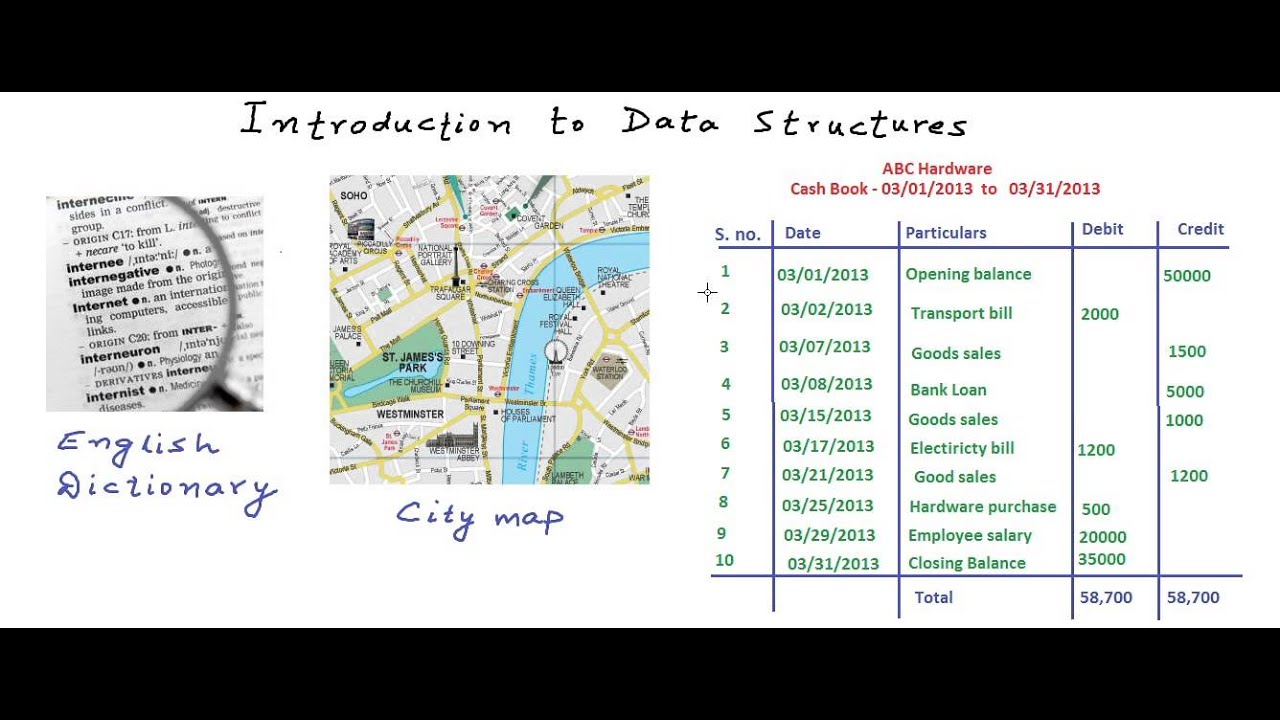
See complete series of videos in data structures here:
http://www.youtube.com/playlist?list=PL2_aWCzGMAwI3W_JlcBbtYTwiQSsOTa6P&feature=view_all
In this lesson, we will introduce you to data structures as ways to store and organize data in computer.
Feel free to drop your question, feedback or suggestion in comments section.
You may also like ...
 limber sedge
steep moat
In my opinion, this is the best tutorial on YouTube about Data Structures. He us...
limber sedge
steep moat
In my opinion, this is the best tutorial on YouTube about Data Structures. He us...
thanks mate
 steep gorge
has anyone tried to solve leetcode 120 triangle problem through applying recursion only ? if so can you please explain your thought process on this plss
agile sundial
wouldn't be a bst, just a binary tree
agile sundial
steep gorge
has anyone tried to solve leetcode 120 triangle problem through applying recursi...
the general idea is you want to compare the cost of the left branch vs the cost of the right branch
then add the cost of the current node to that
that's the cost of the tree rooted at the current node
agile sundial
 old rover
and then use DFS?
old rover
and then use DFS?
you were recently studying dp right? you can use it for this problem
 sick bear
Hmmmm, anyone familiar with Bitcoinlib?

 runic tinsel
It can't be abcedf, you would visit both e and f from c
 orchid depot
how to slice a string to a spesefic value
old rover
 bright ginkgo
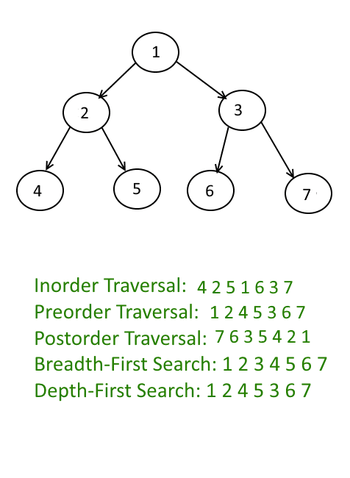
https://open4tech.com/wp-content/uploads/2019/01/BFS-DFS.png
bright ginkgo
https://open4tech.com/wp-content/uploads/2019/01/BFS-DFS.png
depth first search means the search goes till dead ends or the leaf nodes in that tree to the right so yes i think so
bright ginkgo
ok then whats the correct order for dfs?
old rover
runic tinsel
It can't be abcedf, you would visit both e and f from c
can't visit F from C bc F points to C

A, B, C, E, D, F
what you said @bright ginkgo was correct
bright ginkgo
thats what i said
old rover
yep
bright ginkgo
somebody said i was wrong
old rover
they didn't see the arrow from F pointing to C
they thought the edge was pointing from C to F
bright ginkgo
i swear hte more questions i ask the more i get confused cause people giving me wrong answers
old rover
it's a hard arrow to spot unless you double click on the picture
old rover
yep
old rover
bc you'd have to explore C's neighbors before you go to D's
steep gorge
agile sundial
the general idea is you want to compare the cost of the left branch vs the cost ...
Cheers
bright ginkgo
I get that
bright ginkgo
but looking at the image confused me. I assume whoever is posting that pic is an expert in the subject
steep gorge
bright ginkgo
https://open4tech.com/wp-content/uploads/2019/01/BFS-DFS.png
I think you should look into types of DFS pre, post and in order. There's a variation of DFS
old rover
ohh
which type of dfs is that
i forgot there are three dif types of dfs traversales for trees
steep gorge
Preorder in order and post order DFS traversal
old rover
right
but which one is that one
the ordering given in the picture
is it pre order, post order, or in order?
in order i think is left, root, right?
agile sundial
it's not a binary tree
old rover
oh yeah
steep gorge
Google geeks for geeks they got good explanation
old rover
those only work for bsts
 old rover
post order is left, right, root
bright ginkgo
so whats the correct order?
for postorder
and tell me that the image shown isnt wrong
im 99% sure it should be 4 5 2 1 6 7 3
agile sundial
old rover
those only work for bsts
not just bst, binary trees in general
old rover
yes my bad
binary trees have a max of two children per parent node
that tree has three
max
counting
bright ginkgo
whats the correct order for postorder for that diagram?
theres so much shitty material out there sharing wrong information
old rover

Step by step instructions showing how to do post-order tree traversal on a binary tree.
Source: https://en.wikipedia.org/wiki/Tree_traversal
LinkedIn: https://www.linkedin.com/in/michael-sambol-076471ba
screw GFG
use this
michael sambol is much better
that's what i used when i went over trees
bright ginkgo
@old rover you dont know the order do you?
steep gorge
bright ginkgo
https://miro.medium.com/max/350/0*YzOEfnGnWTPbsUkv
Post order 4 , 5 ,2 , 6, 7, 3 ,1
bright ginkgo
anyways, I had enough. I'm just gonna grab a uni textbook and just use that for all my info.
too many so called people on the web pretending to be experts
old rover
the majority of problems i've seen use in order
steep gorge
old rover
mostly isn't in order used
Depends what type of DFS u wanna use
bright ginkgo
also in that image, why is pre-order and depth first search the same?
steep gorge
old rover
the majority of problems i've seen use in order
If u check on leetcode it specifically asked which order to do also there are few questions which type of search traversal u want to use
steep gorge
bright ginkgo
also in that image, why is pre-order and depth first search the same?
I think you are confused with DFS and types of traversal
bright ginkgo
DFS has 3 types of traversal methods. I get that
steep gorge
All of these traversal pre post and in order they are all known DFS
bright ginkgo
but DFS is just a general term right? If someone says search a tree using DFS, wouldnt they have to tell you exactly which DFS method to use?
steep gorge
bright ginkgo
but DFS is just a general term right? If someone says search a tree using DFS, w...
Not really. U can do the traversal you prefer to use
bright ginkgo
yes so DFS can mean in order, pre order, post order right?
bright ginkgo
ok then why include Depth First Search listed in the ordering in the image. they make it seem as if there are 4 DFS types of traversal methods
cause it all depends
just list the 3
do you get what I'm trying to say?
anyways that picture is just bad in general.
looking that at that image yesterday wasted like 2 hours of learning for me
steep gorge
In that pic it's basically visiting each node start from root and going down to leaf and then right which you can do too.
steep gorge
bright ginkgo
looking that at that image yesterday wasted like 2 hours of learning for me
Lol that's normal I guess
bright ginkgo
@steep gorge ok thanks for the help
agile sundial
bright ginkgo
but DFS is just a general term right? If someone says search a tree using DFS, w...
generally, since you're looking for something, it makes sense to check a node as soon as you reach it. for this reason, only pre-order makes sense
 idle pier
Hello folks, I'm currently doing 713. Subarray Product Less Than K
def numSubarrayProductLessThanK(self, nums: List[int], k: int) -> int:
l = 0
output = 0
product = 1
for r in range(len(nums)):
product *= nums[r]
if product >= k:
while product >= k and l <= r:
product /= nums[l]
l += 1
output += r - l + 1
return output```
What exactly is `product /= nums[l]` doing? vocal gorge
idle pier
Hello folks, I'm currently doing `713. Subarray Product Less Than K`
```py
def n...
vocal gorge
idle pier
Hello folks, I'm currently doing `713. Subarray Product Less Than K`
```py
def n...
Divides it by nums[l].
what this solution is doing is noticing that when you slide the window by one, one element slides into it and one out of it
so all you need to adjust the product is to multiply by the new one and divide by the one that slid out.
This only works if there's no zero elements in the array, though.
idle pier
vocal gorge
This only works if there's no zero elements in the array, though.
yea I think its one of the given in the problems, there will never be a 0 in the array
@vocal gorge the l <= r condition, in the beginning I thought I understood that condition but now am a little confused. Is the condition basically just checking that we dont go out of range?
Imagine the input is this nums = [10,5,2,6], k = 100
vocal gorge
At any time, the product is the product of the elements nums[l:r+1], basically
so yes, it's checking we don't adjust the left side of the window so much it goes beyond the right one
 pallid coral
!mute 699113369650593843
 halcyon plankBOT
:incoming_envelope: :ok_hand: applied mute to @supple bolt until <t:1639218380:f> (59 minutes and 59 seconds).
 blazing umbra
Hi guys i'd need some help somebody wanna join #help-croissant real quick 🙂
 drifting spindle
Hey guys
I currently have a problem with my code
def compare(guess, target):
    guessList = []
    targetList = []
    x = 0
    y = 0
    checkString = ''
    for targetLetter in target:
        targetList.append(targetLetter)
    for guessLetter in guess:
        guessList.append(guessLetter)
    while y != len(guess):
        if guessList[x] in targetList:
            letterInTarget = True
        else:
            letterInTarget = False
        if guessList[x] == targetList[x]:
            letterInRightPlace = True
        else:
            letterInRightPlace = False
        if letterInRightPlace:
            checkString += 'X'
        elif not letterInRightPlace and letterInTarget:
            checkString += 'O'
        else:
            checkString += '-'

        y += 1
        x += 1


compare('health', 'teethe')
Currently I have 2 words that I compare
And this is what I have to solve:
Implement a function compare(guess, target) that compares a guessed word
with a target word. You may assume that the two inputs are strings of the same
length that entirely consist of lowercase ASCII letters. The output is a string of
that same length consisting of the symbols X, O, and -, where X represents a red
square, O represents a yellow circle, and - represents nothing (i.e. wrong letter).
Note: O is the letter O, not the number 0.
Examples:
compare("health", "teethe") must return "OX--O-"
compare("rhythm", "teethe") must return "---XX-"
compare("mutate", "teethe") must return "--O-OX"
if I compare health and teethe, it should return "OX--O-"
But it returns "OX--OO" instead
Any idea how to fix that issue?
 merry nimbus
drifting spindle
Any idea how to fix that issue?
merry nimbus
drifting spindle
Any idea how to fix that issue?
Try a help channel
steep moat
drifting spindle
And this is what I have to solve:
Implement a function compare(guess, target) t...
It'd be nice if you could describe the question a little better. For instance, what do you mean by "Red circle" or "Yellow circle" and why, for the letters 'h' and 't' the output is 'O'? On what basis do we tell if compare() of two chars returns that particular output char?
drifting spindle
Yeah, it's Lingo
Dunno if you're familiar with the concept
O stands for a letter that doesn't correspondent same position, but same letter in word
X stands for a letter that has the same position and letter
- stands for when there's no similar letter at all
 opal wadi
HI guys, what is the simplest way to simulate sigma notation in python? I've seen some standard functions in python that'll do it but is there a module so I could just do something like
import sigmamodule as s:
num = s.sigma(1,10.10)
print(str(num))
output is 100
#in this hypothetical function that isn't real, sigma(index value, number of iterations, number we are summing)
tag me if anyone has the answer
idle pier
Hello folks I'm currently doing 209. Minimum Size Subarray Sum and I solved it this way
def minSubArrayLen(self, target: int, nums: List[int]) -> int:
        if target > sum(nums): return 0

        l,r = 0,0
        curSum = 0
        minArr = sys.maxsize

        for r in range(len(nums)):
            curSum += nums[r]
            while curSum >= target:
                minArr = min(minArr,r-l+1)
                curSum -= nums[l]
                l += 1
        return minArr```
I was wondering is there another way to implement the `sys.maxsize` function without using this built in function, I'm not sure if during an interview they might accept `sys.maxsize`float('inf')
 tepid spruce
idle pier
Hello folks I'm currently doing `209. Minimum Size Subarray Sum` and I solved it...
tepid spruce
idle pier
Hello folks I'm currently doing `209. Minimum Size Subarray Sum` and I solved it...
you can use the fact that the answer can't be more than len(nums)
idle pier
runic tinsel
float('inf')
it works!
but can you elaborate a little more, I don't exactly know why it works
but isn't float(inf) greater than any value lol
(sorry if that sounds really dumb of me)
omg, nvm!!
I completely forgot we are taking the min of minArr
idk what I was thinking lol
 fluid sand
can someone help solve this

 next rampart
guys how do u type with a black color boxx
 dapper sapphire
         L        x  M  y        R
array = [1, 2, 3, 4, 5, 6, 7, 8, 9]
left = 1
middle = 5
right = 9
What can I name x and y?
tepid spruce
dapper sapphire
```
L x M y R
array = [1, 2, 3, 4, 5, 6, 7, 8, 9]
```
l...
what do you mean name x and y?
dapper sapphire
Name it how I have left, middle and right naming convention, so it makes it easy to know which number is located at which position.
Would naming x middle_left and naming y middle_right make sense?
tepid spruce
it'd make sense to me
dapper sapphire
pre_middle for x and post_middle for y
or
before_middle for x and after_middle for y
Because on a second though I can see middle_left and middle_right could cause some confusion.
tepid spruce
if those variables are only used briefly then I think any of those are fine. or you could refer to them like array[M+1] and array[M-1]. also, is array always a sorted range?
if it's sorted whole numbers then they might be referred to as predecessor and successor of the middle number (which would be the median if odd length)
tepid spruce
next rampart
guys how do u type with a black color boxx
I don't understand?
dapper sapphire
next rampart
guys how do u type with a black color boxx
Do you mean this?
Wrap your text in a back tick
tepid spruce
fluid sand
can someone help solve this
this looks like the lowest common ancestor problem
dapper sapphire
Yeah the array is always sorted, but sometimes rotated.
Yeah, I think [M + 1] and [M - 1] might be a better approach.
 slender sandal
opal wadi
HI guys, what is the simplest way to simulate sigma notation in python? I've see...
slender sandal
opal wadi
HI guys, what is the simplest way to simulate sigma notation in python? I've see...
sum(x for x in range(n, N + 1))
And you can manipulate the first x there.
vocal gorge
slender sandal
`sum(x for x in range(n, N + 1))`
And you can manipulate the first `x` there.
of course, you'll have some troubles with infinite sums 😛

(this converges to exactly pi/4)
that won't terminate though
my point is that summing series numerically often isn't easy
agile sundial
vocal gorge
of course, you'll have some troubles with infinite sums 😛
can senpaisympy do that?
vocal gorge
it's supposed to be able to
though in my experience it's pretty bad with analytic integration/sums compared to, say, mathematica
something like this it should be able to, though
 fiery cosmos
!e ```py
from sympy.abc import n
from sympy import Sum, oo
a = Sum((-1)**n / (2 * n + 1), (n, 0, oo)).doit()
print(a, float(a))
@fiery cosmos :white_check_mark: Your eval job has completed with return code 0.
pi/4 0.7853981633974483
it knows 
 fathom orbit
Hey
super new to python, currently doing beginner exercises, am on a password generator and for the meantime im using what i know so its very sub-optimal
basically i got three lists for letters,numbers,and symbols but i dont always want it to run the pattern of generating a letter,then a number,then a symbol (e.g. password="s4%g2@"
so i thought of implementing white space into the lists as well, but when generating the password it keeps spaces in between and i cant figure out how to remove the space
any help?
from random import randint
`import random
letters = ["q", "w", "e", "r", "t", "y","u","i","o","p","a","s","d","f","g","h","j","k","l","z","x","c","v","b","n","m"," "," "," "," "," "," "," "," "," "," "," "," "," "," "," "," "]
numbers =["1","2","3","4","5","6","7","8","9"," "," "," "," "," "," "," "," "]
symbols = ["!", "@", "#", "$", "%", "^", "&", "*"," "," "," "," "," "," "," "," "]
passwordList=[]
for i in range(0,randint(5,20)):
l=random.choice(letters)
n=random.choice(numbers)
s=random.choice(symbols)
passwordList.append(random.choice(l))
passwordList.append(random.choice(n))
passwordList.append(random.choice(s))
i+=1
passwordList.remove(" ")
print(''.join(passwordList))`
sorry for long block of text
ivory yacht
fathom orbit
Hey
super new to python, currently doing beginner exercises, am on a password ge...
Well, one way you could do it is to generate however many of each kind of symbol that you want, then afterwards shuffle the list. The reason your current code isn't working though is that list.remove() removes the first item it finds that matches, not all of them.
 jolly mortar
random.shuffle yeah
fathom orbit
ivory yacht
Well, one way you could do it is to generate however many of each kind of symbol...
is there a shuffle function in py?
 brazen grail

Hi guys! I am using the above code, to first extract valid worlds that start with any alphabet from the string, and then it returns a list of string in words identifier, and then i am traversing that words list and again finding if that word is a stopword i need to ignore it. The problem is i have to traverse two times. Can someone tell me how I can do the checking while the split() function checks for the valid word can it also check for the stop words?? I am fairly new at python and tried to read the documentation, but didn't understand anything.
First I have a whole article written in the item['content'] string. Now, I have to extract all the valid words from it , words with the pattern in the regex [^a-ZA-Z] whose starting character is an alphabet and also if the starting character is alphabet, i then want to check if it is a stop word or not, if it is not a stop word then i want that word in my list of words. Problem with using split(), is that it just gives all the list of valid words using strings and then i have to traverse through all the words in the list to find stop words.
I want to remove the stop words while it checks for the valid word
tepid spruce
brazen grail
First I have a whole article written in the item['content'] string. Now, I have ...
maybe re.finditer would help?
 brave rain
just curious is it bad to use super() with polymorphism inheritance
agile sundial
what is polymorphism inheritance
old rover
!pastebin
halcyon plankBOT
Pasting large amounts of code
If your code is too long to fit in a codeblock in discord, you can paste your code here:
https://paste.pythondiscord.com/
After pasting your code, save it by clicking the floppy disk icon in the top right, or by typing ctrl + S. After doing that, the URL should change. Copy the URL and post it here so others can see it.
old rover
i keep getting memory addresses when i try to print the nodes of the depth first traversal
<__main__.Node object at 0x7fb30434dfa0>
<__main__.Node object at 0x7fb30434dbb0>
<__main__.Node object at 0x7fb3042b7640>
<__main__.Node object at 0x7fb3042b7e20>
<__main__.Node object at 0x7fb308247850>
<__main__.Node object at 0x7fb3042b7eb0>
i think i'm calling the function wrong
also the indentation is off i think?
hmm
i'm gonna revise my oop
and also since i used a constructor i don't have to keep doing node.left and node.right over and over again
that defeats the point of a constructor
jolly mortar
old rover
i keep getting memory addresses when i try to print the nodes of the depth first...
that's what the default string representation of objects look like
if you want to change that, add __str__ and/or __repr__ method(s) to your class
old rover
jolly mortar
that's what the default string representation of objects look like
if you want t...
gotcha
 lyric swallow
Hey everyone! I just started college 2 months back and started learning C as a mandatory language prescribed by the professor. Earlier I was inclined towards C++ because competitive programming but over a couple of weeks of research, I've found that I am much more interested in open source contribution. As I am about to start getting into Data Structures and Algorithms, everyone says C++ is the better option for it rather than python. But looking at the Open Source community, Python and Java are much more prevalent and have a wider community reach. As per my understanding, language is not a barrier for DS and Algorithms and one can easily switch from one language to another once the basics are clear.
So just wanted to ask that is it a good option to learn a language like C++ ( which does have a lot of pros as compared to Python) or it doesn't really matter for DS and Algorithms?
old rover
lyric swallow
Hey everyone! I just started college 2 months back and started learning C as a m...
afaik ds/algos are langauge agnostic
meaning it doesn't matter what language you use to learn it they're applicable other than syntax differences
for example if you learned ds/algos in java it shouldn't be too difficult to apply it in python
lyric swallow
old rover
meaning it doesn't matter what language you use to learn it they're applicable o...
yeah thats what I have learnt as well! Gonna stick to Python as of now. Thank you so much for the help! I really appreciate it
old rover
no prob, happy to help
 lunar jacinth
Hello
    def addTwoNumbers(self, l1: Optional[ListNode], l2: Optional[ListNode]) -> Optional[ListNode]:

        node1 = l1 # copy of the listnode
        # print(node1)
        node2 = l2 # copy of the listnode

        arr1 = [str(node1.val)] # because I'm lazy and want to use while node1.next
        # print(arr1)
        arr2 = [str(node2.val)] # same as above but while node2.next
        while node1.next: #creating a list of values for node1
            node1 = node1.next
            # print(node1)
            arr1.insert(0, str(node1.val))
            # print(arr1)
        while node2.next: #creating list of values for node2
            node2 = node2.next
            arr2.insert(0, str(node2.val))
        new = int(''.join(arr1)) + int(''.join(arr2))
        print(new)
        first = last = ListNode(new % 10)
        print(first)
        while new > 9: #iterate through new to create a listnode
            new //= 10
            # print(new)
            last.next = last = ListNode(new%10)
            # print(ListNode(new%10))
        return first

``` Just out of curiosity, what time complexity would this function be?It has 3 while loops
Is this O(3n) or O(n)?
 shut breach
O(3n) and O(n) are exactly the same thing
O(n) is the class of functions that scale linearly with their input
 mild dove
also, you need to understand what n means. there is two nodes, you can say n is size of l1 and m is size of l2 and the complexity O(m+n). the last while uses the variable new, not a list so I think it's O(1)
 dark osprey
Is there a solution to secondary clustering in Quadratic Probing?
 violet sluice
Hey, can anyone recommend any yt vids for learning algorithms and data structures?
fiery cosmos
violet sluice
Hey, can anyone recommend any yt vids for learning algorithms and data structure...
Not sure about yt vids but you can check pins for other resources
fiery cosmos
    print("\n")
    x = len(Atm)
    y = 0
    z = 0
    go = 0
    while z <= x-1:
      go = 20 - len(Atm[y])
      while y <= x-1:
    print(BLUE + str(y+1) + End + ". " + GREEN + Atm[y] + End + "  -> " + CYAN + Atm_symbols[y] + End + "  -> " + PURPLE + Atm_mass[y] + End)
        y += 1
z += 1```Plz tell the error
Atm and other lists are not mentioned but they are listed ocrrectly
also, these variables are junk variab;e
next rampart
dapper sapphire
`Do you mean this`?
yes
 surreal sable
I wanna learn dsa in python
could some here help me out
I don't have any proper source for it
agile sundial
check the pins in this channel
 hard basin
import pygame
import random

pygame.init()

screen = pygame.display.set_mode((800,600))

pygame.display.set_caption("Catch The Egg")

icon = pygame.image.load("Egg/egg.png")
pygame.display.set_icon(icon)

#Basket
basket_img = pygame.image.load("Egg/picnic-basket.png")
basket_x = 400
basket_y = 200
basket_x_change = 0

def basket(basket_img,x,y):
    screen.blit(basket_img,(x,y))

#Egg
egg_img = pygame.image.load("Egg/egg.png")
egg_x = 400
egg_y = 200
egg_x_change = 0

def egg(egg_img,x,y):
    screen.blit(egg_img,(x,y))

#BG
backdrop = pygame.image.load("Egg/bg.jpg")


pygame.display.update()
I am having a syntax error, what's wrong?
 stone brook
Anyone have literation about NPCR or UACI?
 gusty elk
http://worrydream.com/LearnableProgramming/ (Here's a trick question: How do we get people to understand programming?)
 sturdy magnet
problem solved ty
 rough compass
I had an interview today where we have an n^2 solution. Then I make it nlogn.
Then he asked if I sorted something could it make it faster. I said yes but wasn't sure how. What algorithm can I read about for this?
 next oxide
brucie give your task from interview
 wraith temple
Now there is
bright ginkgo
if I have a graph that looks like
                 6
                /
        1     5
      /  \  / | \
     4    2  ――― 7
      \  /  \ | /
        3     8
      /   \
    10     9
DFS
Order 1: 1 4 3 2 7 5 6 8 9 10
Order 2: 1 2 5 8 7 6 3 10 9 4
If you start at 1, which order is correct?
thanks
next oxide
ricky both correct if visit every place
bright ginkgo
@next oxide ok thanks
rough compass
next oxide
brucie give your task from interview
Write a function that takes two lists. A list of names for a flight and a no fly list. How can you do better than nlogn? Naive approach is n^2, for every person check the whole no fly list.
I’d love to know the name of the sorted approach so I can study it
next oxide
brucie what exactly u need check in no fly list?
next oxide
cuz maybe it is possible in linear it depend what u need find
rough compass
next oxide
brucie what exactly u need check in no fly list?
Membership
Is name equal to name
next oxide
try dictionary or set
rough compass
next oxide
try dictionary or set
I want an algorithm name
I think if both lists are to be sorted. You can solve the function in 3n
 harsh field
rough compass
I want an algorithm name
harsh field
rough compass
I want an algorithm name
I dont think there's a specific algorithm name for this
dastraido said you could use a dictionary/set, which are hashmaps.
You go through your no fly list, and add each name to your hashmap/dictionary/set
This uses up space
Then you run through your flight list and check your hashmap/dictionary/set for each name.
A hashmap operates in (practically) constant time.
So take your two lists
no fly is list a
and flight list is list b
Time complexity is O(a+b), space complexity is O(a)
otherwise, if you have to use two sorted lists, you could modify merge sort:
sort both lists alphabetically
then check if the first flight name is the same as the first no-fly name
if its not, and if first flight name is alphabetically before the no flight name, then go to the next flight name
otherwise, go to the next no flight name
similar to how merge sort works
 wraith kayak
rough compass
Write a function that takes two lists. A list of names for a flight and a no fly...
wraith kayak
rough compass
Write a function that takes two lists. A list of names for a flight and a no fly...
If by that you mean to remove/deprecate the no fly list from flights list -
• Simply convert both lists into sets, use the .difference() method and convert back to list. -- O(1)
• In case no fly list contains other names that dont appear in the flight list, use .union() and remove all those element from the original list. -- O(n)
next oxide
if it was sorted(input) you can just use two pointers
harsh field
wraith kayak
If by that you mean to remove/deprecate the `no fly list` from `flights list` -
...
This seems a lot better than my version.
I'm not experienced with using sets in python
next oxide
harsh field
This seems a lot better than my version.
I'm not experienced with using sets in ...
we don't know him task,so it is hard to find the best solution 🙂
harsh field
next oxide
we don't know him task,so it is hard to find the best solution 🙂
¯_(ツ)_/¯
next oxide
rough compass
Reading https://opendsa-server.cs.vt.edu/OpenDSA/Books/CS4104/html/SortedSearch....
for example this,earlier not mention about lists was sorted
harsh field
i meant that solution is just simpler, it uses less lines of code to achieve the goal
harsh field
next oxide
for example this,earlier not mention about lists was sorted
oh i didnt see this link, but it mentions an idea I also brought up
you can use min() to compare two strings, it returns the first in alphabetical order
agile sundial
next oxide
ricky both correct if visit every place
they aren't, the second goes from 2-5-8, without first getting 6 or 7
shut breach
agile sundial
they aren't, the second goes from 2-5-8, without first getting 6 or 7
8 is connected to 5 though
agile sundial
oh, I didn't notice that
shut breach
bright ginkgo
if I have a graph that looks like
```
6
/
...
with backtracks shown
1 4 3 2 7 5 6 | 8 | 9 | 10
1 2 5 8 7 | 6 | 3 10 | 9 | 4
idle pier
Hello folks, this might be a little silly
Let's say we have arr = [1,1,3,4,5,-1,0]
What's the difference between
for i in arr:```
and
```py
for i in range(len(arr)):```
Is it that for the first `for` loop we want to access the value of `arr` and the second `for` we want the index?try printing i and see what you get
idle pier
agile sundial
try printing `i` and see what you get
yup it was I as I suspected
idle pier
agile sundial
try printing `i` and see what you get
the first for loop we want to do something with the values and the second for loop we want to do something with the index
agile sundial
yep
dapper sapphire
Does dict_keys and dict_values have O(1) Time complexity and access?
agile sundial
if you mean O(1) membership test, keys does, values doesn't
dapper sapphire
agile sundial
if you mean O(1) membership test, keys does, values doesn't
So dic_values will be O(n)?
agile sundial
searching in it would be
dapper sapphire
oh ok thanks!
Question is to count palindromic substrings
class Solution:
    def is_palindrome(self, string:str, left, right) -> bool:
        while left < right:
            left_char = string[left]
            right_char = string[right]
            if left_char != right_char:
                return False
            else:
                left = left + 1
                right = right - 1
        return True
    def countSubstrings(self, s: str) -> int:
        count = 0
        for i in range(len(s)):
            for j in range(i, len(s)):
                if self.is_palindrome(s, i, j) is True:
                    count = count + 1
        return count
Above Times out.
But below passes. I thought creating a substring would be slow!?
class Solution:
    def is_palindrome(self, string:str) -> bool:
        return string == string[::-1]

    def countSubstrings(self, s: str) -> int:
        cache = {}
        count = 0
        for i in range(len(s)):
            for j in range(i, len(s)):
                sub_string = s[i:j+1]
                if sub_string not in cache:
                    boolean = self.is_palindrome(sub_string)
                    cache[sub_string] = boolean
                stored_boolean = cache[sub_string]
                if stored_boolean is True:
                    count = count + 1
        return count
So a substring via slice would be faster than iterating over?
Because in the first approach we iterate over elements to determine if it's a palindrome or not.
In the second approach if we replace the is_palindrome implementation with how it's done in the first approach, it still passes.
oh wow thanks!
 exotic hatch
fiery cosmos
exotic hatch
fiery cosmos
oops
 split sigil
bright ginkgo
split sigil
bright ginkgo
Is inserting a node in the middle of a linked list a normal operation?
Would your normally insert by order position or would you insert new node after n node element?
ivory yacht
Inserting in the middle is the thing linked lists are very good at doing in particular. You'd normally insert before/after a node you have a reference to, depending on the direction of the linking.
bright ginkgo
GeeksforGeeks
A Computer Science portal for geeks. It contains well written, well thought and well explained computer science and programming articles, quizzes and practice/competitive programming/company interview Questions.
If my understanding is correct, their insert method is wrong for their python code sample?
``Linked list after insertion of 12 at position 3: 3 12 5 8 10`
12 in this case is in position 2
I even tried changing the position to 4 and 5 but it seems like the code doesnt allow your to insert past position 2
I dont know if this is a bug or I'm just not understanding what the code is supposed to be doing
ivory yacht
It's quite confusing using a position starting at 1, and also then having a while loop with the if that always ends it early...
bright ginkgo
    head = getNode(3);
    head.nextNode = getNode(5);
    head.nextNode.nextNode = getNode(8);
    head.nextNode.nextNode.nextNode = getNode(10);
    head.nextNode.nextNode.nextNode.nextNode = getNode(15);
    head.nextNode.nextNode.nextNode.nextNode.nextNode = getNode(20);
The list is now 3, 5, 8, 10, 15, 20
if i do head = insertPos(head, 4, 500);
shouldnt it be 3, 5, 8, 10, 500, 15, 20?
ivory yacht
Yeah.
bright ginkgo
but I'm getting Linked list after insertion of 500 at position 4: 3 500 5 8 10 15 20
Am I just misunderstanding something?
ivory yacht
Clearly the code is wrong then?
bright ginkgo
I dont know. Maybe I'm wrong
idle pier
Hello folks I have a question about diagonal matrix traversal, here's my code
arr = [
    [1,2,3],
    [4,5,6],
    [5,6,7]
]

n = len(arr)
leftDiag = rightDiag = 0

for i in range(n):
    leftDiag = arr[i][i]
    rightDiag = arr[i][n-1-i]
    print(rightDiag)```

Am having a little trouble understanding how the `leftDiag` and `rightDiag` exactly work.
For example `leftDiag` starts at `[0][0]` which is `1`, since `leftDiag = arr[i][i]`, as it iterates through the matrix, `leftDiag` will only equal `[1][1],[2][2]` which are `5,7` and so on.
Is this correct?yep
idle pier
agile sundial
yep
ahh ok
For rightDiag = arr[i][n-1-i]
arr[i] basically means we are starting at the first row
and arr[n-1-i] is where am a little confuse
I know n-1 means that instead of starting from the left side, we instead start from the right side, just the -i gets me confused. I don't know what exactly it means
 eager dust
idle pier
Hello folks I have a question about diagonal matrix traversal, here's my code
``...
eager dust
idle pier
Hello folks I have a question about diagonal matrix traversal, here's my code
``...
What's your expected output?
agile sundial
idle pier
ahh ok
For `rightDiag = arr[i][n-1-i]`
`arr[i]` basically means we are starting ...
n is the length, 3, i increases from 0-2
agile sundial
agile sundial
n is the length, 3, i increases from 0-2
so on the first iteration, the value of n-i-1 is? @idle pier
idle pier
agile sundial
so on the first iteration, the value of n-i-1 is? <@799045300617871360>
rightDiag once the for loop is done is [3,5,5]
thats the right diagonal traversal
idle pier
agile sundial
so on the first iteration, the value of n-i-1 is? <@799045300617871360>
do you mean n-1-i?
if you do its, 3
agile sundial
it's 2
agile sundial
idle pier
if you do its, `3`
n is 3, i is 0, n-i-1 is 2
idle pier
agile sundial
n is 3, i is 0, `n-i-1` is 2
sorry am lost lol
where are you getting n-i-1 from?
idle pier
agile sundial
i accidently switched the order, but it's the same
oh really? I didn't know that lol
how does it equal 2?
agile sundial
3-0-1 is 2
idle pier
agile sundial
3-0-1 is 2
if its 2, how does it end up being [3,5,5]?
agile sundial
on the first iteration i = 0, right? so it's arr[0][2], which is 3
idle pier
agile sundial
on the first iteration `i = 0`, right? so it's `arr[0][2]`, which is 3
ohh you meant, that the index is 2?
If thats what you meant, I knew that lol
agile sundial
so what's wrong then?
idle pier
agile sundial
so what's wrong then?
What was getting me confused is the i. I know that n-1 means the right most index.
I just didn't know what exactly i was/is doing
ohhhh I think know why
ok since we want to start on the right which is n-1 but I want is the value, which is 3 but in order to access the value we must do a -i.
Is this correct?
agile sundial
idle pier
ok since we want to start on the right which is `n-1` but I want is the value, w...
i is just a number subtracting it doesn't do anything special
idle pier
agile sundial
`i` is just a number subtracting it doesn't do anything special
hmm ok, so i in the first iteration is 0, in the next iteration, it should be 1 and so on correct?
agile sundial
yep
idle pier
agile sundial
yep
I think I just realized what was my issue understanding that particular
It's because I was thinking about it this way n - 1 and not [n - 1]
Once its inside the [], its something different, correct?
agile sundial
it's just subtraction no matter where it is
the result of that subtraction can be used elsewhere, though
the [] are used to index the list in this case
agile sundial
idle pier
I think I just realized what was my issue understanding that particular
It's bec...
so first it does the subtraction, then it takes the result and uses it as an index into the list
idle pier
agile sundial
so first it does the subtraction, then it takes the result and uses it as an ind...
hmm yea that makes a lot more sense
fiery cosmos
can someone link me to open source web3 Operating systems
preferably one owned by a DAO i see so much decentralized stuff but not sure what is what tbh lol
metis vs dxos vs elastos vs whatever else i cant think of rn
agile sundial
it's pretty good
harsh field
There's a newer intro to algos class
@outer lake I don't know if you'd like to pin this newer version, since you pinned the 2011 one?
 outer lake
Sure
MIT 6.006 is a great course for an introduction to algorithms and data structures. The course covers quite a range of stuff, from data structures like trees and heaps, to shortest path with Djikstra. The explanations they provide are much better than anything I've encountered elsewhere, and they provide some exercises (some based in Python) that can be used to practice
https://ocw.mit.edu/courses/electrical-engineering-and-computer-science/6-006-introduction-to-algorithms-spring-2020/

MIT OpenCourseWare
This course is an introduction to mathematical modeling of computational problems, as well as common algorithms, algorithmic paradigms, and data structures used to solve these problems. It emphasizes the relationship between algorithms and programming and introduces basic performance measures and analysis techniques for these problems.
outer lake
outer lake
MIT 6.006 is a great course for an introduction to algorithms and data structure...
outer lake
harsh field
<@!336843820513755157> I don't know if you'd like to pin this newer version, sin...
Thanks for the heads up
harsh field
no problem 🙂
 restive python
Ive done pip install six and sudo apt install python-testresources
What else could be missing so six.movesgets detected ?
 outer lake
Do you actually get an exception when you run the file, or do you only get a Pylance error in VSCode? If the former, python actually can't find the path; if only the latter, it's "just" the Pylance linter/inspection that somehow fails to recognize the import.
Also, I just realized we're iin #algos-and-data-structs, which probably isn't the right channel
restive python
outer lake
Do you actually get an exception when you run the file, or do you only get a Pyl...
the code actually runs without the 'module Not FOund' error
but I think the code is probably not running correctly , just a hunch
not sure if i can ignore the error yellow underline
outer lake
restive python
the code actually runs without the 'module Not FOund' error
Then it's "just" the Pylance tool that doesn't understand the import. This error is not actually a python error. You could try asking in #tools-and-devops, as this is a common error in VSCode due to some configuration. (I don't use VSCode, so I can't help you there.)
restive python
outer lake
Then it's "just" the Pylance tool that doesn't understand the import. This error...
so the code will not run properly and the yellow underline should not be ignored ?
outer lake
The other way around. There's no error from the perspective of Python. "Pylance" is not a part of Python, but a tool that's often used in VSCode to help you write Python code by detecting mistakes. In this case, the tool is wrong, and the import does work.
Anyway, try asking around in #tools-and-devops or another channel, since this channel is specifically meant for discussing algorithms, data structures, and computer science
restive python
hmm thanks, so even if I do manage to import it , the code would still not run properly just like it is now 😅
restive python
outer lake
Anyway, try asking around in <#463035462760792066> or another channel, since thi...
Yeah I just noticed , thought I was in the #python-discussion room, although it did seem way too quiet for that lol
 muted pebble
Does anyone understand why this code works
def unique_id(x, max_id: int, prime_seed):
if max_id > prime_seed:
raise RuntimeError("The prime seed has to be greater than the max id to guarantee uniquness")
return (prime_seed * x) % (max_id + 1)
MAX_ID = 1_000_000
ids = []
for i in range(1, MAX_ID + 1):
ids.append(unique_id(i, max_id=MAX_ID, prime_seed=219263504448813723507259556066210085089))
assert len(set(ids)) == MAX_ID
I suspect its a special case of multiplicative hashing
 past heath
Yes, this is great! The course mentions the text not being required but I ordered anyways for reference. I was going to audit this class in a few just to get a feel for it.
 fierce igloo
 halcyon plankBOT
Hey @fierce igloo!
It looks like you tried to attach a Python file - please use a code-pasting service such as https://paste.pythondiscord.com
fierce igloo
why does the .py find the nums.txt file but the .exe doesnt find it
( pls ping me )
 errant bone
is there a way to make a function, maybe recursive, to search through an array of unknow dimension and unknown structure, and return the coordinates of it
suppose
a[0][2][1] = 22
then
find(22, a)
should return the coords as
[0,2,1]
was just wondering if there was a generalized way to search to arrays
i have made lambdas to search through 2d and 3d arrays, donno how to generalize it for 4d or arrays of unknown structures
maybe i should go to a help channel
fiery cosmos
errant bone
was just wondering if there was a generalized way to search to arrays
Can be done by help of recursion.
You can check if it's a list. If not, compare, and send a state each time if it's a list for index.
errant bone
yea i tried that
fiery cosmos
And?
errant bone
tho i donno how to return all the indexes from downup when something matches
fiery cosmos
Makes sense. You shall share the code. May be i can help with that.
errant bone
harsh field
no problem 🙂
fiery cosmos
I have a question how to make ASCII animations with gif like d and this?
bright ginkgo
how would you remove a node from a linked list if you dont have access to the head?
bright ginkgo
nevermind. figured it out
idle pier
Hello folks, I'm trying to rotate a n x n matrix 180 degrees clockwise, I know how to rotate it 90 degrees but am lost on how to rotate it 180 degrees
matrix = [
[1,2,3],
[4,5,6],
[7,8,9]
]
N = len(matrix)
l,r = 0,N-1
while l < r:
matrix[l],matrix[r] = matrix[r],matrix[l]
l += 1
r -= 1
for r in range(N):
for c in range(r):
matrix[r][c],matrix[c][r] = matrix[c][r],matrix[r][c]
print(matrix)``` native prawn
Hello, I recently started learning Python and would like to know how to open libraries and what needs to be done to make the code work because I don’t understand the instructions, I apologize in advance if I wrote to the wrong channel because I don’t know English well
runic tinsel
idle pier
Hello folks, I'm trying to rotate a `n x n` matrix 180 degrees clockwise, I know...
180° rotation is reversing both axes
it's the simplest rotation
you just do [row[::-1] for row in matrix[::-1]]
idle pier
runic tinsel
you just do [row[::-1] for row in matrix[::-1]]
for the first for loop?
idle pier
runic tinsel
you want 100% manual?
if you mean like no builtin functions, yea lol
@runic tinsel or maybe you can write the code?
I think I know what you mean
runic tinsel
idle pier
<@!141791176540946432> or maybe you can write the code?
I think I know what you ...
N = len(matrix)

for r in range(N//2):
    for c in range(N):
      matrix[r][c],matrix[N-r-1][N-c-1] = matrix[N-r-1][N-c-1],matrix[r][c]
if N%2:
  r = N//2
  for c in range(N//2):
    matrix[r][c],matrix[N-r-1][N-c-1] = matrix[N-r-1][N-c-1],matrix[r][c]
i don't know i messed up the style
you have it cleaner somehow
idle pier
runic tinsel
you have it cleaner somehow
my code only works when rotating 90 degrees both clockwise/counter clockwise
for counter clockwise in my code, I just transpose first and then reverse
harsh field
idle pier
my code only works when rotating 90 degrees both clockwise/counter clockwise
for...
have you gotten an answer for your 180degree question?
idle pier
harsh field
have you gotten an answer for your 180degree question?
I mean frownyfrog solution works and I seen it online but I wanted a solution similar to my code style
harsh field
I think you're on the right track when you write:
N = len(matrix)
l,r = 0,N-1

while l < r:
    matrix[l],matrix[r] = matrix[r],matrix[l]
    l += 1
    r -= 1
there's an easier way to write it though
N = len(matrix)
for x in range(0,N//2):
  matrix[x], matrix[N-(1+x)] = matrix[N-(1+x)], matrix[x]
whoops
I think that works
so that should be a mirror image along one axis
and then you can rewrite it to mirror along the other axis
to get a full 180 degree rotation, in effect
fiery cosmos
Are hash maps and hash tables essentially referring to the same thing? Im in my dsa class, and we are learning about hash tables. I searched on google and it's not very clear. Is it like people calling functions methods and methods functions? Terms are used interchangeably but 'technically' different?
harsh field
idle pier
I mean frownyfrog solution works and I seen it online but I wanted a solution si...
does my solution match the style you had in mind?
complete solution would look like this
N = len(matrix)
for x in range(0,N//2):
  matrix[x], matrix[N-(1+x)] = matrix[N-(1+x)], matrix[x]
for x in range(0,N):
  for y in range(0,N//2):
    (matrix[x])[y], (matrix[x])[N-(1+y)] = (matrix[x])[N-(1+y)], (matrix[x])[y]
print(matrix)
I don't know if its an efficient run time though 😛
idle pier
harsh field
does my solution match the style you had in mind?
hmm no not really lol but thats fine
why do we need to include the 1 in [N-(1+y)]
harsh field
if y = 0, then you'd be looking for the index N-0
because list indexes start at 0, a list of length N doesnt have an element at index N
the Nth element is located at index N-1
ive also never used the reverse() function before, I think you could do
for x in range(0,len(matrix)):
  matrix[x].reverse()
matrix.reverse()
print(matrix)
yea but one of the reasons I sometimes dont use builtin functions unless its necessary is because maybe they dont want it during interviews
harsh field
yeah, i can empathize with that
harsh field
harsh field
complete solution would look like this
```py
N = len(matrix)
for x in range(0,N/...
what I wrote here is essentially the same
but i manually wrote the reverse algorithm
idle pier
harsh field
but i manually wrote the reverse algorithm
the first for loop is the reverse algo correct?
harsh field
both for loops reverse lists
but your matrix is a list of lists
so the first for loop reverses the list of lists
and then the second for loop reverses each of the inner lists
idle pier
I have another question if you dont mind, does this also work on mxn matrix or only on nxn? Because my code only works on square matrix
harsh field
🤔
you could modify it relatively easily to get it to work on a mxn matrix
# assign M and N
for x in range(0,N//2):
  matrix[x], matrix[N-(1+x)] = matrix[N-(1+x)], matrix[x]
for x in range(0,N):
  for y in range(0,M//2):
    (matrix[x])[y], (matrix[x])[M-(1+y)] = (matrix[x])[M-(1+y)], (matrix[x])[y]
print(matrix)
well, thats for N lists, each of length M
harsh field
harsh field
ive also never used the reverse() function before, I think you could do
```py
f...
which would be the same as this one
I think the more difficult question is the 90degree clockwise/counterclockwise question
idle pier
harsh field
I think the more difficult question is the 90degree clockwise/counterclockwise q...
really?
I think thats the easiest one lol
harsh field
idle pier
really?
I think thats the easiest one lol
well, the 180 degree rotation one can rely on a 180degree rotation being the same as an x-axis reflection combined with a y-axis reflection
whereas a 90 degree rotation, i can't think of a shortcut
so i'd have to do something like
well, i'd have to figure out a way to swap 4 slots in 4 different lists, simultaneously, and find a way to calculate the correct quadruplet of slots
it may be relatively easy, but unless theres a shortcut im not seeing, it would require a bit more problem solving
yeah, im trying to figure it out and id need a notepad to jot it down to visualize it better lol
but I dont have one near me, so I'll probably give it a go later
 elfin sundial
!e ```py
months = ["January","Febuary","March","April","May","June","July","August","September","October","November","December"]
for n, m in enumerate(months):
print(m, n+1)
@elfin sundial :white_check_mark: Your eval job has completed with return code 0.
001 | January 1
002 | Febuary 2
003 | March 3
004 | April 4
005 | May 5
006 | June 6
007 | July 7
008 | August 8
009 | September 9
010 | October 10
011 | November 11
... (truncated - too many lines)
enumerate function is sick
agile sundial
instead of doing that manual +1...
for n, m in enumerate(months, start=1):
  ...
how does n become a variable but m is a iterator
agile sundial
elfin sundial
how does n become a variable but m is a iterator
m is an element in months, i'm not sure what you mean
elfin sundial
for n, m in enumerate(months):
print(m, n+1)
why is n a number but m is the iterator for the array
you can plus 1 to n but im sure if you plus 1 to m it would give a error
agile sundial
right, because it's a string
elfin sundial
that's why im saying why does one become a number and the other str
agile sundial
enumerate gives you tuples, which you unpack into the index and element
agile sundial
it's iterating over the function's return, and unpacking each element in it
agile sundial
you are using a for loop
agile sundial
if you mean why do you use enumerate, you use it when you need the index of the element you're getting
like in your example
elfin sundial
i mean, i guess it would be better than a range loop
agile sundial
compared to range(len(...)), it's faster and looks better
agile sundial
some of them are good, some of them are kinda useless
elfin sundial
whats a useless one
agile sundial
!d memoryview
halcyon plankBOT
class memoryview(object)```
Create a [`memoryview`](https://docs.python.org/3/library/stdtypes.html#memoryview "memoryview") that references *object*. *object* must support the buffer protocol. Built-in objects that support the buffer protocol include [`bytes`](https://docs.python.org/3/library/stdtypes.html#bytes "bytes") and [`bytearray`](https://docs.python.org/3/library/stdtypes.html#bytearray "bytearray").

A [`memoryview`](https://docs.python.org/3/library/stdtypes.html#memoryview "memoryview") has the notion of an *element*, which is the atomic memory unit handled by the originating *object*. For many simple types such as [`bytes`](https://docs.python.org/3/library/stdtypes.html#bytes "bytes") and [`bytearray`](https://docs.python.org/3/library/stdtypes.html#bytearray "bytearray"), an element is a single byte, but other types such as [`array.array`](https://docs.python.org/3/library/array.html#array.array "array.array") may have bigger elements.i mean, i guess it could be useful if youre doing ctypes or somthing lowlevel with python
 spark jackal
Is this a the ideal place to share a weird phenomenon I found through python? I threw together this blog post with some pretty simplistic code to extend the collatz conjecture to a weird, possible conclusion
Math hobbyists
This was my submission for a math contest hosted by 3blue1brown
Coding in a sieve of eratosthenes for the extended collatz sequences should be simple enough once I'm more familiar with dictionaries
 acoustic yarrow
Hello
 ebon geyser
spark jackal
https://deandrereichelle33.wixsite.com/website/drunken-inspiration-and-the-colla...
ebon geyser
spark jackal
https://deandrereichelle33.wixsite.com/website/drunken-inspiration-and-the-colla...
i actually find this kinda cool.
it seems like a rather natural extension and something thats definitely fun to explore!
spark jackal
Thanks!
 buoyant thunder
Has anyone here worked with binary search trees and sorting methods related to them?

 carmine wadi
Tuple
fiery cosmos
Heyo! I'm looking for help with hash tables in #help-lollipop if anyone's familiar 😄
fiery cosmos
Hey
dark osprey
For Heaps, what is the difference in time complexity when building the heap from a list, and one from inserting the numbers from the same list 1-by-1?
 main flower
if you insert elements 1-by-1 you will get O(nlogn) while if you build heap from array you can get O(n)
dark osprey
@main flower why exactly is that? Having a hard time wrapping my head around it, I get that if you insert och 1-by-1, sorting is done for each one, but how is that step faster for the ”input entire list” for the other algorithms?
@main flower and thanks for the quick response! Appreciate you!
agile sundial
isn't it O(n) for both
dark osprey
What do you base that on @agile sundial? 🙂
agile sundial
I don't see the difference between inserting elements one at a time and from an array
dark osprey
@main flower and @agile sundial would love for a discussion regarding my question on heaps and the time complexity of building one by inputting 1-by-1 or an entire list, since I received conflicting answers by the two of you.
 atomic totem
is it against the community tools to ask about how to make a palindrome code? I'm trying to make one that uses no spaces in the string (.srip), converts all letters to lowercase (.lower) for the definition is_palindrome(input_string) and defines new_string = "input_string" and reverse_string== "new_string.index([-1:0])" <<-- my guess
restive python
how could I sort this list that it would do this (Imagine points being plotted on a quadrant graph):
Original Tuple:
((6,0),(6,-5),(6,-10),
(2,0),(2,-5),(2,-10),
(-2,0),(-2,-5),(-2,-10))```
Desired Order:
(-2, -10)
(-2, -5)
(-2, 0)
(2, 0)
(2, -5)
(2, -10)
(6, -10)
(6, -5)
(6, 0)```
tepid spruce
restive python
how could I sort this list that it would do this (Imagine points being plotted o...
what is that order, why are the (2, *) sorted in reverse
restive python
imagine a pwm signal , thats what it would look like if drawing a line across
vocal gorge
are you sorting them by angle or something?
restive python
bottom -> top -> left -> bottom -> left -> top and so on, thats how the order would be
restive python
vocal gorge
are you sorting them by angle or something?
should be straightish lines
basically once the x value (column) changes it should start from top to bottom and when it changes again it should start from bottom to top and so on
vocal gorge
ah, so you're just sorting first by first, then by second element
I believe that's what you'll get it you just sorted that list - that's how tuples are compared by default
tepid spruce
it's kind of a zigzag order, no?
restive python
tepid spruce
it's kind of a zigzag order, no?
yeah
This is the starting graph

Afterwards:
 tepid spruce
if (x-2)%4==0 always then I guess you can use some key involving (x-2)%8
restive python
The dots would/should be plotted in that order
restive python
tepid spruce
if (x-2)%4==0 always then I guess you can use some key involving (x-2)%8
yeah ?
restive python
tepid spruce
it's kind of a zigzag order, no?
actually not zigzag ,
more pwm like

im already getting the zigzag by simply using : sorted(rectangles)
fathom orbit
hey so im doing python beginner exercsises and one of them involves getting news titles from nytimes, couldnt solve it so this was the pre-written solution.
`import requests
from bs4 import BeautifulSoup
base_url = 'https://nytimes.com'
r = requests.get(base_url)
soup = BeautifulSoup(r.text, "html.parser")
for story_heading in soup.find_all(class_="title-heading"):
if story_heading.a:
print(story_heading.a.text.replace("\n", " ").strip())
else:
print(story_heading.contents[0].strip())`
so this code when ran doesnt do anything, i checked to see if maybe the name of the class isnt "title-heading" and indeed it wasnt, but i found that the class name was different for every title heading, is that the reason the code doesnt do anything when ran, and is there some other way i can retrieve the titles off of nytimes?
tepid spruce
restive python
yeah ?
!e
!e
print(sorted([(6,0),(6,-5),(6,-10),(2,0),(2,-5),(2,-10),(-2,0),(-2,-5),(-2,-10)],key=lambda x: (x[0],(((x[0]-2)%8)//2-1)*x[1])))
@tepid spruce :white_check_mark: Your eval job has completed with return code 0.
[(-2, -10), (-2, -5), (-2, 0), (2, 0), (2, -5), (2, -10), (6, -10), (6, -5), (6, 0)]
holy F
@tepid spruce can you pls explain the theory behind it
is this very specific to these numbers or could it work for randomly generated squares too ?
tepid spruce
restive python
<@!874118685940387881> can you pls explain the theory behind it
multiply even columns' y by -1 and odd columns' y by 1, then sort in default order
tepid spruce
restive python
is this very specific to these numbers or could it work for randomly generated s...
it's specific to your x's
restive python
I should really start using lambda side thought
restive python
tepid spruce
it's specific to your x's
fair enough my x's are multiples of two , what if its also odd ones
separate case Im assuming
tepid spruce
restive python
separate case Im assuming
yeah this approach is specific to your input pattern
a more general approach could be sorting normally and then reversing parts of it
restive python
thanks very much
restive python
tepid spruce
yeah this approach is specific to your input pattern
by that you dont mean the order, since you ordered it anyways via sorted()
tepid spruce
restive python
by that you dont mean the order, since you ordered it anyways via sorted()
I mean it depends on what your pwm looks like. whether the x intervals are uniform, etc.
if you aren't familiar with sorting by a key, read this https://docs.python.org/3/howto/sorting.html#key-functions
restive python
tepid spruce
if you aren't familiar with sorting by a key, read this https://docs.python.org/...
ill read it, sometimes the issue is not even knowing how to describe the issue
idle pier
Hello folks, am currently doing 21. Merge Two Sorted Lists on leetcode
this is my solution
def mergeTwoLists(self, list1: Optional[ListNode], list2: Optional[ListNode]) -> Optional[ListNode]:
        if not list1: return list2
        if not list2: return list1

        cur = dummy = ListNode()

        while list1 and list2:
            if list1.val < list2.val:
                cur.next = list1
                list1 = list1.next
            else:
                cur.next = list2
                list2 = list2.next
            cur = cur.next

        cur.next = list1 if list1 else list2

        return dummy.next```
Linked List is one of many topics I need to improve on. I then realize, it is possible to solve this problem `in-place`. I found one but I really don't understand it
```py
def mergeTwoLists(self, l1, l2):
    if None in (l1, l2):
        return l1 or l2
    dummy = cur = ListNode(0)
    dummy.next = l1
    while l1 and l2:
        if l1.val < l2.val:
            l1 = l1.next
        else:
            nxt = cur.next
            cur.next = l2
            tmp = l2.next
            l2.next = nxt
            l2 = tmp
        cur = cur.next
    cur.next = l1 or l2
return dummy.next```works like a Fing charm
tepid spruce
idle pier
Hello folks, am currently doing `21. Merge Two Sorted Lists` on leetcode
this is...
your solution is also in-place though
tepid spruce
dark osprey
<@!535120869815484416> and <@!182894631921516545> would love for a discussion re...
https://en.wikipedia.org/wiki/Binary_heap#Building_a_heap has an explanation
maybe try another channel like #data-science-and-ml
tepid spruce
atomic totem
is it against the community tools to ask about how to make a palindrome code? I'...
can you write is_palindrome without the extra requirements?
tepid spruce
fiery cosmos
Heyo! I'm looking for help with hash tables in <#696432394974265374> if anyone's...
did you figure this out? your rule 2 looks off
idle pier
tepid spruce
your solution is also in-place though
it is?
carmine wadi
Hello, I am looking for someone who can help me with data structures and algorithms. Please inbox me if you are willing to. I will pay you.
tepid spruce
idle pier
it is?
you don't copy the lists afaict
buoyant thunder
Currently looking for help with Binary Search Trees and sorting methods if anyone is knowledgeable about them in #help-kiwi.
 hexed osprey
Hi @spice orbit are you the mythical BST wizard?
hexed osprey
haha Binary Search Tree?
 spice orbit
ohh
wanna see the binary search algo
    def binary_search(target, lst, start=0, stop=0):
        stop = len(lst) if not stop else stop
        if start >= stop or start+1 == stop:
            return -1

        if lst[(start+stop)//2] == target:
            return (start+stop)//2

        if target > lst[(start+stop)//2]:
            return binary_search(target, lst, ((start+stop)//2), stop)
        return binary_search(target, lst, start, ((start+stop)//2))
```too late
ah ok i thought you wanted to see mine 😛
that looks lovely alright 😄 I'm looking for a bit of help on figuring out something with mine if you've any ideas where i might find it??
gusty elk
spice orbit
```py
def binary_search(target, lst, start=0, stop=0):
stop = len(ls...
Est-ce récursif vue qu'il y a l'appel de la fonction au sein de la définition de la fonction, non ?
spice orbit
anddd i dont speak that language
gusty elk
oh sorry i belive i was in another servor ><
gusty elk
gusty elk
Est-ce récursif vue qu'il y a l'appel de la fonction au sein de la définition de...
@spice orbit is this a recursive algo since the call of the Func is in the Def of the Func ?
spice orbit
it is recursive yes
gusty elk
recursive algo are dangerious for me, its not "bug-free". i mean in algo for car / sky rocket, recursive may be no use, if ?
gusty elk
spice orbit
```py
def binary_search(target, lst, start=0, stop=0):
stop = len(ls...
its remain me dichotomy algo, is it that or a is it a "false-friend" (in "often confused" meanning) ?
 livid kelp
can i ask why is my code broken (im kinda new to py)

 bold whale
\
thats why i hate repl
use vsc , its better at pointing out mistakes and doesnt lag like replit
livid kelp
i need to use replit cus i join a coding course and they say i gotta use it
old rover
sublime text is sexy
old rover
a linked list is not a python list, no
a list is a dynamic array, yes
a linked list is a bunch of nodes connected by pointers
these pointers are shown as arrows when a linked list is visualized

each node has a a value and a pointer pointing to the next node
the last node points to Null
i encourage if you don't know OOP to learn OOP first before you approach linked lists
 stable pawn
Hey guys, anyone knows the name of the problem when you have x people and the same number of objects, people have a list of preferences towards the objects they want to be assigned, and you want to assign the objects to people to get the least ammount of "jealousy" between people?
old rover
that's good
old rover
stable pawn
Hey guys, anyone knows the name of the problem when you have x people and the sa...
sounds like a graph problem and trying to find a minimal weight path through the graph
agile sundial
it is graph problem, but not minimal weight path
it's the mating algorithm
@old rover @stable pawn
 fierce sluice
Hello guys I have a numpy question, can this be implemented easier using numpy or a lambda function?
def abides_to_sample(list_val: list, sample: dict):
    for node_name, node_val in list_val:
        if sample[node_name] != node_val:
            return False
    return True
By mating you mean marriage problem?
fierce sluice
Example of list_val:
[('A', 1), ('E', 0)]
Example of sample:
{'A': 1, 'E': 0, 'B': 1, 'C': 0, 'D': 1, 'F': 0}
Because that's not quite it
 glossy breach
Maximum matching problem
Maximum bipartite matching @stable pawn
Im sure its a thing
old rover
agile sundial
<@567030124306759710> <@386206006050422787>
the what now?
agile sundial
stable pawn
Because that's not quite it
how so?
stable pawn
i think mating problem is when people and objects have preferences lists
like for students and colleges
or marriages
but the one i was talking about was when only 1 of the two objects have a preference list
i think both problems are very similar but i'm just asking about the name
stable pawn
glossy breach
Maximum bipartite matching <@386206006050422787>
hmmm
this might be it
 tender atlas
Is there anyone who can help me in Ant colony algorithm? 😑
bright ginkgo
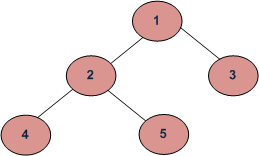
GeeksforGeeks
A Computer Science portal for geeks. It contains well written, well thought and well explained computer science and programming articles, quizzes and practice/competitive programming/company interview Questions.
why are they saying that the height is 2?
agile sundial
it is 2
bright ginkgo

https://assets.leetcode.com/uploads/2020/11/26/tmp-tree.jpg
https://leetcode.com/explore/featured/card/top-interview-questions-easy/94/trees/555/
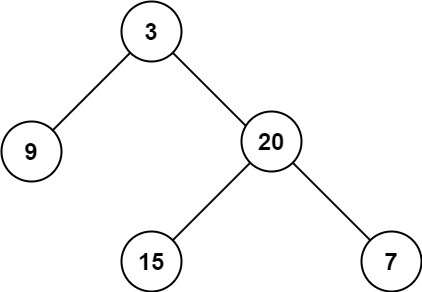

LeetCode Explore is the best place for everyone to start practicing and learning on LeetCode. No matter if you are a beginner or a master, there are always new topics waiting for you to explore.
Input: root = [3,9,20,null,null,15,7]
Output: 3
harsh field
livid kelp
can i ask why is my code broken (im kinda new to py)
you missed a closing parenthesis in line 51
 past vale
stable pawn
Hey guys, anyone knows the name of the problem when you have x people and the sa...
past vale
stable pawn
Hey guys, anyone knows the name of the problem when you have x people and the sa...
I think this is what I just used. Hungarian algorithm.
not bi partite matching
If every job applicant has every job in their preference list that is
what it basically does is, that you can find the combination pairing of single way pairings of X set of elements to Y set of elements causing the least total amount of cost.
cost here is preference number, because you want it to be lowest in total
steep gorge
bright ginkgo
Input: root = [3,9,20,null,null,15,7]
**Output: 3**
Depends, some notebook counts nodes as @agile sundial mentioned
 dark aurora
Hello, How to make my breath first search faster
I need to find the longest path in a graph from starting point(A) to end node(B), and then I need to find the longest path in the graph from the last end node(B) to the new end node(C) (The longest path searches for the end node, I don't need to find the longest path to specific end node)
 vernal sinew
dark aurora
Hello, How to make my breath first search faster
I need to find the longest path...
vernal sinew
dark aurora
Hello, How to make my breath first search faster
I need to find the longest path...
What do you mean by 'new' end node?
dark aurora
vernal sinew
What do you mean by 'new' end node?
Well the node that is the biggest distance away from B(English is not my native language so i don't know if node is the right word, maybe vertex is better)
vernal sinew
So the distances in the graph aren't symmetric? Meaning of B is the farthest distance from A, then A is not necessarily the farthest from B?
But couldn't you just run the algorithm a second time starting from B in that case?
dark aurora
vernal sinew
But couldn't you just run the algorithm a second time starting from B in that ca...
yes, that is what I do, I run bfs two times(one for finding the farthest node from A then the farthest node from B), but I need to make it faster
I can send the code if you want, but i don't know if it would be of any help
tepid spruce
dark aurora
Hello, How to make my breath first search faster
I need to find the longest path...
you want longest hops in a directed graph? is it slow because of implementation?
dark aurora
tepid spruce
you want longest hops in a directed graph? is it slow because of implementation?
maybe? I don't know I am pretty new to this, I don't know what is the fastest implementation, maybe I already achieved it, because the answer is in CPP, i don't know the fastest implementation in python
tepid spruce
dark aurora
maybe? I don't know I am pretty new to this, I don't know what is the fastest im...
are you saying it's slow because you've timed it and it's slower than the official answer (in cpp)?
dark aurora
tepid spruce
are you saying it's slow because you've timed it and it's slower than the offici...
yes
tepid spruce
dark aurora
yes
your code is a direct translation of the answer from cpp to python?
dark aurora
tepid spruce
your code is a direct translation of the answer from cpp to python?
i think so yeah, i don't understand cpp so i am not sure
but keep in mind that the expected answer(in cpp) isn't always the fastest, usually it is the easiest that passes the time limit
tepid spruce
dark aurora
I can send the code if you want, but i don't know if it would be of any help
we would need to see code to know for sure what's wrong
dark aurora
tepid spruce
we would need to see code to know for sure what's wrong
sure here it is
tepid spruce
(could be just cpp vs python)
dark aurora
tm = 0
n, m = list(map(int, input().split()))
b = [list(map(int, input().split())) for x in range(m)]
cn, ln, pr,  wys, a1, a2 = [[] for x in range(n+1)], [], [0]*(n+1), [0]*(n+1), 0, 0


#makes a list of connections
for x in range(len(b)):
    cn[b[x][0]].append(b[x][1])
    cn[b[x][1]].append(b[x][0])

cn = list(map(tuple, cn))

#makes b one list so it is easier to loop
b = [i for x in b for i in x]

#loops through b
for x in range(len(b)):
    #finds the first end node
    if pr[b[x]] == 0:
        a2 = a2+1
        ln.append(b[x])
        pr[b[x]] = 1
        while ln != []:
            d = ln[0]
            for i in range(len(cn[ln[0]])):
                if pr[cn[ln[0]][i]] != 1:
                    a2 = a2+1
                    ln.append(cn[ln[0]][i])
                    pr[cn[ln[0]][i]] = 1
            ln.pop(0)
        ln.append(d)
        pr[d] = 2
        wys[d] = d
    #finds the longest node from first node and writes path
        while ln != []:
            d = ln[0]
            for i in range(len(cn[ln[0]])):
                if pr[cn[ln[0]][i]] != 2:
                    wys[cn[ln[0]][i]] = ln[0]
                    ln.append(cn[ln[0]][i])
                    pr[cn[ln[0]][i]] = 2
            ln.pop(0)
    #backrtracking the path
        while wys[d] != d:
            d = wys[d]
            a1 = a1+1
        a1 = a1+1


print(a1+(n-a2))
```yeah, but someone from another discord programming server told me I can use a* algorithm to make it faster, and it might work, I have to implement it and see
vernal sinew
Yes, that's a specific algorithm https://en.wikipedia.org/wiki/A*_search_algorithm
A* (pronounced "A-star") is a graph traversal and path search algorithm, which is often used in many fields of computer science due to its completeness, optimality, and optimal efficiency. One major practical drawback is its
    O
    (

      b

        d


    )
...
halcyon plankBOT
:incoming_envelope: :ok_hand: applied mute to @glacial charm until <t:1639789438:f> (9 minutes and 59 seconds) (reason: burst rule: sent 8 messages in 10s).
tepid spruce
dark aurora
```Python
tm = 0
n, m = list(map(int, input().split()))
b = [list(map(int, inpu...
what if you make ln a deque or queue?
dark aurora
tepid spruce
what if you make `ln` a deque or queue?
you can do that in python?
tepid spruce
dark aurora
you can do that in python?
yup from collections import deque
dark aurora
tepid spruce
yup `from collections import deque`
hmm, i don't know if that is allowed, i know numpy and random aren't, will check it out
tepid spruce
dark aurora
hmm, i don't know if that is allowed, i know numpy and random aren't, will check...
then just keep it as a list, and use it as a queue, but don't pop(0), this can be slow
instead, you can keep track of the start of the queue with an index j and change your loop to while j < len(ln): j += 1
tepid spruce
dark aurora
```Python
tm = 0
n, m = list(map(int, input().split()))
b = [list(map(int, inpu...
also, how does "#finds the first end node" work? aren't all the nodes 0 at the beginning?
or the first node in b is A?
dark aurora
tepid spruce
also, how does "#finds the first end node" work? aren't all the nodes 0 at the b...
first node means the first end node so B
my computer broke so i need to write the code again on another computer, it will take like 2-5 mins then i can check if i can use collection import deque
tepid spruce
dark aurora
first node means the first end node so B
yes but b[0] is A?
dark aurora
tepid spruce
yes but `b[0]` is A?
yes
tepid spruce
dark aurora
yes
ok that checks out
tepid spruce
dark aurora
my computer broke so i need to write the code again on another computer, it will...
no worries take your time... also simulating a queue with a list (like I said above) is actually a smaller diff than using deque
it just takes more memory because you never pop
dark aurora
tepid spruce
it just takes more memory because you never pop
i don't think memory should be a problem, currently i am trying to implement the a* algorithm is that fine?
tepid spruce
dark aurora
i don't think memory should be a problem, currently i am trying to implement the...
I don't see how a* would help
dark aurora
tepid spruce
I don't see how a* would help
yeah, that is exactly what i wanted to write now, but it's nice i found about it, seems like a useful algorithm
dark aurora
tepid spruce
no worries take your time... also simulating a queue with a list (like I said ab...
so it would be better to use deque if i can?
tepid spruce
dark aurora
so it would be better to use deque if i can?
not necessarily, list may be faster, and a smaller code change from what you already have
dark aurora
tepid spruce
not necessarily, list may be faster, and a smaller code change from what you alr...
Thanks a lot for the tip, it is faster and I got more points, but still isn't fast enough, i am going to sleep, if you find a way to make it faster feel free to say
 plush owl
Given a binary 2d Matrix, in every step you can convert all connected cells with same value. How many steps to make complete Matrix to same value?
tepid spruce
dark aurora
Thanks a lot for the tip, it is faster and I got more points, but still isn't fa...
I am not sure, maybe it is due to reading large input? you can try instead
from sys import stdin
s = stdin.read()
also the small inefficiencies may add up, like for i in range(len(cn[ln[j]])): can be changed to for i in cn[ln[j]]: and then cn[ln[j]][i] will just be i
past vale
fierce sluice
Hello guys I have a numpy question, can this be implemented easier using numpy o...
Easier, no, more efficient, yes. you can vectorize this
 fallow jolt
Hi i need to add a high score system to my mini game could someone help me?
jeu='oui'
print("Règles du juste prix :"):
print(" - Le but du jeu étant de deviner un nombre entre 0 et 1000 le jeu vous indiquera si votre proposition est plus grand ou plus petit que le nombre secret . Bonne chance ! .")
while jeu == 'oui' :
  compteur=0
  joueur=1111
  prix=random.randint(0,1000)
  while joueur != prix:
      joueur=int(input("Donner un prix entre 0 et 1000 : "))
      compteur=compteur+1
      if joueur > prix:
        print("C'est moins")
      elif joueur < prix:
        print("C'est plus")
  print("Bravo vous avez gagné en",compteur,"tentatives")
  jeu = (input("Voulez vous-rejouez ? oui/non " ))
print("Vous avez quitté le jeu .")```The idea is that a number is chosen randomly, and the person has to guess it? So the fewer guesses used, the better?
I think you already track the number of guesses in the variable compteur. So you could do something like
import sys
...
min_compteur = sys.maxsize
while jeu == 'oui' :
...
print("Bravo vous avez gagné en",compteur,"tentatives")
if compteur < min_compteur:
  min_compteur = compteur
Or if you wanted to do something where a higher score was better, you could make the starting score something like 1000 and subtract 100 points in each iteration of the while loop. Then when the player succeeds in fewer guesses, they will have a higher score. Of course, you may want to ensure the score could not be negative
 spice otter
idk where to write this but i am trying to do api requests and idk how to add this to my code
I am kinda new
 blazing prawn
Hi 🖐🏾
spice otter
hey
blazing prawn
may i ask something ?
spice otter
m
blazing prawn
spice otter
m
🙂 ?
blazing prawn
It has nothing to do with Python
what is needed here ?```q1) A program that finds the math series:
s=1+1/2!+ 1/3!+ 1/4!+⋯+ 1/n!
Whereas; (n) is a number entered from the keyboard. Write the result here.
idk
 dense forge
blazing prawn
what is needed here ?```q1) A program that finds the math series:
s=1+1/2!+ 1/3...
dense forge
blazing prawn
what is needed here ?```q1) A program that finds the math series:
s=1+1/2!+ 1/3...
I think it is infinite series problem. You can search in Google. You can find many formulas there.
11th grade math problem.
blazing prawn
dense forge
I think it is infinite series problem. You can search in Google. You can find ma...
ok i will thanks
mild dove
I think it's simpler than a infinite series problem because n is not infinite. you just need to put n and get the result. you can solve with recursion or a for loop between 1 and n
vocal gorge
mild dove
I think it's simpler than a infinite series problem because n is not infinite. ...
especially since the analytical form of this series isn't the nicest - the denominator here is just a factorial, but the numerator has an incomplete gamma function. It would be easiest to just sum it, unless n is very high. And even then it wouldn't be very wasteful to just sum, because there's a limit of how many terms you can calculate until the terms will just be 0 (up to float precision)
 fathom orbit
Doing binary search exercise, thought of this but it doesnt return anything and just runs forever, why?
`def isInListB(num):
a=[3,5,14,45,89,98,99]
middle=a[math.floor(len(a)/2)]
b=[]
while len(a)>1:
if num < middle:
for number in a:
if number < middle:
b.append(number)
    elif num > middle:
        for number in a:
            if number > middle:
                b.append(number)

    a = b
    middle = math.floor(len(a) / 2)
if a[0] == num:
    print("is in list")
else:
    print("is not in list")
isInListB(14)`
vocal gorge
you're probably supposed to recalculate middle each outer loop, not use only one value
also, you probably need to set b to an empty list each time when you set a to b, I'd guess?
since currently, after you do a=b the first time, you get left with only one list with two variables referring to it.
fathom orbit
I don’t understand the first point
I thought I was reassigning value of middle in the line under ‘a=b’
vernal sinew
fathom orbit
I don’t understand the first point
I thought I was reassigning value of middle i...
Suppose you called isInListB(99).
Before the first iteration, middle is 45 and b is an empty list.
At the end of the first iteration, b is [89,98,99], a is [89,98,99] and middle is 98.
At the end of the second iteration, b is [89, 98, 99, 99], a is [89,98,99,99], and middle is 99.
At the end of the third iteration, b is [89, 98, 99, 99], a is [89, 98, 99, 99], and middle is 99. From here it will repeat forever without changing
fathom orbit
So how do I prevent it from just not shortening the list
Cause it seems to work the first iteration right?
vernal sinew
I think ConfusedReptile's advice is correct, you should move the line b=[] inside the while loop
fathom orbit
Trying it rn, I’m on a very old laptop rn and I can’t tell if the programs looping forever or if it’s just not running
vernal sinew
with a list of only 7 numbers i'd expect it to finish in under a second even if you were running it on a potato
fathom orbit
Yeah I think it’s looping forever
vocal gorge
if you're running on an old device, I'd suggest putting a print at the beginning of your program, so that you know when it starts running. Because starting the python interpreter (and so starting to run the program) can take quite a bit on old computers in my experience, but once it's started it should run fast even on a potato indeed.
vernal sinew
fathom orbit
Yeah I think it’s looping forever
There's another problem, this one is how you calculate middle in the loop
fathom orbit
Oh I just realized on the outside I’m taking the index of the len(a)/2 where as in the inside I’m not taking the index
Will that fix it?
vernal sinew
Right. As it is, the value of middle is unrelated to the contents of a
So I think with that change it will stop the infinite loop, although the result is incorrect for some inputs
fathom orbit
It’s working thanks guys
vernal sinew
Try calling it with each element of that list as a test
dark aurora
tepid spruce
I am not sure, maybe it is due to reading large input? you can try instead
```py...
will try that now, also i don't know if this is important, but every graph is a tree
agile sundial
every tree is a graph, but not every graph is a tree
dark aurora
agile sundial
every tree is a graph, but not every graph is a tree
yeah, that is why I clarified that there aren't any graphs that aren't trees (in this task)
agile sundial
i c i c, carry on
dark aurora
agile sundial
i c i c, carry on
I DID THE FUCKING TASK LESTS GOOO
agile sundial
🎉 🎉 🎉
plush owl
agile sundial
every tree is a graph, but not every graph is a tree
You want to find longest path between two nodes in a tree? Or is it a DAG?
plush owl
plush owl
You want to find longest path between two nodes in a tree? Or is it a DAG?
@dark aurora
dark aurora
plush owl
You want to find longest path between two nodes in a tree? Or is it a DAG?
what is DAG?
plush owl
Directed Acyclic Graph
dark aurora
nah not DAG, but i did the task why do you bother?
 raw zealot
is it possible to perform an early exit in dijkstar algorithm search , because ig thats vulnerable to wrong answer , like if we stopped at the desired coordinates but the total costs of some unchecked coordinates (path) is lower than our current shortest path
so can we minimize the search and overcome the problem
or should we do a full search like bfs
fiery cosmos
Guys i need some help BADLY!!
runic tinsel
raw zealot
is it possible to perform an early exit in dijkstar algorithm search , because i...
it has early exit
specifically in aoc task you found the shortest path as soon as you found any path to exit
because nodes have same cost from all directions
i don't understand the question sorry
you can't stop at that point in the general case but you stop when the target is the next step
when you expand from the target
so earlier than that would be when you visited every neighbour of target but not the target which should be possible 🤔
vocal gorge
runic tinsel
i don't understand the question sorry
I believe they mean stopping after some time and providing a suboptimal solution
I don't think dijkstra allows that in any obvious way, though maybe there is one
runic tinsel
but that's never a thing
vocal gorge
there's a term for this
In computer science, an anytime algorithm is an algorithm that can return a valid solution to a problem even if it is interrupted before it ends. The algorithm is expected to find better and better solutions the longer it keeps running.
Most algorithms run to completion: they provide a single answer after performing some fixed amount of computat...
agile sundial
you can't reach the node you want suboptimally with dijkstra. the first time you visit a node is the least cost way to reach it
vocal gorge
agile sundial
~~you can't reach the node you want suboptimally with dijkstra. the first time y...
I don't think that's quite true, but it's close to being true
runic tinsel
yeah that's not true
vocal gorge
the first time you assign a distance to the target node isn't the time that node becomes closed and the search ends
vocal gorge
vocal gorge
the first time you assign a distance to the target node isn't the time that node...
but it is true that the target node usually gets first reached pretty far into the search, close to the end
so you can't early-stop unless you're almost done
agile sundial
oh true
vocal gorge
A* is slightly better at this probably, since it searches towards the target and so reaches it first sooner
but not by much I think
runic tinsel
but like it depends on waht you mean by visit
you always "visit" once, so you mean like, "update"
by wikipedia terms
vocal gorge
A node first gets assigned a distance when one of its neighbours gets visited. When the node itself gets visited (it's chosen as the lowest-distance node from the open set), this distance is finalised - if that's the target node, you can end the search at the point, you've found the optimal route to it
So basically, you can early stop only after one of the neighbours of the target node gets visited
on grids, that allows skipping very little, since obviously you have to come most of the way to reach such a neighbour
in well-connected graphs, I guess early stopping in dijkstra would be more useful
bright ginkgo
are the majority of graph/trees leetcode questions solved using recursion?
mild dove
you can use stack and queue, but the idea I think is the same
dapper sapphire
If we have to find minimum in rotated sorted array:
class Solution:
    def findMin(self, nums: List[int]) -> int:
        if len(nums) == 1 or nums[0] < nums[-1]:
            return nums[0]
        left = 0
        right = len(nums) - 1
        while left <= right:
            middle = (left + right) // 2
            middle_num = nums[middle]
            left_num = nums[left]
            right_num = nums[right]
            # Return values
            if middle_num > nums[middle+1]:
                return nums[middle+1]
            elif nums[middle-1] > middle_num:
                return middle_num

            # Increment / Decrement
            if left_num <= middle_num:
                # Left half is sorted
                left = middle + 1
            elif middle_num <= right_num:
                # Right half is sorted
                right = middle - 1
For increment and decrement, does it make more sense to do left_num <= middle_num or nums[0] <= middle_num
because if we do nums[0] <= middle_num then we would be looking outside the window(between left and right).
But if we do left_num <= middle_num then we would be looking inside the window(between left and right)
I meant this in terms of truly Binary Search.
fiery cosmos
Can someone help in this simple problem please

I don't understand how can I figure out if it will be linear time or not. It could depend on various factors I think. Do we assume the rest of the factors constant? And then see the effect of length on the computation complexity?
idle pier
Hello folks, am doing this question, which t is a binary tree and s an integer. The problem basically is to return True if the sum from root to leaf path equals s, otherwise return False
def solution(t, s):
    if not t:
        return False

    s -= t.value
    if not t.left and not t.right:
        return s == 0
    elif t.left and t.right:
        return solution(t.left, s) or solution(t.right,s)
    elif t.left and not t.right:
        return solution(t.left, s)
    elif not t.left and t.right:
        return solution(t.right,s)```
Am lost in in parts, 1) why are we `s -= t.value` and 2) if there isn't any left and right subtrees, why do we return `s == 0`?Hi i need to add a high score system to my mini game could someone help me?
jeu='oui'
print("Règles du juste prix :")
print("- Le but du jeu étant de deviner un nombre entre 0 et 1000 le jeu vous indiquera si votre proposition est plus grand ou plus petit que le nombre secret . Bonne chance ! .")
nom=("a")
nom=input("\n- Entrer votre nom : ")
while jeu == 'oui' :
  compteur=0
  record=0
  joueur=1111
  prix=random.randint(0,1000)
  while joueur != prix:
      joueur=int(input("Donner un prix entre 0 et 1000 : "))
      compteur=compteur+1
      if joueur > prix:
        print("C'est moins")
      elif joueur < prix:
        print("C'est plus")
  print("\nBravo",nom,"vous avez gagné en",compteur,"tentatives .")
  jeu = (input("\nVoulez vous-rejouez ? oui/non " ))
print("Vous avez quitté le jeu .")```Time complexity is decided on the basis of the worse scenario, here as we don't know the index , it is possible that the last second item is greater than the last , so you gotta iterate over the complete array and check
But as it states that only one element is wrongly placed , so it will not hit quadratic time , one iteration would do the job
That's what I suppose
raw zealot
vocal gorge
So basically, you can early stop only after one of the neighbours of the target ...
I guess we can stop when we have visited all its neighbours 👀
Number of neighbours = number of paths to the target = number of total costs
steep gorge
idle pier
Hello folks, am doing this question, which `t` is a binary tree and `s` an inte...
I think to handle the edge case if not t just do return instead of false because once it's get to leaf recursively it will just return False also in terms of returning each call function just check each function call node val sum with previous node val and check the difference look with for difference val. I think instead of cramming all in one function it's better to create a helper function. Also for this problem do preorder traversal recursively or you can implement stack
mild dove
fiery cosmos
Can someone help in this simple problem please
I think that is true, you need to see the insert sort algorithm, but the idea is that when it finds a[j] it will allocate to the right position and the algorithm will stop.
mild dove
idle pier
Hello folks, am doing this question, which `t` is a binary tree and `s` an inte...
- and 2) are related, s will be reduced from the node current value for each interaction, if s == 0 it means the sum from the values of all nodes traversed are equal s.
 stuck wind
what is the best book to learn data structures& algo? Do you guys have a book in mind that has exercises?
jolly mortar
stuck wind
what is the best book to learn data structures& algo? Do you guys have a book in...
check out the pins in this channel for resources 
stuck wind
sorry what? I don't know what you mean

 austere sparrow
stuck wind
sorry what? I don't know what you mean
austere sparrow
stuck wind
sorry what? I don't know what you mean
 stuck wind
austere sparrow
stuck wind
austere sparrow
thanks I see it now
 edgy thistle
hey guys can you please list some resources to learn data structure and algorithms in python
austere sparrow
edgy thistle
hey guys can you please list some resources to learn data structure and algorith...
check the pins 🙂
 onyx umbra
https://github.com/TheAlgorithms/Python
you can refer this if you ever want proper implementations for any algorithm or data structure. They have implementations in all major languages.

GitHub
All Algorithms implemented in Python. Contribute to TheAlgorithms/Python development by creating an account on GitHub.
austere sparrow
well, not "any" algorithm or data structure
there are infinitely many algorithms and data structures
 quasi basalt
Not a proper place to ask it, but perhaps someone knows. How can I read cpu cache (I mean bits and bytes), any level language will do (assembler, cpp, py)
onyx umbra
what you will need in your lifetime😅
austere sparrow
onyx umbra
what you will need in your lifetime😅
Does it have an implementation of an untyped lambda calculus evaluator?
onyx umbra
austere sparrow
Does it have an implementation of an untyped lambda calculus evaluator?
you can just throw any maths formula and expect it to have be ready made somewhere. You know what i meant. I know it wont have literally everything
I just gave it as a good resource for beginners who get confused on different implementations
austere sparrow
I just commented that the repo promises too much 🙂
On a serious note, it's missing a HAMT.
which is a pretty important data structure
austere sparrow
quasi basalt
Not a proper place to ask it, but perhaps someone knows. How can I read cpu cach...
If it were possible, it would probably be a security disaster. It would allow a process to read the memory of another, arbitrary process.
onyx umbra
its possible but u need to inject your process into the other one
austere sparrow
onyx umbra
you can just throw any maths formula and expect it to have be ready made somewhe...
If it's a resource for beginners, I think it should have a more precise explanation. Otherwise some people might get an impression that this is literally all algorithms, and anything else is not an algorithm.
onyx umbra
austere sparrow
If it's a resource for beginners, I think it should have a more precise explanat...

first line
austere sparrow
onyx umbra
yeah, the first line says "All algorithms"
onyx umbra
for beginners its more than all
austere sparrow
"All" has a very specific meaning, at least for me.
onyx umbra
if you are looking for something advanced then you probably know where to look
ok dude sorry
austere sparrow
"Examples for all of Python's standard library" 👍
"List of all natural numbers" -> "List of first N natural numbers"
"All algorithms" -> "Common algorithms"
onyx umbra
I just gave this resource thinking it might be helpfull, when i was starting programming I would have killed to have these algos in one place
austere sparrow
anyway... sorry for the nitpick.
agile sundial
fix error loves hamt
onyx umbra
yeah i figured
quasi basalt
austere sparrow
If it were possible, it would probably be a security disaster. It would allow a ...
and what about linux, im sure linux is way more free in terms of security measures than windows
austere sparrow
quasi basalt
and what about linux, im sure linux is way more free in terms of security measur...
I didn't imply any specific OS
fierce sluice
a = [[],[],[],[]]
how to create this in python?
a list of 4 lists, each empty, I want to append different amount of numbers inside
austere sparrow
@fierce sluice What's wrong with a = [[], [], [], []]?
 fathom tartan
!e
x = [[]]*4
print(x)
@fathom tartan :white_check_mark: Your eval job has completed with return code 0.
[[], [], [], []]
!e
x = [[]] * 4

x[0].append(1)

print(x)
@agile sundial :white_check_mark: Your eval job has completed with return code 0.
[[1], [1], [1], [1]]
the lists aren't copied, only the reference to the list
fierce sluice
austere sparrow
<@!263622863007907840> What's wrong with `a = [[], [], [], []]`?
It's ok, but for cases longer than 4
fierce sluice
agile sundial
!e
```py
x = [[]] * 4
x[0].append(1)
print(x)
```
Oh I got an idea
!e
x = [ [] for _ in range(4)]
x[0].append(1)
print(x)
@fierce sluice :white_check_mark: Your eval job has completed with return code 0.
[[1], [], [], []]
yep, that works
fiery cosmos
raw zealot
Time complexity is decided on the basis of the worse scenario, here as we don't ...
What if it's 1,2,3,4,1,2,3,4
fiery cosmos
mild dove
I think that is true, you need to see the insert sort algorithm, but the idea is...
Doesn't have to
fiery cosmos
fiery cosmos
What if it's 1,2,3,4,1,2,3,4
In this case the given constraint satisfies. But it will have to do multiple iterations
Only 4>1
!e
print(2)
mild dove
fiery cosmos
What if it's 1,2,3,4,1,2,3,4
I think there is only one a[j] > a[j+1] so the rest is respecting a[i] < a[i+1]. all the array is ordered with one element out of the order. Update: ah yeah, this case will not break the rule.
agile sundial
no
fiery cosmos
Then?
agile sundial
it's your homework after all, you should do it
fiery cosmos
It will be
O(J-2+J-3+J-4+J-5)+O(n)
fiery cosmos
agile sundial
it's your homework after all, you should do it
I am stuck. And it's not my homework 😆
I am trying to self learn
agile sundial
well, it's your work
idle pier
mild dove
1) and 2) are related, s will be reduced from the node current value for each in...
ok, so as we traverse down the tree, it takes the value of that node and subtract it from s. If it equals 0, that basically means there is a leaf path that equals to s, correct?
idle pier
onyx umbra
https://github.com/TheAlgorithms/Python
you can refer this if you ever want prop...
wow that is amazing, they have every algo I can think of
thanks
mild dove
idle pier
ok, so as we traverse down the tree, it takes the `value` of that node and subt...
yeah
idle pier
mild dove
yeah
but why do we need the not t.left and not t.right conditions for?
thats where am a little lost now
mild dove
idle pier
but why do we need the `not t.left and not t.right` conditions for?
thats where ...
when you don't have t.left and t.right, it means that you reached the last node from the path, that is the stop condition and you can respond if the path you followed is equals s. if you have t.left or t.right, you need to reach the last node
idle pier
mild dove
when you don't have t.left and t.right, it means that you reached the last node ...
ohhhhh ok ok
understood, thanks 💯
 runic anvil
Hey guys, I was running the closed formula for finding the n^th fibonacci number
and I was comparing it to the run time of the method using dynamic programming; and I noticed that at the 72nd number, the closed form begins giving incorrect results due to floating point imprecisions
Atleast i'm assuming it's due to that...
This is the closed form


And it breaks down at the 72nd value
My question is... what is special about the number 498454011879265 to give this error?
The 71st number is 308061521170129
vernal sinew
Precision wise, isn't it better to use sqrt() instead of raising to the power of .5?
runic anvil
Not that there's anything special with that number specifically... but what is the threshold
I didn't want to import any libraries lol
vernal sinew
It might be more accurate because it's a specialized method
runic anvil
But I can actually check right now
seems slower using math.sqrt()
It's not really the runtime that's a concern... more like, ignoring the dynamic code, why does the closed formula give incorrect results for the 72nd fibonacci value
The binary version of it is 49 digits long, for the 71st number it's also 49 digits long

If that helps at all
vernal sinew
So using sqrt gave the same result?
runic anvil
Using sqrt made it slower but gave same result of breaking down at 72
vernal sinew
How strange

Computer Science Stack Exchange
Binet's formula for the nth Fibonacci numbers is remarkable because the equation "converts" via a few arithmetic operations an irrational number $\phi$ into an integer sequence. However, using finite
runic anvil
Thank you, i'm looking through it
I think it's cause g is irrational

and I guess by the 15th decimal place...



Stack Overflow
I was working on a project to compute the Leibniz approximation for pi with the below code:
def pi(precision):
sign = True
ret = 0
for i in range(1,precision+1):
odd = 2 * i - ...
I guess that's it
YEP
 runic anvil
vernal sinew
How strange
runic anvil
vernal sinew
How strange
Thanks for pointing me to the right direction! 😄
 viscid kernel
does anyone know how to generate AJ walker algo tables?
 cerulean jetty
So baicalky I am working on a machine learning assignment in creating an algorithm that will detect brain tumors based on brain data tumor data sets. This is an assignment that is asked by my professor but I don’t have experience with coding.
These are the steps I already complete which is
(1) Import the dataset into a fresh Google Collab project
(2) Split the dataset into training / testing / validation sets (thursday)
But i still need help with
(3) Defining my classification model(s). You would probably want to try a few different models here. You can either build your own convolution neural network (layer by layer) in tensorflow and train it from scratch, or you can modify an existing pre-trained network like VGG19, alter it to better suit our binary classification needs, and retrain it on the dataset.
(4) Train you model(s) and evaluate
Help
 north zealot
so let's say I have a graph looking like that

I want to find the number to the right of any node
is there any well known algorithm to do that?
tepid spruce
north zealot
so let's say I have a graph looking like that
 is this related to ||advent of code||?
north zealot
ya
tepid spruce
I don't know if there's a name for it but you can walk up the tree from 2 and then walk down the tree to 3
which is the simplest way I'd say, or there are other methods if you pass along / return extra information in your recursive function
yet another way is to link the leaves explicitly like a doubly linked list
north zealot
they are doubly linked, yeah
tepid spruce
each TreeNode already has left and right children, and these children are unused for the leaf nodes, so for leaf nodes I just changed the meaning of the left and right children to mean left and right leaves instead. and I added an is_leaf boolean. but this takes some bookkeeping so I'd recommend simpler approaches
tepid spruce
tepid spruce
I don't know if there's a name for it but you can walk up the tree from 2 and th...
this approach is just, walk up the tree from 2 until you reach a left child, then go to the sibling of that child (which exists since the tree is full in this problem), and then walk down as far left as you can (to reach 3)
 stable pecan
north zealot
they are doubly linked, yeah
stable pecan
north zealot
they are doubly linked, yeah
this will work, and similarly for previous node:
    @property
    def rightmost(self):
        return self.right.rightmost if isnode(self.right) else self

    @property
    def previous_node(self):
        if self.is_root:
            return None

        parent = self.parent

        if parent.left is self:
            return parent.previous_node

        if isnode(parent.left):
            return parent.left.rightmost

        return parent
you still have to check the children of the node you get
stable pecan
north zealot
now I have some pairs colliding with itself and whatnot
if self.previous_node:
    if isnode(previous_node.right):
        previous_node.left # is previous value
    else:
        previous_node.right # is previous value
some check like this to get the value
 frosty hamlet
Can someone point me in the direction for getting block 1 of text into block 2 of text.
oraclelinux-release-6Server-10.0.2.x86_64
java-1.7.0-openjdk-1.7.0.261-2.6.22.1.0.1.el6_10.x86_64
newrelic-sysmond-2.3.0.132-1.x86_64
copy-jdk-configs-3.3-9.el6.noarch
oracle-logos-60.0.14-1.0.5.el6.noarch
newrelic-infra-1.20.7-1.el6.x86_64
oraclelinux-release-notes-6Server-22.0.2.el6.x86_64
newrelic-repo-5-3.noarch```],]``` cloud plover
@maiden dunehi fyi, we don't allow advertising/self-promotion here, so i've deleted your message. please check out our #rules for future reference
idle pier
Hello folks, currently doing 98. Validate Binary Search Tree on Leetcode
This is is my solution
def isValidBST(self, root: Optional[TreeNode]) -> bool:
stack = [(root, float('-inf'),float('inf'))]
while stack:
node,left,right = stack.pop()
if not left<node.val<right:
return False
if node.right:
stack.append((node.right,node.val,right))
if node.left:
stack.append((node.left,left,node.val))
return True```
I'm a little lost on why exactly we need both `left` and `right` variables. From what I know, they work as boundaries correct? cinder wigeon
wdym by boundaries?
idle pier
cinder wigeon
wdym by boundaries?
I meant like left means min value and right max value.
but honestly, am just confused on what exactly its doing
cinder wigeon
idle pier
but honestly, am just confused on what exactly its doing
you know the invariant for a binary tree, right?
that the value of the parent must be between those of the children
in particular, that the left is less and the right is greater
fiery cosmos
ayo guys I have a problem trying to do this bot and im not sure whats the actual problem or how to fix it

 cinder wigeon
fiery cosmos
ayo guys I have a problem trying to do this bot and im not sure whats the actual...
idle pier
cinder wigeon
in particular, that the left is less and the right is greater
cinder wigeon
fiery cosmos
ayo guys I have a problem trying to do this bot and im not sure whats the actual...
idle pier
cinder wigeon
in particular, that the left is less and the right is greater
hmm hmm
cinder wigeon

idle pier
cinder wigeon
<:look:807976293948719165>
I guess another way to ask this question is, what exactly do node.left, left, node.val mean?
From my understanding, node.left means the left subtree, left is where am confused, and node.val is the value of whichever node we are at
cinder wigeon
idle pier
I guess another way to ask this question is, what exactly do `node.left, left, n...
sorry I didn't understand the code properly
tbh, the code is confusing yeah
also, I was wrong
cinder wigeon
cinder wigeon
you know the invariant for a binary tree, right?
that the value of the parent mu...
this is wrong
sorry :(
I forgot what binary search tree is
idle pier
cinder wigeon
<@!799045300617871360>
its one of those things in which you write it but found the solution somehow lol
idle pier
cinder wigeon
you call the function recursively
yea I originally solved it recurvely but when you return the function, it still in that order node.left,left,node.val
cinder wigeon
wdym?
idle pier
cinder wigeon
wdym?
def dfs(node,left,right):
            if not node: return True

            if not (node.val < right and node.val > left):
                return False

            return dfs(node.left,left,node.val) and dfs(node.right,node.val,right)
return dfs(root,float('-inf'),float('inf'))```idk, looks good to me
idle pier
cinder wigeon
idk, looks good to me
its this part
return dfs(node.left,left,node.val) and dfs(node.right,node.val,right)
the left and right, that has me confused
cinder wigeon
See it this way
all DFS(node, left, right) does is return true, if all the nodes rooted in node are between the value left and right
because of how DFS recursively calls itself, it's called once for each node
idk if that makes any sense
but like, just assume DFS magically works
def magic_in_range(node, left, right):
    ...

def in_range(node,left,right):
            if not node: return True

            if not (node.val < right and node.val > left):
                return False

            return magic_in_range(node.left,left,node.val) and magic_in_range(node.right,node.val,right)

return in_range(root,float('-inf'),float('inf'))
and then by induction
it does actually work
@idle pier
tepid spruce
the power of believing in recursion 😎
cinder wigeon
It's basically magic
tepid spruce
it's probably easier to grok if it's called def is_bst(node, lower_bound=float("-inf"), upper_bound=float("inf"))
runic tinsel
yes
a binary tree node is just a couple variables together
you can use a dictionary, or instance attributes, it should even work with just tuples
 flint citrus
I'm struggling to make an implementation for this problem that satisfies the harder test cases.
https://www.olympiad.org.uk/papers/2021/bio/round_one.html (Question 3 - window dressing)
I think it would be possible to do some sort of smarter, less brute force solution, but so far I've only made a slow recursive one.
What would be a good way to do this problem? (it has to terminate in one second)
fiery cosmos
help me :(

@torpid crown help if you admin
i know you can
help me
can someone help
 cinder wigeon
fiery cosmos
help me :(
cinder wigeon
flint citrus
I'm struggling to make an implementation for this problem that satisfies the har...
cinder wigeon
fiery cosmos
help me :(
cinder wigeon
flint citrus
I'm struggling to make an implementation for this problem that satisfies the har...
seen you ask this before
I suggest you post a picture of the problem itself, instead of linking pdf
cinder wigeon
fiery cosmos
what?
drifting spindle
Does anyone have experience with myplotlib in python?
There's one thing I don't seem to get it work
It'd be lifesaving if anyone could help me
Ping me if you are interested to help
 terse spade
 drifting spindle
Does no one have experience with matplotlib?
 gusty root
any website where we can start to learn python from scratch
dapper sapphire
Is following the correct way to perform list comprehension to convert a list of int to list of strs?:
list(df["itemid"]) is a list of ints
item_ids:List[str] = [str(n) for n in list(df["itemid"])]
 strong summit
looks good to me
dapper sapphire
ok thank you!!
 fervent saddle
dapper sapphire
Is following the correct way to perform list comprehension to convert a list of ...
fervent saddle
dapper sapphire
Is following the correct way to perform list comprehension to convert a list of ...
You could use map instead for that
 trim loom
ehi, could anybody explain me why in the second example of this problem the answer is 2 and not 1.5: https://codeforces.com/problemset/problem/492/B (it's a problem about searching and sorting)

Codeforces
Thank you in advancee ❤️
drifting spindle
Does anyone have experience with matplotlib and would like to help? :)
 worldly agate
trim loom
ehi, could anybody explain me why in the second example of this problem the answ...
worldly agate
trim loom
ehi, could anybody explain me why in the second example of this problem the answ...
If all lanterns have radius 2 then first lantern is gonna cover [0, 4] and second one is gonna cover [3, 5] and they arę both gonna cover [0, 5]
dapper sapphire
drifting spindle
Does anyone have experience with matplotlib and would like to help? :)
Maybe try the #data-science-and-ml channel.
dapper sapphire
fervent saddle
You could use map instead for that
Is there any benefit to using map over list comprehension?
I just dont know much about them that's why I ask.
fervent saddle
It's a little bit more concise in this case. And it's faster here, but that's not really important.
drifting spindle
dapper sapphire
Maybe try the <#366673247892275221> channel.
I have tried many channels, no one really seem to be able to help me


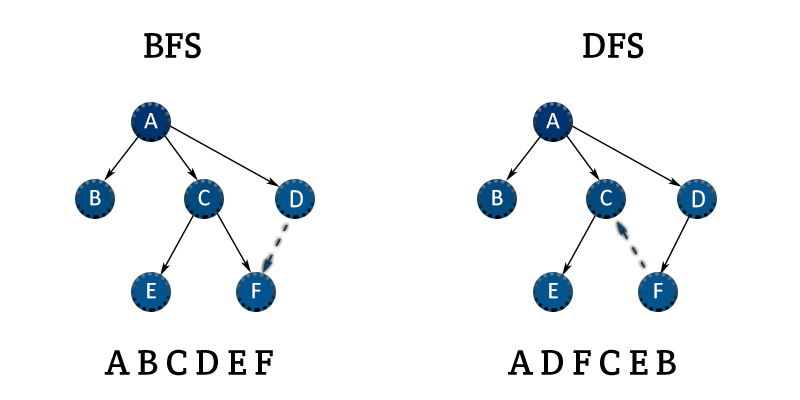

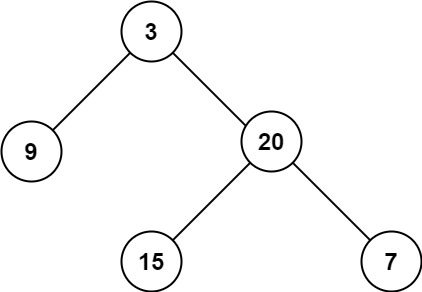 cinder wigeon
fiery cosmos
Can someone help me in this please?
cinder wigeon
fiery cosmos
Can someone help me in this please?
try drawing a tree for it
 junior quail
hi , sry hijack , open a bot but
and already went deep into search, using the wrong words i bet
how can one plot according the code call position and not in the end of all?
using jupyterlab and already have %matplotlib inline
fiery cosmos
cinder wigeon
try drawing a tree for it
Does this only mean how many calls will units of size 4 make?
That would be 4, right?
I thought it's something complicated
cinder wigeon
fiery cosmos
That would be 4, right?
yeah
idle pier
hello folks, doing 70. Climbing Stairs on leetcode
Its a DP problem, I was having trouble solving it, so I looked up the solution. I know its a fibonacci problem but I still fully don't understand the solution
def climbStairs(self, n: int) -> int:
        one,two = 1,1

        for _ in range(n-1):
            temp = one
            one = one + two
            two = temp
        return one```
what gets me confused is why do we need the `temp` and why `two = temp`I know its a bottom-up approach
vocal gorge
idle pier
hello folks, doing `70. Climbing Stairs` on leetcode
Its a DP problem, I was hav...
On the next step, the one variable should store one + two and the two variable should store one. But observe that if you do this:
one = one + two
two = one
it won't produce the right result (two and one will be equal here), nor will the opposite order.
You need to either use a temp variable (that's the approach that works in any language), or, and this approach uses a Python feature called unpacking, do
one, two = one+two, one