#algos-and-data-structs
1 messages · Page 97 of 1
 austere sparrow
 halcyon plankBOT
@austere sparrow :white_check_mark: Your eval job has completed with return code 0.
12586269025
(If you're not familiar with decorator syntax)
def _fib(n):
    if n <= 2:
        return 1
    else:
        return fib(n - 1) + fib(n - 2)
fib = cache(_fib)
and in fact, that thing already exists in Python:
import functools

# python3.9+
@functools.cache
def fib(n):
    if n <= 2:
        return 1
    else:
        return fib(n - 1) + fib(n - 2)

# before 3.9
@functools.lru_cache(maxsize=None)
def fib(n):
    if n <= 2:
        return 1
    else:
        return fib(n - 1) + fib(n - 2)
@feral wadi
 feral wadi
umm @functools.cache a syntax?
austere sparrow
feral wadi
umm `@functools.cache ` a syntax?
What's wrong with it?
feral wadi
i've never used that one
austere sparrow
If you're not familiar with decorators:
@decorator
def f(x):
    ...
is the same as:
def _f(x):
    ...
f = decorator(_f)
@feral wadi
feral wadi
yeah i get that now
i wanna get good in algos but most of the time i fail to recognize a problem
 fiery cosmos
austere sparrow
If you're not familiar with decorators:
```py
@decorator
def f(x):
...
```
i...
fiery cosmos
austere sparrow
If you're not familiar with decorators:
```py
@decorator
def f(x):
...
```
i...
I find that a little confusing. Could you explain what the code does?
austere sparrow
Well, that's not a piece of working code, just an explanation of syntax. You can read this if you want more info: https://realpython.com/primer-on-python-decorators/
 hoary bronze
hello guys is there anybody using Leetcode for problem solving
 true steeple
Hello everybody, I was wondering how to create a matrix of 24 rows and 6 columns in Python , cuz as much as I look on google or books are simple arrays
 agile sundial
yeah you'd know how to do it if you knew how to do it @mystic basin
 static coral
true steeple
Hello everybody, I was wondering how to create a matrix of 24 rows and 6 columns...
static coral
true steeple
Hello everybody, I was wondering how to create a matrix of 24 rows and 6 columns...
the simplest way would be to use two nested for loops. range of 24 for the row and range of 6 for the column
true steeple
agile sundial
yeah you'd know how to do it if you knew how to do it <@303873532863971330>
I agree lol
Thanks guys, I solved it, I come from programming in C , Java and JS, and I do not like that a matrix is something not incorporated in pure python .
 keen turtle
true steeple
Hello everybody, I was wondering how to create a matrix of 24 rows and 6 columns...
keen turtle
true steeple
Hello everybody, I was wondering how to create a matrix of 24 rows and 6 columns...
is [[0 for i in range(24)] for j in range(6)] OK?
agile sundial
does C have a matrix structure?
keen turtle
or you could use numpy
keen turtle
agile sundial
does C have a matrix structure?
no, neither C nor C++ has one.
I've attended Olympiad in Informatics and had to use C++ in such contests......
When I have to use matrices, I need to write a class on my own...
 lean dome
C and C++ and Java have two-dimensional arrays, which you could use as a matrix
true steeple
keen turtle
no, neither C nor C++ has one.
and what is "mtx[rows][cols]" then ?
in C
lean dome
a two dimensional array.
keen turtle
there are indeed multi-dimensional arrays
but there are no algorithms related to that
such as matrix multiplication, fast power and stuff.
lean dome
right. A two dimensional array is one potential way to represent a matrix's data, but it is not itself a matrix.
A one dimensional array is also a way to represent a matrix's data.
keen turtle
I wonder why don't they use python instead of C++ in OI contests(
is there a "Graph" structure in python's standard library?
or in any libraries I could download with pip
(the Graph in graph theory
lean dome
networkx
agile sundial
speed, mainly
keen turtle
Oh, Thx!
lean dome
there's also https://docs.python.org/3/library/graphlib.html in 3.9 now.
which is limited, but can traverse a DAG in dependency order.
keen turtle
agile sundial
speed, mainly
I guess u'r right(
importing numpy takes something like 2.77s
and a common OI problem has a time limit of at most 1s.
lean dome
that doesn't matter as long as everyone's using the same language - they can just adjust the limits accordingly.
but in competitive programming situations where you can choose the language you use, you probably shouldn't choose Python if your competitors can use C++
keen turtle
yeah
lean dome
it's pretty common for a bad C++ algorithm to run faster than a good Python one.
lean dome
and #include <bits/stdc++.h> is pretty close to from * import *, heh - handy for reducing typing when time is on the line
keen turtle
C++ even has optimise(2) or optimise(3) to increase its speed
#include command does the import operation when compiling
(while python does no compiling work
 wraith valve
yeah u can tell the complier to optimize ur code
 winter solar
true steeple
Hello everybody, I was wondering how to create a matrix of 24 rows and 6 columns...
winter solar
true steeple
Hello everybody, I was wondering how to create a matrix of 24 rows and 6 columns...
a = [[0] * 6] * 24
EDIT: oops. i was too late apparently.
winter solar
hoary bronze
hello guys is there anybody using Leetcode for problem solving
yep. what's up?
 sage coral
How difficult is a monte carlo tree search and does anyone have any good resources on them?
keen turtle
I guess "Monte Carlo" is a sort of random algorithm
and I'm pretty bad at random algorithms, so maybe I can't help you (sad
 meager verge
Hello, I have a stupid question about arrays, can i ask it here ? ^^
 frank zinc
yes
winter solar
meager verge
Hello, I have a stupid question about arrays, can i ask it here ? ^^
it's almost exclusively what we do here. ask away 🙂
 upper holly
I have a question about json.loads(). I guess everyone has experienced once, but I can't find a solution...
import json

jsonString = '{"employees": [{"name": "John Watson", "dateOfJoin": "01/01/2018", "active2": True, "awards": None}]}'
_json = json.loads(jsonString)
print(_json["employees"][0]["name"])
```raises```arm
JSONDecodeError("Expecting value", s, err.value) from None
I have no idea what wrong.
Thanks in advance!
 trim fiber
upper holly
I have a question about `json.loads()`. I guess everyone has experienced once, b...
trim fiber
upper holly
I have a question about `json.loads()`. I guess everyone has experienced once, b...
What are True and None values in your JSON?
JSON notation uses rather true and null
upper holly
lol thanks so much
trim fiber
Your welcome
fiery cosmos
hi
hoary bronze
hi guys , my recursion with memoization was working fine but suddenly it broke and it raises an error like " RecursionError: maximum recursion depth exceeded in comparison " , i dont understand what did change before the last time because in last time it worked fine , with same input and same func .. Can anybody tell me what happened
fiery cosmos
Hello guys
 frosty ocean
for dictionary in db_list:
  for key, value in dictionary.items():
    print(key, value)
what is a better way to do this?
i have a list of dicts in my db
id like to iterate through them and get the key and value of each dict
this code works, but is there a... nicer? way to do it?
 quasi oracle
@sleek shale We don't allow recruitment here
 rotund prism
https://leetcode.com/problems/serialize-and-deserialize-bst/
guys need help
cant make my preorder recursion
https://leetcode.com/playground/g4DmCxEb
need help understand recursion in python i am screwing up my return statements

Level up your coding skills and quickly land a job. This is the best place to expand your knowledge and get prepared for your next interview.
Compile. Run. Debug.

 paper yacht
how do i send a mail to HackerRank support regarding a correction?
fiery cosmos
hey guys
i want to find number of "x" in my output
the output is like :
x
x
y
x
now there are three x's here
but i want dont want to count them manually
keen turtle
maybe you can save it as a file and read the file, and
f = open("file.out", r) # assume file.out as the file name
print(f.read().count("x"))
f.close()
or simply use Word
keen turtle
fiery cosmos
i want to find number of "x" in my output
would that be what you want
 blissful stone
Could someone tell me if this is an optimal or near-optimal solution for finding if two words are anagrams? ```python
def map_word(word):
words_letters = {}
for letter in word:
    if letter not in words_letters:
        words_letters[letter] = 1
    else:
        words_letters[letter] += 1

return words_letters
def are_anagrams(word_one, word_two):
if len(word_one) != len(word_two):
return False
mapped_one, mapped_two = map_word(word_one), map_word(word_two)
for char in mapped_one:
    if char not in mapped_one or mapped_one.get(char) != mapped_two.get(char):
        return False
return True
if name == "main":
word_one = "racecar"
word_two = "carcear"
print(are_anagrams(word_one, word_two))```
I understand there are good solutions which involve sorting a list of the letters for each word but this feels like it would be more efficient. Would love to hear someone's take though
keen turtle
if the word is only English words with English alphabet, then you could use a list of length 26
which I think would be faster
agile sundial
the solution that involves sorting that you're talking about is something like
sorted(word1) == sorted(word2)
it sorts twice, so it's O(n log n + m log m)
keen turtle
I guess you could judge whether the words have the same length
before sorting them
and the list version is only O(n)
agile sundial
in your solution, you loop over each character in a string and use in to check if it's in another string, which is O(n^2)
blissful stone
I don't know what I was up to with that statement geez. What if I change this line from if char not in mapped_one or mapped_one.get(char) != mapped_two.get(char): to if mapped_one.get(char) != mapped_two.get(char):
agile sundial
your solution is also not guaranteed to work, i believe
keen turtle
def areAnagrams(a: str, b: str) -> bool:
    if len(a) != len(b):
        return False
    length = len(a)
    lsta = [0 for _ in range(26)]
    lstb = [0 for _ in range(26)]
    for i in range(length):
        lsta[ord(a[i]) - 97] += 1
        lstb[ord(b[i]) - 97] += 1
    return lsta == lstb
Assume they use ASCII
fiery cosmos
def are_anagrams(first_word: str, second_word: str) -> bool:
    return sorted(first_word) == sorted(second_word)
``` lolThis is not as fast as the list version, I believe
since this is O(n log n) and the list is just O(n)
agile sundial
it's probably just as fast for strings under 1000 chars or so, but i'm just guessing
blissful stone
Feels like cheating lol. Just taking a data structs and algorithms course so I'm trying to dip my toes in the proverbial water
fiery cosmos
yeah, I know the interviewer wouldn't accept this anyways
44 ms, faster than 78.81% of Python3 online submissions for Valid Anagram.
agile sundial
that's kind of sad
keen turtle
well, as an OIer, I think the faster the better lol.
agile sundial
well yeah, but
keen turtle
but I guess using numpy.array will even increase its speed(
agile sundial
probably not
blissful stone
Runtime: 52 ms, faster than 50.39% of Python3 online submissions for Valid Anagram.
Guess I have a lot to learn this semster 😃 Thanks everyone for the input
keen turtle
!e
def areAnagrams(a: str, b: str) -> bool:
    if len(a) != len(b):
        return False
    length = len(a)
    lsta = [0 for _ in range(26)]
    lstb = [0 for _ in range(26)]
    for i in range(length):
        lsta[ord(a[i]) - 97] += 1
        lstb[ord(b[i]) - 97] += 1
    return lsta == lstb

print(areAnagrams("abc", "cba"))
You are not allowed to use that command here. Please use the #bot-commands channel instead.
fiery cosmos
blissful stone
`Runtime: 52 ms, faster than 50.39% of Python3 online submissions for Valid Anag...
you should ignore these messages from leet. the interviewer only cares about the theoretical time complexity
fiery cosmos
agile sundial
you could use `collections.Counter`
Runtime: 40 ms, faster than 88.91% of Python3 online submissions for Valid Anagram. it's a stupid question to be honest. you can't handicap people from using the built in tools of their language of choice
that was the runtime for your counter solution
agile sundial
well it was the same speed as my solution using sorted, so i just assume their test cases weren't large enough to make a difference
keen turtle
I guess anyway the words are pretty short
longest common words are something like 20 or 30 letters.
agile sundial
they didn't have to be actual words though, could just have been long strings
fiery cosmos
keen turtle
would that be what you want
yes
not the most efficient way but clever indeed
 stable pecan
Counter is linear
agile sundial
indeed
agile sundial
dm @fallow ginkgo to report @dense mauve
 pseudo pilot
could anyone here help me solve a recursion problem in #help-popcorn ?
 carmine anvil
 amber egret
help
amber egret
help
You're asking in the wrong channel, but write pass inside login
 unique loom
this is kind of unclear to me, but does anyone know, in ant colony optimization algos, is the pheromone matrix initialized to 0, or some non-zero positive value?
having it be all 0's at the start would require some sort of special case for picking the next vertex for the ant, no?
and it would mean that whatever paths the first ants choose and then deposit the pheromones on, if there are any edges with 0 pheromones left after that, they will always have 0% probability to get chosen compared to any other edges with any amount of pheromone on them
or am i misunderstanding something
 valid coral
hello just wondering if anyone knows how to implement a functional recursive merge sort in python?
agile sundial
i'm sure a few people do
valid coral
i'm tying to make one right now but there's always an error when I try to use the len() function on the arrays that i pass in the parameters
 keen hearth
Hey @valid coral
Perhaps they are iterables (can be iterated with a for loop), but not sequences (can be accessed by index with [] and have a defined length)?
Do you get an error message like this? ```
TypeError: object of type 'generator' has no len()
yeaaa object of type 'NoneType' has no len()
 mint jewel
your functions need to return something
I am guessing you have something like
def fun():
    if ...:
        ...
        fun()
``` where you need
```py
def fun():
    if ...:
        ...
        return fun()
 small drift
Can someone explain why we need to use gradient descent, for example for linear regression, when we can just take the derivative of the function and see where it = 0?
mint jewel
because there is no easy way to compute the derivative of the function.
small drift
so if our error function was only, say 3D, then would that be a feasible solution?
in other words, if we only had 2 features in our data set
because the derivative function would be a single variable equation..?
oop nvm im wrong about that
mint jewel
remember that the function you use gradient descent to take the derivative of takes all of your network parameters as arguments and outputs the error over some slice of the dataset.
small drift
ok...what do you mean some slice? doesnt it use the whole dataset for its parameters?
mint jewel
not always, it can often yield better results if you descend after only going through part of the dataset, or even only one datapoint since it much more performant, though this is more a topic for #data-science-and-ml
let's say I wanted to search if a phrase (string/rope/...) is a subsequence of several other stored phrases (subsequence in the can you remove elements to get the sequence). I know of the dynamic programming algo for this, but that is for 1:1, but here I have 1 phrase which may be a subsequence of several other phrases, so I wonder if there is some e.g. tree I could build to not have to do
phrases = ["pricey orange grafter"]
for phrase in phrases:
if issubsequence("peter", phrase):
print(phrase)
```. It may turn out fast enough this way, didn't write it yet, but this more of a let's practice algorithms project than a let's get something useful done project mighty stream
rotund prism
mighty stream
rotund prism
does heapify do heapsort on the array? I am trying to get the next smallest element from heap by interatign thru the heapified array, will go in heapsorted way or do i have to heappop everytime?
wraith valve
generally heapify creates a heap
and i think if u actually want the sorted values u need to pop them all out
mint jewel
yeah, you have to iteratively pop, though I think that is what heapsort does
there is no heap iterator builtin, so you can make your own
def iter_heap(heap):
    heapq.heapify(heap) # optional
    while heap:
        yield heapq.heappop(heap)
you may want to copy the heap as well before depending on your usecase
though why not just use sorted() instead?
 brave oak
Can someone explain why we need to use gradient descent, for example for linear regression, when we can just take the derivative of the function and see where it = 0?
@small drift remember that the equation is overdetermined in the general case
therefore it has no exact solutions
small drift
ok thank you!!
valid coral
Hi! i was actually able to do the merge sort but I need to have the out put where I print the elements of the array after each sort and I'm not really sure where to place the prints :< can anyone help out?
def merge(a, b):

    out = []

    while (len(a) > 0 and len(b) > 0):
        if (a[0] <= b[0]):
            out.append(a[0])
            a.pop(0)
        else:
            out.append(b[0])
            b.pop(0)

    while(len(a) > 0 ):
        out.append(a[0])
        a.pop(0)

    while(len(b) > 0 ):
        out.append(b[0])
        b.pop(0)
    print(out)

    return out

def half(arr):
    mid = len(arr) // 2

    return arr[:int(mid)], arr[int(mid):] # array colon python

def mergesort(arr):

    if (len(arr) <= 1):
        return arr

    left, right = half(arr)

    L = mergesort(left)
    R = mergesort(right)

    #print (merge(L, R))
    return merge(L, R)

def inputList(size):

    arr = []

    for n in range (0, size):
        arr.append(int(input()))
    return arr
i have this so far with the print in the merge function but it doesn't print everything out
 rich ridge
ans = max(helper(k, k), helper(k, k + 1), ans, key=len)
rich ridge
rich ridge
ans = max(helper(k, k), helper(k, k + 1), ans, key=len)
how and why did we use "key=len"?
Whose length is key storing ?how and why did we use "key=len"?
Whose length is key storing ?
 wispy hare
rich ridge
how and why did we use "key=len"?
Whose length is key storing ?how and why did w...
wispy hare
rich ridge
how and why did we use "key=len"?
Whose length is key storing ?how and why did w...
we use key=len when we want to compare elements by their length
for example, if we have a list of lists and we want to get the longest one, we write max(lists, key=len)
your code means max(len(helper(k,k)), len(helper(k,k+1)), len(ans))
rich ridge
wispy hare
we use key=len when we want to compare elements by their length
Thanks for your help👍
wispy hare
you're welcome!
rich ridge
How does string slicing work in this example s[i + 1 : j] ??
wispy hare
rich ridge
How does string slicing work in this example s[i + 1 : j] ??
s[i+1:j] returns the substring in s between indexes i+1 (inclusive) and j (exclusive), so it returns {s[i+1], s[i+2], ..., s[j-1]}
rich ridge
wispy hare
`s[i+1:j]` returns the substring in `s` between indexes `i+1` (inclusive) and `j...
so its same for s[i : j+1]?
 tawny narwhal
wispy hare
your code means `max(len(helper(k,k)), len(helper(k,k+1)), len(ans))`
tawny narwhal
wispy hare
your code means `max(len(helper(k,k)), len(helper(k,k+1)), len(ans))`
how do u format it like this or is it the backticks `
wispy hare
rich ridge
so its same for s[i : j+1]?
nope s[i:j+1] returns {s[i], s[i+1, ..., s[j]}
wispy hare
tawny narwhal
how do u format it like this or is it the backticks `
yep backticks
tawny narwhal
ah
wispy hare
Example:
>>> s = "inside code"
>>> i = 1
>>> j = 5
>>> s[i+1:j]
<<< "sid"
>>> s[i:j+1]
<<< "nside"
 mighty cedar
 rocky fractal
the second one?
 twilit gate
The second one looks cleaner
 half lotus
How coarse should a lexer be? Should every operator get its own token or should they be grouped e.g. a token encompassing all binary operators?
 clever crag
hello everyone , i just start to learn data-struct
i install a repo to record my study
can someone help me to do code review?
thanks a lot

GitHub
DS for Jmu. Contribute to sukai-cheng/DS development by creating an account on GitHub.
wispy hare
csv = """AACG, 01/02/2015, $4.7
AACG, 01/02/2018, $5.43
AACG, 01/02/2019, $0.94
AACG, 01/02/2020, $1.35
AACG, 01/31/2017, $3.04
AACG, 01/31/2018, $5
AACG, 01/31/2019, $1.08
AACG, 01/31/2020, $1.1569
NWS, 01/20/2017, $12.35
NWS, 01/21/2014, $16.76
NWS, 01/21/2015, $14.45
NWS, 01/21/2016, $12.72
NWS, 09/27/2019, $14.17
NWS, 09/28/2015, $12.44
NWS, 09/28/2016, $14.27
NWS, 09/28/2017, $13.65""".split('\n')
csv.sort(key=lambda x: datetime.datetime.strptime(x.split(', ')[1], '%m/%d/%Y'))```Are there any Python packages or other software/tools that will return the discrete form of a differential equation?
 vernal stirrup
how do I write the label for a matplotlib chart? I have r"$a_y$ in $\frac{m}{s^2}$" but i want the m ans s to be straight up (not like a variable) because they are units
vernal stirrup
vernal stirrup
how do I write the label for a matplotlib chart? I have r"$a_y$ in $\frac{m}{s^2...
r"$a_y$ in $\frac{\mathregular{m}}{mathregular {s^2}}$" worked.
(if i should delete my messages pls tell me)
 buoyant bone
mynumbers = [15, 12, 2, 6, 10, 20, 1, 4, 21, 18, 5, 14, 3]

for i in range(len(mynumbers) - 1):
    minindex = i

    j = i + 1
    for j in range(j, len(mynumbers)):
        if mynumbers[j] < mynumbers[minindex]:
            minindex = j

    if not minindex == i:
        temp = mynumbers[i]
        mynumbers[i] = mynumbers[minindex]
        mynumbers[minindex] = temp

print(f"The sorted list is {mynumbers}")
My attempt at selection sort...
Is there a more efficient way to do this?
 runic tinsel
fiery cosmos
buoyant bone
```py
mynumbers = [15, 12, 2, 6, 10, 20, 1, 4, 21, 18, 5, 14, 3]
for i in range...
runic tinsel
fiery cosmos
buoyant bone
```py
mynumbers = [15, 12, 2, 6, 10, 20, 1, 4, 21, 18, 5, 14, 3]
for i in range...
def selection_sort(numbers: list):
    for sorted_index, _ in enumerate(numbers):
        # get index of smallest element
        min_element, min_index = numbers[sorted_index], sorted_index
        for index in range(sorted_index, len(numbers)):
            min_element, min_index = (numbers[index], index) if numbers[index] < min_element \
                                                             else (min_element, min_index)

        numbers[sorted_index], numbers[min_index] = numbers[min_index], numbers[sorted_index]
 hidden sequoia
hi, any king of string slicing?
 void hatch
hidden sequoia
hi, any king of string slicing?
void hatch
hidden sequoia
hi, any king of string slicing?
look into the slice() command
formatting: teststring.slice("what to slice by")
 ashen yarrow
Hey guys. I've been stuck on this problem for more than a day now..

Stack Overflow
I have a canvas. On this canvas, I want to position 1, 2 or 3 images. The images can be positioned anywhere on the canvas just as long as they're within the canvas. The images move by their top-left
 queen patio
hot
 fading shell
how do i create a simple program that calculate the mode of a given number list?
lean dome
Loop over the list to find how many times each number occurs in it, then loop over the counts to find which number has the most occurrences
 autumn whale
fading shell
how do i create a simple program that calculate the mode of a given number list?
autumn whale
fading shell
how do i create a simple program that calculate the mode of a given number list?
from collections import Counter

nums = [5,5,9,6,9,2,7,0,3,3,4,7,5,3,2,1,5,43,7,8]

c = Counter(nums)
mode = c.most_common()[0][0]
print(mode)
Thanks so much
autumn whale
the simplest and probably least algorithmic way is to use mode from the statistics module
fading shell
Yep but that one was the one in looking for
 trail totem
Does someone know how to turn a set of integeres in a matrix ?
 vocal gorge
A set? Into a matrix? What order would you arrange them in, and why?
 uncut cradle
Hi, I've got a question.
Suppose I'm looking at multiple stocks all in the format of [initial price, end price] and given that I have a limited amount of money to buy said stocks once, what is the best way i can calculate which stocks i should buy to maximize profits.
Take note that just doing (end price - initial price) and choosing the most profitable may not necessarily work in all cases
vocal gorge
This seems like precisely the https://en.wikipedia.org/wiki/Knapsack_problem.
With profit being the value and initial price being the weight.
uncut cradle
wow yeah looks really similar! how did you find out about this knapsack thingy
agile sundial
it's a classic well known problem
 ionic vine
My mom wants me to code a program to help her in packaging for exports:
Given a list of items of different weights in grams (example, [6.5, 6,7, 6,7, 7, 7, 8]), pack them into boxes of 100g. The criteria is to pack as many full boxes with exactly 100g (or other weight), and return the list of boxes.
I'm not quite sure how to tackle this problem other than just filling the boxes with the heaviest items first and try every possible combination.
wispy hare
ionic vine
My mom wants me to code a program to help her in packaging for exports:
Given a...
https://en.wikipedia.org/wiki/Bin_packing_problem might help you
In the bin packing problem, items of different volumes must be packed into a finite number of bins or containers each of a fixed given volume in a way that minimizes the number of bins used. In computational complexity theory, it is a combinatorial NP-hard problem. The decision problem (deciding if items will fit into a specified number of bins...
ionic vine
 thank you, I will have a read. I see that it seems like an NP-complete problem
wispy hare
you're welcome!
ionic vine
hmmm the heuristic algorithms don't guarantee (unless I misread) filling up most boxes to max weight though, it's more like minimizing the boxes used but not filling them up to the brim
I feel like my problem is slightly different
fiery cosmos
need help
fiery cosmos
why do we have so many sorting methods. Just do bogosort and be lucky like me and it'll sort in O(1)
agile sundial
def sorted(L):
  return L
Timsort - Python's default sorting algorithm - basically does that. If the data is already sorted, Timsort is O(n)
fiery cosmos
How should i seperate the items in this list so that i can print each out individually
Anyone help?
 balmy dove
this thread is cool! i'm learning so much. thanks 😅
 dense mauve
@shrewd solar u looking kinda cute ngl
 shrewd solar
thanks grapes
rich ridge
How long did y'all take to get a decent grasp on DSA ??
trail totem
vocal gorge
A `set`? Into a matrix? What order would you arrange them in, and why?
A list that you can append into a 3 x 3 matrix.
lean dome
rich ridge
How long did y'all take to get a decent grasp on DSA ??
Data structures didn't take me much work. I understood most of them the first time I was taught them, including what operations were efficient and what operations weren't on each. Learning algorithms was much harder for me. It took a year or two of different classes discussing big o notation before I really was comfortable with it and could reason about it.
In retrospect, the more theoretical aspects of computer science were always much harder for me to grasp and internalize than the more practical aspects, so it's not surprising that algos was tougher for me than data structures.
 serene phoenix
can this be condensed into a single line list comprehension?
  tempsls.append(file_io.read_cpu(i))```
Where templs is an empty list and file_io.read_cpu(i) returns a floating point valueyeah if u loop and append u can list comp
i think it would be templs = [file_io.read_cpu(i) for i in [8,12,16,20]]
 rancid flower
 lyric bramble
need some help
 celest skiff
I would love to try to help :D
lyric bramble
its going in a infinite loop
can some one help me with this problem
it goes to infinte loop
celest skiff
I would suggest adding whitespace, makes code a lot easier to read.
What exactly are you trying to do here?
wraith valve
im just thinking
if none of the if and elif work
like the first if evaluates to false
and the elif also evaluates to false
the whole thing is a while true loop
celest skiff
Exactly, there's no default else case.
wraith valve
oh i just saw the dude's question in general
he wants to sort the squares of the numbers
i personally would first square the numbers ie doing a map using lambda x: x**2 on the list
and then doing ur sort on the newly created list
@lyric bramble just to ping u about the question u had
lyric bramble
yes but its going to an infinite loop
wraith valve
how is that an infinate loop
lyric bramble
the output section is blank
wraith valve
and make a new list
lyric bramble
ok
wraith valve
by squaring each value in the list
lyric bramble
ok
wraith valve
oh wait ur code actually isnt totally wrong
lyric bramble
but buddy i need a linear solution
wraith valve
sorting will never be linear
lyric bramble
with squaring and then sorting i would get o(nlogn)
wraith valve
ur just implementing the sorting wrong
lyric bramble
but im not sorting
wraith valve
like ur quicksort that u made is wrong
lyric bramble
im just comparing the values, which is bigger gets appended first
carmine anvil
How does that sort the array?
wraith valve
so ur basically trying to find the biggest value
and append that first
and doing that for the entire array
well thats getting u quadratic
not linear
carmine anvil
^
lyric bramble
yessss
wraith valve
dude
ur not getting linear runtime by doing that
and sorting will never be linear
if u do comparision
carmine anvil
You can't get a linear comparative sort
If you do something like radix you can get close
lyric bramble
wraith valve
well thats getting u quadratic
so my code will go quadratic??
wraith valve
n + n-1 + n-2 + ... + 2 + 1
is what ur code is doing
if ur finding max
and appending to list
until the initial list is empty
lyric bramble
oh damn and that is o(n^2)
carmine anvil
It's called selection sort
wraith valve
lmao facts
lyric bramble
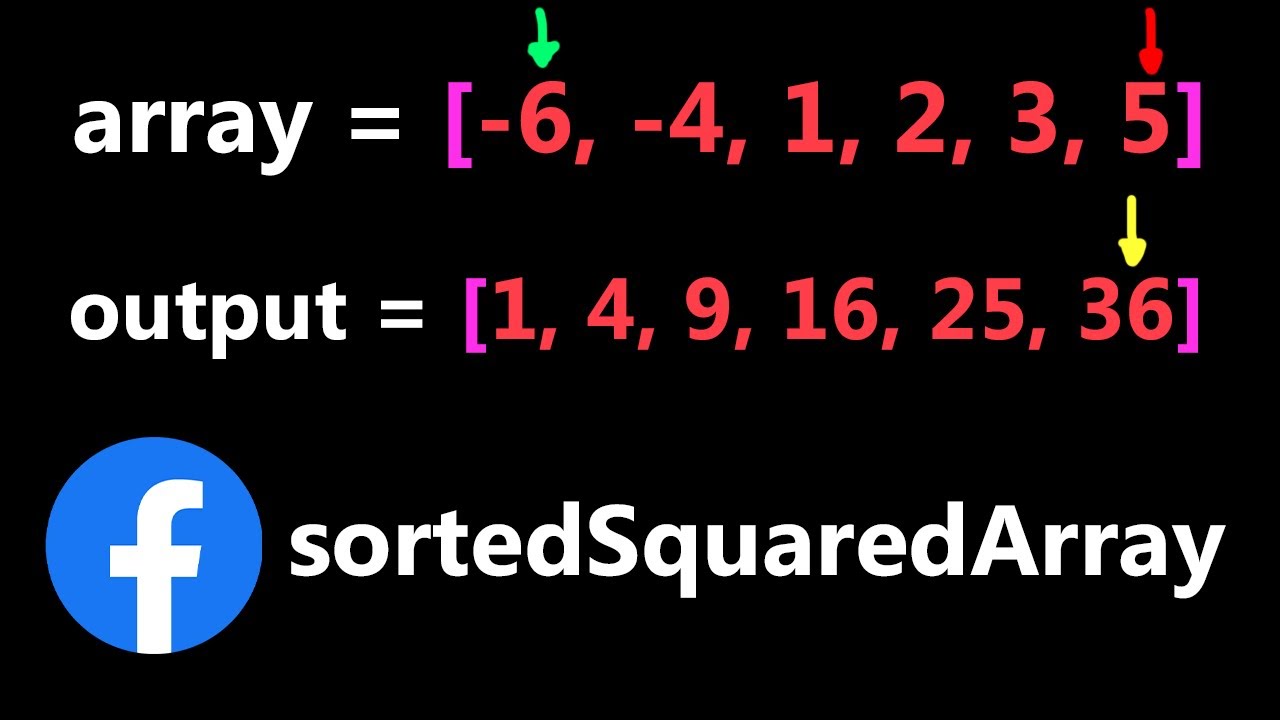
(Technical Interview Study Guide Available)
Patreon - https://www.patreon.com/nick_white?al...
Discord - https://discord.gg/2f2Tgy3
Twitch - https://www.twitch.tv/nickwhitettv
Twitter - https://twitter.com/nicholaswwhite
Instagram - https://instagram.com/nickwwhite
LinkedIn - https://bit.ly/37AEo5j
Github - https://github.com/white105
Beco...
see this video
he says its o(n)
wraith valve
lmaooooo
carmine anvil
You're getting a sorted input, so the largest square at any point in time is at either end
lyric bramble
exactly
carmine anvil
Yeah so you didn't tell the entire question till now lmao
The fact that the input is sorted makes a huge difference
lyric bramble
yea ur righr
wraith valve
okay ur code now makes more sense
lyric bramble
oh so u werent aware it was sorted?
carmine anvil
I mean, you didn't mention it so we couldn't have known
carmine anvil
Cool
wraith valve
ur idea is right
u compare the ends with each other
and keep on doing it till u meet
wraith valve
also i noticed
y dont u use append
ur repeatedly inserting into the first index
with insert(0, value)
lyric bramble
bocz im sorting from desceding to ascending
agile sundial
actually it makes it much faster, since insert(0, val) is very slow
compared to append
lyric bramble
but then it would get sorted in reverse manner
wraith valve
well im not sure about its exact implementation
either it does a backwards iteration and appends
lyric bramble
wraith valve
either it does a backwards iteration and appends
ok
agile sundial
list.reverse is linear time
wraith valve
and not really worried about actual running time in terms of seconds
u know whats the actual issue with ur code
its the inequalites
what if the two numbers at the ends are equal
lyric bramble
wraith valve
its the inequalites
omgggggg
lyric bramble
def sort_sq(arr):
n = []
low,high = 0,len(arr)-1
while low <= high :
if arr[low]**2 >= arr[high]**2:
n.append(arr[low]**2)
low += 1
elif arr[low]**2 <= arr[high]**2:
n.append(arr[high]**2)
high -= 1
n.reverse()
print(n)
this is my code now
lyric bramble
im appending both
wraith valve
and the second = in the elif is unneccessary
lyric bramble
order doesnt matter
wraith valve
bc the first if would capture the equals
lyric bramble
yes
wraith valve
i mean u can still do a insert(0,val)
lyric bramble
no ill dothe reverse
wraith valve
yeah either have the equal in the if or elif
and the elif can be turned into an else
bc its either less than or equal which is captured in the if
or its greater than
lyric bramble
changed it
wraith valve
def sort_sq(arr):
    n = []
    low,high = 0,len(arr)-1
    while low <= high :
        if arr[low]2 >= arr[high]**2:
            n.append(arr[low]**2)
            low += 1
        else:
            n.append(arr[high]**2)
            high -= 1
    n.reverse()
    print(n)
this is my version
which is basically what u did
lyric bramble
correct
thanks
could u help me w one more problem
Run-length encoding is a fast and simple method of encoding strings. The basic idea is to represent repeated successive characters as a single count and character. For example, the string "AAAABBBCCDAA" would be encoded as "4A3B2C1D2A".
brave oak
lyric bramble
Run-length encoding is a fast and simple method of encoding strings. The basic i...
look into itertools.groupby
lyric bramble
i want to implement it on my own
brave oak
lyric bramble
i want to implement it on my own
use a for loop while recording the current character and the number of instances you've seen
 steady arch
A good way would be to use nested loops
And u can speed it up by skipping indexes
Is what I feel
 stiff pewter
Hello guys. There's this piece of code:
def productSum(array, multiplier = 1):
    sum = 0
    for element in array:
        if type(element) is list:
            sum += productSum(element, multiplier + 1)
        else:
            sum += element
    return sum * multiplier
That I'd like to turn into this:
def productSum(array):
    currentSum
    productSumHelper(array, 1, 0)
    return currentSum

def productSumHelper(array, multiplier, currentSum):
    for i in range(len(array) - 1):
        if type(i) is list:
            sum+= productSumHelper(array, multiplier + 1, currentSum)
        else:
            currentSum += i
    return currentSum * multiplier
Right now I'm getting compilation errors of currentSum not being defined. But if I set it to zero then the entire thing returns 0. What's the correct way of doing it?
Please ping me
lyric bramble
def selection_sort(arr):
    start = 0
    while start < len(arr):
        min_item = min(arr[start:])
        index = arr.index(min_item)
        arr[start],arr[index] = arr[index],arr[start]
        start+= 1
    return arr
what is the time complexitiy of this program??
stiff pewter
O(1) space since you're not storing anything extra and O(n) time since you're just going through the input without anything crazy
lyric bramble
is this the correct method of implementation of insertion sort
bcoz traditionaly its o(n^2)
stiff pewter
Oh yeah I'm sorry, it's n^2 actually, you're right
lyric bramble
could u explain how is it o(n^2)
stiff pewter
I don't know about your implementation specifically, I'm not very well versed in python
It's 0(1) Space because you're not storing anything. And O(N^2) time. N is the size of your input. And it's N^2 because you keep re iterating through the unsorted part of the list
lyric bramble
ok
stiff pewter
I'm pretty sure your implementation is wrong because there has to be a double for loop which is also an indicator that the complexity is n^2
vocal gorge
stiff pewter
I'm pretty sure your implementation is wrong because there has to be a double fo...
this uses .index to find elements inside the inner loop, so it's O(n) for each iteration, for a total of O(n^2)
(don't have input on whether it's correct, mind, but it's O(n^2))
 shrewd trail
@stiff pewter Its O(n^2) time because you get a sum 1 + 2 + ... + n = n(n-1)/2 = O(n^2)
@lyric bramble
Oh wait, yeah ConfusedReptile is correct. However, properly implamented you get a sum as described above.
 mint crow
Do u guys have any website/video/book suggestions to learn about algorithm, data structure, the inside and out of cs?
 trail dirge
so im doing quick sort right now, and this is the part i dont understand
p = partition(array, start, end)
quick_sort(array, start, p-1)
quick_sort(array, p+1, end)
celest skiff
Quick sort is what's known as a divide and conquer algorithm.
It choses a pivot element and creates two arrays to hold numbers less than and greater than the pivot.
It then uses recursion to sort the two arrays.
trail dirge
so it sorts before the pivot and after the pivot in this case it seems
but what does it return when it is sorting before/after and also how does it combine everything
fiery cosmos
trail dirge
but what does it return when it is sorting before/after and also how does it com...
every time you call the partition function, it places the pivot in the correct location of the array. in other words, it takes the pivot point and places it in the correct sorted order.
fiery cosmos
hey can someone help me with understand a hash func from an ctf. i have the answer and it is not sitll happening
plz
 polar panther
Hey, is https://realpython.com/python-matplotlib-guide/ a good place to learn matploit or do you guys advice another ??

This article is a beginner-to-intermediate-level walkthrough on Python and matplotlib that mixes theory with example.
 errant dagger
Hi guys.I'm new here. I've been learning python for more than a month. Is it right time to start learning data structure and algorithms. If yes, how should I study?
keen hearth
polar panther
Hey, is https://realpython.com/python-matplotlib-guide/ a good place to learn ma...
Hey #data-science-and-ml is probably a better place to ask this.
keen hearth
errant dagger
Hi guys.I'm new here. I've been learning python for more than a month. Is it rig...
It might be worthwhile learning a bit about algorithms. Certainly it would help to understand what the different data structures python provides do.
For example, when and why you might use a dictionary or set instead of a list.
errant dagger
I cant able to solve a single problem easy in hanckerank
fiery cosmos
hey lx, where would I go with my qestion
errant dagger
errant dagger
I cant able to solve a single problem easy in hanckerank
I have to refer solutions everytime
keen hearth
fiery cosmos
hey lx, where would I go with my qestion
Erm, maybe open a help channel. Be sure to post the question rather than 'asking to ask', as you'll get more responses that way.
fiery cosmos
kk
keen hearth
See #❓|how-to-get-help if you don't know how to claim a channel.
keen hearth
errant dagger
I have to refer solutions everytime
That's fairly normal starting out. Solving even the 'easy' questions might require some knowledge of things like 'asymptotic runtime' and some data-structures.
You might not be quite ready to dive into algorithms if you've only been programming for a month, but it depends.
What resources have you been using to learn?
errant dagger
Book - automating the boring stuff with python(only theory)
keen hearth
Oh right. That book is often recommended.
polar panther
keen hearth
Hey <#366673247892275221> is probably a better place to ask this.
ofc sorry
keen hearth
Are you making much progress?
I would maybe work all the way through that book before moving on to programming challenge websites like HackerRank.
And maybe do a couple of small projects.
After that, Khan Academy have a nice introduction to algorithms course online. Unfortunately the programming challenges are in Javascript, but you can skip those (or try doing them in python on your own computer and posting your answers here for feedback).
 heady jewel
lyric bramble
```py
def selection_sort(arr):
start = 0
while start < len(arr):
...
heady jewel
lyric bramble
```py
def selection_sort(arr):
start = 0
while start < len(arr):
...
just to clarify this is O(n^2) due to having N loops through the list and then inside the loop having another pass through the same list (min and index)
errant dagger
keen hearth
After that, Khan Academy have a nice introduction to algorithms course online. U...
Thanks, I'll try to do that
 bleak cloud
guys how do I make this more efficient so that I can find the sum of all prime number till 2 million
[10:32 PM]
num_l=[]
y = int(input("enter till what number do you want the sum"))
for count in range(0,y):
num_l.append(count)
total = 0
for counter in range(0,y):
num = num_l[counter]
if num > 1:
for i in range(2,num):
if (num % i) == 0:
break
else:
total = total + num
print(total)
fiery cosmos
keen hearth
Erm, maybe open a help channel. Be sure to post the question rather than 'asking...
rip no one is answerin
 scarlet maple
so the reason why this:
list1 = [1, 3]
list2 = list1
list1[1] = 4
print(list2)```returns
[1,4]
instead of
[1,3]
is bc python is a dynamic language or something else?
mint jewel
= never copies, it just makes list2 refer to the same list as list1 does
 wispy hare
scarlet maple
even when you reassign the elements huh
wispy hare
scarlet maple
even when you reassign the elements huh
you need to redefine one of them so that they don't have the same reference anymore
scarlet maple
makes sense
wispy hare
or use list2 = list1.copy()
scarlet maple
its more just trying to understand the limits than a specific purpose
but good to know
that i can also do that
thanks
wispy hare
you're welcome
scarlet maple

wispy hare
related to the topic: don't use * operator with a mutable element (e.g.: list)
[[]*10] for example is just creating a list of 10 lists that have the same reference
write [[] for i in range(10)] instead
wispy hare
mutable my bad
scarlet maple
oh gotcha
got it
yeah it gets messy when you throw arrays in there

but numpy has some cool functions
 elder stirrup
So I'm trying to do something interesting
My class played a bunch of games w/ each other and recorded down who beat who
for example person A beat C, person C beat B, A beat B, etc
I was trying to see who was best/worst using a topological sort but it seems to not actually possible to write it that way in this case
so then does anyone know if there's some way I can take these relationships and extract a few cycles sorta like a circular topological sort
so in this case A -> C -> B -> A ...
i thought about this a bit and i'm not even sure whether an ordering like that would be well defined but ummm
if anyone has any ideas please lmk
 kindred coyote
Can someone help me better understand how to implement BFS?
Like problems with explained code
wraith valve
i mean one way is have a queue
u start at a vertex
and u append all the neighboring vertex to the queue
and u loop though till queue is empty
keen hearth
elder stirrup
if anyone has any ideas please lmk
Hey, do you know about how chess players are ranked? You could try something similar to that maybe.
keen hearth
kindred coyote
Can someone help me better understand how to implement BFS?
Hey, what is it you're having trouble with? I can show you a really simple way to implement a BFS, if you like?
keen hearth
elder stirrup
so then does anyone know if there's some way I can take these relationships and ...
The pagerank algorithm may even provide an interesting metric.
keen hearth
kindred coyote
Like problems with explained code
I find the simplest way to implement bfs is to go level-by-level: ```python
def bfs(start: T, goal: T, successor_fn: Callable[[T], Set[T]]):
level = {start}
visited = {start}
depth = 0
while level:
if goal in level:
return depth
level = set.union(*map(successor_fn, level)) - visited
visited |= level
depth += 1
can anyone suggest me some good resources to learn algorithms and data structures
vocal gorge
I don't know any courses, but Introduction to Algorithms (Cormen, Leiserson, Rivest, Stein) is a popular book.
Though one problem in learning DSA in Python is that manually implementing DSes (like many courses involve) in Python will result in very inefficient ones. It's not really a big problem, though.
fiery cosmos
can someone PLEASE help me with hash funktiosns
i have one from a ctf last year with answer but id ont understa
ply
vocal gorge
What's your question?
fiery cosmos
I posted it a while back want me to ss you what i posted
wispy hare
fiery cosmos
Can anybody help me implementing piority quues???
a possible implementation is by using a heap, and there exists the module heapq for that
kindred coyote
keen hearth
I find the simplest way to implement bfs is to go level-by-level: ```python
def ...
I'm sorry, but what is start : T. What object is T? And what is Callable[[T], Set[T]]. Sorry im a bit new to algos and stuff
 uneven jungle
append does not return the list, so remove ts2 =
vernal stirrup
oh okay thanks
 hallow vortex
quick question. why code in the photo outputs this?
I wanted the output to be [[0, 0, 0, 0, 0], [0, 0, 0, 0, 0], [0, 0, 0, 1, 0], [0, 0, 0, 0, 0]]
Can anyone help me for the right output?
uneven jungle
add print(cols) after
wispy hare
hallow vortex
Can anyone help me for the right output?
never use * operator with mutable element
hallow vortex
uneven jungle
add print(cols) after
I don't get it. why do we add print(cols)? it will be just 5
hallow vortex
wispy hare
never use `*` operator with mutable element
then what should I use without using numpy?
wispy hare
[[0]*cols for i in range(rows)]
hallow vortex
isn't that the same thing?
wispy hare
nope because * operator will give the same reference to all the lists
but list comprehension will create rows distinct lists
wispy hare
hallow vortex
* operator is better for time complexity cause it si O(1)
I don't think so
hallow vortex
got it. Thanks let me try it if it has all different references
hallow vortex
wispy hare
I don't think so
then can you persuade me?
wispy hare
'a'*n will create a string of length n, so it probably has a time complexity of O(n)
hallow vortex
wispy hare
`'a'*n` will create a string of length `n`, so it probably has a time complexity...
so you are saying that list multiplication is O(n)
I think it makes sense if each list should be aligned in a list. that could be O(n). Thanks
wispy hare
hallow vortex
so you are saying that list multiplication is O(n)
maybe O(nm), where m is the length of the multiplied element
like if you're doing s*n where s is a string of length m and n the number of repetitions, you get an O(nm) time complexity
keen hearth
fiery cosmos
can anyone suggest me some good resources to learn algorithms and data structure...
Check out the linked course in the channel pin. I also quite like Khan Academy's intro to algorithms course; the exercises are in Javascript, but you can skip them.
keen hearth
kindred coyote
I'm sorry, but what is `start : T`. What object is `T`? And what is `Callable[[T...
Ah, sorry, those are type hints. The T is a type variable. What it says is that start and goal have the same type, T, and that successor_fn is a function which takes an object of type T and returns a set of objects of type T.
So, start and goal are the starting node, and the goal node.
And successor_fn is a function that takes a node and returns a set containing its 'successors' (these could be e.g. neighbours, in a maze problem).
 blazing current
Hey, any good sites or recources for learning/practicing algorithms? I wanna get into AI and I dont know any good place to start
 pine kindle
algoexpert?
wraith valve
y would u go to algoexpert
its literally paying for a service that u can get free else where
pine kindle
i dont know bro its just the only one i can think of off the top of my head
wraith valve
those yt ads indoctrinating u
pine kindle
yeah but those are coding challenges, isnt algosexpert specifically for data structures and algos
agile sundial
i mean
Level up your coding skills and quickly land a job. This is the best place to expand your knowledge and get prepared for your next interview.
small drift
When doing gradient descent for categorical cross entropy, is the loss function summed up over all samples or is it just per sample? I am kind of confused on how to calculate loss with multiple inputs..can someone explain?
 sand pilot
fiery cosmos
Can someone helps my with my businnes?
sand pilot
fiery cosmos
Can someone helps my with my businnes?
Please do not use this server to advertise for your business. It is against our rules here.
 smoky chasm
Hi everyone, I am stuck on a activity. I 250 for the area walls apparently there is more to it. I don't know how to correctly get the 2nd answer I tried substituting the 250 gotten a totally different answer.
small drift
remove line 4 in your code
@smoky chasm
and line 6
4 is the one causing error, but 6 is not needed in the code
small drift
np
 scarlet arch
keen hearth
scarlet arch
scarlet arch
keen hearth
scarlet arch
Hey, you’re more likely to get a response in #databases
 past flare
Does someone know how can I print out the process a memory address belongs to?
I don't even know if it's possible but would be great if it is
keen hearth
past flare
Does someone know how can I print out the process a memory address belongs to?
You want to know how virtual memory maps to physical memory?
That might be more suitable for #unix, assuming you're talking about Linux. I'm not sure this is really the right forum to ask this though, as python programming mostly deals with higher-level stuff.
agile sundial
??
past flare
keen hearth
That might be more suitable for <#491523972836360192>, assuming you're talking a...
oh, i'm on windows
There is a module called pymem which is an wrapping for the ctypes module, allows reading and writing to memory addresses
but i'd like to figure out how to print out what process module a mem address belongs to
 hard leaf

DEV Community
Best books on data structure and algorithms for beginners in Java, Python, C, and C++.
fiery cosmos
I'm not sure if this fits here, but I have a program that automatically adds a stat (it's user count and current UTC timestamp) to a csv file. I then want to display the user count over time using matplotlib.
My problem is I now have more than 1300 samples, and the matplotlib graph is fairly long to generate. How could I "reduce the resolution" of the list by taking 500 elements that are representative of the list ?
I could remove half of the list by keeping only the values that have an even index for example, but this will get an issue again when I will hit 2600 samples...
How could I get a number of samples always between 500 and 1000 ?
wispy hare
fiery cosmos
I'm not sure if this fits here, but I have a program that automatically adds a s...
you can for example generate x indices between where x is between 500 and 1000
fiery cosmos
I finally found a solution
step_size = len(base_list) // 500
usercount = usercount[::step_size]
wispy hare
or
>>> random.sample(range(1, 100), 3)
[77, 52, 45]```replace 100 by the length of your data and 3 by how many numbers you want to generate
fiery cosmos
I think random sampling will not necessarily always be the best solution to get an accurate representation of the list
I would like the list to reduce it's resolution but keep the same space between samples
 fluid robin
ı'm stuck when ı try to create a tree with my inputs can anyone help me
[('bike', {'wheel': 2, 'frame': 1}), ('wheel', {'rim': 1, 'spoke': 1, 'hub': 1}), ('rim', 60.0), ('spoke', 120.0), ('hub', {'gear': 2, 'axle': 1}), ('gear', 25.0), ('axle', {'bolt': 5, 'nut': 7}), ('bolt', 0.1), ('nut', 0.15), ('frame', {'rearframe': 1, 'frontframe': 1}), ('rearframe', 175.0), ('frontframe', {'fork': 1, 'handle': 2}), ('fork', 22.5), ('handle', 10.0)]
what should I do
wispy hare
fluid robin
[('bike', {'wheel': 2, 'frame': 1}), ('wheel', {'rim': 1, 'spoke': 1, 'hub': 1})...
wheel and frame are the children of bike right?
fluid robin
yes
wispy hare
what does 22.5 mean in fork?
fluid robin
their cost when ı have to calculate the complete bike cost
fluid robin
using tree is mandatory for this problem
wispy hare
okay so you want to actually build the tree right?
wispy hare
your tuples can either be (str,float) or (str,dict) where dict contins the children right?
fluid robin
this is sample input input are depend on user
fluid robin
wispy hare
your tuples can either be (str,float) or (str,dict) where dict contins the child...
yep
fluid robin
fluid robin
ı'm stuck when ı try to create a tree with my inputs can anyone help me
do anyone have suggest?
 shy zenith
I recommend using a dictionary here.
tree_dict={'bike': {'wheel': 2, 'frame': 1}, 'wheel': {'rim': 1, 'spoke': 1, 'hub': 1}, 'rim': 60.0, 'spoke': 120.0, 'hub': {'gear': 2, 'axle': 1}, 'gear': 25.0, 'axle': {'bolt': 5, 'nut': 7}, 'bolt': 0.1, 'nut': 0.15, 'frame': {'rearframe': 1, 'frontframe': 1}, 'rearframe': 175.0, 'frontframe': {'fork': 1, 'handle': 2}, 'fork': 22.5, 'handle': 10.0}
Access it by:
Example: tree_dict["bike"]
Not sure if I am going in the right direction :)
 hearty canopy
can someone here help with a quick question, its about stacks
wispy hare
shy zenith
```py
tree_dict={'bike': {'wheel': 2, 'frame': 1}, 'wheel': {'rim': 1, 'spoke': ...
yes then
  tree = Tree(root_name)
  if isinstance(tree_dict[root_name], dict):
    for key in dict.keys():
      tree.children.append(build_tree(key, tree_dict)
  return tree
 rough osprey
fluid robin
ı'm stuck when ı try to create a tree with my inputs can anyone help me
rough osprey
fluid robin
ı'm stuck when ı try to create a tree with my inputs can anyone help me
I do not understand your question. what do you mean by create a tree? there is no such data structure as tree in python
you can have a nested dictionary, probably:
{'bike': {
    'wheel': {
        'tyre': 'value',
        ...,
    },
    'frame': {
        'child': 'value',
        ...,
    },
    ...,
}
I want to do exactly like that
İt is my actual input list
I have to convert it to tree
First ı tried to make children dictionary but ı confused
 grizzled vigil
hey, so i am trying to learn some sorting algorithms right now, and i learned selection sort and bubble sort. i was told that the advantage of bubble sort over selection sort is that in the best case, bubble sort will be more efficient because you have the ability stop the alg whenever you don't need to sort it anymore. my question is why can't you implement this in selection sort?
lean dome
grizzled vigil
hey, so i am trying to learn some sorting algorithms right now, and i learned se...
In bubble sort, you can detect the "already sorted" condition by noticing that you made it through a full iteration over the container without performing any swaps. There's no efficient way to detect that condition for selection sort.
For bubble sort, if the inner loop performs no swaps, the list is sorted. For selection sort, if the inner loop performs no swap, the i'th element was already in the right position
That doesn't imply anything about whether the (i+1)th element is in the right position
rough osprey
fluid robin
İt is my actual input list
I see a pattern here, so try using it in a loop
 final egret
I use other languages han python ... can someone let me know why this doesn't work?
def climb_stairs(n):
dp[0] = 1
dp[1] = 1
for i in range(2,n):
dp[n] = dp[n-1] + dp[n-2]
return dp
I get a NameError ... I would like to be able to write code like this with lists
agile sundial
pretty sure that wouldn't work in other languages either
you have to define dp before you can use it
rough osprey
your list only contains 2 items, but you are trying to use 3
yes, and the name is not defined, of course
final egret
agile sundial
you have to define `dp` before you can use it
it would certainly work in Matlab ...
[dp] = function climb_stairs(n)
dp(1) = 1; dp(2) = 1;
for i = 3:n
dp(n) = dp(n-1) + dp(n-2);
end
that's basically what I'd like to do
agile sundial
well, i'm not very familiar with matlab
rough osprey
where is this line [dp] = function climb_stairs(n) in your python snippet ?
oh, this is a function signature 🙂
if you can explain what that matlab code does, I may try to make a python of it
final egret
you basically have a vector that you make within your function for the first two cases of dp
In Go it would be "dp := make([]int, n+1)
dp[0] = 1
dp[1] = 1" ...
u just want to say ok i know the base value
for dp[0] and dp[1] are equal to zero
and then just run a loop that takes the value of n
rough osprey
so, you also need to define dp in python, which you did not do
rough osprey
in you case it would probably, be dp = []
final egret
gotcha
final egret
I actually get:
"---> 16 dp[0] = 1
17 dp[1] = 1
18 for i in range(2,n):
IndexError: list assignment index out of range
"
rough osprey
because you only have 2 items in your list, but you are trying to use 3
rough osprey
yes, because you onl have 2 items in your list
agile sundial
well actually, he has zero items
so trying dp[0] will error
you could do dp = [0] * n for a list with length n
rough osprey
adding items to a list you need to use append
rough osprey
i understand now, what you are trying to do
just use append - should work
but initailly you can just do dp = [0, 1]
or whatever your values are
rough osprey
yes
final egret
perfect, thanks
also wrote i instead of n
works fine
just out of curiousity why can't you just do:
"dp[n] = (dp[n-1] + dp[n-2])"? why do you need to do append?
rough osprey
because doing dp[n] you are getting an existing element with index n
 near sequoia
anyone know how to solve this
In this exercise, you are going to count by 2, starting at 2 and ending with the provided number.
You should return the numbers as a space seperated string.
Example:
count_by_two(10) --> "2 4 6 8 10 "
count_by_two(4) --> "2 4 "
fluid robin
rough osprey
I see a pattern here, so try using it in a loop
What do you mean
For example
rough osprey
each of the internal lists has a name as a first item and some tuples as the other items.
so, the tuples are, probably, the children 😉
fluid robin
= [["rearframe", 175.0], ["bike", (2, "wheel"), (1, "frame")],
["frontframe", (1, "fork"), (2, "handle")], ["hub", (2, "gear"), (1, "axle")],
["fork", 22.5], ["nut", 0.15], ["rim", 60.0], ["axle", (5, "bolt"), (7, "nut")],
["handle", 10.0], ["frame", (1, "rearframe"), (1, "frontframe")], ["bolt", 0.1],
["spoke", 120.0], ["gear", 25.0], ["wheel", (1, "rim"), (1, "spoke"), (1, "hub")]] the list is not ordered is it problem
So you say ı don’t have to use dictionary
rough osprey
no, you, probably, have to use dictionaries, but there is an easy way to create a function, which will do this for you for this data structure
final egret
rough osprey
because doing `dp[n]` you are getting an existing element with index `n`
i guess all that effectively means is you always have to pre-allocate if you want to do that ... which is fine I guess, it's good practice.
 worthy fjord
hey guys
and gals, hey people, ok here goes my question:
So, let's say that we have a system that count resources needed for tasks, let's say ovens, i distribute the work in 15 minutes buckets, but i need to identify which ovens are made available in the middle of the 15 minute bucket. So I have oven tasks finishing withing the 15 minute time range and others starting within, so by looping through the list i can see which ovens i can reutilize hence minimizing the total ovens needed
is there a good algo based way to do this?
currently I looped through the ones that finish before others start and then store in a list the "reused oens" that way I dont assign a nnon existen new oven task to the 3rd oven in this example
vocal gorge
Hmm, it sounds like an easier variant of https://en.wikipedia.org/wiki/Job_shop_scheduling, but I'm not sure.
fluid robin
I need some help who can help me to solve about data structure
fluid robin
part_lisr= [["bike", (2, "wheel"), (1, "frame")],["wheel", (1, "rim"), (1, "spoke"),
(1, "hub")],["rim", 60.],["spoke", 120.],["hub", (2, "gear"), (1, "axle")],
["gear", 25.],["axle", (5, "bolt"), (7, "nut")],["bolt", 0.1],["nut", 0.15],
["frame", (1, "rearframe"), (1, "frontframe")],["rearframe", 175.],
["frontframe", (1, "fork"), (2, "handle")],["fork", 22.5],["handle", 10.]]
this is input
but output have to be like this
formatted=["bike",[2,"wheel",[1,"rim",[60.0]],[1,"spoke"[120.]],[1,"hub",[2,"gear",[25.]],[1,"axle",[5,"bolt"[0.1]],[7,"nut",[0.15]]]]], [1,"frame",[1,"rearframe",[175.]],[1,"frontframe",[1,"fork",[22.5]],[2,"handle",[10.]]]]]
how can I write this algorithm
 main flower
Ummm... What
 lusty ivy
I have a question for people who learn programming in schools, as someone who just read books in spare time.
Why do you so often see people ask questions like, "Does anyone know a good course to study algorithms and data structures in Python that is beginner friendly?"
What does this mean? Why do they always specify these two things together. If they just learn python, they'll learn lists, dicts, etc.
Do they want to know sorting algorithms? If so, why dont they say that instead of "algos and data structs"
I have to assume this is something that is common for a university course to be called.
 bleak pulsar
I was learning Python for four months plus, and had my fundies down before I ever tackled a recursion. Whatever it is, I doubt I'll ever find a use case for it as a freelancer or on my own project.
I think the algs are really for those looking to get into traditional work with start-ups and such, because they use them to filter applicants in interviews.
lusty ivy
After doing some reading in seems like "algos and data structs" is what people say when they mean "mathematical computer science"
So yeah.
wispy hare
bleak pulsar
I was learning Python for four months plus, and had my fundies down before I eve...
I think that recursion is more than just a function calling itself, it's a way of thinking, it gives you the ability to decompose a problem into multiple instances of the same problem, which is useful sometimes
bleak pulsar
Oh yeah. I'm glad I studied it. It def forces you to think in a non-traditional way. I like any structure/problem that allows you to have an epiphany, when you finally "get it". Unlike syntax rules, which erodes through lack of use, once you really understand recursion, or something similar, you usually don't forget it.
Just today I came upon a Singleton method using a new-type object in some open source code. I didn't even know WTH a singleton was, really. One thing about coding, is if you love learning, you are going to love coding.
 dense acorn
!range
halcyon plankBOT
Iterating over range(len(...)) is a common approach to accessing each item in an ordered collection.
for i in range(len(my_list)):
    do_something(my_list[i])
The pythonic syntax is much simpler, and is guaranteed to produce elements in the same order:
for item in my_list:
    do_something(item)
Python has other solutions for cases when the index itself might be needed. To get the element at the same index from two or more lists, use zip. To get both the index and the element at that index, use enumerate.
lean dome
lusty ivy
After doing some reading in seems like "algos and data structs" is what people s...
sometimes it's a shorthand for "mathematical computer science", but it's more than just that. If you just learn Python, yes, you'll learn lists and dicts, but you won't learn how lists and dicts work. At most, you'll learn that dicts require keys to be hashable, and that immutable objects like strings and ints and tuples are hashable. You won't learn what a hash table is, or how it works, or which operations are fast on a hash table and which are slow, or why hashability is useful and why dicts require it. Likewise, you won't learn that a list is a dynamic array, and that each time it needs to grow it grows itself by some factor (50% larger on each resize, or 100% larger, or whatever) in order to achieve amortized constant time appends to the end of a list. Or that removing things from the start of a large list is very slow.
when someone says that they want to learn Python data structures, they might mean that they want to learn how to use Python's builtin data structures, but when someone says that they want to learn data structures and algorithms, it always refers to how the data structures themselves work, and what algorithms they use internally, and what algorithms can be efficiently applied to them.
lusty ivy
That fully clears it up. I would say even I dont really know that. I know how to use it, not so much why and how it was designed that way
 bleak tapir
Hi, I'm looking for some books / video / info or introductions to Data Science or similar. I have a project in mind regarding string manipulation and matching using FuzzyWuzzy. Project is quite huge (lets say over 5k individual strings needs matching against a huge library (> 100k strings), but I need some reading to understand fundamentals. Any recommendations?
lyric bramble
what is the time complexity of string concatenation in python
lyric bramble
bleak tapir
Hi, I'm looking for some books / video / info or introductions to Data Science ...
check pdfdrive for e-books
lyric bramble
bleak tapir
Hi, I'm looking for some books / video / info or introductions to Data Science ...
udemy for courses
agile sundial
lyric bramble
what is the time complexity of string concatenation in python
O(n + m)
vocal gorge
agile sundial
O(n + m)
 , because of which joining
 N strings of length n is a total of 2n + 3n + ... + N n = O(n N^2). That's why one should use join instead.
(there's an optimization that makes += work in O(m) in some circumstances, but it only works when there's a single reference to the string)
For details on all this, see https://blog.mclemon.io/python-efficient-string-concatenation-in-python-2016-edition.
EDIT: oh damn, the blog got deleted. Thankfully, the Internet remembers: https://web.archive.org/web/20190715231220/http://blog.mclemon.io:80/python-efficient-string-concatenation-in-python-2016-edition
 tranquil nest
do we have a java channel?
vocal gorge
Nope, this is a Python server. There's the offtopic channels, but also, well, there's Java discords.
 languid onyx
Is it possible to get the arbitrary precision functionality from decimal module in python to work with GPU using pyCUDA without losing the benefit of a GPU speedup? I do not need to vary the precision across the runs, but I need significantly larger than double precision floats. (Not sure of the appropriate channel)
keen hearth
languid onyx
Is it possible to get the arbitrary precision functionality from `decimal` modul...
I'm not expert in this area, but I wouldn't have thought so.
GPUs work mostly on single and double floats.
Are you sure you need that much precision?
languid onyx
I am assuming it must be technically possible to divide a higher precision decimal operation in terms of lower precision floats? Perhaps the decimal module internally does something similar?
But implementing it in C++ from scratch looks like a lot of work. So was wondering if it is possible to avoid that.
Would Numba be any good instead of pyCUDA?
fiery cosmos
(N3, C, RES) ~ (NI + N2, 0~0);
while (min(Nl, N2) # 0) V (C ~ 0)
do NEXTBIT; (NI, N2) ~ ([N1/2], iN2/21) od;
RLINK[RES] *-- if NI ~ 0 then R1 else R2 fi;
R3 *-- RLINK[0]
endproc UNION
Cam somebody explain me this algorithm
Pls
 wicked coyote
uhhhhh
idk
also
Curious Folk problem
https://codeforces.com/problemset/problem/1263/D
I don't see how it woudl be possible to solve this in N log(N)
cause don't you need to first make the n^2 connections?
or am I missing something?

Codeforces
keen hearth
fiery cosmos
Cam somebody explain me this algorithm
It's a bit hard to see the way it is written here.
Can you re-write the pseudocode in a code block?
!code
fiery cosmos
@keen hearth explain me pls
keen hearth
Sorry, the command didn't work 😅
I don't understand what some of the symbols in this pseudocode mean, and I'm assuming there's some missing indentation.
fiery cosmos
Can I send you pics?
keen hearth
Alright 👍
 covert wedge
wicked coyote
Curious Folk problem
https://codeforces.com/problemset/problem/1263/D
I don't se...
covert wedge
wicked coyote
Curious Folk problem
https://codeforces.com/problemset/problem/1263/D
I don't se...
you do be missing a point, its never N^2 if you only calculate(roughly) equivalence subsets, they're 26(one for each letter) so you have at most 26 passwords that actually matter and at most 26*N checks to make, so basically linear time :D
the data structure needed to proceed after that is DSU, i'm guessing not actually solved the problem yet but i'm pretty sure that a DSU will give the answer :D
brave oak
I am assuming it must be technically possible to divide a higher precision decimal operation in terms of lower precision floats? Perhaps the decimal module internally does something similar?
But implementing it in C++ from scratch looks like a lot of work. So was wondering if it is possible to avoid that.
@languid onyx I don’t think so...?
because of the bit layout of floats
like I don’t think you would lose the parallelism but you’d need to write a lot of custom code, it seems?
I’m not a CUDA expert though
wicked coyote
covert wedge
you do be missing a point, its never N^2 if you only calculate(roughly) equivale...
ohhh I seee i'm stupid ty so much I really appreciate it! 🙂
covert wedge
wicked coyote
ohhh I seee i'm stupid ty so much I really appreciate it! 🙂
no me!
lean dome
languid onyx
I am assuming it must be technically possible to divide a higher precision decim...
That's not at all how the decimal module works. float is a base 2 floating point number. decimal.Decimal is an base 10 floating point number. You cannot losslessly convert even small Decimal objects, like Decimal("0.3"), to a float.
And GPUs have no facilities for manipulating base 10 floating point numbers, as far as I know.
!e ```py
import decimal
print(decimal.Decimal("0.3") == 0.3)
@lean dome :white_check_mark: Your eval job has completed with return code 0.
False
how would I do this problem:
halcyon plankBOT
Hey @kindred coyote!
Uh-oh! It looks like your message got zapped by our spam filter. We currently don't allow .txt attachments, so here are some tips to help you travel safely:
• If you attempted to send a message longer than 2000 characters, try shortening your message to fit within the character limit or use a pasting service (see below)
• If you tried to show someone your code, you can use codeblocks
(run !code-blocks in #bot-commands for more information) or use a pasting service like:
kindred coyote
ping if answer
fiery cosmos
Can someone explain me why this error comes when I try pickle.loads(f) (I had already created f with a context manager)
_pickle.UnpicklingError: invalid load key, '\x0a
Ping to answer btw
bleak tapir
So \x0a is a linefeed character. is the file local? Can you verify the file actually exist and is readable? Able to reproduce on another system?
@fiery cosmos
languid onyx
lean dome
That's not at all how the decimal module works. float is a base 2 floating point...
Base 10 might be how it represents the number but I meant that ultimately the actual calculations must involve integer/float manipulation being done by the CPU, right? And I don't need to convert it into the regular floats at any time. Something like breaking up the significant digits into smaller integer/float chunks based on the prec and then piecewise adding/subtracting/multiplying and then combining the result? No clue how the internals of the Decimal module work though, all is guesswork.
languid onyx
brave oak
like I don’t think you would lose the parallelism but you’d need to write a lot ...
Yes. It appears so. But a related question, unless I am mistaken, Mandelbrot set renders also need higher precision than floats. Don't some of them use GPU? I think I have not seen python versions accelerated by GPU though.
lean dome
I meant that ultimately the actual calculations must involve integer/float manipulation being done by the CPU, right?
Integer, yes, float, no.
And I don't need to convert it into the regular floats at any time. Something like breaking up the significant digits into smaller integer/float chunks
If you can't losslessly represent a number like 0.3 as a single float, how could you hope to losslessly represent it as the product of multiple floats?
Check out https://en.wikipedia.org/wiki/Decimal_floating_point - it explains how Decimal works.
languid onyx
@lean dome
Thanks! Will check it out.
For my GPU purposes, based on the downstream analysis, the high precision decimal object will give a tiny integer which is the actual output. And that is all I want. Hence if decimal like calculation can be broken into 32-bit ints, I was hoping to do it on a GPU (Nvidia ones can handle 32-bit ints?). But it looks like the decimal module has a lot of padding code surrounding this decimal -> int breakdown on piece-together.
lean dome
for there to be any hope of accomplishing what you want, you're gonna need to read and internalize that wiki page, and understand how Decimal works. Just like a regular float, it has a sign bit, exponent bits, and significand bits. They're just interpreted in a different way.
And CPUs and GPUs are really fast at working in base 2, and not at working in base 10.
lean dome
languid onyx
Yes. It appears so. But a related question, unless I am mistaken, Mandelbrot set...
how much higher precision do they need than floats? Note that Python floats are double precision (like C's double, not like C's float).
from what I can find from a quick google, Mandelbrot set renders typically use doubles...
and others use fixed point, instead of floating point.
and CPUs typically have 80 bit floating point registers, which might be able to be used in some cases.
languid onyx
lean dome
how much higher precision do they need than floats? Note that Python floats are ...
Need around 1.5 times the precision of doubles actually.
On a deeper Mandelbrot zoom, I am sure the doubles would fall short. The 80bit CPU registers is interesting. I'll look more into it. Thanks!
 fierce mantle
Hey guys can anyone tell my what sort of data this is and point me in the right direction to go learn about it?
-3.200000 -0.480000 -3.040000 -0.480000 -2.720000 c\n-0.320000 -2.560000 -0.160000 -2.400000 0.160000 -2.240000 c\n0.480000 -2.240000 0.800000 -2.080000 1.440000 -1.920000 c\n1.920000 -1.760000 2.240000 -1.600000 2.400000 -1.600000 c\n2.560000 -1.440000 2.720000 -1.280000 2.720000 -1.120000 c\n2.720000 -0.800000 2.560000 -0.640000 2.400000 -0.480000 c\n2.240000 -0.320000 1.920000 -0.320000 1.440000 -0.320000 c\n1.120000 -0.320000 0.800000 -0.320000 0.480000
-0.480000 c\n0.320000 -0.800000
 stark prawn
well, where did you get it from?
fierce mantle
it's decompressed flatedecode but it doesn't look the same as other decompressed flatedecode
it's normally straight up bytes
stark prawn
mayb u parsed them as floats instead of bytes by accident
 ruby mortar
guys ı have data mining final exam its really important for me to get higer result can sombody help me after 4-5 hour its not long
actually ı fucked up in yhe first time
now its make-up exam
lean dome
!rule 5 @ruby mortar
halcyon plankBOT
5. Do not provide or request help on projects that may break laws, breach terms of services, be considered malicious or inappropriate. Do not help with ongoing exams. Do not provide or request solutions for graded assignments, although general guidance is okay.
lean dome
We will not help with ongoing exams.
stable pecan
In [7]: from random import randrange, choices

In [8]: NODES = list(range(20))
   ...: my_graph = {node: choices(NODES, k=randrange(2, 6)) for node in NODES}

In [9]: my_graph
Out[9]:
{0: [9, 18],
 1: [2, 19, 1],
 2: [16, 8, 19, 15],
 3: [12, 15, 1, 9, 14],
 4: [4, 0, 15, 1, 8],
 5: [16, 4, 0, 11],
 6: [18, 18],
 7: [9, 6],
 8: [7, 6, 7],
 9: [4, 17, 5, 3],
 10: [6, 10, 14, 9, 11],
 11: [3, 18, 6, 17],
 12: [11, 2, 3],
 13: [11, 7, 3, 18],
 14: [6, 9, 15, 6],
 15: [16, 13],
 16: [10, 9, 16],
 17: [17, 10, 5, 11, 15],
 18: [16, 4, 19, 12],
 19: [15, 7]}
note choices needs a sequence so you can't use dictionary keys
In [10]: choices(dict.fromkeys("abcdef"), k=3)
---------------------------------------------------------------------------
KeyError                                  Traceback (most recent call last)
<ipython-input-10-9203d8559d44> in <module>
----> 1 choices(dict.fromkeys("abcdef"), k=3)
...
though you can just use a range object directly, don't need to make a list first
In [14]: range(20)[3]
Out[14]: 3
one doesn't see too many examples of indexing ranges
range objects have some useful features that are a bit esoteric
or at least less used
vocal gorge
huh. I always assumed random.choice has a special case for handling range objects, but if they are like this, it might as well just work with them like lists... cool.
keen hearth
I think this is actually a fairly subtle problem.
One sec while I do some research...
Is the desired graph directed or undirected?
Actually, I think I just forgot the meaning of the term 'simple graph' 😄
vocal gorge
it's equivalent to generating a random symmetric matrix with 2-5 nonzero entries in each ro- oh, has to be simple too, yikes.
keen hearth
The thing is, there are probably many different such distributions, with different properties.
keen hearth
Alright, so, I did some reading, and found this algorithm:
- Randomly generate the degree sequence.
- Generate a simple (not necessarily connected) graph with that degree sequence:
2.1) Give each vertex a number of 'stubs' (two stubs connect to make an edge) matching its degree.
2.2) Repeatedly select any vertex, and bind all of its stubs to other vertices' stubs to form edges (always choosing the other vertex with the most stubs left). - Connect the graph, without changing the degree sequence.
- Shuffle the edges to make it random, while keeping it simple and connected.
Here's where I got it from: http://complexnetworks.fr/wp-content/uploads/2011/01/random.pdf
It's the algorithm under the heading "Markov chain Monte-Carlo algorithm"
Generating the degree sequence is just a matter of doing: ```python
degree_sequence = sorted(
random.choices(range(2, 6), k=num_nodes),
reverse=True
)
Then step 2 is the 'Havel-Hakimi algorithm', which is an algorithm to generate a simple graph with the given degree-sequence or prove that one does not exist: https://en.wikipedia.org/wiki/Havel–Hakimi_algorithm
I was having a go at implementing it but got distracted sorry 😄
Yep. I think that's the desired behaviour in this case.
random.sample selects without replacement.
It's generating the degree sequence, which is like the number of edges out of each node.
It's presumably fine for two nodes to have the same degree.
Sorry for mixing the terms node/vertex and edge/arc 😄
Not sure what you mean. 🤔
Ah no, this isn't generating the edges themselves, just the number of edges (the degree) of each node.
So it's a random choice from range(2, 6) because each node should have at least 2 edges, and at most 5 edges.
It's just the first step in the algorithm.
Oh, are you talking about the code Salt posted earlier?
The code I posted only generates the degree sequence, which is the degrees of the nodes sorted in reverse order.
For example, this graph has degree sequence [3, 3, 3, 2, 2, 1]
Alright 😄
Np
 ionic ibex
Hey, so I was just watching some youtube videos and they mentioned binary search and I had previously heard about it and wanted to make an implementation of it. So I gave it a go. Is this a good implementation or is it bad and hard to read? ```py
#tVal: Target Value
#l: List
#sVal: Smallest Value
#lVal: Largest Value
def binarySearch1(l, tVal, sVal=0, lVal=0, index=0):
if index == 0 and lVal == 0: index, lVal = math.floor((len(l))/2), len(l)
if l[index] == tVal: return index
elif l[index] > tVal: lVal, index = index, math.floor(index/2)
elif l[index] < tVal: sVal, index = index, math.floor((index+lVal)/2)
return binarySearch1(l, tVal, sVal, lVal, index)
Haha yeah, idk as I don't work with other people and I myself just for some reason think it's easier to read I usually condense it like that
vocal gorge
Instead of math.floor(a/b), you can do a//b.
ionic ibex
Oh okay, thank you. Is it like a to-integer division sign or something?
agile sundial
it's floor division
ionic ibex
def binarySearch1(l, tVal, sVal=0, lVal=0, index=0, comp=0):
    if index == 0 and lVal == 0: index, lVal = (len(l))//2, len(l)
    if l[index] == tVal: return comp
    elif l[index] > tVal:
          lVal = index+1
    elif l[index] < tVal:
          sVal = index-1
    return binarySearch1(l, tVal, sVal, lVal, (sVal + lVal) // 2, comp+1)
``` Why would the change in the index declaring make such a big difference in the search? It went from averaging about 45 comparisons to 13. The new index declaration is the (sVal + lVal) // 2Binary search is often a little bit trickier to implement in practice than you would think.
They key thing is to think in terms of an invariant, which is just a property that is guaranteed not to change throughout the execution of the algorithm.
Although you seem to have implemented it recursively.
ionic ibex
Oh okay, thanks. Is it bad to use it recursively or would it have any effect?
fiery cosmos
Hey
ionic ibex
Hey
agile sundial
in this case, recursion is slower than iterative
ionic ibex
Why would that be?
agile sundial
calling a function is slower than doing another iteration
ionic ibex
Then why would someone ever use recursion if they can just use iteration and it would be faster?
agile sundial
recursion is sometime easier to use
stark prawn
readability/maintenance but that's partially subjective
some algorithms break down nicely recursively
ionic ibex
Oh okay that makes sense
agile sundial
like tree traversal algorithms
ionic ibex
Yeah
 eager hamlet
hey, is there an algo/data structure that can get all the points (x, y) that are strictly greater than a given point (a, b)?
(ping 2 help thx)
brave oak
eager hamlet
hey, is there an algo/data structure that can get all the points (x, y) that are...
how do you count "strictly greater"
in other words how do you order points
my first impression is Euclidean distance from origin but it could be any metric
eager hamlet
uh
oh yeah
(a, b) is strictly greater than (c, d) if a >= c and b >= d
wait sorry
i shouldn't have said strictly greater
just greater than or equal to
brave oak
hm
brave oak
eager hamlet
hey, is there an algo/data structure that can get all the points (x, y) that are...
okay I just woke up but
it seems to me like a basic BST would work?
you don't really have a total ordering but
you can treat (a, b) and (c, d) where a >= c and d >= b as equal
...does that make sense?
🤔
actually
if it's greater than or equal to
that wouldn't work
or
you could have two trees
one for each coordinate
but that would be a lot slower
hm there's probably a better solution
the problem is the ordering
lean dome
what do you mean by "all the points"? do you have some collection of points and you're trying to find which of them are greater than some reference point?
eager hamlet
lean dome
what do you mean by "all the points"? do you have some collection of points and ...
yeah
here's some context: http://usaco.org/index.php?page=viewproblem2&cpid=995 - don't wanna be asking an XY problem
lean dome
off the top of my head, two binary search trees - one that is point-by-x, one that is point-by-y. Search the first tree to find all of the points with high enough X, search the second tree to find all of the points with high enough Y, and then take the intersection of the two sets.
lean dome
hm. isn't this just a graph traversal problem with weighted edges? The only points that are interesting are the start location, the target location, and the start and endpoint of each springboard. There's a cost for getting from each interesting location to each other interesting location, there's some locations that cannot ever reach other locations (since you can't walk or spring backwards), and your goal is to find the path with the lowest cost from the start location to the target location
so that's a directed, acyclic graph, and the weight of any given edge is the amount of moves it takes to reach the latter vertex from the former - either by springing for one action or by walking for (x2-x1 + y2-y1) actions.
granted that's still a graph with up to 20,002 vertices, though - I'm sure it can be simplified further than that...
Ah, you can start building it up from the origin, and then you only need to keep a running tally of the cheapest path from the origin to each other vertex...
 clever stratus
Hi, I have a list of times, and I need to calculate the difference between each time, anyone know an easy way to do this that is not too complicated?
lean dome
[t2 - t1 for t1, t2 in zip(lst[:-1], lst[1:])] perhaps?
lean dome
!e ```py
lst = [1,2,3,5,7,10]
print([t2 - t1 for t1, t2 in zip(lst[:-1], lst[1:])])
@lean dome :white_check_mark: Your eval job has completed with return code 0.
[1, 1, 2, 2, 3]
also, I just wanted to check if my implementation of building a graph is correct (I know that there isn't a "correct" way of implementing a graph as it is based on a problem, but I am wanting to make sure if my implementation is rarely used or if it can be improved)
social_strucutre = [[1,2],[2,3],[1,4],[5,6],[7,6]]
social_strucutre.sort()
graph = {}
for element in social_strucutre:
    if element[0] in graph:
        graph[element[0]].append(element[1])
    else:
        graph[element[0]] = [element[1]]
print(graph)
and that implementation is for the below problem
stark prawn
looks like a typical adjacency list implementation to me @wicked coyote
 safe acorn
Bruh use formatted code blocks
 languid ember
hello idk if Im in the right channel but I'm a beginner, and I wanted to make a simple algorithm that generates a password.. and I'm not sure if my method is the most efficient but its kind of well randomized
it looked pretty neat and simple but I'm very sure that it can be easily cracked
wispy hare
wicked coyote
```py
social_strucutre = [[1,2],[2,3],[1,4],[5,6],[7,6]]
social_strucutre.sort()...
by the way, you can use a defaultdict to avoid checking key existence
social_strucutre = [[1,2],[2,3],[1,4],[5,6],[7,6]]
social_strucutre.sort()
graph = defaultdict(lambda: [])
for element in social_strucutre:
graph[element[0]].append(element[1])
print(graph)``` worldly sigil
I'm playing around with the mandelbrot set, but I'm not sure how I to do the "zooming" at a specific point? I basically start from -2-2i to 2+2i - I suppose I need to shrink that area for each zoom, right?
 candid pulsar
hey, super beginner here, is it possible to use python to create a gui that then fill an excel file ? I got a student job and at this place they use a computer with an open excel sheet as a checkout. It's long and boring when people pay because I have to write the type and sub type of item, the price, the amount, et weight, all that manually x)
So I'm wondering if it is possible to easily make a GUI with like dynamic box for the type and subtype and that can calculate the price instead of me
vocal gorge
Not #algos-and-data-structs, but yeah, that's possible. The GUI will probably be the most annoying part, as you'll have to learn the basics of some GUI library.
candid pulsar
oky, thanks !
 abstract umbra
Hey, I need some help for a math exercise, and i need Python, but I don't understand how to do it. It's for a square matrix "M" order 2, we note s(M) the sum of the coefficients of M. We consider the matrix A=(1 2)
(3 4)
- Determine s(A^k) for k belonging {1, 2, 3}.
2)Write a python function "seuil (M)" which take for argument a real number superior or equalt to 10 and return the smallest natural number k =>1 as s(A^k)=>M
With the help of this function, determine the smallest natural number k =>1 as s(A^k)=>2021
If someone can help me? It will be super nice
vocal gorge
It doesn't sounds like an algorithm problem, really, you just calculate higher and higher powers of A.
numpy will make this trivial. The @ operator is how you do matrix multiplication in it.
abstract umbra
But the probleme is, i don't know how to use an Ide Python and i don't know how to write a python functions 😭
vocal gorge
!e
import numpy as np
A = np.array([[1,2],[3,4]])
tot = A
for i in range(5):
    print(f"s(A^{i}) = {np.sum(tot)}")
    tot @= A
You are not allowed to use that command here. Please use the #bot-commands channel instead.
vocal gorge
abstract umbra
But the probleme is, i don't know how to use an Ide Python and i don't know how ...
ah. Yes, that would make things complicated.
vocal gorge
!resources, I suppose, but it's hard to learn programming from scratch quickly.
!resources
halcyon plankBOT
Resources
The Resources page on our website contains a list of hand-selected learning resources that we regularly recommend to both beginners and experts.
https://pythondiscord.com/pages/resources
vocal gorge
!resources, I suppose, but it's hard to learn programming from scratch quickly.
this?
vocal gorge
s(A^1) = 10
s(A^2) = 54
s(A^3) = 290
s(A^4) = 1558
is the output
abstract umbra
in the function we don't need any return ?
vocal gorge
That's not a function, and it's not doing what the second question asks either.
abstract umbra
ah
okay
Thanks a lot for the first question 😉
and for the sencond, do you have any idea ?
vocal gorge
I mean, yes, but you're supposed to write it yourself.
The idea is simple though - calculate higher and higher powers of A until you get one with a sum that's >= the number you were passed; return what power that is.
abstract umbra
i don't know all the function,
It will help me so much
or anybody else ?
so @vocal gorge do you know how to make the function ?
main flower
Hey. It's not a python question, but I'm wondering, how did you understand dynamic programming?
 sudden kernel
How would I find a path in a tree that involves a specific set of nodes
Let's say this is the tree. How would i find a path that includes [0,6,2,4,3,7]. You can go back from a path as long as you get the nodes
The answer is 6 → 1 → 0 → 2 → 3 → 7 → 3 → 4 but I was curious how they got that answer.
kindred coyote
There could be multiple answers ^ but they need to be the shortest path. It could also be 7 > 3 > 4 > 3 > 2 > 0 > 1 > 6, 4 > 3 > 7 > 3 > 2 > 0 > 1 > 6
Forgot to add (yes that's an alt)
main flower
I'd just use recursion
Like
- Choose a random node (from list of wanted nodes)
- Run dfs or sth like that
For every instance of dfs, pass an array or sth like that where you can check if node v (from wanted nodes) was visited
Also
stable pecan
always start on a leaf and know that other leaves will add an extra step
main flower
Pass a list/vector/array whatever which will keep the path
When you Reach a point where all wanted nodes were visited then just stop and retrive values from that vector
kindred coyote
One solution i saw is thst you could eliminate all nodes that aren't in the list
But that might lead to no paths
main flower
Well, yeah
small drift
I am trying to fit a neural network to a sin wave..Can someone check my derivative code and tell me what i am doing wrong?
https://colab.research.google.com/drive/1D8Uw_S0cv9T79ewy__C2obcUJFFVl8zi?usp=sharing
 fiery cosmos
SciPy's solve_ivp documentation and examples use time t as the independent variable such as dy/dt = f(t, y). But as far as I can tell, the solver can be used to solve ODE systems for space/position such as dy/dx = f(x, y). Is this true or is the solver restricted to ODEs in the time domain? Here's a link to Scipy's docs: https://docs.scipy.org/doc/scipy/reference/generated/scipy.integrate.solve_ivp.html
 buoyant badger
can anyone help me out in a call ?
wicked coyote
N = 7
#Keeping track which nodes are visited
visited = [False for i in range(N)]
#Edges in list
social_structure = [[1,2],[2,3],[1,4],[5,6],[7,6]]
#Converting edges into a graph
#Extending the reversed version of the edges so it isn't directed
social_structure.extend([element[::-1] for element in social_structure])
social_structure.sort()
graph = [[] for i in range (N)]
for element in social_structure:
    graph[element[0]-1].append(element[1])
#Finding the Subsets
def dfs(index, father):
    global visited
    visited[index] = father
    for path in graph[index]:
        if visited[path-1] != father:
            dfs(path - 1, father)
for i in range(len(visited)):
    if visited[i] == False:
        dfs(i, i)
print(visited)
Is this the most effecient way to find all of the different connected components in a graph ?
vocal gorge
Running DFS or BFS (doesn't matter) on every non-visited node in order is the common way, yeah.
vocal gorge
wicked coyote
```py
N = 7
#Keeping track which nodes are visited
visited = [False for i in ran...
Node that you can even number them by component:
next_component = 0
for i in range(len(visited)):
    if visited[i] is False:
        dfs(i, next_component)
        next_component += 1
print(f"Total components found: {next_component}")
Oh, and note how I used is False instead of == False. 0 is equal to False, but is False only detects Falsees. I think using comparison in your code might produce bugs in which the component with a father of 0 will be considered nonvisited, and recalculated each time.
(for context, a is b means id(a) == id(b), and id gives the memory address of an object. So only a few things should be compared using is - mainly, you use is to do checks like is True/is False/is None when you want to not accidentally detects ones/zeros as such.)
wicked coyote
okay, ty! 🙂
vocal gorge
at worst, however many neurons there are in the typical 5-year-old's brain, so 10-100 billion or so, times however many you need to represent a neuron (though an actual neuron network would be a better choice).
 dusky plank
.code
buoyant badger
can anyone help me out with recursion ?? i dont get the logic of this question