#algos-and-data-structs
1 messages · Page 74 of 1
 worthy spoke
 cloud timber
Im currently taking DSA and even though I’ve been practicing a lot of problems I feel like I still am having problems coming up with solutions
Im struggling to imagine how to apply pointers and the over all thought process for dsa
Does anyone have an recommendations on maybe where Im going wrong
(I also have an exam on tuesday and I really want to get a high grade)
 opal oriole
cloud timber
Im currently taking DSA and even though I’ve been practicing a lot of problems I...
opal oriole
cloud timber
Im currently taking DSA and even though I’ve been practicing a lot of problems I...
Are you nearing the end of the course or did you just start? Trying to get a better idea of where you are having difficulty.
Is the difficulty in giving any solutions at all, or for more advanced problems?
You mentioned pointers. Are you comfortable using pointers outside of DSA problems? Like just writing some app?
cloud timber
opal oriole
Are you nearing the end of the course or did you just start? Trying to get a bet...
its my first midterm
cloud timber
opal oriole
Is the difficulty in giving any solutions at all, or for more advanced problems?
so its very bipolar sometimes I can write out a solution in english but no python
somestimes
both
cloud timber
opal oriole
You mentioned pointers. Are you comfortable using pointers outside of DSA proble...
the concept of pointers makes sense to me but i can't always apply it
opal oriole
cloud timber
the concept of pointers makes sense to me but i can't always apply it
This combined with being able to write it in English but not Python indicates to me that you perhaps need more experience writing code in general, not specifically DSA problems. Do you have some side project(s) that you work on in your spare time? Such as making a TODO list terminal application or something like that (small projects).
opal oriole
Ok, I would work through a bunch of projects, read through existing code, etc. You need a massive volume of code/projects to get enough experience such you can focus on the abstract problems of DSA and not the code itself.
cloud timber
I see
opal oriole
Simply following a course's work is not enough.
cloud timber
I see
BecauseI understand time complexities and runtimes
its just straight up solving specific problems
Is there really no quick solution?
opal oriole
No, there are certain periods in learning where it feels like no progress is being made, and can even feel like you are going backwards. It's just more grinding, more data (you need many examples to learn from, and to just go through them). But I can give some generic useful tips for DSA specifically. Although it's not very useful without that large volume of practice.
But being good at something requires doing it a lot, all the time.
cloud timber
I see
can you give me the general useful tips
Im considering taking a one day break and studying a bit more tomorrow for my exam
Because I have been doing a lot of data for the past 2 weeks
opal oriole
Yeah, I can give some random ones: ```
- If stuck, instead of trying to solve the problem directly, go on a detour by solving different problems. One way of doing this is either just coming back to it way later, or asking yourself the more simple version of the same problem (by removing things that make it hard, but sometimes by adding something in).
- Instead of giving the clever solution that is optimal, just give the simple bad solution first and write the code for it. That process will often reveal that you did not properly understand the problem.
- The constraints/variables/properties given in artificial problems (made by humans, e.g. for an exam) are there for a reason. If your solution is not taking them into account to somehow exploit for a better solution, it's probably wrong.
- The constraints given implicitly form an underlying structure that you must realize/visualize/understand to properly solve the problem. How you represent that structure can often be key, as a shift in perspective may be all you need to make the solution obvious.
- Math is largely about what (4) is about, learn a lot math, as it gives you the tools to do that shift.
- Does the problem have nice subproblems that combine together to solve the whole? This is what many problems are in practice in various forms, since programs are about doing a bunch of little things/operations and combining that into a final result.
A common stumbling block is recursion. https://www.youtube.com/watch?v=ngCos392W4w
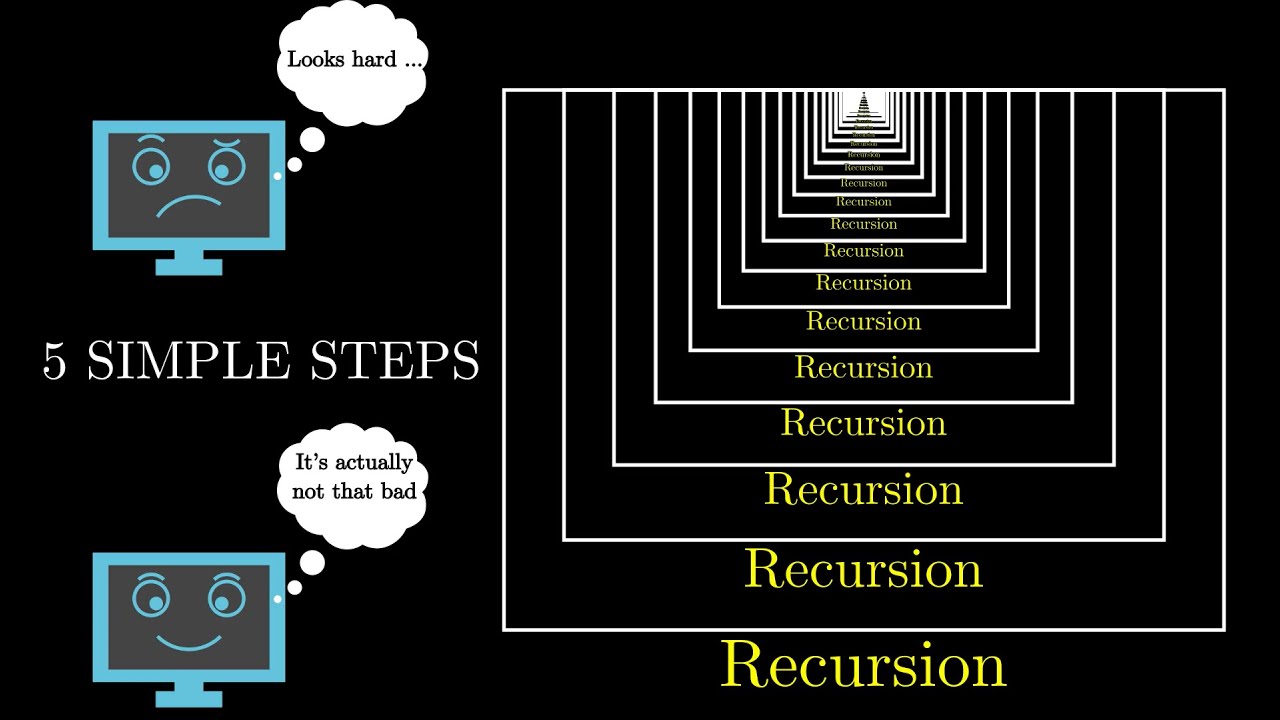
In this video, we take a look at one of the more challenging computer science concepts: Recursion. We introduce 5 simple steps to help you solve challenging recursive problems and show you 3 specific examples, each progressively more difficult than the last.
Support: https://www.patreon.com/reducible
This video wouldn't be possible without the...
As is dynamic programming. https://www.youtube.com/watch?v=aPQY__2H3tE
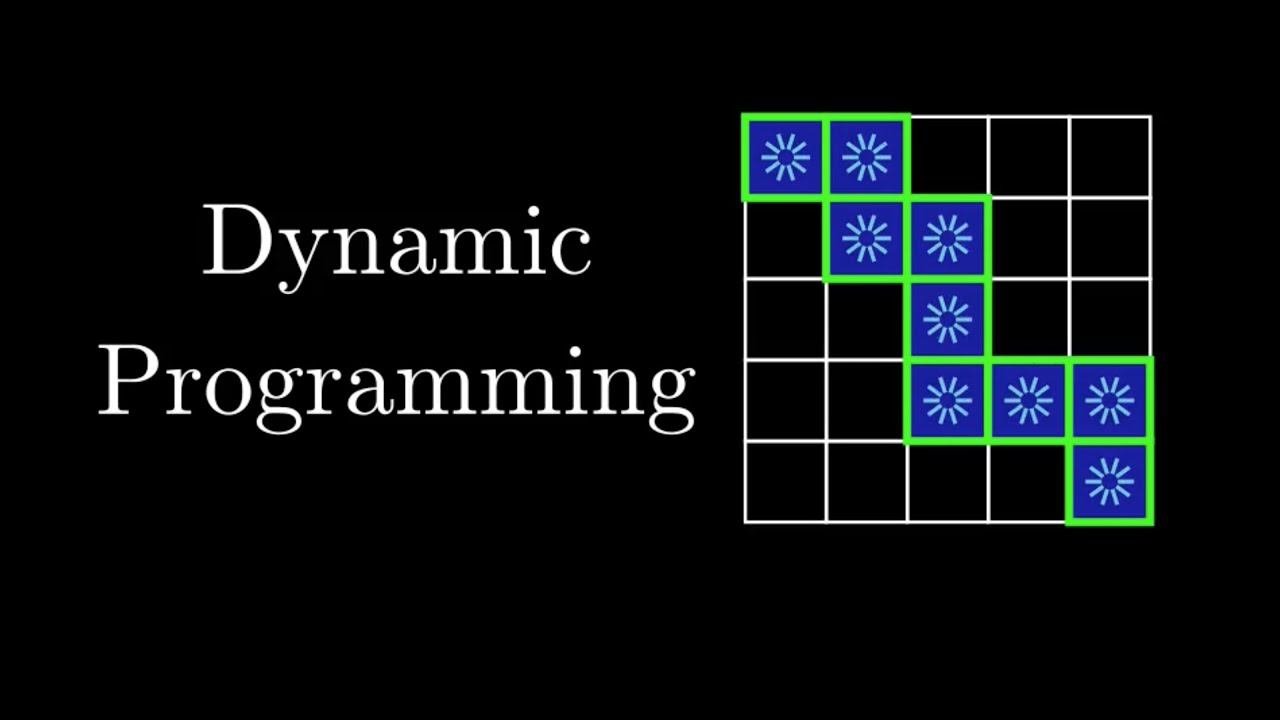
In this video, we go over five steps that you can use as a framework to solve dynamic programming problems. You will see how these steps are applied to two specific dynamic programming problems: the longest increasing subsequence problem and optimal box stacking. The five steps in order are as follows:
- Visualize examples
- Find an appropria...
cloud timber
Thank you so much
opal oriole
Here is a big list of Python projects for you to get more comfortable with programming in general: https://inventwithpython.com/bigbookpython/
I recommend trying to implement it first, see how far you get, and then read through their code.
opal oriole
cloud timber
Thank you so much
Oh, another random tip. Play around with simple concrete cases. So if the problem is to sort a list with N elements. Try messing around with a list of 1, 2, 3, 4, 5 elements and doing it on paper by hand.
Play around with it first, before writing a solution.
cloud timber
I see
opal oriole
Also to properly learn, as with tip (1) given, it's better to try to solve it, and if stuck, not look up the solution, instead realize you can't solve it yet and come back later. Solve something easier first (sometimes many problems needed before that one can be solved later).
If you give up quickly and look up the solution, you have wasted that problem for learning (you don't internalize the solution by just reading it, it gives the illusion of learning).
But initially, yes, you do need some examples.
cloud timber
Thank you I'll keep that in mind
 alpine bane
I am confused why are there so many sorting techniques in general
 shut kernel
Because shorting is hard and inefficient so different people explored different wants to do it.
 swift coral
Sorting efficiency also depends on how mixed the input is. Sometimes an algorithm that is less efficient for homogenous data is better to use on almost sorted data than some other algorithms that work well on homogenous data.
 haughty mountain
alpine bane
I am confused why are there so many sorting techniques in general
haughty mountain
alpine bane
I am confused why are there so many sorting techniques in general
to be fair, quite few are actually useful
some are born as just variations on other ones, some are genuinely trying new stuff, and some from people just wanting to create some silly way of sorting
for useful algorithms there are only a handful I would say are useful to know about
- quick sort, merge sort, heap sort
- insertion sort
the sorting algorithms you'll see in actual use is largely some hybrid of some variations of those
 verbal oar
IS there anyone who wwant to teach me the "way"?
 dreamy tulip
Young padawan, you are the way.

 formal eagle
verbal oar
IS there anyone who wwant to teach me the "way"?
formal eagle
verbal oar
IS there anyone who wwant to teach me the "way"?
which one wym
verbal oar
Nthing
 lilac cradle
formal eagle
lilac cradle
formal eagle
ez
formal eagle
fr
 fallow helm

GitHub
Contribute to abderrahim-ai/TP_Pytho development by creating an account on GitHub.
 blazing snow
formal eagle
blazing snow
formal eagle
move = wasd
formal eagle
blazing snow
move = wasd
auahahha
 still mulch
Is there any way to master linked list those are my worst topics.. I came across leetcode puzzle of like copy list with random pointer and it was the worst I couldn't get over it for some reason I asked chatgpt and still couldn't get it and then checked the solution in the end and understood
 runic tinsel
still mulch
Is there any way to master linked list those are my worst topics.. I came across...
runic tinsel
still mulch
Is there any way to master linked list those are my worst topics.. I came across...
that sounds ideal
if you can keep doing that
you would understand all solutions
eventually
still mulch
Ohhhhh okk I guess I would learn linked list gradually 😭
runic tinsel
linked list means you have two options, look at the first element, or get a different list that doesn't have the first element but otherwise it's the same
so if you want to look at the 5th element, you do the second thing 4 times, and then do the first thing
 tiny briar
Years ago I read a blog post about algorithms that said that all algorithms do one of three techniques one of which was called sliding window. Would anyone happen to know the other two?
I've never taken a formal dsa class so I don't even know where to start looking for this kind of thing
 narrow mica
tiny briar
Years ago I read a blog post about algorithms that said that all algorithms do o...
narrow mica
tiny briar
Years ago I read a blog post about algorithms that said that all algorithms do o...
never heard of this tbh, the "all algos do one of three" part
 empty echo
Sliding window is a ratelimiting algorithm
 agile sundial
tiny briar
Years ago I read a blog post about algorithms that said that all algorithms do o...
agile sundial
tiny briar
Years ago I read a blog post about algorithms that said that all algorithms do o...
"use graph theory" is a good guess
haughty mountain
empty echo
Sliding window is a ratelimiting algorithm
Sliding window is a very general concept 
empty echo
hmm, i guess I have only seen it in ratelimiting so far
 olive hazel
how can i use claude code with notebooklm for free
 astral finch
Which is the best YouTube channel for learning cybersecurity?
 naive oak
sliding window for ratelimiting and sliding window the algorithm technique are kinda two different things?
the ratelimiting method is a specific case i guess
haughty mountain
A specific application of the technique, afaict
haughty mountain
stack < deque > queue
 indigo loom
I see what you did there
 regal spoke
Another hot take
list should have O(1) append_left and append_right
 desert cedar
regal spoke
Another hot take
list should have O(1) append_left and append_right
desert cedar
regal spoke
Another hot take
list should have O(1) append_left and append_right
Linked lists do, but i don't see how that would work for regular lists
regal spoke
One could easily apply the same trick that list currently use
To preallocate extra slots on the left side too.
That would result in a list being fast to modify both on the left and the right.
cloud timber
does anyone know a free website that teaches you data structures
I tried using neetcode and leetcode but thats all blocked with a paywall
 violet pier
cloud timber
violet pier
cloud timber
tyy
dreamy tulip
regal spoke
One could easily apply the same trick that list currently use
I think you have just re-invented the deque.
haughty mountain
dreamy tulip
I think you have just re-invented the deque.
It's not how deques tend to be done
regal spoke
dreamy tulip
I think you have just re-invented the deque.
No. Typically deque is implemented as some kind of linked list, making indexing very slow
 thick granite
regal spoke
To preallocate extra slots on the left side too.
thick granite
regal spoke
To preallocate extra slots on the left side too.
if it runs out it will have to move the entire list though, right?
regal spoke
thick granite
if it runs out it will have to move the entire list though, right?
Thats how a list works to begin with
regal spoke
A significantly less expensive way, yes
 south stream
 real whale
south stream
real whale
south stream
Add a sound
 jolly mortar
regal spoke
Another hot take
list should have O(1) append_left and append_right
jolly mortar
regal spoke
Another hot take
list should have O(1) append_left and append_right
i believe julia's impl of Vector does this
O(1) pushfirst and popfirst
by overallocating on both left and right
regal spoke
jolly mortar
i believe julia's impl of Vector does this
Are you sure? I'm finding it surprisingly hard to confirm this.
Also, the fact that deque is a thing in Julia is making me doubt this fact
Had Julias vector already effectively been a deque, then there should not be any need for a deque
However googling Julia deque, I get something very similar to c++ deque
 tight cedar
Julia instantly becomes the best competitive programming language
tight cedar
damn
jolly mortar
ig a bunch of cp problems are 1 indexed too
regal spoke
How come AI tools think this is not a thing?

 jolly mortar
i dont think the complexity is documented anywhere
i just remembered someone telling me this on the julia discord a while back
tight cedar
If you search Julia front insert vector the ai will say it is O(1)
but it didn't give any source
regal spoke
jolly mortar
i dont think the complexity is documented anywhere
Why wouldnt this be better documented? 
regal spoke
tight cedar
If you search Julia front insert vector the ai will say it is O(1)
Google's search AI thing told me O(n)
tight cedar
I couldn't replicate it now for some reason

lol it says O(n) when I say vectors and O(1) when I say vector
regal spoke
Even when I explicity ask chatgpt/gemini to double check its answer. Both confirm it is O(n)


Maybe they are really sold on the idea that stored in contigiuous memory => append_left/pop_left is always O(n), or at least those are the vibes Im getting
 stiff quartz
Idk why but my GPT seems to get it

I don’t ask it to do anything like I didn’t enable thinking nor did it enable web search and it still goes on to look at the source code itself
It’s getting good 
regal spoke
stiff quartz
Idk why but my GPT seems to get it
You hinted it the answer
Thats not a good way to prompt an ai
 regal spoke
stiff quartz
Even if you give a wrong hint it gets it tbf
regal spoke
stiff quartz
Even if you give a wrong hint it gets it tbf
thats still arguably a hint
stiff quartz
regal spoke
thats still arguably a hint
Well less than saying « double check please »

Sometimes it doesn’t bother going online
And gets it wrong
stiff quartz
stiff quartz
Sometimes it doesn’t bother going online
With the same prompt lol
 crystal smelt
GitHub
the greatest find module thatever lived. Contribute to BlackCatOfficialytb/CatFind-Lib development by creating an account on GitHub.
som1 review it plz
swift coral
<@&831776746206265384> spam/scam message. Feel free to delete my message too
 lusty crest
True python:
I64 A[200005][20],B[200005],C[200005];
U0 (){I64 T=GetI64,N,I,J,P,L,S,V,W,X,Y;char Z[64];
for(;T--;){N=GetI64,I=1,P=1;while(P<N)I++,P*=3;
for(L=0;L<N;L++){for(S=0,P=L,J=0;J<I-1;J++)A[L][J]=P%3,S+=A[L][J],P/=3;
A[L][I-1]=(300-S)%3;}Print("%d\n",I);
for(J=0;J<I;J++){for(V=0,W=0,P=0;P<N;P++)A[P][J]-1||(B[V++]=P+1),A[P][J]-2||(C[W++]=P+1);
Print("%d",V+W);for(P=0;P<V;P++)Print(" %d",B[P]);for(P=0;P<W;P++)Print(" %d",C[P]);Print("\n");}
Yield;GetS(Z,64);for(P=0;P<N;P++){for(X=1,J=0;J<I;J++)
Y=(Z[J]-76?Z[J]-82?Z[J]-78?-1:0:2:1),X&=Y<0||A[P][J]==Y;
if(X){Print("%d\n",P+1);Yield;break;}}}};
None of u will ever know
The peace
 radiant birch
can someone explain me why does 1100 & 1 give 0 here?
>>> 1100 & 1
0
>>> 1100 & 1000
72
>>> 1100 & 0001
  File "<stdin>", line 1
    1100 & 0001
           ^^^
SyntaxError: leading zeros in decimal integer literals are not permitted; use an 0o prefix for octal integers
>>> 1100 & Oo1
Traceback (most recent call last):
  File "<stdin>", line 1, in <module>
NameError: name 'Oo1' is not defined
>>> 1100 & 0o1
0
because 1100 is even so the last bit is 0?
thick granite
lusty crest
True python:
```
I64 A[200005][20],B[200005],C[200005];
U0 (){I64 T=GetI64,N,I...
this looks suspiciously like C and not python
lusty crest
thick granite
this looks suspiciously like C and not python
because it is holy C
“True python”
 burnt swift
has any one have an idea of a tech startup
 worn oyster
make a hammer app which has a hammer pic in it so people could use it nail the nails in wall
regal spoke
radiant birch
can someone explain me why does 1100 & 1 give 0 here?
```bash
>>> 1100 & 1
0
>>>...
That error message is not missleading since you want binary numbers. What you should be using is the 0b prefix
>>> 0b1100 & 0b1000
8
Infact, it is weird that python's error message suggests to use octal integers. I think the probability of someone actually wanting to use octal integers when they write 0001 is quite low.
haughty mountain
regal spoke
Infact, it is weird that python's error message suggests to use octal integers. ...
It's not weird, it was allowed syntax for octal that was later removed
regal spoke
haughty mountain
It's not weird, it was allowed syntax for octal that was later removed
What was the syntax, just a leading 0 or multiple 0s?
haughty mountain
just a leading 0
though probably multiple leading zeroes was allowed
I expect the parser just goes "this looks like leading zero octal, that's not supported anymore" and errors
lilac cradle
https://www.youtube.com/watch?v=ldxFjLJ3rVY
anyone know how you can actaully implement this to get the shape they get?? i cannot replicate it

Escher's Print Gallery, and the tour of complex analysis it invites.
Check out our virtual career fair: 3b1b.co/talent
Join channel supporters to see videos early: 3b1b.co/support
An equally valuable form of support is to share the videos.
Home page: https://www.3blue1brown.com
Original paper by de Smit and Lenstra:
https://pub.math.leidenuniv....
im converting the pixel coordinates to a complex number and taking the log, then scaling it back up to image size and i do not get anything remotely like this
haughty mountain
lilac cradle
https://www.youtube.com/watch?v=ldxFjLJ3rVY
anyone know how you can actaully imp...
log is only part of it, right?
lilac cradle
maybe but i cant figure out what they’re doing to get the effect
haughty mountain
are you just looking at doing the first step in the transformation?
do you have a good test image?
lilac cradle
i used the same as they did and looked at their github and it seems to just be ln(z)? but their code is weird
haughty mountain
random fun fact, I watch a talk on this topic from one of the authors many years ago
Bart de Smit
haughty mountain
So the first step going from rectangular to logarithmic is something like
import cmath
import math

from PIL import Image


def zmap(z: complex):
  return cmath.exp(z)

im = Image.open('droste2.png')
px = im.load()
w, h = im.size
sz = 3.0
def sample(x: float, y: float):
  ix = round((x/sz + .5)*w)
  iy = round((y/sz + .5)*h)
  assert px is not None
  if 0 <= ix < w and 0 <= iy < h:
    return px[ix, iy]
  return 255, 0, 255

out = Image.new('RGB', (w, h), (255, 0, 255))
px2 = out.load()
sc_x = math.log(16)
sc_y = 2*math.pi
off = -sc_x/2, -sc_y/2

for y in range(h):
  y_ = y / h * sc_y
  for x in range(w):
    x_ = (x / w - 1.0) * sc_x  # Offset here is arbitrary, effectively controls zoom.
    z = complex(x_, y_)
    z2 = zmap(z)

    x2 = z2.real
    y2 = z2.imag
    px2[x, y] = sample(x2, y2)

out.save('log_map_img.png')

starting from
 haughty mountain
@lilac cradle I did manage it, but the logic is funnily backwards

(and I really need a higher res image)
when tracking where a pixel in the final image should be sampled from, you need to undo the transformations in sequence
undo the exp, then undo the rotation/scaling, then undo the log
lilac cradle
haughty mountain
<@240985010813796352> I did manage it, but the logic is funnily backwards
sweet
thanks
haughty mountain
I also did some fun to sample the image a bit nicer, when you sampling from within the nested image, rescale and recurse
 round jungle
hello, is there any one who is good at proogramming actually and ca, help me to learn fast with som free courses???
 unreal swallow
round jungle
hello, is there any one who is good at proogramming actually and ca, help me to ...
unreal swallow
round jungle
hello, is there any one who is good at proogramming actually and ca, help me to ...
!learn from one of the recommended resource below 👇
 halcyon plankBOT
Go-to beginner resources
Here are the top free resources we recommend for people who are new to programming:
- Automate the Boring Stuff — an online book (also available to purchase as a physical book)
- Harvard’s CS50P course — video lectures (slides and notes provided) with exercises
- Python Programming MOOC 2026 course — text-based lessons with exercises
- Corey Schafer's YouTube playlist
For a full, curated list of educational resources we recommend, please see our resources page!
 oak cypress
Any resources for learning MIPS assembly?
 candid parrot
can someone with a better rig than me run a simulation code?
its for theoretical physics
 proud geode
https://tube-sciences-technologies.apps.education.fr/w/bd31a30a-26a8-4f13-811f-129517b2254e
I found this on Peertube, a general-purpose database simulation engine. Pretty impressive for people their age.

Tree est un moteur de simulation marchant avec son propre langage sous forme d’un site. Il permet de créer simuler des données sur une période t, et d’afficher leur évolution avec des courbes et u...
 glacial basin
I’m currently a half time Phyton scripter this is my first time for hire I have projects I can show you and I am for hire if you want to hire me or have problems you can ask me
 limber lintel
candid parrot
can someone with a better rig than me run a simulation code?
limber lintel
candid parrot
can someone with a better rig than me run a simulation code?
Yes
candid parrot
limber lintel
Yes
im gunna have to get back to ya, managed to consolidate that one, but im sure it wont be long till the hands needed, mind if i drop a contactline
 limber lintel
candid parrot
im gunna have to get back to ya, managed to consolidate that one, but im sure it...
limber lintel
candid parrot
im gunna have to get back to ya, managed to consolidate that one, but im sure it...
Alright 👌
 fiery cosmos
gfhycrtseqwtyruti
 toxic junco
Is double-imports something I should handle when working on a library where I expose a singleton?
I can't think of a reasonable case where the library would be mistakenly inconsistently imported - once via absolute import and another time via relative import
maybe in the context I have it in right now, which is that I keep it under src/lib as opposed to src/project_name which is the consumer project
also what's a preferred way of making singletons in python?
overriding __new__() and __init__() or exposing an instance in __init__.py?
olive hazel
why AI is useless to guide me in learning cs
 austere sparrow
toxic junco
Is double-imports something I should handle when working on a library where I ex...
austere sparrow
toxic junco
Is double-imports something I should handle when working on a library where I ex...
all modules are singletons and are cached
so if you import it twice, it's the same module
toxic junco
austere sparrow
so if you import it twice, it's the same module
yeah I guess all non-standard import methods that actually cause duplication shouldn't be handled in the library
like importlib maybe
olive hazel
is there here any faang employee
 nimble canyon
Rather than a prebuilt eviction algorithm, i made a dynamic eviction system based on temporal and relational clustering, tracking relationships across entries and types and using that for prefetch accuracy. Would that be appropriate for this chat?
Its inspired by ARC and does use the eviction algorithm as a helper. Its based on contextual frequency vs recency rather than frequency vs recency
 stone garnet
hello friends .
Actually Iam in begein in my programming carrer,i learn well the foundation of python and i apply these simple project like calculator ,etc . can anyone share with me what's next?
 pure crater
olive hazel
is there here any faang employee
pure crater
olive hazel
is there here any faang employee
watchu need
 fading rover
stone garnet
hello friends .
Actually Iam in begein in my programming carrer,i learn well th...
fading rover
stone garnet
hello friends .
Actually Iam in begein in my programming carrer,i learn well th...
Try to build something async, like parser for website from scratch(with something like aiohttp and bs4)
 shrewd lynx
I know this is a longshot, but, does anyone know how to contact the maintainers of onlinejudge. org? (UVa Online Judge)
I know the site is still live and people are submitting solutions, but I cannot login or recover my password. When I try to reset my password, I never get the email, nor is it in my spam filter. I have also tried to create a new account and have had a few different friends that have tried. None of us ever get the email with the account information.
I have also submitted to the "contact us" webform, however, I suspect that it also might not be working as I did not get a "confirmation" email.
I have been trying to figure this out since early January and cannot seem to get this squared away. Thanks!
 flint lodge
Hey, how do i learn DSA the right way?, when i get a resource to learn, i discover more strange topics that i didn't see from the previous resource
stiff quartz
flint lodge
Hey, how do i learn DSA the right way?, when i get a resource to learn, i discov...
 blissful cypress
That class is good but has a high math pre-req
May not be the best first pass at DSA for a lot of people
blissful cypress
flint lodge
Hey, how do i learn DSA the right way?, when i get a resource to learn, i discov...
How long have you been programming?
nimble canyon
I think i finished my cache design. My render speed has increased 12x from cold render to cached render. Is anyone else working on a cache system or is interested in talking about my design?
 jade kelp
hey guys, i built this visual cheatsheet for dsa leetcode prep, if you're looking for a pattern-focused cheatsheet check it out and lmk if there's more i should add? 👉 https://github.com/maryamtb/rook/tree/main/community-notes/dsa-python

GitHub
The note-taking app for developers. Contribute to maryamtb/rook development by creating an account on GitHub.
 main pagoda
hey guys, i was wondering if anyone has any experience in making a robust monte carlo simulation to test theirs or another's trading strategy, i have made one but am looking for a bit of advice on how too make this more robust and more testing, thank you!
haughty mountain
(this reads like an ad)
 shut breach
given {a, b, c} and {1, 2, 3} and there exists an unknown bijection between them
and a set of possible mappings for each e.g. a: {1, 2} b: {1, 2} c: {1, 2, 3}
you can reduce possibilities, e.g. conclude that c: {3}
is there a name for that reduction problem/algorithm?
opal oriole
shut breach
given `{a, b, c}` and `{1, 2, 3}` and there exists an unknown bijection between ...
Constraint satisfaction problems (CSPs) are mathematical questions defined as a set of objects whose state must satisfy a number of constraints or limitations. CSPs represent the entities in a problem as a homogeneous collection of finite constraints over variables, which is solved by constraint satisfaction methods. CSPs are the subject of rese...
See domain reduction as a way to solve this.
The most simple and straight forward way is search with backtracking. Assign some value to a from the set of its possible values, then assign some value to b from its set (note that b can't be one that was already taken, so its set (domain) shrinks as some value is chosen for a), then for c. If you get to say, c, and its set is empty, then the choices so far can't work, so you backtrack and try another.
This is trying all combinations but tracking the sets / reducing them.
In more complicated setups, choices taken affect the set of more than 1 variable. For example in game world generation it's common to use this method. For example having a grid world (tiles) and each tile has a set of possible values it can take (templates), and once one is chosen, the neighbor's sets reduce to values that can be adjacent (so the choice affects 4-8 other neighbor tile sets). This choice then affects the neighbor's neighbors too possibly, in which case you have a constraint propagation algorithm.
shut breach
i meant like problems where the constraints are only the given domains and the goal is to reduce the domains like in the example i gave
i think i was thinking of gaussian elimination
opal oriole
shut breach
i meant like problems where the constraints are *only* the given domains and the...
If you do exhaustive search you can find all valid assignments, that then tells you the sets of each variable.
opal oriole
shut breach
i think i was thinking of gaussian elimination
What is the idea there?
shut breach
not sure, i'm trying to remember things i used to know about linear algebra
opal oriole
Are you thinking of integer linear programming?
shut breach
hmm i dont think so
 zenith crow
Coding against the odds in Gaza 📱💻
My name is Omar, a self-taught Python developer and programmer from Gaza. I lost my laptop during the war when my home was bombed, but my passion for technology remains unbroken.
I am currently using my phone to write and debug Python scripts, and I have recently started my journey into Cybersecurity. However, my progress is significantly hindered because I don't have a laptop to run the necessary tools and environments.
I am looking for any organization or person who can help me acquire a laptop so I can continue my technical education and build my future in the field of Cybersecurity.
haughty mountain
shut breach
given `{a, b, c}` and `{1, 2, 3}` and there exists an unknown bijection between ...
shut breach
ty 👍
 trim thorn
Guys, do anyone have a list of best problems on arrays and strings (from basic to advanced) ?
 deep snow
trim thorn
Guys, do anyone have a list of best problems on arrays and strings (from basic t...
deep snow
trim thorn
Guys, do anyone have a list of best problems on arrays and strings (from basic t...
Try leetcode ig
 safe hinge
Does anyone know how to cut Quiescence Nodes efficiently for a chess bot? Currently I'm getting about 6 times more qnodes than normal nodes in the evaluation tree and I feel like I could really cut that down
 jade lantern
Currently starting on data structures, any hints on how to sort a txt file into a list, the split() function is required when I write the code. unfortunately the editor will only accept the format of python v3.13 or older...(thanks coursera) any help would be appreciated.
 sly nacelle
is there a big list of calc/stats algos/models (physics/engineering/quant)?
 weary gyro
Is there any chance that i can discuss about and talk about like brainstorm about the question I'm praticing about on leetcode like im totally a newbie and i don't want to talk to claude or deepseek and got direct ans to that question and enjoying solving question that i didn't solved actually.
austere sparrow
weary gyro
Is there any chance that i can discuss about and talk about like brainstorm abou...
what question are you struggling with?
(it's usually better to ask the full question from the start)
 thorny gorge
i am learning dsa using python , while exploring the array and the type code used while using them is bit confusing, can anyone explain them with suitable example for each type code of it
 zinc mountain
thorny gorge
i am learning dsa using python , while exploring the array and the type code use...
zinc mountain
thorny gorge
i am learning dsa using python , while exploring the array and the type code use...
While it can be explained, a LLM or any resource on the sites like RealPython would explain it better, with better examples.
 trim atlas
Hey, has anyone ever coded anything in finance and quantitative finance? I have some question to ask about the topic!
fading rover
trim atlas
Hey, has anyone ever coded anything in finance and quantitative finance? I have ...
Just fucking ask
No one going to wait for u
trim atlas
fading rover
Just fucking ask
Just fucking relax
trim atlas
fading rover
No one going to wait for u
Then don’t go ahead with your day
fading rover
trim atlas
Then don’t go ahead with your day
Ask in python-help
They like interesting questions
thorny gorge
zinc mountain
While it can be explained, a LLM or any resource on the sites like RealPython wo...
Will look into it , thank you @zinc mountain
 bronze gazelle
Because it's new
 scenic mason
coolio
 opaque portal
 royal kestrel
I'm having some trouble with octal numbers
scenic mason
shoot
fiery cosmos

 frank nest
🤔
bronze gazelle
Yes, the channel exists, we don't need to spam it with emojis
 clear plaza
sorry boss
 main flower
yes
 gusty grove
oh awesome! i love this new channel!!
 odd pelican
looks like an interesting channel
 ionic niche
oh hey, just as I was creating a binary tree in python, this channel pops up
what a coincidence
 whole wadi
@ionic niche excellent, do let us know if you need help in anyway with it. Except at 12am EST, as I and many others will be busy at that time lol
 tender wedge
so guys and gals, how to calculate complexity of Advent of Code part 2 if you did it recursively
i always suck at guessing them whenever it include recursion
gusty grove
well the summing part will always be O(n). but lets take a look at the rest.
 plain ocean
@whole wadi why 12est?
gusty grove
this is the graph for how many times you have to call recursively for the number n
@tender wedge it seems to do these jumps. no idea why really lol
this is a resolution of 1 so i expected something smoother tbh
tender wedge
Only 8 times wow
 turbid zephyr
Aren't those jumps just going to be where the input becomes 3**n or greater?
Or 3**(n - 1) 🙂
gusty grove
hmm maybe
also you dont have to worry about exceeding the max recursion depth. that happens at around 1.79769e+308
 stark summit
(this may be off-topic but) what's the time complexity of //? it's a / with a int() right?
gusty grove
no! its way faster
stark summit
hmmm
gusty grove
i posted a comparison earlier today in #517745814039166986
let me repeat it real quick 🙂
stark summit
cause in ruby / is //-like behaviour so that might be a built-in thing
gusty grove
%timeit 5//3
12.4 ns ± 0.655 ns per loop (mean ± std. dev. of 7 runs, 100000000 loops each)
%timeit int(5/3)
164 ns ± 1.59 ns per loop (mean ± std. dev. of 7 runs, 10000000 loops each)
%timeit int(5.0)
161 ns ± 3.62 ns per loop (mean ± std. dev. of 7 runs, 10000000 loops each)```oh okay
gusty grove
// is actually just as fast as /
%timeit 5/3
12.1 ns ± 0.639 ns per loop (mean ± std. dev. of 7 runs, 100000000 loops each)```@plain ocean advent of code my boy!
gusty grove
@whole wadi hm?
ah i see
@turbid zephyr how would 3**(n-1) be different from 3**n?
the first jump is between 6 and 23 so that would be a power of 3 difference!
turbid zephyr
The n I was referring to was the recursion level, I realized afterwards n had been mentioned as the input.
gusty grove
the next one is 24-81!
ahh
ok that makes more sense
yup looks like you are right
which means you can write a just as efficient iterative solution!
turbid zephyr
I'll use k instead 🙂 I just figured because we're dividing the number by three k times. It would be 3**k.
gusty grove
yeah, i had a hunch it was something like that but just couldnt think of anything haha
turbid zephyr
I forgot about the subtracting 2 though, so not sure if that has an impact 🙂
gusty grove
to figure out how many times you have to call the function you can then use log(n,3)-1
@tender wedge ok! so that function follows int(log(n,3))-1
so your time complexity should be O(log3 n)
tender wedge
Ahah thanks
I was thinking of this just because it's /3 but i wasn't sure cause i'm bad at math and no CS classes
gusty grove
i've never taken a single cs class 😉 thats not a excuse!
gusty grove
or a uni math class for that matter
in blue the actual value, in green log3(n)-1 and in orange log3(n)
 half lotus
can just be logn
gusty grove
are you allowed to generalize that much?
half lotus
I believe yes because the intent is to describe how a function grows rather than to what extent
gusty grove
ahh ok
half lotus
But please anyone correct me if that's wrong
gusty grove
i think you are correct
gusty grove
ahhh
yeah makes sense
i knew you were allowed to leave constants away, just didnt think of log3 that way
 lusty vault
you omit the base ftr
since log_n(x) = log_e(x)/log_e(n)
so you change it to ln(x)
gusty grove
yeah mark said that
tender wedge
I feel like log2 and log10 grows very differently though, enough to precise it ?
Apparently not :0
half lotus
Yup the shape of the function is still logarithmic
a base of 3 would mean it grows about twice as fast as base 10
it can just be though of as a transformation on the function
fiery cosmos
Hi
 dark moss
So for this part of the chat
if i'm doing OOP in my c.s undergrad with cpp and I'm on a concept like polymorphism, it's appropriate to ask questions about a concept like that in this specific channel?
 low palm
I'd think concepts like polymorphism falls under "general computer science". Go ahead 🙂
dark moss
Oh not yet haha
I'm actually in my introduction to programming
but I read next semester's topics and heard polymorphism and pointers give students some trouble
when I go on break, I would like to practice it, and then I will definitely return
low palm
Sounds good! Welcome back anytime ^_^
Python is pretty much all I know. But if this is not going to be a discussion about computer science, we're in the wrong channel
dark moss
oh right
main flower
Could somebody explain why
a = []
b = a
a.append(1)
This changes the list b, but this
a = "Hello"
b = a
a += " world"
doesn't change the b string?
 warm marsh
https://nedbatchelder.com/text/names.html might be an interesting read to understand the concept
 outer lake
There's also a video on the topic from nedbat: https://www.youtube.com/watch?v=_AEJHKGk9ns

YouTube
"Speaker: Ned Batchelder The behavior of names and values in Python can be confusing. Like many parts of Python, it has an underlying simplicity that can be ...
 acoustic fox
Oh cool! The system works!
Going though computer science 101 book learning big o notation. I will contribute soon
 placid sun
Hello, I have a question , I want to code a L - game . It's a table game with 2 tetris L pieces that you move turn by turn in a grid (with 2 neutral pieces ) . A player wins when the other one cannot move it's piece. If I want to check if a player won, I thought about checking every position his piece can take and verify if it is occupied by something or not.
Is this the only way to verify if someone won ?
Thanks in advance ^^
 weary obsidian
Literally a week late to the big O notation chat but yeah, you strip all the constants out, so log(100000n) -> log(n), which also means that having the complexity isn't necessarily indicative of how long it'll take
Just the order of the function
As the goal is to describe end behavior
whole wadi
i'm not entirely sure what you mean by end behavior. It's meant to estimate how it will scale as the input changes
 feral shale
^
when you double your input, sometimes it takes twice as long, sometimes you come back on Monday and the program is still running - big O tells you which to expect
 stark bridge
nicely said
low palm
I'd like to re-raise @placid sun 's question as I'm curious too. It seems the game in question is the one presented here: https://www.youtube.com/watch?v=64pA31_WJa0
So there's a 4x4 2D grid, and we want to check whether or not the grid contains 4 unoccupied cells in which we can place a tetrisy L-shape (which can be rotated and/or flipped). Since the grid is small (there's only 48 possible placements for an L on an empty grid), checking each option seems viable, but what is a good scalable approach?
I suppose the problem could be stated as: Given a set P (possible positions for an L-shape on an empty grid) of sets L (the cells occupied by an L-shape), and a set U (unoccupied cells on the current grid), how do we efficiently check whether any L in P is a subset of U?
Since different L's can still share some of the same cells, it would be nice to trim down the options for every exclusion, instead of repeating lookups as a bruteforce approach would. Some googling led me to https://xlinux.nist.gov/dads/HTML/unlimitedBranchingTree.html but I can't really tell if it's applicable. Thoughts?
tender wedge
this makes me think of a dynamic programming problem but instead of L shapes, you have squares
hmm maybe the idea is too far away https://www.geeksforgeeks.org/maximum-size-sub-matrix-with-all-1s-in-a-binary-matrix/

GeeksforGeeks
Given a binary matrix, find out the maximum size square sub-matrix with all 1s. For example, consider the below binary matrix. Recommended: Please solve it… Read More »
checking every position would "just" take grid_size x grid_size though?
 scenic iris
@low palm I guess you need a sliding window here 3x3 over given NxM matrix, you could optimize it by increasing a step on certain conditions, but apart form that I'm not sure if it could be done in any better way. I would also be interested to see the best solution to this problem.
placid sun
@low palm After thinking a bit, I think I have a slightly better approach than checking everything, for example the orientations of the L pieces have a 3 squares in common each time, so after checking where it is on the grid, I know that if it is on the edge it cannot be 2 positions because that would go off the grid. So i only check with 2. It's still far from perfect though. If the piece is in the middle of the board it is still 4 positions possible
placid sun
Yes but what does it change ? When you are trying to see the 'free' spaces on the grid . The L of the other player and the stones are processed the same way I think
What I was trying to know was, to check if someone won the only way to check that is to try to see whether he can move his piece somewhere and which is the most efficient way to do this instead of checking if every possibility is possible.
royal kestrel
You can limit your search space by first getting the row- and column-wise amounts of contiguous free spaces and then checking only the ones that have 3 or more spaces available for the "body"
tender wedge
the cost of checking the 4 rotation and the 4 square is probaby nearly the same?
also you could just generate all possible winning board at the start or saved somewhere and compare if the game state and the winning ones are equal ? 😮
placid sun
That's a great idea ColdEmber but i want to do it more algortihmically
and i will try to check this Ava THANKS
I don't know if i understood what you were saying but there is always at least 1 space in every row column in general
I think I don't get what you saying
royal kestrel
Since the piece has 3 blocks next to each other and then the one block next to it as the L-shape, somewhere on the board you need 3 spots next to each other in order to place it
So if you do not check the spots where there are not 3 in a row at all by calculating them beforehand you save many iterations over just trying to check every single space
placid sun
AH
Thanks I get it now I think
I just do 2 checks per row if there is 3 empty spa ces
and I can stop depending if I find 2 and not empty or 1 and not empty
Thanks
and for the columns I do the same ok thank you ^^
fiery cosmos
Can anyone recommend education projects for Python CompSci?
Building a Web Application to manage a Todo List
It's a nice starting point to discover a lot of things
 open cloak
Currently studying Comp. Sci & we've got an assignment with Python Networking, anyone have experience with it?
gusty grove
@open cloak yeah ive done some tcp stuff
@mossy gorge im not quite sure myself, is this the right channel for that question? i mean its his/her comp sci homework but its networking... i thought this channel was more about math/science etc
open cloak
We've to create a TCP socket which the user uploads a document to the server and the server has to count the characters and words contained in the file & return them to the client. I don't even know how to tackle this.
gusty grove
id rather answer any questions here, not in dms 🙂
open cloak
No worries.
gusty grove
python has the socket lib: https://docs.python.org/3/library/socket.html
i actually have a script for sending files, but i think you should try it yourself before i just post it 🙂
open cloak
I've been looking at my screen for like 30 mins, I've a little bit wrote, I'll get back to you.
gusty grove
you might also be interested in https://docs.python.org/3/library/socketserver.html#module-socketserver
 mossy gorge
Yeah doesn't fit here per say, would likely be better in one of the regular help channels. #help-croissant is for sure free
gusty grove
its a slightly higher level lib/wrapper
ok, sounds good to me. feel free to ping me there if you have any questions miller
 last blaze
finding the count of a given character in a string is O(n) right? theres not some weird tricky way of going about it?
royal kestrel
yes
If it's a frequent operator you can create a LUT with pre-computed values, which means subsequent operations are O(1) assuming the string doesn't change
a cache, basically
last blaze
Unless I'm misunderstanding, you still need to do at least one pass of the whole string right?
gusty grove
yes
last blaze
Oh - I misunderstood Ava yeah. Am dumb
half lotus
look up table
tender wedge
ah yeah thanks
 quaint wing
Any video tutorial or book recommendation on algorithms?
last blaze
MIT 6.006 Introduction to Algorithms is a pretty good set of video lectures
Then I've also heard good things about this video https://www.youtube.com/watch?v=RBSGKlAvoiM&t=4s

Learn and master the most common data structures in this full course from Google engineer William Fiset. This course teaches data structures to beginners usi...
gusty grove
@quaint wing for me the best way has been to pick a algorithm and then implement it in some way that I can also visualize it
So for something like pathfinding you can do a maze solver etc
tender wedge
MIT 6.006 Introduction to Algorithms is a pretty good set of video lectures
yeah the professors are pretty cool
i hated math and i was like "hurh" computer are for nerds
then it appeared on my youtube feed and i watched a lot of them
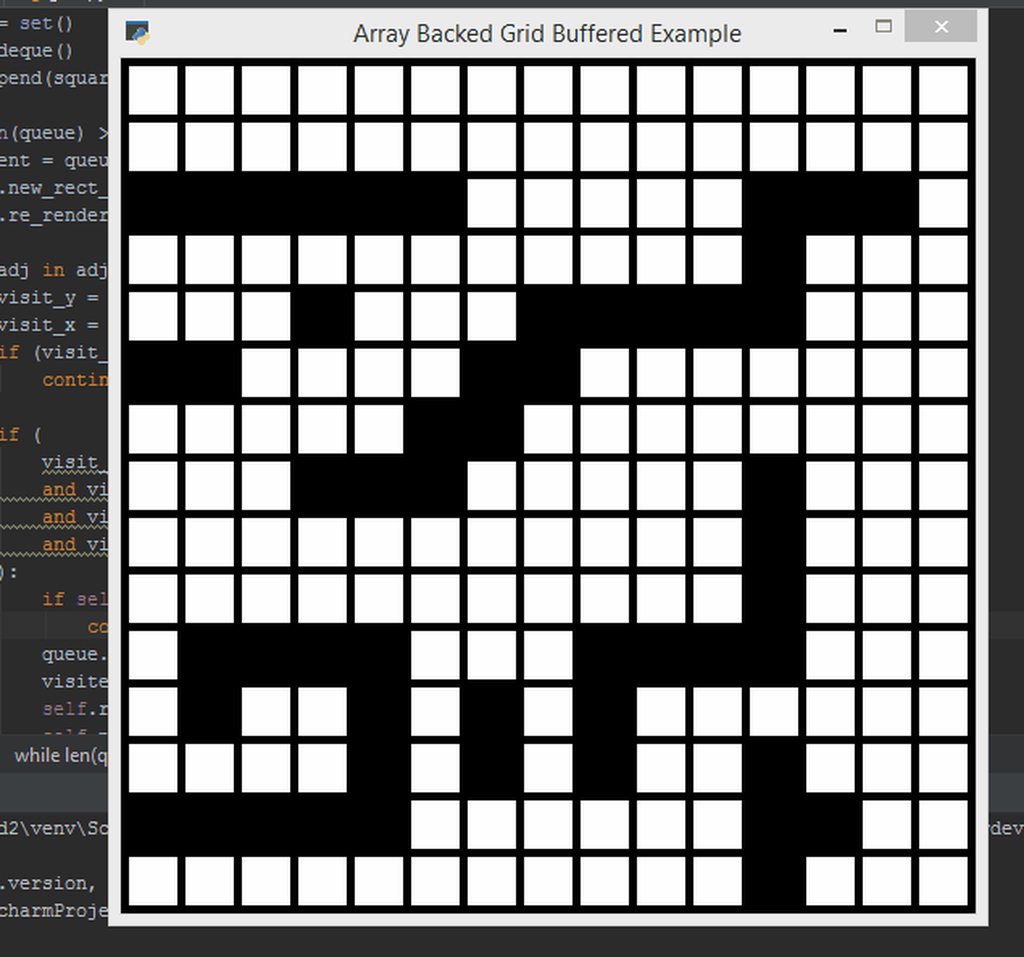
@gusty grove#0140 i tried visualising BFS some time ago with arcade python but performance were meh : o https://i.imgur.com/0Wfj07B.gifv
 gusty grove
i just used kivy.
tender wedge
too many projects
gusty grove
pygame was slow-ish but not really the limiting factor..
tender wedge
the slowness in image above, is it draws the thing on a big list
i should redoit with sprite
the gif not animating for me :c
tender wedge
ahah yeah fast
gusty grove
its really slowed down here
tender wedge
how do you generate the maze
tender wedge
then tell me :p
gusty grove
ofc gif recording is a pain
and i have 0 of the dependencies installed
yay
@tender wedge
oh yikes
what are those colors
i guess thats compression for you haha
so red is where it looked and blue is the fastest path then
i have it to slowly reveal the path but im just skipping that here so the gif isnt too long
im also doing some secret magic behind the scenes to get the maze to generate that quickly 😉
i also have a mode where you can draw your own maze, but as you can imagine it would be kinda hard for those large scale mazes 😉
@tender wedge how did you go about your solver?
tender wedge
oh wow it's super fast 😮
oh it's not really a solver on the gif i show, just bfs, but i gess it's imple enough to retrieve the path once it hit x
gusty grove
yeah
dijkstra’s does something similar to yours
i rewrote that same algo in cpp and that was even faster
like instant.
pythons slow iteration really kills it here...
gusty grove
It's called "Astar"
tender wedge
You could take the red parts to generate continent in a fantasy map :D
acoustic fox
@tender wedge I am going through that class right now
I have gone through 17 lectures
It's a pretty good/easy to follow class.
The problem I had with just going through the lectures is that I didn't know how to pragmatically implement the data structs, and so I am currently going through the book, I am on chapter 4.
acoustic fox
UH
I took extensive notes from the lectures
but it's not necessarily about training as much as like
How do you form a graph in python ?
How do you insert numbers, rotate groups, ect.
fiery cosmos
thx @gusty grove
fiery cosmos
can someone help me understand Dijkstra's algorithm?
 native tiger
anyone know some good recourses on quantum computing
acoustic fox
Taking a look at it @fiery cosmos
So, you already know about relaxing edges, right ?
fiery cosmos
a little, what confuses me is that some approaches don't use the relaxing approach
or is that a key part of the algo?
acoustic fox
Dijkstra's uses relaxing
It's used to deal with negative weight cycles I think

MIT 6.006 Introduction to Algorithms, Fall 2011 View the complete course: http://ocw.mit.edu/6-006F11 Instructor: Srini Devadas License: Creative Commons BY-...
fiery cosmos
so cycles you mean refreshing for each updated node?
acoustic fox
Nonoo
If you try to relax the edges over and over and over again
when you update the values starting from the '1' circle' you can get an arbitrary low value to any node in that cycle
Which is an issue
This creates firstly, a problem of infinite recursion so your algo never terminates, it also means that you will/might weigh all those nodes at -infinity which can break the graph because any node that you need to travel through the negative weight cycle to get to will also have -infinity value
Dijkstra's algo solves this problem in an approximate way
(It doesn't solve the problem, but it pushes the problem aside. )
(Technically in my opinion if you have negative weight cycles that allow for arbitrarily low weights to get to the node, that represents a real problem that your model isn't handling well enough, so we are just sweeping that problem under the rug)
Does this make sense so far?
fiery cosmos
Yeah understanding the problem helps a bit, by arbitary do you mean all neighbouring nodes based on the group, or selected node ? So by selecting one as not having infinity this cancels the cycle?
acoustic fox
So
fiery cosmos
I'm a bit of an algorithm noob so it's a little hard to grasp
acoustic fox
Algorithms are just a series of instructions that you tell a computer to follow
And what you want are robust series of instructions that can tackle general classes of problems
In this case you want to figure out shortest path through an arbitrary graph that consists of Nodes (circles) and edges (the cost of traveling between circles)
(Nodes have no 'value' as much as they are place holders for some object, you can imagine nodes as cities, and edges as roads between cities. You might ask, what is the shortest path between one node and another node (shortest road distance that costs you gass/time/money, whatever)
So when you typically approach this problem what you'll do is look how many edges are coming off a node, and then assign a value to each connected node through the roads that lead to them indicating the 'cost it takes' to get to that node
in my picture, you start at (1) and there are two roads (edges) where one costs 7, the other costs 1
You assign those values and then you travel to the (7) node and repeat the process
So, we see taht there are two paths to
A problem that we see is that there are two paths to that square, so what is the shortest path? when traveling to 7, then 2, the total path is 9, and we put (9) in the value of that node
but then we travel through (1) then (1) again, we check if 2 is < 9, it is, so we update the value. Great! We have the shortest path cost to that value
The problem with negative weight cycles is that we travel -1, then -3, then 2, so the total value of a node is( -1+-3+2)+ initial value of that node ( 2) = 1 the initial value of that node
Since 1< 2 , we update the value and go to that node to count how many vertexes go out from that node and we repeat
the next time we go through the cycle, the value of that node becomes 0, then -1, then -2
fiery cosmos
oooooooh okay and then it just repeats
acoustic fox
(The end condition of this algo is that if you can't relax any edges, the algo completes)
fiery cosmos
until all is visited
acoustic fox
until all is visited (wrong)
This is a fundamental problem of the algo at the moment that we have laid out
It works perfectly for graphs with no Negative Weight Cycles
Dijkstra's algo solves the problem through what you just said , goes until all is visited
fiery cosmos
so it would work in some situations, like calculating real distances but not in certain data which uses negative values
acoustic fox
Right
Technically in the real world, negative weight cycles never really exist
But because graphs are models and approximations and are over simplified
These things come up
(Imagine when you visit a city, they pay you 20, so you experience a -20 decrease when you visit )
Technically the optimal strategy is just visit the city, go back and visit it again infinitely many times.)
(Technically going through roads takes time, not just money, so when we represent this in a graph where we exclude other costs, it presents as an issue )
You still want to capture the benefit of traveling through this city to get to your destination without being bogged down by the negative cycle telling you to go only to that city, to another, and back over and over and over again)
fiery cosmos
yeah that makes sense, very interesting thing to consider if there are other algo's suffering from this
thanks for your explanation it was very helpful
acoustic fox
This is the point of learning algos/data structures
Every structure/algos only solves certain classes of problems
Knowing when they work, when they don't and knowing how you must formulate the problem in order for the algo to digest it is all apart of data struct
To understand the benefit
Imagine you have 50 cities
There are 50! ways the cities are interconnected which means there are 3*10^64 possible connections
which would take a computer 2*10^53 years to brute force and find the shortest path
Instead, we run this algo and solve this problem in .000002 seconds or something
fiery cosmos
but can algos work with multiple dimensions apart from just graphs?
acoustic fox
Hyper graphs ?
People work on problems that can and can't be solved by a computer
There is the most famous example called the 'Halting Problem' where you might ask, 'Can a computer decide if the algo will ever complete or not'
An example might be
While(True):
print("Hello World" )
fiery cosmos
So algo's primary use is for sorting data, use in mapping finance etc. Wondering how else they could be used
acoustic fox
A computer can't decide of that program ever terminates
An algo is just a series of steps
My while look is a 'algo'
All of programming uses algos to create desirable behavior
fiery cosmos
I see
acoustic fox
You can use algos to create art, finance, websites, finance, whatever
Finance twice, cuz why not
The study of Algos deals with the 'run times' of programs
you might ask "How long would it take to sort a list of a given size (N) "
Maybe I have a problem where I want to predict/ autofill people's text responses when they type in a cell phone
So it has to run faster than it takes for someone to 'type a word'
Through brute force using a 1 billion word dictionary, it would take something around 30 seconds for one word
but you can arrange the data in such a way that you can traverse a tree of dictionary values that it takes only 30-40 steps to get to the right approx answers (takes about .00000001 seconds
acoustic fox
When you setup a tree like this, one question is 'How do you insert a new word into the tree'. Like, when 'Yeet' comes along, how does that get inserted into this mess?
And how do you priorities more common use words
I'm glad to help
fiery cosmos
would more trees, or edges be split off from parents?
if those letters where supposed to represent the alphabet
or just another tree
or it would just be entered as nonsense
acoustic fox
When you talk about trees, you talk about 'levels' , first level is [a, b,c,d,e, ..]
you might look at a-> second level would be [aa,ab,ac,ad]
third would be [aardvark, aab, whatever]
(there are no words that start with aaaaaa for instance)
So if you saw someone typing with 'a', you then look at the second, third, fourth level and apply probabilitiy weights to those most likely predicted results and return those, as you get more information, you go down the tree and keep doing the same thing )
fiery cosmos
and this would repeat and repeat until there is a match to yeet?
acoustic fox
In my example
WELL
how about this
instead of yeet
you have 'dab'
Before 'dab' there were no words that started with only 'dab', and you only had words that start with dabb <for dablle, dabber, dabbed, ect
(The tree might only be made up of real words and not partial words, maybe
now you have to insert 'dab' into the tree that lots of words 'depend on'
that you must search through 'dab' before you go to 'dabble'
You have to insert 'dab' now into the tree and make all the words that previously depend on lets say 'Da' (for dad) now depend on 'dab'
Inserting a word isn't like inserting a new word in a dictionary where you find the place, insert it, and move all the words down by one
It's more complicated
(We haven't even talked about balancing a tree )
(A dictionary is actually a tree structure btw)
fiery cosmos
so then for this example would there just be a huge alphabet listing all possible word combinations
acoustic fox
'All word combinations' ?
acoustic fox
Here is a 14 letter word
abstractionists
each position there are 26 possibilities (26 letters) 14 positions,
there are 26^14 possible 14 letter words in english
which means there are 6,400,000,000,000,000,000 possible 14 letter words
in that list contains aaaaaaaaaaaaaa,aaaaaaaaaaaaab,aaaaaaaaaaaaac, ect ect
You want to list only real words that people can use
It would take 7,509,949,466 GB to store that list btw
actually, a bit more, but w/e
75,099,494,660 GB
fiery cosmos
out of just the word abstractionists?
acoustic fox
I mean to say there are that many possibilities to create 14 letter words
fiery cosmos
oh yeeea
acoustic fox
26^1 + 26^2 +26^3, ect ect
fiery cosmos
ohh yea i think i got a feel for the concept
ty again man I've been awake all night trying to blast that stuff
i don't feel so vengeful against djisktra now
or algo's in general
fiery cosmos
2 hours ago I was shouting about how i wanted to fight him irl if he was still alive
acoustic fox
This is a huge subject that is worth billions and billions and billions of dollars
We haven't even talked about Dikstras or whatever
Or talked through how he does it
If you want to learn algos, start at the begging of the lecture series
You should know about lists, dictionaries, sorting, ect
fiery cosmos
all I managed to do was bubblesort
some of the data structures especially with djiks really throws me off
how nodes are referenced and stuff
acoustic fox
I don't know how to put it into python yet
I have guesses
Right now I am going through the book of the course video I posted
fiery cosmos
i'll have a peek
acoustic fox
That whole course is 99% great
fiery cosmos
i can understand psuedocode and demonstrations okay, just translating into code can be a pain
can get lost in some of the logic
or something
but I'll give it one more blast
got to get ready for my class anyways also, thanks very much for your time and help
nice insights
and yea I'll take that recommendation
acoustic fox
npnp
 long sleet
Idk if this could fit here but, has anyone made an stream labs chatbot script for twitch on python?
If so, could u explain me the bascis pls? Reading the wiki and example i understood nothing
acoustic fox
This isn't really the place for that
This more about the study of algos and data structures
 distant maple
Is it possible to make a game in F#, or would that be a difficult task for a functional programming language?
acoustic fox
Not so much a computer science question
 timber zinc
ffs
acoustic fox
but you can make a functional game
timber zinc
forget it
timber zinc
i thought u were saying
not much of a cs question here lmao
i was like oh ffs
anyways
distant maple
Okay I'll post it in off-topic next time 👌
acoustic fox
LOL
It's chily
I'm just trying to make this a comp-sci channel because that is what I am learning at the moment 😛
timber zinc
i know numpy shuffle is way faster for large arrays than random.shuffle(). I think they still use Fisher-Yates but I was wondering if there are algorithms faster
distant maple
Yup about 30 degrees chilly indeed
acoustic fox
I'm trying to find any background on how numpy does it
timber zinc
I cant figure out what algo they use
distant maple
Is the source code on github?
timber zinc
I could maybe use sattalo's but im not sure if that is any faster of a Fisher-Yates
It seems it's faster to use random but not use shuffle and just use something like randrange to pull and check in memory
I may do some timeit tests
acoustic fox
The source code wont help us much dertien
timber zinc
the docs arent very clear on what algo they are using however
acoustic fox
We want to know the method/ what algo is being implemented
timber zinc
i mean if we check source for the shuffle func we would
acoustic fox
I am not familiar with all the possible methods
I would guess at least for me it is something that I haven't been exposed to yet
timber zinc
What about xorshift implementation in python
fiery cosmos
If a binary number until 127 means either a decimal number or a letter at the ASCII, how can the computer differentiate these numbers from the letters?
half lotus
it just depends on context
the computer interprets the data how a programmer tells it to interpret it
long sleet
Guys
I have a question
How many operations (+, *, /, %) are considered to much per frame too make a render laggy?
Because i am doing 900000 and my app goes at 2 fps
acoustic fox
That seems really weird
typically a computer can perform 300,000,000 operations a second
I wonder if the size of the inputs of the operations are the issue
like, 10001000 takes more time than 1010 ?
HMmmmmmm
10 * 10
acoustic fox
HMM
You aren't just doing .9M operations
You are doing something with those, right?
Updating locations ?
And rendering objects ?
I can perform that many operations a second pretty trivially
So there must be something else going on
long sleet
Yes, im rendering
I am doing a color wheel
I have a func that given x,y returns polar form
And another one that transforms hsv to rgb
So my circle has center, min r, and max r
And it is only being filled in between (like a disc)
So i have a while loop (angle < 360)
And inside, a for from r to R
And inside that for, i render the point getting the rgb from the hsv (using the angle and the radius)
Nothing rlly complicated
So if my disc has 250 pixels width
And my angle increases by 0.1
I have 250*360*10
= 900.000
 trim flare
Has anybody worked with geometric algorithms in Python such as Packing Problem etc.? I'm working on something similar but missing the right mathematical terms/jargon
I'm looking to work on an agent-based packing problem, as in packing a grid with rectangles but only with the path of an agent and overlap is allowed
gusty grove
@long sleet could you send me a pic of the output?
 pallid coral
Why are you rerendering it every frame? Does it change on every frame?
It also seems like you're rendering at a given angular accuracy--instead, render the 250x250 circle of pixels as inputs instead of the angle
"what color is pixel 50, 50" instead of "What pixel is at radius 10, angle 0.145"
long sleet
Output? What output
It is an image
U want the pic?
@Leterax#0140
@Leterax#0140 .
O.o
Why not mentioning?

 gusty grove
something like this>
i just made it rotate for fun
ignore the horrible gif quality hah
gusty grove
well its kinda unfair. this is on the gpu 😉
gusty grove
this runs at 2496.85 FPS for me 🙂
long sleet
...
gusty grove
at that point its more the displaying that takes time not the calculations
long sleet
could u share code?
gusty grove
yeah one sec
long sleet
i can share mine, but mine is on java u.u
gusty grove
oh if you know java i dont have to translate it to python!
void main() {
    vec2 uv = (gl_FragCoord.xy/wnd_size - vec2(.5)) * 2.;
    float dst = length(uv);

    if (dst > .4 && dst < .7){
        vec3 color = hsv2rgb(vec3(mod((atan(uv.y, uv.x)/(3.14159265359*2)+time*speed)+1., 2.)-1., dst*2., 1));
        fragColor = vec4(color, 1.);
    }
    else {
        fragColor = vec4(0., 0., 0., 1.);
    }


}```thats the shader code that runs on the gpu
@long sleet feel free to check out the rest of the code under "HSV" in https://github.com/Leterax/Visualization/

GitHub
A collection of demos related to graphics. Contribute to Leterax/Visualization development by creating an account on GitHub.
long sleet
u arent painting anything at all :D
is all the shader
void drawDisc(float x, float y, float r, float R) {

  float angle = 0;

  while (angle < 360) {

    for (float i = r; i < R; i++) {

      float[] point = cart(i, radians(angle));

      float[] rgb = hsv2rgb(angle, 1, i/(R-r));

      stroke(rgb[0], rgb[1], rgb[2]);

      point(x + point[0], y + point[1]);

    }

    angle += 0.1;

  }

}


float[] cart(float r, float a){

  float x = r * cos(a);

  float y = r * sin(a);


  return new float[]{x,y};

}


float[] hsv2rgb(float h, float s, float v) {

  h = min(max(0, h), 360);

  s = min(max(0, s), 1);

  v = min(max(0, v), 1);


  int i = floor((h/60) % 6);

  float f = ((h/60) % 6) - i;

  float p = v * (1 - s);

  float q = v * (1 - f * s);

  float t = v * (1 - (1 - f) * s);


  p *= 255;

  q *= 255;

  t *= 255;

  v *= 255;


  switch(i) {

    case(0):

      return new float[]{v, t, p};

    case(1):

      return new float[]{q, v, p};

    case(2):

      return new float[]{p, v, t};

    case(3):

      return new float[]{p, q, v};

    case(4):

      return new float[]{t, p, v};

    default:

      return new float[]{v, p, q};

  }

}
i paint pixel by pixel
gusty grove
Yeah me too
Thats what a fragmentshader does :)
It paints all the pixels at once ;)
 latent jewel
find the kth element (in sort order) of a binary search tree
what is in sort order? I know pre post and in order
but im not sure what sort order is
feral shale
it means in order
latent jewel
oh ok
 azure shard
why i am getting None as elements in d[] when i am trying to flatten a[]
a=[[2,[4]],5]
d=[]
def flatten(arr):
print("{} is the input".format(arr))
if type(arr) != list:
    #print("{} is not an array".format(arr))
    return arr
for i in arr:
    #print("flattening {}".format(i))
    fl=flatten(i)
   # print("fl: {}".format(fl))
    d.append(fl)
    #print("d: {}".format(d))
flatten(a)
print(d)
half lotus
This question is better suited to a regular help channel
 fleet crow
I've been given an array which tells me to write it out as a binary tree. I've been working on this problem for an hour now and I've still no clue how to solve this.
Is there any resources I can use to help me with this - as I don't really want an answer, rather a clue of some sort.
acoustic fox
I am looking for what the fuck it is asking
 gray blaze
I am doing an assignment on Using AI to detect good and bad reviews has anyone got any good ideas on how I could improve this idea also any good literature I could use
This is for a Computer Science degree so I thought it would go in here
 candid bear
I have a sample paper for an exam on Computer Architecture where it gives us a question asking for the number of bits in the tag, block index and block offset fields of the memory address, just looking for help with how the block index is calculated
the specifications are 16-bit memory addresses, 2K-bytes cache with 64 bytes per cache block, direct mapped cache
the number of blocks doesnt divide evenly into the cache, gives me 31.25 times, do i take this as 32, or do i use the next lowest value that fits 2^n?
if anybody thinks of something could you please @ me, gonna be away for awhile and i dont want to risk missing something if this gets buried, thanks
 surreal geyser
how do you draw a flowchart for a for range loop?
gusty grove
@fleet crow havs you tried sorting the array?
The its rather easy to convert to a bin tree
tender wedge
I don't think you need? It will fell by itself at the right place?
A sorted binary tree isnt degenerate ?
 fierce inlet
im working on a shared memory queue and at the moment it's basically suballocating one large chunk of memory using the buddy system
to keep track of the state of the blocks in this chunk im using a dict as a kind of makeshift linked list.
at the moment this dict needs to be pickled/unpickled to be updated every time a block is allocated/freed
all this is to say: i very much doubt this is the best way to go about solving this problem overall
so im wondering, is there a known allocation method that ideally:
- causes minimal fragmentation
- requires no extra metadata about the blocks (except maybe some info contained within the block itself)
- has amortized O(1) allocation/deallocation
 worthy jay
acoustic fox
worthy jay
acoustic fox
??
@worthy jay there are MIT open courseware classes
I'm going through a book atm
 earnest surge
@acoustic fox Which book?
fleet crow
I'm stuck on a question asking me to simplify the Boolean equation:
Ive managed to simplify it to
but im a bit stuck on where to go next
low palm
Isn't (E ^ B ^ -E) just impossible, because it requires E to be both True and False? @fleet crow
acoustic fox
Introduction to Algorithms, Third Edition
from MIT open course 2.006 (or is it 1.006? ) the fall 2011 intro to algs class
last blaze
I highly reccomend the MIT 6.006 introduction to algorithms https://ocw.mit.edu/courses/electrical-engineering-and-computer-science/6-006-introduction-to-algorithms-fall-2011/
royal kestrel
@fleet crow for the right side you can use the distributivity of disjunction over conjunction, as in A ∨ (B ∧ C) is equivalent to (A ∨ B) ∧ (A ∨ C)
Once you transform with that the right side should be obvious
fleet crow
@royal kestrel would that become (¬A ∨ A) ∧ (A ∨ C) which then simplifies to 1 ∧ (A ∨ C because (¬A ∨ A) = 1 ?
that would become (A n 1) u (C n 1), which becomes A v C?
royal kestrel
yep
royal kestrel
yes
fleet crow
Ok
royal kestrel
acoustic fox
@last blaze That is the course who's book I am currently going through. I made it to lecture 17 with a lot of notes, but I realized I wasn't able to implement the structures I learned so I am reading the book
last blaze
My strategy has been to try and implement the structures I'm not 100% on as I go through the lectures - but I do already have some experience with this sort of thing
I wasted like 2 hours because I didn't 0 index my heap properly and was incredibly confused - so a book definitely has merit
acoustic fox
The problem I have is that I can imagine ways to implement them through nested dictionaries, touples, other kinds of code structures, but I don't want to do something stupid and get stuck in that way.
For trivial basic algos, we should already have the best way to impiment them in code and it is a better use of time I think just getting the best thing under your belt instead of having to reinvent the wheel (Obviously you should know how they work, but that doesn't mean that you should do a shotty implementation )
I do think getting over humps is where the real learning happens if that is any consolation
For introductory stages, I think treating these things as tools to put in your belt is the right way to go about the subject.
last blaze
One thing thats been good for me to do, is to implement it, then ask someone who knows waaay more about this stuff for their thoughts
acoustic fox
And you wouldn't for instance learn about a hammer, then go into the back yard to chop down a tree, get some metal, glue them together and say you have a hammer, you know ?
UHH
I think coding exercises is 100% necessary to learn the subject mater for the purposes of applying to jobs
I get to ask a person who has been studying computational complexity about some of the analysis of algo stuff
last blaze
Yeah, I agree. My current course of action is do this course and maybe some more, then complete every problem on CodeSignal
by which point I should have a pretty solid foundation
about the excercises that is
acoustic fox
What are your goals with learning comp-sci? (I want to get a FAANG job for the $_$)
(I am business oriented )
last blaze
Well - I'm doing a degree. After that I just want a job with a good salary
gusty grove
faang?
gusty grove
ah
acoustic fox
entry level jobs pay 150k +)
acoustic fox
It's hard because you need to have excellent fundamentals )
last blaze
In the UK FBs grad salary is £70k which is pretty great compared to like £24k at a lot of companies
last blaze
Yeah, although London is one of the biggest tech hotspots in the world at the moment
but nothing compared to the biggest
royal kestrel
I'm sorry but in what universe is an entry level job 150k+
Also this really isn't related to computer science so I think we should move to #ot0-psvm’s-eternal-disapproval
feral shale
there's #career-advice too
acoustic fox
...
gusty grove
For a N body gravitational sim, are there any optimizations to get it below O((n*(n-1))/2)
 solid cloud
if you're willing to do a crude-ish approximation, you can get it to O(N) with a solution like SPH

Smoothed-particle hydrodynamics (SPH) is a computational method used for simulating the mechanics of continuum media, such as solid mechanics and fluid flows. It was developed by Gingold and Monaghan and Lucy in 1977, initially for astrophysical problems. It has been used i...
gusty grove
hmm looks kinda difficult haha
solid cloud
SPH is actually really easy
the 2D case is basically 'draw a gaussian falloff where each particle is, and add them up'
the 3D case is same thing except on a volume instead of a plane
for gravitation it'd be a 1/r^2 falloff
gusty grove
does it have any downsides?
solid cloud
it's not super accurate
gusty grove
why not?
solid cloud

OUP Academic
Abstract. We study the impact of different discretization choices on the accuracy of smoothed particle hydrodynamics (SPH) and we explore them in a large numbe
you need to decide how accurate you need a sim to be for your application
if you want to simulate a bunch of matter accreting into a planet, SPH will do that
and also yeah if you want to get into situations where special relativity becomes relevant, things get fucky
this is a computationally demanding domain and depending on how accurate you want to get, n>4 is not currently realistic
gusty grove
huh i thought n > 2 was impossible analytically..
well i only want something that looks cool 😉 it doesnt have to be very accurate.
it should just look believable
solid cloud
then SPH is the main candidate
gusty grove
im gonna try the n**2 first just to see if it works and then ill try sph
solid cloud
if you go with SPH, this is a decent intro: http://www.yuwang-cg.com/2_0_SPH_WebGL_WebCL/sph_webgl_webcl.html
Smoothed Particle Hydrodynimics
gusty grove
thanks!
solid cloud
it is for the fluid case but easy to modify for gravitation
acoustic fox
I wonder if it gets highly accurate if you have super dense objects that are only a meter across that you're total relativistic 'speed' is like, 10m/s
solid cloud
it still has a bunch of tradeoffs
single step discrete time
cost highly dependent on max influence range
which can't be infinite
and discrete force volume which eats more ram for more accuracy
acoustic fox
WELL
Mostly three body problems are chaotic in nature and so everything is fucked on some time scale
I don't know for sure, but I don't believe there is an exact solution for 3 body problems ??
(At some point you need to take into the account the tidal forces between bodies as well for which there are only approximate solutions )
solid cloud
there's no exact solution for anything because we still lack the fundamental physics to describe the behaviour of things
solid cloud
no this is really important. a 2-body analytical solution actually diverges from reality pretty quickly
this might change if we ever have a unified theory
in the meantime all you can do is decide what level of accuracy your application requires and decide whether or not you have enough compute to achieve it
within some reasonable but nonetheless tight bounds
acoustic fox
The two body problem in mathematics is 'solved'
solid cloud
it's solved in the sense that there's a fixed equation governing the motion of the two bodies given a large number of assumptions
not in the sense that it accurately models reality
just like checkers is solved but chess is not despite computers absolutely shitting on humans at chess
acoustic fox
Again, given that physics can only measure things so accurately this objection is just saying that at least fundamentally our models are limited
solid cloud
it's not that we can measure things so accurately, it's that we don't understand the rules that govern how things behave
e.g. dark matter
e.g. wave/particle disparity at scales
e.g. observer problem
acoustic fox
Of course there are still unanswered questions (Gaping holes) in physics
solid cloud
tl;dr we can't write a sim that accounts for <magical quantum effect> if we haven't figured out the rules of that effect. The n-body problem doesn't even try to address this
so comes back to how accurate do ya wanna be
acoustic fox
Any analytical solution has this problem
solid cloud
analytical solution just means we can write an equation that leads to the answer instead of having to explore a search space to find it
acoustic fox
(I might be wrong) But from my computational physics class typically you model a system through a taylor series with infinite terms
solid cloud
you can model anything with a taylor series of infinite terms
or a neural network of infinite depth
anything computable* things get a bit funky there
acoustic fox
(I don't know anything about neural nets, but that is danke as fuck) but you are limited to how many terms you can use to model a system given finite time, so everything becomes an approximation that deviates
It becomes a mater of the timescale of interest
solid cloud
yeah there's a whole field of study dedicated to figuring out things that in theory could be computed but actually can't even if you turned the whole universe into a perfectly efficient computer
acoustic fox
Yeah, there is a phd stupid floating about this server who got their PHD in comp physics
The halting problem can't be computed, and the study of computation times of algos is the reason why this channel exists
solid cloud
yeah there's non-computable
but there's also computable but can't actually be computed even if universe was a computer
i personally found that really interesting
acoustic fox
I mean, computing every combination of 200 unique cards is impossible
solid cloud
in that case its fine
because there's like 10e80 atoms in the observable universe
and we could at least encode a bit in an atom, probably closer to a byte
warm marsh
>>> math.factorial(200)
788657867364790503552363213932185062295135977687173263294742533244359449963403342920304284011984623904177212138919638830257642790242637105061926624952829931113462857270763317237396988943922445621451664240254033291864131227428294853277524242407573903240321257405579568660226031904170324062351700858796178922222789623703897374720000000000000000000000000000000000000000000000000
legend
warm marsh
just saying...
solid cloud
surprised it switched to bigint all on its own
warm marsh
Python handles infinitely large integers natively. Only limit is your RAM.
even 20000! still responds nearly instantly
solid cloud
maybe i've been smoking the wrong stuff but my python does most things in double floats
warm marsh
although the number fills out a whole terminal page
acoustic fox
Seems like the computational time is 10^362 years
On a standard computer
It just seems like because of combinatorics it becomes super easy to have computable / non computable functions
solid cloud
yeah that's basically the deal with the np-hard class
but figuring out the exact limits of what could be computed if the entire universe was an ideal computer is neat
fierce inlet
is there a way to use semaphores to build event primitives?
vaguely remember something like it
by event primitives i mean the ones where you can have multiple threads waiting and notify all of them at once from another.
guess it depends on exactly how much control/info you can get out of the semaphores too
acoustic fox
For python you have threading which you use Queue to communicate between threads
I don't know asyncio
(I am unfamiliar with semaphore /event primitive words, so there could be things I am missing )
fierce inlet
im asking in general terms, not in terms of any particular language
acoustic fox
Oh, interesting
fierce inlet
i.e. can event be reduced to semaphore(s). if so how.
i know you can build mutexes with a semaphore with an initial value of 1
what else can they do yknow?
acoustic fox
I don't know actually. I'm not quite there in terms of programming language architecture 😛
royal kestrel
You can implement a semaphore as a mutex + condition variable
You can use a semaphore to let's say only have 10 connections open at any given time
fierce inlet
im wondering how/if its possible to make one of these https://en.wikipedia.org/wiki/Event_(synchronization_primitive) with a semaphore
cause i vaguely remember being told that semaphores are the basic building block of synchronization
that you can always somehow reduce the other primitives to one or more semaphores
i can think of at least one way but it would be dependent on the implementation of the semaphore. it would require either: being able to directly query the semaphore's current count, or nonblocking acquisition thatll error out if semaphore is busy