#unix
1 messages · Page 62 of 1
 fallow tusk
Until you work out how to get those extra files to enable your wifi
 slender plank
yeah okay
fallow tusk
I'd google debian <name of stuff in that image> that should be good enough to find what you need
I hardly ever use a graphical package manager!
Aptitude, maybe…
Linux has come a long way. When I last used Debian I didn't get a graphical desktop.
slender plank
how old are you guys?
slender plank
15 here ✋
 dry sapphire
fallow tusk
I hardly ever use a graphical package manager!
dry sapphire
fallow tusk
I hardly ever use a graphical package manager!
+1
last time i used was 2 yrs ago ( any kinda gui package manager )
slender plank
what do you guys think of the crash course 2nd edition book for beginners?
dry sapphire
slender plank
what do you guys think of the crash course 2nd edition book for beginners?
it is a good book, you can ref if you are planning to
slender plank
i started learning less than a month ago and so far ive been satisfied by how everything is explained
Also tried codewars aswell a couple days ago and i really like it
dry sapphire
nice
dry sapphire
slender plank
Also tried codewars aswell a couple days ago and i really like it
i also did the same after completing and understanding the basic ... tried codewars ( reached 3 kyu ) then left
fallow tusk
You got to san kyu, said sankyu and left? (Multilingual puns...probably doesn't work with this crowd)
slender plank
ninjutsu
fallow tusk
UK
slender plank
okay
thats really nice
never thought id meet someone from bujinkan online :D
im from Macedonia btw
you can check www.bujinkan.koryu.mk
fallow tusk
Let me have a look. I may have met your instructor, then.
fallow tusk
Maybe not. I'll have to dig out the business card
slender plank
try to find me on the site :D
Soon we will have guests from Turkey at our dojo
maybe you know Ercan
fallow tusk
That name rings a bell.
 oak forum
how do i trigger my script when a new file is detected in folder
dry sapphire
oak forum
how do i trigger my script when a new file is detected in folder
create a background listener .... which check if any new file is added
run that script in background and compare with old data
fallow tusk
Sorry - should move off topic stuff off the channel.
oak forum
fallow tusk
Sorry - should move off topic stuff off the channel.
? it was related to unix and python
oak forum
dry sapphire
create a background listener .... which check if any new file is added
run that ...
please silver spoon me sir
import os
import zipfile
import threading

directory = '//home//hardman//archives//'
extractdir = '//home//hardman//extracts//'


def runit():
    threading.Timer(1.0, runit).start()
    # listdir returns a list of files in the directory
    for filename in os.listdir(directory):
        if filename.endswith('.zip'):  # if the file ends with .zip
            # join the directory and the filename
            zippath = os.path.join(directory, filename)
            zfile = zipfile.ZipFile(zippath)  # open zip file
            # extracts all files in the zip file to the specified directory
            zfile.extractall(extractdir)
            zfile.close()  # close the zip file
            os.remove(zippath)  # delete the zip file


if __name__ == '__main__':
    runit()
sex my luck worked
ugh no clue
dry sapphire
oak forum
ugh no clue

Unix & Linux Stack Exchange
How can I immediately detect when new files added to a folder within a bash script? I would like the script to process files as soon as they are created in the folder. Are there any methods aside f...
oak forum
anyway thanks alot even tho im dumb
 trail sapphire
oak forum
how do i trigger my script when a new file is detected in folder
trail sapphire
oak forum
how do i trigger my script when a new file is detected in folder
the linux feature that your looking for is named inotify and there is also python libraries for inotify that you can use directly with your python code
also note that you don't need the double slashes, one slash will suffice in unix/linux and will work with your code
 royal barn
I'm not sure if this is the right channel, but I'll give it a shot: I've got a discord bot that runs on a VPS and I'd like for it to write its log files like the rest of the system's log files do: owned by the process user and the adm group... I have a systemd unit that runs the bot with the bot user and group (which is how other services like mysql do it), but it ends up creating the log file as bot:bot instead of bot:adm
 prime magnet
royal barn
I'm not sure if this is the right channel, but I'll give it a shot: I've got a d...
prime magnet
royal barn
I'm not sure if this is the right channel, but I'll give it a shot: I've got a d...
there is this channel #discord-bots, just in case
royal barn
It’s not really a bot question, though. More of a “I’m running this thing as a daemon and I want it to write a log file with these permissions and ownership”
prime magnet
royal barn
It’s not really a bot question, though. More of a “I’m running this thing as a d...
yeah I noticed it though not sure if bot daemon has an option to setup user/group. If you are doing it manually, check step 4 - https://www.golinuxcloud.com/run-systemd-service-specific-user-group-linux/

GoLinuxCloud
run service as user linux. systemd allow user to start service. systemd start service as user on boot run systemd service as specific user group CentOS/RHEl 7/8
 formal schooner
royal barn
I'm not sure if this is the right channel, but I'll give it a shot: I've got a d...
formal schooner
royal barn
I'm not sure if this is the right channel, but I'll give it a shot: I've got a d...
how are you running it currently? you can chgrp the log file, or set an acl on the log directory/file that changes the group
systemd is an option as well, but i don't know if you want to use systemd
royal barn
formal schooner
systemd is an option as well, but i don't know if you want to use systemd
I’d rather not run it with elevated privileges
royal barn
formal schooner
how are you running it currently? you can `chgrp` the log file, or set an acl on...
I thought about using a sgid on the directory so the file gets created with the right group, but I noticed services like mysql don’t run elevated and their log files are created with the right group, so I figured there’s a way to do it
royal barn
formal schooner
how are you running it currently? you can `chgrp` the log file, or set an acl on...
I’m just running it with systemd as the bot user and group
formal schooner
yeah no i was not suggesting running the bot as root
royal barn
formal schooner
yeah no i was not suggesting running the bot as root
Right, I didn’t think that. I meant running the bot as the bot user and the adm group as “elevated”.
royal barn
No
formal schooner
ah
royal barn
(None of the other service users are either)
formal schooner
can you show your service unit file? just so i can see
royal barn
Will you be around later? I’m out at dinner right now.
formal schooner
depends on how late, you can @ me
i specifically wanted to know how you set up the logs
royal barn
I’m using python’s logging module with the watched file handler
Nothing special in the systemd unit file
@formal schooner I’ll be back home in about an hour or two
formal schooner
ah ok, that's what i wanted to know, thanks
mysql might start itself as root and then de-privilege itself
i know nginx does that
formal schooner
otherwise a program definitely can't make a file owned by a group that it isn't a member of. and i don't think systemd has any provision for this (it sounds like you aren't using systemd to manage the log file anyway)
yeah, write the logs to a separate directory and use sgid or acl on the directory
royal barn
@formal schooner thanks for your help earlier... I went with sgid on the directory for the log files
 gloomy lava
I hope i am at the right place here, so i wrote a small application to create template .html files and they are written inside the same directory the app is in. I changed the code to create a folder called "html" first and then put the .html files inside it to have it cleaner. It work fine on Linux, but when compiling an .app file and using it on Mac, the application crashes. Does anyone know why it crashes when compiled into a binary?
the line i used was: os.makedirs("./html") and the executable is compiled with pyinstaller --windowed --onefile tool.py
While compiling besides the app there is also an executable created that i can run from the terminal that doesn't crash when creating the directory
trail sapphire
gloomy lava
I hope i am at the right place here, so i wrote a small application to create te...
have you compiled it on the mac and then try to run it there, or are you compiling it on linux and then move the binary to the mac where you try to execute it?
gloomy lava
compiled it on the mac ofc
 main olive
Hello guys i need help i am using pycharm on ubuntu and i am trying to run my script speechrecognition with sphinx and pyaudio but i get the errors
alsa lib pcm errors many
please can someone help me thanks
this is the error code

import speech_recognition as sr


def recordAudio():
    r = sr.Recognizer()
    r.energy_threshold=592.788971
    r.dynamic_energy_threshold=True
    with sr.Microphone() as source2:
        print('Rec.')
        r.adjust_for_ambient_noise(source2)
        audio=r.listen(source2)
    #data=''
    try:#sphinx is so so and offline
        print(r.recognize_sphinx(audio))

    except sr.UnknownValueError:
        print('I could not understand the audio, unknown error.')
    except sr.RequestError as e:
        print('Request results from Speech Recognition service error '+ e)

while True:
    recordAudio()
from what I read on SO the error messages are not really relevant and you can suppress them https://stackoverflow.com/questions/7088672/pyaudio-working-but-spits-out-error-messages-each-time
main olive
main olive
from what I read on SO the error messages are not really relevant and you can su...
that i read also
 ionic goblet
Does anyone know why CPUs can only perform instructions in a register and not directy in memory
fallow tusk
I think the short, easy answer is "because that's how they're designed". The slightly longer answer is "memory supports read/write in byte-sized chunks; the ALU only performs bitwise operations on its own register(s)."
trail sapphire
ionic goblet
Does anyone know why CPUs can only perform instructions in a register and not di...
registers is just memory as well, only that it's extremely little but fast memory that also lives very close to the execution unit so that it can access it directly
with such small amount of memory, addressing isn't a problem either, and there is no pages an such as registries are of short fixed length chunks of bits
ionic goblet
trail sapphire
registers is just memory as well, only that it's extremely little but fast memor...
Thanks, I researched further and this is what I took away
-
Speed and efficiency: System memory is physically far away from the CPU thus directly interacting with the RAM itself is slow. Copying memory that needs to be mutated, writing to the registers then ultimately flushing the bytes-stream back to the system memory overwriting the original memory is faster than reading then directly reading and writing with every cycle one by one. A single assembly instruction might translate to multiple CPU cycles (because it might translate to multiple instructions for the cpu itself [figured out via microcode]) thus writing every cycle which would be very expensive. Acting on the fast registers and waiting for the last moment the set of instructions are completed to flush the memory. Overall, this reduces the frequency of writes as every CPU cycle the state is altered.
-
Thread safety: A copy must be required to be safely acted on, multiple cores writing to the same address concurrently could corrupt and garble the memory
Tl;dr Memory is physically far away from the CPU's execution unit making writing to it expensive. Writing to the copy in register then writing and overwriting the final outcome back to the orignal memory address reduces write frequency thus making it faster
trail sapphire
ionic goblet
Tl;dr Memory is physically far away from the CPU's execution unit making writing...
yeah, and the fact that registers is the fastest type of memory in the computer (not just because it is close, but that too)
and don't forget about L1, L2 and many times even L3 (and on rare occasions even L4) cache memory, L1 being the fastest and then going towards slower but more amount of memory, which is still faster then RAM but not as abundant as RAM is
trail sapphire
ionic goblet
Tl;dr Memory is physically far away from the CPU's execution unit making writing...
the faster the memory the less you have of it because it is much more expensive the slower memory
ionic goblet
trail sapphire
yeah, and the fact that registers is the fastest type of memory in the computer ...
Why is register mem the fastest?
trail sapphire
ionic goblet
Why is register mem the fastest?
to make the cpu as fast as possible the maker of the cpu implements the fastest memory for the registers that they can get there hands on as long as it's also viable (space, power, thermal and economical constraints) and as they don't need so much of that type of memory those constraints aren't to restrictive most of the time
this goes for cache memory as well, the closest (L1) to the execution units are the smallest (in terms of storage capacity) and fastest, but also most expensive, power hungry and sometimes bigger in terms of per byte, but as it isn't so much of it they can fit it in there anyways... and then it goes up from there with the L2 cache and so on
fallow tusk
ionic goblet
Why is register mem the fastest?
https://stackoverflow.com/a/62204316/2098827 This is a nice answer that covers both usage and physical implementation aspects, as well as "complicating factors" as he puts it. I'm also curious about the differences in the underlying electronics. What is it that's making the memory fast (beyond just distance and selection concerns), and why is that more expensive. Is it materials used, is it power usage? Presumably both in combination. This is stuff I probably touched on at uni, but has been lost to the lack of need to use it :)
main olive
module docstring before or after shebang?
trail sapphire
main olive
module docstring before or after shebang?
the shebang must be the first two characters (actually bytes) in the file
 sudden socket
fallow tusk
<https://stackoverflow.com/a/62204316/2098827> This is a nice answer that covers...
sudden socket
fallow tusk
<https://stackoverflow.com/a/62204316/2098827> This is a nice answer that covers...
what do you mean "making the memory fast"? the question is about why registers are faster than RAM. are you asking why registers are faster (than everything) or why RAM is faster (than disk)?
fallow tusk
sudden socket
what do you mean "making the memory fast"? the question is about why registers a...
No, I read the question was "what makes register memory faster than other types of memory" i.e. what is it that makes SRAM faster than DRAM? I was looking beyond the "cos it's closer" and "cos there's less of it" to the physical structure. While there is a difference in how many components (typically) make up SRAM and DRAM, I'm still not sure the differences account for anything speed related. There are a couple of 1-transistor SRAM designs out there, but they don't seem to be commercially viable; the commercially viable designs are (mostly?) 6-transistor cells, yet DRAM uses only a capacitor and a transistor per cell. I think the main difference is the need to periodically refresh the DRAM cells, and (back to how much is available) the amount of addressing infrastructure needed (much more in the case of the more plentiful DRAM)
I think the SRAM circuit behaves faster despite being made up of more components, but I'm not sure, and if that is the case, I don't know why that is (unless it is purely due to addressing and refresh needs)
I'm not sure this is #unix related, either :D
sudden socket
yeah, this is probably not the right server to find this expertise :P
fallow tusk
Well, it was part of my degree, so it ought to be in my remit... :)
sudden socket
and I learned discrete maths but here I am writing SaaS in python
sudden socket
(my degree was CS)
fallow tusk
TV show host is one career route for maths grads, right?
I did Electronic Systems Engineering, but my first job was writing C, and I don't think I've done anything close to elec eng in my job beyond maybe a little soldering.
 subtle fossil
I got tasked with porting a couple Python2 scripts to [practically anything else]. I was looking at duplicating some functionality in Rust, and I realized that shell things suddenly became non-trivial. Is the typical use of os/subprocess.XXX a dirty hack [edit: for interactive child processes like SSH]? It lies at the heart of invoke, too. For what I am working on, I don't need to control the shell. I am making a few API calls to process some data that is passed to anther command. Would a better approach be $ some_cmd $(my_bin)? The Python approach I have seen is subprocess.run("some_cmd" + API_STUFF) that is run under the parent process.
 quick sun
I wrote some stuff with subprocess recently just because I needed run some commands--I could have done it all with API libraries (accessing secrets etc), but couldn't count on those libraries being installed where the python program was likely to be run.
To me, this is an area where our beloved python falls through the cracks. If a script relies heavily on other shell tools, well, bash is really quite capable. If it's more complicated, toolchains that blob all dependencies, like Rust and Golang, eliminate the dependency hunt step.
But that all depends on how much control you have of your environment. Sorry, this may be a tangent from your practical question!
In the end, I did what you said and used my python script to grab and format the input I needed for another command. $ some_cmd $(my_python_program), yes
trail sapphire
quick sun
I wrote some stuff with subprocess recently just because I needed run some comma...
one can package things up with python too, there are many ways to do it (but it can be kind of a hassle), ansible for example uses one such approach
trail sapphire
quick sun
To me, this is an area where our beloved python falls through the cracks. If a s...
yeah, sometimes i wish people just used the most suitable tool for the job instead of religiously using one tool/language for everything they do
it's easy to fall in to that trap since most people just "go with what you know [best]", "if all you have is a hammer..." and all that
speaking of blobs, for golang it's usually quite big blobs while rust makes do with much leaner blobs
quick sun
trail sapphire
one can package things up with python too, there are many ways to do it (but it ...
I've read of those, kivy and stuff? But never tried one, as they seemed unwieldy for my goals. But maybe worth a closer look if the problem warrants!
trail sapphire
quick sun
I've read of those, kivy and stuff? But never tried one, as they seemed unwieldy...
i though kivy was for creating/packaging mobile apps and such in python, not sure if it can be used for the kind of things we are talking about here
trail sapphire
quick sun
I've read of those, kivy and stuff? But never tried one, as they seemed unwieldy...
but there is pex, zipapp, shiv and probably more: https://packaging.python.org/en/latest/overview/
quick sun
trail sapphire
i though kivy was for creating/packaging mobile apps and such in python, not sur...
Hmm, yes, kivy just uses PyInstaller under the hood, it seems--it's more of a standardized UI kit, but with integration to bundle for Windows/macOS/Android/iOS
Oh cool! That's a fun list. I'm trying out Poetry for dependency management too--wonder how / if that integrates.
trail sapphire
quick sun
Oh cool! That's a fun list. I'm trying out Poetry for dependency management too-...
that was the leaner ones, the fatter once (bigger blob) comes further down the list on that page which also packages a python binary (like pyInstaller does)
these can be very good to know about if one needs to be able to run stuff in a more or less unknown environment (remote linux server, anyone?)
just beware of the ones that package a binary, they are tied to the type of system that it was created for because of the binary that is packaged with it (if that is even a concern of yours)
is is how ever true to some extent with the leaner ones too if one isn't careful to only use libraries that are written in pure python and only has such dependencies down the whole dependency tree, so you need to be extra careful about that if you still want it to be more platform independent even if you are diligent about writing your own code as such
trail sapphire
subtle fossil
I got tasked with porting a couple Python2 scripts to [practically anything else...
unless it's [any type of] shell script i usually try to avoid calling external commands/binaries
for shell scripts on the other hand, that's kind of their purpose, at least a lot of the time
but sometimes one has to be pragmatic too about the task at hand, even if it's implemented in other languages, and allow for those things
subtle fossil
Thanks for all the feedback! Platform isn't a concern as I'm in a 100% Debian shop.
trail sapphire
subtle fossil
Thanks for all the feedback! Platform isn't a concern as I'm in a 100% Debian s...
same cpu architecture and major version of debian everywhere?
or else it might become a concern anyways
subtle fossil
CI takes care of most of that. I run over a matrix of arch/release. If it builds on CI, it will [probably 🙈] deploy.
 round onyx
Say I want to write a code.. it’s a easy enough to either write it as bash script or python code.. which one is preferable and why?
trail sapphire
round onyx
Say I want to write a code.. it’s a easy enough to either write it as bash scrip...
it all depends on what the scripts main task(s) is and what kind of logic that should into it
round onyx
Mostly file related operations.. checking files in directory, moving them here and there splitting data into multiple files and archival of those etc.. nothing fancy
prime magnet
round onyx
Mostly file related operations.. checking files in directory, moving them here a...
it also depends on your skills or team skills. I usually use both but depends on the task which one I pick
round onyx
prime magnet
it also depends on your skills or team skills. I usually use both but depends on...
I’m also comfortable with both but I’m just trying to understand which one would be better and why?
prime magnet
round onyx
I’m also comfortable with both but I’m just trying to understand which one would...
e.g. if I need to update files, access db, complex http request, etc. I'd use python. If I need to interact with other applications like Docker, Kubernetes, move, copy or read files. I'd use bash
prime magnet
unless is something that eats a lot of resources and/or, I put "comfortable to read and write" over performance
also. It depends on the operation. I have found interesting comparison of different ways to do stuff by searching in stackoverflow
round onyx
prime magnet
unless is something that eats a lot of resources and/or, I put "comfortable to r...
👍
prime magnet
here's an example - https://stackoverflow.com/q/28227087

Stack Overflow
I have a script that iterates over file contents of hundreds of thousands of files to find specific matches. For convenience I am using a string in. What are the performance differences between the...
round onyx
prime magnet
here's an example - https://stackoverflow.com/q/28227087
Understood! Thanks .
formal schooner
prime magnet
here's an example - https://stackoverflow.com/q/28227087
fwiw grep -F <arg> is literally the same as for line in sys.stdin: if <arg> in line: print(line)
gnu grep specifically has a lot of options, but basic grep usage is pretty straightforward and worth learning how to use
no shame in switching to python for a less trivial task, though
fallow tusk
It may also depend on what the target system you expect them to be used in has available. If it's a minimal system, it may not have python (although most distros include it by default, now). There used to be a rationale for writing scripts for sh rather than bash, as everything was expected to havesh, but bash was not always available.
formal schooner
indeed. although nowadays as you point out, it's often easier and better to install a portable runtime/interpreter than to try to write portable scripts 🙂
fallow tusk
Yeah, it's only on really minimal systems that you're likely to run into issues nowadays.
Quick question of my own:
I am running diff -q filea fileb and seeing the expected returns of $? = 0 for no diff and $? = 1 for differences. That's good. But I thought if I did diff -q filea fileb && echo "DIFF" I would get DIFF only for those which returned 1. I appear to be getting it for files without differences, too. What am I forgetting?
formal schooner
fallow tusk
Quick question of my own:
I am running `diff -q filea fileb` and seeing the expe...
it's the other way around, you want || echo "DIFF"
&& is for "success" (i.e. return status 0), like boolean-and
fallow tusk
sigh Yeah.
I'm looking at it like a boolean on the 0, not on "success"
! diff -q ... worked, though.
formal schooner
yep it's reversed, easy to get confused
and yes, the ! builtin inverts the return code. 0 -> 1, nonzero -> 0
 icy jolt
can i ask question about bash scripting here i need some help?
#!/bin/bash
PATH=/bin:/usr/bin

if [[ $# -ne 2 ]]
then
    echo "Usage: $0 <source-directory> <destination-directory>"
    exit 1
fi
if [[ ! -d $1 ]]; then
    echo "No such source directory $1"
    exit 1

elif [[ ! -d $2 ]]; then
    echo "Creating destination directory $2"
    mkdir $2
fi
for folder in $1/*
do
    for img in "$folder"/*
    do
        convert -resize 100 "${img}"
        echo "Creating thumbmnail for "`realpath $img`"as"`dirname $2`"/"`basename $img`
    done
done
i just need help on resizing the img and trasferring it over to the destination directory
 buoyant cedar
What's wrong with what you have now?
icy jolt

it needs to return this when i run
./make-thumbnails <source-directory> <destination-directory>
formal schooner
icy jolt
```
#!/bin/bash
PATH=/bin:/usr/bin
if [[ $# -ne 2 ]]
then
echo "Usage: $0 <...
-
use
set -eu -o pipefail -
use
mkdir -pinstead of checking for-d $2 -
quote all your parameter expansions, you must assume that the user's input contains whitespace
it's also not clear what you're asking, your code looks fine other than the style issues above
icy jolt
i'm not sure how to transfer the resized image to the destination folder
and im not sure how to format echo "Creating thumbnails for <sourcedirectory> + (/name of img file) as <destinationdirectory>+(/name of img file)"
formal schooner
icy jolt
i'm not sure how to transfer the resized image to the destination folder
mv?
formal schooner
icy jolt
and im not sure how to format echo "Creating thumbnails for <sourcedirectory> +...
use temporary variables to make your life easier. for example:
src_dir="$( readlink -f "$1" )"
dst_dir="$( readlink -f "$2" )"
# ...
src_file="${src_dir}/${filename}"
dst_file="${dst_dir}/thumb_${filename}"
# ...
echo "Creating thumbnail for ${src_file} at ${dst_file}"
it's also recommended to stop using ticks for execution and use $(command goes here) like @formal schooner showed in the example above
icy jolt
trail sapphire
it's also recommended to stop using ticks for execution and use `$(command goes ...
what are ticks?
icy jolt
trail sapphire
it's also recommended to stop using ticks for execution and use `$(command goes ...
i understand
icy jolt
so for converting the size do i just
mv convert -resize 100 "${img}" $2
trail sapphire
no, you must do them as separate commands, but you can just specify the output file instead to the convert command and forgo the mv
at the command prompt just type man convert and you have the manual for the command (if the man pages are installed on that system)
icy jolt
so
convert -resize 100 "${img}" mv $2
trail sapphire
icy jolt
so
convert -resize 100 "${img}" mv $2
as convert takes an input file and an output file you can probably just do convert "${src_file}" "${dst_file}" and also stick your options for the conversion in there as well
 formal schooner
icy jolt
what does the thumb_ do?
formal schooner
icy jolt
what does the thumb_ do?
don't think too hard about it, the stuff inside "" is text, and ${...} is a parameter expansion
 north jasper
Quick question
Does anyone know how to pass a variable from on BASH script to another if I call said BASH script from within the BASH script the variable originated from?
sudden socket
(why are you capitalizing bash?)
the first arg you pass is $1. see the arguments section of https://devhints.io/bash @north jasper
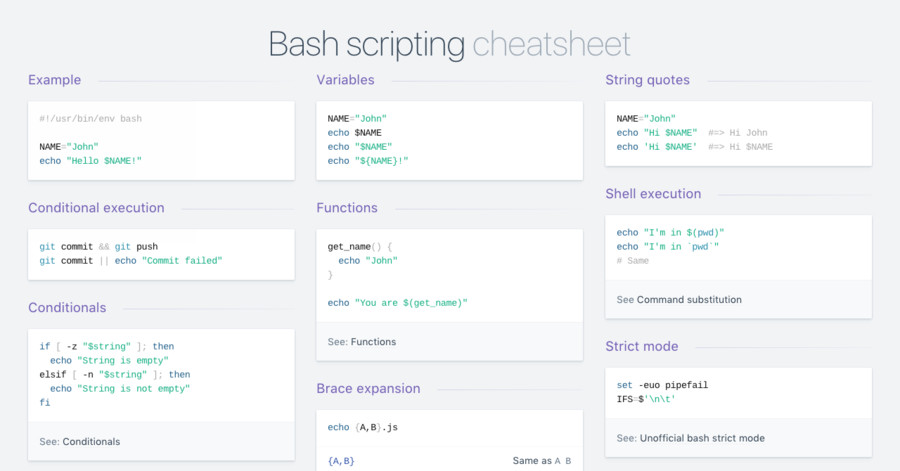
Devhints.io cheatsheets
Variables · Functions · Interpolation · Brace expansions · Loops · Conditional execution · Command substitution · One-page guide to Bash scripting
north jasper
thanks
 desert plank
north jasper
thanks
desert plank
north jasper
thanks
did you mean like exporting a variable and stuff
so that it gets inherited?
Stack Overflow
What is export for?
What is the difference between:
export name=value
and
name=value
sudden socket
ohhhhhhhhh, good call
desert plank
both methods have their pros and cons I guess
sudden socket
@icy jolt consider adding set -euo pipefail to the top of the script
trail sapphire
looks pretty good at this point, but have you tried to run it with directory names that contains a space?
i think you need to be much more diligent on using double quotes around variables when dealing with strings that is treated as file paths or filenames, i see at least six instances where i think i will be needed
sudden socket
(also, obligatory "have you considered not writing a bash script and writing a python script instead?")
trail sapphire
sudden socket
(also, obligatory "have you considered not writing a bash script and writing a p...
personally i would probably have picked shell script for this task as well, as it's a pretty simple one
sudden socket
every shell monstrosity starts off as a cute, "pretty simple" script
also, nothing here is even invoking anything else besides convert, so bash doesn't even seem suitable. all you're benefiting from is not writing subprocess.check_call(['convert', '-resize', '100', filename, os.path.join(sys.argv[2], bname)])
trail sapphire
sudden socket
every shell monstrosity starts off as a cute, "pretty simple" script
because people are too lazy to rewrite it from scratch when it is starting to get out of hand if the script ever is starting to grows into something that resemblesa monstrosity?
sudden socket
no because by the time you notice it's becoming a monstrosity, people are too afraid to rewrite it for fear of breaking something (I don't understand bash arrays/these random options/this weird substitution syntax/this weird redirection/these weird [[]] checks)
it's always lower risk to add new functionality to something than to remove/replace it
trail sapphire
have you enclosed all the variables in double quotes yet and tested the script with both source and destination paths as well as filenames that contains space to catch any such blunders?
trail sapphire
in just that snippet i still see one variable that is unquoted and would give you trouble if the source directory contains at least one space
and did you fix all the other ones higher up in the code as well?
you don't want for filename in $1/* or for filename in "$1/*", but for filename in "$1/"* or for filename in "$1"/*
if the path had been /csse/misc/seng-workshop/nature images/ instead for example
trail sapphire
i don't know if they are strictly necessary, but i would add "" around $1 in the if statement and the $2 in the elif statement
sudden socket
 trim cedar
Is it a good practice to run your python bot as a systemctl service on linux?
 small wing
how do i make my code only start during a unix time?
formal schooner
trim cedar
Is it a good practice to run your python bot as a systemctl service on linux?
it's not a bad practice. i run some of my personal hosted services with systemd
small wing
small wing
how do i make my code only start during a unix time?
jhelp
formal schooner
but definitely make sure you don't run your service as root @trim cedar
formal schooner
small wing
how do i make my code only start during a unix time?
are you asking about something like Cron?
small wing
formal schooner
are you asking about something like Cron?
epoch
fallow tusk
What do you mean by "during" a unix time/epoch? Start at an exact time? Or (be allowed to?) run only during a certain range of times?
trim cedar
formal schooner
but definitely make sure you don't run your service as root <@449712366817509387...
Kindly elaborate on this
formal schooner
trim cedar
Kindly elaborate on this
that is, your discord bot should not actually run as root. your service file should specify the user and group to run the process with
sudden socket
systemd generally runs as init which is root. if you're not careful, it'll run your random python bot as root, which gives it elevated privileges
formal schooner
[Unit]
Description=My Bot
After=network.target

[Service]
User=discord-bot-user
Group=discord-bot-user
Type=simple
WorkingDirectory=/var/www/discord-bot
ExecStart=/var/www/discord-bot/run.py
how accurate is comment now? https://stackoverflow.com/questions/40216311/reading-in-environment-variables-from-an-environment-file#comment101007686_40216465.
Basically I want to use one file to setup envvars with following features:
- easy to read it from Python (without extra lib or ugly code). e.g. using configparser
- easy to read from bash, e.g. convert to array somehow
Stack Overflow
I'd like to run in a local environment a Python script which is normally run in a Docker container. The docker-compose.yml specifies an env_file which looks (partially) like the following:
DB_ADDR=
 lapis finch
Hey, so I made a web app and now I am trying to set it up with nginx and unicorn. I cant seem to be able to serve static files
Heres my nginx file
server {
        listen 80;
        server_name 137.184.102.59;

        location /static {
                alias /root/portafolio/app/static;
        }

        location / {
                proxy_pass http://localhost:8000;
                include /etc/nginx/proxy_params;
                proxy_redirect off;
        }

}
Heres the project structure
portafolio
├── app
│   ├── __init__.py
│   ├── static
│   │   ├── css
│   │   │   └── style.css
│   │   ├── img
│   │   │   ├── api.jpg
│   │   │   ├── datamodel.jpg
│   │   │   ├── favicon.ico
│   │   │   ├── report.jpg
│   │   │   ├── report2.jpg
│   │   │   ├── toddy.jpg
│   │   │   └── woods.jpg
│   │   └── js
│   │       └── main.js
│   ├── templates
│   │   ├── crime.html
│   │   ├── layout.html
│   │   ├── main.html
│   │   └── projects.html
│   └── views.py
├── data.py
├── decorators.py
├── main.py
├── record.log
└── requirements.txt
And when inside static pwd returns /root/portafolio/app/static
Not sure what I am doing wrong, but when firing gunicorn i get plain html with no css and no imgs
Please tag me if you reply, thanks :)
trail sapphire
lapis finch
Hey, so I made a web app and now I am trying to set it up with nginx and unicorn...
you really don't want this under /root/ as only the root user should be allowed to access anything in there, and you don't want nginx to be running as root, move your files somewhere else on the system
lapis finch
trail sapphire
you really don't want this under `/root/` as only the root user should be allowe...
Thanks for replying, will doing that help me with the static files? Or is that just good practice?
trail sapphire
lapis finch
Thanks for replying, will doing that help me with the static files? Or is that j...
i'm suspecting that it could be the source of your problem or at least a part of it
if nginx isn't allowed to read the files it won't be able to serve it
lapis finch
trail sapphire
i'm suspecting that it could be the source of your problem or at least a part of...
I see, I'll try that later today, thanks :)
trail sapphire
defensively, can you login on a local console on one of the four unix machines?
lapis finch
trail sapphire
i'm suspecting that it could be the source of your problem or at least a part of...
U were right, thanks! I created an user and moved the files to its directory and now nginx is serving the static files. Thanks
 candid dove
prime magnet
how accurate is comment now? https://stackoverflow.com/questions/40216311/readin...
candid dove
prime magnet
how accurate is comment now? https://stackoverflow.com/questions/40216311/readin...
dotenv works fine for me // ah just saw that you don't want an extra library .... why not? it's pretty lightweight
prime magnet
candid dove
dotenv works fine for me // ah just saw that you don't want an extra library ......
I saw that lib. I will consider it. Thanks
 lilac latch
hello
formal schooner
prime magnet
how accurate is comment now? https://stackoverflow.com/questions/40216311/readin...
nothing wrong with it, but it's a simple enough piece of code that you shouldn't just copy and paste it, and you should consider whether it's good enough for your needs
e.g. it does not cover the possible use case of embedded line break characters in the env var
prime magnet
a friend suggested me to use this one too - https://github.com/henriquebastos/python-decouple/
GitHub
Strict separation of config from code. Contribute to henriquebastos/python-decouple development by creating an account on GitHub.
 deep dune
What’s unix??
 covert glade
deep dune
What’s unix??
covert glade
deep dune
What’s unix??

fallow tusk
A. It's not linux }:)
 kind coral
deep dune
What’s unix??
kind coral
deep dune
What’s unix??
Unix did start of as an operating system which is now pretty much dead and many other operating systems are based off such as the bsd's and linux based operating systems and unix is just used as a catch all term for these derivatives.
deep dune
oh alright
 finite crater
Most important powershell ive ever typed
(Get-ChildItem -Path $env:HOMEPATH | where {
    $_.Name -match '^[.]' }
).Attributes='Hidden'
in what way does PS fit in to #unix?
finite crater
it imitates unix behavior on windows
trail sapphire
finite crater
it imitates unix behavior on windows
the only resembles i've seen is that you chain things using pipe, other than that i wouldn't say they are very similar at all
finite crater
it's just a script that grabs all the files that have names with leading periods and makes them hidden. I accumulate a lot of files that are dotfiles in my windows home user dir.
Windows doesn't treat these files like dotfiles though because it has a different system for doing that.
The above code makes the files behave as you would expect them to on linux, as in being hidden by default
you could technically install powershell on unix if you wanted to lol
i use both operating systems so for me, the most relevant things are how things work differently between the two and how to find a middle ground of desired behavior from both
 light gorge
 unique tundra
So I installed anaconda
unique tundra
So I installed anaconda
Activate the conda env. Like conda activate base where base is env name
 wise forge
Best laptop companies for Linux? 
trail sapphire
wise forge
Best laptop companies for Linux? <:pithink:652247559909277706>
Lenovo (what used to be IBM) ThinkPad serieses
or https://www.tuxedocomputers.com/en
 marsh tusk
main olive
trail sapphire
Lenovo (what used to be IBM) ThinkPad serieses
or https://www.tuxedocomputers.co...
marsh tusk
main olive
trail sapphire
Lenovo (what used to be IBM) ThinkPad serieses
or https://www.tuxedocomputers.co...
Agreed.
And you can get a pretty cheap one and upgrade it to be a decent computer.
light gorge
wise forge
Best laptop companies for Linux? <:pithink:652247559909277706>
System76 builds Linux laptops. They ship either with Ubuntu or their own take on Ubuntu - PopOS
wise forge
trail sapphire
Lenovo (what used to be IBM) ThinkPad serieses
or https://www.tuxedocomputers.co...
Found a nice one. 945$ cost, Intel Core I5-1135G7, 512 GB SSD, 16 RAM, 15.6 inches screen, two ports for external screens
Lenovo IdeaPad5
A working horse of a web dev
Too bad, the battery is not external
hmm... ThinkPads are available too, but I don't like their price and screen size
I think the found IdeaPad5 is ideal. The price for hardware definitely is
trail sapphire
wise forge
hmm... ThinkPads are available too, but I don't like their price and screen size
i'm not sure the other Lenovo series outside of the different ThinkPad series are as linux compatible, if that is still what you want to go for you should probably do some more research on the subjekt, arch-linux wiki usually has good info on if the hardware is linux compatible or not
wise forge
trail sapphire
i'm not sure the other Lenovo series outside of the different ThinkPad series ar...
I'll be just buying with having live USB Kubuntu on my hands
I'll just check the laptop in shop before buying xD
if Linux is launching from USB (even without installation) and internet is working out of the box, then everything is ok
trail sapphire
wise forge
if Linux is launching from USB (even without installation) and internet is worki...
i still would read up on it a bit so that you don't miss anything that isn't immediately apparent, like wake up from sleep or hibernation or other power management issues, webcam and microphone for videoconferencing and so on
wise forge
trail sapphire
i still would read up on it a bit so that you don't miss anything that isn't imm...
it is cheapest laptop with necessary powerful hardware. No time to think xD
if docker and KVM virtualization works, then it is already ok to me
i can make a test during the buying too for that
trail sapphire
wise forge
it is cheapest laptop with necessary powerful hardware. No time to think xD
okay, your money your choice
trail sapphire
wise forge
if docker and KVM virtualization works, then it is already ok to me
those are probably going to work, kvm just might need hardware support enabled in the bios to work with good performance, which it might not be by default
 shut nebula
creat_user() {
    if id -u $1;
    then userdel $1;
    fi
    useradd $1

  here I need to call passwd $1 and get user input to pass it to passwd
}
``` how can I do thatcan you replicate the error, now, after you've restarted your machine?
no no
can you replicate with the old variable?
or is the old variable available after the restart - after xport SOMEVAR="itsvalue" >> ~/.zshrc
there's a couple of things that could be here
can you try in the same terminal session (window):
export SOMEVAR="itsvalue"
start your jupyter notebook
import os; os.environ['SOMEVAR'].
?
was the notebook main process running when you ran these commands?
from where?
the same terminal session?
did you run all commands and then restart notebooks within the same frame?
👍 gl
can someone more knowledgeable correct me, if I'm wrong. my instructions above should work, no? if you export a variable in a terminal session and you start a new process in the same session, it should have access to that variable?
sudden socket
yes
sudden socket
doesn't really matter at all. use whatever you're comfortable with. if you don't have any familiarity, ubuntu is a popular starting point
main olive
agreed
also, don't use your distro for your python dev needs
use a manager like pyenv (asdf) and virtual environments
wise forge
 fresh path
What is the bes unix/linux distro to work with python?
fresh path
What is the bes unix/linux distro to work with python?
As your personal desktop? Try Kubuntu ;b
It is one of best choices for docker anyway
For docker image? Python goes in Debian distros usually
main olive
python is in a lot of distros ;)
wise forge
main olive
python is in a lot of distros ;)
Not every distro does it painlessly
main olive
yep
wise forge
Alpine distro has debuff: building python packages (including during pip install) 50x times slower
main olive
wait
nope
that's another issue
that's docker
any chance you're using macos?
any chance you have the latest and greatest mac based on m1? :)
wise forge
main olive
any chance you're using macos?
Nah
Regular PC and kubuntu distro
And yeah, it is in docker, but who cares
If it is in docker alpine, it means everywhere
main olive
no, it means you have different issues :)
Not every distro does it painlessly
I agree
that's because distros rely on python
hence: #unix message
wise forge
Well. It is 7 AM and I still haven't slept. Time to sleep
wise forge
main olive
that's because distros rely on python
hence: https://discord.com/channels/267624...
That is because of alpine ecosystem
That is it
Somewhere article is easily googled about it
main olive
alpine is a minimal distro. it has a lot of problems :)
wise forge

Python⇒Speed
Alpine Linux is often recommended as a smaller, faster Docker base image. But if you’re using Python, it will slow down your build and make your image larger.
main olive
I did not know that. thanks
main olive
hello i currently have python 3.7.3 on my vps installed and i want to install python 3.8 but when i do sudo apt install python3.8 it fails
output:
Reading package lists... Done
Building dependency tree
Reading state information... Done
E: Unable to locate package python3.8
E: Couldn't find any package by glob 'python3.8'
E: Couldn't find any package by regex 'python3.8'
what distro do you use and what version of it?
as i see you are running apt i'm guessing is something debian based
but would be good to know more exactly what it is you are using
main olive
trail sapphire
what distro do you use and what version of it?
as i see you are running `apt` i'...
i have Debian GNU/Linux 10 (buster)
trail sapphire
main olive
i have Debian GNU/Linux 10 (buster)
you won't find python 3.8 in the repository for debian 10, it has python 3.7
if you move over to debian 11 you'll find python 3.9 instead
trail sapphire
main olive
i have Debian GNU/Linux 10 (buster)
are you running a container (docker image) or a vm or maybe even on bare metal?
main olive
trail sapphire
you won't find python 3.8 in the repository for debian 10, it has python 3.7
if ...
oh okay could you send me a good guide to upgrade to debian 11?
main olive
trail sapphire
are you running a container (docker image) or a vm or maybe even on bare metal?
this is my vps
trail sapphire
main olive
oh okay could you send me a good guide to upgrade to debian 11?
the preferred way is really to just backup everything that you have done your self and settings you care about and reinstall when you change major versions of the os
trail sapphire
main olive
this is my vps
what kind of vps, is it your own vm so that you can reinstall it?
you may be able to pick another os image that you want your vps to be based on
main olive
trail sapphire
what kind of vps, is it your own vm so that you can reinstall it?
you may be abl...
no its not my own i bought it im paying it monthly
trail sapphire
main olive
no its not my own i bought it im paying it monthly
i understand, but is it just you using that vm or is it a shared vm type of vps deal?
if it's shared you probably can't reinstall it or dictate which os version should be installed on the vm
 patent osprey
hello
when I run /usr/share/discord/resources/app.asar command on linux it says bash permissions denied
cna someone help me with this pls
I even tried root /usr/share/discord/resources/app.asar but it didn't work
bash: /usr/share/discord/resources/app.asar: cannot execute binary file: Exec format error
patent osprey
patent osprey
bash: /usr/share/discord/resources/app.asar: cannot execute binary file: Exec fo...
what does this error mean?
 proud nova
It means you're trying to run app.asar which is not an executable your computer can run
Where did you get this?
main olive
trail sapphire
i understand, but is it just you using that vm or is it a shared vm type of vps ...
i think its shared
trail sapphire
main olive
i think its shared
hmmm, as you can run things as root i'm thinking it's probably not shared on an os level
main olive
trail sapphire
hmmm, as you can run things as root i'm thinking it's probably not shared on an ...
im gonna check it if i can
trail sapphire
main olive
i think its shared
but i'm also starting to suspect that we have a xy-problem here, why did you want to upgrade from python 3.7.x to 3.8.x and what is your ultimate goal?
main olive
trail sapphire
but i'm also starting to suspect that we have a xy-problem here, why did you wan...
because i want lib called nextcord and its only on python 3.8 or higher
trail sapphire
main olive
because i want lib called nextcord and its only on python 3.8 or higher
oh i see, yeah, then you need newer a python
main olive
trail sapphire
oh i see, yeah, then you need newer a python
yeah thats why
trail sapphire
main olive
yeah thats why
do you run anything else on the vps or have anything stored on it that you care about?
main olive
trail sapphire
do you run anything else on the vps or have anything stored on it that you care ...
yeah so i have a few bots running and a website
trail sapphire
main olive
yeah so i have a few bots running and a website
aha, then starting from scratch on a new os would be painful
main olive
yeah
trail sapphire
main olive
yeah
you don't have to be running a system python, you could install a new python version in parallel with the system one
where you able to run sudo apt update?
main olive
trail sapphire
you don't have to be running a system python, you could install a new python ver...
what do you mean by install a new python version in parallel with the system one?
and yeah i can run sudo apt update
trail sapphire
main olive
and yeah i can run sudo apt update
that is a very good thing, then you have root privileges on the vps, and that means that the vps instance at least isn't shared with other customers, because that would be unsecure for all of you
main olive
trail sapphire
that is a very good thing, then you have root privileges on the vps, and that me...
ahh, now i know what you meant by shared, so other can access my vps too
i heard something of pyenv and that you can install python3.8 with it
trail sapphire
main olive
ahh, now i know what you meant by shared, so other can access my vps too
yeah, pyenv is what I was going to suggest next 👍
main olive
trail sapphire
yeah, pyenv is what I was going to suggest next 👍
ah nice i tired it like 1-2 months ago when my problem wasnt that important but i couldnt setup pyenv
trail sapphire
that was what I meant by installing another python version in parallel with the one provided by thr system/os
main olive
ohh okay
trail sapphire
I think pyenv is the best, cleanest and easiest way to do that
main olive
yeah
trail sapphire
you don't even need root to install a new python version using pyenv, but you might need root access to install a few build tools if they aren't already installed on your system
main olive
what are the build tools?
trail sapphire
to be able to compile stuff if pyenv needs to
main olive
yeah i know that, i meant the name of the build tools
trail sapphire
i would suggest you first do a sudo apt dist-upgrade to update the system if you aren't up to date already
main olive
yeah im up to date
trail sapphire
good, then you can try sudo apt install build-essential
but if you have played with pyenv before chances are you already have that installed as well
main olive
i did that i already have it
main olive
trail sapphire
but if you have played with pyenv before chances are you already have that insta...
yeah i do
trail sapphire
git clone https://github.com/pyenv/pyenv.git ~/.pyenv
main olive
i have that installed too
trail sapphire
try echo $PYENV_ROOT and echo $PATH | grep -c $PYENV_ROOT and command -v pyenv to see if your environment is setup correctly
trail sapphire
main olive
i have that installed too
what output did you get from those three commands?
main olive
trail sapphire
try `echo $PYENV_ROOT` and `echo $PATH | grep -c $PYENV_ROOT` and `command -v py...
okay i will do that
main olive
trail sapphire
what output did you get from those three commands?
from pyenv download:
fatal: destination path '/root/.pyenv' already exists and is not an empty directory.
from build essentials:
Reading package lists... Done
Building dependency tree
Reading state information... Done
build-essential is already the newest version (12.6).
i would also recommend to update pyenv by running the following commands as it was a little while since you installed it the last time:
pushd ~/.pyenv
git fetch --all
git reset --hard origin/master
popd
okay i did that
so i did echo $PATH | grep -c $PYENV_ROOT but it says Usage: grep [OPTION]... PATTERNS [FILE]...
trail sapphire
main olive
from pyenv download:
```
fatal: destination path '/root/.pyenv' already exists ...
oh, i only needed to check on the output from these three commands:
echo $PYENV_ROOT
echo $PATH | grep -c $PYENV_ROOT
command -v pyenv
and from just the first command?
because it sounds like your environment variables isn't setup right yet
main olive
trail sapphire
oh, i only needed to check on the output from these three commands:
```bash
echo...
output when i entered this:
Usage: grep [OPTION]... PATTERNS [FILE]...
Try 'grep --help' for more information.
command -v pyenv
pyenv
wheen i enter command -v pyenv the output is just pyenv
trail sapphire
okay, only the output from echo $PYENV_ROOT
main olive
its nothing
trail sapphire
okay, then we are missing some stuff
try:
echo 'export PYENV_ROOT="$HOME/.pyenv"' >> ~/.bashrc
echo 'export PATH="$PYENV_ROOT/bin:$PATH"' >> ~/.bashrc
echo -e 'if command -v pyenv 1>/dev/null 2>&1; then\n\teval "$(pyenv init -)"\nfi' >> ~/.bashrc
exec "$SHELL"
that should get that solved for you
main olive
okay
i accdidentally closed putty and i logged back in into my vps and there is no enter

i did strg + c and now it appeared
but it was very weird
trail sapphire
wow, got scared there for a while, hoping you had not used a single > somewhere instead of a double>> because such a mistake would be really bad
so, back on track?
trail sapphire
then it still sound like something when very wrong with the commands, did you copy them exactly as i wrote them?
main olive
yeah i did
trail sapphire
i'm starting to suspect that your ~/.bashrc got corrupted in some way in the previous step
main olive
oh
trail sapphire
are you comfortable with nano or vi as an editor?
main olive
not really
i mostly used filezilla
uhm
it says sudo comand not found
and nano doesnt work anymore too
trail sapphire
your path is probably broken due to a broken .bashrc file, we'll try to fix it
main olive
oh okay
main olive
yeah
trail sapphire
do you see anything there or is it empty?
main olive
i seee something
main olive
 trail sapphire
doesn't look totally broken at least 👍
can you comment out all the lines from the export and down?
main olive
yeah i can
trail sapphire
and then save the file, just undoing anything that we might have done
there looks like it's many copies of the same commands in that file right now
main olive
okay i saved the file
okay i can connect trough filezilla in my vps now
through*
and i can use sudo again
trail sapphire
can open another putty window (keep the one you have for now) now and see if it works better using sudo and stuff from that window
trail sapphire
good, then we are back in business 😅
trail sapphire
i was thinking that you would start a new putty window and session and keep the old one around just as a precaution until we know that the new one works better, but we seem to be fine again
main olive
yeah its fine now
maybe the error could be that i entered the shell thing a few times lmao
trail sapphire
your .bashrc looked very different then the one i have on debian 10 (trying everything on a system over here in parallel)
main olive
oh okay
trail sapphire
you might have everything in your .bash_profile instead of things in .bashrc on your system
main olive
oh, okay does it matter?
trail sapphire
it shouldn't matter much
main olive
okay
trail sapphire
this is getting a bit longer than i had expected, should we occupy a help channel instead of flooding this channel?
do you want to go grab a help channel for your self and then write in here which channel you ended up getting?
main olive
okay no problem
trail sapphire
just wanted to fix what was broken before i suggested it, since your broken environment was the first priority to fix
 shell crypt
Hey anyone could translate this command from unix to windows?
curl -XPOST -H "Content-type: application/json" -d '{"name": "catty mcCatFace", "price": 5000, "breed": "bengal"}' '127.0.0.1:5000/add'
 fickle granite
that's not exactly a "unix command"; it's a particular program named "curl"
easiest thing is to see if it's available on Windows
if so I don't think you'd need to do any translation
https://superuser.com/a/693179 might be a start

Super User
I know I can download and install the aformentioned library (wget for Windows), but my question is this:
In Windows PowerShell, is there a native alternative to wget?
I need wget simply to retri...
 sleek remnant
shell crypt
Hey anyone could translate this command from unix to windows?
curl -XPOST -H "C...
sleek remnant
shell crypt
Hey anyone could translate this command from unix to windows?
curl -XPOST -H "C...
Curl has been built in to windows 10/11 since October 2017. It’s likely you can just paste that command unedited
main olive
main olive
i needed to restart putty
Why not just ssh?
I'm assuming you're on a unix based system, just ssh user@IP.
trail sapphire
main olive
I'm assuming you're on a unix based system, just ssh user@IP.
that's old messages and the problem is already fully solved
and no, the person was using putty on a windows system to reach a hosted vps running debian 10
trail sapphire
main olive
Good thing you can use ssh on the Windows command line.
yeah, for quite a few years now
however, the ergonomics of the different terminal programs bundled with windows has been far from good
but now there is the new Windows Terminal, which i've heard a lot of good things about for those stuck on a windows system
light gorge
Windows terminal is nice.
 reef walrus
what even is unix
 brisk vigil
Hi guys, who uses linux ubuntu? I wanted to know what is latest release of tensorflow for ubuntu?
kind coral
brisk vigil
Hi guys, who uses linux ubuntu? I wanted to know what is latest release of tenso...
Should just be the latest version on pypi if your using the latest Ubuntu version
!pypi tensorflow
 shy yokeBOT

TensorFlow is an open source machine learning framework for everyone.
brisk vigil
kind coral
Should just be the latest version on pypi if your using the latest Ubuntu versio...
I want to move to linux. That's why i wanted to know it. Thank you for respond!
trail sapphire
brisk vigil
I want to move to linux. That's why i wanted to know it. Thank you for respond!
you know there are other linux distributions as well, right?
 vital bay
i would say ubuntu is an easy one to start with, though. no need to play around with the apt repos for the most part, and no need to update or reinstall for another 5 years
kind coral
trail sapphire
you know there are other linux distributions as well, right?
Tensorflow only really supports Ubuntu, good luck getting it going on any other distro
There are so many good beginner distributions now
trail sapphire
kind coral
Tensorflow only really supports Ubuntu, good luck getting it going on any other ...
maybe you should fact check such a statement before you utter it as truth
it would be very strange if it were to run only on one single linux distro
so, just a sample:
https://linuxstoney.com/how-to-install-and-configure-tensorflow-on-rocky-linux-8/
https://wiki.debian.org/MachineLearning/Tensorflow
https://itslinuxfoss.com/how-to-install-tensorflow-on-debian-11/
kind coral
trail sapphire
maybe you should fact check such a statement before you utter it as truth
it wou...
You totally can get it running on any distro it's just ubuntu is the one you see that is immediately supported
The docker image should be the easiest way to get it running on any distro
trail sapphire
kind coral
The docker image should be the easiest way to get it running on any distro
agreed, using docker is probably easiest to maintain too
light gorge
Ubuntu is default distro for ML/DL for many
 idle nacelle
Hi, any know any pre-built phone app GUI (connect by wifi) to control any ros ubuntu robot with scanner? If not, any link for easy to make GUI guide i can follow? Purpose is for user to use the phone to command the robot to move to its waypoint when command while avoiding collision.
 wind latch
yo i dont know if i am in the right channel for this but i am on ubuntu and i get this message every time i try to make a window with tkinter ModuleNotFoundError: No module named 'tkinter'
light gorge
wind latch
yo i dont know if i am in the right channel for this but i am on ubuntu and i ge...
You need to install tkinter
wind latch
light gorge
You need to install tkinter
Tried that many times didn't work if i did i wouldn't be asking is there another way that would work?
Like another way to fix it
trail sapphire
wind latch
Like another way to fix it
you need to have tkinter to use it in your code
but there are several ways to go about installing it
how did you try to install it?
wind latch
I tried pip and apt
trail sapphire
wind latch
I tried pip and apt
are you using venv or similar for your project and what environment are you trying to execute your code in?
trail sapphire
wind latch
I tried pip and apt
and did you get any errors when you tried installing it with pip and apt?
wind latch
trail sapphire
are you using venv or similar for your project and what environment are you tryi...
Gnome
wind latch
trail sapphire
and did you get any errors when you tried installing it with pip and apt?
No
trail sapphire
wind latch
No
so, both installations (apt and pip) when well as far as you know?
trail sapphire
wind latch
Yes
what does your line of code look like where you import tkinter?
trail sapphire
wind latch
Wdym?
i mean: what does the top of your code look like where you import modules/libraries in to your code?
wind latch
I just put import tkinter
trail sapphire
wind latch
I just put import tkinter
what happens if you run the following in a terminal?
python -m tkinter
wind latch
trail sapphire
what happens if you run the following in a terminal?
`python -m tkinter`
Command 'python' not found, did you mean:
command 'python3' from deb python3
command 'python' from deb python-is-python3
wind latch
trail sapphire
what happens if you run the following in a terminal?
`python -m tkinter`
i put python 3 and it opened a window
trail sapphire
wind latch
Command 'python' not found, did you mean:
command 'python3' from deb python3
...
sure, try with python3 -m tkinter on your system then
trail sapphire
wind latch
i put python 3 and it opened a window
then you have tkinter installed and you should be able to use it
wind latch
but why does pycharm say no modlue named tkinter
trail sapphire
oh pycharm... it's probably just the python installation that pycharm is trying to use that doesn't have it
you can reconfigure pycharm to use another python to run things then the one it's using right now
i think people in #editors-ides will be able to help you with that part
wind latch
trail sapphire
oh pycharm... it's probably just the python installation that pycharm is trying ...
okay thank you
wind latch
trail sapphire
oh pycharm... it's probably just the python installation that pycharm is trying ...
oh and you mean a different version of python right
trail sapphire
wind latch
oh and you mean a different version of python right
or just another installation of python than the system wide installation
that installation of python that pycharm is using probably doesn't have tkinter installed within it
vital bay
you can try and hunt them down by checking the output of whereis python, which python, which python3, etc
in particular, you want to hunt down the one for which you installed tkinter, so use which [whatever python you used pip with]
main olive
Hey, I'm having some problems with python in Linux. Can anyone check my problem here #help-peanut ?
brisk vigil
trail sapphire
you know there are other linux distributions as well, right?
I know. I'm not that familiar with linux yet, and it's said beginner friendly, so that's why I started with ubuntu. Today I installed it, but there are some difficulties with installing newer versions of tensorflow like 2.8. Now trying to install 2.7
trail sapphire
brisk vigil
I know. I'm not that familiar with linux yet, and it's said beginner friendly, s...
i hope you at least are running the latest version (22.04) of ubuntu if that will be your distro of choice
fickle granite
it's a stretch to say Linux is "beginner friendly". But Ubuntu is definitely the right choice.
vital bay
it's a shame that 22.04 still doesn't have miktex (lest you compile from source; then again, tex live is an alternative) nor the nice dcv remote desktop client though. if you want stability and wide access to software, 20.04 is still better than 22.04 and will probably remain so for the rest of the year. on the other hand, you're also behind a couple of versions
 marble otter
Hello
Is the Linux first installed on a mobile and then Android as a layer on top of it?
trail sapphire
marble otter
Is the Linux first installed on a mobile and then Android as a layer on top of i...
not really, android is more or less a special purpose linux distribution made and maintained by google
marble otter
trail sapphire
not really, android is more or less a special purpose linux distribution made an...
So, is it possible to contact a smartphone manufacturer and ask them
To remove camera, microphone, other modules
And install pure Linux server
And an extra rj45 port
trail sapphire
marble otter
So, is it possible to contact a smartphone manufacturer and ask them
what does that have to do with anything?
i don't think they will, there must be a good business proposition for them to do something
marble otter
trail sapphire
what does that have to do with anything?
i don't think they will, there must be ...
Cause raspberry Pi are too costly for shitty specs
 gilded valve
The day has come
 marble otter
And mobile phones these days come with octa core nd other gpu processing (ml)>
Nd shet ton of ram
trail sapphire
marble otter
Cause raspberry Pi are too costly for shitty specs
there are other small computers you can buy instead, doesn't have to be raspberry
marble otter
At cheeaaap price
marble otter
trail sapphire
there are other small computers you can buy instead, doesn't have to be raspberr...
But ARM processor
Like octa core, with 8 gb ram for 20k inr or around 270 dollars
It'd be waaay cheap if you remove cam modules
Bluetooth
Android licenses etc ;(
Right?
trail sapphire
marble otter
But ARM processor
i think there are similar hardware platforms out there, they just aren't main stream
marble otter
Tried searching like crazy. But found none. My primary purpose is easy self hosting.
trail sapphire
and you really really want/need arm specifically because?
marble otter
trail sapphire
and you really really want/need arm specifically because?
Ummm, cause mongodb is hungry and easy scaling in case my service gets popular
kind coral
I would probably just buy a vps
marble otter
kind coral
I would probably just buy a vps
But the service isn't making any money yet
trail sapphire
marble otter
Ummm, cause mongodb is hungry and easy scaling in case my service gets popular
and that has to do with arm how?
x86_64 will do that too for you
marble otter
trail sapphire
and that has to do with arm how?
x86_64 will do that too for you
More cores==more workers
Especially for gunicorn
The intel one's hardly come at 2 cores for cheap
kind coral
marble otter
But the service isn't making any money yet
You're going to have to put some money in before you get any out
marble otter
Everything else costs an arm
marble otter
kind coral
You're going to have to put some money in before you get any out
Imagine the service never making money
kind coral
then you lost a little bit of money, big deal
marble otter
Anything as a service is not OWNED by you
marble otter
kind coral
then you lost a little bit of money, big deal
Yeah, big deal, it's just a few lakh rupees.
Or 100s of dollars
kind coral
business is just a gamble and there is really nothing you can do about that
gilded valve
If you have a credit card you can sign up for GCP or AWS free trial, that’ll give you a bigger window to work with
gilded valve
Not sure why your complaining about it costing an arm then?
marble otter
I don't want to rent database as a service
gilded valve
gilded valve
Not sure why your complaining about it costing an arm then?
If you want to have your own server it’s gonna be costly
marble otter
gilded valve
If you want to have your own server it’s gonna be costly
...arm servers are CHEAP
trail sapphire
marble otter
Or 100s of dollars
would this work when it comes to specs and price?
it's even fanless like a raspberry but will run circles around a raspberry and run x86 software that isn't even available for arm
https://fit-iot.com/web/product/fitlet3-build-to-order/
marble otter
Octa core costs a shit ton low than any cloud provider in like in 6 months
gilded valve
marble otter
...arm servers are CHEAP
Ok, then why not do that? Instead of flashing Linux on a mobile device or whatever you are trying to do
marble otter
trail sapphire
would this work when it comes to specs and price?
it's even fanless like a raspb...
It's Intel infected
trail sapphire
marble otter
Octa core costs a shit ton low than any cloud provider in like in 6 months
number of cores isn't everything
marble otter
...umm...why not?
trail sapphire
marble otter
It's Intel infected
oh, so your anti intel now too?
trail sapphire
marble otter
...umm...why not?
it's the total speed of the system that counts not the number of cores
marble otter
trail sapphire
it's the total speed of the system that counts not the number of cores
.....cores>infinite threading?
trail sapphire
marble otter
I read papers and they said the speed is same
don't believe in one paper, read several benchmarks and decide for your self instead
trail sapphire
marble otter
.....cores>infinite threading?
run things on gpu:s if that is your benchmark
marble otter
trail sapphire
run things on gpu:s if that is your benchmark
I run synchronous work load , flask.
I ideally want more cores. Than threads.
So as to not block the workers.
trail sapphire
if you don't like intel, go amd instead then, there you'll get more cores as well typically
marble otter
Yup, but the cores is still around 4/6/8 in a consumer pc. And costs more than a mobile
But ig, it supports more ram and disk space ig.
trail sapphire
you have no traffic now and you are already optimizing
you know what they say about premature optimization, right?
marble otter
trail sapphire
you have no traffic now and you are already optimizing
you know what they say ab...
👉👈
What do they say?
kind coral
it's just an endless loop of not actually putting a product out and instead optimising it to the moon and back
marble otter
But it is owned by me, so I can keep testing forever too
marble otter
kind coral
it's just an endless loop of not actually putting a product out and instead opti...
The product is ready
I am searching for chheeeeap deployments under my control
/owned
I don't wanna lose stuff cause, I can't pay.
trail sapphire
if you get hang up on optimization you will never get to market
instead optimize when you see the need for it
kind coral
whats your main issue with it not being hosted by you?
marble otter
kind coral
whats your main issue with it not being hosted by you?
- Database in a VM is scary af.
- database as a service in the same cloud is costly.
- i exhausted my credit card free trials 2 years back I think.
- they offer very low cores, ram, etc etc
Compared to self hosting.
And I am a devops engineer, so I know how to setup the infra. Okay just graduated.
trail sapphire
nothing wrong with a db on a vm, a lot of big companies do it
but sure, if you want ultimate performance you should skip the virtualization layer
marble otter
Also, it's a happiness to have your data with you.
trail sapphire
marble otter
Also, it's a happiness to have your data with you.
have you checked: https://www.hardkernel.com/ ?
they have some arm stuff
kind coral
however you also mentioned "Imagine the service never making money" which suggests you are also careful with how much you are spending and if your service is a flop this is a much better position to be in than having bought a lot of physical hardware since you are renting and not buying
marble otter
kind coral
however you also mentioned "Imagine the service never making money" which sugges...
I can afford a smartphone price range.
I am just stumped by why no one is using these ridiculous number of cores for self hosting.
A few years back, sure low cores and crappy performance.
But today, those chips are crazy good.
And flask is arm compatible
So no issues on that end for me
kind coral
you can't invest €5.88 per month in a product you expect to be making a bit of money just to get it going for 2 cores and 4GB of mem?
marble otter
kind coral
you can't invest €5.88 per month in a product you expect to be making a bit of m...
.. ...you do realize 2 cores and 4gb is utter shit?
kind coral
yes, but it's also very cheap
you could probably spend a more money to get better hardware
https://www.hetzner.com/cloud this is where I pulled those figures from, works for me fairly well
marble otter
Yup, I did have tons of cloud experience. Thanks to my thesis.
The price to performance is good in the short term. And even better if the product is making money.
For a startup, it is a death sentence to scale.
I expect my service to not make any more for at least a year.
Money*
kind coral
how much traffic are you actually expecting?
marble otter
A 1000 users. Initially. And also gotta calculate for marketing
not deployed no official stats yet concurrent users maybe 10/12
Let me know if you guys come across how to flash a smartphone and install Ubuntu server.
Or any other arm cheap way. But with performance:)
trail sapphire
marble otter
I am just stumped by why no one is using these ridiculous number of cores for se...
if this was easy and cheap someone would have made the product and sold it to get rich
or you might just go for that business your self if you think you can make it cheap and still make a good buck on it by stripping away screen, battery, cameras, speaker, microphone, bluetooth, wifi, gsm/ltm connectivity and all the other stuff from a phone that you don't need, and the pesky android licensing that must be expensive to uphold
marble otter
trail sapphire
if this was easy and cheap someone would have made the product and sold it to ge...
Exactly!
I believe so.
But again, maybe I'm just naive. Just wish contacting manufacturers and making prototypes is easy
Seriously, octa core. 8gb ram. Ridiculous consistency. Inbuilt battery backup.
Like, what else could you ask for
Maybe expandable ram and hdd/sdd support ig.
trail sapphire
marble otter
Seriously, octa core. 8gb ram. Ridiculous consistency. Inbuilt battery backup.
i would externalize the battery for sure just for the sake of reliability
aging batteries is one of the most common reasons for people to change there phones
and then there is the heat that comes with that as well
marble otter
True ig. But it'll be on power any way.
trail sapphire
and it would be cheaper without the battery on each unit
marble otter
True
trail sapphire
you might have a business right there if you believe strongly in that idea
trail sapphire
reliability with the internet connection and such will be a problem with self hosting unless you set that up in one or more data centers on your own
marble otter
True. Networking could be an issue. but ISPs shouldnt have a problem laying fiber line to homes
We are in the future, fiber is everywhere!
trail sapphire
marble otter
True. Networking could be an issue. but ISPs shouldnt have a problem laying fibe...
that isn't all there is when it comes to hosting
anyways, this doesn't come cheap but it has 16 ARM cores and have expandable ram, up to 64 GB of it too
https://shop.solid-run.com/product/SRLX216S00D00GE064H09CH/
https://www.solid-run.com/wp-content/uploads/2021/01/HoneyComb-LX2-Datasheet.pdf
brisk vigil
trail sapphire
i hope you at least are running the latest version (22.04) of ubuntu if that wil...
Yes, I installed 22.04
 ionic burrow
hi guys! I need to help. I want install pip into ubuntu core. But i couldn't do this. I installed python38 with use sudo snap install python38 but ı couldn't install wit hsudo snap install pip. How can ı do?
fickle granite
sudo snap install python38-pip
 shrewd stratus
ionic burrow
hi guys! I need to help. I want install pip into ubuntu core. But i couldn't d...
shrewd stratus
ionic burrow
hi guys! I need to help. I want install pip into ubuntu core. But i couldn't d...
context: they're using Ubuntu Core, which has a read-only file system akin to nix, Fedora CoreOS, etc.
ionic burrow
fickle granite
`sudo snap install python38-pip`
I tried python38 -m pip install ...
root@ubuntu:~# python38 -m pip --version
pip 19.3.1 from /snap/python38/22/lib/python3.8/site-packages/pip (python 3.8)


root@ubuntu:~# sudo pip install virtualenv
sudo: pip: command not found
Collecting virtualenv
  Downloading https://files.pythonhosted.org/packages/9e/34/e86fc6a8f84329b49321a532b3c1fef103c67765df957fbb3852eea39d00/virtualenv-20.14.1-py2.py3-none-any.whl (8.8MB)
     |████████████████████████████████| 8.8MB 1.3MB/s
Collecting platformdirs<3,>=2
  Downloading https://files.pythonhosted.org/packages/ed/22/967181c94c3a4063fe64e15331b4cb366bdd7dfbf46fcb8ad89650026fec/platformdirs-2.5.2-py3-none-any.whl
Collecting six<2,>=1.9.0
  Downloading https://files.pythonhosted.org/packages/d9/5a/e7c31adbe875f2abbb91bd84cf2dc52d792b5a01506781dbcf25c91daf11/six-1.16.0-py2.py3-none-any.whl
Collecting filelock<4,>=3.2
  Downloading https://files.pythonhosted.org/packages/cd/f1/ba7dee3de0e9d3b8634d6fbaa5d0d407a7da64620305d147298b683e5c36/filelock-3.6.0-py3-none-any.whl
Collecting distlib<1,>=0.3.1
  Downloading https://files.pythonhosted.org/packages/ac/a3/8ee4f54d5f12e16eeeda6b7df3dfdbda24e6cc572c86ff959a4ce110391b/distlib-0.3.4-py2.py3-none-any.whl (461kB)
     |████████████████████████████████| 471kB 95.1MB/s
Installing collected packages: platformdirs, six, filelock, distlib, virtualenv
ERROR: Could not install packages due to an EnvironmentError: [Errno 30] Read-only file system: '/snap/python38/22/usr/local'

WARNING: You are using pip version 19.3.1; however, version 22.1 is available.
You should consider upgrading via the 'pip install --upgrade pip' command.

Usage:
  /snap/python38/22/usr/bin/python3.8 -m pip <command> [options]

no such option: --upgrade
```
And ı was trying ```pip install --upgrade pip``` ı'm getting same errordo python38 -m pip install virtualenv
everything that you want to do with a pip command, you can do with python38 -m pip instead. This is a good thing, since you'll never wonder about which version of python you installed a package into
ionic burrow
fickle granite
do `python38 -m pip install virtualenv`
Sorry, I couldn't install anything. I told you before. ```sudo: pip: command not found
I am not recommending that you run sudo pip; I'm recommending that you run sudo python38 -m pip, which you've already demonstrated works
ionic burrow
fickle granite
I am not recommending that you run `sudo pip`; I'm recommending that you run `su...
My fault. I was searching this fault since a long time. Yes , I tried. Also ı'm trying again ı get same err```Collecting virtualenv
Downloading https://files.pythonhosted.org/packages/9e/34/e86fc6a8f84329b49321a532b3c1fef103c67765df957fbb3852eea39d00/virtualenv-20.14.1-py2.py3-none-any.whl (8.8MB)
|████████████████████████████████| 8.8MB 1.3MB/s
Collecting platformdirs<3,>=2
Downloading https://files.pythonhosted.org/packages/ed/22/967181c94c3a4063fe64e15331b4cb366bdd7dfbf46fcb8ad89650026fec/platformdirs-2.5.2-py3-none-any.whl
Collecting six<2,>=1.9.0
Downloading https://files.pythonhosted.org/packages/d9/5a/e7c31adbe875f2abbb91bd84cf2dc52d792b5a01506781dbcf25c91daf11/six-1.16.0-py2.py3-none-any.whl
Collecting filelock<4,>=3.2
Downloading https://files.pythonhosted.org/packages/cd/f1/ba7dee3de0e9d3b8634d6fbaa5d0d407a7da64620305d147298b683e5c36/filelock-3.6.0-py3-none-any.whl
Collecting distlib<1,>=0.3.1
Downloading https://files.pythonhosted.org/packages/ac/a3/8ee4f54d5f12e16eeeda6b7df3dfdbda24e6cc572c86ff959a4ce110391b/distlib-0.3.4-py2.py3-none-any.whl (461kB)
|████████████████████████████████| 471kB 95.1MB/s
Installing collected packages: platformdirs, six, filelock, distlib, virtualenv
ERROR: Could not install packages due to an EnvironmentError: [Errno 30] Read-only file system: '/snap/python38/22/usr/local'
WARNING: You are using pip version 19.3.1; however, version 22.1 is available.
You should consider upgrading via the 'pip install --upgrade pip' command.
Usage:
/snap/python38/22/usr/bin/python3.8 -m pip <command> [options]
no such option: --upgrade``` Btw ı tried upgrade but not working
fallow tusk
Read-only file system: '/snap/python38/22/usr/local' would be indicative. Might need to use --user
Although that then evades the snap compartmentalisation.
fickle granite
ah, ok the read-only file system thing is a mystery to me; I know nothing about snap
fallow tusk
snap creates something like a chroot for each application
I think there are ways to open parts up, but I have no idea how to do that
 dull spear
yo
 median igloo
Yo
dull spear
so yea currently its being installed
median igloo
Ok so
dull spear
wait mint got installed les go
dull spear
DONE
dull spear
median igloo
Are u running it in VirtualBox?
this
 livid scroll
median igloo
Mint comes with MATE iirc
livid scroll
median igloo
Mint comes with MATE iirc
Cinnamon*
livid scroll
median igloo
Ok so mint has windows executables support
It's not exclusive to Mint, just install Wine sudo apt install wine
dull spear
can someone help me
why is everything on linux so small
all icons all stuff all font size everything
so smol
even in full screen
livid scroll
dull spear
why is everything on linux so small
change the scaling
livid scroll
dull spear
from where
settings i think
 boreal pasture
dull spear
all icons all stuff all font size everything
boreal pasture
dull spear
all icons all stuff all font size everything
is resolution not alright?
dull spear
its a laptop
dull spear
1980 x 1080
boreal pasture
open up terminal and try xrandr -s "1980x1080"
dull spear
um oka
boreal pasture
worky?
shy yokeBOT
Pasting large amounts of code
If your code is too long to fit in a codeblock in discord, you can paste your code here:
https://paste.pythondiscord.com/
After pasting your code, save it by clicking the floppy disk icon in the top right, or by typing ctrl + S. After doing that, the URL should change. Copy the URL and post it here so others can see it.
boreal pasture
why
dull spear
thats linux this is windows
boreal pasture
try ctrl shift c
boreal pasture
why wont it
dull spear
yup not working
boreal pasture
I'm on arch as well
dull spear
cause thats another os
dull spear
boreal pasture
oh you using VM?
yeah
dull spear
 boreal pasture
yeah that's good
dull spear
?
dull spear
im on linux mint btw
dull spear
bruh
boreal pasture
or write it down
 stuck shadow
let me start my mint and see how to make it big
main olive
dull spear
im on linux mint btw
doenst matter that much, all linux work the same under the hood
dull spear
stuck shadow
let me start my mint and see how to make it big
yes thank you
dull spear
boreal pasture
*or write it down*
unrecognized option -hsync
boreal pasture
weird
dull spear
ye
main olive
@dull spear run xrandr -q and show output
dull spear
main olive
<@758907689643409410> run `xrandr -q` and show output
mk
too much stuff
a lotta numbers
main olive
just show screenshot
dull spear
bruh
main olive
bruh
 dull spear
i dont want that
main olive
just select any resolution from the list and run xrandr -s resolution
main olive
dull spear
I want same as windows which is 1920 1080
looks like the highest possible one

xrandr -s 2560x1600
dull spear
so?
main olive
ig it wont be possible to have the same res as windows
dull spear
stuck shadow
can you show a screenshot first?/
sure
stuck shadow
the only thing which i got working is making the font size bigger 💀
 main olive
dull spear
main olive
dull spear
this looks fine
stuck shadow
@dull spear this is what i got (excluding the text size)

i was able to increase the panel size
main olive
boot on real hardware 👍
dull spear
bruh
main olive
i feel like youll probably find something if u fuck around in display settings
dull spear
how

 stuck shadow
dull spear
<@960040981720338533> wdym
stuck shadow
dull spear
<@960040981720338533> wdym
set scale to custom and then make it 0.9
 dull spear
is it in system settings
dull spear
stuck shadow
here
where did u open this from
stuck shadow
stuck shadow
from here
 stuck shadow
dull spear
stuck shadow
dull spear
user interface scale
dull spear
only 3 options
 dull spear
no thats too much
stuck shadow
damn
dull spear
guys I instaledl spotify using the command but when I search for it i dont see it
@stuck shadow do u know why
dull spear
OOF
main olive
dull spear
sudo snap install spotify
what was the output of this command?
i feel like u didnt install snap
livid scroll
mint doesn't like snap
kind coral
Any package manager whilst you have another package manager is normally a bad idea unless that's just what you need to get it working
Luckily my distros repo comes with Spotify
dull spear
how do i install spotify on linux
 barren rock
dull spear
how do i install spotify on linux
barren rock
dull spear
how do i install spotify on linux
sudo apt install spotify
barren rock
ok
kind coral
dull spear
already did it using sofrtware manager
It's working now yeah
 lost panther
Yo guys ! Coud anyone help me add 1 more query option to an existing bash script ? I will not buy you a coffee 😄
fallow tusk
What do you mean by "a query option". And how do I get this coffee? ...but Rule 9 :(
fickle granite
just saying: whenever my bash script becomes complex enough that it's hard to modify ... that's when I rewrite it in python
fallow tusk
Whenever my bash script doesn't fit on a single line, and I can't rewrite that line in Perl....
(You should see some of the perl one-liners I used to write....)
trail sapphire
fallow tusk
(You should see some of the perl one-liners I used to write....)
perl regular expressions 4 life 😉
lost panther
Just to be clear , im a noob in every language , https://github.com/magenta-aps/check_prometheus_metric there is this script,
I use it to check some prometheus metrics. if I run it with the -q , it gives me the prometheus query result. Thats good. But I want to whats the maximum available space:
Close your eyes, I did this :
NUM=1073741824 PROMETHEUS_RESULT_GB=$(($PROMETHEUS_RESULT/$NUM)) if [ ${IS_CRITICAL} -ne ${CRITICAL_INVERTED} ]; then NAGIOS_STATUS=CRITICAL NAGIOS_SHORT_TEXT="${METRIC_NAME} is ${PROMETHEUS_RESULT_GB}Gb / 500Gb"

GitHub
Nagios plugin for alerting on Prometheus query results. - GitHub - magenta-aps/check_prometheus_metric: Nagios plugin for alerting on Prometheus query results.
i just want a -q2 or whatevery that replaces the 500Gb I wrote there 😄
fickle granite
honestly I'd rewrite it
lost panther
I tried to snip it together but because I dont know what im doing , its not working 😄
fickle granite
the bash syntax is something like if [ ${IS_CRITICAL} -ne ${CRITICAL_INVERTED} ] || [ ${THIS} -ne ${THAT} ]; but it's awful
 grizzled bay
Can I ask Linux questions here? As in which linux distro to use?
fickle granite
ubuntu 🙂
grizzled bay
okay to provide a bit more context:
I'm looking for suggestions for a linux distro that I can run with Windows Substem for Linux. I have a coding project which has got to the point where it needs to use a redis databse howver redis is not supported on Windows natively so I need to set up a linux enviroemnt but I have no idea where to start in regards to picking a distro. Any suggestions andor advice related to the topic would be appreciated.
vital bay
since it'll be mostly command line based, the biggest differences will be things like package manager (how up to date software versions are, how to add new repos if needed) and peculiarities on how the directory structure is handled. ubuntu is usually a safe bet, since you don't have to fiddle around too much
grizzled bay
vital bay
since it'll be mostly command line based, the biggest differences will be things...
okay thanks for the tip 😄 do you recommend ubuntu itself or one of it's distros and if so which?
vital bay
ubuntu should be fine, since the spinoffs mainly differ in the desktop environment, which you won't be using. you won't see any difference from kubuntu, xubuntu, etc
grizzled bay
okay thank you again
 minor hull
ive dualbooted my system with ubuntu and windows. but yesterday i was trying to run yolo on ubuntu and did reload command. since then ubuntu isnt starting. how do i fix this?
fallow tusk
First - see if you can boot into non-graphics mode. At the Grub prompt, press "e" to "edit" the configuration and shove a "3" right at the end of the linux (iirc! I do it all the time, but can't remember - I recognise it when I see it, now!) line. Then press F10 to boot that.
@minor hull ^
If that works you may just be able to do a sudo apt update && sudo apt upgrade; It may just be that something's out of sync in your packages.
If not, then you can resort to a live disc USB stick, boot from that, then try to recover the system by mounting it and maybe chrooting into it...but it might just be as easy at that point (especially if what I just said sounds like gobbledegook!) to re-build the system. You should at least be able to mount the drive and recover anything that needs recovering (if anything) from the live USB system.
proud nova
I dusted off an old machine (1GB RAM, Intel Atom CPU, ~160GB HDD) and installed Alpine Linux on it in data disk mode (root filesystem is created as tmpfs and populated at boot). So now I have a working but very underpowered Linux server sitting around and I don't know what to do with it
proud nova
Hmm actually a local DNS server would be nice
And probably something this old machine could actually handle
I'm pretty pleased that Alpine hosts its entire fs in RAM on this machine, with plenty of room to spare.

 main olive
question, i just installed garuda and when i try to install packages i get this error
failed to prepare transaction (could not find database)
can anyone help me?
 tiny lava
have you tried googling it
main olive
Nvm its working
 shadow kindle
Hi!
I have a few questions about Virtual machines. Anyone here who i can dm or write here?
trail sapphire
shadow kindle
Hi!
I have a few questions about Virtual machines. Anyone here who i can dm or w...
ask the question here in the channel and see if you get any responses
shadow kindle
OK
First question:
Does kali Linux run on any windows machine? So could I buy any laptop with Windows and run Kali from a SSD or does it have to be a certian model/os/version…?
Second:
Where do files created in Kali safe?
On the external SSD or on the laptop itself?
trail sapphire
shadow kindle
First question:
Does kali Linux run on any windows machine? So could I buy any l...
linux runs on a lot of hardware, and that doesn't mean that all the hardware is working fully, you can't be sure until you tried it your self or found reliable sources online
some hardware such as wifi chips and stuff like that might have buggy drivers when not using the proprietary windows drivers, you will really need to research such topics
where it saves files if depends on the configuration and if you are running it as a live os or if you do a properly installtion on the computer
shadow kindle
I was thinking about a live version on an external ssd
trail sapphire
shadow kindle
I was thinking about a live version on an external ssd
most of the time files aren't even persisted when running live os, sometimes you can configure them to persist data on the same media as the live os, i don't know if that is the case with kali
otherwise you just have to mount your storage that you want to use under some path to be able to persist data
vital bay
wdym by "any laptop with windows"? kali would run instead of windows
shadow kindle
vital bay
wdym by "any laptop with windows"? kali would run **instead** of windows
But I also need windows as some Programms I use often don't run on Linux
vital bay
all right, but still, only one of the two can run at a time. you can't open windows programs on kali (unless they have a compatible linux version), and the opposite is also true
shadow kindle
I know
vital bay
even using a VM, you can't run one operating system's software on the other
at any rate, what i mean is that the windows part is not important
shadow kindle
But what you recommend me doing? Using a hard drive to boot from it or installing a VM to work with (daily)
vital bay
that would depend on the type of work you're doing. if it's not very intensive, VM is fine. if you need all the memory and cpu power, you'd have to use it directly instead of from a VM
trail sapphire
VM is usually fine, but can sometimes be a problem if you want to do something hardware dependent such as putting the wifi chip in monitor mode
shadow kindle
And what about programming? I have to store a lot of files
vital bay
hmm yeah, now that you mention it. especially with kali, it doesn't make much sense to VM if you want to use the tools it brings
if you're only coding, i would recommend not using kali, and either using a VM or WSL
trail sapphire
programming will be just fine, but kali might not be the best choice of distro for general programming
shadow kindle
And the best choice for learning hacking? Kali brings a lot of tools for that
vital bay
then yes, kali. and not on vm
well. hacking is a broad term. kali is more for security and network infrastructure testing, but i guess it falls under the umbrella
shadow kindle
Yeah I know. I just didn't now how to say it
trail sapphire
you should learn security rather then "hacking"
shadow kindle
That's what I meant
trail sapphire
!rule 5
shy yokeBOT
5. Do not provide or request help on projects that may break laws, breach terms of services, or are malicious or inappropriate.
shadow kindle
Hacking is most of the time legale
If you have the license to do so
But thanks a lot to both of you.
 slate crypt
just pip install hacking
trail sapphire
barren rock
i have 4 linux distros and I can’t use any of them properly
hehe, maybe concentrate on fewer distros or at least see to it that they aren't from too many different families 😉
formal schooner
i think fedora is great for getting started with linux
the filesystem layout and config system is well-organized, which makes it easy to find things
debian and debian-based distros can be pretty chaotic by comparison once you start digging into config files
trail sapphire
formal schooner
i think fedora is great for getting started with linux
i fully agree, and Fedora is nice for development/coding as well
it also apparently is the distribution of choice for Linus Torvalds 😃
 humble falcon
I just use ubuntu, works well enough for me
proud nova
Messing around making an Ubuntu VM that runs entirely from ram/tmpfs following this approach: https://gist.github.com/avinash-oza/9791c4edd78a03540dc69d6fbf21bd9c

Kubuntu + vscode + python/numpy/scipy/matplotlib, running from tmpfs
I paid for all this RAM, may as well use it
humble falcon
Lol
proud nova
Why does this boot so much faster on Linux hosts than Windows
idk maybe Virtualbox is just bad on Windows hosts
This VM performs quite nicely with NixOS as a host but when I put it on Windows, it's terrible...
 toxic rapids
 fallow tusk
iirc, there are extra layers that sit between a VM on Windows and the hardware that Linux can get around, so you do tend to get better performance under Linux. (This may be me mapping recollected Docker knowledge to VMs, although the principles are much the same)
shrewd stratus
Docker Desktop does use a Linux VM, not sure about Virtualbox
fallow tusk
Ah, yes, it sets up a HyperV VM, doesn't it? Which caused issues with running VirtualBox and Docker at the same time because one wanted one set of virtualisation OS settings and the other another set...
proud nova
fallow tusk
Ah, yes, it sets up a HyperV VM, doesn't it? Which caused issues with running Vi...
Yes this has been another thorn in my side haha
 raven kindle
macOS (intel) - Anyone know how to fix this?
myterminal % brew link python@3.10
Linking /usr/local/Cellar/python@3.10/3.10.4...
Error: Could not symlink bin/pip3
Target /usr/local/bin/pip3
already exists. You may want to remove it:
  rm '/usr/local/bin/pip3'

To force the link and overwrite all conflicting files:
  brew link --overwrite python@3.10

To list all files that would be deleted:
  brew link --overwrite --dry-run python@3.10
A python@3.9 was already linked. I just unlinked it, but didn't expect that to be a problem with pip. Should I just ovewrite?
fukkit, did it. rekted my pip env, but whatever
 torpid cipher
raven kindle
fukkit, did it. rekted my pip env, but whatever
torpid cipher
raven kindle
fukkit, did it. rekted my pip env, but whatever
I think you want to use the --overwrite flag, but add a --dry-run first
raven kindle
torpid cipher
I think you want to use the --overwrite flag, but add a --dry-run first
Yea did a --overwrite after. It had me reinstall packages, but that's fine. My global packages had accumulated for a bit
 tall sphinx
 wet folio
#!/bin/bash for i in 1 2 3 4 5 do dd if=/dev/zero bs=4096 count=1024 of=ext4-${i}.image mke2fs -t ext4 -F ${i}.image done
Anyone please help me if i am correct on this loop, So i was using DD command line to create 5 .image file, then using mke2fs I am trying to create 5 ext4 file system of that .image file that I created from dd command
trail sapphire
wet folio
`#!/bin/bash
for i in 1 2 3 4 5
do
dd if=/dev/zero bs=4096 count=1024 of=ext4...
the file name isn't the same, it's ext4-{1,2,3,4,5}.image as the argument to the of parameter of dd
while it's only {1,2,3,4,5}.image to the -F parameter of the mke2fs command
you might also want to change for i in 1 2 3 4 5 to for i in $(seq 1 5) or for i in {1..5}
it's also a good habit to surround filenames and paths with "" to handle spaces and other special characters
wet folio
#!/bin/bash for i in $(seq 1 5) do dd if=/dev/zero bs=4096 count=1024 of=ext4-${1,2,3,4,5}.image mke2fs -t ext4 -F ${1,2,3,4,5}.image done
Does this now look correct?
trail sapphire
wet folio
Does this now look correct?
no, that was not what i meant
trail sapphire
wet folio
Does this now look correct?
#!/bin/bash
for i in $(seq 1 5)
do
   dd if=/dev/zero bs=4096 count=1024 of="ext4-${i}.image"
   mke2fs -t ext4 -F "ext4-${i}.image"
done
Thanks a lot, that make sense now
trail sapphire
wet folio
Does this now look correct?
you see how both filenames for both commands now has the same string that includes ext4- as a prefix which the mke2fs line didn't have before
wet folio
Yes now I understand. Thanks for correcting me.
Bash script seems little hard to me:(
cmd = 'AFL_SKIP_BIN_CHECK=1 ./combined/afl-image-syscall/afl-fuzz -S {0} -b {1} -s fs/{2}/{2}_wrapper.so -e samples/oracle/{2}-'+str(i)+'.image -y seed -i {3} -o {4} -u {5} -- lkl/tools/lkl/{2}-combined-consistency -t {2} -i samples/oracle/{2}-'+str(i)+'.image -e emulator/emulator.py -l /tmp/mosbench/tmpfs-separate/{6}/log -d "/tmp/mosbench/tmpfs-separate/{6}/" -r -p @@'.format(instance_name, shm_name, args.fstype, in_dir, out_dir, args.cpu_id, args.log_id)
I am actually tring to pass those 5 .image file into this command line i used +str(i)+ to do that
trail sapphire
wet folio
Bash script seems little hard to me:(
you'll get there in time and with practice, if you are going to have more complex logic it could be a good idea to instead write it in another language such as python
wet folio
trail sapphire
you'll get there in time and with practice, if you are going to have more comple...
thank you so much for the suggestions. I am a beginner level programmer. trying my best to learn it well
trail sapphire
wet folio
` cmd = 'AFL_SKIP_BIN_CHECK=1 ./combined/afl-image-syscall/afl-fuzz -S {0...
what would {0}, {1}, {2}, {3}, {4}, {5} and {6} be in that code?
are you sure you don't mean to say ${0}, ${1} and so on, which will not expand within 'single quote strings' anyways
and remember that you can't have any spaces around the = when assigning variables
wet folio
trail sapphire
what would `{0}`, `{1}`, `{2}`, `{3}`, `{4}`, `{5}` and `{6}` be in that code?
a...
{i} is replaced with the i-th argument of format() following the string.
Please refer to python2's format string documentation (https://docs.python.org/2/library/string.html#format-examples)
Thats what i got when i asked the owner of the code
trail sapphire
wet folio
{i} is replaced with the i-th argument of format() following the string.
Please ...
oh, now your talking python code 💡
i though you were still talking bash scripts here and was thinking a lot was looking very wrong 😆
wet folio
haha
Thats scary code, long line and I am still trying to understand it
I envy people who are so good at writing code haha, I wish I can be good enough one day
trail sapphire
wet folio
Thats scary code, long line and I am still trying to understand it
f-strings would help here if you are using python 3.6 or newer
wet folio
trail sapphire
f-strings would help here if you are using python 3.6 or newer
I see. I need to watch some tutorial to understand how to organize it,
wet folio
wet folio
` cmd = 'AFL_SKIP_BIN_CHECK=1 ./combined/afl-image-syscall/afl-fuzz -S {0...
what I target to do here is to use those flag operation to run my 5 images one after another for 1 hour and then save in a directory
trail sapphire
wet folio
` cmd = 'AFL_SKIP_BIN_CHECK=1 ./combined/afl-image-syscall/afl-fuzz -S {0...
with f-strings (format strings) you interpolate the variables right in the string
and you might even want to break it out on more lines so that you have one argument per line for better readability and overview of the options you pass
cmd = (
    f'AFL_SKIP_BIN_CHECK=1 "./combined/afl-image-syscall/afl-fuzz"'
    f' -S "{instance_name}" -b "{shm_name}"'
    f' -s "fs/{args.fstype}/{args.fstype}_wrapper.so"'
    f' -e "samples/oracle/{args.fstype}-{i}.image" -y seed'
    f' -i "{in_dir}" -o "{out_dir}" -u {args.cpu_id}'
    f' -- "lkl/tools/lkl/{args.fstype}-combined-consistency"'
    f' -t "{args.fstype}" -i "samples/oracle/{args.fstype}-{i}.image"'
    f' -e "emulator/emulator.py" -l "/tmp/mosbench/tmpfs-separate/{args.log_id}/log"'
    f' -d "/tmp/mosbench/tmpfs-separate/{args.log_id}/" -r -p @@'
)
you don't even need any concatenation as python auto-concatenates strings within parentheses like this
@wet folio what do you think, does the above make sense?
wet folio
trail sapphire
<@823185438637686827> what do you think, does the above make sense?
wow, thank you so much. it looks more clearer to me than before tho. I really appreciate your help
So those image file i keep in this directory samples/oracle/{args.fstype}-{i}.image, do you think this will iterate all the image file one after another
for i in range(1,6): cmd = ( f'AFL_SKIP_BIN_CHECK=1 "./combined/afl-image-syscall/afl-fuzz"' f' -S "{instance_name}" -b "{shm_name}"' f' -s "fs/{args.fstype}/{args.fstype}_wrapper.so"' f' -e "samples/oracle/{args.fstype}-{i}.image" -y seed' f' -i "{in_dir}" -o "{out_dir}" -u {args.cpu_id}' f' -- "lkl/tools/lkl/{args.fstype}-combined-consistency"' f' -t "{args.fstype}" -i "samples/oracle/{args.fstype}-{i}.image"' f' -e "emulator/emulator.py" -l "/tmp/mosbench/tmpfs-separate/{args.log_id}/log"' f' -d "/tmp/mosbench/tmpfs-separate/{args.log_id}/" -r -p @@' ) time.sleep(3600)
wet folio
wet folio
`for i in range(1,6):
cmd = (
f'AFL_SKIP_BIN_CHECK=1 "./combined/afl...
So, I am using for loop to get all the image file from that directory samples/oracle/{args.fstype}-{i}.image and then it will run each image file for 1 hour so i set a time to do it automatically time.sleep(3600) and save it to the /tmp/mosbench/tmpfs-separate/{args.log_id}/ this directory
@trail sapphire do you think my logic is ok here to set this up like this
trail sapphire
wet folio
<@936769916072259654> do you think my logic is ok here to set this up like this
that won't work for several reasons
first you are not even executing the command, you are just putting strings in a variable called cmd, so you will need to run those commands as well in one way or another
second, if you where to run it like that the command would run until completion how ever long that takes (if it even ever really completes on its own accord) and then it will sleep for for an hour before continuing to the next iteration of the loop, it's not like a timeout for the command