#esoteric-python
1 messages · Page 22 of 1
 sly ibex
 meager zinc
sly ibex
i want you be my friend
meager zinc
sly ibex
i want you be my friend
sure
sly ibex
would you like clash of code in shorten mode? i want to learn golf
sly ibex
meager zinc
so you want to find the max?
saw
saw
can you join here?
to play shorten mode
meager zinc
sly ibex
to play shorten mode
oh sure
sly ibex
i think i sended it too fast
meager zinc
thats okay
sly ibex
yeah???
meager zinc
print(hex(int(input(),2)))
fk!!!
meager zinc
dw I submitted a longer one
meager zinc
sure
sly ibex
sly ibex
https://www.codingame.com/clashofcode/clash/2942207bd4f8a0a96fe3612587e3e11fea25...
if someone want to play shortest code
niceee
meager zinc
can you try picking a harder one
sly ibex
meager zinc
can you try picking a harder one
no its completly random
sly ibex
yeah sure
press "show code"
mine
c=input()
for i in input().split():
    if int(i)%2:
        print("[x]",i)
    else:
print("[ ]",i)```i can't to see yours 😦
meager zinc
j=input;j()
for i in j().split():print('['+' x'[int(i)%2]+']',i)
ª
sly ibex
meager zinc
```py
j=input;j()
for i in j().split():print('['+' x'[int(i)%2]+']',i)
```
tf! thx, enjoy your dinner ill be studying that code
 rugged sparrow
You can do either, globally would depend on the operator and what behavior your goal is to evoke
What operator are you trying to hook?
You can use fishhook.hook and loop over all types to hook the operators there, or you can use fishhook.asm.hook on the C functions (Unix x86 only rn)
!e ```py
from fishhook import *
@hook(type)
def init(*args, **kwargs):
print(args, kwargs)
return orig(*args, **kwargs)
class A:pass
class B(type):pass
``` you can hook type.__init__ to apply hooks late
 night quarryBOT
@rugged sparrow :white_check_mark: Your 3.11 eval job has completed with return code 0.
001 | (<class '__main__.A'>, 'A', (), {'__module__': '__main__', '__qualname__': 'A'}) {}
002 | (<class '__main__.B'>, 'B', (<class 'type'>,), {'__module__': '__main__', '__qualname__': 'B'}) {}
@half escarp ^ that should work along with the initial loop to apply hooks
 versed eagle
rugged sparrow
!e ```py
from fishhook import *
@hook(type)
def __init__(*args, **kwargs):
...
versed eagle
rugged sparrow
!e ```py
from fishhook import *
@hook(type)
def __init__(*args, **kwargs):
...
you can hook
type.__init__to apply hooks late
what if they use a metaclass that isn'ttype?
im curious lol
rugged sparrow
Metaclass inherits from type, so you apply the hook to all subclasses of type
versed eagle
hm that could work yeah
rugged sparrow
!e ```py
from fishhook import *
@hook(type)
def init(*args, **kwargs):
print(args, kwargs)
return orig(*args, **kwargs)
class A:pass
class B(type):
def init(*args, **kwargs):
pass # stops inheritance of type.init
class C(metaclass=B):pass
@rugged sparrow :white_check_mark: Your 3.11 eval job has completed with return code 0.
001 | (<class '__main__.A'>, 'A', (), {'__module__': '__main__', '__qualname__': 'A'}) {}
002 | (<class '__main__.B'>, 'B', (<class 'type'>,), {'__module__': '__main__', '__qualname__': 'B', '__init__': <function B.__init__ at 0x7ff35f10efc0>}) {}
yea see above, you would have to reapply the hook when B is initialized
versed eagle
why not, in type.__init__, hook the .__init__ of the created class
rugged sparrow
yea
versed eagle
to have the desired behaviour
rugged sparrow
thats the best way to ensure it
also should probably have a flag to check if hooks have been applied to a given class
versed eagle
ah yeah
rugged sparrow
because if you are applying hooks to metaclasses like that if a given metaclass calls super().__init__(...) in its init then you would double apply hooks
rugged sparrow
maybe through __prepare__
versed eagle
i dont remember the features being able to interact very much but now im curious
rugged sparrow
ill look into it
versed eagle
yep
!e
class meta(type):
    def __prepare__(cls, bases):
        return {"__slots__":("test", "test2")}
class thing(metaclass=meta):
    def __init__(self):
        self.test = 1
        self.test2 = 2
        self.test3 = 3
print(thing().test)
@versed eagle :x: Your 3.11 eval job has completed with return code 1.
001 | Traceback (most recent call last):
002 |   File "<string>", line 9, in <module>
003 |   File "<string>", line 8, in __init__
004 | AttributeError: 'thing' object has no attribute 'test3'
you can
using that, you could add a flag slot to every class
and then use that to check whether or not something's been hooked already
you'd use slots since the dict can be deleted or cleared, but unless someone explicitly modifies the slot it won't be overwritten
rugged sparrow
hooking type.__prepare__ does not seem to work however
rugged sparrow
huh
what
so __prepare__ ran, but the slots added were disregarded
even weirder
oh right
I am an idiot
!e ```py
from fishhook import *
@hook(type)
def prepare(cls, bases):
print('here')
return {'slots': ()}
class A:pass
A().a = 1```
night quarryBOT
@rugged sparrow :x: Your 3.11 eval job has completed with return code 1.
001 | here
002 | Traceback (most recent call last):
003 |   File "<string>", line 10, in <module>
004 | AttributeError: 'A' object has no attribute 'a'
ah yea it does work
rugged sparrow
i think that type.__dict__ is added explicitly
versed eagle
ah
rugged sparrow
so it would ignore slots
versed eagle
i wonder if there's a way to remove that after the fact
versed eagle
what if you just make it a NULL ptr
does it segfault or does it check for NULL first?
im gonna go check that brb
rugged sparrow
!e ```py
from fishhook import getmem, find_offset, getdict
class A:pass
A_mem = getmem(A)
A_mem[find_offset(A_mem, id(getdict(A)))] = 0
print(A)
print(A())
@rugged sparrow :warning: Your 3.11 eval job has completed with return code 139 (SIGSEGV).
[No output]
ah
rugged sparrow
yea it just segfaults
versed eagle
i was hoping that they checked for NULL ptr
versed eagle
hm true
 cloud garden
!e
import time


def benchmark_float(n: int) -> float:
    s = time.time()
    for _ in range(n):
        float(1)
    e = time.time()
    return e - s


def benchmark_divby1(n: int) -> float:
    s = time.time()
    for _ in range(n):
        1 / 1
    e = time.time()
    return e - s


def benchmark_multby1p0(n: int) -> float:
    s = time.time()
    for _ in range(n):
        1 * 1.0
    e = time.time()
    return e - s

print(f"float() conversion: {benchmark_float(10_000_000)}")
print(f"Division by 1: {benchmark_divby1(10_000_000)}")
print(f"Multiplication by 1.0: {benchmark_multby1p0(10_000_000)}")
@cloud garden :white_check_mark: Your 3.10 eval job has completed with return code 0.
001 | float() conversion: 0.7997469902038574
002 | Division by 1: 0.20440340042114258
003 | Multiplication by 1.0: 0.20499849319458008
You should probably use timeit
 arctic skiff
cloud garden
!e
```python
import time
def benchmark_float(n: int) -> float:
s = time.ti...
arctic skiff
cloud garden
!e
```python
import time
def benchmark_float(n: int) -> float:
s = time.ti...
!tipy for _ in range(10_000_000): float(1)
night quarryBOT
@arctic skiff :white_check_mark: Your 3.11 timeit job has completed with return code 0.
1 loop, best of 5: 691 msec per loop
 cloud fossil
Oh I didn't know that this command existed
 next flame
cloud fossil
Oh I didn't know that this command existed
next flame
cloud fossil
Oh I didn't know that this command existed
you can also use it in the terminal

Python documentation
Source code: Lib/timeit.py This module provides a simple way to time small bits of Python code. It has both a Command-Line Interface as well as a callable one. It avoids a number of common traps fo...
 serene garnet
hi
can you golf this code?
import sys
q=sys.stdin.readline;g=len;o=range;z=list;k=map;v=int;y=zip
w=lambda u,f,l,a:f([[a([k[j:j+l] for k in u[i:i+l]])for j in o(0,g(u),l)]for i in o(0,g(u),l)])
def e(u,r):
 s=[]
 for i in o(2**r):
  for j in y(*u[i]):
   t=[]
   for k in j:t.extend(k)
   s.append(t)
 return s
n,m=k(v,q().split())
u=[z(k(v,q().split()))for _ in o(2**n)]
f=[lambda x:x[::-1],lambda x:[i[::-1]for i in x],lambda x:z(k(z,y(*x[::-1]))),lambda x:z(k(z,y(*x)))[::-1]]
for _ in o(m):a,b=k(v,q().split());r=n-b;l=g(u)//2**r;u=e(w(u,z,l,f[a-1]),r)if a<5 else e(w(u,f[a-5],l,z),r)
for i in u:print(*i)
i need it
asap
 proper vault
Why sys.stdin.readline instead of input?
serene garnet
it takes too much time
 gleaming linden
You can do open(0) to read stdin
gleaming linden
serene garnet
```py
import sys
q=sys.stdin.readline;g=len;o=range;z=list;k=map;v=int;y=zip
w=l...
What is it supposed to do?
 low lynx
I question the character saving of those builtin assignments
 earnest wing
the golfing done so far is largely syntactic
you've made it shorter using the same (large) algo
versed eagle
serene garnet
```py
import sys
q=sys.stdin.readline;g=len;o=range;z=list;k=map;v=int;y=zip
w=l...
for k in j:t.extend(k)->*map(t.extend,k),
 quartz wave
gleaming linden
What is it supposed to do?
quartz wave
gleaming linden
What is it supposed to do?
^^^
versed eagle
import sys
q=sys.stdin.readline
o=range
z=list
k=map
w=lambda u,f,l,a:f([[a([k[j:j+l]for k in u[i:i+l]])for j in o(0,len(u),l)]for i in o(0,len(u),l)])
e=lambda u,r:[sum(k,start=[])for i in o(2**r)for j in zip(*u[i])
n,m=k(int,q().split())
u=[z(k(int,q().split()))for _ in o(2**n)]
f=lambda x:x[::-1],lambda x:[i[::-1]for i in x],lambda x:z(k(z,zip(*x[::-1]))),lambda x:z(k(z,zip(*x)))[::-1]
for _ in o(m):a,b=k(int,q().split());r=n-b;l=len(u)//2**r;u=e(w(u,z,l,f[a-1]),r)if a<5 else e(w(u,f[a-5],l,z),r)
for i in u:print(*i)
im pretty sure that does the same thing
but idk what its meant to do so
cant say for sure
gleaming linden
what is it supposed to do though?

 gleaming linden
ah
serene garnet
and print it
gleaming linden
i can read that lmao
gleaming linden
serene garnet
can you send the test input / expected output here?
serene garnet
# input
3 8
1 2 3 4 5 6 7 8
9 10 11 12 13 14 15 16
17 18 19 20 21 22 23 24
25 26 27 28 29 30 31 32
33 34 35 36 37 38 39 40
41 42 43 44 45 46 47 48
49 50 51 52 53 54 55 56
57 58 59 60 61 62 63 64
1 1
2 2
3 1
4 2
5 2
6 1
7 1
8 2

# output
64 63 62 61 60 59 58 57
56 55 54 53 52 51 50 49
48 47 46 45 44 43 42 41
40 39 38 37 36 35 34 33
32 31 30 29 28 27 26 25
24 23 22 21 20 19 18 17
16 15 14 13 12 11 10 9
8 7 6 5 4 3 2 1
it's quite complicated
gleaming linden
yeah I'm reading it rn
serene garnet
do you know korean?
gleaming linden
I'm korean
gleaming linden
mhm
quartz wave
gleaming linden
I'm korean
i didn't know that
serene garnet
the non-golfed original code is
import sys
input = sys.stdin.readline

def change(li, r, func):
    l = len(li) // 2**r
    res = []
    for i in range(0, len(li), l):
        temp = []
        for j in range(0, len(li), l):
            temp.append(func([k[j:j+l] for k in li[i:i+l]]))
        res.append(temp)
    return res

def change2(li, r, func):
    l = len(li) // 2**r
    res = []
    for i in range(0, len(li), l):
        temp = []
        for j in range(0, len(li), l):
            temp.append([k[j:j+l] for k in li[i:i+l]])
        res.append(temp)
    return func(res)

def merge(li, r):
    l = 2**r
    res = []
    for i in range(l):
        for j in zip(*li[i]):
            temp = []
            for k in j:
                temp.extend(k)
            res.append(temp)
    return res

n, m = map(int, input().split())
li = [list(map(int, input().split())) for _ in range(2**n)]

func = [lambda x: x[::-1], lambda x: [i[::-1] for i in x],
        lambda x: list(map(list, zip(*x[::-1]))),
        lambda x: list(map(list, zip(*x)))[::-1]]

for _ in range(m):
    a, b = map(int, input().split())
    r = n-b
    if a <= 4:
        li = merge(change(li, r, func[a-1]), r)
    else:
        li = merge(change2(li, r, func[a-5]), r)

for i in li: print(*i)
i tried to code the function with recursions
but it took too much time
low lynx
can't you just slice the list with odd indices and then slice them with even indices
for the 2 case
idea is the same for bigger squares I think
tho idk what the Korean is saying
gleaming linden
There is a 2**N x 2**N grid of numbers and 8 operations (described later)
Each operation is performed by splitting the grid into 2**l x 2**l chunks and performing the operation on those chunks
Operations 1-4 are applied within each chunk
operation 1 flips the values in each chunk vertically
operation 2 flips the values in each chunk horizontally
operation 3 rotates the values in each chunk 90 degrees clockwise
operation 4 rotates the values in each chunk 90 degrees counterclockwise
Operations 5-8 are applied on entire chunks (the chunks themselves move, while the values within each chunk remain the same)
operation 5 flips chunks vertically
operation 6 flips chunks horizontally
operation 7 rotates chunks 90 degrees clockwise
operation 8 rotates chunks 90 degrees counterclockwise
Given the grid and a series of operations, output the state of the grid after performing the operations
First line of input contains N and R (1<= N <= 7, 1 <= R <= 1000)
The next 2**N lines contain the grid itself (integers ofc)
The next R lines contain integers k and l (1 <= k <= 8, 0 <= l < N, which means operation k should be applied with chunk size l
low lynx
aren't those both just equivalent to rotating the chunk/all the chunks by 180 degrees?
serene garnet
no,
Operations 5-8 are applied on entire chunks (**the chunks themselves move, while the values within each chunk remain the same)**
low lynx
you rotate each chunk and then you rotate the entire matrix taking each chunk as just an element and not modifying it
gleaming linden
low lynx
aren't those both just equivalent to rotating the chunk/all the chunks by 180 de...
Which ones?
low lynx
operations 1-4 and operations 5-8
since flipping both horizontally and vertically is just 180 degree rotation
and clockwise and counterclockwise cancel
gleaming linden
Different chunk sizes
You might run something on chunk size 4x4 then run something else on with chunk size 2x2 for example
serene garnet
Baekjoon Online Judge
 low lynx
ah
gleaming linden
@serene garnet ```py
(N,*),*L=open(0)
N=2**int(N)
u=range
G=[[*map(int,L[x].split())]for x in u(N)]
p=(Q:=lambda g:R(R(R(g))),F:=lambda g:g[::-1],lambda g:Q(F(R(g))),R:=lambda g:[*zip(*F(g))])
S=lambda G,s:[[[G[i+k][j:j+s]for k in u(s)]for j in u(0,N,s)]for i in u(0,N,s)]
def J(g,s):
q=[]
for r in g:
t=[()]*s
for b in r:
for j in u(len(b)):t[j]+=*b[j],
q+=t
return q
for k,,l,_ in L[N:]:k=int(k);f=p[k%4];G=S(G,l:=2**int(l));G=J([[[f(c)for c in r]for r in G],f(G)][k>4],l)
for i in G:print(*i)
it might be too slow though
(N,*_),*L=open(0)
N=2**int(N)
u=range
G=[[*map(int,L[x].split())]for x in u(N)]
p=(Q:=lambda g:R(R(R(g))),F:=lambda g:g[::-1],lambda g:Q(F(R(g))),R:=lambda g:[*zip(*F(g))])
def J(g,s):
 q=[]
 for r in g:
  t=[()]*s
  for b in r:
   for j in u(len(b)):t[j]+=*b[j],
  q+=t
 return q
for k,_,l,_ in L[N:]:k=int(k);l=int(l);f=p[k%4];G=[[[G[i+k][j:j+l]for k in u(l)]for j in u(0,N,l)]for i in u(0,N,l)];G=J([[[f(c)for c in r]for r in G],f(G)][k>4],l)
for i in G:print(*i)
``` 466, might be able to get rid of `J` as wellI'll go to sleep now
 unique viper
i have a feeling all of you folks might know if this is possible—i want to be able to control where the debugger lands when pytest --pdb plops it down, and also the stack trace. Can i edit the stack when an error happens so my users end up in a more helpful spot? Currently they have to go up several frames to get through the logging and other decoration my library uses to get to a more useful spot.
 olive cargo
How can I see the local state of a high order function ?
versed eagle
wdym "high order"
olive cargo
This is my newbie code
olive cargo
Maybe I should say a function which has an inner function
versed eagle
ah. you mean, from inside an inner function, inspect the state of the outer function?
olive cargo
not sure if the term is correct but the outter function provides a context for the inner function , correct ?
olive cargo
I could start the debugger , but I am searching for the objects or attributes which are builts this context
something like locals()
versed eagle
anything in the outer function should be visible to the inner function already
but if you need to you can use something like sys._getframe
olive cargo
ah ok , I think then print() will be my friend 🙂
but there is an attribute called closure
maybe that is what i am looking for
versed eagle
__closure__ is for outside variables referenced in the inner function
not global variables though
quartz wave
versed eagle
variables in the outer function are visible to the inner function
without nonlocal the compiler can only "see" them if you don't assign to them
versed eagle
true
well. if you assign to them without nonlocal then it's not the same variable
it's a new local variable
which overshadows the old variable
olive cargo
test.closure[0].cell_contents , there is my value , but it not very convinient
nevertheless thank you ! Thought it's easier to access it
quartz wave
gleaming linden
```py
(N,*_),*L=open(0)
N=2**int(N)
u=range
G=[[*map(int,L[x].split())]for x in ...
untested slight improvements, 445 ```py
(N,),*L=open(0)
N=2**int(N)
u=range
G=[[*map(int,L[x].split())]for x in u(N)]
def J(g,s):
q=[]
for r in g:
t=[()]*s
for b in r:
for a,c in zip(t,b):a+=*c,
q+=t
return q
U=u(0,N,l)
for k,,l,_ in L[N:]:k=int(k);l=int(l);f=(Q:=lambda g:R(R(R(g))),F:=lambda g:g[::-1],lambda g:Q(F(R(g))),R:=lambda g:[*zip(*F(g))])[k%4];G=[[[G[i+k][j:j+l]for k in u(l)]for j in U]for i in U];G=J([[map(f,r)for r in G],f(G)][k>4],l)
for i in G:print(*i)
hey guys how would you do this in one single line
at the moment i have this
print([i*2 if y%2 else i for y,i in enumerate([7,9,9,2,7,3,9,8,7,1])])```
 astral rover
you are aware that is one single line lol?
sly ibex
astral rover
you are aware that is one single line lol?
but mine is not complete
i didnt the last part
i almost did it
./run
print(sum([sum(list(int, t)) if t>10 else t for t in [i*2 if y%2 else i for y,i in enumerate([7,9,9,2,7,3,9,8,7,1])]]))```jajaja
 rugged owl
!e
night quarryBOT
Missing required argument
code
next flame
sly ibex
./run
```py
print(sum([sum(list(int, t)) if t>10 else t for t in [i*2 if y%2 el...
that list call is illegal
sly ibex
done it
print(sum([sum(list(map(int, str(t)))) if t>10 else t for t in [i*2 if y%2 else i for y,i in enumerate([7,9,9,2,7,3,9,8,7,1])]]))```are all of the inputs < 10?
next flame
no
next flame
next flame
```py
print(sum(x[::2])+sum(a*2-9*(a>5)for a in x[1::2]))
```
51 bytes, input vi...
this assumes that every element of the input < 10
print(sum(x[::2])+sum(a*2-a//5*9for a in x[1::2]))
50 bytes
next flame
versed eagle
```py
print(sum(*x[::2],*(a*2-a//5*9for a in x[1::2])))
```
doesnt work
sum only takes 1 arg
night quarryBOT
sum(iterable, /, start=0)```
Sums *start* and the items of an *iterable* from left to right and returns the total. The *iterable*’s items are normally numbers, and the start value is not allowed to be a string.

For some use cases, there are good alternatives to [`sum()`](https://docs.python.org/3/library/functions.html#sum "sum"). The preferred, fast way to concatenate a sequence of strings is by calling `''.join(sequence)`. To add floating point values with extended precision, see [`math.fsum()`](https://docs.python.org/3/library/math.html#math.fsum "math.fsum"). To concatenate a series of iterables, consider using [`itertools.chain()`](https://docs.python.org/3/library/itertools.html#itertools.chain "itertools.chain").

Changed in version 3.8: The *start* parameter can be specified as a keyword argument.oh i take it back
 astral rover
Python 3.12.0a0 (heads/main:4114bcc, Sep  7 2022, 19:35:54) [Clang 13.1.6 (clang-1316.0.21.2.5)] on darwin
Type "help", "copyright", "credits" or "license" for more information.
>>> sum(1,2,3)
Traceback (most recent call last):
  File "<stdin>", line 1, in <module>
TypeError: sum() takes at most 2 arguments (3 given)```
huh
for some reason, the behaviour is different depending on what python version i use
i dont remember the function specification changing between 3.10 and 3.11?
idfk
meager zinc
@versed eagle here's what I got for grep, can probably be quite improved
import sys,re
_,r,*s=sys.argv
[print(l,end="")for f in([*map(open,s)]or(sys.stdin,))for l in f.readlines()if re.match(r,l)]
 fleet bridge
versed eagle
for some reason, the behaviour is different depending on what python version i u...
fleet bridge
versed eagle
for some reason, the behaviour is different depending on what python version i u...
it is not listed in the docs...
 versed eagle
meager zinc
<@696824456697479240> here's what I got for `grep`, can probably be quite improv...
versed eagle
meager zinc
<@696824456697479240> here's what I got for `grep`, can probably be quite improv...
the generator stuff won't execute
bc lazy evaluation
use a comprehension
rugged sparrow
versed eagle
I can't find a single version that supports variable sum out of the box
meager zinc
versed eagle
use a comprehension
ye I edited it to list
rugged sparrow
versed eagle
which is why im confused
in your version that has it do print(sum)
see if it is a builtin
astral rover
i feel like ive seen varargs sum before
versed eagle
 rugged sparrow
then check sum.__module__
fleet bridge
for some reason python 2.7.18 is screaming at me: ```py
Python 2.7.18 (v2.7.18:8d21aa21f2, Apr 20 2020, 13:25:05) [MSC v.1500 64 bit (AMD64)] on win32
Type "help", "copyright", "credits" or "license" for more information.
sum(1,2,3)
File "<stdin>", line 1
sum(1,2,3)
^
SyntaxError: invalid syntax
sum(1, 2, 3)
File "<stdin>", line 1
sum(1, 2, 3)
^
SyntaxError: invalid syntax
sum(1, 2, 3)
File "<stdin>", line 1
sum(1, 2, 3)
^
SyntaxError: invalid syntax
sum(1, 2, 3);
File "<stdin>", line 1
sum(1, 2, 3);
^
SyntaxError: invalid syntax
print sum(1, 2, 3)
File "<stdin>", line 1
print sum(1, 2, 3)
^
SyntaxError: invalid syntax
x = 1
File "<stdin>", line 1
x = 1
^
SyntaxError: invalid syntax
I swear sum only ever worked with iterables
fleet bridge
Python 3.7.9 (tags/v3.7.9:13c94747c7, Aug 17 2020, 18:01:55) [MSC v.1900 32 bit (Intel)] on win32
Type "help", "copyright", "credits" or "license" for more information.
>>> sum(1,2,3)
Traceback (most recent call last):
  File "<stdin>", line 1, in <module>
TypeError: sum expected at most 2 arguments, got 3
>>>
!d sum
night quarryBOT
sum(iterable, /, start=0)```
Sums *start* and the items of an *iterable* from left to right and returns the total. The *iterable*’s items are normally numbers, and the start value is not allowed to be a string.

For some use cases, there are good alternatives to [`sum()`](https://docs.python.org/3/library/functions.html#sum "sum"). The preferred, fast way to concatenate a sequence of strings is by calling `''.join(sequence)`. To add floating point values with extended precision, see [`math.fsum()`](https://docs.python.org/3/library/math.html#math.fsum "math.fsum"). To concatenate a series of iterables, consider using [`itertools.chain()`](https://docs.python.org/3/library/itertools.html#itertools.chain "itertools.chain").

Changed in version 3.8: The *start* parameter can be specified as a keyword argument.!d min
night quarryBOT
min(iterable, *, key=None)``````py

min(iterable, *, default, key=None)``````py

min(arg1, arg2, *args, key=None)```
Return the smallest item in an iterable or the smallest of two or more arguments.

If one positional argument is provided, it should be an [iterable](https://docs.python.org/3/glossary.html#term-iterable). The smallest item in the iterable is returned. If two or more positional arguments are provided, the smallest of the positional arguments is returned.

There are two optional keyword-only arguments. The *key* argument specifies a one-argument ordering function like that used for [`list.sort()`](https://docs.python.org/3/library/stdtypes.html#list.sort "list.sort"). The *default* argument specifies an object to return if the provided iterable is empty. If the iterable is empty and *default* is not provided, a [`ValueError`](https://docs.python.org/3/library/exceptions.html#ValueError "ValueError") is raised.and this isn't ipython or something? very weird
versed eagle
 versed eagle
rugged sparrow
and this isn't ipython or something? very weird
versed eagle
rugged sparrow
and this isn't ipython or something? very weird
oh god no i hate ipython
its super bloated and fills up the global namespace with lots pointless stuff
rugged sparrow
versed eagle
That is really weird tho
meager zinc
3.8
 astral rover
is it possible youve changed the implementation yourself and recompiled without realising?
versed eagle
i doubt that i would forget doing something like that
astral rover
idk what other explanation for it there could be
versed eagle
though you've given me an idea
i might have something weird in $PYTHONSTARTUP
i'll go check that brb
rugged sparrow
versed eagle
Can you print sys.implementation?
meager zinc
it looks like it's not a python 3.10 only feature which is extremely strange

so I'm guessing your end has something weird
versed eagle
rugged sparrow
Can you print sys.implementation?
 meager zinc

3.10.7 only?
I see four changes to sum for the 3.10.7 release (unless it also works on 3.10.6)
GitHub
BPO 36781 Nosy @rhettinger, @DinoV, @serhiy-storchaka, @MojoVampire, @vedgar PRs #13074 Note: these values reflect the state of the issue at the time it was migrated and might not reflect the curre...

GitHub
BPO 34637 Nosy @rhettinger, @gpshead, @serhiy-storchaka, @zooba, @tirkarthi PRs #9208 Note: these values reflect the state of the issue at the time it was migrated and might not reflect the current...
and it
isn't the second or last
versed eagle
versed eagle
though you've given me an idea
i might have something weird in `$PYTHONSTARTUP`
...
yeah so
turns out i have some weird test script from like 2 years ago sitting in my $PYTHONSTARTUP
which replaces a ton of random builtins
meager zinc
thats really weird
versed eagle
i am very annoyed with my past self.
meager zinc
it's okay
any ideas for the grep?
import sys,re
_,r,*s=sys.argv
[print(l,end="")for f in([*map(open,s)]or(sys.stdin,))for l in f.readlines()if re.match(r,l)]
import sys,re
_,r,*s=sys.argv
[print(l,end="")for f in([*map(open,s)]or(open(0),))for l in f.readlines()if re.match(r,l)]
do we need end=""?
or could we just slice it?
meager zinc
import sys,re
_,r,*s=sys.argv
[print(l[:-1])for f in([*map(open,s)]or(open(0),))for l in f.readlines()if re.match(r,l)]
([*map(open,s)]or(open(0),))
(map(open,s)or(open(0),))
map is iterable already
we dont need to convert it to a list
meager zinc
no I tried it
versed eagle
no?
meager zinc
but if map() seemed to always be true
!e ```py
a = map(int, [])
if a:
print(a)
else:
print("no")
@meager zinc :white_check_mark: Your 3.11 eval job has completed with return code 0.
<map object at 0x7fcb9c038a30>
ah yeah
meager zinc
weird behavior but ye
 past plank
meager zinc
```py
import sys,re
_,r,*s=sys.argv
[print(l[:-1])for f in([*map(open,s)]or(open...
past plank
meager zinc
```py
import sys,re
_,r,*s=sys.argv
[print(l[:-1])for f in([*map(open,s)]or(open...
([*map(open,s)]or(open(0),)) -> map(open,s or[0])
meager zinc
ahh
versed eagle
ooh thats a good one
meager zinc
import sys,re
_,r,*s=sys.argv
[print(l[:-1])for f in map(open,s or[0])for l in f.readlines()if re.match(r,l)]
for f in map(open,s or[0]):print(*re.findall(f'.*{r}.*',f.read()),sep='\n')```should be functionally equivalent with the default behavior of re.findall
also @versed eagle ^
meager zinc
do you need sep="\n"? is it not included in the regex?
past plank
no unfortunately
meager zinc
can't you add it
past plank
!e ```py
import re
text = """
ab!c
def
ghi
jk!l
"""
r = "!"
print(re.findall(f".{r}.", text))```
night quarryBOT
@past plank :white_check_mark: Your 3.11 eval job has completed with return code 0.
['ab!c', 'jk!l']
no newline is included
meager zinc
!e ```py
import re
text = """
ab!c
def
ghi
jk!l
"""
r = "!"
print(re.findall(rf".{r}.\n", text))
@meager zinc :white_check_mark: Your 3.11 eval job has completed with return code 0.
['ab!c\n', 'jk!l\n']
adding r\n is shorter than sep
past plank
does . include \r?
for windows newlines
!e ```py
import re
print(re.findall(".*\n", "hello\r\nworld"))```
night quarryBOT
@past plank :white_check_mark: Your 3.11 eval job has completed with return code 0.
['hello\r\n']
import sys,re
_,r,*s=sys.argv
for f in map(open,s or[0]):print(*re.findall(f'.*{r}.*\n',f.read()))
nice
meager zinc
I wonder if there's a single character that corresponds to a newline
past plank
you don't need the r in fr
meager zinc
I feel like there might be
past plank
I think that actually breaks it
meager zinc
will the regex be fine with a newline character instead of \n?
past plank
past plank
!e ```py
import re
print(re.findall(".*\n", "hello\r\nworld"))```
yeah ^
it has to be that
past plank
how so?
meager zinc
not too greedy
past plank
this will definitely break if someone tries to enter a pattern like ^abc$ though
meager zinc
yeah...
if the last line doesn't have a newline it is also a problem
you can add a single ? to fix it tho
past plank
yeah
meager zinc
import sys,re
_,r,*s=sys.argv
for f in map(open,s or[0]):print(*re.findall(f'.*{r}.*\n?',f.read()))
there is
but you wouldn't be able to use it
because, it's a newline
low lynx
if it was triple quoted then you'd get single character newlines
but triple quotes are rarely worth it
versed eagle
that'd lose more characters than it'd save
versed eagle
meager zinc
```py
import sys,re
_,r,*s=sys.argv
for f in map(open,s or[0]):print(*re.findall...
i dont think this works
since in grep regex you can use ^ and $ for start and end of lines
but in that, ^ would be the start of the whole file, not the start of a line
same with $ being the end of the line vs the end of the whole file
gleaming linden
gleaming linden
```py
(N,*_),*L=open(0)
N=2**int(N)
u=range
G=[[*map(int,L[x].split())]for x in ...
(N,*_),*L=open(0)
N=2**int(N)
u=range
G=[[*map(int,L[x].split())]for x in u(N)]
for k,_,l,_ in L[N:]:
 k=int(k);l=2**int(l);f=(Q:=lambda g:R(R(R(g))),F:=lambda g:g[::-1],lambda g:Q(F(R(g))),R:=lambda g:[*zip(*F(g))])[k%4];G=[[[G[i+k][j:j+l]for k in u(l)]for j in u(0,N,l)]for i in u(0,N,l)];q=[[[f(c)for c in r]for r in G],f(G)][k>4]
 G=[]
 for r in q:
  t=[()]*l
  for b in r:
   for j in u(len(b)):t[j]+=*b[j],
  G+=t
for i in G:print(*i)
``` 440you could just add .splitlines() and then it would work as you want
and then you don't need the other part
versed eagle
.splitlines()
.split("\n")
meager zinc
!d str.split
night quarryBOT
str.split(sep=None, maxsplit=- 1)```
Return a list of the words in the string, using *sep* as the delimiter string. If *maxsplit* is given, at most *maxsplit* splits are done (thus, the list will have at most `maxsplit+1` elements). If *maxsplit* is not specified or `-1`, then there is no limit on the number of splits (all possible splits are made).

If *sep* is given, consecutive delimiters are not grouped together and are deemed to delimit empty strings (for example, `'1,,2'.split(',')` returns `['1', '', '2']`). The *sep* argument may consist of multiple characters (for example, `'1<>2<>3'.split('<>')` returns `['1', '2', '3']`). Splitting an empty string with a specified separator returns `['']`.

For example:default sep = " "
versed eagle
if sep = None, it uses space
 eager ore
 versed eagle
ah you're right
versed eagle
ooh i have a challenge for you all
golf an implementation of the round function
my shortest implementation so far is 53 chars
however, it's far from optimal
rugged sparrow
versed eagle
golf an implementation of the `round` function
I thought I had a clever solution but then I noticed that round supports negative ndigits
versed eagle
wait it does?
i did not know that
at all
oh nice
my solution works
for negative ndigits
rugged sparrow
yea before I noticed that I had this || round = lambda i,n=0:type(i)(f'{i:.{n}f}') ||
versed eagle
oh wow that's quite nice
rugged sparrow
but it doesnt work for negative digits
versed eagle
here's what i've got so far ||round=lambda n,d=0:int((n:=n*10**d)+(n%1>=0.5))/10**d||
i really wish i had thought of using ||f-strings|| like you did, that's quite brilliant
rugged sparrow
versed eagle
i really wish i had thought of using ||f-strings|| like you did, that's quite br...
I just happened to remember that fstrings round floats instead of just cutting them off
serene garnet
hey
golf this code
quick!!
while 1:
 t=int(input())
 if t==0:break
 x=1
 while int(bin(x)[2:])%t:x+=1
 print(bin(x)[2:])
asap
gleaming linden
serene garnet
```py
while 1:
t=int(input())
if t==0:break
x=1
while int(bin(x)[2:])%t:x+=1...
f'{x:b}' instead of bin(x)[2:]
and you could probably walrus that too
and while t:=int(input()):
while t:=int(input()):
 x=1
 while int(r:=f'{x:b}')%t:x+=1
 print(r)
``` 93 -> 68thanks!!!
sorry, one more time
if you know golfscript,
can you translate it to golfscript?
asap, please
i need it quick
plz
my friend golfed one byte more than me
x=1
while t:=int(input()):
 while int(r:=f'{x:b}')%t:x+=1
 print(r)
 tough willow
!ot
night quarryBOT
Off-topic channel
Please read our off-topic etiquette before participating in conversations.
tough willow
@winter basin
gleaming linden
serene garnet
```py
x=1
while t:=int(input()):
while int(r:=f'{x:b}')%t:x+=1
print(r)
```
that makes an assumption though
earnest wing
Why is my custom codec being called multiple times in this control flow?
# bootstrap.py
import hoopy
hoopy.register()
import main
# main.py
# coding: hoopy
def ($)(f, x):
   return f x
add = (+)
print $ add 1 2
Codec registration:
def register():
    codecs.register(searcher)

def searcher(name: str) -> codecs.CodecInfo | None:
    if name.lower() == "hoopy":
        return codecs.CodecInfo(
            lambda input, errors="strict": utf_8.encode(input, errors),
            decode_hoopy,
        )

def decode_hoopy(input: bytes, errors: str = "strict") -> tuple[str, int]:
    from .transform import transform
    source, read = utf_8.decode(input, errors=errors)
    return transform(source), read
decode_hoopy is first called with the whole source, then with the line b'add = (+)\n' 
serene garnet
gleaming linden
that makes an assumption though
ye but it passes idk why
gleaming linden
@serene garnet does it accept pyth by any chance?
 prisma eagle
Hi all, I have a pretty esoteric Python question. I have two class definitions Vector and IntVector. The Vector has float x and y and implements a whole bunch of dunder methods (add, sub, etc.) I want the IntVector to inherit all of the functionality of Vector, but return the int(x), int(y) version of Vector. Here is the code I have so far:
@dataclass(frozen=True)
class Vector():
    x: float
    y: float

    def __add__(self, other):
        return Vector(self.x + other.x, self.y + other.y)

    def __sub__(self, other):
        return Vector(self.x - other.x, self.y - other.y)

    def __iter__(self):
        return iter((self.x, self.y))

    def __truediv__(self, other):
        return Vector(self.x / other, self.y / other)

    @property
    def length(self):
        return sqrt(self.x ** 2 + self.y ** 2)

class IntVector(Vector):
    x: int
    y: int

    @staticmethod
    def intify(func):
        @wraps(func)
        def wrapped(*args, **kwargs):
            result = func(*args, **kwargs)
            if isinstance(result, Vector):
                return IntVector(int(result.x), int(result.y))
            elif isinstance(result, float):
                return int(result)
            elif isinstance(result, int):
                return result
            else:
                raise ValueError(f"Unable to intify {result}")
        return wrapped

    #def __new__(cls, *args, **kwargs):
    #    vector = super().__new__(cls, *args, **kwargs)

    def __init__(self, *args, **kwargs):
        super().__init__(*map(int, args), **kwargs)

    @intify
    def __add__(self, other):
        return super().__add__(other)

    @intify
    def __sub__(self, other):
        return super().__sub__(other)

    @intify
    def __truediv__(self, other):
        return super().__truediv__(other)

    @property
    @intify
    def length(self):
        return super().length
Is there any way to make this more succinct?
fleet bridge
You dont need this weird decorator and all duplicate methods
Use self.__class__ instead of Vector in methods
And modify IntVector.__init__
 dry mirage
prisma eagle
Hi all, I have a pretty esoteric Python question. I have two class definitions `...
dry mirage
prisma eagle
Hi all, I have a pretty esoteric Python question. I have two class definitions `...
why even have 2 classes here?
python dataclasses aren't typed, your Vector class works fine with ints
fleet bridge
You can add .round()->Vector method
dry mirage
all your operations also work the exact same way
you just need to add __floordiv__ if you want that
prisma eagle
interesting, maybe I over-engineered this.
fleet bridge
__floordiv__ works with floats as well
dry mirage
for typing purposes you could make it a generic, but that doesn't affect runtime
@dataclass(frozen=True)
class Vector(Generic[T]):
    x: T
    y: T
Small note: I left out two dunder methods to make the message shorter:
    @property
    def length(self):
        return sqrt(self.x ** 2 + self.y ** 2)

    @property
    def norm(self):
        return self / self.length
I'd like norm to return an int when possible
so Vector(2, 0).norm == Vector(1, 0)
And that spawned this over-engineered design choice
dry mirage
prisma eagle
I'd like `norm` to return an int when possible
why though
kind of weird behavior
fleet bridge
dry mirage
for typing purposes you could make it a generic, but that doesn't affect runtime
I dont like generic idea
It will almost always be a vector of floats, so you need to specify T every time.
I implemented almost the same type recently. I had only one class that works with float values (you can use integers, but typechecher thinks that .x and .y are floats).
To convert to ints Point.round() method that returns tuple[int,int], so i can do x, y = p.round()
prisma eagle
So that I can do
a = Vector(2, 0)
a += a.norm
a += a.norm
and still get an int vector like I started
dry mirage
fleet bridge
I dont like generic idea
It will almost always be a vector of floats, so you nee...
I mean, you're either specifying float or T
don't see much more work here, if you truly need to support multiple types
fleet bridge
prisma eagle
So that I can do
```python
a = Vector(2, 0)
a += a.norm
a += a.norm
```
and sti...
Thats not always possible.
Vector(1,1).norm is not an integer (and not a rational too)
fleet bridge
dry mirage
don't see much more work here, if you truly need to support multiple types
In my case i needed only float vectors (and sometimes int vectors).
So i typed it as a vector of floats and added conversions to ints
prisma eagle
something like a: Vector[int] = Vector(2, 0)?
dry mirage
prisma eagle
something like `a: Vector[int] = Vector(2, 0)`?
well yes but you don't need to hint that, it will be inferred
serene garnet
gleaming linden
<@1072842512189882369> does it accept pyth by any chance?
yes
fleet bridge
prisma eagle
How would the API look with the generic you suggested?
def __add__(self: Point[T], rhs: Point[T]) -> Point[T]:...
dry mirage
in the methods you can do
def __add__(self, other: Vector[T]) -> Vector[T]:
or it can be -> Self as well
prisma eagle
and T = TypeVar('T') from typing import Generic?
dry mirage
depending on if you want the return type to use the current type or the other type
fleet bridge
prisma eagle
and `T = TypeVar('T')` `from typing import Generic`?
You should add bound too. Because T should support addition, subtraction, division, ...
prisma eagle
how do I do that?
dry mirage
prisma eagle
how do I do that?
if you're just supporting int and float you can do TypeVar("T", int, float)
or you'd make a runtime checkable protocol for those you need
fleet bridge
class _Tproto(SupportsAdd, SupportsMul, ..., Protocol):...
T=TypeVar(T, bound=_Tproto)
fleet bridge
It takes any thing that is acceptable as annotation
prisma eagle
Also quick question on
    def __add__(self, other: Self) -> Self:
        return Vector(self.x + other.x, self.y + other.y)
If self is a Vector[float] and other is a Vector[int], does this Self typing make sense?
fleet bridge
Int is a subclass of float
If you want Vector[int] to be assignable to Vector[float] you should make T covariant (or contravariant, i forgot what these things even mean)
prisma eagle
oh boy....
fleet bridge
Otherwise V[int]+V[float] is an error
And V[A]=V[B] is error too if A and B are not the same
fleet bridge
prisma eagle
Also quick question on
```python
def __add__(self, other: Self) -> Self:
...
It is usually a good idea to use self.__class__ instead of Vector.
It wont break anything but it will work well with subclasses
earnest wing
you cannot use Self for generic types (if you want the generic parameter to vary in the signature)
if you could, you would be able to encode higher-kinded types (very difficult) into the type system
fleet bridge
You can use Vector[T] instead of Self. It works the same if you have only one class, but will break typing for subclasses
prisma eagle
ok, thanks!
gleaming linden
serene garnet
yes
ooh, nice
arctic skiff
is it possible to have a single line while loop?
while 1:
    print(1)
    print(2)
    if ...:
      print(3)
```is it possible to make it in in 1 line>>> mybool = False
>>> for _ in iter(lambda:[print(1),print(2),print(3) if mybool else None],1):pass
1
2
1
2
...
>>> mybool = True
>>> for _ in iter(lambda:[print(1),print(2),print(3) if mybool else None],1):pass
1
2
3
1
2
3
...
``` this maybe?while 1:print(1);print(2);[print(3)if ... else 0]
while (print(1, 2, sep="\n"), mybool and print(3)):...
not shorter
but its a fun way to do it imo
rugged sparrow
!e py set(iter(lambda l=[]:print(len(l))or l.append(1) or len(l), 10))
night quarryBOT
@rugged sparrow :white_check_mark: Your 3.11 eval job has completed with return code 0.
001 | 0
002 | 1
003 | 2
004 | 3
005 | 4
006 | 5
007 | 6
008 | 7
009 | 8
010 | 9
ooh thats nice
rugged sparrow
Technically it is a do/while loop but you could swap it to normal while loop with an early bailout
meager zinc
while print(1,2,... and 3,sep="\n")+1:0
versed eagle
that would print Ellipsis
versed eagle
wait im stupid
its not literal ellipsis
it would print False if the bool was false though
also print returns None
cant add an int to None
meager zinc
while print(1,2,'3'*True,sep="\n")or 1:0
versed eagle
the function call ones?
versed eagle
while loops dont like it
earnest wing
here's a fun one:
versed eagle
ooh do tell
earnest wing
>>> for x in range(10), x in range(10):
...     print(x)
range(0, 10)
True
and range in range is well defined!
rugged sparrow
!e Heres another weird one: py x = [0] for x[0], x[0] in ((1, 2),):pass print(x)
night quarryBOT
@rugged sparrow :white_check_mark: Your 3.11 eval job has completed with return code 0.
[2]
what's happening there
arctic skiff
tough willow
```py
>>> mybool = False
>>> for _ in iter(lambda:[print(1),print(2),print(3) if...
single lines means there shouldn't be statements that expect indent
versed eagle
i didn't know you could index into the loop variables lmao
arctic skiff
arctic skiff
single lines means there shouldn't be statements that expect indent
and can put in tuples or lists or etc
rugged sparrow
versed eagle
i didn't know you could index into the loop variables lmao
For allows for any assignments, so you can store into an index or an attribute
arctic skiff
arctic skiff
and can put in tuples or lists or etc
for example (x for i in range(10)) this is a single line for loop
versed eagle
rugged sparrow
For allows for any assignments, so you can store into an index or an attribute
that's quite interesting
i didn't know that
past plank
meager zinc
`while *map(print,(1,2,”3”*True)):0`
what is the point of ”3”*True
this could just be while(*map(print,'123')):0
tough willow
past plank
this could just be `while(*map(print,'123')):0`
the three should only print if a condition is true
past plank
versed eagle
```py
while(print("1\n2"+'\n3'*mybool),):0
```
this is 32 bytes py while 1:print("1\n2"+'\n3'*mybool)
versed eagle
yep
 sonic birch
versed eagle
that's quite interesting
sonic birch
versed eagle
that's quite interesting
BTW the same is true for context managers. So you can `with open('file.txt') as x[0]: pass'
versed eagle
what about except clauses in try/except blocks?
proper vault
those are harder, you can use ContextDecorator
I believe chilaxan also got one to work using bytecode manipulation
versed eagle
ah no it doesn't like it for except clauses
import/as statements don't like it either
versed eagle
proper vault
I believe chilaxan also got one to work using bytecode manipulation
it raises a SyntaxError for me
 finite blaze
while(print("1\n2"+'\n3'*mybool),):0
^ why there is a comma?
versed eagle
that was to make it a tuple
so that it would always evaluate to true
the print returns None
as it is, it evaluates to (None,)
since the tuple isn't empty, it's Truthy
but without the comma, it's (None), which is just None
which is Falsey
rugged sparrow
sonic birch
BTW the same is true for context managers. So you can `with open('file.txt') as ...
although that would result in a closed file object being stored in x[0]
 dusty shadow
yo!
 near siren
earnest wing
```py
>>> for x in range(10), x in range(10):
... print(x)
range(0, 10)
True...
near siren
earnest wing
```py
>>> for x in range(10), x in range(10):
... print(x)
range(0, 10)
True...
this only works if you already defined the name x before that loop
range(10), x in range(10) is evaluated the first to give a NameError
 winter basin
Can you guys help me?
low lynx
with?
winter basin
Can you shorted this?
($.+=1while(r=("%b"%$.).to_i)%T>0;p r)while 0<T=gets.to_i
it is Ruby
Can you short the bite?
earnest wing
in #esoteric-ruby maybe?
winter basin
This is Ruby
quartz wave
winter basin
This is Ruby
what do you expect from a python server
winter basin
sorry
I was cinfused
confused
Can you shortest this code?
while True:
t = int(input())
if t == 0:
break
cnt = 1
while int(format(cnt,'b')) % t != 0:
cnt += 1
print(format(cnt,'b'))
quartz wave
serene garnet
```py
x=1
while t:=int(input()):
while int(r:=f'{x:b}')%t:x+=1
print(r)
```
@winter basin
winter basin
Can you more short?
quartz wave
winter basin
Can you more short?
nope
winter basin
okay
sonic birch
rugged sparrow
although that would result in a closed file object being stored in `x[0]`
Closed if you check it outside the context manager scope, isn't it?
rugged sparrow
Yea
 zealous burrow
!e py import sys sys.stdout.write("hello")
night quarryBOT
@zealous burrow :white_check_mark: Your 3.11 eval job has completed with return code 0.
hello
 sick hound
huh can you help me to find hidden print ?
sick hound
huh can you help me to find hidden print ?
^
sick hound
zealous burrow
^
i just found the import
but didn't find the module
Bruh what if its using it for something else
sick hound
zealous burrow
i mean this was just one of the ways-
can you give me all the ways that you know ?
zealous burrow
sick hound
can you give me all the ways that you know ?
tell me what does it prints
and search that with ctrl+f
sick hound
zealous burrow
tell me what does it prints
sure
zealous burrow
you'll find the line and the code
sick hound
zealous burrow
and search that with `ctrl+f`
already did that
zealous burrow
and u found it ?
 zealous burrow
!e
import io;_ы_ы_ы_=eval("".join(chr(_ы) for _ы in [112,114,105,110,116]));_ы_=sorted;__ы=lambda ь:1;_ы__=str.join;_=chr;__=ord;ы=io.StringIO();_ы_ы_ы_(_ы__("",_ы_([_(__(_(__(____)))) for ____ in "If you bought this you got scammed"],key=__ы)),file=ы);_ы_ы_ы_(ы.getvalue())
@zealous burrow :white_check_mark: Your 3.11 eval job has completed with return code 0.
If you bought this you got scammed
Search for this string i mean
zealous burrow
sick hound
Search for this string i mean
being telling that for last min 💀
and if u cant find it, delete the code.
sick hound
sick hound
I see github at last
zealous burrow
and go sleep
sick hound
zealous burrow
and if u cant find it, delete the code.
He paid $50
zealous burrow
yea well
guy should know that u shouldnt break Tos
bad things happen to those who break the rules
and tf am i talking about 💀 like a old parent
 sick hound
<@634343118384398347> check that
sick hound
sick hound
<@634343118384398347> check that
Search for “if you bought this you got scammed” in the code
zealous burrow
!e ```py
import sys
sys.stdout.write('If you bought this you got scammed \n man just search this output fr')
@zealous burrow :white_check_mark: Your 3.11 eval job has completed with return code 0.
001 | If you bought this you got scammed
002 |  man just search this output fr
@sick hound search "scammed"
sick hound
!e
print("I just did it fam :/")
@sick hound :white_check_mark: Your 3.11 eval job has completed with return code 0.
I just did it fam :/
maybe the dev defined the words through out the code
zealous burrow
Or just contact them fr
 zealous burrow
sick hound
the code seems like that
zealous burrow
sick hound
the code seems like that
omfg there are so many diff files
search in each of them
sick hound
zealous burrow
Or just contact them fr
he don't want to tell me
zealous burrow
sick hound
he don't want to tell me
ask for refund
 zealous burrow
- why do u even want to see where it is getting printed
i mean the code works right ?
sick hound
zealous burrow
Coding 101: Never ever touch code that works.
i already edited it but i know what i do sooo
he's completely working
but this shitty message is not appearing
tough willow
zealous burrow
!e
```py
import io;_ы_ы_ы_=eval("".join(chr(_ы) for _ы in [112,114,105,110,116]...
!e
𩳅=chr;𩳆=ord;𩳈=divmod;𩳁=print;𩳉="""\x62\x69\x74\x5f\x6c\x65\x6e\x67\x74\x68""";𩳊="""\x5f\x5f\x63\x6c\x61\x73\x73\x5f\x5f""";𩳇=getattr;𩳀,𩳂=0O10060541316327106626054422415611*0O2*0O2*0O2*0O3*0O13,0;𩳃=(𩳇(𩳀,𩳉)()+(1<<3)-1)//1<<3-1
while 𩳀:𩳀,𩳄=𩳈(𩳀,1<<8);𩳁(𩳅(𩳄),end=𩳇(𩳅(𩳄),𩳊)());𩳂+=1
𩳁()
@tough willow :white_check_mark: Your 3.11 eval job has completed with return code 0.
Hello, world!
@sick hound :x: Your 3.11 eval job has completed with return code 1.
001 | Traceback (most recent call last):
002 |   File "<string>", line 1, in <module>
003 | NameError: name 'ctypes' is not defined. Did you mean: 'type'?
@sick hound :x: Your 3.11 eval job has completed with return code 1.
001 | Traceback (most recent call last):
002 |   File "<string>", line 1, in <module>
003 | NameError: name 'os' is not defined
@sick hound :x: Your 3.11 eval job has completed with return code 1.
001 | Traceback (most recent call last):
002 |   File "<string>", line 1, in <module>
003 | NameError: name 'json' is not defined
 pure dew
@sick hound just post the code so we can help look
versed eagle
(a := (lambda b, c: (not (d := (e := object.__sizeof__)(b), f :=
 e(c)), f - d)[(g := [d < f])[h := 0]] or (i := tuple)((j := map
)((lambda k, l: {(h, (m := k.from_address)((n := g[h].__add__)((
o := id)(b))).__setattr__((p := "value"), getattr(m(n(o(c))), p)
), g.__setitem__(h, n(l)))[h] for q in iter((lambda: g[h] <= f -
 l), h)}), (r := ((s := __import__("ctypes")).c_int64, s.c_int32
, s.c_int16, s.c_int8)), i(j(s.sizeof, r)))) and h))
object swapper
it's basically << from einspect but it doesn't use memmove and it has only very rudimentary checks for safety
this could be a lot shorter, but i wanted to make it so that the lines were ending on the same column
so there's a few variables that don't really do very much
low lynx
!e
from einspect import impl
@impl(int)
def __getitem__(self, item):
    return self
@low lynx :warning: Your 3.11 eval job has completed with return code 139 (SIGSEGV).
[No output]
why does this sigsegv?
rugged sparrow
!e ```py
from fishhook import hook
@hook(int)
def getitem(self, item):
return self
@rugged sparrow :warning: Your 3.11 eval job has completed with return code 0.
[No output]

rugged sparrow
low lynx
why does this sigsegv?
its crashing inside of PyGC_Collect from Py_FinalizeEx
low lynx
huh
rugged sparrow
weird
rugged sparrow
low lynx
!e
```py
from einspect import impl
@impl(int)
def __getitem__(self, item):
r...
@dry mirage odd crash with einspect, seems to be accessing freed memory when the interpreter finalizes
 night quarryBOT
@dry mirage :white_check_mark: Your 3.11 eval job has completed with return code 0.
0.5.10
seems fine in 0.5.12
!e
from einspect import impl

@impl(int)
def __getitem__(self, item):
    return self

print(1[0])
@dry mirage :x: Your 3.11 eval job has completed with return code 139 (SIGSEGV).
<string>:7: SyntaxWarning: 'int' object is not subscriptable; perhaps you missed a comma?
prior to 0.5.12 it didn't allocate the PyMethods struct for subclasses, but not sure why that causes the segfault
rugged sparrow
huh on the bot it is crashing when the hook is made
on my machine (0.5.11) it was crashing on gc collect
rugged sparrow
dry mirage
prior to 0.5.12 it didn't allocate the PyMethods struct for subclasses, but not ...
without structs on subclasses it would violate the inheritance assumption so it makes sense that it would crash somewhere
dry mirage
but if the subclass tp_as_xxx call is NULL that shouldn't reach the parent right?
dry mirage
rugged sparrow
on my machine (0.5.11) it was crashing on gc collect
yeah that seems to be a 0.5.10 - 0.5.11 difference
rugged sparrow
dry mirage
but if the subclass `tp_as_xxx` call is NULL that shouldn't reach the parent rig...
there are places that assume that if superclass->tp_as_* != NULL then subclass->tp_as_* != NULL
dry mirage
ah hm
seems in 0.5.10 to 0.5.11 the only relevant change is excluding type from the subclass allocation
so starting in 0.5.10 it was already allocating subclasses, just not recursively (only 1 layer of inheritance)
in 0.5.12 I got rid of the type exclusion and properly allocated recursively for all subclasses and subclasses of those
rugged sparrow
dry mirage
in 0.5.12 I got rid of the `type` exclusion and properly allocated recursively f...
yea recursive allocation is what I found to be most stable back when I was writing fishhook
dry mirage
I was kind of scared of how long it would take though
but probably not a huge issue
though it is allocating like, thousands of classes depending on import
rugged sparrow
I haven't noticed any timing issues (since it is a one time cost at hook time i didn't worry about it)
dry mirage
versed eagle
```py
(a := (lambda b, c: (not (d := (e := object.__sizeof__)(b), f :=
e(c)), f...
you might not want to use object.__sizeof__ for this though, in many cases it has nothing to do with the struct size
list.__sizeof__ includes the heap allocated vector that's not with the struct, for example
versed eagle
!e
print(object.__sizeof__(list()))
print(object.__sizeof__(list(range(500000))))
@versed eagle :white_check_mark: Your 3.11 eval job has completed with return code 0.
001 | 40
002 | 40
i used object.__sizeof__ specifically for reasons like that
because the __sizeof__ method isn't consistent between classes
but object.__sizeof__ works on everything
or at least, everything that I've tested it with
rugged sparrow
versed eagle
i used `object.__sizeof__` specifically for reasons like that
I'm pretty sure object.__sizeof__(o) just returns o.__basicsize__
Hmm it is different for tuples actually
Interesting
versed eagle
rugged sparrow
I'm pretty sure `object.__sizeof__(o)` just returns `o.__basicsize__`
no
at least, not for ints
for ints it's int.__basicsize__ + (4 * ob_size)
(ignoring the sign bit in ob_size, that is)
rugged sparrow
Actually it makes sense that it works now, but I think at some point stuff like lists still defined tp_itemsize (they don't anymore)

I remember I had some reason why I didn't use it but I don't think it is the case anymore
versed eagle
ah
versed eagle
chilaxan i have a question for you
in fishhook, you create a lot of local variables in the build_orig function
(https://github.com/chilaxan/fishhook/blob/master/fishhook/fishhook.py#L181-L202)
that's so that you can use those functions even if they get hooked, right?

GitHub
Contribute to chilaxan/fishhook development by creating an account on GitHub.
rugged sparrow
Yea, otherwise orig can end up in a recursive loop
versed eagle
it still can
with hooking method-wrapper
!e
from fishhook import hook, orig
@hook(type(().__add__))
def __call__(self, *args):
    return orig(self, *args)
@hook(int)
def __add__(self, other):
    return orig(self, other - 1)
print(int("1") + int("1"))
@versed eagle :x: Your 3.11 eval job has completed with return code 1.
001 | Traceback (most recent call last):
002 |   File "<string>", line 8, in <module>
003 |   File "<string>", line 7, in __add__
004 |   File "/snekbox/user_base/lib/python3.11/site-packages/fishhook/fishhook.py", line 246, in __call__
005 |     return get_cache_trace('orig', getframe(1))(*args, **kwargs)
006 |            ^^^^^^^^^^^^^^^^^^^^^^^^^^^^^^^^^^^^
007 |   File "/snekbox/user_base/lib/python3.11/site-packages/fishhook/fishhook.py", line 215, in get_cache_trace
008 |     code = get_code(frame)
009 |            ^^^^^^^^^^^^^^^
010 |   File "<string>", line 4, in __call__
011 |   File "/snekbox/user_base/lib/python3.11/site-packages/fishhook/fishhook.py", line 246, in __call__
... (truncated - too many lines)
Full output: too long to upload
 rough crane
does esoteric = fast ish but gives you more headaches or does esoteric just mean headaches for the sake of headaches
rugged owl
rough crane
does esoteric = fast ish but gives you more headaches or does esoteric just mean...
Esoteric is usually not faster than just writing it normally, its usually shortest code possible, or abusing cpython bugs
afaik
rough crane
Output time wise I don’t mind sitting for hours just to shave seconds
 last locust
Speed has nothing to do with esoteric code
Tl;Dr; is that it's obfuscation and/or golfing
But it does divulge into other areas too
rugged sparrow
versed eagle
with hooking `method-wrapper`
It's about as good as I can get it
versed eagle
would it be possible to create a copy in memory of "essential" types such as method-wrapper, function, etc, and then use those as the ob_type of stuff rather than the main class?
rugged sparrow
Not safely
versed eagle
why not?
is it something to do with garbage collection at the end of the python process
rugged sparrow
There are internal checks that check type using pointer equality, swapping those out would fail the checks
rugged sparrow
Subclass delegation typically
versed eagle
ah
rugged sparrow
Those few types might slip by but it's the kind of thing that could definitely break hard on an update
versed eagle
ah. that wouldnt really be worth the effort of implementing it then
winter basin
Can you guys help me?
versed eagle
winter basin
Can you guys help me?
depends on what you want help with. but you're probably in the wrong channel
winter basin
why do you think so?
versed eagle
because the vast majority of people who ask for help in this channel are simply doing so because they have no clue what this channel is for, and chose it at random to ask for help in
dry mirage
versed eagle
!e
```py
from fishhook import hook, orig
@hook(type(().__add__))
def __call__(se...
!e seems to work here
from einspect import impl, orig

@impl(type(().__add__))
def __call__(self, *args):
    return orig(type(().__add__)).__call__(self, *args)

@impl(int)
def __add__(self, other):
    return orig(int).__add__(self, other - 1)
print(int("1") + int("1"))
@dry mirage :white_check_mark: Your 3.11 eval job has completed with return code 0.
1
!e is list to tuple supposed to work here then? weird
(a := (lambda b, c: (not (d := (e := object.__sizeof__)(b), f :=
 e(c)), f - d)[(g := [d < f])[h := 0]] or (i := tuple)((j := map
)((lambda k, l: {(h, (m := k.from_address)((n := g[h].__add__)((
o := id)(b))).__setattr__((p := "value"), getattr(m(n(o(c))), p)
), g.__setitem__(h, n(l)))[h] for q in iter((lambda: g[h] <= f -
 l), h)}), (r := ((s := __import__("ctypes")).c_int64, s.c_int32
, s.c_int16, s.c_int8)), i(j(s.sizeof, r)))) and h))((1, 2), [1, 2, 3])

print((1, 2))
@dry mirage :warning: Your 3.11 eval job has completed with return code 139 (SIGSEGV).
[No output]
I can't really tell what the code is calling so
versed eagle
just a moment, i have a less obfuscated version somewhere
from ctypes import *
def switch_ob(a, b):
    size = object.__sizeof__
    if (a_size := size(a)) < (b_size := size(b)):
        # object `b` is too big to fit into object `a`.
        # return the size difference as an error code
        return b_size - a_size
    types = (
        c_int64, c_int32, c_int16, c_int8,
    )
    offset = 0
    for ctype, ctype_size in zip(types, map(sizeof, types)):
        while offset <= b_size - ctype_size:
            ctype.from_address(id(a) + offset).value = (
                ctype.from_address(id(b) + offset).value
            )
            offset += ctype_size
    return 0 # return success
its something like that
the second bit is just an implementation of memmove, but it does it in chunks
it starts with chunks of 8, and then when there's less than 8 bytes left to move, it goes on to 4 bytes, then 2 bytes, then 1 byte
basically: ensure that b can fit into a, and then move all bytes of b into a
!e
from ctypes import *
def switch_ob(a, b):
    size = object.__sizeof__
    if (a_size := size(a)) < (b_size := size(b)):
        # object `b` is too big to fit into object `a`.
        # return the size difference as an error code
        return b_size - a_size
    types = (
        c_int64, c_int32, c_int16, c_int8,
    )
    offset = 0
    for ctype, ctype_size in zip(types, map(sizeof, types)):
        while offset <= b_size - ctype_size:
            ctype.from_address(id(a) + offset).value = (
                ctype.from_address(id(b) + offset).value
            )
            offset += ctype_size
    return 0 # return success
switch_ob("a", "b")
print("a" == "b")
@versed eagle :white_check_mark: Your 3.11 eval job has completed with return code 0.
True
is list to tuple supposed to work here then? weird
as for that, i have no clue. the list should be small enough to fit into the tuple
dry mirage
versed eagle
it starts with chunks of 8, and then when there's less than 8 bytes left to move...
what's the point of moving in chunks though?
 humble rune
str2num=lambda s,o=[]:[o:=o+[ord(i)]for i in s]*0 or o
is there a shorter way of doing this?
dry mirage
humble rune
```py
str2num=lambda s,o=[]:[o:=o+[ord(i)]for i in s]*0 or o
```
is there a shor...
what does it do?
humble rune
convert a string to a list of numbers
dry mirage
but 2 args?
humble rune
the second argument is so it can fit into a lambda
dry mirage
wut
humble rune
its just setting o to a blank list
so i can not have errors when doing o:=o+[ord(i)]
dry mirage
str2num=lambda s:[*map(ord,s)]
dry mirage

humble rune
thanks
versed eagle
dry mirage
what's the point of moving in chunks though?
there's no point. i found memmove in the docs after i had finished making it and im too lazy to go back and remake it with memmove.
sunk cost fallacy and all that
rugged owl
versed eagle
there's no point. i found memmove in the docs after i had finished making it and...
!e Wouldnt it just be this 🤔
from ctypes import *

def switch_ob(a, b):
    a_size = object.__sizeof__(a)
    b_size = object.__sizeof__(b)

    if b_size > a_size:
        # object `b` is too big to fit into object `a`.
        # return the size difference as an error code
        return b_size - a_size

    memmove(id(a), id(b), b_size)

    return 0 # return success

switch_ob("a", "b")
print("a" == "b")
@rugged owl :white_check_mark: Your 3.11 eval job has completed with return code 0.
True
yep
like i said, sunk cost fallacy
rugged owl
 rapid kayak
change the python syntaxxxxxxxxxxx
rapid kayak
change the python syntaxxxxxxxxxxx
Yeah, there is a few ways. Editing the grammar file directly, or the easier way making a codec with regex and just swapping your syntax to valid python
rapid kayak
rugged owl
Yeah, there is a few ways. Editing the grammar file directly, or the easier way ...
mean like add brackets insted of :
 rapid kayak
rugged owl
https://pypi.org/project/brackets/
rapid kayak
rugged owl
https://pypi.org/project/brackets/
that is so hot
now just change elif to elseif
rugged owl
rapid kayak
now just change elif to elseif
You can fork and edit their translate function probably
rapid kayak
rugged owl
You can fork and edit their translate function probably
aight
this fr making python 20x better
last locust
rapid kayak
like no virus
I mean, as with all projects on pypi, it's open source 
You can check for yourself
GitHub
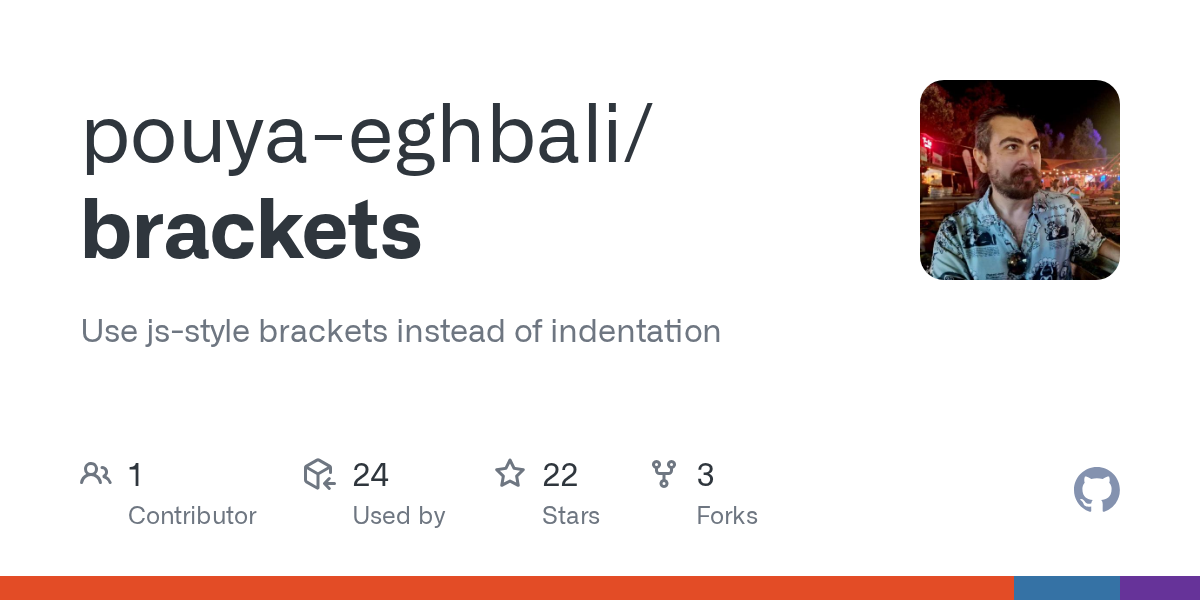
Use js-style brackets instead of indentation. Contribute to pouya-eghbali/brackets development by creating an account on GitHub.
rapid kayak
last locust
I mean, as with all projects on pypi, it's open source <:Shrug:10041634364747940...
trueeeeeeeeeeeeeeeeeeeeeeeeeeeeeeeeeeeeeeeeeeeeeeeeeeeeeeeeeeeeeeeeeeeeeeeeeeeeeeeeeeeeeeeeeeeeeeeeeeeeeeeeeeeeeeeeeeeeeeeeeee
 fair quartz
guys how do i mutate ints in place :DDDDDDDDDD
def add1(x):
    py_object.from_address(id(x)).value += 1

x = 100000000000000000000000
print(x)
add1(x)
print(x)
 restive void
!e
from ctypes import*
x = 1000000000000000000
cast(id(x), POINTER(c_int))[6] += 1
print(x)
@restive void :white_check_mark: Your 3.11 eval job has completed with return code 0.
1000000000000000001
!e doesn't work for 30 bit boundaries though 😔
from ctypes import *

x = 100000000000000000

cast(id(x), POINTER(c_int))[6] *= 2
print(x)
@dry mirage :white_check_mark: Your 3.11 eval job has completed with return code 0.
100000000495583232
from ctypes import *
def inplace_incr(i):
    max_amount = (1 << ((abs(
        c_ssize_t.from_address(id(i) + 16).value
    ) - 1) * 32)) - 1
    if i >= max_amount:
        raise MemoryError(f"value of {i + 1} is larger than the largest amount that can fit into {object.__sizeof__(i) - 24} bytes ({max_amount})")
    digit_offset = 24
    # do{ ... } while() loop. increment successive digits until there's no more overflow
    while True:
        current = c_uint.from_address(
            id(i) + digit_offset
        ).value
        if current <= c_uint(current + 1).value:
            c_uint.from_address(
                id(i) + digit_offset
            ).value += 1
            break
        c_uint.from_address(
            id(i) + digit_offset
        ).value += 1
        digit_offset += 4
 unique heath
im bored so imma golf euler14
!e
a = {}
for i in range(1e6):
    b = 0
    c = i
    while c != 4:
        if c&1:3*c+1
        else:c/2
        b += 1
a[i] = b```@unique heath :x: Your 3.11 eval job has completed with return code 1.
001 | Traceback (most recent call last):
002 |   File "<string>", line 2, in <module>
003 | TypeError: 'float' object cannot be interpreted as an integer
It's always gonna fail at some point
unique heath
!e
m = 0
for i in range(10**6):
    b = 0
    c = i
    while c != 4:
        if c&1:3*c+1
        else:c/2
        b += 1
    if b>m:m=b
@unique heath :warning: Your 3.11 eval job timed out or ran out of memory.
[No output]
you can technically increase the array size by 1 or 2 depending on alignment
but that's not really allocated memory
with python malloc=DEBUG that will have an assertion error during GC
versed eagle
dry mirage
you can technically increase the array size by 1 or 2 depending on alignment
that sounds... non-portable
alignment is scary
dry mirage
all CPython builds have the same alignment iirc
unique heath
@dry mirage why is my thing so slow
versed eagle
you never assign to c so it never gets to 4
unique heath
its been taking over 10 seconds now
versed eagle
the inner while loop never finishes
unique heath
versed eagle
the inner while loop never finishes
any ideas?
versed eagle
versed eagle
you never assign to c so it never gets to 4
.
unique heath
oh im dumb
how is this not wowrkign
m = 0
for i in range(1,10):
    b = 0
    c = i
    while c != 4:
        if c&1: c*=3+1
        else: c/=2
        b += 1
    if b>m:m=b
print(m)```/=
use //=2 or >>=1
versed eagle
also the c*=3+1 is the same as c*=4
unique heath
versed eagle
also the `c*=3+1` is the same as `c*=4`
oh i mbdumb
unique heath
quartz wave
use `//=2` or `>>=1`
but that wont work because the first statement checks for evenness
versed eagle
that's the collatz conjecture right?
versed eagle
unique heath
but that wont work because the first statement checks for evenness
wont matter
as it is now, it makes it into a float
which iirc doesn't have & implemented
yep
unique heath
its taking 69 years rips
versed eagle
unique heath
its taking 69 years rips
!e
n = 123
numloops = 0
while n != 1:
    if n % 2:
        n = n * 3 + 1
    else:
        n = n // 2
    numloops += 1
print(numloops)
@versed eagle :white_check_mark: Your 3.11 eval job has completed with return code 0.
46
good idea (totally not gonna steal that)
quartz wave
__import__('random').choice is not less chars
unique heath
time to obfuscoate
quartz wave
from random import*
while 1:
 if input("rps?")in'rps':print("you %s!"%choice(['won','lost','tied']));break
short as ever
low lynx
is it not shorter to negate the condition instead of having the if and break
 brittle olive
quartz wave
```py
from random import*
while 1:
if input("rps?")in'rps':print("you %s!"%choi...
brittle olive
quartz wave
```py
from random import*
while 1:
if input("rps?")in'rps':print("you %s!"%choi...
this is even shorter
while 1:
 if input("rps?")in'rps':print(f"you {__import__('random').choice(['won','lost','tied'])}!");break
no
low lynx
cereal's is 106
quartz wave
lmao why do people still think __import__ is shorter when i literally showed them this ```
import random random.choice
import random as r r.choice
import('random').choice
from random import* choice
99py from random import* while input("rps?")not in'rps':0 print("you %s!"%choice(['won','lost','tied']))
brittle olive
past plank
99```py
from random import*
while input("rps?")not in'rps':0
print("you %s!"%cho...
i think the length would've been the same if u've used f-strings
past plank
imagine if you could use _ outside of the repl, this 2 character reduction would be sick
from random import*
while input("rps?")not in'rps':'won','lost','tied'
print("you %s!"%choice(_))```you forgot semi-colons
quartz wave
arctic skiff
you forgot semi-colons
?
i'm representing newlines/semicolons as spaces which should make no difference in character count
past plank
quartz wave
i'm representing newlines/semicolons as spaces which should make no difference i...
oh wait I can save another character
97py while input("rps?")not in'rps':from random import* print("you %s!"%choice(['won','lost','tied']))
oops didn't mean to ping sorry
quartz wave
past plank
97```py
while input("rps?")not in'rps':from random import*
print("you %s!"%choic...
nice
low lynx
does it still import if it never goes through the loop?
quartz wave
low lynx
does it still import if it never goes through the loop?
oh yeah that
low lynx
!e
while 0: from random import*
print(choice)
@low lynx :x: Your 3.11 eval job has completed with return code 1.
001 | Traceback (most recent call last):
002 |   File "<string>", line 2, in <module>
003 | NameError: name 'choice' is not defined
oh yeah, shoot
tough willow
@gleaming linden
from random import*;o=ord;r=range;''.join(map(chr,choices([*r(65,123)]+[*r(48,58+1)],k=16))) 92
oh wait no
i forgot to remove the +1
from random import*;o=ord;r=range;''.join(map(chr,choices([*r(65,123)]+[*r(48,58)],k=16))) 90
gleaming linden
from random import*;r=range;''.join(map(chr,choices([*r(65,123)]+[*r(48,58)],k=16)))
``` get rid of `o` as well (84)i also forgot that
from random import*
r=range
''.join(map(chr,choices([*r(65,123)]+[*r(48,58)],k=16)))
``` still 84 but if you dont use crlf you can use newlines instead of semicolonsfrom random import*
''.join(map(chr,choices([*range(65,123),*range(48,58)],k=16)))
```i forgot you could do this (should be 82)yes it's 82
night quarryBOT
@rapid kayak :x: Your 3.11 eval job has completed with return code 1.
001 |   File "<string>", line 1
002 |     False = True
003 |     ^^^^^
004 | SyntaxError: cannot assign to False
cry
low lynx
!e
from einspect import view
with view(False).unsafe() as v:
    v <<= True
x = True
if x == False:
    print('crazy')
@low lynx :white_check_mark: Your 3.11 eval job has completed with return code 0.
crazy
What does <<= do?
night quarryBOT
@wheat river :white_check_mark: Your 3.11 eval job has completed with return code 0.
0b1000
 wheat river
inplace bit shit to the left
wheat river
inplace bit shit to the left
but what does it do in einspect
quartz wave
tough willow
but what does it do in einspect
move object
tough willow
okay
 vapid finch
That's a lot like a classic IOCCC entry, https://www.ioccc.org/1984/mullender/mullender.c. (Explanation at https://www.ioccc.org/1984/mullender/hint.html)
sick hound
Rust also has inline assembly, but all of its functions are unsafe, so they expect an unsafe block
rugged sparrow
What is rmcof? Cross platform assembly support?
Ah clever
fishhook.asm uses something like that written in python to hook C functions
I need to implement the windows api for memory protection and make the jump compile at runtime to ensure it's the correct opcode. I also have a plan to implement a needle/haystack hooking protocol to allow hooks in the middle of C functions
Windows doesn't use mprotect/mmap afaik
In this case I can, the code is just a short jump op + arg. So it's just a matter of selecting the correct op
Yea I know I just haven't written it yet
@sick hound yea that lib won't work on windows (unless you build it using the posix compatibility layer)
Idk if that would happen automatically when python builds it
dry mirage
rugged sparrow
I need to implement the windows api for memory protection and make the jump comp...
ctypes does a bunch of conditionals for platforms for its own dynamic c functions, perhaps you could do something similar?
rugged sparrow
Tbh I was toying around with using some of its internal ffi functions
quartz wave
people are just doing unix-only projects that i can't play with because i'm on windows
versed eagle
you could use a vm
actually, im pretty sure windows has functions that do the same things
quartz wave
versed eagle
actually, im pretty sure windows has functions that do the same things
yes but they're a little complicated to use
versed eagle
ah fair
low lynx
can't u like use wsl
quartz wave
low lynx
can't u like use wsl
too lazy
meager zinc
quartz wave
yes but they're a little complicated to use
use a vm
versed eagle
versed eagle
you could use a vm
.
meager zinc
he didn't reply
lets golf something
what about some euler challenge
what about 40
A website dedicated to the fascinating world of mathematics and programming
not too simple not too hard
low lynx
how about a generalization of that to avoid any ambiguity of hardcoding
meager zinc
sure
low lynx
take an input integer k and print the product from i=0 to k of d_(10**i)
meager zinc
so for Sum[d_10^n, n=0 -> k]
low lynx
yeah
quartz wave
meager zinc
use a vm
too lazy
meager zinc
use an online vm
it's three clicks + 10s loading for me to pull up a NixOS vm rn
in my browser
 rugged sparrow
quartz wave
people are just doing unix-only projects that i can't play with because i'm on w...
rugged sparrow
quartz wave
people are just doing unix-only projects that i can't play with because i'm on w...
I have free time tomorrow, gonna update fishhook.asm to be as universal as I can get it
(I can also leave an internal function to exec raw asm if you want)
meager zinc
ok this is a base impl for #40
q=[9*(x+1)*10**x for x in range(20)]
def c(n):
    i=0
    while n>q[i]:n-=q[i];i+=1
    d,m=divmod(n-1,i+1)
    return int(str(pow(10,i)+d)[m])
def f(k):
    a=1
    for i in range(0,k):a*=c(10**k)
    return a
i think it works but correct me if it doesn't
any ideas to shorten it?
quartz wave
rugged sparrow
I have free time tomorrow, gonna update fishhook.asm to be as universal as I can...
ok
low lynx
meager zinc
any ideas to shorten it?
well you don't need the 0 in the second function
remove spaces as well
meager zinc
true
meager zinc
q=[9*(x+1)*10**x for x in range(20)]
def c(n):
 i=0
 while n>q[i]:n-=q[i];i+=1
 d,m=divmod(n-1,i+1)
 return int(str(pow(10,i)+d)[m])
f=lambda k,a=1:a if k==0else f(k-1,a*c(10**k)
probably works
 languid hare
hmm a hybrid golf/runtime coding challenge would be pretty fun
meager zinc
c works but I messed up f apparently
meager zinc
languid hare
hmm a hybrid golf/runtime coding challenge would be pretty fun
like what
versed eagle
languid hare
hmm a hybrid golf/runtime coding challenge would be pretty fun
oh are you a mod now
congrats
meager zinc
nvm I think it's working?
languid hare
meager zinc
like what
either optimise for speed or length
low lynx
do you have any test values?
meager zinc
lemme make some
languid hare
eg for this euler problem generating the constant and taking the product naively would be pretty short, but slow
meager zinc
languid hare
eg for this euler problem generating the constant and taking the product naively...
the idea was that it's not memory bounded
but that would be
meager zinc
low lynx
how about a generalization of that to avoid any ambiguity of hardcoding
like this
because the generation method is hardcoding pretty much
quartz wave
meager zinc
```py
q=[9*(x+1)*10**x for x in range(20)]
def c(n):
i=0
while n>q[i]:n-=q[i];...
shorter ```py
q=[-~x10**x9for x in range(20)]
def c(n):
i=0
while n>q[i]:n-=q[i];i+=1
d,m=divmod(n-1,i+1);return int(str(10i+d)[m])
f=lambda k,a=1:f(k-1,a*c(10k))if k else a
I was thinking more like to avoid ```f =lambda _:some_precomputed_value``
meager zinc
f(0) = 1
f(1) = 1
f(2) = 5
f(3) = 15
f(4) = 105
f(5) = 210
test cases
!e ```py
q=[-~x10**x9for x in range(20)]
def c(n):
i=0
while n>q[i]:n-=q[i];i+=1
d,m=divmod(n-1,i+1);return int(str(10i+d)[m])
f=lambda k,a=1:f(k-1,a*c(10k))if k else a
for _ in range(1,7):
print(f(_))
@meager zinc :white_check_mark: Your 3.11 eval job has completed with return code 0.
001 | <string>:1: SyntaxWarning: invalid decimal literal
002 | 1
003 | 5
004 | 15
005 | 105
006 | 210
007 | 210
q=[-~x*10**x*9for x in range(20)]
def c(n):
 i=0
 while n>q[i]:n-=q[i];i+=1
 return int(str(10**i+~-n//-~i)[~-n%-~i])
f=lambda k,a=1:f(k-1,a*c(10**k))if k else a
``` shorteryes yes