#data-science-and-ml
1 messages · Page 310 of 1
 winged stratus
 grave breach
Yes, if you lower the quality 1000 should be ok
grave breach
Make a try
 pallid parcel
Anybody know of a library that produce PNG files from data points?
pallid parcel
Well data points for line graphs or candle stick gtaphs
 crude fable
ah, then matplotlib
pallid parcel
Matplotlib makes PNG files?
crude fable
of course
crude fable
just plt.savefig("*.png")
crude fable
Do u have an idea of how GANs could converge?
 grave frost
https://www.reddit.com/r/MachineLearning/comments/n7lv1o/oc_phand_gesture_recognition_play_pause_control/
I am more impressed that he used windows

reddit
502 votes and 35 comments so far on Reddit
that's too less. even using the DeiT recipie wouldn't yield much
grave breach
crude fable
Do u have an idea of how GANs could converge?
What do you mean by converge?
 shy ember
does anyone know how to control the number of clusters here (https://scikit-learn.org/stable/auto_examples/cluster/plot_affinity_propagation.html#sphx-glr-auto-examples-cluster-plot-affinity-propagation-py)

i was hoping for 7-9 clusters but it doesn't seem to separate them far enough
grave breach
For this you should use k-mean clustering
crude fable
grave breach
What do you mean by converge?
Training a good discriminator while a better generator that fools D at the same time?
shy ember
grave breach
For this you should use k-mean clustering
will this work if i don't know the number of clusters beforehand?
from what i recall this was why i didn't use k-mean in the first place
crude fable
the K in k-means is a hyperparameter I think
grave breach
crude fable
Do u have an idea of how GANs could converge?
Well, I don't think a GAN could ever converge
grave breach
shy ember
will this work if i don't know the number of clusters beforehand?
No, unfortunately k-mean clustering has a fixed size
Maybe you could try DBSCAN
If I don't go wrong scikit learn has DBSCAN implemented
crude fable
I am not quite familiar with the general training scheme of GANs. Do D and G both start from scratch or is D initialized with a good enough checkpoint?
grave breach
They both start from scratch
shy ember
grave breach
Maybe you could try DBSCAN
does this return the cluster center? i can't seem to find how in the documentation
grave breach
I think you have to calculate it by yourself
But
Once you have all the points in a cluster
crude fable
quote from Stackoverflow
 grave breach
You can do the mean of all the xs and the mean of all the ys
So you have the center
@shy ember
 lapis sequoia
I'm assuming you mean "better counterpart" as GPT-3, but that's a private beta, so what else can I use?
crude fable
maybe BART?
lapis sequoia
What's BART?
crude fable
auto-regressively pre-trained models are generally better at generative tasks like convo

State-of-the-art Natural Language Processing for Pytorch and TensorFlow 2.0. 🤗 Transformers (formerly known as pytorch-transformers and pytorch-pretrained-be...
A whole bunch of pre-trained models here
Basiclly BART = BERT (as encoder) + GPT (as decoder)
 livid oar
Checkout this new article 😃

These 8 NLP libraries in Python are a must know for anyone working with text data.
 simple shadow
hey everyone, how do i read a folder of images in github through python in google colab?
grave frost
livid oar
Checkout this new article 😃
https://www.analyticsvidhya.com/blog/2021/05/top-8...
ehh, that kind of stuff is always shite. There aren't any "must-to-know" libs ever - only those that are basic (numpy, pandas). It's absolutely useless to "learn" a library. you have to learn concepts, not libraries. in NLP, you do get some use out of those for basic processing, but I would rather say the person learns "TF/Pytorch" (i.e understand the practical terminology and API usage rather than just a lib) to use NLP models since most ML tools don't do good in real-world NLP tasks.
You'd find much more better blogs on Medium than Analytics Vidhya tbh
grave breach
simple shadow
hey everyone, how do i read a folder of images in github through python in googl...
Download them, put them on your google drive
And then open them via colab
grave breach
grave breach
And then open them via colab
Never did this but it seems pretty simple
@simple shadow
 short heart
How does fbprophet work?
cause I gave it some dataset and the output it generated kind of follows true values, but when it went to the values it didnt see, the prophet kinda starts..sucking?

what I mean is, how does it predict something? why did it even predict the values it was trained on if thats what happened on screenie?
grave frost
short heart
what I mean is, how does it predict something? why did it even predict the value...
you can only gain so much performance with black-box methods.
short heart
wdym
grave frost
exactly what I mean.....?
you can't expect something to work as perfect with minimal effort 🤷
short heart
i just want to know how does fbprophet make predictions and why it predicts whats already there
grave frost
short heart
i just want to know how does fbprophet make predictions and why it predicts what...
learn ML basics, then see RNN'S/LSTM
simple shadow
grave breach
And then open them via colab
i want others to be able to run the google colab, wouldnt it not work if its on my google drive only?
grave breach
simple shadow
i want others to be able to run the google colab, wouldnt it not work if its on ...
Just create a shared google colab
*google account
 royal lintel
cannot pickle 'weakref' object
anyone knows how to solve it? Saving model using joblib.dump
tag if answered please
 desert oar
grave frost
learn ML basics, then see RNN'S/LSTM
desert oar
grave frost
learn ML basics, then see RNN'S/LSTM
Prophet is less of a black box than an lstm
desert oar
short heart
cause I gave it some dataset and the output it generated kind of follows true va...
Prophet is essentially regression, and this is a common problem in forecasting. See the "how prophet works" section https://research.fb.com/blog/2017/02/prophet-forecasting-at-scale/

Forecasting is a data science task that is central to many activities within an organization. For instance, large organizations like Facebook must engage in capacity planning to efficiently allocate scarce resources and goal setting in order to measure performance relative to a baseline.
desert oar
short heart
cause I gave it some dataset and the output it generated kind of follows true va...
Just eyeballing this output, it looks like the trend shifts after the big spike, and prophet tries to continue the flatter trend at the end of the time series. If you are aware of additional features that could have caused the flatter period, you should add them to the model
Basically, in order to predict a change in trend, the change either needs to be cyclical, or there needs to be some external feature that can indicate the trend is changing, and in what direction
Otherwise really the only reasonable thing a model could do is to continue the previous trend
short heart
Makes sense
desert oar
That said, it might be doing the wrong thing here in that what should be an unusual deviation from trend appears to be a change in trend
Maybe there are some configurable parameters that can help with this issue
Also, it would help if you drew a vertical line where the training data ended and the test data began
short heart
Yeah, I did draw one after posted but im not on pc now
Give me a sec
Should me something like that
 grave frost
desert oar
Prophet is essentially regression, and this is a common problem in forecasting. ...
grave frost
desert oar
Prophet is essentially regression, and this is a common problem in forecasting. ...
oof
desert oar
short heart
Should me something like that
Yeah that's pretty much what I figured
grave frost
that won't be very high accuracy, but I guess it gets the job done
desert oar
Neural networks have shown themselves to be pretty lackluster in time series modeling compared to other domains
grave frost
desert oar
Neural networks have shown themselves to be pretty lackluster in time series mod...
not true in practice tho
desert oar
I believe it if you are doing something like classifying 1000 different time series
grave frost
you can check out kaggle's jane street, and everyone is running nets (I think the winner too, not sure tho)
desert oar
For time series prediction on a single series? I haven't seen good results but I am obviously willing to be proven wrong
grave frost
jane street is stock prediction BTW
Yirun's Solution (1st on 2021-03-29): Training Supervised Autoencoder with MLP
ahh, and a blend of xgboost
Cross-Validation (CV) Strategy and Feature Engineering:

    5-fold 31-gap purged group time-series split
    Remove first 85 days for training
    Forward-fill the missing values
    Transfer all resp targets (resp, resp_1, resp_2, resp_3, resp_4) to action for multi-label classification
    During inference, the mean of all predicted actions is taken as the final probability

Deep Learning Model:

    Use autoencoder to create new features, adding along with original features to the MLP
    Train autoencoder and MLP together in each CV split to prevent data leakage
    Add target information to autoencoder (supervised learning) to force it generating more relevant features, and to create a shortcut for backpropagation of gradient
    Add Gaussian noise layer before encoder for data augmentation and to prevent overfitting
    Use swish activation function instead of ReLU to prevent ‘dead neuron’ and smooth the gradient
    Batch Normalisation and Dropout are used for MLP
    Train the model with 3 different random seeds and take the average to reduce prediction variance
    Only use the models (with different seeds) trained in the last two CV splits since they have seen more data
    Only monitor the BCE loss of MLP instead of the overall loss for early stopping
    Use Hyperopt to find the optimal hyperparameter set
Ahh, the mind of grandmasters works in different ways than the rest of use mortals can comphrehend
desert oar
Yeah I have no doubt that eventually we will figure out useful general purpose neural network models that offer incremental improvements over regression-based methods
But for now it's a mischaracterization to suggest that a regression model like prophet will be inherently less effective than something based on an LSTM
grave frost
desert oar
But for now it's a mischaracterization to suggest that a regression model like p...
if prohpet hasn't yielded much in a comp for 100,000$ - I think we can safely rule it out imo
desert oar
The Jane Street problem is also a lot more sophisticated than forecasting a single series 🤷♂️
I'm not trying to say this particular model is the best thing since sliced bread either
Neural networks I would expect to perform much better on a complicated evaluation task like this
grave frost
desert oar
The Jane Street problem is also a lot more sophisticated than forecasting a sing...
it seems forcasting is the second stage of the comp - it will end up in 3 months. I bet for NNs to rule
!remindme
 arctic wedgeBOT
Missing required argument
expiration
desert oar
I have no doubt that the winning forecast will at some point use deep learning somewhere along the way
grave frost
uh-huh
royal lintel
royal lintel
`cannot pickle 'weakref' object`
anyone knows how to solve it? Saving model usin...
refreshing question
 tawdry hamlet
Hi, does anyone have any good info on how to interpret the output of the critic/discriminator module in a Wassertstein GAN (WGAN-GP)? I am struggling to interpet whether a large number means 'normal' or a small number means normal and looking around online im seeing conflicting info?
Would love for some clarification
 proper basin
I'm using xml.sax to parse a 200GB XML file and I'm trying to get byte offsets so I can seek back. Is there a way to do this? The Locator interface only provides line/column numbers that are useless for seeking
lapis sequoia
200GB... geez
proper basin
yeah it's been a pain
proper basin
I'm using xml.sax which has a push API, so I read some bytes, feed them to the XML parser, and it calls callbacks where I handle the XML elements
so like I feed 16k bytes to it, one of the event is interesting and I want to note the file position, and I don't know how to do that
If I count bytes when I push data in, I know where the 16k buffer is, but I don't know where exactly in the buffer the event happens
lapis sequoia
Way over my head, wish I could help
The object event though
what happens when you print(blah.dir())
print(blah.__dir__())
Where blah is the obj
Even better, use ipython so you can tab out on the obj
proper basin
unfortunately the parser's internals are in C so I can't really get at the internals
lapis sequoia
Its still an obj is it not?
i.e.
blah blah your code blah blah

x = your callbacks obj at the event level that is interesting


Now you just need to see what properties x has
So to do, you can tab it out if you make x available to you in ipython
In [1]: f = str()
In [2]: f.casefold
capitalize() format_map() isnumeric() maketrans() split()
casefold() index() isprintable() partition() splitlines()
center() isalnum() isspace() replace() startswith()
count() isalpha() istitle() rfind() strip()
encode() isascii() isupper() rindex() swapcase()
endswith() isdecimal() join() rjust() title()
expandtabs() isdigit() ljust() rpartition() translate()
find() isidentifier() lower() rsplit() upper()
format() islower() lstrip() rstrip() zfill()
function()
Like that. I tabbed out and all the things f can do or has, pop up 🙂
proper basin
Oh yeah there's stuff, just not useful stuff
(Pdb) p parser
<xml.sax.expatreader.ExpatParser object at 0x7f393cee4430>
(Pdb) p dir(parser)
['__class__', '__delattr__', '__dict__', '__dir__', '__doc__', '__eq__', '__format__', '__ge__', '__getattribute__', '__gt__', '__hash__', '__init__', '__init_subclass__', '__le__', '__lt__', '__module__', '__ne__', '__new__', '__reduce__', '__reduce_ex__', '__repr__', '__setattr__', '__sizeof__', '__str__', '__subclasshook__', '__weakref__', '_bufsize', '_close_source', '_cont_handler', '_decl_handler_prop', '_dtd_handler', '_ent_handler', '_entity_stack', '_err_handler', '_external_ges', '_interning', '_lex_handler_prop', '_namespaces', '_parser', '_parsing', '_reset_cont_handler', '_reset_lex_handler_prop', '_source', 'character_data', 'close', 'end_element', 'end_element_ns', 'end_namespace_decl', 'external_entity_ref', 'feed', 'getColumnNumber', 'getContentHandler', 'getDTDHandler', 'getEntityResolver', 'getErrorHandler', 'getFeature', 'getLineNumber', 'getProperty', 'getPublicId', 'getSystemId', 'notation_decl', 'parse', 'prepareParser', 'processing_instruction', 'reset', 'setContentHandler', 'setDTDHandler', 'setEntityResolver', 'setErrorHandler', 'setFeature', 'setLocale', 'setProperty', 'skipped_entity_handler', 'start_doctype_decl', 'start_element', 'start_element_ns', 'start_namespace_decl', 'unparsed_entity_decl']
Ok I wrote untractable code that records the byte offset of the buffer and the line number inside that buffer
lapis sequoia
What's the logic that goes into selecting a loss function
grave frost
lapis sequoia
What's the logic that goes into selecting a loss function
how else would you optimize your gradients?
do you mean selecting a loss function or why do we use one?
lapis sequoia
I mean, what loss function should I choose
Yeah, selecting one, I worded that badly lol
Like atm I'm doing an MLP sequential model for recognising numbers, what loss function should I be choosing?
grave frost
classification on multi-class --> cross entropy
I mean, there aren't that many options are there?
lapis sequoia
What's the difference between that and the sparse variant?
grave frost
the sparse accepts one-hot encoded labels I think - not sure tho
lapis sequoia
Then why use it
grave frost
If you want to provide labels using one-hot representation, please use
CategoricalCrossentropyloss
lapis sequoia
Do you have a decision tree for this?
grave frost
but in SO, Im pretty sure I read it as sparse loss for sparse labels
grave frost
yup, it seems sparse_categorical_crossen is for labels that are NOT sparse.
https://stats.stackexchange.com/questions/326065/cross-entropy-vs-sparse-cross-entropy-when-to-use-one-over-the-other
that's a weird convention

Cross Validated
I am playing with convolutional neural networks using Keras+Tensorflow to classify categorical data. I have a choice of two loss functions: categorial_crossentropy and sparse_categorial_crossentrop...
The sparse_categorical_crossentropy is a little bit different, it works on integers that's true, but these integers must be the class indices, not actual values.
Ahh, that makes sense in the terminology, if it does represent indices
 sharp reef
Yeah it really helps not having to keep one-hot distributions in memory for potentially multiple batches
grave frost
I don't think it represents that significant of a overhead
lapis sequoia
How can I use the transformers lib bert model to continue a conversation (and basically be a chatbot)
I've got this code, but I don't know how to turn it's output into usable text.
      tokenized = tokenizer.tokenize(message.content)
      indexed_tokens = tokenizer.convert_tokens_to_ids(tokenized)
      tokens_tensor = torch.tensor([indexed_tokens])
      tokens_tensor = tokens_tensor.to('cpu')
      model.to('cpu')
      outputs = model(tokens_tensor)
      encoded_layers = outputs[0]
The encoded_layers is just a buncha random numbers
 serene scaffold
@lapis sequoia I can look at this tomorrow. However I believe the tokenizer can decode the "random numbers".
lapis sequoia
I know they're not random, they're outputs of the... neurons, I think they're called?
serene scaffold
I know you know they're not random. Bert uses transformers and I don't believe that transformers use neurons.
lapis sequoia
ah
 foggy field
Hi, I think this might be a stupid question but I'm stuck. How do I train KNNRegressor from scikit using my entire dataset and then predict a target feature from 1 outside observation?
i asked my question more indepth in help-pretzel
but one has responded yet
foggy field
anyone able to help?
 flint mason
RuntimeError: mat1 and mat2 shapes cannot be multiplied (256x1 and 128x32)
Anyone familiar with this error. An using Resnet by modifying nn.Linear. The error is thrown when trying to evaluate
flint mason
foggy field
anyone able to help?
def predict_single(input, target, model):
    inputs = input.unsqueeze(0)
    predictions = model(input)
    prediction = predictions[0].detach()
    print("Input:", input)
    print("Target:", target)
    print("Prediction:", prediction)
Will work for almost anything other than image classification
lapis sequoia
flint mason
```python
RuntimeError: mat1 and mat2 shapes cannot be multiplied (256x1 and 128...
we do need to do some stuff in resnet in order to pass previous data to next to next. usually shapes are not exactly perfect and that seems to be case here.
a simple solN would be having the layers kinda same dimensions instead of reducing
 wispy tiger
Hey folks! I'm trying to detect motion and people with opencv and deploy it with fastapi, but I'm having some trouble integrating the two. Details are in #help-potato. Could someone pop in and help out?
 vast thunder
Hello everyone!
So for a CNN (Convolutional Neural Network) , I am using Tensorflow . and I have Conv2d for the first 4 layers, a flatten , and then some dense layers with the last dense layer being Dense(3) with relu activation in ALL of them . My input image is loaded with CV2 and is B&W (the shape is (480, 640, 1)) and the output should be a number, for each image . The number should be either 0, 1 , or 2 . But with my Input (x values) looking something like :
[array([[213, 212, 212, ..., 149, 149, 149],
       [212, 212, 211, ..., 151, 151, 151],
       [211, 211, 211, ..., 150, 150, 150],
       ...,
       [ 27,  27,  27, ...,  18,  18,  18],
       [ 27,  27,  27, ...,  17,  17,  17],
       [ 27,  27,  27, ...,  17,  17,  17]], dtype=uint8), array([[212, 212, 212, ..., 150, 150, 149],
       [211, 211, 211, ..., 152, 151, 151],
       [211, 211, 211, ..., 152, 151, 151],
 . . .
And my output (y values) looking like :
[0, 0, 0, 0, 0, 0, 0, 1, 1, 1, 1, 1, 1, 2, 2, 2, 2, 2, 2]
It gives the following error :
ValueError: Failed to find data adapter that can handle input: (<class 'list'> containing values of types {"<class 'numpy.ndarray'>"}), (<class 'list'> containing values of types {"<class 'int'>"})
Why though? Because the types don't match? But when I turn the y values into np.array (like all of them) , I still get an error, telling the input sizes don't match . Anyone knows why?
 tidal bough
vast thunder
Hello everyone!
So for a CNN (Convolutional Neural Network) , I am using Tensorf...
tidal bough
vast thunder
Hello everyone!
So for a CNN (Convolutional Neural Network) , I am using Tensorf...
What's the input shape of your model? Is it (480, 640, 1) or (480,640)? I think you can check with .input_shape.
vast thunder
tidal bough
What's the input shape of your model? Is it `(480, 640, 1)` or `(480,640)`? I *t...
My input shape is (480, 640, 1)
I can send you the model code if you want
tidal bough
If that's the case, the input shape for multiple images should be (N,480,640,1) (a single tensor/numpy array)
vast thunder
Oh, N being the count?
tidal bough
Yup
vast thunder
Lemme try
tidal bough
It looks like you're passing a list. If you convert that list to a numpy array, what's the shape and dtype?
vast thunder
sorry my laptop crashed
after running the code with input shape of N
so uhm, Im waiting for it to load
Okay so
Um
It doesn't show the dtype

@tidal bough Should I convert EVERY element into one np array?
tidal bough
vast thunder
<@!266216750876459008> Should I convert EVERY element into one np array?
The entire thing you pass to the model should be a single numpy array.
tidal bough
vast thunder
It doesn't show the dtype
.dtype will show it. And what is this, the input? Shouldn't it be a lot bigger than this?
vast thunder
This is for testing purposes , just wanted to practice
That's the output
The input is images
Images , loaded by cv2, grayscaled
tidal bough
!e
import numpy as np
arr = np.arange(100).reshape(5,10,2)
print(arr.shape)
print(arr.dtype)
@tidal bough :white_check_mark: Your eval job has completed with return code 0.
001 | (5, 10, 2)
002 | int64
check the shape and dtype of what you're passing to the model
vast thunder
kk
uint8, (19, 1, 480, 640) is the shape
So I'm guessing ... the input shape should be (19, 480, 640, 1)?
tidal bough
vast thunder
So I'm guessing ... the input shape should be `(19, 480, 640, 1)`?
Yup, if the input shape of your model is (480, 640, 1).
Presumably it will complain about shape if you pass this tensor to it.
vast thunder
tidal bough
Yup, if the input shape of your model is `(480, 640, 1)`.
So I should just add the 19 as the first one?
model.add(Conv2D(20, (5, 5), (2, 2), input_shape=(19, 480, 640, 1), activation='relu'))
Is this alright as the first layer?
tidal bough
If your shape is (19, 1, 480, 640), you can make it (19, 480, 640, 1) using .transpose([0,2,3,1])
 errant gull
What would be the best way to append a column of 1s as the 0th column to a numpy array
X = ([4,5,6,7,8,9],
     [4,5,6,7,8,9],
.
.
.
X should then be:
X = ([1,4,5,6,7,8,9],
     [1,4,5,6,7,8,9],
     [1, ..
     [1, ..
.
.
.
Oh right
tidal bough
vast thunder
```py
model.add(Conv2D(20, (5, 5), (2, 2), input_shape=(19, 480, 640, 1), activa...
No, your input shape of the model should describe one sample, I believe.
So (480,640,1) is right.
tidal bough
yeah, I think so
vast thunder
Lemme try
tidal bough
errant gull
What would be the best way to append a column of 1s as the 0th column to a numpy...
np.hstack([np.ones((X.shape[0],1)),X])
np.ones((X.shape[0],1)) is a (n,1)-shape array where n is X's number of rows.
vast thunder
Thanks @tidal bough , really appreciate it!
grave frost
wait, you can force Convolutionals layers to find horizontal/vertical patterns?

does anyone know the research/technical term behind this?
lapis sequoia
you mean having different kind of filters in same layer?
yes. you can look out for inception network.
grave frost
lapis sequoia
you mean having different kind of filters in same layer?
how can you have different types of filters in the same layers?
lapis sequoia
how do i install pyaudio?
lapis sequoia
grave frost
how can you have different types of filters in the same layers?
there is a model made for that.
grave frost
lapis sequoia
there is a model made for that.
which one?
lapis sequoia
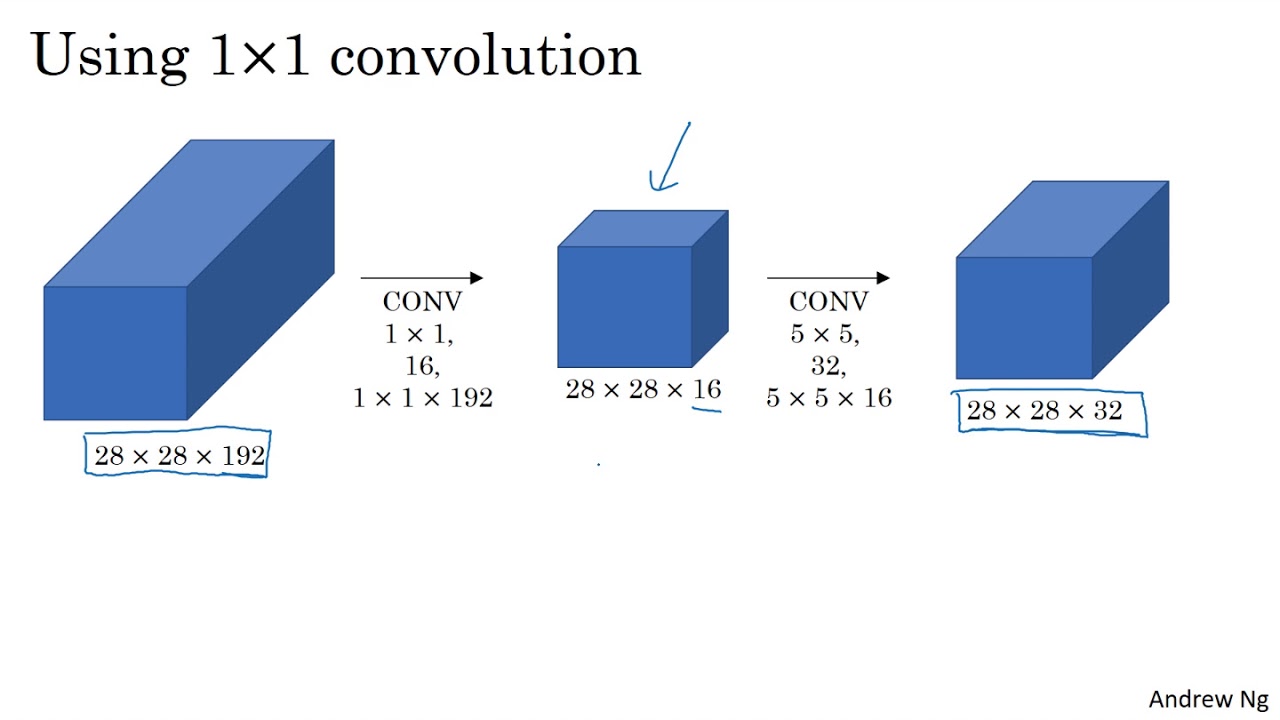
Take the Deep Learning Specialization: http://bit.ly/39thYn3
Check out all our courses: https://www.deeplearning.ai
Subscribe to The Batch, our weekly newsletter: https://www.deeplearning.ai/thebatch
Follow us:
Twitter: https://twitter.com/deeplearningai_
Facebook: https://www.facebook.com/deeplearningHQ/
Linkedin: https://www.linkedin.com/com...
..
inception network.
grave frost
lapis sequoia
inception network.
inception model is just composed of inception modules. and the architecutre I describes was sequential VGGish
lapis sequoia
i was just implying that if it is like that then it is possible.
grave frost
lapis sequoia
i was just implying that if it is like that then it is possible.
well it's not, that's why its to mysterious
and the guys who described it looked like they had written it all in 10 mins
lapis sequoia
alright. thats why i kinda asked question as i was not 100% sure about it.
lapis sequoia
grave frost
and the guys who described it looked like they had written it all in 10 mins
ref?
grave frost
literally fucking one statement "Musically motivated CNN". I mean, why publish a paper when you can't even write out it's whole architecutre
grave frost
lapis sequoia
ref?
their official paper is 1.5 pages of everything
so you can guess what's on it
grave frost
ahh, why didn't they link the repo with this paper?
grave frost
like that paper should have been the first thing in the repo
well, their technique is interesting, but severely outdatted
grave frost
uh-huh. on top of that, they have custom layers for temporal and spatial, didn't even run NAS on it
A mediocre submission, but I guess it's 5 years old so I have to cut them some slack.
I was thinking of using LeVit. Just gotta convince them to gimme more GPU's
lapis sequoia
wow i need to learn a lot in data science.
grave frost
imo I like Vit a lot, but it's main drawback is the fact that it requires labelled data for pre-training
There was a new technique called BYOL, but I haven't got around to understanding it or it's results + it's highly experimental. the advantage for it is that it can use random unlabelled images from the task and pre-train on that, just like in NLP
winged stratus
have there been any advances in gans since wgan-gp?
 hard hound
Hey could someone help me define a function which computes average of every last 50 ints for every point?
grave frost
it's honestly quite confusing to keep advances in something. I guess you can check benchmarks 🤷
lapis sequoia
Should I be one hot-encoding the training set as well (if possible) or just the labels?
 inland zephyr
Hello all. I want to ask if there is any good tutorial to transfer learn VGGNet or Facenet with own-build datasets for production level architecture? Since i need to retrain it for specific face recognition task while cut production time. I search on Medium or anywhere there're lack of these kind of tutorial.
 forest zenith
hi, my code is run, but the voice of my AI is speak too fast
here is my code:
import speech_recognition
import pyttsx3
from datetime import datetime

now = datetime.now()

name = input("Please enter your name before using this: ")
today = now.strftime("%B %D, %Y")

robot_ear = speech_recognition.Recognizer()
robot_mouth = pyttsx3.init()
robot_brain = ""

with speech_recognition.Microphone() as mic:
    print("Robot: I'm listening")
    audio = robot_ear.listen(mic)

print("Robot:...")

try:
    you = robot_ear.recognize_google(audio)
except:
    you = ""
print("you: " + you)

if "":
    robot_brain = "I can hear you, try again."
elif "hello" in you:
    robot_brain = "Hello " + name
elif "today" in you:
    robot_brain = today
elif you == "WWDC 2021":
    robot_brain = "WWDC 2021 will start from June 7 to 11. You can see details in https://developer.apple.com/wwdc21/"
else:
    robot_brain = "Sorry, we not supported this question."
print("Robot:", robot_brain)

robot_mouth = pyttsx3.init()
robot_mouth.say(robot_brain)
robot_mouth.runAndWait()
@serene scaffold if you have some time, I woke up and can do this now
serene scaffold
lapis sequoia
<@!253696366952316929> if you have some time, I woke up and can do this now
Did you look at what methods the tokenizer has?
lapis sequoia
I can't figure out how to look at the methods it has
I tried decode but there was an error, lemme try it again
serene scaffold
The docs
lapis sequoia
inland zephyr
Hello all. I want to ask if there is any good tutorial to transfer learn VGGNet ...
I did the Tensorflow 2 for Deep Learning course on Coursera which is pretty good, goes into a fair amount of detail and uses VGG
The error is that encoded_layers is a list, and int can't convert it to a number (for tokenizer.decode)
Ah, I think I need to call convert_tokens_to_ids on the encoded_layers, then feed it to decode, possibly
serene scaffold
lapis sequoia
The error is that `encoded_layers` is a list, and `int` can't convert it to a nu...
I'll be at my desktop in like 15


 lapis sequoia
Trying convert_ids_to_tokens seems to return something that decode can't handle, and convert_tokens_to_ids and putting it through decode returns [UNK]
 mint palm
the course got updated, lets goooooooooo..................!!!!!!!!!!!
lapis sequoia
 sick wedge
You need to make sure your output layer and your labels layer are the same shape
What's your output layer?
sick wedge
No worries I fixed it
lapis sequoia
Cool
serene scaffold
@lapis sequoiadid you try this one? https://huggingface.co/transformers/main_classes/tokenizer.html#transformers.PreTrainedTokenizer.batch_decode
A tokenizer is in charge of preparing the inputs for a model. The library contains tokenizers for all the models. Most of the tokenizers are available in two...
lapis sequoia
No, I haven't, let my try that
Feeding batch decode the output directly: TypeError: int() argument must be a string, a bytes-like object or a number, not 'list'
Feeding batch decode convert_ids_to_tokens: ValueError: only one element tensors can be converted to Python scalars
Feeding batch decode convert_tokens_to_ids:
 serene scaffold
lapis sequoia
No, I haven't, let my try that
serene scaffold
lapis sequoia
No, I haven't, let my try that
what line caused that error?
lapis sequoia
output directly:
Traceback (most recent call last):
    await coro(*args, **kwargs)
  File ".\public-chatbot02.py", line 28, in on_message
    msg_out = tokenizer.batch_decode(encoded_layers)
  File "C:\Users\owenp\AppData\Roaming\Python\Python37\site-packages\transformers\tokenization_utils_base.py", line 3019, in batch_decode
    for seq in sequences
  File "C:\Users\owenp\AppData\Roaming\Python\Python37\site-packages\transformers\tokenization_utils_base.py", line 3019, in <listcomp>
    for seq in sequences
  File "C:\Users\owenp\AppData\Roaming\Python\Python37\site-packages\transformers\tokenization_utils_base.py", line 3055, in decode
    **kwargs,
  File "C:\Users\owenp\AppData\Roaming\Python\Python37\site-packages\transformers\tokenization_utils.py", line 731, in _decode
  File "C:\Users\owenp\AppData\Roaming\Python\Python37\site-packages\transformers\tokenization_utils.py", line 706, in convert_ids_to_tokens
    index = int(index)
``` `convert_ids_to_tokens`: ```
Traceback (most recent call last):
  File "C:\Users\owenp\AppData\Roaming\Python\Python37\site-packages\discord\client.py", line 343, in _run_event
    await coro(*args, **kwargs)
  File ".\public-chatbot02.py", line 28, in on_message
    token_ids = tokenizer.convert_ids_to_tokens(encoded_layers)
  File "C:\Users\owenp\AppData\Roaming\Python\Python37\site-packages\transformers\tokenization_utils.py", line 706, in convert_ids_to_tokens
    index = int(index)
ValueError: only one element tensors can be converted to Python scalars
This is how I get encoded_layers
      outputs = model(tokens_tensor)
      encoded_layers = outputs[0]
 ripe forge
mint palm
the course got updated, lets goooooooooo..................!!!!!!!!!!!
ripe forge
mint palm
the course got updated, lets goooooooooo..................!!!!!!!!!!!
Thats awesome
serene scaffold
@lapis sequoia this is a program where I use BERT. https://github.com/swfarnsworth/pseudobert/blob/ner/pseudobert/pseudofiers/base_pseudofier.py#L70
arctic wedgeBOT
pseudobert/pseudofiers/base_pseudofier.py line 70
def _call_bert(self, text: str, start: int, end: int) -> t.Generator[t.Tuple[str, float], None, None]:```see if that gives you any leads.
lapis sequoia
Should I be one hot-encoding the training set as well (if possible) or just the labels?
 granite sierra
Hello, I'm doing object detection using darknet yolo, how would I write conditional statements based on the information in the image, like "if object in image, do this"
grave frost
granite sierra
Hello, I'm doing object detection using darknet yolo, how would I write conditio...
if model.predict(image) == 'tree': do_something
 glass cedar
lapis sequoia
Should I be one hot-encoding the training set as well (if possible) or just the ...
glass cedar
lapis sequoia
Should I be one hot-encoding the training set as well (if possible) or just the ...
Depends heavily on the type of information you want to capture
grave frost
honestly, in reality there are very few times that you ever want to one-hot encode your x array
vast thunder
Guys a cross-entropy loss basically runs soft-max on the losses?
granite sierra
grave frost
if `model.predict(image) == 'tree': do_something`
hmm, that's what I thought, the issue is I'm running running the model through the exe, like sending the image over command prompt to the image.
def darknet(note):
    os.chdir("C:/Users/Denis/FinalProject/Carla/darknet-master/build/darknet/x64")
    process = popen_spawn.PopenSpawn("darknet.exe detector test data/obj.data cfg/yolov4.cfg yolov4.weights")
    print(note)
    return process

note = "Darknet Ready"
darknet_process = darknet(note)

def car_recogniser(new, detected_car_loop, sensor_name_image):
    global darknet_process
    carla_image_exists = os.path.isfile(f"C:/Users/Denis/FinalProject/Carla/carla/temp/{sensor_name_image}.jpg")
    if carla_image_exists:
        carla_image = (f"C:/Users/Denis/FinalProject/Carla/carla/temp/{sensor_name_image}.jpg").encode()
        darknet_process.send(carla_image+b"\n")
its just terminology used by people that softmax loss refers to cross-entropy loss which is an actual technical term
grave frost
granite sierra
hmm, that's what I thought, the issue is I'm running running the model through t...
like what exactly?
vast thunder
grave frost
its just terminology used by people that softmax loss refers to cross-entropy lo...
Hm
granite sierra
I posted the code above what i'm doing, I'm running the model through an executable, its not within the script. The model itself isn't written in the script, I wasn't sure how I could incorporate the official darknet model in a pyscript
grave frost
granite sierra
I posted the code above what i'm doing, I'm running the model through an executa...
so you don't know how run inference on the model?
granite sierra
I guess? My method does seem kinda jank
vast thunder
Guys is it necessary to memorize/understand all the loss , or generally, formulas that Machine learning has? Considering you use something like Tensorflow though
grave breach
vast thunder
Guys is it necessary to memorize/understand all the loss , or generally, formula...
You can use machine learning without knowing anything about it
Pay attention about the fact that I worte "use"
vast thunder
Well
grave breach
Because, if you use some auto ml, like autokeras, you don't really get equal results
But you can still do a lot
vast thunder
I can somewhat write a model in keras, without knowing what the frick the formulas mean
grave breach
I suggest you to use autokers
vast thunder
But I wonder, can I continue like this?
vast thunder
grave breach
I suggest you to use autokers
autokeras? what's that
vast thunder
grave breach
No
Why not? I won't need them, do I?
grave breach
A library that automate all the model buildingh
*building
Training
Ecc.
You give it data, and it create and train a suitable model
vast thunder
Oh cool . But isn't the model building itself fun, and generally the whole point?
grave breach
I seuggest you to start with autokeras, move to keras and then move to pytorch
*suggest
vast thunder
I am already using keras ig
I understand conv2d, dense, maxpooling, dropout, and flatten. I guess that's enough for image classification
grave breach
vast thunder
Why not? I won't need them, do I?
When you deal with advanced stuff, you need to understand what you're dealing with
grave breach
vast thunder
I understand conv2d, dense, maxpooling, dropout, and flatten. I guess that's eno...
Yes
vast thunder
grave breach
When you deal with advanced stuff, you need to understand what you're dealing wi...
Oh I see ... Well AI isn't gonna be my job, but I would do projects in it , which would be pretty fun . So yeah , I guess I won't even be an advanced data scientist
vast thunder
grave breach
Yes
I see
 modern vine
Anybody use Chatterbot? How can I recover the author of a message?
 twin fiber
hello, could anyone please help me understand an issue i'm having with a model i'm building for predicting customer defaults on loan repayments
would really really appreciate it
 paper agate
How can i learn about machine learning in Python? :P
 exotic maple
twin fiber
hello, could anyone please help me understand an issue i'm having with a model i...
exotic maple
twin fiber
hello, could anyone please help me understand an issue i'm having with a model i...
You should state the issue directly and people might be able to help you with it
twin fiber
I am applying a weight of evidence function to a train data set, however around half of my variables are categorical and have been split into their sub-categories which are using binary 1,0 to say whether that sub category was selected. my WoE however are extremely low and I think I haven't dealt with the categorical variables correctly so just need and advice on how to do so
desert oar
twin fiber
I am applying a weight of evidence function to a train data set, however around ...
i thought weight of evidence only worked on categorical features anyway?
twin fiber
nope
desert oar
what's the target of the model? yes/no if the loan defaulted?
twin fiber
yes
desert oar
dont people just bin numerical features to compute weight of evidence?
then it's just the weight of evidence in each bin
twin fiber
it's an assignment
and they have given us data with loads of variables
so I can't imagine we are meant to leave out all of the categorical variables
desert oar
thats not what im saying
twin fiber
as there are so many, like education type, housing type, contract type etc
desert oar
im saying that weight evidence only works on categorical variables
and that non-categorical variables need to be binned into categories
twin fiber
well that can't be true because I'm following tutorial and they only have numerical variables exclusively
desert oar
what tutorial?
 sour abyss
paper agate
How can i learn about machine learning in Python? :P
sour abyss
paper agate
How can i learn about machine learning in Python? :P
Cs50 ai is a nice course for learning ai with python
desert oar
link to the tutorial if you can
twin fiber
a lab session
I can't link it it wont allow access

here is a sample
all of those variables are numerical in the data set
desert oar
what's this sc module?
twin fiber
yes
desert oar
?
twin fiber
I mean none of those variables are categorical in the dataset they are all numerical values
paper agate
sour abyss
Cs50 ai is a nice course for learning ai with python
Alright! Thanks!
twin fiber
i think i'm misunderstanding something about categories maybe
desert oar
what is sc?
twin fiber
oh
desert oar
where is this woebin_ply function from?
desert oar
is this a publicly available package?
twin fiber
yes
desert oar
i am pretty sure that the "bin" in that name means that the numerical features are divided into "bins", in order to produce categories
maybe im wrong
 twin fiber
either way I have so many and it just looks wrong because all the sub categories have been given their own column
twin fiber
i just dont know what to do
because in the examples they only deal in numerical variables
desert oar
can you link to this scorecard package? the one i found does not appear to be correct
twin fiber
so they never discuss what to do with categorical ones
desert oar
were you ever actually taught how WoE is calculated?
is it in a textbook? course notes?
desert oar
well if you cant link to the package somewhere on the web, and you can't post the definition that you've been given, there isn't much i can say other than what i've already said
desert oar
it looks like bins_adj were calculated by sc.woebin
i.e. those are "bins" calculated from the numerical features
which are themselves categories
desert oar
that's a good idea to do. but don't use zscore on anything categorical, it doesn't make sense to do it.
twin fiber
and thats when i saw the split in the df
desert oar
it looks like sc.woebin supports categorical features naturally, according to the docs http://shichen.name/scorecard/reference/woebin.html
woebin generates optimal binning for numerical, factor and categorical variables using methods including tree-like segmentation or chi-square merge. woebin can also customizing breakpoints if the breaks_list was provided. The default woe is defined as ln(Pos_i/Neg_i). If you prefer ln(Neg_i/Pos_i), please set the argument positive as negative va...
woebin generates optimal binning for numerical, factor and categorical variables
twin fiber
yeah i can't understand that page it's way above what i'm doing
i'm following their tutorial and applying the functions to the provided data set
no where do they explain how to deal with categorical variables 😦
desert oar
(this is also the R docs i think)
what i would do is this:
- make sure that your categorical features are either
pd.Categoricalor otherwise not a numeric type (e.g. int, float) - use
sc.woebinandsc.woebin_plyas normal
just try it
use a small sample of the dataset
pick 2 categoricals and 2 numerics
twin fiber
i dont know how
desert oar
you dont know how to select columns from a pandas dataframe?
actually you dont even need to, it takes whole dataframes
    dt: A data frame with both x (predictor/feature) and y (response/label) variables.
    y: Name of y variable.
    x: Name of x variables. Default is None. If x is None,
      then all variables except y are counted as x variables.
if you're using jupyter, go into a new cell and type ?sc.woebin
it will show you the docs
twin fiber
i'm using colab
twin fiber
what am i meant to be reading I honestly am very new to this i can't understand what this is saying to me
desert oar
you need to be learning basic python then, and basic pandas usage, as well as the fundamental vocabulary that people use to talk about data
im sorry if they didnt teach you this and you were expected to figure it out
thats not good teaching style and its counterproductive to learning
twin fiber
:/
desert oar
what kind of course is this? something actuarial?
twin fiber
business analytics
desert oar
i see
can you at least show the previous code sections
just copy and paste the code i dont need the text
i can try to give a very quick explanation of what it is doing
twin fiber
there is quite a lot
i don't know how far to go back
I just need to know how to deal with these categorical variables because my WoE are so low they are useless
I don't understand why they didn't use categorical variables in any of the examples


have about 20 graphs like that
some look like this which seems wrong


that's all that's relevant I think
exotic maple
It's the first time i've seen weight of evidence and information value lol. It looks intersting and easy to calculate, especially IV, but WoE...I dont think i'm getting what it intends to represent
twin fiber
the nagative or positive impact of the variable relative to your target I guess
I'm not too familiar either
exotic maple
towards data science tends to do a good job explaining stuff

Medium
Using the Titanic data set to explain and implement both the concepts step-by-step. A great opportunity to also code in Julia!
twin fiber
yeah thank you i'll have a look
sadly i'm just going to have to continue modelling even though I know what I've done is incorrect
can't figure this out right now and have a llot more to finish
 chilly pebble
Hi everyone, woudl this be a place to talk about a decison i need to make by tmrw morning. I have to decide if I am going to move forward with my CS masters degree or if I am making the switch to a MS in Data Science. Are any of you professional data scientists?
exotic maple
chilly pebble
Hi everyone, woudl this be a place to talk about a decison i need to make by tmr...
you should probably go to #career-advice
chilly pebble
exotic maple
you should probably go to <#470889390588035082>
I am there now, I guess i should have just asked if anyone did Data Science as a job right now. I have some basic questions about that
desert oar
@twin fiber it doesn't look like they only used numeric variables
desert oar
gender is not a numeric variable
twin fiber
they even had random numbers in the excel file for the address
I know but they used numbers in the excel file to replace
twin fiber
i have tried their code on my data
that is how i'm at this stage
what i'm saying is in their examples they are only applying the code to numeric values
whereas I have categories and subcategories
and I don't know to deal with them
I have used pandas.get_dummies()
which is meant to handle the categorical variables, but that has just divided the categories into the respective sub categories and assigned a 1 or a 0
desert oar
im telling you not to use that pd.get_dummies or anything like it
just run it on the data with the categorical features, without trying to transform them
the docs clearly state that the default "tree" method works on both
twin fiber
I'm just following the code
from me lectures
so I feel like it must be done this way surely
desert oar
the code says to use pd.get_dummies on the categorical features?
it will certainly work
in fact it should be equivalent to not doing it, now that i think about it
twin fiber
not explicitly on categorical variables
desert oar
so what exactly is the problem that you are encountering
twin fiber
the problem is that my data just seems wrong
desert oar
well pd.get_dummies makes no sense to use on numeric features
desert oar
that's probably because the splits were wrong
twin fiber
type of job
and within that variable the customers can answer 5 different options
so my pd.get_dummies has split that into 5 columns
1 for each job
and assigned a 1 if it was selected

this slides along, there are just too many columns
and they say to remove any info_values below 0.1

all of mine are below 0.1 so I know it's wrong
desert oar
can you just show the code that you ran
desert oar
import pandas as pd
import scorecardpy as sc

df = pd.DataFrame([
  {'gender': 'f', 'weight_lbs': 120, 'is_adult': 1},
  {'gender': 'f', 'weight_lbs': 130, 'is_adult': 1},
  {'gender': 'f', 'weight_lbs': 60, 'is_adult': 0},
  {'gender': 'm', 'weight_lbs': 50, 'is_adult': 0},
  {'gender': 'm', 'weight_lbs': 70, 'is_adult': 0},
  {'gender': 'f', 'weight_lbs': 30, 'is_adult': 0},
  {'gender': 'f', 'weight_lbs': 45, 'is_adult': 0},
  {'gender': 'm', 'weight_lbs': 175, 'is_adult': 1},
  {'gender': 'm', 'weight_lbs': 163, 'is_adult': 1},
])

bins = sc.woebin(
    df,
    y='is_adult',
    x=['weight_lbs', 'gender'],
    breaks_list={'weight_lbs': [100]},
)
df_woe = sc.woebin_ply(df, bins)
print(df_woe)
this works. i had to manually specify a break point for the weight_lbs column, not entirely sure why, maybe not enough data for the tree splitting algorithm. but it works.
twin fiber
 desert oar
ok, none of that looks offensive. pd.get_dummies will ignore numerical columns and only convert the categorical ones, so that should be fine
however it looks like you never actually used the z-scores you created
twin fiber
hmm
desert oar
you'd have to do something like customer_data[zscores.columns] = zscores to replace the numeric columns in the customer data with the z-score versions
twin fiber
i guess i didn't see them use it in their code
desert oar
(ideally you wouldn't replace them, you'd make new columns, but it sounds like you're already struggling w/ the python basics and at this point you just need to get it working)
maybe they use it later in the code?
twin fiber
well the first lab was preprocessing
it ended with zscore function to normalize the data
now the second lab goes straight to WoE
and they don't use the zscores created previously
they just do the WoE stuff I'm trying to do now
but my results are just terrible
desert oar
its also not that big a deal if you dont use the z scores
what code did you use to compute the WoE scores
that is what i am interested in
because that is where we might be able to identify the problems and misunderstandings
evidently you were never taught what WoE actually is or how to use python. which makes me upset and frustrated on your behalf, but that's not something we can change now.
twin fiber
yeah it's been an insane few days
desert oar
so i want to at least see specifically what you did that generated the bad output, so i can try to at least patch up your understanding enough to survive your exam
twin fiber
the zscore line took me 3.5 hours yesterday
to get to work and remove the right columns LOL
it's an assignment due tomorrow at 4, luckily no exam
but i have so much more to try and learn
desert oar
im sorry to hear that. learning is always slow at first, but having poor instruction makes it that much worse.
 desert oar
and how did you compute bins_adj
twin fiber

well first it was this

and then used that other function to manually adjust some of them
for the WoE plots, I have quite a few that look like this

that can't be right
desert oar
ok, and how did you compute breaks_adj
twin fiber
what do you mean?
desert oar
it looks to me like this data is highly imbalanced. where you only have a small % of "bad" cases
desert oar
twin fiber
what do you mean?
when you compute bins_adj there is a variable called breaks_adj. how did you create breaks_adj?
twin fiber
i just used the function
sc.woebin_adj
and it has a little input box to manually play with bins
and i just tried different bins to try and get some of the unintuitive plots to be monotonic
which is what was advised in the lectures slides
grave frost
**My biggest mystery in ML is: **
HOW IN THE HOLY FUCK CAN I GET BETTER ACCURACY IF I TRAIN A MODEL FROM SCRATCH THAN PRE-TRAINING
desert oar
grave frost
**My biggest mystery in ML is: **
*HOW IN THE HOLY FUCK CAN I GET BETTER ACCURAC...
local minima
 grave frost
desert oar
local minima
grave frost
desert oar
local minima
but I tried all the LR's 😦
desert oar
it means that there is 1 column that has all the same data in every entry
no, it is not something to worry about
it really would help if you at least listed the steps that you took to get from "a dataframe" to "the final output"
desert oar
i imagine you did something like this:
- load the data
- apply
woebintodfand gotbins - apply
woebin_adjtobinsand gotbreaks_adj - apply
woebintodfwithbreaks_adjand gotbins_adj - apply
woebin_plytodfwithbins_adjto get the final bad output
is that close enough?
and you are worried because the output seems like it's so low-quality that you think you did something wrong
twin fiber
give me a sec i will close frames and then show code
desert oar
you can also use our code posting site https://paste.pythondiscord.com to post your code
it would be easier to read that way anyway
desert oar
notebook cells? i dont know if you can in colab. i hate colab.
grave frost
@desert oar ok, then how do I do this
One classic technique is to gradually reduce the learning rate, then increase it and slowly draw it down, again, several times.
it just sounds like random Learning rates with extra steps
grave frost
you can share notebook in colab to work on it in real time
desert oar
i agree. i like that they make all the libraries and models available and i like that you get free gpu compute, but the interface is hot garbage.
desert oar
grave frost
you can share notebook in colab to work on it in real time
i can't and i don't want to, it's through their school
twin fiber
desert oar
grave frost
<@!389497659087650836> ok, then how do I do this
> One classic technique is to g...
yeah learning rate stuff is kind of black magic. but initialization also matters a lot, it made sense to use imagenet for initialization but i guess if your data is very different then it also makes sense that it wouldnt work
grave frost
desert oar
yeah learning rate stuff is kind of black magic. but initialization also matters...
no, like I initialized with imagenet, then fitted on big dataset. then again, with no changes, I recompiled my model slightly (increased regularization to prevent overfitting) and re-fitted. well, the accuracy on base dataset and small one is similar 😐
I have never expereienced such shit in my life please send help
twin fiber
thank you for helping
desert oar
so do you think that any of these features should have a strong predictive effect on the target?
maybe this data is just crap for this task
desert oar
if you selected the data yourself then it's very very possible that it's just not a good dataset
twin fiber

look at my IV values on the right

so all of my variables have no impact?
and 1 has very weak impact
i've obviously done something wrong
 distant path
What level of python do I need to learn opencv?
grave frost
Right, so basically I have a NN with an efficientnet + some Conv layers. Initially, I initialize the effnet with imagenet weights and then train from scratch on a pretty big dataset.
Next, I increase the regularization of the whole Net and re-fit to another smaller dataset. so the weights of all layers would be used again. the mystery is that this whole method performs much better than if I freezed my base network (effnet) and pre-trained on the small dataset.
I need theories on this. Any idea what could have happened?
desert oar
@twin fiber personally i think that IVs are fucked up because you used pd.get_dummies. for a variable like NAME_HOUSING_TYPE, you need to be adding up the IVs across all the individual columns created by pd.get_dummies
are you very very certain that they told you to use WoE and IV on the output from pd.get_dummies?
distant path
distant path
What level of python do I need to learn opencv?
Please help
desert oar
distant path
Please help
what do you mean level? like your personal experience level?
distant path
What are the things I should know about
twin fiber
umm
desert oar
distant path
What are the things I should know about
at minimum: functions, modules, reading and writing files, numpy basics, how to use pip
twin fiber
maybe not but I don't understand why we would go throuhg a whole preprocessing stage
in the previous lab
and then ignore it and use fresh data
desert oar
are you sure they werent just showing you various ways to process your data
distant path
desert oar
at minimum: functions, modules, reading and writing files, numpy basics, how to ...
Alright thanks
twin fiber
desert oar
are you very very certain that they told you to use WoE and IV on the output fro...
actually I don't think i did apply it to the output from pd.get_dummies
desert oar
it looks like you did, based on the column names
from my messing around with this module, it doesnt look like it "splits" columns for you into separate columns, one per category. however get_dummies definitely does that
twin fiber
oh i did yes
desert oar
grave frost
Right, so basically I have a NN with an efficientnet + some Conv layers. Initial...
im not sure i follow the 2 different procedures here
twin fiber
what do you mean how do i do that
grave frost
desert oar
im not sure i follow the 2 different procedures here
they aren't 2 different procedures; first is just training the model again with new data (keeping old weights) and second is the proper pre-training --> freezing base model, then training the F.C on new data
desert oar
i have to step away for a while... @twin fiber maybe go take a break and get some fresh air. sounds like you've been at this nonstop for hours.
 heady yarrow
hello
twin fiber
i have been but sadly I don't have time to stop as it's due tomorrow and I have a lot more stuff to do r.e. applying models
heady yarrow
 heady yarrow
I want to get a list of players data here.
grave frost
for generating code with AI, why don't we have masked "code modules" with special tokens for variables, chars (language specific subtleties etc.) and apply the masking LM recipie to get a good (kind of advanced) code autocompleter?

 rigid ledge
hey guys, I am training a graph GAN that consumes a lot of RAM. what are the tricks to reduce its usage ?
 bronze skiff
uh, what part consumes a lot of ram?
you can lazily load in data, saving you some memory on the input side... if your backprop graphs are too large to fit in memory, you can do gradient checkpointing
if you need to use a large batch size, but not enough space locally, maybe distribute over multiple nodes
your graph representation could also be really inefficient-- are you storing entire adjacency matrices, or just lists?
lots of things you can try
but you should learn how to use a profiler first, to figure out memory usages of each part
lapis sequoia
if i am lacking images on my data set, how good/bad would be using a GAN to generate more images? 🙂
 zinc lark
do i need cuda installed locally after I build pytorch from source w/ CUDA support? I know that building CUDA-enabled pytorch requires CUDA, but what about running that build?
 short inlet
distant path
What level of python do I need to learn opencv?
short inlet
distant path
What level of python do I need to learn opencv?
After you finish Machine learning
Because you will need Train Test Split and everything to run detection
 charred skiff
Helloooo,a basic question I have,why do we mutiply input with weights?
 haughty tree

Udemy
Learn how to use NumPy, Pandas, Seaborn , Matplotlib , Plotly , Scikit-Learn , Machine Learning, Tensorflow , and more!
can i start this course to get knowledge in ml
 verbal niche
Hey there ! i was looking into the math behind neural nets, can anyone suggest some resources where they explain how they actually work ?
distant path
haughty tree
can i start this course to get knowledge in ml
I would also like an answer to this question
inland zephyr
i need some suggestion about face recognition with transfer learning method. Let say if i have a hundred unique person but i only one image per person as the source. The task is to identify who's face is this. Is is feasible if i use image generator to make train test and valid images for each person?
since what i have now is one image per person
inland zephyr
verbal niche
Hey there ! i was looking into the math behind neural nets, can anyone suggest s...
you can read deep learning PDF e book from Ian Goodfellow which is give brief explanation about math behind the nets
verbal niche
inland zephyr
you can read deep learning PDF e book from Ian Goodfellow which is give brief e...
Lan goodfellow, will remember that, thanks
inland zephyr
Ian Goodfellow
you're wellcome
 brittle stratus
zinc lark
do i need cuda installed locally after I build pytorch from source w/ CUDA suppo...
brittle stratus
zinc lark
do i need cuda installed locally after I build pytorch from source w/ CUDA suppo...
I typically use GPU's via Google Collab notebooks for my grad courses. You need to verify cuda is available and you need to place the features and targets on the selected device. Here is the cuda documentation: https://pytorch.org/docs/stable/cuda.html
brittle stratus
zinc lark
do i need cuda installed locally after I build pytorch from source w/ CUDA suppo...
The easiest way is to do "torch.cuda.is_available()" for verification or just something like "device = torch.device("cuda" if torch.cuda.is_available() else "cpu")" and then during training and testing you place the features and targets on the device (i.e. device.to() call).
brittle stratus
haughty tree
https://www.udemy.com/course/python-for-data-science-and-machine-learning-bootca...
I would watch Sentdex machine learning course on YouTube. He walks through all the more basic machine learning models and implements them line by line with clear cut explanations. plus it is free! I used that to get started and it helped build up my foundational knowledge. Link: https://www.youtube.com/playlist?list=PLQVvvaa0QuDfKTOs3Keq_kaG2P55YRn5v

YouTube
Has anyone here used Named-Entity-Recognition to categorize streamed data and then perform sentiment analysis with BERT or VADER or some other pretrained model? I have only done sentiment analysis but am trying to also use NER, so I don't have to query my streamed data prior and can just analyze all of it real-time. Any help would be greatly appreciated!
 raven knoll
I trained a logistic regression model with some scraped data and saved the model. Now im trying to import it and im trying to predict the test data from my school project but I keep getting the message could not convert string to float:
My code looks like this right now.
test_data = df["text"]
# loading the vectorizer
vect_name = open("ml-vectorizer/tldf-vectorizer.sav", "rb")
Xtest = vectorizer.transform(test_data)
# loading the model
model_name = open("ml-models/sentiment-model.sav", "rb")
model = joblib.load(model_name)
model.predict(test_data)```
I have no clue where to look... neon marsh
Does anyone know where I can find a tutorial of how to do this using python and tensorflow?

 grim fiber
X = teamid_matches.loc[:, ['home_team', 'away_team', 'home_team_cup', 'away_team_cup']]
X = np.array(X).astype('int32')
res_filter_drop = res_filter.drop(['date', 'home_score', 'away_score', 'tournament', 'city', 'country', 'neutral'], 1)
# Append data: simply exchange 'home team name' with 'away team name', 'home team championship' with 'away team
# championship', and replace the result
_X = X.copy()

_X[:, 0] = X[:, 1]
_X[:, 1] = X[:, 0]
_X[:, 2] = X[:, 3]
_X[:, 3] = X[:, 2]

y = res_filter_drop.loc[:, ['Winner']]
y = np.array(y).astype('int32')
y = np.reshape(y, (1, 900))
y = y[0]

_y = y.copy()

for i in range(len(_y)):
    if (_y[i] == 1):
        _y[i] = 2
    elif (_y[i] == 2):
        _y[i] = 1

X = np.concatenate((X, _X), axis=0)

y = np.concatenate((y, _y))

# Shuffle and split test, train
X, y = shuffle(X, y)
Guys I dont understand this piece of code right here why did he concatenate the columns for this prediction using svm
haughty tree
brittle stratus
I would watch Sentdex machine learning course on YouTube. He walks through all t...
he uses some library which i doesn't even know
grim fiber
raven knoll
I trained a logistic regression model with some scraped data and saved the model...
read the error message word by word you will find why
 thorny kite
oh good math
raven knoll
grim fiber
read the error message word by word you will find why
I am a pendejo, thanks I just noticed I am using the wrong variable
 kindred radish
So i;ve come up with this diagram for a single-layer perceptron network:

Sigma is the summation function, phi is the activation function, x are the inputs, y are the outputs
Would this be the correct diagram for a multi-layer perception network with one hidden layer?

Basically just checking if you have layers of activation functions:? Or is it only the output layer that has them?
mint palm
Anyone having access currently to coursera deep learning specisialisation :course 2 ...plz dm?......theres a small help i need....please and thank you
 rough otter
if i have two correlated variables like sqft_living (house sqft) and sqft_above (upstairs sqft), is it necessary or beneficial to get rid of one of the two?
 sweet zenith
hey guys, which is better tensorflow or pytorch?
 merry lintel
most likely depends on the use case
 austere swift
^
i personally like pytorch better
its more pythonic
but for getting started using keras with tensorflow is easier
merry lintel
@austere swift
i have a question
im pretty much a beginner but how did you get started with ai/ml?
i know dumb quesiton but i just wonder
austere swift
i just started out doing some projects and learning about it
you have to have a good math background first though
linear algebra and calculus mainly
merry lintel
did you study it by yourself?
austere swift
yes
i made a simple neural network from scratch using only numpy
when i first started
 atomic tide
merry lintel
im pretty much a beginner but how did you get started with ai/ml?
atomic tide
merry lintel
im pretty much a beginner but how did you get started with ai/ml?
What level of education are you at? An online course might be the way to go. There are several excellent free online courses on Edx, Coursera, and MIT OCW.
austere swift
that way i can learn more about it
atomic tide
I actually started by taking an online course run by Berkeley. It's what got me into computer science and programming.
merry lintel
i am currently in 8th grade but i dont live in uk/us so it means a bit different thing
oh okay
merry lintel
atomic tide
I actually started by taking an online course run by Berkeley. It's what got me ...
do you think khan academy is a good resource?
atomic tide
Khan Academy is great!
merry lintel
agreed
atomic tide
I don't think they have much on AI, but their math content is really good.
That would be a great way to get your math up to the level required to really understand what you're doing in AI/ML.
merry lintel
yeah thats fine because i enjoy maths anyway xd
atomic tide
On the practical side, you might want to check out Kaggle: https://www.kaggle.com
Kaggle is the world’s largest data science community with powerful tools and resources to help you achieve your data science goals.
merry lintel
i mean you can probably do ai without actually understanding the math much but i want to know what am i doing
merry lintel
atomic tide
On the practical side, you might want to check out Kaggle: https://www.kaggle.co...
oh neat
merry lintel
merry lintel
oh neat
is it free?
atomic tide
merry lintel
i mean you can probably do ai without actually understanding the math much but i...
Yeah, I was about to say actually, it would be fine to get started trying out AI even if you don't yet have the math prerequisites. I personally paid far too much attention to the theory of AI relative to the practical side.
merry lintel
and one more thing
if i want to get started with making a basic neural network from scratch should i use numpy?
atomic tide
merry lintel
is it free?
I believe Kaggle has free courses. Edx and Coursera courses can usually be audited for free (i.e. you have access to all the materials but don't get a certificate at the end).
atomic tide
merry lintel
if i want to get started with making a basic neural network from scratch should ...
Indeed 🙂
There's one text-book I recommend above all others for AI, and thats Artificial Intelligence: A Modern Approach by Russell and Norvig. It provides a pretty comprehensive overview of the subject.
atomic tide
No prob 👍
 knotty flume
hey guys hows it going
how do i increase the bar space in matplotlib in graphs
in barchart
AttributeError: 'Rectangle' object has no property 'rwdith'
``` also got this errorTypeError: barh() got multiple values for argument 'width'
 neon marsh
For anyone who needs to use scipy on Big Sur/Apple Silicon:
https://github.com/scipy/scipy/issues/13102#issuecomment-733988544
grave frost
oh god, I joined this Ai server on discord and it's absolute shite. they think AGI is just a task, like classification
You would think an Ai-focused server would be better than a channel in the python server
grave frost
austere swift
i personally like pytorch better
I am pretty sure half of your messages are promotions for PyTorch. Seriously guys, TF/Keras is not that bad 🙂
grave frost
Are you sponsored by FAIR to spread Pytorch?
😛
oof, I hate all these stupid dependencies
knotty flume
Tell me about it
grave frost
I just hate numba. it f-ups all my stuff
 true crag
any Idea?
ValueError: Input 0 of layer sequential is incompatible with the layer: expected axis -1 of input shape to have value 96 but received input with shape (32, 1)
I tensorflow/compiler/mlir/mlir_graph_optimization_pass.cc:116] None of the MLIR optimization passes are enabled (registered 2)
and that one
grave frost
what do you think the error means?
 limber yew
Hello guys!
soooo I am like 14 and I want to learn AI
can anyone recommend any vids?
Anyone?
 misty torrent
Does the memory / cpu required to drop a column from a dataframe scale with the amount of records in the column?
 sly salmon
what is a data pipeline? is this similar to a ci/cd pipeline?
 uncut orbit
limber yew
can anyone recommend any vids?
uncut orbit
limber yew
can anyone recommend any vids?
ik a pretty good class this summer
its berkeley coding academy
its pretty good and helpful
grave frost
sly salmon
what is a data pipeline? is this similar to a ci/cd pipeline?
what has that got to do with data?
tidal bough
misty torrent
Does the memory / cpu required to drop a column from a dataframe scale with the ...
Hmm, good question. I'd assume that it's O(1), but best idea is to test it.
misty torrent
Wait I'm disabled, why not just... not load useless columns
then I don't have to drop it
big brain time
sly salmon
grave frost
what has that got to do with data?
well, I don't know - I'm not sure what a data pipeline is
misty torrent
also this helped significantly with the source problem, not the main question

Medium
Watch Other Interesting Data Science Topics and my other medium articles
 rapid ridge
I have a pipeline where I need to send data, but should I yield data as a single object or send it in a list of hashes?
limber yew
uncut orbit
its berkeley coding academy
k thanks!
.
desert oar
rapid ridge
I have a pipeline where I need to send data, but should I yield data as a single...
Can you elaborate
rapid ridge
desert oar
Can you elaborate
how do I properly build the following pipeline where all my data sources shares the same structure ?? https://dpaste.org/knNX#L1,15 the example: https://avleonov.com/wp-content/uploads/2017/05/home-grown_vulnerability_database.png
I need currently like a chat where a user sends a message then the other party recieve that data and save it
my approach
- celery for task queue (2 tasks one each 24 hours, and another each hour)
- node manger that acts as a chat to stream data
- scrapers streaming data to node manger
- node manager saves data < I am not sure if a list of dicts or single json object = many queries to db
 true crag
I am trying to create a chatbot, I have a simple keras using intents, should I spend time adding information to that json, or try to find an already made one, or should I use a different method?
exotic maple
for any of the more experienced guys here, do you think joining a kaggle competition and getting a decent score (even if not top of the leaderboards) would good to showcase some python / DS proficiency?
sour abyss
quick stats-related question - in AP statistics we learn to estimate with confidence with methods that are optimal as long as we are sampling less than 10% of our population. I read somewhere that if we can sample over 10%, then there are more optimal statistical procedures to estimate parameters (a confidence interval, for example). how do these methods differ from the ones used?
 ebon geyser
Anyone here who knows of a good and free AI module/API? except Chatterbot
 celest python
Anyone knows the difference of ggplot between python and R?
 glacial sparrow
do 'interpretable machine learning' and 'explainable artificial intelligence' mean the same thing?
ripe forge
Yes, pretty much
 uncut barn
what are the different types of scenarios of when a NN overfits/underfits?
grave frost
exotic maple
for any of the more experienced guys here, do you think joining a kaggle competi...
kind of yeah. most people in the industry realize the worth of kaggle and other competeions
grave frost
uncut barn
what are the different types of scenarios of when a NN overfits/underfits?
low data, low model power respectively
grave frost
that is model power - the number of parameters
uncut barn
Do hyperparms also affect over/underfitting?
grave frost
uncut barn
Do hyperparms also affect over/underfitting?
ofc
uncut barn
grave frost
ofc
Ok but would this depend on the data or is there a general explanation for each hyperparam?
grave frost
uncut barn
Ok but would this depend on the data or is there a general explanation for each ...
I recommend you read up the topic on the net - it's too deep to communicate via chat
knowledge about your hyperparameters would also help a lot
uncut barn
Kl could you share a useful link
grave frost
🤷 I did this a long time ago, so I don't remeber any resources. I guess google overfitting and underfitting and read every single article you get your hands on
 worldly ruin
anyone have any luck installing pandas on an m1 mac?
uncut barn
when the number of samples is less than the number of features does this mean we are prone to underfitting?
grave frost
uncut barn
when the number of samples is less than the number of features does this mean we...
not always - it could simply be that most of your features are useless, and only a few are useful that have a linear relationship (which can be easily mapped).
 loud kindle
what are you trying to overcome exactly?
grave frost
~~ google lords, forgive me for sinning,~~ but Is it just me, or is pytorch very easy to ....... debug?
previously, I only did tensor manipulation with PT. but now, I am running a pytorch model repo which is basically shit - and I am finding it far easier to edit the files rather than change it on my side; which is smthing I would have never dared to do with TF
uncut barn
yes it is @grave frost
true crag
true crag
I am trying to create a chatbot, I have a simple keras using intents, should I s...
anyone?^
grave frost
anyone have any leads on this type of output tensor(-0., device='cuda:0', grad_fn=<NegBackward>) I am unable to locate the reason and the particular code
I assume it has something to do with my model gradients, since it seems to be at 0 validation accuracy
Hmm...I will try pre-processing my data again
 main moat
I just want to make sure what I have done so far makes sense, because it looks like I can't use any of the generic test train split method such as from sklearn.
My goal is to detect which user is typing based on samples from a typing test which captures key press and release times. There is a warmup prompt, then a real test. Regardless, all of the data for each user is put in one file, and looks like this:
1620322580238912200::1620322580342812900::h
1620322580421799400::1620322580502047400::e
1620322580559144700::1620322580677672600::l
1620322580741669700::1620322580861339900::l
1620322580878105600::1620322580967490900::o
1620322580984171600::1620322581046345000::
1620322581103447000::1620322581181768700::r
1620322582151222600::1620322582230004600::backspace
1620322582215080400::1620322582309995200::w
1620322586805930900::1620322586941929800::o
1620322587061273700::1620322587149182600::r
1620322587125172800::1620322587245511000::l
1620322587285746100::1620322587365764900::d```
`timeUp` and `timeDown` are in nanoseconds time.For each user, I calculate what the text ended up looking like when they were finished with the prompt. I won't go into detail but I'm sure the algorithm that does this works as intended. I just want to give an overview of my whole process.
I put each user's table of data in a pd.DataFrame, and calculate the following:
- timeDown of first key to timeUp of same key
- timeUp of first key to timeDown of second key
- timeUp between two consecutive keys
- timeDown between two consecutive keys
- count of times key was pressed
I add this info to a group of lists, organized by character typed. For example 'l' in the above example was pressed twice, so the following dictionary entries would be made:
'l_d_d_avg': [1620322580741669700 - 1620322580559144700, 1620322580878105600 - 1620322580741669700]
'l_d_u_avg': [1620322580677672600 - 1620322580559144700, 1620322580861339900 - 1620322580741669700]
'l_u_u_avg': [1620322580861339900 - 1620322580677672600, 1620322580967490900 - 1620322580861339900]
'l_count': 2```All these calculations are stored as key-value pairs in a dict.
All users will not type exactly the same count of each character, but each dict entry is supposed to be a column. That means different users will give me different number of columns. So after looping through all the data, I replace the lists with average(list) , which greatly reduces the chance of not getting each character's stats. In other words, our attributes are character-focused, not key-event-focused. Any missing columns from this approach are unlikely, but can be imputed.
Now that I've shared all that, I can discuss what I want verification on. I want to make sure I'm splitting the train and test in a logical way. Because I need consecutive rows for my calculations, I can't just randomly split the rows for train and test, because consecutive rows may not be consecutive keystrokes if I do that, and it will throw off my calculations.
My Solution:
Currently, I take a percentage of unique, random indices (sampling without replacement) of the input rows before I start getting the character stats. Then while looping, I keep track of the index. If the current index is in that sample of indices, I copy the stats for that iteration to test_dict. If not, I copy them to train_dict. That way, train and test can both have averages from accurate data, but they will be computed from mutually exclusive data points.
lapis sequoia
sklearn or tensorflow?
neon marsh
https://www.youtube.com/watch?v=O1aZmy_YuL4&t=190s does anyone know where I can learn how to recreate this
 main moat
@lapis sequoia sklearn
ebon geyser
https://github.com/topics/gpt2-chatbot
Anyone here who can help me set this up so that, it acts like a simple chatbot?

GitHub
GitHub is where people build software. More than 65 million people use GitHub to discover, fork, and contribute to over 200 million projects.
Ping me if u do plz
 silver widget
hi all.. I've been studying on hyperparameter tuning . Of course my helper is youtube and datacamp videos.
But I came up with a question here;
grid = GridSearchCV(estimator= rfc, param_grid = param_grid, cv=3, n_jobs=2, verbose=2)
That's my code for gridsearchCV
Should I use all my dataset for fit or still need to train_test_split the data again? If I need to split it again, what does cv=3 do?
Thanks in advence
*advance
 void prism
Hello everyone, I just found the Python server and I am really excited to see how many channels there are. I was wondering if there is an equivalent server for R, I tried searching for it but I couldn't find it. Thanks in advance
 light rain
{
"hi": "hello"
}
how can i get hi by the value hello in json
idk if this is the right channel lmao
sick wedge
I just designed my first Neural Network Model with a CNN architecture, it is meant to detect masked faces.
I've just trained it through 10 epochs, but can anyone explain these values to me such as accuracy and val_accuracy? I understand pretty well what they mean but what should I be aiming for with those values?
1st epoch

10th epoch

isn't it bad that the val_accuracy stays at around 78%, whereas the accuracy has increased from 71% to 98%
btw I did test the model with 6 images and got 50% accuracy so far
grave frost
you model is overfitting. you should aim for the highest val_accuracy and your accuracy should be around 4-6% your val accuracy
sick wedge
okay, I heard that term before, but what does it mean 😅
it's when it fits the data well but can't make good predictions with new data right?
grave frost
it means that your model is basically "memorizing" your input data
which is not good, we want it to find the pattern
sick wedge
also did you mean it should be around + or - 4-6%, e.g. if i have 70% val accuracy i should have 65-75 accuracy
sick wedge
grave frost
which is not good, we want it to find the pattern
so what's the best way to fix this? Better training data or improving the model?
grave frost
sick wedge
so what's the best way to fix this? Better training data or improving the model?
more data is an option, but it's infinitely easier to reduce the model complexity
sick wedge
I think I'll learn more from the latter, so will try that 😄
my models really basic though
 grave frost
sick wedge
my models really basic though
grave frost
sick wedge
my models really basic though
it might be, but it seems to be more than enough for your task
or you can add dropout layer
you can read up more about it on net, it's pretty easy to implement
sick wedge
okay, you think that might fix it alone? or is that on top of simplifying the model
grave frost
it should. if it doesn't then you can simply increase the effectiveness of dropout. that would def do it
sick wedge
Okay 👍
tbh I thought it was just cuz my training data sucked, so that's good I don't have to find more
grave frost
nah, it's fine if the network can overfit. Data scientists always first overfit on the data to see everythin works, then gradually increase the complexity of the model
sick wedge
But you said I have to reduce the complexity of the model, why is it different in my case?
grave frost
ah, ignore that part
I was just describing a debugging flow for Models. you can leave it
ebon geyser
Anyways, anyone who used ChatterBot library before?
mint palm

the earlier algo was trained on regular birds that are often seen
so why am i wrong if i marked option 1?
is it because i would still have lower examples
desert oar
this is a weird question because presumably data augmentation is part of your model training pipeline, so #2 would imply #1
 chilly geyser
It's also a weirdly high-level question
mint palm
desert oar
this is a weird question because presumably data augmentation is part of your mo...
ya but #1 seems correct (only drawback is we are only getting couple of thousand example......thats very less
so what would be the the perfect out of thenm
desert oar
The city expects a better system from you within the next 3 months
Better get a telephoto lens and start birdwatching 😛
mint palm
haha
desert oar
The question says "which should you do first" (emphasis mine), which maybe helps narrow it down. What is option 3? is there an option 4+?
I wonder if option 2 is inherently wrong because you should be putting 800 of the images into train and 200 into test
mint palm
4
 desert oar
yep, that. that's the correct answer
that's what i would personally want to do first
then you can answer the question of "how bad is our model at predicting these birds if we only have 1000 of them?"
mint palm
2 are rulled out
desert oar
what's the full statement of #3
also i assume this is a graded assignment from the past and you arent sneaking around rule 5 🙂
 mint palm
desert oar
also i assume this is a graded assignment from the past and you arent sneaking a...
mint palm
desert oar
also i assume this is a graded assignment from the past and you arent sneaking a...
 mint palm
desert oar
also i assume this is a graded assignment from the past and you arent sneaking a...
mint palm
desert oar
also i assume this is a graded assignment from the past and you arent sneaking a...
this is true ya
desert oar
yeah pedantically the right answer is #3 - make sure your evaluation metric takes the new bird species into account, before trying to actually do anything with the new bird data
its a weird question though
mint palm
what is the main reason to rule out # 1
desert oar
because it's not what you do first
it's part of the process, but not the first thing you should do
mint palm
yeah but is it still acceptable solution later on?
mint palm
ok
desert oar
this is actually a good question and as you can see it tripped me up too. it almost seems designed for you to get it wrong and then learn from your wrong answer.
rather, the question is badly phrased but the intent behind it is good
mint palm
so almost all are right but we first try new eval matrix to know if we can tweak the code and work without changing data sets?
mint palm
desert oar
this is actually a good question and as you can see it tripped me up too. it alm...
ya thanks
desert oar
i think the idea is, if you add the new bird species to your evaluation metrics for the current model, you will have 2 things happen:
- the model will no longer appear to (erroneously) underperform on known birds
- the model will be total useless shit on the new birds
mint palm
yeah
desert oar
then you can iterate towards improving 2 while maybe accepting some decrease in 1 (e.g. if the birds are similar or they happen to look similar in pictures)
mint palm
so we work after checking what initially we can do with what made earlier
desert oar
i think that is the idea, yes. something like test-driven development but for machine learning.
presumably also you still care about overall accuracy too, so you might be looking at multiple metrics even if you're only using 1 metric in your cross val loop
mint palm
ok got it ....i am quite sure it was beyond syllabus....but andrew did say it will be worth the thinking and experience
mint palm
desert oar
presumably also you still care about overall accuracy too, so you might be looki...
multiple metric parameter?
or literally multiple matric(wont that create multiple f1scores)
desert oar
yeah maybe you want to at least keep track of accuracy, f1, and brier score
mint palm
👍 brier score is still left to be covered by me
desert oar
some references:
https://www.fharrell.com/post/classification/
https://www.fharrell.com/post/class-damage/
https://stats.stackexchange.com/q/312780/36229
https://stats.stackexchange.com/q/359909/36229
https://neptune.ai/blog/brier-score-and-model-calibration
https://machinelearningmastery.com/probability-metrics-for-imbalanced-classification/
mint palm
thank you very much
grave frost
I think honestly, we can still make an AI that can code very well without reaching the AGI mark
since code would just be a set of instructions, we have an easy one-to-many relationship to map code with instructions performed. Once we have this loss metric, then it becomes easier to arrange research in a way to minimize that metric
the point won't be to write code fully autonomously, but to understand what a dev has already written and help them write much much more thereby reducing the programmers required, effort and money put in by companies for projects.
code is avaiable in plentiful, and we already have automatic documenter that can document each function so there's that
I think coding itself is ripe for automation 🤑
 granite wolf
anyone happen to be good with SQLAlchemy?
exotic maple
grave frost
I think coding itself is ripe for automation 🤑
ofc it is, there are plenty of no-code tools that can easily challenge or nullify the skills of 50% of devs
does it replace all devs? Not even close, just as a "coding AI" wouldnt make all devs obsolete either.
but id be surprised if a FAANG wasn't working on something like that
grave frost
exotic maple
ofc it is, there are plenty of no-code tools that can easily challenge or nullif...
you think too narrowly, my friend
I don't mean no-code; I mean generating most of the code
exotic maple
grave frost
you think too narrowly, my friend
I want my AI powered genetically engineered foxgirls.
Is that broad enough? 😳
grave frost
mostly, the reason why I think we can acheive automated programming before AGI is that you can't really measure effectiveness of AGI - it's not a simple task to test and achieve best results on. But for automating coding, we can easily create a loss function. what's left is just to optimize it
so it's just the modelling part. and seeing the ingenuity from transformers, it does seem like a possibility
chilly geyser
'easy loss function' for coding what
What losses would you be considering for that?
All losses essentially describe the structure of perfection and I'd say it's quite difficult to describe what is 'perfect code.'
Even if you just want the structure of something 'good enough' - what is 'good enough' code?
grave frost
chilly geyser
All losses essentially describe the structure of perfection and I'd say it's qui...
something that works well, and a loss that incorporates Big O wouldn't be too bad
mostly, something that runs. you guys are missing the point - the aim is not to fully automate the developers but drastically reduce the amount of developers required. this strategy plays out in almost every innovation and no reason for it to not work this time too
chilly geyser
That's somewhat true, but despite Humans Need Not Apply being released in 2015, I feel like the economic revolution hasn't happened or would happen soon
grave frost
humans always overestimate future; and CGP grey is not an AI expert
I would be willing to bet my every nickel that it would happen in my lifetime
chilly geyser
FWIW, I think a no-licenses-required GPT-3 will transform the whole industry, especially as I think it's very end-user friendly
It can do stuff like "give me this website design" or "make sure no contrast decisions are bad"
Which is already quite a lot of freelance work I'd say?
grave frost
it def would not; it suffers too much from biases. it would require some regulation but yeah, your general hypothesis is correct imo
again, you overestimate capabilities of GPT3
it's just a giant overfitted model
it's not supposed to be for techncial CS tasks or medical ones
only simple languages - and their usage
chilly geyser
I'm not talkingn technical CS or medical
Simple language and simple work is a lot of work
Deploy this webapp, make a website showcasing X
grave frost
yeah, GPT3 can do that. give it notes on news, and you have a news article for that news in the style of a editor
chilly geyser
I mean the fact is most work is boring work
And GPT3 has the capability to replace that
grave frost
yeah, it can. and it has happened
a lot of newspapers have these AI-generate low-level articles at the end (for testing)
what's your point? it seems you are proving my own point to demonstrate what models are taking over specific industries
chilly geyser
Just discussion
grave frost
ahh. and consider the fact that oh, "LAnGUaAgEs aRe HaRD" by the non-technical people few years back. they overestimated the complexity of language. while GPT-3 can't write deep books or win a nobel, it can take over quite a few jobs.
I suspect the same thing is gonna happen. programmers think their coding is pretty complicated task, but then it might later turn out that it wasn't as much as you though - tho by the time most realize, they would jobless 🤷
if companies are paying for 10 experts at 100,000$, and that product saves them the seats of 5, then they only have to pay like half a million rather than a whole million
chilly geyser
What about human problems like https://www.youtube.com/watch?v=y8OnoxKotPQ

it's because of the way our backend works
tl;dw, weird deprecation issues, and also possibly weird architected systems
Also it's just funny so I like posting lol
grave frost
I know next to nothing about web-dev but I really don't see why same AI can't generate code to interface with microservices??
grave frost
chilly geyser
tl;dw, weird deprecation issues, and also possibly weird architected systems
again, I said that NOT ALL PROGRAMMERS would be replaced - only the bulk. that's how new products come into markets. but even say, a 20% loss in jobs can drastically decrease your salary
you have to compete with 20% more people who would work more at lower salary, so bye-bye money and perks
 limpid saddle
Hello, I need a bit of help with a kaggle project
First of all, this was supposed to take the Phrases and cut them down into words then put it in the same row, so why is it different?

 slate hollow
hey
import os
import random
import tensorflow as tf


def process_text(text: tf.Tensor, cutoff_len: int = 300, word_len: int = 100, pad: str = 'asdf') -> tf.Tensor:
    print(text, text.numpy())
    initial = tf.strings.lower(tf.strings.substr(text, 0, cutoff_len))
    no_special = tf.strings.regex_replace(initial, r'[^\w\s*]', '')
    brs_removed = tf.strings.regex_replace(no_special, r'<br\s*/?>', ' ')
    split_up = tf.strings.split(brs_removed)[:-1][:word_len]
    # tf.pad(split_up, [[0, max(0, word_len - len(split_up))]], "CONSTANT", constant_values=tf.constant(pad))
    return split_up  # remove the trailing word because it might be cutoff


raw_data = ([[[1, 0], open(f'data/aclImdb/train/neg/{f}', encoding='utf-8').readline().strip()]
             for f in os.listdir('data/aclImdb/train/neg')] +
            [[[0, 1], open(f'data/aclImdb/train/pos/{f}', encoding='utf-8').readline().strip()]
             for f in os.listdir('data/aclImdb/train/pos')])
random.shuffle(raw_data)

values = [d[0] for d in raw_data]
reviews = [d[1] for d in raw_data]
data = tf.data.Dataset.from_tensor_slices((values, reviews))
data = data.map(lambda v, r: (v, process_text(r)))
(the /neg and /pos) directories are just a bunch of txt files
so it's some simple strings
the thing is, i get this weird error: AttributeError: 'Tensor' object has no attribute 'numpy'
i googled it, and they said eager execution should solve this, but they also say tf2 (which is the one i'm using) has eager execution enabled by default so
 velvet thorn
slate hollow
i googled it, and they said eager execution should solve this, but they also say...
velvet thorn
slate hollow
i googled it, and they said eager execution should solve this, but they also say...
wrap the map argument in tf.py_function
slate hollow
yeah i tried that, but what should i pass to input and outputT
passing a raw tf.Tensor doesn't seem to work
 fiery coyote
Hello everyone, everything good?
Could someone guide me to solve a problem?
I have a text (recipes) where I need to identify the words that are the ingredients within it, how can I solve this problem? Could someone guide me?
Thanks!
serene scaffold
fiery coyote
Hello everyone, everything good?
Could someone guide me to solve a problem?
I ...
if you didn't already know, the problem you are trying to solve is called "named entity recognition". That might give you an entry point for finding more resources.
fiery coyote
serene scaffold
if you didn't already know, the problem you are trying to solve is called "named...
Thank you so much!!! I didn't know !! This will help me a lot to start research!
fiery coyote
serene scaffold
if you didn't already know, the problem you are trying to solve is called "named...
do you indicate any specific reading? Any material or website for this?
serene scaffold
fiery coyote
do you indicate any specific reading? Any material or website for this?
I'm not sure
sour abyss
quick stats-related question - in AP statistics we learn to estimate with confidence with methods that are optimal as long as we are sampling less than 10% of our population. I read somewhere that if we can sample over 10%, then there are more optimal statistical procedures to estimate parameters (a confidence interval, for example). how do these methods differ from the ones used?
desert oar
sour abyss
quick stats-related question - in AP statistics we learn to estimate with confid...
they are probably referring to the "finite population correction" that can be applied to certain situations
https://stats.stackexchange.com/q/401763/36229
https://web.ma.utexas.edu/users/mks/M358KInstr/TenPctCond.pdf
Cross Validated
In an introductory stats book by Nicole Radziwell "Statistics the easy way with R" , an assumption used for nearly every statistical test (e.g.t-tets, anova, etc) is that the sample size should no...
exotic maple
desert oar
they are probably referring to the "finite population correction" that can be ap...
whoa holy crap I feel old. I havent seen this correction in nearly a decade hahaha
do you remember the criterias for determining finite or infinite populations? I only ever saw it i the context of manufacturing and populations are assumed infinite always (you dont have a production ceiling)
desert oar
the a 10% rule mentioned above is as good as any, i think
i don't think i've ever had to use the FPC "in anger" although in hindsight i probably should have in some cases
sour abyss
desert oar
they are probably referring to the "finite population correction" that can be ap...
read the posts, but i'm still a bit confused. does it basically mean that, because we are sampling without replacement, this can be harmful to the independence of each sample?
i think that's where the bit about infinity comes in, if N = infinity then this isn't a problem
so the finite population correction can take care of this in confidence intervals by multiplying the "original" margin of error by sqrt((N - n)/N) i think, right?
exotic maple
sour abyss
read the posts, but i'm still a bit confused. does it basically mean that, becau...
short story, yeah something like that.
 olive lichen
hey all, I'm working on building a text classifier using nltk and was hoping to get some guidance from someone. is anyone free to talk a bit about it?
 weary summit
Hello,
I have a 2d numpy array, and I would like to evaluate the following equation.
Is there a numpy like(vectorized) way to implement this evaluation rather than just iterating over the values?
Bonus question, is there a way(vectorized again) to save each result of the product inside a new 1d numpy array?
Thanks in advance
 true crag
I am using keras, tensorflow to make a simple AI bot, can u recommend any better data processing method?
I need to make a simple chatbot that ll interact with the user, keep a conversation... Is that process ok? Can I achieve that by adding more data to my training session?
 iron basalt
weary summit
iron basalt
weary summit
>>> x = np.array([1, 2, 3, 4, 5])
>>> y = np.array([1, 2, 3, 4, 5])
>>> m1 = x[1:] * y[:-1]
>>> m2 = x[:-1] * y[1:]
>>> s = 0.5 * np.sum(m1 - m2)
Where s is the final half sum result, m1 is the first elementwise-multiplication and m2 the second.
weary summit
iron basalt
```python
>>> x = np.array([1, 2, 3, 4, 5])
>>> y = np.array([1, 2, 3, 4, 5])
>>...
Thanks, I think that would probably work.
Though, I was thinking that m1, m2 should look something like:
m1= x[:-1] * y[1:]
m2 = x[1:] * y[:-1]
iron basalt
weary summit
Thanks, I think that would probably work.
Though, I was thinking that m1, m2 sho...
yeah the ranges are flipped for x and y
uncut barn
Anyone know why there are 3 conv layers in a row; this is Alexnet?

 bold timber
Hi everybody
pallid parcel
How do i rename these columns in pandas? Im using pandas.read_json() to read the data.json { "c": [ 120.57, 120.52, 120.54 ], "h": [ 120.75, 120.63, 120.75 ], "l": [ 120.54, 120.46, 120.48 ], "o": [ 120.74, 120.58, 120.53 ], "s": "ok", "t": [ 1615302420, 1615302480, 1615302540 ], "v": [ 483063, 498590, 516948 ] }
bold timber
I have a question: How I know 'spain' equal to [0.0 0.0 1.0 27.0 48000.0]?

whether a binary number place as a randomly? Please give me the clue. I'm so confuse to understand it
lapis sequoia
bold timber
I have a question: How I know 'spain' equal to [0.0 0.0 1.0 27.0 48000.0]?
so basically OHE transforms your spain into a matrix
one good example would be if we have a list of variables
list = ['a', 'b', 'c']```if we pass it through enc it gives us
a
will be
[1, 0, 0]
it basically takes all your strings and tranforms them into a matrix
so what in reality you are seeing is this
(don't mind this just a line filler)
[0, 0, 1, 27, 48000]
^ ^ ^ ^ ^ ^ ^^^^^^^^
Spain Age. Salary
btw for a started I'd recommend never to use fit_transform as it might confuse you
just use fit and then transform
bold timber
lapis sequoia
if we pass it through enc it gives us
what is 'enc'?
bold timber
lapis sequoia
`a`
will be
[1, 0, 0]
Why i get two 0 at the first place in 'Spain'?
 broken quail
Hello everyone, i am new for data science (2 month studied claning data and simple machine learning, and little bit streamlit)
Anyone had a suggestion simple project for portofolio ?
uncut barn
In LeNet from 6x14x14 ---> 16x10x10 via convolution, would the total number of parameters be 16x((6x14x14) + 1) where 6x14x14 is the dimension of each kernel?
 hoary wigeon